
<?xml version="1.0" encoding="UTF-8"?>
<!DOCTYPE article PUBLIC "-//NLM//DTD Journal Publishing DTD v2.3 20070202//EN" "journalpublishing.dtd">
<article xmlns:mml="http://www.w3.org/1998/Math/MathML" xmlns:xlink="http://www.w3.org/1999/xlink" article-type="review-article">
	<front>
		<journal-meta>
			<journal-id journal-id-type="publisher-id">7</journal-id>
			<journal-title>Viruses</journal-title>
			<abbrev-journal-title abbrev-type="publisher">Viruses</abbrev-journal-title>
			<abbrev-journal-title abbrev-type="pubmed">Viruses</abbrev-journal-title>			
			<abbrev-journal-title>Viruses</abbrev-journal-title>
			<issn pub-type="epub">1999-4915</issn>
			<publisher>
				<publisher-name>Molecular Diversity Preservation International</publisher-name>
			</publisher>
		<abbrev-journal-title abbrev-type="publisher">Viruses</abbrev-journal-title><abbrev-journal-title abbrev-type="pubmed">Viruses</abbrev-journal-title><abbrev-journal-title abbrev-type="system">viruses</abbrev-journal-title></journal-meta>
		<article-meta><article-id pub-id-type="pii">viruses-02-00213</article-id><article-id pub-id-type="pii">viruses-02-00213</article-id>
			<article-id pub-id-type="pii">viruses-02-00213</article-id>
			<article-id pub-id-type="doi">10.3390/v2010213</article-id>
			<article-id pub-id-type="publisher-id">v2010213</article-id>
			<article-categories>
				<subj-group>
					<subject>Review</subject>
				</subj-group>
			</article-categories>
      <title-group>
        <article-title>Initiation of HIV Reverse Transcription </article-title>

      </title-group>
      <contrib-group>
        <contrib contrib-type="author">
          <name>
            <surname>Isel</surname>
            <given-names>Catherine</given-names>
          </name>
          <xref ref-type="corresp" rid="c1">*</xref>
        </contrib>
        <contrib contrib-type="author">
          <name>
            <surname>Ehresmann</surname>
            <given-names>Chantal</given-names>
          </name>
        </contrib>
        <contrib contrib-type="author">
          <name>
            <surname>Marquet</surname>
            <given-names>Roland</given-names>
          </name>
          <xref ref-type="corresp" rid="c1">*</xref>
        </contrib>
      </contrib-group>
      <aff>Architecture et Réactivité de l’ARN, Université de Strasbourg, CNRS, IBMC, 15 Rue René Descartes, 67084 Strasbourg cedex, France; E-Mail: Chantal.Ehresmann@free.fr (C.E.)</aff>
      <author-notes>
        <corresp id="c1">Authors to whom correspondence should be addressed; E-Mail: C.Isel@ibmc-cnrs.unistra.fr; Tel.: +33-388-417-040; Fax: +33-388-602-218 (C.I.); E-Mail: R.Marquet@ibmc-cnrs.unistra.fr; Tel.: +33-388-417-054; Fax: +33-388-602-218 (R.M.).</corresp>
      </author-notes>
      <pub-date pub-type="epub">
        <day>18</day>
        <month>01</month>
        <year>2010</year>
      </pub-date>
      <volume>2</volume>
      <issue>1</issue>
      <fpage>213</fpage>
      <lpage>243</lpage>
      <history>
        <date date-type="received">
          <day>07</day>
          <month>10</month>
          <year>2009</year>
        </date>
        <date date-type="rev-recd">
          <day>08</day>
          <month>01</month>
          <year>2010</year>
        </date>
        <date date-type="accepted">
          <day>13</day>
          <month>01</month>
          <year>2010</year>
        </date>
      </history>
      <permissions>
        <copyright-statement>©  2010 by the authors; licensee Molecular Diversity Preservation International, Basel, Switzerland</copyright-statement>
        <copyright-year>2010</copyright-year>
        <license xmlns:xlink="http://www.w3.org/1999/xlink" license-type="open-access" xlink:href="http://creativecommons.org/licenses/by/3.0/">
          <p>This is an open-access article distributed under the terms of the Creative Commons Attribution License, which permits unrestricted use, distribution, and reproduction in any medium, provided the original work is properly cited.</p>
        </license>
      </permissions>
      <abstract>
        <p>Reverse transcription of retroviral genomes into double stranded DNA is a key event for viral replication. The very first stage of HIV reverse transcription, the initiation step, involves viral and cellular partners that are selectively packaged into the viral particle, leading to an RNA/protein complex with very specific structural and functional features, some of which being, in the case of HIV-1, linked to particular isolates. Recent understanding of the tight spatio-temporal regulation of reverse transcription and its importance for viral infectivity further points toward reverse transcription and potentially its initiation step as an important drug target.</p>
      </abstract>
      <kwd-group>
        <kwd>retrovirus</kwd>
        <kwd>reverse transcriptase</kwd>
        <kwd>tRNA</kwd>
      </kwd-group>
    <supplement>2010</supplement></article-meta>
  </front>
  <body>
    <sec sec-type="intro">
      <title>1. Introduction </title>
      <p>Reverse transcription is a central event in the retroviral life cycle, allowing conversion of the single-stranded genomic RNA into a double-stranded DNA with duplicated long terminal repeats [<xref ref-type="bibr" rid="B1">1</xref>]. This is achieved by the viral reverse transcriptase (RT) that possesses an RNA- and DNA- dependent DNA polymerase activity as well as an endonuclease activity (RNase H) [<xref ref-type="bibr" rid="B2">2</xref>]. In both HIV-1 and HIV-2, DNA synthesis is initiated by the cellular tRNA<sub>3</sub><sup>Lys</sup> selectively packaged into the virion [<xref ref-type="bibr" rid="B3">3</xref>]. The tRNA<sub>3</sub><sup>Lys</sup> packaging process has been recently unravelled [<xref ref-type="bibr" rid="B4">4</xref>]: it involves a number of interactions between a Gag/Gag-Pol/vRNA entity and the mitochondrial lysyl-tRNA synthetase (LysRS)/tRNA<sub>3</sub><sup>Lys</sup> complex. In order for reverse transcription to start, the 3’-terminal 18 nucleotides of the primer tRNA are annealed to the complementary viral sequence called the Primer Binding Site (PBS) present in the 5’-untranslated region (UTR) of the genomic RNA. The precise timing<italic>, i.e</italic>., during the budding process or during maturation of the viral particles, and the number of steps of this process still remain to be determined. Formation of the vRNA/tRNA<sub>3</sub><sup>Lys</sup> complex cannot occur spontaneously at physiological temperature since both RNA molecules involved are highly structured. Hence, a viral chaperone protein, namely the nucleocapsid protein (NCp) is involved in formation of the HIV-1 initiation complex of reverse transcription. Recent <italic>in vitro</italic> data showed that the Viral Infectivity Factor (Vif) can partially replace NCp in this function, while the restriction factors APOBEC3G (A3G) and A3F have been proposed to inhibit this process. <italic>In vitro</italic> and <italic>in vivo</italic> structural probing, mutagenesis, as well as replication studies with mutated HIV-1 genomes “forced” to use non-homologous primers indicated that the vRNA/tRNA<sub>3</sub><sup>Lys</sup> interactions are not restricted to the PBS and the 18 3’-terminal nucleotides of tRNA<sub>3</sub><sup>Lys</sup>. However, different groups proposed different interactions, and a consensus has yet to be found. Several studies pointed at the structural versatility of the vRNA/tRNA<sub>3</sub><sup>Lys</sup> initiation complex, which might not be conserved among different HIV-1 isolates, and which could adopt different two- and three-dimensional structures when using wild type or mutant vRNA templates and tRNA<sub>3</sub><sup>Lys</sup> or other primers. In addition, detailed kinetic studies revealed that the initiation process is clearly distinct, at the enzymatic level, from the subsequent elongation step. Our current understanding of the initiation complex of HIV-1 reverse transcription has driven some interest in using this step as a target for new and specific drugs. This is all the more relevant that recent work has highlighted the importance of a tight spatio-temporal regulation, by viral co-factors such as NC, of the reverse transcription process, in order for the virus to maintain its infectivity. </p>
    </sec>
    <sec>
      <title>2. Selective packaging of the primer tRNA</title>
      <p>Different retroviruses use different tRNA primers, all of cellular origin (for review, see [<xref ref-type="bibr" rid="B3">3</xref>]). Some lentiviruses use tRNA<sub>1,2</sub><sup>Lys</sup> as a pimer for reverse transcription, other use tRNA<sub>3</sub><sup>Lys</sup>. For HIV-1, tRNA<sub>3</sub><sup>Lys</sup> is the primer and is “selectively” packaged into the viral particles. The “selective” packaging refers to the enrichment of the primer tRNA species packaged into the virion by comparison with the tRNA population present in the cytoplasm of the infected cell [<xref ref-type="bibr" rid="B5">5</xref>]. For example, in particles produced from COS7 cells transfected with a HIV-1 proviral DNA, the three major isoacceptors of tRNA<sup>Lys</sup> (tRNA<sub>1,2</sub><sup>Lys</sup> and tRNA<sub>3</sub><sup>Lys</sup>) were preferentially packaged, with the relative concentration of tRNA<sup>Lys</sup> increasing from 5-6 % in the cell to 50-60 % in the virion, with respect to low molecular weight RNA species [<xref ref-type="bibr" rid="B6">6-8</xref>]. The number of tRNA<sup>Lys</sup> packaged was estimated at 20-25 molecules per virion, with the same tRNA<sub>3</sub><sup>Lys</sup>/tRNA<sub>1,2</sub><sup>Lys</sup> ratio as in the cell [<xref ref-type="bibr" rid="B9">9</xref>].</p>
      <sec>
        <title>2.1. Structure of tRNA<sub>3</sub><sup>Lys </sup></title>
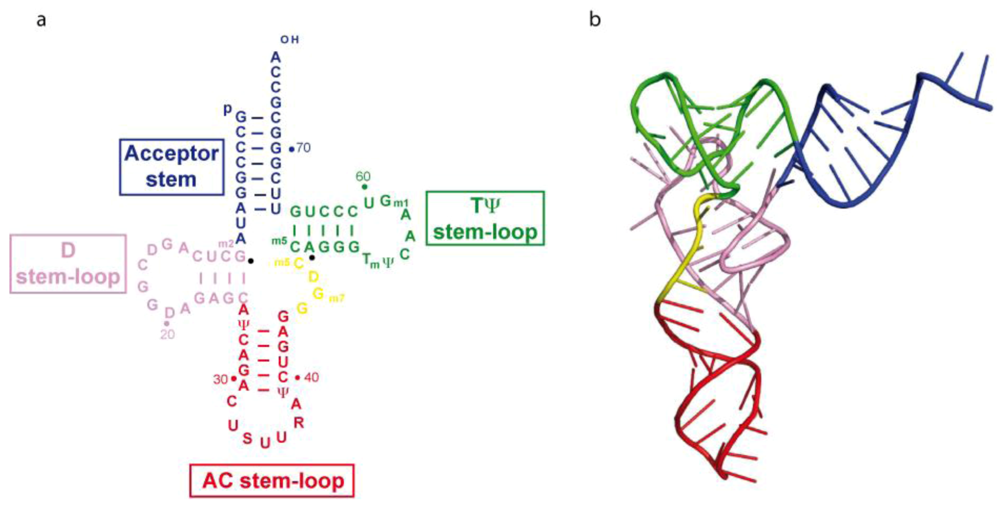
        <p>tRNA<sub>3</sub><sup>Lys</sup> folds into a classical two-dimensional cloverleaf structure, with acceptor, D, anticodon and TΨC arms (<xref ref-type="fig" rid="figure1">Figure 1</xref>a). The three-dimensional structure of tRNA<sub>3</sub><sup>Lys</sup> has been solved to 3.3 Å resolution [<xref ref-type="bibr" rid="B10">10</xref>]. As expected, tRNA<sub>3</sub><sup>Lys</sup> adopts the canonical L-shaped structure that was first highlighted in yeast tRNA<sup>Phe</sup> (<xref ref-type="fig" rid="figure1">Figure 1</xref>b). More importantly, the crystal structure reveals that the anticodon loop of human tRNA<sub>3</sub><sup>Lys</sup> is also perfectly canonical. This contradicts early findings from two different groups, both of which have been studying, by NMR, the solution structure of either an undermodified pentanucleotide mimicking the anticodon loop [<xref ref-type="bibr" rid="B11">11</xref>] or a much larger oligonucleotide, lacking any modifications at positions U34 and A37 [<xref ref-type="bibr" rid="B12">12</xref>]. The recently published NMR structure of an entire, unmodified, tRNA<sub>3</sub><sup>Lys </sup>[<xref ref-type="bibr" rid="B13">13</xref>] is in complete agreement with the standard three-dimensional structure of a tRNA revealed by X-ray crystallography. </p>
        <fig id="figure1" position="float">
          <label>Figure 1</label>
          <caption>
            <p>Secondary <bold>(a)</bold> and tertiary <bold>(b)</bold> structures of tRNA<sub>3</sub><sup>Lys</sup>.</p>
          </caption>
          <graphic xmlns:xlink="http://www.w3.org/1999/xlink" xlink:href="viruses-02-00213-g001.tif" scale="0"/>
        </fig>
      </sec>
      <sec>
        <title>2.2. The role of Gag-Pol </title>
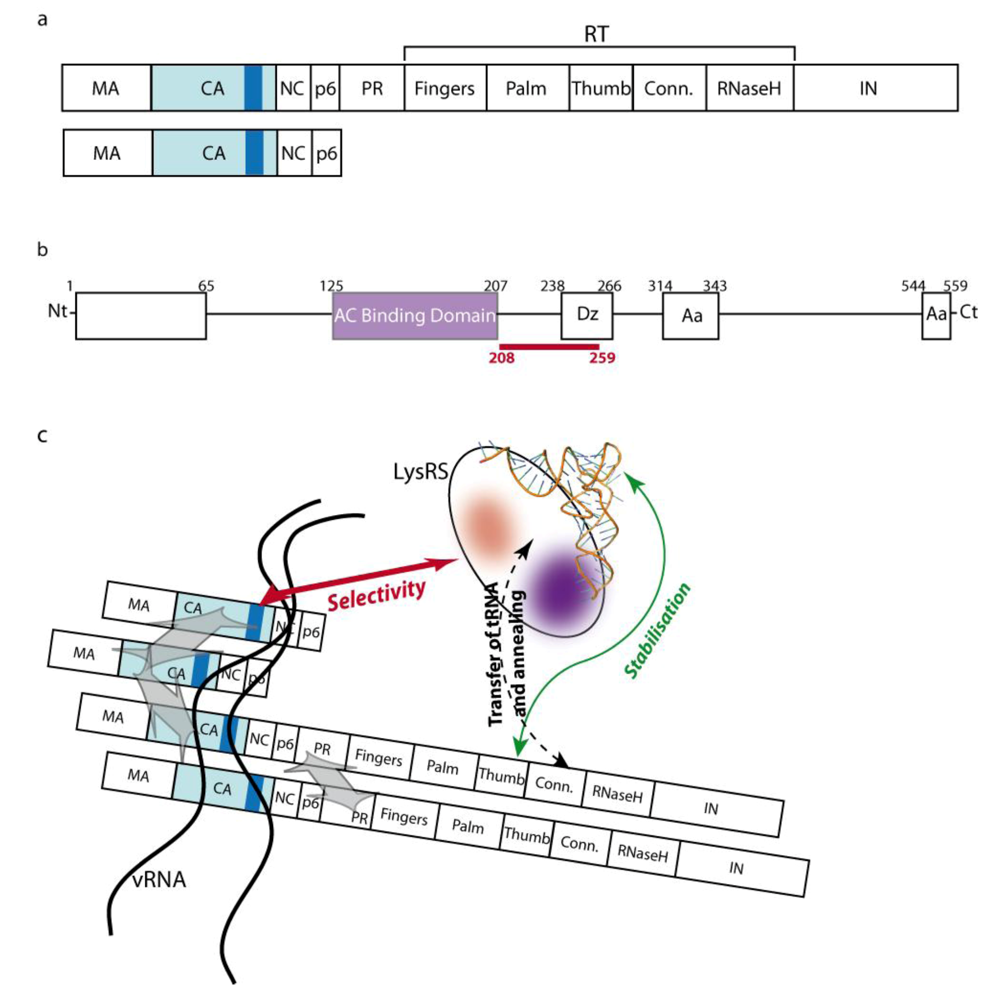
        <p>Selection of tRNA<sup>Lys</sup> does not depend on viral RNA packaging or maturation of protein precursors [<xref ref-type="bibr" rid="B9">9</xref>], but requires the unprocessed Gag and Gag-Pol precursors (<xref ref-type="fig" rid="figure2">Figure 2</xref>a) [<xref ref-type="bibr" rid="B8">8</xref>,<xref ref-type="bibr" rid="B14">14</xref>,<xref ref-type="bibr" rid="B15">15</xref>]. Since RT interacts with primer tRNA<sub>3</sub><sup>Lys</sup> during reverse transcription, the RT domain of Gag-Pol had been proposed as a likely candidate for interacting with tRNA<sup>Lys</sup> during selective packaging. Accordingly, the thumb domain of RT, shown to interact with tRNA<sub>3</sub><sup>Lys</sup><italic>in vitro </italic>[<xref ref-type="bibr" rid="B16">16-18</xref>], was also shown to be important for <italic>in vivo</italic> tRNA packaging [<xref ref-type="bibr" rid="B19">19</xref>]. However, the putative implication of the tRNA<sup>Lys</sup> anticodon/RT thumb interaction [<xref ref-type="bibr" rid="B16">16</xref>,<xref ref-type="bibr" rid="B18">18</xref>] has been questioned, since mutations in the RT thumb domain at positions found to inhibit the interaction of mature RT with the tRNA<sub>3</sub><sup>Lys</sup> anticodon <italic>in vitro</italic> [<xref ref-type="bibr" rid="B16">16</xref>], did not affect tRNA<sub>3</sub><sup>Lys</sup> packaging <italic>in vivo</italic> [<xref ref-type="bibr" rid="B19">19</xref>]. A recent model suggests that the interaction between the thumb domain of RT within the Gag-pol precursor and tRNA<sub>3</sub><sup>Lys</sup> only plays a stabilizing role [<xref ref-type="bibr" rid="B20">20</xref>]. </p>
      </sec>
      <sec>
        <title>2.3. The role of LysRS </title>
        <p>In mammalian cells, LysRS (<xref ref-type="fig" rid="figure2">Figure 2</xref>b), which aminoacylates tRNA<sup>Lys</sup>, is involved in a multi-aminoacyl tRNA-synthetase complex comprising 11 enzymes, amongst which only LysRS is found in HIV-1 viral particles [<xref ref-type="bibr" rid="B21">21-23</xref>]. Notably, about 25 molecules of LysRS are found per virion, a number close to that of tRNA<sup>Lys </sup>molecules, suggesting the existence of an equimolar complex between these two partners. However, and importantly, the incorporation of LysRS into the virion does not require tRNA<sup>Lys</sup> packaging [<xref ref-type="bibr" rid="B22">22</xref>]. On the other hand, packaging of tRNA<sup>Lys</sup> appears to be controlled by LysRS, since the amount of primer tRNA that is encapsidated is affected by variations in the number of packaged LysRS molecules [<xref ref-type="bibr" rid="B23">23-25</xref>]. In addition, RNA interference experiments designed to decrease cellular expression of LysRS not only reduced tRNA<sup>Lys</sup> packaging, but also viral infectivity [<xref ref-type="bibr" rid="B25">25</xref>]. Precise mapping revealed that the N-terminal tRNA binding domain of LysRS [<xref ref-type="bibr" rid="B26">26-28</xref>], as well as the tRNA<sub>3</sub><sup>Lys</sup> anticodon known to be the major determinant for LysRS recognition [<xref ref-type="bibr" rid="B29">29</xref>], is required for tRNA packaging.</p>
        <p>Newly synthesized cytoplasmic LysRS was long believed to be the form that is encapsidated into the HIV-1 viral particles. Human cytoplasmic and mitochondrial LysRSs result from the same gene and are produced by alternative splicing, with the very N-terminus of the two forms being different. Production of antibodies able to discriminate between the two proteins pointed to the mitochondrial enzyme, in either its pre-mitochondrial or mature form lacking the signal peptide which is cleaved during import, as the packaged enzyme [<xref ref-type="bibr" rid="B30">30</xref>]. Selective packaging of the mitochondrial form of LysRS into the viral particles could be explained by the fact that the cytoplasmic LysRS is involved in the multi-aminoacyl tRNA-synthetase complex, which would impede its interaction with HIV or other targeting proteins. </p>
      </sec>
      <sec>
        <title>2.4. The packaging complex</title>
        <p>Gag alone was proven to be sufficient for LysRS packaging [<xref ref-type="bibr" rid="B22">22</xref>] and Kleiman and co-workers mapped the Gag/LysRS interactions <italic>in vitro</italic> and <italic>in</italic> <italic>vivo</italic>. Their results revealed that the two partners interact through the dimerisation domains of both LysRS and the CA domain of the Gag precursor [<xref ref-type="bibr" rid="B31">31</xref>]. Fine mapping indicated that Helix 7 of the LysRS dimerisation domain interacts with Helix 4 of the C-terminal dimerisation domain of the CA [<xref ref-type="bibr" rid="B32">32</xref>,<xref ref-type="bibr" rid="B33">33</xref>]. This interaction is thought to be responsible for the selectivity of the packaging process. A weaker interaction between LysRS and the thumb-RNase H domain of RT, only observed when both peptides were expressed in the cell, was also reported [<xref ref-type="bibr" rid="B20">20</xref>]. Based on the data described so far, a model for the packaging complex has been proposed [<xref ref-type="bibr" rid="B4">4</xref>,<xref ref-type="bibr" rid="B5">5</xref>] (<xref ref-type="fig" rid="figure2">Figure 2</xref>c). In this model, two sub-complexes are involved: 1) the Gag/Gag-Pol/vRNA complex is maintained together <italic>via</italic> well documented Gag/Gag interactions (occurring between the CA, NC and p6 domains [<xref ref-type="bibr" rid="B34">34</xref>]), Gag-Pol/Gag-Pol interactions (occurring via the PR dimerisation domain [<xref ref-type="bibr" rid="B35">35</xref>]) and Gag/vRNA interactions [<xref ref-type="bibr" rid="B36">36-40</xref>]; 2) the tRNA<sub>3</sub><sup>Lys</sup>/LysRS complex is maintained together <italic>via</italic> an interaction between the anticodon of tRNA<sub>3</sub><sup>Lys</sup> and the N-terminal anticodon binding domain of the synthetase [<xref ref-type="bibr" rid="B4">4</xref>]. As mentioned before, the two complexes interact via a Gag/LysRS interaction that is responsible for the selective incorporation of LysRS and hence tRNA<sub>3</sub><sup>Lys</sup> into the viral particles, whereas the thumb-RNase H domain of RT within Gag-Pol only stabilizes the interaction [<xref ref-type="bibr" rid="B20">20</xref>]. Finally, it was shown that although the RT connection domain is dispensable for tRNA packaging, it is required for its annealing to the vRNA [<xref ref-type="bibr" rid="B41">41</xref>].</p>
        <fig id="figure2" position="float">
          <label>Figure 2</label>
          <caption>
            <p>Partners and model for the tRNA<sub>3</sub><sup>Lys</sup> packaging complex <bold>(a)</bold> Organisation of the Gag-Pol and Gag precursors. MA: matrix ; CA: capsid ; NC: nucleocapsid ; p6: HIV-1 p6 protein ; PR: protease; RT: reverse transcriptase, with its Fingers, Palm, Thumb, Connection (Conn.) and RNase H domains; IN: integrase. The dark blue rectangle in the capsid domain of the precursors corresponds to the C-terminal helix 4 that was shown to interact with lysyl-tRNA synthetase (LysRS) <bold>(b)</bold>Organisation of LysRS: the anticodon (AC) binding domain is located between positions 125 and 207 and the LysRS dimerisation (Dz) domain between positions 238 and 266. The two boxes toward the C-terminus of the protein, between positions 314 and 343 and 544 and 559 are important for amino acid recognition. The area highlighted in red (208-259), overlapping the dimerisation domain, is involved in binding to the capsid.<bold> (c) </bold>Model for the packaging complex. The purple patch corresponds to the anticodon binding domain and the red patch to amino acids 208-259 that interact with the CA domain of Gag. </p>
          </caption>
          <graphic xmlns:xlink="http://www.w3.org/1999/xlink" xlink:href="viruses-02-00213-g002.tif" scale="0"/>
        </fig>        
      </sec>
      <sec>
        <title>2.5. tRNA<sub>3</sub><sup>Lys</sup> amino-acylation</title>
        <p>While previous studies indicated that, on the contrary to cellular tRNA<sup>Lys</sup>, tRNA<sup>Lys</sup> purified from virions is uncharged [<xref ref-type="bibr" rid="B9">9</xref>], it is not clear whether charged or uncharged tRNA<sup>Lys</sup> is initially packaged. It was shown that the mature HIV-1 RT was unable to extend acylated tRNA<sub>3</sub><sup>Lys</sup> and did not increase deacylation [<xref ref-type="bibr" rid="B42">42</xref>]. Thus, a possible role of tRNA<sub>3</sub><sup>Lys</sup> acylation could be to prevent premature initiation of reverse transcription [<xref ref-type="bibr" rid="B42">42</xref>,<xref ref-type="bibr" rid="B43">43</xref>]. The fact that only deacylated tRNA<sub>3</sub><sup>Lys</sup> was found within viral particles does not contradict this assertion, since spontaneaous deacylation of tRNA<sub>3</sub><sup>Lys</sup> could easily occur during the time lapse necessary for virion collection and purification. </p>
      </sec>
    </sec>
    <sec>
      <title>3. Secondary structure of the PBS domain</title>
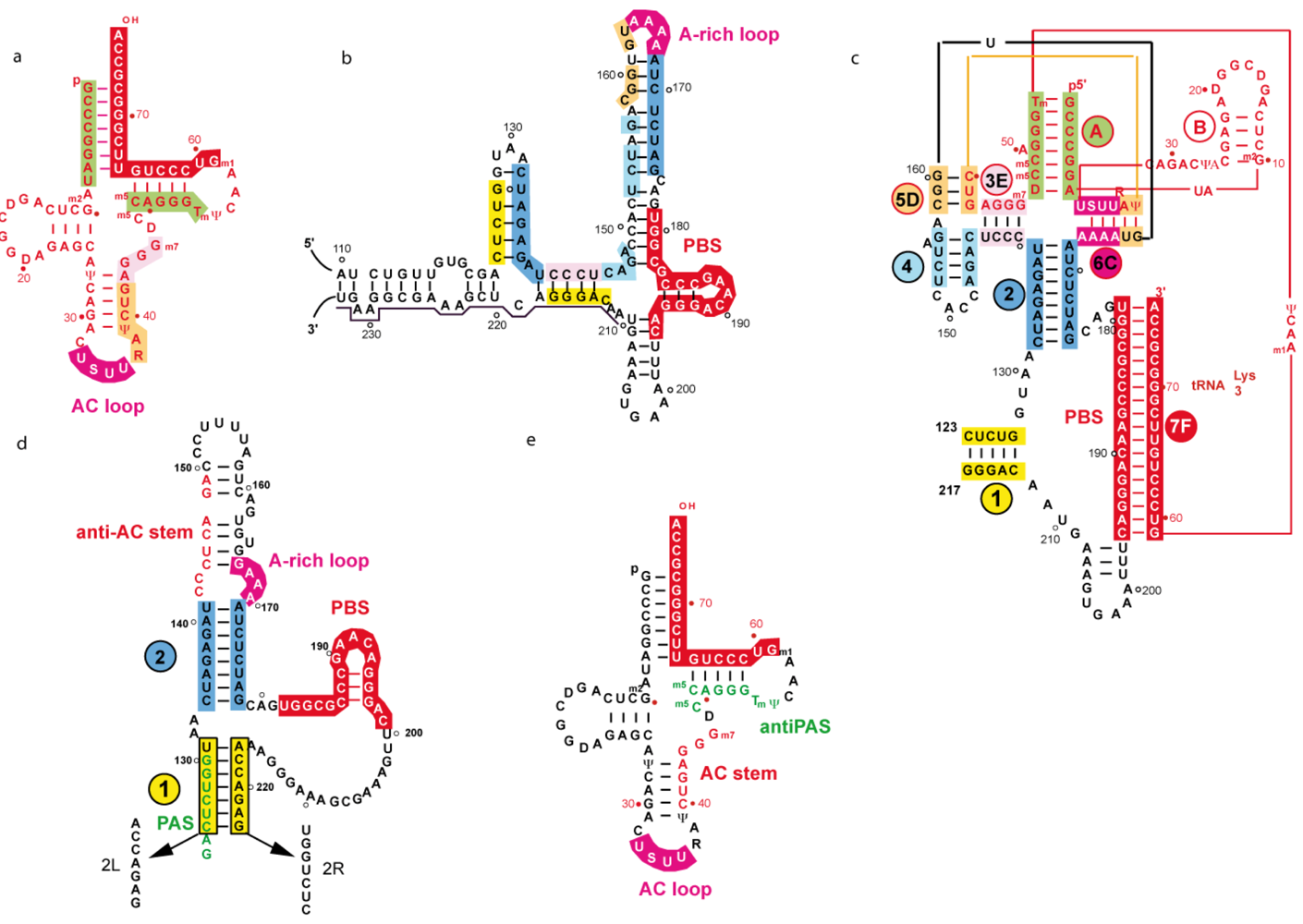
      <p>Detailed <italic>in vitro </italic>and<italic> in situ</italic> structural studies were conducted on HIV-1 MAL, a recombinant virus with a PBS domain of subtype A origin [<xref ref-type="bibr" rid="B43">43</xref>,<xref ref-type="bibr" rid="B44">44</xref>], and subtype B isolates Lai, HxB2 and NL4-3 [<xref ref-type="bibr" rid="B44">44-47</xref>]. Although the different isolates display strong sequence homologies, the MAL isolate differs from the subtype B isolates by a 23-nucleotide insertion downstream of the PBS (nucleotides 211 to 233, underlined in figure 4b) resulting from a partial duplication of the PBS sequence and several point mutations (<xref ref-type="fig" rid="figure4">Figure 4</xref>b, d). Sequence alignments reveal that 14% of all HIV-1 isolates possess this insertion [<xref ref-type="bibr" rid="B48">48</xref>]. However, as this insertion is absent from subtype B isolates, which are over-represented in the databank, but present in the subtypes and circulating recombinant forms most actively involved in spreading of HIV-1, the biological importance of isolates presenting a MAL-like insertion is greater than suggested by the databank [<xref ref-type="bibr" rid="B48">48</xref>]. These sequence differences account for the different secondary structure models proposed by different groups, with a conserved A-stretch located 10 nucleotides upstream of the PBS either in an apical loop in the case of MAL (<xref ref-type="fig" rid="figure4">Figure 4</xref>b) [<xref ref-type="bibr" rid="B44">44</xref>,<xref ref-type="bibr" rid="B49">49</xref>] or in an internal loop for the Lai, NL4-3 or HxB2 isolates [<xref ref-type="bibr" rid="B39">39</xref>,<xref ref-type="bibr" rid="B44">44-47</xref>,<xref ref-type="bibr" rid="B50">50-52</xref>] (<xref ref-type="fig" rid="figure4">Figure 4</xref>d). Notably, the secondary structures shown in <xref ref-type="fig" rid="figure4">Figure 4</xref>b and 4d, first deduced from classical <italic>in vitro</italic> probing studies, are supported by recent experiments conducted on viral RNA directly modified within infected cells [<xref ref-type="bibr" rid="B45">45-48</xref>]. </p>
    </sec>
    <sec>
      <title>4. The Primer/Template Complex</title>
      <sec>
        <title>4.1. From initiation to elongation </title>
        <p>When reverse transcription was tested <italic>in vitro</italic> using purified natural tRNA<sub>3</sub><sup>Lys</sup>, a synthetic vRNA fragment and purified recombinant RT, it appeared that (-) ssDNA synthesis proceeds in a two step manner [<xref ref-type="bibr" rid="B53">53-56</xref>] (<xref ref-type="fig" rid="figure3">Figure 3</xref>): 1) an initiation phase, during which RT dissociates rapidly from the primer/template duplex, corresponds to the slow and distributive addition of the first 6 nucleotides. Initiation was found to be specific, since non-homologous RTs, like AMV and MLV RTs, did not extend the natural tRNA<sub>3</sub><sup>Lys</sup> primer efficiently; 2) an unspecific elongation phase, where dissociation of RT is slow, leading to processive DNA synthesis. During elongation, there is no specific recognition between HIV-1 RT and the primer/template duplex and any RT performs in the same manner. It was shown that the modified nucleotides of the natural tRNA were required for the specificity and efficiency of the initiation step [<xref ref-type="bibr" rid="B53">53-55</xref>,<xref ref-type="bibr" rid="B57">57</xref>] and that a DNA oligonucleotide strictly complementary to the PBS was representative of the elongation step (<xref ref-type="fig" rid="figure3">Figure 3</xref>). Such features were also demonstrated for HIV-2 [<xref ref-type="bibr" rid="B58">58</xref>] and FIV [<xref ref-type="bibr" rid="B56">56</xref>], and could be a general characteristic of all retroviruses, since there is also evidence from avian and murine retroviruses [<xref ref-type="bibr" rid="B59">59</xref>].</p>
      </sec>
      <sec>
        <title>4.2. Extended HIV-1 RNA/tRNA<sub>3</sub><sup>Lys</sup> interactions and their implication in initiation of reverse transcription in vitro </title>
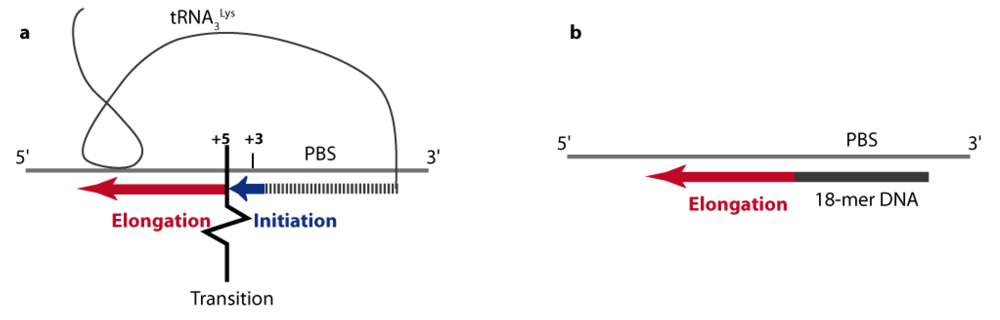
        <p>The idea that the PBS is not the sole determinant for primer usage was supported by observations from different laboratories. Indeed, transfection of proviral DNA with PBS sequences mutated to be complementary to the 3’ end of tRNAs other than the natural tRNA<sub>3</sub><sup>Lys</sup>yielded HIV-1 viruses with dramatically reduced replication kinetics that eventually reverted back to the wild-type PBS sequence [<xref ref-type="bibr" rid="B60">60-62</xref>]. Notably a similar observation was made with avian viruses [<xref ref-type="bibr" rid="B63">63</xref>] but not with murine viruses [<xref ref-type="bibr" rid="B64">64</xref>,<xref ref-type="bibr" rid="B65">65</xref>]. Various intermolecular primer/template interactions in HIV-1 were proposed by different groups to modulate the efficiency of reverse transcription <italic>in vitro</italic>, leading to apparently conflicting results.</p>
        <fig id="figure3" position="float">
          <label>Figure 3</label>
          <caption>
            <p>Schematic representation of HIV-1 specific initiation<bold> (a)</bold><italic>versus</italic> unspecific elongation <bold>(b)</bold> of reverse transcription. The vRNA template is represented by a thin grey line. The natural tRNA<sub>3</sub><sup>Lys</sup> primer or an 18 mer DNA primer are in black and the newly synthesized DNA is represented by thick blue and red lines representative of the initiation and elongation steps of reverse transcription, respectively. In the presence of the natural tRNA primer, transition between initiation and elongation occurs after the addition of the first 6 nucleotides to the 3’ end of the primer. In the case of the HIV-1 MAL isolate, transition is facilitated by the anticodon/A-rich loop interaction upstream of the PBS, represented by the close contact between tRNA<sub>3</sub><sup>Lys</sup> and the vRNA. </p>
          </caption>
          <graphic xmlns:xlink="http://www.w3.org/1999/xlink" xlink:href="viruses-02-00213-g003.tif" scale="0"/>
        </fig>
        <sec>
          <title>4.2.1 Two and three-dimensional structures of a representative subtype A initiation complex</title>
          <p>The first <italic>in vitro</italic> structural data for a tRNA/vRNA duplex were obtained from enzymatic and chemical probing on a heat-annealed complex between tRNA<sub>3</sub><sup>Lys</sup> and a fragment of HIV-1 MAL vRNA containing the complete 5’-UTR [<xref ref-type="bibr" rid="B66">66</xref>,<xref ref-type="bibr" rid="B67">67</xref>]. They revealed intricate intermolecular interactions between tRNA<sub>3</sub><sup>Lys</sup> and viral sequences located upstream of the PBS (<xref ref-type="fig" rid="figure4">Figure 4</xref>a-c). An identical conformation of the binary complex was observed when the primer was annealed to the vRNA with the nucleocapsid protein [<xref ref-type="bibr" rid="B68">68</xref>]. The stability of the proposed extended interactions was found to depend on the post-transcriptional modifications of tRNA<sub>3</sub><sup>Lys</sup>[<xref ref-type="bibr" rid="B67">67</xref>,<xref ref-type="bibr" rid="B69">69</xref>] and on the complementarity between the anticodon loop of the primer and the conserved A-rich loop of the vRNA located in the apex of the U5 stem [<xref ref-type="bibr" rid="B66">66</xref>,<xref ref-type="bibr" rid="B70">70</xref>].</p>
      <fig id="figure4" position="float">
        <label>Figure 4</label>
        <caption>
          <p>Secondary structure of the RNA partners of the HIV-1 initiation complex of reverse transcription and of the binary primer/template complexes, in the case of the HIV-1 MAL (representative of a subtype A PBS domain) and subtype B isolates.The regions undergoing intra- or intermolecular rearrangements upon formation of the primer/template complex are highlighted in various colours. Boxes or sequences of the same color represent areas that are base-paired in the binary complex.<bold> (a)</bold> The human tRNA<sub>3</sub><sup>Lys</sup>. <bold>(b)</bold> The PBS sub-domain in the free form of the HIV-1 MAL vRNA. <bold>(c) </bold>The HIV-1 MAL vRNA/tRNA<sub>3</sub><sup>Lys</sup> complex. <bold>(d)</bold> The PBS sub-domain in the free form of the HIV-1 NL-4.3 (subtype B) isolate. The PAS and mutations 2L and 2R are indicated. <bold>(e)</bold> Localization of the anti-PAS region of tRNA<sub>3</sub><sup>Lys</sup>.</p>
        </caption>
        <graphic xmlns:xlink="http://www.w3.org/1999/xlink" xlink:href="viruses-02-00213-g004.tif" scale="0"/>
      </fig>
          <p>The NMR structure of a stem-loop containing the A-rich sequence of the MAL isolate revealed that the structure of the loop resembles the one of a tRNA anticodon loop, with a non-canonical G-A pair closing the loop and a U-turn motif leading to the continuous stacking of 164-AAA-166 onto A167 [<xref ref-type="bibr" rid="B71">71</xref>]. This pre-stacked structure renders the loop a good candidate for base-pairing, most likely with the U-rich anticodon loop of tRNA<sub>3</sub><sup>Lys</sup>, in the same way as any tRNA anticodon would base-pair with messenger RNA. The solution structure of a duplex representative of the A-rich loop/tRNA interaction pointed to the importance of base modifications for stabilization of the vRNA/tRNA complex, in agreement with previously published work [<xref ref-type="bibr" rid="B57">57</xref>,<xref ref-type="bibr" rid="B67">67</xref>,<xref ref-type="bibr" rid="B69">69</xref>]. Indeed, the thio-group of U34 plays a crucial role in the stabilization of the loop-loop interaction that makes helix 6C (<xref ref-type="fig" rid="figure4">Figure 4</xref>c), whereas Ψ39 contributes to it [<xref ref-type="bibr" rid="B72">72</xref>]. Accordingly, <italic>in vitro</italic> reverse transcription experiments revealed that the modified nucleotides of tRNA<sub>3</sub><sup>Lys</sup> and extended primer-template interactions are required for efficient initiation and transition to elongation of reverse transcription respectively [<xref ref-type="bibr" rid="B53">53</xref>,<xref ref-type="bibr" rid="B57">57</xref>].</p>
          <p>A three-dimensional model of the MAL vRNA/ tRNA<sub>3</sub><sup>Lys</sup> /RT ternary complex was proposed, based on probing data and footprinting experiments [<xref ref-type="bibr" rid="B73">73</xref>]. Strikingly, none of the extended intermolecular interactions (helices 3E, 5D and 6C in <xref ref-type="fig" rid="figure4">Figure 4</xref>c) are directly recognized by RT. Their assumed role is to impose a particular primer/template conformation that correctly places the intermolecular helix containing the PBS (helix 7F) and the 3’-OH group of the primer into the RNA-binding cleft of RT. Mutational analysis pointed to the three-nucleotide junction between helices 2 and 7F and the intermolecular RNA/tRNA interactions forming helix 6C as the most critical elements for efficient initiation of reverse transcription (<xref ref-type="fig" rid="figure3">Figure 3</xref>c) [<xref ref-type="bibr" rid="B44">44</xref>,<xref ref-type="bibr" rid="B53">53</xref>]. These results are in keeping with the three-dimensional model and agree with the idea that the intermolecular interactions impose a precise tertiary structure and/or counteract possible inhibitory effects of the vRNA structure that could otherwise lead to steric clashes between RT and RNA. </p>
        </sec>
        <sec>
          <title>4.2.2. Secondary structure of tRNA/vRNA complexes representative of subtype B isolates</title>
          <p>Structural probing performed <italic>in vitro</italic> on vRNA associated to tRNA<sub>3</sub><sup>Lys</sup> by thermal annealing [<xref ref-type="bibr" rid="B48">48</xref>] led to the same results as <italic>in situ</italic> probing on vRNA/tRNA complexes isolated from virions [<xref ref-type="bibr" rid="B45">45</xref>,<xref ref-type="bibr" rid="B48">48</xref>]. In contrast to the subtype A situation, only the interaction involving the PBS could be observed for subtype B, with no structural rearrangement accompanying tRNA<sub>3</sub><sup>Lys</sup> annealing [<xref ref-type="bibr" rid="B48">48</xref>]. Recently, two studies using the SHAPE technology were performed on genomic vRNA extracted from virions and deproteinized. Although they generally gave very similar results, the secondary structure models derived from these experiments vary in the PBS region [<xref ref-type="bibr" rid="B46">46</xref>,<xref ref-type="bibr" rid="B47">47</xref>]. Data from the first publication lead to the proposal of two additional primer/template interactions, on top of the PBS interaction: one between the A-rich sequence and the U-rich anticodon loop of tRNA<sub>3</sub><sup>Lys</sup>, the other between the 3’ anticodon stem and part of the variable loop and a sequence upstream of the PBS, as suggested by Iwatani and co-workers [<xref ref-type="bibr" rid="B74">74</xref>]. The second set of data does not account for any primer/template interactions beside the one involving the PBS. The difference between the two sets of data may lie in a slightly different protocol for virus preparation and deproteinization. </p>
          <p>It was suggested that in MAL the extended interactions with tRNA<sub>3</sub><sup>Lys</sup>, which incidentally were also confirmed by <italic>in situ</italic> probing [<xref ref-type="bibr" rid="B48">48</xref>], are required to trigger the structural rearrangements generating the three-dimensional elements ultimately recognized by RT. These rearrangements would be necessary to prevent steric clashes. The absence of structural rearrangements in NL4-3/HxB2 was accounted for by the fact that essential structural elements such as helices 1 and 2 and the three single-stranded nucleotides at the junction between the PBS helix and helix 2, found in the MAL RNA/ tRNA<sub>3</sub><sup>Lys</sup>complex, preexist in subtype B vRNA prior to tRNA<sub>3</sub><sup>Lys</sup> annealing [<xref ref-type="bibr" rid="B44">44</xref>,<xref ref-type="bibr" rid="B48">48</xref>] (<xref ref-type="fig" rid="figure4">Figure 4</xref>c, d). In line with this interpretation, an 18-mer RNA oligonucleotide complementary to the PBS efficiently primed reverse transcription of NL4-3/HxB2 RNAs [<xref ref-type="bibr" rid="B75">75</xref>,<xref ref-type="bibr" rid="B6">6</xref>], but that of MAL RNA [<xref ref-type="bibr" rid="B53">53</xref>].</p>
          <p>The possible role of the A-rich loop was nevertheless investigated in the two very similar HxB2 and NL4-3 RNAs, leading to unexpectedly divergent observations. The deletion of the AAAA sequence severely reduced initiation of reverse transcription [<xref ref-type="bibr" rid="B75">75</xref>,<xref ref-type="bibr" rid="B76">76</xref>]. However, the final amount of (-) ssDNA synthesis was found to be only modestly decreased, presumably due to the elimination of strong pausing sites after the addition of 11 to 14 nucleotides [<xref ref-type="bibr" rid="B76">76</xref>]. This deletion was also reported to have only a modest effect on (-) ssDNA synthesis in the presence of NCp [<xref ref-type="bibr" rid="B77">77</xref>]. By contrast, an AAAA to UUUU substitution on NL4-3 RNA was found to enhance the efficiency of (-) ssDNA synthesis, in the absence and presence of NCp [<xref ref-type="bibr" rid="B74">74</xref>]. It is possible that the deletion of the AAAA sequence induces structural perturbation of primer/template complex, thus explaining these differences.</p>
        </sec>
        <sec>
          <title>4.2.3. The PAS/anti-PAS interaction</title>
          <p>An alternative intermolecular interaction between the TΨC loop in tRNA<sub>3</sub><sup>Lys</sup> and a conserved 8-nucleotide sequence within helix 1, downstream of the PBS (123GACUCUGG130) (<xref ref-type="fig" rid="figure4">Figure 4</xref>d, e), termed the Primer Activation Signal (PAS), was proposed to be important for regulated reverse transcription [<xref ref-type="bibr" rid="B43">43</xref>,<xref ref-type="bibr" rid="B50">50</xref>]. Mutation of the PAS sequence (mutant 2L, <xref ref-type="fig" rid="figure4">Figure 4</xref>d) strongly reduced the efficiency of the initiation of reverse transcription, while mutation of the opposite strand (mutant 2R, <xref ref-type="fig" rid="figure4">Figure 4</xref>d) enhanced reverse transcription, both <italic>in vitro</italic> and using virion-extracted primer/template complexes. The latter effect is most likely due to disruption of helix 1 and exposure of the PAS sequence [<xref ref-type="bibr" rid="B43">43</xref>,<xref ref-type="bibr" rid="B50">50</xref>]. The double mutation (2LR), theoretically restoring base-pairing, did not sustain efficient reverse transcription, suggesting that the sequence rather than the helical structure is important for reverse transcription. It was also shown that the efficiency of reverse transcription could be modulated by PAS mutations engineered to strengthen or weaken the interaction with the anti-PAS [<xref ref-type="bibr" rid="B78">78</xref>]. However these mutations not only interfere with the PAS/antiPAS interaction, but also affect the stability of helix 1 that is directly recognised by RT [<xref ref-type="bibr" rid="B44">44</xref>,<xref ref-type="bibr" rid="B48">48</xref>]. Recently, other sequences downstream of the PBS were reported to regulate initiation of reverse transcription <italic>in vitro</italic>, by affecting the accessibility of the PAS motif [<xref ref-type="bibr" rid="B79">79</xref>]. Finally, attempts to complement, <italic>in vitro</italic>, the 2L mutation in the PAS sequence by a corresponding change in the antiPAS of a synthetic tRNA<sub>3</sub><sup>Lys</sup> primer (2L- tRNA<sub>3</sub><sup>Lys</sup>) were not successful [<xref ref-type="bibr" rid="B78">78</xref>]. The similarity between the PAS/anti-PAS interaction in HIV-1 and the interaction proposed for Rous sarcoma virus genomic RNA and its tRNA<sup>Trp</sup> primer [<xref ref-type="bibr" rid="B80">80</xref>], together with the conservation of the PAS sequence among several retroviruses, led to the proposal that retroviral reverse transcription could be regulated by a common mechanism [<xref ref-type="bibr" rid="B78">78</xref>].</p>
          <p>These conclusions were challenged by another study conducted on the same HxB2 vRNA variants [<xref ref-type="bibr" rid="B81">81</xref>]. In agreement with the previous studies [<xref ref-type="bibr" rid="B43">43</xref>,<xref ref-type="bibr" rid="B50">50</xref>], <italic>in vitro</italic> (-) ssDNA synthesis was severely affected by mutation 2L and was not restored by the double mutation 2LR, whether tRNA<sub>3</sub><sup>Lys</sup> or an 18-mer RNA oligoribonucleotide complementary to the PBS were used as primers. However, this reduction was correlated with enhanced pausing, while the initial rate of primer extension was unaffected [<xref ref-type="bibr" rid="B81">81</xref>]. On the contrary to previous results [<xref ref-type="bibr" rid="B43">43</xref>,<xref ref-type="bibr" rid="B50">50</xref>], mutation 2R was found to reduce (-) ssDNA synthesis, with a five-fold decrease of the initial rate of primer extension [<xref ref-type="bibr" rid="B79">79</xref>]. This observation is consistent with <italic>in vitro</italic> data from another group indicating that efficient tRNA<sub>3</sub><sup>Lys</sup>-primed (-) ssDNA synthesis required the 24 nucleotides downstream of the PBS (which include the sequence concerned by mutation 2R) [<xref ref-type="bibr" rid="B74">74</xref>]. </p>
        </sec>
        <sec>
          <title>4.2.4. The interaction involving the tRNA anticodon stem and the variable loop</title>
          <p>As mentioned above, efficient (-) ssDNA synthesis was shown to require the 24 nucleotides downstream of the PBS when using NL4-3 vRNA template and tRNA<sub>3</sub><sup>Lys</sup> as a primer [<xref ref-type="bibr" rid="B74">74</xref>]. The same template sequence was also found to be required with an all-RNA 18-mer primer (R18) complementary to the PBS or a chimeric primer containing nine deoxyribonucleotides at the 3’ end, but not with a DNA primer or a chimeric primer containing deoxyribonucleotides at the 5’ end. This was consistent with the fact that (-) ssDNA synthesis is sensitive to the nature of the helical conformation of the primer/template duplex [<xref ref-type="bibr" rid="B53">53-55</xref>,<xref ref-type="bibr" rid="B82">82</xref>]. Interestingly, the requirement for the downstream sequence is alleviated by the nucleocapsid protein (NCp) when natural or unmodified tRNA<sub>3</sub><sup>Lys</sup>, but not the R18 primer, were used as primers [<xref ref-type="bibr" rid="B74">74</xref>]. Remarkably, mutation of nucleotides 142-148 complementary to the 3’ strand of the anticodon stem and the variable loop of tRNA<sub>3</sub><sup>Lys</sup> (<xref ref-type="fig" rid="figure4">Figure 4</xref>d, e) abolished the rescue by NCp in the absence of the downstream sequence [<xref ref-type="bibr" rid="B74">74</xref>]. Thus, NCp seems to be able to increase reverse transcription by facilitating extended interactions between tRNA<sub>3</sub><sup>Lys</sup> and upstream template sequences. These results address the question of the conditional requirement for highly conserved sequences forming helix 1, depending on the presence or absence of NCp. A possible explanation given by Iwatani <italic>et al.</italic> [<xref ref-type="bibr" rid="B74">74</xref>] is that helix 1 (<xref ref-type="fig" rid="figure4">Figure 4</xref>d) might be important for the maintenance of a structure stabilizing the initiation complex in the absence of NCp. </p>
        </sec>
      </sec>
      <sec>
        <title>4.3. Biological significance of extended HIV-1 RNA / tRNA<sub>3</sub><sup>Lys</sup> interactions for virus replication </title>
        <p>The importance of extended interactions for viral replication was addressed by two different approaches: 1) sequence deletions containing the elements proposed to participate to these interactions, and 2) investigation of HIV-1 variant viruses that use a non-self tRNA primer for reverse transcription. </p>
        <sec>
          <title>4.3.1. HIV-1 viruses carrying sequence deletions upstream and downstream of the PBS<italic/></title>
          <p>The deletion of the A-rich loop (169AAAA172) in HxB2 RNA resulted in diminished levels of infectivity and reduced synthesis of viral DNA [<xref ref-type="bibr" rid="B75">75</xref>]. After long-term culture, 167GG168 were substituted by two As, restoring wild-type reverse transcription and replication levels [<xref ref-type="bibr" rid="B73">73</xref>]. These results argued in favour of the importance of the conserved A-rich loop in HIV-1 replication. Besides, an earlier study showed that a 26-nucleotide deletion in the 3’ part of the U5 region (∆153-179) of NL4-3<sub/>vRNA produced a severe defect in infectivity. However, the deletion was found to affect integration but did not impair viral DNA synthesis in acutely infected cells, despite the absence of the A-rich sequence. This study also indicated that deletion of a 25-nucleotide fragment adjacent to the previous one (∆127-152) had no detectable effect on virus replication [<xref ref-type="bibr" rid="B81">81</xref>]. Incidentally, this deletion contains seven nucleotides proposed to interact with the 3’ strand of the anticodon stem and variable loop of tRNA<sub>3</sub><sup>Lys</sup>, and six of the eight nucleotides of the PAS sequence [<xref ref-type="bibr" rid="B83">83</xref>] (<xref ref-type="fig" rid="figure4">Figure 4</xref>). </p>
        </sec>
        <sec>
          <title>4.3.2. HIV-1 variant viruses that use a non-self tRNA primer for reverse transcription</title>
          <p>Evidence for a role of the A-rich loop/anticodon interaction was brought by experiments showing that HIV-1HxB2 could replicate by stably utilizing non-cognate tRNAs as primers, provided that the PBS and the A-rich loop were simultaneously mutated to match both the 3’-end and the anticodon loop of the chosen tRNAs. This held true for tRNA<sup>His</sup>[<xref ref-type="bibr" rid="B84">84-86</xref>], tRNA<sup>Met</sup>[<xref ref-type="bibr" rid="B87">87</xref>,<xref ref-type="bibr" rid="B88">88</xref>], and tRNA<sub>1,2</sub><sup>Lys</sup> [<xref ref-type="bibr" rid="B89">89</xref>]. These studies, together with the A-loop deletion (see above), pointed to the biological importance of the A-rich sequence. However, the results might be biased by the presence of overlapping sequences important for other functions, like integration [<xref ref-type="bibr" rid="B83">83</xref>,<xref ref-type="bibr" rid="B90">90</xref>,<xref ref-type="bibr" rid="B91">91</xref>]. It was also proposed that mutations of the A-rich loop allowed stable usage of non-cognate tRNAs by disfavouring tRNA<sub>3</sub><sup>Lys</sup>, rather than favouring alternate primers [<xref ref-type="bibr" rid="B92">92</xref>]. In addition, mutated viruses rapidly acquired additional mutations that improved their replication efficiencies [<xref ref-type="bibr" rid="B85">85-89</xref>,<xref ref-type="bibr" rid="B93">93</xref>], suggesting that the A-rich sequence/anticodon-loop interaction may not be sufficient for optimal initiation of reverse transcription. The replication defect of these viruses might also be linked to their inability to selectively package their non-self tRNA primers [<xref ref-type="bibr" rid="B94">94</xref>].</p>
          <p>Nevertheless, a direct correlation between the evolution of mutants using tRNA<sup>His</sup> in cell culture [<xref ref-type="bibr" rid="B85">85</xref>,<xref ref-type="bibr" rid="B86">86</xref>,<xref ref-type="bibr" rid="B93">93</xref>], their efficiency in initiating reverse transcription<italic> in vitro,</italic> and the structure of the primer/template complex was observed [<xref ref-type="bibr" rid="B95">95</xref>]. Indeed, viruses that acquired additional adaptive mutations allowing a more stable interaction with the tRNA primer replicated more rapidly and displayed nearly wild-type levels of reverse transcription <italic>in vitro</italic> [<xref ref-type="bibr" rid="B85">85</xref>,<xref ref-type="bibr" rid="B86">86</xref>]. In addition, probing experiments indicated that the mutated A-rich loop forms stable interactions with tRNA<sup>His</sup> only in the presence of these adaptive mutations [<xref ref-type="bibr" rid="B95">95</xref>]. </p>
          <p>Attempts were also made to switch the tRNA primer usage by mutating the PAS sequence. In short term cultures, viruses containing the PBS-PAS double mutations introduced to enforce the use of non-self primers tRNA<sup>Pro</sup> or tRNA<sub>1,2</sub><sup>Lys</sup> replicated more poorly than viruses with mutations in the PBS alone [<xref ref-type="bibr" rid="B96">96</xref>]. This observation is in line with <italic>in vitro</italic> experiments indicating that tRNA<sub>1,2</sub><sup>Lys</sup> primed reverse transcription of an HxB2 RNA template containing the same PBS-PAS double mutation with only ~5 % efficiency compared to the wild-type situation [<xref ref-type="bibr" rid="B78">78</xref>]. However, when using primer/template complexes extracted from virions, the PBS-PAS double mutation restored tRNA<sub>1,2</sub><sup>Lys</sup> extension to wild type levels [<xref ref-type="bibr" rid="B79">79</xref>]. The origin of the difference in the effects of these mutations when using either <italic>in vitro</italic> annealed primer/template or primer/templates extracted from virions is unclear.</p>
          <p>Multiple independent virus evolution experiments selected one PBS variant that was able to stably utilize tRNA<sub>1,2</sub><sup>Lys</sup> and restored high replication rates [<xref ref-type="bibr" rid="B96">96</xref>]. This mutant contained a second site mutation in the PAS sequence (U126C) that might stabilize the PAS/anti-PAS interaction by converting a G-U pair into a G-C pair [<xref ref-type="bibr" rid="B96">96</xref>]. Another second site mutation was identified within the RT gene (G3600A) that was responsible for a G490E change in the RNase H domain. Both mutations improved the replication capabilities of the mutated virus but only the U126C mutation was able to prevent reversion to the wild-type PBS [<xref ref-type="bibr" rid="B96">96</xref>].</p>
          <p>Upon prolonged culture of a virus with the wild type PBS and a mutated PAS sequence, revertant viruses that partially overcame the reverse transcription defects were selected [<xref ref-type="bibr" rid="B43">43</xref>]. Interestingly, revertant viruses all acquired a single nucleotide substitution (C150U) that did not restore the PAS sequence but stimulated elongation of reverse transcription [<xref ref-type="bibr" rid="B43">43</xref>]. This observation fits with the proposal that mutations in the PAS affect elongation of reverse transcription rather than initiation [<xref ref-type="bibr" rid="B81">81</xref>].</p>
          <p>The inability of HIV-1 to accommodate a non-self tRNA primer by substituting the PBS alone undoubtedly demonstrates the importance of additional interactions for the initiation of reverse transcription: MLV, for which no additional interactions have been described [<xref ref-type="bibr" rid="B97">97</xref>] easily utilises different tRNAs as primers [<xref ref-type="bibr" rid="B65">65</xref>], while avian sarcoma virus, for which an interaction between U5 and the TΨC loop has been proposed [<xref ref-type="bibr" rid="B80">80</xref>], does not [<xref ref-type="bibr" rid="B98">98</xref>]. Incidentally, HIV-1 has been shown to infrequently use tRNA<sub>5a</sub><sup>Lys</sup> as primer [<xref ref-type="bibr" rid="B99">99</xref>]; this tRNA only differs from tRNA<sub>3</sub><sup>Lys</sup> by one base-pair in the acceptor stem and has the potential to interacts with both the viral A-rich loop and the PAS sequence.</p>
        </sec>
        <sec>
          <title>4.3.3. Reaching a consensus?</title>
          <p>Although the large collection of findings reviewed above provide evidence that the complementarity between the PBS sequence and the 3’ part of the primer tRNA is not sufficient to determine primer usage, it is difficult to unambiguously rationalize the existence of precise additional interactions. The origin of apparent discrepancies is probably multiple and reflects the high complexity of the process. The most obvious explanation arises from (i) the existence of biases such as the nature of the strains used, (ii) the experimental parameters and tools utilised and (iii) unexpected effects of mutations. In particular, RNA mutations may interfere with a variety of steps other than the targeted one during the replication cycle. In addition the source of the interference can be direct (<italic>i.e.</italic>,<italic> </italic>directly altering a binding site) or indirect (<italic>i.e.</italic>, by triggering an undesired conformation that becomes inactive or induces a steric conflict). Even though a lot of publications already addressed the question of the structure of the complex mediating initiation of reverse transcription, several additional studies might be envisaged. For instance, whereas many detailed kinetic studies have been performed <italic>in vitro</italic> on the HIV-1 MAL isolate, <italic>in vivo</italic> studies of mutations affecting the proposed structure are yet to be performed. Similarly, the effects of mutations affecting the proposed PAS/anti-PAS interaction on the kinetics of reverse transcription have never been studied in infected cells.</p>
          <p>The proposed mutually exclusive interactions might proceed transiently and be required at different steps of the replication cycle. Nevertheless, the results collected from experiments designed to probe the structure of subtype A and subtype B vRNA/tRNA complexes undoubtedly reveal an unexpected structural versatility of the HIV-1 initiation complex. The extraordinary plasticity of the vRNA and its capacity to adapt to a variety of constraints, in particular those imposed by mutations, offers the virus several solutions to precisely match RT and the viral RNA/tRNA primer complex in order to efficiently promote reverse transcription. As an example, the absence of interaction between the A-rich loop of NL4-3 and HxB2 vRNAs and the anticodon loop of tRNA<sub>3</sub><sup>Lys</sup> is at variance with both <italic>in vitro</italic> and <italic>ex vivo</italic> data showing that a double mutation of the PBS and A-rich loop allowed the use of tRNA<sup>His</sup> as a primer for reverse transcription. It was proposed that in this case the loop-loop interaction was used to compensate a negative contribution of tRNA<sup>His</sup>[<xref ref-type="bibr" rid="B95">95</xref>]. This would imply that all tRNAs are not equally suited to prime reverse transcription, in agreement with a study comparing non cognate tRNAs [<xref ref-type="bibr" rid="B100">100</xref>]. </p>
        </sec>
      </sec>
      <sec>
        <title>4.4. The case of HIV-2 </title>
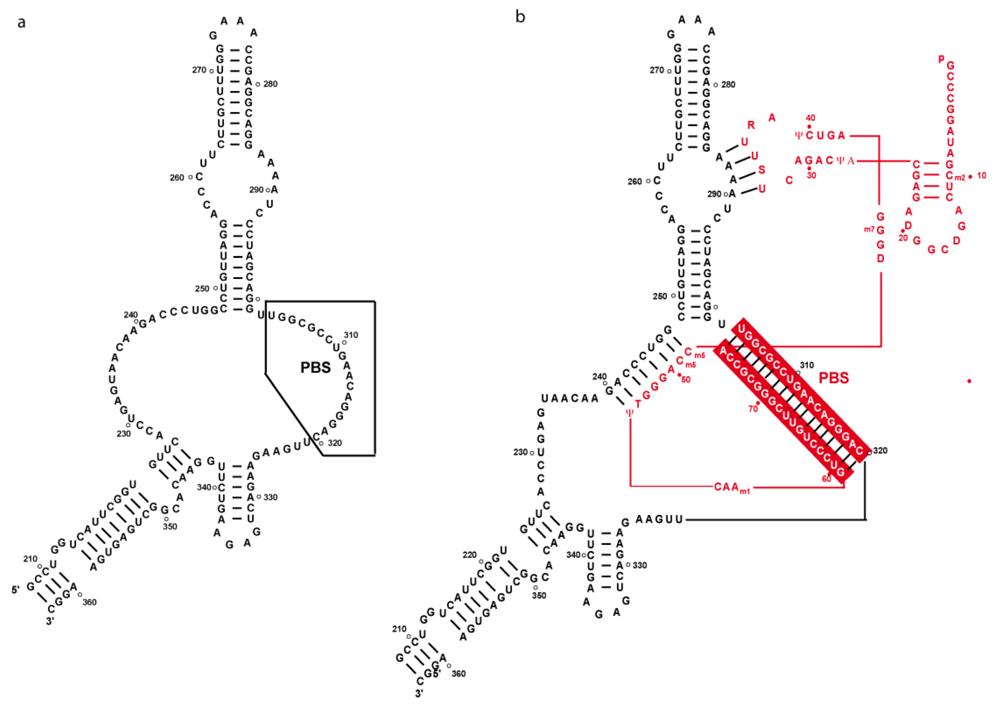
        <p>In the case of HIV-2, <italic>in vitro</italic> structural studies led to the proposal of a secondary structure in which most of the nucleotides of the vRNA are base-paired, with the noticeable exception of the PBS sequence, in which only 3 out of 18 nucleotides are involved in base-pairing interactions [<xref ref-type="bibr" rid="B101">101</xref>]. In this model, the PBS sequence is preceded by a long hairpin, containing two A-stretches in both an apical and an internal loop [<xref ref-type="bibr" rid="B101">101</xref>,<xref ref-type="bibr" rid="B102">102</xref>] (<xref ref-type="fig" rid="figure5">Figure 5</xref>a). </p>
        <p>On the contrary to the situation with HIV-1 MAL, formation of the binary complex does not involve any intermolecular rearrangements [<xref ref-type="bibr" rid="B102">102</xref>] (<xref ref-type="fig" rid="figure5">Figure 5</xref>). However, similarly to HIV-1 MAL, the U-rich anticodon loop of tRNA<sub>3</sub><sup>Lys</sup> interacts with an A-rich loop upstream of the PBS, while nucleotides of the 5’ part of the TΨC stem interact with nucleotides in the U5 sequence upstream of the PBS [<xref ref-type="bibr" rid="B102">102</xref>], in a way reminiscent of the HIV-1 PAS/anti-PAS interaction (<xref ref-type="fig" rid="figure5">Figure 5</xref>).</p>
        <fig id="figure5" position="float">
          <label>Figure 5</label>
          <caption>
            <p>Secondary structure models of the HIV-2 vRNA (<bold>a</bold>) and of the vRNA/tRNA<sub>3</sub><sup>Lys</sup> complex (<bold>b</bold>). The tRNA is in red and the vRNA in black.</p>
          </caption>
          <graphic xmlns:xlink="http://www.w3.org/1999/xlink" xlink:href="viruses-02-00213-g005.tif" scale="0"/>
        </fig>
      </sec>
    </sec>
    <sec>
      <title>5. Mechanism of primer tRNA annealing to HIV-1 RNA by the viral nucleocapsid protein</title>
      <p>As described above, tRNAs are highly structured macromolecules. Formation of the binary vRNA/tRNA complex necessitates, at least, the unfolding of the 3D structure of the primer tRNA and melting of base-pairings in the acceptor and TΨC arms. Such a phenomenon does not occur spontaneously at 37 °C and numerous studies have identified the viral nucleocapsid protein as the required chaperone co-factor [<xref ref-type="bibr" rid="B77">77</xref>,<xref ref-type="bibr" rid="B103">103-106</xref>] (for a review see [<xref ref-type="bibr" rid="B107">107</xref>]). Annealing between the two partners of the reverse transcription initiation complex can be achieved either by the NC domain within the unprocessed pr55Gag precursor [<xref ref-type="bibr" rid="B108">108-112</xref>] or by the mature NC [<xref ref-type="bibr" rid="B77">77</xref>,<xref ref-type="bibr" rid="B103">103-106</xref>]. Mature NC is a small basic protein that exists mainly in two forms, NCp15 and NCp7, the latter being the final maturation product. It contains two CCHC zinc-fingers, separated by a short basic linker and flanked by N- and C-terminus basic residues [<xref ref-type="bibr" rid="B107">107</xref>]. The role of each NC domain in tRNA annealing has been the source of some debate but a consensus seems to have been finally reached. It is now accepted that although the zinc fingers are required for optimal chaperone activity [<xref ref-type="bibr" rid="B113">113-115</xref>], the basic amino-acids surrounding the N-terminal zinc fingers are absolutely necessary for the annealing activity [<xref ref-type="bibr" rid="B104">104</xref>,<xref ref-type="bibr" rid="B113">113</xref>,<xref ref-type="bibr" rid="B116">116</xref>]. Several groups have been trying to dissect the annealing process, using different approaches: terbium cleavages and kinetic studies for the Musier-Forsyth group and detection of base-pair melting or formation by NMR, in the absence or presence of NC, for the Dardel group. From their data, it appears that the first step of hybrid formation is the melting of a small duplex, followed by a nucleation step that brings together the sequences to be annealed [<xref ref-type="bibr" rid="B114">114</xref>,<xref ref-type="bibr" rid="B117">117</xref>]. The basic amino-acids flanking the first zinc finger, which do not directly contact the tRNA but strengthen binding, were proven to be essential for this process. Even though NMR studies showed that nucleation can occur without NCp, this protein dramatically accelerates the process and is strictly required for full annealing. The nucleation process could be initiated by the unpaired 3’ CCA of the tRNA [<xref ref-type="bibr" rid="B117">117</xref>] and/or by the four unpaired bases that form the junction between the acceptor and the TΨC-stems [<xref ref-type="bibr" rid="B114">114</xref>,<xref ref-type="bibr" rid="B118">118</xref>]. Unwinding of the rest of the double-stranded RNA regions happens thanks to the zinc fingers of NC, the structure of which is necessary for most of the specific contacts with tRNA [<xref ref-type="bibr" rid="B119">119</xref>]. The zinc fingers are also involved in destabilization of the tertiary TΨC/D loop interaction [<xref ref-type="bibr" rid="B113">113</xref>,<xref ref-type="bibr" rid="B120">120</xref>].</p>
    </sec>
    <sec>
      <title>6. Effects of the restriction factors APOBEC-3G/3F and of the viral infectivity factor (Vif) on the early steps of reverse transcription</title>
      <p>APOBEC-3G (A3G; APOlipoprotein B m-RNA-Editing enzyme, catalytic polypeptide 3G) and A3F are restriction factors expressed in primary human T-cells, macrophages and monocytes, which are the main reservoir of HIV-1 in humans, as well as in some lymphocyte-derived cell lines. The viral infectivity factor (Vif) neutralizes these restriction factors and is required for HIV-1 replication in these so-called “non-permissive” cells (for a review, see [<xref ref-type="bibr" rid="B121">121</xref>]). A3F and A3G are cytidine deaminases [<xref ref-type="bibr" rid="B122">122</xref>] that introduce C to U transitions during (-) strand DNA synthesis, leading to G to A mutations in the (+) strand DNA which are deleterious to the virus. It was long believed that the antiviral activity associated with APOBEC proteins was entirely due to cytidine deamination [<xref ref-type="bibr" rid="B121">121</xref>,<xref ref-type="bibr" rid="B123">123</xref>,<xref ref-type="bibr" rid="B124">124</xref>]. However, the basis for a possibly more complex mechanism were already laid by early observations by Dettenhoffer and Yu [<xref ref-type="bibr" rid="B125">125</xref>] who highlighted a more than 50% decrease in the tRNA<sub>3</sub><sup>Lys</sup>-primed reaction in <italic>vif</italic> (-) virions produced from non-permissive cells. Accordingly, the antiviral activity of A3G has been correlated to the capacity of this protein to inhibit the synthesis of short reverse transcripts, rather than to hypermutation [<xref ref-type="bibr" rid="B126">126</xref>]. Indeed, a number of studies showed that enzymaticaly inactive A3G and A3F are able to inhibit HIV-1 reverse transcription, even though the deaminase activity is required for optimal anti-HIV-1 activity of these restriction factors [<xref ref-type="bibr" rid="B121">121</xref>]. </p>
      <p>A possible link with early steps of reverse transcription was suggested when an interplay between NC, A3G and RT was observed. Indeed, the NC domain of Gag is not only required for primer tRNA packaging and annealing, but also for A3G incorporation into the viral particles [<xref ref-type="bibr" rid="B127">127</xref>]. In addition, <italic>in vitro</italic> experiments indicated that A3G interacts with NC to inhibit tRNA annealing to the vRNA, and hence decreases priming efficiency by &gt;50% <italic>in vitro</italic> and in cell culture [<xref ref-type="bibr" rid="B128">128</xref>,<xref ref-type="bibr" rid="B129">129</xref>]. The same inhibition features were described for A3F [<xref ref-type="bibr" rid="B130">130</xref>]. In protease (-) viruses, A3G does not inhibit the Gag-driven tRNA annealing to the PBS sequence. This hybridisation generates a vRNA/tRNA complex that is less stable than the complex formed later on, in the presence of mature NCp7 [<xref ref-type="bibr" rid="B110">110</xref>]. The initial “weak” vRNA/tRNA complex, formed by Gag, can be “rescued” <italic>in vitro</italic> into the mature complex by exposure to NCp7, and that rescue is inhibited by A3G [<xref ref-type="bibr" rid="B110">110</xref>]. The hypothesis developed by the authors is that the binary vRNA/tRNA complex formed in the presence of Gag, during the budding step, could be transformed by mature NCp7, within the mature virion, into a more solid complex that undergoes reverse transcription. In this context, the observation that Vif has an RNA chaperone activity and is able to promote annealing of tRNA<sub>3</sub><sup>Lys</sup> to the PBS <italic>in vitro</italic> may provide an additional mechanism by which Vif counteracts the antiviral activity of A3G and A3F [<xref ref-type="bibr" rid="B131">131</xref>]. However, inhibition of tRNA annealing by A3G was not confirmed by the other groups [<xref ref-type="bibr" rid="B132">132</xref>,<xref ref-type="bibr" rid="B133">133</xref>]. These studies suggested that A3G inhibits the elongation phase of reverse transcription, even in the absence of cytosine deaminase activity, but not tRNA<sub>3</sub><sup>Lys</sup> annealing, both <italic>in vitro</italic> [<xref ref-type="bibr" rid="B133">133</xref>] and when reverse transcription was performed in melittin-permabilized purified virions [<xref ref-type="bibr" rid="B132">132</xref>]. </p>
      <p>In conclusion, it has become clear recently that the reduced accumulation of viral DNA in HIV-1 infected cells in the absence of Vif is not only related to the cytidine deaminase activity of A3G and A3F but is likely linked to the inhibition of the early steps reverse transcription. Whether the annealing of tRNA<sub>3</sub><sup>Lys</sup> to the PBS and/or the initiation of reverse transcription are directly affected by these restriction factors awaits further experimental confirmation.</p>
    </sec>
    <sec>
      <title>7. Spatio-temporal regulation of reverse transcription</title>
      <sec>
        <title>7.1. In producer cells </title>
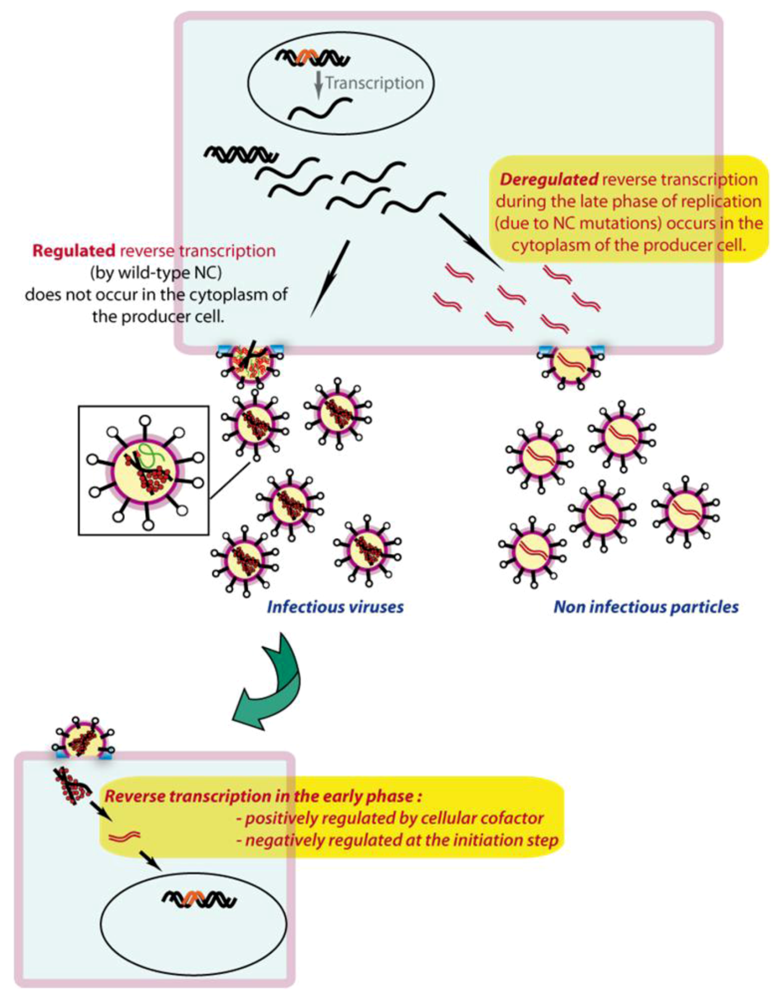
        <p>Where and when<bold> </bold>exactly reverse transcription is initiated has been a debate for some time. Even though tRNA extended by two nucleotides has been isolated from purified virions [<xref ref-type="bibr" rid="B134">134</xref>], it was commonly accepted that the entire reverse transcription process could not take place within virions due to an insufficient dNTP concentration for completion of the reaction [<xref ref-type="bibr" rid="B135">135</xref>,<xref ref-type="bibr" rid="B136">136</xref>]. However, it was recently shown that low levels of complete reverse transcription products of genomic and spliced HIV-1 RNA could be detected in viral particles[<xref ref-type="bibr" rid="B137">137</xref>].</p>
        <p>The chaperone NC protein not only plays a crucial role in annealing the primer tRNA to the vRNA, but is also involved in the control of the timing of reverse transcription during the late phase of the HIV-1 replication cycle. The latter property of NC was discovered recently, when Mougel and co-workers deleted one or both zinc fingers of NCp, leading to high levels of viral DNA packaged into viral particles that became non infectious [<xref ref-type="bibr" rid="B138">138</xref>] (<xref ref-type="fig" rid="figure6">Figure 6</xref>). It was demonstrated that DNA synthesis was not due to natural endogenous reverse transcription, but was indeed the first example of premature reverse transcription taking place during the late step of the replication cycle, in the producer cell. This result was confirmed by single mutations in one or the other zinc finger, as well as disruption of the NC/RNA interactions by mutation of the N-terminal basic residues of NCp, which all yielded late reverse transcription products [<xref ref-type="bibr" rid="B139">139</xref>,<xref ref-type="bibr" rid="B140">140</xref>]. Hence, wild type viral NC protein is required to ensure the correct timing of reverse transcription, since early reverse transcription during the late phase of the replication process, in the cytoplasm prior to budding, is detrimental to viral replication (<xref ref-type="fig" rid="figure6">Figure 6</xref>). Intramolecular base-pairing of the PAS sequence, which could modulate its interaction with tRNA<sub>3</sub><sup>Lys</sup>, might play a similar role [<xref ref-type="bibr" rid="B43">43</xref>,<xref ref-type="bibr" rid="B50">50</xref>].</p>
        <fig id="figure6" position="float">
          <label>Figure 6</label>
          <caption>
            <p>Schematic representation of the temporal regulation of reverse transcription in producer and target cells. </p>
          </caption>
          <graphic xmlns:xlink="http://www.w3.org/1999/xlink" xlink:href="viruses-02-00213-g006.tif" scale="0"/>
        </fig>
      </sec>
      <sec>
        <title>7.2. In target cells</title>
        <p>Efficiency of reverse transcription is most likely also controlled during the early steps of the replication cycle, after viral entry. It was long believed that entry was immediately followed by an uncoating process that liberates the Reverse Transcription Complex (RTC) into the cytoplasm. Recent data from Charneau’s group suggested that the viral core remains assembled after entry and that reverse transcription takes place within that confined environment, keeping all the components tightly associated and moving along the microtubule network towards the nuclear compartment [<xref ref-type="bibr" rid="B141">141</xref>]. Uncoating, triggered by the synthesis of the central flap, would occur only after completion of reverse transcription and in close proximity to the nuclear pores [<xref ref-type="bibr" rid="B141">141</xref>,<xref ref-type="bibr" rid="B142">142</xref>]. The RTC would then transform into a pre-integration complex that is translocated through the nuclear membrane [<xref ref-type="bibr" rid="B141">141</xref>,<xref ref-type="bibr" rid="B142">142</xref>]. </p>
        <p>Recent work from the group of D. Harrich has shown that cellular factors stimulate reverse transcription in the target cells [<xref ref-type="bibr" rid="B143">143</xref>] (<xref ref-type="fig" rid="figure6">Figure 6</xref>). Unexpectedly, recent data from the same group showed that the early steps of reverse transcription are negatively regulated in the target cells and that suppression of this negative control is detrimental to HIV-1 replication (<xref ref-type="fig" rid="figure6">Figure 6</xref>) [<xref ref-type="bibr" rid="B144">144</xref>]. Thus, there is increasing evidence that initiation of reverse transcription is temporally regulated, both in the producer and in the target cells.</p>
      </sec>
    </sec>
    <sec>
      <title>8. Initiation of reverse transcription as a drug target</title>
      <p>All inhibitors that target the HIV-1 replication cycle have led to the development of resistance and this is true also for reverse transcription inhibitors. In the case of nucleoside analogues of reverse transcription (NRTI), resistance occurs either <italic>via</italic> increased discrimination of the NRTI against the natural dNTP or by phosphorolytic excision, the reverse reaction to polymerization, of the chain-terminating analogue [<xref ref-type="bibr" rid="B145">145-148</xref>]. Interestingly, it has been shown that AZT, the first and still one of the main NRTIs used in combination therapies, cannot be removed by phosphorolysis or ATP-lysis during the initiation phase of reverse transcription, by either wild type [<xref ref-type="bibr" rid="B149">149</xref>] or AZT-resistant RT [<xref ref-type="bibr" rid="B150">150</xref>]. The most likely explanation for this phenomenon is that the structure of the active site of RT containing the vRNA/tRNA complex is distorted and does not permit removal of the chain terminator in the same way as a for DNA/RNA or DNA/DNA hybrids. This makes the initiation complex a very interesting target for the development of specific inhibitors. </p>
      <p>RNA, RNA/RNA and RNA/protein complexes can be targeted by small molecule (for review see [<xref ref-type="bibr" rid="B151">151</xref>]). The group of F. Dardel has pursued the idea of finding small molecules that could bind the primer tRNA<sub>3</sub><sup>Lys</sup> and hence destabilize the tRNA<sub>3</sub><sup>Lys</sup>/vRNA initiation complex. An NMR screen, based on high selectivity, was used and three short peptides were selected, one of them interacting with tRNA<sub>3</sub><sup>Lys</sup> with a 2 mM dissociation constant. All three peptides were found to recognize the 3D structure of the D-stem and loop of tRNAs [<xref ref-type="bibr" rid="B152">152</xref>]. Compounds were further optimized for tRNA<sub>3</sub><sup>Lys</sup> binding [<xref ref-type="bibr" rid="B153">153</xref>,<xref ref-type="bibr" rid="B154">154</xref>]; their effect on initiation of reverse transcription needs now to be tested.</p>
      <p>The strict requirement for the PBS sequence for all HIV-1 isolates and the importance of the A-rich loop for initiation of reverse transcription [<xref ref-type="bibr" rid="B44">44</xref>,<xref ref-type="bibr" rid="B53">53</xref>,<xref ref-type="bibr" rid="B66">66</xref>] led to the development of PNA antisense oligonucleotides [<xref ref-type="bibr" rid="B155">155</xref>,<xref ref-type="bibr" rid="B156">156</xref>] or 2’-O-methyl-antisense oligonucleotides [<xref ref-type="bibr" rid="B157">157</xref>] targeting the PBS and PNAs targeting the PBS together with the upstream A-rich loop [<xref ref-type="bibr" rid="B158">158</xref>] or the A-rich loop only [<xref ref-type="bibr" rid="B159">159</xref>]. All the above-cited antisense oligonucleotides strongly inhibited viral replication as well as initiation of reverse transcription <italic>in vitro</italic> and in endogenous reverse transcription assays in the case of PNAs. The potential of PNA molecules as candidates for the development of new drugs was also emphasized by the fact that their uptake is efficient in the presence of a membrane-transducing (MTD) peptide, with IC<sub>50</sub> for inhibition of viral replication in the range of 0.5 to 0.75 µM [<xref ref-type="bibr" rid="B156">156</xref>]. Moreover, MTD peptide conjugates of PNAs also diplay virucidal activity [<xref ref-type="bibr" rid="B156">156</xref>]. </p>
      <p>RNA interference could also be a promising tool for antiviral therapy in general and anti-HIV therapy in particular [<xref ref-type="bibr" rid="B160">160-162</xref>]. The use of a combinatorial approach for shRNA therapy did yield some success in generating shRNA sequences that inhibit viral replication effectively [<xref ref-type="bibr" rid="B163">163</xref>]. However, although it was shown that viral escape was reduced when highly conserved sequence were targeted [<xref ref-type="bibr" rid="B164">164</xref>], targeting the PBS sequence using this strategy has not been successful [<xref ref-type="bibr" rid="B165">165</xref>].</p>
    </sec>
    <sec sec-type="conclusions">
      <title>9. Conclusions</title>
      <p>Like most steps in HIV replication, initiation of reverse transcription has been the subject of a very large number of <italic>in vitro</italic> and <italic>ex-vivo</italic> studies. </p>
      <p>The mechanisms allowing selective packaging of the tRNA<sub>3</sub><sup>Lys</sup> primer inside the viral particles are now well understood. Our understanding of the tRNA<sub>3</sub><sup>Lys</sup> annealing process mediated by the Gag precursor and the subsequent maturation of the initiation complex by mature NCp7 also significantly improved. New questions regarding tRNA<sub>3</sub><sup>Lys</sup> annealing emerged from the observations that A3G and A3F may inhibit this process. However, these findings have been questioned and await further confirmation. In the same context, the ability of Vif to replace NCp7 in the annealing reaction, and thus to potentially act as a counteracting factor to A3F and A3G, has been demonstrated <italic>in vitro</italic> but remains to be assessed <italic>in vivo</italic>. </p>
      <p>Once the binary vRNA/tRNA<sub>3</sub><sup>Lys</sup> complex is formed, synthesis of the (-) strand strong stop DNA proceeds in two phases, initiation which corresponds to the addition of the first 6 nucleotides to the tRNA primer, and elongation, both of which have been well characterized from the enzymology point of view. On the contrary, the intermolecular interactions between the viral RNA and tRNA<sub>3</sub><sup>Lys</sup> taking place during this process have been a subject of debate and controversy. The structural versatility of the PBS region of the HIV genomic RNA, which has been shown to adopt different structures in different isolates, might explain some of the discrepancies. Moreover, some differences between experiments published by different laboratories could also arise from the fact that certain RNA conformations, even though important, are transient and/or that mutant RNAs may adopt a alternative structure not reflecting the wild-type situation. </p>
      <p>Finally, one of the recent and fascinating advances in the field concerns regulation of reverse transcription, in space and in time. Indeed, it seems clear that tight negative regulation of reverse transcription in producer cells is crucial for the infectivity of the virus, but also that a controlled initiation of reverse transcription process in infected cells is important for proper replication. </p>
    </sec>
  </body>
  <back>
    <ack>
      <p>This work was supported by grants from the Agence Nationale de Recherches sur le SIDA (ANRS) and Sidaction. </p>
    </ack>
    <ref-list>
    <title>References</title>
      <ref id="B1">
        <citation citation-type="journal">
          <person-group person-group-type="author">
            <name>
              <surname>Gilboa</surname>
              <given-names>E.</given-names>
            </name>
            <name>
              <surname>Mitra</surname>
              <given-names>S.W.</given-names>
            </name>
            <name>
              <surname>Goff</surname>
              <given-names>S.</given-names>
            </name>
            <name>
              <surname>Baltimore</surname>
              <given-names>D.</given-names>
            </name>
          </person-group>
          <article-title>A detailed model of reverse transcription and tests of crucial aspects</article-title>
          <source>Cell</source>
          <year>1979</year>
          <volume>18</volume>
          <fpage>93</fpage>
          <lpage>100</lpage>
          <pub-id pub-id-type="doi">10.1016/0092-8674(79)90357-X</pub-id>
          <pub-id pub-id-type="pmid">509527</pub-id>
        </citation>
      </ref>
      <ref id="B2">
        <citation citation-type="journal">
          <person-group person-group-type="author">
            <name>
              <surname>Mölling</surname>
              <given-names>K.</given-names>
            </name>
            <name>
              <surname>Bolognesi</surname>
              <given-names>D.P.</given-names>
            </name>
            <name>
              <surname>Bauer</surname>
              <given-names>H.</given-names>
            </name>
            <name>
              <surname>Büsen</surname>
              <given-names>W.</given-names>
            </name>
            <name>
              <surname>Plassmann</surname>
              <given-names>H.W.</given-names>
            </name>
            <name>
              <surname>Hausen</surname>
              <given-names>P.</given-names>
            </name>
          </person-group>
          <article-title>Association of viral reverse transcriptase with an enzyme degrading the RNA moiety of RNA-DNA hybrids</article-title>
          <source>Nature New Biol.</source>
          <year>1971</year>
          <volume>234</volume>
          <fpage>240</fpage>
          <lpage>243</lpage>
          <pub-id pub-id-type="doi">10.1038/234240a0</pub-id>
          <pub-id pub-id-type="pmid">4331605</pub-id>
        </citation>
      </ref>
      <ref id="B3">
        <citation citation-type="journal">
          <person-group person-group-type="author">
            <name>
              <surname>Marquet</surname>
              <given-names>R.</given-names>
            </name>
            <name>
              <surname>Isel</surname>
              <given-names>C.</given-names>
            </name>
            <name>
              <surname>Ehresmann</surname>
              <given-names>C.</given-names>
            </name>
            <name>
              <surname>Ehresmann</surname>
              <given-names>B.</given-names>
            </name>
          </person-group>
          <article-title>tRNAs as primer of reverse transcriptase</article-title>
          <source>Biochimie</source>
          <year>1995</year>
          <volume>77</volume>
          <fpage>113</fpage>
          <lpage>124</lpage>
          <pub-id pub-id-type="doi">10.1016/0300-9084(96)88114-4</pub-id>
          <pub-id pub-id-type="pmid">7541250</pub-id>
        </citation>
      </ref>
      <ref id="B4">
        <citation citation-type="journal">
          <person-group person-group-type="author">
            <name>
              <surname>Kleiman</surname>
              <given-names>L.</given-names>
            </name>
            <name>
              <surname>Jones</surname>
              <given-names>C.P.</given-names>
            </name>
            <name>
              <surname>Musier-Forsyth</surname>
              <given-names>K.</given-names>
            </name>
          </person-group>
          <article-title>Formation of the tRNALys packaging complex in HIV-1</article-title>
          <source>FEBS Lett.</source>
          <year>2010</year>
          <volume>584</volume>
          <fpage>359</fpage>
          <lpage>365</lpage>
          <pub-id pub-id-type="doi">10.1016/j.febslet.2009.11.038</pub-id>
          <pub-id pub-id-type="pmid">19914238</pub-id>
        </citation>
      </ref>
      <ref id="B5">
        <citation citation-type="journal">
          <person-group person-group-type="author">
            <name>
              <surname>Kleiman</surname>
              <given-names>L.</given-names>
            </name>
            <name>
              <surname>Halwani</surname>
              <given-names>R.</given-names>
            </name>
            <name>
              <surname>Javanbakht</surname>
              <given-names>H.</given-names>
            </name>
          </person-group>
          <article-title>The selective packaging and annealing of primer tRNALys3 in HIV-1</article-title>
          <source>Curr. HIV Res.</source>
          <year>2004</year>
          <volume>2</volume>
          <fpage>163</fpage>
          <lpage>175</lpage>
          <pub-id pub-id-type="doi">10.2174/1570162043484988</pub-id>
        </citation>
      </ref>
      <ref id="B6">
        <citation citation-type="journal">
          <person-group person-group-type="author">
            <name>
              <surname>Jiang</surname>
              <given-names>M.</given-names>
            </name>
            <name>
              <surname>Mak</surname>
              <given-names>J.</given-names>
            </name>
            <name>
              <surname>Ladha</surname>
              <given-names>A.</given-names>
            </name>
            <name>
              <surname>Cohen</surname>
              <given-names>E.</given-names>
            </name>
            <name>
              <surname>Klein</surname>
              <given-names>M.</given-names>
            </name>
            <name>
              <surname>Rovinski</surname>
              <given-names>B.</given-names>
            </name>
            <name>
              <surname>Kleiman</surname>
              <given-names>L.</given-names>
            </name>
          </person-group>
          <article-title>Identification of tRNAs incorporated into wild-type and mutant human immunodeficiency virus type-1</article-title>
          <source>J. Virol.</source>
          <year>1993</year>
          <volume>67</volume>
          <fpage>3246</fpage>
          <lpage>3253</lpage>
          <pub-id pub-id-type="pmid">8497049</pub-id>
        </citation>
      </ref>
      <ref id="B7">
        <citation citation-type="journal">
          <person-group person-group-type="author">
            <name>
              <surname>Jiang</surname>
              <given-names>M.</given-names>
            </name>
            <name>
              <surname>Mak</surname>
              <given-names>J.</given-names>
            </name>
            <name>
              <surname>Wainberg</surname>
              <given-names>M.A.</given-names>
            </name>
            <name>
              <surname>Parniak</surname>
              <given-names>M.A.</given-names>
            </name>
            <name>
              <surname>Cohen</surname>
              <given-names>E.</given-names>
            </name>
            <name>
              <surname>Kleiman</surname>
              <given-names>L.</given-names>
            </name>
          </person-group>
          <article-title>Variable transfer RNA content in HIV-1(IIIB)</article-title>
          <source>Biochem. Biophys. Res. Commun.</source>
          <year>1992</year>
          <volume>185</volume>
          <fpage>1005</fpage>
          <lpage>1015</lpage>
          <pub-id pub-id-type="doi">10.1016/0006-291X(92)91727-8</pub-id>
          <pub-id pub-id-type="pmid">1627125</pub-id>
        </citation>
      </ref>
      <ref id="B8">
        <citation citation-type="journal">
          <person-group person-group-type="author">
            <name>
              <surname>Mak</surname>
              <given-names>J.</given-names>
            </name>
            <name>
              <surname>Jiang</surname>
              <given-names>M.</given-names>
            </name>
            <name>
              <surname>Wainberg</surname>
              <given-names>M.A.</given-names>
            </name>
            <name>
              <surname>Hammarskjöld</surname>
              <given-names>M.-L.</given-names>
            </name>
            <name>
              <surname>Rekosh</surname>
              <given-names>D.</given-names>
            </name>
            <name>
              <surname>Kleiman</surname>
              <given-names>L.</given-names>
            </name>
          </person-group>
          <article-title>Role of Pr160<sup>gag-pol</sup> in mediating the selective incorporation of tRNA<sup>Lys</sup> into human immunodeficiency virus type 1 particles</article-title>
          <source>J. Virol.</source>
          <year>1994</year>
          <volume>68</volume>
          <fpage>2065</fpage>
          <lpage>2072</lpage>
          <pub-id pub-id-type="pmid">7511167</pub-id>
        </citation>
      </ref>
      <ref id="B9">
        <citation citation-type="journal">
          <person-group person-group-type="author">
            <name>
              <surname>Huang</surname>
              <given-names>Y.</given-names>
            </name>
            <name>
              <surname>Mak</surname>
              <given-names>J.</given-names>
            </name>
            <name>
              <surname>Cao</surname>
              <given-names>Q.</given-names>
            </name>
            <name>
              <surname>Li</surname>
              <given-names>Z.</given-names>
            </name>
            <name>
              <surname>Wainberg</surname>
              <given-names>M.A.</given-names>
            </name>
            <name>
              <surname>Kleiman</surname>
              <given-names>L.</given-names>
            </name>
          </person-group>
          <article-title>Incorporation of excess wild-type and mutant tRNA<sub>3</sub><sup>Lys</sup> into human immunodeficiency virus type 1</article-title>
          <source>J. Virol.</source>
          <year>1994</year>
          <volume>68</volume>
          <fpage>7676</fpage>
          <lpage>7683</lpage>
          <pub-id pub-id-type="pmid">7966556</pub-id>
        </citation>
      </ref>
      <ref id="B10">
        <citation citation-type="journal">
          <person-group person-group-type="author">
            <name>
              <surname>Bénas</surname>
              <given-names>P.</given-names>
            </name>
            <name>
              <surname>Bec</surname>
              <given-names>G.</given-names>
            </name>
            <name>
              <surname>Keith</surname>
              <given-names>G.</given-names>
            </name>
            <name>
              <surname>Marquet</surname>
              <given-names>R.</given-names>
            </name>
            <name>
              <surname>Ehresmann</surname>
              <given-names>C.</given-names>
            </name>
            <name>
              <surname>Ehresmann</surname>
              <given-names>B.</given-names>
            </name>
            <name>
              <surname>Dumas</surname>
              <given-names>P.</given-names>
            </name>
          </person-group>
          <article-title>The crystal structure of HIV reverse transcription primer tRNA<sup>Lys,3</sup> shows a canonical anticodon loop</article-title>
          <source>RNA</source>
          <year>2000</year>
          <volume>6</volume>
          <fpage>1347</fpage>
          <lpage>1355</lpage>
          <pub-id pub-id-type="doi">10.1017/S1355838200000911</pub-id>
        </citation>
      </ref>
      <ref id="B11">
        <citation citation-type="journal">
          <person-group person-group-type="author">
            <name>
              <surname>Agris</surname>
              <given-names>P.F.</given-names>
            </name>
            <name>
              <surname>Guenther</surname>
              <given-names>R.</given-names>
            </name>
            <name>
              <surname>Ingram</surname>
              <given-names>P.C.</given-names>
            </name>
            <name>
              <surname>Basti</surname>
              <given-names>M.M.</given-names>
            </name>
            <name>
              <surname>Stuart</surname>
              <given-names>J.W.</given-names>
            </name>
            <name>
              <surname>Sochacka</surname>
              <given-names>E.</given-names>
            </name>
            <name>
              <surname>Malkiewicz</surname>
              <given-names>A.</given-names>
            </name>
          </person-group>
          <article-title>Unconventional structure of tRNA(Lys)SUU anticodon explains tRNA's role in bacterial and mammalian ribosomal frameshifting and primer selection by HIV-1</article-title>
          <source>RNA</source>
          <year>1997</year>
          <volume>3</volume>
          <fpage>420</fpage>
          <lpage>428</lpage>
        <pub-id pub-id-type="pmid">9085848</pub-id></citation>
      </ref>
      <ref id="B12">
        <citation citation-type="journal">
          <person-group person-group-type="author">
            <name>
              <surname>Durant</surname>
              <given-names>P.C.</given-names>
            </name>
            <name>
              <surname>Davis</surname>
              <given-names>D.R.</given-names>
            </name>
          </person-group>
          <article-title>Stabilization of the anticodon stem-loop of tRNALys,3 by an A+-C base-pair and by pseudouridine</article-title>
          <source>J. Mol. Biol.</source>
          <year>1999</year>
          <volume>285</volume>
          <fpage>115</fpage>
          <lpage>131</lpage>
          <pub-id pub-id-type="doi">10.1006/jmbi.1998.2297</pub-id>
          <pub-id pub-id-type="pmid">9878393</pub-id>
        </citation>
      </ref>
      <ref id="B13">
        <citation citation-type="journal">
          <person-group person-group-type="author">
            <name>
              <surname>Puglisi</surname>
              <given-names>E.V.</given-names>
            </name>
            <name>
              <surname>Puglisi</surname>
              <given-names>J.D.</given-names>
            </name>
          </person-group>
          <article-title>Probing the conformation of human tRNA(3)(Lys) in solution by NMR</article-title>
          <source>FEBS Lett.</source>
          <year>2007</year>
          <volume>581</volume>
          <fpage>5307</fpage>
          <lpage>5314</lpage>
          <pub-id pub-id-type="doi">10.1016/j.febslet.2007.10.026</pub-id>
          <pub-id pub-id-type="pmid">17963705</pub-id>
        </citation>
      </ref>
      <ref id="B14">
        <citation citation-type="journal">
          <person-group person-group-type="author">
            <name>
              <surname>Jiang</surname>
              <given-names>M.</given-names>
            </name>
            <name>
              <surname>Mak</surname>
              <given-names>J.</given-names>
            </name>
            <name>
              <surname>Huang</surname>
              <given-names>Y.</given-names>
            </name>
            <name>
              <surname>Kleiman</surname>
              <given-names>L.</given-names>
            </name>
          </person-group>
          <article-title>Reverse transcriptase is an important factor for the primer tRNA selection in HIV-1</article-title>
          <source>Leukemia</source>
          <year>1994</year>
          <volume>8</volume>
          <fpage>S149</fpage>
          <lpage>S151</lpage>
          <pub-id pub-id-type="pmid">7512177</pub-id>
        </citation>
      </ref>
      <ref id="B15">
        <citation citation-type="journal">
          <person-group person-group-type="author">
            <name>
              <surname>Mak</surname>
              <given-names>J.</given-names>
            </name>
            <name>
              <surname>Khorchid</surname>
              <given-names>A.</given-names>
            </name>
            <name>
              <surname>Cao</surname>
              <given-names>Q.</given-names>
            </name>
            <name>
              <surname>Huang</surname>
              <given-names>Y.</given-names>
            </name>
            <name>
              <surname>Lowy</surname>
              <given-names>I.</given-names>
            </name>
            <name>
              <surname>Parniak</surname>
              <given-names>M.A.</given-names>
            </name>
            <name>
              <surname>Prasad</surname>
              <given-names>V.R.</given-names>
            </name>
            <name>
              <surname>Wainberg</surname>
              <given-names>M.A.</given-names>
            </name>
            <name>
              <surname>Kleiman</surname>
              <given-names>L.</given-names>
            </name>
          </person-group>
          <article-title>Effects of mutations in Pr160(gag-pol) upon tRNA<sub>3</sub><sup>Lys</sup> and Pr160(gag-pol) incorporation into HIV-1</article-title>
          <source>J. Mol. Biol.</source>
          <year>1997</year>
          <volume>265</volume>
          <fpage>419</fpage>
          <lpage>431</lpage>
          <pub-id pub-id-type="doi">10.1006/jmbi.1996.0742</pub-id>
          <pub-id pub-id-type="pmid">9034361</pub-id>
        </citation>
      </ref>
      <ref id="B16">
        <citation citation-type="journal">
          <person-group person-group-type="author">
            <name>
              <surname>Arts</surname>
              <given-names>E.J.</given-names>
            </name>
            <name>
              <surname>Miller</surname>
              <given-names>J.T.</given-names>
            </name>
            <name>
              <surname>Ehresmann</surname>
              <given-names>B.</given-names>
            </name>
            <name>
              <surname>Le Grice</surname>
              <given-names>S. F. J.</given-names>
            </name>
          </person-group>
          <article-title>Mutating a region of HIV-1 reverse transcriptase implicated in tRNALys-3 binding and the consequence for (-)-strand DNA synthesis</article-title>
          <source>J. Biol. Chem.</source>
          <year>1998</year>
          <volume>273</volume>
          <fpage>14523</fpage>
          <lpage>14532</lpage>
          <pub-id pub-id-type="doi">10.1074/jbc.273.23.14523</pub-id>
          <pub-id pub-id-type="pmid">9603966</pub-id>
        </citation>
      </ref>
      <ref id="B17">
        <citation citation-type="journal">
          <person-group person-group-type="author">
            <name>
              <surname>Dufour</surname>
              <given-names>E.</given-names>
            </name>
            <name>
              <surname>El Dirani-Diab</surname>
              <given-names>R.</given-names>
            </name>
            <name>
              <surname>Boulme</surname>
              <given-names>F.</given-names>
            </name>
            <name>
              <surname>Fournier</surname>
              <given-names>M.</given-names>
            </name>
            <name>
              <surname>Nevinsky</surname>
              <given-names>G.</given-names>
            </name>
            <name>
              <surname>Tarrago-Litvak</surname>
              <given-names>L.</given-names>
            </name>
            <name>
              <surname>Litvak</surname>
              <given-names>S.</given-names>
            </name>
            <name>
              <surname>Andreola</surname>
              <given-names>M. L.</given-names>
            </name>
          </person-group>
          <article-title>p66/p51 and p51/p51 recombinant forms of reverse transcriptase from human immunodeficiency virus type 1--interactions with primer tRNA(Lys3), initiation of cDNA synthesis, and effect of inhibitors</article-title>
          <source>Eur. J. Biochem.</source>
          <year>1998</year>
          <volume>251</volume>
          <fpage>487</fpage>
          <lpage>495</lpage>
          <pub-id pub-id-type="pmid">9492322</pub-id>
        </citation>
      </ref>
      <ref id="B18">
        <citation citation-type="journal">
          <person-group person-group-type="author">
            <name>
              <surname>Mishima</surname>
              <given-names>Y.</given-names>
            </name>
            <name>
              <surname>Steitz</surname>
              <given-names>J.A.</given-names>
            </name>
          </person-group>
          <article-title>Site-specific crosslinking of 4-thiouridine-modified human tRNA3Lys to reverse transcriptase from human immunodeficiency virus type 1</article-title>
          <source>EMBO J.</source>
          <year>1995</year>
          <volume>14</volume>
          <fpage>2679</fpage>
          <lpage>2687</lpage>
          <pub-id pub-id-type="pmid">7540137</pub-id>
        </citation>
      </ref>
      <ref id="B19">
        <citation citation-type="journal">
          <person-group person-group-type="author">
            <name>
              <surname>Khorchid</surname>
              <given-names>A.</given-names>
            </name>
            <name>
              <surname>Javanbakht</surname>
              <given-names>H.</given-names>
            </name>
            <name>
              <surname>Wise</surname>
              <given-names>S.</given-names>
            </name>
            <name>
              <surname>Halwani</surname>
              <given-names>R.</given-names>
            </name>
            <name>
              <surname>Parniak</surname>
              <given-names>M.A.</given-names>
            </name>
            <name>
              <surname>Wainberg</surname>
              <given-names>M.A.</given-names>
            </name>
            <name>
              <surname>Kleiman</surname>
              <given-names>L.</given-names>
            </name>
          </person-group>
          <article-title>Sequences Within Pr160(gag-pol) Affecting the Selective Packaging of Primer tRNA(Lys3) into HIV-1</article-title>
          <source>J. Mol. Biol.</source>
          <year>2000</year>
          <volume>299</volume>
          <fpage>17</fpage>
          <lpage>26</lpage>
          <pub-id pub-id-type="doi">10.1006/jmbi.2000.3709</pub-id>
          <pub-id pub-id-type="pmid">10860720</pub-id>
        </citation>
      </ref>
      <ref id="B20">
        <citation citation-type="journal">
          <person-group person-group-type="author">
            <name>
              <surname>Saadatmand</surname>
              <given-names>J.</given-names>
            </name>
            <name>
              <surname>Guo</surname>
              <given-names>F.</given-names>
            </name>
            <name>
              <surname>Cen</surname>
              <given-names>S.</given-names>
            </name>
            <name>
              <surname>Niu</surname>
              <given-names>M.</given-names>
            </name>
            <name>
              <surname>Kleiman</surname>
              <given-names>L.</given-names>
            </name>
          </person-group>
          <article-title>Interactions of reverse transcriptase sequences in Pol with Gag and LysRS in the HIV-1 tRNALys3 packaging/annealing complex</article-title>
          <source>Virology</source>
          <year>2008</year>
          <volume>380</volume>
          <fpage>109</fpage>
          <lpage>117</lpage>
          <pub-id pub-id-type="doi">10.1016/j.virol.2008.07.015</pub-id>
          <pub-id pub-id-type="pmid">18708237</pub-id>
        </citation>
      </ref>
      <ref id="B21">
        <citation citation-type="journal">
          <person-group person-group-type="author">
            <name>
              <surname>Halwani</surname>
              <given-names>R.</given-names>
            </name>
            <name>
              <surname>Cen</surname>
              <given-names>S.</given-names>
            </name>
            <name>
              <surname>Javanbakht</surname>
              <given-names>H.</given-names>
            </name>
            <name>
              <surname>Saadatmand</surname>
              <given-names>J.</given-names>
            </name>
            <name>
              <surname>Kim</surname>
              <given-names>S.</given-names>
            </name>
            <name>
              <surname>Shiba</surname>
              <given-names>K.</given-names>
            </name>
            <name>
              <surname>Kleiman</surname>
              <given-names>L.</given-names>
            </name>
          </person-group>
          <article-title>Cellular distribution of Lysyl-tRNA synthetase and its interaction with Gag during human immunodeficiency virus type 1 assembly</article-title>
          <source>J. Virol.</source>
          <year>2004</year>
          <volume>78</volume>
          <fpage>7553</fpage>
          <lpage>7564</lpage>
          <pub-id pub-id-type="doi">10.1128/JVI.78.14.7553-7564.2004</pub-id>
          <pub-id pub-id-type="pmid">15220430</pub-id>
        </citation>
      </ref>
      <ref id="B22">
        <citation citation-type="journal">
          <person-group person-group-type="author">
            <name>
              <surname>Cen</surname>
              <given-names>S.</given-names>
            </name>
            <name>
              <surname>Khorchid</surname>
              <given-names>A.</given-names>
            </name>
            <name>
              <surname>Javanbakht</surname>
              <given-names>H.</given-names>
            </name>
            <name>
              <surname>Gabor</surname>
              <given-names>J.</given-names>
            </name>
            <name>
              <surname>Stello</surname>
              <given-names>T.</given-names>
            </name>
            <name>
              <surname>Shiba</surname>
              <given-names>K.</given-names>
            </name>
            <name>
              <surname>Musier-Forsyth</surname>
              <given-names>K.</given-names>
            </name>
            <name>
              <surname>Kleiman</surname>
              <given-names>L.</given-names>
            </name>
          </person-group>
          <article-title>Incorporation of lysyl-tRNA synthetase into human immunodeficiency virus type 1</article-title>
          <source>J. Virol.</source>
          <year>2001</year>
          <volume>75</volume>
          <fpage>5043</fpage>
          <lpage>5048</lpage>
          <pub-id pub-id-type="doi">10.1128/JVI.75.11.5043-5048.2001</pub-id>
          <pub-id pub-id-type="pmid">11333884</pub-id>
        </citation>
      </ref>
      <ref id="B23">
        <citation citation-type="journal">
          <person-group person-group-type="author">
            <name>
              <surname>Cen</surname>
              <given-names>S.</given-names>
            </name>
            <name>
              <surname>Javanbakht</surname>
              <given-names>H.</given-names>
            </name>
            <name>
              <surname>Kim</surname>
              <given-names>S.</given-names>
            </name>
            <name>
              <surname>Shiba</surname>
              <given-names>K.</given-names>
            </name>
            <name>
              <surname>Craven</surname>
              <given-names>R.</given-names>
            </name>
            <name>
              <surname>Rein</surname>
              <given-names>A.</given-names>
            </name>
            <name>
              <surname>Ewalt</surname>
              <given-names>K.</given-names>
            </name>
            <name>
              <surname>Schimmel</surname>
              <given-names>P.</given-names>
            </name>
            <name>
              <surname>Musier-Forsyth</surname>
              <given-names>K.</given-names>
            </name>
            <name>
              <surname>Kleiman</surname>
              <given-names>L.</given-names>
            </name>
          </person-group>
          <article-title>Retrovirus-specific packaging of aminoacyl-tRNA synthetases with cognate primer tRNAs</article-title>
          <source>J. Virol.</source>
          <year>2002</year>
          <volume>76</volume>
          <fpage>13111</fpage>
          <lpage>13115</lpage>
          <pub-id pub-id-type="doi">10.1128/JVI.76.24.13111-13115.2002</pub-id>
          <pub-id pub-id-type="pmid">12438642</pub-id>
        </citation>
      </ref>
      <ref id="B24">
        <citation citation-type="journal">
          <person-group person-group-type="author">
            <name>
              <surname>Gabor</surname>
              <given-names>J.</given-names>
            </name>
            <name>
              <surname>Cen</surname>
              <given-names>S.</given-names>
            </name>
            <name>
              <surname>Javanbakht</surname>
              <given-names>H.</given-names>
            </name>
            <name>
              <surname>Niu</surname>
              <given-names>M.</given-names>
            </name>
            <name>
              <surname>Kleiman</surname>
              <given-names>L.</given-names>
            </name>
          </person-group>
          <article-title>Effect of altering the tRNA(Lys)(3) concentration in human immunodeficiency virus type 1 upon its annealing to viral RNA, GagPol incorporation, and viral infectivity</article-title>
          <source>J. Virol.</source>
          <year>2002</year>
          <volume>76</volume>
          <fpage>9096</fpage>
          <lpage>9102</lpage>
          <pub-id pub-id-type="doi">10.1128/JVI.76.18.9096-9102.2002</pub-id>
          <pub-id pub-id-type="pmid">12186893</pub-id>
        </citation>
      </ref>
      <ref id="B25">
        <citation citation-type="journal">
          <person-group person-group-type="author">
            <name>
              <surname>Guo</surname>
              <given-names>F.</given-names>
            </name>
            <name>
              <surname>Cen</surname>
              <given-names>S.</given-names>
            </name>
            <name>
              <surname>Niu</surname>
              <given-names>M.</given-names>
            </name>
            <name>
              <surname>Javanbakht</surname>
              <given-names>H.</given-names>
            </name>
            <name>
              <surname>Kleiman</surname>
              <given-names>L.</given-names>
            </name>
          </person-group>
          <article-title>Specific inhibition of the synthesis of human lysyl-tRNA synthetase results in decreases in tRNA(Lys) incorporation, tRNA(3)(Lys) annealing to viral RNA, and viral infectivity in human immunodeficiency virus type 1</article-title>
          <source>J. Virol.</source>
          <year>2003</year>
          <volume>77</volume>
          <fpage>9817</fpage>
          <lpage>9822</lpage>
          <pub-id pub-id-type="doi">10.1128/JVI.77.18.9817-9822.2003</pub-id>
          <pub-id pub-id-type="pmid">12941890</pub-id>
        </citation>
      </ref>
      <ref id="B26">
        <citation citation-type="journal">
          <person-group person-group-type="author">
            <name>
              <surname>Cen</surname>
              <given-names>S.</given-names>
            </name>
            <name>
              <surname>Javanbakht</surname>
              <given-names>H.</given-names>
            </name>
            <name>
              <surname>Niu</surname>
              <given-names>M.</given-names>
            </name>
            <name>
              <surname>Kleiman</surname>
              <given-names>L.</given-names>
            </name>
          </person-group>
          <article-title>Ability of wild-type and mutant lysyl-tRNA synthetase to facilitate tRNA(Lys) incorporation into human immunodeficiency virus type 1</article-title>
          <source>J. Virol.</source>
          <year>2004</year>
          <volume>78</volume>
          <fpage>1595</fpage>
          <lpage>1601</lpage>
          <pub-id pub-id-type="doi">10.1128/JVI.78.3.1595-1601.2004</pub-id>
          <pub-id pub-id-type="pmid">14722314</pub-id>
        </citation>
      </ref>
      <ref id="B27">
        <citation citation-type="journal">
          <person-group person-group-type="author">
            <name>
              <surname>Francin</surname>
              <given-names>M.</given-names>
            </name>
            <name>
              <surname>Kaminska</surname>
              <given-names>M.</given-names>
            </name>
            <name>
              <surname>Kerjan</surname>
              <given-names>P.</given-names>
            </name>
            <name>
              <surname>Mirande</surname>
              <given-names>M.</given-names>
            </name>
          </person-group>
          <article-title>The N-terminal domain of mammalian Lysyl-tRNA synthetase is a functional tRNA-binding domain</article-title>
          <source>J. Biol. Chem.</source>
          <year>2002</year>
          <volume>277</volume>
          <fpage>1762</fpage>
          <lpage>1769</lpage>
          <pub-id pub-id-type="doi">10.1074/jbc.M109759200</pub-id>
          <pub-id pub-id-type="pmid">11706011</pub-id>
        </citation>
      </ref>
      <ref id="B28">
        <citation citation-type="journal">
          <person-group person-group-type="author">
            <name>
              <surname>Francin</surname>
              <given-names>M.</given-names>
            </name>
            <name>
              <surname>Mirande</surname>
              <given-names>M.</given-names>
            </name>
          </person-group>
          <article-title>Functional dissection of the eukaryotic-specific tRNA-interacting factor of lysyl-tRNA synthetase</article-title>
          <source>J. Biol. Chem.</source>
          <year>2003</year>
          <volume>278</volume>
          <fpage>1472</fpage>
          <lpage>1479</lpage>
          <pub-id pub-id-type="doi">10.1074/jbc.M208802200</pub-id>
          <pub-id pub-id-type="pmid">12417586</pub-id>
        </citation>
      </ref>
      <ref id="B29">
        <citation citation-type="journal">
          <person-group person-group-type="author">
            <name>
              <surname>Javanbakht</surname>
              <given-names>H.</given-names>
            </name>
            <name>
              <surname>Cen</surname>
              <given-names>S.</given-names>
            </name>
            <name>
              <surname>Musier-Forsyth</surname>
              <given-names>K.</given-names>
            </name>
            <name>
              <surname>Kleiman</surname>
              <given-names>L.</given-names>
            </name>
          </person-group>
          <article-title>Correlation between tRNALys3 aminoacylation and its incorporation into HIV-1</article-title>
          <source>J. Biol. Chem.</source>
          <year>2002</year>
          <volume>277</volume>
          <fpage>17389</fpage>
          <lpage>17396</lpage>
          <pub-id pub-id-type="doi">10.1074/jbc.M112479200</pub-id>
          <pub-id pub-id-type="pmid">11884398</pub-id>
        </citation>
      </ref>
      <ref id="B30">
        <citation citation-type="journal">
          <person-group person-group-type="author">
            <name>
              <surname>Kaminska</surname>
              <given-names>M.</given-names>
            </name>
            <name>
              <surname>Shalak</surname>
              <given-names>V.</given-names>
            </name>
            <name>
              <surname>Francin</surname>
              <given-names>M.</given-names>
            </name>
            <name>
              <surname>Mirande</surname>
              <given-names>M.</given-names>
            </name>
          </person-group>
          <article-title>Viral Hijacking of Mitochondrial Lysyl-tRNA Synthetase</article-title>
          <source>J. Virol.</source>
          <year>2006</year>
          <volume>81</volume>
          <fpage>68</fpage>
          <lpage>73</lpage>
          <pub-id pub-id-type="doi">10.1128/JVI.01267-06</pub-id>
          <pub-id pub-id-type="pmid">17050605</pub-id>
        </citation>
      </ref>
      <ref id="B31">
        <citation citation-type="journal">
          <person-group person-group-type="author">
            <name>
              <surname>Javanbakht</surname>
              <given-names>H.</given-names>
            </name>
          </person-group>
          <article-title>The Interaction between HIV-1 Gag and Human Lysyl-tRNA Synthetase during Viral Assembly</article-title>
          <source>J. Biol. Chem.</source>
          <year>2003</year>
          <volume>278</volume>
          <fpage>27644</fpage>
          <lpage>27651</lpage>
          <pub-id pub-id-type="doi">10.1074/jbc.M301840200</pub-id>
          <pub-id pub-id-type="pmid">12756246</pub-id>
        </citation>
      </ref>
      <ref id="B32">
        <citation citation-type="journal">
          <person-group person-group-type="author">
            <name>
              <surname>Kovaleski</surname>
              <given-names>B.J.</given-names>
            </name>
            <name>
              <surname>Kennedy</surname>
              <given-names>R.</given-names>
            </name>
            <name>
              <surname>Hong</surname>
              <given-names>M.K.</given-names>
            </name>
            <name>
              <surname>Datta</surname>
              <given-names>S.A.</given-names>
            </name>
            <name>
              <surname>Kleiman</surname>
              <given-names>L.</given-names>
            </name>
            <name>
              <surname>Rein</surname>
              <given-names>A.</given-names>
            </name>
            <name>
              <surname>Musier-Forsyth</surname>
              <given-names>K.</given-names>
            </name>
          </person-group>
          <article-title>In vitro characterization of the interaction between HIV-1 Gag and human lysyl-tRNA synthetase</article-title>
          <source>J. Biol. Chem.</source>
          <year>2006</year>
          <volume>281</volume>
          <fpage>19449</fpage>
          <lpage>19456</lpage>
          <pub-id pub-id-type="doi">10.1074/jbc.M601189200</pub-id>
          <pub-id pub-id-type="pmid">16702215</pub-id>
        </citation>
      </ref>
      <ref id="B33">
        <citation citation-type="journal">
          <person-group person-group-type="author">
            <name>
              <surname>Kovaleski</surname>
              <given-names>B.J.</given-names>
            </name>
            <name>
              <surname>Kennedy</surname>
              <given-names>R.</given-names>
            </name>
            <name>
              <surname>Khorchid</surname>
              <given-names>A.</given-names>
            </name>
            <name>
              <surname>Kleiman</surname>
              <given-names>L.</given-names>
            </name>
            <name>
              <surname>Matsuo</surname>
              <given-names>H.</given-names>
            </name>
            <name>
              <surname>Musier-Forsyth</surname>
              <given-names>K.</given-names>
            </name>
          </person-group>
          <article-title>Critical role of helix 4 of HIV-1 capsid C-terminal domain in interactions with human lysyl-tRNA synthetase</article-title>
          <source>J. Biol. Chem.</source>
          <year>2007</year>
          <volume>282</volume>
          <fpage>32274</fpage>
          <lpage>32279</lpage>
          <pub-id pub-id-type="doi">10.1074/jbc.M706256200</pub-id>
          <pub-id pub-id-type="pmid">17724017</pub-id>
        </citation>
      </ref>
      <ref id="B34">
        <citation citation-type="journal">
          <person-group person-group-type="author">
            <name>
              <surname>Ganser-Pornillos</surname>
              <given-names>B.K.</given-names>
            </name>
            <name>
              <surname>Yeager</surname>
              <given-names>M.</given-names>
            </name>
            <name>
              <surname>Sundquist</surname>
              <given-names>W.I.</given-names>
            </name>
          </person-group>
          <article-title>The structural biology of HIV assembly</article-title>
          <source>Curr. Opin. Struct. Biol.</source>
          <year>2008</year>
          <volume>18</volume>
          <fpage>203</fpage>
          <lpage>217</lpage>
          <pub-id pub-id-type="doi">10.1016/j.sbi.2008.02.001</pub-id>
          <pub-id pub-id-type="pmid">18406133</pub-id>
        </citation>
      </ref>
      <ref id="B35">
        <citation citation-type="journal">
          <person-group person-group-type="author">
            <name>
              <surname>Pettit</surname>
              <given-names>S.C.</given-names>
            </name>
            <name>
              <surname>Gulnik</surname>
              <given-names>S.</given-names>
            </name>
            <name>
              <surname>Everitt</surname>
              <given-names>L.</given-names>
            </name>
            <name>
              <surname>Kaplan</surname>
              <given-names>A.H.</given-names>
            </name>
          </person-group>
          <article-title>The dimer interfaces of protease and extra-protease domains influence the activation of protease and the specificity of GagPol cleavage</article-title>
          <source>J. Virol.</source>
          <year>2003</year>
          <volume>77</volume>
          <fpage>366</fpage>
          <lpage>374</lpage>
          <pub-id pub-id-type="doi">10.1128/JVI.77.1.366-374.2003</pub-id>
          <pub-id pub-id-type="pmid">12477841</pub-id>
        </citation>
      </ref>
      <ref id="B36">
        <citation citation-type="journal">
          <person-group person-group-type="author">
            <name>
              <surname>Berkowitz</surname>
              <given-names>R.D.</given-names>
            </name>
            <name>
              <surname>Luban</surname>
              <given-names>J.</given-names>
            </name>
            <name>
              <surname>Goff</surname>
              <given-names>S.P.</given-names>
            </name>
          </person-group>
          <article-title>Specific binding of human immunodeficiency virus type 1 gag polyprotein and nucleocapsid protein to viral RNAs detected by RNA mobility shift assays</article-title>
          <source>J. Virol.</source>
          <year>1993</year>
          <volume>67</volume>
          <fpage>7190</fpage>
          <lpage>7200</lpage>
          <pub-id pub-id-type="pmid">8230441</pub-id>
        </citation>
      </ref>
      <ref id="B37">
        <citation citation-type="journal">
          <person-group person-group-type="author">
            <name>
              <surname>Berkowitz</surname>
              <given-names>R.D.</given-names>
            </name>
            <name>
              <surname>Ohagen</surname>
              <given-names>A.</given-names>
            </name>
            <name>
              <surname>Hoglund</surname>
              <given-names>S.</given-names>
            </name>
            <name>
              <surname>Goff</surname>
              <given-names>S.P.</given-names>
            </name>
          </person-group>
          <article-title>Retroviral nucleocapsid domains mediate the specific recognition of genomic viral RNAs by chimeric Gag polyproteins during RNA packaging <italic>in vivo</italic></article-title>
          <source>J. Virol.</source>
          <year>1995</year>
          <volume>69</volume>
          <fpage>6445</fpage>
          <lpage>6456</lpage>
          <pub-id pub-id-type="pmid">7666546</pub-id>
        </citation>
      </ref>
      <ref id="B38">
        <citation citation-type="journal">
          <person-group person-group-type="author">
            <name>
              <surname>Clever</surname>
              <given-names>J.</given-names>
            </name>
            <name>
              <surname>Sassetti</surname>
              <given-names>C.</given-names>
            </name>
            <name>
              <surname>Parslow</surname>
              <given-names>T.G.</given-names>
            </name>
          </person-group>
          <article-title>RNA secondary structure and binding sites for gag gene products in the 5' packaging signal of human immunodeficiency virus type 1</article-title>
          <source>J. Virol.</source>
          <year>1995</year>
          <volume>69</volume>
          <fpage>2101</fpage>
          <lpage>2109</lpage>
          <pub-id pub-id-type="pmid">7884856</pub-id>
        </citation>
      </ref>
      <ref id="B39">
        <citation citation-type="journal">
          <person-group person-group-type="author">
            <name>
              <surname>Damgaard</surname>
              <given-names>C.K.</given-names>
            </name>
            <name>
              <surname>Dyhr-Mikkelsen</surname>
              <given-names>H.</given-names>
            </name>
            <name>
              <surname>Kjems</surname>
              <given-names>J.</given-names>
            </name>
          </person-group>
          <article-title>Mapping the RNA binding sites for human immunodeficiency virus type-1 gag and NC proteins within the complete HIV-1 and -2 untranslated leader regions</article-title>
          <source>Nucleic Acids Res.</source>
          <year>1998</year>
          <volume>26</volume>
          <fpage>3667</fpage>
          <lpage>3676</lpage>
          <pub-id pub-id-type="doi">10.1093/nar/26.16.3667</pub-id>
          <pub-id pub-id-type="pmid">9685481</pub-id>
        </citation>
      </ref>
      <ref id="B40">
        <citation citation-type="journal">
          <person-group person-group-type="author">
            <name>
              <surname>Nikolaitchik</surname>
              <given-names>O.</given-names>
            </name>
            <name>
              <surname>Rhodes</surname>
              <given-names>T.D.</given-names>
            </name>
            <name>
              <surname>Ott</surname>
              <given-names>D.</given-names>
            </name>
            <name>
              <surname>Hu</surname>
              <given-names>W.S.</given-names>
            </name>
          </person-group>
          <article-title>Effects of mutations in the human immunodeficiency virus type 1 Gag gene on RNA packaging and recombination</article-title>
          <source>J. Virol.</source>
          <year>2006</year>
          <volume>80</volume>
          <fpage>4691</fpage>
          <lpage>4697</lpage>
          <pub-id pub-id-type="doi">10.1128/JVI.80.10.4691-4697.2006</pub-id>
          <pub-id pub-id-type="pmid">16641262</pub-id>
        </citation>
      </ref>
      <ref id="B41">
        <citation citation-type="journal">
          <person-group person-group-type="author">
            <name>
              <surname>Cen</surname>
              <given-names>S.</given-names>
            </name>
            <name>
              <surname>Niu</surname>
              <given-names>M.</given-names>
            </name>
            <name>
              <surname>Kleiman</surname>
              <given-names>L.</given-names>
            </name>
          </person-group>
          <article-title>The connection domain in reverse transcriptase facilitates the <italic>in vivo</italic> annealing of tRNALys3 to HIV-1 genomic RNA</article-title>
          <source>Retrovirology</source>
          <year>2004</year>
          <volume>1</volume>
          <fpage>33</fpage>
          <pub-id pub-id-type="doi">10.1186/1742-4690-1-33</pub-id>
          <pub-id pub-id-type="pmid">15494076</pub-id>
        </citation>
      </ref>
      <ref id="B42">
        <citation citation-type="journal">
          <person-group person-group-type="author">
            <name>
              <surname>Rigourd</surname>
              <given-names>M.</given-names>
            </name>
            <name>
              <surname>Bec</surname>
              <given-names>G.</given-names>
            </name>
            <name>
              <surname>Benas</surname>
              <given-names>P.</given-names>
            </name>
            <name>
              <surname>Le Grice</surname>
              <given-names>S.F.</given-names>
            </name>
            <name>
              <surname>Ehresmann</surname>
              <given-names>B.</given-names>
            </name>
            <name>
              <surname>Ehresmann</surname>
              <given-names>C.</given-names>
            </name>
            <name>
              <surname>Marquet</surname>
              <given-names>R.</given-names>
            </name>
          </person-group>
          <article-title>Effects of tRNA(3)(Lys) aminoacylation on the initiation of HIV-1 reverse transcription</article-title>
          <source>Biochimie</source>
          <year>2003</year>
          <volume>85</volume>
          <fpage>521</fpage>
          <lpage>525</lpage>
          <pub-id pub-id-type="doi">10.1016/S0300-9084(03)00045-2</pub-id>
          <pub-id pub-id-type="pmid">12763311</pub-id>
        </citation>
      </ref>
      <ref id="B43">
        <citation citation-type="journal">
          <person-group person-group-type="author">
            <name>
              <surname>Beerens</surname>
              <given-names>N.</given-names>
            </name>
            <name>
              <surname>Berkhout</surname>
              <given-names>B.</given-names>
            </name>
          </person-group>
          <article-title>The tRNA primer activation signal in the human immunodeficiency virus type 1 genome is important for initiation and processive elongation of reverse transcription</article-title>
          <source>J. Virol.</source>
          <year>2002</year>
          <volume>76</volume>
          <fpage>2329</fpage>
          <lpage>2339</lpage>
          <pub-id pub-id-type="doi">10.1128/jvi.76.5.2329-2339.2002</pub-id>
          <pub-id pub-id-type="pmid">11836411</pub-id>
        </citation>
      </ref>
      <ref id="B44">
        <citation citation-type="journal">
          <person-group person-group-type="author">
            <name>
              <surname>Goldschmidt</surname>
              <given-names>V.</given-names>
            </name>
            <name>
              <surname>Rigourd</surname>
              <given-names>M.</given-names>
            </name>
            <name>
              <surname>Ehresmann</surname>
              <given-names>C.</given-names>
            </name>
            <name>
              <surname>Le Grice</surname>
              <given-names>S.F.</given-names>
            </name>
            <name>
              <surname>Ehresmann</surname>
              <given-names>B.</given-names>
            </name>
            <name>
              <surname>Marquet</surname>
              <given-names>R.</given-names>
            </name>
          </person-group>
          <article-title>Direct and indirect contributions of RNA secondary structure elements to the initiation of HIV-1 reverse transcription</article-title>
          <source>J. Biol. Chem.</source>
          <year>2002</year>
          <volume>277</volume>
          <fpage>43233</fpage>
          <lpage>43242</lpage>
          <pub-id pub-id-type="doi">10.1074/jbc.M205295200</pub-id>
          <pub-id pub-id-type="pmid">12194974</pub-id>
        </citation>
      </ref>
      <ref id="B45">
        <citation citation-type="journal">
          <person-group person-group-type="author">
            <name>
              <surname>Paillart</surname>
              <given-names>J.C.</given-names>
            </name>
            <name>
              <surname>Dettenhofer</surname>
              <given-names>M.</given-names>
            </name>
            <name>
              <surname>Yu</surname>
              <given-names>X.F.</given-names>
            </name>
            <name>
              <surname>Ehresmann</surname>
              <given-names>C.</given-names>
            </name>
            <name>
              <surname>Ehresmann</surname>
              <given-names>B.</given-names>
            </name>
            <name>
              <surname>Marquet</surname>
              <given-names>R.</given-names>
            </name>
          </person-group>
          <article-title>First snapshots of the HIV-1 RNA structure in infected cells and in virions</article-title>
          <source>J. Biol. Chem.</source>
          <year>2004</year>
          <volume>279</volume>
          <fpage>48397</fpage>
          <lpage>48403</lpage>
          <pub-id pub-id-type="doi">10.1074/jbc.M408294200</pub-id>
          <pub-id pub-id-type="pmid">15355993</pub-id>
        </citation>
      </ref>
      <ref id="B46">
        <citation citation-type="journal">
          <person-group person-group-type="author">
            <name>
              <surname>Watts</surname>
              <given-names>J.M.</given-names>
            </name>
            <name>
              <surname>Dang</surname>
              <given-names>K.K.</given-names>
            </name>
            <name>
              <surname>Gorelick</surname>
              <given-names>R.J.</given-names>
            </name>
            <name>
              <surname>Leonard</surname>
              <given-names>C.W.</given-names>
            </name>
            <name>
              <surname>Bess</surname>
              <given-names>J.W.</given-names>
            </name>
            <name>
              <surname>Swanstrom</surname>
              <given-names>R.</given-names>
            </name>
            <name>
              <surname>Burch</surname>
              <given-names>C.L.</given-names>
            </name>
            <name>
              <surname>Weeks</surname>
              <given-names>K.</given-names>
            </name>
          </person-group>
          <article-title>Architecture and secondary structure of an entire HIV-1 RNA genome</article-title>
          <source>Nature</source>
          <year>2009</year>
          <volume>460</volume>
          <fpage>711</fpage>
          <lpage>716</lpage>
          <pub-id pub-id-type="doi">10.1038/nature08237</pub-id>
          <pub-id pub-id-type="pmid">19661910</pub-id>
        </citation>
      </ref>
      <ref id="B47">
        <citation citation-type="journal">
          <person-group person-group-type="author">
            <name>
              <surname>Wilkinson</surname>
              <given-names>K.</given-names>
            </name>
            <name>
              <surname>Gorelick</surname>
              <given-names>R.J.</given-names>
            </name>
            <name>
              <surname>Vasa</surname>
              <given-names>S.</given-names>
            </name>
            <name>
              <surname>Guex</surname>
              <given-names>N.</given-names>
            </name>
            <name>
              <surname>Rein</surname>
              <given-names>A.</given-names>
            </name>
            <name>
              <surname>Mathews</surname>
              <given-names>D.</given-names>
            </name>
            <name>
              <surname>Giddings</surname>
              <given-names>M.</given-names>
            </name>
            <name>
              <surname>Weeks</surname>
              <given-names>K.</given-names>
            </name>
          </person-group>
          <article-title>High-throughput SHAPE analysis reveals structures in HIV-1 genomic RNA strongly conserved across distinct biological states</article-title>
          <source>PLoS Biol.</source>
          <year>2008</year>
          <volume>6</volume>
          <fpage>e96</fpage>
          <pub-id pub-id-type="doi">10.1371/journal.pbio.0060096</pub-id>
          <pub-id pub-id-type="pmid">18447581</pub-id>
        </citation>
      </ref>
      <ref id="B48">
        <citation citation-type="journal">
          <person-group person-group-type="author">
            <name>
              <surname>Goldschmidt</surname>
              <given-names>V.</given-names>
            </name>
            <name>
              <surname>Paillart</surname>
              <given-names>J.C.</given-names>
            </name>
            <name>
              <surname>Rigourd</surname>
              <given-names>M.</given-names>
            </name>
            <name>
              <surname>Ehresmann</surname>
              <given-names>B.</given-names>
            </name>
            <name>
              <surname>Aubertin</surname>
              <given-names>A.M.</given-names>
            </name>
            <name>
              <surname>Ehresmann</surname>
              <given-names>C.</given-names>
            </name>
            <name>
              <surname>Marquet</surname>
              <given-names>R.</given-names>
            </name>
          </person-group>
          <article-title>Structural variability of the initiation complex of HIV-1 reverse transcription</article-title>
          <source>J. Biol. Chem.</source>
          <year>2004</year>
          <volume>279</volume>
          <fpage>35923</fpage>
          <lpage>35931</lpage>
          <pub-id pub-id-type="doi">10.1074/jbc.M404473200</pub-id>
          <pub-id pub-id-type="pmid">15194685</pub-id>
        </citation>
      </ref>
      <ref id="B49">
        <citation citation-type="journal">
          <person-group person-group-type="author">
            <name>
              <surname>Baudin</surname>
              <given-names>F.</given-names>
            </name>
            <name>
              <surname>Marquet</surname>
              <given-names>R.</given-names>
            </name>
            <name>
              <surname>Isel</surname>
              <given-names>C.</given-names>
            </name>
            <name>
              <surname>Darlix</surname>
              <given-names>J.L.</given-names>
            </name>
            <name>
              <surname>Ehresmann</surname>
              <given-names>B.</given-names>
            </name>
            <name>
              <surname>Ehresmann</surname>
              <given-names>C.</given-names>
            </name>
          </person-group>
          <article-title>Functional sites in the 5' region of human immunodeficiency virus type-1 RNA form defined structural domains</article-title>
          <source>J. Mol. Biol.</source>
          <year>1993</year>
          <volume>229</volume>
          <fpage>382</fpage>
          <lpage>397</lpage>
          <pub-id pub-id-type="doi">10.1006/jmbi.1993.1041</pub-id>
          <pub-id pub-id-type="pmid">8429553</pub-id>
        </citation>
      </ref>
      <ref id="B50">
        <citation citation-type="journal">
          <person-group person-group-type="author">
            <name>
              <surname>Beerens</surname>
              <given-names>N.</given-names>
            </name>
            <name>
              <surname>Groot</surname>
              <given-names>F.</given-names>
            </name>
            <name>
              <surname>Berkhout</surname>
              <given-names>B.</given-names>
            </name>
          </person-group>
          <article-title>Initiation of HIV-1 reverse transcription is regulated by a primer activation signal</article-title>
          <source>J. Biol. Chem.</source>
          <year>2001</year>
          <volume>276</volume>
          <fpage>31247</fpage>
          <lpage>31256</lpage>
          <pub-id pub-id-type="doi">10.1074/jbc.M102441200</pub-id>
          <pub-id pub-id-type="pmid">11384976</pub-id>
        </citation>
      </ref>
      <ref id="B51">
        <citation citation-type="journal">
          <person-group person-group-type="author">
            <name>
              <surname>Berkhout</surname>
              <given-names>B.</given-names>
            </name>
          </person-group>
          <article-title>Structure and function of the human immunodeficiency virus leader RNA</article-title>
          <source>Prog. Nucleic Acids Res. Mol. Biol.</source>
          <year>1996</year>
          <volume>54</volume>
          <fpage>1</fpage>
          <lpage>34</lpage>
        </citation>
      </ref>
      <ref id="B52">
        <citation citation-type="journal">
          <person-group person-group-type="author">
            <name>
              <surname>Rizvi</surname>
              <given-names>T.A.</given-names>
            </name>
            <name>
              <surname>Panganiban</surname>
              <given-names>A.T.</given-names>
            </name>
          </person-group>
          <article-title>Simian immunodeficiency virus RNA is efficiently encapsidated by human immunodeficiency virus type 1 particles</article-title>
          <source>J. Virol.</source>
          <year>1993</year>
          <volume>67</volume>
          <fpage>2681</fpage>
          <lpage>2688</lpage>
          <pub-id pub-id-type="pmid">8474168</pub-id>
        </citation>
      </ref>
      <ref id="B53">
        <citation citation-type="journal">
          <person-group person-group-type="author">
            <name>
              <surname>Isel</surname>
              <given-names>C.</given-names>
            </name>
            <name>
              <surname>Lanchy</surname>
              <given-names>J.M.</given-names>
            </name>
            <name>
              <surname>Le Grice</surname>
              <given-names>S.F.J.</given-names>
            </name>
            <name>
              <surname>Ehresmann</surname>
              <given-names>C.</given-names>
            </name>
            <name>
              <surname>Ehresmann</surname>
              <given-names>B.</given-names>
            </name>
            <name>
              <surname>Marquet</surname>
              <given-names>R.</given-names>
            </name>
          </person-group>
          <article-title>Specific initiation and switch to elongation of human immunodeficiency virus type 1 reverse transcription require the post-transcriptional modifications of primer tRNA<sub>3</sub><sup>Lys</sup></article-title>
          <source>EMBO J.</source>
          <year>1996</year>
          <volume>15</volume>
          <fpage>917</fpage>
          <lpage>924</lpage>
          <pub-id pub-id-type="pmid">8631312</pub-id>
        </citation>
      </ref>
      <ref id="B54">
        <citation citation-type="journal">
          <person-group person-group-type="author">
            <name>
              <surname>Lanchy</surname>
              <given-names>J.M.</given-names>
            </name>
            <name>
              <surname>Ehresmann</surname>
              <given-names>C.</given-names>
            </name>
            <name>
              <surname>Le Grice</surname>
              <given-names>S.F.J.</given-names>
            </name>
            <name>
              <surname>Ehresmann</surname>
              <given-names>B.</given-names>
            </name>
            <name>
              <surname>Marquet</surname>
              <given-names>R.</given-names>
            </name>
          </person-group>
          <article-title>Binding and kinetic properties of HIV-1 reverse transcriptase markedly differ during initiation and elongation of reverse transcription</article-title>
          <source>EMBO J.</source>
          <year>1996</year>
          <volume>15</volume>
          <fpage>7178</fpage>
          <lpage>7187</lpage>
          <pub-id pub-id-type="pmid">9003793</pub-id>
        </citation>
      </ref>
      <ref id="B55">
        <citation citation-type="journal">
          <person-group person-group-type="author">
            <name>
              <surname>Lanchy</surname>
              <given-names>J.M.</given-names>
            </name>
            <name>
              <surname>Keith</surname>
              <given-names>G.</given-names>
            </name>
            <name>
              <surname>Le Grice</surname>
              <given-names>S.F.J.</given-names>
            </name>
            <name>
              <surname>Ehresmann</surname>
              <given-names>B.</given-names>
            </name>
            <name>
              <surname>Ehresmann</surname>
              <given-names>C.</given-names>
            </name>
            <name>
              <surname>Marquet</surname>
              <given-names>R.</given-names>
            </name>
          </person-group>
          <article-title>Contacts between reverse transcriptase and the primer strand govern the transition from initiation to elongation of HIV-1 reverse transcription</article-title>
          <source>J. Biol. Chem.</source>
          <year>1998</year>
          <volume>273</volume>
          <fpage>24425</fpage>
          <lpage>24432</lpage>
          <pub-id pub-id-type="doi">10.1074/jbc.273.38.24425</pub-id>
          <pub-id pub-id-type="pmid">9733733</pub-id>
        </citation>
      </ref>
      <ref id="B56">
        <citation citation-type="journal">
          <person-group person-group-type="author">
            <name>
              <surname>Arts</surname>
              <given-names>E.J.</given-names>
            </name>
            <name>
              <surname>Stetor</surname>
              <given-names>S.R.</given-names>
            </name>
            <name>
              <surname>Li</surname>
              <given-names>X.G.</given-names>
            </name>
            <name>
              <surname>Rausch</surname>
              <given-names>J.W.</given-names>
            </name>
            <name>
              <surname>Howard</surname>
              <given-names>K.J.</given-names>
            </name>
            <name>
              <surname>Ehresmann</surname>
              <given-names>B.</given-names>
            </name>
            <name>
              <surname>North</surname>
              <given-names>T.W.</given-names>
            </name>
            <name>
              <surname>Wohrl</surname>
              <given-names>B.M.</given-names>
            </name>
            <name>
              <surname>Goody</surname>
              <given-names>R.S.</given-names>
            </name>
            <name>
              <surname>Wainberg</surname>
              <given-names>M.A.</given-names>
            </name>
            <name>
              <surname>Le Grice</surname>
              <given-names>S.F.J.</given-names>
            </name>
          </person-group>
          <article-title>Initiation of (-) strand DNA synthesis from tRNA<sub>3</sub><sup>Lys</sup> on lentiviral RNAs: Implications of specific HIV-1 RNA-tRNA<sub>3</sub><sup>Lys</sup> interactions inhibiting primer utilization by retroviral reverse transcriptases</article-title>
          <source>Proc. Natl. Acad. Sci. U.S.A.</source>
          <year>1996</year>
          <volume>93</volume>
          <fpage>10063</fpage>
          <lpage>10068</lpage>
          <pub-id pub-id-type="doi">10.1073/pnas.93.19.10063</pub-id>
          <pub-id pub-id-type="pmid">8816751</pub-id>
        </citation>
      </ref>
      <ref id="B57">
        <citation citation-type="journal">
          <person-group person-group-type="author">
            <name>
              <surname>Tisne</surname>
              <given-names>C.</given-names>
            </name>
            <name>
              <surname>Rigourd</surname>
              <given-names>M.</given-names>
            </name>
            <name>
              <surname>Marquet</surname>
              <given-names>R.</given-names>
            </name>
            <name>
              <surname>Ehresmann</surname>
              <given-names>C.</given-names>
            </name>
            <name>
              <surname>Dardel</surname>
              <given-names>F.</given-names>
            </name>
          </person-group>
          <article-title>NMR and biochemical characterization of recombinant human tRNA<sup>Lys3</sup> expressed in Escherichia coli: identification of posttranscriptional nucleotide modifications required for efficient initiation of HIV-1 reverse transcription</article-title>
          <source>RNA</source>
          <year>2000</year>
          <volume>6</volume>
          <fpage>1403</fpage>
          <lpage>1412</lpage>
          <pub-id pub-id-type="doi">10.1017/S1355838200000947</pub-id>
        </citation>
      </ref>
      <ref id="B58">
        <citation citation-type="journal">
          <person-group person-group-type="author">
            <name>
              <surname>Boulme</surname>
              <given-names>F.</given-names>
            </name>
            <name>
              <surname>Freund</surname>
              <given-names>F.</given-names>
            </name>
            <name>
              <surname>Litvak</surname>
              <given-names>S.</given-names>
            </name>
          </person-group>
          <article-title>Initiation of <italic>in vitro</italic> reverse transcription from tRNA(Lys3) on HIV-1 or HIV-2 RNAs by both type 1 and 2 reverse transcriptases</article-title>
          <source>FEBS Lett.</source>
          <year>1998</year>
          <volume>430</volume>
          <fpage>165</fpage>
          <lpage>170</lpage>
          <pub-id pub-id-type="doi">10.1016/S0014-5793(98)00649-8</pub-id>
          <pub-id pub-id-type="pmid">9688531</pub-id>
        </citation>
      </ref>
      <ref id="B59">
        <citation citation-type="journal">
          <person-group person-group-type="author">
            <name>
              <surname>Isel</surname>
              <given-names>C.</given-names>
            </name>
            <name>
              <surname>Ehresmann</surname>
              <given-names>C.</given-names>
            </name>
            <name>
              <surname>Keith</surname>
              <given-names>G.</given-names>
            </name>
            <name>
              <surname>Ehresmann</surname>
              <given-names>B.</given-names>
            </name>
            <name>
              <surname>Marquet</surname>
              <given-names>R.</given-names>
            </name>
          </person-group>
          <article-title>Two step synthesis of (-) strong-stop DNA by avian and murine reverse transcriptases <italic>in vitro</italic></article-title>
          <source>Nucleic Acids Res.</source>
          <year>1997</year>
          <volume>25</volume>
          <fpage>545</fpage>
          <lpage>552</lpage>
          <pub-id pub-id-type="doi">10.1093/nar/25.3.545</pub-id>
          <pub-id pub-id-type="pmid">9016594</pub-id>
        </citation>
      </ref>
      <ref id="B60">
        <citation citation-type="journal">
          <person-group person-group-type="author">
            <name>
              <surname>Das</surname>
              <given-names>A.T.</given-names>
            </name>
            <name>
              <surname>Klaver</surname>
              <given-names>B.</given-names>
            </name>
            <name>
              <surname>Berkhout</surname>
              <given-names>B.</given-names>
            </name>
          </person-group>
          <article-title>Reduced replication of human immunodeficiency virus type 1 mutants that use reverse transcription primers other than the natural tRNA<sub>3</sub><sup>Lys</sup></article-title>
          <source>J. Virol.</source>
          <year>1995</year>
          <volume>69</volume>
          <fpage>3090</fpage>
          <lpage>3097</lpage>
          <pub-id pub-id-type="pmid">7707537</pub-id>
        </citation>
      </ref>
      <ref id="B61">
        <citation citation-type="journal">
          <person-group person-group-type="author">
            <name>
              <surname>Li</surname>
              <given-names>X.G.</given-names>
            </name>
            <name>
              <surname>Mak</surname>
              <given-names>J.</given-names>
            </name>
            <name>
              <surname>Arts</surname>
              <given-names>E. J.</given-names>
            </name>
            <name>
              <surname>Gu</surname>
              <given-names>Z.X.</given-names>
            </name>
            <name>
              <surname>Kleiman</surname>
              <given-names>L.</given-names>
            </name>
            <name>
              <surname>Wainberg</surname>
              <given-names>M.A.</given-names>
            </name>
            <name>
              <surname>Parniak</surname>
              <given-names>M.A.</given-names>
            </name>
          </person-group>
          <article-title>Effects of alterations of primer-binding site sequences on human immunodeficiency virus type 1 replication</article-title>
          <source>J. Virol.</source>
          <year>1994</year>
          <volume>68</volume>
          <fpage>6198</fpage>
          <lpage>6206</lpage>
          <pub-id pub-id-type="pmid">7521916</pub-id>
        </citation>
      </ref>
      <ref id="B62">
        <citation citation-type="journal">
          <person-group person-group-type="author">
            <name>
              <surname>Wakefield</surname>
              <given-names>J.K.</given-names>
            </name>
            <name>
              <surname>Wolf</surname>
              <given-names>A.G.</given-names>
            </name>
            <name>
              <surname>Morrow</surname>
              <given-names>C.D.</given-names>
            </name>
          </person-group>
          <article-title>Human immunodeficiency virus type 1 can use different tRNAs as primers for reverse transcription but selectively maintains a primer binding site complementary to tRNA<sub>3</sub><sup>Lys</sup></article-title>
          <source>J Virol.</source>
          <year>1995</year>
          <volume>69</volume>
          <fpage>6021</fpage>
          <lpage>6029</lpage>
          <pub-id pub-id-type="pmid">7545240</pub-id>
        </citation>
      </ref>
      <ref id="B63">
        <citation citation-type="journal">
          <person-group person-group-type="author">
            <name>
              <surname>Whitcomb</surname>
              <given-names>J.M.</given-names>
            </name>
            <name>
              <surname>Ortiz-Conde</surname>
              <given-names>B.A.</given-names>
            </name>
            <name>
              <surname>Hughes</surname>
              <given-names>S.H.</given-names>
            </name>
          </person-group>
          <article-title>Replication of avian leukosis viruses with mutations at the primer binding site: use of alternative tRNAs as primers</article-title>
          <source>J. Virol.</source>
          <year>1995</year>
          <volume>69</volume>
          <fpage>6228</fpage>
          <lpage>6238</lpage>
          <pub-id pub-id-type="pmid">7545245</pub-id>
        </citation>
      </ref>
      <ref id="B64">
        <citation citation-type="journal">
          <person-group person-group-type="author">
            <name>
              <surname>Colicelli</surname>
              <given-names>J.</given-names>
            </name>
            <name>
              <surname>Goff</surname>
              <given-names>S.P.</given-names>
            </name>
          </person-group>
          <article-title>Isolation of a recombinant murine leukemia virus utilizing a new primer tRNA</article-title>
          <source>J. Virol.</source>
          <year>1986</year>
          <volume>57</volume>
          <fpage>37</fpage>
          <lpage>45</lpage>
          <pub-id pub-id-type="pmid">2416955</pub-id>
        </citation>
      </ref>
      <ref id="B65">
        <citation citation-type="journal">
          <person-group person-group-type="author">
            <name>
              <surname>Lund</surname>
              <given-names>A.H.</given-names>
            </name>
            <name>
              <surname>Duch</surname>
              <given-names>M.</given-names>
            </name>
            <name>
              <surname>Lovmand</surname>
              <given-names>J.</given-names>
            </name>
            <name>
              <surname>Jørgensen</surname>
              <given-names>P.</given-names>
            </name>
            <name>
              <surname>Pedersen</surname>
              <given-names>F.S.</given-names>
            </name>
          </person-group>
          <article-title>Mutated primer binding sites interacting with different tRNAs allow efficient murine leukemia virus replication</article-title>
          <source>J. Virol.</source>
          <year>1993</year>
          <volume>67</volume>
          <fpage>7125</fpage>
          <lpage>7130</lpage>
          <pub-id pub-id-type="pmid">7693968</pub-id>
        </citation>
      </ref>
      <ref id="B66">
        <citation citation-type="journal">
          <person-group person-group-type="author">
            <name>
              <surname>Isel</surname>
              <given-names>C.</given-names>
            </name>
            <name>
              <surname>Ehresmann</surname>
              <given-names>C.</given-names>
            </name>
            <name>
              <surname>Keith</surname>
              <given-names>G.</given-names>
            </name>
            <name>
              <surname>Ehresmann</surname>
              <given-names>B.</given-names>
            </name>
            <name>
              <surname>Marquet</surname>
              <given-names>R.</given-names>
            </name>
          </person-group>
          <article-title>Initiation of reverse transcription of HIV-1: secondary structure of the HIV-1 RNA/tRNA<sub>3</sub><sup>Lys</sup> (template/primer) complex</article-title>
          <source>J. Mol. Biol.</source>
          <year>1995</year>
          <volume>247</volume>
          <fpage>236</fpage>
          <lpage>250</lpage>
          <pub-id pub-id-type="doi">10.1006/jmbi.1994.0136</pub-id>
          <pub-id pub-id-type="pmid">7707372</pub-id>
        </citation>
      </ref>
      <ref id="B67">
        <citation citation-type="journal">
          <person-group person-group-type="author">
            <name>
              <surname>Isel</surname>
              <given-names>C.</given-names>
            </name>
            <name>
              <surname>Marquet</surname>
              <given-names>R.</given-names>
            </name>
            <name>
              <surname>Keith</surname>
              <given-names>G.</given-names>
            </name>
            <name>
              <surname>Ehresmann</surname>
              <given-names>C.</given-names>
            </name>
            <name>
              <surname>Ehresmann</surname>
              <given-names>B.</given-names>
            </name>
          </person-group>
          <article-title>Modified nucleotides of transfer-RNA<sub>3</sub><sup>Lys</sup> modulate primer / template loop-loop interaction in the initiation complex of HIV-1 reverse transcription</article-title>
          <source>J. Biol. Chem.</source>
          <year>1993</year>
          <volume>268</volume>
          <fpage>25269</fpage>
          <lpage>25272</lpage>
          <pub-id pub-id-type="pmid">7503978</pub-id>
        </citation>
      </ref>
      <ref id="B68">
        <citation citation-type="journal">
          <person-group person-group-type="author">
            <name>
              <surname>Brulé</surname>
              <given-names>F.</given-names>
            </name>
            <name>
              <surname>Marquet</surname>
              <given-names>R.</given-names>
            </name>
            <name>
              <surname>Rong</surname>
              <given-names>L.</given-names>
            </name>
            <name>
              <surname>Wainberg</surname>
              <given-names>M.A.</given-names>
            </name>
            <name>
              <surname>Roques</surname>
              <given-names>B.P.</given-names>
            </name>
            <name>
              <surname>Le Grice</surname>
              <given-names>S.F.J.</given-names>
            </name>
            <name>
              <surname>Ehresmann</surname>
              <given-names>B.</given-names>
            </name>
            <name>
              <surname>Ehresmann</surname>
              <given-names>C.</given-names>
            </name>
          </person-group>
          <article-title>Structural and functional properties of the HIV-1 RNA-tRNA<sub>3</sub><sup>Lys</sup> primer annealed by the nucleocapsid protein: Comparison with the heat annealed complex</article-title>
          <source>RNA</source>
          <year>2002</year>
          <volume>8</volume>
          <fpage>8</fpage>
          <lpage>15</lpage>
          <pub-id pub-id-type="doi">10.1017/S1355838202010981</pub-id>
          <pub-id pub-id-type="pmid">11873759</pub-id>
        </citation>
      </ref>
      <ref id="B69">
        <citation citation-type="journal">
          <person-group person-group-type="author">
            <name>
              <surname>Skripkin</surname>
              <given-names>E.</given-names>
            </name>
            <name>
              <surname>Isel</surname>
              <given-names>C.</given-names>
            </name>
            <name>
              <surname>Marquet</surname>
              <given-names>R.</given-names>
            </name>
            <name>
              <surname>Ehresmann</surname>
              <given-names>B.</given-names>
            </name>
            <name>
              <surname>Ehresmann</surname>
              <given-names>C.</given-names>
            </name>
          </person-group>
          <article-title>Psoralen crosslinking between human immunodeficiency virys type 1 RNA and primer tRNA<sub>3</sub><sup>Lys</sup></article-title>
          <source>Nucleic Acids Res.</source>
          <year>1996</year>
          <volume>24</volume>
          <fpage>509</fpage>
          <lpage>514</lpage>
          <pub-id pub-id-type="doi">10.1093/nar/24.3.509</pub-id>
          <pub-id pub-id-type="pmid">8602365</pub-id>
        </citation>
      </ref>
      <ref id="B70">
        <citation citation-type="journal">
          <person-group person-group-type="author">
            <name>
              <surname>Isel</surname>
              <given-names>C.</given-names>
            </name>
            <name>
              <surname>Keith</surname>
              <given-names>G.</given-names>
            </name>
            <name>
              <surname>Ehresmann</surname>
              <given-names>B.</given-names>
            </name>
            <name>
              <surname>Ehresmann</surname>
              <given-names>C.</given-names>
            </name>
            <name>
              <surname>Marquet</surname>
              <given-names>R.</given-names>
            </name>
          </person-group>
          <article-title>Mutational analysis of the tRNA<sub>3</sub><sup>Lys</sup>/HIV-1 RNA (primer/template) complex</article-title>
          <source>Nucleic Acids Res.</source>
          <year>1998</year>
          <volume>26</volume>
          <fpage>1198</fpage>
          <lpage>1204</lpage>
          <pub-id pub-id-type="doi">10.1093/nar/26.5.1198</pub-id>
          <pub-id pub-id-type="pmid">9469827</pub-id>
        </citation>
      </ref>
      <ref id="B71">
        <citation citation-type="journal">
          <person-group person-group-type="author">
            <name>
              <surname>Puglisi</surname>
              <given-names>E.V.</given-names>
            </name>
            <name>
              <surname>Puglisi</surname>
              <given-names>J.D.</given-names>
            </name>
          </person-group>
          <article-title>HIV-1 A-rich RNA loop mimics the tRNA anticodon structure</article-title>
          <source>Nat. Struct. Biol.</source>
          <year>1998</year>
          <volume>5</volume>
          <fpage>1033</fpage>
          <lpage>1036</lpage>
          <pub-id pub-id-type="doi">10.1038/4141</pub-id>
          <pub-id pub-id-type="pmid">9846871</pub-id>
        </citation>
      </ref>
      <ref id="B72">
        <citation citation-type="journal">
          <person-group person-group-type="author">
            <name>
              <surname>Bilbille</surname>
              <given-names>Y.</given-names>
            </name>
            <name>
              <surname>Vendeix</surname>
              <given-names>F.A.</given-names>
            </name>
            <name>
              <surname>Guenther</surname>
              <given-names>R.</given-names>
            </name>
            <name>
              <surname>Malkiewicz</surname>
              <given-names>A.</given-names>
            </name>
            <name>
              <surname>Ariza</surname>
              <given-names>X.</given-names>
            </name>
            <name>
              <surname>Vilarrasa</surname>
              <given-names>J.</given-names>
            </name>
            <name>
              <surname>Agris</surname>
              <given-names>P.</given-names>
            </name>
          </person-group>
          <article-title>The structure of the human tRNALys3 anticodon bound to the HIV genome is stabilized by modified nucleosides and adjacent mismatch base pairs</article-title>
          <source>Nucleic Acids Res.</source>
          <year>2009</year>
          <volume>37</volume>
          <fpage>3342</fpage>
          <lpage>3353</lpage>
          <pub-id pub-id-type="doi">10.1093/nar/gkp187</pub-id>
          <pub-id pub-id-type="pmid">19324888</pub-id>
        </citation>
      </ref>
      <ref id="B73">
        <citation citation-type="journal">
          <person-group person-group-type="author">
            <name>
              <surname>Isel</surname>
              <given-names>C.</given-names>
            </name>
            <name>
              <surname>Westhof</surname>
              <given-names>E.</given-names>
            </name>
            <name>
              <surname>Massire</surname>
              <given-names>C.</given-names>
            </name>
            <name>
              <surname>Le Grice</surname>
              <given-names>S.F.J.</given-names>
            </name>
            <name>
              <surname>Ehresmann</surname>
              <given-names>C.</given-names>
            </name>
            <name>
              <surname>Ehresmann</surname>
              <given-names>B.</given-names>
            </name>
            <name>
              <surname>Marquet</surname>
              <given-names>R.</given-names>
            </name>
          </person-group>
          <article-title>Structural basis for the specificity of the initiation of HIV-1 reverse transcription</article-title>
          <source>EMBO J.</source>
          <year>1999</year>
          <volume>18</volume>
          <fpage>1038</fpage>
          <lpage>1048</lpage>
          <pub-id pub-id-type="doi">10.1093/emboj/18.4.1038</pub-id>
          <pub-id pub-id-type="pmid">10022845</pub-id>
        </citation>
      </ref>
      <ref id="B74">
        <citation citation-type="journal">
          <person-group person-group-type="author">
            <name>
              <surname>Iwatani</surname>
              <given-names>Y.</given-names>
            </name>
            <name>
              <surname>Rosen</surname>
              <given-names>A.E.</given-names>
            </name>
            <name>
              <surname>Guo</surname>
              <given-names>J.</given-names>
            </name>
            <name>
              <surname>Musier-Forsyth</surname>
              <given-names>K.</given-names>
            </name>
            <name>
              <surname>Levin</surname>
              <given-names>J.G.</given-names>
            </name>
          </person-group>
          <article-title>Efficient initiation of HIV-1 reverse transcription <italic>in vitro</italic>: Requirement for RNA sequences downstream of the primer binding site abrogated by nucleocapsid protein-dependent primer-template interactions</article-title>
          <source>J. Biol. Chem.</source>
          <year>2003</year>
          <volume>278</volume>
          <fpage>14185</fpage>
          <lpage>14195</lpage>
          <pub-id pub-id-type="doi">10.1074/jbc.M211618200</pub-id>
          <pub-id pub-id-type="pmid">12560327</pub-id>
        </citation>
      </ref>
      <ref id="B75">
        <citation citation-type="journal">
          <person-group person-group-type="author">
            <name>
              <surname>Liang</surname>
              <given-names>C.</given-names>
            </name>
            <name>
              <surname>Li</surname>
              <given-names>X.</given-names>
            </name>
            <name>
              <surname>Rong</surname>
              <given-names>L.</given-names>
            </name>
            <name>
              <surname>Inouye</surname>
              <given-names>P.</given-names>
            </name>
            <name>
              <surname>Quan</surname>
              <given-names>Y.</given-names>
            </name>
            <name>
              <surname>Kleiman</surname>
              <given-names>L.</given-names>
            </name>
            <name>
              <surname>Wainberg</surname>
              <given-names>M.A.</given-names>
            </name>
          </person-group>
          <article-title>The importance of the A-rich loop in human immunodeficiency virus type 1 reverse transcription and infectivity</article-title>
          <source>J. Virol.</source>
          <year>1997</year>
          <volume>71</volume>
          <fpage>5750</fpage>
          <lpage>5757</lpage>
          <pub-id pub-id-type="pmid">9223461</pub-id>
        </citation>
      </ref>
      <ref id="B76">
        <citation citation-type="journal">
          <person-group person-group-type="author">
            <name>
              <surname>Liang</surname>
              <given-names>C.</given-names>
            </name>
            <name>
              <surname>Rong</surname>
              <given-names>L.</given-names>
            </name>
            <name>
              <surname>Gotte</surname>
              <given-names>M.</given-names>
            </name>
            <name>
              <surname>Li</surname>
              <given-names>X.</given-names>
            </name>
            <name>
              <surname>Quan</surname>
              <given-names>Y.</given-names>
            </name>
            <name>
              <surname>Kleiman</surname>
              <given-names>L.</given-names>
            </name>
            <name>
              <surname>Wainberg</surname>
              <given-names>M.A.</given-names>
            </name>
          </person-group>
          <article-title>Mechanistic studies of early pausing events during initiation of HIV-1 reverse transcription</article-title>
          <source>J. Biol. Chem.</source>
          <year>1998</year>
          <volume>273</volume>
          <fpage>21309</fpage>
          <lpage>21315</lpage>
          <pub-id pub-id-type="doi">10.1074/jbc.273.33.21309</pub-id>
          <pub-id pub-id-type="pmid">9694891</pub-id>
        </citation>
      </ref>
      <ref id="B77">
        <citation citation-type="journal">
          <person-group person-group-type="author">
            <name>
              <surname>Li</surname>
              <given-names>X.</given-names>
            </name>
            <name>
              <surname>Quan</surname>
              <given-names>Y.</given-names>
            </name>
            <name>
              <surname>Arts</surname>
              <given-names>E.J.</given-names>
            </name>
            <name>
              <surname>Li</surname>
              <given-names>Z.</given-names>
            </name>
            <name>
              <surname>Preston</surname>
              <given-names>B.D.</given-names>
            </name>
            <name>
              <surname>de Rocquigny</surname>
              <given-names>H.</given-names>
            </name>
            <name>
              <surname>Roques</surname>
              <given-names>B.P.</given-names>
            </name>
            <name>
              <surname>Darlix</surname>
              <given-names>J.L.</given-names>
            </name>
            <name>
              <surname>Kleiman</surname>
              <given-names>L.</given-names>
            </name>
            <name>
              <surname>Parniak</surname>
              <given-names>M.A.</given-names>
            </name>
            <name>
              <surname>Wainberg</surname>
              <given-names>M.A.</given-names>
            </name>
          </person-group>
          <article-title>Human immunodeficiency virus Type 1 nucleocapsid protein (NCp7) directs specific initiation of minus-strand DNA synthesis primed by human tRNA(Lys3) <italic>in vitro</italic>: studies of viral RNA molecules mutated in regions that flank the primer binding site</article-title>
          <source>J. Virol.</source>
          <year>1996</year>
          <volume>70</volume>
          <fpage>4996</fpage>
          <lpage>5004</lpage>
          <pub-id pub-id-type="pmid">8764006</pub-id>
        </citation>
      </ref>
      <ref id="B78">
        <citation citation-type="journal">
          <person-group person-group-type="author">
            <name>
              <surname>Beerens</surname>
              <given-names>N.</given-names>
            </name>
            <name>
              <surname>Berkhout</surname>
              <given-names>B.</given-names>
            </name>
          </person-group>
          <article-title>Switching the <italic>in vitro</italic> tRNA usage of HIV-1 by simultaneous adaptation of the PBS and PAS</article-title>
          <source>RNA</source>
          <year>2002</year>
          <volume>8</volume>
          <fpage>357</fpage>
          <lpage>369</lpage>
          <pub-id pub-id-type="doi">10.1017/S1355838202028194</pub-id>
        </citation>
      </ref>
      <ref id="B79">
        <citation citation-type="journal">
          <person-group person-group-type="author">
            <name>
              <surname>Ooms</surname>
              <given-names>M.</given-names>
            </name>
            <name>
              <surname>Cupac</surname>
              <given-names>D.</given-names>
            </name>
            <name>
              <surname>Abbink</surname>
              <given-names>T.E.</given-names>
            </name>
            <name>
              <surname>Huthoff</surname>
              <given-names>H.</given-names>
            </name>
            <name>
              <surname>Berkhout</surname>
              <given-names>B.</given-names>
            </name>
          </person-group>
          <article-title>The availability of the primer activation signal (PAS) affects the efficiency of HIV-1 reverse transcription initiation</article-title>
          <source>Nucleic Acids Res.</source>
          <year>2007</year>
          <volume>35</volume>
          <fpage>1649</fpage>
          <lpage>1659</lpage>
          <pub-id pub-id-type="doi">10.1093/nar/gkm046</pub-id>
          <pub-id pub-id-type="pmid">17308346</pub-id>
        </citation>
      </ref>
      <ref id="B80">
        <citation citation-type="journal">
          <person-group person-group-type="author">
            <name>
              <surname>Aiyar</surname>
              <given-names>A.</given-names>
            </name>
            <name>
              <surname>Cobrinik</surname>
              <given-names>D.</given-names>
            </name>
            <name>
              <surname>Ge</surname>
              <given-names>Z.</given-names>
            </name>
            <name>
              <surname>Kung</surname>
              <given-names>H.J.</given-names>
            </name>
            <name>
              <surname>Leis</surname>
              <given-names>J.</given-names>
            </name>
          </person-group>
          <article-title>Interaction between retroviral U5 RNA and the TψC loop of the tRNA<sup>Trp</sup> primer is required for efficient initiation of reverse transcription</article-title>
          <source>J. Virol.</source>
          <year>1992</year>
          <volume>66</volume>
          <fpage>2464</fpage>
          <lpage>2472</lpage>
          <pub-id pub-id-type="pmid">1548772</pub-id>
        </citation>
      </ref>
      <ref id="B81">
        <citation citation-type="journal">
          <person-group person-group-type="author">
            <name>
              <surname>Goldschmidt</surname>
              <given-names>V.</given-names>
            </name>
            <name>
              <surname>Ehresmann</surname>
              <given-names>C.</given-names>
            </name>
            <name>
              <surname>Ehresmann</surname>
              <given-names>B.</given-names>
            </name>
            <name>
              <surname>Marquet</surname>
              <given-names>R.</given-names>
            </name>
          </person-group>
          <article-title>Does the HIV-1 primer activation signal interact with tRNA<sub>3</sub><sup>Lys</sup> during the initiation of reverse transcription?</article-title>
          <source>Nucleic Acids Res.</source>
          <year>2003</year>
          <volume>31</volume>
          <fpage>850</fpage>
          <lpage>859</lpage>
          <pub-id pub-id-type="doi">10.1093/nar/gkg187</pub-id>
          <pub-id pub-id-type="pmid">12560480</pub-id>
        </citation>
      </ref>
      <ref id="B82">
        <citation citation-type="journal">
          <person-group person-group-type="author">
            <name>
              <surname>Thrall</surname>
              <given-names>S.H.</given-names>
            </name>
            <name>
              <surname>Krebs</surname>
              <given-names>R.</given-names>
            </name>
            <name>
              <surname>Wohrl</surname>
              <given-names>B.M.</given-names>
            </name>
            <name>
              <surname>Cellai</surname>
              <given-names>L.</given-names>
            </name>
            <name>
              <surname>Goody</surname>
              <given-names>R.S.</given-names>
            </name>
            <name>
              <surname>Restle</surname>
              <given-names>T.</given-names>
            </name>
          </person-group>
          <article-title>Pre-steady-state kinetic characterization of RNA-primed initiation of transcription by HIV-1 reverse transcriptase and analysis of the transition to a processive DNA-primed polymerization mode</article-title>
          <source>Biochemistry</source>
          <year>1998</year>
          <volume>37</volume>
          <fpage>13349</fpage>
          <lpage>13358</lpage>
          <pub-id pub-id-type="doi">10.1021/bi981102t</pub-id>
          <pub-id pub-id-type="pmid">9786651</pub-id>
        </citation>
      </ref>
      <ref id="B83">
        <citation citation-type="journal">
          <person-group person-group-type="author">
            <name>
              <surname>Vicenzi</surname>
              <given-names>E.</given-names>
            </name>
            <name>
              <surname>Dimitrov</surname>
              <given-names>D.S.</given-names>
            </name>
            <name>
              <surname>Engelman</surname>
              <given-names>A.</given-names>
            </name>
            <name>
              <surname>Migone</surname>
              <given-names>T.S.</given-names>
            </name>
            <name>
              <surname>Purcell</surname>
              <given-names>D.F.</given-names>
            </name>
            <name>
              <surname>Leonard</surname>
              <given-names>J.</given-names>
            </name>
            <name>
              <surname>Englund</surname>
              <given-names>G.</given-names>
            </name>
            <name>
              <surname>Martin</surname>
              <given-names>M.A.</given-names>
            </name>
          </person-group>
          <article-title>An integration-defective U5 deletion mutant of human immunodeficiency virus type 1 reverts by eliminating additional long terminal repeat sequences</article-title>
          <source>J. Virol.</source>
          <year>1994</year>
          <volume>68</volume>
          <fpage>7879</fpage>
          <lpage>7890</lpage>
          <pub-id pub-id-type="pmid">7966578</pub-id>
        </citation>
      </ref>
      <ref id="B84">
        <citation citation-type="journal">
          <person-group person-group-type="author">
            <name>
              <surname>Li</surname>
              <given-names>Y.</given-names>
            </name>
            <name>
              <surname>Zhang</surname>
              <given-names>Z.</given-names>
            </name>
            <name>
              <surname>Wakefield</surname>
              <given-names>J.K.</given-names>
            </name>
            <name>
              <surname>Kang</surname>
              <given-names>S.M.</given-names>
            </name>
            <name>
              <surname>Morrow</surname>
              <given-names>C.D.</given-names>
            </name>
          </person-group>
          <article-title>Nucleotide substitutions within U5 are critical for efficient reverse transcription of human immunodeficiency virus type 1 with a primer binding site complementary to tRNA<sup>His</sup></article-title>
          <source>J. Virol.</source>
          <year>1997</year>
          <volume>71</volume>
          <fpage>6315</fpage>
          <lpage>6322</lpage>
          <pub-id pub-id-type="pmid">9261348</pub-id>
        </citation>
      </ref>
      <ref id="B85">
        <citation citation-type="journal">
          <person-group person-group-type="author">
            <name>
              <surname>Wakefield</surname>
              <given-names>J.K.</given-names>
            </name>
            <name>
              <surname>Kang</surname>
              <given-names>S.-M.</given-names>
            </name>
            <name>
              <surname>Morrow</surname>
              <given-names>C.D.</given-names>
            </name>
          </person-group>
          <article-title>Construction of a type 1 human immunodeficiency virus that maintains a primer binding site complementary to tRNA<sup>His</sup></article-title>
          <source>J. Virol.</source>
          <year>1996</year>
          <volume>70</volume>
          <fpage>966</fpage>
          <lpage>975</lpage>
          <pub-id pub-id-type="pmid">8551637</pub-id>
        </citation>
      </ref>
      <ref id="B86">
        <citation citation-type="journal">
          <person-group person-group-type="author">
            <name>
              <surname>Zhang</surname>
              <given-names>Z.</given-names>
            </name>
            <name>
              <surname>Kang</surname>
              <given-names>S.M.</given-names>
            </name>
            <name>
              <surname>LeBlanc</surname>
              <given-names>A.</given-names>
            </name>
            <name>
              <surname>Hajduk</surname>
              <given-names>S.L.</given-names>
            </name>
            <name>
              <surname>Morrow</surname>
              <given-names>C.D.</given-names>
            </name>
          </person-group>
          <article-title>Nucleotide sequences within the U5 region of the viral RNA genome are the major determinants for an human immunodeficiency virus type 1 to maintain a primer binding site complementary to tRNA<sup>His</sup></article-title>
          <source>Virology</source>
          <year>1996</year>
          <volume>226</volume>
          <fpage>306</fpage>
          <lpage>317</lpage>
          <pub-id pub-id-type="doi">10.1006/viro.1996.0658</pub-id>
          <pub-id pub-id-type="pmid">8955050</pub-id>
        </citation>
      </ref>
      <ref id="B87">
        <citation citation-type="journal">
          <person-group person-group-type="author">
            <name>
              <surname>Kang</surname>
              <given-names>S.M.</given-names>
            </name>
            <name>
              <surname>Morrow</surname>
              <given-names>C.D.</given-names>
            </name>
          </person-group>
          <article-title>Genetic analysis of a unique human immunodeficiency virus type 1 (HIV- 1) with a primer binding site complementary to tRNAMet supports a role for U5-PBS stem-loop RNA structures in initiation of HIV-1 reverse transcription</article-title>
          <source>J. Virol.</source>
          <year>1999</year>
          <volume>73</volume>
          <fpage>1818</fpage>
          <lpage>1827</lpage>
          <pub-id pub-id-type="pmid">9971759</pub-id>
        </citation>
      </ref>
      <ref id="B88">
        <citation citation-type="journal">
          <person-group person-group-type="author">
            <name>
              <surname>Kang</surname>
              <given-names>S.M.</given-names>
            </name>
            <name>
              <surname>Zhang</surname>
              <given-names>Z.J.</given-names>
            </name>
            <name>
              <surname>Morrow</surname>
              <given-names>C.D.</given-names>
            </name>
          </person-group>
          <article-title>Identification of a sequence within U5 required for human immunodeficiency virus type 1 to stably maintain a primer binding site complementary to tRNA<sup>Met</sup></article-title>
          <source>J. Virol.</source>
          <year>1997</year>
          <volume>71</volume>
          <fpage>207</fpage>
          <lpage>217</lpage>
          <pub-id pub-id-type="pmid">8985340</pub-id>
        </citation>
      </ref>
      <ref id="B89">
        <citation citation-type="journal">
          <person-group person-group-type="author">
            <name>
              <surname>Kang</surname>
              <given-names>S.M.</given-names>
            </name>
            <name>
              <surname>Zhang</surname>
              <given-names>Z.</given-names>
            </name>
            <name>
              <surname>Morrow</surname>
              <given-names>C.D.</given-names>
            </name>
          </person-group>
          <article-title>Identification of a human immunodeficiency virus type 1 that stably uses tRNA<sup>Lys1,2</sup> rather than tRNA<sup>Lys,3</sup> for initiation of reverse transcription</article-title>
          <source>Virology</source>
          <year>1999</year>
          <volume>257</volume>
          <fpage>95</fpage>
          <lpage>105</lpage>
          <pub-id pub-id-type="doi">10.1006/viro.1999.9615</pub-id>
          <pub-id pub-id-type="pmid">10208924</pub-id>
        </citation>
      </ref>
      <ref id="B90">
        <citation citation-type="journal">
          <person-group person-group-type="author">
            <name>
              <surname>Brown</surname>
              <given-names>H.E.</given-names>
            </name>
            <name>
              <surname>Chen</surname>
              <given-names>H.</given-names>
            </name>
            <name>
              <surname>Engelman</surname>
              <given-names>A.</given-names>
            </name>
          </person-group>
          <article-title>Structure-based mutagenesis of the human immunodeficiency virus type 1 DNA attachment site: effects on integration and cDNA synthesis</article-title>
          <source>J. Virol.</source>
          <year>1999</year>
          <volume>73</volume>
          <fpage>9011</fpage>
          <lpage>9020</lpage>
          <pub-id pub-id-type="pmid">10516007</pub-id>
        </citation>
      </ref>
      <ref id="B91">
        <citation citation-type="journal">
          <person-group person-group-type="author">
            <name>
              <surname>Esposito</surname>
              <given-names>D.</given-names>
            </name>
            <name>
              <surname>Craigie</surname>
              <given-names>R.</given-names>
            </name>
          </person-group>
          <article-title>Sequence specificity of viral end DNA binding by HIV-1 integrase reveals critical regions for protein-DNA interaction</article-title>
          <source>EMBO J.</source>
          <year>1998</year>
          <volume>17</volume>
          <fpage>5832</fpage>
          <lpage>5843</lpage>
          <pub-id pub-id-type="doi">10.1093/emboj/17.19.5832</pub-id>
          <pub-id pub-id-type="pmid">9755183</pub-id>
        </citation>
      </ref>
      <ref id="B92">
        <citation citation-type="journal">
          <person-group person-group-type="author">
            <name>
              <surname>Huang</surname>
              <given-names>Y.</given-names>
            </name>
            <name>
              <surname>Shalom</surname>
              <given-names>A.</given-names>
            </name>
            <name>
              <surname>Li</surname>
              <given-names>Z.</given-names>
            </name>
            <name>
              <surname>Wang</surname>
              <given-names>J.</given-names>
            </name>
            <name>
              <surname>Mak</surname>
              <given-names>J.</given-names>
            </name>
            <name>
              <surname>Wainberg</surname>
              <given-names>M.A.</given-names>
            </name>
            <name>
              <surname>Kleiman</surname>
              <given-names>L.</given-names>
            </name>
          </person-group>
          <article-title>Effects of modifying the tRNA<sub>3</sub><sup>Lys</sup> anticodon on the initiation of human immunodeficiency virus type 1 reverse transcription</article-title>
          <source>J. Virol.</source>
          <year>1996</year>
          <volume>70</volume>
          <fpage>4700</fpage>
          <lpage>4706</lpage>
          <pub-id pub-id-type="pmid">8676496</pub-id>
        </citation>
      </ref>
      <ref id="B93">
        <citation citation-type="journal">
          <person-group person-group-type="author">
            <name>
              <surname>Zhang</surname>
              <given-names>Z.J.</given-names>
            </name>
            <name>
              <surname>Kang</surname>
              <given-names>S.M.</given-names>
            </name>
            <name>
              <surname>Li</surname>
              <given-names>Y.</given-names>
            </name>
            <name>
              <surname>Morrow</surname>
              <given-names>C.D.</given-names>
            </name>
          </person-group>
          <article-title>Genetic analysis of the U5-PBS of a novel HIV-1 reveals multiple interactions between the tRNA and RNA genome required for initiation of reverse transcription</article-title>
          <source>RNA</source>
          <year>1998</year>
          <volume>4</volume>
          <fpage>394</fpage>
          <lpage>406</lpage>
          <pub-id pub-id-type="doi">10.1017/S1355838298971849</pub-id>
        </citation>
      </ref>
      <ref id="B94">
        <citation citation-type="journal">
          <person-group person-group-type="author">
            <name>
              <surname>Wei</surname>
              <given-names>M.</given-names>
            </name>
            <name>
              <surname>Yang</surname>
              <given-names>Y.</given-names>
            </name>
            <name>
              <surname>Niu</surname>
              <given-names>M.</given-names>
            </name>
            <name>
              <surname>Desfosse</surname>
              <given-names>L.</given-names>
            </name>
            <name>
              <surname>Kennedy</surname>
              <given-names>R.</given-names>
            </name>
            <name>
              <surname>Musier-Forsyth</surname>
              <given-names>K.</given-names>
            </name>
            <name>
              <surname>Kleiman</surname>
              <given-names>L.</given-names>
            </name>
          </person-group>
          <article-title>Inability of human immunodeficiency virus type 1 produced in murine cells to selectively incorporate primer formula</article-title>
          <source>J. Virol.</source>
          <year>2008</year>
          <volume>82</volume>
          <fpage>12049</fpage>
          <lpage>12059</lpage>
          <pub-id pub-id-type="doi">10.1128/JVI.01744-08</pub-id>
          <pub-id pub-id-type="pmid">18842718</pub-id>
        </citation>
      </ref>
      <ref id="B95">
        <citation citation-type="journal">
          <person-group person-group-type="author">
            <name>
              <surname>Rigourd</surname>
              <given-names>M.</given-names>
            </name>
            <name>
              <surname>Goldschmidt</surname>
              <given-names>V.</given-names>
            </name>
            <name>
              <surname>Brule</surname>
              <given-names>F.</given-names>
            </name>
            <name>
              <surname>Morrow</surname>
              <given-names>C.D.</given-names>
            </name>
            <name>
              <surname>Ehresmann</surname>
              <given-names>B.</given-names>
            </name>
            <name>
              <surname>Ehresmann</surname>
              <given-names>C.</given-names>
            </name>
            <name>
              <surname>Marquet</surname>
              <given-names>R.</given-names>
            </name>
          </person-group>
          <article-title>Structure-function relationships of the initiation complex of HIV-1 reverse transcription: the case of mutant viruses using tRNA(His) as primer</article-title>
          <source>Nucleic Acids Res.</source>
          <year>2003</year>
          <volume>31</volume>
          <fpage>5764</fpage>
          <lpage>5775</lpage>
          <pub-id pub-id-type="doi">10.1093/nar/gkg754</pub-id>
          <pub-id pub-id-type="pmid">14500840</pub-id>
        </citation>
      </ref>
      <ref id="B96">
        <citation citation-type="journal">
          <person-group person-group-type="author">
            <name>
              <surname>Abbink</surname>
              <given-names>T.E.</given-names>
            </name>
            <name>
              <surname>Beerens</surname>
              <given-names>N.</given-names>
            </name>
            <name>
              <surname>Berkhout</surname>
              <given-names>B.</given-names>
            </name>
          </person-group>
          <article-title>Forced selection of a human immunodeficiency virus type 1 variant that uses a non-self tRNA primer for reverse transcription: involvement of viral RNA sequences and the reverse transcriptase enzyme</article-title>
          <source>J. Virol.</source>
          <year>2004</year>
          <volume>78</volume>
          <fpage>10706</fpage>
          <lpage>10714</lpage>
          <pub-id pub-id-type="doi">10.1128/JVI.78.19.10706-10714.2004</pub-id>
          <pub-id pub-id-type="pmid">15367637</pub-id>
        </citation>
      </ref>
      <ref id="B97">
        <citation citation-type="journal">
          <person-group person-group-type="author">
            <name>
              <surname>Fossé</surname>
              <given-names>P.</given-names>
            </name>
            <name>
              <surname>Mougel</surname>
              <given-names>M.</given-names>
            </name>
            <name>
              <surname>Keith</surname>
              <given-names>G.</given-names>
            </name>
            <name>
              <surname>Westhof</surname>
              <given-names>E.</given-names>
            </name>
            <name>
              <surname>Ehresmann</surname>
              <given-names>B.</given-names>
            </name>
            <name>
              <surname>Ehresmann</surname>
              <given-names>C.</given-names>
            </name>
          </person-group>
          <article-title>Modified nucleotides of tRNA<sup>Pro</sup> restrict interactions in the binary primer/template complex of M-MLV</article-title>
          <source>J. Mol. Biol.</source>
          <year>1998</year>
          <volume>275</volume>
          <fpage>731</fpage>
          <lpage>746</lpage>
          <pub-id pub-id-type="doi">10.1006/jmbi.1997.1487</pub-id>
          <pub-id pub-id-type="pmid">9480765</pub-id>
        </citation>
      </ref>
      <ref id="B98">
        <citation citation-type="journal">
          <person-group person-group-type="author">
            <name>
              <surname>Morris</surname>
              <given-names>S.</given-names>
            </name>
            <name>
              <surname>Johnson</surname>
              <given-names>M.</given-names>
            </name>
            <name>
              <surname>Stavnezer</surname>
              <given-names>E.</given-names>
            </name>
            <name>
              <surname>Leis</surname>
              <given-names>J.</given-names>
            </name>
          </person-group>
          <article-title>Replication of Avian Sarcoma Virus <italic>In Vivo</italic> Requires an Interaction between the Viral RNA and the TψC Loop of the tRNA<sup>Trp</sup> Primer</article-title>
          <source>J. Virol.</source>
          <year>2002</year>
          <volume>76</volume>
          <fpage>7571</fpage>
          <lpage>7577</lpage>
          <pub-id pub-id-type="doi">10.1128/JVI.76.15.7571-7577.2002</pub-id>
          <pub-id pub-id-type="pmid">12097570</pub-id>
        </citation>
      </ref>
      <ref id="B99">
        <citation citation-type="journal">
          <person-group person-group-type="author">
            <name>
              <surname>Das</surname>
              <given-names>A.T.</given-names>
            </name>
            <name>
              <surname>Vink</surname>
              <given-names>M.</given-names>
            </name>
            <name>
              <surname>Berkhout</surname>
              <given-names>B.</given-names>
            </name>
          </person-group>
          <article-title>Alternative tRNA priming of human immunodeficiency virus type 1 reverse transcription explains sequence variation in the primer-binding site that has been attributed to APOBEC3G activity</article-title>
          <source>J. Virol.</source>
          <year>2005</year>
          <volume>79</volume>
          <fpage>3179</fpage>
          <lpage>3181</lpage>
          <pub-id pub-id-type="doi">10.1128/JVI.79.5.3179-3181.2005</pub-id>
          <pub-id pub-id-type="pmid">15709038</pub-id>
        </citation>
      </ref>
      <ref id="B100">
        <citation citation-type="journal">
          <person-group person-group-type="author">
            <name>
              <surname>Dupuy</surname>
              <given-names>L.C.</given-names>
            </name>
            <name>
              <surname>Kelly</surname>
              <given-names>N.J.</given-names>
            </name>
            <name>
              <surname>Elgavish</surname>
              <given-names>T.E.</given-names>
            </name>
            <name>
              <surname>Harvey</surname>
              <given-names>S.C.</given-names>
            </name>
            <name>
              <surname>Morrow</surname>
              <given-names>C.D.</given-names>
            </name>
          </person-group>
          <article-title>Probing the importance of tRNA anticodon: human immunodeficiency virus type 1 (HIV-1) RNA genome complementarity with an HIV-1 that selects tRNA(Glu) for replication</article-title>
          <source>J. Virol.</source>
          <year>2003</year>
          <volume>77</volume>
          <fpage>8756</fpage>
          <lpage>8764</lpage>
          <pub-id pub-id-type="doi">10.1128/JVI.77.16.8756-8764.2003</pub-id>
          <pub-id pub-id-type="pmid">12885895</pub-id>
        </citation>
      </ref>
      <ref id="B101">
        <citation citation-type="journal">
          <person-group person-group-type="author">
            <name>
              <surname>Berkhout</surname>
              <given-names>B.</given-names>
            </name>
            <name>
              <surname>Schoneveld</surname>
              <given-names>I.</given-names>
            </name>
          </person-group>
          <article-title>Secondary structure of the HIV-2 leader RNA comprising the tRNA-primer binding site</article-title>
          <source>Nucleic Acids Res.</source>
          <year>1993</year>
          <volume>21</volume>
          <fpage>1171</fpage>
          <lpage>1178</lpage>
          <pub-id pub-id-type="doi">10.1093/nar/21.5.1171</pub-id>
          <pub-id pub-id-type="pmid">8464701</pub-id>
        </citation>
      </ref>
      <ref id="B102">
        <citation citation-type="journal">
          <person-group person-group-type="author">
            <name>
              <surname>Freund</surname>
              <given-names>F.</given-names>
            </name>
            <name>
              <surname>Boulme</surname>
              <given-names>F.</given-names>
            </name>
            <name>
              <surname>Litvak</surname>
              <given-names>S.</given-names>
            </name>
            <name>
              <surname>Tarrago-Litvak</surname>
              <given-names>L.</given-names>
            </name>
          </person-group>
          <article-title>Initiation of HIV-2 reverse transcription: a secondary structure model of the RNA-tRNA<sup>Lys3</sup> duplex</article-title>
          <source>Nucleic Acids Res.</source>
          <year>2001</year>
          <volume>29</volume>
          <fpage>2757</fpage>
          <lpage>2765</lpage>
          <pub-id pub-id-type="doi">10.1093/nar/29.13.2757</pub-id>
          <pub-id pub-id-type="pmid">11433020</pub-id>
        </citation>
      </ref>
      <ref id="B103">
        <citation citation-type="journal">
          <person-group person-group-type="author">
            <name>
              <surname>Chan</surname>
              <given-names>B.</given-names>
            </name>
            <name>
              <surname>Weidemaier</surname>
              <given-names>K.</given-names>
            </name>
            <name>
              <surname>Yip</surname>
              <given-names>W.T.</given-names>
            </name>
            <name>
              <surname>Barbara</surname>
              <given-names>P.F.</given-names>
            </name>
            <name>
              <surname>Musier-Forsyth</surname>
              <given-names>K.</given-names>
            </name>
          </person-group>
          <article-title>Intra-tRNA distance measurements for nucleocapsid proteindependent tRNA unwinding during priming of HIV reverse transcription</article-title>
          <source>Proc. Natl. Acad. Sci. USA</source>
          <year>1999</year>
          <volume>96</volume>
          <fpage>459</fpage>
          <lpage>464</lpage>
          <pub-id pub-id-type="doi">10.1073/pnas.96.2.459</pub-id>
        </citation>
      </ref>
      <ref id="B104">
        <citation citation-type="journal">
          <person-group person-group-type="author">
            <name>
              <surname>de Rocquigny</surname>
              <given-names>H.</given-names>
            </name>
            <name>
              <surname>Gabus</surname>
              <given-names>C.</given-names>
            </name>
            <name>
              <surname>Vincent</surname>
              <given-names>A.</given-names>
            </name>
            <name>
              <surname>Fournié-Zaluski</surname>
              <given-names>M.C.</given-names>
            </name>
            <name>
              <surname>Roques</surname>
              <given-names>B.</given-names>
            </name>
            <name>
              <surname>Darlix</surname>
              <given-names>J.L.</given-names>
            </name>
          </person-group>
          <article-title>Viral RNA annealing activities of HIV-1 nucleocapsid protein require only peptide domains outside the zinc fingers</article-title>
          <source>Proc. Natl. Acad. Sci. USA</source>
          <year>1992</year>
          <volume>89</volume>
          <fpage>6472</fpage>
          <lpage>6476</lpage>
          <pub-id pub-id-type="doi">10.1073/pnas.89.14.6472</pub-id>
        </citation>
      </ref>
      <ref id="B105">
        <citation citation-type="journal">
          <person-group person-group-type="author">
            <name>
              <surname>Lapadat-Tapolsky</surname>
              <given-names>M.</given-names>
            </name>
            <name>
              <surname>de Rocquigny</surname>
              <given-names>H.</given-names>
            </name>
            <name>
              <surname>Van Gent</surname>
              <given-names>D.</given-names>
            </name>
            <name>
              <surname>Roques</surname>
              <given-names>B.</given-names>
            </name>
            <name>
              <surname>Plasterk</surname>
              <given-names>R.</given-names>
            </name>
            <name>
              <surname>Darlix</surname>
              <given-names>J.L.</given-names>
            </name>
          </person-group>
          <article-title>Interactions between HIV-1 nucleocapsid protein and viral DNA may have important functions in the viral life cycle [published erratum appears in Nucleic Acids Res. 1993 Apr 25;21(8):2024]</article-title>
          <source>Nucleic Acids Res.</source>
          <year>1993</year>
          <volume>21</volume>
          <fpage>831</fpage>
          <lpage>839</lpage>
          <pub-id pub-id-type="doi">10.1093/nar/21.4.831</pub-id>
          <pub-id pub-id-type="pmid">8383840</pub-id>
        </citation>
      </ref>
      <ref id="B106">
        <citation citation-type="journal">
          <person-group person-group-type="author">
            <name>
              <surname>Prats</surname>
              <given-names>A.C.</given-names>
            </name>
            <name>
              <surname>Sarih</surname>
              <given-names>L.</given-names>
            </name>
            <name>
              <surname>Gabus</surname>
              <given-names>C.</given-names>
            </name>
            <name>
              <surname>Litvak</surname>
              <given-names>S.</given-names>
            </name>
            <name>
              <surname>Keith</surname>
              <given-names>G.</given-names>
            </name>
            <name>
              <surname>Darlix</surname>
              <given-names>J.L.</given-names>
            </name>
          </person-group>
          <article-title>Small finger protein of avian and murine retroviruses has nucleic acid annealing activity and positions the replication primer tRNA onto genomic RNA</article-title>
          <source>EMBO J.</source>
          <year>1988</year>
          <volume>7</volume>
          <fpage>1777</fpage>
          <lpage>1783</lpage>
          <pub-id pub-id-type="pmid">2458920</pub-id>
        </citation>
      </ref>
      <ref id="B107">
        <citation citation-type="journal">
          <person-group person-group-type="author">
            <name>
              <surname>Levin</surname>
              <given-names>J.G.</given-names>
            </name>
            <name>
              <surname>Guo</surname>
              <given-names>J.</given-names>
            </name>
            <name>
              <surname>Rouzina</surname>
              <given-names>I.</given-names>
            </name>
            <name>
              <surname>Musier-Forsyth</surname>
              <given-names>K.</given-names>
            </name>
          </person-group>
          <article-title>Nucleic acid chaperone activity of HIV-1 nucleocapsid protein: critical role in reverse transcription and molecular mechanism</article-title>
          <source>Prog. Nucleic Acid Res. Mol. Biol.</source>
          <year>2005</year>
          <volume>80</volume>
          <fpage>217</fpage>
          <lpage>286</lpage>
          <pub-id pub-id-type="pmid">16164976</pub-id>
        </citation>
      </ref>
      <ref id="B108">
        <citation citation-type="journal">
          <person-group person-group-type="author">
            <name>
              <surname>Cen</surname>
              <given-names>S.</given-names>
            </name>
            <name>
              <surname>Huang</surname>
              <given-names>Y.</given-names>
            </name>
            <name>
              <surname>Khorchid</surname>
              <given-names>A.</given-names>
            </name>
            <name>
              <surname>Darlix</surname>
              <given-names>J.L.</given-names>
            </name>
            <name>
              <surname>Wainberg</surname>
              <given-names>M.A.</given-names>
            </name>
            <name>
              <surname>Kleiman</surname>
              <given-names>L.</given-names>
            </name>
          </person-group>
          <article-title>The role of Pr55(gag) in the annealing of tRNA3Lys to human immunodeficiency virus type 1 genomic RNA</article-title>
          <source>J. Virol.</source>
          <year>1999</year>
          <volume>73</volume>
          <fpage>4485</fpage>
          <lpage>4488</lpage>
          <pub-id pub-id-type="pmid">10196352</pub-id>
        </citation>
      </ref>
      <ref id="B109">
        <citation citation-type="journal">
          <person-group person-group-type="author">
            <name>
              <surname>Feng</surname>
              <given-names>Y.X.</given-names>
            </name>
            <name>
              <surname>Campbell</surname>
              <given-names>S.</given-names>
            </name>
            <name>
              <surname>Harvin</surname>
              <given-names>D.</given-names>
            </name>
            <name>
              <surname>Ehresmann</surname>
              <given-names>B.</given-names>
            </name>
            <name>
              <surname>Ehresmann</surname>
              <given-names>C.</given-names>
            </name>
            <name>
              <surname>Rein</surname>
              <given-names>A.</given-names>
            </name>
          </person-group>
          <article-title>The human immunodeficiency virus type 1 Gag polyprotein has nucleic acid chaperone activity: possible role in dimerization of genomic RNA and placement of tRNA on the primer binding site</article-title>
          <source>J. Virol.</source>
          <year>1999</year>
          <volume>73</volume>
          <fpage>4251</fpage>
          <lpage>4256</lpage>
          <pub-id pub-id-type="pmid">10196321</pub-id>
        </citation>
      </ref>
      <ref id="B110">
        <citation citation-type="journal">
          <person-group person-group-type="author">
            <name>
              <surname>Guo</surname>
              <given-names>F.</given-names>
            </name>
            <name>
              <surname>Saadatmand</surname>
              <given-names>J.</given-names>
            </name>
            <name>
              <surname>Niu</surname>
              <given-names>M.</given-names>
            </name>
            <name>
              <surname>Kleiman</surname>
              <given-names>L.</given-names>
            </name>
          </person-group>
          <article-title>Roles of Gag and NCp7 in facilitating tRNA(Lys)(3) Annealing to viral RNA in human immunodeficiency virus type 1</article-title>
          <source>J. Virol.</source>
          <year>2009</year>
          <volume>83</volume>
          <fpage>8099</fpage>
          <lpage>8107</lpage>
          <pub-id pub-id-type="doi">10.1128/JVI.00488-09</pub-id>
          <pub-id pub-id-type="pmid">19494012</pub-id>
        </citation>
      </ref>
      <ref id="B111">
        <citation citation-type="journal">
          <person-group person-group-type="author">
            <name>
              <surname>Huang</surname>
              <given-names>Y.</given-names>
            </name>
            <name>
              <surname>Khorchid</surname>
              <given-names>A.</given-names>
            </name>
            <name>
              <surname>Wang</surname>
              <given-names>J.</given-names>
            </name>
            <name>
              <surname>Parniak</surname>
              <given-names>M.A.</given-names>
            </name>
            <name>
              <surname>Darlix</surname>
              <given-names>J.L.</given-names>
            </name>
            <name>
              <surname>Wainberg</surname>
              <given-names>M.A.</given-names>
            </name>
            <name>
              <surname>Kleiman</surname>
              <given-names>L.</given-names>
            </name>
          </person-group>
          <article-title>Effect of mutations in the nucleocapsid protein (NCp7) upon Pr160(gag- pol) and tRNA(Lys) incorporation into human immunodeficiency virus type 1</article-title>
          <source>J. Virol.</source>
          <year>1997</year>
          <volume>71</volume>
          <fpage>4378</fpage>
          <lpage>4384</lpage>
          <pub-id pub-id-type="pmid">9151827</pub-id>
        </citation>
      </ref>
      <ref id="B112">
        <citation citation-type="journal">
          <person-group person-group-type="author">
            <name>
              <surname>Saadatmand</surname>
              <given-names>J.</given-names>
            </name>
            <name>
              <surname>Niu</surname>
              <given-names>M.</given-names>
            </name>
            <name>
              <surname>Kleiman</surname>
              <given-names>L.</given-names>
            </name>
            <name>
              <surname>Guo</surname>
              <given-names>F.</given-names>
            </name>
          </person-group>
          <article-title>The contribution of the primer activation signal to differences between Gag- and NCp7-facilitated tRNA(Lys3) annealing in HIV-1</article-title>
          <source>Virology</source>
          <year>2009</year>
          <volume>391</volume>
          <fpage>334</fpage>
          <lpage>341</lpage>
          <pub-id pub-id-type="doi">10.1016/j.virol.2009.06.036</pub-id>
          <pub-id pub-id-type="pmid">19616817</pub-id>
        </citation>
      </ref>
      <ref id="B113">
        <citation citation-type="journal">
          <person-group person-group-type="author">
            <name>
              <surname>Hargittai</surname>
              <given-names>M.R.</given-names>
            </name>
            <name>
              <surname>Mangla</surname>
              <given-names>A.T.</given-names>
            </name>
            <name>
              <surname>Gorelick</surname>
              <given-names>R.J.</given-names>
            </name>
            <name>
              <surname>Musier-Forsyth</surname>
              <given-names>K.</given-names>
            </name>
          </person-group>
          <article-title>HIV-1 nucleocapsid protein zinc finger structures induce tRNA(Lys,3) structural changes but are not critical for primer/template annealing</article-title>
          <source>J. Mol. Biol.</source>
          <year>2001</year>
          <volume>312</volume>
          <fpage>985</fpage>
          <lpage>997</lpage>
          <pub-id pub-id-type="doi">10.1006/jmbi.2001.5021</pub-id>
          <pub-id pub-id-type="pmid">11580244</pub-id>
        </citation>
      </ref>
      <ref id="B114">
        <citation citation-type="journal">
          <person-group person-group-type="author">
            <name>
              <surname>Tisné</surname>
              <given-names>C.</given-names>
            </name>
            <name>
              <surname>Roques</surname>
              <given-names>B.P.</given-names>
            </name>
            <name>
              <surname>Dardel</surname>
              <given-names>F.</given-names>
            </name>
          </person-group>
          <article-title>The annealing mechanism of HIV-1 reverse transcription primer onto the viral genome</article-title>
          <source>J. Biol. Chem.</source>
          <year>2004</year>
          <volume>279</volume>
          <fpage>3588</fpage>
          <lpage>3595</lpage>
          <pub-id pub-id-type="doi">10.1074/jbc.M310368200</pub-id>
          <pub-id pub-id-type="pmid">14602716</pub-id>
        </citation>
      </ref>
      <ref id="B115">
        <citation citation-type="journal">
          <person-group person-group-type="author">
            <name>
              <surname>Williams</surname>
              <given-names>M.C.</given-names>
            </name>
            <name>
              <surname>Gorelick</surname>
              <given-names>R.J.</given-names>
            </name>
            <name>
              <surname>Musier-Forsyth</surname>
              <given-names>K.</given-names>
            </name>
          </person-group>
          <article-title>Specific zinc-finger architecture required for HIV-1 nucleocapsid protein's nucleic acid chaperone function</article-title>
          <source>Proc. Natl. Acad. Sci. USA</source>
          <year>2002</year>
          <volume>99</volume>
          <fpage>8614</fpage>
          <lpage>8619</lpage>
          <pub-id pub-id-type="doi">10.1073/pnas.132128999</pub-id>
        </citation>
      </ref>
      <ref id="B116">
        <citation citation-type="journal">
          <person-group person-group-type="author">
            <name>
              <surname>Lapadat-Tapolsky</surname>
              <given-names>M.</given-names>
            </name>
            <name>
              <surname>Pernelle</surname>
              <given-names>C.</given-names>
            </name>
            <name>
              <surname>Borie</surname>
              <given-names>C.</given-names>
            </name>
            <name>
              <surname>Darlix</surname>
              <given-names>J.L.</given-names>
            </name>
          </person-group>
          <article-title>Analysis of the nucleic acid annealing activities of nucleocapsid protein from HIV-1</article-title>
          <source>Nucleic Acids Res.</source>
          <year>1995</year>
          <volume>23</volume>
          <fpage>2434</fpage>
          <lpage>2441</lpage>
          <pub-id pub-id-type="doi">10.1093/nar/23.13.2434</pub-id>
          <pub-id pub-id-type="pmid">7543198</pub-id>
        </citation>
      </ref>
      <ref id="B117">
        <citation citation-type="journal">
          <person-group person-group-type="author">
            <name>
              <surname>Hargittai</surname>
              <given-names>M.R.</given-names>
            </name>
            <name>
              <surname>Gorelick</surname>
              <given-names>R.J.</given-names>
            </name>
            <name>
              <surname>Rouzina</surname>
              <given-names>I.</given-names>
            </name>
            <name>
              <surname>Musier-Forsyth</surname>
              <given-names>K.</given-names>
            </name>
          </person-group>
          <article-title>Mechanistic insights into the kinetics of HIV-1 nucleocapsid protein-facilitated tRNA annealing to the primer binding site</article-title>
          <source>J. Mol. Biol.</source>
          <year>2004</year>
          <volume>337</volume>
          <fpage>951</fpage>
          <lpage>968</lpage>
          <pub-id pub-id-type="doi">10.1016/j.jmb.2004.01.054</pub-id>
          <pub-id pub-id-type="pmid">15033363</pub-id>
        </citation>
      </ref>
      <ref id="B118">
        <citation citation-type="journal">
          <person-group person-group-type="author">
            <name>
              <surname>Barraud</surname>
              <given-names>P.</given-names>
            </name>
            <name>
              <surname>Gaudin</surname>
              <given-names>C.</given-names>
            </name>
            <name>
              <surname>Dardel</surname>
              <given-names>F.</given-names>
            </name>
            <name>
              <surname>Tisné</surname>
              <given-names>C.</given-names>
            </name>
          </person-group>
          <article-title>New insights into the formation of HIV-1 reverse transcription initiation complex</article-title>
          <source>Biochimie</source>
          <year>2007</year>
          <volume>89</volume>
          <fpage>1204</fpage>
          <lpage>1210</lpage>
          <pub-id pub-id-type="doi">10.1016/j.biochi.2007.01.016</pub-id>
          <pub-id pub-id-type="pmid">17383790</pub-id>
        </citation>
      </ref>
      <ref id="B119">
        <citation citation-type="journal">
          <person-group person-group-type="author">
            <name>
              <surname>Tisné</surname>
              <given-names>C.</given-names>
            </name>
            <name>
              <surname>Roques</surname>
              <given-names>B.P.</given-names>
            </name>
            <name>
              <surname>Dardel</surname>
              <given-names>F.</given-names>
            </name>
          </person-group>
          <article-title>Specific recognition of primer tRNA Lys 3 by HIV-1 nucleocapsid protein: involvement of the zinc fingers and the N-terminal basic extension</article-title>
          <source>Biochimie</source>
          <year>2003</year>
          <volume>85</volume>
          <fpage>557</fpage>
          <lpage>561</lpage>
          <pub-id pub-id-type="doi">10.1016/S0300-9084(03)00034-8</pub-id>
          <pub-id pub-id-type="pmid">12763315</pub-id>
        </citation>
      </ref>
      <ref id="B120">
        <citation citation-type="journal">
          <person-group person-group-type="author">
            <name>
              <surname>Tisné</surname>
              <given-names>C.</given-names>
            </name>
            <name>
              <surname>Roques</surname>
              <given-names>B.P.</given-names>
            </name>
            <name>
              <surname>Dardel</surname>
              <given-names>F.</given-names>
            </name>
          </person-group>
          <article-title>Heteronuclear NMR studies of the interaction of tRNA(Lys)3 with HIV-1 nucleocapsid protein</article-title>
          <source>J. Mol. Biol.</source>
          <year>2001</year>
          <volume>306</volume>
          <fpage>443</fpage>
          <lpage>454</lpage>
          <pub-id pub-id-type="doi">10.1006/jmbi.2000.4391</pub-id>
          <pub-id pub-id-type="pmid">11178904</pub-id>
        </citation>
      </ref>
      <ref id="B121">
        <citation citation-type="journal">
          <person-group person-group-type="author">
            <name>
              <surname>Henriet</surname>
              <given-names>S.</given-names>
            </name>
            <name>
              <surname>Mercenne</surname>
              <given-names>G.</given-names>
            </name>
            <name>
              <surname>Bernacchi</surname>
              <given-names>S.</given-names>
            </name>
            <name>
              <surname>Paillart</surname>
              <given-names>J.C.</given-names>
            </name>
            <name>
              <surname>Marquet</surname>
              <given-names>R.</given-names>
            </name>
          </person-group>
          <article-title>Tumultuous relationship between the human immunodeficiency virus type 1 viral infectivity factor (Vif) and the human APOBEC-3G and APOBEC-3F restriction factors</article-title>
          <source>Microbiol. Mol. Biol. Rev.</source>
          <year>2009</year>
          <volume>73</volume>
          <fpage>211</fpage>
          <lpage>232</lpage>
          <pub-id pub-id-type="doi">10.1128/MMBR.00040-08</pub-id>
          <pub-id pub-id-type="pmid">19487726</pub-id>
        </citation>
      </ref>
      <ref id="B122">
        <citation citation-type="journal">
          <person-group person-group-type="author">
            <name>
              <surname>Conticello</surname>
              <given-names>S.G.</given-names>
            </name>
          </person-group>
          <article-title>The AID/APOBEC family of nucleic acid mutators</article-title>
          <source>Genome Biol.</source>
          <year>2008</year>
          <volume>9</volume>
          <fpage>229</fpage>
          <pub-id pub-id-type="doi">10.1186/gb-2008-9-6-229</pub-id>
        </citation>
      </ref>
      <ref id="B123">
        <citation citation-type="journal">
          <person-group person-group-type="author">
            <name>
              <surname>Bishop</surname>
              <given-names>K.N.</given-names>
            </name>
            <name>
              <surname>Holmes</surname>
              <given-names>R.K.</given-names>
            </name>
            <name>
              <surname>Sheehy</surname>
              <given-names>A.M.</given-names>
            </name>
            <name>
              <surname>Davidson</surname>
              <given-names>N.O.</given-names>
            </name>
            <name>
              <surname>Cho</surname>
              <given-names>S.J.</given-names>
            </name>
            <name>
              <surname>Malim</surname>
              <given-names>M.H.</given-names>
            </name>
          </person-group>
          <article-title>Cytidine deamination of retroviral DNA by diverse APOBEC proteins</article-title>
          <source>Curr. Biol.</source>
          <year>2004</year>
          <volume>14</volume>
          <fpage>1392</fpage>
          <lpage>1396</lpage>
          <pub-id pub-id-type="doi">10.1016/j.cub.2004.06.057</pub-id>
          <pub-id pub-id-type="pmid">15296758</pub-id>
        </citation>
      </ref>
      <ref id="B124">
        <citation citation-type="journal">
          <person-group person-group-type="author">
            <name>
              <surname>Holmes</surname>
              <given-names>R.K.</given-names>
            </name>
            <name>
              <surname>Malim</surname>
              <given-names>M.H.</given-names>
            </name>
            <name>
              <surname>Bishop</surname>
              <given-names>K.N.</given-names>
            </name>
          </person-group>
          <article-title>APOBEC-mediated viral restriction: not simply editing?</article-title>
          <source>Trends Biochem. Sci.</source>
          <year>2007</year>
          <volume>32</volume>
          <fpage>118</fpage>
          <lpage>128</lpage>
          <pub-id pub-id-type="doi">10.1016/j.tibs.2007.01.004</pub-id>
          <pub-id pub-id-type="pmid">17303427</pub-id>
        </citation>
      </ref>
      <ref id="B125">
        <citation citation-type="journal">
          <person-group person-group-type="author">
            <name>
              <surname>Dettenhofer</surname>
              <given-names>M.</given-names>
            </name>
            <name>
              <surname>Cen</surname>
              <given-names>S.</given-names>
            </name>
            <name>
              <surname>Carlson</surname>
              <given-names>B.A.</given-names>
            </name>
            <name>
              <surname>Kleiman</surname>
              <given-names>L.</given-names>
            </name>
            <name>
              <surname>Yu</surname>
              <given-names>X.F.</given-names>
            </name>
          </person-group>
          <article-title>Association of human immunodeficiency virus type 1 Vif with RNA and its role in reverse transcription</article-title>
          <source>J. Virol.</source>
          <year>2000</year>
          <volume>74</volume>
          <fpage>8938</fpage>
          <lpage>8945</lpage>
          <pub-id pub-id-type="doi">10.1128/JVI.74.19.8938-8945.2000</pub-id>
          <pub-id pub-id-type="pmid">10982337</pub-id>
        </citation>
      </ref>
      <ref id="B126">
        <citation citation-type="journal">
          <person-group person-group-type="author">
            <name>
              <surname>Bishop</surname>
              <given-names>K.N.</given-names>
            </name>
            <name>
              <surname>Holmes</surname>
              <given-names>R.K.</given-names>
            </name>
            <name>
              <surname>Malim</surname>
              <given-names>M.H.</given-names>
            </name>
          </person-group>
          <article-title>Antiviral potency of APOBEC proteins does not correlate with cytidine deamination</article-title>
          <source>J. Virol.</source>
          <year>2006</year>
          <volume>80</volume>
          <fpage>8450</fpage>
          <lpage>8458</lpage>
          <pub-id pub-id-type="doi">10.1128/JVI.00839-06</pub-id>
          <pub-id pub-id-type="pmid">16912295</pub-id>
        </citation>
      </ref>
      <ref id="B127">
        <citation citation-type="journal">
          <person-group person-group-type="author">
            <name>
              <surname>Cen</surname>
              <given-names>S.</given-names>
            </name>
            <name>
              <surname>Guo</surname>
              <given-names>F.</given-names>
            </name>
            <name>
              <surname>Niu</surname>
              <given-names>M.</given-names>
            </name>
            <name>
              <surname>Saadatmand</surname>
              <given-names>J.</given-names>
            </name>
            <name>
              <surname>Deflassieux</surname>
              <given-names>J.</given-names>
            </name>
            <name>
              <surname>Kleiman</surname>
              <given-names>L.</given-names>
            </name>
          </person-group>
          <article-title>The interaction between HIV-1 Gag and APOBEC3G</article-title>
          <source>J. Biol. Chem.</source>
          <year>2004</year>
          <volume>279</volume>
          <fpage>33177</fpage>
          <lpage>33184</lpage>
          <pub-id pub-id-type="doi">10.1074/jbc.M402062200</pub-id>
          <pub-id pub-id-type="pmid">15159405</pub-id>
        </citation>
      </ref>
      <ref id="B128">
        <citation citation-type="journal">
          <person-group person-group-type="author">
            <name>
              <surname>Guo</surname>
              <given-names>F.</given-names>
            </name>
            <name>
              <surname>Cen</surname>
              <given-names>S.</given-names>
            </name>
            <name>
              <surname>Niu</surname>
              <given-names>M.</given-names>
            </name>
            <name>
              <surname>Saadatmand</surname>
              <given-names>J.</given-names>
            </name>
            <name>
              <surname>Kleiman</surname>
              <given-names>L.</given-names>
            </name>
          </person-group>
          <article-title>Inhibition of formula-primed reverse transcription by human APOBEC3G during human immunodeficiency virus type 1 replication</article-title>
          <source>J. Virol.</source>
          <year>2006</year>
          <volume>80</volume>
          <fpage>11710</fpage>
          <lpage>11722</lpage>
          <pub-id pub-id-type="doi">10.1128/JVI.01038-06</pub-id>
          <pub-id pub-id-type="pmid">16971427</pub-id>
        </citation>
      </ref>
      <ref id="B129">
        <citation citation-type="journal">
          <person-group person-group-type="author">
            <name>
              <surname>Guo</surname>
              <given-names>F.</given-names>
            </name>
            <name>
              <surname>Cen</surname>
              <given-names>S.</given-names>
            </name>
            <name>
              <surname>Niu</surname>
              <given-names>M.</given-names>
            </name>
            <name>
              <surname>Yang</surname>
              <given-names>Y.</given-names>
            </name>
            <name>
              <surname>Gorelick</surname>
              <given-names>R.J.</given-names>
            </name>
            <name>
              <surname>Kleiman</surname>
              <given-names>L.</given-names>
            </name>
          </person-group>
          <article-title>The interaction of APOBEC3G with human immunodeficiency virus type 1 nucleocapsid inhibits tRNA3Lys annealing to viral RNA</article-title>
          <source>J. Virol.</source>
          <year>2007</year>
          <volume>81</volume>
          <fpage>11322</fpage>
          <lpage>11331</lpage>
          <pub-id pub-id-type="doi">10.1128/JVI.00162-07</pub-id>
          <pub-id pub-id-type="pmid">17670826</pub-id>
        </citation>
      </ref>
      <ref id="B130">
        <citation citation-type="journal">
          <person-group person-group-type="author">
            <name>
              <surname>Yang</surname>
              <given-names>Y.</given-names>
            </name>
            <name>
              <surname>Guo</surname>
              <given-names>F.</given-names>
            </name>
            <name>
              <surname>Cen</surname>
              <given-names>S.</given-names>
            </name>
            <name>
              <surname>Kleiman</surname>
              <given-names>L.</given-names>
            </name>
          </person-group>
          <article-title>Inhibition of initiation of reverse transcription in HIV-1 by human APOBEC3F</article-title>
          <source>Virology</source>
          <year>2007</year>
          <volume>365</volume>
          <fpage>92</fpage>
          <lpage>100</lpage>
          <pub-id pub-id-type="doi">10.1016/j.virol.2007.03.022</pub-id>
          <pub-id pub-id-type="pmid">17459442</pub-id>
        </citation>
      </ref>
      <ref id="B131">
        <citation citation-type="journal">
          <person-group person-group-type="author">
            <name>
              <surname>Henriet</surname>
              <given-names>S.</given-names>
            </name>
            <name>
              <surname>Sinck</surname>
              <given-names>L.</given-names>
            </name>
            <name>
              <surname>Bec</surname>
              <given-names>G.</given-names>
            </name>
            <name>
              <surname>Gorelick</surname>
              <given-names>R. J.</given-names>
            </name>
            <name>
              <surname>Marquet</surname>
              <given-names>R.</given-names>
            </name>
            <name>
              <surname>Paillart</surname>
              <given-names>J.C.</given-names>
            </name>
          </person-group>
          <article-title>Vif is a RNA chaperone that could temporally regulate RNA dimerization and the early steps of HIV-1 reverse transcription</article-title>
          <source>Nucleic Acids Res.</source>
          <year>2007</year>
          <volume>35</volume>
          <fpage>5141</fpage>
          <lpage>5153</lpage>
          <pub-id pub-id-type="doi">10.1093/nar/gkm542</pub-id>
          <pub-id pub-id-type="pmid">17660191</pub-id>
        </citation>
      </ref>
      <ref id="B132">
        <citation citation-type="journal">
          <person-group person-group-type="author">
            <name>
              <surname>Bishop</surname>
              <given-names>K.N.</given-names>
            </name>
            <name>
              <surname>Verma</surname>
              <given-names>M.</given-names>
            </name>
            <name>
              <surname>Kim</surname>
              <given-names>E.Y.</given-names>
            </name>
            <name>
              <surname>Wolinsky</surname>
              <given-names>S.M.</given-names>
            </name>
            <name>
              <surname>Malim</surname>
              <given-names>M.H</given-names>
            </name>
          </person-group>
          <article-title>APOBEC3G inhibits elongation of HIV-1 reverse transcripts</article-title>
          <source>PLoS Pathog.</source>
          <year>2008</year>
          <volume>4</volume>
          <fpage>e1000231</fpage>
          
          <pub-id pub-id-type="doi">10.1371/journal.ppat.1000231</pub-id>
          <pub-id pub-id-type="pmid">19057663</pub-id>
        </citation>
      </ref>
      <ref id="B133">
        <citation citation-type="journal">
          <person-group person-group-type="author">
            <name>
              <surname>Iwatani</surname>
              <given-names>Y.</given-names>
            </name>
            <name>
              <surname>Chan</surname>
              <given-names>D.S.</given-names>
            </name>
            <name>
              <surname>Wang</surname>
              <given-names>F.</given-names>
            </name>
            <name>
              <surname>Maynard</surname>
              <given-names>K.S.</given-names>
            </name>
            <name>
              <surname>Sugiura</surname>
              <given-names>W.</given-names>
            </name>
            <name>
              <surname>Gronenborn</surname>
              <given-names>A.M.</given-names>
            </name>
            <name>
              <surname>Rouzina</surname>
              <given-names>I.</given-names>
            </name>
            <name>
              <surname>Williams</surname>
              <given-names>M.C.</given-names>
            </name>
            <name>
              <surname>Musier-Forsyth</surname>
              <given-names>K.</given-names>
            </name>
            <name>
              <surname>Levin</surname>
              <given-names>J.G.</given-names>
            </name>
          </person-group>
          <article-title>Deaminase-independent inhibition of HIV-1 reverse transcription by APOBEC3G</article-title>
          <source>Nucleic Acids Res.</source>
          <year>2007</year>
          <volume>35</volume>
          <fpage>7096</fpage>
          <lpage>7108</lpage>
          <pub-id pub-id-type="doi">10.1093/nar/gkm750</pub-id>
          <pub-id pub-id-type="pmid">17942420</pub-id>
        </citation>
      </ref>
      <ref id="B134">
        <citation citation-type="journal">
          <person-group person-group-type="author">
            <name>
              <surname>Huang</surname>
              <given-names>Y.</given-names>
            </name>
            <name>
              <surname>Wang</surname>
              <given-names>J.</given-names>
            </name>
            <name>
              <surname>Shalom</surname>
              <given-names>A.</given-names>
            </name>
            <name>
              <surname>Li</surname>
              <given-names>Z.</given-names>
            </name>
            <name>
              <surname>Khorchid</surname>
              <given-names>A.</given-names>
            </name>
            <name>
              <surname>Wainberg</surname>
              <given-names>M.A.</given-names>
            </name>
            <name>
              <surname>Kleiman</surname>
              <given-names>L.</given-names>
            </name>
          </person-group>
          <article-title>Primer tRNA3Lys on the viral genome exists in unextended and two-base extended forms within mature human immunodeficiency virus type 1</article-title>
          <source>J. Virol.</source>
          <year>1997</year>
          <volume>71</volume>
          <fpage>726</fpage>
          <lpage>728</lpage>
          <pub-id pub-id-type="pmid">8985405</pub-id>
        </citation>
      </ref>
      <ref id="B135">
        <citation citation-type="journal">
          <person-group person-group-type="author">
            <name>
              <surname>Lori</surname>
              <given-names>F.</given-names>
            </name>
            <name>
              <surname>di Marzo Veronese</surname>
              <given-names>F.</given-names>
            </name>
            <name>
              <surname>de Vico</surname>
              <given-names>A.L.</given-names>
            </name>
            <name>
              <surname>Lusso</surname>
              <given-names>P.</given-names>
            </name>
            <name>
              <surname>Reitz Jr.</surname>
              <given-names>M.S.</given-names>
            </name>
            <name>
              <surname>Gallo</surname>
              <given-names>R.C.</given-names>
            </name>
          </person-group>
          <article-title>Viral DNA carried by human immunodeficiency virus type 1 virions</article-title>
          <source>J. Virol.</source>
          <year>1992</year>
          <volume>66</volume>
          <fpage>5067</fpage>
          <lpage>5074</lpage>
          <pub-id pub-id-type="pmid">1378514</pub-id>
        </citation>
      </ref>
      <ref id="B136">
        <citation citation-type="journal">
          <person-group person-group-type="author">
            <name>
              <surname>Trono</surname>
              <given-names>D.</given-names>
            </name>
          </person-group>
          <article-title>Partial reverse transcripts in virions from human immunodeficiency and murine leukemia viruses</article-title>
          <source>J. Virol.</source>
          <year>1992</year>
          <volume>66</volume>
          <fpage>4893</fpage>
          <lpage>4900</lpage>
          <pub-id pub-id-type="pmid">1378513</pub-id>
        </citation>
      </ref>
      <ref id="B137">
        <citation citation-type="journal">
          <person-group person-group-type="author">
            <name>
              <surname>Houzet</surname>
              <given-names>L.</given-names>
            </name>
            <name>
              <surname>Morichaud</surname>
              <given-names>Z.</given-names>
            </name>
            <name>
              <surname>Mougel</surname>
              <given-names>M.</given-names>
            </name>
          </person-group>
          <article-title>Fully-spliced HIV-1 RNAs are reverse transcribed with similar efficiencies as the genomic RNA in virions and cells, but more efficiently in AZT-treated cells</article-title>
          <source>Retrovirology</source>
          <year>2007</year>
          <volume>4</volume>
          <fpage>30</fpage>
          <pub-id pub-id-type="doi">10.1186/1742-4690-4-30</pub-id>
        </citation>
      </ref>
      <ref id="B138">
        <citation citation-type="journal">
          <person-group person-group-type="author">
            <name>
              <surname>Houzet</surname>
              <given-names>L.</given-names>
            </name>
            <name>
              <surname>Morichaud</surname>
              <given-names>Z.</given-names>
            </name>
            <name>
              <surname>Didierlaurent</surname>
              <given-names>L.</given-names>
            </name>
            <name>
              <surname>Muriaux</surname>
              <given-names>D.</given-names>
            </name>
            <name>
              <surname>Darlix</surname>
              <given-names>J.L.</given-names>
            </name>
            <name>
              <surname>Mougel</surname>
              <given-names>M.</given-names>
            </name>
          </person-group>
          <article-title>Nucleocapsid mutations turn HIV-1 into a DNA-containing virus</article-title>
          <source>Nucleic Acids Res.</source>
          <year>2008</year>
          <volume>36</volume>
          <fpage>2311</fpage>
          <lpage>2319</lpage>
          <pub-id pub-id-type="doi">10.1093/nar/gkn069</pub-id>
          <pub-id pub-id-type="pmid">18296486</pub-id>
        </citation>
      </ref>
      <ref id="B139">
        <citation citation-type="journal">
          <person-group person-group-type="author">
            <name>
              <surname>Didierlaurent</surname>
              <given-names>L.</given-names>
            </name>
            <name>
              <surname>Houzet</surname>
              <given-names>L.</given-names>
            </name>
            <name>
              <surname>Morichaud</surname>
              <given-names>Z.</given-names>
            </name>
            <name>
              <surname>Darlix</surname>
              <given-names>J.L.</given-names>
            </name>
            <name>
              <surname>Mougel</surname>
              <given-names>M.</given-names>
            </name>
          </person-group>
          <article-title>The conserved N-terminal basic residues and zinc-finger motifs of HIV-1 nucleocapsid restrict the viral cDNA synthesis during virus formation and maturation</article-title>
          <source>Nucleic Acids Res.</source>
          <year>2008</year>
          <volume>36</volume>
          <fpage>4745</fpage>
          <lpage>4753</lpage>
          <pub-id pub-id-type="doi">10.1093/nar/gkn474</pub-id>
          <pub-id pub-id-type="pmid">18641038</pub-id>
        </citation>
      </ref>
      <ref id="B140">
        <citation citation-type="journal">
          <person-group person-group-type="author">
            <name>
              <surname>Thomas</surname>
              <given-names>J.A.</given-names>
            </name>
            <name>
              <surname>Bosche</surname>
              <given-names>W.J.</given-names>
            </name>
            <name>
              <surname>Shatzer</surname>
              <given-names>T.L.</given-names>
            </name>
            <name>
              <surname>Johnson</surname>
              <given-names>D.G.</given-names>
            </name>
            <name>
              <surname>Gorelick</surname>
              <given-names>R.J.</given-names>
            </name>
          </person-group>
          <article-title>Mutations in human immunodeficiency virus type 1 nucleocapsid protein zinc fingers cause premature reverse transcription</article-title>
          <source>J. Virol.</source>
          <year>2008</year>
          <volume>82</volume>
          <fpage>9318</fpage>
          <lpage>9328</lpage>
          <pub-id pub-id-type="doi">10.1128/JVI.00583-08</pub-id>
          <pub-id pub-id-type="pmid">18667500</pub-id>
        </citation>
      </ref>
      <ref id="B141">
        <citation citation-type="journal">
          <person-group person-group-type="author">
            <name>
              <surname>Arhel</surname>
              <given-names>N.J.</given-names>
            </name>
            <name>
              <surname>Souquere-Besse</surname>
              <given-names>S.</given-names>
            </name>
            <name>
              <surname>Munier</surname>
              <given-names>S.</given-names>
            </name>
            <name>
              <surname>Souque</surname>
              <given-names>P.</given-names>
            </name>
            <name>
              <surname>Guadagnini</surname>
              <given-names>S.</given-names>
            </name>
            <name>
              <surname>Rutherford</surname>
              <given-names>S.</given-names>
            </name>
            <name>
              <surname>Prevost</surname>
              <given-names>M.C.</given-names>
            </name>
            <name>
              <surname>Allen</surname>
              <given-names>T.D.</given-names>
            </name>
            <name>
              <surname>Charneau</surname>
              <given-names>P.</given-names>
            </name>
          </person-group>
          <article-title>HIV-1 DNA Flap formation promotes uncoating of the pre-integration complex at the nuclear pore</article-title>
          <source>EMBO J.</source>
          <year>2007</year>
          <volume>26</volume>
          <fpage>3025</fpage>
          <lpage>3037</lpage>
          <pub-id pub-id-type="doi">10.1038/sj.emboj.7601740</pub-id>
          <pub-id pub-id-type="pmid">17557080</pub-id>
        </citation>
      </ref>
      <ref id="B142">
        <citation citation-type="journal">
          <person-group person-group-type="author">
            <name>
              <surname>Zennou</surname>
              <given-names>V.</given-names>
            </name>
            <name>
              <surname>Petit</surname>
              <given-names>C.</given-names>
            </name>
            <name>
              <surname>Guetard</surname>
              <given-names>D.</given-names>
            </name>
            <name>
              <surname>Nerhbass</surname>
              <given-names>U.</given-names>
            </name>
            <name>
              <surname>Montagnier</surname>
              <given-names>L.</given-names>
            </name>
            <name>
              <surname>Charneau</surname>
              <given-names>P.</given-names>
            </name>
          </person-group>
          <article-title>HIV-1 genome nuclear import is mediated by a central DNA flap</article-title>
          <source>Cell</source>
          <year>2000</year>
          <volume>101</volume>
          <fpage>173</fpage>
          <lpage>185</lpage>
          <pub-id pub-id-type="doi">10.1016/S0092-8674(00)80828-4</pub-id>
          <pub-id pub-id-type="pmid">10786833</pub-id>
        </citation>
      </ref>
      <ref id="B143">
        <citation citation-type="journal">
          <person-group person-group-type="author">
            <name>
              <surname>Warrilow</surname>
              <given-names>D.</given-names>
            </name>
            <name>
              <surname>Meredith</surname>
              <given-names>L.</given-names>
            </name>
            <name>
              <surname>Davis</surname>
              <given-names>A.</given-names>
            </name>
            <name>
              <surname>Burrell</surname>
              <given-names>C.</given-names>
            </name>
            <name>
              <surname>Li</surname>
              <given-names>P.</given-names>
            </name>
            <name>
              <surname>Harrich</surname>
              <given-names>D.</given-names>
            </name>
          </person-group>
          <article-title>Cell factors stimulate human immunodeficiency virus type 1 reverse transcription <italic>in vitro</italic></article-title>
          <source>J. Virol.</source>
          <year>2008</year>
          <volume>82</volume>
          <fpage>1425</fpage>
          <lpage>1437</lpage>
          <pub-id pub-id-type="doi">10.1128/JVI.01808-07</pub-id>
          <pub-id pub-id-type="pmid">18045931</pub-id>
        </citation>
      </ref>
      <ref id="B144">
        <citation citation-type="journal">
          <person-group person-group-type="author">
            <name>
              <surname>Meredith</surname>
              <given-names>L.</given-names>
            </name>
            <name>
              <surname>Ducloux</surname>
              <given-names>C.</given-names>
            </name>
            <name>
              <surname>Isel</surname>
              <given-names>C.</given-names>
            </name>
            <name>
              <surname>Lin</surname>
              <given-names>M.H.</given-names>
            </name>
            <name>
              <surname>Marquet</surname>
              <given-names>R.</given-names>
            </name>
            <name>
              <surname>Harrich</surname>
              <given-names>D.</given-names>
            </name>
          </person-group>
          <article-title>A U5 represssor of reverse transcription is required for optimal HIV-1 infectivity and replication</article-title>
          <year>2010</year>
          <supplement>submitted</supplement>          
        </citation>
      </ref>
      <ref id="B145">
        <citation citation-type="journal">
          <person-group person-group-type="author">
            <name>
              <surname>El Safadi</surname>
              <given-names>Y.</given-names>
            </name>
            <name>
              <surname>Vivet-Boudou</surname>
              <given-names>V.</given-names>
            </name>
            <name>
              <surname>Marquet</surname>
              <given-names>R.</given-names>
            </name>
          </person-group>
          <article-title>HIV-1 reverse transcriptase inhibitors</article-title>
          <source>Appl. Microbiol. Biotechnol.</source>
          <year>2007</year>
          <volume>75</volume>
          <fpage>723</fpage>
          <lpage>737</lpage>
          <pub-id pub-id-type="doi">10.1007/s00253-007-0919-7</pub-id>
          <pub-id pub-id-type="pmid">17370068</pub-id>
        </citation>
      </ref>
      <ref id="B146">
        <citation citation-type="journal">
          <person-group person-group-type="author">
            <name>
              <surname>Goldschmidt</surname>
              <given-names>V.</given-names>
            </name>
            <name>
              <surname>Marquet</surname>
              <given-names>R.</given-names>
            </name>
          </person-group>
          <article-title>Primer unblocking by HIV-1 reverse transcriptase and resistance to nucleoside RT inhibitors (NRTIs)</article-title>
          <source>Int. J. Biochem. Cell Biol.</source>
          <year>2004</year>
          <volume>36</volume>
          <fpage>1687</fpage>
          <lpage>1705</lpage>
          <pub-id pub-id-type="doi">10.1016/j.biocel.2004.02.028</pub-id>
          <pub-id pub-id-type="pmid">15183338</pub-id>
        </citation>
      </ref>
      <ref id="B147">
        <citation citation-type="journal">
          <person-group person-group-type="author">
            <name>
              <surname>Isel</surname>
              <given-names>C.</given-names>
            </name>
            <name>
              <surname>Ehresmann</surname>
              <given-names>C.</given-names>
            </name>
            <name>
              <surname>Walter</surname>
              <given-names>P.</given-names>
            </name>
            <name>
              <surname>Ehresmann</surname>
              <given-names>B.</given-names>
            </name>
            <name>
              <surname>Marquet</surname>
              <given-names>R.</given-names>
            </name>
          </person-group>
          <article-title>The emergence of different resistance mechanisms towards nucleoside inhibitors is explained by the properties of the wild type HIV-1 reverse transcriptase</article-title>
          <source>J. Biol. Chem.</source>
          <year>2001</year>
          <volume>176</volume>
          <fpage>48725</fpage>
          <lpage>48732</lpage>
          <pub-id pub-id-type="doi">10.1074/jbc.M108352200</pub-id>
        </citation>
      </ref>
      <ref id="B148">
        <citation citation-type="journal">
          <person-group person-group-type="author">
            <name>
              <surname>Vivet-Boudou</surname>
              <given-names>V.</given-names>
            </name>
            <name>
              <surname>Didierjean</surname>
              <given-names>J.</given-names>
            </name>
            <name>
              <surname>Isel</surname>
              <given-names>C.</given-names>
            </name>
            <name>
              <surname>Marquet</surname>
              <given-names>R.</given-names>
            </name>
          </person-group>
          <article-title>Nucleoside and nucleotide inhibitors of HIV-1 replication</article-title>
          <source>Cell Mol. Life Sci.</source>
          <year>2006</year>
          <volume>63</volume>
          <fpage>163</fpage>
          <lpage>186</lpage>
          <pub-id pub-id-type="doi">10.1007/s00018-005-5367-x</pub-id>
          <pub-id pub-id-type="pmid">16389458</pub-id>
        </citation>
      </ref>
      <ref id="B149">
        <citation citation-type="journal">
          <person-group person-group-type="author">
            <name>
              <surname>Rigourd</surname>
              <given-names>M.</given-names>
            </name>
            <name>
              <surname>Lanchy</surname>
              <given-names>J.M.</given-names>
            </name>
            <name>
              <surname>Le Grice</surname>
              <given-names>S.F.</given-names>
            </name>
            <name>
              <surname>Ehresmann</surname>
              <given-names>B.</given-names>
            </name>
            <name>
              <surname>Ehresmann</surname>
              <given-names>C.</given-names>
            </name>
            <name>
              <surname>Marquet</surname>
              <given-names>R.</given-names>
            </name>
          </person-group>
          <article-title>Inhibition of the initiation of HIV-1 reverse transcription by 3'-azido- 3'-deoxythymidine. Comparison with elongation</article-title>
          <source>J. Biol. Chem.</source>
          <year>2000</year>
          <volume>275</volume>
          <fpage>26944</fpage>
          <lpage>26951</lpage>
          <pub-id pub-id-type="pmid">10864929</pub-id>
        </citation>
      </ref>
      <ref id="B150">
        <citation citation-type="journal">
          <person-group person-group-type="author">
            <name>
              <surname>Rigourd</surname>
              <given-names>M.</given-names>
            </name>
            <name>
              <surname>Ehresmann</surname>
              <given-names>C.</given-names>
            </name>
            <name>
              <surname>Parniak</surname>
              <given-names>M.A.</given-names>
            </name>
            <name>
              <surname>Ehresmann</surname>
              <given-names>B.</given-names>
            </name>
            <name>
              <surname>Marquet</surname>
              <given-names>R.</given-names>
            </name>
          </person-group>
          <article-title>Primer unblocking and rescue of DNA synthesis by azidothymidine (AZT)-resistant HIV-1 reverse transcriptase: comparison between initiation and elongation of reverse transcription and between (-) and (+) strand DNA synthesis</article-title>
          <source>J. Biol. Chem.</source>
          <year>2002</year>
          <volume>277</volume>
          <fpage>18611</fpage>
          <lpage>18618</lpage>
          <pub-id pub-id-type="doi">10.1074/jbc.M110836200</pub-id>
          <pub-id pub-id-type="pmid">11901149</pub-id>
        </citation>
      </ref>
      <ref id="B151">
        <citation citation-type="journal">
          <person-group person-group-type="author">
            <name>
              <surname>Thomas</surname>
              <given-names>J.</given-names>
            </name>
            <name>
              <surname>Hergenrother</surname>
              <given-names>P.</given-names>
            </name>
          </person-group>
          <article-title>Targeting RNA with small molecules</article-title>
          <source>Chem. Rev.</source>
          <year>2008</year>
          <volume>108</volume>
          <fpage>1171</fpage>
          <lpage>1224</lpage>
          <pub-id pub-id-type="doi">10.1021/cr0681546</pub-id>
          <pub-id pub-id-type="pmid">18361529</pub-id>
        </citation>
      </ref>
      <ref id="B152">
        <citation citation-type="journal">
          <person-group person-group-type="author">
            <name>
              <surname>Tisne</surname>
              <given-names>C.</given-names>
            </name>
            <name>
              <surname>Guilliere</surname>
              <given-names>F.</given-names>
            </name>
            <name>
              <surname>Dardel</surname>
              <given-names>F.</given-names>
            </name>
          </person-group>
          <article-title>NMR-based identification of peptides that specifically recognize the d-arm of tRNA</article-title>
          <source>Biochimie</source>
          <year>2005</year>
          <volume>87</volume>
          <fpage>885</fpage>
          <lpage>888</lpage>
          <pub-id pub-id-type="doi">10.1016/j.biochi.2005.02.003</pub-id>
          <pub-id pub-id-type="pmid">16164995</pub-id>
        </citation>
      </ref>
      <ref id="B153">
        <citation citation-type="journal">
          <person-group person-group-type="author">
            <name>
              <surname>Chung</surname>
              <given-names>F.</given-names>
            </name>
            <name>
              <surname>Tisne</surname>
              <given-names>C.</given-names>
            </name>
            <name>
              <surname>Lecourt</surname>
              <given-names>T.</given-names>
            </name>
            <name>
              <surname>Dardel</surname>
              <given-names>F.</given-names>
            </name>
            <name>
              <surname>Micouin</surname>
              <given-names>L.</given-names>
            </name>
          </person-group>
          <article-title>NMR-guided fragment-based approach for the design of tRNA(Lys3) ligands</article-title>
          <source>Angew. Chem. Int. Ed. Engl.</source>
          <year>2007</year>
          <volume>46</volume>
          <fpage>4489</fpage>
          <lpage>4491</lpage>
          <pub-id pub-id-type="doi">10.1002/anie.200605201</pub-id>
          <pub-id pub-id-type="pmid">17486554</pub-id>
        </citation>
      </ref>
      <ref id="B154">
        <citation citation-type="journal">
          <person-group person-group-type="author">
            <name>
              <surname>Chung</surname>
              <given-names>F.</given-names>
            </name>
            <name>
              <surname>Tisne</surname>
              <given-names>C.</given-names>
            </name>
            <name>
              <surname>Lecourt</surname>
              <given-names>T.</given-names>
            </name>
            <name>
              <surname>Seijo</surname>
              <given-names>B.</given-names>
            </name>
            <name>
              <surname>Dardel</surname>
              <given-names>F.</given-names>
            </name>
            <name>
              <surname>Micouin</surname>
              <given-names>L.</given-names>
            </name>
          </person-group>
          <article-title>Design of tRNA(Lys)3 ligands: fragment evolution and linker selection guided by NMR spectroscopy</article-title>
          <source>Chemistry</source>
          <year>2009</year>
          <volume>15</volume>
          <fpage>7109</fpage>
          <lpage>7116</lpage>
          <pub-id pub-id-type="doi">10.1002/chem.200802451</pub-id>
          <pub-id pub-id-type="pmid">19544516</pub-id>
        </citation>
      </ref>
      <ref id="B155">
        <citation citation-type="journal">
          <person-group person-group-type="author">
            <name>
              <surname>Lee</surname>
              <given-names>R.</given-names>
            </name>
            <name>
              <surname>Kaushik</surname>
              <given-names>N.</given-names>
            </name>
            <name>
              <surname>Modak</surname>
              <given-names>M.J.</given-names>
            </name>
            <name>
              <surname>Vinayak</surname>
              <given-names>R.</given-names>
            </name>
            <name>
              <surname>Pandey</surname>
              <given-names>V.N.</given-names>
            </name>
          </person-group>
          <article-title>Polyamide nucleic acid targeted to the primer binding site of the HIV-1 RNA genome blocks <italic>in vitro</italic> HIV-1 reverse transcription</article-title>
          <source>Biochemistry</source>
          <year>1998</year>
          <volume>37</volume>
          <fpage>900</fpage>
          <lpage>910</lpage>
          <pub-id pub-id-type="doi">10.1021/bi972197m</pub-id>
          <pub-id pub-id-type="pmid">9454580</pub-id>
        </citation>
      </ref>
      <ref id="B156">
        <citation citation-type="journal">
          <person-group person-group-type="author">
            <name>
              <surname>Tripathi</surname>
              <given-names>S.</given-names>
            </name>
            <name>
              <surname>Chaubey</surname>
              <given-names>B.</given-names>
            </name>
            <name>
              <surname>Barton</surname>
              <given-names>B.E.</given-names>
            </name>
            <name>
              <surname>Pandey</surname>
              <given-names>V.N.</given-names>
            </name>
          </person-group>
          <article-title>Anti HIV-1 virucidal activity of polyamide nucleic acid-membrane transducing peptide conjugates targeted to primer binding site of HIV-1 genome</article-title>
          <source>Virology</source>
          <year>2007</year>
          <volume>363</volume>
          <fpage>91</fpage>
          <lpage>103</lpage>
          <pub-id pub-id-type="doi">10.1016/j.virol.2007.01.016</pub-id>
          <pub-id pub-id-type="pmid">17320140</pub-id>
        </citation>
      </ref>
      <ref id="B157">
        <citation citation-type="journal">
          <person-group person-group-type="author">
            <name>
              <surname>Freund</surname>
              <given-names>F.</given-names>
            </name>
            <name>
              <surname>Boulme</surname>
              <given-names>F.</given-names>
            </name>
            <name>
              <surname>Michel</surname>
              <given-names>J.</given-names>
            </name>
            <name>
              <surname>Ventura</surname>
              <given-names>M.</given-names>
            </name>
            <name>
              <surname>Moreau</surname>
              <given-names>S.</given-names>
            </name>
            <name>
              <surname>Litvak</surname>
              <given-names>S.</given-names>
            </name>
          </person-group>
          <article-title>Inhibition of HIV-1 replication <italic>in vitro</italic> and in human infected cells by modified antisense oligonucleotides targeting the tRNALys3/RNA initiation complex</article-title>
          <source>Antisense Nucleic Acid Drug Dev.</source>
          <year>2001</year>
          <volume>11</volume>
          <fpage>301</fpage>
          <lpage>315</lpage>
          <pub-id pub-id-type="doi">10.1089/108729001753231687</pub-id>
          <pub-id pub-id-type="pmid">11763347</pub-id>
        </citation>
      </ref>
      <ref id="B158">
        <citation citation-type="journal">
          <person-group person-group-type="author">
            <name>
              <surname>Kaushik</surname>
              <given-names>N.</given-names>
            </name>
            <name>
              <surname>Pandey</surname>
              <given-names>V.N.</given-names>
            </name>
          </person-group>
          <article-title>PNA targeting the PBS and A-loop sequences of HIV-1 genome destabilizes packaged tRNA3(Lys) in the virions and inhibits HIV-1 replication</article-title>
          <source>Virology</source>
          <year>2002</year>
          <volume>303</volume>
          <fpage>297</fpage>
          <lpage>308</lpage>
          <pub-id pub-id-type="doi">10.1006/viro.2002.1630</pub-id>
          <pub-id pub-id-type="pmid">12490391</pub-id>
        </citation>
      </ref>
      <ref id="B159">
        <citation citation-type="journal">
          <person-group person-group-type="author">
            <name>
              <surname>Kaushik</surname>
              <given-names>N.</given-names>
            </name>
            <name>
              <surname>Talele</surname>
              <given-names>T.T.</given-names>
            </name>
            <name>
              <surname>Monel</surname>
              <given-names>R.</given-names>
            </name>
            <name>
              <surname>Palumbo</surname>
              <given-names>P.</given-names>
            </name>
            <name>
              <surname>Pandey</surname>
              <given-names>V.N.</given-names>
            </name>
          </person-group>
          <article-title>Destabilization of tRNA3Lys from the primer-binding site of HIV-1 genome by anti-A loop polyamide nucleotide analog</article-title>
          <source>Nucleic Acids Res.</source>
          <year>2001</year>
          <volume>29</volume>
          <fpage>5099</fpage>
          <lpage>5106</lpage>
          <pub-id pub-id-type="doi">10.1093/nar/29.24.5099</pub-id>
          <pub-id pub-id-type="pmid">11812842</pub-id>
        </citation>
      </ref>
      <ref id="B160">
        <citation citation-type="journal">
          <person-group person-group-type="author">
            <name>
              <surname>Coburn</surname>
              <given-names>G.A.</given-names>
            </name>
            <name>
              <surname>Cullen</surname>
              <given-names>B.R.</given-names>
            </name>
          </person-group>
          <article-title>Potent and specific inhibition of human immunodeficiency virus type 1 replication by RNA interference</article-title>
          <source>J. Virol.</source>
          <year>2002</year>
          <volume>76</volume>
          <fpage>9225</fpage>
          <lpage>9231</lpage>
          <pub-id pub-id-type="doi">10.1128/JVI.76.18.9225-9231.2002</pub-id>
          <pub-id pub-id-type="pmid">12186906</pub-id>
        </citation>
      </ref>
      <ref id="B161">
        <citation citation-type="journal">
          <person-group person-group-type="author">
            <name>
              <surname>Jacque</surname>
              <given-names>J.M.</given-names>
            </name>
            <name>
              <surname>Triques</surname>
              <given-names>K.</given-names>
            </name>
            <name>
              <surname>Stevenson</surname>
              <given-names>M.</given-names>
            </name>
          </person-group>
          <article-title>Modulation of HIV-1 replication by RNA interference</article-title>
          <source>Nature</source>
          <year>2002</year>
          <volume>418</volume>
          <fpage>435</fpage>
          <lpage>438</lpage>
          <pub-id pub-id-type="doi">10.1038/nature00896</pub-id>
          <pub-id pub-id-type="pmid">12087358</pub-id>
        </citation>
      </ref>
      <ref id="B162">
        <citation citation-type="journal">
          <person-group person-group-type="author">
            <name>
              <surname>Surabhi</surname>
              <given-names>R.M.</given-names>
            </name>
            <name>
              <surname>Gaynor</surname>
              <given-names>R.B.</given-names>
            </name>
          </person-group>
          <article-title>RNA interference directed against viral and cellular targets inhibits human immunodeficiency Virus Type 1 replication</article-title>
          <source>J. Virol.</source>
          <year>2002</year>
          <volume>76</volume>
          <fpage>12963</fpage>
          <lpage>12973</lpage>
          <pub-id pub-id-type="doi">10.1128/JVI.76.24.12963-12973.2002</pub-id>
          <pub-id pub-id-type="pmid">12438622</pub-id>
        </citation>
      </ref>
      <ref id="B163">
        <citation citation-type="journal">
          <person-group person-group-type="author">
            <name>
              <surname>von Eije</surname>
              <given-names>K.J.</given-names>
            </name>
            <name>
              <surname>ter Brake</surname>
              <given-names>O.</given-names>
            </name>
            <name>
              <surname>Berkhout</surname>
              <given-names>B.</given-names>
            </name>
          </person-group>
          <article-title>Stringent testing identifies highly potent and escape-proof anti-HIV short hairpin RNAs</article-title>
          <source>J. Gene Med.</source>
          <year>2009</year>
          <volume>11</volume>
          <fpage>459</fpage>
          <lpage>467</lpage>
          <pub-id pub-id-type="doi">10.1002/jgm.1329</pub-id>
          <pub-id pub-id-type="pmid">19384894</pub-id>
        </citation>
      </ref>
      <ref id="B164">
        <citation citation-type="journal">
          <person-group person-group-type="author">
            <name>
              <surname>von Eije</surname>
              <given-names>K.J.</given-names>
            </name>
            <name>
              <surname>ter Brake</surname>
              <given-names>O.</given-names>
            </name>
            <name>
              <surname>Berkhout</surname>
              <given-names>B.</given-names>
            </name>
          </person-group>
          <article-title>Human immunodeficiency virus type 1 escape is restricted when conserved genome sequences are targeted by RNA interference</article-title>
          <source>J. Virol.</source>
          <year>2008</year>
          <volume>82</volume>
          <fpage>2895</fpage>
          <lpage>2903</lpage>
          <pub-id pub-id-type="doi">10.1128/JVI.02035-07</pub-id>
          <pub-id pub-id-type="pmid">18077712</pub-id>
        </citation>
      </ref>
      <ref id="B165">
        <citation citation-type="journal">
          <person-group person-group-type="author">
            <name>
              <surname>Das</surname>
              <given-names>A.T.</given-names>
            </name>
            <name>
              <surname>Brummelkamp</surname>
              <given-names>T.R.</given-names>
            </name>
            <name>
              <surname>Westerhout</surname>
              <given-names>E.M.</given-names>
            </name>
            <name>
              <surname>Vink</surname>
              <given-names>M.</given-names>
            </name>
            <name>
              <surname>Madiredjo</surname>
              <given-names>M.</given-names>
            </name>
            <name>
              <surname>Bernards</surname>
              <given-names>R.</given-names>
            </name>
            <name>
              <surname>Berkhout</surname>
              <given-names>B.</given-names>
            </name>
          </person-group>
          <article-title>Human immunodeficiency virus type 1 escapes from RNA interference-mediated inhibition</article-title>
          <source>J. Virol.</source>
          <year>2004</year>
          <volume>78</volume>
          <fpage>2601</fpage>
          <lpage>2605</lpage>
          <pub-id pub-id-type="doi">10.1128/JVI.78.5.2601-2605.2004</pub-id>
          <pub-id pub-id-type="pmid">14963165</pub-id>
        </citation>
      </ref>
    </ref-list>
  </back>
</article>