<?xml version="1.0" encoding="UTF-8"?>
<!DOCTYPE article PUBLIC "-//NLM//DTD Journal Publishing DTD v2.3 20070202//EN" "journalpublishing.dtd">
<article xmlns:mml="http://www.w3.org/1998/Math/MathML" xmlns:xlink="http://www.w3.org/1999/xlink" xml:lang="en" article-type="research-article">
  <front>
    <journal-meta>
      <journal-id journal-id-type="publisher-id">      forests</journal-id>
      <journal-title>Forests</journal-title>
      <abbrev-journal-title abbrev-type="publisher">      Forests</abbrev-journal-title>
      <abbrev-journal-title abbrev-type="pubmed">      Forests</abbrev-journal-title>
      <abbrev-journal-title abbrev-type="system">      forests</abbrev-journal-title>
      <issn pub-type="epub">1999-4907</issn>
      <publisher>
        <publisher-name>Molecular Diversity Preservation
        International (MDPI)</publisher-name>
      </publisher>
    </journal-meta>
    <article-meta>
      <article-id pub-id-type="doi">10.3390/f1010049</article-id>
      <article-id pub-id-type="publisher-id">      forests-01-00049</article-id>
      <article-categories>
        <subj-group>
          <subject>Article</subject>
        </subj-group>
      </article-categories>
      <title-group>
        <article-title>Examining the Compatibility between Forestry
        Incentive Programs in the US and the Practice of
        Sustainable Forest Management</article-title>
      </title-group>
      <aff id="af1-forests-01-00049"><label>1</label>Department of Sociology, Social Work, and
      Anthropology, Utah State University, 216C Old Main Hall,
      Logan, UT 84322-0730, USA; E-Mail: <email>steve.daniels@usu.edu</email></aff>
      <aff id="af2-forests-01-00049"><label>2</label>Department of Forest Resources, University of
      Minnesota, 301K Green Hall, 1530 Cleveland Ave. N., St. Paul,
      MN 55108-6112, USA; E-Mail: <email>mkilgore@umn.edu</email></aff>
      <aff id="af3-forests-01-00049"><label>3</label>School of Forest Resources, The Pennsylvania
      State University, 309 Forest Resources Building, University
      Park, PA 16802, USA; E-Mail: <email>mgj2@psu.edu</email></aff>
      <aff id="af4-forests-01-00049"><label>4</label>Southern Research Station, USDA Forest
      Service, P.O. Box 12254, Research Triangle Park, NC 27709,
      USA; E-Mail: <email>jgreene01@fs.fed.us</email></aff>
      <aff id="af5-forests-01-00049"><label>5</label>Department of Forestry and Natural Resources,
      Clemson University, Box 340317, Clemson, SC 29634-0317,
      USA</aff>
      <contrib-group>
        <contrib contrib-type="author">
          <name>
            <surname>Daniels</surname>
            <given-names>Steven E.</given-names>
          </name>
          <xref rid="af1-forests-01-00049" ref-type="aff">1</xref>
        </contrib>
        <contrib contrib-type="author">
          <name>
            <surname>Kilgore</surname>
            <given-names>Michael A.</given-names>
          </name>
          <xref rid="af2-forests-01-00049" ref-type="aff">2</xref>
        </contrib>
        <contrib contrib-type="author">
          <name>
            <surname>Jacobson</surname>
            <given-names>Michael G.</given-names>
          </name>
          <xref rid="af3-forests-01-00049" ref-type="aff">3</xref>
        </contrib>
        <contrib contrib-type="author">
          <name>
            <surname>Greene</surname>
            <given-names>John L.</given-names>
          </name>
          <xref rid="af4-forests-01-00049" ref-type="aff">4</xref>
        </contrib>
        <contrib contrib-type="author">
          <name>
            <surname>Straka</surname>
            <given-names>Thomas J.</given-names>
          </name>
          <xref rid="af5-forests-01-00049" ref-type="aff">5</xref>
          <xref rid="c1-forests-01-00049" ref-type="corresp">          *</xref>
        </contrib>
      </contrib-group>
      <author-notes>
        <corresp id="c1-forests-01-00049"><label>*</label>Author to whom correspondence should be
        addressed <email>tstraka@clemson.edu</email>Tel.: +1-864-656-4827;
        Fax: +1-864-656-3304.</corresp>
      </author-notes>
      <pub-date pub-type="epub">
        <day>23</day>
        <month>03</month>
        <year>2010</year>
      </pub-date>
      <pub-date pub-type="collection">
        <year>2010</year>
      </pub-date>
      <volume>1</volume>
      <issue>1</issue>
      <fpage>49</fpage>
      <lpage>64</lpage>
      <history>
        <date date-type="received">
          <day>07</day>
          <month>12</month>
          <year>2009</year>
        </date>
        <date date-type="rev-recd">
          <day>12</day>
          <month>03</month>
          <year>2010</year>
        </date>
        <date date-type="accepted">
          <day>16</day>
          <month>03</month>
          <year>2010</year>
        </date>
      </history>
      <permissions>
        <copyright-statement>&amp;#x000A9; 2010 by the authors;
        licensee MDPI, Basel, Switzerland</copyright-statement>
        <copyright-year>2010</copyright-year>
        <license xmlns:xlink="http://www.w3.org/1999/xlink" license-type="open-access" xlink:href="http://creativecommons.org/licenses/by/3.0/">
          <p>This article is an open-access article distributed
          under the terms and conditions of the Creative Commons
          Attribution license
          (http://creativecommons.org/licenses/by/3.0/).</p>
        </license>
      </permissions>
      <abstract>
        <p>This research explores the intersection between the
        various federal and state forestry incentive programs and
        the adoption of sustainable forestry practices on
        non-industrial private forest (NIPF) lands in the US. The
        qualitative research reported here draws upon a series of
        eight focus groups of NIPF landowners (two each in
        Minnesota, Oregon, Pennsylvania, and South Carolina).
        Despite minor regional variations, the dominant theme that
        emerged is that these landowners’ purchase and
        management decisions are motivated by the
        “trilogy” of forest continuity, benefit to the
        owner, and doing the “right thing.” This
        trilogy is quite consistent with notions of sustainable
        forestry, but somewhat more at odds with the objectives of
        many financial incentive programs, as well as specific
        tactics such as third-party certification. A series of
        policy recommendations that emerge from this research is
        presented.</p>
      </abstract>
      <kwd-group>
        <kwd>land management policies</kwd>
        <kwd>non-industrial private forests</kwd>
        <kwd>focus groups</kwd>
        <kwd>sustainable forestry</kwd>
      </kwd-group>
    </article-meta>
  </front>
  <body>
    <sec sec-type="intro">
      <title>1. Introduction</title>
      <p>Forestry faces the curious situation that management
      approaches come and go much more frequently than the
      underlying production period. Although it takes decades to
      grow a stand of sawtimber to maturity, the notion of what
      represents the best science or the most socially appropriate
      management changes much more rapidly. As a result, a stand
      may be planted, thinned, or harvested with what might be
      regarded as best management practices of the day, only to be
      subsequently viewed as being shortsighted or somehow less
      than ideal. There are few other endeavors where the legacy of
      one’s choices is both as visible and as long-lived as
      in forest management.</p>
      <p>The research reported in this paper examines the links
      between a policy institution in the US that dates back nearly
      a century—the framework of state and federal forestry
      incentive programs—and a global movement that has
      become increasingly institutionalized over the past 15 years
      under the rubric “sustainable forestry.” Both the
      forestry incentive programs and the sustainable forestry
      movement face a core policy challenge of altering the
      behavior of forest landowners. Even though the various
      incentive programs have undergone a number of changes over
      the decades, there nevertheless remains considerable
      possibility that these programs and the newer notions of
      sustainable forestry are somewhat at odds—simply
      because they arose in different historical contexts. This
      research examines the intersection between sustainable
      forestry and forestry incentive policies by asking: How
      compatible are forest landowners’ objectives with
      sustainable forestry, and in what ways might forestry
      incentive programs either impede or enhance the adoption of
      sustainable forestry practices among non-industrial forest
      landowners in the US?</p>
      <p>A nationwide research project recently examined this issue
      through two major research activities: a survey of the
      managers of state forestry incentive programs in all 50
      states to examine the effectiveness of those programs in
      promoting sustainable forestry practices, and a series of
      focus groups across the country involving nonindustrial
      private forest (NIPF) landowners themselves. The results of
      the survey of assistance foresters are presented elsewhere [ <xref ref-type="bibr" rid="B1-forests-01-00049">1</xref>];
      this article discusses solely the focus group component of
      the research, which itself is rich with insights and policy
      implications.</p>
      <p>This article follows a format dictated by its emphasis on
      the intersectionality of incentive programs, sustainable
      forestry, and landowner objectives. Both the various forestry
      incentive programs and the sustainable forestry movement are
      briefly described. The details of the focus group methods
      used to surface the landowners’ ownership objectives
      are presented, followed by the salient themes that emerge
      from each landowner focus group as well as the cross-cutting
      themes that both unify and differentiate NIPF landowners in
      various regions of the country. Finally, the policy
      implications of this research are presented.</p>
    </sec>
    <sec>
      <title>2. Background</title>
      <sec>
        <title>2.1. Forestry Incentive Programs</title>
        <p>Forestry incentive programs in the US date back at least
        to early 20th century, and are broadly defined as those
        programs intended to help private landowners manage their
        forest lands better [ <xref ref-type="bibr" rid="B2-forests-01-00049">2</xref>].
        The Clarke-McNary Act of 1924 is generally cited as the
        first federal legislation containing significant provisions
        for private forestry assistance. Forestry incentive
        programs come in two broad categories: financial assistance
        and technical assistance. Within the rubric of financial
        assistance there are various programs ranging from
        preferential tax treatment (notably property and income
        tax) to cost sharing of management practices. In terms of
        technical assistance, there are service foresters working
        for federal and state agencies, and forest industry and
        private consultants that can provide on-the-ground
        technical assistance. Extension foresters associated with
        the land grant universities in virtually every state also
        provide educational resources (consultations, field trips,
        organized courses, <italic>etc</italic>.) to NIPF landowners. A key form of
        technical assistance is through the preparation of
        management plans, since many forest landowners do not have
        plans, and they are a prerequisite for participation in
        many incentive programs. There is also significant federal
        research into forestry and wood utilization that affects
        the profitability of NIPF management as well.</p>
        <p>The range and evolution of forestry incentive programs
        in the US have been inventoried and evaluated many times [ <xref ref-type="bibr" rid="B3-forests-01-00049">3</xref>, <xref ref-type="bibr" rid="B4-forests-01-00049">4</xref>, <xref ref-type="bibr" rid="B5-forests-01-00049">5</xref>, <xref ref-type="bibr" rid="B6-forests-01-00049">6</xref>].
        But if the incentive programs are broadly viewed as public
        investments to achieve public goals, then it is important
        to ask what practices are being encouraged by the incentive
        programs. Certainly in the decades after World War II the
        task was viewed as solving the “farm forestry
        problem” of too little harvesting [ <xref ref-type="bibr" rid="B7-forests-01-00049">7</xref>, <xref ref-type="bibr" rid="B8-forests-01-00049">8</xref>, <xref ref-type="bibr" rid="B9-forests-01-00049">9</xref>].
        Today’s policy interests regarding private forests
        are no doubt different from those in the 1950s, and the
        incentive programs should reflect those interests.</p>
      </sec>
      <sec>
        <title>2.2. Sustainable Forestry</title>
        <p>Compared to the forestry incentive programs, the
        sustainable forestry movement is a much more recent
        phenomena. Its earliest roots are no doubt in the
        environmental consciousness that blossomed in the 1970s,
        and it gathered considerable energy from international
        discussions such as the 1983 World Commission on
        Environment and Development (also known as the Brundtland
        Commission), the 1992 UN Conference on Environment and
        Development that set out Agenda 21 (also know as the Rio,
        or Earth Summit), the 1993 Convention on Biological
        Diversity (and the subsequent Malawi Principles), and the
        1995 Santiago Declaration that codified a
        criteria/indicators-based approach to sustainable
        management of temperate and boreal forests that had its
        origins in the 1993 Montreal workshop. Sustainable forestry
        is a concept that defies a brief definition, but is a model
        of forest management that attempts to ensure that the flow
        of goods and services from a land area can be sustained
        into the future ( <italic>i.e.</italic>, current management is not depleting
        future productivity). In addition, sustainable forest
        management also broadens the set of outputs that ought to
        be considered in one’s management; with heightened
        attention being paid to biodiversity, air and water
        quality, and soil productivity [ <xref ref-type="bibr" rid="B10-forests-01-00049">        10</xref>]. Finally, sustainable forestry also brings in
        concern about off-site impacts of one’s management
        actions, both with respect to adjoining lands and to the
        human communities that are linked to the land in various
        ways. In short, sustainable forest management encourages
        the landowner to consider many other factors than merely
        marketable wood fiber [ <xref ref-type="bibr" rid="B11-forests-01-00049">        11</xref>].</p>
        <p>Arguably the most well-developed mechanism for promoting
        sustainable forestry on private lands is the process of
        forest certification [ <xref ref-type="bibr" rid="B12-forests-01-00049">        12</xref>]. A number of nongovernmental organizations
        (NGOs) (Forest Stewardship Council and the Sustainable
        Forestry Initiative being among the largest) have
        established auditing processes through which third-party
        inspectors evaluate a forestry operation for its compliance
        with sustainable forestry principles and performance
        standards. If the enterprise passes the audit, its products
        are certified as being “sustainable.” The
        expectation is that a market premium will be assigned to
        certified forest products and the enterprise will be
        rewarded by the marketplace for engaging in socially and
        ecologically sound forestry. Clear evidence of a
        significant market premium associated with certification
        has not yet emerged, although it may play a role in
        maintaining market access [ <xref ref-type="bibr" rid="B13-forests-01-00049">13</xref>, <xref ref-type="bibr" rid="B14-forests-01-00049">14</xref>, <xref ref-type="bibr" rid="B15-forests-01-00049">        15</xref>].</p>
      </sec>
    </sec>
    <sec sec-type="methods">
      <title>3. Methods</title>
      <p>The research being reported in this paper is one component
      of a multi-method national study. The project’s other
      major component is a canvassing of the official in each
      state’s forestry agency responsible for administering
      the forestry financial incentive programs in that state. They
      were each sent an extensive survey on the structure and
      effectiveness of their financial incentive programs in
      promoting the practices typically referred to as sustainable
      forestry. But undoubtedly the views of these program
      administrators on the effectiveness of programs they oversee
      could be influenced by their managerial roles. In order to
      get an additional perspective, the second component of the
      research examined the situation from the viewpoint of the
      potential clients for the forestry incentive programs: the
      NIPF landowners themselves.</p>
      <p>The information was gathered from NIPF landowners via a
      series of eight focus groups conducted in the spring of 2005
      and which span the major forestry regions in the country; two
      each in Pennsylvania, Minnesota, South Carolina, and Oregon.
      The focus groups were designed and conducted using very
      conventional techniques, drawn primarily out of the approach
      of Krueger and Casey [ <xref ref-type="bibr" rid="B16-forests-01-00049">16</xref>].
      The number of participants in the focus groups ranged from
      8-14 participants, and all were forest landowners (save one,
      who was employed managing a property for an order of Catholic
      nuns). The range of ownership size varied from less than 10
      acres to several hundred. In each state, one focus group was
      conducted with NIPF landowners who were members of the state
      small woodland owners’ association, and one was
      conducted with NIPF landowners who were not members. The
      association membership was used as a proxy variable for the
      knowledge level of the participants, with the assumption
      being that the association members would be variously more
      informed, experienced, and active managers with larger tracts
      of land. As such, there was concern that if they were mixed
      in with less active managers, the association members might
      intimidate the others and/or dominate the focus group
      discussions. Since part of the focus group method is to
      control for participant characteristics and create a safe
      social environment for interaction and disclosure, using
      association membership as a proxy measure of management
      experience was appropriate.</p>
      <p>In each state, local staff members from the Cooperative
      Extension system were invaluable key contacts in organizing
      the focus groups, and their local networks were doubly
      important in soliciting landowner participation in the focus
      groups. As a rule, the participants in the association member
      focus groups were easier to identify because their membership
      and activist role in forestry issues made them more visible.
      The association member participants were identified through
      referrals provided by local extension offices and/or forest
      landowner associations. The non-member participants were
      identified through various mailing lists and tax rolls,
      depending on the state. There is no assumption that the focus
      group participants are somehow statistically representative
      of a broader population; however, the local extension
      contacts in each study locale were confident that the
      participants were broadly typical of the demographic from
      which they were drawn. The research was conducted pursuant to
      the Institutional Review Board requirements of Utah State
      University regarding protocols for research involving human
      subjects, and participants were offered $100 each for their
      participation in the research. The focus groups were all
      roughly three hours long.</p>
      <p>Considerable effort was expended to ensure that all of the
      focus groups were conducted in as consistent a manner as
      possible in order to generate data that could be reliably
      compared across them. The entire research team was on site in
      Pennsylvania where the first two focus groups occurred. A
      “how to conduct focus groups” white paper was
      prepared within the team and used as a reference to guide the
      process in each study site. A single set of discussion themes
      and prompting questions was used at all of the focus groups.
      The themes were: background information on ownership
      (duration, size, <italic>etc</italic>.); ownership objectives, knowledge and
      use of incentive programs, knowledge and use of sustainable
      forestry practices (with a specific inquiry about
      certification), where they get their information about
      forestry, and challenges they face achieving their ownership
      objectives. Although it would have been prohibitively
      expensive to have the entire research team at every focus
      group, one member of the team attended all of the focus
      groups and therefore had a comprehensive experience against
      which all of the others’ views could be compared. The
      focus groups were audio recorded, but not videotaped. In
      addition, the flow of the conversation was “mind
      mapped” [ <xref ref-type="bibr" rid="B17-forests-01-00049">17</xref>, <xref ref-type="bibr" rid="B18-forests-01-00049">18</xref>]
      using a large expanse of paper taped to the wall. That map
      was also a valuable archival source of insight into the
      cognition of the focus group participants. There was no
      attempt to get agreement on the ideas that went on the mind
      map as in nominal group techniques; rather it became a
      spatial record of the topics of conversation that was more
      relational than mere flipcharting might have been.</p>
      <p>The focus group audiotapes were qualitatively analyzed to
      identify the salient themes that were unique to each region
      as well as those shared in common across them. The data from
      all of the focus groups were amassed in a single location and
      coded and initially interpreted by a single researcher, and
      subsequently through discussions among the entire team. The
      focus groups from each region were coded in terms of themes
      without consideration for what might be themes in other
      regions. Once the region-specific themes were identified,
      they were compared across regions to identify the emergent
      patterns. The data were then re-analyzed to look specifically
      for the appearance or absence of the emergent patterns in
      each region.</p>
    </sec>
    <sec>
      <title>4. Focus Group Themes</title>
      <sec>
        <title>4.1. Cross Cutting Themes</title>
        <sec>
          <title>4.1.1. Ownership is linked more to self-identity
          than to profit</title>
          <p>The most striking finding was the strong affiliation
          these landowners felt toward their land. Every focus
          group elicited statements that equated land ownership
          with self-identity: it is who I am and what I want to be
          and do. Some managed land that had been in their
          families’ hands since the early-19th century or
          lived on roads named after their families; others had
          only owned the land for a couple of years, perhaps as
          retirement homes and assets. Despite these great
          differences, there was a broadly shared commitment to
          long-term stewardship and appropriate management. Some of
          the more recent forest landowners bought their land
          without thinking about needing to manage it, but soon
          learned the need for a management plan and in so doing
          became more educated about forestry. Landownership seemed
          much more tied to self-identity and lifestyle than to
          financial return, and in some cases there were clear
          statements that financial return was not a decision
          driver for their management (the exception was in the
          South, where financial return was more important). Focus
          group narrative is included below and identification
          codes (State; Participant Type) identify the geographical
          state of the participant (Oregon = OR, Minnesota = MN,
          Pennsylvania = PA, and SC = South Carolina) and
          participant type (FAM = forestry association member and
          NAM = non-forestry association member).</p>
          <p>This is not about making money—this is forestry.
          (OR; FAM)</p>
          <p>One thing you need to know is what you want to do with
          your forest personally. Not everyone is in it for the
          timber; some people just like a quiet place to go, some
          people like to grow things, some people like to hunt. So
          you need to have your goals of what you want to do, and
          that varies across everyone in the room. (PA; FAM)</p>
          <p>I just enjoy seeing a beautiful tree in a beautiful
          forest. (MN; FAM)</p>
          <p>Doing something totally different than my usual
          routine…it provides me with a place to retreat.
          (MN:FAM)</p>
          <p>We bought because it reflected a simpler life. When we
          grew up, it wasn’t as populated, didn’t have
          the traffic or the population. So when we looked at the
          area, it was peaceful, quiet, you had a little privacy.
          It’s a lot of wildlife, the traffic was low and we
          want to care for it out of respect. Somebody greater than
          I made it, and with a chainsaw you can cut it down pretty
          quick and destroy it, at least for my lifetime. We just
          like to walk through it. (PA; FAM)</p>
          <p>Doing something that feels good—landscaping for
          wildlife is what I enjoy the most from my forest land.
          (SC; FAM)</p>
          <p>The traditional economic model of investment behavior
          assumes that investment returns are fungible, and that
          investors readily shift their asset allocations in order
          to meet their financial objectives. But the economic
          model of investment decisionmaking seems to be a
          less-than-ideal fit to the ownership of forestland
          because there was little sense from the focus group
          participants that they were viewing their forestland as a
          readily substitutable asset.</p>
          <p>It is important to me, my farm, that I want a legacy
          to my kids. And this legacy will be done properly, with
          good forestry. And we are now raising black cherry
          cultivars, back-crossed chestnuts, and black walnut. And
          this will be my legacy to my kids. (PA; FAM)</p>
          <p>Today, the family forest owner is probably 7/10 of 1
          percent of the expressed interest in production. So you
          have an inversion… You have a production-driven
          system (of programs) imposed on a benefit-driven
          ownership system. (MN; FAM).</p>
          <p>Of the eight focus groups, perhaps the only one that
          approached the classic economic motivation paradigm was
          the forestry association members in South Carolina. These
          landowners were the most focused on intensive management
          and generating financial return. This is not an
          unexpected finding because the south is the region where
          economic returns are the often the highest, rotations are
          quite short, and the NIPF lands play a significant role
          in the region’s forest industry [ <xref ref-type="bibr" rid="B19-forests-01-00049">          19</xref>]. But even among them, there was a strong
          inter-generation component in their motivations for land
          ownership.</p>
          <p>This result is not particularly striking because it is
          not a new finding; in fact it replicates similar results
          [ <xref ref-type="bibr" rid="B20-forests-01-00049">          20</xref>, <xref ref-type="bibr" rid="B21-forests-01-00049">          21</xref>]. What is interesting is the extent to which it
          was seemingly universal across the eight focus groups,
          and also provides a window into the objectives that
          people have and the programs that they find to be
          attractive.</p>
        </sec>
        <sec>
          <title>4.1.2. A strong ethic of conservation</title>
          <p>A readily verbalized commitment to conservation
          appears to be interwoven with the self-identity
          motivation for forest land ownership and management. The
          concept of sustainable forestry resonates well with these
          landowners, as one might expect, given that their
          ownership is motivated by a broad set of reasons. No one
          in the focus groups said anything about expecting to sell
          off land or liquidate their standing timber. It was far
          more common to have them say that they intended to pass
          the land to future generations, or would buy more land if
          they had the money.</p>
          <p>You see what strip miners do, you see what happens
          when the neighbors start to move in, urban encroachment,
          you see the gas companies, all those different things you
          go down the road and you don’t like. You
          can’t do nothing about it. But when you own the
          property, basically that piece of land you can
          control...I never got a dollar off a tree, I don’t
          care. I just want to have control of that piece of land.
          If I had more money, I would buy more land. (PA; FAM)</p>
          <p>I figure that everyone that owns land should leave it
          as good, preferably better, than when they got it.
          (PA:NAM)</p>
          <p>The stewardship/future generations motivation is also
          echoed in this exchange between two people from
          Oregon:</p>
          <p>Participant 1:.there is a legacy element to it...Not
          only improving something for your family or children or
          whatever, but also being able to see the results of your
          own planning and work.</p>
          <p>Participant 2: Stewardship.</p>
          <p>Participant 1: Yeah, stewardship—that is a good
          word. (Oregon, NAM)</p>
        </sec>
        <sec>
          <title>4.1.3. The landowners were aware of sustainable
          forestry, but not clear as to its meaning</title>
          <p>When asked if they knew about sustainable forestry,
          the preponderance of focus group participants said that
          they did. When asked more probing questions about
          defining the concept or articulating what the term meant
          to them, the response became much more hesitant or vague.
          In many cases, people would respond with statements
          resonant of sustained yield concepts (e.g., harvesting at
          a rate no greater than growth) or by referring to the
          program of a particular group (e.g, “that is what
          TreeFarm is promoting” (OR; FAM)). Statements such
          as the following were comparatively rare:</p>
          <p>Sustainable forestry and forests require viable
          economic markets…it means forestry will, in the
          long run, support the economic, ecological, and social
          demands placed on the forest. (MN; FAM)</p>
        </sec>
        <sec>
          <title>4.1.4. The landowners have a high interest in
          face-to-face technical assistance</title>
          <p>Participants from every focus group said that they
          would do a management practice they thought was important
          even if there was no incentive program. Technical
          assistance, however, was far more highly valued than
          simple cost share. The need to have someone walk the land
          with them, help them understand what was happening on
          their land, and make decisions about what should be done
          was strongly felt in every region.</p>
          <p>I retired from the military in ’67, bought 140
          acres. Over the past three or four years, we sold two
          sales. I didn’t know trees were that valuable. I
          couldn’t believe how lucky we were to have it. We
          did what Penn State taught us to do. The service forester
          helped us write the contract with the logger to protect
          our trees. I couldn’t believe how lucky we were to
          have all this help. (PA; FAM)</p>
          <p>We worked with a wonderful forester…who sat down
          with us, talked to us, figured out what we could do, and
          told us how to do it. (MN; FAM)</p>
          <p>I want to see somebody, I want to be able to look at
          them and have them talk directly to me and walk on the
          land. (SC; NAM)</p>
          <p>You get better information and more tailored
          information when you are dealing with someone face to
          face on your own property. (SC:NAM)</p>
          <p>The important role of education, particularly for new
          landowners, was a common theme. One of the participants
          in the Pennsylvania NAM focus group was very experienced,
          and actually acted as a log buyer/contract logger. He
          made the broad assertion that “most people
          don’t have a clue about how to manage their
          lands,” which generated a response from a recent
          in-migrant:</p>
          <p>When you say most of us don’t have a clue,
          it’s true. As a newcomer, it’s nothing we
          have been told about, or when I was a city slicker,
          it’s nothing I cared about...with a little
          education I’m learning that timber does need to be
          managed. (PA; NAM)</p>
          <p>This finding that direct face-to-face technical
          assistance is highly valued by NIPF landowners is
          consistent with a literature that dates back to the early
          1950’s [ <xref ref-type="bibr" rid="B22-forests-01-00049">          22</xref>, <xref ref-type="bibr" rid="B23-forests-01-00049">          23</xref>, <xref ref-type="bibr" rid="B24-forests-01-00049">          24</xref>]</p>
        </sec>
      </sec>
      <sec>
        <title>4.2. A Synthetic Perspective on the Inter-regional
        Variation</title>
        <p>Describing the focus groups topic-by-topic and
        state-by-state would require more space than this article
        allows and, more importantly, would fail to convey one of
        the emergent insights of the research. Such a piecemeal
        approach would prevent an examination of the
        intersectionality of forestry incentive programs,
        sustainable forestry, and the management objectives of NIPF
        landowners. The differences between the states are more
        accurately understood as nuanced variations on a theme than
        as wholesale departures from one another. So any discussion
        of how the results differed geographically must be
        understood in the recognition that they were also broadly
        the same. Borrowing on a visual trope utilized effectively
        in a recent article on community forestry [ <xref ref-type="bibr" rid="B25-forests-01-00049">        25</xref>], it is possible to locate each of the regional
        focus group results in a space that is defined by their
        shared interest in three topics: forest continuity,
        profit/benefit, and a commitment to do the “right
        thing.” Although the particular language and detail
        might change between regions in the country, these common
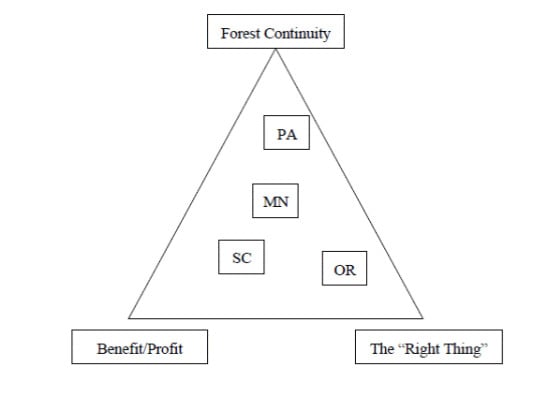
        themes transcend the geographical detail. In <xref ref-type="fig" rid="forests-01-00049-f001">Figure
        1</xref>the position of the focus groups within the space
        is broadly indicative of the relative importance that the
        participants from each state placed on the various topics
        (based on a combined interpretation of the two focus groups
        that occurred in each state).</p>
        <fig id="forests-01-00049-f001" position="float">
          <label>Figure 1</label>
          <caption>
            <p>Graphical Representation of the Relative Importance
            of Ownership Objectives among the Forest Landowner
            Focus Groups from Pennsylvania (PA), Minnesota (MN),
            South Carolina (SC) and Oregon (OR)</p>
          </caption>
          <graphic xmlns:xlink="http://www.w3.org/1999/xlink" xlink:href="forests-01-00049-g001.tif"/>
        </fig>
        <p>The forest continuity concept is a two-fold concern for
        landowners: keeping the land in the family, and keeping the
        land in forest cover. Various pressures exist that make
        achieving both forms of continuity a challenge. In the
        northeast in particular, conversion of forestland to
        residential development was a significant concern (but it
        was less a concern in the west because of Oregon’s
        land zoning practices). In every region there was
        discussion about intergenerational transfer of the land,
        which mixed in family issues (are my kids interested and/or
        capable of managing it?) and estate tax issues, as this
        exchange illustrates:</p>
        <p>Participant 1: Parcelization. You know in our area,
        there is no plan. And there’s a lot of big farms, and
        the children live out of town. They are older people living
        in our neighborhood. Big tracts of land going to be up for
        sale, and probably parceled off. There’s some good
        timber, maybe they’ll sell it.</p>
        <p>Participant 2: It’ll get high-graded off and then
        they’ll sell it.</p>
        <p>Participant 1: Yeah, it is not going to be a good
        outcome. Ten acre parcels they do; more money</p>
        <p>Participant 3: In our county, there was a 90 acre parcel
        with some ecological value. The person would’ve loved
        to have passed it on to the next generation. He had some
        estate planning, all of a sudden there was a corporate
        trustee, and the daughter lived in Florida. She said sell
        it to the highest bidder. (PA; FAM)</p>
        <p>I see development occurring all around me…The 40
        acres I own will never be developed. I just want to keep it
        natural. (MN; FAM)</p>
        <p>The day will come when I will not be able to afford not
        to sell (my land) to a developer…the pressure I will
        be subject to will be tremendous. (MN; FAM)</p>
        <p>If you don’t have the financial assets, you will
        eventually be taxed out of your forest land due to
        development pressure. (MN; FAM)</p>
        <p>The benefit/profit concept merely refers to the benefits
        accrued through private land ownership. As noted before,
        the concept of benefit goes far beyond economic profit. The
        focus groups in South Carolina talked about economic return
        as a primary benefit to forest land ownership more than did
        the other regions (“we need more markets for
        timber” (SC; NAM)), and even the southerners
        expressed substantial interest in non-economic benefits
        such as wildlife habitat/hunting. In the other regions, the
        financial returns from forestry were regarded much more as
        means to an end (“when I make money selling trees I
        tend to reinvest it in my land” (OR; NAM)) than as
        the end itself.</p>
        <p>The “right thing” concept refers to the
        broadly held notion that was broadly Leopoldian in
        philosophy: a management action is right if it tends to
        promote the overall health of the forest. Quite obviously
        what constituted the “right thing” varied
        considerably by region: in Pennsylvania it was combating
        wild rose infestations and reducing deer herbivory on young
        trees, in Oregon it might be restoring riparian areas, and
        in South Carolina it might be appropriate use of prescribed
        fire. But in every region there was the sense that as long
        as the landowners knew the right thing to do, they would do
        it.</p>
        <p>It’s like the purpose driven forest—you hear
        about the purpose driven life. My concern is when
        we’re gone—then what? (PA; FAM)</p>
        <p>The extent to which the landowners’ trilogy of
        forest continuity, benefit/profit, and the “right
        thing” aligns with sustainable forestry is not
        entirely clear. At a philosophical level, there is no
        apparent conflict; in fact, there is a great deal of
        compatibility between the dimensions of this trilogy and
        the “triple bottom line” of sustainable
        business practices—equity, economy, and ecology [ <xref ref-type="bibr" rid="B26-forests-01-00049">        26</xref>]. There are no values or objectives reflected in
        the trilogy that are contrary to sustainable forestry, nor
        are the typical sustainable forestry criteria omitted from
        it with the possible exception of an explicit attention to
        off-site impacts of management. But it is largely
        impossible to determine if this philosophical alignment
        would be manifest in on-the-ground practices. It may be
        that the landowners’ definition of the “right
        thing” is driven by aesthetics or traditional
        practices [ <xref ref-type="bibr" rid="B27-forests-01-00049">27</xref>]
        rather than scientifically grounded practices implemented
        to restore ecological structure and function.</p>
        <p>One sentiment that arose in all of the focus groups was
        an anti-bureaucratic viewpoint. This was manifest in two
        different ways. First was a reluctance to become involved
        in programs such as forest certification if doing so would
        allow other people to have influence on the
        landowners’ decisions.</p>
        <p>We don’t want anybody else telling us what to do
        with our land. (SC; FAM)</p>
        <p>The reason I got into contract logging, and the reason I
        have forest land, is that I didn’t want some boss
        telling me what to do and how to do it. (OR; FAM)</p>
        <p>The second was a fairly broad anti-government sentiment:
        that there was too much government intervention in the
        private sector and too many restrictions on private
        property rights, that some people received cost-share money
        but did not perform the requisite management practices, and
        that service foresters were too busy to return calls or
        schedule technical assistance visits in a timely manner.
        Under-funded programs were also a recurring source of
        frustration among the landowners.</p>
        <p>They (incentive programs) are in writing, but when it
        comes time for allocation of money or the priorities,
        it’s just not there. Again, it seems there are
        government programs, they say ‘we have this, we have
        that’, but the reality of it is it isn’t, it is
        just on paper. But as far as can you get it? No, it is not
        there. It hasn’t been allocated. So I would hope to
        see the kinds of programs people could actually use to get
        them that incentive to get going. Also it would be nice if
        there was some help to get out there, more foresters, or
        somebody you could call up. (PA; FAM)</p>
        <p>(A) major problem is not enough information or where to
        get (information) for it but not enough money to get any
        and then there is always ten people ahead of you. (SC;
        NAM)</p>
        <p>In 1988 I applied for that thing and got it the year I
        applied for it. In 1992 I applied for that money and got it
        the year I applied for it. In 2003 I applied for that money
        and they told me it would be a two-year wait maybe. (SC;
        FAM)</p>
      </sec>
    </sec>
    <sec>
      <title>5. Caveats and Conclusions</title>
      <sec>
        <title>5.1. Caveats</title>
        <p>Any research that offers broad and unqualified
        conclusions regarding a nuanced social phenomenon based on
        a limited sample and single research methodology should be
        read with skepticism. Even though the focus group approach
        was the best choice for this research, it nevertheless
        limits the depth of data we have about any single land
        owner. Moreover, it lacks the statistical measures that a
        large sample-based survey would provide. In addition,
        results from a focus group are inevitably shaped by the
        particular constellation of participants. Finally, analysis
        of the focus group data invariably seems to generate
        additional questions that one wishes were asked during the
        focus group session (but obviously cannot be.)</p>
        <p>Recognizing these limitations, it would be imprudent to
        develop a model of landowner behavior based solely on these
        results, particularly if they contradicted the broad sweep
        of the NIPF incentives research that preceded it. But these
        research results are much more coincident with our
        understanding of NIPF landowners than it is contradictory
        or revolutionary.</p>
      </sec>
      <sec>
        <title>5.2. Conclusions</title>
        <p>Subject to the caveats above, this research adds another
        “brick in the wall” of our knowledge of
        non-industrial private forest landowners in the US and
        their responsiveness to external incentives. It matters
        little whether those incentives come from the government
        (financial incentives and technical assistance) or from
        NGOs pushing for sustainable forestry through mechanisms
        such as certification. A nuanced understanding of the
        knowledge pathways, preferences, and ownership objectives
        of those landowners provides a foundation for developing
        incentives that will have meaningful impact. One strength
        of this research is its use of focus group methods, which
        have been used far less often than survey techniques to
        understand NIPF behavior, and yet have the advantage of
        exploring their objectives in ways that surveys often
        cannot. The sampling frame—8 focus groups distributed
        across the major forestry regions of the country—is
        novel in the NIPF literature and offers the ability to
        address the research topic at a national scale while
        examining the possibility of interregional variation.</p>
        <p><italic>Financial incentives have weak
        appeal.</italic>Recognizing that financial return is not
        the primary decision screen for the forest landowners in
        our focus groups goes a long way in explaining their
        understanding and use of forestry incentive programs.
        Programs that are intended to increase the profitability of
        forest land management do not have much traction with the
        landowners because profit is not their primary ownership
        objective. (This finding corroborates long-standing
        research results [ <xref ref-type="bibr" rid="B21-forests-01-00049">        21</xref>].) It is not that the landowners dislike making
        money from their forest land, nor do they dislike financial
        assistance. But the financial return is not their dominant
        decision screen when contemplating a management practice.
        Perhaps the greatest benefit of financial assistance
        accrues through its ability to increase the number of acres
        that landowners might be able to treat, as in the case of
        mitigating fire risk in Oregon or treating wild rose in
        Pennsylvania. By the same token, forest certification has
        little direct appeal to the landowners to the extent that
        it is primarily framed as creating a market premium that
        would have a bottom-line cash flow impact similar to an
        incentive provided by the government. There is no doubt
        that market forces matter. But they seemed to function more
        to establish the feasibility set for these landowners,
        rather than what was preferred within that set. They no
        doubt have instrumental appeal, but comparatively little
        motivational appeal.</p>
        <p><italic>Face-to-face tech transfer is the most valued form
        of assistance.</italic>The various cost share programs were
        far less utilized and valued than technical assistance
        across the participants in all focus groups. The
        “doing the right thing” concept previously
        described was salient in all regions of the country, and
        among both the association members (experienced landowners)
        and non-association member focus groups. A logical <italic>a priori</italic>expectation could be that the
        non-association members need the technical assistance
        because their level of expertise is lower, while the
        association members value the financial incentives more
        highly. However logical that speculation might be, it in
        fact was not borne out by these focus group participants,
        all of whom valued technical assistance highly. A more
        accurate distinction is that the less experienced
        landowners wanted help with “what to do”
        questions, while their more experienced counterparts wanted
        “how to do” information. Along with that,
        however, is a sense of frustration when local forestry
        expertise is spread too thin and it is not possible to get
        the level of personalized and timely attention that the
        landowners would like. As such, programs like Master
        Forester or Master Tree Farmer are seen as useful ways to
        increase the information flow because they leverage the
        expertise of professional extension foresters through a
        cadre of trained volunteers.</p>
        <p>There may be no more direct way to encourage the
        adoption of sustainable forestry practices among small
        forest landowners than to enlist the support of the service
        foresters who provide technical assistance those landowners
        rely upon. To the extent that service foresters are either
        dismissive toward sustainable forestry concepts or merely
        silent about them, there is a reduced chance that the
        approach will make significant inroads. The importance of
        this quite traditional diffusion channel has been
        previously documented [ <xref ref-type="bibr" rid="B28-forests-01-00049">        28</xref>]. But if service foresters are willing and able
        to frame sustainable forestry concepts as “the right
        thing,” then the prospects for adoption change
        significantly (even if the label “sustainable
        forestry” is never applied to those practices).</p>
        <p><italic>A continued policy emphasis on promoting
        stewardship through management planning is
        appropriate.</italic>Approximately 40% of the association
        members and 70% of the non-association members
        participating in these focus groups did not have formal
        management plans for their properties. This low level of
        investment in developing management plans is a barrier to
        the use of the incentive programs because most require an
        accepted management plan as a pre-requisite to receiving
        assistance. It also indicates that there is still a need
        for assistance and education in management planning. The
        development of these plans is also a key opportunity to
        imbed sustainable forestry concepts and criteria into their
        management strategies.</p>
        <p><italic>Sustainable forestry is a resonant concept, but
        formal certification lacks traction, except when it is a
        secondary result of being in the TREEFARM
        program.</italic>The concept of sustainable forestry
        resonates well with these landowners, as one might expect,
        given that their ownership is motivated by a broad set of
        reasons. The landowners are committed to the long term and
        strongly want to do the right thing, so if sustainable
        forestry is cast as “the right thing for the long
        term,” it becomes an easy concept to sell. When asked
        what sustainable forestry is, these landowners were just as
        likely to respond with attributes that are more commonly
        linked to sustained yield (harvesting at a rate equal to
        forest growth) but specific strategies do not have much
        traction. No one was exploring certification as a market
        niche strategy, although TreeFarm members acknowledge that
        they are certified. Based on strong attachment to their
        forestland, as well as an expressed commitment to do the
        “right thing,” certification may be more
        attractive if it is framed as a validation of the quality
        of their stewardship rather than as a potential price
        premium.</p>
        <p><italic>Regional variation in emphasis argues for a
        state-based program with adequate flexibility to promote
        responsiveness.</italic>Even though these focus groups
        share the unifying trilogy of forest continuity, benefit,
        and doing the “right thing,” there were
        nevertheless differences among them. The land use trends,
        forest health and biodiversity issues, socioeconomic
        context and regulatory environments all differed across
        these four states and the broader regions they were chosen
        to represent. That variation would seem to argue for a
        relatively uniform structure of forestry policies at the
        national level that was flexible enough to allow for
        state-level customization.</p>
        <p>In summary, both the incentive programs and the
        sustainable forestry movement may be making the same
        limiting assumption: that private forest landowners are
        primarily economic agents and thus the most direct means of
        influencing their behavior is through economic leverage.
        This research—and indeed much of the NIPF literature
        conducted over the decades—shows that while landowner
        motivations include financial return, their objectives are
        much more far-reaching. That leads to a conclusion that
        understanding their motivations through models such as the
        continuity/benefit/“right thing” trilogy that
        this focus group research identified may be a more nuanced
        and appropriate foundation for policy formation. It is
        interesting to note that much of the sustainable
        forestry/certification movement has been driven by
        non-governmental organizations (foundations, environmental
        groups, <italic>etc</italic>.). They nevertheless seem to be
        falling into the same paradigmatic trap that the
        government-led forestry incentive programs have been mired
        in; that is, by focusing their attempts to change behavior
        predominantly on the economic incentives, they are failing
        to connect with forest landowners whose motivations appear
        to go considerably beyond the financial.</p>
      </sec>
    </sec>
  </body>
  <back>
    <ref-list>
      <title>References</title>
      <ref id="B1-forests-01-00049">
        <label>1.</label>
        <citation citation-type="journal">
          <person-group person-group-type="author">
            <name>
              <surname>Kilgore</surname>
              <given-names>M.A.</given-names>
            </name>
            <name>
              <surname>Greene</surname>
              <given-names>J.L.</given-names>
            </name>
            <name>
              <surname>Jacobson</surname>
              <given-names>M.G.</given-names>
            </name>
            <name>
              <surname>Straka</surname>
              <given-names>T.J.</given-names>
            </name>
            <name>
              <surname>Daniels</surname>
              <given-names>S.E.</given-names>
            </name>
          </person-group>
          <article-title>The influence of financial incentive
          programs in promoting sustainable forestry on the
          nation’s family forests</article-title>
          <source>J. For.</source>
          <year>2007</year>
          <volume>105</volume>
          <fpage>184</fpage>
          <lpage>191</lpage>
        </citation>
      </ref>
      <ref id="B2-forests-01-00049">
        <label>2.</label>
        <citation citation-type="book">
          <person-group person-group-type="author">
            <name>
              <surname>Cubbage</surname>
              <given-names>F.W.</given-names>
            </name>
            <name>
              <surname>O’Laughlin</surname>
              <given-names>J.</given-names>
            </name>
            <name>
              <surname>Bullock</surname>
              <given-names>C.S.</given-names>
            </name>
          </person-group>
          <source>Forest Resource Policy</source>
          <publisher-name>John Wiley &amp; Sons</publisher-name>
          <publisher-loc>New York, NY, USA</publisher-loc>
          <year>1993</year>
        </citation>
      </ref>
      <ref id="B3-forests-01-00049">
        <label>3.</label>
        <citation citation-type="book">
          <person-group person-group-type="author">
            <name>
              <surname>Royer</surname>
              <given-names>J.P.</given-names>
            </name>
          </person-group>
          <source>Nonindustrial Private Forests: A Review of
          Economic and Policy Studies</source>
          <publisher-name>Duke University School of Forestry and
          Environmental Studies</publisher-name>
          <publisher-loc>Durham, NC, USA</publisher-loc>
          <year>1983</year>
        </citation>
      </ref>
      <ref id="B4-forests-01-00049">
        <label>4.</label>
        <citation citation-type="book">
          <person-group person-group-type="author">
            <name>
              <surname>Ellefson</surname>
              <given-names>P.V.</given-names>
            </name>
            <name>
              <surname>Cheng</surname>
              <given-names>A.S.</given-names>
            </name>
            <name>
              <surname>Moulton</surname>
              <given-names>R.J.</given-names>
            </name>
          </person-group>
          <source>Regulation of Private Forestry Practices by State
          Governments(Station Bulletin 605-1995)</source>
          <publisher-name>University of Minnesota Agricultural
          Experiment Station</publisher-name>
          <publisher-loc>St. Paul, MN, USA</publisher-loc>
          <year>1995</year>
        </citation>
      </ref>
      <ref id="B5-forests-01-00049">
        <label>5.</label>
        <citation citation-type="book">
          <person-group person-group-type="author">
            <name>
              <surname>Sampson</surname>
              <given-names>R.N.</given-names>
            </name>
            <name>
              <surname>deCoster</surname>
              <given-names>L.A.</given-names>
            </name>
          </person-group>
          <source>Public Programs for Private Forestry</source>
          <publisher-name>American Forests</publisher-name>
          <publisher-loc>Washington, DC, USA</publisher-loc>
          <year>1997</year>
        </citation>
      </ref>
      <ref id="B6-forests-01-00049">
        <label>6.</label>
        <citation citation-type="journal">
          <person-group person-group-type="author">
            <name>
              <surname>Straka</surname>
              <given-names>T.J.</given-names>
            </name>
            <name>
              <surname>Greene</surname>
              <given-names>J.L.</given-names>
            </name>
            <name>
              <surname>Daniels</surname>
              <given-names>S.E.</given-names>
            </name>
            <name>
              <surname>Jacobson</surname>
              <given-names>M.G.</given-names>
            </name>
            <name>
              <surname>Kilgore</surname>
              <given-names>M.A.</given-names>
            </name>
          </person-group>
          <article-title>Sources for forestry incentive
          programs</article-title>
          <source>For. Landowner</source>
          <year>2006</year>
          <volume>65</volume>
          <fpage>15</fpage>
          <lpage>16</lpage>
        </citation>
      </ref>
      <ref id="B7-forests-01-00049">
        <label>7.</label>
        <citation citation-type="journal">
          <person-group person-group-type="author">
            <name>
              <surname>Stoddard</surname>
              <given-names>C.H.</given-names>
            </name>
          </person-group>
          <article-title>Future of private forest land ownership in
          the northern Lake States</article-title>
          <source>J. Land Public Util. Econ.</source>
          <year>1942</year>
          <volume>18</volume>
          <fpage>267</fpage>
          <lpage>283</lpage>
          <pub-id pub-id-type="doi">10.2307/3159057</pub-id>
        </citation>
      </ref>
      <ref id="B8-forests-01-00049">
        <label>8.</label>
        <citation citation-type="journal">
          <person-group person-group-type="author">
            <name>
              <surname>Lord</surname>
              <given-names>W.B.</given-names>
            </name>
          </person-group>
          <article-title>A reconsideration of the farm forestry
          problem</article-title>
          <source>J. For.</source>
          <year>1963</year>
          <volume>61</volume>
          <fpage>262</fpage>
          <lpage>64</lpage>
        </citation>
      </ref>
      <ref id="B9-forests-01-00049">
        <label>9.</label>
        <citation citation-type="book">
          <person-group person-group-type="author">
            <name>
              <surname>Stoddard</surname>
              <given-names>C.H.</given-names>
            </name>
          </person-group>
          <source>The Small Private Forest in the United
          States</source>
          <publisher-name>Resources for the Future</publisher-name>
          <publisher-loc>Washington, DC, USA</publisher-loc>
          <year>1961</year>
        </citation>
      </ref>
      <ref id="B10-forests-01-00049">
        <label>10.</label>
        <citation citation-type="gov">
          <article-title>National Report on Sustainable
          Forestry—2003 (FS-766)</article-title>
          <source>USDA Forest Service</source>
          <publisher-name>USDA Forest Service</publisher-name>
          <publisher-loc>Washington, D.C., USA</publisher-loc>
          <year>2004</year>
        </citation>
      </ref>
      <ref id="B11-forests-01-00049">
        <label>11.</label>
        <citation citation-type="book">
          <person-group person-group-type="author">
            <name>
              <surname>Rockwell</surname>
              <given-names>W.</given-names>
            </name>
            <name>
              <surname>Levesque</surname>
              <given-names>C.</given-names>
            </name>
          </person-group>
          <source>Forest Certification Auditing: A Guide for
          Practitioners</source>
          <publisher-name>Society of American
          Foresters</publisher-name>
          <publisher-loc>Bethesda, MD, USA</publisher-loc>
          <year>2005</year>
        </citation>
      </ref>
      <ref id="B12-forests-01-00049">
        <label>12.</label>
        <citation citation-type="book">
          <person-group person-group-type="author">
            <name>
              <surname>Cashore</surname>
              <given-names>B.</given-names>
            </name>
            <name>
              <surname>Auld</surname>
              <given-names>G.</given-names>
            </name>
            <name>
              <surname>Newsom</surname>
              <given-names>D.</given-names>
            </name>
          </person-group>
          <source>Governing through Markets: Forest Certification
          and the Emergence of Non-State Authority</source>
          <publisher-name>Yale University Press</publisher-name>
          <publisher-loc>New Haven, CT, USA</publisher-loc>
          <year>2004</year>
        </citation>
      </ref>
      <ref id="B13-forests-01-00049">
        <label>13.</label>
        <citation citation-type="journal">
          <person-group person-group-type="author">
            <name>
              <surname>Adamowicz</surname>
              <given-names>W.</given-names>
            </name>
            <name>
              <surname>Adamowicz</surname>
              <given-names>W.</given-names>
            </name>
          </person-group>
          <article-title>Economic indicators of sustainable forest
          management: Theory <italic>versus</italic>practice</article-title>
          <source>J. For. Econ.</source>
          <year>2003</year>
          <volume>9</volume>
          <fpage>27</fpage>
          <lpage>40</lpage>
        </citation>
      </ref>
      <ref id="B14-forests-01-00049">
        <label>14.</label>
        <citation citation-type="book">
          <person-group person-group-type="author">
            <name>
              <surname>Niskanen</surname>
              <given-names>A.</given-names>
            </name>
          </person-group>
          <source>Economic sustainability of small-scale forestry
          (EFI Proceedings No. 36)</source>
          <publisher-name>European Forest
          Institute</publisher-name>
          <publisher-loc>Joensuu, Finland</publisher-loc>
          <year>2001</year>
        </citation>
      </ref>
      <ref id="B15-forests-01-00049">
        <label>15.</label>
        <citation citation-type="journal">
          <person-group person-group-type="author">
            <name>
              <surname>Vierikko</surname>
              <given-names>K.</given-names>
            </name>
            <name>
              <surname>Vehkamäki</surname>
              <given-names>S.</given-names>
            </name>
            <name>
              <surname>Niemelä</surname>
              <given-names>J.</given-names>
            </name>
            <name>
              <surname>Pellikka</surname>
              <given-names>J.</given-names>
            </name>
            <name>
              <surname>Lindén</surname>
              <given-names>H.</given-names>
            </name>
          </person-group>
          <article-title>Meeting the ecological, social and
          economic needs of sustainable forest management at a
          regional scale</article-title>
          <source>Scand. J. ForestRes.</source>
          <year>2008</year>
          <volume>23</volume>
          <fpage>431</fpage>
          <lpage>444</lpage>
          <pub-id pub-id-type="doi">          10.1080/02827580802284693</pub-id>
        </citation>
      </ref>
      <ref id="B16-forests-01-00049">
        <label>16.</label>
        <citation citation-type="book">
          <person-group person-group-type="author">
            <name>
              <surname>Krueger</surname>
              <given-names>R.A.</given-names>
            </name>
            <name>
              <surname>Casey</surname>
              <given-names>M.A.</given-names>
            </name>
          </person-group>
          <source>Focus Groups: A Practical Guide for Applied
          Research</source>
          <edition>3rd</edition>
          <publisher-name>Sage Publications</publisher-name>
          <publisher-loc>Thousand Oaks, CA, USA</publisher-loc>
          <year>2000</year>
        </citation>
      </ref>
      <ref id="B17-forests-01-00049">
        <label>17.</label>
        <citation citation-type="book">
          <person-group person-group-type="author">
            <name>
              <surname>Buzan</surname>
              <given-names>T.</given-names>
            </name>
          </person-group>
          <source>Use Both Sides of Your Brain</source>
          <edition>3rd</edition>
          <publisher-name>Dutton Adult</publisher-name>
          <publisher-loc>New York, NY, USA</publisher-loc>
          <year>1991</year>
        </citation>
      </ref>
      <ref id="B18-forests-01-00049">
        <label>18.</label>
        <citation citation-type="book">
          <person-group person-group-type="author">
            <name>
              <surname>Daniels</surname>
              <given-names>S.E.</given-names>
            </name>
            <name>
              <surname>Walker</surname>
              <given-names>G.B.</given-names>
            </name>
          </person-group>
          <source>Working Through Environmental Conflict: The
          Collaborative Learning Approach</source>
          <publisher-name>Praeger Press</publisher-name>
          <publisher-loc>Westport, CT, USA</publisher-loc>
          <year>2001</year>
        </citation>
      </ref>
      <ref id="B19-forests-01-00049">
        <label>19.</label>
        <citation citation-type="book">
          <person-group person-group-type="author">
            <name>
              <surname>Wear</surname>
              <given-names>D.N.</given-names>
            </name>
          </person-group>
          <source>Southern Forest Resource Assessment (General
          Technical Report SRS-53)</source>
          <publisher-name>USDA Forest Service</publisher-name>
          <publisher-loc>Asheville, NC, USA</publisher-loc>
          <year>2002</year>
        </citation>
      </ref>
      <ref id="B20-forests-01-00049">
        <label>20.</label>
        <citation citation-type="journal">
          <person-group person-group-type="author">
            <name>
              <surname>Kenniston</surname>
              <given-names>R.F.</given-names>
            </name>
          </person-group>
          <article-title>The forest owner—a
          person</article-title>
          <source>J. For.</source>
          <year>1962</year>
          <volume>60</volume>
          <fpage>249</fpage>
          <lpage>53</lpage>
        </citation>
      </ref>
      <ref id="B21-forests-01-00049">
        <label>21.</label>
        <citation citation-type="book">
          <person-group person-group-type="author">
            <name>
              <surname>Binkley</surname>
              <given-names>C.S.</given-names>
            </name>
          </person-group>
          <source>Timber Supply from Nonindustrial Forests: A
          Microeconomic Analysis of Landowner Behavior (Bulletin
          No. 92)</source>
          <publisher-name>Yale University School of Forestry and
          Environmental Studies</publisher-name>
          <publisher-loc>New Haven, CT, USA</publisher-loc>
          <year>1981</year>
        </citation>
      </ref>
      <ref id="B22-forests-01-00049">
        <label>22.</label>
        <citation citation-type="book">
          <person-group person-group-type="author">
            <name>
              <surname>James</surname>
              <given-names>L.M.</given-names>
            </name>
            <name>
              <surname>Hoffman</surname>
              <given-names>W.P.</given-names>
            </name>
            <name>
              <surname>Payne</surname>
              <given-names>M.A.</given-names>
            </name>
          </person-group>
          <source>Private forest landownership and management in
          Central Mississippi (Technical Bulletin 33)</source>
          <publisher-name>Mississippi State College Agricultural
          Experiment Station</publisher-name>
          <publisher-loc>Starkville, MS, USA</publisher-loc>
          <year>1951</year>
        </citation>
      </ref>
      <ref id="B23-forests-01-00049">
        <label>23.</label>
        <citation citation-type="journal">
          <person-group person-group-type="author">
            <name>
              <surname>Kilgore</surname>
              <given-names>M.A.</given-names>
            </name>
            <name>
              <surname>Blinn</surname>
              <given-names>C.R.</given-names>
            </name>
          </person-group>
          <article-title>Policy tools to encourage the application
          of sustainable timber harvesting practices in the United
          States and Canada</article-title>
          <source>Forest Policy and Econ.</source>
          <year>2004</year>
          <volume>6</volume>
          <fpage>111</fpage>
          <lpage>127</lpage>
          <pub-id pub-id-type="doi">          10.1016/S1389-9341(02)00116-8</pub-id>
        </citation>
      </ref>
      <ref id="B24-forests-01-00049">
        <label>24.</label>
        <citation citation-type="journal">
          <person-group person-group-type="author">
            <name>
              <surname>Bliss</surname>
              <given-names>J.C.</given-names>
            </name>
            <name>
              <surname>Nepal</surname>
              <given-names>S.K.</given-names>
            </name>
            <name>
              <surname>Brooks</surname>
              <given-names>R.T.</given-names>
            </name>
            <name>
              <surname>Larsen</surname>
              <given-names>M.D.</given-names>
            </name>
          </person-group>
          <article-title>In the mainstream: environmental attitudes
          of Mid-south forest owners.</article-title>
          <source>So. J. App. Forestry</source>
          <year>1997</year>
          <volume>21</volume>
          <fpage>37</fpage>
          <lpage>43</lpage>
        </citation>
      </ref>
      <ref id="B25-forests-01-00049">
        <label>25.</label>
        <citation citation-type="journal">
          <person-group person-group-type="author">
            <name>
              <surname>Wilson</surname>
              <given-names>R.K.</given-names>
            </name>
          </person-group>
          <article-title>Collaboration in context: Rural change and
          community forestry in the Four Corners</article-title>
          <source>Soc. Natur. Resour.</source>
          <year>2006</year>
          <volume>19</volume>
          <fpage>53</fpage>
          <lpage>70</lpage>
          <pub-id pub-id-type="doi">          10.1080/08941920500323302</pub-id>
        </citation>
      </ref>
      <ref id="B26-forests-01-00049">
        <label>26.</label>
        <citation citation-type="book">
          <person-group person-group-type="author">
            <name>
              <surname>Savitz</surname>
              <given-names>A.W.</given-names>
            </name>
          </person-group>
          <source>The Triple Bottom Line: How Today's Best-Run
          Companies Are Achieving Economic, Social and
          Environmental Success</source>
          <publisher-name>Jossey Bass</publisher-name>
          <publisher-loc>San Francisco, CA, USA</publisher-loc>
          <year>2006</year>
        </citation>
      </ref>
      <ref id="B27-forests-01-00049">
        <label>27.</label>
        <citation citation-type="journal">
          <person-group person-group-type="author">
            <name>
              <surname>Bliss</surname>
              <given-names>J.C.</given-names>
            </name>
            <name>
              <surname>Martin</surname>
              <given-names>A.J.</given-names>
            </name>
          </person-group>
          <article-title>Identifying NIPF management motivations
          with qualitative methods</article-title>
          <source>For. Sci.</source>
          <year>1989</year>
          <volume>35</volume>
          <fpage>601</fpage>
          <lpage>622</lpage>
        </citation>
      </ref>
      <ref id="B28-forests-01-00049">
        <label>28.</label>
        <citation citation-type="journal">
          <person-group person-group-type="author">
            <name>
              <surname>Doolittle</surname>
              <given-names>M.L.</given-names>
            </name>
            <name>
              <surname>Straka</surname>
              <given-names>T.J.</given-names>
            </name>
          </person-group>
          <article-title>Regeneration following harvest on
          nonindustrial pine sites in the South: A diffusion of
          innovations perspective</article-title>
          <source>So. J. Appl. Forestry</source>
          <year>1987</year>
          <volume>11</volume>
          <fpage>37</fpage>
          <lpage>41</lpage>
        </citation>
      </ref>
    </ref-list>
  </back>
</article>