
<?xml version="1.0" encoding="UTF-8"?>
<!DOCTYPE article PUBLIC "-//NLM//DTD Journal Publishing DTD v2.3 20070202//EN" "journalpublishing.dtd">
<article xmlns:xlink="http://www.w3.org/1999/xlink" xml:lang="en" article-type="review-article">
<front>
<journal-meta>
<journal-id journal-id-type="publisher-id">101238455</journal-id>
<journal-title>International Journal of Environmental Research and Public Health</journal-title>
<issn pub-type="ppub">1661-7827</issn>
<issn pub-type="epub">1660-4601</issn>
<publisher>
<publisher-name>Molecular Diversity Preservation International (MDPI)</publisher-name></publisher></journal-meta>
<article-meta>
<article-id pub-id-type="doi">10.3390/ijerph8114238</article-id>
<article-id pub-id-type="publisher-id">ijerph-08-04238</article-id>
<article-categories>
<subj-group>
<subject>Review</subject></subj-group></article-categories>
<title-group>
<article-title>Trichloroethylene and Cancer: Systematic and Quantitative Review of Epidemiologic Evidence for Identifying Hazards</article-title></title-group>
<contrib-group>
<contrib contrib-type="author">
<name><surname>Scott</surname><given-names>Cheryl Siegel</given-names></name><xref ref-type="corresp" rid="c1-ijerph-08-04238">*</xref></contrib>
<contrib contrib-type="author">
<name><surname>Jinot</surname><given-names>Jennifer</given-names></name></contrib>
<aff id="af1-ijerph-08-04238">National Center for Environmental Assessment, Office of Research and Development, United States Environmental Protection Agency, 1200 Pennsylvania Avenue, Washington, DC 20460, USA; E-Mail: <email>Jinot.Jennifer@epa.gov</email></aff></contrib-group>
<author-notes>
<corresp id="c1-ijerph-08-04238">
<label>*</label>Author to whom correspondence should be addressed; E-Mail: <email>Scott.Cheryl@epa.gov</email>; Tel: +1-703-347-8590; Fax: +1-703-347-8694.</corresp></author-notes>
<pub-date pub-type="ppub">
<month>11</month>
<year>2011</year></pub-date>
<pub-date pub-type="epub">
<day>09</day>
<month>11</month>
<year>2011</year></pub-date>
<volume>8</volume>
<issue>11</issue>
<fpage>4238</fpage>
<lpage>4272</lpage>
<history>
<date date-type="received">
<day>22</day>
<month>9</month>
<year>2011</year></date>
<date date-type="rev-recd">
<day>21</day>
<month>10</month>
<year>2011</year></date>
<date date-type="accepted">
<day>26</day>
<month>10</month>
<year>2011</year></date></history>
<permissions>
<copyright-statement>© 2011 by the authors; licensee MDPI, Basel, Switzerland</copyright-statement>
<copyright-year>2011</copyright-year>
<license license-type="open-access" xlink:href="http://creativecommons.org/licenses/by/3.0">
<p>This article is an open-access article distributed under the terms and conditions of the Creative Commons Attribution license (http://creativecommons.org/licenses/by/3.0/).</p></license></permissions>
<abstract>
<p>We conducted a meta-analysis focusing on studies with high potential for trichloroethylene (TCE) exposure to provide quantitative evaluations of the evidence for associations between TCE exposure and kidney, liver, and non-Hodgkin lymphoma (NHL) cancers. A systematic review documenting essential design features, exposure assessment approaches, statistical analyses, and potential sources of confounding and bias identified twenty-four cohort and case-control studies on TCE and the three cancers of interest with high potential for exposure, including five recently published case-control studies of kidney cancer or NHL. Fixed- and random-effects models were fitted to the data on overall exposure and on the highest exposure group. Sensitivity analyses examined the influence of individual studies and of alternative risk estimate selections. For overall TCE exposure and kidney cancer, the summary relative risk (RRm) estimate from the random effects model was 1.27 (95% CI: 1.13, 1.43), with a higher RRm for the highest exposure groups (1.58, 95% CI: 1.28, 1.96). The RRm estimates were not overly sensitive to alternative risk estimate selections or to removal of an individual study. There was no apparent heterogeneity or publication bias. For NHL, RRm estimates for overall exposure and for the highest exposure group, respectively, were 1.23 (95% CI: 1.07, 1.42) and 1.43 (95% CI: 1.13, 1.82) and, for liver cancer, 1.29 (95% CI: 1.07, 1.56) and 1.28 (95% CI: 0.93, 1.77). Our findings provide strong support for a causal association between TCE exposure and kidney cancer. The support is strong but less robust for NHL, where issues of study heterogeneity, potential publication bias, and weaker exposure-response results contribute uncertainty, and more limited for liver cancer, where only cohort studies with small numbers of cases were available.</p></abstract>
<kwd-group>
<kwd>trichloroethylene</kwd>
<kwd>meta-analysis</kwd>
<kwd>kidney cancer</kwd>
<kwd>liver cancer</kwd>
<kwd>NHL</kwd>
<kwd>occupational exposure</kwd></kwd-group></article-meta></front>
<body>
<sec sec-type="intro">
<title>1. Introduction</title>
<p>The interpretation of the epidemiologic studies on cancer and trichloroethylene (TCE) continues to be an area of considerable interest despite numerous reviews, including those of multidisciplinary expert panels whose conclusions have ranged widely due, in part, to differences in the qualitative evaluation of the epidemiologic data as well as in the studies available at the time [<xref ref-type="bibr" rid="b1-ijerph-08-04238">1</xref>–<xref ref-type="bibr" rid="b5-ijerph-08-04238">5</xref>]. Two advisory panels reviewing the epidemiologic evidence on cancer and TCE recommended meta-analysis as an approach to synthesize the data, noting individual studies had limited statistical power for relatively uncommon cancers such as kidney, liver, and non-Hodgkin lymphoma (NHL) [<xref ref-type="bibr" rid="b6-ijerph-08-04238">6</xref>,<xref ref-type="bibr" rid="b7-ijerph-08-04238">7</xref>].</p>
<p>In this paper, we present findings from a systematic review and a comprehensive meta-analysis of studies of occupational TCE exposure and cancer, focusing on studies with high potential for TCE exposure and following guidance for epidemiologic study reporting and meta-analysis practice [<xref ref-type="bibr" rid="b8-ijerph-08-04238">8</xref>–<xref ref-type="bibr" rid="b10-ijerph-08-04238">10</xref>]. We focus on three specific cancers of <italic>a priori</italic> interest from rodent bioassays of TCE exposure [<xref ref-type="bibr" rid="b11-ijerph-08-04238">11</xref>–<xref ref-type="bibr" rid="b13-ijerph-08-04238">13</xref>] and a broader qualitative review of the epidemiologic data—kidney cancer, liver cancer, and NHL. We consider current disease classifications for NHL and carry out a systematic evaluation of the literature. Our meta-analysis updates the literature covered by previous meta-analyses of TCE exposure and cancer [<xref ref-type="bibr" rid="b14-ijerph-08-04238">14</xref>–<xref ref-type="bibr" rid="b19-ijerph-08-04238">19</xref>], adding four case-control studies on NHL [<xref ref-type="bibr" rid="b20-ijerph-08-04238">20</xref>–<xref ref-type="bibr" rid="b23-ijerph-08-04238">23</xref>], one case-control study on renal cell carcinoma [<xref ref-type="bibr" rid="b24-ijerph-08-04238">24</xref>], two studies in a cohort of aerospace workers [<xref ref-type="bibr" rid="b25-ijerph-08-04238">25</xref>,<xref ref-type="bibr" rid="b26-ijerph-08-04238">26</xref>], and an updated mortality follow-up of a cohort of aircraft maintenance workers [<xref ref-type="bibr" rid="b27-ijerph-08-04238">27</xref>]. The incorporation of clear <italic>a priori</italic> guidelines for identifying studies with moderate-to-high probability of TCE exposure, inclusion of both cohort and case-control studies, supplemental examination of the highest exposure group in each study to reduce the impact of exposure misclassification, and assessments of heterogeneity and sensitivity provide insight for the evaluation of a causal link between TCE and these specific cancers.</p></sec>
<sec sec-type="methods">
<title>2. Methods</title>
<p>A thorough search of the literature was carried out without restriction on year of publication or language to identify all studies that assessed the relationship between cancer and TCE following these approaches: a search of the bibliographic databases PubMed (<ext-link xlink:href="http://www.ncbi.nlm.nih.gov/pubmed/" ext-link-type="uri">http://www.ncbi.nlm.nih.gov/pubmed/</ext-link>), TOXNET (<ext-link xlink:href="http://toxnet.nlm.nih.gov/" ext-link-type="uri">http://toxnet.nlm.nih.gov/</ext-link>) and EMBASE (<ext-link xlink:href="http://www.embase.com/" ext-link-type="uri">http://www.embase.com/</ext-link>) using the terms “trichloroethylene cancer epidemiology” and ancillary terms, “degreasers,” “aircraft, aerospace or aircraft maintenance workers,” “metal workers,” and “electronic workers,” “trichloroethylene and cohort,” or, “trichloroethylene and case-control;” examination of bibliographies of reviews of the TCE epidemiologic literature such as those of the Institute of Medicine [<xref ref-type="bibr" rid="b28-ijerph-08-04238">28</xref>], National Research Council [<xref ref-type="bibr" rid="b5-ijerph-08-04238">5</xref>,<xref ref-type="bibr" rid="b6-ijerph-08-04238">6</xref>] and Scott and Chiu [<xref ref-type="bibr" rid="b4-ijerph-08-04238">4</xref>]; and review of bibliographies of individual studies and previous meta-analyses for relevant studies. Only studies in press or published in scientific journals, as of December 2010, or their additional analyses provided through personnel communication with the authors were considered. Studies with multiple published analyses based on updates to the same cohort are identified by the most recent publication.</p>
<sec sec-type="methods">
<title>2.1. Study Selection and Data Extraction</title>
<p>Studies selected for inclusion in the meta-analysis met the following criteria: (1) cohort or case-control design; (2) exposed and control groups in cohort studies and cases and controls in case-control studies are comparable and drawn from the same base population; (3) TCE exposure potential and some estimate of TCE exposure assessed for each subject by reference to industrial hygiene records, individual biomarkers, job-exposure matrices, expert assessment, water distribution models, or questionnaire responses (case-control studies); and (4) relative risk (RR) estimates for kidney cancer, liver cancer, or NHL.</p>
<p>The general approach for selecting RR estimates and associated confidence intervals (CIs) was to pick a single RR estimate for overall TCE exposure <italic>versus</italic> no TCE exposure. When multiple estimates were available for the same study based on different subcohorts with different inclusion criteria, the preference for overall exposure was to select the RR estimate that represented the largest population in the study, while trying to minimize the likelihood of TCE exposure misclassification. A subcohort with more restrictive inclusion criteria was selected if the goal for the definition of the subcohort was to reduce exposure misclassification (e.g., including only subjects with more probable TCE exposure) but not if the goal was to reflect subjects with greater exposure (e.g., routine <italic>versus</italic> any exposure). When available, RR estimates from internal analyses were chosen over standardized incidence or mortality ratios (SIRs, SMRs), and adjusted RR estimates were selected over crude estimates. Odds ratios in case-control studies were considered to approximate the RR, or more specifically the rate ratio, as the cancers of interest are rare diseases in both the exposed and unexposed groups, with lifetime risks considerably less than 10% [<xref ref-type="bibr" rid="b29-ijerph-08-04238">29</xref>]. No correction was made to cause-specific mortality estimates based on an overall standardized mortality ratio to adjust for the healthy worker bias. In separate analyses, a RR estimate for the highest exposure group was selected, with a preference for cumulative exposure if available; however, often duration was the sole exposure metric presented.</p></sec>
<sec sec-type="methods">
<title>2.2. Statistical Methods</title>
<p>Random-effects models were used for the primary analyses, employing the methodology of DerSimonian and Laird [<xref ref-type="bibr" rid="b30-ijerph-08-04238">30</xref>], with fixed-effect analyses conducted for comparison. Both approaches combine effect measures (in this case, RR estimates) weighted by the inverse variance; however, the random-effects model takes estimates of between-study, as well as within-study, variation into account. The meta-analysis calculations are based on natural-logarithm-transformed relative risk (log RR) values. For the weights, either an estimate of the standard error (SE) of the log RR, from which to estimate the variance, was obtained from the CIs of the RR estimate [<xref ref-type="bibr" rid="b31-ijerph-08-04238">31</xref>] or, for SMRs and SIRs, an estimate of the variance of the log RR was calculated directly as the inverse of the observed number of deaths (or cases) [<xref ref-type="bibr" rid="b32-ijerph-08-04238">32</xref>]. In some case-control studies, no overall odds ratio (OR) was reported and a crude OR estimate was used, with the variance of the log OR estimated in accordance with the method proposed by Woolf [<xref ref-type="bibr" rid="b33-ijerph-08-04238">33</xref>], as described by Breslow and Day [<xref ref-type="bibr" rid="b34-ijerph-08-04238">34</xref>]. All analyses were performed using Microsoft Excel<sup>®</sup> spreadsheets and the software package Comprehensive Meta-Analysis, Version 2 (© 2006, Biostat, Inc.); forest plots were created using SAS, Version 9.2 (© 2002–2008, SAS Institute, Inc.). We calculated summary meta-relative-risk (RRm) estimates for overall TCE exposure and for the highest exposure groups in studies that provided data by exposure group. Examination of the highest exposure group was undertaken not to provide an estimate of risk associated with a specific exposure level, as exposure assessments differed greatly in quality and in the exposure metrics used, but, rather, to identify subjects with the greatest potential for TCE exposure, reducing potential bias from exposure misclassification. Additionally, we conducted analyses of the sensitivity of the summary estimates to alternative study inclusion selections or to alternative selections of a study’s RR estimate and influence analyses to examine the impact of individual studies on the summary estimates. Heterogeneity was assessed using the <italic>Q</italic>-statistic [<xref ref-type="bibr" rid="b30-ijerph-08-04238">30</xref>] and the <italic>I</italic><italic><sup>2</sup></italic>-value [<xref ref-type="bibr" rid="b35-ijerph-08-04238">35</xref>]. Publication bias was assessed a number of ways, including funnel plots, the “trim and fill” procedure of Duval and Tweedie [<xref ref-type="bibr" rid="b36-ijerph-08-04238">36</xref>], forest plots of studies sorted by the SE, and cumulative meta-analyses after sorting studies by the SE.</p></sec></sec>
<sec sec-type="results">
<title>3. Results</title>
<p>Twenty-four studies met the inclusion criteria and were eligible for meta-analysis. <xref ref-type="table" rid="t1-ijerph-08-04238">Table 1</xref> lists the literature reference, study design, number of subjects, follow-up period, exposure assessment approach and whether RRs were based on incidence or on mortality. Eleven cohort studies were identified, four European studies of cancer incidence in degreasers from predominantly iron and metal industries [<xref ref-type="bibr" rid="b37-ijerph-08-04238">37</xref>–<xref ref-type="bibr" rid="b40-ijerph-08-04238">40</xref>] and seven studies in the United States of mortality in electrical, aerospace or aircraft maintenance workers [<xref ref-type="bibr" rid="b26-ijerph-08-04238">26</xref>,<xref ref-type="bibr" rid="b27-ijerph-08-04238">27</xref>,<xref ref-type="bibr" rid="b41-ijerph-08-04238">41</xref>–<xref ref-type="bibr" rid="b43-ijerph-08-04238">43</xref>] or of both incidence and mortality in aircraft maintenance and aerospace workers [<xref ref-type="bibr" rid="b25-ijerph-08-04238">25</xref>,<xref ref-type="bibr" rid="b44-ijerph-08-04238">44</xref>]. The study periods and base populations in Zhao <italic>et al</italic>. [<xref ref-type="bibr" rid="b25-ijerph-08-04238">25</xref>] and Boice <italic>et al.</italic> [<xref ref-type="bibr" rid="b26-ijerph-08-04238">26</xref>] overlap, although the studies differ in their exposure assessment approach. Zhao <italic>et al.</italic> [<xref ref-type="bibr" rid="b25-ijerph-08-04238">25</xref>] is preferred for the primary analysis given its larger number of TCE-exposed subjects, larger number of kidney cancer and NHL deaths, semi-quantitative exposure assessment, and internal referent group; Boice <italic>et al</italic>. [<xref ref-type="bibr" rid="b26-ijerph-08-04238">26</xref>] was used in the sensitivity analyses. Radican <italic>et al</italic>. [<xref ref-type="bibr" rid="b27-ijerph-08-04238">27</xref>] updated mortality in the National Cancer Institute (NCI) cohort of Blair <italic>et al</italic>. [<xref ref-type="bibr" rid="b44-ijerph-08-04238">44</xref>] and is preferred in the main analysis, given its additional 10 years of follow-up; the incidence findings reported in the earlier publication by Blair <italic>et al.</italic> [<xref ref-type="bibr" rid="b44-ijerph-08-04238">44</xref>] were used in the sensitivity analyses. The analysis treats Greenland <italic>et al.</italic> [<xref ref-type="bibr" rid="b42-ijerph-08-04238">42</xref>], a case-control study of multiple cancer sites nested within an occupational cohort, as a cohort study because the OR was estimated from incidence density sampling [<xref ref-type="bibr" rid="b45-ijerph-08-04238">45</xref>]. Of the thirteen case-control studies, seven were of NHL [<xref ref-type="bibr" rid="b20-ijerph-08-04238">20</xref>–<xref ref-type="bibr" rid="b23-ijerph-08-04238">23</xref>,<xref ref-type="bibr" rid="b46-ijerph-08-04238">46</xref>–<xref ref-type="bibr" rid="b48-ijerph-08-04238">48</xref>], five of renal cell carcinoma [<xref ref-type="bibr" rid="b24-ijerph-08-04238">24</xref>,<xref ref-type="bibr" rid="b49-ijerph-08-04238">49</xref>–<xref ref-type="bibr" rid="b52-ijerph-08-04238">52</xref>] and one of multiple cancer sites that included NHL and renal cell carcinoma [<xref ref-type="bibr" rid="b53-ijerph-08-04238">53</xref>]. No case-control studies of primary liver cancer or liver and biliary cancers were identified which fulfilled the inclusion criteria.</p>
<p>A listing of studies not meeting the selection criteria and the reasons for the exclusions can be found in the <xref ref-type="supplementary-material" rid="s1-ijerph-08-04238">Supplemental Material</xref>.</p>
<sec>
<title>3.1. Kidney Cancer</title>
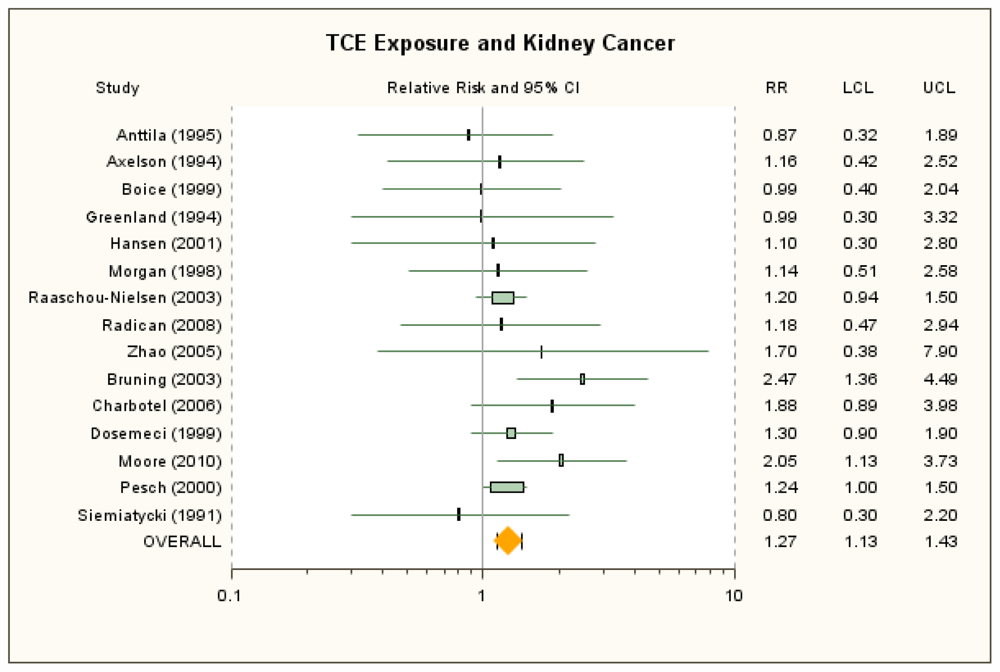
<p>Primary and alternate RR estimates for kidney cancer from the individual cohort and case-control studies are presented in <xref ref-type="table" rid="t2-ijerph-08-04238">Table 2</xref>, and a forest plot of the primary RR estimates and the summary RRm estimate for overall exposure is displayed in <xref ref-type="fig" rid="f1-ijerph-08-04238">Figure 1</xref>. The RRm from the primary random-effects meta-analysis of the 15 studies was 1.27 (95% CI: 1.13, 1.43) and was identical to the RRm from the fixed-effect model. The studies of Pesch <italic>et al</italic>. [<xref ref-type="bibr" rid="b52-ijerph-08-04238">52</xref>], Raaschou-Nielsen <italic>et al</italic>. [<xref ref-type="bibr" rid="b40-ijerph-08-04238">40</xref>], and Dosemeci <italic>et al</italic>. [<xref ref-type="bibr" rid="b51-ijerph-08-04238">51</xref>] contributed about 75% of the weight, although no single study was overly influential and removal of individual studies resulted in RRm estimates that were all statistically significant and that ranged from 1.24 (removing Brüning <italic>et al</italic>. [<xref ref-type="bibr" rid="b49-ijerph-08-04238">49</xref>]) to 1.30 (removing Raaschou-Nielsen <italic>et al</italic>. [<xref ref-type="bibr" rid="b40-ijerph-08-04238">40</xref>]). Similarly, the RRm estimate was not highly sensitive to alternate RR estimate selections. Use of the 13 alternate RR selections, individually, resulted in RRm estimates that ranged from 1.21 (95% CI: 1.09, 1.34) to 1.32 (95% CI: 1.17, 1.49) (see <xref ref-type="supplementary-material" rid="s1-ijerph-08-04238">Supplemental Material</xref>).</p>
<p>There was no observable heterogeneity across the studies of overall exposure (<italic>I</italic><italic><sup>2</sup></italic> = 0%). Nevertheless, subgroup analyses examining cohort and case-control studies separately were carried out as sensitivity analyses. The random-effects model yielded RRm estimates of 1.16 (95% CI: 0.96, 1.40) for the cohort studies and 1.48 (1.15, 1.91) for the case-control studies, with RRm estimates not statistically significant different (p = 0.12) between cohort or case-control studies. No heterogeneity was observed in the cohort subgroup (<italic>I</italic><italic><sup>2</sup></italic> = 0%), and low-to-moderate heterogeneity in the case-control subgroup was suggested by the <italic>I</italic><italic><sup>2</sup></italic>-value of 41% (p = 0.14 for heterogeneity). No evidence of publication bias was observed in the data set for kidney cancer and overall TCE exposure. The trim-and-fill procedure determined that there was no imbalance in the funnel plot indicative of publication bias (see <xref ref-type="supplementary-material" rid="s1-ijerph-08-04238">Supplemental Material</xref>).</p>
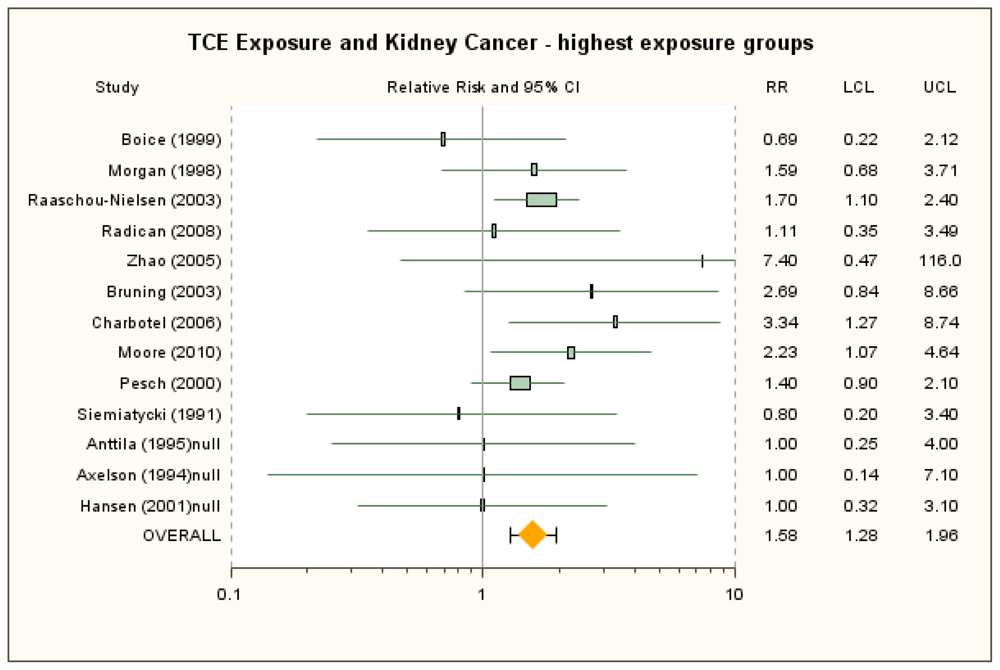
<p>For the highest exposure groups, the primary random-effects meta-analysis, in which null estimates (RR = 1.0) were included for three studies which reported exposure-group results for select other cancers but not for kidney cancer, to address ostensible reporting bias, yielded an RRm estimate of 1.58 (95% CI: 1.28, 1.96) (see <xref ref-type="fig" rid="f2-ijerph-08-04238">Figure 2</xref>) [<xref ref-type="bibr" rid="b37-ijerph-08-04238">37</xref>–<xref ref-type="bibr" rid="b39-ijerph-08-04238">39</xref>]. In an analysis of only the ten studies reporting results by exposure level, the RRm estimate was 1.64 (95% CI: 1.31, 2.04), similar to the RRm from the primary analysis. No single study was overly influential, as removal of individual studies resulted in RRm estimates that were all statistically significant and that ranged from 1.52 (removing Raaschou-Nielsen <italic>et al</italic>. [<xref ref-type="bibr" rid="b40-ijerph-08-04238">40</xref>]) to 1.64 (removing Pesch <italic>et al</italic>. [<xref ref-type="bibr" rid="b52-ijerph-08-04238">52</xref>]). Similarly, the RRm estimate was not highly sensitive to alternate RR estimate selections. Use of the 18 alternate selections, individually, resulted in RRm estimates that ranged from 1.47 (95% CI: 1.20, 1.79) to 1.60 (95% CI: 1.29, 1.98), with most alternate selections yielding RRm estimates in the narrow range 1.54–1.60 (see <xref ref-type="supplementary-material" rid="s1-ijerph-08-04238">Supplemental Material</xref>). There was no observable heterogeneity across the studies for any of the analyses conducted with the highest exposure groups other than a negligible amount of heterogeneity observed in the sensitivity analysis with the Pesch <italic>et al</italic>. [<xref ref-type="bibr" rid="b52-ijerph-08-04238">52</xref>] alternate RR estimate (<italic>I</italic><sup>2</sup> = 0.64%).</p></sec>
<sec>
<title>3.2. Liver Cancer</title>
<p>The RRm estimate from the random-effects meta-analysis of the nine independent cohort studies of overall TCE exposure and liver and gall bladder/biliary passages was 1.29 (95% CI: 1.07, 1.56) (<xref ref-type="fig" rid="f3-ijerph-08-04238">Figure 3</xref>), identical to that from the fixed-effect model. Individual study RR estimates and alternatives are in <xref ref-type="table" rid="t3-ijerph-08-04238">Table 3</xref>. Relative risk estimates in these studies were generally based on fewer than 10 events. The number of events in Raaschou-Nielsen <italic>et al</italic>. [<xref ref-type="bibr" rid="b40-ijerph-08-04238">40</xref>] was over 2-fold higher than the numbers in other studies and contributed about 53% of the total weight. The RRm estimate decreases somewhat without this large study and, as expected, has less precision (RRm = 1.22; 95% CI: 0.93, 1.61). The influence analysis showed no other single study was overly influential; removal of any of the other individual studies resulted in RRm estimates that were all statistically significant and that ranged from 1.24 (removing Anttila <italic>et al</italic>. [<xref ref-type="bibr" rid="b38-ijerph-08-04238">38</xref>]) to 1.39 (removing Boice <italic>et al</italic>. [<xref ref-type="bibr" rid="b41-ijerph-08-04238">41</xref>]). The RRm, furthermore, was not highly sensitive to the seven alternate RR estimate selections, nor to the simultaneous substitution of results for liver cancer alone for the three studies for which these were available, which yielded a RRm of 1.25 (95% CI: 0.99, 1.57) (see <xref ref-type="supplementary-material" rid="s1-ijerph-08-04238">Supplemental Material</xref>).</p>
<p>Analysis of the nine studies of overall exposure revealed no apparent heterogeneity (<italic>I</italic><italic><sup>2</sup></italic>-values were 0%). Since all studies on liver cancer were of cohort design, no analyses were conducted examining cohort and case-control studies separately. Funnel plots and other tests performed to examine potential publication bias in the TCE liver cancer data set did not find any evidence of missing studies or of a relationship between RR estimate and study size (see <xref ref-type="supplementary-material" rid="s1-ijerph-08-04238">Supplemental Material</xref>).</p>
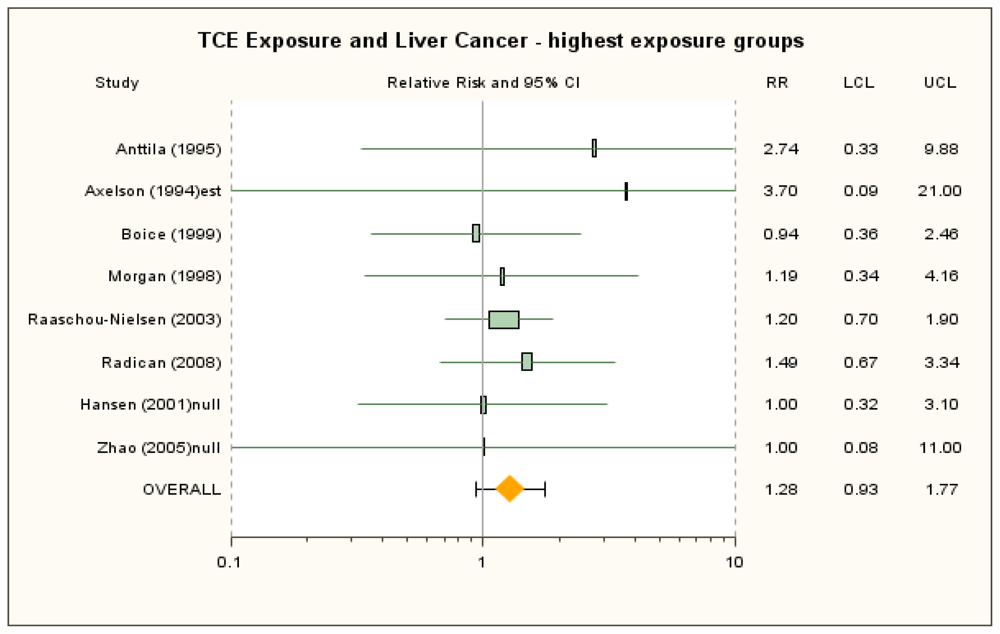
<p>The RRm estimate from the random-effects meta-analysis of the six studies presenting results for highest exposure groups was 1.32 (95% CI: 0.93, 1.86). The RRm estimate from the primary random-effects meta-analysis with null RR estimates (<italic>i.e.</italic>, 1.0) included for Hansen <italic>et al</italic>. [<xref ref-type="bibr" rid="b39-ijerph-08-04238">39</xref>] and Zhao <italic>et al</italic>. [<xref ref-type="bibr" rid="b25-ijerph-08-04238">25</xref>] to address presumed reporting bias was 1.28 (95% CI: 0.93, 1.77) (<xref ref-type="fig" rid="f4-ijerph-08-04238">Figure 4</xref>). The RRm estimate for liver cancer in the highest exposure groups was lower than that for overall exposure and primarily reflects the lower observed RR estimate for the highest exposure group in Raaschou-Nielsen <italic>et al</italic>. [<xref ref-type="bibr" rid="b40-ijerph-08-04238">40</xref>], the study carrying the greatest weight. No other single study was overly influential, and the RRm estimate was not sensitive to alternate RR selections (see <xref ref-type="supplementary-material" rid="s1-ijerph-08-04238">Supplemental Material</xref>). There was no observable heterogeneity across the eight studies for any of the analyses conducted with the highest exposure groups (<italic>I</italic><italic><sup>2</sup></italic>-values were 0%).</p></sec>
<sec>
<title>3.3. Non-Hodgkin Lymphoma</title>
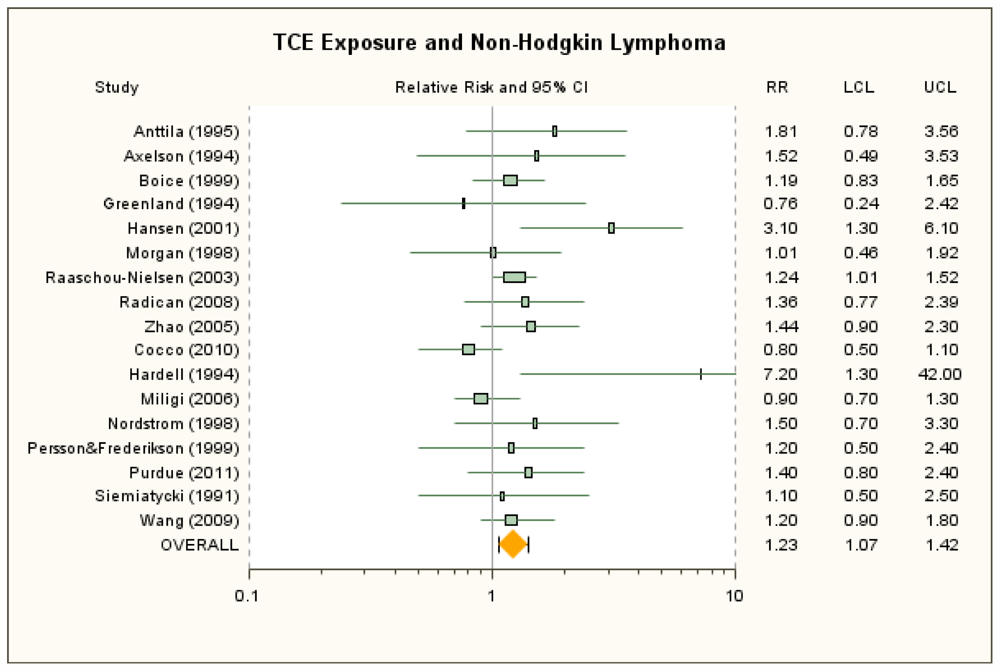
<p>Primary and alternate RR estimates for NHL in the nine cohort and eight case-control studies are presented in <xref ref-type="table" rid="t4-ijerph-08-04238">Table 4</xref>, and a forest plot for overall exposure is displayed in <xref ref-type="fig" rid="f5-ijerph-08-04238">Figure 5</xref>. The RRm estimate from the primary random-effects meta-analysis of overall exposure was 1.23 (95% CI: 1.07, 1.42). This RRm estimate was not overly sensitive to removal of individual studies, with resulting RRm estimates that were all statistically significant and that ranged from 1.18 (removing Hansen <italic>et al</italic>. [<xref ref-type="bibr" rid="b39-ijerph-08-04238">39</xref>]) to 1.27 (removing Miligi <italic>et al</italic>. [<xref ref-type="bibr" rid="b20-ijerph-08-04238">20</xref>] or Cocco <italic>et al</italic>. [<xref ref-type="bibr" rid="b21-ijerph-08-04238">21</xref>]). Removal of Hardell <italic>et al</italic>. [<xref ref-type="bibr" rid="b46-ijerph-08-04238">46</xref>], whose RR estimate of 7.2 is a relative outlier, only decreased the RRm estimate to 1.21 (95% CI: 1.07, 1.38), since this study contributes little weight to the meta-analysis. Similarly, the primary RRm estimate was not highly sensitive to the alternate RR estimate selections, with which RRm estimates ranged from 1.20 (95% CI: 1.03, 1.39) to 1.28 (95% CI: 1.09, 1.49); nor was it sensitive to restriction of the analysis to the 13 studies for which RR estimates for the traditional definition of NHL were available (RRm = 1.27, 95% CI: 1.05, 1.55) (see <xref ref-type="supplementary-material" rid="s1-ijerph-08-04238">Supplemental Material</xref>). Low-to-moderate heterogeneity was observed in the primary analysis of overall exposure (<italic>I</italic><italic><sup>2</sup></italic>-value was 26%; <italic>p</italic> = 0.16) and in each of the meta-analyses with alternative RR selections (<italic>I</italic><italic><sup>2</sup></italic> = 25% to 34%; <italic>p</italic> = 0.09 to 0.17). Subgroup analyses examined cohort and case-control studies and overall exposure separately to investigate the heterogeneity. In cohort studies, the RRm was 1.33 (95% CI: 1.13, 1.58) and, in case-control studies, 1.11 (95% CI: 0.89, 1.38). The subgroup RRm estimates were not statistically significantly different (<italic>p</italic> = 0.19, under the random-effects model). There was evidence of potential publication bias, as the funnel plot appeared asymmetrical and suggested some relationship between RR estimate and study size (see <xref ref-type="supplementary-material" rid="s1-ijerph-08-04238">Supplemental Material</xref>). Using Duval and Tweedie’s trim-and-fill procedure to counter-balance the apparent asymmetry of the more extreme values in the funnel plot yielded a RRm estimate of 1.15 (95% CI: 0.97, 1.36). Thus, if there is publication bias in this data set, it does not appear to account completely for the finding of an increased NHL risk.</p>
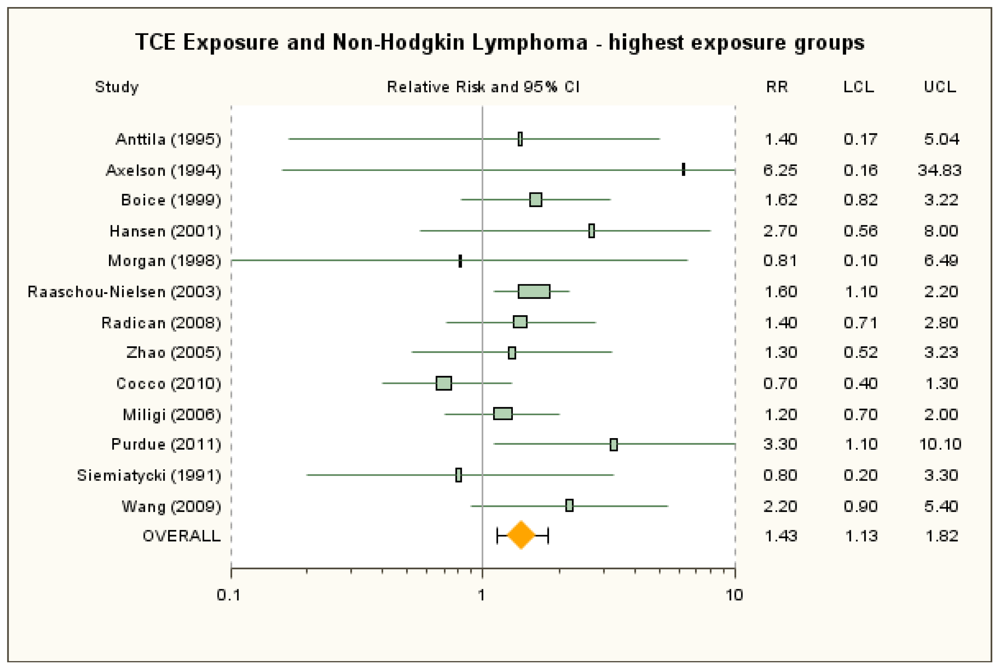
<p>The RRm estimate from the primary random-effects meta-analysis of the highest exposure groups from the 13 studies with results presented by exposure level was 1.43 (95% CI: 1.13, 1.82) (see <xref ref-type="fig" rid="f6-ijerph-08-04238">Figure 6</xref>). No single study was overly influential; removal of individual studies resulted in RRm estimates that ranged from 1.38 (removing Purdue <italic>et al</italic>. [<xref ref-type="bibr" rid="b22-ijerph-08-04238">22</xref>]) to 1.57 (removing Cocco <italic>et al</italic>. [<xref ref-type="bibr" rid="b21-ijerph-08-04238">21</xref>]). Similarly, use of the nine alternative RR selections produced RRm estimates in a narrow range from 1.40 (95% CI: 1.09, 1.80) to 1.49 (95% CI: 1.14, 1.93) (see <xref ref-type="supplementary-material" rid="s1-ijerph-08-04238">Supplemental Material</xref>). Low heterogeneity was observed across the 13 studies of NHL in the highest exposure groups (<italic>I</italic><italic><sup>2</sup></italic> = 14%; <italic>p</italic> = 0.30), and low to low-to-moderate heterogeneity was apparent in each of the meta-analyses with alternative RR selections (<italic>I</italic><italic><sup>2</sup></italic> = 9% to 33%; <italic>p</italic> = 0.12 to 0.37). Subgroup analyses examined the highest exposure groups in cohort and case-control studies, separately, to investigate the heterogeneity. In cohort studies, the RRm was 1.60 (95% CI: 1.24, 2.08) and, for case-control studies, 1.29 (95% CI: 0.76, 2.20). The subgroup RRm estimates were not statistically significantly different (<italic>p</italic> = 0.47, under the random-effects model).</p></sec></sec>
<sec sec-type="discussion">
<title>4. Discussion</title>
<p>Individual studies in our analysis had low power to evaluate TCE exposure and cancer risk, but meta-analysis provided a tool to combine underpowered studies and to systematically assess the associations of TCE exposure and various cancers. In addition to the analyses of overall exposure, results were combined across the highest exposure groups, although individual studies used different exposure definitions, as an attempt to identify subjects with the greatest exposure potential and reduce potential exposure misclassification problems. We were unable to explore the shape of exposure-response relationships, as was recently done for benzene [<xref ref-type="bibr" rid="b61-ijerph-08-04238">61</xref>], given the few studies with quantitative TCE exposure data.</p>
<p>For kidney cancer, the elevated RRm estimates for overall TCE exposure and the highest exposure groups in the primary and alternative analyses provide robust support for a small, statistically significant increased risk, without evidence of heterogeneity or publication bias. The lack of observed heterogeneity provides evidence of consistency in kidney cancer risk estimates from independent epidemiologic studies of different industries with high potential for TCE exposure, regardless of study design. We did observe a slightly larger RRm estimate for case-control than for cohort studies; however, the difference across study designs was not statistically significant. Two case-control studies were carried out in geographic areas with a high frequency and a high degree of TCE exposure and were designed with <italic>a priori</italic> hypotheses to test for the effects of TCE exposure on renal cell cancer risk [<xref ref-type="bibr" rid="b49-ijerph-08-04238">49</xref>,<xref ref-type="bibr" rid="b50-ijerph-08-04238">50</xref>], and a third study was carried out in four central and eastern European countries with high renal cell cancer rates unexplained by established risk factors [<xref ref-type="bibr" rid="b24-ijerph-08-04238">24</xref>]. The higher exposures in these case-control studies compared to cohort studies may, in part, contribute to our finding of a larger RRm estimate for case-control studies.</p>
<p>We also found support for a small increased risk of NHL from TCE exposure, but less support than that for kidney cancer. Some potential publication bias in the TCE NHL data set was suggested by some of the tests used. In addition, low-to-moderate heterogeneity was observed for the NHL studies, although it was not statistically significant. Subgroup analysis of the cohort and case-control studies separately explained some of the differences in NHL risk across studies, although study design, itself, is unlikely to be an underlying cause of heterogeneity and is probably a surrogate for some other differences across these studies that may be associated with study design. Instead, temporal NHL classification changes and study differences in NHL classification, as well as differences in exposure definitions, levels, and prevalence, are possible alternative explanations. If TCE exposure increases the risk of NHL, the effects should be more apparent in the highest exposure groups and, indeed, our analyses did observe this finding. Our observations, furthermore, suggest an increased risk of liver cancer. The liver cancer results, however, are relatively underpowered with respect to numbers of studies and cases, and the study that provides the greatest weight used the weak exposure surrogate of duration of employment for categorizing exposure level.</p>
<p>Our analysis approach has several advantages to previous meta-analyses of TCE exposure and cancer. The selection criteria adopted for this meta-analysis were intended to identify informative studies for the evaluation of TCE exposure and cancer, <italic>i.e.</italic>, studies with reduced systematic errors. Neither Henschler <italic>et al</italic>. [<xref ref-type="bibr" rid="b62-ijerph-08-04238">62</xref>] nor Vamvakas <italic>et al</italic>. [<xref ref-type="bibr" rid="b63-ijerph-08-04238">63</xref>], two studies with incomplete cohort identification or potential selection bias of study controls, met our inclusion criteria. Their inclusion in another recent meta-analysis may have contributed to the observed heterogeneity in kidney cancer RR estimates in that analysis [<xref ref-type="bibr" rid="b16-ijerph-08-04238">16</xref>]. Despite these and other differences in study selection, such as the inclusion of studies lacking documented TCE exposure, that meta-analysis reported RRm estimates of 1.24 (95% CI: 1.06, 1.45) to 1.42 (95% CI: 1.13, 1.77) for overall exposure and kidney cancer [<xref ref-type="bibr" rid="b16-ijerph-08-04238">16</xref>], similar to our finding. Studies with low potential for TCE exposure also did not meet our selection criteria, as our analysis focused on studies in which TCE exposure potential was inferred to each subject by reference to industrial hygiene records, individual biomarkers, job-exposure matrices, or questionnaire responses, in order to reduce exposure misclassification bias, although this bias would not have been completely eliminated. Inclusion of studies of lower exposure potential in meta-analyses can have important implications for identifying a cancer hazard [<xref ref-type="bibr" rid="b64-ijerph-08-04238">64</xref>–<xref ref-type="bibr" rid="b66-ijerph-08-04238">66</xref>]. Additionally, we allowed use of a broader definition of NHL, more consistent with the updated WHO classification [<xref ref-type="bibr" rid="b67-ijerph-08-04238">67</xref>]. Use of this broader definition of NHL may have introduced some downward bias, since NHL subtypes unrelated to TCE may have been included. Last, our analysis updates other meta-analyses by the inclusion of recently published studies on NHL and kidney cancer, and we also included two studies of overlapping cohorts in alternate analyses. Two previous meta-analyses of TCE and NHL [<xref ref-type="bibr" rid="b18-ijerph-08-04238">18</xref>] or kidney cancer [<xref ref-type="bibr" rid="b16-ijerph-08-04238">16</xref>] chose to include Boice <italic>et al</italic>. [<xref ref-type="bibr" rid="b26-ijerph-08-04238">26</xref>] rather than Zhao <italic>et al</italic>. [<xref ref-type="bibr" rid="b25-ijerph-08-04238">25</xref>]. Despite the fact that Zhao <italic>et al</italic>. [<xref ref-type="bibr" rid="b25-ijerph-08-04238">25</xref>] did not report NHL results and we had to use results for a broader category of lymphohematopoietic cancers that included NHL, we preferred Zhao <italic>et al</italic>. [<xref ref-type="bibr" rid="b25-ijerph-08-04238">25</xref>] for our primary analysis because of their use of a semi-quantitative cumulative exposure assessment approach, use of an internal referent population, and much larger number of lymphohematopoietic cancer cases, which include NHLs, than Boice <italic>et al</italic>. [<xref ref-type="bibr" rid="b26-ijerph-08-04238">26</xref>] Our sensitivity analysis showed this study choice did not greatly affect the summary RRm for NHL and overall TCE exposure.</p>
<p>Interpretation of our findings on kidney cancer, liver cancer and NHL within a causal framework can be challenging in light of the modest RRm estimates and, for NHL, the low-to-moderate heterogeneity and potential publication bias. In general, the observed RRm estimates for overall TCE exposure suggest increased risks of 20%–30% for liver cancer, kidney cancer, and NHL. Increased risks suggested by the RRm estimates for the highest exposure groups were further elevated for kidney cancer (58%) and NHL (43%). Large RR estimates are considered strong evidence of causality; however, modest-sized risks may reflect a lower level of exposure or an agent of lower potency.</p>
<p>Consideration of potential confounding as an alternative explanation for our observations is important. Obesity, high body mass index (BMI), and smoking are known risk factors for kidney cancer [<xref ref-type="bibr" rid="b68-ijerph-08-04238">68</xref>]. Any confounding in cohort studies related to obesity is likely small given the generally healthy nature of an employed population. All kidney cancer case-control studies controlled for BMI, except Pesch <italic>et al</italic>. [<xref ref-type="bibr" rid="b52-ijerph-08-04238">52</xref>] and Moore <italic>et al</italic>. [<xref ref-type="bibr" rid="b24-ijerph-08-04238">24</xref>], and for smoking, except Moore <italic>et al</italic>. [<xref ref-type="bibr" rid="b24-ijerph-08-04238">24</xref>]. Moore <italic>et al</italic>. [<xref ref-type="bibr" rid="b24-ijerph-08-04238">24</xref>] reported that neither smoking nor BMI significantly changed the overall association with TCE exposure. Information on smoking for individual subjects is commonly lacking in cohort studies. Use of internal controls, which occurred in five of the cohort studies [<xref ref-type="bibr" rid="b25-ijerph-08-04238">25</xref>–<xref ref-type="bibr" rid="b27-ijerph-08-04238">27</xref>,<xref ref-type="bibr" rid="b41-ijerph-08-04238">41</xref>,<xref ref-type="bibr" rid="b43-ijerph-08-04238">43</xref>], generally minimizes effects of potential confounding due to smoking or socioeconomic status, since exposed and referent subjects are drawn from the same target population. Unlike for kidney cancer, a pattern of increased lung cancer risk was not apparent in the cohort studies; the RRm for lung cancer from the nine cohort studies in our meta-analysis was 0.96 (95% CI: 0.76, 1.21) for overall TCE exposure and 0.96 (95% CI: 0.72, 1.27) for the highest exposure groups. Although smoking was more prevalent in the Raaschou-Nielsen <italic>et al.</italic> [<xref ref-type="bibr" rid="b40-ijerph-08-04238">40</xref>] cohort than in the background population, if smoking fully explains the observed 40% excess lung cancer risk in this study, the expected contribution to renal cell carcinoma risk from smoking based on RRs for lung cancer and kidney cancer observed in five smoking cohorts [<xref ref-type="bibr" rid="b69-ijerph-08-04238">69</xref>] is estimated as 1%–6%, far smaller than the 20% and 40% excess in renal cell carcinoma risk observed in the cohort and subcohort, respectively. These observations suggest that confounding by smoking is not an issue for the kidney cancer results.</p>
<p>Job titles such as a degreaser often have potential for several exposures, including mineral oils, hydrazine, and other solvents, besides TCE [<xref ref-type="bibr" rid="b25-ijerph-08-04238">25</xref>,<xref ref-type="bibr" rid="b27-ijerph-08-04238">27</xref>,<xref ref-type="bibr" rid="b38-ijerph-08-04238">38</xref>,<xref ref-type="bibr" rid="b41-ijerph-08-04238">41</xref>]. Mineral oils such as cutting fluids, common to some job titles with potential TCE exposures, were included as covariates in the statistical analyses of Zhao <italic>et al</italic>. [<xref ref-type="bibr" rid="b25-ijerph-08-04238">25</xref>], who also examined hydrazine and several other co-exposures, and of Charbotel <italic>et al</italic>. [<xref ref-type="bibr" rid="b50-ijerph-08-04238">50</xref>,<xref ref-type="bibr" rid="b70-ijerph-08-04238">70</xref>] or were evaluated as a single exposure for cases and controls in some other studies [<xref ref-type="bibr" rid="b49-ijerph-08-04238">49</xref>,<xref ref-type="bibr" rid="b71-ijerph-08-04238">71</xref>]. Although Brüning <italic>et al</italic>. [<xref ref-type="bibr" rid="b49-ijerph-08-04238">49</xref>] reported an association with cutting oil exposure and kidney cancer, cutting oil exposure did not appear highly correlated with TCE exposure, as only 5 cases reported exposure to cutting oils compared to 25 cases reporting TCE exposure. Karami <italic>et al</italic>. [<xref ref-type="bibr" rid="b71-ijerph-08-04238">71</xref>], who examined mineral oil or cutting fluid exposure among cases and controls in Moore <italic>et al</italic>. [<xref ref-type="bibr" rid="b24-ijerph-08-04238">24</xref>], found no association for cutting oil mists or other mineral oil mists and kidney cancer. Cutting oils and mineral oils have not been associated with kidney cancer in other cohort or case-control studies [<xref ref-type="bibr" rid="b72-ijerph-08-04238">72</xref>,<xref ref-type="bibr" rid="b73-ijerph-08-04238">73</xref>]. Potential co-exposure to other solvents and other chemicals is unlikely to provide an alternative explanation for our robust findings, as the studies included in our analysis varied in the pattern, level, and specific types of co-exposures.</p>
<p>Risk factors for liver cancer include Hepatitis C viruses and heavy alcohol consumption in the United States and Northern Europe, where Hepatitis B prevalence is low [<xref ref-type="bibr" rid="b74-ijerph-08-04238">74</xref>]. In addition, nonalcoholic steatohepatitis, reflecting obesity and metabolic syndrome, was recently identified as contributing to liver cancer risk [<xref ref-type="bibr" rid="b68-ijerph-08-04238">68</xref>,<xref ref-type="bibr" rid="b75-ijerph-08-04238">75</xref>]. Heavy alcohol consumption is unlikely a confounder for liver cancer, as four of the nine independent cohort studies also reported on cirrhosis mortality, with no observed positive association with TCE exposure [<xref ref-type="bibr" rid="b26-ijerph-08-04238">26</xref>,<xref ref-type="bibr" rid="b27-ijerph-08-04238">27</xref>,<xref ref-type="bibr" rid="b41-ijerph-08-04238">41</xref>,<xref ref-type="bibr" rid="b43-ijerph-08-04238">43</xref>]. The generally healthy nature of an employed population reduces concern about confounding related to obesity and Hepatitis C.</p>
<p>Few risk factors have been identified for NHL, with the exception of viruses and suspected factors such as family history of NHL and lymphoproliferative diseases or immunosuppression [<xref ref-type="bibr" rid="b76-ijerph-08-04238">76</xref>]. Smoking is weakly associated with the follicular type of NHL [<xref ref-type="bibr" rid="b68-ijerph-08-04238">68</xref>,<xref ref-type="bibr" rid="b77-ijerph-08-04238">77</xref>]; however, any potential confounding by smoking in the case-control studies is reduced by the inclusion of several NHL types in our definition. Altered immunity may be a possible mode of action for TCE and NHL, as Lan <italic>et al</italic>. [<xref ref-type="bibr" rid="b78-ijerph-08-04238">78</xref>] recently reported decreased lymphocyte subsets among TCE-exposed workers.</p>
<p>In conclusion, our analysis updates the literature review since past meta-analyses on TCE exposure and NHL, liver cancer and kidney cancer, adopting criteria to identify studies that minimize biases associated with exposure misclassification and subject selection. The consistency of increased kidney cancer RR estimates across a large number of independent studies of different designs and populations from different countries and industries and the robust summary RRm estimates across various influence and sensitivity analyses provide strong support for a causal association. Although the RRm for kidney cancer was modest, neither chance nor confounding related to BMI, smoking, or exposure to cutting oils could provide alternative explanations for the observed increase in risk for this site. The support is strong but less robust for NHL, where issues of (non-statistically significant) study heterogeneity, potential publication bias, and weaker exposure-response results contribute greater uncertainty, and more limited for liver cancer, where only cohort studies with small numbers of cases are available. Although we did not examine exposure-response relationships using statistical models, biological gradients are supported for kidney cancer and NHL based on meta-analyses of only the highest exposure groups, which yielded higher summary RRm estimates than for overall TCE exposure. Other human, animal and pharmacokinetic data linking TCE and these cancers provide further support and biological plausibility to our findings [<xref ref-type="bibr" rid="b60-ijerph-08-04238">60</xref>].</p></sec>
<sec sec-type="supplementary-material">
<title>Supplementary Material</title>
<supplementary-material id="s1-ijerph-08-04238" content-type="local-data">
<media xlink:href="ijerph-08-04238-s001.doc" mimetype="application" mime-subtype="msword"/></supplementary-material></sec></body>
<back>
<ack>
<title>Acknowledgements</title>
<p>We thank the TCE team for their insightfulness and constructive input, particularly Chiu, W. for his technical guidance and leadership, Cooper, G. and Christensen, K. for their critical review of the manuscript, and Clark, R., Bussard, D. and White, P. for providing management support for this work.</p></ack>
<fn-group><fn>
<p><bold>Sources of Financial Support</bold></p>
<p>No external sources of funding were used for analysis or preparation of manuscript.</p></fn><fn>
<p><bold>Disclaimer</bold></p>
<p>The views expressed in this article are those of the authors and do not necessarily reflect the views or policies of the U.S. Environmental Protection Agency.</p></fn></fn-group>
<ref-list>
<title>References</title>
<ref id="b1-ijerph-08-04238"><label>1</label><citation citation-type="book"><collab>International Agency for Research on Cancer (IARC)</collab><source>Monographs on the Evaluation of Carcinogenic Risks to Humans. Dry Cleaning, Some Chlorinated Solvents and Other Industrial Chemicals</source><publisher-name>International Agency for Research on Cancer</publisher-name><publisher-loc>Lyon, France</publisher-loc><year>1995</year><volume>63</volume></citation></ref>
<ref id="b2-ijerph-08-04238"><label>2</label><citation citation-type="journal"><collab>National Toxicology Program (NTP)</collab><article-title>11th report on carcinogens</article-title><source>Rep. Carcinog.</source><year>2005</year><fpage>1-A32</fpage></citation></ref>
<ref id="b3-ijerph-08-04238"><label>3</label><citation citation-type="journal"><person-group person-group-type="author"><name><surname>Ruden</surname><given-names>C.</given-names></name></person-group><article-title>Principles and practices of health risk assessment under current EU regulations</article-title><source>Regul. Toxicol. Pharmacol.</source><year>2006</year><volume>44</volume><fpage>14</fpage><lpage>23</lpage><pub-id pub-id-type="doi">10.1016/j.yrtph.2005.04.009</pub-id><pub-id pub-id-type="pmid">16188358</pub-id></citation></ref>
<ref id="b4-ijerph-08-04238"><label>4</label><citation citation-type="journal"><person-group person-group-type="author"><name><surname>Scott</surname><given-names>C.S.</given-names></name><name><surname>Chiu</surname><given-names>W.A.</given-names></name></person-group><article-title>Trichloroethylene cancer epidemiology: A consideration of select issues</article-title><source>Environ. Health Perspect.</source><year>2006</year><volume>114</volume><fpage>1471</fpage><lpage>1478</lpage><pub-id pub-id-type="doi">10.1289/ehp.8949</pub-id><pub-id pub-id-type="pmid">16966107</pub-id></citation></ref>
<ref id="b5-ijerph-08-04238"><label>5</label><citation citation-type="book"><collab>National Research Council (NRC)</collab><source>Contaminated Water Supplies at Camp Lejeune—Assessing Potential Health Effects</source><publisher-name>The National Academies Press</publisher-name><publisher-loc>Washington, DC, USA</publisher-loc><year>2009</year></citation></ref>
<ref id="b6-ijerph-08-04238"><label>6</label><citation citation-type="book"><collab>National Research Council (NRC)</collab><source>Assessing the Human Health Risks of Trichloroethylene: Key Scientific Issues</source><publisher-name>The National Academies Press</publisher-name><publisher-loc>Washington, DC, USA</publisher-loc><year>2006</year></citation></ref>
<ref id="b7-ijerph-08-04238"><label>7</label><citation citation-type="journal"><person-group person-group-type="author"><name><surname>Ward</surname><given-names>E.M.</given-names></name><name><surname>Schulte</surname><given-names>P.A.</given-names></name><name><surname>Straif</surname><given-names>K.</given-names></name><name><surname>Hopf</surname><given-names>N.B.</given-names></name><name><surname>Caldwell</surname><given-names>J.C.</given-names></name><name><surname>Carreon</surname><given-names>T.</given-names></name><name><surname>Demarini</surname><given-names>D.M.</given-names></name><name><surname>Fowler</surname><given-names>B.A.</given-names></name><name><surname>Goldstein</surname><given-names>B.D.</given-names></name><name><surname>Hemminki</surname><given-names>K.</given-names></name><etal/></person-group><article-title>Research recommendations for selected IARC-classified agents</article-title><source>Environ. Health Perspect.</source><year>2010</year><volume>118</volume><fpage>1355</fpage><lpage>1362</lpage><pub-id pub-id-type="doi">10.1289/ehp.0901828</pub-id><pub-id pub-id-type="pmid">20562050</pub-id></citation></ref>
<ref id="b8-ijerph-08-04238"><label>8</label><citation citation-type="journal"><person-group person-group-type="author"><name><surname>Blair</surname><given-names>A.</given-names></name><name><surname>Burg</surname><given-names>J.</given-names></name><name><surname>Foran</surname><given-names>J.</given-names></name><name><surname>Gibb</surname><given-names>H.</given-names></name><name><surname>Greenland</surname><given-names>S.</given-names></name><name><surname>Morris</surname><given-names>R.</given-names></name><name><surname>Raabe</surname><given-names>G.</given-names></name><name><surname>Savitz</surname><given-names>D.</given-names></name><name><surname>Teta</surname><given-names>J.</given-names></name><name><surname>Wartenberg</surname><given-names>D.</given-names></name></person-group><article-title>Guidelines for application of meta-analysis in environmental epidemiology</article-title><source>Regul. Toxicol. Pharmacol.</source><year>1995</year><volume>22</volume><fpage>189</fpage><lpage>197</lpage><pub-id pub-id-type="doi">10.1006/rtph.1995.1084</pub-id><pub-id pub-id-type="pmid">8577954</pub-id></citation></ref>
<ref id="b9-ijerph-08-04238"><label>9</label><citation citation-type="journal"><person-group person-group-type="author"><name><surname>Stroup</surname><given-names>D.F.</given-names></name><name><surname>Berlin</surname><given-names>J.A.</given-names></name><name><surname>Morton</surname><given-names>S.C.</given-names></name><name><surname>Olkin</surname><given-names>I.</given-names></name><name><surname>Williamson</surname><given-names>G.D.</given-names></name><name><surname>Rennie</surname><given-names>D.</given-names></name><name><surname>Moher</surname><given-names>D.</given-names></name><name><surname>Becker</surname><given-names>B.J.</given-names></name><name><surname>Sipe</surname><given-names>T.A.</given-names></name><name><surname>Thacker</surname><given-names>S.B.</given-names></name></person-group><article-title>Meta-analysis of observational studies in epidemiology: A proposal for reporting. Meta-analysis of observational studies in epidemiology (MOOSE) group</article-title><source>JAMA</source><year>2000</year><volume>283</volume><fpage>2008</fpage><lpage>2012</lpage><pub-id pub-id-type="doi">10.1001/jama.283.15.2008</pub-id><pub-id pub-id-type="pmid">10789670</pub-id></citation></ref>
<ref id="b10-ijerph-08-04238"><label>10</label><citation citation-type="journal"><person-group person-group-type="author"><name><surname>Vandenbroucke</surname><given-names>J.P.</given-names></name><name><surname>von Elm</surname><given-names>E.</given-names></name><name><surname>Altman</surname><given-names>D.G.</given-names></name><name><surname>Gotzsche</surname><given-names>P.C.</given-names></name><name><surname>Mulrow</surname><given-names>C.D.</given-names></name><name><surname>Pocock</surname><given-names>S.J.</given-names></name><name><surname>Poole</surname><given-names>C.</given-names></name><name><surname>Schlesselman</surname><given-names>J.J.</given-names></name><name><surname>Egger</surname><given-names>M.</given-names></name></person-group><article-title>Strengthening the reporting of observational studies in epidemiology (STROBE): Explanation and elaboration</article-title><source>Epidemiology</source><year>2007</year><volume>18</volume><fpage>805</fpage><lpage>835</lpage><pub-id pub-id-type="doi">10.1097/EDE.0b013e3181577511</pub-id><pub-id pub-id-type="pmid">18049195</pub-id></citation></ref>
<ref id="b11-ijerph-08-04238"><label>11</label><citation citation-type="book"><collab>National Cancer Institute (NCI)</collab><article-title>Carcinogenesis Bioassay of Trichloroethylene, NCI-CG-TR-2</article-title><source>Technical Report Series</source><publisher-name>NCI</publisher-name><publisher-loc>Bethesda, MD, USA</publisher-loc><year>1976</year></citation></ref>
<ref id="b12-ijerph-08-04238"><label>12</label><citation citation-type="book"><collab>NTP</collab><article-title>Toxicology and Carcinogenesis Studies of Trichloroethylene (CAS No. 79-01-6) in Four Strains of Rats (ACI, August, Marshall, Osborne-Mendel) (Gavage Studies)</article-title><source>Technical Report Series</source><publisher-name>NTP</publisher-name><publisher-loc>Research Triangle Park, NC, USA</publisher-loc><year>1988</year></citation></ref>
<ref id="b13-ijerph-08-04238"><label>13</label><citation citation-type="book"><collab>NTP</collab><article-title>Carcinogenesis Studies of Trichloroethylene (without Epichlorohydrin) in F344/N Rats and B6C3F1 Mice (Gavage Studies)</article-title><source>Technical Report Series</source><publisher-name>NTP</publisher-name><publisher-loc>Research Triangle Park, NC, USA</publisher-loc><year>1990</year></citation></ref>
<ref id="b14-ijerph-08-04238"><label>14</label><citation citation-type="journal"><person-group person-group-type="author"><name><surname>Alexander</surname><given-names>D.D.</given-names></name><name><surname>Kelsh</surname><given-names>M.A.</given-names></name><name><surname>Mink</surname><given-names>P.J.</given-names></name><name><surname>Mandel</surname><given-names>J.H.</given-names></name><name><surname>Basu</surname><given-names>R.</given-names></name><name><surname>Weingart</surname><given-names>M.</given-names></name></person-group><article-title>A meta-analysis of occupational trichloroethylene exposure and liver cancer</article-title><source>Int. Arch. Occup. Environ. Health</source><year>2007</year><volume>81</volume><fpage>127</fpage><lpage>143</lpage><pub-id pub-id-type="doi">10.1007/s00420-007-0201-4</pub-id><pub-id pub-id-type="pmid">17492303</pub-id></citation></ref>
<ref id="b15-ijerph-08-04238"><label>15</label><citation citation-type="journal"><person-group person-group-type="author"><name><surname>Alexander</surname><given-names>D.D.</given-names></name><name><surname>Mink</surname><given-names>P.J.</given-names></name><name><surname>Mandel</surname><given-names>J.H.</given-names></name><name><surname>Kelsh</surname><given-names>M.A.</given-names></name></person-group><article-title>A meta-analysis of occupational trichloroethylene exposure and multiple myeloma or leukaemia</article-title><source>Occup. Med. (Lond.)</source><year>2006</year><volume>56</volume><fpage>485</fpage><lpage>493</lpage><pub-id pub-id-type="doi">10.1093/occmed/kql083</pub-id></citation></ref>
<ref id="b16-ijerph-08-04238"><label>16</label><citation citation-type="journal"><person-group person-group-type="author"><name><surname>Kelsh</surname><given-names>M.A.</given-names></name><name><surname>Alexander</surname><given-names>D.D.</given-names></name><name><surname>Mink</surname><given-names>P.J.</given-names></name><name><surname>Mandel</surname><given-names>J.H.</given-names></name></person-group><article-title>Occupational trichloroethylene exposure and kidney cancer: A meta-analysis</article-title><source>Epidemiology</source><year>2010</year><volume>21</volume><fpage>95</fpage><lpage>102</lpage><pub-id pub-id-type="doi">10.1097/EDE.0b013e3181c30e92</pub-id><pub-id pub-id-type="pmid">20010212</pub-id></citation></ref>
<ref id="b17-ijerph-08-04238"><label>17</label><citation citation-type="confproc"><person-group person-group-type="author"><name><surname>Kelsh</surname><given-names>M.A.</given-names></name><name><surname>Weingart</surname><given-names>M.</given-names></name><name><surname>Mandel</surname><given-names>J.H.</given-names></name><name><surname>Mink</surname><given-names>P.</given-names></name><name><surname>Alexander</surname><given-names>D.</given-names></name><name><surname>Basu</surname><given-names>R.</given-names></name><name><surname>Kalmes</surname><given-names>R.</given-names></name><name><surname>Goodman</surname><given-names>M.</given-names></name></person-group><article-title>A meta-analysis of epidemiology studies of occupational TCE exposure and selected cancers</article-title><conf-name>Presented at the Third Meeting on Assessing Human Health Risks of Trichloroethylene</conf-name><conf-loc>Irvine, CA, USA</conf-loc><year>2005</year></citation></ref>
<ref id="b18-ijerph-08-04238"><label>18</label><citation citation-type="journal"><person-group person-group-type="author"><name><surname>Mandel</surname><given-names>J.H.</given-names></name><name><surname>Kelsh</surname><given-names>M.A.</given-names></name><name><surname>Mink</surname><given-names>P.J.</given-names></name><name><surname>Alexander</surname><given-names>D.D.</given-names></name><name><surname>Kalmes</surname><given-names>R.M.</given-names></name><name><surname>Weingart</surname><given-names>M.</given-names></name><name><surname>Yost</surname><given-names>L.</given-names></name><name><surname>Goodman</surname><given-names>M.</given-names></name></person-group><article-title>Occupational trichloroethylene exposure and non-Hodgkin’s lymphoma: A meta-analysis and review</article-title><source>Occup. Environ. Med.</source><year>2006</year><volume>63</volume><fpage>597</fpage><lpage>607</lpage><pub-id pub-id-type="doi">10.1136/oem.2005.022418</pub-id><pub-id pub-id-type="pmid">16644896</pub-id></citation></ref>
<ref id="b19-ijerph-08-04238"><label>19</label><citation citation-type="journal"><person-group person-group-type="author"><name><surname>Wartenberg</surname><given-names>D.</given-names></name><name><surname>Reyner</surname><given-names>D.</given-names></name><name><surname>Scott</surname><given-names>C.S.</given-names></name></person-group><article-title>Trichloroethylene and cancer: Epidemiologic evidence</article-title><source>Environ. Health Perspect.</source><year>2000</year><volume>108</volume><supplement>Suppl 2</supplement><fpage>161</fpage><lpage>176</lpage><pub-id pub-id-type="doi">10.1289/ehp.00108s2161</pub-id><pub-id pub-id-type="pmid">10807550</pub-id></citation></ref>
<ref id="b20-ijerph-08-04238"><label>20</label><citation citation-type="journal"><person-group person-group-type="author"><name><surname>Miligi</surname><given-names>L.</given-names></name><name><surname>Costantini</surname><given-names>A.S.</given-names></name><name><surname>Benvenuti</surname><given-names>A.</given-names></name><name><surname>Kriebel</surname><given-names>D.</given-names></name><name><surname>Bolejack</surname><given-names>V.</given-names></name><name><surname>Tumino</surname><given-names>R.</given-names></name><name><surname>Ramazzotti</surname><given-names>V.</given-names></name><name><surname>Rodella</surname><given-names>S.</given-names></name><name><surname>Stagnaro</surname><given-names>E.</given-names></name><name><surname>Crosignani</surname><given-names>P.</given-names></name><etal/></person-group><article-title>Occupational exposure to solvents and the risk of lymphomas</article-title><source>Epidemiology</source><year>2006</year><volume>17</volume><fpage>552</fpage><lpage>561</lpage><pub-id pub-id-type="doi">10.1097/01.ede.0000231279.30988.4d</pub-id><pub-id pub-id-type="pmid">16878041</pub-id></citation></ref>
<ref id="b21-ijerph-08-04238"><label>21</label><citation citation-type="journal"><person-group person-group-type="author"><name><surname>Cocco</surname><given-names>P.</given-names></name><name><surname>t’Mannetje</surname><given-names>A.</given-names></name><name><surname>Fadda</surname><given-names>D.</given-names></name><name><surname>Melis</surname><given-names>M.</given-names></name><name><surname>Becker</surname><given-names>N.</given-names></name><name><surname>de Sanjose</surname><given-names>S.</given-names></name><name><surname>Foretova</surname><given-names>L.</given-names></name><name><surname>Mareckova</surname><given-names>J.</given-names></name><name><surname>Staines</surname><given-names>A.</given-names></name><name><surname>Kleefeld</surname><given-names>S.</given-names></name><etal/></person-group><article-title>Occupational exposure to solvents and risk of lymphoma subtypes: Results from the Epilymph case-control study</article-title><source>Occup. Environ. Med.</source><year>2010</year><volume>67</volume><fpage>341</fpage><lpage>347</lpage><pub-id pub-id-type="doi">10.1136/oem.2009.046839</pub-id><pub-id pub-id-type="pmid">20447988</pub-id></citation></ref>
<ref id="b22-ijerph-08-04238"><label>22</label><citation citation-type="journal"><person-group person-group-type="author"><name><surname>Purdue</surname><given-names>M.P.</given-names></name><name><surname>Bakke</surname><given-names>B.</given-names></name><name><surname>Stewart</surname><given-names>P.</given-names></name><name><surname>De Roos</surname><given-names>A.J.</given-names></name><name><surname>Schenk</surname><given-names>M.</given-names></name><name><surname>Lynch</surname><given-names>C.F.</given-names></name><name><surname>Bernstein</surname><given-names>L.</given-names></name><name><surname>Morton</surname><given-names>L.M.</given-names></name><name><surname>Cerhan</surname><given-names>J.R.</given-names></name><name><surname>Severson</surname><given-names>R.K.</given-names></name><etal/></person-group><article-title>A case-control study of occupational exposure to trichloroethylene and non-Hodgkin lymphoma</article-title><source>Environ. Health Perspect.</source><year>2011</year><volume>119</volume><fpage>232</fpage><lpage>238</lpage><pub-id pub-id-type="pmid">21370516</pub-id></citation></ref>
<ref id="b23-ijerph-08-04238"><label>23</label><citation citation-type="journal"><person-group person-group-type="author"><name><surname>Wang</surname><given-names>R.</given-names></name><name><surname>Zhang</surname><given-names>Y.</given-names></name><name><surname>Lan</surname><given-names>Q.</given-names></name><name><surname>Holford</surname><given-names>T.R.</given-names></name><name><surname>Leaderer</surname><given-names>B.</given-names></name><name><surname>Zahm</surname><given-names>S.H.</given-names></name><name><surname>Boyle</surname><given-names>P.</given-names></name><name><surname>Dosemeci</surname><given-names>M.</given-names></name><name><surname>Rothman</surname><given-names>N.</given-names></name><name><surname>Zhu</surname><given-names>Y.</given-names></name><etal/></person-group><article-title>Occupational exposure to solvents and risk of non-Hodgkin lymphoma in Connecticut women</article-title><source>Am. J. Epidemiol.</source><year>2009</year><volume>169</volume><fpage>176</fpage><lpage>185</lpage><pub-id pub-id-type="pmid">19056833</pub-id></citation></ref>
<ref id="b24-ijerph-08-04238"><label>24</label><citation citation-type="journal"><person-group person-group-type="author"><name><surname>Moore</surname><given-names>L.E.</given-names></name><name><surname>Boffetta</surname><given-names>P.</given-names></name><name><surname>Karami</surname><given-names>S.</given-names></name><name><surname>Brennan</surname><given-names>P.</given-names></name><name><surname>Stewart</surname><given-names>P.S.</given-names></name><name><surname>Hung</surname><given-names>R.</given-names></name><name><surname>Zaridze</surname><given-names>D.</given-names></name><name><surname>Matveev</surname><given-names>V.</given-names></name><name><surname>Janout</surname><given-names>V.</given-names></name><name><surname>Kollarova</surname><given-names>H.</given-names></name><etal/></person-group><article-title>Occupational trichloroethylene exposure and renal carcinoma risk: Evidence of genetic susceptibility by reductive metabolism gene variants</article-title><source>Cancer Res.</source><year>2010</year><volume>70</volume><fpage>6527</fpage><lpage>6536</lpage><pub-id pub-id-type="doi">10.1158/0008-5472.CAN-09-4167</pub-id><pub-id pub-id-type="pmid">20663906</pub-id></citation></ref>
<ref id="b25-ijerph-08-04238"><label>25</label><citation citation-type="journal"><person-group person-group-type="author"><name><surname>Zhao</surname><given-names>Y.</given-names></name><name><surname>Krishnadasan</surname><given-names>A.</given-names></name><name><surname>Kennedy</surname><given-names>N.</given-names></name><name><surname>Morgenstern</surname><given-names>H.</given-names></name><name><surname>Ritz</surname><given-names>B.</given-names></name></person-group><article-title>Estimated effects of solvents and mineral oils on cancer incidence and mortality in a cohort of aerospace workers</article-title><source>Am. J. Ind. Med.</source><year>2005</year><volume>48</volume><fpage>249</fpage><lpage>258</lpage><pub-id pub-id-type="doi">10.1002/ajim.20216</pub-id><pub-id pub-id-type="pmid">16167347</pub-id></citation></ref>
<ref id="b26-ijerph-08-04238"><label>26</label><citation citation-type="journal"><person-group person-group-type="author"><name><surname>Boice</surname><given-names>J.D.</given-names><suffix>Jr</suffix></name><name><surname>Marano</surname><given-names>D.E.</given-names></name><name><surname>Cohen</surname><given-names>S.S.</given-names></name><name><surname>Mumma</surname><given-names>M.T.</given-names></name><name><surname>Blot</surname><given-names>W.J.</given-names></name><name><surname>Brill</surname><given-names>A.B.</given-names></name><name><surname>Fryzek</surname><given-names>J.P.</given-names></name><name><surname>Henderson</surname><given-names>B.E.</given-names></name><name><surname>McLaughlin</surname><given-names>J.K.</given-names></name></person-group><article-title>Mortality among Rocketdyne workers who tested rocket engines, 1948–1999</article-title><source>J. Occup. Environ. Med.</source><year>2006</year><volume>48</volume><fpage>1070</fpage><lpage>1092</lpage><pub-id pub-id-type="doi">10.1097/01.jom.0000240661.33413.b5</pub-id><pub-id pub-id-type="pmid">17033507</pub-id></citation></ref>
<ref id="b27-ijerph-08-04238"><label>27</label><citation citation-type="journal"><person-group person-group-type="author"><name><surname>Radican</surname><given-names>L.</given-names></name><name><surname>Blair</surname><given-names>A.</given-names></name><name><surname>Stewart</surname><given-names>P.</given-names></name><name><surname>Wartenberg</surname><given-names>D.</given-names></name></person-group><article-title>Mortality of aircraft maintenance workers exposed to trichloroethylene and other hydrocarbons and chemicals: Extended follow-up</article-title><source>J. Occup. Environ. Med.</source><year>2008</year><volume>50</volume><fpage>1306</fpage><lpage>1319</lpage><pub-id pub-id-type="doi">10.1097/JOM.0b013e3181845f7f</pub-id><pub-id pub-id-type="pmid">19001957</pub-id></citation></ref>
<ref id="b28-ijerph-08-04238"><label>28</label><citation citation-type="book"><collab>Institute of Medicine (IOM)</collab><source>Gulf War and Health. Insecticides and Solvents</source><publisher-name>The National Academies Press</publisher-name><publisher-loc>Washington, DC, USA</publisher-loc><year>2003</year><volume>2</volume></citation></ref>
<ref id="b29-ijerph-08-04238"><label>29</label><citation citation-type="web"><person-group person-group-type="author"><name><surname>Altekruse</surname><given-names>S.F.</given-names></name><name><surname>Kosary</surname><given-names>C.L.</given-names></name><name><surname>Krapcho</surname><given-names>M.</given-names></name><name><surname>Neyman</surname><given-names>N.</given-names></name><name><surname>Aminou</surname><given-names>R.</given-names></name><name><surname>Waldron</surname><given-names>W.</given-names></name><name><surname>Ruhl</surname><given-names>J.</given-names></name><name><surname>Howlader</surname><given-names>N.</given-names></name><name><surname>Tatalovich</surname><given-names>Z.</given-names></name><name><surname>Cho</surname><given-names>H.</given-names></name><etal/></person-group><source>Surveillance, Epidemiology, End Results (SEER) Cancer Statistics Review, 1975–2007</source><publisher-name>National Cancer Institute</publisher-name><publisher-loc>Bethesda, MD, USA</publisher-loc><year>2010</year><comment>Available online: <ext-link xlink:href="http://seer.cancer.gov/csr/1975_2007/" ext-link-type="uri">http://seer.cancer.gov/csr/1975_2007/</ext-link></comment><access-date>accessed on 30 March 2011</access-date></citation></ref>
<ref id="b30-ijerph-08-04238"><label>30</label><citation citation-type="journal"><person-group person-group-type="author"><name><surname>DerSimonian</surname><given-names>R.</given-names></name><name><surname>Laird</surname><given-names>N.</given-names></name></person-group><article-title>Meta-analysis in clinical trials</article-title><source>Control Clin. Trials</source><year>1986</year><volume>7</volume><fpage>177</fpage><lpage>188</lpage><pub-id pub-id-type="doi">10.1016/0197-2456(86)90046-2</pub-id><pub-id pub-id-type="pmid">3802833</pub-id></citation></ref>
<ref id="b31-ijerph-08-04238"><label>31</label><citation citation-type="book"><person-group person-group-type="author"><name><surname>Rothman</surname><given-names>K.J.</given-names></name><name><surname>Greenland</surname><given-names>S.</given-names></name></person-group><source>Modern Epidemiology</source><edition>2nd Edition</edition><publisher-name>Lippincott Williams &amp; Wilkins</publisher-name><publisher-loc>Philedelphia, PA, USA</publisher-loc><year>1998</year></citation></ref>
<ref id="b32-ijerph-08-04238"><label>32</label><citation citation-type="book"><person-group person-group-type="author"><name><surname>Breslow</surname><given-names>N.E.</given-names></name><name><surname>Day</surname><given-names>N.E.</given-names></name></person-group><source>Statistical Methods in Cancer Research. Volume II—The Design and Analysis of Cohort Studies</source><publisher-name>International Agency for Research on Cancer</publisher-name><publisher-loc>Lyon, France</publisher-loc><year>1987</year></citation></ref>
<ref id="b33-ijerph-08-04238"><label>33</label><citation citation-type="journal"><person-group person-group-type="author"><name><surname>Woolf</surname><given-names>B.</given-names></name></person-group><article-title>On estimating the relation between blood group and disease</article-title><source>Ann. Hum. Genet.</source><year>1955</year><volume>19</volume><fpage>251</fpage><lpage>253</lpage><pub-id pub-id-type="doi">10.1111/j.1469-1809.1955.tb01348.x</pub-id><pub-id pub-id-type="pmid">14388528</pub-id></citation></ref>
<ref id="b34-ijerph-08-04238"><label>34</label><citation citation-type="book"><person-group person-group-type="author"><name><surname>Breslow</surname><given-names>N.E.</given-names></name><name><surname>Day</surname><given-names>N.E.</given-names></name></person-group><source>Statistical Methods in Cancer Research. Volume I—The Analysis of Case-Control Studies</source><publisher-name>International Agency for Research on Cancer</publisher-name><publisher-loc>Lyon, France</publisher-loc><year>1980</year></citation></ref>
<ref id="b35-ijerph-08-04238"><label>35</label><citation citation-type="journal"><person-group person-group-type="author"><name><surname>Higgins</surname><given-names>J.P.</given-names></name><name><surname>Thompson</surname><given-names>S.G.</given-names></name><name><surname>Deeks</surname><given-names>J.J.</given-names></name><name><surname>Altman</surname><given-names>D.G.</given-names></name></person-group><article-title>Measuring inconsistency in meta-analyses</article-title><source>BMJ</source><year>2003</year><volume>327</volume><fpage>557</fpage><lpage>560</lpage><pub-id pub-id-type="doi">10.1136/bmj.327.7414.557</pub-id><pub-id pub-id-type="pmid">12958120</pub-id></citation></ref>
<ref id="b36-ijerph-08-04238"><label>36</label><citation citation-type="journal"><person-group person-group-type="author"><name><surname>Duval</surname><given-names>S.</given-names></name><name><surname>Tweedie</surname><given-names>R.</given-names></name></person-group><article-title>Trim and fill: A simple funnel-plot-based method of testing and adjusting for publication bias in meta-analysis</article-title><source>Biometrics</source><year>2000</year><volume>56</volume><fpage>455</fpage><lpage>463</lpage><pub-id pub-id-type="doi">10.1111/j.0006-341X.2000.00455.x</pub-id><pub-id pub-id-type="pmid">10877304</pub-id></citation></ref>
<ref id="b37-ijerph-08-04238"><label>37</label><citation citation-type="journal"><person-group person-group-type="author"><name><surname>Axelson</surname><given-names>O.</given-names></name><name><surname>Selden</surname><given-names>A.</given-names></name><name><surname>Andersson</surname><given-names>K.</given-names></name><name><surname>Hogstedt</surname><given-names>C.</given-names></name></person-group><article-title>Updated and expanded Swedish cohort study on trichloroethylene and cancer risk</article-title><source>J. Occup. Med.</source><year>1994</year><volume>36</volume><fpage>556</fpage><lpage>562</lpage><pub-id pub-id-type="pmid">8027881</pub-id></citation></ref>
<ref id="b38-ijerph-08-04238"><label>38</label><citation citation-type="journal"><person-group person-group-type="author"><name><surname>Anttila</surname><given-names>A.</given-names></name><name><surname>Pukkala</surname><given-names>E.</given-names></name><name><surname>Sallmen</surname><given-names>M.</given-names></name><name><surname>Hernberg</surname><given-names>S.</given-names></name><name><surname>Hemminki</surname><given-names>K.</given-names></name></person-group><article-title>Cancer incidence among Finnish workers exposed to halogenated hydrocarbons</article-title><source>J. Occup. Environ. Med.</source><year>1995</year><volume>37</volume><fpage>797</fpage><lpage>806</lpage><pub-id pub-id-type="doi">10.1097/00043764-199507000-00008</pub-id><pub-id pub-id-type="pmid">7552463</pub-id></citation></ref>
<ref id="b39-ijerph-08-04238"><label>39</label><citation citation-type="journal"><person-group person-group-type="author"><name><surname>Hansen</surname><given-names>J.</given-names></name><name><surname>Raaschou-Nielsen</surname><given-names>O.</given-names></name><name><surname>Christensen</surname><given-names>J.M.</given-names></name><name><surname>Johansen</surname><given-names>I.</given-names></name><name><surname>McLaughlin</surname><given-names>J.K.</given-names></name><name><surname>Lipworth</surname><given-names>L.</given-names></name><name><surname>Blot</surname><given-names>W.J.</given-names></name><name><surname>Olsen</surname><given-names>J.H.</given-names></name></person-group><article-title>Cancer incidence among Danish workers exposed to trichloroethylene</article-title><source>J. Occup. Environ. Med.</source><year>2001</year><volume>43</volume><fpage>133</fpage><lpage>139</lpage><pub-id pub-id-type="doi">10.1097/00043764-200102000-00012</pub-id><pub-id pub-id-type="pmid">11227631</pub-id></citation></ref>
<ref id="b40-ijerph-08-04238"><label>40</label><citation citation-type="journal"><person-group person-group-type="author"><name><surname>Raaschou-Nielsen</surname><given-names>O.</given-names></name><name><surname>Hansen</surname><given-names>J.</given-names></name><name><surname>McLaughlin</surname><given-names>J.K.</given-names></name><name><surname>Kolstad</surname><given-names>H.</given-names></name><name><surname>Christensen</surname><given-names>J.M.</given-names></name><name><surname>Tarone</surname><given-names>R.E.</given-names></name><name><surname>Olsen</surname><given-names>J.H.</given-names></name></person-group><article-title>Cancer risk among workers at Danish companies using trichloroethylene: A cohort study</article-title><source>Am. J. Epidemiol.</source><year>2003</year><volume>158</volume><fpage>1182</fpage><lpage>1192</lpage><pub-id pub-id-type="doi">10.1093/aje/kwg282</pub-id><pub-id pub-id-type="pmid">14652303</pub-id></citation></ref>
<ref id="b41-ijerph-08-04238"><label>41</label><citation citation-type="journal"><person-group person-group-type="author"><name><surname>Boice</surname><given-names>J.D.</given-names><suffix>Jr</suffix></name><name><surname>Marano</surname><given-names>D.E.</given-names></name><name><surname>Fryzek</surname><given-names>J.P.</given-names></name><name><surname>Sadler</surname><given-names>C.J.</given-names></name><name><surname>McLaughlin</surname><given-names>J.K.</given-names></name></person-group><article-title>Mortality among aircraft manufacturing workers</article-title><source>Occup. Environ. Med.</source><year>1999</year><volume>56</volume><fpage>581</fpage><lpage>597</lpage><pub-id pub-id-type="doi">10.1136/oem.56.9.581</pub-id><pub-id pub-id-type="pmid">10615290</pub-id></citation></ref>
<ref id="b42-ijerph-08-04238"><label>42</label><citation citation-type="journal"><person-group person-group-type="author"><name><surname>Greenland</surname><given-names>S.</given-names></name><name><surname>Salvan</surname><given-names>A.</given-names></name><name><surname>Wegman</surname><given-names>D.H.</given-names></name><name><surname>Hallock</surname><given-names>M.F.</given-names></name><name><surname>Smith</surname><given-names>T.J.</given-names></name></person-group><article-title>A case-control study of cancer mortality at a transformer-assembly facility</article-title><source>Int. Arch. Occup. Environ. Health</source><year>1994</year><volume>66</volume><fpage>49</fpage><lpage>54</lpage><pub-id pub-id-type="doi">10.1007/BF00386579</pub-id><pub-id pub-id-type="pmid">7927843</pub-id></citation></ref>
<ref id="b43-ijerph-08-04238"><label>43</label><citation citation-type="journal"><person-group person-group-type="author"><name><surname>Morgan</surname><given-names>R.W.</given-names></name><name><surname>Kelsh</surname><given-names>M.A.</given-names></name><name><surname>Zhao</surname><given-names>K.</given-names></name><name><surname>Heringer</surname><given-names>S.</given-names></name></person-group><article-title>Mortality of aerospace workers exposed to trichloroethylene</article-title><source>Epidemiology</source><year>1998</year><volume>9</volume><fpage>424</fpage><lpage>431</lpage><pub-id pub-id-type="doi">10.1097/00001648-199807000-00013</pub-id><pub-id pub-id-type="pmid">9647907</pub-id></citation></ref>
<ref id="b44-ijerph-08-04238"><label>44</label><citation citation-type="journal"><person-group person-group-type="author"><name><surname>Blair</surname><given-names>A.</given-names></name><name><surname>Hartge</surname><given-names>P.</given-names></name><name><surname>Stewart</surname><given-names>P.A.</given-names></name><name><surname>McAdams</surname><given-names>M.</given-names></name><name><surname>Lubin</surname><given-names>J.</given-names></name></person-group><article-title>Mortality and cancer incidence of aircraft maintenance workers exposed to trichloroethylene and other organic solvents and chemicals: Extended follow up</article-title><source>Occup. Environ. Med.</source><year>1998</year><volume>55</volume><fpage>161</fpage><lpage>171</lpage><pub-id pub-id-type="doi">10.1136/oem.55.3.161</pub-id><pub-id pub-id-type="pmid">9624267</pub-id></citation></ref>
<ref id="b45-ijerph-08-04238"><label>45</label><citation citation-type="book"><person-group person-group-type="author"><name><surname>Rothman</surname><given-names>K.J.</given-names></name><name><surname>Greenland</surname><given-names>S.</given-names></name><name><surname>Lash</surname><given-names>T.L.</given-names></name></person-group><source>Modern Epidemiology</source><edition>3rd Edition</edition><publisher-name>Wolters Kluwer, Lippincott Williams and Wilkins</publisher-name><publisher-loc>Philadelphia, PA, USA</publisher-loc><year>2008</year></citation></ref>
<ref id="b46-ijerph-08-04238"><label>46</label><citation citation-type="journal"><person-group person-group-type="author"><name><surname>Hardell</surname><given-names>L.</given-names></name><name><surname>Eriksson</surname><given-names>M.</given-names></name><name><surname>Degerman</surname><given-names>A.</given-names></name></person-group><article-title>Exposure to phenoxyacetic acids, chlorophenols, or organic solvents in relation to histopathology, stage, and anatomical localization of non-Hodgkin’s lymphoma</article-title><source>Cancer Res.</source><year>1994</year><volume>54</volume><fpage>2386</fpage><lpage>2389</lpage><pub-id pub-id-type="pmid">8162585</pub-id></citation></ref>
<ref id="b47-ijerph-08-04238"><label>47</label><citation citation-type="journal"><person-group person-group-type="author"><name><surname>Nordstrom</surname><given-names>M.</given-names></name><name><surname>Hardell</surname><given-names>L.</given-names></name><name><surname>Magnuson</surname><given-names>A.</given-names></name><name><surname>Hagberg</surname><given-names>H.</given-names></name><name><surname>Rask-Andersen</surname><given-names>A.</given-names></name></person-group><article-title>Occupational exposures, animal exposure and smoking as risk factors for hairy cell leukaemia evaluated in a case-control study</article-title><source>Br. J. Cancer</source><year>1998</year><volume>77</volume><fpage>2048</fpage><lpage>2052</lpage><pub-id pub-id-type="doi">10.1038/bjc.1998.341</pub-id><pub-id pub-id-type="pmid">9667691</pub-id></citation></ref>
<ref id="b48-ijerph-08-04238"><label>48</label><citation citation-type="journal"><person-group person-group-type="author"><name><surname>Persson</surname><given-names>B.</given-names></name><name><surname>Fredrikson</surname><given-names>M.</given-names></name></person-group><article-title>Some risk factors for non-Hodgkin’s lymphoma</article-title><source>Int .J. Occup. Med. Environ. Health</source><year>1999</year><volume>12</volume><fpage>135</fpage><lpage>142</lpage><pub-id pub-id-type="pmid">10465904</pub-id></citation></ref>
<ref id="b49-ijerph-08-04238"><label>49</label><citation citation-type="journal"><person-group person-group-type="author"><name><surname>Bruning</surname><given-names>T.</given-names></name><name><surname>Pesch</surname><given-names>B.</given-names></name><name><surname>Wiesenhutter</surname><given-names>B.</given-names></name><name><surname>Rabstein</surname><given-names>S.</given-names></name><name><surname>Lammert</surname><given-names>M.</given-names></name><name><surname>Baumuller</surname><given-names>A.</given-names></name><name><surname>Bolt</surname><given-names>H.M.</given-names></name></person-group><article-title>Renal cell cancer risk and occupational exposure to trichloroethylene: Results of a consecutive case-control study in Arnsberg, Germany</article-title><source>Am. J. Ind. Med.</source><year>2003</year><volume>43</volume><fpage>274</fpage><lpage>285</lpage><pub-id pub-id-type="doi">10.1002/ajim.10185</pub-id><pub-id pub-id-type="pmid">12594774</pub-id></citation></ref>
<ref id="b50-ijerph-08-04238"><label>50</label><citation citation-type="journal"><person-group person-group-type="author"><name><surname>Charbotel</surname><given-names>B.</given-names></name><name><surname>Fevotte</surname><given-names>J.</given-names></name><name><surname>Hours</surname><given-names>M.</given-names></name><name><surname>Martin</surname><given-names>J.L.</given-names></name><name><surname>Bergeret</surname><given-names>A.</given-names></name></person-group><article-title>Case-control study on renal cell cancer and occupational exposure to trichloroethylene. Part II: Epidemiological aspects</article-title><source>Ann. Occup. Hyg.</source><year>2006</year><volume>50</volume><fpage>777</fpage><lpage>787</lpage><pub-id pub-id-type="doi">10.1093/annhyg/mel039</pub-id><pub-id pub-id-type="pmid">16840435</pub-id></citation></ref>
<ref id="b51-ijerph-08-04238"><label>51</label><citation citation-type="journal"><person-group person-group-type="author"><name><surname>Dosemeci</surname><given-names>M.</given-names></name><name><surname>Cocco</surname><given-names>P.</given-names></name><name><surname>Chow</surname><given-names>W.H.</given-names></name></person-group><article-title>Gender differences in risk of renal cell carcinoma and occupational exposures to chlorinated aliphatic hydrocarbons</article-title><source>Am. J. Ind. Med.</source><year>1999</year><volume>36</volume><fpage>54</fpage><lpage>59</lpage><pub-id pub-id-type="doi">10.1002/(SICI)1097-0274(199907)36:1&lt;54::AID-AJIM8&gt;3.0.CO;2-0</pub-id><pub-id pub-id-type="pmid">10361587</pub-id></citation></ref>
<ref id="b52-ijerph-08-04238"><label>52</label><citation citation-type="journal"><person-group person-group-type="author"><name><surname>Pesch</surname><given-names>B.</given-names></name><name><surname>Haerting</surname><given-names>J.</given-names></name><name><surname>Ranft</surname><given-names>U.</given-names></name><name><surname>Klimpel</surname><given-names>A.</given-names></name><name><surname>Oelschlagel</surname><given-names>B.</given-names></name><name><surname>Schill</surname><given-names>W.</given-names></name></person-group><article-title>Occupational risk factors for renal cell carcinoma: Agent-specific results from a case-control study in Germany. MURC study group. Multicenter urothelial and renal cancer study</article-title><source>Int. J. Epidemiol.</source><year>2000</year><volume>29</volume><fpage>1014</fpage><lpage>1024</lpage><pub-id pub-id-type="doi">10.1093/ije/29.6.1014</pub-id><pub-id pub-id-type="pmid">11101542</pub-id></citation></ref>
<ref id="b53-ijerph-08-04238"><label>53</label><citation citation-type="book"><person-group person-group-type="author"><name><surname>Siemiatycki</surname><given-names>J.</given-names></name></person-group><source>Risk Factors for Cancer in the Workplace</source><publisher-name>CRC Press</publisher-name><publisher-loc>Boca Raton, FL, USA</publisher-loc><year>1991</year></citation></ref>
<ref id="b54-ijerph-08-04238"><label>54</label><citation citation-type="journal"><person-group person-group-type="author"><name><surname>Ikeda</surname><given-names>M.</given-names></name><name><surname>Otsuji</surname><given-names>H.</given-names></name><name><surname>Imamura</surname><given-names>T.</given-names></name><name><surname>Komoike</surname><given-names>Y.</given-names></name></person-group><article-title>Urinary excretion of total trichloro-compounds, trichloroethanol, and trichloroacetic acid as a measure of exposure to trichloroethylene and tetrachloroethylene</article-title><source>Br. J. Ind. Med.</source><year>1972</year><volume>29</volume><fpage>328</fpage><lpage>333</lpage><pub-id pub-id-type="pmid">5044605</pub-id></citation></ref>
<ref id="b55-ijerph-08-04238"><label>55</label><citation citation-type="journal"><person-group person-group-type="author"><name><surname>Pannett</surname><given-names>B.</given-names></name><name><surname>Coggon</surname><given-names>D.</given-names></name><name><surname>Acheson</surname><given-names>E.D.</given-names></name></person-group><article-title>A job-exposure matrix for use in population based studies in England and Wales</article-title><source>Br. J. Ind. Med.</source><year>1985</year><volume>42</volume><fpage>777</fpage><lpage>783</lpage><pub-id pub-id-type="pmid">4063222</pub-id></citation></ref>
<ref id="b56-ijerph-08-04238"><label>56</label><citation citation-type="journal"><person-group person-group-type="author"><name><surname>Gomez</surname><given-names>M.R.</given-names></name><name><surname>Cocco</surname><given-names>P.</given-names></name><name><surname>Dosemeci</surname><given-names>M.</given-names></name><name><surname>Stewart</surname><given-names>P.A.</given-names></name></person-group><article-title>Occupational exposure to chlorinated aliphatic hydrocarbons: Job exposure matrix</article-title><source>Am. J. Ind. Med</source><year>1994</year><volume>26</volume><fpage>171</fpage><lpage>183</lpage><pub-id pub-id-type="doi">10.1002/ajim.4700260204</pub-id><pub-id pub-id-type="pmid">7977394</pub-id></citation></ref>
<ref id="b57-ijerph-08-04238"><label>57</label><citation citation-type="web"><person-group person-group-type="author"><name><surname>Morgan</surname><given-names>R.W.</given-names></name><name><surname>Kelsh</surname><given-names>M.A.</given-names></name><name><surname>Zhao</surname><given-names>K.</given-names></name><name><surname>Heringer</surname><given-names>S.</given-names></name></person-group><article-title>Final Report “Cohort Mortality Study of Aerospace Workers with Exposure to Trichloroethylene.”</article-title><source>Letter from Paul A. Cammer, Ph.D., Trichloroethylene Issues Group, to Cheryl Siegel Scott, US EPA, ID 645806</source><publisher-name>US EPA, Health and Environmental Reserach Online (HERO)</publisher-name><publisher-loc>Durham, NC, USA</publisher-loc><year>1997</year><comment>Available online: <ext-link xlink:href="http://hero.epa.gov/index.cfm?heroid=645806&amp;action=search.do&amp;submit=Search&amp;portal=true&amp;sort=year&amp;all=&amp;exact=&amp;any=&amp;author=&amp;journal=&amp;singleyear=&amp;startyear=&amp;endyear=" ext-link-type="uri">http://hero.epa.gov/index.cfm?heroid=645806&amp;action=search.do&amp;submit=Search&amp;portal=true&amp;sort=year&amp;all=&amp;exact=&amp;any=&amp;author=&amp;journal=&amp;singleyear=&amp;startyear=&amp;endyear=</ext-link></comment><access-date>accessed on 30 August 2011</access-date></citation></ref>
<ref id="b58-ijerph-08-04238"><label>58</label><citation citation-type="journal"><person-group person-group-type="author"><name><surname>Bruning</surname><given-names>T.</given-names></name><name><surname>Weirich</surname><given-names>G.</given-names></name><name><surname>Hornauer</surname><given-names>M.A.</given-names></name><name><surname>Hofler</surname><given-names>H.</given-names></name><name><surname>Brauch</surname><given-names>H.</given-names></name></person-group><article-title>Renal cell carcinomas in trichloroethene (TRI) exposed persons are associated with somatic mutations in the von Hippel-Lindau (VHL) tumour suppressor gene</article-title><source>Arch. Toxicol.</source><year>1997</year><volume>71</volume><fpage>332</fpage><lpage>335</lpage><pub-id pub-id-type="doi">10.1007/s002040050394</pub-id><pub-id pub-id-type="pmid">9137812</pub-id></citation></ref>
<ref id="b59-ijerph-08-04238"><label>59</label><citation citation-type="web"><person-group person-group-type="author"><name><surname>Pesch</surname><given-names>B.</given-names></name></person-group><source>Correspondence from Beate Pesch, Ph.D., BGFA—Research Institute of Occupational Medicine to Cheryl Siegel Scott, US EPA, ID 783486</source><publisher-name>US EPA, Health and Environmental Reserach Online (HERO)</publisher-name><publisher-loc>Durham, NC, USA</publisher-loc><year>2008</year><comment>Available online: <ext-link xlink:href="http://hero.epa.gov/index.cfm?heroid=783486&amp;action=search.do&amp;submit=Search&amp;portal=true&amp;sort=year&amp;all=&amp;exact=&amp;any=&amp;author=&amp;journal=&amp;singleyear=&amp;startyear=&amp;endyear=" ext-link-type="uri">http://hero.epa.gov/index.cfm?heroid=783486&amp;action=search.do&amp;submit=Search&amp;portal=true&amp;sort=year&amp;all=&amp;exact=&amp;any=&amp;author=&amp;journal=&amp;singleyear=&amp;startyear=&amp;endyear=</ext-link></comment><access-date>accessed on 30 August 2011</access-date></citation></ref>
<ref id="b60-ijerph-08-04238"><label>60</label><citation citation-type="book"><collab>Environmental Protection Agency (US EPA)</collab><source>Toxicological Review of Trichloroethylene (CAS No. 79-01-6) in Support of Summary Information on the Integrated Risk Information System (IRIS), EPA/635/R-09/011F</source><publisher-name>EPA</publisher-name><publisher-loc>Washington, DC, USA</publisher-loc><year>2011</year></citation></ref>
<ref id="b61-ijerph-08-04238"><label>61</label><citation citation-type="journal"><person-group person-group-type="author"><name><surname>Vlaanderen</surname><given-names>J.</given-names></name><name><surname>Portengen</surname><given-names>L.</given-names></name><name><surname>Rothman</surname><given-names>N.</given-names></name><name><surname>Lan</surname><given-names>Q.</given-names></name><name><surname>Kromhout</surname><given-names>H.</given-names></name><name><surname>Vermeulen</surname><given-names>R.</given-names></name></person-group><article-title>Flexible meta-regression to assess the shape of the benzene-leukemia exposure-response curve</article-title><source>Environ. Health Perspect.</source><year>2010</year><volume>118</volume><fpage>526</fpage><lpage>532</lpage><pub-id pub-id-type="pmid">20064779</pub-id></citation></ref>
<ref id="b62-ijerph-08-04238"><label>62</label><citation citation-type="journal"><person-group person-group-type="author"><name><surname>Henschler</surname><given-names>D.</given-names></name><name><surname>Vamvakas</surname><given-names>S.</given-names></name><name><surname>Lammert</surname><given-names>M.</given-names></name><name><surname>Dekant</surname><given-names>W.</given-names></name><name><surname>Kraus</surname><given-names>B.</given-names></name><name><surname>Thomas</surname><given-names>B.</given-names></name><name><surname>Ulm</surname><given-names>K.</given-names></name></person-group><article-title>Increased incidence of renal cell tumors in a cohort of cardboard workers exposed to trichloroethene</article-title><source>Arch. Toxicol.</source><year>1995</year><volume>69</volume><fpage>291</fpage><lpage>299</lpage><pub-id pub-id-type="doi">10.1007/s002040050173</pub-id><pub-id pub-id-type="pmid">7654132</pub-id></citation></ref>
<ref id="b63-ijerph-08-04238"><label>63</label><citation citation-type="journal"><person-group person-group-type="author"><name><surname>Vamvakas</surname><given-names>S.</given-names></name><name><surname>Bruning</surname><given-names>T.</given-names></name><name><surname>Thomasson</surname><given-names>B.</given-names></name><name><surname>Lammert</surname><given-names>M.</given-names></name><name><surname>Baumuller</surname><given-names>A.</given-names></name><name><surname>Bolt</surname><given-names>H.M.</given-names></name><name><surname>Dekant</surname><given-names>W.</given-names></name><name><surname>Birner</surname><given-names>G.</given-names></name><name><surname>Henschler</surname><given-names>D.</given-names></name><name><surname>Ulm</surname><given-names>K.</given-names></name></person-group><article-title>Renal cell cancer correlated with occupational exposure to trichloroethene</article-title><source>J. Cancer Res. Clin. Oncol.</source><year>1998</year><volume>124</volume><fpage>374</fpage><lpage>382</lpage><pub-id pub-id-type="doi">10.1007/s004320050186</pub-id><pub-id pub-id-type="pmid">9719500</pub-id></citation></ref>
<ref id="b64-ijerph-08-04238"><label>64</label><citation citation-type="journal"><person-group person-group-type="author"><name><surname>Steinmaus</surname><given-names>C.</given-names></name><name><surname>Smith</surname><given-names>A.H.</given-names></name><name><surname>Jones</surname><given-names>R.M.</given-names></name><name><surname>Smith</surname><given-names>M.T.</given-names></name></person-group><article-title>Meta-analysis of benzene exposure and non-Hodgkin lymphoma: Biases could mask an important association</article-title><source>Occup. Environ. Med.</source><year>2008</year><volume>65</volume><fpage>371</fpage><lpage>378</lpage><pub-id pub-id-type="doi">10.1136/oem.2007.036913</pub-id><pub-id pub-id-type="pmid">18417556</pub-id></citation></ref>
<ref id="b65-ijerph-08-04238"><label>65</label><citation citation-type="journal"><person-group person-group-type="author"><name><surname>Vlaanderen</surname><given-names>J.</given-names></name><name><surname>Lan</surname><given-names>Q.</given-names></name><name><surname>Kromhout</surname><given-names>H.</given-names></name><name><surname>Rothman</surname><given-names>N.</given-names></name><name><surname>Vermeulen</surname><given-names>R.</given-names></name></person-group><article-title>Occupational benzene exposure and the risk of lymphoma subtypes: A meta-analysis of cohort studies incorporating three study quality dimensions</article-title><source>Environ. Health Perspect.</source><year>2011</year><volume>119</volume><fpage>159</fpage><lpage>167</lpage><pub-id pub-id-type="pmid">20880796</pub-id></citation></ref>
<ref id="b66-ijerph-08-04238"><label>66</label><citation citation-type="journal"><person-group person-group-type="author"><name><surname>Zhang</surname><given-names>L.</given-names></name><name><surname>Steinmaus</surname><given-names>C.</given-names></name><name><surname>Eastmond</surname><given-names>D.A.</given-names></name><name><surname>Xin</surname><given-names>X.K.</given-names></name><name><surname>Smith</surname><given-names>M.T.</given-names></name></person-group><article-title>Formaldehyde exposure and leukemia: A new meta-analysis and potential mechanisms</article-title><source>Mutat. Res.</source><year>2009</year><volume>681</volume><fpage>150</fpage><lpage>168</lpage><pub-id pub-id-type="doi">10.1016/j.mrrev.2008.07.002</pub-id><pub-id pub-id-type="pmid">18674636</pub-id></citation></ref>
<ref id="b67-ijerph-08-04238"><label>67</label><citation citation-type="journal"><person-group person-group-type="author"><name><surname>Vardiman</surname><given-names>J.W.</given-names></name></person-group><article-title>The World Health Organization (WHO) classification of tumors of the hematopoietic and lymphoid tissues: An overview with emphasis on the myeloid neoplasms</article-title><source>Chem. Biol. Interact.</source><year>2010</year><volume>184</volume><fpage>16</fpage><lpage>20</lpage><pub-id pub-id-type="doi">10.1016/j.cbi.2009.10.009</pub-id><pub-id pub-id-type="pmid">19857474</pub-id></citation></ref>
<ref id="b68-ijerph-08-04238"><label>68</label><citation citation-type="journal"><person-group person-group-type="author"><name><surname>Chow</surname><given-names>W.H.</given-names></name><name><surname>Dong</surname><given-names>L.M.</given-names></name><name><surname>Devesa</surname><given-names>S.S.</given-names></name></person-group><article-title>Epidemiology and risk factors for kidney cancer</article-title><source>Nat. Rev. Urol.</source><year>2010</year><volume>7</volume><fpage>245</fpage><lpage>257</lpage><pub-id pub-id-type="doi">10.1038/nrurol.2010.46</pub-id><pub-id pub-id-type="pmid">20448658</pub-id></citation></ref>
<ref id="b69-ijerph-08-04238"><label>69</label><citation citation-type="book"><collab>IARC</collab><source>Tobacco Smoke and Involuntary Smoking</source><publisher-name>International Agency for Research on Cancer</publisher-name><publisher-loc>Lyon, France</publisher-loc><year>2004</year><volume>83</volume></citation></ref>
<ref id="b70-ijerph-08-04238"><label>70</label><citation citation-type="journal"><person-group person-group-type="author"><name><surname>Charbotel</surname><given-names>B.</given-names></name><name><surname>Fevotte</surname><given-names>J.</given-names></name><name><surname>Martin</surname><given-names>J.L.</given-names></name><name><surname>Bergeret</surname><given-names>A.</given-names></name></person-group><article-title>Renal cell carcinoma and exposure to trichloroethylene: Are the French limits of occupational exposure relevant?</article-title><source>Rev. Epidemiol. Sante Publique</source><year>2009</year><volume>57</volume><fpage>41</fpage><lpage>47</lpage><pub-id pub-id-type="doi">10.1016/j.respe.2008.09.008</pub-id><pub-id pub-id-type="pmid">19155150</pub-id></citation></ref>
<ref id="b71-ijerph-08-04238"><label>71</label><citation citation-type="journal"><person-group person-group-type="author"><name><surname>Karami</surname><given-names>S.</given-names></name><name><surname>Boffetta</surname><given-names>P.</given-names></name><name><surname>Brennan</surname><given-names>P.</given-names></name><name><surname>Stewart</surname><given-names>P.A.</given-names></name><name><surname>Zaridze</surname><given-names>D.</given-names></name><name><surname>Matveev</surname><given-names>V.</given-names></name><name><surname>Janout</surname><given-names>V.</given-names></name><name><surname>Kollarova</surname><given-names>H.</given-names></name><name><surname>Bencko</surname><given-names>V.</given-names></name><name><surname>Navratilova</surname><given-names>M.</given-names></name><etal/></person-group><article-title>Renal cancer risk and occupational exposure to polycyclic aromatic hydrocarbons and plastics</article-title><source>J. Occup. Environ. Med.</source><year>2011</year><volume>53</volume><fpage>218</fpage><lpage>223</lpage><pub-id pub-id-type="doi">10.1097/JOM.0b013e31820a40a3</pub-id><pub-id pub-id-type="pmid">21270648</pub-id></citation></ref>
<ref id="b72-ijerph-08-04238"><label>72</label><citation citation-type="journal"><person-group person-group-type="author"><name><surname>Calvert</surname><given-names>G.M.</given-names></name><name><surname>Ward</surname><given-names>E.</given-names></name><name><surname>Schnorr</surname><given-names>T.M.</given-names></name><name><surname>Fine</surname><given-names>L.J.</given-names></name></person-group><article-title>Cancer risks among workers exposed to metalworking fluids: A systematic review</article-title><source>Am. J. Ind. Med.</source><year>1998</year><volume>33</volume><fpage>282</fpage><lpage>292</lpage><pub-id pub-id-type="doi">10.1002/(SICI)1097-0274(199803)33:3&lt;282::AID-AJIM10&gt;3.0.CO;2-W</pub-id><pub-id pub-id-type="pmid">9481427</pub-id></citation></ref>
<ref id="b73-ijerph-08-04238"><label>73</label><citation citation-type="journal"><person-group person-group-type="author"><name><surname>Mirer</surname><given-names>F.E.</given-names></name></person-group><article-title>New evidence on the health hazards and control of metalworking fluids since completion of the OSHA advisory committee report</article-title><source>Am. J. Ind. Med.</source><year>2010</year><volume>53</volume><fpage>792</fpage><lpage>801</lpage><pub-id pub-id-type="pmid">20623659</pub-id></citation></ref>
<ref id="b74-ijerph-08-04238"><label>74</label><citation citation-type="journal"><person-group person-group-type="author"><name><surname>Venook</surname><given-names>A.P.</given-names></name><name><surname>Papandreou</surname><given-names>C.</given-names></name><name><surname>Furuse</surname><given-names>J.</given-names></name><name><surname>de Guevara</surname><given-names>L.L.</given-names></name></person-group><article-title>The incidence and epidemiology of hepatocellular carcinoma: A global and regional perspective</article-title><source>Oncologist</source><year>2010</year><volume>15</volume><supplement>Suppl 4</supplement><fpage>5</fpage><lpage>13</lpage><pub-id pub-id-type="pmid">21115576</pub-id></citation></ref>
<ref id="b75-ijerph-08-04238"><label>75</label><citation citation-type="journal"><person-group person-group-type="author"><name><surname>El-Serag</surname><given-names>H.B.</given-names></name></person-group><article-title>Epidemiology of hepatocellular carcinoma in USA</article-title><source>Hepatol. Res.</source><year>2007</year><volume>37</volume><supplement>Suppl 2</supplement><fpage>S88</fpage><lpage>S94</lpage><pub-id pub-id-type="doi">10.1111/j.1872-034X.2007.00168.x</pub-id><pub-id pub-id-type="pmid">17877502</pub-id></citation></ref>
<ref id="b76-ijerph-08-04238"><label>76</label><citation citation-type="journal"><person-group person-group-type="author"><name><surname>Alexander</surname><given-names>D.D.</given-names></name><name><surname>Mink</surname><given-names>P.J.</given-names></name><name><surname>Adami</surname><given-names>H.O.</given-names></name><name><surname>Chang</surname><given-names>E.T.</given-names></name><name><surname>Cole</surname><given-names>P.</given-names></name><name><surname>Mandel</surname><given-names>J.S.</given-names></name><name><surname>Trichopoulos</surname><given-names>D.</given-names></name></person-group><article-title>The non-Hodgkin lymphomas: A review of the epidemiologic literature</article-title><source>Int. J. Cancer</source><year>2007</year><volume>120</volume><supplement>Suppl 12</supplement><fpage>1</fpage><lpage>39</lpage><pub-id pub-id-type="pmid">17405121</pub-id></citation></ref>
<ref id="b77-ijerph-08-04238"><label>77</label><citation citation-type="journal"><person-group person-group-type="author"><name><surname>Morton</surname><given-names>L.M.</given-names></name><name><surname>Hartge</surname><given-names>P.</given-names></name><name><surname>Holford</surname><given-names>T.R.</given-names></name><name><surname>Holly</surname><given-names>E.A.</given-names></name><name><surname>Chiu</surname><given-names>B.C.</given-names></name><name><surname>Vineis</surname><given-names>P.</given-names></name><name><surname>Stagnaro</surname><given-names>E.</given-names></name><name><surname>Willett</surname><given-names>E.V.</given-names></name><name><surname>Franceschi</surname><given-names>S.</given-names></name><name><surname>La Vecchia</surname><given-names>C.</given-names></name><etal/></person-group><article-title>Cigarette smoking and risk of non-Hodgkin lymphoma: A pooled analysis from the International Lymphoma Epidemiology Consortium (INTERLYMPH)</article-title><source>Cancer Epidemiol. Biomarkers Prev.</source><year>2005</year><volume>14</volume><fpage>925</fpage><lpage>933</lpage><pub-id pub-id-type="doi">10.1158/1055-9965.EPI-04-0693</pub-id><pub-id pub-id-type="pmid">15824165</pub-id></citation></ref>
<ref id="b78-ijerph-08-04238"><label>78</label><citation citation-type="journal"><person-group person-group-type="author"><name><surname>Lan</surname><given-names>Q.</given-names></name><name><surname>Zhang</surname><given-names>L.</given-names></name><name><surname>Tang</surname><given-names>X.</given-names></name><name><surname>Shen</surname><given-names>M.</given-names></name><name><surname>Smith</surname><given-names>M.T.</given-names></name><name><surname>Qiu</surname><given-names>C.</given-names></name><name><surname>Ge</surname><given-names>Y.</given-names></name><name><surname>Ji</surname><given-names>Z.</given-names></name><name><surname>Xiong</surname><given-names>J.</given-names></name><name><surname>He</surname><given-names>J.</given-names></name><etal/></person-group><article-title>Occupational exposure to trichloroethylene is associated with a decline in lymphocyte subsets and soluble CD27 and CD30 markers</article-title><source>Carcinogenesis</source><year>2010</year><volume>31</volume><fpage>1592</fpage><lpage>1596</lpage><pub-id pub-id-type="doi">10.1093/carcin/bgq121</pub-id><pub-id pub-id-type="pmid">20530238</pub-id></citation></ref></ref-list>
<sec sec-type="display-objects">
<title>Figures and Tables</title>
<fig id="f1-ijerph-08-04238" position="float">
<label>Figure 1</label>
<caption>
<p>Forest plot of overall TCE exposure and kidney cancer from random-effects meta-analysis. Individual study results are plotted with 95% confidence intervals. Symbol sizes reflect relative weights of the 15 cohort and case-control studies.</p></caption>
<graphic xlink:href="ijerph-08-04238f1.gif"/></fig>
<fig id="f2-ijerph-08-04238" position="float">
<label>Figure 2</label>
<caption>
<p>Forest plot of highest TCE exposure group and kidney cancer from random-effects meta-analysis. Individual study results are plotted with 95% confidence intervals. A risk estimate of 1.0 is assigned for highest exposure in Anttila <italic>et al</italic>. [<xref ref-type="bibr" rid="b38-ijerph-08-04238">38</xref>], Axelson <italic>et al</italic>. [<xref ref-type="bibr" rid="b37-ijerph-08-04238">37</xref>] and Hansen <italic>et al</italic>. [<xref ref-type="bibr" rid="b39-ijerph-08-04238">39</xref>] to account for presumed reporting bias. Symbol sizes reflect relative weights of the 13 cohort and case-control studies.</p></caption>
<graphic xlink:href="ijerph-08-04238f2.gif"/></fig>
<fig id="f3-ijerph-08-04238" position="float">
<label>Figure 3</label>
<caption>
<p>Forest plot of overall TCE exposure and liver cancer from random-effects meta-analysis. Individual study results are plotted with 95% confidence intervals. Symbol sizes reflect relative weights of the 9 cohort studies.</p></caption>
<graphic xlink:href="ijerph-08-04238f3.gif"/></fig>
<fig id="f4-ijerph-08-04238" position="float">
<label>Figure 4</label>
<caption>
<p>Forest plot of highest TCE exposure group and liver cancer from random-effects meta-analysis. Individual study results are plotted with 95% confidence intervals. A risk estimate of 1.0 is assigned for highest exposure in Hansen <italic>et al</italic>. [<xref ref-type="bibr" rid="b39-ijerph-08-04238">39</xref>] and Zhao <italic>et al</italic>. [<xref ref-type="bibr" rid="b25-ijerph-08-04238">25</xref>] to account for presumed reporting bias. Symbol sizes reflect relative weights of the 8 cohort studies.</p></caption>
<graphic xlink:href="ijerph-08-04238f4.gif"/></fig>
<fig id="f5-ijerph-08-04238" position="float">
<label>Figure 5</label>
<caption>
<p>Forest plot of overall TCE exposure and non-Hodgkin lymphoma from random-effects meta-analysis. Individual study results are plotted with 95% confidence intervals. Symbol sizes reflect relative weights of the 17 cohort and case-control studies.</p></caption>
<graphic xlink:href="ijerph-08-04238f5.gif"/></fig>
<fig id="f6-ijerph-08-04238" position="float">
<label>Figure 6</label>
<caption>
<p>Forest plot of highest TCE exposure group and non-Hodgkin lymphoma from random-effects meta-analysis. Individual study results are plotted with 95% confidence intervals. Symbol sizes reflect relative weights of the 13 cohort and case-control studies.</p></caption>
<graphic xlink:href="ijerph-08-04238f6.gif"/></fig>
<table-wrap id="t1-ijerph-08-04238" position="float">
<label>Table 1</label>
<caption>
<p>Key characteristics of epidemiologic cohort and case-control studies of TCE exposure included in the meta-analysis.</p></caption>
<table frame="hsides" rules="groups">
<thead>
<tr>
<th align="left" valign="bottom">Reference</th>
<th align="center" valign="bottom">Study Design</th>
<th align="center" valign="bottom">Study population and size</th>
<th align="center" valign="bottom"/>
<th align="center" valign="bottom">Outcome and Sites Examined</th>
<th align="center" valign="bottom">Exposure assessment and exposure surrogate</th></tr></thead>
<tbody>
<tr>
<td align="left" valign="top">Anttila <italic>et al</italic>. [<xref ref-type="bibr" rid="b38-ijerph-08-04238">38</xref>]</td>
<td align="center" valign="top">C</td>
<td align="left" valign="top">Finnish workers (n = 3,974) biologically monitored using U-TCA (n = 3,089), 1965–1982, FU 1965–1991 (M), 1967–1992 (I).</td>
<td align="center" valign="top">I, M</td>
<td align="left" valign="top">K, L, NHL</td>
<td align="left" valign="top">Subjects from several industries, primarily metal. Using the Ikeda <italic>et al</italic>. [<xref ref-type="bibr" rid="b54-ijerph-08-04238">54</xref>] relationship for TCE exposure to U-TCA, TCE exposures were roughly 4 ppm (median) and 6 ppm (mean). Overall TCE exposure, mean U-TCA, years since 1st U-TCA measurement.</td></tr>
<tr>
<td align="left" valign="top">Axelson <italic>et al</italic>. [<xref ref-type="bibr" rid="b37-ijerph-08-04238">37</xref>]</td>
<td align="center" valign="top">C</td>
<td align="left" valign="top">Swedish workers biologically monitored using U-TCA (n = 1,670), 1955–1975, FU 1958–1987 (I).</td>
<td align="center" valign="top">I</td>
<td align="left" valign="top">K, L, NHL</td>
<td align="left" valign="top">Roughly ¾ of cohort had U-TCA concentrations equivalent to &lt;20 ppm TCE. Overall TCE exposure mean U-TCA, years since 1st biological monitoring measurement.</td></tr>
<tr>
<td align="left" valign="top">Boice <italic>et al</italic>. [<xref ref-type="bibr" rid="b41-ijerph-08-04238">41</xref>]</td>
<td align="center" valign="top">C</td>
<td align="left" valign="top">Aircraft-manufacturing workers with ≥1 year at Lockheed Martin (Burbank, CA) (n = 77,965; 2,267 with routine TCE; 3,176 with intermittent TCE), FU 1960–1996.</td>
<td align="center" valign="top">M</td>
<td align="left" valign="top">K, L, NHL</td>
<td align="left" valign="top">TCE subcohort. JEM for potential TCE exposure for (1) routine or (2) intermittent or routine basis without semi-quantitative intensity estimate. Overall TCE exposure, exposure duration.</td></tr>
<tr>
<td align="left" valign="top">Boice <italic>et al</italic>. [<xref ref-type="bibr" rid="b26-ijerph-08-04238">26</xref>]</td>
<td align="center" valign="top">C</td>
<td align="left" valign="top">Aerospace workers with ≥6 months employment at Rockwell/ Rocketdyne (Santa Susana Field Laboratory and nearby facilities) (n = 41,351; 1,111 with TCE exposure), FU 1948–1999. Overlaps cohort of Zhao <italic>et al</italic>. [<xref ref-type="bibr" rid="b25-ijerph-08-04238">25</xref>].</td>
<td align="center" valign="top">M</td>
<td align="left" valign="top">K, L, NHL</td>
<td align="left" valign="top">TCE subcohort. Potential TCE exposure assigned to test-stand workers whose tasks included the cleaning or flushing of rocket engines (engine flush) (<italic>n</italic> = 639 subjects) or for general utility cleaning (<italic>n</italic> = 472). JEM for TCE without semi-quantitative intensity estimates. Vapor degreasing with TCE before 1966 and PCE afterwards. Overall TCE exposure, exposure duration.</td></tr>
<tr>
<td align="left" valign="top">Brüning <italic>et al</italic>. [<xref ref-type="bibr" rid="b49-ijerph-08-04238">49</xref>]</td>
<td align="center" valign="top">CC</td>
<td align="left" valign="top">Histologically confirmed RCC (n = 134), from hospitals (Arnsberg, Germany), 1992−2000; hospital controls (n = 401).</td>
<td align="center" valign="top">I</td>
<td align="left" valign="top">K (RCC)</td>
<td align="left" valign="top">Self-reported exposure and JEM of Pannett <italic>et al</italic>. [<xref ref-type="bibr" rid="b55-ijerph-08-04238">55</xref>] to assign cumulative exposure to TCE and PCE. Cumulative exposure, exposure duration.</td></tr>
<tr>
<td align="left" valign="top">Charbotel <italic>et al</italic>. [<xref ref-type="bibr" rid="b50-ijerph-08-04238">50</xref>]</td>
<td align="center" valign="top">CC</td>
<td align="left" valign="top">RCC (n = 87), from urologists’ files and area teaching hospitals (Arve Valley region, France), 1993–2003; urologist or general practitioner patient controls (n = 316).</td>
<td align="center" valign="top">I</td>
<td align="left" valign="top">K (RCC)</td>
<td align="left" valign="top">Semi-quantitative cumulative TCE exposure and presence/absence of peak TCE exposure assigned to subjects using a JTEM designed using information obtained from questionnaires and routine atmospheric monitoring of workshops or biological monitoring (U-TCA) of workers carried out since the 1960s. Cumulative exposure (low, 62.4 ppm-year; medium, 253.2 ppm-year; high, 925.0 ppm-year), cumulative exposure + peaks.</td></tr>
<tr>
<td align="left" valign="top">Cocco <italic>et al</italic>. [<xref ref-type="bibr" rid="b21-ijerph-08-04238">21</xref>]</td>
<td align="center" valign="top">CC</td>
<td align="left" valign="top">Histologically confirmed NHL from 7 European countries (Czech Republic, Finland, France, Germany, Ireland, Italy, and Spain) (n = 2,348), 1998−2004; hospital (4 participating countries) or population controls (all others) (n = 2,462).</td>
<td align="center" valign="top">I</td>
<td align="left" valign="top">NHL</td>
<td align="left" valign="top">IH assessment of 43 agents, including TCE, by confidence, exposure intensity, and exposure frequency, in each participating center. Overall TCE exposure, cumulative TCE exposure for subjects assessed with high degree of confidence.</td></tr>
<tr>
<td align="left" valign="top">Dosemeci <italic>et al</italic>. [<xref ref-type="bibr" rid="b51-ijerph-08-04238">51</xref>]</td>
<td align="center" valign="top">CC</td>
<td align="left" valign="top">Histologically confirmed RCC (n = 438), 1988−1990, Minnesota Cancer Registry; controls identified using RDD or, if ≥65 years, from HCFA records (n = 687).</td>
<td align="center" valign="top">I</td>
<td align="left" valign="top">K (RCC)</td>
<td align="left" valign="top">Occupational history of TCE exposure using job title and JEM of Gomez <italic>et al</italic>. [<xref ref-type="bibr" rid="b56-ijerph-08-04238">56</xref>]. Overall TCE exposure.</td></tr>
<tr>
<td align="left" valign="top">Greenland <italic>et al</italic>. [<xref ref-type="bibr" rid="b42-ijerph-08-04238">42</xref>]</td>
<td align="center" valign="top">Nested CC</td>
<td align="left" valign="top">Cancer deaths among pensioned workers, GE transformer plant (Pittsfield, MA) (n = 12 kidney, 9 liver and biliary, 15 NHL), 1969–1984; controls were non-cancer deaths among pensioned workers (n = 1,202).</td>
<td align="center" valign="top">M</td>
<td align="left" valign="top">K, L, NHL</td>
<td align="left" valign="top">IH assessment from interviews and position descriptions. TCE (no/any exposure) assigned to individual subjects using JEM. Overall TCE exposure.</td></tr>
<tr>
<td align="left" valign="top">Hansen <italic>et al</italic>. [<xref ref-type="bibr" rid="b39-ijerph-08-04238">39</xref>]</td>
<td align="center" valign="top">C</td>
<td align="left" valign="top">Workers biologically monitored using U-TCA and air-TCE (n = 803), 1947–1989, FU 1968–1998.</td>
<td align="center" valign="top">I</td>
<td align="left" valign="top">K, L, NHL</td>
<td align="left" valign="top">U-TCA from 1947−1989; air TCE measurements from 1974. Overall, TCE exposure to cohort as extrapolated from air TCE and U-TCA measurements, using Ikeda <italic>et al</italic>. [<xref ref-type="bibr" rid="b54-ijerph-08-04238">54</xref>], was 4 ppm (median) and 12 ppm (mean). Overall TCE exposure, year 1st employed, employment duration, mean exposure, cumulative exposure.</td></tr>
<tr>
<td align="left" valign="top">Hardell <italic>et al</italic>. [<xref ref-type="bibr" rid="b46-ijerph-08-04238">46</xref>]</td>
<td align="center" valign="top">CC</td>
<td align="left" valign="top">Histologically confirmed cases of NHL in males from Swedish (Umea) hospital (n = 105), 1974−1978; population controls or, if case deceased, from causes-of-death registry (n = 335).</td>
<td align="center" valign="top">I</td>
<td align="left" valign="top">NHL</td>
<td align="left" valign="top">Self-reported overall TCE exposure.</td></tr>
<tr>
<td align="left" valign="top">Miligi <italic>et al</italic>. [<xref ref-type="bibr" rid="b20-ijerph-08-04238">20</xref>]</td>
<td align="center" valign="top">CC</td>
<td align="left" valign="top">NHL, including CLL, cases (n = 1,428) identified through surveys of hospital and pathology departments or specialized hematology centers in 8 areas in Italy, 1991−1993; population controls (n = 1,530).</td>
<td align="center" valign="top">I</td>
<td align="left" valign="top">NHL+ CLL</td>
<td align="left" valign="top">TCE exposure assigned using JEM and assessed using exposure probability, intensity and duration. TCE exposure intensity, exposure duration.</td></tr>
<tr>
<td align="left" valign="top">Moore <italic>et al</italic>. [<xref ref-type="bibr" rid="b24-ijerph-08-04238">24</xref>]</td>
<td align="center" valign="top">CC</td>
<td align="left" valign="top">Histologically confirmed RCC identified in hospitals in four European countries (Czech Republic, Poland, Romania, Russia) (n = 1,097), 1999−2003; hospital controls with diagnoses unrelated to smoking or genitourinary disorders (n = 1,476).</td>
<td align="center" valign="top">I</td>
<td align="left" valign="top">K (RCC)</td>
<td align="left" valign="top">Specialized job-specific questionnaire for specific jobs or industries of interest focused on solvent exposures, includingTCE, with exposure assignment by frequency, intensity and confidence of TCE exposure. Overall TCE exposure, duration (total hours, years), cumulative exposure (cases: 0, 0.83, 1.95, 7.25 ppm-years for 25th percentile, median, and 75th percentile) and average intensity (cases: 0, 0.08, 0.08, and 0.44 ppm for 25th percentile, median, and 75th percentile).</td></tr>
<tr>
<td align="left" valign="top">Morgan <italic>et al</italic>. [<xref ref-type="bibr" rid="b43-ijerph-08-04238">43</xref>]</td>
<td align="center" valign="top">C</td>
<td align="left" valign="top">Aerospace workers with &gt;6 months during 1950–1985 at Hughes (Tucson, AZ) (n = 20,503; 4,733 with TCE exposure), FU 1950–1993.</td>
<td align="center" valign="top">M</td>
<td align="left" valign="top">K, L, NHL</td>
<td align="left" valign="top">TCE subcohort. TCE exposure intensity assigned using JEM. “High TCE exposure” job classification defined as &gt;50 ppm. Overall TCE exposure, cumulative exposure, peak exposure.</td></tr>
<tr>
<td align="left" valign="top">Nordstrom <italic>et al</italic>. [<xref ref-type="bibr" rid="b47-ijerph-08-04238">47</xref>]</td>
<td align="center" valign="top">CC</td>
<td align="left" valign="top">Histologically confirmed cases of hairy-cell leukemia in males (n = 111), Swedish Cancer Registry, 1987−1992;<xref ref-type="table-fn" rid="tfn1-ijerph-08-04238">a</xref> population controls (n = 400).</td>
<td align="center" valign="top">I</td>
<td align="left" valign="top">NHL (HCL)</td>
<td align="left" valign="top">Self-reported overall TCE exposure.</td></tr>
<tr>
<td align="left" valign="top">Persson and Fredrikson [<xref ref-type="bibr" rid="b48-ijerph-08-04238">48</xref>]</td>
<td align="center" valign="top">CC</td>
<td align="left" valign="top">Histologically confirmed B-cell NHL from two hospitals in Sweden: Oreboro, 1964−1986, or Linkoping, 1975−1984 (n = 199); controls from previous studies, randomly selected from population registers (n = 479).</td>
<td align="center" valign="top">I</td>
<td align="left" valign="top">NHL</td>
<td align="left" valign="top">Self-reported overall TCE exposure.</td></tr>
<tr>
<td align="left" valign="top">Pesch <italic>et al</italic>. [<xref ref-type="bibr" rid="b52-ijerph-08-04238">52</xref>]</td>
<td align="center" valign="top">CC</td>
<td align="left" valign="top">Histologically confirmed RCC from German hospitals (5 regions) (n = 935), 1991−1995; controls randomly selected from residency registries (n = 4,298).</td>
<td align="center" valign="top">I</td>
<td align="left" valign="top">K (RCC)</td>
<td align="left" valign="top">TCE and other exposures assigned by questionnaire assessing occupational history using job title (JEM approach), job task (JTEM approach), or self-reported exposure. Cumulative exposure.</td></tr>
<tr>
<td align="left" valign="top">Purdue <italic>et al</italic>. [<xref ref-type="bibr" rid="b22-ijerph-08-04238">22</xref>]</td>
<td align="center" valign="top">CC</td>
<td align="left" valign="top">Histologically confirmed NHL identified from four SEER areas (Los Angeles County, Detroit metropolitan area, Seattle-Puget Sound and Iowa) (n = 1,321), 1998–2000; population controls from RDD, or Medicare file, if ≥65 years (n = 1,057).</td>
<td align="center" valign="top">I</td>
<td align="left" valign="top">NHL</td>
<td align="left" valign="top">Specialized job-specific modules asked for detailed information on individual jobs and focused on solvent exposures, including TCE; assessment by expert industrial hygienist blinded to case and control status by levels of probability, frequency, and intensity. Overall exposure, average weekly exposure, years exposed, average exposure intensity, and cumulative exposure. Cumulative exposure categories of 0, 1–46,800 ppm-hour, 46,801–112,320 ppm-hour, 112,321–234,000 ppmhour and &gt;234,000 ppm-hour.</td></tr>
<tr>
<td align="left" valign="top">Radican <italic>et al</italic>. [<xref ref-type="bibr" rid="b27-ijerph-08-04238">27</xref>] (mortality follow-up of Blair <italic>et al</italic>. [<xref ref-type="bibr" rid="b44-ijerph-08-04238">44</xref>])</td>
<td align="center" valign="top">C</td>
<td align="left" valign="top">Civilian aircraft-maintenance workers with at least 1 year in 1952−1956 at Hill Air Force Base (UT) (n = 14,455; 7,204 ever exposed to TCE), FU 1952–2000 (M), 1973–1990 (I).</td>
<td align="center" valign="top">I, M</td>
<td align="left" valign="top">K, L, NHL</td>
<td align="left" valign="top">TCE assigned to individual subjects using JEM. TCE replaced in 1968 with 1,1,1-trichloroethane in bench-top degreasing activities and was discontinued in 1978 in vapor degreasing activities. Median TCE exposures were ~10 ppm for rag and bucket; 100−200 ppm for vapor degreasing. Overall TCE exposure, cumulative exposure, continuous or intermittent exposures, and peak exposure. Cumulative exposure categories of 0–5 unit-hour, 5–25 unit-hour, and &gt;25 unit-hour.</td></tr>
<tr>
<td align="left" valign="top">Raaschou-Nielsen <italic>et al</italic>. [<xref ref-type="bibr" rid="b40-ijerph-08-04238">40</xref>]</td>
<td align="center" valign="top">C</td>
<td align="left" valign="top">Blue-collar workers employed &gt;1,968 at 347 Danish TCE-using companies (n = 40,049; 14,360 with presumably higher-level exposure to TCE). FU to 1997.</td>
<td align="center" valign="top">I</td>
<td align="left" valign="top">K, L, NHL</td>
<td align="left" valign="top">Employers had documented TCE usage but no information on individual subjects, with job type and company size as variables identified as increasing the likelihood for TCE exposure. Subjects from iron and metal, electronics, painting, printing, chemical, and dry-cleaning industries. Median exposures to TCE were 40−60 ppm for the years before 1970, 10−20 ppm for 1970 to 1979, and approximately 4 ppm for 1980 to 1989. Overall TCE exposure, employment duration, year 1st employed, and company size.</td></tr>
<tr>
<td align="left" valign="top">Siemiatycki [<xref ref-type="bibr" rid="b53-ijerph-08-04238">53</xref>]</td>
<td align="center" valign="top">CC</td>
<td align="left" valign="top">Histologically confirmed NHL or kidney cancer in males, diagnosed in 16 large Montreal-area hospitals (215 = NHL, 177 K), 1979−1985; population-based controls identified from electoral lists and RDD (n = 533).</td>
<td align="center" valign="top">I</td>
<td align="left" valign="top">K, NHL</td>
<td align="left" valign="top">TCE and other exposure assigned on semi-quantitative scale from work histories by team of chemists and industrial hygienists. Overall TCE exposure, substantial exposure.</td></tr>
<tr>
<td align="left" valign="top">Wang <italic>et al</italic>. [<xref ref-type="bibr" rid="b23-ijerph-08-04238">23</xref>]</td>
<td align="center" valign="top">CC</td>
<td align="left" valign="top">Histologically confirmed NHL cases among females (n = 601), Connecticut Cancer Registry, 1996−2000; population-based female controls from RDD or, if ≥65 years of age, random selection from Medicare and Medicaid Service files (n = 717).</td>
<td align="center" valign="top">I</td>
<td align="left" valign="top">NHL</td>
<td align="left" valign="top">TCE intensity and probability of exposure assigned on semi-quantitative scale using JEM (Gomez <italic>et al</italic>. [<xref ref-type="bibr" rid="b56-ijerph-08-04238">56</xref>]). Overall TCE exposure, intensity, exposure probability.</td></tr>
<tr>
<td align="left" valign="top">Zhao <italic>et al</italic>. [<xref ref-type="bibr" rid="b25-ijerph-08-04238">25</xref>]</td>
<td align="center" valign="top">C</td>
<td align="left" valign="top">Aerospace workers with &gt;2 years of employment at Rockwell/ Rocketdyne’s Santa Susana Field Laboratory, 1950–1993, FU 1950–2001 (M, n = 6,044), 1988–2000 (I, n = 5,049). Overlaps cohort of Boice <italic>et al</italic>.[<xref ref-type="bibr" rid="b26-ijerph-08-04238">26</xref>].</td>
<td align="center" valign="top">I, M</td>
<td align="left" valign="top">K, NHL+ other LHP cancers</td>
<td align="left" valign="top">TCE and other exposures assigned on semi-quantitative scale from work history using JEM. Cumulative TCE score.</td></tr></tbody></table>
<table-wrap-foot><fn id="tfn1-ijerph-08-04238">
<label>a</label>
<p>Upon a review of the case series, Nordstrom <italic>et al</italic>. [<xref ref-type="bibr" rid="b47-ijerph-08-04238">47</xref>] found one case was diagnosed in 1993.</p></fn><fn id="tfn2-ijerph-08-04238">
<p>C = cohort, CA = California, CC = case-control, CLL = chronic lymphocytic leukemia, FU = follow-up, HCFA = Health Care Financing Administration, HCL = hairy cell leukemia, I = incidence, IH = industrial hygiene, JEM = job-exposure matrix, JTEM = job-task-exposure matrix, K = kidney cancer, L = liver and biliary tract cancer, LHP = lymphohematopoietic, M = mortality, MA = Massachusettes, NHL = non-Hodgkin lymphoma, PCE = perchloroethylene, ppm = parts per million, RCC = renal cell carcinoma, RDD = random digit dialing, TCE = trichloroethylene, US = United States, U-TCA = urinary trichloroacetic acid, UT = Utah.</p></fn></table-wrap-foot></table-wrap>
<table-wrap id="t2-ijerph-08-04238" position="float">
<label>Table 2</label>
<caption>
<p>RR estimates for kidney cancer associated with TCE exposure (overall and highest exposure group) from cohort and case-control studies.</p></caption>
<table frame="hsides" rules="groups">
<thead>
<tr>
<th align="left" valign="bottom"/>
<th colspan="2" align="center" valign="bottom">Overall Exposure</th>
<th colspan="3" align="center" valign="bottom">Highest TCE Exposure Group</th>
<th align="center" valign="bottom"/></tr>
<tr>
<th align="left" valign="bottom">Study</th>
<th align="center" valign="bottom">RR (95% CI)</th>
<th align="center" valign="bottom">Alternate RR estimates</th>
<th align="center" valign="bottom">Exposure Category</th>
<th align="center" valign="bottom">RR (95% CI)</th>
<th align="center" valign="bottom">Alternate RR estimates</th>
<th align="center" valign="bottom">Comments</th></tr></thead>
<tbody>
<tr>
<td colspan="7" align="left" valign="top">Cohort Studies</td></tr>
<tr>
<td align="left" valign="top">Anttila <italic>et al</italic>. [<xref ref-type="bibr" rid="b38-ijerph-08-04238">38</xref>]</td>
<td align="left" valign="top">0.87 (0.32, 1.89)</td>
<td align="left" valign="top">None</td>
<td align="left" valign="top">100+ μmol/L U-TCA <xref ref-type="table-fn" rid="tfn3-ijerph-08-04238">a</xref></td>
<td align="left" valign="top">1.0 assumed <xref ref-type="table-fn" rid="tfn4-ijerph-08-04238">b</xref></td>
<td align="left" valign="top"/>
<td align="left" valign="top">ICD-7 180. SIR. Reported high exposure group results for some cancer sites but not kidney.</td></tr>
<tr>
<td align="left" valign="top">Axelson <italic>et al</italic>. [<xref ref-type="bibr" rid="b37-ijerph-08-04238">37</xref>]</td>
<td align="left" valign="top">1.16 (0.42, 2.52)</td>
<td align="left" valign="top">1.07 (0.39, 2.33) with estimated female contribution to SIR added<xref ref-type="table-fn" rid="tfn5-ijerph-08-04238">c</xref></td>
<td align="left" valign="top">≥2 year exposure and 100+ mg/L U-TCA</td>
<td align="left" valign="top">1.0 assumed <xref ref-type="table-fn" rid="tfn4-ijerph-08-04238">b</xref></td>
<td align="left" valign="top"/>
<td align="left" valign="top">ICD-7 180. SIR reported for males only, but there was a small female component to the cohort. Reported high exposure group results for some cancer sites but not kidney.</td></tr>
<tr>
<td align="left" valign="top">Boice <italic>et al</italic>. [<xref ref-type="bibr" rid="b41-ijerph-08-04238">41</xref>]</td>
<td align="left" valign="top">0.99 (0.4, 2.04)</td>
<td align="left" valign="top">None</td>
<td align="left" valign="top">≥5 years exposure</td>
<td align="left" valign="top">0.69 (0.22, 2.12)</td>
<td align="left" valign="top">None</td>
<td align="left" valign="top">ICD-9 189.0−189.2. Overall exposure SMR for potential routine exposure; results for any potential exposure not reported. Mortality RR for highest exposure group for potential routine or intermittent exposure, adjusted for date of birth, dates 1<sup>st</sup> and last employed, race, and sex; referent group is workers not exposed to any solvent.</td></tr>
<tr>
<td align="left" valign="top">Greenland <italic>et al</italic>. [<xref ref-type="bibr" rid="b42-ijerph-08-04238">42</xref>]</td>
<td align="left" valign="top">0.99 (0.30, 3.32)</td>
<td align="left" valign="top">None</td>
<td align="left" valign="top">NA</td>
<td align="left" valign="top"><xref ref-type="table-fn" rid="tfn4-ijerph-08-04238">b</xref></td>
<td align="left" valign="top"/>
<td align="left" valign="top">ICD-8 codes not specified, presumably all of 189. Mortality OR from nested case-control study.</td></tr>
<tr>
<td align="left" valign="top">Hansen <italic>et al</italic>. [<xref ref-type="bibr" rid="b39-ijerph-08-04238">39</xref>]</td>
<td align="left" valign="top">1.1 (0.3, 2.8) <xref ref-type="table-fn" rid="tfn5-ijerph-08-04238">c</xref></td>
<td align="left" valign="top">None</td>
<td align="left" valign="top">≥1,080 months × mg/m<sup>3</sup></td>
<td align="left" valign="top">1.0 assumed <xref ref-type="table-fn" rid="tfn4-ijerph-08-04238">b</xref></td>
<td align="left" valign="top"/>
<td align="left" valign="top">ICD-7 180. SIR. Reported high exposure group results for some cancer sites but not kidney.</td></tr>
<tr>
<td align="left" valign="top">Morgan <italic>et al</italic>. [<xref ref-type="bibr" rid="b43-ijerph-08-04238">43</xref>]</td>
<td align="left" valign="top">1.14 (0.51, 2.58) (Morgan <italic>et al</italic>. [<xref ref-type="bibr" rid="b57-ijerph-08-04238">57</xref>])</td>
<td align="left" valign="top">1.32 (0.57, 2.6) Published SMR</td>
<td align="left" valign="top">High cumulative exposure score</td>
<td align="left" valign="top">1.59 (0.68, 3.71)</td>
<td align="left" valign="top">1.89 (0.85, 4.23) for medium/high peak</td>
<td align="left" valign="top">ICD-7 180, ICD-8, -9 189.0−189.2. Overall mortality RR from Morgan <italic>et al</italic>. [<xref ref-type="bibr" rid="b57-ijerph-08-04238">57</xref>]. RRs adjusted for age and sex.</td></tr>
<tr>
<td align="left" valign="top">Raaschou-Nielsen <italic>et al</italic>. [<xref ref-type="bibr" rid="b40-ijerph-08-04238">40</xref>]</td>
<td align="left" valign="top">1.20 (0.94, 1.50)</td>
<td align="left" valign="top">1.20 (0.98, 1.46) for ICD-7 180; <xref ref-type="table-fn" rid="tfn5-ijerph-08-04238">c</xref><break/>1.4 (1.0, 1.8) for subcohort with expected higher exposures</td>
<td align="left" valign="top">≥5 years in subcohort with expected higher exposure levels</td>
<td align="left" valign="top">1.7 (1.1, 2.4)</td>
<td align="left" valign="top">1.6 (1.1, 2.2) for ≥5 years in total cohort; <xref ref-type="table-fn" rid="tfn5-ijerph-08-04238">c</xref><break/>1.4 (0.99, 1.9)<break/>ICD-7 180 ≥5 years in total cohort <xref ref-type="table-fn" rid="tfn5-ijerph-08-04238">c</xref></td>
<td align="left" valign="top">ICD-7 180.0 (RCC).</td></tr>
<tr>
<td align="left" valign="top">Radican <italic>et al</italic>. [<xref ref-type="bibr" rid="b27-ijerph-08-04238">27</xref>]</td>
<td align="left" valign="top">1.18 (0.47, 2.94)</td>
<td align="left" valign="top">None</td>
<td align="left" valign="top">&gt;25 unit-years</td>
<td align="left" valign="top">1.11 (0.35, 3.49) <xref ref-type="table-fn" rid="tfn6-ijerph-08-04238">d</xref></td>
<td align="left" valign="top">Incidence RR: 0.9 (0.3, 3.2) (Blair <italic>et al</italic>. [<xref ref-type="bibr" rid="b44-ijerph-08-04238">44</xref>]) <xref ref-type="table-fn" rid="tfn6-ijerph-08-04238">d</xref></td>
<td align="left" valign="top">ICD-8, -9 189.0, ICD-10 C64. Mortality RR adjusted for age, sex and race, with workers with no chemical exposures as referent group.</td></tr>
<tr>
<td align="left" valign="top">Zhao <italic>et al</italic>. [<xref ref-type="bibr" rid="b25-ijerph-08-04238">25</xref>]</td>
<td align="left" valign="top">1.7 (0.38, 7.9)<xref ref-type="table-fn" rid="tfn7-ijerph-08-04238">e</xref></td>
<td align="left" valign="top">Incidence RR: 2.0 (0.47, 8.2); <xref ref-type="table-fn" rid="tfn7-ijerph-08-04238">e</xref><break/>Mortality RR no lag: 0.89 (0.22, 3.6); <xref ref-type="table-fn" rid="tfn7-ijerph-08-04238">e</xref><break/>Incidence RR no lag : 2.1 (0.56, 8.1);<xref ref-type="table-fn" rid="tfn7-ijerph-08-04238">e</xref><break/>SMR: 2.22 (0.89, 4.57) (Boice <italic>et al</italic>. [<xref ref-type="bibr" rid="b26-ijerph-08-04238">26</xref>])</td>
<td align="left" valign="top">High exposure score</td>
<td align="left" valign="top">7.40 (0.47, 116)</td>
<td align="left" valign="top">Mortality RR: 1.82 (0.09, 38.6);<break/>Incidence RR no lag: 7.71 (0.65, 91.4);<break/>Mortality RR no lag: 0.96 (0.09, 9.91);<break/>Mortality RR: 2.12 (0.63, 7.11) for ≥5 years as test stand mechanic (Boice <italic>et al</italic>. [<xref ref-type="bibr" rid="b26-ijerph-08-04238">26</xref>]);<break/>3.13 (0.74, 13.2) for ≥4 test-year engine flush (Boice <italic>et al</italic>. [<xref ref-type="bibr" rid="b26-ijerph-08-04238">26</xref>])</td>
<td align="left" valign="top">ICD-9 189. Mortality RR for males only for overall exposure with 20-year lag; adjusted for age, SES, time since first employment, exposure to other carcinogens. Overall mortality results reflect same number exposed cases (10 with no lag) as do incidence results. Overall RRs estimated by combining across exposure groups. Incidence RR for highest TCE exposure group reflects more exposed cases than does the mortality results and is used in primary analysis. Boice <italic>et al.</italic> [<xref ref-type="bibr" rid="b26-ijerph-08-04238">26</xref>] cohort, with seven exposed deaths, overlaps Zhao <italic>et al.</italic> [<xref ref-type="bibr" rid="b25-ijerph-08-04238">25</xref>] cohort.</td></tr>
<tr>
<td colspan="7" align="left" valign="top">Case-Control Studies: <xref ref-type="table-fn" rid="tfn8-ijerph-08-04238">f</xref></td></tr>
<tr>
<td align="left" valign="top">Brüning <italic>et al</italic>. [<xref ref-type="bibr" rid="b58-ijerph-08-04238">58</xref>]</td>
<td align="left" valign="top">2.47 (1.36, 4.49)</td>
<td align="left" valign="top">1.80 (1.01, 3.20) for longest job held in industry with TCE exposure</td>
<td align="left" valign="top">≥20 years self-assessed exposure</td>
<td align="left" valign="top">2.69 (0.84, 8.66)</td>
<td align="left" valign="top">None</td>
<td align="left" valign="top">RCC. OR for self-assessed TCE exposure adjusted for age, sex, and smoking.</td></tr>
<tr>
<td align="left" valign="top">Charbotel <italic>et al</italic>. [<xref ref-type="bibr" rid="b50-ijerph-08-04238">50</xref>]</td>
<td align="left" valign="top">1.88 (0.89, 3.98)</td>
<td align="left" valign="top">1.64 (0.95, 2.84) for full study; 1.68 (0.97, 2.91) for full study with 10-year lag</td>
<td align="left" valign="top">High cumulative dose</td>
<td align="left" valign="top">3.34 (1.27, 8.74)</td>
<td align="left" valign="top">3.80 (1.27, 11.40) for high + peaks;<break/>Full study, high: 2.16 (1.02, 4.60) + peaks: 2.73 (1.06, 7.07);<break/>Full study with 10-year lag, high: 2.16 (1.01, 4.65) + peaks: 3.15 (1.19, 8.38);<break/>Full study, additional adjustment, high: 1.96 (0.71, 5.37) + peaks: 2.63 (0.79, 8.83)</td>
<td align="left" valign="top">RCC. ORs for subgroups with good confidence about exposure assessment. Matched on sex and age, and adjusted for smoking and BMI. Highest exposure group alternate estimates with additional adjustment were also adjusted for exposure to cutting fluids and other petroleum oils.</td></tr>
<tr>
<td align="left" valign="top">Dosemeci <italic>et al</italic>. [<xref ref-type="bibr" rid="b51-ijerph-08-04238">51</xref>]</td>
<td align="left" valign="top">1.30 (0.9, 1.9)</td>
<td align="left" valign="top">None</td>
<td align="left" valign="top">NA</td>
<td align="left" valign="top"><xref ref-type="table-fn" rid="tfn4-ijerph-08-04238">b</xref></td>
<td align="left" valign="top"/>
<td align="left" valign="top">RCC. OR adjusted for age, sex, smoking, hypertension and/or use of diuretics and/or anti-hypertension drugs, BMI.</td></tr>
<tr>
<td align="left" valign="top">Moore <italic>et al</italic>. [<xref ref-type="bibr" rid="b24-ijerph-08-04238">24</xref>]</td>
<td align="left" valign="top">2.05 (1.13, 3.73)</td>
<td align="left" valign="top">1.63 (1.04, 2.54) for all subjects</td>
<td align="left" valign="top">≥1.58 ppm × years</td>
<td align="left" valign="top">2.23 (1.07, 4.64)</td>
<td align="left" valign="top">2.02 (1.14, 3.59) for all subjects</td>
<td align="left" valign="top">RCC. Subgroup with high-confidence assessments. OR adjusted for age, sex, and center.</td></tr>
<tr>
<td align="left" valign="top">Pesch <italic>et al</italic>. [<xref ref-type="bibr" rid="b52-ijerph-08-04238">52</xref>]</td>
<td align="left" valign="top">1.24 (1.03, 1.49)</td>
<td align="left" valign="top">1.13 (0.98, 1.30) with German JEM</td>
<td align="left" valign="top">Substantial</td>
<td align="left" valign="top">1.4 (0.9, 2.1) <xref ref-type="table-fn" rid="tfn6-ijerph-08-04238">d</xref></td>
<td align="left" valign="top">1.2 (0.9, 1.7) for JEM <xref ref-type="table-fn" rid="tfn6-ijerph-08-04238">d</xref></td>
<td align="left" valign="top">RCC. JTEM approach. Crude ORs and CIs for overall TCE exposure calculated from data provided by Pesch [<xref ref-type="bibr" rid="b59-ijerph-08-04238">59</xref>], as described in methods section. ORs for highest exposure group adjusted for age, study center, and smoking.</td></tr>
<tr>
<td align="left" valign="top">Siemiatycki [<xref ref-type="bibr" rid="b53-ijerph-08-04238">53</xref>]</td>
<td align="left" valign="top">0.8 (0.3, 2.2)</td>
<td align="left" valign="top">None</td>
<td align="left" valign="top">Substantial</td>
<td align="left" valign="top">0.8 (0.2, 3.4)</td>
<td align="left" valign="top">None</td>
<td align="left" valign="top">“Kidney cancer.” SE and 95% CI calculated from reported 90% CI. OR for males only, adjusted for age, income, and cigarette smoking index.</td></tr></tbody></table>
<table-wrap-foot><fn id="tfn3-ijerph-08-04238">
<label>a</label>
<p>Mean personal trichloroacetic acid in urine. 1 μmol/L = 0.1634 mg/L.</p></fn><fn id="tfn4-ijerph-08-04238">
<label>b</label>
<p>Anttila <italic>et al</italic>. [<xref ref-type="bibr" rid="b38-ijerph-08-04238">38</xref>], Axelson <italic>et al</italic>. [<xref ref-type="bibr" rid="b37-ijerph-08-04238">37</xref>] and Hansen <italic>et al</italic>. [<xref ref-type="bibr" rid="b39-ijerph-08-04238">39</xref>] report a RR estimate for highest TCE exposure groups and other cancers, but not kidney. A risk estimate of 1.0 is assigned for highest exposure in these studies to account for potential publication bias. For the SE (of the log RR) estimates for these null values, SE estimates from cancer types in the highest exposure group that were expected to have similar numbers of cases were generally used (See Appendix C of U.S. EPA [<xref ref-type="bibr" rid="b60-ijerph-08-04238">60</xref>] for further details). For Greenland <italic>et al</italic>. [<xref ref-type="bibr" rid="b42-ijerph-08-04238">42</xref>] and Dosemeci <italic>et al</italic>. [<xref ref-type="bibr" rid="b51-ijerph-08-04238">51</xref>], a risk of 1.0 is not assumed for highest exposure since only overall results are presented in those studies.</p></fn><fn id="tfn5-ijerph-08-04238">
<label>c</label>
<p>Male and female results combined assuming Poisson distribution. Details of the approach used to estimate the female contribution for Axelson <italic>et al</italic>. [<xref ref-type="bibr" rid="b37-ijerph-08-04238">37</xref>] are presented in U.S. EPA [<xref ref-type="bibr" rid="b60-ijerph-08-04238">60</xref>].</p></fn><fn id="tfn6-ijerph-08-04238">
<label>d</label>
<p>Male and female results combined using inverse-variance weighting, as in a fixed-effect meta-analysis.</p></fn><fn id="tfn7-ijerph-08-04238">
<label>e</label>
<p>To derive an overall RR estimate, results were combined across exposure groups using inverse-variance weighting, under assumptions of group independence, although the exposure groups share a referent group and, hence, are not actually independent.</p></fn><fn id="tfn8-ijerph-08-04238">
<label>f</label>
<p>The RR estimates are all ORs for incident cases.</p></fn><fn id="tfn9-ijerph-08-04238">
<p>BMI = body mass index, CI = confidence interval, cum = cumulative, ICD = International Classification of Diseases, JTEM = job-task-exposure matrix, NA = not available, OR = odds ratio, RCC = renal cell carcinoma, RR = relative risk, SE = standard error, SES = socioeconomic status, SIR = standardized incidence ratio, SMR = standardized mortality ratio, TCE = trichloroethylene, U-TCA = urinary trichloroacetic acid.</p></fn></table-wrap-foot></table-wrap>
<table-wrap id="t3-ijerph-08-04238" position="float">
<label>Table 3</label>
<caption>
<p>Selected RR estimates for liver cancer associated with TCE exposure (overall and highest exposure group) from cohort and case-control studies.</p></caption>
<table frame="hsides" rules="groups">
<thead>
<tr>
<th align="left" valign="bottom"/>
<th colspan="2" align="center" valign="bottom">Overall Exposure</th>
<th colspan="3" align="center" valign="bottom">Highest TCE Exposure Group</th>
<th align="center" valign="bottom"/></tr>
<tr>
<th align="left" valign="bottom">Study</th>
<th align="center" valign="bottom">RR (95% CI)</th>
<th align="center" valign="bottom">Alternate RR estimates</th>
<th align="center" valign="bottom">Exposure Category</th>
<th align="center" valign="bottom">RR (95% CI)</th>
<th align="center" valign="bottom">Alternate RR estimates</th>
<th align="center" valign="bottom">Comments</th></tr></thead>
<tbody>
<tr>
<td colspan="7" align="left" valign="top">Cohort Studies</td></tr>
<tr>
<td align="left" valign="top">Anttila <italic>et al</italic>. [<xref ref-type="bibr" rid="b38-ijerph-08-04238">38</xref>]</td>
<td align="left" valign="top">1.89 (0.86, 3.59) <xref ref-type="table-fn" rid="tfn10-ijerph-08-04238">a</xref></td>
<td align="left" valign="top">2.27 (0.74, 5.29) for 155.0 alone</td>
<td align="left" valign="top">100+ μmol/L U-TCA <xref ref-type="table-fn" rid="tfn11-ijerph-08-04238">b</xref></td>
<td align="left" valign="top">2.74 (0.33, 9.88)</td>
<td align="left" valign="top">None</td>
<td align="left" valign="top">ICD-7 155.0 + 155.1. SIR. ICD-7 155.0 for highest exposure group.</td></tr>
<tr>
<td align="left" valign="top">Axelson <italic>et al</italic>. [<xref ref-type="bibr" rid="b37-ijerph-08-04238">37</xref>]</td>
<td align="left" valign="top">1.41 (0.38, 3.60)</td>
<td align="left" valign="top">1.34 (0.36, 3.42) with estimated female contribution to SIR added <xref ref-type="table-fn" rid="tfn12-ijerph-08-04238">c</xref></td>
<td align="left" valign="top">100+ mg/L U-TCA</td>
<td align="left" valign="top">3.7 (0.09, 21) <xref ref-type="table-fn" rid="tfn12-ijerph-08-04238">c</xref></td>
<td align="left" valign="top">Exclude study</td>
<td align="left" valign="top">ICD-7 155. SIR reported for males only, but there was a small female component to the cohort. No cases were observed in highest exposure group (<italic>i.e.</italic>, &gt;2 years and 100+ U-TCA), so combined with &lt;2 years and 100+ subgroup and estimated female results.</td></tr>
<tr>
<td align="left" valign="top">Boice <italic>et al</italic>. [<xref ref-type="bibr" rid="b41-ijerph-08-04238">41</xref>]</td>
<td align="left" valign="top">0.81 (0.45, 1.33)</td>
<td align="left" valign="top">0.54 (0.15, 1.38) for potential routine exposure</td>
<td align="left" valign="top">≥5 year exposure</td>
<td align="left" valign="top">0.94 (0.36, 2.46)</td>
<td align="left" valign="top">None</td>
<td align="left" valign="top">ICD-9 155 + 156. Overall SMR for any potential exposure. Highest exposure mortality RR for any potential exposure, adjusted for date of birth, dates 1st and last employed, race, and sex; referent group is workers not exposed to any solvent.</td></tr>
<tr>
<td align="left" valign="top">Greenland <italic>et al</italic>. [<xref ref-type="bibr" rid="b42-ijerph-08-04238">42</xref>]</td>
<td align="left" valign="top">0.54 (0.11, 2.63)</td>
<td align="left" valign="top">None</td>
<td align="left" valign="top">NA</td>
<td align="left" valign="top"><xref ref-type="table-fn" rid="tfn13-ijerph-08-04238">d</xref></td>
<td align="left" valign="top"/>
<td align="left" valign="top">ICD-8 155 + 156. Mortality OR from nested case-control study.</td></tr>
<tr>
<td align="left" valign="top">Hansen <italic>et al</italic>. [<xref ref-type="bibr" rid="b39-ijerph-08-04238">39</xref>]</td>
<td align="left" valign="top">2.1 (0.7, 5.0) <xref ref-type="table-fn" rid="tfn12-ijerph-08-04238">c</xref></td>
<td align="left" valign="top">None</td>
<td align="left" valign="top">≥1,080 months × mg/m<sup>3</sup></td>
<td align="left" valign="top">1.0 assumed <xref ref-type="table-fn" rid="tfn13-ijerph-08-04238">d</xref></td>
<td align="left" valign="top"/>
<td align="left" valign="top">ICD-7 155. SIR. Reported high exposure group results for some cancer sites but not liver.</td></tr>
<tr>
<td align="left" valign="top">Morgan <italic>et al</italic>. [<xref ref-type="bibr" rid="b43-ijerph-08-04238">43</xref>]</td>
<td align="left" valign="top">1.48 (0.56, 3.91)</td>
<td align="left" valign="top">0.98 (0.36, 2.13) Published SMR</td>
<td align="left" valign="top">High cumulative exposure score</td>
<td align="left" valign="top">1.19 (0.34, 4.16)</td>
<td align="left" valign="top">0.98 (0.29, 3.35) for medium/high</td>
<td align="left" valign="top">ICD-7 155, ICD-8, −9 155 + 156. Overall mortality RR as reported in Morgan <italic>et al</italic>. [<xref ref-type="bibr" rid="b57-ijerph-08-04238">57</xref>] RRs adjusted for age and sex.</td></tr>
<tr>
<td align="left" valign="top">Raaschou-Nielsen <italic>et al</italic>. [<xref ref-type="bibr" rid="b40-ijerph-08-04238">40</xref>]</td>
<td align="left" valign="top">1.35 (1.03, 1.77) <xref ref-type="table-fn" rid="tfn10-ijerph-08-04238">a</xref>,<xref ref-type="table-fn" rid="tfn12-ijerph-08-04238">c</xref></td>
<td align="left" valign="top">1.28 (0.89, 1.80) for ICD-7 155.0 <xref ref-type="table-fn" rid="tfn12-ijerph-08-04238">c</xref></td>
<td align="left" valign="top">≥5 years</td>
<td align="left" valign="top">1.2 (0.7, 1.9) <xref ref-type="table-fn" rid="tfn10-ijerph-08-04238">a</xref>,<xref ref-type="table-fn" rid="tfn12-ijerph-08-04238">c</xref></td>
<td align="left" valign="top">1.1 (0.5, 2.1) ICD-7 155.0 (liver only) <xref ref-type="table-fn" rid="tfn12-ijerph-08-04238">c</xref></td>
<td align="left" valign="top">ICD-7 155.0 + 155.1. SIR.</td></tr>
<tr>
<td align="left" valign="top">Radican <italic>et al</italic>. [<xref ref-type="bibr" rid="b27-ijerph-08-04238">27</xref>]</td>
<td align="left" valign="top">1.12 (0.57, 2.19)</td>
<td align="left" valign="top">1.25 (0.31, 4.97) for ICD-8, −9 155.0</td>
<td align="left" valign="top">&gt;25 unit-year</td>
<td align="left" valign="top">1.49 (0.67, 3.34) <xref ref-type="table-fn" rid="tfn14-ijerph-08-04238">e</xref></td>
<td align="left" valign="top">None</td>
<td align="left" valign="top">ICD-8, −9 155 + 156, ICD-10 C22–C24. Mortality HR adjusted for age, sex and race, with workers with no chemical exposures as referent group.</td></tr>
<tr>
<td align="left" valign="top">Zhao <italic>et al</italic>. [<xref ref-type="bibr" rid="b25-ijerph-08-04238">25</xref>]/Boice <italic>et al</italic>. [<xref ref-type="bibr" rid="b26-ijerph-08-04238">26</xref>]</td>
<td align="left" valign="top">1.28 (0.35, 3.27)</td>
<td align="left" valign="top">1.0 assumed for Zhao <italic>et al</italic>. [<xref ref-type="bibr" rid="b25-ijerph-08-04238">25</xref>] <xref ref-type="table-fn" rid="tfn13-ijerph-08-04238">d</xref></td>
<td align="left" valign="top">High exposure score</td>
<td align="left" valign="top">1.0 assumed for Zhao <italic>et al</italic>. [<xref ref-type="bibr" rid="b25-ijerph-08-04238">25</xref>] <xref ref-type="table-fn" rid="tfn13-ijerph-08-04238">d</xref></td>
<td align="left" valign="top"/>
<td align="left" valign="top">ICD-9 155 + 156. Overall SMR for males from Boice <italic>et al</italic>. [<xref ref-type="bibr" rid="b26-ijerph-08-04238">26</xref>] used in lieu of Zhao <italic>et al</italic>. [<xref ref-type="bibr" rid="b25-ijerph-08-04238">25</xref>], who do not report liver cancer results. Highest exposure group RR for liver cancer not reported by Zhao <italic>et al</italic>. [<xref ref-type="bibr" rid="b25-ijerph-08-04238">25</xref>] or Boice <italic>et al</italic>. [<xref ref-type="bibr" rid="b26-ijerph-08-04238">26</xref>].</td></tr></tbody></table>
<table-wrap-foot><fn id="tfn10-ijerph-08-04238">
<label>a</label>
<p>Observed and expected numbers of cases combined assuming Poisson distribution for ICD codes identified in comments column.</p></fn><fn id="tfn11-ijerph-08-04238">
<label>b</label>
<p>Mean personal trichloroacetic acid in urine. 1 μmol/L = 0.1634 mg/L.</p></fn><fn id="tfn12-ijerph-08-04238">
<label>c</label>
<p>Male and female results combined assuming Poisson distribution. Details of the approach used to estimate the female contribution for Axelson <italic>et al.</italic> [<xref ref-type="bibr" rid="b37-ijerph-08-04238">37</xref>] are presented in U.S. EPA [<xref ref-type="bibr" rid="b60-ijerph-08-04238">60</xref>].</p></fn><fn id="tfn13-ijerph-08-04238">
<label>d</label>
<p>Hansen <italic>et al</italic>. [<xref ref-type="bibr" rid="b39-ijerph-08-04238">39</xref>] and Zhao <italic>et al</italic>. [<xref ref-type="bibr" rid="b25-ijerph-08-04238">25</xref>] report a RR estimate for highest TCE exposure groups and other cancers, but not liver. A risk estimate of 1.0 is assigned for highest exposure in these studies, and as an alternate overall RR estimate for the Zhao <italic>et al</italic>. [<xref ref-type="bibr" rid="b25-ijerph-08-04238">25</xref>] study, which does not report any liver results, to account for potential publication bias. For the SE (of the log RR) estimates for these null values, SE estimates from cancer types that were expected to have similar numbers of cases were generally used (See Appendix C of U.S. EPA [<xref ref-type="bibr" rid="b60-ijerph-08-04238">60</xref>] for further details). For Greenland <italic>et al</italic>. [<xref ref-type="bibr" rid="b42-ijerph-08-04238">42</xref>], a risk of 1.0 is not assumed for highest exposure since only overall results are presented in that study.</p></fn><fn id="tfn14-ijerph-08-04238">
<label>e</label>
<p>Male and female results combined using inverse-variance weighting, as in a fixed-effect meta-analysis.</p></fn><fn id="tfn15-ijerph-08-04238">
<p>HR = hazard ratio, ICD = International Classification of Diseases, NA = not available, OR = odds ratio, RR = relative risk, SIR = standardized incidence ratio, SMR = standardized mortality ratio, TCE = trichloroethylene, U-TCA = urinary trichloroacetic acid.</p></fn></table-wrap-foot></table-wrap>
<table-wrap id="t4-ijerph-08-04238" position="float">
<label>Table 4</label>
<caption>
<p>Selected RR estimates for NHL associated with TCE exposure (overall and highest exposure group) from cohort and case-control studies.</p></caption>
<table frame="hsides" rules="groups">
<thead>
<tr>
<th align="left" valign="bottom"/>
<th colspan="2" align="center" valign="bottom">Overall Exposure</th>
<th colspan="3" align="center" valign="bottom">Highest TCE Exposure Group</th>
<th align="center" valign="bottom"/></tr>
<tr>
<th align="left" valign="bottom">Study</th>
<th align="center" valign="bottom">RR (95% CI)</th>
<th align="center" valign="bottom">Alternate RR estimates</th>
<th align="center" valign="bottom">Exposure Category</th>
<th align="center" valign="bottom">RR (95% CI)</th>
<th align="center" valign="bottom">Alternate RR estimates</th>
<th align="center" valign="bottom">Comments</th></tr></thead>
<tbody>
<tr>
<td colspan="7" align="left" valign="top">Cohort Studies</td></tr>
<tr>
<td align="left" valign="top">Anttila <italic>et al</italic>. [<xref ref-type="bibr" rid="b38-ijerph-08-04238">38</xref>]</td>
<td align="left" valign="top">1.81 (0.78, 3.56)</td>
<td align="left" valign="top">None</td>
<td align="left" valign="top">100+ μmol/L U-TCA <xref ref-type="table-fn" rid="tfn16-ijerph-08-04238">a</xref></td>
<td align="left" valign="top">1.4 (0.17, 5.04)</td>
<td align="left" valign="top">None</td>
<td align="left" valign="top">ICD-7 200 + 202. SIR.</td></tr>
<tr>
<td align="left" valign="top">Axelson <italic>et al</italic>. [<xref ref-type="bibr" rid="b37-ijerph-08-04238">37</xref>]</td>
<td align="left" valign="top">1.52 (0.49, 3.53)</td>
<td align="left" valign="top">1.36 (0.44, 3.18) with estimated female contribution to SIR added <xref ref-type="table-fn" rid="tfn17-ijerph-08-04238">b</xref></td>
<td align="left" valign="top">≥2 year exposure and 100+ mg/L U-TCA</td>
<td align="left" valign="top">6.25 (0.16, 34.83)</td>
<td align="left" valign="top">5.62 (0.14, 31.3) with estimated female contribution added <xref ref-type="table-fn" rid="tfn17-ijerph-08-04238">b</xref></td>
<td align="left" valign="top">ICD-7 200 + 202. SIR reported for males only, but there was a small female component to the cohort.</td></tr>
<tr>
<td align="left" valign="top">Boice <italic>et al</italic>. [<xref ref-type="bibr" rid="b41-ijerph-08-04238">41</xref>]</td>
<td align="left" valign="top">1.19 (0.83, 1.65)</td>
<td align="left" valign="top">1.19 (0.65, 1.99) for potential routine exposure</td>
<td align="left" valign="top">≥5 years exposure</td>
<td align="left" valign="top">1.62 (0.82, 3.22)</td>
<td align="left" valign="top">None</td>
<td align="left" valign="top">ICD-9 200 + 202. Overall exposure SMR for any potential exposure. Mortality RR for highest exposure group for any potential exposure adjusted for date of birth, dates 1st and last employed, race, and sex; referent group is workers not exposed to any solvent.</td></tr>
<tr>
<td align="left" valign="top">Greenland <italic>et al</italic>. [<xref ref-type="bibr" rid="b42-ijerph-08-04238">42</xref>]</td>
<td align="left" valign="top">0.76 (0.24, 2.42)</td>
<td align="left" valign="top">None</td>
<td align="left" valign="top">NA</td>
<td align="left" valign="top"/>
<td align="left" valign="top">ICD-8 200–202. Mortality OR from nested case-control study. Overall exposure only.</td></tr>
<tr>
<td align="left" valign="top">Hansen <italic>et al</italic>. [<xref ref-type="bibr" rid="b39-ijerph-08-04238">39</xref>]</td>
<td align="left" valign="top">3.1 (1.3, 6.1) <xref ref-type="table-fn" rid="tfn17-ijerph-08-04238">b</xref></td>
<td align="left" valign="top">None</td>
<td align="left" valign="top">≥1,080 months × mg/m<sup>3</sup></td>
<td align="left" valign="top">2.7 (0.56, 8.0) <xref ref-type="table-fn" rid="tfn17-ijerph-08-04238">b</xref></td>
<td align="left" valign="top">3.7 (1.0, 9.5) for &gt;75 months exposure duration; <xref ref-type="table-fn" rid="tfn17-ijerph-08-04238">b</xref><break/>2.9 (0.79, 7.5) for &gt;19 mg/m<sup>3</sup> mean exposure <xref ref-type="table-fn" rid="tfn17-ijerph-08-04238">b</xref></td>
<td align="left" valign="top">ICD-7 200 + 202. SIR for highest exposure group presented only for males; female results estimated and combined with male results.</td></tr>
<tr>
<td align="left" valign="top">Morgan <italic>et al</italic>. [<xref ref-type="bibr" rid="b43-ijerph-08-04238">43</xref>]</td>
<td align="left" valign="top">1.01 (0.46, 1.92)</td>
<td align="left" valign="top">1.36 (0.35, 5.21)<break/>RR for ICD 200</td>
<td align="left" valign="top">High cumulative exposure score</td>
<td align="left" valign="top">0.81 (0.1, 6.49)</td>
<td align="left" valign="top">1.31 (0.28, 6.08) for medium/high peak</td>
<td align="left" valign="top">ICD 200 + 202, ICD Revision 7, 8, or 9, depending on year of death. Overall SMR reported by Mandel <italic>et al</italic>. [<xref ref-type="bibr" rid="b18-ijerph-08-04238">18</xref>]<break/>Alternative overall mortality RR for ICD 200 as reported in Morgan <italic>et al</italic>. [<xref ref-type="bibr" rid="b57-ijerph-08-04238">57</xref>] and adjusted for age and sex. Mortality RR for highest exposure group is for ICD 200 only and adjusted for age and sex.</td></tr>
<tr>
<td align="left" valign="top">Raaschou-Nielsen <italic>et al</italic>. [<xref ref-type="bibr" rid="b40-ijerph-08-04238">40</xref>]</td>
<td align="left" valign="top">1.24 (1.01, 1.52)</td>
<td align="left" valign="top">1.5 (1.2, 2.0) for subcohort with expected higher exposures</td>
<td align="left" valign="top">≥5 years in subcohort with expected higher exposure levels</td>
<td align="left" valign="top">1.6 (1.1, 2.2)</td>
<td align="left" valign="top">1.45 (0.99, 2.05) for ≥5 years in full cohort <xref ref-type="table-fn" rid="tfn17-ijerph-08-04238">b</xref></td>
<td align="left" valign="top">ICD-7 200 + 202. SIR.</td></tr>
<tr>
<td align="left" valign="top">Radican <italic>et al</italic>. [<xref ref-type="bibr" rid="b27-ijerph-08-04238">27</xref>]</td>
<td align="left" valign="top">1.36 (0.77, 2.39)</td>
<td align="left" valign="top">None</td>
<td align="left" valign="top">&gt;25 unit-years</td>
<td align="left" valign="top">1.41 (0.71, 2.81)<xref ref-type="table-fn" rid="tfn18-ijerph-08-04238">c</xref></td>
<td align="left" valign="top">0.97 (0.42, 2.2) for incidence (Blair <italic>et al</italic>. [<xref ref-type="bibr" rid="b44-ijerph-08-04238">44</xref>])<xref ref-type="table-fn" rid="tfn18-ijerph-08-04238">c</xref></td>
<td align="left" valign="top">ICD-8,-9 200 + 202; ICD-10 C82–C85. Mortality RR adjusted for age, sex and race, with workers with no chemical exposures as referent group.</td></tr>
<tr>
<td align="left" valign="top">Zhao <italic>et al</italic>. [<xref ref-type="bibr" rid="b25-ijerph-08-04238">25</xref>]</td>
<td align="left" valign="top">1.44 (0.90, 2.30) <xref ref-type="table-fn" rid="tfn19-ijerph-08-04238">d</xref></td>
<td align="left" valign="top">Incidence RR: 0.77 (0.42, 1.39); <xref ref-type="table-fn" rid="tfn19-ijerph-08-04238">d</xref> SMR for ICD-9 200 + 202: 0.21 (0.01, 1.18) (Boice <italic>et al</italic>. [<xref ref-type="bibr" rid="b26-ijerph-08-04238">26</xref>])</td>
<td align="left" valign="top">High exposure score</td>
<td align="left" valign="top">1.30 (0.52, 3.23)</td>
<td align="left" valign="top">Incidence RR: 0.20 (0.03, 1.46)</td>
<td align="left" valign="top">Most lymphohematopoietic cancers, ICD-9 200–208, ICD-10, C81–C95, ICD-O 2, morphology code 9590–9716, 9723, 9800–9980. Mortality RRs used in primary analyses since reflect more exposed cases than do the incidence results. Males only; adjusted for age, SES, time since first employment.</td></tr>
<tr>
<td colspan="7" align="left" valign="top">Case-Control Studies:<xref ref-type="table-fn" rid="tfn20-ijerph-08-04238">e</xref></td></tr>
<tr>
<td align="left" valign="top">Cocco <italic>et al</italic>. [<xref ref-type="bibr" rid="b21-ijerph-08-04238">21</xref>]</td>
<td align="left" valign="top">0.8 (0.5, 1.1)</td>
<td align="left" valign="top">None</td>
<td align="left" valign="top">High cumulative exposure</td>
<td align="left" valign="top">0.7 (0. 4, 1.3)</td>
<td align="left" valign="top">None</td>
<td align="left" valign="top">NHL. Grouping consistent with traditional definition provided by author. Incidence OR. High-confidence subgroup. Adjusted for age, sex, center, and education.</td></tr>
<tr>
<td align="left" valign="top">Hardell <italic>et al</italic>. [<xref ref-type="bibr" rid="b46-ijerph-08-04238">46</xref>]</td>
<td align="left" valign="top">7.2 (1.3, 42)</td>
<td align="left" valign="top">None</td>
<td align="left" valign="top">NA</td>
<td align="left" valign="top"/>
<td align="left" valign="top">NHL. Rappaport classification system. Incidence OR. Males only; controls matched for age, place of residence, vital status. Overall exposure only.</td></tr>
<tr>
<td align="left" valign="top">Miligi <italic>et al</italic>. [<xref ref-type="bibr" rid="b20-ijerph-08-04238">20</xref>]</td>
<td align="left" valign="top">0.93 (0.67, 1.29)</td>
<td align="left" valign="top">None</td>
<td align="left" valign="top">Medium/high exposure intensity</td>
<td align="left" valign="top">1.2 (0.7, 2.0)</td>
<td align="left" valign="top">1.0 (0.5, 2.6) for med/high intensity and &gt;15 years</td>
<td align="left" valign="top">NHL + CLL. NCI Working Formulation. Adjusted OR for overall exposure not presented; overall crude incidence OR calculated as described in methods section. OR for highest exposure group adjusted for age, sex, education, and area.</td></tr>
<tr>
<td align="left" valign="top">Nordstrom <italic>et al</italic>. [<xref ref-type="bibr" rid="b47-ijerph-08-04238">47</xref>]</td>
<td align="left" valign="top">1.5 (0.7, 3.3)</td>
<td align="left" valign="top">None</td>
<td align="left" valign="top">NA</td>
<td align="left" valign="top"/>
<td align="left" valign="top">HCL. Incidence OR. Males only; controls matched for age and county; analysis controlled for age. Overall exposure only.</td></tr>
<tr>
<td align="left" valign="top">Perrson and Frederikson [<xref ref-type="bibr" rid="b48-ijerph-08-04238">48</xref>]</td>
<td align="left" valign="top">1.2 (0.5, 2.4)</td>
<td align="left" valign="top">None</td>
<td align="left" valign="top">NA</td>
<td align="left" valign="top"/>
<td align="left" valign="top">NHL. Classification system not specified. Incidence OR. Controls selected from same geographic areas; OR stratified on age and sex. Overall exposure only.</td></tr>
<tr>
<td align="left" valign="top">Purdue <italic>et al</italic>. [<xref ref-type="bibr" rid="b22-ijerph-08-04238">22</xref>]</td>
<td align="left" valign="top">1.4 (0.8, 2.4)</td>
<td align="left" valign="top">None</td>
<td align="left" valign="top">Cumulative exposure &gt; 234,000 ppm-hours</td>
<td align="left" valign="top">3.3 (1.1, 10.1)</td>
<td align="left" valign="top">2.3 (1.0, 5.0) for highest exposure tertile (&gt;112,320 ppm-hours)</td>
<td align="left" valign="top">ICD-O-3 codes 967–972. Incidence OR. Probable-exposure subgroup. Adjusted for age, sex, SEER center, race, and education.</td></tr>
<tr>
<td align="left" valign="top">Siemiatycki [<xref ref-type="bibr" rid="b53-ijerph-08-04238">53</xref>]</td>
<td align="left" valign="top">1.1 (0.5, 2.5)</td>
<td align="left" valign="top">None</td>
<td align="left" valign="top">Substantial</td>
<td align="left" valign="top">0.8 (0.2, 3.3)</td>
<td align="left" valign="top">None</td>
<td align="left" valign="top">ICD-9 200 + 202. Incidence OR. SE and 95% CI calculated from reported 90% CIs; males only; adjusted for age, income, and cigarette smoking index.</td></tr>
<tr>
<td align="left" valign="top">Wang <italic>et al</italic>. [<xref ref-type="bibr" rid="b23-ijerph-08-04238">23</xref>]</td>
<td align="left" valign="top">1.2 (0.9, 1.8)</td>
<td align="left" valign="top">None</td>
<td align="left" valign="top">Medium-high intensity</td>
<td align="left" valign="top">2.2 (0.9, 5.4)</td>
<td align="left" valign="top">None</td>
<td align="left" valign="top">ICD-O M-9590–9595, 9670–9688, 9690–9698, 9700–9723. Incidence OR. Females only; adjusted for age, family history of lymphohematopoietic cancers, alcohol consumption, and race.</td></tr></tbody></table>
<table-wrap-foot><fn id="tfn16-ijerph-08-04238">
<label>a</label>
<p>Mean personal trichloroacetic acid in urine. 1 μmol/L = 0.1634 mg/L.</p></fn><fn id="tfn17-ijerph-08-04238">
<label>b</label>
<p>Male and female results combined assuming Poisson distribution. Details of the approach used to estimate the female contribution for Axelson <italic>et al</italic>. [<xref ref-type="bibr" rid="b37-ijerph-08-04238">37</xref>] are presented in U.S. EPA [<xref ref-type="bibr" rid="b60-ijerph-08-04238">60</xref>].</p></fn><fn id="tfn18-ijerph-08-04238">
<label>c</label>
<p>Male and female results combined using inverse-variance weighting, as in a fixed-effect meta-analysis.</p></fn><fn id="tfn19-ijerph-08-04238">
<label>d</label>
<p>To derive an overall RR estimate, results were combined across exposure groups using inverse-variance weighting, under assumptions of group independence, although the exposure groups share a referent group and, hence, are not actually independent.</p></fn><fn id="tfn20-ijerph-08-04238">
<label>e</label>
<p>The RR estimates are all ORs for incident cases.</p></fn><fn id="tfn21-ijerph-08-04238">
<p>CI = confidence interval, CLL = chronic lymphocytic leukemia, HCL = hairy cell leukemia, ICD = International Classification of Diseases, NCI = National Cancer Institute, NHL = non-Hodgkin lymphoma, NA = not available, OR = odds ratio, RR = relative risk, SES = socioeconomic status, SIR = standardized incidence ratio, SMR = standardized mortality ratio, TCE = Trichloroethylene, U-TCA = urinary trichloroacetic acid.</p></fn></table-wrap-foot></table-wrap></sec></back></article>