
<?xml version="1.0" encoding="UTF-8"?>
<!DOCTYPE article PUBLIC "-//NLM//DTD Journal Publishing DTD v2.3 20070202//EN" "journalpublishing.dtd">
<article xmlns:xlink="http://www.w3.org/1999/xlink" xml:lang="en" article-type="research-article">
<front>
<journal-meta>
<journal-id journal-id-type="publisher-id">MD</journal-id>
<journal-title>Marine Drugs</journal-title>
<abbrev-journal-title>MD</abbrev-journal-title>
<issn pub-type="epub">1660-3397</issn>
<publisher>
<publisher-name>Molecular Diversity Preservation International</publisher-name></publisher></journal-meta>
<article-meta>
<article-id pub-id-type="doi">10.3390/md8061743</article-id>
<article-id pub-id-type="publisher-id">marinedrugs-08-01743</article-id>
<article-categories>
<subj-group>
<subject>Article</subject></subj-group></article-categories>
<title-group>
<article-title>Antibacterial Activities of a New Brominated Diterpene from Borneon <italic>Laurencia</italic> spp</article-title></title-group>
<contrib-group>
<contrib contrib-type="author">
<name><surname>Vairappan</surname><given-names>Charles Santhanaraju</given-names></name><xref ref-type="aff" rid="af1-marinedrugs-08-01743">1</xref><xref ref-type="corresp" rid="c1-marinedrugs-08-01743">*</xref></contrib>
<contrib contrib-type="author">
<name><surname>Ishii</surname><given-names>Takahiro</given-names></name><xref ref-type="aff" rid="af1-marinedrugs-08-01743">1</xref></contrib>
<contrib contrib-type="author">
<name><surname>Lee</surname><given-names>Tan Kai</given-names></name><xref ref-type="aff" rid="af1-marinedrugs-08-01743">1</xref></contrib>
<contrib contrib-type="author">
<name><surname>Suzuki</surname><given-names>Minoru</given-names></name><xref ref-type="aff" rid="af1-marinedrugs-08-01743">1</xref></contrib>
<contrib contrib-type="author">
<name><surname>Zhaoqi</surname><given-names>Zhan</given-names></name><xref ref-type="aff" rid="af2-marinedrugs-08-01743">2</xref></contrib></contrib-group>
<aff id="af1-marinedrugs-08-01743">
<label>1</label> Laboratory of Natural Products Chemistry, Institute for Tropical Biology and Conservation, Universiti Malaysia Sabah, 88999 Kota Kinabalu, Sabah, Malaysia</aff>
<aff id="af2-marinedrugs-08-01743">
<label>2</label> Shimadzu (Asia Pacific) Pte Ltd, 16 Science Park Drive, #01-01, The Pasteur Singapore Science Park, 118227, Singapore</aff>
<author-notes>
<corresp id="c1-marinedrugs-08-01743">*Author to whom correspondence should be addressed; E-Mail: <email>csv@ums.edu.my</email>; Tel.: +60-88-320000 (ext. 2384); Fax: +60-88-320291.</corresp></author-notes>
<pub-date pub-type="collection">
<year>2008</year></pub-date>
<pub-date pub-type="epub">
<day>26</day>
<month>5</month>
<year>2010</year></pub-date>
<volume>8</volume>
<issue>6</issue>
<fpage>1743</fpage>
<lpage>1749</lpage>
<history>
<date date-type="received">
<day>4</day>
<month>5</month>
<year>2010</year></date>
<date date-type="accepted">
<day>14</day>
<month>5</month>
<year>2010</year></date></history>
<permissions>
<copyright-statement>© 2008 by the authors; licensee Molecular Diversity Preservation International, Basel, Switzerland</copyright-statement>
<copyright-year>2008</copyright-year>
<license license-type="open-access" xlink:href="http://creativecommons.org/licenses/by/3.0">
<p>This article is an open-access article distributed under the terms and conditions of the Creative Commons Attribution license (http://creativecommons.org/licenses/by/3.0/).</p></license></permissions>
<abstract>
<p>In our continuous interest to study the diversity of halogenated metabolites of Malaysian species of the red algal genus <italic>Laurencia</italic>, we examined the chemical composition of five populations of unrecorded <italic>Laurencia</italic> sp. A new brominated diterpene, 10-acetoxyangasiol (<bold>1</bold>), and four other known metabolites, aplysidiol (<bold>2</bold>), cupalaurenol (<bold>3</bold>), 1-methyl-2,3,5-tribromoindole (<bold>4</bold>), and chamigrane epoxide (<bold>5</bold>), were isolated and identified. Isolated metabolites exhibited potent antibacterial activities against clinical bacteria, <italic>Staphylococcus aureus, Staphylococcus</italic> sp., <italic>Streptococcus pyogenes, Salmonella</italic> sp. and <italic>Vibrio cholerae.</italic></p></abstract>
<kwd-group>
<kwd><italic>Laurencia</italic> sp.</kwd>
<kwd>halogenated metabolites</kwd>
<kwd>antibacterial activity</kwd></kwd-group></article-meta></front>
<body>
<sec sec-type="intro">
<title>1. Introduction</title>
<p>Red algae of the genus <italic>Laurencia</italic> (Rhodomelaceae, Ceramiales) are known to be prolific sources of a wide variety of halogenated secondary metabolites, such as C<sub>15</sub>-acetogenins and C<sub>15</sub>-, C<sub>20</sub>-, and C<sub>30</sub>-terpenoids [<xref ref-type="bibr" rid="b1-marinedrugs-08-01743">1</xref>]. In the course of our chemical and biological investigation of <italic>Laurencia</italic> species from the coastal waters of Borneo (Malaysia), we reported the chemical composition of <italic>L. snackeyi</italic> (Weber-van Bosse) Masuda [<xref ref-type="bibr" rid="b2-marinedrugs-08-01743">2</xref>], <italic>L. similis</italic> Nam et Saito [<xref ref-type="bibr" rid="b3-marinedrugs-08-01743">3</xref>], and <italic>L. majuscula</italic> (Harvey) Lucas [<xref ref-type="bibr" rid="b4-marinedrugs-08-01743">4</xref>,<xref ref-type="bibr" rid="b5-marinedrugs-08-01743">5</xref>]. As part of the chemical analysis of the undescribed <italic>Laurencia</italic> species, we examined five populations of unrecorded <italic>Laurencia</italic> sp. collected from the coastal waters of North Borneo Island, Sabah. Each specimen contained one halogenated metabolite, a total of five halogenated metabolites were isolated and identified. These specimens yielded one new 10-acetoxyangasiol (<bold>1</bold>) and four known halogenated metabolites; aplysiadiol (<bold>2</bold>), cupalaurenol (<bold>3</bold>), 1-methyl-2,3,5-tribromoindole (<bold>4</bold>), and chamigrane epoxide (<bold>5</bold>). The structure of the new compound 10-acetoxyangasiol (<bold>1</bold>) was elucidated by spectral data. The structures of the known metabolites (<bold>2</bold>–<bold>5</bold>) were determined based on the comparison of spectral data to that of the published reports of Ojika <italic>et al.</italic> [<xref ref-type="bibr" rid="b6-marinedrugs-08-01743">6</xref>,<xref ref-type="bibr" rid="b7-marinedrugs-08-01743">7</xref>], Ichiba and Higa [<xref ref-type="bibr" rid="b8-marinedrugs-08-01743">8</xref>] and Carter and Rinehart [<xref ref-type="bibr" rid="b9-marinedrugs-08-01743">9</xref>]. In this paper, we describe the isolation and structure elucidation of these compounds and their antibacterial activities against clinical bacteria.</p></sec>
<sec sec-type="results|discussion">
<title>2. Results and Discussion</title>
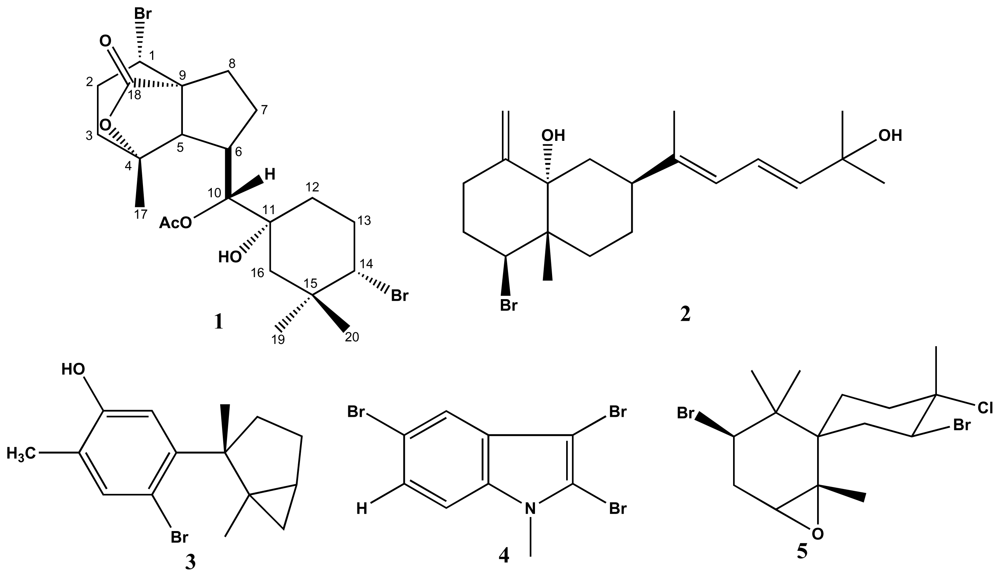
<p>The partially dried specimens of algae <italic>Laurencia</italic> sp. were extracted in MeOH (1:1, v/v). The concentrated extracts were partitioned between H<sub>2</sub>O and EtOAc. The EtOAc soluble fraction was dehydrated over Na<sub>2</sub>SO<sub>4</sub> anhydrous, filtered, concentrated and purified by a combination of silica gel column chromatography and High Performance Liquid Chromatography (HPLC) separation, to yield compounds <bold>1</bold>–<bold>5</bold> (<xref ref-type="fig" rid="f1-marinedrugs-08-01743">Figure 1</xref>).</p>
<p>Compound <bold>1</bold> was obtained as white powder, [α]<sup>25</sup><sub>D</sub> +6.4 (<italic>c</italic> 0.9, CHCl<sub>3</sub>). The IR spectrum indicated the presence of OH group (3532 cm<sup>−1</sup>), γ-lactone carbonyl group (1773 cm<sup>−1</sup>) and acetoxy functionality (1734 and 1236 cm<sup>−1</sup>). The positive ESI-MS exhibited a characteristic molecular-ion cluster at <italic>m</italic>/<italic>z</italic> 535/537/539 in a ratio of 1:2:1, suggesting the presence of two bromine atoms. The molecular formula was determined to be C<sub>22</sub>H<sub>32</sub>Br<sub>2</sub>O<sub>5</sub> by HR-ESI-TOFMS, indicating six degrees of unsaturation. The <sup>13</sup>C NMR spectrum (<xref ref-type="table" rid="t1-marinedrugs-08-01743">Table 1</xref>) along with the DEPT experiments showed the presence of 22 carbons including four methyls, seven methylenes, five methines and six quaternary carbon atoms. In addition, the <sup>1</sup>H and <sup>13</sup>C NMR spectral data (<xref ref-type="table" rid="t1-marinedrugs-08-01743">Table 1</xref>) indicated the presence of a γ-lactone carbonyl group [δ<sub>C</sub> 174.3 (s)] and an associated tertiary alkoxy group [δ<sub>C</sub> 83.0 (s)], an acetoxy group [δ<sub>C</sub> 169.4 (s), 20.2 (q); δ<sub>H</sub> 1.58 (3H, s)], an acetoxymethine [δ<sub>C</sub> 83.0 (d); δ<sub>H</sub> 4.31 (1H, d, <italic>J</italic> = 8.9 Hz)], a tertiary alcohol [δ<sub>C</sub> 73.7 (s)], two bromomethines [δ<sub>C</sub> 64.4 (d); δ<sub>H</sub> 3.52 (1H, dd, <italic>J</italic> = 13.1, 4.1 Hz) and δ<sub>C</sub> 51.0 (d); δ<sub>H</sub> 3.33 (1H, dd, <italic>J</italic> = 11.7, 6.2 Hz)] and three tertiary methyls [δ<sub>H</sub> 1.25, 1.15 and 0.93 (each 3H, s)]. According to the molecular formula and the functionalities mentioned above, compound <bold>1</bold> is suggested to contain one γ-lactone and three carbocyclic rings. Furthermore, the <sup>13</sup>C-NMR spectra of <bold>1</bold> closely resembled those of the known compound angasiol [<xref ref-type="bibr" rid="b10-marinedrugs-08-01743">10</xref>], except for the absence of one acetoxy group. It clearly suggested that <bold>1</bold> possesses the same skeleton and substituent.</p>
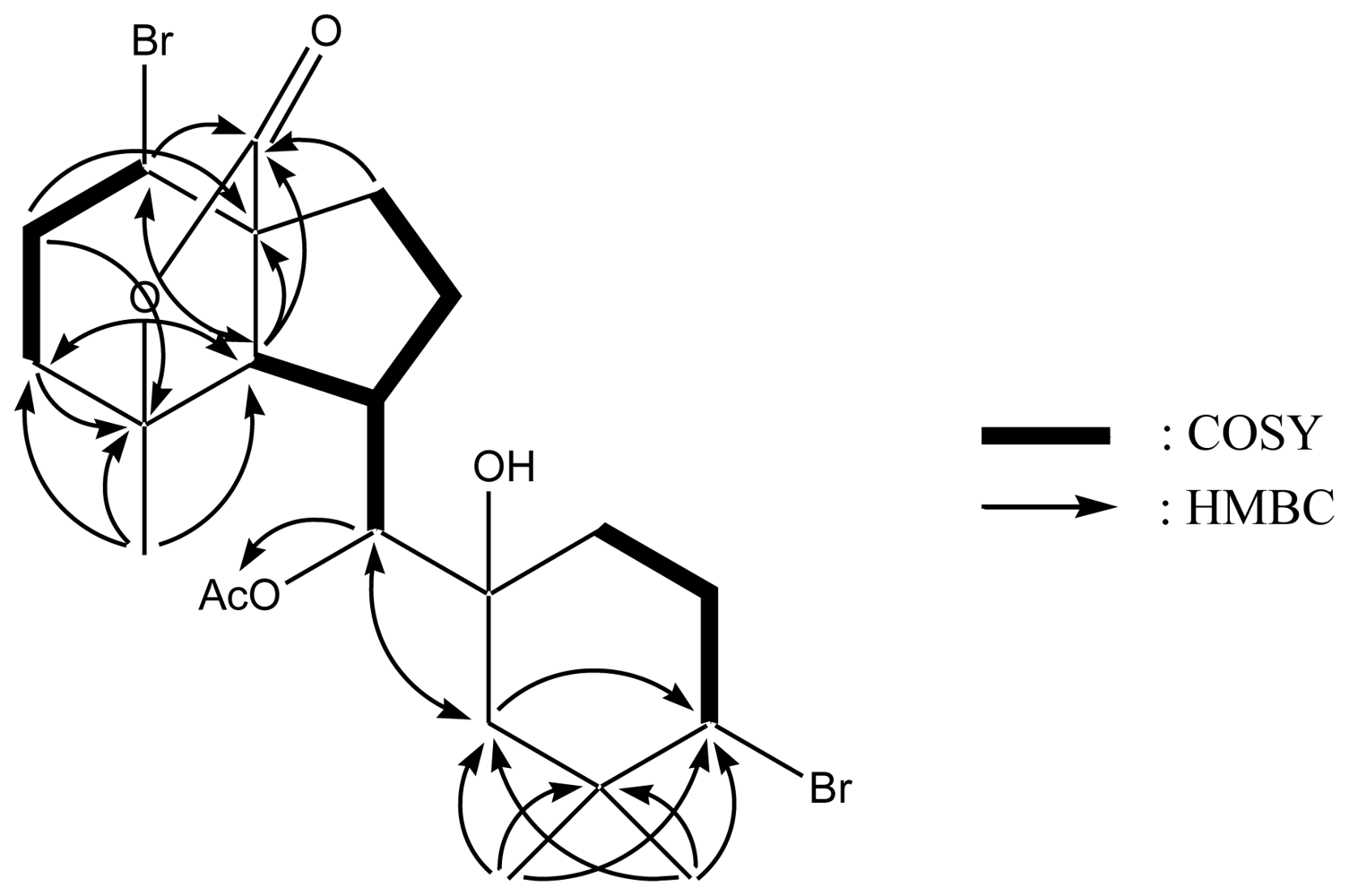
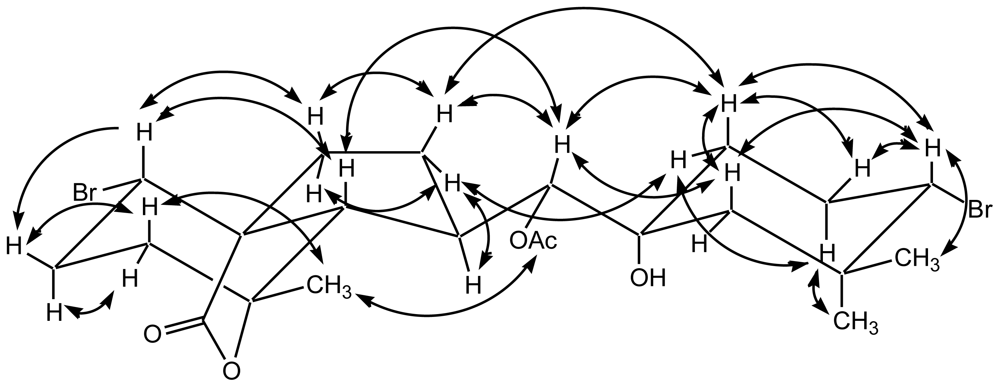
<p>Assignments were carried out based on <sup>1</sup>H-<sup>1</sup>H COSY, HSQC and HMBC spectra data. <sup>1</sup>H-<sup>1</sup>H COSY experiments revealed the sequences of the correlations depicted by the bold lines in <xref ref-type="fig" rid="f2-marinedrugs-08-01743">Figure 2</xref>. Key HMBC correlations as shown in <xref ref-type="fig" rid="f2-marinedrugs-08-01743">Figure 2</xref> were consistent with the proposed structure of <bold>1</bold>. Furthermore, the relative stereochemistry of <bold>1</bold> was elucidated by NOESY experiments as well as the coupling constants in the <sup>1</sup>H-NMR spectrum. The coupling constant (<italic>J</italic><sub>6,10</sub> = 8.9 Hz) indicated the <italic>anti</italic> conformation for the H-6/H-10. The configuration at C-10 was assigned as <italic>R</italic>* on the basis of the NOESY correlations observed between H-5/H-10, H-7β/H-10, H-10/Hax-12, H-10/Hax-16 and H<sub>3</sub>-17/H<sub>3</sub>-Ac. In addition, the remaining stereochemistry of <bold>1</bold> was determined by NOESY correlations as shown in <xref ref-type="fig" rid="f3-marinedrugs-08-01743">Figure 3</xref> and assigned to be the same as for angasiol and its related compounds, irieols A–G [<xref ref-type="bibr" rid="b10-marinedrugs-08-01743">10</xref>–<xref ref-type="bibr" rid="b12-marinedrugs-08-01743">12</xref>]. In consequence, the structure of 10-acetoxyangasiol (<bold>1</bold>) must be represented by structure <bold>1</bold>.</p>
<p>All five metabolites were subjected to antibacterial bioassay against five species of clinical bacteria, and their antibacterial activities at 30 mg disc<sup>−1</sup> are shown in <xref ref-type="table" rid="t2-marinedrugs-08-01743">Table 2</xref>. Compounds <bold>1</bold>, <bold>2</bold> and <bold>3</bold> exhibited potent inhibition against three of the tested bacteria. The lowest MIC value was observed for compound <bold>1</bold> against <italic>Vibrio cholerae</italic> at 100 μg mL<sup>−1</sup>. Compounds <bold>4</bold> and <bold>5</bold> only exhibited weak inhibition against <italic>Staphylococcus</italic> sp. with a MIC value of 300 μg mL<sup>−1</sup>. Vancomycin, used as a positive control, exhibited a &gt;23 mm inhibition zone against all the tested microbes at 30 mg disc<sup>−1</sup>. Based on our findings, these halogenated metabolites could be considered as possible candidates for further investigation against clinical microbes in our endeavor to combat the rise in antibiotic resistant microbes.</p></sec>
<sec>
<title>3. Experimental Section</title>
<sec>
<title>3.1. General</title>
<p>Optical rotations were measured on an AUTOPOL IV automatic polarimeter (Rudolph Research Analytical). <sup>1</sup>H-NMR (600 MHz) and <sup>13</sup>C-NMR (150 MHz) spectra were recorded with a JEOL ECA 600, with TMS as internal standard. HR-ESI-TOFMS spectrum was obtained with LCMS-IT-TOF (Shimadzu). Silica gel (Merck, Kieselgel 60, 70–230 mesh) was used for column chromatography. Separation of the eluted fraction were carried out using Shimadzu HPLC with Phenyl Hexyl (Phenomenex, USA) 10 × 250 mm eluted with 70% MeCN/H<sub>2</sub>O, and detected at 210 nm using SPD 20A Shimadzu UV-Vis detector. Analytical TLC was performed on Merck Kieselgel 60 F<sub>254</sub>. Spots were visualized by UV light or by spraying with a 5% phosphomolybdic acid-ethanol solution.</p></sec>
<sec>
<title>3.2. Algal material</title>
<p>Specimens of <italic>Laurencia</italic> sp. were collected from Lohok Butun (4°27’23”N, 118°41’12”E), Selakan Island (4°35’00”N, 118°42’04”E), Layangan Island (5°46’63”N, 115°53’39”E), and Gaya Island (6°00’47”N, 116°03’14”E). The specimens (voucher nos. 37604, 37610, 37665, 37767, 37774) are deposited in the Herbarium (BORH) of Institute for Tropical Biology and Conservation, Universiti Malaysia Sabah.</p></sec>
<sec>
<title>3.3. Extraction and isolation</title>
<p>The partially dried alga specimens (100 g) were extracted with MeOH. The MeOH solution was concentrated <italic>in vacuo</italic> and partitioned between EtOAc and H<sub>2</sub>O. The EtOAc fraction was washed with water, dried over anhydrous Na<sub>2</sub>SO<sub>4</sub>, and evaporated to leave dark green oil. The extract was then fractioned by Si gel column chromatography with a step gradient (hexane and EtOAc). The fractions eluted with hexanes-EtOAc (9:1) and hexanes-EtOAc (8:2) were further purified by HPLC to give 10-acetoxyangasiol (<bold>1</bold>) (2.4%) from specimen BORH 37610, aplysidiol (<bold>2</bold>) (3.2%) from specimen BORH 37665), cupalaurenol (<bold>3</bold>) (0.9%) from specimen BORH 37774, 1-methyl-2,3,5-tribromoindole (<bold>4</bold>) (2.8%) from specimen BORH 37767, and chamigrane epoxide (<bold>5</bold>) (3.6%) from specimen BORH 37774. Yield was calculated based on the extracted methanol crude.</p></sec>
<sec>
<title>3.4. Characterization of 10-acetoxyangasiol (<bold>1</bold>)</title>
<p>White powder; [α]<sup>25</sup><sub>D</sub> +6.4 (<italic>c</italic> 0.9, CHCl<sub>3</sub>); HR-TOFMS <italic>m</italic>/<italic>z</italic> 535.0661 [M + H]<sup>+</sup> (calculated for C<sub>22</sub>H<sub>33</sub>Br<sub>2</sub>O<sub>5</sub>, 535.0689); <sup>1</sup>H-NMR and <sup>13</sup>C-NMR spectral data: see <xref ref-type="table" rid="t1-marinedrugs-08-01743">Table 1</xref>.</p></sec>
<sec>
<title>3.5. Bioassay</title>
<p>The antibacterial bioassay for the isolated metabolite was carried out against 5 species of clinical pathogens obtained from Department of Pathology, Queen Elizabeth Hospital, Kota Kinabalu, Sabah, Malaysia. These bacteria are <italic>Staphylococcus aureus</italic> (UMS01-08)<italic>, Staphylococcus</italic> sp. (UMS02-08), <italic>Streptococcus pyogenes</italic>(UMS03-08)<italic>, Salmonella</italic> sp. (UMS04-08) and <italic>Vibrio cholerae</italic>(UMS05-08). One loopful of each organism was precultured in 20 mL of peptone water overnight. The turbidity of the culture was adjusted to an optical density (OD) of McFarland 0.5 [<xref ref-type="bibr" rid="b13-marinedrugs-08-01743">13</xref>]. Then 0.1 mL of the precultured bacterial suspension was used to seed Nutrient Agar plates. Paper discs (Whatman, 6 mm) impregnated with 30 mg disc<sup>−1</sup> of the respective isolated compounds were placed on the seeded agar plates and the diameter of the inhibitory zones measured after incubation at 28 °C for 24 h. Antibacterial activity was evaluated by measuring the diameter of inhibition zone of the tested bacteria. Vancomycin (Sigma, Germany) was used as positive control. Minimum Inhibitory Concentration (MIC) determination for the positive inhibitions was carried out via microdilution broth method as described by Shan <italic>et al.</italic> (2008) with slight modifications [<xref ref-type="bibr" rid="b14-marinedrugs-08-01743">14</xref>].</p></sec></sec>
<sec sec-type="conclusions">
<title>4. Conclusions</title>
<p>This is our first report on the composition of halogenated metabolites and their activities in unrecorded <italic>Laurencia</italic> sp. from the coastal waters of North Borneo Island of Sabah, Malaysia. Our initiative pertaining to the isolation and identification of halogenated secondary metabolites from Borneon <italic>Laurencia</italic> continues to excite us, with the isolation of a wide diversity of structurally interesting metabolites. To date, we have isolated a total of 42 halogenated metabolites from <italic>L. snackeyii</italic>, <italic>L. majuscula</italic>, <italic>L. similis</italic>, <italic>L. nangii</italic> and these five species of undescribed <italic>Laurencia</italic> spp.</p></sec></body>
<back>
<ack>
<title>Acknowledgements</title>
<p>We are grateful to the Sabah Parks for the support and assistance during field survey. This study was funded by the “International Foundation for Science (IFS)” and Committee for the Prohibition of Chemical Weapon, Hague, The Netherlands (IFS), Grant No: AF/4286-2). The authors would also like to acknowledge Hiroshi Matsuura for his kind assistance during data comparison.</p></ack>
<fn-group><fn>
<p><italic>Samples Availability:</italic> Available from the authors.</p></fn></fn-group>
<ref-list>
<title>References</title>
<ref id="b1-marinedrugs-08-01743"><label>1</label><citation citation-type="book"><person-group person-group-type="author"><name><surname>Erickson</surname><given-names>KL</given-names></name></person-group><person-group person-group-type="editor"><name><surname>Scheuer</surname><given-names>PJ</given-names></name></person-group><source>Marine Natural Products: Chemical and Biological Perspectives</source><publisher-name>Academic Press</publisher-name><publisher-loc>New York, NY, USA</publisher-loc><year>1983</year><volume>V</volume><fpage>131</fpage><lpage>257</lpage></citation></ref>
<ref id="b2-marinedrugs-08-01743"><label>2</label><citation citation-type="journal"><person-group person-group-type="author"><name><surname>Vairappan</surname><given-names>CS</given-names></name><name><surname>Tan</surname><given-names>KL</given-names></name></person-group><article-title>Halogenated secondary metabolites from sea hare <italic>Aplysia dactylomela</italic></article-title><source>Malaysian J. Sci</source><year>2004</year><volume>24</volume><fpage>17</fpage><lpage>22</lpage></citation></ref>
<ref id="b3-marinedrugs-08-01743"><label>3</label><citation citation-type="journal"><person-group person-group-type="author"><name><surname>Vairappan</surname><given-names>CS</given-names></name><name><surname>Ang</surname><given-names>MY</given-names></name><name><surname>Ong</surname><given-names>CY</given-names></name><name><surname>Phang</surname><given-names>SM</given-names></name></person-group><article-title>Biologically active polybrominated indoles in the red algae <italic>Laurencia similis</italic> from the coastal waters of Sabah (<italic>Rhodomelaceae</italic>, <italic>Ceramiales</italic>)</article-title><source>Malaysian J. Sci</source><year>2004</year><volume>23</volume><fpage>119</fpage><lpage>126</lpage></citation></ref>
<ref id="b4-marinedrugs-08-01743"><label>4</label><citation citation-type="journal"><person-group person-group-type="author"><name><surname>Vairappan</surname><given-names>CS</given-names></name></person-group><article-title>Potent antibacterial activity of Malaysian red algal halogenated metabolites against human pathogenic bacteria</article-title><source>Biomol. Eng</source><year>2003</year><volume>20</volume><fpage>255</fpage><lpage>259</lpage><pub-id pub-id-type="doi">10.1016/S1389-0344(03)00067-4</pub-id><pub-id pub-id-type="pmid">12919806</pub-id></citation></ref>
<ref id="b5-marinedrugs-08-01743"><label>5</label><citation citation-type="journal"><person-group person-group-type="author"><name><surname>Vairappan</surname><given-names>CS</given-names></name><name><surname>Phang</surname><given-names>SM</given-names></name></person-group><article-title>Morphology and halochamigrene metabolite content of Laurencia majuscula (Rhodomelaceae, Ceramiales) from the Spratly Islands</article-title><source>Malaysian J. Sci</source><year>2005</year><volume>24</volume><issue>2</issue><fpage>29</fpage><lpage>36</lpage></citation></ref>
<ref id="b6-marinedrugs-08-01743"><label>6</label><citation citation-type="journal"><person-group person-group-type="author"><name><surname>Ojika</surname><given-names>M</given-names></name><name><surname>Shizuri</surname><given-names>Y</given-names></name><name><surname>Yamada</surname><given-names>K</given-names></name></person-group><article-title>A halogenated chamigrane epoxide and six related halogen containing sesquiterpenes from the red alga <italic>Laurencia okamurai</italic></article-title><source>Phytochemistry</source><year>1982</year><volume>21</volume><fpage>2410</fpage><lpage>2411</lpage></citation></ref>
<ref id="b7-marinedrugs-08-01743"><label>7</label><citation citation-type="journal"><person-group person-group-type="author"><name><surname>Ojika</surname><given-names>M</given-names></name><name><surname>Yoshida</surname><given-names>Y</given-names></name><name><surname>Okumura</surname><given-names>M</given-names></name><name><surname>Ieda</surname><given-names>S</given-names></name><name><surname>Yamada</surname><given-names>K</given-names></name></person-group><article-title>Alysiadiol, a new brominated diterpene from the marine mollusc <italic>Aplysia kurodai</italic></article-title><source>J. Nat. Prod</source><year>1990</year><volume>53</volume><fpage>1619</fpage><lpage>1622</lpage></citation></ref>
<ref id="b8-marinedrugs-08-01743"><label>8</label><citation citation-type="journal"><person-group person-group-type="author"><name><surname>Ichiba</surname><given-names>T</given-names></name><name><surname>Higa</surname><given-names>T</given-names></name></person-group><article-title>New cuparene derived sesquiterpenes with unprecedented oxygenation patterns from the sea hare <italic>Aplysia dactylomela</italic></article-title><source>J. Org. Chem</source><year>1986</year><volume>51</volume><fpage>3364</fpage><lpage>3366</lpage></citation></ref>
<ref id="b9-marinedrugs-08-01743"><label>9</label><citation citation-type="journal"><person-group person-group-type="author"><name><surname>Carter</surname><given-names>GT</given-names></name><name><surname>Rinehart</surname><given-names>KL</given-names><suffix>Jr</suffix></name><name><surname>Li</surname><given-names>LH</given-names></name><name><surname>Kuentzel</surname><given-names>SL</given-names></name><name><surname>Connor</surname><given-names>JL</given-names></name></person-group><article-title>Brominated indoles from <italic>Laurencia brongniartii</italic></article-title><source>Tetrahedron Lett</source><year>1978</year><volume>46</volume><fpage>4479</fpage><lpage>4482</lpage></citation></ref>
<ref id="b10-marinedrugs-08-01743"><label>10</label><citation citation-type="journal"><person-group person-group-type="author"><name><surname>Pettit</surname><given-names>GR</given-names></name><name><surname>Herald</surname><given-names>CL</given-names></name><name><surname>Einck</surname><given-names>JJ</given-names></name><name><surname>Vanell</surname><given-names>LD</given-names></name><name><surname>Brown</surname><given-names>P</given-names></name><name><surname>Gust</surname><given-names>D</given-names></name></person-group><article-title>Isolation and structure of angasiol</article-title><source>J. Org. Chem</source><year>1978</year><volume>43</volume><fpage>4685</fpage><lpage>4686</lpage><pub-id pub-id-type="doi">10.1021/jo00418a045</pub-id></citation></ref>
<ref id="b11-marinedrugs-08-01743"><label>11</label><citation citation-type="journal"><person-group person-group-type="author"><name><surname>Howard</surname><given-names>BM</given-names></name><name><surname>Fenical</surname><given-names>W</given-names></name></person-group><article-title>Structures of irieols, new dibromoditerpenoids of a unique skeletal class from the marine red alga <italic>Laurencia irieii</italic></article-title><source>J. Org. Chem</source><year>1978</year><volume>43</volume><fpage>4401</fpage><lpage>4408</lpage><pub-id pub-id-type="doi">10.1021/jo00417a001</pub-id></citation></ref>
<ref id="b12-marinedrugs-08-01743"><label>12</label><citation citation-type="journal"><person-group person-group-type="author"><name><surname>Ji</surname><given-names>NY</given-names></name><name><surname>Li</surname><given-names>XM</given-names></name><name><surname>Cui</surname><given-names>CM</given-names></name><name><surname>Wang</surname><given-names>BG</given-names></name></person-group><article-title>Terpenes and polybromoindoles from the marine red alga <italic>Laurencia decumbens</italic> (Rhodomelaceae)</article-title><source>Helv. Chim. Acta</source><year>2007</year><volume>90</volume><fpage>1731</fpage><lpage>1736</lpage></citation></ref>
<ref id="b13-marinedrugs-08-01743"><label>13</label><citation citation-type="journal"><person-group person-group-type="author"><name><surname>Vairappan</surname><given-names>CS</given-names></name><name><surname>Suzuki</surname><given-names>M</given-names></name><name><surname>Ishii</surname><given-names>T</given-names></name><name><surname>Okino</surname><given-names>T</given-names></name><name><surname>Abe</surname><given-names>T</given-names></name><name><surname>Masuda</surname><given-names>M</given-names></name></person-group><article-title>Antibacterial activity of halogenated sesquiterpenes from Malaysian <italic>Laurencia</italic> spp</article-title><source>Phytochemistry</source><year>2008</year><volume>69</volume><fpage>2490</fpage><lpage>2494</lpage><pub-id pub-id-type="pmid">18718619</pub-id></citation></ref>
<ref id="b14-marinedrugs-08-01743"><label>14</label><citation citation-type="journal"><person-group person-group-type="author"><name><surname>Shan</surname><given-names>B</given-names></name><name><surname>Cai</surname><given-names>YZ</given-names></name><name><surname>Brooks</surname><given-names>JD</given-names></name><name><surname>Corke</surname><given-names>H</given-names></name></person-group><article-title>Antibacterial properties of <italic>Polygonum cuspidatum</italic> roots and their major bioactive constituents</article-title><source>Food Chem</source><year>2008</year><volume>109</volume><fpage>503</fpage><lpage>537</lpage></citation></ref></ref-list>
<sec sec-type="display-objects">
<title>Figures and Tables</title>
<fig id="f1-marinedrugs-08-01743" position="float">
<label>Figure 1</label>
<caption>
<p>The structure of compounds <bold>1</bold>–<bold>5</bold> from specimens of algae <italic>Laurencia</italic> sp.</p></caption><graphic xlink:href="marinedrugs-08-01743f1.gif"/></fig>
<fig id="f2-marinedrugs-08-01743" position="float">
<label>Figure 2</label>
<caption>
<p><sup>1</sup>H-<sup>1</sup>H COSY correlations (bold lines) and key HMBC correlations (H→C) of <bold>1</bold>.</p></caption><graphic xlink:href="marinedrugs-08-01743f2.gif"/></fig>
<fig id="f3-marinedrugs-08-01743" position="float">
<label>Figure 3</label>
<caption>
<p>NOESY correlations of <bold>1</bold>.</p></caption><graphic xlink:href="marinedrugs-08-01743f3.gif"/></fig>
<table-wrap id="t1-marinedrugs-08-01743" position="float">
<label>Table 1</label>
<caption>
<p><sup>1</sup>H-NMR and <sup>13</sup>C-NMR spectral data of compound <bold>1</bold> (recorded at 600/150 MHz in CDCl<sub>3</sub>; δ in ppm, <italic>J</italic> in Hz).</p></caption>
<table frame="hsides" rules="groups">
<thead>
<tr>
<th align="left" valign="bottom">C</th>
<th align="left" valign="bottom"><sup>13</sup>C (δ)</th>
<th align="left" valign="bottom"><sup>1</sup>H (δ)</th>
<th align="left" valign="bottom">Multiplicity (<italic>J</italic> in Hz)</th></tr></thead>
<tbody>
<tr>
<td align="left" valign="top">1</td>
<td align="left" valign="top">51.0</td>
<td align="left" valign="top">3.33</td>
<td align="left" valign="top">(dd, 11.7, 6.2)</td></tr>
<tr>
<td align="left" valign="top">2</td>
<td align="left" valign="top">32.6</td>
<td align="left" valign="top">2.00</td>
<td align="left" valign="top">m</td></tr>
<tr><td align="left" valign="top"/><td align="left" valign="top"/>
<td align="left" valign="top">1.82</td>
<td align="left" valign="top">m</td></tr>
<tr>
<td align="left" valign="top">3</td>
<td align="left" valign="top">38.1</td>
<td align="left" valign="top">1.32–1.39</td>
<td align="left" valign="top">m</td></tr>
<tr><td align="left" valign="top"/><td align="left" valign="top"/>
<td align="left" valign="top">0.81</td>
<td align="left" valign="top">(ddd, 13.7, 12.4, 5.5)</td></tr>
<tr>
<td align="left" valign="top">4</td>
<td align="left" valign="top">83.0</td><td align="left" valign="top"/><td align="left" valign="top"/></tr>
<tr>
<td align="left" valign="top">5</td>
<td align="left" valign="top">60.1</td>
<td align="left" valign="top">1.34</td>
<td align="left" valign="top">(d, 8.3)</td></tr>
<tr>
<td align="left" valign="top">6</td>
<td align="left" valign="top">38.0</td>
<td align="left" valign="top">2.32</td>
<td align="left" valign="top">(dddd, 11.0, 8.9, 8.3, 4.8)</td></tr>
<tr>
<td align="left" valign="top">7</td>
<td align="left" valign="top">29.6</td>
<td align="left" valign="top">1.50–1.57</td>
<td align="left" valign="top">m</td></tr>
<tr><td align="left" valign="top"/><td align="left" valign="top"/>
<td align="left" valign="top">1.05</td>
<td align="left" valign="top">(dddd, 14.5, 10.3, 4.8, 2.0)</td></tr>
<tr>
<td align="left" valign="top">8</td>
<td align="left" valign="top">32.7</td>
<td align="left" valign="top">2.54</td>
<td align="left" valign="top">(ddd, 13.1, 8.3, 2.0)</td></tr>
<tr><td align="left" valign="top"/><td align="left" valign="top"/>
<td align="left" valign="top">1.43</td>
<td align="left" valign="top">(ddd, 13.1, 10.3, 10.3)</td></tr>
<tr>
<td align="left" valign="top">9</td>
<td align="left" valign="top">61.8</td><td align="left" valign="top"/><td align="left" valign="top"/></tr>
<tr>
<td align="left" valign="top">10</td>
<td align="left" valign="top">83.0</td>
<td align="left" valign="top">4.31</td>
<td align="left" valign="top">(d, 8.9)</td></tr>
<tr>
<td align="left" valign="top">11</td>
<td align="left" valign="top">73.7</td><td align="left" valign="top"/><td align="left" valign="top"/></tr>
<tr>
<td align="left" valign="top">12</td>
<td align="left" valign="top">34.3</td>
<td align="left" valign="top">0.90–0.95</td>
<td align="left" valign="top">m</td></tr>
<tr><td align="left" valign="top"/><td align="left" valign="top"/>
<td align="left" valign="top">0.56</td>
<td align="left" valign="top">(ddd, 13.1, 13.1, 4.1)</td></tr>
<tr>
<td align="left" valign="top">13</td>
<td align="left" valign="top">29.7</td>
<td align="left" valign="top">2.25</td>
<td align="left" valign="top">(dddd, 13.1, 13.1, 13.1, 3.4)</td></tr>
<tr><td align="left" valign="top"/><td align="left" valign="top"/>
<td align="left" valign="top">1.78</td>
<td align="left" valign="top">(dddd, 13.1, 4.1, 4.1, 4.1)</td></tr>
<tr>
<td align="left" valign="top">14</td>
<td align="left" valign="top">64.4</td>
<td align="left" valign="top">3.52</td>
<td align="left" valign="top">(dd, 13.1, 4.1)</td></tr>
<tr>
<td align="left" valign="top">15</td>
<td align="left" valign="top">36.1</td><td align="left" valign="top"/><td align="left" valign="top"/></tr>
<tr>
<td align="left" valign="top">16</td>
<td align="left" valign="top">47.2</td>
<td align="left" valign="top">1.29</td>
<td align="left" valign="top">(dd, 13.7, 3.4)</td></tr>
<tr><td align="left" valign="top"/><td align="left" valign="top"/>
<td align="left" valign="top">0.92</td>
<td align="left" valign="top">(d, 13.7)</td></tr>
<tr>
<td align="left" valign="top">17</td>
<td align="left" valign="top">21.9</td>
<td align="left" valign="top">1.15</td>
<td align="left" valign="top">s</td></tr>
<tr>
<td align="left" valign="top">18</td>
<td align="left" valign="top">174.3</td><td align="left" valign="top"/><td align="left" valign="top"/></tr>
<tr>
<td align="left" valign="top">19</td>
<td align="left" valign="top">22.7</td>
<td align="left" valign="top">1.25</td>
<td align="left" valign="top">s</td></tr>
<tr>
<td align="left" valign="top">20</td>
<td align="left" valign="top">32.3</td>
<td align="left" valign="top">0.93</td>
<td align="left" valign="top">s</td></tr>
<tr>
<td align="left" valign="top">Ac</td>
<td align="left" valign="top">169.4</td><td align="left" valign="top"/><td align="left" valign="top"/></tr>
<tr><td align="left" valign="top"/>
<td align="left" valign="top">20.2</td>
<td align="left" valign="top">1.58</td>
<td align="left" valign="top">s</td></tr></tbody></table></table-wrap>
<table-wrap id="t2-marinedrugs-08-01743" position="float">
<label>Table 2</label>
<caption>
<p>Diameter of inhibition zone (DIZ) and minimum inhibitory concentration (MIC) of halogenated metabolites from <italic>Laurencia</italic> sp against five bacteria.</p></caption>
<table frame="box" rules="cols">
<thead>
<tr>
<th align="center" valign="top" rowspan="2">Tested Bacteria</th>
<th colspan="5" align="center" valign="top">Halogenated Metabolites<hr/></th></tr>
<tr>
<th align="center" valign="top">1</th>
<th align="center" valign="top">2</th>
<th align="center" valign="top">3</th>
<th align="center" valign="top">4</th>
<th align="center" valign="top">5</th></tr>
<tr>
<th colspan="6" align="center" valign="top"><hr/></th></tr></thead>
<tbody>
<tr>
<td align="center" valign="top"><bold><italic>INHIBITION AT 30 mg/disc (mm)</italic></bold></td><td align="center" valign="top"/><td align="center" valign="top"/><td align="center" valign="top"/><td align="center" valign="top"/><td align="center" valign="top"/></tr>
<tr>
<td align="left" valign="top"><italic>Staphylococcus aureus</italic></td>
<td align="center" valign="top">10</td>
<td align="center" valign="top">8</td>
<td align="center" valign="top">15</td>
<td align="center" valign="top">-</td>
<td align="center" valign="top">-</td></tr>
<tr>
<td align="left" valign="top"><italic>Staphylococcus</italic> sp.</td>
<td align="center" valign="top">12</td>
<td align="center" valign="top">10</td>
<td align="center" valign="top">15</td>
<td align="center" valign="top">9</td>
<td align="center" valign="top">9</td></tr>
<tr>
<td align="left" valign="top"><italic>Streptococcus pyogenes</italic></td>
<td align="center" valign="top">-</td>
<td align="center" valign="top">-</td></tr>
<tr>
<td align="left" valign="top"><italic>Salmonella</italic> sp.</td>
<td align="center" valign="top">-</td>
<td align="center" valign="top">9</td>
<td align="center" valign="top">15</td>
<td align="center" valign="top">-</td>
<td align="center" valign="top">-</td></tr>
<tr>
<td align="left" valign="top"><italic>Vibrio cholerae</italic></td>
<td align="center" valign="top">18</td>
<td align="center" valign="top">-</td>
<td align="center" valign="top">11</td>
<td align="center" valign="top">-</td>
<td align="center" valign="top">-</td></tr>
<tr>
<td align="center" valign="top"><bold><italic>MINIMUM INHIBITION CONCENTRATION (MIC) (</italic></bold><italic>μ</italic><bold><italic>g/mL)</italic></bold></td><td align="center" valign="top"/><td align="center" valign="top"/><td align="center" valign="top"/><td align="center" valign="top"/><td align="center" valign="top"/></tr>
<tr>
<td align="left" valign="top"><italic>Staphylococcus aureus</italic></td>
<td align="center" valign="top">250</td>
<td align="center" valign="top">200</td>
<td align="center" valign="top">125</td>
<td align="center" valign="top">-</td>
<td align="center" valign="top">-</td></tr>
<tr>
<td align="left" valign="top"><italic>Staphylococcus</italic> sp.</td>
<td align="center" valign="top">200</td>
<td align="center" valign="top">125</td>
<td align="center" valign="top">300</td>
<td align="center" valign="top">300</td></tr>
<tr>
<td align="left" valign="top"><italic>Streptococcus pyogenes</italic></td>
<td align="center" valign="top">-</td>
<td align="center" valign="top">-</td></tr>
<tr>
<td align="left" valign="top"><italic>Salmonella</italic> sp.</td>
<td align="center" valign="top">-</td>
<td align="center" valign="top">250</td>
<td align="center" valign="top">125</td>
<td align="center" valign="top">-</td>
<td align="center" valign="top">-</td></tr>
<tr>
<td align="left" valign="top"><italic>Vibrio cholerae</italic></td>
<td align="center" valign="top">100</td>
<td align="center" valign="top">-</td>
<td align="center" valign="top">200</td>
<td align="center" valign="top">-</td>
<td align="center" valign="top">-</td></tr></tbody></table>
<table-wrap-foot><fn id="tfn1-marinedrugs-08-01743">
<p>Note: Bioassay were done in triplicate, SD &lt;10%, and not shown.</p></fn></table-wrap-foot></table-wrap></sec></back></article>