
<?xml version="1.0" encoding="UTF-8"?>
<!DOCTYPE article PUBLIC "-//NLM//DTD Journal Publishing DTD v2.3 20070202//EN" "journalpublishing.dtd">
<article xmlns:xlink="http://www.w3.org/1999/xlink" xml:lang="en" article-type="review-article">
<front>
<journal-meta>
<journal-id journal-id-type="publisher-id">MD</journal-id>
<journal-title>Marine Drugs</journal-title>
<abbrev-journal-title>MD</abbrev-journal-title>
<issn pub-type="epub">1660-3397</issn>
<publisher>
<publisher-name>Molecular Diversity Preservation International</publisher-name></publisher></journal-meta>
<article-meta>
<article-id pub-id-type="doi">10.3390/md8020269</article-id>
<article-id pub-id-type="publisher-id">marinedrugs-08-00269</article-id>
<article-categories>
<subj-group>
<subject>Review</subject></subj-group></article-categories>
<title-group>
<article-title>Alkaloids in Marine Algae</article-title></title-group>
<contrib-group>
<contrib contrib-type="author">
<name><surname>Güven</surname><given-names>Kasım Cemal</given-names></name><xref ref-type="aff" rid="af1-marinedrugs-08-00269">1</xref><xref ref-type="corresp" rid="c1-marinedrugs-08-00269">*</xref></contrib>
<contrib contrib-type="author">
<name><surname>Percot</surname><given-names>Aline</given-names></name><xref ref-type="aff" rid="af2-marinedrugs-08-00269">2</xref></contrib>
<contrib contrib-type="author">
<name><surname>Sezik</surname><given-names>Ekrem</given-names></name><xref ref-type="aff" rid="af3-marinedrugs-08-00269">3</xref></contrib></contrib-group>
<aff id="af1-marinedrugs-08-00269">
<label>1</label> Istanbul Aydın University, Inönü Cad., 40, Sefaköy, Istanbul, Turkey</aff>
<aff id="af2-marinedrugs-08-00269">
<label>2</label> Laboratoire de Dynamique, Interactions et Réactivité (LADIR), UMR 7075 CNRS–UPMC Univ Paris 06, 2 rue Henry Dunant, 94320 Thiais, France; E-Mail: 
<email>aline.percot@gmail.com</email></aff>
<aff id="af3-marinedrugs-08-00269">
<label>3</label> Department of Pharmacognosy, Hipodrom Ankara, Faculty of Pharmacy, Gazi University, Turkey; E-Mail: 
<email>ekrmsezik@gmail.com</email></aff>
<author-notes>
<corresp id="c1-marinedrugs-08-00269">*Author to whom correspondence should be addressed; E-Mail: 
<email>kcguven@yahoo.com.tr</email>; Tel.: +90 212 573 03 88; Fax: +90 212 573 31 89.</corresp></author-notes>
<pub-date pub-type="collection">
<year>2010</year></pub-date>
<pub-date pub-type="epub">
<day>4</day>
<month>2</month>
<year>2010</year></pub-date>
<volume>8</volume>
<issue>2</issue>
<fpage>269</fpage>
<lpage>284</lpage>
<history>
<date date-type="received">
<day>10</day>
<month>12</month>
<year>2009</year></date>
<date date-type="rev-recd">
<day>20</day>
<month>1</month>
<year>2010</year></date>
<date date-type="accepted">
<day>25</day>
<month>1</month>
<year>2010</year></date></history>
<permissions>
<copyright-statement>© 2010 by the authors; licensee Molecular Diversity Preservation International, Basel, Switzerland</copyright-statement>
<copyright-year>2010</copyright-year>
<license license-type="open-access" xlink:href="http://creativecommons.org/licenses/by/3.0">
<p>This article is an open-access article distributed under the terms and conditions of the Creative Commons Attribution license (http://creativecommons.org/licenses/by/3.0/).</p></license></permissions>
<abstract>
<p>This paper presents the alkaloids found in green, brown and red marine algae. Algal chemistry has interested many researchers in order to develop new drugs, as algae include compounds with functional groups which are characteristic from this particular source. Among these compounds, alkaloids present special interest because of their pharmacological activities. Alkaloid chemistry has been widely studied in terrestrial plants, but the number of studies in algae is insignificant. In this review, a detailed account of macro algae alkaloids with their structure and pharmacological activities is presented. The alkaloids found in marine algae may be divided into three groups: 1. Phenylethylamine alkaloids, 2. Indole and halogenated indole alkaloids, 3. Other alkaloids.</p></abstract>
<kwd-group>
<kwd>alkaloids</kwd>
<kwd>phenylethylamine alkaloids</kwd>
<kwd>indole alkaloids</kwd>
<kwd>halogenated indole alkaloids</kwd>
<kwd>other alkaloids</kwd></kwd-group></article-meta></front>
<body>
<sec sec-type="intro">
<title>1. Introduction</title>
<p>The term alkaloid was first proposed by Meissner in 1819 to characterize these “alkali-like” compounds found in plants [<xref ref-type="bibr" rid="b1-marinedrugs-08-00269">1</xref>,<xref ref-type="bibr" rid="b2-marinedrugs-08-00269">2</xref>], but it was not precisely defined [<xref ref-type="bibr" rid="b3-marinedrugs-08-00269">3</xref>]. With time, the definition has changed [<xref ref-type="bibr" rid="b4-marinedrugs-08-00269">4</xref>] to: a compound that has nitrogen atom(s) in a cyclic ring. Numerous biological amines and halogenated cyclic nitrogen-containing substances are included in the term alkaloid. The latter is specific from marine organisms and marine algae. They could not be found in terrestrial plants.</p>
<p>Some alkaloids isolated from marine algae correspond to contaminants, such as the indole derivative communesin isolated from a <italic>Penicillium</italic> <bold>s</bold>p. found on the green alga <italic>Enteromorpha intestinalis</italic> [<xref ref-type="bibr" rid="b5-marinedrugs-08-00269">5</xref>] and leptosins from <italic>Leptosphaeria</italic> on <italic>Sargassum tortillae</italic> [<xref ref-type="bibr" rid="b6-marinedrugs-08-00269">6</xref>]. These alkaloids were improperly attributed to algae and were not included in this paper.</p>
<p>After the isolation of alkaloids, pure active compounds were used in therapy instead of plant extracts. Isolation of active compounds from plants began in 18th century. Morphine was the first alkaloid extracted from a terrestrial plant in 1805 as reported by Kappelmayer [<xref ref-type="bibr" rid="b7-marinedrugs-08-00269">7</xref>] and hordenine was the first alkaloid isolated from a marine algae in 1969 [<xref ref-type="bibr" rid="b8-marinedrugs-08-00269">8</xref>,<xref ref-type="bibr" rid="b9-marinedrugs-08-00269">9</xref>]. Today approximately two thousand alkaloids are known. They occur abundantly in terrestrial plants and rarely in marine algae.</p>
<p>In this chapter alkaloids in marine algae were classified in three groups as follows:</p>
<list list-type="order">
<list-item>
<p>Phenylethylamine alkaloids.</p></list-item>
<list-item>
<p>Indole and halogenated indole alkaloids.</p></list-item>
<list-item>
<p>Other alkaloids.</p></list-item></list></sec>
<sec>
<title>2. Phenylethylamine Group</title>
<sec>
<title>2.1. Phenylethylamine (PEA)</title>
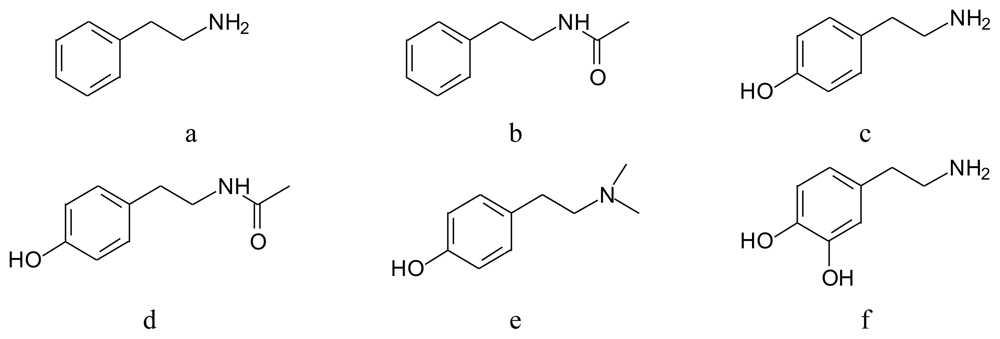
<p>PEA (β/2-phenylethylamine, phenethylamine) is an aromatic amine made up of a benzene ring to which an ethylamine side chain is attached (<xref ref-type="fig" rid="f1-marinedrugs-08-00269">Figure 1a</xref>). The PEA alkaloid group includes important alkaloids. It is a precursor of many natural and synthetic compounds. Several substituted PEAs are pharmacologically active compounds found in plants and animals. This group includes simple phenylamine (tyramine, hordenine) and catecholamine (dopamine). The latter was found in animals and terrestrial plants [<xref ref-type="bibr" rid="b10-marinedrugs-08-00269">10</xref>]. The structure of PEA allows substitutions on the aromatic ring, the α and β carbons and terminal amino group. The published papers concern amine compounds in marine algae [<xref ref-type="bibr" rid="b11-marinedrugs-08-00269">11</xref>,<xref ref-type="bibr" rid="b12-marinedrugs-08-00269">12</xref>], and in the plant kingdom including algae [<xref ref-type="bibr" rid="b13-marinedrugs-08-00269">13</xref>].</p>
<p><italic>Sources</italic>: Some brown marine algae containing PEA are [<xref ref-type="bibr" rid="b11-marinedrugs-08-00269">11</xref>]: <italic>Desmerestia aculeata</italic>, <italic>Desmerestia viridis;</italic> Red: <italic>Ceramium rubrum</italic>, <italic>Cystoclonium purpureum</italic>, <italic>Delesseria sanguine</italic>, <italic>Dumontia incrassata</italic>, <italic>Polysiphonia urceolata</italic>, <italic>Polyides rotundus.</italic> Recently the presence of PEA was examined in 17 marine algae and it was found only in six red algae [<xref ref-type="bibr" rid="b14-marinedrugs-08-00269">14</xref>]: <italic>Gelidium crinale</italic>, <italic>Gracilaria bursa-pastoris</italic>, <italic>Halymenia floresii</italic>, <italic>Phyllophora crispa</italic>, <italic>Polysiphonia morrowii</italic>, <italic>Polysiphonia tripinnata.</italic> PEA was also found in the microalgae <italic>Scenedesmus acutus</italic> [<xref ref-type="bibr" rid="b15-marinedrugs-08-00269">15</xref>].</p>
<p><italic>Pharmacological activity</italic>: PEA in the human brain acts as a neuromodulator and a neurotransmitter. PEA has been shown to relieve depression in 60% of depressed patients. It has been proposed that a PEA deficit may be the cause of a common form of depressive illness [<xref ref-type="bibr" rid="b16-marinedrugs-08-00269">16</xref>]. Substituted PEAs are pharmacologically active compounds as hormones, stimulants, hallucinogens, entactogenes, anorectics, bronchodilators and antidepressants [<xref ref-type="bibr" rid="b17-marinedrugs-08-00269">17</xref>].</p>
<p><italic>N</italic>-acetylphenylethylamine (<italic>N</italic>-ACPEA, <italic>N</italic>-(2-phenylethylacetamide; <xref ref-type="fig" rid="f1-marinedrugs-08-00269">Figure 1b</xref>)</p>
<p><italic>Source: N</italic>-acetylphenylethylamine was first isolated from the red algae <italic>Phyllophora crispa</italic> and <italic>Gelidium crinale</italic> [<xref ref-type="bibr" rid="b18-marinedrugs-08-00269">18</xref>].</p>
<p><italic>Pharmacological activity: N</italic>-ACPEA induced also rotations ipsilateral to the side of the brain lesion as PEA but its activity was 90% less active than β-PEA [<xref ref-type="bibr" rid="b16-marinedrugs-08-00269">16</xref>].</p></sec>
<sec>
<title>2.2. Tyramine (TYR, 4-hydroxyphenylethylamine; <xref ref-type="fig" rid="f1-marinedrugs-08-00269">Figure 1c</xref>)</title>
<p>TYR is a monoamine derivative of the amino acid tyrosine.</p>
<p><italic>Source</italic>: TYR occurs widely in plants, fungi and animal but is rare in algae. It was detected in the brown alga <italic>Laminaria saccharina</italic>, and red algae <italic>Chondrus crispus</italic> and <italic>Polysiphonia urceolata</italic> [<xref ref-type="bibr" rid="b19-marinedrugs-08-00269">19</xref>] and in the microalgae <italic>Scenedesmus acutus</italic> [<xref ref-type="bibr" rid="b14-marinedrugs-08-00269">14</xref>].</p>
<p><italic>Pharmacological activity</italic>: TYR is a pharmacologically important compound. It stimulates the central nervous system, causes vasoconstriction, increases heart rate and blood pressure and is also responsible for migraines.</p>
<p><italic>N</italic>-Acetyltyramine (<italic>N</italic>-ACTYR; <xref ref-type="fig" rid="f1-marinedrugs-08-00269">Figure 1d</xref>)</p>
<p>Acetyl derivative of tyramine</p>
<p><italic>Source</italic>: It was found in the marine algae <italic>Phyllophora crispa</italic> and <italic>Gelidium crinale</italic> [<xref ref-type="bibr" rid="b18-marinedrugs-08-00269">18</xref>] and is produced by many microorganisms [<xref ref-type="bibr" rid="b14-marinedrugs-08-00269">14</xref>] and terrestrial plants [<xref ref-type="bibr" rid="b20-marinedrugs-08-00269">20</xref>].</p>
<p><italic>Pharmacological activity</italic>: N-ACTYR is a neuropeptide and an important amine for chemical and pharmacological purposes. The presence of urinary N-ACTYR in neuroblastoma patients was demonstrated [<xref ref-type="bibr" rid="b21-marinedrugs-08-00269">21</xref>].</p></sec>
<sec>
<title>2.3. Hordenine (Anhaline) (HORD, 4-(2-dimethylaminoethyl) phenol; <xref ref-type="fig" rid="f1-marinedrugs-08-00269">Figure 1e</xref>)</title>
<p>It was first isolated from terrestrial plant <italic>Anhanolium fissuratus</italic> in 1894 [<xref ref-type="bibr" rid="b22-marinedrugs-08-00269">22</xref>] and its structure was elucidated in 1906 [<xref ref-type="bibr" rid="b23-marinedrugs-08-00269">23</xref>].</p>
<p><italic>Source</italic>: HORD was first obtained from red algae <italic>Phyllophora nervosa</italic> [new name: <italic>Phyllophora crispa</italic>] [8a,b], and later from <italic>Ahnfeltia paradoxa</italic> [<xref ref-type="bibr" rid="b24-marinedrugs-08-00269">24</xref>], from <italic>Gigartina stellata (Mastocarpus stellatus)</italic> [<xref ref-type="bibr" rid="b25-marinedrugs-08-00269">25</xref>] and from <italic>Gelidium crinale</italic> [<xref ref-type="bibr" rid="b26-marinedrugs-08-00269">26</xref>]. The amount of HORD was determined in <italic>Gelidium crinale</italic> [<xref ref-type="bibr" rid="b26-marinedrugs-08-00269">26</xref>] and <italic>Phyllophora nervosa</italic> [<xref ref-type="bibr" rid="b27-marinedrugs-08-00269">27</xref>] as 9.54–39.66 μg/g, respectively.</p>
<p><italic>Pharmacological activity</italic>: The roles of amine compounds in marine algae are not clear [<xref ref-type="bibr" rid="b28-marinedrugs-08-00269">28</xref>]. HORD is diuretic and affects the central nervous system. In the past, HORD was used for the treatment of diarrhea and dysentery [<xref ref-type="bibr" rid="b29-marinedrugs-08-00269">29</xref>]. It has a positive inotropic effect upon the heart, increases systolic and diastolic blood pressure, peripheral blood volume and inhibits gut movement [<xref ref-type="bibr" rid="b30-marinedrugs-08-00269">30</xref>]. All effects are short and only observable with high doses.</p></sec>
<sec>
<title>2.4. Dopamine (DOP, 3,4-dihydroxyphenethylamine; <xref ref-type="fig" rid="f1-marinedrugs-08-00269">Figure 1f</xref>)</title>
<p>DOP is a catecholamine carrying two hydroxyl groups in the position 3 and 4 of the phenyl ring. It is produced in the organism by decarboxylation of dihydroxyphenylalanine.</p>
<p><italic>Source</italic>: DOP was found in animals and several terrestrial plants [<xref ref-type="bibr" rid="b9-marinedrugs-08-00269">9</xref>] and only one reference mentions its presence in the green alga <italic>Monostroma fuscum</italic> [<xref ref-type="bibr" rid="b31-marinedrugs-08-00269">31</xref>].</p>
<p><italic>Pharmacological activity</italic>: It is a hormone and a neurotransmitter. DOP is a sympathomimetic compound. It was used to treat cardiovascular and kidney disorders [<xref ref-type="bibr" rid="b32-marinedrugs-08-00269">32</xref>].</p></sec></sec>
<sec>
<title>3. Indole Group</title>
<p>This alkaloid group containing a benzylpyrrole (derived from tryptophan) includes caulerpin, caulersin, fragilamide, martensine, martefragine, denticine and almazolone.</p>
<sec>
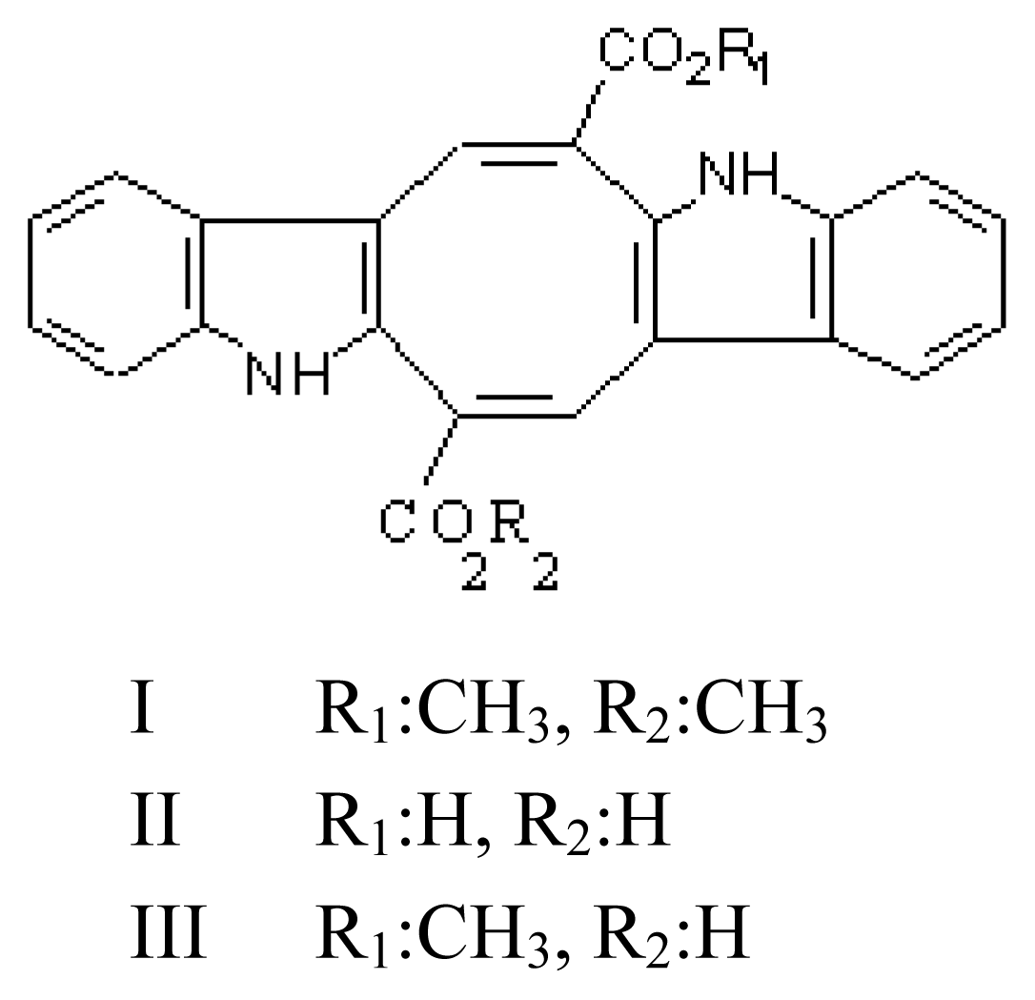
<title>3.1. Caulerpin (CLP, dimethyl-6,13-dihydrodibenzo [b,i]phenazine-5,12-dicarboxylate methyl ester; <xref ref-type="fig" rid="f2-marinedrugs-08-00269">Figure 2</xref>)</title>
<p>Caulerpin contains two indole groups linked by a cyclic ring containing eight carbons with two carboxy groups. The structure of CLP (I) was first proposed [<xref ref-type="bibr" rid="b33-marinedrugs-08-00269">33</xref>,<xref ref-type="bibr" rid="b34-marinedrugs-08-00269">34</xref>] and later revised [<xref ref-type="bibr" rid="b35-marinedrugs-08-00269">35</xref>]. Its crystal structure [<xref ref-type="bibr" rid="b36-marinedrugs-08-00269">36</xref>] was studied. Two CLP (I) analogues CLP (II) and (III) were also isolated from <italic>Caulerpa racemosa</italic> [<xref ref-type="bibr" rid="b37-marinedrugs-08-00269">37</xref>].</p>
<p><italic>Source</italic>: CLP (I) was isolated especially from green algae and some from red algae. CLP (I) was first extracted from <italic>Caulerpa racemosa</italic>, <italic>C. sertularioides</italic>, <italic>C. serrulata</italic> [<xref ref-type="bibr" rid="b33-marinedrugs-08-00269">33</xref>,<xref ref-type="bibr" rid="b34-marinedrugs-08-00269">34</xref>] and later, isolated from various <italic>Caulerpa</italic> sp. as: <italic>C. lamourouxii</italic> [<xref ref-type="bibr" rid="b38-marinedrugs-08-00269">38</xref>], <italic>C. racemosa var. macrophysa</italic>, <italic>C. racemosa var. laetevirens</italic>, <italic>C. ashmeadii</italic> [<xref ref-type="bibr" rid="b39-marinedrugs-08-00269">39</xref>], <italic>C. cupressoides</italic>, <italic>C. paspaloides</italic>, <italic>C. prolifera</italic>, <italic>C. sertularioides</italic> [<xref ref-type="bibr" rid="b40-marinedrugs-08-00269">40</xref>], <italic>C. peltata</italic> [<xref ref-type="bibr" rid="b40-marinedrugs-08-00269">40</xref>–<xref ref-type="bibr" rid="b42-marinedrugs-08-00269">42</xref>], <italic>C. racemosa var. clavifera</italic> [<xref ref-type="bibr" rid="b43-marinedrugs-08-00269">43</xref>], <italic>C. taxifolia</italic> [<xref ref-type="bibr" rid="b44-marinedrugs-08-00269">44</xref>,<xref ref-type="bibr" rid="b45-marinedrugs-08-00269">45</xref>], <italic>C. serrulata</italic> [<xref ref-type="bibr" rid="b33-marinedrugs-08-00269">33</xref>]. CLP (I) was also isolated from other algae: green; <italic>Codium decorticatum</italic> [<xref ref-type="bibr" rid="b46-marinedrugs-08-00269">46</xref>], <italic>Halimeda incrassate</italic> [<xref ref-type="bibr" rid="b47-marinedrugs-08-00269">47</xref>], and red; <italic>Laurencia majuscula</italic> (CLP I, II) [<xref ref-type="bibr" rid="b48-marinedrugs-08-00269">48</xref>], <italic>Hypnea concornis</italic> [<xref ref-type="bibr" rid="b48-marinedrugs-08-00269">48</xref>], <italic>Caloglossa leprieurii</italic> [<xref ref-type="bibr" rid="b48-marinedrugs-08-00269">48</xref>,<xref ref-type="bibr" rid="b49-marinedrugs-08-00269">49</xref>], <italic>Chondria armata</italic> [<xref ref-type="bibr" rid="b50-marinedrugs-08-00269">50</xref>].</p>
<p>The content of CLP (I) in <italic>Caulerpa</italic> sp. are 15% for <italic>C. lentilifera</italic>, 5% for <italic>C. rasemosa</italic>, 2% for <italic>C.microphysa</italic> and 8% for <italic>C. sertulorides</italic> [<xref ref-type="bibr" rid="b51-marinedrugs-08-00269">51</xref>]. <italic>C. taxifolia</italic> has bloomed explosively in the Mediterranean Sea and has become a major ecological problem [<xref ref-type="bibr" rid="b52-marinedrugs-08-00269">52</xref>].</p>
<p><italic>Pharmacological activity</italic>: There are different opinions on the toxicity of CLP (I). Symptoms were observed after the ingestion of <italic>Caulerpa</italic> genus [<xref ref-type="bibr" rid="b33-marinedrugs-08-00269">33</xref>]. It shows low toxicity [<xref ref-type="bibr" rid="b43-marinedrugs-08-00269">43</xref>]. <italic>C. racemosa</italic> extracts showed some cytotoxicity, but CLP (I) isolated from these extracts did not show any activity [<xref ref-type="bibr" rid="b53-marinedrugs-08-00269">53</xref>]. CLP (I) exhibited a moderate <italic>in-vitro</italic> antitumor activity against crown gall tumor [<xref ref-type="bibr" rid="b54-marinedrugs-08-00269">54</xref>]. CLP (I) showed moderate antibacterial activity against 8 species of bacteria isolated from algal surface [<xref ref-type="bibr" rid="b51-marinedrugs-08-00269">51</xref>]. CLP (I) containing alga <italic>Laurencia majuscula</italic> showed antifungal activity [<xref ref-type="bibr" rid="b55-marinedrugs-08-00269">55</xref>]. CLP (I) has been shown to be a plant growth regulator [<xref ref-type="bibr" rid="b55-marinedrugs-08-00269">55</xref>–<xref ref-type="bibr" rid="b57-marinedrugs-08-00269">57</xref>]. CLP (I) showed no peroxidase activity [<xref ref-type="bibr" rid="b58-marinedrugs-08-00269">58</xref>].</p></sec>
<sec>
<title>3.2. Caulersin (CLS)</title>
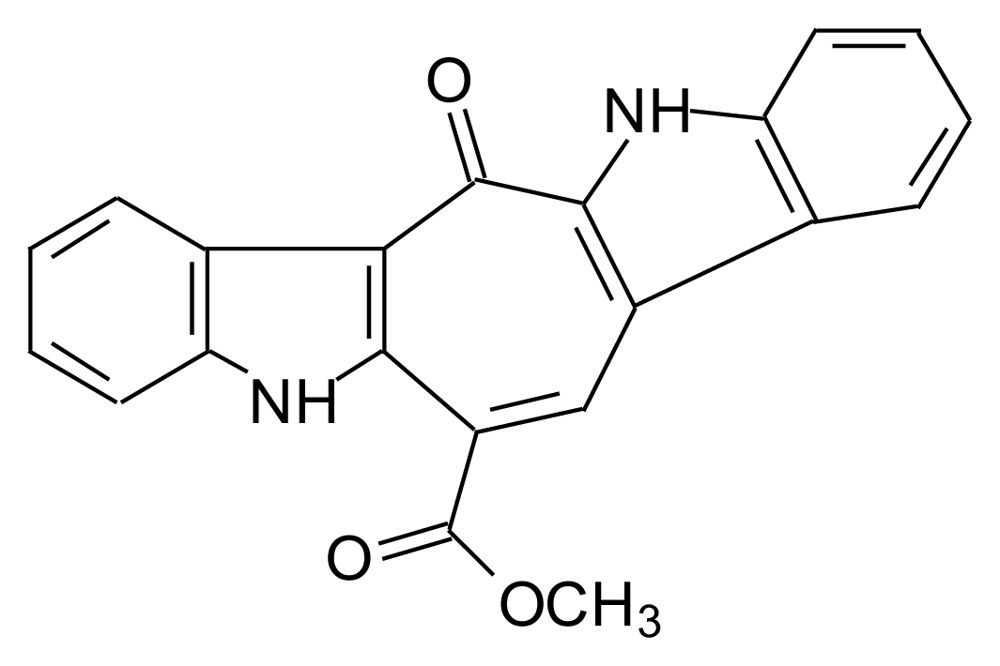
<p>CLS is a bisindole alkaloid with a 7 members central ring and two ≪anti parallel≫ indole cores [<xref ref-type="bibr" rid="b59-marinedrugs-08-00269">59</xref>] (<xref ref-type="fig" rid="f3-marinedrugs-08-00269">Figure 3</xref>). It was synthesized by several authors [<xref ref-type="bibr" rid="b60-marinedrugs-08-00269">60</xref>–<xref ref-type="bibr" rid="b63-marinedrugs-08-00269">63</xref>]. CLS has three isomers: A, B and C [<xref ref-type="bibr" rid="b62-marinedrugs-08-00269">62</xref>].</p>
<p><italic>Source</italic>: CLS was isolated from <italic>Caulerpa serrulata</italic> [<xref ref-type="bibr" rid="b59-marinedrugs-08-00269">59</xref>].</p></sec>
<sec>
<title>3.3. Martensia fragilis alkaloids</title>
<p>Several compounds were isolated from <italic>Martensia fragilis (M. denticulata)</italic> such as: fragilamide, martensines, martefragin A, and denticins.</p>
<sec>
<title>3.3.1. Fragilamide (FRG)</title>
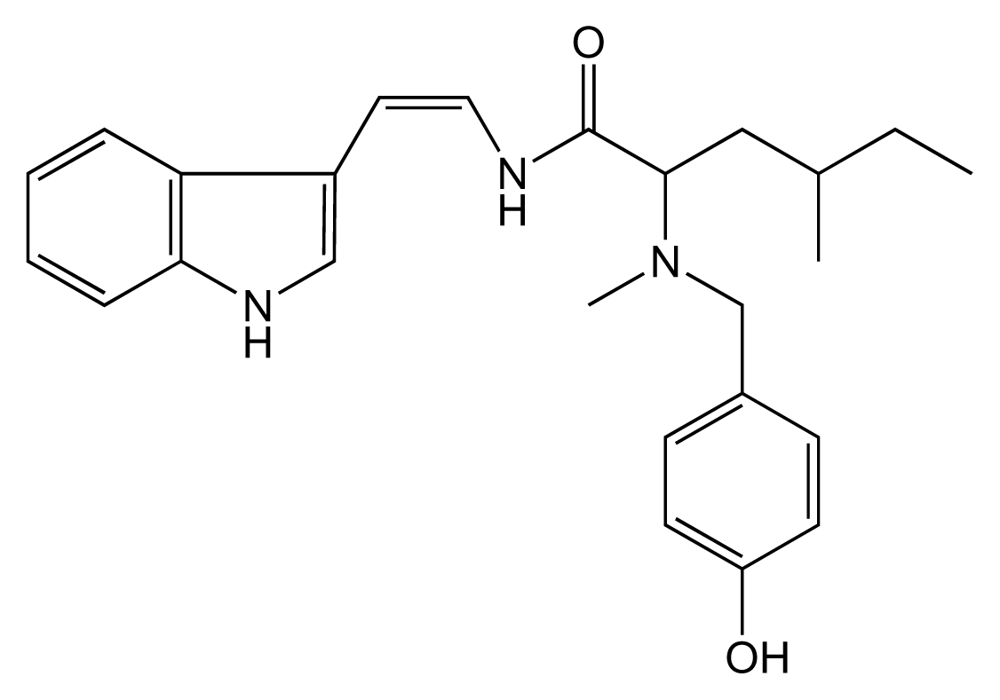
<p>FRG was extracted from the red alga <italic>Martensia fragilis.</italic> It is a labile amine and it rapidly auto-oxidized in solution. FRG is a 3-substituted indole and corresponds to a <italic>N</italic>-methylhomoisoleucyl unit and a <italic>p</italic>-hydroxybenzyl group connected to the indole unit C-3. The amide NH was connected to a cis disubstituted carbon-carbon double bond [<xref ref-type="bibr" rid="b64-marinedrugs-08-00269">64</xref>] (<xref ref-type="fig" rid="f4-marinedrugs-08-00269">Figure 4</xref>).</p>
<p><italic>Pharmacological activity</italic>: FRG showed strong antioxidant activity [<xref ref-type="bibr" rid="b65-marinedrugs-08-00269">65</xref>].</p></sec>
<sec>
<title>3.3.2. Martensines (MRT)</title>
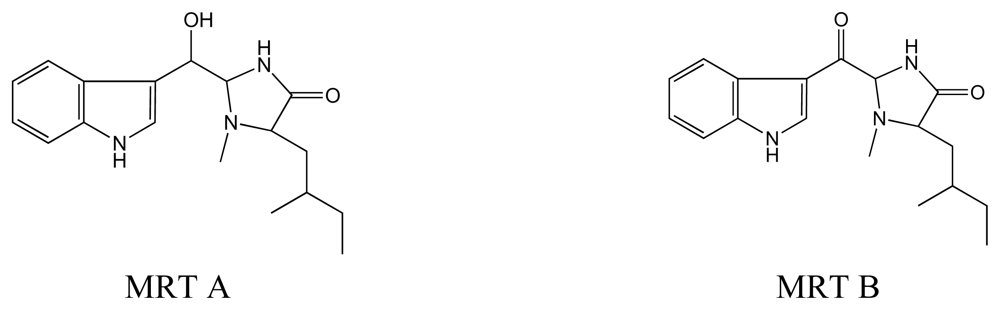
<p>MRT A and B were extracted from the red algae <italic>Martensia fragilis</italic> [<xref ref-type="bibr" rid="b64-marinedrugs-08-00269">64</xref>]. MRTs are 3-substituted indoles.</p>
<sec>
<title>3.3.2.1. Martensine A</title>
<p>MRT A is a 3- substituted indole bound to a 5-membered lactam ring [<xref ref-type="bibr" rid="b64-marinedrugs-08-00269">64</xref>] (<xref ref-type="fig" rid="f5-marinedrugs-08-00269">Figure 5</xref>).</p>
<p><italic>Pharmacological activity</italic>: MRT A shows an antibiotic activity against <italic>Bacillus subtilis</italic>, <italic>Staphylococcus aureus</italic>, and <italic>Mycobacterium smegmatis</italic> [<xref ref-type="bibr" rid="b64-marinedrugs-08-00269">64</xref>].</p></sec>
<sec>
<title>3.3.2.2. Martensine B</title>
<p>MRT B contains two carbonyl as γ-lactam and an aryl ketone group [<xref ref-type="bibr" rid="b64-marinedrugs-08-00269">64</xref>] (<xref ref-type="fig" rid="f5-marinedrugs-08-00269">Figure 5</xref>).</p></sec></sec>
<sec>
<title>3.3.3. Martefragin A (MRF A)</title>
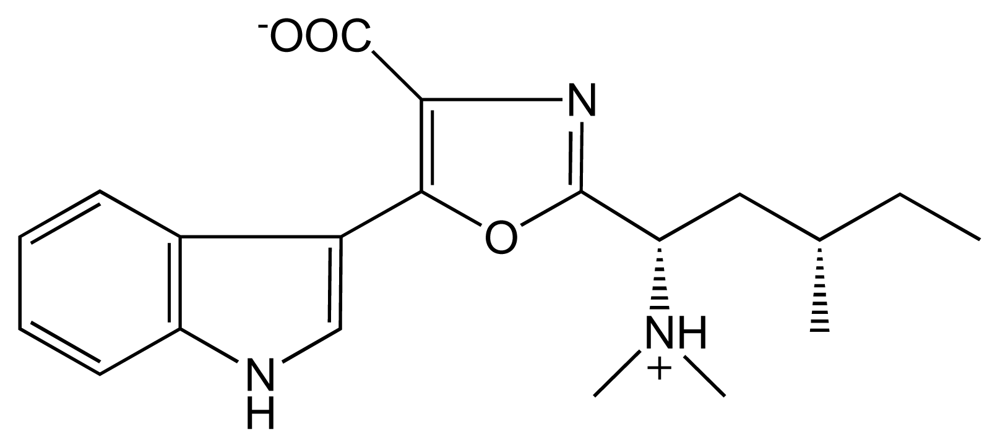
<p>MRF A was isolated from <italic>Martensia fragilis</italic>. MRF A displays a 3-oxazolylindole structure [<xref ref-type="bibr" rid="b66-marinedrugs-08-00269">66</xref> a,b] (<xref ref-type="fig" rid="f6-marinedrugs-08-00269">Figure 6</xref>). It was also synthesized [<xref ref-type="bibr" rid="b67-marinedrugs-08-00269">67</xref>].</p>
<p><italic>Pharmacological activity</italic>: MRF A showed inhibitory activity on NADPH- depending lipid peroxidation in rat liver microsomes [<xref ref-type="bibr" rid="b66-marinedrugs-08-00269">66</xref>,<xref ref-type="bibr" rid="b67-marinedrugs-08-00269">67</xref>].</p></sec>
<sec>
<title>3.3.4. Denticins (DTC)</title>
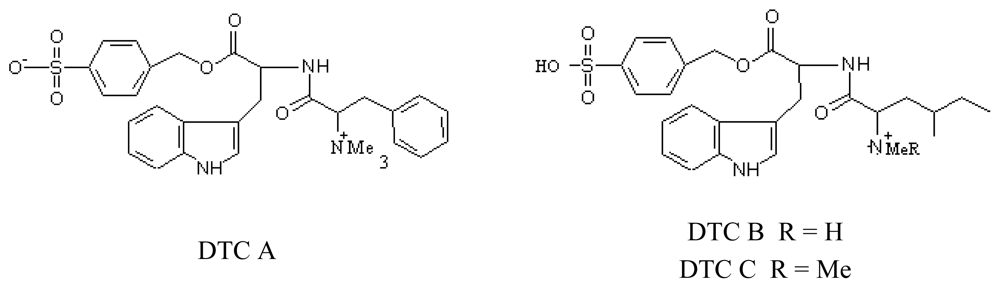
<p>DTC’s were isolated from <italic>Martensia denticulata</italic> [<xref ref-type="bibr" rid="b68-marinedrugs-08-00269">68</xref>]. DTC(s) are 3-subsituted indole derivates named DTC A, B and C. These alkaloids contain sulfonic acids which are rarely found in alkaloids (<xref ref-type="fig" rid="f7-marinedrugs-08-00269">Figure 7</xref>).</p>
<p><italic>Pharmacological activity</italic>: DTC(s) have an anti-photo-oxidative activity [<xref ref-type="bibr" rid="b68-marinedrugs-08-00269">68</xref>].</p></sec></sec>
<sec>
<title>3.4. Almazolone (ALM)</title>
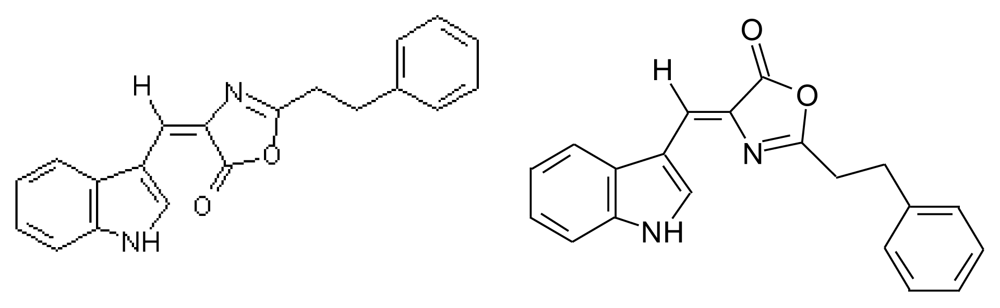
<p>ALM was isolated from the red alga <italic>Haraldiophyllum</italic> sp. collected in Dakar (Senegal). ALM is a disubstituted oxazolindole derivate. It has two steroisomers, which correspond to synthesized <italic>E</italic> and <italic>Z</italic> isomers [<xref ref-type="bibr" rid="b69-marinedrugs-08-00269">69</xref>] (<xref ref-type="fig" rid="f8-marinedrugs-08-00269">Figure 8</xref>).</p></sec></sec>
<sec>
<title>4. Halogenated Indole Alkaloids (HLI)</title>
<p>HLI alkaloids were isolated only in marine organisms and algae but not in terrestrial plants. Many HLI alkaloids were isolated from red algae and only one from a green alga. These alkaloids contain an indole group substituted by bromine and chlorine atoms. Sulfur-containing bromoalkaloids were also extracted from red algae.</p>
<p><italic>Pharmacological activity</italic>: Antibacterial activities of halogenated alkaloids were examined on terrestrial and some marine bacteria.</p>
<sec>
<title>4.1. Bromoindole</title>
<sec>
<title>4.1.1. Bromoindoles and <italic>N</italic>-methylbromoindoles isolated from algae are given by the source</title>
<list list-type="order">
<list-item>
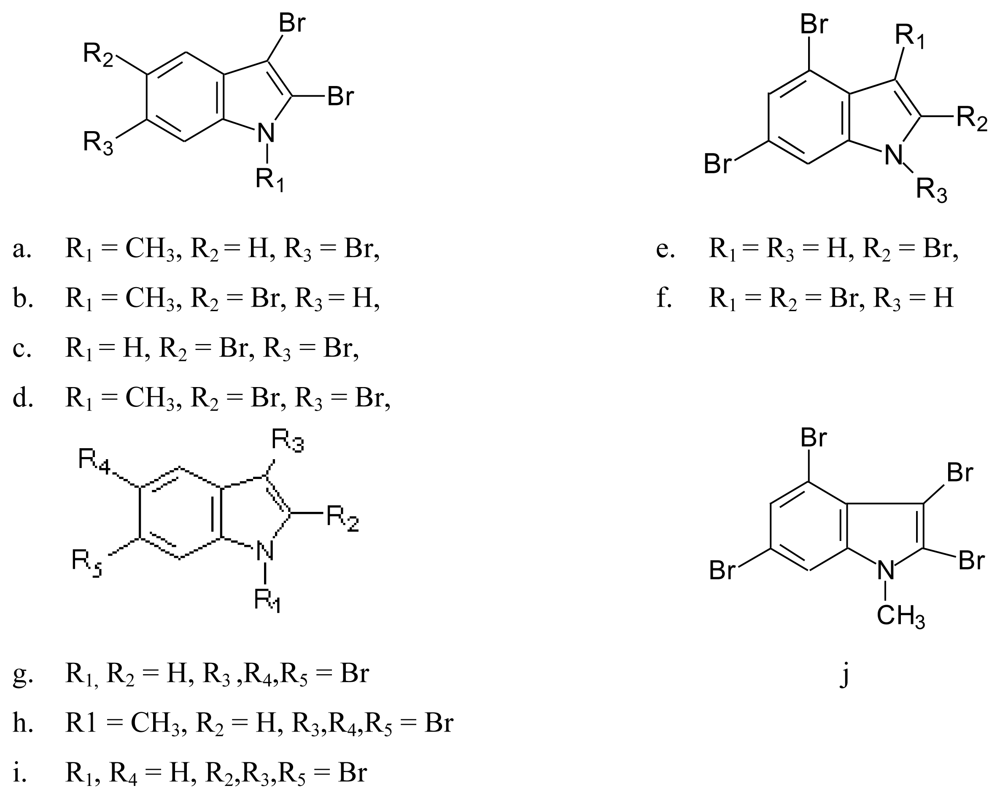
<p>Red alga <italic>Laurencia brongniartii</italic> collected from Caribbean Sea [<xref ref-type="bibr" rid="b70-marinedrugs-08-00269">70</xref>] and Okinawan Sea [<xref ref-type="bibr" rid="b71-marinedrugs-08-00269">71</xref>] (<xref ref-type="fig" rid="f9-marinedrugs-08-00269">Figure 9</xref>): 2,3,6-tribromo-1-methyl indole (<bold>9a</bold>) [<xref ref-type="bibr" rid="b70-marinedrugs-08-00269">70</xref>], 2,3,5-tribromo-1-methyl indole (<bold>9b</bold>) [<xref ref-type="bibr" rid="b72-marinedrugs-08-00269">72</xref>], 2,3,5,6-tetrabromo-1<italic>H</italic>-indole (<bold>9c</bold>) [<xref ref-type="bibr" rid="b70-marinedrugs-08-00269">70</xref>], 2,3,5,6-tetrabromo-1-methyl indole (<bold>9d</bold>) [<xref ref-type="bibr" rid="b70-marinedrugs-08-00269">70</xref>], 2,4,6-tribromo-1<italic>H</italic>-indole (<bold>9e</bold>)[<xref ref-type="bibr" rid="b71-marinedrugs-08-00269">71</xref>] and 2,3,4,6-tetrabromo-1<italic>H</italic>-indole (<bold>9f</bold>) [<xref ref-type="bibr" rid="b71-marinedrugs-08-00269">71</xref>]. Compounds <bold>9c</bold> and <bold>9f</bold> were also identified in the red alga <italic>Laurencia similis</italic> collected from Pulau Gaya, Malaysia [<xref ref-type="bibr" rid="b72-marinedrugs-08-00269">72</xref>] and compound <bold>9b</bold> was isolated from a red alga <italic>Laurencia decumbens</italic> collected from Weizhou Island (South China-Sea) [<xref ref-type="bibr" rid="b73-marinedrugs-08-00269">73</xref>].</p>
<p><italic>Pharmacological activity</italic>: Among compounds <bold>9a</bold>–<bold>d</bold> only <bold>9c</bold> showed antibacterial activity against <italic>Bacillus subtilis</italic> and <italic>Saccharomyces cerevisiae</italic> [<xref ref-type="bibr" rid="b70-marinedrugs-08-00269">70</xref>].</p></list-item>
<list-item>
<p>Red alga <italic>Laurencia similis</italic> collected from Sanya, China [<xref ref-type="bibr" rid="b74-marinedrugs-08-00269">74</xref>] (<xref ref-type="fig" rid="f9-marinedrugs-08-00269">Figure 9</xref>): 3,5,6-tribromo-1<italic>H</italic>-indole (<bold>9g</bold>) [<xref ref-type="bibr" rid="b74-marinedrugs-08-00269">74</xref>], 3,5,6-tribromo-1-methylindole (<bold>9h</bold>) [<xref ref-type="bibr" rid="b74-marinedrugs-08-00269">74</xref>] and 2,3,6-tribromo-1<italic>H</italic>-indole (<bold>9i</bold>) [<xref ref-type="bibr" rid="b74-marinedrugs-08-00269">74</xref>]</p></list-item>
<list-item>
<p>Bromoindoles isolated from the red alga <italic>Laurencia decumbens</italic> collected from Weizhou Island (South China- Sea) [<xref ref-type="bibr" rid="b73-marinedrugs-08-00269">73</xref>] (<xref ref-type="fig" rid="f9-marinedrugs-08-00269">Figure 9</xref>): 2,3,4,6-tetrabromo-1-methylindole (<bold>9j</bold>).</p></list-item></list></sec></sec>
<sec>
<title>4.2. Sulfur-containing bromoalkaloids isolated from Laurencia brongniartii</title>
<list list-type="roman-upper">
<list-item>
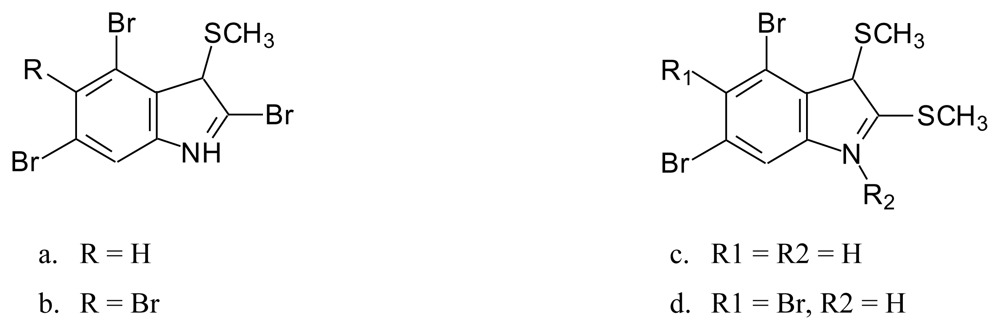
<p>Thiobromoindoles [<xref ref-type="bibr" rid="b73-marinedrugs-08-00269">73</xref>] (<xref ref-type="fig" rid="f10-marinedrugs-08-00269">Figure 10</xref>): 3-thiomethyl 2,4,6-tribromo-1<italic>H</italic>-indole (<bold>10a</bold>), 3-thiomethyl 2,4,5,6- tetrabromo-1<italic>H</italic>-indole (<bold>10b</bold>), 2,3-dithiomethyl-4,6-dibromo-1<italic>H</italic>-indole (<bold>10c</bold>) and 2,3-dithio-methyl-4,5,6- tribromo-1<italic>H</italic>-indole (<bold>10d</bold>).</p></list-item>
<list-item>
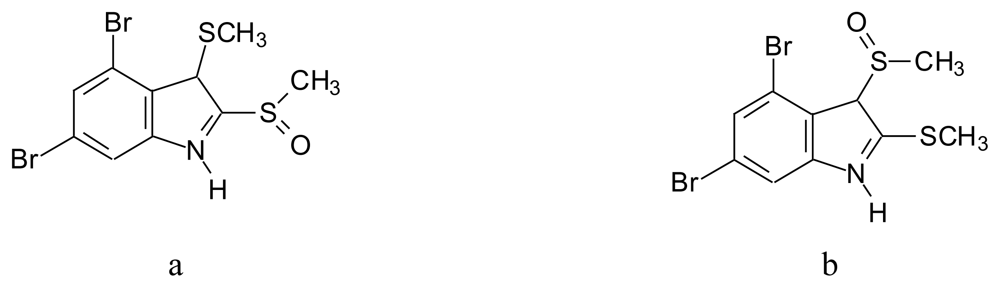
<p>Thiomethyl and sulfoxide containing bromoindoles [<xref ref-type="bibr" rid="b73-marinedrugs-08-00269">73</xref>] (<xref ref-type="fig" rid="f11-marinedrugs-08-00269">Figure 11</xref>): 2-thiomethyl-3-sulfoxymethyl-4,6-dibromoindole (<bold>11a</bold>) and 2-sulfoxymethyl-3-thiomethyl-4,6-dibromo-1<italic>H</italic>-indole (<bold>11b</bold>).</p></list-item></list>
<p><italic>Laurencia brongniartii</italic> is an exceptionally important red algae. The isolated compounds were:</p>
<list list-type="order">
<list-item>
<p>Four sulfur-containing bromoindoles collected from Caribbean Sea [<xref ref-type="bibr" rid="b70-marinedrugs-08-00269">70</xref>,<xref ref-type="bibr" rid="b71-marinedrugs-08-00269">71</xref>].</p></list-item>
<list-item>
<p>Four other sulfur-containing bromoindoles isolated from the Taiwanese coast [<xref ref-type="bibr" rid="b75-marinedrugs-08-00269">75</xref>], Okinawan Sea [<xref ref-type="bibr" rid="b71-marinedrugs-08-00269">71</xref>].</p></list-item>
<list-item>
<p>Six new indoles of which the two are sulfoxides from the Okinawan Sea [<xref ref-type="bibr" rid="b71-marinedrugs-08-00269">71</xref>].</p></list-item>
<list-item>
<p>A bisindole collected in Okinawan waters [<xref ref-type="bibr" rid="b71-marinedrugs-08-00269">71</xref>].</p></list-item></list>
<p>These results showed that halogenated alkaloid types depended on the same algae and collection areas [<xref ref-type="bibr" rid="b71-marinedrugs-08-00269">71</xref>].</p></sec>
<sec>
<title>4.3. Polyhalogenated indoles</title>
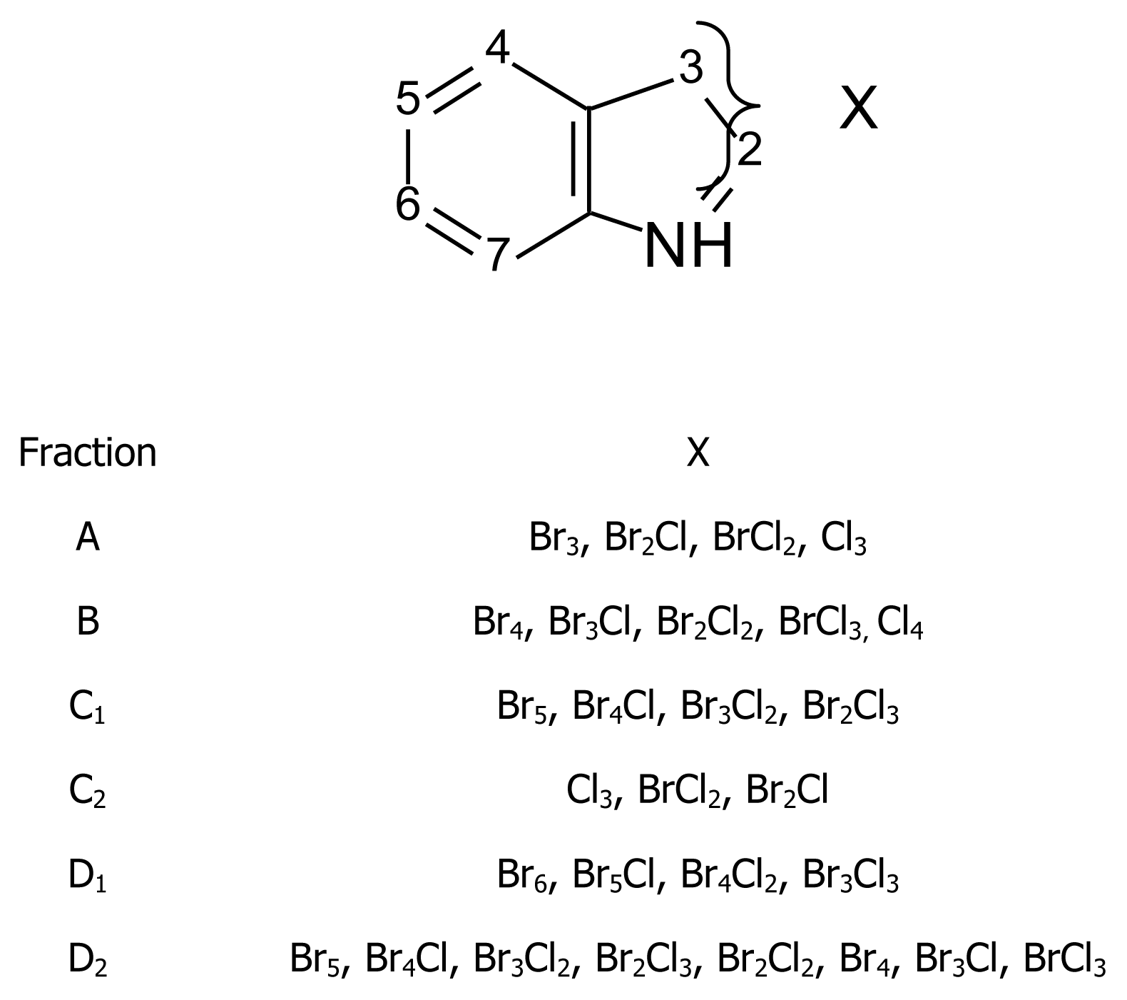
<p>Many polyhalogenated indoles were identified in <italic>Rhodophyllis membranacea</italic> collected from the Kaikoura coast (New Zealand). The fractions obtained from the extract of <italic>R. membranacea</italic> contain polychlorinated and polybrominated alkaloids [<xref ref-type="bibr" rid="b75-marinedrugs-08-00269">75</xref>] (<xref ref-type="fig" rid="f12-marinedrugs-08-00269">Figure 12</xref>).</p>
<p><italic>Pharmacological activity</italic>: Crude extract of <italic>R. membranacea</italic> showed strong antifungal activity due to the presences of these polyhalogenated indoles [<xref ref-type="bibr" rid="b75-marinedrugs-08-00269">75</xref>].</p></sec>
<sec>
<title>4.4. Bromobisindole</title>
<sec>
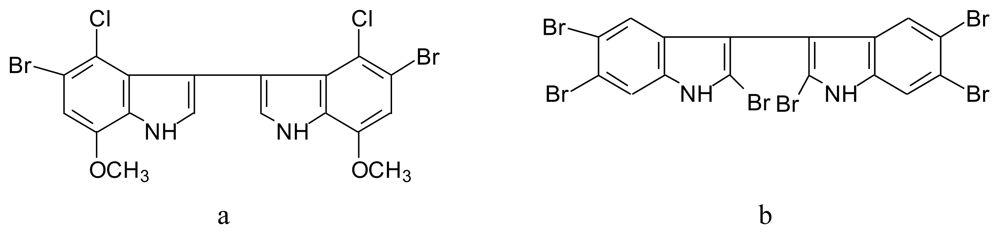
<title>4.4.1. Polyhalogenated bisindoles (<xref ref-type="fig" rid="f13-marinedrugs-08-00269">Figure 13</xref>)</title>
<p>4,4′-Dichloro-5,5′-dibromo-7,7′-dimethoxy-3,3′-bis-1<italic>H</italic>-indole (<bold>13a</bold>) was identified from the green alga <italic>Chaetomorpha basiretorsa</italic> [<xref ref-type="bibr" rid="b76-marinedrugs-08-00269">76</xref>]. 2,2′,5,5′,6,6′-hexabromo-3,3′-bis-1<italic>H</italic>-indole (<bold>13b</bold>) was identified from <italic>Laurencia similis</italic> collected from the coast of Sanya, Hainan Island (China) [<xref ref-type="bibr" rid="b77-marinedrugs-08-00269">77</xref>].</p></sec>
<sec>
<title>4.4.2. Thiomethyl-containing bromobisindoles</title>
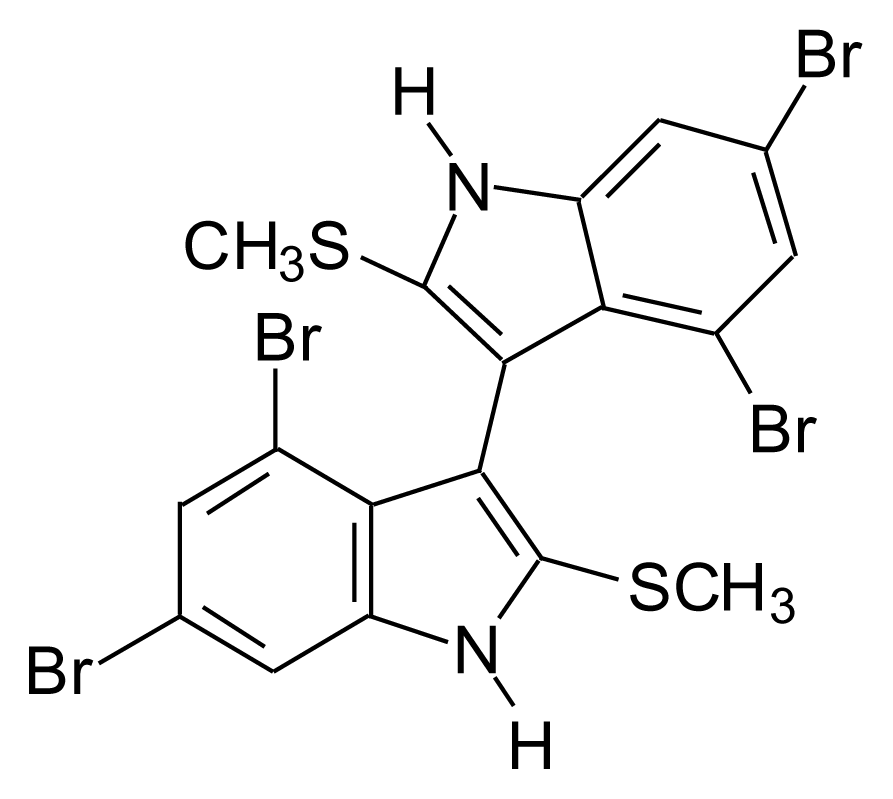
<p>3,3′-bis(4,6-Dibromo-3-methylthio) indole was isolated from <italic>Laurencia brongniartii</italic> collected in Okinawan Sea [<xref ref-type="bibr" rid="b71-marinedrugs-08-00269">71</xref>] (<xref ref-type="fig" rid="f14-marinedrugs-08-00269">Figure 14</xref>).</p></sec></sec></sec>
<sec>
<title>5. Other</title>
<sec>
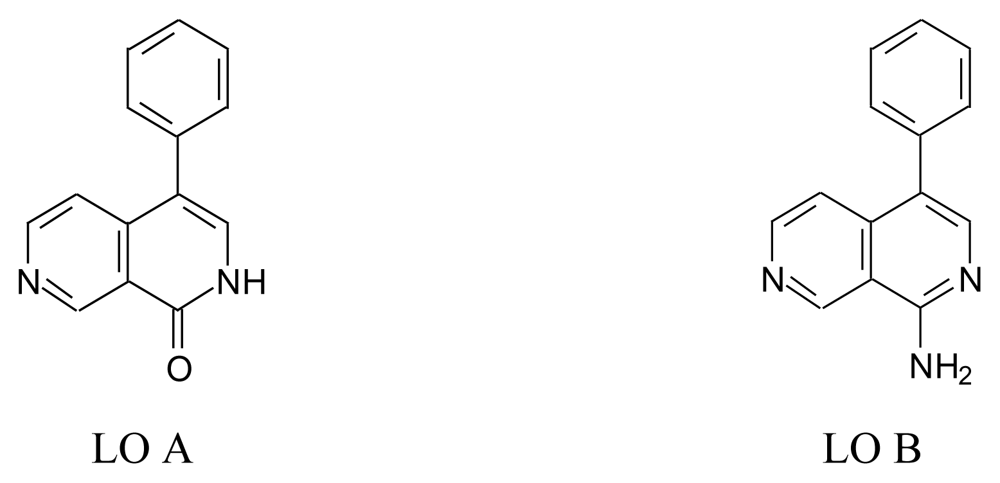
<title>5.1. Lophocladines (LO, <xref ref-type="fig" rid="f15-marinedrugs-08-00269">Figure 15</xref>)</title>
<p>There are two derivatives: lophocladine A and lophocladine B which were isolated from a red alga <italic>Lophocladia</italic> sp. collected from Fijian Island (New Zealand) [<xref ref-type="bibr" rid="b78-marinedrugs-08-00269">78</xref>] (<xref ref-type="fig" rid="f15-marinedrugs-08-00269">Figure 15</xref>).</p>
<list list-type="order">
<list-item>
<p>Lophocladines A (LO A, 4-phenyl-[<xref ref-type="bibr" rid="b2-marinedrugs-08-00269">2</xref>,<xref ref-type="bibr" rid="b7-marinedrugs-08-00269">7</xref>]-naphthyridine-1(2<italic>H</italic>)-one, <bold>15a</bold>)</p></list-item>
<list-item>
<p>Lophocladines B (LO B, 4-phenyl-[<xref ref-type="bibr" rid="b2-marinedrugs-08-00269">2</xref>,<xref ref-type="bibr" rid="b7-marinedrugs-08-00269">7</xref>]-naphtyridine-1-amine, <bold>15b</bold>)</p></list-item></list>
<p><italic>Pharmacological activity</italic>: The cytotoxic activities of LO A and B were investigated on NCI-H-460 lung cancer and neuro-2a neuroblastoma and MDA-MB-435 breast cancer lines. Only LO B showed moderate cytotoxic activity on MDA-MB-435 and NCI-H-460 cell lines but not on neuro 2-a cell [<xref ref-type="bibr" rid="b78-marinedrugs-08-00269">78</xref>].</p></sec></sec>
<sec sec-type="conclusions">
<title>6. Conclusions</title>
<p>Marine algal alkaloids have been reviewed in this paper. Structurally the alkaloids isolated from marine algae mostly belong to the phenylethylamine and indole groups. Biological activities of these alkaloids were not wholly investigated. Alkaloids of marine algae are relatively rare, when compared with terrestrial plant alkaloids. Research on marine drugs has largely focused on finding drugs for cancer treatment. Nowadays, no alkaloids obtained from marine algae are used in medicine.</p></sec></body>
<back>
<ack>
<title>Acknowledgements</title>
<p>The authors thank Burak Çoban for reading the manuscript.</p></ack>
<fn-group><fn>
<p><italic>Samples Availability:</italic> Available from the authors.</p></fn></fn-group>
<ref-list>
<title>References and Notes</title>
<ref id="b1-marinedrugs-08-00269"><label>1</label><citation citation-type="book"><person-group person-group-type="author"><name><surname>Pelletier</surname><given-names>SW</given-names></name></person-group><source>Chemistry of the Alkaloids</source><publisher-name>Van Nostrand Reinhold</publisher-name><publisher-loc>New York, NY, USA</publisher-loc><year>1970</year><fpage>1</fpage></citation></ref>
<ref id="b2-marinedrugs-08-00269"><label>2</label><citation citation-type="book"><person-group person-group-type="author"><name><surname>Trier</surname><given-names>G</given-names></name></person-group><source>Die Alkaloide</source><publisher-name>Verlag von Gebrüder</publisher-name><publisher-loc>Borntraeger, Berlin, Germany</publisher-loc><year>1931</year><fpage>1</fpage><lpage>10</lpage></citation></ref>
<ref id="b3-marinedrugs-08-00269"><label>3</label><citation citation-type="book"><person-group person-group-type="author"><name><surname>Swan</surname><given-names>GA</given-names></name></person-group><source>An Introduction to the Alkaloids</source><publisher-name>Black Well Scientific</publisher-name><publisher-loc>Oxford and Edinburgh, UK</publisher-loc><year>1967</year><fpage>1</fpage></citation></ref>
<ref id="b4-marinedrugs-08-00269"><label>4</label><citation citation-type="book"><person-group person-group-type="author"><name><surname>Bentley</surname><given-names>KW</given-names></name></person-group><source>The Alkaloids</source><publisher-name>Interscience</publisher-name><publisher-loc>New York, NY, USA</publisher-loc><year>1957</year><fpage>1</fpage></citation></ref>
<ref id="b5-marinedrugs-08-00269"><label>5</label><citation citation-type="journal"><person-group person-group-type="author"><name><surname>Numata</surname><given-names>A</given-names></name><name><surname>Takahashi</surname><given-names>C</given-names></name><name><surname>Ito</surname><given-names>Y</given-names></name><name><surname>Takada</surname><given-names>T</given-names></name><name><surname>Kawai</surname><given-names>K</given-names></name><name><surname>Usami</surname><given-names>Y</given-names></name><name><surname>Matsumura</surname><given-names>E</given-names></name><name><surname>Imachi</surname><given-names>M</given-names></name><name><surname>Ito</surname><given-names>T</given-names></name><name><surname>Hasegawo</surname><given-names>T</given-names></name></person-group><article-title>Communesin, cytotoxic metabolites of a fungus isolated from a marine algae</article-title><source>Tetrahedron Lett</source><year>1993</year><volume>34</volume><fpage>2355</fpage><lpage>2358</lpage><pub-id pub-id-type="doi">10.1016/S0040-4039(00)77612-X</pub-id></citation></ref>
<ref id="b6-marinedrugs-08-00269"><label>6</label><citation citation-type="journal"><person-group person-group-type="author"><name><surname>Takahashi</surname><given-names>C</given-names></name><name><surname>Takai</surname><given-names>Y</given-names></name><name><surname>Kimura</surname><given-names>Y</given-names></name><name><surname>Numata</surname><given-names>A</given-names></name><name><surname>Shigematsu</surname><given-names>N</given-names></name><name><surname>Tanaka</surname><given-names>H</given-names></name></person-group><article-title>Cytotoxic metabolites from a fungi adherent of a marine alga</article-title><source>Phytochemistry</source><year>1995</year><volume>38</volume><fpage>155</fpage><lpage>158</lpage><pub-id pub-id-type="doi">10.1016/0031-9422(94)00582-E</pub-id><pub-id pub-id-type="pmid">7766052</pub-id></citation></ref>
<ref id="b7-marinedrugs-08-00269"><label>7</label><citation citation-type="book"><person-group person-group-type="author"><name><surname>Kappelmeier</surname><given-names>P</given-names></name></person-group><source>Die Konstitutions Erforschung der Wichtigten Opium Alkaloide</source><publisher-name>Verlag von Ferdinand Enke</publisher-name><publisher-loc>Stuttgart, Germany</publisher-loc><year>1912</year><fpage>4</fpage></citation></ref>
<ref id="b8-marinedrugs-08-00269"><label>8</label><citation citation-type="journal"><person-group person-group-type="author"><name><surname>Guven</surname><given-names>KC</given-names></name><name><surname>Bora</surname><given-names>A</given-names></name><name><surname>Sunam</surname><given-names>G</given-names></name></person-group><article-title>Alkaloid content of marine algae. I. Hordenine from <italic>Phyllophora nervosa</italic></article-title><source>Eczacılık Bul</source><year>1969</year><volume>11</volume><fpage>177</fpage><lpage>184</lpage></citation></ref>
<ref id="b9-marinedrugs-08-00269"><label>9</label><citation citation-type="journal"><person-group person-group-type="author"><name><surname>Guven</surname><given-names>KC</given-names></name><name><surname>Bora</surname><given-names>A</given-names></name><name><surname>Sunam</surname><given-names>G</given-names></name></person-group><article-title>Hordenine from the alga <italic>Phyllophora nervosa</italic></article-title><source>Phytochemistry</source><year>1970</year><issue>9</issue><fpage>1893</fpage></citation></ref>
<ref id="b10-marinedrugs-08-00269"><label>10</label><citation citation-type="book"><person-group person-group-type="author"><name><surname>Boit</surname><given-names>HG</given-names></name></person-group><source>Ergebnisse der Alkaloid-Chemic</source><publisher-name>Academie-Verlag</publisher-name><publisher-loc>Berlin, Germany</publisher-loc><year>1961</year><fpage>16</fpage></citation></ref>
<ref id="b11-marinedrugs-08-00269"><label>11</label><citation citation-type="journal"><person-group person-group-type="author"><name><surname>Steiner</surname><given-names>M</given-names></name><name><surname>Hartmann</surname><given-names>T</given-names></name></person-group><article-title>Über Verkommen und Verbreitung flüchtiger Amine bei Meeresalgen</article-title><source>Planta</source><year>1968</year><volume>79</volume><fpage>113</fpage><lpage>121</lpage></citation></ref>
<ref id="b12-marinedrugs-08-00269"><label>12</label><citation citation-type="book"><person-group person-group-type="author"><name><surname>Kneifel</surname><given-names>H</given-names></name></person-group><article-title>Amine in Algae <italic>Marine Algae in Pharmaceutical</italic></article-title><source>Science</source><person-group person-group-type="editor"><name><surname>Hoppe</surname><given-names>HA</given-names></name><name><surname>Levring</surname><given-names>T</given-names></name><name><surname>Tanaka</surname><given-names>Y</given-names></name></person-group><publisher-name>Walter de Gruyter</publisher-name><publisher-loc>Berlin, Germany</publisher-loc><year>1979</year><fpage>365</fpage><lpage>401</lpage></citation></ref>
<ref id="b13-marinedrugs-08-00269"><label>13</label><citation citation-type="journal"><person-group person-group-type="author"><name><surname>Smith</surname><given-names>TA</given-names></name></person-group><article-title>Phenethylamine and related compounds in plant</article-title><source>Phytochemistry</source><year>1977</year><volume>16</volume><fpage>9</fpage><lpage>18</lpage></citation></ref>
<ref id="b14-marinedrugs-08-00269"><label>14</label><citation citation-type="journal"><person-group person-group-type="author"><name><surname>Percot</surname><given-names>A</given-names></name><name><surname>Yalçın</surname><given-names>A</given-names></name><name><surname>Aysel</surname><given-names>V</given-names></name><name><surname>Erdugan</surname><given-names>H</given-names></name><name><surname>Dural</surname><given-names>B</given-names></name><name><surname>Güven</surname><given-names>KC</given-names></name></person-group><article-title>β-Phenylethylamine content in marine algae around Turkish coasts</article-title><source>Bot Mar</source><year>2009</year><volume>52</volume><fpage>87</fpage><lpage>90</lpage></citation></ref>
<ref id="b15-marinedrugs-08-00269"><label>15</label><citation citation-type="journal"><person-group person-group-type="author"><name><surname>Rolle</surname><given-names>I</given-names></name><name><surname>Hobucher</surname><given-names>HE</given-names></name><name><surname>Kneifel</surname><given-names>H</given-names></name><name><surname>Paschold</surname><given-names>B</given-names></name><name><surname>Riepe</surname><given-names>W</given-names></name><name><surname>Soeder</surname><given-names>CJ</given-names></name></person-group><article-title>Amines in unicellular green algae. 2. Amines in <italic>Scenedesmus acutus</italic></article-title><source>Anal Biochem</source><year>1977</year><volume>77</volume><fpage>103</fpage><lpage>109</lpage><pub-id pub-id-type="pmid">831565</pub-id></citation></ref>
<ref id="b16-marinedrugs-08-00269"><label>16</label><citation citation-type="journal"><person-group person-group-type="author"><name><surname>Barroso</surname><given-names>N</given-names></name><name><surname>Rodriguez</surname><given-names>M</given-names></name></person-group><article-title>Action of β-phenylethylamine and related amines on nigrostriatal dopamine neurotransmission</article-title><source>Eur J pharmacol</source><year>1996</year><volume>297</volume><fpage>195</fpage><lpage>203</lpage><pub-id pub-id-type="pmid">8666050</pub-id></citation></ref>
<ref id="b17-marinedrugs-08-00269"><label>17</label><citation citation-type="journal"><person-group person-group-type="author"><name><surname>Saavedra</surname><given-names>JM</given-names></name></person-group><article-title>β-Phenylethylamine: Is this biogenic amine related to neuropsychiatic disease</article-title><source>Mod Pharmacol Toxicol</source><year>1978</year><volume>12</volume><fpage>139</fpage><lpage>157</lpage></citation></ref>
<ref id="b18-marinedrugs-08-00269"><label>18</label><citation citation-type="journal"><person-group person-group-type="author"><name><surname>Percot</surname><given-names>A</given-names></name><name><surname>Guven</surname><given-names>KC</given-names></name><name><surname>Aysel</surname><given-names>V</given-names></name><name><surname>Erdugan</surname><given-names>H</given-names></name><name><surname>Gezgin</surname><given-names>T</given-names></name></person-group><article-title><italic>N</italic>-acetyltyramine from <italic>Phyllophora crispa</italic> (Hudson) P.S. Dixon and N-acetylphenylethylamine from <italic>Gelidium crinale</italic> (Hare ex Turner) Graillon</article-title><source>Acta Pharm Sci</source><year>2009</year><volume>51</volume><fpage>9</fpage><lpage>14</lpage></citation></ref>
<ref id="b19-marinedrugs-08-00269"><label>19</label><citation citation-type="journal"><person-group person-group-type="author"><name><surname>Kneifel</surname><given-names>H</given-names></name><name><surname>Meinicke</surname><given-names>M</given-names></name><name><surname>Soeder</surname><given-names>ÇJ</given-names></name></person-group><article-title>Analysis of amines in algae by high performance liquid chromatography</article-title><source>J Phycol</source><year>1977</year><volume>13</volume><fpage>36</fpage></citation></ref>
<ref id="b20-marinedrugs-08-00269"><label>20</label><citation citation-type="journal"><person-group person-group-type="author"><name><surname>Tian-Shung</surname><given-names>WU</given-names></name><name><surname>Yanna-Lii</surname><given-names>L</given-names></name><name><surname>Yu-Yi</surname><given-names>C</given-names></name></person-group><article-title>Constituents of the fresh leaves of <italic>Aristolochia cucurbitifolia</italic></article-title><source>Chem Pharm Bull</source><year>1999</year><volume>47</volume><fpage>571</fpage><lpage>573</lpage></citation></ref>
<ref id="b21-marinedrugs-08-00269"><label>21</label><citation citation-type="journal"><person-group person-group-type="author"><name><surname>Von Studnitz</surname><given-names>W</given-names></name><name><surname>Hanson</surname><given-names>A</given-names></name></person-group><article-title>Demonstration of urinary N-acetyltyramine in patients with neuroblastoma</article-title><source>Clin Chim Acta</source><year>1967</year><volume>16</volume><fpage>180</fpage><lpage>183</lpage><pub-id pub-id-type="pmid">6036912</pub-id></citation></ref>
<ref id="b22-marinedrugs-08-00269"><label>22</label><citation citation-type="journal"><person-group person-group-type="author"><name><surname>Heffter</surname><given-names>A</given-names></name></person-group><article-title>Ueber Pellote. Ein Beitrag zur pharmakologischen Kenntnis der Cacteen. (Naunyn- Schmiedeberg’s)</article-title><source>Arch Exp Path Pharm</source><year>1894</year><volume>34</volume><fpage>65</fpage><lpage>86</lpage></citation></ref>
<ref id="b23-marinedrugs-08-00269"><label>23</label><citation citation-type="journal"><person-group person-group-type="author"><name><surname>Leger</surname><given-names>E</given-names></name></person-group><article-title>Hordenine: A new alkaloid extracted from the germ of barley</article-title><source>J Pharm Chim</source><year>1906</year><volume>23</volume><fpage>177</fpage><lpage>181</lpage></citation></ref>
<ref id="b24-marinedrugs-08-00269"><label>24</label><citation citation-type="journal"><person-group person-group-type="author"><name><surname>Kawauchi</surname><given-names>H</given-names></name><name><surname>Sasaki</surname><given-names>T</given-names></name></person-group><article-title>Isolation and identification of hordenine, p-(2-dimethylamino) ethylphenol from <italic>Ahnfeltia paradoxa</italic></article-title><source>Bull Jap Soc Sci Fish</source><year>1978</year><volume>44</volume><fpage>135</fpage><lpage>137</lpage></citation></ref>
<ref id="b25-marinedrugs-08-00269"><label>25</label><citation citation-type="journal"><person-group person-group-type="author"><name><surname>Barwell</surname><given-names>C</given-names></name><name><surname>Blunden</surname><given-names>G</given-names></name></person-group><article-title>Hordenine from the red alga <italic>Gigartina stellata</italic></article-title><source>J Nat Prod</source><year>1981</year><volume>44</volume><fpage>500</fpage><lpage>502</lpage></citation></ref>
<ref id="b26-marinedrugs-08-00269"><label>26</label><citation citation-type="journal"><person-group person-group-type="author"><name><surname>Percot</surname><given-names>A</given-names></name><name><surname>Yalcın</surname><given-names>A</given-names></name><name><surname>Erduğan</surname><given-names>H</given-names></name><name><surname>Guven</surname><given-names>KC</given-names></name></person-group><article-title>Hordenine amount in <italic>Phyllophora nervosa</italic> (D.C. Grev) (Marine alga) collected from Şile (The Black Sea) and Dardanelle</article-title><source>Acta Pharm Sci</source><year>2007</year><volume>49</volume><fpage>127</fpage><lpage>132</lpage></citation></ref>
<ref id="b27-marinedrugs-08-00269"><label>27</label><citation citation-type="journal"><person-group person-group-type="author"><name><surname>Yalcın</surname><given-names>A</given-names></name><name><surname>Percot</surname><given-names>A</given-names></name><name><surname>Erdugan</surname><given-names>H</given-names></name><name><surname>Coban</surname><given-names>B</given-names></name><name><surname>Guven</surname><given-names>KC</given-names></name></person-group><article-title>Hordenine in marine alga, <italic>Gelidium crinale</italic> (Hare ex Turner) Gaillon</article-title><source>Acta Pharm Sci</source><year>2007</year><volume>49</volume><fpage>213</fpage><lpage>218</lpage></citation></ref>
<ref id="b28-marinedrugs-08-00269"><label>28</label><citation citation-type="book"><person-group person-group-type="author"><name><surname>Baslow</surname><given-names>MH</given-names></name></person-group><source>Marine Pharmacology</source><publisher-name>The William &amp; Wilkins Co</publisher-name><publisher-loc>Baltimore, MD, USA</publisher-loc><year>1969</year><fpage>56</fpage><lpage>85</lpage></citation></ref>
<ref id="b29-marinedrugs-08-00269"><label>29</label><citation citation-type="journal"><person-group person-group-type="author"><name><surname>Schweitzer</surname><given-names>A</given-names></name><name><surname>Wright</surname><given-names>S</given-names></name></person-group><article-title>Action of hordenine compounds on the central nervous system</article-title><source>J Physiol</source><year>1938</year><volume>92</volume><fpage>422</fpage><lpage>438</lpage><pub-id pub-id-type="pmid">16994985</pub-id></citation></ref>
<ref id="b30-marinedrugs-08-00269"><label>30</label><citation citation-type="journal"><person-group person-group-type="author"><name><surname>Hapke</surname><given-names>HJ</given-names></name><name><surname>Strathmann</surname><given-names>W</given-names></name></person-group><article-title>Pharmacological effects of hordenine</article-title><source>Deutsche tierärztliche Wochenschrift</source><year>1995</year><volume>102</volume><fpage>228</fpage><lpage>232</lpage><pub-id pub-id-type="pmid">8582256</pub-id></citation></ref>
<ref id="b31-marinedrugs-08-00269"><label>31</label><citation citation-type="confproc"><person-group person-group-type="author"><name><surname>Tocher</surname><given-names>RD</given-names></name><name><surname>Tocher</surname><given-names>CA</given-names></name></person-group><article-title>Biosynthesis of 3-hdroxy tyramine in plants Enz</article-title><conf-name>Dopa decarboxylaze XI International Botanical Congresse</conf-name><conf-loc>University of Washington, Seattle, WA, USA</conf-loc><conf-date>August 24–September 2, 1969</conf-date></citation></ref>
<ref id="b32-marinedrugs-08-00269"><label>32</label><citation citation-type="book"><person-group person-group-type="author"><name><surname>Sweetman</surname><given-names>SC</given-names></name></person-group><article-title>Martindale</article-title><source>The Complete Drug Reference</source><publisher-name>Pharmaceutical Press, Williams Clowes</publisher-name><publisher-loc>Suffock, UK</publisher-loc><year>2005</year><fpage>907</fpage></citation></ref>
<ref id="b33-marinedrugs-08-00269"><label>33</label><citation citation-type="book"><person-group person-group-type="author"><name><surname>Aguilar-Santos</surname><given-names>G</given-names></name><name><surname>Doty</surname><given-names>MS</given-names></name></person-group><article-title>Chemical studies on three species of the marine algal genus <italic>Caulerpa</italic></article-title><source>Drugs from the Sea</source><person-group person-group-type="editor"><name><surname>Freudenthal</surname><given-names>HD</given-names></name></person-group><publisher-name>Marine Technology Society</publisher-name><publisher-loc>Washington, DC, USA</publisher-loc><year>1968</year><fpage>173</fpage><lpage>176</lpage></citation></ref>
<ref id="b34-marinedrugs-08-00269"><label>34</label><citation citation-type="journal"><person-group person-group-type="author"><name><surname>Aguilar-Santos</surname><given-names>G</given-names></name></person-group><article-title>Caulerpin, a new red pigment from green algae of the genus <italic>Caulerpa</italic></article-title><source>J Chem Soc Perkin C: Org</source><year>1970</year><volume>6</volume><fpage>842</fpage><lpage>843</lpage></citation></ref>
<ref id="b35-marinedrugs-08-00269"><label>35</label><citation citation-type="journal"><person-group person-group-type="author"><name><surname>Maiti</surname><given-names>BC</given-names></name><name><surname>Thomson</surname><given-names>RH</given-names></name><name><surname>Mahendran</surname><given-names>M</given-names></name></person-group><article-title>The structure of caulerpin, a pigment from <italic>Caulerpa</italic> algae</article-title><source>J Chem Res Synop</source><year>1978</year><volume>4</volume><fpage>126</fpage><lpage>127</lpage></citation></ref>
<ref id="b36-marinedrugs-08-00269"><label>36</label><citation citation-type="journal"><person-group person-group-type="author"><name><surname>Lu</surname><given-names>Y</given-names></name><name><surname>Lu</surname><given-names>D</given-names></name><name><surname>Zheng</surname><given-names>QT</given-names></name><name><surname>Lian</surname><given-names>B</given-names></name><name><surname>Su</surname><given-names>JY</given-names></name><name><surname>Cen</surname><given-names>YZ</given-names></name></person-group><article-title>Crystal structure determination of caulerpin</article-title><source>Jiegou Huaxue</source><year>1994</year><volume>13</volume><fpage>472</fpage><lpage>476</lpage></citation></ref>
<ref id="b37-marinedrugs-08-00269"><label>37</label><citation citation-type="journal"><person-group person-group-type="author"><name><surname>Anjaneyulu</surname><given-names>ASR</given-names></name><name><surname>Prakash</surname><given-names>CVS</given-names></name><name><surname>Mallavadhani</surname><given-names>UV</given-names></name></person-group><article-title>Two caulerpin analogues and a sesquiterpene from <italic>Caulerpa racemosa</italic></article-title><source>Phytochemistry</source><year>1991</year><volume>30</volume><fpage>3041</fpage><lpage>3042</lpage><pub-id pub-id-type="doi">10.1016/S0031-9422(00)98248-7</pub-id></citation></ref>
<ref id="b38-marinedrugs-08-00269"><label>38</label><citation citation-type="journal"><person-group person-group-type="author"><name><surname>Santos</surname><given-names>GA</given-names></name><name><surname>Doty</surname><given-names>MS</given-names></name></person-group><article-title>Constituents of the green alga <italic>Caulerpa lamourouxii</italic></article-title><source>Lloydia</source><year>1971</year><volume>34</volume><fpage>88</fpage><lpage>90</lpage><pub-id pub-id-type="pmid">5140267</pub-id></citation></ref>
<ref id="b39-marinedrugs-08-00269"><label>39</label><citation citation-type="journal"><person-group person-group-type="author"><name><surname>McConnell</surname><given-names>OJ</given-names></name><name><surname>Hughes</surname><given-names>PA</given-names></name><name><surname>Targett</surname><given-names>NM</given-names></name><name><surname>Daley</surname><given-names>J</given-names></name></person-group><article-title>Effects of secondary metabolites from marine algae on feeding by the sea urchin <italic>Lytechinus variegatus</italic></article-title><source>J Chem Ecol</source><year>1982</year><volume>8</volume><fpage>1437</fpage><lpage>1453</lpage></citation></ref>
<ref id="b40-marinedrugs-08-00269"><label>40</label><citation citation-type="journal"><person-group person-group-type="author"><name><surname>Vest</surname><given-names>SE</given-names></name><name><surname>Dawes</surname><given-names>CJ</given-names></name><name><surname>Romeo</surname><given-names>JT</given-names></name></person-group><article-title>Distribution of caulerpin and caulerpicin in eight species of the green alga <italic>Caulerpa</italic> (Caulerpales)</article-title><source>Bot Mar</source><year>1983</year><volume>26</volume><fpage>313</fpage><lpage>316</lpage></citation></ref>
<ref id="b41-marinedrugs-08-00269"><label>41</label><citation citation-type="journal"><person-group person-group-type="author"><name><surname>Capon</surname><given-names>RJ</given-names></name><name><surname>Ghisalberti</surname><given-names>EL</given-names></name><name><surname>Jefferies</surname><given-names>PR</given-names></name></person-group><article-title>Metabolites of the green algae, Caulerpa species</article-title><source>Phytochemistry</source><year>1983</year><volume>22</volume><fpage>1465</fpage><lpage>1467</lpage></citation></ref>
<ref id="b42-marinedrugs-08-00269"><label>42</label><citation citation-type="journal"><person-group person-group-type="author"><name><surname>Cheng</surname><given-names>F</given-names></name><name><surname>Zhou</surname><given-names>Y</given-names></name><name><surname>Wu</surname><given-names>J</given-names></name><name><surname>Zhou</surname><given-names>K</given-names></name></person-group><article-title>Chemical constituents of <italic>Caulerpa peltata</italic></article-title><source>Shizhen Guoyi Guoyao</source><year>2008</year><volume>19</volume><fpage>856</fpage><lpage>857</lpage></citation></ref>
<ref id="b43-marinedrugs-08-00269"><label>43</label><citation citation-type="journal"><person-group person-group-type="author"><name><surname>Vidal</surname><given-names>JP</given-names></name><name><surname>Laurent</surname><given-names>D</given-names></name><name><surname>Kabore</surname><given-names>SA</given-names></name><name><surname>Rechencq</surname><given-names>E</given-names></name><name><surname>Boucard</surname><given-names>M</given-names></name><name><surname>Girard</surname><given-names>JP</given-names></name><name><surname>Escale</surname><given-names>R</given-names></name><name><surname>Rossi</surname><given-names>JC</given-names></name></person-group><article-title>Caulerpin, Caulerpicin, <italic>Caulerpa scalpelliformis</italic>: Comparative acute toxicity study</article-title><source>Bot Mar</source><year>1984</year><volume>27</volume><fpage>533</fpage><lpage>537</lpage></citation></ref>
<ref id="b44-marinedrugs-08-00269"><label>44</label><citation citation-type="journal"><person-group person-group-type="author"><name><surname>Mao</surname><given-names>S.-C</given-names></name><name><surname>Guo</surname><given-names>Y.-W</given-names></name><name><surname>Shen</surname><given-names>X</given-names></name></person-group><article-title>Two novel aromatic valerenane-type sesquiterpenes from Chinese green alga <italic>Caulerpa taxifolia</italic></article-title><source>Biorg Med Chem Lett</source><year>2006</year><volume>16</volume><fpage>2947</fpage><lpage>2950</lpage></citation></ref>
<ref id="b45-marinedrugs-08-00269"><label>45</label><citation citation-type="journal"><person-group person-group-type="author"><name><surname>Schroder</surname><given-names>HC</given-names></name><name><surname>Badria</surname><given-names>FA</given-names></name><name><surname>Ayyad</surname><given-names>SN</given-names></name><name><surname>Batel</surname><given-names>R</given-names></name><name><surname>Wiens</surname><given-names>M</given-names></name><name><surname>Hassanein</surname><given-names>HMA</given-names></name><name><surname>Kurelec</surname><given-names>B</given-names></name><name><surname>Müller</surname><given-names>WEG</given-names></name></person-group><article-title>Inhibitory effects of extracts from the marine alga <italic>Caulerpa taxifolia</italic> and of toxin from <italic>Caulerpa racemosa</italic> on multixenobiotic resistance in the marine sponge <italic>Geodia cydonium</italic></article-title><source>Environ Toxicol Pharmacol</source><year>1998</year><volume>5</volume><fpage>119</fpage><lpage>126</lpage><pub-id pub-id-type="pmid">21781858</pub-id></citation></ref>
<ref id="b46-marinedrugs-08-00269"><label>46</label><citation citation-type="journal"><person-group person-group-type="author"><name><surname>Anjaneyulu</surname><given-names>ASR</given-names></name><name><surname>Prakash</surname><given-names>CVS</given-names></name><name><surname>Mallavadhani</surname><given-names>UV</given-names></name></person-group><article-title>Sterols and terpenes of the marine green algal species <italic>Caulerpa racemosa</italic> and <italic>Codium decorticatum</italic></article-title><source>J Indian Chem Soc</source><year>1991</year><volume>68</volume><fpage>480</fpage></citation></ref>
<ref id="b47-marinedrugs-08-00269"><label>47</label><citation citation-type="journal"><person-group person-group-type="author"><name><surname>Yan</surname><given-names>S</given-names></name><name><surname>Su</surname><given-names>J</given-names></name><name><surname>Wang</surname><given-names>Y</given-names></name><name><surname>Zeng</surname><given-names>L</given-names></name></person-group><article-title>Studies on chemical constituents of <italic>Halimeda incrassata</italic></article-title><source>Redai Haiyang</source><year>1999</year><volume>18</volume><fpage>91</fpage><lpage>94</lpage></citation></ref>
<ref id="b48-marinedrugs-08-00269"><label>48</label><citation citation-type="journal"><person-group person-group-type="author"><name><surname>Xu</surname><given-names>X</given-names></name><name><surname>Su</surname><given-names>J</given-names></name></person-group><article-title>The separation, identification and bioassay of caulerpin</article-title><source>Ziran Kexueban</source><year>1996</year><volume>35</volume><fpage>64</fpage><lpage>66</lpage></citation></ref>
<ref id="b49-marinedrugs-08-00269"><label>49</label><citation citation-type="journal"><person-group person-group-type="author"><name><surname>Xu</surname><given-names>XH</given-names></name><name><surname>Su</surname><given-names>JY</given-names></name><name><surname>Zeng</surname><given-names>LM</given-names></name><name><surname>Wang</surname><given-names>MY</given-names></name></person-group><article-title>Chemical constituents of the alga <italic>Caloglossa leprieurii</italic></article-title><source>Gadeng Xuexiao Huaxue Xuebao</source><year>1998</year><volume>19</volume><fpage>249</fpage><lpage>251</lpage></citation></ref>
<ref id="b50-marinedrugs-08-00269"><label>50</label><citation citation-type="journal"><person-group person-group-type="author"><name><surname>Govenkar</surname><given-names>MB</given-names></name><name><surname>Wahidulla</surname><given-names>S</given-names></name></person-group><article-title>Constituents of <italic>Chondria armata</italic></article-title><source>Phytochemistry</source><year>2000</year><volume>54</volume><fpage>979</fpage><lpage>981</lpage><pub-id pub-id-type="pmid">11014301</pub-id></citation></ref>
<ref id="b51-marinedrugs-08-00269"><label>51</label><citation citation-type="journal"><person-group person-group-type="author"><name><surname>Vairappan</surname><given-names>CS</given-names></name></person-group><article-title>Antibacterial activity of major secondary metabolities: found in four species of edible green macroalgae genus <italic>Caulerpa</italic></article-title><source>Asian J Microbiol Biotech Environ Sci</source><year>2004</year><volume>6</volume><fpage>197</fpage><lpage>201</lpage></citation></ref>
<ref id="b52-marinedrugs-08-00269"><label>52</label><citation citation-type="journal"><person-group person-group-type="author"><name><surname>Higa</surname><given-names>T</given-names></name><name><surname>Kuniyoshi</surname><given-names>M</given-names></name></person-group><article-title>Toxins associated with medicinal and edible seaweeds</article-title><source>J Toxicol Toxin Rev</source><year>2000</year><volume>19</volume><fpage>119</fpage><lpage>137</lpage></citation></ref>
<ref id="b53-marinedrugs-08-00269"><label>53</label><citation citation-type="journal"><person-group person-group-type="author"><name><surname>Rocha</surname><given-names>FD</given-names></name><name><surname>Soares</surname><given-names>AR</given-names></name><name><surname>Houghton</surname><given-names>PJ</given-names></name><name><surname>Pereira</surname><given-names>RC</given-names></name><name><surname>Kaplan</surname><given-names>MAC</given-names></name><name><surname>Teixeira</surname><given-names>VL</given-names></name></person-group><article-title>Potential cytotoxic activity of some Brazilian seaweeds on human melanoma cells</article-title><source>Phytother Res</source><year>2007</year><volume>21</volume><fpage>170</fpage><lpage>175</lpage><pub-id pub-id-type="pmid">17133653</pub-id></citation></ref>
<ref id="b54-marinedrugs-08-00269"><label>54</label><citation citation-type="journal"><person-group person-group-type="author"><name><surname>Ayyad</surname><given-names>SEN</given-names></name><name><surname>Badria</surname><given-names>FA</given-names></name></person-group><article-title>Caulerpine: An antitumor indole alkaloid from <italic>Caulerpa racemosa</italic></article-title><source>Alexandria J Pharm Sci</source><year>1994</year><volume>8</volume><fpage>217</fpage><lpage>219</lpage></citation></ref>
<ref id="b55-marinedrugs-08-00269"><label>55</label><citation citation-type="confproc"><person-group person-group-type="author"><name><surname>Xu</surname><given-names>XH</given-names></name><name><surname>Zhu</surname><given-names>YD</given-names></name><name><surname>Gao</surname><given-names>W</given-names></name><name><surname>Kong</surname><given-names>CH</given-names></name></person-group><article-title>Agricultural lead compounds from <italic>Laurencia majuscula</italic></article-title><conf-name>Proceedings of International Forum on Green Chemical Science &amp; Engineering and Process Systems Engineering</conf-name><conf-loc>Tianjin, China</conf-loc><conf-date>8–10 October 2006</conf-date><volume>1</volume><fpage>538</fpage><lpage>541</lpage></citation></ref>
<ref id="b56-marinedrugs-08-00269"><label>56</label><citation citation-type="journal"><person-group person-group-type="author"><name><surname>Raub</surname><given-names>MF</given-names></name><name><surname>Cardellina</surname><given-names>JH</given-names><suffix>II</suffix></name><name><surname>Schwede</surname><given-names>JG</given-names></name></person-group><article-title>The green algal pigment caulerpin as a plant growth regulator</article-title><source>Phytochemistry</source><year>1987</year><volume>26</volume><fpage>619</fpage><lpage>620</lpage></citation></ref>
<ref id="b57-marinedrugs-08-00269"><label>57</label><citation citation-type="journal"><person-group person-group-type="author"><name><surname>Huang</surname><given-names>L</given-names></name><name><surname>Cen</surname><given-names>Y</given-names></name><name><surname>Xu</surname><given-names>S</given-names></name><name><surname>Li</surname><given-names>Y</given-names></name><name><surname>Xu</surname><given-names>S</given-names></name><name><surname>Wu</surname><given-names>Q</given-names></name></person-group><article-title>Research progress on caulerpin: plant growth regulator from algae</article-title><source>Tianran Chanwu Yanjiu Yu Kaifa</source><year>2001</year><volume>13</volume><fpage>74</fpage><lpage>78</lpage></citation></ref>
<ref id="b58-marinedrugs-08-00269"><label>58</label><citation citation-type="journal"><person-group person-group-type="author"><name><surname>Schwede</surname><given-names>JG</given-names></name><name><surname>Cardellina</surname><given-names>JH</given-names></name><name><surname>Grode</surname><given-names>SH</given-names></name><name><surname>James</surname><given-names>TR</given-names><suffix>Jr</suffix></name><name><surname>Blackman</surname><given-names>AJ</given-names></name></person-group><article-title>Distribution of the pigment caulerpin in species of the green alga</article-title><source>Caulerpa Phytochemistry</source><year>1986</year><volume>26</volume><fpage>155</fpage><lpage>158</lpage></citation></ref>
<ref id="b59-marinedrugs-08-00269"><label>59</label><citation citation-type="journal"><person-group person-group-type="author"><name><surname>Su</surname><given-names>JY</given-names></name><name><surname>Zhu</surname><given-names>Y</given-names></name><name><surname>Zeng</surname><given-names>LM</given-names></name><name><surname>Xu</surname><given-names>XH</given-names></name></person-group><article-title><italic>A</italic> new bisindole from alga <italic>Caulerpa serrulata</italic></article-title><source>J Nat Prod</source><year>1997</year><volume>60</volume><fpage>1043</fpage><lpage>1044</lpage></citation></ref>
<ref id="b60-marinedrugs-08-00269"><label>60</label><citation citation-type="journal"><person-group person-group-type="author"><name><surname>Fresneda</surname><given-names>PM</given-names></name><name><surname>Molina</surname><given-names>P</given-names></name><name><surname>Angeles</surname><given-names>SM</given-names></name></person-group><article-title>The first synthesis of the bis (indole) marine alkaloid Caulersin</article-title><source>Synlett</source><year>1999</year><volume>10</volume><fpage>1652</fpage><lpage>1653</lpage></citation></ref>
<ref id="b61-marinedrugs-08-00269"><label>61</label><citation citation-type="journal"><person-group person-group-type="author"><name><surname>Wahlström</surname><given-names>N</given-names></name><name><surname>Stensland</surname><given-names>B</given-names></name><name><surname>Bergman</surname><given-names>J</given-names></name></person-group><article-title>Synthesis of the marine alkaloid caulersin</article-title><source>Tetrahedron</source><year>2004</year><volume>60</volume><fpage>2147</fpage><lpage>2153</lpage><pub-id pub-id-type="doi">10.1016/j.tet.2003.12.046</pub-id></citation></ref>
<ref id="b62-marinedrugs-08-00269"><label>62</label><citation citation-type="journal"><person-group person-group-type="author"><name><surname>Miki</surname><given-names>Y</given-names></name><name><surname>Aoki</surname><given-names>Y</given-names></name><name><surname>Miyatake</surname><given-names>H</given-names></name><name><surname>Minematsu</surname><given-names>T</given-names></name><name><surname>Hibino</surname><given-names>H</given-names></name></person-group><article-title>Synthesis of caulersin and its isomers by reaction of indole-2,3-dicarboxylic anhydrides with methyl indoleacetates</article-title><source>Tetrahedron Lett</source><year>2006</year><volume>47</volume><fpage>5215</fpage><lpage>5218</lpage><pub-id pub-id-type="doi">10.1016/j.tetlet.2006.04.157</pub-id></citation></ref>
<ref id="b63-marinedrugs-08-00269"><label>63</label><citation citation-type="journal"><person-group person-group-type="author"><name><surname>Bourderioux</surname><given-names>A</given-names></name><name><surname>Routier</surname><given-names>S</given-names></name><name><surname>Beneteau</surname><given-names>V</given-names></name><name><surname>Merour</surname><given-names>J.-Y</given-names></name></person-group><article-title>Synthesis of benzo analogs of oxoarcyriaflavins and caulersine</article-title><source>Tetrahedron</source><year>2007</year><volume>63</volume><fpage>9465</fpage><lpage>9475</lpage></citation></ref>
<ref id="b64-marinedrugs-08-00269"><label>64</label><citation citation-type="journal"><person-group person-group-type="author"><name><surname>Kirkup</surname><given-names>MP</given-names></name><name><surname>Moore</surname><given-names>RE</given-names></name></person-group><article-title>Indole alkaloids from the marine red alga <italic>Martensia fragilis</italic></article-title><source>Tetrahedron Lett</source><year>1983</year><volume>24</volume><fpage>2087</fpage><lpage>2090</lpage></citation></ref>
<ref id="b65-marinedrugs-08-00269"><label>65</label><citation citation-type="journal"><person-group person-group-type="author"><name><surname>Takamatsu</surname><given-names>S</given-names></name><name><surname>Hodges</surname><given-names>TW</given-names></name><name><surname>Rajbhandari</surname><given-names>I</given-names></name><name><surname>Gerwick</surname><given-names>WH</given-names></name><name><surname>Hamann</surname><given-names>MT</given-names></name><name><surname>Nagle</surname><given-names>DG</given-names></name></person-group><article-title>Marine natural products as novel antioxidant prototypes</article-title><source>J Nat Prod</source><year>2003</year><volume>66</volume><fpage>605</fpage><lpage>608</lpage><pub-id pub-id-type="pmid">12762791</pub-id></citation></ref>
<ref id="b66-marinedrugs-08-00269"><label>66</label><citation citation-type="journal"><person-group person-group-type="author"><name><surname>Takahashi</surname><given-names>S</given-names></name><name><surname>Matsunaga</surname><given-names>T</given-names></name><name><surname>Hasegawa</surname><given-names>C</given-names></name><name><surname>Saito</surname><given-names>H</given-names></name><name><surname>Fujita</surname><given-names>D</given-names></name><name><surname>Kiuchi</surname><given-names>F</given-names></name><name><surname>Tsuda</surname><given-names>Y</given-names></name></person-group><article-title>Studies on bioactive substances in natural resources. VI. Isolation and structure elucidation of martefragin A</article-title><source>Toyama-ken Yakuji Kenkyusho Nenpo</source><year>1997</year><volume>24</volume><fpage>53</fpage><lpage>57</lpage></citation></ref>
<ref id="b67-marinedrugs-08-00269"><label>67</label><citation citation-type="journal"><person-group person-group-type="author"><name><surname>Nishida</surname><given-names>A</given-names></name><name><surname>Fuwa</surname><given-names>M</given-names></name><name><surname>Fujikaw</surname><given-names>Y</given-names></name></person-group><article-title>First total synthesis of Martefragin A, a potent inhibitor of lipid peroxidation</article-title><source>Tetrahedron Lett</source><year>1998</year><volume>39</volume><fpage>5983</fpage><lpage>5986</lpage></citation></ref>
<ref id="b68-marinedrugs-08-00269"><label>68</label><citation citation-type="journal"><person-group person-group-type="author"><name><surname>Murakami</surname><given-names>H</given-names></name><name><surname>Kato</surname><given-names>T</given-names></name><name><surname>Mimura</surname><given-names>A</given-names></name><name><surname>Takahara</surname><given-names>Y</given-names></name></person-group><article-title>New indole derivatives from <italic>Martensia denticulata</italic> seaweed</article-title><source>Biosci Biotechnol Biochem</source><year>1994</year><volume>58</volume><fpage>535</fpage><lpage>538</lpage></citation></ref>
<ref id="b69-marinedrugs-08-00269"><label>69</label><citation citation-type="journal"><person-group person-group-type="author"><name><surname>Guella</surname><given-names>G</given-names></name><name><surname>N’Diaye</surname><given-names>I</given-names></name><name><surname>Fofana</surname><given-names>M</given-names></name><name><surname>Mancini</surname><given-names>I</given-names></name></person-group><article-title>Isolation synthesis and photochemical properties of almazolone, a new indole alkaloid from a red alga of Senegal</article-title><source>Tetrahedron</source><year>2006</year><volume>62</volume><fpage>1165</fpage><lpage>1170</lpage></citation></ref>
<ref id="b70-marinedrugs-08-00269"><label>70</label><citation citation-type="journal"><person-group person-group-type="author"><name><surname>Carter</surname><given-names>GT</given-names></name><name><surname>Rinehart</surname><given-names>KL</given-names><suffix>Jr</suffix></name><name><surname>Li</surname><given-names>LH</given-names></name><name><surname>Kuentzel</surname><given-names>SL</given-names></name><name><surname>Connor</surname><given-names>JL</given-names></name></person-group><article-title>Brominated indoles from <italic>Laurencia brongniartii</italic></article-title><source>Tetrahedron Lett</source><year>1978</year><volume>46</volume><fpage>4479</fpage><lpage>4482</lpage></citation></ref>
<ref id="b71-marinedrugs-08-00269"><label>71</label><citation citation-type="journal"><person-group person-group-type="author"><name><surname>Tanaka</surname><given-names>J</given-names></name><name><surname>Higa</surname><given-names>T</given-names></name><name><surname>Bernardinelli</surname><given-names>G</given-names></name><name><surname>Jefford</surname><given-names>CW</given-names></name></person-group><article-title>Sulfur-containing polybromoindoles from the red alga <italic>Laurencia brongniartii</italic></article-title><source>Tetrahedron</source><year>1989</year><volume>45</volume><fpage>7301</fpage><lpage>7310</lpage></citation></ref>
<ref id="b72-marinedrugs-08-00269"><label>72</label><citation citation-type="journal"><person-group person-group-type="author"><name><surname>Masuda</surname><given-names>M</given-names></name><name><surname>Kawaguchi</surname><given-names>S</given-names></name><name><surname>Takahashi</surname><given-names>Y</given-names></name><name><surname>Okamoto</surname><given-names>K</given-names></name><name><surname>Suzuki</surname><given-names>M</given-names></name></person-group><article-title>Halogenated secondary metabolites of <italic>Laurencia similis</italic> (<italic>Rhodomelaceae</italic>, <italic>Rhodophyta</italic>)</article-title><source>Bot Mar</source><year>1999</year><volume>42</volume><fpage>199</fpage><lpage>202</lpage></citation></ref>
<ref id="b73-marinedrugs-08-00269"><label>73</label><citation citation-type="journal"><person-group person-group-type="author"><name><surname>Ji</surname><given-names>NY</given-names></name><name><surname>Li</surname><given-names>XM</given-names></name><name><surname>Cui</surname><given-names>CM</given-names></name><name><surname>Wang</surname><given-names>BG</given-names></name></person-group><article-title>Terpenes and polybromoindoles from the marine red alga <italic>Laurencia decumbens</italic> (<italic>Rhodomelacea</italic>)</article-title><source>Helv Chim Acta</source><year>2007</year><volume>90</volume><fpage>1731</fpage><lpage>1736</lpage><pub-id pub-id-type="doi">10.1002/hlca.200790181</pub-id></citation></ref>
<ref id="b74-marinedrugs-08-00269"><label>74</label><citation citation-type="journal"><person-group person-group-type="author"><name><surname>Ji</surname><given-names>N-Y</given-names></name><name><surname>Li</surname><given-names>X-M</given-names></name><name><surname>Ding</surname><given-names>L-P</given-names></name><name><surname>Wang</surname><given-names>B-G</given-names></name></person-group><article-title>Aristolane sesquiterpenes and highly brominated indoles from the marine red alga <italic>Laurencia similis</italic> (<italic>Rhodomelaceae</italic>)</article-title><source>Helv Chim Acta</source><year>2007</year><volume>90</volume><fpage>385</fpage><lpage>391</lpage></citation></ref>
<ref id="b75-marinedrugs-08-00269"><label>75</label><citation citation-type="journal"><person-group person-group-type="author"><name><surname>Brennan</surname><given-names>MR</given-names></name><name><surname>Erickson</surname><given-names>KL</given-names></name></person-group><article-title>Polyhalogenated indoles from the marine alga <italic>Rhodophyllis membranacea</italic> Harvey</article-title><source>Tetrahedron Lett</source><year>1978</year><volume>19</volume><fpage>1637</fpage><lpage>1640</lpage><pub-id pub-id-type="doi">10.1016/S0040-4039(01)94627-1</pub-id></citation></ref>
<ref id="b76-marinedrugs-08-00269"><label>76</label><citation citation-type="journal"><person-group person-group-type="author"><name><surname>Shi</surname><given-names>DY</given-names></name><name><surname>Han</surname><given-names>LJ</given-names></name><name><surname>Sun</surname><given-names>J</given-names></name><name><surname>Li</surname><given-names>S</given-names></name><name><surname>Wang</surname><given-names>SJ</given-names></name><name><surname>Yang</surname><given-names>YC</given-names></name><name><surname>Fan</surname><given-names>X</given-names></name><name><surname>Shi</surname><given-names>JG</given-names></name></person-group><article-title>A new halogenated biindole and a new apo-carotenone from green alga <italic>Chaetomorpha basiretors</italic>a Setchell</article-title><source>Chin Chem Lett</source><year>2005</year><volume>16</volume><fpage>777</fpage><lpage>780</lpage></citation></ref>
<ref id="b77-marinedrugs-08-00269"><label>77</label><citation citation-type="journal"><person-group person-group-type="author"><name><surname>Su</surname><given-names>H</given-names></name><name><surname>Yuan</surname><given-names>ZH</given-names></name><name><surname>Li</surname><given-names>J</given-names></name><name><surname>Guo</surname><given-names>SJ</given-names></name><name><surname>Deng</surname><given-names>LP</given-names></name><name><surname>Han</surname><given-names>LJ</given-names></name><name><surname>Zhu</surname><given-names>XB</given-names></name><name><surname>Shi</surname><given-names>DY</given-names></name></person-group><article-title>Two new bromoindoles from red alga <italic>Laurencia similis</italic></article-title><source>Chin Chem Lett</source><year>2009</year><volume>20</volume><fpage>456</fpage><lpage>458</lpage></citation></ref>
<ref id="b78-marinedrugs-08-00269"><label>78</label><citation citation-type="journal"><person-group person-group-type="author"><name><surname>Gross</surname><given-names>H</given-names></name><name><surname>Goeger</surname><given-names>DE</given-names></name><name><surname>Hills</surname><given-names>P</given-names></name><name><surname>Mooberry</surname><given-names>SL</given-names></name><name><surname>Ballantine</surname><given-names>DL</given-names></name><name><surname>Murray</surname><given-names>TF</given-names></name><name><surname>Valeriote</surname><given-names>FA</given-names></name><name><surname>Gerwick</surname><given-names>WH</given-names></name></person-group><article-title>Lophocladines Bioactive alkaloids from red alga <italic>Lophocladia</italic> sp</article-title><source>J Nat Prod</source><year>2006</year><volume>69</volume><fpage>640</fpage><lpage>644</lpage><pub-id pub-id-type="pmid">16643042</pub-id></citation></ref></ref-list>
<sec sec-type="display-objects">
<title>Figures</title>
<fig id="f1-marinedrugs-08-00269" position="float">
<label>Figure 1</label>
<caption>
<p>Structures of phenylethylamine derivatives: (a) PEA; (b) N-ACPEA; (c) TYR; (d) N-ACTYR; (e) HORD; (f) DOP.</p></caption><graphic xlink:href="marinedrugs-08-00269f1.gif"/></fig>
<fig id="f2-marinedrugs-08-00269" position="float">
<label>Figure 2</label>
<caption>
<p>Structures of CLP analogues (I, II, III).</p></caption><graphic xlink:href="marinedrugs-08-00269f2.gif"/></fig>
<fig id="f3-marinedrugs-08-00269" position="float">
<label>Figure 3</label>
<caption>
<p>Structure of CLS.</p></caption><graphic xlink:href="marinedrugs-08-00269f3.gif"/></fig>
<fig id="f4-marinedrugs-08-00269" position="float">
<label>Figure 4</label>
<caption>
<p>Structure of FRG.</p></caption><graphic xlink:href="marinedrugs-08-00269f4.gif"/></fig>
<fig id="f5-marinedrugs-08-00269" position="float">
<label>Figure 5</label>
<caption>
<p>Structures of MRT A and MRT B.</p></caption><graphic xlink:href="marinedrugs-08-00269f5.gif"/></fig>
<fig id="f6-marinedrugs-08-00269" position="float">
<label>Figure 6</label>
<caption>
<p>Structures of MRF A.</p></caption><graphic xlink:href="marinedrugs-08-00269f6.gif"/></fig>
<fig id="f7-marinedrugs-08-00269" position="float">
<label>Figure 7</label>
<caption>
<p>Structures of DTCs.</p></caption><graphic xlink:href="marinedrugs-08-00269f7.gif"/></fig>
<fig id="f8-marinedrugs-08-00269" position="float">
<label>Figure 8</label>
<caption>
<p>Structures of ALM isomers E and Z.</p></caption><graphic xlink:href="marinedrugs-08-00269f8.gif"/></fig>
<fig id="f9-marinedrugs-08-00269" position="float">
<label>Figure 9</label>
<caption>
<p>Structures of bromo compounds isolated from red algae <italic>Laurencia brongniartii</italic>, <italic>Laurencia similis</italic> and <italic>Laurencia decumbens.</italic></p></caption><graphic xlink:href="marinedrugs-08-00269f9.gif"/></fig>
<fig id="f10-marinedrugs-08-00269" position="float">
<label>Figure 10</label>
<caption>
<p>Structures of thiobromo compounds isolated from the red alga <italic>Laurencia brongniartii.</italic></p></caption><graphic xlink:href="marinedrugs-08-00269f10.gif"/></fig>
<fig id="f11-marinedrugs-08-00269" position="float">
<label>Figure 11</label>
<caption>
<p>Structures of thiomethyl and sulfoxide containing bromoindoles isolated from <italic>Laurencia brongniartii</italic>.</p></caption><graphic xlink:href="marinedrugs-08-00269f11.gif"/></fig>
<fig id="f12-marinedrugs-08-00269" position="float">
<label>Figure 12</label>
<caption>
<p>Structure of polyhalogenated indoles from <italic>Rhodophyllis membranacea</italic>.</p></caption><graphic xlink:href="marinedrugs-08-00269f12.gif"/></fig>
<fig id="f13-marinedrugs-08-00269" position="float">
<label>Figure 13</label>
<caption>
<p>Structure of bromobisindoles isolated from <italic>Chaetomorpha basiretorsa</italic> and <italic>Laurencia similis</italic>.</p></caption><graphic xlink:href="marinedrugs-08-00269f13.gif"/></fig>
<fig id="f14-marinedrugs-08-00269" position="float">
<label>Figure 14</label>
<caption>
<p>Structure of thiomethyl containing bromobisindole.</p></caption><graphic xlink:href="marinedrugs-08-00269f14.gif"/></fig>
<fig id="f15-marinedrugs-08-00269" position="float">
<label>Figure 15</label>
<caption>
<p>Structure of LO A and LO B.</p></caption><graphic xlink:href="marinedrugs-08-00269f15.gif"/></fig></sec></back></article>