
<?xml version="1.0" encoding="UTF-8"?>
<!DOCTYPE article PUBLIC "-//NLM//DTD Journal Publishing DTD v2.3 20070202//EN" "journalpublishing.dtd">
<article xmlns:mml="http://www.w3.org/1998/Math/MathML" xmlns:xlink="http://www.w3.org/1999/xlink" xml:lang="en" article-type="research-article">
<front>
<journal-meta>
<journal-id journal-id-type="publisher-id">Pharmaceuticals</journal-id>
<journal-title>Pharmaceuticals</journal-title>
<issn pub-type="epub">1424-8247</issn>
<publisher>
<publisher-name>Molecular Diversity Preservation International (MDPI)</publisher-name></publisher></journal-meta>
<article-meta>
<article-id pub-id-type="doi">10.3390/ph4020215</article-id>
<article-id pub-id-type="publisher-id">pharmaceuticals-04-00215</article-id>
<article-categories>
<subj-group>
<subject>Article</subject></subj-group></article-categories>
<title-group>
<article-title>Magnesium-Molybate Compounds as Matrix for <sup>99</sup>Mo/<sup>99m</sup>Tc Generators</article-title></title-group>
<contrib-group>
<contrib contrib-type="author">
<name><surname>Monroy-Guzman</surname><given-names>Fabiola</given-names></name><xref ref-type="aff" rid="af1-pharmaceuticals-04-00215"><sup>1</sup></xref><xref ref-type="corresp" rid="c1-pharmaceuticals-04-00215"><sup>*</sup></xref></contrib>
<contrib contrib-type="author">
<name><surname>Jimenez Martinez</surname><given-names>Thania Susana</given-names></name><xref ref-type="aff" rid="af1-pharmaceuticals-04-00215"><sup>1</sup></xref></contrib>
<contrib contrib-type="author">
<name><surname>Arriola</surname><given-names>Humberto</given-names></name><xref ref-type="aff" rid="af2-pharmaceuticals-04-00215"><sup>2</sup></xref></contrib>
<contrib contrib-type="author">
<name><surname>Longoria Gandara</surname><given-names>Luis Carlos</given-names></name><xref ref-type="aff" rid="af1-pharmaceuticals-04-00215"><sup>1</sup></xref></contrib></contrib-group>
<aff id="af1-pharmaceuticals-04-00215">
<label>1</label> National Institute of Nuclear Research (ININ) Carretera Mexico-Toluca, 52750, Mexico</aff>
<aff id="af2-pharmaceuticals-04-00215">
<label>2</label> Faculty of Chemistry, National University of Mexico, Coyoacan 04510, Mexico; E-Mail: <email>has@servidor.unam.mx</email> (H.A.)</aff>
<author-notes>
<corresp id="c1-pharmaceuticals-04-00215">
<label>*</label>Author to whom correspondence should be addressed; E-Mail: <email>fabiola.monroy@inin.gob.mx</email>; Tel.: +52-55-53-29-72-00; Fax: +52-55-53-29-73-71.</corresp></author-notes>
<pub-date pub-type="collection">
<year>2011</year></pub-date>
<pub-date pub-type="epub">
<day>25</day>
<month>01</month>
<year>2011</year></pub-date>
<volume>4</volume>
<issue>2</issue>
<fpage>215</fpage>
<lpage>232</lpage>
<history>
<date date-type="received">
<day>30</day>
<month>11</month>
<year>2010</year></date>
<date date-type="rev-recd">
<day>05</day>
<month>01</month>
<year>2011</year></date>
<date date-type="accepted">
<day>13</day>
<month>01</month>
<year>2011</year></date></history>
<permissions>
<copyright-statement>© 2011 by the authors; licensee MDPI, Basel, Switzerland.</copyright-statement>
<copyright-year>2011</copyright-year>
<license>
<p>This article is an open access article distributed under the terms and conditions of the Creative Commons Attribution license (http://creativecommons.org/licenses/by/3.0/).</p></license></permissions>
<abstract>
<p>This work reports the preparation of a <sup>99m</sup>Tc generator based on conversion of <sup>99</sup>Mo produced by neutron irradiation, into insoluble magnesium <sup>99</sup>Mo-molybdates compounds as matrix. The effect of magnesium salt types and concentration, Mg:Mo molar ratios, pH of molybdate solutions, eluate volume as well as the addition order of molybdate and magnesium solutions' influences on the final <sup>99m</sup>Tc were evaluated. Polymetalates and polymolybdates salts either crystallized or amorphous were obtained depending on the magnesium salt and Mg:Mo molar ratio used in matrix preparation. <sup>99</sup>Mo/<sup>99m</sup>Tc generator production based on magnesium-<sup>99</sup>Mo molybdate compounds allow reduction of preparation time and eliminates the use of specialized installations. The best generator performances were attained using matrices prepared from 0.1 mol/L MgCl<sub>2</sub>·6H<sub>2</sub>O solutions, ammonium molybdate solutions at pH 7 and at a Mg:Mo molar ratio of 1:1.</p></abstract>
<kwd-group>
<kwd><sup>99</sup>Mo/<sup>99m</sup>Tc generator</kwd>
<kwd>magnesium molybdates</kwd></kwd-group></article-meta></front>
<body>
<sec sec-type="intro">
<label>1.</label>
<title>Introduction</title>
<p>Technetium-99m (<sup>99m</sup>Tc) is used for more than two thirds of nuclear imaging techniques because of its short 6.02 h half-life, simple decay scheme (a single 141 KeV photon), minimum whole-body dose, versatile chemistry, and availability from the <sup>99</sup>Mo/<sup>99m</sup>Tc generator [<xref ref-type="bibr" rid="b1-pharmaceuticals-04-00215">1</xref>-<xref ref-type="bibr" rid="b2-pharmaceuticals-04-00215">2</xref>]. This system is based on adsorption of <sup>99</sup>Mo on an alumina column where <sup>99m</sup>Tc formed from decay of the <sup>99</sup>Mo is periodically eluted from the column using physiological saline, as sodium pertechnetate (Na<sup>99m</sup>TcO<sub>4</sub>) while <sup>99</sup>MoO<sub>4</sub><sup>2−</sup> remains attached to alumina. The limited loading capacity of alumina for molybdenum (2 mg Mo/g alumina) forces the use of a uranium fission product with a high specific activity, <sup>99</sup>Mo (10<sup>5</sup> Ci/g Mo) [<xref ref-type="bibr" rid="b3-pharmaceuticals-04-00215">3</xref>], thus requiring sophisticated separation processing infrastructure and disposal of large amounts of radioactive wastes [<xref ref-type="bibr" rid="b4-pharmaceuticals-04-00215">4</xref>-<xref ref-type="bibr" rid="b5-pharmaceuticals-04-00215">5</xref>]. To avoid this, alternative methods of <sup>99</sup>Mo/<sup>99m</sup>Tc generator production have been investigated using low and medium specific activity <sup>99</sup>Mo, produced from (n,γ) nuclear reaction with natural Mo (activation method) and directly converted into insoluble substrates that can be eluted in a column. <sup>99</sup>Mo/<sup>99m</sup>Tc generator based on heteropolyanions such as zirconium molybdate, titanium molybdate, molybdocerates, <italic>etc.</italic>, [<xref ref-type="bibr" rid="b6-pharmaceuticals-04-00215">6</xref>-<xref ref-type="bibr" rid="b12-pharmaceuticals-04-00215">12</xref>] have been developed by some laboratories around the world. This is due to the molybdates' matrix capacity to incorporate up to 30% in weight of <sup>99</sup>Mo [<xref ref-type="bibr" rid="b13-pharmaceuticals-04-00215">13</xref>] compared to 0.2% in traditional alumina based generators. Although these generators has opened a way of making column type <sup>99m</sup>Tc generator even using low and medium specific activity <sup>99</sup>Mo, the handling problems (precipitation, filtration drying, fragmentation, <italic>etc.</italic>) still exist because these <sup>99</sup>Mo-molybdates are mostly synthesized from <sup>99</sup>Mo, requiring sophisticated remote handling facilities and at least 6 h processing time [<xref ref-type="bibr" rid="b12-pharmaceuticals-04-00215">12</xref>,<xref ref-type="bibr" rid="b14-pharmaceuticals-04-00215">14</xref>]. To simplify the production process of these systems, we propose preparing <sup>99</sup>Mo/<sup>99m</sup>Tc generators based on magnesium <sup>99</sup>Mo-molybdate compounds by synthesizing magnesium molybdate compounds, followed by irradiation. This approach has three advantages: (1) it eliminates the use of specialized installations for molybdates synthesis; (2) it reduces <sup>99</sup>Mo/<sup>99m</sup>Tc generator preparation time and (3) it minimizes radiological contributions at <sup>99m</sup>Tc eluats due to the only radioisotope produced for the manganesium (<sup>24</sup>Mg) during magnesium molybdate compound irradiation which has a short half life: 9.46 min.</p>
<p>Systematic studies on <sup>99</sup>Mo/<sup>99m</sup>Tc generators based on magnesium <sup>99</sup>Mo-molybdate compounds were performed. The effect of six parameters on the <sup>99</sup>Mo/<sup>99m</sup>Tc generator performance were evaluated: magnesium concentration and salt type, Mg:Mo molar ratios, molybdates solutions and precipitated pH, and addition order of molybdate and magnesium solutions. The physical-chemical properties of magnesium molybdate compounds were also determined to relate their properties with generator performance.</p></sec>
<sec sec-type="results|discussion">
<label>2.</label>
<title>Results and Discussion</title>
<sec>
<label>2.1.</label>
<title>Performances of <sup>99</sup>Mo/<sup>99m</sup>Tc Generators Based on Magnesium <sup>99</sup>Mo-Molybdate Compounds</title>
<p><xref ref-type="table" rid="t1-pharmaceuticals-04-00215">Table 1</xref> shows the performances of the <sup>99</sup>Mo/<sup>99m</sup>Tc generators based on magnesium <sup>99</sup>Mo-molybdate compounds prepared in this research. Results are divided into three series, in line with the type of magnesium salts used in the generator preparation: magnesium chloride hexahydrate (series A), magnesium nitrate hexahydrate (series B) and magnesium sulfate hexahydrate (series C). The generator performances were compared with those advised by the Pharmacopoeia for the <sup>99m</sup>Tc eluates used with medical purposes: <sup>99</sup>Mo breakthrough less than 0.015%, a minimum percentage of 95% for the radiochemical purity, a chemical purity less than 10 ppm for aluminium and pH values between 4.5 and 7.5 [<xref ref-type="bibr" rid="b15-pharmaceuticals-04-00215">15</xref>].</p>
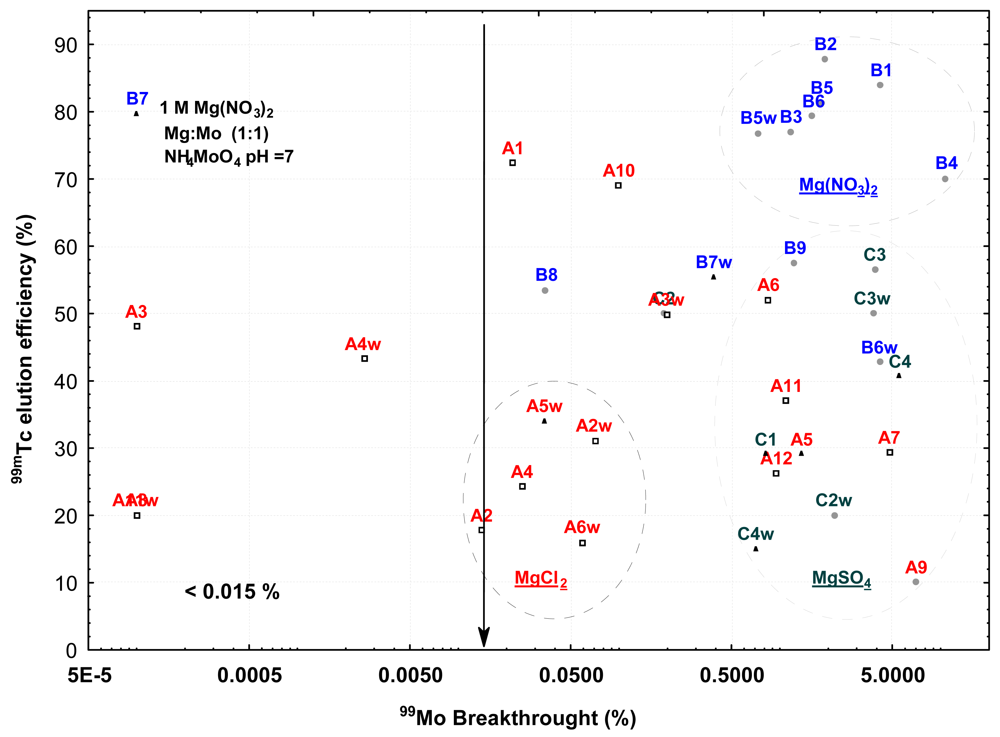
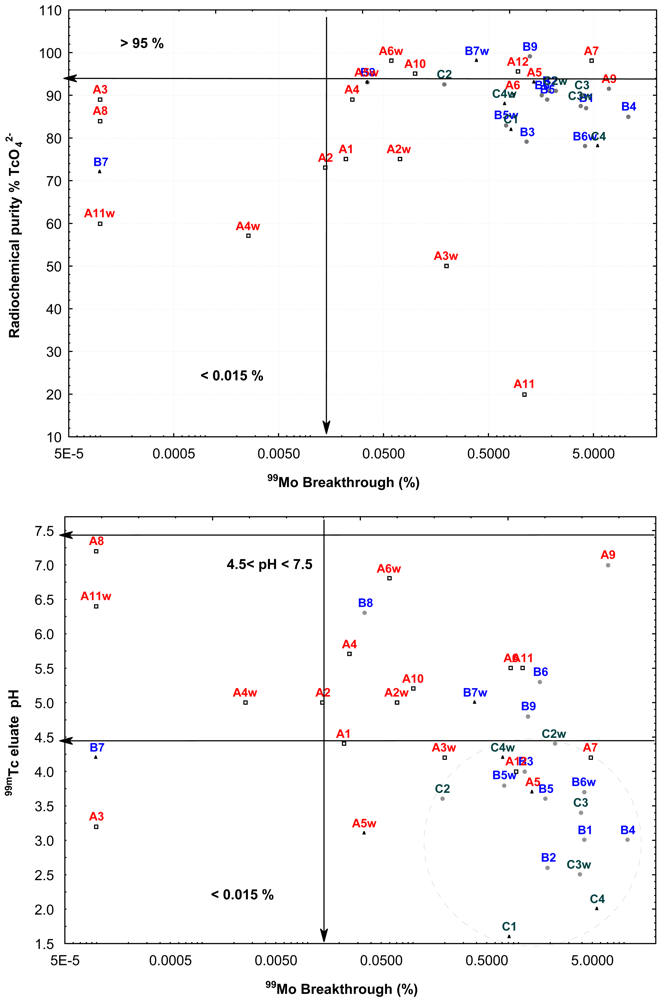
<p><sup>99</sup>Mo breakthrough percentages of less than 0.015% were only obtained in the matrices prepared from: (a) 0.5 mol/L MgCl<sub>2</sub>·6H<sub>2</sub>O (series A) and b) 1 mol/L MgNO<sub>3</sub>·6H<sub>2</sub>O solutions (series B) using ammonium molybdate solutions at pH of 7 and a Mg:Mo molar ratio of 1:2 (<xref ref-type="fig" rid="f1-pharmaceuticals-04-00215">Figure 1</xref>). However, <sup>99m</sup>Tc elution efficiencies of theses generators were less than 48%, except for the matrix B7. On the other hand, the highest elution efficiencies (&gt;70%) were obtained in the generators prepared from 0.1 mol/L Mg(NO<sub>3</sub>)<sub>2</sub>·6H<sub>2</sub>O solutions, at a Mg:Mo molar ratio of 0.2:1 and ammonium molybdate solutions at pH values between 4.5 and 10, however under these conditions, <sup>99</sup>Mo breakthrough of the eluates were more than 0.7%, apart from the matrix B7. <sup>99m</sup>Tc eluates of the matrices prepared preferably with Mg:Mo molar ratio of 2:1 presented radiochemical purity of more than 95% and, in general, those made from MgCl<sub>2</sub>·6H<sub>2</sub>O solutions which satisfy the eluate pH values fixed by the Pharmacopoeia: between 4.5 and 7.5, while the eluate pH values obtained from the matrices formed with MgSO<sub>4</sub>·6H<sub>2</sub>O were the more acid, between 1 and 3. The average elution volume of all the generators studied ranged between 2 and 3.5 mL and all <sup>99m</sup>Tc eluates had an Al content of less than 10 ppm. It is important to note that a high <sup>99</sup>Mo breakthrough percentage in the eluates entails the presence of Mg<sup>2+</sup> in solution.</p>
<p>The Mo and Mg content in the generators is directly connected with: the Mg:Mo molar ratio, the type and concentration of magnesium salt used during matrix synthesis and matrix washing before irradiation. Thus the highest (75-50%) and lowest (18–7%) Mo percentages, and <italic>vice versa</italic> for Mg content, were recorded in the washed matrices and those prepared from MgSO<sub>4</sub>·6H<sub>2</sub>O solutions at Mg:Mo molar ratio of 2:1 respectively.</p>
<p>Matrix washing caused a decrease of the <sup>99m</sup>Tc elution efficiencies and Mg percentage in the matrix, while an increase in magnesium salt concentration (series C) induced a drop in the <sup>99m</sup>Tc elution efficiency and acidification of <sup>99m</sup>Tc eluates. The addition order of magnesium salt and ammonium molybdate solutions, and ammonium molybdate pH in the matrix process preparation (series B) did not cause meaningful changes in <sup>99</sup>Mo/<sup>99m</sup>Tc generator performance.</p>
<p><sup>99m</sup>Tc eluates produced by the generators prepared from MgCl<sub>2</sub>·6H<sub>2</sub>O solutions (series A) mostly attained the pH values established by the Pharmacopoeia: between 4.5 and 7.5, while higher acid eluates were obtained in the matrices synthesized from MgSO<sub>4</sub>·6H<sub>2</sub>O solutions. When the Mg proportion was higher than Mo in the Mg:Mo molar ratio, <sup>99</sup>Mo breakthrough percentage increased in the <sup>99m</sup>Tc eluates and the Mo percentages in the matrix decreased. All <sup>99m</sup>Tc eluates of series A were colorless, those prepared from MgNO<sub>3</sub>·6H<sub>2</sub>O solutions at pH 10 or adding the ammonium molybdate solutions to magnesium salts (series B) presented a yellow coloration, while some of series C eluates showed a yellow coloring or a blue precipitate, in fact only the <sup>99m</sup>Tc eluates obtained from generator prepared with 0.1 mol/L MgSO<sub>4</sub>·6H<sub>2</sub>O solutions were colorless.</p></sec>
<sec>
<label>2.2.</label>
<title>Characterization of Magnesium Molybdate Compounds</title>
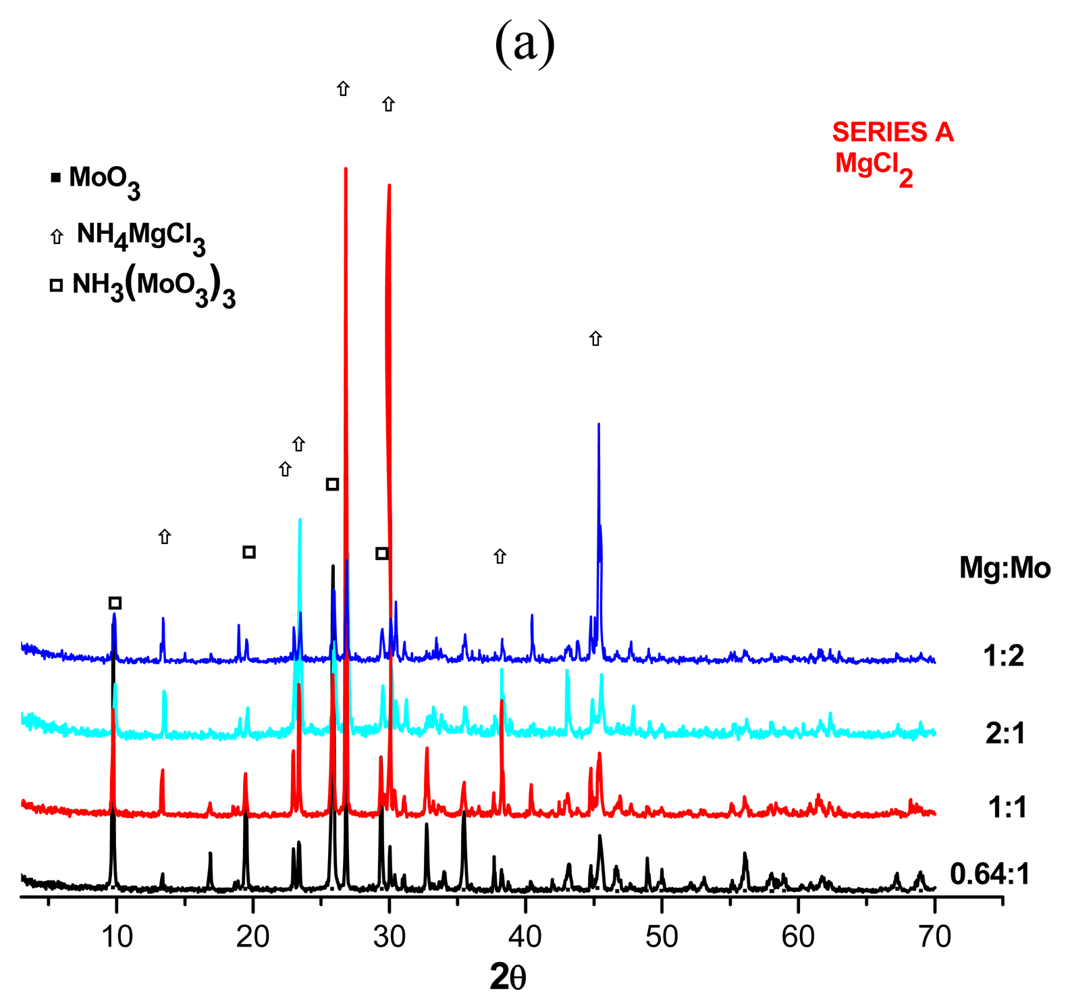
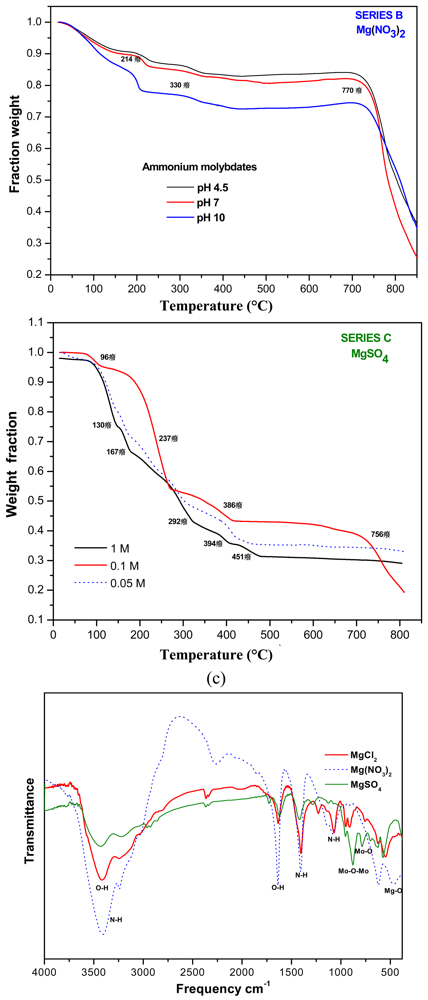
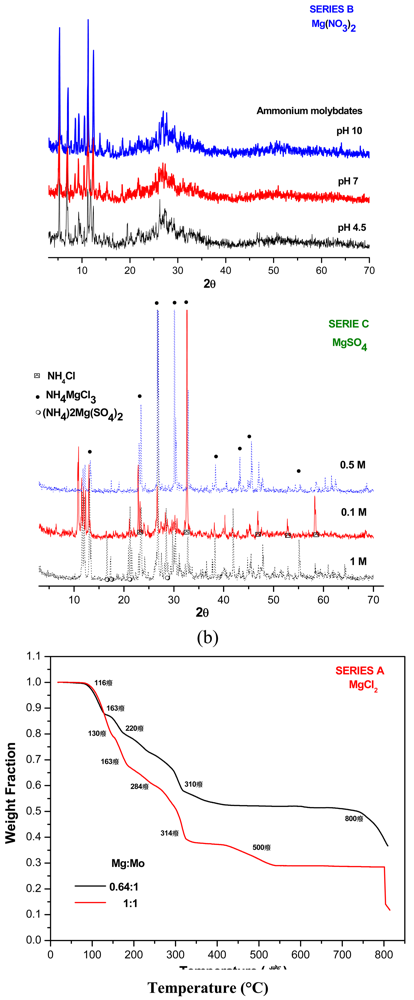
<p>Crystalline phases identified by XRD (see <xref ref-type="table" rid="t1-pharmaceuticals-04-00215">Table 1</xref> and <xref ref-type="fig" rid="f2-pharmaceuticals-04-00215">Figure 2a</xref>) showed that the type of magnesium salt used in preparing generator matrices determines their chemical composition. In accordance with these data, Mg-Mo compounds prepared from MgCl<sub>2</sub>·6H<sub>2</sub>O, Mg(NO<sub>3</sub>)<sub>2</sub>·6H<sub>2</sub>O and MgSO<sub>4</sub>·6H<sub>2</sub>O solutions are mainly constituted of: (a) NH<sub>4</sub>MgCl<sub>3</sub>·6H<sub>2</sub>O, MoO<sub>3</sub> and NH<sub>3</sub>(MoO<sub>3</sub>)<sub>3</sub>; (b) amorphous compounds and unidentified crystalline phases and (c) NH<sub>4</sub>MgCl<sub>3</sub>·6H<sub>2</sub>O, (NH<sub>4</sub>)<sub>2</sub>Mg(SO<sub>4</sub>)<sub>2</sub>·6H<sub>2</sub>O and amorphous compounds, respectively. These results are congruent with the thermogravimetric and infrared spectra shown in <xref ref-type="fig" rid="f2-pharmaceuticals-04-00215">Figures 2b</xref> which present a characteristic pattern for each magnesium salt used. The thermal decomposition step multiples of different matrices prove the presence of compound mixtures. In series A, it is possible to identify five main causes for weight-loss, firstly water elimination of ammonium magnesium chloride hydrate (∼116 °C), later the transformation of NH<sub>4</sub>MgCl<sub>3</sub> in Mg(OH)Cl and NH<sub>4</sub>Cl (160–170 °C), after NH<sub>4</sub>Cl decomposition (∼220 °C), the formation of MgO from Mg(OH)Cl (350–550 °C) and finally the decomposition of MoO<sub>3</sub> (770–800 °C) [<xref ref-type="bibr" rid="b8-pharmaceuticals-04-00215">8</xref>,<xref ref-type="bibr" rid="b16-pharmaceuticals-04-00215">16</xref>]. Three weight-losses are evident in the series B at 214, 330 y 770 °C which could be derived from NH<sub>3</sub>Cl, Mg(OH) and MoO<sub>3</sub> decomposition respectively considering that amorphous materials and the unidentified phases (<xref ref-type="fig" rid="f2-pharmaceuticals-04-00215">Figure 2b</xref>) are constituted by Mo, Mg, NO<sub>3</sub><sup>−</sup>, NH<sub>3</sub> and Cl and making an analogy with the compounds formed in series A. In the case of series C, the weight-loss is fixed by the NH<sub>4</sub>MgCl<sub>3</sub>·6H<sub>2</sub>O, (NH<sub>4</sub>)<sub>2</sub>Mg(SO<sub>4</sub>)<sub>2</sub>·6H<sub>2</sub>O and amorphous molybdenum compound decomposition (see <xref ref-type="table" rid="t1-pharmaceuticals-04-00215">Table 1</xref> and <xref ref-type="fig" rid="f2-pharmaceuticals-04-00215">Figure 2b</xref>): dehydratation (96–130 °C), elimination of [NH<sub>4</sub><sup>+</sup>] in NH<sub>4</sub>MgCl<sub>3</sub> (167 °C) and (NH<sub>4</sub>)<sub>2</sub>Mg(SO<sub>4</sub>)<sub>2</sub> (451 °C), decomposition of NH<sub>4</sub>Cl (∼237 °C), formation of MgO (300–400 °C) and decomposition of MoO<sub>3</sub> (756 °C) [<xref ref-type="bibr" rid="b16-pharmaceuticals-04-00215">16</xref>].</p>
<p>The effect of magnesium salt on forming different magnesium-molybdenum compounds during generator matrices preparation was also demonstrated by infrared analysis shown in <xref ref-type="fig" rid="f2-pharmaceuticals-04-00215">Figure 2c</xref>. The matrix spectra prepared using MgCl<sub>2</sub>*6H<sub>2</sub>O, Mg(NO<sub>3</sub>)<sub>2</sub>*6H<sub>2</sub>O and MgSO<sub>4</sub>*6H<sub>2</sub>O solutions have similar troughs in the 3500-1200 cm<sup>−1</sup> region, but with differences in band intensities.</p>
<p>In this region, ammonium and water displays strong broad N-H and O-H stretching bands between 3500 and 3300 cm<sup>−1</sup> and bands at 1405 and 1640 cm<sup>−1</sup> respectively [<xref ref-type="bibr" rid="b8-pharmaceuticals-04-00215">8</xref>,<xref ref-type="bibr" rid="b17-pharmaceuticals-04-00215">17</xref>-<xref ref-type="bibr" rid="b18-pharmaceuticals-04-00215">18</xref>]; while significant differences in intensities and wavenumber values and of each matrix were noted in fingerprint region (1200–400 cm<sup>−1</sup>). All matrices spectra exhibit characteristic absorption bands of Mo-O-Mo vibration at 960, 910 cm<sup>−1</sup> and N-H bonds at 1075 and 1220 cm<sup>−1</sup> as well as a band at 620 cm<sup>−1</sup> possibly originated from Mg vibrations [<xref ref-type="bibr" rid="b8-pharmaceuticals-04-00215">8</xref>,<xref ref-type="bibr" rid="b18-pharmaceuticals-04-00215">18</xref>-<xref ref-type="bibr" rid="b19-pharmaceuticals-04-00215">19</xref>]. Only the matrix prepared from Mg(NO<sub>3</sub>)<sub>2</sub>*6H<sub>2</sub>O presented broad bands at around 470 cm<sup>−1</sup> attributed to Mg-O bonds [<xref ref-type="bibr" rid="b19-pharmaceuticals-04-00215">19</xref>], and that from MgSO<sub>4</sub>*6H<sub>2</sub>O showed characteristic bands assigned to [SO<sub>4</sub><sup>2−</sup>] (628, 700, 1075, 1130, 1287 cm<sup>−1</sup>) and Mo-O vibrations at 792 and 880 cm<sup>−1</sup> whereas that from MgCl<sub>2</sub>*6H<sub>2</sub>O presented peaks 760 and 545 cm<sup>−1</sup> assigned to the Mo-O vibrations and possibly to Mg-Cl bonds respectively [<xref ref-type="bibr" rid="b8-pharmaceuticals-04-00215">8</xref>,<xref ref-type="bibr" rid="b18-pharmaceuticals-04-00215">18</xref>-<xref ref-type="bibr" rid="b19-pharmaceuticals-04-00215">19</xref>].</p>
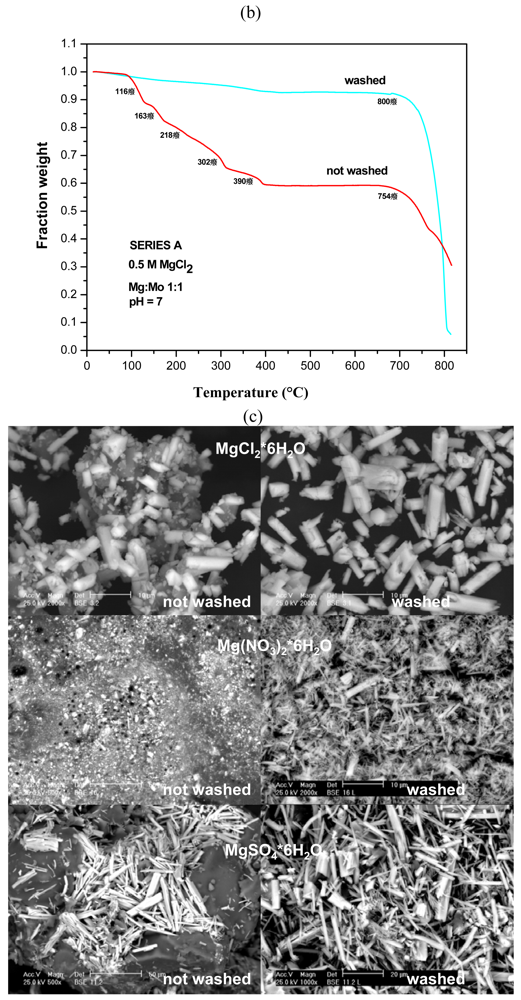
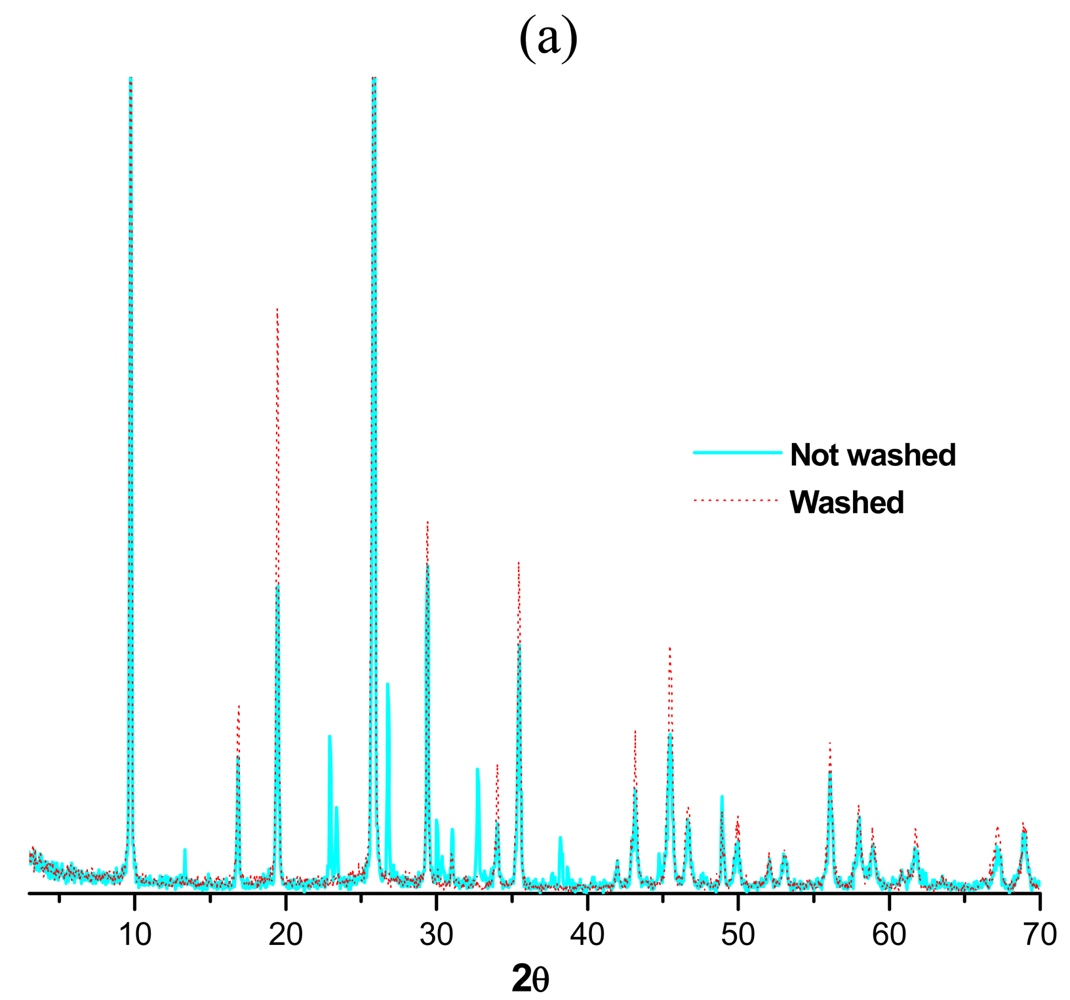
<p>The X-ray diffraction patters and thermograms of a typical matrix washed and unwashed are shown in <xref ref-type="fig" rid="f3-pharmaceuticals-04-00215">Figure 3a</xref> and <xref ref-type="fig" rid="f3-pharmaceuticals-04-00215">3b</xref>. The diffractograms show that the washed matrix before irradiation is constituted only by MoO<sub>3</sub> and the unwashed one by a mixture of MoO<sub>3</sub> and NH<sub>4</sub>MgCl<sub>3</sub>*6H<sub>2</sub>O. These data match with thermograms of the washed and unwashed matrix which have typical patterns of pure and mixed compounds respectively. Thus, washed matrices before irradiation cause soluble compounds to be removed, mainly those containing ammonium and magnesium in the matrix and conversion of the molybdenum compounds in MoO<sub>3</sub>. It is important to note that this behavior is independent of the type of magnesium salt used in preparing the matrix (<xref ref-type="table" rid="t1-pharmaceuticals-04-00215">Table 1</xref>).</p>
<p>The effect of matrix washing on morphology is shown in <xref ref-type="fig" rid="f3-pharmaceuticals-04-00215">Figure 3c</xref>. The unwashed matrices present a crystalline phase soaked in an amorphous material, and the washed matrices only have the crystalline phase, constituted by rods of different thicknesses and length.</p></sec>
<sec>
<label>2.3.</label>
<title>Discussion</title>
<p>The performance of the <sup>99</sup>Mo/<sup>99m</sup>Tc generators based on magnesium-molybdate compounds depends upon matrix preparation and treatment methods. The latter has to be an insoluble precipitate to avoid <sup>99</sup>Mo leakage, whilst simultaneously allowing <sup>99m</sup>Tc release, and have a high Mo content that enables the use of low specific activities of <sup>99</sup>Mo (2.5 Ci/g) in the generator and a good thermal and radiation stability.</p>
<p>Magnesium molybdate is fairly soluble in water [<xref ref-type="bibr" rid="b20-pharmaceuticals-04-00215">20</xref>-<xref ref-type="bibr" rid="b21-pharmaceuticals-04-00215">21</xref>] and literature has reported obtaining magnesium molybdate precipitates, mainly used in catalysis, applied suitable thermal treatments and magnesium and molybdate concentrations. For example, Yoon <italic>et al.</italic> have reported magnesium molybdates precipitation from Mg(NO<sub>3</sub>)<sub>2</sub>·6H<sub>2</sub>O and (NH<sub>4</sub>)<sub>3</sub>Mo<sub>7</sub>O<sub>24</sub>·4H<sub>2</sub>O solutions and calcining at different temperatures (200–650 °C) [<xref ref-type="bibr" rid="b19-pharmaceuticals-04-00215">19</xref>]. Ozeki <italic>et al.</italic> prepared magnesium molybdate solids by concentrating a mixed solution of 0.1 mol/L sodium molybdate and 4.5 mol/L magnesium chloride [<xref ref-type="bibr" rid="b20-pharmaceuticals-04-00215">20</xref>]. Amber <italic>et al.</italic> obtained MgMoO<sub>4</sub>·H<sub>2</sub>O from 0.1 mol/L Na<sub>2</sub>MoO<sub>4</sub> and 0.5 mol/L MgCl<sub>2</sub> solutions at pH 6 treated at 155 °C for 3 days [<xref ref-type="bibr" rid="b22-pharmaceuticals-04-00215">22</xref>].</p>
<p>In this work, insoluble magnesium molybdate compound precipitation was favored by adjusting pH and irradiation, and not by thermal treatment. Under these experimental conditions, magnesium molybdate compounds obtained were mainly polymetalates salts such as xNH<sub>4</sub>MgCl<sub>3</sub>·yMoO<sub>3</sub>, and polymolybdates [NH<sub>4</sub>Mo<sub>5</sub>O<sub>15</sub>(OH)] (see <xref ref-type="fig" rid="f2-pharmaceuticals-04-00215">Figure 2</xref> and <xref ref-type="table" rid="t2-pharmaceuticals-04-00215">Table 2</xref>). Assuming that compound formation is the result of three steps, firstly the formation of ammonium molybdates according to reaction (1):
<disp-formula id="FD1">
<label>(1)</label>
<mml:math id="mm1" display="block">
<mml:semantics id="sm1">
<mml:mrow>
<mml:mtext>Mo</mml:mtext>
<mml:msub>
<mml:mtext>O</mml:mtext>
<mml:mn>3</mml:mn></mml:msub>
<mml:mo>+</mml:mo>
<mml:mn>2</mml:mn>
<mml:mtext>N</mml:mtext>
<mml:msub>
<mml:mtext>H</mml:mtext>
<mml:mn>4</mml:mn></mml:msub>
<mml:mtext>OH</mml:mtext>
<mml:mo>↔</mml:mo>
<mml:mo stretchy="false">(</mml:mo>
<mml:mtext>N</mml:mtext>
<mml:msub>
<mml:mtext>H</mml:mtext>
<mml:mn>4</mml:mn></mml:msub>
<mml:mo stretchy="false">)</mml:mo>
<mml:mtext>Mo</mml:mtext>
<mml:msub>
<mml:mtext>O</mml:mtext>
<mml:mn>4</mml:mn></mml:msub>
<mml:mo>+</mml:mo>
<mml:msub>
<mml:mtext>H</mml:mtext>
<mml:mn>2</mml:mn></mml:msub>
<mml:mtext>O</mml:mtext></mml:mrow></mml:semantics></mml:math></disp-formula></p>
<p>The molybdate ion generally exists as MoO<sub>4</sub><sup>2−</sup> in alkaline or neutral solutions (pH &gt; 6) while polymolybdate ions such as [Mo<sub>7</sub>O<sub>24</sub>]<sup>6−</sup>, [Mo<sub>8</sub>O<sub>26</sub>]<sup>4−</sup>, [Mo<sub>36</sub>O<sub>112</sub>]<sup>8−</sup> are formed in acid solutions [<xref ref-type="bibr" rid="b19-pharmaceuticals-04-00215">19</xref>,<xref ref-type="bibr" rid="b23-pharmaceuticals-04-00215">23</xref>-<xref ref-type="bibr" rid="b27-pharmaceuticals-04-00215">27</xref>]:
<disp-formula id="FD2">
<label>(2)</label>
<mml:math id="mm2" display="block">
<mml:semantics id="sm2">
<mml:mrow>
<mml:mtext>xMo</mml:mtext>
<mml:msubsup>
<mml:mtext>O</mml:mtext>
<mml:mn>4</mml:mn>
<mml:mrow>
<mml:mn>2</mml:mn>
<mml:mo>−</mml:mo></mml:mrow></mml:msubsup>
<mml:mo>+</mml:mo>
<mml:mtext>y</mml:mtext>
<mml:msup>
<mml:mtext>H</mml:mtext>
<mml:mo>+</mml:mo></mml:msup>
<mml:mo>↔</mml:mo>
<mml:mtext>M</mml:mtext>
<mml:msub>
<mml:mtext>o</mml:mtext>
<mml:mtext>x</mml:mtext></mml:msub>
<mml:msub>
<mml:mtext>O</mml:mtext>
<mml:mtext>z</mml:mtext></mml:msub>
<mml:msubsup>
<mml:mrow>
<mml:mo stretchy="false">(</mml:mo>
<mml:mtext>OH</mml:mtext>
<mml:mo stretchy="false">)</mml:mo></mml:mrow>
<mml:mrow>
<mml:mn>8</mml:mn>
<mml:mtext>x</mml:mtext>
<mml:mo>−</mml:mo>
<mml:mtext>y</mml:mtext>
<mml:mo>−</mml:mo>
<mml:mn>2</mml:mn>
<mml:mtext>z</mml:mtext></mml:mrow>
<mml:mrow>
<mml:mo stretchy="false">(</mml:mo>
<mml:mn>2</mml:mn>
<mml:mtext>x</mml:mtext>
<mml:mo>−</mml:mo>
<mml:mtext>y</mml:mtext>
<mml:mo stretchy="false">)</mml:mo>
<mml:mo>−</mml:mo></mml:mrow></mml:msubsup>
<mml:mo>+</mml:mo>
<mml:mo stretchy="false">(</mml:mo>
<mml:mtext>y</mml:mtext>
<mml:mo>−</mml:mo>
<mml:mn>4</mml:mn>
<mml:mtext>x</mml:mtext>
<mml:mo>−</mml:mo>
<mml:mtext>z</mml:mtext>
<mml:mo stretchy="false">)</mml:mo>
<mml:msub>
<mml:mtext>H</mml:mtext>
<mml:mn>2</mml:mn></mml:msub>
<mml:mtext>O</mml:mtext></mml:mrow></mml:semantics></mml:math></disp-formula></p>
<p>Thus the ammonium molybdate solutions prepared at pH 10 and 7 contain simply MoO<sub>4</sub><sup>2-</sup> ions and those at pH 4.5 a mixture of polymolybdate ions where the predominant species is probably the [Mo<sub>7</sub>O<sub>24</sub>]<sup>6−</sup> ion [<xref ref-type="bibr" rid="b18-pharmaceuticals-04-00215">18</xref>]. In the second step, ammonium molybdates react with magnesium solutions to form magnesium-molybdates solutions. Considering these solutions pH values can vary between 8 and 4.3, the magnesium molybdates can be constituted by MoO<sub>4</sub><sup>2−</sup> (pH &gt; 6) or polymolybdates (pH &lt; 6) according to:
<disp-formula id="FD3">
<label>(3)</label>
<mml:math id="mm3" display="block">
<mml:semantics id="sm3">
<mml:mrow>
<mml:mo stretchy="false">(</mml:mo>
<mml:mtext>N</mml:mtext>
<mml:msub>
<mml:mtext>H</mml:mtext>
<mml:mn>4</mml:mn></mml:msub>
<mml:mo stretchy="false">)</mml:mo>
<mml:mtext>Mo</mml:mtext>
<mml:msub>
<mml:mtext>O</mml:mtext>
<mml:mn>4</mml:mn></mml:msub>
<mml:mo>+</mml:mo>
<mml:mtext>MgX</mml:mtext>
<mml:mo>↔</mml:mo>
<mml:mtext>MgMo</mml:mtext>
<mml:msub>
<mml:mtext>O</mml:mtext>
<mml:mn>4</mml:mn></mml:msub>
<mml:mo>+</mml:mo>
<mml:mtext>N</mml:mtext>
<mml:msub>
<mml:mtext>H</mml:mtext>
<mml:mn>4</mml:mn></mml:msub>
<mml:mtext>X</mml:mtext></mml:mrow></mml:semantics></mml:math></disp-formula>
<disp-formula id="FD4">
<label>(4)</label>
<mml:math id="mm4" display="block">
<mml:semantics id="sm4">
<mml:mrow>
<mml:mtable>
<mml:mtr>
<mml:mtd>
<mml:mrow>
<mml:msub>
<mml:mrow>
<mml:mo stretchy="false">(</mml:mo>
<mml:mtext>N</mml:mtext>
<mml:msub>
<mml:mtext>H</mml:mtext>
<mml:mn>4</mml:mn></mml:msub>
<mml:mo stretchy="false">)</mml:mo></mml:mrow>
<mml:mrow>
<mml:mo stretchy="false">(</mml:mo>
<mml:mn>2</mml:mn>
<mml:mtext>x</mml:mtext>
<mml:mo>−</mml:mo>
<mml:mtext>y</mml:mtext>
<mml:mo stretchy="false">)</mml:mo></mml:mrow></mml:msub>
<mml:mtext>M</mml:mtext>
<mml:msub>
<mml:mtext>o</mml:mtext>
<mml:mtext>x</mml:mtext></mml:msub>
<mml:msub>
<mml:mtext>O</mml:mtext>
<mml:mtext>z</mml:mtext></mml:msub>
<mml:msub>
<mml:mrow>
<mml:mo stretchy="false">(</mml:mo>
<mml:mtext>OH</mml:mtext>
<mml:mo stretchy="false">)</mml:mo></mml:mrow>
<mml:mrow>
<mml:mn>8</mml:mn>
<mml:mtext>x</mml:mtext>
<mml:mo>−</mml:mo>
<mml:mtext>y</mml:mtext>
<mml:mo>−</mml:mo>
<mml:mn>2</mml:mn>
<mml:mtext>z</mml:mtext></mml:mrow></mml:msub>
<mml:mo>+</mml:mo>
<mml:mo stretchy="false">(</mml:mo>
<mml:mn>2</mml:mn>
<mml:mtext>x</mml:mtext>
<mml:mo>−</mml:mo>
<mml:mtext>y</mml:mtext>
<mml:mo stretchy="false">)</mml:mo>
<mml:mtext>MgX</mml:mtext>
<mml:mo>↔</mml:mo>
<mml:mtext>M</mml:mtext>
<mml:msub>
<mml:mtext>g</mml:mtext>
<mml:mrow>
<mml:mo stretchy="false">(</mml:mo>
<mml:mn>2</mml:mn>
<mml:mtext>x</mml:mtext>
<mml:mo>−</mml:mo>
<mml:mtext>y</mml:mtext>
<mml:mo stretchy="false">)</mml:mo></mml:mrow></mml:msub>
<mml:mtext>M</mml:mtext>
<mml:msub>
<mml:mtext>o</mml:mtext>
<mml:mtext>x</mml:mtext></mml:msub>
<mml:msub>
<mml:mtext>O</mml:mtext>
<mml:mtext>z</mml:mtext></mml:msub>
<mml:msub>
<mml:mrow>
<mml:mo stretchy="false">(</mml:mo>
<mml:mtext>OH</mml:mtext>
<mml:mo stretchy="false">)</mml:mo></mml:mrow>
<mml:mrow>
<mml:mn>8</mml:mn>
<mml:mtext>x</mml:mtext>
<mml:mo>−</mml:mo>
<mml:mtext>y</mml:mtext>
<mml:mo>−</mml:mo>
<mml:mn>2</mml:mn>
<mml:mtext>z</mml:mtext></mml:mrow></mml:msub>
<mml:mo>+</mml:mo>
<mml:mo stretchy="false">(</mml:mo>
<mml:mn>2</mml:mn>
<mml:mtext>x</mml:mtext>
<mml:mo>−</mml:mo>
<mml:mtext>y</mml:mtext>
<mml:mo stretchy="false">)</mml:mo>
<mml:mtext>N</mml:mtext>
<mml:msub>
<mml:mtext>H</mml:mtext>
<mml:mn>4</mml:mn></mml:msub>
<mml:mtext>X</mml:mtext></mml:mrow></mml:mtd></mml:mtr>
<mml:mtr>
<mml:mtd>
<mml:mrow>
<mml:mtext>X</mml:mtext>
<mml:mo>=</mml:mo>
<mml:mtext>C</mml:mtext>
<mml:msup>
<mml:mtext>l</mml:mtext>
<mml:mo>−</mml:mo></mml:msup>
<mml:mo>,</mml:mo>
<mml:mtext>N</mml:mtext>
<mml:msubsup>
<mml:mtext>O</mml:mtext>
<mml:mn>3</mml:mn>
<mml:mo>−</mml:mo></mml:msubsup>
<mml:mspace width="0.2em"/>
<mml:mtext>or</mml:mtext>
<mml:mspace width="0.2em"/>
<mml:mtext>S</mml:mtext>
<mml:msubsup>
<mml:mtext>O</mml:mtext>
<mml:mn>4</mml:mn>
<mml:mrow>
<mml:mn>2</mml:mn>
<mml:mo>−</mml:mo></mml:mrow></mml:msubsup>
<mml:mo>,</mml:mo></mml:mrow></mml:mtd></mml:mtr></mml:mtable></mml:mrow></mml:semantics></mml:math></disp-formula></p>
<p>In the last step, the magnesium molybdates are induced to precipitate by adjusting pH values of the solutions to be between 1.9 and 0.3. At pH &lt; 2, literature has reported the presence of very large polymolybdate species like [Mo<sub>36</sub>O<sub>112</sub>]<sup>8−</sup> [<xref ref-type="bibr" rid="b23-pharmaceuticals-04-00215">23</xref>,<xref ref-type="bibr" rid="b25-pharmaceuticals-04-00215">25</xref>] or MoO<sub>3</sub>·2H<sub>2</sub>O precipitation [<xref ref-type="bibr" rid="b19-pharmaceuticals-04-00215">19</xref>,<xref ref-type="bibr" rid="b28-pharmaceuticals-04-00215">28</xref>-<xref ref-type="bibr" rid="b29-pharmaceuticals-04-00215">29</xref>]. X-ray diffraction data (see <xref ref-type="table" rid="t2-pharmaceuticals-04-00215">Table 2</xref> and <xref ref-type="fig" rid="f2-pharmaceuticals-04-00215">Figure 2</xref>) suggests polymetalates formation such as xNH<sub>4</sub>MgCl<sub>3</sub>·yMoO<sub>3</sub> or polymolybdates according to:
<disp-formula id="FD5">
<label>(5)</label>
<mml:math id="mm5" display="block">
<mml:semantics id="sm5">
<mml:mrow>
<mml:mtext>MgMo</mml:mtext>
<mml:msub>
<mml:mtext>O</mml:mtext>
<mml:mn>4</mml:mn></mml:msub>
<mml:mo>+</mml:mo>
<mml:mn>2</mml:mn>
<mml:mtext>N</mml:mtext>
<mml:msub>
<mml:mtext>H</mml:mtext>
<mml:mn>4</mml:mn></mml:msub>
<mml:mtext>X</mml:mtext>
<mml:mo>+</mml:mo>
<mml:mn>2</mml:mn>
<mml:mtext>HCl</mml:mtext>
<mml:mo>↔</mml:mo>
<mml:mtext>N</mml:mtext>
<mml:msub>
<mml:mtext>H</mml:mtext>
<mml:mn>4</mml:mn></mml:msub>
<mml:mtext>MgC</mml:mtext>
<mml:msub>
<mml:mtext>l</mml:mtext>
<mml:mn>3</mml:mn></mml:msub>
<mml:mo>·</mml:mo>
<mml:mtext>Mo</mml:mtext>
<mml:msub>
<mml:mtext>O</mml:mtext>
<mml:mn>3</mml:mn></mml:msub>
<mml:mo>·</mml:mo>
<mml:msub>
<mml:mtext>H</mml:mtext>
<mml:mn>2</mml:mn></mml:msub>
<mml:mtext>O</mml:mtext>
<mml:mo>+</mml:mo>
<mml:mtext>N</mml:mtext>
<mml:msub>
<mml:mtext>H</mml:mtext>
<mml:mn>4</mml:mn></mml:msub>
<mml:mtext>X</mml:mtext></mml:mrow></mml:semantics></mml:math></disp-formula>
<disp-formula id="FD6">
<label>(6)</label>
<mml:math id="mm6" display="block">
<mml:semantics id="sm6">
<mml:mrow>
<mml:mtext>uMgMo</mml:mtext>
<mml:msub>
<mml:mtext>O</mml:mtext>
<mml:mn>4</mml:mn></mml:msub>
<mml:mo>+</mml:mo>
<mml:mtext>vN</mml:mtext>
<mml:msub>
<mml:mtext>H</mml:mtext>
<mml:mn>4</mml:mn></mml:msub>
<mml:mtext>X</mml:mtext>
<mml:mo>+</mml:mo>
<mml:mtext>wHCl</mml:mtext>
<mml:mo>↔</mml:mo>
<mml:mtext>u</mml:mtext>
<mml:msub>
<mml:mtext>NH</mml:mtext>
<mml:mn>4</mml:mn></mml:msub>
<mml:mtext>MgC</mml:mtext>
<mml:msub>
<mml:mtext>l</mml:mtext>
<mml:mn>3</mml:mn></mml:msub>
<mml:mo>·</mml:mo>
<mml:msub>
<mml:mrow>
<mml:mo stretchy="false">(</mml:mo>
<mml:mtext>N</mml:mtext>
<mml:msub>
<mml:mtext>H</mml:mtext>
<mml:mn>4</mml:mn></mml:msub>
<mml:mo stretchy="false">)</mml:mo></mml:mrow>
<mml:mrow>
<mml:mo stretchy="false">(</mml:mo>
<mml:mn>2</mml:mn>
<mml:mtext>x</mml:mtext>
<mml:mo>−</mml:mo>
<mml:mtext>y</mml:mtext>
<mml:mo stretchy="false">)</mml:mo></mml:mrow></mml:msub>
<mml:mtext>M</mml:mtext>
<mml:msub>
<mml:mtext>o</mml:mtext>
<mml:mtext>x</mml:mtext></mml:msub>
<mml:msub>
<mml:mtext>O</mml:mtext>
<mml:mtext>z</mml:mtext></mml:msub>
<mml:msub>
<mml:mrow>
<mml:mo stretchy="false">(</mml:mo>
<mml:mtext>OH</mml:mtext>
<mml:mo stretchy="false">)</mml:mo></mml:mrow>
<mml:mrow>
<mml:mn>8</mml:mn>
<mml:mtext>x</mml:mtext>
<mml:mo>−</mml:mo>
<mml:mtext>y</mml:mtext>
<mml:mo>−</mml:mo>
<mml:mn>2</mml:mn>
<mml:mtext>z</mml:mtext></mml:mrow></mml:msub>
<mml:mo>+</mml:mo>
<mml:mo stretchy="false">(</mml:mo>
<mml:mtext>v</mml:mtext>
<mml:mo>−</mml:mo>
<mml:mtext>u</mml:mtext>
<mml:mo>−</mml:mo>
<mml:mn>2</mml:mn>
<mml:mtext>x</mml:mtext>
<mml:mo>−</mml:mo>
<mml:mtext>y</mml:mtext>
<mml:mo stretchy="false">)</mml:mo>
<mml:mtext>N</mml:mtext>
<mml:msub>
<mml:mtext>H</mml:mtext>
<mml:mn>4</mml:mn></mml:msub>
<mml:mtext>X</mml:mtext></mml:mrow></mml:semantics></mml:math></disp-formula>
<disp-formula id="FD7">
<label>(7)</label>
<mml:math id="mm7" display="block">
<mml:semantics id="sm7">
<mml:mrow>
<mml:mtable>
<mml:mtr>
<mml:mtd>
<mml:mrow>
<mml:mtext>M</mml:mtext>
<mml:msub>
<mml:mtext>g</mml:mtext>
<mml:mrow>
<mml:mo stretchy="false">(</mml:mo>
<mml:mn>2</mml:mn>
<mml:mtext>x</mml:mtext>
<mml:mo>−</mml:mo>
<mml:mtext>y</mml:mtext>
<mml:mo stretchy="false">)</mml:mo></mml:mrow></mml:msub>
<mml:msub>
<mml:mtext>Mo</mml:mtext>
<mml:mtext>x</mml:mtext></mml:msub>
<mml:msub>
<mml:mtext>O</mml:mtext>
<mml:mtext>z</mml:mtext></mml:msub>
<mml:msub>
<mml:mrow>
<mml:mo stretchy="false">(</mml:mo>
<mml:mtext>OH</mml:mtext>
<mml:mo stretchy="false">)</mml:mo></mml:mrow>
<mml:mrow>
<mml:mn>8</mml:mn>
<mml:mtext>x</mml:mtext>
<mml:mo>−</mml:mo>
<mml:mtext>y</mml:mtext>
<mml:mo>−</mml:mo>
<mml:mn>2</mml:mn>
<mml:mtext>z</mml:mtext></mml:mrow></mml:msub>
<mml:mo>+</mml:mo>
<mml:mtext>vN</mml:mtext>
<mml:msub>
<mml:mtext>H</mml:mtext>
<mml:mn>4</mml:mn></mml:msub>
<mml:mtext>X</mml:mtext>
<mml:mo>+</mml:mo>
<mml:mtext>wHCl</mml:mtext>
<mml:mo>↔</mml:mo>
<mml:mo stretchy="false">(</mml:mo>
<mml:mn>2</mml:mn>
<mml:mtext>x</mml:mtext>
<mml:mo>−</mml:mo>
<mml:mtext>y</mml:mtext>
<mml:mo stretchy="false">)</mml:mo>
<mml:mtext>N</mml:mtext>
<mml:msub>
<mml:mtext>H</mml:mtext>
<mml:mn>4</mml:mn></mml:msub>
<mml:mtext>MgC</mml:mtext>
<mml:msub>
<mml:mtext>l</mml:mtext>
<mml:mn>3</mml:mn></mml:msub>
<mml:mo>·</mml:mo>
<mml:msub>
<mml:mrow>
<mml:mo stretchy="false">(</mml:mo>
<mml:mtext>N</mml:mtext>
<mml:msub>
<mml:mtext>H</mml:mtext>
<mml:mn>4</mml:mn></mml:msub>
<mml:mo stretchy="false">)</mml:mo></mml:mrow>
<mml:mrow>
<mml:mo stretchy="false">(</mml:mo>
<mml:mn>2</mml:mn>
<mml:mtext>x</mml:mtext>
<mml:mo>−</mml:mo>
<mml:mtext>y</mml:mtext>
<mml:mo stretchy="false">)</mml:mo></mml:mrow></mml:msub>
<mml:mtext>M</mml:mtext>
<mml:msub>
<mml:mtext>o</mml:mtext>
<mml:mtext>x</mml:mtext></mml:msub>
<mml:msub>
<mml:mtext>O</mml:mtext>
<mml:mtext>z</mml:mtext></mml:msub>
<mml:msub>
<mml:mrow>
<mml:mo stretchy="false">(</mml:mo>
<mml:mtext>OH</mml:mtext>
<mml:mo stretchy="false">)</mml:mo></mml:mrow>
<mml:mrow>
<mml:mn>8</mml:mn>
<mml:mtext>x</mml:mtext>
<mml:mo>−</mml:mo>
<mml:mtext>y</mml:mtext>
<mml:mo>−</mml:mo>
<mml:mn>2</mml:mn>
<mml:mtext>z</mml:mtext></mml:mrow></mml:msub></mml:mrow></mml:mtd></mml:mtr>
<mml:mtr>
<mml:mtd>
<mml:mrow>
<mml:mo>+</mml:mo>
<mml:mspace width="0.2em"/>
<mml:mtext>v</mml:mtext>
<mml:mspace width="0.2em"/>
<mml:mo>−</mml:mo>
<mml:mo stretchy="false">(</mml:mo>
<mml:mn>2</mml:mn>
<mml:mtext>x</mml:mtext>
<mml:mo>−</mml:mo>
<mml:mtext>y</mml:mtext>
<mml:mo stretchy="false">)</mml:mo>
<mml:mtext>N</mml:mtext>
<mml:msub>
<mml:mtext>H</mml:mtext>
<mml:mn>4</mml:mn></mml:msub>
<mml:mtext>X</mml:mtext></mml:mrow></mml:mtd></mml:mtr></mml:mtable></mml:mrow></mml:semantics></mml:math></disp-formula></p>
<p>The Cl<sup>−</sup> ion usually displaces NO<sub>3</sub><sup>−</sup> and SO<sub>4</sub><sup>2−</sup> ions [<xref ref-type="bibr" rid="b30-pharmaceuticals-04-00215">30</xref>] when magnesium nitrate and sulfate are employed in preparing magnesium molybdates; for that reason ammonium magnesium chlorides (NH<sub>4</sub>MgCl<sub>3</sub>) were present in all the series studied (see <xref ref-type="table" rid="t2-pharmaceuticals-04-00215">Table 2</xref> and <xref ref-type="fig" rid="f2-pharmaceuticals-04-00215">Figure 2</xref>), however mixtures of NH<sub>4</sub>MgCl<sub>3</sub> and (NH<sub>4</sub>)<sub>2</sub>Mg(SO<sub>4</sub>)<sub>2</sub> were also identified in matrices prepared from magnesium sulfates.</p>
<p>An excess of molybdenum favors polymolybdates and formation of amorphous phases whereas a surplus of magnesium the presence of ammonium magnesium salts and crystalline phases. Thus, the crystallinity degree of the compounds contained in the matrix is closely attached to <sup>99</sup>Mo/<sup>99m</sup>Tc generator performances. For example amorphous matrices presented the best <sup>99m</sup>Tc elution efficiencies (series B) while the crystalline (series A) presented lower <sup>99</sup>Mo breakthrough (see <xref ref-type="table" rid="t1-pharmaceuticals-04-00215">Table 1</xref>, <xref ref-type="fig" rid="f1-pharmaceuticals-04-00215">Figure 1</xref>). Assuming that amorphous materials also consist of molybenum oxides or polymolybdates and that the oxides and hydrous oxides of Mo(VI) exhibit cation exchange properties and show little or no anion exchange character even in acid solution [<xref ref-type="bibr" rid="b31-pharmaceuticals-04-00215">31</xref>] and ammonium magnesium salts have no adsorption properties, so the separation mechanism of the <sup>99</sup>Mo and <sup>99m</sup>Tc in the generators can be explained by free diffusion of <sup>99m</sup>TcO<sub>4</sub><sup>−</sup> ion inside the matrix because the <sup>99m</sup>TcO<sub>4</sub><sup>−</sup> anion produced in the generator is not adsorbed in the matrix and can be removed from the chromatographic column by elution with isotonic saline solution, leaving the <sup>99</sup>Mo inside. In accordance with this argument, a crystalline matrix acts as a molecular sieve preventing <sup>99m</sup>Tc mobility and causing generator efficiency decrease. Whereas a flexible random network (amorphous) increases generator efficiency and radiochemical purity because the matrix is more elastic but simultaneously harder and more resistant to mechanical breakdown and more difficult to dissolve. The low <sup>99m</sup>Tc eluate radiochemical purities obtained in some generators can be explained by Tc(VII) reduction caused by the presence of insoluble species of polymolybdates, which are strong oxidizing agents [<xref ref-type="bibr" rid="b18-pharmaceuticals-04-00215">18</xref>].</p>
<p>Inorganic materials are susceptible to irradiation-induced amorphization producing particularly volume changes in crystalline or amorphous phases. The main concern with large differential volume changes is that it may affect atomic bonding, local coordination, and the pathways for ion exchange, all of which can impact the release rates of radionuclides [<xref ref-type="bibr" rid="b32-pharmaceuticals-04-00215">32</xref>]. Thus the matrix amorphization caused by its irradiation could be linked to the high <sup>99</sup>Mo breakthrough obtained in generators for which matrices are mainly formed by amorphous compounds such as the series B and C.</p></sec></sec>
<sec>
<label>3.</label>
<title>Experimental</title>
<sec>
<label>3.1.</label>
<title>Preparation of Magnesium <sup>99</sup>Mo-Molybdate Compounds</title>
<p>Magnesium <sup>99</sup>Mo-molybdate compounds were formed from magnesium and molybdate solutions. The molybdate solutions were prepared from MoO3 natural pellets, previously heated to 650 °C for 1 h and dissolved in 2 mol/L NH<sub>4</sub>OH at a MoO<sub>3</sub>:2NH<sub>4</sub>OH molar ratio [<xref ref-type="bibr" rid="b8-pharmaceuticals-04-00215">8</xref>]. The pH of the formed ammonium molybdates was adjusted by adding 4 mol/L HCl and converted into magnesium molybdate by reacting with magnesium solutions. Magnesium molybdates pH were also adjusted using 4 mol/L HCl. The resulting solids were dried for 2 days using an infrared lamp and crushed in an agate mortar. One portion of magnesium molybdate precipitate was placed on a funnel to be washed using 200 mL of distilled water and the washed and unwashed solids were dried for 1 day at 40 °C in a stove. The dried magnesium molybdate were irradiated for 2 h at a neutron fluence of about 1.61 × 10<sup>13</sup> n cm<sup>−2</sup>s<sup>−1</sup> in the Triga Mark III Reactor (Mexico). After irradiation, about 1 g of magnesium <sup>99</sup>Mo-molybdate (∼4.9 MBq/g) were added into a glass column (12 mm × 70 mm) containing a bed of 1 g acid alumina. The column was finally washed with 20 mL of saline solution [<xref ref-type="bibr" rid="b8-pharmaceuticals-04-00215">8</xref>,<xref ref-type="bibr" rid="b17-pharmaceuticals-04-00215">17</xref>-<xref ref-type="bibr" rid="b18-pharmaceuticals-04-00215">18</xref>]. The magnesium molybdate compounds were synthesized in duplicate at different conditions; where parameters such as magnesium salts and concentrations (MgCl<sub>2</sub>·6H<sub>2</sub>O, Mg(NO<sub>3</sub>)<sub>2</sub>·6H<sub>2</sub>O, MgSO<sub>4</sub>·6H<sub>2</sub>O), Mo:Mg molar ratios, ammonium and magnesium molybdates pH and the addition order of magnesium and molybdenum solutions were evaluated (see <xref ref-type="table" rid="t2-pharmaceuticals-04-00215">Table 2</xref>).</p></sec>
<sec sec-type="methods">
<label>3.2.</label>
<title>Elution of Generators and Eluate Analysis</title>
<p>The generators were eluted with 6 mL of 0.9% NaCl every 24 h for 1 week and the following parameter of the <sup>99m</sup>Tc eluates were determined: <sup>99m</sup>Tc elution efficiency, <sup>99</sup>Mo breakthrough, <sup>99m</sup>Tc elution profile, <sup>99m</sup>Tc radiochemical purity, pH eluate and aluminium concentration. The <sup>99m</sup>Tc elution efficiency and the <sup>99</sup>Mo breakthrough were calculated from the <sup>99m</sup>Tc and <sup>99</sup>Mo activities measured in a CRC-10R Capintec dose calibrator and a GeHp solid state detector (Canberra 7229P) coupled to a PC-multichannel analyzer (ACUSPECT-A, Canberra, Australia). The radiochemical purity of the <sup>99m</sup>Tc eluate was determined by paper chromatography using 1 CHR (Whatman®) paper as solid phase and 85% methanol as mobile phase. The <sup>99m</sup>TcO<sub>4</sub><sup>−</sup>R<sub>f</sub> was 0.66–0.72. Aluminium and magnesium concentrations in <sup>99m</sup>Tc eluates were determined by the aluminon and Eriochrome Black T methods [<xref ref-type="bibr" rid="b18-pharmaceuticals-04-00215">18</xref>,<xref ref-type="bibr" rid="b33-pharmaceuticals-04-00215">33</xref>]. The eluate pH values were determined by pH paper.</p></sec>
<sec>
<label>3.3.</label>
<title>Gel Characterization</title>
<p>Magnesium-molibdate compounds were characterized by X-ray diffraction (XRD), scanning electron microscopy (SEM), infrared spectrometry, thermogravimetry and neutron activation analysis. The X-ray diffraction patterns were obtained on a Siemens D500 diffractometer for 1 h and scanned from 2.5° to 70° with steps of 0.02°. SEM imaging was performed by Philips SL30. Digital images were obtained at 5,000×, 3,000×, 1,000× and 500× magnifications in randomly selected fields. The infrared measurements were taken on a Nicole Mgna-IR™ spectrometer 550 with the samples pressed in KBr pellets. The thermogravimetric analyses were performed using a Phillips unit at a heating rate of 10°/min under a nitrogen atmosphere [<xref ref-type="bibr" rid="b8-pharmaceuticals-04-00215">8</xref>,<xref ref-type="bibr" rid="b18-pharmaceuticals-04-00215">18</xref>]. Molybdenum and magnesium concentrations were determined by neutron activation. The procedure described in previous works was applied for molybdenum and in the case of magnesium, 50 mg of each magnesium molybdate and MgO, used as reference material, were irradiated in the Triga Mark II reactor at a neutron fluence of about 1.65 × 10<sup>12</sup> n cm<sup>−2</sup>s<sup>−1</sup> for 15 s. Magnesium was determined by the 843.4 keV γ-ray of <sup>27</sup>Mg by means of a HPGe detector at a counting time of 100 s [<xref ref-type="bibr" rid="b13-pharmaceuticals-04-00215">13</xref>].</p></sec></sec>
<sec sec-type="conclusions">
<label>4.</label>
<title>Conclusions</title>
<p>The performances of <sup>99m</sup>Tc generators are strongly related to the chemical composition of the matrix and consequently their preparation conditions. The magnesium molybdate compounds obtained were mainly salts of polymetalates such as NH<sub>4</sub>MgCl<sub>3</sub>·MoO<sub>3</sub>, NH<sub>4</sub>MgSO<sub>4</sub>·MoO<sub>3</sub> and polymolybdates [Mo<sub>x</sub>O<sub>z</sub>(OH)<sub>8x − y − 2z</sub><sup>(2x − y)−</sup>] crystallized or amorphous. The type of magnesium salt and the Mg:Mo ratio used in the matrix preparation inhibits or favours polymetalate salts and polymolybdates amorphization. Crystalline NH<sub>4</sub>MgCl<sub>3</sub>·MoO<sub>3</sub> were preferably obtained from MgCl<sub>2</sub>·6H<sub>2</sub>O solutions while amorphous compounds, probably constituted by polymetalates (see reactions 6 and 7) and unidentified crystalline phases were formed from Mg(NO<sub>3</sub>)<sub>2</sub>·6H<sub>2</sub>O solutions and mixtures of cristalline NH<sub>4</sub>MgCl<sub>3</sub>·MoO<sub>3</sub> and NH<sub>4</sub>MgSO<sub>4</sub>·MoO<sub>3</sub> and amorphous phases, also possible formed by polymetalates, were produced from MgSO<sub>4</sub>·6H<sub>2</sub>O solutions. An excess of molybdenum or magnesium during the matrix preparation favors amorphous or crystalline phases formation respectively. The degree of ordering of Mg-Mo compounds defines the <sup>99m</sup>Tc generators performances: high <sup>99m</sup>Tc elution efficiencies were obtained from amorphous matrices while lower <sup>99</sup>Mo breakthrough by crystalline matrices. The free <sup>99m</sup>TcO<sub>4</sub><sup>−</sup> diffusion is proposed as separation mechanism of the <sup>99</sup>Mo and <sup>99m</sup>Tc in the generators considering that polymetalates act as cation exchanges and the <sup>99m</sup>TcO<sub>4</sub><sup>−</sup> anion produced in the generator is not adsorbed in the matrix.</p>
<p><sup>99</sup>Mo/<sup>99m</sup>Tc generator production based on magnesium-<sup>99</sup>Mo molybdate compounds allow reduction of preparation time and eliminates the use of specialized installations. The best generator performances were attained using matrices prepared from 0.1 mol/L MgCl<sub>2</sub>·6H<sub>2</sub>O solutions, ammonium molybdate solutions at pH 7 and at a Mg:Mo molar ratio of 1:1.</p></sec></body>
<back>
<sec sec-type="display-objects">
<title>Figures and Tables</title>
<fig id="f1-pharmaceuticals-04-00215" position="float">
<label>Figure 1.</label>
<caption>
<p>Distribution of magnesium <sup>99</sup>Mo-molybdate generator performances (<sup>99m</sup>Tc eluate efficiency and pH, radiochemical purity) in function of <sup>99</sup>Mo breakthough.</p></caption>
<graphic xlink:href="pharmaceuticals-04-00215f1a.gif"/>
<graphic xlink:href="pharmaceuticals-04-00215f1b.gif"/></fig>
<fig id="f2-pharmaceuticals-04-00215" position="float">
<label>Figure 2.</label>
<caption>
<p>Magnesium salt effect used in the preparation of magnesium-molybdates in (a) X-ray diffraction patters, (b) thermograms and (c) infrared spectra.</p></caption>
<graphic xlink:href="pharmaceuticals-04-00215f2a.gif"/>
<graphic xlink:href="pharmaceuticals-04-00215f2b.gif"/>
<graphic xlink:href="pharmaceuticals-04-00215f2c.gif"/></fig>
<fig id="f3-pharmaceuticals-04-00215" position="float">
<label>Figure 3.</label>
<caption>
<p>Generator matrix washing effect on (a) X-ray diffraction patters; (b) thermograms and (c) morphology.</p></caption>
<graphic xlink:href="pharmaceuticals-04-00215f3a.gif"/>
<graphic xlink:href="pharmaceuticals-04-00215f3b.gif"/></fig>
<table-wrap id="t1-pharmaceuticals-04-00215" position="float">
<label>Table 1.</label>
<caption>
<p>Performances of <sup>99</sup>Mo/<sup>99m</sup>Tc generators based on magnesium <sup>99</sup>Mo-molybdate compounds.</p></caption>
<table frame="hsides" rules="groups">
<thead>
<tr>
<th align="left" valign="middle"><bold>Series</bold></th>
<th align="center" valign="middle"><bold>[Mg<sup>2+</sup>]</bold></th>
<th align="center" valign="middle"><bold>Mg:Mo</bold></th>
<th align="center" valign="middle"><bold>pH ammonium molybdates</bold></th>
<th align="center" valign="middle"><bold>Eluate color</bold></th>
<th align="center" valign="middle"><bold>Eluate Volume (mL)</bold></th>
<th align="center" valign="middle"><bold><sup>99</sup>Mo Breakthrough (%)</bold></th>
<th align="center" valign="middle"><bold><sup>99m</sup>Tc elution efficiency (%)</bold></th>
<th align="center" valign="middle"><bold><sup>99m</sup>TcO<sub>4</sub><sup>−</sup> (%)</bold></th>
<th align="center" valign="middle"><bold>Al<sup>3+</sup> 10ppm</bold></th>
<th align="center" valign="middle"><bold>Mg<sup>2+</sup>10ppm</bold></th>
<th align="center" valign="middle"><bold>pH eluate</bold></th>
<th align="center" valign="middle"><bold>washed</bold></th>
<th align="center" valign="middle"><bold>Mo %</bold></th>
<th align="center" valign="middle"><bold>Mg %</bold></th>
<th align="center" valign="middle"><bold><underline>Crystalline phases</underline></bold></th></tr></thead>
<tbody>
<tr>
<td align="left" valign="top"><bold>A1</bold></td>
<td align="center" valign="top">0.5 M</td>
<td align="center" valign="top">0.64:1</td>
<td align="center" valign="top">7</td>
<td align="center" valign="top">colorless</td>
<td align="center" valign="top">3.5</td>
<td align="center" valign="top">0.022</td>
<td align="center" valign="top">72.3</td>
<td align="center" valign="top">68-82</td>
<td align="center" valign="top">&lt;</td>
<td align="center" valign="top">3.8–4.4</td>
<td align="center" valign="top">no</td>
<td align="left" valign="top">61.44</td>
<td align="left" valign="top">11.00</td>
<td align="center" valign="top">MoO<sub>3</sub>, NH<sub>4</sub> MgCl<sub>3</sub>*6H<sub>2</sub>O</td></tr>
<tr>
<td align="left" valign="top"><bold>A2</bold></td>
<td align="center" valign="top">0.5 M</td>
<td align="center" valign="top">0.93:1</td>
<td align="center" valign="top">7</td>
<td align="center" valign="top">colorless</td>
<td align="center" valign="top">2</td>
<td align="center" valign="top">0.014</td>
<td align="center" valign="top">17.7</td>
<td align="center" valign="top">73</td>
<td align="center" valign="top">&lt;</td>
<td align="center" valign="top">4.5–5</td>
<td align="center" valign="top">no</td>
<td align="left" valign="top">49.44</td>
<td align="left" valign="top">8.89</td>
<td align="center" valign="top">MoO<sub>3</sub>, NH4 MgCl<sub>3</sub>*6H<sub>2</sub>O</td></tr>
<tr>
<td align="left" valign="top"><bold>A2w</bold></td>
<td align="center" valign="top">0.5 M</td>
<td align="center" valign="top">0.93:1</td>
<td align="center" valign="top">7</td>
<td align="center" valign="top">colorless</td>
<td align="center" valign="top">2.5</td>
<td align="center" valign="top">0.071</td>
<td align="center" valign="top">31.1</td>
<td align="center" valign="top">75</td>
<td align="center" valign="top">&lt;</td>
<td align="center" valign="top">3.3–5</td>
<td align="center" valign="top">yes</td>
<td align="left" valign="top">47.98</td>
<td align="left" valign="top">2.52</td>
<td align="center" valign="top">MoO<sub>3</sub></td></tr>
<tr>
<td align="left" valign="top"><bold>A3</bold></td>
<td align="center" valign="top">0.5 M</td>
<td align="center" valign="top">1.08:1</td>
<td align="center" valign="top">7</td>
<td align="center" valign="top">colorless</td>
<td align="center" valign="top">6</td>
<td align="center" valign="top">0</td>
<td align="center" valign="top">48</td>
<td align="center" valign="top">89</td>
<td align="center" valign="top">&lt;</td>
<td align="center" valign="top">3.2</td>
<td align="center" valign="top">no</td>
<td align="left" valign="top">67.4</td>
<td align="left" valign="top">17.11</td>
<td align="center" valign="top">MoO<sub>3</sub>, NH4 MgCl<sub>3</sub>*6H<sub>2</sub>O</td></tr>
<tr>
<td align="left" valign="top"><bold>A3w</bold></td>
<td align="center" valign="top">0.5 M</td>
<td align="center" valign="top">1.08:1</td>
<td align="center" valign="top">7</td>
<td align="center" valign="top">colorless</td>
<td align="center" valign="top">3.5</td>
<td align="center" valign="top">0.2</td>
<td align="center" valign="top">49.8</td>
<td align="center" valign="top">50</td>
<td align="center" valign="top">&lt;</td>
<td align="center" valign="top">3.2–4.2</td>
<td align="center" valign="top">yes</td>
<td align="left" valign="top">55.97</td>
<td align="left" valign="top">2.51</td>
<td align="center" valign="top">MoO<sub>3</sub></td></tr>
<tr>
<td align="left" valign="top"><bold>A4</bold></td>
<td align="center" valign="top">0.5 M</td>
<td align="center" valign="top">1.18:1</td>
<td align="center" valign="top">7</td>
<td align="center" valign="top">colorless</td>
<td align="center" valign="top">2</td>
<td align="center" valign="top">0.025</td>
<td align="center" valign="top">24.2</td>
<td align="center" valign="top">84–94</td>
<td align="center" valign="top">&lt;</td>
<td align="center" valign="top">4.4–5.7</td>
<td align="center" valign="top">no</td>
<td align="left" valign="top">75.83</td>
<td align="left" valign="top">11.55</td>
<td align="center" valign="top">MoO<sub>3</sub>, NH<sub>4</sub> MgCl<sub>3</sub>*6H<sub>2</sub>O</td></tr>
<tr>
<td align="left" valign="top"><bold>A4w</bold></td>
<td align="center" valign="top">0.5 M</td>
<td align="center" valign="top">1.18:1</td>
<td align="center" valign="top">7</td>
<td align="center" valign="top">colorless</td>
<td align="center" valign="top">2.5</td>
<td align="center" valign="top">0.0026</td>
<td align="center" valign="top">43.2</td>
<td align="center" valign="top">37–77</td>
<td align="center" valign="top">&lt;</td>
<td align="center" valign="top">4.5–5</td>
<td align="center" valign="top">yes</td>
<td align="left" valign="top">47.20</td>
<td align="left" valign="top">4.29</td>
<td align="center" valign="top">MoO<sub>3</sub></td></tr>
<tr>
<td align="left" valign="top"><bold>A5</bold></td>
<td align="center" valign="top">1 M</td>
<td align="center" valign="top">2:1</td>
<td align="center" valign="top">7</td>
<td align="center" valign="top">colorless</td>
<td align="center" valign="top">2</td>
<td align="center" valign="top">1.37</td>
<td align="center" valign="top">29</td>
<td align="center" valign="top">93</td>
<td align="center" valign="top">&lt;</td>
<td align="center" valign="top">&gt;</td>
<td align="center" valign="top">2.8–3.7</td>
<td align="center" valign="top">no</td>
<td align="left" valign="top">15.8</td>
<td align="left" valign="top">21.35</td>
<td align="center" valign="top">NH<sub>4</sub> MgCl<sub>3</sub>*6H<sub>2</sub>O, NH<sub>3</sub>(MoO<sub>3</sub>)<sub>3</sub>, NH<sub>4</sub>Cl</td></tr>
<tr>
<td align="left" valign="top"><bold>A5w</bold></td>
<td align="center" valign="top">1 M</td>
<td align="center" valign="top">2:1</td>
<td align="center" valign="top">7</td>
<td align="center" valign="top">colorless</td>
<td align="center" valign="top">3</td>
<td align="center" valign="top">0.035</td>
<td align="center" valign="top">34</td>
<td align="center" valign="top">93</td>
<td align="center" valign="top">&lt;</td>
<td align="center" valign="top">2.2–3.1</td>
<td align="center" valign="top">yes</td>
<td align="left" valign="top">28.03</td>
<td align="left" valign="top">0.69</td>
<td align="center" valign="top">MoO<sub>3</sub></td></tr>
<tr>
<td align="left" valign="top"><bold>A6</bold></td>
<td align="center" valign="top">05 M</td>
<td align="center" valign="top">2:1</td>
<td align="center" valign="top">7</td>
<td align="center" valign="top">colorless</td>
<td align="center" valign="top">3</td>
<td align="center" valign="top">0.85</td>
<td align="center" valign="top">52</td>
<td align="center" valign="top">90</td>
<td align="center" valign="top">&lt;</td>
<td align="center" valign="top">4.8–5.5</td>
<td align="center" valign="top">no</td>
<td align="left" valign="top">11.28</td>
<td align="left" valign="top">22.27</td>
<td align="center" valign="top">NH<sub>4</sub> MgCl<sub>3</sub>*6H<sub>2</sub>O, NH<sub>3</sub>(MoO<sub>3</sub>)<sub>3</sub></td></tr>
<tr>
<td align="left" valign="top"><bold>A6w</bold></td>
<td align="center" valign="top">05 M</td>
<td align="center" valign="top">2:1</td>
<td align="center" valign="top">7</td>
<td align="center" valign="top">colorless</td>
<td align="center" valign="top">3</td>
<td align="center" valign="top">0.06</td>
<td align="center" valign="top">16</td>
<td align="center" valign="top">98</td>
<td align="center" valign="top">&lt;</td>
<td align="center" valign="top">4.3–6.8</td>
<td align="center" valign="top">yes</td>
<td align="left" valign="top">58.81</td>
<td align="left" valign="top">1.62</td>
<td align="center" valign="top">MoO<sub>3</sub></td></tr>
<tr>
<td align="left" valign="top"><bold>A7</bold></td>
<td align="center" valign="top">0.5 M</td>
<td align="center" valign="top">1:1</td>
<td align="center" valign="top">7</td>
<td align="center" valign="top">colorless</td>
<td align="center" valign="top">2.5</td>
<td align="center" valign="top">4.8</td>
<td align="center" valign="top">29.3</td>
<td align="center" valign="top">98</td>
<td align="center" valign="top">&lt;</td>
<td align="center" valign="top">&gt;</td>
<td align="center" valign="top">4–4.2</td>
<td align="center" valign="top">no</td>
<td align="left" valign="top">28.05</td>
<td align="left" valign="top">20.71</td>
<td align="center" valign="top">NH<sub>4</sub> MgCl<sub>3</sub>*6H<sub>2</sub>O, NH<sub>3</sub>(MoO<sub>3</sub>)<sub>3</sub>, NH<sub>4</sub>Mo<sub>5</sub>O<sub>15</sub>(OH)*2H<sub>2</sub>O</td></tr>
<tr>
<td align="left" valign="top"><bold>A8</bold></td>
<td align="center" valign="top">0.5 M</td>
<td align="center" valign="top">1:2</td>
<td align="center" valign="top">7</td>
<td align="center" valign="top">colorless</td>
<td align="center" valign="top">2.3</td>
<td align="center" valign="top">0</td>
<td align="center" valign="top">20</td>
<td align="center" valign="top">84</td>
<td align="center" valign="top">&lt;</td>
<td align="center" valign="top">5.2–7.2</td>
<td align="center" valign="top">no</td>
<td align="left" valign="top">47.5</td>
<td align="left" valign="top">18.55</td>
<td align="center" valign="top">NH<sub>4</sub> MgCl<sub>3</sub>*6H<sub>2</sub>O, NH<sub>3</sub>(MoO<sub>3</sub>)<sub>3</sub>, NH<sub>4</sub>Mo<sub>5</sub>O<sub>15</sub>(OH)*2H<sub>2</sub>O</td></tr>
<tr>
<td align="left" valign="top"><bold>A9</bold></td>
<td align="center" valign="top">0.1 M</td>
<td align="center" valign="top">1:2</td>
<td align="center" valign="top">7</td>
<td align="center" valign="top">colorless</td>
<td align="center" valign="top">3.5</td>
<td align="center" valign="top">7.07</td>
<td align="center" valign="top">10</td>
<td align="center" valign="top">92</td>
<td align="center" valign="top">&lt;</td>
<td align="center" valign="top">&gt;</td>
<td align="center" valign="top">6.8–7</td>
<td align="center" valign="top">no</td>
<td align="left" valign="top">18.16</td>
<td align="left" valign="top">10.8</td>
<td align="center" valign="top">NH<sub>4</sub> MgCl<sub>3</sub>*6H<sub>2</sub>O, NH<sub>3</sub>(MoO<sub>3</sub>)<sub>3</sub>, MoO<sub>3</sub></td></tr>
<tr>
<td align="left" valign="top"><bold>A10</bold></td>
<td align="center" valign="top">0.5 M</td>
<td align="center" valign="top">2:1</td>
<td align="center" valign="top">4.5</td>
<td align="center" valign="top">colorless</td>
<td align="center" valign="top">2.8</td>
<td align="center" valign="top">0.1</td>
<td align="center" valign="top">69</td>
<td align="center" valign="top">95</td>
<td align="center" valign="top">&lt;</td>
<td align="center" valign="top">4.0–5.2</td>
<td align="center" valign="top">no</td>
<td align="left" valign="top">9.08</td>
<td align="left" valign="top">19.35</td>
<td align="center" valign="top">NH<sub>4</sub> MgCl<sub>3</sub>*6H<sub>2</sub>O, NH<sub>4</sub>Cl, NH<sub>3</sub>(MoO<sub>3</sub>)<sub>3</sub></td></tr>
<tr>
<td align="left" valign="top"><bold>A11</bold></td>
<td align="center" valign="top">0.5 M</td>
<td align="center" valign="top">1:2</td>
<td align="center" valign="top">4.5</td>
<td align="center" valign="top">colorless</td>
<td align="center" valign="top">2.5</td>
<td align="center" valign="top">1.1</td>
<td align="center" valign="top">37</td>
<td align="center" valign="top">20</td>
<td align="center" valign="top">&lt;</td>
<td align="center" valign="top">4.3–5.5</td>
<td align="center" valign="top">no</td>
<td align="left" valign="top">49.71</td>
<td align="left" valign="top">9.22</td>
<td align="center" valign="top">NH<sub>3</sub>(MoO<sub>3</sub>)<sub>3</sub>, MoO<sub>3</sub>, NH<sub>4</sub>Mo<sub>5</sub>O<sub>15</sub>(OH) 2H<sub>2</sub>O, NH<sub>4</sub> MgCl<sub>3</sub>*6H<sub>2</sub>O</td></tr>
<tr>
<td align="left" valign="top"><bold>A11w</bold></td>
<td align="center" valign="top">0.5M</td>
<td align="center" valign="top">1:2</td>
<td align="center" valign="top">4.5</td>
<td align="center" valign="top">colorless</td>
<td align="center" valign="top">3</td>
<td align="center" valign="top">0</td>
<td align="center" valign="top">20</td>
<td align="center" valign="top">60</td>
<td align="center" valign="top">&lt;</td>
<td align="center" valign="top">5.9–6.4</td>
<td align="center" valign="top">yes</td>
<td align="left" valign="top">54.85</td>
<td align="left" valign="top">0.59</td>
<td align="center" valign="top">MoO<sub>3</sub>,</td></tr>
<tr>
<td align="left" valign="top"><bold>A12</bold></td>
<td align="center" valign="top">0.5M</td>
<td align="center" valign="top">1:1</td>
<td align="center" valign="top">4.5</td>
<td align="center" valign="top">colorless</td>
<td align="center" valign="top">3</td>
<td align="center" valign="top">0.95</td>
<td align="center" valign="top">26.2</td>
<td align="center" valign="top">96</td>
<td align="center" valign="top">&lt;</td>
<td align="center" valign="top">2.4–4</td>
<td align="center" valign="top">no</td>
<td align="left" valign="top">68.54</td>
<td align="left" valign="top"/>
<td align="center" valign="top">MoO<sub>3</sub>, MoO<sub>3</sub>*H<sub>2</sub>O</td></tr>
<tr>
<td align="left" valign="top"><bold>B1</bold></td>
<td align="center" valign="top">0.1M</td>
<td align="center" valign="top">0.2:1</td>
<td align="center" valign="top">7</td>
<td align="center" valign="top">colorless</td>
<td align="center" valign="top">2</td>
<td align="center" valign="top">4.24</td>
<td align="center" valign="top">83.9</td>
<td align="center" valign="top">87</td>
<td align="center" valign="top">&lt;</td>
<td align="center" valign="top">2.7–3</td>
<td align="center" valign="top">no</td>
<td align="left" valign="top">27.19</td>
<td align="left" valign="top">5.03</td>
<td align="center" valign="top">amorphous, unidentified phases</td></tr>
<tr>
<td align="left" valign="top"><bold>B2</bold></td>
<td align="center" valign="top">0.1M</td>
<td align="center" valign="top">0.2:1</td>
<td align="center" valign="top">7</td>
<td align="center" valign="top">yellow</td>
<td align="center" valign="top">2.5</td>
<td align="center" valign="top">1.9</td>
<td align="center" valign="top">87.8</td>
<td align="center" valign="top">91</td>
<td align="center" valign="top">&lt;</td>
<td align="center" valign="top">1.7–2.6</td>
<td align="center" valign="top">no</td>
<td align="left" valign="top">19.97</td>
<td align="left" valign="top">3.63</td>
<td align="center" valign="top">amorphous, unidentified phases</td></tr>
<tr>
<td align="left" valign="top"><bold>B3</bold></td>
<td align="center" valign="top">0.1M</td>
<td align="center" valign="top">0.2:1</td>
<td align="center" valign="top">4.5</td>
<td align="center" valign="top">colorless</td>
<td align="center" valign="top">2</td>
<td align="center" valign="top">1.16</td>
<td align="center" valign="top">77</td>
<td align="center" valign="top">79</td>
<td align="center" valign="top">&lt;</td>
<td align="center" valign="top">2.2–4</td>
<td align="center" valign="top">no</td>
<td align="left" valign="top">21.31</td>
<td align="left" valign="top">2.45</td>
<td align="center" valign="top">amorphous, unidentified phases</td></tr>
<tr>
<td align="left" valign="top"><bold>B4</bold></td>
<td align="center" valign="top">0.1M</td>
<td align="center" valign="top">0.2:1</td>
<td align="center" valign="top">4.5</td>
<td align="center" valign="top">yellow</td>
<td align="center" valign="top">2</td>
<td align="center" valign="top">10.74</td>
<td align="center" valign="top">70.1</td>
<td align="center" valign="top">85</td>
<td align="center" valign="top">&lt;</td>
<td align="center" valign="top">2–3</td>
<td align="center" valign="top">no</td>
<td align="left" valign="top">26.05</td>
<td align="left" valign="top">2.89</td>
<td align="center" valign="top">amorphous, unidentified phases</td></tr>
<tr>
<td align="left" valign="top"><bold>B5</bold></td>
<td align="center" valign="top">0.1M</td>
<td align="center" valign="top">0.2:1</td>
<td align="center" valign="top">10</td>
<td align="center" valign="top">yellow</td>
<td align="center" valign="top">2.5</td>
<td align="center" valign="top">1.8</td>
<td align="center" valign="top">81.3</td>
<td align="center" valign="top">89</td>
<td align="center" valign="top">&lt;</td>
<td align="center" valign="top">2–3.6</td>
<td align="center" valign="top">no</td>
<td align="left" valign="top">26.91</td>
<td align="left" valign="top">2.93</td>
<td align="center" valign="top">amorphous, unidentified phases</td></tr>
<tr>
<td align="left" valign="top"><bold>B5w</bold></td>
<td align="center" valign="top">0.1 M</td>
<td align="center" valign="top">0.2:1</td>
<td align="center" valign="top">10</td>
<td align="center" valign="top">yellow</td>
<td align="center" valign="top">6</td>
<td align="center" valign="top">0.74</td>
<td align="center" valign="top">76.84</td>
<td align="center" valign="top">83</td>
<td align="center" valign="top">&lt;</td>
<td align="center" valign="top">3.8–2.6</td>
<td align="center" valign="top">yes</td>
<td align="left" valign="top"/>
<td align="center" valign="top"/></tr>
<tr>
<td align="left" valign="top"><bold>B6</bold></td>
<td align="center" valign="top">0.1 M</td>
<td align="center" valign="top">0.2:1</td>
<td align="center" valign="top">10</td>
<td align="center" valign="top">yellow</td>
<td align="center" valign="top">2.5</td>
<td align="center" valign="top">1.6</td>
<td align="center" valign="top">79.3</td>
<td align="center" valign="top">90</td>
<td align="center" valign="top">&lt;</td>
<td align="center" valign="top">2.3–5.3</td>
<td align="center" valign="top">no</td>
<td align="left" valign="top">25.83</td>
<td align="left" valign="top">1.56</td>
<td align="center" valign="top">amorphous, unidentified phases</td></tr>
<tr>
<td align="left" valign="top"><bold>B6w</bold></td>
<td align="center" valign="top">0.1 M</td>
<td align="center" valign="top">0.2:1</td>
<td align="center" valign="top">10</td>
<td align="center" valign="top">yellow</td>
<td align="center" valign="top">2.5</td>
<td align="center" valign="top">4.17</td>
<td align="center" valign="top">42.7</td>
<td align="center" valign="top">78</td>
<td align="center" valign="top">&lt;</td>
<td align="center" valign="top">&gt;</td>
<td align="center" valign="top">2.9–3.7</td>
<td align="center" valign="top">yes</td>
<td align="left" valign="top"/>
<td align="center" valign="top">MoO<sub>3</sub>, NH<sub>3</sub>(MoO<sub>3</sub>)<sub>3</sub></td></tr>
<tr>
<td align="left" valign="top"><bold>B7</bold></td>
<td align="center" valign="top">1 M</td>
<td align="center" valign="top">1:1</td>
<td align="center" valign="top">7</td>
<td align="center" valign="top">colorless</td>
<td align="center" valign="top">5</td>
<td align="center" valign="top">0</td>
<td align="center" valign="top">79.7</td>
<td align="center" valign="top">52–92</td>
<td align="center" valign="top">&lt;</td>
<td align="center" valign="top">&gt;</td>
<td align="center" valign="top">3.4–4.2</td>
<td align="center" valign="top">no</td>
<td align="left" valign="top">42.3</td>
<td align="left" valign="top">33.37</td>
<td align="center" valign="top">NH<sub>4</sub> MgCl<sub>3</sub>*6H<sub>2</sub>O, NH<sub>3</sub>(MoO<sub>3</sub>)<sub>3</sub></td></tr>
<tr>
<td align="left" valign="top"><bold>B7w</bold></td>
<td align="center" valign="top">1 M</td>
<td align="center" valign="top">1:1</td>
<td align="center" valign="top">7</td>
<td align="center" valign="top">colorless</td>
<td align="center" valign="top">3</td>
<td align="center" valign="top">0.39</td>
<td align="center" valign="top">55.4</td>
<td align="center" valign="top">98</td>
<td align="center" valign="top">&lt;</td>
<td align="center" valign="top">4.6–5</td>
<td align="center" valign="top">yes</td>
<td align="left" valign="top">64.9</td>
<td align="left" valign="top">0.88</td>
<td align="center" valign="top">MoO<sub>3</sub></td></tr>
<tr>
<td align="left" valign="top"><bold>B8</bold></td>
<td align="center" valign="top">0.1 M</td>
<td align="center" valign="top">1:2</td>
<td align="center" valign="top">4.5</td>
<td align="center" valign="top">colorless</td>
<td align="center" valign="top">3</td>
<td align="center" valign="top">0.035</td>
<td align="center" valign="top">53.5</td>
<td align="center" valign="top">96–90</td>
<td align="center" valign="top">&lt;</td>
<td align="center" valign="top">5–6.3</td>
<td align="center" valign="top">no</td>
<td align="left" valign="top">47.65</td>
<td align="left" valign="top"/>
<td align="center" valign="top">MoO<sub>3</sub>, NH<sub>4</sub> MgCl<sub>3</sub>*6H<sub>2</sub>O, (NH<sub>4</sub>)<sub>2</sub>Mo<sub>3</sub>O<sub>10</sub></td></tr>
<tr>
<td align="left" valign="top"><bold>B9</bold></td>
<td align="center" valign="top">0.1 M</td>
<td align="center" valign="top">2:1</td>
<td align="center" valign="top">4.5</td>
<td align="center" valign="top">colorless</td>
<td align="center" valign="top">2</td>
<td align="center" valign="top">1.23</td>
<td align="center" valign="top">57.5</td>
<td align="center" valign="top">99</td>
<td align="center" valign="top">&lt;</td>
<td align="center" valign="top">4.3–4.8</td>
<td align="center" valign="top">yes</td>
<td align="left" valign="top"/>
<td align="left" valign="top">4.12</td>
<td align="center" valign="top">amorphous, unidentified phases, NH<sub>4</sub> MgCl<sub>3</sub>*6H<sub>2</sub>O</td></tr>
<tr>
<td align="left" valign="top"><bold>C1</bold></td>
<td align="center" valign="top">1 M</td>
<td align="center" valign="top">2:1</td>
<td align="center" valign="top">4.5</td>
<td align="center" valign="top">yellow</td>
<td align="center" valign="top">2.5</td>
<td align="center" valign="top">0.82</td>
<td align="center" valign="top">29</td>
<td align="center" valign="top">82</td>
<td align="center" valign="top">&lt;</td>
<td align="center" valign="top">&gt;</td>
<td align="center" valign="top">1–1.6</td>
<td align="center" valign="top">no</td>
<td align="left" valign="top">18.16</td>
<td align="left" valign="top">35.72</td>
<td align="center" valign="top">NH<sub>4</sub> MgCl<sub>3</sub>*6H<sub>2</sub>O, (NH<sub>4</sub>)<sub>2</sub>Mg(SO<sub>4</sub>)<sub>2</sub>*6H<sub>2</sub>O</td></tr>
<tr>
<td align="left" valign="top"><bold>C2</bold></td>
<td align="center" valign="top">0.1 M</td>
<td align="center" valign="top">2:1</td>
<td align="center" valign="top">4.5</td>
<td align="center" valign="top">colorless</td>
<td align="center" valign="top">4</td>
<td align="center" valign="top">0.19</td>
<td align="center" valign="top">50</td>
<td align="center" valign="top">89–96</td>
<td align="center" valign="top">&lt;</td>
<td align="center" valign="top">1.9–3.6</td>
<td align="center" valign="top">no</td>
<td align="left" valign="top">15.7</td>
<td align="left" valign="top">19.93</td>
<td align="center" valign="top">NH<sub>4</sub> MgCl<sub>3</sub>*6H<sub>2</sub>O, (NH<sub>4</sub>)<sub>2</sub>Mg(SO<sub>4</sub>)<sub>2</sub>*6H<sub>2</sub>O, NH<sub>4</sub>Cl,</td></tr>
<tr>
<td align="left" valign="top"><bold>C2w</bold></td>
<td align="center" valign="top">0.1 M</td>
<td align="center" valign="top">2:1</td>
<td align="center" valign="top">4.5</td>
<td align="center" valign="top">colorless</td>
<td align="center" valign="top">2</td>
<td align="center" valign="top">2.2</td>
<td align="center" valign="top">20</td>
<td align="center" valign="top">89–93</td>
<td align="center" valign="top">&lt;</td>
<td align="center" valign="top">3.9–4.4</td>
<td align="center" valign="top">yes</td>
<td align="left" valign="top">74.28</td>
<td align="left" valign="top">0.57</td>
<td align="center" valign="top">MoO<sub>3</sub></td></tr>
<tr>
<td align="left" valign="top"><bold>C3</bold></td>
<td align="center" valign="top">0.05 M</td>
<td align="center" valign="top">2:1</td>
<td align="center" valign="top">4.5</td>
<td align="center" valign="top">yellow-clear</td>
<td align="center" valign="top">2</td>
<td align="center" valign="top">3.89</td>
<td align="center" valign="top">56.5</td>
<td align="center" valign="top">90</td>
<td align="center" valign="top">&lt;</td>
<td align="center" valign="top">&gt;</td>
<td align="center" valign="top">3.1–3.4</td>
<td align="center" valign="top">no</td>
<td align="left" valign="top">7.11</td>
<td align="left" valign="top">24.2</td>
<td align="center" valign="top">NH<sub>4</sub>MgCl<sub>3</sub> 6H<sub>2</sub>O</td></tr>
<tr>
<td align="left" valign="top"><bold>C3w</bold></td>
<td align="center" valign="top">0.05 M</td>
<td align="center" valign="top">2:1</td>
<td align="center" valign="top">4.5</td>
<td align="center" valign="top">Blue precipited</td>
<td align="center" valign="top">1.5</td>
<td align="center" valign="top">3.8</td>
<td align="center" valign="top">50</td>
<td align="center" valign="top">81–94</td>
<td align="center" valign="top">≤</td>
<td align="center" valign="top">&lt;</td>
<td align="center" valign="top">2.5–1.7</td>
<td align="center" valign="top">yes</td>
<td align="left" valign="top">34.16</td>
<td align="left" valign="top">2.84</td>
<td align="center" valign="top">amorphous, unidentified phases</td></tr>
<tr>
<td align="left" valign="top"><bold>C4</bold></td>
<td align="center" valign="top">1 M</td>
<td align="center" valign="top">1:1</td>
<td align="center" valign="top">7</td>
<td align="center" valign="top">clear precipited</td>
<td align="center" valign="top">2.</td>
<td align="center" valign="top">5.59</td>
<td align="center" valign="top">40.6</td>
<td align="center" valign="top">78</td>
<td align="center" valign="top">&lt;</td>
<td align="center" valign="top">&gt;</td>
<td align="center" valign="top">1.9–2</td>
<td align="center" valign="top">no</td>
<td align="left" valign="top">11.34</td>
<td align="left" valign="top">10.08</td>
<td align="center" valign="top">NH<sub>4</sub> MgCl<sub>3</sub>*6H<sub>2</sub>O, (NH<sub>4</sub>)<sub>2</sub>Mg(SO<sub>4</sub>)<sub>2</sub> 6H<sub>2</sub>O, amorphous</td></tr>
<tr>
<td align="left" valign="top"><bold>C4w</bold></td>
<td align="center" valign="top">1 M</td>
<td align="center" valign="top">1:1</td>
<td align="center" valign="top">7</td>
<td align="center" valign="top">colorless</td>
<td align="center" valign="top">3</td>
<td align="center" valign="top">0.72</td>
<td align="center" valign="top">15</td>
<td align="center" valign="top">81–95</td>
<td align="center" valign="top">&lt;</td>
<td align="center" valign="top">3.4–4.2</td>
<td align="center" valign="top">yes</td>
<td align="left" valign="top">69.53</td>
<td align="left" valign="top"/>
<td align="center" valign="top">MoO<sub>3</sub></td></tr></tbody></table></table-wrap>
<table-wrap id="t2-pharmaceuticals-04-00215" position="float">
<label>Table 2.</label>
<caption>
<p>Preparation conditions of magnesium molybdate compounds.</p></caption>
<table frame="box" rules="all">
<thead>
<tr content-type="background-color:#F2F2F2">
<th align="center" valign="middle"><bold>Series</bold></th>
<th align="center" valign="middle"><bold>pH Ammonium molybdates</bold></th>
<th align="center" valign="middle"><bold>Mg:Mo</bold></th>
<th align="center" valign="middle">[<bold>MgCl<sub>2</sub><sub>*</sub>6H<sub>2</sub>O</bold>] <bold>mol/L</bold></th>
<th align="center" valign="middle">[<bold>MgCl<sub>2</sub><sub>*</sub>6H<sub>2</sub>O</bold>] <bold>pH</bold></th>
<th align="center" valign="middle"><bold>pH Magnesium molybdate</bold></th>
<th align="center" valign="middle"><bold>Addition order</bold></th></tr></thead>
<tbody>
<tr content-type="background-color:#CCCCCC">
<td align="center" valign="top">A1</td>
<td align="center" valign="top">7</td>
<td align="center" valign="top">0.64:1</td>
<td align="center" valign="top">0.5</td>
<td align="center" valign="top">0.72</td>
<td align="center" valign="top">0.05</td>
<td align="center" valign="top">Mg(NO<sub>3</sub>)<sub>2</sub>→ [MoO<sub>4</sub><sup>2−</sup>]</td></tr>
<tr content-type="background-color:#F2F2F2">
<td align="center" valign="top">A2</td>
<td align="center" valign="top">7</td>
<td align="center" valign="top">0.93:1</td>
<td align="center" valign="top">0.5</td>
<td align="center" valign="top">0.72</td>
<td align="center" valign="top">0.49</td>
<td align="center" valign="top">Mg(NO<sub>3</sub>)<sub>2</sub>→ [MoO<sub>4</sub><sup>2−</sup>]</td></tr>
<tr content-type="background-color:#CCCCCC">
<td align="center" valign="top">A3</td>
<td align="center" valign="top">7</td>
<td align="center" valign="top">1.08:1</td>
<td align="center" valign="top">0.5</td>
<td align="center" valign="top">5.9</td>
<td align="center" valign="top">0.3</td>
<td align="center" valign="top">Mg(NO<sub>3</sub>)<sub>2</sub>→ [MoO<sub>4</sub><sup>2−</sup>]</td></tr>
<tr content-type="background-color:#F2F2F2">
<td align="center" valign="top">A4</td>
<td align="center" valign="top">7</td>
<td align="center" valign="top">1.18:1</td>
<td align="center" valign="top">0.5</td>
<td align="center" valign="top">0.1</td>
<td align="center" valign="top">0.5</td>
<td align="center" valign="top">Mg(NO<sub>3</sub>)<sub>2</sub>→ [MoO<sub>4</sub><sup>2−</sup>]</td></tr>
<tr content-type="background-color:#CCCCCC">
<td align="center" valign="top">A5</td>
<td align="center" valign="top">7</td>
<td align="center" valign="top">2:1</td>
<td align="center" valign="top">1</td>
<td align="center" valign="top">5.9</td>
<td align="center" valign="top">1.2</td>
<td align="center" valign="top">Mg(NO<sub>3</sub>)<sub>2</sub>→ [MoO<sub>4</sub><sup>2−</sup>]</td></tr>
<tr content-type="background-color:#F2F2F2">
<td align="center" valign="top">A6</td>
<td align="center" valign="top">7</td>
<td align="center" valign="top">2:1</td>
<td align="center" valign="top">0.5</td>
<td align="center" valign="top">0.7</td>
<td align="center" valign="top">0.4</td>
<td align="center" valign="top">Mg(NO<sub>3</sub>)<sub>2</sub>→ [MoO<sub>4</sub><sup>2−</sup>]</td></tr>
<tr content-type="background-color:#CCCCCC">
<td align="center" valign="top">A7</td>
<td align="center" valign="top">7</td>
<td align="center" valign="top">1:1</td>
<td align="center" valign="top">0.5</td>
<td align="center" valign="top">0.7</td>
<td align="center" valign="top">0.5</td>
<td align="center" valign="top">Mg(NO<sub>3</sub>)<sub>2</sub>→ [MoO<sub>4</sub><sup>2−</sup>]</td></tr>
<tr content-type="background-color:#F2F2F2">
<td align="center" valign="top">A8</td>
<td align="center" valign="top">7</td>
<td align="center" valign="top">1:2</td>
<td align="center" valign="top">0.5</td>
<td align="center" valign="top">0.7</td>
<td align="center" valign="top">0.6</td>
<td align="center" valign="top">Mg(NO<sub>3</sub>)<sub>2</sub>→ [MoO<sub>4</sub><sup>2−</sup>]</td></tr>
<tr content-type="background-color:#CCCCCC">
<td align="center" valign="top">A9</td>
<td align="center" valign="top">7</td>
<td align="center" valign="top">1:2</td>
<td align="center" valign="top">0.1</td>
<td align="center" valign="top">0.7</td>
<td align="center" valign="top">Mg(NO<sub>3</sub>)<sub>2</sub>→ [MoO<sub>4</sub><sup>2−</sup>]</td></tr>
<tr content-type="background-color:#F2F2F2">
<td align="center" valign="top">A10</td>
<td align="center" valign="top">4.5</td>
<td align="center" valign="top">2:1</td>
<td align="center" valign="top">0.5</td>
<td align="center" valign="top">0.7</td>
<td align="center" valign="top">0.6</td>
<td align="center" valign="top">Mg(NO<sub>3</sub>)<sub>2</sub>→ [MoO<sub>4</sub><sup>2−</sup>]</td></tr>
<tr content-type="background-color:#CCCCCC">
<td align="center" valign="top">A11</td>
<td align="center" valign="top">4.5</td>
<td align="center" valign="top">1:2</td>
<td align="center" valign="top">0.5</td>
<td align="center" valign="top">0.7</td>
<td align="center" valign="top">1.8</td>
<td align="center" valign="top">Mg(NO<sub>3</sub>)<sub>2</sub>→ [MoO<sub>4</sub><sup>2−</sup>]</td></tr>
<tr content-type="background-color:#F2F2F2">
<td align="center" valign="top">A12</td>
<td align="center" valign="top">4.5</td>
<td align="center" valign="top">1:1</td>
<td align="center" valign="top">0.5</td>
<td align="center" valign="top">0.7</td>
<td align="center" valign="top">1.6</td>
<td align="center" valign="top">Mg(NO<sub>3</sub>)<sub>2</sub>→ [MoO<sub>4</sub><sup>2−</sup>]</td></tr></tbody>
<tbody>
<tr content-type="background-color:#CCCCCC">
<td align="center" valign="middle"><bold>Series</bold></td>
<td align="center" valign="middle"><bold>pH Ammonium molybdates</bold></td>
<td align="center" valign="middle"><bold>Mg:Mo</bold></td>
<td align="center" valign="middle">[<bold>Mg(NO<sub>3</sub>)<sub>2</sub>*6H<sub>2</sub>O</bold>] <bold>mol/L</bold></td>
<td align="center" valign="middle"><bold>pH</bold> [<bold>Mg(NO<sub>3</sub>)<sub>2</sub>*6H<sub>2</sub>O</bold>]</td>
<td align="center" valign="middle"><bold>pH Magnesium molybdate</bold></td>
<td align="center" valign="middle"><bold>Addition order</bold></td></tr>
<tr content-type="background-color:#F2F2F2">
<td align="center" valign="top">B1</td>
<td align="center" valign="top">7</td>
<td align="center" valign="top">0.2:1</td>
<td align="center" valign="top">0.1</td>
<td align="center" valign="top">5.5</td>
<td align="center" valign="top">1.1</td>
<td align="center" valign="top">Mg(NO<sub>3</sub>)<sub>2</sub>→ [MoO<sub>4</sub><sup>2−</sup>]</td></tr>
<tr content-type="background-color:#CCCCCC">
<td align="center" valign="top">B2</td>
<td align="center" valign="top">7</td>
<td align="center" valign="top">0.2:1</td>
<td align="center" valign="top">0.1</td>
<td align="center" valign="top">5.5</td>
<td align="center" valign="top">0.7</td>
<td align="center" valign="top">[MoO<sub>4</sub><sup>2−</sup>] → Mg(NO<sub>3</sub>)<sub>2</sub></td></tr>
<tr content-type="background-color:#F2F2F2">
<td align="center" valign="top">B3</td>
<td align="center" valign="top">4.5</td>
<td align="center" valign="top">0.2:1</td>
<td align="center" valign="top">0.1</td>
<td align="center" valign="top">5.5</td>
<td align="center" valign="top">0.9</td>
<td align="center" valign="top">Mg(NO<sub>3</sub>)<sub>2</sub>→ [MoO<sub>4</sub><sup>2−</sup>]</td></tr>
<tr content-type="background-color:#CCCCCC">
<td align="center" valign="top">B4</td>
<td align="center" valign="top">4.5</td>
<td align="center" valign="top">0.2:1</td>
<td align="center" valign="top">0.1</td>
<td align="center" valign="top">5.5</td>
<td align="center" valign="top">0.9</td>
<td align="center" valign="top">[MoO<sub>4</sub><sup>2−</sup>] → Mg(NO<sub>3</sub>)<sub>2</sub></td></tr>
<tr content-type="background-color:#F2F2F2">
<td align="center" valign="top">B5</td>
<td align="center" valign="top">10</td>
<td align="center" valign="top">0.2:1</td>
<td align="center" valign="top">0.1</td>
<td align="center" valign="top">5.5</td>
<td align="center" valign="top">1.0</td>
<td align="center" valign="top">Mg(NO<sub>3</sub>)<sub>2</sub>→ [MoO<sub>4</sub><sup>2−</sup>]</td></tr>
<tr content-type="background-color:#CCCCCC">
<td align="center" valign="top">B6</td>
<td align="center" valign="top">10</td>
<td align="center" valign="top">0.2:1</td>
<td align="center" valign="top">0.1</td>
<td align="center" valign="top">5.5</td>
<td align="center" valign="top">0.9</td>
<td align="center" valign="top">[MoO<sub>4</sub><sup>2−</sup>] → Mg(NO<sub>3</sub>)<sub>2</sub></td></tr>
<tr content-type="background-color:#F2F2F2">
<td align="center" valign="top">B7</td>
<td align="center" valign="top">7</td>
<td align="center" valign="top">1:1</td>
<td align="center" valign="top">1</td>
<td align="center" valign="top">5.5</td>
<td align="center" valign="top">0.1</td>
<td align="center" valign="top">Mg(NO<sub>3</sub>)<sub>2</sub>→ [MoO<sub>4</sub><sup>2−</sup>]</td></tr>
<tr content-type="background-color:#CCCCCC">
<td align="center" valign="top">B8</td>
<td align="center" valign="top">4.5</td>
<td align="center" valign="top">1:2</td>
<td align="center" valign="top">0.1M</td>
<td align="center" valign="top">5.5</td>
<td align="center" valign="top">1.0</td>
<td align="center" valign="top">Mg(NO<sub>3</sub>)<sub>2</sub>→ [MoO<sub>4</sub><sup>2−</sup>]</td></tr>
<tr content-type="background-color:#F2F2F2">
<td align="center" valign="top">B9</td>
<td align="center" valign="top">4.5</td>
<td align="center" valign="top">2:1</td>
<td align="center" valign="top">0.1M</td>
<td align="center" valign="top">5.5</td>
<td align="center" valign="top">1.9</td>
<td align="center" valign="top">Mg(NO<sub>3</sub>)<sub>2</sub>→ [MoO<sub>4</sub><sup>2−</sup>]</td></tr></tbody>
<tbody>
<tr content-type="background-color:#CCCCCC">
<td align="center" valign="middle"><bold>Series</bold></td>
<td align="center" valign="middle"><bold>pH Ammonium molybdates</bold></td>
<td align="center" valign="middle"><bold>Mg:Mo</bold></td>
<td align="center" valign="middle">[<bold>MgSO<sub>4</sub>*6H<sub>2</sub>O</bold>] <bold>mol/L</bold></td>
<td align="center" valign="middle"><bold>pH</bold> [<bold>MgSO<sub>4</sub>*6H<sub>2</sub>O</bold>]</td>
<td align="center" valign="middle"><bold>pH Magnesium molybdate</bold></td>
<td align="center" valign="middle"><bold>Addition order</bold></td></tr>
<tr content-type="background-color:#F2F2F2">
<td align="center" valign="top">C1</td>
<td align="center" valign="top">4.5</td>
<td align="center" valign="top">2:1</td>
<td align="center" valign="top">1</td>
<td align="center" valign="top">5.4</td>
<td align="center" valign="top">1.0</td>
<td align="center" valign="top">Mg(NO<sub>3</sub>)<sub>2</sub>→ [MoO<sub>4</sub><sup>2−</sup>]</td></tr>
<tr content-type="background-color:#CCCCCC">
<td align="center" valign="top">C2</td>
<td align="center" valign="top">4.5</td>
<td align="center" valign="top">2:1</td>
<td align="center" valign="top">0.1</td>
<td align="center" valign="top">5.4</td>
<td align="center" valign="top">0.6</td>
<td align="center" valign="top">Mg(NO<sub>3</sub>)<sub>2</sub>→ [MoO<sub>4</sub><sup>2−</sup>]</td></tr>
<tr content-type="background-color:#F2F2F2">
<td align="center" valign="top">C3</td>
<td align="center" valign="top">4.5</td>
<td align="center" valign="top">2:1</td>
<td align="center" valign="top">0.05</td>
<td align="center" valign="top">5.4</td>
<td align="center" valign="top">0.9</td>
<td align="center" valign="top">Mg(NO<sub>3</sub>)<sub>2</sub>→ [MoO<sub>4</sub><sup>2−</sup>]</td></tr>
<tr content-type="background-color:#CCCCCC">
<td align="center" valign="top">C4</td>
<td align="center" valign="top">7</td>
<td align="center" valign="top">1:1</td>
<td align="center" valign="top">1</td>
<td align="center" valign="top">5.4</td>
<td align="center" valign="top">1.0</td>
<td align="center" valign="top">Mg(NO<sub>3</sub>)<sub>2</sub>→ [MoO<sub>4</sub><sup>2−</sup>]</td></tr></tbody></table></table-wrap></sec>
<ack>
<p>This work was supported by the CONACYT (J-33049). The authors are indebted to the technical staff of the reactor department, and to the chemical nuclear laboratory for performing the IR and TGA analyses and to Ms. Leticia Carapia.</p></ack>
<ref-list>
<title>References</title>
<ref id="b1-pharmaceuticals-04-00215"><label>1.</label><citation citation-type="book"><source>Technetium-99m Radiopharmaceuticals: Manufacture of Kits</source><comment>Technical Reports Series No. 466</comment><publisher-name>IAEA</publisher-name><publisher-loc>Vienna, Austria</publisher-loc><year>2008</year><fpage>7</fpage><lpage>21</lpage></citation></ref>
<ref id="b2-pharmaceuticals-04-00215"><label>2.</label><citation citation-type="book"><person-group person-group-type="author"><name><surname>Verbruggen</surname><given-names>A.M.</given-names></name></person-group><article-title>Technetium-99m radiopharmaceuticals: Current situation and perspectives</article-title><source>Trends in Radiopharmaceuticals (ISTR-2005)</source><publisher-name>Proceedings Series, IAEA</publisher-name><publisher-loc>Vienna, Austria</publisher-loc><year>2007</year><volume>1</volume><fpage>3</fpage><lpage>19</lpage></citation></ref>
<ref id="b3-pharmaceuticals-04-00215"><label>3.</label><citation citation-type="journal"><person-group person-group-type="author"><name><surname>Arino</surname><given-names>H.</given-names></name><name><surname>Kramer</surname><given-names>H.H.</given-names></name></person-group><article-title>Fission product <sup>99m</sup>Tc generator</article-title><source>Int. J. App. Rad. Isot</source><year>1975</year><volume>26</volume><fpage>301</fpage><lpage>303</lpage><pub-id pub-id-type="doi">10.1016/0020-708X(75)90165-9</pub-id></citation></ref>
<ref id="b4-pharmaceuticals-04-00215"><label>4.</label><citation citation-type="book"><person-group person-group-type="author"><name><surname>Vandegrift</surname><given-names>G.F.</given-names></name><name><surname>Snelgrove</surname><given-names>J.L.</given-names></name><name><surname>Aase</surname><given-names>S.</given-names></name><name><surname>Bretscher</surname><given-names>M.M.</given-names></name><name><surname>Buchholz</surname><given-names>B.A.</given-names></name><name><surname>Chaiko</surname><given-names>D.J.</given-names></name><name><surname>Chamberlain</surname><given-names>D.B.</given-names></name><name><surname>Chen</surname><given-names>L.</given-names></name><name><surname>Conner</surname><given-names>C.</given-names></name><name><surname>Dong</surname><given-names>D.</given-names></name><etal/></person-group><article-title>Converting targets and processes for fission-product molybdenum-99 from high -to low-enriched uranium</article-title><source>Production technologies for molybdenum-99 and technetium-99m</source><publisher-name>IAEA-TECDOC-1065 IAEA</publisher-name><publisher-loc>Vienna, Austria</publisher-loc><year>1999</year><fpage>25</fpage><lpage>75</lpage></citation></ref>
<ref id="b5-pharmaceuticals-04-00215"><label>5.</label><citation citation-type="book"><person-group person-group-type="author"><name><surname>Savushkin</surname><given-names>I.A.</given-names></name><name><surname>Gourko</surname><given-names>O.B.</given-names></name></person-group><article-title>Tc-99m production on the basis of Central Generator and Wasteless reactor Zr-Mo Gel-Technology</article-title><source>Advances in Nuclear and Radiochemistry</source><person-group person-group-type="editor"><name><surname>Qaim</surname><given-names>S.M.</given-names></name><name><surname>Coenen</surname><given-names>H.H.</given-names></name></person-group><publisher-name>Forschungszentrum Julich GmbH</publisher-name><publisher-loc>Aachen, Germany</publisher-loc><year>2004</year><fpage>336</fpage><lpage>338</lpage></citation></ref>
<ref id="b6-pharmaceuticals-04-00215"><label>6.</label><citation citation-type="book"><person-group person-group-type="author"><name><surname>Evans</surname><given-names>J.V.</given-names></name><name><surname>Shying</surname><given-names>M.E.</given-names></name></person-group><source>Zirconium Molybdate Gel as a Generator for Technetium-99m</source><publisher-name>Australian Atomic Energy Comission, AAEC/E59</publisher-name><publisher-loc>Sutherland, Australia</publisher-loc><year>1984</year></citation></ref>
<ref id="b7-pharmaceuticals-04-00215"><label>7.</label><citation citation-type="journal"><person-group person-group-type="author"><name><surname>Vanaja</surname><given-names>P.</given-names></name><name><surname>Ramamoorthy</surname><given-names>N.</given-names></name><name><surname>Iyer</surname><given-names>S.P.</given-names></name><name><surname>Mani</surname><given-names>R.S.</given-names></name></person-group><article-title>Development of a new <sup>99m</sup>Tc generator using neutron irradiated titanium molybdate as column matrix</article-title><source>Radiochim. Acta.</source><year>1987</year><volume>42</volume><fpage>49</fpage><lpage>52</lpage></citation></ref>
<ref id="b8-pharmaceuticals-04-00215"><label>8.</label><citation citation-type="journal"><person-group person-group-type="author"><name><surname>Monroy-Guzmán</surname><given-names>F.</given-names></name><name><surname>Cortes Romerio</surname><given-names>O.</given-names></name><name><surname>Díaz Velásquez</surname><given-names>H.</given-names></name></person-group><article-title>Titanium molybdate gels as matrix of <sup>99</sup>Mo/<sup>99m</sup>Tc generators</article-title><source>J. Nucl. Radiochem. Sci.</source><year>2007</year><volume>8</volume><fpage>11</fpage><lpage>19</lpage></citation></ref>
<ref id="b9-pharmaceuticals-04-00215"><label>9.</label><citation citation-type="journal"><person-group person-group-type="author"><name><surname>El Absy</surname><given-names>M.A.</given-names></name><name><surname>El Nagar</surname><given-names>M.</given-names></name><name><surname>Audah</surname><given-names>A.I.</given-names></name></person-group><article-title>Technetium-99m generators based on neutron irradiated 12-molybdocerate as column matriz</article-title><source>J. Radioanal. Nucl. Chem.</source><year>1994</year><volume>183</volume><fpage>339</fpage><lpage>350</lpage><pub-id pub-id-type="doi">10.1007/BF02038002</pub-id></citation></ref>
<ref id="b10-pharmaceuticals-04-00215"><label>10.</label><citation citation-type="journal"><person-group person-group-type="author"><name><surname>El Absy</surname><given-names>M.A.</given-names></name><name><surname>El-Bayoumy</surname><given-names>S.</given-names></name></person-group><article-title>The use of stannic molybdate-<sup>99</sup>Mo as a <sup>99m</sup>Tc generator</article-title><source>Isotopenpraxis</source><year>1990</year><volume>26</volume><fpage>60</fpage><lpage>63</lpage><pub-id pub-id-type="doi">10.1080/10256019008624227</pub-id></citation></ref>
<ref id="b11-pharmaceuticals-04-00215"><label>11.</label><citation citation-type="journal"><person-group person-group-type="author"><name><surname>El Kolaly</surname><given-names>M.T.</given-names></name></person-group><article-title>A <sup>99</sup>Mo/<sup>99m</sup>Tc generator based on the use of zirconium molybdophosphate-<sup>99</sup>Mo gel</article-title><source>J. Radioanal. Nucl. Chem.</source><year>1993</year><volume>170</volume><fpage>293</fpage><lpage>298</lpage></citation></ref>
<ref id="b12-pharmaceuticals-04-00215"><label>12.</label><citation citation-type="journal"><person-group person-group-type="author"><name><surname>Narasimhan</surname><given-names>D.V.S.</given-names></name><name><surname>Vanaja</surname><given-names>K.P.</given-names></name><name><surname>Mani</surname><given-names>R.S.</given-names></name></person-group><article-title>A new method for Tc-99m generator preparation</article-title><source>J. Radioanal. Nucl. Chem.</source><year>1984</year><volume>85</volume><fpage>345</fpage><lpage>356</lpage><pub-id pub-id-type="doi">10.1007/BF02164058</pub-id></citation></ref>
<ref id="b13-pharmaceuticals-04-00215"><label>13.</label><citation citation-type="journal"><person-group person-group-type="author"><name><surname>Monroy-Guzman</surname><given-names>F.</given-names></name><name><surname>Arriola Santamaría</surname><given-names>H.</given-names></name><name><surname>Ortega Álvarez</surname><given-names>I.</given-names></name><name><surname>Cortés Romero</surname><given-names>O.</given-names></name><name><surname>Díaz Archundia</surname><given-names>L.V.</given-names></name></person-group><article-title>Determination of Mo, W and Zr in molybdates and tungstates of zirconium and titanium</article-title><source>J. Radioanal. Nucl. Chem.</source><year>2007</year><volume>271</volume><fpage>523</fpage><lpage>532</lpage><pub-id pub-id-type="doi">10.1007/s10967-007-0301-3</pub-id></citation></ref>
<ref id="b14-pharmaceuticals-04-00215"><label>14.</label><citation citation-type="book"><person-group person-group-type="author"><name><surname>Monroy-Guzman</surname><given-names>F.</given-names></name><name><surname>Barron Santos</surname><given-names>E.S.</given-names></name><name><surname>Hernandez</surname><given-names>S.</given-names></name></person-group><article-title>Synthesis installation of zirconium-<sup>99</sup>Mo-molybdate gels to <sup>99</sup>Mo/<sup>99m</sup>Tc generador</article-title><source>Synthesis and Applications of Isotopically Labelled Compounds</source><person-group person-group-type="editor"><name><surname>Dean</surname><given-names>D.C.</given-names></name><name><surname>Filer</surname><given-names>C.N.</given-names></name><name><surname>McCarthy</surname><given-names>K.E.</given-names></name></person-group><publisher-name>Wiley</publisher-name><publisher-loc>England</publisher-loc><year>2004</year><volume>8</volume><fpage>325</fpage><lpage>329</lpage></citation></ref>
<ref id="b15-pharmaceuticals-04-00215"><label>15.</label><citation citation-type="book"><source>Farmacopea de los Estados Unidos Mexicanos</source><edition>9th ed.</edition><publisher-name>SSA</publisher-name><publisher-loc>Mexico, Mexico</publisher-loc><year>2008</year></citation></ref>
<ref id="b16-pharmaceuticals-04-00215"><label>16.</label><citation citation-type="book"><source>Nouveau Traité de Chimie Minérale</source><person-group person-group-type="editor"><name><surname>Pascal</surname><given-names>P.</given-names></name></person-group><publisher-name>Masson</publisher-name><publisher-loc>Paris, France</publisher-loc><year>1958</year><volume>IV</volume></citation></ref>
<ref id="b17-pharmaceuticals-04-00215"><label>17.</label><citation citation-type="journal"><person-group person-group-type="author"><name><surname>Monroy-Guzman</surname><given-names>F.</given-names></name><name><surname>Diaz-Archundia</surname><given-names>L.V.</given-names></name><name><surname>Contreras Ramírez</surname><given-names>A.</given-names></name></person-group><article-title>Effect of Zr:Mo ratio on <sup>99m</sup>Tc generador performance based on zirconium molybdate gels</article-title><source>Appl. Rad. Isot.</source><year>2003</year><volume>59</volume><fpage>27</fpage><lpage>34</lpage><pub-id pub-id-type="doi">10.1016/S0969-8043(03)00150-7</pub-id></citation></ref>
<ref id="b18-pharmaceuticals-04-00215"><label>18.</label><citation citation-type="journal"><person-group person-group-type="author"><name><surname>Monroy-Guzmán</surname><given-names>F.</given-names></name><name><surname>Díaz-Archundia</surname><given-names>L.V.</given-names></name><name><surname>Hernández-Cortés</surname><given-names>S.</given-names></name></person-group><article-title><sup>99</sup>Mo/<sup>99m</sup>Tc generators performances prepared from zirconium molybate gels</article-title><source>J. Braz. Chem. Soc.</source><year>2008</year><volume>19</volume><fpage>380</fpage><lpage>388</lpage><pub-id pub-id-type="doi">10.1590/S0103-50532008000300003</pub-id></citation></ref>
<ref id="b19-pharmaceuticals-04-00215"><label>19.</label><citation citation-type="journal"><person-group person-group-type="author"><name><surname>Yoon</surname><given-names>Y.S.</given-names></name><name><surname>Suzuki</surname><given-names>K.</given-names></name><name><surname>Hayakawa</surname><given-names>T.</given-names></name><name><surname>Hamakawa</surname><given-names>S.</given-names></name><name><surname>Shishido</surname><given-names>T.</given-names></name><name><surname>Takehira</surname><given-names>K.</given-names></name></person-group><article-title>Structures and catalytic properties of magnesium molybdate in the oxidative dehydrogenation of alkanes</article-title><source>Catal. Lett.</source><year>1999</year><volume>59</volume><fpage>165</fpage><lpage>172</lpage><pub-id pub-id-type="doi">10.1023/A:1019068420890</pub-id></citation></ref>
<ref id="b20-pharmaceuticals-04-00215"><label>20.</label><citation citation-type="journal"><person-group person-group-type="author"><name><surname>Ozeki</surname><given-names>T.</given-names></name><name><surname>Murata</surname><given-names>K.</given-names></name><name><surname>Kihara</surname><given-names>H.</given-names></name><name><surname>Hikime</surname><given-names>S.</given-names></name></person-group><article-title>Studies on the interaction of molybdate ion and magnesium ion observed in the Raman Spectra of the Mixture Solutions</article-title><source>Bull. Chem. Soc. Jpn.</source><year>1987</year><volume>60</volume><fpage>3585</fpage><lpage>3589</lpage><pub-id pub-id-type="doi">10.1246/bcsj.60.3585</pub-id></citation></ref>
<ref id="b21-pharmaceuticals-04-00215"><label>21.</label><citation citation-type="journal"><person-group person-group-type="author"><name><surname>Essington</surname><given-names>M.E.</given-names></name></person-group><article-title>Formation of calcium and magnesium molybdate complexes in dilute aqueous solutions</article-title><source>Soil Sci. Soc. Am. J.</source><year>1992</year><volume>56</volume><fpage>1124</fpage><lpage>1127</lpage><pub-id pub-id-type="doi">10.2136/sssaj1992.03615995005600040018x</pub-id></citation></ref>
<ref id="b22-pharmaceuticals-04-00215"><label>22.</label><citation citation-type="journal"><person-group person-group-type="author"><name><surname>Amberg</surname><given-names>M.</given-names></name><name><surname>Günter</surname><given-names>J.R.</given-names></name><name><surname>Schmalle</surname><given-names>H.</given-names></name><name><surname>Blasse</surname><given-names>G.</given-names></name></person-group><article-title>Preparation, crystal structure and luminiscence of magnesium molybate and tungstate monohydrates, MgMO<sub>4</sub>*H<sub>2</sub>O and MgWO<sub>4</sub>*H<sub>2</sub>O</article-title><source>J. Sol. Stat Chem.</source><year>1988</year><volume>77</volume><fpage>162</fpage><lpage>169</lpage><pub-id pub-id-type="doi">10.1016/0022-4596(88)90104-1</pub-id></citation></ref>
<ref id="b23-pharmaceuticals-04-00215"><label>23.</label><citation citation-type="book"><person-group person-group-type="author"><name><surname>Tytko</surname><given-names>H.K.</given-names></name><name><surname>Glemser</surname><given-names>O.</given-names></name></person-group><article-title>Isopolymolybdates and isopolytungstates</article-title><source>Advances Inorganic Chemistry and Radiochemistry</source><publisher-name>Academic Press</publisher-name><publisher-loc>NY, USA</publisher-loc><year>1976</year><volume>19</volume><fpage>35</fpage><lpage>40</lpage></citation></ref>
<ref id="b24-pharmaceuticals-04-00215"><label>24.</label><citation citation-type="journal"><person-group person-group-type="author"><name><surname>Honing</surname><given-names>D.S.</given-names></name><name><surname>Kustin</surname><given-names>K.</given-names></name></person-group><article-title>Relaxation spectra of molybdate polymers in aqueous solutions: Temperature-jump studies</article-title><source>Inorg. Chem.</source><year>1972</year><volume>11</volume><fpage>65</fpage><lpage>71</lpage><pub-id pub-id-type="doi">10.1021/ic50107a015</pub-id></citation></ref>
<ref id="b25-pharmaceuticals-04-00215"><label>25.</label><citation citation-type="book"><person-group person-group-type="author"><name><surname>Pope</surname><given-names>M.T.</given-names></name></person-group><source>Heteropoly and Isopoly Oxometalates</source><publisher-name>Springer-Verlag</publisher-name><publisher-loc>NY, New York</publisher-loc><year>1983</year><fpage>42</fpage><lpage>70</lpage></citation></ref>
<ref id="b26-pharmaceuticals-04-00215"><label>26.</label><citation citation-type="journal"><person-group person-group-type="author"><name><surname>Baker</surname><given-names>L.C.W.</given-names></name><name><surname>Glick</surname><given-names>D.C.</given-names></name></person-group><article-title>Present general status of understanding of heteropoly electrolytes and a tracing of some major highlights in the history of their elucidation</article-title><source>Chem. Rev.</source><year>1998</year><volume>98</volume><fpage>3</fpage><lpage>50</lpage><pub-id pub-id-type="doi">10.1021/cr960392l</pub-id><pub-id pub-id-type="pmid">11851498</pub-id></citation></ref>
<ref id="b27-pharmaceuticals-04-00215"><label>27.</label><citation citation-type="journal"><person-group person-group-type="author"><name><surname>Cruywagen</surname><given-names>Y.Y.</given-names></name></person-group><article-title>Potentiometric investigation of molybdenum (VI) equilibria at 25 °C in 1 M NaCl medium</article-title><source>Inorg. Chem.</source><year>1980</year><volume>19</volume><fpage>552</fpage><lpage>554</lpage><pub-id pub-id-type="doi">10.1021/ic50204a055</pub-id></citation></ref>
<ref id="b28-pharmaceuticals-04-00215"><label>28.</label><citation citation-type="journal"><person-group person-group-type="author"><name><surname>Sengupta</surname><given-names>A.K.</given-names></name></person-group><article-title>A unified approach to interpret unusual observations in heterogeneous ion exchange</article-title><source>J. Coll. Inter. Sci.</source><year>1988</year><volume>123</volume><fpage>201</fpage><lpage>215</lpage><pub-id pub-id-type="doi">10.1016/0021-9797(88)90236-6</pub-id></citation></ref>
<ref id="b29-pharmaceuticals-04-00215"><label>29.</label><citation citation-type="journal"><person-group person-group-type="author"><name><surname>Nekovář</surname><given-names>P.</given-names></name><name><surname>Schrötterová</surname><given-names>D.</given-names></name></person-group><article-title>Liquid-liquid exctration of Mo(VI) and V(V) by Prime JMT</article-title><source>J. Radioanal. Nucl. Chem.</source><year>1998</year><volume>228</volume><fpage>95</fpage><lpage>98</lpage><pub-id pub-id-type="doi">10.1007/BF02387306</pub-id></citation></ref>
<ref id="b30-pharmaceuticals-04-00215"><label>30.</label><citation citation-type="journal"><person-group person-group-type="author"><name><surname>Jacobson</surname><given-names>C.A.</given-names></name></person-group><article-title>Encyclopedia of chemical reactions</article-title><source>J. Chem. Educ.</source><year>1940</year><volume>17</volume><fpage>406</fpage></citation></ref>
<ref id="b31-pharmaceuticals-04-00215"><label>31.</label><citation citation-type="journal"><person-group person-group-type="author"><name><surname>Fuller</surname><given-names>M.J.</given-names></name></person-group><article-title>Inorganic ion-exchange chromatography on oxides and hydrous oxides</article-title><source>Chromatogr. Rev.</source><year>1971</year><volume>14</volume><fpage>45</fpage><lpage>76</lpage><pub-id pub-id-type="doi">10.1016/0009-5907(71)80011-X</pub-id></citation></ref>
<ref id="b32-pharmaceuticals-04-00215"><label>32.</label><citation citation-type="journal"><person-group person-group-type="author"><name><surname>Weber</surname><given-names>W.J.</given-names></name><name><surname>Ewing</surname><given-names>R.C.</given-names></name><name><surname>Catlow</surname><given-names>C.R.A.</given-names></name><name><surname>Díaz de la Rubia</surname><given-names>T.</given-names></name><name><surname>Hobbs</surname><given-names>L.W.</given-names></name><name><surname>Kinoshita</surname><given-names>C.</given-names></name><name><surname>Matzke</surname><given-names>Hj.</given-names></name><name><surname>Motta</surname><given-names>A.T.</given-names></name><name><surname>Nastasi</surname><given-names>M.</given-names></name><name><surname>Slje</surname><given-names>E.K.H.</given-names></name><name><surname>Vance</surname><given-names>E.R.</given-names></name><name><surname>Zinkle</surname><given-names>S.J.</given-names></name></person-group><article-title>Radiation effects in crystalline ceramics for the immobilization of high-level nuclear waste and plutonium</article-title><source>J. Mater. Reser.</source><year>1998</year><volume>13</volume><fpage>1434</fpage><lpage>1484</lpage><pub-id pub-id-type="doi">10.1557/JMR.1998.0205</pub-id></citation></ref>
<ref id="b33-pharmaceuticals-04-00215"><label>33.</label><citation citation-type="book"><person-group person-group-type="author"><name><surname>Sandell</surname><given-names>E.B.</given-names></name><name><surname>Onishi</surname><given-names>H.</given-names></name></person-group><source>Photometric Determination of Traces of Metals</source><publisher-name>Wiley</publisher-name><publisher-loc>NY, USA</publisher-loc><year>1978</year></citation></ref></ref-list></back></article>