
<?xml version="1.0" encoding="UTF-8"?>
<!DOCTYPE article PUBLIC "-//NLM//DTD Journal Publishing DTD v2.3 20070202//EN" "journalpublishing.dtd">
<article xmlns:mml="http://www.w3.org/1998/Math/MathML" xmlns:xlink="http://www.w3.org/1999/xlink" article-type="research-article">
  <front>
    <journal-meta>
      <journal-id journal-id-type="publisher-id">10</journal-id>
      <journal-title>Pharmaceuticals</journal-title>
      <abbrev-journal-title abbrev-type="publisher">Pharmaceuticals</abbrev-journal-title>
      <abbrev-journal-title abbrev-type="pubmed">Pharmaceuticals</abbrev-journal-title>
      <abbrev-journal-title>Pharmaceuticals</abbrev-journal-title>
      <issn pub-type="epub">1424-8247</issn>
      <publisher>
        <publisher-name>MDPl</publisher-name>
      </publisher>
    <abbrev-journal-title abbrev-type="system">pharmaceuticals</abbrev-journal-title></journal-meta>
    <article-meta><article-id pub-id-type="pii">pharmaceuticals-03-00636</article-id>
      <article-id pub-id-type="publisher-id">ph3030636</article-id>
      <article-id pub-id-type="doi">10.3390/ph3030636</article-id>
      <article-id pub-id-type="pii">pharmaceuticals-03-00636</article-id>
      <article-categories>
        <subj-group>
          <subject>Article</subject>
        </subj-group>
      </article-categories>
      <title-group>
        <article-title>Dendritic Guanidines as Efficient Analogues of Cell Penetrating Peptides</article-title>
      </title-group>
      <contrib-group>
        <contrib contrib-type="author">
          <name>
            <surname>Bonduelle</surname>
            <given-names>Colin V.</given-names>
          </name>
          <xref rid="aff1" ref-type="aff">1</xref>
        </contrib>
        <contrib contrib-type="author">
          <name>
            <surname>Gillies</surname>
            <given-names>Elizabeth R.</given-names>
          </name>
          <xref rid="aff1" ref-type="aff">1</xref>
          <xref rid="aff2" ref-type="aff">2</xref>
          <xref rid="c1" ref-type="corresp">*</xref>
        </contrib>
      </contrib-group>
      <aff id="aff1"><label>1</label>           Department of Chemistry, The University of Western Ontario, 1151 Richmond St., London, N6A 5B7, Canada</aff>
      <aff id="aff2"><label>2</label>           Department of Chemical and Biochemical Engineering, The University of Western Ontario, 1151 Richmond St., London, N6A 5B9, Canada</aff>
      <author-notes>
        <corresp id="c1">*  Author to whom correspondence should be addressed; E-Mail: egillie@uwo.ca; Tel.: +519-661-2111; Fax: +519-661-3022.</corresp>
      </author-notes>
      <pub-date pub-type="epub">
        <day>12</day>
        <month>03</month>
        <year>2010</year>
      </pub-date>
      <volume>3</volume>
      <issue>3</issue>
      <fpage>636</fpage>
      <lpage>666</lpage>
      <history>
        <date date-type="received">
          <day>18</day>
          <month>12</month>
          <year>2010</year>
        </date>
        <date date-type="rev-recd">
          <day>10</day>
          <month>02</month>
          <year>2010</year>
        </date>
        <date date-type="accepted">
          <day>09</day>
          <month>03</month>
          <year>2010</year>
        </date>
      </history>
      <permissions>
        <copyright-statement>2010 by the authors; licensee MDPI, Basel, Switzerland</copyright-statement>
        <copyright-year>2010</copyright-year>
        <license xmlns:xlink="http://www.w3.org/1999/xlink" license-type="open-access" xlink:href="http://creativecommons.org/licenses/by/3.0/">
          <p>This is an open-access article distributed under the terms of the Creative Commons Attribution License, which permits unrestricted use, distribution, and reproduction in any medium, provided the original work is properly cited.</p>
        </license>
      </permissions>
      <abstract>
        <p>The widespread application of cell penetrating agents to clinical therapeutics and imaging agents relies on the ability to prepare them on a large scale and to readily conjugate them to their cargos. Dendritic analogues of cell penetrating peptides, with multiple guanidine groups on their peripheries offer advantages as their high symmetry allows them to be efficiently synthesized, while orthogonal functionalities at their focal points allow them to be conjugated to cargo using simple synthetic methods. Their chemical structures and properties are also highly tunable as their flexibility and the number of guanidine groups can be tuned by altering the dendritic backbone or the linkages to the guanidine groups. This review describes the development of cell-penetrating dendrimers based on several different backbones, their structure-property relationships, and comparisons of their efficacies with those of known cell penetrating peptides. The toxicities of these dendritic guanidines are also reported as well as their application towards the intracellular delivery of biologically significant cargos including proteins and nanoparticles.</p>
      </abstract>
      <kwd-group>
        <kwd>cell penetrating peptide</kwd>
        <kwd>dendrimer</kwd>
        <kwd>guanidine</kwd>
        <kwd>drug delivery</kwd>
        <kwd>cell-uptake</kwd>
        <kwd>toxicity</kwd>
      </kwd-group>
    <supplement>2010</supplement></article-meta>
  </front>
  <body>
    <sec>
      <title>1. Introduction</title>
      <p>In recent decades there has been significant interest in the preparation of new materials for the delivery of drugs and imaging agents. This interest is motivated mainly by the problematic properties of these molecules. For example, while genomics and proteomics are revealing many promising drug candidates based on peptides and oligonucleotides, these molecules are often unable to reach their target sites within cells as they are not capable of traversing cell membranes. On the other hand, cell penetrating peptides (CPPs) are a class of molecules that exhibit the ability to cross biological barriers. They were discovered from serendipitous observations on the HIV-1 Tat trans-activating factor and on the <italic>Drosophila Antennapedia</italic> transcription factor [<xref ref-type="bibr" rid="B1">1</xref>,<xref ref-type="bibr" rid="B2">2</xref>,<xref ref-type="bibr" rid="B3">3</xref>,<xref ref-type="bibr" rid="B4">4</xref>]. Since then, the search for other CPPs has been ongoing, either by the screening of natural proteins or by rational design [<xref ref-type="bibr" rid="B5">5</xref>,<xref ref-type="bibr" rid="B6">6</xref>,<xref ref-type="bibr" rid="B7">7</xref>,<xref ref-type="bibr" rid="B8">8</xref>,<xref ref-type="bibr" rid="B9">9</xref>,<xref ref-type="bibr" rid="B10">10</xref>,<xref ref-type="bibr" rid="B11">11</xref>,<xref ref-type="bibr" rid="B12">12</xref>,<xref ref-type="bibr" rid="B13">13</xref>,<xref ref-type="bibr" rid="B14">14</xref>,<xref ref-type="bibr" rid="B15">15</xref>,<xref ref-type="bibr" rid="B16">16</xref>].</p>
      <p>The functions common to all CPPs include their abilities to rapidly enter cells and their high water solubilities [<xref ref-type="bibr" rid="B17">17</xref>]. While the main classes of CPPs differ from one another in structure [<xref ref-type="bibr" rid="B17">17</xref>,<xref ref-type="bibr" rid="B18">18</xref>] (<xref ref-type="table" rid="table1">Table 1</xref>), they are generally composed of large fractions of basic amino acids and in particular often contain a high concentrations of guanidinium moieties [<xref ref-type="bibr" rid="B18">18</xref>,<xref ref-type="bibr" rid="B19">19</xref>,<xref ref-type="bibr" rid="B20">20</xref>,<xref ref-type="bibr" rid="B21">21</xref>,<xref ref-type="bibr" rid="B22">22</xref>,<xref ref-type="bibr" rid="B23">23</xref>]. Indeed, the translocation capabilities of CPPs are strongly influenced by the presence of positively charged residues, particularly arginine [<xref ref-type="bibr" rid="B13">13</xref>,<xref ref-type="bibr" rid="B14">14</xref>,<xref ref-type="bibr" rid="B15">15</xref>,<xref ref-type="bibr" rid="B24">24</xref>]. The observation of this primary structure-function relationship has thus far led to the development of 1) peptide analogues where residues are replaced by positively charged ones such as arginine [<xref ref-type="bibr" rid="B13">13</xref>,<xref ref-type="bibr" rid="B23">23</xref>,<xref ref-type="bibr" rid="B24">24</xref>,<xref ref-type="bibr" rid="B25">25</xref>] and 2) nonpeptide analogues that contain positively charged functionalities including guanidine groups [<xref ref-type="bibr" rid="B23">23</xref>,<xref ref-type="bibr" rid="B24">24</xref>,<xref ref-type="bibr" rid="B26">26</xref>,<xref ref-type="bibr" rid="B27">27</xref>,<xref ref-type="bibr" rid="B28">28</xref>,<xref ref-type="bibr" rid="B29">29</xref>,<xref ref-type="bibr" rid="B30">30</xref>,<xref ref-type="bibr" rid="B31">31</xref>,<xref ref-type="bibr" rid="B32">32</xref>].</p>
      <table-wrap id="table1" position="float"><object-id pub-id-type="pii">pharmaceuticals-03-00636_table1</object-id>
        <object-id pub-id-type="pii">pharmaceuticals-03-00636_table1</object-id>
        <label>Table 1</label>
        <caption>
          <p>Amino acids sequences of the main CPPs.</p>
        </caption>
        <table>
          <tbody>
            <tr>
              <td align="left" valign="middle">
                <bold>Tat49-57</bold>
              </td>
              <td align="left" valign="middle">RKKRRQRRR</td>
            </tr>
            <tr>
              <td align="left" valign="middle">
                <bold>Polyarginine</bold>
              </td>
              <td align="left" valign="middle">RRRRRRRRR</td>
            </tr>
            <tr>
              <td align="left" valign="middle">
                <bold>Decalysine</bold>
              </td>
              <td align="left" valign="middle">KKKKKKKKKK</td>
            </tr>
            <tr>
              <td align="left" valign="middle">
                <bold>Penetratin</bold>
              </td>
              <td align="left" valign="middle">RQIKIWFQNRRMKWKK</td>
            </tr>
            <tr>
              <td align="left" valign="middle">
                <bold>Transportan</bold>
              </td>
              <td align="left" valign="middle">GWTLNSAGYLLGKINLKALAALAKKIL</td>
            </tr>
            <tr>
              <td align="left" valign="middle">
                <bold>MPG</bold>
              </td>
              <td align="left" valign="middle">GALFLGFLGAAGSTMGAWSQPKKKRKV</td>
            </tr>
            <tr>
              <td align="left" valign="middle">
                <bold>Pep1</bold>
              </td>
              <td align="left" valign="middle">KETWWETWWTEWSQPKKKRKV</td>
            </tr>
          </tbody>
        </table>
      </table-wrap>
      <p>Several studies have been carried out in order to elucidate the role of the arginine residues in the HIV Tat<sub>49-57 </sub>(RKKRRQRRR) sequence [<xref ref-type="bibr" rid="B33">33</xref>]. For example, the replacement of each residue in this sequence by alanine showed that arginine and lysine residues were essential to the cell-uptake [<xref ref-type="bibr" rid="B24">24</xref>]. When the non-charged glutamine was replaced by an alanine (RKKRRARRR), cell-uptake was less affected. The conclusion was that positive charge was important for uptake. Subsequently, it was found that a lysine 9-mer (KKKKKKKKK) performed less well than the original Tat<sub>49-57 </sub>sequence. In marked contrast, the corresponding arginine 9-mer (RRRRRRRRR) was superior to the Tat reference [<xref ref-type="bibr" rid="B24">24</xref>]. These studies therefore showed an obvious link between translocation and arginine residues. Experiments have also been conducted to investigate the effects of oligomer length. Studies on the HIV Tat<sub>49-57 </sub>sequence revealed that truncations led to less effective uptake [<xref ref-type="bibr" rid="B24">24</xref>]. In a study on oligoarginines comprising 6–20 arginine residues, a maximum activity was found for the 15-mer [<xref ref-type="bibr" rid="B13">13</xref>,<xref ref-type="bibr" rid="B34">34</xref>]. For cost reasons concerning synthesis, the 8-mer (RRRRRRRR) was chosen by Wender and coworkers [<xref ref-type="bibr" rid="B35">35</xref>] but this number also seemed to be the most efficient in several other cases [<xref ref-type="bibr" rid="B36">36</xref>].</p>
      <p>The interesting finding that oligomers comprising either all <italic>D</italic><italic/>or all <italic>L</italic> amino acids worked similarly suggested that the backbone of the transporter was not critical to uptake [<xref ref-type="bibr" rid="B13">13</xref>]. Indeed it has been shown that interdigitation of an arginine backbone with α, β, γ, or δ amino acids [<xref ref-type="bibr" rid="B25">25</xref>] or even replacement of the peptide backbone with an oligocarbamate [<xref ref-type="bibr" rid="B30">30</xref>] improved cellular uptake relative to the corresponding arginine oligomers. By investigating different backbones, it was shown that the main backbone requirement for cellular uptake of arginine-rich peptides was conformational freedom, an essential parameter to afford an optimized interaction with the cell membrane moieties [<xref ref-type="bibr" rid="B33">33</xref>].</p>
      <p>Overall, research on various linear analogues of CPPs has revealed the importance of multiple guanidine groups and the possibility to vary the backbone and the spacing between guanidines without loss of cell-uptake efficiency [<xref ref-type="bibr" rid="B23">23</xref>,<xref ref-type="bibr" rid="B25">25</xref>,<xref ref-type="bibr" rid="B30">30</xref>,<xref ref-type="bibr" rid="B37">37</xref>,<xref ref-type="bibr" rid="B38">38</xref>]. As a next step, if CPPs are to be used to deliver biologically active cargoes into cells, another important design consideration should be their ease of synthesis. While peptides are often prepared by iterative syntheses on solid supports, the preparation of large quantities is still quite costly and may prove limiting for the widespread pharmaceutical application of these materials. The preparation of other non-peptide linear oligomers by convergent solution syntheses also involves many synthetic reactions and purification steps [<xref ref-type="bibr" rid="B23">23</xref>,<xref ref-type="bibr" rid="B24">24</xref>,<xref ref-type="bibr" rid="B25">25</xref>,<xref ref-type="bibr" rid="B30">30</xref>]. Therefore, the development of cell penetrating molecules that can be efficiently prepared on larger scales and which can be readily conjugated to their cargos would represent an important step towards extending their utility in drug delivery applications. Dendrimer synthesis, once optimized, can be efficient and cost-effective, as indicated by the increasing numbers of dendrimers available commercially on a multi-gram scale. For example, one can purchase 2 g of a 3rd generation polyamidoamine (PAMAM) dendrimer for less than US $400 and functionalize it with guanidines in a single step. In contrast, for a similar price one can only purchase less than 10 mg of the Tat<sub>49-57</sub> peptide (depending on the supplier). In addition, as the backbones are tunable their flexibilities can be optimized [<xref ref-type="bibr" rid="B39">39</xref>,<xref ref-type="bibr" rid="B40">40</xref>]. Furthermore, dendrimers can be designed to be resistant to rapid biodegradation, unlike many linear peptides [<xref ref-type="bibr" rid="B41">41</xref>,<xref ref-type="bibr" rid="B42">42</xref>,<xref ref-type="bibr" rid="B43">43</xref>,<xref ref-type="bibr" rid="B44">44</xref>]. Because of these potential advantages, dendrimers represent promising backbones for the display of multiple guanidine residues. This review is focused on the use of dendritic guanidines as analogues of cell-penetrating peptides. It is an attempt to summarize the state-of-the-art in this field. The following sections will successively discuss the unique properties of dendrimers, their syntheses and functionalization with guanidine groups, the cell penetrating capabilities of the resulting dendritic guanidines, their structure-property relationships and their conjugation to cargo.</p>
    </sec>
    <sec>
      <title>2. Dendrimers as Cell-Penetrating Agents</title>
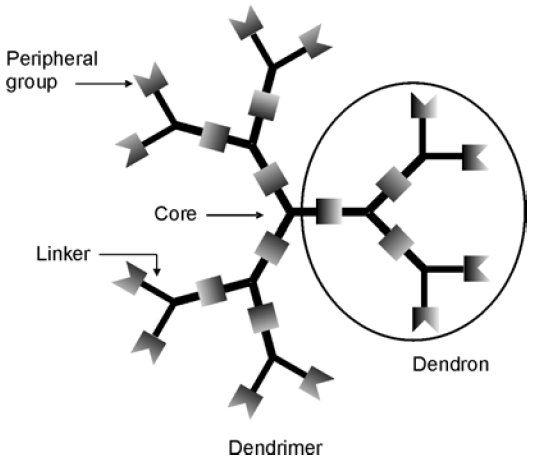
      <p>While peptides are typically linear macromolecules, highly branched structures are also found widely in nature, where the branching and display of multiple terminal functionalities enable the enhancement of functions. At the interface of polymer and synthetic organic chemistry, “dendrimers” have emerged over the past couple of decades as a new class of highly branched molecules. Named based on the Greek word <italic>dendron</italic>, meaning “tree”, dendrimers are macromolecules that have structures resembling those of trees (<xref ref-type="fig" rid="figure1">Figure 1</xref>). As dendrimers are synthesized from branched monomer units in a stepwise manner, monodisperse products are often obtained. In addition, it is possible to achieve precise control over their molecular shape, dimensions, density, polarity, flexibility and solubility by choosing different building/branching units and surface functional groups [<xref ref-type="bibr" rid="B45">45</xref>,<xref ref-type="bibr" rid="B46">46</xref>,<xref ref-type="bibr" rid="B47">47</xref>,<xref ref-type="bibr" rid="B48">48</xref>,<xref ref-type="bibr" rid="B49">49</xref>]. Generally, dendrimers are globe- or ellipsoid-shaped, and they consist of three distinct regions: (1) a central core, (2) repeated branches, and (3) surface functional groups [<xref ref-type="bibr" rid="B50">50</xref>]. The central core should be a molecule with at least two reactive functional groups. The repeated branches are organized in a series of radially concentric layers called ‘’generations’’ [<xref ref-type="bibr" rid="B51">51</xref>]. When iterative growth is conducted from focal point or core molecules containing one reactive group, wedge-shaped structures, commonly referred to as “dendrons” result. </p>
      <fig id="figure1" position="float">
        <label>Figure 1</label>
        <caption>
          <p>Schematic of a dendrimer structure.</p>
        </caption>
        <graphic xmlns:xlink="http://www.w3.org/1999/xlink" xlink:href="pharmaceuticals-03-00636-g001.tif" scale="0"/>
      </fig>
      <p>Dendritic structures have been recognized to be ideal building blocks for biomedical applications because of their monodispersities, high loading capacities, large-scale production, and bioconjugation capabilities [<xref ref-type="bibr" rid="B39">39</xref>,<xref ref-type="bibr" rid="B52">52</xref>,<xref ref-type="bibr" rid="B53">53</xref>,<xref ref-type="bibr" rid="B54">54</xref>] .Most pertinent to their development as analogues of CPPs, the properties of dendrimers are often dominated by their peripheral groups, particularly at high generations owing to the exponential increase in the number of peripheral units with each generation. Thus dendrimers may serve as useful backbones for the conjugation of multiple guanidine groups. Tuning the dendrimer or dendron generation allows the number of guanidine groups to be controlled, while the distance between gaunidines and the flexibilities of the structures can be determined by the selection of the branching monomers and linkers.</p>
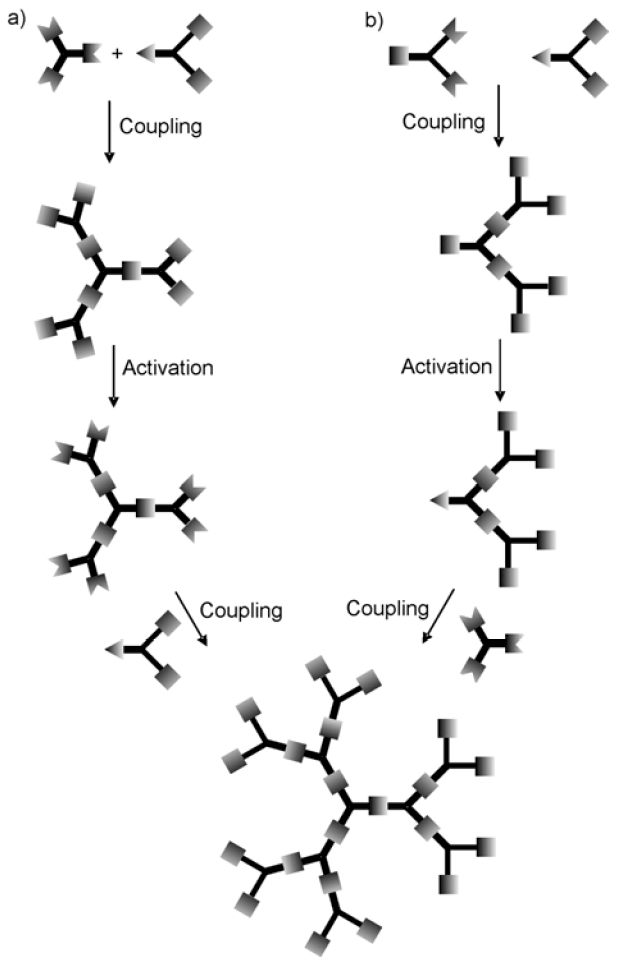
      <p>Generally, there are two approaches used to synthesize dendrimers: the divergent method and the convergent one [<xref ref-type="bibr" rid="B40">40</xref>,<xref ref-type="bibr" rid="B55">55</xref>]. In the divergent approach, the dendrimer is grown outwards from the core by the repetition of coupling and activation steps as shown in <xref ref-type="fig" rid="figure2">Figure 2</xref>a. Repetition of these coupling and activation steps provides an exponential increase in the number of peripheral groups, and reactions at each step. In the convergent approach (<xref ref-type="fig" rid="figure2">Figure 2</xref>b), growth initiates from what will become the dendrimer periphery and progresses towards the core. First the peripheral groups are coupled to each branch of the monomer, while keeping the focal point of the monomer in an unreacted form. This focal point can then be activated and subsequently coupled to another monomer unit. This reaction sequence of coupling and activation continues until the desired generation is reached, and then the resulting dendritic fragments, referred to as “dendrons” are finally coupled to a core molecule. The convergent approach often affords dendrimers with perfect structural homogeneity due to the small number of coupling reactions performed at each step and the possibility to remove flawed structures by purification methods such as chromatography [<xref ref-type="bibr" rid="B51">51</xref>,<xref ref-type="bibr" rid="B55">55</xref>,<xref ref-type="bibr" rid="B56">56</xref>]. However, the divergent approach is the preferred one for the large scale industrial preparation of dendrimers because the quantity of dendrimer sample increases with each generation and the removal of excess reagents by techniques such as precipitation, distillation, or ultrafiltration is facilitated by their differences in mass. In some cases, a divergent synthesis can yield a monodisperse product [<xref ref-type="bibr" rid="B57">57</xref>,<xref ref-type="bibr" rid="B58">58</xref>,<xref ref-type="bibr" rid="B59">59</xref>]. In other cases minor structural flaws resulting from incomplete couplings or side reactions can exist, [<xref ref-type="bibr" rid="B47">47</xref>,<xref ref-type="bibr" rid="B60">60</xref>] but the polydispersities are still as low or lower than can be achieved in the best controlled polymerizations. Although the focus of this review is not to describe the syntheses of the dendrimer backbones in detail, these approaches have allowed for the preparation of several families of dendrimers such as the PAMAM [<xref ref-type="bibr" rid="B61">61</xref>], polypropyleneimine (PPI) [<xref ref-type="bibr" rid="B62">62</xref>], polyester [<xref ref-type="bibr" rid="B63">63</xref>,<xref ref-type="bibr" rid="B64">64</xref>,<xref ref-type="bibr" rid="B65">65</xref>,<xref ref-type="bibr" rid="B66">66</xref>], amino acid [<xref ref-type="bibr" rid="B67">67</xref>,<xref ref-type="bibr" rid="B68">68</xref>,<xref ref-type="bibr" rid="B69">69</xref>,<xref ref-type="bibr" rid="B71">71</xref>], carbohydrate [<xref ref-type="bibr" rid="B72">72</xref>,<xref ref-type="bibr" rid="B73">73</xref>] and various hydrophobic dendrimers [<xref ref-type="bibr" rid="B74">74</xref>,<xref ref-type="bibr" rid="B75">75</xref>]. At this stage, the syntheses of dendrimers is a sufficiently well developed field such that many dendrimer backbones can be prepared on a multigram or larger scale, and several dendrimer backbones including the PAMAM, PPI, polyesters, and polylysines are even commercially available. The ready availability of these backbones provides an additional advantage in their development as analogues of CPPs.</p>
      <fig id="figure2" position="float">
        <label>Figure 2</label>
        <caption>
          <p>Comparison of the (a) divergent and (b) convergent approaches to dendrimer synthesis.</p>
        </caption>
        <graphic xmlns:xlink="http://www.w3.org/1999/xlink" xlink:href="pharmaceuticals-03-00636-g002.tif" scale="0"/>
      </fig>
    </sec>
    <sec>
      <title>3. Syntheses of Guanidine Functionalized Dendrimers</title>
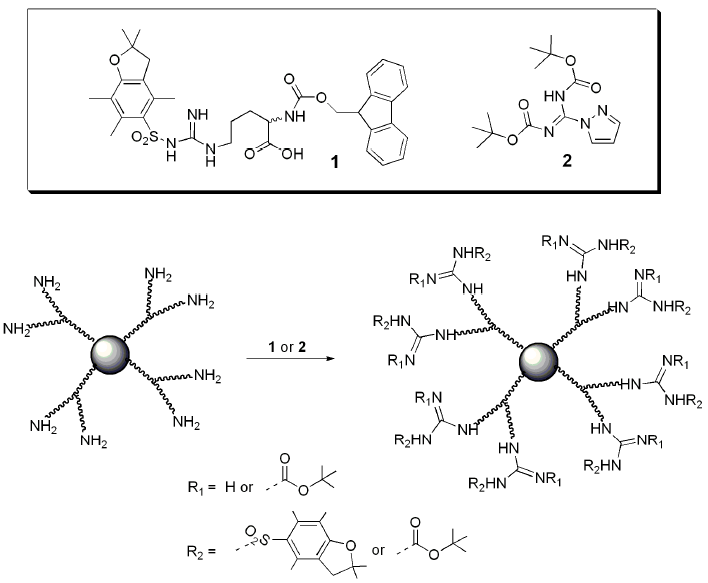
      <p>With many diverse dendrimer backbones readily available commercially or through chemical synthesis, the guanidine end group is generally introduced after the dendrimer synthesis by a final functionalization step. This usually involves guanidinylation of terminal amino groups on the dendrimer using either fluorenylmethyloxycarbonyl (Fmoc) protected arginine (1) [<xref ref-type="bibr" rid="B76">76</xref>] or 1<italic>H</italic>-pyrazole-1-carboxamidine (<bold>2</bold>)<bold/>[<xref ref-type="bibr" rid="B77">77</xref>]<bold/>(<xref ref-type="fig" rid="figure3">Figure 3</xref>). The guanidine moiety of these molecules is generally introduced in a protected form and the protecting group is removed from the dendrimer in the final step.</p>
      <fig id="figure3" position="float">
        <label>Figure 3</label>
        <caption>
          <p>Introduction of the guanidine functionality to a dendrimer’s peripheral amine groups using Fmoc protected arginine (<bold>1</bold>) or 1H-pyrazole-1-carboxamidine (<bold>2</bold>).</p>
        </caption>
        <graphic xmlns:xlink="http://www.w3.org/1999/xlink" xlink:href="pharmaceuticals-03-00636-g003.tif" scale="0"/>
      </fig>
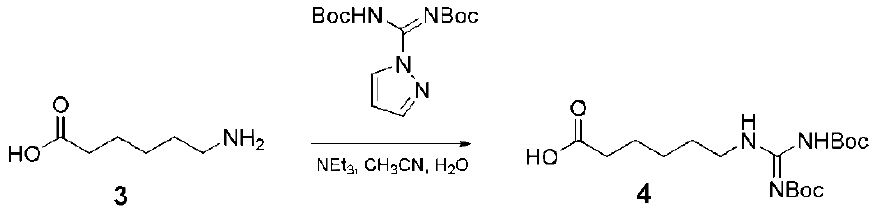
      <p>Fmoc-protected arginine has been used to functionalize polyamide based dendrimers [<xref ref-type="bibr" rid="B78">78</xref>,<xref ref-type="bibr" rid="B79">79</xref>,<xref ref-type="bibr" rid="B80">80</xref>,<xref ref-type="bibr" rid="B81">81</xref>,<xref ref-type="bibr" rid="B82">82</xref>,<xref ref-type="bibr" rid="B83">83</xref>,<xref ref-type="bibr" rid="B84">84</xref>]<bold/>(generally PAMAM) [<xref ref-type="bibr" rid="B79">79</xref>,<xref ref-type="bibr" rid="B80">80</xref>,<xref ref-type="bibr" rid="B81">81</xref>,<xref ref-type="bibr" rid="B82">82</xref>,<xref ref-type="bibr" rid="B83">83</xref>,<xref ref-type="bibr" rid="B84">84</xref>]) and PPI dendrimers [<xref ref-type="bibr" rid="B85">85</xref>]. The pyrazole carboxamidine represents an efficient alternative to increase the reactivity of the coupling and was used to functionalize polyamide [<xref ref-type="bibr" rid="B29">29</xref>,<xref ref-type="bibr" rid="B86">86</xref>], PPI [<xref ref-type="bibr" rid="B87">87</xref>,<xref ref-type="bibr" rid="B88">88</xref>,<xref ref-type="bibr" rid="B89">89</xref>,<xref ref-type="bibr" rid="B90">90</xref>,<xref ref-type="bibr" rid="B91">91</xref>]<bold>, </bold>melamine [<xref ref-type="bibr" rid="B92">92</xref>] and polyether based dendrimers [<xref ref-type="bibr" rid="B93">93</xref>]. In the case of polyester based dendrimers [<xref ref-type="bibr" rid="B94">94</xref>], pyrazole carboxamidine <bold>2</bold> was used to create a guanidine functionalized precursor with a carboxylic acid moiety <bold>4</bold> that was then coupled to the polyester dendrimer by using carbodiimide chemistry (<xref ref-type="fig" rid="figure4">Figure 4</xref>).</p>
      <fig id="figure4" position="float">
        <label>Figure 4</label>
        <caption>
          <p>Synthesis of a guanidine functionalized precursor having a carboxylic acid moiety for coupling to a polyester dendrimer periphery [<xref ref-type="bibr" rid="B94">94</xref>].</p>
        </caption>
        <graphic xmlns:xlink="http://www.w3.org/1999/xlink" xlink:href="pharmaceuticals-03-00636-g004.tif" scale="0"/>
      </fig>
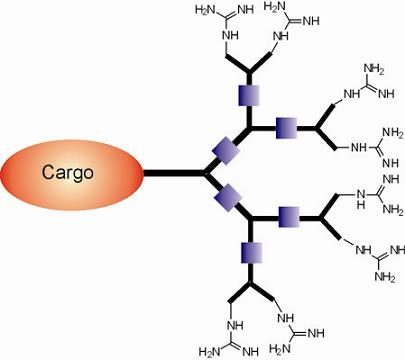
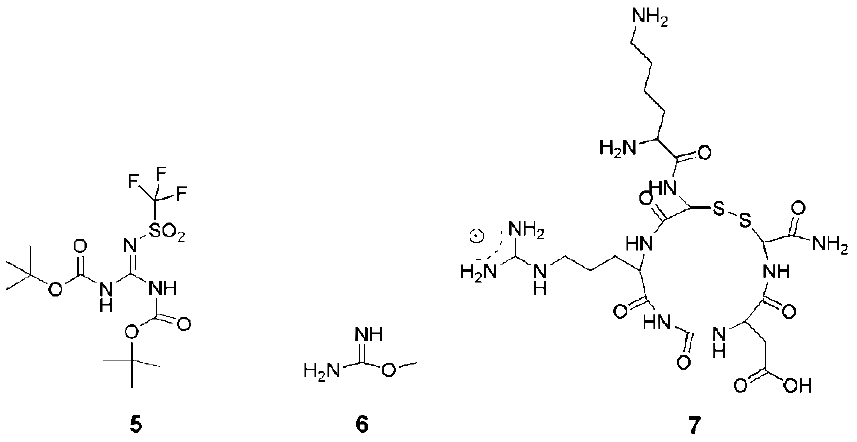
      <p>Occasionally, other precursors such as <italic>N,N’</italic>-diBoc-<italic>N’’</italic>-triflylguanidine (<bold>5</bold>) [<xref ref-type="bibr" rid="B26">26</xref>,<xref ref-type="bibr" rid="B95">95</xref>,<xref ref-type="bibr" rid="B96">96</xref>,<xref ref-type="bibr" rid="B97">97</xref>], <italic>O</italic>-methyl-isourea hydrochloride (<bold>6</bold>)<bold/>[<xref ref-type="bibr" rid="B98">98</xref>,<xref ref-type="bibr" rid="B99">99</xref>]<bold/>or an arginine-containing tri/tetrapeptide <bold>7 </bold>[<xref ref-type="bibr" rid="B100">100</xref>,<xref ref-type="bibr" rid="B101">101</xref>,<xref ref-type="bibr" rid="B102">102</xref>]<bold/>(RGD or CRGD to target αvβ3 Integrins) have also been used to introduce guanidine moieties (<xref ref-type="fig" rid="figure5">Figure 5</xref>).</p>
      <fig id="figure5" position="float">
        <label>Figure 5</label>
        <caption>
          <p>Precursors for the introduction of guanidine moieties.</p>
        </caption>
        <graphic xmlns:xlink="http://www.w3.org/1999/xlink" xlink:href="pharmaceuticals-03-00636-g005.tif" scale="0"/>
      </fig>
    </sec>
    <sec>
      <title>4. Structures and Cellular Internalization of Guanidine Functionalized Dendrimers</title>
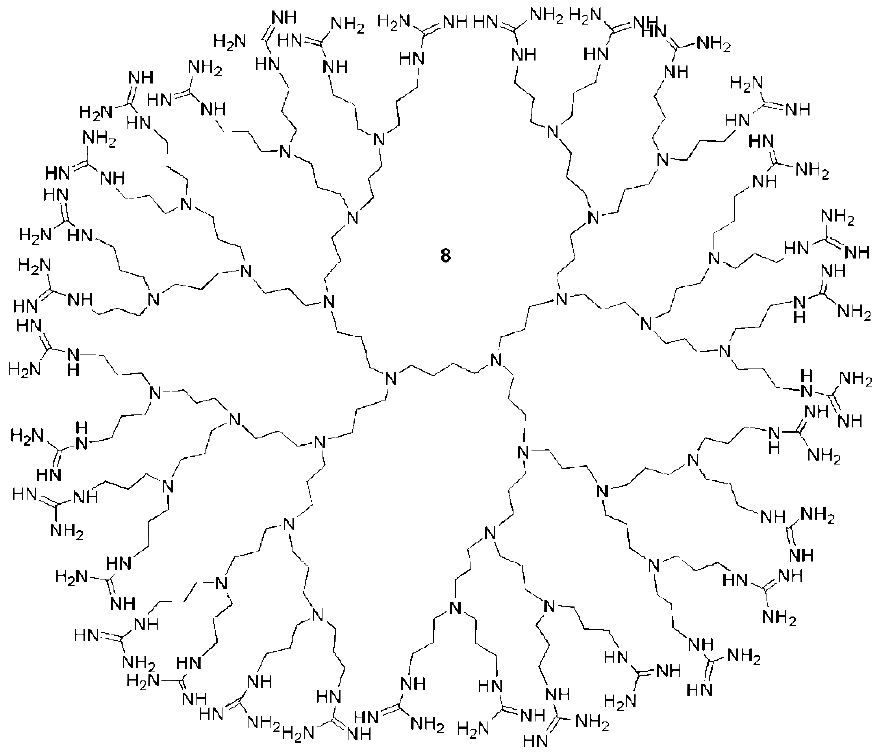
      <p>The translocation of a branched-chain arginine transporter was first investigated with success by Futaki <italic>et al</italic>. [<xref ref-type="bibr" rid="B27">27</xref>]. It was shown that peptide clusters formed by approximately eight arginine residues played a crucial role in translocation. Moreover, flexibility in the positions of the positive charges in these peptides confirmed that a continuous arrangement of the arginine residues was not required. As described above, dendrimers are promising alternative branched backbones for the multivalent display of guanidine functionalities due to their relatively economical syntheses and abilities to display varying numbers of guanidine moieties in a controlled manner. </p>
      <p>Initially, guanidine functionalized PPI dendrimers such as <bold>8</bold> (<xref ref-type="fig" rid="figure6">Figure 6</xref>) were investigated as analogues of CPPs by Paleos and coworkers. The first studies on these macromolecules were focused on liposome internalization of 4th and 5th generation dendrimers [<xref ref-type="bibr" rid="B89">89</xref>,<xref ref-type="bibr" rid="B90">90</xref>]. With a 4th generation dendrimer, liposome uptake was enhanced by the number of guanidine groups. For example, for 0, 6, or 12 guanidines on the dendrimer surface, the liposome uptake was 25%, 60% and 80% respectively. Moreover, for equal concentrations of guanidine moieties, the higher generation dendrimers proved to be more effective in interacting with liposomes. This behavior was attributed to the multivalent effect of the dendrimer [<xref ref-type="bibr" rid="B103">103</xref>,<xref ref-type="bibr" rid="B104">104</xref>]. Nevertheless, this interaction enhancement with increasing dendrimer generation was not correlated with liposome penetration efficiency. An investigation of 3rd and 4th generation guanidine functionalized PPI dendrimers bearing either 16 or 32 guanidine groups respectively showed that the lower generation dendrimer was more effective in penetrating the liposomes [<xref ref-type="bibr" rid="B87">87</xref>]. It was concluded from this work with liposomes that the constraints imposed by the size and the dense surface functionalization inhibited effective liposome internalization of the higher generations despite the multivalent effect leading to a stronger interaction. The effects of decorating the surface with other functionalities were also tested. For example, guanidine functionalized PPI dendrimers were partially actetylated [<xref ref-type="bibr" rid="B87">87</xref>] or partially hyroxylated [<xref ref-type="bibr" rid="B88">88</xref>]. On A549 lung carcinoma cells, partially acetylated derivatives of the 3rd and 4th generation dendrimers showed enhanced translocation abilities compared to the non-acetylated derivatives, an effect attributed to their increased hydrophobicities. In this case, the number of guanidines, eight for the 3rd generation and 14 for the 4th generation, was crucial. Cell uptake was localized to the nucleus for the 3rd generation dendrimer and to the cytosol for the 4th generation dendrimer [<xref ref-type="bibr" rid="B87">87</xref>]. The introduction of hydroxyl groups was accomplished by the ring opening of propylene oxide and led to a decrease in internalization of a 4th generation dendrimer in HEK 293 and COS-7 cells [<xref ref-type="bibr" rid="B88">88</xref>]. However, in this latter case, the partially hydroxylated dendrimers were less toxic.</p>
      <fig id="figure6" position="float">
        <label>Figure 6</label>
        <caption>
          <p>A guanidine functionalized 4th generation PPI dendrimer [<xref ref-type="bibr" rid="B89">89</xref>,<xref ref-type="bibr" rid="B90">90</xref>].</p>
        </caption>
        <graphic xmlns:xlink="http://www.w3.org/1999/xlink" xlink:href="pharmaceuticals-03-00636-g006.tif" scale="0"/>
      </fig>
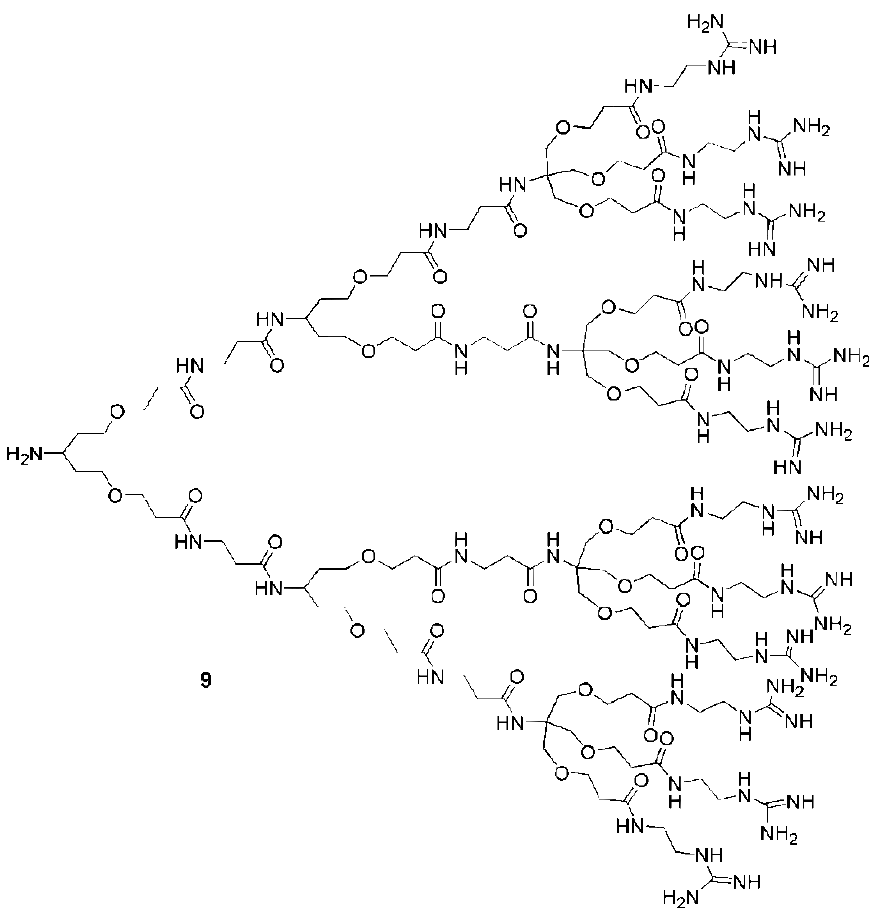
      <p>The second backbone investigated for the development of guanidine functionalized dendrimers was a polyamide. The first studies on these dendrimers were performed by Goodman and coworkers who synthesized dendrons with focal point amine groups for coupling to cargos [<xref ref-type="bibr" rid="B26">26</xref>]. These dendrons such as <bold>9</bold> (<xref ref-type="fig" rid="figure7">Figure 7</xref>) were internalized efficiently into HeLa S3 cells as well as human cervical carcinoma cells. Dendrimers with different numbers of guanidines (1, 3, 6, 9, or 12) on their surfaces were tested. The dendrimers bearing 6, 9 or 12 guanidines exhibited better uptake than dendrimers with 1 or 3 guanidines, suggesting that 6 guanidine groups were sufficient to achieve good translocation. A comparative assay with Tat<sub>49-57</sub> conjugates revealed that dendrons with 9 guanidine groups exhibited the same cell penetrating capabilities as Tat<sub>49-57</sub>. Nevertheless, the dendron was not able to cross the nuclear membrane as efficiently as the Tat<sub>49-57</sub> conjugate. Although the presence of a fully complexed Tat<sub>49-57</sub>-chromophore in the nucleus had not been demonstrated in this work, it has since then been elegantly confirmed by using Cre recombinase as cargo that the Tat conjugate reaches the nucleus without compromising the survival and competency of the cells [<xref ref-type="bibr" rid="B105">105</xref>,<xref ref-type="bibr" rid="B106">106</xref>].</p>
      <fig id="figure7" position="float">
        <label>Figure 7</label>
        <caption>
          <p>A polyamide dendrimer with 12 peripheral guanidines [<xref ref-type="bibr" rid="B26">26</xref>].</p>
        </caption>
        <graphic xmlns:xlink="http://www.w3.org/1999/xlink" xlink:href="pharmaceuticals-03-00636-g007.tif" scale="0"/>
      </fig>
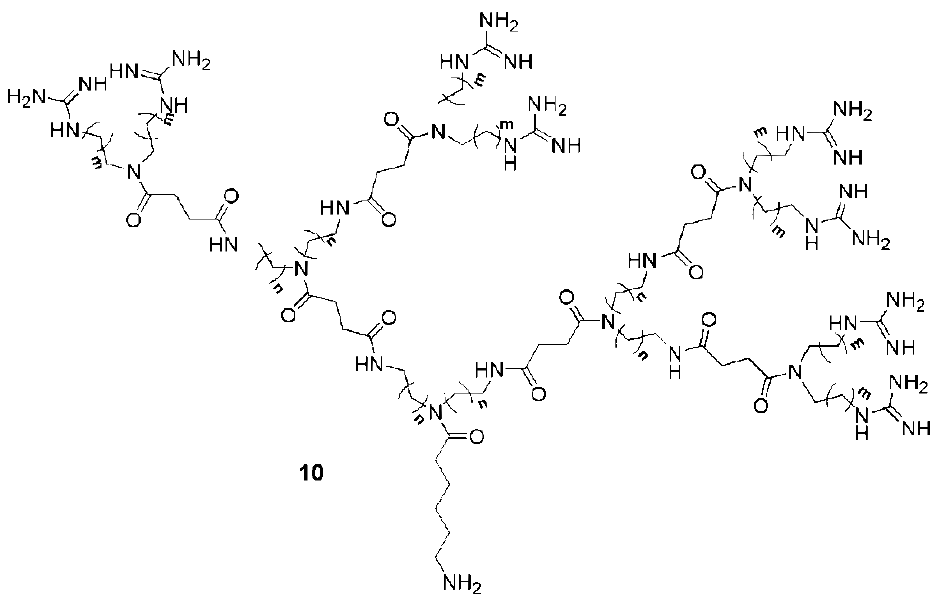
      <p>In other work, the prospect of new guanidine-based transporters prompted Wender and coworkers to study tunable guanidine functionalized polyamide dendrimers [<xref ref-type="bibr" rid="B29">29</xref>]. These authors prepared a series of 9 dendrons, all bearing 9 guanidine groups on their peripheries (<xref ref-type="fig" rid="figure8">Figure 8</xref>). Tunable spacers (n or m, see <xref ref-type="fig" rid="figure8">Figure 8</xref>) incorporated throughout the dendron backbones permitted a study of the effect of spacer length on cell uptake efficiency in the human T cell line Jurkat. The results revealed that the longest hydrocarbon spacers led to faster rates of uptake into cells. For dendrons such as <bold>10</bold> (n = 5, m = 2 or 5), the efficiencies exceeded those of the linear oligoarginine transporter (9-mer). The increased uptake of the dendrons with the longer spacers may be attributed to the increased flexibilities of the backbones as was observed for the linear CPPs; however, the incorporation of longer spacers also introduced increased hydrophobicity which may have enhanced the interaction of the molecules with membranes and thus their uptake. In order to separate the effects of flexibility and hydrophobicity, it would be necessary to compare molecules having hydrophilic versus hydrophobic spacers.</p>
      <fig id="figure8" position="float">
        <label>Figure 8</label>
        <caption>
          <p>Guanidine functionalized polyamide dendrimers incorporating difference spacers (<italic>n,m = 1,2 or 5</italic>) [<xref ref-type="bibr" rid="B29">29</xref>].</p>
        </caption>
        <graphic xmlns:xlink="http://www.w3.org/1999/xlink" xlink:href="pharmaceuticals-03-00636-g008.tif" scale="0"/>
      </fig>
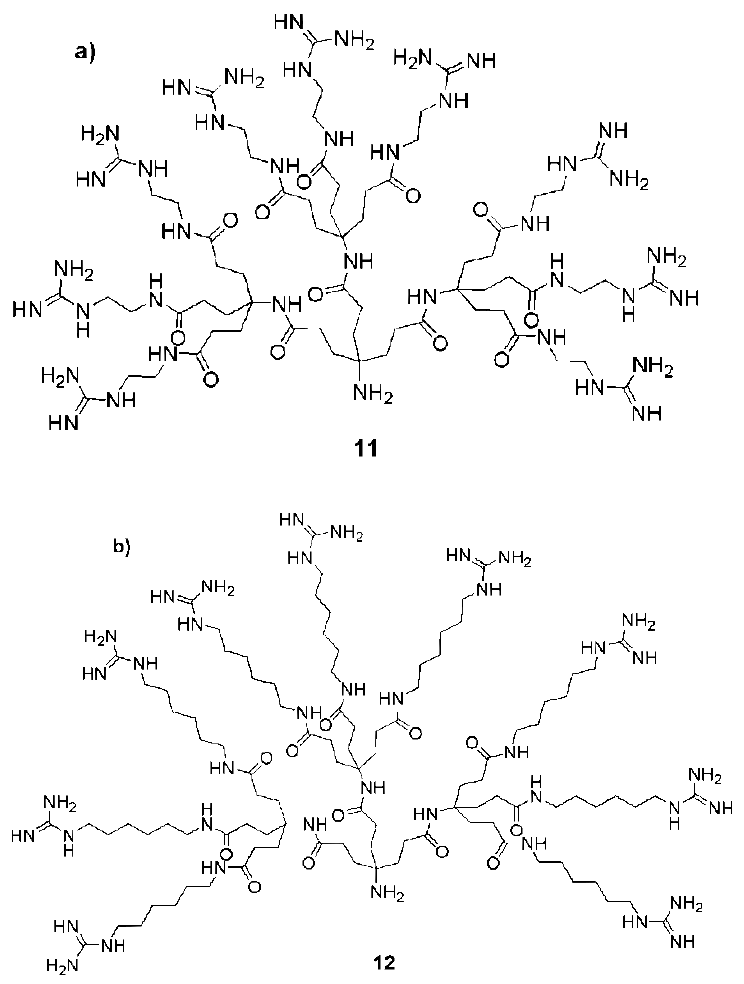
      <p>The effects of spacers were further investigated by Harth et al. They prepared two different dendrons, each bearing 9 peripheral guanidines but with two different spacers: C2 length (<bold>11</bold>) or C6 length (<bold>12</bold>) (<xref ref-type="fig" rid="figure9">Figure 9</xref>) [<xref ref-type="bibr" rid="B95">95</xref>]. Fluorescent conjugates of these dendrons were tested with NIH-3T3 and HMEC cells and the conjugate with the longer spacer was internalized more rapidly. </p>
      <fig id="figure9" position="float">
        <label>Figure 9</label>
        <caption>
          <p>Guanidine functionalized dendrimers having either (a) C2 or (b) C6 spacers [95]</p>
        </caption>
        <graphic xmlns:xlink="http://www.w3.org/1999/xlink" xlink:href="pharmaceuticals-03-00636-g009.tif" scale="0"/>
      </fig>
      <p>Moreover, while the dendron with the longer spacer was localized in the cell nuclei after internalization, the other conjugate was taken up into cytosolic compartments. Dendron <bold>12</bold>, containing the C6 spacer was also used to create protein conjugates [<xref ref-type="bibr" rid="B96">96</xref>,<xref ref-type="bibr" rid="B97">97</xref>]<bold/>but the nuclear localization observed with the dendron alone was lost in these cases. </p>
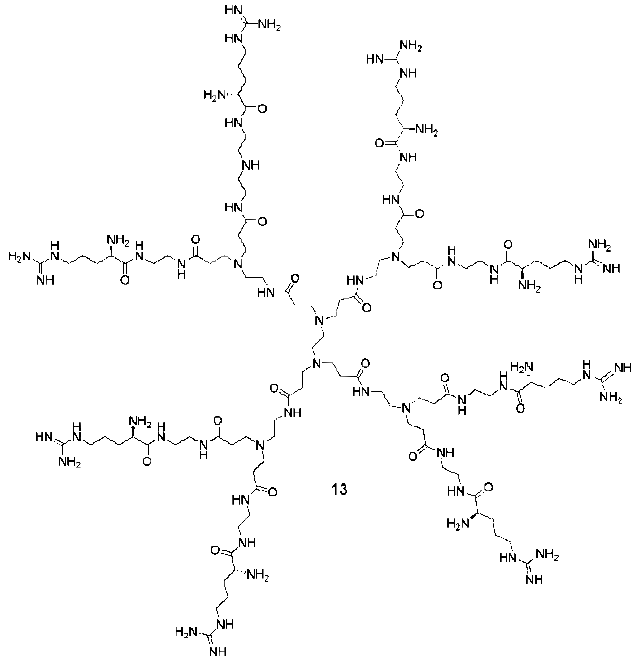
      <p>Another polyamide-based dendrimer investigated for cell penetration was the well-known PAMAM dendrimer. The first attempt to functionalize PAMAM dendrimers with guanidine groups was performed by Park and coworkers [<xref ref-type="bibr" rid="B80">80</xref>]. These authors compared the transfection efficiencies of an arginine functionalized PAMAM dendrimer <bold>13</bold> (<xref ref-type="fig" rid="figure10">Figure 10</xref>) with a lysine functionalized PAMAM dendrimer. </p>
      <fig id="figure10" position="float">
        <label>Figure 10</label>
        <caption>
          <p>A PAMAM dendrimer functionalized with guanidine groups [<xref ref-type="bibr" rid="B85">85</xref>].</p>
        </caption>
        <graphic xmlns:xlink="http://www.w3.org/1999/xlink" xlink:href="pharmaceuticals-03-00636-g010.tif" scale="0"/>
      </fig>
      <p>The results obtained using 293, HepG2, Neuro 2A and vascular smooth muscle cells strongly evidenced the efficiency of the guanidinylated dendrimer and its potential as a good nonviral gene carrier. This first study, carried out using a 4th generation dendrimer with 58 peripheral guanidines opened doors to vulnerable-cell transfection [<xref ref-type="bibr" rid="B79">79</xref>]. Further studies on the 4th generation dendrimer were also done by the same group to evaluate its ability to cross monolayers of CaCo-2 cells [<xref ref-type="bibr" rid="B81">81</xref>]. The results suggested a paracellular transport mechanism (apical-to-basolateral or basolateral-to-apical) revealing the potential for these macromolecules to be used in oral absorption applications.</p>
      <fig id="figure11" position="float">
        <label>Figure 11</label>
        <caption>
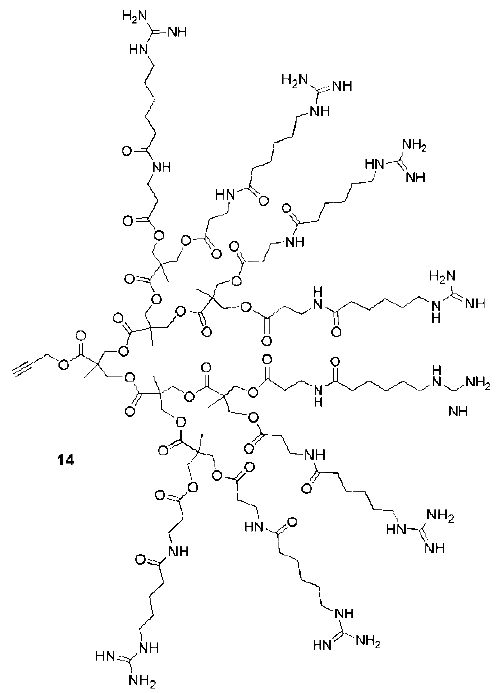
          <p>Guanidine functionalized polyester dendron with a ‘clickable’ focal point [<xref ref-type="bibr" rid="B94">94</xref>].</p>
        </caption>
        <graphic xmlns:xlink="http://www.w3.org/1999/xlink" xlink:href="pharmaceuticals-03-00636-g011.tif" scale="0"/>
      </fig>
      <fig id="figure12" position="float">
        <label>Figure 12</label>
        <caption>
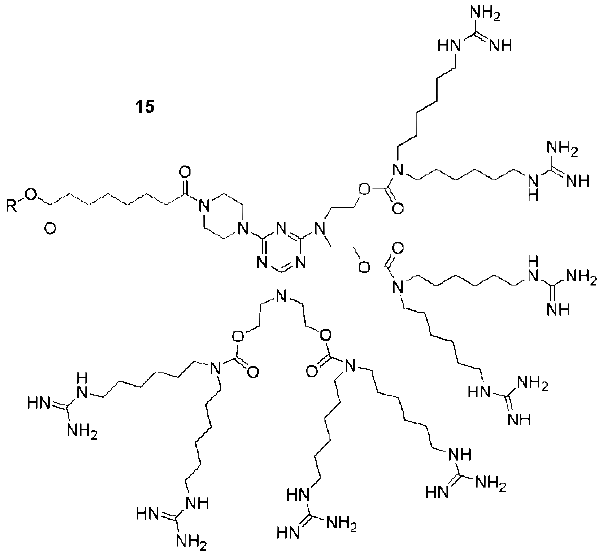
          <p>Guanidine functionalized polycarbamate dendron [<xref ref-type="bibr" rid="B98">98</xref>,<xref ref-type="bibr" rid="B99">99</xref>].</p>
        </caption>
        <graphic xmlns:xlink="http://www.w3.org/1999/xlink" xlink:href="pharmaceuticals-03-00636-g012.tif" scale="0"/>
      </fig>
      <p>Two other guanidine functionalized dendrimers were also developed for cell penetration. A 3rd generation polyester dendron (<bold>14</bold>, <xref ref-type="fig" rid="figure11">Figure 11</xref>) bearing 8 peripheral guanidines exhibited cell-penetrating efficiencies similar to those of Tat<sub>49-57 </sub>in GL261 mouse glioma cells [<xref ref-type="bibr" rid="B94">94</xref>]. Interestingly, this dendron presents a clickable propargyl group at its focal point for conjugation to cargo. The second example was a polycarbamate-based dendron (<bold>15</bold>, <xref ref-type="fig" rid="figure12">Figure 12</xref>), also bearing 8 guanidines. Coupled with different cargos, this CPP analogue gave efficient transfection results <italic>in vivo</italic> (in mice) [<xref ref-type="bibr" rid="B98">98</xref>,<xref ref-type="bibr" rid="B99">99</xref>]. From the studies described above, it is evident that guanidinylated dendrimers are able to act as CPP analogues, with efficiencies similar to those of the peptide Tat<sub>49-57</sub>. A wide variety of dendrimer backbones have been functionalized with guanidine moieties, and the effects of the linkers, dendrimer backbones, and the numbers of guanidines have also been investigated. As for CPPs, these studies have suggested the importance of the flexibilities and conformational freedom of the guanidine moieties in the molecules. With dendrimers, this freedom was easily achieved by tuning the length of the spacers between the guanidine groups and the dendrimer peripheries. It should also be considered that the lengths of these spacers may also affect the overall hydrophobicities of the structures, which may in turn affect their uptake. Furthermore, it was also shown that the structures of the dendrimers impacted the cellular localization (cytosolic <italic>vs. </italic>nuclear), thus suggesting that dendrimers as CPPs analogues are also useful to cross different types of biological membranes.</p>
      <table-wrap id="table2" position="float"><object-id pub-id-type="pii">pharmaceuticals-03-00636_table2</object-id>
        <object-id pub-id-type="pii">pharmaceuticals-03-00636_table2</object-id>
        <label>Table 2</label>
        <caption>
          <p>Guanidinylated dendrimers used for cell-uptake studies.</p>
        </caption>
        <table>
          <thead>
            <tr>
              <th align="left" valign="middle">Backbone</th>
              <th align="left" valign="middle">Guanidines</th>
              <th align="left" valign="middle">Cargo</th>
              <th align="left" valign="middle">Cell-line</th>
              <th align="left" valign="middle">Reference</th>
            </tr>
          </thead>
          <tbody>
            <tr>
              <td align="left" valign="middle">Poly(propylene imine)</td>
              <td align="left" valign="middle">0,6,12</td>
              <td align="left" valign="middle">Betamethasone derivatives</td>
              <td align="left" valign="middle">Liposomes</td>
              <td align="left" valign="middle">[89]</td>
            </tr>
            <tr>
              <td align="left" valign="middle">Poly(propylene imine)</td>
              <td align="left" valign="middle">4,8</td>
              <td align="left" valign="middle">-</td>
              <td align="left" valign="middle">Liposomes</td>
              <td align="left" valign="middle">[90]</td>
            </tr>
            <tr>
              <td align="left" valign="middle">Poly(propylene imine)</td>
              <td align="left" valign="middle">8,14</td>
              <td align="left" valign="middle">FITC</td>
              <td align="left" valign="middle">Human lung carcinoma  (A549)</td>
              <td rowspan="2" align="left" valign="middle">[87]</td>
            </tr>
            <tr>
              <td align="left" valign="middle">Poly(propylene imine)</td>
              <td align="left" valign="middle">16,32</td>
              <td align="left" valign="middle">-</td>
              <td align="left" valign="middle">Liposomes</td>
            </tr>
            <tr>
              <td align="left" valign="middle">Poly(propylene imine)</td>
              <td align="left" valign="middle">0-32</td>
              <td align="left" valign="middle">DNA</td>
              <td align="left" valign="middle">HEK293, COSY7</td>
              <td align="left" valign="middle">[88]</td>
            </tr>
            <tr>
              <td align="left" valign="middle">Poly(propylene imine)</td>
              <td align="left" valign="middle">8</td>
              <td align="left" valign="middle">DNA</td>
              <td align="left" valign="middle">HeLa, 293 cells</td>
              <td align="left" valign="middle">[85]</td>
            </tr>
            <tr>
              <td align="left" valign="middle">Polyamide</td>
              <td align="left" valign="middle">3,6,9,12</td>
              <td align="left" valign="middle">GFP, FITC</td>
              <td align="left" valign="middle">HeLa S3 and Human cervical carcinoma</td>
              <td align="left" valign="middle">[26]</td>
            </tr>
            <tr>
              <td align="left" valign="middle">Polyamide</td>
              <td align="left" valign="middle">9</td>
              <td align="left" valign="middle">FITC</td>
              <td align="left" valign="middle">NIH-3T3 fibroblasts and HMEC</td>
              <td align="left" valign="middle">[95]</td>
            </tr>
            <tr>
              <td align="left" valign="middle">Polyamide</td>
              <td align="left" valign="middle">9</td>
              <td align="left" valign="middle">IgG-Antibodies</td>
              <td align="left" valign="middle">Hep-2 (RSV-GFP)</td>
              <td align="left" valign="middle">[97]</td>
            </tr>
            <tr>
              <td align="left" valign="middle">Polyamide</td>
              <td align="left" valign="middle">9</td>
              <td align="left" valign="middle">Polymer nanoparticles</td>
              <td align="left" valign="middle">NIH-3T3 fibroblasts</td>
              <td align="left" valign="middle">[96]</td>
            </tr>
            <tr>
              <td align="left" valign="middle">Polyamide (dendrigrafts)</td>
              <td align="left" valign="middle">12</td>
              <td align="left" valign="middle">FITC</td>
              <td align="left" valign="middle">Human lung carcinoma  (A549)</td>
              <td align="left" valign="middle">[86]</td>
            </tr>
            <tr>
              <td align="left" valign="middle">Polyamide</td>
              <td align="left" valign="middle">8</td>
              <td align="left" valign="middle">FITC</td>
              <td align="left" valign="middle">Human lymphocyte (T cell line Jurkat)</td>
              <td align="left" valign="middle">[29]</td>
            </tr>
            <tr>
              <td align="left" valign="middle">PAMAM</td>
              <td align="left" valign="middle">58</td>
              <td align="left" valign="middle">DNA</td>
              <td align="left" valign="middle">293, HepG2, Neuro2A, rat vascular smooth muscle cells</td>
              <td align="left" valign="middle">[80]</td>
            </tr>
            <tr>
              <td align="left" valign="middle">PAMAM</td>
              <td align="left" valign="middle">58</td>
              <td align="left" valign="middle">DNA,RNA</td>
              <td align="left" valign="middle">Primary cortical cells (Neurons, glial cells)</td>
              <td align="left" valign="middle">[79]</td>
            </tr>
            <tr>
              <td align="left" valign="middle">PAMAM</td>
              <td align="left" valign="middle">16,32,64</td>
              <td align="left" valign="middle">DNA,RNA</td>
              <td align="left" valign="middle">293, HUVECs</td>
              <td align="left" valign="middle">[81]</td>
            </tr>
            <tr>
              <td align="left" valign="middle">PAMAM</td>
              <td align="left" valign="middle">64</td>
              <td align="left" valign="middle">DNA</td>
              <td align="left" valign="middle">HepG2, HeLa, SMCs, HUVECs</td>
              <td align="left" valign="middle">[82]</td>
            </tr>
            <tr>
              <td align="left" valign="middle">PAMAM</td>
              <td align="left" valign="middle">31,59,60,116</td>
              <td align="left" valign="middle">DNA</td>
              <td align="left" valign="middle">HeLa, 293, A549</td>
              <td align="left" valign="middle">[83]</td>
            </tr>
            <tr>
              <td align="left" valign="middle">Polycarbonate</td>
              <td align="left" valign="middle">8</td>
              <td align="left" valign="middle">Oligonucleotides</td>
              <td align="left" valign="middle">mouse</td>
              <td align="left" valign="middle">[99]</td>
            </tr>
            <tr>
              <td align="left" valign="middle">Polycarbonate</td>
              <td align="left" valign="middle">8</td>
              <td align="left" valign="middle">Oligonucleotides</td>
              <td align="left" valign="middle">mouse</td>
              <td align="left" valign="middle">[98]</td>
            </tr>
            <tr>
              <td align="left" valign="middle">Polyester</td>
              <td align="left" valign="middle">8</td>
              <td align="left" valign="middle">Fe<sub>3</sub>O<sub>4</sub> nanoparticles</td>
              <td align="left" valign="middle">GL261 mouse glioma</td>
              <td align="left" valign="middle">[94]</td>
            </tr>
          </tbody>
        </table>
      </table-wrap>
    </sec>
    <sec>
      <title>5. Cellular Internalization Mechanism</title>
      <p>CPPs can enter cells through multiple mechanisms. Theoretically, both endocytosis and diffusion to the cytosol can occur. Wender highlighted that for CPPs a universal uptake mechanism is not very probable [<xref ref-type="bibr" rid="B23">23</xref>]. However, he defined two common aspects of any mechanistic possibilities derived from the guanidine group: an association occurs first and is followed by the cell uptake itself.</p>
      <p>The first association step involves ionic and hydrogen bonding interactions between the negatively charged carboxylates, phosphates and sulfates belonging to membrane constituents and the guanidine groups, which are protonated and thus positively charged at physiological pH. It was shown that the bidentate hydrogen bond network formed with guanidinium groups is particularly strong and important. For example, monomethylation or dimethylation of the guanidine groups strongly affected the cell uptake with decreases of 80% and 95% respectively [<xref ref-type="bibr" rid="B107">107</xref>]. Moreover, the spatial orientation of the guanidiniums was another key point to facilitate the interaction with the membrane. Space and freedom were required because negatively charged functionalities on the membrane diffuse and repel each other [<xref ref-type="bibr" rid="B23">23</xref>,<xref ref-type="bibr" rid="B24">24</xref>]. Also of importance were the organizational [<xref ref-type="bibr" rid="B108">108</xref>] and multivalent effects [<xref ref-type="bibr" rid="B103">103</xref>,<xref ref-type="bibr" rid="B104">104</xref>]<bold/>that act synergistically to enhance the binding.</p>
      <p>After the first association step, cell-uptake occurs. Theoretically, either endocytosis or diffusion processes permit molecules to enter cells. It is generally accepted that diffusion only occurs for small molecules (molecular weight &lt; 3,000 g·mol<sup>-1</sup>) and involves passive or active transport through the membrane, depending on the molecule [<xref ref-type="bibr" rid="B109">109</xref>]. It was shown that endocytosis is certainly involved for CPPs, because at 4 ºC, a temperature known to inhibit endocytosis, a significant decrease is generally observed [<xref ref-type="bibr" rid="B110">110</xref>,<xref ref-type="bibr" rid="B111">111</xref>]. It is important to note that some uptake is observed under conditions that inhibit endocytosis, suggesting that simple diffusion probably also occurs [<xref ref-type="bibr" rid="B13">13</xref>,<xref ref-type="bibr" rid="B112">112</xref>,<xref ref-type="bibr" rid="B113">113</xref>]. Numerous models for understanding how this direct diffusion of CPPs could occur have been suggested as an inverted micelle model [<xref ref-type="bibr" rid="B3">3</xref>], a carpet model [<xref ref-type="bibr" rid="B114">114</xref>] or an adaptive translocation model [<xref ref-type="bibr" rid="B107">107</xref>]. More details concerning the endocytosis/direct diffusion of CPPs can be found in recent reviews by Wender et al. [<xref ref-type="bibr" rid="B23">23</xref>] and Nakase et al. [<xref ref-type="bibr" rid="B115">115</xref>].</p>
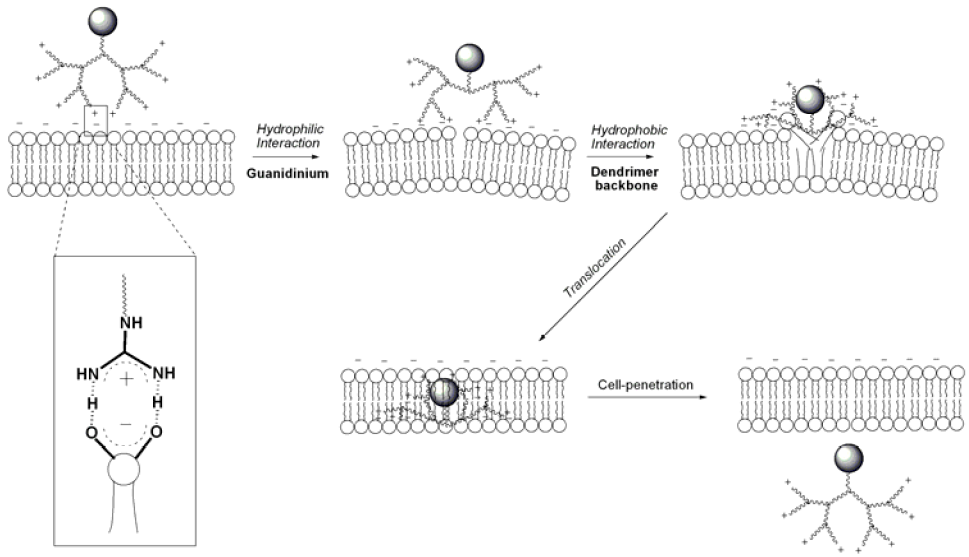
      <p>For dendrimers, all of the elements required for strong interactions between the guanidiniums and the negatively charged membranes were found to be important, including the use of flexible spacers for conformational freedom, and the incorporation of multiple guanidines for organizational and multivalent effects [<xref ref-type="bibr" rid="B116">116</xref>]. For guanidine functionalized dendrimers, Paleos and coworkers proposed a mechanism based on liposome interaction studies that is in principle, applicable to cells [<xref ref-type="bibr" rid="B28">28</xref>] (<xref ref-type="fig" rid="figure13">Figure 13</xref>). This mechanism is based on the possibility for dendrimers to exhibit adaptive solubility behaviour [<xref ref-type="bibr" rid="B117">117</xref>,<xref ref-type="bibr" rid="B118">118</xref>], the ability to become hydrophobic or hydrophilic depending on the environment. After charge neutralization, a change in the dendrimer’s conformation could occur, leading to the exposure of the dendrimer’s hydrophobic interior to the interior of the cell membrane. By this mechanism, the dendrimer may be translocated easily by simple diffusion. This mechanism is certainly concomitant to endocytosis, which may be more important if large or highly hydrophilic cargo is attached to the dendrimer.</p>
      <fig id="figure13" position="float">
        <label>Figure 13</label>
        <caption>
          <p>Postulated mechanism of direct cell penetration for a guanidine functionalized dendrimer/dendron.</p>
        </caption>
        <graphic xmlns:xlink="http://www.w3.org/1999/xlink" xlink:href="pharmaceuticals-03-00636-g013.tif" scale="0"/>
      </fig>
    </sec>
    <sec>
      <title>6. Toxicity of Guanidine Functionalized Dendrimers</title>
      <p>One drawback of the use of polycationic vectors is their potential cell toxicity [<xref ref-type="bibr" rid="B119">119</xref>,<xref ref-type="bibr" rid="B120">120</xref>]. It is important to highlight that toxicity is a relative concept, strongly dependent on the concentration used. Moreover the toxicity as well as the cell-uptake efficiency are cell-line dependent.</p>
      <p>There are several recent examples of the use of CPPs as therapeutic vectors, in which they were found to be well tolerated <italic>in vivo</italic> [<xref ref-type="bibr" rid="B7">7</xref>,<xref ref-type="bibr" rid="B121">121</xref>,<xref ref-type="bibr" rid="B122">122</xref>,<xref ref-type="bibr" rid="B123">123</xref>]. Nevertheless, CPPs have also revealed potentially toxic behaviour [<xref ref-type="bibr" rid="B124">124</xref>,<xref ref-type="bibr" rid="B125">125</xref>,<xref ref-type="bibr" rid="B126">126</xref>]. For example, the full-length Tat protein exerted a toxic action on primary rat neuronal cultures, inducing neuronal cell death that was correlated with the time of exposure [<xref ref-type="bibr" rid="B127">127</xref>]. The neurotoxic effects of this Tat protein had also been previously revealed [<xref ref-type="bibr" rid="B128">128</xref>] as well as for the basic region Tat<sub>49–57</sub> alone [<xref ref-type="bibr" rid="B129">129</xref>]. This basic domain was also able to induce endothelial cell apoptosis [<xref ref-type="bibr" rid="B130">130</xref>]. Although at 100 μM Tat<sub>48–60</sub> did not induce any significant toxicity during a period of 24 h on HeLa cells [<xref ref-type="bibr" rid="B4">4</xref>], at concentrations as high as 1 mM, Tat<sub>49–57</sub> demonstrated a toxic effect in all the cell lines tested [<xref ref-type="bibr" rid="B131">131</xref>]. The precise mechanisms leading to this cytotoxicity still remain unclear but the membrane-disrupting potential of CPPs appears to be correlated with the hydrophobic moment of the peptides [<xref ref-type="bibr" rid="B125">125</xref>]. Moreover, the toxicity of CPPs depends heavily on the peptide concentration, on the cargo molecule attached and on the coupling strategy used [<xref ref-type="bibr" rid="B126">126</xref>].</p>
      <p>First, it is important to emphasize that there is nothing inherently concerning about dendrimers or dendrons. Dendrimers are increasingly being used in a wide variety of biomedical applications [<xref ref-type="bibr" rid="B132">132</xref>,<xref ref-type="bibr" rid="B133">133</xref>] where a number of dendrimer backbones have been found to be well tolerated. For example, polyester dendrimers have been investigated as carriers of the anticancer drug doxorubicin, and even at doses higher than that of the free drug, the delivery system was less toxic [<xref ref-type="bibr" rid="B134">134</xref>]. In addition, PAMAM dendrimers functionalized with the anticancer drug methotrexate and folic acid as a targeting group have been found to be well tolerated <italic>in vivo</italic> [<xref ref-type="bibr" rid="B135">135</xref>]. Another significant example is the dendrimer-based microbiocide VivaGel<sup>TM</sup>, which is in clinical trials for the prevention of HIV or HSV-2 (genital herpes) transmission [<xref ref-type="bibr" rid="B136">136</xref>]. On the other hand, polycationic polymers and dendrimers such as PAMAM and poly(ethyleneimine) (PEI) have also been demonstrated to be toxic under some circumstances. They can induce the formation of nanoscale holes in model lipid membranes and cause dye leakage in cell culture experiments at concentrations in the range of 200 nM [<xref ref-type="bibr" rid="B137">137</xref>,<xref ref-type="bibr" rid="B138">138</xref>,<xref ref-type="bibr" rid="B139">139</xref>,<xref ref-type="bibr" rid="B140">140</xref>,<xref ref-type="bibr" rid="B141">141</xref>,<xref ref-type="bibr" rid="B142">142</xref>]. As a reference, this concentration is lower than the 1 mM concentration cited above for the CPP. Nevertheless, a variety of studies have demonstrated that cationic drug delivery systems (including CPPs) can buffer endolysosomal acidity. This has been termed the “proton sponge” effect [<xref ref-type="bibr" rid="B143">143</xref>]<bold>,</bold> and it has been proposed that due to lysosomal swelling and rupture [<xref ref-type="bibr" rid="B144">144</xref>,<xref ref-type="bibr" rid="B145">145</xref>,<xref ref-type="bibr" rid="B146">146</xref>]<bold/>this is important for allowing an efficient delivery. </p>
      <p>In general, the toxicities of dendrimers have been found to be dependent on the charge state of the dendrimer backbone and the peripheral groups [<xref ref-type="bibr" rid="B142">142</xref>]. Therefore, it is of interest to evaluate the potential toxicities of dendrimers with peripheral guanidines. Some studies have been carried out towards this goal. For example, 4th generation PPI based dendrimers were toxic with or without guanidinium groups, both exhibiting relative cell viabilities of approximately 50% at concentrations of 30 μg·mL<sup>-1</sup> (after 24 h) [<xref ref-type="bibr" rid="B88">88</xref>]. The guanidine functionalized dendrimers were only slightly more toxic. Similar results were also obtained for melamine based dendrimers [<xref ref-type="bibr" rid="B92">92</xref>]. The latter were also hemolytic with a relative hemolysis of 50% (after 24 h) below 10 μg·mL<sup>-1</sup>. A 5th generation PPI dendrimer bearing 64 guanidine moieties was significantly more toxic (10 μM for 50% cell viability after 6 days) than the PPI with primary amine groups (40 μM for 50% cell viability after 6 days) [<xref ref-type="bibr" rid="B91">91</xref>]. Guanidine functionalized PPI dendrimers showed marked dose dependent cytotoxic effects as well as generation effects<bold/>meaning that the number of guanidine groups was correlated to the toxicity [<xref ref-type="bibr" rid="B86">86</xref>,<xref ref-type="bibr" rid="B87">87</xref>]. A second generation dendrimer was consequently less toxic with HeLa and 293 cells, and even with only 8 guanidines, was efficiently internalized by the cells without showing toxicity [<xref ref-type="bibr" rid="B85">85</xref>]. Another interesting finding was that the toxicity was correlated to the efficiency of the internalization of polyamide based dendrimers when the effects of spacers with different degrees of flexibility were studied [<xref ref-type="bibr" rid="B29">29</xref>]. Nevertheless, other polyamide-based guanidinylated dendrimers were not toxic during the internalization [<xref ref-type="bibr" rid="B26">26</xref>,<xref ref-type="bibr" rid="B95">95</xref>]. Thus far there is only one example demonstrating the use of a dendritic guanidines <italic>in vivo</italic> and no toxicity was detected. This work involved carbamate based dendrons, which were successfully used for transfection in mice [<xref ref-type="bibr" rid="B98">98</xref>,<xref ref-type="bibr" rid="B99">99</xref>].</p>
      <p>In some cases, it has been possible to reduce the toxicities of otherwise toxic cell penetrating dendrimers. Studies have focused on the use of lower generation dendrimers [<xref ref-type="bibr" rid="B85">85</xref>,<xref ref-type="bibr" rid="B86">86</xref>]<bold/>when these lower generations have exhibited sufficient cell penetration. Another option has been to decorate the surface with two functionalities such as guanidines for cell uptake and hydroxyls for biocompatibility [<xref ref-type="bibr" rid="B88">88</xref>]. However a decrease in cell uptake was observed in this case. A third option was recently introduced using the PAMAM backbone, with or without the guanidines. The peripheral primary amines were first functionalized to provide a hydroxylated PAMAM dendrimer and then this dendrimer was functionalized with arginine and used for cell internalization with increased biocompatibility [<xref ref-type="bibr" rid="B81">81</xref>,<xref ref-type="bibr" rid="B82">82</xref>].</p>
      <p>Overall, it is difficult to quantitatively compare the toxicities of CPPs with guanidinylated dendrimers as they have not been measured side by side on the same cell lines using the same assays. Such studies will be pertinent in future work in this field. However, based on the successful use of dendrimers in other biomedical applications and the preliminary results described above, it appears that it should be possible to develop relatively non-toxic cell penetrating dendrimers. The key to this success will be the choice of a dendrimer backbone that is preferably uncharged and non-toxic such as the polyester or polycarbamate, as well as careful tuning of the hydrophobic/hydrophilic balance and minimizing the number of guanidines to that required for activity.</p>
    </sec>
    <sec>
      <title>7. Conjugation of Guanidine Functionalized Dendrimers to Cargo</title>
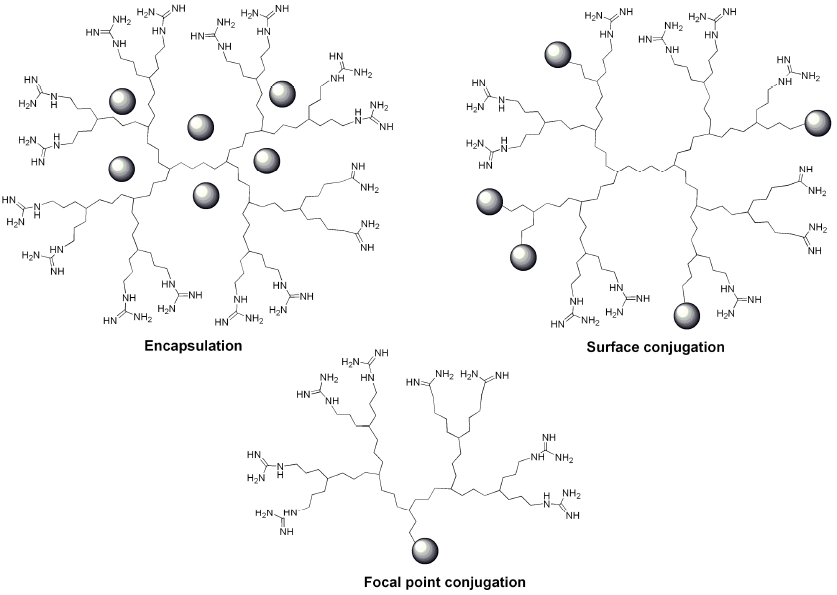
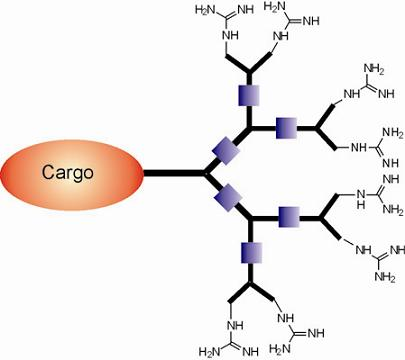
      <p>Interest in CPPs rapidly increased when it became evident that they were able to act as vectors for the delivery of other molecules such as proteins [<xref ref-type="bibr" rid="B147">147</xref>,<xref ref-type="bibr" rid="B148">148</xref>,<xref ref-type="bibr" rid="B149">149</xref>,<xref ref-type="bibr" rid="B150">150</xref>], peptides [<xref ref-type="bibr" rid="B149">149</xref>,<xref ref-type="bibr" rid="B151">151</xref>,<xref ref-type="bibr" rid="B152">152</xref>,<xref ref-type="bibr" rid="B153">153</xref>,<xref ref-type="bibr" rid="B154">154</xref>,<xref ref-type="bibr" rid="B153">153</xref>], nucleic acids [<xref ref-type="bibr" rid="B154">154</xref>,<xref ref-type="bibr" rid="B155">155</xref>,<xref ref-type="bibr" rid="B156">156</xref>,<xref ref-type="bibr" rid="B157">157</xref>,<xref ref-type="bibr" rid="B158">158</xref>,<xref ref-type="bibr" rid="B159">159</xref>,<xref ref-type="bibr" rid="B160">160</xref>], imaging agents [<xref ref-type="bibr" rid="B161">161</xref>,<xref ref-type="bibr" rid="B162">162</xref>,<xref ref-type="bibr" rid="B163">163</xref>], nanocarriers [<xref ref-type="bibr" rid="B164">164</xref>,<xref ref-type="bibr" rid="B165">165</xref>,<xref ref-type="bibr" rid="B168">168</xref>], liposomes [<xref ref-type="bibr" rid="B164">164</xref>,<xref ref-type="bibr" rid="B169">169</xref>,<xref ref-type="bibr" rid="B170">170</xref>,<xref ref-type="bibr" rid="B171">171</xref>], and several small molecules [<xref ref-type="bibr" rid="B33">33</xref>,<xref ref-type="bibr" rid="B172">172</xref>,<xref ref-type="bibr" rid="B173">173</xref>,<xref ref-type="bibr" rid="B174">174</xref>]. Many molecules with anticancer, anti-inflammatory or antimicrobial activities have been successfully associated with dendrimers, either covalently or noncovalently [<xref ref-type="bibr" rid="B175">175</xref>]. First of all, dendrimers are particularly well-suited to encapsulate/complex many small molecules [<xref ref-type="bibr" rid="B39">39</xref>,<xref ref-type="bibr" rid="B176">176</xref>] (<xref ref-type="fig" rid="figure14">Figure 14</xref>a). </p>
      <fig id="figure14" position="float">
        <label>Figure 14</label>
        <caption>
          <p>Guanidine functionalized dendrimers and their association with cargo: (a) encapsulation (b) surface conjugation (c) focal point conjugation.</p>
        </caption>
        <graphic xmlns:xlink="http://www.w3.org/1999/xlink" xlink:href="pharmaceuticals-03-00636-g014.tif" scale="0"/>
      </fig>
      <p>These cargos can physically interact with dendrimers through either the encapsulation into void spaces, the association with surface groups, or a mixture of both. Driving forces for these interactions are hydrogen bonding, van der Waals interactions, and electrostatic attractions between opposite charges on the dendrimers and the cargos [<xref ref-type="bibr" rid="B177">177</xref>]. While the complexation of molecules within guanidinylated dendrimers has been investigated much less extensively, studies carried out thus far have yielded highly promising results. For example, guanidinylated PAMAM dendrimers have been used to encapsulate macromolecules such as DNA and RNA [<xref ref-type="bibr" rid="B79">79</xref>,<xref ref-type="bibr" rid="B80">80</xref>,<xref ref-type="bibr" rid="B81">81</xref>,<xref ref-type="bibr" rid="B82">82</xref>,<xref ref-type="bibr" rid="B83">83</xref>,<xref ref-type="bibr" rid="B85">85</xref>,<xref ref-type="bibr" rid="B88">88</xref>] for transfection applications. The conclusion of these studies was that guanidinylated PAMAM dendrimers were highly potent for transfection, even with vulnerable cells. For mechanistic studies, Paleos and coworkers have encapsulated betamethasone derivatives as dye molecules into guanidine functionalized dendrimers, but these molecules are also commonly used as anti-inflammatory agents [<xref ref-type="bibr" rid="B89">89</xref>].</p>
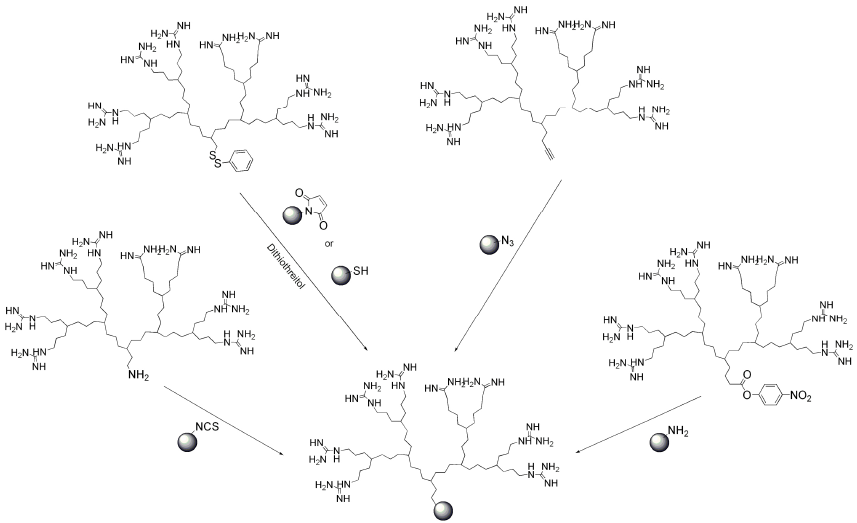
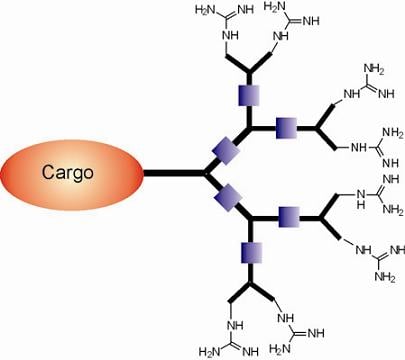
      <p>Alternatively, different approaches have been developed to covalently conjugate the cargo. The first possibility is to conjugate cargo molecules to the dendrimer periphery (<xref ref-type="fig" rid="figure14">Figure 14</xref>b). This approach is often chosen [<xref ref-type="bibr" rid="B133">133</xref>] and has for example been used to synthesize polyester dendrimers as carriers of the anticancer drug doxorubicin [<xref ref-type="bibr" rid="B134">134</xref>] or to produce the dendrimer-based microbiocide VivaGel<sup>TM</sup>, which is in clinical trials for the prevention of HIV or HSV-2 (genital herpes) transmission [<xref ref-type="bibr" rid="B136">136</xref>].<bold/>With guanidinylated dendrimers this approach has also begun to be explored. For example, the partial reaction of nucleophilic surface functionalities on the dendrimer with activated fluorescein dye molecules (FITC), enabled the evaluation of the cellular internalization of the conjugate [<xref ref-type="bibr" rid="B84">84</xref>,<xref ref-type="bibr" rid="B86">86</xref>,<xref ref-type="bibr" rid="B87">87</xref>]. The second possibility was to couple dendrons to cargo molecules at their focal points (<xref ref-type="fig" rid="figure14">Figure 14</xref>c, <xref ref-type="fig" rid="figure15">Figure 15</xref>).</p>
      <fig id="figure15" position="float">
        <label>Figure 15</label>
        <caption>
          <p>Conjugation to cargo via the dendron focal point.</p>
        </caption>
        <graphic xmlns:xlink="http://www.w3.org/1999/xlink" xlink:href="pharmaceuticals-03-00636-g015.tif" scale="0"/>
      </fig>
      <p>For example, dye molecules have been coupled with focal point amine groups of several different dendrons in order to study their cell uptake [<xref ref-type="bibr" rid="B26">26</xref>,<xref ref-type="bibr" rid="B29">29</xref>,<xref ref-type="bibr" rid="B95">95</xref>]. In addition, by using the focal point approach, Goodman and coworkers developed a coupling using a disulfide linker that enabled the conjugation of green fluorescent protein (GFP) to a dendritic guanidine [<xref ref-type="bibr" rid="B26">26</xref>]. Interestingly, the replacement of the low molecular weight fluorescein dye molecule with GFP did not change the translocation activity of their dendron. A disulfide linker was also used to couple dendritic guanidines to antibodies [<xref ref-type="bibr" rid="B97">97</xref>] and to polymer nanoparticles [<xref ref-type="bibr" rid="B96">96</xref>]. These conjugates were efficiently internalized by mammalian cells. For MRI applications, a polyester-based dendritic guanidine with a focal point alkyne was conjugated to azide functionalized Fe<sub>3</sub>O<sub>4</sub> nanoparticles <italic>via</italic> a Cu(I) catalyzed “click” reaction [<xref ref-type="bibr" rid="B94">94</xref>]. This was demonstrated to enhance the cell uptake of the nanoparticles relative to control unfunctionalized nanoparticles, thus increasing the ability to detect the cells by MRI. For transfection applications, oligocarbamate-based dendrons were coupled to oligonucleotides [<xref ref-type="bibr" rid="B98">98</xref>,<xref ref-type="bibr" rid="B99">99</xref>]. In order to accomplish this, the dendrons were first functionalized to bear activated esters at their focal points, with which amines were subsequently reacted. This ‘dendrimeric octa-guanidine’ was highly effective to restore the dystrophin expression in both skeletal and cardiac muscles in the <italic>dystrophic mdx</italic><italic>mice</italic>, as was the case with a CPP [<xref ref-type="bibr" rid="B178">178</xref>]. Moreover, Morcos et al. highlighted that this dendrimeric octaguanidine was highly potent for tissue penetration [<xref ref-type="bibr" rid="B98">98</xref>].</p>
      <p>All of these results indicate that guanidinylated dendrimers can be successfully conjugated to a wide variety of cargos ranging from small molecules to biomacromolecules and nanoparticles. While much of this work is recent, it appears thus far that the dendrimers significantly enhance the cell uptake of their cargo, despite sizes approaching the tens of nanometres range. In addition, the controlled and step-wise nature of dendrimer chemistry enables the preparation of well-defined conjugates, particularly using the focal point approach. Future work in this area will likely involve the optimization of conjugation methods, the selection of the best transporters, and further biological studies of the conjugates.</p>
    </sec>
    <sec>
      <title>8. Conclusions and Perspectives</title>
      <p>Dendrimers and dendrons bearing multiple peripheral guanidine moieties are promising analogues of CPPs. Although this is a new field with much of the progress occurring over the last several yeras, the syntheses of dendrimers is a sufficiently well developed field that a diverse range of dendrimer backbones can be readily prepared on relatively large scales and several reagents have been demonstrated to efficiently introduce guanidines to their peripheries. The many different available dendrimer backbones and linkers have allowed structure-activity relationships to be explored. This research has revealed that guanidine functionalized dendrimers can penetrate cells as efficiently as the HIV Tat<sub>49-57 </sub>peptide and that the incorporation of longer linkers into the dendrimer structure is important for this activity. It may also play a role in determining the subcellar localization of the transporter, an aspect that requires further study. In addition, the ability to tune the dendrimer’s generation has allowed the effect of varying the number of peripheral guanidine groups to be easily explored and it has generally been found that the optimal number is between 6 and 8. While higher numbers of guanidines lead to stronger interactions with membranes, the larger sizes of these molecules can make them more challenging to internalize and can lead to increased toxicity.</p>
      <p>The covalent and non-covalent conjugation of guanidine functionalized dendrons to biologically relevant cargo is an area that is just beginning to be developed. Thus far, some exciting results have emerged demonstrating that dendritic guanidines can facilitate the cellular internalization of even large cargo such as DNA, proteins, and nanoparticles. Nevertheless, cell viability upon internalization needs to be confirmed for these promising systems by the use of functional assays that require cell survival, such as the delivery of Cre recombinase [<xref ref-type="bibr" rid="B105">105</xref>,<xref ref-type="bibr" rid="B106">106</xref>]. Moreover, most of the research concerning guanidinylated dendrons has been carried out <italic>in vitro</italic>, so future efforts will need to focus on translating these results to animal models of disease. As part of this work, the <italic>in vivo</italic> toxicities and biodistribution behaviour of these molecules must be further explored before such systems can be applied in the clinic. It is known that cationic carriers, including CPPs can sometimes exhibit toxicity and research thus far has revealed that dendritic guanidines may not be an exception to this. Moreover, in order to be internalized by the target cells, the system must effectively reach the target site and evade undesired uptake by the reticuloendothelial system. The approaches for achieving this will be highly dependent on the target but may involve active targeting strategies and/or masking the cationic nature of protonated guanidines prior to their arrival at the target. Other promising applications involving the <italic>in vivo</italic> biodistribution and targeting of dendrimers, such as those outlined above, suggest that this work can be successful. Thus, in the future it is likely that the challenge in this field will be the conjugation of dendritic guanidines to a wider array of cargo aimed at specific therapies or imaging applications. In addition, the <italic>in vitro</italic> and <italic>in vivo</italic> efficacies and biocompatibilities of these systems must be explored. Nevertheless, significant progress has been made in this field during a relatively short time period and the results thus far demonstrate that dendritic guanidines are promising molecules for intracellular delivery and are worthy of further attention.</p>
    </sec>
  </body>
  <back>
    <ack>
      <p>We thank the Natural Sciences and Engineering Research Council of Canada, the Ontario Centers of Excellence, and the Canada Research Chairs Program for Funding.</p>
    </ack>
    <ref-list>
      <ref id="B1">
        <citation citation-type="journal">
          <person-group person-group-type="author">
            <name>
              <surname>Frankel</surname>
              <given-names>A.D.</given-names>
            </name>
            <name>
              <surname>Pabo</surname>
              <given-names>C.O.</given-names>
            </name>
          </person-group>
          <article-title>Cellular Uptake of the Tat Protein From Human Immunodeficiency Virus</article-title>
          <source>Cell</source>
          <year>1988</year>
          <volume>55</volume>
          <fpage>1189</fpage>
          <lpage>1193</lpage>
          <pub-id pub-id-type="doi">10.1016/0092-8674(88)90263-2</pub-id>
          <pub-id pub-id-type="pmid">2849510</pub-id>
        </citation>
      </ref>
      <ref id="B2">
        <citation citation-type="journal">
          <person-group person-group-type="author">
            <name>
              <surname>Joliot</surname>
              <given-names>A.H.</given-names>
            </name>
            <name>
              <surname>Triller</surname>
              <given-names>A.</given-names>
            </name>
            <name>
              <surname>Volovitch</surname>
              <given-names>M.</given-names>
            </name>
            <name>
              <surname>Pernelle</surname>
              <given-names>C.</given-names>
            </name>
            <name>
              <surname>Prochiantz</surname>
              <given-names>A.</given-names>
            </name>
          </person-group>
          <article-title>Alpha-2,8-Polysialic Acid is the Neuronal Surface Receptor of Antennapedia Homeobox Peptide</article-title>
          <source>New Biol.</source>
          <year>1991</year>
          <volume>3</volume>
          <fpage>1121</fpage>
          <lpage>1134</lpage>
          <pub-id pub-id-type="pmid">1777485</pub-id>
        </citation>
      </ref>
      <ref id="B3">
        <citation citation-type="journal">
          <person-group person-group-type="author">
            <name>
              <surname>Derossi</surname>
              <given-names>D.</given-names>
            </name>
            <name>
              <surname>Joliot</surname>
              <given-names>A.H.</given-names>
            </name>
            <name>
              <surname>Chassaing</surname>
              <given-names>G.</given-names>
            </name>
            <name>
              <surname>Prochiantz</surname>
              <given-names>A.</given-names>
            </name>
          </person-group>
          <article-title>The Third Helix of the Antennapedia Homeodornain Translocates through Biological Membrane</article-title>
          <source>J. Biol. Chem.</source>
          <year>1994</year>
          <volume>269</volume>
          <fpage>10444</fpage>
          <lpage>10450</lpage>
          <pub-id pub-id-type="pmid">8144628</pub-id>
        </citation>
      </ref>
      <ref id="B4">
        <citation citation-type="journal">
          <person-group person-group-type="author">
            <name>
              <surname>Vives</surname>
              <given-names>E.</given-names>
            </name>
            <name>
              <surname>Brodin</surname>
              <given-names>P.</given-names>
            </name>
            <name>
              <surname>Lebleu</surname>
              <given-names>B.</given-names>
            </name>
          </person-group>
          <article-title>A Truncated HIV-1 Tat Protein Basic Domain Rapidly Translocates through the Plasma Membrane and Accumulates in the Cell Nucleus</article-title>
          <source>J. Biol. Chem.</source>
          <year>1997</year>
          <volume>272</volume>
          <fpage>16010</fpage>
          <lpage>16017</lpage>
          <pub-id pub-id-type="doi">10.1074/jbc.272.25.16010</pub-id>
          <pub-id pub-id-type="pmid">9188504</pub-id>
        </citation>
      </ref>
      <ref id="B5">
        <citation citation-type="journal">
          <person-group person-group-type="author">
            <name>
              <surname>Morris</surname>
              <given-names>M.C.</given-names>
            </name>
            <name>
              <surname>Vidal</surname>
              <given-names>P.</given-names>
            </name>
            <name>
              <surname>Chaloin</surname>
              <given-names>L.</given-names>
            </name>
            <name>
              <surname>Heitz</surname>
              <given-names>F.</given-names>
            </name>
            <name>
              <surname>Divita</surname>
              <given-names>G.</given-names>
            </name>
          </person-group>
          <article-title>A New Peptide Vector for Efficient Delivery of Oligonucleotides into Mammalian Cells</article-title>
          <source>Nucleic Acids Res.</source>
          <year>1997</year>
          <volume>25</volume>
          <fpage>2730</fpage>
          <lpage>2736</lpage>
          <pub-id pub-id-type="doi">10.1093/nar/25.14.2730</pub-id>
          <pub-id pub-id-type="pmid">9207018</pub-id>
        </citation>
      </ref>
      <ref id="B6">
        <citation citation-type="journal">
          <person-group person-group-type="author">
            <name>
              <surname>Pooga</surname>
              <given-names>M.</given-names>
            </name>
            <name>
              <surname>Hallbrink</surname>
              <given-names>M.</given-names>
            </name>
            <name>
              <surname>Zorko</surname>
              <given-names>M.</given-names>
            </name>
            <name>
              <surname>Langel</surname>
              <given-names>U.</given-names>
            </name>
          </person-group>
          <article-title>Cell Penetration by Transportan</article-title>
          <source>FASEB J.</source>
          <year>1998</year>
          <volume>12</volume>
          <fpage>67</fpage>
          <lpage>77</lpage>
          <pub-id pub-id-type="pmid">9438412</pub-id>
        </citation>
      </ref>
      <ref id="B7">
        <citation citation-type="journal">
          <person-group person-group-type="author">
            <name>
              <surname>Morris</surname>
              <given-names>M.C.</given-names>
            </name>
            <name>
              <surname>Deshayes</surname>
              <given-names>S.</given-names>
            </name>
            <name>
              <surname>Heitz</surname>
              <given-names>F.</given-names>
            </name>
            <name>
              <surname>Divita</surname>
              <given-names>G.</given-names>
            </name>
          </person-group>
          <article-title>Cell-penetrating Peptides: From Molecular Mechanisms to Therapeutics</article-title>
          <source>Biol Cell</source>
          <year>2008</year>
          <volume>100</volume>
          <fpage>201</fpage>
          <lpage>217</lpage>
          <pub-id pub-id-type="doi">10.1042/BC20070116</pub-id>
          <pub-id pub-id-type="pmid">18341479</pub-id>
        </citation>
      </ref>
      <ref id="B8">
        <citation citation-type="journal">
          <person-group person-group-type="author">
            <name>
              <surname>Oehlke</surname>
              <given-names>J.</given-names>
            </name>
            <name>
              <surname>Scheller</surname>
              <given-names>A.</given-names>
            </name>
            <name>
              <surname>Wiesner</surname>
              <given-names>B.</given-names>
            </name>
            <name>
              <surname>Krause</surname>
              <given-names>E.</given-names>
            </name>
            <name>
              <surname>Beyermann</surname>
              <given-names>M.</given-names>
            </name>
            <name>
              <surname>Klauschenz</surname>
              <given-names>E.</given-names>
            </name>
            <name>
              <surname>Melzig</surname>
              <given-names>M.</given-names>
            </name>
            <name>
              <surname>Bienert</surname>
              <given-names>M.</given-names>
            </name>
          </person-group>
          <article-title>Cellular Uptake of an Alpha-helical Amphipathic Model Peptide with the Potential to Deliver Polar Compounds into the Cell Interior Non-endocytically</article-title>
          <source>Biochim. Biophys. Acta</source>
          <year>1998</year>
          <volume>1414</volume>
          <fpage>127</fpage>
          <lpage>139</lpage>
          <pub-id pub-id-type="doi">10.1016/S0005-2736(98)00161-8</pub-id>
          <pub-id pub-id-type="pmid">9804921</pub-id>
        </citation>
      </ref>
      <ref id="B9">
        <citation citation-type="journal">
          <person-group person-group-type="author">
            <name>
              <surname>Abes</surname>
              <given-names>S.</given-names>
            </name>
            <name>
              <surname>Moulton</surname>
              <given-names>H.M.</given-names>
            </name>
            <name>
              <surname>Clair</surname>
              <given-names>P.</given-names>
            </name>
            <name>
              <surname>Prevot</surname>
              <given-names>P.</given-names>
            </name>
            <name>
              <surname>Youngblood</surname>
              <given-names>D.S.</given-names>
            </name>
            <name>
              <surname>Wu</surname>
              <given-names>R.P.</given-names>
            </name>
            <name>
              <surname>Iversen</surname>
              <given-names>P.L.</given-names>
            </name>
            <name>
              <surname>Lebleu</surname>
              <given-names>B.</given-names>
            </name>
          </person-group>
          <article-title>Vectorization of Morpholino Oligomers by the (R–Ahx-R)4 Peptide Allows Efficient Splicing Correction in the Absence of Endosomolytic Agents</article-title>
          <source>J. Control. Release</source>
          <year>2006</year>
          <volume>116</volume>
          <fpage>304</fpage>
          <lpage>313</lpage>
          <pub-id pub-id-type="doi">10.1016/j.jconrel.2006.09.011</pub-id>
          <pub-id pub-id-type="pmid">17097177</pub-id>
        </citation>
      </ref>
      <ref id="B10">
        <citation citation-type="journal">
          <person-group person-group-type="author">
            <name>
              <surname>Ivanova</surname>
              <given-names>G.D.</given-names>
            </name>
            <name>
              <surname>Arzumanov</surname>
              <given-names>A.</given-names>
            </name>
            <name>
              <surname>Abes</surname>
              <given-names>R.</given-names>
            </name>
            <name>
              <surname>Yin</surname>
              <given-names>H.</given-names>
            </name>
            <name>
              <surname>Wood</surname>
              <given-names>M.J.</given-names>
            </name>
            <name>
              <surname>Lebleu</surname>
              <given-names>B.</given-names>
            </name>
            <name>
              <surname>Gait</surname>
              <given-names>M.J.</given-names>
            </name>
          </person-group>
          <article-title>Improved Cell-penetrating Peptide–PNA Conjugates for Splicing Redirection in HeLa Cells and Exon Skipping in Mdx Mouse Muscle</article-title>
          <source>Nucleic Acids Res.</source>
          <year>2008</year>
          <volume>36</volume>
          <fpage>6418</fpage>
          <lpage>6428</lpage>
          <pub-id pub-id-type="doi">10.1093/nar/gkn671</pub-id>
          <pub-id pub-id-type="pmid">18842625</pub-id>
        </citation>
      </ref>
      <ref id="B11">
        <citation citation-type="journal">
          <person-group person-group-type="author">
            <name>
              <surname>Mae</surname>
              <given-names>M.</given-names>
            </name>
            <name>
              <surname>El Andaloussi</surname>
              <given-names>S.</given-names>
            </name>
            <name>
              <surname>Lundin</surname>
              <given-names>P.</given-names>
            </name>
            <name>
              <surname>Oskolkov</surname>
              <given-names>N.</given-names>
            </name>
            <name>
              <surname>Johansson</surname>
              <given-names>H.J.</given-names>
            </name>
            <name>
              <surname>Guterstam</surname>
              <given-names>P.</given-names>
            </name>
            <name>
              <surname>Langel</surname>
              <given-names>U.</given-names>
            </name>
          </person-group>
          <article-title>A Stearylated CPP for Delivery of Splice Correcting Oligonucleotides Using a Non-covalent Co-incubation Strategy</article-title>
          <source>J. Control. Release</source>
          <year>2009</year>
          <volume>134</volume>
          <fpage>221</fpage>
          <lpage>227</lpage>
          <pub-id pub-id-type="doi">10.1016/j.jconrel.2008.11.025</pub-id>
          <pub-id pub-id-type="pmid">19105971</pub-id>
        </citation>
      </ref>
      <ref id="B12">
        <citation citation-type="journal">
          <person-group person-group-type="author">
            <name>
              <surname>De Coupade</surname>
              <given-names>C.</given-names>
            </name>
            <name>
              <surname>Fittipaldi</surname>
              <given-names>A.</given-names>
            </name>
            <name>
              <surname>Chagnas</surname>
              <given-names>V.</given-names>
            </name>
            <name>
              <surname>Michel</surname>
              <given-names>M.</given-names>
            </name>
            <name>
              <surname>Carlier</surname>
              <given-names>S.</given-names>
            </name>
            <name>
              <surname>Tasciott</surname>
              <given-names>E.</given-names>
            </name>
            <name>
              <surname>Darmon</surname>
              <given-names>A.</given-names>
            </name>
            <name>
              <surname>Ravel</surname>
              <given-names>D.</given-names>
            </name>
            <name>
              <surname>Kearsey</surname>
              <given-names>J.</given-names>
            </name>
            <name>
              <surname>Giacca</surname>
              <given-names>M.</given-names>
            </name>
            <name>
              <surname>Cailler</surname>
              <given-names>F.</given-names>
            </name>
          </person-group>
          <article-title>Novel Human-derived Cell-penetrating Peptides for Specific Subcellular Delivery of Therapeutic Biomolecules</article-title>
          <source>Biochem. J.</source>
          <year>2005</year>
          <volume>390</volume>
          <fpage>407</fpage>
          <lpage>418</lpage>
          <pub-id pub-id-type="doi">10.1042/BJ20050401</pub-id>
          <pub-id pub-id-type="pmid">15859953</pub-id>
        </citation>
      </ref>
      <ref id="B13">
        <citation citation-type="journal">
          <person-group person-group-type="author">
            <name>
              <surname>Mitchell</surname>
              <given-names>D.J.</given-names>
            </name>
            <name>
              <surname>Kim</surname>
              <given-names>D.T.</given-names>
            </name>
            <name>
              <surname>Steinman</surname>
              <given-names>L.</given-names>
            </name>
            <name>
              <surname>Fathman</surname>
              <given-names>C.G.</given-names>
            </name>
            <name>
              <surname>Rothbard</surname>
              <given-names>J.B.</given-names>
            </name>
          </person-group>
          <article-title>Polyarginine Enters Cells More Efficiently Than Other Polycationic Homopolymers</article-title>
          <source>J. Pept. Res.</source>
          <year>2000</year>
          <volume>56</volume>
          <fpage>318</fpage>
          <lpage>325</lpage>
          <pub-id pub-id-type="doi">10.1034/j.1399-3011.2000.00723.x</pub-id>
          <pub-id pub-id-type="pmid">11095185</pub-id>
        </citation>
      </ref>
      <ref id="B14">
        <citation citation-type="journal">
          <person-group person-group-type="author">
            <name>
              <surname>Futaki</surname>
              <given-names>S.</given-names>
            </name>
            <name>
              <surname>Suzuki</surname>
              <given-names>T.</given-names>
            </name>
            <name>
              <surname>Ohashi</surname>
              <given-names>W.</given-names>
            </name>
            <name>
              <surname>Yagami</surname>
              <given-names>T.</given-names>
            </name>
            <name>
              <surname>Tanaka</surname>
              <given-names>S.</given-names>
            </name>
            <name>
              <surname>Ueda</surname>
              <given-names>K.</given-names>
            </name>
            <name>
              <surname>Sugiura</surname>
              <given-names>Y.</given-names>
            </name>
          </person-group>
          <article-title>Arginine-rich Peptides</article-title>
          <source>J. Biol. Chem.</source>
          <year>2001</year>
          <volume>276</volume>
          <fpage>5836</fpage>
          <lpage>5840</lpage>
          <pub-id pub-id-type="doi">10.1074/jbc.M007540200</pub-id>
          <pub-id pub-id-type="pmid">11084031</pub-id>
        </citation>
      </ref>
      <ref id="B15">
        <citation citation-type="journal">
          <person-group person-group-type="author">
            <name>
              <surname>Futaki</surname>
              <given-names>S.</given-names>
            </name>
            <name>
              <surname>Nakase</surname>
              <given-names>I.</given-names>
            </name>
            <name>
              <surname>Tadokoro</surname>
              <given-names>A.</given-names>
            </name>
            <name>
              <surname>Takeuchi</surname>
              <given-names>T.</given-names>
            </name>
            <name>
              <surname>Jones</surname>
              <given-names>A.T.</given-names>
            </name>
          </person-group>
          <article-title>Arginine-rich Peptides and Their Internalization Mechanisms</article-title>
          <source>Bio. Soc. Trans.</source>
          <year>2007</year>
          <volume>35</volume>
          <fpage>784</fpage>
          <lpage>787</lpage>
          <pub-id pub-id-type="doi">10.1042/BST0350784</pub-id>
        </citation>
      </ref>
      <ref id="B16">
        <citation citation-type="journal">
          <person-group person-group-type="author">
            <name>
              <surname>Ward</surname>
              <given-names>B.</given-names>
            </name>
            <name>
              <surname>Seal</surname>
              <given-names>B.L.</given-names>
            </name>
            <name>
              <surname>Brophy</surname>
              <given-names>C.M.</given-names>
            </name>
            <name>
              <surname>Panitch</surname>
              <given-names>A.</given-names>
            </name>
          </person-group>
          <article-title>Design of a Bioactive Cell-penetrating Peptide: When a Transduction Domain Does More Than Transduce</article-title>
          <source>J. Pept. Sci.</source>
          <year>2009</year>
          <volume>15</volume>
          <fpage>668</fpage>
          <lpage>674</lpage>
          <pub-id pub-id-type="doi">10.1002/psc.1168</pub-id>
          <pub-id pub-id-type="pmid">19691016</pub-id>
        </citation>
      </ref>
      <ref id="B17">
        <citation citation-type="journal">
          <person-group person-group-type="author">
            <name>
              <surname>Mueller</surname>
              <given-names>J.</given-names>
            </name>
            <name>
              <surname>Kretzschmar</surname>
              <given-names>I.</given-names>
            </name>
            <name>
              <surname>Volkmer</surname>
              <given-names>R.</given-names>
            </name>
            <name>
              <surname>Boisguerin</surname>
              <given-names>P.</given-names>
            </name>
          </person-group>
          <article-title>Comparison of Cellular Uptake Using 22 CPPs in 4 Different Cell Lines</article-title>
          <source>Bioconjug. Chem.</source>
          <year>2008</year>
          <volume>19</volume>
          <fpage>2363</fpage>
          <lpage>2374</lpage>
          <pub-id pub-id-type="doi">10.1021/bc800194e</pub-id>
          <pub-id pub-id-type="pmid">19053306</pub-id>
        </citation>
      </ref>
      <ref id="B18">
        <citation citation-type="journal">
          <person-group person-group-type="author">
            <name>
              <surname>Said Hassane</surname>
              <given-names>F.</given-names>
            </name>
            <name>
              <surname>Saleh</surname>
              <given-names>A.F.</given-names>
            </name>
            <name>
              <surname>Abes</surname>
              <given-names>R.</given-names>
            </name>
            <name>
              <surname>Gait</surname>
              <given-names>M.J.</given-names>
            </name>
            <name>
              <surname>Lebleu</surname>
              <given-names>B.</given-names>
            </name>
          </person-group>
          <article-title>Cell Penetrating Peptides: Overview and Applications to the Delivery of Oligonucleotides</article-title>
          <source>Cell. Mol. Life Sci.</source>
          <year>2009</year>
          <volume>67</volume>
          <fpage>715</fpage>
          <lpage>726</lpage>
          <pub-id pub-id-type="doi">10.1007/s00018-009-0186-0</pub-id>
          <pub-id pub-id-type="pmid">19898741</pub-id>
        </citation>
      </ref>
      <ref id="B19">
        <citation citation-type="journal">
          <person-group person-group-type="author">
            <name>
              <surname>Heitz</surname>
              <given-names>F.</given-names>
            </name>
            <name>
              <surname>Morris</surname>
              <given-names>M.C.</given-names>
            </name>
            <name>
              <surname>Divita</surname>
              <given-names>G.</given-names>
            </name>
          </person-group>
          <article-title>Twenty Years of Cell-penetrating Peptides: From Molecular Mechanisms to Therapeutics</article-title>
          <source>Br. J. Pharmacol.</source>
          <year>2009</year>
          <volume>157</volume>
          <fpage>195</fpage>
          <lpage>206</lpage>
          <pub-id pub-id-type="doi">10.1111/j.1476-5381.2009.00057.x</pub-id>
          <pub-id pub-id-type="pmid">19309362</pub-id>
        </citation>
      </ref>
      <ref id="B20">
        <citation citation-type="book">
          <person-group person-group-type="author">
            <name>
              <surname>Langel</surname>
              <given-names>U.</given-names>
            </name>
          </person-group>
          <source>Cell-penetrating Peptides: Processes and Applications</source>
          <publisher-name>CRC Press</publisher-name>
          <publisher-loc>London, UK</publisher-loc>
          <year>2002</year>
        </citation>
      </ref>
      <ref id="B21">
        <citation citation-type="journal">
          <person-group person-group-type="author">
            <name>
              <surname>Lindsay</surname>
              <given-names>M.A.</given-names>
            </name>
          </person-group>
          <article-title>Peptide-Mediated Cell Delivery: Application in Protein Target Validation</article-title>
          <source>Curr Opin. Pharmacol.</source>
          <year>2002</year>
          <volume>2</volume>
          <fpage>587</fpage>
          <lpage>594</lpage>
          <pub-id pub-id-type="doi">10.1016/S1471-4892(02)00199-6</pub-id>
        </citation>
      </ref>
      <ref id="B22">
        <citation citation-type="journal">
          <person-group person-group-type="author">
            <name>
              <surname>Bennett</surname>
              <given-names>R.P.</given-names>
            </name>
            <name>
              <surname>Dalby</surname>
              <given-names>B.</given-names>
            </name>
          </person-group>
          <article-title>Protein Delivery Using VP22</article-title>
          <source>Nat. Biotechnol.</source>
          <year>2002</year>
          <volume>20</volume>
          <fpage>20</fpage>
          <lpage>20</lpage>
          <pub-id pub-id-type="doi">10.1038/nbt0102-20</pub-id>
          <pub-id pub-id-type="pmid">11753353</pub-id>
        </citation>
      </ref>
      <ref id="B23">
        <citation citation-type="journal">
          <person-group person-group-type="author">
            <name>
              <surname>Wender</surname>
              <given-names>P.A.</given-names>
            </name>
            <name>
              <surname>Galliher</surname>
              <given-names>W.C.</given-names>
            </name>
            <name>
              <surname>Goun</surname>
              <given-names>E.A.</given-names>
            </name>
            <name>
              <surname>Jones</surname>
              <given-names>L.R.</given-names>
            </name>
            <name>
              <surname>Pillow</surname>
              <given-names>T.H.</given-names>
            </name>
          </person-group>
          <article-title>The Design of Guanidinium-rich Transporters and Their Internalization Mechanisms</article-title>
          <source>Adv. Drug Delivery Rev.</source>
          <year>2008</year>
          <volume>60</volume>
          <fpage>452</fpage>
          <lpage>472</lpage>
          <pub-id pub-id-type="doi">10.1016/j.addr.2007.10.016</pub-id>
        </citation>
      </ref>
      <ref id="B24">
        <citation citation-type="journal">
          <person-group person-group-type="author">
            <name>
              <surname>Wender</surname>
              <given-names>P.A.</given-names>
            </name>
            <name>
              <surname>Mitchell</surname>
              <given-names>D.J.</given-names>
            </name>
            <name>
              <surname>Pattabiraman</surname>
              <given-names>K.</given-names>
            </name>
            <name>
              <surname>Pelkey</surname>
              <given-names>E.T.</given-names>
            </name>
            <name>
              <surname>Steinman</surname>
              <given-names>L.</given-names>
            </name>
            <name>
              <surname>Rothbard</surname>
              <given-names>J.B.</given-names>
            </name>
          </person-group>
          <article-title>The Design, Synthesis, and Evaluation of Molecules that Enable or Enhance Cellular Uptake: Peptoid Molecular Transporters</article-title>
          <source>Proc. Natl. Acad. Sci. USA</source>
          <year>2000</year>
          <volume>97</volume>
          <fpage>13003</fpage>
          <lpage>13008</lpage>
          <pub-id pub-id-type="doi">10.1073/pnas.97.24.13003</pub-id>
        </citation>
      </ref>
      <ref id="B25">
        <citation citation-type="journal">
          <person-group person-group-type="author">
            <name>
              <surname>Rothbard</surname>
              <given-names>J.B.</given-names>
            </name>
            <name>
              <surname>Kreider</surname>
              <given-names>E.</given-names>
            </name>
            <name>
              <surname>VanDeusen</surname>
              <given-names>C.L.</given-names>
            </name>
            <name>
              <surname>Wright</surname>
              <given-names>L.</given-names>
            </name>
            <name>
              <surname>Wylie</surname>
              <given-names>B.L.</given-names>
            </name>
            <name>
              <surname>Wender</surname>
              <given-names>P.A.</given-names>
            </name>
          </person-group>
          <article-title>Arginine-Rich Molecular Transporters for Drug Delivery: Role of Backbone Spacing in Cellular Uptake</article-title>
          <source>J. Med. Chem.</source>
          <year>2002</year>
          <volume>45</volume>
          <fpage>3612</fpage>
          <lpage>3618</lpage>
          <pub-id pub-id-type="doi">10.1021/jm0105676</pub-id>
          <pub-id pub-id-type="pmid">12166934</pub-id>
        </citation>
      </ref>
      <ref id="B26">
        <citation citation-type="journal">
          <person-group person-group-type="author">
            <name>
              <surname>Chung</surname>
              <given-names>H.</given-names>
            </name>
            <name>
              <surname>Harms</surname>
              <given-names>G.</given-names>
            </name>
            <name>
              <surname>Seong</surname>
              <given-names>C.M.</given-names>
            </name>
            <name>
              <surname>Choi</surname>
              <given-names>B.H.</given-names>
            </name>
            <name>
              <surname>Min</surname>
              <given-names>C.</given-names>
            </name>
            <name>
              <surname>Taulane</surname>
              <given-names>J.P.</given-names>
            </name>
            <name>
              <surname>Goodman</surname>
              <given-names>M.</given-names>
            </name>
          </person-group>
          <article-title>Dendritic Oligoguanidines as Intracellular Translocators</article-title>
          <source>Biopolymers</source>
          <year>2004</year>
          <volume>76</volume>
          <fpage>83</fpage>
          <lpage>96</lpage>
          <pub-id pub-id-type="doi">10.1002/bip.10597</pub-id>
          <pub-id pub-id-type="pmid">14997478</pub-id>
        </citation>
      </ref>
      <ref id="B27">
        <citation citation-type="journal">
          <person-group person-group-type="author">
            <name>
              <surname>Futaki</surname>
              <given-names>S.</given-names>
            </name>
            <name>
              <surname>Nakase</surname>
              <given-names>I.</given-names>
            </name>
            <name>
              <surname>Suzuki</surname>
              <given-names>T.</given-names>
            </name>
            <name>
              <surname>Youjun</surname>
              <given-names>Y.</given-names>
            </name>
            <name>
              <surname>Sugiura</surname>
              <given-names>Y.</given-names>
            </name>
          </person-group>
          <article-title>Translocation of Branched-Chain Arginine Peptides through Cell Membranes: Flexibility in the Spatial Disposition of Positive Charges in Membrane-Permeable Peptides</article-title>
          <source>Biochemistry</source>
          <year>2002</year>
          <volume>41</volume>
          <fpage>7925</fpage>
          <lpage>7930</lpage>
          <pub-id pub-id-type="doi">10.1021/bi0256173</pub-id>
          <pub-id pub-id-type="pmid">12069581</pub-id>
        </citation>
      </ref>
      <ref id="B28">
        <citation citation-type="journal">
          <person-group person-group-type="author">
            <name>
              <surname>Pantos</surname>
              <given-names>A.</given-names>
            </name>
            <name>
              <surname>Tsogas</surname>
              <given-names>I.</given-names>
            </name>
            <name>
              <surname>Paleos</surname>
              <given-names>C.M.</given-names>
            </name>
          </person-group>
          <article-title>Guanidinium Group: A Versatile Moiety Inducing Transport and Multicompartmentalization in Complementary Membranes</article-title>
          <source>Biochim. Biophys. Acta</source>
          <year>2008</year>
          <volume>1778</volume>
          <fpage>811</fpage>
          <lpage>823</lpage>
          <pub-id pub-id-type="doi">10.1016/j.bbamem.2007.12.003</pub-id>
          <pub-id pub-id-type="pmid">18178146</pub-id>
        </citation>
      </ref>
      <ref id="B29">
        <citation citation-type="journal">
          <person-group person-group-type="author">
            <name>
              <surname>Wender</surname>
              <given-names>P.A.</given-names>
            </name>
            <name>
              <surname>Kreider</surname>
              <given-names>E.</given-names>
            </name>
            <name>
              <surname>Pelkey</surname>
              <given-names>E.T.</given-names>
            </name>
            <name>
              <surname>Rothbard</surname>
              <given-names>J.</given-names>
            </name>
            <name>
              <surname>VanDeusen</surname>
              <given-names>C.L.</given-names>
            </name>
          </person-group>
          <article-title>Dendrimeric Molecular Transporters: Synthesis and Evaluation of Tunable Polyguanidino Dendrimers That Facilitate Cellular Uptake</article-title>
          <source>Org. Lett.</source>
          <year>2005</year>
          <volume>7</volume>
          <fpage>4815</fpage>
          <lpage>4818</lpage>
          <pub-id pub-id-type="doi">10.1021/ol051496y</pub-id>
          <pub-id pub-id-type="pmid">16235896</pub-id>
        </citation>
      </ref>
      <ref id="B30">
        <citation citation-type="journal">
          <person-group person-group-type="author">
            <name>
              <surname>Wender</surname>
              <given-names>P.A.</given-names>
            </name>
            <name>
              <surname>Rothbard</surname>
              <given-names>J.B.</given-names>
            </name>
            <name>
              <surname>Jessop</surname>
              <given-names>T.C.</given-names>
            </name>
            <name>
              <surname>Kreider</surname>
              <given-names>E.L.</given-names>
            </name>
            <name>
              <surname>Wylie</surname>
              <given-names>B.L.</given-names>
            </name>
          </person-group>
          <article-title>Oligocarbamate Molecular Transporters: Design, Synthesis, and Biological Evaluation of a New Class of Transporters for Drug Delivery</article-title>
          <source>J. Am. Chem. Soc.</source>
          <year>2002</year>
          <volume>124</volume>
          <fpage>13382</fpage>
          <lpage>13383</lpage>
          <pub-id pub-id-type="doi">10.1021/ja0275109</pub-id>
          <pub-id pub-id-type="pmid">12418880</pub-id>
        </citation>
      </ref>
      <ref id="B31">
        <citation citation-type="journal">
          <person-group person-group-type="author">
            <name>
              <surname>Yu</surname>
              <given-names>J.</given-names>
            </name>
            <name>
              <surname>Huang</surname>
              <given-names>J.</given-names>
            </name>
            <name>
              <surname>Jiang</surname>
              <given-names>H.</given-names>
            </name>
            <name>
              <surname>Quan</surname>
              <given-names>J.</given-names>
            </name>
            <name>
              <surname>Cho</surname>
              <given-names>M.</given-names>
            </name>
            <name>
              <surname>Cho</surname>
              <given-names>C.</given-names>
            </name>
          </person-group>
          <article-title>Guanidinylated Poly(allyl amine) as a Gene Carrier</article-title>
          <source>J. Appl. Polym. Sci.</source>
          <year>2009</year>
          <volume>112</volume>
          <fpage>926</fpage>
          <lpage>933</lpage>
          <pub-id pub-id-type="doi">10.1002/app.29440</pub-id>
        </citation>
      </ref>
      <ref id="B32">
        <citation citation-type="journal">
          <person-group person-group-type="author">
            <name>
              <surname>Ziegler</surname>
              <given-names>A.</given-names>
            </name>
          </person-group>
          <article-title>Thermodynamic Studies and Binding Mechanisms of Cell-penetrating Peptides with Lipids and Glycosaminoglycans</article-title>
          <source>Adv. Drug Delivery Rev.</source>
          <year>2008</year>
          <volume>60</volume>
          <fpage>580</fpage>
          <lpage>597</lpage>
          <pub-id pub-id-type="doi">10.1016/j.addr.2007.10.005</pub-id>
        </citation>
      </ref>
      <ref id="B33">
        <citation citation-type="journal">
          <person-group person-group-type="author">
            <name>
              <surname>Goun</surname>
              <given-names>E.A.</given-names>
            </name>
            <name>
              <surname>Pillow</surname>
              <given-names>T.H.</given-names>
            </name>
            <name>
              <surname>Jones</surname>
              <given-names>L.R.</given-names>
            </name>
            <name>
              <surname>Rothbard</surname>
              <given-names>J.B.</given-names>
            </name>
            <name>
              <surname>Wender</surname>
              <given-names>P.A.</given-names>
            </name>
          </person-group>
          <article-title>Molecular Transporters: Synthesis of Oligoguanidinium Transporters and Their Application to Drug Delivery and Real-T ime Imaging</article-title>
          <source>Chem. Bio. Chem.</source>
          <year>2006</year>
          <volume>7</volume>
          <fpage>1497</fpage>
          <lpage>1515</lpage>
        <pub-id pub-id-type="doi">10.1002/cbic.200600171</pub-id><pub-id pub-id-type="pmid">16972294</pub-id></citation>
      </ref>
      <ref id="B34">
        <citation citation-type="journal">
          <person-group person-group-type="author">
            <name>
              <surname>Wright</surname>
              <given-names>L.R.</given-names>
            </name>
            <name>
              <surname>Rothbard</surname>
              <given-names>J.B.</given-names>
            </name>
            <name>
              <surname>Wender</surname>
              <given-names>P.A.</given-names>
            </name>
          </person-group>
          <article-title>Guanidinium Rich Peptide Transporters and Drug Delivery</article-title>
          <source>Curr. Prot. Pept. Sci.</source>
          <year>2003</year>
          <volume>4</volume>
          <fpage>105</fpage>
          <lpage>124</lpage>
          <pub-id pub-id-type="doi">10.2174/1389203033487252</pub-id>
        </citation>
      </ref>
      <ref id="B35">
        <citation citation-type="journal">
          <person-group person-group-type="author">
            <name>
              <surname>Wender</surname>
              <given-names>P.A.</given-names>
            </name>
            <name>
              <surname>Jessop</surname>
              <given-names>T.C.</given-names>
            </name>
            <name>
              <surname>Pattabiraman</surname>
              <given-names>K.</given-names>
            </name>
            <name>
              <surname>Pelkey</surname>
              <given-names>E.T.</given-names>
            </name>
            <name>
              <surname>VanDeusen</surname>
              <given-names>C.L.</given-names>
            </name>
          </person-group>
          <article-title>An Efficient, Scalable Synthesis of the Molecular Transporter Octaarginine Via a Segment Doubling Strategy</article-title>
          <source>Org. Lett.</source>
          <year>2001</year>
          <volume>3</volume>
          <fpage>3229</fpage>
          <lpage>3232</lpage>
          <pub-id pub-id-type="doi">10.1021/ol0161108</pub-id>
          <pub-id pub-id-type="pmid">11594801</pub-id>
        </citation>
      </ref>
      <ref id="B36">
        <citation citation-type="journal">
          <person-group person-group-type="author">
            <name>
              <surname>Futaki</surname>
              <given-names>S.</given-names>
            </name>
            <name>
              <surname>Ohashi</surname>
              <given-names>W.</given-names>
            </name>
            <name>
              <surname>Suzuki</surname>
              <given-names>T.</given-names>
            </name>
            <name>
              <surname>Niwa</surname>
              <given-names>M.</given-names>
            </name>
            <name>
              <surname>Tanaka</surname>
              <given-names>S.</given-names>
            </name>
            <name>
              <surname>Ueda</surname>
              <given-names>K.</given-names>
            </name>
            <name>
              <surname>Harashima</surname>
              <given-names>H.</given-names>
            </name>
            <name>
              <surname>Sugiura</surname>
              <given-names>Y.</given-names>
            </name>
          </person-group>
          <article-title>Stearylated Arginine-Rich Peptides: A New Class of Transfection Systems</article-title>
          <source>Bioconjug. Chem.</source>
          <year>2001</year>
          <volume>12</volume>
          <fpage>1005</fpage>
          <lpage>1011</lpage>
          <pub-id pub-id-type="doi">10.1021/bc015508l</pub-id>
          <pub-id pub-id-type="pmid">11716693</pub-id>
        </citation>
      </ref>
      <ref id="B37">
        <citation citation-type="journal">
          <person-group person-group-type="author">
            <name>
              <surname>Potocky</surname>
              <given-names>T.B.</given-names>
            </name>
            <name>
              <surname>Menon</surname>
              <given-names>A.K.</given-names>
            </name>
            <name>
              <surname>Gellman</surname>
              <given-names>S.H.</given-names>
            </name>
          </person-group>
          <article-title>Effects of Conformational Stability and Geometry of Guanidinium Display on Cell Entry by Beta-Peptides</article-title>
          <source>J. Am. Chem. Soc.</source>
          <year>2005</year>
          <volume>127</volume>
          <fpage>3686</fpage>
          <lpage>3687</lpage>
          <pub-id pub-id-type="doi">10.1021/ja042566j</pub-id>
          <pub-id pub-id-type="pmid">15771489</pub-id>
        </citation>
      </ref>
      <ref id="B38">
        <citation citation-type="journal">
          <person-group person-group-type="author">
            <name>
              <surname>Rueping</surname>
              <given-names>M.</given-names>
            </name>
            <name>
              <surname>Mahajan</surname>
              <given-names>Y.</given-names>
            </name>
            <name>
              <surname>Sauer</surname>
              <given-names>M.</given-names>
            </name>
            <name>
              <surname>Seebach</surname>
              <given-names>D.</given-names>
            </name>
          </person-group>
          <article-title>Cellular Uptake Studies with Beta-Peptides</article-title>
          <source>Chem Bio. Chem.</source>
          <year>2002</year>
          <volume>3</volume>
          <fpage>257</fpage>
          <lpage>259</lpage>
        <pub-id pub-id-type="doi">10.1002/1439-7633(20020301)3:2/3&lt;257::AID-CBIC257&gt;3.0.CO;2-S</pub-id><pub-id pub-id-type="pmid">11921409</pub-id></citation>
      </ref>
      <ref id="B39">
        <citation citation-type="journal">
          <person-group person-group-type="author">
            <name>
              <surname>Medina</surname>
              <given-names>S.H.</given-names>
            </name>
            <name>
              <surname>El-Sayed</surname>
              <given-names>M.E.H.</given-names>
            </name>
          </person-group>
          <article-title>Dendrimers as Carriers for Delivery of Chemotherapeutic Agents</article-title>
          <source>Chem. Rev.</source>
          <year>2009</year>
          <volume>109</volume>
          <fpage>3141</fpage>
          <lpage>3157</lpage>
          <pub-id pub-id-type="doi">10.1021/cr900174j</pub-id>
          <pub-id pub-id-type="pmid">19534493</pub-id>
        </citation>
      </ref>
      <ref id="B40">
        <citation citation-type="journal">
          <person-group person-group-type="author">
            <name>
              <surname>Tomalia</surname>
              <given-names>D.A.</given-names>
            </name>
          </person-group>
          <article-title>Birth of a New Macromolecular Architecture: Dendrimers as Quantized Building Blocks for Nanoscale Synthetic Polymer Chemistry</article-title>
          <source>Prog. Polym. Sci.</source>
          <year>2005</year>
          <volume>30</volume>
          <fpage>294</fpage>
          <lpage>324</lpage>
          <pub-id pub-id-type="doi">10.1016/j.progpolymsci.2005.01.007</pub-id>
        </citation>
      </ref>
      <ref id="B41">
        <citation citation-type="journal">
          <person-group person-group-type="author">
            <name>
              <surname>Cheng</surname>
              <given-names>Y.</given-names>
            </name>
            <name>
              <surname>Xu</surname>
              <given-names>T.</given-names>
            </name>
          </person-group>
          <article-title>The Effect of Dendrimers on the Pharmacodynamic and Pharmacokinetic Behaviors of Non-Covalently or Covalently Attached Drugs</article-title>
          <source>Eur. J. Med. Chem.</source>
          <year>2008</year>
          <volume>43</volume>
          <fpage>2291</fpage>
          <lpage>2297</lpage>
          <pub-id pub-id-type="doi">10.1016/j.ejmech.2007.12.021</pub-id>
          <pub-id pub-id-type="pmid">18276038</pub-id>
        </citation>
      </ref>
      <ref id="B42">
        <citation citation-type="journal">
          <person-group person-group-type="author">
            <name>
              <surname>Dutta</surname>
              <given-names>R.C.</given-names>
            </name>
          </person-group>
          <article-title>Drug Carriers in Pharmaceutical Design: Promises and Progress</article-title>
          <source>Curr. Pharm. Des.</source>
          <year>2007</year>
          <volume>13</volume>
          <fpage>761</fpage>
          <lpage>769</lpage>
          <pub-id pub-id-type="doi">10.2174/138161207780249119</pub-id>
          <pub-id pub-id-type="pmid">17346190</pub-id>
        </citation>
      </ref>
      <ref id="B43">
        <citation citation-type="journal">
          <person-group person-group-type="author">
            <name>
              <surname>Wang</surname>
              <given-names>W.</given-names>
            </name>
          </person-group>
          <article-title>Instability, Stabilization, and Formulation of Liquid Protein Pharmaceuticals</article-title>
          <source>Int. J. Pharm.</source>
          <year>1999</year>
          <volume>185</volume>
          <fpage>129</fpage>
          <lpage>188</lpage>
          <pub-id pub-id-type="doi">10.1016/S0378-5173(99)00152-0</pub-id>
          <pub-id pub-id-type="pmid">10460913</pub-id>
        </citation>
      </ref>
      <ref id="B44">
        <citation citation-type="journal">
          <person-group person-group-type="author">
            <name>
              <surname>Pini</surname>
              <given-names>A.</given-names>
            </name>
            <name>
              <surname>Falciani</surname>
              <given-names>C.</given-names>
            </name>
            <name>
              <surname>Bracci</surname>
              <given-names>L.</given-names>
            </name>
          </person-group>
          <article-title>Branched Peptides as therapeutics</article-title>
          <source>Curr. Protein Pept. Sci.</source>
          <year>2008</year>
          <volume>9</volume>
          <fpage>468</fpage>
          <lpage>477</lpage>
          <pub-id pub-id-type="doi">10.2174/138920308785915227</pub-id>
        </citation>
      </ref>
      <ref id="B45">
        <citation citation-type="journal">
          <person-group person-group-type="author">
            <name>
              <surname>Buhleier</surname>
              <given-names>E.</given-names>
            </name>
            <name>
              <surname>Wehner</surname>
              <given-names>W.</given-names>
            </name>
            <name>
              <surname>Vogtle</surname>
              <given-names>F.</given-names>
            </name>
          </person-group>
          <article-title>"Cascade"- and "Nonskid-Chain-like" Syntheses of Molecular Cavity Topologies</article-title>
          <source>Synthesis</source>
          <year>1978</year>
          <volume>55</volume>
          <fpage>155</fpage>
          <lpage>158</lpage>
          <pub-id pub-id-type="doi">10.1055/s-1978-24702</pub-id>
        </citation>
      </ref>
      <ref id="B46">
        <citation citation-type="journal">
          <person-group person-group-type="author">
            <name>
              <surname>Tomalia</surname>
              <given-names>D.A.</given-names>
            </name>
            <name>
              <surname>Baker</surname>
              <given-names>H.</given-names>
            </name>
            <name>
              <surname>Dewald</surname>
              <given-names>J.</given-names>
            </name>
            <name>
              <surname>Hall</surname>
              <given-names>M.G.K.</given-names>
            </name>
            <name>
              <surname>Martin</surname>
              <given-names>S.</given-names>
            </name>
            <name>
              <surname>Roek</surname>
              <given-names>J.</given-names>
            </name>
            <name>
              <surname>Ryder</surname>
              <given-names>J.</given-names>
            </name>
            <name>
              <surname>Smith</surname>
              <given-names>P.</given-names>
            </name>
          </person-group>
          <article-title>A New Class of Polymers : Starbust-Dendritic Macromolecules</article-title>
          <source>Polym. J.</source>
          <year>1985</year>
          <volume>17</volume>
          <fpage>117</fpage>
          <lpage>132</lpage>
          <pub-id pub-id-type="doi">10.1295/polymj.17.117</pub-id>
        </citation>
      </ref>
      <ref id="B47">
        <citation citation-type="journal">
          <person-group person-group-type="author">
            <name>
              <surname>Tomalia</surname>
              <given-names>D.A.</given-names>
            </name>
            <name>
              <surname>Naylor</surname>
              <given-names>A.M.</given-names>
            </name>
            <name>
              <surname>Goddard</surname>
              <given-names>W.A.</given-names>
            </name>
          </person-group>
          <article-title>Starburst Dendrimers: Molecular-Level Control of Size, Shape, Surface Chemistry, Topology, and Flexibility from Atoms to Macroscopic Matter</article-title>
          <source>Angew. Chem. Int. Ed.</source>
          <year>1990</year>
          <volume>29</volume>
          <fpage>138</fpage>
          <lpage>175</lpage>
          <pub-id pub-id-type="doi">10.1002/anie.199001381</pub-id>
        </citation>
      </ref>
      <ref id="B48">
        <citation citation-type="book">
          <person-group person-group-type="author">
            <name>
              <surname>Frechet</surname>
              <given-names>J.M.J.</given-names>
            </name>
            <name>
              <surname>Tomalia</surname>
              <given-names>D.</given-names>
            </name>
          </person-group>
          <source>Dendrimers and Other Dentritic Polymers</source>
          <publisher-name>John Wiley and Sons</publisher-name>
          <publisher-loc>Chichester, New York, NY, USA</publisher-loc>
          <year>2001</year>
        </citation>
      </ref>
      <ref id="B49">
        <citation citation-type="book">
          <person-group person-group-type="author">
            <name>
              <surname>Newkome</surname>
              <given-names>G.R.</given-names>
            </name>
            <name>
              <surname>Moorefield</surname>
              <given-names>C.N.</given-names>
            </name>
            <name>
              <surname>Vogtle</surname>
              <given-names>F.</given-names>
            </name>
          </person-group>
          <source>Dendrimers and Dendrons: Concepts, Syntheses, Applications</source>
          <year>2001</year>
          <publisher-name>Wiley-VCH</publisher-name>
          <publisher-loc>Weinheim, Germany</publisher-loc>
        </citation>
      </ref>
      <ref id="B50">
        <citation citation-type="journal">
          <person-group person-group-type="author">
            <name>
              <surname>Aulenta</surname>
              <given-names>F.</given-names>
            </name>
            <name>
              <surname>Hayes</surname>
              <given-names>W.</given-names>
            </name>
            <name>
              <surname>Rannard</surname>
              <given-names>S.</given-names>
            </name>
          </person-group>
          <article-title>Dendrimers: A New Class of Nanoscopic Containers and Delivery Devices</article-title>
          <source>Eur. Polym. J.</source>
          <year>2003</year>
          <volume>39</volume>
          <fpage>1741</fpage>
          <lpage>1771</lpage>
          <pub-id pub-id-type="doi">10.1016/S0014-3057(03)00100-9</pub-id>
        </citation>
      </ref>
      <ref id="B51">
        <citation citation-type="journal">
          <person-group person-group-type="author">
            <name>
              <surname>Caminade</surname>
              <given-names>A.</given-names>
            </name>
            <name>
              <surname>Laurent</surname>
              <given-names>R.</given-names>
            </name>
            <name>
              <surname>Majoral</surname>
              <given-names>J.</given-names>
            </name>
          </person-group>
          <article-title>Characterization of Dendrimers</article-title>
          <source>Adv. Drug Delivery Rev.</source>
          <year>2005</year>
          <volume>57</volume>
          <fpage>2130</fpage>
          <lpage>2146</lpage>
          <pub-id pub-id-type="doi">10.1016/j.addr.2005.09.011</pub-id>
        </citation>
      </ref>
      <ref id="B52">
        <citation citation-type="journal">
          <person-group person-group-type="author">
            <name>
              <surname>Gillies</surname>
              <given-names>E.R.</given-names>
            </name>
            <name>
              <surname>Frechet</surname>
              <given-names>J.M.J.</given-names>
            </name>
          </person-group>
          <article-title>Dendrimers and Dendritic Polymers in Drug Delivery</article-title>
          <source>Drug Discov. Today</source>
          <year>2005</year>
          <volume>10</volume>
          <fpage>35</fpage>
          <lpage>43</lpage>
          <pub-id pub-id-type="doi">10.1016/S1359-6446(04)03276-3</pub-id>
          <pub-id pub-id-type="pmid">15676297</pub-id>
        </citation>
      </ref>
      <ref id="B53">
        <citation citation-type="journal">
          <person-group person-group-type="author">
            <name>
              <surname>Boas</surname>
              <given-names>U.</given-names>
            </name>
            <name>
              <surname>Heegaard</surname>
              <given-names>P.M.H.</given-names>
            </name>
          </person-group>
          <article-title>Dendrimers in Drug Research</article-title>
          <source>Chem. Soc. Rev.</source>
          <year>2004</year>
          <volume>33</volume>
          <fpage>43</fpage>
          <pub-id pub-id-type="doi">10.1039/b309043b</pub-id>
          <pub-id pub-id-type="pmid">14737508</pub-id>
        </citation>
      </ref>
      <ref id="B54">
        <citation citation-type="journal">
          <person-group person-group-type="author">
            <name>
              <surname>Lee</surname>
              <given-names>C.C.</given-names>
            </name>
            <name>
              <surname>MacKay</surname>
              <given-names>J.A.</given-names>
            </name>
            <name>
              <surname>Frechet</surname>
              <given-names>J.M.J.</given-names>
            </name>
            <name>
              <surname>Szoka</surname>
              <given-names>F.C.</given-names>
            </name>
          </person-group>
          <article-title>Designing Dendrimers for Biological Applications</article-title>
          <source>Nat. Biotechnol.</source>
          <year>2005</year>
          <volume>23</volume>
          <fpage>1517</fpage>
          <lpage>1526</lpage>
          <pub-id pub-id-type="doi">10.1038/nbt1171</pub-id>
          <pub-id pub-id-type="pmid">16333296</pub-id>
        </citation>
      </ref>
      <ref id="B55">
        <citation citation-type="journal">
          <person-group person-group-type="author">
            <name>
              <surname>Hawker</surname>
              <given-names>C.J.</given-names>
            </name>
            <name>
              <surname>Frechet</surname>
              <given-names>J.M.J.</given-names>
            </name>
          </person-group>
          <article-title>Preparation of Polymers with Controlled Molecular Architecture. A New Convergent Approach to Dendritic Macromolecules</article-title>
          <source>J. Am. Chem. Soc.</source>
          <year>1990</year>
          <volume>112</volume>
          <fpage>7638</fpage>
          <lpage>7647</lpage>
          <pub-id pub-id-type="doi">10.1021/ja00177a027</pub-id>
        </citation>
      </ref>
      <ref id="B56">
        <citation citation-type="journal">
          <person-group person-group-type="author">
            <name>
              <surname>Ashton</surname>
              <given-names>P.R.</given-names>
            </name>
            <name>
              <surname>Boyd</surname>
              <given-names>S.E.</given-names>
            </name>
            <name>
              <surname>Brown</surname>
              <given-names>C.L.</given-names>
            </name>
            <name>
              <surname>Jayaraman</surname>
              <given-names>N.</given-names>
            </name>
            <name>
              <surname>Nepogodiev</surname>
              <given-names>S.A.</given-names>
            </name>
            <name>
              <surname>Stoddart</surname>
              <given-names>J.F.</given-names>
            </name>
          </person-group>
          <article-title>A Convergent Synthesis of Carbohydrate-Containing Dendrimers</article-title>
          <source>Chem. Eur. J.</source>
          <year>1996</year>
          <volume>2</volume>
          <fpage>1115</fpage>
          <lpage>1128</lpage>
          <pub-id pub-id-type="doi">10.1002/chem.19960020913</pub-id>
        </citation>
      </ref>
      <ref id="B57">
        <citation citation-type="journal">
          <person-group person-group-type="author">
            <name>
              <surname>Ma</surname>
              <given-names>X.</given-names>
            </name>
            <name>
              <surname>Tang</surname>
              <given-names>J.</given-names>
            </name>
            <name>
              <surname>Shen</surname>
              <given-names>Y.</given-names>
            </name>
            <name>
              <surname>Fan</surname>
              <given-names>M.</given-names>
            </name>
            <name>
              <surname>Tang</surname>
              <given-names>H.</given-names>
            </name>
            <name>
              <surname>Radosz</surname>
              <given-names>M.</given-names>
            </name>
          </person-group>
          <article-title>Facile Synthesis of Polyester Dendrimers from Sequential Click Coupling of Asymmetrical Monomers</article-title>
          <source>J. Am. Chem. Soc.</source>
          <year>2009</year>
          <volume>131</volume>
          <fpage>14795</fpage>
          <lpage>14803</lpage>
          <pub-id pub-id-type="doi">10.1021/ja9037406</pub-id>
          <pub-id pub-id-type="pmid">19772342</pub-id>
        </citation>
      </ref>
      <ref id="B58">
        <citation citation-type="journal">
          <person-group person-group-type="author">
            <name>
              <surname>Sahota</surname>
              <given-names>H.</given-names>
            </name>
            <name>
              <surname>Lloyd</surname>
              <given-names>P.M.</given-names>
            </name>
            <name>
              <surname>Yeates</surname>
              <given-names>S.G.</given-names>
            </name>
            <name>
              <surname>Derrick</surname>
              <given-names>P.J.</given-names>
            </name>
            <name>
              <surname>Taylor</surname>
              <given-names>P.C.</given-names>
            </name>
            <name>
              <surname>Haddleton</surname>
              <given-names>D.M.</given-names>
            </name>
          </person-group>
          <article-title>Characterization of Aromatic Polyester Dendrimers by Matrix-Assisted Laser Desorption Ionization Mass Spectrometry</article-title>
          <source>J. Chem. Soc., Chem. Commun.</source>
          <year>1994</year>
          <fpage>2445</fpage>
          <lpage>2446</lpage>
          <pub-id pub-id-type="doi">10.1039/c39940002445</pub-id>
        </citation>
      </ref>
      <ref id="B59">
        <citation citation-type="journal">
          <person-group person-group-type="author">
            <name>
              <surname>Ihre</surname>
              <given-names>H.</given-names>
            </name>
            <name>
              <surname>De Jesus</surname>
              <given-names>O.L.P.</given-names>
            </name>
            <name>
              <surname>Frechet</surname>
              <given-names>J.M.J.</given-names>
            </name>
          </person-group>
          <article-title>Fast and Convenient Divergent Synthesis of Aliphatic Ester Dendrimers by Anhydride Coupling</article-title>
          <source>J. Am. Chem. Soc.</source>
          <year>2001</year>
          <volume>123</volume>
          <fpage>5908</fpage>
          <lpage>5917</lpage>
          <pub-id pub-id-type="doi">10.1021/ja010524e</pub-id>
          <pub-id pub-id-type="pmid">11414823</pub-id>
        </citation>
      </ref>
      <ref id="B60">
        <citation citation-type="journal">
          <person-group person-group-type="author">
            <name>
              <surname>Baytekin</surname>
              <given-names>B.</given-names>
            </name>
            <name>
              <surname>Werner</surname>
              <given-names>N.</given-names>
            </name>
            <name>
              <surname>Luppertz</surname>
              <given-names>F.</given-names>
            </name>
            <name>
              <surname>Engeser</surname>
              <given-names>M.</given-names>
            </name>
            <name>
              <surname>Bruggemannb</surname>
              <given-names>J.</given-names>
            </name>
            <name>
              <surname>Bitter</surname>
              <given-names>S.</given-names>
            </name>
            <name>
              <surname>Henkel</surname>
              <given-names>R.</given-names>
            </name>
            <name>
              <surname>Felder</surname>
              <given-names>T.</given-names>
            </name>
            <name>
              <surname>Schalley</surname>
              <given-names>C.A.</given-names>
            </name>
          </person-group>
          <article-title>How Useful is Mass Spectrometry for the Characterization of Dendrimers?
”Fake Defects” in the ESI and MALDI Mass Spectra of Dendritic Compounds</article-title>
          <source>Int. J. Mass Spectrom.</source>
          <year>2006</year>
          <volume>249–250</volume>
          <fpage>138</fpage>
          <lpage>148</lpage>
        </citation>
      </ref>
      <ref id="B61">
        <citation citation-type="journal">
          <person-group person-group-type="author">
            <name>
              <surname>Esfand</surname>
              <given-names>R.</given-names>
            </name>
            <name>
              <surname>Tomalia</surname>
              <given-names>D.A.</given-names>
            </name>
          </person-group>
          <article-title>Poly(amidoamine) (PAMAM) Dendrimers: From Biomimicry to Drug Delivery and Biomedical Applications</article-title>
          <source>Drug Discov. Today</source>
          <year>2001</year>
          <volume>6</volume>
          <fpage>427</fpage>
          <lpage>436</lpage>
          <pub-id pub-id-type="doi">10.1016/S1359-6446(01)01757-3</pub-id>
          <pub-id pub-id-type="pmid">11301287</pub-id>
        </citation>
      </ref>
      <ref id="B62">
        <citation citation-type="journal">
          <person-group person-group-type="author">
            <name>
              <surname>de Bradander-van den Berg</surname>
              <given-names>E.M.M.</given-names>
            </name>
            <name>
              <surname>Meijer</surname>
              <given-names>E.W.</given-names>
            </name>
          </person-group>
          <article-title>Poly(propylenimine) Dendrimers: Large-Scale Synthesis <italic>via</italic> Heterogeneously Catalyzed Hydrogenation</article-title>
          <source>Angew. Chem. Int. Ed.</source>
          <year>1993</year>
          <volume>32</volume>
          <fpage>1308</fpage>
          <lpage>1311</lpage>
          <pub-id pub-id-type="doi">10.1002/anie.199313081</pub-id>
        </citation>
      </ref>
      <ref id="B63">
        <citation citation-type="journal">
          <person-group person-group-type="author">
            <name>
              <surname>Morgan</surname>
              <given-names>M.T.</given-names>
            </name>
            <name>
              <surname>Nakanishi</surname>
              <given-names>Y.</given-names>
            </name>
            <name>
              <surname>Kroll</surname>
              <given-names>D.J.</given-names>
            </name>
            <name>
              <surname>Griset</surname>
              <given-names>A.P.</given-names>
            </name>
            <name>
              <surname>Carnahan</surname>
              <given-names>M.A.</given-names>
            </name>
            <name>
              <surname>Wathier</surname>
              <given-names>M.</given-names>
            </name>
            <name>
              <surname>Oberlies</surname>
              <given-names>N.H.</given-names>
            </name>
            <name>
              <surname>Manikumar</surname>
              <given-names>G.</given-names>
            </name>
            <name>
              <surname>Wani</surname>
              <given-names>M.C.</given-names>
            </name>
            <name>
              <surname>Grinstaff</surname>
              <given-names>M.W.</given-names>
            </name>
          </person-group>
          <article-title>Dendrimer-Encapsulated Camptothecins: Increased Solubility, Cellular Uptake, and Cellular Retention Affords Enhanced Anticancer Activity <italic>In vitro</italic></article-title>
          <source>Cancer Res.</source>
          <year>2006</year>
          <volume>66</volume>
          <fpage>11913</fpage>
          <lpage>11921</lpage>
          <pub-id pub-id-type="pmid">17178889</pub-id>
          <pub-id pub-id-type="doi">10.1158/0008-5472.CAN-06-2066</pub-id>
        </citation>
      </ref>
      <ref id="B64">
        <citation citation-type="journal">
          <person-group person-group-type="author">
            <name>
              <surname>Grinstaff</surname>
              <given-names>M.W.</given-names>
            </name>
          </person-group>
          <article-title>Biodendrimers: New Polymeric Biomaterials for Tissue Engineering</article-title>
          <source>Chem. Eur. J.</source>
          <year>2002</year>
          <volume>8</volume>
          <fpage>2838</fpage>
          <lpage>2846</lpage>
          <pub-id pub-id-type="doi">10.1002/1521-3765(20020703)8:13&lt;2838::AID-CHEM2838&gt;3.0.CO;2-I</pub-id>
        </citation>
      </ref>
      <ref id="B65">
        <citation citation-type="journal">
          <person-group person-group-type="author">
            <name>
              <surname>Goodwin</surname>
              <given-names>A.P.</given-names>
            </name>
            <name>
              <surname>Lam</surname>
              <given-names>S.S.</given-names>
            </name>
            <name>
              <surname>Frechet</surname>
              <given-names>J.M.J.</given-names>
            </name>
          </person-group>
          <article-title>Rapid, Efficient Synthesis of Heterobifunctional Biodegradable Dendrimers</article-title>
          <source>J. Am. Chem. Soc.</source>
          <year>2007</year>
          <volume>129</volume>
          <fpage>6994</fpage>
          <lpage>6995</lpage>
          <pub-id pub-id-type="doi">10.1021/ja071530z</pub-id>
          <pub-id pub-id-type="pmid">17489595</pub-id>
        </citation>
      </ref>
      <ref id="B66">
        <citation citation-type="journal">
          <person-group person-group-type="author">
            <name>
              <surname>Padilla De Jesus</surname>
              <given-names>O.L.</given-names>
            </name>
            <name>
              <surname>Ihre</surname>
              <given-names>H.R.</given-names>
            </name>
            <name>
              <surname>Gagne</surname>
              <given-names>L.</given-names>
            </name>
            <name>
              <surname>Frechet</surname>
              <given-names>J.M.J.</given-names>
            </name>
            <name>
              <surname>Szoka</surname>
              <given-names>F.C.</given-names>
            </name>
          </person-group>
          <article-title>Polyester Dendritic Systems for Drug Delivery Applications: <italic>In Vitro</italic> and <italic>In Vivo</italic> Evaluation</article-title>
          <source>Bioconjug. Chem.</source>
          <year>2002</year>
          <volume>13</volume>
          <fpage>453</fpage>
          <lpage>461</lpage>
          <pub-id pub-id-type="doi">10.1021/bc010103m</pub-id>
          <pub-id pub-id-type="pmid">12009933</pub-id>
        </citation>
      </ref>
      <ref id="B67">
        <citation citation-type="journal">
          <person-group person-group-type="author">
            <name>
              <surname>Newkome</surname>
              <given-names>G.R.</given-names>
            </name>
            <name>
              <surname>Lin</surname>
              <given-names>X.</given-names>
            </name>
            <name>
              <surname>Weis</surname>
              <given-names>C.D.</given-names>
            </name>
          </person-group>
          <article-title>Polytryptophane Terminated Dendritic Macromolecules</article-title>
          <source>Tetrahedron: Asymmetry</source>
          <year>1991</year>
          <volume>2</volume>
          <fpage>957</fpage>
          <lpage>960</lpage>
          <pub-id pub-id-type="doi">10.1016/S0957-4166(00)86135-2</pub-id>
        </citation>
      </ref>
      <ref id="B68">
        <citation citation-type="journal">
          <person-group person-group-type="author">
            <name>
              <surname>Kono</surname>
              <given-names>K.</given-names>
            </name>
            <name>
              <surname>Fukui</surname>
              <given-names>T.</given-names>
            </name>
            <name>
              <surname>Takagishi</surname>
              <given-names>T.</given-names>
            </name>
            <name>
              <surname>Sakurai</surname>
              <given-names>S.</given-names>
            </name>
            <name>
              <surname>Kojima</surname>
              <given-names>C.</given-names>
            </name>
          </person-group>
          <article-title>Preparation of Poly(ethylene glycol)-Modified Poly(amidoamine) Dendrimers with a Shell of Hydrophobic Amino Acid Residues and Their Function as a Nanocontainer</article-title>
          <source>Polymer</source>
          <year>2008</year>
          <volume>49</volume>
          <fpage>2832</fpage>
          <lpage>2838</lpage>
          <pub-id pub-id-type="doi">10.1016/j.polymer.2008.04.048</pub-id>
        </citation>
      </ref>
      <ref id="B69">
        <citation citation-type="journal">
          <person-group person-group-type="author">
            <name>
              <surname>Ranganathan</surname>
              <given-names>D.</given-names>
            </name>
            <name>
              <surname>Kurur</surname>
              <given-names>S.</given-names>
            </name>
          </person-group>
          <article-title>Synthesis of Totally Chiral, Multiple Armed, Poly Glu and Poly Asp Scaffoldings on Bifunctional Adamantane Core</article-title>
          <source>Tetrahedron Lett.</source>
          <year>1997</year>
          <volume>38</volume>
          <fpage>1265</fpage>
          <lpage>1268</lpage>
          <pub-id pub-id-type="doi">10.1016/S0040-4039(97)00054-3</pub-id>
        </citation>
      </ref>
      <ref id="B70">
        <citation citation-type="journal">
          <person-group person-group-type="author">
            <name>
              <surname>Kim</surname>
              <given-names>Y.</given-names>
            </name>
            <name>
              <surname>Zeng</surname>
              <given-names>F.</given-names>
            </name>
            <name>
              <surname>Zimmerman</surname>
              <given-names>S.C.</given-names>
            </name>
          </person-group>
          <article-title>Peptide Dendrimers from Natural Amino Acids</article-title>
          <source>Chem. Eur. J.</source>
          <year>1999</year>
          <volume>5</volume>
          <fpage>2133</fpage>
          <lpage>2138</lpage>
          <pub-id pub-id-type="doi">10.1002/(SICI)1521-3765(19990702)5:7&lt;2133::AID-CHEM2133&gt;3.0.CO;2-J</pub-id>
        </citation>
      </ref>
      <ref id="B71">
        <citation citation-type="journal">
          <person-group person-group-type="author">
            <name>
              <surname>Kress</surname>
              <given-names>J.</given-names>
            </name>
            <name>
              <surname>Rosner</surname>
              <given-names>A.</given-names>
            </name>
            <name>
              <surname>Hirsch</surname>
              <given-names>A.</given-names>
            </name>
          </person-group>
          <article-title>Depsipeptide Dendrimers</article-title>
          <source>Chem. Eur. J.</source>
          <year>2000</year>
          <volume>6</volume>
          <fpage>247</fpage>
          <lpage>257</lpage>
          <pub-id pub-id-type="doi">10.1002/(SICI)1521-3765(20000117)6:2&lt;247::AID-CHEM247&gt;3.0.CO;2-M</pub-id>
        </citation>
      </ref>
      <ref id="B72">
        <citation citation-type="journal">
          <person-group person-group-type="author">
            <name>
              <surname>Roy</surname>
              <given-names>R.</given-names>
            </name>
          </person-group>
          <article-title>A Decade of Glycodendrimer Chemistry</article-title>
          <source>Trend Glycosci. Glycotech.</source>
          <year>2003</year>
          <volume>15</volume>
          <fpage>291</fpage>
          <lpage>310</lpage>
        <pub-id pub-id-type="doi">10.4052/tigg.15.291</pub-id></citation>
      </ref>
      <ref id="B73">
        <citation citation-type="journal">
          <person-group person-group-type="author">
            <name>
              <surname>Röckendorf</surname>
              <given-names>N.</given-names>
            </name>
            <name>
              <surname>Lindhorst</surname>
              <given-names>T.K.</given-names>
            </name>
          </person-group>
          <article-title>Glycodendrimers</article-title>
          <source>Top. Curr. Chem.</source>
          <year>2001</year>
          <volume>217</volume>
          <fpage>202</fpage>
          <lpage>238</lpage>
        </citation>
      </ref>
      <ref id="B74">
        <citation citation-type="journal">
          <person-group person-group-type="author">
            <name>
              <surname>Patri</surname>
              <given-names>A.K.</given-names>
            </name>
            <name>
              <surname>Majoros</surname>
              <given-names>I.J.</given-names>
            </name>
            <name>
              <surname>Baker</surname>
              <given-names>J.R.</given-names>
            </name>
          </person-group>
          <article-title>Dendritic Polymer Macromolecular Carriers for Drug Delivery</article-title>
          <source>Curr. Opin. Chem. Biol.</source>
          <year>2002</year>
          <volume>6</volume>
          <fpage>466</fpage>
          <lpage>471</lpage>
          <pub-id pub-id-type="doi">10.1016/S1367-5931(02)00347-2</pub-id>
          <pub-id pub-id-type="pmid">12133722</pub-id>
        </citation>
      </ref>
      <ref id="B75">
        <citation citation-type="journal">
          <person-group person-group-type="author">
            <name>
              <surname>Frechet</surname>
              <given-names>J.M.J.</given-names>
            </name>
          </person-group>
          <article-title>Dendrimers and Supramolecular Chemistry</article-title>
          <source>Proc. Natl. Acad. Sci. USA</source>
          <year>2002</year>
          <volume>99</volume>
          <fpage>4782</fpage>
          <lpage>4787</lpage>
          <pub-id pub-id-type="doi">10.1073/pnas.082013899</pub-id>
        </citation>
      </ref>
      <ref id="B76">
        <citation citation-type="journal">
          <person-group person-group-type="author">
            <name>
              <surname>Carpino</surname>
              <given-names>L.A.</given-names>
            </name>
            <name>
              <surname>Han</surname>
              <given-names>G.Y.</given-names>
            </name>
          </person-group>
          <article-title>9-Fluorenylmethoxycarbonyl Amino-protecting Group</article-title>
          <source>J. Org. Chem.</source>
          <year>1972</year>
          <volume>37</volume>
          <fpage>3404</fpage>
          <lpage>3409</lpage>
          <pub-id pub-id-type="doi">10.1021/jo00795a005</pub-id>
        </citation>
      </ref>
      <ref id="B77">
        <citation citation-type="journal">
          <person-group person-group-type="author">
            <name>
              <surname>Bernatowicz</surname>
              <given-names>M.S.</given-names>
            </name>
            <name>
              <surname>Wu</surname>
              <given-names>Y.</given-names>
            </name>
            <name>
              <surname>Matsueda</surname>
              <given-names>G.R.</given-names>
            </name>
          </person-group>
          <article-title>1H-Pyrazole-1-carboxamidine Hydrochloride an Attractive Reagent for Guanylation of Amines and its Application to Peptide Synthesis</article-title>
          <source>J. Org. Chem.</source>
          <year>1992</year>
          <volume>57</volume>
          <fpage>2497</fpage>
          <lpage>2500</lpage>
          <pub-id pub-id-type="doi">10.1021/jo00034a059</pub-id>
        </citation>
      </ref>
      <ref id="B78">
        <citation citation-type="journal">
          <person-group person-group-type="author">
            <name>
              <surname>Kasai</surname>
              <given-names>S.</given-names>
            </name>
            <name>
              <surname>Nagasawa</surname>
              <given-names>H.</given-names>
            </name>
            <name>
              <surname>Shimamura</surname>
              <given-names>M.</given-names>
            </name>
            <name>
              <surname>Uto</surname>
              <given-names>Y.</given-names>
            </name>
            <name>
              <surname>Hori</surname>
              <given-names>H.</given-names>
            </name>
          </person-group>
          <article-title>Design and Synthesis of Antiangiogenic/Heparin-Binding Arginine Dendrimer Mimicking the Surface of Endostatin</article-title>
          <source>Bio. Med. Chem. Lett.</source>
          <year>2002</year>
          <volume>12</volume>
          <fpage>951</fpage>
          <lpage>954</lpage>
          <pub-id pub-id-type="doi">10.1016/S0960-894X(02)00066-5</pub-id>
        </citation>
      </ref>
      <ref id="B79">
        <citation citation-type="journal">
          <person-group person-group-type="author">
            <name>
              <surname>Kim</surname>
              <given-names>J.-B.</given-names>
            </name>
            <name>
              <surname>Choi</surname>
              <given-names>J.S.</given-names>
            </name>
            <name>
              <surname>Nam</surname>
              <given-names>K.</given-names>
            </name>
            <name>
              <surname>Lee</surname>
              <given-names>M.</given-names>
            </name>
            <name>
              <surname>Park</surname>
              <given-names>J.-S.</given-names>
            </name>
            <name>
              <surname>Lee</surname>
              <given-names>J.-K.</given-names>
            </name>
          </person-group>
          <article-title>Enhanced Transfection of Primary Cortical Cultures using Arginine-grafted PAMAM Dendrimer, PAMAM-Arg</article-title>
          <source>J. Control. Release</source>
          <year>2006</year>
          <volume>114</volume>
          <fpage>110</fpage>
          <lpage>117</lpage>
          <pub-id pub-id-type="doi">10.1016/j.jconrel.2006.05.011</pub-id>
          <pub-id pub-id-type="pmid">16842881</pub-id>
        </citation>
      </ref>
      <ref id="B80">
        <citation citation-type="journal">
          <person-group person-group-type="author">
            <name>
              <surname>Choi</surname>
              <given-names>J.S.</given-names>
            </name>
            <name>
              <surname>Nam</surname>
              <given-names>K.</given-names>
            </name>
            <name>
              <surname>Park</surname>
              <given-names>J.</given-names>
            </name>
            <name>
              <surname>Kim</surname>
              <given-names>J.</given-names>
            </name>
            <name>
              <surname>Lee</surname>
              <given-names>J.</given-names>
            </name>
            <name>
              <surname>Park</surname>
              <given-names>J.</given-names>
            </name>
          </person-group>
          <article-title>Enhanced Transfection Efficiency of PAMAM Dendrimer by Surface Modification with L-Arginine</article-title>
          <source>J. Control. Release</source>
          <year>2004</year>
          <volume>99</volume>
          <fpage>445</fpage>
          <lpage>456</lpage>
          <pub-id pub-id-type="doi">10.1016/j.jconrel.2004.07.027</pub-id>
          <pub-id pub-id-type="pmid">15451602</pub-id>
        </citation>
      </ref>
      <ref id="B81">
        <citation citation-type="journal">
          <person-group person-group-type="author">
            <name>
              <surname>Nam</surname>
              <given-names>H.Y.</given-names>
            </name>
            <name>
              <surname>Hahn</surname>
              <given-names>H.J.</given-names>
            </name>
            <name>
              <surname>Nam</surname>
              <given-names>K.</given-names>
            </name>
            <name>
              <surname>Choi</surname>
              <given-names>W.</given-names>
            </name>
            <name>
              <surname>Jeong</surname>
              <given-names>Y.</given-names>
            </name>
            <name>
              <surname>Kim</surname>
              <given-names>D.</given-names>
            </name>
            <name>
              <surname>Park</surname>
              <given-names>J.S.</given-names>
            </name>
          </person-group>
          <article-title>Evaluation of Generations 2, 3 and 4 Arginine Modified PAMAM Dendrimers for Gene Delivery</article-title>
          <source>Int. J. Pharm.</source>
          <year>2008</year>
          <volume>363</volume>
          <fpage>199</fpage>
          <lpage>205</lpage>
          <pub-id pub-id-type="doi">10.1016/j.ijpharm.2008.07.021</pub-id>
          <pub-id pub-id-type="pmid">18718514</pub-id>
        </citation>
      </ref>
      <ref id="B82">
        <citation citation-type="journal">
          <person-group person-group-type="author">
            <name>
              <surname>Nam</surname>
              <given-names>H.Y.</given-names>
            </name>
            <name>
              <surname>Nam</surname>
              <given-names>K.</given-names>
            </name>
            <name>
              <surname>Hahn</surname>
              <given-names>H.J.</given-names>
            </name>
            <name>
              <surname>Kim</surname>
              <given-names>B.H.</given-names>
            </name>
            <name>
              <surname>Lim</surname>
              <given-names>H.J.</given-names>
            </name>
            <name>
              <surname>Kim</surname>
              <given-names>H.J.</given-names>
            </name>
            <name>
              <surname>Choi</surname>
              <given-names>J.S.</given-names>
            </name>
            <name>
              <surname>Park</surname>
              <given-names>J.-S.</given-names>
            </name>
          </person-group>
          <article-title>Biodegradable PAMAM ester for enhanced transfection efficiency with low cytotoxicity</article-title>
          <source>Biomaterials</source>
          <year>2009</year>
          <volume>30</volume>
          <fpage>665</fpage>
          <lpage>673</lpage>
          <pub-id pub-id-type="doi">10.1016/j.biomaterials.2008.10.013</pub-id>
          <pub-id pub-id-type="pmid">18996585</pub-id>
        </citation>
      </ref>
      <ref id="B83">
        <citation citation-type="journal">
          <person-group person-group-type="author">
            <name>
              <surname>Kim</surname>
              <given-names>T.-I.</given-names>
            </name>
            <name>
              <surname>Bai</surname>
              <given-names>C.Z.</given-names>
            </name>
            <name>
              <surname>Nam</surname>
              <given-names>K.</given-names>
            </name>
            <name>
              <surname>Park</surname>
              <given-names>J.–S.</given-names>
            </name>
          </person-group>
          <article-title>Comparison Between Arginine Conjugated PAMAM Dendrimers with Structural Diversity for Gene Delivery systems</article-title>
          <source>J. Control. Release</source>
          <year>2009</year>
          <volume>136</volume>
          <fpage>132</fpage>
          <lpage>139</lpage>
          <pub-id pub-id-type="doi">10.1016/j.jconrel.2009.01.028</pub-id>
          <pub-id pub-id-type="pmid">19331841</pub-id>
        </citation>
      </ref>
      <ref id="B84">
        <citation citation-type="journal">
          <person-group person-group-type="author">
            <name>
              <surname>Pisal</surname>
              <given-names>D.S.</given-names>
            </name>
            <name>
              <surname>Yellepeddi</surname>
              <given-names>V.K.</given-names>
            </name>
            <name>
              <surname>Kumar</surname>
              <given-names>A.</given-names>
            </name>
            <name>
              <surname>Kaushik</surname>
              <given-names>R.S.</given-names>
            </name>
            <name>
              <surname>Hildreth</surname>
              <given-names>M.B.</given-names>
            </name>
            <name>
              <surname>Guan</surname>
              <given-names>X.</given-names>
            </name>
            <name>
              <surname>Palakurthi</surname>
              <given-names>S.</given-names>
            </name>
          </person-group>
          <article-title>Permeability of Surface-Modified Polyamidoamine (PAMAM) Dendrimers Across Caco-2 Cell Monolayers</article-title>
          <source>Int. J. Pharm.</source>
          <year>2008</year>
          <volume>350</volume>
          <fpage>113</fpage>
          <lpage>121</lpage>
          <pub-id pub-id-type="doi">10.1016/j.ijpharm.2007.08.033</pub-id>
          <pub-id pub-id-type="pmid">17913410</pub-id>
        </citation>
      </ref>
      <ref id="B85">
        <citation citation-type="journal">
          <person-group person-group-type="author">
            <name>
              <surname>Kim</surname>
              <given-names>T.</given-names>
            </name>
            <name>
              <surname>Baek</surname>
              <given-names>J.</given-names>
            </name>
            <name>
              <surname>Bai</surname>
              <given-names>C.Z.</given-names>
            </name>
            <name>
              <surname>Park</surname>
              <given-names>J.S.</given-names>
            </name>
          </person-group>
          <article-title>Arginine-conjugated Polypropylenimine Dendrimer as a Non-toxic and Efficient Gene Delivery Carrier</article-title>
          <source>Biomaterials</source>
          <year>2007</year>
          <volume>28</volume>
          <fpage>2061</fpage>
          <lpage>2067</lpage>
          <pub-id pub-id-type="doi">10.1016/j.biomaterials.2006.12.013</pub-id>
          <pub-id pub-id-type="pmid">17196650</pub-id>
        </citation>
      </ref>
      <ref id="B86">
        <citation citation-type="journal">
          <person-group person-group-type="author">
            <name>
              <surname>Tsogas</surname>
              <given-names>I.</given-names>
            </name>
            <name>
              <surname>Theodossis</surname>
              <given-names>T.</given-names>
            </name>
            <name>
              <surname>Sideratou</surname>
              <given-names>Z.</given-names>
            </name>
            <name>
              <surname>Paleos</surname>
              <given-names>C.M.</given-names>
            </name>
            <name>
              <surname>Collet</surname>
              <given-names>H.</given-names>
            </name>
            <name>
              <surname>Rossi</surname>
              <given-names>J.C.</given-names>
            </name>
            <name>
              <surname>Romestand</surname>
              <given-names>B.</given-names>
            </name>
            <name>
              <surname>Commeyras</surname>
              <given-names>A.</given-names>
            </name>
          </person-group>
          <article-title>Interaction and Transport of Poly(L-lysine) Dendrigrafts through Liposomal and Cellular Membranes: The Role of Generation and Surface Functionalization</article-title>
          <source>Biomacromolecules</source>
          <year>2007</year>
          <volume>8</volume>
          <fpage>3263</fpage>
          <lpage>3270</lpage>
          <pub-id pub-id-type="doi">10.1021/bm700668w</pub-id>
        </citation>
      </ref>
      <ref id="B87">
        <citation citation-type="journal">
          <person-group person-group-type="author">
            <name>
              <surname>Tsogas</surname>
              <given-names>I.</given-names>
            </name>
            <name>
              <surname>Sideratou</surname>
              <given-names>Z.</given-names>
            </name>
            <name>
              <surname>Tsiourvas</surname>
              <given-names>D.</given-names>
            </name>
            <name>
              <surname>Theodossiou</surname>
              <given-names>T.A.</given-names>
            </name>
            <name>
              <surname>Paleos</surname>
              <given-names>C.M.</given-names>
            </name>
          </person-group>
          <article-title>Interactive Transport of Guanidinylated Poly(propylene imine)-Based Dendrimers through Liposomal and Cellular Membranes</article-title>
          <source>Chem. Bio. Chem.</source>
          <year>2007</year>
          <volume>8</volume>
          <fpage>1865</fpage>
          <lpage>1876</lpage>
        <pub-id pub-id-type="doi">10.1002/cbic.200700289</pub-id><pub-id pub-id-type="pmid">17854019</pub-id></citation>
      </ref>
      <ref id="B88">
        <citation citation-type="journal">
          <person-group person-group-type="author">
            <name>
              <surname>Tziveleka</surname>
              <given-names>L.</given-names>
            </name>
            <name>
              <surname>Psarra</surname>
              <given-names>A.G.</given-names>
            </name>
            <name>
              <surname>Tsiourvas</surname>
              <given-names>D.</given-names>
            </name>
            <name>
              <surname>Paleos</surname>
              <given-names>C.M.</given-names>
            </name>
          </person-group>
          <article-title>Synthesis and Characterization of Guanidinylated Poly(propylene imine) Dendrimers as Gene Transfection Agents</article-title>
          <source>J. Control. Release</source>
          <year>2007</year>
          <volume>117</volume>
          <fpage>137</fpage>
          <lpage>146</lpage>
          <pub-id pub-id-type="doi">10.1016/j.jconrel.2006.10.019</pub-id>
          <pub-id pub-id-type="pmid">17156881</pub-id>
        </citation>
      </ref>
      <ref id="B89">
        <citation citation-type="journal">
          <person-group person-group-type="author">
            <name>
              <surname>Pantos</surname>
              <given-names>A.</given-names>
            </name>
            <name>
              <surname>Tsiourvas</surname>
              <given-names>D.</given-names>
            </name>
            <name>
              <surname>Nounesis</surname>
              <given-names>G.</given-names>
            </name>
            <name>
              <surname>Paleos</surname>
              <given-names>C.M.</given-names>
            </name>
          </person-group>
          <article-title>Interaction of Functional Dendrimers with Multilamellar Liposomes: Design of a Model System for Studying Drug Delivery</article-title>
          <source>Langmuir</source>
          <year>2005</year>
          <volume>21</volume>
          <fpage>7483</fpage>
          <lpage>7490</lpage>
          <pub-id pub-id-type="doi">10.1021/la0510331</pub-id>
          <pub-id pub-id-type="pmid">16042483</pub-id>
        </citation>
      </ref>
      <ref id="B90">
        <citation citation-type="journal">
          <person-group person-group-type="author">
            <name>
              <surname>Sideratou</surname>
              <given-names>Z.</given-names>
            </name>
            <name>
              <surname>Foundis</surname>
              <given-names>J.</given-names>
            </name>
            <name>
              <surname>Tsiourvas</surname>
              <given-names>D.</given-names>
            </name>
            <name>
              <surname>Nezis</surname>
              <given-names>I.P.</given-names>
            </name>
            <name>
              <surname>Papadimas</surname>
              <given-names>G.</given-names>
            </name>
            <name>
              <surname>Paleos</surname>
              <given-names>C.M.</given-names>
            </name>
          </person-group>
          <article-title>A Novel Dendrimeric “Glue” for Adhesion of Phosphatidyl Choline-Based Liposomes</article-title>
          <source>Langmuir</source>
          <year>2002</year>
          <volume>18</volume>
          <fpage>5036</fpage>
          <lpage>5039</lpage>
          <pub-id pub-id-type="doi">10.1021/la020150i</pub-id>
        </citation>
      </ref>
      <ref id="B91">
        <citation citation-type="journal">
          <person-group person-group-type="author">
            <name>
              <surname>Cordes</surname>
              <given-names>H.</given-names>
            </name>
            <name>
              <surname>Boas</surname>
              <given-names>U.</given-names>
            </name>
            <name>
              <surname>Olsen</surname>
              <given-names>P.</given-names>
            </name>
            <name>
              <surname>Heegaard</surname>
              <given-names>P.M.H.</given-names>
            </name>
          </person-group>
          <article-title>Guanidino- and Urea-Modified Dendrimers as Potent Solubilizers of Misfolded Prion Protein Aggregates under Non-cytotoxic Conditions. Dependence on Dendrimer Generation and Surface Charge</article-title>
          <source>Biomacromolecules</source>
          <year>2007</year>
          <volume>8</volume>
          <fpage>3578</fpage>
          <lpage>3583</lpage>
          <pub-id pub-id-type="doi">10.1021/bm7006168</pub-id>
        </citation>
      </ref>
      <ref id="B92">
        <citation citation-type="journal">
          <person-group person-group-type="author">
            <name>
              <surname>Chen</surname>
              <given-names>H.</given-names>
            </name>
            <name>
              <surname>Neerman</surname>
              <given-names>M.F.</given-names>
            </name>
            <name>
              <surname>Parrish</surname>
              <given-names>A.R.</given-names>
            </name>
            <name>
              <surname>Simanek</surname>
              <given-names>E.E.</given-names>
            </name>
          </person-group>
          <article-title>Cytotoxicity, Hemolysis, and Acute <italic>in Vivo</italic> Toxicity of Dendrimers Based on Melamine, Candidate Vehicles for Drug Delivery</article-title>
          <source>J. Am. Chem. Soc.</source>
          <year>2004</year>
          <volume>126</volume>
          <fpage>10044</fpage>
          <lpage>10048</lpage>
          <pub-id pub-id-type="doi">10.1021/ja048548j</pub-id>
          <pub-id pub-id-type="pmid">15303879</pub-id>
        </citation>
      </ref>
      <ref id="B93">
        <citation citation-type="journal">
          <person-group person-group-type="author">
            <name>
              <surname>Okuro</surname>
              <given-names>K.</given-names>
            </name>
            <name>
              <surname>Kinbara</surname>
              <given-names>K.</given-names>
            </name>
            <name>
              <surname>Tsumoto</surname>
              <given-names>K.</given-names>
            </name>
            <name>
              <surname>Ishii</surname>
              <given-names>N.</given-names>
            </name>
            <name>
              <surname>Aida</surname>
              <given-names>T.</given-names>
            </name>
          </person-group>
          <article-title>Molecular Glues Carrying Multiple Guanidinium Ion Pendants <italic>via</italic> an Oligoether Spacer: Stabilization of Microtubules against Depolymerization</article-title>
          <source>J. Am. Chem. Soc.</source>
          <year>2009</year>
          <volume>131</volume>
          <fpage>1626</fpage>
          <lpage>1627</lpage>
          <pub-id pub-id-type="doi">10.1021/ja800491v</pub-id>
          <pub-id pub-id-type="pmid">19146374</pub-id>
        </citation>
      </ref>
      <ref id="B94">
        <citation citation-type="journal">
          <person-group person-group-type="author">
            <name>
              <surname>Martin</surname>
              <given-names>A.L.</given-names>
            </name>
            <name>
              <surname>Bernas</surname>
              <given-names>L.M.</given-names>
            </name>
            <name>
              <surname>Rutt</surname>
              <given-names>B.K.</given-names>
            </name>
            <name>
              <surname>Foster</surname>
              <given-names>P.J.</given-names>
            </name>
            <name>
              <surname>Gillies</surname>
              <given-names>E.R.</given-names>
            </name>
          </person-group>
          <article-title>Enhanced Cell Uptake of Superparamagnetic Iron Oxide Nanoparticles Functionalized with Dendritic Guanidines</article-title>
          <source>Bioconjugate Chem.</source>
          <year>2008</year>
          <volume>19</volume>
          <fpage>2375</fpage>
          <lpage>2384</lpage>
          <pub-id pub-id-type="doi">10.1021/bc800209u</pub-id>
        </citation>
      </ref>
      <ref id="B95">
        <citation citation-type="journal">
          <person-group person-group-type="author">
            <name>
              <surname>Huang</surname>
              <given-names>K.</given-names>
            </name>
            <name>
              <surname>Voss</surname>
              <given-names>B.</given-names>
            </name>
            <name>
              <surname>Kumar</surname>
              <given-names>D.</given-names>
            </name>
            <name>
              <surname>Hamm</surname>
              <given-names>H.E.</given-names>
            </name>
            <name>
              <surname>Harth</surname>
              <given-names>E.</given-names>
            </name>
          </person-group>
          <article-title>Dendritic Molecular Transporters Provide Control of Delivery to Intracellular Compartments</article-title>
          <source>Bioconjug. Chem.</source>
          <year>2007</year>
          <volume>18</volume>
          <fpage>403</fpage>
          <lpage>409</lpage>
          <pub-id pub-id-type="doi">10.1021/bc060287a</pub-id>
          <pub-id pub-id-type="pmid">17284011</pub-id>
        </citation>
      </ref>
      <ref id="B96">
        <citation citation-type="journal">
          <person-group person-group-type="author">
            <name>
              <surname>Hamilton</surname>
              <given-names>S.K.</given-names>
            </name>
            <name>
              <surname>Harth</surname>
              <given-names>E.</given-names>
            </name>
          </person-group>
          <article-title>Molecular Dendritic Transporter Nanoparticle Vectors Provide Efficient Intracellular Delivery of Peptides</article-title>
          <source>ACS Nano</source>
          <year>2009</year>
          <volume>3</volume>
          <fpage>402</fpage>
          <lpage>410</lpage>
          <pub-id pub-id-type="doi">10.1021/nn800679z</pub-id>
        </citation>
      </ref>
      <ref id="B97">
        <citation citation-type="journal">
          <person-group person-group-type="author">
            <name>
              <surname>Hamilton</surname>
              <given-names>S.K.</given-names>
            </name>
            <name>
              <surname>Ikizler</surname>
              <given-names>M.R.</given-names>
            </name>
            <name>
              <surname>Wallen</surname>
              <given-names>C.</given-names>
            </name>
            <name>
              <surname>Wright</surname>
              <given-names>P.F.</given-names>
            </name>
            <name>
              <surname>Harth</surname>
              <given-names>E.</given-names>
            </name>
          </person-group>
          <article-title>Effective Delivery of IgG-antibodies Into Infected Cells via Dendritic Molecular Transporter Conjugate IgGMTw</article-title>
          <source>Mol. BioSyst.</source>
          <year>2008</year>
          <volume>4</volume>
          <fpage>1209</fpage>
          <lpage>1211</lpage>
          <pub-id pub-id-type="doi">10.1039/b816645e</pub-id>
        </citation>
      </ref>
      <ref id="B98">
        <citation citation-type="journal">
          <person-group person-group-type="author">
            <name>
              <surname>Wu</surname>
              <given-names>B.</given-names>
            </name>
            <name>
              <surname>Li</surname>
              <given-names>Y.</given-names>
            </name>
            <name>
              <surname>Morcos</surname>
              <given-names>P.A.</given-names>
            </name>
            <name>
              <surname>Doran</surname>
              <given-names>T.J.</given-names>
            </name>
            <name>
              <surname>Lu</surname>
              <given-names>P.</given-names>
            </name>
            <name>
              <surname>Lu</surname>
              <given-names>Q.L.</given-names>
            </name>
          </person-group>
          <article-title>Octa-guanidine Morpholino Restores Dystrophin Expression in Cardiac and Skeletal Muscles and Ameliorates Pathology in Dystrophic mdx Mice</article-title>
          <source>Mol. Therapy</source>
          <year>2009</year>
          <volume>17</volume>
          <fpage>864</fpage>
          <lpage>871</lpage>
          <pub-id pub-id-type="doi">10.1038/mt.2009.38</pub-id>
        </citation>
      </ref>
      <ref id="B99">
        <citation citation-type="journal">
          <person-group person-group-type="author">
            <name>
              <surname>Li</surname>
              <given-names>Y.</given-names>
            </name>
            <name>
              <surname>Morcos</surname>
              <given-names>P.A.</given-names>
            </name>
          </person-group>
          <article-title>Design and Synthesis of Dendritic Molecular Transporter that Achieves Efficient <italic>in Vivo</italic> Delivery of Morpholino Antisense Oligo</article-title>
          <source>Bioconjug. Chem.</source>
          <year>2008</year>
          <volume>19</volume>
          <fpage>1464</fpage>
          <lpage>1470</lpage>
          <pub-id pub-id-type="doi">10.1021/bc8001437</pub-id>
          <pub-id pub-id-type="pmid">18564870</pub-id>
        </citation>
      </ref>
      <ref id="B100">
        <citation citation-type="journal">
          <person-group person-group-type="author">
            <name>
              <surname>Almutairi</surname>
              <given-names>A.</given-names>
            </name>
            <name>
              <surname>Rossin</surname>
              <given-names>R.</given-names>
            </name>
            <name>
              <surname>Shokeen</surname>
              <given-names>M.</given-names>
            </name>
            <name>
              <surname>Hagooly</surname>
              <given-names>A.</given-names>
            </name>
            <name>
              <surname>Ananth</surname>
              <given-names>A.</given-names>
            </name>
            <name>
              <surname>Capoccia</surname>
              <given-names>B.</given-names>
            </name>
            <name>
              <surname>Guillaudeu</surname>
              <given-names>S.</given-names>
            </name>
            <name>
              <surname>Abendschein</surname>
              <given-names>D.</given-names>
            </name>
            <name>
              <surname>Anderson</surname>
              <given-names>C.J.</given-names>
            </name>
            <name>
              <surname>Welch</surname>
              <given-names>M.J.</given-names>
            </name>
            <name>
              <surname>Frechet</surname>
              <given-names>J.M.J.</given-names>
            </name>
          </person-group>
          <article-title>Biodegradable Dendritic Positron-emitting Nanoprobes for the Noninvasive Imaging of Angiogenesis</article-title>
          <source>Proc. Natl. Acad. Sci. USA</source>
          <year>2009</year>
          <volume>106</volume>
          <fpage>685</fpage>
          <lpage>690</lpage>
          <pub-id pub-id-type="doi">10.1073/pnas.0811757106</pub-id>
        </citation>
      </ref>
      <ref id="B101">
        <citation citation-type="journal">
          <person-group person-group-type="author">
            <name>
              <surname>Lesniak</surname>
              <given-names>W.G.</given-names>
            </name>
            <name>
              <surname>Kariapper</surname>
              <given-names>M.S.T.</given-names>
            </name>
            <name>
              <surname>Nair</surname>
              <given-names>B.M.</given-names>
            </name>
            <name>
              <surname>Tan</surname>
              <given-names>W.</given-names>
            </name>
            <name>
              <surname>Hutson</surname>
              <given-names>A.</given-names>
            </name>
            <name>
              <surname>Balogh</surname>
              <given-names>L.P.</given-names>
            </name>
            <name>
              <surname>Khan</surname>
              <given-names>M.K.</given-names>
            </name>
          </person-group>
          <article-title>Synthesis and Characterization of PAMAM Dendrimer-Based Multifunctional Nanodevices for Targeting rvâ3 Integrins</article-title>
          <source>Bioconjug. Chem.</source>
          <year>2007</year>
          <volume>18</volume>
          <fpage>1148</fpage>
          <lpage>1154</lpage>
          <pub-id pub-id-type="doi">10.1021/bc070008z</pub-id>
          <pub-id pub-id-type="pmid">17566976</pub-id>
        </citation>
      </ref>
      <ref id="B102">
        <citation citation-type="journal">
          <person-group person-group-type="author">
            <name>
              <surname>Boswell</surname>
              <given-names>C.A.</given-names>
            </name>
            <name>
              <surname>Eck</surname>
              <given-names>P.K.</given-names>
            </name>
            <name>
              <surname>Regino</surname>
              <given-names>C.A.S.</given-names>
            </name>
            <name>
              <surname>Bernardo</surname>
              <given-names>M.</given-names>
            </name>
            <name>
              <surname>Wong</surname>
              <given-names>K.J.</given-names>
            </name>
            <name>
              <surname>Milenic</surname>
              <given-names>D.E.</given-names>
            </name>
            <name>
              <surname>Choyke</surname>
              <given-names>P.L.</given-names>
            </name>
            <name>
              <surname>Brechbiel</surname>
              <given-names>M.W.</given-names>
            </name>
          </person-group>
          <article-title>Synthesis, Characterization, and Biological Evaluation of Integrinαvβ3-Targeted PAMAM Dendrimers</article-title>
          <source>Mol. Pharm.</source>
          <year>2008</year>
          <volume>5</volume>
          <fpage>527</fpage>
          <lpage>539</lpage>
          <pub-id pub-id-type="doi">10.1021/mp800022a</pub-id>
          <pub-id pub-id-type="pmid">18537262</pub-id>
        </citation>
      </ref>
      <ref id="B103">
        <citation citation-type="journal">
          <person-group person-group-type="author">
            <name>
              <surname>Mammen</surname>
              <given-names>M.</given-names>
            </name>
            <name>
              <surname>Choi</surname>
              <given-names>S.</given-names>
            </name>
            <name>
              <surname>Whitesides</surname>
              <given-names>G.M.</given-names>
            </name>
          </person-group>
          <article-title>Polyvalent Interactions in Biological Systems: Implications for Design and Use of Multivalent Ligands and Inhibitors</article-title>
          <source>Angew. Chem. Int. Ed.</source>
          <year>1998</year>
          <volume>37</volume>
          <fpage>2754</fpage>
          <lpage>2794</lpage>
          <pub-id pub-id-type="doi">10.1002/(SICI)1521-3773(19981102)37:20&lt;2754::AID-ANIE2754&gt;3.0.CO;2-3</pub-id>
        </citation>
      </ref>
      <ref id="B104">
        <citation citation-type="journal">
          <person-group person-group-type="author">
            <name>
              <surname>Kitov</surname>
              <given-names>P.I.</given-names>
            </name>
            <name>
              <surname>Bundle</surname>
              <given-names>D.R.</given-names>
            </name>
          </person-group>
          <article-title>On the Nature of the Multivalency Effect: A Thermodynamic Model</article-title>
          <source>J. Am. Chem. Soc.</source>
          <year>2003</year>
          <volume>125</volume>
          <fpage>16271</fpage>
          <lpage>16284</lpage>
          <pub-id pub-id-type="doi">10.1021/ja038223n</pub-id>
          <pub-id pub-id-type="pmid">14692768</pub-id>
        </citation>
      </ref>
      <ref id="B105">
        <citation citation-type="journal">
          <person-group person-group-type="author">
            <name>
              <surname>Xu</surname>
              <given-names>Y.</given-names>
            </name>
            <name>
              <surname>Liu</surname>
              <given-names>S.</given-names>
            </name>
            <name>
              <surname>Yu</surname>
              <given-names>G.</given-names>
            </name>
            <name>
              <surname>Chen</surname>
              <given-names>J.</given-names>
            </name>
            <name>
              <surname>Chen</surname>
              <given-names>J.</given-names>
            </name>
            <name>
              <surname>Xu</surname>
              <given-names>X.</given-names>
            </name>
            <name>
              <surname>Wu</surname>
              <given-names>Y.</given-names>
            </name>
            <name>
              <surname>Zhang</surname>
              <given-names>A.</given-names>
            </name>
            <name>
              <surname>Dowdy</surname>
              <given-names>S.F.</given-names>
            </name>
            <name>
              <surname>Cheng</surname>
              <given-names>G.</given-names>
            </name>
          </person-group>
          <article-title>Excision of Selectable Genes from Transgenic Goat Cells by a Protein Transducible TAT-Cre Recombinase</article-title>
          <source>Gene</source>
          <year>2008</year>
          <volume>419</volume>
          <fpage>70</fpage>
          <lpage>74</lpage>
          <pub-id pub-id-type="doi">10.1016/j.gene.2008.04.020</pub-id>
          <pub-id pub-id-type="pmid">18547746</pub-id>
        </citation>
      </ref>
      <ref id="B106">
        <citation citation-type="journal">
          <person-group person-group-type="author">
            <name>
              <surname>Gitton</surname>
              <given-names>Y.</given-names>
            </name>
            <name>
              <surname>Tibaldi</surname>
              <given-names>L.</given-names>
            </name>
            <name>
              <surname>Dupont</surname>
              <given-names>E.</given-names>
            </name>
            <name>
              <surname>Levi</surname>
              <given-names>G.</given-names>
            </name>
            <name>
              <surname>Joliot</surname>
              <given-names>A.</given-names>
            </name>
          </person-group>
          <article-title>Efficient CPP-mediated Cre Protein Delivery to Developing and Adult CNS Tissues</article-title>
          <source>BMC Biotechnol.</source>
          <year>2009</year>
          <volume>9</volume>
          <fpage>1</fpage>
          <lpage>11</lpage>
          <pub-id pub-id-type="doi">10.1186/1472-6750-9-40</pub-id>
          <pub-id pub-id-type="pmid">19128466</pub-id>
        </citation>
      </ref>
      <ref id="B107">
        <citation citation-type="journal">
          <person-group person-group-type="author">
            <name>
              <surname>Rothbard</surname>
              <given-names>J.B.</given-names>
            </name>
            <name>
              <surname>Jessop</surname>
              <given-names>T.C.</given-names>
            </name>
            <name>
              <surname>Lewis</surname>
              <given-names>R.S.</given-names>
            </name>
            <name>
              <surname>Murray</surname>
              <given-names>B.A.</given-names>
            </name>
            <name>
              <surname>Wender</surname>
              <given-names>P.A.</given-names>
            </name>
          </person-group>
          <article-title>Role of Membrane Potential and Hydrogen Bonding in the Mechanism of Translocation of Guanidinium-rich Peptides into Cells</article-title>
          <source>J. Am. Chem. Soc.</source>
          <year>2004</year>
          <volume>126</volume>
          <fpage>9506</fpage>
          <lpage>9507</lpage>
          <pub-id pub-id-type="doi">10.1021/ja0482536</pub-id>
          <pub-id pub-id-type="pmid">15291531</pub-id>
        </citation>
      </ref>
      <ref id="B108">
        <citation citation-type="journal">
          <person-group person-group-type="author">
            <name>
              <surname>Onda</surname>
              <given-names>M.</given-names>
            </name>
            <name>
              <surname>Yoshihara</surname>
              <given-names>K.</given-names>
            </name>
            <name>
              <surname>Koyano</surname>
              <given-names>H.</given-names>
            </name>
            <name>
              <surname>Ariga</surname>
              <given-names>K.</given-names>
            </name>
            <name>
              <surname>Kunitake</surname>
              <given-names>T.</given-names>
            </name>
          </person-group>
          <article-title>Molecular Recognition of Nucleotides by the Guanidinium Unit at the Surface of Aqueous Micelles and Bilayers. A Comparison of Microscopic and Macroscopic Interfaces</article-title>
          <source>J. Am. Chem. Soc.</source>
          <year>1996</year>
          <volume>118</volume>
          <fpage>8524</fpage>
          <lpage>8530</lpage>
          <pub-id pub-id-type="doi">10.1021/ja960991+</pub-id>
        </citation>
      </ref>
      <ref id="B109">
        <citation citation-type="journal">
          <person-group person-group-type="author">
            <name>
              <surname>Seddon</surname>
              <given-names>A.M.</given-names>
            </name>
            <name>
              <surname>Casey</surname>
              <given-names>D.</given-names>
            </name>
            <name>
              <surname>Law</surname>
              <given-names>R.V.</given-names>
            </name>
            <name>
              <surname>Gee</surname>
              <given-names>A.</given-names>
            </name>
            <name>
              <surname>Templer</surname>
              <given-names>R.H.</given-names>
            </name>
            <name>
              <surname>Ces</surname>
              <given-names>O.</given-names>
            </name>
          </person-group>
          <article-title>Drug Interactions with Lipid Membranes</article-title>
          <source>Chem. Soc. Rev.</source>
          <year>2009</year>
          <volume>38</volume>
          <fpage>2509</fpage>
          <lpage>2519</lpage>
          <pub-id pub-id-type="doi">10.1039/b813853m</pub-id>
          <pub-id pub-id-type="pmid">19690732</pub-id>
        </citation>
      </ref>
      <ref id="B110">
        <citation citation-type="journal">
          <person-group person-group-type="author">
            <name>
              <surname>Drin</surname>
              <given-names>G.</given-names>
            </name>
            <name>
              <surname>Cottin</surname>
              <given-names>S.</given-names>
            </name>
            <name>
              <surname>Blanc</surname>
              <given-names>E.</given-names>
            </name>
            <name>
              <surname>Rees</surname>
              <given-names>A.R.</given-names>
            </name>
            <name>
              <surname>Temsamani</surname>
              <given-names>J.</given-names>
            </name>
          </person-group>
          <article-title>Studies on the Internalization Mechanism of Cationic Cell-penetrating Peptides</article-title>
          <source>J. Biol. Chem.</source>
          <year>2003</year>
          <volume>278</volume>
          <fpage>31192</fpage>
          <lpage>31201</lpage>
          <pub-id pub-id-type="doi">10.1074/jbc.M303938200</pub-id>
          <pub-id pub-id-type="pmid">12783857</pub-id>
        </citation>
      </ref>
      <ref id="B111">
        <citation citation-type="journal">
          <person-group person-group-type="author">
            <name>
              <surname>Richard</surname>
              <given-names>J.P.</given-names>
            </name>
            <name>
              <surname>Melikov</surname>
              <given-names>K.</given-names>
            </name>
            <name>
              <surname>Vives</surname>
              <given-names>E.</given-names>
            </name>
            <name>
              <surname>Ramos</surname>
              <given-names>C.</given-names>
            </name>
            <name>
              <surname>Verbeure</surname>
              <given-names>B.</given-names>
            </name>
            <name>
              <surname>Gait</surname>
              <given-names>M.J.</given-names>
            </name>
            <name>
              <surname>Chernomordik</surname>
              <given-names>L.V.</given-names>
            </name>
            <name>
              <surname>Lebleu</surname>
              <given-names>B.</given-names>
            </name>
          </person-group>
          <article-title>Cell-penetrating Peptides. A Reevaluation of the Mechanism of Cellular Uptake</article-title>
          <source>J. Biol. Chem.</source>
          <year>2003</year>
          <volume>278</volume>
          <fpage>585</fpage>
          <lpage>590</lpage>
          <pub-id pub-id-type="doi">10.1074/jbc.M209548200</pub-id>
          <pub-id pub-id-type="pmid">12411431</pub-id>
        </citation>
      </ref>
      <ref id="B112">
        <citation citation-type="journal">
          <person-group person-group-type="author">
            <name>
              <surname>Maiolo</surname>
              <given-names>J.R.</given-names>
            </name>
            <name>
              <surname>Ferrer</surname>
              <given-names>M.</given-names>
            </name>
            <name>
              <surname>Ottinger</surname>
              <given-names>E.A.</given-names>
            </name>
          </person-group>
          <article-title>Effects of Cargo Molecules on the Cellular Uptake of Arginine-rich Cell-penetrating Peptides</article-title>
          <source>Biochim. Biophys. Acta</source>
          <year>2005</year>
          <volume>1712</volume>
          <fpage>161</fpage>
          <lpage>172</lpage>
          <pub-id pub-id-type="doi">10.1016/j.bbamem.2005.04.010</pub-id>
          <pub-id pub-id-type="pmid">15935328</pub-id>
        </citation>
      </ref>
      <ref id="B113">
        <citation citation-type="journal">
          <person-group person-group-type="author">
            <name>
              <surname>Suzuki</surname>
              <given-names>T.</given-names>
            </name>
            <name>
              <surname>Futaki</surname>
              <given-names>S.</given-names>
            </name>
            <name>
              <surname>Niwa</surname>
              <given-names>M.</given-names>
            </name>
            <name>
              <surname>Tanaka</surname>
              <given-names>S.</given-names>
            </name>
            <name>
              <surname>Ueda</surname>
              <given-names>K.</given-names>
            </name>
            <name>
              <surname>Sugiura</surname>
              <given-names>Y.</given-names>
            </name>
          </person-group>
          <article-title>Possible Existence of Common Internalization Mechanisms among Arginine-rich Peptides</article-title>
          <source>J. Biol. Chem.</source>
          <year>2002</year>
          <volume>277</volume>
          <fpage>2437</fpage>
          <lpage>2443</lpage>
          <pub-id pub-id-type="doi">10.1074/jbc.M110017200</pub-id>
          <pub-id pub-id-type="pmid">11711547</pub-id>
        </citation>
      </ref>
      <ref id="B114">
        <citation citation-type="journal">
          <person-group person-group-type="author">
            <name>
              <surname>Pouny</surname>
              <given-names>Y.</given-names>
            </name>
            <name>
              <surname>Rapaport</surname>
              <given-names>D.</given-names>
            </name>
            <name>
              <surname>Mor</surname>
              <given-names>A.</given-names>
            </name>
            <name>
              <surname>Nicolas</surname>
              <given-names>P.</given-names>
            </name>
            <name>
              <surname>Shai</surname>
              <given-names>Y.</given-names>
            </name>
          </person-group>
          <article-title>Interaction of Antimicrobial Dermaseptin and its Fluorescently Labeled Analogues with Phospholipids Membranes</article-title>
          <source>Biochemistry</source>
          <year>1992</year>
          <volume>31</volume>
          <fpage>12416</fpage>
          <lpage>12423</lpage>
          <pub-id pub-id-type="doi">10.1021/bi00164a017</pub-id>
          <pub-id pub-id-type="pmid">1463728</pub-id>
        </citation>
      </ref>
      <ref id="B115">
        <citation citation-type="journal">
          <person-group person-group-type="author">
            <name>
              <surname>Nakase</surname>
              <given-names>I.</given-names>
            </name>
            <name>
              <surname>Takeuchi</surname>
              <given-names>T.</given-names>
            </name>
            <name>
              <surname>Tanaka</surname>
              <given-names>G.</given-names>
            </name>
            <name>
              <surname>Futaki</surname>
              <given-names>S.</given-names>
            </name>
          </person-group>
          <article-title>Methodological and Cellular Aspects That Govern the Internalization Mechanisms of Arginine-rich Cell-penetrating Peptides</article-title>
          <source>Adv. Drug Deliv. Rev.</source>
          <year>2008</year>
          <volume>60</volume>
          <fpage>598</fpage>
          <lpage>607</lpage>
          <pub-id pub-id-type="doi">10.1016/j.addr.2007.10.006</pub-id>
          <pub-id pub-id-type="pmid">18045727</pub-id>
        </citation>
      </ref>
      <ref id="B116">
        <citation citation-type="journal">
          <person-group person-group-type="author">
            <name>
              <surname>Theodossiou</surname>
              <given-names>T.A.</given-names>
            </name>
            <name>
              <surname>Pantos</surname>
              <given-names>A.</given-names>
            </name>
            <name>
              <surname>Tsogas</surname>
              <given-names>I.</given-names>
            </name>
            <name>
              <surname>Paleos</surname>
              <given-names>C.M.</given-names>
            </name>
          </person-group>
          <article-title>Guanidinylated Dendritic Molecular Transporters: Prospective Drug Delivery Systems and Application in Cell Transfection</article-title>
          <source>Chem Med. Chem</source>
          <year>2008</year>
          <volume>3</volume>
          <fpage>1635</fpage>
          <lpage>1643</lpage>
        <pub-id pub-id-type="pmid">18985650</pub-id></citation>
      </ref>
      <ref id="B117">
        <citation citation-type="journal">
          <person-group person-group-type="author">
            <name>
              <surname>Rothbard</surname>
              <given-names>J.B.</given-names>
            </name>
            <name>
              <surname>Jessop</surname>
              <given-names>T.C.</given-names>
            </name>
            <name>
              <surname>Wender</surname>
              <given-names>P.A.</given-names>
            </name>
          </person-group>
          <article-title>Adaptive Translocation: The Role of Hydrogen Bonding and Membrane Potential in the Uptake of Guanidinium-rich Transporters into Cells</article-title>
          <source>Adv. Drug Delivery Rev.</source>
          <year>2005</year>
          <volume>57</volume>
          <fpage>495</fpage>
          <lpage>504</lpage>
          <pub-id pub-id-type="doi">10.1016/j.addr.2004.10.003</pub-id>
        </citation>
      </ref>
      <ref id="B118">
        <citation citation-type="journal">
          <person-group person-group-type="author">
            <name>
              <surname>Tsogas</surname>
              <given-names>I.</given-names>
            </name>
            <name>
              <surname>Tsiourvas</surname>
              <given-names>D.</given-names>
            </name>
            <name>
              <surname>Nounesis</surname>
              <given-names>G.</given-names>
            </name>
            <name>
              <surname>Paleos</surname>
              <given-names>C.M.</given-names>
            </name>
          </person-group>
          <article-title>Modeling Cell Membrane Transport: Interaction of Guanidinylated Poly(propylene imine) Dendrimers with a Liposomal Membrane Consisting of Phosphate-based Lipids</article-title>
          <source>Langmuir</source>
          <year>2006</year>
          <volume>22</volume>
          <fpage>11322</fpage>
          <lpage>11328</lpage>
          <pub-id pub-id-type="doi">10.1021/la0620861</pub-id>
          <pub-id pub-id-type="pmid">17154621</pub-id>
        </citation>
      </ref>
      <ref id="B119">
        <citation citation-type="journal">
          <person-group person-group-type="author">
            <name>
              <surname>Douglas</surname>
              <given-names>K.L.</given-names>
            </name>
            <name>
              <surname>Piccirillo</surname>
              <given-names>C.A.</given-names>
            </name>
            <name>
              <surname>Tabrizian</surname>
              <given-names>M.</given-names>
            </name>
          </person-group>
          <article-title>Cell Line-dependent Internalization Pathways and Intracellular Trafficking Determine Transfection Efficiency of Nanoparticle Vectors</article-title>
          <source>Eur. J. Pharm. Biopharm.</source>
          <year>2008</year>
          <volume>68</volume>
          <fpage>676</fpage>
          <lpage>687</lpage>
          <pub-id pub-id-type="doi">10.1016/j.ejpb.2007.09.002</pub-id>
          <pub-id pub-id-type="pmid">17945472</pub-id>
        </citation>
      </ref>
      <ref id="B120">
        <citation citation-type="journal">
          <person-group person-group-type="author">
            <name>
              <surname>Godbey</surname>
              <given-names>W.T.</given-names>
            </name>
            <name>
              <surname>Wu</surname>
              <given-names>K.K.</given-names>
            </name>
            <name>
              <surname>Mikos</surname>
              <given-names>A.G.</given-names>
            </name>
          </person-group>
          <article-title>Poly(ethylenimine)-mediated Gene Delivery Affects Endothelial Cell Function and Viability</article-title>
          <source>Biomaterials</source>
          <year>2001</year>
          <volume>22</volume>
          <fpage>471</fpage>
          <lpage>480</lpage>
          <pub-id pub-id-type="doi">10.1016/S0142-9612(00)00203-9</pub-id>
          <pub-id pub-id-type="pmid">11214758</pub-id>
        </citation>
      </ref>
      <ref id="B121">
        <citation citation-type="journal">
          <person-group person-group-type="author">
            <name>
              <surname>Olson</surname>
              <given-names>E.S.</given-names>
            </name>
            <name>
              <surname>Aguilera</surname>
              <given-names>T.A.</given-names>
            </name>
            <name>
              <surname>Jiang</surname>
              <given-names>T.</given-names>
            </name>
            <name>
              <surname>Ellies</surname>
              <given-names>L.G.</given-names>
            </name>
            <name>
              <surname>Nguyen</surname>
              <given-names>Q.T.</given-names>
            </name>
            <name>
              <surname>Wong</surname>
              <given-names>E.H.</given-names>
            </name>
            <name>
              <surname>Gross</surname>
              <given-names>L.A.</given-names>
            </name>
            <name>
              <surname>Tsien</surname>
              <given-names>R.Y.</given-names>
            </name>
          </person-group>
          <article-title>In vivo Characterization of Activatable Cell Penetrating Peptides for Targeting Protease Activity in Cancer</article-title>
          <source>Integr. Biol. (Camb).</source>
          <year>2009</year>
          <volume>5</volume>
          <fpage>382</fpage>
          <lpage>393</lpage>
          <pub-id pub-id-type="doi">10.1039/b904890a</pub-id>
        </citation>
      </ref>
      <ref id="B122">
        <citation citation-type="journal">
          <person-group person-group-type="author">
            <name>
              <surname>Vives</surname>
              <given-names>E.</given-names>
            </name>
          </person-group>
          <article-title>Present and Future of Cell-Penetrating Peptide Mediated Delivery Systems: "Is the Trojan Horse too Wild to go only to Troy?"</article-title>
          <source>J. Control. Release</source>
          <year>2005</year>
          <volume>109</volume>
          <fpage>77</fpage>
          <lpage>85</lpage>
          <pub-id pub-id-type="pmid">16271792</pub-id>
          <pub-id pub-id-type="doi">10.1016/j.jconrel.2005.09.032</pub-id>
        </citation>
      </ref>
      <ref id="B123">
        <citation citation-type="journal">
          <person-group person-group-type="author">
            <name>
              <surname>Dietz</surname>
              <given-names>G.P.</given-names>
            </name>
            <name>
              <surname>Bähr</surname>
              <given-names>M.</given-names>
            </name>
          </person-group>
          <article-title>Synthesis of Cell-Penetrating Peptides and their Application in Neurobiology</article-title>
          <source>Methods Mol. Biol.</source>
          <year>2007</year>
          <volume>399</volume>
          <fpage>181</fpage>
          <lpage>198</lpage>
          <pub-id pub-id-type="pmid">18309933</pub-id>
        </citation>
      </ref>
      <ref id="B124">
        <citation citation-type="journal">
          <person-group person-group-type="author">
            <name>
              <surname>Scheller</surname>
              <given-names>A.</given-names>
            </name>
            <name>
              <surname>Oehlke</surname>
              <given-names>J.</given-names>
            </name>
            <name>
              <surname>Wiesner</surname>
              <given-names>B.</given-names>
            </name>
            <name>
              <surname>Dathe</surname>
              <given-names>M.</given-names>
            </name>
            <name>
              <surname>Krause</surname>
              <given-names>E.</given-names>
            </name>
            <name>
              <surname>Beyermann</surname>
              <given-names>M.</given-names>
            </name>
            <name>
              <surname>Melzig</surname>
              <given-names>M.</given-names>
            </name>
            <name>
              <surname>Bienert</surname>
              <given-names>M.</given-names>
            </name>
          </person-group>
          <article-title>Structural Requirements for Cellular Uptake of Alpha-helical Amphipathic Peptides</article-title>
          <source>J. Pept. Sci.</source>
          <year>1999</year>
          <volume>5</volume>
          <fpage>185</fpage>
          <lpage>194</lpage>
          <pub-id pub-id-type="doi">10.1002/(SICI)1099-1387(199904)5:4&lt;185::AID-PSC184&gt;3.0.CO;2-9</pub-id>
          <pub-id pub-id-type="pmid">10323198</pub-id>
        </citation>
      </ref>
      <ref id="B125">
        <citation citation-type="journal">
          <person-group person-group-type="author">
            <name>
              <surname>Hallbrink</surname>
              <given-names>M.</given-names>
            </name>
            <name>
              <surname>Floren</surname>
              <given-names>A.</given-names>
            </name>
            <name>
              <surname>Elmquist</surname>
              <given-names>A.</given-names>
            </name>
            <name>
              <surname>Pooga</surname>
              <given-names>M.</given-names>
            </name>
            <name>
              <surname>Bartfai</surname>
              <given-names>T.</given-names>
            </name>
            <name>
              <surname>Langel</surname>
              <given-names>U.</given-names>
            </name>
          </person-group>
          <article-title>Cargo Delivery Kinetics of Cell-Penetrating Peptides</article-title>
          <source>Biochim. Biophys. Acta</source>
          <year>2001</year>
          <volume>1515</volume>
          <fpage>101</fpage>
          <lpage>109</lpage>
          <pub-id pub-id-type="doi">10.1016/S0005-2736(01)00398-4</pub-id>
          <pub-id pub-id-type="pmid">11718666</pub-id>
        </citation>
      </ref>
      <ref id="B126">
        <citation citation-type="journal">
          <person-group person-group-type="author">
            <name>
              <surname>El-Andaloussi</surname>
              <given-names>S.</given-names>
            </name>
            <name>
              <surname>Järver</surname>
              <given-names>P.</given-names>
            </name>
            <name>
              <surname>Johansson</surname>
              <given-names>H.J.</given-names>
            </name>
            <name>
              <surname>Langel</surname>
              <given-names>U.</given-names>
            </name>
          </person-group>
          <article-title>Cargo-Dependent Cytotoxicity and Delivery Efficacy of Cell-Penetrating Peptides: A Comparative Study</article-title>
          <source>Biochem. J.</source>
          <year>2007</year>
          <volume>407</volume>
          <fpage>285</fpage>
          <lpage>292</lpage>
          <pub-id pub-id-type="doi">10.1042/BJ20070507</pub-id>
          <pub-id pub-id-type="pmid">17627607</pub-id>
        </citation>
      </ref>
      <ref id="B127">
        <citation citation-type="journal">
          <person-group person-group-type="author">
            <name>
              <surname>Bonavia</surname>
              <given-names>R.</given-names>
            </name>
            <name>
              <surname>Bajetto</surname>
              <given-names>A.</given-names>
            </name>
            <name>
              <surname>Barbero</surname>
              <given-names>S.</given-names>
            </name>
            <name>
              <surname>Albini</surname>
              <given-names>A.</given-names>
            </name>
            <name>
              <surname>Noonan</surname>
              <given-names>D.M.</given-names>
            </name>
            <name>
              <surname>Schettini</surname>
              <given-names>G.</given-names>
            </name>
          </person-group>
          <article-title>HIV-1 Tat causes Apoptotic Death and Calcium Homeostasis Alterations in Rat Neurons</article-title>
          <source>Biochem. Biophys. Res. Commun.</source>
          <year>2001</year>
          <volume>288</volume>
          <fpage>301</fpage>
          <lpage>308</lpage>
          <pub-id pub-id-type="doi">10.1006/bbrc.2001.5743</pub-id>
          <pub-id pub-id-type="pmid">11606043</pub-id>
        </citation>
      </ref>
      <ref id="B128">
        <citation citation-type="journal">
          <person-group person-group-type="author">
            <name>
              <surname>Nath</surname>
              <given-names>A.</given-names>
            </name>
            <name>
              <surname>Psooy</surname>
              <given-names>K.</given-names>
            </name>
            <name>
              <surname>Martin</surname>
              <given-names>C.</given-names>
            </name>
            <name>
              <surname>Knudsen</surname>
              <given-names>B.</given-names>
            </name>
            <name>
              <surname>Magnuson</surname>
              <given-names>D.S.</given-names>
            </name>
            <name>
              <surname>Haughey</surname>
              <given-names>N.</given-names>
            </name>
            <name>
              <surname>Geiger</surname>
              <given-names>J.D.</given-names>
            </name>
          </person-group>
          <article-title>Identification of a human immunodeficiency virus type 1 Tat epitope that is neuroexcitatory and neurotoxic</article-title>
          <source>J. Virol.</source>
          <year>1996</year>
          <volume>70</volume>
          <fpage>1475</fpage>
          <lpage>1480</lpage>
          <pub-id pub-id-type="pmid">8627665</pub-id>
        </citation>
      </ref>
      <ref id="B129">
        <citation citation-type="journal">
          <person-group person-group-type="author">
            <name>
              <surname>Benjouad</surname>
              <given-names>A.</given-names>
            </name>
            <name>
              <surname>Mabrouk</surname>
              <given-names>K.</given-names>
            </name>
            <name>
              <surname>Moulard</surname>
              <given-names>M.</given-names>
            </name>
            <name>
              <surname>Gluckman</surname>
              <given-names>J.C.</given-names>
            </name>
            <name>
              <surname>Rochat</surname>
              <given-names>H.</given-names>
            </name>
            <name>
              <surname>Van Rietschoten</surname>
              <given-names>J.</given-names>
            </name>
            <name>
              <surname>Sabatier</surname>
              <given-names>J.M.</given-names>
            </name>
          </person-group>
          <article-title>Cytotoxic Effect on Lymphocytes of Tat from Human Immunodeficiency Virus (HIV-1)</article-title>
          <source>Fed. Eur. Biochem. Soc. Lett.</source>
          <year>1993</year>
          <volume>319</volume>
          <fpage>119</fpage>
          <lpage>124</lpage>
          <pub-id pub-id-type="doi">10.1016/0014-5793(93)80049-Z</pub-id>
        </citation>
      </ref>
      <ref id="B130">
        <citation citation-type="journal">
          <person-group person-group-type="author">
            <name>
              <surname>Jia</surname>
              <given-names>H.</given-names>
            </name>
            <name>
              <surname>Lohr</surname>
              <given-names>M.</given-names>
            </name>
            <name>
              <surname>Jezequel</surname>
              <given-names>S.</given-names>
            </name>
            <name>
              <surname>Davis</surname>
              <given-names>D.</given-names>
            </name>
            <name>
              <surname>Shaikh</surname>
              <given-names>S.</given-names>
            </name>
            <name>
              <surname>Selwood</surname>
              <given-names>D.</given-names>
            </name>
            <name>
              <surname>Zachary</surname>
              <given-names>I.</given-names>
            </name>
          </person-group>
          <article-title>Cysteine-Rich and Basic Domain HIV-1 Tat Peptides Inhibit Angiogenesis and Induce Endothelial Cell Apoptosis</article-title>
          <source>Biochem. Biophys. Res. Commun.</source>
          <year>2001</year>
          <volume>283</volume>
          <fpage>469</fpage>
          <lpage>479</lpage>
          <pub-id pub-id-type="doi">10.1006/bbrc.2001.4790</pub-id>
          <pub-id pub-id-type="pmid">11327725</pub-id>
        </citation>
      </ref>
      <ref id="B131">
        <citation citation-type="journal">
          <person-group person-group-type="author">
            <name>
              <surname>Trehin</surname>
              <given-names>R.</given-names>
            </name>
            <name>
              <surname>Merkle</surname>
              <given-names>H.P.</given-names>
            </name>
          </person-group>
          <article-title>Chances and Pitfalls of Cell Penetrating Peptides for Cellular Drug Delivery</article-title>
          <source>Eur. J. Pharm. Biopharm.</source>
          <year>2004</year>
          <volume>58</volume>
          <fpage>209</fpage>
          <lpage>223</lpage>
          <pub-id pub-id-type="doi">10.1016/j.ejpb.2004.02.018</pub-id>
          <pub-id pub-id-type="pmid">15296950</pub-id>
        </citation>
      </ref>
      <ref id="B132">
        <citation citation-type="journal">
          <person-group person-group-type="author">
            <name>
              <surname>Tomalia</surname>
              <given-names>D.A.</given-names>
            </name>
            <name>
              <surname>Reyna</surname>
              <given-names>L.A.</given-names>
            </name>
            <name>
              <surname>Svenson</surname>
              <given-names>S.</given-names>
            </name>
          </person-group>
          <article-title>Dendrimers as Multi-Purpose Nanodevices for Oncology Drug Delivery and Diagnostic Imaging</article-title>
          <source>Biochem. Soc. Trans.</source>
          <year>2007</year>
          <volume>35</volume>
          <fpage>61</fpage>
          <lpage>67</lpage>
          <pub-id pub-id-type="doi">10.1042/BST0350061</pub-id>
          <pub-id pub-id-type="pmid">17233602</pub-id>
        </citation>
      </ref>
      <ref id="B133">
        <citation citation-type="journal">
          <person-group person-group-type="author">
            <name>
              <surname>Nanjwade</surname>
              <given-names>B.K.</given-names>
            </name>
            <name>
              <surname>Bechra</surname>
              <given-names>H.M.</given-names>
            </name>
            <name>
              <surname>Derkar</surname>
              <given-names>D.K.</given-names>
            </name>
            <name>
              <surname>Manvi</surname>
              <given-names>F.V.</given-names>
            </name>
            <name>
              <surname>Nanjwade</surname>
              <given-names>V.K.</given-names>
            </name>
          </person-group>
          <article-title>Dendrimers: Emerging Polymers for Drug-Delivery Systems</article-title>
          <source>Eur. J. Pharm. Sci.</source>
          <year>2009</year>
          <volume>38</volume>
          <fpage>185</fpage>
          <lpage>196</lpage>
          <pub-id pub-id-type="doi">10.1016/j.ejps.2009.07.008</pub-id>
          <pub-id pub-id-type="pmid">19646528</pub-id>
        </citation>
      </ref>
      <ref id="B134">
        <citation citation-type="journal">
          <person-group person-group-type="author">
            <name>
              <surname>Lee</surname>
              <given-names>C.C.</given-names>
            </name>
            <name>
              <surname>Gillies</surname>
              <given-names>E.R.</given-names>
            </name>
            <name>
              <surname>Fox</surname>
              <given-names>M.E.</given-names>
            </name>
            <name>
              <surname>Guillaudeu</surname>
              <given-names>S.J.</given-names>
            </name>
            <name>
              <surname>Fréchet</surname>
              <given-names>J.M.</given-names>
            </name>
            <name>
              <surname>Dy</surname>
              <given-names>E.E.</given-names>
            </name>
            <name>
              <surname>Szoka</surname>
              <given-names>F.C.</given-names>
            </name>
          </person-group>
          <article-title>A Single Dose of Doxorubicin-Functionalized Bow-tie Dendrimer Cures Mice Bearing C-26 Colon Carcinomas</article-title>
          <source>Proc. Natl. Acad. Sci. USA</source>
          <year>2006</year>
          <volume>103</volume>
          <fpage>16649</fpage>
          <lpage>16654</lpage>
          <pub-id pub-id-type="doi">10.1073/pnas.0607705103</pub-id>
        </citation>
      </ref>
      <ref id="B135">
        <citation citation-type="journal">
          <person-group person-group-type="author">
            <name>
              <surname>Majoros</surname>
              <given-names>I.J.</given-names>
            </name>
            <name>
              <surname>Williams</surname>
              <given-names>C.R.</given-names>
            </name>
            <name>
              <surname>Becker</surname>
              <given-names>A.</given-names>
            </name>
            <name>
              <surname>Baker</surname>
              <given-names>J.R.</given-names>
            </name>
          </person-group>
          <article-title>Methotrexate Delivery via Folate Targeted Dendrimer-based Nanotherapeutic Platform</article-title>
          <source>Wiley Interdiscip. Rev. Nanomed. Nanobiotechnol.</source>
          <year>2009</year>
          <volume>1</volume>
          <fpage>502</fpage>
          <lpage>510</lpage>
          <pub-id pub-id-type="doi">10.1002/wnan.37</pub-id>
          <pub-id pub-id-type="pmid">20049813</pub-id>
        </citation>
      </ref>
      <ref id="B136">
        <citation citation-type="journal">
          <person-group person-group-type="author">
            <name>
              <surname>Halford</surname>
              <given-names>B.</given-names>
            </name>
          </person-group>
          <article-title>Dendrimers Branch Out</article-title>
          <source>Chem. Eng. News</source>
          <year>2005</year>
          <volume>83</volume>
          <fpage>30</fpage>
          <lpage>36</lpage>
        </citation>
      </ref>
      <ref id="B137">
        <citation citation-type="journal">
          <person-group person-group-type="author">
            <name>
              <surname>Leroueil</surname>
              <given-names>P.R.</given-names>
            </name>
            <name>
              <surname>Hong</surname>
              <given-names>S.</given-names>
            </name>
            <name>
              <surname>Mecke</surname>
              <given-names>A.</given-names>
            </name>
            <name>
              <surname>Baker</surname>
              <given-names>J.R.</given-names>
            </name>
            <name>
              <surname>Orr</surname>
              <given-names>B.G.</given-names>
            </name>
            <name>
              <surname>Banaszak-Holl</surname>
              <given-names>M.M.</given-names>
            </name>
          </person-group>
          <article-title>Nanoparticle Interaction with Biological Membranes: Does Nanotechnology Present a Janus Face?</article-title>
          <source>Acc. Chem. Res.</source>
          <year>2007</year>
          <volume>40</volume>
          <fpage>335</fpage>
          <lpage>342</lpage>
          <pub-id pub-id-type="doi">10.1021/ar600012y</pub-id>
          <pub-id pub-id-type="pmid">17474708</pub-id>
        </citation>
      </ref>
      <ref id="B138">
        <citation citation-type="journal">
          <person-group person-group-type="author">
            <name>
              <surname>Leroueil</surname>
              <given-names>P.R.</given-names>
            </name>
            <name>
              <surname>Berry</surname>
              <given-names>S.A.</given-names>
            </name>
            <name>
              <surname>Duthie</surname>
              <given-names>K.</given-names>
            </name>
            <name>
              <surname>Han</surname>
              <given-names>G.</given-names>
            </name>
            <name>
              <surname>Rotello</surname>
              <given-names>V.M.</given-names>
            </name>
            <name>
              <surname>McNerny</surname>
              <given-names>D.Q.</given-names>
            </name>
            <name>
              <surname>Baker</surname>
              <given-names>J.R.</given-names>
            </name>
            <name>
              <surname>Orr</surname>
              <given-names>B.G.</given-names>
            </name>
            <name>
              <surname>Banaszak Holl</surname>
              <given-names>M.M.</given-names>
            </name>
          </person-group>
          <article-title>Wide Varieties of Cationic Nanoparticles Induce Defects in Supported Lipid Bilayers</article-title>
          <source>Nano Lett.</source>
          <year>2008</year>
          <volume>8</volume>
          <fpage>420</fpage>
          <lpage>424</lpage>
          <pub-id pub-id-type="doi">10.1021/nl0722929</pub-id>
        </citation>
      </ref>
      <ref id="B139">
        <citation citation-type="journal">
          <person-group person-group-type="author">
            <name>
              <surname>Fischer</surname>
              <given-names>D.</given-names>
            </name>
            <name>
              <surname>Li</surname>
              <given-names>Y.</given-names>
            </name>
            <name>
              <surname>Ahlemeyer</surname>
              <given-names>B.</given-names>
            </name>
            <name>
              <surname>Krieglstein</surname>
              <given-names>J.</given-names>
            </name>
            <name>
              <surname>Kissel</surname>
              <given-names>T.</given-names>
            </name>
          </person-group>
          <article-title>In Vitro Cytotoxicity Testing of Polycations: Influence of Polymer Structure on Cell Viability and Hemolysis</article-title>
          <source>Biomaterials</source>
          <year>2003</year>
          <volume>24</volume>
          <fpage>1121</fpage>
          <lpage>1131</lpage>
          <pub-id pub-id-type="doi">10.1016/S0142-9612(02)00445-3</pub-id>
          <pub-id pub-id-type="pmid">12527253</pub-id>
        </citation>
      </ref>
      <ref id="B140">
        <citation citation-type="journal">
          <person-group person-group-type="author">
            <name>
              <surname>Hong</surname>
              <given-names>S.</given-names>
            </name>
            <name>
              <surname>Bielinska</surname>
              <given-names>A.U.</given-names>
            </name>
            <name>
              <surname>Mecke</surname>
              <given-names>A.</given-names>
            </name>
            <name>
              <surname>Keszler</surname>
              <given-names>B.</given-names>
            </name>
            <name>
              <surname>Beals</surname>
              <given-names>J.L.</given-names>
            </name>
            <name>
              <surname>Shi</surname>
              <given-names>X.</given-names>
            </name>
            <name>
              <surname>Balogh</surname>
              <given-names>L.</given-names>
            </name>
            <name>
              <surname>Orr</surname>
              <given-names>B.G.</given-names>
            </name>
            <name>
              <surname>Baker</surname>
              <given-names>J.R.</given-names>
            </name>
            <name>
              <surname>Banaszak-Holl</surname>
              <given-names>M.M.</given-names>
            </name>
          </person-group>
          <article-title>Synthetic and Natural Polycationic Polymer Nanoparticles Interact Selectively with Fluid-Phase Domains of DMPC Lipid Bilayers</article-title>
          <source>Bioconjug. Chem.</source>
          <year>2004</year>
          <volume>15</volume>
          <fpage>774</fpage>
          <lpage>782</lpage>
          <pub-id pub-id-type="doi">10.1021/bc049962b</pub-id>
          <pub-id pub-id-type="pmid">15264864</pub-id>
        </citation>
      </ref>
      <ref id="B141">
        <citation citation-type="journal">
          <person-group person-group-type="author">
            <name>
              <surname>Hong</surname>
              <given-names>S.</given-names>
            </name>
            <name>
              <surname>Leroueil</surname>
              <given-names>P.R.</given-names>
            </name>
            <name>
              <surname>Janus</surname>
              <given-names>E.K.</given-names>
            </name>
            <name>
              <surname>Peters</surname>
              <given-names>J.L.</given-names>
            </name>
            <name>
              <surname>Kober</surname>
              <given-names>M.M.</given-names>
            </name>
            <name>
              <surname>Islam</surname>
              <given-names>M.T.</given-names>
            </name>
            <name>
              <surname>Orr</surname>
              <given-names>B.G.</given-names>
            </name>
            <name>
              <surname>Baker</surname>
              <given-names>J.R.</given-names>
            </name>
            <name>
              <surname>Banaszak Holl</surname>
              <given-names>M.M.</given-names>
            </name>
          </person-group>
          <article-title>Interaction of Polycationic Polymers with Supported Lipid Bilayers and Cells:  Nanoscale Hole Formation and Enhanced Membrane Permeability</article-title>
          <source>Bioconjug. Chem.</source>
          <year>2006</year>
          <volume>17</volume>
          <fpage>728</fpage>
          <lpage>734</lpage>
          <pub-id pub-id-type="doi">10.1021/bc060077y</pub-id>
          <pub-id pub-id-type="pmid">16704211</pub-id>
        </citation>
      </ref>
      <ref id="B142">
        <citation citation-type="journal">
          <person-group person-group-type="author">
            <name>
              <surname>Malik</surname>
              <given-names>N.</given-names>
            </name>
            <name>
              <surname>Wiwattanapatapee</surname>
              <given-names>R.</given-names>
            </name>
            <name>
              <surname>Klopsch</surname>
              <given-names>R.</given-names>
            </name>
            <name>
              <surname>Lorenz</surname>
              <given-names>K.</given-names>
            </name>
            <name>
              <surname>Frey</surname>
              <given-names>H.</given-names>
            </name>
            <name>
              <surname>Weener</surname>
              <given-names>J.W.</given-names>
            </name>
            <name>
              <surname>Meijer</surname>
              <given-names>E.W.</given-names>
            </name>
            <name>
              <surname>Paulus</surname>
              <given-names>W.</given-names>
            </name>
            <name>
              <surname>Duncan</surname>
              <given-names>R.</given-names>
            </name>
          </person-group>
          <article-title>Dendrimers: Relationship Between Structure and Biocompatibility<italic> in Vitro</italic>, and Preliminary Studies on the Biodistribution of 125I-Labelled PAMAM Dendrimers <italic>in Vivo</italic></article-title>
          <source>J. Control. Release</source>
          <year>2000</year>
          <volume>65</volume>
          <fpage>133</fpage>
          <lpage>148</lpage>
          <pub-id pub-id-type="pmid">10699277</pub-id>
          <pub-id pub-id-type="doi">10.1016/S0168-3659(99)00246-1</pub-id>
        </citation>
      </ref>
      <ref id="B143">
        <citation citation-type="journal">
          <person-group person-group-type="author">
            <name>
              <surname>Behr</surname>
              <given-names>J.P.</given-names>
            </name>
          </person-group>
          <article-title>Synthetic Gene-transfer Vectors</article-title>
          <source>Acc. Chem. Res.</source>
          <year>1993</year>
          <volume>26</volume>
          <fpage>274</fpage>
          <lpage>278</lpage>
          <pub-id pub-id-type="doi">10.1021/ar00029a008</pub-id>
        </citation>
      </ref>
      <ref id="B144">
        <citation citation-type="journal">
          <person-group person-group-type="author">
            <name>
              <surname>Akinc</surname>
              <given-names>A.</given-names>
            </name>
            <name>
              <surname>Thomas</surname>
              <given-names>M.</given-names>
            </name>
            <name>
              <surname>Klibanov</surname>
              <given-names>A.M.</given-names>
            </name>
            <name>
              <surname>Langer</surname>
              <given-names>R.J.</given-names>
            </name>
          </person-group>
          <article-title>Exploring Polyethylenimine-mediated DNA Transfection and the Proton Sponge Hypothesis</article-title>
          <source>Gene Med.</source>
          <year>2005</year>
          <volume>7</volume>
          <fpage>657</fpage>
          <lpage>663</lpage>
          <pub-id pub-id-type="doi">10.1002/jgm.696</pub-id>
        </citation>
      </ref>
      <ref id="B145">
        <citation citation-type="journal">
          <person-group person-group-type="author">
            <name>
              <surname>Sonawane</surname>
              <given-names>N.D.</given-names>
            </name>
            <name>
              <surname>Szoka</surname>
              <given-names>F.C.</given-names>
            </name>
            <name>
              <surname>Verkman</surname>
              <given-names>A.S.</given-names>
            </name>
          </person-group>
          <article-title>Chloride Accumulation and Swelling in Endosomes Enhances DNA Transfer by Polyamine-DNA Polyplexes</article-title>
          <source>J. Biol. Chem.</source>
          <year>2003</year>
          <volume>278</volume>
          <fpage>44826</fpage>
          <lpage>44831</lpage>
          <pub-id pub-id-type="doi">10.1074/jbc.M308643200</pub-id>
          <pub-id pub-id-type="pmid">12944394</pub-id>
        </citation>
      </ref>
      <ref id="B146">
        <citation citation-type="journal">
          <person-group person-group-type="author">
            <name>
              <surname>Kichler</surname>
              <given-names>A.</given-names>
            </name>
            <name>
              <surname>Leborgne</surname>
              <given-names>C.</given-names>
            </name>
            <name>
              <surname>Coeytaux</surname>
              <given-names>E.</given-names>
            </name>
            <name>
              <surname>Danos</surname>
              <given-names>O.</given-names>
            </name>
          </person-group>
          <article-title>Polyethylenimine-mediated Gene Delivery: A Mechanistic Study</article-title>
          <source>J. Gene Med.</source>
          <year>2001</year>
          <volume>3</volume>
          <fpage>135</fpage>
          <lpage>144</lpage>
          <pub-id pub-id-type="doi">10.1002/jgm.173</pub-id>
          <pub-id pub-id-type="pmid">11318112</pub-id>
        </citation>
      </ref>
      <ref id="B147">
        <citation citation-type="journal">
          <person-group person-group-type="author">
            <name>
              <surname>Fawell</surname>
              <given-names>S.</given-names>
            </name>
            <name>
              <surname>Seery</surname>
              <given-names>J.</given-names>
            </name>
            <name>
              <surname>Daikh</surname>
              <given-names>Y.</given-names>
            </name>
            <name>
              <surname>Moore</surname>
              <given-names>C.</given-names>
            </name>
            <name>
              <surname>Chen</surname>
              <given-names>L.L.</given-names>
            </name>
            <name>
              <surname>Pepinsky</surname>
              <given-names>B.</given-names>
            </name>
            <name>
              <surname>Barsoum</surname>
              <given-names>J.</given-names>
            </name>
          </person-group>
          <article-title>Tat-mediated Delivery of Heterologous Proteins into Cells</article-title>
          <source>Proc. Natl. Acad. Sci. USA</source>
          <year>1994</year>
          <volume>91</volume>
          <fpage>664</fpage>
          <lpage>668</lpage>
          <pub-id pub-id-type="doi">10.1073/pnas.91.2.664</pub-id>
        </citation>
      </ref>
      <ref id="B148">
        <citation citation-type="journal">
          <person-group person-group-type="author">
            <name>
              <surname>Wadia</surname>
              <given-names>J.S.</given-names>
            </name>
            <name>
              <surname>Dowdy</surname>
              <given-names>S.F.</given-names>
            </name>
          </person-group>
          <article-title>Tat Peptide-mediated Cellular Delivery: Back to Basics</article-title>
          <source>Adv. Drug Delivery Rev.</source>
          <year>2005</year>
          <volume>57</volume>
          <fpage>559</fpage>
          <lpage>577</lpage>
          <pub-id pub-id-type="doi">10.1016/j.addr.2004.10.005</pub-id>
        </citation>
      </ref>
      <ref id="B149">
        <citation citation-type="journal">
          <person-group person-group-type="author">
            <name>
              <surname>Wadia</surname>
              <given-names>J.S.</given-names>
            </name>
            <name>
              <surname>Dowdy</surname>
              <given-names>S.F.</given-names>
            </name>
          </person-group>
          <article-title>Transmembrane Delivery of Protein and Peptide Drugs by TAT-mediated Transduction in the Treatment of Cancer</article-title>
          <source>Adv. Drug Delivery Rev.</source>
          <year>2005</year>
          <volume>57</volume>
          <fpage>579</fpage>
          <lpage>596</lpage>
          <pub-id pub-id-type="doi">10.1016/j.addr.2004.10.005</pub-id>
        </citation>
      </ref>
      <ref id="B150">
        <citation citation-type="journal">
          <person-group person-group-type="author">
            <name>
              <surname>Fittipaldi</surname>
              <given-names>A.</given-names>
            </name>
            <name>
              <surname>Giacca</surname>
              <given-names>M.</given-names>
            </name>
          </person-group>
          <article-title>Transcellular Protein Transduction Using the Tat Protein of HIV-1</article-title>
          <source>Adv. Drug Delivery Rev.</source>
          <year>2005</year>
          <volume>57</volume>
          <fpage>597</fpage>
          <lpage>608</lpage>
          <pub-id pub-id-type="doi">10.1016/j.addr.2004.10.011</pub-id>
        </citation>
      </ref>
      <ref id="B151">
        <citation citation-type="journal">
          <person-group person-group-type="author">
            <name>
              <surname>Hallbrink</surname>
              <given-names>M.</given-names>
            </name>
            <name>
              <surname>Floren</surname>
              <given-names>A.</given-names>
            </name>
            <name>
              <surname>Elmquist</surname>
              <given-names>A.</given-names>
            </name>
            <name>
              <surname>Pooga</surname>
              <given-names>M.</given-names>
            </name>
            <name>
              <surname>Bartfai</surname>
              <given-names>T.</given-names>
            </name>
            <name>
              <surname>Langel</surname>
              <given-names>U.</given-names>
            </name>
          </person-group>
          <article-title>Cargo Delivery Kinetics of Cell-penetrating Peptides</article-title>
          <source>Biochim. Biophys. Acta</source>
          <year>2001</year>
          <volume>1515</volume>
          <fpage>101</fpage>
          <lpage>109</lpage>
          <pub-id pub-id-type="doi">10.1016/S0005-2736(01)00398-4</pub-id>
          <pub-id pub-id-type="pmid">11718666</pub-id>
        </citation>
      </ref>
      <ref id="B152">
        <citation citation-type="journal">
          <person-group person-group-type="author">
            <name>
              <surname>Corradin</surname>
              <given-names>S.</given-names>
            </name>
            <name>
              <surname>Ransijn</surname>
              <given-names>A.</given-names>
            </name>
            <name>
              <surname>Corradin</surname>
              <given-names>G.</given-names>
            </name>
            <name>
              <surname>Bouvier</surname>
              <given-names>J.</given-names>
            </name>
            <name>
              <surname>Delgado</surname>
              <given-names>M.B.</given-names>
            </name>
            <name>
              <surname>Fernandez-Carneado</surname>
              <given-names>J.</given-names>
            </name>
            <name>
              <surname>Mottram</surname>
              <given-names>J.C.</given-names>
            </name>
            <name>
              <surname>Vergeres</surname>
              <given-names>G.</given-names>
            </name>
            <name>
              <surname>Mauel</surname>
              <given-names>J.</given-names>
            </name>
          </person-group>
          <article-title>Novel Peptide Inhibitors of Leishmania gp63 Based on the Cleavage Site of MARCKS (Myristoylated Alanine-rich C Kinase Substrate)-Related Protein</article-title>
          <source>Biochem. J.</source>
          <year>2002</year>
          <volume>367</volume>
          <fpage>761</fpage>
          <lpage>769</lpage>
          <pub-id pub-id-type="doi">10.1042/BJ20020386</pub-id>
          <pub-id pub-id-type="pmid">12137567</pub-id>
        </citation>
      </ref>
      <ref id="B153">
        <citation citation-type="journal">
          <person-group person-group-type="author">
            <name>
              <surname>Datta</surname>
              <given-names>K.</given-names>
            </name>
            <name>
              <surname>Sundberg</surname>
              <given-names>C.</given-names>
            </name>
            <name>
              <surname>Karumanchi</surname>
              <given-names>S.A.</given-names>
            </name>
            <name>
              <surname>Mukhopadhyay</surname>
              <given-names>D.</given-names>
            </name>
          </person-group>
          <article-title>The 104–123 Amino Acid Sequence of the b-domain of von Hippel-Lindau Gene Product Is Sufficient to Inhibit Renal Tumor Growth and Invasion</article-title>
          <source>Cancer Res.</source>
          <year>2001</year>
          <volume>61</volume>
          <fpage>1768</fpage>
          <lpage>1775</lpage>
          <pub-id pub-id-type="pmid">11280720</pub-id>
        </citation>
      </ref>
      <ref id="B154">
        <citation citation-type="journal">
          <person-group person-group-type="author">
            <name>
              <surname>Eguchi</surname>
              <given-names>A.</given-names>
            </name>
            <name>
              <surname>Akuta</surname>
              <given-names>T.</given-names>
            </name>
            <name>
              <surname>Okuyama</surname>
              <given-names>H.</given-names>
            </name>
            <name>
              <surname>Senda</surname>
              <given-names>T.</given-names>
            </name>
            <name>
              <surname>Yokoi</surname>
              <given-names>H.</given-names>
            </name>
            <name>
              <surname>Inokuchi</surname>
              <given-names>H.</given-names>
            </name>
            <name>
              <surname>Fujita</surname>
              <given-names>S.</given-names>
            </name>
            <name>
              <surname>Hayakawa</surname>
              <given-names>T.</given-names>
            </name>
            <name>
              <surname>Takeda</surname>
              <given-names>K.</given-names>
            </name>
            <name>
              <surname>Hasegawa</surname>
              <given-names>M.</given-names>
            </name>
            <name>
              <surname>Nakanishi</surname>
              <given-names>M.</given-names>
            </name>
          </person-group>
          <article-title>Protein Transduction Domain of HIV-1 Tat Protein Promotes Efficient Delivery of DNA into Mammalian Cells</article-title>
          <source>J. Biol. Chem.</source>
          <year>2001</year>
          <volume>276</volume>
          <fpage>26204</fpage>
          <lpage>26210</lpage>
          <pub-id pub-id-type="doi">10.1074/jbc.M010625200</pub-id>
          <pub-id pub-id-type="pmid">11346640</pub-id>
        </citation>
      </ref>
      <ref id="B155">
        <citation citation-type="journal">
          <person-group person-group-type="author">
            <name>
              <surname>Snyder</surname>
              <given-names>E.L.</given-names>
            </name>
            <name>
              <surname>Dowdy</surname>
              <given-names>S.F.</given-names>
            </name>
          </person-group>
          <article-title>Protein/peptide Transduction Domains: Potential to Deliver Large DNA Molecules into Cells</article-title>
          <source>Curr. Opin. Mol. Ther.</source>
          <year>2001</year>
          <volume>3</volume>
          <fpage>147</fpage>
          <lpage>152</lpage>
          <pub-id pub-id-type="pmid">11338927</pub-id>
        </citation>
      </ref>
      <ref id="B156">
        <citation citation-type="journal">
          <person-group person-group-type="author">
            <name>
              <surname>Lebleu</surname>
              <given-names>B.</given-names>
            </name>
            <name>
              <surname>Moulton</surname>
              <given-names>H.M.</given-names>
            </name>
            <name>
              <surname>Abes</surname>
              <given-names>R.</given-names>
            </name>
            <name>
              <surname>Ivanova</surname>
              <given-names>G.D.</given-names>
            </name>
            <name>
              <surname>Abes</surname>
              <given-names>S.</given-names>
            </name>
            <name>
              <surname>Stein</surname>
              <given-names>D.A.</given-names>
            </name>
            <name>
              <surname>Iversen</surname>
              <given-names>P.L.</given-names>
            </name>
            <name>
              <surname>Arzumanov</surname>
              <given-names>A.A.</given-names>
            </name>
            <name>
              <surname>Gait</surname>
              <given-names>M.J.</given-names>
            </name>
          </person-group>
          <article-title>Cell Penetrating Peptide Conjugates of Steric Block Oligonucleotides</article-title>
          <source>Adv. Drug Delivery Rev.</source>
          <year>2008</year>
          <volume>60</volume>
          <fpage>517</fpage>
          <lpage>529</lpage>
          <pub-id pub-id-type="doi">10.1016/j.addr.2007.09.002</pub-id>
        </citation>
      </ref>
      <ref id="B157">
        <citation citation-type="journal">
          <person-group person-group-type="author">
            <name>
              <surname>Abes</surname>
              <given-names>R.</given-names>
            </name>
            <name>
              <surname>Arzumanov</surname>
              <given-names>A.</given-names>
            </name>
            <name>
              <surname>Moulton</surname>
              <given-names>H.</given-names>
            </name>
            <name>
              <surname>Abes</surname>
              <given-names>S.</given-names>
            </name>
            <name>
              <surname>Ivanova</surname>
              <given-names>G.</given-names>
            </name>
            <name>
              <surname>Gait</surname>
              <given-names>M.J.</given-names>
            </name>
            <name>
              <surname>Iversen</surname>
              <given-names>P.</given-names>
            </name>
            <name>
              <surname>Lebleu</surname>
              <given-names>B.</given-names>
            </name>
          </person-group>
          <article-title>Arginine-rich Cell Penetrating Peptides: Design, Structure–activity, and Applications to Alter Pre-mRNA Splicing by Steric-block Oligonucleotides</article-title>
          <source>J. Pept. Sci.</source>
          <year>2008</year>
          <volume>14</volume>
          <fpage>455</fpage>
          <lpage>460</lpage>
          <pub-id pub-id-type="doi">10.1002/psc.979</pub-id>
          <pub-id pub-id-type="pmid">18236382</pub-id>
        </citation>
      </ref>
      <ref id="B158">
        <citation citation-type="journal">
          <person-group person-group-type="author">
            <name>
              <surname>Veldhoen</surname>
              <given-names>S.</given-names>
            </name>
            <name>
              <surname>Laufer</surname>
              <given-names>S.D.</given-names>
            </name>
            <name>
              <surname>Restle</surname>
              <given-names>T.</given-names>
            </name>
          </person-group>
          <article-title>Recent Developments in Peptide-Based Nucleic Acid Delivery</article-title>
          <source>Int. J. Mol. Sci.</source>
          <year>2008</year>
          <volume>9</volume>
          <fpage>1276</fpage>
          <lpage>1320</lpage>
          <pub-id pub-id-type="doi">10.3390/ijms9071276</pub-id>
          <pub-id pub-id-type="pmid">19325804</pub-id>
        </citation>
      </ref>
      <ref id="B159">
        <citation citation-type="journal">
          <person-group person-group-type="author">
            <name>
              <surname>Crombez</surname>
              <given-names>L.</given-names>
            </name>
            <name>
              <surname>Aldrian-Herrada</surname>
              <given-names>G.</given-names>
            </name>
            <name>
              <surname>Konate</surname>
              <given-names>K.</given-names>
            </name>
            <name>
              <surname>Nguyen</surname>
              <given-names>Q.</given-names>
            </name>
            <name>
              <surname>McMaster</surname>
              <given-names>G.K.</given-names>
            </name>
            <name>
              <surname>Brasseur</surname>
              <given-names>R.</given-names>
            </name>
            <name>
              <surname>Heitz</surname>
              <given-names>F.</given-names>
            </name>
            <name>
              <surname>Divita</surname>
              <given-names>G.</given-names>
            </name>
          </person-group>
          <article-title>A New Potent Secondary Amphipathic Cell–penetrating Peptide for siRNA Delivery into Mammalian Cells</article-title>
          <source>Mol. Ther.</source>
          <year>2009</year>
          <volume>17</volume>
          <fpage>95</fpage>
          <lpage>103</lpage>
          <pub-id pub-id-type="doi">10.1038/mt.2008.215</pub-id>
          <pub-id pub-id-type="pmid">18957965</pub-id>
        </citation>
      </ref>
      <ref id="B160">
        <citation citation-type="journal">
          <person-group person-group-type="author">
            <name>
              <surname>Abes</surname>
              <given-names>R.</given-names>
            </name>
            <name>
              <surname>Arzumanov</surname>
              <given-names>A.A.</given-names>
            </name>
            <name>
              <surname>Moulton</surname>
              <given-names>H.M.</given-names>
            </name>
            <name>
              <surname>Abes</surname>
              <given-names>S.</given-names>
            </name>
            <name>
              <surname>Ivanova</surname>
              <given-names>G.D.</given-names>
            </name>
            <name>
              <surname>Iversen</surname>
              <given-names>P.L.</given-names>
            </name>
            <name>
              <surname>Gait</surname>
              <given-names>M.J.</given-names>
            </name>
            <name>
              <surname>Lebleu</surname>
              <given-names>B.</given-names>
            </name>
          </person-group>
          <article-title>Cell-penetrating-peptide-based Delivery of Oligonucleotides: An Overview</article-title>
          <source>Bio. Soc. Trans.</source>
          <year>2007</year>
          <volume>35</volume>
          <fpage>775</fpage>
          <lpage>779</lpage>
          <pub-id pub-id-type="doi">10.1042/BST0350775</pub-id>
        </citation>
      </ref>
      <ref id="B161">
        <citation citation-type="journal">
          <person-group person-group-type="author">
            <name>
              <surname>Kersemans</surname>
              <given-names>V.</given-names>
            </name>
            <name>
              <surname>Kersemans</surname>
              <given-names>K.</given-names>
            </name>
            <name>
              <surname>Cornelissen</surname>
              <given-names>B.</given-names>
            </name>
          </person-group>
          <article-title>Cell Penetrating Peptides for <italic>In Vivo</italic> Molecular Imaging Applications</article-title>
          <source>Curr. Pharm. Des.</source>
          <year>2008</year>
          <volume>14</volume>
          <fpage>2415</fpage>
          <lpage>2447</lpage>
          <pub-id pub-id-type="doi">10.2174/138161208785777432</pub-id>
          <pub-id pub-id-type="pmid">18781991</pub-id>
        </citation>
      </ref>
      <ref id="B162">
        <citation citation-type="journal">
          <person-group person-group-type="author">
            <name>
              <surname>Bhorade</surname>
              <given-names>R.</given-names>
            </name>
            <name>
              <surname>Weissleder</surname>
              <given-names>R.</given-names>
            </name>
            <name>
              <surname>Nakakoshi</surname>
              <given-names>T.</given-names>
            </name>
            <name>
              <surname>Moore</surname>
              <given-names>A.</given-names>
            </name>
            <name>
              <surname>Tung</surname>
              <given-names>C.H.</given-names>
            </name>
          </person-group>
          <article-title>Macrocyclic Chelators with Paramagnetic Cations Are Internalized into Mammalian Cells <italic>via</italic> a HIV-Tat Derived Membrane Translocation Peptide</article-title>
          <source>Bioconjug. Chem.</source>
          <year>2000</year>
          <volume>11</volume>
          <fpage>301</fpage>
          <lpage>305</lpage>
          <pub-id pub-id-type="doi">10.1021/bc990168d</pub-id>
          <pub-id pub-id-type="pmid">10821645</pub-id>
        </citation>
      </ref>
      <ref id="B163">
        <citation citation-type="journal">
          <person-group person-group-type="author">
            <name>
              <surname>Polyakov</surname>
              <given-names>V.</given-names>
            </name>
            <name>
              <surname>Sharma</surname>
              <given-names>V.</given-names>
            </name>
            <name>
              <surname>Dahlheimer</surname>
              <given-names>J.L.</given-names>
            </name>
            <name>
              <surname>Pica</surname>
              <given-names>C.M.</given-names>
            </name>
            <name>
              <surname>Luker</surname>
              <given-names>G.D.</given-names>
            </name>
            <name>
              <surname>Piwnica-Worms</surname>
              <given-names>D.</given-names>
            </name>
          </person-group>
          <article-title>Novel Tat-Peptide Chelates for Direct Transduction of Technetium-99m and Rhenium into Human Cells for Imaging and Radiotherapy</article-title>
          <source>Bioconjug. Chem.</source>
          <year>2000</year>
          <volume>11</volume>
          <fpage>762</fpage>
          <lpage>771</lpage>
          <pub-id pub-id-type="doi">10.1021/bc000008y</pub-id>
          <pub-id pub-id-type="pmid">11087323</pub-id>
        </citation>
      </ref>
      <ref id="B164">
        <citation citation-type="journal">
          <person-group person-group-type="author">
            <name>
              <surname>Torchilin</surname>
              <given-names>V.P.</given-names>
            </name>
          </person-group>
          <article-title>Tat Peptide-mediated Intracellular Delivery of Pharmaceutical Nanocarriers</article-title>
          <source>Adv. Drug Delivery Rev.</source>
          <year>2008</year>
          <volume>60</volume>
          <fpage>548</fpage>
          <lpage>558</lpage>
          <pub-id pub-id-type="doi">10.1016/j.addr.2007.10.008</pub-id>
        </citation>
      </ref>
      <ref id="B165">
        <citation citation-type="journal">
          <person-group person-group-type="author">
            <name>
              <surname>Rudolph</surname>
              <given-names>C.</given-names>
            </name>
            <name>
              <surname>Schillinger</surname>
              <given-names>U.</given-names>
            </name>
            <name>
              <surname>Ortiz</surname>
              <given-names>A.</given-names>
            </name>
            <name>
              <surname>Tabatt</surname>
              <given-names>K.</given-names>
            </name>
            <name>
              <surname>Plank</surname>
              <given-names>C.</given-names>
            </name>
            <name>
              <surname>Muller</surname>
              <given-names>R.H.</given-names>
            </name>
            <name>
              <surname>Rosenecker</surname>
              <given-names>J.</given-names>
            </name>
          </person-group>
          <article-title>Application of Novel Solid Lipid Nanoparticle (SLN)-Gene Vector Formulations Based on a Dimeric HIV-1 TAT-Peptide <italic>in Vitro</italic> and <italic>in Vivo</italic></article-title>
          <source>Pharm. Res.</source>
          <year>2004</year>
          <volume>21</volume>
          <fpage>1662</fpage>
          <lpage>1669</lpage>
          <pub-id pub-id-type="pmid">15497694</pub-id>
          <pub-id pub-id-type="doi">10.1023/B:PHAM.0000041463.56768.ec</pub-id>
        </citation>
      </ref>
      <ref id="B166">
        <citation citation-type="journal">
          <person-group person-group-type="author">
            <name>
              <surname>de la Fuente</surname>
              <given-names>J.M.</given-names>
            </name>
            <name>
              <surname>Berry</surname>
              <given-names>C.C.</given-names>
            </name>
          </person-group>
          <article-title>Tat Peptide as an Efficient Molecule To Translocate Gold Nanoparticles into the Cell Nucleus</article-title>
          <source>Bioconjug. Chem.</source>
          <year>2005</year>
          <volume>16</volume>
          <fpage>1176</fpage>
          <lpage>1180</lpage>
          <pub-id pub-id-type="doi">10.1021/bc050033+</pub-id>
          <pub-id pub-id-type="pmid">16173795</pub-id>
        </citation>
      </ref>
      <ref id="B167">
        <citation citation-type="journal">
          <person-group person-group-type="author">
            <name>
              <surname>Sethuraman</surname>
              <given-names>V.A.</given-names>
            </name>
            <name>
              <surname>Bae</surname>
              <given-names>Y.H.</given-names>
            </name>
          </person-group>
          <article-title>Tat Peptide-based Micelle System for Potential Active Targeting of Anti-cancer Agents to Acidic Solid Tumors</article-title>
          <source>J. Control. Release</source>
          <year>2007</year>
          <volume>118</volume>
          <fpage>216</fpage>
          <lpage>224</lpage>
          <pub-id pub-id-type="doi">10.1016/j.jconrel.2006.12.008</pub-id>
          <pub-id pub-id-type="pmid">17239466</pub-id>
        </citation>
      </ref>
      <ref id="B168">
        <citation citation-type="journal">
          <person-group person-group-type="author">
            <name>
              <surname>Mishra</surname>
              <given-names>R.</given-names>
            </name>
            <name>
              <surname>Su</surname>
              <given-names>W.</given-names>
            </name>
            <name>
              <surname>Pohmann</surname>
              <given-names>R.</given-names>
            </name>
            <name>
              <surname>Pfeuffer</surname>
              <given-names>J.</given-names>
            </name>
            <name>
              <surname>Sauer</surname>
              <given-names>M.G.</given-names>
            </name>
            <name>
              <surname>Ugurbil</surname>
              <given-names>K.</given-names>
            </name>
            <name>
              <surname>Engelmann</surname>
              <given-names>J.</given-names>
            </name>
          </person-group>
          <article-title>Cell-Penetrating Peptides and Peptide Nucleic Acid-Coupled MRI Contrast Agents: Evaluation of Cellular Delivery and Target Binding</article-title>
          <source>Bioconjug. Chem.</source>
          <year>2009</year>
          <volume>20</volume>
          <fpage>1860</fpage>
          <lpage>1868</lpage>
          <pub-id pub-id-type="doi">10.1021/bc9000454</pub-id>
        </citation>
      </ref>
      <ref id="B169">
        <citation citation-type="journal">
          <person-group person-group-type="author">
            <name>
              <surname>Tseng</surname>
              <given-names>Y.L.</given-names>
            </name>
            <name>
              <surname>Liu</surname>
              <given-names>J.J.</given-names>
            </name>
            <name>
              <surname>Hong</surname>
              <given-names>R.L.</given-names>
            </name>
          </person-group>
          <article-title>Translocation of Liposomes into Cancer Cells by Cell-Penetrating Peptides Penetratin and Tat: A Kinetic and Efficacy Study</article-title>
          <source>Mol. Pharmacol.</source>
          <year>2002</year>
          <volume>62</volume>
          <fpage>864</fpage>
          <lpage>872</lpage>
          <pub-id pub-id-type="doi">10.1124/mol.62.4.864</pub-id>
          <pub-id pub-id-type="pmid">12237333</pub-id>
        </citation>
      </ref>
      <ref id="B170">
        <citation citation-type="journal">
          <person-group person-group-type="author">
            <name>
              <surname>Torchilin</surname>
              <given-names>V.P.</given-names>
            </name>
            <name>
              <surname>Levchenko</surname>
              <given-names>T.S.</given-names>
            </name>
          </person-group>
          <article-title>TAT-Liposomes: A Novel Intracellular Drug Carrier</article-title>
          <source>Curr. Protein Pept. Sci.</source>
          <year>2003</year>
          <volume>4</volume>
          <fpage>133</fpage>
          <lpage>140</lpage>
          <pub-id pub-id-type="doi">10.2174/1389203033487298</pub-id>
        </citation>
      </ref>
      <ref id="B171">
        <citation citation-type="journal">
          <person-group person-group-type="author">
            <name>
              <surname>Torchilin</surname>
              <given-names>V.P.</given-names>
            </name>
            <name>
              <surname>Rammohan</surname>
              <given-names>R.</given-names>
            </name>
            <name>
              <surname>Weissig</surname>
              <given-names>V.</given-names>
            </name>
            <name>
              <surname>Levchenko</surname>
              <given-names>T.S.</given-names>
            </name>
          </person-group>
          <article-title>TAT peptide on the surface of liposomes affords their efficient intracellular delivery even at low temperature and in the presence of metabolic inhibitors</article-title>
          <source>Proc Natl. Acad. Sci. USA</source>
          <year>2001</year>
          <volume>98</volume>
          <fpage>8786</fpage>
          <lpage>8791</lpage>
          <pub-id pub-id-type="doi">10.1073/pnas.151247498</pub-id>
        </citation>
      </ref>
      <ref id="B172">
        <citation citation-type="journal">
          <person-group person-group-type="author">
            <name>
              <surname>Kirschberg</surname>
              <given-names>T.A.</given-names>
            </name>
            <name>
              <surname>VanDeusen</surname>
              <given-names>C.L.</given-names>
            </name>
            <name>
              <surname>Rothbard</surname>
              <given-names>J.B.</given-names>
            </name>
            <name>
              <surname>Yang</surname>
              <given-names>M.</given-names>
            </name>
            <name>
              <surname>Wender</surname>
              <given-names>P.A.</given-names>
            </name>
          </person-group>
          <article-title>Arginine-Based Molecular Transporters: The Synthesis and Chemical Evaluation of Releasable Taxol-Transporter Conjugates</article-title>
          <source>Org. Lett.</source>
          <year>2003</year>
          <volume>5</volume>
          <fpage>3459</fpage>
          <lpage>3462</lpage>
          <pub-id pub-id-type="doi">10.1021/ol035234c</pub-id>
          <pub-id pub-id-type="pmid">12967299</pub-id>
        </citation>
      </ref>
      <ref id="B173">
        <citation citation-type="journal">
          <person-group person-group-type="author">
            <name>
              <surname>Rothbard</surname>
              <given-names>J.B.</given-names>
            </name>
            <name>
              <surname>Garlington</surname>
              <given-names>S.</given-names>
            </name>
            <name>
              <surname>Lin</surname>
              <given-names>Q.</given-names>
            </name>
            <name>
              <surname>Kirschberg</surname>
              <given-names>T.</given-names>
            </name>
            <name>
              <surname>Kreider</surname>
              <given-names>E.</given-names>
            </name>
            <name>
              <surname>McGrane</surname>
              <given-names>P.L.</given-names>
            </name>
            <name>
              <surname>Wender</surname>
              <given-names>P.A.</given-names>
            </name>
            <name>
              <surname>Khavari</surname>
              <given-names>P.A.</given-names>
            </name>
          </person-group>
          <article-title>Conjugation of Arginine Oligomers to Cyclosporin A Facilitates Topical Delivery and Inhibition of Inflammation</article-title>
          <source>Nat. Med.</source>
          <year>2000</year>
          <volume>6</volume>
          <fpage>1253</fpage>
          <lpage>1257</lpage>
          <pub-id pub-id-type="doi">10.1038/81359</pub-id>
        </citation>
      </ref>
      <ref id="B174">
        <citation citation-type="journal">
          <person-group person-group-type="author">
            <name>
              <surname>Gupta</surname>
              <given-names>B.</given-names>
            </name>
            <name>
              <surname>Levchenko</surname>
              <given-names>T.S.</given-names>
            </name>
            <name>
              <surname>Torchilin</surname>
              <given-names>V.P.</given-names>
            </name>
          </person-group>
          <article-title>Intracellular Delivery of Large Molecules and Small Particles by Cell-penetrating Proteins and Peptides</article-title>
          <source>Adv. Drug Delivery Rev.</source>
          <year>2005</year>
          <volume>57</volume>
          <fpage>637</fpage>
          <lpage>651</lpage>
          <pub-id pub-id-type="doi">10.1016/j.addr.2004.10.007</pub-id>
        </citation>
      </ref>
      <ref id="B175">
        <citation citation-type="journal">
          <person-group person-group-type="author">
            <name>
              <surname>Svenson</surname>
              <given-names>S.</given-names>
            </name>
          </person-group>
          <article-title>Dendrimers as Versatile Platform in Drug Delivery Applications</article-title>
          <source>Eur. J. Pharm. Bio.</source>
          <year>2009</year>
          <volume>71</volume>
          <fpage>445</fpage>
          <pub-id pub-id-type="doi">10.1016/j.ejpb.2008.09.023</pub-id>
        </citation>
      </ref>
      <ref id="B176">
        <citation citation-type="journal">
          <person-group person-group-type="author">
            <name>
              <surname>Samad</surname>
              <given-names>A.</given-names>
            </name>
            <name>
              <surname>Alam</surname>
              <given-names>I.</given-names>
            </name>
            <name>
              <surname>Saxena</surname>
              <given-names>K.</given-names>
            </name>
          </person-group>
          <article-title>Dendrimers : A Class of Polymers in the Nanotechnology for the Delivery of Active Pharmaceuticals</article-title>
          <source>Curr. Pharm. Des.</source>
          <year>2009</year>
          <volume>15</volume>
          <fpage>2958</fpage>
          <lpage>2969</lpage>
          <pub-id pub-id-type="doi">10.2174/138161209789058200</pub-id>
          <pub-id pub-id-type="pmid">19754372</pub-id>
        </citation>
      </ref>
      <ref id="B177">
        <citation citation-type="journal">
          <person-group person-group-type="author">
            <name>
              <surname>D’Emanuele</surname>
              <given-names>A.</given-names>
            </name>
            <name>
              <surname>Attwood</surname>
              <given-names>D.</given-names>
            </name>
          </person-group>
          <article-title>Dendrimer-drug Interactions</article-title>
          <source>Adv Drug Delivery Rev.</source>
          <year>2005</year>
          <volume>57</volume>
          <fpage>2147</fpage>
          <lpage>2162</lpage>
          <pub-id pub-id-type="doi">10.1016/j.addr.2005.09.012</pub-id>
        </citation>
      </ref>
      <ref id="B178">
        <citation citation-type="journal">
          <person-group person-group-type="author">
            <name>
              <surname>Jearawiriyapaisarn</surname>
              <given-names>N.</given-names>
            </name>
            <name>
              <surname>Moulton</surname>
              <given-names>H.M.</given-names>
            </name>
            <name>
              <surname>Buckley</surname>
              <given-names>B.</given-names>
            </name>
            <name>
              <surname>Roberts</surname>
              <given-names>J.</given-names>
            </name>
            <name>
              <surname>Sazani</surname>
              <given-names>P.</given-names>
            </name>
            <name>
              <surname>Fucharoen</surname>
              <given-names>S.</given-names>
            </name>
          </person-group>
          <article-title>Sustained Dystrophin Expression Induced by Peptide-Conjugated Morpholino Oligomers in the Muscles of mdx Mice</article-title>
          <source>Mol. Ther.</source>
          <year>2008</year>
          <volume>16</volume>
          <fpage>1624</fpage>
          <lpage>1629</lpage>
          <pub-id pub-id-type="doi">10.1038/mt.2008.120</pub-id>
          <pub-id pub-id-type="pmid">18545222</pub-id>
        </citation>
      </ref>
    </ref-list>
  </back>
</article>