
<?xml version="1.0" encoding="UTF-8"?>
<!DOCTYPE article PUBLIC "-//NLM//DTD Journal Publishing DTD v2.3 20070202//EN" "journalpublishing.dtd">
<article xmlns:mml="http://www.w3.org/1998/Math/MathML" xmlns:xlink="http://www.w3.org/1999/xlink" xml:lang="en" article-type="research-article">
<front>
<journal-meta>
<journal-id journal-id-type="nlm-ta">Sensors</journal-id>
<journal-title>Sensors</journal-title>
<issn pub-type="epub">1424-8220</issn>
<publisher>
<publisher-name>Molecular Diversity Preservation International (MDPI)</publisher-name></publisher></journal-meta>
<article-meta>
<article-id pub-id-type="doi">10.3390/s91108624</article-id>
<article-id pub-id-type="publisher-id">sensors-09-08624</article-id>
<article-categories>
<subj-group>
<subject>Review</subject></subj-group></article-categories>
<title-group>
<article-title>Understanding of Coupled Terrestrial Carbon, Nitrogen and Water Dynamics—An Overview</article-title></title-group>
<contrib-group>
<contrib contrib-type="author">
<name><surname>Chen</surname><given-names>Baozhang</given-names></name><xref ref-type="aff" rid="af1-sensors-09-08624"><sup>1</sup></xref><xref ref-type="aff" rid="af2-sensors-09-08624"><sup>2</sup></xref><xref ref-type="corresp" rid="c1-sensors-09-08624"><sup>*</sup></xref></contrib>
<contrib contrib-type="author">
<name><surname>Coops</surname><given-names>Nicholas C.</given-names></name><xref ref-type="aff" rid="af2-sensors-09-08624"><sup>2</sup></xref></contrib></contrib-group>
<aff id="af1-sensors-09-08624">
<label>1</label> LREIS Institute of Geographic Sciences &amp; Nature Resources Research, Chinese Academy of Sciences, Beijing 100101, China</aff>
<aff id="af2-sensors-09-08624">
<label>2</label> Department of Forest Resources Management, Faculty of Forestry, University of British Columbia 2424 Main Mall, Vancouver, BC V6T 1Z4, Canada; E-Mail: <email>coop.nicholas@ubc.ca</email></aff>
<author-notes>
<corresp id="c1-sensors-09-08624">
<label>*</label>Author to whom correspondence should be addressed; E-Mail: <email>Baozhang.Chen@ubc.ca</email>; Tel.: +86-10-64889283; Fax: +1-604-822-9106.</corresp></author-notes>
<pub-date pub-type="collection">
<year>2009</year></pub-date>
<pub-date pub-type="epub">
<day>29</day>
<month>10</month>
<year>2009</year></pub-date>
<volume>9</volume>
<issue>11</issue>
<fpage>8624</fpage>
<lpage>8657</lpage>
<history>
<date date-type="received">
<day>20</day>
<month>8</month>
<year>2009</year></date>
<date date-type="rev-recd">
<day>12</day>
<month>10</month>
<year>2009</year></date>
<date date-type="accepted">
<day>26</day>
<month>10</month>
<year>2009</year></date></history>
<permissions>
<copyright-statement>© 2009 by the authors; licensee Molecular Diversity Preservation International, Basel, Switzerland.</copyright-statement>
<copyright-year>2009</copyright-year>
<license>
<p>This article is an open access article distributed under the terms and conditions of the Creative Commons Attribution license (http://creativecommons.org/licenses/by/3.0/).</p></license></permissions>
<abstract>
<p>Coupled terrestrial carbon (C), nitrogen (N) and hydrological processes play a crucial role in the climate system, providing both positive and negative feedbacks to climate change. In this review we summarize published research results to gain an increased understanding of the dynamics between vegetation and atmosphere processes. A variety of methods, including monitoring (e.g., eddy covariance flux tower, remote sensing, etc.) and modeling (i.e., ecosystem, hydrology and atmospheric inversion modeling) the terrestrial carbon and water budgeting, are evaluated and compared. We highlight two major research areas where additional research could be focused: (i) Conceptually, the hydrological and biogeochemical processes are closely linked, however, the coupling processes between terrestrial C, N and hydrological processes are far from well understood; and (ii) there are significant uncertainties in estimates of the components of the C balance, especially at landscape and regional scales. To address these two questions, a synthetic research framework is needed which includes both bottom-up and top-down approaches integrating scalable (footprint and ecosystem) models and a spatially nested hierarchy of observations which include multispectral remote sensing, inventories, existing regional clusters of eddy-covariance flux towers and CO<sub>2</sub> mixing ratio towers and chambers.</p></abstract>
<kwd-group>
<kwd>terrestrial carbon and water dynamics</kwd>
<kwd>ecohydrological modeling</kwd>
<kwd>remote sensing</kwd>
<kwd>eddy-covariance flux tower</kwd>
<kwd>scaling</kwd></kwd-group></article-meta></front>
<body>
<sec sec-type="intro">
<label>1.</label>
<title>Introduction</title>
<p>The terrestrial biosphere plays a crucial role in the climate system providing both positive and negative feedbacks to climate change [<xref ref-type="bibr" rid="b1-sensors-09-08624">1</xref>]. The terrestrial carbon (C) cycle is closely linked to hydrological and nutrient controls on vegetation [<xref ref-type="bibr" rid="b2-sensors-09-08624">2</xref>-<xref ref-type="bibr" rid="b3-sensors-09-08624">3</xref>]. Understanding the coupled terrestrial C, nitrogen (N) and water cycle is required to gain a comprehensive understanding of the role that terrestrial ecosystems play in the global climate change. Much progress has been made in gaining insight of the coupling processes between C, N and water cycles across a range of time and spatial scales [<xref ref-type="bibr" rid="b4-sensors-09-08624">4</xref>-<xref ref-type="bibr" rid="b9-sensors-09-08624">9</xref>]. Since the early 1990s, there has been an increased interest in monitoring of the CO<sub>2</sub>, water vapor and energy exchange between the atmosphere and terrestrial ecosystems by a variety of methods, such as the eddy-covariance techniques (EC), satellite and other airborne remote sensing, CO<sub>2</sub> concentration and isotope measurements. Meanwhile, there are various kinds of models have been developed to better understanding of these processes and for large-scale C and water budgeting.</p>
<p>The large number of papers published since the 1980s on the terrestrial and C and water cycles have resulted in the publication of several major reviews from different perspectives. For example, Running <italic>et al.</italic> [<xref ref-type="bibr" rid="b10-sensors-09-08624">10</xref>] described a blueprint for more comprehensive coordination of the various flux measurement and modeling activities into a global terrestrial monitoring network by reviewing the literature published before the middle of 1990s. Baldocchi [<xref ref-type="bibr" rid="b9-sensors-09-08624">9</xref>] recently provided a comprehensive review of research results associated with a global network of C flux measurement systems. The topics discussed by this review include history of the network, errors and issues related with the EC method, and a synopsis of how these data are being used by ecosystem and climate modellers and the remote-sensing community [<xref ref-type="bibr" rid="b9-sensors-09-08624">9</xref>]. Kalma <italic>et al.</italic> [<xref ref-type="bibr" rid="b11-sensors-09-08624">11</xref>] reviewed satellite-based algorithms for estimating evepotranspiration (ET) and land surface temperatures at local, regional and continental scales, with particular emphasis on studies published since the early 1990s; while Verstraeten <italic>et al.</italic> [<xref ref-type="bibr" rid="b12-sensors-09-08624">12</xref>] provided a comprehensive review of remote sensing methods for assessing ET and soil moisture content across different scales based on the literature published after 1990s. Marquis and Tans [<xref ref-type="bibr" rid="b13-sensors-09-08624">13</xref>] reviewed satellite-based instruments on CO<sub>2</sub> concentration measurements.</p>
<p>In this review article, we distil and synthesise the rapidly growing literature on C and water cycles across local to global spatial scales and over a range of time scales. To give the reader a perspective of the growth of this literature, a search of Web of Science produced over 2000 papers with the key words ‘ecosystem carbon, water and nitrogen cycles’ published since 1990 which is indicative of the large amount of research recently being undertaken on these topics. In order to filter through this large body of literature, we concentrated on papers discussing on the coupling processes between C, water and N cycles and we extracted information from a database of published results that we have collated during the past decade (available on request). In terms of content, the report covers the state of knowledge, monitoring and modeling of the coupled terrestrial C and water cycles. Our aim is to highlight the recent advances in this field, and propose areas of future research based on perceived current gaps in the literature.</p>
<p>The review is divided into several inter-connected sections. First, we review the scientific background of the linkage between terrestrial ecosystems and climate, and revise the state of knowledge on terrestrial C cycling, coupling of the C and water cycles, and coupling of the C and N cycles. Second, we discuss the ground-based and satellite-based monitoring methods and observation networks associated with measuring C and water fluxes, CO<sub>2</sub> concentration and C isotopes. Third, we report on the recent advances in modeling approaches associated with the terrestrial biochemical and hydrological studies. Fourth, we discuss research gaps in C sinks/sources estimates and finally, we discuss the current research trends and the near-future directions in this field and propose an upscaling framework for landscape and regional C and water fluxes estimates.</p></sec>
<sec>
<label>2.</label>
<title>Scientific Background and State of Knowledge</title>
<sec>
<label>2.1.</label>
<title>Overview of Terrestrial Ecosystems and Climate</title>
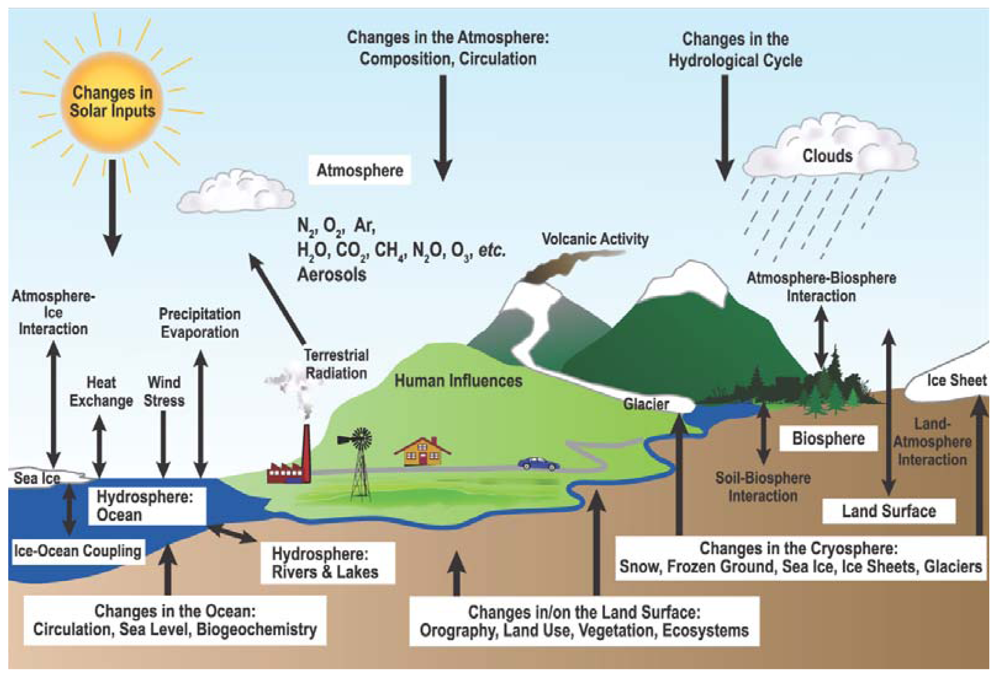
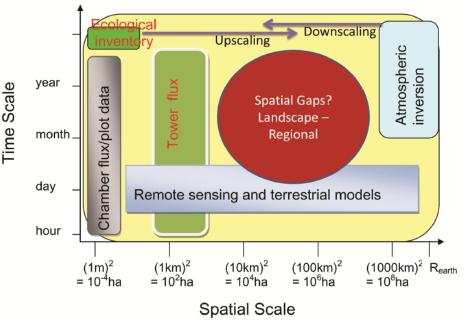
<p>The climate system is controlled by a number of complex coupled physical, chemical and biological processes (<xref ref-type="fig" rid="f1-sensors-09-08624">Figure 1</xref>). The terrestrial biosphere plays a crucial role in the climate system, providing both positive and negative feedbacks to climate change through biogeophysical and biogeochemical processes [<xref ref-type="bibr" rid="b1-sensors-09-08624">1</xref>]. Couplings between the climate system and biogeochemistry are mainly through tightly linked dynamics of C and water cycles. The importance of coupled C and water dynamics for the climate system has been increasingly recognized [<xref ref-type="bibr" rid="b2-sensors-09-08624">2</xref>-<xref ref-type="bibr" rid="b8-sensors-09-08624">8</xref>]; however the mechanisms behind these coupled cycles are still far from well understood.</p></sec>
<sec>
<label>2.2.</label>
<title>Terrestrial C Cycling</title>
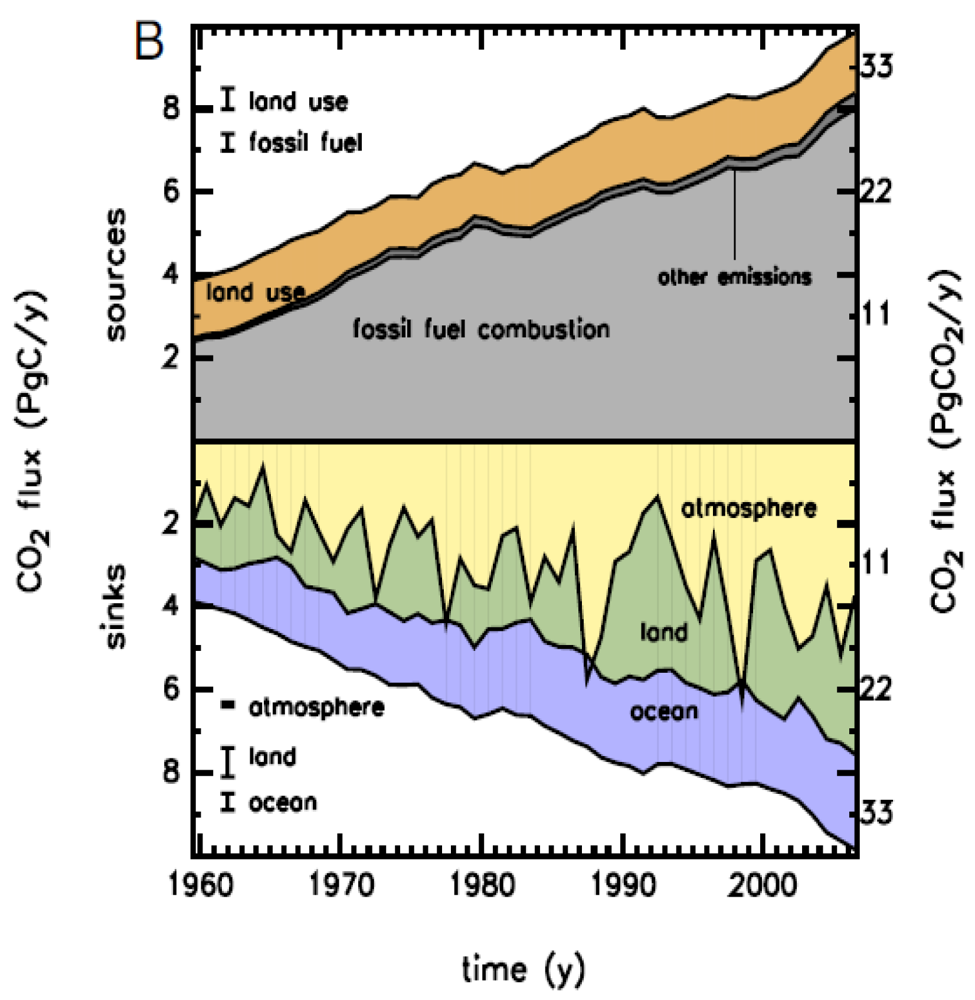
<p>One of the crucial issues in the prognosis of future climate change is the global budget of atmospheric CO<sub>2</sub>. The growth rate of atmospheric CO<sub>2</sub> is increasing rapidly. Three processes contribute to this rapid increase: fossil fuel emission, land use change (deforestation), and ocean and terrestrial uptake. As shown in <xref ref-type="fig" rid="f2-sensors-09-08624">Figure 2</xref>, terrestrial C budgets have large uncertainties and interannual variability.</p>
<p>Terrestrial ecosystems mediate a large part of CO<sub>2</sub> flux between the Earth's surface and the atmosphere, with ∼120 Pg C yr<sup>-1</sup> taken up by photosynthesis and roughly the same amount released back to the atmosphere by respiration annually [<xref ref-type="bibr" rid="b1-sensors-09-08624">1</xref>,<xref ref-type="bibr" rid="b15-sensors-09-08624">15</xref>]. Imbalances between gross ecosystem photosynthesis or gross primary productivity (GPP) and ecosystem respiration (<italic>R<sub>e</sub></italic>) lead to land surfaces being either CO<sub>2</sub> sinks or sources. C sequestration by global terrestrial ecosystems is estimated to be about 1-2 Gt C yr<sup>-1</sup> [<xref ref-type="bibr" rid="b1-sensors-09-08624">1</xref>,<xref ref-type="bibr" rid="b15-sensors-09-08624">15</xref>]. A detailed understanding of the interactive relationships in atmosphere-biosphere exchange is relevant to ecosystem-scale analysis and is needed to improve our knowledge of the global C cycle [<xref ref-type="bibr" rid="b16-sensors-09-08624">16</xref>]. The metabolism of terrestrial ecosystems is complex and highly dynamic because ecosystems consist of coupled, non-linear processes that possess many positive and negative feedbacks [<xref ref-type="bibr" rid="b17-sensors-09-08624">17</xref>,<xref ref-type="bibr" rid="b18-sensors-09-08624">18</xref>]. Complex features of ecosystem metabolism are relatively unknown and how C budget of major ecosystems will respond to changes in climate is not quantitatively well understood [<xref ref-type="bibr" rid="b19-sensors-09-08624">19</xref>-<xref ref-type="bibr" rid="b23-sensors-09-08624">23</xref>].</p></sec>
<sec>
<label>2.3.</label>
<title>Coupling of the C and Water Cycles</title>
<p>Thermodynamically, a terrestrial ecosystem is an open system. Therefore, hydrological and C cycles are closely coupled at various temporal and spatial scales [<xref ref-type="bibr" rid="b7-sensors-09-08624">7</xref>,<xref ref-type="bibr" rid="b24-sensors-09-08624">24</xref>-<xref ref-type="bibr" rid="b30-sensors-09-08624">30</xref>]. C uptake for example, is closely coupled to water loss by ecosystems mainly through leaf stomatal pathway governed principally through leaf conductance [<xref ref-type="bibr" rid="b31-sensors-09-08624">31</xref>-<xref ref-type="bibr" rid="b33-sensors-09-08624">33</xref>]. Soil organic C decomposition is very sensitive to soil moisture content via microbial activity and other processes [<xref ref-type="bibr" rid="b8-sensors-09-08624">8</xref>,<xref ref-type="bibr" rid="b25-sensors-09-08624">25</xref>,<xref ref-type="bibr" rid="b30-sensors-09-08624">30</xref>,<xref ref-type="bibr" rid="b34-sensors-09-08624">34</xref>,<xref ref-type="bibr" rid="b35-sensors-09-08624">35</xref>]. The flux of terrestrial organic C by river runoff to the ocean and wetland discharge is an important component of the global organic C cycle [<xref ref-type="bibr" rid="b36-sensors-09-08624">36</xref>,<xref ref-type="bibr" rid="b37-sensors-09-08624">37</xref>]. It is estimated that 0.25 × 10<sup>15</sup> g dissolved organic carbon (DOC) is discharged to the ocean by the world rivers each year [<xref ref-type="bibr" rid="b38-sensors-09-08624">38</xref>]. The land surface hydrological processes (in particular the terrestrial river systems) play an important role in transport of dissolved and particulate organic C from terrestrial to marine ecosystems [<xref ref-type="bibr" rid="b37-sensors-09-08624">37</xref>]. However, the interactions between C and water cycles and the mechanisms how these interactions will shape future climatic and biosphere conditions are far from well understood.</p></sec>
<sec>
<label>2.4.</label>
<title>Coupling of the C and N Cycles</title>
<p>N is an essential element that can limit the growth of living organisms across a wide range of ecosystems [<xref ref-type="bibr" rid="b39-sensors-09-08624">39</xref>,<xref ref-type="bibr" rid="b40-sensors-09-08624">40</xref>]. However, global inputs to the terrestrial N cycle have doubled in the past century due to anthropogenic activities, particularly fertilizer use and fossil fuel burning [<xref ref-type="bibr" rid="b41-sensors-09-08624">41</xref>,<xref ref-type="bibr" rid="b42-sensors-09-08624">42</xref>]. High atmospheric N and N depositions have changed the dynamics of N and C in many ecosystems of developed countries (e.g., in Europe and North America) [<xref ref-type="bibr" rid="b43-sensors-09-08624">43</xref>], with the impact in other Asian developing countries projected to increase over the next few decades [<xref ref-type="bibr" rid="b44-sensors-09-08624">44</xref>]. N addition to forest and other ecosystems will affect the health and vitality of ecosystems and the terrestrial C cycle [<xref ref-type="bibr" rid="b45-sensors-09-08624">45</xref>,<xref ref-type="bibr" rid="b46-sensors-09-08624">46</xref>]. There is a continuing discussion on whether N deposition has positive (e.g., increases in forest growth and C sequestration) or negative (e.g., increases in nitrate leaching, reduction in forest growth and C sequestration) effects on an ecosystem depends on the N status of the system and the rate and duration of N deposition [<xref ref-type="bibr" rid="b45-sensors-09-08624">45</xref>,<xref ref-type="bibr" rid="b46-sensors-09-08624">46</xref>]. Bauer <italic>et al.</italic> [<xref ref-type="bibr" rid="b47-sensors-09-08624">47</xref>] summarized that (1) if the remaining available N does not exceed the capacity for N uptake by vegetation net primary productivity (NPP), C sequestration may be enhanced; (2) if deposition rates exceed the capacity for N uptake, nutrient imbalances can lead to forest decline due to N saturation [<xref ref-type="bibr" rid="b48-sensors-09-08624">48</xref>,<xref ref-type="bibr" rid="b49-sensors-09-08624">49</xref>]. Aber <italic>et al.</italic> [<xref ref-type="bibr" rid="b45-sensors-09-08624">45</xref>,<xref ref-type="bibr" rid="b46-sensors-09-08624">46</xref>] hypothesized that forest ecosystems positively respond to N addition in the short-term, while negatively respond to N addition over the long-term. N fertilization in northern temperate zones has been estimated to enhance C storage by 0.3–0.5 Pg C per year [<xref ref-type="bibr" rid="b50-sensors-09-08624">50</xref>] with Pregitzer <italic>et al.</italic> [<xref ref-type="bibr" rid="b51-sensors-09-08624">51</xref>] reporting that simulated chronic N deposition has increased C storage in northern temperate forests. Olsson <italic>et al.</italic> [<xref ref-type="bibr" rid="b52-sensors-09-08624">52</xref>] found that fertilization of a boreal Norway spruce stand led to a three-fold increase in aboveground productivity, possibly due to decreased C allocation to roots in response to higher nutrient availability. Leggett and Kelting [<xref ref-type="bibr" rid="b53-sensors-09-08624">53</xref>] found that N fertilization of Loblolly pine plantations not only increased aboveground and belowground biomass but also increased soil C pools. However, other estimates suggest that N loading on ecosystems only makes a minor contribution to C sequestration [<xref ref-type="bibr" rid="b54-sensors-09-08624">54</xref>] or does not likely account for significant C storage [<xref ref-type="bibr" rid="b55-sensors-09-08624">55</xref>,<xref ref-type="bibr" rid="b56-sensors-09-08624">56</xref>] or in some cases may actually reduce ecosystem productivity and C storage [<xref ref-type="bibr" rid="b46-sensors-09-08624">46</xref>,<xref ref-type="bibr" rid="b57-sensors-09-08624">57</xref>].</p>
<p>N fertilisation may affect the pool of soil organic carbon (SOC) through the changes of litterfall. Both negative [<xref ref-type="bibr" rid="b58-sensors-09-08624">58</xref>] and positive [<xref ref-type="bibr" rid="b59-sensors-09-08624">59</xref>] effects of N fertilisation on root biomass have been observed. In a detailed review Nadelhoffer [<xref ref-type="bibr" rid="b60-sensors-09-08624">60</xref>] found it is likely that N deposition will decrease fine-root biomass, however, stimulate fine-root turnover and production. N addition/fertilization to soils has also shown variable effects on SOC storage by enhanced, reduced or unchanged heterotrophic and/or autotrophic respiration as a response to litter C/N ratio [<xref ref-type="bibr" rid="b61-sensors-09-08624">61</xref>-<xref ref-type="bibr" rid="b68-sensors-09-08624">68</xref>]. With increasing rates of anthropogenic N deposition [<xref ref-type="bibr" rid="b41-sensors-09-08624">41</xref>,<xref ref-type="bibr" rid="b42-sensors-09-08624">42</xref>], there is a strong need to understand links between ecosystem N inputs and C sequestration.</p></sec></sec>
<sec>
<label>3.</label>
<title>Monitoring of C and Water Cycling in Terrestrial Ecosystems</title>
<sec>
<label>3.1.</label>
<title>Global Flux Tower Network (FLUXNET)</title>
<p>The EC technique is commonly used to directly measure the CO<sub>2</sub>, water vapor and energy exchange between the atmosphere and terrestrial ecosystems [<xref ref-type="bibr" rid="b9-sensors-09-08624">9</xref>]. A global network of collaborating regional networks, FLUXNET, began in 1997 [<xref ref-type="bibr" rid="b9-sensors-09-08624">9</xref>] and today, there exist more than 400 EC-flux towers across the globe. EC measurements are a rich source of information on temporal variability and environmental controls of CO<sub>2</sub> exchange between the atmosphere and terrestrial ecosystems [<xref ref-type="bibr" rid="b69-sensors-09-08624">69</xref>]. These global EC datasets allow us to (1) explore emergent-scale properties by quantifying how the metabolism of complex ecosystems respond to perturbations in climate variables on diurnal, seasonal, interannual and decadal time scales and elucidate physical and biological controlling factors [<xref ref-type="bibr" rid="b9-sensors-09-08624">9</xref>,<xref ref-type="bibr" rid="b69-sensors-09-08624">69</xref>]; (2) examine carry-over effects that may be introduced by either favorable or deleterious conditions during antecedent years [<xref ref-type="bibr" rid="b70-sensors-09-08624">70</xref>]; (3) observe a disturbance and the recovery from it or to span a natural sequence of ecological development coupled with fluctuations in climate [<xref ref-type="bibr" rid="b71-sensors-09-08624">71</xref>,<xref ref-type="bibr" rid="b72-sensors-09-08624">72</xref>]; and (4) test and validate ecosystem process models [<xref ref-type="bibr" rid="b73-sensors-09-08624">73</xref>,<xref ref-type="bibr" rid="b74-sensors-09-08624">74</xref>], since most of these models span timescales from hours to decades. Although the available EC data have been rapidly accumulating, there are some issues associated with its use due to difficulties/uncertainties in (i) assessing/interpreting the associated measuring biases of EC data, and (ii) upscaling of the EC fluxes at the ecosystem (typically less than 1–3 km<sup>2</sup> for each site) to larger scales, e.g., landscape and regional scales.</p></sec>
<sec sec-type="methods">
<label>3.2.</label>
<title>CO<sub>2</sub> Concentration Measurements, Data Assimilation and CarbonTracker</title>
<p>Observations of CO<sub>2</sub> over the continent within the atmospheric boundary layer reflect exchange processes occurring at the surface at a regional scale (10<sup>2</sup>–10<sup>5</sup> km<sup>2</sup>). The flux information contained in CO<sub>2</sub> concentration data represents footprints of up to 10<sup>5</sup> km<sup>2</sup> [<xref ref-type="bibr" rid="b75-sensors-09-08624">75</xref>-<xref ref-type="bibr" rid="b77-sensors-09-08624">77</xref>], which is several orders of magnitude larger than the direct EC-flux footprint. These measurements form a record of integrated net CO<sub>2</sub> exchange from multiple processes, geographic areas, and times [<xref ref-type="bibr" rid="b78-sensors-09-08624">78</xref>]. CO<sub>2</sub> concentration measurements are made from tall towers [<xref ref-type="bibr" rid="b79-sensors-09-08624">79</xref>-<xref ref-type="bibr" rid="b81-sensors-09-08624">81</xref>] or balloons that reach the top of the planetary boundary layer (PBL) of the Earth. These measurements therefore provide significant information to upscale from site to region. Moreover, the number of CO<sub>2</sub> concentration measurements above the land surface, made by either tower or aircraft, is steadily increasing. Data are collected by numerous agencies around the world, for instance, the National Oceanic and Atmospheric Administration's (NOAA's) Earth System Research Laboratory (ESRL) monitors CO<sub>2</sub> in the atmosphere as a contribution to the North American Carbon Program (NACP) [<xref ref-type="bibr" rid="b82-sensors-09-08624">82</xref>]. In addition, Peters <italic>et al.</italic> [<xref ref-type="bibr" rid="b78-sensors-09-08624">78</xref>] suggest that direct satellite observations of CO<sub>2</sub> are available already for the upper troposphere, whereas near-surface CO<sub>2</sub> from space will become available within several years to augment the current efforts.</p>
<p>Previous efforts to interpret the signal of regional CO<sub>2</sub> exchange making use of tower concentration data have focused on simple one-dimensional PBL budgets that rely on gradients in CO<sub>2</sub> concentrations between the PBL and the free troposphere [<xref ref-type="bibr" rid="b77-sensors-09-08624">77</xref>,<xref ref-type="bibr" rid="b79-sensors-09-08624">79</xref>,<xref ref-type="bibr" rid="b83-sensors-09-08624">83</xref>-<xref ref-type="bibr" rid="b85-sensors-09-08624">85</xref>]. These methods are limited to monthly resolution because of the need to smooth and average over several synoptic events [<xref ref-type="bibr" rid="b86-sensors-09-08624">86</xref>].</p>
<p>The atmosphere integrates surface fluxes over many temporal and spatial scales and links scalar sources and sinks with concentrations and fluxes. This principle has been successfully used to develop inverse models to estimate annual carbon budgets [<xref ref-type="bibr" rid="b87-sensors-09-08624">87</xref>-<xref ref-type="bibr" rid="b90-sensors-09-08624">90</xref>]. However, due to model limitations and paucity of continental CO<sub>2</sub> observations these studies have yielded carbon fluxes only at coarse resolution, over large spatial regions (i.e., at continental scale, [<xref ref-type="bibr" rid="b91-sensors-09-08624">91</xref>]). Recently, Stephens [<xref ref-type="bibr" rid="b89-sensors-09-08624">89</xref>] and Yang [<xref ref-type="bibr" rid="b90-sensors-09-08624">90</xref>] showed that a large set of atmospheric inverse model results were inconsistent with free troposphere CO<sub>2</sub> concentration. Transport biases are one of the largest unknown sources of error in flux inversions [<xref ref-type="bibr" rid="b88-sensors-09-08624">88</xref>].</p>
<p>A powerful way to use all these CO<sub>2</sub> data is in a data assimilation system, which combines diverse data and models into a unified description of a physical/biogeochemical system consistent with observations [<xref ref-type="bibr" rid="b13-sensors-09-08624">13</xref>]. Such a new data assimilation system called CarbonTracker, has been built in the NOAA ESRL, using a state-of-the-art atmospheric transport model coupled to an ensemble Kalman filter [<xref ref-type="bibr" rid="b78-sensors-09-08624">78</xref>]. The first release of CarbonTracker marks a significant step in our ability to monitor month-by-month surface sources and sinks of CO<sub>2</sub> [<xref ref-type="bibr" rid="b78-sensors-09-08624">78</xref>], with all results, data and code of CarbonTracker freely available from NOAA ERSL's CarbonTracker web site, <ext-link xlink:href="http://carbontracker.noaa.gov" ext-link-type="uri">http://carbontracker.noaa.gov</ext-link>.</p></sec>
<sec>
<label>3.3.</label>
<title>Stable C Isotope Measurements</title>
<p>The information on the biological and physical processes that exchange CO<sub>2</sub> between terrestrial ecosystems and the atmosphere is recorded by the signals of <sup>13</sup>C /<sup>12</sup>C ratio in the atmosphere CO<sub>2</sub>. The stable isotope ratio of CO<sub>2</sub> (δ<sup>13</sup>C) in the atmosphere contains unique information to study the overall balance of surface CO<sub>2</sub> fluxes [<xref ref-type="bibr" rid="b92-sensors-09-08624">92</xref>,<xref ref-type="bibr" rid="b93-sensors-09-08624">93</xref>]. As reviewed by Suits <italic>et al.</italic> [<xref ref-type="bibr" rid="b94-sensors-09-08624">94</xref>], C isotopes can be helpful in investigations of the following four aspects at ecosystem and local scales: (i) plant water-use efficiency and the response of plants to changes in precipitation and relative humidity [<xref ref-type="bibr" rid="b95-sensors-09-08624">95</xref>-<xref ref-type="bibr" rid="b100-sensors-09-08624">100</xref>], (ii) variation in light distribution and stand structure [<xref ref-type="bibr" rid="b101-sensors-09-08624">101</xref>-<xref ref-type="bibr" rid="b104-sensors-09-08624">104</xref>], (iii) recycling of respired CO<sub>2</sub> [<xref ref-type="bibr" rid="b105-sensors-09-08624">105</xref>-<xref ref-type="bibr" rid="b109-sensors-09-08624">109</xref>], and (iv) determining the relative contributions of photosynthesis and respiration to the total net ecosystem exchange [<xref ref-type="bibr" rid="b110-sensors-09-08624">110</xref>-<xref ref-type="bibr" rid="b114-sensors-09-08624">114</xref>].</p>
<p>Multiple efforts to measure stable C isotopes at both flux towers and flask stations around the world have been achieved. Several new techniques (e.g., automated measurement systems, tunable diode laser (TDL) spectrometer and pulsed quantum cascade laser spectrometer) have also been applied to this investigation [<xref ref-type="bibr" rid="b115-sensors-09-08624">115</xref>-<xref ref-type="bibr" rid="b117-sensors-09-08624">117</xref>], isotope measurements, however, are still lacking considering the land surface diversity/heterogeneity. This shortage of long-term measurements and of sampling frequency still limits isotopic studies and applications to various spatial/temporal scales.</p>
<p>Efforts to expand CarbonTracker to assimilate observations of C isotopes (<sup>13</sup>CO<sub>2</sub>, <sup>14</sup>CO<sub>2</sub>) and other observation types (eddy-flux measurements, satellite radiances) are underway. Such observations could facilitate attribution of carbon fluxes to specific processes such as fossil fuel burning, biomass burning, or agricultural food and biofuel production [<xref ref-type="bibr" rid="b78-sensors-09-08624">78</xref>].</p></sec>
<sec>
<label>3.4.</label>
<title>Satellite Monitoring</title>
<p>Satellite-borne remote sensing offers unique opportunities to parameterize land surface characteristics over large spatial extents at variable spatial and temporal resolutions. For example, the Moderate Resolution Imaging Spectroradiometer (MODIS) provides a global dataset every 1–2 days with 36 bands. The spatial resolution of MODIS (pixel size at nadir) is 250 m for channels 1 and 2 (0.6–0.9 μm), 500 m for channels 3 to 7 (0.4–2.1 μm) and 1,000 m for channels 8 to 36 (0.4–14.4 μm), respectively. Data from the satellite-borne MODIS are currently used in the calculation of global weekly GPP at 1 km spatial resolution [<xref ref-type="bibr" rid="b10-sensors-09-08624">10</xref>]. Other sensors, the Landsat Thematic Mapper sensors carried onboard the Landsat series of satellites, acquire images at a 30 m spatial resolution with a 16 day interval.</p>
<p>In general, water evapotranspired from ecosystems into the atmosphere will reduce the land surface temperature (<italic>T<sub>a</sub></italic>). Reduction in soil moisture will decrease plant transpiration and evaporation from soil and plant surfaces. Reduction in ET will increase <italic>T<sub>a</sub>. T<sub>a</sub></italic> can be derived from remotely-sensed thermal-infrared (TIR) band (8-14 microns) from various operational satellites. Based on the relationship between <italic>T<sub>a</sub></italic> and ET, remotely sensed <italic>T<sub>a</sub></italic> has been used to estimate regional ET [<xref ref-type="bibr" rid="b118-sensors-09-08624">118</xref>-<xref ref-type="bibr" rid="b121-sensors-09-08624">121</xref>]. The existing thermal imaging sensors provide adequate coverage of thermal dynamics that are useful for operational monitoring applications of ET. For example, thermal images at 15 minutes intervals and at a spatial resolution of 5 kilometers can be obtained from the NOAA Geostationary Operational Environmental Satellites (GOES), and TIR data at a fine spatial resolution (60 m or 120 m) with a much longer time interval (16 days) have been provided by the Thematic Mapper (TM) and ETM+ instruments on Landsat 5 and Landsat 7.</p>
<p>ET, the largest component of water loss from ecosystems, plays an important role in affecting soil moisture, vegetation productivity, C cycle, and water budgets in terrestrial ecosystems [<xref ref-type="bibr" rid="b122-sensors-09-08624">122</xref>-<xref ref-type="bibr" rid="b124-sensors-09-08624">124</xref>]. Verstraeten <italic>et al.</italic> [<xref ref-type="bibr" rid="b12-sensors-09-08624">12</xref>] provided a comprehensive review of remote sensing methods for assessing ET and soil moisture content across different scales and Kalma <italic>et al.</italic> [<xref ref-type="bibr" rid="b11-sensors-09-08624">11</xref>] reviewed satellite-based algorithms for estimating ET and land surface temperatures at local, regional and continental scales, with particular emphasis on studies published since the early 1990s.</p>
<p>In addition, as Marquis and Tans [<xref ref-type="bibr" rid="b13-sensors-09-08624">13</xref>] reviewed, satellite-based instruments can also provide information about CO<sub>2</sub> concentration in the atmosphere, but no current satellite-borne instrument comes close to providing the accuracy, precision, and continuity required to determine regional CO<sub>2</sub> concentrations and local fluxes. Future satellites, including the Greenhouse Gases Observing Satellite (GOSAT) [<xref ref-type="bibr" rid="b125-sensors-09-08624">125</xref>], are expected to provide more accurate CO<sub>2</sub> measurements than do today's satellites [<xref ref-type="bibr" rid="b13-sensors-09-08624">13</xref>,<xref ref-type="bibr" rid="b126-sensors-09-08624">126</xref>].</p></sec>
<sec>
<label>3.5.</label>
<title>Other Airborne Measurements</title>
<p>Besides satellite monitoring, other airborne observation techniques (e.g., aircraft, airplane and land surface remote sensing) have been developed rapidly since the latest decade. For instance, a new approach is LiDAR (Light Detection and Ranging), which is a remote sensing technology that determines distances to an object or surface using laser pulses. LiDAR data have proved to be highly effective for the determination of three dimensional forest attributes. The suitability of airborne LiDAR for the determination of forest stand attributes including leaf area index (LAI) and the probability of canopy gaps within different layers of canopy has been widely acknowledged by various studies [<xref ref-type="bibr" rid="b127-sensors-09-08624">127</xref>,<xref ref-type="bibr" rid="b128-sensors-09-08624">128</xref>]. The interpreted LiDAR data have been further used for landscape C modeling and scaling [<xref ref-type="bibr" rid="b129-sensors-09-08624">129</xref>,<xref ref-type="bibr" rid="b130-sensors-09-08624">130</xref>].</p></sec></sec>
<sec>
<label>4.</label>
<title>Modeling of C and Water Dynamics in Terrestrial Ecosystems</title>
<p>The land surface of the Earth represents significant sources, sinks, and reservoirs of C, heat and moisture to the atmosphere. C and energy fluxes and water cycles at soil-atmosphere and plant-atmosphere interfaces are therefore important land surface processes. Due to the complexity and non-linearity of C, N and water dynamics in terrestrial ecosystems, various modeling tools are needed for better understanding of these biogeochemical and hydrological processes and their feedback mechanisms with the land surface climate system [<xref ref-type="bibr" rid="b131-sensors-09-08624">131</xref>]. It is well known that realistic simulations of C, N and water dynamics in terrestrial ecosystems is of critical importance, not only for the surface microclimate, but also for the large-scale physics of the atmosphere [<xref ref-type="bibr" rid="b132-sensors-09-08624">132</xref>-<xref ref-type="bibr" rid="b134-sensors-09-08624">134</xref>]. Such models can be flagged by land surface, ecosystem and hydrological models based on their objectives and emphases. The former focus on ecosystem processes and the interactions between ecosystems and the atmosphere; while the latter place emphasis on the land surface hydrology processes, including lateral flow resulting from catchment topography.</p>
<sec>
<label>4.1.</label>
<title>Land Surface and Ecosystem Modeling</title>
<p>Global climate and the global carbon cycle are controlled by exchanges of water, carbon, and energy between the terrestrial biosphere and atmosphere. Thus land surface models (LSMs) are essential for the purpose of developing predictive capability for the Earth's climate on all time scales [<xref ref-type="bibr" rid="b135-sensors-09-08624">135</xref>]. Most current LSMs can be associated with three broad types [<xref ref-type="bibr" rid="b136-sensors-09-08624">136</xref>]: soil-vegetation-atmosphere transfer schemes (SVATS), potential vegetation models (PVMs), and terrestrial biogeochemistry models (TBMs).</p>
<p>The first generation of SVATS evolved from simple bucket schemes focusing on soil water availability [<xref ref-type="bibr" rid="b137-sensors-09-08624">137</xref>], through the schemes of Deardorff [<xref ref-type="bibr" rid="b138-sensors-09-08624">138</xref>]. Marked improvements of the second generation (e.g., BATS [<xref ref-type="bibr" rid="b136-sensors-09-08624">136</xref>], SiB [<xref ref-type="bibr" rid="b139-sensors-09-08624">139</xref>,<xref ref-type="bibr" rid="b140-sensors-09-08624">140</xref>], and CLASS [<xref ref-type="bibr" rid="b141-sensors-09-08624">141</xref>,<xref ref-type="bibr" rid="b142-sensors-09-08624">142</xref>]) from the first generation are the separation of vegetation from soil and the inclusion of multiple soil layers for dynamic heat and moisture-flow simulations [<xref ref-type="bibr" rid="b143-sensors-09-08624">143</xref>]. The second generation SVATS firstly modeled plant physiology in an explicit manner in GCMs (General Circulation Model or Global Climate Model) [<xref ref-type="bibr" rid="b144-sensors-09-08624">144</xref>]. For most second-generation SVATS, land cover was fixed, with seasonally-varying prescriptions of parameters such as reflectance, leaf area index or rooting depth [<xref ref-type="bibr" rid="b145-sensors-09-08624">145</xref>-<xref ref-type="bibr" rid="b148-sensors-09-08624">148</xref>]. Some SVATS incorporated satellite data to characterize more realistically the seasonal dynamics in vegetation function [<xref ref-type="bibr" rid="b146-sensors-09-08624">146</xref>,<xref ref-type="bibr" rid="b149-sensors-09-08624">149</xref>]. The latest (third generation) SVATS used more recent theories relating photosynthesis and plant water relations to provide a consistent description of energy exchange, ET, and C exchange by plants [<xref ref-type="bibr" rid="b143-sensors-09-08624">143</xref>,<xref ref-type="bibr" rid="b150-sensors-09-08624">150</xref>]. In our effort in understanding the impact of climate change on terrestrial ecosystems, energy, water, and C cycles need to be modelled simultaneously [<xref ref-type="bibr" rid="b150-sensors-09-08624">150</xref>,<xref ref-type="bibr" rid="b151-sensors-09-08624">151</xref>]. Recently, most of SVATS have thus been enhanced to include the CO<sub>2</sub> flux between the land surface and the atmosphere, such as SiB2 [<xref ref-type="bibr" rid="b150-sensors-09-08624">150</xref>], IBIS [<xref ref-type="bibr" rid="b152-sensors-09-08624">152</xref>], NCAR-LSM [<xref ref-type="bibr" rid="b153-sensors-09-08624">153</xref>], BATS [<xref ref-type="bibr" rid="b134-sensors-09-08624">134</xref>], CLASS-C [<xref ref-type="bibr" rid="b154-sensors-09-08624">154</xref>] and EASS [<xref ref-type="bibr" rid="b143-sensors-09-08624">143</xref>].</p>
<p>The earlier generation of PVMs comprised a suite of schemes that focus on modeling distributions of vegetation as a function of climate [<xref ref-type="bibr" rid="b155-sensors-09-08624">155</xref>,<xref ref-type="bibr" rid="b156-sensors-09-08624">156</xref>] without influences of anthropogenic or natural disturbance. The second generation of PVMs included more sophisticated modules to account for factors controlling vegetation distributions, such as competition, varying combinations of plant functional types, and physiological and ecological constraints [<xref ref-type="bibr" rid="b157-sensors-09-08624">157</xref>].</p>
<p>TBMs developed from scaling up local ecological models, are process-based models that simulate dynamics of energy, water, and C and N exchange among biospheric pools and the atmosphere [<xref ref-type="bibr" rid="b136-sensors-09-08624">136</xref>]. Few of the existing TBMs incorporate PVMs. These models are not applicable to transient climate change experiments without coupling with PVMs.</p>
<p>In recent decades, the interactions among soil, vegetation and climate have been studied intensively and modeled successfully on the basis of water and energy transfer in the soil-vegetation-atmosphere system [<xref ref-type="bibr" rid="b136-sensors-09-08624">136</xref>,<xref ref-type="bibr" rid="b140-sensors-09-08624">140</xref>,<xref ref-type="bibr" rid="b142-sensors-09-08624">142</xref>,<xref ref-type="bibr" rid="b158-sensors-09-08624">158</xref>]. Also the construction and refinement of LSMs have received increasing attention [<xref ref-type="bibr" rid="b150-sensors-09-08624">150</xref>,<xref ref-type="bibr" rid="b159-sensors-09-08624">159</xref>,<xref ref-type="bibr" rid="b160-sensors-09-08624">160</xref>]. Combination of these three different LSMs and utilization of remotely sensed land surface parameters are critical in the future LSM development, because of (1) the tight coupling of exchanges of water, energy and C between the land surface and the atmosphere; (2) the sophisticated impact/feedback mechanisms between climate change and terrestrial ecosystems; and (3) increasingly strong anthropogenic alterations to land cover. On-line coupling of a LSM with a GCM is needed for studying interannual to multi-decadal climate variations.</p>
<p>Several model intercomparisons have focused on evaluating SVATS and TBMs with particular objectives. For instance, the Project for Intercomparison of Land-surface Parameterization Schemes (PILPS) was initiated to evaluate an array of LSMs existing in GCMs [<xref ref-type="bibr" rid="b144-sensors-09-08624">144</xref>]; while the AMMA (African Monsoon Multidisciplinary Analysis) Land Surface Model Intercomparison Project (ALMIP) is being conducted to get a better understanding of the role of soil moisture in land surface processes in West Africa [<xref ref-type="bibr" rid="b161-sensors-09-08624">161</xref>]. Coordinated land surface modeling activities have improved our understanding of land surface processes [<xref ref-type="bibr" rid="b161-sensors-09-08624">161</xref>].</p></sec>
<sec>
<label>4.2.</label>
<title>Spatially-distributed Hydrological Processes Modeling</title>
<p>Hydrology and ecosystem have, for the most part, been studied independently. Most LSMs and ecosystem models make an assumption of “flat Earth” with the absence of lateral redistribution of soil moisture. On the other hand, hydrological models have mostly been concerned with runoff production. Spatially-distributed models are needed, especially for hydrological simulation objective, because of heterogeneity of land surface and non-linearity of hydrological processes. Spatially-distributed hydrological models are not only able to account for spatial variability of hydrological processes, but enable computation of internal fluxes and state variables. Such kinds of models are increasingly applied to simulate spatial variability of forcing variables (e.g., precipitation), physiographic characteristics, detailed processes and internal fluxes within a catchment [<xref ref-type="bibr" rid="b162-sensors-09-08624">162</xref>-<xref ref-type="bibr" rid="b167-sensors-09-08624">167</xref>].</p></sec>
<sec>
<label>4.3.</label>
<title>Modeling Dynamics of Stable C Isotopic Exchange between Ecosystem and the Atmosphere</title>
<p>It is recognized that the atmospheric measurements are still too sparse, relative to its spatial variability, to be used for inferring the surface flux at high spatial resolution [<xref ref-type="bibr" rid="b168-sensors-09-08624">168</xref>]. The use of the isotope ratio as an additional constraint to identify various C sources and sinks can contribute to a significant reduction in the uncertainty. Though available isotopic datasets are being accumulated quickly [<xref ref-type="bibr" rid="b117-sensors-09-08624">117</xref>,<xref ref-type="bibr" rid="b169-sensors-09-08624">169</xref>-<xref ref-type="bibr" rid="b171-sensors-09-08624">171</xref>], isotope measurements are still lacking considering land surface diversity and heterogeneity. This shortage of long-term measurements and of sampling frequency still limits C isotopic studies.</p>
<p>Mechanistic ecosystem models that couple micrometeorological and eco-physiological theories have the potential to shed light on how to extend efforts and applications of stable isotopes of CO<sub>2</sub> to global C budgeting, because biophysical models have the capacities of simulating isotope discrimination in response to environmental perturbations and can produce information on its diurnal, seasonal and interannual dynamics. Few biophysical models, however, have been developed to assess stable C discrimination between a plant canopy and the atmosphere [<xref ref-type="bibr" rid="b94-sensors-09-08624">94</xref>,<xref ref-type="bibr" rid="b87-sensors-09-08624">87</xref>,<xref ref-type="bibr" rid="b135-sensors-09-08624">135</xref>,]. Most existing biophysical models are based on individual leaf level discrimination equations given by Farquhar <italic>et al.</italic> [<xref ref-type="bibr" rid="b173-sensors-09-08624">173</xref>,<xref ref-type="bibr" rid="b174-sensors-09-08624">174</xref>] and only focus on the land surface layer (ignoring vertical and horizontal advection effects beyond 50∼100 m above the ground [<xref ref-type="bibr" rid="b172-sensors-09-08624">172</xref>]. However, in nature, the convective boundary layer (CBL) integrates the effects of photosynthesis, respiration, and turbulent transport of CO<sub>2</sub> over the landscape [<xref ref-type="bibr" rid="b107-sensors-09-08624">107</xref>,<xref ref-type="bibr" rid="b175-sensors-09-08624">175</xref>]. The influence of the CBL cannot be ignored when using isotope composition of CO<sub>2</sub> to investigate biological processes [<xref ref-type="bibr" rid="b176-sensors-09-08624">176</xref>], because the effect of atmospheric stability on turbulent mixing/diffusion has an important impact on scalar fluxes and concentration fields within and above canopies [<xref ref-type="bibr" rid="b177-sensors-09-08624">177</xref>,<xref ref-type="bibr" rid="b178-sensors-09-08624">178</xref>]. Few such models considering the CBL effects on isotope fractionation have been developed to date [<xref ref-type="bibr" rid="b107-sensors-09-08624">107</xref>,<xref ref-type="bibr" rid="b178-sensors-09-08624">178</xref>-<xref ref-type="bibr" rid="b182-sensors-09-08624">182</xref>].</p></sec>
<sec>
<label>4.4.</label>
<title>Modeling Coupled C, N and Water Dynamics—An Ecohydrological Approach</title>
<p>C and N dynamics and hydrological processes are closely linked. The stomatal conductance (<italic>g</italic><sub>s</sub>) is the key linkage between C assimilation (photosynthesis) and transpiration. An empirical equation is used in the second-generation LSMs to calculate <italic>g</italic><sub>s</sub>, which is hypothesized to be controlled by the environmental conditions [<xref ref-type="bibr" rid="b31-sensors-09-08624">31</xref>]. While field and laboratory studies have documented that leaf photosynthesis also affects <italic>g</italic><sub>s</sub>. Therefore, Ball <italic>et al.</italic> [<xref ref-type="bibr" rid="b24-sensors-09-08624">24</xref>] proposed a semi-empirical stomatal conductance formulation (Ball-Woodrow-Berry model), in which <italic>g</italic><sub>s</sub> is controlled by both photosynthesis and the environmental conditions. Most of third-generation LSMs (Ecological models, e.g., SiB2 [<xref ref-type="bibr" rid="b139-sensors-09-08624">139</xref>,<xref ref-type="bibr" rid="b150-sensors-09-08624">150</xref>]; CN-CLASS [<xref ref-type="bibr" rid="b28-sensors-09-08624">28</xref>]; <italic>Ecosys</italic> [<xref ref-type="bibr" rid="b183-sensors-09-08624">183</xref>-<xref ref-type="bibr" rid="b184-sensors-09-08624">184</xref>; and EASS [<xref ref-type="bibr" rid="b143-sensors-09-08624">143</xref>]) fully couple photosynthesis and transpiration processes by employing the Ball-Woodrow-Berry stamatal conductance formulation.</p>
<p>In addition to the coupling of hydrological condition and C assimilation through the linkage of <italic>g</italic><sub>s</sub>, C assimilation is also coupling with N dynamics through another biochemical parameter, 
<inline-formula>
<mml:math id="mm1">
<mml:semantics id="sm1">
<mml:mrow>
<mml:msubsup>
<mml:mi>V</mml:mi>
<mml:mrow>
<mml:mi>c</mml:mi>
<mml:mo>max</mml:mo></mml:mrow>
<mml:mrow>
<mml:mn>25</mml:mn></mml:mrow></mml:msubsup></mml:mrow></mml:semantics></mml:math></inline-formula> — maximum carboxylation rate at 25 °C. In the photosynthesis model proposed by Farquhar <italic>et al.</italic>[<xref ref-type="bibr" rid="b174-sensors-09-08624">174</xref>], the net photosynthetic rate <italic>A<sub>net</sub></italic> at leaf level is a function of two tightly-correlated parameters 
<inline-formula>
<mml:math id="mm2">
<mml:semantics id="sm2">
<mml:mrow>
<mml:msubsup>
<mml:mi>V</mml:mi>
<mml:mrow>
<mml:mi>c</mml:mi>
<mml:mo>max</mml:mo></mml:mrow>
<mml:mrow>
<mml:mn>25</mml:mn></mml:mrow></mml:msubsup></mml:mrow></mml:semantics></mml:math></inline-formula> and 
<inline-formula>
<mml:math id="mm3">
<mml:semantics id="sm3">
<mml:mrow>
<mml:msubsup>
<mml:mi>J</mml:mi>
<mml:mrow>
<mml:mi>c</mml:mi>
<mml:mo>max</mml:mo></mml:mrow>
<mml:mrow>
<mml:mn>25</mml:mn></mml:mrow></mml:msubsup></mml:mrow></mml:semantics></mml:math></inline-formula> (the maximum electron transport rate at 25 °C), and is calculated as:
<disp-formula id="FD1">
<label>(1)</label>
<mml:math id="mm4" display="block">
<mml:semantics id="sm4">
<mml:mrow>
<mml:msub>
<mml:mi>A</mml:mi>
<mml:mtext mathvariant="italic">net</mml:mtext></mml:msub>
<mml:mo>=</mml:mo>
<mml:mo>min</mml:mo>
<mml:mo stretchy="false">(</mml:mo>
<mml:msub>
<mml:mi>A</mml:mi>
<mml:mi>c</mml:mi></mml:msub>
<mml:mo>,</mml:mo>
<mml:msub>
<mml:mi>A</mml:mi>
<mml:mi>j</mml:mi></mml:msub>
<mml:mo stretchy="false">)</mml:mo>
<mml:mo>−</mml:mo>
<mml:msub>
<mml:mi>R</mml:mi>
<mml:mi>d</mml:mi></mml:msub></mml:mrow></mml:semantics></mml:math></disp-formula>where <italic>A<sub>c</sub></italic> and <italic>A<sub>j</sub></italic> are Rubiso-limited and light-limited gross photosynthesis rates, respectively, and <italic>R<sub>d</sub></italic> is the daytime leaf dark respiration and computed as <italic>R<sub>d</sub></italic> = 0.015 <italic>V<sub>c max</sub>. A<sub>c</sub></italic> and <italic>A<sub>j</sub></italic> are expressed as:
<disp-formula id="FD2">
<label>(2a)</label>
<mml:math id="mm5" display="block">
<mml:semantics id="sm5">
<mml:mrow>
<mml:msub>
<mml:mi>A</mml:mi>
<mml:mi>c</mml:mi></mml:msub>
<mml:mo>=</mml:mo>
<mml:msub>
<mml:mi>V</mml:mi>
<mml:mrow>
<mml:mi>c</mml:mi>
<mml:mo>max</mml:mo></mml:mrow></mml:msub>
<mml:mfrac>
<mml:mrow>
<mml:msub>
<mml:mi>C</mml:mi>
<mml:mi>c</mml:mi></mml:msub>
<mml:mo>−</mml:mo>
<mml:msup>
<mml:mo>Γ</mml:mo>
<mml:mo>∗</mml:mo></mml:msup></mml:mrow>
<mml:mrow>
<mml:msub>
<mml:mi>C</mml:mi>
<mml:mi>c</mml:mi></mml:msub>
<mml:mo>+</mml:mo>
<mml:msub>
<mml:mi>K</mml:mi>
<mml:mi>c</mml:mi></mml:msub>
<mml:mo stretchy="false">(</mml:mo>
<mml:mn>1</mml:mn>
<mml:mo>+</mml:mo>
<mml:msub>
<mml:mi>O</mml:mi>
<mml:mi>c</mml:mi></mml:msub>
<mml:mo>/</mml:mo>
<mml:msub>
<mml:mi>K</mml:mi>
<mml:mi>o</mml:mi></mml:msub>
<mml:mo stretchy="false">)</mml:mo></mml:mrow></mml:mfrac></mml:mrow></mml:semantics></mml:math></disp-formula>and:
<disp-formula id="FD3">
<label>(2b)</label>
<mml:math id="mm6" display="block">
<mml:semantics id="sm6">
<mml:mrow>
<mml:msub>
<mml:mi>A</mml:mi>
<mml:mi>j</mml:mi></mml:msub>
<mml:mo>=</mml:mo>
<mml:mrow>
<mml:msub>
<mml:mi>J</mml:mi>
<mml:mo>max</mml:mo></mml:msub></mml:mrow>
<mml:mfrac>
<mml:mrow>
<mml:msub>
<mml:mi>C</mml:mi>
<mml:mi>c</mml:mi></mml:msub>
<mml:mo>−</mml:mo>
<mml:msup>
<mml:mo>Γ</mml:mo>
<mml:mo>∗</mml:mo></mml:msup></mml:mrow>
<mml:mrow>
<mml:mn>4</mml:mn>
<mml:mo stretchy="false">(</mml:mo>
<mml:msub>
<mml:mi>C</mml:mi>
<mml:mi>c</mml:mi></mml:msub>
<mml:mo>+</mml:mo>
<mml:mn>2</mml:mn>
<mml:msup>
<mml:mo>Γ</mml:mo>
<mml:mo>∗</mml:mo></mml:msup>
<mml:mo stretchy="false">)</mml:mo></mml:mrow></mml:mfrac></mml:mrow></mml:semantics></mml:math></disp-formula>where <italic>C<sub>c</sub></italic> and <italic>O<sub>c</sub></italic> are the intercellular CO<sub>2</sub> and O<sub>2</sub> mole fractions (mol mol<sup>−1</sup>), respectively; Γ* is the CO<sub>2</sub> compensation point without dark respiration (mol mol<sup>−1</sup>); <italic>K<sub>c</sub></italic> and <italic>K<sub>o</sub></italic> are Michaelis-Menten constants for CO<sub>2</sub> and O<sub>2</sub> (mol mol<sup>−1</sup>), respectively. In the nutrient-limited stands, <italic>A<sub>net</sub></italic> is generally limited by <italic>A<sub>c</sub></italic>, while <italic>A<sub>c</sub></italic> is dominantly controlled by a parameter <italic>V<sub>c</sub></italic> <sub>max</sub> (see <xref ref-type="disp-formula" rid="FD2">Eqn. 2a</xref>). Many research results showed 
<inline-formula>
<mml:math id="mm7">
<mml:semantics id="sm7">
<mml:mrow>
<mml:msubsup>
<mml:mi>V</mml:mi>
<mml:mrow>
<mml:mi>c</mml:mi>
<mml:mo>max</mml:mo></mml:mrow>
<mml:mrow>
<mml:mn>25</mml:mn></mml:mrow></mml:msubsup></mml:mrow></mml:semantics></mml:math></inline-formula> is very sensitive to leaf N status (more specifically leaf Rubisco-N) [<xref ref-type="bibr" rid="b134-sensors-09-08624">134</xref>,<xref ref-type="bibr" rid="b185-sensors-09-08624">185</xref>-<xref ref-type="bibr" rid="b187-sensors-09-08624">187</xref>]. As a result in some ecosystem models (i.e., C&amp;N-CLASS [<xref ref-type="bibr" rid="b23-sensors-09-08624">23</xref>]), 
<inline-formula>
<mml:math id="mm8">
<mml:semantics id="sm8">
<mml:mrow>
<mml:msubsup>
<mml:mi>V</mml:mi>
<mml:mrow>
<mml:mi>c</mml:mi>
<mml:mo>max</mml:mo></mml:mrow>
<mml:mrow>
<mml:mn>25</mml:mn></mml:mrow></mml:msubsup></mml:mrow></mml:semantics></mml:math></inline-formula> is calculated as a nonlinear function of Rubisco-N following observations made by Warren and Adams [<xref ref-type="bibr" rid="b134-sensors-09-08624">134</xref>]:
<disp-formula id="FD4">
<label>(3)</label>
<mml:math id="mm9" display="block">
<mml:semantics id="sm9">
<mml:mrow>
<mml:msubsup>
<mml:mi>V</mml:mi>
<mml:mrow>
<mml:mi>c</mml:mi>
<mml:mo>max</mml:mo></mml:mrow>
<mml:mrow>
<mml:mn>25</mml:mn></mml:mrow></mml:msubsup>
<mml:mo stretchy="false">(</mml:mo>
<mml:mi>N</mml:mi>
<mml:mo stretchy="false">)</mml:mo>
<mml:mo>=</mml:mo>
<mml:mi>α</mml:mi>
<mml:mo stretchy="false">[</mml:mo>
<mml:mn>1</mml:mn>
<mml:mo>−</mml:mo>
<mml:mo>exp</mml:mo>
<mml:mo stretchy="false">(</mml:mo>
<mml:mo>−</mml:mo>
<mml:mn>1·8</mml:mn>
<mml:msub>
<mml:mi>N</mml:mi>
<mml:mrow>
<mml:mi>r</mml:mi>
<mml:mn>0</mml:mn></mml:mrow></mml:msub>
<mml:mo stretchy="false">]</mml:mo></mml:mrow></mml:semantics></mml:math></disp-formula>where α is the maximum value of 
<inline-formula>
<mml:math id="mm10">
<mml:semantics id="sm10">
<mml:mrow>
<mml:msubsup>
<mml:mi>V</mml:mi>
<mml:mrow>
<mml:mi>c</mml:mi>
<mml:mo>max</mml:mo></mml:mrow>
<mml:mrow>
<mml:mn>25</mml:mn></mml:mrow></mml:msubsup></mml:mrow></mml:semantics></mml:math></inline-formula> and <italic>N<sub>r0</sub></italic> is the leaf Rubisco-N (g N m<sup>−2</sup> leaf area) in the top canopy.</p>
<p>The coupled C, N and water processes have been carefully considered in most of the third-generation LSMs (e.g., SiB2 [<xref ref-type="bibr" rid="b139-sensors-09-08624">139</xref>,<xref ref-type="bibr" rid="b140-sensors-09-08624">140</xref>,<xref ref-type="bibr" rid="b150-sensors-09-08624">150</xref>]); CN-CLASS [<xref ref-type="bibr" rid="b28-sensors-09-08624">28</xref>] and <italic>Ecosys</italic> [<xref ref-type="bibr" rid="b183-sensors-09-08624">183</xref>,<xref ref-type="bibr" rid="b184-sensors-09-08624">184</xref>]), the models' grids, however, are isolated from their neighboring grids mainly due to the availability of input data. Vertical soil hydrological processes are hard to be realistically simulated if the lateral flows are ignored by assuming that the Earth is “flat”. However, simulations of the topographically-driven lateral water flows are important components in most of spatially-distributed models, while the detailed ecophsiological processes are weakly represented [<xref ref-type="bibr" rid="b188-sensors-09-08624">188</xref>]. Much effort to bridge these two different models has been increasingly made [<xref ref-type="bibr" rid="b33-sensors-09-08624">33</xref>,<xref ref-type="bibr" rid="b35-sensors-09-08624">35</xref>,<xref ref-type="bibr" rid="b188-sensors-09-08624">188</xref>-<xref ref-type="bibr" rid="b194-sensors-09-08624">194</xref>]. However, a model coupling approach—a full combination of ecosystem model and hydrological model, i.e., ecohydrological modeling, is still lacking.</p></sec>
<sec sec-type="methods">
<label>4.5.</label>
<title>Applications of Remotely-sensed Data in Ecohydrological Modeling</title>
<p>Remote sensing techniques, which inherently have the ability to provide spatially comprehensive and temporally repeatable information of the land surface, may be the only feasible way to obtaining data needed for land surface and ecological modeling [<xref ref-type="bibr" rid="b140-sensors-09-08624">140</xref>,<xref ref-type="bibr" rid="b194-sensors-09-08624">194</xref>-<xref ref-type="bibr" rid="b197-sensors-09-08624">197</xref>]. The most common rationale for interfacing remote sensing and land surface-ecosystem models is using remotely sensed data as model inputs [<xref ref-type="bibr" rid="b198-sensors-09-08624">198</xref>]. These input data, corresponding to forcing functions or state variables in ecological modeling, include LC, LAI, normalized difference vegetation index (NDVI), and the fraction of photosynthetically active radiation (<italic>f<sub>PAR</sub></italic>) [<xref ref-type="bibr" rid="b140-sensors-09-08624">140</xref>,<xref ref-type="bibr" rid="b199-sensors-09-08624">199</xref>-<xref ref-type="bibr" rid="b201-sensors-09-08624">201</xref>]. Another effort is the direct estimation of GPP and NPP [<xref ref-type="bibr" rid="b202-sensors-09-08624">202</xref>,<xref ref-type="bibr" rid="b203-sensors-09-08624">203</xref>] of biomass [<xref ref-type="bibr" rid="b203-sensors-09-08624">203</xref>-<xref ref-type="bibr" rid="b204-sensors-09-08624">204</xref>] and of plant growth [<xref ref-type="bibr" rid="b205-sensors-09-08624">205</xref>,<xref ref-type="bibr" rid="b206-sensors-09-08624">206</xref>], by making use of <italic>f<sub>PAR</sub></italic> and NDVI. It has been shown that the direct estimation has lower accuracy than the integration of remotely sensed data with process based models [<xref ref-type="bibr" rid="b202-sensors-09-08624">202</xref>].</p>
<p>Remote sensing data have also been used to parameterize hydrological models [<xref ref-type="bibr" rid="b194-sensors-09-08624">194</xref>,<xref ref-type="bibr" rid="b195-sensors-09-08624">195</xref>,<xref ref-type="bibr" rid="b207-sensors-09-08624">207</xref>]. For instance, a hydrological model (TerrainLab) was further developed using remote sensing as inputs [<xref ref-type="bibr" rid="b194-sensors-09-08624">194</xref>]. TerrainLab is a spatially distributed, process-oriented hydrological model using the explicit routing scheme of Wigmosta <italic>et al.</italic> [<xref ref-type="bibr" rid="b208-sensors-09-08624">208</xref>]. This model has been applied to flat areas (such as boreal and wet land region, [<xref ref-type="bibr" rid="b188-sensors-09-08624">188</xref>,<xref ref-type="bibr" rid="b195-sensors-09-08624">195</xref>,<xref ref-type="bibr" rid="b209-sensors-09-08624">209</xref>]), but it has not yet been applied to mountainous areas.</p>
<p>Different from traditional hydrological models, which have coarse spatial resolutions, the grid-based-distributed ecohydrological models have a high demand for spatial data [<xref ref-type="bibr" rid="b195-sensors-09-08624">195</xref>,<xref ref-type="bibr" rid="b210-sensors-09-08624">210</xref>]. Some researchers highlight that the main obstacles in current distributed ecohydrological modeling is the lack of sufficient spatially distributed data for input and model validation [<xref ref-type="bibr" rid="b211-sensors-09-08624">211</xref>]. Remote sensing can potentially fill in some of the gaps in data availability and produce means of spatial calibration and validation of distributed hydrological models. As a result the application of remote sensing techniques in hydrological studies and water resources management has progressed in the past decades (see review by [<xref ref-type="bibr" rid="b195-sensors-09-08624">195</xref>]).</p>
<p>In general, the applications of remotely sensed data in ecohydrological modeling can be in the two ways [<xref ref-type="bibr" rid="b194-sensors-09-08624">194</xref>,<xref ref-type="bibr" rid="b195-sensors-09-08624">195</xref>,<xref ref-type="bibr" rid="b207-sensors-09-08624">207</xref>,<xref ref-type="bibr" rid="b210-sensors-09-08624">210</xref>-<xref ref-type="bibr" rid="b218-sensors-09-08624">218</xref>]: (i) multispectral remote sensing data are used to quantify surface parameters, such as vegetation types and density. Although the usefulness of remote sensing data is widely recognized, there remain few cases where remote sensing data have been actually used in ecohydrological simulations. Difficulties still exist in choosing the most suitable spectral data for studying hydrological processes as well as in interpreting such data to extract useful information [<xref ref-type="bibr" rid="b194-sensors-09-08624">194</xref>,<xref ref-type="bibr" rid="b195-sensors-09-08624">195</xref>,<xref ref-type="bibr" rid="b219-sensors-09-08624">219</xref>]; and (ii) processed remote sensing data are used to provide fields of hydrological parameters for calibration and validation of ecohydrological models, such as precipitation [<xref ref-type="bibr" rid="b195-sensors-09-08624">195</xref>,<xref ref-type="bibr" rid="b220-sensors-09-08624">220</xref>], and soil moisture [<xref ref-type="bibr" rid="b221-sensors-09-08624">221</xref>-<xref ref-type="bibr" rid="b224-sensors-09-08624">224</xref>]. Koster <italic>et al.</italic> [<xref ref-type="bibr" rid="b224-sensors-09-08624">224</xref>] pointed out that remote sensing data take the form of emitted and reflected radiances and thus are not the type of data traditionally used to run and calibrate models. Hence, it is important to understand and develop relationships between the electromagnetic signals and hydrological parameters of interest [<xref ref-type="bibr" rid="b194-sensors-09-08624">194</xref>]. Kite and Pietroniro [<xref ref-type="bibr" rid="b195-sensors-09-08624">195</xref>] stated that the use of remote sensing in hydrological modeling was limited. Even though a number of new sensors have been launched since then and research has documented that remote sensing data have promising perspectives, operational uses of satellite data in hydrological modeling still appear to be in its infancy [<xref ref-type="bibr" rid="b211-sensors-09-08624">211</xref>].</p></sec></sec>
<sec>
<label>5.</label>
<title>Research gaps in C and Water Flux Estimates and Scaling Approaches</title>
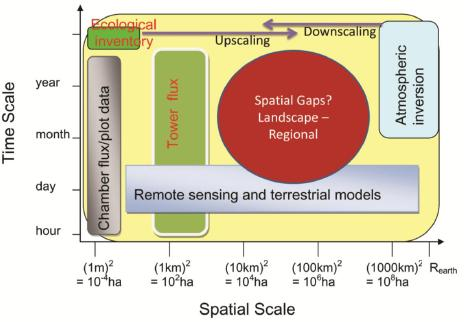
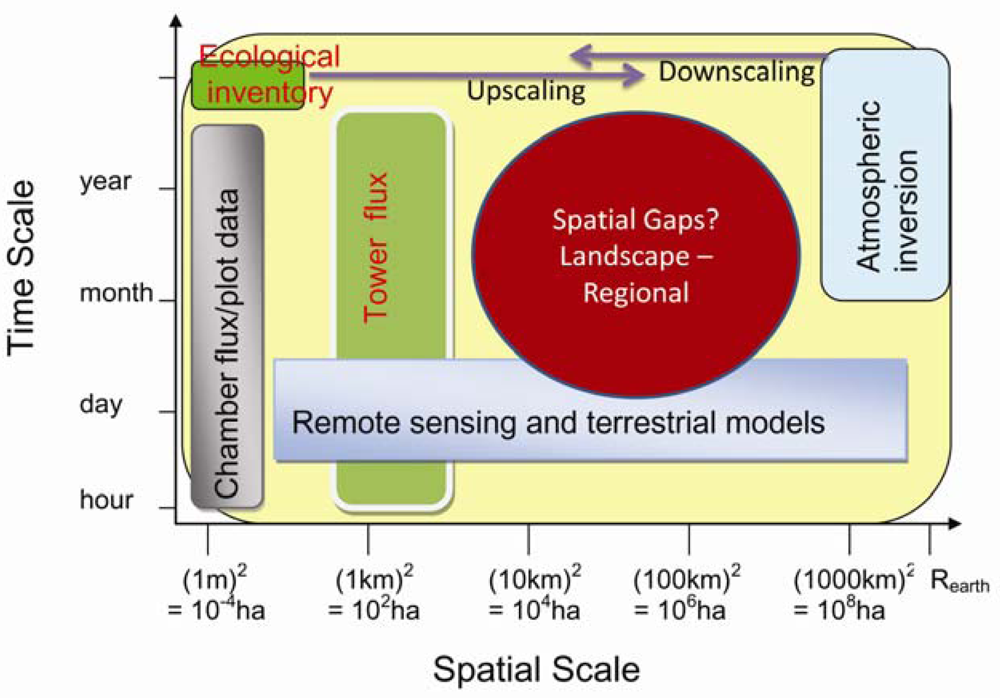
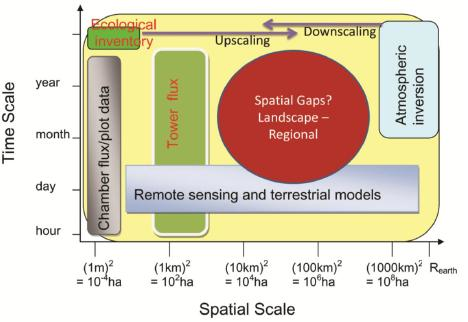
<p>A variety of methods are being used in the C and water cycles studies. As shown in <xref ref-type="fig" rid="f3-sensors-09-08624">Figure 3</xref>, different approaches have different temporal and spatial scales. The most direct measurements of the terrestrial C flux are made either at the plot scale (10<sup>−2</sup>–10<sup>1</sup> m<sup>2</sup>), e.g., using biometric methods and various forms of chamber, or at the ecosystem (patch) scale (10<sup>4</sup>–10<sup>6</sup> m<sup>2</sup>), using the EC technique. Ecohydrological / ecosystem modeling and remote sensing estimations are generally available across variable spatiotemporal scales. These estimates are normally available within a nested framework that permits a progressive comparison of measurements made by surface instrumentation (scale: 1 to 10 m), surface flux equipment (10 m to 1 km), airborne remote sensing equipment (100 m to several km), satellite remote sensing (30 m to global scale) and EC tower (1–3 km).</p>
<p>The atmosphere integrates surface fluxes over many temporal and spatial scales and links scalar sources and sinks with concentrations and fluxes. This principle has been successfully used to develop inverse models to estimate annual C budgets [<xref ref-type="bibr" rid="b225-sensors-09-08624">225</xref>-<xref ref-type="bibr" rid="b230-sensors-09-08624">230</xref>]. However, due to model limitations and paucity of continental CO<sub>2</sub> observations these studies have yielded C fluxes only at coarse resolution, over large spatial regions [<xref ref-type="bibr" rid="b231-sensors-09-08624">231</xref>-<xref ref-type="bibr" rid="b233-sensors-09-08624">233</xref>].</p>
<p>Progress in C balance studies has been achieved at both ends of the spatial scale spectrum, either large continents (larger than 10<sup>6</sup> km<sup>2</sup>, e.g., global inverse modeling) or small vegetation stands (less than 1–3 km<sup>2</sup>, e.g., EC-measurements). Methods to estimate CO<sub>2</sub> sources and sinks at the intermediate scale (i.e., landscape to regional scales) between continental and local scales are less well advanced. Moreover, the C cycle in different regions can vary markedly in response to changing climate [<xref ref-type="bibr" rid="b5-sensors-09-08624">5</xref>]. Reliable estimates of terrestrial C sources and sinks at landscape to regional spatial scales (finer than those used in global inversions and larger than local EC flux measurements and roughly defined as the range between 10<sup>2</sup> and 10<sup>6</sup> km<sup>2</sup>) are required to quantitatively account for the large spatial variability in sources and sinks in the near-field of a measurement location [<xref ref-type="bibr" rid="b234-sensors-09-08624">234</xref>], as well as fundamental to improving our understanding of the C cycle [<xref ref-type="bibr" rid="b235-sensors-09-08624">235</xref>].</p>
<p>It is generally considered unreliable to upscale stand-level fluxes (i.e., EC measurements) to a region by simple spatial extrapolation and interpolation because of the heterogeneity of the land surface and the nonlinearity inherent in ecophysiological processes [<xref ref-type="bibr" rid="b236-sensors-09-08624">236</xref>]. It is also challenging to apply atmospheric inversion technique to regional scales for quantifying annual C budgets because at such intermediate scales the atmosphere is often poorly constrained [<xref ref-type="bibr" rid="b86-sensors-09-08624">86</xref>,<xref ref-type="bibr" rid="b237-sensors-09-08624">237</xref>]. Moreover, aggregation errors and errors in atmospheric transport, both within the PBL and between the PBL and free troposphere, can also be obstacles to using these approaches to obtain quantitative estimates of regional C fluxes [<xref ref-type="bibr" rid="b76-sensors-09-08624">76</xref>]. Hence, there is a strong motivation to develop methods to quantify and validate estimates of the C balance at these intermediate scales [<xref ref-type="bibr" rid="b76-sensors-09-08624">76</xref>-<xref ref-type="bibr" rid="b77-sensors-09-08624">77</xref>,<xref ref-type="bibr" rid="b79-sensors-09-08624">79</xref>,<xref ref-type="bibr" rid="b86-sensors-09-08624">86</xref>]. Observations of CO<sub>2</sub> over the continent within the PBL reflect exchange processes occurring at the surface at a regional scale (10<sup>2</sup>–10<sup>5</sup> km<sup>2</sup>). The flux information contained in CO<sub>2</sub> concentration data represents footprints of up to 10<sup>5</sup> km<sup>2</sup> [<xref ref-type="bibr" rid="b75-sensors-09-08624">75</xref>,<xref ref-type="bibr" rid="b76-sensors-09-08624">76</xref>], which are several orders of magnitude larger than the direct EC-flux footprint. This information is therefore needed in our effort to upscale from site to region. Moreover, the number of CO<sub>2</sub> mixing ratio measurements above the land surface, made by either tower or aircraft, is steadily increasing. Previous efforts to interpret the signal of regional CO<sub>2</sub> exchange making use of tower concentration data have focused on simple one-dimensional PBL budgets that rely on gradients in CO<sub>2</sub> concentrations between the PBL and the free troposphere [<xref ref-type="bibr" rid="b79-sensors-09-08624">79</xref>,<xref ref-type="bibr" rid="b84-sensors-09-08624">84</xref>]. These methods are limited to monthly resolution because of the need to smooth and average over several synoptic events [<xref ref-type="bibr" rid="b86-sensors-09-08624">86</xref>].</p></sec>
<sec sec-type="conclusions">
<label>6.</label>
<title>Future Research Directions</title>
<p>A synthetic research framework is needed to strength the less well researched areas as reviewed in Section 5: bottom-up and top-down approaches integrating scalable (footprint and ecosystem) models and a spatially nested hierarchy of observations which include multispectral remote sensing, inventories, existing regional clusters of eddy-covariance flux towers and CO<sub>2</sub> mixing ratio towers and chambers.</p>
<p>The current research trends and the future directions in this field include: (i) A synthesis aggregation method—integrating ecohydrological and isotopic models, remote sensing and component flux data, is becoming a pragmatic approach towards a better understanding of the coupled C, N and water dynamics at landscape/watershed scales; and (ii) The landscape- and regional-scale C fluxes are being estimated using an integrated approach involving direct land surface measurements, remote sensing measurements, and ecosystem-, footprint- and inversion- modeling.</p>
<sec>
<label>6.1.</label>
<title>Development of a Spatially Explicit Ecohydrological Modeling Framework</title>
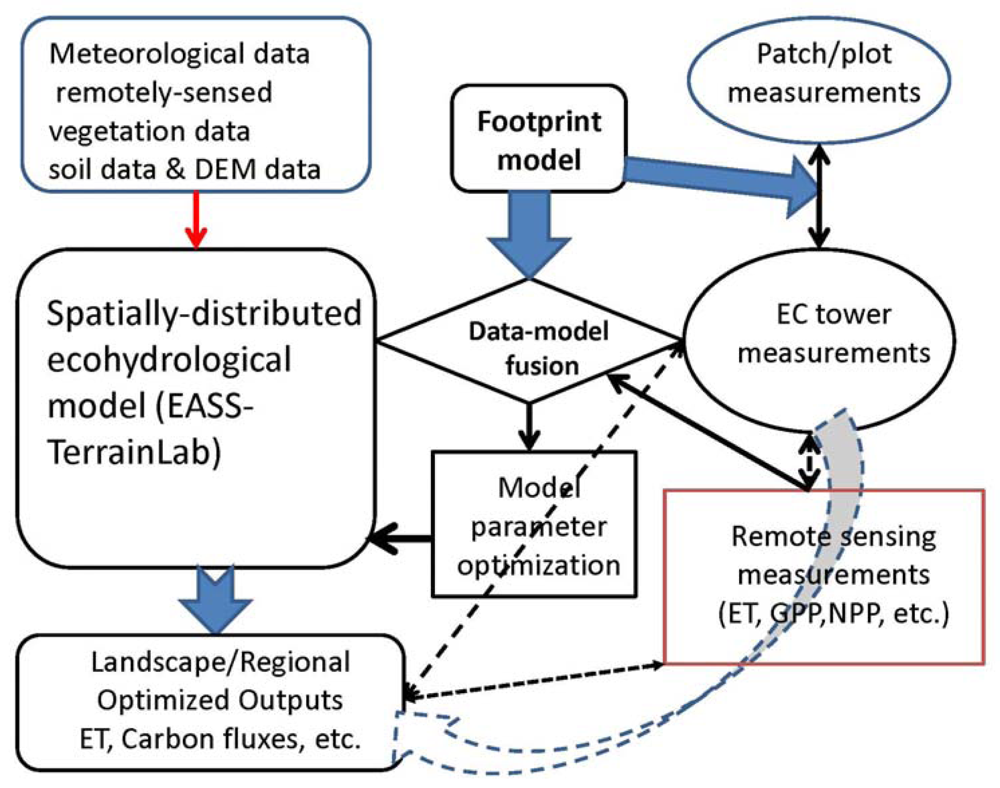
<p>Coupled modeling will help refine the experimental and instrumental design and generate cross-disciplinary hypotheses that can be tested in the experiment. Ecohydrological models are powerful tools for quantitative and predictive understanding the coupled C, N and water mechanisms. Spatially-explicit ecohydrological modeling can be used to infer aspects of the land surface system that are difficult to measure by mass and energy balance, and will be critical to improving the accuracy of forecasts of landscape change and C dynamics in the real world. While developing a process-based, coupled-system model is a significant task, the coupling to existing models may provide a relatively easy way forward. For example, a spatially explicit, process-based ecohydrological model, EASS-TerrainLab, is developed to improve the representation of the coupled C, N and hydrological processes by integrating of two existing models (an ecosystem LSM model—EASS and a distributed hydrological model—TerrainLab).</p>
<sec>
<label>6.1.1.</label>
<title>Reviewing of the Existing EASS Model [<xref ref-type="bibr" rid="b112-sensors-09-08624">112</xref>]</title>
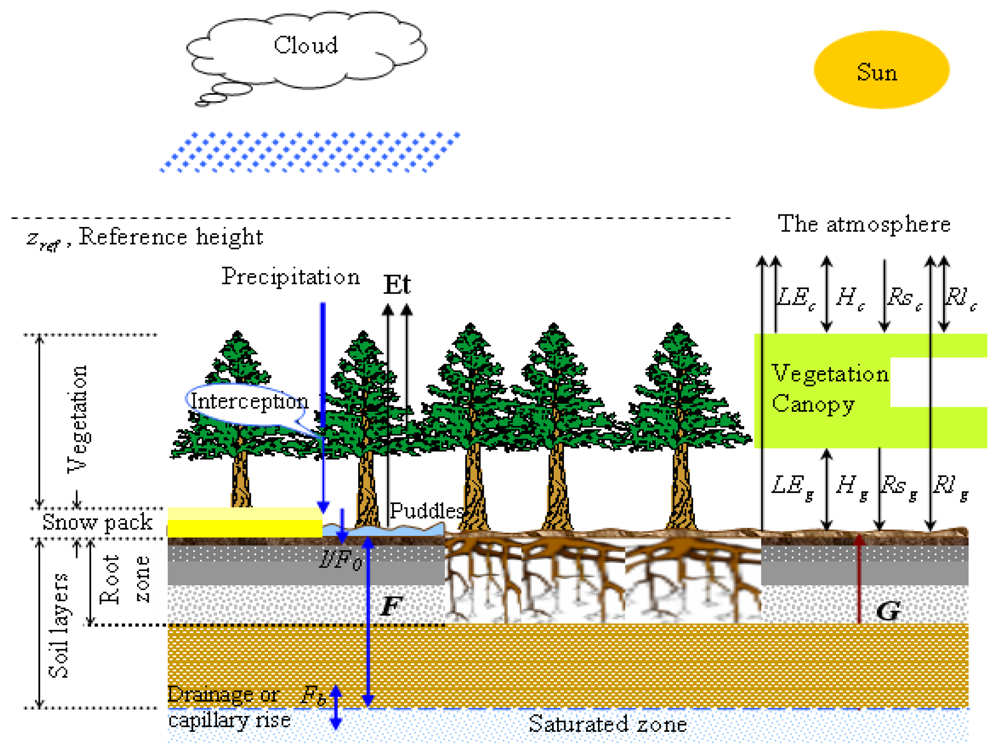
<p>EASS is based on a single layer vegetation canopy overlying a seven-layer soil, and includes physically-based treatment of energy and moisture fluxes from the vegetation canopy and through it. It also incorporates explicit thermal separation of the vegetation from the underlying ground [<xref ref-type="bibr" rid="b134-sensors-09-08624">134</xref>]. Moreover, EASS includes a scheme with stratification of sunlit and shaded leaves to avoid shortcomings of the “big leaf” assumption [<xref ref-type="bibr" rid="b197-sensors-09-08624">197</xref>,<xref ref-type="bibr" rid="b238-sensors-09-08624">238</xref>]. It has been referred as a “two-leaf” canopy model [<xref ref-type="bibr" rid="b81-sensors-09-08624">81</xref>,<xref ref-type="bibr" rid="b239-sensors-09-08624">239</xref>]. The structure of EASS is shown in <xref ref-type="fig" rid="f4-sensors-09-08624">Figure 4</xref>.</p>
<p>With spatially explicit input data on vegetation, meteorology and soil, EASS can be run pixel by pixel over a defined domain, such as Canada's landmass, or any of its parts, or the globe. EASS has flexible spatial and temporal resolutions, as long as the input data of each pixel are defined.</p>
<p>In short, EASS has the following characteristics: (i) satellite data are used to describe the spatial and temporal information on vegetation [<xref ref-type="bibr" rid="b143-sensors-09-08624">143</xref>]; (ii) energy and water exchanges and carbon assimilation in the soil-vegetation-atmosphere system are fully coupled and are simulated simultaneously. The Ball-Woodrow-Berry stamatal conductance formulation [<xref ref-type="bibr" rid="b24-sensors-09-08624">24</xref>] was employed (see Section 4.4); (iii) the energy and C assimilation fluxes are calculated with stratification of sunlit and shaded leaves to avoid shortcomings of the “big-leaf” assumption; and (iv) the lateral movement of water is ignored.</p></sec>
<sec>
<label>6.1.2.</label>
<title>Reviewing of the TerrainLab Model [<xref ref-type="bibr" rid="b157-sensors-09-08624">157</xref>]</title>
<p>TerrainLab [<xref ref-type="bibr" rid="b194-sensors-09-08624">194</xref>] was adopted concepts from Wigmosta <italic>et al.</italic> [<xref ref-type="bibr" rid="b208-sensors-09-08624">208</xref>] and it has been tested in the Southern Study Area (SSA) of the BOREAS region to study the spatio-temporal variation of ET and soil moisture [<xref ref-type="bibr" rid="b143-sensors-09-08624">143</xref>]. The horizontal boundary of the simulated area is a watershed delineated from a digital elevation model (DEM) where divides between neighboring watersheds are identified. Vertically, the simulation extends from the saturated zone in the soil to the top of vegetation canopy. Within a watershed, the forest ecosystem is divided into basic spatial units, or pixels in remote sensing. Each pixel is treated as a unique vegetation-soil system, except for the ground and runoff water exchanges. Basic model simulations of the physical and biological processes are made at the pixel scale. According to the need of simulating hydrological processes, a pixel is vertically divided into five strata, i.e., overstory, understory, litter or moss layer, soil unsaturated zone, and soil saturated zone. Precipitation, solar radiation, topographic parameters, land cover, LAI, and soil properties are the major inputs to the model.</p>
<p>The soil water balance component of TerrainLab allows for the spatially explicit simulation of topographically driven lateral subsurface flow and its influence on water table depth and soil water content dynamics based on a raster grid DEM [<xref ref-type="bibr" rid="b194-sensors-09-08624">194</xref>]. TerrainLab uses the explicit routing scheme of Wigmosta <italic>et al.</italic> [<xref ref-type="bibr" rid="b208-sensors-09-08624">208</xref>]. In this approach the soil profile is subdivided into an unsaturated and a saturated zone. Saturated hydraulic conductivity is assumed to be depth-dependent, while other hydraulic parameters are considered to be vertically homogenous. However, the assumption of vertical homogeneity of permanent wilting point, field capacity, and porosity represents a major simplification in peat lands. The lateral movement of water between each raster grid cell (pixel) of the modeling domain and its maximum eight neighboring pixels based on a multi-predilection-flow algorithm occurs in the saturated zone, i.e., as groundwater flow. Groundwater follows the local hydraulic gradient (3 × 3 pixels) that is assumed to be approximated by local ground surface slopes [<xref ref-type="bibr" rid="b194-sensors-09-08624">194</xref>,<xref ref-type="bibr" rid="b208-sensors-09-08624">208</xref>].</p></sec>
<sec>
<label>6.1.3.</label>
<title>Development of an Ecohydrological Model by Coupling of EASS with TerrainLab</title>
<p>The coupled model (EASS-TerrainLab) explicitly describes ecohydrological processes (coupled C, N and water dynamics). Each process will be explicitly calculated separately for overstory and understory with sunlit and shaded leaf groups. Vertical hydrological processing will be adequately described using detailed water balance equations, the topographically driven lateral water flows will be considered for both saturated and unsaturated soil layers, and their influence on soil water content and water table depth are calculated based on a raster grid DEM [<xref ref-type="bibr" rid="b194-sensors-09-08624">194</xref>] using the explicit routing scheme of Wigmosta <italic>et al.</italic> [<xref ref-type="bibr" rid="b208-sensors-09-08624">208</xref>].</p></sec>
<sec>
<label>6.1.4.</label>
<title>Model Calibration and Validation for EASS-TerrainLab</title>
<p>Model calibration and validation will conducted in three ways: (i) Modeled surface runoff will be compared with the watershed discharge measurements; (ii) Simulated soil water storage and its changes will be verified with several soil water measurement profiles; and (iii) Simulated ET will be validated with EC-flux tower measured ET based on footprint averaging and the remotely sensed spatially-distributed ET.</p></sec>
<sec sec-type="methods">
<label>6.1.5.</label>
<title>Model Sensitivity Analysis and Runs under Different Scenarios</title>
<p>A set of sensitivity analysis will conducted to test the coupled capacity. The model will be run under several different scenarios to explore: (i) the effects of surface and sub-surface base flow on GPP and ET; (ii) the influence of mesoscale topography on hydrological processes (runoff and soil storage) and C exchange (water use efficiency and light use efficiency); (iii) the influence of photosynthesis on ET by comparing simulation results using different stomatal conductance schemes; and (iv) the effects of representations of spatial variability on simulations of photosynthesis and ET.</p></sec></sec>
<sec>
<label>6.2.</label>
<title>Landscape and Regional C and Water Fluxes Estimation: An Upscaling Framework</title>
<p><xref ref-type="fig" rid="f5-sensors-09-08624">Figure 5</xref> schematically shows a synthetic upscaling framework for estimating landscape and regional C and water budgets with a reasonable accuracy. Using a data-model fusion with footprint weighting method to optimize the ecohydrological model's parameters is strongly suggested because the land surface is normally heterogeneous. This is a key component in the upscaling framework. Model parameters are optimized by minimizing the ‘cost’ function [<xref ref-type="bibr" rid="b240-sensors-09-08624">240</xref>]:
<disp-formula id="FD5">
<label>(4)</label>
<mml:math id="mm11" display="block">
<mml:semantics id="sm11">
<mml:mrow>
<mml:mi mathvariant="bold">J</mml:mi>
<mml:mo mathvariant="bold" stretchy="false">(</mml:mo>
<mml:mtext mathvariant="bold">x</mml:mtext>
<mml:mo mathvariant="bold" stretchy="false">)</mml:mo>
<mml:mo mathvariant="bold">=</mml:mo>
<mml:mfrac>
<mml:mn mathvariant="bold">1</mml:mn>
<mml:mn mathvariant="bold">2</mml:mn></mml:mfrac>
<mml:mrow>
<mml:mo mathvariant="bold">[</mml:mo>
<mml:mrow>
<mml:msup>
<mml:mrow>
<mml:mrow>
<mml:mo mathvariant="bold" stretchy="true">(</mml:mo>
<mml:mrow>
<mml:mi mathvariant="bold">O</mml:mi>
<mml:mo mathvariant="bold">−</mml:mo>
<mml:mi mathvariant="bold">Y</mml:mi>
<mml:mo stretchy="false" mathvariant="bold">(</mml:mo>
<mml:mtext mathvariant="bold">x</mml:mtext>
<mml:mo stretchy="false" mathvariant="bold">)</mml:mo></mml:mrow>
<mml:mo mathvariant="bold" stretchy="true">)</mml:mo></mml:mrow></mml:mrow>
<mml:mtext mathvariant="bold">T</mml:mtext></mml:msup>
<mml:msubsup>
<mml:mi mathvariant="bold">C</mml:mi>
<mml:mi mathvariant="bold">o</mml:mi>
<mml:mrow>
<mml:mo mathvariant="bold">−</mml:mo>
<mml:mn mathvariant="bold">1</mml:mn></mml:mrow></mml:msubsup>
<mml:mrow>
<mml:mo mathvariant="bold" stretchy="true">(</mml:mo>
<mml:mrow>
<mml:mi mathvariant="bold">O</mml:mi>
<mml:mo mathvariant="bold">−</mml:mo>
<mml:mi mathvariant="bold">Y</mml:mi>
<mml:mo stretchy="false" mathvariant="bold">(</mml:mo>
<mml:mtext mathvariant="bold">x</mml:mtext>
<mml:mo stretchy="false" mathvariant="bold">)</mml:mo></mml:mrow></mml:mrow>
<mml:mo mathvariant="bold">+</mml:mo>
<mml:msup>
<mml:mrow>
<mml:mrow>
<mml:mo mathvariant="bold">(</mml:mo>
<mml:mrow>
<mml:mtext mathvariant="bold">x</mml:mtext>
<mml:mo mathvariant="bold">−</mml:mo>
<mml:msub>
<mml:mi mathvariant="bold">x</mml:mi>
<mml:mtext mathvariant="bold">b</mml:mtext></mml:msub></mml:mrow>
<mml:mo mathvariant="bold">)</mml:mo></mml:mrow></mml:mrow>
<mml:mi mathvariant="bold">T</mml:mi></mml:msup>
<mml:msubsup>
<mml:mtext mathvariant="bold">P</mml:mtext>
<mml:mtext mathvariant="bold">b</mml:mtext>
<mml:mrow>
<mml:mo mathvariant="bold">−</mml:mo>
<mml:mn mathvariant="bold">1</mml:mn></mml:mrow></mml:msubsup>
<mml:mrow>
<mml:mo mathvariant="bold">(</mml:mo>
<mml:mrow>
<mml:mi mathvariant="bold">x</mml:mi>
<mml:mo mathvariant="bold">−</mml:mo>
<mml:msub>
<mml:mi mathvariant="bold">x</mml:mi>
<mml:mtext mathvariant="bold">b</mml:mtext></mml:msub></mml:mrow>
<mml:mo mathvariant="bold">)</mml:mo></mml:mrow></mml:mrow>
<mml:mo mathvariant="bold">]</mml:mo></mml:mrow></mml:mrow></mml:semantics></mml:math></disp-formula>where <bold>x</bold> is the vector of unknown parameters and <bold>x<sub>b</sub></bold> is a vector of <italic>a priori</italic> values of <bold>x</bold>; <bold><italic>O</italic></bold> is the vector of observations and <bold>Y</bold> is the nonlinear model results, <bold>C<sub>o</sub></bold> is the covariance matrix of observations and <bold><italic>P</italic><sub>b</sub></bold> is the covariance matrix of <italic>a priori</italic> parameters. Different from general data-fusion method, <bold>Y</bold> is weighting averaged by footprint <italic>f<sub>j</sub></italic> for each pixel (<italic>j</italic>) within the footprint domain as <bold>Y</bold> = ∑<bold>Y</bold><italic><sub>j</sub>f<sub>j</sub></italic>.</p>
<p>We also note that the dynamics of the PBL is tightly coupled with the land surface processes (e.g., energy / water / C fluxes). But for simplification, we proposed off-line modeling instead of the on-line coupling with regional climate model or the GCMs. The meteorological driving inputs for the ecohydrological model, therefore, are required for model runs. These inputs can either acquire from spatially extrapolation from climate station (including EC flux towers) measurements, or from the re-analysis data (e.g., the data provided by National Centers for Environmental Prediction (NCEP)), or from the regional climate modeling outputs.</p></sec></sec>
<sec sec-type="conclusions">
<label>7.</label>
<title>Summary</title>
<p>After comprehensive reviewing of a variety of approaches being used in research on the C/water cycles, the concluding remarks are summed the following:</p>
<p>Research gaps in this field are (i) The coupled terrestrial C, N and hydrological dynamics are far from well understood, especially at landscape (watershed) and regional scales; (2) Much progresses have been achieved at the extreme ends of the spatial-scale spectrum, either large regions/continents or small vegetation stands. Because of the heterogeneity of the land surface and the nonlinearity inherent in ecophysiological and ecohydrological processes in response to their driving forces, it is difficult to upscale stand level results to regions and the globe by extrapolation. Budgets of carbon and water at landscape intermediate regional scales (10<sup>2</sup>–10<sup>5</sup> km<sup>2</sup>) have large uncertainties.</p>
<p>A coupled spatially-explicit ecohydrological model is a powerful tool for quantitative and predictive understanding of the coupled C, N and water mechanism. This modeling framework can be used to infer aspects of the land surface system that are difficult to measure, and will be critical to improving the accuracy of forecasts of landscape change and C dynamics in the real world.</p>
<p>Combining and mutually constraining the bottom-up and top-down methods to reduce their uncertainties using data assimilation techniques is a practical and effective means to derive regional C and water fluxes with reasonably high accuracy. In the proposed upscaling framework by this paper, spatially nested hierarchy of observations, including multispectral remote sensing, inventories, existing regional clusters of EC flux towers and CO<sub>2</sub> mixing ratio towers and chambers, are able to integrated using scalable (footprint and ecosystem and ecohydrological) models and data-model fusion techniques.</p></sec></body>
<back>
<ack>
<p>This research is financially supported by Alexander Graham Bell Canada Scholarship (CGS) funded by Natural Sciences and Engineering Research Council of Canada, “One hundred talents” program funded by Chinese Academy of Sciences, and National Key Technology R&amp;D Program of China (2008BAK50B06-02). The authors are grateful to the two anonymous referees for their constructive and in-depth reviews, and for their comments/suggestions on how to improve this manuscript.</p></ack>
<ref-list>
<title>References and Notes</title>
<ref id="b1-sensors-09-08624"><label>1.</label><citation citation-type="book"><person-group person-group-type="author"><name><surname>Treut</surname><given-names>L.</given-names></name><name><surname>Somerville</surname><given-names>H.R.</given-names></name><name><surname>Cubasch</surname><given-names>U.</given-names></name><name><surname>Ding</surname><given-names>Y.</given-names></name><name><surname>Mauritzen</surname><given-names>C.</given-names></name><name><surname>Mokssit</surname><given-names>A.</given-names></name><name><surname>Peterson</surname><given-names>T.</given-names></name><name><surname>Prather</surname><given-names>M.</given-names></name></person-group><article-title>Historical Overview of Climate Change</article-title><source>Climate Change 2007: The Physical Science Basis. Contribution of Working Group I to the Fourth Assessment Report of the Intergovernmental Panel on Climate Change</source><person-group person-group-type="editor"><name><surname>Solomon</surname><given-names>S.</given-names></name><name><surname>Qin</surname><given-names>D.</given-names></name><name><surname>Manning</surname><given-names>M.</given-names></name><name><surname>Chen</surname><given-names>Z.</given-names></name><name><surname>Marquis</surname><given-names>M.</given-names></name><name><surname>Averyt</surname><given-names>K.B.</given-names></name><name><surname>Tignor</surname><given-names>M.</given-names></name><name><surname>Miller</surname><given-names>H.L.</given-names></name></person-group><publisher-name>Cambridge University Press</publisher-name><publisher-loc>Cambridge, UK</publisher-loc><year>2007</year><fpage>104</fpage><lpage>105</lpage></citation></ref>
<ref id="b2-sensors-09-08624"><label>2.</label><citation citation-type="journal"><person-group person-group-type="author"><name><surname>Betts</surname><given-names>R.A.</given-names></name><name><surname>Cox</surname><given-names>P.M.</given-names></name><name><surname>Woodward</surname><given-names>F.I.</given-names></name></person-group><article-title>Simulated responses of potential vegetation to doubled-CO<sub>2</sub> climate change and feedbacks on near-surface temperature</article-title><source>Global Ecol. Biogeogr.</source><year>2000</year><volume>9</volume><fpage>171</fpage><lpage>180</lpage><pub-id pub-id-type="doi">10.1046/j.1365-2699.2000.00160.x</pub-id></citation></ref>
<ref id="b3-sensors-09-08624"><label>3.</label><citation citation-type="journal"><person-group person-group-type="author"><name><surname>Cox</surname><given-names>P.M.</given-names></name><name><surname>Betts</surname><given-names>R.A.</given-names></name><name><surname>Jones</surname><given-names>C.D.</given-names></name><name><surname>Spall</surname><given-names>S.A.</given-names></name><name><surname>Totterdell</surname><given-names>I.J.</given-names></name></person-group><article-title>Acceleration of global warming due to carbon-cycle feedbacks in a coupled climate model</article-title><source>Nature</source><year>2000</year><volume>408</volume><fpage>184</fpage><pub-id pub-id-type="doi">10.1038/35041539</pub-id><pub-id pub-id-type="pmid">11089968</pub-id></citation></ref>
<ref id="b4-sensors-09-08624"><label>4.</label><citation citation-type="journal"><person-group person-group-type="author"><name><surname>Pielke</surname><given-names>R.A.</given-names><suffix>Sr.</suffix></name></person-group><article-title>Influence of the spatial distribution of vegetation and soils on the prediction of cumulus convective rainfall</article-title><source>Rev. Geophys.</source><year>2001</year><volume>39</volume><fpage>151</fpage><lpage>177</lpage><pub-id pub-id-type="doi">10.1029/1999RG000072</pub-id></citation></ref>
<ref id="b5-sensors-09-08624"><label>5.</label><citation citation-type="journal"><person-group person-group-type="author"><name><surname>Friedlingstein</surname><given-names>P.</given-names></name><name><surname>Dufresne</surname><given-names>J.L.</given-names></name><name><surname>Cox</surname><given-names>P.M.</given-names></name><name><surname>Rayner</surname><given-names>P.</given-names></name></person-group><article-title>How positive is the feedback between climate change and the carbon cycle?</article-title><source>Tellus B</source><year>2003</year><volume>55</volume><fpage>692</fpage><lpage>700</lpage><pub-id pub-id-type="doi">10.1034/j.1600-0889.2003.01461.x</pub-id></citation></ref>
<ref id="b6-sensors-09-08624"><label>6.</label><citation citation-type="journal"><person-group person-group-type="author"><name><surname>Seneviratne</surname><given-names>S.I.</given-names></name><name><surname>Luthi</surname><given-names>D.</given-names></name><name><surname>Litschi</surname><given-names>M.</given-names></name><name><surname>Schar</surname><given-names>C.</given-names></name></person-group><article-title>Land-atmosphere coupling and climate change in Europe</article-title><source>Nature</source><year>2006</year><volume>443</volume><fpage>205</fpage><lpage>209</lpage><pub-id pub-id-type="doi">10.1038/nature05095</pub-id><pub-id pub-id-type="pmid">16971947</pub-id></citation></ref>
<ref id="b7-sensors-09-08624"><label>7.</label><citation citation-type="journal"><person-group person-group-type="author"><name><surname>Betts</surname><given-names>A.K.</given-names></name><name><surname>Desjardins</surname><given-names>R.L.</given-names></name><name><surname>Worth</surname><given-names>D.</given-names></name></person-group><article-title>Impact of agriculture, forest and cloud feedback on the surface energy budget in BOREAS</article-title><source>Agric. For. Meteor.</source><year>2007</year><volume>142</volume><fpage>156</fpage><lpage>169</lpage><pub-id pub-id-type="doi">10.1016/j.agrformet.2006.08.020</pub-id></citation></ref>
<ref id="b8-sensors-09-08624"><label>8.</label><citation citation-type="journal"><person-group person-group-type="author"><name><surname>Betts</surname><given-names>R.A.</given-names></name><name><surname>Boucher</surname><given-names>O.</given-names></name><name><surname>Collins</surname><given-names>M.</given-names></name><name><surname>Cox</surname><given-names>P.M.</given-names></name><name><surname>Falloon</surname><given-names>P.D.</given-names></name><name><surname>Gedney</surname><given-names>N.</given-names></name><name><surname>Hemming</surname><given-names>D.L.</given-names></name><name><surname>Huntingford</surname><given-names>C.</given-names></name><name><surname>Jones</surname><given-names>C.D.</given-names></name><name><surname>Sexton</surname><given-names>D.M.H.</given-names></name><name><surname>Webb</surname><given-names>M.J.</given-names></name></person-group><article-title>Projected increase in continental runoff due to plant responses to increasing carbon dioxide</article-title><source>Nature</source><year>2007</year><volume>448</volume><fpage>1037</fpage><lpage>1045</lpage><pub-id pub-id-type="doi">10.1038/nature06045</pub-id><pub-id pub-id-type="pmid">17728755</pub-id></citation></ref>
<ref id="b9-sensors-09-08624"><label>9.</label><citation citation-type="journal"><person-group person-group-type="author"><name><surname>Baldocchi</surname><given-names>D.D.</given-names></name></person-group><article-title>Breathing of the terrestrial biosphere: lessons learned from a global network of carbon dioxide flux measurement systems</article-title><source>Aust. J. Bot.</source><year>2008</year><volume>56</volume><fpage>1</fpage><lpage>26</lpage><pub-id pub-id-type="doi">10.1071/BT07151</pub-id></citation></ref>
<ref id="b10-sensors-09-08624"><label>10.</label><citation citation-type="journal"><person-group person-group-type="author"><name><surname>Running</surname><given-names>S.W.</given-names></name><name><surname>Nemani</surname><given-names>R.R.</given-names></name><name><surname>Heinsch</surname><given-names>F.A.</given-names></name><name><surname>Zhao</surname><given-names>M.</given-names></name><name><surname>Reeves</surname><given-names>M.</given-names></name><name><surname>Jolly</surname><given-names>M.</given-names></name></person-group><article-title>A continuous satellite-derived measure of global terrestrial primary productivity: Future science and applications</article-title><source>Bioscience</source><year>2004</year><volume>56</volume><fpage>547</fpage><lpage>560</lpage></citation></ref>
<ref id="b11-sensors-09-08624"><label>11.</label><citation citation-type="journal"><person-group person-group-type="author"><name><surname>Kalma</surname><given-names>J.D.</given-names></name><name><surname>McVicar</surname><given-names>T.R.</given-names></name><name><surname>McCabe</surname><given-names>M.F.</given-names></name></person-group><article-title>Estimating Land Surface Evaporation: A Review of Methods Using Remotely Sensed Surface Temperature Data</article-title><source>Surv. Geophys.</source><year>2008</year><volume>29</volume><fpage>421</fpage><lpage>469</lpage><pub-id pub-id-type="doi">10.1007/s10712-008-9037-z</pub-id></citation></ref>
<ref id="b12-sensors-09-08624"><label>12.</label><citation citation-type="journal"><person-group person-group-type="author"><name><surname>Verstraeten</surname><given-names>W.W.</given-names></name><name><surname>Veroustraete</surname><given-names>F.</given-names></name><name><surname>Feyen</surname><given-names>J.</given-names></name></person-group><article-title>Assessment of evapotranspiration and soil moisture content across different scales of observation</article-title><source>Sensors</source><year>2008</year><volume>8</volume><fpage>70</fpage><lpage>117</lpage><pub-id pub-id-type="doi">10.3390/s8010070</pub-id></citation></ref>
<ref id="b13-sensors-09-08624"><label>13.</label><citation citation-type="journal"><person-group person-group-type="author"><name><surname>Marquis</surname><given-names>M.</given-names></name><name><surname>Tans</surname><given-names>P.</given-names></name></person-group><article-title>Carbon crucible</article-title><source>Science</source><year>2008</year><volume>320</volume><fpage>460</fpage><lpage>470</lpage><pub-id pub-id-type="doi">10.1126/science.1156451</pub-id><pub-id pub-id-type="pmid">18436764</pub-id></citation></ref>
<ref id="b14-sensors-09-08624"><label>14.</label><citation citation-type="journal"><person-group person-group-type="author"><name><surname>Canadell</surname><given-names>J.G.</given-names></name><name><surname>Quere</surname><given-names>C.</given-names></name><name><surname>Raupacha</surname><given-names>M.R.</given-names></name><name><surname>Fielde</surname><given-names>C.B.</given-names></name><name><surname>Buitenhuisc</surname><given-names>E.T.</given-names></name><name><surname>Ciais</surname><given-names>P.</given-names></name><name><surname>Conwayg</surname><given-names>T.J.</given-names></name><name><surname>Gillettc</surname><given-names>N.P.</given-names></name><name><surname>Houghtonh</surname><given-names>R.A.</given-names></name><name><surname>Marlandi</surname><given-names>G.</given-names></name></person-group><article-title>Contributions to accelerating atmospheric CO<sub>2</sub> growth from economic activity, carbon intensity, and efficiency of natural sinks</article-title><source>Proc. Natl. Acad. Sci.</source><year>2007</year><volume>104</volume><fpage>18866</fpage><lpage>18870</lpage><pub-id pub-id-type="doi">10.1073/pnas.0702737104</pub-id><pub-id pub-id-type="pmid">17962418</pub-id></citation></ref>
<ref id="b15-sensors-09-08624"><label>15.</label><citation citation-type="book"><person-group person-group-type="author"><name><surname>Prentice</surname><given-names>I.C.</given-names></name><name><surname>Farquhar</surname><given-names>G.D.</given-names></name><name><surname>Fasham</surname><given-names>M.J.R.</given-names></name></person-group><source>The Carbon Cycle and Atmospheric Carbon Dioxide</source><person-group person-group-type="editor"><name><surname>Houghton</surname><given-names>J.T.</given-names></name></person-group><publisher-name>Cambridge University Press</publisher-name><publisher-loc>Cambridge, UK</publisher-loc><year>2001</year><fpage>183</fpage><lpage>238</lpage></citation></ref>
<ref id="b16-sensors-09-08624"><label>16.</label><citation citation-type="journal"><person-group person-group-type="author"><name><surname>Falk</surname><given-names>M.</given-names></name><name><surname>Wharton</surname><given-names>S.</given-names></name><name><surname>Schroeder</surname><given-names>M.</given-names></name></person-group><article-title>Flux partitioning in an old-growth forest: seasonal and interannual dynamics</article-title><source>Tree Physiol.</source><year>2008</year><volume>28</volume><fpage>509</fpage><lpage>520</lpage><pub-id pub-id-type="doi">10.1093/treephys/28.4.509</pub-id><pub-id pub-id-type="pmid">18244938</pub-id></citation></ref>
<ref id="b17-sensors-09-08624"><label>17.</label><citation citation-type="journal"><person-group person-group-type="author"><name><surname>Levin</surname><given-names>S.A.</given-names></name></person-group><article-title>Complex adaptive systems: exploring the known, unknown and unknowable</article-title><source>Bull. Amer. Meteor. Soc.</source><year>2002</year><volume>40</volume><fpage>1</fpage><lpage>19</lpage><pub-id pub-id-type="doi">10.1090/S0273-0979-02-00973-4</pub-id></citation></ref>
<ref id="b18-sensors-09-08624"><label>18.</label><citation citation-type="journal"><person-group person-group-type="author"><name><surname>Ma</surname><given-names>S.</given-names></name><name><surname>Baldocchi</surname><given-names>D.D.</given-names></name><name><surname>Xu</surname><given-names>L.</given-names></name></person-group><article-title>Interannual variability in carbon dioxide exchage of an oak/grass sacanna and open grassland in California</article-title><source>Agric. For. Meteor.</source><year>2007</year><volume>147</volume><fpage>157</fpage><lpage>171</lpage><pub-id pub-id-type="doi">10.1016/j.agrformet.2007.07.008</pub-id></citation></ref>
<ref id="b19-sensors-09-08624"><label>19.</label><citation citation-type="journal"><person-group person-group-type="author"><name><surname>Black</surname><given-names>T.A.</given-names></name><name><surname>Chen</surname><given-names>W.J.</given-names></name><name><surname>Barr</surname><given-names>A.G.</given-names></name></person-group><article-title>Increased carbon sequestration by a boreal deciduous forest in years with a warm spring</article-title><source>Geophys. Res. Lett.</source><year>2000</year><volume>27</volume><fpage>1271</fpage><lpage>1274</lpage><pub-id pub-id-type="doi">10.1029/1999GL011234</pub-id></citation></ref>
<ref id="b20-sensors-09-08624"><label>20.</label><citation citation-type="journal"><person-group person-group-type="author"><name><surname>Baldocchi</surname><given-names>D.D.</given-names></name><name><surname>Falge</surname><given-names>E.</given-names></name><name><surname>Gu</surname><given-names>L.</given-names></name></person-group><article-title>Fluxnet: a new tool to study the temporal and spatial variability of ecosystem-scale carbon dioxide, water vapor, and energy flux densities</article-title><source>Bull Amer. Meteorl. Soc.</source><year>2001</year><volume>82</volume><fpage>2415</fpage><lpage>2434</lpage><pub-id pub-id-type="doi">10.1175/1520-0477(2001)082&lt;2415:FANTTS&gt;2.3.CO;2</pub-id></citation></ref>
<ref id="b21-sensors-09-08624"><label>21.</label><citation citation-type="journal"><person-group person-group-type="author"><name><surname>Baldocchi</surname><given-names>D.D.</given-names></name><name><surname>Wilson</surname><given-names>K.B.</given-names></name></person-group><article-title>Modeling CO<sub>2</sub> fluxes and water vapor exchange of a temperate broadleaved forest across hourly to decadal time scales</article-title><source>Ecol. Mod.</source><year>2001</year><volume>142</volume><fpage>155</fpage><lpage>184</lpage><pub-id pub-id-type="doi">10.1016/S0304-3800(01)00287-3</pub-id></citation></ref>
<ref id="b22-sensors-09-08624"><label>22.</label><citation citation-type="journal"><person-group person-group-type="author"><name><surname>Barr</surname><given-names>A.G.</given-names></name><name><surname>Black</surname><given-names>T.A.</given-names></name><name><surname>Hogg</surname><given-names>E.H.</given-names></name></person-group><article-title>Inter-annual variability in the leaf area index of a boreal aspen-hazelnut forest in relation to net ecosystem production</article-title><source>Agric. For. Meteor.</source><year>2004</year><volume>126</volume><fpage>237</fpage><lpage>255</lpage><pub-id pub-id-type="doi">10.1016/j.agrformet.2004.06.011</pub-id></citation></ref>
<ref id="b23-sensors-09-08624"><label>23.</label><citation citation-type="journal"><person-group person-group-type="author"><name><surname>Law</surname><given-names>B.E.</given-names></name><name><surname>Falge</surname><given-names>E.</given-names></name><name><surname>Gu</surname><given-names>L.</given-names></name></person-group><article-title>Environmental controls over carbon dioxide and water vapor exchange of terrestrial vegetation</article-title><source>Agric. For. Meteor.</source><year>2002</year><volume>113</volume><fpage>97</fpage><lpage>120</lpage><pub-id pub-id-type="doi">10.1016/S0168-1923(02)00104-1</pub-id></citation></ref>
<ref id="b24-sensors-09-08624"><label>24.</label><citation citation-type="book"><person-group person-group-type="author"><name><surname>Ball</surname><given-names>J.T.</given-names></name><name><surname>Woodrow</surname><given-names>I.E.</given-names></name><name><surname>Berry</surname><given-names>J.A.</given-names></name></person-group><source>A Model Predicting Stomatal Conductnance Amd Its Contribution to the Control of Photosynthesis under Different Environmental Conditions</source><publisher-name>Martinus Nijhoff</publisher-name><publisher-loc>Dordrecht, Netherland</publisher-loc><year>1987</year><fpage>221</fpage><lpage>224</lpage></citation></ref>
<ref id="b25-sensors-09-08624"><label>25.</label><citation citation-type="journal"><person-group person-group-type="author"><name><surname>Levis</surname><given-names>S.</given-names></name><name><surname>Foley</surname><given-names>J.A.</given-names></name><name><surname>Pollard</surname><given-names>D.</given-names></name></person-group><article-title>Potential high-latitude vegetation feedbacks on CO<sub>2</sub>-induced climate change</article-title><source>Geophys. Res. Lett</source><year>1999</year><volume>26</volume><fpage>747</fpage><lpage>750</lpage><pub-id pub-id-type="doi">10.1029/1999GL900107</pub-id></citation></ref>
<ref id="b26-sensors-09-08624"><label>26.</label><citation citation-type="journal"><person-group person-group-type="author"><name><surname>Rodriguez-Iturbe</surname><given-names>I.</given-names></name></person-group><article-title>Ecohydrology: A hydrologic perspective of climate-soil-vegetation dynamics</article-title><source>Water Resour. Res.</source><year>2000</year><volume>36</volume><fpage>3</fpage><lpage>9</lpage><pub-id pub-id-type="doi">10.1029/1999WR900210</pub-id></citation></ref>
<ref id="b27-sensors-09-08624"><label>27.</label><citation citation-type="journal"><person-group person-group-type="author"><name><surname>Joos</surname><given-names>F.</given-names></name><name><surname>Prentice</surname><given-names>I.C.</given-names></name><name><surname>Sitch</surname><given-names>S.</given-names></name><name><surname>Meyer</surname><given-names>R.</given-names></name><name><surname>Hooss</surname><given-names>G.</given-names></name><name><surname>Plattner</surname><given-names>G.K.</given-names></name><name><surname>Gerber</surname><given-names>S.</given-names></name><name><surname>Hasselmann</surname><given-names>K.</given-names></name></person-group><article-title>Global warming feedbacks on terrestrial carbon uptake under the intergovernmental panel on climate change (IPCC) emission scenarios</article-title><source>Global Biogeochem. Cycles</source><year>2001</year><volume>15</volume><fpage>891</fpage><lpage>907</lpage><pub-id pub-id-type="doi">10.1029/2000GB001375</pub-id></citation></ref>
<ref id="b28-sensors-09-08624"><label>28.</label><citation citation-type="journal"><person-group person-group-type="author"><name><surname>Arain</surname><given-names>M.A.</given-names></name><name><surname>Yuan</surname><given-names>F.M.</given-names></name><name><surname>Black</surname><given-names>T.A.</given-names></name></person-group><article-title>Soil-plant nitrogen cycling modulated carbon exchanges in a Western Temperate Conifer Forest in Canada</article-title><source>Agric. For. Meteor.</source><year>2006</year><volume>140</volume><fpage>171</fpage><lpage>192</lpage><pub-id pub-id-type="doi">10.1016/j.agrformet.2006.03.021</pub-id></citation></ref>
<ref id="b29-sensors-09-08624"><label>29.</label><citation citation-type="journal"><person-group person-group-type="author"><name><surname>Blanken</surname><given-names>P.D.</given-names></name><name><surname>Black</surname><given-names>T.A.</given-names></name></person-group><article-title>The canopy conductance of a boreal aspen forest, Prince Albert national park, Canada</article-title><source>Hydro. Proces.</source><year>2004</year><volume>18</volume><fpage>1561</fpage><lpage>1578</lpage><pub-id pub-id-type="doi">10.1002/hyp.1406</pub-id></citation></ref>
<ref id="b30-sensors-09-08624"><label>30.</label><citation citation-type="journal"><person-group person-group-type="author"><name><surname>Snyder</surname><given-names>P.K.</given-names></name><name><surname>Delire</surname><given-names>C.L.</given-names></name><name><surname>Foley</surname><given-names>J.A.</given-names></name></person-group><article-title>Evaluating the influence of different vegetation biomes on the global climate</article-title><source>Clim. Dyn.</source><year>2004</year><volume>23</volume><fpage>279</fpage><lpage>302</lpage></citation></ref>
<ref id="b31-sensors-09-08624"><label>31.</label><citation citation-type="journal"><person-group person-group-type="author"><name><surname>Jarvis</surname><given-names>P.G.</given-names></name></person-group><article-title>Interpretation of variations in leaf water potential and stomatal conductance found in canopies in field</article-title><source>Philos. Trans. R Soc. Lond B Biol. Sci.</source><year>1976</year><volume>273</volume><fpage>593</fpage><lpage>610</lpage><pub-id pub-id-type="doi">10.1098/rstb.1976.0035</pub-id></citation></ref>
<ref id="b32-sensors-09-08624"><label>32.</label><citation citation-type="journal"><person-group person-group-type="author"><name><surname>Harris</surname><given-names>P.P.</given-names></name><name><surname>Huntingford</surname><given-names>C.</given-names></name><name><surname>Cox</surname><given-names>P.M.</given-names></name><name><surname>Gash</surname><given-names>J.H.C.</given-names></name><name><surname>Malhi</surname><given-names>Y.</given-names></name></person-group><article-title>Effect of soil moisture on canopy conductance of Amazonian rainforest</article-title><source>Agric. For. Meteor.</source><year>2004</year><volume>122</volume><fpage>215</fpage><lpage>227</lpage><pub-id pub-id-type="doi">10.1016/j.agrformet.2003.09.006</pub-id></citation></ref>
<ref id="b33-sensors-09-08624"><label>33.</label><citation citation-type="journal"><person-group person-group-type="author"><name><surname>Rodriguez-Iturbe</surname><given-names>I.</given-names></name><name><surname>Porporato</surname><given-names>A.</given-names></name><name><surname>Laio</surname><given-names>F.</given-names></name><name><surname>Ridolfi</surname><given-names>L.</given-names></name></person-group><article-title>Plants in water-controlled ecosystems: active role in hydrologic processes and response to water stress - i. scope and general outline</article-title><source>Adv. Water Resour.</source><year>2001</year><volume>24</volume><fpage>695</fpage><lpage>705</lpage><pub-id pub-id-type="doi">10.1016/S0309-1708(01)00004-5</pub-id></citation></ref>
<ref id="b34-sensors-09-08624"><label>34.</label><citation citation-type="journal"><person-group person-group-type="author"><name><surname>Parton</surname><given-names>W.J.</given-names></name><name><surname>Ojima</surname><given-names>D.S.</given-names></name><name><surname>Cole</surname><given-names>C.V.</given-names></name><name><surname>Schimel</surname><given-names>D.S.</given-names></name></person-group><article-title>A general model for soil organic matter dynamics: sensitivity to litter chemistry, texture and management</article-title><source>Soil Sci. Soc. Am. J.</source><year>1993</year><volume>39</volume><fpage>147</fpage><lpage>167</lpage></citation></ref>
<ref id="b35-sensors-09-08624"><label>35.</label><citation citation-type="journal"><person-group person-group-type="author"><name><surname>D'odorico</surname><given-names>P.</given-names></name><name><surname>Porporato</surname><given-names>A.</given-names></name><name><surname>Laio</surname><given-names>F.</given-names></name><name><surname>Ridolfi</surname><given-names>L.</given-names></name><name><surname>Rodriguez-Iturbe</surname><given-names>I.</given-names></name></person-group><article-title>Probabilistic modeling of nitrogen and carbon dynamics in water-limited ecosystems</article-title><source>Ecol. Model.</source><year>2004</year><volume>179</volume><fpage>205</fpage><lpage>219</lpage><pub-id pub-id-type="doi">10.1016/j.ecolmodel.2004.06.005</pub-id></citation></ref>
<ref id="b36-sensors-09-08624"><label>36.</label><citation citation-type="journal"><person-group person-group-type="author"><name><surname>Hedges</surname><given-names>J.I.</given-names></name></person-group><article-title>Global biogeochemical cycles: progress and problems</article-title><source>Mar. Chem.</source><year>1992</year><volume>39</volume><fpage>67</fpage><lpage>93</lpage><pub-id pub-id-type="doi">10.1016/0304-4203(92)90096-S</pub-id></citation></ref>
<ref id="b37-sensors-09-08624"><label>37.</label><citation citation-type="journal"><person-group person-group-type="author"><name><surname>Wang</surname><given-names>X.-C.</given-names></name><name><surname>Chen</surname><given-names>R.F.</given-names></name><name><surname>Gardner</surname><given-names>G.B.</given-names></name></person-group><article-title>Sources and transport of dissolved and particulate organic carbon in the Mississippi River estuary and adjacent coastal waters of the northern Gulf of Mexico</article-title><source>Marine Chem.</source><year>2004</year><volume>89</volume><fpage>241</fpage><lpage>256</lpage><pub-id pub-id-type="doi">10.1016/j.marchem.2004.02.014</pub-id></citation></ref>
<ref id="b38-sensors-09-08624"><label>38.</label><citation citation-type="journal"><person-group person-group-type="author"><name><surname>Meybeck</surname><given-names>M.</given-names></name></person-group><article-title>Carbon, nitrogen, and phosphorous transport by world rivers</article-title><source>Am. J. Sci.</source><year>1982</year><volume>282</volume><fpage>401</fpage><lpage>450</lpage><pub-id pub-id-type="doi">10.2475/ajs.282.4.401</pub-id></citation></ref>
<ref id="b39-sensors-09-08624"><label>39.</label><citation citation-type="journal"><person-group person-group-type="author"><name><surname>Vitousek</surname><given-names>P.M.</given-names></name><name><surname>Howarth</surname><given-names>R.W.</given-names></name></person-group><article-title>Nitrogen limitation on land and in the sea: how can it occur?</article-title><source>Biogeochemistry</source><year>1991</year><volume>13</volume><fpage>87</fpage><lpage>115</lpage></citation></ref>
<ref id="b40-sensors-09-08624"><label>40.</label><citation citation-type="journal"><person-group person-group-type="author"><name><surname>Allison</surname><given-names>S.D.</given-names></name><name><surname>Czimczik</surname><given-names>C.I.</given-names></name><name><surname>Treseder</surname><given-names>K.K.</given-names></name></person-group><article-title>Microbial activity and soil respiration under nitrogen addition in Alaskan boreal forest</article-title><source>Glob. Change Biol.</source><year>2008</year><volume>14</volume><fpage>1</fpage><lpage>13</lpage></citation></ref>
<ref id="b41-sensors-09-08624"><label>41.</label><citation citation-type="journal"><person-group person-group-type="author"><name><surname>Vitousek</surname><given-names>P.M.</given-names></name><name><surname>Aber</surname><given-names>J.D.</given-names></name><name><surname>Howarth</surname><given-names>R.W.</given-names></name></person-group><article-title>Human alteration of the global nitrogen cycle: sources and consequences</article-title><source>Ecol. Appl.</source><year>1997</year><volume>7</volume><fpage>737</fpage><lpage>750</lpage></citation></ref>
<ref id="b42-sensors-09-08624"><label>42.</label><citation citation-type="journal"><person-group person-group-type="author"><name><surname>Galloway</surname><given-names>J.N.</given-names></name><name><surname>Cowling</surname><given-names>E.B.</given-names></name></person-group><article-title>Reactive nitrogen and the world: 200 years of change</article-title><source>Ambio.</source><year>2002</year><volume>31</volume><fpage>64</fpage><lpage>71</lpage><pub-id pub-id-type="pmid">12078011</pub-id></citation></ref>
<ref id="b43-sensors-09-08624"><label>43.</label><citation citation-type="journal"><person-group person-group-type="author"><name><surname>Brumme</surname><given-names>R.</given-names></name><name><surname>Khanna</surname><given-names>P.</given-names></name></person-group><article-title>Ecological and site historical aspects of N dynamics and current N status in temperate forests</article-title><source>Glob. Change Biol.</source><year>2008</year><volume>14</volume><fpage>125</fpage><lpage>141</lpage></citation></ref>
<ref id="b44-sensors-09-08624"><label>44.</label><citation citation-type="journal"><person-group person-group-type="author"><name><surname>Galloway</surname><given-names>J.N.</given-names></name><name><surname>Cowling</surname><given-names>E.B.</given-names></name></person-group><article-title>Reactive nitrogen and the world: 200 years of change</article-title><source>J. Human Environ.</source><year>2002</year><volume>31</volume><fpage>64</fpage><lpage>71</lpage></citation></ref>
<ref id="b45-sensors-09-08624"><label>45.</label><citation citation-type="journal"><person-group person-group-type="author"><name><surname>Aber</surname><given-names>J.D.</given-names></name><name><surname>McDowell</surname><given-names>W.</given-names></name><name><surname>Nadelhoffer</surname><given-names>K.</given-names></name></person-group><article-title>Nitrogen saturation in temperate forest ecosystems</article-title><source>Bioscience</source><year>1998</year><volume>48</volume><fpage>921</fpage><lpage>934</lpage><pub-id pub-id-type="doi">10.2307/1313296</pub-id></citation></ref>
<ref id="b46-sensors-09-08624"><label>46.</label><citation citation-type="journal"><person-group person-group-type="author"><name><surname>Aber</surname><given-names>J.D.</given-names></name><name><surname>Nadelhoffer</surname><given-names>K.J.</given-names></name><name><surname>Steudler</surname><given-names>P.</given-names></name><name><surname>Melillo</surname><given-names>J.M.</given-names></name></person-group><article-title>Nitrogen saturation in northern forest ecosystems</article-title><source>BioScience</source><year>1989</year><volume>39</volume><fpage>378</fpage><lpage>386</lpage><pub-id pub-id-type="doi">10.2307/1311067</pub-id></citation></ref>
<ref id="b47-sensors-09-08624"><label>47.</label><citation citation-type="journal"><person-group person-group-type="author"><name><surname>Bauer</surname><given-names>G.A.</given-names></name><name><surname>Bazzaz</surname><given-names>F.A.</given-names></name><name><surname>Minocha</surname><given-names>R.</given-names></name><name><surname>Long</surname><given-names>S.</given-names></name><name><surname>Magill</surname><given-names>A.</given-names></name><name><surname>Aber</surname><given-names>J.</given-names></name><name><surname>Berntson</surname><given-names>G.M.</given-names></name></person-group><article-title>Effects of chronic N additions on tissue chemistry, photosynthetic capacity, and carbon sequestration potential of a red pine (<italic>Pinus resinosa</italic> Ait.) stand in the NE United States</article-title><source>Forest Ecol. Manag.</source><year>2004</year><volume>196</volume><fpage>173</fpage><lpage>186</lpage><pub-id pub-id-type="doi">10.1016/j.foreco.2004.03.032</pub-id></citation></ref>
<ref id="b48-sensors-09-08624"><label>48.</label><citation citation-type="journal"><person-group person-group-type="author"><name><surname>Agren</surname><given-names>G.I.</given-names></name><name><surname>Bosatta</surname><given-names>E.</given-names></name></person-group><article-title>Nitrogen saturation of terrestrial ecosystems</article-title><source>Environ. Pollut.</source><year>1988</year><volume>54</volume><fpage>185</fpage><lpage>197</lpage><pub-id pub-id-type="doi">10.1016/0269-7491(88)90111-X</pub-id><pub-id pub-id-type="pmid">15092517</pub-id></citation></ref>
<ref id="b49-sensors-09-08624"><label>49.</label><citation citation-type="journal"><person-group person-group-type="author"><name><surname>Nihlgard</surname><given-names>B.</given-names></name></person-group><article-title>The ammonium hypothesis—an additional explanation to the forest dieback</article-title><source>Europe. Ambio.</source><year>1985</year><volume>14</volume><fpage>2</fpage><lpage>8</lpage></citation></ref>
<ref id="b50-sensors-09-08624"><label>50.</label><citation citation-type="journal"><person-group person-group-type="author"><name><surname>Townsend</surname><given-names>A.R.</given-names></name><name><surname>Braswell</surname><given-names>B.H.</given-names></name><name><surname>Holland</surname><given-names>E.A.</given-names></name><name><surname>Penner</surname><given-names>J.E.</given-names></name></person-group><article-title>Spatial and temporal patterns in terrestrial carbon storage due to deposition of fossil fuel nitrogen</article-title><source>Ecol. Appl.</source><year>1996</year><volume>6</volume><fpage>806</fpage><lpage>814</lpage><pub-id pub-id-type="doi">10.2307/2269486</pub-id></citation></ref>
<ref id="b51-sensors-09-08624"><label>51.</label><citation citation-type="journal"><person-group person-group-type="author"><name><surname>Pregitzer</surname><given-names>K.S.</given-names></name><name><surname>Burton</surname><given-names>J.A.</given-names></name><name><surname>Zak</surname><given-names>D.R.</given-names></name></person-group><article-title>Simulated chronic nitrogen deposition increases carbon storage in Northern Temperate forests</article-title><source>Glob. Change Biol.</source><year>2008</year><volume>14</volume><fpage>142</fpage><lpage>153</lpage></citation></ref>
<ref id="b52-sensors-09-08624"><label>52.</label><citation citation-type="journal"><person-group person-group-type="author"><name><surname>Olsson</surname><given-names>P.</given-names></name><name><surname>Linder</surname><given-names>S.</given-names></name><name><surname>Giesler</surname><given-names>R.</given-names></name></person-group><article-title>Fertilization of boreal forest reduces both autotrophic and heterotrophic soil respiration</article-title><source>Glob. Change Biol.</source><year>2005</year><volume>11</volume><fpage>1745</fpage><lpage>1753</lpage><pub-id pub-id-type="doi">10.1111/j.1365-2486.2005.001033.x</pub-id></citation></ref>
<ref id="b53-sensors-09-08624"><label>53.</label><citation citation-type="journal"><person-group person-group-type="author"><name><surname>Leggett</surname><given-names>Z.H.</given-names></name><name><surname>Kelting</surname><given-names>D.L.</given-names></name></person-group><article-title>Fertilization effects on carbon pools in loblolly pine plantations on two upland sites</article-title><source>Soil Sci. Soc. Amer. J.</source><year>2006</year><volume>70</volume><fpage>279</fpage><lpage>286</lpage><pub-id pub-id-type="doi">10.2136/sssaj2003.0232</pub-id></citation></ref>
<ref id="b54-sensors-09-08624"><label>54.</label><citation citation-type="journal"><person-group person-group-type="author"><name><surname>Nadelhoffer</surname><given-names>K.J.</given-names></name><name><surname>Emmett</surname><given-names>B.A.</given-names></name><name><surname>Gundersen</surname><given-names>P.</given-names></name></person-group><article-title>Nitrogen deposition makes a minor contribution to carbon sequestration in temperate forests</article-title><source>Nature</source><year>1999</year><volume>398</volume><fpage>145</fpage><lpage>148</lpage><pub-id pub-id-type="doi">10.1038/18205</pub-id></citation></ref>
<ref id="b55-sensors-09-08624"><label>55.</label><citation citation-type="journal"><person-group person-group-type="author"><name><surname>Korner</surname><given-names>C.</given-names></name></person-group><article-title>Biosphere responses to CO<sub>2</sub> enrichment</article-title><source>Ecol. Appl.</source><year>2000</year><volume>10</volume><fpage>1590</fpage><lpage>1619</lpage></citation></ref>
<ref id="b56-sensors-09-08624"><label>56.</label><citation citation-type="journal"><person-group person-group-type="author"><name><surname>De Vries</surname><given-names>W.</given-names></name><name><surname>Reinds</surname><given-names>G.J.</given-names></name><name><surname>Gundersen</surname><given-names>P.</given-names></name><name><surname>Sterba</surname><given-names>H.</given-names></name></person-group><article-title>The impact of nitrogen deposition on carbon sequestration in European forests and forest soils</article-title><source>Glob. Change Biol.</source><year>2006</year><volume>12</volume><fpage>1151</fpage><lpage>1173</lpage><pub-id pub-id-type="doi">10.1111/j.1365-2486.2006.01151.x</pub-id></citation></ref>
<ref id="b57-sensors-09-08624"><label>57.</label><citation citation-type="journal"><person-group person-group-type="author"><name><surname>Schulze</surname><given-names>E.D.</given-names></name></person-group><article-title>Air pollution and forest decline in a spruce (Picea abies) forest</article-title><source>Science</source><year>1989</year><volume>244</volume><fpage>776</fpage><lpage>783</lpage><pub-id pub-id-type="doi">10.1126/science.244.4906.776</pub-id><pub-id pub-id-type="pmid">17802236</pub-id></citation></ref>
<ref id="b58-sensors-09-08624"><label>58.</label><citation citation-type="journal"><person-group person-group-type="author"><name><surname>Gundersen</surname><given-names>P.</given-names></name><name><surname>Emmett</surname><given-names>B.A.</given-names></name><name><surname>Kjønaas</surname><given-names>O.J.</given-names></name><name><surname>Koopmans</surname><given-names>C.J.</given-names></name><name><surname>Tietema</surname><given-names>A.</given-names></name></person-group><article-title>Impact of nitrogen deposition on nitrogen cycling in forests: a synthesis of NITREX data</article-title><source>Forest Ecol. Manag.</source><year>1998</year><volume>101</volume><fpage>37</fpage><lpage>55</lpage><pub-id pub-id-type="doi">10.1016/S0378-1127(97)00124-2</pub-id></citation></ref>
<ref id="b59-sensors-09-08624"><label>59.</label><citation citation-type="journal"><person-group person-group-type="author"><name><surname>Majdi</surname><given-names>H.</given-names></name><name><surname>Andersson</surname><given-names>P.</given-names></name></person-group><article-title>Fine root production and turnover in a Norway spruce stand in northern Sweden: effects of nitrogen and water manipulation</article-title><source>Ecosystems</source><year>2005</year><volume>8</volume><fpage>191</fpage><lpage>199</lpage></citation></ref>
<ref id="b60-sensors-09-08624"><label>60.</label><citation citation-type="journal"><person-group person-group-type="author"><name><surname>Nadelhoffer</surname><given-names>K.J.</given-names></name></person-group><article-title>The potential effects of nitrogen deposition on fine-root production in forest ecosystems</article-title><source>New Phytol.</source><year>2000</year><volume>147</volume><fpage>131</fpage><lpage>139</lpage><pub-id pub-id-type="doi">10.1046/j.1469-8137.2000.00677.x</pub-id></citation></ref>
<ref id="b61-sensors-09-08624"><label>61.</label><citation citation-type="journal"><person-group person-group-type="author"><name><surname>Bowden</surname><given-names>R.D.</given-names></name><name><surname>Rullo</surname><given-names>G.</given-names></name><name><surname>Sevens</surname><given-names>G.R.</given-names></name></person-group><article-title>Soil fluxes of carbon dioxide, nitrous oxide, and methane at a productive temperate deciduous forest</article-title><source>J. Environ. Quality</source><year>2000</year><volume>29</volume><fpage>268</fpage><lpage>276</lpage></citation></ref>
<ref id="b62-sensors-09-08624"><label>62.</label><citation citation-type="journal"><person-group person-group-type="author"><name><surname>Bowden</surname><given-names>R.D.</given-names></name><name><surname>Davidson</surname><given-names>E.</given-names></name><name><surname>Savage</surname><given-names>K.</given-names></name></person-group><article-title>Chronic nitrogen additions reduce total soil respiration and microbial respiration in temperate forest soils at the Harvard forest</article-title><source>For. Ecol. Manage</source><year>2004</year><volume>196</volume><fpage>43</fpage><lpage>56</lpage><pub-id pub-id-type="doi">10.1016/j.foreco.2004.03.011</pub-id></citation></ref>
<ref id="b63-sensors-09-08624"><label>63.</label><citation citation-type="journal"><person-group person-group-type="author"><name><surname>Burton</surname><given-names>A.J.</given-names></name><name><surname>Pregitzer</surname><given-names>K.</given-names></name><name><surname>Crawford</surname><given-names>J.N.</given-names></name></person-group><article-title>Simulated chronic NO<sub>3</sub><sup>-</sup> deposition reduces soil respiration in northern hardwood forests</article-title><source>Glob. Change Biol.</source><year>2004</year><volume>10</volume><fpage>1080</fpage><lpage>1091</lpage><pub-id pub-id-type="doi">10.1111/j.1365-2486.2004.00737.x</pub-id></citation></ref>
<ref id="b64-sensors-09-08624"><label>64.</label><citation citation-type="journal"><person-group person-group-type="author"><name><surname>Cleveland</surname><given-names>C.C.</given-names></name><name><surname>Townsend</surname><given-names>A.R.</given-names></name></person-group><article-title>Nutrient additions to a tropical rain forest drive substantial soil carbon dioxide losses to the atmosphere</article-title><source>Proc. Natl. Acad. Sci.</source><year>2006</year><volume>103</volume><fpage>10316</fpage><lpage>10321</lpage><pub-id pub-id-type="doi">10.1073/pnas.0600989103</pub-id><pub-id pub-id-type="pmid">16793925</pub-id></citation></ref>
<ref id="b65-sensors-09-08624"><label>65.</label><citation citation-type="journal"><person-group person-group-type="author"><name><surname>Phillips</surname><given-names>R.P.</given-names></name><name><surname>Fahey</surname><given-names>T.J.</given-names></name></person-group><article-title>Fertilization effects on fineroot biomass, rhizosphere microbes and respiratory fluxes in hardwood forest soils</article-title><source>New Physiologist</source><year>2007</year><volume>176</volume><fpage>655</fpage><lpage>664</lpage><pub-id pub-id-type="doi">10.1111/j.1469-8137.2007.02204.x</pub-id></citation></ref>
<ref id="b66-sensors-09-08624"><label>66.</label><citation citation-type="journal"><person-group person-group-type="author"><name><surname>Mo</surname><given-names>J.M.</given-names></name><name><surname>Brown</surname><given-names>S.</given-names></name><name><surname>Xue</surname><given-names>J.H.</given-names></name></person-group><article-title>Response of litter decomposition to simulated N deposition in disturbed, rehabilitated and mature forests in subtropical China</article-title><source>Plant Soil</source><year>2006</year><volume>282</volume><fpage>135</fpage><lpage>151</lpage><pub-id pub-id-type="doi">10.1007/s11104-005-5446-7</pub-id></citation></ref>
<ref id="b67-sensors-09-08624"><label>67.</label><citation citation-type="journal"><person-group person-group-type="author"><name><surname>Mo</surname><given-names>J.M.</given-names></name><name><surname>Zhang</surname><given-names>W.</given-names></name><name><surname>Zhu</surname><given-names>W.</given-names></name></person-group><article-title>Nitrogen addition reduces soil respiration in a mature tropical forest in southern China</article-title><source>Glob. Change Biol.</source><year>2008</year><volume>14</volume><fpage>403</fpage><lpage>412</lpage></citation></ref>
<ref id="b68-sensors-09-08624"><label>68.</label><citation citation-type="journal"><person-group person-group-type="author"><name><surname>Hyvonen</surname><given-names>R.</given-names></name><name><surname>Persson</surname><given-names>T.</given-names></name><name><surname>Andersson</surname><given-names>S.</given-names></name><name><surname>Olsson</surname><given-names>B.</given-names></name><name><surname>Agren</surname><given-names>G.I.</given-names></name><name><surname>Linder</surname><given-names>S.</given-names></name></person-group><article-title>Impact of long-term nitrogen addition on carbon stocks in trees and soils in northern Europe</article-title><source>Biogeochemistry</source><year>2008</year><volume>89</volume><fpage>121</fpage><lpage>137</lpage><pub-id pub-id-type="doi">10.1007/s10533-007-9121-3</pub-id></citation></ref>
<ref id="b69-sensors-09-08624"><label>69.</label><citation citation-type="journal"><person-group person-group-type="author"><name><surname>Law</surname><given-names>B.E.</given-names></name><name><surname>Waring</surname><given-names>R.H.</given-names></name><name><surname>Anthoni</surname><given-names>P.M.</given-names></name></person-group><article-title>Measurements of gross and net ecosystem, productivity and water vapour exchange of a Pinus ponderosa ecosystem, and evaluation of two generalized models</article-title><source>Glob. Change Biol.</source><year>2000</year><volume>6</volume><fpage>155</fpage><lpage>168</lpage><pub-id pub-id-type="doi">10.1046/j.1365-2486.2000.00291.x</pub-id></citation></ref>
<ref id="b70-sensors-09-08624"><label>70.</label><citation citation-type="journal"><person-group person-group-type="author"><name><surname>Barford</surname><given-names>C.C.</given-names></name><name><surname>Wofsy</surname><given-names>S.C.</given-names></name><name><surname>Goulden</surname><given-names>M.L.</given-names></name></person-group><article-title>Factors controlling long- and short-term sequestration of atmospheric CO<sub>2</sub> in a mid-latitude forest</article-title><source>Science</source><year>2001</year><volume>294</volume><fpage>1688</fpage><lpage>1691</lpage><pub-id pub-id-type="doi">10.1126/science.1062962</pub-id><pub-id pub-id-type="pmid">11721047</pub-id></citation></ref>
<ref id="b71-sensors-09-08624"><label>71.</label><citation citation-type="journal"><person-group person-group-type="author"><name><surname>Amiro</surname><given-names>B.D.</given-names></name><name><surname>Barr</surname><given-names>A.G.</given-names></name><name><surname>Black</surname><given-names>T.A.</given-names></name></person-group><article-title>Carbon, energy and water fluxes at mature disturbed forest sites, Saskatchewan, Canada</article-title><source>Agric. For. Meteor.</source><year>2006</year><volume>136</volume><fpage>237</fpage><lpage>251</lpage><pub-id pub-id-type="doi">10.1016/j.agrformet.2004.11.012</pub-id></citation></ref>
<ref id="b72-sensors-09-08624"><label>72.</label><citation citation-type="journal"><person-group person-group-type="author"><name><surname>Stoy</surname><given-names>P.C.</given-names></name><name><surname>Katul</surname><given-names>G.G.</given-names></name><name><surname>Siqueira</surname><given-names>M.B.S.</given-names></name><name><surname>Juang</surname><given-names>J.-Y.</given-names></name><name><surname>Novick</surname><given-names>K.A.</given-names></name><name><surname>Mccarthy</surname><given-names>H.R.</given-names></name><name><surname>Oishi</surname><given-names>A.C.</given-names></name><name><surname>Uebelherr</surname><given-names>C.M.</given-names></name><name><surname>Kim</surname><given-names>H.S.</given-names></name><name><surname>Oren</surname><given-names>R.</given-names></name></person-group><article-title>Separating the effects of climate and vegetation on evapotranspiration along a successional chronosequence in the southeastern US</article-title><source>Glob. Change Biol.</source><year>2006</year><volume>12</volume><fpage>2115</fpage><lpage>2135</lpage><pub-id pub-id-type="doi">10.1111/j.1365-2486.2006.01244.x</pub-id></citation></ref>
<ref id="b73-sensors-09-08624"><label>73.</label><citation citation-type="journal"><person-group person-group-type="author"><name><surname>Chen</surname><given-names>B.</given-names></name><name><surname>Chen</surname><given-names>J.M.</given-names></name><name><surname>Mo</surname><given-names>G.</given-names></name><name><surname>Yuen</surname><given-names>C-W.</given-names></name><name><surname>Margolis</surname><given-names>H.</given-names></name><name><surname>Higuchi</surname><given-names>K.</given-names></name><name><surname>Chan</surname><given-names>D.</given-names></name></person-group><article-title>Modeling and scaling coupled energy, water, and carbon fluxes based on remote sensing: an application to Canada's landmass</article-title><source>J. Hydrometeor.</source><year>2007</year><volume>8</volume><fpage>123</fpage><lpage>143</lpage><pub-id pub-id-type="doi">10.1175/JHM566.1</pub-id></citation></ref>
<ref id="b74-sensors-09-08624"><label>74.</label><citation citation-type="journal"><person-group person-group-type="author"><name><surname>Urbanski</surname><given-names>S.</given-names></name><name><surname>Barford</surname><given-names>C.</given-names></name><name><surname>Wofsy</surname><given-names>S.</given-names></name></person-group><article-title>Factors controlling CO<sub>2</sub> exchange on timescales from hourly to decadal at Harvard Forest</article-title><source>J. Geophys. Res.</source><year>2007</year><volume>112</volume><fpage>G02020</fpage><pub-id pub-id-type="doi">10.1029/2006JG000293</pub-id></citation></ref>
<ref id="b75-sensors-09-08624"><label>75.</label><citation citation-type="journal"><person-group person-group-type="author"><name><surname>Gloor</surname><given-names>M.</given-names></name><name><surname>Bakwin</surname><given-names>P.</given-names></name><name><surname>Hurst</surname><given-names>D.</given-names></name><name><surname>Lock</surname><given-names>L.</given-names></name><name><surname>Draxler</surname><given-names>R.</given-names></name><name><surname>Tans</surname><given-names>P.</given-names></name></person-group><article-title>What is the concentration footprint of a tall tower?</article-title><source>J. Geophys. Res.</source><year>2001</year><volume>106</volume><fpage>831</fpage><lpage>840</lpage></citation></ref>
<ref id="b76-sensors-09-08624"><label>76.</label><citation citation-type="journal"><person-group person-group-type="author"><name><surname>Lin</surname><given-names>J.C.</given-names></name><name><surname>Gerbig</surname><given-names>C.</given-names></name><name><surname>Wofsy</surname><given-names>S.C.</given-names></name><name><surname>Andrews</surname><given-names>A.E.</given-names></name><name><surname>Daube</surname><given-names>B.C.</given-names></name><name><surname>Grainger</surname><given-names>C.A.</given-names></name><name><surname>Stephens</surname><given-names>B.B.</given-names></name><name><surname>Bakwin</surname><given-names>P.S.</given-names></name><name><surname>Hollinger</surname><given-names>D.Y.</given-names></name></person-group><article-title>Measuring fluxes of trace gases at regional scales by Lagrangian observations: application to the CO<sub>2</sub> Budget and Rectification Airborne (COBRA) study</article-title><source>J. Geophys. Res.</source><year>2004</year><volume>109</volume><fpage>D15304</fpage><pub-id pub-id-type="doi">10.1029/2004JD004754</pub-id></citation></ref>
<ref id="b77-sensors-09-08624"><label>77.</label><citation citation-type="journal"><person-group person-group-type="author"><name><surname>Chen</surname><given-names>B.</given-names></name><name><surname>Chen</surname><given-names>J.M.</given-names></name><name><surname>Mo</surname><given-names>G.</given-names></name><name><surname>Black</surname><given-names>T.A.</given-names></name><name><surname>Worthy</surname><given-names>D.E.J.</given-names></name></person-group><article-title>Comparison of regional carbon flux estimates from CO<sub>2</sub> concentration measurements and remote sensing based footprint integration</article-title><source>Global Biogeochem. Cycles</source><year>2008</year><volume>22</volume><fpage>GB2012</fpage><pub-id pub-id-type="doi">10.1029/2007GB003024</pub-id></citation></ref>
<ref id="b78-sensors-09-08624"><label>78.</label><citation citation-type="journal"><person-group person-group-type="author"><name><surname>Peters</surname><given-names>W.</given-names></name><name><surname>Jacobson</surname><given-names>A.</given-names></name><name><surname>Sweeney</surname><given-names>C.</given-names></name><name><surname>Andrews</surname><given-names>A.</given-names></name><name><surname>Conway</surname><given-names>T.</given-names></name><name><surname>Masarie</surname><given-names>K.</given-names></name></person-group><article-title>An atmospheric perspective on North American carbon dioxide exchange: CarbonTracker</article-title><source>Proc. Natl. Acad. Sci.</source><year>2007</year><volume>104</volume><fpage>18925</fpage><lpage>18930</lpage><pub-id pub-id-type="doi">10.1073/pnas.0708986104</pub-id><pub-id pub-id-type="pmid">18045791</pub-id></citation></ref>
<ref id="b79-sensors-09-08624"><label>79.</label><citation citation-type="journal"><person-group person-group-type="author"><name><surname>Bakwin</surname><given-names>P.S.</given-names></name><name><surname>Davis</surname><given-names>K.J.</given-names></name><name><surname>Yi</surname><given-names>C.</given-names></name><name><surname>Wofsy</surname><given-names>S.C.</given-names></name><name><surname>Munger</surname><given-names>J.W.</given-names></name><name><surname>Haszpra</surname><given-names>L.</given-names></name><name><surname>Barcza</surname><given-names>Z.</given-names></name></person-group><article-title>Regional carbon dioxide fluxes from mixing ratio data</article-title><source>Tellus B</source><year>2004</year><volume>56</volume><fpage>301</fpage><lpage>311</lpage><pub-id pub-id-type="doi">10.1111/j.1600-0889.2004.00111.x</pub-id></citation></ref>
<ref id="b80-sensors-09-08624"><label>80.</label><citation citation-type="journal"><person-group person-group-type="author"><name><surname>Bakwin</surname><given-names>P.S.</given-names></name><name><surname>Tans</surname><given-names>P.P.</given-names></name><name><surname>Zhao</surname><given-names>C.</given-names></name><name><surname>Ussler</surname><given-names>W.</given-names></name><name><surname>Quesnell</surname><given-names>E.</given-names></name></person-group><article-title>Measurements of carbon dioxide on a very tall tower</article-title><source>Tellus B</source><year>1995</year><volume>37</volume><fpage>535</fpage><lpage>549</lpage></citation></ref>
<ref id="b81-sensors-09-08624"><label>81.</label><citation citation-type="journal"><person-group person-group-type="author"><name><surname>Bakwin</surname><given-names>P.S.</given-names></name><name><surname>Tans</surname><given-names>P.P.</given-names></name><name><surname>Hurst</surname><given-names>D.F.</given-names></name><name><surname>Zhao</surname><given-names>C.</given-names></name></person-group><article-title>Measurements of carbon dioxide on very tall towers: results of the NOAA/CMDL program</article-title><source>Tellus B</source><year>1998</year><volume>50</volume><fpage>401</fpage><lpage>415</lpage><pub-id pub-id-type="doi">10.1034/j.1600-0889.1998.t01-4-00001.x</pub-id></citation></ref>
<ref id="b82-sensors-09-08624"><label>82.</label><citation citation-type="book"><person-group person-group-type="author"><name><surname>Wofsy</surname><given-names>S.C.</given-names></name><name><surname>Harriss</surname><given-names>R.C.</given-names></name></person-group><source>The North American Carbon Program (NACP) Report for the US Interagency Carbon Cycle Science Program</source><publisher-name>US Interagency Carbon Cycle Science Program</publisher-name><publisher-loc>Washington, DC, USA</publisher-loc><year>2002</year></citation></ref>
<ref id="b83-sensors-09-08624"><label>83.</label><citation citation-type="journal"><person-group person-group-type="author"><name><surname>Betts</surname><given-names>A.K.</given-names></name><name><surname>Helliker</surname><given-names>B.</given-names></name><name><surname>Berry</surname><given-names>J.</given-names></name></person-group><article-title>Coupling between CO2, water vapor, temperature and radon and their fluxes in an idealized equilibrium boundary layer over land</article-title><source>J. Geophys. Res.</source><year>2004</year><volume>109</volume><fpage>D18103</fpage><pub-id pub-id-type="doi">10.1029/2003JD004420</pub-id></citation></ref>
<ref id="b84-sensors-09-08624"><label>84.</label><citation citation-type="journal"><person-group person-group-type="author"><name><surname>Helliker</surname><given-names>B.R.</given-names></name><name><surname>Berry</surname><given-names>J.A.</given-names></name><name><surname>Betts</surname><given-names>A.K.</given-names></name><name><surname>Bakwin</surname><given-names>P.S.</given-names></name><name><surname>Davis</surname><given-names>K.J.</given-names></name><name><surname>Denning</surname><given-names>A.S.</given-names></name><name><surname>Ehleringer</surname><given-names>J.R.</given-names></name><name><surname>Miller</surname><given-names>J.B.</given-names></name><name><surname>Butler</surname><given-names>M.P.</given-names></name><name><surname>Ricciuto</surname><given-names>D.M.</given-names></name></person-group><article-title>Estimates of net CO<sub>2</sub> flux by application of equilibrium boundary layer concepts to CO<sub>2</sub> and water vapor measurements from a tall tower</article-title><source>J. Geophys. Res.</source><year>2004</year><volume>109</volume><fpage>D20106</fpage><pub-id pub-id-type="doi">10.1029/2004JD004532</pub-id></citation></ref>
<ref id="b85-sensors-09-08624"><label>85.</label><citation citation-type="journal"><person-group person-group-type="author"><name><surname>Dolman</surname><given-names>A.J.</given-names></name><name><surname>Cerbig</surname><given-names>C.</given-names></name><name><surname>Noilhan</surname><given-names>J.</given-names></name><name><surname>Sarrat</surname><given-names>C.</given-names></name><name><surname>Miglietta</surname><given-names>F.</given-names></name></person-group><article-title>Detecting regional variability in sources and sinks of carbon dioxide: a synthesis</article-title><source>Biogeosciences</source><year>2009</year><volume>6</volume><fpage>1015</fpage><lpage>1026</lpage><pub-id pub-id-type="doi">10.5194/bg-6-1015-2009</pub-id></citation></ref>
<ref id="b86-sensors-09-08624"><label>86.</label><citation citation-type="journal"><person-group person-group-type="author"><name><surname>Matross</surname><given-names>D.</given-names></name><name><surname>Andrews</surname><given-names>A.</given-names></name><name><surname>Pathmathevan</surname><given-names>M.</given-names></name></person-group><article-title>Estimating regional carbon exchange in New England and Quebec by combining atmospheric, ground-based and satellite data</article-title><source>Tellus B</source><year>2006</year><volume>58</volume><fpage>344</fpage><lpage>358</lpage></citation></ref>
<ref id="b87-sensors-09-08624"><label>87.</label><citation citation-type="journal"><person-group person-group-type="author"><name><surname>Tans</surname><given-names>P.P.</given-names></name><name><surname>Fung</surname><given-names>I.Y.</given-names></name><name><surname>Takahashi</surname><given-names>T.</given-names></name></person-group><article-title>Observational constraints on the global atmospheric CO<sub>2</sub> budget</article-title><source>Science</source><year>1990</year><volume>247</volume><fpage>1431</fpage><lpage>1438</lpage><pub-id pub-id-type="doi">10.1126/science.247.4949.1431</pub-id><pub-id pub-id-type="pmid">17791210</pub-id></citation></ref>
<ref id="b88-sensors-09-08624"><label>88.</label><citation citation-type="journal"><person-group person-group-type="author"><name><surname>Gurney</surname><given-names>K.R.</given-names></name><name><surname>Law</surname><given-names>R.M.</given-names></name><name><surname>Denning</surname><given-names>A.S.</given-names></name><name><surname>Rayner</surname><given-names>P.J.</given-names></name><name><surname>Baker</surname><given-names>D.</given-names></name><name><surname>Bousquet</surname><given-names>P.</given-names></name><name><surname>Bruhwiler</surname><given-names>L.</given-names></name><name><surname>Chen</surname><given-names>Y.-H.</given-names></name><name><surname>Ciais</surname><given-names>P.</given-names></name><name><surname>Fan</surname><given-names>S.M.</given-names></name><name><surname>Fung</surname><given-names>I.Y.</given-names></name><name><surname>Gloor</surname><given-names>M.</given-names></name><name><surname>Heimann</surname><given-names>M.</given-names></name><name><surname>Higuchi</surname><given-names>K.</given-names></name><name><surname>John</surname><given-names>J.</given-names></name><name><surname>Maki</surname><given-names>T.</given-names></name><name><surname>Maksyutov</surname><given-names>S.</given-names></name><name><surname>Masarie</surname><given-names>K.</given-names></name><name><surname>Peylin</surname><given-names>P.</given-names></name><name><surname>Prather</surname><given-names>M.</given-names></name><name><surname>Bernard</surname><given-names>C.P.</given-names></name><name><surname>Randerson</surname><given-names>J.</given-names></name><name><surname>Sarmiento</surname><given-names>J.</given-names></name><name><surname>Taguchi</surname><given-names>S.</given-names></name><name><surname>Takahashi</surname><given-names>T.</given-names></name><name><surname>Yuen</surname><given-names>C.-W.</given-names></name></person-group><article-title>Towards robust regional estimates of CO<sub>2</sub> sources and sinks using atmospheric transport models</article-title><source>Nature</source><year>2002</year><volume>415</volume><fpage>626</fpage><lpage>630</lpage><pub-id pub-id-type="doi">10.1038/415626a</pub-id><pub-id pub-id-type="pmid">11832942</pub-id></citation></ref>
<ref id="b89-sensors-09-08624"><label>89.</label><citation citation-type="journal"><person-group person-group-type="author"><name><surname>Stephens</surname><given-names>B.B.</given-names></name><name><surname>Gurney</surname><given-names>K.R.</given-names></name><name><surname>Tans</surname><given-names>P.P.</given-names></name><name><surname>Sweeney</surname><given-names>C.</given-names></name><name><surname>Peters</surname><given-names>W.</given-names></name><name><surname>Bruhwiler</surname><given-names>L.</given-names></name><name><surname>Ciais</surname><given-names>P.</given-names></name><name><surname>Ramonet</surname><given-names>M.</given-names></name><name><surname>Bousquet</surname><given-names>P.</given-names></name><name><surname>Nakazawa</surname><given-names>T.</given-names></name></person-group><article-title>Weak northern and strong tropical land carbon uptake from vertical profiles of atmospheric CO2</article-title><source>Science</source><year>2007</year><volume>316</volume><fpage>1732</fpage><lpage>1735</lpage><pub-id pub-id-type="doi">10.1126/science.1137004</pub-id><pub-id pub-id-type="pmid">17588927</pub-id></citation></ref>
<ref id="b90-sensors-09-08624"><label>90.</label><citation citation-type="journal"><person-group person-group-type="author"><name><surname>Yang</surname><given-names>Z.</given-names></name><name><surname>Washenfelder</surname><given-names>R.A.</given-names></name><name><surname>Keppel-Aleks</surname><given-names>G.</given-names></name><name><surname>Krakauer</surname><given-names>N.Y.</given-names></name><name><surname>Randerson</surname><given-names>J.T.</given-names></name><name><surname>Tans</surname><given-names>P.P.</given-names></name><name><surname>Sweeney</surname><given-names>C.</given-names></name><name><surname>Wennberg</surname><given-names>P.O.</given-names></name></person-group><article-title>New constraints on Northern Hemisphere growing season net flux</article-title><source>Geophys. Res. Lett.</source><year>2007</year><volume>34</volume><fpage>L12807</fpage><pub-id pub-id-type="doi">10.1029/2007GL029742</pub-id></citation></ref>
<ref id="b91-sensors-09-08624"><label>91.</label><citation citation-type="journal"><person-group person-group-type="author"><name><surname>Rodenbeck</surname><given-names>C.</given-names></name><name><surname>Houweling</surname><given-names>S.</given-names></name><name><surname>GLoor</surname><given-names>M.</given-names></name><name><surname>Heimann</surname><given-names>M.</given-names></name></person-group><article-title>CO<sub>2</sub> flux history 1982-2001 inferred from atmospheric data using a global inversion of atmospheric transport</article-title><source>Atmos. Chem. Phys.</source><year>2003</year><volume>3</volume><fpage>1919</fpage><lpage>1964</lpage><pub-id pub-id-type="doi">10.5194/acp-3-1919-2003</pub-id></citation></ref>
<ref id="b92-sensors-09-08624"><label>92.</label><citation citation-type="journal"><person-group person-group-type="author"><name><surname>Tans</surname><given-names>P.P.</given-names></name></person-group><article-title>On calculating the transfer of carbon-13 in reservoir models of the carbon cycle</article-title><source>Tellus B</source><year>1980</year><volume>32</volume><fpage>464</fpage><lpage>469</lpage><pub-id pub-id-type="doi">10.1111/j.2153-3490.1980.tb00973.x</pub-id></citation></ref>
<ref id="b93-sensors-09-08624"><label>93.</label><citation citation-type="journal"><person-group person-group-type="author"><name><surname>Tans</surname><given-names>P.P.</given-names></name><name><surname>Berry</surname><given-names>J.A.</given-names></name><name><surname>Keeling</surname><given-names>R.F.</given-names></name></person-group><article-title>Oceanic <sup>13</sup>C/<sup>12</sup>C observation: A new window on CO<sub>2</sub> uptake by the oceans</article-title><source>Global Biogeochem. Cycles</source><year>1993</year><volume>7</volume><fpage>353</fpage><lpage>368</lpage><pub-id pub-id-type="doi">10.1029/93GB00053</pub-id></citation></ref>
<ref id="b94-sensors-09-08624"><label>94.</label><citation citation-type="journal"><person-group person-group-type="author"><name><surname>Suits</surname><given-names>N.S.</given-names></name><name><surname>Denning</surname><given-names>A.S.</given-names></name><name><surname>Berry</surname><given-names>J.A.</given-names></name><name><surname>Still</surname><given-names>C.J.</given-names></name><name><surname>Kaduk</surname><given-names>J.</given-names></name><name><surname>Miller</surname><given-names>J.B.</given-names></name><name><surname>Baker</surname><given-names>I.T.</given-names></name></person-group><article-title>Simulation of carbon isotope discrimination of the terrestrial biosphere</article-title><source>Global Biogeochem. Cycles</source><year>2005</year><volume>19</volume><fpage>GB1017</fpage><pub-id pub-id-type="doi">10.1029/2003GB002141</pub-id></citation></ref>
<ref id="b95-sensors-09-08624"><label>95.</label><citation citation-type="journal"><person-group person-group-type="author"><name><surname>Farquhar</surname><given-names>G.D.</given-names></name><name><surname>Richards</surname><given-names>R.A.</given-names></name></person-group><article-title>Isotopic composition of plant carbon correlates with water-use efficiency of wheat genotypes</article-title><source>Aust. J. Plant. Physiol.</source><year>1984</year><volume>11</volume><fpage>539</fpage><lpage>552</lpage><pub-id pub-id-type="doi">10.1071/PP9840539</pub-id></citation></ref>
<ref id="b96-sensors-09-08624"><label>96.</label><citation citation-type="book"><person-group person-group-type="author"><name><surname>Farquhar</surname><given-names>G.D.</given-names></name><name><surname>Hubick</surname><given-names>K.T.</given-names></name><name><surname>Condon</surname><given-names>A.G.</given-names></name><name><surname>Richards</surname><given-names>R.A.</given-names></name></person-group><article-title>Carbon Isotope Discrimination and Plant Water Use Efficiency</article-title><source>StableIsotopes in Ecological Research</source><person-group person-group-type="editor"><name><surname>Rundel</surname><given-names>P.W.</given-names></name></person-group><publisher-name>Academic</publisher-name><publisher-loc>San Diego, CA. USA</publisher-loc><year>1988</year><fpage>21</fpage><lpage>40</lpage></citation></ref>
<ref id="b97-sensors-09-08624"><label>97.</label><citation citation-type="journal"><person-group person-group-type="author"><name><surname>Condon</surname><given-names>A.G.</given-names></name><name><surname>Richards</surname><given-names>R.A.</given-names></name><name><surname>Farquhar</surname><given-names>G.D.</given-names></name></person-group><article-title>Relationship between carbon isotope discrimination, water use efficiency and transpiration efficiency for dryland wheat</article-title><source>Aust. J. Agric. Res.</source><year>1993</year><volume>44</volume><fpage>1693</fpage><lpage>1711</lpage><pub-id pub-id-type="doi">10.1071/AR9931693</pub-id></citation></ref>
<ref id="b98-sensors-09-08624"><label>98.</label><citation citation-type="book"><person-group person-group-type="author"><name><surname>Hall</surname><given-names>A.E.</given-names></name><name><surname>Ismail</surname><given-names>A.M.</given-names></name><name><surname>Menendez</surname><given-names>C.M.</given-names></name></person-group><article-title>Implications for Plant Breeding of Genotypic and Drought Induced Differences in Water Use Efficiency, Carbon Isotope Discrimination and Gas Exchange</article-title><source>Stable Isotopes and Plant Carbon-Water Relations</source><person-group person-group-type="editor"><name><surname>Ehleringer</surname><given-names>J.R.</given-names></name><name><surname>Hall</surname><given-names>A.E.</given-names></name><name><surname>Farquhar</surname><given-names>G.D.</given-names></name></person-group><publisher-name>Academic</publisher-name><publisher-loc>San Diego, CA. USA</publisher-loc><year>1993</year><fpage>19</fpage><lpage>28</lpage></citation></ref>
<ref id="b99-sensors-09-08624"><label>99.</label><citation citation-type="journal"><person-group person-group-type="author"><name><surname>Ekblad</surname><given-names>A.</given-names></name><name><surname>Hogberg</surname><given-names>P.</given-names></name></person-group><article-title>Natural abundance of <sup>13</sup>C in CO<sub>2</sub> respired from forest soils reveals speed of link between tree photosynthesis and root respiration</article-title><source>Oecologia</source><year>2001</year><volume>127</volume><fpage>305</fpage><lpage>308</lpage><pub-id pub-id-type="doi">10.1007/s004420100667</pub-id></citation></ref>
<ref id="b100-sensors-09-08624"><label>100.</label><citation citation-type="journal"><person-group person-group-type="author"><name><surname>Bowling</surname><given-names>D.R.</given-names></name><name><surname>McDowell</surname><given-names>N.G.</given-names></name><name><surname>Bond</surname><given-names>B.J.</given-names></name><name><surname>Law</surname><given-names>B.E.</given-names></name><name><surname>Ehleringer</surname><given-names>J.R.</given-names></name></person-group><article-title><sup>13</sup>C content of ecosystem respiration is linked to precipitation and vapor pressure deficit</article-title><source>Oecologia</source><year>2002</year><volume>131</volume><fpage>113</fpage><lpage>124</lpage><pub-id pub-id-type="doi">10.1007/s00442-001-0851-y</pub-id></citation></ref>
<ref id="b101-sensors-09-08624"><label>101.</label><citation citation-type="journal"><person-group person-group-type="author"><name><surname>Berry</surname><given-names>S.C.</given-names></name><name><surname>Varney</surname><given-names>G.T.</given-names></name><name><surname>Flanagan</surname><given-names>L.B.</given-names></name></person-group><article-title>Leaf δ<sup>13</sup>C in Pinus resinosa trees and understory plants: Variation associated with light and CO<sub>2</sub> gradients</article-title><source>Oecologia</source><year>1997</year><volume>109</volume><fpage>499</fpage><lpage>506</lpage><pub-id pub-id-type="doi">10.1007/s004420050110</pub-id></citation></ref>
<ref id="b102-sensors-09-08624"><label>102.</label><citation citation-type="journal"><person-group person-group-type="author"><name><surname>Buchmann</surname><given-names>N.</given-names></name><name><surname>Guehl</surname><given-names>J.M.</given-names></name><name><surname>Barigah</surname><given-names>T.S.</given-names></name><name><surname>Ehleringer</surname><given-names>J.R.</given-names></name></person-group><article-title>Interseasonal comparison of CO<sub>2</sub> concentrations, isotopic composition, and carbon dynamics in an Amazonian rainforest (French Guiana)</article-title><source>Oecolgia</source><year>1997</year><volume>110</volume><fpage>120</fpage><lpage>131</lpage><pub-id pub-id-type="doi">10.1007/s004420050140</pub-id></citation></ref>
<ref id="b103-sensors-09-08624"><label>103.</label><citation citation-type="journal"><person-group person-group-type="author"><name><surname>Buchmann</surname><given-names>N.</given-names></name><name><surname>Kao</surname><given-names>W.Y.</given-names></name><name><surname>Ehleringer</surname><given-names>J.R.</given-names></name></person-group><article-title>Influence of stand structure on carbon-13 of vegetation, soils, and canopy air within deciduous and evergreen forests in Utah, United States</article-title><source>Oecologia</source><year>1997</year><volume>110</volume><fpage>109</fpage><lpage>119</lpage><pub-id pub-id-type="doi">10.1007/s004420050139</pub-id></citation></ref>
<ref id="b104-sensors-09-08624"><label>104.</label><citation citation-type="journal"><person-group person-group-type="author"><name><surname>Le Roux</surname><given-names>X.</given-names></name><name><surname>Bariac</surname><given-names>T.</given-names></name><name><surname>Sinoquet</surname><given-names>H.</given-names></name><name><surname>Genty</surname><given-names>B.</given-names></name><name><surname>Piel</surname><given-names>C.</given-names></name><name><surname>Mariotti</surname><given-names>A.</given-names></name><name><surname>Girardin</surname><given-names>C.</given-names></name><name><surname>Richard</surname><given-names>P.</given-names></name></person-group><article-title>Spatial distribution of leaf water use efficiency and carbon isotope discrimination within an isolated tree crown</article-title><source>Plant Cell Environ.</source><year>2001</year><volume>24</volume><fpage>1021</fpage><lpage>1032</lpage><pub-id pub-id-type="doi">10.1046/j.0016-8025.2001.00756.x</pub-id></citation></ref>
<ref id="b105-sensors-09-08624"><label>105.</label><citation citation-type="journal"><person-group person-group-type="author"><name><surname>Keeling</surname><given-names>C.D.</given-names></name></person-group><article-title>A mechanism for cyclic enrichment of carbon-12 by terrestrial plants</article-title><source>Geochim. Cosmochim. Acta</source><year>1961</year><volume>24</volume><fpage>299</fpage><lpage>313</lpage><pub-id pub-id-type="doi">10.1016/0016-7037(61)90024-2</pub-id></citation></ref>
<ref id="b106-sensors-09-08624"><label>106.</label><citation citation-type="journal"><person-group person-group-type="author"><name><surname>Schleser</surname><given-names>G.H.</given-names></name><name><surname>Jayasekera</surname><given-names>R.</given-names></name></person-group><article-title>δ<sup>13</sup>C variations of leaves in forests as an indication of reassimilated CO<sub>2</sub> from the soil</article-title><source>Oecologia</source><year>1985</year><volume>65</volume><fpage>536</fpage><lpage>542</lpage><pub-id pub-id-type="doi">10.1007/BF00379669</pub-id></citation></ref>
<ref id="b107-sensors-09-08624"><label>107.</label><citation citation-type="journal"><person-group person-group-type="author"><name><surname>Lloyd</surname><given-names>J.</given-names></name><name><surname>Kruijt</surname><given-names>B.</given-names></name><name><surname>Hollinger</surname><given-names>D.Y.</given-names></name></person-group><article-title>Vegetation effects on the isotopic composition of atmospheric CO<sub>2</sub> at local and regional scales: theoretical aspects and a comparison between rain forest in Amazonia and a boreal forest in Siberia</article-title><source>Austr. J. Plant Phys.</source><year>1996</year><volume>23</volume><fpage>371</fpage><lpage>399</lpage><pub-id pub-id-type="doi">10.1071/PP9960371</pub-id></citation></ref>
<ref id="b108-sensors-09-08624"><label>108.</label><citation citation-type="journal"><person-group person-group-type="author"><name><surname>Sternberg</surname><given-names>L.S.O.</given-names></name></person-group><article-title>A model to estimate carbon dioxide recycling in forests using <sup>13</sup>C/<sup>12</sup>C ratios and concentrations of ambient carbon dioxide</article-title><source>Agric. Aor. Meteor.</source><year>1989</year><volume>48</volume><fpage>163</fpage><lpage>173</lpage><pub-id pub-id-type="doi">10.1016/0168-1923(89)90014-2</pub-id></citation></ref>
<ref id="b109-sensors-09-08624"><label>109.</label><citation citation-type="journal"><person-group person-group-type="author"><name><surname>Sternberg</surname><given-names>L.S.O.</given-names></name><name><surname>Moreira</surname><given-names>M.Z.</given-names></name><name><surname>Martinelli</surname><given-names>L.A.</given-names></name><name><surname>Victoria</surname><given-names>R.L.</given-names></name><name><surname>Barbosa</surname><given-names>E.M.</given-names></name><name><surname>Bonates</surname><given-names>L.C.M.</given-names></name><name><surname>Nepstad</surname><given-names>D.C.</given-names></name></person-group><article-title>Carbon dioxide recycling in two Amazonian tropical forests</article-title><source>Agric. For. Meteor.</source><year>1997</year><volume>88</volume><fpage>259</fpage><lpage>268</lpage><pub-id pub-id-type="doi">10.1016/S0168-1923(97)00038-5</pub-id></citation></ref>
<ref id="b110-sensors-09-08624"><label>110.</label><citation citation-type="journal"><person-group person-group-type="author"><name><surname>Yakir</surname><given-names>D.</given-names></name><name><surname>Wang</surname><given-names>X.F.</given-names></name></person-group><article-title>Fluxes of CO<sub>2</sub> and water between terrestrial vegetation and the atmosphere estimated from isotope measurements</article-title><source>Nature</source><year>1996</year><volume>380</volume><fpage>515</fpage><lpage>517</lpage><pub-id pub-id-type="doi">10.1038/380515a0</pub-id></citation></ref>
<ref id="b111-sensors-09-08624"><label>111.</label><citation citation-type="journal"><person-group person-group-type="author"><name><surname>Bowling</surname><given-names>D.R.</given-names></name><name><surname>Tans</surname><given-names>P.P.</given-names></name><name><surname>Monson</surname><given-names>R.K.</given-names></name></person-group><article-title>Partitioning net ecosystem carbon exchange with isotopic fluxes of CO<sub>2</sub></article-title><source>Glob. Change Biol.</source><year>2001</year><volume>7</volume><fpage>127</fpage><lpage>145</lpage><pub-id pub-id-type="doi">10.1046/j.1365-2486.2001.00400.x</pub-id></citation></ref>
<ref id="b112-sensors-09-08624"><label>112.</label><citation citation-type="journal"><person-group person-group-type="author"><name><surname>Ogee</surname><given-names>J.</given-names></name><name><surname>Brunet</surname><given-names>Y.</given-names></name><name><surname>Loustau</surname><given-names>D.</given-names></name><name><surname>Berbigier</surname><given-names>P.</given-names></name><name><surname>Delzon</surname><given-names>S.</given-names></name></person-group><article-title>MuSICA, a CO<sub>2</sub>, water and energy multi-layer, multi-leaf pine forest model: Evaluation from hourly to yearly time scales and sensitivity analysis</article-title><source>Glob. Change Biol.</source><year>2003</year><volume>9</volume><fpage>697</fpage><lpage>717</lpage><pub-id pub-id-type="doi">10.1046/j.1365-2486.2003.00628.x</pub-id></citation></ref>
<ref id="b113-sensors-09-08624"><label>113.</label><citation citation-type="journal"><person-group person-group-type="author"><name><surname>Lai</surname><given-names>C.T.</given-names></name><name><surname>Schauer</surname><given-names>A.J.</given-names></name><name><surname>Owensby</surname><given-names>C.</given-names></name><name><surname>Ham</surname><given-names>J.M.</given-names></name><name><surname>Ehleringer</surname><given-names>J.R.</given-names></name></person-group><article-title>Isotopic air sampling in a tallgrass prairie to partition net ecosystem CO<sub>2</sub> exchange</article-title><source>J. Geophys. Res.</source><year>2003</year><volume>108</volume><fpage>4566</fpage><pub-id pub-id-type="doi">10.1029/2002JD003369</pub-id></citation></ref>
<ref id="b114-sensors-09-08624"><label>114.</label><citation citation-type="journal"><person-group person-group-type="author"><name><surname>Knohl</surname><given-names>A.</given-names></name><name><surname>Buchmann</surname><given-names>N.</given-names></name></person-group><article-title>Partitioning the net CO<sub>2</sub> flux of a deciduous forest into respiration and assimilation using stable carbon isotopes</article-title><source>Global Biogeochem. Cycles</source><year>2005</year><volume>19</volume><fpage>GB4008</fpage><pub-id pub-id-type="doi">10.1029/2004GB002301</pub-id></citation></ref>
<ref id="b115-sensors-09-08624"><label>115.</label><citation citation-type="journal"><person-group person-group-type="author"><name><surname>Bowling</surname><given-names>D.R.</given-names></name><name><surname>Sargent</surname><given-names>S.D.</given-names></name><name><surname>Tanner</surname><given-names>B.D.</given-names></name><name><surname>Ehleringer</surname><given-names>J.R.</given-names></name></person-group><article-title>Tunable diode laser absorption spectroscopy for stable isotope studies of ecosystem-atmosphere CO<sub>2</sub> exchange</article-title><source>Agri. For. Meteor.</source><year>2003</year><volume>118</volume><fpage>1</fpage><lpage>19</lpage><pub-id pub-id-type="doi">10.1016/S0168-1923(03)00074-1</pub-id></citation></ref>
<ref id="b116-sensors-09-08624"><label>116.</label><citation citation-type="journal"><person-group person-group-type="author"><name><surname>Lai</surname><given-names>C.T.</given-names></name><name><surname>Ehleringer</surname><given-names>J.R.</given-names></name><name><surname>Tans</surname><given-names>P.P.</given-names></name><name><surname>Wofsy</surname><given-names>S.C.</given-names></name><name><surname>Urbanski</surname><given-names>S.P.</given-names></name><name><surname>Hollinger</surname><given-names>D.Y.</given-names></name></person-group><article-title>Estimating photosynthetic <sup>13</sup>C discrimination in terrestrial CO<sub>2</sub> exchange from canopy to regional scales</article-title><source>Global Biogeochem. Cycles</source><year>2004</year><volume>18</volume><fpage>GB1041</fpage><pub-id pub-id-type="doi">10.1029/2003GB002148</pub-id></citation></ref>
<ref id="b117-sensors-09-08624"><label>117.</label><citation citation-type="journal"><person-group person-group-type="author"><name><surname>Griffis</surname><given-names>T.J.</given-names></name><name><surname>Baker</surname><given-names>J.M.</given-names></name><name><surname>Zhang</surname><given-names>J.</given-names></name></person-group><article-title>Seasonal dynamics and partitioning of isotopic CO<sub>2</sub> exchange in a C<sub>3</sub>/C<sub>4</sub> managed ecosystem</article-title><source>Agric. For. Meteor.</source><year>2005</year><volume>132</volume><fpage>1</fpage><lpage>19</lpage><pub-id pub-id-type="doi">10.1016/j.agrformet.2005.06.005</pub-id></citation></ref>
<ref id="b118-sensors-09-08624"><label>118.</label><citation citation-type="journal"><person-group person-group-type="author"><name><surname>Gillies</surname><given-names>R.R.</given-names></name><name><surname>Cui</surname><given-names>J.</given-names></name><name><surname>Carlson</surname><given-names>T.N.</given-names></name><name><surname>Kustas</surname><given-names>W.P.</given-names></name><name><surname>Humes</surname><given-names>K.S.</given-names></name></person-group><article-title>Verification of a method for obtaining surface soil water content and energy fluxes from remote measurements of NDVI and surface radiant temperature</article-title><source>Inter. J. Remot. Sens.</source><year>1997</year><volume>18</volume><fpage>3145</fpage><lpage>3166</lpage><pub-id pub-id-type="doi">10.1080/014311697217026</pub-id></citation></ref>
<ref id="b119-sensors-09-08624"><label>119.</label><citation citation-type="journal"><person-group person-group-type="author"><name><surname>Kite</surname><given-names>G.W.</given-names></name><name><surname>Droogers</surname><given-names>P.</given-names></name></person-group><article-title>Comparing evapotranspiration estimates from satellites, hydrological models and field data</article-title><source>J. Hydrol.</source><year>2000</year><volume>229</volume><fpage>3</fpage><lpage>18</lpage><pub-id pub-id-type="doi">10.1016/S0022-1694(99)00195-X</pub-id></citation></ref>
<ref id="b120-sensors-09-08624"><label>120.</label><citation citation-type="journal"><person-group person-group-type="author"><name><surname>Su</surname><given-names>Z.</given-names></name></person-group><article-title>Remote sensing of land use and vegetation for mesoscale hydrological studies</article-title><source>Inter. J. Remot. Sens.</source><year>2000</year><volume>21</volume><fpage>213</fpage><lpage>233</lpage><pub-id pub-id-type="doi">10.1080/014311600210803</pub-id></citation></ref>
<ref id="b121-sensors-09-08624"><label>121.</label><citation citation-type="journal"><person-group person-group-type="author"><name><surname>Su</surname><given-names>Z.</given-names></name></person-group><article-title>The surface energy balance system (SEBS) for estimation of the turbulent heat fluxes</article-title><source>Hydro. Earth Sci.</source><year>2002</year><volume>6</volume><fpage>85</fpage><lpage>99</lpage><pub-id pub-id-type="doi">10.5194/hess-6-85-2002</pub-id></citation></ref>
<ref id="b122-sensors-09-08624"><label>122.</label><citation citation-type="journal"><person-group person-group-type="author"><name><surname>Dirmeyer</surname><given-names>P.A.</given-names></name></person-group><article-title>Vegetation stress as a feedback mechanism in mid-latitude drought</article-title><source>J. Climate</source><year>1994</year><volume>7</volume><fpage>1463</fpage><lpage>1483</lpage><pub-id pub-id-type="doi">10.1175/1520-0442(1994)007&lt;1463:VSAAFM&gt;2.0.CO;2</pub-id></citation></ref>
<ref id="b123-sensors-09-08624"><label>123.</label><citation citation-type="journal"><person-group person-group-type="author"><name><surname>Pielke</surname><given-names>R.S.</given-names><suffix>Sr.</suffix></name><name><surname>Avissar</surname><given-names>R.</given-names></name><name><surname>Raupach</surname><given-names>M.</given-names></name></person-group><article-title>Interactions between the atmosphere and terrestrial ecosystems: influence on weather and climate</article-title><source>Glob. Change Biol.</source><year>1998</year><volume>4</volume><fpage>461</fpage><lpage>475</lpage><pub-id pub-id-type="doi">10.1046/j.1365-2486.1998.t01-1-00176.x</pub-id></citation></ref>
<ref id="b124-sensors-09-08624"><label>124.</label><citation citation-type="journal"><person-group person-group-type="author"><name><surname>Betts</surname><given-names>A.K.</given-names></name><name><surname>Ball</surname><given-names>J.H.</given-names></name></person-group><article-title>Albedo over the boreal forest</article-title><source>J. Geophys. Res.</source><year>1997</year><volume>102</volume><fpage>901</fpage><lpage>909</lpage></citation></ref>
<ref id="b125-sensors-09-08624"><label>125.</label><citation citation-type="book"><person-group person-group-type="author"><name><surname>Hamazaki</surname><given-names>T.</given-names></name><name><surname>Kaneko</surname><given-names>Y.</given-names></name><name><surname>Kuze</surname><given-names>A.</given-names></name></person-group><article-title>Carbon Dioxide Monitoring from the Gosat Satellite, Geo-Imagery Bridging Continents</article-title><source>Proceedings of Commission VII, ISPRS Congress</source><publisher-loc>Istanbul, Turkey</publisher-loc><month>July</month><year>2004</year></citation></ref>
<ref id="b126-sensors-09-08624"><label>126.</label><citation citation-type="journal"><person-group person-group-type="author"><name><surname>Crisp</surname><given-names>D.</given-names></name></person-group><article-title>Orbiting Carbon Observatory (OCO) mission</article-title><source>Adv. Space. Res.</source><year>2004</year><volume>34</volume><fpage>700</fpage><lpage>709</lpage><pub-id pub-id-type="doi">10.1016/j.asr.2003.08.062</pub-id></citation></ref>
<ref id="b127-sensors-09-08624"><label>127.</label><citation citation-type="journal"><person-group person-group-type="author"><name><surname>Coops</surname><given-names>N.</given-names></name><name><surname>Wulder</surname><given-names>M.</given-names></name><name><surname>Culvenor</surname><given-names>D.</given-names></name><name><surname>St-Onge</surname><given-names>B.</given-names></name></person-group><article-title>Comparison of forest attributes extracted from fine spatial resolution multispectral and lidar data</article-title><source>Can. J. Remote Sens.</source><year>2004</year><volume>30</volume><fpage>855</fpage><lpage>866</lpage><pub-id pub-id-type="doi">10.5589/m04-045</pub-id></citation></ref>
<ref id="b128-sensors-09-08624"><label>128.</label><citation citation-type="journal"><person-group person-group-type="author"><name><surname>Coops</surname><given-names>N.C.</given-names></name><name><surname>Hilker</surname><given-names>T.</given-names></name><name><surname>Wulder</surname><given-names>M.A.</given-names></name><name><surname>St-Onge</surname><given-names>B.</given-names></name><name><surname>Newnham</surname><given-names>G.</given-names></name><name><surname>Siggins</surname><given-names>A.</given-names></name><name><surname>Trofymow</surname><given-names>J.A.</given-names></name></person-group><article-title>Estimating canopy structure of Douglas-fir forest stands from discrete-return lidar</article-title><source>Trees</source><year>2007</year><volume>21</volume><fpage>295</fpage><lpage>310</lpage><pub-id pub-id-type="doi">10.1007/s00468-006-0119-6</pub-id></citation></ref>
<ref id="b129-sensors-09-08624"><label>129.</label><citation citation-type="journal"><person-group person-group-type="author"><name><surname>Hilker</surname><given-names>T.</given-names></name><name><surname>Coops</surname><given-names>N.C.</given-names></name><name><surname>Hall</surname><given-names>F.G.</given-names></name><name><surname>Black</surname><given-names>T.A.</given-names></name><name><surname>Chen</surname><given-names>B.</given-names></name><name><surname>Krishnan</surname><given-names>P.</given-names></name><name><surname>Wulder</surname><given-names>M.A.</given-names></name><name><surname>Sellers</surname><given-names>P.J.</given-names></name><name><surname>Middleton</surname><given-names>E.M.</given-names></name><name><surname>Huemmrich</surname><given-names>K.F.</given-names></name></person-group><article-title>A modeling approach for upscaling gross ecosystem production to the landscape scale using remote sensing data</article-title><source>J. Geophys Res.</source><year>2008</year><volume>113</volume><fpage>G03006</fpage><pub-id pub-id-type="doi">10.1029/2007JG000666</pub-id></citation></ref>
<ref id="b130-sensors-09-08624"><label>130.</label><citation citation-type="journal"><person-group person-group-type="author"><name><surname>Chen</surname><given-names>B.</given-names></name><name><surname>Black</surname><given-names>A.</given-names></name><name><surname>Coops</surname><given-names>N.C.</given-names></name><name><surname>Hilker</surname><given-names>T.</given-names></name><name><surname>Trofymow</surname><given-names>T.</given-names></name><name><surname>Nesic</surname><given-names>Z.</given-names></name><name><surname>Morgenstern</surname><given-names>K.</given-names></name></person-group><article-title>Assessing tower flux footprint climatology and scaling between remotely sensed and eddy covariance measurements</article-title><source>Boundary-Layer Meteor.</source><year>2009</year><volume>130</volume><fpage>137</fpage><lpage>167</lpage><pub-id pub-id-type="doi">10.1007/s10546-008-9339-1</pub-id></citation></ref>
<ref id="b131-sensors-09-08624"><label>131.</label><citation citation-type="journal"><person-group person-group-type="author"><name><surname>Rannik</surname><given-names>U.</given-names></name><name><surname>Kolari</surname><given-names>P.</given-names></name><name><surname>Vesala</surname><given-names>T.</given-names></name><name><surname>Hari</surname><given-names>P.</given-names></name></person-group><article-title>Uncertainties in measurement and modelling of net ecosystem exchange of a forest</article-title><source>Agric. For. Meteor.</source><year>2006</year><volume>138</volume><fpage>244</fpage><lpage>257</lpage><pub-id pub-id-type="doi">10.1016/j.agrformet.2006.05.007</pub-id></citation></ref>
<ref id="b132-sensors-09-08624"><label>132.</label><citation citation-type="journal"><person-group person-group-type="author"><name><surname>Cox</surname><given-names>P.M.</given-names></name><name><surname>Betts</surname><given-names>R.A.</given-names></name><name><surname>Bunton</surname><given-names>C.B.</given-names></name><name><surname>Essery</surname><given-names>R.L.H.</given-names></name><name><surname>Rowntree</surname><given-names>P.R.</given-names></name><name><surname>Smith</surname><given-names>J.</given-names></name></person-group><article-title>The impact of new land surface physics on the GCM simulation of climate and climate sensitivity</article-title><source>Climate Dyn.</source><year>1999</year><volume>15</volume><fpage>183</fpage><lpage>203</lpage><pub-id pub-id-type="doi">10.1007/s003820050276</pub-id></citation></ref>
<ref id="b133-sensors-09-08624"><label>133.</label><citation citation-type="journal"><person-group person-group-type="author"><name><surname>Gedney</surname><given-names>N.</given-names></name><name><surname>Cox</surname><given-names>P.M.</given-names></name><name><surname>Betts</surname><given-names>R.A.</given-names></name><name><surname>Boucher</surname><given-names>O.</given-names></name><name><surname>Huntingford</surname><given-names>C.</given-names></name><name><surname>Stott</surname><given-names>P.A.</given-names></name></person-group><article-title>Detection of a direct carbon dioxide effect in continental river runoff records</article-title><source>Nature</source><year>2006</year><volume>439</volume><fpage>835</fpage><lpage>838</lpage><pub-id pub-id-type="doi">10.1038/nature04504</pub-id><pub-id pub-id-type="pmid">16482155</pub-id></citation></ref>
<ref id="b134-sensors-09-08624"><label>134.</label><citation citation-type="journal"><person-group person-group-type="author"><name><surname>Dickinson</surname><given-names>R.E.</given-names></name><name><surname>Berry</surname><given-names>J.A.</given-names></name><name><surname>Bonan</surname><given-names>G.B.</given-names></name></person-group><article-title>Nitrogen controls on climate model evapotranspiration</article-title><source>J. Climat.</source><year>2002</year><volume>15</volume><fpage>278</fpage><lpage>295</lpage><pub-id pub-id-type="doi">10.1175/1520-0442(2002)015&lt;0278:NCOCME&gt;2.0.CO;2</pub-id></citation></ref>
<ref id="b135-sensors-09-08624"><label>135.</label><citation citation-type="web"><person-group person-group-type="author"><name><surname>Matthews</surname><given-names>E.</given-names></name><name><surname>Hansen</surname><given-names>J.</given-names></name></person-group><source>Land Surface Modeling: A Mini-Workshop.</source><comment>Available online: <ext-link xlink:href="http://www.giss.nasa.gov/meetings/landsurface1998/section3.html/" ext-link-type="uri">http://www.giss.nasa.gov/meetings/landsurface1998/section3.html/</ext-link> (accessed on October 20, 2009)</comment></citation></ref>
<ref id="b136-sensors-09-08624"><label>136.</label><citation citation-type="journal"><person-group person-group-type="author"><name><surname>Seth</surname><given-names>A.</given-names></name><name><surname>Giorgi</surname><given-names>F.</given-names></name><name><surname>Dickinson</surname><given-names>R.E.</given-names></name></person-group><article-title>Simulating fluxes from heterogeneous land surfaces: Explicit subgrid method employing the biosphere-atmosphere transfer scheme (BATS)</article-title><source>J. Geophys. Res.</source><year>1994</year><volume>99</volume><fpage>651</fpage><lpage>667</lpage></citation></ref>
<ref id="b137-sensors-09-08624"><label>137.</label><citation citation-type="journal"><person-group person-group-type="author"><name><surname>Manabe</surname><given-names>S.</given-names></name></person-group><article-title>Climate and the ocean circulation I. The atmospheric circulation and the hydrology of the Earth's surface</article-title><source>Mon. Wea. Rev.</source><year>1969</year><volume>97</volume><fpage>739</fpage><lpage>774</lpage><pub-id pub-id-type="doi">10.1175/1520-0493(1969)097&lt;0739:CATOC&gt;2.3.CO;2</pub-id></citation></ref>
<ref id="b138-sensors-09-08624"><label>138.</label><citation citation-type="journal"><person-group person-group-type="author"><name><surname>Deardorff</surname><given-names>J.W.</given-names></name></person-group><article-title>Efficient prediction of ground surface temperature and moisture, with inclusion of a layer of vegetation</article-title><source>J. Geophys. Res.</source><year>1978</year><volume>83</volume><fpage>1889</fpage><lpage>1903</lpage><pub-id pub-id-type="doi">10.1029/JC083iC04p01889</pub-id></citation></ref>
<ref id="b139-sensors-09-08624"><label>139.</label><citation citation-type="journal"><person-group person-group-type="author"><name><surname>Sellers</surname><given-names>P.J.</given-names></name></person-group><article-title>Modeling the exchange of energy, water, and carbon between continentals and the atmosphere</article-title><source>Science</source><year>1997</year><volume>275</volume><fpage>502</fpage><lpage>509</lpage><pub-id pub-id-type="doi">10.1126/science.275.5299.502</pub-id><pub-id pub-id-type="pmid">8999789</pub-id></citation></ref>
<ref id="b140-sensors-09-08624"><label>140.</label><citation citation-type="journal"><person-group person-group-type="author"><name><surname>Sellers</surname><given-names>P.J.</given-names></name><name><surname>Mintz</surname><given-names>Y.</given-names></name><name><surname>Sud</surname><given-names>Y.C.</given-names></name><name><surname>Dalcher</surname><given-names>A.</given-names></name></person-group><article-title>A Simple Biosphere Model (SiB) for Use Within General-Circulation Models</article-title><source>J. Atmos. Sci.</source><year>1986</year><volume>43</volume><fpage>505</fpage><lpage>531</lpage><pub-id pub-id-type="doi">10.1175/1520-0469(1986)043&lt;0505:ASBMFU&gt;2.0.CO;2</pub-id></citation></ref>
<ref id="b141-sensors-09-08624"><label>141.</label><citation citation-type="journal"><person-group person-group-type="author"><name><surname>Verseghy</surname><given-names>D.L.</given-names></name></person-group><article-title>CLASS: A Canadian land surface scheme for gcms</article-title><source>Int. J. Climatol.</source><year>1999</year><volume>11</volume><fpage>111</fpage><lpage>133</lpage></citation></ref>
<ref id="b142-sensors-09-08624"><label>142.</label><citation citation-type="journal"><person-group person-group-type="author"><name><surname>Verseghy</surname><given-names>D.L.</given-names></name><name><surname>McFarlane</surname><given-names>N.A.</given-names></name><name><surname>Lazare</surname><given-names>M.</given-names></name></person-group><article-title>CLASS: A Canadian land surface scheme for GCMs: II. Vegetation model and coupled runs</article-title><source>Int. J. Climatol.</source><year>1993</year><volume>13</volume><fpage>347</fpage><lpage>370</lpage><pub-id pub-id-type="doi">10.1002/joc.3370130402</pub-id></citation></ref>
<ref id="b143-sensors-09-08624"><label>143.</label><citation citation-type="journal"><person-group person-group-type="author"><name><surname>Chen</surname><given-names>B.</given-names></name><name><surname>Chen</surname><given-names>J.M.</given-names></name><name><surname>Ju</surname><given-names>W.</given-names></name></person-group><article-title>Remote sensing based ecosystem-atmosphere simulation Scheme (EASS)—model formulation and test with multiple-year data</article-title><source>Ecol. Model.</source><year>2007</year><volume>209</volume><fpage>277</fpage><lpage>300</lpage><pub-id pub-id-type="doi">10.1016/j.ecolmodel.2007.06.032</pub-id></citation></ref>
<ref id="b144-sensors-09-08624"><label>144.</label><citation citation-type="journal"><person-group person-group-type="author"><name><surname>Henderson-Sellers</surname><given-names>A.</given-names></name><name><surname>Yang</surname><given-names>Z.-L.</given-names></name><name><surname>Dickinson</surname><given-names>R.E.</given-names></name></person-group><article-title>The project for intercomparison of land-surface parameterization schemes</article-title><source>Bull. Amer. Meteorol. Soc.</source><year>1993</year><volume>74</volume><fpage>1335</fpage><pub-id pub-id-type="doi">10.1175/1520-0477(1993)074&lt;1335:TPFIOL&gt;2.0.CO;2</pub-id></citation></ref>
<ref id="b145-sensors-09-08624"><label>145.</label><citation citation-type="journal"><person-group person-group-type="author"><name><surname>Wang</surname><given-names>S.</given-names></name><name><surname>Grant</surname><given-names>R.F.</given-names></name><name><surname>Verseghy</surname><given-names>D.L.</given-names></name><name><surname>Black</surname><given-names>T.A.</given-names></name></person-group><article-title>Modeling carbon-coupled energy and water dynamics of boreal aspen forest in a general circulation model land surface scheme</article-title><source>Int. J. Climatol.</source><year>2002</year><volume>22</volume><fpage>1249</fpage><lpage>1265</lpage><pub-id pub-id-type="doi">10.1002/joc.776</pub-id></citation></ref>
<ref id="b146-sensors-09-08624"><label>146.</label><citation citation-type="journal"><person-group person-group-type="author"><name><surname>Kickert</surname><given-names>R.N.</given-names></name><name><surname>Tonella</surname><given-names>G.</given-names></name><name><surname>Simonov</surname><given-names>A.</given-names></name><name><surname>Krupa</surname><given-names>S.</given-names></name></person-group><article-title>Predictive modeling of effects under global change</article-title><source>Environ. Pollut.</source><year>1999</year><volume>100</volume><fpage>87</fpage><lpage>132</lpage><pub-id pub-id-type="doi">10.1016/S0269-7491(99)00089-5</pub-id><pub-id pub-id-type="pmid">15093114</pub-id></citation></ref>
<ref id="b147-sensors-09-08624"><label>147.</label><citation citation-type="journal"><person-group person-group-type="author"><name><surname>Kley</surname><given-names>D.</given-names></name><name><surname>Kleinmann</surname><given-names>M.</given-names></name><name><surname>Sandermann</surname><given-names>H.</given-names></name><name><surname>Krupa</surname><given-names>S.</given-names></name></person-group><article-title>Photochemical oxidants: state of the science</article-title><source>Environ. Pollut.</source><year>1999</year><volume>100</volume><fpage>19</fpage><lpage>42</lpage><pub-id pub-id-type="doi">10.1016/S0269-7491(99)00086-X</pub-id><pub-id pub-id-type="pmid">15093111</pub-id></citation></ref>
<ref id="b148-sensors-09-08624"><label>148.</label><citation citation-type="journal"><person-group person-group-type="author"><name><surname>Schwalm</surname><given-names>C.R.</given-names></name><name><surname>Ek</surname><given-names>A.R.</given-names></name></person-group><article-title>Climate change and site: relevant mechanisms and modeling techniques</article-title><source>For. Ecol. Manage.</source><year>2001</year><volume>150</volume><fpage>241</fpage><lpage>258</lpage><pub-id pub-id-type="doi">10.1016/S0378-1127(00)00568-5</pub-id></citation></ref>
<ref id="b149-sensors-09-08624"><label>149.</label><citation citation-type="journal"><person-group person-group-type="author"><name><surname>Bonan</surname><given-names>G.B.</given-names></name></person-group><article-title>Comparison of two land surface process models using prescribed forcings</article-title><source>J. Geophys. Res.</source><year>1994</year><volume>99</volume><fpage>803</fpage><lpage>818</lpage></citation></ref>
<ref id="b150-sensors-09-08624"><label>150.</label><citation citation-type="journal"><person-group person-group-type="author"><name><surname>Sellers</surname><given-names>P.J.</given-names></name><name><surname>Randall</surname><given-names>D.A.</given-names></name><name><surname>Collatz</surname><given-names>G.J.</given-names></name></person-group><article-title>A revised land surface parameterization (SiB2) for atmospheric GCMs. Part I: model formulation</article-title><source>J. Climat.</source><year>1996</year><volume>9</volume><fpage>676</fpage><lpage>705</lpage><pub-id pub-id-type="doi">10.1175/1520-0442(1996)009&lt;0676:ARLSPF&gt;2.0.CO;2</pub-id></citation></ref>
<ref id="b151-sensors-09-08624"><label>151.</label><citation citation-type="journal"><person-group person-group-type="author"><name><surname>Williams</surname><given-names>M.S.</given-names></name><name><surname>Law</surname><given-names>B.E.</given-names></name><name><surname>Anthoni</surname><given-names>P.M.</given-names></name><name><surname>Unsworth</surname><given-names>W.H.</given-names></name></person-group><article-title>Use of a simulation model and ecosystems flux data to examine carbon-water interactions in ponderosa pine</article-title><source>Tree Physiol.</source><year>2001</year><volume>21</volume><fpage>287</fpage><lpage>298</lpage><pub-id pub-id-type="doi">10.1093/treephys/21.5.287</pub-id><pub-id pub-id-type="pmid">11262920</pub-id></citation></ref>
<ref id="b152-sensors-09-08624"><label>152.</label><citation citation-type="journal"><person-group person-group-type="author"><name><surname>Foley</surname><given-names>J.A.</given-names></name><name><surname>Prentice</surname><given-names>I.C.</given-names></name><name><surname>Ramankutty</surname><given-names>N.</given-names></name><name><surname>Levis</surname><given-names>S.</given-names></name><name><surname>Pollard</surname><given-names>D.</given-names></name><name><surname>Sitch</surname><given-names>S.</given-names></name><name><surname>Haxeltine</surname><given-names>A.</given-names></name></person-group><article-title>An integrated biosphere model of land surface processes, terrestrial carbon balance, and vegetation dynamics</article-title><source>Global Biogeochem. Cycles</source><year>1996</year><volume>10</volume><fpage>603</fpage><lpage>628</lpage><pub-id pub-id-type="doi">10.1029/96GB02692</pub-id></citation></ref>
<ref id="b153-sensors-09-08624"><label>153.</label><citation citation-type="journal"><person-group person-group-type="author"><name><surname>Bonan</surname><given-names>G.B.</given-names></name></person-group><article-title>Land-atmospheric interactions for climate system models: Coupling biophysical, biogeochemical and ecosystem dynamical processes</article-title><source>Remote Sens. Environ.</source><year>1995</year><volume>51</volume><fpage>57</fpage><lpage>73</lpage><pub-id pub-id-type="doi">10.1016/0034-4257(94)00065-U</pub-id></citation></ref>
<ref id="b154-sensors-09-08624"><label>154.</label><citation citation-type="journal"><person-group person-group-type="author"><name><surname>Wang</surname><given-names>S.</given-names></name><name><surname>Grant</surname><given-names>R.F.</given-names></name><name><surname>Verseghy</surname><given-names>D.L.</given-names></name><name><surname>Black</surname><given-names>T.A.</given-names></name></person-group><article-title>Modeling carbon dynamics of boreal forest ecosystems using the Canadian land surface scheme</article-title><source>Clim. Chang.</source><year>2002</year><volume>55</volume><fpage>451</fpage><lpage>477</lpage><pub-id pub-id-type="doi">10.1023/A:1020780211008</pub-id></citation></ref>
<ref id="b155-sensors-09-08624"><label>155.</label><citation citation-type="journal"><person-group person-group-type="author"><name><surname>Holdridge</surname><given-names>L.</given-names></name></person-group><article-title>Determination of world plant formations from simple climatic data</article-title><source>Science</source><year>1947</year><volume>105</volume><fpage>367</fpage><lpage>368</lpage><pub-id pub-id-type="doi">10.1126/science.105.2727.367</pub-id><pub-id pub-id-type="pmid">17800882</pub-id></citation></ref>
<ref id="b156-sensors-09-08624"><label>156.</label><citation citation-type="journal"><person-group person-group-type="author"><name><surname>Prentice</surname><given-names>K.</given-names></name><name><surname>Fung</surname><given-names>I.Y.</given-names></name></person-group><article-title>The sensitivity of terrestrial carbon storage to climate change</article-title><source>Nature</source><year>1990</year><volume>346</volume><fpage>48</fpage><lpage>51</lpage><pub-id pub-id-type="doi">10.1038/346048a0</pub-id></citation></ref>
<ref id="b157-sensors-09-08624"><label>157.</label><citation citation-type="journal"><person-group person-group-type="author"><name><surname>Prentice</surname><given-names>I.C.</given-names></name><name><surname>Cramer</surname><given-names>W.</given-names></name><name><surname>Harrison</surname><given-names>S.P.</given-names></name><name><surname>Leemans</surname><given-names>R.</given-names></name><name><surname>Monserud</surname><given-names>R.A.</given-names></name><name><surname>Solomon</surname><given-names>A.M.</given-names></name></person-group><article-title>A global biome model based on plant physiology and dominance, soil properties, and climate</article-title><source>J. Biogeog.</source><year>1992</year><volume>19</volume><fpage>117</fpage><lpage>134</lpage><pub-id pub-id-type="doi">10.2307/2845499</pub-id></citation></ref>
<ref id="b158-sensors-09-08624"><label>158.</label><citation citation-type="journal"><person-group person-group-type="author"><name><surname>Zhang</surname><given-names>Y.</given-names></name><name><surname>Chen</surname><given-names>W.</given-names></name><name><surname>Cihlar</surname><given-names>J.</given-names></name></person-group><article-title>A process-based model for quantifying the impact of climate change on permafrost thermal regimes</article-title><source>J. Geophys. Res.</source><year>2003</year><volume>108</volume><fpage>4695</fpage><pub-id pub-id-type="doi">10.1029/2002JD003354</pub-id></citation></ref>
<ref id="b159-sensors-09-08624"><label>159.</label><citation citation-type="journal"><person-group person-group-type="author"><name><surname>Viterbo</surname><given-names>P.</given-names></name><name><surname>Beljaars</surname><given-names>A.C.M.</given-names></name></person-group><article-title>An improved land surface parameterization scheme in the ECMWF model and its validation</article-title><source>J. Climat.</source><year>1995</year><volume>8</volume><fpage>2716</fpage><lpage>2748</lpage><pub-id pub-id-type="doi">10.1175/1520-0442(1995)008&lt;2716:AILSPS&gt;2.0.CO;2</pub-id></citation></ref>
<ref id="b160-sensors-09-08624"><label>160.</label><citation citation-type="journal"><person-group person-group-type="author"><name><surname>Christopher</surname><given-names>S.R.</given-names></name><name><surname>Ek</surname><given-names>A.R.</given-names></name></person-group><article-title>A process-based model of forest ecosystems driven by meteorology</article-title><source>Ecol. Model.</source><year>2004</year><volume>179</volume><fpage>317</fpage><lpage>348</lpage><pub-id pub-id-type="doi">10.1016/j.ecolmodel.2004.04.016</pub-id></citation></ref>
<ref id="b161-sensors-09-08624"><label>161.</label><citation citation-type="journal"><person-group person-group-type="author"><name><surname>de Rosnay</surname><given-names>P.</given-names></name><name><surname>Drusch</surname><given-names>M.</given-names></name><name><surname>Boone</surname><given-names>A.</given-names></name><name><surname>Balsamo</surname><given-names>G.</given-names></name><name><surname>Decharme</surname><given-names>B.</given-names></name><name><surname>Harris</surname><given-names>P.</given-names></name><name><surname>Kerr</surname><given-names>Y.</given-names></name><name><surname>Pellarin</surname><given-names>T.</given-names></name><name><surname>Polcher</surname><given-names>J.</given-names></name><name><surname>Wigneron</surname><given-names>J.-P.</given-names></name></person-group><article-title>AMMA Land Surface Model Intercomparison Experiment coupled to the Community Microwave Emission Model: ALMIP-MEM</article-title><source>J. Geophys. Res.</source><year>2009</year><volume>114</volume><fpage>D05108</fpage><pub-id pub-id-type="doi">10.1029/2008JD010724</pub-id></citation></ref>
<ref id="b162-sensors-09-08624"><label>162.</label><citation citation-type="journal"><person-group person-group-type="author"><name><surname>Liang</surname><given-names>X.</given-names></name><name><surname>Lettenmaier</surname><given-names>D.P.</given-names></name><name><surname>Wood</surname><given-names>E.F.</given-names></name><name><surname>Burges</surname><given-names>S.J.</given-names></name></person-group><article-title>A simple hydrologically based model of land surface water and energy fluxes for GSMs</article-title><source>J. Geophys. Res.</source><year>1994</year><volume>99</volume><fpage>14415</fpage><lpage>14428</lpage><pub-id pub-id-type="doi">10.1029/94JD00483</pub-id></citation></ref>
<ref id="b163-sensors-09-08624"><label>163.</label><citation citation-type="journal"><person-group person-group-type="author"><name><surname>Liang</surname><given-names>X.</given-names></name><name><surname>Guo</surname><given-names>J.</given-names></name><name><surname>Leung</surname><given-names>L.R.</given-names></name></person-group><article-title>Assessment of the effects of spatial resolutions on daily water flux simulations</article-title><source>J. Hydrol.</source><year>2004</year><volume>298</volume><fpage>287</fpage><lpage>310</lpage><pub-id pub-id-type="doi">10.1016/j.jhydrol.2003.07.007</pub-id></citation></ref>
<ref id="b164-sensors-09-08624"><label>164.</label><citation citation-type="journal"><person-group person-group-type="author"><name><surname>Beldring</surname><given-names>S.</given-names></name><name><surname>Engeland</surname><given-names>K.</given-names></name><name><surname>Roald</surname><given-names>L.A.</given-names></name><name><surname>Sælthun</surname><given-names>N.R.</given-names></name><name><surname>Voksø</surname><given-names>A.</given-names></name></person-group><article-title>Estimation of parameters in a distributed precipitation runoff model for Norway</article-title><source>Hydro. Earth System Sci.</source><year>2003</year><volume>7</volume><fpage>304</fpage><lpage>316</lpage><pub-id pub-id-type="doi">10.5194/hess-7-304-2003</pub-id></citation></ref>
<ref id="b165-sensors-09-08624"><label>165.</label><citation citation-type="journal"><person-group person-group-type="author"><name><surname>Brath</surname><given-names>A.</given-names></name><name><surname>Montanari</surname><given-names>A.</given-names></name><name><surname>Toth</surname><given-names>E.</given-names></name></person-group><article-title>Analysis of the effects of different scenarios of historical data availability on the calibration of a spatially-distributed hydrological model</article-title><source>J. Hydro.</source><year>2004</year><volume>291</volume><fpage>232</fpage><lpage>253</lpage><pub-id pub-id-type="doi">10.1016/j.jhydrol.2003.12.044</pub-id></citation></ref>
<ref id="b166-sensors-09-08624"><label>166.</label><citation citation-type="journal"><person-group person-group-type="author"><name><surname>Christensen</surname><given-names>N.</given-names></name><name><surname>Lettenmaier</surname><given-names>D.P.</given-names></name></person-group><article-title>A multimodel ensemble approach to assessment of climate change impacts on the hydrology and water resources of the Colorado River basin</article-title><source>Hydro. Earth System Sci.</source><year>2007</year><volume>11</volume><fpage>1417</fpage><lpage>1434</lpage><pub-id pub-id-type="doi">10.5194/hess-11-1417-2007</pub-id></citation></ref>
<ref id="b167-sensors-09-08624"><label>167.</label><citation citation-type="journal"><person-group person-group-type="author"><name><surname>Reed</surname><given-names>S.</given-names></name><name><surname>Koren</surname><given-names>V.</given-names></name><name><surname>Smith</surname><given-names>M.</given-names></name><name><surname>Zhang</surname><given-names>Z.</given-names></name><name><surname>Moreda</surname><given-names>F.</given-names></name><name><surname>Seo</surname><given-names>D.J.</given-names></name></person-group><article-title>Overall distributed model intercomparison project results</article-title><source>J. Hydro.</source><year>2004</year><volume>298</volume><fpage>27</fpage><lpage>60</lpage><pub-id pub-id-type="doi">10.1016/j.jhydrol.2004.03.031</pub-id></citation></ref>
<ref id="b168-sensors-09-08624"><label>168.</label><citation citation-type="journal"><person-group person-group-type="author"><name><surname>Ciais</surname><given-names>P.</given-names></name><name><surname>Tans</surname><given-names>P.P.</given-names></name><name><surname>Trolier</surname><given-names>M</given-names></name><name><surname>White</surname><given-names>J.W.C.</given-names></name><name><surname>Francey</surname><given-names>R.J.</given-names></name></person-group><article-title>A large Northern Hemisphere terrestrial CO<sub>2</sub> sink indicated by the <sup>13</sup>C/<sup>12</sup>C ratio of atmospheric CO<sub>2</sub></article-title><source>Science</source><year>1995</year><volume>269</volume><fpage>1098</fpage><lpage>1102</lpage><pub-id pub-id-type="doi">10.1126/science.269.5227.1098</pub-id><pub-id pub-id-type="pmid">17755534</pub-id></citation></ref>
<ref id="b169-sensors-09-08624"><label>169.</label><citation citation-type="journal"><person-group person-group-type="author"><name><surname>Ponton</surname><given-names>S.</given-names></name><name><surname>Flanagan</surname><given-names>L.B.</given-names></name><name><surname>Alstard</surname><given-names>K.</given-names></name><name><surname>Johnson</surname><given-names>B.G.</given-names></name><name><surname>Morgenstern</surname><given-names>K.</given-names></name><name><surname>Kljun</surname><given-names>N.</given-names></name><name><surname>Black</surname><given-names>T.A.</given-names></name><name><surname>Barr</surname><given-names>A.G.</given-names></name></person-group><article-title>Comparison of ecosystem water-use efficiency among Douglas-fir forest, aspen forest and grassland using eddy covariance and carbon isotope techniques</article-title><source>Glob. Change Biol.</source><year>2006</year><volume>12</volume><fpage>294</fpage><lpage>310</lpage><pub-id pub-id-type="doi">10.1111/j.1365-2486.2005.01103.x</pub-id></citation></ref>
<ref id="b170-sensors-09-08624"><label>170.</label><citation citation-type="journal"><person-group person-group-type="author"><name><surname>Lai</surname><given-names>C.-T.</given-names></name><name><surname>Schauer</surname><given-names>A.J.</given-names></name><name><surname>Owensby</surname><given-names>C.</given-names></name></person-group><article-title>Regional CO<sub>2</sub> fluxes inferred from mixing ratio measurements: estimates from flask air samples in central Kansas, USA</article-title><source>Tellus B</source><year>2006</year><volume>58</volume><fpage>523</fpage><lpage>536</lpage></citation></ref>
<ref id="b171-sensors-09-08624"><label>171.</label><citation citation-type="journal"><person-group person-group-type="author"><name><surname>Lai</surname><given-names>C.T.</given-names></name><name><surname>Ehleringer</surname><given-names>J.</given-names></name><name><surname>Schauer</surname><given-names>A.</given-names></name><name><surname>Tanss</surname><given-names>P.P.</given-names></name><name><surname>Hollinger</surname><given-names>D.</given-names></name><name><surname>Paw</surname><given-names>K.T.U.</given-names></name><name><surname>Munger</surname><given-names>J.</given-names></name><name><surname>Wofsy</surname><given-names>S.</given-names></name></person-group><article-title>Canopy-scale δ<sup>13</sup>C of photosynthetic and respiratory CO<sub>2</sub> fluxes: observations in forest biomes across the United States</article-title><source>Glob. Change Biol.</source><year>2005</year><volume>11</volume><fpage>633</fpage><lpage>643</lpage><pub-id pub-id-type="doi">10.1111/j.1365-2486.2005.00931.x</pub-id></citation></ref>
<ref id="b172-sensors-09-08624"><label>172.</label><citation citation-type="journal"><person-group person-group-type="author"><name><surname>Baldocchi</surname><given-names>D.D.</given-names></name><name><surname>Bowling</surname><given-names>D.R.</given-names></name></person-group><article-title>Modeling the discrimination of <sup>13</sup>C above and within a temperate broad-leaved forest canopy on hourly to seasonal time scales</article-title><source>Plant Cell Environ.</source><year>2003</year><volume>26</volume><fpage>231</fpage><lpage>244</lpage><pub-id pub-id-type="doi">10.1046/j.1365-3040.2003.00953.x</pub-id></citation></ref>
<ref id="b173-sensors-09-08624"><label>173.</label><citation citation-type="journal"><person-group person-group-type="author"><name><surname>Farquhar</surname><given-names>G.D.</given-names></name><name><surname>Ehleringer</surname><given-names>J.R.</given-names></name><name><surname>Hubick</surname><given-names>K.T.</given-names></name></person-group><article-title>Carbon isotope discrimination and photosynthesis</article-title><source>Annu. Rev. Plant Phys. Plant Mol. Biol.</source><year>1989</year><volume>40</volume><fpage>503</fpage><lpage>537</lpage><pub-id pub-id-type="doi">10.1146/annurev.pp.40.060189.002443</pub-id></citation></ref>
<ref id="b174-sensors-09-08624"><label>174.</label><citation citation-type="journal"><person-group person-group-type="author"><name><surname>Farquhar</surname><given-names>G.D.</given-names></name><name><surname>O'Leary</surname><given-names>M.H.</given-names></name><name><surname>Berry</surname><given-names>J.A.</given-names></name></person-group><article-title>On the relationship between carbon isotope discrimination and the intercellular carbon dioxide concentration in leaves</article-title><source>Aust. J. Plant Physi.</source><year>1982</year><volume>9</volume><fpage>121</fpage><lpage>137</lpage><pub-id pub-id-type="doi">10.1071/PP9820121</pub-id></citation></ref>
<ref id="b175-sensors-09-08624"><label>175.</label><citation citation-type="journal"><person-group person-group-type="author"><name><surname>Pataki</surname><given-names>D.E.</given-names></name><name><surname>Ehleringer</surname><given-names>J.R.</given-names></name><name><surname>Flanagan</surname><given-names>L.B.</given-names></name><name><surname>Yakir</surname><given-names>D.</given-names></name><name><surname>Bowling</surname><given-names>D.R.</given-names></name><name><surname>Still</surname><given-names>C.J.</given-names></name><name><surname>Buchmann</surname><given-names>N.</given-names></name><name><surname>Kaplan</surname><given-names>J.O.</given-names></name><name><surname>Berry</surname><given-names>J.A.</given-names></name></person-group><article-title>The application and interpretation of Keeling plots in terrestrial carbon cycle research</article-title><source>Global Biogeochem. Cycles</source><year>2003</year><volume>17</volume><fpage>1022</fpage><pub-id pub-id-type="doi">10.1029/2001GB001850</pub-id></citation></ref>
<ref id="b176-sensors-09-08624"><label>176.</label><citation citation-type="journal"><person-group person-group-type="author"><name><surname>Bowling</surname><given-names>D.R.</given-names></name><name><surname>Baldocchi</surname><given-names>D.D.</given-names></name><name><surname>Monson</surname><given-names>R.K.</given-names></name></person-group><article-title>Dynamics of isotope exchange of carbon dioxide in a Tennessee deciduous forest</article-title><source>Global Biogeochem. Cycles</source><year>1999</year><volume>13</volume><fpage>903</fpage><lpage>921</lpage><pub-id pub-id-type="doi">10.1029/1999GB900072</pub-id></citation></ref>
<ref id="b177-sensors-09-08624"><label>177.</label><citation citation-type="journal"><person-group person-group-type="author"><name><surname>Baldocchi</surname><given-names>D.D.</given-names></name><name><surname>Harley</surname><given-names>P.C.</given-names></name></person-group><article-title>Scaling carbon dioxide and water vapour exchange from leaf to canopy in a deciduous forest: model testing and application</article-title><source>Plant Cell Environ</source><year>1995</year><volume>18</volume><fpage>1157</fpage><lpage>1173</lpage><pub-id pub-id-type="doi">10.1111/j.1365-3040.1995.tb00626.x</pub-id></citation></ref>
<ref id="b178-sensors-09-08624"><label>178.</label><citation citation-type="journal"><person-group person-group-type="author"><name><surname>Leuning</surname><given-names>R.</given-names></name></person-group><article-title>Estimation of scalar source/sink distributions in plant canopies using Lagrangian dispersion analysis: Corrections for atmospheric stability and comparison with a multilayer canopy model</article-title><source>Boundary-Layer Meteor</source><year>2000</year><volume>96</volume><fpage>293</fpage><lpage>314</lpage><pub-id pub-id-type="doi">10.1023/A:1002449700617</pub-id></citation></ref>
<ref id="b179-sensors-09-08624"><label>179.</label><citation citation-type="journal"><person-group person-group-type="author"><name><surname>Lloyd</surname><given-names>J.</given-names></name><name><surname>Francey</surname><given-names>R.J.</given-names></name><name><surname>Mollicone</surname><given-names>D.</given-names></name><name><surname>Raupach</surname><given-names>M.R.</given-names></name><name><surname>Sogachev</surname><given-names>A.</given-names></name><name><surname>Arneth</surname><given-names>A.</given-names></name><name><surname>Byers</surname><given-names>J.N.</given-names></name><name><surname>Kelliher</surname><given-names>F.M.</given-names></name><name><surname>Rebmann</surname><given-names>C.</given-names></name><name><surname>Valentini</surname><given-names>R.</given-names></name><name><surname>Wong</surname><given-names>S.C.</given-names></name><name><surname>Bauer</surname><given-names>G.</given-names></name><name><surname>Schulze</surname><given-names>E.D.</given-names></name></person-group><article-title>Vertical profiles, boundary layer budgets, and regional flux estimates for CO<sub>2</sub> and its <sup>13</sup>C/<sup>12</sup>C ratio and for water vapor above a forest/bog mosaic in central Siberia</article-title><source>Global Biogeochem. Cycles</source><year>2001</year><volume>15</volume><fpage>267</fpage><lpage>284</lpage><pub-id pub-id-type="doi">10.1029/1999GB001211</pub-id></citation></ref>
<ref id="b180-sensors-09-08624"><label>180.</label><citation citation-type="journal"><person-group person-group-type="author"><name><surname>Chen</surname><given-names>B.</given-names></name><name><surname>Chen</surname><given-names>J.M.</given-names></name><name><surname>Huang</surname><given-names>L.</given-names></name><name><surname>Tans</surname><given-names>P.P.</given-names></name></person-group><article-title>Simulating dynamics of δ<sup>13</sup>C of CO<sub>2</sub> in the planetary boundary layer over a boreal forest region: Covariation between surface fluxes and atmospheric mixing</article-title><source>Tellus B</source><year>2006</year><volume>58</volume><fpage>537</fpage><lpage>549</lpage><pub-id pub-id-type="doi">10.1111/j.1600-0889.2006.00213.x</pub-id></citation></ref>
<ref id="b181-sensors-09-08624"><label>181.</label><citation citation-type="journal"><person-group person-group-type="author"><name><surname>Chen</surname><given-names>B.</given-names></name><name><surname>Chen</surname><given-names>J.M.</given-names></name><name><surname>Tans</surname><given-names>P.P.</given-names></name><name><surname>Huang</surname><given-names>L.</given-names></name></person-group><article-title>Modeling dynamics of stable carbon isotopic exchange between a boreal ecosystem and the Atmosphere</article-title><source>Glob. Change Biol.</source><year>2006</year><volume>12</volume><fpage>1842</fpage><lpage>1867</lpage><pub-id pub-id-type="doi">10.1111/j.1365-2486.2006.01200.x</pub-id></citation></ref>
<ref id="b182-sensors-09-08624"><label>182.</label><citation citation-type="journal"><person-group person-group-type="author"><name><surname>Chen</surname><given-names>B.</given-names></name><name><surname>Chen</surname><given-names>J.M.</given-names></name></person-group><article-title>Diurnal, seasonal and inter-annual variability of carbon isotope discrimination at the canopy level in response to environmental factors in a boreal forest ecosystem</article-title><source>Plant Cell Environ.</source><year>2007</year><volume>30</volume><fpage>1223</fpage><lpage>1239</lpage><pub-id pub-id-type="doi">10.1111/j.1365-3040.2007.01703.x</pub-id><pub-id pub-id-type="pmid">17727414</pub-id></citation></ref>
<ref id="b183-sensors-09-08624"><label>183.</label><citation citation-type="journal"><person-group person-group-type="author"><name><surname>Grant</surname><given-names>R.F.</given-names></name><name><surname>Flanagan</surname><given-names>L.B.</given-names></name></person-group><article-title>Modeling stomatal and nonstomatal effects of water deficits on CO<sub>2</sub> fixation in a semiarid grassland</article-title><source>J. Geophys. Res.</source><year>2007</year><volume>112</volume><fpage>G03011</fpage><pub-id pub-id-type="doi">10.1029/2006JG000302</pub-id></citation></ref>
<ref id="b184-sensors-09-08624"><label>184.</label><citation citation-type="journal"><person-group person-group-type="author"><name><surname>Grant</surname><given-names>R.F.</given-names></name><name><surname>Black</surname><given-names>T.A.</given-names></name><name><surname>den Hartog</surname><given-names>G.</given-names></name></person-group><article-title>Diurnal and annual exchanges of mass and energy between an aspen-hazelnut forest and the atmosphere: testing the mathematical model Ecosys with data from the BOREAS experiment</article-title><source>J. Geophys. Res.</source><year>1999</year><volume>27</volume><fpage>27699</fpage><lpage>27718</lpage></citation></ref>
<ref id="b185-sensors-09-08624"><label>185.</label><citation citation-type="journal"><person-group person-group-type="author"><name><surname>Wilson</surname><given-names>K.B.</given-names></name><name><surname>Baldocchi</surname><given-names>D.D.</given-names></name><name><surname>Hanson</surname><given-names>P.J.</given-names></name></person-group><article-title>Spatial and seasonal variability of photosynthetic parameters and their relationship to leaf nitrogen in a deciduous forest</article-title><source>Tree Physi.</source><year>2000</year><volume>20</volume><fpage>565</fpage><lpage>578</lpage><pub-id pub-id-type="doi">10.1093/treephys/20.9.565</pub-id></citation></ref>
<ref id="b186-sensors-09-08624"><label>186.</label><citation citation-type="journal"><person-group person-group-type="author"><name><surname>Wilson</surname><given-names>K.B.</given-names></name><name><surname>Baldocchi</surname><given-names>D.D.</given-names></name><name><surname>Hanson</surname><given-names>P.J.</given-names></name></person-group><article-title>Leaf age affects the seasonal pattern photosynthetic capacity and net ecosystem exchange of carbon in a deciduous forest</article-title><source>Plant Cell Environ.</source><year>2001</year><volume>24</volume><fpage>571</fpage><lpage>583</lpage><pub-id pub-id-type="doi">10.1046/j.0016-8025.2001.00706.x</pub-id></citation></ref>
<ref id="b187-sensors-09-08624"><label>187.</label><citation citation-type="journal"><person-group person-group-type="author"><name><surname>Warren</surname><given-names>C.R.</given-names></name><name><surname>Adams</surname><given-names>M.A.</given-names></name></person-group><article-title>Distribution of N. Rubisco and photosynthesis in Pinus pinaster and acclimation to light</article-title><source>Plant Cell Environ.</source><year>2001</year><volume>24</volume><fpage>597</fpage><lpage>609</lpage><pub-id pub-id-type="doi">10.1046/j.1365-3040.2001.00711.x</pub-id></citation></ref>
<ref id="b188-sensors-09-08624"><label>188.</label><citation citation-type="journal"><person-group person-group-type="author"><name><surname>Govind</surname><given-names>A.</given-names></name><name><surname>Chen</surname><given-names>J.M.</given-names></name><name><surname>Margolis</surname><given-names>H.</given-names></name><name><surname>Ju</surname><given-names>W.</given-names></name><name><surname>Sonnentag</surname><given-names>O.</given-names></name><name><surname>Giasson</surname><given-names>M.-A.</given-names></name></person-group><article-title>A spatially explicit hydro-ecological modeling framework (BEPS-TerrainLab V2.0): model description and test in a boreal ecosystem in Eastern North America</article-title><source>J. Hydro.</source><year>2009</year><volume>367</volume><fpage>200</fpage><lpage>216</lpage><pub-id pub-id-type="doi">10.1016/j.jhydrol.2009.01.006</pub-id></citation></ref>
<ref id="b189-sensors-09-08624"><label>189.</label><citation citation-type="journal"><person-group person-group-type="author"><name><surname>Creed</surname><given-names>I.F.</given-names></name><name><surname>Band</surname><given-names>L.E.</given-names></name></person-group><article-title>Exploring functional similarity in the export of Nitrate-N from forested catchments: a mechanistic modeling approach</article-title><source>Water Resour. Res.</source><year>1998</year><volume>34</volume><fpage>3079</fpage><lpage>3093</lpage><pub-id pub-id-type="doi">10.1029/98WR02102</pub-id></citation></ref>
<ref id="b190-sensors-09-08624"><label>190.</label><citation citation-type="journal"><person-group person-group-type="author"><name><surname>Band</surname><given-names>L.E.</given-names></name><name><surname>Tague</surname><given-names>C.L.</given-names></name><name><surname>Groffman</surname><given-names>P.</given-names></name><name><surname>Belt</surname><given-names>K.</given-names></name></person-group><article-title>Forest ecosystem processes at the watershed scale: hydrological and ecological controls of Nitrogen export</article-title><source>Hydro. Processes</source><year>2001</year><volume>15</volume><fpage>2013</fpage><lpage>2028</lpage><pub-id pub-id-type="doi">10.1002/hyp.253</pub-id></citation></ref>
<ref id="b191-sensors-09-08624"><label>191.</label><citation citation-type="journal"><person-group person-group-type="author"><name><surname>Porporato</surname><given-names>A.</given-names></name><name><surname>Rodriguez-Iturbe</surname><given-names>I.</given-names></name></person-group><article-title>Ecohydrology—a challenging multidisciplinary research perspective</article-title><source>Hydro. Sci.</source><year>2002</year><volume>47</volume><fpage>811</fpage><lpage>821</lpage><pub-id pub-id-type="doi">10.1080/02626660209492985</pub-id></citation></ref>
<ref id="b192-sensors-09-08624"><label>192.</label><citation citation-type="journal"><person-group person-group-type="author"><name><surname>Porporato</surname><given-names>A.</given-names></name><name><surname>D'odorico</surname><given-names>P.</given-names></name><name><surname>Laio</surname><given-names>F.</given-names></name><name><surname>Rodriguez-Iturbe</surname><given-names>I.</given-names></name></person-group><article-title>Hydrologic Controls on Soil Carbon and Nitrogen Cycles. I. Modeling Scheme</article-title><source>Adv. Water Resour.</source><year>2003</year><volume>26</volume><fpage>45</fpage><lpage>58</lpage><pub-id pub-id-type="doi">10.1016/S0309-1708(02)00094-5</pub-id></citation></ref>
<ref id="b193-sensors-09-08624"><label>193.</label><citation citation-type="journal"><person-group person-group-type="author"><name><surname>Daly</surname><given-names>E.</given-names></name><name><surname>Porporato</surname><given-names>A.</given-names></name><name><surname>Rodriguez-Iturbe</surname><given-names>I.</given-names></name></person-group><article-title>Coupled dynamics of photosynthesis, transpiration, and soil water balance. Part I: upscaling from hourly to daily level</article-title><source>J. Hydrometeo.</source><year>2004</year><volume>5</volume><fpage>546</fpage><lpage>558</lpage><pub-id pub-id-type="doi">10.1175/1525-7541(2004)005&lt;0546:CDOPTA&gt;2.0.CO;2</pub-id></citation></ref>
<ref id="b194-sensors-09-08624"><label>194.</label><citation citation-type="journal"><person-group person-group-type="author"><name><surname>Chen</surname><given-names>J.M.</given-names></name><name><surname>Chen</surname><given-names>X.Y.</given-names></name><name><surname>Ju</surname><given-names>W.M.</given-names></name><name><surname>Geng</surname><given-names>X.Y.</given-names></name></person-group><article-title>Distributed hydrological model for mapping evapotranspiration using remote sensing inputs</article-title><source>J. Hydrol.</source><year>2005</year><volume>305</volume><fpage>15</fpage><lpage>39</lpage><pub-id pub-id-type="doi">10.1016/j.jhydrol.2004.08.029</pub-id></citation></ref>
<ref id="b195-sensors-09-08624"><label>195.</label><citation citation-type="journal"><person-group person-group-type="author"><name><surname>Kite</surname><given-names>G.W.</given-names></name><name><surname>Pietroniro</surname><given-names>A.</given-names></name></person-group><article-title>Remote sensing applications in hydrological modelling</article-title><source>Hydro. Sci. J.</source><year>1996</year><volume>41</volume><fpage>563</fpage><lpage>591</lpage><pub-id pub-id-type="doi">10.1080/02626669609491526</pub-id></citation></ref>
<ref id="b196-sensors-09-08624"><label>196.</label><citation citation-type="journal"><person-group person-group-type="author"><name><surname>Engman</surname><given-names>E.T.</given-names></name></person-group><article-title>Remote sensing applications to hydrology: future impact</article-title><source>Hydro. Sci. J.</source><year>1996</year><volume>41</volume><fpage>637</fpage><lpage>647</lpage><pub-id pub-id-type="doi">10.1080/02626669609491530</pub-id></citation></ref>
<ref id="b197-sensors-09-08624"><label>197.</label><citation citation-type="journal"><person-group person-group-type="author"><name><surname>Melesse</surname><given-names>A.M.</given-names></name><name><surname>Vijay</surname><given-names>N.</given-names></name><name><surname>Jon</surname><given-names>H.</given-names></name></person-group><article-title>Analysis of energy fluxes and land surface parameters in grassland ecosystem: remote sensing perspective</article-title><source>Int. J. Remot. Sens.</source><year>2008</year><volume>29</volume><fpage>3325</fpage><lpage>3341</lpage><pub-id pub-id-type="doi">10.1080/01431160701442153</pub-id></citation></ref>
<ref id="b198-sensors-09-08624"><label>198.</label><citation citation-type="journal"><person-group person-group-type="author"><name><surname>Plummer</surname><given-names>S.E.</given-names></name></person-group><article-title>Perspectives on combining ecological process models and remotely sensed data</article-title><source>Ecol. Model.</source><year>2000</year><volume>129</volume><fpage>169</fpage><lpage>186</lpage><pub-id pub-id-type="doi">10.1016/S0304-3800(00)00233-7</pub-id></citation></ref>
<ref id="b199-sensors-09-08624"><label>199.</label><citation citation-type="journal"><person-group person-group-type="author"><name><surname>Running</surname><given-names>S.W.</given-names></name><name><surname>Coughlan</surname><given-names>J.C.</given-names></name></person-group><article-title>A general model of forest ecosystem processes for regional applications I. Hydrological balance, canopy gas exchange and primary production processes</article-title><source>Ecol. Model.</source><year>1998</year><volume>42</volume><fpage>125</fpage><lpage>154</lpage></citation></ref>
<ref id="b200-sensors-09-08624"><label>200.</label><citation citation-type="journal"><person-group person-group-type="author"><name><surname>Chiesi</surname><given-names>M.</given-names></name><name><surname>Maselli</surname><given-names>F.</given-names></name><name><surname>Bindi</surname><given-names>M.</given-names></name><name><surname>Fibbi</surname><given-names>L.</given-names></name><name><surname>Bonora</surname><given-names>L.</given-names></name><name><surname>Raschi</surname><given-names>A.</given-names></name><name><surname>Tognetti</surname><given-names>R.</given-names></name><name><surname>Cermak</surname><given-names>J.</given-names></name><name><surname>Nadezhdina</surname><given-names>N.</given-names></name></person-group><article-title>Calibration and application of FOREST-BGC in a Mediterranean area by the use of conventional and remote sensing data</article-title><source>Ecol. Model.</source><year>2002</year><volume>154</volume><fpage>251</fpage><lpage>262</lpage><pub-id pub-id-type="doi">10.1016/S0304-3800(02)00057-1</pub-id></citation></ref>
<ref id="b201-sensors-09-08624"><label>201.</label><citation citation-type="journal"><person-group person-group-type="author"><name><surname>Loiselle</surname><given-names>S.</given-names></name><name><surname>Bracchini</surname><given-names>L.</given-names></name><name><surname>Bonechi</surname><given-names>C.</given-names></name><name><surname>Rossi</surname><given-names>C.</given-names></name></person-group><article-title>Modelling energy fluxes in remote wetland ecosystems with the help of remote sensing</article-title><source>Ecol. Model.</source><year>2001</year><volume>145</volume><fpage>243</fpage><lpage>261</lpage><pub-id pub-id-type="doi">10.1016/S0304-3800(01)00394-5</pub-id></citation></ref>
<ref id="b202-sensors-09-08624"><label>202.</label><citation citation-type="journal"><person-group person-group-type="author"><name><surname>Goetz</surname><given-names>S.J.</given-names></name><name><surname>Prince</surname><given-names>S.D.</given-names></name><name><surname>Goward</surname><given-names>S.N.</given-names></name><name><surname>Thawley</surname><given-names>M.M.</given-names></name><name><surname>Small</surname><given-names>J.</given-names></name></person-group><article-title>Satellite remote sensing of primary production: an improved production efficiency modelling approach</article-title><source>Ecol. Model.</source><year>1999</year><volume>122</volume><fpage>239</fpage><lpage>255</lpage><pub-id pub-id-type="doi">10.1016/S0304-3800(99)00140-4</pub-id></citation></ref>
<ref id="b203-sensors-09-08624"><label>203.</label><citation citation-type="journal"><person-group person-group-type="author"><name><surname>Seaquist</surname><given-names>J.W.</given-names></name><name><surname>Olsson</surname><given-names>L.</given-names></name><name><surname>Ardo</surname><given-names>J.</given-names></name></person-group><article-title>A remote sensing-based primary production model for grassland biomes</article-title><source>Ecol. Model.</source><year>2003</year><volume>169</volume><fpage>131</fpage><lpage>155</lpage><pub-id pub-id-type="doi">10.1016/S0304-3800(03)00267-9</pub-id></citation></ref>
<ref id="b204-sensors-09-08624"><label>204.</label><citation citation-type="journal"><person-group person-group-type="author"><name><surname>Bergen</surname><given-names>K.M.</given-names></name><name><surname>Dobson</surname><given-names>M.C.</given-names></name></person-group><article-title>Integration of remotely sensed radar imagery in modeling and mapping forest biomass and net primary production</article-title><source>Ecol. Model.</source><year>1999</year><volume>122</volume><fpage>257</fpage><lpage>274</lpage><pub-id pub-id-type="doi">10.1016/S0304-3800(99)00141-6</pub-id></citation></ref>
<ref id="b205-sensors-09-08624"><label>205.</label><citation citation-type="journal"><person-group person-group-type="author"><name><surname>Maas</surname><given-names>S.J.</given-names></name></person-group><article-title>Use of remotely sensed information in agricultural crop growth models</article-title><source>Ecol. Model.</source><year>1988</year><volume>41</volume><fpage>247</fpage><lpage>268</lpage><pub-id pub-id-type="doi">10.1016/0304-3800(88)90031-2</pub-id></citation></ref>
<ref id="b206-sensors-09-08624"><label>206.</label><citation citation-type="journal"><person-group person-group-type="author"><name><surname>Kurth</surname><given-names>W.</given-names></name></person-group><article-title>Morphological models of plant growth: possibilities and ecological relevance</article-title><source>Ecol. Model.</source><year>1994</year><volume>75</volume><fpage>299</fpage><lpage>308</lpage><pub-id pub-id-type="doi">10.1016/0304-3800(94)90027-2</pub-id></citation></ref>
<ref id="b207-sensors-09-08624"><label>207.</label><citation citation-type="journal"><person-group person-group-type="author"><name><surname>Boegh</surname><given-names>E.</given-names></name><name><surname>Thorsen</surname><given-names>M.</given-names></name><name><surname>Butts</surname><given-names>M.B.</given-names></name><name><surname>Hansen</surname><given-names>S.</given-names></name><name><surname>Christiansen</surname><given-names>J.S.</given-names></name><name><surname>Abrahamsen</surname><given-names>P.</given-names></name><name><surname>Hasager</surname><given-names>C.B.</given-names></name><name><surname>Jensen</surname><given-names>N.O.</given-names></name><name><surname>van der Keur</surname><given-names>P.</given-names></name><name><surname>Refsgaard</surname><given-names>J.C.</given-names></name><name><surname>Schelde</surname><given-names>K.</given-names></name><name><surname>Soegaard</surname><given-names>H.</given-names></name><name><surname>Thomsen</surname><given-names>A.</given-names></name></person-group><article-title>Incorporating remote sensing data in physically based distributed agro-hydrological modelling</article-title><source>J. Hydro.</source><year>2004</year><volume>287</volume><fpage>279</fpage><lpage>299</lpage><pub-id pub-id-type="doi">10.1016/j.jhydrol.2003.10.018</pub-id></citation></ref>
<ref id="b208-sensors-09-08624"><label>208.</label><citation citation-type="journal"><person-group person-group-type="author"><name><surname>Wigmosta</surname><given-names>M.S.</given-names></name><name><surname>Vail</surname><given-names>L.W.</given-names></name><name><surname>Lettenmaier</surname><given-names>D.P.</given-names></name></person-group><article-title>A distributed hydrology-vegetation model for complex terrain</article-title><source>Water Resour. Res.</source><year>1994</year><volume>30</volume><fpage>1665</fpage><lpage>1679</lpage><pub-id pub-id-type="doi">10.1029/94WR00436</pub-id></citation></ref>
<ref id="b209-sensors-09-08624"><label>209.</label><citation citation-type="journal"><person-group person-group-type="author"><name><surname>Govind</surname><given-names>A.</given-names></name><name><surname>Chen</surname><given-names>J.M.</given-names></name><name><surname>Ju</surname><given-names>W.</given-names></name></person-group><article-title>Spatially explicit simulation of hydrologically controlled carbon and nitrogen cycles and associated feedback mechanisms in a boreal ecosystem</article-title><source>J. Geophys. Res.</source><year>2009</year><volume>114</volume><fpage>G02006</fpage><pub-id pub-id-type="doi">10.1029/2008JG000728</pub-id></citation></ref>
<ref id="b210-sensors-09-08624"><label>210.</label><citation citation-type="journal"><person-group person-group-type="author"><name><surname>Montzka</surname><given-names>C.</given-names></name><name><surname>Canty</surname><given-names>M.</given-names></name><name><surname>Kunkel</surname><given-names>R.</given-names></name><name><surname>Menz</surname><given-names>G.</given-names></name><name><surname>Vereecken</surname><given-names>H.</given-names></name><name><surname>Wendland</surname><given-names>F.</given-names></name></person-group><article-title>Modelling the water balance of a mesoscale catchment basin using remotely sensed land cover data</article-title><source>J. Hydro.</source><year>2008</year><volume>353</volume><fpage>322</fpage><lpage>334</lpage><pub-id pub-id-type="doi">10.1016/j.jhydrol.2008.02.018</pub-id></citation></ref>
<ref id="b211-sensors-09-08624"><label>211.</label><citation citation-type="journal"><person-group person-group-type="author"><name><surname>Stisen</surname><given-names>S.</given-names></name><name><surname>Jensen</surname><given-names>K.H.</given-names></name><name><surname>Sandholt</surname><given-names>I.</given-names></name><name><surname>Grimes</surname><given-names>D.I.F.</given-names></name></person-group><article-title>A remote sensing driven distributed hydrological model of the Senegal River basin</article-title><source>J. Hydro.</source><year>2008</year><volume>354</volume><fpage>131</fpage><lpage>148</lpage><pub-id pub-id-type="doi">10.1016/j.jhydrol.2008.03.006</pub-id></citation></ref>
<ref id="b212-sensors-09-08624"><label>212.</label><citation citation-type="journal"><person-group person-group-type="author"><name><surname>Ritchie</surname><given-names>J.C.</given-names></name><name><surname>Rango</surname><given-names>A.</given-names></name></person-group><article-title>Remote sensing applications to hydrology: introduction</article-title><source>Hydro. Sci. J.</source><year>1996</year><volume>41</volume><fpage>429</fpage><lpage>431</lpage><pub-id pub-id-type="doi">10.1080/02626669609491518</pub-id></citation></ref>
<ref id="b213-sensors-09-08624"><label>213.</label><citation citation-type="journal"><person-group person-group-type="author"><name><surname>Schultz</surname><given-names>G.A.</given-names></name></person-group><article-title>Remote sensing applications to hydrology: runoff</article-title><source>Hydro. Sci. J.</source><year>1996</year><volume>41</volume><fpage>453</fpage><lpage>475</lpage><pub-id pub-id-type="doi">10.1080/02626669609491520</pub-id></citation></ref>
<ref id="b214-sensors-09-08624"><label>214.</label><citation citation-type="journal"><person-group person-group-type="author"><name><surname>Melesse</surname><given-names>A.M.</given-names></name><name><surname>Weng</surname><given-names>Q.</given-names></name><name><surname>Thenkabail</surname><given-names>P.</given-names></name><name><surname>Senay</surname><given-names>G.</given-names></name></person-group><article-title>Remote sensing sensors and applications in environmental resources mapping and modeling</article-title><source>Sensors</source><year>2007</year><volume>7</volume><fpage>3209</fpage><lpage>3241</lpage><pub-id pub-id-type="doi">10.3390/s7123209</pub-id></citation></ref>
<ref id="b215-sensors-09-08624"><label>215.</label><citation citation-type="journal"><person-group person-group-type="author"><name><surname>Schmugge</surname><given-names>J.S.</given-names></name><name><surname>Kustas</surname><given-names>W.P.</given-names></name><name><surname>Ritchie</surname><given-names>J.C.</given-names></name><name><surname>Jackson</surname><given-names>T.J.</given-names></name><name><surname>Rango</surname><given-names>A.</given-names></name></person-group><article-title>Remote sensing in hydrology</article-title><source>Adv. Water Resour.</source><year>2002</year><volume>25</volume><fpage>1367</fpage><lpage>1385</lpage><pub-id pub-id-type="doi">10.1016/S0309-1708(02)00065-9</pub-id></citation></ref>
<ref id="b216-sensors-09-08624"><label>216.</label><citation citation-type="journal"><person-group person-group-type="author"><name><surname>Jain</surname><given-names>M.K.</given-names></name><name><surname>Kothyari</surname><given-names>U.C.</given-names></name><name><surname>Raju</surname><given-names>K.G.</given-names></name></person-group><article-title>A GIS based distributed rainfall–runoff model</article-title><source>J. Hydro.</source><year>2004</year><volume>299</volume><fpage>107</fpage><lpage>135</lpage><pub-id pub-id-type="doi">10.1016/j.jhydrol.2004.04.024</pub-id></citation></ref>
<ref id="b217-sensors-09-08624"><label>217.</label><citation citation-type="journal"><person-group person-group-type="author"><name><surname>Pietroniro</surname><given-names>A.</given-names></name><name><surname>Leconte</surname><given-names>R.</given-names></name></person-group><article-title>A review of Canadian remote sensing and hydrology, 1999-2003</article-title><source>Hydro. Proc.</source><year>2005</year><volume>19</volume><fpage>285</fpage><lpage>301</lpage><pub-id pub-id-type="doi">10.1002/hyp.5771</pub-id></citation></ref>
<ref id="b218-sensors-09-08624"><label>218.</label><citation citation-type="journal"><person-group person-group-type="author"><name><surname>French</surname><given-names>R.H.</given-names></name><name><surname>Miller</surname><given-names>J.J.</given-names></name><name><surname>Dettling</surname><given-names>C.</given-names></name><name><surname>Carr</surname><given-names>J.</given-names></name></person-group><article-title>Use of remotely sensed data to estimate the flow of water to a playa lake</article-title><source>J. Hydro.</source><year>2006</year><volume>325</volume><fpage>67</fpage><lpage>81</lpage><pub-id pub-id-type="doi">10.1016/j.jhydrol.2005.09.034</pub-id></citation></ref>
<ref id="b219-sensors-09-08624"><label>219.</label><citation citation-type="journal"><person-group person-group-type="author"><name><surname>Engman</surname><given-names>E.T.</given-names></name></person-group><article-title>Remote sensing applications to hydrology: future impact</article-title><source>Hydro. Sci. J.</source><year>1996</year><volume>41</volume><fpage>637</fpage><lpage>647</lpage><pub-id pub-id-type="doi">10.1080/02626669609491530</pub-id></citation></ref>
<ref id="b220-sensors-09-08624"><label>220.</label><citation citation-type="journal"><person-group person-group-type="author"><name><surname>Wang</surname><given-names>J.</given-names></name><name><surname>Price</surname><given-names>K.P.</given-names></name><name><surname>Rich</surname><given-names>P.M.</given-names></name></person-group><article-title>Spatial patterns of NDVI in response to precipitation and temperature in the central Great Plains</article-title><source>Int. J. Remote Sens.</source><year>2001</year><volume>22</volume><fpage>3827</fpage><lpage>3844</lpage><pub-id pub-id-type="doi">10.1080/01431160010007033</pub-id></citation></ref>
<ref id="b221-sensors-09-08624"><label>221.</label><citation citation-type="journal"><person-group person-group-type="author"><name><surname>Jackson</surname><given-names>T.J.</given-names></name></person-group><article-title>Measuring surface soil moisture using passive microwave remote sensing</article-title><source>Hydr. Proc.</source><year>1993</year><volume>7</volume><fpage>139</fpage><lpage>152</lpage><pub-id pub-id-type="doi">10.1002/hyp.3360070205</pub-id></citation></ref>
<ref id="b222-sensors-09-08624"><label>222.</label><citation citation-type="journal"><person-group person-group-type="author"><name><surname>Hollenbeck</surname><given-names>K.J.</given-names></name><name><surname>Schmugge</surname><given-names>T.J.</given-names></name><name><surname>Homberger</surname><given-names>G.M.</given-names></name><name><surname>Wang</surname><given-names>J.R.</given-names></name></person-group><article-title>Identifying soil hydraulic heterogeneity by detection of relative change in passive microwave remote sensing observations</article-title><source>Water Resour. Res.</source><year>1996</year><volume>32</volume><fpage>139</fpage><lpage>148</lpage><pub-id pub-id-type="doi">10.1029/95WR02916</pub-id></citation></ref>
<ref id="b223-sensors-09-08624"><label>223.</label><citation citation-type="journal"><person-group person-group-type="author"><name><surname>Kim</surname><given-names>G.</given-names></name><name><surname>Barros</surname><given-names>A.P.</given-names></name></person-group><article-title>Space-time characterization of soil moisture from passive microwave remotely sensed imagery and ancillary data</article-title><source>Remote Sens. Environ.</source><year>2002</year><volume>81</volume><fpage>393</fpage><lpage>403</lpage><pub-id pub-id-type="doi">10.1016/S0034-4257(02)00014-7</pub-id></citation></ref>
<ref id="b224-sensors-09-08624"><label>224.</label><citation citation-type="journal"><person-group person-group-type="author"><name><surname>Koster</surname><given-names>R.D.</given-names></name><name><surname>Guo</surname><given-names>Z.C.</given-names></name><name><surname>Dirmeyer</surname><given-names>P.A.</given-names></name><name><surname>Bonan</surname><given-names>G.</given-names></name><name><surname>Chan</surname><given-names>E.</given-names></name><name><surname>Cox</surname><given-names>P.</given-names></name><name><surname>Davies</surname><given-names>H.</given-names></name><name><surname>Gordon</surname><given-names>C.T.</given-names></name><name><surname>Kanae</surname><given-names>S.</given-names></name><name><surname>Kowalczyk</surname><given-names>E.</given-names></name></person-group><article-title>Glace: the global land-atmosphere coupling experiment. Part I: overview</article-title><source>J. Hydrometeor.</source><year>2006</year><volume>7</volume><fpage>590</fpage><lpage>610</lpage><pub-id pub-id-type="doi">10.1175/JHM510.1</pub-id></citation></ref>
<ref id="b225-sensors-09-08624"><label>225.</label><citation citation-type="journal"><person-group person-group-type="author"><name><surname>Tans</surname><given-names>P.P.</given-names></name><name><surname>Fung</surname><given-names>I.Y.</given-names></name><name><surname>Takahashi</surname><given-names>T.</given-names></name></person-group><article-title>Observation Constraints on the global atmospheric CO<sub>2</sub> budget</article-title><source>Science</source><year>1990</year><volume>247</volume><fpage>1431</fpage><lpage>1438</lpage><pub-id pub-id-type="doi">10.1126/science.247.4949.1431</pub-id><pub-id pub-id-type="pmid">17791210</pub-id></citation></ref>
<ref id="b226-sensors-09-08624"><label>226.</label><citation citation-type="journal"><person-group person-group-type="author"><name><surname>Enting</surname><given-names>I.G.</given-names></name><name><surname>Trudinger</surname><given-names>C.M.</given-names></name><name><surname>Francey</surname><given-names>R.J.</given-names></name></person-group><article-title>A synthesis inversion of the concentration and δ<sup>13</sup>C of atmospheric CO<sub>2</sub></article-title><source>Tellus B</source><year>1995</year><volume>47</volume><fpage>35</fpage><lpage>52</lpage><pub-id pub-id-type="doi">10.1034/j.1600-0889.47.issue1.5.x</pub-id></citation></ref>
<ref id="b227-sensors-09-08624"><label>227.</label><citation citation-type="journal"><person-group person-group-type="author"><name><surname>Fan</surname><given-names>S.</given-names></name><name><surname>Gloor</surname><given-names>M.</given-names></name><name><surname>Mahlman</surname><given-names>J.</given-names></name><name><surname>Pacala</surname><given-names>S.</given-names></name><name><surname>Sarmiento</surname><given-names>J.</given-names></name></person-group><article-title>A large terrestrial carbon sink in North America implied by atmospheric and oceanic carbon dioxide data and models</article-title><source>Science</source><year>1998</year><volume>282</volume><fpage>442</fpage><lpage>446</lpage><pub-id pub-id-type="doi">10.1126/science.282.5388.442</pub-id><pub-id pub-id-type="pmid">9774264</pub-id></citation></ref>
<ref id="b228-sensors-09-08624"><label>228.</label><citation citation-type="journal"><person-group person-group-type="author"><name><surname>Bousquet</surname><given-names>P.</given-names></name><name><surname>Ciais</surname><given-names>P.</given-names></name><name><surname>Peylin</surname><given-names>P.</given-names></name><name><surname>Ramonet</surname><given-names>M.</given-names></name><name><surname>Monfray</surname><given-names>P.</given-names></name></person-group><article-title>Inverse modeling of annual atmospheric CO<sub>2</sub> sources and sinks 1. method and control inversion</article-title><source>J. Geophys. Res.</source><year>1999</year><volume>104</volume><fpage>26161</fpage><lpage>26178</lpage><pub-id pub-id-type="doi">10.1029/1999JD900342</pub-id></citation></ref>
<ref id="b229-sensors-09-08624"><label>229.</label><citation citation-type="journal"><person-group person-group-type="author"><name><surname>Gurney</surname><given-names>K.R.</given-names></name><name><surname>Law</surname><given-names>R.M.</given-names></name><name><surname>Denning</surname><given-names>A.S.</given-names></name><name><surname>Rayner</surname><given-names>P.J.</given-names></name><name><surname>Baker</surname><given-names>D.</given-names></name></person-group><article-title>Towards robust regional estimates of CO<sub>2</sub> sources and sinks using atmospheric transport models</article-title><source>Nature</source><year>2002</year><volume>415</volume><fpage>626</fpage><lpage>630</lpage><pub-id pub-id-type="doi">10.1038/415626a</pub-id><pub-id pub-id-type="pmid">11832942</pub-id></citation></ref>
<ref id="b230-sensors-09-08624"><label>230.</label><citation citation-type="journal"><person-group person-group-type="author"><name><surname>Gurney</surname><given-names>K.R.</given-names></name></person-group><article-title>TransCom 3 CO<sub>2</sub> Inversion Intercomparison: 1. Annual mean control results and sensitivity to transport and prior flux information</article-title><source>Tellus B</source><year>2003</year><volume>55</volume><fpage>555</fpage><lpage>579</lpage><pub-id pub-id-type="doi">10.1034/j.1600-0889.2003.00049.x</pub-id></citation></ref>
<ref id="b231-sensors-09-08624"><label>231.</label><citation citation-type="journal"><person-group person-group-type="author"><name><surname>Gurney</surname><given-names>K.R.</given-names></name></person-group><article-title>Transcom 3 inversion intercomparison: model mean results for the estimation of seasonal carbon sources and sinks</article-title><source>Global Biogeochem. Cycles</source><year>2004</year><volume>18</volume><fpage>GB1010</fpage><pub-id pub-id-type="doi">10.1029/2003GB002111</pub-id></citation></ref>
<ref id="b232-sensors-09-08624"><label>232.</label><citation citation-type="journal"><person-group person-group-type="author"><name><surname>Gurney</surname><given-names>K.R.</given-names></name><name><surname>Chen</surname><given-names>Y.-H.</given-names></name><name><surname>Maki</surname><given-names>T.</given-names></name><name><surname>Kawa</surname><given-names>S.R.</given-names></name><name><surname>Andrews</surname><given-names>A.</given-names></name><name><surname>Zhu</surname><given-names>Z.</given-names></name></person-group><article-title>Sensitivity of atmospheric CO<sub>2</sub> inversions to seasonal and interannual variations in fossil fuel emissions</article-title><source>J. Geophys. Res.</source><year>2005</year><volume>110</volume><fpage>D10308</fpage><pub-id pub-id-type="doi">10.1029/2004JD005373</pub-id></citation></ref>
<ref id="b233-sensors-09-08624"><label>233.</label><citation citation-type="journal"><person-group person-group-type="author"><name><surname>Gurney</surname><given-names>K.R.</given-names></name><name><surname>Baker</surname><given-names>D.</given-names></name><name><surname>Rayner</surname><given-names>P.</given-names></name><name><surname>Denning</surname><given-names>S.</given-names></name></person-group><article-title>Interannual variations in continental-scale net carbon exchange and sensitivity to observing networks estimated from atmospheric CO<sub>2</sub> inversions for the period 1980 to 2005</article-title><source>Global Biogeochem. Cycles</source><year>2008</year><volume>22</volume><fpage>GB3025</fpage><pub-id pub-id-type="doi">10.1029/2007GB003082</pub-id></citation></ref>
<ref id="b234-sensors-09-08624"><label>234.</label><citation citation-type="journal"><person-group person-group-type="author"><name><surname>Gerbig</surname><given-names>C.</given-names></name><name><surname>Lin</surname><given-names>J.</given-names></name><name><surname>Wofsy</surname><given-names>S.C.</given-names></name><name><surname>Daube</surname><given-names>B.C.</given-names></name><name><surname>Andrews</surname><given-names>A.E.</given-names></name></person-group><article-title>Towards constraining regional scale fluxes of CO<sub>2</sub> with atmospheric observations over a continent: Observed spatial variability from airborne platforms</article-title><source>J. Geophys. Res.</source><year>2003</year><volume>108</volume><fpage>D4756</fpage><pub-id pub-id-type="doi">10.1029/2002JD003018</pub-id></citation></ref>
<ref id="b235-sensors-09-08624"><label>235.</label><citation citation-type="journal"><person-group person-group-type="author"><name><surname>Crevoisier</surname><given-names>C.</given-names></name><name><surname>Gloor</surname><given-names>M.</given-names></name><name><surname>Gloaguen</surname><given-names>E.</given-names></name><name><surname>Horowitz</surname><given-names>L.W.</given-names></name><name><surname>Sarmiento</surname><given-names>J.</given-names></name><name><surname>Sweeney</surname><given-names>C.</given-names></name><name><surname>Tans</surname><given-names>P.</given-names></name></person-group><article-title>A direct carbon budgeting approach to infer carbon sources and sinks: Design and synthetic application to complement the NACP observation network</article-title><source>Tellus B</source><year>2006</year><volume>58</volume><fpage>366</fpage><lpage>375</lpage><pub-id pub-id-type="doi">10.1111/j.1600-0889.2006.00214.x</pub-id></citation></ref>
<ref id="b236-sensors-09-08624"><label>236.</label><citation citation-type="journal"><person-group person-group-type="author"><name><surname>Levy</surname><given-names>P.E.</given-names></name><name><surname>Grelle</surname><given-names>A.</given-names></name><name><surname>Lindroth</surname><given-names>A.</given-names></name><name><surname>Mölder</surname><given-names>M.</given-names></name><name><surname>Jarvis</surname><given-names>P.G.</given-names></name><name><surname>Kruijt</surname><given-names>B.</given-names></name><name><surname>Moncrieff</surname><given-names>J.B.</given-names></name></person-group><article-title>Regional-scale CO<sub>2</sub> fluxes over central Sweden by a boundary layer budget method</article-title><source>Agric. For. Meteor.</source><year>1999</year><volume>98-99</volume><fpage>169</fpage><lpage>180</lpage><pub-id pub-id-type="doi">10.1016/S0168-1923(99)00096-9</pub-id></citation></ref>
<ref id="b237-sensors-09-08624"><label>237.</label><citation citation-type="journal"><person-group person-group-type="author"><name><surname>Gloor</surname><given-names>M.</given-names></name><name><surname>Fan</surname><given-names>S.M.</given-names></name><name><surname>Pacala</surname><given-names>S.</given-names></name><name><surname>Sarmiento</surname><given-names>J.</given-names></name><name><surname>Ramonet</surname><given-names>M.A.</given-names></name></person-group><article-title>Model-based evaluation of inversions of atmospheric transport, using annual mean mixing ratios, as a tool to monitor fluxes of nonreactive trace substances like CO<sub>2</sub> on a continental scale</article-title><source>J. Geophys. Res.</source><year>1999</year><volume>104</volume><fpage>14245</fpage><lpage>14260</lpage><pub-id pub-id-type="doi">10.1029/1999JD900132</pub-id></citation></ref>
<ref id="b238-sensors-09-08624"><label>238.</label><citation citation-type="journal"><person-group person-group-type="author"><name><surname>De Pury</surname><given-names>D.G.G.</given-names></name><name><surname>Farquhar</surname><given-names>G.D.</given-names></name></person-group><article-title>Simple scaling of photosynthesis from leaves to canopies without the errors of big-leaf models</article-title><source>Plant Cell Environ.</source><year>1997</year><volume>20</volume><fpage>537</fpage><lpage>557</lpage><pub-id pub-id-type="doi">10.1111/j.1365-3040.1997.00094.x</pub-id></citation></ref>
<ref id="b239-sensors-09-08624"><label>239.</label><citation citation-type="book"><person-group person-group-type="author"><name><surname>Norman</surname><given-names>J.M.</given-names></name></person-group><article-title>Interfacing Leaf and Canopy Light Interception Models</article-title><source>Predicting Photosynthesis for Ecosystem Models</source><person-group person-group-type="editor"><name><surname>Hesketh</surname><given-names>J.D.</given-names></name><name><surname>Jones</surname><given-names>J.W.</given-names></name></person-group><publisher-name>CRC</publisher-name><publisher-loc>Boca Raton, FL, USA</publisher-loc><year>1980</year><fpage>49</fpage><lpage>68</lpage></citation></ref>
<ref id="b240-sensors-09-08624"><label>240.</label><citation citation-type="book"><person-group person-group-type="author"><name><surname>Tarantola</surname><given-names>A.</given-names></name></person-group><source>Inverse Problem: Theory Methods for Data Fitting and Parameter Estimation.</source><publisher-name>Elsevier</publisher-name><publisher-loc>New York, NY, USA</publisher-loc><year>1987</year><fpage>155</fpage><lpage>178</lpage></citation></ref></ref-list>
<sec sec-type="display-objects">
<title>Figures</title>
<fig id="f1-sensors-09-08624" position="float">
<label>Figure 1.</label>
<caption>
<p>Schematic view of the components of the climate system, their processes and interactions [<xref ref-type="bibr" rid="b1-sensors-09-08624">1</xref>].</p></caption>
<graphic xlink:href="sensors-09-08624f1.gif"/></fig>
<fig id="f2-sensors-09-08624" position="float">
<label>Figure 2.</label>
<caption>
<p>Global CO<sub>2</sub> budget from 1959 to 2006. Upper panel: CO<sub>2</sub> emissions to the atmosphere (sources) as the sum of fossil fuel combustion, land-use change, and other emissions. Lower panel: The fate of the emitted CO<sub>2</sub>, including the increase in atmospheric CO<sub>2</sub> plus the sinks of CO<sub>2</sub> on land and in the ocean [<xref ref-type="bibr" rid="b14-sensors-09-08624">14</xref>].</p></caption>
<graphic xlink:href="sensors-09-08624f2.gif"/></fig>
<fig id="f3-sensors-09-08624" position="float">
<label>Figure 3.</label>
<caption>
<p>Temporal and spatial scales of different approaches.</p></caption>
<graphic xlink:href="sensors-09-08624f3.gif"/></fig>
<fig id="f4-sensors-09-08624" position="float">
<label>Figure 4.</label>
<caption>
<p>Structure of the EASS model. Three components (soil, vegetation and the atmosphere) are considered in EASS, which are integrated with two interfaces. The right panel illustrated energy fluxes between these three components. <italic>LE, H, Rs, Rl</italic>, and <italic>G</italic> are the latent heat flux, sensible heat flux, shortwave radiation, longwave radiation, and soil conductive heat flux, respectively; the subscripts <italic>g</italic> and <italic>c</italic> present the energy fluxes at soil-canopy and canopy-atmosphere interfaces, respectively. The left panel describes soil water fluxes. The symbol <italic>F</italic> represents conductive water flux between soil layers, and <italic>F<sub>0</sub></italic> represents the incoming water flux from the surface to the top soil layer (i.e., the actual infiltration rate <italic>I</italic>), and <italic>F<sub>b</sub></italic> is the water exchange (drainage or capillary rise) between the bottom soil layer and the underground water [<xref ref-type="bibr" rid="b143-sensors-09-08624">143</xref>].</p></caption>
<graphic xlink:href="sensors-09-08624f4.gif"/></fig>
<fig id="f5-sensors-09-08624" position="float">
<label>Figure 5.</label>
<caption>
<p>An upscaling framework synthetically integrating ecohydrologcal and footprint modeling, remote sensing and land surface measurements.</p></caption>
<graphic xlink:href="sensors-09-08624f5.gif"/></fig></sec></back></article>