<?xml version="1.0" encoding="UTF-8"?>
<!DOCTYPE article PUBLIC "-//NLM//DTD Journal Publishing DTD v2.3 20070202//EN" "journalpublishing.dtd">
<article xmlns:mml="http://www.w3.org/1998/Math/MathML" xmlns:xlink="http://www.w3.org/1999/xlink" xml:lang="en" article-type="research-article">
<front>
<journal-meta>
<journal-id journal-id-type="nlm-ta">Sensors</journal-id>
<journal-title>Sensors</journal-title>
<issn pub-type="epub">1424-8220</issn>
<publisher>
<publisher-name>Molecular Diversity Preservation International (MDPI)</publisher-name></publisher></journal-meta>
<article-meta>
<article-id pub-id-type="doi">10.3390/s120607905</article-id>
<article-id pub-id-type="publisher-id">sensors-12-07905</article-id>
<article-categories>
<subj-group>
<subject>Article</subject></subj-group></article-categories>
<title-group>
<article-title>Design and Theoretical Analysis of a Resonant Sensor for Liquid Density Measurement</article-title></title-group>
<contrib-group>
<contrib contrib-type="author">
<name><surname>Zheng</surname><given-names>Dezhi</given-names></name></contrib>
<contrib contrib-type="author">
<name><surname>Shi</surname><given-names>Jiying</given-names></name><xref ref-type="corresp" rid="c1-sensors-12-07905"><sup>*</sup></xref></contrib>
<contrib contrib-type="author">
<name><surname>Fan</surname><given-names>Shangchun</given-names></name></contrib>
<aff id="af1-sensors-12-07905">School of Instrument Science and Opto-Electronics Engineering, New Main Building B504, Beijing University of Aeronautics and Astronautics, Beijing 100191, China; E-Mails: <email>zhengdezhi@buaa.edu.cn</email> (D.Z.); <email>shangcfan@buaa.edu.cn</email> (S.F.)</aff></contrib-group>
<author-notes>
<corresp id="c1-sensors-12-07905">
<label>*</label>Author to whom correspondence should be addressed; E-Mail: <email>shijiying108@163.com</email>; Tel./Fax: +86-10-8233-8320.</corresp></author-notes>
<pub-date pub-type="collection">
<year>2012</year></pub-date>
<pub-date pub-type="epub">
<day>08</day>
<month>06</month>
<year>2012</year></pub-date>
<volume>12</volume>
<issue>6</issue>
<fpage>7905</fpage>
<lpage>7916</lpage>
<history>
<date date-type="received">
<day>05</day>
<month>05</month>
<year>2012</year></date>
<date date-type="rev-recd">
<day>16</day>
<month>05</month>
<year>2012</year></date>
<date date-type="accepted">
<day>21</day>
<month>05</month>
<year>2012</year></date></history>
<permissions>
<copyright-statement>© 2012 by the authors; licensee MDPI, Basel, Switzerland.</copyright-statement>
<copyright-year>2012</copyright-year>
<license>
<p>This article is an open access article distributed under the terms and conditions of the Creative Commons Attribution license (http://creativecommons.org/licenses/by/3.0/).</p></license></permissions>
<abstract>
<p>In order to increase the accuracy of on-line liquid density measurements, a sensor equipped with a tuning fork as the resonant sensitive component is designed in this paper. It is a quasi-digital sensor with simple structure and high precision. The sensor is based on resonance theory and composed of a sensitive unit and a closed-loop control unit, where the sensitive unit consists of the actuator, the resonant tuning fork and the detector and the closed-loop control unit comprises precondition circuit, digital signal processing and control unit, analog-to-digital converter and digital-to-analog converter. An approximate parameters model of the tuning fork is established and the impact of liquid density, position of the tuning fork, temperature and structural parameters on the natural frequency of the tuning fork are also analyzed. On this basis, a tuning fork liquid density measurement sensor is developed. In addition, experimental testing on the sensor has been carried out on standard calibration facilities under constant 20 °C, and the sensor coefficients are calibrated. The experimental results show that the repeatability error is about 0.03% and the accuracy is about 0.4 kg/m<sup>3</sup>. The results also confirm that the method to increase the accuracy of liquid density measurement is feasible.</p></abstract>
<kwd-group>
<kwd>liquid density measurement</kwd>
<kwd>resonant sensor</kwd>
<kwd>tuning fork</kwd>
<kwd>natural frequency</kwd></kwd-group></article-meta></front>
<body>
<sec sec-type="intro">
<label>1.</label>
<title>Introduction</title>
<p>Density is one of the characteristic physical properties of a substance, which can be used to understand other physical and chemical properties, for example, the isothermal compressibility coefficient or the thermal expansion coefficient [<xref ref-type="bibr" rid="b1-sensors-12-07905">1</xref>].</p>
<p>The on-line density sensor was developed initially for monitoring the retrieval operations from the radioactive waste storage tanks at the Hanford Site in Eastern Washington State (USA), and it is also of interest for many other applications [<xref ref-type="bibr" rid="b2-sensors-12-07905">2</xref>,<xref ref-type="bibr" rid="b3-sensors-12-07905">3</xref>]. The sensor can be used in a pipeline for process control in the petrochemical industry, in the production of chemical reagents, in food processing, in the production of paper, in the production of textiles, and so on. The sensor can also be placed in a vat to determine the density of the contents [<xref ref-type="bibr" rid="b4-sensors-12-07905">4</xref>]. At present, the study on the liquid density measurement abroad is focused on ultrasonic method, but the ultrasonic measurement devices can only reach accuracies of 0.1% [<xref ref-type="bibr" rid="b5-sensors-12-07905">5</xref>], which are still far from those achievable with laboratory measurement instruments that can reach 0.01% or better. Therefore, more accurate measurement sensors must be developed [<xref ref-type="bibr" rid="b6-sensors-12-07905">6</xref>].</p>
<p>A liquid density measurement sensor with the tuning fork as the sensitive component, which is based on the resonance principle, is described in this paper and developed to measure density of liquids, static or in motion. It can measure liquid density directly, being a quasi-digital sensor, which not only has simple structure, small size, light weight, but also has high precision and reliability [<xref ref-type="bibr" rid="b7-sensors-12-07905">7</xref>,<xref ref-type="bibr" rid="b8-sensors-12-07905">8</xref>]. According to the dynamic principle, an approximate parameters model of the tuning fork is established, and the impact of structural parameters, temperature and liquid on the natural frequency of the tuning fork are also analyzed either theoretically or by simulation, along with experimental results that showed the better performance of the sensor to measure liquid density.</p>
<p>The remainder of this paper is organized as follows: theoretical analysis and simulation results are described in Section 2, the sensor fabrication, system configuration and hardware design are presented in Section 3, and Section 4 describes the experiments and results.</p></sec>
<sec sec-type="methods">
<label>2.</label>
<title>Theory Analysis and Simulation</title>
<sec>
<label>2.1.</label>
<title>Working Principle</title>
<p>The sensitive component of resonant sensor must vibrate at its natural frequency stably during operation. Discussing the infinitesimal element of sensitive component, it can be regarded as a single freedom system theoretically. The natural frequency of the system relates to the equivalent mass and the equivalent stiffness only.</p>
<p>The tuning fork liquid density measurement sensor places the tuning fork driven by electromagnetic or piezoelectric method in the measuring chamber, and then the actuator transmits alternating force to the tuning fork to make it vibrate in accordance with its natural frequency. When the tuning fork contacts with the liquid measured, the added mass of the tuning fork changes, and results in vibration frequency (vibration cycle) changes. The detector picks up the vibration signal to detect the vibration frequency. By measuring the changes of the natural frequency or vibration cycle, the density of the liquid tested can be determined. Therefore, it is very important to obtain the natural frequency of the tuning fork exactly to ensure the excellent performance of the sensor.</p>
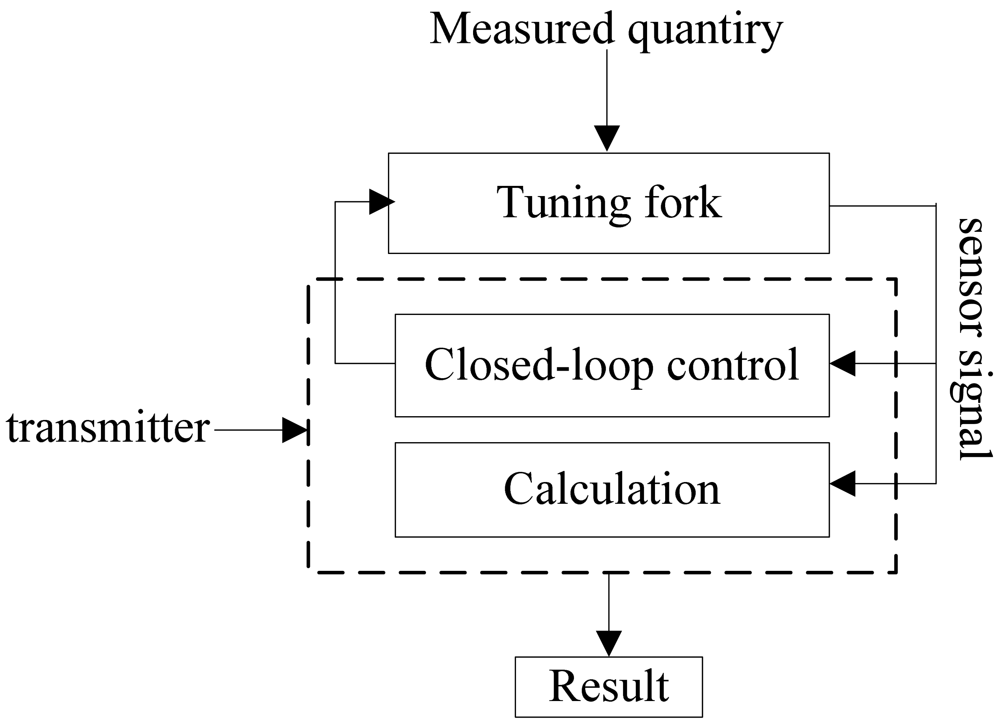
<p>The sensor is composed of the sensitive unit and the closed-loop control unit, where the sensitive unit consists of the actuator, the resonant tuning fork and the detector. Resonant tuning fork senses the liquid density directly, and the detector sends the signal which carries measurement information forward to the closed-loop control unit for processing and output density value, while the closed-loop control unit output excitation signal to control the actuator and then drive the tuning fork. The basic configuration of the sensor is shown in <xref ref-type="fig" rid="f1-sensors-12-07905">Figure 1</xref>.</p></sec>
<sec>
<label>2.2.</label>
<title>Resonant Frequency of the Tuning Fork</title>
<p>As can be seen from the analysis above, the natural frequency of the tuning fork has important impact on the performance of the sensor. In this part of the paper, an approximate parameters model of the tuning fork is established, and the impact of liquid density, position of the tuning fork, temperature and structural parameters on the natural frequency of the tuning fork are also analyzed both theoretically and by simulation.</p>
<sec>
<label>2.2.1.</label>
<title>Resonant Frequency in the Ideal Condition</title>
<p>The vibration of a tuning fork can be equivalent to the vibration of a cantilever beam. The vibration frequency can be obtained from calculating Euler Equation and described as follows:
<disp-formula id="FD1">
<label>(1)</label>
<mml:math id="mm1" display="block">
<mml:semantics id="sm1">
<mml:mrow>
<mml:msub>
<mml:mi>f</mml:mi>
<mml:mi>r</mml:mi></mml:msub>
<mml:mo>=</mml:mo>
<mml:mfrac>
<mml:mrow>
<mml:msup>
<mml:mrow>
<mml:mo stretchy="false">(</mml:mo>
<mml:msub>
<mml:mi>β</mml:mi>
<mml:mi>r</mml:mi></mml:msub>
<mml:mi>l</mml:mi>
<mml:mo stretchy="false">)</mml:mo></mml:mrow>
<mml:mn>2</mml:mn></mml:msup></mml:mrow>
<mml:mrow>
<mml:mn>2</mml:mn>
<mml:mrow>
<mml:mo>π</mml:mo></mml:mrow></mml:mrow></mml:mfrac>
<mml:msqrt>
<mml:mrow>
<mml:mfrac>
<mml:mrow>
<mml:mi>E</mml:mi>
<mml:mi>J</mml:mi></mml:mrow>
<mml:mrow>
<mml:mi>ρ</mml:mi>
<mml:mi>A</mml:mi>
<mml:msup>
<mml:mi>l</mml:mi>
<mml:mn>4</mml:mn></mml:msup></mml:mrow></mml:mfrac></mml:mrow></mml:msqrt>
<mml:mo>,</mml:mo>
<mml:mi>r</mml:mi>
<mml:mo>=</mml:mo>
<mml:mn>1</mml:mn>
<mml:mo>,</mml:mo>
<mml:mn>2</mml:mn>
<mml:mo>,</mml:mo>
<mml:mo>⋯</mml:mo></mml:mrow></mml:semantics></mml:math></disp-formula>where <italic>ρ</italic> is mass per unit volume, <italic>A</italic> is cross sectional area, <italic>l</italic> is the length, <italic>EJ</italic> is bending rigidity of the cross section, and <italic>βl</italic> can be calculated from the equation 
<inline-formula>
<mml:math id="mm2" display="inline">
<mml:semantics id="sm2">
<mml:mrow>
<mml:mo>cos</mml:mo>
<mml:mi>β</mml:mi>
<mml:mi>l</mml:mi>
<mml:mo>=</mml:mo>
<mml:mo>−</mml:mo>
<mml:mfrac>
<mml:mn>1</mml:mn>
<mml:mrow>
<mml:mtext>ch</mml:mtext>
<mml:mi>β</mml:mi>
<mml:mi>l</mml:mi></mml:mrow></mml:mfrac></mml:mrow></mml:semantics></mml:math></inline-formula>. <xref rid="FD1" ref-type="disp-formula">Equation (1)</xref> shows that the vibration frequency of the cantilever beam relates to the cross-sectional area and the length [<xref ref-type="bibr" rid="b9-sensors-12-07905">9</xref>].</p></sec>
<sec>
<label>2.2.2.</label>
<title>Resonant Frequency Dependence on Liquid</title>
<p>Through the study on vibration of free-free beams under liquid [<xref ref-type="bibr" rid="b10-sensors-12-07905">10</xref>], it is assumed that the liquid is ideal, incompressible and without spin, and based on the Laplace equation:
<disp-formula id="FD2">
<label>(2)</label>
<mml:math id="mm3" display="block">
<mml:semantics id="sm3">
<mml:mrow>
<mml:mfrac>
<mml:mrow>
<mml:msup>
<mml:mo>∂</mml:mo>
<mml:mn>2</mml:mn></mml:msup>
<mml:mi>ϕ</mml:mi></mml:mrow>
<mml:mrow>
<mml:mo>∂</mml:mo>
<mml:msup>
<mml:mi>x</mml:mi>
<mml:mn>2</mml:mn></mml:msup></mml:mrow></mml:mfrac>
<mml:mo>+</mml:mo>
<mml:mfrac>
<mml:mrow>
<mml:msup>
<mml:mo>∂</mml:mo>
<mml:mn>2</mml:mn></mml:msup>
<mml:mi>ϕ</mml:mi></mml:mrow>
<mml:mrow>
<mml:mo>∂</mml:mo>
<mml:msup>
<mml:mi>z</mml:mi>
<mml:mn>2</mml:mn></mml:msup></mml:mrow></mml:mfrac>
<mml:mo>=</mml:mo>
<mml:mn>0</mml:mn></mml:mrow></mml:semantics></mml:math></disp-formula>we can get the liquid velocity potential function <italic>φ</italic>(<italic>x,z,t</italic>), and the changes of vibration frequency of a cantilever beam when the depth of the beam in the liquid changes. On this basis, we also have introduced the change of the first-order vibration frequency of the tuning fork when the depth in the liquid changes or the liquid density changes, as given by <xref rid="FD3" ref-type="disp-formula">Equation (3)</xref> below:
<disp-formula id="FD3">
<label>(3)</label>
<mml:math id="mm4" display="block">
<mml:semantics id="sm4">
<mml:mrow>
<mml:mi>f</mml:mi>
<mml:mo>'</mml:mo>
<mml:mo>=</mml:mo>
<mml:mfrac>
<mml:mrow>
<mml:msub>
<mml:mi>f</mml:mi>
<mml:mn>0</mml:mn></mml:msub></mml:mrow>
<mml:mrow>
<mml:msqrt>
<mml:mrow>
<mml:mn>1</mml:mn>
<mml:mo>+</mml:mo>
<mml:mn>0.183</mml:mn>
<mml:mfrac>
<mml:mrow>
<mml:mn>4</mml:mn>
<mml:mi>ρ</mml:mi>
<mml:mo>'</mml:mo>
<mml:mi>h</mml:mi></mml:mrow>
<mml:mrow>
<mml:mrow>
<mml:mo>π</mml:mo></mml:mrow>
<mml:mi>γ</mml:mi></mml:mrow></mml:mfrac></mml:mrow></mml:msqrt></mml:mrow></mml:mfrac></mml:mrow></mml:semantics></mml:math></disp-formula>
<disp-formula id="FD4">
<label>(4)</label>
<mml:math id="mm5" display="block">
<mml:semantics id="sm5">
<mml:mrow>
<mml:mi>ρ</mml:mi>
<mml:mo>'</mml:mo>
<mml:mo>=</mml:mo>
<mml:mfrac>
<mml:mrow>
<mml:mo stretchy="false">(</mml:mo>
<mml:msup>
<mml:mrow>
<mml:msub>
<mml:mi>f</mml:mi>
<mml:mn>0</mml:mn></mml:msub></mml:mrow>
<mml:mn>2</mml:mn></mml:msup>
<mml:msup>
<mml:mi>T</mml:mi>
<mml:mn>2</mml:mn></mml:msup>
<mml:mo>−</mml:mo>
<mml:mn>1</mml:mn>
<mml:mo stretchy="false">)</mml:mo>
<mml:mrow>
<mml:mo>π</mml:mo></mml:mrow>
<mml:mi>γ</mml:mi></mml:mrow>
<mml:mrow>
<mml:mn>0.732</mml:mn>
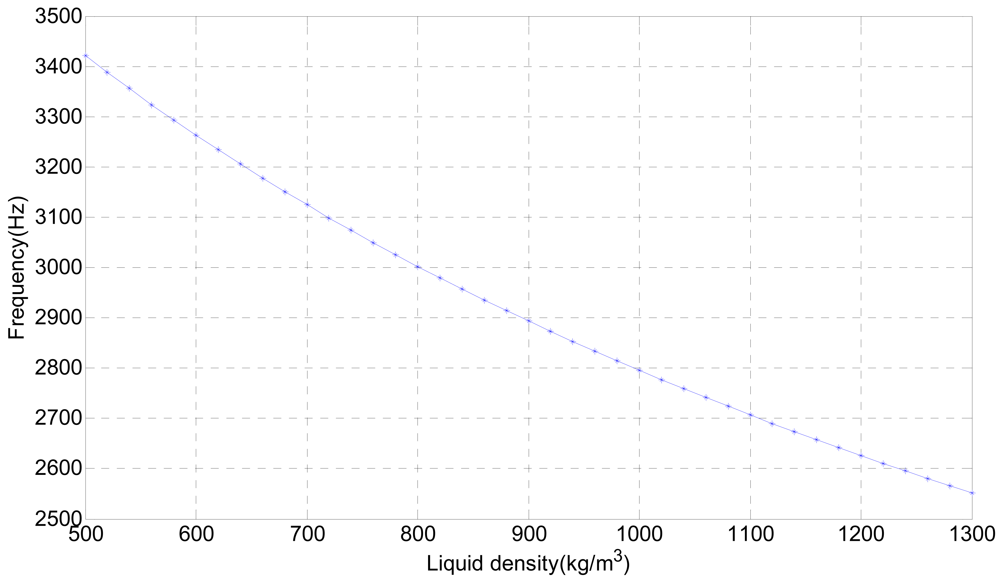
<mml:mi>h</mml:mi></mml:mrow></mml:mfrac></mml:mrow></mml:semantics></mml:math></disp-formula>where <italic>f</italic><sub>0</sub> is natural frequency of the tuning fork in the air, <italic>ρ</italic>′ is the liquid density, <italic>T</italic> is the vibration cycle of the tuning fork, <italic>T</italic> = 1/<italic>f</italic>′, <italic>h</italic> is the depth of the tuning fork into the liquid, and <italic>γ</italic> is density of the tuning fork per unit width. When the depth of the tuning fork in the liquid is fixed, the vibration frequency decreases as the liquid density increases. <xref ref-type="fig" rid="f2-sensors-12-07905">Figure 2</xref> shows the change of natural frequency with the liquid density.</p>
<p>Generally speaking, the follow equation is often used to calculate the liquid density:
<disp-formula id="FD5">
<label>(5)</label>
<mml:math id="mm6" display="block">
<mml:semantics id="sm6">
<mml:mrow>
<mml:mi>ρ</mml:mi>
<mml:mo>'</mml:mo>
<mml:mo>=</mml:mo>
<mml:msub>
<mml:mi>m</mml:mi>
<mml:mn>0</mml:mn></mml:msub>
<mml:mo>+</mml:mo>
<mml:msub>
<mml:mi>m</mml:mi>
<mml:mn>1</mml:mn></mml:msub>
<mml:mi>T</mml:mi>
<mml:mo>+</mml:mo>
<mml:msub>
<mml:mi>m</mml:mi>
<mml:mn>2</mml:mn></mml:msub>
<mml:msup>
<mml:mi>T</mml:mi>
<mml:mn>2</mml:mn></mml:msup></mml:mrow></mml:semantics></mml:math></disp-formula>Where <italic>ρ</italic>′ is the liquid density, <italic><sub>T</sub></italic> is the vibration cycle of the tuning fork, <italic>T</italic> = 1/<italic>f</italic>′, <italic>m</italic><sub>0</sub>, <italic>m</italic><sub>1</sub> and <italic>m</italic><sub>2</sub> are the sensor coefficients which can be determined through calibration experiments.</p>
<p>When vibrating while immersed in a liquid, the vibration frequency of the tuning fork decreases as its depth in the liquid increases. When the depth of the tuning fork in the liquid is fixed, the vibration frequency also decreases as the liquid density increases. The relation between liquid density <italic>ρ</italic>′ and vibration cycle of the tuning fork <italic>T</italic> is as indicated by <xref rid="FD5" ref-type="disp-formula">Equation (5)</xref>. As long as the vibration cycle of the resonant component in the liquid is measured, the density of the liquid under test can be calculated, thus enabling on-line density measurements of liquids in real-time.</p></sec>
<sec>
<label>2.2.3.</label>
<title>Resonant Frequency Dependence on Temperature</title>
<p>Temperature affects its performance if there are gradients around the sensor. The impact of temperature on the natural frequency is mainly due to the impact on the elastic modulus of the material. The relation between interaction potential energy <italic>U</italic>(<italic>r</italic>) and their distance <italic>r</italic> of two atoms for various types of crystals can be written as:
<disp-formula id="FD6">
<label>(6)</label>
<mml:math id="mm7" display="block">
<mml:semantics id="sm7">
<mml:mrow>
<mml:mi>U</mml:mi>
<mml:mo stretchy="false">(</mml:mo>
<mml:mi>r</mml:mi>
<mml:mo stretchy="false">)</mml:mo>
<mml:mo>=</mml:mo>
<mml:mo>−</mml:mo>
<mml:mfrac>
<mml:mi>A</mml:mi>
<mml:mrow>
<mml:msup>
<mml:mi>r</mml:mi>
<mml:mi>n</mml:mi></mml:msup></mml:mrow></mml:mfrac>
<mml:mo>+</mml:mo>
<mml:mfrac>
<mml:mi>B</mml:mi>
<mml:mrow>
<mml:msup>
<mml:mi>r</mml:mi>
<mml:mi>m</mml:mi></mml:msup></mml:mrow></mml:mfrac></mml:mrow></mml:semantics></mml:math></disp-formula>where <italic>A, B, n</italic> and <italic>m</italic> are constants which are greater than zero. The first item is the attractive energy, and the second is the repulsive energy [<xref ref-type="bibr" rid="b11-sensors-12-07905">11</xref>]. Now we choose a simple cubic crystal as model to calculate the relation between <italic><sub>E</sub></italic> and <italic>T</italic>, set the crystal under tension along the axis, so when the tension changes by d<italic>f</italic>, the atomic spacing <italic>r</italic> changes by d<italic>r</italic>, then the cross-sectional area <italic>r</italic><sup>2</sup> of unit cell is unchanged. Therefore, the elastic modulus of crystal is:
<disp-formula id="FD7">
<label>(7)</label>
<mml:math id="mm8" display="block">
<mml:semantics id="sm8">
<mml:mrow>
<mml:mi>E</mml:mi>
<mml:mo>=</mml:mo>
<mml:mfrac>
<mml:mrow>
<mml:mfrac>
<mml:mrow>
<mml:mtext>d</mml:mtext>
<mml:mi>f</mml:mi></mml:mrow>
<mml:mrow>
<mml:msup>
<mml:mi>r</mml:mi>
<mml:mn>2</mml:mn></mml:msup></mml:mrow></mml:mfrac></mml:mrow>
<mml:mrow>
<mml:mfrac>
<mml:mrow>
<mml:mtext>d</mml:mtext>
<mml:mi>r</mml:mi></mml:mrow>
<mml:mi>r</mml:mi></mml:mfrac></mml:mrow></mml:mfrac>
<mml:mo>=</mml:mo>
<mml:mfrac>
<mml:mrow>
<mml:mtext>d</mml:mtext>
<mml:mi>f</mml:mi></mml:mrow>
<mml:mrow>
<mml:mi>r</mml:mi>
<mml:mtext>d</mml:mtext>
<mml:mi>r</mml:mi></mml:mrow></mml:mfrac></mml:mrow></mml:semantics></mml:math></disp-formula>where 
<inline-formula>
<mml:math id="mm9" display="inline">
<mml:semantics id="sm9">
<mml:mrow>
<mml:mfrac>
<mml:mrow>
<mml:mtext>d</mml:mtext>
<mml:mi>f</mml:mi></mml:mrow>
<mml:mrow>
<mml:msup>
<mml:mi>r</mml:mi>
<mml:mn>2</mml:mn></mml:msup></mml:mrow></mml:mfrac></mml:mrow></mml:semantics></mml:math></inline-formula> and 
<inline-formula>
<mml:math id="mm10" display="inline">
<mml:semantics id="sm10">
<mml:mrow>
<mml:mfrac>
<mml:mrow>
<mml:mtext>d</mml:mtext>
<mml:mi>r</mml:mi></mml:mrow>
<mml:mi>r</mml:mi></mml:mfrac></mml:mrow></mml:semantics></mml:math></inline-formula> are the stress and strain, respectively. The binding force <italic>f</italic> of the crystal only relates to the first item of <xref rid="FD6" ref-type="disp-formula">Equation (6)</xref>, and its size is given by:
<disp-formula id="FD8">
<label>(8)</label>
<mml:math id="mm11" display="block">
<mml:semantics id="sm11">
<mml:mrow>
<mml:mi>f</mml:mi>
<mml:mo stretchy="false">(</mml:mo>
<mml:mi>r</mml:mi>
<mml:mo stretchy="false">)</mml:mo>
<mml:mo>=</mml:mo>
<mml:mfrac>
<mml:mrow>
<mml:mtext>d</mml:mtext>
<mml:mi>U</mml:mi>
<mml:mo stretchy="false">(</mml:mo>
<mml:mi>r</mml:mi>
<mml:mo stretchy="false">)</mml:mo></mml:mrow>
<mml:mrow>
<mml:mtext>d</mml:mtext>
<mml:mi>r</mml:mi></mml:mrow></mml:mfrac>
<mml:mo>=</mml:mo>
<mml:mfrac>
<mml:mrow>
<mml:mi>n</mml:mi>
<mml:mi>A</mml:mi></mml:mrow>
<mml:mrow>
<mml:msup>
<mml:mi>r</mml:mi>
<mml:mrow>
<mml:mi>n</mml:mi>
<mml:mo>+</mml:mo>
<mml:mn>1</mml:mn></mml:mrow></mml:msup></mml:mrow></mml:mfrac></mml:mrow></mml:semantics></mml:math></disp-formula></p>
<p>Differentiating <xref rid="FD8" ref-type="disp-formula">Equation (8)</xref> with respect to <italic>r</italic> and substituting in <xref rid="FD7" ref-type="disp-formula">Equation (7)</xref>, considering <italic>K</italic> = −(<italic>n</italic> +1)<italic>A</italic>, <italic>Q</italic> = <italic>n</italic> +3, this leads to:
<disp-formula id="FD9">
<label>(9)</label>
<mml:math id="mm12" display="block">
<mml:semantics id="sm12">
<mml:mrow>
<mml:mi>E</mml:mi>
<mml:mo>=</mml:mo>
<mml:mfrac>
<mml:mrow>
<mml:mi>n</mml:mi>
<mml:mi>k</mml:mi></mml:mrow>
<mml:mrow>
<mml:msup>
<mml:mi>r</mml:mi>
<mml:mi>Q</mml:mi></mml:msup></mml:mrow></mml:mfrac></mml:mrow></mml:semantics></mml:math></disp-formula></p>
<p>Assuming the interatomic distance still obeys the following rules when the crystal expands by heat:
<disp-formula id="FD10">
<label>(10)</label>
<mml:math id="mm13" display="block">
<mml:semantics id="sm13">
<mml:mrow>
<mml:mi>r</mml:mi>
<mml:mo>=</mml:mo>
<mml:msub>
<mml:mi>r</mml:mi>
<mml:mn>0</mml:mn></mml:msub>
<mml:mo stretchy="false">(</mml:mo>
<mml:mn>1</mml:mn>
<mml:mo>+</mml:mo>
<mml:mi>α</mml:mi>
<mml:mi>T</mml:mi>
<mml:mo stretchy="false">)</mml:mo></mml:mrow></mml:semantics></mml:math></disp-formula>where <italic>r</italic><sub>0</sub> is the interatomic distance when absolute temperature <italic>T</italic><sub>0</sub> = 0, <italic>α</italic> is linear expansion coefficient of the crystal, and its differential defined type is:
<disp-formula id="FD11">
<label>(11)</label>
<mml:math id="mm14" display="block">
<mml:semantics id="sm14">
<mml:mrow>
<mml:mrow>
<mml:mo>{</mml:mo>
<mml:mrow>
<mml:mtable>
<mml:mtr>
<mml:mtd>
<mml:mrow>
<mml:mi>α</mml:mi>
<mml:mo>=</mml:mo>
<mml:mfrac>
<mml:mn>1</mml:mn>
<mml:mi>r</mml:mi></mml:mfrac>
<mml:mfrac>
<mml:mrow>
<mml:mtext>d</mml:mtext>
<mml:mi>r</mml:mi></mml:mrow>
<mml:mrow>
<mml:mtext>d</mml:mtext>
<mml:mi>T</mml:mi></mml:mrow></mml:mfrac></mml:mrow></mml:mtd></mml:mtr>
<mml:mtr>
<mml:mtd>
<mml:mrow>
<mml:mi>η</mml:mi>
<mml:mo>=</mml:mo>
<mml:mo>−</mml:mo>
<mml:mfrac>
<mml:mn>1</mml:mn>
<mml:mi>r</mml:mi></mml:mfrac>
<mml:mfrac>
<mml:mrow>
<mml:mtext>d</mml:mtext>
<mml:mi>E</mml:mi></mml:mrow>
<mml:mrow>
<mml:mtext>d</mml:mtext>
<mml:mi>T</mml:mi></mml:mrow></mml:mfrac></mml:mrow></mml:mtd></mml:mtr></mml:mtable></mml:mrow></mml:mrow></mml:mrow></mml:semantics></mml:math></disp-formula>where <italic>η</italic> is the temperature coefficient of the elastic modulus <italic>E</italic>, d<italic>E</italic> = −<italic>ηE</italic>d<italic>T</italic> illustrates that elastic modulus decreases as the temperature increases, and the increment d<italic>E</italic> of elastic modulus <italic>E</italic> is negative. From equations above, we get:
<disp-formula id="FD12">
<label>(12)</label>
<mml:math id="mm15" display="block">
<mml:semantics id="sm15">
<mml:mrow>
<mml:mrow>
<mml:mo>{</mml:mo>
<mml:mrow>
<mml:mtable>
<mml:mtr>
<mml:mtd>
<mml:mrow>
<mml:mi>E</mml:mi>
<mml:mo>=</mml:mo>
<mml:msub>
<mml:mi>E</mml:mi>
<mml:mn>0</mml:mn></mml:msub>
<mml:msup>
<mml:mrow>
<mml:mo stretchy="false">(</mml:mo>
<mml:mfrac>
<mml:mrow>
<mml:mn>1</mml:mn>
<mml:mo>+</mml:mo>
<mml:mi>α</mml:mi>
<mml:mi>T</mml:mi></mml:mrow>
<mml:mrow>
<mml:mn>1</mml:mn>
<mml:mo>+</mml:mo>
<mml:mi>α</mml:mi>
<mml:msub>
<mml:mi>T</mml:mi>
<mml:mn>0</mml:mn></mml:msub></mml:mrow></mml:mfrac>
<mml:mo stretchy="false">)</mml:mo></mml:mrow>
<mml:mrow>
<mml:mo>−</mml:mo>
<mml:mi>Q</mml:mi></mml:mrow></mml:msup>
<mml:mo>≈</mml:mo>
<mml:msub>
<mml:mi>E</mml:mi>
<mml:mn>0</mml:mn></mml:msub>
<mml:mo stretchy="false">(</mml:mo>
<mml:mn>1</mml:mn>
<mml:mo>−</mml:mo>
<mml:mi>Q</mml:mi>
<mml:mi>α</mml:mi>
<mml:mi>T</mml:mi>
<mml:mo stretchy="false">)</mml:mo></mml:mrow></mml:mtd></mml:mtr>
<mml:mtr>
<mml:mtd>
<mml:mrow>
<mml:mi>Q</mml:mi>
<mml:mo>=</mml:mo>
<mml:mrow>
<mml:mover accent="true">
<mml:mspace height=".6"/>
<mml:mi>η</mml:mi></mml:mover>
<mml:mo stretchy="true">/</mml:mo>
<mml:munder accentunder="true">
<mml:mspace depth="-.8"/>
<mml:mi>α</mml:mi></mml:munder></mml:mrow></mml:mrow></mml:mtd></mml:mtr></mml:mtable></mml:mrow></mml:mrow></mml:mrow></mml:semantics></mml:math></disp-formula>
<disp-formula id="FD13">
<label>(13)</label>
<mml:math id="mm16" display="block">
<mml:semantics id="sm16">
<mml:mrow>
<mml:mi>E</mml:mi>
<mml:mo>=</mml:mo>
<mml:msub>
<mml:mi>E</mml:mi>
<mml:mn>0</mml:mn></mml:msub>
<mml:mo stretchy="false">(</mml:mo>
<mml:mn>1</mml:mn>
<mml:mo>−</mml:mo>
<mml:mi>η</mml:mi>
<mml:mi>T</mml:mi>
<mml:mo stretchy="false">)</mml:mo></mml:mrow></mml:semantics></mml:math></disp-formula></p>
<p><xref rid="FD13" ref-type="disp-formula">Equation (13)</xref> shows that the elastic modulus of metallic materials decreases linearly with increasing temperature, depending on the temperature coefficient <italic>η</italic> of the elastic modulus. The values of <italic>η</italic> for metallic materials such as iron, tungsten, duralumin and carbon steel to be investigated are scant, while the experimental data of linear expansion coefficients <italic>α</italic> are more abundant, their experimental relation (<italic>α</italic>/<italic>η</italic>) × 10<sup>3</sup> is approximately equal to 40, so we get <italic>Q</italic> = 25, then <xref rid="FD13" ref-type="disp-formula">Equation (13)</xref> will take the form:
<disp-formula id="FD14">
<label>(14)</label>
<mml:math id="mm17" display="block">
<mml:semantics id="sm17">
<mml:mrow>
<mml:mi>E</mml:mi>
<mml:mo>=</mml:mo>
<mml:msub>
<mml:mi>E</mml:mi>
<mml:mn>0</mml:mn></mml:msub>
<mml:mo stretchy="false">(</mml:mo>
<mml:mn>1</mml:mn>
<mml:mo>−</mml:mo>
<mml:mn>25</mml:mn>
<mml:mi>α</mml:mi>
<mml:mi>T</mml:mi>
<mml:mo stretchy="false">)</mml:mo></mml:mrow></mml:semantics></mml:math></disp-formula></p>
<p><xref rid="FD14" ref-type="disp-formula">Equation (14)</xref> is the general law of elastic modulus of metallic material changes with temperature. For most metallic materials, <italic>α</italic> changes when the temperature increases, but the small change could be considered as constant. <xref rid="FD1" ref-type="disp-formula">Equation (1)</xref> will be on the form:
<disp-formula id="FD15">
<label>(15)</label>
<mml:math id="mm18" display="block">
<mml:semantics id="sm18">
<mml:mrow>
<mml:msub>
<mml:mi>f</mml:mi>
<mml:mi>r</mml:mi></mml:msub>
<mml:mo>=</mml:mo>
<mml:mfrac>
<mml:mrow>
<mml:msup>
<mml:mrow>
<mml:mo stretchy="false">(</mml:mo>
<mml:msub>
<mml:mi>β</mml:mi>
<mml:mi>r</mml:mi></mml:msub>
<mml:mi>l</mml:mi>
<mml:mo stretchy="false">)</mml:mo></mml:mrow>
<mml:mn>2</mml:mn></mml:msup></mml:mrow>
<mml:mrow>
<mml:mn>2</mml:mn>
<mml:mi>π</mml:mi></mml:mrow></mml:mfrac>
<mml:msqrt>
<mml:mrow>
<mml:mfrac>
<mml:mrow>
<mml:msub>
<mml:mi>E</mml:mi>
<mml:mn>0</mml:mn></mml:msub>
<mml:mo stretchy="false">(</mml:mo>
<mml:mn>1</mml:mn>
<mml:mo>−</mml:mo>
<mml:mn>25</mml:mn>
<mml:mi>α</mml:mi>
<mml:mi>T</mml:mi>
<mml:mo stretchy="false">)</mml:mo>
<mml:mi>J</mml:mi></mml:mrow>
<mml:mrow>
<mml:mi>ρ</mml:mi>
<mml:mi>A</mml:mi>
<mml:msup>
<mml:mi>l</mml:mi>
<mml:mn>4</mml:mn></mml:msup></mml:mrow></mml:mfrac></mml:mrow></mml:msqrt>
<mml:mo>,</mml:mo>
<mml:mi>r</mml:mi>
<mml:mo>=</mml:mo>
<mml:mn>1</mml:mn>
<mml:mo>,</mml:mo>
<mml:mn>2</mml:mn>
<mml:mo>,</mml:mo>
<mml:mo>⋯</mml:mo></mml:mrow></mml:semantics></mml:math></disp-formula>where <italic>α</italic> is linear expansion coefficient of the metallic materials, <italic>T</italic> is Kelvin, <italic>E</italic><sub>0</sub> is elastic modulus at absolute zero, <italic>ρ</italic> is density of the metallic materials, <italic>J</italic> is the moment of inertia, <italic>A</italic> is the cross sectional area, <italic>l</italic> is the length. <xref rid="FD14" ref-type="disp-formula">Equation (14)</xref> shows the elastic modulus changes with temperature and <xref rid="FD15" ref-type="disp-formula">Equation (15)</xref> verifies that the influence of temperature on the natural frequency of tuning fork is obvious, thus, a temperature sensor is required to detect the liquid measured in real-time to compensate for the changes in the elastic modulus of the tuning fork.</p></sec></sec>
<sec>
<label>2.3.</label>
<title>Simulation</title>
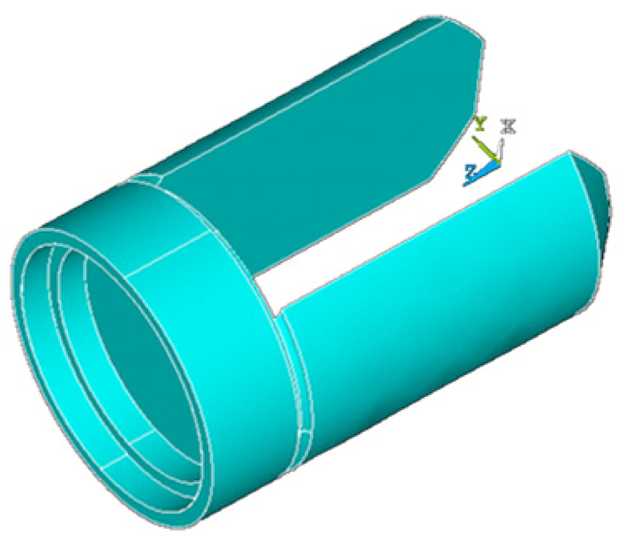
<p>Finite element analysis software is used to analyze the structural parameters which have an influence on the natural frequency of the tuning fork. The tuning fork oscillator is designed on this basis. The first vibrating mode is chosen as the working mode, to maintain the lowest working energy and simple mode shape. <xref ref-type="fig" rid="f3-sensors-12-07905">Figure 3</xref> is the tuning fork model obtained through the finite element analysis software, and the natural frequency of the first order is 3,940.5 Hz. The natural frequency of the tuning fork based on the theoretical analysis is 3,910.82 Hz, and the measured value is 3,961.9 Hz. The finite element analysis software considers the impact of factors on the natural vibration frequency of the oscillator more comprehensively, and the matrix for calculation is more complete, therefore, the results is closer to the measured value, while <xref rid="FD1" ref-type="disp-formula">Equation (1)</xref> omits a number of factors, some of which (such as constraints, <italic>etc.</italic>) have a great influence on the vibration frequency, so the difference between calculated value and measured value is larger, only as a reference. Since the actual processing of the harmonic oscillator, the structural parameters and material parameters are difficult to guarantee to consistent with the theoretical value, so it is understandable that there is certain difference between the theoretical result and the measured value.</p>
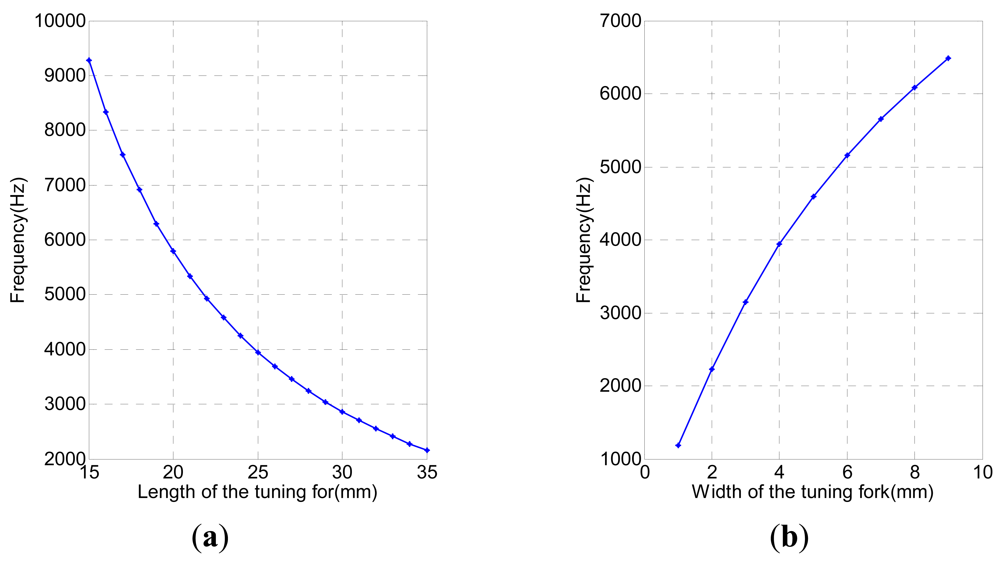
<p>According to <xref rid="FD1" ref-type="disp-formula">Equation (1)</xref>, the vibration frequency of the tuning fork changes as the cross-sectional area and the length change. For the tuning fork, the first-order natural frequency depends on its structural properties. In modal analysis, we analyze the impact of structure parameters on natural frequency by changing the length and width (cross-sectional area) of the tuning fork [<xref ref-type="bibr" rid="b12-sensors-12-07905">12</xref>].</p>
<p><xref ref-type="fig" rid="f4-sensors-12-07905">Figure 4</xref> shows how the first-order natural frequency of the tuning fork decreases as the length increases, and increases as the width increases. First we maintain the width invariable (4 mm) and change the length (15∼35 mm), giving the curve shown in <xref ref-type="fig" rid="f4-sensors-12-07905">Figure 4(a)</xref> that relates the change of natural frequency with the length. Then we maintain the length (12 mm) as a constant and change the width (1∼9 mm), and in this case the curve that shows the resulting change of natural frequency with the width is as indicated by <xref ref-type="fig" rid="f4-sensors-12-07905">Figure 4(b)</xref>. The simulation result is identical with that of the theoretical analysis. Therefore, structural parameters must be taken into account when designing the sensor.</p></sec></sec>
<sec sec-type="methods">
<label>3.</label>
<title>Sensor Fabrication and Digital Closed-Loop Control System Design</title>
<p>To verify the feasibility of the new design, test samples were fabricated by finish machining technology, and a digital closed-loop control system for the newly designed sensor was built up to interpret the resonant frequencies into liquid density data.</p>
<sec>
<label>3.1.</label>
<title>Tuning Fork Fabrication</title>
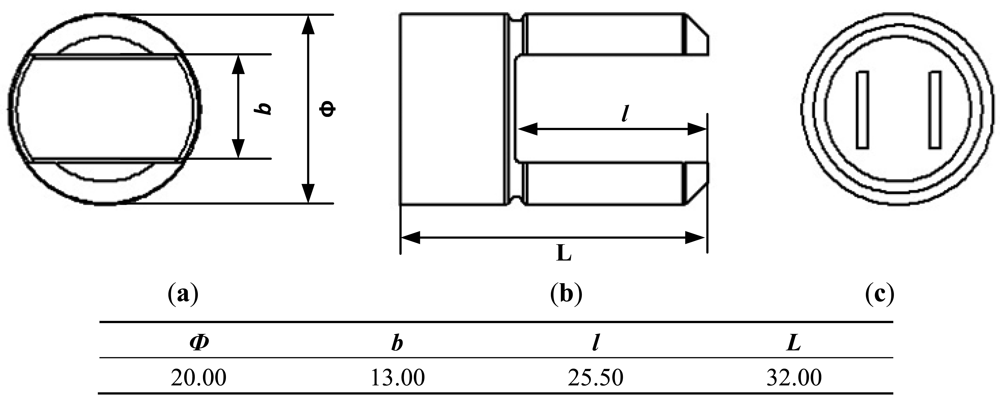
<p>Stainless steel 316 L, whose material properties are shown in <xref ref-type="table" rid="t1-sensors-12-07905">Table 1</xref>, was used to make the tuning fork. The tuning fork is fabricated through finish machining technology with the specific dimensional parameters shown in <xref ref-type="fig" rid="f5-sensors-12-07905">Figure 5(a,b)</xref>. The actuator and detector are a pair of distributed bi-piezoelectric actuators with simple structure and low power consumption. The bi-piezoelectric actuators are symmetrical, perpendicular to the tuning fork, as shown in <xref ref-type="fig" rid="f5-sensors-12-07905">Figure 5(c)</xref>.</p>
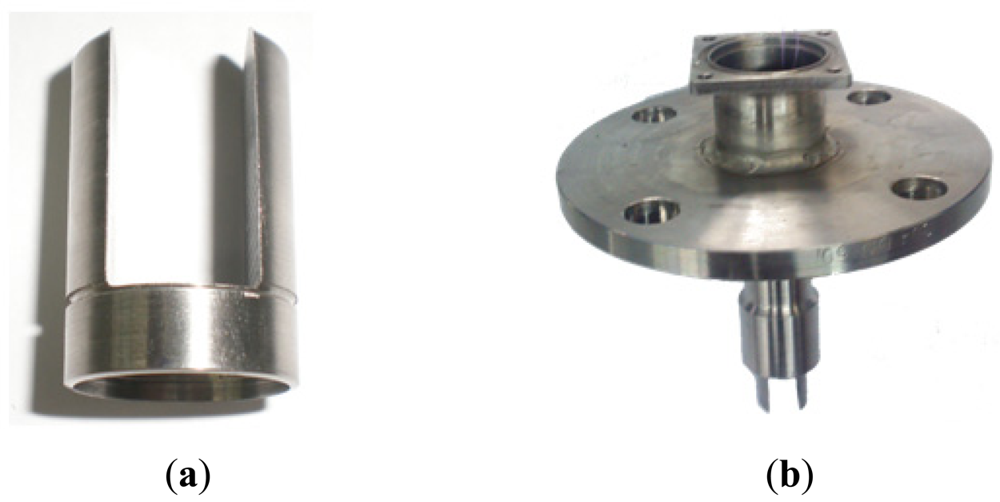
<p>The tuning fork is shown in <xref ref-type="fig" rid="f6-sensors-12-07905">Figure 6(a)</xref>, and is supported by a flange whose stiffness is approximately infinite, shown in <xref ref-type="fig" rid="f6-sensors-12-07905">Figure 6(b)</xref>. The flange does not vibrate, therefore, it does not affect the liquid density measurement process.</p></sec>
<sec>
<label>3.2.</label>
<title>Digital Closed-Loop Control System</title>
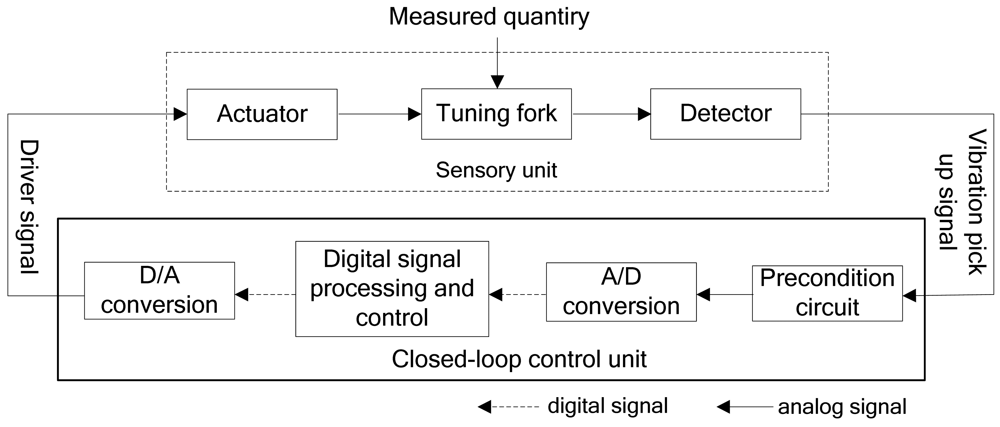
<p>To improve the measurement performance, high speed digital circuits and digital signal processing technology are used in the transmitters to replace conventional analog control system. The basic configuration of the closed-loop control system is illustrated in <xref ref-type="fig" rid="f7-sensors-12-07905">Figure 7</xref>. It mainly includes a preconditioning circuit, digital signal processing and control unit, analog-to-digital converter and digital-to-analog converter. The tuning fork senses the liquid density directly, and the detector sends the analog signal that carries measurement information to the preconditioning circuit for amplification and filtering. Then the analog-to-digital converter converts the amplified and filtered analog signal to a digital signal, and then to the closed-loop control unit to track the signal frequency, control phase difference and amplitude, and output the density value, while the closed-loop control unit outputs an excitation signal to control the actuator to drive the tuning fork vibrate in accordance with the changing vibration frequency in real-time. As seen in the configuration, to obtain the desired frequency, phase, and amplitude characteristics, a “positive feedback” technique is used herein in which a sensor signal (having the desired frequency, phase and amplitude characteristics) is fed back to the tuning fork via the drive signal.</p>
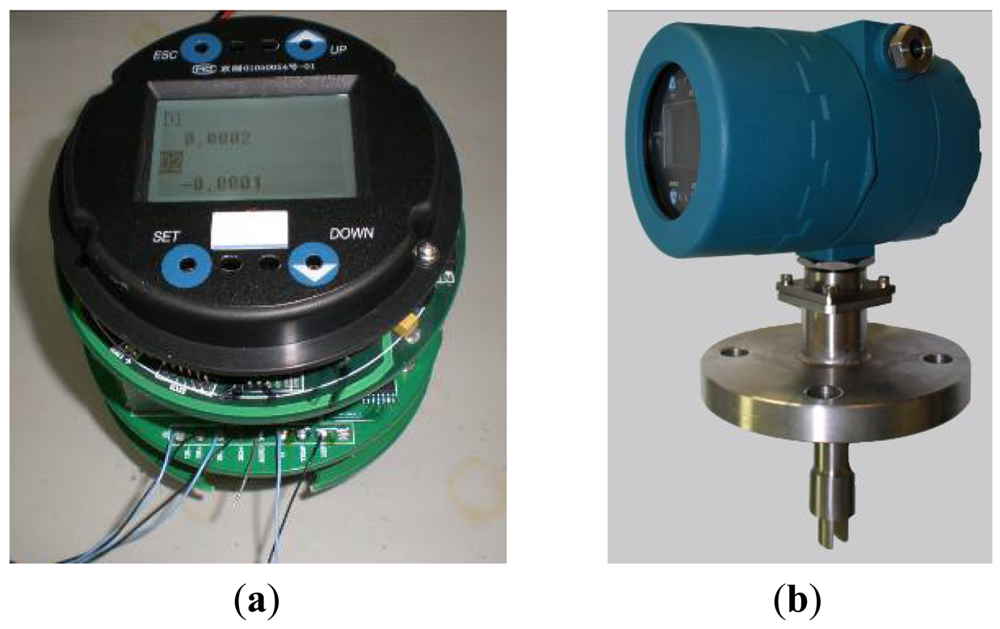
<p><xref ref-type="fig" rid="f8-sensors-12-07905">Figure 8(a)</xref> shows the digital closed-loop control system, and the theoretical prototype designed to do the confirmation of function is shown in <xref ref-type="fig" rid="f8-sensors-12-07905">Figure 8(b)</xref>.</p></sec></sec>
<sec sec-type="discussion">
<label>4.</label>
<title>Experiments and Discussion</title>
<sec>
<label>4.1.</label>
<title>Calibration Experiments</title>
<p>Calibration experiments are taken at constant 20 °C, and five different uniform densities of the liquids to be measured (alcohol if different concentration, water, CuSO<sub>4</sub>) were prepared. The float densitometer with the differentiate force of 1.0 kg/m<sup>3</sup> is the standard density meter. Both the resonant density sensor and the standard float-type density meter are placed into the liquid to be tested, and the liquid tested is placed in the temperature controller (GDS-50L type, accuracy of ±0.1 °C) at a constant temperature of 20 °C. When the temperature is stable, the vibration cycle <italic>T</italic> of the resonant tuning fork and the float densitometer readings <italic>ρ<sub>r</sub></italic> are recorded and the least square method for curve fitting used with the measured density <italic>ρ</italic>′ and the vibration cycle <italic>T</italic> of the tuning fork to get the sensor coefficients <italic>m</italic><sub>0</sub>, <italic>m</italic><sub>1</sub>, <italic>m</italic><sub>2</sub> under 20 °C which are −2,500.6776 kg/m<sup>3</sup>, −0.2756 kg/(m<sup>3</sup>·μs), 0.026778 kg/(m<sup>3</sup>·μs<sup>2</sup>) respectively, and then we can calculate the liquid density through <xref rid="FD5" ref-type="disp-formula">Equation (5)</xref>. Therefore, the equation for calculating the liquid density is:
<disp-formula id="FD16">
<label>(16)</label>
<mml:math id="mm19" display="block">
<mml:semantics id="sm19">
<mml:mrow>
<mml:mi>ρ</mml:mi>
<mml:mo>'</mml:mo>
<mml:mo>=</mml:mo>
<mml:mo>−</mml:mo>
<mml:mn>2500.6773</mml:mn>
<mml:mo>−</mml:mo>
<mml:mn>0.2756</mml:mn>
<mml:mi>T</mml:mi>
<mml:mo>+</mml:mo>
<mml:mn>0.026778</mml:mn>
<mml:msup>
<mml:mi>T</mml:mi>
<mml:mn>2</mml:mn></mml:msup></mml:mrow></mml:semantics></mml:math></disp-formula>where <italic>ρ</italic>′ (unit: kg/m<sup>3</sup>) is the liquid density, <italic>T</italic> (unit: μs) is the vibration cycle of the tuning fork. Results of the experiments are shown in <xref ref-type="table" rid="t2-sensors-12-07905">Table 2</xref>. They confirm that the repeatability error of the sensor is about 0.03% and the accuracy is about 0.4 kg/m<sup>3</sup>.</p></sec>
<sec>
<label>4.2.</label>
<title>Temperature Experiments</title>
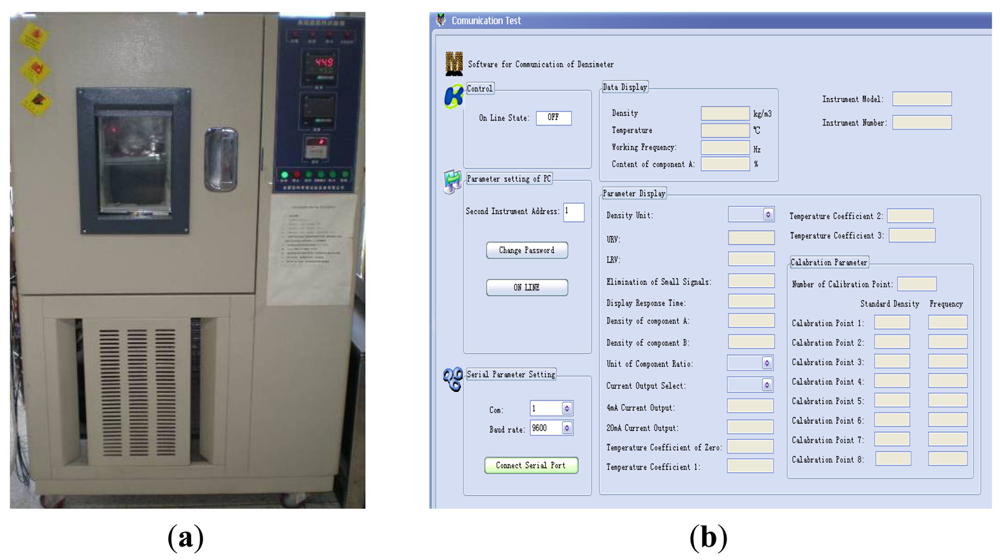
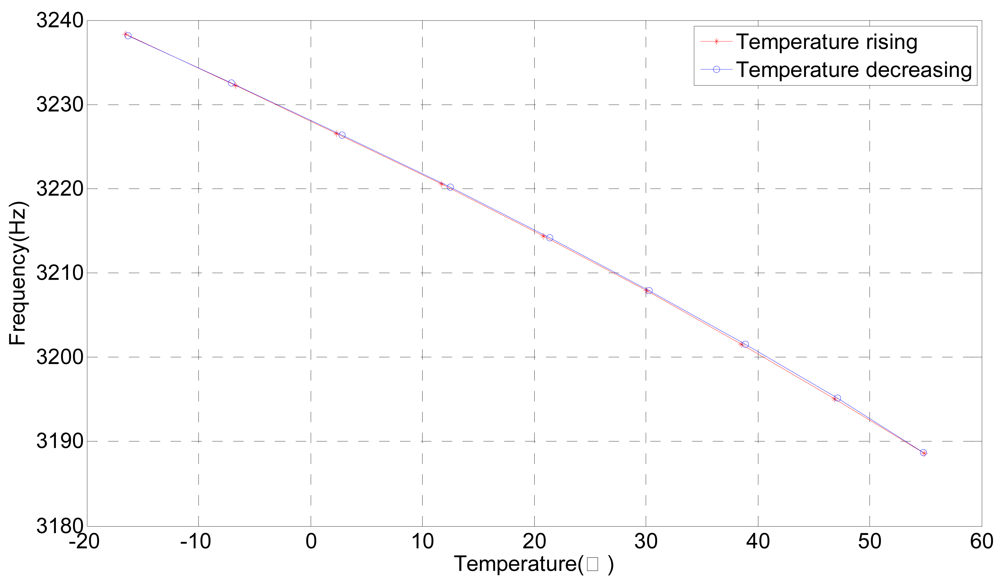
<p>Temperature experiments were performed to check the impact of this factor on the natural frequency. The temperature environment is provided by a GDS-50L type temperature controller with accuracy of ±0.1 °C. Natural frequencies of the tuning fork are obtained through the homemade software once every 10 °C from −20 °C to 60 °C first, and then from 60 °C to −20 °C. The experimental set-up and the software interface are shown in <xref ref-type="fig" rid="f9-sensors-12-07905">Figure 9</xref>.</p>
<p><xref ref-type="fig" rid="f10-sensors-12-07905">Figure 10</xref> shows that the natural frequency of the tuning fork changes with the temperature, thus, a temperature sensor is required in order to compensate for the changes in the elastic modulus of the tuning fork in real-time. The experiment result is identical with theoretical analysis provided above, which proves that the theoretical results are reliable.</p></sec></sec>
<sec sec-type="conclusions">
<label>5.</label>
<title>Conclusions</title>
<p>In order to increase the precision of liquid density measurements, this paper designs a novel liquid density measurement sensor based on the resonance principle, and provides the calibration results of this sensor. Firstly, an approximate parameters model of the tuning fork is established according to the dynamic principle. The tuning fork structure of the sensor is also formed based on the optimization and improvements of further research. The impact of liquid density, position of the tuning fork, temperature and structural parameters on the natural frequency of the tuning fork are analyzed. Then the experimental results show that the repeatability error of the sensor is about 0.03% and the accuracy is about 0.4 kg/m<sup>3</sup>. In a word, the proposed density sensor equipped with a tuning fork as the resonant sensitive component based on the resonance theory is a high-precision instrument and can measure liquid density directly. The methods designed in this paper should also prove beneficial to research on other types of resonant sensors.</p></sec></body>
<back>
<ack>
<p>The authors gratefully acknowledge the financial support from the National Natural Science Foundation of China with grant No. 60904094 and the Special Funds for Basic Research and Operating Expenses of the Central Universities with grant No. YWF-12-LXGY-003.</p></ack>
<ref-list>
<title>References</title>
<ref id="b1-sensors-12-07905"><label>1.</label><citation citation-type="journal"><person-group person-group-type="author"><name><surname>Lagourette</surname><given-names>B.</given-names></name><name><surname>Boned</surname><given-names>C.</given-names></name><name><surname>Saint-Guirons</surname><given-names>H.</given-names></name><name><surname>Xans</surname><given-names>P.</given-names></name></person-group><article-title>Densimeter calibration method <italic>versus</italic> temperature and pressure</article-title><source>Meas. Sci. Technol.</source><year>1992</year><volume>3</volume><fpage>699</fpage><lpage>703</lpage><pub-id pub-id-type="doi">10.1088/0957-0233/3/8/002</pub-id></citation></ref>
<ref id="b2-sensors-12-07905"><label>2.</label><citation citation-type="patent"><person-group person-group-type="author"><name><surname>Greenwood</surname><given-names>M.S.</given-names></name><name><surname>Lail</surname><given-names>J.C.</given-names></name></person-group><article-title>Ultrasonic Fluid Densitometry and Densitometer</article-title><patent>U.S. Patent 5, 708, 191, 13</patent><month>January</month><year>1998</year></citation></ref>
<ref id="b3-sensors-12-07905"><label>3.</label><citation citation-type="book"><person-group person-group-type="author"><name><surname>Greenwood</surname><given-names>M.S.</given-names></name><name><surname>Skorpik</surname><given-names>J.R.</given-names></name><name><surname>Bamberger</surname><given-names>J.A.</given-names></name></person-group><article-title>On-line sensor to measure the density of a liquid or slurry</article-title><source>Science and Technology for Disposal of Radioactive Tank Waste</source><person-group person-group-type="editor"><name><surname>Wallace</surname><given-names>W.S.</given-names></name><name><surname>Nichoals</surname><given-names>J.L.</given-names></name></person-group><publisher-name>Plenum Press</publisher-name><publisher-loc>New York, NY, USA</publisher-loc><year>1998</year><fpage>497</fpage><lpage>506</lpage></citation></ref>
<ref id="b4-sensors-12-07905"><label>4.</label><citation citation-type="journal"><person-group person-group-type="author"><name><surname>Greenwood</surname><given-names>M.S.</given-names></name><name><surname>Skorpik</surname><given-names>J.R.</given-names></name><name><surname>Bamberger</surname><given-names>J.A.</given-names></name><name><surname>Harris</surname><given-names>R.V.</given-names></name></person-group><article-title>On-line ultrasonic density sensor for process control of liquids and slurries</article-title><source>Ultrasonics</source><year>1999</year><volume>37</volume><fpage>159</fpage><lpage>171</lpage><pub-id pub-id-type="doi">10.1016/S0041-624X(98)00052-3</pub-id></citation></ref>
<ref id="b5-sensors-12-07905"><label>5.</label><citation citation-type="journal"><person-group person-group-type="author"><name><surname>Püttmer</surname><given-names>A.</given-names></name><name><surname>Hauptmann</surname><given-names>P.</given-names></name><name><surname>Henning</surname><given-names>B.</given-names></name></person-group><article-title>Ultrasonic density sensor for liquids</article-title><source>IEEE Trans. Ultrason. Ferroelectr. Freq. Control</source><year>2000</year><volume>47</volume><fpage>85</fpage><lpage>92</lpage><pub-id pub-id-type="doi">10.1109/58.818751</pub-id><pub-id pub-id-type="pmid">18238520</pub-id></citation></ref>
<ref id="b6-sensors-12-07905"><label>6.</label><citation citation-type="journal"><person-group person-group-type="author"><name><surname>Ricardo</surname><given-names>T.H.</given-names></name><name><surname>Flávio</surname><given-names>B.</given-names></name><name><surname>Júlio</surname><given-names>C.A.</given-names></name><name><surname>Francisco</surname><given-names>M.E.</given-names></name></person-group><article-title>Ultrasonic density measurement cell design and simulation of non-ideal effects</article-title><source>Ultrasonics</source><year>2006</year><volume>44</volume><fpage>302</fpage><lpage>309</lpage><pub-id pub-id-type="doi">10.1016/j.ultras.2006.03.003</pub-id><pub-id pub-id-type="pmid">16690095</pub-id></citation></ref>
<ref id="b7-sensors-12-07905"><label>7.</label><citation citation-type="journal"><person-group person-group-type="author"><name><surname>Feng</surname><given-names>G.P.</given-names></name><name><surname>Gui</surname><given-names>C.Q.</given-names></name><name><surname>Dong</surname><given-names>Y.G.</given-names></name></person-group><article-title>Study of sensing theory by resonant danmping</article-title><source>Sens Actuators B</source><year>1993</year><volume>14</volume><fpage>736</fpage><lpage>738</lpage><pub-id pub-id-type="doi">10.1016/0925-4005(93)85164-6</pub-id></citation></ref>
<ref id="b8-sensors-12-07905"><label>8.</label><citation citation-type="book"><person-group person-group-type="author"><name><surname>Walt</surname><given-names>B.</given-names></name></person-group><source>Instrumentation Reference Book</source><edition>4th ed.</edition><publisher-name>Butterworth-Heinemann</publisher-name><publisher-loc>Burlington, VT, USA</publisher-loc><year>2009</year><fpage>135</fpage><lpage>143</lpage></citation></ref>
<ref id="b9-sensors-12-07905"><label>9.</label><citation citation-type="book"><person-group person-group-type="author"><name><surname>Wang</surname><given-names>B.</given-names></name></person-group><source>Analysis and Application of Vibration (In Chinese)</source><publisher-name>Haichao Publishing House</publisher-name><publisher-loc>Beijing, China</publisher-loc><year>1992</year><fpage>224</fpage><lpage>283</lpage></citation></ref>
<ref id="b10-sensors-12-07905"><label>10.</label><citation citation-type="journal"><person-group person-group-type="author"><name><surname>Yeh</surname><given-names>L.</given-names></name></person-group><article-title>A study of vibration of free-free beams under liquid</article-title><source>Ann. Nucl. Sci. Technol.</source><year>1974</year><volume>1</volume><fpage>437</fpage><lpage>442</lpage><pub-id pub-id-type="doi">10.1016/0302-2927(74)90067-1</pub-id></citation></ref>
<ref id="b11-sensors-12-07905"><label>11.</label><citation citation-type="journal"><person-group person-group-type="author"><name><surname>Xu</surname><given-names>Z.D.</given-names></name><name><surname>Fan</surname><given-names>Z.L.</given-names></name></person-group><article-title>A phenomenological explanation of the variation of elastic modulus with temperature for metallic materials</article-title><source>J. SWJTU</source><year>1993</year><volume>2</volume><fpage>88</fpage><lpage>92</lpage></citation></ref>
<ref id="b12-sensors-12-07905"><label>12.</label><citation citation-type="book"><person-group person-group-type="author"><name><surname>Hu</surname><given-names>Y.J.</given-names></name><name><surname>Wang</surname><given-names>Z.Q.</given-names></name></person-group><source>Finite Element Analysis and Applications</source><publisher-name>Tsinghua University Press</publisher-name><publisher-loc>Beijing, China</publisher-loc><year>2009</year><fpage>97</fpage><lpage>278</lpage></citation></ref></ref-list>
<sec sec-type="display-objects">
<title>Figures and Tables</title>
<fig id="f1-sensors-12-07905" position="float">
<label>Figure 1.</label>
<caption>
<p>Schematic of the resonant tuning fork liquid density measurement sensor.</p></caption>
<graphic xlink:href="sensors-12-07905f1.gif"/></fig>
<fig id="f2-sensors-12-07905" position="float">
<label>Figure 2.</label>
<caption>
<p>Natural frequency of the tuning fork changes with the liquid density.</p></caption>
<graphic xlink:href="sensors-12-07905f2.gif"/></fig>
<fig id="f3-sensors-12-07905" position="float">
<label>Figure 3.</label>
<caption>
<p>Tuning fork model.</p></caption>
<graphic xlink:href="sensors-12-07905f3.gif"/></fig>
<fig id="f4-sensors-12-07905" position="float">
<label>Figure 4.</label>
<caption>
<p>(<bold>a</bold>) Natural frequency of the tuning fork changes with the length; (<bold>b</bold>) Natural frequency of the tuning fork changes with the width.</p></caption>
<graphic xlink:href="sensors-12-07905f4.gif"/></fig>
<fig id="f5-sensors-12-07905" position="float">
<label>Figure 5.</label>
<caption>
<p>(<bold>a</bold>) Front view of the tuning fork; (<bold>b</bold>) Left view of the tuning fork; (<bold>c</bold>) Back view of the tuning fork (unit: mm).</p></caption>
<graphic xlink:href="sensors-12-07905f5.gif"/></fig>
<fig id="f6-sensors-12-07905" position="float">
<label>Figure 6.</label>
<caption>
<p>(<bold>a</bold>) Tuning fork; (<bold>b</bold>) Support flange.</p></caption>
<graphic xlink:href="sensors-12-07905f6.gif"/></fig>
<fig id="f7-sensors-12-07905" position="float">
<label>Figure 7.</label>
<caption>
<p>Block diagram of digital closed-loop control system.</p></caption>
<graphic xlink:href="sensors-12-07905f7.gif"/></fig>
<fig id="f8-sensors-12-07905" position="float">
<label>Figure 8.</label>
<caption>
<p>(<bold>a</bold>) Digital closed-loop control system; (<bold>b</bold>) Theoretical prototype.</p></caption>
<graphic xlink:href="sensors-12-07905f8.gif"/></fig>
<fig id="f9-sensors-12-07905" position="float">
<label>Figure 9.</label>
<caption>
<p>(<bold>a</bold>) Temperature controller(GDS-50L); (<bold>b</bold>) Communication software.</p></caption>
<graphic xlink:href="sensors-12-07905f9.gif"/></fig>
<fig id="f10-sensors-12-07905" position="float">
<label>Figure 10.</label>
<caption>
<p>Natural frequency of the tuning fork changes with temperature.</p></caption>
<graphic xlink:href="sensors-12-07905f10.gif"/></fig>
<table-wrap id="t1-sensors-12-07905" position="float">
<label>Table 1.</label>
<caption>
<p>Material properties for stainless steel 316 L.</p></caption>
<table frame="hsides" rules="groups">
<thead>
<tr>
<th align="center" valign="middle"><bold>Property</bold></th>
<th align="center" valign="middle"><bold>Young's modulus</bold> <italic>E</italic> <bold>(GPa)</bold></th>
<th align="center" valign="middle"><bold>Density</bold> <italic>ρ</italic> <bold>(kg/m<sup>3</sup>)</bold></th>
<th align="center" valign="middle"><bold>Thermal expansion</bold> <italic>α</italic> <bold>(10<sup>−6</sup>/°C)</bold></th>
<th colspan="2" align="center" valign="middle"><bold>Thermal conductivity</bold> λ <bold>(W/m/K)</bold></th></tr></thead>
<tbody>
<tr>
<td align="center" valign="middle" rowspan="3">Stainless steel 316 L</td>
<td align="center" valign="middle" rowspan="3">195</td>
<td align="center" valign="middle" rowspan="3">7,980</td>
<td align="center" valign="middle">20∼100 °C</td>
<td align="center" valign="middle">100 °C</td>
<td align="center" valign="middle">300 °C</td></tr>
<tr>
<td colspan="3" valign="middle">
<hr/></td></tr>
<tr>
<td align="center" valign="middle">16.0</td>
<td align="center" valign="middle">15.1</td>
<td align="center" valign="middle">18.4</td></tr></tbody></table></table-wrap>
<table-wrap id="t2-sensors-12-07905" position="float">
<label>Table 2.</label>
<caption>
<p>Experimental data at 20 °C.</p></caption>
<table frame="hsides" rules="groups">
<thead>
<tr>
<th align="center" valign="middle"><bold>No.</bold></th>
<th align="center" valign="middle"><bold><italic>ρ</italic></bold><italic><sub>r</sub></italic> <bold>(kg/m<sup>3</sup>)</bold></th>
<th align="center" valign="middle"><bold><italic>ρ</italic></bold>′ <bold>(kg/m<sup>3</sup>)</bold></th>
<th align="center" valign="middle"><bold>Absolute error (kg/m<sup>3</sup>)</bold></th>
<th align="center" valign="middle"><bold>Relative error (%)</bold></th>
<th align="center" valign="middle"><bold>Repeatability (%)</bold></th></tr></thead>
<tbody>
<tr>
<td align="center" valign="middle" rowspan="3">1</td>
<td align="center" valign="top">789.0</td>
<td align="center" valign="top">0</td>
<td align="center" valign="middle" rowspan="3">0.0073</td></tr>
<tr>
<td align="center" valign="top">789.0</td>
<td align="center" valign="top">789.1</td>
<td align="center" valign="top">0.1</td>
<td align="center" valign="top">0.013</td></tr>
<tr>
<td align="center" valign="top">789.0</td>
<td align="center" valign="top">789.1</td>
<td align="center" valign="top">0.1</td>
<td align="center" valign="top">0.013</td></tr>
<tr>
<td colspan="6" valign="bottom">
<hr/></td></tr>
<tr>
<td align="center" valign="middle" rowspan="3">2</td>
<td align="center" valign="top">834.0</td>
<td align="center" valign="top">833.8</td>
<td align="center" valign="top">−0.2</td>
<td align="center" valign="top">−0.024</td>
<td align="center" valign="top"/></tr>
<tr>
<td align="center" valign="top">834.1</td>
<td align="center" valign="top">833.9</td>
<td align="center" valign="top">−0.2</td>
<td align="center" valign="top">−0.024</td>
<td align="center" valign="top">0.0069</td></tr>
<tr>
<td align="center" valign="top">834.0</td>
<td align="center" valign="top">833.9</td>
<td align="center" valign="top">−0.1</td>
<td align="center" valign="top">−0.012</td>
<td align="center" valign="top"/></tr>
<tr>
<td colspan="6" valign="bottom">
<hr/></td></tr>
<tr>
<td align="center" valign="middle" rowspan="3">3</td>
<td align="center" valign="top">859.9</td>
<td align="center" valign="top">860.3</td>
<td align="center" valign="top">0.4</td>
<td align="center" valign="top">0.046</td>
<td align="center" valign="top"/></tr>
<tr>
<td align="center" valign="top">860.0</td>
<td align="center" valign="top">860.4</td>
<td align="center" valign="top">0.4</td>
<td align="center" valign="top">0.046</td>
<td align="center" valign="top">0.0067</td></tr>
<tr>
<td align="center" valign="top">860.1</td>
<td align="center" valign="top">860.4</td>
<td align="center" valign="top">0.3</td>
<td align="center" valign="top">0.035</td>
<td align="center" valign="top"/></tr>
<tr>
<td colspan="6" valign="bottom">
<hr/></td></tr>
<tr>
<td align="center" valign="middle" rowspan="3">4</td>
<td align="center" valign="top">998.1</td>
<td align="center" valign="top">998.2</td>
<td align="center" valign="top">0.1</td>
<td align="center" valign="top">0.010</td>
<td align="center" valign="top"/></tr>
<tr>
<td align="center" valign="top">998.0</td>
<td align="center" valign="top">0</td>
<td align="center" valign="top">0.015</td></tr>
<tr>
<td align="center" valign="top">998.0</td>
<td align="center" valign="top">997.8</td>
<td align="center" valign="top">−0.2</td>
<td align="center" valign="top">−0.020</td>
<td align="center" valign="top"/></tr>
<tr>
<td colspan="6" valign="bottom">
<hr/></td></tr>
<tr>
<td align="center" valign="middle" rowspan="3">5</td>
<td align="center" valign="top">1120.5</td>
<td align="center" valign="top">1120.7</td>
<td align="center" valign="top">0.2</td>
<td align="center" valign="top">0.018</td>
<td align="center" valign="top"/></tr>
<tr>
<td align="center" valign="top">1121.1</td>
<td align="center" valign="top">1120.8</td>
<td align="center" valign="top">−0.3</td>
<td align="center" valign="top">−0.027</td>
<td align="center" valign="top">0.032</td></tr>
<tr>
<td align="center" valign="top">1121.0</td>
<td align="center" valign="top">1120.8</td>
<td align="center" valign="top">−0.2</td>
<td align="center" valign="top">−0.018</td>
<td align="center" valign="top"/></tr></tbody></table></table-wrap></sec></back></article>