
<?xml version="1.0" encoding="UTF-8"?>
<!DOCTYPE article PUBLIC "-//NLM//DTD Journal Publishing DTD v2.3 20070202//EN" "journalpublishing.dtd">
<article xmlns:xlink="http://www.w3.org/1999/xlink" xml:lang="en" article-type="review-article">
<front>
<journal-meta>
<journal-id journal-id-type="nlm-ta">Sensors</journal-id>
<journal-title>Sensors</journal-title>
<issn pub-type="epub">1424-8220</issn>
<publisher>
<publisher-name>Molecular Diversity Preservation International (MDPI)</publisher-name></publisher></journal-meta>
<article-meta>
<article-id pub-id-type="doi">10.3390/s120506645</article-id>
<article-id pub-id-type="publisher-id">sensors-12-06645</article-id>
<article-categories>
<subj-group>
<subject>Review</subject></subj-group></article-categories>
<title-group>
<article-title>Detection of AI-2 Receptors in Genomes of <italic>Enterobacteriaceae</italic> Suggests a Role of Type-2 Quorum Sensing in Closed Ecosystems</article-title></title-group>
<contrib-group>
<contrib contrib-type="author">
<name><surname>Rezzonico</surname><given-names>Fabio</given-names></name></contrib>
<contrib contrib-type="author">
<name><surname>Smits</surname><given-names>Theo H. M.</given-names></name></contrib>
<contrib contrib-type="author">
<name><surname>Duffy</surname><given-names>Brion</given-names></name><xref ref-type="corresp" rid="c1-sensors-12-06645"><sup>*</sup></xref></contrib>
<aff id="af1-sensors-12-05919">Plant Protection Division, Agroscope Changins-Wädenswil ACW, Schloss 1, Wädenswil CH-8820, Switzerland; E-Mails: <email>fabio.rezzonico@acw.admin.ch</email> (F.R.); <email>theo.smits@acw.admin.ch</email> (T.H.M.S.)</aff></contrib-group>
<author-notes>
<corresp id="c1-sensors-12-06645">
<label>*</label>Author to whom correspondence should be addressed; E-Mail: <email>duffy@acw.admin.ch</email>; Tel.: +41-44-783-6416; Fax: +41-44-780-6341.</corresp></author-notes>
<pub-date pub-type="collection">
<year>2012</year></pub-date>
<pub-date pub-type="epub">
<day>21</day>
<month>05</month>
<year>2012</year></pub-date>
<volume>12</volume>
<issue>5</issue>
<fpage>6645</fpage>
<lpage>6665</lpage>
<history>
<date date-type="received">
<day>31</day>
<month>03</month>
<year>2012</year></date>
<date date-type="rev-recd">
<day>11</day>
<month>05</month>
<year>2012</year></date>
<date date-type="accepted">
<day>16</day>
<month>05</month>
<year>2012</year></date></history>
<permissions>
<copyright-statement>© 2012 by the authors; licensee MDPI, Basel, Switzerland.</copyright-statement>
<copyright-year>2012</copyright-year>
<license>
<p>This article is an open access article distributed under the terms and conditions of the Creative Commons Attribution license (http://creativecommons.org/licenses/by/3.0/).</p></license></permissions>
<abstract>
<p>The LuxS enzyme, an S-ribosyl-homocysteine lyase, catalyzes the production of the signal precursor for autoinducer-2 mediated quorum sensing (QS-2) in <italic>Vibrio</italic>. Its widespread occurrence among bacteria is often considered the evidence for a universal language for interspecies communication. Presence of the <italic>luxS</italic> gene and production of the autoinducer-2 (AI-2) signal have repeatedly been the only evidences presented to assign a functional QS-2 to the most diverse species. In fact, LuxS has a primary metabolic role as part of the activated methyl cycle. In this review we have analyzed the distribution of QS-2 related genes in <italic>Enterobacteriaceae</italic> by moving the focus of the investigation from AI-2 production to the detection of potential AI-2 receptors. The latter are common in pathogens or endosymbionts of animals, but were also found in a limited number of <italic>Enterobacteriaceae</italic> of the genera <italic>Enterobacter, Klebsiella</italic>, and <italic>Pantoea</italic> that live in close association with plants or fungi. Although a precise function of QS-2 in these species has not been identified, they all show an endophytic or endosymbiontic lifestyle that suggests a role of type-2 quorum sensing in the adaptation to closed ecosystems.</p></abstract>
<kwd-group>
<kwd>LuxS</kwd>
<kwd><italic>N</italic>-acyl homoserine lactone</kwd>
<kwd><italic>Erwinia</italic></kwd>
<kwd><italic>Pantoea</italic></kwd>
<kwd><italic>Salmonella</italic></kwd>
<kwd><italic>Serratia</italic></kwd>
<kwd><italic>Enterobacter</italic></kwd>
<kwd>metabolism</kwd>
<kwd>autoinducer</kwd>
<kwd>plant pathogen</kwd>
<kwd>nitrogen fixation</kwd></kwd-group></article-meta></front>
<body>
<sec sec-type="intro">
<label>1.</label>
<title>Introduction</title>
<p>The historical concept of microorganisms as single entities autonomously thriving in their environment has been clearly overcome by abundant evidence demonstrating that many, if not most, bacteria are able to live in organized communities requiring the exchange of some kind of information to coordinate their behavior. Part of this communication process, known as quorum sensing (QS), is defined as the awareness of bacteria to population densities and is based on the secretion and detection of different chemical molecules that are expressed in a density-dependent manner. Several cellular mechanisms are understood to be regulated by a QS mechanism in a variety of bacteria.</p>
<p>Plant-associated bacteria display a multiplicity of different lifestyles ranging from the commensal epiphyte and the endophytic symbiont up to a fully pathogenic existence. Many species are able to switch between different lifestyles depending on the environmental conditions met <italic>in planta</italic> and alter their population structure accordingly, which may range from a free-living unicellular state to communities of organisms living within extracellular matrices known as biofilms [<xref ref-type="bibr" rid="b1-sensors-12-06645">1</xref>]. These processes, together with swarming behavior or the production of antibiotics and virulence factors, are often steered by the QS molecules, the so-called autoinducers (AI) [<xref ref-type="bibr" rid="b2-sensors-12-06645">2</xref>–<xref ref-type="bibr" rid="b4-sensors-12-06645">4</xref>].</p>
<p>The most widespread QS system in Gram-negative bacteria (QS-1) was first discovered in the marine symbiont <italic>Vibrio fischeri</italic>, where it controls bioluminescence. It consists of an N-acyl-L-homoserine lactone (AHL) synthase and a transcriptional activator encoded by the genes <italic>luxI</italic> and <italic>luxR</italic>, respectively [<xref ref-type="bibr" rid="b5-sensors-12-06645">5</xref>,<xref ref-type="bibr" rid="b6-sensors-12-06645">6</xref>]. In the related marine bacterium <italic>Vibrio harveyi</italic>, AHL is synthesized by the LuxM synthase, which shows no homology to LuxI-type AHL synthases although it is based on same biochemistry. In <italic>V. harveyi</italic>, the signal is detected by the LuxN histidine kinase [<xref ref-type="bibr" rid="b7-sensors-12-06645">7</xref>]. Several AHLs (or type I autoinducers, AI-1), all sharing a common homoserine lactone core, but differing in their acyl side chain moieties have been described to date [<xref ref-type="bibr" rid="b2-sensors-12-06645">2</xref>–<xref ref-type="bibr" rid="b4-sensors-12-06645">4</xref>]. Various sets of AI-1 molecule and cognate receptor are employed (sometimes simultaneously [<xref ref-type="bibr" rid="b8-sensors-12-06645">8</xref>,<xref ref-type="bibr" rid="b9-sensors-12-06645">9</xref>]) among Gram-negative bacteria. Interspecies communication is basically limited to species sharing the same system, although a limited crosstalk is possible between bacteria that use chemically similar AHLs [<xref ref-type="bibr" rid="b10-sensors-12-06645">10</xref>–<xref ref-type="bibr" rid="b12-sensors-12-06645">12</xref>].</p>
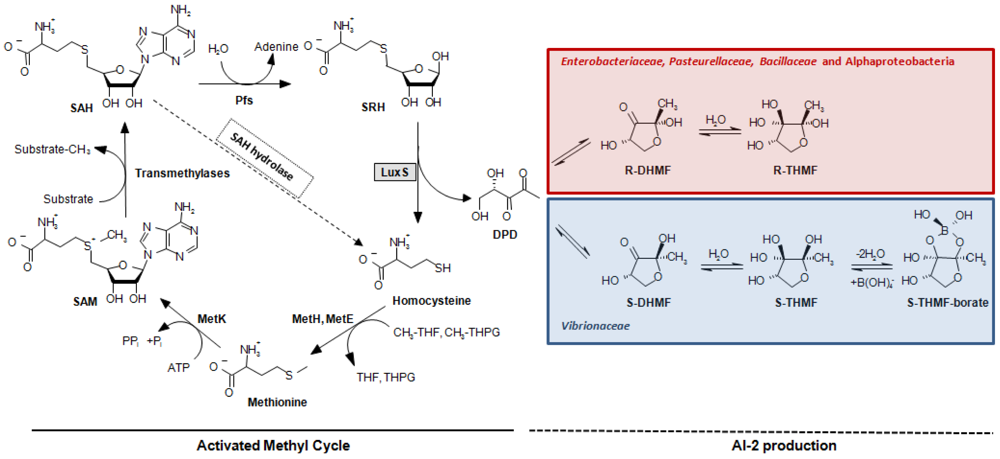
<p>A second quorum sensing system (QS-2, [<xref ref-type="bibr" rid="b13-sensors-12-06645">13</xref>]) was discovered in <italic>V. harveyi</italic> [<xref ref-type="bibr" rid="b14-sensors-12-06645">14</xref>]. This system is controlled by the LuxS protein that catalyzes the production of (<italic>S</italic>)-4,5-dihydroxy-2,3-pentanedione (DPD). DPD is the direct precursor of a different autoinducer molecule (AI-2), (2<italic>S</italic>,4<italic>S</italic>)-2-methyl-2,3,3, 4-tetrahydroxytetrahydrofuryl borate (S-THMF-borate), a furanosyl borate diester [<xref ref-type="bibr" rid="b15-sensors-12-06645">15</xref>] (<xref ref-type="fig" rid="f1-sensors-12-06645">Figure 1</xref>). In <italic>Vibrio</italic> spp., the AI-2 signal is detected by the two-component sensor kinase LuxPQ and is ultimately linked to the same transduction pathway used by the QS-1 sketched above and a third quorum sensing system, which is based on signal molecule (S)-3-hydroxytridecan-4-one (CAI-1) in <italic>Vibrio cholerae</italic> [<xref ref-type="bibr" rid="b16-sensors-12-06645">16</xref>] and <italic>Vibrio harveyi</italic> [<xref ref-type="bibr" rid="b17-sensors-12-06645">17</xref>]. All three signals are conveyed through the central signal relay protein LuxU and the terminal response regulator LuxO, the latter controlling gene expression together with sigma factor σ<sup>54</sup> [<xref ref-type="bibr" rid="b18-sensors-12-06645">18</xref>], whereby the strengths of the different autoinducer signals are not equivalent and vary from species to species [<xref ref-type="bibr" rid="b19-sensors-12-06645">19</xref>,<xref ref-type="bibr" rid="b20-sensors-12-06645">20</xref>]. In bacterial orders other than the <italic>Vibrionaceae</italic>, the task of detecting a different form of the DPD-derived AI-2 signal, (2<italic>R</italic>,4<italic>S</italic>)-2-methyl-2,3,3,4-tetrahydroxytetrahydrofuran (R-THMF), is carried out by an ABC-transporter, the Lsr-receptor complex. Orthologs of this protein are prevalent mainly in <italic>Enterobacteriaceae</italic> [<xref ref-type="bibr" rid="b21-sensors-12-06645">21</xref>,<xref ref-type="bibr" rid="b22-sensors-12-06645">22</xref>], <italic>Pasteurellaceae</italic> and <italic>Bacillaceae</italic>, but were not detected in <italic>Vibrionaceae</italic> [<xref ref-type="bibr" rid="b23-sensors-12-06645">23</xref>]. The presence of LuxS has been reported in several subgroups of the bacterial kingdom such as Actinobacteria, Bacilli, Bacteroidetes, Deinococci and Beta-, Gamma-, and Epsilonproteobacteria. Conversely, LuxS has not been described in Archaea nor in Eukarya [<xref ref-type="bibr" rid="b24-sensors-12-06645">24</xref>,<xref ref-type="bibr" rid="b25-sensors-12-06645">25</xref>]. The pervasive nature of the <italic>luxS</italic> gene, embracing both Gram-negative and Gram-positive bacteria, led to the presumption that QS-2 may be the foundation of a bacterial Esperanto; that is to say, a universal language spoken and understood by various bacterial species [<xref ref-type="bibr" rid="b26-sensors-12-06645">26</xref>]. Unfortunately, this assumption has often neglected a crucial function of LuxS in bacterial cells. This protein has an enzymatic role in the activated methyl cycle (AMC) [<xref ref-type="bibr" rid="b25-sensors-12-06645">25</xref>], which accounts for the regeneration of the major methyl donor S-adenosyl-L-methionine (SAM) and the recycling of methionine by detoxification of S-adenosyl-L-homocysteine (SAH) in the cell (<xref ref-type="fig" rid="f1-sensors-12-06645">Figure 1</xref>). This omission has repeatedly led to the misinterpretation as QS of metabolic effects in <italic>in vitro</italic> mutational experiments and to the incorrect interpretation of <italic>in silico</italic> genomic data (see Section 5) [<xref ref-type="bibr" rid="b23-sensors-12-06645">23</xref>]. Further complicating data interpretation, also the presence of sequences encoding accessory elements like small regulatory RNAs (sRNAs) in the coding or the promoter region of the <italic>luxS</italic> gene has been shown be involved in QS-related behaviors. Thus, their involvement should carefully be considered when evaluating the phenotype of <italic>luxS</italic> mutants [<xref ref-type="bibr" rid="b27-sensors-12-06645">27</xref>,<xref ref-type="bibr" rid="b28-sensors-12-06645">28</xref>].</p>
<p>In this review we will critically review the latest publications on QS-2 to analyze whether LuxS is involved in signaling or if it may hold a mere metabolic role in the species studied. Furthermore, we will comb through the published genomes of bacteria and search for elements related to AI-2 signaling that may allow the formulation of bioinformatics-informed predictions on the importance of QS-2, with particular focus on plant-associated <italic>Enterobacteriaceae</italic>.</p></sec>
<sec>
<label>2.</label>
<title>True, Functional AI-2 Quorum Sensing Systems</title>
<sec>
<label>2.1.</label>
<title>Vibrionaceae</title>
<p>The genus <italic>Vibrio</italic> contains over 50 species that can be found either free-living or in association as commensals, symbionts or pathogens with fauna and flora of aquatic habitats, depending on the species [<xref ref-type="bibr" rid="b29-sensors-12-06645">29</xref>]. In this genus, AI-2 regulated QS controls several biological functions, such as bioluminescence in the marine Gram-negative bacterium <italic>V. harveyi</italic>. The production of luciferase depends upon the production and detection of AI-1, AI-2 and CAI-1 in <italic>V. harveyi</italic>. The QS circuit consists of three parallel sensory systems [<xref ref-type="bibr" rid="b17-sensors-12-06645">17</xref>,<xref ref-type="bibr" rid="b30-sensors-12-06645">30</xref>]. AI-1 synthase LuxLM produces <italic>N</italic>-(3-hydroxybutanoyl)-L-homoserine lactone [<xref ref-type="bibr" rid="b5-sensors-12-06645">5</xref>,<xref ref-type="bibr" rid="b14-sensors-12-06645">14</xref>], CAI-1 is produced by the CqsA enzyme, whereas S-THMF-borate (AI-2) is synthesized by LuxS [<xref ref-type="bibr" rid="b13-sensors-12-06645">13</xref>–<xref ref-type="bibr" rid="b15-sensors-12-06645">15</xref>,<xref ref-type="bibr" rid="b31-sensors-12-06645">31</xref>]. The hybrid kinase LuxQ autophosporylates at Asp-47 in the absence of the AI-2 molecule [<xref ref-type="bibr" rid="b32-sensors-12-06645">32</xref>]. The phosphorylation signal is conveyed to the response regulator protein LuxO, which, in conjunction with alternative sigma factor σ<sup>54</sup>, activates the transcription of five sRNAs [<xref ref-type="bibr" rid="b33-sensors-12-06645">33</xref>] that, in complex with the sRNA chaperone Hfq, destabilize the transcript of master regulator LuxR, repressing the transcription of the <italic>lux</italic> operon. At high cell density, the cognate sensors LuxN and LuxP bind AI-1 and AI-2 in the periplasm, respectively [<xref ref-type="bibr" rid="b14-sensors-12-06645">14</xref>,<xref ref-type="bibr" rid="b34-sensors-12-06645">34</xref>,<xref ref-type="bibr" rid="b35-sensors-12-06645">35</xref>]. The AI-2/LuxP complex interacts with LuxQ and transduces the AI-2 signal inside the cell [<xref ref-type="bibr" rid="b15-sensors-12-06645">15</xref>,<xref ref-type="bibr" rid="b34-sensors-12-06645">34</xref>] by changing the activity of the latter from kinase to phosphatase [<xref ref-type="bibr" rid="b35-sensors-12-06645">35</xref>]. This reverses the flow of phosphate through the pathway and allows the expression of the <italic>luxCDABE</italic> operon, that controls the production of luciferase and the emission of light by the bacteria [<xref ref-type="bibr" rid="b36-sensors-12-06645">36</xref>] (<xref ref-type="fig" rid="f2-sensors-12-06645">Figure 2</xref>).</p>
<p>As one autoinducer is, in principle, sufficient to control density-dependent gene regulation, it was hypothesized that AI-1 and AI-2 are used by <italic>V. harveyi</italic> for intra- and interspecies communication, respectively. This setup makes it possible for the bacterium to distinguish between mono- and mixed-culture situations [<xref ref-type="bibr" rid="b30-sensors-12-06645">30</xref>,<xref ref-type="bibr" rid="b37-sensors-12-06645">37</xref>], as different combinations of autoinducers would reflect the composition and abundance of species within the microbial community (at least within the <italic>Vibrionaceae</italic>, which is the sole bacterial family so far known to hold the LuxPQ-type of receptors [<xref ref-type="bibr" rid="b23-sensors-12-06645">23</xref>,<xref ref-type="bibr" rid="b38-sensors-12-06645">38</xref>]). In addition to bioluminescence [<xref ref-type="bibr" rid="b14-sensors-12-06645">14</xref>,<xref ref-type="bibr" rid="b34-sensors-12-06645">34</xref>,<xref ref-type="bibr" rid="b39-sensors-12-06645">39</xref>], metalloprotease [<xref ref-type="bibr" rid="b30-sensors-12-06645">30</xref>], siderophore, and exopolysaccharide production [<xref ref-type="bibr" rid="b40-sensors-12-06645">40</xref>] are also positively regulated by AI-2 in <italic>V. harveyi</italic> , whereas type III secretion is negatively regulated [<xref ref-type="bibr" rid="b39-sensors-12-06645">39</xref>].</p>
<p>The QS mechanisms in different <italic>Vibrio</italic> spp. diverge in their composition and genetic response although the basic machinery is quite conserved. QS-2 is a crucial regulator of virulence in the human pathogen <italic>V. cholerae</italic> [<xref ref-type="bibr" rid="b19-sensors-12-06645">19</xref>] and of the expression of colonization genes in the symbiont of the Hawaiian bobtail squid (<italic>Euprymna scolopes</italic>), <italic>V. fischeri</italic> [<xref ref-type="bibr" rid="b41-sensors-12-06645">41</xref>,<xref ref-type="bibr" rid="b42-sensors-12-06645">42</xref>].</p>
<p>Other genes whose expression is regulated by QS-2 are a metalloprotease and several virulence genes in the human and eel pathogen <italic>Vibrio vulnificus</italic> [<xref ref-type="bibr" rid="b43-sensors-12-06645">43</xref>,<xref ref-type="bibr" rid="b44-sensors-12-06645">44</xref>] or type III secretion system genes in the gastroenteritis agent <italic>Vibrio parahaemolyticus</italic> [<xref ref-type="bibr" rid="b39-sensors-12-06645">39</xref>]. QS-2 is present also in the opportunistic fish pathogen <italic>Vibrio anguillarum</italic> [<xref ref-type="bibr" rid="b45-sensors-12-06645">45</xref>], even if a clear role for its function could not be defined in the latter. In all these species, bioinformatics analyses detected a minimal set of QS genes (<italic>luxS, luxPQ, luxU, luxO</italic>) involved in the AI-2 transduction pathway [<xref ref-type="bibr" rid="b23-sensors-12-06645">23</xref>]. Other species, such as the marine bacterium <italic>V. angustum</italic>, are devoid of the LuxPQ receptor and do not respond to the AI-2 signal [<xref ref-type="bibr" rid="b46-sensors-12-06645">46</xref>].</p></sec>
<sec>
<label>2.2.</label>
<title>Enterobacteriaceae, Pasteurellaceae, Bacillaceae and Alphaproteobacteria</title>
<p>Outside the <italic>Vibrionaceae</italic> family, another type of receptor, named Lsr (<underline>L</underline>ux<underline>S</underline>-<underline>r</underline>egulated), is responsible for sensing the AI-2 signal. In <italic>S. enterica</italic> subsp. <italic>enterica</italic> serovar Typhimurium, a boron-free variant of AI-2 binds to the periplasmic LsrB protein [<xref ref-type="bibr" rid="b47-sensors-12-06645">47</xref>], the receptor component of the AI-2 ABC transporter (Transporter Classification Database number, TC# 3.A.1.2.8, [<xref ref-type="bibr" rid="b48-sensors-12-06645">48</xref>]). The uptake system also contains the LsrC and LsrD proteins, which form a heterodimeric membrane channel for AI-2 uptake, and LsrA, the ATPase that provides energy for AI-2 transport. Expression of the <italic>lsrACDBFGE</italic> operon is regulated by the AI-2 kinase LsrK as well as by the repressor LsrR, which is active in the absence of phosphorylated AI-2 (AI-2-P) (<xref ref-type="fig" rid="f2-sensors-12-06645">Figure 2</xref>) and was shown to specifically bind the intergenic region between <italic>lsrR</italic> and the <italic>lsr</italic> operon <italic>in vivo</italic> [<xref ref-type="bibr" rid="b49-sensors-12-06645">49</xref>]. A BlastP search using LuxP of <italic>V. harveyi</italic> results in local hits within LsrB of <italic>Enterobacteriaceae</italic>. The similarity is limited to a small portion at the C-terminus of the LuxP protein, which resembles the receptor (RbsB) of the ribose ABC transporter (TC# 3.A.1.2.1). This similarity is most probably indicative of the AI-2 substrate-binding domain of both receptors. In contrast to what occurs in <italic>Vibrionaceae</italic>, where the AI-2 signal but not the AI-2 molecule is transduced inside the cytoplasm, this mechanism requires the import of the molecule inside the cell, where it is phosporylated by LsrK [<xref ref-type="bibr" rid="b22-sensors-12-06645">22</xref>], thus effectively depleting AI-2 from the culture medium when the receptor is active.</p>
<p>Bioinformatic analyses [<xref ref-type="bibr" rid="b23-sensors-12-06645">23</xref>,<xref ref-type="bibr" rid="b50-sensors-12-06645">50</xref>] have demonstrated that, among LuxS positive species, the Lsr-receptor complex is generally more widely spread than the LuxPQ-system (<xref ref-type="table" rid="t1-sensors-12-06645">Table 1</xref>). It was found in members of the bacterial families <italic>Enterobacteriaceae</italic> (genera <italic>Escherichia, Enterobacter, Klebsiella, Yersinia, Shigella, Photorhabdus</italic>, and <italic>Pantoea</italic>, but not <italic>Serratia, Sodalis glossinidius</italic>, or <italic>Erwinia</italic>), <italic>Pasteurellaceae</italic> (in <italic>Actinobacillus actimycetemcomitans, Pasteurella multocida, Haemophilus somnus</italic> and <italic>Haemophilus influenzae</italic>, but not in related species such as <italic>Actinobacillus pleuropneumoniae</italic>) or <italic>Bacillaceae</italic> (<italic>Bacillus cereus</italic> group). This type of receptor was also found on the pSymB-plasmid of <italic>Sinorhizobium meliloti</italic> and in the small, fast-evolving chromosomes of <italic>Rhodobacter sphaeroides</italic> 2.4.1 and <italic>Rhodobacter capsulatus</italic>, which are Alphaproteobacteria that lack the <italic>luxS</italic> gene and use a one-step reaction catalyzed by SAH hydrolase to detoxify SAH and regenerate homocysteine (<xref ref-type="fig" rid="f1-sensors-12-06645">Figure 1</xref>).</p>
<p>Pereira and coworkers [<xref ref-type="bibr" rid="b50-sensors-12-06645">50</xref>] identified critical factors for predicting which LsrB orthologs are functional AI-2 receptors by assaying the AI-2 binding ability of selected candidates. Bacteria having a protein showing more than 63% amino acid sequence identity to <italic>S.</italic> Typhimurium LsrB, including conservation of all six AI-2 binding-site residues (K35, D116, D166, Q167, P220, and A222), were shown to have functional LsrB-like AI-2 receptors and orthologs to all of the proteins encoded by the <italic>lsr</italic> operon.</p>
<p>A second group with lower sequence identity (&lt;36%) that contained substitutions at residues D166 and A222, did not have the complete set of orthologs for the other genes of the <italic>lsr</italic> operon. In these species, LsrB was shown to be likely involved in rhamnose uptake. AI-2 taken up by the Lsr system does not appear to be used as a carbon source, because both cultures of <italic>S.</italic> Typhimurium and <italic>S. meliloti</italic> are unable to grow when AI-2 is used as the sole carbon source [<xref ref-type="bibr" rid="b21-sensors-12-06645">21</xref>,<xref ref-type="bibr" rid="b51-sensors-12-06645">51</xref>].</p>
<p>In enterohemorrhagic <italic>E. coli</italic>, AI-2 was shown to influence chemotaxis and motility. AI-2 was suggested to be an important signal in colonization and successful infection of the human gastrointestinal tract [<xref ref-type="bibr" rid="b52-sensors-12-06645">52</xref>,<xref ref-type="bibr" rid="b53-sensors-12-06645">53</xref>]. Both LsrR and LsrK serve as global regulators for the expression of several important genes, those associated with host invasion and biofilm architecture being the most affected. Deletion of <italic>lsrR</italic> and <italic>lsrK</italic> influenced sRNA expression, which implies that further genes are regulated indirectly by the QS mechanism via these small riboregulators [<xref ref-type="bibr" rid="b54-sensors-12-06645">54</xref>]. Both LsrB and L-serine chemoreceptor Tsr, but not AI-2 uptake in the cytoplasm, are necessary for sensing AI-2, suggesting that LsrB and Tsr interact directly in the periplasm [<xref ref-type="bibr" rid="b55-sensors-12-06645">55</xref>].</p>
<p>In the human oral pathogen <italic>Aggregatibacter actinomycetemcomitans</italic>, AI-2 is internalized via the Lsr system and LsrB is required to mediate the complete AI-2-dependent activation of biofilm formation [<xref ref-type="bibr" rid="b56-sensors-12-06645">56</xref>,<xref ref-type="bibr" rid="b57-sensors-12-06645">57</xref>]. AI-2 can also interact specifically with RbsB, the receptor of the ribose ABC-transporter encoded by the <italic>rbs</italic>-operon. In this species, iron uptake and leukotoxin production were shown to be regulated by LuxS-dependent signaling [<xref ref-type="bibr" rid="b58-sensors-12-06645">58</xref>]. In the insect pathogen <italic>Photorhabdus luminescens</italic>, the transcription of the <italic>lsr</italic> operon is induced by AI-2, which is also involved in the regulation of biofilm formation and motility [<xref ref-type="bibr" rid="b59-sensors-12-06645">59</xref>]. Addition of AI-2 has been associated with regulation of the growth rate in <italic>Bacillus anthracis</italic> [<xref ref-type="bibr" rid="b60-sensors-12-06645">60</xref>] and was shown to negatively affect biofilm formation in <italic>B. cereus</italic> [<xref ref-type="bibr" rid="b61-sensors-12-06645">61</xref>], but definitive experimental evidence that the uptake of AI-2 occurs by the means of LrsB is missing.</p></sec></sec>
<sec>
<label>3.</label>
<title>Alternative Receptors and QS-2 Regulators</title>
<p>In those cases when the chemical complementation of <italic>luxS</italic> mutation by the means of exogenous AI-2 is successful even in the absence of genes coding for either LuxPQ or the Lsr-receptor complex, the presence of alternative receptors for AI-2 must be postulated; otherwise a sheer metabolic role of LuxS in the associated bacteria must be considered [<xref ref-type="bibr" rid="b23-sensors-12-06645">23</xref>]. Different studies have hypothesized a number of such QS-2 related regulators and transporters.</p>
<sec>
<label>3.1.</label>
<title>Alternative Receptors</title>
<p>Because AI-2 is derived from S-ribosyl-homocysteine (SRH), a molecule containing a ribose moiety, and because the periplasmic AI-2-binding proteins of both <italic>V. harveyi</italic> and <italic>S.</italic> Typhimurium show at least partial sequence identity to the <italic>E. coli</italic> RbsB ribose-binding protein, it was speculated that the latter may also serve as an AI-2 receptor [<xref ref-type="bibr" rid="b62-sensors-12-06645">62</xref>]. This was then demonstrated in <italic>A. actinomycetemcomitans</italic> [<xref ref-type="bibr" rid="b63-sensors-12-06645">63</xref>], in which both the LsrB and RbsB proteins were shown to interact with the AI-2 molecule [<xref ref-type="bibr" rid="b56-sensors-12-06645">56</xref>]. Their differential affinity to the AI-2 signal, depending on whether it is found as R-THMF (like in <italic>Enterobacteriaceae</italic>) or as S-THMF-borate (like in <italic>Vibrionaceae</italic>), led to the hypothesis of the synergetic use of the two receptors as borate scavangers [<xref ref-type="bibr" rid="b57-sensors-12-06645">57</xref>]. RbsB was also found to mediate AI-2 uptake in <italic>H. influenzae</italic>, influencing biofilm formation and bacterial persistence in the chinchilla middle ear [<xref ref-type="bibr" rid="b64-sensors-12-06645">64</xref>]. Although bioinformatic analysis has shown that the <italic>lsr</italic>-operon is present in <italic>H. influenzae</italic> [<xref ref-type="bibr" rid="b50-sensors-12-06645">50</xref>], it is not known whether LsrB plays a role in AI-2 uptake in this species. The role of RbsB in AI-2 uptake has not yet been extensively investigated, but because Rbs-transporters are quite widespread among bacteria (<xref ref-type="table" rid="t1-sensors-12-06645">Table 1</xref>), it is possible that RbsB may account for AI-2 internalization in a number of species, even those lacking LuxS or LsrB [<xref ref-type="bibr" rid="b23-sensors-12-06645">23</xref>].</p>
<p>Another protein involved in AI-2 sensing, TlpB, which shares no sequence similarity with the previously identified AI-2 binding proteins, has been recently described in <italic>Helicobacter pylori</italic>, in which the AI-2 signal was shown to function as chemorepellent. TlpB is involved in a signaling pathway downstream of LuxS and upstream of the CheA histidine kinase sensor and the two CheY response regulators required for chemotaxis, which is necessary for <italic>H. pylori</italic> ability to colonize the gastric mucosa of rodents [<xref ref-type="bibr" rid="b65-sensors-12-06645">65</xref>].</p>
<p>In <italic>Streptococcus mutans</italic>, 59 genes regulated by AI-2 were identified by global transcriptome analysis. The product of one of them, SMU_408, a putative permease of the NAT/NCS2 transporter family, was hypothesized to be responsible for the uptake for AI-2 [<xref ref-type="bibr" rid="b66-sensors-12-06645">66</xref>]. Orthologs to this putative receptor are present in all <italic>Streptococcus</italic> spp. for which a QS-2-related phenotype has been described [<xref ref-type="bibr" rid="b23-sensors-12-06645">23</xref>], but also in species belonging other genera, including many for which a conventional receptor for AI-2 is already known, such as <italic>Vibrio, Bacillus</italic> or <italic>Pasteurella</italic>.</p></sec>
<sec>
<label>3.2.</label>
<title>QS-2 Regulators</title>
<p>In <italic>E. coli</italic>, initial AI-2 internalization appears to rely upon a functional phosphoenolpyruvate phosphotransferase system (PTS), a mechanism for the translocation and phosphorylation of several carbohydrates such as glucose, fructose, mannose, hexitols, and 3-glucosides [<xref ref-type="bibr" rid="b67-sensors-12-06645">67</xref>,<xref ref-type="bibr" rid="b68-sensors-12-06645">68</xref>]. AI-2 is first imported in a PTS-dependent manner, and LsrK, not Enzyme I of the PTS (TC# 8.A.7.1.1), is necessary for phosphorylation. AI-2-phosphate then inactivates LsrR and induces synthesis of the Lsr transporter [<xref ref-type="bibr" rid="b68-sensors-12-06645">68</xref>]. Another potential QS-2 regulator (MqsR) was detected in <italic>E. coli</italic> strain K12, where it was shown to induce AI-2 dependent biofilm formation and modify biofim architecture by stimulating flagellar motion and motility [<xref ref-type="bibr" rid="b69-sensors-12-06645">69</xref>] via response regulator QseB and sensor kinase QseC [<xref ref-type="bibr" rid="b70-sensors-12-06645">70</xref>]. Later it was shown that <italic>mqsR</italic> and <italic>ygiT</italic> code for a new toxin-antitoxin system, represented in several groups of bacteria [<xref ref-type="bibr" rid="b71-sensors-12-06645">71</xref>], that causes biofilm formation-associated cell death [<xref ref-type="bibr" rid="b72-sensors-12-06645">72</xref>] via an mRNA interferase mechanism [<xref ref-type="bibr" rid="b73-sensors-12-06645">73</xref>].</p>
<p>In the same strain, an YdgG null mutant showed lowered extracellular and higher intracellular concentrations of AI-2, which resulted in augmented transcription of flagellar genes leading to increased cell motility and decreased biofilm formation. Hence, it was concluded that YdgG (renamed TqsA for ‘<underline>t</underline>ransport of <underline>q</underline>uorum-sensing <underline>s</underline>ignal’) controls export of AI-2 [<xref ref-type="bibr" rid="b74-sensors-12-06645">74</xref>].</p>
<p>In <italic>A. actinomycetemcomitans</italic>, there are indications that the ArcB sensor/kinase may contribute to the signal transduction cascade that directs the LuxS-dependent expression of iron acquisition genes under conditions of iron limitation. The <italic>arcB</italic> mutant gives rise to a phenotype that is similar to that of a LuxS null strain [<xref ref-type="bibr" rid="b75-sensors-12-06645">75</xref>]. The AI-2 signaling system also regulates capsular polysaccharide production in the major nosocomial pathogen <italic>Staphylococcus aureus</italic> through a two-component system, which was first characterized in <italic>E. coli</italic>. This system consists of a sensor histidine kinase KdpD that phosphorylates the response regulator KdpE, which in turn binds to the <italic>cap</italic> promoter [<xref ref-type="bibr" rid="b76-sensors-12-06645">76</xref>]. The exact mechanism by which LuxS/AI-2 interacts with KdpDE is still unknown. The ability to remove AI-2 from culture supernatants was previously demonstrated in another <italic>Staphylococcus</italic> species (<italic>i.e., S. epidermidis</italic>), but the actual receptor was not identified in that study [<xref ref-type="bibr" rid="b77-sensors-12-06645">77</xref>].</p></sec></sec>
<sec>
<label>4.</label>
<title>Lifestyle and Host Specificity of QS-2 Positive Bacteria</title>
<p>Although the two-component sensor kinase LuxPQ is expected to be limited to marine bacteria of the genus <italic>Vibrio</italic>, there are indications that Lsr-mediated AI-2 sensing is a trait generally restricted to (but not a prerequisite for) bacteria that live in close association with specific groups of eukaryotes. In keeping with this idea, the <italic>lsr</italic>-locus is present in many species of the <italic>B. cereus</italic> group, but not in <italic>B. subtilis</italic>, a soil organism which is not considered to be an animal pathogen [<xref ref-type="bibr" rid="b23-sensors-12-06645">23</xref>]. Among <italic>Salmonella</italic> spp., the <italic>lsr</italic> operon is only located in <italic>S. enterica</italic> subsp. <italic>enterica</italic> serovars that are associated with endotherms, whereas it is absent from the genome of <italic>S. bongori</italic>, a species usually associated with cold-blooded animals [<xref ref-type="bibr" rid="b78-sensors-12-06645">78</xref>]. In the nematode symbiont <italic>P. luminescens</italic> the Lsr-receptor complex is apparently restricted to those strains that form a mutualistic consortium with <italic>Heterorhabditis bacteriophora</italic>, but the <italic>lsr</italic> genes show extensive deletions in strains associated with other hosts, suggesting that QS-2 is deeply involved in the association with this particular insect-pathogenic nematode [<xref ref-type="bibr" rid="b79-sensors-12-06645">79</xref>]. Thus, the pattern of distribution of LsrB among the different bacterial species suggests that AI-2 may be a relevant signal for many animal pathogens and symbionts and that the Lsr-receptor complex may play a general role in host colonization by regulating processes, such as biofilm formation, for which a high cellular density is a critical prerequisite.</p>
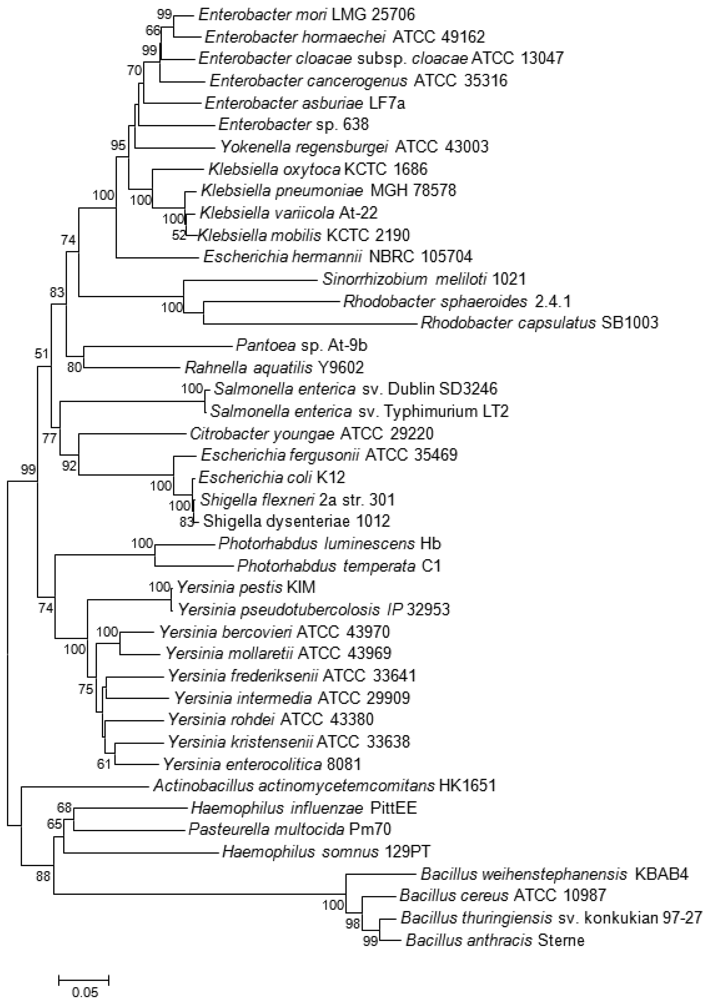
<p>Among plant-associated bacteria, AI-2 specific receptors were only found on the pSymB-plasmid of the N<sub>2</sub>-fixing Alphaproteobacterium <italic>S. meliloti</italic>, which forms an endosymbiotic relationship with legumes from the genera <italic>Medicago, Melilotus</italic> and <italic>Trigonella</italic>. Both <italic>S. meliloti</italic> (as well as related Alphaproteobacteria <italic>R. sphaeroides</italic> and <italic>R capsulatus</italic>) and the aforementioned <italic>Bacillus cereus</italic> group are thought to have acquired the genes coding for the Lsr receptor complex by horizontal gene transfer (HGT), probably from bacteria belonging to the <italic>Enterobacteriaceae</italic> and <italic>Pasteurellaceae</italic>, respectively, that share the same ecological niche [<xref ref-type="bibr" rid="b23-sensors-12-06645">23</xref>,<xref ref-type="bibr" rid="b50-sensors-12-06645">50</xref>]. This conclusion is supported by the unusual position of their <italic>lsrB</italic> genes in the corresponding phylogenetic tree (<xref ref-type="fig" rid="f3-sensors-12-06645">Figure 3</xref>). As Alphaproteobacteria themselves are unable to produce AI-2, it was speculated that they may use the Lsr-receptor complex to eavesdrop on the AI-2-mediated communication of other bacterial species in the same habitat [<xref ref-type="bibr" rid="b23-sensors-12-06645">23</xref>,<xref ref-type="bibr" rid="b51-sensors-12-06645">51</xref>].</p>
<p><italic>Klebsiella</italic> spp. naturally occur as a free-living diazotrophs in soil or as endophytes in the roots of a wide variety of plant species. About 30% of strains can fix nitrogen under anaerobic conditions, but isolates that are close relatives of these diazotrophs are also associated with human diseases [<xref ref-type="bibr" rid="b80-sensors-12-06645">80</xref>,<xref ref-type="bibr" rid="b81-sensors-12-06645">81</xref>]. Isolates forming a clade that includes the type strain of <italic>Klebsiella variicola</italic> were also found within fungus gardens of the colonies leaf-cutter ants of the genera <italic>Atta</italic> and <italic>Acromyrmex</italic> where, together with bacteria belonging to the genus <italic>Pantoea</italic>, they participate in nitrogen fixation for the fungal symbiont [<xref ref-type="bibr" rid="b82-sensors-12-06645">82</xref>]. Both bacterial species living within this consortium carry, beside the <italic>nif</italic> genes coding for the nitrogen fixation pathway, the <italic>lsr</italic>-operon needed for the AI-2 ABC transporter. Although prevalent in the genomes of different <italic>Klebsiella</italic> spp., none of the two gene clusters was previously reported in any sequenced <italic>Pantoea</italic> spp. [<xref ref-type="bibr" rid="b83-sensors-12-06645">83</xref>–<xref ref-type="bibr" rid="b88-sensors-12-06645">88</xref>] suggesting that these were acquired by <italic>Pantoea</italic> sp. At-9b through HGT during adaptation to this particular ecological niche [<xref ref-type="bibr" rid="b82-sensors-12-06645">82</xref>]. However, the <italic>lsr</italic>-genes were not directly acquired from <italic>Klebsiella</italic>, as the significant distance between the two genera in the <italic>lsrB</italic> tree demonstrates (<xref ref-type="fig" rid="f3-sensors-12-06645">Figure 3</xref>). Just as in the symbiotic/pathogenic interactions involving gut colonization of insects and animals, the lifestyle needed for nitrogen fixation in root nodules or in fungus gardens entails high bacterial population densities within a closed system, thus providing a possible rationale for the presence of a QS system. A potential relationship between QS-2 and nitrogen fixation is confirmed by the presence of the Lsr receptor complex in another Alphaproteobacterium <italic>R. sphaeroides</italic> 2.4.1. This bacterium is similar to <italic>Sinorhizobium</italic> in that it does not carry the <italic>luxS</italic> gene, but, in contrast to the latter, it is a free-living diazotroph.</p>
<p>In plant-associated bacteria that are not N<sub>2</sub>-fixing symbionts, the genes encoding the Lsr receptor complex could be identified only in the genomes of the mulberry-pathogen <italic>Enterobacter mori</italic> [<xref ref-type="bibr" rid="b89-sensors-12-06645">89</xref>], in the plant growth-promoting endophyte <italic>Enterobacter</italic> sp. 638 [<xref ref-type="bibr" rid="b90-sensors-12-06645">90</xref>], and in <italic>Enterobacter cancerogenus</italic>, which was originally isolated from poplars (<italic>Populus</italic> spp.) affected by a canker disease [<xref ref-type="bibr" rid="b91-sensors-12-06645">91</xref>]. <italic>E. cancerogenus</italic> has also been found as clinical isolate [<xref ref-type="bibr" rid="b92-sensors-12-06645">92</xref>]. Whether the AI-2 receptor plays a role in pathogenicity or plant association is unknown, but its presence could again reflect the importance of QS-2 in situations associated with bacterial populations thriving in a limited space such as in the case of bacterial cancers or in bacteria employing an endophytic lifestyle.</p></sec>
<sec>
<label>5.</label>
<title>Pitfalls</title>
<p>The major pitfall when analyzing the role of QS-2 in a microbial species has been the reliance on the mere presence of the <italic>luxS</italic> gene in the genome of the bacteria under investigation [<xref ref-type="bibr" rid="b23-sensors-12-06645">23</xref>]. As the AI-2 precursor DPD is normally produced as a by-product of the AMC, even detection of AI-2 molecules in the culture supernatant, either by chemical analysis or through reporter strains such as <italic>V. harveyi</italic> BB170 [<xref ref-type="bibr" rid="b31-sensors-12-06645">31</xref>], cannot be considered as an unmistakable proof of the existence of a functional QS-2 system. The same applies to traditional mutational analysis that, given the important role of LuxS in methionine recycling within the cell, is not able to discriminate between QS-2 and metabolism-related changes of the <italic>luxS</italic> mutant phenotype. This is because conventional <italic>in trans</italic> complementation will overcome defects induced in either pathway. Examples for this kind of “missed approach” are available in a wide variety of <italic>luxS</italic> positive bacteria [<xref ref-type="bibr" rid="b23-sensors-12-06645">23</xref>], including plant pathogens such as <italic>Pectobacterium carotovorum</italic> [<xref ref-type="bibr" rid="b93-sensors-12-06645">93</xref>,<xref ref-type="bibr" rid="b94-sensors-12-06645">94</xref>] or <italic>Erwinia amylovora</italic> [<xref ref-type="bibr" rid="b95-sensors-12-06645">95</xref>]. In the latter study, the effects of the <italic>luxS</italic> mutation were sweepingly ascribed to QS without considering any possible implication of the AMC, even though it was previously demonstrated that the mutant strain has impaired metabolic fitness, especially under sulfur-limiting conditions [<xref ref-type="bibr" rid="b96-sensors-12-06645">96</xref>]. In the same vein, the failure to complement the phenotype of a Δ<italic>luxS</italic> variant by the <italic>luxS</italic>-positive wild-type strain in co-cultivation assays suggested the absence of an extracellular signal. A way to circumvent the complication of the dual role of LuxS in the cell is to shift the focus of the analysis from LuxS itself to the analysis of potential AI-2 receptors and the chemical complementation of the <italic>luxS</italic> mutant, including objective evidence of AI-2 binding or uptake [<xref ref-type="bibr" rid="b97-sensors-12-06645">97</xref>,<xref ref-type="bibr" rid="b98-sensors-12-06645">98</xref>]. Alternatively, it was proposed to replace the <italic>luxS</italic> gene not with an intact copy of itself, but with the <italic>sahH</italic> gene that encodes the SAH hydrolase, which is part of the one-step S-adenosylhomocysteine detoxification pathway (<xref ref-type="fig" rid="f1-sensors-12-06645">Figure 1</xref>). In this manner, it is possible to repair the function of the AMC without restoring AI-2 production: if the wild-type phenotype can be salvaged by an <italic>in trans</italic> complementation with <italic>sahH</italic>, then any difference observed in the <italic>luxS</italic> mutant has to be ascribed to metabolism, not to QS-2 [<xref ref-type="bibr" rid="b99-sensors-12-06645">99</xref>]. Conversely, if it possible to fully complement the <italic>luxS</italic> mutant by adding exogenous AI-2 to the culture medium (chemical complementation), a role of the latter molecule in signaling must be considered.</p>
<p>A more promising tactic to determine whether QS-2 is really present in a bacterial species is to shift the focus of the investigation from AI-2 production to AI-2 recognition and detection. This may include bioinformatics approaches to scan for orthologs of known AI-2 receptors [<xref ref-type="bibr" rid="b23-sensors-12-06645">23</xref>,<xref ref-type="bibr" rid="b38-sensors-12-06645">38</xref>,<xref ref-type="bibr" rid="b50-sensors-12-06645">50</xref>], which must withstand the reciprocal best-hit strategy to distinguish between orthologous and paralogous genes [<xref ref-type="bibr" rid="b100-sensors-12-06645">100</xref>]. In this kind of approach, it is important that the actual receptor is employed in similarity searches, as the use of associated proteins or domains (e.g., transmembrane channel LsrCD or sensor kinase/phosphatase LuxQ) may yield multiple partial positive matches in several species, as these proteins may share an high degree of sequence identity among paralogous systems. A thorough analysis of the complete genomes of <italic>E. amylovora</italic> [<xref ref-type="bibr" rid="b101-sensors-12-06645">101</xref>] and the closely related species <italic>E. pyrifoliae</italic> [<xref ref-type="bibr" rid="b102-sensors-12-06645">102</xref>], <italic>E. piriflorinigrans</italic> [<xref ref-type="bibr" rid="b103-sensors-12-06645">103</xref>], <italic>E. billingiae</italic> and <italic>E. tasmaniensis</italic> [<xref ref-type="bibr" rid="b104-sensors-12-06645">104</xref>] revealed the complete absence of any specific receptor associated with QS-2, thus confirming the metabolic role of LuxS in the fully sequenced species of this genus. In addition to the bioinformatics approach, experimental evidence of a functional QS-2 system can be gathered by confirming AI-2 depletion from the culture media [<xref ref-type="bibr" rid="b97-sensors-12-06645">97</xref>,<xref ref-type="bibr" rid="b98-sensors-12-06645">98</xref>] or, as more recently proposed, the use of a DPD-based rhodamine-conjugated dendrimer as multivalent probe that allows specific imaging of cells bearing Lsr-type quorum-sensing receptors [<xref ref-type="bibr" rid="b105-sensors-12-06645">105</xref>].</p></sec>
<sec>
<label>6.</label>
<title>Reflections</title>
<p>The fact that many of the alternative AI-2 receptors and QS-2 regulators are fairly common across different bacterial taxa and are not specific to <italic>luxS</italic>-positive bacteria suggests that they were recruited subsequently into their role in QS-2. This raises the question of whether their primary function is always true signalling or, especially in <italic>luxS</italic>-negative bacteria, whether it may also concern other types of interactions involving metabolism or activation of non-QS-2 related responses. In principle, because the PTS system initiates AI-2 import in <italic>E. coli</italic> [<xref ref-type="bibr" rid="b68-sensors-12-06645">68</xref>] is virtually ubiquitous within the bacterial kingdom [<xref ref-type="bibr" rid="b106-sensors-12-06645">106</xref>], almost every bacterium should at least theoretically be capable to internalize AI-2. The same is true for ribose ABC transporters, which were shown to be able to mediate AI-2 intake because of the structural similarity of the autoinducer molecule with their cognate substrate [<xref ref-type="bibr" rid="b56-sensors-12-06645">56</xref>,<xref ref-type="bibr" rid="b63-sensors-12-06645">63</xref>]. This could explain the successful chemical complementation of <italic>luxS</italic> mutants in those species that were found to be devoid of both major AI-2 receptors [<xref ref-type="bibr" rid="b23-sensors-12-06645">23</xref>]. However, whether the transcriptional changes induced by the addition of exogenous AI-2 in the receiver organism are effectively related to QS-2 remains to be demonstrated. From an evolutionary point of view, for a secreted molecule to be a signal between different species, it must not only elicit a response in the receiving organism but also have evolved primarily to do so [<xref ref-type="bibr" rid="b107-sensors-12-06645">107</xref>]. Interactions involving other types of non-concerted responses may be referred to as cues or coercion events [<xref ref-type="bibr" rid="b108-sensors-12-06645">108</xref>]. A cue describes an emission which provides beneficial information to a receiver but which did not evolve explicitly for that purpose, and thus does not directly benefit the emitter. Conversely, coercion describes the situation in which a signal induces a detrimental response in a receiver to the benefit of the emitter [<xref ref-type="bibr" rid="b109-sensors-12-06645">109</xref>]. Whatever names are used for these alternative activities, they illustrate the danger of concluding that a single prevailing environmental factor controls bacterial behavior in a manner that evolved specifically to carry out that function. In reality, both the ecological context of QS regulation and the process itself are complex and respond to a multiplicity of environmental stimuli. For this reason, the notion of ‘quorum sensing’ should perhaps be defined more narrowly to include only signals specifically used for communication between emitter and receiver cells. Otherwise, the concept of QS may be diluted to include environmental signals that affect bacterial metabolism and behavior in rather indirect ways that are not examples of intentional cell-to-cell- communication [<xref ref-type="bibr" rid="b110-sensors-12-06645">110</xref>].</p></sec></body>
<back>
<ack>
<p>This work was supported by the Swiss Federal Office of Agriculture (BLW Fire Blight Research-Achilles) and was conducted within the Swiss ProfiCrops program, and the Q-Detect research network.</p></ack>
<ref-list>
<title>References</title>
<ref id="b1-sensors-12-06645"><label>1.</label><citation citation-type="journal"><person-group person-group-type="author"><name><surname>Danhorn</surname><given-names>T.</given-names></name><name><surname>Fuqua</surname><given-names>C.</given-names></name></person-group><article-title>Biofilm formation by plant-associated bacteria</article-title><source>Annu. Rev. Microbiol.</source><year>2007</year><volume>61</volume><fpage>401</fpage><lpage>422</lpage><pub-id pub-id-type="doi">10.1146/annurev.micro.61.080706.093316</pub-id><pub-id pub-id-type="pmid">17506679</pub-id></citation></ref>
<ref id="b2-sensors-12-06645"><label>2.</label><citation citation-type="journal"><person-group person-group-type="author"><name><surname>Whitehead</surname><given-names>N.A.</given-names></name><name><surname>Barnard</surname><given-names>A.M.</given-names></name><name><surname>Slater</surname><given-names>H.</given-names></name><name><surname>Simpson</surname><given-names>N.J.</given-names></name><name><surname>Salmond</surname><given-names>G.P.</given-names></name></person-group><article-title>Quorum-sensing in Gram-negative bacteria</article-title><source>FEMS Microbiol. Rev.</source><year>2001</year><volume>25</volume><fpage>365</fpage><lpage>404</lpage><pub-id pub-id-type="doi">10.1111/j.1574-6976.2001.tb00583.x</pub-id><pub-id pub-id-type="pmid">11524130</pub-id></citation></ref>
<ref id="b3-sensors-12-06645"><label>3.</label><citation citation-type="journal"><person-group person-group-type="author"><name><surname>Cha</surname><given-names>C.</given-names></name><name><surname>Gao</surname><given-names>P.</given-names></name><name><surname>Chen</surname><given-names>Y.-C.</given-names></name><name><surname>Shaw</surname><given-names>P.D.</given-names></name><name><surname>Farrand</surname><given-names>S.K.</given-names></name></person-group><article-title>Production of acyl-homoserine lactone quorum-sensing signals by Gram-negative plant-associated bacteria</article-title><source>Mol. Plant-Microbe Interact.</source><year>1998</year><volume>11</volume><fpage>1119</fpage><lpage>1129</lpage><pub-id pub-id-type="doi">10.1094/MPMI.1998.11.11.1119</pub-id><pub-id pub-id-type="pmid">9805399</pub-id></citation></ref>
<ref id="b4-sensors-12-06645"><label>4.</label><citation citation-type="journal"><person-group person-group-type="author"><name><surname>Loh</surname><given-names>J.</given-names></name><name><surname>Pierson</surname><given-names>E.A.</given-names></name><name><surname>Pierson</surname><given-names>L.S.</given-names></name><name><surname>Stacey</surname><given-names>G.</given-names></name><name><surname>Chatterjee</surname><given-names>A.</given-names></name></person-group><article-title>Quorum sensing in plant-associated bacteria</article-title><source>Curr. Opin. Plant Biol.</source><year>2002</year><volume>5</volume><fpage>285</fpage><lpage>290</lpage><pub-id pub-id-type="doi">10.1016/S1369-5266(02)00274-1</pub-id><pub-id pub-id-type="pmid">12179960</pub-id></citation></ref>
<ref id="b5-sensors-12-06645"><label>5.</label><citation citation-type="journal"><person-group person-group-type="author"><name><surname>Cao</surname><given-names>J.G.</given-names></name><name><surname>Meighen</surname><given-names>E.A.</given-names></name></person-group><article-title>Purification and structural identification of an autoinducer for the luminescence system of <italic>Vibrio harveyi</italic></article-title><source>J. Biol. Chem.</source><year>1989</year><volume>264</volume><fpage>21670</fpage><lpage>21676</lpage><pub-id pub-id-type="pmid">2600086</pub-id></citation></ref>
<ref id="b6-sensors-12-06645"><label>6.</label><citation citation-type="journal"><person-group person-group-type="author"><name><surname>Engebrecht</surname><given-names>J.</given-names></name><name><surname>Nealson</surname><given-names>K.</given-names></name><name><surname>Silverman</surname><given-names>M.</given-names></name></person-group><article-title>Bacterial bioluminescence: Isolation and genetic analysis of functions from <italic>Vibrio fischer</italic></article-title><source>Cell</source><year>1983</year><volume>32</volume><fpage>773</fpage><lpage>781</lpage><pub-id pub-id-type="doi">10.1016/0092-8674(83)90063-6</pub-id><pub-id pub-id-type="pmid">6831560</pub-id></citation></ref>
<ref id="b7-sensors-12-06645"><label>7.</label><citation citation-type="journal"><person-group person-group-type="author"><name><surname>Ng</surname><given-names>W.-L.</given-names></name><name><surname>Bassler</surname><given-names>B.L.</given-names></name></person-group><article-title>Bacterial quorum-sensing network architectures</article-title><source>Annu. Rev. Genet</source><year>2009</year><volume>43</volume><fpage>197</fpage><lpage>222</lpage><pub-id pub-id-type="doi">10.1146/annurev-genet-102108-134304</pub-id><pub-id pub-id-type="pmid">19686078</pub-id></citation></ref>
<ref id="b8-sensors-12-06645"><label>8.</label><citation citation-type="journal"><person-group person-group-type="author"><name><surname>Pearson</surname><given-names>J.P.</given-names></name><name><surname>Passador</surname><given-names>L.</given-names></name><name><surname>Iglewski</surname><given-names>B.H.</given-names></name><name><surname>Greenberg</surname><given-names>E.P.</given-names></name></person-group><article-title>A second N-acylhomoserine lactone signal produced by <italic>Pseudomonas aeruginosa</italic></article-title><source>Proc. Natl. Acad. Sci. USA</source><year>1995</year><volume>92</volume><fpage>1490</fpage><lpage>1494</lpage><pub-id pub-id-type="doi">10.1073/pnas.92.5.1490</pub-id><pub-id pub-id-type="pmid">7878006</pub-id></citation></ref>
<ref id="b9-sensors-12-06645"><label>9.</label><citation citation-type="journal"><person-group person-group-type="author"><name><surname>Winson</surname><given-names>M.K.</given-names></name><name><surname>Camara</surname><given-names>M.</given-names></name><name><surname>Latifi</surname><given-names>A.</given-names></name><name><surname>Foglino</surname><given-names>M.</given-names></name><name><surname>Chhabra</surname><given-names>S.R.</given-names></name><name><surname>Daykin</surname><given-names>M.</given-names></name><name><surname>Bally</surname><given-names>M.</given-names></name><name><surname>Chapon</surname><given-names>V.</given-names></name><name><surname>Salmond</surname><given-names>G.P.</given-names></name><name><surname>Bycroft</surname><given-names>B.W.</given-names></name></person-group><article-title>Multiple N-acyl-L-homoserine lactone signal molecules regulate production of virulence determinants and secondary metabolites in <italic>Pseudomonas aeruginosa</italic></article-title><source>Proc. Natl. Acad. Sci. USA</source><year>1995</year><volume>92</volume><fpage>9427</fpage><lpage>9431</lpage><pub-id pub-id-type="doi">10.1073/pnas.92.20.9427</pub-id><pub-id pub-id-type="pmid">7568146</pub-id></citation></ref>
<ref id="b10-sensors-12-06645"><label>10.</label><citation citation-type="journal"><person-group person-group-type="author"><name><surname>McKenney</surname><given-names>D.</given-names></name><name><surname>Brown</surname><given-names>K.E.</given-names></name><name><surname>Allison</surname><given-names>D.G.</given-names></name></person-group><article-title>Influence of <italic>Pseudomonas aeruginosa</italic> exoproducts on virulence factor production in <italic>Burkholderia cepacia</italic>: Evidence of interspecies communication</article-title><source>J. Bacteriol.</source><year>1995</year><volume>177</volume><fpage>6989</fpage><lpage>6992</lpage><pub-id pub-id-type="pmid">7592496</pub-id></citation></ref>
<ref id="b11-sensors-12-06645"><label>11.</label><citation citation-type="journal"><person-group person-group-type="author"><name><surname>Pierson</surname><given-names>E.A.</given-names></name><name><surname>Wood</surname><given-names>D.W.</given-names></name><name><surname>Cannon</surname><given-names>J.A.</given-names></name><name><surname>Blachere</surname><given-names>F.M.</given-names></name><name><surname>Pierson</surname><given-names>L.S.</given-names></name></person-group><article-title>Interpopulation signaling via N-acyl-homoserine lactones among bacteria in the wheat rhizosphere</article-title><source>Mol. Plant-Microbe Interact.</source><year>1998</year><volume>11</volume><fpage>1078</fpage><lpage>1084</lpage><pub-id pub-id-type="doi">10.1094/MPMI.1998.11.11.1078</pub-id></citation></ref>
<ref id="b12-sensors-12-06645"><label>12.</label><citation citation-type="journal"><person-group person-group-type="author"><name><surname>Bassler</surname><given-names>B.L.</given-names></name></person-group><article-title>Small talk. Cell-to-cell communication in bacteria</article-title><source>Cell</source><year>2002</year><volume>109</volume><fpage>421</fpage><lpage>424</lpage><pub-id pub-id-type="doi">10.1016/S0092-8674(02)00749-3</pub-id><pub-id pub-id-type="pmid">12086599</pub-id></citation></ref>
<ref id="b13-sensors-12-06645"><label>13.</label><citation citation-type="journal"><person-group person-group-type="author"><name><surname>Schauder</surname><given-names>S.</given-names></name><name><surname>Shokat</surname><given-names>K.</given-names></name><name><surname>Surette</surname><given-names>M.G.</given-names></name><name><surname>Bassler</surname><given-names>B.L.</given-names></name></person-group><article-title>The LuxS family of bacterial autoinducers: Biosynthesis of a novel quorum sensing signal molecule</article-title><source>Mol. Microbiol.</source><year>2001</year><volume>41</volume><fpage>463</fpage><lpage>467</lpage><pub-id pub-id-type="doi">10.1046/j.1365-2958.2001.02532.x</pub-id><pub-id pub-id-type="pmid">11489131</pub-id></citation></ref>
<ref id="b14-sensors-12-06645"><label>14.</label><citation citation-type="journal"><person-group person-group-type="author"><name><surname>Bassler</surname><given-names>B.L.</given-names></name><name><surname>Wright</surname><given-names>M.</given-names></name><name><surname>Showalter</surname><given-names>R.E.</given-names></name><name><surname>Silverman</surname><given-names>M.R.</given-names></name></person-group><article-title>Intercellular signalling in <italic>Vibrio harveyi</italic>: Sequence and function of genes regulating expression of luminescence</article-title><source>Mol. Microbiol.</source><year>1993</year><volume>9</volume><fpage>773</fpage><lpage>786</lpage><pub-id pub-id-type="doi">10.1111/j.1365-2958.1993.tb01737.x</pub-id><pub-id pub-id-type="pmid">8231809</pub-id></citation></ref>
<ref id="b15-sensors-12-06645"><label>15.</label><citation citation-type="journal"><person-group person-group-type="author"><name><surname>Chen</surname><given-names>X.</given-names></name><name><surname>Schauder</surname><given-names>S.</given-names></name><name><surname>Potier</surname><given-names>N.</given-names></name><name><surname>van Dorssealaer</surname><given-names>A.</given-names></name><name><surname>Pelczer</surname><given-names>I.</given-names></name><name><surname>Bassler</surname><given-names>B.L.</given-names></name><name><surname>Hughson</surname><given-names>F.M.</given-names></name></person-group><article-title>Structural identification of bacterial quorum-sensing signal containing boron</article-title><source>Nature</source><year>2002</year><volume>415</volume><fpage>545</fpage><lpage>549</lpage><pub-id pub-id-type="doi">10.1038/415545a</pub-id><pub-id pub-id-type="pmid">11823863</pub-id></citation></ref>
<ref id="b16-sensors-12-06645"><label>16.</label><citation citation-type="journal"><person-group person-group-type="author"><name><surname>Higgins</surname><given-names>D.A.</given-names></name><name><surname>Pomianek</surname><given-names>M.E.</given-names></name><name><surname>Kraml</surname><given-names>C.M.</given-names></name><name><surname>Taylor</surname><given-names>R.K.</given-names></name><name><surname>Semmelhack</surname><given-names>M.F.</given-names></name><name><surname>Bassler</surname><given-names>B.L.</given-names></name></person-group><article-title>The major <italic>Vibrio cholerae</italic> autoinducer and its role in virulence factor production</article-title><source>Nature</source><year>2007</year><volume>450</volume><fpage>883</fpage><lpage>886</lpage><pub-id pub-id-type="doi">10.1038/nature06284</pub-id><pub-id pub-id-type="pmid">18004304</pub-id></citation></ref>
<ref id="b17-sensors-12-06645"><label>17.</label><citation citation-type="journal"><person-group person-group-type="author"><name><surname>Tu</surname><given-names>K.C.</given-names></name><name><surname>Bassler</surname><given-names>B.L.</given-names></name></person-group><article-title>Multiple small RNAs act additively to integrate sensory information and control quorum sensing in <italic>Vibrio harveyi</italic></article-title><source>Genes Dev.</source><year>2007</year><volume>21</volume><fpage>221</fpage><lpage>233</lpage><pub-id pub-id-type="doi">10.1101/gad.1502407</pub-id><pub-id pub-id-type="pmid">17234887</pub-id></citation></ref>
<ref id="b18-sensors-12-06645"><label>18.</label><citation citation-type="journal"><person-group person-group-type="author"><name><surname>Reading</surname><given-names>N.C.</given-names></name><name><surname>Sperandio</surname><given-names>V.</given-names></name></person-group><article-title>Quorum sensing: The many languages of bacteria</article-title><source>FEMS Microbiol. Lett.</source><year>2006</year><volume>254</volume><fpage>1</fpage><lpage>11</lpage><pub-id pub-id-type="doi">10.1111/j.1574-6968.2005.00001.x</pub-id><pub-id pub-id-type="pmid">16451172</pub-id></citation></ref>
<ref id="b19-sensors-12-06645"><label>19.</label><citation citation-type="journal"><person-group person-group-type="author"><name><surname>Miller</surname><given-names>M.B.</given-names></name><name><surname>Skorupski</surname><given-names>K.</given-names></name><name><surname>Lenz</surname><given-names>D.H.</given-names></name><name><surname>Taylor</surname><given-names>R.K.</given-names></name><name><surname>Bassler</surname><given-names>B.L.</given-names></name></person-group><article-title>Parallel quorum sensing systems converge to regulate virulence in <italic>Vibrio cholerae</italic></article-title><source>Cell</source><year>2002</year><volume>110</volume><fpage>303</fpage><lpage>314</lpage><pub-id pub-id-type="doi">10.1016/S0092-8674(02)00829-2</pub-id><pub-id pub-id-type="pmid">12176318</pub-id></citation></ref>
<ref id="b20-sensors-12-06645"><label>20.</label><citation citation-type="journal"><person-group person-group-type="author"><name><surname>Henke</surname><given-names>J.M.</given-names></name><name><surname>Bassler</surname><given-names>B.L.</given-names></name></person-group><article-title>Three parallel quorum-sensing systems regulate gene expression in <italic>Vibrio harveyi</italic></article-title><source>J. Bacteriol.</source><year>2004</year><volume>186</volume><fpage>6902</fpage><lpage>6914</lpage><pub-id pub-id-type="doi">10.1128/JB.186.20.6902-6914.2004</pub-id><pub-id pub-id-type="pmid">15466044</pub-id></citation></ref>
<ref id="b21-sensors-12-06645"><label>21.</label><citation citation-type="journal"><person-group person-group-type="author"><name><surname>Taga</surname><given-names>M.E.</given-names></name><name><surname>Semmelhack</surname><given-names>J.L.</given-names></name><name><surname>Bassler</surname><given-names>B.L.</given-names></name></person-group><article-title>The LuxS-dependent autoinducer AI-2 controls the expression of an ABC transporter that functions in AI-2 uptake in S<italic>almonella typhimurium</italic></article-title><source>Mol. Microbiol.</source><year>2001</year><volume>42</volume><fpage>777</fpage><lpage>793</lpage><pub-id pub-id-type="pmid">11722742</pub-id></citation></ref>
<ref id="b22-sensors-12-06645"><label>22.</label><citation citation-type="journal"><person-group person-group-type="author"><name><surname>Xavier</surname><given-names>K.B.</given-names></name><name><surname>Bassler</surname><given-names>B.L.</given-names></name></person-group><article-title>Regulation of uptake and processing of the quorum-sensing autoinducer AI-2 in <italic>Escherichia coli</italic></article-title><source>J. Bacteriol.</source><year>2005</year><volume>187</volume><fpage>238</fpage><lpage>248</lpage><pub-id pub-id-type="doi">10.1128/JB.187.1.238-248.2005</pub-id><pub-id pub-id-type="pmid">15601708</pub-id></citation></ref>
<ref id="b23-sensors-12-06645"><label>23.</label><citation citation-type="journal"><person-group person-group-type="author"><name><surname>Rezzonico</surname><given-names>F.</given-names></name><name><surname>Duffy</surname><given-names>B.</given-names></name></person-group><article-title>Lack of genomic evidence of AI-2 receptors suggests a non quorum sensing role for <italic>luxS</italic> in most bacteria</article-title><source>BMC Microbiol.</source><year>2008</year><volume>8</volume><pub-id pub-id-type="doi">10.1186/1471-2180-8-154</pub-id></citation></ref>
<ref id="b24-sensors-12-06645"><label>24.</label><citation citation-type="journal"><person-group person-group-type="author"><name><surname>Xavier</surname><given-names>K.B.</given-names></name><name><surname>Bassler</surname><given-names>B.L.</given-names></name></person-group><article-title>Interference with AI-2-mediated bacterial cell-cell communication</article-title><source>Nature</source><year>2005</year><volume>437</volume><fpage>750</fpage><lpage>753</lpage><pub-id pub-id-type="doi">10.1038/nature03960</pub-id><pub-id pub-id-type="pmid">16193054</pub-id></citation></ref>
<ref id="b25-sensors-12-06645"><label>25.</label><citation citation-type="journal"><person-group person-group-type="author"><name><surname>Winzer</surname><given-names>K.</given-names></name><name><surname>Hardie</surname><given-names>K.R.</given-names></name><name><surname>Williams</surname><given-names>P.</given-names></name></person-group><article-title>LuxS and autoinducer-2: Their contribution to quorum sensing and metabolism in bacteria</article-title><source>Adv. Appl. Microbiol.</source><year>2003</year><volume>53</volume><fpage>291</fpage><lpage>396</lpage><pub-id pub-id-type="pmid">14696323</pub-id></citation></ref>
<ref id="b26-sensors-12-06645"><label>26.</label><citation citation-type="journal"><person-group person-group-type="author"><name><surname>Winans</surname><given-names>S.C.</given-names></name></person-group><article-title>Bacterial Esperanto</article-title><source>Nat. Struct. Biol.</source><year>2002</year><volume>9</volume><fpage>83</fpage><lpage>84</lpage><pub-id pub-id-type="doi">10.1038/nsb0202-83</pub-id><pub-id pub-id-type="pmid">11813009</pub-id></citation></ref>
<ref id="b27-sensors-12-06645"><label>27.</label><citation citation-type="journal"><person-group person-group-type="author"><name><surname>De Keersmaecker</surname><given-names>S.C.</given-names></name><name><surname>Sonck</surname><given-names>K.</given-names></name><name><surname>Vanderleyden</surname><given-names>J.</given-names></name></person-group><article-title>Let LuxS speak up in AI-2 signaling</article-title><source>Trends Microbiol.</source><year>2006</year><volume>14</volume><fpage>114</fpage><lpage>119</lpage><pub-id pub-id-type="doi">10.1016/j.tim.2006.01.003</pub-id><pub-id pub-id-type="pmid">16459080</pub-id></citation></ref>
<ref id="b28-sensors-12-06645"><label>28.</label><citation citation-type="journal"><person-group person-group-type="author"><name><surname>Kint</surname><given-names>G.</given-names></name><name><surname>de Coster</surname><given-names>D.</given-names></name><name><surname>Marchal</surname><given-names>K.</given-names></name><name><surname>Vanderleyden</surname><given-names>J.</given-names></name><name><surname>de Keersmaecker</surname><given-names>S.C.J.</given-names></name></person-group><article-title>The small regulatory RNA molecule MicA is involved in <italic>Salmonella enterica</italic> serovar Typhimurium biofilm formation</article-title><source>BMC Microbiol.</source><year>2010</year><volume>10</volume><fpage>276</fpage><pub-id pub-id-type="doi">10.1186/1471-2180-10-276</pub-id></citation></ref>
<ref id="b29-sensors-12-06645"><label>29.</label><citation citation-type="journal"><person-group person-group-type="author"><name><surname>Milton</surname><given-names>D.L.</given-names></name></person-group><article-title>Quorum sensing in vibrios: Complexity for diversification</article-title><source>Int. J. Med. Microbiol.</source><year>2006</year><volume>296</volume><fpage>61</fpage><lpage>71</lpage><pub-id pub-id-type="doi">10.1016/j.ijmm.2006.01.044</pub-id><pub-id pub-id-type="pmid">16487746</pub-id></citation></ref>
<ref id="b30-sensors-12-06645"><label>30.</label><citation citation-type="journal"><person-group person-group-type="author"><name><surname>Mok</surname><given-names>K.C.</given-names></name><name><surname>Wingreen</surname><given-names>N.S.</given-names></name><name><surname>Bassler</surname><given-names>B.L.</given-names></name></person-group><article-title><italic>Vibrio harveyi</italic> quorum sensing: A coincidence detector for two autoinducers controls gene expression</article-title><source>EMBO J.</source><year>2003</year><volume>22</volume><fpage>870</fpage><lpage>881</lpage><pub-id pub-id-type="doi">10.1093/emboj/cdg085</pub-id><pub-id pub-id-type="pmid">12574123</pub-id></citation></ref>
<ref id="b31-sensors-12-06645"><label>31.</label><citation citation-type="journal"><person-group person-group-type="author"><name><surname>Surette</surname><given-names>M.G.</given-names></name><name><surname>Bassler</surname><given-names>B.L.</given-names></name></person-group><article-title>Regulation of autoinducer production in <italic>Salmonella typhimurium</italic></article-title><source>Mol. Microbiol.</source><year>1999</year><volume>31</volume><fpage>585</fpage><lpage>595</lpage><pub-id pub-id-type="doi">10.1046/j.1365-2958.1999.01199.x</pub-id><pub-id pub-id-type="pmid">10027975</pub-id></citation></ref>
<ref id="b32-sensors-12-06645"><label>32.</label><citation citation-type="journal"><person-group person-group-type="author"><name><surname>Freeman</surname><given-names>J.A.</given-names></name><name><surname>Bassler</surname><given-names>B.L.</given-names></name></person-group><article-title>A genetic analysis of the function of LuxO, a two-component response regulator involved in quorum sensing in <italic>Vibrio harveyi</italic></article-title><source>Mol. Microbiol.</source><year>1999</year><volume>31</volume><fpage>665</fpage><lpage>677</lpage><pub-id pub-id-type="doi">10.1046/j.1365-2958.1999.01208.x</pub-id><pub-id pub-id-type="pmid">10027982</pub-id></citation></ref>
<ref id="b33-sensors-12-06645"><label>33.</label><citation citation-type="journal"><person-group person-group-type="author"><name><surname>Shao</surname><given-names>Y.</given-names></name><name><surname>Bassler</surname><given-names>B.L.</given-names></name></person-group><article-title>Quorum-sensing non-coding small RNAs use unique pairing regions to differentially control mRNA targets</article-title><source>Mol. Microbiol.</source><year>2012</year><volume>83</volume><fpage>599</fpage><lpage>611</lpage><pub-id pub-id-type="doi">10.1111/j.1365-2958.2011.07959.x</pub-id><pub-id pub-id-type="pmid">22229925</pub-id></citation></ref>
<ref id="b34-sensors-12-06645"><label>34.</label><citation citation-type="journal"><person-group person-group-type="author"><name><surname>Bassler</surname><given-names>B.L.</given-names></name><name><surname>Wright</surname><given-names>M.</given-names></name><name><surname>Silverman</surname><given-names>M.R.</given-names></name></person-group><article-title>Multiple signalling systems controlling expression of luminescence in <italic>Vibrio harveyi</italic>: Sequence and function of genes encoding a second sensory pathway</article-title><source>Mol. Microbiol.</source><year>1994</year><volume>13</volume><fpage>273</fpage><lpage>286</lpage><pub-id pub-id-type="doi">10.1111/j.1365-2958.1994.tb00422.x</pub-id><pub-id pub-id-type="pmid">7984107</pub-id></citation></ref>
<ref id="b35-sensors-12-06645"><label>35.</label><citation citation-type="journal"><person-group person-group-type="author"><name><surname>Freeman</surname><given-names>J.A.</given-names></name><name><surname>Lilley</surname><given-names>B.N.</given-names></name><name><surname>Bassler</surname><given-names>B.L.</given-names></name></person-group><article-title>A genetic analysis of the functions of LuxN: A two-component hybrid sensor kinase that regulates quorum sensing in <italic>Vibrio harveyi</italic></article-title><source>Mol. Microbiol.</source><year>2000</year><volume>35</volume><fpage>139</fpage><lpage>149</lpage><pub-id pub-id-type="doi">10.1046/j.1365-2958.2000.01684.x</pub-id><pub-id pub-id-type="pmid">10632884</pub-id></citation></ref>
<ref id="b36-sensors-12-06645"><label>36.</label><citation citation-type="journal"><person-group person-group-type="author"><name><surname>Lenz</surname><given-names>D.H.</given-names></name><name><surname>Mok</surname><given-names>K.C.</given-names></name><name><surname>Lilley</surname><given-names>B.N.</given-names></name><name><surname>Kulkarni</surname><given-names>R.V.</given-names></name><name><surname>Wingreen</surname><given-names>N.S.</given-names></name><name><surname>Bassler</surname><given-names>B.L.</given-names></name></person-group><article-title>The small RNA chaperone Hfq and multiple small RNAs control quorum sensing in <italic>Vibrio harveyi</italic> and <italic>Vibrio cholerae</italic></article-title><source>Cell</source><year>2004</year><volume>118</volume><fpage>69</fpage><lpage>82</lpage><pub-id pub-id-type="doi">10.1016/j.cell.2004.06.009</pub-id><pub-id pub-id-type="pmid">15242645</pub-id></citation></ref>
<ref id="b37-sensors-12-06645"><label>37.</label><citation citation-type="journal"><person-group person-group-type="author"><name><surname>Long</surname><given-names>T.</given-names></name><name><surname>Tu</surname><given-names>K.C.</given-names></name><name><surname>Wang</surname><given-names>Y.</given-names></name><name><surname>Mehta</surname><given-names>P.</given-names></name><name><surname>Ong</surname><given-names>N.P.</given-names></name><name><surname>Bassler</surname><given-names>B.L.</given-names></name><name><surname>Wingreen</surname><given-names>N.S.</given-names></name></person-group><article-title>Quantifying the integration of quorum-sensing signals with single-cell resolution</article-title><source>PLoS Biol.</source><year>2009</year><volume>7</volume><fpage>e68</fpage><pub-id pub-id-type="doi">10.1371/journal.pbio.1000068</pub-id><pub-id pub-id-type="pmid">19320539</pub-id></citation></ref>
<ref id="b38-sensors-12-06645"><label>38.</label><citation citation-type="journal"><person-group person-group-type="author"><name><surname>Sun</surname><given-names>J.</given-names></name><name><surname>Daniel</surname><given-names>R.</given-names></name><name><surname>Wagner-Döbler</surname><given-names>I.</given-names></name><name><surname>Zeng</surname><given-names>A.P.</given-names></name></person-group><article-title>Is autoinducer-2 a universal signal for interspecies communication: A comparative genomic and phylogenetic analysis of the synthesis and signal transduction pathways</article-title><source>BMC Evol. Biol.</source><year>2004</year><volume>4</volume><fpage>36</fpage><lpage>46</lpage><pub-id pub-id-type="doi">10.1186/1471-2148-4-36</pub-id><pub-id pub-id-type="pmid">15456522</pub-id></citation></ref>
<ref id="b39-sensors-12-06645"><label>39.</label><citation citation-type="journal"><person-group person-group-type="author"><name><surname>Henke</surname><given-names>J.M.</given-names></name><name><surname>Bassler</surname><given-names>B.L.</given-names></name></person-group><article-title>Quorum sensing regulates type III secretion in <italic>Vibrio harveyi</italic> and <italic>Vibrio parahaemolyticus</italic></article-title><source>J. Bacteriol.</source><year>2004</year><volume>186</volume><fpage>3794</fpage><lpage>3805</lpage><pub-id pub-id-type="doi">10.1128/JB.186.12.3794-3805.2004</pub-id><pub-id pub-id-type="pmid">15175293</pub-id></citation></ref>
<ref id="b40-sensors-12-06645"><label>40.</label><citation citation-type="journal"><person-group person-group-type="author"><name><surname>Lilley</surname><given-names>B.N.</given-names></name><name><surname>Bassler</surname><given-names>B.L.</given-names></name></person-group><article-title>Regulation of quorum sensing in <italic>Vibrio harveyi</italic> by LuxO and Sigma-54</article-title><source>Mol. Microbiol.</source><year>2000</year><volume>36</volume><fpage>940</fpage><lpage>954</lpage><pub-id pub-id-type="doi">10.1046/j.1365-2958.2000.01913.x</pub-id><pub-id pub-id-type="pmid">10844680</pub-id></citation></ref>
<ref id="b41-sensors-12-06645"><label>41.</label><citation citation-type="journal"><person-group person-group-type="author"><name><surname>Lupp</surname><given-names>C.</given-names></name><name><surname>Ruby</surname><given-names>E.G.</given-names></name></person-group><article-title><italic>Vibrio fischeri</italic> LuxS and AinS: Comparative study of two signal synthases</article-title><source>J. Bacteriol.</source><year>2004</year><volume>186</volume><fpage>3873</fpage><lpage>3881</lpage><pub-id pub-id-type="doi">10.1128/JB.186.12.3873-3881.2004</pub-id><pub-id pub-id-type="pmid">15175301</pub-id></citation></ref>
<ref id="b42-sensors-12-06645"><label>42.</label><citation citation-type="journal"><person-group person-group-type="author"><name><surname>Lupp</surname><given-names>C.</given-names></name><name><surname>Ruby</surname><given-names>E.G.</given-names></name></person-group><article-title><italic>Vibrio fischeri</italic> uses two quorum-sensing systems for the regulation of early and late colonization factors</article-title><source>J. Bacteriol.</source><year>2005</year><volume>187</volume><fpage>3620</fpage><lpage>3629</lpage><pub-id pub-id-type="doi">10.1128/JB.187.11.3620-3629.2005</pub-id><pub-id pub-id-type="pmid">15901683</pub-id></citation></ref>
<ref id="b43-sensors-12-06645"><label>43.</label><citation citation-type="journal"><person-group person-group-type="author"><name><surname>Shao</surname><given-names>C.-P.</given-names></name><name><surname>Hor</surname><given-names>L.-I.</given-names></name></person-group><article-title>Regulation of metalloprotease gene expression in <italic>Vibrio vulnificus</italic> by a <italic>Vibrio harveyi</italic> LuxR homologue</article-title><source>J. Bacteriol.</source><year>2001</year><volume>183</volume><fpage>1369</fpage><lpage>1375</lpage><pub-id pub-id-type="doi">10.1128/JB.183.4.1369-1375.2001</pub-id><pub-id pub-id-type="pmid">11157950</pub-id></citation></ref>
<ref id="b44-sensors-12-06645"><label>44.</label><citation citation-type="journal"><person-group person-group-type="author"><name><surname>Kim</surname><given-names>S.Y.</given-names></name><name><surname>Lee</surname><given-names>S.E.</given-names></name><name><surname>Kim</surname><given-names>Y.R.</given-names></name><name><surname>Kim</surname><given-names>C.M.</given-names></name><name><surname>Ryu</surname><given-names>P.Y.</given-names></name><name><surname>Choy</surname><given-names>H.E.</given-names></name><name><surname>Chung</surname><given-names>S.S.</given-names></name><name><surname>Rhee</surname><given-names>J.H.</given-names></name></person-group><article-title>Regulation of <italic>Vibrio vulnificus</italic> virulence by the LuxS quorum-sensing system</article-title><source>Mol. Microbiol.</source><year>2003</year><volume>48</volume><fpage>1647</fpage><lpage>1664</lpage><pub-id pub-id-type="doi">10.1046/j.1365-2958.2003.03536.x</pub-id><pub-id pub-id-type="pmid">12791145</pub-id></citation></ref>
<ref id="b45-sensors-12-06645"><label>45.</label><citation citation-type="journal"><person-group person-group-type="author"><name><surname>Croxatto</surname><given-names>A.</given-names></name><name><surname>Pride</surname><given-names>J.</given-names></name><name><surname>Hardman</surname><given-names>A.</given-names></name><name><surname>Williams</surname><given-names>P.</given-names></name><name><surname>Cámara</surname><given-names>M.</given-names></name><name><surname>Milton</surname><given-names>D.L.</given-names></name></person-group><article-title>A distinctive dual-channel quorum sensing system operates in <italic>Vibrio anguillarum</italic></article-title><source>Mol. Microbiol.</source><year>2004</year><volume>52</volume><fpage>1677</fpage><lpage>1689</lpage><pub-id pub-id-type="doi">10.1111/j.1365-2958.2004.04083.x</pub-id><pub-id pub-id-type="pmid">15186417</pub-id></citation></ref>
<ref id="b46-sensors-12-06645"><label>46.</label><citation citation-type="journal"><person-group person-group-type="author"><name><surname>Bassler</surname><given-names>B.L.</given-names></name><name><surname>Greenberg</surname><given-names>E.P.</given-names></name><name><surname>Stevens</surname><given-names>A.M.</given-names></name></person-group><article-title>Cross-species induction of luminescence in the quorum-sensing bacterium <italic>Vibrio harveyi</italic></article-title><source>J. Bacteriol.</source><year>1997</year><volume>179</volume><fpage>4043</fpage><lpage>4045</lpage><pub-id pub-id-type="pmid">9190823</pub-id></citation></ref>
<ref id="b47-sensors-12-06645"><label>47.</label><citation citation-type="journal"><person-group person-group-type="author"><name><surname>Miller</surname><given-names>S.T.</given-names></name><name><surname>Xavier</surname><given-names>K.B.</given-names></name><name><surname>Campagna</surname><given-names>S.R.</given-names></name><name><surname>Taga</surname><given-names>M.E.</given-names></name><name><surname>Semmelhack</surname><given-names>M.F.</given-names></name><name><surname>Bassler</surname><given-names>B.L.</given-names></name><name><surname>Hughson</surname><given-names>F.M.</given-names></name></person-group><article-title><italic>Salmonella typhimurium</italic> recognizes a chemically distinct form of the bacterial quorum-sensing signal AI-2</article-title><source>Mol. Cell</source><year>2004</year><volume>15</volume><fpage>677</fpage><lpage>687</lpage><pub-id pub-id-type="doi">10.1016/j.molcel.2004.07.020</pub-id><pub-id pub-id-type="pmid">15350213</pub-id></citation></ref>
<ref id="b48-sensors-12-06645"><label>48.</label><citation citation-type="journal"><person-group person-group-type="author"><name><surname>Saier</surname><given-names>M.H.</given-names><suffix>Jr.</suffix></name><name><surname>Tran</surname><given-names>C.V.</given-names></name><name><surname>Barabote</surname><given-names>R.D.</given-names></name></person-group><article-title>TCDB: The Transporter Classification Database for membrane transport protein analyses and information</article-title><source>Nucl. Acids Res.</source><year>2006</year><volume>34</volume><fpage>D181</fpage><lpage>D186</lpage><pub-id pub-id-type="doi">10.1093/nar/gkj001</pub-id><pub-id pub-id-type="pmid">16381841</pub-id></citation></ref>
<ref id="b49-sensors-12-06645"><label>49.</label><citation citation-type="journal"><person-group person-group-type="author"><name><surname>Thijs</surname><given-names>I.</given-names></name><name><surname>Zhao</surname><given-names>H.</given-names></name><name><surname>de Weerdt</surname><given-names>A.</given-names></name><name><surname>Engelen</surname><given-names>K.</given-names></name><name><surname>de Coster</surname><given-names>D.</given-names></name><name><surname>Schoofs</surname><given-names>G.</given-names></name><name><surname>McClelland</surname><given-names>M.</given-names></name><name><surname>Vanderleyden</surname><given-names>J.</given-names></name><name><surname>Marchal</surname><given-names>K.</given-names></name><name><surname>de Keersmaecker</surname><given-names>S.</given-names></name></person-group><article-title>The AI-2 dependent regulator LsrR has a limited regulon in <italic>Salmonella</italic> Typhimurium</article-title><source>Cell Res.</source><year>2010</year><volume>20</volume><fpage>966</fpage><lpage>969</lpage><pub-id pub-id-type="doi">10.1038/cr.2010.104</pub-id><pub-id pub-id-type="pmid">20628367</pub-id></citation></ref>
<ref id="b50-sensors-12-06645"><label>50.</label><citation citation-type="journal"><person-group person-group-type="author"><name><surname>Pereira</surname><given-names>C.S.</given-names></name><name><surname>de Regt</surname><given-names>A.K.</given-names></name><name><surname>Brito</surname><given-names>P.H.</given-names></name><name><surname>Miller</surname><given-names>S.T.</given-names></name><name><surname>Xavier</surname><given-names>K.B.</given-names></name></person-group><article-title>Identification of functional LsrB-Like autoinducer-2 receptors</article-title><source>J. Bacteriol.</source><year>2009</year><volume>191</volume><fpage>6975</fpage><lpage>6987</lpage><pub-id pub-id-type="doi">10.1128/JB.00976-09</pub-id><pub-id pub-id-type="pmid">19749048</pub-id></citation></ref>
<ref id="b51-sensors-12-06645"><label>51.</label><citation citation-type="journal"><person-group person-group-type="author"><name><surname>Pereira</surname><given-names>C.S.</given-names></name><name><surname>McAuley</surname><given-names>J.R.</given-names></name><name><surname>Taga</surname><given-names>M.E.</given-names></name><name><surname>Xavier</surname><given-names>K.B.</given-names></name><name><surname>Miller</surname><given-names>S.T.</given-names></name></person-group><article-title><italic>Sinorhizobium meliloti</italic>, a bacterium lacking the autoinducer-2 (AI-2) synthase, responds to AI-2 supplied by other bacteria</article-title><source>Mol. Microbiol.</source><year>2008</year><volume>70</volume><fpage>1223</fpage><lpage>1235</lpage><pub-id pub-id-type="doi">10.1111/j.1365-2958.2008.06477.x</pub-id><pub-id pub-id-type="pmid">18990189</pub-id></citation></ref>
<ref id="b52-sensors-12-06645"><label>52.</label><citation citation-type="journal"><person-group person-group-type="author"><name><surname>Bansal</surname><given-names>T.</given-names></name><name><surname>Jesudhasan</surname><given-names>P.</given-names></name><name><surname>Pillai</surname><given-names>S.</given-names></name><name><surname>Wood</surname><given-names>T.K.</given-names></name><name><surname>Jayaraman</surname><given-names>A.</given-names></name></person-group><article-title>Temporal regulation of enterohemorrhagic <italic>Escherichia coli</italic> virulence mediated by autoinducer-2</article-title><source>Appl. Microbiol. Biotechnol.</source><year>2008</year><volume>78</volume><fpage>811</fpage><lpage>819</lpage><pub-id pub-id-type="doi">10.1007/s00253-008-1359-8</pub-id><pub-id pub-id-type="pmid">18256823</pub-id></citation></ref>
<ref id="b53-sensors-12-06645"><label>53.</label><citation citation-type="journal"><person-group person-group-type="author"><name><surname>Englert</surname><given-names>D.L.</given-names></name><name><surname>Manson</surname><given-names>M.D.</given-names></name><name><surname>Jayaraman</surname><given-names>A.</given-names></name></person-group><article-title>Flow-based microfluidic device for quantifying bacterial chemotaxis in stable, competing gradients</article-title><source>Appl. Environ. Microbiol.</source><year>2009</year><volume>75</volume><fpage>4557</fpage><lpage>4564</lpage><pub-id pub-id-type="doi">10.1128/AEM.02952-08</pub-id><pub-id pub-id-type="pmid">19411425</pub-id></citation></ref>
<ref id="b54-sensors-12-06645"><label>54.</label><citation citation-type="journal"><person-group person-group-type="author"><name><surname>Li</surname><given-names>J.</given-names></name><name><surname>Attila</surname><given-names>C.</given-names></name><name><surname>Wang</surname><given-names>L.</given-names></name><name><surname>Wood</surname><given-names>T.K.</given-names></name><name><surname>Valdes</surname><given-names>J.J.</given-names></name><name><surname>Bentley</surname><given-names>W.E.</given-names></name></person-group><article-title>Quorum sensing in <italic>Escherichia coli</italic> is signaled by AI-2/LsrR: Effects on small RNA and biofilm architecture</article-title><source>J. Bacteriol.</source><year>2007</year><volume>189</volume><fpage>6011</fpage><lpage>6020</lpage><pub-id pub-id-type="doi">10.1128/JB.00014-07</pub-id><pub-id pub-id-type="pmid">17557827</pub-id></citation></ref>
<ref id="b55-sensors-12-06645"><label>55.</label><citation citation-type="journal"><person-group person-group-type="author"><name><surname>Hegde</surname><given-names>M.</given-names></name><name><surname>Englert</surname><given-names>D.L.</given-names></name><name><surname>Schrock</surname><given-names>S.</given-names></name><name><surname>Cohn</surname><given-names>W.B.</given-names></name><name><surname>Vogt</surname><given-names>C.</given-names></name><name><surname>Wood</surname><given-names>T.K.</given-names></name><name><surname>Manson</surname><given-names>M.D.</given-names></name><name><surname>Jayaraman</surname><given-names>A.</given-names></name></person-group><article-title>Chemotaxis to the quorum-sensing signal AI-2 requires the Tsr chemoreceptor and the periplasmic LsrB AI-2-binding protein</article-title><source>J. Bacteriol.</source><year>2011</year><volume>193</volume><fpage>768</fpage><lpage>773</lpage><pub-id pub-id-type="doi">10.1128/JB.01196-10</pub-id><pub-id pub-id-type="pmid">21097621</pub-id></citation></ref>
<ref id="b56-sensors-12-06645"><label>56.</label><citation citation-type="journal"><person-group person-group-type="author"><name><surname>Shao</surname><given-names>H.</given-names></name><name><surname>James</surname><given-names>D.</given-names></name><name><surname>Lamont</surname><given-names>R.J.</given-names></name><name><surname>Demuth</surname><given-names>D.R.</given-names></name></person-group><article-title>Differential interaction of <italic>Aggregatibacter</italic> (<italic>Actinobacillus</italic>) <italic>actinomycetemcomitans</italic> LsrB and RbsB proteins with autoinducer 2</article-title><source>J. Bacteriol.</source><year>2007</year><volume>189</volume><fpage>5559</fpage><lpage>5565</lpage><pub-id pub-id-type="doi">10.1128/JB.00387-07</pub-id><pub-id pub-id-type="pmid">17526716</pub-id></citation></ref>
<ref id="b57-sensors-12-06645"><label>57.</label><citation citation-type="journal"><person-group person-group-type="author"><name><surname>Shao</surname><given-names>H.</given-names></name><name><surname>Lamont</surname><given-names>R.J.</given-names></name><name><surname>Demuth</surname><given-names>D.R.</given-names></name></person-group><article-title>Autoinducer 2 is required for biofilm growth of <italic>Aggregatibacter</italic> (<italic>Actinobacillus</italic>) <italic>actinomycetemcomitans</italic></article-title><source>Infect Immun.</source><year>2007</year><volume>75</volume><fpage>4211</fpage><lpage>4218</lpage><pub-id pub-id-type="doi">10.1128/IAI.00402-07</pub-id><pub-id pub-id-type="pmid">17591788</pub-id></citation></ref>
<ref id="b58-sensors-12-06645"><label>58.</label><citation citation-type="journal"><person-group person-group-type="author"><name><surname>Fong</surname><given-names>K.P.</given-names></name><name><surname>Chung</surname><given-names>W.O.</given-names></name><name><surname>Lamont</surname><given-names>R.J.</given-names></name><name><surname>Demuth</surname><given-names>D.R.</given-names></name></person-group><article-title>Intra- and interspecies regulation of gene expression by <italic>Actinobacillus actinomycetemcomitans</italic> LuxS</article-title><source>Infect Immun.</source><year>2001</year><volume>69</volume><fpage>7625</fpage><lpage>7634</lpage><pub-id pub-id-type="doi">10.1128/IAI.69.12.7625-7634.2001</pub-id><pub-id pub-id-type="pmid">11705942</pub-id></citation></ref>
<ref id="b59-sensors-12-06645"><label>59.</label><citation citation-type="journal"><person-group person-group-type="author"><name><surname>Krin</surname><given-names>E.</given-names></name><name><surname>Chakroun</surname><given-names>N.</given-names></name><name><surname>Turlin</surname><given-names>E.</given-names></name><name><surname>Givaudan</surname><given-names>A.</given-names></name><name><surname>Gaboriau</surname><given-names>F.</given-names></name><name><surname>Bonne</surname><given-names>I.</given-names></name><name><surname>Rousselle</surname><given-names>J.C.</given-names></name><name><surname>Frangeul</surname><given-names>L.</given-names></name><name><surname>Lacroix</surname><given-names>C.</given-names></name><name><surname>Hullo</surname><given-names>M.F.</given-names></name><name><surname>Marisa</surname><given-names>L.</given-names></name><name><surname>Danchin</surname><given-names>A.</given-names></name><name><surname>Derzelle</surname><given-names>S.</given-names></name></person-group><article-title>Pleiotropic role of quorum-sensing autoinducer 2 in <italic>Photorhabdus luminescens</italic></article-title><source>Appl. Environ. Microbiol.</source><year>2006</year><volume>72</volume><fpage>6439</fpage><lpage>6451</lpage><pub-id pub-id-type="doi">10.1128/AEM.00398-06</pub-id><pub-id pub-id-type="pmid">17021191</pub-id></citation></ref>
<ref id="b60-sensors-12-06645"><label>60.</label><citation citation-type="journal"><person-group person-group-type="author"><name><surname>Jones</surname><given-names>M.B.</given-names></name><name><surname>Blaser</surname><given-names>M.J.</given-names></name></person-group><article-title>Detection of a <italic>luxS</italic>-signaling molecule in <italic>Bacillus anthracis</italic></article-title><source>Infect Immun.</source><year>2003</year><volume>71</volume><fpage>3914</fpage><lpage>3919</lpage><pub-id pub-id-type="doi">10.1128/IAI.71.7.3914-3919.2003</pub-id><pub-id pub-id-type="pmid">12819077</pub-id></citation></ref>
<ref id="b61-sensors-12-06645"><label>61.</label><citation citation-type="journal"><person-group person-group-type="author"><name><surname>Auger</surname><given-names>S.</given-names></name><name><surname>Krin</surname><given-names>E.</given-names></name><name><surname>Aymerich</surname><given-names>S.</given-names></name><name><surname>Gohar</surname><given-names>M.</given-names></name></person-group><article-title>Autoinducer 2 affects biofilm formation by <italic>Bacillus cereus</italic></article-title><source>Appl. Environ. Microbiol.</source><year>2006</year><volume>72</volume><fpage>937</fpage><lpage>941</lpage><pub-id pub-id-type="doi">10.1128/AEM.72.1.937-941.2006</pub-id><pub-id pub-id-type="pmid">16391139</pub-id></citation></ref>
<ref id="b62-sensors-12-06645"><label>62.</label><citation citation-type="journal"><person-group person-group-type="author"><name><surname>Stevenson</surname><given-names>B.</given-names></name><name><surname>von Lackum</surname><given-names>K.</given-names></name><name><surname>Wattier</surname><given-names>R.L.</given-names></name><name><surname>McAlister</surname><given-names>J.D.</given-names></name><name><surname>Miller</surname><given-names>J.C.</given-names></name><name><surname>Babb</surname><given-names>K.</given-names></name></person-group><article-title>Quorum sensing by the Lyme disease spirochete</article-title><source>Micr Infect.</source><year>2003</year><volume>5</volume><fpage>991</fpage><lpage>997</lpage><pub-id pub-id-type="doi">10.1016/S1286-4579(03)00184-9</pub-id></citation></ref>
<ref id="b63-sensors-12-06645"><label>63.</label><citation citation-type="journal"><person-group person-group-type="author"><name><surname>James</surname><given-names>D.</given-names></name><name><surname>Shao</surname><given-names>H.</given-names></name><name><surname>Lamont</surname><given-names>R.J.</given-names></name><name><surname>Demuth</surname><given-names>D.R.</given-names></name></person-group><article-title>The <italic>Actinobacillus actinomycetemcomitans</italic> ribose binding protein RbsB interacts with cognate and heterologous autoinducer 2 signals</article-title><source>Infect Immun.</source><year>2006</year><volume>74</volume><fpage>4021</fpage><lpage>4029</lpage><pub-id pub-id-type="doi">10.1128/IAI.01741-05</pub-id><pub-id pub-id-type="pmid">16790775</pub-id></citation></ref>
<ref id="b64-sensors-12-06645"><label>64.</label><citation citation-type="journal"><person-group person-group-type="author"><name><surname>Armbruster</surname><given-names>C.E.</given-names></name><name><surname>Pang</surname><given-names>B.</given-names></name><name><surname>Murrah</surname><given-names>K.</given-names></name><name><surname>Juneau</surname><given-names>R.A.</given-names></name><name><surname>Perez</surname><given-names>A.C.</given-names></name><name><surname>Weimer</surname><given-names>K.E.D.</given-names></name><name><surname>Swords</surname><given-names>W.E.</given-names></name></person-group><article-title>RbsB (NTHI_0632) mediates quorum signal uptake in nontypeable <italic>Haemophilus influenzae</italic> strain 86-028NP</article-title><source>Mol. Microbiol.</source><year>2011</year><volume>82</volume><fpage>836</fpage><lpage>850</lpage><pub-id pub-id-type="doi">10.1111/j.1365-2958.2011.07831.x</pub-id><pub-id pub-id-type="pmid">21923771</pub-id></citation></ref>
<ref id="b65-sensors-12-06645"><label>65.</label><citation citation-type="journal"><person-group person-group-type="author"><name><surname>Rader</surname><given-names>B.A.</given-names></name><name><surname>Wreden</surname><given-names>C.</given-names></name><name><surname>Hicks</surname><given-names>K.G.</given-names></name><name><surname>Sweeney</surname><given-names>E.G.</given-names></name><name><surname>Ottemann</surname><given-names>K.M.</given-names></name><name><surname>Guillemin</surname><given-names>K.</given-names></name></person-group><article-title><italic>Helicobacter pylori</italic> perceives the quorum-sensing molecule AI-2 as a chemorepellent via the chemoreceptor TlpB</article-title><source>Microbiology</source><year>2011</year><volume>157</volume><fpage>2445</fpage><lpage>2455</lpage><pub-id pub-id-type="doi">10.1099/mic.0.049353-0</pub-id><pub-id pub-id-type="pmid">21602215</pub-id></citation></ref>
<ref id="b66-sensors-12-06645"><label>66.</label><citation citation-type="journal"><person-group person-group-type="author"><name><surname>Sztajer</surname><given-names>H.</given-names></name><name><surname>Lemme</surname><given-names>A.</given-names></name><name><surname>Vilchez</surname><given-names>R.</given-names></name><name><surname>Schulz</surname><given-names>S.</given-names></name><name><surname>Geffers</surname><given-names>R.</given-names></name><name><surname>Yip</surname><given-names>C.Y.</given-names></name><name><surname>Levesque</surname><given-names>C.M.</given-names></name><name><surname>Cvitkovitch</surname><given-names>D.G.</given-names></name><name><surname>Wagner-Döbler</surname><given-names>I.</given-names></name></person-group><article-title>Autoinducer-2-regulated genes in <italic>Streptococcus mutans</italic> UA159 and global metabolic effect of the <italic>luxS</italic> mutation</article-title><source>J. Bacteriol.</source><year>2008</year><volume>190</volume><fpage>401</fpage><lpage>415</lpage><pub-id pub-id-type="doi">10.1128/JB.01086-07</pub-id><pub-id pub-id-type="pmid">17981981</pub-id></citation></ref>
<ref id="b67-sensors-12-06645"><label>67.</label><citation citation-type="journal"><person-group person-group-type="author"><name><surname>Saier</surname><given-names>M.H.</given-names><suffix>Jr.</suffix></name><name><surname>Hvorup</surname><given-names>R.N.</given-names></name><name><surname>Barabote</surname><given-names>R.D.</given-names></name></person-group><article-title>Evolution of the bacterial phosphotransferase system: From carriers and enzymes to group translocators</article-title><source>Biochem. Soc. Trans.</source><year>2005</year><volume>33</volume><fpage>220</fpage><lpage>224</lpage><pub-id pub-id-type="doi">10.1042/BST0330220</pub-id><pub-id pub-id-type="pmid">15667312</pub-id></citation></ref>
<ref id="b68-sensors-12-06645"><label>68.</label><citation citation-type="journal"><person-group person-group-type="author"><name><surname>Pereira</surname><given-names>C.S.</given-names></name><name><surname>Santos</surname><given-names>A.J.M.</given-names></name><name><surname>Bejerano-Sagie</surname><given-names>M.</given-names></name><name><surname>Correia</surname><given-names>P.B.</given-names></name><name><surname>Marques</surname><given-names>J.C.</given-names></name><name><surname>Xavier</surname><given-names>K.B.</given-names></name></person-group><article-title>Phosphoenolpyruvate phosphotransferase system regulates detection and processing of the quorum sensing signal autoinducer-2</article-title><source>Mol. Microbiol.</source><year>2012</year><pub-id pub-id-type="doi">10.1111/j.1365-2958.2012.08010.x</pub-id></citation></ref>
<ref id="b69-sensors-12-06645"><label>69.</label><citation citation-type="journal"><person-group person-group-type="author"><name><surname>González Barrios</surname><given-names>A.F.</given-names></name><name><surname>Zuo</surname><given-names>R.</given-names></name><name><surname>Hashimoto</surname><given-names>Y.</given-names></name><name><surname>Yang</surname><given-names>L.</given-names></name><name><surname>Bentley</surname><given-names>W.E.</given-names></name><name><surname>Wood</surname><given-names>T.K.</given-names></name></person-group><article-title>Autoinducer 2 controls biofilm formation in <italic>Escherichia coli</italic> through a novel motility quorum-sensing regulator (MqsR, B3022)</article-title><source>J. Bacteriol.</source><year>2006</year><volume>188</volume><fpage>305</fpage><lpage>316</lpage><pub-id pub-id-type="doi">10.1128/JB.188.1.305-316.2006</pub-id><pub-id pub-id-type="pmid">16352847</pub-id></citation></ref>
<ref id="b70-sensors-12-06645"><label>70.</label><citation citation-type="journal"><person-group person-group-type="author"><name><surname>Sperandio</surname><given-names>V.</given-names></name><name><surname>Torres</surname><given-names>A.G.</given-names></name><name><surname>Kaper</surname><given-names>J.B.</given-names></name></person-group><article-title>Quorum sensing <italic>Escherichia coli</italic> regulators B and C (QseBC): A novel two-component regulatory system involved in the regulation of flagella and motility by quorum sensing in <italic>E. coli</italic></article-title><source>Mol. Microbiol.</source><year>2002</year><volume>43</volume><fpage>809</fpage><lpage>821</lpage><pub-id pub-id-type="doi">10.1046/j.1365-2958.2002.02803.x</pub-id><pub-id pub-id-type="pmid">11929534</pub-id></citation></ref>
<ref id="b71-sensors-12-06645"><label>71.</label><citation citation-type="journal"><person-group person-group-type="author"><name><surname>Kasari</surname><given-names>V.</given-names></name><name><surname>Kurg</surname><given-names>K.</given-names></name><name><surname>Margus</surname><given-names>T.</given-names></name><name><surname>Tenson</surname><given-names>T.</given-names></name><name><surname>Kaldalu</surname><given-names>N.</given-names></name></person-group><article-title>The <italic>Escherichia coli mqsR</italic> and <italic>ygiT</italic> genes encode a new toxin-antitoxin pair</article-title><source>J. Bacteriol.</source><year>2010</year><volume>192</volume><fpage>2908</fpage><lpage>2919</lpage><pub-id pub-id-type="doi">10.1128/JB.01266-09</pub-id><pub-id pub-id-type="pmid">20233923</pub-id></citation></ref>
<ref id="b72-sensors-12-06645"><label>72.</label><citation citation-type="journal"><person-group person-group-type="author"><name><surname>Webb</surname><given-names>J.S.</given-names></name><name><surname>Thompson</surname><given-names>L.S.</given-names></name><name><surname>James</surname><given-names>S.</given-names></name><name><surname>Charlton</surname><given-names>T.</given-names></name><name><surname>Tolker-Nielsen</surname><given-names>T.</given-names></name><name><surname>Koch</surname><given-names>B.</given-names></name><name><surname>Givskov</surname><given-names>M.</given-names></name><name><surname>Kjelleberg</surname><given-names>S.</given-names></name></person-group><article-title>Cell death in <italic>Pseudomonas aeruginosa</italic> biofilm development</article-title><source>J. Bacteriol.</source><year>2003</year><volume>185</volume><fpage>4585</fpage><lpage>4592</lpage><pub-id pub-id-type="doi">10.1128/JB.185.15.4585-4592.2003</pub-id><pub-id pub-id-type="pmid">12867469</pub-id></citation></ref>
<ref id="b73-sensors-12-06645"><label>73.</label><citation citation-type="journal"><person-group person-group-type="author"><name><surname>Yamaguchi</surname><given-names>Y.</given-names></name><name><surname>Park</surname><given-names>J.H.</given-names></name><name><surname>Inouye</surname><given-names>M.</given-names></name></person-group><article-title>MqsR, a crucial regulator for quorum sensing and biofilm formation, is a GCU-specific mRNA interferase in <italic>Escherichia coli</italic></article-title><source>J. Biol. Chem.</source><year>2009</year><volume>284</volume><fpage>28746</fpage><lpage>28753</lpage><pub-id pub-id-type="doi">10.1074/jbc.M109.032904</pub-id><pub-id pub-id-type="pmid">19690171</pub-id></citation></ref>
<ref id="b74-sensors-12-06645"><label>74.</label><citation citation-type="journal"><person-group person-group-type="author"><name><surname>Herzberg</surname><given-names>M.</given-names></name><name><surname>Kaye</surname><given-names>I.K.</given-names></name><name><surname>Peti</surname><given-names>W.</given-names></name><name><surname>Wood</surname><given-names>T.K.</given-names></name></person-group><article-title>YdgG (TqsA) controls biofilm formation in <italic>Escherichia coli</italic> K-12 through autoinducer 2 transport</article-title><source>J. Bacteriol.</source><year>2006</year><volume>188</volume><fpage>587</fpage><lpage>598</lpage><pub-id pub-id-type="doi">10.1128/JB.188.2.587-598.2006</pub-id><pub-id pub-id-type="pmid">16385049</pub-id></citation></ref>
<ref id="b75-sensors-12-06645"><label>75.</label><citation citation-type="journal"><person-group person-group-type="author"><name><surname>Fong</surname><given-names>K.P.</given-names></name><name><surname>Gao</surname><given-names>L.</given-names></name><name><surname>Demuth</surname><given-names>D.R.</given-names></name></person-group><article-title><italic>luxS</italic> and <italic>arcB</italic> control aerobic growth of <italic>Actinobacillus actinomycetemcomitans</italic> under iron limitation</article-title><source>Infect Immun.</source><year>2003</year><volume>71</volume><fpage>298</fpage><lpage>308</lpage><pub-id pub-id-type="doi">10.1128/IAI.71.1.298-308.2003</pub-id><pub-id pub-id-type="pmid">12496179</pub-id></citation></ref>
<ref id="b76-sensors-12-06645"><label>76.</label><citation citation-type="journal"><person-group person-group-type="author"><name><surname>Zhao</surname><given-names>L.</given-names></name><name><surname>Xue</surname><given-names>T.</given-names></name><name><surname>Shang</surname><given-names>F.</given-names></name><name><surname>Sun</surname><given-names>H.</given-names></name><name><surname>Sun</surname><given-names>B.</given-names></name></person-group><article-title><italic>Staphylococcus aureus</italic> AI-2 quorum sensing associates with the KdpDE two-component system to regulate capsular polysaccharide synthesis and virulence</article-title><source>Infect. Immun.</source><year>2010</year><volume>78</volume><fpage>3506</fpage><lpage>3515</lpage><pub-id pub-id-type="doi">10.1128/IAI.00131-10</pub-id><pub-id pub-id-type="pmid">20498265</pub-id></citation></ref>
<ref id="b77-sensors-12-06645"><label>77.</label><citation citation-type="journal"><person-group person-group-type="author"><name><surname>Li</surname><given-names>M.</given-names></name><name><surname>Villaruz</surname><given-names>A.E.</given-names></name><name><surname>Vadyvaloo</surname><given-names>V.</given-names></name><name><surname>Sturdevant</surname><given-names>D.E.</given-names></name><name><surname>Otto</surname><given-names>M.</given-names></name></person-group><article-title>AI-2-dependent gene regulation in <italic>Staphylococcus epidermidis</italic></article-title><source>BMC Microbiol.</source><year>2008</year><volume>8</volume><pub-id pub-id-type="doi">10.1186/1471-2180-8-4</pub-id></citation></ref>
<ref id="b78-sensors-12-06645"><label>78.</label><citation citation-type="journal"><person-group person-group-type="author"><name><surname>Chan</surname><given-names>K.</given-names></name><name><surname>Bake</surname><given-names>S.</given-names></name><name><surname>Kim</surname><given-names>C.C.</given-names></name><name><surname>Detweiler</surname><given-names>C.S.</given-names></name><name><surname>Dougan</surname><given-names>G.</given-names></name><name><surname>Falkow</surname><given-names>S.</given-names></name></person-group><article-title>Genomic comparison of <italic>Salmonella enterica</italic> serovars and <italic>Salmonella bongori</italic> by use of an <italic>S. enterica</italic> serovar <italic>typhimurium</italic> DNA microarray</article-title><source>J. Bacteriol.</source><year>2003</year><volume>185</volume><fpage>553</fpage><lpage>563</lpage><pub-id pub-id-type="doi">10.1128/JB.185.2.553-563.2003</pub-id><pub-id pub-id-type="pmid">12511502</pub-id></citation></ref>
<ref id="b79-sensors-12-06645"><label>79.</label><citation citation-type="journal"><person-group person-group-type="author"><name><surname>Gaudriault</surname><given-names>S.</given-names></name><name><surname>Duchaud</surname><given-names>E.</given-names></name><name><surname>Lanois</surname><given-names>A.</given-names></name><name><surname>Canoy</surname><given-names>A.S.</given-names></name><name><surname>Bourot</surname><given-names>S.</given-names></name><name><surname>DeRose</surname><given-names>R.</given-names></name><name><surname>Kunst</surname><given-names>F.</given-names></name><name><surname>Boemare</surname><given-names>N.</given-names></name><name><surname>Givaudan</surname><given-names>A.</given-names></name></person-group><article-title>Whole-genome comparison between <italic>Photorhabdus</italic> strains to identify genomic regions involved in the specificity of nematode interaction</article-title><source>J. Bacteriol.</source><year>2006</year><volume>188</volume><fpage>809</fpage><lpage>814</lpage><pub-id pub-id-type="doi">10.1128/JB.188.2.809-814.2006</pub-id><pub-id pub-id-type="pmid">16385072</pub-id></citation></ref>
<ref id="b80-sensors-12-06645"><label>80.</label><citation citation-type="journal"><person-group person-group-type="author"><name><surname>Dong</surname><given-names>Y.</given-names></name><name><surname>Chelius</surname><given-names>M.K.</given-names></name><name><surname>Brisse</surname><given-names>S.</given-names></name><name><surname>Kozyrovska</surname><given-names>N.</given-names></name><name><surname>Kovtunovych</surname><given-names>G.</given-names></name><name><surname>Podschun</surname><given-names>R.</given-names></name><name><surname>Triplett</surname><given-names>E.W.</given-names></name></person-group><article-title>Comparisons between two <italic>Klebsiella</italic>: The plant endophyte <italic>K. pneumoniae</italic> 342 and a clinical isolate, <italic>K. pneumoniae</italic> MGH78578</article-title><source>Symbiosis</source><year>2003</year><volume>35</volume><fpage>247</fpage><lpage>259</lpage></citation></ref>
<ref id="b81-sensors-12-06645"><label>81.</label><citation citation-type="book"><person-group person-group-type="author"><name><surname>Postgate</surname><given-names>J.</given-names></name></person-group><source>Nitrogen Fixation</source><edition>3rd ed.</edition><publisher-name>Cambridge University Press</publisher-name><publisher-loc>Cambridge, UK</publisher-loc><year>1998</year></citation></ref>
<ref id="b82-sensors-12-06645"><label>82.</label><citation citation-type="journal"><person-group person-group-type="author"><name><surname>Pinto-Tomás</surname><given-names>A.A.</given-names></name><name><surname>Anderson</surname><given-names>M.A.</given-names></name><name><surname>Suen</surname><given-names>G.</given-names></name><name><surname>Stevenson</surname><given-names>D.M.</given-names></name><name><surname>Chu</surname><given-names>F.S.T.</given-names></name><name><surname>Wallace Cleland</surname><given-names>W.</given-names></name><name><surname>Weimer</surname><given-names>P.J.</given-names></name><name><surname>Currie</surname><given-names>C.R.</given-names></name></person-group><article-title>Symbiotic nitrogen fixation in the fungus gardens of leaf-cutter ants</article-title><source>Science</source><year>2009</year><volume>326</volume><fpage>1120</fpage><lpage>1123</lpage><pub-id pub-id-type="doi">10.1126/science.1173036</pub-id><pub-id pub-id-type="pmid">19965433</pub-id></citation></ref>
<ref id="b83-sensors-12-06645"><label>83.</label><citation citation-type="journal"><person-group person-group-type="author"><name><surname>Smits</surname><given-names>T.H.M.</given-names></name><name><surname>Rezzonico</surname><given-names>F.</given-names></name><name><surname>Kamber</surname><given-names>T.</given-names></name><name><surname>Goesmann</surname><given-names>A.</given-names></name><name><surname>Ishimaru</surname><given-names>C.A.</given-names></name><name><surname>Stockwell</surname><given-names>V.O.</given-names></name><name><surname>Frey</surname><given-names>J.E.</given-names></name><name><surname>Duffy</surname><given-names>B.</given-names></name></person-group><article-title>The genome sequence of the biocontrol agent <italic>Pantoea vagans</italic> strain C9-1</article-title><source>J. Bacteriol.</source><year>2010</year><volume>192</volume><fpage>6486</fpage><lpage>6487</lpage><pub-id pub-id-type="doi">10.1128/JB.01122-10</pub-id><pub-id pub-id-type="pmid">20952567</pub-id></citation></ref>
<ref id="b84-sensors-12-06645"><label>84.</label><citation citation-type="journal"><person-group person-group-type="author"><name><surname>de Maayer</surname><given-names>P.</given-names></name><name><surname>Chan</surname><given-names>W.Y.</given-names></name><name><surname>Venter</surname><given-names>S.N.</given-names></name><name><surname>Toth</surname><given-names>I.K.</given-names></name><name><surname>Birch</surname><given-names>P.R.J.</given-names></name><name><surname>Joubert</surname><given-names>F.</given-names></name><name><surname>Coutinho</surname><given-names>T.A.</given-names></name></person-group><article-title>The genome sequence of <italic>Pantoea ananatis</italic> LMG20103, the causative agent of Eucalyptus blight and dieback</article-title><source>J. Bacteriol.</source><year>2010</year><volume>192</volume><fpage>2936</fpage><lpage>2937</lpage><pub-id pub-id-type="doi">10.1128/JB.00060-10</pub-id><pub-id pub-id-type="pmid">20348253</pub-id></citation></ref>
<ref id="b85-sensors-12-06645"><label>85.</label><citation citation-type="journal"><person-group person-group-type="author"><name><surname>de Maayer</surname><given-names>P.</given-names></name><name><surname>Chan</surname><given-names>W.Y.</given-names></name><name><surname>Rezzonico</surname><given-names>F.</given-names></name><name><surname>Bühlmann</surname><given-names>A.</given-names></name><name><surname>Venter</surname><given-names>S.N.</given-names></name><name><surname>Blom</surname><given-names>J.</given-names></name><name><surname>Goesmann</surname><given-names>A.</given-names></name><name><surname>Frey</surname><given-names>J.E.</given-names></name><name><surname>Smits</surname><given-names>T.H.M.</given-names></name><name><surname>Duffy</surname><given-names>B.</given-names></name><name><surname>Coutinho</surname><given-names>T.A.</given-names></name></person-group><article-title>Complete genome sequence of clinical isolate <italic>Pantoea ananatis</italic> LMG 5342</article-title><source>J. Bacteriol.</source><year>2012</year><volume>194</volume><fpage>1615</fpage><lpage>1616</lpage><pub-id pub-id-type="doi">10.1128/JB.06715-11</pub-id><pub-id pub-id-type="pmid">22374951</pub-id></citation></ref>
<ref id="b86-sensors-12-06645"><label>86.</label><citation citation-type="journal"><person-group person-group-type="author"><name><surname>Choi</surname><given-names>O.</given-names></name><name><surname>Lim</surname><given-names>J.Y.</given-names></name><name><surname>Seo</surname><given-names>Y.S.</given-names></name><name><surname>Hwang</surname><given-names>I.</given-names></name><name><surname>Kim</surname><given-names>J.</given-names></name></person-group><article-title>Complete genome sequence of the rice pathogen <italic>Pantoea ananatis</italic> strain PA13</article-title><source>J. Bacteriol.</source><year>2012</year><volume>194</volume><fpage>531</fpage><pub-id pub-id-type="doi">10.1128/JB.06450-11</pub-id><pub-id pub-id-type="pmid">22207741</pub-id></citation></ref>
<ref id="b87-sensors-12-06645"><label>87.</label><citation citation-type="journal"><person-group person-group-type="author"><name><surname>Matsuzawa</surname><given-names>T.</given-names></name><name><surname>Mori</surname><given-names>K.</given-names></name><name><surname>Kadowaki</surname><given-names>T.</given-names></name><name><surname>Shimada</surname><given-names>M.</given-names></name><name><surname>Tashiro</surname><given-names>K.</given-names></name><name><surname>Kuhara</surname><given-names>S.</given-names></name><name><surname>Inagawa</surname><given-names>H.</given-names></name><name><surname>Soma</surname><given-names>G.-i.</given-names></name><name><surname>Takegawa</surname><given-names>K.</given-names></name></person-group><article-title>Genome sequence of <italic>Pantoea agglomerans</italic> strain IG1</article-title><source>J. Bacteriol.</source><year>2012</year><volume>194</volume><fpage>1258</fpage><lpage>1259</lpage><pub-id pub-id-type="doi">10.1128/JB.06674-11</pub-id><pub-id pub-id-type="pmid">22328756</pub-id></citation></ref>
<ref id="b88-sensors-12-06645"><label>88.</label><citation citation-type="journal"><person-group person-group-type="author"><name><surname>Adams</surname><given-names>A.S.</given-names></name><name><surname>Cardoza</surname><given-names>Y.</given-names></name><name><surname>Klepzig</surname><given-names>K.D.</given-names></name><name><surname>Raffa</surname><given-names>K.F.</given-names></name></person-group><article-title>Effects of symbiotic bacteria and tree chemistry on the growth and reproduction of bark beetle fungal symbionts</article-title><source>Can. J. For. Res.</source><year>2009</year><volume>39</volume><fpage>1133</fpage><lpage>1147</lpage><pub-id pub-id-type="doi">10.1139/X09-034</pub-id></citation></ref>
<ref id="b89-sensors-12-06645"><label>89.</label><citation citation-type="journal"><person-group person-group-type="author"><name><surname>Zhu</surname><given-names>B.</given-names></name><name><surname>Lou</surname><given-names>M.M.</given-names></name><name><surname>Xie</surname><given-names>G.L.</given-names></name><name><surname>Wang</surname><given-names>G.F.</given-names></name><name><surname>Zhou</surname><given-names>Q.</given-names></name><name><surname>Wang</surname><given-names>F.</given-names></name><name><surname>Fang</surname><given-names>Y.</given-names></name><name><surname>Su</surname><given-names>T.</given-names></name><name><surname>Li</surname><given-names>B.</given-names></name><name><surname>Duan</surname><given-names>Y.P.</given-names></name></person-group><article-title><italic>Enterobacter mori</italic> sp. nov., associated with bacterial wilt on <italic>Morus alba</italic> L</article-title><source>Int. J. Syst. Evol. Microbiol.</source><year>2011</year><volume>61</volume><fpage>2769</fpage><lpage>2774</lpage><pub-id pub-id-type="doi">10.1099/ijs.0.028613-0</pub-id><pub-id pub-id-type="pmid">21216919</pub-id></citation></ref>
<ref id="b90-sensors-12-06645"><label>90.</label><citation citation-type="journal"><person-group person-group-type="author"><name><surname>Taghavi</surname><given-names>S.</given-names></name><name><surname>van der Lelie</surname><given-names>D.</given-names></name><name><surname>Hoffman</surname><given-names>A.</given-names></name><name><surname>Zhang</surname><given-names>Y.-B.</given-names></name><name><surname>Walla</surname><given-names>M.D.</given-names></name><name><surname>Vangronsveld</surname><given-names>J.</given-names></name><name><surname>Newman</surname><given-names>L.</given-names></name><name><surname>Monchy</surname><given-names>S.</given-names></name></person-group><article-title>Genome sequence of the plant growth promoting endophytic bacterium <italic>Enterobacter</italic> sp. 638</article-title><source>PLoS Genet.</source><year>2010</year><volume>6</volume><fpage>e1000943</fpage><pub-id pub-id-type="doi">10.1371/journal.pgen.1000943</pub-id><pub-id pub-id-type="pmid">20485560</pub-id></citation></ref>
<ref id="b91-sensors-12-06645"><label>91.</label><citation citation-type="journal"><person-group person-group-type="author"><name><surname>Dickey</surname><given-names>R.S.</given-names></name><name><surname>Zumogg</surname><given-names>C.H.</given-names></name></person-group><article-title>Emended description of <italic>Enterobacter cancerogenus</italic> comb. nov. (formerly <italic>Erwinia cancerogena</italic>)</article-title><source>Int. J. Sys. Bacteriol.</source><year>1988</year><volume>38</volume><fpage>371</fpage><lpage>374</lpage><pub-id pub-id-type="doi">10.1099/00207713-38-4-371</pub-id></citation></ref>
<ref id="b92-sensors-12-06645"><label>92.</label><citation citation-type="journal"><person-group person-group-type="author"><name><surname>Bowles</surname><given-names>D.W.</given-names></name><name><surname>Truesdale</surname><given-names>A.E.</given-names></name><name><surname>Levi</surname><given-names>M.</given-names></name><name><surname>Trotter</surname><given-names>J.F.</given-names></name></person-group><article-title><italic>Enterobacter cancerogenus</italic> bacteremia in a patient with poor dentition, cirrhosis, and a variceal bleed</article-title><source>J. Clin. Gastroenterol.</source><year>2006</year><volume>40</volume><fpage>456</fpage><lpage>457</lpage><pub-id pub-id-type="pmid">16721237</pub-id></citation></ref>
<ref id="b93-sensors-12-06645"><label>93.</label><citation citation-type="journal"><person-group person-group-type="author"><name><surname>Coulthurst</surname><given-names>S.J.</given-names></name><name><surname>Lilley</surname><given-names>K.S.</given-names></name><name><surname>Salmond</surname><given-names>G.P.</given-names></name></person-group><article-title>Genetic and proteomic analysis of the role of <italic>luxS</italic> in the enteric phytopathogen, <italic>Erwinia carotovora</italic></article-title><source>Mol. Plant Pathol.</source><year>2006</year><volume>7</volume><fpage>31</fpage><lpage>46</lpage><pub-id pub-id-type="doi">10.1111/j.1364-3703.2005.00314.x</pub-id><pub-id pub-id-type="pmid">20507426</pub-id></citation></ref>
<ref id="b94-sensors-12-06645"><label>94.</label><citation citation-type="journal"><person-group person-group-type="author"><name><surname>Laasik</surname><given-names>E.</given-names></name><name><surname>Andresen</surname><given-names>L.</given-names></name><name><surname>Mäe</surname><given-names>A.</given-names></name></person-group><article-title>Type II quorum sensing regulates virulence in <italic>Erwinia carotovora</italic> ssp. <italic>carotovora</italic></article-title><source>FEMS Microbiol. Lett.</source><year>2006</year><volume>258</volume><fpage>227</fpage><lpage>234</lpage><pub-id pub-id-type="doi">10.1111/j.1574-6968.2006.00222.x</pub-id><pub-id pub-id-type="pmid">16640578</pub-id></citation></ref>
<ref id="b95-sensors-12-06645"><label>95.</label><citation citation-type="journal"><person-group person-group-type="author"><name><surname>Gao</surname><given-names>Y.</given-names></name><name><surname>Song</surname><given-names>J.</given-names></name><name><surname>Hu</surname><given-names>B.</given-names></name><name><surname>Zhang</surname><given-names>L.</given-names></name><name><surname>Liu</surname><given-names>Q.</given-names></name><name><surname>Liu</surname><given-names>F.</given-names></name></person-group><article-title>The <italic>luxS</italic> gene is involved in AI-2 production, pathogenicity, and some phenotypes in <italic>Erwinia amylovora</italic></article-title><source>Curr. Microbiol.</source><year>2009</year><volume>58</volume><fpage>1</fpage><lpage>10</lpage><pub-id pub-id-type="doi">10.1007/s00284-008-9256-z</pub-id><pub-id pub-id-type="pmid">18820970</pub-id></citation></ref>
<ref id="b96-sensors-12-06645"><label>96.</label><citation citation-type="journal"><person-group person-group-type="author"><name><surname>Rezzonico</surname><given-names>F.</given-names></name><name><surname>Duffy</surname><given-names>B.</given-names></name></person-group><article-title>The role of <italic>luxS</italic> in the fire blight pathogen <italic>Erwinia amylovora</italic> is limited to metabolism and does not involve quorum sensing</article-title><source>Mol. Plant-Microbe Interact.</source><year>2007</year><volume>20</volume><fpage>1284</fpage><lpage>1297</lpage><pub-id pub-id-type="doi">10.1094/MPMI-20-10-1284</pub-id><pub-id pub-id-type="pmid">17918630</pub-id></citation></ref>
<ref id="b97-sensors-12-06645"><label>97.</label><citation citation-type="journal"><person-group person-group-type="author"><name><surname>Meijler</surname><given-names>M.M.</given-names></name><name><surname>Kaufmann</surname><given-names>G.F.</given-names></name><name><surname>Hom</surname><given-names>L.G.</given-names></name><name><surname>McKenzie</surname><given-names>K.</given-names></name><name><surname>Sun</surname><given-names>C.</given-names></name><name><surname>Moss</surname><given-names>J.A.</given-names></name><name><surname>Matsushita</surname><given-names>M.</given-names></name><name><surname>Janda</surname><given-names>K.D.</given-names></name></person-group><article-title>Synthesis and biological validation of a ubiquitous quorum-sensing molecule</article-title><source>Angew. Chem. Int. Ed. Engl.</source><year>2004</year><volume>43</volume><fpage>2106</fpage><lpage>2108</lpage><pub-id pub-id-type="doi">10.1002/anie.200353150</pub-id><pub-id pub-id-type="pmid">15083457</pub-id></citation></ref>
<ref id="b98-sensors-12-06645"><label>98.</label><citation citation-type="journal"><person-group person-group-type="author"><name><surname>Vendeville</surname><given-names>A.</given-names></name><name><surname>Winzer</surname><given-names>K.</given-names></name><name><surname>Heurlier</surname><given-names>K.</given-names></name><name><surname>Tang</surname><given-names>C.M.</given-names></name><name><surname>Hardie</surname><given-names>K.R.</given-names></name></person-group><article-title>Making ‘sense’ of metabolism: Autoinducer-2, LuxS and pathogenic bacteria</article-title><source>Nat. Rev. Microbiol.</source><year>2005</year><volume>3</volume><fpage>383</fpage><lpage>396</lpage><pub-id pub-id-type="doi">10.1038/nrmicro1146</pub-id><pub-id pub-id-type="pmid">15864263</pub-id></citation></ref>
<ref id="b99-sensors-12-06645"><label>99.</label><citation citation-type="journal"><person-group person-group-type="author"><name><surname>Walters</surname><given-names>M.</given-names></name><name><surname>Sircili</surname><given-names>M.P.</given-names></name><name><surname>Sperandio</surname><given-names>V.</given-names></name></person-group><article-title>AI-3 synthesis is not dependent on <italic>luxS</italic> in <italic>Escherichia coli</italic></article-title><source>J. Bacteriol.</source><year>2006</year><volume>188</volume><fpage>5668</fpage><lpage>5681</lpage><pub-id pub-id-type="doi">10.1128/JB.00648-06</pub-id><pub-id pub-id-type="pmid">16885435</pub-id></citation></ref>
<ref id="b100-sensors-12-06645"><label>100.</label><citation citation-type="journal"><person-group person-group-type="author"><name><surname>Cannon</surname><given-names>S.B.</given-names></name><name><surname>Young</surname><given-names>N.D.</given-names></name></person-group><article-title>OrthoParaMap: Distinguishing orthologs from paralogs by integrating comparative genome data and gene phylogenies</article-title><source>BMC Bioinformatics</source><year>2003</year><volume>4</volume><fpage>35</fpage><pub-id pub-id-type="doi">10.1186/1471-2105-4-35</pub-id><pub-id pub-id-type="pmid">12952558</pub-id></citation></ref>
<ref id="b101-sensors-12-06645"><label>101.</label><citation citation-type="journal"><person-group person-group-type="author"><name><surname>Smits</surname><given-names>T.H.M.</given-names></name><name><surname>Rezzonico</surname><given-names>F.</given-names></name><name><surname>Kamber</surname><given-names>T.</given-names></name><name><surname>Blom</surname><given-names>J.</given-names></name><name><surname>Goesmann</surname><given-names>A.</given-names></name><name><surname>Frey</surname><given-names>J.E.</given-names></name><name><surname>Duffy</surname><given-names>B.</given-names></name></person-group><article-title>Complete genome sequence of the fire blight pathogen <italic>Erwinia amylovora</italic> CFBP 1430 and comparison to other <italic>Erwinia</italic> species</article-title><source>Mol. Plant-Microbe Interact.</source><year>2010</year><volume>23</volume><fpage>384</fpage><lpage>393</lpage><pub-id pub-id-type="doi">10.1094/MPMI-23-4-0384</pub-id><pub-id pub-id-type="pmid">20192826</pub-id></citation></ref>
<ref id="b102-sensors-12-06645"><label>102.</label><citation citation-type="journal"><person-group person-group-type="author"><name><surname>Smits</surname><given-names>T.H.M.</given-names></name><name><surname>Jaenicke</surname><given-names>S.</given-names></name><name><surname>Rezzonico</surname><given-names>F.</given-names></name><name><surname>Kamber</surname><given-names>T.</given-names></name><name><surname>Goesmann</surname><given-names>A.</given-names></name><name><surname>Frey</surname><given-names>J.E.</given-names></name><name><surname>Duffy</surname><given-names>B.</given-names></name></person-group><article-title>Complete genome sequence of the fire blight pathogen <italic>Erwinia pyrifoliae</italic> DSM 12163<sup>T</sup> and comparative genomic insights into plant pathogenicity</article-title><source>BMC Genomics</source><year>2010</year><volume>11</volume><pub-id pub-id-type="doi">10.1186/1471-2164-11-2</pub-id></citation></ref>
<ref id="b103-sensors-12-06645"><label>103.</label><citation citation-type="journal"><person-group person-group-type="author"><name><surname>Smits</surname><given-names>T.H.M.</given-names></name><name><surname>Rezzonico</surname><given-names>F.</given-names></name><name><surname>López</surname><given-names>M.M.</given-names></name><name><surname>Blom</surname><given-names>J.</given-names></name><name><surname>Llop</surname><given-names>P.</given-names></name><name><surname>Goesmann</surname><given-names>A.</given-names></name><name><surname>Frey</surname><given-names>J.E.</given-names></name><name><surname>Duffy</surname><given-names>B.</given-names></name></person-group><article-title>Comparative analysis of the genome of <italic>Erwinia piriflorinigrans</italic> CFBP 5888<sup>T</sup> reveals its pathogenic potential and its phylogenetic position within the <italic>Erwinia</italic> species pathogenic to Spiraeoideae</article-title><source>BMC Genomics</source><year>2012</year><comment>submitted</comment></citation></ref>
<ref id="b104-sensors-12-06645"><label>104.</label><citation citation-type="journal"><person-group person-group-type="author"><name><surname>Smits</surname><given-names>T.H.M.</given-names></name><name><surname>Rezzonico</surname><given-names>F.</given-names></name><name><surname>Duffy</surname><given-names>B.</given-names></name></person-group><article-title>Evolutionary insights from <italic>Erwinia amylovora</italic> genomics</article-title><source>J. Biotechnol.</source><year>2011</year><volume>155</volume><fpage>34</fpage><lpage>39</lpage><pub-id pub-id-type="doi">10.1016/j.jbiotec.2010.10.075</pub-id><pub-id pub-id-type="pmid">21040749</pub-id></citation></ref>
<ref id="b105-sensors-12-06645"><label>105.</label><citation citation-type="journal"><person-group person-group-type="author"><name><surname>Garner</surname><given-names>A.L.</given-names></name><name><surname>Park</surname><given-names>J.</given-names></name><name><surname>Zakhari</surname><given-names>J.S.</given-names></name><name><surname>Lowery</surname><given-names>C.A.</given-names></name><name><surname>Struss</surname><given-names>A.K.</given-names></name><name><surname>Sawada</surname><given-names>D.</given-names></name><name><surname>Kaufmann</surname><given-names>G.F.</given-names></name><name><surname>Janda</surname><given-names>K.D.</given-names></name></person-group><article-title>A multivalent probe for AI-2 quorum-sensing receptors</article-title><source>J. Am. Chem. Soc.</source><year>2011</year><volume>133</volume><fpage>15934</fpage><lpage>15937</lpage><pub-id pub-id-type="doi">10.1021/ja207556d</pub-id><pub-id pub-id-type="pmid">21913711</pub-id></citation></ref>
<ref id="b106-sensors-12-06645"><label>106.</label><citation citation-type="journal"><person-group person-group-type="author"><name><surname>Deutscher</surname><given-names>J.</given-names></name><name><surname>Francke</surname><given-names>C.</given-names></name><name><surname>Postma</surname><given-names>P.W.</given-names></name></person-group><article-title>How phosphotransferase system-related protein phosphorylation regulates carbohydrate metabolism in bacteria</article-title><source>Microbiol. Mol. Biol. Rev.</source><year>2006</year><volume>70</volume><fpage>939</fpage><lpage>1031</lpage><pub-id pub-id-type="doi">10.1128/MMBR.00024-06</pub-id><pub-id pub-id-type="pmid">17158705</pub-id></citation></ref>
<ref id="b107-sensors-12-06645"><label>107.</label><citation citation-type="journal"><person-group person-group-type="author"><name><surname>Stacy</surname><given-names>A.R.</given-names></name><name><surname>Diggle</surname><given-names>S.P.</given-names></name><name><surname>Whiteley</surname><given-names>M.</given-names></name></person-group><article-title>Rules of engagement: Defining bacterial communication</article-title><source>Curr. Opin. Microbiol.</source><year>2011</year><volume>15</volume><fpage>1</fpage><lpage>7</lpage><pub-id pub-id-type="pmid">22209485</pub-id></citation></ref>
<ref id="b108-sensors-12-06645"><label>108.</label><citation citation-type="book"><person-group person-group-type="author"><name><surname>Maynard-Smith</surname><given-names>J.</given-names></name><name><surname>Harper</surname><given-names>D.</given-names></name></person-group><source>Animal Signals</source><publisher-name>Oxford University Press</publisher-name><publisher-loc>New York, NY, USA</publisher-loc><year>2003</year></citation></ref>
<ref id="b109-sensors-12-06645"><label>109.</label><citation citation-type="journal"><person-group person-group-type="author"><name><surname>Keller</surname><given-names>L.</given-names></name><name><surname>Surette</surname><given-names>M.G.</given-names></name></person-group><article-title>Communication in bacteria: An ecological and evolutionary perspective</article-title><source>Nat. Rev. Microbiol.</source><year>2006</year><volume>4</volume><fpage>249</fpage><lpage>258</lpage><pub-id pub-id-type="doi">10.1038/nrmicro1383</pub-id><pub-id pub-id-type="pmid">16501584</pub-id></citation></ref>
<ref id="b110-sensors-12-06645"><label>110.</label><citation citation-type="journal"><person-group person-group-type="author"><name><surname>Platt</surname><given-names>T.G.</given-names></name><name><surname>Fuqua</surname><given-names>C.</given-names></name></person-group><article-title>What's in a name? The semantics of quorum sensing</article-title><source>Trends Microbiol.</source><year>2010</year><volume>18</volume><fpage>383</fpage><lpage>387</lpage><pub-id pub-id-type="doi">10.1016/j.tim.2010.05.003</pub-id><pub-id pub-id-type="pmid">20573513</pub-id></citation></ref></ref-list>
<sec sec-type="display-objects">
<title>Figures and Table</title>
<fig id="f1-sensors-12-06645" position="float">
<label>Figure 1.</label>
<caption>
<p>Relationship between the Activated Methyl Cycle (AMC) and AI-2 production in bacteria. The AMC is responsible for the generation of the major methyl donor in the cell, S-adenosyl-L-methionine (SAM), and the recycling of methionine by detoxification of S-adenosyl-L-homocysteine (SAH). LuxS takes part in this cycle by salvaging the homocysteine moiety from the cycle intermediate S-ribosyl-homocysteine (SRH). The alternative homocysteine-regeneration pathway using SAH hydrolase, which is employed by Alphaproteobacteria, is portrayed by the dashed arrow. As a by-product of the LuxS-catalyzed reaction, the direct AI-2 precursor 4,5-dihydroxy-2,3-pentadione (DPD) is formed. DPD undergoes further reactions to form distinct biologically active signal molecules generically termed AI-2. (2<italic>S</italic>,4<italic>S</italic>)-2-methyl-2,3,3,4-tetrahydroxytetrahydrofuryl borate (<italic>S</italic>-THMF-borate), the AI-2 signal of <italic>Vibrionaceae</italic>, is produced without the help on any known enzyme in the presence of boric acid (lower pathway), whereas in other bacteria (e.g., <italic>S</italic>. Typhimurium) DPD rearranges spontaneously to form (2<italic>R</italic>,4<italic>S</italic>)-2-methyl-2,3,3,4-tetrahydroxytetrahydrofuran (<italic>R</italic>-THMF) as AI-2 signal (upper pathway). CH<sub>3</sub>-THPG: <italic>N<sup>5</sup></italic>-methyltetrahydropteroryl glutamate, CH<sub>3</sub>-THF: <italic>N<sup>5</sup></italic>-methyltetrahydrofolate.</p></caption>
<graphic xlink:href="sensors-12-06645f1.gif"/></fig>
<fig id="f2-sensors-12-06645" position="float">
<label>Figure 2.</label>
<caption>
<p>Transduction of the AI-2 signal and autoinducer gene regulation in <italic>Enterobacteriaceae</italic> (left, in <bold>red</bold>) and <italic>Vibrionaceae</italic> (right, in <bold>blue</bold>). In the <italic>Enterobacteriaceae</italic>, the AI-2 signal <italic>R</italic>-THMF is imported by the means of the Lsr ABC transporter in the cytoplasm of the cell, where is phosphorylated by LsrK. AI-2-P binds the repressor LsrR which is then released from the <italic>lsr</italic> promoter to allow the expression of the autoinducer operon. The histidine/aspartate (H/D) hybrid kinase LuxQ autophosporylates in the absence of autoinducers in <italic>Vibrionaceae</italic>. The phosporylation signal is transmitted to the histidine phosphorelay LuxU that conveys it to the σ<sup>54</sup>-dependent response regulator LuxO, which activates the expression of small regulatory RNAs (sRNAs). The complexes of these sRNAs and chaperone protein Hfq destabilizes the mRNA of master regulator LuxR, thereby repressing the transcription of the <italic>lux</italic> operon. In the presence of <italic>S</italic>-THMF-borate, the AI- 2 receptor LuxP converts LuxQ from kinase to phosphatase, reversing the flow of phosphate through the pathway and hence allowing the expression of the <italic>lux</italic> operon.</p></caption>
<graphic xlink:href="sensors-12-06645f2.gif"/></fig>
<fig id="f3-sensors-12-06645" position="float">
<label>Figure 3.</label>
<caption>
<p>Phylogeny of <italic>lsrB</italic> positive bacteria based on complete <italic>lsrB</italic> sequences. The distance tree was generated by the NJ method with the JC formula, without choosing any outgroup. Nodal supports were assessed by 1000 bootstrap replicates. Only bootstrap values greater than 50% are shown. All <italic>lsrB</italic> sequences were retrieved from published genome projects at the NCBI database.</p></caption>
<graphic xlink:href="sensors-12-06645f3.gif"/></fig>
<table-wrap id="t1-sensors-12-06645" position="float">
<label>Table 1.</label>
<caption>
<p>Presence of AI-2 receptors and regulators in different genera belonging to the Enterobacteriaceae or other bacterial families <xref ref-type="table-fn" rid="tfn1-sensors-12-06645"><sup>a</sup></xref>.</p></caption>
<table frame="hsides" rules="groups">
<thead>
<tr>
<th align="center" valign="middle"><bold>Protein</bold> <xref ref-type="table-fn" rid="tfn2-sensors-12-06645"><sup>b</sup></xref></th>
<th align="center" valign="middle">LuxP<break/><italic>V. harveyi</italic><break/>AAA20837</th>
<th align="center" valign="middle">LsrB<break/><italic>S. enterica</italic><break/>Q8Z2X8</th>
<th align="center" valign="middle">RbsB<break/><italic>E. coli</italic><break/>BAE77537</th>
<th align="center" valign="middle">PTS<break/><italic>E. coli</italic><break/>BAA16290</th>
<th align="center" valign="middle">MqsR<break/><italic>E. coli</italic><break/>YP_001731885</th>
<th align="center" valign="middle">TlpB<break/><italic>H. pylori</italic><break/>YP_003056929</th>
<th align="center" valign="middle">SMU_408<break/><italic>S. mutans</italic><break/>NP_720856</th></tr></thead>
<tbody>
<tr>
<td colspan="8" align="left" valign="top"><bold>Genera of the <italic>Enterobacteriaceae</italic> family</bold></td></tr>
<tr>
<td align="left" valign="top"> <italic>Brenneria</italic> <xref ref-type="table-fn" rid="tfn3-sensors-12-06645"><sup>c</sup></xref></td>
<td align="center" valign="top">-</td>
<td align="center" valign="top">+</td>
<td align="center" valign="top">-</td>
<td align="center" valign="top">(±)</td></tr>
<tr>
<td align="left" valign="top"> <italic>Citrobacter</italic></td>
<td align="center" valign="top">-</td>
<td align="center" valign="top">+</td>
<td align="center" valign="top">-</td>
<td align="center" valign="top">(±)</td></tr>
<tr>
<td colspan="8" align="left" valign="top"> Lsr-positive species: <italic>C. youngae</italic></td></tr>
<tr>
<td align="left" valign="top"> <italic>Cronobacter</italic></td>
<td align="center" valign="top">-</td>
<td align="center" valign="top">+</td>
<td align="center" valign="top">-</td>
<td align="center" valign="top">(±)</td></tr>
<tr>
<td align="left" valign="top">  <italic>Dickeya</italic></td>
<td align="center" valign="top">-</td>
<td align="center" valign="top">+</td>
<td align="center" valign="top">-</td>
<td align="center" valign="top">(±)</td></tr>
<tr>
<td align="left" valign="top"> <italic>Enterobacter</italic></td>
<td align="center" valign="top">-</td>
<td align="center" valign="top">+</td>
<td align="center" valign="top">-</td>
<td align="center" valign="top">(±)</td></tr>
<tr>
<td colspan="8" align="left" valign="top"> Lsr-positive species: <italic>E. asburiae, E. cancerogenus, E. cloacae, E. hormachei, E. mori, Enterobacter</italic> sp. 638</td></tr>
<tr>
<td align="left" valign="top">  <italic>Erwinia</italic></td>
<td align="center" valign="top">-</td>
<td align="center" valign="top">+</td>
<td align="center" valign="top">-</td>
<td align="center" valign="top">(±)</td></tr>
<tr>
<td align="left" valign="top"> <italic>Escherichia</italic></td>
<td align="center" valign="top"/>
<td align="center" valign="top">+</td>
<td align="center" valign="top" content-type="color:#FF0000">+</td>
<td align="center" valign="top">-</td>
<td align="center" valign="top">(±)</td></tr>
<tr>
<td colspan="8" align="left" valign="top"> Lsr-positive species: <italic>E. coli, E. fergusonii, E. hermanii</italic></td></tr>
<tr>
<td align="left" valign="top">  <italic>Klebsiella</italic></td>
<td align="center" valign="top">-</td>
<td align="center" valign="top">+</td>
<td align="center" valign="top">-</td>
<td align="center" valign="top">(±)</td></tr>
<tr>
<td colspan="8" align="left" valign="top"> Lsr-positive species: <italic>K. mobilis</italic> (<italic>Enterobacter aerogenes</italic>), <italic>K. oxytoca, K. pneumonia, K. variicola</italic></td></tr>
<tr>
<td align="left" valign="top"><italic>Pectobacterium</italic></td>
<td align="center" valign="top">-</td>
<td align="center" valign="top">+</td>
<td align="center" valign="top">-</td>
<td align="center" valign="top">(±)</td></tr>
<tr>
<td align="left" valign="top">  <italic>Pantoea</italic></td>
<td align="center" valign="top">-</td>
<td align="center" valign="top">+<xref ref-type="table-fn" rid="tfn4-sensors-12-06645"><sup>d</sup></xref></td>
<td align="center" valign="top">+</td>
<td align="center" valign="top">-</td>
<td align="center" valign="top">(±)</td></tr>
<tr>
<td colspan="8" align="left" valign="top"> Lsr-positive strain: <italic>Pantoea</italic> sp. At-9b</td></tr>
<tr>
<td align="left" valign="top"><italic>Photorhabdus</italic></td>
<td align="center" valign="top">-</td>
<td align="center" valign="top">+</td>
<td align="center" valign="top">-</td>
<td align="center" valign="top">(±)</td></tr>
<tr>
<td colspan="8" align="left" valign="top"> Lsr-positive species: <italic>P. luminescens, P. temperata</italic></td></tr>
<tr>
<td align="left" valign="top">  <italic>Rahnella</italic> <xref ref-type="table-fn" rid="tfn5-sensors-12-06645"><sup>e</sup></xref></td>
<td align="center" valign="top">-</td>
<td align="center" valign="top">+</td>
<td align="center" valign="top">-</td>
<td align="center" valign="top">(±)</td></tr>
<tr>
<td colspan="8" align="left" valign="top"> Lsr-positive strains: <italic>R. aquatilis</italic> CIP 78.65, <italic>Rahnella</italic> sp.Y9602</td></tr>
<tr>
<td align="left" valign="top"> <italic>Salmonella</italic></td>
<td align="center" valign="top">-</td>
<td align="center" valign="top" content-type="color:#FF0000">+</td>
<td align="center" valign="top">+</td>
<td align="center" valign="top">-</td>
<td align="center" valign="top">(±)</td></tr>
<tr>
<td colspan="8" align="left" valign="top"> Lsr-positive species: <italic>S. enterica</italic> subsp. <italic>enterica</italic></td></tr>
<tr>
<td align="left" valign="top">  <italic>Serratia</italic></td>
<td align="center" valign="top">-</td>
<td align="center" valign="top">+</td>
<td align="center" valign="top">-</td>
<td align="center" valign="top">(±)</td></tr>
<tr>
<td align="left" valign="top">  <italic>Shigella</italic></td>
<td align="center" valign="top">-</td>
<td align="center" valign="top">+</td>
<td align="center" valign="top">-</td>
<td align="center" valign="top">(-) <xref ref-type="table-fn" rid="tfn6-sensors-12-06645"><sup>f</sup></xref></td>
<td align="center" valign="top">(±)</td></tr>
<tr>
<td colspan="8" align="left" valign="top"> Lsr-positive species: <italic>S. flexneri, S. dysenteriae</italic></td></tr>
<tr>
<td align="left" valign="top">  <italic>Yersinia</italic></td>
<td align="center" valign="top">-</td>
<td align="center" valign="top">+</td>
<td align="center" valign="top">-</td>
<td align="center" valign="top">(±)</td></tr>
<tr>
<td colspan="8" align="left" valign="top"> Lsr-positive species: <italic>Y. bercovieri, Y. fredericksenii, Y. enterocolitica,Y. intermedia, Y. kristensenii, Y. mollaretii, Y. pestis, Y. pseudotubercolosis, Y. rohdei</italic></td></tr>
<tr>
<td align="left" valign="top">  <italic>Yokenella</italic> <xref ref-type="table-fn" rid="tfn7-sensors-12-06645"><sup>g</sup></xref></td>
<td align="center" valign="top">-</td>
<td align="center" valign="top">+</td>
<td align="center" valign="top">-</td>
<td align="center" valign="top">(±)</td></tr>
<tr>
<td colspan="8" align="left" valign="top">  Lsr-positive strain: <italic>Y. regensburgei</italic> ATCC 43003</td></tr>
<tr>
<td colspan="8" align="left" valign="top"><bold>Genera belonging to other bacterial families</bold></td></tr>
<tr>
<td align="left" valign="top"> <italic>Actinobacillus</italic></td>
<td align="center" valign="top">-</td>
<td align="center" valign="top">+</td>
<td align="center" valign="top">-</td>
<td align="center" valign="top">(±)</td></tr>
<tr>
<td colspan="8" align="left" valign="top"> Lsr-positive species: <italic>A. actinomycetmcomitans</italic></td></tr>
<tr>
<td align="left" valign="top">  <italic>Bacillus</italic></td>
<td align="center" valign="top">-</td>
<td align="center" valign="top">+</td>
<td align="center" valign="top">-</td>
<td align="center" valign="top">(-) <xref ref-type="table-fn" rid="tfn6-sensors-12-06645"><sup>f</sup></xref></td>
<td align="center" valign="top">(±)</td></tr>
<tr>
<td colspan="8" align="left" valign="top"> Lsr-positive species: <italic>B. anthracis, B. cereus, B. thuringensis, B. weihenstephanensis</italic></td></tr>
<tr>
<td align="left" valign="top"> <italic>Burkholderia</italic></td>
<td align="center" valign="top">-</td>
<td align="center" valign="top">(±) <xref ref-type="table-fn" rid="tfn8-sensors-12-06645"><sup>h</sup></xref></td>
<td align="center" valign="top">(±)</td>
<td align="center" valign="top">+</td>
<td align="center" valign="top">-</td>
<td align="center" valign="top">(±)</td></tr>
<tr>
<td align="left" valign="top"> <italic>Haemophilus</italic></td>
<td align="center" valign="top">-</td>
<td align="center" valign="top">+</td>
<td align="center" valign="top">-</td>
<td align="center" valign="top">(±)</td></tr>
<tr>
<td colspan="8" align="left" valign="top"> Lsr-positive species: <italic>H. influenzae, H. somnus</italic></td></tr>
<tr>
<td align="left" valign="top"> <italic>Helicobacter</italic></td>
<td align="center" valign="top">-</td>
<td align="center" valign="top">(-) <xref ref-type="table-fn" rid="tfn9-sensors-12-06645"><sup>i</sup></xref></td>
<td align="center" valign="top">-</td>
<td align="center" valign="top" content-type="color:#FF0000">+</td>
<td align="center" valign="top">(±)</td></tr>
<tr>
<td align="left" valign="top">  <italic>Pasteurella</italic></td>
<td align="center" valign="top">-</td>
<td align="center" valign="top">+</td>
<td align="center" valign="top">-</td>
<td align="center" valign="top">+</td>
<td align="center" valign="top">-</td>
<td align="center" valign="top">(±)</td></tr>
<tr>
<td colspan="8" align="left" valign="top">  Lsr-positive species: <italic>P. multocida</italic></td></tr>
<tr>
<td align="left" valign="top"> <italic>Pseudomonas</italic></td>
<td align="center" valign="top">-</td>
<td align="center" valign="top">(±) <xref ref-type="table-fn" rid="tfn8-sensors-12-06645"><sup>h</sup></xref></td>
<td align="center" valign="top">(±)</td>
<td align="center" valign="top">(+)</td>
<td align="center" valign="top">-</td>
<td align="center" valign="top">(±)</td></tr>
<tr>
<td align="left" valign="top"> <italic>Rhodobacter</italic></td>
<td align="center" valign="top">-</td>
<td align="center" valign="top">+</td>
<td align="center" valign="top">(±)</td>
<td align="center" valign="top">-</td>
<td align="center" valign="top">-</td></tr>
<tr>
<td colspan="8" align="left" valign="top">  Lsr-positive strains: <italic>R. sphaeroides</italic> 2.4.1, <italic>R. capsulatus</italic> SB1003</td></tr>
<tr>
<td align="left" valign="top"> <italic>Sinorhizobium</italic></td>
<td align="center" valign="top">-</td>
<td align="center" valign="top">+</td>
<td align="center" valign="top">(±)</td>
<td align="center" valign="top">-</td>
<td align="center" valign="top">(±)</td></tr>
<tr>
<td colspan="8" align="left" valign="top">  Lsr-positive strain: <italic>S. meliloti</italic> Rm1021</td></tr>
<tr>
<td align="left" valign="top"> <italic>Staphylococcus</italic></td>
<td align="center" valign="top">-</td>
<td align="center" valign="top">+</td>
<td align="center" valign="top">(+)</td>
<td align="center" valign="top">-</td>
<td align="center" valign="top">(±)</td></tr>
<tr>
<td align="left" valign="top">  <italic>Streptococcus</italic></td>
<td align="center" valign="top">-</td>
<td align="center" valign="top">(±) <xref ref-type="table-fn" rid="tfn8-sensors-12-06645"><sup>h</sup></xref></td>
<td align="center" valign="top">(+)</td>
<td align="center" valign="top">-</td>
<td align="center" valign="top" content-type="color:#FF0000">+</td></tr>
<tr>
<td align="left" valign="top">  <italic>Xanthomonas</italic></td>
<td align="center" valign="top">-</td>
<td align="center" valign="top">(±)</td>
<td align="center" valign="top">-</td>
<td align="center" valign="top">(±)</td></tr>
<tr>
<td align="left" valign="top">   <italic>Xylella</italic></td>
<td align="center" valign="top">-</td>
<td align="center" valign="top">(±)</td>
<td align="center" valign="top">(+)</td>
<td align="center" valign="top">-</td>
<td align="center" valign="top">-</td></tr>
<tr>
<td align="left" valign="top">   <italic>Vibrio</italic></td>
<td align="center" valign="top" content-type="color:#FF0000">+</td>
<td align="center" valign="top">-</td>
<td align="center" valign="top">+</td>
<td align="center" valign="top">-</td>
<td align="center" valign="top">(-) <xref ref-type="table-fn" rid="tfn6-sensors-12-06645"><sup>f</sup></xref></td>
<td align="center" valign="top">(±)</td></tr></tbody></table>
<table-wrap-foot><fn id="tfn1-sensors-12-06645">
<label>a</label>
<p>Symbols represent the sequence identity with respect to the protein reference sequence used for BlastP analysis: +:sequence identity &gt;60%; (+): sequence identity 50–60%; (±): sequence identity 30–50%; (-): sequence identity &lt;30%; -: no relevant sequence identity;</p></fn><fn id="tfn2-sensors-12-06645">
<label>b</label>
<p>Organism of origin and accession number of the NCBI entry used for BlastP analysis are indicated below the protein name and and colored in red in the table;</p></fn><fn id="tfn3-sensors-12-06645">
<label>c</label>
<p>Only one complete genome available (<italic>Brenneria</italic> sp. EniD312);</p></fn><fn id="tfn4-sensors-12-06645">
<label>d</label>
<p>Only one <italic>lsr</italic>-positive sequence found: <italic>Pantoea</italic> sp. At-9b (YP_004116560);</p></fn><fn id="tfn5-sensors-12-06645">
<label>e</label>
<p>Only two complete genomes available, both <italic>lsr</italic>-positive: <italic>Rahnella aquatilis</italic> CIP 78.65 (AEX52447); <italic>Rahnella</italic> sp. Y9602 (ADW74190);</p></fn><fn id="tfn6-sensors-12-06645">
<label>f</label>
<p>annotated as chemotaxis receptor (CheW domain). CheW-like proteins are widespread among bacteria and are present in a majority of <italic>Enterobacteriaceae</italic>, but similarity between these bacteria and <italic>H. pylori</italic> is very low;</p></fn><fn id="tfn7-sensors-12-06645">
<label>g</label>
<p>Only one complete genome available: <italic>Yokenella regensburgei</italic> ATCC 43003 (EHM49552);</p></fn><fn id="tfn8-sensors-12-06645">
<label>h</label>
<p>annotated as RbsB despite low sequence identity with <italic>E. coli</italic> RbsB;</p></fn><fn id="tfn9-sensors-12-06645">
<label>i</label>
<p>annotated as PTS component despite low sequence identity with <italic>E. coli</italic> PTS.</p></fn></table-wrap-foot></table-wrap></sec></back></article>