
<?xml version="1.0" encoding="UTF-8"?>
<!DOCTYPE article PUBLIC "-//NLM//DTD Journal Publishing DTD v2.3 20070202//EN" "journalpublishing.dtd">
<article xmlns:mml="http://www.w3.org/1998/Math/MathML" xmlns:xlink="http://www.w3.org/1999/xlink" xml:lang="en" article-type="research-article">
<front>
<journal-meta>
<journal-id journal-id-type="nlm-ta">Sensors</journal-id>
<journal-title>Sensors</journal-title>
<issn pub-type="epub">1424-8220</issn>
<publisher>
<publisher-name>Molecular Diversity Preservation International (MDPI)</publisher-name></publisher></journal-meta>
<article-meta>
<article-id pub-id-type="doi">10.3390/s121013402</article-id>
<article-id pub-id-type="publisher-id">sensors-12-13402</article-id>
<article-categories>
<subj-group>
<subject>Article</subject></subj-group></article-categories>
<title-group>
<article-title>Theoretical Analysis of the Performance of Glucose Sensors with Layer-by-Layer Assembled Outer Membranes</article-title></title-group>
<contrib-group>
<contrib contrib-type="author">
<name><surname>Croce</surname><given-names>Robert A.</given-names><suffix>Jr.</suffix></name><xref ref-type="aff" rid="af1-sensors-12-13402"><sup>1</sup></xref></contrib>
<contrib contrib-type="author">
<name><surname>Vaddiraju</surname><given-names>Santhisagar</given-names></name><xref ref-type="aff" rid="af2-sensors-12-13402"><sup>2</sup></xref><xref ref-type="aff" rid="af3-sensors-12-13402"><sup>3</sup></xref></contrib>
<contrib contrib-type="author">
<name><surname>Papadimitrakopoulos</surname><given-names>Fotios</given-names></name><xref ref-type="aff" rid="af3-sensors-12-13402"><sup>3</sup></xref><xref ref-type="aff" rid="af4-sensors-12-13402"><sup>4</sup></xref></contrib>
<contrib contrib-type="author">
<name><surname>Jain</surname><given-names>Faquir C.</given-names></name><xref ref-type="aff" rid="af1-sensors-12-13402"><sup>1</sup></xref><xref ref-type="corresp" rid="c1-sensors-12-13402"><sup>*</sup></xref></contrib></contrib-group>
<aff id="af1-sensors-12-13402">
<label>1</label> Electrical and Computer Engineering, University of Connecticut, 371 Fairfield Way, Storrs, CT 06269, USA; E-Mail: <email>rjc03001@engr.uconn.edu</email></aff>
<aff id="af2-sensors-12-13402">
<label>2</label> Biorasis Inc., Technology Incubation Program, University of Connecticut, Storrs, CT 06269, USA</aff>
<aff id="af3-sensors-12-13402">
<label>3</label> Nanomaterials Optoelectronics Laboratory, Polymer Program, Institute of Materials Science, University of Connecticut, Storrs, CT 06269, USA; E-Mails: <email>sagar@bio-orasis.com</email> (S.V.); <email>papadim@ims.uconn.edu</email> (F.P.)</aff>
<aff id="af4-sensors-12-13402">
<label>4</label> Department of Chemistry, University of Connecticut, Storrs, CT 06269, USA</aff>
<author-notes>
<corresp id="c1-sensors-12-13402">
<label>*</label> Author to whom correspondence should be addressed; E-Mail: <email>fcj@engr.uconn.edu</email>; Tel.: +1-860-486-3752; Fax: +1-860-486-2447.</corresp></author-notes>
<pub-date pub-type="collection">
<year>2012</year></pub-date>
<pub-date pub-type="epub">
<day>01</day>
<month>10</month>
<year>2012</year></pub-date>
<volume>12</volume>
<issue>10</issue>
<fpage>13402</fpage>
<lpage>13416</lpage>
<history>
<date date-type="received">
<day>22</day>
<month>08</month>
<year>2012</year></date>
<date date-type="rev-recd">
<day>25</day>
<month>09</month>
<year>2012</year></date>
<date date-type="accepted">
<day>28</day>
<month>09</month>
<year>2012</year></date></history>
<permissions>
<copyright-statement>© 2012 by the authors; licensee MDPI, Basel, Switzerland.</copyright-statement>
<copyright-year>2012</copyright-year>
<license>
<p>This article is an open access article distributed under the terms and conditions of the Creative Commons Attribution license (http://creativecommons.org/licenses/by/3.0/).</p></license></permissions>
<abstract>
<p>The performance of implantable electrochemical glucose sensors is highly dependent on the flux-limiting (glucose, H<sub>2</sub>O<sub>2</sub>, O<sub>2</sub>) properties of their outer membranes. A careful understanding of the diffusion profiles of the participating species throughout the sensor architecture (enzyme and membrane layer) plays a crucial role in designing a robust sensor for both <italic>in vitro</italic> and <italic>in vivo</italic> operation. This paper reports the results from the mathematical modeling of Clark's first generation amperometric glucose sensor coated with layer-by-layer assembled outer membranes in order to obtain and compare the diffusion profiles of various participating species and their effect on sensor performance. Devices coated with highly glucose permeable (HAs/Fe<sup>3+</sup>) membranes were compared with devices coated with PSS/PDDA membranes, which have an order of magnitude lower permeability. The simulation showed that the low glucose permeable membrane (PSS/PDDA) sensors exhibited a 27% higher amperometric response than the high glucose permeable (HAs/Fe<sup>3+</sup>) sensors. Upon closer inspection of H<sub>2</sub>O<sub>2</sub> diffusion profiles, this non-typical higher response from PSS/PDDA is not due to either a larger glucose flux or comparatively larger O<sub>2</sub> concentrations within the sensor geometry, but rather is attributed to a 48% higher H<sub>2</sub>O<sub>2</sub> concentration in the glucose oxidase enzyme layer of PSS/PDDA coated sensors as compared to HAs/Fe<sup>3+</sup> coated ones. These simulated results corroborate our experimental findings reported previously. The high concentration of H<sub>2</sub>O<sub>2</sub> in the PSS/PDDA coated sensors is due to the low permeability of H<sub>2</sub>O<sub>2</sub> through the PSS/PDDA membrane, which also led to an undesired increase in sensor response time. Additionally, it was found that this phenomenon occurs for all enzyme thicknesses investigated (15, 20 and 25 nm), signifying the need for a holistic approach in designing outer membranes for amperometric biosensors.</p></abstract>
<kwd-group>
<kwd>amperometric glucose sensors</kwd>
<kwd>mathematical modeling</kwd>
<kwd>biosensors</kwd>
<kwd>Michaelis-Menten constant</kwd>
<kwd>enzyme kinetics</kwd>
<kwd>layer-by-layer assembly</kwd>
<kwd>polymer chemistry</kwd>
<kwd>finite difference schemes</kwd>
<kwd>differential equations</kwd>
<kwd>analyte diffusion</kwd></kwd-group></article-meta></front>
<body>
<sec sec-type="intro">
<label>1.</label>
<title>Introduction</title>
<p>The design and implementation of miniaturized implantable potentiometric or amperometric sensors for glucose monitoring has recently gained considerable attention in light of their ability to be integrated with integrated electronic circuits in the development of continuous glucose monitoring systems [<xref ref-type="bibr" rid="b1-sensors-12-13402">1</xref>–<xref ref-type="bibr" rid="b6-sensors-12-13402">6</xref>]. Among these, Clark's type amperometric sensors drew a lot of attention which is owed to their design simplicity and ease of fabrication. First generation Clark-based amperometric sensors employ a glucose oxidase (GO<sub>x</sub>) enzyme immobilized on top of the working electrode [<xref ref-type="bibr" rid="b7-sensors-12-13402">7</xref>]. The flavin adenine dinucleotide (FAD) redox cofactor of GO<sub>x</sub> catalyzes the oxidation of glucose to glucarolactone, as shown in <xref rid="FD1" ref-type="disp-formula">Equations (1)</xref> and <xref rid="FD2" ref-type="disp-formula">(2)</xref>:
<disp-formula id="FD1">
<label>(1)</label>
<mml:math id="mm1" display="block">
<mml:semantics id="sm1">
<mml:mrow>
<mml:mtext mathvariant="italic">Glucose</mml:mtext>
<mml:mo>+</mml:mo>
<mml:mi>G</mml:mi>
<mml:msub>
<mml:mi>O</mml:mi>
<mml:mi>x</mml:mi></mml:msub>
<mml:mo stretchy="false">(</mml:mo>
<mml:mtext mathvariant="italic">FAD</mml:mtext>
<mml:mo stretchy="false">)</mml:mo>
<mml:mo>→</mml:mo>
<mml:mtext mathvariant="italic">Glucolactone</mml:mtext>
<mml:mo>+</mml:mo>
<mml:mi>G</mml:mi>
<mml:msub>
<mml:mi>O</mml:mi>
<mml:mi>x</mml:mi></mml:msub>
<mml:mo stretchy="false">(</mml:mo>
<mml:mtext mathvariant="italic">FAD</mml:mtext>
<mml:msub>
<mml:mi>H</mml:mi>
<mml:mn>2</mml:mn></mml:msub>
<mml:mo stretchy="false">)</mml:mo></mml:mrow></mml:semantics></mml:math></disp-formula>
<disp-formula id="FD2">
<label>(2)</label>
<mml:math id="mm2" display="block">
<mml:semantics id="sm2">
<mml:mrow>
<mml:mi>G</mml:mi>
<mml:msub>
<mml:mi>O</mml:mi>
<mml:mi>x</mml:mi></mml:msub>
<mml:mo stretchy="false">(</mml:mo>
<mml:mtext mathvariant="italic">FAD</mml:mtext>
<mml:msub>
<mml:mi>H</mml:mi>
<mml:mn>2</mml:mn></mml:msub>
<mml:mo stretchy="false">)</mml:mo>
<mml:mo>+</mml:mo>
<mml:msub>
<mml:mi>O</mml:mi>
<mml:mn>2</mml:mn></mml:msub>
<mml:mo>→</mml:mo>
<mml:mi>G</mml:mi>
<mml:msub>
<mml:mi>O</mml:mi>
<mml:mi>x</mml:mi></mml:msub>
<mml:mo stretchy="false">(</mml:mo>
<mml:mtext mathvariant="italic">FAD</mml:mtext>
<mml:mo stretchy="false">)</mml:mo>
<mml:mo>+</mml:mo>
<mml:msub>
<mml:mi>H</mml:mi>
<mml:mn>2</mml:mn></mml:msub>
<mml:msub>
<mml:mi>O</mml:mi>
<mml:mn>2</mml:mn></mml:msub>
<mml:mo>.</mml:mo></mml:mrow></mml:semantics></mml:math></disp-formula></p>
<p>The generated H<sub>2</sub>O<sub>2</sub> is amperometrically assessed on the surface of working electrode by the application of the appropriate redox potential, hence relating the current to glucose concentration,
<disp-formula id="FD3">
<label>(3)</label>
<mml:math id="mm3" display="block">
<mml:semantics id="sm3">
<mml:mrow>
<mml:msub>
<mml:mi>H</mml:mi>
<mml:mn>2</mml:mn></mml:msub>
<mml:msub>
<mml:mi>O</mml:mi>
<mml:mn>2</mml:mn></mml:msub>
<mml:mover>
<mml:mo>→</mml:mo>
<mml:mrow>
<mml:mo>+</mml:mo>
<mml:mi>v</mml:mi></mml:mrow></mml:mover>
<mml:msub>
<mml:mi>O</mml:mi>
<mml:mn>2</mml:mn></mml:msub>
<mml:mo>+</mml:mo>
<mml:mn>2</mml:mn>
<mml:msup>
<mml:mi>e</mml:mi>
<mml:mo>−</mml:mo></mml:msup>
<mml:mo>+</mml:mo>
<mml:mn>2</mml:mn>
<mml:msup>
<mml:mi>H</mml:mi>
<mml:mo>+</mml:mo></mml:msup></mml:mrow></mml:semantics></mml:math></disp-formula></p>
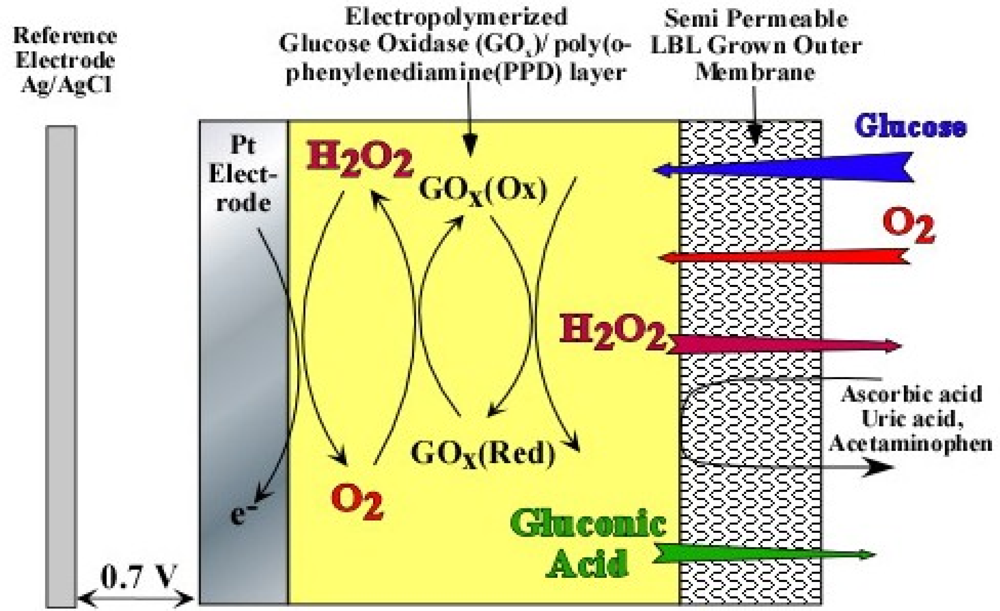
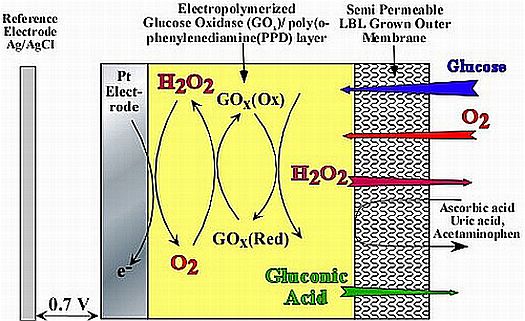
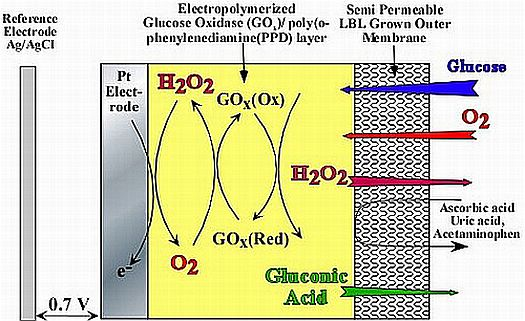
<p>As evident from <xref rid="FD1" ref-type="disp-formula">Equations (1)</xref> and <xref rid="FD2" ref-type="disp-formula">(2)</xref>, optimum sensor performance can only be obtained when the glucose to oxygen ratio is less than 1. If not, <xref rid="FD2" ref-type="disp-formula">Equation (2)</xref> becomes oxygen limited, which is the case for most <italic>in vivo</italic> applications [<xref ref-type="bibr" rid="b8-sensors-12-13402">8</xref>]. For example, in the subcutaneous tissue the O<sub>2</sub> concentration is only 0.18 mM as compared to 5.6 mM of physiological glucose concentration (glucose/O<sub>2</sub> ratio ≌ 30) <xref ref-type="bibr" rid="b9-sensors-12-13402">9</xref>], which leads to signal saturation at higher glucose concentrations. In order to mitigate signal saturation and render the sensor response linear, perm-selective membranes based on pore size has been employed, which decrease the glucose to O<sub>2</sub> ratio in the vicinity of GO<sub>x</sub> (<xref ref-type="fig" rid="f1-sensors-12-13402">Figure 1</xref>). However, the use of outer membranes inadvertently decreases sensitivity and increases response time.</p>
<p>Second and third generation Clark-type biosensors employ redox mediators and direct ‘wiring’ of enzymes to electrodes in an attempt to minimize or completely eliminate the need for O<sub>2</sub> [<xref ref-type="bibr" rid="b9-sensors-12-13402">9</xref>]. However, the unwanted toxicity associated with the nanomaterials used in second and third generation Clark type glucose sensors stand against their application in implantable sensor configurations [<xref ref-type="bibr" rid="b9-sensors-12-13402">9</xref>]. With this in mind, our group has been evaluating mediator-free, 1st generation Clark-type sensors that solely rely on careful mass transfer balance of the various species involved in the operation of these devices [<xref ref-type="bibr" rid="b10-sensors-12-13402">10</xref>–<xref ref-type="bibr" rid="b13-sensors-12-13402">13</xref>]. As part of this, using a series of layer-by-layer assembled glucose flux limiting membranes (namely humic acids/ferric cations (HAs/Fe<sup>3+</sup>) and poly(styrene sulfonate)/poly(diallyldimethylammonium chloride) (PSS/PDDA)), we have shown that the outer diffusion of H<sub>2</sub>O<sub>2</sub> through these membranes plays a vital role in determining the sensitivity of the sensor. It was proven that sensors fabricated with highly glucose permeable HAs/Fe<sup>3+</sup> membranes exhibited lower sensitivities and better linearities compared to sensors with less permeable PSS/PDDA membranes [<xref ref-type="bibr" rid="b10-sensors-12-13402">10</xref>]. Through a series of analyte diffusion studies and oxygen dependence of these sensors [<xref ref-type="bibr" rid="b10-sensors-12-13402">10</xref>], it was proven that this unique phenomenon did not occur as a result of the poor diffusion of oxygen through the outer membranes, but rather as a result of the outer diffusion of H<sub>2</sub>O<sub>2</sub> through the various outer layers. In light of these findings, we have shown that optimal sensor performance could be easily achieved via a careful stratification of five functional layers, each of which is intended to carefully balance the mass transfer of various participating species involved [<xref ref-type="bibr" rid="b11-sensors-12-13402">11</xref>]. This has also prompted us to theoretically understand the diffusion profiles of various participating species as they diffuse through the polymer and enzyme layers, which is a powerful tool useful in facilitating the development of future high performance first generation Clark-based amperometric implantable sensors.</p>
<p>Herein, we present our initial results from our theoretical analysis of glucose sensors employing the two aforementioned LBL membranes. A multi-layer analyte diffusion model based on Fick's second law was employed to analyze the diffusion profiles of the participating species (namely, glucose and H<sub>2</sub>O<sub>2</sub>). The computational model presented here utilizes well-developed enzyme-catalyzed reaction diffusion equations, which were applied to glucose and H<sub>2</sub>O<sub>2</sub>, to model the reaction of glucose with glucose oxidase. This along with Fick's second law of diffusion, which represents the diffusive transport of glucose and the enzyme-generated H<sub>2</sub>O<sub>2</sub> throughout the LBL assembled outer membranes, gives a full dynamic representation of the sensor-system under study. The explicit finite difference scheme was coded in MATLAB to solve the diffusion-based partial differential equations in order to obtain concentration profiles of glucose and H<sub>2</sub>O<sub>2</sub> as a function of LBL thickness and enzyme thickness. In doing this, we were able to precisely analyze the role of H<sub>2</sub>O<sub>2</sub> in sensor operation and its effect on the amperometric response. In accordance with our previously reported experimental studies [<xref ref-type="bibr" rid="b10-sensors-12-13402">10</xref>], sensors coated with the less glucose permeable PSS/PDDA membrane showed a pronounced build-up of H<sub>2</sub>O<sub>2</sub> compared to that of sensors coated with the more permeable HAs/Fe<sup>3+</sup> membrane. It was also found that this phenomenon appears for increasing enzyme thicknesses, further confirming the previous experimental studies. Furthermore, amperometric response times were found to increase with increasing enzyme thickness, due to the time necessary for the participating species to establish equilibrium within the enzyme layer.</p></sec>
<sec>
<label>2.</label>
<title>The Theoretical Model</title>
<p><xref ref-type="fig" rid="f1-sensors-12-13402">Figure 1</xref> shows the cross-section of the sensor under study. The platinum electrode is covered with an electropolymerized GO<sub>x</sub>/poly(<italic>o</italic>-phenylenediamine) (PPD) layer followed by a layer-by-layer assembled outer membrane based on HAs/Fe<sup>3+</sup> (Device A) and PSS/PDDA (Device B). As can be seen in <xref ref-type="fig" rid="f1-sensors-12-13402">Figure 1</xref>, the incorporation of GO<sub>x</sub> into the electropolymerized poly(<italic>o</italic>-phenylenediamine) (PPD) has been previously shown to block the oxidation of other endogenous species like uric acid, ascorbic acid and acetaminophen, which are highly likely to oxidize at the operating potential of the sensor [<xref ref-type="bibr" rid="b14-sensors-12-13402">14</xref>–<xref ref-type="bibr" rid="b16-sensors-12-13402">16</xref>]. The dynamic operation of this multi-layer sensor can be accurately modeled by one-substrate Michaelis-Menten enzyme kinetics [<xref ref-type="bibr" rid="b17-sensors-12-13402">17</xref>–<xref ref-type="bibr" rid="b21-sensors-12-13402">21</xref>]. First, consider the enzyme-catalyzed reaction where the substrate, S<sub>E</sub>, is irreversibly converted to a product, P<sub>E</sub>:
<disp-formula id="FD4">
<label>(4)</label>
<mml:math id="mm4" display="block">
<mml:semantics id="sm4">
<mml:mrow>
<mml:mrow>
<mml:mtext>SE</mml:mtext>
<mml:mo>+</mml:mo>
<mml:mtext>E</mml:mtext></mml:mrow>
<mml:munderover>
<mml:mo>⇄</mml:mo>
<mml:mrow>
<mml:msub>
<mml:mtext>k</mml:mtext>
<mml:mrow>
<mml:mo>−</mml:mo>
<mml:mn>1</mml:mn></mml:mrow></mml:msub></mml:mrow>
<mml:mrow>
<mml:msub>
<mml:mtext>k</mml:mtext>
<mml:mn>1</mml:mn></mml:msub></mml:mrow></mml:munderover>
<mml:msub>
<mml:mrow>
<mml:mtext>ES</mml:mtext></mml:mrow>
<mml:mtext>E</mml:mtext></mml:msub>
<mml:mover>
<mml:mo>→</mml:mo>
<mml:mrow>
<mml:msub>
<mml:mtext>k</mml:mtext>
<mml:mn>2</mml:mn></mml:msub></mml:mrow></mml:mover>
<mml:mtext>E</mml:mtext>
<mml:mo>+</mml:mo>
<mml:msub>
<mml:mtext>P</mml:mtext>
<mml:mtext>E</mml:mtext></mml:msub></mml:mrow></mml:semantics></mml:math></disp-formula></p>
<p>Here, the substrate, S<sub>E</sub>, is the glucose present in the enzyme layer, the product, P<sub>E</sub>, is the hydrogen peroxide (H<sub>2</sub>O<sub>2</sub>) in the enzyme layer generated per <xref rid="FD2" ref-type="disp-formula">Equation (2)</xref>, and k<sub>1</sub>, k<sub>−1</sub> and k<sub>2</sub> are the rate constants. The rate at which the product is formed, V, can be expressed as:
<disp-formula id="FD5">
<label>(5)</label>
<mml:math id="mm5" display="block">
<mml:semantics id="sm5">
<mml:mrow>
<mml:mi>V</mml:mi>
<mml:mo>=</mml:mo>
<mml:mfrac>
<mml:mrow>
<mml:mi>d</mml:mi>
<mml:mo stretchy="false">[</mml:mo>
<mml:msub>
<mml:mtext>P</mml:mtext>
<mml:mtext>E</mml:mtext></mml:msub>
<mml:mo stretchy="false">]</mml:mo></mml:mrow>
<mml:mrow>
<mml:mi>d</mml:mi>
<mml:mi>t</mml:mi></mml:mrow></mml:mfrac>
<mml:mo>=</mml:mo>
<mml:msub>
<mml:mi>k</mml:mi>
<mml:mn>2</mml:mn></mml:msub>
<mml:mo stretchy="false">[</mml:mo>
<mml:mi>E</mml:mi>
<mml:msub>
<mml:mtext>S</mml:mtext>
<mml:mtext>E</mml:mtext></mml:msub>
<mml:mo stretchy="false">]</mml:mo></mml:mrow></mml:semantics></mml:math></disp-formula></p>
<p>Applying the quasi steady-state assumption on the rate of variation of the [ES<sub>E</sub>] complex [<xref ref-type="bibr" rid="b17-sensors-12-13402">17</xref>] leads to the following equation:
<disp-formula id="FD6">
<label>(6)</label>
<mml:math id="mm6" display="block">
<mml:semantics id="sm6">
<mml:mrow>
<mml:mi>V</mml:mi>
<mml:mo>=</mml:mo>
<mml:mfrac>
<mml:mrow>
<mml:mi>d</mml:mi>
<mml:mo stretchy="false">[</mml:mo>
<mml:msub>
<mml:mtext>P</mml:mtext>
<mml:mtext>E</mml:mtext></mml:msub>
<mml:mo stretchy="false">]</mml:mo></mml:mrow>
<mml:mrow>
<mml:mi>d</mml:mi>
<mml:mi>t</mml:mi></mml:mrow></mml:mfrac>
<mml:mo>=</mml:mo>
<mml:mfrac>
<mml:mrow>
<mml:msub>
<mml:mi>V</mml:mi>
<mml:mi>M</mml:mi></mml:msub>
<mml:mo stretchy="false">[</mml:mo>
<mml:msub>
<mml:mtext>S</mml:mtext>
<mml:mtext>E</mml:mtext></mml:msub>
<mml:mo stretchy="false">]</mml:mo></mml:mrow>
<mml:mrow>
<mml:msub>
<mml:mi>V</mml:mi>
<mml:mi>M</mml:mi></mml:msub>
<mml:mo>+</mml:mo>
<mml:mo stretchy="false">[</mml:mo>
<mml:msub>
<mml:mtext>S</mml:mtext>
<mml:mtext>E</mml:mtext></mml:msub>
<mml:mo stretchy="false">]</mml:mo></mml:mrow></mml:mfrac></mml:mrow></mml:semantics></mml:math></disp-formula></p>
<p>where K<sub>M</sub> is the Michaelis-Menten constant and V<sub>M</sub> is the maximum enzymatic rate when the enzyme is fully saturated. We can integrate this rate equation to the well-known diffusion equation to obtain expressions for the effect of enzyme-catalyzed reactions on both glucose and H<sub>2</sub>O<sub>2</sub> as they diffuse through the GO<sub>x</sub>/PPD layer (layer 1). Here we can safely assume that the GO<sub>x</sub> is uniformly distributed throughout the layer [<xref ref-type="bibr" rid="b22-sensors-12-13402">22</xref>], which is a self-limiting electropolymerization process that yields a thickness comparable to the size of the immobilized enzyme [<xref ref-type="bibr" rid="b23-sensors-12-13402">23</xref>]. Additionally, we assume that oxygen is present in sufficient amounts to drive the enzematic reaction to completion. The results in two reaction-diffusion equations (<xref rid="FD7" ref-type="disp-formula">Equations (7)</xref> and <xref rid="FD8" ref-type="disp-formula">(8)</xref>):
<disp-formula id="FD7">
<label>(7)</label>
<mml:math id="mm7" display="block">
<mml:semantics id="sm7">
<mml:mrow>
<mml:mfrac>
<mml:mrow>
<mml:mo>∂</mml:mo>
<mml:msub>
<mml:mi>S</mml:mi>
<mml:mi>E</mml:mi></mml:msub></mml:mrow>
<mml:mrow>
<mml:mo>∂</mml:mo>
<mml:mi>t</mml:mi></mml:mrow></mml:mfrac>
<mml:mo>=</mml:mo>
<mml:msub>
<mml:mi>D</mml:mi>
<mml:mrow>
<mml:msub>
<mml:mi>S</mml:mi>
<mml:mi>E</mml:mi></mml:msub></mml:mrow></mml:msub>
<mml:mfrac>
<mml:mrow>
<mml:msup>
<mml:mo>∂</mml:mo>
<mml:mn>2</mml:mn></mml:msup>
<mml:msub>
<mml:mi>S</mml:mi>
<mml:mi>E</mml:mi></mml:msub></mml:mrow>
<mml:mrow>
<mml:mo>∂</mml:mo>
<mml:msup>
<mml:mi>x</mml:mi>
<mml:mn>2</mml:mn></mml:msup></mml:mrow></mml:mfrac>
<mml:mo>−</mml:mo>
<mml:mfrac>
<mml:mrow>
<mml:msub>
<mml:mi>V</mml:mi>
<mml:mrow>
<mml:mtext mathvariant="italic">max</mml:mtext></mml:mrow></mml:msub>
<mml:msub>
<mml:mi>S</mml:mi>
<mml:mi>E</mml:mi></mml:msub></mml:mrow>
<mml:mrow>
<mml:msub>
<mml:mi>K</mml:mi>
<mml:mi>M</mml:mi></mml:msub>
<mml:mo>+</mml:mo>
<mml:msub>
<mml:mi>S</mml:mi>
<mml:mi>E</mml:mi></mml:msub></mml:mrow></mml:mfrac>
<mml:mo>,</mml:mo>
<mml:mn>0</mml:mn>
<mml:mo>&lt;</mml:mo>
<mml:mi>x</mml:mi>
<mml:mo>&lt;</mml:mo>
<mml:msub>
<mml:mi>d</mml:mi>
<mml:mi>E</mml:mi></mml:msub>
<mml:mo>,</mml:mo>
<mml:mn>0</mml:mn>
<mml:mo>&lt;</mml:mo>
<mml:mi>t</mml:mi>
<mml:mo>≤</mml:mo>
<mml:mi>T</mml:mi></mml:mrow></mml:semantics></mml:math></disp-formula>
<disp-formula id="FD8">
<label>(8)</label>
<mml:math id="mm8" display="block">
<mml:semantics id="sm8">
<mml:mrow>
<mml:mfrac>
<mml:mrow>
<mml:mo>∂</mml:mo>
<mml:msub>
<mml:mi>P</mml:mi>
<mml:mi>E</mml:mi></mml:msub></mml:mrow>
<mml:mrow>
<mml:mo>∂</mml:mo>
<mml:mi>t</mml:mi></mml:mrow></mml:mfrac>
<mml:mo>=</mml:mo>
<mml:msub>
<mml:mi>D</mml:mi>
<mml:mrow>
<mml:msub>
<mml:mi>P</mml:mi>
<mml:mi>E</mml:mi></mml:msub></mml:mrow></mml:msub>
<mml:mfrac>
<mml:mrow>
<mml:msup>
<mml:mo>∂</mml:mo>
<mml:mn>2</mml:mn></mml:msup>
<mml:msub>
<mml:mi>P</mml:mi>
<mml:mi>E</mml:mi></mml:msub></mml:mrow>
<mml:mrow>
<mml:mo>∂</mml:mo>
<mml:msup>
<mml:mi>x</mml:mi>
<mml:mn>2</mml:mn></mml:msup></mml:mrow></mml:mfrac>
<mml:mo>−</mml:mo>
<mml:mfrac>
<mml:mrow>
<mml:msub>
<mml:mi>V</mml:mi>
<mml:mrow>
<mml:mtext mathvariant="italic">max</mml:mtext></mml:mrow></mml:msub>
<mml:msub>
<mml:mi>S</mml:mi>
<mml:mi>E</mml:mi></mml:msub></mml:mrow>
<mml:mrow>
<mml:msub>
<mml:mi>K</mml:mi>
<mml:mi>M</mml:mi></mml:msub>
<mml:mo>+</mml:mo>
<mml:msub>
<mml:mi>S</mml:mi>
<mml:mi>E</mml:mi></mml:msub></mml:mrow></mml:mfrac>
<mml:mo>,</mml:mo>
<mml:mn>0</mml:mn>
<mml:mo>&lt;</mml:mo>
<mml:mi>x</mml:mi>
<mml:mo>&lt;</mml:mo>
<mml:msub>
<mml:mi>d</mml:mi>
<mml:mi>E</mml:mi></mml:msub>
<mml:mo>,</mml:mo>
<mml:mn>0</mml:mn>
<mml:mo>&lt;</mml:mo>
<mml:mi>t</mml:mi>
<mml:mo>≤</mml:mo>
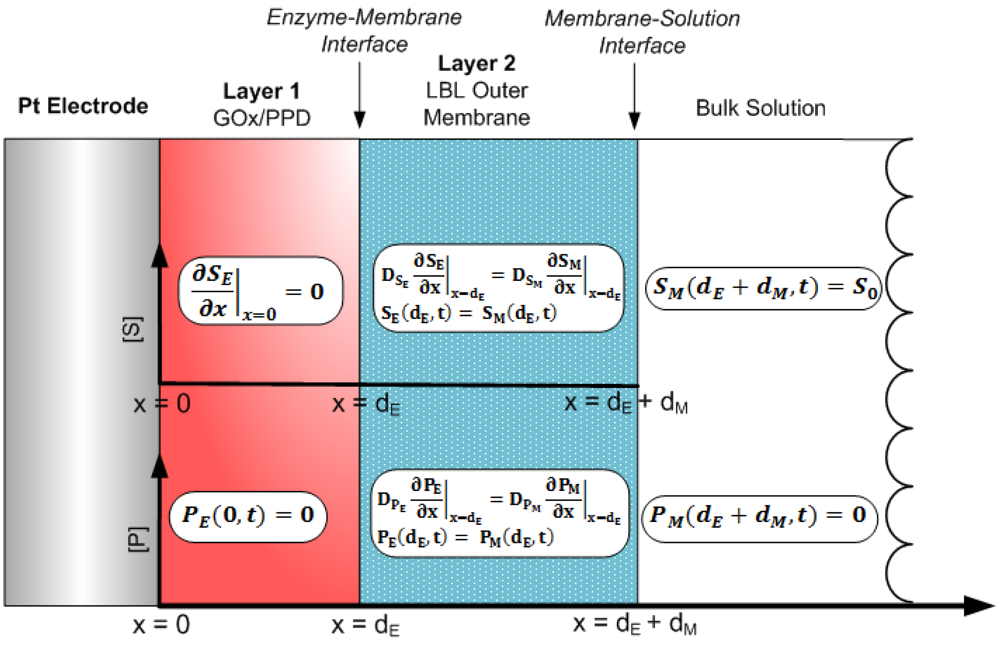
<mml:mi>T</mml:mi></mml:mrow></mml:semantics></mml:math></disp-formula>where <italic>S<sub>E</sub></italic> (<italic>x</italic>, <italic>t</italic>) and <italic>P<sub>E</sub></italic> (<italic>x</italic>, <italic>t</italic>) are the concentrations of glucose and H<sub>2</sub>O<sub>2</sub>, respectively, <italic>D<sub>SE</sub></italic> the diffusion coefficient of glucose in the GO<sub>x</sub>/PPD layer, <italic>D<sub>PE</sub></italic> the diffusion coefficient of the H<sub>2</sub>O<sub>2</sub> in the GO<sub>x</sub>/PPD layer, and <italic>d<sub>E</sub></italic> is the total thickness of the GO<sub>x</sub>/PPD layer. Here, <italic>x</italic> and <italic>t</italic> represent the points in space and time, respectively, where <italic>x</italic> = <italic>0</italic> is taken at the electrode surface, and <italic>x</italic> = <italic>d<sub>E</sub></italic> at the edge of the GO<sub>x</sub>/PPD layer, and <italic>T</italic> is the total time elapsed. A graphical representation of the boundary conditions of this system conditions can be seen in <xref ref-type="fig" rid="f2-sensors-12-13402">Figure 2</xref>.</p>
<p>The operation of the system initiates immediately after the substrate in the bulk solution reaches the surface of the outer membrane (layer 2), which we define as the following initial conditions:
<disp-formula id="FD9">
<label>(9)</label>
<mml:math id="mm9" display="block">
<mml:semantics id="sm9">
<mml:mrow>
<mml:msub>
<mml:mi>S</mml:mi>
<mml:mi>E</mml:mi></mml:msub>
<mml:mo stretchy="false">(</mml:mo>
<mml:mi>x</mml:mi>
<mml:mo>,</mml:mo>
<mml:mn>0</mml:mn>
<mml:mo stretchy="false">)</mml:mo>
<mml:mo>=</mml:mo>
<mml:mn>0</mml:mn>
<mml:mo>,</mml:mo>
<mml:msub>
<mml:mi>P</mml:mi>
<mml:mi>E</mml:mi></mml:msub>
<mml:mo stretchy="false">(</mml:mo>
<mml:mi>x</mml:mi>
<mml:mo>,</mml:mo>
<mml:mn>0</mml:mn>
<mml:mo stretchy="false">)</mml:mo>
<mml:mo>=</mml:mo>
<mml:mn>0</mml:mn>
<mml:mo>,</mml:mo>
<mml:mi>x</mml:mi>
<mml:mo>∈</mml:mo>
<mml:mo stretchy="false">[</mml:mo>
<mml:mn>0</mml:mn>
<mml:mo>,</mml:mo>
<mml:msub>
<mml:mi>d</mml:mi>
<mml:mi>E</mml:mi></mml:msub>
<mml:mo stretchy="false">]</mml:mo></mml:mrow></mml:semantics></mml:math></disp-formula>
<disp-formula id="FD10">
<label>(10a)</label>
<mml:math id="mm10" display="block">
<mml:semantics id="sm10">
<mml:mrow>
<mml:msub>
<mml:mi>P</mml:mi>
<mml:mi>M</mml:mi></mml:msub>
<mml:mo stretchy="false">(</mml:mo>
<mml:mi>x</mml:mi>
<mml:mo>,</mml:mo>
<mml:mn>0</mml:mn>
<mml:mo stretchy="false">)</mml:mo>
<mml:mo>=</mml:mo>
<mml:mn>0</mml:mn>
<mml:mi>x</mml:mi>
<mml:mo>∈</mml:mo>
<mml:mo stretchy="false">[</mml:mo>
<mml:msub>
<mml:mi>d</mml:mi>
<mml:mi>E</mml:mi></mml:msub>
<mml:mo>,</mml:mo>
<mml:msub>
<mml:mi>d</mml:mi>
<mml:mi>E</mml:mi></mml:msub>
<mml:mo>+</mml:mo>
<mml:msub>
<mml:mi>d</mml:mi>
<mml:mi>M</mml:mi></mml:msub>
<mml:mo stretchy="false">]</mml:mo></mml:mrow></mml:semantics></mml:math></disp-formula>
<disp-formula id="FD11">
<label>(10b)</label>
<mml:math id="mm11" display="block">
<mml:semantics id="sm11">
<mml:mrow>
<mml:msub>
<mml:mi>S</mml:mi>
<mml:mi>M</mml:mi></mml:msub>
<mml:mo stretchy="false">(</mml:mo>
<mml:mi>d</mml:mi>
<mml:mi>E</mml:mi>
<mml:mo>,</mml:mo>
<mml:mn>0</mml:mn>
<mml:mo stretchy="false">)</mml:mo>
<mml:mo>=</mml:mo>
<mml:mn>0</mml:mn>
<mml:msub>
<mml:mi>S</mml:mi>
<mml:mi>M</mml:mi></mml:msub>
<mml:mo stretchy="false">(</mml:mo>
<mml:mi>d</mml:mi>
<mml:mi>E</mml:mi>
<mml:mo>+</mml:mo>
<mml:mi>d</mml:mi>
<mml:mi>M</mml:mi>
<mml:mo>,</mml:mo>
<mml:mn>0</mml:mn>
<mml:mo stretchy="false">)</mml:mo>
<mml:mo>=</mml:mo>
<mml:msub>
<mml:mi>S</mml:mi>
<mml:mn>0</mml:mn></mml:msub></mml:mrow></mml:semantics></mml:math></disp-formula></p>
<p>Here, we introduce <italic>S<sub>M</sub></italic> (<italic>x</italic>, <italic>t</italic>) and <italic>P<sub>M</sub></italic> (<italic>x</italic>, <italic>t</italic>) which are the concentrations of glucose and H<sub>2</sub>O<sub>2</sub>, respectively, in the outer LBL membrane, where <italic>x</italic> = <italic>d<sub>M</sub></italic> represents the surface of the outer membrane. The assumptions made are the following: (1) the substrate does not react at the electrode surface, (2) the H<sub>2</sub>O<sub>2</sub> at the electrode surface gets permanently reduced to zero, (3) if the substrate is well stirred, then the diffusion layer (0 &lt; x &lt; <italic>d<sub>E</sub></italic> +<italic>d<sub>M</sub></italic>) remains at a constant thickness, <italic>d<sub>E</sub></italic> + <italic>d<sub>M</sub></italic>, during sensor operation and (4) the concentration of H<sub>2</sub>O<sub>2</sub> at the sensor/bulk solution interface is zero. This can be quantitatively described as the following boundary conditions:
<disp-formula id="FD12">
<label>(11)</label>
<mml:math id="mm12" display="block">
<mml:semantics id="sm12">
<mml:mrow>
<mml:msub>
<mml:mrow>
<mml:mrow>
<mml:mrow>
<mml:mfrac>
<mml:mrow>
<mml:mo>∂</mml:mo>
<mml:msub>
<mml:mi>S</mml:mi>
<mml:mi>E</mml:mi></mml:msub></mml:mrow>
<mml:mrow>
<mml:mo>∂</mml:mo>
<mml:mi>x</mml:mi></mml:mrow></mml:mfrac></mml:mrow>
<mml:mo>|</mml:mo></mml:mrow></mml:mrow>
<mml:mrow>
<mml:mi>x</mml:mi>
<mml:mo>=</mml:mo>
<mml:mn>0</mml:mn></mml:mrow></mml:msub>
<mml:mo>=</mml:mo>
<mml:mn>0</mml:mn></mml:mrow></mml:semantics></mml:math></disp-formula>
<disp-formula id="FD13">
<label>(12)</label>
<mml:math id="mm13" display="block">
<mml:semantics id="sm13">
<mml:mrow>
<mml:msub>
<mml:mi>S</mml:mi>
<mml:mi>M</mml:mi></mml:msub>
<mml:mo stretchy="false">(</mml:mo>
<mml:msub>
<mml:mi>d</mml:mi>
<mml:mi>E</mml:mi></mml:msub>
<mml:mo>+</mml:mo>
<mml:msub>
<mml:mi>d</mml:mi>
<mml:mi>M</mml:mi></mml:msub>
<mml:mo>,</mml:mo>
<mml:mi>t</mml:mi>
<mml:mo stretchy="false">)</mml:mo>
<mml:mo>=</mml:mo>
<mml:msub>
<mml:mi>S</mml:mi>
<mml:mn>0</mml:mn></mml:msub></mml:mrow></mml:semantics></mml:math></disp-formula>
<disp-formula id="FD14">
<label>(13)</label>
<mml:math id="mm14" display="block">
<mml:semantics id="sm14">
<mml:mrow>
<mml:msub>
<mml:mi>P</mml:mi>
<mml:mi>E</mml:mi></mml:msub>
<mml:mo stretchy="false">(</mml:mo>
<mml:mn>0</mml:mn>
<mml:mo>,</mml:mo>
<mml:mi>t</mml:mi>
<mml:mo stretchy="false">)</mml:mo>
<mml:mo>=</mml:mo>
<mml:msub>
<mml:mi>P</mml:mi>
<mml:mi>E</mml:mi></mml:msub>
<mml:mo stretchy="false">(</mml:mo>
<mml:msub>
<mml:mi>d</mml:mi>
<mml:mi>E</mml:mi></mml:msub>
<mml:mo>+</mml:mo>
<mml:msub>
<mml:mi>d</mml:mi>
<mml:mi>M</mml:mi></mml:msub>
<mml:mo>,</mml:mo>
<mml:mi>t</mml:mi>
<mml:mo stretchy="false">)</mml:mo>
<mml:mo>=</mml:mo>
<mml:mn>0</mml:mn></mml:mrow></mml:semantics></mml:math></disp-formula></p>
<p>The aforementioned initial conditions and boundary conditions have been previously employed to model various amperometric and potentiometric biosensors, with various physical parameters and testing conditions [<xref ref-type="bibr" rid="b18-sensors-12-13402">18</xref>–<xref ref-type="bibr" rid="b21-sensors-12-13402">21</xref>,<xref ref-type="bibr" rid="b24-sensors-12-13402">24</xref>–<xref ref-type="bibr" rid="b31-sensors-12-13402">31</xref>]. At the boundary between the enzyme layer and the flux-limiting membrane, matching conditions are defined (for <italic>t</italic> &gt; 0) [<xref ref-type="bibr" rid="b32-sensors-12-13402">32</xref>]:
<disp-formula id="FD15">
<label>(14)</label>
<mml:math id="mm15" display="block">
<mml:semantics id="sm15">
<mml:mrow>
<mml:msub>
<mml:mi>D</mml:mi>
<mml:mrow>
<mml:msub>
<mml:mi>S</mml:mi>
<mml:mi>E</mml:mi></mml:msub></mml:mrow></mml:msub>
<mml:msub>
<mml:mrow>
<mml:mrow>
<mml:mrow>
<mml:mfrac>
<mml:mrow>
<mml:mo>∂</mml:mo>
<mml:msub>
<mml:mi>S</mml:mi>
<mml:mi>E</mml:mi></mml:msub></mml:mrow>
<mml:mrow>
<mml:mo>∂</mml:mo>
<mml:mi>x</mml:mi></mml:mrow></mml:mfrac></mml:mrow>
<mml:mo stretchy="true">∣</mml:mo></mml:mrow></mml:mrow>
<mml:mrow>
<mml:mi>x</mml:mi>
<mml:mo>=</mml:mo>
<mml:msub>
<mml:mi>d</mml:mi>
<mml:mi>E</mml:mi></mml:msub></mml:mrow></mml:msub>
<mml:mo>=</mml:mo>
<mml:msub>
<mml:mi>D</mml:mi>
<mml:mrow>
<mml:msub>
<mml:mi>S</mml:mi>
<mml:mi>M</mml:mi></mml:msub></mml:mrow></mml:msub>
<mml:msub>
<mml:mrow>
<mml:mrow>
<mml:mrow>
<mml:mfrac>
<mml:mrow>
<mml:mo>∂</mml:mo>
<mml:msub>
<mml:mi>S</mml:mi>
<mml:mi>M</mml:mi></mml:msub></mml:mrow>
<mml:mrow>
<mml:mo>∂</mml:mo>
<mml:mi>x</mml:mi></mml:mrow></mml:mfrac></mml:mrow>
<mml:mo stretchy="true">∣</mml:mo></mml:mrow></mml:mrow>
<mml:mrow>
<mml:mi>x</mml:mi>
<mml:mo>=</mml:mo>
<mml:msub>
<mml:mi>d</mml:mi>
<mml:mi>E</mml:mi></mml:msub></mml:mrow></mml:msub>
<mml:mo>,</mml:mo>
<mml:msub>
<mml:mi>S</mml:mi>
<mml:mi>E</mml:mi></mml:msub>
<mml:mo stretchy="false">(</mml:mo>
<mml:msub>
<mml:mi>d</mml:mi>
<mml:mi>E</mml:mi></mml:msub>
<mml:mo>,</mml:mo>
<mml:mi>t</mml:mi>
<mml:mo stretchy="false">)</mml:mo>
<mml:mo>=</mml:mo>
<mml:msub>
<mml:mi>S</mml:mi>
<mml:mi>M</mml:mi></mml:msub>
<mml:mo stretchy="false">(</mml:mo>
<mml:msub>
<mml:mi>d</mml:mi>
<mml:mi>E</mml:mi></mml:msub>
<mml:mo>,</mml:mo>
<mml:mi>t</mml:mi>
<mml:mo stretchy="false">)</mml:mo></mml:mrow></mml:semantics></mml:math></disp-formula>
<disp-formula id="FD16">
<label>(15)</label>
<mml:math id="mm16" display="block">
<mml:semantics id="sm16">
<mml:mrow>
<mml:msub>
<mml:mi>D</mml:mi>
<mml:mrow>
<mml:msub>
<mml:mi>P</mml:mi>
<mml:mi>E</mml:mi></mml:msub></mml:mrow></mml:msub>
<mml:msub>
<mml:mrow>
<mml:mrow>
<mml:mrow>
<mml:mfrac>
<mml:mrow>
<mml:mo>∂</mml:mo>
<mml:msub>
<mml:mi>P</mml:mi>
<mml:mi>E</mml:mi></mml:msub></mml:mrow>
<mml:mrow>
<mml:mo>∂</mml:mo>
<mml:mi>x</mml:mi></mml:mrow></mml:mfrac></mml:mrow>
<mml:mo stretchy="true">∣</mml:mo></mml:mrow></mml:mrow>
<mml:mrow>
<mml:mi>x</mml:mi>
<mml:mo>=</mml:mo>
<mml:msub>
<mml:mi>d</mml:mi>
<mml:mi>E</mml:mi></mml:msub></mml:mrow></mml:msub>
<mml:mo>=</mml:mo>
<mml:msub>
<mml:mi>D</mml:mi>
<mml:mrow>
<mml:msub>
<mml:mi>P</mml:mi>
<mml:mi>M</mml:mi></mml:msub></mml:mrow></mml:msub>
<mml:msub>
<mml:mrow>
<mml:mrow>
<mml:mrow>
<mml:mfrac>
<mml:mrow>
<mml:mo>∂</mml:mo>
<mml:msub>
<mml:mi>P</mml:mi>
<mml:mi>M</mml:mi></mml:msub></mml:mrow>
<mml:mrow>
<mml:mo>∂</mml:mo>
<mml:mi>x</mml:mi></mml:mrow></mml:mfrac></mml:mrow>
<mml:mo stretchy="true">∣</mml:mo></mml:mrow></mml:mrow>
<mml:mrow>
<mml:mi>x</mml:mi>
<mml:mo>=</mml:mo>
<mml:msub>
<mml:mi>d</mml:mi>
<mml:mi>E</mml:mi></mml:msub></mml:mrow></mml:msub>
<mml:mo>,</mml:mo>
<mml:msub>
<mml:mi>P</mml:mi>
<mml:mi>E</mml:mi></mml:msub>
<mml:mo stretchy="false">(</mml:mo>
<mml:msub>
<mml:mi>d</mml:mi>
<mml:mi>E</mml:mi></mml:msub>
<mml:mo>,</mml:mo>
<mml:mi>t</mml:mi>
<mml:mo stretchy="false">)</mml:mo>
<mml:mo>=</mml:mo>
<mml:msub>
<mml:mi>P</mml:mi>
<mml:mi>M</mml:mi></mml:msub>
<mml:mo stretchy="false">(</mml:mo>
<mml:msub>
<mml:mi>d</mml:mi>
<mml:mi>E</mml:mi></mml:msub>
<mml:mo>,</mml:mo>
<mml:mi>t</mml:mi>
<mml:mo stretchy="false">)</mml:mo></mml:mrow></mml:semantics></mml:math></disp-formula></p>
<p>Following H<sub>2</sub>O<sub>2</sub> oxidation at the Pt surface, the amperometric current response of the device is expressed as:
<disp-formula id="FD17">
<label>(16)</label>
<mml:math id="mm17" display="block">
<mml:semantics id="sm17">
<mml:mrow>
<mml:mi>I</mml:mi>
<mml:mo>=</mml:mo>
<mml:msub>
<mml:mi>n</mml:mi>
<mml:mi>e</mml:mi></mml:msub>
<mml:msub>
<mml:mi>D</mml:mi>
<mml:mrow>
<mml:mi>P</mml:mi>
<mml:mi>E</mml:mi></mml:mrow></mml:msub>
<mml:mi>F</mml:mi>
<mml:msub>
<mml:mrow>
<mml:mrow>
<mml:mrow>
<mml:mfrac>
<mml:mrow>
<mml:mo>∂</mml:mo>
<mml:msub>
<mml:mi>P</mml:mi>
<mml:mi>E</mml:mi></mml:msub></mml:mrow>
<mml:mrow>
<mml:mo>∂</mml:mo>
<mml:mi>x</mml:mi></mml:mrow></mml:mfrac></mml:mrow>
<mml:mo stretchy="true">∣</mml:mo></mml:mrow></mml:mrow>
<mml:mrow>
<mml:mi>x</mml:mi>
<mml:mo>=</mml:mo>
<mml:mn>0</mml:mn></mml:mrow></mml:msub></mml:mrow></mml:semantics></mml:math></disp-formula>where, n<sub>e</sub> is the number of electrons produced (2 for H<sub>2</sub>O<sub>2</sub>), D<sub>PE</sub> the diffusion coefficient of the H<sub>2</sub>O<sub>2</sub> in the GO<sub>x</sub>/PPD layer and F is Faraday's constant (96,500 C/mol).</p>
<sec>
<label>2.2.</label>
<title>The Solution Scheme</title>
<p>The cross-sectional schematic of <xref ref-type="fig" rid="f2-sensors-12-13402">Figure 2</xref> was modeled by constructing a mesh employing a finite set of <italic>x</italic> and <italic>t</italic>, and utilizing the boundary conditions of <xref rid="FD12" ref-type="disp-formula">Equations (11)</xref> to <xref rid="FD16" ref-type="disp-formula">(15)</xref> as a means to obtain a solution to the tridiagonal system. Based on this, the explicit finite difference scheme was used to obtain substrate and product concentrations of the Michaelis-Menten reaction-based differential <xref rid="FD7" ref-type="disp-formula">Equations (7)</xref> and <xref rid="FD8" ref-type="disp-formula">(8)</xref>, as:</p>
<p><bold><italic>Glucose (S)</italic></bold>
<disp-formula id="FD18">
<label>(17)</label>
<mml:math id="mm18" display="block">
<mml:semantics id="sm18">
<mml:mrow>
<mml:msubsup>
<mml:mi>S</mml:mi>
<mml:mrow>
<mml:msub>
<mml:mi>E</mml:mi>
<mml:mi>i</mml:mi></mml:msub></mml:mrow>
<mml:mrow>
<mml:mi>j</mml:mi>
<mml:mo>+</mml:mo>
<mml:mn>1</mml:mn></mml:mrow></mml:msubsup>
<mml:mo>=</mml:mo>
<mml:msubsup>
<mml:mi>S</mml:mi>
<mml:mrow>
<mml:msub>
<mml:mi>E</mml:mi>
<mml:mi>i</mml:mi></mml:msub></mml:mrow>
<mml:mi>j</mml:mi></mml:msubsup>
<mml:mo>+</mml:mo>
<mml:mfrac>
<mml:mrow>
<mml:msub>
<mml:mi>D</mml:mi>
<mml:mrow>
<mml:mi>S</mml:mi>
<mml:mi>E</mml:mi></mml:mrow></mml:msub>
<mml:mo>Δ</mml:mo>
<mml:mi>t</mml:mi></mml:mrow>
<mml:mrow>
<mml:mo>Δ</mml:mo>
<mml:msup>
<mml:mi>x</mml:mi>
<mml:mn>2</mml:mn></mml:msup></mml:mrow></mml:mfrac>
<mml:mo stretchy="false">(</mml:mo>
<mml:msubsup>
<mml:mi>S</mml:mi>
<mml:mrow>
<mml:msub>
<mml:mi>E</mml:mi>
<mml:mrow>
<mml:mi>i</mml:mi>
<mml:mo>+</mml:mo>
<mml:mn>1</mml:mn></mml:mrow></mml:msub></mml:mrow>
<mml:mi>j</mml:mi></mml:msubsup>
<mml:mo>−</mml:mo>
<mml:mn>2</mml:mn>
<mml:msubsup>
<mml:mi>S</mml:mi>
<mml:mrow>
<mml:msub>
<mml:mi>E</mml:mi>
<mml:mi>i</mml:mi></mml:msub></mml:mrow>
<mml:mi>j</mml:mi></mml:msubsup>
<mml:mo>+</mml:mo>
<mml:msubsup>
<mml:mi>S</mml:mi>
<mml:mrow>
<mml:msub>
<mml:mi>E</mml:mi>
<mml:mrow>
<mml:mi>i</mml:mi>
<mml:mo>−</mml:mo>
<mml:mn>1</mml:mn></mml:mrow></mml:msub></mml:mrow>
<mml:mi>j</mml:mi></mml:msubsup>
<mml:mo stretchy="false">)</mml:mo>
<mml:mo>−</mml:mo>
<mml:mo>Δ</mml:mo>
<mml:mi>t</mml:mi>
<mml:mfrac>
<mml:mrow>
<mml:msub>
<mml:mi>V</mml:mi>
<mml:mrow>
<mml:mtext mathvariant="italic">MAX</mml:mtext></mml:mrow></mml:msub>
<mml:msubsup>
<mml:mi>S</mml:mi>
<mml:mrow>
<mml:msub>
<mml:mi>E</mml:mi>
<mml:mi>i</mml:mi></mml:msub></mml:mrow>
<mml:mi>j</mml:mi></mml:msubsup></mml:mrow>
<mml:mrow>
<mml:msub>
<mml:mi>K</mml:mi>
<mml:mi>M</mml:mi></mml:msub>
<mml:mo>+</mml:mo>
<mml:msubsup>
<mml:mi>S</mml:mi>
<mml:mrow>
<mml:msub>
<mml:mi>E</mml:mi>
<mml:mi>i</mml:mi></mml:msub></mml:mrow>
<mml:mi>j</mml:mi></mml:msubsup></mml:mrow></mml:mfrac></mml:mrow></mml:semantics></mml:math></disp-formula><bold><italic>H</italic></bold><italic><sub>2</sub></italic><bold><italic>O</italic></bold><italic><sub>2</sub></italic> <bold><italic>(P)</italic></bold>
<disp-formula id="FD19">
<label>(18)</label>
<mml:math id="mm19" display="block">
<mml:semantics id="sm19">
<mml:mrow>
<mml:msubsup>
<mml:mi>P</mml:mi>
<mml:mrow>
<mml:msub>
<mml:mi>E</mml:mi>
<mml:mi>i</mml:mi></mml:msub></mml:mrow>
<mml:mrow>
<mml:mi>j</mml:mi>
<mml:mo>+</mml:mo>
<mml:mn>1</mml:mn></mml:mrow></mml:msubsup>
<mml:mo>=</mml:mo>
<mml:msubsup>
<mml:mi>P</mml:mi>
<mml:mrow>
<mml:msub>
<mml:mi>E</mml:mi>
<mml:mi>i</mml:mi></mml:msub></mml:mrow>
<mml:mi>j</mml:mi></mml:msubsup>
<mml:mo>+</mml:mo>
<mml:mfrac>
<mml:mrow>
<mml:msub>
<mml:mi>D</mml:mi>
<mml:mrow>
<mml:mi>P</mml:mi>
<mml:mi>E</mml:mi></mml:mrow></mml:msub>
<mml:mo>Δ</mml:mo>
<mml:mi>t</mml:mi></mml:mrow>
<mml:mrow>
<mml:mo>Δ</mml:mo>
<mml:msup>
<mml:mi>x</mml:mi>
<mml:mn>2</mml:mn></mml:msup></mml:mrow></mml:mfrac>
<mml:mo stretchy="false">(</mml:mo>
<mml:msubsup>
<mml:mi>P</mml:mi>
<mml:mrow>
<mml:msub>
<mml:mi>E</mml:mi>
<mml:mrow>
<mml:mi>i</mml:mi>
<mml:mo>+</mml:mo>
<mml:mn>1</mml:mn></mml:mrow></mml:msub></mml:mrow>
<mml:mi>j</mml:mi></mml:msubsup>
<mml:mo>−</mml:mo>
<mml:mn>2</mml:mn>
<mml:msubsup>
<mml:mi>P</mml:mi>
<mml:mrow>
<mml:msub>
<mml:mi>E</mml:mi>
<mml:mi>i</mml:mi></mml:msub></mml:mrow>
<mml:mi>j</mml:mi></mml:msubsup>
<mml:mo>+</mml:mo>
<mml:msubsup>
<mml:mi>P</mml:mi>
<mml:mrow>
<mml:msub>
<mml:mi>E</mml:mi>
<mml:mrow>
<mml:mi>i</mml:mi>
<mml:mo>−</mml:mo>
<mml:mn>1</mml:mn></mml:mrow></mml:msub></mml:mrow>
<mml:mi>j</mml:mi></mml:msubsup>
<mml:mo stretchy="false">)</mml:mo>
<mml:mo>+</mml:mo>
<mml:mo>Δ</mml:mo>
<mml:mi>t</mml:mi>
<mml:mfrac>
<mml:mrow>
<mml:msub>
<mml:mi>V</mml:mi>
<mml:mrow>
<mml:mtext mathvariant="italic">MAX</mml:mtext></mml:mrow></mml:msub>
<mml:msubsup>
<mml:mi>S</mml:mi>
<mml:mrow>
<mml:msub>
<mml:mi>E</mml:mi>
<mml:mi>i</mml:mi></mml:msub></mml:mrow>
<mml:mi>j</mml:mi></mml:msubsup></mml:mrow>
<mml:mrow>
<mml:msub>
<mml:mi>K</mml:mi>
<mml:mi>M</mml:mi></mml:msub>
<mml:mo>+</mml:mo>
<mml:msubsup>
<mml:mi>S</mml:mi>
<mml:mrow>
<mml:msub>
<mml:mi>E</mml:mi>
<mml:mi>i</mml:mi></mml:msub></mml:mrow>
<mml:mi>j</mml:mi></mml:msubsup></mml:mrow></mml:mfrac></mml:mrow></mml:semantics></mml:math></disp-formula>where <italic>j</italic> = 1 … <italic>Numt</italic>, where <italic>Numt</italic> represents the total number of time steps and <italic>i</italic> = 1 … <italic>k</italic> − 1, where <italic>k</italic> represents the number of steps in space from the electrode surface to the enzyme/LBL interface. Having said this, at the interface <italic>(i</italic> = <italic>k)</italic> <xref rid="FD15" ref-type="disp-formula">Equations (14)</xref> and <xref rid="FD16" ref-type="disp-formula">(15)</xref> can be solved explicitly [<xref ref-type="bibr" rid="b32-sensors-12-13402">32</xref>] as follows:</p>
<p><bold><italic>Glucose (S)</italic></bold>
<disp-formula id="FD20">
<label>(19)</label>
<mml:math id="mm20" display="block">
<mml:semantics id="sm20">
<mml:mrow>
<mml:msubsup>
<mml:mi>S</mml:mi>
<mml:mi>i</mml:mi>
<mml:mrow>
<mml:mi>j</mml:mi>
<mml:mo>+</mml:mo>
<mml:mn>1</mml:mn></mml:mrow></mml:msubsup>
<mml:mo>=</mml:mo>
<mml:msubsup>
<mml:mi>S</mml:mi>
<mml:mi>i</mml:mi>
<mml:mi>j</mml:mi></mml:msubsup>
<mml:mo>+</mml:mo>
<mml:mfrac>
<mml:mrow>
<mml:mo>Δ</mml:mo>
<mml:mi>t</mml:mi></mml:mrow>
<mml:mrow>
<mml:mo>Δ</mml:mo>
<mml:msup>
<mml:mi>x</mml:mi>
<mml:mn>2</mml:mn></mml:msup></mml:mrow></mml:mfrac>
<mml:mo stretchy="false">[</mml:mo>
<mml:msub>
<mml:mi>D</mml:mi>
<mml:mrow>
<mml:mi>S</mml:mi>
<mml:mi>M</mml:mi></mml:mrow></mml:msub>
<mml:msubsup>
<mml:mi>S</mml:mi>
<mml:mrow>
<mml:mi>i</mml:mi>
<mml:mo>+</mml:mo>
<mml:mn>1</mml:mn></mml:mrow>
<mml:mi>j</mml:mi></mml:msubsup>
<mml:mo>−</mml:mo>
<mml:mo stretchy="false">(</mml:mo>
<mml:msub>
<mml:mi>D</mml:mi>
<mml:mrow>
<mml:mi>S</mml:mi>
<mml:mi>M</mml:mi></mml:mrow></mml:msub>
<mml:mo>+</mml:mo>
<mml:msub>
<mml:mi>D</mml:mi>
<mml:mrow>
<mml:mi>S</mml:mi>
<mml:mi>E</mml:mi></mml:mrow></mml:msub>
<mml:mo stretchy="false">)</mml:mo>
<mml:msubsup>
<mml:mi>S</mml:mi>
<mml:mi>i</mml:mi>
<mml:mi>j</mml:mi></mml:msubsup>
<mml:mo>+</mml:mo>
<mml:msub>
<mml:mi>D</mml:mi>
<mml:mrow>
<mml:mi>S</mml:mi>
<mml:mi>E</mml:mi></mml:mrow></mml:msub>
<mml:msubsup>
<mml:mi>S</mml:mi>
<mml:mrow>
<mml:mi>i</mml:mi>
<mml:mo>−</mml:mo>
<mml:mn>1</mml:mn></mml:mrow>
<mml:mi>j</mml:mi></mml:msubsup>
<mml:mo stretchy="false">]</mml:mo></mml:mrow></mml:semantics></mml:math></disp-formula><bold><italic>H</italic></bold><italic><sub>2</sub></italic><bold><italic>O</italic></bold><italic><sub>2</sub></italic> <bold><italic>(P)</italic></bold>
<disp-formula id="FD21">
<label>(20)</label>
<mml:math id="mm21" display="block">
<mml:semantics id="sm21">
<mml:mrow>
<mml:msubsup>
<mml:mi>P</mml:mi>
<mml:mi>i</mml:mi>
<mml:mrow>
<mml:mi>j</mml:mi>
<mml:mo>+</mml:mo>
<mml:mn>1</mml:mn></mml:mrow></mml:msubsup>
<mml:mo>=</mml:mo>
<mml:msubsup>
<mml:mi>P</mml:mi>
<mml:mi>i</mml:mi>
<mml:mi>j</mml:mi></mml:msubsup>
<mml:mo>+</mml:mo>
<mml:mfrac>
<mml:mrow>
<mml:mo>Δ</mml:mo>
<mml:mi>t</mml:mi></mml:mrow>
<mml:mrow>
<mml:mo>Δ</mml:mo>
<mml:msup>
<mml:mi>x</mml:mi>
<mml:mn>2</mml:mn></mml:msup></mml:mrow></mml:mfrac>
<mml:mo stretchy="false">[</mml:mo>
<mml:msub>
<mml:mi>D</mml:mi>
<mml:mrow>
<mml:mi>P</mml:mi>
<mml:mi>M</mml:mi></mml:mrow></mml:msub>
<mml:msubsup>
<mml:mi>P</mml:mi>
<mml:mrow>
<mml:mi>i</mml:mi>
<mml:mo>+</mml:mo>
<mml:mn>1</mml:mn></mml:mrow>
<mml:mi>j</mml:mi></mml:msubsup>
<mml:mo>−</mml:mo>
<mml:mo stretchy="false">(</mml:mo>
<mml:msub>
<mml:mi>D</mml:mi>
<mml:mrow>
<mml:mi>P</mml:mi>
<mml:mi>M</mml:mi></mml:mrow></mml:msub>
<mml:mo>+</mml:mo>
<mml:msub>
<mml:mi>D</mml:mi>
<mml:mrow>
<mml:mi>P</mml:mi>
<mml:mi>E</mml:mi></mml:mrow></mml:msub>
<mml:mo stretchy="false">)</mml:mo>
<mml:msubsup>
<mml:mi>P</mml:mi>
<mml:mi>i</mml:mi>
<mml:mi>j</mml:mi></mml:msubsup>
<mml:mo>+</mml:mo>
<mml:msub>
<mml:mi>D</mml:mi>
<mml:mrow>
<mml:mi>P</mml:mi>
<mml:mi>M</mml:mi></mml:mrow></mml:msub>
<mml:msubsup>
<mml:mi>P</mml:mi>
<mml:mrow>
<mml:mi>i</mml:mi>
<mml:mo>−</mml:mo>
<mml:mn>1</mml:mn></mml:mrow>
<mml:mi>j</mml:mi></mml:msubsup>
<mml:mo stretchy="false">]</mml:mo></mml:mrow></mml:semantics></mml:math></disp-formula>where <italic>i</italic> = <italic>k</italic> – 1 … <italic>k</italic> + 1. Furthermore, similar to the difference scheme of <xref rid="FD18" ref-type="disp-formula">Equations (17)</xref> and <xref rid="FD19" ref-type="disp-formula">(18)</xref> and neglecting the Michaelis-Menten reaction portion, the diffusion of glucose and H<sub>2</sub>O<sub>2</sub> from the bulk through the LBL membrane follows the diffusion equation and was solved as,:</p>
<p><bold><italic>Glucose (S)</italic></bold>
<disp-formula id="FD22">
<label>(17)</label>
<mml:math id="mm22" display="block">
<mml:semantics id="sm22">
<mml:mrow>
<mml:msubsup>
<mml:mi>S</mml:mi>
<mml:mrow>
<mml:msub>
<mml:mi>M</mml:mi>
<mml:mi>i</mml:mi></mml:msub></mml:mrow>
<mml:mrow>
<mml:mi>j</mml:mi>
<mml:mo>+</mml:mo>
<mml:mn>1</mml:mn></mml:mrow></mml:msubsup>
<mml:mo>=</mml:mo>
<mml:msubsup>
<mml:mi>S</mml:mi>
<mml:mrow>
<mml:msub>
<mml:mi>M</mml:mi>
<mml:mi>i</mml:mi></mml:msub></mml:mrow>
<mml:mi>j</mml:mi></mml:msubsup>
<mml:mo>+</mml:mo>
<mml:mfrac>
<mml:mrow>
<mml:msub>
<mml:mi>D</mml:mi>
<mml:mrow>
<mml:mi>S</mml:mi>
<mml:mi>M</mml:mi></mml:mrow></mml:msub>
<mml:mo>Δ</mml:mo>
<mml:mi>t</mml:mi></mml:mrow>
<mml:mrow>
<mml:mo>Δ</mml:mo>
<mml:msup>
<mml:mi>x</mml:mi>
<mml:mn>2</mml:mn></mml:msup></mml:mrow></mml:mfrac>
<mml:mo stretchy="false">(</mml:mo>
<mml:msubsup>
<mml:mi>S</mml:mi>
<mml:mrow>
<mml:msub>
<mml:mi>M</mml:mi>
<mml:mrow>
<mml:mi>i</mml:mi>
<mml:mo>+</mml:mo>
<mml:mn>1</mml:mn></mml:mrow></mml:msub></mml:mrow>
<mml:mi>j</mml:mi></mml:msubsup>
<mml:mo>−</mml:mo>
<mml:mn>2</mml:mn>
<mml:msubsup>
<mml:mi>S</mml:mi>
<mml:mrow>
<mml:msub>
<mml:mi>M</mml:mi>
<mml:mi>i</mml:mi></mml:msub></mml:mrow>
<mml:mi>j</mml:mi></mml:msubsup>
<mml:mo>+</mml:mo>
<mml:msubsup>
<mml:mi>S</mml:mi>
<mml:mrow>
<mml:msub>
<mml:mi>M</mml:mi>
<mml:mrow>
<mml:mi>i</mml:mi>
<mml:mo>−</mml:mo>
<mml:mn>1</mml:mn></mml:mrow></mml:msub></mml:mrow>
<mml:mi>j</mml:mi></mml:msubsup>
<mml:mo stretchy="false">)</mml:mo></mml:mrow></mml:semantics></mml:math></disp-formula><bold><italic>H</italic></bold><italic><sub>2</sub></italic><bold><italic>O</italic></bold><italic><sub>2</sub></italic> <bold><italic>(P)</italic></bold>
<disp-formula id="FD23">
<label>(18)</label>
<mml:math id="mm23" display="block">
<mml:semantics id="sm23">
<mml:mrow>
<mml:msubsup>
<mml:mi>P</mml:mi>
<mml:mrow>
<mml:msub>
<mml:mi>M</mml:mi>
<mml:mi>i</mml:mi></mml:msub></mml:mrow>
<mml:mrow>
<mml:mi>j</mml:mi>
<mml:mo>+</mml:mo>
<mml:mn>1</mml:mn></mml:mrow></mml:msubsup>
<mml:mo>=</mml:mo>
<mml:msubsup>
<mml:mi>P</mml:mi>
<mml:mrow>
<mml:msub>
<mml:mi>M</mml:mi>
<mml:mi>i</mml:mi></mml:msub></mml:mrow>
<mml:mi>j</mml:mi></mml:msubsup>
<mml:mo>+</mml:mo>
<mml:mfrac>
<mml:mrow>
<mml:msub>
<mml:mi>D</mml:mi>
<mml:mrow>
<mml:mi>P</mml:mi>
<mml:mi>M</mml:mi></mml:mrow></mml:msub>
<mml:mo>Δ</mml:mo>
<mml:mi>t</mml:mi></mml:mrow>
<mml:mrow>
<mml:mo>Δ</mml:mo>
<mml:msup>
<mml:mi>x</mml:mi>
<mml:mn>2</mml:mn></mml:msup></mml:mrow></mml:mfrac>
<mml:mo stretchy="false">(</mml:mo>
<mml:msubsup>
<mml:mi>P</mml:mi>
<mml:mrow>
<mml:msub>
<mml:mi>M</mml:mi>
<mml:mrow>
<mml:mi>i</mml:mi>
<mml:mo>+</mml:mo>
<mml:mn>1</mml:mn></mml:mrow></mml:msub></mml:mrow>
<mml:mi>j</mml:mi></mml:msubsup>
<mml:mo>−</mml:mo>
<mml:mn>2</mml:mn>
<mml:msubsup>
<mml:mi>P</mml:mi>
<mml:mrow>
<mml:msub>
<mml:mi>M</mml:mi>
<mml:mi>i</mml:mi></mml:msub></mml:mrow>
<mml:mi>j</mml:mi></mml:msubsup>
<mml:mo>+</mml:mo>
<mml:msubsup>
<mml:mi>P</mml:mi>
<mml:mrow>
<mml:msub>
<mml:mi>M</mml:mi>
<mml:mrow>
<mml:mi>i</mml:mi>
<mml:mo>−</mml:mo>
<mml:mn>1</mml:mn></mml:mrow></mml:msub></mml:mrow>
<mml:mi>j</mml:mi></mml:msubsup>
<mml:mo stretchy="false">)</mml:mo></mml:mrow></mml:semantics></mml:math></disp-formula>where <italic>i</italic> = <italic>k</italic> + 1 … <italic>Numx</italic>, where <italic>Numx</italic> represents the total number of time steps performed in the simulation.</p>
<p>Numerical parameters for the enzymatic layer, such as diffusion coefficients, Michaelis-Menten constant, maximum rate of velocity and thickness have been obtained from earlier reports [<xref ref-type="bibr" rid="b22-sensors-12-13402">22</xref>,<xref ref-type="bibr" rid="b33-sensors-12-13402">33</xref>]. A keen understanding of the kinetics of H<sub>2</sub>O<sub>2</sub> diffusion though this multi-layer model has been simulated and analyzed by studying the effect of enzyme thickness (15, 20 and 25 nm GO<sub>x</sub>/PPD) as a function of these two LBL outer membranes. A summation of variables employed in the model can be seen in <xref ref-type="table" rid="t1-sensors-12-13402">Table 1</xref>.</p>
<p>The physical parameters for the enzyme layer, as well the parameters of the two outer membranes are summarized in <xref ref-type="table" rid="t2-sensors-12-13402">Table 2</xref>.</p></sec></sec>
<sec sec-type="results">
<label>3.</label>
<title>Results</title>
<p>It is well believed that the amperometric response of first generation Clark's glucose sensors is directly proportional to the glucose permeability through the outer membranes assuming that O<sub>2</sub> is not the limiting factor for the GO<sub>x</sub> reaction (<xref rid="FD2" ref-type="disp-formula">Equation (2)</xref>). Having said this, in order to keep the glucose-to-oxygen ratio less than 1, a variety of outer membranes with less and less glucose permeability have been reported [<xref ref-type="bibr" rid="b8-sensors-12-13402">8</xref>,<xref ref-type="bibr" rid="b9-sensors-12-13402">9</xref>], albeit without a mechanistic understanding of the diffusion profiles of other participating species such as H<sub>2</sub>O<sub>2</sub>. Layer-by-layer assembled outer membranes afford such studies in that the thickness as well as analyte permeability can be precisely controlled via the number of bilayers within the membrane. Utilizing a series of such LBL assembled membranes (namely a more glucose permeable HAs/Fe<sup>3+</sup> and less glucose permeable PSS/PDDA membrane), we have previously deduced that the amperometric response of a sensor is also dependent on the outward diffusion of H<sub>2</sub>O<sub>2</sub>. Intuitively, the more glucose-permeable HAs/Fe<sup>3+</sup> outer membrane is expected to yield a higher response; yet the outwards diffusion of H<sub>2</sub>O<sub>2</sub> through these membranes is also significant thereby contributing to a lowering of the amperometric response. In addition, through a series of oxygen dependence studies it was concluded that any potential role of lower oxygen levels within HAs/Fe<sup>3+</sup> membranes in lowering the amperometric response of HAs/Fe<sup>3+</sup> device has been excluded.</p>
<p>In this contribution, we report a simulation on the concentration profiles of both glucose and H<sub>2</sub>O<sub>2</sub> throughout the multi-layer system in an attempt to quantify their peak concentrations within the interior of the sensor and to re-assert our earlier finding that H<sub>2</sub>O<sub>2</sub> is a key contributor in advanced implantable sensor design. Here, it is worth noting that the theory and mathematical analysis of enzyme-catalyzed reactions used in this model are widely-accepted, and thus have been previously applied to similar glucose oxidase systems along with a wide-range of other enzymatic processes. More importantly, based on our earlier experimental studies on oxygen dependence of implantable glucose sensors, we have in this study assumed that O<sub>2</sub> is present in sufficient amounts (for <xref rid="FD2" ref-type="disp-formula">Equation (2)</xref> to go to completion) and that there is no variation in oxygen levels during sensor operation. Moreover, any effect of oxygen within the electropolymerized PPD/GOx layer can be considered negligible based on the fact that the pore size of PPD is enough to let H<sub>2</sub>O<sub>2</sub> pass through, which is a bigger molecule than O<sub>2</sub>. In fact, it has been reported that sensors having PPD/GO<sub>x</sub> structures are minimally affected by oxygen [<xref ref-type="bibr" rid="b34-sensors-12-13402">34</xref>], reinforcing our O<sub>2</sub>-independnce assumption. Having said this, it should be clear that the assumption of abundant O<sub>2</sub> levels within the sensor is an approximation, and has been used in order to solely analyze the role of H<sub>2</sub>O<sub>2</sub> in these devices.</p>
<p>Based on that, we have utilized a one-substrate Michaelis-Menten model [<xref ref-type="bibr" rid="b18-sensors-12-13402">18</xref>] in conjunction with diffusion kinetics through the LBL assembled outer membranes to get a holistic representation of sensor performance for the comparison of both devices.</p>
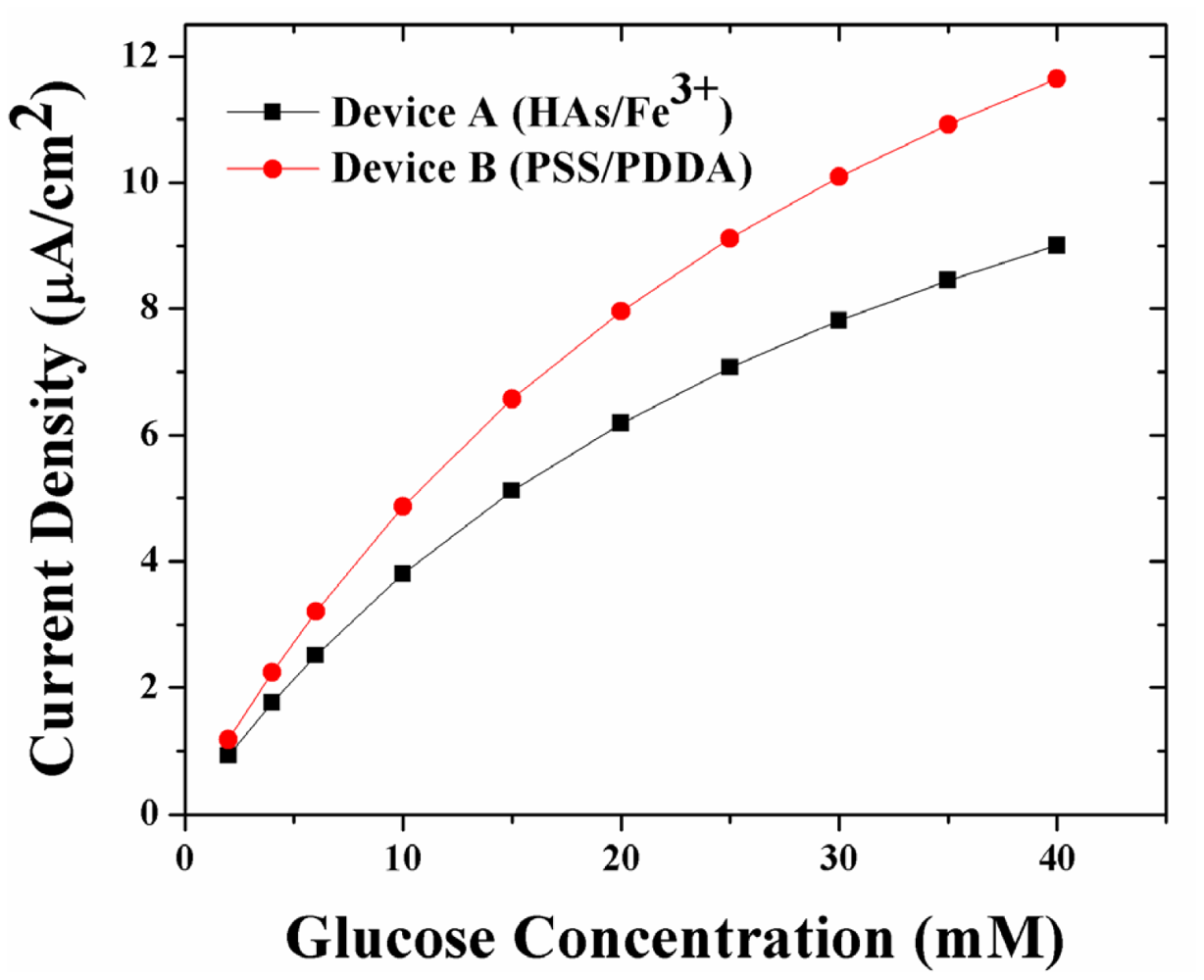
<p><xref ref-type="fig" rid="f3-sensors-12-13402">Figure 3</xref> shows the simulated amperometric response of sensors coated with the two LBL systems. For any glucose concentration, and in particular at higher glucose concentrations, the amperometric response of Device B (with PSS/PDDA membranes) is 27% higher than that of Device A (HAs/Fe<sup>3+</sup> membranes). This trend in amperometric response is opposite to the trends observed in glucose permeability through the LBL membranes (which is highest through the HAs/Fe<sup>3+</sup>, Device A, and least through the PSS/PDDA, Device B, membranes), wherein the amperometric response from Device A is 27–30% lower than Device B. Here, it is worth noting that the trend in simulated amperometric responses is similar to that of experimental data reported earlier [<xref ref-type="bibr" rid="b10-sensors-12-13402">10</xref>]. Taking into account the low oxygen permeability of PSS/PDDA membranes compared to HAs/Fe<sup>3+</sup> membranes, it was concluded that the observed higher amperometric response from Device B (PSS/PDDA) is due to a higher build-up of H<sub>2</sub>O<sub>2</sub> within its sensor geometry. The higher build-up of H<sub>2</sub>O<sub>2</sub> is in turn attributed to its low permeability through the PSS/PDDA membrane compared to the HAs/Fe<sup>3+</sup> membrane. In order to further elucidate this, a theoretical understanding of the concentration profiles of glucose and H<sub>2</sub>O<sub>2</sub> as a function of various LBL membranes has been performed.</p>
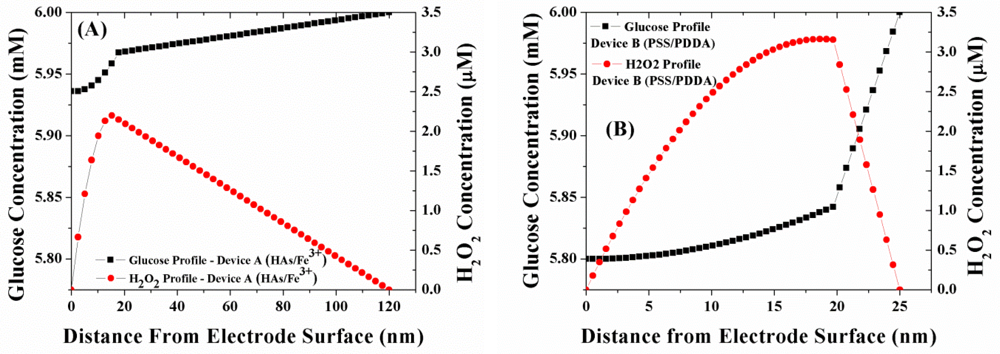
<p><xref ref-type="fig" rid="f4-sensors-12-13402">Figure 4(A,B)</xref> illustrates the simulated concentration profile of glucose and H<sub>2</sub>O<sub>2</sub> within a sensor geometry coated with either of the two LBL membranes namely (HAs/Fe<sup>3+</sup> and PSS/PDDA) at normal physiological glucose concentrations (6 mM glucose). The GO<sub>x</sub> enzyme for both devices is immobilized within a 20 mM poly(phenylenediamine) (PPD) layer and is assumed to be uniformly distributed within the PPD layer [<xref ref-type="bibr" rid="b22-sensors-12-13402">22</xref>]. Employing the outer membrane thickness values of <xref ref-type="table" rid="t1-sensors-12-13402">Table 1</xref>, the bulk solution of Device A is present at 120 nm from the electrode surface, while the bulk solution is present at 25 nm from the electrode surface for Device B. As illustrated in <xref ref-type="fig" rid="f4-sensors-12-13402">Figure 4(A,B)</xref>, the glucose flux within the GO<sub>x</sub> layer for Device B (PSS/PDDA) lower than that in Device A (HAs/Fe<sup>3+</sup>), which is in agreement with the trends in glucose permeability through these membranes [<xref ref-type="bibr" rid="b12-sensors-12-13402">12</xref>]. Based on the observed lower glucose flux within Device B, one would expect it to have a lower concentration of H<sub>2</sub>O<sub>2</sub> generated compared to Device A. However, as seen in <xref ref-type="fig" rid="f4-sensors-12-13402">Figure 4</xref>, the concentration of H<sub>2</sub>O<sub>2</sub> within Device B is 48% higher than that of Device A. Considering the facts that the rate of oxidation of H<sub>2</sub>O<sub>2</sub> at the Pt electrode is the same for all the electrodes and that the oxygen permeability through the three membranes follows the same trend as glucose [<xref ref-type="bibr" rid="b10-sensors-12-13402">10</xref>], the higher concentration of H<sub>2</sub>O<sub>2</sub> within Device B can easily be attributed to the poor outwards diffusion of H<sub>2</sub>O<sub>2</sub> through the PSS/PDDA membrane compared to the HAs/Fe<sup>3+</sup> membrane. This larger build-up of H<sub>2</sub>O<sub>2</sub> within Device B in turn leads to its higher amperometric response (27–30%) as illustrated in <xref ref-type="fig" rid="f3-sensors-12-13402">Figure 3</xref>.</p>
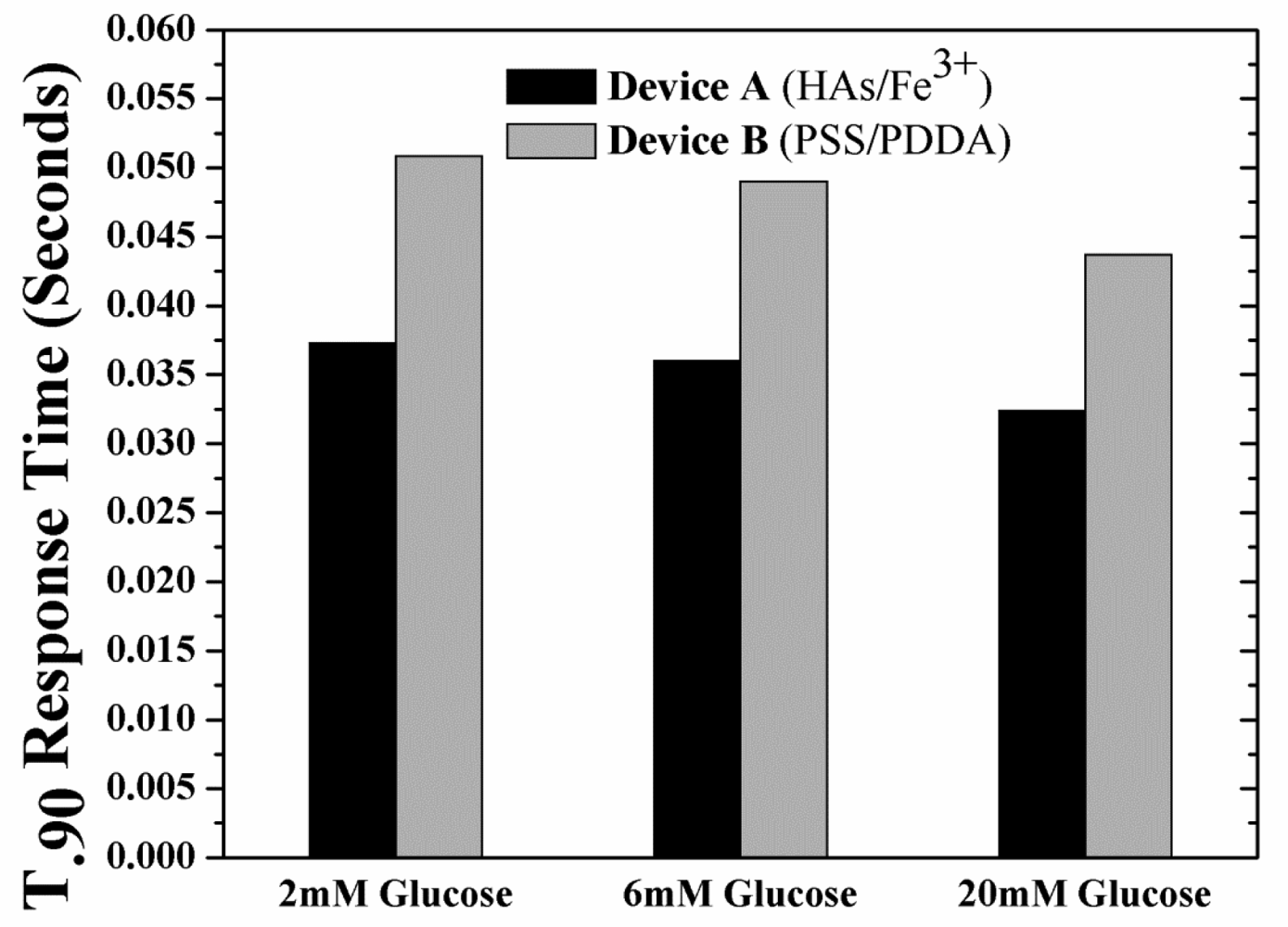
<p>The unwanted build-up of H<sub>2</sub>O<sub>2</sub> within Device B is also expected to increase the sensor response time considering the longer times needed to establish equilibrium. This increase in response times adds to the already longer response times resulting from the use of tighter (less glucose permeable membranes). With this in mind, the response times (t<sub>90%</sub>; time taken to reach 90% of the saturation current value as obtained from the simulated sensor transient response, <xref rid="SD1" ref-type="supplementary-material">Figure S3 of Supplementary Information</xref>) of the devices have been investigated as a function of glucose concentration and type of outer LBL membrane. <xref ref-type="fig" rid="f5-sensors-12-13402">Figure 5</xref> shows the t<sub>90%</sub> response times for the two devices under hypoglycemia (2 mM glucose), normal physiological glucose concentrations (6 mM glucose) and hyperglycemia (20 mM glucose). For both devices at any glucose concentration, the response time of Device A was <italic>ca.</italic> 35% less than that of Device B, as expected.</p>
<p>Overall the results of <xref ref-type="fig" rid="f4-sensors-12-13402">Figures 4</xref> and <xref ref-type="fig" rid="f5-sensors-12-13402">5</xref> indicate one has to utilize a tighter PSS/PDDA membrane for higher sensitivities (e.g., for glutamate detection which are in the sub-μM levels [<xref ref-type="bibr" rid="b35-sensors-12-13402">35</xref>]) even though it can lead to longer response times (due to build-up of H<sub>2</sub>O<sub>2</sub>) necessitating a means to remove H<sub>2</sub>O<sub>2</sub> buildup within the sensor. This can be achieved by methods including: (i) increasing the catalytic activity of the Pt working electrode [<xref ref-type="bibr" rid="b22-sensors-12-13402">22</xref>] (ii) introducing an additional H<sub>2</sub>O<sub>2</sub>-consuming layer (e.g., Catalase enzyme) [<xref ref-type="bibr" rid="b11-sensors-12-13402">11</xref>], and (ii) grading the GO<sub>x</sub> concentrations in the PPD membrane. Such schemes retain the outer boundary conditions of the currently utilized model (<xref ref-type="fig" rid="f2-sensors-12-13402">Figure 2</xref>), however the inner boundary conditions must be modified in order to include the associated diffusion and reaction-diffusion equations.</p>
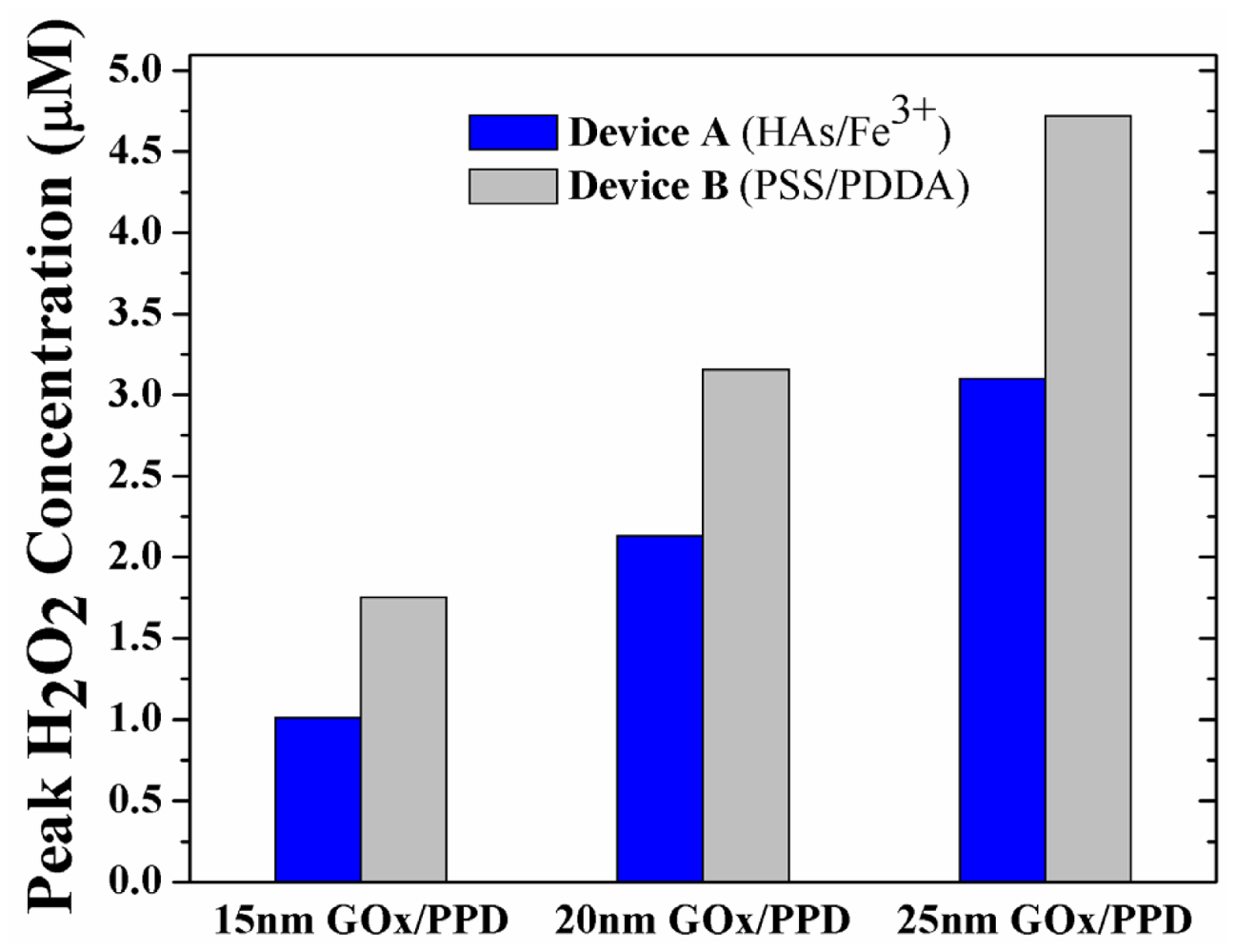
<p>Having established the importance of outwards diffusion of H<sub>2</sub>O<sub>2</sub> on sensor performance, the enzyme layer thickness was additionally simulated at 15 nm and 25 nm, in an effort to determine if the observed phenomenon is enzyme-thickness dependent. <xref ref-type="fig" rid="f6-sensors-12-13402">Figure 6</xref> shows the peak H<sub>2</sub>O<sub>2</sub> concentration in the GO<sub>x</sub>/PPD layer of Device A and B at 15 nm (<xref rid="SD1" ref-type="supplementary-material">Figure S1 of Supplementary Information</xref>), 20 nm (<xref ref-type="fig" rid="f4-sensors-12-13402">Figure 4</xref>) and 25 nm (<xref rid="SD1" ref-type="supplementary-material">Figure S2 of Supplementary Information</xref>) thick enzyme layers. Intuitively, it is seen that there is increase in peak H<sub>2</sub>O<sub>2</sub> concentration at increasing enzyme thicknesses, due to the increase in GO<sub>x</sub>-induced H<sub>2</sub>O<sub>2</sub> turnover. Moreover, for any enzyme thickness, the H<sub>2</sub>O<sub>2</sub> concentration for Device B is <italic>ca.</italic> 50–70% larger than Device A due to the pronounced buildup of H<sub>2</sub>O<sub>2</sub> in the enzyme layer.</p>
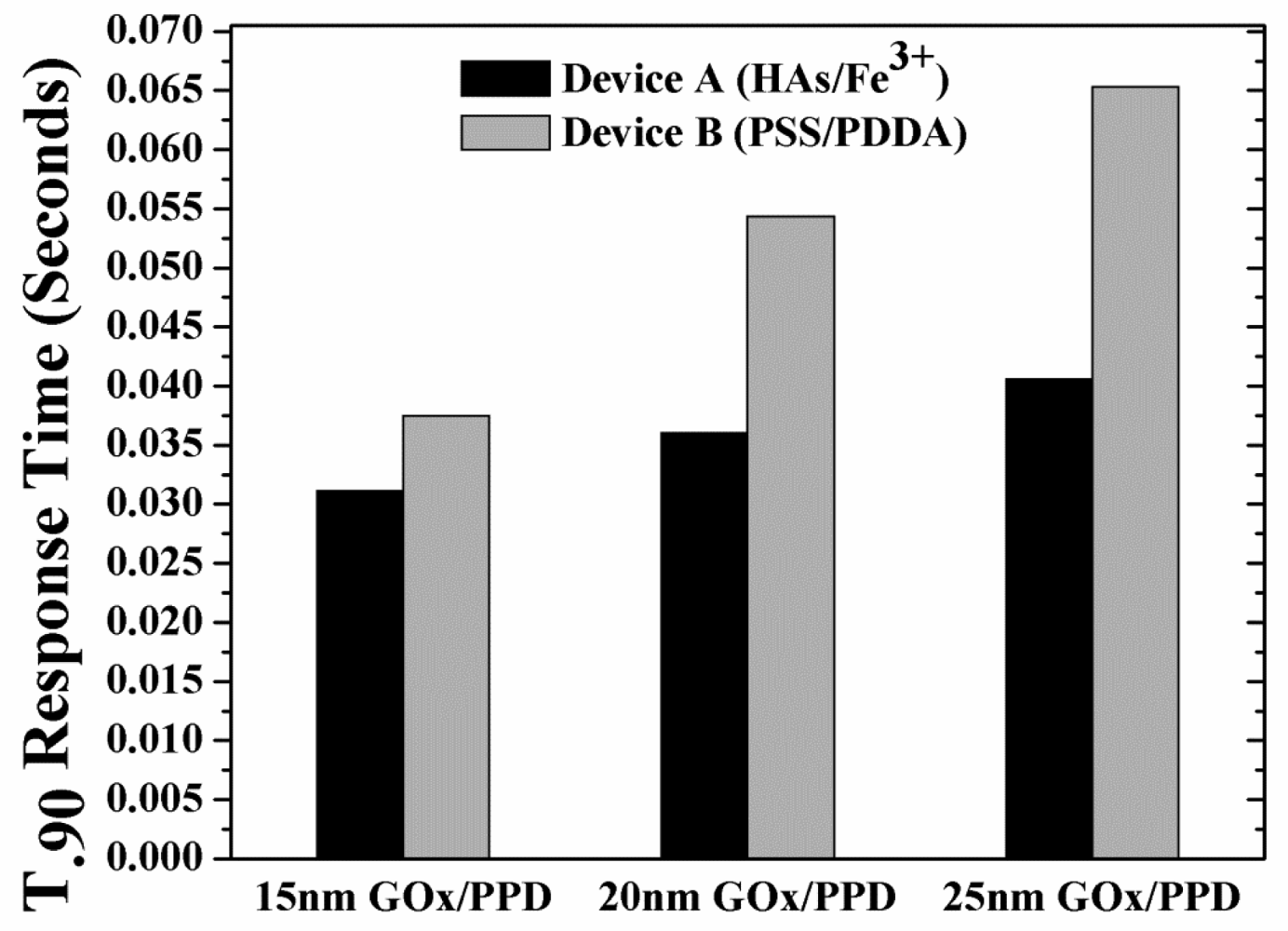
<p>Following the analysis of peak H<sub>2</sub>O<sub>2</sub> concentration as a function of varying GO<sub>x</sub>/PPD thickness, the t<sub>90%</sub> response times of these thicknesses was investigated. <xref ref-type="fig" rid="f7-sensors-12-13402">Figure 7</xref> shows the response times of the devices as a function of enzyme thickness. As expected, for any enzyme thickness, the response times of Devices B is higher than that of Devices A, due to the higher build-up of H<sub>2</sub>O<sub>2</sub> (shown in <xref ref-type="fig" rid="f6-sensors-12-13402">Figure 6</xref>).</p></sec>
<sec sec-type="conclusions">
<label>4.</label>
<title>Conclusions</title>
<p>In this contribution, a multi-layered computational model has been utilized to compare the performance of an enzymatic glucose sensor coated with two kinds of LBL assembled outer membranes, namely humic acids/ferric cations and poly(styrene sulfonate)/poly(diallyldimethylammonium chloride) outer membranes. The diffusion profiles of glucose (S) and H<sub>2</sub>O<sub>2</sub> (P) have been computed under specified boundary conditions for sensors coated with high glucose permeable (HAs/Fe<sup>3</sup>) and low glucose permeable (PSS/PDDA) membranes. Sensors coated with PSS/PDDA membranes, although have low inwards flux, have displayed high sensitivity due to low outwards diffusion of H<sub>2</sub>O<sub>2</sub> in all simulated enzyme thicknesses. This trend in simulation corroborates our previous experimental finding of the role H<sub>2</sub>O<sub>2</sub> on sensor sensitivity [<xref ref-type="bibr" rid="b10-sensors-12-13402">10</xref>] and re-signifying the need for outer membrane optimization not only in terms of glucose diffusion, but also for H<sub>2</sub>O<sub>2</sub> diffusion. Moreover, it is also found that this low outer diffusion of H<sub>2</sub>O<sub>2</sub> through the less glucose permeable PSS/PDDA membranes leads to longer response times thereby alluding to the necessity for a means to remove H<sub>2</sub>O<sub>2</sub> buildup within an outer membrane-coated biosensor. Currently, we are investigating the efficacy of this model in a variety of physiological environments as well as understanding the need for gradients, if any. Additionally, even though H<sub>2</sub>O<sub>2</sub> serves as the key contributor to the dynamics of these devices, the role of H<sub>2</sub>O<sub>2</sub> in an environment of varying oxygen levels is currently under investigation, and will be the topic of future publications.</p>
<p>The study presented here, even though only two LBL membranes were compared, could be extended to other designs that utilize a different outer membrane or to designs that employ a series of stratified membranes and could be used a guide for optimization of outer layers.</p></sec>
<sec sec-type="supplementary-material">
<title>Supplementary Material</title>
<supplementary-material id="SD1" content-type="local-data">
<media mimetype="application" mime-subtype="pdf" xlink:href="sensors-12-13402-s001.pdf"/></supplementary-material></sec></body>
<back>
<ack>
<p>Financial support for this study was obtained from US Army Medical Research Grants (W81XWH-09-1-0711 and W81XWH-07-10688), NIH grants (1-R21-HL090458-01, ES013557, R43EB011886 and 9R01EB014586) and NSF/SBIR grants (1046902 and 1230148). The authors would also like to thank Dr. Evan Heller for technical assistance and discussions.</p></ack>
<ref-list>
<title>References</title>
<ref id="b1-sensors-12-13402"><label>1.</label><citation citation-type="journal"><person-group person-group-type="author"><name><surname>Valdastri</surname><given-names>P.</given-names></name><name><surname>Menciassi</surname><given-names>A.</given-names></name><name><surname>Arena</surname><given-names>A.</given-names></name><name><surname>Caccamo</surname><given-names>C.</given-names></name><name><surname>Dario</surname><given-names>P.</given-names></name></person-group><article-title>An Implantable Telemetry Platform System for <italic>In Vivo</italic> Monitoring of Physiological Parameters</article-title><source>IEEE Trans. Inform. Technol. Biomed.</source><year>2004</year><volume>8</volume><fpage>271</fpage><lpage>278</lpage><pub-id pub-id-type="doi">10.1109/TITB.2004.834389</pub-id></citation></ref>
<ref id="b2-sensors-12-13402"><label>2.</label><citation citation-type="confproc"><person-group person-group-type="author"><name><surname>Valdastri</surname><given-names>P.</given-names></name><name><surname>Rossi</surname><given-names>S.</given-names></name><name><surname>Menciassi</surname><given-names>A.</given-names></name><name><surname>Lionetti</surname><given-names>V.</given-names></name><name><surname>Bernini</surname><given-names>F.</given-names></name><name><surname>Recchia</surname><given-names>F.A.</given-names></name><name><surname>Dario</surname><given-names>P.</given-names></name></person-group><article-title>An Implantable ZigBee Ready Telemetric Platform for <italic>In Vivo</italic> Monitoring of Physiological Parameters</article-title><conf-name>Proceedings of the 20th European Conference on Solid-State Transducers</conf-name><conf-loc>Dresden, Germany</conf-loc><conf-date>7– 10 September 2008</conf-date><fpage>369</fpage><lpage>378</lpage></citation></ref>
<ref id="b3-sensors-12-13402"><label>3.</label><citation citation-type="confproc"><person-group person-group-type="author"><name><surname>Valdastri</surname><given-names>P.</given-names></name><name><surname>Susilo</surname><given-names>E.</given-names></name><name><surname>Förster</surname><given-names>T.</given-names></name><name><surname>Strohhöfer</surname><given-names>C.</given-names></name><name><surname>Menciassia</surname><given-names>A.</given-names></name><name><surname>Dario</surname><given-names>P.</given-names></name></person-group><article-title>Wireless Implantable Electronic Platform for Blood Glucose Level Monitoring</article-title><conf-name>Proceedings of the Eurosensors XXIII Conference</conf-name><conf-loc>Lausanne, Switzerland</conf-loc><conf-date>6–9 September 2009</conf-date><fpage>1255</fpage><lpage>1258</lpage></citation></ref>
<ref id="b4-sensors-12-13402"><label>4.</label><citation citation-type="journal"><person-group person-group-type="author"><name><surname>Ahmadi</surname><given-names>M.M.</given-names></name><name><surname>Jullien</surname><given-names>G.A.</given-names></name></person-group><article-title>A Wireless-Implantable Microsystem for Continuous Blood Glucose Monitoring</article-title><source>IEEE Trans. Biomed. Circ. Syst.</source><year>2009</year><volume>3</volume><fpage>169</fpage><lpage>180</lpage><pub-id pub-id-type="doi">10.1109/TBCAS.2009.2016844</pub-id></citation></ref>
<ref id="b5-sensors-12-13402"><label>5.</label><citation citation-type="journal"><person-group person-group-type="author"><name><surname>Serra</surname><given-names>P.A.</given-names></name><name><surname>Rocchitta</surname><given-names>G.</given-names></name><name><surname>Bazzu</surname><given-names>G.</given-names></name><name><surname>Manca</surname><given-names>A.</given-names></name><name><surname>Puggioni</surname><given-names>G.M.</given-names></name><name><surname>Lowry</surname><given-names>J.P.</given-names></name><name><surname>O'Neill</surname><given-names>R.D.</given-names></name></person-group><article-title>Design and Construction of a Low Cost Single-Supply Embedded Telemetry System for Amperometric Biosensor Applications</article-title><source>Sens. Actuat. B Chem.</source><year>2007</year><volume>122</volume><fpage>118</fpage><lpage>126</lpage><pub-id pub-id-type="doi">10.1016/j.snb.2006.05.013</pub-id></citation></ref>
<ref id="b6-sensors-12-13402"><label>6.</label><citation citation-type="confproc"><person-group person-group-type="author"><name><surname>Bolomey</surname><given-names>L.</given-names></name><name><surname>Meurville</surname><given-names>E.</given-names></name><name><surname>Ryser</surname><given-names>P.</given-names></name></person-group><article-title>Implantable Ultra-Low Power DSP-Based System for a Miniature Chemico-Rheological Biosensor</article-title><conf-name>Proceedings of the Eurosensors XXIII Conference</conf-name><conf-loc>Lausanne, Switzerland</conf-loc><conf-date>6–9 September 2009</conf-date><fpage>1235</fpage><lpage>1238</lpage></citation></ref>
<ref id="b7-sensors-12-13402"><label>7.</label><citation citation-type="journal"><person-group person-group-type="author"><name><surname>Wilson</surname><given-names>G.S.</given-names></name><name><surname>Gifford</surname><given-names>R.</given-names></name></person-group><article-title>Biosensors for Real-Time <italic>In Vivo</italic> Measurements</article-title><source>Biosens. Bioelectr.</source><year>2005</year><volume>20</volume><fpage>2388</fpage><lpage>2403</lpage><pub-id pub-id-type="doi">10.1016/j.bios.2004.12.003</pub-id></citation></ref>
<ref id="b8-sensors-12-13402"><label>8.</label><citation citation-type="journal"><person-group person-group-type="author"><name><surname>Vaddiraju</surname><given-names>S.</given-names></name><name><surname>Burgess</surname><given-names>D.J.</given-names></name><name><surname>Tomazos</surname><given-names>I.</given-names></name><name><surname>Jain</surname><given-names>F.C.</given-names></name><name><surname>Papadimitrakopoulos</surname><given-names>F.</given-names></name></person-group><article-title>Technologies for Continuous Glucose Monitoring: Current Problems and Future Promises</article-title><source>J. Diabetes Sci. Technol.</source><year>2010</year><volume>4</volume><fpage>1540</fpage><lpage>1562</lpage><pub-id pub-id-type="pmid">21129353</pub-id></citation></ref>
<ref id="b9-sensors-12-13402"><label>9.</label><citation citation-type="journal"><person-group person-group-type="author"><name><surname>Vaddiraju</surname><given-names>S.</given-names></name><name><surname>Tomazos</surname><given-names>I.</given-names></name><name><surname>Burgess</surname><given-names>D.J.</given-names></name><name><surname>Jain</surname><given-names>F.C.</given-names></name><name><surname>Papadimitrakopoulos</surname><given-names>F.</given-names></name></person-group><article-title>Emerging Synergy between Nanotechnology and Implantable Biosensors: A Review</article-title><source>Biosens. Bioelectr.</source><year>2010</year><volume>25</volume><fpage>1553</fpage><lpage>1565</lpage><pub-id pub-id-type="doi">10.1016/j.bios.2009.12.001</pub-id></citation></ref>
<ref id="b10-sensors-12-13402"><label>10.</label><citation citation-type="journal"><person-group person-group-type="author"><name><surname>Vaddiraju</surname><given-names>S.</given-names></name><name><surname>Burgess</surname><given-names>D.J.</given-names></name><name><surname>Jain</surname><given-names>F.C.</given-names></name><name><surname>Papadimitrakopoulos</surname><given-names>F.</given-names></name></person-group><article-title>The Role of H<sub>2</sub>O<sub>2</sub> Outer Diffusion on the Performance of Implantable Glucose Sensors</article-title><source>Biosens. Bioelectr.</source><year>2009</year><volume>24</volume><fpage>1557</fpage><lpage>1562</lpage><pub-id pub-id-type="doi">10.1016/j.bios.2008.08.015</pub-id></citation></ref>
<ref id="b11-sensors-12-13402"><label>11.</label><citation citation-type="journal"><person-group person-group-type="author"><name><surname>Vaddiraju</surname><given-names>S.</given-names></name><name><surname>Legassey</surname><given-names>A.</given-names></name><name><surname>Wang</surname><given-names>Y.</given-names></name><name><surname>Qiang</surname><given-names>L.</given-names></name><name><surname>Burgess</surname><given-names>D.J.</given-names></name><name><surname>Jain</surname><given-names>F.C.</given-names></name><name><surname>Papadimitrakopoulos</surname><given-names>F.</given-names></name></person-group><article-title>Design and Fabrication of a High-Performance Electrochemical Glucose Sensor</article-title><source>J. Diabetes Sci. Technol.</source><year>2011</year><volume>5</volume><fpage>1044</fpage><lpage>1051</lpage><pub-id pub-id-type="pmid">22027296</pub-id></citation></ref>
<ref id="b12-sensors-12-13402"><label>12.</label><citation citation-type="journal"><person-group person-group-type="author"><name><surname>Tipnis</surname><given-names>R.</given-names></name><name><surname>Vaddiraju</surname><given-names>S.</given-names></name><name><surname>Jain</surname><given-names>F.C.</given-names></name><name><surname>Burgess</surname><given-names>D.J.</given-names></name><name><surname>Papadimitrakopoulos</surname><given-names>F.</given-names></name></person-group><article-title>Layer-by-Layer Assembled Semipermeable Membrane for Amperometric Glucose Sensors</article-title><source>J. Diabetes Sci. Technol.</source><year>2007</year><volume>1</volume><fpage>193</fpage><lpage>200</lpage><pub-id pub-id-type="pmid">19888406</pub-id></citation></ref>
<ref id="b13-sensors-12-13402"><label>13.</label><citation citation-type="journal"><person-group person-group-type="author"><name><surname>Vaddiraju</surname><given-names>S.H.</given-names></name><name><surname>Burgess</surname><given-names>D.J.</given-names></name><name><surname>Jain</surname><given-names>F.C.</given-names></name><name><surname>Papadimitrakopoulos</surname><given-names>F.</given-names></name></person-group><article-title>Enhanced Glucose Sensor Linearity Using Poly(vinyl Alcohol) Hydrogels</article-title><source>J. Diabetes Sci. Technol.</source><year>2009</year><fpage>863</fpage><lpage>874</lpage></citation></ref>
<ref id="b14-sensors-12-13402"><label>14.</label><citation citation-type="journal"><person-group person-group-type="author"><name><surname>McMahon</surname><given-names>C.P.</given-names></name><name><surname>Killoran</surname><given-names>S.J.</given-names></name><name><surname>Kirwan</surname><given-names>S.M.</given-names></name><name><surname>O'Neill</surname><given-names>R.D.</given-names></name></person-group><article-title>The Selectivity of Electrosynthesised Polymer Membranes Depends on the Electrode Dimensions: Implications for Biosensor Applications</article-title><source>Chem. Commun.</source><year>2004</year><volume>21</volume><fpage>2128</fpage><lpage>2130</lpage></citation></ref>
<ref id="b15-sensors-12-13402"><label>15.</label><citation citation-type="journal"><person-group person-group-type="author"><name><surname>Moussy</surname><given-names>F.</given-names></name><name><surname>Harrison</surname><given-names>D.J.</given-names></name><name><surname>O'Brien</surname><given-names>D.W.</given-names></name><name><surname>Rajotte</surname><given-names>R.V.</given-names></name></person-group><article-title>Performance of Subcutaneously Implanted Needle-Type Glucose Sensors Employing a Novel Trilayer Coating</article-title><source>Anal. Chem.</source><year>1993</year><volume>65</volume><fpage>2072</fpage><lpage>2077</lpage><pub-id pub-id-type="pmid">8372970</pub-id><pub-id pub-id-type="doi">10.1021/ac00063a023</pub-id></citation></ref>
<ref id="b16-sensors-12-13402"><label>16.</label><citation citation-type="journal"><person-group person-group-type="author"><name><surname>Kirwan</surname><given-names>S.</given-names></name><name><surname>Rocchitta</surname><given-names>G.</given-names></name><name><surname>McMahon</surname><given-names>C.</given-names></name><name><surname>Craig</surname><given-names>J.</given-names></name><name><surname>Killoran</surname><given-names>S.</given-names></name><name><surname>O'Brien</surname><given-names>K.</given-names></name><name><surname>Serra</surname><given-names>P.</given-names></name><name><surname>Lowry</surname><given-names>J.</given-names></name><name><surname>O'Neill</surname><given-names>R.</given-names></name></person-group><article-title>Modifications of Poly(o-phenylenediamine) Permselective Layer on Pt-Ir for Biosensor Application in Neurochemical Monitoring</article-title><source>Sensors</source><year>2007</year><volume>7</volume><fpage>420</fpage><lpage>437</lpage><pub-id pub-id-type="doi">10.3390/s7040420</pub-id></citation></ref>
<ref id="b17-sensors-12-13402"><label>17.</label><citation citation-type="book"><person-group person-group-type="author"><name><surname>Shuler</surname><given-names>M.L.</given-names></name><name><surname>Kargi</surname><given-names>F.</given-names></name></person-group><source>Bioprocess Engineering: Basic Concepts</source><publisher-name>Prentice Hall</publisher-name><publisher-loc>Upper Saddle River, NJ, USA</publisher-loc><year>2002</year></citation></ref>
<ref id="b18-sensors-12-13402"><label>18.</label><citation citation-type="book"><person-group person-group-type="author"><name><surname>Baronas</surname><given-names>R.</given-names></name><name><surname>Ivanauskas</surname><given-names>F.</given-names></name><name><surname>Kulys</surname><given-names>J.</given-names></name></person-group><source>Mathematical Modeling of Biosensors: An Introduction for Chemists and Mathematicians</source><publisher-name>Springer</publisher-name><publisher-loc>New York, NY, USA</publisher-loc><year>2009</year></citation></ref>
<ref id="b19-sensors-12-13402"><label>19.</label><citation citation-type="journal"><person-group person-group-type="author"><name><surname>Baronas</surname><given-names>R.</given-names></name><name><surname>Ivanauskas</surname><given-names>F.</given-names></name><name><surname>Kulys</surname><given-names>J.</given-names></name></person-group><article-title>Computational Modelling of Amperometric Enzyme Electrodes with Selective and Perforated Membranes</article-title><source>AIP Conf. Proc.</source><year>2007</year><volume>963</volume><fpage>457</fpage><lpage>460</lpage></citation></ref>
<ref id="b20-sensors-12-13402"><label>20.</label><citation citation-type="journal"><person-group person-group-type="author"><name><surname>Baronas</surname><given-names>R.</given-names></name><name><surname>Ivanauskas</surname><given-names>F.</given-names></name><name><surname>Kulys</surname><given-names>J.</given-names></name></person-group><article-title>The Influence of the Enzyme Membrane Thickness on the Response of Amperometric Biosensors</article-title><source>Sensors</source><year>2003</year><volume>3</volume><fpage>248</fpage><lpage>262</lpage><pub-id pub-id-type="doi">10.3390/s30700248</pub-id></citation></ref>
<ref id="b21-sensors-12-13402"><label>21.</label><citation citation-type="journal"><person-group person-group-type="author"><name><surname>Baronas</surname><given-names>R.</given-names></name><name><surname>Ivanauskas</surname><given-names>F.</given-names></name><name><surname>Kulys</surname><given-names>J.</given-names></name></person-group><article-title>Computational Modelling of the Behaviour of Potentiometric Membrane Biosensors</article-title><source>J. Math. Chem.</source><year>2007</year><volume>42</volume><fpage>321</fpage><lpage>336</lpage><pub-id pub-id-type="doi">10.1007/s10910-006-9102-0</pub-id></citation></ref>
<ref id="b22-sensors-12-13402"><label>22.</label><citation citation-type="journal"><person-group person-group-type="author"><name><surname>Reyes De Corcuera</surname><given-names>J.I.</given-names></name><name><surname>Cavalieri</surname><given-names>R.P.</given-names></name><name><surname>Powers</surname><given-names>J.R.</given-names></name></person-group><article-title>Improved Platinization Conditions Produce a 60-Fold Increase in Sensitivity of Amperometric Biosensors Using Glucose Oxidase Immobilized in Poly-o-phenylenediamine</article-title><source>J. Electroanal. Chem.</source><year>2005</year><volume>575</volume><fpage>229</fpage><lpage>241</lpage><pub-id pub-id-type="doi">10.1016/j.jelechem.2004.09.015</pub-id></citation></ref>
<ref id="b23-sensors-12-13402"><label>23.</label><citation citation-type="journal"><person-group person-group-type="author"><name><surname>Chen</surname><given-names>X.</given-names></name><name><surname>Matsumoto</surname><given-names>N.</given-names></name><name><surname>Hu</surname><given-names>Y.</given-names></name><name><surname>Wilson</surname><given-names>G.S.</given-names></name></person-group><article-title>Electrochemically Mediated Electrodeposition/Electropolymerization to Yield a Glucose Microbiosensor with Improved Characteristics</article-title><source>Anal. Chem.</source><year>2002</year><volume>74</volume><fpage>368</fpage><lpage>372</lpage><pub-id pub-id-type="doi">10.1021/ac015628m</pub-id><pub-id pub-id-type="pmid">11811410</pub-id></citation></ref>
<ref id="b24-sensors-12-13402"><label>24.</label><citation citation-type="journal"><person-group person-group-type="author"><name><surname>Ivanauskas</surname><given-names>F.</given-names></name><name><surname>Baronas</surname><given-names>R.</given-names></name></person-group><article-title>Numerical Simulation of a Plate-Gap Biosensor with an Outer Porous Membrane</article-title><source>Simul. Modell. Pract. Theory</source><year>2008</year><volume>16</volume><fpage>962</fpage><lpage>970</lpage><pub-id pub-id-type="doi">10.1016/j.simpat.2008.05.004</pub-id></citation></ref>
<ref id="b25-sensors-12-13402"><label>25.</label><citation citation-type="journal"><person-group person-group-type="author"><name><surname>Meena</surname><given-names>A.</given-names></name><name><surname>Rajendran</surname><given-names>L.</given-names></name></person-group><article-title>Mathematical Modeling of Amperometric and Potentiometric Biosensors and System of Non-Linear Equations—Homotopy perturbation approach</article-title><source>J. Electroanal. Chem.</source><year>2010</year><volume>644</volume><fpage>50</fpage><lpage>59</lpage><pub-id pub-id-type="doi">10.1016/j.jelechem.2010.03.027</pub-id></citation></ref>
<ref id="b26-sensors-12-13402"><label>26.</label><citation citation-type="journal"><person-group person-group-type="author"><name><surname>Kulys</surname><given-names>J.</given-names></name><name><surname>Baronas</surname><given-names>R.</given-names></name></person-group><article-title>Modelling of Amperometric Biosensors in the Case of Substrate Inhibition</article-title><source>Sensors</source><year>2006</year><volume>6</volume><fpage>1513</fpage><lpage>1522</lpage><pub-id pub-id-type="doi">10.3390/s6111513</pub-id></citation></ref>
<ref id="b27-sensors-12-13402"><label>27.</label><citation citation-type="journal"><person-group person-group-type="author"><name><surname>Patre</surname><given-names>B.M.S.V.G.</given-names></name></person-group><article-title>Mathematical Model of an Amperometric Biosensor for the Design of an Appropriate Instrumentation System</article-title><source>J. Med. Eng. Technol.</source><year>2007</year><volume>31</volume><fpage>351</fpage><lpage>360</lpage><pub-id pub-id-type="doi">10.1080/03091900600926898</pub-id><pub-id pub-id-type="pmid">17701780</pub-id></citation></ref>
<ref id="b28-sensors-12-13402"><label>28.</label><citation citation-type="journal"><person-group person-group-type="author"><name><surname>Cambiaso</surname><given-names>A.</given-names></name><name><surname>Delfino</surname><given-names>L.</given-names></name><name><surname>Grattarola</surname><given-names>M.</given-names></name><name><surname>Verreschia</surname><given-names>G.</given-names></name><name><surname>Ashworth</surname><given-names>D.</given-names></name><name><surname>Maines</surname><given-names>A.</given-names></name><name><surname>Vadgama</surname><given-names>P.</given-names></name></person-group><article-title>Modelling and Simulation of a Diffusion Limited Glucose Biosensor</article-title><source>Sens. Actuat. B Chem.</source><year>1996</year><volume>33</volume><fpage>203</fpage><lpage>207</lpage><pub-id pub-id-type="doi">10.1016/0925-4005(96)80099-2</pub-id></citation></ref>
<ref id="b29-sensors-12-13402"><label>29.</label><citation citation-type="journal"><person-group person-group-type="author"><name><surname>Gaidamauskait</surname><given-names>E.</given-names></name><name><surname>Baronas</surname><given-names>R.</given-names></name></person-group><article-title>A Comparison of Finite Difference Schemes for Computational Modelling of Biosensors</article-title><source>Nonlin. Anal. Model. Control</source><year>2007</year><volume>12</volume><fpage>359</fpage><lpage>369</lpage></citation></ref>
<ref id="b30-sensors-12-13402"><label>30.</label><citation citation-type="journal"><person-group person-group-type="author"><name><surname>Bacha</surname><given-names>S.</given-names></name><name><surname>Bergel</surname><given-names>A.</given-names></name><name><surname>Comtat</surname><given-names>M.</given-names></name></person-group><article-title>Transient Response of Multilayer Electroenzymic Biosensors</article-title><source>Anal. Chem.</source><year>1995</year><volume>67</volume><fpage>1669</fpage><lpage>1678</lpage><pub-id pub-id-type="doi">10.1021/ac00106a004</pub-id></citation></ref>
<ref id="b31-sensors-12-13402"><label>31.</label><citation citation-type="journal"><person-group person-group-type="author"><name><surname>Baronas</surname><given-names>R.</given-names></name><name><surname>Ivanauskas</surname><given-names>E.</given-names></name><name><surname>Kulys</surname><given-names>J.</given-names></name></person-group><article-title>Computer Simulation of the Response of Amperometric Biosensors in Stirred and Non Stirred Solution</article-title><source>Nonlin. Anal. Model. Control</source><year>2003</year><volume>8</volume><fpage>3</fpage><lpage>18</lpage></citation></ref>
<ref id="b32-sensors-12-13402"><label>32.</label><citation citation-type="journal"><person-group person-group-type="author"><name><surname>Hickson</surname><given-names>R.I.</given-names></name><name><surname>Barry</surname><given-names>S.I.</given-names></name><name><surname>Mercera</surname><given-names>G.N.</given-names></name><name><surname>Sidhu</surname><given-names>H.S.</given-names></name></person-group><article-title>Finite Difference Schemes for Multilayer Diffusion</article-title><source>Math. Comput. Modell.</source><year>2011</year><volume>54</volume><fpage>210</fpage><lpage>220</lpage><pub-id pub-id-type="doi">10.1016/j.mcm.2011.02.003</pub-id></citation></ref>
<ref id="b33-sensors-12-13402"><label>33.</label><citation citation-type="journal"><person-group person-group-type="author"><name><surname>Gros</surname><given-names>P.</given-names></name><name><surname>Bergel</surname><given-names>A.</given-names></name></person-group><article-title>Improved Model of a Polypyrrole Glucose Oxidase Modified Electrode</article-title><source>J. Electroanal. Chem.</source><year>1995</year><volume>386</volume><fpage>65</fpage><lpage>73</lpage><pub-id pub-id-type="doi">10.1016/0022-0728(94)03804-C</pub-id></citation></ref>
<ref id="b34-sensors-12-13402"><label>34.</label><citation citation-type="journal"><person-group person-group-type="author"><name><surname>Lowry</surname><given-names>J.P.</given-names></name><name><surname>McAteer</surname><given-names>K.</given-names></name><name><surname>Atrash</surname><given-names>S.S.E.</given-names></name><name><surname>O'Neill</surname><given-names>R.D.</given-names></name></person-group><article-title>Efficient Glucose Detection in Anaerobic Solutions Using an Enzyme-Modified Electrode Designed to Detect H<sub>2</sub>O<sub>2</sub>: Implications for Biomedical Applications</article-title><source>J. Chem. Soc. Chem. Commun.</source><year>1994</year><pub-id pub-id-type="doi">10.1039/C39940002483.</pub-id></citation></ref>
<ref id="b35-sensors-12-13402"><label>35.</label><citation citation-type="journal"><person-group person-group-type="author"><name><surname>McMahon</surname><given-names>C.P.</given-names></name><name><surname>Rocchitta</surname><given-names>G.</given-names></name><name><surname>Serra</surname><given-names>P.A.</given-names></name><name><surname>Kirwan</surname><given-names>S.M.</given-names></name><name><surname>Lowry</surname><given-names>J.P.</given-names></name><name><surname>O'Neill</surname><given-names>R.D.</given-names></name></person-group><article-title>Control of the Oxygen Dependence of an Implantable Polymer/Enzyme Composite Biosensor for Glutamate</article-title><source>Anal. Chem.</source><year>2006</year><volume>78</volume><fpage>2352</fpage><lpage>2359</lpage><pub-id pub-id-type="doi">10.1021/ac0518194</pub-id><pub-id pub-id-type="pmid">16579619</pub-id></citation></ref></ref-list>
<sec sec-type="display-objects">
<title>Figures and Tables</title>
<fig id="f1-sensors-12-13402" position="float">
<label>Figure 1.</label>
<caption>
<p>Cross-sectional schematic representation of the multi-layer amperometric glucose sensor used in the numerical simulations. The outer LBL membrane is represented as either one of the following systems: (i) HAs/Fe<sup>3+</sup> (ii) PSS/PDDA.</p></caption>
<graphic xlink:href="sensors-12-13402f1.gif"/></fig>
<fig id="f2-sensors-12-13402" position="float">
<label>Figure 2.</label>
<caption>
<p>Graphical representation of the Product (H<sub>2</sub>O<sub>2</sub>), P, and Substrate (Glucose), S, boundary conditions employed in the simulated multi-layered glucose sensor. Here, x = 0 is taken at the surface of the Pt electrode, x = d<sub>E</sub> is taken as the enzyme-membrane interface and x = d<sub>E</sub> +d<sub>M</sub> is taken as the surface of the LBL outer membrane.</p></caption>
<graphic xlink:href="sensors-12-13402f2.gif"/></fig>
<fig id="f3-sensors-12-13402" position="float">
<label>Figure 3.</label>
<caption>
<p>Simulated amperometric response of Device A (100 nm HAs/Fe<sup>3+</sup>) and Device B (5 nm PSS/PDDA) employing 20 nm GO<sub>x</sub>/PPD coating the electrode surface.</p></caption>
<graphic xlink:href="sensors-12-13402f3.gif"/></fig>
<fig id="f4-sensors-12-13402" position="float">
<label>Figure 4.</label>
<caption>
<p>(<bold>A</bold>) Simulated glucose and H<sub>2</sub>O<sub>2</sub> concentration profiles in the multi-layer sensor system consisting of 20 nm GO<sub>x</sub>/PPD as the first layer, and HAs/Fe<sup>3+</sup> as the second layer; (<bold>B</bold>) simulated glucose and H<sub>2</sub>O<sub>2</sub> concentration profiles in the multi-layer sensor system consisting of 20 nm GO<sub>x</sub>/PPD as the first layer, and PSS/PDDA as the second layer.</p></caption>
<graphic xlink:href="sensors-12-13402f4.gif"/></fig>
<fig id="f5-sensors-12-13402" position="float">
<label>Figure 5.</label>
<caption>
<p>90% saturation current response time <italic>vs.</italic> glucose concentration of Device A and B, employing a 20 nm thick GO<sub>x</sub>/PPD layer.</p></caption>
<graphic xlink:href="sensors-12-13402f5.gif"/></fig>
<fig id="f6-sensors-12-13402" position="float">
<label>Figure 6.</label>
<caption>
<p>Peak H<sub>2</sub>O<sub>2</sub> concentration of Device A and B in the GO<sub>x</sub>/PPD layer as a function of enzyme thickness (15, 20 and 25 nm).</p></caption>
<graphic xlink:href="sensors-12-13402f6.gif"/></fig>
<fig id="f7-sensors-12-13402" position="float">
<label>Figure 7.</label>
<caption>
<p>90% saturation current response time <italic>vs.</italic> glucose concentration of Device A and B, as a function of GO<sub>x</sub>/PPD thickness (15, 20 and 25 nm).</p></caption>
<graphic xlink:href="sensors-12-13402f7.gif"/></fig>
<table-wrap id="t1-sensors-12-13402" position="float">
<label>Table 1.</label>
<caption>
<p>Compilation of variables used in the multi-layer model.</p></caption>
<table frame="box" rules="all">
<thead>
<tr>
<th colspan="4" align="center" valign="top"><bold>Declaration of Variables</bold></th></tr></thead>
<tbody>
<tr>
<td align="center" valign="middle"><italic>S<sub>E</sub></italic></td>
<td align="left" valign="middle">Concentration of glucose in the GO<sub>x</sub>/PPD layer</td>
<td align="center" valign="middle"><italic>D<sub>SM</sub></italic></td>
<td align="left" valign="middle">Diffusion coefficient of glucose in the various LBL outer membranes</td></tr>
<tr>
<td align="center" valign="middle"><italic>P<sub>E</sub></italic></td>
<td align="left" valign="middle">Concentration of H<sub>2</sub>O<sub>2</sub> in the GO<sub>x</sub>/PPD layer</td>
<td align="center" valign="middle"><italic>D<sub>PM</sub></italic></td>
<td align="left" valign="middle">Diffusion coefficient of H<sub>2</sub>O<sub>2</sub> in the various outer membranes</td></tr>
<tr>
<td align="center" valign="middle"><italic>S<sub>M</sub></italic></td>
<td align="left" valign="middle">Concentration of glucose in the various LBL outer membranes</td>
<td align="center" valign="middle"><italic>V<sub>MAX</sub></italic></td>
<td align="left" valign="middle">Maximum enzymatic rate of reaction</td></tr>
<tr>
<td align="center" valign="middle"><italic>P<sub>M</sub></italic></td>
<td align="left" valign="middle">Concentration of H<sub>2</sub>O<sub>2</sub> in the various outer membranes</td>
<td align="center" valign="middle"><italic>K<sub>M</sub></italic></td>
<td align="left" valign="middle">Michaelis-Menten constant</td></tr>
<tr>
<td align="center" valign="top"><italic>d<sub>E</sub></italic></td>
<td align="left" valign="middle">Thickness of the GO<sub>x</sub>/PPD layer</td>
<td align="center" valign="top"><italic>I</italic></td>
<td align="left" valign="middle">Response current</td></tr>
<tr>
<td align="center" valign="middle"><italic>d<sub>M</sub></italic></td>
<td align="left" valign="middle">Thickness of the various LBL outer membranes</td>
<td align="center" valign="middle"><italic>n<sub>e</sub></italic></td>
<td align="left" valign="middle">Number of electrons (2 for H<sub>2</sub>O<sub>2</sub>)</td></tr>
<tr>
<td align="center" valign="middle"><italic>D<sub>SE</sub></italic></td>
<td align="left" valign="middle">Diffusion coefficient of glucose in the GO<sub>x</sub>/PPD layer</td>
<td align="center" valign="middle"><italic>F</italic></td>
<td align="left" valign="middle">Faraday's Constant (96,500 C/mol)</td></tr>
<tr>
<td align="center" valign="middle"><italic>D<sub>PE</sub></italic></td>
<td align="left" valign="middle">Diffusion coefficient of H<sub>2</sub>O<sub>2</sub> in the GO<sub>x</sub>/PPD layer</td>
<td align="center" valign="middle"/>
<td align="center" valign="top"/></tr></tbody></table></table-wrap>
<table-wrap id="t2-sensors-12-13402" position="float">
<label>Table 2.</label>
<caption>
<p>Physical parameters for the enzyme layer and LBL assembled outer membrane used in the simulation, including diffusion coefficients for glucose and H<sub>2</sub>O<sub>2</sub>, membrane thicknesses, Michaelis-Menten constant and maximum rate of enzymatic activity.</p></caption>
<table frame="box" rules="all">
<thead>
<tr>
<th align="left" valign="top"/>
<th colspan="3" align="center" valign="top"><bold>Layer</bold></th></tr>
<tr>
<th align="left" valign="top"><bold>Parameter</bold></th>
<th align="left" valign="top"><bold>GO<sub>x</sub>/PPD</bold></th>
<th align="left" valign="top"><bold>HAs/Fe<sup>3+</sup></bold></th>
<th align="left" valign="top"><bold>PSS/PDDA</bold></th></tr></thead>
<tbody>
<tr>
<td align="left" valign="top"><italic>D<sub>Glucose</sub> (cm<sup>2</sup>/sec)</italic></td>
<td align="left" valign="top">4 × 10<sup>−10</sup> [<xref ref-type="bibr" rid="b22-sensors-12-13402">22</xref>,<xref ref-type="bibr" rid="b33-sensors-12-13402">33</xref>]</td>
<td align="left" valign="top">4.4 × 10<sup>−9</sup> [<xref ref-type="bibr" rid="b10-sensors-12-13402">10</xref>]</td>
<td align="left" valign="top">0.058 × 10<sup>−9</sup> [<xref ref-type="bibr" rid="b10-sensors-12-13402">10</xref>]</td></tr>
<tr>
<td align="left" valign="top"><italic>D<sub>H2O2</sub> (cm<sup>2</sup>/sec)</italic></td>
<td align="left" valign="top">5 × 10<sup>−9</sup> [<xref ref-type="bibr" rid="b22-sensors-12-13402">22</xref>,<xref ref-type="bibr" rid="b33-sensors-12-13402">33</xref>]</td>
<td align="left" valign="top">4.8 × 10<sup>−9</sup> [<xref ref-type="bibr" rid="b10-sensors-12-13402">10</xref>]</td>
<td align="left" valign="top">0.1 × 10<sup>−9</sup> [<xref ref-type="bibr" rid="b10-sensors-12-13402">10</xref>]</td></tr>
<tr>
<td align="left" valign="top"><italic>Thickness (nm)</italic></td>
<td align="left" valign="top">15, 20 and 25 [<xref ref-type="bibr" rid="b33-sensors-12-13402">33</xref>]</td>
<td align="left" valign="top">100 [<xref ref-type="bibr" rid="b10-sensors-12-13402">10</xref>,<xref ref-type="bibr" rid="b12-sensors-12-13402">12</xref>]</td>
<td align="left" valign="top">5 [<xref ref-type="bibr" rid="b10-sensors-12-13402">10</xref>,<xref ref-type="bibr" rid="b12-sensors-12-13402">12</xref>]</td></tr>
<tr>
<td align="left" valign="top"><italic>K<sub>M</sub> (mol/cm<sup>3</sup>)</italic></td>
<td align="left" valign="top">33 × 10<sup>−6</sup> [<xref ref-type="bibr" rid="b22-sensors-12-13402">22</xref>,<xref ref-type="bibr" rid="b33-sensors-12-13402">33</xref>]</td>
<td align="left" valign="top">n/a</td>
<td align="left" valign="top">n/a</td></tr>
<tr>
<td align="left" valign="top"><italic>V<sub>Max</sub></italic> (<italic>mol/cm<sup>2</sup>sec)</italic></td>
<td align="left" valign="top">60 × 10<sup>−6</sup> [<xref ref-type="bibr" rid="b22-sensors-12-13402">22</xref>,<xref ref-type="bibr" rid="b33-sensors-12-13402">33</xref>]</td>
<td align="left" valign="top">n/a</td>
<td align="left" valign="top">n/a</td></tr></tbody></table></table-wrap></sec></back></article>