
<?xml version="1.0" encoding="UTF-8"?>
<!DOCTYPE article PUBLIC "-//NLM//DTD Journal Publishing DTD v2.3 20070202//EN" "journalpublishing.dtd">
<article xmlns:xlink="http://www.w3.org/1999/xlink" xml:lang="en" article-type="research-article">
<front>
<journal-meta>
<journal-id journal-id-type="nlm-ta">Sensors</journal-id>
<journal-title>Sensors</journal-title>
<issn pub-type="epub">1424-8220</issn>
<publisher>
<publisher-name>Molecular Diversity Preservation International (MDPI)</publisher-name></publisher></journal-meta>
<article-meta>
<article-id pub-id-type="doi">10.3390/s100807863</article-id>
<article-id pub-id-type="publisher-id">sensors-10-07863-v2</article-id>
<article-categories>
<subj-group>
<subject>Article</subject></subj-group></article-categories>
<title-group>
<article-title>Flame-Spray-Made Undoped Zinc Oxide Films for Gas Sensing Applications</article-title></title-group>
<contrib-group>
<contrib contrib-type="author">
<name><surname>Tamaekong</surname><given-names>Nittaya</given-names></name><xref ref-type="aff" rid="af1-sensors-10-07863-v2"><sup>1</sup></xref></contrib>
<contrib contrib-type="author">
<name><surname>Liewhiran</surname><given-names>Chaikarn</given-names></name><xref ref-type="aff" rid="af2-sensors-10-07863-v2"><sup>2</sup></xref></contrib>
<contrib contrib-type="author">
<name><surname>Wisitsoraat</surname><given-names>Anurat</given-names></name><xref ref-type="aff" rid="af3-sensors-10-07863-v2"><sup>3</sup></xref></contrib>
<contrib contrib-type="author">
<name><surname>Phanichphant</surname><given-names>Sukon</given-names></name><xref ref-type="aff" rid="af1-sensors-10-07863-v2"><sup>1</sup></xref><xref ref-type="corresp" rid="c1-sensors-10-07863-v2"><sup>*</sup></xref></contrib></contrib-group>
<aff id="af1-sensors-10-07863-v2">
<label>1</label> Nanoscience Research Laboratory, Department of Chemistry, Faculty of Science, Chiang Mai University, Chiang Mai, 50200, Thailand; E-Mail: <email>doramon_koygy@hotmail.com</email> (N.T.)</aff>
<aff id="af2-sensors-10-07863-v2">
<label>2</label> Department of Materials Science, Faculty of Science, Chiang Mai University, Chiang Mai, 50200, Thailand; E-Mail: <email>chaikarn_l@yahoo.com</email> (C.L.)</aff>
<aff id="af3-sensors-10-07863-v2">
<label>3</label> National Electronics and Computer Technology Center, Pathumthani, 12120, Thailand; E-Mail: <email>anurat.wisitsoraat@nectec.or.th</email> (A.W.)</aff>
<author-notes>
<corresp id="c1-sensors-10-07863-v2">
<label>*</label>Author to whom correspondence should be addressed; E-Mail: <email>sphanichphant@yahoo.com</email>; Tel.: +6-681-882-7977; Fax: +66-53-892-277.</corresp></author-notes>
<pub-date pub-type="collection">
<year>2010</year></pub-date>
<pub-date pub-type="epub">
<day>23</day>
<month>8</month>
<year>2010</year></pub-date>
<volume>10</volume>
<issue>8</issue>
<fpage>7863</fpage>
<lpage>7873</lpage>
<history>
<date date-type="received">
<day>7</day>
<month>7</month>
<year>2010</year></date>
<date date-type="rev-recd">
<day>16</day>
<month>8</month>
<year>2010</year></date>
<date date-type="accepted">
<day>20</day>
<month>8</month>
<year>2010</year></date></history>
<permissions>
<copyright-statement>© 2010 by the authors; licensee MDPI, Basel, Switzerland.</copyright-statement>
<copyright-year>2010</copyright-year>
<license>
<p>This article is an open access article distributed under the terms and conditions of the Creative Commons Attribution license (http://creativecommons.org/licenses/by/3.0/).</p></license></permissions>
<abstract>
<p>Using zinc naphthenate dissolved in xylene as a precursor undoped ZnO nanopowders were synthesized by the flame spray pyrolysis technique. The average diameter and length of ZnO spherical and hexagonal particles were in the range of 5 to 20 nm, while ZnO nanorods were found to be 5–20 nm wide and 20–40 nm long, under 5/5 (precursor/oxygen) flame conditions. The gas sensitivity of the undoped ZnO nanopowders towards 50 ppm of NO<sub>2</sub>, C<sub>2</sub>H<sub>5</sub>OH and SO<sub>2</sub> were found to be 33, 7 and 3, respectively. The sensors showed a great selectivity towards NO<sub>2</sub> at high working temperature (at 300 °C), while small resistance variations were observed for C<sub>2</sub>H<sub>5</sub>OH and SO<sub>2</sub>, respectively.</p></abstract>
<kwd-group>
<kwd>undoped ZnO</kwd>
<kwd>flame spray pyrolysis</kwd>
<kwd>NO<sub>2</sub></kwd>
<kwd>C<sub>2</sub>H<sub>5</sub>OH</kwd>
<kwd>SO<sub>2</sub></kwd>
<kwd>gas sensor</kwd></kwd-group></article-meta></front>
<body>
<sec sec-type="intro">
<label>1.</label>
<title>Introduction</title>
<p>Zinc oxide has attracted increased attention during the last few years due to the possibility of its relatively simple transformation into various nanoscale structures. Nanostructures like rods and particles have become the most promising research materials because of their wide range of applications. Different techniques, namely sol-gel [<xref ref-type="bibr" rid="b1-sensors-10-07863-v2">1</xref>], spray pyrolysis [<xref ref-type="bibr" rid="b2-sensors-10-07863-v2">2</xref>], hydrothermal method [<xref ref-type="bibr" rid="b3-sensors-10-07863-v2">3</xref>,<xref ref-type="bibr" rid="b4-sensors-10-07863-v2">4</xref>], electrospinning [<xref ref-type="bibr" rid="b5-sensors-10-07863-v2">5</xref>], thermal evaporation [<xref ref-type="bibr" rid="b6-sensors-10-07863-v2">6</xref>,<xref ref-type="bibr" rid="b7-sensors-10-07863-v2">7</xref>], <italic>etc.</italic> [<xref ref-type="bibr" rid="b8-sensors-10-07863-v2">8</xref>–<xref ref-type="bibr" rid="b13-sensors-10-07863-v2">13</xref>] are prevalent for the synthesis of zinc oxide nanoparticles and nanorods. In the present work, nanorods and nanoparticles have been prepared by flame spray pyrolysis (FSP), a promising technique for the synthesis of high purity nano-sized materials with controlled size and crystallinity in a single step. This was systematically investigated by using an external-mixing gas-assisted atomizer supported by six premixed methane-oxygen flamelets [<xref ref-type="bibr" rid="b14-sensors-10-07863-v2">14</xref>].</p>
<p>Semiconducting metal oxide sensors have been extensively studied due to their simple preparation and high sensitivity under ambient conditions [<xref ref-type="bibr" rid="b15-sensors-10-07863-v2">15</xref>–<xref ref-type="bibr" rid="b20-sensors-10-07863-v2">20</xref>]. Zinc oxide (ZnO), an n-type metal oxide semiconductor sensing material with a wide band gap (<italic>E</italic>g = 3.37 eV at 300 K), has attracted much attention due to its high chemical stability, low cost, and good flexibility in fabrication. It was found that ZnO exhibits pronounced gas sensing properties towards many toxic/non-toxic gases such as NO<sub>2</sub>, SO<sub>2</sub>, ethanol, <italic>etc</italic>. [<xref ref-type="bibr" rid="b21-sensors-10-07863-v2">21</xref>–<xref ref-type="bibr" rid="b31-sensors-10-07863-v2">31</xref>]. A summary on the sensing properties toward NO<sub>2</sub>, ethanol (C<sub>2</sub>H<sub>5</sub>OH) and SO<sub>2</sub> gases of the undoped ZnO prepared by several synthetic methods is shown in <xref ref-type="table" rid="t1-sensors-10-07863-v2">Table 1</xref>.</p>
<p>Great interest in improving the gas sensitivity as well as selectivity and in decreasing the working temperature has been witnessed. Nitrogen dioxide (NO<sub>2</sub>) is considered a common air pollutant produced during combustion in automotive engines, industrial factories, and power plants. Therefore, the development of stable NO<sub>2</sub> gas sensors that can detect extremely low concentrations of NO<sub>2</sub> with high sensitivity is highly desirable [<xref ref-type="bibr" rid="b32-sensors-10-07863-v2">32</xref>]. In this study, undoped ZnO nanopowders have been prepared by the flame spray pyrolysis process and their gas sensing responses towards different gases have been comparatively examined. In particular, three types of sensors were tested under oxidizing and reducing gases, like nitrogen dioxide, ethanol and sulfur dioxide.</p></sec>
<sec>
<label>2.</label>
<title>Experimental</title>
<sec>
<label>2.1.</label>
<title>Particle synthesis and characterization</title>
<p>Zinc naphthenate (Aldrich, 8 wt% Zn) was used as a precursor. The precursor was dissolved in xylene (Carlo Erba, 98.5%) to obtain a 0.5 mol/L precursor solution. In a typical run, the precursor was fed into a FSP reactor by a syringe pump with a rate of 5 mL/min while 5 L/min O<sub>2</sub> was being dispersed (5/5 flame). The gas flow rates of methane and O<sub>2</sub> supporting flamelets were 1.19 and 2.46 L/min, respectively. The pressure drop at the capillary tip was kept constant at 1.5 bars by adjusting the orifice gap area at the nozzle.</p>
<p>The flame height was observed to be approximately 10–12 cm. The sample showed a yellowish-orange flame. The liquid precursor mixture was rapidly dispersed by a gas stream and ignited by a premixed methane/oxygen flame. After evaporation and combustion of precursor droplets, particles are formed by nucleation, condensation, coagulation and coalescence. Finally, the nanoparticles were collected on glass microfiber filters with the aid of a vacuum pump. The undoped ZnO nanopowders were characterized by X-ray diffraction (XRD), scanning electron microscopy (SEM) and transmission electron microscopy (TEM). Specific surface area (<italic>SSA</italic><sub>BET</sub>) of the nanoparticles was also investigated by nitrogen adsorption (BET analysis).</p></sec>
<sec>
<label>2.2.</label>
<title>Sensing film preparation and characterization of the gas sensing properties</title>
<p>The undoped ZnO sensing film was prepared by mixing the nanoparticles into an organic paste composed of ethyl cellulose and terpineol, which acted as a vehicle binder and solvent, respectively. The resulting paste was spin-coated on Al<sub>2</sub>O<sub>3</sub> substrates with predeposited interdigitated Au electrodes. The films were then annealed at 400 °C for 2 h (with heating rate of 2 °C/min) for binder removal. The morphology and the cross section of sensing films were analyzed by SEM.</p>
<p>The gas-sensing characteristics of the undoped ZnO nanoparticles towards NO<sub>2</sub>, C<sub>2</sub>H<sub>5</sub>OH and SO<sub>2</sub> were characterized. The flow through technique was used to test the gas-sensing properties of thin films. A constant flux of synthetic air of 2 L/min was mixed with desired concentrations of pollutants. All measurements were conducted in a temperature-stabilized sealed chamber at 20 °C under controlled humidity. The external NiCr heater was heated by a regulated dc power supply to different operating temperatures. The operating temperature was varied from 200 °C to 350 °C. The resistances of various sensors were continuously monitored with a computer-controlled system by voltage-amperometric technique with 5 V dc bias and current measurement through a picoammeter. The sensor was exposed to a gas sample for ∼5 minutes for each gas concentration testing and then the air flux was restored for 15 minutes. The concentration of NO<sub>2</sub>, C<sub>2</sub>H<sub>5</sub>OH and SO<sub>2</sub> were varied from 1 to 50 ppm, 50 to 100 ppm and 10 to 500 ppm, respectively.</p></sec></sec>
<sec sec-type="results|discussion">
<label>3.</label>
<title>Results and Discussion</title>
<sec>
<label>3.1.</label>
<title>Particle properties</title>
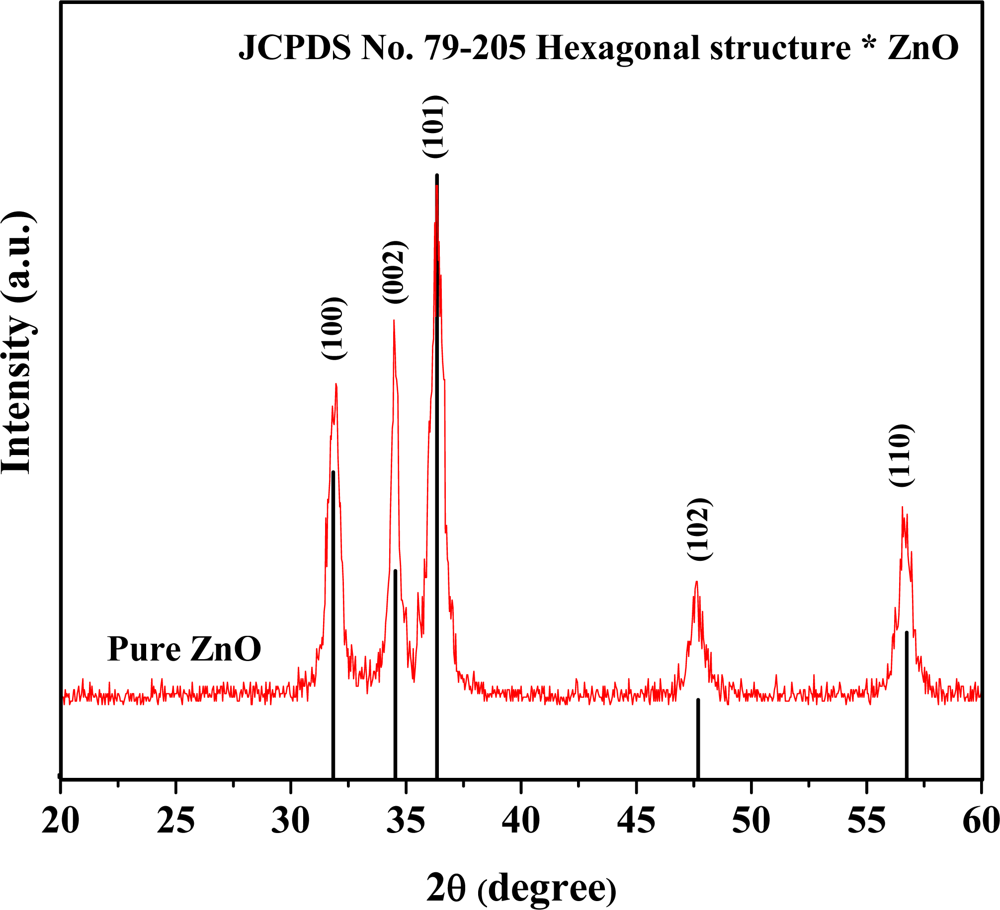
<p><xref ref-type="fig" rid="f1-sensors-10-07863-v2">Figure 1</xref> shows the XRD patterns of the undoped ZnO sample. All peaks can be confirmed to correspond to the hexagonal structure of ZnO (JCPDS No. 79-205).</p>
<p>An average BET equivalent particle diameter (<italic>d</italic><sub>BET</sub>) was calculated using the average density of ZnO as shown in <xref ref-type="table" rid="t2-sensors-10-07863-v2">Table 2</xref>. The accurate particle size and morphology of undoped ZnO dispersion were confirmed by SEM and TEM images.</p>
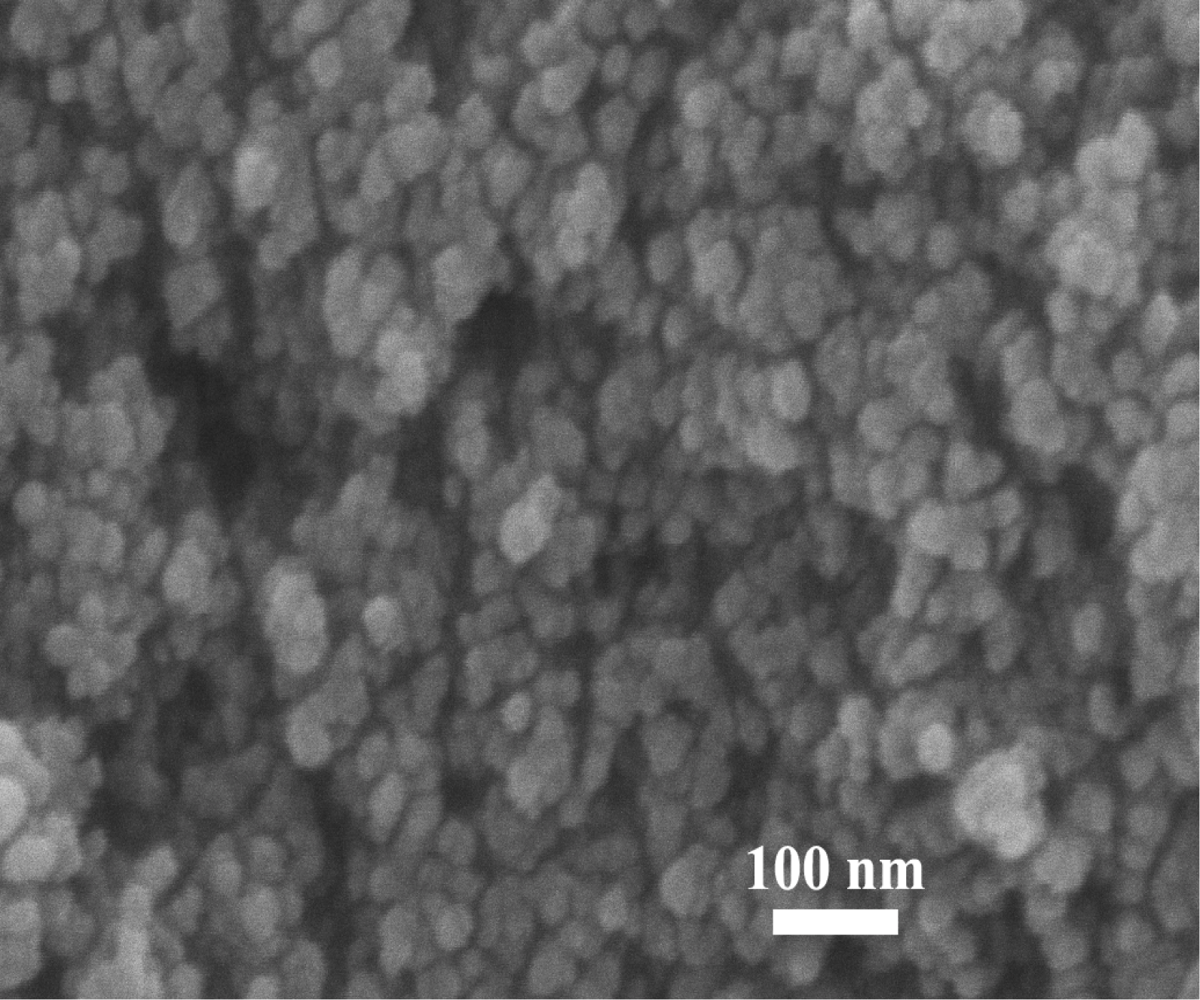
<p><xref ref-type="fig" rid="f2-sensors-10-07863-v2">Figure 2</xref> shows the morphology of highly crystalline flame-made (5/5) undoped ZnO nanoparticles from SEM analysis. The SEM micrograph clearly showed nanostructural homogeneities and remarkably different morphologies of the undoped ZnO nanoparticles synthesized by the FSP technique. The SEM result showed the presence of agglomerated nanospheres with an average diameter of 10–20 nm. Therefore, from this observation only the rough morphology was found. Nevertheless, the accurate sizes and morphology of the nanoparticles can be estimated from the TEM analysis. While the SEM images provide 3-D morphology and estimated particle sizes, TEM images can reveal internal structure and a more accurate measurement of particle size and morphology.</p>
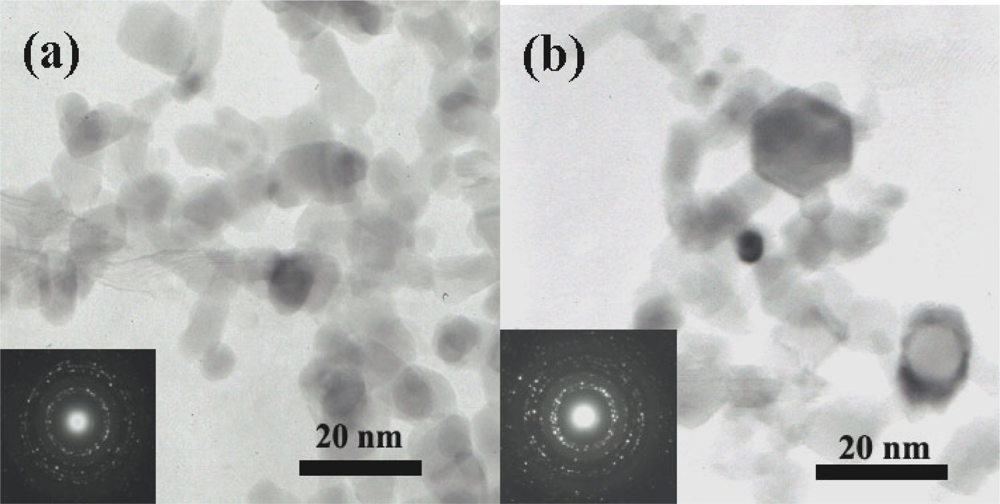
<p><xref ref-type="fig" rid="f3-sensors-10-07863-v2">Figure 3</xref> shows the TEM-bright-field images of undoped ZnO nanoparticles. The ZnO morphologies were revealed to be spherical, hexagonal and rod-like. The presence of ZnO spherical nanoparticles along with a few nanorods was observed as shown in <xref ref-type="fig" rid="f3-sensors-10-07863-v2">Figure 3(a)</xref>. The crystallite sizes of spherical particles were found to be in the range of 5–20 nm whereas the nanorods were found to be ranging from 5–20 nm in width and 20–40 nm in length. Hexagonal ZnO nanoparticles with the size of 5–20 nm were also observed, as shown in <xref ref-type="fig" rid="f3-sensors-10-07863-v2">Figure 3 (b)</xref>.</p></sec>
<sec>
<label>3.2.</label>
<title>SEM sensing layer</title>
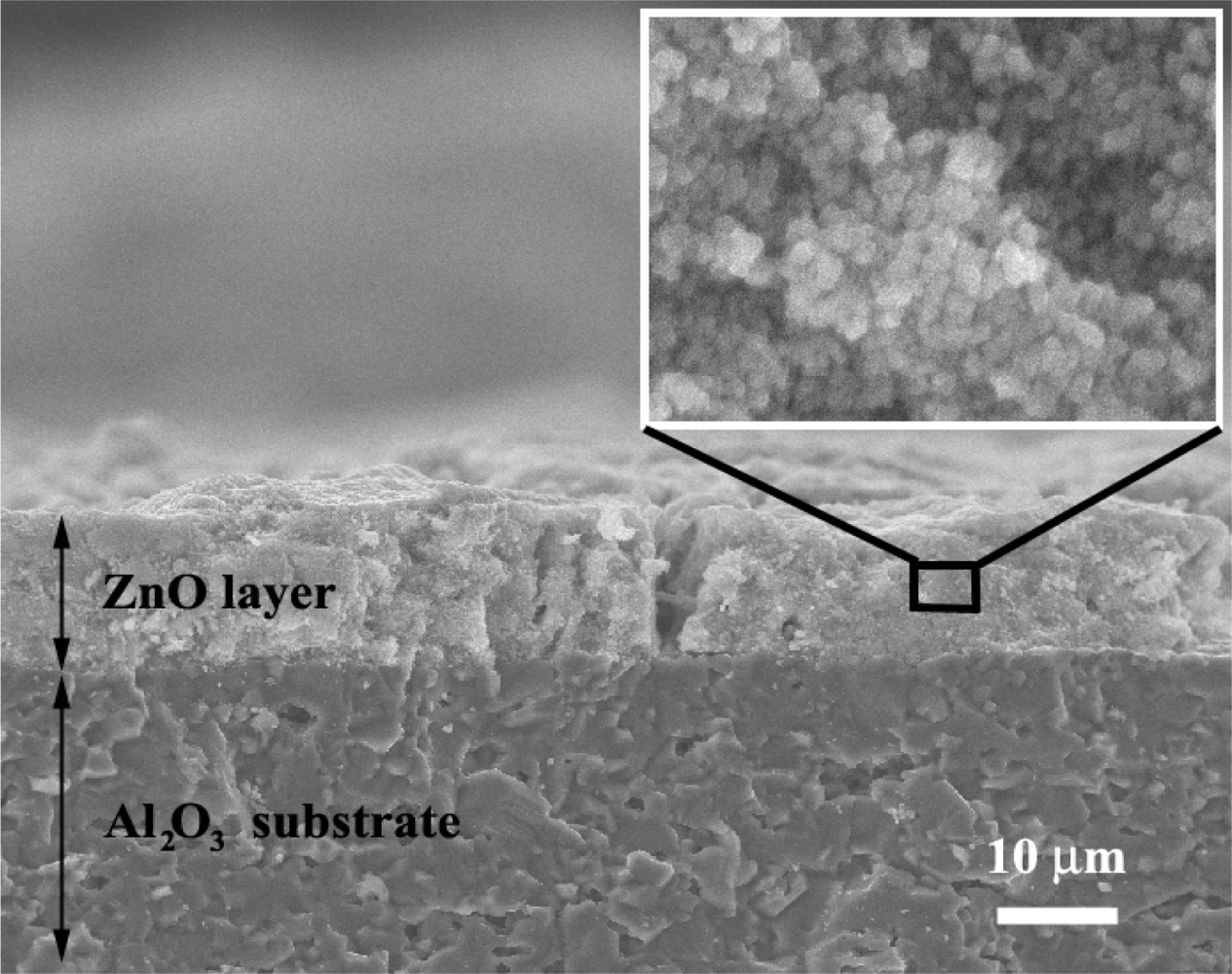
<p>The cross-section, film thickness, and surface morphology of the undoped ZnO sensing film layer after annealing and sensing test at 300 °C were observed using SEM analysis, as shown in <xref ref-type="fig" rid="f4-sensors-10-07863-v2">Figure 4</xref>. The thickness of sensing film was approximately 10 μm (side view) which benefited tremendously the NO<sub>2</sub>, C<sub>2</sub>H<sub>5</sub>OH and SO<sub>2</sub> gas sensing properties. Irregularities in the film thickness (top view) stem from the spin coating technique. The high density Al<sub>2</sub>O<sub>3</sub> substrate interdigitated with Au electrodes was also visible. After the annealing process, a denser film layer was formed.</p>
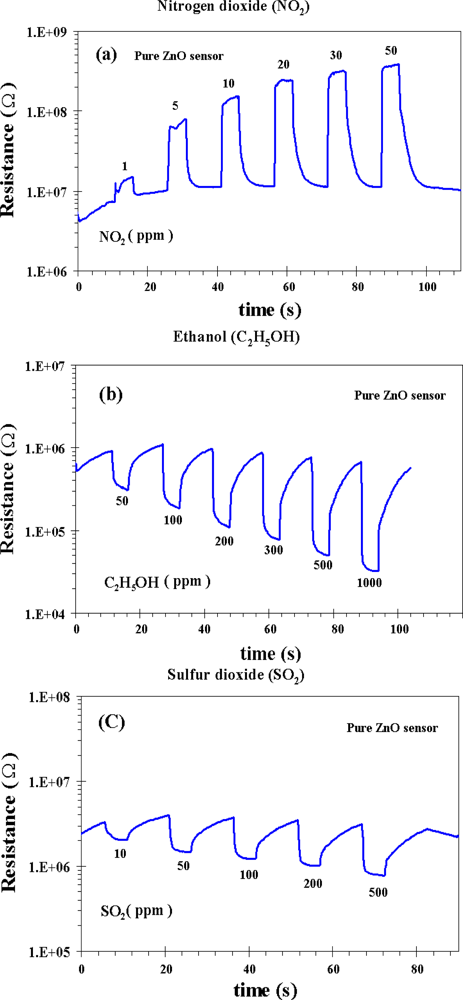
<p>The sensitivity and response time of the thick films of the undoped ZnO nanoparticles as a function of NO<sub>2</sub>, C<sub>2</sub>H<sub>5</sub>OH and SO<sub>2</sub> concentrations at 300 °C are shown in <xref ref-type="fig" rid="f5-sensors-10-07863-v2">Figure 5</xref>. In <xref ref-type="fig" rid="f5-sensors-10-07863-v2">Figure 5(a)</xref>, it can be seen that the sensitivity toward NO<sub>2</sub> is increased considerably at 50 ppm NO<sub>2</sub> concentration. The sensitivity and response time for the undoped ZnO nanoparticles at 50 ppm NO<sub>2</sub> concentration were found to be 33 and 7 s, respectively. The sensitivity, however, are decreased considerably by testing the undoped ZnO sensor with C<sub>2</sub>H<sub>5</sub>OH and SO<sub>2</sub> at 50 ppm concentration of each gas. The sensitivity of 7 and 3 with the response time of 94 and 17 s are obtained at 50 ppm of C<sub>2</sub>H<sub>5</sub>OH and 50 ppm of SO<sub>2</sub>, respectively. It is important to note that the undoped ZnO nanoparticles behave as an n-type semiconductor with decreased resistance during NO<sub>2</sub>, C<sub>2</sub>H<sub>5</sub>OH and SO<sub>2</sub> gas exposure, which is a typical behavior of ZnO material [<xref ref-type="bibr" rid="b33-sensors-10-07863-v2">33</xref>]. The gas-sensing sensitivity, <italic>S</italic>, is defined as the ratio of <italic>R<sub>a</sub>/R<sub>g</sub></italic> where <italic>R<sub>a</sub></italic> is the resistance in dry air, and <italic>R<sub>g</sub></italic> is the resistance in test gas. The response time, <italic>T</italic><sub>res</sub>, is defined as the time required until 90% of the response signal is reached. The recovery time, <italic>T</italic><sub>rec</sub>, denotes the time needed until 90% of the original baseline signal is recovered. The sensor behaviors under the operating temperature of 300 °C versus the NO<sub>2</sub> concentrations ranging from 1–50 ppm for the flame-made undoped ZnO nanoparticles were plotted as shown in <xref ref-type="fig" rid="f5-sensors-10-07863-v2">Figure 5(a)</xref>. The changes in resistance of the undoped ZnO sensor for C<sub>2</sub>H<sub>5</sub>OH and SO<sub>2</sub> gases under exposure to 50–1,000 ppm of C<sub>2</sub>H<sub>5</sub>OH and 10–500 ppm of SO<sub>2</sub> during forward cycle at 300 °C are shown in <xref ref-type="fig" rid="f5-sensors-10-07863-v2">Figures 5(b,c)</xref>, respectively.</p>
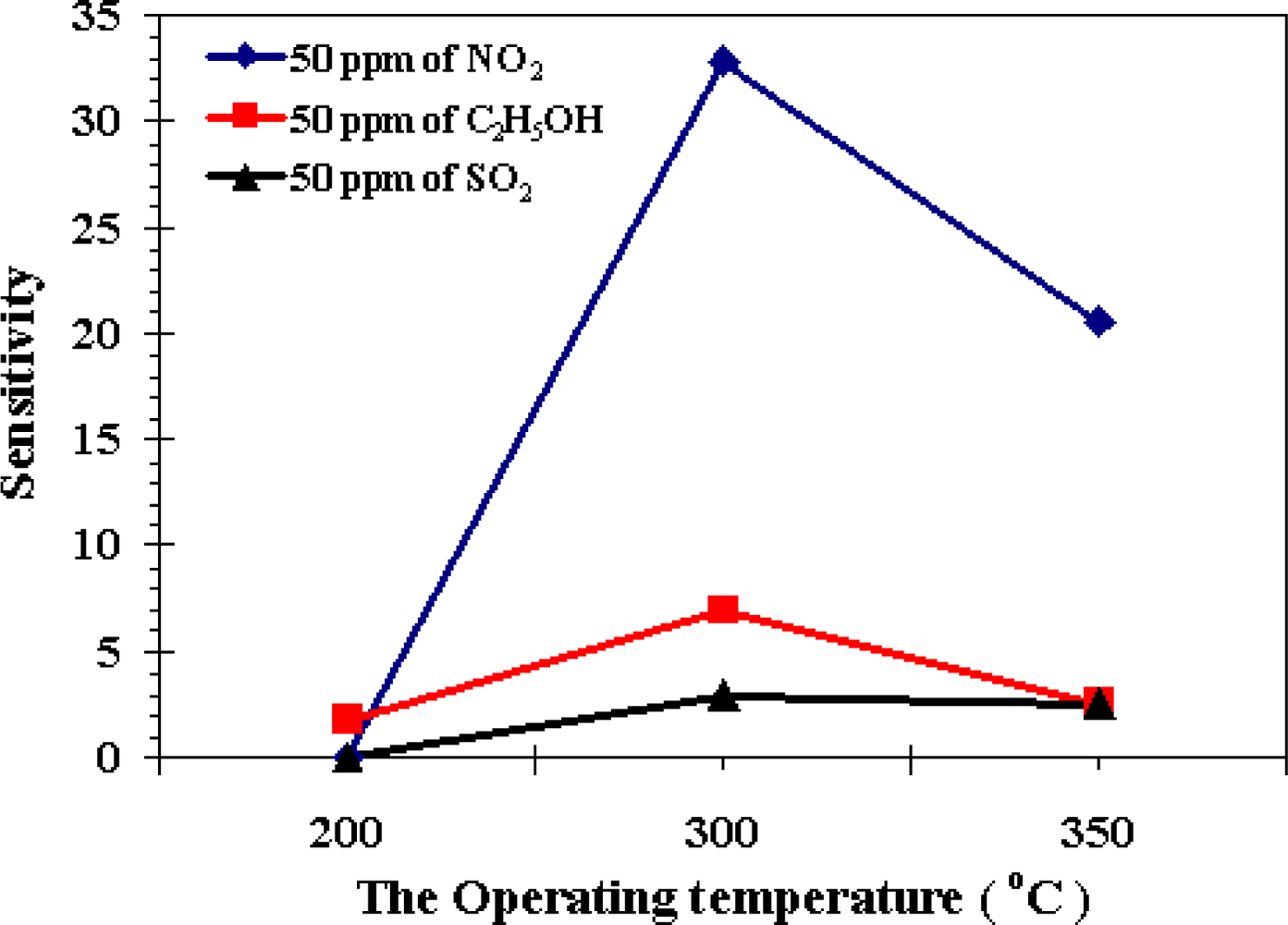
<p>It is well known that the sensitivity of a semiconductor gas sensor is highly influenced by its operating temperature [<xref ref-type="bibr" rid="b34-sensors-10-07863-v2">34</xref>,<xref ref-type="bibr" rid="b35-sensors-10-07863-v2">35</xref>]. In order to determine the optimum operating temperatures, the response of the undoped ZnO gas sensor to 50 ppm concentration of nitrogen dioxide, ethanol and sulfur dioxide in air was tested as a function of operating temperature, as shown in <xref ref-type="fig" rid="f6-sensors-10-07863-v2">Figure 6</xref>. It is clear that the responses of three gases tested varied with operating temperature. The sensitivity to NO<sub>2</sub> first increased with temperature, up to 300 °C, and then gradually decreased. The maximum sensitivity towards NO<sub>2</sub> was 33, at 300 °C. For ethanol and SO<sub>2</sub>, the sensitivity continuously increased when operating temperatures varied from 200 to 300 °C, and then decreased. The maximum sensitivities obtained were 7 and 3, at 300 °C. Therefore, optimal operating temperatures of 300 °C were chosen for NO<sub>2</sub>, ethanol and SO<sub>2</sub> respectively, to further examine the characteristics of the gas sensor. Results suggest that the undoped ZnO sensor can act as a multifunctional selective gas sensor, detecting NO<sub>2</sub>, ethanol and SO<sub>2</sub> gases. In other words, the above mentioned sensor can be used as an excellent NO<sub>2</sub> sensor at an operating temperature of 300 °C.</p>
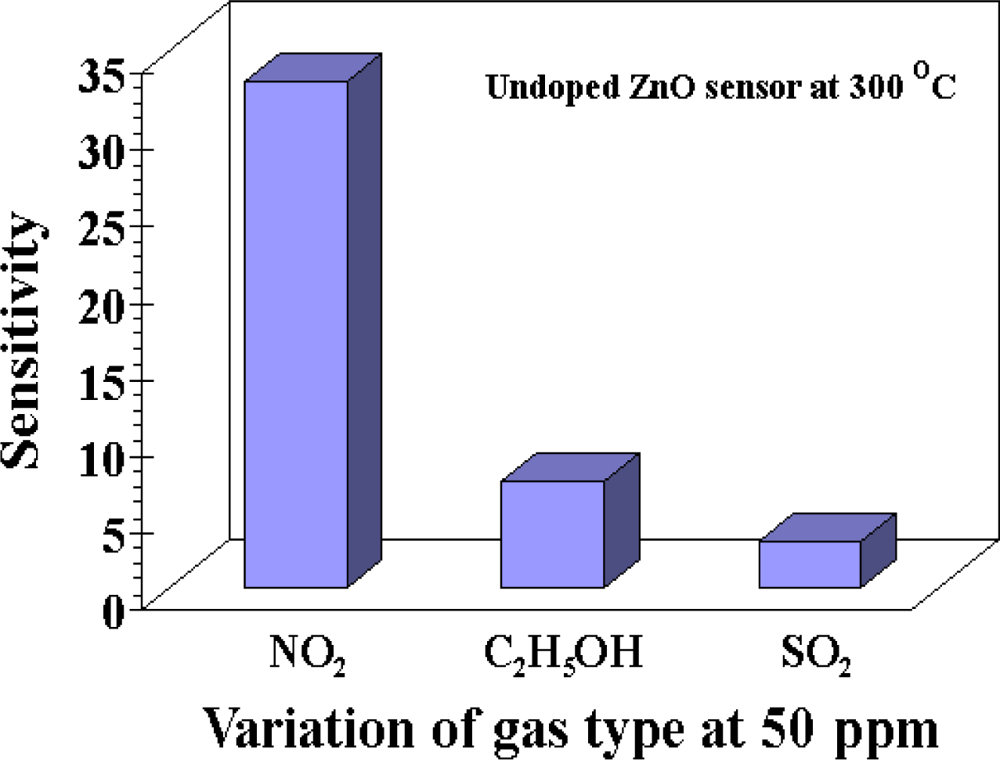
<p>The gas sensing selectivity of the undoped ZnO gas sensor has been characterized towards one common oxidizing gas, nitrogen dioxide (NO<sub>2</sub>), and two other common reducing gases, ethanol (C<sub>2</sub>H<sub>5</sub>OH) and sulfur dioxide (SO<sub>2</sub>) as shown in <xref ref-type="fig" rid="f7-sensors-10-07863-v2">Figure 7</xref>. In <xref ref-type="fig" rid="f7-sensors-10-07863-v2">Figure 7</xref>, the sensitivities towards NO<sub>2</sub>, C<sub>2</sub>H<sub>5</sub>OH and SO<sub>2</sub> under the operating temperature of 300 °C were found to be 33, 7 and 3, respectively. This indicates an excellent NO<sub>2</sub> selectivity of our undoped ZnO gas sensor.</p>
<p>The sensitivities of the flame-made ZnO sensor towards different concentrations of NO<sub>2</sub>, C<sub>2</sub>H<sub>5</sub>OH and SO<sub>2</sub> gases obtained from our studies are summarized in <xref ref-type="table" rid="t3-sensors-10-07863-v2">Table 3</xref>. In comparison with the previously reported sensitivities of other ZnO sensors given in <xref ref-type="table" rid="t1-sensors-10-07863-v2">Table 1</xref> [<xref ref-type="bibr" rid="b21-sensors-10-07863-v2">21</xref>–<xref ref-type="bibr" rid="b24-sensors-10-07863-v2">24</xref>], the flame-made ZnO films showed higher sensitivity towards the same NO<sub>2</sub> concentration in all cases. Sensitivity of flame-made ZnO films towards 100 ppm of SO<sub>2</sub> was 2.8, whereas the result from Lupan <italic>et al</italic>. [<xref ref-type="bibr" rid="b26-sensors-10-07863-v2">26</xref>] was less than 0.5. Likewise flame-made ZnO films showed sensitivity towards 200, 300 and 500 ppm of ethanol as 18.2, 22.4 and 27.5 respectively which were higher than the values reported by Singh <italic>et al.</italic> [<xref ref-type="bibr" rid="b28-sensors-10-07863-v2">28</xref>] and Hieu <italic>et al.</italic> [<xref ref-type="bibr" rid="b31-sensors-10-07863-v2">31</xref>].</p></sec></sec>
<sec sec-type="conclusions">
<label>4.</label>
<title>Conclusions</title>
<p>In summary, we have shown that FSP is a promising technique for the synthesis of high purity nano-sized materials with controlled size and crystallinity in a single step, exemplified by the fabrication of an undoped ZnO array sensor that can sense NO<sub>2</sub>, C<sub>2</sub>H<sub>5</sub>OH and SO<sub>2</sub> gases. The undoped ZnO-based NO<sub>2</sub> gas sensor showed the lowest detection limit of 1 ppm with short response and recovery time. Moreover, the sensors showed a high selectivity towards NO<sub>2</sub> at 300 °C when compared with C<sub>2</sub>H<sub>5</sub>OH and SO<sub>2</sub> gases, respectively. The sensitivity of undoped ZnO film towards 50 ppm of NO<sub>2</sub>, C<sub>2</sub>H<sub>5</sub>OH and SO<sub>2</sub> were 33, 7 and 3 respectively.</p></sec></body>
<back>
<ack>
<p>The authors gratefully acknowledge the financial support from the Office of Higher Education Commision, Ministry of Education; the Graduate School and Department of Chemistry, Faculty of Science, Chiang Mai University, Thailand; the National Nanotechnology Center and the National Electronics and Computer Technology Center, Pathumthani, Thailand.</p></ack>
<ref-list>
<title>References</title>
<ref id="b1-sensors-10-07863-v2"><label>1.</label><citation citation-type="journal"><person-group person-group-type="author"><name><surname>Cheng</surname><given-names>XL</given-names></name><name><surname>Zhao</surname><given-names>H</given-names></name><name><surname>Huo</surname><given-names>LH</given-names></name><name><surname>Gao</surname><given-names>S</given-names></name><name><surname>Zhao</surname><given-names>JG</given-names></name></person-group><article-title>ZnO nanoparticulate thin film: Preparation, characterization and gas-sensing property</article-title><source>Sens. Actuat. B Chem</source><year>2004</year><volume>102</volume><fpage>248</fpage><lpage>252</lpage><pub-id pub-id-type="doi">10.1016/j.snb.2004.04.080</pub-id></citation></ref>
<ref id="b2-sensors-10-07863-v2"><label>2.</label><citation citation-type="journal"><person-group person-group-type="author"><name><surname>Nunes</surname><given-names>P</given-names></name><name><surname>Fernandes</surname><given-names>B</given-names></name><name><surname>Fortunato</surname><given-names>E</given-names></name><name><surname>Vilarinho</surname><given-names>P</given-names></name><name><surname>Martins</surname><given-names>R</given-names></name></person-group><article-title>Performances presented by zinc oxide thin films deposited by spray pyrolysis</article-title><source>Thin Solid Films</source><year>1999</year><volume>337</volume><fpage>176</fpage><lpage>179</lpage><pub-id pub-id-type="doi">10.1016/S0040-6090(98)01394-7</pub-id></citation></ref>
<ref id="b3-sensors-10-07863-v2"><label>3.</label><citation citation-type="journal"><person-group person-group-type="author"><name><surname>Jiaqiang</surname><given-names>X</given-names></name><name><surname>Yuping</surname><given-names>C</given-names></name><name><surname>Yadong</surname><given-names>L</given-names></name><name><surname>Jianian</surname><given-names>S</given-names></name></person-group><article-title>Gas sensing properties of ZnO nanorods prepared by hydrothermal method</article-title><source>J. Mater. Sci</source><year>2005</year><volume>40</volume><fpage>2919</fpage><lpage>2921</lpage><pub-id pub-id-type="doi">10.1007/s10853-005-2435-4</pub-id></citation></ref>
<ref id="b4-sensors-10-07863-v2"><label>4.</label><citation citation-type="journal"><person-group person-group-type="author"><name><surname>Baruwati</surname><given-names>B</given-names></name><name><surname>Kumar</surname><given-names>DK</given-names></name><name><surname>Manorama</surname><given-names>SV</given-names></name></person-group><article-title>Hydrothermal synthesis of highly crystalline ZnO nanoparticles: A competitive sensor for LPG and EtOH</article-title><source>Sens. Actuat. B Chem</source><year>2006</year><volume>119</volume><fpage>676</fpage><lpage>682</lpage><pub-id pub-id-type="doi">10.1016/j.snb.2006.01.028</pub-id></citation></ref>
<ref id="b5-sensors-10-07863-v2"><label>5.</label><citation citation-type="journal"><person-group person-group-type="author"><name><surname>Li</surname><given-names>D</given-names></name><name><surname>McCann</surname><given-names>JT</given-names></name><name><surname>Xia</surname><given-names>Y</given-names></name></person-group><article-title>Electrospinning: A simple and versatile technique for producing ceramic nanofibers and nanotubes</article-title><source>J. Am. Ceram. Soc</source><year>2006</year><volume>89</volume><fpage>1861</fpage><lpage>1869</lpage><pub-id pub-id-type="doi">10.1111/j.1551-2916.2006.00989.x</pub-id></citation></ref>
<ref id="b6-sensors-10-07863-v2"><label>6.</label><citation citation-type="journal"><person-group person-group-type="author"><name><surname>Gao</surname><given-names>T</given-names></name><name><surname>Wang</surname><given-names>TH</given-names></name></person-group><article-title>Synthesis and properties of multipod-shaped ZnO nanorods for gas-sensor applications</article-title><source>Appl. Phys. A</source><year>2005</year><volume>80</volume><fpage>1451</fpage><lpage>1454</lpage><pub-id pub-id-type="doi">10.1007/s00339-004-3075-2</pub-id></citation></ref>
<ref id="b7-sensors-10-07863-v2"><label>7.</label><citation citation-type="journal"><person-group person-group-type="author"><name><surname>Umar</surname><given-names>A</given-names></name><name><surname>Suh</surname><given-names>EK</given-names></name><name><surname>Hahn</surname><given-names>YB</given-names></name></person-group><article-title>Growth and optical properties of large-quantity single-crystalline ZnO rods by thermal evaporation</article-title><source>J. Phys. D</source><year>2007</year><volume>40</volume><fpage>3478</fpage><lpage>3484</lpage><pub-id pub-id-type="doi">10.1088/0022-3727/40/11/032</pub-id></citation></ref>
<ref id="b8-sensors-10-07863-v2"><label>8.</label><citation citation-type="journal"><person-group person-group-type="author"><name><surname>Sun</surname><given-names>ZP</given-names></name><name><surname>Liu</surname><given-names>L</given-names></name><name><surname>Zhang</surname><given-names>L</given-names></name><name><surname>Jia</surname><given-names>DZ</given-names></name></person-group><article-title>Rapid synthesis of ZnO nano-rods by onestep room-temperature, solid-state reaction and their gas-sensing properties</article-title><source>Nanotechnology</source><year>2006</year><volume>17</volume><fpage>2266</fpage><lpage>2270</lpage><pub-id pub-id-type="doi">10.1088/0957-4484/17/9/032</pub-id></citation></ref>
<ref id="b9-sensors-10-07863-v2"><label>9.</label><citation citation-type="journal"><person-group person-group-type="author"><name><surname>Rout</surname><given-names>CS</given-names></name><name><surname>Krishna</surname><given-names>SH</given-names></name><name><surname>Vivekchand</surname><given-names>SRC</given-names></name><name><surname>Govindaraj</surname><given-names>A</given-names></name><name><surname>Rao</surname><given-names>CNR</given-names></name></person-group><article-title>Hydrogen and ethanol sensors based on ZnO nanorods, nanowires and nanotubes</article-title><source>Chem. Phys. Lett</source><year>2006</year><volume>418</volume><fpage>586</fpage><lpage>590</lpage><pub-id pub-id-type="doi">10.1016/j.cplett.2005.11.040</pub-id></citation></ref>
<ref id="b10-sensors-10-07863-v2"><label>10.</label><citation citation-type="journal"><person-group person-group-type="author"><name><surname>Li</surname><given-names>C</given-names></name><name><surname>Li</surname><given-names>L</given-names></name><name><surname>Du</surname><given-names>Z</given-names></name><name><surname>Yu</surname><given-names>H</given-names></name><name><surname>Xinag</surname><given-names>Y</given-names></name><name><surname>Li</surname><given-names>Y</given-names></name><name><surname>Cai</surname><given-names>Y</given-names></name><name><surname>Wang</surname><given-names>T</given-names></name></person-group><article-title>Rapid and ultrahigh ethanol sensing based on Au-coated ZnO nanorods</article-title><source>Nanotechnology</source><year>2008</year><volume>19</volume><fpage>35501-1</fpage><lpage>35501-4</lpage></citation></ref>
<ref id="b11-sensors-10-07863-v2"><label>11.</label><citation citation-type="journal"><person-group person-group-type="author"><name><surname>Chen</surname><given-names>Y</given-names></name><name><surname>Zhu</surname><given-names>CL</given-names></name><name><surname>Xiao</surname><given-names>G</given-names></name></person-group><article-title>Reduced-temperature ethanol sensing characteristics of flower-like ZnO nanorods synthesized by a sonochemical method</article-title><source>Nanotechnology</source><year>2006</year><volume>17</volume><fpage>4537</fpage><lpage>4541</lpage><pub-id pub-id-type="doi">10.1088/0957-4484/17/18/002</pub-id><pub-id pub-id-type="pmid">21727574</pub-id></citation></ref>
<ref id="b12-sensors-10-07863-v2"><label>12.</label><citation citation-type="journal"><person-group person-group-type="author"><name><surname>Guo</surname><given-names>G</given-names></name><name><surname>Guo</surname><given-names>J</given-names></name><name><surname>Tao</surname><given-names>D</given-names></name><name><surname>Choy</surname><given-names>WCH</given-names></name><name><surname>Zhao</surname><given-names>L</given-names></name><name><surname>Qian</surname><given-names>W</given-names></name><name><surname>Wang</surname><given-names>Z</given-names></name></person-group><article-title>A simple method to prepare multi-walled carbon nanotubes/ZnO nanoparticles composites</article-title><source>Appl. Phys. A</source><year>2007</year><volume>89</volume><fpage>525</fpage><lpage>528</lpage><pub-id pub-id-type="doi">10.1007/s00339-007-4098-2</pub-id></citation></ref>
<ref id="b13-sensors-10-07863-v2"><label>13.</label><citation citation-type="journal"><person-group person-group-type="author"><name><surname>Yu</surname><given-names>K</given-names></name><name><surname>Zhang</surname><given-names>Y</given-names></name><name><surname>Luo</surname><given-names>L</given-names></name><name><surname>Wang</surname><given-names>W</given-names></name><name><surname>Zhu</surname><given-names>Z</given-names></name><name><surname>Wang</surname><given-names>J</given-names></name><name><surname>Cui</surname><given-names>Y</given-names></name><name><surname>Ma</surname><given-names>H</given-names></name><name><surname>Lu</surname><given-names>W</given-names></name></person-group><article-title>Growth and optical properties of quadrangular zinc oxide nanorods on copper-filled porous silicon</article-title><source>Appl. Phys. A</source><year>2004</year><volume>79</volume><fpage>443</fpage><lpage>446</lpage><pub-id pub-id-type="doi">10.1007/s00339-004-2706-y</pub-id></citation></ref>
<ref id="b14-sensors-10-07863-v2"><label>14.</label><citation citation-type="journal"><person-group person-group-type="author"><name><surname>Maedler</surname><given-names>L</given-names></name><name><surname>Kammler</surname><given-names>HK</given-names></name><name><surname>Mueller</surname><given-names>R</given-names></name><name><surname>Pratsinis</surname><given-names>SE</given-names></name></person-group><article-title>Controlled synthesis of nanostructured particles by flame spray pyrolysis</article-title><source>J. Aerosol. Sci</source><year>2002</year><volume>33</volume><fpage>369</fpage><lpage>389</lpage><pub-id pub-id-type="doi">10.1016/S0021-8502(01)00159-8</pub-id></citation></ref>
<ref id="b15-sensors-10-07863-v2"><label>15.</label><citation citation-type="journal"><person-group person-group-type="author"><name><surname>Gergintschew</surname><given-names>Z</given-names></name><name><surname>Forster</surname><given-names>H</given-names></name><name><surname>Kositza</surname><given-names>J</given-names></name><name><surname>Schipanski</surname><given-names>D</given-names></name></person-group><article-title>Two-dimensional numerical simulation of semiconductor gas sensors</article-title><source>Sens. Actuat. B Chem</source><year>1995</year><volume>26</volume><fpage>170</fpage><lpage>173</lpage><pub-id pub-id-type="doi">10.1016/0925-4005(94)01580-B</pub-id></citation></ref>
<ref id="b16-sensors-10-07863-v2"><label>16.</label><citation citation-type="journal"><person-group person-group-type="author"><name><surname>Egashira</surname><given-names>M</given-names></name><name><surname>Shimizu</surname><given-names>Y</given-names></name><name><surname>Takao</surname><given-names>Y</given-names></name><name><surname>Sako</surname><given-names>S</given-names></name></person-group><article-title>Variations in I–V characteristics of oxide semiconductors induced by oxidizing gases</article-title><source>Sens Actuat B Chem</source><year>1996</year><volume>35–36</volume><fpage>62</fpage><lpage>67</lpage></citation></ref>
<ref id="b17-sensors-10-07863-v2"><label>17.</label><citation citation-type="journal"><person-group person-group-type="author"><name><surname>Xu</surname><given-names>J</given-names></name><name><surname>Pan</surname><given-names>Q</given-names></name><name><surname>Shun</surname><given-names>Y</given-names></name><name><surname>Tian</surname><given-names>Z</given-names></name></person-group><article-title>Grain size control and gas sensing properties of ZnO gas sensor</article-title><source>Sens. Actuat. B Chem</source><year>2000</year><volume>66</volume><fpage>277</fpage><lpage>279</lpage><pub-id pub-id-type="doi">10.1016/S0925-4005(00)00381-6</pub-id></citation></ref>
<ref id="b18-sensors-10-07863-v2"><label>18.</label><citation citation-type="journal"><person-group person-group-type="author"><name><surname>Koshizaki</surname><given-names>N</given-names></name><name><surname>Oyama</surname><given-names>T</given-names></name></person-group><article-title>Sensing characteristics of ZnO-based NO sensor</article-title><source>Sens. Actuat. B Chem</source><year>2000</year><volume>66</volume><fpage>119</fpage><lpage>121</lpage><pub-id pub-id-type="doi">10.1016/S0925-4005(00)00323-3</pub-id></citation></ref>
<ref id="b19-sensors-10-07863-v2"><label>19.</label><citation citation-type="journal"><person-group person-group-type="author"><name><surname>Rao</surname><given-names>GST</given-names></name><name><surname>Rao</surname><given-names>DT</given-names></name></person-group><article-title>Gas sensitivity of ZnO based thick film sensor to NH<sub>3</sub> at room temperature</article-title><source>Sens. Actuat. B Chem</source><year>1999</year><volume>55</volume><fpage>166</fpage><lpage>169</lpage><pub-id pub-id-type="doi">10.1016/S0925-4005(99)00049-0</pub-id></citation></ref>
<ref id="b20-sensors-10-07863-v2"><label>20.</label><citation citation-type="journal"><person-group person-group-type="author"><name><surname>Law</surname><given-names>M</given-names></name><name><surname>Kind</surname><given-names>H</given-names></name><name><surname>Kim</surname><given-names>F</given-names></name><name><surname>Messer</surname><given-names>B</given-names></name><name><surname>Yang</surname><given-names>P</given-names></name></person-group><article-title>Photochemical sensing of NO<sub>2</sub> with SnO<sub>2</sub> nanoribbon nanosensors at room temperature</article-title><source>Angew. Chem. Int. Ed</source><year>2002</year><volume>41</volume><fpage>2405</fpage><lpage>2408</lpage><pub-id pub-id-type="doi">10.1002/1521-3773(20020703)41:13&lt;2405::AID-ANIE2405&gt;3.0.CO;2-3</pub-id></citation></ref>
<ref id="b21-sensors-10-07863-v2"><label>21.</label><citation citation-type="journal"><person-group person-group-type="author"><name><surname>Ghimbeu</surname><given-names>CM</given-names></name><name><surname>Schoonman</surname><given-names>J</given-names></name><name><surname>Lumbreras</surname><given-names>M</given-names></name><name><surname>Siadat</surname><given-names>M</given-names></name></person-group><article-title>Electrostatic spradeposited zinc oxide films for gas sensor applications</article-title><source>Appl. Surf. Sci</source><year>2007</year><volume>253</volume><fpage>7483</fpage><lpage>7489</lpage><pub-id pub-id-type="doi">10.1016/j.apsusc.2007.03.039</pub-id></citation></ref>
<ref id="b22-sensors-10-07863-v2"><label>22.</label><citation citation-type="journal"><person-group person-group-type="author"><name><surname>Cho</surname><given-names>PS</given-names></name><name><surname>Kim</surname><given-names>KW</given-names></name><name><surname>Lee</surname><given-names>JH</given-names></name></person-group><article-title>NO<sub>2</sub> sensing characteristics of ZnO nanorods prepared by hydrothermal method</article-title><source>J. Electroceram</source><year>2006</year><volume>17</volume><fpage>975</fpage><lpage>978</lpage><pub-id pub-id-type="doi">10.1007/s10832-006-8146-7</pub-id></citation></ref>
<ref id="b23-sensors-10-07863-v2"><label>23.</label><citation citation-type="journal"><person-group person-group-type="author"><name><surname>Sadek</surname><given-names>AZ</given-names></name><name><surname>Wlodarski</surname><given-names>W</given-names></name><name><surname>Kalantar-zadeh</surname><given-names>K</given-names></name><name><surname>Choopun</surname><given-names>S</given-names></name></person-group><source>ZnO Nanobelt Based Conductometric H<sub>2</sub> and NO<sub>2</sub> Gas Sensors. IEEE Sens. J</source><year>2005</year><pub-id pub-id-type="doi">10.1109/ICSENS.2005.1597952</pub-id></citation></ref>
<ref id="b24-sensors-10-07863-v2"><label>24.</label><citation citation-type="journal"><person-group person-group-type="author"><name><surname>Sadek</surname><given-names>AZ</given-names></name><name><surname>Choopun</surname><given-names>S</given-names></name><name><surname>Wlodarski</surname><given-names>W</given-names></name><name><surname>Ippolito</surname><given-names>SJ</given-names></name><name><surname>Kalantar-zadeh</surname><given-names>K</given-names></name></person-group><article-title>Characterization of ZnO nanobelt-based gas sensor for H<sub>2</sub>, NO<sub>2</sub>, and hydrocarbon sensing</article-title><source>J. IEEE Sens</source><year>2007</year><volume>7</volume><fpage>919</fpage><lpage>924</lpage></citation></ref>
<ref id="b25-sensors-10-07863-v2"><label>25.</label><citation citation-type="journal"><person-group person-group-type="author"><name><surname>Koshizaki</surname><given-names>N</given-names></name><name><surname>Oyama</surname><given-names>T</given-names></name></person-group><article-title>Sensing characteristics of ZnO-based NO sensor</article-title><source>Sens. Actuat. B Chem</source><year>2000</year><volume>66</volume><fpage>119</fpage><lpage>121</lpage><pub-id pub-id-type="doi">10.1016/S0925-4005(00)00323-3</pub-id></citation></ref>
<ref id="b26-sensors-10-07863-v2"><label>26.</label><citation citation-type="journal"><person-group person-group-type="author"><name><surname>Lupan</surname><given-names>O</given-names></name><name><surname>Chow</surname><given-names>L</given-names></name><name><surname>Chai</surname><given-names>G</given-names></name></person-group><article-title>A single ZnO tetrapod-based sensor</article-title><source>Sens. Actuat. B Chem</source><year>2009</year><volume>141</volume><fpage>511</fpage><lpage>517</lpage><pub-id pub-id-type="doi">10.1016/j.snb.2009.07.011</pub-id></citation></ref>
<ref id="b27-sensors-10-07863-v2"><label>27.</label><citation citation-type="journal"><person-group person-group-type="author"><name><surname>Zhang</surname><given-names>WD</given-names></name><name><surname>Zhang</surname><given-names>WH</given-names></name><name><surname>Ma</surname><given-names>XY</given-names></name></person-group><article-title>Tunable ZnO nanostructures for ethanol sensing</article-title><source>J. Mater. Sci</source><year>2009</year><volume>44</volume><fpage>4677</fpage><lpage>4682</lpage><pub-id pub-id-type="doi">10.1007/s10853-009-3716-0</pub-id></citation></ref>
<ref id="b28-sensors-10-07863-v2"><label>28.</label><citation citation-type="journal"><person-group person-group-type="author"><name><surname>Singh</surname><given-names>RC</given-names></name><name><surname>Singh</surname><given-names>O</given-names></name><name><surname>Singh</surname><given-names>MP</given-names></name><name><surname>Chandi</surname><given-names>PS</given-names></name></person-group><article-title>Synthesis of zinc oxide nanorods and nanoparticles by chemical route and their comparative study as ethanol sensors</article-title><source>Sens. Actuat. B Chem</source><year>2008</year><volume>135</volume><fpage>352</fpage><lpage>357</lpage><pub-id pub-id-type="doi">10.1016/j.snb.2008.09.004</pub-id></citation></ref>
<ref id="b29-sensors-10-07863-v2"><label>29.</label><citation citation-type="journal"><person-group person-group-type="author"><name><surname>Jing</surname><given-names>Z</given-names></name><name><surname>Zhan</surname><given-names>J</given-names></name></person-group><article-title>Fabrication and gas-sensing properties of porous ZnO nanoplates</article-title><source>Adv. Mater</source><year>2008</year><volume>20</volume><fpage>4547</fpage><lpage>4551</lpage><pub-id pub-id-type="doi">10.1002/adma.200800243</pub-id></citation></ref>
<ref id="b30-sensors-10-07863-v2"><label>30.</label><citation citation-type="journal"><person-group person-group-type="author"><name><surname>Xu</surname><given-names>J</given-names></name><name><surname>Zhang</surname><given-names>Y</given-names></name><name><surname>Chen</surname><given-names>Y</given-names></name><name><surname>Xiang</surname><given-names>Q</given-names></name><name><surname>Pan</surname><given-names>Q</given-names></name><name><surname>Shi</surname><given-names>L</given-names></name></person-group><article-title>Uniform ZnO nanorods can be used to improve the response of ZnO gas sensor</article-title><source>Mater. Sci. Eng. B</source><year>2008</year><volume>150</volume><fpage>55</fpage><lpage>60</lpage><pub-id pub-id-type="doi">10.1016/j.mseb.2008.01.010</pub-id></citation></ref>
<ref id="b31-sensors-10-07863-v2"><label>31.</label><citation citation-type="journal"><person-group person-group-type="author"><name><surname>Hieu</surname><given-names>NV</given-names></name><name><surname>Chien</surname><given-names>ND</given-names></name></person-group><article-title>Low-temperature growth and ethanol-sensing characteristics of quasi-one-dimensional ZnO nanostructures</article-title><source>Phys. B</source><year>2008</year><volume>403</volume><fpage>50</fpage><lpage>56</lpage><pub-id pub-id-type="doi">10.1016/j.physb.2007.08.006</pub-id></citation></ref>
<ref id="b32-sensors-10-07863-v2"><label>32.</label><citation citation-type="journal"><person-group person-group-type="author"><name><surname>Oh</surname><given-names>E</given-names></name><name><surname>Choi</surname><given-names>H-Y</given-names></name><name><surname>Jung</surname><given-names>S-H</given-names></name><name><surname>Cho</surname><given-names>S</given-names></name><name><surname>Kim</surname><given-names>JC</given-names></name><name><surname>Lee</surname><given-names>K-H</given-names></name><name><surname>Kang</surname><given-names>S-W</given-names></name><name><surname>Kim</surname><given-names>J</given-names></name><name><surname>Yun</surname><given-names>J-Y</given-names></name></person-group><article-title>High-performance NO<sub>2</sub> gas sensor based on ZnO nanorod grown by ultrasonic irradiation</article-title><source>Sens. Actuat. B Chem</source><year>2009</year><volume>141</volume><fpage>239</fpage><lpage>243</lpage><pub-id pub-id-type="doi">10.1016/j.snb.2009.06.031</pub-id></citation></ref>
<ref id="b33-sensors-10-07863-v2"><label>33.</label><citation citation-type="journal"><person-group person-group-type="author"><name><surname>Wan</surname><given-names>Q</given-names></name><name><surname>Li</surname><given-names>QH</given-names></name><name><surname>Chen</surname><given-names>YJ</given-names></name><name><surname>He</surname><given-names>XL</given-names></name><name><surname>Li</surname><given-names>JP</given-names></name><name><surname>Lin</surname><given-names>CL</given-names></name><name><surname>Wang</surname><given-names>TH</given-names></name></person-group><article-title>Fabrication and ethanol sensing characteristics of ZnO nanowire gas sensors</article-title><source>Appl. Phys. Lett</source><year>2004</year><volume>84</volume><fpage>3654</fpage><lpage>3656</lpage><pub-id pub-id-type="doi">10.1063/1.1738932</pub-id></citation></ref>
<ref id="b34-sensors-10-07863-v2"><label>34.</label><citation citation-type="journal"><person-group person-group-type="author"><name><surname>Shinde</surname><given-names>VR</given-names></name><name><surname>Gujar</surname><given-names>TP</given-names></name><name><surname>Lokhande</surname><given-names>CD</given-names></name></person-group><article-title>Enhanced response of porous ZnO nanobeads towards LPG:Effect of Pd sensitization</article-title><source>Sens. Actuat. B Chem</source><year>2007</year><volume>123</volume><fpage>701</fpage><lpage>706</lpage><pub-id pub-id-type="doi">10.1016/j.snb.2006.10.003</pub-id></citation></ref>
<ref id="b35-sensors-10-07863-v2"><label>35.</label><citation citation-type="journal"><person-group person-group-type="author"><name><surname>Gonga</surname><given-names>H</given-names></name><name><surname>Hua</surname><given-names>JQ</given-names></name><name><surname>Wang</surname><given-names>JH</given-names></name><name><surname>Onga</surname><given-names>CH</given-names></name><name><surname>Zhub</surname><given-names>FR</given-names></name></person-group><article-title>Nano-crystalline Cu-doped ZnO thin film gas sensor for CO</article-title><source>Sens. Actuat. B Chem</source><year>2006</year><volume>115</volume><fpage>247</fpage><lpage>251</lpage><pub-id pub-id-type="doi">10.1016/j.snb.2005.09.008</pub-id></citation></ref></ref-list>
<sec sec-type="display-objects">
<title>Figures and Tables</title>
<fig id="f1-sensors-10-07863-v2" position="float">
<label>Figure 1.</label>
<caption>
<p>The XRD patterns of flame-spray-made (5/5) undoped ZnO nanopowders.</p></caption>
<graphic xlink:href="sensors-10-07863-v2f1.gif"/></fig>
<fig id="f2-sensors-10-07863-v2" position="float">
<label>Figure 2.</label>
<caption>
<p>The SEM micrograph of highly crystalline flame-made (5/5) undoped ZnO nanoparticles.</p></caption>
<graphic xlink:href="sensors-10-07863-v2f2.gif"/></fig>
<fig id="f3-sensors-10-07863-v2" position="float">
<label>Figure 3.</label>
<caption>
<p>The TEM images of undoped ZnO morphologies showing the spherical, hexagonal and rod-like shapes.</p></caption>
<graphic xlink:href="sensors-10-07863-v2f3.gif"/></fig>
<fig id="f4-sensors-10-07863-v2" position="float">
<label>Figure 4.</label>
<caption>
<p>The SEM micrographs of flame-made undoped ZnO thick films sensor on an Al<sub>2</sub>O<sub>3</sub> substrate interdigitated with Au electrodes after annealing and sensing test at 300 °C in dry air. The film thickness was approximately 10 μm.</p></caption>
<graphic xlink:href="sensors-10-07863-v2f4.gif"/></fig>
<fig id="f5-sensors-10-07863-v2" position="float">
<label>Figure 5.</label>
<caption>
<p>The change in resistance of undoped ZnO sensor for NO<sub>2</sub> <bold>(a)</bold> C<sub>2</sub>H<sub>5</sub>OH <bold>(b)</bold> and SO<sub>2</sub> <bold>(c)</bold> gases under exposure to oxidizing gas of NO<sub>2</sub> and reducing gases of C<sub>2</sub>H<sub>5</sub>OH and SO<sub>2</sub> during forward cycle at 300 °C, respectively.</p></caption>
<graphic xlink:href="sensors-10-07863-v2f5.gif"/></fig>
<fig id="f6-sensors-10-07863-v2" position="float">
<label>Figure 6.</label>
<caption>
<p>The sensitivity <italic>versus</italic> variation of the operating temperature of NO<sub>2</sub>, C<sub>2</sub>H<sub>5</sub>OH and SO<sub>2</sub> (at 50 ppm of concentration) for the undoped ZnO sensor.</p></caption>
<graphic xlink:href="sensors-10-07863-v2f6.gif"/></fig>
<fig id="f7-sensors-10-07863-v2" position="float">
<label>Figure 7.</label>
<caption>
<p>The sensitivity variation of the undoped ZnO sensor testing with 50 ppm concentration of NO<sub>2</sub>, C<sub>2</sub>H<sub>5</sub>OH and SO<sub>2</sub> under the operating temperature of 300 °C.</p></caption>
<graphic xlink:href="sensors-10-07863-v2f7.gif"/></fig>
<table-wrap id="t1-sensors-10-07863-v2" position="float">
<label>Table 1.</label>
<caption>
<p>A summary on the gas sensing properties of differently-prepared undoped ZnO for NO<sub>2</sub>, ethanol (C<sub>2</sub>H<sub>5</sub>OH) and SO<sub>2</sub> gases.</p></caption>
<table frame="box" rules="all">
<thead>
<tr>
<th align="left" valign="middle"><bold>Authors [ref.]</bold></th>
<th align="left" valign="middle"><bold>Method</bold></th>
<th align="center" valign="middle"><bold>Nanoparticles</bold></th>
<th align="center" valign="middle"><bold>Gas concentration</bold></th>
<th align="center" valign="middle"><bold>Sensitivity</bold></th></tr></thead>
<tbody>
<tr>
<td align="left" valign="middle"><bold>Ghimbeu <italic>et al</italic>. [<xref ref-type="bibr" rid="b21-sensors-10-07863-v2">21</xref>]</bold></td>
<td align="left" valign="middle">Electrostatic spray deposition (ESD) technique</td>
<td align="left" valign="middle">Undoped ZnO</td>
<td align="left" valign="middle">1 ppm of NO<sub>2</sub>, at 300 °C</td>
<td align="left" valign="middle">∼1.84</td></tr>
<tr>
<td align="left" valign="middle"><bold>Cho <italic>et al.</italic> [<xref ref-type="bibr" rid="b22-sensors-10-07863-v2">22</xref>]</bold></td>
<td align="left" valign="middle">Hydrothermal</td>
<td align="left" valign="middle">Undoped ZnO</td>
<td align="left" valign="middle">1 ppm of NO<sub>2</sub>, at 300 °C</td>
<td align="left" valign="middle">∼1.8</td></tr>
<tr>
<td align="left" valign="middle"><bold>Sadek <italic>et al.</italic> [<xref ref-type="bibr" rid="b23-sensors-10-07863-v2">23</xref>]</bold></td>
<td align="left" valign="middle">Conventional solid-state method</td>
<td align="left" valign="middle">Undoped ZnO</td>
<td align="left" valign="middle">10 ppm of NO<sub>2</sub>, at 350 °C</td>
<td align="left" valign="middle">∼1.81</td></tr>
<tr>
<td align="left" valign="middle"><bold>Lupan <italic>et al.</italic> [<xref ref-type="bibr" rid="b26-sensors-10-07863-v2">26</xref>]</bold></td>
<td align="left" valign="middle">A solution method</td>
<td align="left" valign="middle">Undoped ZnO</td>
<td align="left" valign="middle">100 ppm of SO<sub>2</sub></td>
<td align="left" valign="middle">&lt;0.5</td></tr>
<tr>
<td align="left" valign="middle"><bold>Singh <italic>et al.</italic> [<xref ref-type="bibr" rid="b28-sensors-10-07863-v2">28</xref>]</bold></td>
<td align="left" valign="middle">A simple chemical route</td>
<td align="left" valign="middle">Undoped ZnO</td>
<td align="left" valign="middle">250 ppm of ethanol, at 400, 600 and 800 °C</td>
<td align="left" valign="middle">∼6.5, 5.6 and 4,</td></tr>
<tr>
<td align="left" valign="middle"><bold>Hieu <italic>et al.</italic> [<xref ref-type="bibr" rid="b31-sensors-10-07863-v2">31</xref>]</bold></td>
<td align="left" valign="middle">Thermal evaporation</td>
<td align="left" valign="middle">Undoped ZnO</td>
<td align="left" valign="middle">500 ppm of ethanol, at 300 °C</td>
<td align="left" valign="middle">5.3</td></tr>
<tr>
<td align="left" valign="middle" rowspan="3"><bold>Present work</bold></td>
<td align="left" valign="middle" rowspan="3">Flame spray pyrolysis (FSP)</td>
<td align="left" valign="middle" rowspan="3">Undoped ZnO</td>
<td align="left" valign="middle">1, 5 and 10 ppm of NO<sub>2</sub>, at 300 °C</td>
<td align="left" valign="middle">∼2.7, 6.2 and 11.8</td></tr>
<tr>
<td align="left" valign="middle">100 ppm of SO<sub>2</sub>, at 300 °C</td>
<td align="left" valign="middle">∼2.8</td></tr>
<tr>
<td align="left" valign="middle">200, 300 and 500 ppm of ethanol, at 300 °C</td>
<td align="left" valign="middle">∼18.2, 22.4 and 27.5</td></tr></tbody></table></table-wrap>
<table-wrap id="t2-sensors-10-07863-v2" position="float">
<label>Table 2.</label>
<caption>
<p>The specific surface area (<italic>SSA</italic><sub>BET</sub>) and <italic>d</italic><sub>BET</sub> of undoped ZnO nanoparticles.</p></caption>
<table frame="box" rules="all">
<thead>
<tr>
<th align="center" valign="middle"><bold>Sample</bold></th>
<th align="center" valign="middle"><bold>Specific surface area (<italic>SSA</italic><sub>BET</sub>), (m<sup>2</sup>/g)</bold></th>
<th align="center" valign="middle"><bold><italic>d</italic><sub>BET</sub> (nm)</bold></th></tr></thead>
<tbody>
<tr>
<td align="center" valign="middle">Undoped ZnO</td>
<td align="center" valign="middle">78.8</td>
<td align="center" valign="middle">13.6</td></tr></tbody></table></table-wrap>
<table-wrap id="t3-sensors-10-07863-v2" position="float">
<label>Table 3.</label>
<caption>
<p>Sensitivity of flame-made undoped ZnO nanoparticles towards different concentrations of NO<sub>2</sub>, C<sub>2</sub>H<sub>5</sub>OH and SO<sub>2</sub> gases under the operating temperature of 300 °C.</p></caption>
<table frame="hsides" rules="groups">
<thead>
<tr>
<th align="center" valign="middle"><bold>Gas concentration</bold></th>
<th align="center" valign="middle"><bold>Sensitivity</bold></th></tr></thead>
<tbody>
<tr>
<td align="center" valign="middle">1, 5, 10, 20, 30 and 50 ppm of NO<sub>2</sub></td>
<td align="center" valign="middle">2.7, 6.2, 11.8, 18.5, 26.7 and 33</td></tr>
<tr>
<td align="center" valign="middle">100 ppm of SO<sub>2</sub></td>
<td align="center" valign="middle">2.8</td></tr>
<tr>
<td align="center" valign="middle">200,300, and 500 ppm of ethanol</td>
<td align="center" valign="middle">18.2, 22.4 and 27.5</td></tr></tbody></table></table-wrap></sec></back></article>