
<?xml version="1.0" encoding="UTF-8"?>
<!DOCTYPE article PUBLIC "-//NLM//DTD Journal Publishing DTD v2.3 20070202//EN" "journalpublishing.dtd">
<article xmlns:xlink="http://www.w3.org/1999/xlink" xml:lang="en" article-type="research-article">
<front>
<journal-meta>
<journal-id journal-id-type="nlm-ta">Sensors</journal-id>
<journal-title>Sensors</journal-title>
<issn pub-type="epub">1424-8220</issn>
<publisher>
<publisher-name>Molecular Diversity Preservation International (MDPI)</publisher-name></publisher></journal-meta>
<article-meta>
<article-id pub-id-type="doi">10.3390/s100201326</article-id>
<article-id pub-id-type="publisher-id">sensors-10-01326</article-id>
<article-categories>
<subj-group>
<subject>Communication</subject></subj-group></article-categories>
<title-group>
<article-title>A Lanthanide-Based Chemosensor for Bioavailable Fe<sup>3+</sup> Using a Fluorescent Siderophore: An Assay Displacement Approach</article-title></title-group>
<contrib-group>
<contrib contrib-type="author">
<name><surname>Orcutt</surname><given-names>Karen M.</given-names></name><xref ref-type="aff" rid="af1-sensors-10-01326"><sup>1</sup></xref><xref ref-type="corresp" rid="c1-sensors-10-01326"><sup>*</sup></xref></contrib>
<contrib contrib-type="author">
<name><surname>Jones</surname><given-names>W. Scott</given-names></name><xref ref-type="aff" rid="af2-sensors-10-01326"><sup>2</sup></xref></contrib>
<contrib contrib-type="author">
<name><surname>McDonald</surname><given-names>Andrea</given-names></name><xref ref-type="aff" rid="af2-sensors-10-01326"><sup>2</sup></xref></contrib>
<contrib contrib-type="author">
<name><surname>Schrock</surname><given-names>David</given-names></name><xref ref-type="aff" rid="af2-sensors-10-01326"><sup>2</sup></xref></contrib>
<contrib contrib-type="author">
<name><surname>Wallace</surname><given-names>Karl J.</given-names></name><xref ref-type="aff" rid="af2-sensors-10-01326"><sup>2</sup></xref></contrib></contrib-group>
<aff id="af1-sensors-10-01326">
<label>1</label> Department of Marine Science, University of Southern Mississippi, 1020 Balch Blvd. Stennis Space Center, MS 39529, USA</aff>
<aff id="af2-sensors-10-01326">
<label>2</label> Department of Chemistry and Biochemistry, University of Southern Mississippi, 118 College Drive, Hattiesburg, MS 39406, USA; E-Mail: <email>Karl.Wallace@usm.edu</email> (K.J.W.)</aff>
<author-notes>
<corresp id="c1-sensors-10-01326">
<label>*</label> Author to whom correspondence should be addressed; E-Mail: <email>Karen.Orcutt@usm.edu</email>; Tel.: +1-228-688-3154; Fax: +1-228-688-1121.</corresp></author-notes>
<pub-date pub-type="collection">
<year>2010</year></pub-date>
<pub-date pub-type="epub">
<day>11</day>
<month>2</month>
<year>2010</year></pub-date>
<volume>10</volume>
<issue>2</issue>
<fpage>1326</fpage>
<lpage>1337</lpage>
<history>
<date date-type="received">
<day>24</day>
<month>12</month>
<year>2009</year></date>
<date date-type="rev-recd">
<day>28</day>
<month>1</month>
<year>2010</year></date>
<date date-type="accepted">
<day>5</day>
<month>2</month>
<year>2010</year></date></history>
<permissions>
<copyright-statement>© 2010 by the authors; licensee Molecular Diversity Preservation International, Basel, Switzerland.</copyright-statement>
<copyright-year>2010</copyright-year>
<license>
<p>This article is an open access article distributed under the terms and conditions of the Creative Commons Attribution license (http://creativecommons.org/licenses/by/3.0/).</p></license></permissions>
<abstract>
<p>The measurement of trace analytes in aqueous systems has become increasingly important for understanding ocean primary productivity. In oceanography, iron (Fe) is a key element in regulating ocean productivity, microplankton assemblages and has been identified as a causative element in the development of some harmful algal blooms. The chemosenor developed in this study is based on an indicator displacement approach that utilizes time-resolved fluorescence and fluorescence resonance energy transfer as the sensing mechanism to achieve detection of Fe<sup>3+</sup> ions as low as 5 nM. This novel approach holds promise for the development of photoactive chemosensors for ocean deployment.</p></abstract>
<kwd-group>
<kwd>lanthanide</kwd>
<kwd>desferrioxamine</kwd>
<kwd>siderophore</kwd>
<kwd>iron</kwd>
<kwd>chemosensor</kwd>
<kwd>indicator displacement assay</kwd></kwd-group></article-meta></front>
<body>
<sec sec-type="intro">
<label>1.</label>
<title>Introduction</title>
<p>Currently, there is a need for ultra-sensitive, real-time monitoring and detection technologies in marine science. The measurement of trace analytes in aqueous systems has become increasingly important for understanding the controls of ocean primary productivity. In oceanography, iron (Fe) (total iron <italic>i.e.</italic>, Fe<sup>2+</sup> and Fe<sup>3+</sup>) is a key element in regulating the efficiency of the biological pump, the CO<sub>2</sub> absorbing mechanism of the ocean [<xref ref-type="bibr" rid="b1-sensors-10-01326">1</xref>]. The development of a sensitive photoactive chemosensor for biologically available Fe provides a model to build sensors for other biologically relevant analytes, such as other trace metals.</p>
<p>Biologically available Fe is the form that is nutritionally available to microorganisms. The majority of this fraction of Fe in seawater is coordinated to organic ligands. The fungal siderophore Desferrioxamine B (DFB) specifically complexes Fe over all other bioactive metals and can extract Fe from seawater [<xref ref-type="bibr" rid="b2-sensors-10-01326">2</xref>–<xref ref-type="bibr" rid="b4-sensors-10-01326">4</xref>]. DFB has a high binding affinity (log K ∼30.6) for Fe<sup>3+</sup> and when added to natural seawater, it dramatically decreases the ability of microplankton to take up Fe [<xref ref-type="bibr" rid="b2-sensors-10-01326">2</xref>–<xref ref-type="bibr" rid="b4-sensors-10-01326">4</xref>]. Thus, DFB binds Fe that was previously nutritionally available to microplankton. This is the fraction of Fe that will be the target analyte in this chemosensor application and the DFB molecule will serve as the reactive interface.</p>
<p>Elemental Fe is a key regulator in oceanic primary productivity, microbial community assemblages and has been identified as an agent in the development of some harmful algal blooms. Although there are several methodologies to measure total Fe in seawater, there are few analytical methods for measuring ultra-trace biologically available Fe fraction in seawater [<xref ref-type="bibr" rid="b5-sensors-10-01326">5</xref>]. Recently, novel approaches have been developed for assessing biologically available Fe in aqueous systems. For example, bioreporters, engineered cells that emit light under iron deficiency, are a direct approach to assessing the bioavailability of iron to heterotrophic bacteria and cyanobacteria [<xref ref-type="bibr" rid="b6-sensors-10-01326">6</xref>–<xref ref-type="bibr" rid="b14-sensors-10-01326">14</xref>]. Bioreporters were first demonstrated in fresh water systems using engineered bacterial and cyanobacterial cells [<xref ref-type="bibr" rid="b7-sensors-10-01326">7</xref>,<xref ref-type="bibr" rid="b12-sensors-10-01326">12</xref>] but they also have been used in marine systems to measure biologically available iron [<xref ref-type="bibr" rid="b6-sensors-10-01326">6</xref>,<xref ref-type="bibr" rid="b11-sensors-10-01326">11</xref>,<xref ref-type="bibr" rid="b15-sensors-10-01326">15</xref>]. While these systems provide a measure of biologically available iron to prokaryotes, they cannot provide a measure of biologically available iron to eukaryotic phytoplankton. Another approach to determine the bioavailability of iron is to monitor the fluorescent signal using encapsulated bacterial parabactin sensor. This approach uses flow cell technology equipped with a sol-gel film with detection limits as low as 40 pM [<xref ref-type="bibr" rid="b16-sensors-10-01326">16</xref>]. It takes approximately 20 minutes for a measurement-regeneration cycle. Another approach miniaturized a bulk liquid membrane system to a liposome-based nanodevice to sequester siderophore bound iron, demonstrating the feasibility of a nanostructured approach [<xref ref-type="bibr" rid="b17-sensors-10-01326">17</xref>].</p>
<p>Fluorescence detection of Fe in cells and biological fluids use fluorescent siderophores [<xref ref-type="bibr" rid="b18-sensors-10-01326">18</xref>,<xref ref-type="bibr" rid="b19-sensors-10-01326">19</xref>]. These molecules can be fluorescent bacterial siderophores such as parabactin or azotobactin, DFB derivatives and reversed siderophores [<xref ref-type="bibr" rid="b18-sensors-10-01326">18</xref>]. Fluorescent DFB siderophores are produced by a bioconjugate technique that links a fluorophore group to the amine group on the pendant arm of DFB. A chemically derived DFB siderophore called <italic>N</italic>-Methyanthranyl desferrioxamine (MA-DFB) has been used by Palanche <italic>et al.</italic> and has shown promise as a possible environmental chemosensor in natural waters with a reported detection limit of 1.1 ng/mL [<xref ref-type="bibr" rid="b19-sensors-10-01326">19</xref>].</p>
<p>This paper presents preliminary evidence that a fluorescent siderophore can be used to sensitize a lanthanide ion, that is displaced upon the addition of Fe(III). The initial studies show that the present study has lowered the detection limit to 0.28 ng/mL in relation to previously reported systems, thus increasing the sensitivity at least four fold.</p></sec>
<sec sec-type="results|discussion">
<label>2.</label>
<title>Results and Discussion</title>
<sec sec-type="methods">
<label>2.1.</label>
<title>Design Criteria</title>
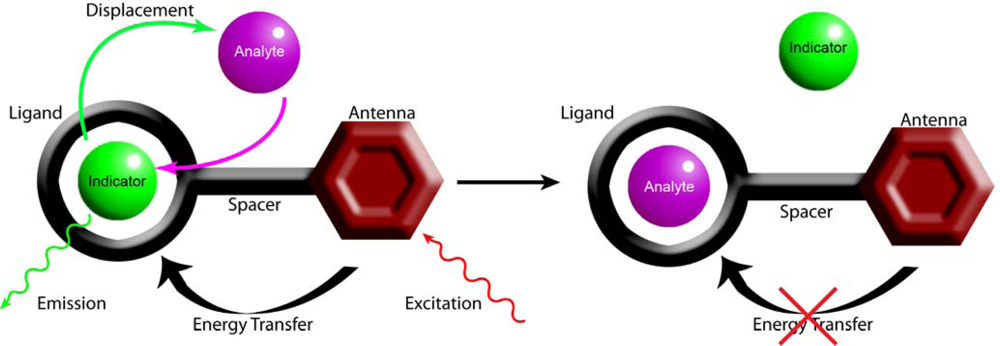
<p>Indicator displacement sensing, also referred to as an indicator displacement assay (IDA), has become an attractive method to detect analytes [<xref ref-type="bibr" rid="b20-sensors-10-01326">20</xref>–<xref ref-type="bibr" rid="b23-sensors-10-01326">23</xref>]. In a typical IDA approach, the indicator competes with the substrate for the same binding site via rapid reversible interactions. The indicator sits within the cavity of the receptor, with a particular λ<sub>max</sub>, indicative of the microenvironment of the receptor. Upon addition of a guest, the indicator is displaced into free solution and an alternative wavelength is observed (<xref ref-type="fig" rid="f1-sensors-10-01326">Figure 1</xref>). As with any host–guest system design, there needs to be careful consideration of the target guest. Factors such as shape, size, charge, and hydrogen bonding donor/acceptor characteristics need to be taken into account. The binding sites for the particular guest need to be complimentary to the binding sites of the host. The more favorable the interactions, the more stable the host–guest complex.</p>
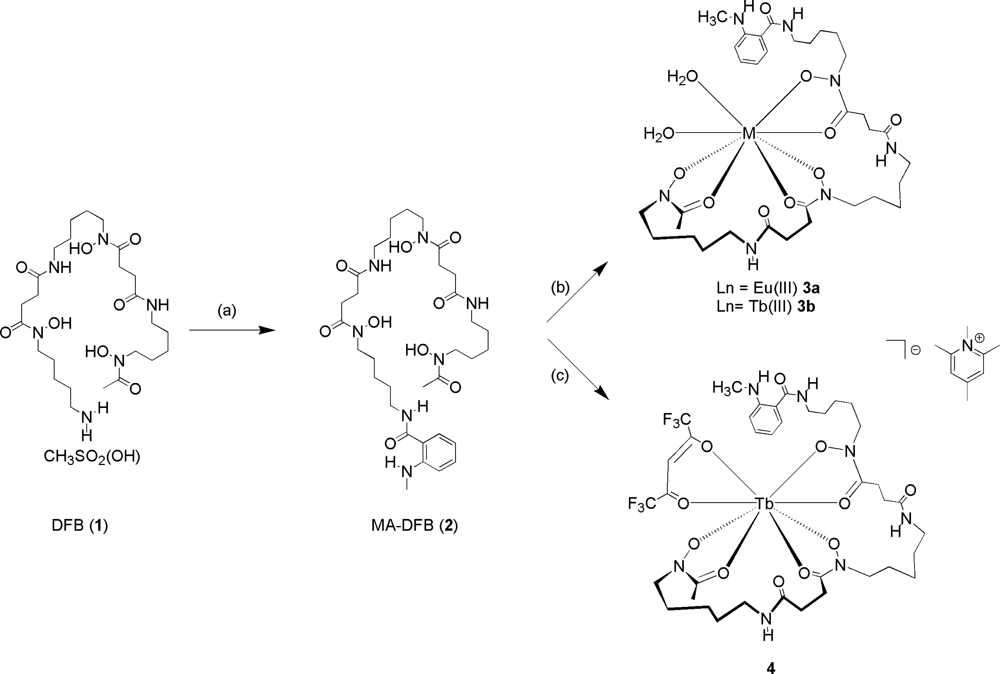
<p>The host-guest system described in this paper is such that the indicator of choice is a lanthanide ion (Eu<sup>3+</sup> or Tb<sup>3+</sup>) coordinated to MA-DFB (compound <bold>2</bold>- the host). It is well known that lanthanide complexes undergo rapid ligand exchange [<xref ref-type="bibr" rid="b24-sensors-10-01326">24</xref>]. Lanthanide<sup>3+</sup> ions are hard Lewis acids that have a tendency to form stable complexes with hard Lewis bases, those that contain oxygen atoms. Therefore the nature of the bonding in these complexes is predominately ionic and highly stable. However, lanthanide complexes in general, are also kinetically labile [<xref ref-type="bibr" rid="b25-sensors-10-01326">25</xref>]. This is in contrast to the ferric ion siderophore coordination species whereby the complex is thermodynamically stable and kinetically inert. Taking this into consideration, the rationale behind the sensor design described in this paper was to utilize and synthesize an ID sensor, whereby the host-indicator (Ln-MA-DFB) was prepared (<xref ref-type="fig" rid="f6-sensors-10-01326">scheme 1</xref>) and Fe<sup>3+</sup> acting as the guest.</p>
<p>It is well known that lanthanide ions, in particular Eu(III) and Tb(III) salts, have poor luminescence properties, due to <italic>f-f</italic> forbidden transitions, and as a consequence, lanthanide ions are not usually excited directly. Instead, they require a fluorophore (antenna) attached to a chelating functionality that incorporates the lanthanide metal [<xref ref-type="bibr" rid="b26-sensors-10-01326">26</xref>,<xref ref-type="bibr" rid="b27-sensors-10-01326">27</xref>]. The fluorophore (known as a sensitizer molecule) is typically an organic functional group. The organic fluorophore acts as an antenna absorbing light and transferring energy (<italic>via</italic> fluorescent transfer) to the lanthanide ion. An advantage of using lanthanide ions as part of a sensing application is their well-defined narrow excitation and emission bands and their long (micro- to millisecond) fluorescence, making them excellent candidates for molecular sensors. The long lifetimes (&gt;200 μs) of Ln luminescence allow for discrete signal detection without background fluorescence, providing temporal selectivity for the lanthanide ion.</p>
<p>The advantage of this type of host-guest receptor is the sensing mechanism employed in the system, being a combination of Time-Resolved Fluorescence (TRF) and Fluorescent Resonance Energy Transfer (FRET). This union allows for greater analytical sensitivity because of the use of rare earth ions (lanthanides). A more correct description of energy transfer using lanthanides is Lanthanide Resonance Energy Transfer (LRET). LRET has a number of technical advantages compared to conventional FRET but is based on a similar mechanism [<xref ref-type="bibr" rid="b28-sensors-10-01326">28</xref>]. For simplicity, the term FRET will be used to include LRET and FRET in this paper. The Ln ions absorb light poorly and require a sensitizer molecule for luminescence. The sensitizer molecule, (<italic>N</italic>-Methyanthranyl) will act as the antenna absorbing light and transferring that energy to the Ln ion.</p></sec>
<sec>
<label>2.2.</label>
<title>Synthesis and Photophysical Properties</title>
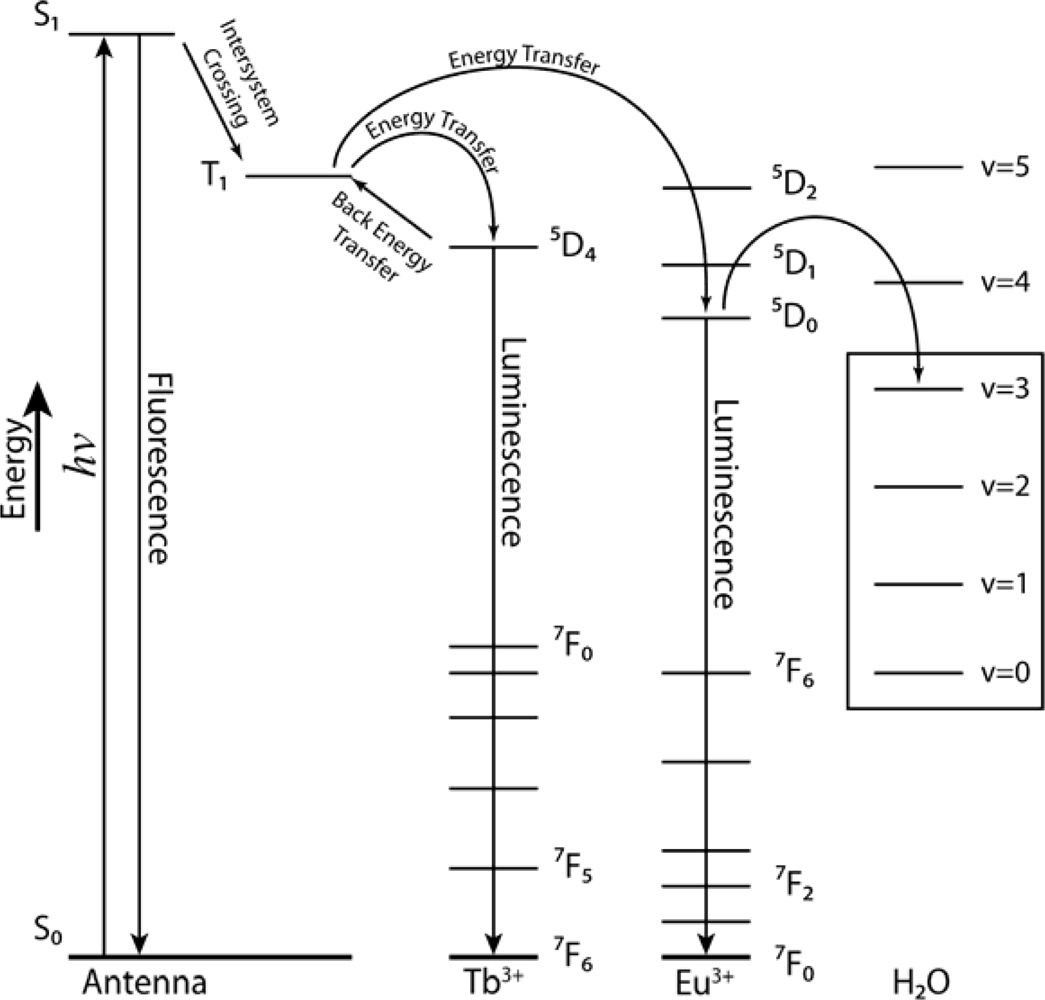
<p>Three Ln(III) receptors have been prepared (compounds <bold>3a</bold>, <bold>3b</bold> and <bold>4</bold>, <xref ref-type="fig" rid="f6-sensors-10-01326">Scheme 1</xref>) adapted from known literature procedures [<xref ref-type="bibr" rid="b29-sensors-10-01326">29</xref>,<xref ref-type="bibr" rid="b30-sensors-10-01326">30</xref>]. In order to test whether a MA-DFB (<bold>2</bold>) ligand can act as an antenna to sensitize the Eu(III) metal center, compound <bold>3a</bold> was synthesized and isolated by reacting MA-DFB (<bold>2</bold>) with EuCl<sub>3</sub>•6H<sub>2</sub>O with triethylamine and the Eu(III). Europium(III) complexes typically show an intense luminescence signal between 610 and 620 nm [<xref ref-type="bibr" rid="b31-sensors-10-01326">31</xref>]. The energy transfer (triplet state) from the <sup>3</sup>An-Ln to An-Ln* (An = antenna) can occur <italic>via</italic> two mechanisms; the Dexter mechanism or the Förster energy transfer mechanism. The formation of the lanthanide excited state (Ar-Ln*) is a reversible process, and luminescence is dependent on a number of criterion; (1) how well the T<sub>1</sub> excited state is populated, (2) The energy difference between the excited state of the antenna and the <sup>5</sup>D excited state of Ln <italic>i.e.</italic>, is the energy gap large enough such that the lanthanide emission cannot be quenched <italic>via</italic> back transfer to the antenna triplet state (<sup>3</sup>Ar-Ln), (3) The distance between the antenna and the lanthanide which follows a <italic>r</italic><sup>6</sup> dependence, and (4) The number of coordinated water molecules, as the fourth overtone of the H<sub>2</sub>O oscillator is lower in energy than the <sup>5</sup>D state, and therefore decrease the quantum yield of the metal luminescence, (<xref ref-type="fig" rid="f2-sensors-10-01326">figure 2</xref>; boxed in region). Unfortunately, no luminescence emission was observed for compound <bold>3a</bold>. The choice of antenna is very important in the receptor design, the lowest excited states of Eu(III) and Tb(III) are 17,200 cm<sup>−1</sup> and 20,500 cm<sup>−1</sup>, respectively, due to point (2) mentioned above. For efficient population to the lanthanide excited state the energy of the triplet excited state needs to be at least 1,700 cm<sup>−1</sup> above the excited state of the lanthanide ion, to prevent a thermally initiated back energy-transfer process, from An-Ln* to <sup>3</sup>Ar-Ln and hence a signal response. If, however, the energy gap is less than 1,500 cm<sup>−1</sup>, such thermally activated back-energy transfer competes to repopulate the triplet state of the antenna and as a consequence no lanthanide luminescence is observed.</p>
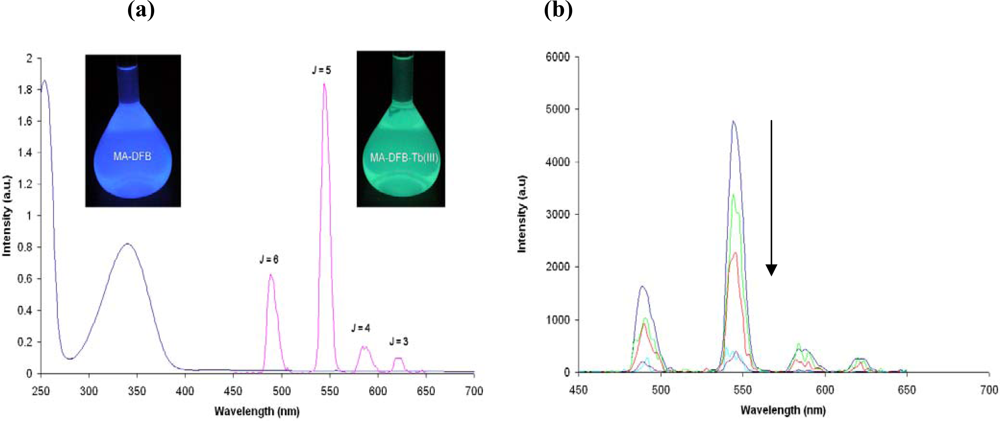
<p>Therefore we switched the lanthanide ion to Tb<sup>3+</sup> and prepared compound <bold>3b.</bold> Upon the excitation of compound <bold>3b</bold> at 340 nm, four distinct luminescence emissions are measured (transitions are <sup>5</sup>D<sub>4</sub>-<sup>7</sup>F<sub>J</sub> whereby <italic>J</italic> = 6,5,4 and 3) (also seen visually) in organic solvents such as ethyl acetate (<xref ref-type="fig" rid="f3-sensors-10-01326">Figure 3a</xref>). The initial studies showed that luminescence emission for compound <bold>3b</bold> was seen in a variety of solvents (ethyl acetate (<xref ref-type="fig" rid="f3-sensors-10-01326">Figure 3a</xref>), acetone, dichloromethane, chloroform, acetonitrile, and diethyl ether) and we have demonstrated that the fluorescence is quenched upon the addition of FeCl<sub>3</sub>, (ethyl acetate <xref ref-type="fig" rid="f3-sensors-10-01326">Figure 3b</xref>). However, like the Eu(III) complex, the luminescence of the Terbium is quenched by protic polar solvents such as MeOH and solvents that are hydroscopic, for example DMSO, when water occupies the vacant metal coordination sites (compounds 3a and 3b).</p>
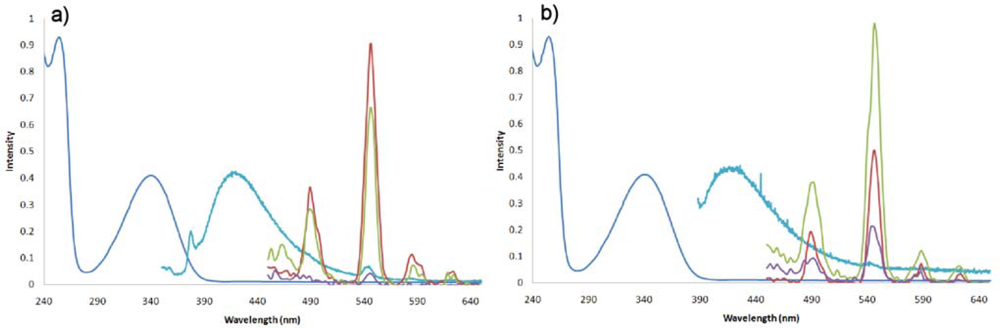
<p>In order for our system to work as a sensor in oceanographic applications, it is essential that the signal response is not quenched by water molecules. This would require a luminescence signal in solvents such as methanol (MeOH), ethanol (EtOH) or dimethyl sulfoxide (DMSO), organic solvents that are miscible with water. In this paper we demonstrate that indeed a luminescence signal is observed for compound <bold>3b</bold>, in 100% MeOH and a 50:50% MeOH:dH<sub>2</sub>O mix (<xref ref-type="fig" rid="f4-sensors-10-01326">Figure 4a</xref>). As noted, the luminescence signal is quenched in 100% dH<sub>2</sub>O; because O-H, (like C-H moieties), is a higher-energy oscillator (<italic>vide supra</italic>) it significantly quenches the Ln luminescence, (<xref ref-type="fig" rid="f4-sensors-10-01326">Figure 4a</xref> purple line). We therefore modified the design of our molecular receptor to incorporate a “blocking” ligand that would prevent water molecules from coordinating to the Tb(III) centre. β-Diketonates have been used as sensitizers for lanthanide complexes [<xref ref-type="bibr" rid="b29-sensors-10-01326">29</xref>,<xref ref-type="bibr" rid="b32-sensors-10-01326">32</xref>–<xref ref-type="bibr" rid="b35-sensors-10-01326">35</xref>]. β-Diketonate ligands coordinate via the two oxygen atoms leading to neutral species in a 3:1 β-diketonate:lanthanide ratio, the complexes have been shown to be stable in aqueous solutions [<xref ref-type="bibr" rid="b35-sensors-10-01326">35</xref>]. Therefore these molecules have been used in many applications from sensing [<xref ref-type="bibr" rid="b36-sensors-10-01326">36</xref>], antibody labeling [<xref ref-type="bibr" rid="b37-sensors-10-01326">37</xref>], new materials such as liquid crystals [<xref ref-type="bibr" rid="b38-sensors-10-01326">38</xref>], near IR-LEDs, [<xref ref-type="bibr" rid="b39-sensors-10-01326">39</xref>] sol-gel glasses [<xref ref-type="bibr" rid="b40-sensors-10-01326">40</xref>], and polymers [<xref ref-type="bibr" rid="b40-sensors-10-01326">40</xref>].</p>
<p>Incorporating a commercially available β-diketonate, for example, 1,1,1,5,5,5-hexafluoro-2, 4-pentanediione (Hhfac) ligand into our molecular receptor we synthesized compound <bold>4</bold>, (<xref ref-type="fig" rid="f6-sensors-10-01326">Scheme 1</xref>). Again the same luminescence experiments were carried out in 100% MeOH, 50:50% MeOH:dH<sub>2</sub>O and 100% dH<sub>2</sub>O (pH 8) and in all three solvent systems a luminescence signal, is observed, (<xref ref-type="fig" rid="f4-sensors-10-01326">Figure 4b</xref>).</p>
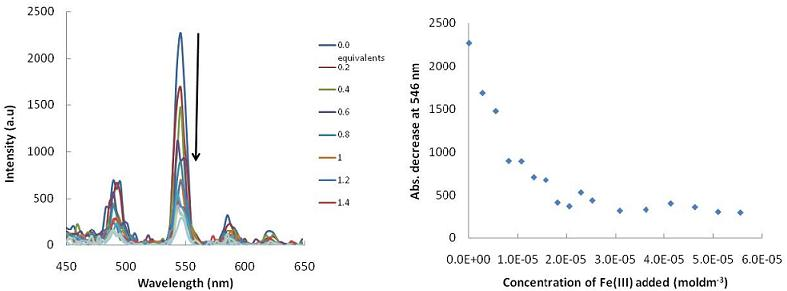
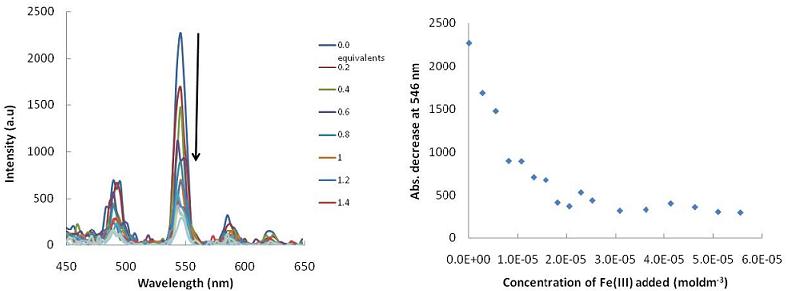
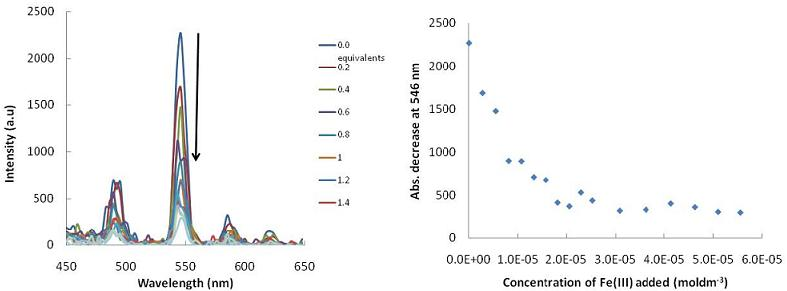
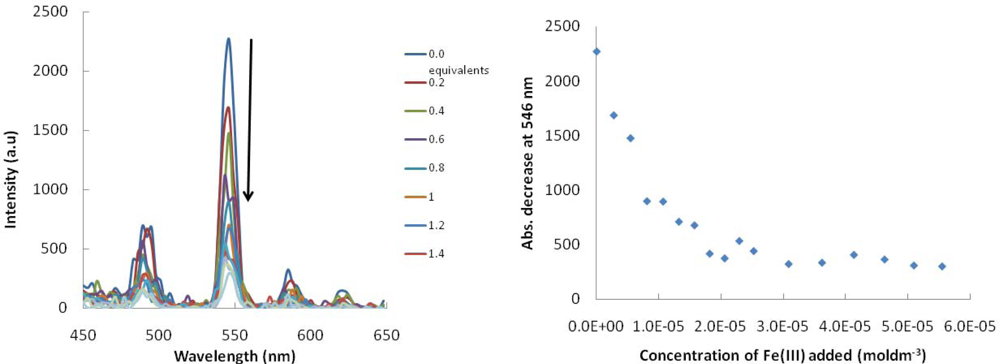
<p>We have shown that the displacement of the lanthanide with FeCl<sub>3</sub> is achieved in organic solvents, ethyl acetate, (<xref ref-type="fig" rid="f3-sensors-10-01326">Figure 3b</xref>). The same titration experiment has been carried out with compound <bold>4</bold> and FeCl<sub>3</sub> in MeOH and dH<sub>2</sub>O (50:50%) and the same trend is seen, the luminescence is quenched rapidly upon the addition of small aliquots of Fe<sup>3+</sup>. The concentration of the Fe(III) equals 2.5 × 10<sup>−5</sup> moldm<sup>−3</sup> at the point where there is no more quenching (<xref ref-type="fig" rid="f5-sensors-10-01326">Figure 5</xref>).</p>
<p>This preliminary data provides us with a good understanding of the system and evidence that this theoretical approach will work for development into an iron chemosensor. This data clearly demonstrate that with a slight modification of the molecular receptor, one can observe luminescence in 100% dH<sub>2</sub>O and that this luminescence decreases as a function of increasing [Fe(III)]. Our initial studies provide an effective detection limit, based on the precision of the luminescent signal as low as 5 nM (assuming a 1L sample), an environmentally relevant concentration.</p></sec></sec>
<sec>
<label>3.</label>
<title>Experimental Section</title>
<p><bold>Materials.</bold> Chemicals: All chemicals were purchased from Sigma-Aldrich Chemical Co. (St.Louis, MO) and used without further purification. N-methylisatoic anhydride was purchased from TCI America. Solvents used were all of UV-spectroscopic grade and purchased from Sigma-Aldrich, or VWR.</p>
<p><sup>1</sup>H and <sup>13</sup>C NMR spectra were recorded on a Bruker UltraShield plus 400 MHz spectrometer in DMSO-<italic>d</italic><sub>6</sub>. Chemical shifts are reported in parts per million (<italic>d</italic>) downfield from tetramethylsilane (0 ppm) as the internal standard and coupling constants (<italic>J</italic>) are recorded in Hertz (Hz). The multiplicities in the <sup>1</sup>H NMR are reported as (br) broad, (s) singlet, (d) doublet, (dd) doublet of doublets, (ddd) doublet of doublet of doublets, (t) triplet, (sp) septet, (m) multiplet. All spectra are recorded at ambient temperatures. IR was taken using a Nicolet Nexus 470 FT-IR paired with a Smart Orbit ATR attachment, with the characteristic functional groups reported in wavenumbers (cm<sup>−1</sup>). UV-vis experiments were performed on a Beckman DU-70 UV-vis spectrometer. A stock solution (2.9 × 10<sup>−4</sup> moldm<sup>−3</sup>) of compound <bold>2</bold> was prepared by dissolving 2.0 mg in 10 mL of MeOH and 1 mL transferred to the UV-vis cell. To which 2,4,6 trimethylpyridine (1μL, 26 equivalents) was added to compound <bold>2</bold>. A second stock solution of TbCl<sub>3•</sub>6H<sub>2</sub>O salt was prepared by dissolving 7.1 mg of Tb<sup>3+</sup> salt in 5 mL of MeOH (3.8 mmol), from the Tb<sup>3+</sup> salt stock solution a 2.9 × 10<sup>−3</sup> mol dm<sup>−3</sup> solution was prepared by transferring 152 μL to a 2 mL cell. Aliquots of the Tb<sup>3+</sup> was then added incrementally up to 10 equivalents. Fluorescence experiments were carried out on a QuantaMaster<sup>™</sup> 40 Intensity Based spectrofluorometer; steady-state (slitwidths 1.00 mm); λ<sub>Ex</sub> = 340 λ<sub>Em</sub> = 360 to 600 nm and gated emission (slit widths 3.0 mm, delay time 200 μs, λ<sub>Ex</sub> = 340 λ<sub>Em</sub> = 450 to 650 nm). MA-DFB and the Lanthanide salts were diluted to 2.25 × 10<sup>−6</sup> moldm<sup>−3</sup> and 2.2 × 10<sup>−4</sup> moldm<sup>−3</sup> respectively and used for the fluorescence studies. A FeCl<sub>3</sub> solution (2.2 × 10<sup>−4</sup> M) was prepared in MeOH and aliquots of 10 μL was titrated into the UV-vis or fluorescence cell. The dilution was taken into consideration when calculating the equivalents of host:guest solution.</p>
<p><bold>Synthesis.</bold> Compound <bold>2</bold> (MA-DFB): The synthesis of MA-DFB was adopted from Loyevsky <italic>et al</italic>. [<xref ref-type="bibr" rid="b41-sensors-10-01326">41</xref>]. Desferrioxamine (330 mg, 0.5 mmol) was dissolved in dimethylformamide (1 mL) and triethylamine (73 mg, 0.730 mmol). The solution was allowed to stir for 15 minutes, to which <italic>N</italic>-methylisatoic anhydride (90 mg, 0.5 mmol) was added to it, the resulting mixture allowed then to stir overnight at STP under argon. The supernatant was removed by centrifugation and the white solid was washed several times with ddH<sub>2</sub>O, then washed with diethyl ether and dried in vacuum for 24 h. Melting point: 177–181 °C; UV (methanol): 340 nm (ε = 2398 M<sup>−1</sup> cm<sup>−1</sup>) and 250 nm (ε = 4659 M<sup>−1</sup> cm<sup>−1</sup>); IR (neat ATR): 3304 (NH amide), 3092 (OH oxime), 1617 (CO-N) cm<sup>−1</sup>; <sup>1</sup>H-NMR (DMSO-<italic>d</italic><sub>6</sub>): 9.65 (br, s 3H OH oxime); disappears on D<sub>2</sub>O shake at room temperature, 8.27 (t, 1H, NH amide); disappears on D<sub>2</sub>O shake at 60 °C, 7.80 (m, 2H, NH amide) disappears on D<sub>2</sub>O shake at 60 °C, 7.61 (m, 1H, 2° NH amine); disappears on D<sub>2</sub>O shake at room temperature, 7.50 (m, 1H, ArH), 7.30 (m, 1H, ArH), 6.60 (m, 2H, ArH), 3.49 (m, 6H, CH<sub>2</sub>), 3.17 (m, 2H, CH<sub>2</sub>), 3.00 (m, 6H CH<sub>2</sub>), 2.75 (m, 4H, CH<sub>2</sub>), 2.55 (m, 4H, CH<sub>2</sub>CH<sub>2</sub>), 2.25 (m, 4H, CH<sub>2</sub>CH<sub>2</sub>), 2.34 (s, 3H, NCH<sub>3</sub>), 1.95 (s, 3H COCH<sub>3</sub>), 1.50–1.23 (12H, CH<sub>2</sub>CH<sub>2</sub>CH<sub>2</sub>); <sup>13</sup>C-NMR (DMSO-<italic>d</italic><sub>6</sub>): 172.5, 172.0, 170.7, 169.8, 150.2, 132.8, 128.7, 115.9, 114.4, 110.0, 49.1, 47.6, 47.3, 38.9, 30.3, 29.8, 29.3, 28.0, 27.2, 26.5, 26.2, 24.0, 23.3, 20.9 ppm.</p></sec>
<sec sec-type="conclusions">
<label>4.</label>
<title>Conclusions</title>
<p>We describe a novel approach that utilizes an indicator displacement assay to develop a chemosensor for the biologically available iron fraction in aquatic systems. This approach combines TRF and FRET with the unique photophysical properties of a lanthanide ion to increase the sensitivity of a fluorescent siderophore derivative, MA-DFB. The siderophore is derived from a natural siderophore, desferrrioxamine B, a strong fungal chelator. Currently there are very limited means to measure iron that is biologically available to eukaryotic phytoplankton. The development of this chemosensor will help build a better understanding of this fraction of iron in marine systems. The capability of measuring labile iron <italic>in situ</italic> with a photoactive chemosensor will lead to a more comprehensive understanding of primary production and the ocean carbon cycle.</p></sec></body>
<back>
<ack>
<p>This work was supported by startup grants to KMO and KJW from the University of Southern Mississippi and NSF0840390 for the acquisition of a 400 MHz NMR. The authors would also like to acknowledge support from the U.S. Department of Education GAANN Fellowship program (GR02619) for W. Scott Jones and the NSF MRSECenter for Responsive Driven Films at USM (DMR-0213883) for providing the REU (Research Experience for Undergraduates) stipend for David Schrock.</p></ack>
<ref-list>
<title>References and Notes</title>
<ref id="b1-sensors-10-01326"><label>1.</label><citation citation-type="journal"><person-group person-group-type="author"><name><surname>Chisholm</surname><given-names>S.W.</given-names></name></person-group><article-title>Oceanography: Stirring times in the Southern Ocean</article-title><source>Nature</source><year>2000</year><volume>407</volume><fpage>685</fpage><lpage>687</lpage><pub-id pub-id-type="doi">10.1038/35037696</pub-id><pub-id pub-id-type="pmid">11048702</pub-id></citation></ref>
<ref id="b2-sensors-10-01326"><label>2.</label><citation citation-type="journal"><person-group person-group-type="author"><name><surname>Hutchins</surname><given-names>D.A.</given-names></name><name><surname>Franck</surname><given-names>V.M.</given-names></name><name><surname>Brzezinski</surname><given-names>M.A.</given-names></name><name><surname>Bruland</surname><given-names>K.W.</given-names></name></person-group><article-title>Inducing iron limitation in iron-replete coastal waters with a strong chelating ligand</article-title><source>Limnol. Oceanogr</source><year>1999</year><volume>44</volume><fpage>1009</fpage><lpage>1018</lpage><pub-id pub-id-type="doi">10.4319/lo.1999.44.4.1009</pub-id></citation></ref>
<ref id="b3-sensors-10-01326"><label>3.</label><citation citation-type="journal"><person-group person-group-type="author"><name><surname>Wells</surname><given-names>M.L.</given-names></name></person-group><article-title>Manipulating iron availability in nearshore waters</article-title><source>Limnol. Oceanogr</source><year>1999</year><volume>44</volume><fpage>1002</fpage><lpage>1008</lpage><pub-id pub-id-type="doi">10.4319/lo.1999.44.4.1002</pub-id></citation></ref>
<ref id="b4-sensors-10-01326"><label>4.</label><citation citation-type="journal"><person-group person-group-type="author"><name><surname>Wells</surname><given-names>M.L.</given-names></name><name><surname>Trick</surname><given-names>C.G.</given-names></name></person-group><article-title>Controlling iron availability to phytoplankton in iron-replete coastal waters</article-title><source>Mar. Chem</source><year>2004</year><volume>86</volume><fpage>1</fpage><lpage>13</lpage><pub-id pub-id-type="doi">10.1016/j.marchem.2003.10.003</pub-id></citation></ref>
<ref id="b5-sensors-10-01326"><label>5.</label><citation citation-type="journal"><person-group person-group-type="author"><name><surname>Well</surname><given-names>M.L.</given-names></name><name><surname>Price</surname><given-names>N.M.</given-names></name><name><surname>Bruland</surname><given-names>K.W.</given-names></name></person-group><article-title>Iron chemistry in seawater and its relationship to phytoplankton: a workshop report</article-title><source>Mar. Chem</source><year>1995</year><volume>48</volume><fpage>157</fpage><lpage>182</lpage><pub-id pub-id-type="doi">10.1016/0304-4203(94)00055-I</pub-id></citation></ref>
<ref id="b6-sensors-10-01326"><label>6.</label><citation citation-type="journal"><person-group person-group-type="author"><name><surname>Boyanapalli</surname><given-names>R.</given-names></name><name><surname>Bullerjahn</surname><given-names>G.S.</given-names></name><name><surname>Pohl</surname><given-names>C.</given-names></name><name><surname>Croot</surname><given-names>P.L.</given-names></name><name><surname>Boyd</surname><given-names>P.W.</given-names></name><name><surname>Michael</surname><given-names>R.</given-names></name><name><surname>McKay</surname><given-names>R.M.L.</given-names></name></person-group><article-title>Luminescent whole-cell cyanobacterial bioreporter for measuring Fe availability in diverse marine environments</article-title><source>Appl. Environ. Microbiol</source><year>2007</year><volume>73</volume><fpage>1019</fpage><lpage>1024</lpage><pub-id pub-id-type="doi">10.1128/AEM.01670-06</pub-id><pub-id pub-id-type="pmid">17158623</pub-id></citation></ref>
<ref id="b7-sensors-10-01326"><label>7.</label><citation citation-type="journal"><person-group person-group-type="author"><name><surname>Durham</surname><given-names>K.A.</given-names></name><name><surname>Porta</surname><given-names>D.</given-names></name><name><surname>Twiss</surname><given-names>M.R.</given-names></name><name><surname>McKay</surname><given-names>M.L.</given-names></name><name><surname>Bullerjahn</surname><given-names>G.S.</given-names></name></person-group><article-title>Construction and initial characterization of a luminescent <italic>Synechoccus</italic> sp. PCC 7942 Fe-dependant bioreporter</article-title><source>FEMS Microbiol. Lett</source><year>2002</year><volume>209</volume><fpage>215</fpage><lpage>221</lpage><pub-id pub-id-type="doi">10.1111/j.1574-6968.2002.tb11134.x</pub-id><pub-id pub-id-type="pmid">12007808</pub-id></citation></ref>
<ref id="b8-sensors-10-01326"><label>8.</label><citation citation-type="journal"><person-group person-group-type="author"><name><surname>Hassler</surname><given-names>C.S.</given-names></name><name><surname>Wiss</surname><given-names>M.R.</given-names></name><name><surname>McKay</surname><given-names>R.M.L.</given-names></name><name><surname>Bullerjahn</surname><given-names>G.S.</given-names></name></person-group><article-title>Optimization of iron-dependant cyanobacterial (Synechoccocus, Cyanophyceae) bioreporters to measure iron availability</article-title><source>J. Phycol</source><year>2006</year><volume>42</volume><fpage>324</fpage><lpage>335</lpage><pub-id pub-id-type="doi">10.1111/j.1529-8817.2006.00203.x</pub-id></citation></ref>
<ref id="b9-sensors-10-01326"><label>9.</label><citation citation-type="journal"><person-group person-group-type="author"><name><surname>McKay</surname><given-names>R.M.L.</given-names></name><name><surname>Bullerjahn</surname><given-names>G.S.</given-names></name><name><surname>Porta</surname><given-names>D.</given-names></name><name><surname>Brown</surname><given-names>E.T.</given-names></name><name><surname>Sherrel</surname><given-names>R.M.</given-names></name><name><surname>Smutka</surname><given-names>T.M.</given-names></name><name><surname>Sterner</surname><given-names>R.W.</given-names></name><name><surname>Twiss</surname><given-names>M.R.</given-names></name><name><surname>Wilhelm</surname><given-names>S.W.</given-names></name></person-group><article-title>Consideration of the bioavailability of iron in the North American Great Lakes: Development of novel approaches toward understanding iron biogeochemistry</article-title><source>Aquat. Ecosyst. Health Manag</source><year>2004</year><volume>7</volume><fpage>475</fpage><lpage>490</lpage><pub-id pub-id-type="doi">10.1080/14634980490513364</pub-id></citation></ref>
<ref id="b10-sensors-10-01326"><label>10.</label><citation citation-type="journal"><person-group person-group-type="author"><name><surname>McKay</surname><given-names>R.M.L.</given-names></name><name><surname>Porta</surname><given-names>D.</given-names></name><name><surname>Bullerjahn</surname><given-names>G.S.</given-names></name><name><surname>Al-Rshaidat</surname><given-names>M.M.D.</given-names></name><name><surname>Kilmowicz</surname><given-names>J.A.</given-names></name><name><surname>Sterner</surname><given-names>R.W.</given-names></name><name><surname>Smutka</surname><given-names>T.M.</given-names></name><name><surname>Brown</surname><given-names>E.T.</given-names></name><name><surname>Sherrel</surname><given-names>R.M.</given-names></name></person-group><article-title>Bioavailable iron in oligotrophic Lake Superior assessed using biological reporters</article-title><source>J. Plankton Res</source><year>2005</year><volume>27</volume><fpage>1033</fpage><lpage>1044</lpage><pub-id pub-id-type="doi">10.1093/plankt/fbi070</pub-id></citation></ref>
<ref id="b11-sensors-10-01326"><label>11.</label><citation citation-type="journal"><person-group person-group-type="author"><name><surname>Mioni</surname><given-names>C.E.</given-names></name><name><surname>Handy</surname><given-names>S.M.</given-names></name><name><surname>Ellwood</surname><given-names>M.J.</given-names></name><name><surname>Twiss</surname><given-names>M.R.</given-names></name><name><surname>McKay</surname><given-names>R.M.L.</given-names></name><name><surname>Boyd</surname><given-names>P.W.</given-names></name><name><surname>Wilhelm</surname><given-names>S.W.</given-names></name></person-group><article-title>Tracking changes in bioavailable Fe within high-nutrient low-chlorophyll oceanic waters: a first estimate using a heterotrophic bacterial bioreporter</article-title><source>Global Biogeochem. Cycles</source><year>2005</year><volume>19</volume><fpage>1</fpage><lpage>10</lpage></citation></ref>
<ref id="b12-sensors-10-01326"><label>12.</label><citation citation-type="journal"><person-group person-group-type="author"><name><surname>Mioni</surname><given-names>C.E.</given-names></name><name><surname>Howard</surname><given-names>A.M.</given-names></name><name><surname>Debruyn</surname><given-names>J.M.</given-names></name><name><surname>Bright</surname><given-names>N.G.</given-names></name><name><surname>Twiss</surname><given-names>M.R.</given-names></name><name><surname>Applegate</surname><given-names>B.M.</given-names></name><name><surname>Wilhelm</surname><given-names>S.W.</given-names></name></person-group><article-title>Characterization and field trials of a bioluminescent bacterial reporter of iron availability</article-title><source>Mar. Chem</source><year>2003</year><volume>83</volume><fpage>31</fpage><lpage>46</lpage><pub-id pub-id-type="doi">10.1016/S0304-4203(03)00094-X</pub-id></citation></ref>
<ref id="b13-sensors-10-01326"><label>13.</label><citation citation-type="journal"><person-group person-group-type="author"><name><surname>Mioni</surname><given-names>C.E.</given-names></name><name><surname>Poorvin</surname><given-names>L.</given-names></name><name><surname>Wilhelm</surname><given-names>S.W.</given-names></name></person-group><article-title>Virus and siderophore-mediated transfer of available Fe between heterotrophic bacteria: characterization using an Fe-specific reporter</article-title><source>Aquat. Microb. Ecol</source><year>2005</year><volume>41</volume><fpage>233</fpage><lpage>245</lpage><pub-id pub-id-type="doi">10.3354/ame041233</pub-id></citation></ref>
<ref id="b14-sensors-10-01326"><label>14.</label><citation citation-type="journal"><person-group person-group-type="author"><name><surname>Porta</surname><given-names>D.</given-names></name><name><surname>Bullerjahn</surname><given-names>G.S.</given-names></name><name><surname>Wilhelm</surname><given-names>S.W.</given-names></name><name><surname>Twiss</surname><given-names>M.R.</given-names></name><name><surname>McKay</surname><given-names>R.M.L.</given-names></name></person-group><article-title>Physiological characterization of <italic>Synechococcus</italic> sp. (cyanophyceae) strain PCC 7942 iron-dependant bioreporter for freshwater environments</article-title><source>J. Phycol</source><year>2003</year><volume>39</volume><fpage>64</fpage><lpage>73</lpage><pub-id pub-id-type="doi">10.1046/j.1529-8817.2003.02068.x</pub-id></citation></ref>
<ref id="b15-sensors-10-01326"><label>15.</label><citation citation-type="journal"><person-group person-group-type="author"><name><surname>Mioni</surname><given-names>C.E.</given-names></name><name><surname>Pakulski</surname><given-names>J.D.</given-names></name><name><surname>Poorvin</surname><given-names>L.</given-names></name><name><surname>Baldwin</surname><given-names>A.</given-names></name><name><surname>Twiss</surname><given-names>M.R.</given-names></name><name><surname>Jeffrey</surname><given-names>W.H.</given-names></name><name><surname>Wilhelm</surname><given-names>S.W.</given-names></name></person-group><article-title>Variability in the in situ bioavailability of Fe to bacterioplankton communities in the eastern subtropical Pacific Ocean</article-title><source>Aquat. Microb. Ecol</source><year>2007</year><volume>46</volume><fpage>239</fpage><lpage>251</lpage><pub-id pub-id-type="doi">10.3354/ame046239</pub-id></citation></ref>
<ref id="b16-sensors-10-01326"><label>16.</label><citation citation-type="journal"><person-group person-group-type="author"><name><surname>Chung Chun Lam</surname><given-names>C.K.S.</given-names></name><name><surname>Jickells</surname><given-names>T.D.</given-names></name><name><surname>Richardson</surname><given-names>D.J.</given-names></name><name><surname>Russell</surname><given-names>D.A.</given-names></name></person-group><article-title>Fluorescence-based siderophore biosensor for the determination of bioavailable iron in oceanic waters</article-title><source>Anal. Chem</source><year>2006</year><volume>78</volume><fpage>5040</fpage><lpage>5045</lpage><pub-id pub-id-type="doi">10.1021/ac060223t</pub-id><pub-id pub-id-type="pmid">16841927</pub-id></citation></ref>
<ref id="b17-sensors-10-01326"><label>17.</label><citation citation-type="journal"><person-group person-group-type="author"><name><surname>Orcutt</surname><given-names>K.M.</given-names></name><name><surname>L</surname><given-names>W.M.</given-names></name></person-group><article-title>A liposome-based nanodevice for sequestering siderophore-bound Fe</article-title><source>J. Membrane Sci</source><year>2007</year><volume>288</volume><fpage>247</fpage><lpage>254</lpage><pub-id pub-id-type="doi">10.1016/j.memsci.2006.11.021</pub-id></citation></ref>
<ref id="b18-sensors-10-01326"><label>18.</label><citation citation-type="journal"><person-group person-group-type="author"><name><surname>Espósito</surname><given-names>B.P.</given-names></name><name><surname>Epsztejn</surname><given-names>S.</given-names></name><name><surname>Breuer</surname><given-names>W.</given-names></name><name><surname>Cabantchik</surname><given-names>Z.I.</given-names></name></person-group><article-title>A review of fluorescence methods for assessing labile iron in cells and biological fluids</article-title><source>Anal. Biochem</source><year>2002</year><volume>304</volume><fpage>1</fpage><lpage>18</lpage><pub-id pub-id-type="doi">10.1006/abio.2002.5611</pub-id><pub-id pub-id-type="pmid">11969183</pub-id></citation></ref>
<ref id="b19-sensors-10-01326"><label>19.</label><citation citation-type="journal"><person-group person-group-type="author"><name><surname>Palanché</surname><given-names>B.P.</given-names></name><name><surname>Marmolle</surname><given-names>F.</given-names></name><name><surname>Abraham</surname><given-names>M.A.</given-names></name><name><surname>Shanzer</surname><given-names>A.</given-names></name><name><surname>Albrecht-Gray</surname><given-names>A.M.</given-names></name></person-group><article-title>Fluorescent siderophore-based chemosensors: iron (III) quantitative determinations</article-title><source>J. Biol. Inorg. Chem</source><year>1999</year><volume>4</volume><fpage>188</fpage><lpage>198</lpage><pub-id pub-id-type="doi">10.1007/s007750050304</pub-id><pub-id pub-id-type="pmid">10499091</pub-id></citation></ref>
<ref id="b20-sensors-10-01326"><label>20.</label><citation citation-type="journal"><person-group person-group-type="author"><name><surname>de Silva</surname><given-names>A.P.</given-names></name><name><surname>Gunaratne</surname><given-names>H.Q.N.</given-names></name><name><surname>Gunnlaugsson</surname><given-names>T.</given-names></name><name><surname>Huxley</surname><given-names>A.J.M.</given-names></name><name><surname>McCoy</surname><given-names>C.P.</given-names></name><name><surname>Rademacher</surname><given-names>J.T.</given-names></name><name><surname>Rice</surname><given-names>T.E.</given-names></name></person-group><article-title>Signaling recognition events with fluorescent sensors and switches</article-title><source>Chem. Rev</source><year>1997</year><volume>97</volume><fpage>1515</fpage><lpage>1566</lpage><pub-id pub-id-type="doi">10.1021/cr960386p</pub-id><pub-id pub-id-type="pmid">11851458</pub-id></citation></ref>
<ref id="b21-sensors-10-01326"><label>21.</label><citation citation-type="journal"><person-group person-group-type="author"><name><surname>Houk</surname><given-names>R.J.T.</given-names></name><name><surname>Wallace</surname><given-names>K.J.</given-names></name><name><surname>Hewage</surname><given-names>H.S.</given-names></name><name><surname>Anslyn</surname><given-names>E.V.</given-names></name></person-group><article-title>A colorimetric chemodosimeter for Pd(II): a method for detecting residual palladium in cross-coupling reactions</article-title><source>Tetrahedron</source><year>2008</year><volume>64</volume><fpage>8271</fpage><lpage>8278</lpage><pub-id pub-id-type="doi">10.1016/j.tet.2008.04.105</pub-id><pub-id pub-id-type="pmid">19122841</pub-id></citation></ref>
<ref id="b22-sensors-10-01326"><label>22.</label><citation citation-type="book"><person-group person-group-type="author"><name><surname>Wallace</surname><given-names>K.J.</given-names></name><name><surname>Nguyen</surname><given-names>B.T.</given-names></name><name><surname>Anslyn</surname><given-names>E.V.</given-names></name></person-group><article-title>Indicator Displacement Assay (IDA)</article-title><source>Encyclopedia of Supramolecular Chemistry</source><edition>1st ed</edition><person-group person-group-type="editor"><name><surname>Atwood</surname><given-names>J.L.</given-names></name><name><surname>Steed</surname><given-names>J.W.</given-names></name></person-group><publisher-name>Taylor &amp; Francis</publisher-name><publisher-loc>Baca Raton, FL, USA</publisher-loc><year>2006</year></citation></ref>
<ref id="b23-sensors-10-01326"><label>23.</label><citation citation-type="journal"><person-group person-group-type="author"><name><surname>Wiskur</surname><given-names>S.L.</given-names></name><name><surname>Ait-Haddou</surname><given-names>H.</given-names></name><name><surname>Lavigne</surname><given-names>J.J.</given-names></name><name><surname>Anslyn</surname><given-names>E.V.</given-names></name></person-group><article-title>Teaching old indicators new tricks</article-title><source>Acc. Chem. Res</source><year>2001</year><volume>34</volume><fpage>963</fpage><lpage>972</lpage><pub-id pub-id-type="doi">10.1021/ar9600796</pub-id><pub-id pub-id-type="pmid">11747414</pub-id></citation></ref>
<ref id="b24-sensors-10-01326"><label>24.</label><citation citation-type="journal"><person-group person-group-type="author"><name><surname>Graeppi</surname><given-names>N.</given-names></name><name><surname>Powell</surname><given-names>G.H.</given-names></name><name><surname>Laurenczy</surname><given-names>G.</given-names></name><name><surname>Zékány</surname><given-names>L.</given-names></name><name><surname>Merbach</surname><given-names>A.</given-names></name></person-group><article-title>Coordination equilibria and water exchange kinetics of lanthanide(III) propylenediaminetetraacetates and other magnetic resonance imaging related complexes</article-title><source>Inorg Chimi. Acta</source><year>1995</year><volume>235</volume><fpage>311</fpage><lpage>326</lpage><pub-id pub-id-type="doi">10.1016/0020-1693(95)90073-F</pub-id></citation></ref>
<ref id="b25-sensors-10-01326"><label>25.</label><citation citation-type="journal"><person-group person-group-type="author"><name><surname>Goshe</surname><given-names>A.J.</given-names></name><name><surname>Steele</surname><given-names>I.M.</given-names></name><name><surname>Ceccarelli</surname><given-names>C.</given-names></name><name><surname>Rheingold</surname><given-names>A.L.</given-names></name><name><surname>Bosnich</surname><given-names>B.</given-names></name></person-group><article-title>Supramolecular recognition: On the kinetic lability of thermodynamically stable host-guest association complexes</article-title><source>Proc. Natl. Acad. Sci</source><year>2002</year><volume>99</volume><fpage>4823</fpage><lpage>4829</lpage><pub-id pub-id-type="doi">10.1073/pnas.052587499</pub-id><pub-id pub-id-type="pmid">11959933</pub-id></citation></ref>
<ref id="b26-sensors-10-01326"><label>26.</label><citation citation-type="journal"><person-group person-group-type="author"><name><surname>Bunzli</surname><given-names>J.C.G.</given-names></name><name><surname>Piguet</surname><given-names>C.</given-names></name></person-group><article-title>Lanthanide-Containing molecular and supramolecular polymetallic functional assemblies</article-title><source>Chem. Rev</source><year>2002</year><volume>102</volume><fpage>1897</fpage><lpage>1928</lpage><pub-id pub-id-type="doi">10.1021/cr010299j</pub-id><pub-id pub-id-type="pmid">12059257</pub-id></citation></ref>
<ref id="b27-sensors-10-01326"><label>27.</label><citation citation-type="journal"><person-group person-group-type="author"><name><surname>Tsukube</surname><given-names>H.</given-names></name><name><surname>Shinoda</surname><given-names>S.</given-names></name></person-group><article-title>Lanthanide complexes in molecular recognition and chirality sensing of biological substrates</article-title><source>Chem. Rev</source><year>2002</year><volume>102</volume><fpage>2389</fpage><lpage>2403</lpage><pub-id pub-id-type="doi">10.1021/cr010450p</pub-id><pub-id pub-id-type="pmid">12059273</pub-id></citation></ref>
<ref id="b28-sensors-10-01326"><label>28.</label><citation citation-type="journal"><person-group person-group-type="author"><name><surname>Selvin</surname><given-names>P.R.</given-names></name></person-group><article-title>Principles and biophysical applications of lanthanide-based probes</article-title><source>Annu. Rev. Biophys. Biomol. Struct</source><year>2002</year><volume>31</volume><fpage>275</fpage><lpage>302</lpage><pub-id pub-id-type="doi">10.1146/annurev.biophys.31.101101.140927</pub-id><pub-id pub-id-type="pmid">11988471</pub-id></citation></ref>
<ref id="b29-sensors-10-01326"><label>29.</label><citation citation-type="journal"><person-group person-group-type="author"><name><surname>De Silva</surname><given-names>C.R.</given-names></name><name><surname>Maeyer</surname><given-names>J.R.</given-names></name><name><surname>Wang</surname><given-names>R.</given-names></name><name><surname>Nichol</surname><given-names>G.S.</given-names></name><name><surname>Zheng</surname><given-names>Z.</given-names></name></person-group><article-title>Adducts of europium b-diketonates with nitrogen <italic>p,p′-</italic>disubstituted bipyridine and phenanthroline ligands: Synthesis structural characterization, and luminescence studies</article-title><source>Inorg. Chimi. Acta</source><year>2007</year><volume>360</volume><fpage>3543</fpage><lpage>3552</lpage><pub-id pub-id-type="doi">10.1016/j.ica.2007.04.049</pub-id></citation></ref>
<ref id="b30-sensors-10-01326"><label>30.</label><citation citation-type="journal"><person-group person-group-type="author"><name><surname>Lytton</surname><given-names>S.D.</given-names></name><name><surname>Cabantchik</surname><given-names>Z.I.</given-names></name><name><surname>Libman</surname><given-names>J.</given-names></name><name><surname>Shanzer</surname><given-names>A.</given-names></name></person-group><article-title>Reversed siderophores as antimalarial agents. II. Selective scavenging of Fe (III) from parasitized erythrocytes by a fluorescent derivitive of Desferal</article-title><source>Mol. Pharmacol</source><year>1991</year><volume>40</volume><fpage>584</fpage><lpage>590</lpage><pub-id pub-id-type="pmid">1921988</pub-id></citation></ref>
<ref id="b31-sensors-10-01326"><label>31.</label><citation citation-type="journal"><person-group person-group-type="author"><name><surname>Moore</surname><given-names>E.G.</given-names></name><name><surname>Xu</surname><given-names>J.</given-names></name><name><surname>Jocher</surname><given-names>C.J.</given-names></name><name><surname>Werner</surname><given-names>E.J.</given-names></name><name><surname>Raymond</surname><given-names>K.N.</given-names></name></person-group><article-title>“Cymothoe sangaris”: An extremely stable and highly luminescent 1,2-hydroxypyridinonate chelate of Eu(III)</article-title><source>J. Am. Chem. Soc</source><year>2006</year><volume>128</volume><fpage>10648</fpage><lpage>10649</lpage><pub-id pub-id-type="doi">10.1021/ja062597+</pub-id><pub-id pub-id-type="pmid">16910637</pub-id></citation></ref>
<ref id="b32-sensors-10-01326"><label>32.</label><citation citation-type="journal"><person-group person-group-type="author"><name><surname>Bassett</surname><given-names>A.P.</given-names></name><name><surname>Magennis</surname><given-names>S.W.</given-names></name><name><surname>Glover</surname><given-names>P.B.</given-names></name><name><surname>Lewis</surname><given-names>D.J.</given-names></name><name><surname>Spencer</surname><given-names>N.</given-names></name><name><surname>Parsons</surname><given-names>S.</given-names></name><name><surname>Williams</surname><given-names>R.M.</given-names></name><name><surname>De Cola</surname><given-names>L.</given-names></name><name><surname>Pikramenou</surname><given-names>Z.</given-names></name></person-group><article-title>Hghly Luminescent, Triple- and quadruple-stranded dinuclear Eu, Nd, and Sm(III) lanthanide complexes based on bis-diketonates?</article-title><source>J. Am. Chem. Soc</source><year>2004</year><volume>126</volume><fpage>9413</fpage><lpage>9424</lpage><pub-id pub-id-type="doi">10.1021/ja048022z</pub-id><pub-id pub-id-type="pmid">15281834</pub-id></citation></ref>
<ref id="b33-sensors-10-01326"><label>33.</label><citation citation-type="journal"><person-group person-group-type="author"><name><surname>Batista</surname><given-names>H.J.</given-names></name><name><surname>de Andrade</surname><given-names>A.V.M.</given-names></name><name><surname>Longo</surname><given-names>R.L.</given-names></name><name><surname>Simas</surname><given-names>M.</given-names></name><name><surname>de Sá</surname><given-names>G.D.</given-names></name><name><surname>Ito</surname><given-names>N.K.</given-names></name><name><surname>Thompson</surname><given-names>L.C.</given-names></name></person-group><article-title>Synthesis, X-ray structure, spectroscopic characterization, and theoretical prediction of the Structure and Electronic Spectrum of Eu (btfa)<sub>3</sub>·bipy and an assesessment of the effect of fluorine as β-diketone substituent on the ligand-metal energy transfer proces</article-title><source>Inorg. Chem</source><year>1998</year><volume>37</volume><fpage>3542</fpage><lpage>3547</lpage><pub-id pub-id-type="doi">10.1021/ic971602v</pub-id><pub-id pub-id-type="pmid">11670441</pub-id></citation></ref>
<ref id="b34-sensors-10-01326"><label>34.</label><citation citation-type="journal"><person-group person-group-type="author"><name><surname>dos Santos</surname><given-names>C.M.G.</given-names></name><name><surname>Harte</surname><given-names>A.J.</given-names></name><name><surname>Quinn</surname><given-names>S.J.</given-names></name><name><surname>Gunnlaugsson</surname><given-names>T.</given-names></name></person-group><article-title>“Recent developments in the field of supramolecular lanthanide luminescent sensors and self-assemblies”</article-title><source>Coord. Chem. Rev</source><year>2008</year><volume>252</volume><fpage>2512</fpage><lpage>2527</lpage><pub-id pub-id-type="doi">10.1016/j.ccr.2008.07.018</pub-id></citation></ref>
<ref id="b35-sensors-10-01326"><label>35.</label><citation citation-type="journal"><person-group person-group-type="author"><name><surname>Tsukube</surname><given-names>H.</given-names></name><name><surname>Shinoda</surname><given-names>S.</given-names></name><name><surname>Uenishi</surname><given-names>J.</given-names></name><name><surname>Kanatani</surname><given-names>T.</given-names></name><name><surname>Itoch</surname><given-names>H.</given-names></name><name><surname>Shiode</surname><given-names>M.</given-names></name><name><surname>Iwachido</surname><given-names>T.</given-names></name><name><surname>Yonemitsu</surname><given-names>O.</given-names></name></person-group><article-title>“Molecular Recognition with lanthanide(III) tris(β-diketonate) complexes: extraction, transport, and chiral recognition of unprotected amino acids”</article-title><source>Inorg. Chem</source><year>1998</year><volume>37</volume><fpage>1585</fpage><lpage>1591</lpage><pub-id pub-id-type="doi">10.1021/ic970103r</pub-id></citation></ref>
<ref id="b36-sensors-10-01326"><label>36.</label><citation citation-type="journal"><person-group person-group-type="author"><name><surname>Thibon</surname><given-names>A.</given-names></name><name><surname>Pierre</surname><given-names>V.C.</given-names></name></person-group><article-title>A highly selective luminescent sensor for the time-gated detection of potassium</article-title><source>J. Am. Chem. Soc</source><year>2009</year><volume>131</volume><fpage>434</fpage><lpage>435</lpage><pub-id pub-id-type="doi">10.1021/ja8077889</pub-id><pub-id pub-id-type="pmid">19113859</pub-id></citation></ref>
<ref id="b37-sensors-10-01326"><label>37.</label><citation citation-type="journal"><person-group person-group-type="author"><name><surname>Terenghi</surname><given-names>M.</given-names></name><name><surname>Elviri</surname><given-names>L.</given-names></name><name><surname>Careri</surname><given-names>M.</given-names></name><name><surname>Mangia</surname><given-names>A.</given-names></name><name><surname>Lobinski</surname><given-names>R.</given-names></name></person-group><article-title>Multiplexed determination of protein biomarkers using metal-tagged antibodies and size exclusion chromatography-inductively coupled plasma mass spectrometry</article-title><source>Anal. Chem</source><year>2009</year><volume>81</volume><fpage>9440</fpage><lpage>9448</lpage><pub-id pub-id-type="doi">10.1021/ac901853g</pub-id><pub-id pub-id-type="pmid">19908906</pub-id></citation></ref>
<ref id="b38-sensors-10-01326"><label>38.</label><citation citation-type="journal"><person-group person-group-type="author"><name><surname>Binnemans</surname><given-names>K.</given-names></name></person-group><article-title>Luminescence of metallomesogens in the liquid crystal state</article-title><source>J. Mater. Chem</source><year>2009</year><volume>19</volume><fpage>448</fpage><lpage>453</lpage><pub-id pub-id-type="doi">10.1039/b811373d</pub-id></citation></ref>
<ref id="b39-sensors-10-01326"><label>39.</label><citation citation-type="journal"><person-group person-group-type="author"><name><surname>Guo</surname><given-names>X.</given-names></name><name><surname>Guo</surname><given-names>H.</given-names></name><name><surname>Fu</surname><given-names>L.</given-names></name><name><surname>Carlos</surname><given-names>L.D.</given-names></name><name><surname>Ferreira</surname><given-names>R.A.S.</given-names></name><name><surname>Sun</surname><given-names>L.</given-names></name><name><surname>Deng</surname><given-names>R.</given-names></name><name><surname>Zhang</surname><given-names>H.</given-names></name></person-group><article-title>Novel near-infrared luminescent hybrid materials covalently linking with lanthanide [Nd(III), Er(III), Yb(III), and Sm(III)] complexes via a primary β-Diketone ligand: synthesis and photophysical studies</article-title><source>J. Phys. Chem. C</source><year>2009</year><volume>113</volume><fpage>12538</fpage><lpage>12545</lpage><pub-id pub-id-type="doi">10.1021/jp9005179</pub-id></citation></ref>
<ref id="b40-sensors-10-01326"><label>40.</label><citation citation-type="journal"><person-group person-group-type="author"><name><surname>Binnemans</surname><given-names>K.</given-names></name></person-group><article-title>Lanthanide-Based Luminescent Hybrid Materials</article-title><source>Chem. Rev</source><year>2009</year><volume>109</volume><fpage>4283</fpage><lpage>4374</lpage><pub-id pub-id-type="doi">10.1021/cr8003983</pub-id><pub-id pub-id-type="pmid">19650663</pub-id></citation></ref>
<ref id="b41-sensors-10-01326"><label>41.</label><citation citation-type="journal"><person-group person-group-type="author"><name><surname>Loyevsky</surname><given-names>M.</given-names></name><name><surname>Lytton</surname><given-names>S.D.</given-names></name><name><surname>Mester</surname><given-names>B.</given-names></name><name><surname>Libman</surname><given-names>J.</given-names></name><name><surname>Shanzer</surname><given-names>A.</given-names></name><name><surname>Cabantchik</surname><given-names>Z.I.</given-names></name></person-group><article-title>The Antimalarial action of desferal involves a direct access route to erythrocytic (Plasmodium Falciparum) parasites</article-title><source>J. Clin. Invest</source><year>1993</year><volume>91</volume><fpage>218</fpage><lpage>224</lpage><pub-id pub-id-type="doi">10.1172/JCI116174</pub-id><pub-id pub-id-type="pmid">8423220</pub-id></citation></ref></ref-list>
<sec sec-type="display-objects">
<title>Figures</title>
<fig id="f1-sensors-10-01326" position="float">
<label>Figure 1.</label>
<caption>
<p>Cartoon representation of the Indicator Displace Assay (indicator = lanthanide, analyte = Fe<sup>3+</sup> antenna = <italic>N</italic>-Methyanthranyl moiety).</p></caption>
<graphic xlink:href="sensors-10-01326f1.gif"/></fig>
<fig id="f2-sensors-10-01326" position="float">
<label>Figure 2.</label>
<caption>
<p>Electronic energy level diagrams for Tb<sup>3+</sup> and Eu<sup>3+</sup>. Radiationless energy transfer competes with the radioactive process through coupling of the emissive states to the O-H vibrational overtones of the coordinated water molecules.</p></caption>
<graphic xlink:href="sensors-10-01326f2.gif"/></fig>
<fig id="f3-sensors-10-01326" position="float">
<label>Figure 3.</label>
<caption>
<p>(a) The UV-Vis (340 nm) and the corresponding Luminescence spectrum of compound <bold>3b</bold> (Ex = 340 nm) in ethyl acetate (1 × 10<sup>−8</sup> M) and (b) The UV-Vis (340 nm) and the corresponding decreasing Luminescence of compound <bold>3b</bold> (Ex = 340 nm) in ethyl acetate (1 × 10<sup>−8</sup> M) with increasing amounts of FeCl<sub>3</sub> added.</p></caption>
<graphic xlink:href="sensors-10-01326f3.gif"/></fig>
<fig id="f4-sensors-10-01326" position="float">
<label>Figure 4.</label>
<caption>
<p><bold>(</bold>a) The spectra showing absorbance (dark blue 100% MeOH, compound <bold>2</bold>), steady-state (light blue100 % MeOH, compound <bold>3b</bold>) and gated luminescence (red 100% MeOH (<bold>3b</bold>), green 50:50% MeOH:H<sub>2</sub>O (<bold>3b</bold>), purple 100% H<sub>2</sub>O (<bold>3b</bold>)). (b) The spectra showing absorbance (dark blue 100% MeOH, compound <bold>2</bold>), steady-state (light blue100 % MeOH, compound <bold>4</bold>) and gated luminescence (red 100% MeOH (<bold>4</bold>), green 50:50% MeOH:H<sub>2</sub>O (<bold>4</bold>), purple 100% H<sub>2</sub>O (<bold>4</bold>)). Conditions: Ex 340 nm, Em 350–650 nm, slit width 2.25 mm, delay 200 μs.</p></caption>
<graphic xlink:href="sensors-10-01326f4.gif"/></fig>
<fig id="f5-sensors-10-01326" position="float">
<label>Figure 5.</label>
<caption>
<p>Fluorescence titration with <bold>4</bold> and FeCl<sub>3</sub> (0 to 5 equivalents) MeOH:H<sub>2</sub>O (50:50). RHS: Binding isotherm obtained showing the decrease in absorbance at 546 nm on the addition of Fe(III).</p></caption>
<graphic xlink:href="sensors-10-01326f5.gif"/></fig>
<fig id="f6-sensors-10-01326" position="float">
<label>Scheme 1.</label>
<caption>
<p>Synthesis of MA-DFB-Ln(III) (a) N-methylisatoic anhydride and Et<sub>3</sub>N (b) LnCl<sub>3</sub>•6H<sub>2</sub>O (Ln = Eu(III) or Tb(III), 2,4,6 trimethylpyridine (c) TbCl<sub>3</sub>•6H<sub>2</sub>O, 1,1,1,5,5,5-hexafluoro-2, 4-pentanediione (Hhfac) and 2,4,6 trimethylpyridine.</p></caption>
<graphic xlink:href="sensors-10-01326f6.gif"/></fig></sec></back></article>