
<?xml version="1.0" encoding="UTF-8"?>
<!DOCTYPE article PUBLIC "-//NLM//DTD Journal Publishing DTD v2.3 20070202//EN" "journalpublishing.dtd">
<article xmlns:mml="http://www.w3.org/1998/Math/MathML" xmlns:xlink="http://www.w3.org/1999/xlink" xml:lang="en" article-type="research-article">
  <front>
    <journal-meta>
      <journal-id journal-id-type="publisher-id">diversity</journal-id>
      <journal-title>Diversity</journal-title>
      <abbrev-journal-title abbrev-type="publisher">Diversity</abbrev-journal-title>
      <abbrev-journal-title abbrev-type="pubmed">diversity</abbrev-journal-title>
      <issn pub-type="epub">1424-2818</issn>
      <publisher>
        <publisher-name>MDPI</publisher-name>
      </publisher>
    </journal-meta>
    <article-meta>
      <article-id pub-id-type="doi">10.3390/d5010001</article-id>
      <article-id pub-id-type="publisher-id">diversity-05-00001</article-id>
      <article-categories>
        <subj-group>
          <subject>Article</subject>
        </subj-group>
      </article-categories>
      <title-group>
        <article-title>Human-Induced Disturbance Alters Pollinator Communities in Tropical Mountain Forests</article-title>
      </title-group>
     
      <contrib-group>
        <contrib contrib-type="author">
          <name>
            <surname>Kambach</surname>
            <given-names>Stephan</given-names>
          </name>
          <xref rid="af1-diversity-05-00001" ref-type="aff">1</xref>
          <xref rid="c1-diversity-05-00001" ref-type="corresp">*</xref>
        </contrib>
        <contrib contrib-type="author">
          <name>
            <surname>Guerra</surname>
            <given-names>Fernando</given-names>
          </name>
          <xref rid="af2-diversity-05-00001" ref-type="aff">2</xref>
        </contrib>
        <contrib contrib-type="author">
          <name>
            <surname>Beck</surname>
            <given-names>Stephan G.</given-names>
          </name>
          <xref rid="af3-diversity-05-00001" ref-type="aff">3</xref>
        </contrib>
        <contrib contrib-type="author">
          <name>
            <surname>Hensen</surname>
            <given-names>Isabell</given-names>
          </name>
          <xref rid="af1-diversity-05-00001" ref-type="aff">1</xref>
        </contrib>
        <contrib contrib-type="author">
          <name>
            <surname>Schleuning</surname>
            <given-names>Matthias</given-names>
          </name>
          <xref rid="af1-diversity-05-00001" ref-type="aff">1</xref>
          <xref rid="af4-diversity-05-00001" ref-type="aff">4</xref>
          <xref rid="c1-diversity-05-00001" ref-type="corresp">*</xref>
        </contrib>
      </contrib-group>
       <aff id="af1-diversity-05-00001"><label>1 </label>Institute of Biology/Geobotany and Botanical Garden, Martin-Luther-University Halle-Wittenberg, Am Kirchtor 1, 06108 Halle, Germany; E-Mail: <email>isabell.hensen@botanik.uni-halle.de</email></aff>
      <aff id="af2-diversity-05-00001"><label>2 </label>Estación Biológica Tunquini, Instituto de Ecología, Universidad Mayor de San Andrés, Casilla 10077, Correo Central. La Paz, Bolivia; E-Mail: <email>ferguerrafideo@yahoo.com</email></aff>
      <aff id="af3-diversity-05-00001"><label>3 </label>Herbario Nacional de Bolivia, Universidad Mayor de San Andrés, Cota Cota, La Paz 10077, Bolivia; E-Mail: <email>lpbstephanbeck@yahoo.com</email></aff>
      <aff id="af4-diversity-05-00001"><label>4 </label>Biodiversity and Climate Research Centre (BiK-F) and Senckenberg Gesellschaft für Naturforschung, 60325 Frankfurt am Main, Germany</aff>
      <author-notes>
        <corresp id="c1-diversity-05-00001"><label>*</label> Author to whom correspondence should be addressed; E-Mails: <email>Stephan.Kambach@gmx.de</email> (S.K.); <email>Matthias.Schleuning@senckenberg.de</email> (M.S.); Tel.: +49-152-385-681-51.</corresp>
      </author-notes>
      <pub-date pub-type="epub">
        <day>27</day>
        <month>12</month>
        <year>2012</year>
      </pub-date>
      <pub-date pub-type="collection"><month>03</month>
        <year>2013</year>
      </pub-date>
      <volume>5</volume>
      <issue>1</issue>
      <fpage>1</fpage>
      <lpage>14</lpage>
      <history>
        <date date-type="received">
          <day>13</day>
          <month>11</month>
          <year>2012</year>
        </date>
        <date date-type="rev-recd">
          <day>29</day>
          <month>11</month>
          <year>2012</year>
        </date>
        <date date-type="accepted">
          <day>14</day>
          <month>12</month>
          <year>2012</year>
        </date>
      </history>
      <permissions>
        <copyright-statement>©  2013 by the authors; licensee MDPI, Basel, Switzerland.</copyright-statement>
        <copyright-year>2013</copyright-year>
        <license xmlns:xlink="http://www.w3.org/1999/xlink" license-type="open-access" xlink:href="http://creativecommons.org/licenses/by/3.0/">
          <p>This article is an open-access article distributed under the terms and conditions of the Creative Commons Attribution license (http://creativecommons.org/licenses/by/3.0/).</p>
        </license>
      </permissions>
      <abstract>
        <p>Mountain forest ecosystems in the Andes are threatened by deforestation. Increasing fire frequencies lead to fire-degraded habitats that are often characterized by a persistent fern-dominated vegetation. Little is known about the consequences of these drastic changes in habitat conditions for pollinator communities. In a rapid diversity assessment, we collected individuals of two major groups of insect pollinators (bees and butterflies/moths) with pan traps and compared pollinator diversities in a spatial block design between forest interior, forest edge and adjacent fire-degraded habitats at eight sites in the Bolivian Andes. We found that bee species richness and abundance were significantly higher in fire-degraded habitats than in forest habitats, whereas species richness and abundance of butterflies/moths increased towards the forests interior. Species turnover between forest and fire-degraded habitats was very high for both pollinator groups and was reflected by an increase in the body size of bee species and a decrease in the body size of butterfly/moth species in fire-degraded habitats. We conclude that deforestation by frequent fires has profound impacts on the diversity and composition of pollinator communities. Our tentative findings suggest shifts towards bee-dominated pollinator communities in fire-degraded habitats that may have important feedbacks on the regenerating communities of insect-pollinated plant species.</p>
      </abstract>
      <kwd-group>
        <kwd>Anthropogenic fires</kwd>
        <kwd>Apiformes</kwd>
        <kwd>biodiversity</kwd>
        <kwd>body size</kwd>
        <kwd>Bolivian Andes</kwd>
        <kwd>human disturbance</kwd>
        <kwd>insect pollinators</kwd>
        <kwd>Lepidoptera</kwd>
        <kwd>rain forest</kwd>
        <kwd>species traits</kwd>
      </kwd-group>
    </article-meta>
  </front>
  <body>
    <sec sec-type="intro">
      <title>1. Introduction</title>
      <p>The tropical Andes are one of the global hotspots of plant and animal diversity [<xref ref-type="bibr" rid="B1-diversity-05-00001">1</xref>,<xref ref-type="bibr" rid="B2-diversity-05-00001">2</xref>]. In addition to the impacts of logging and land-use changes, Andean montane forest ecosystems are severely threatened by fire incidents, often caused by uncontrolled slash-and-burn agriculture. A predicted future increase in El Niño-related droughts is likely to exacerbate the impacts of fire on forest ecosystems in the tropical Andes [<xref ref-type="bibr" rid="B3-diversity-05-00001">3</xref>]. Deforestation and forest fragmentation even increase the susceptibility of forest remnants to fires [<xref ref-type="bibr" rid="B3-diversity-05-00001">3</xref>]. In many parts of the tropical Andes, these fire-cleared areas, which have been abandoned for 10–20 years, are nowadays widely dominated by a dense cover of bracken fern, <italic>Pteridium aquilinum  </italic>var. <italic>arachnoideu</italic>m (Kaulf.) Brade. Because of their strong competitive capability and further spread in case of repeated fire events, these fire-degraded ecosystems are long-lasting and may even mark a final succession stage [<xref ref-type="bibr" rid="B4-diversity-05-00001">4</xref>,<xref ref-type="bibr" rid="B5-diversity-05-00001">5</xref>,<xref ref-type="bibr" rid="B6-diversity-05-00001">6</xref>].</p>
      <p>Animal-mediated ecosystem processes, such as pollination and seed dispersal, are crucial for forest restoration [<xref ref-type="bibr" rid="B7-diversity-05-00001">7</xref>]. This is particularly true in the tropics where most woody plant species depend on animal vectors for pollination and seed dispersal [<xref ref-type="bibr" rid="B8-diversity-05-00001">8</xref>,<xref ref-type="bibr" rid="B9-diversity-05-00001">9</xref>]. Consequently, plant reproductive success is often pollen-limited in the tropics, largely due to inadequate pollinator visitation [<xref ref-type="bibr" rid="B10-diversity-05-00001">10</xref>]. It is consensus that pollinator communities and plant-pollinator interactions are susceptible to human-induced habitat disturbances [<xref ref-type="bibr" rid="B11-diversity-05-00001">11</xref>,<xref ref-type="bibr" rid="B12-diversity-05-00001">12</xref>,<xref ref-type="bibr" rid="B13-diversity-05-00001">13</xref>]. However, effects of forest disturbance on bee and butterfly species diversity can be scale dependent [<xref ref-type="bibr" rid="B14-diversity-05-00001">14</xref>,<xref ref-type="bibr" rid="B15-diversity-05-00001">15</xref>] and the extent to which pollinators are able to move between different habitat types is contentious [<xref ref-type="bibr" rid="B16-diversity-05-00001">16</xref>]. Factors driving the responses of pollinator assemblages to human-induced habitat disturbance can be changes in flower compositions [<xref ref-type="bibr" rid="B17-diversity-05-00001">17</xref>,<xref ref-type="bibr" rid="B18-diversity-05-00001">18</xref>] but also changes in environmental conditions both at the local and at the landscape scale [<xref ref-type="bibr" rid="B19-diversity-05-00001">19</xref>].</p>
      <p>One important environmental factor influencing animal pollinators is temperature because it strongly influences the individual activities and thus the local habitat preferences of animal pollinators [<xref ref-type="bibr" rid="B20-diversity-05-00001">20</xref>]. Changes in habitat conditions may not only change community composition, but also the small-scale distribution of species traits. For instance, pollinator body size dictates the warm up rate [<xref ref-type="bibr" rid="B21-diversity-05-00001">21</xref>] and the temperatures necessary for initiating flight [<xref ref-type="bibr" rid="B20-diversity-05-00001">20</xref>] and might also play a role in predator-prey interactions [<xref ref-type="bibr" rid="B22-diversity-05-00001">22</xref>]. Previous studies have therefore suggested that body size is also associated with the species ability to resist habitat loss [<xref ref-type="bibr" rid="B23-diversity-05-00001">23</xref>]. As a consequence, human-induced habitat disturbance is likely to favor different life-history strategies and pollinator morphologies [<xref ref-type="bibr" rid="B23-diversity-05-00001">23</xref>].</p>
      <p>The re-establishment of pollinator communities during succession as well as the importance of plant-pollinator interactions for forest management are still highly unexplored [<xref ref-type="bibr" rid="B11-diversity-05-00001">11</xref>]. We therefore asked how pollinator communities respond to a human-induced disturbance gradient in tropical montane forests. The answer to this question may have important implications for forest restoration in the tropical Andes because responses of insect pollinator communities to human-induced habitat gradients can have crucial feedbacks on the regeneration processes of insect-pollinated plant species in degraded habitats [<xref ref-type="bibr" rid="B24-diversity-05-00001">24</xref>,<xref ref-type="bibr" rid="B25-diversity-05-00001">25</xref>]. We employed a steep habitat gradient from forest interior over forest edge to fire-degraded habitats dominated by a vegetation of pioneer shrubs and ferns. In a spatial block design, we compared the diversity of two important guilds of animal pollinators (1) Apiformes (bees) and (2) Lepidoptera (butterflies and moths) among habitat types. We addressed the following questions:</p>
      <list list-type="simple">
      <list-item><p>(1) Do pollinator richness and abundance of bee and butterfly/moth pollinator guilds decrease from the forest interior towards fire-degraded habitats?</p></list-item>
      <list-item><p>(2) Does the community composition of both pollinator guilds change between forest and fire-degraded habitats?</p></list-item>
      <list-item><p>(3) Do changes in habitat conditions cause changes in the body size of the pollinator guilds?</p></list-item>
      </list>


    </sec>
    <sec sec-type="methods">
      <title>2. Methods</title>
      <sec>
        <title>2.1. Site Description</title>
        <p>Study sites were located on the eastern slopes of the Andes near the city of Chulumani, Bolivia (16° 24' 29'' S, 67° 31' 15'' W; 1.750 m a.s.l.). The mean annual temperature is 20.8 °C [<xref ref-type="bibr" rid="B26-diversity-05-00001">26</xref>]. Mean annual precipitation is 1.366 mm and can be restricted to less than 50 mm per month during the dry season from May to July [<xref ref-type="bibr" rid="B26-diversity-05-00001">26</xref>].</p>
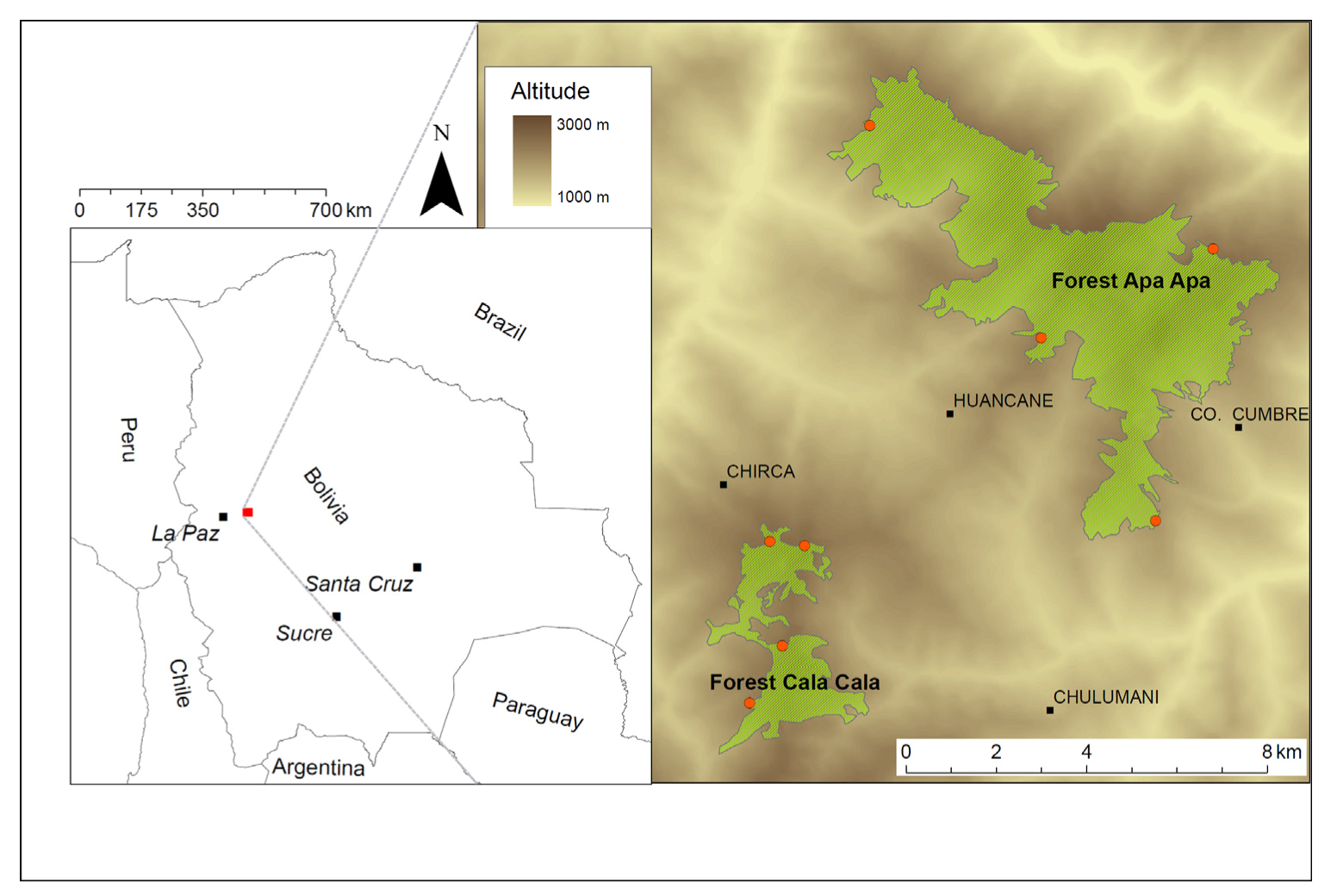
        <p>Two remnants of primary forests, Reserva Ecológica Apa-Apa and Bosque de Cala Cala, were investigated in this study (<xref ref-type="fig" rid="diversity-05-00001-f001">Figure 1</xref>). In each forest remnant, four sites were set up at the forest borders. Selection criteria for these sites were: (i) The fire-degraded sites were located adjacent to a forest fragment. (ii) The adjacent parts of these forests covered more than 600 m in diameter. (iii) The homogeneous fire-cleared site covered more than 150 m in diameter. All investigated sites were situated at 1940–2500 m a.s.l.</p>
        <fig id="diversity-05-00001-f001" position="float">
          <label>Figure 1</label>
          <caption>
            <p>Map of the study area in the Bolivian Andes. Forest remnants are shown in green, the eight study sites at the forest borders are marked by red points.</p>
          </caption>
          <graphic xmlns:xlink="http://www.w3.org/1999/xlink" xlink:href="diversity-05-00001-g001.tif"/>
        </fig>
        <p>At each site, we established one spatial block alongside a previously established transect, perpendicular to the forest border. Each spatial block comprised three habitat types: (1) Forest interior, situated 120 m distant from the forest border, (2) Forest edge, situated at the border between forest and fire-degraded habitat, and (3) Fire-degraded area, 120 m distant from the forest border. At a single site, the fire-degraded habitat could not be sampled because it burned down during the time of the study.</p>
        <p>In contrast to forest habitats, the fire-degraded and now fern-dominated habitats lack any trees higher than 5 m, but comprise patches of insect-pollinated pioneer shrubs, e.g., <italic>Borreria capitata</italic> (Ruiz &amp; Pev.) DC. (Rubiaceae), <italic>Collaea speciosa</italic> (Loisel.) DC. (Fabaceae) or <italic>Raulinoreitzia crenulata</italic> (Spreng.) R.M. King &amp; H. Rob. (Asteraceae). Abiotic conditions show higher fluctuations during the course of a day in fire-degraded habitats than in forest habitats, with particularly high temperatures and arid conditions during times of sun exposure (D. Lippok and S. Gallegos Ayala, unpublished data). </p>
      </sec>
      <sec>
        <title>2.2. Sampling</title>
        <p>The study took place from February to May 2011. Bee and butterfly/moth individuals were caught with pan traps [<xref ref-type="bibr" rid="B27-diversity-05-00001">27</xref>,<xref ref-type="bibr" rid="B28-diversity-05-00001">28</xref>]. Although they may differ in their attraction among different bee species, pan traps are a frequently used, standardized passive sampling technique [<xref ref-type="bibr" rid="B27-diversity-05-00001">27</xref>,<xref ref-type="bibr" rid="B28-diversity-05-00001">28</xref>], often used in biodiversity assessments [<xref ref-type="bibr" rid="B19-diversity-05-00001">19</xref>,<xref ref-type="bibr" rid="B29-diversity-05-00001">29</xref>]. In order to attract a wide spectrum of potential pollinators [<xref ref-type="bibr" rid="B28-diversity-05-00001">28</xref>,<xref ref-type="bibr" rid="B30-diversity-05-00001">30</xref>], commercially available white plastic dishes were additionally painted in yellow and blue. These traps were filled with 300 mL of water and a dash of odorless soluble. Three pan traps, one of each color (white, yellow, blue), were placed in breast height. Thus, our study design compares pollinator diversity in the lower vegetation strata. In every habitat type at each site, three pan trap bundles were installed in a distance of 10 meters from each other.</p>
        <p>First, bee species were collected for 24 h at every site. In a second sampling, bee and butterfly/moth species were collected for 48 h at every site. At a single study site, individuals were accidentally collected for five days instead of two days. Assuming a linear relationship between time and number of caught individuals, we applied a rarefaction approach to create a randomly rarefied community sample that was used in further analyses for this particular site. All collected specimen were stored in 60% ethanol and later identified to morphospecies at the Universidad Mayor de San Andrés, La Paz/Bolivia. For each morphospecies, we also measured its body length (<italic>i.e.</italic>, distance from caput to abdomen) as a measure of body size.</p>
        <p>We acknowledge that the sampling effort at each site was too low for estimating the true species richness in these diverse tropical pollinator communities. However, the aim of this rapid diversity assessment was to compare relative differences in pollinator diversity among the three habitat types. Because sampling effort and design were highly standardized in all habitat types, potential differences in species richness and community composition among habitat types are very unlikely to arise from sampling bias and are instead indicative of changes in the respective pollinator communities.</p>
      </sec>
      <sec>
        <title>2.3. Statistical Analysis</title>
        <p>All statistical analyses were conducted with R, version 2.14.0 [<xref ref-type="bibr" rid="B31-diversity-05-00001">31</xref>] and dedicated packages: <italic>vegan</italic> [<xref ref-type="bibr" rid="B32-diversity-05-00001">32</xref>], <italic>nlme</italic> [<xref ref-type="bibr" rid="B33-diversity-05-00001">33</xref>] and <italic>ade4</italic> [<xref ref-type="bibr" rid="B34-diversity-05-00001">34</xref>]. </p>
        <p>For each habitat type and study site, we determined the cumulative species richness and species abundance across all samplings and compiled a community matrix including species abundances, <italic>i.e.</italic>, the cumulative individual number per morphospecies. Species richness and abundance were square-root transformed to meet normality assumptions. Bee and butterfly/moth richness and abundance were compared between different habitat types, using linear mixed-effect models with habitat as predictor variable and site as random factor to account for the spatial block design of sampling. We defined two orthogonal contrasts in order to identify differences in potential pollinator richness and abundance between (i) forest habitats (interior and edge) and fire-degraded habitats, and between (ii) forest interior and forest edge. Significances of both contrasts were tested using t-statistics.</p>
        <p>Because shifts in community composition from habitat loss may be masked when only species richness is measured [<xref ref-type="bibr" rid="B35-diversity-05-00001">35</xref>], changes in species composition were analyzed with a detrended correspondence analysis (DCA), based on the quantitative community matrix. The influence of rare species was down-weighted and a single outlying community from a fire-degraded habitat had to be excluded from the ordination analysis. We tested whether species compositions correlated with (i) habitat identity and (ii) altitude of the study sites. We also calculated the proportions of bee and butterfly/moth species in pollinator communities for each habitat type and study site and related their proportions to the gradient in species turn-over. Significances of predictor variables on community composition were tested with a permutation test (1,000 permutations). Effects of habitat type were tested with a stratified randomization approach within sites.</p>
        <p>In order to test for differences in body sizes of bee and butterfly/moth guilds among habitats, we applied fourth-corner analyses to detect significant associations between species traits and habitat characteristics [<xref ref-type="bibr" rid="B36-diversity-05-00001">36</xref>,<xref ref-type="bibr" rid="B37-diversity-05-00001">37</xref>]. For both potential pollinator guilds, we compared body sizes with two approaches. First, we compared body sizes within each pollinator guild; bee body sizes had to be log-transformed. Second, we assigned species to be 'large' or 'small', separated by the median in body size in each guild (median for bees: 6.5 mm; median for butterflies/moths: 14.5 mm). By contrasting small and large size classes, we were able to test whether changes in body sizes were driven by responses of the small- or the large-bodied pollinators. In order to test for significances in correlations between species traits and environment, Legendre <italic>et al.</italic> [<xref ref-type="bibr" rid="B36-diversity-05-00001">36</xref>] proposed four permutation models. According to our study questions, we applied model 1 and 2. In model 1, values for each species are permuted independently, assuming that individual species respond to the habitat gradient. In model 2, entire rows are permuted, assuming that fixed assemblages of species prefer environmentally distinct habitats. We conducted permutation tests using model 1 and model 2 with 999 permutations. Since <italic>p</italic>-values from both permutation models were qualitatively identical, we only report p-values from permutation model 1.</p>
      </sec>
    </sec>
    <sec sec-type="results">
      <title>3. Results</title>
      <p>In total, 356 bee individuals, belonging to 67 morphospecies, and 303 Lepidoptera individuals, belonging to 124 morphospecies, were collected. A full list of collected individuals per morphospecies, habitat type and study site is provided in the Supplement. Notably, we recorded 32 individuals of the introduced honeybee <italic>Apis mellifera </italic>L., none of them in forest interior.</p>
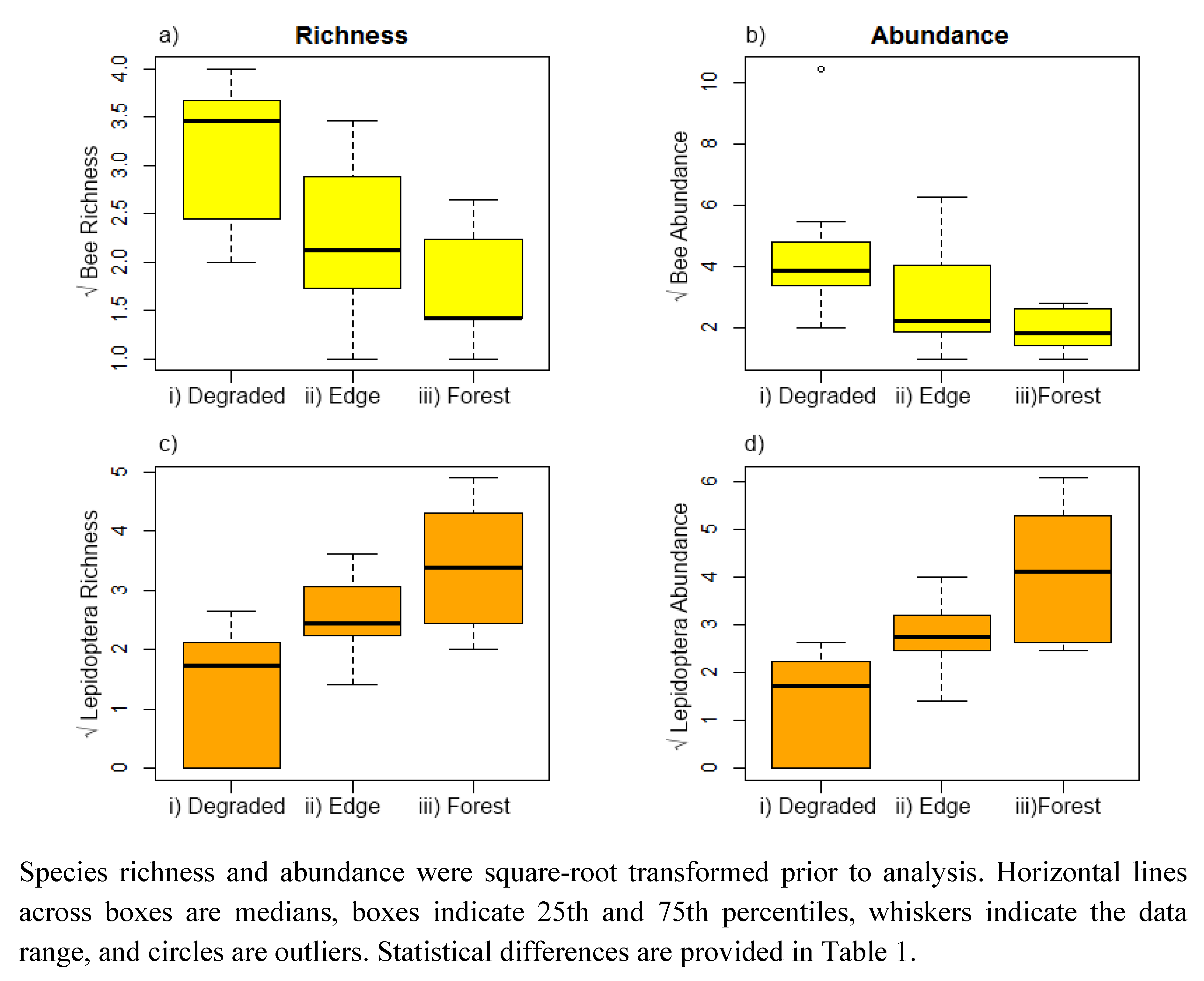
      <p>Bee richness and abundances were higher in fire-degraded habitats than in the adjacent forests. In contrast to bee diversity, butterfly/moth richness and abundances were higher in forest habitats than in adjacent fire-degraded habitats and were significantly higher in forest interior than at forest edges (<xref ref-type="fig" rid="diversity-05-00001-f002">Figure 2</xref>, <xref ref-type="table" rid="diversity-05-00001-t001">Table 1</xref>).</p>
      <fig id="diversity-05-00001-f002" position="float">
        <label>Figure 2</label>
        <caption>
          <p>Species richness and abundance of two pollinators guilds collected with pan traps in three different habitat types in the Bolivian Andes. Bee species richness and abundance are shown in (<bold>a</bold>) and (<bold>b</bold>), butterfly/moth species richness and abundance in (<bold>c</bold>) and (<bold>d</bold>). Habitat types were: (i) fire-degraded, (ii) forest edge and (iii) forest interior habitats. </p>
        </caption>
        <graphic xmlns:xlink="http://www.w3.org/1999/xlink" xlink:href="diversity-05-00001-g002.tif"/>
      </fig>
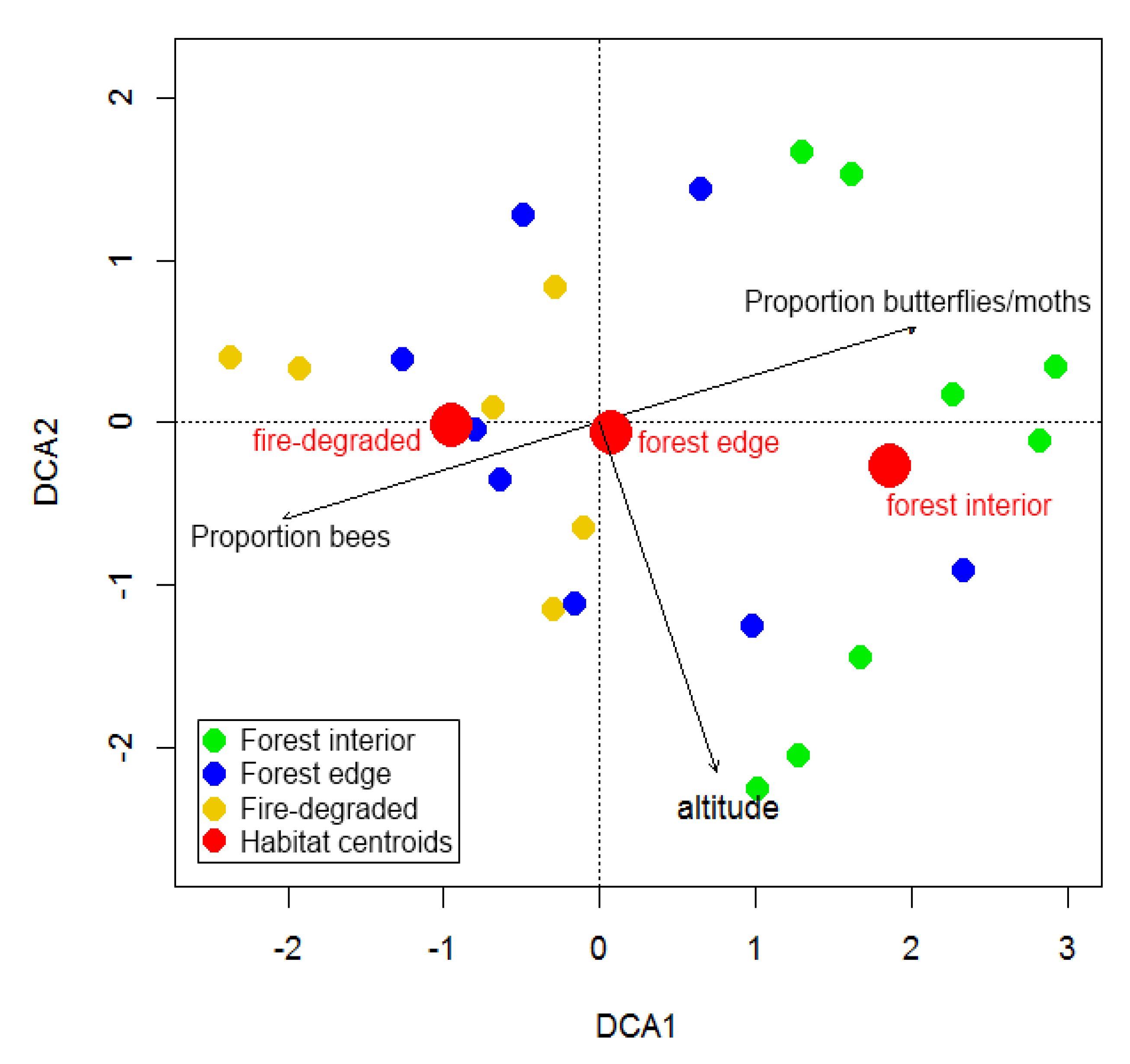
      <p>Community turn-over from forest interior to fire-degraded habitats was high, indicating a complete species turnover (axis lengths: first axis 5.3 standard deviations, second axis 3.9 standard deviations). Ordination axes explained 37.2% and 26.9% of community turnover, respectively. Forest interior and fire-degraded habitats were clearly separated in the ordination plot, while forest edges were characterized by transitional species communities (<xref ref-type="fig" rid="diversity-05-00001-f003">Figure 3</xref>). Habitat types explained 40% (r<sup>2</sup> = 0.40; <italic>p</italic> &lt; 0.001) of the variation in species turn-over and thus slightly more than the species turn-over along the elevation gradient (36%; r<sup>2</sup> = 0.36; <italic>p</italic> = 0.01). Consistent with the observed changes in species richness and abundance, bee species dominated the fire-degraded habitats (r<sup>2</sup> = 0.75; <italic>p</italic> &lt; 0.001), whereas butterfly/moth species increased in relative abundance in forest interiors (r<sup>2</sup> = 0.69; <italic>p</italic> = 0.002).</p>
      <table-wrap id="diversity-05-00001-t001" position="float">
        <object-id pub-id-type="pii">diversity-05-00001-t001_Table 1</object-id>
        <label>Table 1</label>
        <caption>
          <p>Differences in species richness and abundance of two pollinator guilds (bees and butterflies/moths) between three habitat types at eight study sites in the Bolivian Andes. Habitat types were: (i) fire-degraded, (ii) forest edge and (iii) forest interior habitats. Results are from linear mixed-effect models including site as random factor. We applied two orthogonal contrasts to test differences between (i) forest (including interior and edge) <italic>vs.</italic> fire-degraded habitats and (ii) forest interior <italic>vs.</italic> forest edge. </p>
        </caption>
                 <table>
          <thead>
            <tr>
              <th align="left" valign="middle">Bees</th>
              <th align="left" valign="middle"> </th>
              <th align="center" valign="middle">Estimate</th>
              <th align="center" valign="middle">Std. Error</th>
              <th align="center" valign="middle">DF</th>
              <th align="center" valign="middle">t-value</th>
              <th align="center" valign="middle"><italic>p</italic>-value</th>
            </tr>
          </thead>
          <tbody>
            <tr style="border-top: solid thin">
              <td align="left" valign="middle">Richness</td>
              <td align="left" valign="middle">Forest <italic>vs.</italic> degraded</td>
              <td align="center" valign="middle">−0.53</td>
              <td align="center" valign="middle">0.13</td>
              <td align="center" valign="middle">13</td>
              <td align="center" valign="middle">−3.80</td>
              <td align="center" valign="middle"><bold>0.002</bold></td>
            </tr>
            <tr>
              <td align="left" valign="middle"> </td>
              <td align="left" valign="middle">Interior <italic>vs.</italic> edge</td>
              <td align="center" valign="middle">−0.25</td>
              <td align="center" valign="middle">0.15</td>
              <td align="center" valign="middle">13</td>
              <td align="center" valign="middle">−1.70</td>
              <td align="center" valign="middle">0.112</td>
            </tr>
            <tr>
              <td align="left" valign="middle">Abundance</td>
              <td align="left" valign="middle">Forest <italic>vs.</italic> degraded</td>
              <td align="center" valign="middle">−1.07</td>
              <td align="center" valign="middle">0.37</td>
              <td align="center" valign="middle">13</td>
              <td align="center" valign="middle">−2.83</td>
              <td align="center" valign="middle">
                <bold>0.014</bold>
              </td>
            </tr>
            <tr>
              <td align="left" valign="middle"> </td>
              <td align="left" valign="middle">Interior <italic>vs.</italic> edge</td>
              <td align="center" valign="middle">−0.49</td>
              <td align="center" valign="middle">0.41</td>
              <td align="center" valign="middle">13</td>
              <td align="center" valign="middle">−1.20</td>
              <td align="center" valign="middle">0.251</td>
            </tr>
            <tr style="border-top: solid thin">
              <td align="left" valign="middle">
                <bold>Lepidoptera</bold>
              </td>
              <td align="left" valign="middle"> </td>
              <td align="center" valign="middle"> </td>
              <td align="center" valign="middle"> </td>
              <td align="center" valign="middle"> </td>
              <td align="center" valign="middle"> </td>
              <td align="center" valign="middle"> </td>
            </tr>
            <tr style="border-top: solid thin">
              <td align="left" valign="middle">Richness</td>
              <td align="left" valign="middle">Forest <italic>vs.</italic> degraded</td>
              <td align="center" valign="middle">0.88</td>
              <td align="center" valign="middle">0.14</td>
              <td align="center" valign="middle">13</td>
              <td align="center" valign="middle">6.05</td>
              <td align="center" valign="middle">
                <bold>&lt;0.001</bold>
              </td>
            </tr>
            <tr>
              <td align="left" valign="middle"> </td>
              <td align="left" valign="middle">Interior <italic>vs.</italic> edge</td>
              <td align="center" valign="middle">0.41</td>
              <td align="center" valign="middle">0.15</td>
              <td align="center" valign="middle">13</td>
              <td align="center" valign="middle">2.64</td>
              <td align="center" valign="middle">
                <bold>0.020</bold>
              </td>
            </tr>
            <tr>
              <td align="left" valign="middle">Abundance</td>
              <td align="left" valign="middle">Forest <italic>vs.</italic> degraded</td>
              <td align="center" valign="middle">0.17</td>
              <td align="center" valign="middle">0.17</td>
              <td align="center" valign="middle">13</td>
              <td align="center" valign="middle">6.31</td>
              <td align="center" valign="middle">
                <bold>&lt;0.001</bold>
              </td>
            </tr>
            <tr>
              <td align="left" valign="middle"> </td>
              <td align="left" valign="middle">Interior <italic>vs.</italic> edge</td>
              <td align="center" valign="middle">0.64</td>
              <td align="center" valign="middle">0.18</td>
              <td align="center" valign="middle">13</td>
              <td align="center" valign="middle">3.51</td>
              <td align="center" valign="middle">
                <bold>0.004</bold>
              </td>
            </tr>
          </tbody>
        </table>
      </table-wrap>
      
      
      <fig id="diversity-05-00001-f003" position="float">
        <label>Figure 3</label>
        <caption>
          <p>Result of a detrended correspondence analysis testing for species turn-over in pollinator communities of two pollinator guilds (bees, butterflies/moths) along habitat gradients comprising forest interior, forest edge and fire-degraded habitats in the Bolivian Andes. Effects of habitat type, altitude and of the proportion of pollinator guilds on community composition are indicated by the respective centroids or vectors; all effects shown were significant (<italic>p</italic> &lt; 0.05 in a permutation test).</p>
        </caption>
        <graphic xmlns:xlink="http://www.w3.org/1999/xlink" xlink:href="diversity-05-00001-g003.tif"/>
      </fig>
      <p>Body sizes of bee and butterfly/moth communities changed along the habitat gradient (<xref ref-type="table" rid="diversity-05-00001-t002">Table 2</xref>). Body sizes of bee species decreased in the forest interior, whereas body sizes of butterfly/moth communities decreased in fire-degraded habitats. In both pollinator guilds, these changes were driven by the response of large-bodied species to the habitat gradient (<xref ref-type="table" rid="diversity-05-00001-t002">Table 2</xref>). After excluding the introduced honeybee <italic>A. mellifera</italic> from the analysis, the abundance of large-bodied pollinators was still reduced in the forest interior (Χ<sup>2</sup> = 3.29, <italic>p</italic> = 0.007).</p>
      <table-wrap id="diversity-05-00001-t002" position="float">
        <object-id pub-id-type="pii">diversity-05-00001-t002_Table 2</object-id>
        <label>Table 2</label>
        <caption>
          <p>Fourth-corner analyses of body sizes of two pollinator guilds (bees and butterflies/moths) along a human-induced habitat gradient comprising forest interior, forest edge and fire-degraded habitats. Non-random distribution of body sizes was tested using F- and χ<sup>2</sup>-statistics in permutation model 1 [<xref ref-type="bibr" rid="B35-diversity-05-00001">35</xref>]. Holm's corrected <italic>p</italic>-values are provided; significant <italic>p</italic>-values (<italic>p</italic> &lt; 0.05) are printed in bold. Effect sizes that indicate an increase or decrease of body size in the respective habitat type are indicated by "+" and "–", respectively.</p>
        </caption>
        <table>
          <thead>
            <tr>
              <th align="left" valign="middle"> </th>
              <th align="left" valign="middle"> </th>
              <th colspan="5" align="center" valign="middle" style="border-right: dotted thin">Bees</th>
              <th colspan="5" align="center" valign="middle">Lepidoptera</th>
            </tr>
          </thead>
          <tbody>
            <tr>
              <td colspan="2" align="left" valign="middle"> </td>
              <td colspan="2" align="left" valign="middle" style="border-top: solid thin"><bold>Size </bold>(F)</td>
              <td align="left" valign="middle" style="border-top: solid thin"><bold>Small </bold>(χ<sup>2</sup>)</td>
              <td colspan="2" align="left" valign="middle" style="border-top: solid thin;  border-right: dotted thin"><bold>Large</bold> (χ<sup>2</sup>)</td>
              <td colspan="2" align="left" valign="middle" style="border-top: solid thin"><bold>Size </bold>(F)</td>
              <td align="left" valign="middle" style="border-top: solid thin"><bold>Small </bold>(χ<sup>2</sup>)</td>
              <td colspan="2" align="left" valign="middle" style="border-top: solid thin"><bold>Large </bold>(χ<sup>2</sup>)</td>
            </tr>
            <tr style="border-top: solid thin">
              <td colspan="2" align="left" valign="middle">
                <bold>Fire-degraded</bold>
              </td>
              <td colspan="2" align="left" valign="middle">0.1</td>
              <td align="left" valign="middle">8.6</td>
              <td align="left" valign="middle">
                <bold>11.4</bold>
              </td>
              <td align="left" valign="middle" style="border-right: dotted thin">
                <bold>+</bold>
              </td>
              <td align="left" valign="middle">
                <bold>0.3</bold>
              </td>
              <td align="left" valign="middle">
                <bold>−</bold>
              </td>
              <td align="left" valign="middle">5.5</td>
              <td align="left" valign="middle">
                <bold>4.1</bold>
              </td>
              <td align="left" valign="middle">
                <bold>−</bold>
              </td>
            </tr>
            <tr>
              <td colspan="2" align="left" valign="middle"><italic>p</italic>-Value</td>
              <td colspan="2" align="left" valign="middle">0.187</td>
              <td align="left" valign="middle">0.720</td>
              <td colspan="2" align="left" valign="middle" style="border-right: dotted thin">
                <bold>0.015</bold>
              </td>
              <td colspan="2" align="left" valign="middle">
                <bold>0.003</bold>
              </td>
              <td align="left" valign="middle">0.132</td>
              <td colspan="2" align="left" valign="middle">
                <bold>0.006</bold>
              </td>
            </tr>
            <tr style="border-top: solid thin">
              <td colspan="2" align="left" valign="middle">
                <bold>Forest edge</bold>
              </td>
              <td colspan="2" align="left" valign="middle">0.1</td>
              <td align="left" valign="middle">8.4</td>
              <td colspan="2" align="left" valign="middle" style="border-right: dotted thin">9.2</td>
              <td colspan="2" align="left" valign="middle">0.0</td>
              <td align="left" valign="middle">10.2</td>
              <td colspan="2" align="left" valign="middle">11.3</td>
            </tr>
            <tr>
              <td colspan="2" align="left" valign="middle"><italic>p</italic>-Value</td>
              <td colspan="2" align="left" valign="middle">0.178</td>
              <td align="left" valign="middle">0.720</td>
              <td colspan="2" align="left" valign="middle" style="border-right: dotted thin">0.720</td>
              <td colspan="2" align="left" valign="middle">0.399</td>
              <td align="left" valign="middle">0.452</td>
              <td colspan="2" align="left" valign="middle">0.489</td>
            </tr>
            <tr style="border-top: solid thin">
              <td colspan="2" align="left" valign="middle">
                <bold>Forest interior</bold>
              </td>
              <td align="left" valign="middle">
                <bold>0.2</bold>
              </td>
              <td align="left" valign="middle">
                <bold>−</bold>
              </td>
              <td align="left" valign="middle">11.1</td>
              <td align="left" valign="middle">
                <bold>3.4</bold>
              </td>
              <td align="left" valign="middle" style="border-right: dotted thin">
                <bold>−</bold>
              </td>
              <td align="left" valign="middle">
                <bold>0.2</bold>
              </td>
              <td align="left" valign="middle">
                <bold>+</bold>
              </td>
              <td align="left" valign="middle">10.6</td>
              <td align="left" valign="middle">
                <bold>17.4</bold>
              </td>
              <td align="left" valign="middle">
                <bold>+</bold>
              </td>
            </tr>
            <tr>
              <td colspan="2" align="left" valign="middle"><italic>p</italic>-Value</td>
              <td colspan="2" align="left" valign="middle">
                <bold>0.024</bold>
              </td>
              <td align="left" valign="middle">0.720</td>
              <td colspan="2" align="left" valign="middle" style="border-right: dotted thin">
                <bold>0.006</bold>
              </td>
              <td colspan="2" align="left" valign="middle">
                <bold>0.016</bold>
              </td>
              <td align="left" valign="middle">0.435</td>
              <td colspan="2" align="left" valign="middle">
                <bold>0.006</bold>
              </td>
            </tr>
          </tbody>
        </table>
      </table-wrap>
    </sec>
    <sec sec-type="discussion">
      <title>4. Discussion</title>
      <sec>
        <title>4.1. Species Richness and Abundance</title>
        <p>Species richness of bees and butterfly/moth communities changed along the human-induced habitat gradient. Notably, both pollinator guilds were differently affected by altered habitat conditions. The high structural diversity at the contact zone between fire-degraded and forest habitats did not lead to an increase in species richness, neither in bee nor in butterfly/moth communities. Bee species richness was highest in fire-degraded habitats, whereas butterfly/moth richness significantly decreased in fire-degraded, now fern-dominated habitats. For bee species, Oteri and Sandino [<xref ref-type="bibr" rid="B38-diversity-05-00001">38</xref>] also reported a higher abundance of bees in open farmland habitats than in tropical forests but, different from our study, forests still accounted for highest species richness. Contrarily, Liow <italic>et al.</italic> [<xref ref-type="bibr" rid="B39-diversity-05-00001">39</xref>] described lower species richness but higher abundance in primary forests when compared to disturbed forest ecosystems. Diversity and abundance of Euglossine bees were reported to be unaffected by habitat alterations [<xref ref-type="bibr" rid="B40-diversity-05-00001">40</xref>]. Thus, responses of bee pollinators to human-induced habitat disturbance appear to be context-dependent and may strongly depend on the type of habitat modification [<xref ref-type="bibr" rid="B29-diversity-05-00001">29</xref>] and the surrounding landscape matrix [<xref ref-type="bibr" rid="B29-diversity-05-00001">29</xref>].</p>
        <p>In our study, we collected 32 individuals of the invasive honeybee [<xref ref-type="bibr" rid="B41-diversity-05-00001">41</xref>], <italic>Apis mellifera</italic> L., in fire-degraded habitats and at forest edges. Honeybees contributed strongly to the increase in bee species richness in disturbed habitats and were strictly bound to disturbed habitats, a phenomenon also found in other studies [<xref ref-type="bibr" rid="B42-diversity-05-00001">42</xref>,<xref ref-type="bibr" rid="B43-diversity-05-00001">43</xref>]. Further research on the question whether honeybees indeed provide pollination functions and connect forest edges with the surrounding habitat matrix or whether they compete with native pollinators for resources [<xref ref-type="bibr" rid="B44-diversity-05-00001">44</xref>] are crucial for assessing the potential value of honeybees for forest restoration. </p>
        <p>The observed decline in butterfly/moth species diversity in fire-degraded habitats is consistent with previous studies [<xref ref-type="bibr" rid="B13-diversity-05-00001">13</xref>,<xref ref-type="bibr" rid="B45-diversity-05-00001">45</xref>,<xref ref-type="bibr" rid="B46-diversity-05-00001">46</xref>]. Apart from climate and topography, human disturbance was reported to be one of the most important determinants of butterfly diversity [<xref ref-type="bibr" rid="B40-diversity-05-00001">40</xref>]. In most studies, species diversity of Lepidoptera was negatively associated with the intensity of human disturbance [<xref ref-type="bibr" rid="B13-diversity-05-00001">13</xref>,<xref ref-type="bibr" rid="B45-diversity-05-00001">45</xref>,<xref ref-type="bibr" rid="B46-diversity-05-00001">46</xref>], leading to reductions in butterfly richness and abundance of up to 80% in a temperate system [<xref ref-type="bibr" rid="B47-diversity-05-00001">47</xref>]. On a larger scale, however, small-scale forest disturbances could even increase Lepidoptera richness [<xref ref-type="bibr" rid="B48-diversity-05-00001">48</xref>]. </p>
        <p>We acknowledge that not only spatial, but also temporal variations in biotic and abiotic conditions influence species diversity [<xref ref-type="bibr" rid="B48-diversity-05-00001">48</xref>,<xref ref-type="bibr" rid="B49-diversity-05-00001">49</xref>]. Repeated samplings in different seasons could give a more comprehensive insight into differences in species diversity between forest and fire-degraded habitats in our study system. For instance, tropical Hymenoptera exhibited higher temporal species turnover in forest habitats compared to disturbed agricultural ecosystems [<xref ref-type="bibr" rid="B50-diversity-05-00001">50</xref>].</p>
      </sec>
      <sec>
        <title>4.2. Species Turn-Over</title>
        <p>At a small spatial scale of 240 m, our study revealed a complete species turnover between forest understorey and fire-degraded habitats. This demonstrates that bee and butterfly/moth species, albeit long distance foragers [<xref ref-type="bibr" rid="B51-diversity-05-00001">51</xref>], exhibit strong habitat dependences. In agreement with this view, Powell and Powell [<xref ref-type="bibr" rid="B52-diversity-05-00001">52</xref>] reported that male Euglossine bees, known as mobile pollinators [<xref ref-type="bibr" rid="B53-diversity-05-00001">53</xref>], failed to cross 100 m wide cleared areas. This was likely because altered microclimatic conditions constrained species movements and local species distributions [<xref ref-type="bibr" rid="B52-diversity-05-00001">52</xref>]. For moth species, temperature is assumed to be the most important abiotic determinant of species turnover in montane rain forests [<xref ref-type="bibr" rid="B54-diversity-05-00001">54</xref>]. Because our study was conducted at the end of the wet season, lower frequencies of rainfall during the dry season likely result in stronger differences in humidity and temperature between forest and fire-degraded habitats in the dry than in the wet season. The strong differences in microclimatic conditions between forest habitats and adjacent fire-degraded habitats are a likely explanation for the observed species turn-over in our study system. Opposite responses of bee and Lepidoptera communities to altered microclimatic conditions are thus a plausible explanation for their divergent diversity patterns.</p>
        <p>Another factor that could affect differences in pollinator communities between habitats is flower availability [<xref ref-type="bibr" rid="B38-diversity-05-00001">38</xref>]. In our study system, flower abundances were, however, similarly high in all habitat types (mean number of flowers per 100 m<sup>2</sup>: 1,100 flowers; habitat differences: F = 0.41, <italic>p</italic> = 0.671) [<xref ref-type="bibr" rid="B55-diversity-05-00001">55</xref>]. In addition to resource quantities, future studies should test whether changes in resource qualities, <italic>i.e.</italic>, floral traits, from forest interior to degraded habitats are associated with the species turn-over in pollinator communities, particularly with the observed opposite trends in bee and Lepidoptera communities.</p>
      </sec>
      <sec>
        <title>4.3. Changes in Body Size</title>
        <p>We could show that even on a small spatial scale bees and butterfly/moth communities varied in species' body sizes. As bee body size determines the thoracic temperature necessary for initiating flight [<xref ref-type="bibr" rid="B20-diversity-05-00001">20</xref>], large-bodied bee species start foraging earlier during the day and in cooler conditions than small-bodied bee species [<xref ref-type="bibr" rid="B21-diversity-05-00001">21</xref>]. Small-bodied species, on the other hand, can tolerate higher temperatures without overheating [<xref ref-type="bibr" rid="B21-diversity-05-00001">21</xref>]. As temperatures were found to rise twice as high in fire-degraded habitats than in forest interior habitats [D. Lippok and S. Gallegos Ayala, unpublished data], we expected to collect smaller bee species in open fire-degraded habitats. Because we actually found more large-bodied species in fire-degraded habitats than in forest interiors, we suppose that other factors drive the increase in bee body size with human disturbance in the study area. For instance, colonization ability was reported as positively correlated with bee body size [<xref ref-type="bibr" rid="B56-diversity-05-00001">56</xref>], possibly because body size is linked to bee foraging ranges [<xref ref-type="bibr" rid="B57-diversity-05-00001">57</xref>]. Therefore, large-bodied species could be less affected by disturbance and habitat loss than small-bodied species [<xref ref-type="bibr" rid="B58-diversity-05-00001">58</xref>].</p>
        <p>In contrast to bees, body sizes of butterfly/moth species decreased in degraded habitats. This could be related to the fact that body temperatures of large butterfly species are close to ambient temperatures [<xref ref-type="bibr" rid="B58-diversity-05-00001">58</xref>] and thus need to heat up less in closed forest habitats. Schulze <italic>et al.</italic> [<xref ref-type="bibr" rid="B22-diversity-05-00001">22</xref>] also pointed out that the forest understorey offers higher structural diversity and thus better protection against predators than open habitats. Because large-bodied butterflies move more slowly and are therefore easier to catch than small-bodied species [<xref ref-type="bibr" rid="B59-diversity-05-00001">59</xref>], it is plausible that large-bodied butterflies are mostly found in the forest interior where they are better protected against predators.</p>
        <p>We highlight that different pollinator guilds responded differently to the human-induced habitat gradient in our study area and that physiological differences between the studied pollinator guilds may translate into opposing trends in pollinator traits. It might be an interesting field of future research to test whether different selection pressures on different pollinator guilds result in diverging community structures also at larger spatial scales.</p>
      </sec>
    </sec>
    <sec sec-type="conclusions">
      <title>5. Conclusions</title>
      <p>Despite the limited sampling effort of our rapid diversity assessment, we were able to demonstrate that fire-degradation of tropical montane forest has severe impacts on animal pollinator communities. Predicted future increases in fire frequencies [<xref ref-type="bibr" rid="B3-diversity-05-00001">3</xref>] are likely to cause further decreases in abundance and richness of forest-adapted pollinator guilds, such as butterflies and moths. Because we found that bee pollinators followed an opposite pattern than butterfly and moth species, pollination services to insect-pollinated plant species could be buffered by bee pollinators in fire-degraded habitats. However, the ultimate consequences of these profound changes in pollinator communities on animal-mediated pollination and plant reproductive success remain to be investigated. Our tentative findings suggest that plant species relying on generalized pollinators, such as <italic>A. mellifera</italic>, may suffer less from fire degradation, whereas highly specialized plant species are likely to lose crucial pollinator species in fire-degraded habitats. We conclude that changes in pollinator communities in fire-degraded habitats may be an important filter for the natural regeneration of forest plant species in the tropical Andes and elsewhere.</p>
    </sec>
  </body>
  <back>
    <ack>
      <title>Acknowledgements</title>
      <p>We thank Denis Lippok and Silvia Gallegos Ayala for their support during field work and identification of specimen. We also thank the staff of the Herbario nacional de Bolivia, La Paz. This research was funded by the Deutsche Forschungsgemeinschaft (DFG-project HE3041 /20-1). M.S. was also supported by the research funding program Landes-Offensive zur Entwicklung Wissenschaftlich-ökonomischer Exzellenz (LOEWE) of Hesse’s Ministry of Higher Education, Research, and the Arts.</p>
    </ack>
    <app-group>
    <app>
        <title>Supplementary Files</title>
        <supplementary-material xmlns:xlink="http://www.w3.org/1999/xlink" id="diversity-05-00001-s001" xlink:href="diversity-05-00001-s001.pdf">
        <label>Supplementary File 1</label>
            <caption>
                <p>Supplementary File (PDF, 118 KB) </p>
            </caption>
        </supplementary-material>
    </app>
</app-group>
    <ref-list>
      <title>References</title>
      <ref id="B1-diversity-05-00001">
        <label>1.</label>
        <citation citation-type="journal">
          <person-group person-group-type="author">
            <name>
              <surname>Barthlott</surname>
              <given-names>W.</given-names>
            </name>
            <name>
              <surname>Lauer</surname>
              <given-names>W.</given-names>
            </name>
            <name>
              <surname>Placke</surname>
              <given-names>A.</given-names>
            </name>
          </person-group>
          <article-title><italic>Global Distribution of Species Diversity in Vascular Plants: Towards A World Map</italic> Of Phytodiversity (Globale Verteilung der Artenvielfalt Höherer Pflanzen: Vorarbeiten zu einer Weltkarte der Phytodiversität<italic>)</italic></article-title>
          <source>Erdkunde</source>
          <year>1996</year>
          <volume>50</volume>
          <fpage>317</fpage>
          <lpage>327</lpage>
        </citation>
      </ref>
      <ref id="B2-diversity-05-00001">
        <label>2.</label>
        <citation citation-type="journal">
          <person-group person-group-type="author">
            <name>
              <surname>Mittermeier</surname>
              <given-names>R.A.</given-names>
            </name>
            <name>
              <surname>Myers</surname>
              <given-names>N.</given-names>
            </name>
            <name>
              <surname>Thomsen</surname>
              <given-names>J.B.</given-names>
            </name>
            <name>
              <surname>da Fonseca</surname>
              <given-names>G.A.</given-names>
            </name>
            <name>
              <surname>Olivieri</surname>
              <given-names>S.</given-names>
            </name>
          </person-group>
          <article-title>Biodiversity hotspots and major tropical wilderness areas: Approaches to setting conservation priorities</article-title>
          <source>Conserv. Biol.</source>
          <year>1998</year>
          <volume>12</volume>
          <fpage>516</fpage>
          <lpage>520</lpage>
        <pub-id pub-id-type="doi">10.1046/j.1523-1739.1998.012003516.x</pub-id></citation>
      </ref>
      <ref id="B3-diversity-05-00001">
        <label>3.</label>
        <citation citation-type="book">
		<collab>IPCC</collab>
           
          <article-title>Summary for Policymakers</article-title>
          <source>Climate Change 2007: Impacts, Adaptation and Vulnerability. Contribution of Working Group II to the Fourth Assessment Report of the Intergovernmental Panel on Climate Change</source>
          <person-group person-group-type="editor">
            <name>
              <surname>Parry</surname>
              <given-names>M.L.</given-names>
            </name>
            <name>
              <surname>Canziani</surname>
              <given-names>O.F.</given-names>
            </name>
            <name>
              <surname>Palutikof</surname>
              <given-names>J.P.</given-names>
            </name>
            <name>
              <surname>van der Linden</surname>
              <given-names>P.J.</given-names>
            </name>
            <name>
              <surname>Hanson</surname>
              <given-names>C.E.</given-names>
            </name>
          </person-group>
          <publisher-name>Cambridge University Press</publisher-name>
          <publisher-loc>Cambridge, UK</publisher-loc>
          <year>2007</year>
        </citation>
      </ref>
      <ref id="B4-diversity-05-00001">
        <label>4.</label>
        <citation citation-type="journal">
          <person-group person-group-type="author">
            <name>
              <surname>Webster</surname>
              <given-names>B.D.</given-names>
            </name>
            <name>
              <surname>Steeves</surname>
              <given-names>T.A.</given-names>
            </name>
          </person-group>
          <article-title>Morphogenesis in Pteridium aquilinum (L.) Kuhn-General morphology and growth habit</article-title>
          <source>Phytomorphology</source>
          <year>1958</year>
          <volume>8</volume>
          <fpage>30</fpage>
          <lpage>41</lpage>
        </citation>
      </ref>
      <ref id="B5-diversity-05-00001">
        <label>5.</label>
        <citation citation-type="journal">
          <person-group person-group-type="author">
            <name>
              <surname>Hartig</surname>
              <given-names>K.</given-names>
            </name>
            <name>
              <surname>Beck</surname>
              <given-names>E.</given-names>
            </name>
          </person-group>
          <article-title>The bracken fern (Pteridium arachnoideum (Kaulf.) Maxon) Dilemma in the Andes of southern Ecuador</article-title>
          <source>Ecotropica</source>
          <year>2003</year>
          <volume>9</volume>
          <fpage>3</fpage>
          <lpage>13</lpage>
        </citation>
      </ref>
      <ref id="B6-diversity-05-00001">
        <label>6.</label>
        <citation citation-type="journal">
          <person-group person-group-type="author">
            <name>
              <surname>Silva Matos</surname>
              <given-names>D.M.</given-names>
            </name>
            <name>
              <surname>Belinato</surname>
              <given-names>T.A.</given-names>
            </name>
          </person-group>
          <article-title>Interference of Pteridium arachnoideum (Kaulf.) Maxon. (Dennstaedtiaceae) on the establishment of rainforest trees</article-title>
          <source>Braz. J. Biol.</source>
          <year>2010</year>
          <volume>70</volume>
          <fpage>311</fpage>
          <lpage>316</lpage>
          <pub-id pub-id-type="doi">10.1590/S1519-69842010000200012</pub-id>
        </citation>
      </ref>
      <ref id="B7-diversity-05-00001">
        <label>7.</label>
        <citation citation-type="book">
          <person-group person-group-type="author">
            <name>
              <surname>Rodrigues</surname>
              <given-names>R.R.</given-names>
            </name>
            <name>
              <surname>Martins</surname>
              <given-names>S.V.</given-names>
            </name>
          </person-group>
          <source>High Diversity Forest Restoration in Degraded Areas: Methods and Projects In Brazil</source>
          <publisher-name>Nova Publishers</publisher-name>
          <publisher-loc>São Paulo, Brazil</publisher-loc>
          <year>2007</year>
        </citation>
      </ref>
      <ref id="B8-diversity-05-00001">
        <label>8.</label>
        <citation citation-type="journal">
          <person-group person-group-type="author">
            <name>
              <surname>Bawa</surname>
              <given-names>K.S.</given-names>
            </name>
          </person-group>
          <article-title>Plant-pollinator interactions in tropical rain forests</article-title>
          <source>Annu. Rev. Ecol. Syst.</source>
          <year>1990</year>
          <volume>21</volume>
          <fpage>399</fpage>
          <lpage>422</lpage>
        <pub-id pub-id-type="doi">10.1146/annurev.es.21.110190.002151</pub-id></citation>
      </ref>
      <ref id="B9-diversity-05-00001">
        <label>9.</label>
        <citation citation-type="journal">
          <person-group person-group-type="author">
            <name>
              <surname>Schemske</surname>
              <given-names>D.W.</given-names>
            </name>
            <name>
              <surname>Mittelbach</surname>
              <given-names>G.G.</given-names>
            </name>
            <name>
              <surname>Cornell</surname>
              <given-names>H.V.</given-names>
            </name>
            <name>
              <surname>Sobel</surname>
              <given-names>J.M.</given-names>
            </name>
            <name>
              <surname>Roy</surname>
              <given-names>K.</given-names>
            </name>
          </person-group>
          <article-title>Is there a latitudinal gradient in the importance of biotic interactions?</article-title>
          <source>Annu. Rev. Ecol. Evol. Syst.</source>
          <year>2009</year>
          <volume>40</volume>
          <fpage>245</fpage>
          <lpage>269</lpage>
          <pub-id pub-id-type="doi">10.1146/annurev.ecolsys.39.110707.173430</pub-id>
        </citation>
      </ref>
      <ref id="B10-diversity-05-00001">
        <label>10.</label>
        <citation citation-type="journal">
          <person-group person-group-type="author">
            <name>
              <surname>Knight</surname>
              <given-names>T.M.</given-names>
            </name>
            <name>
              <surname>Steets</surname>
              <given-names>J.A.</given-names>
            </name>
            <name>
              <surname>Vamosi</surname>
              <given-names>J.C.</given-names>
            </name>
            <name>
              <surname>Mazer</surname>
              <given-names>S.J.</given-names>
            </name>
            <name>
              <surname>Burd</surname>
              <given-names>M.</given-names>
            </name>
            <name>
              <surname>Campbell</surname>
              <given-names>D.R.</given-names>
            </name>
            <name>
              <surname>Dudash</surname>
              <given-names>M.R.</given-names>
            </name>
            <name>
              <surname>Johnston</surname>
              <given-names>M.O.</given-names>
            </name>
            <name>
              <surname>Mitchell</surname>
              <given-names>R.J.</given-names>
            </name>
            <name>
              <surname>Ashman</surname>
              <given-names>T.L.</given-names>
            </name>
          </person-group>
          <article-title>Pollen limitation of plant reproduction: Pattern and process</article-title>
          <source>Annu. Rev. Ecol. Evol. Syst.</source>
          <year>2005</year>
          <volume>36</volume>
          <fpage>467</fpage>
          <lpage>497</lpage>
          <pub-id pub-id-type="doi">10.1146/annurev.ecolsys.36.102403.115320</pub-id>
        </citation>
      </ref>
      <ref id="B11-diversity-05-00001">
        <label>11.</label>
        <citation citation-type="journal">
          <person-group person-group-type="author">
            <name>
              <surname>Hagen</surname>
              <given-names>M.</given-names>
            </name>
            <name>
              <surname>Kraemer</surname>
              <given-names>M.</given-names>
            </name>
          </person-group>
          <article-title>Agricultural surroundings support flower–visitor networks in an afrotropical rain forest</article-title>
          <source>Biol. Conserv.</source>
          <year>2010</year>
          <volume>143</volume>
          <fpage>1654</fpage>
          <lpage>1663</lpage>
          <pub-id pub-id-type="doi">10.1016/j.biocon.2010.03.036</pub-id>
        </citation>
      </ref>
      <ref id="B12-diversity-05-00001">
        <label>12.</label>
        <citation citation-type="journal">
          <person-group person-group-type="author">
            <name>
              <surname>Winfree</surname>
              <given-names>R.</given-names>
            </name>
            <name>
              <surname>Griswold</surname>
              <given-names>T.</given-names>
            </name>
            <name>
              <surname>Kremen</surname>
              <given-names>C.</given-names>
            </name>
          </person-group>
          <article-title>Effect of human disturbance on bee communities in a forested ecosystem</article-title>
          <source>Conserv. Biol.</source>
          <year>2007</year>
          <volume>21</volume>
          <fpage>213</fpage>
          <lpage>223</lpage>
          <pub-id pub-id-type="doi">10.1111/j.1523-1739.2006.00574.x</pub-id>
        </citation>
      </ref>
      <ref id="B13-diversity-05-00001">
        <label>13.</label>
        <citation citation-type="journal">
          <person-group person-group-type="author">
            <name>
              <surname>Aguilar</surname>
              <given-names>R.</given-names>
            </name>
            <name>
              <surname>Ashworth</surname>
              <given-names>L.</given-names>
            </name>
            <name>
              <surname>Galetto</surname>
              <given-names>L.</given-names>
            </name>
            <name>
              <surname>Aizen</surname>
              <given-names>M.A.</given-names>
            </name>
          </person-group>
          <article-title>Plant reproductive susceptibility to habitat fragmentation: Review and synthesis through a meta-analysis</article-title>
          <source>Ecol. Lett.</source>
          <year>2006</year>
          <volume>9</volume>
          <fpage>968</fpage>
          <lpage>980</lpage>
        <pub-id pub-id-type="doi">10.1111/j.1461-0248.2006.00927.x</pub-id><pub-id pub-id-type="pmid">16913941</pub-id></citation>
      </ref>
      <ref id="B14-diversity-05-00001">
        <label>14.</label>
        <citation citation-type="journal">
          <person-group person-group-type="author">
            <name>
              <surname>Steffan-Dewenter</surname>
              <given-names>I.</given-names>
            </name>
            <name>
              <surname>Münzenberg</surname>
              <given-names>U.</given-names>
            </name>
            <name>
              <surname>Bürger</surname>
              <given-names>C.</given-names>
            </name>
            <name>
              <surname>Thies</surname>
              <given-names>C.</given-names>
            </name>
            <name>
              <surname>Tscharntke</surname>
              <given-names>T.</given-names>
            </name>
          </person-group>
          <article-title>Scale-dependent effects of landscape context on three pollinator guilds</article-title>
          <source>Ecology</source>
          <year>2002</year>
          <volume>83</volume>
          <fpage>1421</fpage>
          <lpage>1432</lpage>
          <pub-id pub-id-type="doi">10.1890/0012-9658(2002)083[1421:SDEOLC]2.0.CO;2</pub-id>
        </citation>
      </ref>
      <ref id="B15-diversity-05-00001">
        <label>15.</label>
        <citation citation-type="journal">
          <person-group person-group-type="author">
            <name>
              <surname>Hamer</surname>
              <given-names>K.C.</given-names>
            </name>
            <name>
              <surname>Hill</surname>
              <given-names>J.K.</given-names>
            </name>
          </person-group>
          <article-title>Scale-dependent effects of habitat disturbance on species richness in tropical forests</article-title>
          <source>Conserv. Biol.</source>
          <year>2000</year>
          <volume>14</volume>
          <fpage>1435</fpage>
          <lpage>1440</lpage>
          <pub-id pub-id-type="doi">10.1046/j.1523-1739.2000.99417.x</pub-id>
        </citation>
      </ref>
      <ref id="B16-diversity-05-00001">
        <label>16.</label>
        <citation citation-type="journal">
          <person-group person-group-type="author">
            <name>
              <surname>Quesada</surname>
              <given-names>M.</given-names>
            </name>
            <name>
              <surname>Sanchez-Azofeifa</surname>
              <given-names>G.A.</given-names>
            </name>
            <name>
              <surname>Alvarez-Añorve</surname>
              <given-names>M.</given-names>
            </name>
            <name>
              <surname>Stoner</surname>
              <given-names>K.E.</given-names>
            </name>
            <name>
              <surname>Avila-Cabadilla</surname>
              <given-names>L.</given-names>
            </name>
            <name>
              <surname>Calvo-Alvarado</surname>
              <given-names>J.</given-names>
            </name>
            <name>
              <surname>Castillo</surname>
              <given-names>A.</given-names>
            </name>
            <name>
              <surname>Espírito-Santo</surname>
              <given-names>M.M.</given-names>
            </name>
            <name>
              <surname>Fagundes</surname>
              <given-names>M.</given-names>
            </name>
            <name>
              <surname>Fernandes</surname>
              <given-names>G.W.</given-names>
            </name>
            <etal/>
          </person-group>
          <article-title>Succession and management of tropical dry forests in the Americas: Review and new perspectives</article-title>
          <source>Forest Ecol. Manag.</source>
          <year>2009</year>
          <volume>258</volume>
          <fpage>1014</fpage>
          <lpage>1024</lpage>
          <pub-id pub-id-type="doi">10.1016/j.foreco.2009.06.023</pub-id>
        </citation>
      </ref>
      <ref id="B17-diversity-05-00001">
        <label>17.</label>
        <citation citation-type="journal">
          <person-group person-group-type="author">
            <name>
              <surname>Heithaus</surname>
              <given-names>E.R.</given-names>
            </name>
          </person-group>
          <article-title>Community structure of neotropical flower visiting bees and wasps: Diversity and phenology</article-title>
          <source>Ecology</source>
          <year>1979</year>
          <volume>60</volume>
          <fpage>190</fpage>
          <lpage>202</lpage>
          <pub-id pub-id-type="doi">10.2307/1936480</pub-id>
        </citation>
      </ref>
      <ref id="B18-diversity-05-00001">
        <label>18.</label>
        <citation citation-type="journal">
          <person-group person-group-type="author">
            <name>
              <surname>Potts</surname>
              <given-names>S.G.</given-names>
            </name>
            <name>
              <surname>Vulliamy</surname>
              <given-names>B.</given-names>
            </name>
            <name>
              <surname>Dafni</surname>
              <given-names>A.</given-names>
            </name>
            <name>
              <surname>Ne’eman</surname>
              <given-names>G.</given-names>
            </name>
            <name>
              <surname>Willmer</surname>
              <given-names>P.</given-names>
            </name>
          </person-group>
          <article-title>Linking bees and flowers: How do floral communities structure pollinator communities?</article-title>
          <source>Ecology</source>
          <year>2003</year>
          <volume>84</volume>
          <fpage>2628</fpage>
          <lpage>2642</lpage>
          <pub-id pub-id-type="doi">10.1890/02-0136</pub-id>
        </citation>
      </ref>
      <ref id="B19-diversity-05-00001">
        <label>19.</label>
        <citation citation-type="journal">
          <person-group person-group-type="author">
            <name>
              <surname>Breitbach</surname>
              <given-names>N.</given-names>
            </name>
            <name>
              <surname>Tillmann</surname>
              <given-names>S.</given-names>
            </name>
            <name>
              <surname>Schleuning</surname>
              <given-names>M.</given-names>
            </name>
            <name>
              <surname>Grünewald</surname>
              <given-names>C.</given-names>
            </name>
            <name>
              <surname>Laube</surname>
              <given-names>I.</given-names>
            </name>
            <name>
              <surname>Steffan-Dewenter</surname>
              <given-names>I.</given-names>
            </name>
            <name>
              <surname>Böhning-Gaese</surname>
              <given-names>K.</given-names>
            </name>
          </person-group>
          <article-title>Influence of habitat complexity and landscape configuration on pollination and seed-dispersal interactions of wild cherry trees</article-title>
          <source>Oecologia</source>
          <year>2012</year>
          <volume>168</volume>
          <fpage>425</fpage>
          <lpage>437</lpage>
          <pub-id pub-id-type="doi">10.1007/s00442-011-2090-1</pub-id>
        </citation>
      </ref>
      <ref id="B20-diversity-05-00001">
        <label>20.</label>
        <citation citation-type="journal">
          <person-group person-group-type="author">
            <name>
              <surname>Bishop</surname>
              <given-names>J.A.</given-names>
            </name>
            <name>
              <surname>Armbruster</surname>
              <given-names>W.S.</given-names>
            </name>
          </person-group>
          <article-title>Thermoregulatory abilities of Alaskan bees: Effects of size, phylogeny and ecology</article-title>
          <source>Funct. Ecol.</source>
          <year>1999</year>
          <volume>13</volume>
          <fpage>711</fpage>
          <lpage>724</lpage>
          <pub-id pub-id-type="doi">10.1046/j.1365-2435.1999.00351.x</pub-id>
        </citation>
      </ref>
      <ref id="B21-diversity-05-00001">
        <label>21.</label>
        <citation citation-type="journal">
          <person-group person-group-type="author">
            <name>
              <surname>Pereboom</surname>
              <given-names>J.J.M.</given-names>
            </name>
            <name>
              <surname>Biesmeijer</surname>
              <given-names>J.C.</given-names>
            </name>
          </person-group>
          <article-title>Thermal constraints for stingless bee foragers: The importance of body size and coloration</article-title>
          <source>Oecologia</source>
          <year>2003</year>
          <volume>137</volume>
          <fpage>42</fpage>
          <lpage>50</lpage>
        <pub-id pub-id-type="doi">10.1007/s00442-003-1324-2</pub-id><pub-id pub-id-type="pmid">12838404</pub-id></citation>
      </ref>
      <ref id="B22-diversity-05-00001">
        <label>22.</label>
        <citation citation-type="journal">
          <person-group person-group-type="author">
            <name>
              <surname>Schulze</surname>
              <given-names>C.H.</given-names>
            </name>
            <name>
              <surname>Linsenmair</surname>
              <given-names>K.E.</given-names>
            </name>
            <name>
              <surname>Fiedler</surname>
              <given-names>K.</given-names>
            </name>
          </person-group>
          <article-title>Understorey <italic>versus </italic>canopy: Patterns of vertical stratification and diversity among Lepidoptera in a Bornean rain forest</article-title>
          <source>Plant. Ecol.</source>
          <year>2001</year>
          <volume>153</volume>
          <fpage>133</fpage>
          <lpage>152</lpage>
          <pub-id pub-id-type="doi">10.1023/A:1017589711553</pub-id>
        </citation>
      </ref>
      <ref id="B23-diversity-05-00001">
        <label>23.</label>
        <citation citation-type="journal">
          <person-group person-group-type="author">
            <name>
              <surname>Hill</surname>
              <given-names>J.K.</given-names>
            </name>
            <name>
              <surname>Hamer</surname>
              <given-names>K.C.</given-names>
            </name>
            <name>
              <surname>Tangah</surname>
              <given-names>J.</given-names>
            </name>
            <name>
              <surname>Dawood</surname>
              <given-names>M.</given-names>
            </name>
          </person-group>
          <article-title>Ecology of tropical butterflies in rainforest gaps</article-title>
          <source>Oecologia</source>
          <year>2001</year>
          <volume>128</volume>
          <fpage>294</fpage>
          <lpage>302</lpage>
        <pub-id pub-id-type="doi">10.1007/s004420100651</pub-id></citation>
      </ref>
      <ref id="B24-diversity-05-00001">
        <label>24.</label>
        <citation citation-type="book">
          <person-group person-group-type="author">
            <name>
              <surname>Handel</surname>
              <given-names>S.N.</given-names>
            </name>
          </person-group>
          <article-title>The role of plant-animal mutualisms in the design and restoration of natural communities</article-title>
          <source>Restoration Ecology and Sustainable Development</source>
          <person-group person-group-type="editor">
            <name>
              <surname>Urbanska</surname>
              <given-names>K.M.</given-names>
            </name>
            <name>
              <surname>Webb</surname>
              <given-names>N.R.</given-names>
            </name>
            <name>
              <surname>Edwards</surname>
              <given-names>P.J.</given-names>
            </name>
          </person-group>
          <publisher-name>Cambridge University Press</publisher-name>
          <publisher-loc>Cambridge, UK</publisher-loc>
          <year>1997</year>
          <fpage>111</fpage>
          <lpage>132</lpage>
        </citation>
      </ref>
      <ref id="B25-diversity-05-00001">
        <label>25.</label>
        <citation citation-type="journal">
          <person-group person-group-type="author">
            <name>
              <surname>Dixon</surname>
              <given-names>K.W.</given-names>
            </name>
          </person-group>
          <article-title>Pollination and restoration</article-title>
          <source>Science</source>
          <year>2009</year>
          <volume>325</volume>
          <fpage>571</fpage>
          <lpage>573</lpage>
          <pub-id pub-id-type="doi">10.1126/science.1176295</pub-id>
        </citation>
      </ref>
      <ref id="B26-diversity-05-00001">
        <label>26.</label>
        <citation citation-type="journal">
          <person-group person-group-type="author">
            <name>
              <surname>Molina Carpio</surname>
              <given-names>J.</given-names>
            </name>
          </person-group>
          <article-title>Régimen de precipitación en la cuenca de Huarinilla-Cotapata, La Paz-Bolivia</article-title>
          <source>Ecol. Boliv.</source>
          <year>2005</year>
          <volume>40</volume>
          <fpage>43</fpage>
          <lpage>55</lpage>
        </citation>
      </ref>
      <ref id="B27-diversity-05-00001">
        <label>27.</label>
        <citation citation-type="journal">
          <person-group person-group-type="author">
            <name>
              <surname>Toler</surname>
              <given-names>T.R.</given-names>
            </name>
            <name>
              <surname>Evans</surname>
              <given-names>E.W.</given-names>
            </name>
            <name>
              <surname>Tepedino</surname>
              <given-names>V.J.</given-names>
            </name>
          </person-group>
          <article-title>Pan-trapping for bees (Hymenoptera: Apiformes) in Utah’s west desert: The importance of color diversity</article-title>
          <source>Pan-Pac. Entomol.</source>
          <year>2005</year>
          <volume>81</volume>
          <fpage>103</fpage>
          <lpage>113</lpage>
        </citation>
      </ref>
      <ref id="B28-diversity-05-00001">
        <label>28.</label>
        <citation citation-type="journal">
          <person-group person-group-type="author">
            <name>
              <surname>Roulston</surname>
              <given-names>T.H.</given-names>
            </name>
            <name>
              <surname>Smith</surname>
              <given-names>S.A.</given-names>
            </name>
            <name>
              <surname>Brewster</surname>
              <given-names>A.L.</given-names>
            </name>
          </person-group>
          <article-title>A Comparison of pan trap and intensive net sampling techniques for documenting a bee (Hymenoptera: Apiformes) fauna</article-title>
          <source>J. Kansas Entomol. Soc.</source>
          <year>2007</year>
          <volume>80</volume>
          <fpage>179</fpage>
          <lpage>181</lpage>
          <pub-id pub-id-type="doi">10.2317/0022-8567(2007)80[179:ACOPTA]2.0.CO;2</pub-id>
        </citation>
      </ref>
      <ref id="B29-diversity-05-00001">
        <label>29.</label>
        <citation citation-type="journal">
          <person-group person-group-type="author">
            <name>
              <surname>Schleuning</surname>
              <given-names>M.</given-names>
            </name>
            <name>
              <surname>Farwig</surname>
              <given-names>N.</given-names>
            </name>
            <name>
              <surname>Peters</surname>
              <given-names>M.K.</given-names>
            </name>
            <name>
              <surname>Bergsdorf</surname>
              <given-names>T.</given-names>
            </name>
            <name>
              <surname>Bleher</surname>
              <given-names>B.</given-names>
            </name>
            <name>
              <surname>Brandl</surname>
              <given-names>R.</given-names>
            </name>
            <name>
              <surname>Dalitz</surname>
              <given-names>H.</given-names>
            </name>
            <name>
              <surname>Fischer</surname>
              <given-names>G.</given-names>
            </name>
            <name>
              <surname>Freund</surname>
              <given-names>W.</given-names>
            </name>
            <name>
              <surname>Gikungu</surname>
              <given-names>M.W.</given-names>
            </name>
          </person-group>
          <article-title>Forest fragmentation and selective logging have inconsistent effects on multiple animal-mediated ecosystem processes in a tropical forest</article-title>
          <source>PloS One</source>
          <year>2011</year>
          <volume>6</volume>
          <fpage>e27785</fpage>
        <pub-id pub-id-type="doi">10.1371/journal.pone.0027785</pub-id><pub-id pub-id-type="pmid">22114695</pub-id></citation>
      </ref>
      <ref id="B30-diversity-05-00001">
        <label>30.</label>
        <citation citation-type="journal">
          <person-group person-group-type="author">
            <name>
              <surname>Campbell</surname>
              <given-names>J.W.</given-names>
            </name>
            <name>
              <surname>Hanula</surname>
              <given-names>J.L.</given-names>
            </name>
          </person-group>
          <article-title>Efficiency of malaise traps and colored pan traps for collecting flower visiting insects from three forested ecosystems</article-title>
          <source>J. Insect Cons.</source>
          <year>2007</year>
          <volume>11</volume>
          <fpage>399</fpage>
          <lpage>408</lpage>
          <pub-id pub-id-type="doi">10.1007/s10841-006-9055-4</pub-id>
        </citation>
      </ref>
      <ref id="B31-diversity-05-00001">
        <label>31.</label>
        <citation citation-type="book">
		<collab>R Development Core Team</collab>
           
          <source>R: A Language and Environment for Statistical Computing</source>
          <publisher-name>R Foundation for Statistical Computing</publisher-name>
          <publisher-loc>Vienna, Austria</publisher-loc>
          <year>2008</year>
        </citation>
      </ref>
      <ref id="B32-diversity-05-00001">
        <label>32.</label>
        <citation citation-type="book">
          <person-group person-group-type="author">
            <name>
              <surname>Oksanen</surname>
              <given-names>J.</given-names>
            </name>
            <name>
              <surname>Blanchet</surname>
              <given-names>F.G.</given-names>
            </name>
            <name>
              <surname>Kindt</surname>
              <given-names>R.</given-names>
            </name>
            <name>
              <surname>Legendre</surname>
              <given-names>P.</given-names>
            </name>
            <name>
              <surname>Minchin</surname>
              <given-names>P.R.</given-names>
            </name>
            <name>
              <surname>O’Hara</surname>
              <given-names>R.B.</given-names>
            </name>
            <name>
              <surname>Simpson</surname>
              <given-names>G.L.</given-names>
            </name>
            <name>
              <surname>Solymos</surname>
              <given-names>P.</given-names>
            </name>
            <name>
              <surname>Stevens</surname>
              <given-names>M.H.H.</given-names>
            </name>
            <name>
              <surname>Wagner</surname>
              <given-names>H.</given-names>
            </name>
          </person-group>
          <article-title>Vegan: Community ecology package, 2011</article-title>
          <source>R package version 2.0-1</source>
        </citation>
      </ref>
      <ref id="B33-diversity-05-00001">
        <label>33.</label>
        <citation citation-type="book">
          <person-group person-group-type="author">
            <name>
              <surname>Pinheiro</surname>
              <given-names>J.</given-names>
            </name>
            <name>
              <surname>Bates</surname>
              <given-names>D.</given-names>
            </name>
            <name>
              <surname>DebRoy</surname>
              <given-names>S.</given-names>
            </name>
            <name>
              <surname>Sarkar</surname>
              <given-names>D.</given-names>
            </name>
          </person-group>
          <article-title>The R development core team (2011) nlme: Linear and nonlinear mixed effects models, 2011</article-title>
          <source>R package version 3.1-106</source>
        </citation>
      </ref>
      <ref id="B34-diversity-05-00001">
        <label>34.</label>
        <citation citation-type="journal">
          <person-group person-group-type="author">
            <name>
              <surname>Dray</surname>
              <given-names>S.</given-names>
            </name>
            <name>
              <surname>Dufour</surname>
              <given-names>A.B.</given-names>
            </name>
          </person-group>
          <article-title>The Ade4 package: Implementing the duality diagram for ecologists</article-title>
          <source>J. Stat. Softw.</source>
          <year>2007</year>
          <volume>22</volume>
          <fpage>1</fpage>
          <lpage>20</lpage>
        </citation>
      </ref>
      <ref id="B35-diversity-05-00001">
        <label>35.</label>
        <citation citation-type="journal">
          <person-group person-group-type="author">
            <name>
              <surname>Ewers</surname>
              <given-names>R.M.</given-names>
            </name>
            <name>
              <surname>Didham</surname>
              <given-names>R.K.</given-names>
            </name>
          </person-group>
          <article-title>Confounding factors in the detection of species responses to habitat fragmentation</article-title>
          <source>Biol. Rev.</source>
          <year>2006</year>
          <volume>81</volume>
          <fpage>117</fpage>
          <lpage>142</lpage>
        <pub-id pub-id-type="pmid">16318651</pub-id></citation>
      </ref>
      <ref id="B36-diversity-05-00001">
        <label>36.</label>
        <citation citation-type="journal">
          <person-group person-group-type="author">
            <name>
              <surname>Legendre</surname>
              <given-names>P.</given-names>
            </name>
            <name>
              <surname>Galzin</surname>
              <given-names>R.</given-names>
            </name>
            <name>
              <surname>Harmelin-Vivien</surname>
              <given-names>M.L.</given-names>
            </name>
          </person-group>
          <article-title>Relating behaviour to habitat: Solutions to the fourth-corner problem</article-title>
          <source>Ecology</source>
          <year>1997</year>
          <volume>78</volume>
          <fpage>547</fpage>
          <lpage>562</lpage>
        </citation>
      </ref>
      <ref id="B37-diversity-05-00001">
        <label>37.</label>
        <citation citation-type="journal">
          <person-group person-group-type="author">
            <name>
              <surname>Dray</surname>
              <given-names>S.</given-names>
            </name>
            <name>
              <surname>Legendre</surname>
              <given-names>P.</given-names>
            </name>
          </person-group>
          <article-title>Testing the species traits-environment relationships: The fourth-corner problem revisited</article-title>
          <source>Ecology</source>
          <year>2008</year>
          <volume>89</volume>
          <fpage>3400</fpage>
          <lpage>3412</lpage>
          <pub-id pub-id-type="doi">10.1890/08-0349.1</pub-id>
        </citation>
      </ref>
      <ref id="B38-diversity-05-00001">
        <label>38.</label>
        <citation citation-type="journal">
          <person-group person-group-type="author">
            <name>
              <surname>Otero</surname>
              <given-names>J.T.</given-names>
            </name>
            <name>
              <surname>Sandino</surname>
              <given-names>J.C.</given-names>
            </name>
          </person-group>
          <article-title>Capture rates of male Euglossine bees across a human intervention gradient, Chocó region, Colombia</article-title>
          <source>Biotropica</source>
          <year>2006</year>
          <volume>35</volume>
          <fpage>520</fpage>
          <lpage>529</lpage>
        </citation>
      </ref>
      <ref id="B39-diversity-05-00001">
        <label>39.</label>
        <citation citation-type="journal">
          <person-group person-group-type="author">
            <name>
              <surname>Liow</surname>
              <given-names>L.H.</given-names>
            </name>
            <name>
              <surname>Sodhi</surname>
              <given-names>N.S.</given-names>
            </name>
            <name>
              <surname>Elmqvist</surname>
              <given-names>T.</given-names>
            </name>
          </person-group>
          <article-title>Bee diversity along a disturbance gradient in tropical lowland forests of south-east Asia</article-title>
          <source>J. Appl. Ecol.</source>
          <year>2001</year>
          <volume>38</volume>
          <fpage>180</fpage>
          <lpage>192</lpage>
          <pub-id pub-id-type="doi">10.1046/j.1365-2664.2001.00582.x</pub-id>
        </citation>
      </ref>
      <ref id="B40-diversity-05-00001">
        <label>40.</label>
        <citation citation-type="journal">
          <person-group person-group-type="author">
            <name>
              <surname>Tonhasca</surname>
              <given-names>A.</given-names>
              <suffix>Jr.</suffix>
            </name>
            <name>
              <surname>Blackmer</surname>
              <given-names>J.L.</given-names>
            </name>
            <name>
              <surname>Albuquerque</surname>
              <given-names>G.S.</given-names>
            </name>
          </person-group>
          <article-title>Abundance and diversity of Euglossine bees in the fragmented landscape of the Brazilian Atlantic forest</article-title>
          <source>Biotropica</source>
          <year>2002</year>
          <volume>34</volume>
          <fpage>416</fpage>
          <lpage>422</lpage>
        </citation>
      </ref>
      <ref id="B41-diversity-05-00001">
        <label>41.</label>
        <citation citation-type="journal">
          <person-group person-group-type="author">
            <name>
              <surname>Zayed</surname>
              <given-names>A.</given-names>
            </name>
            <name>
              <surname>Whitfield</surname>
              <given-names>C.W.</given-names>
            </name>
          </person-group>
          <article-title>A genome-wide signature of positive selection in ancient and recent invasive expansions of the honey bee Apis mellifera</article-title>
          <source>Proc. Natl. Acad. Sci. USA</source>
          <year>2008</year>
          <volume>105</volume>
          <fpage>3421</fpage>
          <lpage>3426</lpage>
          <pub-id pub-id-type="doi">10.1073/pnas.0800107105</pub-id>
        </citation>
      </ref>
      <ref id="B42-diversity-05-00001">
        <label>42.</label>
        <citation citation-type="journal">
          <person-group person-group-type="author">
            <name>
              <surname>Brosi</surname>
              <given-names>B.J.</given-names>
            </name>
            <name>
              <surname>Daily</surname>
              <given-names>G.C.</given-names>
            </name>
            <name>
              <surname>Ehrlich</surname>
              <given-names>P.R.</given-names>
            </name>
          </person-group>
          <article-title>Bee community shifts with landscape context in a tropical countryside</article-title>
          <source>Ecol. Appl.</source>
          <year>2007</year>
          <volume>17</volume>
          <fpage>418</fpage>
          <lpage>430</lpage>
          <pub-id pub-id-type="doi">10.1890/06-0029</pub-id>
        </citation>
      </ref>
      <ref id="B43-diversity-05-00001">
        <label>43.</label>
        <citation citation-type="journal">
          <person-group person-group-type="author">
            <name>
              <surname>Brosi</surname>
              <given-names>B.J.</given-names>
            </name>
            <name>
              <surname>Daily</surname>
              <given-names>G.C.</given-names>
            </name>
            <name>
              <surname>Shih</surname>
              <given-names>T.M.</given-names>
            </name>
            <name>
              <surname>Oviedo</surname>
              <given-names>F.</given-names>
            </name>
            <name>
              <surname>Durán</surname>
              <given-names>G.</given-names>
            </name>
          </person-group>
          <article-title>The effects of forest fragmentation on bee communities in tropical countryside</article-title>
          <source>J. Appl. Ecol.</source>
          <year>2008</year>
          <volume>45</volume>
          <fpage>773</fpage>
          <lpage>783</lpage>
        </citation>
      </ref>
      <ref id="B44-diversity-05-00001">
        <label>44.</label>
        <citation citation-type="journal">
          <person-group person-group-type="author">
            <name>
              <surname>Wilms</surname>
              <given-names>W.</given-names>
            </name>
            <name>
              <surname>Wiechers</surname>
              <given-names>B.</given-names>
            </name>
          </person-group>
          <article-title>Floral resource partitioning between native Melipona bees and the introduced Africanized honey bee in the Brazilian Atlantic rain forest</article-title>
          <source>Apidologie</source>
          <year>1997</year>
          <volume>28</volume>
          <fpage>339</fpage>
          <lpage>355</lpage>
          <pub-id pub-id-type="doi">10.1051/apido:19970602</pub-id>
        </citation>
      </ref>
      <ref id="B45-diversity-05-00001">
        <label>45.</label>
        <citation citation-type="journal">
          <person-group person-group-type="author">
            <name>
              <surname>Stefanescu</surname>
              <given-names>C.</given-names>
            </name>
            <name>
              <surname>Herrando</surname>
              <given-names>S.</given-names>
            </name>
            <name>
              <surname>Páramo</surname>
              <given-names>F.</given-names>
            </name>
          </person-group>
          <article-title>Butterfly species richness in the north-west Mediterranean basin: The role of natural and human-induced factors</article-title>
          <source>J. Biogeogr.</source>
          <year>2004</year>
          <volume>31</volume>
          <fpage>905</fpage>
          <lpage>915</lpage>
          <pub-id pub-id-type="doi">10.1111/j.1365-2699.2004.01088.x</pub-id>
        </citation>
      </ref>
      <ref id="B46-diversity-05-00001">
        <label>46.</label>
        <citation citation-type="journal">
          <person-group person-group-type="author">
            <name>
              <surname>Hill</surname>
              <given-names>J.K.</given-names>
            </name>
            <name>
              <surname>Hamer</surname>
              <given-names>K.C.</given-names>
            </name>
            <name>
              <surname>Lace</surname>
              <given-names>L.A.</given-names>
            </name>
            <name>
              <surname>Banham</surname>
              <given-names>W.M.T.</given-names>
            </name>
          </person-group>
          <article-title>Effects of selective logging on tropical forest butterflies on Buru, Indonesia</article-title>
          <source>J. Appl. Ecol.</source>
          <year>1995</year>
          <volume>32</volume>
          <fpage>754</fpage>
          <lpage>760</lpage>
          <pub-id pub-id-type="doi">10.2307/2404815</pub-id>
        </citation>
      </ref>
      <ref id="B47-diversity-05-00001">
        <label>47.</label>
        <citation citation-type="journal">
          <person-group person-group-type="author">
            <name>
              <surname>Kitahara</surname>
              <given-names>M.</given-names>
            </name>
            <name>
              <surname>Fujii</surname>
              <given-names>K.</given-names>
            </name>
          </person-group>
          <article-title>Biodiversity and community structure of temperate butterfly species within a gradient of human disturbance: An analysis based on the concept of generalist <italic>vs.</italic> specialist strategies</article-title>
          <source>Res. Popul. Ecol.</source>
          <year>1994</year>
          <volume>36</volume>
          <fpage>187</fpage>
          <lpage>199</lpage>
          <pub-id pub-id-type="doi">10.1007/BF02514935</pub-id>
        </citation>
      </ref>
      <ref id="B48-diversity-05-00001">
        <label>48.</label>
        <citation citation-type="journal">
          <person-group person-group-type="author">
            <name>
              <surname>Hogsden</surname>
              <given-names>K.L.</given-names>
            </name>
            <name>
              <surname>Hutchinson</surname>
              <given-names>T.C.</given-names>
            </name>
          </person-group>
          <article-title>Butterfly assemblages along a human disturbance gradient in Ontario, Canada</article-title>
          <source>Can. J. Zoolog.</source>
          <year>2004</year>
          <volume>82</volume>
          <fpage>739</fpage>
          <lpage>748</lpage>
        <pub-id pub-id-type="doi">10.1139/z04-048</pub-id></citation>
      </ref>
      <ref id="B49-diversity-05-00001">
        <label>49.</label>
        <citation citation-type="journal">
          <person-group person-group-type="author">
            <name>
              <surname>Potts</surname>
              <given-names>S.G.</given-names>
            </name>
            <name>
              <surname>Dafni</surname>
              <given-names>A.</given-names>
            </name>
            <name>
              <surname>Ne’eman</surname>
              <given-names>G.</given-names>
            </name>
          </person-group>
          <article-title>Pollination of a core flowering shrub species in Mediterranean phrygana: variation in pollinator diversity, abundance and effectiveness in response to fire</article-title>
          <source>Oikos</source>
          <year>2003</year>
          <volume>92</volume>
          <fpage>71</fpage>
          <lpage>80</lpage>
        </citation>
      </ref>
      <ref id="B50-diversity-05-00001">
        <label>50.</label>
        <citation citation-type="journal">
          <person-group person-group-type="author">
            <name>
              <surname>Tylianakis</surname>
              <given-names>J.M.</given-names>
            </name>
            <name>
              <surname>Klein</surname>
              <given-names>A.-M.</given-names>
            </name>
            <name>
              <surname>Tscharntke</surname>
              <given-names>T.</given-names>
            </name>
          </person-group>
          <article-title>Spatiotemporal variation in the diversity of Hymenoptera across a tropical habitat gradient</article-title>
          <source>Ecology</source>
          <year>2005</year>
          <volume>86</volume>
          <fpage>3296</fpage>
          <lpage>3302</lpage>
        <pub-id pub-id-type="doi">10.1890/05-0371</pub-id></citation>
      </ref>
      <ref id="B51-diversity-05-00001">
        <label>51.</label>
        <citation citation-type="journal">
          <person-group person-group-type="author">
            <name>
              <surname>Bawa</surname>
              <given-names>K.S.</given-names>
            </name>
            <name>
              <surname>Bullock</surname>
              <given-names>S.H.</given-names>
            </name>
            <name>
              <surname>Perry</surname>
              <given-names>D.R.</given-names>
            </name>
            <name>
              <surname>Coville</surname>
              <given-names>R.E.</given-names>
            </name>
            <name>
              <surname>Grayum</surname>
              <given-names>M.H.</given-names>
            </name>
          </person-group>
          <article-title>Reproductive biology of tropical lowland rain forest trees. II. Pollination systems</article-title>
          <source> Am. J. Bot.</source>
          <year>1985</year>
          <volume>72</volume>
          <fpage>346</fpage>
          <lpage>356</lpage>
          <pub-id pub-id-type="doi">10.2307/2443527</pub-id>
        </citation>
      </ref>
      <ref id="B52-diversity-05-00001">
        <label>52.</label>
        <citation citation-type="journal">
          <person-group person-group-type="author">
            <name>
              <surname>Powell</surname>
              <given-names>A.H.</given-names>
            </name>
            <name>
              <surname>Powell</surname>
              <given-names>G.V.</given-names>
            </name>
          </person-group>
          <article-title>Population dynamics of male Euglossine bees in Amazonian forest fragments</article-title>
          <source>Biotropica</source>
          <year>1987</year>
          <volume>19</volume>
          <fpage>176</fpage>
          <lpage>179</lpage>
          <pub-id pub-id-type="doi">10.2307/2388742</pub-id>
        </citation>
      </ref>
      <ref id="B53-diversity-05-00001">
        <label>53.</label>
        <citation citation-type="journal">
          <person-group person-group-type="author">
            <name>
              <surname>Janzen</surname>
              <given-names>D.H.</given-names>
            </name>
          </person-group>
          <article-title>Euglossine Bees as long-distance pollinators of tropical plants</article-title>
          <source>Science</source>
          <year>1971</year>
          <volume>171</volume>
          <fpage>203</fpage>
        <pub-id pub-id-type="doi">10.1126/science.171.3967.203</pub-id><pub-id pub-id-type="pmid">17751330</pub-id></citation>
      </ref>
      <ref id="B54-diversity-05-00001">
        <label>54.</label>
        <citation citation-type="journal">
          <person-group person-group-type="author">
            <name>
              <surname>Brehm</surname>
              <given-names>G.</given-names>
            </name>
            <name>
              <surname>Homeier</surname>
              <given-names>J.</given-names>
            </name>
            <name>
              <surname>Fiedler</surname>
              <given-names>K.</given-names>
            </name>
          </person-group>
          <article-title>Beta diversity of Geometrid moths (Lepidoptera: Geometridae) in an Andean montane rainforest</article-title>
          <source>Divers. Distrib.</source>
          <year>2003</year>
          <volume>9</volume>
          <fpage>351</fpage>
          <lpage>366</lpage>
          <pub-id pub-id-type="doi">10.1046/j.1472-4642.2003.00023.x</pub-id>
        </citation>
      </ref>
      <ref id="B55-diversity-05-00001">
        <label>55.</label>
        <citation citation-type="thesis">
          <person-group person-group-type="author">
            <name>
              <surname>Kambach</surname>
              <given-names>S.</given-names>
            </name>
          </person-group>
          <article-title>Differences in diversity and composition of pollinator guilds between montane forest and arrested succession in Bolivia</article-title>
          <comment>Diploma Thesis, University of Halle-Wittenberg, 2012.</comment>
        </citation>
      </ref>
      <ref id="B56-diversity-05-00001">
        <label>56.</label>
        <citation citation-type="journal">
          <person-group person-group-type="author">
            <name>
              <surname>Gathmann</surname>
              <given-names>A.</given-names>
            </name>
            <name>
              <surname>Greiler</surname>
              <given-names>H.-J.</given-names>
            </name>
            <name>
              <surname>Tscharntke</surname>
              <given-names>T.</given-names>
            </name>
          </person-group>
          <article-title>Trap-nesting bees and wasps colonizing set-aside fields: Succession and body size, Management by cutting and sowing</article-title>
          <source>Oecologia</source>
          <year>1994</year>
          <volume>98</volume>
          <fpage>8</fpage>
          <lpage>14</lpage>
        <pub-id pub-id-type="doi">10.1007/BF00326084</pub-id></citation>
      </ref>
      <ref id="B57-diversity-05-00001">
        <label>57.</label>
        <citation citation-type="journal">
          <person-group person-group-type="author">
            <name>
              <surname>Greenleaf</surname>
              <given-names>S.S.</given-names>
            </name>
            <name>
              <surname>Williams</surname>
              <given-names>N.M.</given-names>
            </name>
            <name>
              <surname>Winfree</surname>
              <given-names>R.</given-names>
            </name>
            <name>
              <surname>Kremen</surname>
              <given-names>C.</given-names>
            </name>
          </person-group>
          <article-title>Bee foraging ranges and their relationship to body size</article-title>
          <source>Oecologia</source>
          <year>2007</year>
          <volume>153</volume>
          <fpage>589</fpage>
          <lpage>596</lpage>
        <pub-id pub-id-type="doi">10.1007/s00442-007-0752-9</pub-id><pub-id pub-id-type="pmid">17483965</pub-id></citation>
      </ref>
      <ref id="B58-diversity-05-00001">
        <label>58.</label>
        <citation citation-type="journal">
          <person-group person-group-type="author">
            <name>
              <surname>Bommarco</surname>
              <given-names>R.</given-names>
            </name>
            <name>
              <surname>Biesmeijer</surname>
              <given-names>J.C.</given-names>
            </name>
            <name>
              <surname>Meyer</surname>
              <given-names>B.</given-names>
            </name>
            <name>
              <surname>Potts</surname>
              <given-names>S.G.</given-names>
            </name>
            <name>
              <surname>Pöyry</surname>
              <given-names>J.</given-names>
            </name>
            <name>
              <surname>Roberts</surname>
              <given-names>S.P.M.</given-names>
            </name>
            <name>
              <surname>Steffan-Dewenter</surname>
              <given-names>I.</given-names>
            </name>
            <name>
              <surname>Öckinger</surname>
              <given-names>E.</given-names>
            </name>
          </person-group>
          <article-title>Dispersal capacity and diet breadth modify the response of wild bees to habitat loss</article-title>
          <source>P. Roy. Soc. B-Biol. Sci.</source>
          <year>2010</year>
          <volume>277</volume>
          <fpage>2075</fpage>
          <lpage>2082</lpage>
        <pub-id pub-id-type="doi">10.1098/rspb.2009.2221</pub-id></citation>
      </ref>
      <ref id="B59-diversity-05-00001">
        <label>59.</label>
        <citation citation-type="journal">
          <person-group person-group-type="author">
            <name>
              <surname>Thomas</surname>
              <given-names>C.D.</given-names>
            </name>
            <name>
              <surname>Hill</surname>
              <given-names>J.K.</given-names>
            </name>
            <name>
              <surname>Lewis</surname>
              <given-names>O.T.</given-names>
            </name>
          </person-group>
          <article-title>Evolutionary consequences of habitat fragmentation in a localized butterfly</article-title>
          <source>J. Anim. Ecol.</source>
          <year>1998</year>
          <volume>67</volume>
          <fpage>485</fpage>
          <lpage>497</lpage>
        <pub-id pub-id-type="doi">10.1046/j.1365-2656.1998.00213.x</pub-id></citation>
      </ref>
    </ref-list>
  </back>
</article>