
<?xml version="1.0" encoding="UTF-8"?>
<!DOCTYPE article PUBLIC "-//NLM//DTD Journal Publishing DTD v2.3 20070202//EN" "journalpublishing.dtd">
<article xmlns:xlink="http://www.w3.org/1999/xlink" xml:lang="en" article-type="research-article">
<front>
<journal-meta>
<journal-id journal-id-type="publisher-id">Diversity</journal-id>
<journal-title>Diversity</journal-title>
<issn pub-type="epub">1424-2818</issn>
<publisher>
<publisher-name>Molecular Diversity Preservation International (MDPI)</publisher-name></publisher></journal-meta>
<article-meta>
<article-id pub-id-type="doi">10.3390/d3040628</article-id>
<article-id pub-id-type="publisher-id">diversity-03-00628</article-id>
<article-categories>
<subj-group>
<subject>Article</subject></subj-group></article-categories>
<title-group>
<article-title>Resilience of Florida Keys Coral Communities Following Large-Scale Disturbances</article-title></title-group>
<contrib-group>
<contrib contrib-type="author">
<name><surname>Santavy</surname><given-names>Deborah L.</given-names></name><xref ref-type="aff" rid="af1-diversity-03-00628"><sup>1</sup></xref></contrib>
<contrib contrib-type="author">
<name><surname>Mueller</surname><given-names>Erich M.</given-names></name><xref ref-type="aff" rid="af2-diversity-03-00628"><sup>2</sup></xref></contrib>
<contrib contrib-type="author">
<name><surname>MacLaughlin</surname><given-names>Lauri</given-names></name><xref ref-type="aff" rid="af3-diversity-03-00628"><sup>3</sup></xref></contrib>
<contrib contrib-type="author">
<name><surname>Peters</surname><given-names>Esther C.</given-names></name><xref ref-type="aff" rid="af4-diversity-03-00628"><sup>4</sup></xref></contrib>
<contrib contrib-type="author">
<name><surname>Quarles</surname><given-names>Robert L.</given-names></name><xref ref-type="aff" rid="af1-diversity-03-00628"><sup>1</sup></xref></contrib>
<contrib contrib-type="author">
<name><surname>Barron</surname><given-names>Mace G.</given-names></name><xref ref-type="aff" rid="af1-diversity-03-00628"><sup>1</sup></xref><xref ref-type="corresp" rid="c1-diversity-03-00628"><sup>*</sup></xref></contrib></contrib-group>
<aff id="af1-diversity-03-00628">
<label>1</label> Gulf Ecology Division, US Environmental Protection Agency, 1 Sabine Island Dr., Gulf Breeze, FL 32561, USA; E-Mails: <email>santavy.debbie@epa.gov</email> (D.L.S.); <email>quarles.bob@epa.gov</email> (R.L.Q.)</aff>
<aff id="af2-diversity-03-00628">
<label>2</label> Perry Institute for Marine Science, Suite 202, 100 N US Hwy. 1, Jupiter, FL 33477, USA;E-Mail: <email>emueller@perryinstitute.org</email></aff>
<aff id="af3-diversity-03-00628">
<label>3</label> Florida Keys National Marine Sanctuary, Upper Keys Office, MM 95, 230 Overseas Hwy, Key Largo, FL 33037, USA; E-Mail: <email>lauri.maclaughlin@noaa.gov</email></aff>
<aff id="af4-diversity-03-00628">
<label>4</label> Department of Environmental Science and Policy, George Mason University, 4400 University Drive MSN5F2, Fairfax, VA 22030, USA; E-Mail: <email>epeters2@gmu.edu</email></aff>
<author-notes>
<corresp id="c1-diversity-03-00628">
<label>*</label> Author to whom correspondence should be addressed; E-Mail: <email>barron.mace@epa.gov</email>; Tel.: +1-850-934-9223; Fax: +1-850-934-2402.</corresp></author-notes>
<pub-date pub-type="collection">
<year>2011</year></pub-date>
<pub-date pub-type="epub">
<day>03</day>
<month>10</month>
<year>2011</year></pub-date>
<volume>4</volume>
<issue>4</issue>
<fpage>628</fpage>
<lpage>640</lpage>
<history>
<date date-type="received">
<day>02</day>
<month>08</month>
<year>2011</year></date>
<date date-type="rev-recd">
<day>15</day>
<month>09</month>
<year>2011</year></date>
<date date-type="accepted">
<day>22</day>
<month>09</month>
<year>2011</year></date></history>
<permissions>
<copyright-statement>© 2011 by the authors; licensee MDPI, Basel, Switzerland.</copyright-statement>
<copyright-year>2011</copyright-year>
<license>
<p>This article is an open access article distributed under the terms and conditions of the Creative Commons Attribution license (http://creativecommons.org/licenses/by/3.0/).</p></license></permissions>
<abstract>
<p>The decline of coral reefs in the Caribbean over the last 40 years has been attributed to multiple chronic stressors and episodic large-scale disturbances. This study assessed the resilience of coral communities in two different regions of the Florida Keys reef system between 1998 and 2002 following hurricane impacts and coral bleaching in 1998. Resilience was assessed from changes in coral abundance, diversity, disease, and bleaching prevalence in reefs near the remote off-shore islands of the Dry Tortugas compared to reefs near Key West, a center of high population density and anthropogenic influences. During the first assessment in spring 1998, Key West and Dry Tortugas coral communities had similar abundance, species diversity, and disease prevalence. Bleaching and disease significantly increased in all reef areas during the summer 1998 El Niño event, with Key West reefs exhibiting higher bleaching and disease prevalence and severity compared to Dry Tortugas. Acroporids and total coral abundance significantly declined in both regions during 1998 following mass-coral bleaching and hurricane impact, but remained reduced only on Key West reefs during the 5-year assessment. These results provide additional evidence that coral reef systems distant from anthropogenic influences may have greater resilience to large-scale disturbances.</p></abstract>
<kwd-group>
<kwd>coral resilience</kwd>
<kwd>coral condition</kwd>
<kwd>coral disease</kwd>
<kwd>Florida Keys</kwd>
<kwd>Dry Tortugas</kwd>
<kwd>coral bleaching</kwd></kwd-group></article-meta></front>
<body>
<sec sec-type="intro">
<label>1.</label>
<title>Introduction</title>
<p>The Florida Keys reef tract has had substantial declines in coral cover and condition, and although multiple factors appear to contribute, the specific causes remain uncertain [<xref ref-type="bibr" rid="b1-diversity-03-00628">1</xref>-<xref ref-type="bibr" rid="b4-diversity-03-00628">4</xref>]. Fossilized reefs of Florida coral communities show general stability for the last several thousand years prior to the rapid changes observed in the last four decades [<xref ref-type="bibr" rid="b5-diversity-03-00628">5</xref>]. Analysis of growth rates in the massive star coral <italic>Montastraea faveolata</italic> also indicates relative stability in past decades [<xref ref-type="bibr" rid="b6-diversity-03-00628">6</xref>]. Recent reductions in the condition of Florida Keys coral reefs have included a 45% decline in live coral coverage between 1996 and 2004, to an average of only 6.6% [<xref ref-type="bibr" rid="b3-diversity-03-00628">3</xref>]. Increased coral disease prevalence of 28% has also been reported in the Lower Keys [<xref ref-type="bibr" rid="b7-diversity-03-00628">7</xref>,<xref ref-type="bibr" rid="b8-diversity-03-00628">8</xref>]. Perhaps of greatest concern are the acroporids which have declined to historically low densities and were federally listed as threatened in 2008 [<xref ref-type="bibr" rid="b9-diversity-03-00628">9</xref>]. Overall, the Florida Keys reef track represents a degraded coral ecosystem that continues to experience periodic large-scale disturbances.</p>
<p>The resilience of an ecosystem has been defined as its capacity to absorb recurrent disturbances without switching to an alternate stable state [<xref ref-type="bibr" rid="b10-diversity-03-00628">10</xref>,<xref ref-type="bibr" rid="b11-diversity-03-00628">11</xref>]. Coral reef resilience can be measured as the time taken to return to its former state after disturbance or the resistance of the system to perturbation [<xref ref-type="bibr" rid="b12-diversity-03-00628">12</xref>]. Resilient coral ecosystems will maintain their critical functions and biodiversity after major perturbations, such as a hurricane or massive bleaching event. Change from a coral to an algal dominated reef is a common phase shift observed on less resilient reefs. The causes of phase shifts appear to be diverse but are believed to be closely aligned with continued human influences [<xref ref-type="bibr" rid="b13-diversity-03-00628">13</xref>].</p>
<p>Recent research from coral ecosystems across the globe has shown that local stressors and regional scale disturbances can have differential effects on species composition and diversity, coral cover, growth rates, and disease prevalence [<xref ref-type="bibr" rid="b3-diversity-03-00628">3</xref>,<xref ref-type="bibr" rid="b14-diversity-03-00628">14</xref>-<xref ref-type="bibr" rid="b18-diversity-03-00628">18</xref>]. Studies of hurricane impacts have shown loss of coral cover and impaired recruitment from both physical damage and subsequent increased mortality, with impacts appearing to increase with increasing storm frequency and intensity [<xref ref-type="bibr" rid="b19-diversity-03-00628">19</xref>,<xref ref-type="bibr" rid="b20-diversity-03-00628">20</xref>]. There is conflicting evidence on the degree that local stressors such as degraded water quality can influence coral resilience when exposed to large-scale disturbances [<xref ref-type="bibr" rid="b2-diversity-03-00628">2</xref>,<xref ref-type="bibr" rid="b14-diversity-03-00628">14</xref>,<xref ref-type="bibr" rid="b21-diversity-03-00628">21</xref>,<xref ref-type="bibr" rid="b22-diversity-03-00628">22</xref>]. Recent studies suggest that multiple factors may affect the impact of coral bleaching, mortality and recovery [<xref ref-type="bibr" rid="b10-diversity-03-00628">10</xref>].</p>
<p>This study assessed the resilience of coral communities near Key West and the more remote Dry Tortugas following large-scale disturbances of massive coral bleaching and Hurricane Georges in 1998. The Florida Keys, including Key West, are influenced by the Gulf Stream, the more turbid waters of Florida Bay, and from land-based stressors [<xref ref-type="bibr" rid="b23-diversity-03-00628">23</xref>,<xref ref-type="bibr" rid="b24-diversity-03-00628">24</xref>]. In contrast, the Dry Tortugas are a remote island system located at the western edge of the Florida reef tract and have water quality more comparable to oceanic conditions [<xref ref-type="bibr" rid="b25-diversity-03-00628">25</xref>]. The reefs in these two regions had similar exposure to hurricane and El Niño bleaching conditions, but differed in water flow patterns and quality, and the intensity of human usage [<xref ref-type="bibr" rid="b26-diversity-03-00628">26</xref>,<xref ref-type="bibr" rid="b27-diversity-03-00628">27</xref>]. Resilience was assessed over a five-year period by quantifying coral abundance, species diversity, disease prevalence, and bleaching prevalence.</p></sec>
<sec sec-type="materials|methods">
<label>2.</label>
<title>Materials and Methods</title>
<sec>
<label>2.1.</label>
<title>Survey Design</title>
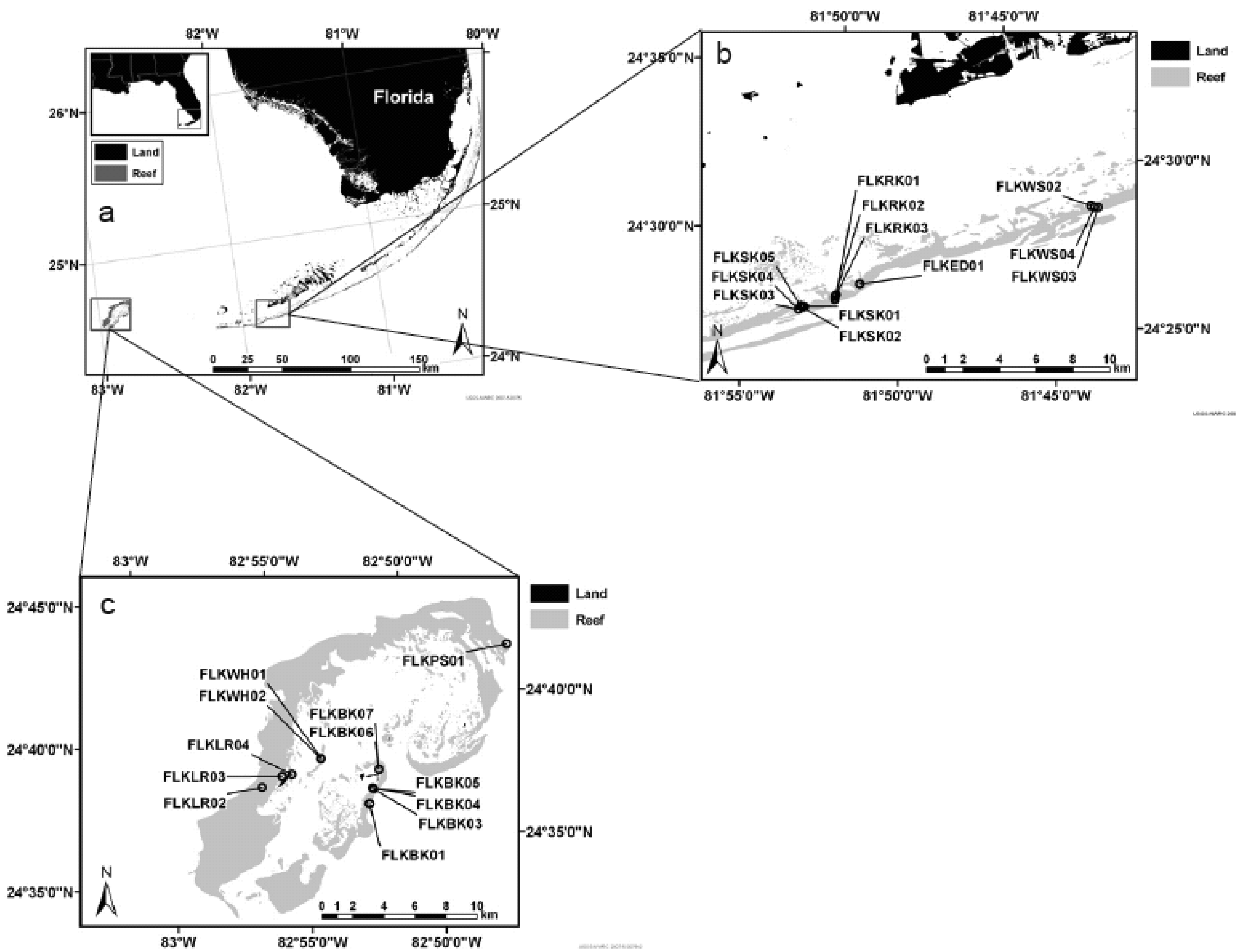
<p>A stratified random sampling design was used for selecting survey stations and has been detailed previously [<xref ref-type="bibr" rid="b8-diversity-03-00628">8</xref>,<xref ref-type="bibr" rid="b28-diversity-03-00628">28</xref>]. Briefly, hard coral bottoms were demarcated as reefs within each geographic region using a prototype of the Florida Marine Research Institute benthic habitat maps of the Florida Keys [<xref ref-type="bibr" rid="b29-diversity-03-00628">29</xref>]. Potential stations were identified by generating 20 random points within each reef. Surveyors visited each site in the order it was generated and accepted the site if it contained 5% or greater coral cover. Most potential stations were rejected because of an absence of live coral. If a site was suitable for sampling, a permanent station was installed and surveyed. The random stations were matched by approximate depths between regions to allow comparison of condition (<xref ref-type="fig" rid="f1-diversity-03-00628">Figure 1</xref>). SCUBA-based surveys were conducted between 1998 and 2002 at twelve reef stations in each region, with four survey locations in each depth zone: shallow, mid-depth and deep. Surveys were conducted during May–June 1998 (prior to bleaching), September 1998 (during bleaching, prior to hurricane impact), and in June 1999, August 2000, August 2001, and August–September 2002 following large-scale bleaching and hurricane disturbances.</p>
<p>All stations were assessed using a radial belt transect survey by SCUBA that has been used in coral reef surveys in US and Australia and has been detailed in other reports [<xref ref-type="bibr" rid="b7-diversity-03-00628">7</xref>,<xref ref-type="bibr" rid="b8-diversity-03-00628">8</xref>,<xref ref-type="bibr" rid="b28-diversity-03-00628">28</xref>]. Transects were conducted by positioning a 2 m long rod into a permanent stainless steel pipe in the center of the survey station. A 10 m survey line was extended from the center and positioned horizontally to encompass the 8–10 m swath around the rod. The 8 and 10 m points were marked on the line with plumb lines; all coral colonies which fell within the 8 to 10 m radius of the line were included in the arc survey, for a total area of 113 m<sup>2</sup>. An arbitrary start/end point was marked with a buoy just outside the 10 m mark in the radial belt. Three surveyors swam directly over the survey line recording the number of each coral species, coral diseases on each colony, and the degree of bleaching of each colony within the transect area. A fourth diver moved the line along the arc segment.</p></sec>
<sec>
<label>2.2.</label>
<title>Coral Assessments</title>
<p>Eighteen coral species previously known to be affected by disease were evaluated to characterize coral condition in colonies 10 cm or greater in diameter. The coral species assessed included <italic>Acropora cervicornis</italic>, <italic>Acropora palmata</italic>, <italic>Colpophyllia natans</italic>, <italic>Dichocoenia stokesii</italic>, <italic>Montastraea cavernosa</italic>, <italic>Solenastrea bournoni</italic>, <italic>Siderastrea siderea</italic>, <italic>Diploria strigosa</italic>, <italic>Diploria labyrinthiformis</italic>, <italic>Stephanocoenia intersepta</italic>, <italic>Mycetophyllia ferox</italic>, <italic>Mycetophyllia lamarkiana</italic>, and <italic>Mycetophyllia danaae. Montastraea annularis</italic>, <italic>M. faveolata</italic>, and <italic>M. franksi</italic> were aggregated as the <italic>M. annularis</italic> complex because of uncertain species identification at early survey times. The sea fans <italic>Gorgonia ventalina</italic> and <italic>G. flabellum</italic> were not differentiated in the field and were recorded as <italic>Gorgonia</italic> spp. They were included in the assessment since several diseases affected them. Each colony in the transect area was assessed for disease and bleaching. Ten coral disease categories were assessed including black-band disease, red-band disease, white-band disease, aspergillosis, white plague, white pox disease/patchy necrosis, dark spots disease, yellow blotch/band disease, skeletal anomalies and unknown. The unknown category was recorded when a disease condition was encountered which had not been previously described [<xref ref-type="bibr" rid="b8-diversity-03-00628">8</xref>,<xref ref-type="bibr" rid="b28-diversity-03-00628">28</xref>]. Colonies were evaluated as diseased only if they contained active lesions. Specific diseases were not scored if the cause of mortality was uncertain. Distinguishing signs for coral diseases have been detailed elsewhere [<xref ref-type="bibr" rid="b7-diversity-03-00628">7</xref>,<xref ref-type="bibr" rid="b8-diversity-03-00628">8</xref>,<xref ref-type="bibr" rid="b30-diversity-03-00628">30</xref>]. White pox described the lesions found on <italic>Acropora palmata</italic> colonies that could not be attributed to white-band disease or predation. White plague types 1 and 2 were only identified as white plague. If multiple diseases were found on the same colony, both conditions were recorded as one so disease prevalence was not overestimated. Each coral colony was also assessed for bleaching and assigned one of three categories based on an estimate of the proportion of colony surface affected: no bleaching (less than 10% surface area bleached), partial bleaching (10–50%) and severe bleaching (&gt;50%).</p></sec>
<sec>
<label>2.3.</label>
<title>Data Analyses</title>
<p>The data were partitioned to examine the responses of all surveyed coral species in aggregate, and also three functional groups: the acroporids (<italic>A. cervicornis</italic>, <italic>A. palmata</italic>), sea fans (<italic>Gorgonia spp.</italic>), and massive corals comprised of the largest hemispherical colonies: <italic>C. natans</italic>, <italic>M. cavernosa</italic>, and the three species of the <italic>M. annularis</italic> complex. Coral abundance rather than percent areal coverage was assessed to allow determination of the prevalence of coral disease and bleaching based on presence or absence on each colony. Total and functional group data were examined for differences over time within each region and for differences between the regions at each time period. All metrics were standardized to the number of colonies per annular area of one arc (113 m<sup>2</sup>).</p>
<p>Nonparametric statistics were used in the analysis because the data failed normality requirements. Data were analyzed using SAS (SAS Institute, Cary, SC) and PRIMER™ [<xref ref-type="bibr" rid="b27-diversity-03-00628">27</xref>]. The experimental design was developed after a power analysis of data from a 1997 pilot study supported adopting α = 0.10 to allow a regional comparison through sampling more sites less intensively [<xref ref-type="bibr" rid="b8-diversity-03-00628">8</xref>]. The first null hypothesis tested for temporal trends within each region, and the second tested for differences between the regions at each survey time.</p>
<p>To test the null hypotheses for no differences in abundance, a rank-based analysis of variance (ANOVA) was applied for unbalanced data and discriminated statistically different main effects at α = 0.10 using Dunnett's test. A Poisson regression model was fitted to over-dispersed abundance data to test for temporal responses in Key West and Dry Tortugas coral communities. Regression coefficients were estimated by maximum likelihood and statistical significance levels were adjusted to reflect over-dispersion. Four metrics were used to assess changes in coral species composition as species richness, evenness, dominance and diversity, including Shannon's diversity index (H), Simpson's dominance index (λ), Margalef's species richness index (d) and Pielou's evenness index (J). The statistical model included terms for year, region, and interaction of year and region. The model assumed the response could be approximated by an exponent function of time, and recovery rate might vary between Dry Tortugas and Key West regions.</p>
<p>Coral disease and bleaching prevalence were standardized as the percentage of diseased or bleached coral colonies at each station for each survey time. Both untransformed and arcsine-transformed data failed normality assumptions. Data were analyzed using the multivariate nonparametric statistics for analysis of similarities (ANOSIM [<xref ref-type="bibr" rid="b31-diversity-03-00628">31</xref>]). Bray Curtis similarity coefficients were used in the ANOSIM test of temporal changes within each region and differences between regions for each survey. The 90% confidence intervals for prevalence were calculated using bootstrapping [<xref ref-type="bibr" rid="b32-diversity-03-00628">32</xref>]. Statistically significant relationships were determined by the ANOSIM R statistic [<xref ref-type="bibr" rid="b33-diversity-03-00628">33</xref>].</p></sec></sec>
<sec sec-type="results">
<label>3.</label>
<title>Results</title>
<sec>
<label>3.1.</label>
<title>Similarity in Coral Condition Prior to Disturbance</title>
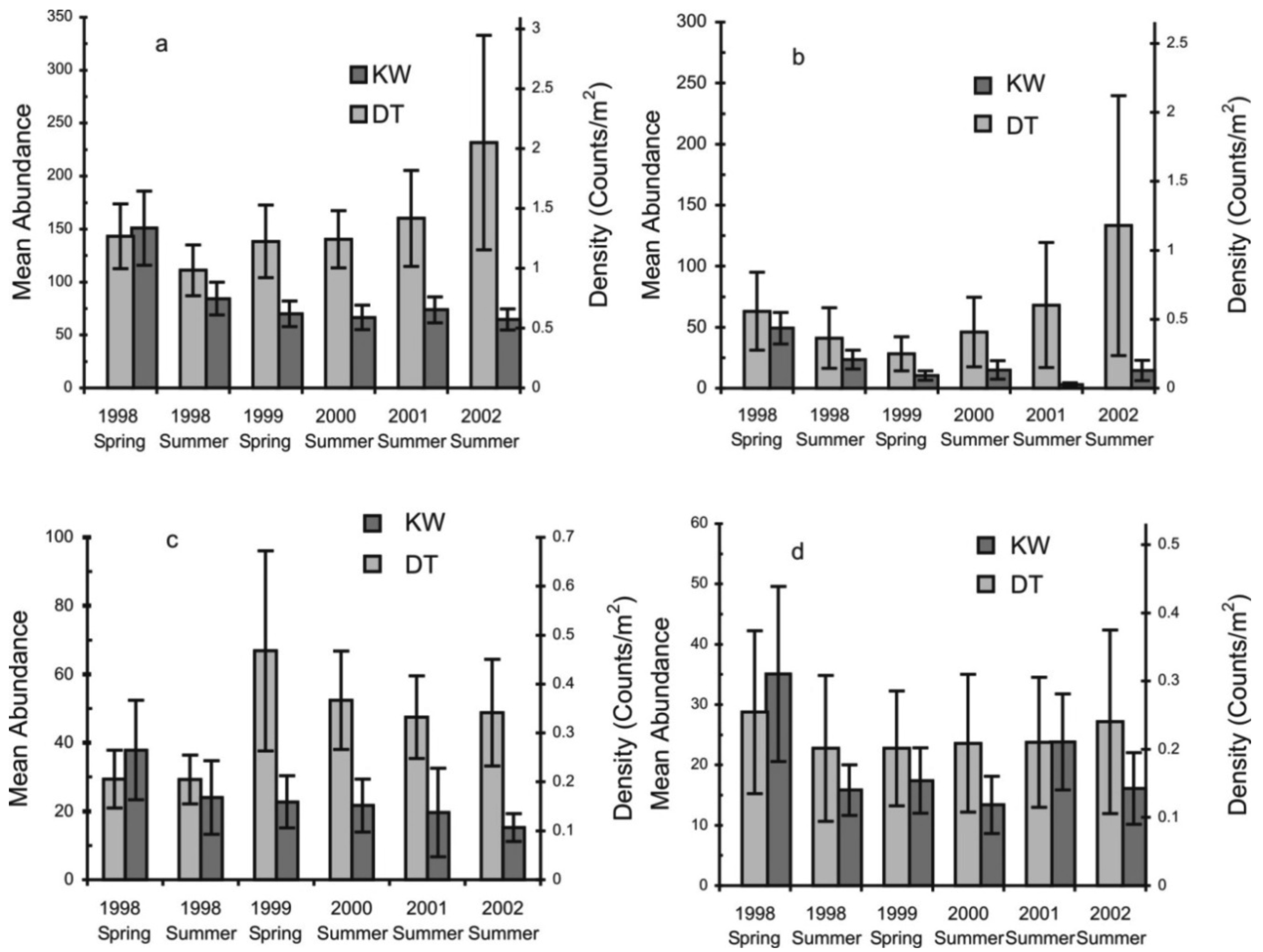
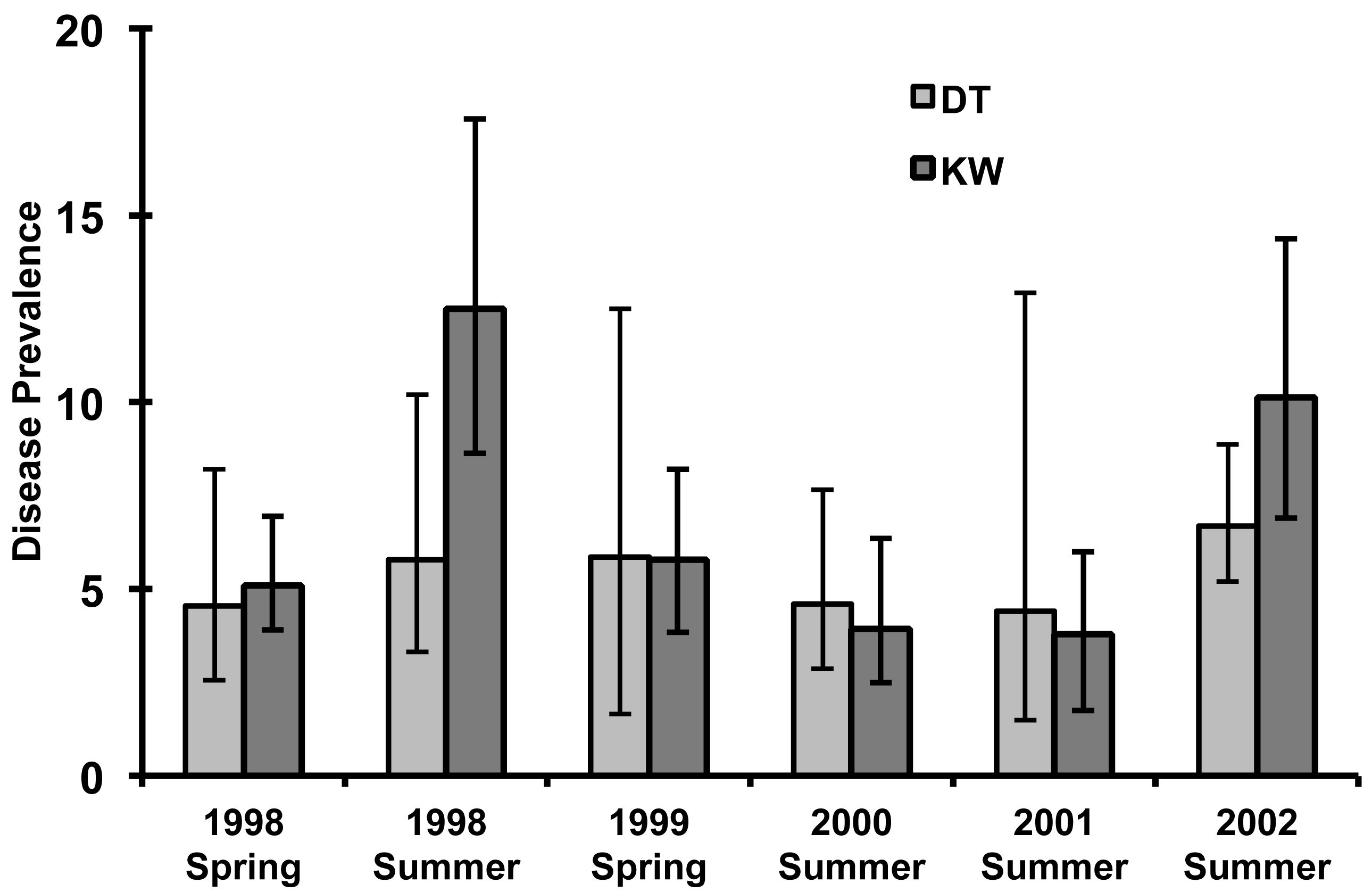
<p>Surveys in spring 1998 conducted prior to the large-scale disturbances of hurricane impact and massive coral bleaching showed that coral condition was similar in reefs near Key West and the more remote Dry Tortugas. There were no significant differences in coral abundance, either as total species in aggregate or for the three functional groups of sea fans, acroporids, and massive species (<xref ref-type="fig" rid="f2-diversity-03-00628">Figure 2</xref>). The four community metrics of species richness, evenness, dominance and diversity all indicated similar community attributes in the two locations (<xref ref-type="table" rid="t1-diversity-03-00628">Table 1</xref>). There also were no significant differences in disease prevalence in aggregate or for the three functional groups prior to the large-scale disturbances impacting Key West and Dry Tortugas reefs (<xref ref-type="fig" rid="f3-diversity-03-00628">Figure 3</xref>). Bleaching was not quantified in spring 1998, because there was no evidence of coral bleaching in either area based on qualitative observations and bleaching conditions were absent.</p></sec>
<sec>
<label>3.2.</label>
<title>Similarity in Large-scale Disturbances</title>
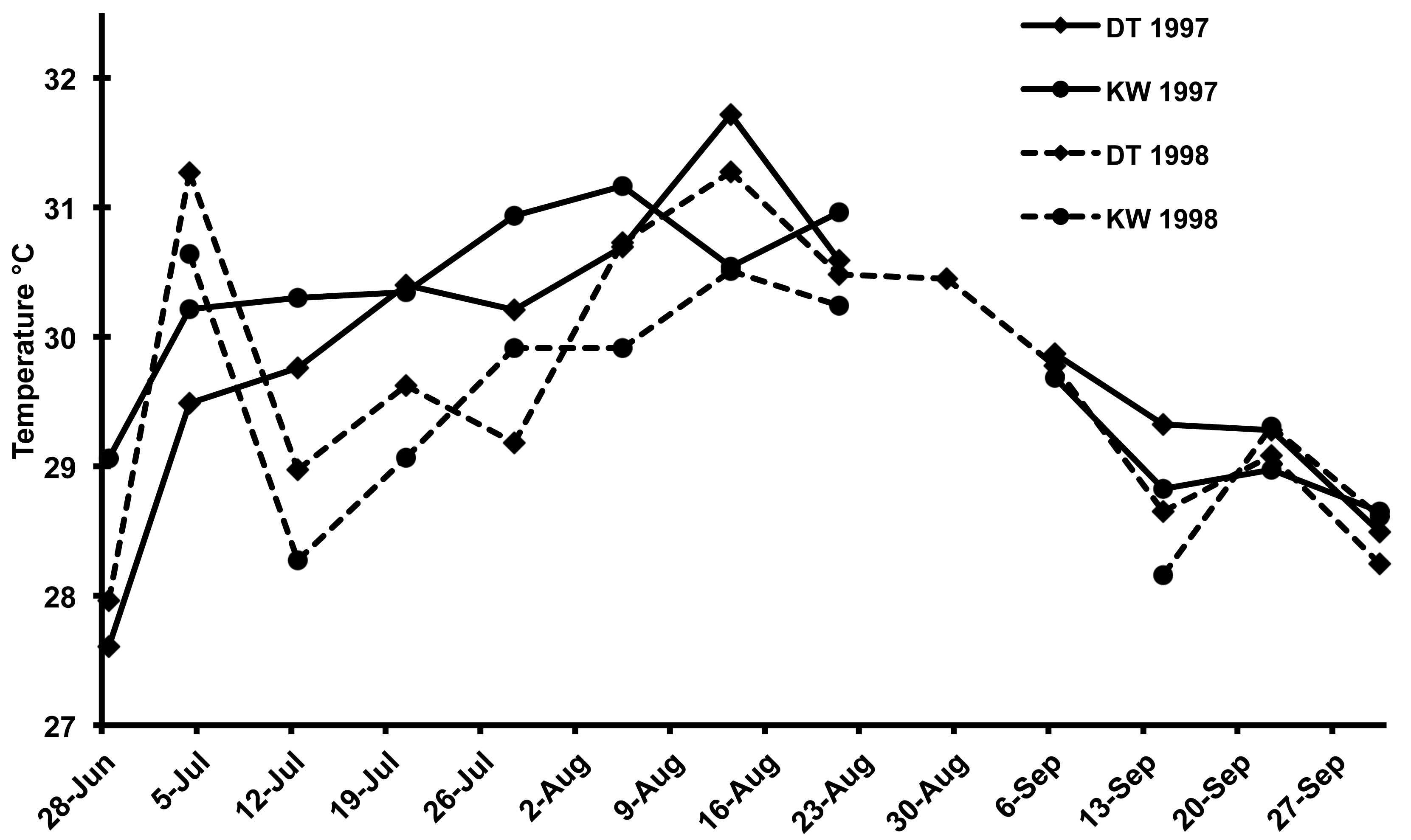
<p>The available information indicated that the reefs near Key West and the Dry Tortugas were exposed to similar temporal and spatial scales of disturbance. Based on remote sensed sea surface temperature data for the Lower Florida Keys and Dry Tortugas, both reef areas experienced elevated levels of thermal stress during the summers of both 1997 and 1998 (<xref ref-type="fig" rid="f4-diversity-03-00628">Figure 4</xref>). In 1998, sea surface temperatures remained above 30 °C in both regions for over six consecutive weeks, and both regions reached their maxima in early July 1998 (DT 31.3 °C, KW 30.6 °C) (<xref ref-type="fig" rid="f4-diversity-03-00628">Figure 4</xref>). Key West and Dry Tortugas reefs were also exposed to similar impacts from the Category 3 Hurricane Georges. The eye of the hurricane moved rapidly over both the Florida Keys and Dry Tortugas reef areas on 25 September, 1998 in a northwestern trajectory [<xref ref-type="bibr" rid="b27-diversity-03-00628">27</xref>]. Satellite imagery indicated region-wide impact across the Florida Keys reef tract.</p></sec>
<sec>
<label>3.3.</label>
<title>Changes in Coral Abundance and Diversity Following Disturbance</title>
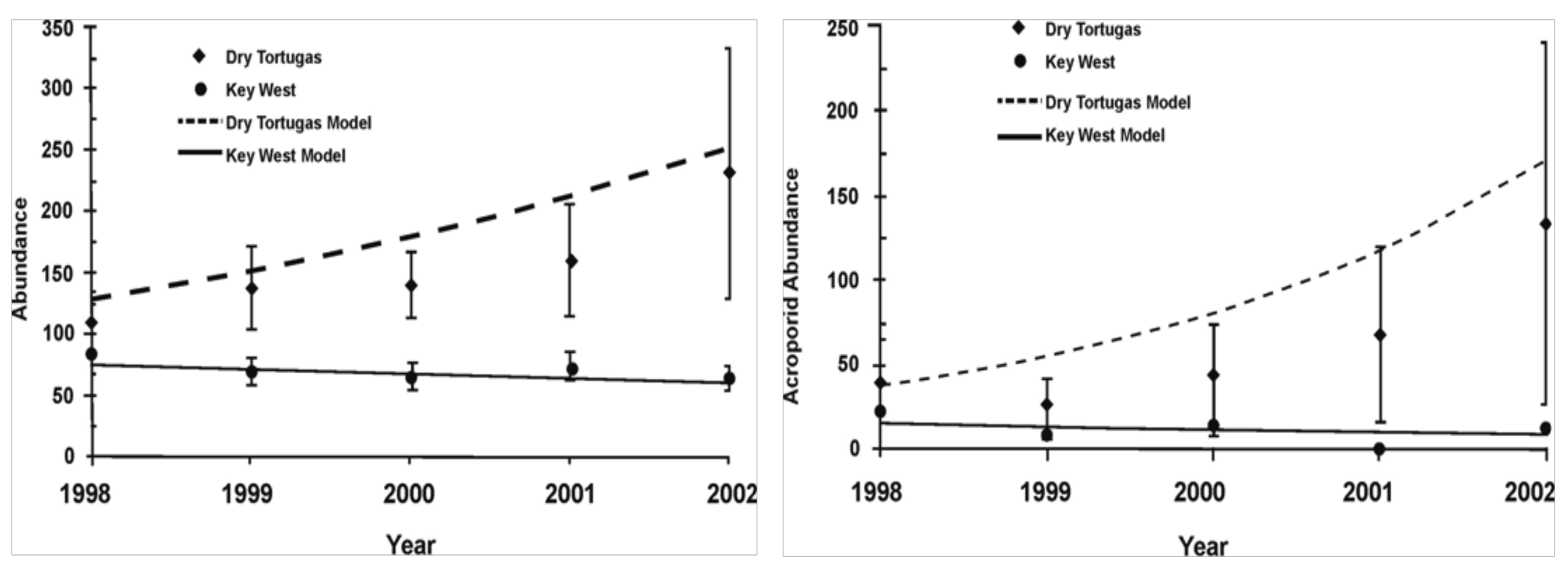
<p>Coral abundance in the Dry Tortugas and Key West differed significantly in their responses following large-scale disturbance, whereas species diversity metrics showed only limited variation. A significant decline in mean total coral abundance and density (F = 3.18, p ≤ 0.013) occurred between spring 1998 (151 ± 36 SE) and summer 2002 on Key West reefs (65 ±10, <xref ref-type="fig" rid="f2-diversity-03-00628">Figure 2</xref>). In contrast, live coral abundance and density on Dry Tortugas reefs were not statistically different over the five year assessment period for the surveyed species in aggregate as well as the abundance of each of the three functional groups (p ≤ 0.660).</p>
<p>Declines in Key West coral abundance were attributed to significant declines in acroporids (F = 3.23, p ≤ 0.012), rather than <italic>Gorgonia spp.</italic> (F = 0.64, p ≤ 0.669) or massive coral abundance (F = 1.06, p ≤ 0.390) (<xref ref-type="fig" rid="f2-diversity-03-00628">Figure 2</xref>). Regression analysis showed that both total abundance and acroporid abundance declined on Key West reefs, but increased over time in the Dry Tortugas (p &lt; 0.0001; <xref ref-type="fig" rid="f5-diversity-03-00628">Figure 5</xref>). Three of the coral species diversity metrics (Shannon's diversity index, Simpson's dominance index, and Margalef's species richness index) did not vary significantly within or between regions over time (<xref ref-type="table" rid="t1-diversity-03-00628">Table 1</xref>). Only Pielou's evenness index significantly differed between each region in 1999 (F = 6.59, p ≤ 0.018), 2000 (F = 6.26, p ≤ 0.020), and 2002 (F = 3.73, p ≤ 0.067), with species evenness remaining the same in the Dry Tortugas, and increasing in Key West.</p></sec>
<sec>
<label>3.4.</label>
<title>Change in Coral Disease and Bleaching Prevalence Following Disturbance</title>
<p>The prevalence of coral disease significantly increased from 5.1% to 12.5% of affected colonies on Key West reefs following large-scale disturbance, but remained relatively constant in the Dry Tortugas (4.4–6.7% of colonies) (<xref ref-type="fig" rid="f3-diversity-03-00628">Figure 3</xref>). Disease prevalence was also significantly elevated on Key West reefs in 2002 (10% of colonies; R = 0.055, p ≤ 0.032). Species specific and coral functional group disease information are available in the epizootic report of Santavy <italic>et al.</italic> [<xref ref-type="bibr" rid="b7-diversity-03-00628">7</xref>].</p>
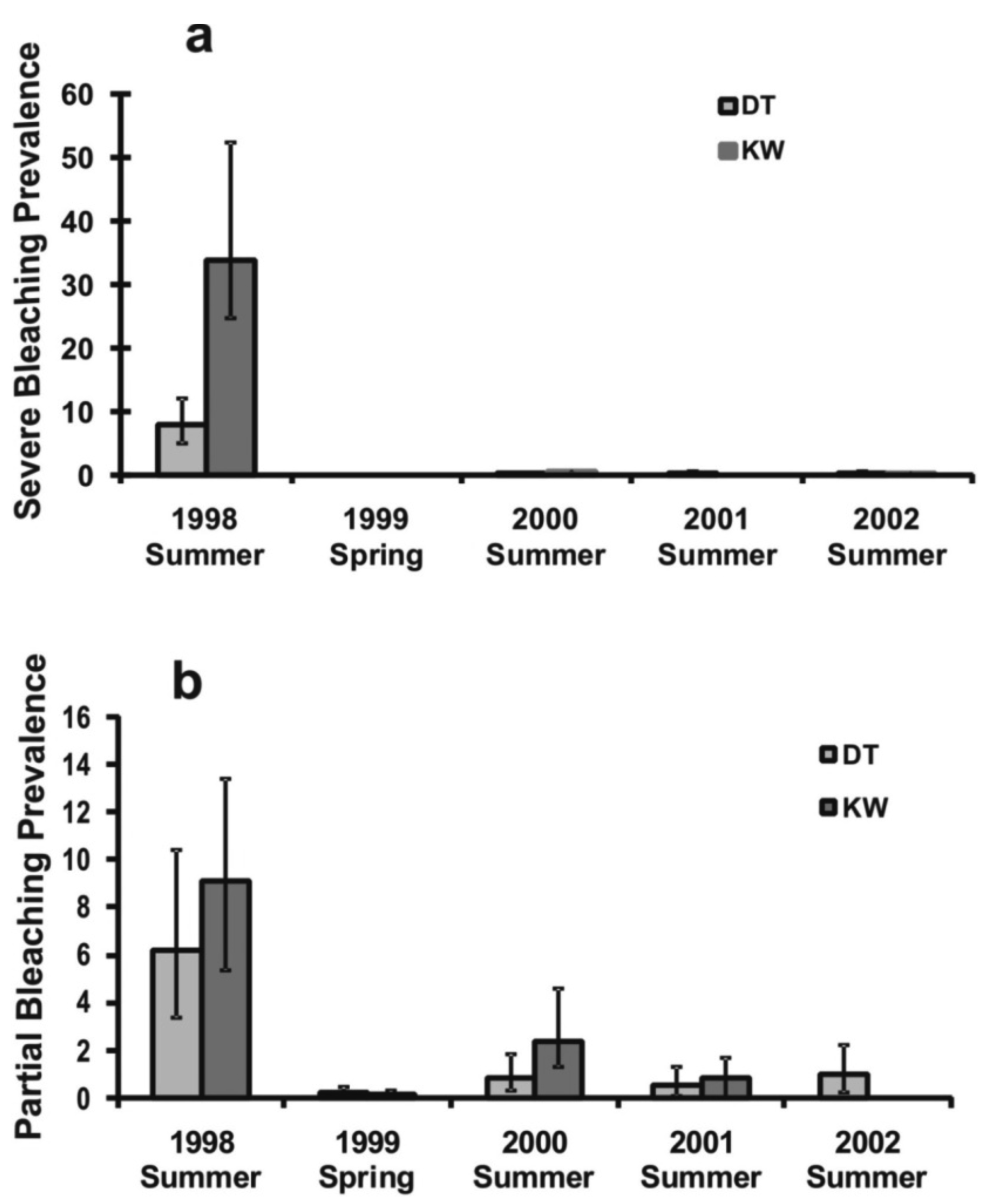
<p>Extensive and significantly elevated coral bleaching occurred during summer 1998 on both Key West (43% of colonies) and Dry Tortugas reefs (14% of colonies), and was the only time bleaching prevalence exceeded 3% (<xref ref-type="fig" rid="f6-diversity-03-00628">Figure 6</xref>). Key West reefs exhibited significantly greater aggregate bleaching prevalence than the Dry Tortugas (R = 0.186, p ≤ 0.008). In the Dry Tortugas, 6 of 15 surveyed species exhibited severe bleaching (&gt;50% of surface tissue) compared to 12 of 15 species severely bleaching in Key West [<xref ref-type="bibr" rid="b5-diversity-03-00628">5</xref>,<xref ref-type="bibr" rid="b6-diversity-03-00628">6</xref>]. Acroporid bleaching was significantly greater in Key West (52% of colonies) than in Dry Tortugas (8.3%) during summer 1998, and accounted for the majority of differences in aggregate species bleaching. Bleaching prevalence in massive corals was not significantly different between Key West colonies (46%) and Dry Tortugas (37%) whereas gorgonians were never observed to bleach during any survey period. Following the 1998 bleaching event, severely bleached corals were never more than 1% of the coral community, and most bleached colonies exhibited only a low frequency of partial bleaching (<xref ref-type="fig" rid="f6-diversity-03-00628">Figure 6</xref>).</p></sec></sec>
<sec sec-type="discussion">
<label>4.</label>
<title>Discussion</title>
<p>Ecological impacts of catastrophic stressors on coral reefs in remote versus more anthropogenically affected regions is an area of increasing interest in coral reef, conservation, and global change research. There is conflicting evidence on the degree that local stressors such as degraded water quality and human uses can influence coral resilience to large-scale disturbances [<xref ref-type="bibr" rid="b2-diversity-03-00628">2</xref>,<xref ref-type="bibr" rid="b15-diversity-03-00628">15</xref>,<xref ref-type="bibr" rid="b21-diversity-03-00628">21</xref>,<xref ref-type="bibr" rid="b22-diversity-03-00628">22</xref>]. Studies in the Great Barrier and Mesoamerican reef systems have indicated that local stressors can increase susceptibility to mass-coral bleaching events [<xref ref-type="bibr" rid="b21-diversity-03-00628">21</xref>,<xref ref-type="bibr" rid="b22-diversity-03-00628">22</xref>]. In the upper, middle and lower Florida Keys, proximity to land-based stressors did not appear to influence coral recruitment and population structure of patch reefs surveyed between 2001 and 2003 [<xref ref-type="bibr" rid="b2-diversity-03-00628">2</xref>]. In a 10-year study of Virgin Island coral reef community structure, areas of greater coral community resilience to repeated hurricanes was associated with lower human uses impacts [<xref ref-type="bibr" rid="b35-diversity-03-00628">35</xref>]. Studies in the Western Indian Ocean show geographically heterogeneous responses of coral to thermal stress, further indicating that a diversity of factors control reef resilience [<xref ref-type="bibr" rid="b10-diversity-03-00628">10</xref>].</p>
<p>In the current study, Key West reefs exhibited greater bleaching and disease prevalence and severity compared to the reefs of the more remote Dry Tortugas following similar large-scale hurricane impact and mass-coral bleaching events. Coral abundance significantly declined on Key West reefs and coral density remained lower during the 5-year assessment. These results provide additional evidence that coral reef ecosystems distant from anthropogenic influences may have greater resilience to large-scale disturbances [<xref ref-type="bibr" rid="b15-diversity-03-00628">15</xref>,<xref ref-type="bibr" rid="b21-diversity-03-00628">21</xref>,<xref ref-type="bibr" rid="b22-diversity-03-00628">22</xref>]. Additional research is needed on the determinants of local stressors effects on coral reef resilience, as well as the importance of recent disturbance history, coral community condition, species composition, and other factors [<xref ref-type="bibr" rid="b10-diversity-03-00628">10</xref>-<xref ref-type="bibr" rid="b12-diversity-03-00628">12</xref>].</p>
<p>Acroporid responses to disturbance were a primary difference in the lower resilience of Key West reefs. Acroporid bleaching was significantly elevated on Key West reefs (52% of colonies) compared to Dry Tortugas acroporids (8% of colonies). The abundance of acroporids on Key West reefs continued to decline following hurricane and bleaching impacts, whereas Dry Tortugas acroporids rebounded. Acroporids were once a dominant reef-building coral in the Caribbean, but have experienced substantial regional declines, resulting in U.S. Federal listing as a protected species [<xref ref-type="bibr" rid="b9-diversity-03-00628">9</xref>]. Miller <italic>et al.</italic> [<xref ref-type="bibr" rid="b36-diversity-03-00628">36</xref>] reported that acroporid abundance declined over 90% between 1983 and 2000 in the lower Keys (Looe Key), and that substantial population declines may have occurred prior to 1983. Additionally, Williams <italic>et al.</italic> [<xref ref-type="bibr" rid="b20-diversity-03-00628">20</xref>] reported recruitment failure in <italic>A. palmata</italic> at upper Keys sites between 2004 and 2007. Hughes <italic>et al.</italic> [<xref ref-type="bibr" rid="b11-diversity-03-00628">11</xref>] and others have noted the increase in phase shifts from once common coral communities, and the need for research directed from monitoring ecosystem declines to understanding the processes controlling degradation.</p>
<p>Making inferences on multiple stressor effects on ecological systems from environmental data is uncertain, but is critical to assessing large-scale complex problems. The current study utilized a survey design focused on individual colonies that could be identified to species, and included measures of abundance, diversity, disease and bleaching prevalence. Together, these measures indicated generally similar condition in the Dry Tortugas and Key West prior to the large-scale disturbances of mass-coral bleaching and hurricane impacts during 1998, and continued declines in coral condition on Key West reefs. Other studies have used different metrics of coral condition, and reported similar trends of declining coral reef health and changes in species composition in the Florida Keys [<xref ref-type="bibr" rid="b3-diversity-03-00628">3</xref>,<xref ref-type="bibr" rid="b5-diversity-03-00628">5</xref>]. The Dry Tortugas have been less studied, but are generally considered to be in better condition as reported in the current study [<xref ref-type="bibr" rid="b37-diversity-03-00628">37</xref>]. Florida's reefs can be considered marginal environments where corals are less resilient than many reefs in the Caribbean. For example, an estimated 30,800 km<sup>2</sup> of shallow inshore waters in the Florida Reef Tract could potentially support coral reef ecosystems [<xref ref-type="bibr" rid="b38-diversity-03-00628">38</xref>], but only 1150 km<sup>2</sup> contain live coral reef habitat [<xref ref-type="bibr" rid="b29-diversity-03-00628">29</xref>]. The results of the current study and other recent reports show that despite large-scale disturbances, coral reef ecosystems can still exhibit positive population growth if there are minimal additional stressors [<xref ref-type="bibr" rid="b14-diversity-03-00628">14</xref>,<xref ref-type="bibr" rid="b16-diversity-03-00628">16</xref>,<xref ref-type="bibr" rid="b17-diversity-03-00628">17</xref>]. Several authors have proposed frameworks for understanding both the factors that control reef resilience and indicators of sustainable reef ecosystems [<xref ref-type="bibr" rid="b10-diversity-03-00628">10</xref>-<xref ref-type="bibr" rid="b12-diversity-03-00628">12</xref>]. The continued global decline in coral reef ecosystems creates an urgent need for management strategies that promote reef resilience [<xref ref-type="bibr" rid="b10-diversity-03-00628">10</xref>-<xref ref-type="bibr" rid="b12-diversity-03-00628">12</xref>].</p></sec></body>
<back>
<sec sec-type="display-objects">
<title>Figures and Table</title>
<fig id="f1-diversity-03-00628" position="float">
<label>Figure 1.</label>
<caption>
<p>Regional survey areas in the (<bold>a</bold>) South Florida Reef Tract, United States, and specific survey stations in (<bold>b</bold>) Key West and (<bold>c</bold>) Dry Tortugas.</p></caption>
<graphic xlink:href="diversity-03-00628f1.gif"/></fig>
<fig id="f2-diversity-03-00628" position="float">
<label>Figure 2.</label>
<caption>
<p>Mean coral abundance as total colony count and density (count/m<sup>2</sup>) of Dry Tortugas (DT) and Key West (KW) reef areas for 1998 to 2002 survey periods for: (<bold>a</bold>) all colonies; (<bold>b</bold>) acroporids; (<bold>c</bold>) <italic>Gorgonia</italic> spp; and (<bold>d</bold>) massive species (<italic>Colpophyllia natans</italic>, <italic>Montastraea annularis</italic> complex and <italic>Montastraea cavernosa</italic>).</p></caption>
<graphic xlink:href="diversity-03-00628f2.gif"/></fig>
<fig id="f3-diversity-03-00628" position="float">
<label>Figure 3.</label>
<caption>
<p>Mean coral disease prevalence (percent of colonies affected by one or more diseases) on Dry Tortugas (DT) and Key West (KW) reefs for 1998 to 2002 survey periods.</p></caption>
<graphic xlink:href="diversity-03-00628f3.gif"/></fig>
<fig id="f4-diversity-03-00628" position="float">
<label>Figure 4.</label>
<caption>
<p>Weekly average sea-surface temperature in Dry Tortugas (DT) and Key West (KW) reef areas for June to September, 1997 and 1998 [<xref ref-type="bibr" rid="b34-diversity-03-00628">34</xref>].</p></caption>
<graphic xlink:href="diversity-03-00628f4.gif"/></fig>
<fig id="f5-diversity-03-00628" position="float">
<label>Figure 5.</label>
<caption>
<p>Poisson regression models of temporal changes in abundance at survey periods between summer 1998 and summer 2002 in reef areas near Dry Tortugas (DT) and Key West (KW): (<bold>a</bold>) total mean abundance (±SE); (<bold>b</bold>) mean acroporid abundance (±SE).</p></caption>
<graphic xlink:href="diversity-03-00628f5.gif"/></fig>
<fig id="f6-diversity-03-00628" position="float">
<label>Figure 6.</label>
<caption>
<p>Mean bleaching prevalence (percent of colonies affected) on Dry Tortugas (DT) and Key West (KW) reefs for 1998 to 2002 survey periods. (<bold>a</bold>) Partial bleaching: &gt;10% –50% of tissue bleached; (<bold>b</bold>) Severe bleaching: &gt;50% of tissue bleached.</p></caption>
<graphic xlink:href="diversity-03-00628f6.gif"/></fig>
<table-wrap id="t1-diversity-03-00628" position="float">
<label>Table 1.</label>
<caption>
<p>Mean diversity indices (±SE) of coral communities in Key West and the Dry Tortugas: Margelef's species richness (d), Shannon's species diversity (H), Simpson's dominance (λ) and Pielou's species evenness (J).</p></caption>
<table frame="hsides" rules="groups">
<thead>
<tr>
<th align="center" valign="top"><bold>Region</bold></th>
<th align="center" valign="top"><bold>Survey</bold></th>
<th align="center" valign="top"><bold>d</bold></th>
<th align="center" valign="top"><bold>H</bold></th>
<th align="center" valign="top"><bold>λ</bold></th>
<th align="center" valign="top"><bold>J</bold></th></tr></thead>
<tbody>
<tr>
<td align="center" valign="middle" rowspan="6">Dry Tortugas</td>
<td align="left" valign="top">Spring 1998</td>
<td align="left" valign="top">1.50 ± 0.189</td>
<td align="left" valign="top">1.37 ± 0.170</td>
<td align="left" valign="top">0.376 ± 0.0703</td>
<td align="left" valign="top">0.655 ± 0.0667</td></tr>
<tr>
<td align="left" valign="top">Summer 1998</td>
<td align="left" valign="top">1.52 ± 0.188</td>
<td align="left" valign="top">1.37 ± 0.164</td>
<td align="left" valign="top">0.381 ± 0.0661</td>
<td align="left" valign="top">0.668 ± 0.0649</td></tr>
<tr>
<td align="left" valign="top">Spring 1999</td>
<td align="left" valign="top">1.38 ± 0.145</td>
<td align="left" valign="top">1.12 ± 0.130</td>
<td align="left" valign="top">0.487 ± 0.0578</td>
<td align="left" valign="top">0.561 ± 0.0530</td></tr>
<tr>
<td align="left" valign="top">Summer 2000</td>
<td align="left" valign="top">1.42 ± 0.154</td>
<td align="left" valign="top">1.10 ± 0.134</td>
<td align="left" valign="top">0.491 ± 0.0601</td>
<td align="left" valign="top">0.540 ± 0.0543</td></tr>
<tr>
<td align="left" valign="top">Summer 2001</td>
<td align="left" valign="top">1.46 ± 0.178</td>
<td align="left" valign="top">1.23 ± 0.162</td>
<td align="left" valign="top">0.437 ± 0.0702</td>
<td align="left" valign="top">0.593 ± 0.0673</td></tr>
<tr>
<td align="left" valign="top">Summer 2002</td>
<td align="left" valign="top">1.49 ± 0.199</td>
<td align="left" valign="top">1.25 ± 0.165</td>
<td align="left" valign="top">0.434 ± 0.0673</td>
<td align="left" valign="top">0.597 ± 0.0643</td></tr>
<tr>
<td valign="bottom" colspan="6">
<hr/></td></tr>
<tr>
<td align="center" valign="middle" rowspan="6">Key West</td>
<td align="left" valign="top">Spring 1998</td>
<td align="left" valign="top">1.40 ± 0.202</td>
<td align="left" valign="top">1.32 ± 0.166</td>
<td align="left" valign="top">0.393 ± 0.0720</td>
<td align="left" valign="top">0.693± 0.0425</td></tr>
<tr>
<td align="left" valign="top">Summer 1998</td>
<td align="left" valign="top">1.48 ± 0.197</td>
<td align="left" valign="top">1.35 ± 0.159</td>
<td align="left" valign="top">0.383 ± 0.0687</td>
<td align="left" valign="top">0.723± 0.0378</td></tr>
<tr>
<td align="left" valign="top">Spring 1999</td>
<td align="left" valign="top">1.36 ± 0.166</td>
<td align="left" valign="top">1.31 ± 0.140</td>
<td align="left" valign="top">0.372 ± 0.0574</td>
<td align="left" valign="top">0.730 ± 0.0393</td></tr>
<tr>
<td align="left" valign="top">Summer 2000</td>
<td align="left" valign="top">1.26 ± 0.184</td>
<td align="left" valign="top">1.15 ± 0.160</td>
<td align="left" valign="top">0.447 ± 0.0693</td>
<td align="left" valign="top">0.715 ± 0.0438</td></tr>
<tr>
<td align="left" valign="top">Summer 2001<xref ref-type="table-fn" rid="tfn1-diversity-03-00628">*</xref></td>
<td align="left" valign="top">1.97 ± 0.192</td>
<td align="left" valign="top">1.49 ± 0.128</td>
<td align="left" valign="top">0.345 ± 0.0537</td>
<td align="left" valign="top">0.670 ± 0.0435</td></tr>
<tr>
<td align="left" valign="top">Summer 2002</td>
<td align="left" valign="top">1.40 ± 0.199</td>
<td align="left" valign="top">1.28 ± 0.153</td>
<td align="left" valign="top">0.401 ± 0.0652</td>
<td align="left" valign="top">0.731 ± 0.0267</td></tr></tbody></table>
<table-wrap-foot><fn id="tfn1-diversity-03-00628">
<label>*</label>
<p>Summer 2001: only 5 of 12 Key West stations sampled.</p></fn></table-wrap-foot></table-wrap></sec>
<ack>
<p>This article is dedicated to the memory of Captain Robert Quarles who served on multiple coral monitoring surveys. Support was provided by United States Environmental Protection Agency (US EPA), Office of Research and Development, Gulf Ecology Division (GED), to National Oceanographic and Atmospheric Association through an Interagency Agreement (RW13937452) and by Mote Marine Laboratory. Ship support by US EPA, Office of Water on the OSV/<italic>Peter W. Anderson</italic>. Small vessel and logistical support was provided by the Florida Keys National Marine Sanctuary and Dry Tortugas National Park. We thank J. Campbell, J. Patrick, M. Parsons, K. Potts, J. Hawkridge, J. Porter, K. Patterson, and D. Marcinek for field support, and J. Kern for statistical advice. Mention of trade names or commercial products does not constitute endorsement by US EPA. Contribution #1296 US EPA, GED, Gulf Breeze, FL.</p></ack>
<ref-list>
<title>References</title>
<ref id="b1-diversity-03-00628"><label>1.</label><citation citation-type="journal"><person-group person-group-type="author"><name><surname>Keller</surname><given-names>B.D.</given-names></name><name><surname>Causey</surname><given-names>B.D.</given-names></name></person-group><article-title>Linkages between the Florida Keys National Marine Sanctuary and the South Florida ecosystem restoration initiative</article-title><source>Ocean Coast Manag.</source><year>2005</year><volume>48</volume><fpage>869</fpage><lpage>900</lpage><pub-id pub-id-type="doi">10.1016/j.ocecoaman.2005.03.008</pub-id></citation></ref>
<ref id="b2-diversity-03-00628"><label>2.</label><citation citation-type="journal"><person-group person-group-type="author"><name><surname>Lirman</surname><given-names>D.</given-names></name><name><surname>Fong</surname><given-names>P.</given-names></name></person-group><article-title>Is proximity to land-based sources of coral stressors an appropriate measure of risk to coral reefs? An example from the Florida Reef Tract</article-title><source>Mar. Poll Bull.</source><year>2007</year><volume>54</volume><fpage>779</fpage><lpage>791</lpage><pub-id pub-id-type="doi">10.1016/j.marpolbul.2006.12.014</pub-id></citation></ref>
<ref id="b3-diversity-03-00628"><label>3.</label><citation citation-type="journal"><person-group person-group-type="author"><name><surname>Somerfield</surname><given-names>P.J.</given-names></name><name><surname>Jaap</surname><given-names>W.C.</given-names></name><name><surname>Clarke</surname><given-names>K.R.</given-names></name><name><surname>Callahan</surname><given-names>M.</given-names></name><name><surname>Hackett</surname><given-names>K.</given-names></name><name><surname>Porter</surname><given-names>J.</given-names></name><name><surname>Lybolt</surname><given-names>M.</given-names></name><name><surname>Tsokos</surname><given-names>C.</given-names></name><name><surname>Yanev</surname><given-names>G.</given-names></name></person-group><article-title>Changes in coral reef communities among the Florida Keys, 1996–2003</article-title><source>Coral Reefs</source><year>2008</year><volume>27</volume><fpage>951</fpage><lpage>965</lpage><pub-id pub-id-type="doi">10.1007/s00338-008-0390-7</pub-id></citation></ref>
<ref id="b4-diversity-03-00628"><label>4.</label><citation citation-type="journal"><person-group person-group-type="author"><name><surname>Yee</surname><given-names>S.H.</given-names></name><name><surname>Santavy</surname><given-names>D.L.</given-names></name><name><surname>Barron</surname><given-names>M.G.</given-names></name></person-group><article-title>Assessing the effects of disease and bleaching on Florida Keys corals by fitting population models to data</article-title><source>Ecol. Model.</source><year>2011</year><volume>222</volume><fpage>1323</fpage><lpage>1332</lpage><pub-id pub-id-type="doi">10.1016/j.ecolmodel.2011.01.009</pub-id></citation></ref>
<ref id="b5-diversity-03-00628"><label>5.</label><citation citation-type="book"><person-group person-group-type="author"><name><surname>Precht</surname><given-names>W.F.</given-names></name><name><surname>Miller</surname><given-names>S.L.</given-names></name></person-group><article-title>Ecological shifts along the Florida Reef tract: The past as a key to the future</article-title><source>Geological Approaches to Coral Reef Ecology</source><person-group person-group-type="editor"><name><surname>Aronson</surname><given-names>R.B.</given-names></name></person-group><publisher-name>Springer</publisher-name><publisher-loc>New York, NY, USA</publisher-loc><year>2007</year><fpage>237</fpage><lpage>312</lpage></citation></ref>
<ref id="b6-diversity-03-00628"><label>6.</label><citation citation-type="journal"><person-group person-group-type="author"><name><surname>Helme</surname><given-names>K.P.</given-names></name><name><surname>Dodge</surname><given-names>R.E.</given-names></name><name><surname>Swart</surname><given-names>P.K.</given-names></name><name><surname>Gledhill</surname><given-names>D.K.</given-names></name><name><surname>Eakin</surname><given-names>C.M.</given-names></name></person-group><article-title>Growth rates of Florida corals from 1937 to 1996 and their response to climate change</article-title><source>Nat. Com.</source><year>2011</year><volume>2011</volume><fpage>1</fpage><lpage>6</lpage></citation></ref>
<ref id="b7-diversity-03-00628"><label>7.</label><citation citation-type="book"><person-group person-group-type="author"><name><surname>Santavy</surname><given-names>D.L.</given-names></name><name><surname>Campbell</surname><given-names>J.</given-names></name><name><surname>Quarles</surname><given-names>R.L.</given-names></name><name><surname>Patrick</surname><given-names>J.M.</given-names></name><name><surname>Hawkridge</surname><given-names>J.</given-names></name></person-group><source>The Epizootiology of Coral Diseases in South Florida</source><comment>EPA/600/R-05/146U</comment><publisher-name>SEPA</publisher-name><publisher-loc>Gulf Breeze, FL, USA</publisher-loc><publisher-name>GPO</publisher-name><publisher-loc>Washington, DC, USA</publisher-loc><year>2006</year></citation></ref>
<ref id="b8-diversity-03-00628"><label>8.</label><citation citation-type="journal"><person-group person-group-type="author"><name><surname>Santavy</surname><given-names>D.L.</given-names></name><name><surname>Mueller</surname><given-names>E.</given-names></name><name><surname>Peters</surname><given-names>E.C.</given-names></name><name><surname>MacLaughlin</surname><given-names>L.</given-names></name><name><surname>Porter</surname><given-names>J.W.</given-names></name><name><surname>Patterson</surname><given-names>K.L.</given-names></name><name><surname>Campbell</surname><given-names>J.</given-names></name></person-group><article-title>Quantitative assessment of coral diseases in the Florida Keys: Strategy and methodology</article-title><source>Hydrobiologia</source><year>2001</year><volume>460</volume><fpage>39</fpage><lpage>52</lpage><pub-id pub-id-type="doi">10.1023/A:1013194422440</pub-id></citation></ref>
<ref id="b9-diversity-03-00628"><label>9.</label><citation citation-type="journal"><person-group person-group-type="author"><collab>USDOC</collab></person-group><article-title>Endangered and threatened species; Critical habitat for threatened Elkhorn and Staghorn Corals</article-title><comment>Final rule: 50 CFR Parts 223 and 226</comment><source>Fed. Regist.</source><year>2008</year><volume>73</volume><fpage>72210</fpage><lpage>72240</lpage></citation></ref>
<ref id="b10-diversity-03-00628"><label>10.</label><citation citation-type="journal"><person-group person-group-type="author"><name><surname>Obura</surname><given-names>D.O.</given-names></name></person-group><article-title>Resilience, coral bleaching and MPA design</article-title><source>Estuar. Coast. Shelf Sci.</source><year>2005</year><volume>603</volume><fpage>353</fpage><lpage>372</lpage></citation></ref>
<ref id="b11-diversity-03-00628"><label>11.</label><citation citation-type="journal"><person-group person-group-type="author"><name><surname>Hughes</surname><given-names>T.P.</given-names></name><name><surname>Graham</surname><given-names>A.J.</given-names></name><name><surname>Jackson</surname><given-names>J.B.C.</given-names></name><name><surname>Mumby</surname><given-names>P.J.</given-names></name><name><surname>Stenick</surname><given-names>R.S.</given-names></name></person-group><article-title>Rising to the challenge of sustaining coral reef resilience</article-title><source>Trends Ecol. Evol.</source><year>2010</year><volume>25</volume><fpage>619</fpage><lpage>680</lpage><pub-id pub-id-type="doi">10.1016/j.tree.2010.08.001</pub-id><pub-id pub-id-type="pmid">20739091</pub-id></citation></ref>
<ref id="b12-diversity-03-00628"><label>12.</label><citation citation-type="journal"><person-group person-group-type="author"><name><surname>Nystrom</surname><given-names>M.</given-names></name><name><surname>Graham</surname><given-names>N.A.J.</given-names></name><name><surname>Lokrantz</surname><given-names>J.</given-names></name><name><surname>Norstrom</surname><given-names>A.V.</given-names></name></person-group><article-title>Capturing the cornerstones of coral reef resilience: Linking theory to practice</article-title><source>Coral Reefs</source><year>2008</year><volume>27</volume><fpage>795</fpage><lpage>809</lpage><pub-id pub-id-type="doi">10.1007/s00338-008-0426-z</pub-id></citation></ref>
<ref id="b13-diversity-03-00628"><label>13.</label><citation citation-type="journal"><person-group person-group-type="author"><name><surname>Hughes</surname><given-names>T.P.</given-names></name><name><surname>Baird</surname><given-names>A.H.</given-names></name><name><surname>Bellwood</surname><given-names>D.R.</given-names></name><name><surname>Card</surname><given-names>M.</given-names></name><name><surname>Connolly</surname><given-names>S.R.</given-names></name><name><surname>Folke</surname><given-names>C.</given-names></name><name><surname>Grosberg</surname><given-names>R.</given-names></name><name><surname>Hoegh-Guldberg</surname><given-names>O.</given-names></name><name><surname>Jackson</surname><given-names>J.B.C.</given-names></name><name><surname>Kleypas</surname><given-names>J.</given-names></name><etal/></person-group><article-title>Climate change, human impacts, and the resilience of coral reefs</article-title><source>Science</source><year>2003</year><volume>301</volume><fpage>929</fpage><lpage>933</lpage><pub-id pub-id-type="doi">10.1126/science.1085046</pub-id><pub-id pub-id-type="pmid">12920289</pub-id></citation></ref>
<ref id="b14-diversity-03-00628"><label>14.</label><citation citation-type="journal"><person-group person-group-type="author"><name><surname>Smith</surname><given-names>L.D.</given-names></name><name><surname>Gilmour</surname><given-names>J.P.</given-names></name><name><surname>Heyward</surname><given-names>A.J.</given-names></name></person-group><article-title>Resilience of coral communities on an isolated system of reefs following catastrophic mass-bleaching</article-title><source>Coral Reefs</source><year>2008</year><volume>27</volume><fpage>197</fpage><lpage>205</lpage><pub-id pub-id-type="doi">10.1007/s00338-007-0311-1</pub-id></citation></ref>
<ref id="b15-diversity-03-00628"><label>15.</label><citation citation-type="journal"><person-group person-group-type="author"><name><surname>Yee</surname><given-names>S.H.</given-names></name><name><surname>Santavy</surname><given-names>D.L.</given-names></name><name><surname>Barron</surname><given-names>M.G.</given-names></name></person-group><article-title>Comparing environmental influences on coral bleaching across and within species using clustered binomial regression</article-title><source>Ecol. Model.</source><year>2008</year><volume>218</volume><fpage>162</fpage><lpage>174</lpage><pub-id pub-id-type="doi">10.1016/j.ecolmodel.2008.06.037</pub-id></citation></ref>
<ref id="b16-diversity-03-00628"><label>16.</label><citation citation-type="journal"><person-group person-group-type="author"><name><surname>Mallela</surname><given-names>J.</given-names></name><name><surname>Crabbe</surname><given-names>M.J.C.</given-names></name></person-group><article-title>Hurricanes and coral bleaching linked to changes in coral recruitment in Tobago</article-title><source>Mar. Environ. Res.</source><year>2009</year><volume>68</volume><fpage>158</fpage><lpage>162</lpage><pub-id pub-id-type="doi">10.1016/j.marenvres.2009.06.001</pub-id><pub-id pub-id-type="pmid">19570575</pub-id></citation></ref>
<ref id="b17-diversity-03-00628"><label>17.</label><citation citation-type="journal"><person-group person-group-type="author"><name><surname>Trapon</surname><given-names>M.L.</given-names></name><name><surname>Pratchett</surname><given-names>M.S.</given-names></name><name><surname>Penin</surname><given-names>L.</given-names></name></person-group><article-title>Comparative effects of different disturbances in coral reef habitats in Moorea, French Polynesia</article-title><source>J. Mar. Biol.</source><year>2011</year><volume>2011</volume><fpage>1</fpage><lpage>11</lpage></citation></ref>
<ref id="b18-diversity-03-00628"><label>18.</label><citation citation-type="journal"><person-group person-group-type="author"><name><surname>Alvarez-Filip</surname><given-names>L.</given-names></name><name><surname>Cote</surname><given-names>I.M.</given-names></name><name><surname>Gill</surname><given-names>J.A.</given-names></name><name><surname>Watkinson</surname><given-names>A.R.</given-names></name><name><surname>Dulvy</surname><given-names>N.K.</given-names></name></person-group><article-title>Region-wide temporal and spatial variation in Caribbean reef architecture: Is coral cover the whole story</article-title><source>Glob. Change Biol.</source><year>2010</year><volume>17</volume><fpage>2470</fpage><lpage>2477</lpage></citation></ref>
<ref id="b19-diversity-03-00628"><label>19.</label><citation citation-type="journal"><person-group person-group-type="author"><name><surname>Gardner</surname><given-names>T.A.</given-names></name><name><surname>Cote</surname><given-names>I.M.</given-names></name><name><surname>Gill</surname><given-names>J.A.</given-names></name><name><surname>Grant</surname><given-names>A.</given-names></name><name><surname>Watkinson</surname><given-names>A.R.</given-names></name></person-group><article-title>Hurricanes and Caribbean coral reefs: Impacts, recovery patterns, and role in long-term decline</article-title><source>Ecology</source><year>2005</year><volume>86</volume><fpage>174</fpage><lpage>184</lpage><pub-id pub-id-type="doi">10.1890/04-0141</pub-id></citation></ref>
<ref id="b20-diversity-03-00628"><label>20.</label><citation citation-type="journal"><person-group person-group-type="author"><name><surname>Williams</surname><given-names>D.E.</given-names></name><name><surname>Miller</surname><given-names>M.W.</given-names></name><name><surname>Kramer</surname><given-names>K.L.</given-names></name></person-group><article-title>Recruitment failure in Florida Keys <italic>Acropora palmata</italic>, a threatened Caribbean coral</article-title><source>Coral Reefs</source><year>2008</year><volume>27</volume><fpage>687</fpage><lpage>705</lpage></citation></ref>
<ref id="b21-diversity-03-00628"><label>21.</label><citation citation-type="journal"><person-group person-group-type="author"><name><surname>Wooldridge</surname><given-names>S.A.</given-names></name><name><surname>Done</surname><given-names>T.J.</given-names></name></person-group><article-title>Improved water quality can ameliorate effects of climate change on corals</article-title><source>Ecol. Appl.</source><year>2009</year><volume>19</volume><fpage>1492</fpage><lpage>1499</lpage><pub-id pub-id-type="doi">10.1890/08-0963.1</pub-id><pub-id pub-id-type="pmid">19769097</pub-id></citation></ref>
<ref id="b22-diversity-03-00628"><label>22.</label><citation citation-type="journal"><person-group person-group-type="author"><name><surname>Carilli</surname><given-names>J.E.</given-names></name><name><surname>Norris</surname><given-names>R.D.</given-names></name><name><surname>Black</surname><given-names>B.</given-names></name><name><surname>Walsh</surname><given-names>S.M.</given-names></name><name><surname>McField</surname><given-names>M.</given-names></name></person-group><article-title>Century-scale records of coral growth rates indicate that local stressors reduce coral thermal tolerance threshold</article-title><source>Glob. Change Biol.</source><year>2010</year><volume>16</volume><fpage>1247</fpage><lpage>1257</lpage><pub-id pub-id-type="doi">10.1111/j.1365-2486.2009.02043.x</pub-id></citation></ref>
<ref id="b23-diversity-03-00628"><label>23.</label><citation citation-type="journal"><person-group person-group-type="author"><name><surname>Lee</surname><given-names>T.N.</given-names></name><name><surname>Leaman</surname><given-names>K.</given-names></name><name><surname>Williams</surname><given-names>E.</given-names></name><name><surname>Berger</surname><given-names>T.</given-names></name><name><surname>Atkinson</surname><given-names>L.</given-names></name></person-group><article-title>Florida current meanders and gyre formation in the southern Straits of Florida</article-title><source>J. Geophys. Res.</source><year>1995</year><volume>100</volume><fpage>8607</fpage><lpage>8620</lpage><pub-id pub-id-type="doi">10.1029/94JC02795</pub-id></citation></ref>
<ref id="b24-diversity-03-00628"><label>24.</label><citation citation-type="journal"><person-group person-group-type="author"><name><surname>Porter</surname><given-names>J.W.</given-names></name><name><surname>Lewis</surname><given-names>S.K.</given-names></name><name><surname>Porter</surname><given-names>K.G.</given-names></name></person-group><article-title>The effect of multiple stressors on the Florida Keys coral reef ecosystem: A landscape hypothesis and a physiological test</article-title><source>Limnol. Oceanogr.</source><year>2007</year><volume>44</volume><fpage>941</fpage><lpage>949</lpage></citation></ref>
<ref id="b25-diversity-03-00628"><label>25.</label><citation citation-type="book"><person-group person-group-type="author"><name><surname>Boyer</surname><given-names>J.N.</given-names></name><name><surname>Jones</surname><given-names>R.D.</given-names></name></person-group><article-title>A View from the bridge: External and internal forces affecting the ambient water quality of the Florida Keys National Marine Sanctuary (FKNMS)</article-title><source>The Everglades, Florida Bay, and Coral Reefs of the Florida Keys An Ecosystem Sourcebook</source><person-group person-group-type="editor"><name><surname>Porter</surname><given-names>J.W.</given-names></name><name><surname>Porter</surname><given-names>K.G.</given-names></name></person-group><publisher-name>CRC Press</publisher-name><publisher-loc>Boca Raton, FL, USA</publisher-loc><year>2002</year><volume>27</volume><fpage>609</fpage><lpage>628</lpage></citation></ref>
<ref id="b26-diversity-03-00628"><label>26.</label><citation citation-type="journal"><person-group person-group-type="author"><name><surname>Manzello</surname><given-names>D.P.</given-names></name><name><surname>Berkelmans</surname><given-names>R.</given-names></name><name><surname>Hendee</surname><given-names>J.C.</given-names></name></person-group><article-title>Coral bleaching indices and thresholds for the Florida reef tract, Bahamas, and St. Croix, US Virgin Islands</article-title><source>Mar. Poll. Bull.</source><year>2007</year><volume>54</volume><fpage>1923</fpage><lpage>1931</lpage><pub-id pub-id-type="doi">10.1016/j.marpolbul.2007.08.009</pub-id></citation></ref>
<ref id="b27-diversity-03-00628"><label>27.</label><citation citation-type="web"><person-group person-group-type="author"><name><surname>Guiney</surname><given-names>J.L.</given-names></name></person-group><article-title>Report from National Hurricane Center. Hurricane Georges, 15 September–1 October 1998</article-title><comment>Available online: <ext-link xlink:href="http://www.nhc.noaa.gov/1998georges.html" ext-link-type="uri">http://www.nhc.noaa.gov/1998georges.html</ext-link> (accessed on 5 January 1999)</comment></citation></ref>
<ref id="b28-diversity-03-00628"><label>28.</label><citation citation-type="journal"><person-group person-group-type="author"><name><surname>Santavy</surname><given-names>D.L.</given-names></name><name><surname>Summers</surname><given-names>J.K.</given-names></name><name><surname>Engle</surname><given-names>V.D.</given-names></name><name><surname>Harwell</surname><given-names>L.C.</given-names></name></person-group><article-title>The condition of coral reefs in south Florida (2000) using coral disease and bleaching as an indicators</article-title><source>Environ. Monitor. Assess.</source><year>2005</year><volume>100</volume><fpage>129</fpage><lpage>152</lpage><pub-id pub-id-type="doi">10.1007/s10661-005-4767-6</pub-id></citation></ref>
<ref id="b29-diversity-03-00628"><label>29.</label><citation citation-type="book"><article-title>Benthic habitats of the Florida Keys</article-title><source>Florida Marine Research Institute Technical Report TR-4</source><publisher-name>Florida Marine Research Institute</publisher-name><publisher-loc>Petersburg, FL, USA</publisher-loc><year>1998</year><volume>53</volume></citation></ref>
<ref id="b30-diversity-03-00628"><label>30.</label><citation citation-type="journal"><person-group person-group-type="author"><name><surname>Sutherland</surname><given-names>K.P.</given-names></name><name><surname>Porter</surname><given-names>J.W.</given-names></name><name><surname>Torres</surname><given-names>C.</given-names></name></person-group><article-title>Disease and immunity in Caribbean and Indo-Pacific zooxanthellate corals</article-title><source>Mar. Ecol. Prog. Ser.</source><year>2004</year><volume>266</volume><fpage>273</fpage><lpage>302</lpage><pub-id pub-id-type="doi">10.3354/meps266273</pub-id></citation></ref>
<ref id="b31-diversity-03-00628"><label>31.</label><citation citation-type="book"><person-group person-group-type="author"><name><surname>Clarke</surname><given-names>K.R.</given-names></name><name><surname>Gorley</surname><given-names>R.N.</given-names></name></person-group><source>PRIMER v5: User Manual/Tutorial</source><publisher-name>PRIMER-E</publisher-name><publisher-loc>Plymouth, UK</publisher-loc><year>2001</year></citation></ref>
<ref id="b32-diversity-03-00628"><label>32.</label><citation citation-type="book"><person-group person-group-type="author"><name><surname>Davison</surname><given-names>A.C.</given-names></name><name><surname>Hinkley</surname><given-names>D.V.</given-names></name></person-group><source>Bootstrap Methods and Their Application</source><publisher-name>Cambridge University Press</publisher-name><publisher-loc>Cambridge, MA, USA</publisher-loc><year>1997</year><comment>Chapter 5</comment></citation></ref>
<ref id="b33-diversity-03-00628"><label>33.</label><citation citation-type="book"><person-group person-group-type="author"><name><surname>Clarke</surname><given-names>K.R.</given-names></name><name><surname>Warwick</surname><given-names>R.M.</given-names></name></person-group><source>Change in Marine Communities: An Approach to Statistical Analysis and Interpretation</source><edition>2nd ed.</edition><publisher-name>PRIMER-E</publisher-name><publisher-loc>Plymouth, UK</publisher-loc><year>2001</year></citation></ref>
<ref id="b34-diversity-03-00628"><label>34.</label><citation citation-type="web"><person-group person-group-type="author"><name><surname>Casey</surname><given-names>K.S.</given-names></name><name><surname>Brandon</surname><given-names>T.B.</given-names></name><name><surname>Cornillon</surname><given-names>P.</given-names></name><name><surname>Evans</surname><given-names>R.</given-names></name></person-group><article-title>The Past, present and future of the AVHRR Pathfinder SST Program</article-title><source>Oceanography from Space: Revisited</source><person-group person-group-type="editor"><name><surname>Barale</surname><given-names>V.</given-names></name><name><surname>Gower</surname><given-names>J.F.R.</given-names></name><name><surname>Alberotanza</surname><given-names>L.</given-names></name></person-group><publisher-name>Springer</publisher-name><publisher-loc>New York, USA</publisher-loc><year>2010</year><comment>Available online: <ext-link xlink:href="http://www.nodc.noaa.gov/sog/pathfinder4km/" ext-link-type="uri">http://www.nodc.noaa.gov/sog/pathfinder4km/</ext-link> (date accessed 1 September 2011)</comment></citation></ref>
<ref id="b35-diversity-03-00628"><label>35.</label><citation citation-type="journal"><person-group person-group-type="author"><name><surname>Bythell</surname><given-names>J.C.</given-names></name><name><surname>Hillis-Starr</surname><given-names>Z.M.</given-names></name><name><surname>Rogers</surname><given-names>C.S.</given-names></name></person-group><article-title>Local variability but landscape stability in coral reef communities following repeated hurricane impacts</article-title><source>Mar. Ecol. Prog. Ser.</source><year>2000</year><volume>204</volume><fpage>93</fpage><lpage>100</lpage><pub-id pub-id-type="doi">10.3354/meps204093</pub-id></citation></ref>
<ref id="b36-diversity-03-00628"><label>36.</label><citation citation-type="journal"><person-group person-group-type="author"><name><surname>Miller</surname><given-names>M.W.</given-names></name><name><surname>Bourque</surname><given-names>A.S.</given-names></name><name><surname>Bohnsack</surname><given-names>J.A.</given-names></name></person-group><article-title>An analysis of the loss of acroporid corals at Looe Key, Florida, USA: 1983–2000</article-title><source>Coral Reefs</source><year>2002</year><volume>21</volume><fpage>179</fpage><lpage>182</lpage></citation></ref>
<ref id="b37-diversity-03-00628"><label>37.</label><citation citation-type="book"><person-group person-group-type="author"><name><surname>Keller</surname><given-names>B.D.</given-names></name><name><surname>Donahue</surname><given-names>S.</given-names></name></person-group><source>2002–03 Florida Keys National Marine Sanctuary Science Report: An Ecosystem Report Card after Five Years of Marine Zoning</source><comment>NMSP-06-12</comment><publisher-name>US Department Commerce, NOAA, NMSP</publisher-name><publisher-loc>Silver Spring, MD, USA</publisher-loc><year>2006</year></citation></ref>
<ref id="b38-diversity-03-00628"><label>38.</label><citation citation-type="journal"><person-group person-group-type="author"><name><surname>Rohmann</surname><given-names>S.O.</given-names></name><name><surname>Hayes</surname><given-names>J.J.</given-names></name><name><surname>Newhall</surname><given-names>R.C.</given-names></name><name><surname>Monaco</surname><given-names>M.E.</given-names></name><name><surname>Grigg</surname><given-names>R.W.</given-names></name></person-group><article-title>The area of potential shallow-water tropical and subtropical coral ecosystems in the United States</article-title><source>Coral Reefs</source><year>2005</year><volume>4</volume><fpage>370</fpage><lpage>383</lpage></citation></ref></ref-list></back></article>