
<?xml version="1.0" encoding="UTF-8"?>
<!DOCTYPE article PUBLIC "-//NLM//DTD Journal Publishing DTD v2.3 20070202//EN" "journalpublishing.dtd">
<article xmlns:mml="http://www.w3.org/1998/Math/MathML" xmlns:xlink="http://www.w3.org/1999/xlink" xml:lang="en" article-type="research-article">
<front>
<journal-meta>
<journal-id journal-id-type="publisher-id">Diversity</journal-id>
<journal-title>Diversity</journal-title>
<issn pub-type="epub">1424-2818</issn>
<publisher>
<publisher-name>Molecular Diversity Preservation International (MDPI)</publisher-name></publisher></journal-meta>
<article-meta>
<article-id pub-id-type="doi">10.3390/d3030329</article-id>
<article-id pub-id-type="publisher-id">diversity-03-00329</article-id>
<article-categories>
<subj-group>
<subject>Article</subject></subj-group></article-categories>
<title-group>
<article-title>Species Richness and Community Structure on a High Latitude Reef: Implications for Conservation and Management</article-title></title-group>
<contrib-group>
<contrib contrib-type="author">
<name><surname>Jones</surname><given-names>Alison M.</given-names></name><xref ref-type="aff" rid="af1-diversity-03-00329"><sup>1</sup></xref><xref ref-type="corresp" rid="c1-diversity-03-00329"><sup>*</sup></xref></contrib>
<contrib contrib-type="author">
<name><surname>Berkelmans</surname><given-names>Ray</given-names></name><xref ref-type="aff" rid="af2-diversity-03-00329"><sup>2</sup></xref></contrib>
<contrib contrib-type="author">
<name><surname>Houston</surname><given-names>Wayne</given-names></name><xref ref-type="aff" rid="af1-diversity-03-00329"><sup>1</sup></xref></contrib></contrib-group>
<aff id="af1-diversity-03-00329">
<label>1</label> Central Queensland University, Rockhampton, Queensland, 4702, Australia; E-Mail: <email>w.houston@cqu.edu.au</email></aff>
<aff id="af2-diversity-03-00329">
<label>2</label> Australian Institute of Marine Science, PMB 3, Townsville Mail Centre, Queensland, 4810, Australia; E-Mail: <email>r.berkelmans@aims.gov.au</email></aff>
<author-notes>
<corresp id="c1-diversity-03-00329">
<label>*</label> Author to whom correspondence should be addressed; E-Mail: <email>a.jones@cqu.edu.au</email>; Tel.: +61-074-930-9568; Fax: +61-074-930-9561</corresp></author-notes>
<pub-date pub-type="collection">
<year>2011</year></pub-date>
<pub-date pub-type="epub">
<day>19</day>
<month>07</month>
<year>2011</year></pub-date>
<volume>3</volume>
<issue>3</issue>
<fpage>329</fpage>
<lpage>355</lpage>
<history>
<date date-type="received">
<day>19</day>
<month>04</month>
<year>2011</year></date>
<date date-type="rev-recd">
<day>12</day>
<month>07</month>
<year>2011</year></date>
<date date-type="accepted">
<day>13</day>
<month>07</month>
<year>2011</year></date></history>
<permissions>
<copyright-statement>© 2011 by the authors; licensee MDPI, Basel, Switzerland.</copyright-statement>
<copyright-year>2011</copyright-year>
<license>
<p>This article is an open access article distributed under the terms and conditions of the Creative Commons Attribution license (http://creativecommons.org/licenses/by/3.0/).</p></license></permissions>
<abstract>
<p>In spite of the wealth of research on the Great Barrier Reef, few detailed biodiversity assessments of its inshore coral communities have been conducted. Effective conservation and management of marine ecosystems begins with fine-scale biophysical assessments focused on diversity and the architectural species that build the structural framework of the reef. In this study, we investigate key coral diversity and environmental attributes of an inshore reef system surrounding the Keppel Bay Islands near Rockhampton in Central Queensland, Australia, and assess their implications for conservation and management. The Keppels has much higher coral diversity than previously found. The average species richness for the 19 study sites was ∼40 with representatives from 68% of the ∼244 species previously described for the southern Great Barrier Reef. Using scleractinian coral species richness, taxonomic distinctiveness and coral cover as the main criteria, we found that five out of 19 sites had particularly high conservation value. A further site was also considered to be of relatively high value. Corals at this site were taxonomically distinct from the others (representatives of two families were found here but not at other sites) and a wide range of functionally diverse taxa were present. This site was associated with more stressful conditions such as high temperatures and turbidity. Highly diverse coral communities or biodiversity ‘hotspots’ and taxonomically distinct reefs may act as insurance policies for climatic disturbance, much like Noah's Arks for reefs. While improving water quality and limiting anthropogenic impacts are clearly important management initiatives to improve the long-term outlook for inshore reefs, identifying, mapping and protecting these coastal ‘refugia’ may be the key for ensuring their regeneration against catastrophic climatic disturbance in the meantime.</p></abstract>
<kwd-group>
<kwd>coral</kwd>
<kwd>diversity</kwd>
<kwd>biodiversity</kwd>
<kwd>inshore reef</kwd></kwd-group></article-meta></front>
<body>
<sec sec-type="intro">
<label>1.</label>
<title>Introduction</title>
<p>In spite of their preeminence as one of the most biologically diverse ecosystems on earth, coral reefs have declined in biodiversity, habitat quality and area over the past two to three decades. A prime example of this is the Indo-Pacific region, which encompasses 75% of the world's tropical reefs, and has experienced an estimated decline of ∼1–2% per year in coral cover over the past few decades [<xref ref-type="bibr" rid="b1-diversity-03-00329">1</xref>-<xref ref-type="bibr" rid="b3-diversity-03-00329">3</xref>]. Many coral species are now listed as “critically endangered” (6 spp.), or “endangered” (23 spp.) or “vulnerable” (199 spp.) by the International Union for Conservation of Nature [<xref ref-type="bibr" rid="b4-diversity-03-00329">4</xref>,<xref ref-type="bibr" rid="b5-diversity-03-00329">5</xref>]. A recent study of massive <italic>Porites</italic> colonies on the Great Barrier Reef has also revealed an alarming 21% decline in calcification rates since 1994 suggesting that not only are reefs losing species and habitat but that massive corals are struggling to maintain their pre-1994 accretion rates [<xref ref-type="bibr" rid="b6-diversity-03-00329">6</xref>,<xref ref-type="bibr" rid="b7-diversity-03-00329">7</xref>]. Although some reefs have demonstrated strong regeneration following disturbance [<xref ref-type="bibr" rid="b8-diversity-03-00329">8</xref>], reefs can only recover if they have a good supply of larvae and the conditions are conducive to settlement and growth. The influence of land runoff on water quality [<xref ref-type="bibr" rid="b9-diversity-03-00329">9</xref>] means that many reefs are no longer able to recover and many have already undergone phase shifts [<xref ref-type="bibr" rid="b10-diversity-03-00329">10</xref>]. Remote and isolated reefs are also starved of larval supply and shorter return times between disturbances puts more and more reefs at risk of undergoing phase shifts [<xref ref-type="bibr" rid="b11-diversity-03-00329">11</xref>]. Complex recovery trajectories also mean that recovering reefs do not necessarily return to their original species composition [<xref ref-type="bibr" rid="b12-diversity-03-00329">12</xref>,<xref ref-type="bibr" rid="b13-diversity-03-00329">13</xref>].</p>
<p>The causes of coral reef degradation vary both locally and regionally but the trends of declining species diversity, coral cover and calcium carbonate accretion are expected to continue given that global sea temperatures and <italic>p</italic>CO<sub>2</sub> are expected to increase by 2050 [<xref ref-type="bibr" rid="b14-diversity-03-00329">14</xref>]. While current global management models are focused on implementing marine reserves and are showing promise for the protection of fish stocks [<xref ref-type="bibr" rid="b15-diversity-03-00329">15</xref>], insuring against predator outbreaks [<xref ref-type="bibr" rid="b16-diversity-03-00329">16</xref>] and promoting coral cover following disturbance [<xref ref-type="bibr" rid="b17-diversity-03-00329">17</xref>]; the loss of species diversity that can accompany such disturbance and recovery may mean that recovered reefs are less functionally diverse. The alarming trends of declining species diversity, loss of reef habitat and accretion rates call for an urgent re-assessment of current management models and practices and an improved understanding of the key factors that contribute to regional scale variations in reef resilience.</p>
<p>The biological diversity of the corals found on reefs is inextricably linked to ecosystem function and their capacity to return to former states following disturbance [<xref ref-type="bibr" rid="b18-diversity-03-00329">18</xref>]. Even pristine reefs can rapidly undergo phase shifts [<xref ref-type="bibr" rid="b19-diversity-03-00329">19</xref>] to macro-algal dominated states that may take decades to return to coral dominance [<xref ref-type="bibr" rid="b20-diversity-03-00329">20</xref>]. High species diversity contributes greater potential variation in the reef's response to disturbance whilst still remaining in a coral-dominated state [<xref ref-type="bibr" rid="b21-diversity-03-00329">21</xref>] because a variety of species provides enhanced functional complementarity [<xref ref-type="bibr" rid="b22-diversity-03-00329">22</xref>]. The addition or removal of one or a few species has the potential to have profound impacts on the dynamics and persistence of other marine fauna in the system [<xref ref-type="bibr" rid="b23-diversity-03-00329">23</xref>,<xref ref-type="bibr" rid="b24-diversity-03-00329">24</xref>]. Coral biodiversity is influenced in part by competition between species and by the availability of a variety of habitat types suitable for growth [<xref ref-type="bibr" rid="b25-diversity-03-00329">25</xref>]. Maintenance of coral biodiversity is therefore contingent on protection from processes that reduce this competition as interruptions to species competition can shift the whole system to a stable but functionally less diverse state [<xref ref-type="bibr" rid="b26-diversity-03-00329">26</xref>] with ultimate consequences for other marine organisms [<xref ref-type="bibr" rid="b27-diversity-03-00329">27</xref>].</p>
<p>Regional-scale coral cover and biodiversity patterns vary according to the availability and area of suitable habitat that suit particular functional groups [<xref ref-type="bibr" rid="b28-diversity-03-00329">28</xref>] as well as the reefs history and response to disturbance [<xref ref-type="bibr" rid="b29-diversity-03-00329">29</xref>]. In particular, near-shore reefs are most at risk of coral losses because they typically experience more frequent and severe temperature stress [<xref ref-type="bibr" rid="b30-diversity-03-00329">30</xref>,<xref ref-type="bibr" rid="b31-diversity-03-00329">31</xref>], have higher sedimentation and dissolved inorganic nutrient levels [<xref ref-type="bibr" rid="b9-diversity-03-00329">9</xref>] and lower coral biodiversity [<xref ref-type="bibr" rid="b32-diversity-03-00329">32</xref>]. The lower baseline diversity on inshore reefs may make them more vulnerable because important family or functional groups that are capable of responding to environmental variability may already be missing or present in low abundance. Causal factors such as post-European deterioration in water quality associated with increased sediment [<xref ref-type="bibr" rid="b9-diversity-03-00329">9</xref>,<xref ref-type="bibr" rid="b33-diversity-03-00329">33</xref>] and nutrients from coastal catchments [<xref ref-type="bibr" rid="b34-diversity-03-00329">34</xref>,<xref ref-type="bibr" rid="b35-diversity-03-00329">35</xref>] are all argued to be contributing to habitat declines in near-shore reefs. Because of their vulnerability and their importance to coastal towns, natural resource managers often must rapidly assess and interpret localized changes in coral reef communities following disturbance in order to make decisions about the most appropriate measures to ensure their protection and continued survival.</p>
<p>In spite of the wealth of research on the Great Barrier Reef, to date, few detailed biodiversity assessments of its inshore coral communities have been conducted. Logistical constraints, lack of adequate expertise in identifying corals to a high enough taxonomic resolution and the vast scale of many reef areas all contribute to this inadequacy. On a broad scale, the cover and diversity of coral species on the Great Barrier Reef varies with both latitude and distance from the coastline along it's &gt;1800 km length. In general, northern and central, outer-shelf reefs have been described as having the highest diversity while southern, inner-shelf fringing reefs have been described as having the lowest species diversity [<xref ref-type="bibr" rid="b32-diversity-03-00329">32</xref>,<xref ref-type="bibr" rid="b36-diversity-03-00329">36</xref>-<xref ref-type="bibr" rid="b38-diversity-03-00329">38</xref>]. North-south variation is overshadowed by cross-shelf species variation which increases with distance from the sediment and silt-affected mainland coastline. In the Southern Great Barrier Reef, decline in species richness is also due to naturally marginal environmental conditions [<xref ref-type="bibr" rid="b39-diversity-03-00329">39</xref>], isolation [<xref ref-type="bibr" rid="b40-diversity-03-00329">40</xref>] and high disturbance regimes [<xref ref-type="bibr" rid="b11-diversity-03-00329">11</xref>]. While broad-scale assessments can be useful in comparing regional reef areas in terms of species diversity and coral cover, without finer scale assessments of inshore reefs it may be impossible to tease out future anthropogenic effects from natural historical trends [<xref ref-type="bibr" rid="b41-diversity-03-00329">41</xref>]. This may be particularly true for isolated coastal reef systems because of their lack of connectivity and their reliance on self-recruitment. Effective conservation and management of a marine ecosystem must therefore necessarily begin with fine-scale biophysical assessments focused on the diversity of the architectural species that build the structural framework of the reef [<xref ref-type="bibr" rid="b13-diversity-03-00329">13</xref>,<xref ref-type="bibr" rid="b42-diversity-03-00329">42</xref>].</p>
<p>The aim of this study was to conduct a detailed assessment of coral biodiversity and abundance as well as a number of key physical parameters (temperature, light, habitat profile, reef rugosity and current strength) on an inshore reef system to elucidate patterns, linkages and implications for conservation. The Keppel Islands region in the southern Great Barrier Reef was chosen for the study because it is a relatively small and isolated inshore fringing reef system that has a history of frequent disturbance and strong regeneration between events.</p></sec>
<sec>
<label>2.</label>
<title>Experimental Section</title>
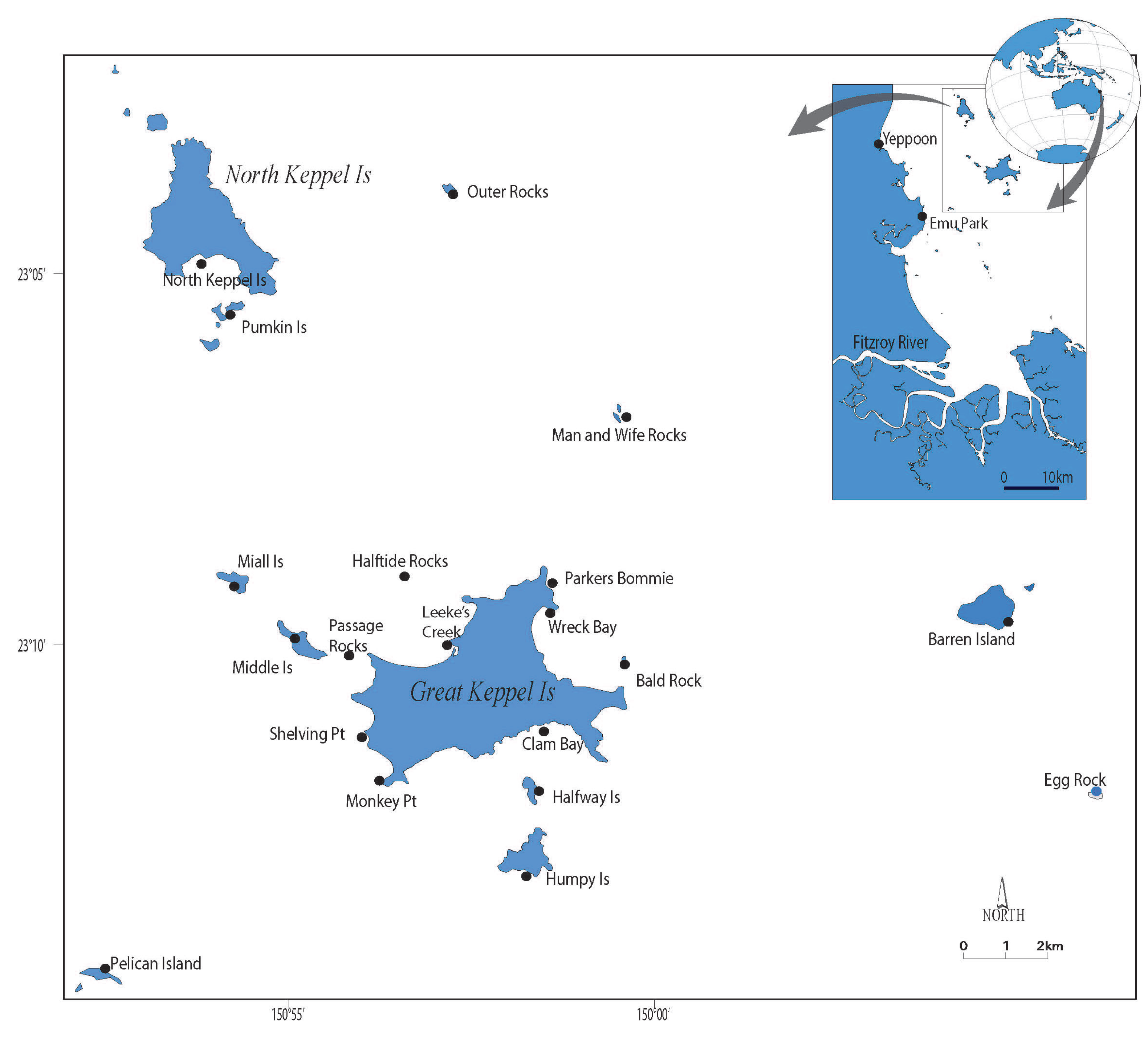
<p>The Keppel Island group (Keppels) is a group of 15 continental islands situated along the inner shelf of the Great Barrier Reef near Rockhampton (23.1 °S, 150.9 °E, <xref ref-type="fig" rid="f1-diversity-03-00329">Figure 1</xref>). The islands are surrounded by a patchwork of fringing reefs with relatively high coral cover (∼67%) compared to the rest of the Great Barrier Reef [<xref ref-type="bibr" rid="b3-diversity-03-00329">3</xref>]. Radio carbon dating of similar reefs ∼100 km to the north (Percy Islands) suggests that reefs in the Keppel group are relatively young, having developed only ∼1500 years ago in the late Holocene following landward migration of the terrigenous sediment wedge and sea level fall [<xref ref-type="bibr" rid="b43-diversity-03-00329">43</xref>,<xref ref-type="bibr" rid="b44-diversity-03-00329">44</xref>]. Keppel Bay is essentially an ancient flood plain, in-filled with accumulated coastal sediment from the Fitzroy River following sea level rise in the early Holocene (∼9000 years ago). Sediment continues to accumulate in the river mouth and inner Keppel bay north spreading along the coast during short duration episodic high discharge fluvial events [<xref ref-type="bibr" rid="b45-diversity-03-00329">45</xref>,<xref ref-type="bibr" rid="b46-diversity-03-00329">46</xref>]. However, there is relatively low sediment accumulation around the islands in the outer part of the bay. In general, leeward bays are dominated by shallow reef flats (where the geomorphology allows adequate flushing of fluvial and accumulated sediments) while eastern shores and rocky headlands comprise deeper reef slopes.</p>
<p>A number of disturbances have impacted on the Keppel reef communities in the last few decades causing concerns about loss of reef quality [<xref ref-type="bibr" rid="b30-diversity-03-00329">30</xref>,<xref ref-type="bibr" rid="b47-diversity-03-00329">47</xref>-<xref ref-type="bibr" rid="b50-diversity-03-00329">50</xref>] and severe bleaching in 2006 [<xref ref-type="bibr" rid="b51-diversity-03-00329">51</xref>,<xref ref-type="bibr" rid="b52-diversity-03-00329">52</xref>]. A flood in 1991 caused mortality of almost 85% to corals to a depth of ∼1.3m below datum on leeward island reefs. Assessments of reef impact were conducted by van Woesik [<xref ref-type="bibr" rid="b47-diversity-03-00329">47</xref>] and Byron and O'Neill [<xref ref-type="bibr" rid="b53-diversity-03-00329">53</xref>]. A bleaching event in 2006 resulted in a 40% loss of corals (unpublished data). Two earlier bleaching events in 1998 and 2002 also caused significant coral mortality [<xref ref-type="bibr" rid="b30-diversity-03-00329">30</xref>]. In spite of these disturbances, the high coral growth rate observed in the Keppels has allowed significant recovery [<xref ref-type="bibr" rid="b54-diversity-03-00329">54</xref>].</p>
<sec>
<label>2.1.</label>
<title>Field Surveys</title>
<p>A total of 19 sites were surveyed between March 2008 and April 2009 (<xref ref-type="table" rid="t1-diversity-03-00329">Table 1</xref>). A combination of high resolution aerial photographs and local knowledge was used to ensure that all significant reef systems in the central Keppel Island group were represented. Aerial photos were geo-rectified in Google Earth ™ and reef area estimated by tracing the outline of the reef which was clearly visible in the photos. Coral species and their abundance (ranked % abundance) were assessed during a random swim over ∼60 minutes at each of the 19 sites. Species lists were limited to scleractinian corals. Most coral species could be adequately identified in the field with the exception of those in the Poritidae (massive growth form) and Fungiidae genera which were counted as one species if these were present. Digital still photographs of the features of each species were taken to verify identity. Each species was ranked in terms of abundance and compared to the total live hard coral cover using a scale of 0–5 (0 = none present; 1 = 1–10%; 2 = 11–30%; 3 = 31–50%; 4 = 51–75%) as per de Vantier <italic>et al.</italic> [<xref ref-type="bibr" rid="b38-diversity-03-00329">38</xref>].</p></sec>
<sec>
<label>2.2.</label>
<title>Benthic Cover</title>
<p>The cover of benthic communities was assessed for 17 of the 19 sites (benthic cover was not measured for Leeke's Creek and Clam Bay) along two haphazard 50 m transects on the reef flat (0–2.0 m at chart datum, 2.4–4.8 m at mean sea level) and reef slope (6.0–12.0 m at chart datum, 8.4–14.4 m at mean sea level). Transects were photographed every 2 m at a height of 1 m above the substratum using a digital still camera (4 Mp) fitted with a 16 mm wide angle lens. To enable calculation of the average gradient between the reef flats and slopes, geo-referenced images were obtained for each transect using a towed GPS set to record a track at 5 second intervals which was later matched to the images using the software RoboGeo™ according to the methods of Roelfsema and Phinn [<xref ref-type="bibr" rid="b55-diversity-03-00329">55</xref>]. Digital still images were analysed using 20 random points per image with the program CPCe™v3.1 [<xref ref-type="bibr" rid="b56-diversity-03-00329">56</xref>]. Cover was assessed as the percentage of the total biotic and abiotic benthos averaged across the replicate transects on reef flats and slopes. Benthic cover was classified into the proportion of macro-algae, abiotic, coralline algae, turf algae, hard live coral and soft coral.</p></sec>
<sec>
<label>2.3.</label>
<title>Environmental Variables</title>
<p>To assess their influence on the coral species assemblage, three key environmental variables, light, temperature and habitat profile were directly measured at 18 of the 19 study sites (light and temperature loggers were not deployed at Leeke's Creek). In addition, current strength and reef rugosity (3-D habitat complexity) were subjectively categorized for each site based on observations as potential influences on diversity.</p>
<sec>
<label>2.3.1.</label>
<title>Light Attenuation Coefficient—K<sub>d</sub></title>
<p>To assess the variation in light levels across sites, predominantly due to variation in turbidity, the light attenuation coefficient (K<sub>d</sub>) was derived from photosynthetically active radiation (PAR) loggers (Odyssey, Dataflow Systems, NZ) at each site deployed at a depth of 5–7 m. The PAR loggers were fitted with custom-built wipers to prevent fouling of the sensor by sediment and algal growth. These wipers brushed the PAR sensor three times in quick succession every two hours. Light was recorded every 10 minutes for periods of 1–12 weeks.</p>
<p>Average daily cumulative PAR light between 10 am and 3 pm was determined for each site using only data from cloud-free days. Cloud-free days were easily identified in the dataset by their smooth diurnal light curves. K<sub>d</sub>, was calculated from the average cumulative underwater irradiance (I) at depth (z) and the theoretical cloud-free irradiance at the surface (I<sub>surface</sub>), derived using the software PARCAL (AIMS, version 01.03.08), using the equation:
<disp-formula id="FD1">
<label>(1)</label>
<mml:math id="mm1" display="block">
<mml:semantics id="sm1">
<mml:mrow>
<mml:mrow>
<mml:mrow>
<mml:mrow>
<mml:mo>[</mml:mo>
<mml:mrow>
<mml:msub>
<mml:mtext>d</mml:mtext>
<mml:mrow>
<mml:mtext>site</mml:mtext></mml:mrow></mml:msub>
<mml:mo>=</mml:mo>
<mml:mtext>Ln</mml:mtext>
<mml:mrow>
<mml:mo>[</mml:mo>
<mml:mrow>
<mml:mrow>
<mml:mo>(</mml:mo>
<mml:mrow>
<mml:mrow>
<mml:mtext>I</mml:mtext>
<mml:mo>/</mml:mo>
<mml:mrow>
<mml:msub>
<mml:mtext>I</mml:mtext>
<mml:mrow>
<mml:mtext>surface</mml:mtext></mml:mrow></mml:msub></mml:mrow></mml:mrow></mml:mrow>
<mml:mo>)</mml:mo></mml:mrow></mml:mrow></mml:mrow></mml:mrow>
<mml:mo>]</mml:mo></mml:mrow></mml:mrow>
<mml:mo>/</mml:mo>
<mml:mtext>z</mml:mtext></mml:mrow></mml:mrow></mml:semantics></mml:math></disp-formula></p>
<p>All K<sub>d</sub> values were standardized to values at Miall Island, our reference site, to account for non-synchronous deployments of light loggers at some sites. Odyssey PAR loggers were calibrated in air using theoretical clear-sky midday irradiances derived from by PARCAL. Theoretical midday irradiances were checked against a calibrated LI-COR<sup>®</sup> sensor and the maximum error was found to be &lt;3%.</p></sec>
<sec>
<label>2.3.2.</label>
<title>Temperature</title>
<p>Sea temperatures (SST) were recorded at half-hourly intervals using Odyssey temperature loggers (Dataflow Systems Pty Ltd, NZ) deployed on the reef slope (5–7 m at LAT). Loggers were calibrated against a NATA certified Hart 1522 reference thermometer (Hart Scientific, UT, USA) in a water bath to a final accuracy of &lt;0.1 °C. The total number of days where the maximum daily temperature exceeded 28 °C (days &gt;28 °C) was calculated for each site.</p></sec>
<sec>
<label>2.3.3.</label>
<title>Habitat Profiles</title>
<p>Habitat profiles were estimated by measuring the gradient (slope) between the start of reef flat and slope transects for each site from the geo-rectified images using Google Earth™. The depth at the reef flat was subtracted from the depth at the reef slope and then divided by the distance between the points.</p></sec>
<sec>
<label>2.3.4.</label>
<title>Current</title>
<p>To assess the influence of current flow on the species assemblage at each site, current strengths were catagorized based on local knowledge as: 1 = strong tidal combined with longshore currents; 2 = medium current (mainly tidal) but some longshore current influence; 3 = mostly diurnal tidal currents which are protected from strong longshore currents and ocean swell.</p></sec>
<sec>
<label>2.3.5.</label>
<title>Habitat Rugosity</title>
<p>To assess the influence of 3-D habitat complexity (rugosity) on the coral species assemblages at the 19 sites, each site was subjectively categorized as: 1 = high rugosity as a result of bommies and rocks creating high 3-D habitat structure and a range of habitat types; 2 = average rugosity with reef flats and slopes exhibiting range of coral growth morphologies and scattered bommies; and 3 = low rugosity (reef flats and slopes with extensive mono-specific stands dominated mainly by <italic>Acropora</italic> spp.) [<xref ref-type="bibr" rid="b57-diversity-03-00329">57</xref>].</p></sec></sec>
<sec>
<label>2.4.</label>
<title>Statistical Analyses</title>
<p>Data for species abundance, benthic cover, and environmental variables were analyzed using the statistical software Primer v6 [<xref ref-type="bibr" rid="b58-diversity-03-00329">58</xref>-<xref ref-type="bibr" rid="b60-diversity-03-00329">60</xref>] and SPSS v17 (SPSS Inc.). Missing values for benthic cover variables were replaced using the expectation maximum likelihood algorithm which assumes a multi-normal distribution model for the data. A range of coral community-based statistical methods, as described in the following sections, were used to explore the sites according to their species assemblage and environmental variables. Multivariate analysis of variance was used to investigate the significance of differences in the benthic variables among site groups. The model residuals were examined to verify the validity of the assumption of normality and Levene's test was used to verify the homogeneity of variances. Simple pair-wise comparisons were performed to further investigate significant differences between groups of sites.</p>
<sec>
<label>2.4.1.</label>
<title>Multivariate Analyses of Species Assemblage</title>
<p>A resemblance matrix based on Bray Curtis similarities was constructed from the species presence/absence data for the 19 sites. Agglomerative CLUSTER analysis was used to group the sites according to the presence or absence of coral species using group average linkage distances. Objective grouping of clusters was based on the SIMPROF routine [<xref ref-type="bibr" rid="b61-diversity-03-00329">61</xref>]. The validity of the site groupings derived from CLUSTER analysis were further explored using non-metric multidimensional scaling analysis (MDS) following the recommendations of Legendre and Legendre [<xref ref-type="bibr" rid="b62-diversity-03-00329">62</xref>].</p></sec>
<sec>
<label>2.4.2.</label>
<title>Univariate Measures of Community Structure: Species Richness S and Average Taxonomic Distinctness (Δ+)</title>
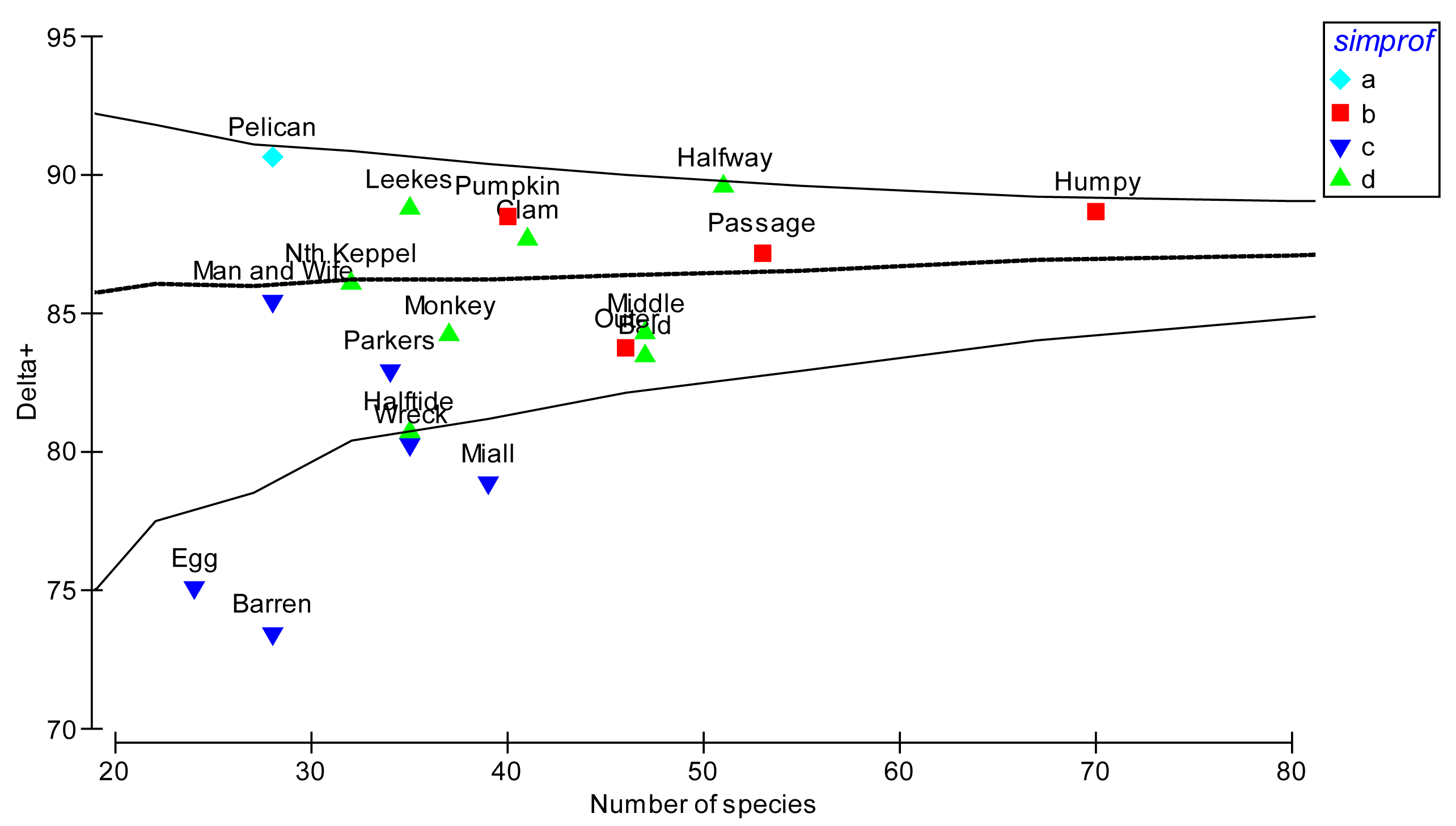
<p>Species richness S and average taxonomic distinctness Δ+ were determined for each site [<xref ref-type="bibr" rid="b63-diversity-03-00329">63</xref>,<xref ref-type="bibr" rid="b64-diversity-03-00329">64</xref>]. Following Somerfield <italic>et al.</italic> [<xref ref-type="bibr" rid="b65-diversity-03-00329">65</xref>] the branch lengths between taxonomic levels (ω) were weighted using the species richness information gained from the full species inventory. Higher branch lengths were assigned to consecutive taxonomic levels according to differences in species richness whereby taxonomic groups with the same species richness were assigned branch lengths of zero. The species list from each site was compared with the full species inventory for the study and the resulting values of Δ+ were displayed using a funnel plot under the null hypothesis that the assemblages are a random selection from the regional species pool but adjusts probabilities to account for commonness/rarity [<xref ref-type="bibr" rid="b63-diversity-03-00329">63</xref>,<xref ref-type="bibr" rid="b66-diversity-03-00329">66</xref>,<xref ref-type="bibr" rid="b67-diversity-03-00329">67</xref>].</p></sec>
<sec>
<label>2.4.3.</label>
<title>Environmental Variables Contributing to Coral Community Structure</title>
<p>To examine the structuring forces behind the species assemblage, the 7 environmental variables (light extinction coefficient index, average and maximum daily temperatures, number of days &gt;28 °C, habitat profile, current and rugosity) and 6 benthic variables (% coral, macro-algae, turf algae, coralline algae and soft coral cover) were explored using BEST [<xref ref-type="bibr" rid="b60-diversity-03-00329">60</xref>] using Spearman's rank correlations (ρ) as a measure of resemblance. The environmental data were then compared with the benthic cover and species assemblage data in the same way.</p></sec>
<sec>
<label>2.4.4.</label>
<title>Coral Genera Contributing to Community Structure</title>
<p>The coral taxa contributing to the multivariate species community structure were investigated using the SIMPER procedure run on data aggregated to genus level [<xref ref-type="bibr" rid="b60-diversity-03-00329">60</xref>]. Coral genera contributions were visualised by superimposing bubble plots across the species assemblage 2-D MDS plot.</p></sec></sec></sec>
<sec sec-type="results">
<label>3.</label>
<title>Results</title>
<sec>
<label>3.1.</label>
<title>Species Lists</title>
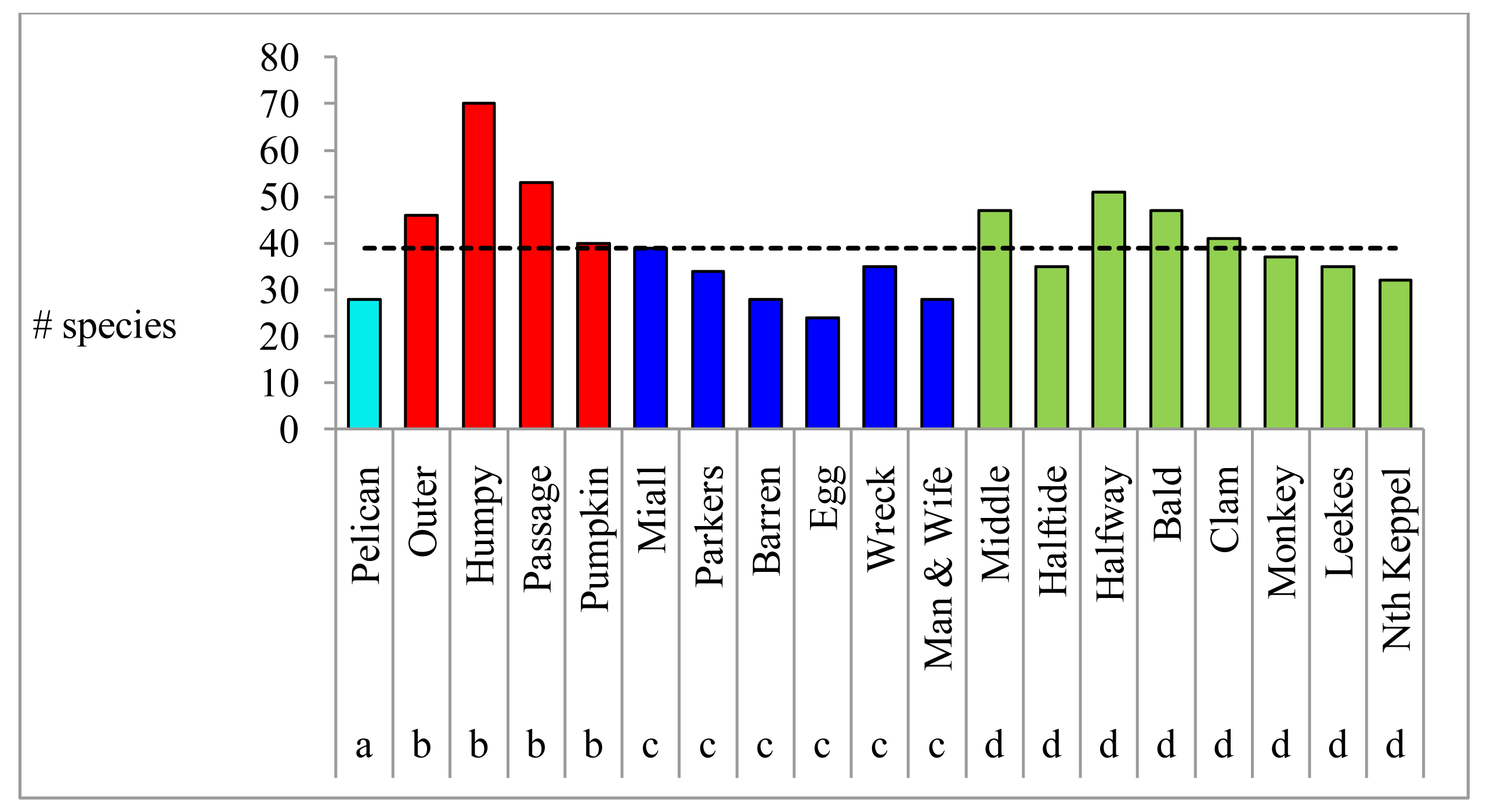
<p>In total, 167 species from 48 genera in 13 scleractinian families were recorded at the 19 sites. Average species richness among sites was 39.5, the same as the mean species richness found for the Great Barrier Reef between Townsville and Rockhampton by de Vantier (39.5) [<xref ref-type="bibr" rid="b39-diversity-03-00329">39</xref>]. Humpy had much greater species richness than any other site (70 species compared to the next highest, 53, at Passage), and the lowest species richness was found at Egg (24 species).</p></sec>
<sec>
<label>3.2.</label>
<title>Benthic Cover</title>
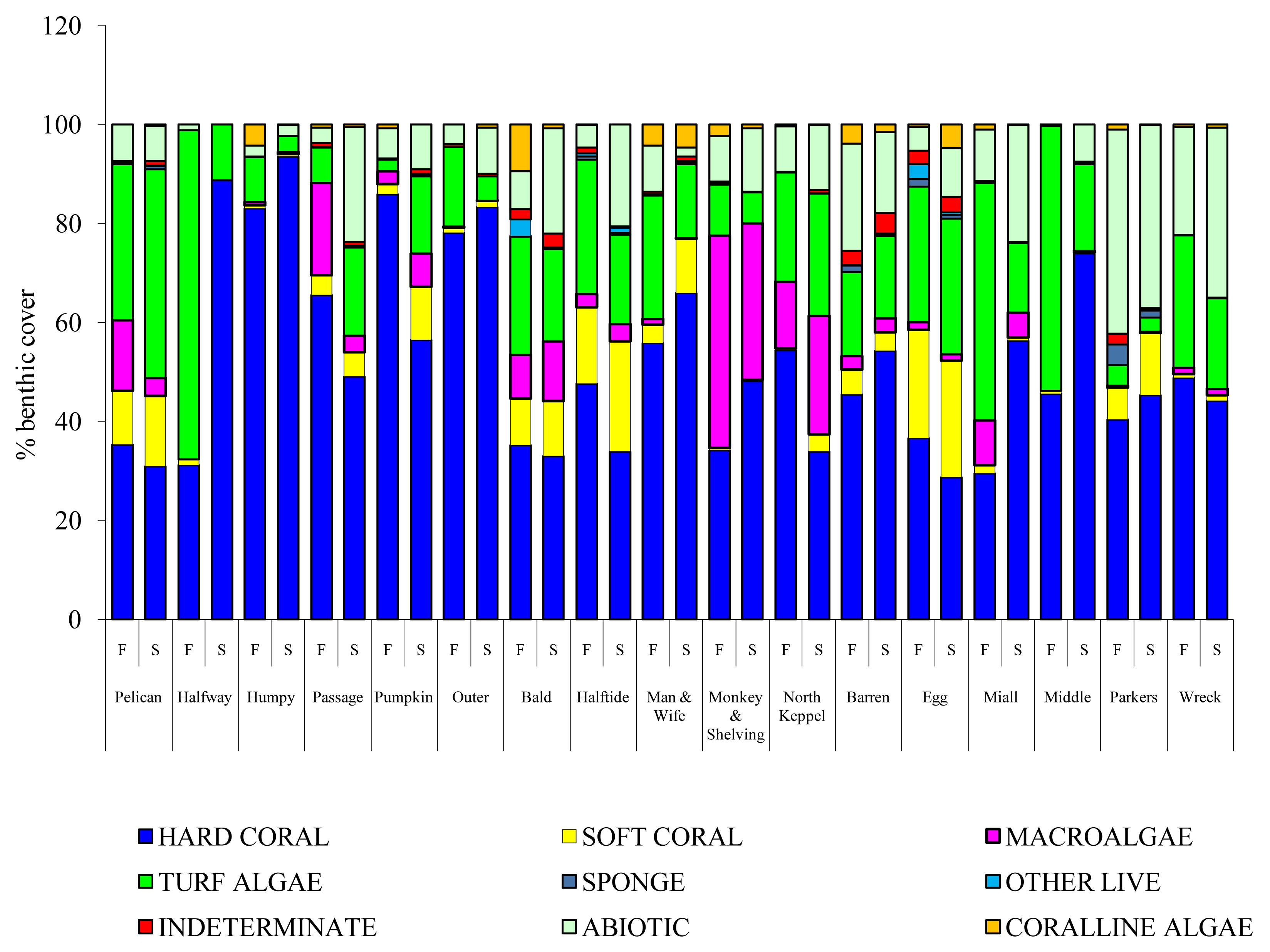
<p>Coral cover varied from 29% to 94% with an overall average of 52% ± 19% (<xref ref-type="fig" rid="f2-diversity-03-00329">Figure 2</xref>). Reef flats had only slightly lower coral cover than reef slopes (48 ± 21% cf 53 ± 20%). The highest mean coral cover was found on the south eastern side of Humpy Island (88 ± 10%) and the lowest cover was found around Egg Rock (33 ± 16%). Soft corals comprised only 6 ± 1% of the benthic cover. Macro algal cover comprised 8 ± 1% of the benthic cover and was dominated by a single species, <italic>Lobophora variegata</italic>.</p>
<p>Species from the Families Acroporidae and Faviidae were the best represented with 61 and 57 species, respectively (<xref ref-type="table" rid="t2-diversity-03-00329">Table 2</xref>). Species from the branching genus <italic>Acropora</italic> dominated the species assemblage in the Keppels in both species richness (43 out of a total of 167 species) and contribution to hard coral cover (80%). The remaining 20% non-acroporid coral community had a mean site abundance of &lt;10% (mostly non-branching species except for pocilloporids).</p></sec>
<sec>
<label>3.3.</label>
<title>Multivariate Analyses of Species Assemblage</title>
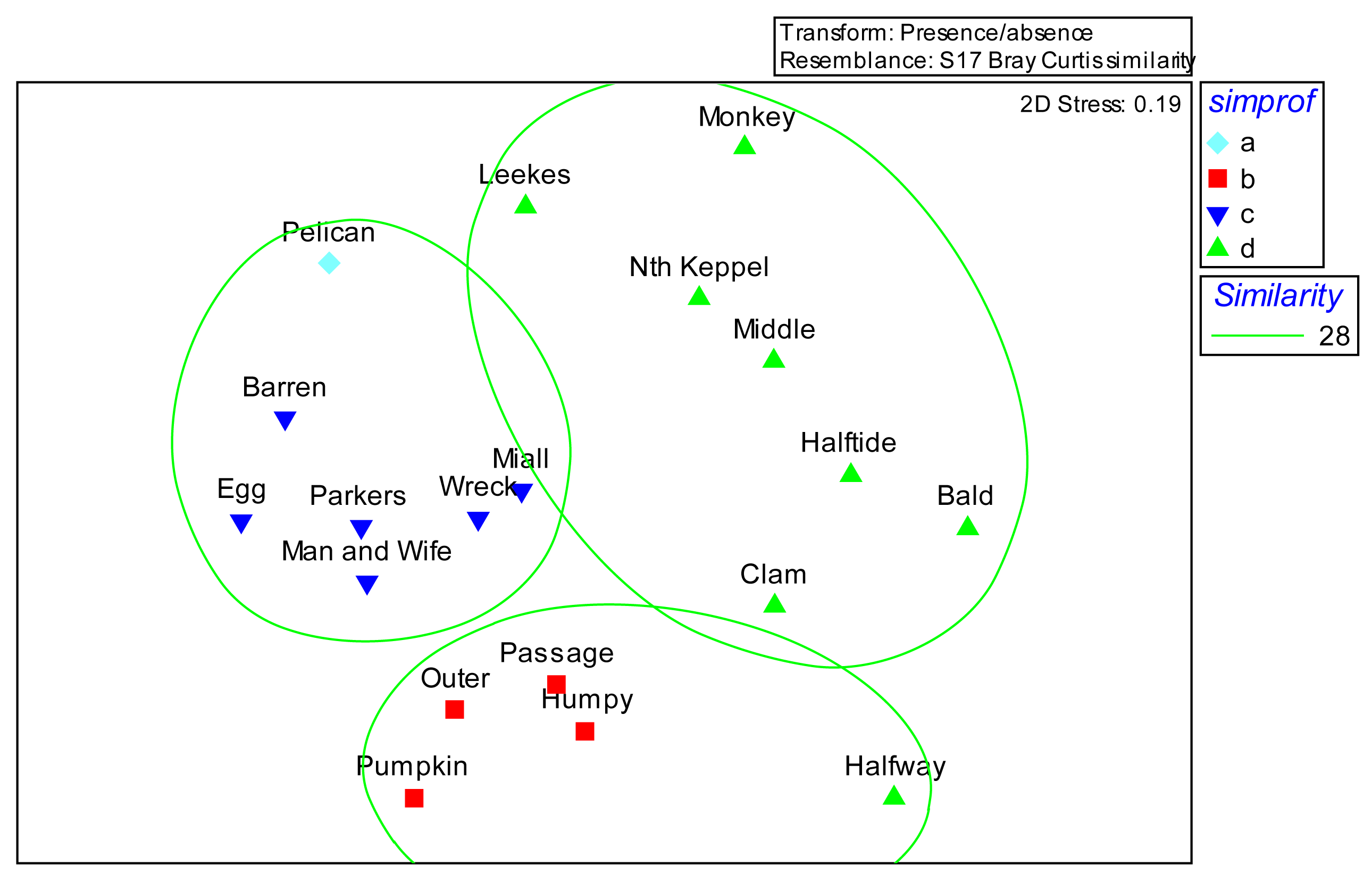
<p>CLUSTER analysis separated the sites into four groups (A–D, <xref ref-type="fig" rid="f3-diversity-03-00329">Figure 3</xref>). 2-D plots of the MDS axis were overlaid with the groups derived using the SIMPROF routine. Group A comprised a single site, Pelican with 28 species. Group B included Humpy, Outer, Passage and Pumpkin with 52 ± 13 species. Group C included Barren, Egg, Miall, Man and Wife, Parkers and Wreck with 31 ± 6 species. Group D included Bald, Clam, Halftide, Leekes, Halfway, Middle, Monkey and North Keppel with 41 ± 7 species.</p>
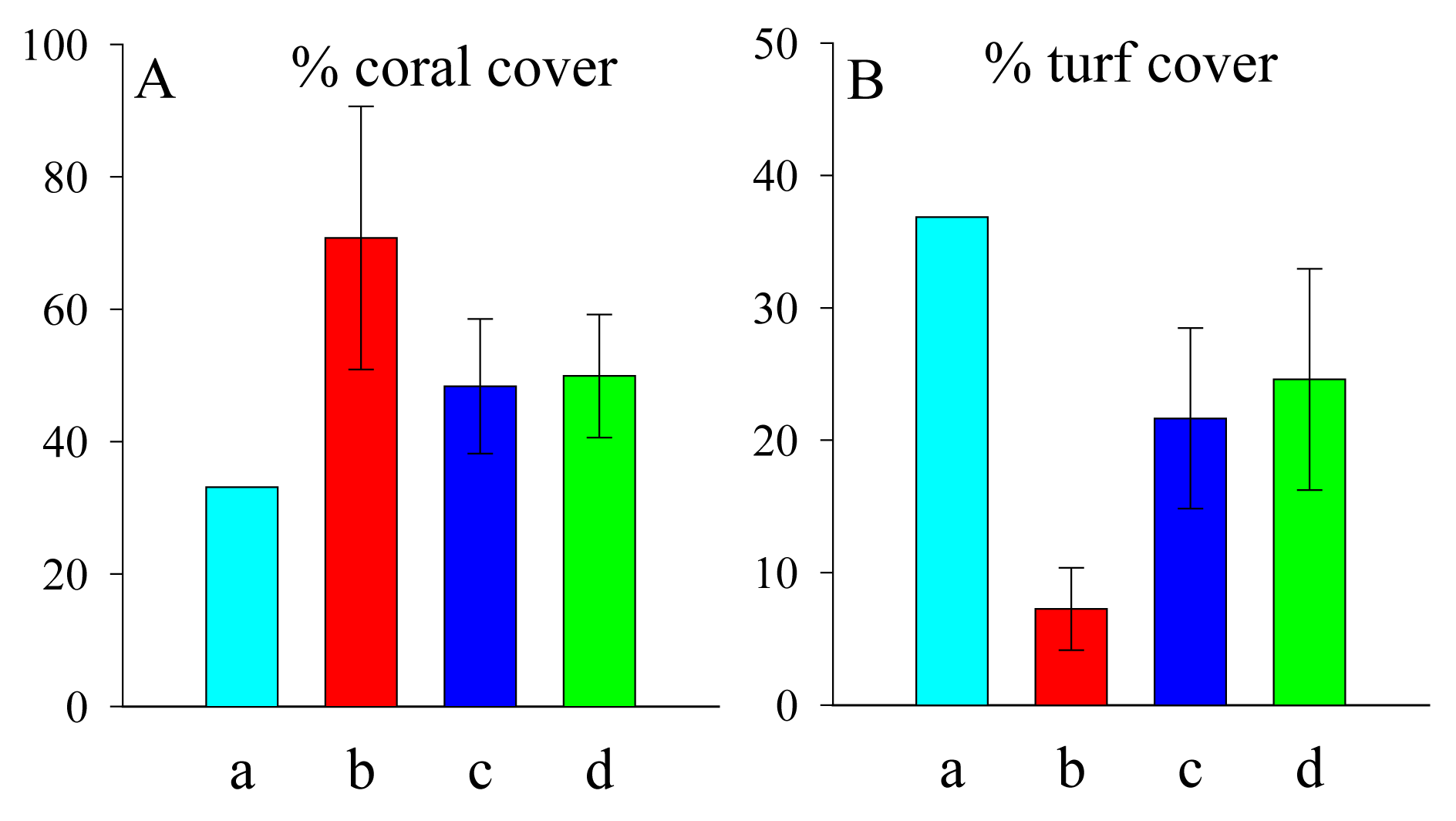
<p>Percentage coral cover and turf algal cover varied between the sites groups (<xref ref-type="fig" rid="f4-diversity-03-00329">Figure 4A</xref>–<xref ref-type="fig" rid="f4-diversity-03-00329">B</xref>). Group B sites had the highest coral cover, more than double that of Pelican and 1.5 times that of the other two groups. Turf algal cover showed the reverse pattern.</p></sec>
<sec>
<label>3.4.</label>
<title>Species Richness S and Average Taxonomic Distinctness AvTD (Δ+)</title>
<p>There was a gradient of species richness and taxonomic distinctness across the four groups of sites (<xref ref-type="fig" rid="f5-diversity-03-00329">Figures 5</xref> and <xref ref-type="fig" rid="f6-diversity-03-00329">6</xref>). Pelican (Group A) had the highest taxonomic distinctness but low species numbers. The frequency-based mean taxonomic distinctness for the full species list was ∼86. Seven sites had frequency-based values of Δ+ above the mean including Pelican which had the highest taxonomic distinctness followed by Halfway, Leekes, Humpy Pumpkin, Clam and Passage. Five sites (Egg, Barren, Miall, Halftide and Wreck) had taxonomic distinctness values below the 95% probability limit.</p>
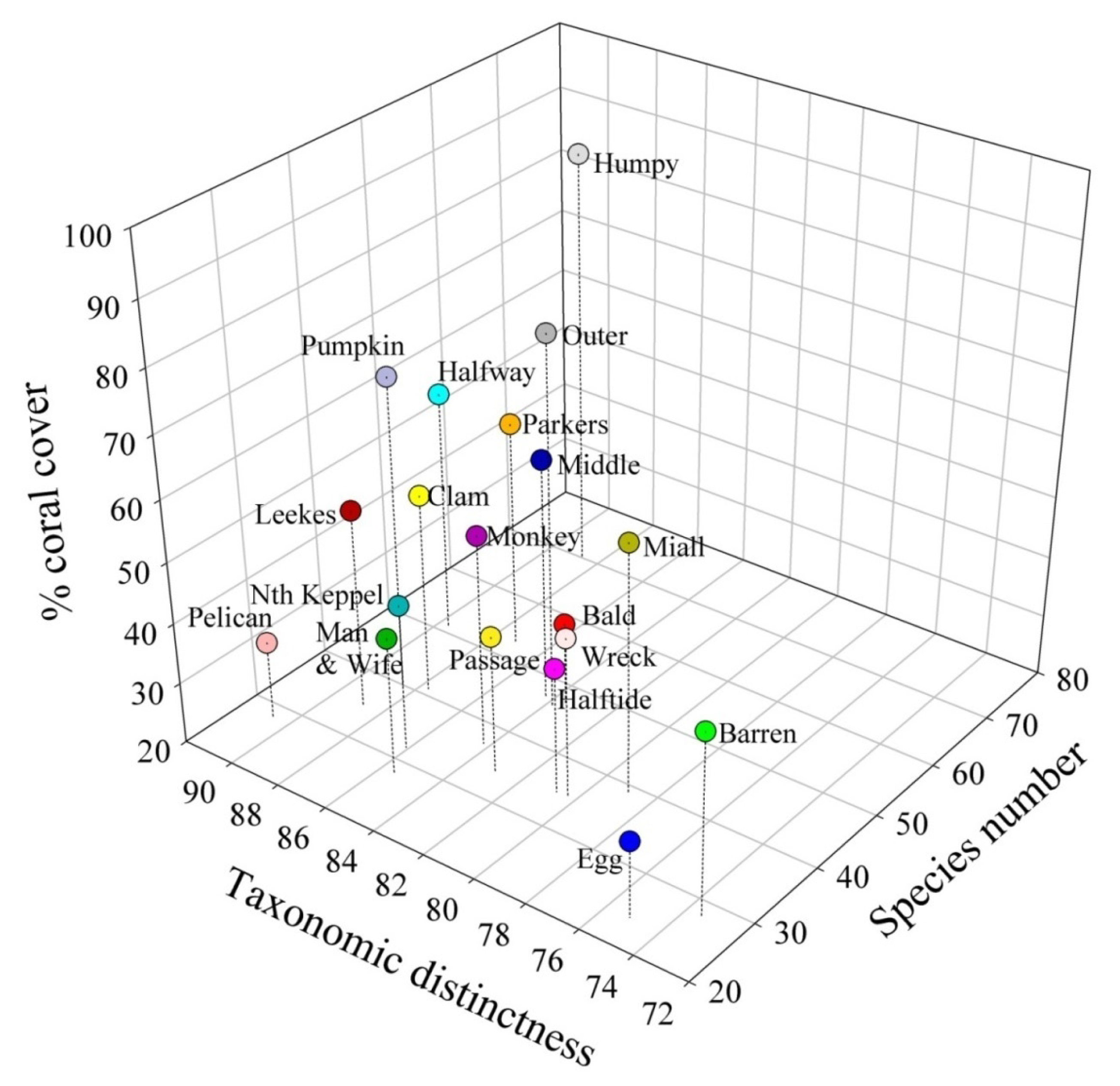
<p>Overall, there is a suite of sites that have relatively higher values for species richness, taxonomic distinctiveness and coral cover: the four sites in Group B, Humpy, Passage, Pumpkin and Outer plus two more sites in Group D, Halfway and Middle (<xref ref-type="fig" rid="f7-diversity-03-00329">Figure 7</xref>). A further site was added to this group, Pelican, on the basis of its taxonomic distinctiveness and provision of habitat for stress tolerant corals not found at the other 18 sites.</p></sec>
<sec>
<label>3.5.</label>
<title>Environmental Variables Contributing to Coral Community Structure</title>
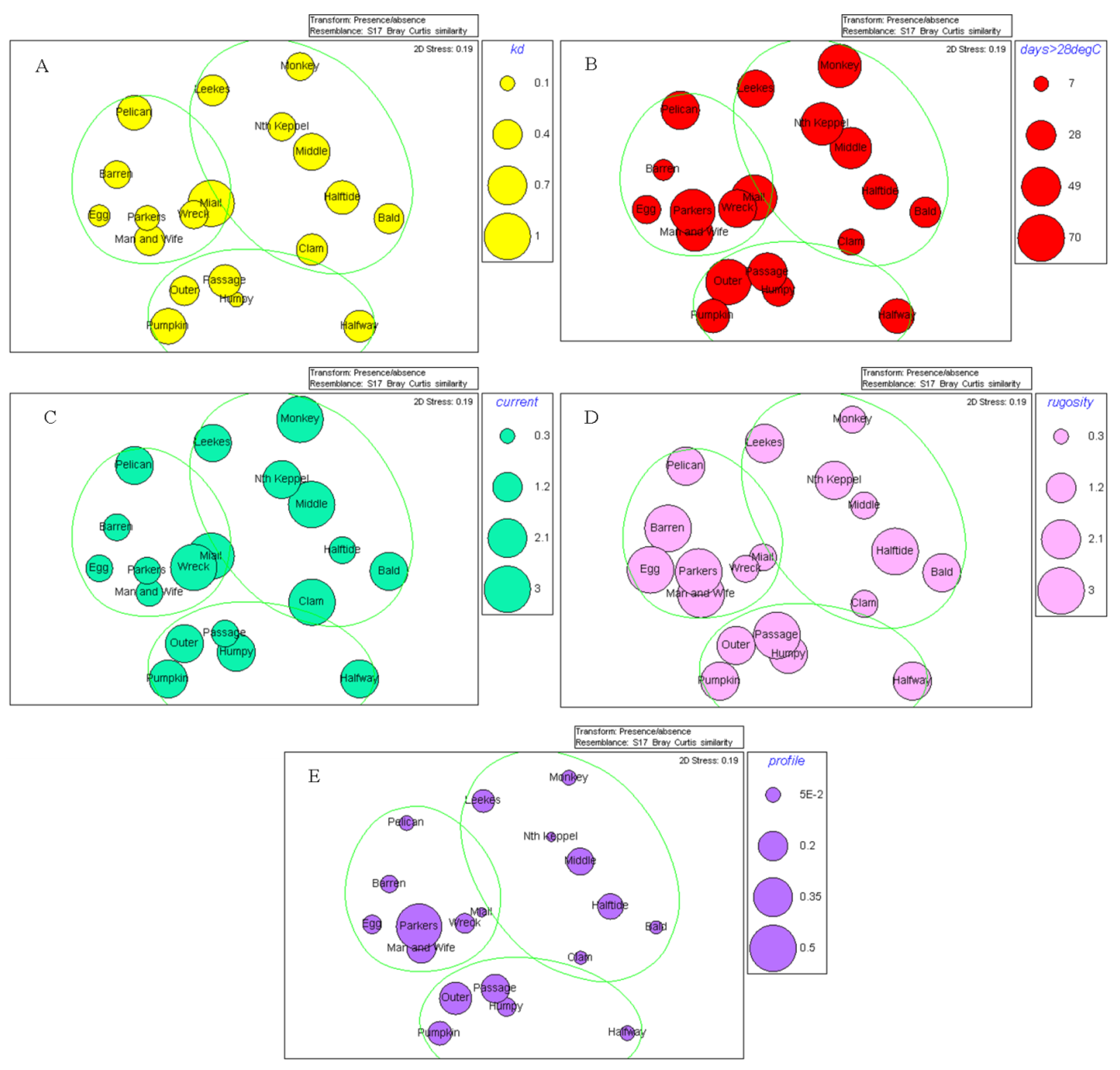
<p>None of the environmental variables significantly explained the species assemblage (<xref ref-type="fig" rid="f8-diversity-03-00329">Figure 8</xref>). There was also no statistically significant relationship between the resemblances based on the coral community structure and that of the full suite of environmental variables. It is likely that there is insufficient replication of suites of particular abiotic variability to obtain a statistically robust analysis [<xref ref-type="bibr" rid="b68-diversity-03-00329">68</xref>] or that the community structure does not respond to the chosen variables, at least not over the scales at which they were measured.</p></sec>
<sec>
<label>3.6.</label>
<title>Coral Genera Contributing to Community Structure</title>
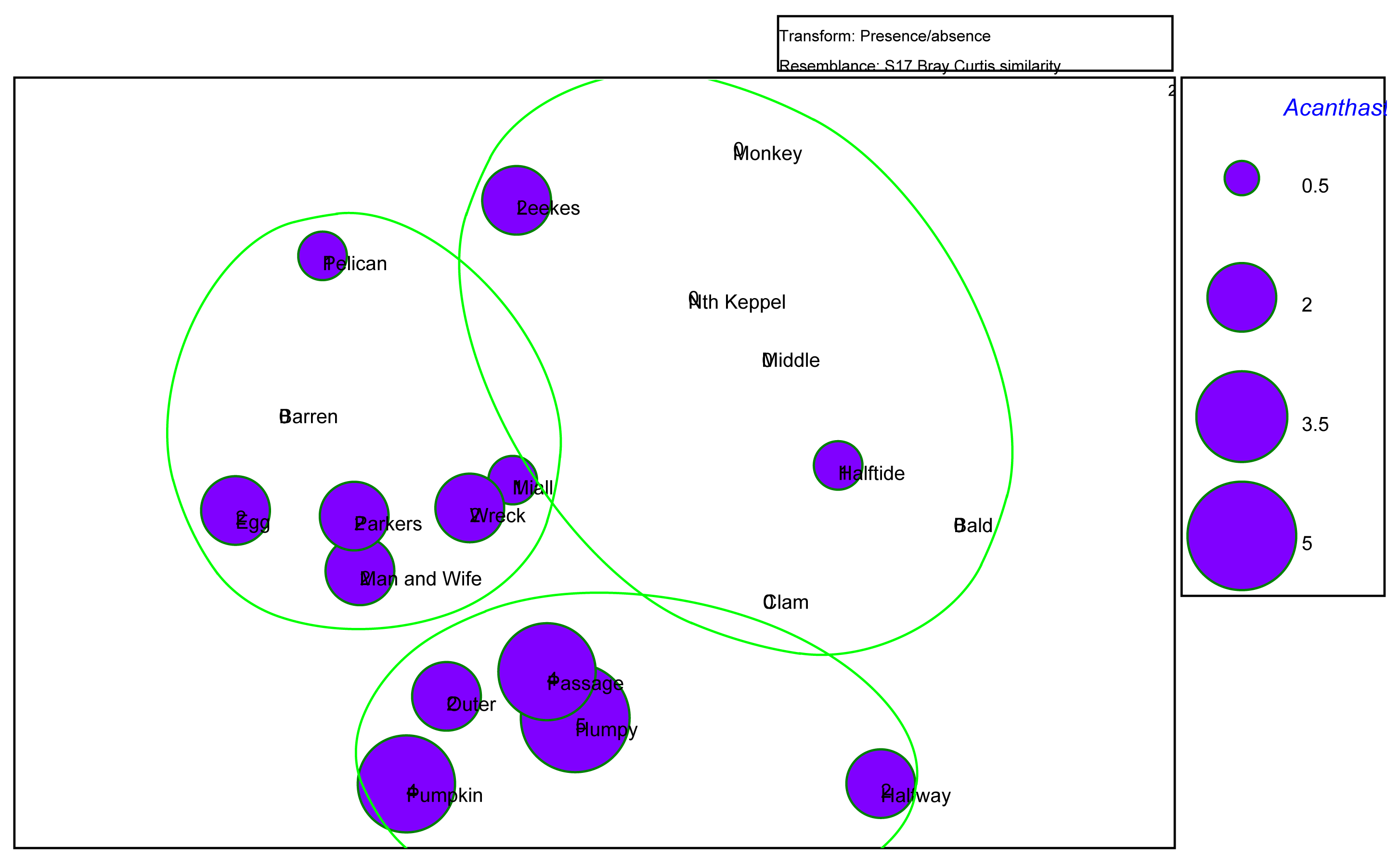
<p>There was little structure to the species comparisons among the sites which was dominated by <italic>Acropora</italic> (30–60% contribution). More detailed comparisons were conducted following removal of <italic>Acropora</italic> from the dataset. SIMPER analysis showed that the average similarity amongst the four sites in Group B (Humpy, Outer, Passage and Pumpkin) was 64%. Five genera comprising <italic>Turbinaria</italic> (15%), <italic>Goniastrea</italic> (13%), <italic>Acanthastraea</italic> (12%), <italic>Favia</italic> (12%) and <italic>Montipora</italic> (11%) contributed most to the group similarities.</p>
<p>The average similarity between the sites in group C (Barren, Egg, Miall, Man and Wife, Parkers, Wreck) was 52%. Eight non-<italic>Acropora</italic> genera comprising <italic>Platygyra</italic> (13%), <italic>Acanthastrea</italic> (13%), <italic>Pocillopora</italic> (12%) and <italic>Turbinaria</italic> (10%) contributed to the similarities between site groups.</p>
<p>The average similarity between the sites in group D (Bald, Clam, Halftide, Leekes, Middle, Monkey, North Keppel) was 58%. <italic>Favia</italic> species contributed 19% to the similarity. Three other taxa comprising <italic>Montipora</italic> (13%) <italic>Platygyra</italic> and <italic>Favites</italic> (9%) contributed to the similarities between groups.</p>
<p>The relationship between the site groups and the cumulative ranked abundance of corals in each genus was apparent from the bubble plots superimposed on the MDS of species assemblage. For instance, species from the genera <italic>Acanthastrea</italic> were more abundant in Group B sites (<xref ref-type="fig" rid="f9-diversity-03-00329">Figure 9</xref>).</p>
<p>Coral species from the family Poritidae, specifically in the genus <italic>Goniopora</italic> were strongly represented at sites in group C which had 1–4 species at 6 sites whereas only one site in each of group B (two species at one site) and C (one species at one site) had species from this genus. Sites in groups B and C had a greater abundance of coral species from the family Merulinidae specifically the genus <italic>Hydnophora</italic> (1–2 spp) compared to only 1 species at two sites in group D (bubble plots not shown).</p></sec></sec>
<sec sec-type="discussion">
<label>4.</label>
<title>Discussion</title>
<p>Six of the 19 reefs were identified as coral biodiversity hotspots within the Keppel Island group (Keppels). The survey sites in the southern bays at Humpy, Middle and Halfway Islands, reef surrounding Passage Rocks, Outer Rocks and Pumpkin Island were typified by relatively high species richness, taxonomic distinctiveness and coral cover, and low turf-algal cover compared to other sites. These six sites are likely to be more resilient to disturbance than the other sites in the study because high taxonomic diversity is implicated in ecosystem stability [<xref ref-type="bibr" rid="b69-diversity-03-00329">69</xref>]. For much of the year prevailing southeast trade winds drive surface currents northwest, connecting four of the sites, Humpy, Passage, Halfway and Pumpkin oceanographically to sites such as Clam Bay, Haftide Rocks, and North Keppel Island [<xref ref-type="bibr" rid="b70-diversity-03-00329">70</xref>]. These sites therefore represent potential ‘refugia’ (source reefs) in the Keppels, from which propagules from a wide range of coral species can spread to surrounding sites of lower diversity (sink reefs) following the annual mass coral spawning. Knowing what taxa exist on which reefs that are connected to each other oceanographically can provide information about sites that are of high conservation value and therefore are a priority for enhanced management efforts if regeneration of surrounding sites becomes important. On the GBR, de Vantier [<xref ref-type="bibr" rid="b39-diversity-03-00329">39</xref>] conducted broadscale assessments of &gt;75% of the nearshore reef-building coral communities between 14 °S and 23 °S. These assessments supplemented previous work by Veron [<xref ref-type="bibr" rid="b37-diversity-03-00329">37</xref>,<xref ref-type="bibr" rid="b71-diversity-03-00329">71</xref>,<xref ref-type="bibr" rid="b72-diversity-03-00329">72</xref>] and contributed to an improved understanding of both the natural and anthropogenic influences structuring inshore GBR coral communities. Whilst coral species community assessments must be interpreted with care in the context of differential coastal geomorphology, habitat diversity, disturbance history, connectivity and terrestrial influences, they contribute to a more robust contextual framework against which researchers and reef managers can predict and model changes. Care must be taken when making qualitative comparisons between coral communities because many of the sediment-tolerant taxa are particularly sparse and restricted to small reef areas [<xref ref-type="bibr" rid="b73-diversity-03-00329">73</xref>]. As such, fine-scale mapping can contribute to more robust study design by elucidating smaller, low-diversity sites which have an abundance of stress-tolerant taxa but would otherwise have been considered of ‘low’ conservation value. In addition, fine-scale mapping can be used as a baseline to investigate the impacts of anthropogenic disturbance, such as dredging, on coral communities [<xref ref-type="bibr" rid="b74-diversity-03-00329">74</xref>-<xref ref-type="bibr" rid="b76-diversity-03-00329">76</xref>]. A note of caution must also accompany any discussion of augmented management intervention in order to enhance overall reef resilience. It remains to be seen whether past intervention (the implementation of no-take zones) has been effective in protecting coral biodiversity due to the potentially over-riding influences of other major structuring forces like terrestrial runoff, thermal stress and cyclones [<xref ref-type="bibr" rid="b11-diversity-03-00329">11</xref>,<xref ref-type="bibr" rid="b77-diversity-03-00329">77</xref>,<xref ref-type="bibr" rid="b78-diversity-03-00329">78</xref>].</p>
<p>The concept of marine ‘refugia’ is not new. No-take areas focused on the preservation of the commercially harvested marine species have historically been used as a key management tool to enhance the resilience of reefs [<xref ref-type="bibr" rid="b79-diversity-03-00329">79</xref>]. However, recent evidence strongly suggests that although no-take areas enhance the capacity of corals to recover following disturbance [<xref ref-type="bibr" rid="b17-diversity-03-00329">17</xref>] and protect fish stocks [<xref ref-type="bibr" rid="b15-diversity-03-00329">15</xref>,<xref ref-type="bibr" rid="b79-diversity-03-00329">79</xref>], as a management tool they may not necessarily protect coral biodiversity [<xref ref-type="bibr" rid="b1-diversity-03-00329">1</xref>,<xref ref-type="bibr" rid="b80-diversity-03-00329">80</xref>,<xref ref-type="bibr" rid="b81-diversity-03-00329">81</xref>]. An example of this can be found in the Red Sea [<xref ref-type="bibr" rid="b82-diversity-03-00329">82</xref>] whereby the species diversity on a protected reef failed to recover to pre-disturbance diversity after catastrophic exposure because of chronic pollution. A second example can be found on Kenyan reefs following the 1998 bleaching [<xref ref-type="bibr" rid="b83-diversity-03-00329">83</xref>] whereby the colony sizes of some coral species were affected regardless of reef protection status. Natural influences also structured the complement of species that re-colonized both polluted and unpolluted reefs in the Gulf of Eilat where fast-growing and competitively superior branching <italic>Acropora</italic> species monopolized recovered reef flats [<xref ref-type="bibr" rid="b82-diversity-03-00329">82</xref>]. There are multiple other examples of reefs that have undergone coral community composition changes following disturbance. Among these are those that have been influenced by bleaching [<xref ref-type="bibr" rid="b20-diversity-03-00329">20</xref>,<xref ref-type="bibr" rid="b42-diversity-03-00329">42</xref>,<xref ref-type="bibr" rid="b84-diversity-03-00329">84</xref>,<xref ref-type="bibr" rid="b85-diversity-03-00329">85</xref>], herbivore reductions [<xref ref-type="bibr" rid="b86-diversity-03-00329">86</xref>-<xref ref-type="bibr" rid="b88-diversity-03-00329">88</xref>], coral carnivore (<italic>Acanthaster planci</italic>) invasions [<xref ref-type="bibr" rid="b89-diversity-03-00329">89</xref>-<xref ref-type="bibr" rid="b91-diversity-03-00329">91</xref>], siltation [<xref ref-type="bibr" rid="b74-diversity-03-00329">74</xref>-<xref ref-type="bibr" rid="b76-diversity-03-00329">76</xref>,<xref ref-type="bibr" rid="b92-diversity-03-00329">92</xref>] and commercial collection [<xref ref-type="bibr" rid="b93-diversity-03-00329">93</xref>,<xref ref-type="bibr" rid="b94-diversity-03-00329">94</xref>]. In some cases, combinations of multiple influences have driven longer-term changes in coral community composition [<xref ref-type="bibr" rid="b11-diversity-03-00329">11</xref>,<xref ref-type="bibr" rid="b86-diversity-03-00329">86</xref>]. Choice of marine protected areas must therefore not only take into account coral biodiversity but must also consider the key natural and anthropogenic structuring influences such as space limitation, temperature, water quality and fishing pressure which can all ultimately exert influence on coral communities [<xref ref-type="bibr" rid="b91-diversity-03-00329">91</xref>].</p>
<p>Loss of the biodiversity of the structurally important coral species that underwrite ecosystem stability could have devastating long-term consequences on reefs [<xref ref-type="bibr" rid="b13-diversity-03-00329">13</xref>,<xref ref-type="bibr" rid="b24-diversity-03-00329">24</xref>,<xref ref-type="bibr" rid="b95-diversity-03-00329">95</xref>-<xref ref-type="bibr" rid="b97-diversity-03-00329">97</xref>]. Most coral taxa are functionally distinct and therefore respond in varying ways to specific environmental conditions. The higher the number of species such variability is averaged across, the less variable is the total system [<xref ref-type="bibr" rid="b98-diversity-03-00329">98</xref>]. Pelican (Group A) had a more random assemblage of coral species but low species number compared to all other sites in the Keppels because the coral communities surrounding Pelican have probably already responded to past disturbance by shifting to stress tolerant species. On sites with high coral diversity or taxonomic distinctness, equilibrium may have been reached whereby competitive interactions between species prevent stronger species from overcoming weaker ones, thereby averting the assemblages from becoming mono-specific. Whilst the fast-growing <italic>Acropora</italic> species are clearly the most dominant feature on most reefs in the Keppels, they are also vulnerable to temperature and low salinity. The low <italic>Acropora</italic> abundance surrounding Pelican Island confirms that these species are not able to withstand chronic disturbances such as bleaching and flood impacts in much the same way that mono-specific plant communities are vulnerable to disease and predation [<xref ref-type="bibr" rid="b99-diversity-03-00329">99</xref>]. And yet, the persistence of a wide diversity of less abundant but stress-resilient species has helped to sustain Pelican reefs under a frequent disturbance regime. It is unclear whether these species are ‘reef-builders’ capable of building the substrate for future reefs [<xref ref-type="bibr" rid="b100-diversity-03-00329">100</xref>]. Until their contribution has been determined, and considering that they probably contribute to functional diversification, it is imperative that future management efforts are directed towards maintaining and protecting existing levels of coral biodiversity in order to augment the resilience of the system as a whole. The threats posed by increased temperature, ocean acidification, rising sea level, land runoff, changing hydrodynamics and increasing severity of storms and floods are predicted to escalate. There is also a strong likelihood of a corresponding decline in the resources available to management initiatives to protect coral reefs. It may also be necessary to prioritize the protection of sites based on their potential to provide the seed stock for regeneration on surrounding reefs when and if the threats abate: Noah's arks for reefs.</p>
<p>The main characteristics responsible for distinguishing sites in the Keppel Islands were the richness (number) and taxonomic distinctness of coral taxa. These sites were also characterized by high coral cover combined with a low percentage of turf-algal cover but there was no evidence that these were structuring factors. The lack of correlation between the species assemblage and environmental variables may be a result of a lack of replication of sites with similar biotic and abiotic characteristics. Study sites were chosen based on their likelihood of supporting high coral species diversity without regard for replicating environmental characteristics. The design of future studies should comprise control sites and widely spaced replicates within each sites with appropriate randomization in sampling. The availability of a variety of habitat types and strong tidal flushing are also expected to support species biodiversity however we found no evidence for these factors structuring the species assemblages among the sites chosen for the study. Restricted habitat rugosity has previously been identified as a potential factor in limiting the diversity of species assemblages because of the importance of a range of suitable habitat types for settlement and survival of functionally diverse coral taxa [<xref ref-type="bibr" rid="b101-diversity-03-00329">101</xref>]. Clearly, in the Keppels factors other than high habitat rugosity are at play in determining biodiversity but there is evidence of this factor limiting species diversity. For instance, shallow reef flats such as Monkey that lie in sheltered bays and are prone to temperature extremes are likely to have a more restricted range of species than sites such as Passage Rocks which have high rugosity. In contrast, Egg Rock is clearly an important fish habitat because of its geographic isolation and strong ocean currents but these factors and the lack of a variety of substrates at depths suitable for coral growth may limit biodiversity. Neither Egg Rock nor Monkey Point reefs represent significant coral biodiversity hotspots. Shallow reef flats such as those at those at Middle, Halfway, Monkey and Clam are also prone to high temperatures and flood impacts. Frequent disturbance with limited time for recovery is clearly a factor in structuring their species assemblages which are dominated by fast growing branching and corymbose <italic>Acropora</italic> species. Space limitation on the reef flats is another factor that limits diversity. Where space is limited and conditions like temperature and light are stochastic, single functional opportunists e.g., <italic>Acropora</italic> species, tend to monopolize the resources available [<xref ref-type="bibr" rid="b82-diversity-03-00329">82</xref>,<xref ref-type="bibr" rid="b91-diversity-03-00329">91</xref>]. In contrast, sites such as Humpy, Passage and Pumpkin with adequate tidal flushing, which prevents water temperatures and turbidity from frequently reaching stressful levels and encourages the exchange of coral propagules with surrounding sites, have much higher coral cover and species diversity. It is possible that many of the study reefs are not yet in a state of equilibrium, <italic>i.e.</italic>, that disturbance is so frequent that the coral communities have not yet reached the point at which they are structured by environmental factors such as temperature, light and rugosity, but rather that they are in a state of recovery from past disturbance [<xref ref-type="bibr" rid="b82-diversity-03-00329">82</xref>].</p>
<p>Oceanographic connectivity is central to the concept of coral ‘refugia’. Tidal and oceanic currents provide a means by which coral propagules can potentially be transported between sites during the annual spring coral spawning. For instance, Passage Rocks was found to have surprisingly high species-richness despite its relatively small size and high turbidity. Situated between Middle Island and Great Keppel Island, it is prone to strong tidal- and wind-driven currents. These currents connect Passage to other sites, making it a potential source of coral propagules during the annual mass spawning and thus an important site for management [<xref ref-type="bibr" rid="b25-diversity-03-00329">25</xref>,<xref ref-type="bibr" rid="b102-diversity-03-00329">102</xref>]. Studies of the genetic flow between such sites combined with detailed hydrodynamic modeling are urgently needed in order to understand the importance of these small, deepwater refuges of coral biodiversity in this region. Without such information, reef managers may struggle to prevent further fragmentation and loss of coral biodiversity [<xref ref-type="bibr" rid="b102-diversity-03-00329">102</xref>].</p>
<p>Two sites stood out as having strongly contrasting species attributes in the Keppels. Pelican had the lowest species number but a highly distinctive species assemblage whereas Humpy had many more species than the other 18 study sites (70 compared with a range of 24 to 53). Humpy and Pelican have distinctively different disturbance histories. The survey site at Pelican is on the northern side of the island which is away from the mouth of the Fitzroy River and, although protected from the prevailing south easterly winds, it is prone to frequent freshwater influx, sediment accumulation and warmer than average temperatures. These factors may have encouraged the proliferation of stress tolerant species at Pelican, which resulted in a distinctive but restricted species complement compared with other, less stressful sites. Sediment-tolerant species from the family Pectinidae and the genus <italic>Echinophyllia</italic> (specifically <italic>E. aspera</italic> and <italic>E. orpheensis</italic>) were identified at Pelican but were not found on any other reefs in the study. However, the low abundance of <italic>Acropora</italic> species is the most distinctive feature of the coral species assemblage at Pelican. Only 10 out of 43 coral species from the family Acroporidae were present (comprising 23% of the total species found in the Keppels) whereas all other sites had between 30% and 55% of the <italic>Acropora</italic> species. The synergistic effects of temperature, turbidity and sediment at Pelican probably deter the proliferation of anything but the most stress-tolerant species.</p>
<p>This study has shown that the Keppels has more than double the coral species richness than previously described by van Woesik [<xref ref-type="bibr" rid="b103-diversity-03-00329">103</xref>]. We identified a total of 167 species in the Keppels compared to 70 species described by van Woesik [<xref ref-type="bibr" rid="b103-diversity-03-00329">103</xref>]. Mean species richness was ∼40, which is almost the same as the mean of ∼39.5 reported by de Vantier [<xref ref-type="bibr" rid="b39-diversity-03-00329">39</xref>] for the Great Barrier between Townsville and Rockhampton. Sixty eight percent of the 244 species reported by Veron [<xref ref-type="bibr" rid="b104-diversity-03-00329">104</xref>] for the southern Great Barrier Reef were found in the Keppel group. The apparent anomalies between species diversity in the present study and that found previously is probably a result of the much higher number of sites surveyed (19 sites compared to 8 sites in van Woesik's study), the use of random swims compared to the 1989 study which used set 200 m<sup>2</sup> transects‥ The finding of higher species diversity in this study compared to the 1989 and 1997 studies could also lie in the time elapsed since major disturbance. De Vantier <italic>et al.</italic> [<xref ref-type="bibr" rid="b39-diversity-03-00329">39</xref>] conducted their surveys in 1997, approximately 6 years after the 1991 flood [<xref ref-type="bibr" rid="b105-diversity-03-00329">105</xref>] whereas the reefs had had a further 11 years to recover for the current study. De Vantier compared the relatively lower species diversity in the Keppels to the northern Great Barrier Reef and attributed it to the higher disturbance history in the Keppels and the fact that although many of the sub-tropical indicator species were present they were sparsely distributed. Species may have been present but may not have had time to proliferate between disturbance events [<xref ref-type="bibr" rid="b11-diversity-03-00329">11</xref>]. More species may be present in the Keppels than have been described in these latest surveys but they may exist in numbers so low and in areas so small that they are seldom found. The classification of Keppel reef biodiversity as ‘low’ may therefore be inaccurate in light of the species richness found in this study [<xref ref-type="bibr" rid="b106-diversity-03-00329">106</xref>]. The Keppels may instead be considered truly biologically distinct because of its unique geographic location and relative abundance of stress tolerant species such as those from the Mussidae, Faviidae, Dendrophylliidae, Merulinidae, Poritidae and Sidastreiidae families [<xref ref-type="bibr" rid="b78-diversity-03-00329">78</xref>].</p>
<p>While coastal geomorphology, oceanographic connectivity, and the geological history of reefs in the Keppels are probably structuring coral assemblages in the longer term, more localized short term changes are within anthropogenic control. Maintaining water quality, reducing anchor damage and preventing the loss of the less abundant but stress-tolerant species through commercial coral collection will go a long way towards maintaining reef resilience in the shorter (10 year) timeframe. Due to the global market demand for small and vibrantly colored corals for use in domestic aquaria, the commercial marine coral fishery in Queensland has recently begun targeting species from the coral taxa Faviidae, Euphyllidae and Mussidae (specifically species from the genera <italic>Acanthastrea</italic>, <italic>Scolymia,</italic> and <italic>Blastomussa</italic>) in the Keppels [<xref ref-type="bibr" rid="b107-diversity-03-00329">107</xref>]. Over 12,000 specimens from the Mussidae family were collected in the year between 2008 and 2009 from the Keppels compared to only ∼4000 from the larger collection area on reefs off Cairns in the northern Great Barrier Reef and compared to &lt;6000 specimens from the Keppels in the year between 2007 and 2008. Little is currently know of the functional role and regeneration capacity of these rare taxa. Undermining functional diversity by removing less abundant coras which are vulnerable to localized depletions due to their limited distributional range could hasten the compositional change of species-assemblages [<xref ref-type="bibr" rid="b108-diversity-03-00329">108</xref>,<xref ref-type="bibr" rid="b109-diversity-03-00329">109</xref>]. Altered community structure can rapidly disrupt ecosystem function [<xref ref-type="bibr" rid="b110-diversity-03-00329">110</xref>,<xref ref-type="bibr" rid="b111-diversity-03-00329">111</xref>]. Another important influence is that of water quality on marine coastal coral biodiversity. Over geologic time, runoff from land can be a stronger factor in shaping coral community structure than even temperature variability [<xref ref-type="bibr" rid="b112-diversity-03-00329">112</xref>]. Runoff not only damages corals, it also diminishes substrate quality for larval settlement and can lead to algal proliferation, which is a key factor for declining recruitment success [<xref ref-type="bibr" rid="b113-diversity-03-00329">113</xref>]. Worm <italic>et al.</italic> [<xref ref-type="bibr" rid="b109-diversity-03-00329">109</xref>] have established a link between marine biodiversity and coastal water quality. Wooldridge [<xref ref-type="bibr" rid="b31-diversity-03-00329">31</xref>] estimates that improved local management has a potential benefit equivalent to 2.0–2.5 °C improvement in temperature tolerance to inshore reefs that run the highest risk of damage from dissolved inorganic nitrogen. Similarly, Negri <italic>et al.</italic> [<xref ref-type="bibr" rid="b114-diversity-03-00329">114</xref>] have suggested that reducing herbicides by 1.2 mg L<sup>−1</sup> was equivalent to reducing thermal stress on <italic>Acropora</italic> corals by 1.0–1.8 °C. Therefore, improved water quality in reef lagoons is one of the key protective measures to augment the capacity of reefs to survive climate change.</p></sec>
<sec sec-type="conclusions">
<label>5.</label>
<title>Conclusions</title>
<p>The way that we manage our reefs now is critical to Australia's future economic and maritime security as they protect our vulnerable coastlines and provide food, employment and recreation. This study presents a detailed assessment of the coral species assemblage of a small and geographically isolated system of fringing reefs in the Keppel Islands region that assist in protecting the coast and islands in the southern region of the Great Barrier Reef. Six coral biodiversity hotspots were identified based on the richness and distinctness of the coral taxa present. These sites are considered coral ‘refuges’ based on their high species numbers and connectivity to sites with lower species numbers and coral cover. Further molecular studies of the main structural species and the hydrodynamics between sites are required to investigate the connectivity between these biodiversity hotspots and other sites in the Keppels. Reefs with high coral diversity and those at the extreme environmental tolerance range for coral survival may need to be earmarked by marine and natural resource managers for increased protection from anthropogenic influence. Assessments of the species assemblages of the structurally important reef corals on inshore reefs provide a clear and practical model to identify reefs that has important implications for economically and ecologically effective marine management intervention.</p></sec>
<sec sec-type="supplementary-material">
<title>Supplementary Material</title>
<supplementary-material id="SD1" content-type="local-data">
<media mimetype="application" mime-subtype="pdf" xlink:href="diversity-03-00329-s001.pdf"/></supplementary-material></sec></body>
<back>
<sec sec-type="display-objects">
<title>Figures and Tables</title>
<fig id="f1-diversity-03-00329" position="float">
<label>Figure 1.</label>
<caption>
<p>Map of the study sites in the Keppels.</p></caption>
<graphic xlink:href="diversity-03-00329f1.gif"/></fig>
<fig id="f2-diversity-03-00329" position="float">
<label>Figure 2.</label>
<caption>
<p>Percentage benthic cover (percentage of total benthic cover) on reef flats (F) and slopes (S) in the Keppels.</p></caption>
<graphic xlink:href="diversity-03-00329f2.gif"/></fig>
<fig id="f3-diversity-03-00329" position="float">
<label>Figure 3.</label>
<caption>
<p>2-D Multidimensional scaling analysis (MDS) plot based on Bray Curtis similarities between coral species assemblages at 19 sites in the Keppels depicting three groups based on 28% similarity (circles) and four groups distinguished by CLUSTER analysis (symbols). Aqua symbols represent sites in group A, red symbols represent sites in group B, blue symbols represent sites in group C and green symbols represent sites in group D.</p></caption>
<graphic xlink:href="diversity-03-00329f3.gif"/></fig>
<fig id="f4-diversity-03-00329" position="float">
<label>Figure 4.</label>
<caption>
<p>Bar graphs showing the mean percentage of (<bold>A</bold>) coral and (<bold>B</bold>) turf cover across the 4 site groups chosen using CLUSTER analysis. Aqua bars represent sites in group A, red bars represent sites in group B, blue bars represent sites in group C and green bars represent sites in group D.</p></caption>
<graphic xlink:href="diversity-03-00329f4.gif"/></fig>
<fig id="f5-diversity-03-00329" position="float">
<label>Figure 5.</label>
<caption>
<p>Species numbers for the 19 sites in the Keppels. Thin dotted line represents the mean species number (39 species) for the 19 sites and bars represent the actual species number for individual sites. Aqua bars represent sites in group A, red bars represent sites in group B, blue bars represent sites in group C and green bars represent sites in group D.</p></caption>
<graphic xlink:href="diversity-03-00329f5.gif"/></fig>
<fig id="f6-diversity-03-00329" position="float">
<label>Figure 6.</label>
<caption>
<p>Funnel plots for simulated Δ+ <italic>versus</italic> species numbers. The broken line indicates the mean Δ+ for the full species inventory and thin lines represent the 95% probability limits. Aqua symbols = group A sites, Red = group B sites, Blue = group C sites and Green = group D sites.</p></caption>
<graphic xlink:href="diversity-03-00329f6.gif"/></fig>
<fig id="f7-diversity-03-00329" position="float">
<label>Figure 7.</label>
<caption>
<p>3-D plot of species richness, taxonomic distinctiveness and coral cover for the 19 sites.</p></caption>
<graphic xlink:href="diversity-03-00329f7.gif"/></fig>
<fig id="f8-diversity-03-00329" position="float">
<label>Figure 8.</label>
<caption>
<p>Bubble plots of the five environmental variables. <bold>(A)</bold> light extinction coefficient (K<sub>d</sub> = 0–1); <bold>(B)</bold> temperature (days &gt;28 °C); <bold>(C)</bold> current (1 = strong; 2 = medium; 3 = weak); <bold>(D)</bold> rugosity (1 = high rugosity; 2 = average rugosity; and 3 = low); and <bold>(E)</bold> reef profile (0–0.5) superimposed on the 2-D MDS plot of sites of the Bray Curtis similarities based on the presence/absence of 167 scleractinian coral species at 19 sites in the Keppels. Bubble scales for each variable are shown to the right of the plots.</p></caption>
<graphic xlink:href="diversity-03-00329f8.gif"/></fig>
<fig id="f9-diversity-03-00329" position="float">
<label>Figure 9.</label>
<caption>
<p>Bubble plot of the abundance of coral species from the genus <italic>Acanthastrea</italic> superimposed on the 2-D MDS plot of sites of the Bray Curtis similarities based on the presence/absence of 167 scleractinian coral species at 19 sites in the Keppels. Bubble key shows the ranked % abundance whereby each species was ranked in terms of abundance and compared to the total live hard coral cover using a scale of 0–5 (0 = none present; 1 = 1–10%; 2 = 11–30%; 3 = 31–50%; 4 = 51–75%).</p></caption>
<graphic xlink:href="diversity-03-00329f9.gif"/></fig>
<table-wrap id="t1-diversity-03-00329" position="float">
<label>Table 1.</label>
<caption>
<p>The study sites in the Keppels and their abbreviations.</p></caption>
<table frame="box" rules="all">
<thead>
<tr>
<th align="center" valign="middle"><bold>Location</bold></th>
<th align="center" valign="middle"><bold>Abbreviation</bold></th>
<th align="center" valign="middle"><bold>Latitude south (decimal degrees)</bold></th>
<th align="center" valign="middle"><bold>Longitude east (decimal degrees)</bold></th>
<th align="center" valign="middle"><bold>Reef area (Ha)</bold></th></tr></thead>
<tbody>
<tr>
<td align="left" valign="top">Bald Rocks</td>
<td align="left" valign="top">Bald</td>
<td align="center" valign="top">23.17108</td>
<td align="center" valign="top">150.9938</td>
<td align="center" valign="top">10.0</td></tr>
<tr>
<td align="left" valign="top">Barren Island</td>
<td align="left" valign="top">Barren</td>
<td align="center" valign="top">23.15674</td>
<td align="center" valign="top">151.0253</td>
<td align="center" valign="top">31.0</td></tr>
<tr>
<td align="left" valign="top">Clam Bay</td>
<td align="left" valign="top">Clam</td>
<td align="center" valign="top">23.187</td>
<td align="center" valign="top">150.9782</td>
<td align="center" valign="top">45.0</td></tr>
<tr>
<td align="left" valign="top">Egg Rock</td>
<td align="left" valign="top">Egg</td>
<td align="center" valign="top">23.20004</td>
<td align="center" valign="top">151.0993</td>
<td align="center" valign="top">4.5</td></tr>
<tr>
<td align="left" valign="top">Halftide Rocks</td>
<td align="left" valign="top">Halftide</td>
<td align="center" valign="top">23.15352</td>
<td align="center" valign="top">150.9385</td>
<td align="center" valign="top">8.0</td></tr>
<tr>
<td align="left" valign="top">Halfway Island</td>
<td align="left" valign="top">Halfway</td>
<td align="center" valign="top">23.2011</td>
<td align="center" valign="top">150.9729</td>
<td align="center" valign="top">45.0</td></tr>
<tr>
<td align="left" valign="top">Humpy Island</td>
<td align="left" valign="top">Humpy</td>
<td align="center" valign="top">23.21639</td>
<td align="center" valign="top">150.9744</td>
<td align="center" valign="top">68.0</td></tr>
<tr>
<td align="left" valign="top">Leekes Creek</td>
<td align="left" valign="top">Leekes</td>
<td align="center" valign="top">23.16712</td>
<td align="center" valign="top">150.9519</td>
<td align="center" valign="top">0.5</td></tr>
<tr>
<td align="left" valign="top">Man and Wife Rocks</td>
<td align="left" valign="top">Man and Wife</td>
<td align="center" valign="top">23.11836</td>
<td align="center" valign="top">150.9916</td>
<td align="center" valign="top">4.0</td></tr>
<tr>
<td align="left" valign="top">Miall Island</td>
<td align="left" valign="top">Miall</td>
<td align="center" valign="top">23.1539</td>
<td align="center" valign="top">150.9038</td>
<td align="center" valign="top">27.0</td></tr>
<tr>
<td align="left" valign="top">Middle Island</td>
<td align="left" valign="top">Middle</td>
<td align="center" valign="top">23.16235</td>
<td align="center" valign="top">150.9205</td>
<td align="center" valign="top">28.0</td></tr>
<tr>
<td align="left" valign="top">Monkey and Shelving Points</td>
<td align="left" valign="top">Monkey</td>
<td align="center" valign="top">23.19491</td>
<td align="center" valign="top">150.9362</td>
<td align="center" valign="top">10.5</td></tr>
<tr>
<td align="left" valign="top">North Keppel Island</td>
<td align="left" valign="top">Nth Keppel</td>
<td align="center" valign="top">23.08477</td>
<td align="center" valign="top">150.8987</td>
<td align="center" valign="top">44.0</td></tr>
<tr>
<td align="left" valign="top">Outer Rocks</td>
<td align="left" valign="top">Outer</td>
<td align="center" valign="top">23.06545</td>
<td align="center" valign="top">150.9521</td>
<td align="center" valign="top">10.0</td></tr>
<tr>
<td align="left" valign="top">Parkers Bommie</td>
<td align="left" valign="top">Parkers</td>
<td align="center" valign="top">23.15407</td>
<td align="center" valign="top">150.9768</td>
<td align="center" valign="top">8.0</td></tr>
<tr>
<td align="left" valign="top">Passage Rocks</td>
<td align="left" valign="top">Passage</td>
<td align="center" valign="top">23.16865</td>
<td align="center" valign="top">150.9287</td>
<td align="center" valign="top">4.5</td></tr>
<tr>
<td align="left" valign="top">Pelican Island</td>
<td align="left" valign="top">Pelican</td>
<td align="center" valign="top">23.24123</td>
<td align="center" valign="top">150.8769</td>
<td align="center" valign="top">41.0</td></tr>
<tr>
<td align="left" valign="top">Pumpkin Island</td>
<td align="left" valign="top">Pumpkin</td>
<td align="center" valign="top">23.09211</td>
<td align="center" valign="top">150.9028</td>
<td align="center" valign="top">11.0</td></tr>
<tr>
<td align="left" valign="top">Wreck Bay</td>
<td align="left" valign="top">Wreck</td>
<td align="center" valign="top">23.1601</td>
<td align="center" valign="top">150.9768</td>
<td align="center" valign="top">4.5</td></tr></tbody></table></table-wrap>
<table-wrap id="t2-diversity-03-00329" position="float">
<label>Table 2.</label>
<caption>
<p>The 13 Scleractinian coral families comprising 167 species in 48 genera identified in the Keppels.</p></caption>
<table frame="box" rules="all">
<thead>
<tr>
<th align="center" valign="top"><bold>Family</bold></th>
<th align="center" valign="top"><bold># Species per family</bold></th>
<th align="center" valign="top"><bold>Genus</bold></th>
<th align="center" valign="top"><bold># Species per genus</bold></th></tr></thead>
<tbody>
<tr>
<td align="center" valign="middle" rowspan="3">Acroporidae</td>
<td align="center" valign="middle" rowspan="3">61</td>
<td align="center" valign="top"><italic>Acropora</italic></td>
<td align="center" valign="top">43</td></tr>
<tr>
<td align="center" valign="top"><italic>Montipora</italic></td>
<td align="center" valign="top">14</td></tr>
<tr>
<td align="center" valign="top"><italic>Astreopora</italic></td>
<td align="center" valign="top">4</td></tr>
<tr>
<td align="center" valign="top">Agariciidae</td>
<td align="center" valign="top">1</td>
<td align="center" valign="top"><italic>Coelosceris</italic></td>
<td align="center" valign="top">1</td></tr>
<tr>
<td align="center" valign="top">Astrocoeniidae</td>
<td align="center" valign="top">1</td>
<td align="center" valign="top"><italic>Palauastrea</italic></td>
<td align="center" valign="top">1</td></tr>
<tr>
<td align="center" valign="top">Dendrophylliidae</td>
<td align="center" valign="top">8</td>
<td align="center" valign="top"><italic>Turbinaria</italic></td>
<td align="center" valign="top">8</td></tr>
<tr>
<td align="center" valign="middle" rowspan="13">Faviidae</td>
<td align="center" valign="middle" rowspan="13">57</td>
<td align="center" valign="top"><italic>Barabattoia</italic></td>
<td align="center" valign="top">1</td></tr>
<tr>
<td align="center" valign="top"><italic>Cyphastrea</italic></td>
<td align="center" valign="top">5</td></tr>
<tr>
<td align="center" valign="top"><italic>Diploastrea</italic></td>
<td align="center" valign="top">1</td></tr>
<tr>
<td align="center" valign="top"><italic>Favia</italic></td>
<td align="center" valign="top">15</td></tr>
<tr>
<td align="center" valign="top"><italic>Favites</italic></td>
<td align="center" valign="top">8</td></tr>
<tr>
<td align="center" valign="top"><italic>Goniastrea</italic></td>
<td align="center" valign="top">8</td></tr>
<tr>
<td align="center" valign="top"><italic>Leptastrea</italic></td>
<td align="center" valign="top">4</td></tr>
<tr>
<td align="center" valign="top"><italic>Leptoria</italic></td>
<td align="center" valign="top">1</td></tr>
<tr>
<td align="center" valign="top"><italic>Montastrea</italic></td>
<td align="center" valign="top">5</td></tr>
<tr>
<td align="center" valign="top"><italic>Moseyela</italic></td>
<td align="center" valign="top">1</td></tr>
<tr>
<td align="center" valign="top"><italic>Oulophyllia</italic></td>
<td align="center" valign="top">1</td></tr>
<tr>
<td align="center" valign="top"><italic>Platygyra</italic></td>
<td align="center" valign="top">6</td></tr>
<tr>
<td align="center" valign="top"><italic>Plesiastrea</italic></td>
<td align="center" valign="top">1</td></tr>
<tr>
<td align="center" valign="top">Fungiidae</td>
<td align="center" valign="top">1</td>
<td align="center" valign="top"><italic>Fungia</italic></td>
<td align="center" valign="top">1</td></tr>
<tr>
<td align="center" valign="top">Merulinidae</td>
<td align="center" valign="top">3</td>
<td align="center" valign="top"><italic>Hydnopora</italic></td>
<td align="center" valign="top">3</td></tr>
<tr>
<td align="center" valign="middle" rowspan="5">Mussidae</td>
<td align="center" valign="middle" rowspan="5">12</td>
<td align="center" valign="top"><italic>Acanthastrea</italic></td>
<td align="center" valign="top">5</td></tr>
<tr>
<td align="center" valign="top"><italic>Blastomussa</italic></td>
<td align="center" valign="top">1</td></tr>
<tr>
<td align="center" valign="top"><italic>Lobophyllia</italic></td>
<td align="center" valign="top">4</td></tr>
<tr>
<td align="center" valign="top"><italic>Scolymia</italic></td>
<td align="center" valign="top">1</td></tr>
<tr>
<td align="center" valign="top"><italic>Symphillia</italic></td>
<td align="center" valign="top">1</td></tr>
<tr>
<td align="center" valign="middle" rowspan="3">Pectiniidae</td>
<td align="center" valign="middle" rowspan="3">4</td>
<td align="center" valign="top"><italic>Echinophyllia</italic></td>
<td align="center" valign="top">2</td></tr>
<tr>
<td align="center" valign="top"><italic>Mycedium</italic></td>
<td align="center" valign="top">1</td></tr>
<tr>
<td align="center" valign="top"><italic>Oxypora</italic></td>
<td align="center" valign="top">1</td></tr>
<tr>
<td align="center" valign="middle" rowspan="2">Pocilloporidae</td>
<td align="center" valign="middle" rowspan="2">3</td>
<td align="center" valign="top"><italic>Pocillopora</italic></td>
<td align="center" valign="top">2</td></tr>
<tr>
<td align="center" valign="top"><italic>Stylophora</italic></td>
<td align="center" valign="top">1</td></tr>
<tr>
<td align="center" valign="middle" rowspan="2">Poritidae</td>
<td align="center" valign="middle" rowspan="2">10</td>
<td align="center" valign="top"><italic>Goniopora</italic></td>
<td align="center" valign="top">5</td></tr>
<tr>
<td align="center" valign="top"><italic>Porites</italic></td>
<td align="center" valign="top">5</td></tr>
<tr>
<td align="center" valign="middle" rowspan="3">Sidastreiidae</td>
<td align="center" valign="middle" rowspan="3">5</td>
<td align="center" valign="top"><italic>Coscinaraea</italic></td>
<td align="center" valign="top">2</td></tr>
<tr>
<td align="center" valign="top"><italic>Psammocora</italic></td>
<td align="center" valign="top">2</td></tr>
<tr>
<td align="center" valign="top"><italic>Pseudosiderastrea</italic></td>
<td align="center" valign="top">1</td></tr></tbody></table></table-wrap></sec>
<ack>
<p>This study was conducted with funds granted by the Australian Government Caring for Our Country Program and the Australian Naval Institute (Maritime Advancement Award 2008). The help of members of the Central Queensland community was invaluable in completing this study.</p></ack>
<ref-list>
<title>References and Notes</title>
<ref id="b1-diversity-03-00329"><label>1.</label><citation citation-type="journal"><person-group person-group-type="author"><name><surname>Bruno</surname><given-names>J.F.</given-names></name><name><surname>Selig</surname><given-names>E.R.</given-names></name></person-group><article-title>Regional decline of coral cover in the Indo-Pacific: Timing, extent, and subregional comparisons</article-title><source>PLoS ONE</source><year>2007</year><volume>2</volume><fpage>e711</fpage><pub-id pub-id-type="doi">10.1371/journal.pone.0000711</pub-id><pub-id pub-id-type="pmid">17684557</pub-id></citation></ref>
<ref id="b2-diversity-03-00329"><label>2.</label><citation citation-type="journal"><person-group person-group-type="author"><name><surname>Hughes</surname><given-names>T.</given-names></name><name><surname>Bellwood</surname><given-names>D.</given-names></name><name><surname>Baird</surname><given-names>A.</given-names></name><name><surname>Brodie</surname><given-names>J.</given-names></name><name><surname>Bruno</surname><given-names>J.</given-names></name><name><surname>Pandolfi</surname><given-names>J.</given-names></name></person-group><article-title>Shifting base-lines, declining coral cover, and the erosion of reef resilience: Comment on Sweatman <italic>et al.</italic> (2011)</article-title><source>Coral Reef.</source><year>2011</year><fpage>1</fpage><lpage>8</lpage></citation></ref>
<ref id="b3-diversity-03-00329"><label>3.</label><citation citation-type="journal"><person-group person-group-type="author"><name><surname>Sweatman</surname><given-names>H.</given-names></name><name><surname>Delean</surname><given-names>S.</given-names></name><name><surname>Syms</surname><given-names>C.</given-names></name></person-group><article-title>Assessing loss of coral cover on Australia's Great Barrier Reef over two decades, with implications for longer-term trends</article-title><source>Coral Reef.</source><year>2011</year><volume>30</volume><fpage>521</fpage><lpage>531</lpage><pub-id pub-id-type="doi">10.1007/s00338-010-0715-1</pub-id></citation></ref>
<ref id="b4-diversity-03-00329"><label>4.</label><citation citation-type="journal"><person-group person-group-type="author"><name><surname>Carpenter</surname><given-names>K.E.</given-names></name><name><surname>Abrar</surname><given-names>M.</given-names></name><name><surname>Aeby</surname><given-names>G.</given-names></name><name><surname>Aronson</surname><given-names>R.B.</given-names></name><name><surname>Banks</surname><given-names>S.</given-names></name><name><surname>Bruckner</surname><given-names>A.</given-names></name><name><surname>Chiriboga</surname><given-names>A.</given-names></name><name><surname>Cortés</surname><given-names>J.</given-names></name><name><surname>Delbeek</surname><given-names>J.C.</given-names></name><name><surname>DeVantier</surname><given-names>L.</given-names></name><etal/></person-group><article-title>One-third of reef-building corals face elevated extinction risk from climate change and local impacts</article-title><source>Science</source><year>2008</year><volume>321</volume><fpage>560</fpage><lpage>563</lpage><pub-id pub-id-type="doi">10.1126/science.1159196</pub-id><pub-id pub-id-type="pmid">18653892</pub-id></citation></ref>
<ref id="b5-diversity-03-00329"><label>5.</label><citation citation-type="web"><source>2008 IUCN Red List of Threatened Species</source><publisher-name>International Union for Conservation of Nature (IUCN), Species Survival Commission (SSC)</publisher-name><publisher-loc>Gland, Switzerland</publisher-loc><publisher-loc>IUCN</publisher-loc><publisher-loc>Cambridge, UK</publisher-loc><year>2008</year><comment>Available online: <ext-link xlink:href="http://www.iucnredlist.org" ext-link-type="uri">http://www.iucnredlist.org</ext-link> (accessed on 9 October 2008)</comment></citation></ref>
<ref id="b6-diversity-03-00329"><label>6.</label><citation citation-type="journal"><person-group person-group-type="author"><name><surname>De'ath</surname><given-names>G.</given-names></name><name><surname>Lough</surname><given-names>J.M.</given-names></name><name><surname>Fabricius</surname><given-names>K.E.</given-names></name></person-group><article-title>Declining coral calcification on the Great Barrier Reef</article-title><source>Science</source><year>2009</year><volume>323</volume><fpage>116</fpage><lpage>119</lpage><pub-id pub-id-type="doi">10.1126/science.1165283</pub-id><pub-id pub-id-type="pmid">19119230</pub-id></citation></ref>
<ref id="b7-diversity-03-00329"><label>7.</label><citation citation-type="journal"><person-group person-group-type="author"><name><surname>Cooper</surname><given-names>T.F.</given-names></name><name><surname>De'Ath</surname><given-names>G.</given-names></name><name><surname>Fabricius</surname><given-names>K.E.</given-names></name><name><surname>Lough</surname><given-names>J.M.</given-names></name></person-group><article-title>Declining coral calcification in massive Porites in two nearshore regions of the northern Great Barrier Reef</article-title><source>Glob. Change. Biol.</source><year>2008</year><volume>14</volume><fpage>529</fpage><lpage>538</lpage><pub-id pub-id-type="doi">10.1111/j.1365-2486.2007.01520.x</pub-id></citation></ref>
<ref id="b8-diversity-03-00329"><label>8.</label><citation citation-type="book"><person-group person-group-type="author"><name><surname>Sweatman</surname><given-names>H.</given-names></name><name><surname>Cheal</surname><given-names>A.J.</given-names></name><name><surname>Coleman</surname><given-names>G.</given-names></name><name><surname>Emslie</surname><given-names>M.J.</given-names></name><name><surname>Johns</surname><given-names>K.</given-names></name><name><surname>Jonker</surname><given-names>M.</given-names></name><name><surname>Miller</surname><given-names>I.</given-names></name><name><surname>Osborne</surname><given-names>K.</given-names></name></person-group><article-title>Status Report 8: Long Term Monitoring of the Great Barrier Reef</article-title><publisher-name>Austrialian Institute of Marine Science (AIMS)</publisher-name><publisher-loc>Townsville, Australia</publisher-loc><year>2008</year></citation></ref>
<ref id="b9-diversity-03-00329"><label>9.</label><citation citation-type="journal"><person-group person-group-type="author"><name><surname>Fabricius</surname><given-names>K.</given-names></name></person-group><article-title>Effects of terrestrial runoff on the ecology of corals and coral reefs: Review and synthesis</article-title><source>Vaccine Res.</source><year>2005</year><volume>50</volume><fpage>125</fpage><lpage>146</lpage></citation></ref>
<ref id="b10-diversity-03-00329"><label>10.</label><citation citation-type="book"><person-group person-group-type="author"><name><surname>Wilkinson</surname><given-names>C.</given-names></name></person-group><source>Status of Coral Reefs of the World: 2008</source><publisher-name>Global Coral Reef Monitoring Network and Reef and Rainforest Research Centre</publisher-name><publisher-loc>Townsville, Australia</publisher-loc><year>2008</year></citation></ref>
<ref id="b11-diversity-03-00329"><label>11.</label><citation citation-type="journal"><person-group person-group-type="author"><name><surname>Thompson</surname><given-names>A.</given-names></name><name><surname>Dolman</surname><given-names>A.</given-names></name></person-group><article-title>Coral bleaching: One disturbance too many for near-shore reefs of the Great Barrier Reef</article-title><source>Coral Reef.</source><year>2010</year><volume>29</volume><fpage>637</fpage><lpage>648</lpage><pub-id pub-id-type="doi">10.1007/s00338-009-0562-0</pub-id></citation></ref>
<ref id="b12-diversity-03-00329"><label>12.</label><citation citation-type="web"><person-group person-group-type="author"><name><surname>Ogden</surname><given-names>J.C.</given-names></name><name><surname>Smith</surname><given-names>S.</given-names></name><name><surname>Miller</surname><given-names>M.</given-names></name></person-group><source>Ecological Processes and Coral Reef Recovery in the Florida Keys</source><publisher-name>National Oceanic and Atmospheric Administration</publisher-name><publisher-loc>Boulder, CO, USA</publisher-loc><year>2009</year><comment>Available online: <ext-link xlink:href="http://www.aoml.noaa.gov/ocd/sferpm/fy02/Ogden02_abstract.pdf" ext-link-type="uri">http://www.aoml.noaa.gov/ocd/sferpm/fy02/Ogden02_abstract.pdf</ext-link> (accessed on 13 July 2011)</comment></citation></ref>
<ref id="b13-diversity-03-00329"><label>13.</label><citation citation-type="journal"><person-group person-group-type="author"><name><surname>Wakeford</surname><given-names>M.</given-names></name><name><surname>Done</surname><given-names>T.J.</given-names></name><name><surname>Johnson</surname><given-names>C.R.</given-names></name></person-group><article-title>Decadal trends in a coral community and evidence of changed disturbance regime</article-title><source>Coral Reef.</source><year>2008</year><volume>27</volume><fpage>1</fpage><lpage>13</lpage><pub-id pub-id-type="doi">10.1007/s00338-007-0284-0</pub-id></citation></ref>
<ref id="b14-diversity-03-00329"><label>14.</label><citation citation-type="journal"><person-group person-group-type="author"><name><surname>Orr</surname><given-names>J.C.</given-names></name><name><surname>Fabry</surname><given-names>V.J.</given-names></name><name><surname>Aumont</surname><given-names>O.</given-names></name><name><surname>Bopp</surname><given-names>L.</given-names></name><name><surname>Doney</surname><given-names>S.C.</given-names></name><name><surname>Feely</surname><given-names>R.A.</given-names></name><name><surname>Gnanadesikan</surname><given-names>A.</given-names></name><name><surname>Gruber</surname><given-names>N.</given-names></name><name><surname>Ishida</surname><given-names>A.</given-names></name><name><surname>Joos</surname><given-names>F.</given-names></name><etal/></person-group><article-title>Anthropogenic ocean acidification over the twenty-first century and its impact on calcifying organisms</article-title><source>Nature</source><year>2005</year><volume>437</volume><fpage>681</fpage><lpage>686</lpage><pub-id pub-id-type="doi">10.1038/nature04095</pub-id><pub-id pub-id-type="pmid">16193043</pub-id></citation></ref>
<ref id="b15-diversity-03-00329"><label>15.</label><citation citation-type="journal"><person-group person-group-type="author"><name><surname>Russ</surname><given-names>G.R.</given-names></name><name><surname>Cheal</surname><given-names>A.J.</given-names></name><name><surname>Dolman</surname><given-names>A.M.</given-names></name><name><surname>Emslie</surname><given-names>M.J.</given-names></name><name><surname>Evans</surname><given-names>R.D.</given-names></name><name><surname>Miller</surname><given-names>I.</given-names></name><name><surname>Sweatman</surname><given-names>H.</given-names></name><name><surname>Williamson</surname><given-names>D.H.</given-names></name></person-group><article-title>Rapid increase in fish numbers follows creation of world's largest marine reserve network</article-title><source>Curr. Biol.</source><year>2008</year><volume>18</volume><fpage>514</fpage><lpage>515</lpage><pub-id pub-id-type="doi">10.1016/j.cub.2008.02.080</pub-id><pub-id pub-id-type="pmid">18394893</pub-id></citation></ref>
<ref id="b16-diversity-03-00329"><label>16.</label><citation citation-type="journal"><person-group person-group-type="author"><name><surname>Sweatman</surname><given-names>H.</given-names></name></person-group><article-title>No-take reserves protect coral reefs from predatory starfish</article-title><source>Curr. Biol.</source><year>2008</year><volume>18</volume><fpage>598</fpage><lpage>599</lpage><pub-id pub-id-type="doi">10.1016/j.cub.2008.05.033</pub-id></citation></ref>
<ref id="b17-diversity-03-00329"><label>17.</label><citation citation-type="journal"><person-group person-group-type="author"><name><surname>Mumby</surname><given-names>P.J.</given-names></name><name><surname>Harborne</surname><given-names>A.R.</given-names></name></person-group><article-title>Marine reserves enhance the recovery of corals on Caribbean Reefs</article-title><source>PLoS ONE</source><year>2010</year><volume>5</volume><fpage>e8657</fpage><pub-id pub-id-type="doi">10.1371/journal.pone.0008657</pub-id><pub-id pub-id-type="pmid">20066158</pub-id></citation></ref>
<ref id="b18-diversity-03-00329"><label>18.</label><citation citation-type="journal"><person-group person-group-type="author"><name><surname>Carpenter</surname><given-names>S.R.</given-names></name><name><surname>Ives</surname><given-names>A.R.</given-names></name></person-group><article-title>Stability and diversity of ecosystems</article-title><source>Science</source><year>2007</year><volume>317</volume><fpage>58</fpage><lpage>62</lpage><pub-id pub-id-type="doi">10.1126/science.1133258</pub-id><pub-id pub-id-type="pmid">17615333</pub-id></citation></ref>
<ref id="b19-diversity-03-00329"><label>19.</label><citation citation-type="journal"><person-group person-group-type="author"><name><surname>Done</surname><given-names>T.</given-names></name></person-group><article-title>Phase shifts in coral reef communities and their ecological significance</article-title><source>Hydrobiologia</source><year>1992</year><volume>247</volume><fpage>121</fpage><lpage>132</lpage><pub-id pub-id-type="doi">10.1007/BF00008211</pub-id></citation></ref>
<ref id="b20-diversity-03-00329"><label>20.</label><citation citation-type="journal"><person-group person-group-type="author"><name><surname>Ostrander</surname><given-names>G.K.</given-names></name><name><surname>Armstrong</surname><given-names>K.M.</given-names></name><name><surname>Knobbe</surname><given-names>E.T.</given-names></name><name><surname>Gerace</surname><given-names>D.</given-names></name><name><surname>Scully</surname><given-names>E.P.</given-names></name></person-group><article-title>Rapid transition in the structure of a coral reef community: The effects of coral bleaching and physical disturbance</article-title><source>Proc. Nat. Acad. Sci. USA</source><year>2000</year><volume>97</volume><fpage>5297</fpage><lpage>5302</lpage><pub-id pub-id-type="doi">10.1073/pnas.090104897</pub-id><pub-id pub-id-type="pmid">10792043</pub-id></citation></ref>
<ref id="b21-diversity-03-00329"><label>21.</label><citation citation-type="journal"><person-group person-group-type="author"><name><surname>Elmqvist</surname><given-names>T.</given-names></name><name><surname>Folke</surname><given-names>C.</given-names></name><name><surname>Nystrom</surname><given-names>M.</given-names></name><name><surname>Peterson</surname><given-names>G.</given-names></name><name><surname>Bengtsson</surname><given-names>J.</given-names></name><name><surname>Walker</surname><given-names>B.</given-names></name><name><surname>Norberg</surname><given-names>J.</given-names></name></person-group><article-title>Response diversity, ecosystem change and resilience</article-title><source>Front. Ecol. Environ.</source><year>2003</year><volume>1</volume><fpage>488</fpage><lpage>494</lpage><pub-id pub-id-type="doi">10.1890/1540-9295(2003)001[0488:RDECAR]2.0.CO;2</pub-id></citation></ref>
<ref id="b22-diversity-03-00329"><label>22.</label><citation citation-type="journal"><person-group person-group-type="author"><name><surname>Walker</surname><given-names>B.</given-names></name></person-group><article-title>Biodiversity and ecological redundancy</article-title><source>Conserv. Biol.</source><year>1992</year><volume>6</volume><fpage>18</fpage><lpage>23</lpage><pub-id pub-id-type="doi">10.1046/j.1523-1739.1992.610018.x</pub-id></citation></ref>
<ref id="b23-diversity-03-00329"><label>23.</label><citation citation-type="journal"><person-group person-group-type="author"><name><surname>Bush</surname><given-names>S.L.</given-names></name><name><surname>Precht</surname><given-names>W.F.</given-names></name><name><surname>Woodley</surname><given-names>J.D.</given-names></name><name><surname>Bruno</surname><given-names>J.F.</given-names></name></person-group><article-title>Indo-Pacific mushroom corals found on Jamaican reefs</article-title><source>Coral Reef.</source><year>2004</year><volume>23</volume><fpage>234</fpage><lpage>234</lpage></citation></ref>
<ref id="b24-diversity-03-00329"><label>24.</label><citation citation-type="journal"><person-group person-group-type="author"><name><surname>Emslie</surname><given-names>M.J.</given-names></name><name><surname>Cheal</surname><given-names>A.J.</given-names></name><name><surname>Sweatman</surname><given-names>H.</given-names></name><name><surname>Delean</surname><given-names>S.</given-names></name></person-group><article-title>Recovery from disturbance of coral and reef fish communities on the Great Barrier Reef, Australia</article-title><source>Mar. Ecol. Progr.</source><year>2008</year><volume>371</volume><fpage>177</fpage><lpage>190</lpage><pub-id pub-id-type="doi">10.3354/meps07657</pub-id></citation></ref>
<ref id="b25-diversity-03-00329"><label>25.</label><citation citation-type="journal"><person-group person-group-type="author"><name><surname>Bellwood</surname><given-names>D.R.</given-names></name><name><surname>Hughes</surname><given-names>T.P.</given-names></name></person-group><article-title>Regional-scale assembly rules and biodiversity of coral reefs</article-title><source>Science</source><year>2001</year><volume>292</volume><fpage>1532</fpage><lpage>1534</lpage><pub-id pub-id-type="doi">10.1126/science.1058635</pub-id><pub-id pub-id-type="pmid">11375488</pub-id></citation></ref>
<ref id="b26-diversity-03-00329"><label>26.</label><citation citation-type="journal"><person-group person-group-type="author"><name><surname>Connell</surname><given-names>J.H.</given-names></name><name><surname>Hughes</surname><given-names>T.E.</given-names></name><name><surname>Wallace</surname><given-names>C.C.</given-names></name><name><surname>Tanner</surname><given-names>J.E.</given-names></name><name><surname>Harms</surname><given-names>K.E.</given-names></name><name><surname>Kerr</surname><given-names>A.M.</given-names></name></person-group><article-title>A long-term study of competition and diversity of corals</article-title><source>Ecol. Monogr.</source><year>2004</year><volume>74</volume><fpage>179</fpage><lpage>210</lpage><pub-id pub-id-type="doi">10.1890/02-4043</pub-id></citation></ref>
<ref id="b27-diversity-03-00329"><label>27.</label><citation citation-type="journal"><person-group person-group-type="author"><name><surname>Graham</surname><given-names>N.</given-names></name></person-group><article-title>Ecological versatility and the decline of coral feeding fishes following climate driven coral mortality</article-title><source>Mar. Biol.</source><year>2007</year><volume>153</volume><fpage>119</fpage><lpage>127</lpage><pub-id pub-id-type="doi">10.1007/s00227-007-0786-x</pub-id></citation></ref>
<ref id="b28-diversity-03-00329"><label>28.</label><citation citation-type="book"><person-group person-group-type="author"><name><surname>Rosen</surname><given-names>B.R.</given-names></name></person-group><source>The Tropical High Diversity Enigm—The Corals'-Eye View</source><publisher-name>Cambridge University Press</publisher-name><publisher-loc>Cambridge, UK</publisher-loc><year>1980</year><fpage>103</fpage><lpage>129</lpage></citation></ref>
<ref id="b29-diversity-03-00329"><label>29.</label><citation citation-type="journal"><person-group person-group-type="author"><name><surname>Chappell</surname><given-names>J.</given-names></name></person-group><article-title>Coral morphology, diversity and reef growth</article-title><source>Nature</source><year>1980</year><volume>286</volume><fpage>249</fpage><lpage>252</lpage><pub-id pub-id-type="doi">10.1038/286249a0</pub-id></citation></ref>
<ref id="b30-diversity-03-00329"><label>30.</label><citation citation-type="journal"><person-group person-group-type="author"><name><surname>Berkelmans</surname><given-names>R.</given-names></name><name><surname>De'ath</surname><given-names>G.</given-names></name><name><surname>Kinninmonth</surname><given-names>S.</given-names></name><name><surname>Skirving</surname><given-names>W.J.</given-names></name></person-group><article-title>A comparison of the 1998 and 2002 coral bleaching events on the Great Barrier Reef: Spatial correlation, patterns, and predictions</article-title><source>Coral Reef.</source><year>2004</year><volume>23</volume><fpage>74</fpage><lpage>83</lpage><pub-id pub-id-type="doi">10.1007/s00338-003-0353-y</pub-id></citation></ref>
<ref id="b31-diversity-03-00329"><label>31.</label><citation citation-type="journal"><person-group person-group-type="author"><name><surname>Wooldridge</surname><given-names>S.</given-names></name></person-group><article-title>Water quality and coral bleaching thresholds: Formalising the linkage for the inshore reefs of the Great Barrier Reef, Australia</article-title><source>Mar. Pollut. Bull.</source><year>2009</year><volume>58</volume><fpage>745</fpage><lpage>751</lpage><pub-id pub-id-type="doi">10.1016/j.marpolbul.2008.12.013</pub-id><pub-id pub-id-type="pmid">19230930</pub-id></citation></ref>
<ref id="b32-diversity-03-00329"><label>32.</label><citation citation-type="journal"><person-group person-group-type="author"><name><surname>Done</surname><given-names>T.J.</given-names></name></person-group><article-title>Patterns in the distribution of coral communities across the central Great Barrier Reef</article-title><source>Coral Reef.</source><year>1982</year><volume>1</volume><fpage>95</fpage><lpage>107</lpage><pub-id pub-id-type="doi">10.1007/BF00301691</pub-id></citation></ref>
<ref id="b33-diversity-03-00329"><label>33.</label><citation citation-type="journal"><person-group person-group-type="author"><name><surname>McCulloch</surname><given-names>M.</given-names></name><name><surname>Fallon</surname><given-names>S.</given-names></name><name><surname>Wyndham</surname><given-names>T.</given-names></name><name><surname>Hendy</surname><given-names>E.</given-names></name><name><surname>Lough</surname><given-names>J.M.</given-names></name><name><surname>Barnes</surname><given-names>D.</given-names></name></person-group><article-title>Coral record of increased sediment flux to the inner Great Barrier Reef since European settlement</article-title><source>Nature</source><year>2003</year><volume>421</volume><fpage>727</fpage><lpage>730</lpage><pub-id pub-id-type="doi">10.1038/nature01361</pub-id><pub-id pub-id-type="pmid">12610621</pub-id></citation></ref>
<ref id="b34-diversity-03-00329"><label>34.</label><citation citation-type="journal"><person-group person-group-type="author"><name><surname>Neil</surname><given-names>D.T.</given-names></name><name><surname>Orpin</surname><given-names>A.R.</given-names></name><name><surname>Ridd</surname><given-names>P.V.</given-names></name><name><surname>Yu</surname><given-names>B.</given-names></name></person-group><article-title>Sediment yield and impacts from river catchments to the Great Barrier Reef lagoon: A review</article-title><source>Mar. Freshwater Res.</source><year>2002</year><volume>53</volume><fpage>733</fpage><lpage>752</lpage><pub-id pub-id-type="doi">10.1071/MF00151</pub-id></citation></ref>
<ref id="b35-diversity-03-00329"><label>35.</label><citation citation-type="journal"><person-group person-group-type="author"><name><surname>Wooldridge</surname><given-names>S.</given-names></name><name><surname>Brodie</surname><given-names>J.</given-names></name><name><surname>Furnas</surname><given-names>M.</given-names></name></person-group><article-title>Exposure of inner-shelf reefs to nutrient enriched runoff entering the Great Barrier Reef Lagoon: Post European changes and the design of water quality targets</article-title><source>Mar. Pollut. Bull.</source><year>2006</year><volume>52</volume><fpage>1467</fpage><lpage>1479</lpage><pub-id pub-id-type="doi">10.1016/j.marpolbul.2006.05.009</pub-id><pub-id pub-id-type="pmid">16814810</pub-id></citation></ref>
<ref id="b36-diversity-03-00329"><label>36.</label><citation citation-type="journal"><person-group person-group-type="author"><name><surname>Van Woesik</surname><given-names>R.</given-names></name><name><surname>Done</surname><given-names>T.J.</given-names></name></person-group><article-title>Coral communities and reef growth in the southern Great Barrier Reef</article-title><source>Coral Reef.</source><year>1997</year><volume>16</volume><fpage>103</fpage><lpage>115</lpage><pub-id pub-id-type="doi">10.1007/s003380050064</pub-id></citation></ref>
<ref id="b37-diversity-03-00329"><label>37.</label><citation citation-type="book"><person-group person-group-type="author"><name><surname>Veron</surname><given-names>J.E.N.</given-names></name></person-group><source>Corals of the World</source><publisher-name>Australian Institute of Marine Science</publisher-name><publisher-loc>Townsville, Australia</publisher-loc><year>2000</year><volume>1</volume><fpage>463</fpage></citation></ref>
<ref id="b38-diversity-03-00329"><label>38.</label><citation citation-type="journal"><person-group person-group-type="author"><name><surname>De Vantier</surname><given-names>L.</given-names></name><name><surname>De'ath</surname><given-names>G.</given-names></name><name><surname>Done</surname><given-names>T.</given-names></name><name><surname>Turak</surname><given-names>E.</given-names></name></person-group><article-title>Ecological assessment of a complex of natural system: A case study from the Great Barrier Reef</article-title><source>Ecol. Appl.</source><year>1998</year><volume>8</volume><fpage>480</fpage><lpage>496</lpage><pub-id pub-id-type="doi">10.1890/1051-0761(1998)008[0480:EAOACN]2.0.CO;2</pub-id></citation></ref>
<ref id="b39-diversity-03-00329"><label>39.</label><citation citation-type="journal"><person-group person-group-type="author"><name><surname>De Vantier</surname><given-names>L.M.</given-names></name><name><surname>De'ath</surname><given-names>G.</given-names></name><name><surname>Turak</surname><given-names>E.</given-names></name><name><surname>Done</surname><given-names>T.J.</given-names></name><name><surname>Fabricius</surname><given-names>K.E.</given-names></name></person-group><article-title>Species richness and community structure of reef-building corals on the nearshore Great Barrier Reef</article-title><source>Coral Reef.</source><year>2006</year><volume>25</volume><fpage>329</fpage><lpage>340</lpage><pub-id pub-id-type="doi">10.1007/s00338-006-0115-8</pub-id></citation></ref>
<ref id="b40-diversity-03-00329"><label>40.</label><citation citation-type="journal"><person-group person-group-type="author"><name><surname>Ayre</surname><given-names>D.J.</given-names></name><name><surname>Hughes</surname><given-names>T.P.</given-names></name></person-group><article-title>Climate change, genotypic diversity and gene flow in reef-building corals</article-title><source>Ecol. Lett.</source><year>2004</year><volume>7</volume><fpage>273</fpage><lpage>278</lpage><pub-id pub-id-type="doi">10.1111/j.1461-0248.2004.00585.x</pub-id></citation></ref>
<ref id="b41-diversity-03-00329"><label>41.</label><citation citation-type="journal"><person-group person-group-type="author"><name><surname>Perry</surname><given-names>C.T.</given-names></name><name><surname>Smithers</surname><given-names>S.G.</given-names></name></person-group><article-title>Cycles of coral reef ‘turn-on’, rapid growth and ‘turn-off’ over the past 8500 years: A context for understanding modern ecological states and trajectories</article-title><source>Glob. Change. Biol.</source><year>2010</year><volume>17</volume><fpage>76</fpage><lpage>86</lpage></citation></ref>
<ref id="b42-diversity-03-00329"><label>42.</label><citation citation-type="journal"><person-group person-group-type="author"><name><surname>Smith</surname><given-names>L.D.</given-names></name><name><surname>Gilmour</surname><given-names>J.P.</given-names></name><name><surname>Heyward</surname><given-names>A.J.</given-names></name></person-group><article-title>Resilience of coral communities on an isolated system of reefs following catastrophic mass-bleaching</article-title><source>Coral Reef.</source><year>2008</year><volume>27</volume><fpage>197</fpage><lpage>205</lpage><pub-id pub-id-type="doi">10.1007/s00338-007-0311-1</pub-id></citation></ref>
<ref id="b43-diversity-03-00329"><label>43.</label><citation citation-type="confproc"><person-group person-group-type="author"><name><surname>Belperio</surname><given-names>A.P.</given-names></name></person-group><article-title>Late Quaternary Terrigenous Sedimentation in the Great Barrier Reef Lagoon</article-title><conf-name>Proceedings of the Great Barrier Reef Conference</conf-name><conf-loc>James Cook University, Townsville, Australia</conf-loc><conf-date>28 August–2 September</conf-date><year>1983</year></citation></ref>
<ref id="b44-diversity-03-00329"><label>44.</label><citation citation-type="book"><person-group person-group-type="author"><name><surname>Hopley</surname><given-names>D.</given-names></name></person-group><source>The Geomorphology of the Great Barrier Reef: Quaternary Development of Coral Reefs</source><publisher-name>John Wiley-Interscience</publisher-name><publisher-loc>New York, NY, USA</publisher-loc><year>1982</year><fpage>453</fpage></citation></ref>
<ref id="b45-diversity-03-00329"><label>45.</label><citation citation-type="book"><person-group person-group-type="author"><name><surname>Ryan</surname><given-names>D.A.</given-names></name><name><surname>Bostock</surname><given-names>H.</given-names></name><name><surname>Brooke</surname><given-names>B.P.</given-names></name><name><surname>Skene</surname><given-names>D.</given-names></name></person-group><source>Synthesis of sediment and acoustic data for Keppel Bay—Report on the analysis of cores and sub-bottom profiles. Milestone Report, Agricultural Contaminants project 54, Cooperative Research Centre for Coastal Zone</source><publisher-name>Estuary and Waterway Management</publisher-name><publisher-loc>Brisbane, Australia</publisher-loc><year>2005</year></citation></ref>
<ref id="b46-diversity-03-00329"><label>46.</label><citation citation-type="book"><person-group person-group-type="author"><name><surname>Ryan</surname><given-names>D.A.</given-names></name><name><surname>Brooke</surname><given-names>B.P.</given-names></name><name><surname>Bostock</surname><given-names>B.</given-names></name><name><surname>Collins</surname><given-names>L.B.</given-names></name><name><surname>Buchanan</surname><given-names>C.</given-names></name><name><surname>Siwabessy</surname><given-names>J.</given-names></name><name><surname>Margvelashvili</surname><given-names>N.</given-names></name><name><surname>Radke</surname><given-names>L.</given-names></name><name><surname>Skene</surname><given-names>D.</given-names></name><name><surname>Hamilton</surname><given-names>L.</given-names></name></person-group><article-title>Geomorphology and sediment transport in Keppel Bay, south-east Queensland, Australia. Technical Report No. 49, Cooperative Research Centre for Coastal Zone</article-title><publisher-name>Estuary and Waterway Management</publisher-name><publisher-loc>Brisbane, Australia</publisher-loc><year>2006</year></citation></ref>
<ref id="b47-diversity-03-00329"><label>47.</label><citation citation-type="confproc"><person-group person-group-type="author"><name><surname>Van Woesik</surname><given-names>R.</given-names></name></person-group><article-title>Impact of the 1991 floods on coral communities of the Keppel Islands</article-title><conf-name>Proceedings of Workshop on the Impacts of Flooding</conf-name><conf-loc>Rockhamptori, Australia</conf-loc><conf-date>27 September 1991</conf-date><person-group person-group-type="editor"><name><surname>Byron</surname><given-names>G.T.</given-names></name></person-group><publisher-name>Great Barrier Reef Marine Park Authority</publisher-name><publisher-loc>Townsville, Australia</publisher-loc><year>1992</year></citation></ref>
<ref id="b48-diversity-03-00329"><label>48.</label><citation citation-type="confproc"><person-group person-group-type="author"><name><surname>Packett</surname><given-names>B.</given-names></name></person-group><article-title>A Mouthful of Mud: the Fate of Contaminants from the Fitzroy River, Queensland, Australia and Implications for Reef Water Policy</article-title><conf-name>Proceedings of the 5th Australian Stream Management Conference: Australian Rivers: Making a Difference</conf-name><conf-loc>Charles Sturt University, Thurgoona, Australia</conf-loc><conf-date>21–25 May 2007</conf-date></citation></ref>
<ref id="b49-diversity-03-00329"><label>49.</label><citation citation-type="journal"><person-group person-group-type="author"><name><surname>Berkelmans</surname><given-names>R.</given-names></name><name><surname>Oliver</surname><given-names>J.K.</given-names></name></person-group><article-title>Large-scale bleaching of corals on the Great Barrier Reef</article-title><source>Coral Reef.</source><year>1999</year><volume>18</volume><fpage>55</fpage><lpage>60</lpage><pub-id pub-id-type="doi">10.1007/s003380050154</pub-id></citation></ref>
<ref id="b50-diversity-03-00329"><label>50.</label><citation citation-type="journal"><person-group person-group-type="author"><name><surname>Elvidge</surname><given-names>C.D.</given-names></name><name><surname>Dietz</surname><given-names>J.B.</given-names></name><name><surname>Berkelmans</surname><given-names>R.</given-names></name><name><surname>Andrefouet</surname><given-names>S.</given-names></name><name><surname>Skirving</surname><given-names>W.</given-names></name><name><surname>Strong</surname><given-names>A.E.</given-names></name><name><surname>Tuttle</surname><given-names>B.T.</given-names></name></person-group><article-title>Satellite observation of Keppel Islands (Great Barrier Reef) 2002 coral bleaching using IKONOS data</article-title><source>Coral Reef.</source><year>2004</year><volume>23</volume><fpage>123</fpage><lpage>132</lpage></citation></ref>
<ref id="b51-diversity-03-00329"><label>51.</label><citation citation-type="book"><person-group person-group-type="author"><name><surname>Marshall</surname><given-names>P.</given-names></name><name><surname>Davidson</surname><given-names>J.</given-names></name></person-group><article-title>Biophysical Assessment of the Reefs of Keppel Bay: A Baseline Study (April 2007)</article-title><publisher-name>Climate Change Group, Australia Government</publisher-name><publisher-loc>Currumbin, Australia</publisher-loc><year>2007</year><fpage>27</fpage></citation></ref>
<ref id="b52-diversity-03-00329"><label>52.</label><citation citation-type="journal"><person-group person-group-type="author"><name><surname>Weeks</surname><given-names>S.J.</given-names></name><name><surname>Anthony</surname><given-names>K.R.N.</given-names></name><name><surname>Bakun</surname><given-names>A.</given-names></name><name><surname>Feldman</surname><given-names>G.C.</given-names></name><name><surname>Hoegh-Guldberg</surname><given-names>O.</given-names></name></person-group><article-title>Improved predictions of coral bleaching using seasonal baselines and higher spatial resolution</article-title><source>Limnol. Oceanogr.</source><year>2008</year><volume>53</volume><fpage>1369</fpage><lpage>1375</lpage><pub-id pub-id-type="doi">10.4319/lo.2008.53.4.1369</pub-id></citation></ref>
<ref id="b53-diversity-03-00329"><label>53.</label><citation citation-type="confproc"><person-group person-group-type="author"><name><surname>Byron</surname><given-names>G.T.</given-names></name><name><surname>O'Neill</surname><given-names>J.P.</given-names></name></person-group><article-title>Flood induced coral mortality on fringing reefs in Keppel Bay</article-title><conf-name>Proceedings of Workshop on the Impacts of Flooding</conf-name><conf-loc>Rockhamptori, Australia</conf-loc><conf-date>27 September 1991</conf-date><person-group person-group-type="editor"><name><surname>Byron</surname><given-names>G.T.</given-names></name></person-group><publisher-name>Great Barrier Reef Marine Park Authority</publisher-name><publisher-loc>Townsville, Australia</publisher-loc><year>1992</year><fpage>76</fpage><lpage>89</lpage></citation></ref>
<ref id="b54-diversity-03-00329"><label>54.</label><citation citation-type="journal"><person-group person-group-type="author"><name><surname>Diaz-Pulido</surname><given-names>G.</given-names></name><name><surname>McCook</surname><given-names>L.J.</given-names></name><name><surname>Dove</surname><given-names>S.</given-names></name><name><surname>Berkelmans</surname><given-names>R.</given-names></name><name><surname>Roff</surname><given-names>G.</given-names></name><name><surname>Kline</surname><given-names>D.I.</given-names></name><name><surname>Weeks</surname><given-names>S.</given-names></name><name><surname>Evans</surname><given-names>R.D.</given-names></name><name><surname>Williamson</surname><given-names>D.H.</given-names></name><name><surname>Hoegh-Guldberg</surname><given-names>O.</given-names></name></person-group><article-title>Doom and boom on a resilient reef: Climate change, algal overgrowth and coral recovery</article-title><source>PLoS ONE</source><year>2009</year><volume>4</volume><fpage>e5239</fpage><pub-id pub-id-type="doi">10.1371/journal.pone.0005239</pub-id><pub-id pub-id-type="pmid">19384423</pub-id></citation></ref>
<ref id="b55-diversity-03-00329"><label>55.</label><citation citation-type="journal"><person-group person-group-type="author"><name><surname>Roelfsema</surname><given-names>C.</given-names></name><name><surname>Phinn</surname><given-names>S.</given-names></name></person-group><article-title>Integrating field data with high spatial resolution multispectral satellite imagery for calibration and validation of coral reef benthic community maps</article-title><source>J. Appl. Remote Sens.</source><year>2010</year><volume>4</volume><fpage>043527</fpage><pub-id pub-id-type="doi">10.1117/1.3430107</pub-id></citation></ref>
<ref id="b56-diversity-03-00329"><label>56.</label><citation citation-type="journal"><person-group person-group-type="author"><name><surname>Kohler</surname><given-names>K.E.</given-names></name><name><surname>Gill</surname><given-names>S.M.</given-names></name></person-group><article-title>Coral Point Count with Excel extensions (CPCe): A Visual Basic program for the determination of coral and substrate coverage using random point count methodology</article-title><source>Comput. Geosci.</source><year>2006</year><volume>329</volume><fpage>1259</fpage><lpage>1269</lpage></citation></ref>
<ref id="b57-diversity-03-00329"><label>57.</label><citation citation-type="journal"><person-group person-group-type="author"><name><surname>Wilson</surname><given-names>S.</given-names></name><name><surname>Graham</surname><given-names>N.</given-names></name><name><surname>Polunin</surname><given-names>N.</given-names></name></person-group><article-title>Appraisal of visual assessments of habitat complexity and benthic composition on coral reefs</article-title><source>Mar. Biol.</source><year>2007</year><volume>151</volume><fpage>1069</fpage><lpage>1076</lpage><pub-id pub-id-type="doi">10.1007/s00227-006-0538-3</pub-id></citation></ref>
<ref id="b58-diversity-03-00329"><label>58.</label><citation citation-type="book"><person-group person-group-type="author"><name><surname>Clarke</surname><given-names>K.</given-names></name><name><surname>Warwick</surname><given-names>R.</given-names></name></person-group><source>Changes in Marine Communities: An Approach to Statistical Analysis and Interpretation</source><edition>2nd ed.</edition><publisher-name>Primer-E</publisher-name><publisher-loc>Plymouth, UK</publisher-loc><year>2001</year><fpage>1</fpage><lpage>172</lpage></citation></ref>
<ref id="b59-diversity-03-00329"><label>59.</label><citation citation-type="journal"><person-group person-group-type="author"><name><surname>Clarke</surname><given-names>K.R.</given-names></name></person-group><article-title>Non-parametric multivariate analyses of changes in community structure</article-title><source>Aust. J. Ecol.</source><year>1993</year><volume>18</volume><fpage>117</fpage><lpage>143</lpage><pub-id pub-id-type="doi">10.1111/j.1442-9993.1993.tb00438.x</pub-id></citation></ref>
<ref id="b60-diversity-03-00329"><label>60.</label><citation citation-type="journal"><person-group person-group-type="author"><name><surname>Clarke</surname><given-names>K.R.</given-names></name><name><surname>Ainsworth</surname><given-names>M.</given-names></name></person-group><article-title>A method of linking multivariate community structure to environmental variables</article-title><source>Mar. Ecol. Progr.</source><year>1993</year><volume>92</volume><fpage>205</fpage><lpage>219</lpage><pub-id pub-id-type="doi">10.3354/meps092205</pub-id></citation></ref>
<ref id="b61-diversity-03-00329"><label>61.</label><citation citation-type="journal"><person-group person-group-type="author"><name><surname>Clarke</surname><given-names>K.R.</given-names></name><name><surname>Somerfield</surname><given-names>P.J.</given-names></name><name><surname>Gorley</surname><given-names>R.</given-names></name></person-group><article-title>Testing of null hypotheses in exploratory community analyses: Similarity profiles and biota-environment linkage</article-title><source>J. Exp. Mar. Biol. Ecol.</source><year>2008</year><volume>366</volume><fpage>56</fpage><lpage>69</lpage><pub-id pub-id-type="doi">10.1016/j.jembe.2008.07.009</pub-id></citation></ref>
<ref id="b62-diversity-03-00329"><label>62.</label><citation citation-type="book"><person-group person-group-type="author"><name><surname>Legendre</surname><given-names>P.</given-names></name><name><surname>Legendre</surname><given-names>L.</given-names></name></person-group><source>Biodiversity and Ecosystem Function</source><publisher-name>Elsevier Health Sciences</publisher-name><publisher-loc>New York, NY, USA</publisher-loc><year>1998</year></citation></ref>
<ref id="b63-diversity-03-00329"><label>63.</label><citation citation-type="journal"><person-group person-group-type="author"><name><surname>Warwick</surname><given-names>R.M.</given-names></name><name><surname>Clarke</surname><given-names>K.R.</given-names></name></person-group><article-title>New ‘biodiversity’ measures reveal a decrease in taxonomic distinctness with increasing stress</article-title><source>Mar. Ecol. Progr.</source><year>1995</year><volume>129</volume><fpage>301</fpage><lpage>305</lpage><pub-id pub-id-type="doi">10.3354/meps129301</pub-id></citation></ref>
<ref id="b64-diversity-03-00329"><label>64.</label><citation citation-type="book"><person-group person-group-type="author"><name><surname>Gage</surname><given-names>J.D.</given-names></name><name><surname>Coghill</surname><given-names>G.G.</given-names></name></person-group><article-title>Studies on the Dispersion Patterns of Scottish Sea-Loch Benthos from Contiguous Core Transects</article-title><source>Ecology of Marine Benthos</source><person-group person-group-type="editor"><name><surname>Coull</surname><given-names>B.C.</given-names></name></person-group><publisher-name>University of South Carolina Press</publisher-name><publisher-loc>Carolina, New York, NY, USA</publisher-loc><year>1977</year><fpage>1</fpage><lpage>467</lpage></citation></ref>
<ref id="b65-diversity-03-00329"><label>65.</label><citation citation-type="journal"><person-group person-group-type="author"><name><surname>Somerfield</surname><given-names>P.J.</given-names></name><name><surname>Gee</surname><given-names>J.M.</given-names></name><name><surname>Warwick</surname><given-names>R.M.</given-names></name></person-group><article-title>Soft sediment meiofaunal community structure in relation to a long-term heavy metal gradient in the Fa1 estuary system</article-title><source>Mar. Ecol. Progr.</source><year>1994</year><volume>105</volume><fpage>79</fpage><lpage>88</lpage><pub-id pub-id-type="doi">10.3354/meps105079</pub-id></citation></ref>
<ref id="b66-diversity-03-00329"><label>66.</label><citation citation-type="journal"><person-group person-group-type="author"><name><surname>Warwick</surname><given-names>R.M.</given-names></name><name><surname>Clarke</surname><given-names>K.R.</given-names></name></person-group><article-title>Taxonomic distinctness and environmental assessment</article-title><source>J. Appl. Ecol.</source><year>1998</year><volume>35</volume><fpage>532</fpage><lpage>543</lpage><pub-id pub-id-type="doi">10.1046/j.1365-2664.1998.3540532.x</pub-id></citation></ref>
<ref id="b67-diversity-03-00329"><label>67.</label><citation citation-type="journal"><person-group person-group-type="author"><name><surname>Clarke</surname><given-names>K.R.</given-names></name><name><surname>Warwick</surname><given-names>R.M.</given-names></name></person-group><article-title>The taxonomic distinctness measure of biodiversity: Weighting of step lengths between hierarchical levels</article-title><source>Mar. Ecol. Progr.</source><year>1999</year><volume>184</volume><fpage>21</fpage><lpage>29</lpage><pub-id pub-id-type="doi">10.3354/meps184021</pub-id></citation></ref>
<ref id="b68-diversity-03-00329"><label>68.</label><citation citation-type="journal"><person-group person-group-type="author"><name><surname>Underwood</surname><given-names>A.J.</given-names></name></person-group><article-title>Beyond BACI: the detection of environmental impacts on populations in the real, but variable, world</article-title><source>J. Exp. Mar. Biol. Ecol.</source><year>1992</year><volume>161</volume><fpage>145</fpage><lpage>178</lpage><pub-id pub-id-type="doi">10.1016/0022-0981(92)90094-Q</pub-id></citation></ref>
<ref id="b69-diversity-03-00329"><label>69.</label><citation citation-type="book"><person-group person-group-type="author"><name><surname>Schulze</surname><given-names>E.D.</given-names></name><name><surname>Mooney</surname><given-names>H.A.</given-names></name></person-group><source>Biodiversity and Ecosystem Function</source><publisher-name>Springer</publisher-name><publisher-loc>Berlin, Germany</publisher-loc><year>1993</year></citation></ref>
<ref id="b70-diversity-03-00329"><label>70.</label><citation citation-type="journal"><person-group person-group-type="author"><name><surname>Choukroun</surname><given-names>S.</given-names></name><name><surname>Ridd</surname><given-names>P.V.</given-names></name><name><surname>Brinkman</surname><given-names>R.</given-names></name><name><surname>McKinna</surname><given-names>L.I.W.</given-names></name></person-group><article-title>On the surface circulation in the western Coral Sea and residence times in the Great Barrier Reef</article-title><source>J. Geophys. Res.</source><year>2010</year><volume>115</volume><fpage>1</fpage><lpage>13</lpage></citation></ref>
<ref id="b71-diversity-03-00329"><label>71.</label><citation citation-type="book"><person-group person-group-type="author"><name><surname>Veron</surname><given-names>J.E.N.</given-names></name></person-group><source>Corals in Space and Time: Biogeography and Evolution of the Scleractinia</source><publisher-name>Cornell University Press</publisher-name><publisher-loc>Ithica, NY, USA</publisher-loc><year>1995</year><fpage>1</fpage><lpage>321</lpage></citation></ref>
<ref id="b72-diversity-03-00329"><label>72.</label><citation citation-type="book"><person-group person-group-type="author"><name><surname>Veron</surname><given-names>J.E.N.</given-names></name></person-group><source>A Biogeographic Database of Hermatypic Corals, Species of the Central Indo-Pacific, Genera of the World</source><publisher-name>Australian Institute of Marine Science (AIMS)</publisher-name><publisher-loc>Townsville, Australia</publisher-loc><year>1993</year><fpage>1</fpage><lpage>433</lpage></citation></ref>
<ref id="b73-diversity-03-00329"><label>73.</label><citation citation-type="journal"><person-group person-group-type="author"><name><surname>Stafford-Smith</surname><given-names>M.</given-names></name></person-group><article-title>Sediment-rejection efficiency of 22 species of Australian scleractinian corals</article-title><source>Mar. Biol.</source><year>1993</year><volume>115</volume><fpage>229</fpage><lpage>243</lpage><pub-id pub-id-type="doi">10.1007/BF00346340</pub-id></citation></ref>
<ref id="b74-diversity-03-00329"><label>74.</label><citation citation-type="book"><person-group person-group-type="author"><name><surname>Brock</surname><given-names>V.E.</given-names></name><name><surname>Jones</surname><given-names>R.S.</given-names></name><name><surname>Helfrich</surname><given-names>P.</given-names></name></person-group><article-title>An ecological reconnaissance of Johnston Island and the effects of dredging. Second annual report submitted to the United States Atomic Energy Commission, Hawaii Institute of Marine Biology</article-title><publisher-name>University of Hawaii</publisher-name><publisher-loc>Honolulu, HI, USA</publisher-loc><year>1966</year><fpage>1</fpage><lpage>56</lpage></citation></ref>
<ref id="b75-diversity-03-00329"><label>75.</label><citation citation-type="journal"><person-group person-group-type="author"><name><surname>Dodge</surname><given-names>R.E.</given-names></name><name><surname>Vaisyns</surname><given-names>J.R.</given-names></name></person-group><article-title>Coral populations and growth patterns: Responses to sedimentation and turbidity associated with dredging</article-title><source>J. Mar. Res.</source><year>1977</year><volume>35</volume><fpage>715</fpage><lpage>730</lpage></citation></ref>
<ref id="b76-diversity-03-00329"><label>76.</label><citation citation-type="book"><person-group person-group-type="author"><name><surname>Marsh</surname><given-names>J.A.J.</given-names></name><name><surname>Gordon</surname><given-names>G.D.</given-names></name></person-group><article-title>Marine environmental effects of dredging and power plant construction. Technical Report</article-title><publisher-name>University Guam Marine Laboratories</publisher-name><publisher-loc>Mangilao, GU, USA</publisher-loc><day>8</day><month>May</month><year>1974</year><fpage>1</fpage><lpage>56</lpage></citation></ref>
<ref id="b77-diversity-03-00329"><label>77.</label><citation citation-type="web"><person-group person-group-type="author"><name><surname>Schaffelke</surname><given-names>B.</given-names></name><name><surname>Carleton</surname><given-names>J.</given-names></name><name><surname>Doyle</surname><given-names>J.</given-names></name><name><surname>Furnas</surname><given-names>M.</given-names></name><name><surname>Gunn</surname><given-names>K.</given-names></name><name><surname>Skuza</surname><given-names>M.</given-names></name><name><surname>Wright</surname><given-names>M.</given-names></name><name><surname>Zagorskis</surname><given-names>I.</given-names></name></person-group><source>Reef Rescue Marine Monitoring Program Annual Report of AIMS Activities 2009/10 Project 3.7.8 Inshore Water Quality Monitoring</source><publisher-name>Australian Institute of Marine Science</publisher-name><publisher-loc>Townsville, Australia</publisher-loc><year>2010</year><fpage>1</fpage><lpage>18</lpage><comment>Available online: <ext-link xlink:href="http://www.rrrc.org.au/mmp/downloads/378_AIMS_final-annual-report_2009-10.pdf" ext-link-type="uri">http://www.rrrc.org.au/mmp/downloads/378_AIMS_final-annual-report_2009-10.pdf</ext-link> (accessed on 14 July 2011)</comment></citation></ref>
<ref id="b78-diversity-03-00329"><label>78.</label><citation citation-type="web"><person-group person-group-type="author"><name><surname>Thompson</surname><given-names>A.</given-names></name><name><surname>Davidson</surname><given-names>J.</given-names></name><name><surname>Schaffelke</surname><given-names>B.</given-names></name><name><surname>Sweatman</surname><given-names>H.</given-names></name></person-group><source>Reef Rescue Marine Monitoring Program Annual Report of AIMS Activities 2009/10 Project 3.7.1b Inshore Coral Reef Monitoring</source><publisher-name>Australian Institute of Marine Science</publisher-name><publisher-loc>Townsville, Australia</publisher-loc><year>2010</year><fpage>1</fpage><lpage>104</lpage><comment>Available online: <ext-link xlink:href="http://www.rrrc.org.au/mmp/downloads/371b_AIMS_final-annual-report_2009-10.pdf" ext-link-type="uri">http://www.rrrc.org.au/mmp/downloads/371b_AIMS_final-annual-report_2009-10.pdf</ext-link> (accessed on 14 July 2011)</comment></citation></ref>
<ref id="b79-diversity-03-00329"><label>79.</label><citation citation-type="journal"><person-group person-group-type="author"><name><surname>Hughes</surname><given-names>T.P.</given-names></name><name><surname>Bellwood</surname><given-names>D.R.</given-names></name><name><surname>Folke</surname><given-names>C.S.</given-names></name><name><surname>McCook</surname><given-names>L.J.</given-names></name><name><surname>Pandolfi</surname><given-names>J.M.</given-names></name></person-group><article-title>No-take areas, herbivory and coral reef resilience</article-title><source>Trends. Ecol. Evol.</source><year>2006</year><volume>22</volume><fpage>1</fpage><lpage>3</lpage><pub-id pub-id-type="pmid">17070963</pub-id></citation></ref>
<ref id="b80-diversity-03-00329"><label>80.</label><citation citation-type="journal"><person-group person-group-type="author"><name><surname>Riegl</surname><given-names>B.</given-names></name><name><surname>Piller</surname><given-names>W.E.</given-names></name></person-group><article-title>Possible refugia for reefs in times of environmental stress</article-title><source>Int. J. Earth. Sci.</source><year>2003</year><volume>92</volume><fpage>520</fpage><lpage>531</lpage><pub-id pub-id-type="doi">10.1007/s00531-003-0328-9</pub-id></citation></ref>
<ref id="b81-diversity-03-00329"><label>81.</label><citation citation-type="journal"><person-group person-group-type="author"><name><surname>Graham</surname><given-names>N.A.J.</given-names></name><name><surname>McClanahan</surname><given-names>T.R.</given-names></name><name><surname>MacNeil</surname><given-names>M.A.</given-names></name><name><surname>Wilson</surname><given-names>S.K.</given-names></name><name><surname>Polunin</surname><given-names>N.V.C.</given-names></name><name><surname>Jennings</surname><given-names>S.</given-names></name><name><surname>Chabanet</surname><given-names>P.</given-names></name><name><surname>Clark</surname><given-names>S.</given-names></name><name><surname>Spalding</surname><given-names>M.D.</given-names></name><name><surname>Letourneur</surname><given-names>Y.</given-names></name><etal/></person-group><article-title>Climate warming, Marine protected areas and the ocean-scale integrity of coral reef ecosystems</article-title><source>PLoS ONE</source><year>2008</year><volume>3</volume><fpage>e3039</fpage><pub-id pub-id-type="doi">10.1371/journal.pone.0003039</pub-id><pub-id pub-id-type="pmid">18728776</pub-id></citation></ref>
<ref id="b82-diversity-03-00329"><label>82.</label><citation citation-type="journal"><person-group person-group-type="author"><name><surname>Loya</surname><given-names>Y.</given-names></name></person-group><article-title>Recolonization of Red Sea corals affected by natural catastrophes and man-made perturbations</article-title><source>Ecology</source><year>1976</year><volume>57</volume><fpage>278</fpage><lpage>289</lpage><pub-id pub-id-type="doi">10.2307/1934816</pub-id></citation></ref>
<ref id="b83-diversity-03-00329"><label>83.</label><citation citation-type="journal"><person-group person-group-type="author"><name><surname>McClanahan</surname><given-names>T.</given-names></name><name><surname>Ateweberhan</surname><given-names>M.</given-names></name><name><surname>Omukoto</surname><given-names>J.</given-names></name></person-group><article-title>Long-term changes in coral colony size distributions on Kenyan reefs under different management regimes and across the 1998 bleaching event</article-title><source>Mar. Biol.</source><year>2008</year><volume>153</volume><fpage>755</fpage><lpage>768</lpage><pub-id pub-id-type="doi">10.1007/s00227-007-0844-4</pub-id></citation></ref>
<ref id="b84-diversity-03-00329"><label>84.</label><citation citation-type="journal"><person-group person-group-type="author"><name><surname>Aronson</surname><given-names>R.</given-names></name><name><surname>Precht</surname><given-names>W.</given-names></name><name><surname>Toscano</surname><given-names>M.</given-names></name><name><surname>Koltes</surname><given-names>K.</given-names></name></person-group><article-title>The 1998 bleaching event and its aftermath on a coral reef in Belize</article-title><source>Mar. Biol.</source><year>2002</year><volume>141</volume><fpage>435</fpage><lpage>447</lpage><pub-id pub-id-type="doi">10.1007/s00227-002-0842-5</pub-id></citation></ref>
<ref id="b85-diversity-03-00329"><label>85.</label><citation citation-type="journal"><person-group person-group-type="author"><name><surname>Loya</surname><given-names>Y.</given-names></name><name><surname>Sakai</surname><given-names>K.</given-names></name><name><surname>Yamazato</surname><given-names>K.</given-names></name><name><surname>Nakano</surname><given-names>Y.</given-names></name></person-group><article-title>Coral bleaching: The winners and the losers</article-title><source>Ecol. Lett.</source><year>2001</year><volume>4</volume><fpage>122</fpage><lpage>131</lpage><pub-id pub-id-type="doi">10.1046/j.1461-0248.2001.00203.x</pub-id></citation></ref>
<ref id="b86-diversity-03-00329"><label>86.</label><citation citation-type="journal"><person-group person-group-type="author"><name><surname>Shulman</surname><given-names>M.</given-names></name><name><surname>Robertson</surname><given-names>D.</given-names></name></person-group><article-title>Changes in the coral reefs of San Blas, Caribbean Panama: 1983 to 1990</article-title><source>Coral Reef.</source><year>1996</year><volume>15</volume><fpage>231</fpage><lpage>236</lpage></citation></ref>
<ref id="b87-diversity-03-00329"><label>87.</label><citation citation-type="journal"><person-group person-group-type="author"><name><surname>Stobart</surname><given-names>B.</given-names></name><name><surname>Teleki</surname><given-names>K.</given-names></name><name><surname>Buckley</surname><given-names>R.</given-names></name><name><surname>Downing</surname><given-names>N.</given-names></name><name><surname>Callow</surname><given-names>M.</given-names></name></person-group><article-title>Coral recovery at Aldabra Atoll, Sechelles: Five years after the 1998 bleaching event</article-title><source>Phil. Trans. Math. Phys. Eng. Sci.</source><year>2005</year><volume>363</volume><fpage>251</fpage><lpage>155</lpage><pub-id pub-id-type="doi">10.1098/rsta.2004.1490</pub-id></citation></ref>
<ref id="b88-diversity-03-00329"><label>88.</label><citation citation-type="journal"><person-group person-group-type="author"><name><surname>Bellwood</surname><given-names>D.R.</given-names></name><name><surname>Hughes</surname><given-names>T.</given-names></name><name><surname>Folke</surname><given-names>C.</given-names></name><name><surname>Nyström</surname><given-names>M.</given-names></name></person-group><article-title>Confronting the coral reef crisis</article-title><source>Nature</source><year>2004</year><volume>429</volume><fpage>827</fpage><lpage>833</lpage><pub-id pub-id-type="doi">10.1038/nature02691</pub-id><pub-id pub-id-type="pmid">15215854</pub-id></citation></ref>
<ref id="b89-diversity-03-00329"><label>89.</label><citation citation-type="journal"><person-group person-group-type="author"><name><surname>Glynn</surname><given-names>P.W.</given-names></name></person-group><article-title>Some physical and biological determinants of coral community structure in the Eastern Pacific</article-title><source>Ecol. Monogr.</source><year>1976</year><volume>46</volume><fpage>431</fpage><lpage>456</lpage><pub-id pub-id-type="doi">10.2307/1942565</pub-id></citation></ref>
<ref id="b90-diversity-03-00329"><label>90.</label><citation citation-type="journal"><person-group person-group-type="author"><name><surname>Porter</surname><given-names>J.W.</given-names></name></person-group><article-title>Predation by <italic>Acanthaster</italic> and its effect on coral species diversity</article-title><source>Am. Nat.</source><year>1972</year><volume>106</volume><fpage>487</fpage><lpage>492</lpage><pub-id pub-id-type="doi">10.1086/282789</pub-id></citation></ref>
<ref id="b91-diversity-03-00329"><label>91.</label><citation citation-type="journal"><person-group person-group-type="author"><name><surname>Porter</surname><given-names>J.W.</given-names></name></person-group><article-title>Community structure of coral reefs on opposite sides of the isthmus of Panama</article-title><source>Science</source><year>1974</year><volume>186</volume><fpage>543</fpage><lpage>545</lpage><pub-id pub-id-type="doi">10.1126/science.186.4163.543</pub-id><pub-id pub-id-type="pmid">17790384</pub-id></citation></ref>
<ref id="b92-diversity-03-00329"><label>92.</label><citation citation-type="journal"><person-group person-group-type="author"><name><surname>Dikou</surname><given-names>A.</given-names></name><name><surname>van Woesik</surname><given-names>R.</given-names></name></person-group><article-title>Survival under chronic stress from sediment load: Spatial patterns of hard coral communities in the southern islands of Singapore</article-title><source>Mar. Pollut. Bull.</source><year>2006</year><volume>52</volume><fpage>7</fpage><lpage>21</lpage><pub-id pub-id-type="doi">10.1016/j.marpolbul.2005.07.021</pub-id><pub-id pub-id-type="pmid">16293267</pub-id></citation></ref>
<ref id="b93-diversity-03-00329"><label>93.</label><citation citation-type="journal"><person-group person-group-type="author"><name><surname>Ross</surname><given-names>M.A.</given-names></name></person-group><article-title>A Quantitative Study of the Stony Coral Fishery in Cebu, Philippines</article-title><source>Mar. Ecol.</source><year>1984</year><volume>5</volume><fpage>75</fpage><lpage>91</lpage><pub-id pub-id-type="doi">10.1111/j.1439-0485.1984.tb00308.x</pub-id></citation></ref>
<ref id="b94-diversity-03-00329"><label>94.</label><citation citation-type="journal"><person-group person-group-type="author"><name><surname>Bentley</surname><given-names>N.</given-names></name></person-group><article-title>An overview of the exploitation, trade and management of corals in Indonesia</article-title><source>Traffic Bull.</source><year>1998</year><volume>17</volume><fpage>67</fpage><lpage>78</lpage></citation></ref>
<ref id="b95-diversity-03-00329"><label>95.</label><citation citation-type="journal"><person-group person-group-type="author"><name><surname>Pratchett</surname><given-names>M.S.</given-names></name><name><surname>Wilson</surname><given-names>S.K.</given-names></name><name><surname>Baird</surname><given-names>A.H.</given-names></name></person-group><article-title>Declines in the abundance of Chaetodon butterflyfishes following extensive coral depletion</article-title><source>J. Fish Biol.</source><year>2006</year><volume>69</volume><fpage>1269</fpage><lpage>1280</lpage><pub-id pub-id-type="doi">10.1111/j.1095-8649.2006.01161.x</pub-id></citation></ref>
<ref id="b96-diversity-03-00329"><label>96.</label><citation citation-type="journal"><person-group person-group-type="author"><name><surname>Connell</surname><given-names>J.H.</given-names></name></person-group><article-title>Diversity in tropical rain forests and coral reefs</article-title><source>Science</source><year>1978</year><volume>199</volume><fpage>1302</fpage><lpage>1310</lpage><pub-id pub-id-type="doi">10.1126/science.199.4335.1302</pub-id><pub-id pub-id-type="pmid">17840770</pub-id></citation></ref>
<ref id="b97-diversity-03-00329"><label>97.</label><citation citation-type="book"><person-group person-group-type="author"><name><surname>Harrison</surname><given-names>P.</given-names></name><name><surname>Booth</surname><given-names>D.</given-names></name></person-group><article-title>Coral reefs: Naturally dynamic and increasingly disturbed ecosystems</article-title><source>Marine Ecology</source><person-group person-group-type="editor"><name><surname>Connell</surname><given-names>S.</given-names></name><name><surname>Gillanders</surname><given-names>B.</given-names></name></person-group><publisher-name>Oxford University Press</publisher-name><publisher-loc>London, UK</publisher-loc><year>2007</year><fpage>316</fpage><lpage>377</lpage></citation></ref>
<ref id="b98-diversity-03-00329"><label>98.</label><citation citation-type="journal"><person-group person-group-type="author"><name><surname>Doak</surname><given-names>D.F.</given-names></name><name><surname>Bigger</surname><given-names>D.</given-names></name><name><surname>Harding</surname><given-names>E.K.</given-names></name><name><surname>Marvier</surname><given-names>M.A.</given-names></name><name><surname>O'Malley</surname><given-names>R.E.</given-names></name><name><surname>Thomson</surname><given-names>D.</given-names></name></person-group><article-title>The statistical inevitability of stability-diversity relationships in community ecology</article-title><source>Am. Nat.</source><year>1998</year><volume>151</volume><fpage>264</fpage><lpage>276</lpage><pub-id pub-id-type="doi">10.1086/286117</pub-id><pub-id pub-id-type="pmid">18811357</pub-id></citation></ref>
<ref id="b99-diversity-03-00329"><label>99.</label><citation citation-type="journal"><person-group person-group-type="author"><name><surname>Tilman</surname><given-names>D.</given-names></name></person-group><article-title>Causes, consequences and ethics of biodiversity</article-title><source>Nature</source><year>2000</year><volume>405</volume><fpage>208</fpage><lpage>211</lpage><pub-id pub-id-type="doi">10.1038/35012217</pub-id><pub-id pub-id-type="pmid">10821280</pub-id></citation></ref>
<ref id="b100-diversity-03-00329"><label>100.</label><citation citation-type="journal"><person-group person-group-type="author"><name><surname>Smithers</surname><given-names>S.G.</given-names></name><name><surname>Hopley</surname><given-names>D.</given-names></name><name><surname>Parnell</surname><given-names>K.E.</given-names></name></person-group><article-title>Fringing and nearshore coral reefs of the Great Barrier Reef: Episodic Holocene development and future prospects</article-title><source>J. Coast. Res.</source><year>2006</year><volume>22</volume><fpage>175</fpage><lpage>187</lpage></citation></ref>
<ref id="b101-diversity-03-00329"><label>101.</label><citation citation-type="journal"><person-group person-group-type="author"><name><surname>Johnson</surname><given-names>M.P.</given-names></name><name><surname>Frost</surname><given-names>N.J.</given-names></name><name><surname>Mosley</surname><given-names>M.W.J.</given-names></name><name><surname>Roberts</surname><given-names>M.F.</given-names></name><name><surname>Hawkins</surname><given-names>S.J.</given-names></name></person-group><article-title>The area-independent effects of habitat complexity on biodiversity vary between regions</article-title><source>Ecol. Lett.</source><year>2003</year><volume>6</volume><fpage>126</fpage><lpage>132</lpage><pub-id pub-id-type="doi">10.1046/j.1461-0248.2003.00404.x</pub-id></citation></ref>
<ref id="b102-diversity-03-00329"><label>102.</label><citation citation-type="journal"><person-group person-group-type="author"><name><surname>Bellwood</surname><given-names>D.R.</given-names></name><name><surname>Hughes</surname><given-names>T.P.</given-names></name><name><surname>Connolly</surname><given-names>S.R.</given-names></name><name><surname>Tanner</surname><given-names>J.</given-names></name></person-group><article-title>Environmental and geometric constraints on Indo-Pacific coral reef biodiversity</article-title><source>Ecol. Lett.</source><year>2005</year><volume>8</volume><fpage>643</fpage><lpage>651</lpage><pub-id pub-id-type="doi">10.1111/j.1461-0248.2005.00763.x</pub-id></citation></ref>
<ref id="b103-diversity-03-00329"><label>103.</label><citation citation-type="book"><person-group person-group-type="author"><name><surname>van Woesik</surname><given-names>R.</given-names></name></person-group><source>An assessment of the coral reef communities of the Keppel Isles</source><comment>Report to the Great Barrier Reef Marine Park Authority, Townsville, Australia</comment><year>1989</year></citation></ref>
<ref id="b104-diversity-03-00329"><label>104.</label><citation citation-type="web"><person-group person-group-type="author"><name><surname>Veron</surname><given-names>J.</given-names></name><name><surname>Stafford-Smith</surname><given-names>M.G.</given-names></name></person-group><source>Coral ID version 1.1.</source><publisher-name>Australian Institute of Marine Science</publisher-name><publisher-loc>Townsville, Australia</publisher-loc><year>2011</year><comment>Available online: <ext-link xlink:href="http://www.coralid.com" ext-link-type="uri">http://www.coralid.com</ext-link> (accessed on 14 July 2011)</comment></citation></ref>
<ref id="b105-diversity-03-00329"><label>105.</label><citation citation-type="journal"><person-group person-group-type="author"><name><surname>Van Woesik</surname><given-names>R.</given-names></name><name><surname>DeVantier</surname><given-names>L.M.</given-names></name><name><surname>Glazebrook</surname><given-names>J.S.</given-names></name></person-group><article-title>Effects of Cyclone ‘Joy’ on nearshore coral communities of the Great Barrier Reef</article-title><source>Mar. Ecol. Progr.</source><year>1995</year><volume>128</volume><fpage>261</fpage><lpage>270</lpage><pub-id pub-id-type="doi">10.3354/meps128261</pub-id></citation></ref>
<ref id="b106-diversity-03-00329"><label>106.</label><citation citation-type="book"><person-group person-group-type="author"><name><surname>Kerrigan</surname><given-names>B.</given-names></name><name><surname>Breen</surname><given-names>D.</given-names></name><name><surname>De'ath</surname><given-names>G.</given-names></name><name><surname>Day</surname><given-names>J.</given-names></name><name><surname>Fernandes</surname><given-names>L.</given-names></name><name><surname>Tobin</surname><given-names>R.</given-names></name><name><surname>Kirsin</surname><given-names>D.</given-names></name></person-group><source>Classifying the Biodiversity of the Great Barrier Reef World Heritage Area</source><publisher-name>Great Barrier Marine Park Authority</publisher-name><publisher-loc>Townsville, Australia</publisher-loc><year>1999</year><fpage>1</fpage><lpage>50</lpage></citation></ref>
<ref id="b107-diversity-03-00329"><label>107.</label><citation citation-type="book"><source>Annual status report 2009</source><publisher-name>Queensland Coral Fishery</publisher-name><publisher-loc>Brisbane, Australia</publisher-loc><year>2010</year><fpage>12</fpage></citation></ref>
<ref id="b108-diversity-03-00329"><label>108.</label><citation citation-type="journal"><person-group person-group-type="author"><name><surname>Wooldridge</surname><given-names>S.</given-names></name><name><surname>Done</surname><given-names>T.</given-names></name><name><surname>Berkelmans</surname><given-names>R.</given-names></name><name><surname>Jones</surname><given-names>R.</given-names></name><name><surname>Marshall</surname><given-names>P.</given-names></name></person-group><article-title>Precursors for resilience in coral communities in a warming climate: A belief network approach</article-title><source>Mar. Ecol. Progr.</source><year>2005</year><volume>295</volume><fpage>157</fpage><lpage>169</lpage><pub-id pub-id-type="doi">10.3354/meps295157</pub-id></citation></ref>
<ref id="b109-diversity-03-00329"><label>109.</label><citation citation-type="journal"><person-group person-group-type="author"><name><surname>Worm</surname><given-names>B.</given-names></name><name><surname>Barbier</surname><given-names>E.B.</given-names></name><name><surname>Beaumont</surname><given-names>N.</given-names></name><name><surname>Duffy</surname><given-names>J.E.</given-names></name><name><surname>Folke</surname><given-names>C.</given-names></name><name><surname>Halpern</surname><given-names>B.S.</given-names></name><name><surname>Jackson</surname><given-names>J.B.C.</given-names></name><name><surname>Lotze</surname><given-names>H.K.</given-names></name><name><surname>Micheli</surname><given-names>F.</given-names></name><name><surname>Palumbi</surname><given-names>S.R.</given-names></name><name><surname>Sala</surname><given-names>E.</given-names></name><name><surname>Selkoe</surname><given-names>K.A.</given-names></name><name><surname>Stachowicz</surname><given-names>J.J.</given-names></name><name><surname>Watson</surname><given-names>R.</given-names></name></person-group><article-title>Impacts of biodiversity loss on ocean ecosystem services</article-title><source>Science</source><year>2006</year><volume>314</volume><fpage>787</fpage><lpage>790</lpage><pub-id pub-id-type="doi">10.1126/science.1132294</pub-id><pub-id pub-id-type="pmid">17082450</pub-id></citation></ref>
<ref id="b110-diversity-03-00329"><label>110.</label><citation citation-type="journal"><person-group person-group-type="author"><name><surname>Larsen</surname><given-names>T.H.</given-names></name><name><surname>Williams</surname><given-names>N.M.</given-names></name><name><surname>Kremen</surname><given-names>C.</given-names></name></person-group><article-title>Extinction order and altered community structure rapidly disrupt ecosystem functioning</article-title><source>Ecol. Lett.</source><year>2005</year><volume>8</volume><fpage>538</fpage><lpage>547</lpage><pub-id pub-id-type="doi">10.1111/j.1461-0248.2005.00749.x</pub-id><pub-id pub-id-type="pmid">21352458</pub-id></citation></ref>
<ref id="b111-diversity-03-00329"><label>111.</label><citation citation-type="journal"><person-group person-group-type="author"><name><surname>Duffy</surname><given-names>J.E.</given-names></name></person-group><article-title>Why biodiversity is important to the functioning of real-world ecosystems</article-title><source>Front. Ecol. Environ.</source><year>2009</year><volume>7</volume><fpage>437</fpage><lpage>444</lpage><pub-id pub-id-type="doi">10.1890/070195</pub-id></citation></ref>
<ref id="b112-diversity-03-00329"><label>112.</label><citation citation-type="journal"><person-group person-group-type="author"><name><surname>Pandolfi</surname><given-names>J.M.</given-names></name></person-group><article-title>Response of Pleistocene coral reefs to environmental change over long temporal scales</article-title><source>Am. Zool.</source><year>1999</year><volume>39</volume><fpage>113</fpage><lpage>130</lpage></citation></ref>
<ref id="b113-diversity-03-00329"><label>113.</label><citation citation-type="journal"><person-group person-group-type="author"><name><surname>Mumby</surname><given-names>P.J.</given-names></name><name><surname>Harborne</surname><given-names>A.R.</given-names></name><name><surname>Williams</surname><given-names>J.</given-names></name><name><surname>Kappel</surname><given-names>C.V.</given-names></name><name><surname>Brumbaugh</surname><given-names>D.R.</given-names></name><name><surname>Micheli</surname><given-names>F.</given-names></name><name><surname>Holmes</surname><given-names>K.E.</given-names></name><name><surname>Dahlgren</surname><given-names>C.P.</given-names></name><name><surname>Paris</surname><given-names>C.B.</given-names></name><name><surname>Blackwell</surname><given-names>P.G.</given-names></name></person-group><article-title>Trophic cascade facilitates coral recruitment in a marine reserve</article-title><source>Proc. Natl. Acad. Sci. USA</source><year>2007</year><volume>104</volume><fpage>8362</fpage><lpage>8367</lpage><pub-id pub-id-type="doi">10.1073/pnas.0702602104</pub-id><pub-id pub-id-type="pmid">17488824</pub-id></citation></ref>
<ref id="b114-diversity-03-00329"><label>114.</label><citation citation-type="journal"><person-group person-group-type="author"><name><surname>Negri</surname><given-names>A.P.</given-names></name><name><surname>Flores</surname><given-names>F.</given-names></name><name><surname>Röthig</surname><given-names>T.</given-names></name><name><surname>Uthicke</surname><given-names>S.</given-names></name></person-group><article-title>Herbicides increase the vulnerability of corals to rising sea surface temperature</article-title><source>Limnol. Oceanogr.</source><year>2011</year><volume>56</volume><fpage>471</fpage><lpage>485</lpage><pub-id pub-id-type="doi">10.4319/lo.2011.56.2.0471</pub-id></citation></ref></ref-list></back></article>