
Photoinduced Biohydrogen Production from Biomass

Department of Applied Chemistry, Oita University Dannoharu 700, Oita 870-1192, Japan
Int. J. Mol. Sci. 2008, 9(7), 1156-1172; https://doi.org/10.3390/ijms9071156
Submission received: 16 May 2008
/
Revised: 9 June 2008
/
Accepted: 17 June 2008
/
Published: 8 July 2008
(This article belongs to the Special Issue Energy Technology for the 21st Century - Materials and Devices)
Abstract
:Photoinduced biohydrogen production systems, coupling saccharaides biomass such as sucrose, maltose, cellobiose, cellulose, or saccharides mixture hydrolysis by enzymes and glucose dehydrogenase (GDH), and hydrogen production with platinum colloid as a catalyst using the visible light-induced photosensitization of Mg chlorophyll-a (Mg Chl-a) from higher green plant or artificial chlorophyll analog, zinc porphyrin, are introduced.
1. Introduction
Photoinduced hydrogen production systems have been studied extensively by means of converting solar energy to chemical energy [1–4]. Photoinduced hydrogen production systems consist of electron donor, photosensitizer, electron carrier and catalyst for hydrogen production as shown in Figure 1. For hydrogen evolved catalyst, platinum colloid and hydrogenase from Desulfovibrio vulgaris (Miyazaki) are widely used in hydrogen production systems [5–20]. Especially, platinum colloid is stable against long-term irradiation [9–11]. In photoinduced hydrogen production system with visible light, as water-soluble zinc porphyrins have absorption band in the visible light region (380–600nm), these porphyrins have been widely used as an effective photosensitizer. Especially, zinc tetraphenylporphyrin tetrasulfonate (ZnTPPS) is useful as a photosensitizer [17, 18]. However, themolar absorption coefficient of zinc porphyrins in the visible light region (500–600nm) is lower than that in the near ultra-visible light region (380–400nm).
In contrast, chlorophylls and bacteriochlorophylls act as the important roles of light-harvesting, photoinduced energy transfer and photoinduced charge separation functions in photosynthesis reactions [21]. There photosynthesis dyes have the absorption maxima at 670–800nm. Moreover, themolar absorption coefficient of these dyes is larger than that of zinc porphyrin, the modelmolecules for chlorophyll. The photoinduced hydrogen production system using the photosensitization of chlorophyllmolecule also developed [22–25]. As mentioned above, the photoinduced hydrogen production with the system consisting of electron donor, photosensitizer, electron carrier and catalyst are widely studied. In this system, however, electron donor is a sacrificial reagent and the oxidized electron donor is consumed in the reaction system and the hydrogen production is stopped with consumption of electron donor. Moreover, NADH or NADPH, which is an effective electron donor in photoinduced hydrogen production system, is an expensive reagent and the system with NADH or NADPHas a sacrificial reagent is not desirable. However, NADH or NADPHcan be regenerated, the photoinduced hydrogen production system would be accomplished without NAD+ or NADP+ consumption. Since glucose dehydrogenase (GDH) uses NAD+ as a cofactor, a photoinduced hydrogen production can be developed using the combination of two reactions. One is the NADH regeneration with GDH and the other one is hydrogen production system with photosensitizer, electron relay reagent, and catalyst. Some renewable biomass resources are starch, cellulose, sucrose, lactose, and so on. These oligosaccharides and polysaccharides are hydrolyzed to form monosaccharides such as glucose. The conversion of glucose to hydrogen will be a useful new enzymatic pathway. Some studies on the hydrogen production from glucose using the enzymatic and biological pathway have been reported [26–33]. Moreover, the development of hydrogen production system using solar energy and the saccharide biomass is innovative.
In this review, the visible-light induced biohydrogen production systems, coupling saccharides biomass such as sucrose, maltose, cellobiose, cellulose, or saccharides mixture hydrolysis by enzymes and glucose dehydrogenase (GDH), and hydrogen production with platinum colloid as a catalyst using the visible light-induced photosensitization of Mg chlorophyll-a (Mg Chl-a) or artificial chlorophyll analog, water-soluble zinc porphyrin, are introduced.
2. Principle of photoinduced biohydrogen production from saccharide biomass
The photoinduced biohydrogen production from saccharide biomass is shown in Figure 2. This system consists of two reaction systems. One is the saccharide hydrolysis with hydrolysis functional enzyme and NADH production with GDH. The other is the photoinduced hydrogen production with the system containing a photosensitizer (P) such as Mg Chl-a or water-soluble zinc porphyrin, an electron carrier (C) such as methylviologen (MV2+), a hydrogen producing catalyst such as platinum colloid and an electron donor NADH. The two reactions are connected via the NAD+/NADH redox system.
3. Photoinduced biohydrogen production from glucose with GDH, NAD+, zinc porphyrin, methylviologen and hydrogenase system
Although in theory the amount of hydrogen that could be generated from renewable sources of energy such as cellulose is vast, only 16–24% of the maximum stoichiometric yield of hydrogen from glucose (about 12mol hydrogen permol glucose) is typically achieved by biological methods. The enzymes of the oxidative pentose phosphate cycle can be coupled to hydrogenase purified from the bacterium Pyrococcus furiosus, one of only a few hydrogenases that use NADP+ as the electron carrier, to generate 11.6mol hydrogen permol glucose-6-phosphate. Hydrogen produced by this pathway is the major product, unlike that produced by intermediate metabolic pathways of bacterial fermentation, and therefore has important practical implications for biohydrogen production [34].
Another hydrogen production system from glucose consisting of GDH and hydrogenase from Alcaligenes eutrophus H16, mesophilic hydrogen oxidizing bacterium, is introduced [35]. The reaction system is shown in Figure 3. The production of hydrogen from glucose is carried out as follows. The reaction mixture (4.1ml) containing glucose (2.1mmol), GDH (10units), and hydrogenase (4.5units) in 5ml test tube is sealed and is deaerated by freeze pump thaw cycle for 3 times, and by flush with N2. Oneunit of GDH activity is defined as the amount of enzyme that reduced 1.0μmol NAD+ to NADH by glucose permin. Oneunit of hydrogenase activity is defined as release of 1.0μmol of hydrogen permin.. The reaction is started by adding N2 saturated 4.1μmol NAD+ solution to the reaction mixture. When the solution containing hydrogenase (2.2units) and NADH (1.2mmol) is incubated at 30 °C under N2 at pH7.0, 70μmol hydrogen is evolved after 40min incubation confirming the hydrogen production from NADH with the hydrogenase from Alcaligenes eutrophus H16. The hydrogenase finds to catalyze the hydrogen evolution from NADH stoichiometrically, indicating that no side reaction of NADH oxidation occurs. When the solution containing glucose (2.1mmol), GDH (10units), NAD+ (4.1μmol), and hydrogenase (4.5units) is incubated at 30°C (pH7.0), about 3.0μmol of hydrogen is evolved after 1h incubation. This demonstrates the hydrogen production system from glucose consisting of GDH, NAD+, and hydrogenase as shown in Figure 3.
Next, photoinduced biohydrogen production from glucose with GDH, NAD+, water-soluble zinc porphyrin, methylviologen (MV2+) and hydrogenase system is introduced [36]. The reaction system is shown in Figure 4. Photoreduction of MV2+ is carried out as follows. The reaction mixture (3ml, pH8.0) containing tris(hydroxymethyl)-aminomethane (Tris, 150μmol), glucose (990μmol). GDH (39units), NAD+ (3μmol). ZnTPPS (2.2nmol) and MV2+ (900nmol) is deaerated, by freeze pump thaw cycles and by flush with Ar in a glass vessel. After deaeration, the reaction mixture is irradiated using 200W tungsten lamp through 390nm cut off filter. The reduction of MV2+ is measured by UV spectrometer at 600nm. When the solution containing glucose, GDH, NAD+, ZnTPPS, and MV2+ is irradiated under anaerobic conditions, the absorbance at 600nm typical absorption band of reduced form of MV2+, increases. After 40min irradiation, 0.06mmol dm−3 MV2+ is photoreduced.
The production of hydrogen from glucose is carried out as follows. The reaction mixture (3.0ml, pH8.0) containing Tris (150μmol), glucose (990μmol), GDH (39units), NAD+ (3.0μmol), ZnTPPS (2.2nmol), MV2+ (900nmol) and hydrogenase (0.6units) is deaerated by freeze pump thaw cycle for 3 times, and by flush with N2. The reaction is started by irradiation as mentioned above. Produced hydrogen is measured by gas chromatograpHwith N2 carrier. By irradiation, hydrogen evolves continuously more than 9h. After 8hirradiation, 2.5μmol hydrogen evolves. Thus the photoinduced hydrogen evolution system, which contains glucose as the electron donor as shown in Figure 4, is established.
4. Photoinduced biohydrogen production with sucrose hydrolysis and chlorophyll-platinum colloid system
Sucrose is disaccharide and consists of glucose and fructose. Sucrose is hydrolyzed into glucose and fructose with invertase as shown in Figure 5. In this section, the photoinduced biohydrogen production with the system consisting of sucrose hydrolysis with invertase and hydrogen production with chlorophyll-platinum colloid is introduced [37–39]. At first, NADH formation with the system consisting of sucrose, invertase, GDH, NAD+ is indicated. The conversion yield of NAD+ to NADH is c.a 100 % with 80min incubation at 30°C under the condition of NAD+ (0.80μmol), sucrose (16μmol), invertase (4.0units) and GDH (5.0units) in 3.0ml of 10mmol dm−3 potassium phosphate buffer (pH7.0). In contrast, no formation of NADH is observed in a solution containing sucrose, GDH and NAD+ without invertase. Thus, NADH is formed via sucrose hydrolysis with invertase.
Next, the photoreduction of MV2+ with the system containing NAD+, sucrose, Mg Chl-a, MV2+, invertase and GDH with visible light irradiation is introduced. The absorbance at 605nm, absorption band of MV+, increases with irradiation time. After 80min irradiation, 0.2μmol reduced MV2+ is produced and the yield of MV2+ to MV.+ is estimated to be c.a. 33% under the condition of NAD+ (15μmol), sucrose (0.30mmol), Mg Chl-a (3.0nmol), MV2+ (1.2μmol), invertase (4.0units) and GDH (5.0units) in 3.0ml of 10mmol dm−3 potassium phosphate buffer (pH7.0). Oneunit of invertase activity is defined as the amount of enzyme that produced 1.0μmol glucose by sucrose permin. The sample solution is deaerated by repeated freeze-pump-thaw cycles and irradiated with a 200W tungsten lamp at a distance of 3.0cm, with a light intensity of 200J m−2 s−1, at 30°C. The light of the wavelength less than 390nm is removed by Toshiba L-39 cut-off filter. The photoreduction rate is independent of the concentrations of NAD+, sucrose, invertase and GDH. On the other hand, the reduction rate depends on the concentrations of Mg Chl-a and MV2+. Thus, the rate-limiting step in the MV2+ reduction is the photoinduced electron transfer process from the photoexcited Mg Chl-a (*Mg Chl-a) to MV2+. On the other hand, MV2+ is not reduced without NAD+ in the above system. There is no direct electron transfer between sucrose or glucose formed with invertase and MV2+, and between Mg Chl-a and MV2+. Thus, the visible light-induced MV2+ reduction proceeds by coupling the sucrose hydrolysis with invertase and GDH and MV2+ reduction using the photosensitization of Mg Chl-a.
As the MV2+ photoreduction system containing NAD+, sucrose, Mg Chl-a, MV2+, invertase and GDH is achieved, the photoinduced hydrogen production system is introduced. The photoinduced hydrogen production from sucrose is carried out as follows. The sample solution containing NAD+ (15μmol), sucrose (0.30mmol), Mg Chl-a (3.0nmol), MV2+ (1.2μmol), platinum colloid (0.5unit), invertase (4.0units) and GDH (5.0units) in 3.0mol of 10mmol dm−3 potassium phosphate buffer (pH7.0) is deaerated by freeze pump thaw cycle for 6 times, and is substituted by argon gas. One unit of platinum colloid activity is defined as release of 1.0μmol of hydrogen per min. The amount of hydrogen evolved is measured by gas chromatography (detector: TCD, column temperature: 4°C, column: active charcoal with the particle size 60~80 mesh, carrier gas: nitrogen gas, carrier gas flow rate: 24ml min−1). By irradiation, hydrogen evolves continuously more than 420min. The amount of hydrogen production is estimated to be 4.3 μmol after 420min irradiation. It indicates that 8.6 μmol of proton, that is 2867 times the amount of Mg Chl-a (3.0nmol) in the sample solution, is reduced to hydrogenmolecules. Therefore, the Mg Chl-a appears to serve as the system for transferring electrons from NADH, which is formed from sucrose, to a more reductive hydrogenmolecule. On the other hand, the hydrogen also is not evolved in the absence of NAD+ in the above system. There is no direct electron transfer between sucrose or glucose formed with invertase and platinum colloid, and among Mg Chl-a, MV2+ and platinum colloid. However, the amount of hydrogen gas evolved is less than the initial amount of NAD+ added within 420min irradiation. Thus, the hydrogen production is attempted with long-term irradiation. After 48hcontinuously irradiation, the amount of hydrogen production is estimated to be 23 μmol. As the amount of hydrogen gas evolved is more than the initial amount of NAD+ added with long term irradiation, therefore, NADH is recycle to NAD+. These results suggest that the visible light-induced hydrogen production proceeded by coupling the sucrose hydrolysis with invertase and GDH and the hydrogen production with platinum colloid using the photosensitization of Mg Chl-a.
In general, Mg Chl-a purified is unstable against the irradiation. Recently, zinc bacteriochlorophyll-a is founded in an aerobic bacterium Acidiphilium rubrum[40–42]. As the zinc porphyrins are stable against the irradiation and effective photosensitizers, zinc chlorophylls also are attractive compound as a stable visible photosensitizer. Thus, the enzymatic photoinduced hydrogen productions from sucrose using the photosensitization of Zn chlorophyll-a (Zn Chl-a) [43–45] and water-soluble zinc porphyrin ZnTPPS [46, 47] is introduced. Photoreduction of MV2+ is tested in the reaction mixture containing NAD+, sucrose, Zn Chl-a, MV2+, invertase and GDH. The reaction system consists of NAD+ (15μmol), sucrose (0.30mmol), Zn Chl-a (4.5nmol), MV2+ (1.2μmol), invertase (4.0units) and GDH (5.0units) in 3.0ml of 10mmol dm−3 potassium phosphate buffer (pH7.0). The absorbance at 605nm, absorption band of MV.+, increases with irradiation time. After 80min irradiation, 0.69μmol reduced MV2+ is produced and the yield of MV2+ to MV.+ is estimated to be c.a. 58%. For the system using Mg Chl-a, 0.21μmol reduced MV2+ is produced and the yield of MV2+ to MV.+ is estimated to be c.a. 33% after 80min irradiation. Thus, the photosensitization activity of Zn Chl-a is superior to that of Mg Chl-a.
The photoinduced hydrogen production from sucrose is carried out under condition with the sample solution containing NAD+ (15μmol), sucrose (0.30mmol), Zn Chl-a (4.5nmol), MV2+ (1.2μmol), platinum colloid (0.5unit), invertase (4.0units) and GDH (5.0units) in 3.0ml of 10mmol dm−3 potassium phosphate buffer (pH7.0). By irradiation, hydrogen evolves continuously more than 4h. The amount of hydrogen production is estimated to be 7.0 μmol after 4hirradiation. It indicates that 14 μmol of proton, that is 3111 times the amount of Zn Chl-a (4.5nmol) in the sample solution, is reduced to hydrogenmolecules. Therefore, the Zn Chl-a appears to serve as the system for transferring electrons from NADH, which is formed from sucrose, to a more reductive hydrogenmolecule. For the system using Mg Chl-a, the amount of hydrogen production is estimated to be 3.0μmol after 4hirradiation. It indicated that 6.0μmol of proton, that is 2000 times the amount of Mg Chl-a (3.0nmol) in the sample solution, is reduced to hydrogenmolecules. Moreover, the amount of hydrogen production is estimated to be 68μmol after 48h continuously irradiation. In this system, the amount of hydrogen gas evolved also is more than the initial amount of NAD+ added with long term irradiation. Thus, the Zn Chl-a has highly activity of photosensitization compared with that of Mg Chl-a in the photoinduced hydrogen production system.
Next, the photoinduced hydrogen production with the combination of sucrose hydrolysis and the system with ZnTPPS-platinum colloid is introduced. When the deaerated sample solution containing NAD+ (15μmol), sucrose (0.30mmol), ZnTPPS (3.0nmol), MV2+ (1.2μmol), invertase (4.0units) and GDH (5.0units) in 3.0ml of 10mmol dm−3 phosphate buffer (pH=7.0) is irradiated, the absorbance at 605nm, absorption band of reduced MV2+, increases with irradiation time. After 180min irradiation, 1.1μmol reduced MV2+ is produced. Thus, the conversion of MV2+ to the reduced MV2+ is c.a. 100% after 180min irradiation.
As the MV2+ photoreduction system containing sucrose as an electron-donating reagent is achieved, the development of photoinduced hydrogen production system is introduced. The photoinduced hydrogen production from sucrose is carried out as follows. The sample solution containing sucrose (0.30mmol), ZnTPPS (3.0nmol), MV2+ (1.2μmol), platinum colloid (0.12μmol), invertase (4.0units) and GDH (5.0units) in 10mmol dm−3 phosphate buffer (pH=7.0) is deaerated by freeze pump thaw cycle for 6 times, and substituted by argon gas. The NAD+ (15μmol) solution, which is deaerated and substituted by argon gas, is added to the above solution and then the reaction is started by the irradiation. By irradiation, hydrogen evolves continuously more than 7h. The amount of hydrogen production is estimated to be c.a. 18μmol after 7hirradiation. In this system, the amount of hydrogen gas evolved also is more than the initial amount of NAD+ added with 7hirradiation. These results are summarized in Tables 1 and 2.
5. Photoinduced biohydrogen production with D-maltose hydrolysis and chlorophyll-platinum colloid system
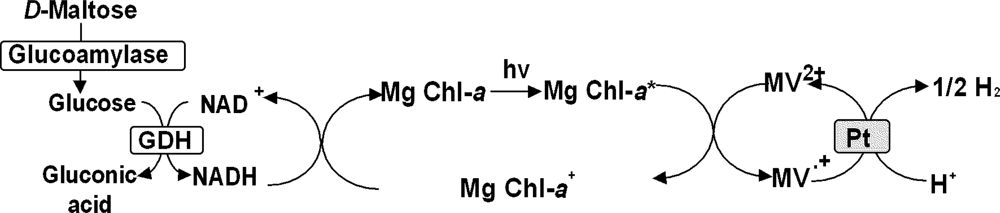
D-Maltose is a disaccharide formed from twounits of glucose joined with an α (1→4) linkage. Maltose is broken down into two glucosemolecules by hydrolysis. In living organisms, the enzyme maltase or glucoamylase achieve hydrolysis very rapidly as shown in Figure 6. In this section, the photoinduced biohydrogen production with the system consisting of D-maltose hydrolysis with glucoamylase and hydrogen production with chlorophyll-platinum colloid is introduced [48, 49]. NADH formation with the system consisting of D-maltose, glucoamylase, GDH, NAD+ is indicated. The reaction condition is NAD+ (6.0μmol), D-maltose (11μmol), glucoamylase and GDH (5.0units) in 3.0ml of 10mmol dm−3 potassium phosphate buffer (pH7.0). Oneunit of glucoamylase activity is defined as the amount of enzyme that produced 1.0μmol glucose by maltose permin. The initial rate of NADH formation is determined by the amount of NADH after incubation for 10min. The rate of formation increases with the concentration of glucoamylase up to 8.0units and then became constant value. In contrast, no formation of NADH is observed in a solution containing D-maltose, GDH and NAD+. Thus, NADH is formed via D-maltose hydrolysis with glucoamylase. Eightunits of glucoamylase, formed 0.6μmol NADH after 120min under above condition. The yield of conversion of NAD+ to NADH in this system is almost 100%.
Next, the photoreduction of MV2+ with the system containing NAD+, D-maltose, Mg Chl-a, MV2+, glucoamylase and GDH with visible light irradiation is introduced. The reaction condition is NAD+, D-maltose (0.30mmol), Mg Chl-a (3.0nmol), MV2+ (1.2μmol), glucoamylase (8.0units) and GDH (5.0units) in 3.0ml of 10mmol dm−3 potassium phosphate buffer (pH7.0). The absorbance at 605nm attributed to the absorption band of MV.+ also increases with irradiation time. The rate of formation increases with the concentration of NAD+ up to 15μmol and then the rate decreases. After 40min irradiation, 0.18μmol □of reduced MV2+ is produced and the yield of MV2+ to MV.+ is estimated to be about 15 %. The photoreduction rate is independent of the concentrations of D-maltose, glucoamylase and GDH. In contrast, MV2+ is not reduced without NAD+ in the system. There is no direct electron transfer between D-maltose or glucose formed with glucoamylase and MV2+, and between Mg Chl-a and MV2+. Thus, the visible light-induced MV2+ reduction proceeds by the coupling of D-maltose hydrolysis with glucoamylase and GDH and MV2+ reduction using the photosensitization of Mg Chl-a.
Photoinduced hydrogen production with the system containing NAD+, D-maltose, Mg Chl-a, MV2+, glucoamylase, GDH and platinum colloid is introduced. The reaction condition is NAD+ (15μmol), D-maltose (0.30mmol), Mg Chl-a (3.0nmol), MV2+ (1.2μmol), platinum colloid (0.5unit), glucoamylase (8.0units) and GDH (5.0units) in 3.0ml of 10mmol dm−3 potassium phosphate buffer (pH7.0). Hydrogen is produced continuously for more than 4hunder visible light irradiation. The amount of hydrogen production is estimated to be 5.0μmol after 4h. The conversion of D-maltose to hydrogen gas is about 1.8%. On the other hand, hydrogen is not produced in the absence of NAD+ in the above system. There is no direct electron transfer between D-maltose or glucose formed with glucoamylase and Pt colloid, and Mg Chl-a, MV2+ and platinum colloid. Moreover, the amount of hydrogen production is estimated to be 50μmol after 48h continuously irradiation. In this system, the amount of hydrogen gas evolved also is more than the initial amount of NAD+ added with long term irradiation. These results suggest that the visible light-induced hydrogen production proceeded by coupling D-maltose hydrolysis with glucoamylase and GDH and hydrogen production with platinum colloid using photosensitization of Mg Chl-a.
6. Photoinduced biohydrogen production with cellulose derivative hydrolysis and chlorophyll-platinum colloid system
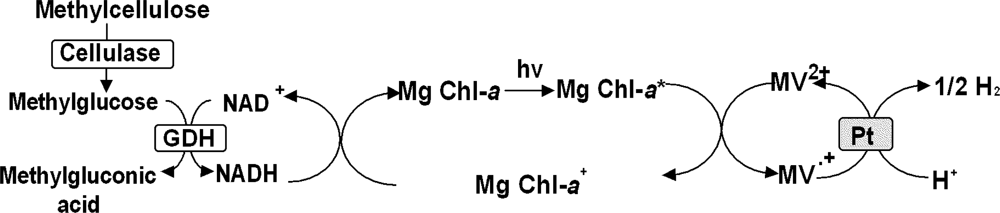
Exploitation of energy of cellulose is desired, because cellulose is the main ingredients, such as wood waste. Cellulose is a polysaccharide consisting of a linear chain of several hundred to over ten thousand β (1→4) linked D-glucoseunits. Cellulose is the structural component of the primary cell wall of green plants. Cellulose is broken down into two glucosemolecules by hydrolysis with cellulase as shown in Figure 7. To attain the photoinduced biohydrogen production from cellulose, it is necessary to develop the solubilization of cellulose in water media. In this section, the photoinduced hydrogen production system by coupling the water-soluble cellulose derivative, methylcellulose, hydrolysis with cellulase and GDH, and hydrogen production with platinum colloid via the photoreduction of MV2+ using the sensitization of Mg Chl-a is introduced[50,51]. NADH formation with the system consisting of methylcellulose, cellulase, GDH, NAD+ is indicated. The reaction condition is NAD+ (0.52μmol) to a solution containing methylcellulose (1.1μmol), cellulase and GDH (5.0units) in 3.0ml of 10mmol dm−3 potassium phosphate buffer (pH7.0). Oneunit of cellulase activity is defined as the amount of enzyme that produced 1.0μmol glucose by methylcellulose permin. The initial rate of NADH formation is determined by the amount of NADH after incubation for 10min. The rate of formation increases with the concentration of cellulase up to 4.0units and then becomes constant value. In contrast, no formation of NADH is observed in a solution containing methylcellulose, GDH and NAD+. Thus, NADH is formed via methylcellulose hydrolysis with cellulase. Fourunits of cellulase, formed 0.52μmol NADH after 40min. The yield of conversion of NAD+ to NADH in this system is almost 100%.
Next, the photoreduction of MV2+ with the system containing NAD+, methylcellulose, Mg Chl-a, MV2+, cellulase and GDH with visible light irradiation is introduced. The absorbance at 605nm, absorption band of MV+, increases with irradiation time. After 50min irradiation, 0.3 μmol reduced MV2+ is produced and the yield of MV2+ to MV.+ is estimated to be c.a. 25% under the condition of NAD+ (15 μmol), methylcellulose (30μmol monomerunit), cellulase (4.0units) and GDH (5.0units), Mg Chl-a (3.0nmol), and MV2+ (1.2μmol) in 3.0ml of 10mmol dm−3 potassium phosphate buffer (pH7.0). The photoreduction rate is independent of the concentrations of NAD+, methylcellulose, cellulase and GDH. In contrast, the reduction rate depends on the concentrations of Mg Chl-a and MV2+. Thus, the rate-limiting step in the MV2+ reduction is the electron transfer process from the photoexcited Mg Chl-a (*Mg Chl-a) to MV2+. On the other hand, MV2+ is not reduced without NAD+ in the above system. Thus, the MV2+ photoreduction proceeds by coupling the methylcellulose hydrolysis with cellulase and GDH and MV2+ reduction using the photosensitization of Mg Chl-a.
The photoinduced hydrogen production in the system containing methylcellulose, cellulase, GDH, NAD+, Mg Chl-a, MV2+, and platinum colloid by the visible light is introduced. The reaction condition is NAD+ (15μmol), methylcellulose (30μmol monomerunit), cellulase (4.0units), GDH (5.0units), Mg Chl-a (3.0nmol), MV2+ (1.2μmol) and platinum colloid (0.5unit) in 3.0ml of 10mmol dm−3 potassium phosphate buffer (pH7.0). From the result of gases analysis in gaseous phase using chromatography, hydrogen and argon gases are detected and the other gases is not detected. Carbon dioxide gas also is not detected. The by-product formation in reaction mixture is analyzed using HPLC with an electrical conductivity detector (column temperature: 40 °C, column: polystyrene sulfonate column, elutant: p-toluene sulfonic acid and flow rate: 0.8mlmin−1). 6-Methylgluconic acid is produced as by-product. 6-Methylgluconic acid is formed by oxidation of 6-methylglucose (formed by methylcellulose hydrolysis with cellulase) with GDH. Thus, the visible light-induced hydrogen production proceeds by coupling the methylcellulose hydrolysis with cellulase and GDH and the hydrogen production with platinum colloid using the photosensitization of Mg Chl-a. By irradiation, hydrogen produces continuously more than 4h. The amount of hydrogen production is estimated to be 12 μmol after 4hirradiation. Moreover, the amount of hydrogen production is estimated to be 30 μmol after 10hcontinuously irradiation. In this system, the amount of hydrogen gas evolved also is more than the initial amount of NAD+ added with 10hirradiation. It indicates that 24μmol of proton, that is 8000 times the amount of Mg Chl-a (3.0nmol) in the sample solution, is reduced to hydrogenmolecules. Therefore, the Mg Chl-a appears to serve as the system for transferring electrons from NADH, which is formed from methylcellulose, to a more reductive hydrogenmolecule. On the other hand, the hydrogen also is not evolved in the absence of NAD+ in the above system. These results strongly suggest that the visible light-induced hydrogen production proceeded by coupling the methylcellulose hydrolysis with cellulase and GDH and the hydrogen production with platinum colloid using the photosensitization of Mg Chl-a.
Next let us focus on the relation among the degree of polymerization, molecular weight of methylcellulose and the amount of hydrogen production [52,53]. Methylcellulose (MCn) with averagemolecular weights of 15,000, 21,000, 26,000, 41,000, 63,000 and 86,000, are defined as the MC1, MC2, MC3, MC4, MC5 and MC6. When the sample solution containing MCn and cellulase is incubated for 10min, methylglucose (2-, 3- or 6-methylglucose) or glucose is formed. For all systems using MCn, 2.4 μmol methylglucose is produced. This result shows that the rate of MCn hydrolysis to methylglucose or glucose with cellulase is very rapid and the yield is ca. 100% after 10min incubation. When the sample solution containing MCn, cellulase, NAD+ and GDH is incubated, 0.6μmol NADH is formed and the yield of conversion of NAD+ to NADH by the MCn hydrolysis with cellulase and GDH is 100% after 40min incubation in all cases using MCn. Little change in NADH formation rate is observed for any MCn, and thus, MCn hydrolysis rate with cellulase is independent of the polymerization of MCn.
In all cases of MCn, 0.3 μmol reduced MV2+ is produced and the yield of MV2+ to MV.+ is estimated to be c.a. 25% under the condition of NAD+ (15 μmol), MCn (30 μmol monomerunit), cellulase (4.0units) and GDH (5.0units), Mg Chl-a (3.0nmol), and MV2+ (1.2μmol) in 3.0ml of 10mmol dm−3 potassium phosphate buffer (pH7.0). Little change in MV2+ photoreduction rate is observed for any MCn, and thus, MV2+ photoreduction rate is independent of the polymerization of MCn.
When the sample solution containing MCn, cellulase, GDH, NAD+, Mg Chl-a, MV2+, and platinum colloid is irradiated, the hydrogen production is observed in all systems using MCn. For the systems using MC1 and MC4, the amount of hydrogen production is 12μmol after 4hirradiation. In contrast, the amount of hydrogen production is 10μmol after 4hirradiation in the system using MC2. Moreover, the amount of hydrogen production is more than 25μmol after 10h continuously irradiation in all cases of MCn. Thus, the amount of hydrogen gas evolved also is more than the initial amount of NAD+ added with 10h irradiation. These results show that the hydrogen production rate also is independent of polymerization degree of MCn. These results are summarized in Tables 3 and 4.
7. Photoinduced biohydrogen production with saccharide mixture hydrolysis and chlorophyll-platinum colloid system
To apply this system for practical photoinduced biohydrogen production, it is necessary to accomplish the hydrogen production from various saccharides mixture biomass. In this section, the photoinduced biohydrogen production system by coupling three difference saccharaides mixture (sucrose, D-maltose and cellobiose) hydrolysis by three enzymes (invertase, glucoamylase and cellulase) and glucose dehydrogenase (GDH), and hydrogen production with platinum colloid as a catalyst using the visible light-induced photosensitization of Mg Chl-a is introduced[54]. When the sample solution containing NAD+ (0.33μmol), sucrose (6.0μmol), D-maltose (6.0μmol), cellobiose (6.0μmol), invertase (4.0units), glucoamylase (4.0units), cellulase (4.0units) and GDH (5.0units) in phosphate buffer (pH7.0) is incubated, 0.30μmol NADH is produced after 20min incubation. The reduction ratio of NAD+ to NADH is about 91%, showing that glucose formation from saccharides (sucrose, D-maltose and cellobiose) with the system of invertase, glucoamylase and cellulase proceeds rapidly.
When the sample solution containing NAD+ (15μmol), sucrose (12μmol), D-maltose (12μmol), cellobiose (9μmol), invertase (4.0units), glucoamylase (4.0units), cellulase (4.0units), GDH (5.0units), Mg Chl-a (13.5nmol), and MV2+(1.2μmol) in phosphate buffer (pH7.0) is irradiated, 0.24μmol MV.+ is produced after 60min irradiation,. Thus, the conversion of MV2+ to the reduced MV+ is about 20% after 60min irradiation. These results show that the MV2+ photoreduction proceeds by coupling the NADH formation due to the saccharides hydrolysis with the system of invertase, glucoamylase, cellulase, NAD+ and GDH and MV2+ reduction using the photosensitization of Mg Chl-a. As the MV2+ photoreduction system containing three different saccharides as an electron-donating reagent is achieved, the development of photoinduced hydrogen production system is attempted. By irradiation to the sample solution containing NAD+ (15μmol), sucrose (12μmol), D-maltose (12μmol 3), cellobiose (9μmol), invertase (4.0units), glucoamylase (4.0units), cellulase (4.0units), GDH (5.0units), Mg Chl-a (13.5nmol), MV2+ (1.2μmol) and platinum colloid (0.5unit) in phosphate buffer (pH7.0), hydrogen evolves continuously more than 2h. The amount of hydrogen production is estimated to be about 2.9μmol after 2h irradiation. As the amount of initial saccharides is 33μmol, the yield of saccharides to hydrogen gas is estimated to be 8.8% after 2h irradiation. The by-product formation in reaction mixture is analyzed using HPLC. Gluconic acid is produced as by-product and the amount of gluconic acid is 5.7μmol after 2h irradiation. Gluconic acid is formed by oxidation of glucose (formed by cellobiose, sucrose and maltose hydrolysis) with GDH. On the other hand, hydrogen also is not evolved in the absence of NAD+ or without irradiation condition. There is no direct electron transfer between three saccharides or glucose formed with three enzymes and platinum colloid, and among Mg Chl-a, MV2+ and platinum colloid. Moreover, the amount of hydrogen production is estimated to be 57μmol after 48h continuously irradiation. In this system, the amount of hydrogen gas evolved also is more than the initial amount of NAD+ added with long term irradiation. These results suggest that the visible light-induced hydrogen production proceeded by coupling the three different saccharides hydrolysis with three enzymes and GDH and the hydrogen production with platinum colloid using the photosensitization of Mg Chl-a. The results of MV2+ photoreduction and hydrogen production from various saccharides are summarized in Tables 5 and 6.
8. Conclusion
In this review, green process for hydrogen production system coupling saccharide biomass hydrolysis with hydrolysis functional enzyme and GDH and hydrogen production with platinum colloid via MV2+ photoreduction using light-harvesting function of Mg Chl-a or its analogs is developed and the continuous hydrogen gas is achieved. Gluconic acid from saccharide biomass only is produced as a by-product and no carbon dioxide gas is evolved in present reaction system. Thus, renewable bio-resources have been effectively used to produce, hydrogen gas through on environmentally clean process.
Acknowledgments
These researches introduced in this review are supported by The Thermal & Electric Energy Technology (TEET) Foundation, The Mazda Foundation, The Iwatani Naoji Foundation, Foundation for Promotion of Material Science and Technology of Japan, The Japan Securities Scholarship Foundation, and Special Fund from The Institute of Applied Energy (IAE). The author is very thankful to Mrs. Yoshinobu Saiki, Takamasa Hirakawa, Miss. Yumiko Tomonou, Noriko Himeshima, Yuko Maki, Yumi Takeuchi and Misa Hirayama for their kind efforts in the research advancement and manuscript preparation.
References and Notes
- Amao, Y; Okura, I. Sensitization by Metal Complexes Towards Future Artificial Photosynthesis in Photocatalysis; Kodansha Springer, 2002. [Google Scholar]
- Kiwi, J; Kalyanasundaram, K; Grätzel, M. Visible Light Induced Cleavage of Water into Hydrogen and Oxygen in Colloidal and Microheterogeneous Systems. Struct Bonding 1982, 49, 37–125. [Google Scholar]
- Kelly, LA; Rodgers, MAJ. Photoreduction of Methyl Viologen Mediated by Tris(bipyridyl) Ruthenium(II) in Inert Colloidal Suspensions. J Phys Chem 1994, 98, 6386–6391. [Google Scholar]
- Amao, Y. Photoenergy Conversion System Based on the Photosynthesis Dyes Conjugated Nanoparticle. Current Nanoscience 2008, 4, 45–52. [Google Scholar]
- Okura, I. Hydrogenase and Its Application for Photoinduced Hydrogen Evolution. Coord Chem Rev 1985, 68, 53–99. [Google Scholar]
- Okura, I. Application of Hydrogenase for Photoinduced Hydrogen Evolution. Biochimi 1986, 68, 189–199. [Google Scholar]
- Okura, I; Aono, S; Kusunoki, S. Photoreduction of Viologens and Hydrogen Evolution with Hydrogenase. Inorg Chim Acta 1983, 71, 77–80. [Google Scholar]
- Okura, I; Kim-Thuan, N. Kinetic Studies of Photoinduced Methyl Viologen Reduction with Ruthenium Complexes and Hydrogen Evolution from Water by Hydrogenase. J Chem Soc Faraday Trans 1981, 77, 1411–1416. [Google Scholar]
- Darwent, JR; Douglas, P; Harriman, A; Porter, G; Richoux, MC. Metal Phthalocyanines and Porphyrins as Photosensitizers for Reduction of Water to Hydrogen. Coord Chem Rev 1982, 44, 93–126. [Google Scholar]
- Brugger, PA; Cuendet, P; Grätzel, M. Ultrafine and Specific Catalysts Affording Efficient Hydrogen Evolution from Water under Visible Light Illumination. J Am Chem Soc 1981, 103, 2923–2927. [Google Scholar]
- Kiwi, J; Grätzel, M. Protection Size Factors, and Reaction Dynamics of Colloidal Redox Catalysis Mediating Light Induced Hydrogen Evolution from Water. J Am Chem Soc 1979, 101, 7214–7217. [Google Scholar]
- Amao, Y; Okura, I. Effective Photoinduced Hydrogen Evolution with Hydrogenase in Surfactant Micelles. J mol Catal A Chem 1996, 105, 125–130. [Google Scholar]
- Amao, Y; Okura, I. Effect of Cationic Surfactant on Photoinduced Hydrogen Evolution with Hydrogenase. J mol Catal A Chem 103, 69–71.
- Okura, I; Takeuchi, M; Kusunoki, S; Aono, S. Kinetics and Mechanism of Photo-induced Methyl Viologen Reduction with an Organic Dye and Hydrogen Evolution from Water by Hydrogenase. Inorg Chim Acta 1982, 63, 157–159. [Google Scholar]
- Sakai, K; Ozawa, H. Homogeneous Catalysis of Platinum(II) Complexes in Photochemical Hydrogen Production from Water. Coord Chem Rev 2007, 251, 2753–2766. [Google Scholar]
- Li, Q; Lu, G. Visible-light Driven Photocatalytic Hydrogen Generation on Eosin Y-sensitized Pt-loaded Nanotube Na2Ti2O4(OH)2. J mol Catal A Chem 2007, 266, 75–79. [Google Scholar]
- Okura, I; Aono, S; Yamada, A. Photoinduced Electron Transfer Between Zn(TPPS)33− and Viologens. J Phys Chem 1985, 89, 1593–1598. [Google Scholar]
- Okura, I; Kaji, N; Aono, S; Yamada, A. Determination of Association Constants by Laser Flash Photolysis Between Zn-TPPS3 and Bipyridinium Salts in Photocatalytic Hydrogen Evolution Systems. J mol Catal 1985, 32, 119–123. [Google Scholar]
- Okura, I; Kita, T; Aono, S; Kaji, N; Yamada, A. Photoinduced Hydrogen Evolution in Micellar System. Inorg Chim Acta 1986, 122, 169–173. [Google Scholar]
- Mal'tsev, SV; Allakhverdiev, SI; Klimov, VV; Krasnovsky, AA. Hydrogen Evolution by Subchloroplast Preparations of Photosystem II from Pea and Spinach. FEBS Letters 1988, 240, 1–5. [Google Scholar]
- Scheer, H. Chlorophylls; CRC Press: London, British, 1991. [Google Scholar]
- Tomonou, Y; Amao, Y. Visible Light Induced Hydrogen Production with Mg Chlorophyll-a from Spirulina and Colloidal Platinum. Biometals 2002, 15, 391–395. [Google Scholar]
- Tomonou, Y; Amao, Y. Visible and Near-IR Light Induced Biohydrogen Production Using the System Containing Mg Chlorophyll-a from Spirulina and Colloidal Platinum. Biometals 2003, 16, 419–424. [Google Scholar]
- Itoh, T; Ishii, A; Kodera, Y; Matsushima, A; Hiroto, M; Nishimura, h; Tsuzuki, T; Kamachi, T; Okura, I; Inada, Y. Photostable Chlorophyll a with Poly(vinylpyrrolidone)-smectite Catalyzes Photoreduction and Hydrogen Gas Evolution by Visible Light. Bioconjugate Chem 1998, 9, 409–412. [Google Scholar]
- Sugiyama, N; Toyoda, M; Amao, Y. Photoinduced Hydrogen Production with Chlorophyll-platinum Nano-conjugated Micellar System. Colloids, Surfaces A: Physicochemical and Engineering Aspects 2006. [Google Scholar]
- Barbosa, MJ; Rocha, JM; Tramper, J; Wijffels, Rh. Acetate as a Carbon Source for Hydrogen Production by Photosynthetic Bacteria. J Biotechnol 2001, 85, 25–33. [Google Scholar]
- Mizuno, O; Dinsdale, R; Hawkes, FR; Hawkes, DL; Noike, T. Enhancement of Hydrogen Production from Glucose by Nitrogen Gas Sparging. Bioresource Technol 2000, 73, 59–65. [Google Scholar]
- Akashah, M; Yoshida, M; Watanabe, M; Nakamura, M; Matsumoto, J. Hydrogen Gas Production from Glucose and Its Microbial Kinetics in Anaerobic Systems. Water Sci Technol 1997, 36, 279–286. [Google Scholar]
- Ma, K; Adams, MW. Sulfide Dehydrogenase from the Hyperthermophilic Archaeon Pyrococcus furiosus: A New Multifunctional Enzyme Involved in the Reduction of Elemental Sulfur. J Bacteriol 1994, 176, 6509–6517. [Google Scholar]
- Woodard, J; Mattingly, SM; Danson, M; Hough, D; Ward, N; Adams, M. In Vitro Hydrogen Production by Glucose Dehydrogenase and Hydrogenase. Nature Biotechnol 1996, 14, 872–874. [Google Scholar]
- Rustamov, VR; Abdullayev, KM; Aliyev, FG; Kerimov, VK. Hydrogen Formation from Biomass Using Solar Energy. Int J Hydrogen Energy 1998, 23, 649–652. [Google Scholar]
- Tanisho, S; Ishiwata, Y. Continuous Hydrogen Production frommolasses by the Bacterium Enterobacter aerogenes. Int J Hydrogen Energy 1994, 19, 807–812. [Google Scholar]
- Garcia, L; French, R; Czernik, S; Chornet, E. Catalytic Steam Reforming of Bio-oils for the Production of Hydrogen: Effects of Catalyst Composition. Appl Catal A: General 2000, 201, 225–239. [Google Scholar]
- Woodward, J; Orr, M; Cordray, K; Greenbaum, E. Enzymatic Biohydrogen Production. Nature 2000, 405, 1014–1015. [Google Scholar]
- Inoue, T; Kumar, SN; Kamachi, T; Okura, I. Hydrogen Evolution from Glucose with the Combination of Glucose Dehydrogenase and Hydrogenase from A. eutrophus H16. Chem Lett 1999, 28, 147–148. [Google Scholar]
- Inoue, T; Kamachi, T; Okura, I. Photoinduced Hydrogen Evolution from Glucose using Zn Porphyrin as a Photosensitizer. Porphyrins 1999, 8, 26–29. [Google Scholar]
- Saiki, Y; Amao, Y. Visible Light Induced Biohydrogen Production from Sucrose Using the Photosensitization of Mg Chlorophyll-a. Bioconjugate Chem 2002, 13, 898–901. [Google Scholar]
- Saiki, Y; Amao, Y. Visible Light-induced Enzymatic Hydrogen Production from Oligosaccharides Using Mg Chlorophyll-a and Platinum Colloid Conjugate System. Int J Hydrogen Energy 2004, 29, 695–699. [Google Scholar]
- Takeuchi, Y; Amao, Y. Visible Light-induced H2 Production from the Bioresources Using Photosensitization of Zn Chlorophyll-a. Trans Mater Res Soc Jpn 2004, 29, 927–930. [Google Scholar]
- Kobayashi, M; Yamamura, M; Akiyama, M; Kise, h; Inoue, K; Hara, M; Wakao, N; Yahara, K; Watanabe, T. Acid Resistance of Zn-bacteriochlorophyll a from an Acidophilic Bacterium. Acidiphilium rubrum. Anal Sci 1998, 14, 1149–1152. [Google Scholar]
- Wakao, N; Yokoi, N; Isoyama, N; Hiraishi, A; Shimada, K; Kobayashi, M; Kise, h; Iwaki, M; Itoh, S; Takaichi, S; Sakurai, Y. Discovery of Natural Photosynthesis Using Zn-containing Bacteriochlorophyll in an Aerobic Bacterium Acidiphilium Rubrum. Plant Cell Physiol 1996, 37, 889–893. [Google Scholar]
- Akiyama, M; Kobayashi, M; Kise, h; Hara, M; Wakao, N; Shimada, K. Pigment Composition of the Reaction Center Complex Isolated from an Acidophilic Bacterium Acidiphilium rubrum Grown at pH3.5. Photomed Photobiol 1998, 20, 85–87. [Google Scholar]
- Takeuchi, Y; Amao, Y. Biohydrogen Production from Sucrose Using the Visible Light-sensitization of Artificial Zn Chlorophyll-a. Bioconjugate Chem 2003, 14, 268–272. [Google Scholar]
- Takeuchi, Y; Amao, Y. Light-harvesting Properties of Zinc Complex of Chlorophyll-a from Spirulina in Surfactant Micellar Media. Biometals 2005, 18, 15–21. [Google Scholar]
- Takeuchi, Y; Amao, Y. Biohydrogen Production from Sucrose Using Light-harvesting Function of Zinc Chlorophyll-a. Bull Chem Soc Jpn 2005, 78, 622–625. [Google Scholar]
- Saiki, Y; Ishikawa, Y; Amao, Y. Photoinduced Hydrogen Production from Sucrose with the Combination System of Water-soluble Zinc Porphyrin and Enzymes. Chem Lett 2002, 218–219. [Google Scholar]
- Saiki, Y; Amao, Y. Bio-mimetic Hydrogen Production from Polysaccharide Using the Visible Light Sensitization of Zinc Porphyrin. Biotechnol Bioeng 2003, 82, 710–714. [Google Scholar]
- Himeshima, N; Amao, Y. H2 Production from Maltose Derived from Starch Using the Visible Light Photosensitization of Mg Chlorophyll-a from Spirulina. Biotechnol Lett 2002, 24, 1647–1650. [Google Scholar]
- Himeshima, N; Amao, Y. Photoinduced Hydrogen Production from D-Maltose in the Presence of Chlorophyll a and Pt Colloid. J Jpn Petro Inst 2003, 46, 259–263. [Google Scholar]
- Himeshima, N; Amao, Y. Visible Light-induced Hydrogen Production from Cellulose Using the Photosensitization of Mg Chlorophyll-a. Biotechnol Lett 2002, 24, 1935–1938. [Google Scholar]
- Himeshima, N; Amao, Y. Photoinduced Hydrogen Production from Cellulose Derivative with Chlorophyll-a and Platinum Nanoparticles System. Energy Fuels 2003, 17, 1641–1644. [Google Scholar]
- Himeshima, N; Amao, Y. Hydrogen Production from Cellulose Derivative with the System Containing Mg Chlorophyll-a and Platinum Colloid. Polymer J 2004, 36, 352–355. [Google Scholar]
- Himeshima, N; Amao, Y. Green Process for Hydrogen Production from Cellulose Derivative Using Visible Light-harvesting Function of Mg Chlorophyll-a. Green Chem 2005, 7, 742–746. [Google Scholar]
- Amao, Y; Hirakawa, T; Himeshima, N. Photoinduced Biohydrogen Production from Saccharide Mixture with the Photosensitization of Mg Chlorophyll-a from Green Plant. Catal Commun 2008, 9, 131–134. [Google Scholar]
Figure 1.
Photoinduced hydrogen production system consisting of an electron donor (D), a photosensitizer (P), an electron carrier (C) and a hydrogen producing catalyst.
Figure 1.
Photoinduced hydrogen production system consisting of an electron donor (D), a photosensitizer (P), an electron carrier (C) and a hydrogen producing catalyst.
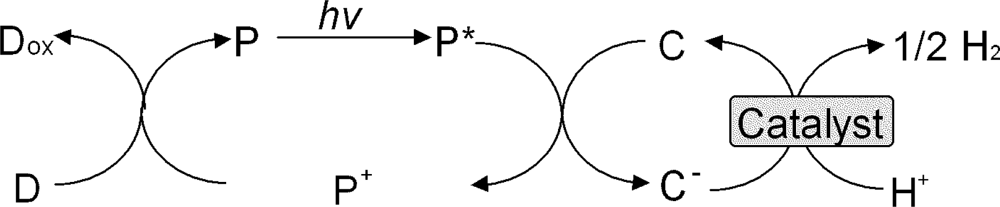
Figure 2.
Photoinduced biohydrogen production system with the combination of NADH production with saccharide hydrolysis by enzyme and GDH and hydrogen production consisting of NADH, a photosensitizer (P), an electron carrier (C) and a hydrogen producing catalyst.
Figure 2.
Photoinduced biohydrogen production system with the combination of NADH production with saccharide hydrolysis by enzyme and GDH and hydrogen production consisting of NADH, a photosensitizer (P), an electron carrier (C) and a hydrogen producing catalyst.
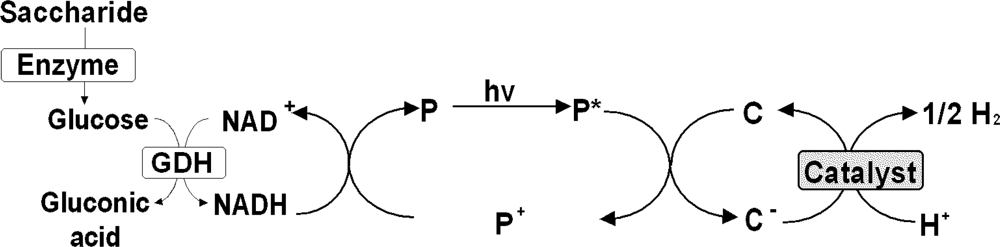
Figure 3.
Hydrogen production system consisting of glucose, GDH, NAD+ and hydrogenase.

Figure 4.
Photoinduced biohydrogen production from glucose with artificial chlorophyll analogmolecule ZnTPPS-hydrogenase system.
Figure 4.
Photoinduced biohydrogen production from glucose with artificial chlorophyll analogmolecule ZnTPPS-hydrogenase system.
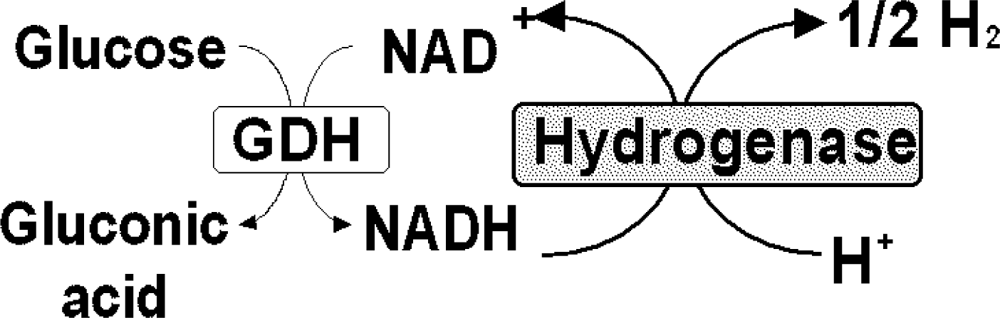
Figure 5.
Photoinduced biohydrogen production with sucrose hydrolysis and chlorophyll or artificial chlorophyll analogmolecule-platinum colloid system.
Figure 5.
Photoinduced biohydrogen production with sucrose hydrolysis and chlorophyll or artificial chlorophyll analogmolecule-platinum colloid system.
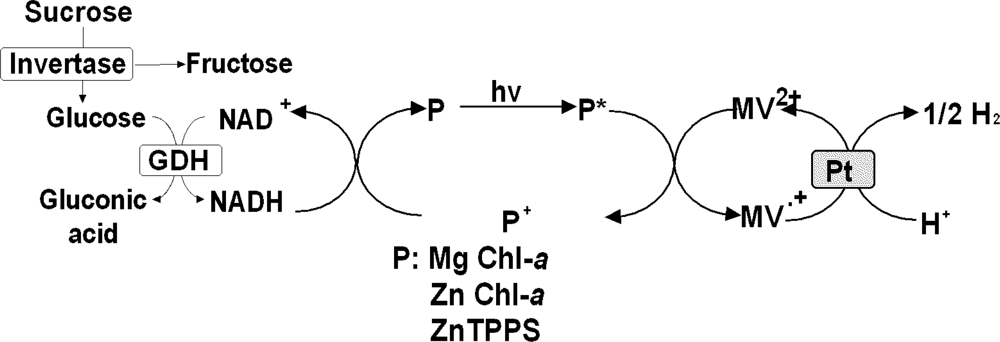
Figure 6.
Photoinduced biohydrogen production with D-maltose hydrolysis and chlorophyll-platinum colloid system.
Figure 6.
Photoinduced biohydrogen production with D-maltose hydrolysis and chlorophyll-platinum colloid system.

Figure 7.
Photoinduced biohydrogen production with cellulose derivative methylcellulose hydrolysis and chlorophyll-platinum colloid system.
Figure 7.
Photoinduced biohydrogen production with cellulose derivative methylcellulose hydrolysis and chlorophyll-platinum colloid system.

Figure 8.
Photoinduced biohydrogen production with saccharide mixture consisting of D-maltose, sucrose and cellobiose hydrolysis and chlorophyll-platinum colloid system.
Figure 8.
Photoinduced biohydrogen production with saccharide mixture consisting of D-maltose, sucrose and cellobiose hydrolysis and chlorophyll-platinum colloid system.
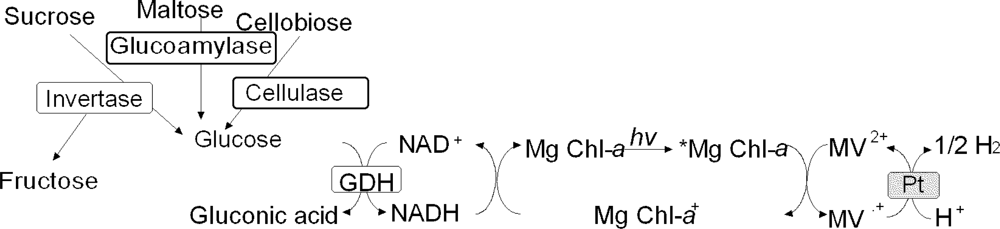

Table 1.
Reduced MV2+ (MV.+) production rate with the system of sucrose, invertase, GDH, NAD+, photosensitizer and MV2+.
| Photosensitizer | Rate of MV.+ production /μmolmin−1 | Reference |
|---|---|---|
| Mg Chl-a | 0.0025 | [37–39] |
| Zn Chl-a | 0.0086 | [43–45] |
| ZnTPPS | 0.014 | [46, 47] |
Table 2.
Hydrogen production rate with the system of sucrose, invertase, GDH, NAD+, photosensitizer, MV2+ and platinum colloid.
| Photosensitizer | Rate of hydrogen production/μmol h−1 | Reference |
|---|---|---|
| Mg Chl-a | 0.61 | [37–39] |
| Zn Chl-a | 1.75 | [43–45] |
| ZnTPPS | 2.57 | [46, 47] |
Table 3.
Reduced MV2+ (MV.+) production rate with the system of methylcellulose, cellulase, GDH, NAD+, Mg Chl-a and MV2+.
| Molecular weight of methylcellulose | Rate of MV.+ production/μmolmin−1 |
|---|---|
| 15,000 (MC1) | 0.0060 |
| 21,000 (MC2) | 0.0061 |
| 26,000 (MC3) | 0.0058 |
| 41,000 (MC4) | 0.0060 |
| 63,000 (MC5) | 0.0060 |
| 86,000 (MC6) | 0.0059 |
Table 4.
Hydrogen production rate with the system of methylcellulose, cellulase, GDH, NAD+, Mg Chl-a, MV2+ and platinum colloid.
| Molecular weight of methylcellulose | Rate of hydrogen production/μmol h−1 |
|---|---|
| 15,000 (MC1) | 2.9 |
| 21,000 (MC2) | 3.0 |
| 26,000 (MC3) | 2.3 |
| 41,000 (MC4) | 3.0 |
| 63,000 (MC5) | 2.9 |
| 86,000 (MC6) | 2.8 |
Table 5.
Reduced MV2+ (MV.+) production rate with the system of saccharide, hydrolysis enzyme, GDH, NAD+, Mg Chl-a and MV2+.
| Saccharide | Rate of MV.+ production/μmolmin−1 | Reference |
|---|---|---|
| D-Maltose | 0.0045 | [48,49] |
| Methylcellulose | 0.0060 | [50,51] |
| Mixture of sucrose, D-maltose and cellobiose | 0.0040 | [54] |
Table 6.
Hydrogen production rate with the system of saccharide, hydrolysis enzyme, GDH, NAD+, Mg Chl-a, MV2+ and platinum colloid.
Share and Cite
MDPI and ACS Style
Amao, Y. Photoinduced Biohydrogen Production from Biomass. Int. J. Mol. Sci. 2008, 9, 1156-1172. https://doi.org/10.3390/ijms9071156
AMA Style
Amao Y. Photoinduced Biohydrogen Production from Biomass. International Journal of Molecular Sciences. 2008; 9(7):1156-1172. https://doi.org/10.3390/ijms9071156
Chicago/Turabian StyleAmao, Yutaka. 2008. "Photoinduced Biohydrogen Production from Biomass" International Journal of Molecular Sciences 9, no. 7: 1156-1172. https://doi.org/10.3390/ijms9071156