
<?xml version="1.0" encoding="UTF-8"?>
<!DOCTYPE article PUBLIC "-//NLM//DTD Journal Publishing DTD v2.3 20070202//EN" "journalpublishing.dtd">
<article xmlns:xlink="http://www.w3.org/1999/xlink" xml:lang="en" article-type="review-article">
	<front>
		<journal-meta>
			<journal-id journal-id-type="publisher-id">ijms</journal-id>
			<journal-title>International Journal of Molecular Sciences</journal-title>
			<abbrev-journal-title>Int. J. Mol. Sci.</abbrev-journal-title>
			<issn pub-type="epub">1422-0067</issn>
			<publisher>
				<publisher-name>Molecular Diversity Preservation International (MDPI)</publisher-name>
			</publisher>
		</journal-meta>
		<article-meta>
			<article-id pub-id-type="doi">10.3390/ijms9112062</article-id>
			<article-id pub-id-type="publisher-id">ijms-09-02062</article-id>
			<article-categories>
				<subj-group>
					<subject>Review</subject>
				</subj-group>
			</article-categories>
			<title-group>
				<article-title>Fumonisins, Trichothecenes and Zearalenone in Cereals</article-title>
			</title-group>
			<contrib-group>
				<contrib contrib-type="author">
					<name>
						<surname>Yazar</surname>
						<given-names>Selma</given-names>
					</name>
				</contrib>
				<contrib contrib-type="author">
					<name>
						<surname>Omurtag</surname>
						<given-names>Gülden Z.</given-names>
					</name>
					<xref ref-type="corresp" rid="c1">*</xref>
				</contrib>
				<aff id="af1-ijms-09-02062">Department of Pharmaceutical Toxicology, Faculty of Pharmacy, Marmara University, 34668, Haydarpaşa - İstanbul, Turkey. E-Mail:
					<email>selmayazar@hotmail.com</email>
				</aff>
			</contrib-group>
			<author-notes>
				<corresp id="c1">* Author to whom correspondence should be addressed; E-Mail:
					<email>gomurtag@marmara.edu.tr</email>; Tel. +90-216-418-82-87; Fax: +90-216-345 29 52</corresp>
			</author-notes>
			<pub-date pub-type="collection">
				<month>11</month>
				<year>2008</year>
			</pub-date>
			<pub-date pub-type="epub">
				<day>31</day>
				<month>10</month>
				<year>2008</year>
			</pub-date>
			<volume>9</volume>
			<issue>11</issue>
			<fpage>2062</fpage>
			<lpage>2090</lpage>
			<history>
				<date date-type="received">
					<day>28</day>
					<month>7</month>
					<year>2008</year>
				</date>
				<date date-type="rev-recd">
					<day>26</day>
					<month>10</month>
					<year>2008</year>
				</date>
				<date date-type="accepted">
					<day>28</day>
					<month>10</month>
					<year>2008</year>
				</date>
			</history>
			<permissions>
				<copyright-statement>© 2008 by MDPI</copyright-statement>
				<copyright-year>2008</copyright-year>
				<license license-type="open-access" xlink:href="http://creativecommons.org/licenses/by/3.0">
					<p>This article is an open-access article distributed under the terms and conditions of the Creative Commons Attribution license (http://creativecommons.org/licenses/by/3.0/).</p>
				</license>
			</permissions>
			<abstract>
				<p>Fumonisins are phytotoxic mycotoxins which are synthesized by various species of the fungal genus <italic>Fusarium</italic> such as <italic>Fusarium verticillioides</italic> (Sacc.) Nirenberg (ex <italic>F.moniliforme</italic> Sheldon) and <italic>Fusarium proliferatum</italic>. The trichothecene (TC) mycotoxins are secondary metabolites produce by species that belong to several fungal genera, especially <italic>Fusarium</italic>, <italic>Stachybotrys</italic>, <italic>Trichothecium</italic>, <italic>Trichoderma</italic>, <italic>Memnoniella</italic> and <italic>Myrothecium. Fusarium</italic> mycotoxins are widely dispersed in cereals and their products. Zearalenone (ZEA) is an estrogenic compound produced by <italic>Fusarium</italic> spp. such as <italic>F. graminearum</italic> and <italic>F. culmorum</italic>. Fumonisins, the TCs and ZEA are hazardous for human and animal health. Contamination with TCs causes a number of illnesses in human and animal such as decrease in food consumption (anorexia), depression or inhibition on immune system function and haematoxicity. The purpose of this paper is to give a review of the papers published on the field of fumonisin, TC and ZEA mycotoxins in cereals consumed in the world.</p>
			</abstract>
			<kwd-group>
				<kwd>Fumonisins</kwd>
				<kwd>trichothecenes</kwd>
				<kwd>zearalenone</kwd>
				<kwd>cereals</kwd>
			</kwd-group>
		</article-meta>
	</front>
	<body>
		<sec sec-type="intro">
			<title>1. Introduction</title>
			<p>Mycotoxins are secondary metabolites produced by a wide variety of fungal species that cause nutritional losses and represent a significant hazard to the food chain [<xref ref-type="bibr" rid="b1-ijms-09-02062">1</xref>]. The exposure risk to human is either directly through foods of plant origin (cereal grains) or indirectly through foods of animal origin (kidney, liver, milk and eggs) [<xref ref-type="bibr" rid="b2-ijms-09-02062">2</xref>–<xref ref-type="bibr" rid="b4-ijms-09-02062">4</xref>]. <italic>Fusarium</italic> species are probably the most prevalent toxin-producing fungi of the northern temperate regions and are commonly found on cereals grown in the temperate regions of America, Europe and Asia [<xref ref-type="bibr" rid="b5-ijms-09-02062">5</xref>].</p>
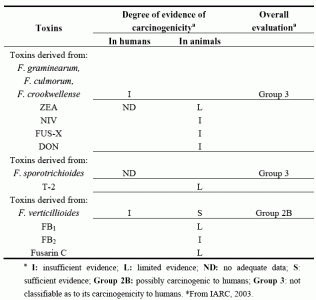
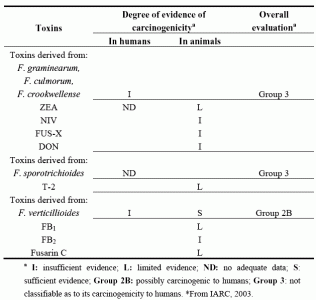
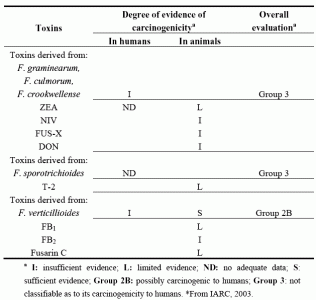
			<p>The most important <italic>Fusarium</italic> mycotoxins are fumonisins, TCs such as T-2, HT-2, DON, DAS, FUS-X, NIV, diacetylnivalenol, neosolaniol and ZEA. They are common mycotoxins throughout the world, mainly associated with cereal crops, in particular corn, wheat, barley, rye, rice and oats [<xref ref-type="bibr" rid="b6-ijms-09-02062">6</xref>–<xref ref-type="bibr" rid="b9-ijms-09-02062">9</xref>]. The summary of the IARC evaluation of <italic>Fusarium</italic> mycotoxins [<xref ref-type="bibr" rid="b10-ijms-09-02062">10</xref>] is reported in <xref ref-type="table" rid="t1-ijms-09-02062">Table 1</xref>.</p>
		</sec>
		<sec>
			<title>2. Fumonisins</title>
			<sec>
				<title/>
				<sec>
					<title>Short history and synthesis</title>
					<p>Elucidation of the chemical structure of fumonisins was first clarified by Bezuidenhout <italic>et al.</italic> [<xref ref-type="bibr" rid="b11-ijms-09-02062">11</xref>]. Fumonisins are produced by a number of <italic>Fusarium</italic> species, notably <italic>F. verticillioides</italic> (formerly <italic>Fusarium moniliforme</italic>=<italic>Gibberella fujikuroi</italic>), <italic>F. proliferatum</italic>, <italic>F. anthophilum</italic>, <italic>F. nygamai</italic> as well as <italic>Alternia alternata</italic> f. sp. l<italic>ycopersici</italic> [<xref ref-type="bibr" rid="b12-ijms-09-02062">12</xref>]. Until now, twenty-eight fumonisins have been isolated and they can be divided in four series known as A, B, C and P. FB<sub>1</sub>, FB<sub>2</sub> and FB<sub>3</sub> are the principal fumonisins analyzed as natural contaminants of cereals [<xref ref-type="bibr" rid="b13-ijms-09-02062">13</xref>, <xref ref-type="bibr" rid="b14-ijms-09-02062">14</xref>]. <italic>F. verticillioides</italic> produce several mycotoxins, the most prominent of which is called fumonisin B<sub>1</sub> (FB<sub>1</sub>) [<xref ref-type="bibr" rid="b15-ijms-09-02062">15</xref>]. The carcinogenic mycotoxin fumonisin B<sub>2</sub> was discovered for the first time in <italic>Aspergillus niger</italic>, an industrially important species [<xref ref-type="bibr" rid="b16-ijms-09-02062">16</xref>].</p>
					<p>FB<sub>1</sub> is the diester of propane-1,2,3-tricarboxylic acid and a pentahydroxyeicosane in which the C14 and C15 hydroxy groups are esterified with the terminal carboxy group of propane-1,2,3-tricarboxylic acid (TCA). FB<sub>2</sub> is the C-10-deoxy analogue of FB<sub>1</sub> and FB<sub>3</sub> is the C-5-deoxy analogue of FB<sub>1</sub> [<xref ref-type="bibr" rid="b13-ijms-09-02062">13</xref>]. <italic>Fusarium</italic> mycotoxins found in food are produced mainly in the field, although some toxin synthesis may occur during storage. Temperature and moisture conditions are crucial factors affecting fungal infection and toxin synthesis [<xref ref-type="bibr" rid="b17-ijms-09-02062">17</xref>]. Infection of cereal grains with <italic>Fusarium</italic> species can trigger serious human and animal diseases [<xref ref-type="bibr" rid="b8-ijms-09-02062">8</xref>, <xref ref-type="bibr" rid="b18-ijms-09-02062">18</xref>]. <italic>F. verticillioides</italic> was the predominant fungus isolated from moldy corn associated with a field outbreak of equine leukoencephalomalacia (ELEM) in South Africa during 1970 characterized by liquefaction’s necrosis in the white matter of the cerebral hemispheres of horses [<xref ref-type="bibr" rid="b19-ijms-09-02062">19</xref>]. Fumonisin toxicosis in swine was mentioned porcine pulmonary edema (PPE) after outbreaks of a fatal disease in pigs fed with <italic>F. verticillioides</italic> contaminated corn screenings from the 1989 corn crop in Iowa, Illinois, and Georgia [<xref ref-type="bibr" rid="b20-ijms-09-02062">20</xref>].</p>
				</sec>
				<sec>
					<title>Stability</title>
					<p>Castelo <italic>et al</italic>. [<xref ref-type="bibr" rid="b21-ijms-09-02062">21</xref>] have reported that fumonisins added to cornmeal and present in artificially contaminated cornmeal samples were unstable under roasting conditions, but remained fairly stable during canning and baking of corn-based foods because canned and baked products reached lower temperatures than the roasted products. Alberts <italic>et al.</italic> [<xref ref-type="bibr" rid="b22-ijms-09-02062">22</xref>] suggested that FB<sub>1</sub> was found to be stable to heating, as there was no reduction in the FB<sub>1</sub> level after boiling culture material of <italic>F. moniliforme MRC 826.</italic> Jackson <italic>et al.</italic> [<xref ref-type="bibr" rid="b23-ijms-09-02062">23</xref>] indicated that foods reaching temperatures greater than 150 °C during processing may have lower fumonisin levels. Marin <italic>et al.</italic> [<xref ref-type="bibr" rid="b24-ijms-09-02062">24</xref>] showed that water activities (a<sub>w</sub>, 0.968, 0.956, 0.944, 0.925) and temperature (25 °C and 30 °C) affected colonization and production of FB<sub>1</sub> and FB<sub>2</sub>. They suggested at all a<sub>w</sub> levels and both temperatures there was an increase in FB<sub>1</sub> and FB<sub>2</sub> concentration with time.</p>
				</sec>
				<sec>
					<title>Products</title>
					<p>In addition to corn or corn-based foods and feeds [<xref ref-type="bibr" rid="b25-ijms-09-02062">25</xref>, <xref ref-type="bibr" rid="b26-ijms-09-02062">26</xref>], the occurrence of fumonisins has also been reported some products such as beans, rice, sorghum, corn, wheat noodles, curry, chili pickle, beer and corn-based brewing adjuncts [<xref ref-type="bibr" rid="b27-ijms-09-02062">27</xref>]. Between 1997 and 2002, the studies related to fumonisin in cereals have been reported by Soriano and Dragacci [<xref ref-type="bibr" rid="b28-ijms-09-02062">28</xref>]. The fumonisin studies on cereals between 2003–2007 are shown in <xref ref-type="table" rid="t2-ijms-09-02062">Table 2</xref>.</p>
				</sec>
				<sec>
					<title>Mode of action</title>
					<p>Fumonisins structurally resemble sphingoid bases such as sphingosine. The structural similarity between sphinganine and FB<sub>1</sub> suggests that the mechanism of action of this mycotoxin is mainly via disruption of sphingolipid metabolism. This mechanism is reflected in effects on protein kinase activity, on cell growth and differentiation, in cell death (apoptosis), carcinogenicity and involvement of lipid peroxidation. Inhibition of biosynthesis of sphingolipids has seen at different levels and is reflected in changes of the ratio sphinganine/sphingosine (Sa/So). This ratio may be used as indicators of FB<sub>1</sub> exposure, mechanism of action of sphingolipids and their metabolites in the toxicity of FB<sub>1</sub> is well documented by Soriano <italic>et al.</italic> [<xref ref-type="bibr" rid="b13-ijms-09-02062">13</xref>]. Structurally, fumonisins resemble sphingolipids and can alter sphingolipid biosynthesis suggesting that sphingolipid alterations play an important role in disease and carcinogenesis in DNA damage for FB<sub>1</sub> [<xref ref-type="bibr" rid="b15-ijms-09-02062">15</xref>, <xref ref-type="bibr" rid="b29-ijms-09-02062">29</xref>].</p>
				</sec>
				<sec>
					<title>Toxicity</title>
					<p>Fumonisins are known to be the cause of leukoencephalomacia in equines [<xref ref-type="bibr" rid="b30-ijms-09-02062">30</xref>–<xref ref-type="bibr" rid="b33-ijms-09-02062">33</xref>] and in rabbits [<xref ref-type="bibr" rid="b34-ijms-09-02062">34</xref>], pulmonary edema and hydrothorax in swine [<xref ref-type="bibr" rid="b34-ijms-09-02062">34</xref>, <xref ref-type="bibr" rid="b35-ijms-09-02062">35</xref>], cardiac failure in baboons [<xref ref-type="bibr" rid="b36-ijms-09-02062">36</xref>], atherogenic effects in vervet monkeys [<xref ref-type="bibr" rid="b37-ijms-09-02062">37</xref>], brain haemorrhage in rabbits [<xref ref-type="bibr" rid="b38-ijms-09-02062">38</xref>], renal cancer and hepatocarcinogenic in rats [<xref ref-type="bibr" rid="b39-ijms-09-02062">39</xref>–<xref ref-type="bibr" rid="b41-ijms-09-02062">41</xref>] and some birth defects (especially neural tube defects) [<xref ref-type="bibr" rid="b42-ijms-09-02062">42</xref>]. Fumonisins additionally produce mild to fatal toxicity in liver, kidney and heart in horses, pigs, cattle, sheep, chickens, ducks, rabbits, rats and mice [<xref ref-type="bibr" rid="b34-ijms-09-02062">34</xref>, <xref ref-type="bibr" rid="b40-ijms-09-02062">40</xref>, <xref ref-type="bibr" rid="b43-ijms-09-02062">43</xref>–<xref ref-type="bibr" rid="b45-ijms-09-02062">45</xref>]. The effects of cytotoxicity of FB was observed in turkey and in broiler chicks lymphocytes [<xref ref-type="bibr" rid="b46-ijms-09-02062">46</xref>, <xref ref-type="bibr" rid="b47-ijms-09-02062">47</xref>], chick macrophages [<xref ref-type="bibr" rid="b48-ijms-09-02062">48</xref>], in rabbit kidney RK13 cells [<xref ref-type="bibr" rid="b49-ijms-09-02062">49</xref>]. Epidemiological evidence indicates a link between human esophageal cancer and ingestion of <italic>Fusarium verticillioides</italic>-contaminated corn [<xref ref-type="bibr" rid="b30-ijms-09-02062">30</xref>]. FB<sub>1</sub>, in cereals was associated with the incidence of a high rate of human esophageal cancer in Africa [<xref ref-type="bibr" rid="b13-ijms-09-02062">13</xref>, <xref ref-type="bibr" rid="b31-ijms-09-02062">31</xref>], in northern Italy [<xref ref-type="bibr" rid="b50-ijms-09-02062">50</xref>], in Iran [<xref ref-type="bibr" rid="b51-ijms-09-02062">51</xref>], the Southeastern of the United States [<xref ref-type="bibr" rid="b2-ijms-09-02062">2</xref>, <xref ref-type="bibr" rid="b52-ijms-09-02062">52</xref>] and with promotion of primary liver cancer in certain endemic areas of the People’s Republic of China [<xref ref-type="bibr" rid="b53-ijms-09-02062">53</xref>, <xref ref-type="bibr" rid="b54-ijms-09-02062">54</xref>]. There are no confirmed biomarkers for human exposure to FB<sub>1</sub> [<xref ref-type="bibr" rid="b30-ijms-09-02062">30</xref>].</p>
					<p>The International Agency for Research on Cancer (IARC) has evaluated the cancer risk of fumonisin to humans and grouped them as group 2B (probably carcinogenic). They are toxic to animals and at least one analogue, FB<sub>1</sub>, is carcinogenic to rodents. Their effect on human health is unclear. The mechanisms of FB<sub>1</sub>-induced carcinogenesis are uncertain and the information on FB<sub>1</sub> mutagenic properties is limited and controversial [<xref ref-type="bibr" rid="b15-ijms-09-02062">15</xref>, <xref ref-type="bibr" rid="b40-ijms-09-02062">40</xref>, <xref ref-type="bibr" rid="b45-ijms-09-02062">45</xref>, <xref ref-type="bibr" rid="b55-ijms-09-02062">55</xref>–<xref ref-type="bibr" rid="b60-ijms-09-02062">60</xref>]. Some reports show that fumonisins have been described some genotoxic effect in mammalian cells <italic>in vitro</italic>, including clastogenic effects, chromosomal aberrations and sister chromatid exchange, or DNA synthesis [<xref ref-type="bibr" rid="b30-ijms-09-02062">30</xref>].</p>
					<p>In some animal species such as horse, mouse, pig and rat; NOAELs expressed as mg FB<sub>1</sub>/kg body weight [<xref ref-type="bibr" rid="b13-ijms-09-02062">13</xref>]. The recommended maximum levels for fumonisins in corn and corn products intended for human consumption (<xref ref-type="table" rid="t3-ijms-09-02062">Table 3</xref>) are based on concerns associated with hazards show primarily by animal studies. However, based on available information on the occurrence of fumonisins, FDA accepted that typical fumonisin levels found in corn and corn products intended for human consumption are much lower than the recommended levels [<xref ref-type="bibr" rid="b61-ijms-09-02062">61</xref>].</p>
					<p>A provisional maximum is fixed for tolerable daily intake (PMTDI) for FB<sub>1</sub>, B<sub>2</sub> and B<sub>3</sub> single or in combination, of 2 μg/kg of body weight per day on the basis of the NOEL of 0.2 mg/kg of body weight per day and safety factor of 100. Some national estimates of intake of FB<sub>1</sub> in Europe and in the world have displayed <xref ref-type="table" rid="t4-ijms-09-02062">Table 4</xref> [<xref ref-type="bibr" rid="b5-ijms-09-02062">5</xref>].</p>
				</sec>
			</sec>
		</sec>
		<sec>
			<title>3. Trichothecenes</title>
			<sec>
				<title/>
				<sec>
					<title>Short history and synthesis</title>
					<p>TCs are mycotoxins produced by a range of different fungi and chemically they belong to the sesquiterpenoids [<xref ref-type="bibr" rid="b62-ijms-09-02062">62</xref>]. TCs have been suspected to produce a human illness known a “taumelge treide” (staggering grains) that was first observed in Siberia in the 1890s. Symptoms in this included vomiting, headache, and vertigo [<xref ref-type="bibr" rid="b63-ijms-09-02062">63</xref>]. A possible role of TCs in the human disease Alimentary Toxic Aleukia (ATA) in Russia was reported. It has been reported since the 19<sup>th</sup> century and a severe outbreak occurred in the Orenburg region where 100,000 people died [<xref ref-type="bibr" rid="b64-ijms-09-02062">64</xref>]. Later, TCs have also been researched cause of concerns about their potential misuse as biological or chemical warfare agents. In late 1970s and early 1980s, it was asserted that weaponized, aerosolized TCs had been used on civilian and refugee populations in Laos, Kampuchea, and Afghanistan. It was reported symptoms such as bleeding, nausea, fever, dyspnea, dizziness, and vertigo. These events became known as "yellow rain", because of descriptive reports of witnesses, although the allegation that TCs were responsible for the reported symptoms is controversial [<xref ref-type="bibr" rid="b65-ijms-09-02062">65</xref>]. The levels and kinds of TCs were in positive correlation with the incidence of esophageal cancer in human [<xref ref-type="bibr" rid="b66-ijms-09-02062">66</xref>]. Trichothecin was isolated first TC, was isolated from <italic>Trichothecium roseum</italic> and described in 1949 by Freeman and Morrison. Following the isolation of trichothecin was followed by the isolation and description of other TCs such as DAS, T-2, NIV and DON. By now, more than 180 different trichothecenes and trichothecene derivatives have been isolated and characterized [<xref ref-type="bibr" rid="b64-ijms-09-02062">64</xref>, <xref ref-type="bibr" rid="b67-ijms-09-02062">67</xref>]. The TCs causing most concern are T-2, which is the most acute toxic TC, HT-2, and NIV [<xref ref-type="bibr" rid="b67-ijms-09-02062">67</xref>].</p>
					<p>The TCs are all non-volatile, low-molecular-weight sesquiterpene epoxides, and can be further classified according to the presence or absence of characteristic functional groups. The C12,13-epoxide ring, which is necessary for protein synthesis inhibition, is considered to be essential [<xref ref-type="bibr" rid="b63-ijms-09-02062">63</xref>–<xref ref-type="bibr" rid="b65-ijms-09-02062">65</xref>]. Most TCs also have a C9–10 double bond, which is important for their toxicity [<xref ref-type="bibr" rid="b64-ijms-09-02062">64</xref>, <xref ref-type="bibr" rid="b68-ijms-09-02062">68</xref>].</p>
					<p>They can be divided into four categories according to both their chemical properties and their producer fungi;</p>
					<list list-type="order">
						<list-item>
							<p>
								<bold>Type A:</bold> functional group other than a ketone at C8 position (e.g.; T-2, HT-2, DAS);</p>
						</list-item>
						<list-item>
							<p>
								<bold>Type B:</bold> carbonyl functions at C8 position (e.g.; DON, NIV, FUS-X, 3-acetyl-deoxynivalenol, 15-acetyl-deoxynivalenol);</p>
						</list-item>
						<list-item>
							<p>
								<bold>Type C:</bold> second epoxide group at C7, 8 or C9, 10; (e.g.; crotocin and baccharin);</p>
						</list-item>
						<list-item>
							<p>
								<bold>Type D:</bold> macrocyclic ring system between C4 and C15 with two ester linkages (e.g.; satratoxin G, H, roridin A and verrucarin A) [<xref ref-type="bibr" rid="b65-ijms-09-02062">65</xref>, <xref ref-type="bibr" rid="b68-ijms-09-02062">68</xref>–<xref ref-type="bibr" rid="b70-ijms-09-02062">70</xref>].</p>
						</list-item>
					</list>
				</sec>
				<sec>
					<title>Stability</title>
					<p>TCs are stable to heating and are not degraded during normal food processing or autoclaving. They are also stable at neutral and acidic pH and consequently, they are not hydrolyzed in the stomach after ingestion [<xref ref-type="bibr" rid="b68-ijms-09-02062">68</xref>]. The degree of infection is dependent on various factors, for example weather conditions, environmental conditions, and temperature and storage conditions of cereal crops [<xref ref-type="bibr" rid="b63-ijms-09-02062">63</xref>, <xref ref-type="bibr" rid="b65-ijms-09-02062">65</xref>]. They can be deactivated under strong acid and alkaline conditions [<xref ref-type="bibr" rid="b65-ijms-09-02062">65</xref>]. At harvest and storage of cereals, TCs formation is the key factors such as conidia presence and humidity combined with temperature. Minimizing or avoiding conidia contaminated materials, cleaning at early stage during the harvest and drying the grain at low temperatures will allow to store cereals for more than 12 months without increasing TC levels [<xref ref-type="bibr" rid="b71-ijms-09-02062">71</xref>]. <italic>Fusaria</italic> are common fungi on a variety of plants and soil throughout the cold and cold-temperature regions about 0–10 °C and they necessary moisture in range of 22–25%. The effect of solvent, storage, temperature, moisture, pH and heat on the stability of TCs was documented by Widestrand and Pettersson [<xref ref-type="bibr" rid="b72-ijms-09-02062">72</xref>] and Lauren and Smith [<xref ref-type="bibr" rid="b73-ijms-09-02062">73</xref>].</p>
				</sec>
				<sec>
					<title>Products</title>
					<p>They are commonly found on cereals grown in the temperate regions of Europe, America and Asia. The toxin is probably the most important of the northern temperate regions [<xref ref-type="bibr" rid="b63-ijms-09-02062">63</xref>, <xref ref-type="bibr" rid="b74-ijms-09-02062">74</xref>]. The toxin is commonly found world-wide on cereals such as wheat, rye, barley, oats and corn. Cereals products are prevalent used in feed and farm animals may thus consume relatively high amounts TCs [<xref ref-type="bibr" rid="b64-ijms-09-02062">64</xref>, <xref ref-type="bibr" rid="b67-ijms-09-02062">67</xref>]. The TCs studies in cereals between 1999–2008 are shown in <xref ref-type="table" rid="t5-ijms-09-02062">Table 5</xref>.</p>
				</sec>
				<sec>
					<title>Mode of action</title>
					<p>TCs are especially well-known inhibitors of protein synthesis, including DNA, RNA synthesis, inhibition of mitochondrial function, effects on cell division and membrane effects. The toxin binds to the peptidyl transferase, which is an integral part of the 60S ribosomal subunit of mammalian ribosome. The mechanism of DNA synthesis has not yet been clarified, however, it may be a secondary effect of the inhibition of the protein synthesis or of the apoptotic effect of TCs. TCs affect cell membrane and are also shown to interfere with the metabolism of membrane phospholipids and to increase liver lipid peroxides <italic>in vivo</italic>. Also, some TCs are shown to change the serotonin activity in the central nervous system, which is known to be related in the regulation of food intake [<xref ref-type="bibr" rid="b62-ijms-09-02062">62</xref>, <xref ref-type="bibr" rid="b67-ijms-09-02062">67</xref>].</p>
				</sec>
				<sec>
					<title>Toxicity</title>
					<p>General signs of TCs toxicity in animals include weight loss, decreased feed conversion, feed refusal, vomiting, bloody diarrhea, severe dermatitis, hemorrhage, decreased egg production, abortion, and death. Clinical effects produced by TCs can be grouped into four clinical categories: (1) feed refusal, (2) dermal necrosis, (3) gastroenteric effects, (4) coagulopathy [<xref ref-type="bibr" rid="b75-ijms-09-02062">75</xref>]. TC exposure leads to apoptosis both <italic>in vitro</italic> and <italic>in vivo</italic> in several organs such as lymphoid organs, hematopoietic tissues, liver, intestinal crypts, bone marrow and thymus [<xref ref-type="bibr" rid="b64-ijms-09-02062">64</xref>, <xref ref-type="bibr" rid="b68-ijms-09-02062">68</xref>, <xref ref-type="bibr" rid="b70-ijms-09-02062">70</xref>]. Acute high dose toxicity of TCs is characterized by “radiomimetic” effects such as diarrhea, vomiting, leukocytosis, haemorrhage, and circulatory shock and death, whereas chronic low dose toxicity is described by anorexia, reduced weight gain, decreased feed conversion, neuroendocrine changes and immunologic effects [<xref ref-type="bibr" rid="b62-ijms-09-02062">62</xref>, <xref ref-type="bibr" rid="b70-ijms-09-02062">70</xref>, <xref ref-type="bibr" rid="b74-ijms-09-02062">74</xref>]. Cellular effects on DNA and membrane integrity have been considered as secondary effects of the inhibited protein synthesis [<xref ref-type="bibr" rid="b62-ijms-09-02062">62</xref>, <xref ref-type="bibr" rid="b67-ijms-09-02062">67</xref>]. Cytotoxic effects were observed at slightly higher doses of TCs [<xref ref-type="bibr" rid="b66-ijms-09-02062">66</xref>]. The myelotoxicity was considered highest for T-2 and HT-2 toxins and lowest for DON and NIV [<xref ref-type="bibr" rid="b74-ijms-09-02062">74</xref>].</p>
					<p>TCs cause the greatest problems to animal health [<xref ref-type="bibr" rid="b62-ijms-09-02062">62</xref>]. In acute tests with TCs, type A members such as DAS and T-2 have been found to be more toxic than Type B members such as DON and NIV [<xref ref-type="bibr" rid="b76-ijms-09-02062">76</xref>]. TCs are toxic to many animal species, but the sensitivity varies considerably between species and also between the different TCs. Chickens are more sensitive to TCs than ruminants. Turkeys are more sensitive to TCs than chickens. Pigs are especially sensitive to TCs in feed [<xref ref-type="bibr" rid="b64-ijms-09-02062">64</xref>]. TCs reason histological finding in experimental animals such as cellular necrosis and karyorrhexis in actively dividing tissues of the intestinal mucosa, bone marrow, spleen, testis, and ovary [<xref ref-type="bibr" rid="b62-ijms-09-02062">62</xref>].</p>
					<p>There is very little data about toxicokinetics of TCs in humans. It is unknown whether the metabolic and elimination pathways that have been described in these studies are predictive of TC toxicokinetics in humans. Further research is necessary to understand the human health effect of TCs from dietary as well as non-dietary routes of exposure. The majority of the studies have been assigned in animals, where interspecies variation in pharmacokinetic parameters and susceptibility to TCs has been constantly reported. [<xref ref-type="bibr" rid="b65-ijms-09-02062">65</xref>]. In a study of cultured human lymphocytes, increased Ig production was observed in cells exposed to lower levels of TCs (T-2, DAS, DON, NIV), whereas decreased Ig production was reported at higher levels [<xref ref-type="bibr" rid="b77-ijms-09-02062">77</xref>]. TCs were observed in combine with ATA led some researchers to evaluate whether they may have a beneficial role in the treatment of cancer [<xref ref-type="bibr" rid="b65-ijms-09-02062">65</xref>].</p>
				</sec>
			</sec>
			<sec>
				<title>3.1. T-2 and HT-2</title>
				<sec>
					<title>Short history and synthesis</title>
					<p>The first report of ATA happened in Russia during World War II and the other was the bean-hull poisoning of horses in Japan. In both event, isolates of <italic>F. sporotrichioides</italic> isolated from grains and beans were found to produce T-2 and its derivatives [<xref ref-type="bibr" rid="b78-ijms-09-02062">78</xref>]. Generally, HT-2 occurs together with T-2 in the infected cereals products. HT-2 is a major metabolite of T-2 and T-2 is only differentiated from HT-2 by an acetyl group in the C-4 position. It is difficult to distinguish the effects of T-2 and HT-2 <italic>in vivo</italic> because of HT-2 is rapidly formed after exposing an animal to T-2. [<xref ref-type="bibr" rid="b67-ijms-09-02062">67</xref>]. T-2 and HT-2 have been reported to be produced by <italic>F. sporotrichioides</italic>, <italic>F. poae</italic>, <italic>F. equiseti</italic> and <italic>F. acuminatum</italic> [<xref ref-type="bibr" rid="b5-ijms-09-02062">5</xref>]. T-2 is a secondary metabolite produced by <italic>Fusarium</italic> and related fungal species [<xref ref-type="bibr" rid="b79-ijms-09-02062">79</xref>]. <italic>F. sporotrichioides</italic> of the Sporotrichiella section is the most important producer of T-2. This species has no known teleomorph. It is basically a saprophytic species (non pathogenic to plants) and is especially associated with cereals left in the field after normal harvest [<xref ref-type="bibr" rid="b74-ijms-09-02062">74</xref>].</p>
				</sec>
				<sec>
					<title>Stability</title>
					<p>Mainly factors of occurring of <italic>F. sporotrichioides</italic> in cereals are a result of water damage to grains occurring when the cereals remain for extended periods on the field at or after harvest or when the grain is wet during storage [<xref ref-type="bibr" rid="b64-ijms-09-02062">64</xref>]. <italic>F. sporotrichioides</italic> grows at −2 to 35 °C and only at high water activities [<xref ref-type="bibr" rid="b5-ijms-09-02062">5</xref>]. The optimum temperature for occur of T-2 is relatively low (8–14 °C), with yields being much lower or negligible at temperatures of 25 °C and above [<xref ref-type="bibr" rid="b80-ijms-09-02062">80</xref>]. T-2 is produced by various species of <italic>Fusaria</italic> which are widespread fungi on a variety of plants in soil throughout the cold-temperate regions [<xref ref-type="bibr" rid="b81-ijms-09-02062">81</xref>]. T-2 has the most stability at 4 °C and the least stability at 37 °C [<xref ref-type="bibr" rid="b82-ijms-09-02062">82</xref>]. T-2 and HT-2 have the most stability when stored at −70 °C, in the presence of NaF, and in urine (pH 6). T-2, HT-2 and T-2 tetraol in urine and blood stored over 6 months at −70, 4, and 23 °C with and without the addition of NaF. They have less stability in saline (control, pH 7) and the least stablity in blood (pH 8). Since T-2 tetraol is the most stability metabolite and, it is the most appropriate metabolite for diagnostic testing [<xref ref-type="bibr" rid="b83-ijms-09-02062">83</xref>].</p>
				</sec>
				<sec>
					<title>Products</title>
					<p>T-2 and HT-2 are generally found in various cereal crops such as wheat, corn, barley, oats and rye and processed grains (malt, beer and bread) [<xref ref-type="bibr" rid="b84-ijms-09-02062">84</xref>].</p>
				</sec>
				<sec>
					<title>Mode of action</title>
					<p>T–2 is well known to inhibit DNA, RNA and protein synthesis, mitochondrial function as well as other subcellular processes, and to cause death of eukaryotic cells. T–2 toxin has a direct lytic effect on erythrocytes [<xref ref-type="bibr" rid="b85-ijms-09-02062">85</xref>].</p>
				</sec>
				<sec>
					<title>Toxicity</title>
					<p>T–2-contaminated products can cause severe effects in humans/animals at the same time it may even result in death [<xref ref-type="bibr" rid="b86-ijms-09-02062">86</xref>, <xref ref-type="bibr" rid="b87-ijms-09-02062">87</xref>]. General signs of T-2 include nausea, emesis, dizziness, chills, abdominal pain, diarrhea, dermal necrosis, abortion, irreversible damage to the bone marrow, reduction in white blood cells (aleukia), inhibition of protein synthesis, and is toxic for the hematological and lymphatic systems, producing immunosupression [<xref ref-type="bibr" rid="b81-ijms-09-02062">81</xref>, <xref ref-type="bibr" rid="b87-ijms-09-02062">87</xref>, <xref ref-type="bibr" rid="b88-ijms-09-02062">88</xref>]. The immune system is the mainly target of T–2, and the effects include changes in leukocyte counts, delayed hypersensitivity, depletion of selective blood cell progenitors, depressed antibody formation, allograft rejection, and a blastogenic response to lectins [<xref ref-type="bibr" rid="b5-ijms-09-02062">5</xref>] and cytotoxic effect in cell culture [<xref ref-type="bibr" rid="b86-ijms-09-02062">86</xref>]. T–2 alters the levels of dopamine, tryptophan, serotonine and serotonine metabolites in the brain of rodents and pigs [<xref ref-type="bibr" rid="b63-ijms-09-02062">63</xref>]. T–2 is theoretically associated with a disease of past significance in Russia known as ATA [<xref ref-type="bibr" rid="b62-ijms-09-02062">62</xref>]. The symptoms of illness included nausea, vomiting, necrotic lesions in the mouth and throat (making it difficult to eat), hemorrhaging in many of the body organs. Pacin <italic>et al.</italic> [<xref ref-type="bibr" rid="b88-ijms-09-02062">88</xref>] reported T–2 was found increase in the level of monocytes in old mice, so this could be a biological indicator for T–2 subclinical intoxication.</p>
					<p>The first human toxicosis in China due to moldy rice contaminated with <italic>Fusarium</italic> and T-2 toxin was reported by Wang <italic>et al.</italic> [<xref ref-type="bibr" rid="b89-ijms-09-02062">89</xref>]. T–2 decreased responses to mitogens in human lymphocytes <italic>in vitro</italic>. No <italic>in vivo</italic> data from humans with known exposures are available, but effects on lymphocytes were recorded in Russia in persons affected by the ATA, an epidemic where T–2 is suspected to be causative agent [<xref ref-type="bibr" rid="b84-ijms-09-02062">84</xref>]. The Committee noted that IARC (1993) concluded that no data were available on the carcinogenicity to humans of toxins derived from <italic>F. sporotrichioides</italic> and <italic>F. sporotrichioides</italic> are not classifiable as to their carcinogenicity to humans (Group 3). There is limited evidence in experimental animals for the carcinogenicity of T-2 [<xref ref-type="bibr" rid="b84-ijms-09-02062">84</xref>].</p>
				</sec>
			</sec>
			<sec>
				<title>3.2. DON</title>
				<sec>
					<title>Short history and synthesis</title>
					<p>DON is called as vomitoxin because of its strong emetic effects and its action as a feed refusal factor and it was first characterized and named following its isolation from <italic>Fusarium</italic>-infected barley in Japan. DON is produced by <italic>F. graminearum</italic> and <italic>F. culmorum</italic> among other <italic>Fusarium</italic> species [<xref ref-type="bibr" rid="b63-ijms-09-02062">63</xref>, <xref ref-type="bibr" rid="b64-ijms-09-02062">64</xref>, <xref ref-type="bibr" rid="b67-ijms-09-02062">67</xref>]. Both species have different optimum temperatures for growth (25 and 21 °C, respectively) and this probably affects geographical distribution [<xref ref-type="bibr" rid="b87-ijms-09-02062">87</xref>]. In developed countries where grains are dried to ≤13% moisture content to prevent mold growth, DON is the most important pre-harvest problem. However, it can also be produced during storage in the world where moisture content of stored grains is less rigorously controlled. Concurrent fungal infections with DON production in the field are mainly dependent on weather conditions and are favored by low temperatures and high humidity [<xref ref-type="bibr" rid="b63-ijms-09-02062">63</xref>].</p>
				</sec>
				<sec>
					<title>Stability</title>
					<p>Since DON can be found in many post-harvest products, it is mostly believed to be resistant to standard processes like milling, baking and heating. Several chemical reagents such as ammonia, calcium hydroxide, chlorine, hydrochloric acid, ozone, sodium bisulfite and sodium hydroxide can degrade DON; however, to date none have been applied because these chemicals interfere with standard processing of grains or represent health hazards on their own [<xref ref-type="bibr" rid="b63-ijms-09-02062">63</xref>]. DON is stable under weakly acidic conditions but is unstable under alkaline conditions like those encountered during tortilla preparation. A 72–88% decrease in natural corn contamination with DON has been shown during this process [<xref ref-type="bibr" rid="b74-ijms-09-02062">74</xref>]. Naturally contaminated flour (1.200 μg/kg) and artificially contaminated flour (260 μg/kg) were used to prepare turnover pie dough covers. Frying was carried out at three temperatures (169°C, 205°C and 243°C) for different times. The final time for cooking at every temperature was accepted by measuring the colour during the frying process. DON reduction was greater in contaminated flour artificially with DON (&gt;66% at 169°C, 43% at 205°C and 38% at 243°C). For the level of 1.200 μg/kg, the average percentage of DON reduction, based on medians, was 28% when the dough covers were fried at 169°C, 21% at 205°C and 20% at 243°C [<xref ref-type="bibr" rid="b90-ijms-09-02062">90</xref>].</p>
				</sec>
				<sec>
					<title>Products</title>
					<p>DON is a mycotoxin that commonly contaminates cereal-based foods worldwide. It is detected often at the ppm level [<xref ref-type="bibr" rid="b63-ijms-09-02062">63</xref>, <xref ref-type="bibr" rid="b70-ijms-09-02062">70</xref>]. DON is generally found in various cereal crops such as wheat, barley, oats, rye, rice and corn and is produced mainly by two important cereal pathogens: <italic>F. graminearum</italic> Schwabe and <italic>F. culmorum</italic> Sacc., which cause ear rot in maize and head blight in wheat [<xref ref-type="bibr" rid="b5-ijms-09-02062">5</xref>, <xref ref-type="bibr" rid="b87-ijms-09-02062">87</xref>, <xref ref-type="bibr" rid="b91-ijms-09-02062">91</xref>]. Natural occurrence of DON in cereals is certainly prevalent and surveys from South America, Canada, China and many countries of Europe have showed contamination levels in excess of 50% in oats, barley and wheat with mean concentrations as high as 9 mg/kg in barley [<xref ref-type="bibr" rid="b87-ijms-09-02062">87</xref>]. DON and either of two mono-acetylated derivatives – 3-and 15-acetyl DON – are frequently found together in cereal-based products [<xref ref-type="bibr" rid="b67-ijms-09-02062">67</xref>, <xref ref-type="bibr" rid="b92-ijms-09-02062">92</xref>]. DON is the most often occurring TC and is prevalent in crops used for food and feed production [<xref ref-type="bibr" rid="b67-ijms-09-02062">67</xref>, <xref ref-type="bibr" rid="b93-ijms-09-02062">93</xref>].</p>
				</sec>
				<sec>
					<title>Mode of action</title>
					<p>The molecular mode of action of DON involves disruption of normal cell structure and function by inhibiting protein synthesis via binding to the ribosome and by activating critical cellular kinases involved in signal transduction related to proliferation, differentiation, and apoptosis [<xref ref-type="bibr" rid="b63-ijms-09-02062">63</xref>]. The mechanism of these effects has not been fully explained but alters in the serotonergic activity of both the peripherous and central nervous system may be involved [<xref ref-type="bibr" rid="b67-ijms-09-02062">67</xref>].</p>
				</sec>
				<sec>
					<title>Toxicity</title>
					<p>At the cellular level, the main toxic effects of DON are immunosuppressant or immunostimulation depending upon the dose and duration of exposure. Although these effects have been largely characterized in the mouse, several investigations with DON suggest that immunotoxic effects are also likely in domestic animals [<xref ref-type="bibr" rid="b94-ijms-09-02062">94</xref>]. The symptoms of acute toxicity studies in sensitive species include abdominal distress, increased salivation, malaise, diarrhea, emesis and anorexia. In addition to, the most common effects of chronic toxicity studies in experimental animals are decreased weight gain, anorexia, and altered nutritional efficiency [<xref ref-type="bibr" rid="b63-ijms-09-02062">63</xref>].</p>
					<p>The main effects of DON at low dietary doses appear to be decreased growth and anorexia, while higher doses induce vomiting (emesis), immunotoxic effects and changes in brain neurochemicals [<xref ref-type="bibr" rid="b93-ijms-09-02062">93</xref>]. In animals, at low dosages of DON, hematological, clinical and immunological alterations are also temporary and decrease as compensatory/adaptation mechanisms are founded. According to the sensitivity between the species, pigs are more sensitive to DON than mice, poultry, and ruminants, in part because of differences in metabolism of DON, with males being more sensitive than females. [<xref ref-type="bibr" rid="b94-ijms-09-02062">94</xref>]. For all that, all animal species tested have been shown to be susceptible to DON. Experimental animals are sensitive to DON according to the following rank order: swine&gt;mice&gt;rats&gt;poultry&gt;ruminants. Animal species differ with regard to the absorption, distribution, metabolism, and elimination of DON. This may account for the differential sensitivity to the adverse effects of this mycotoxin [<xref ref-type="bibr" rid="b62-ijms-09-02062">62</xref>, <xref ref-type="bibr" rid="b63-ijms-09-02062">63</xref>].</p>
					<p>DON is less toxic than other TCs such as T-2, however, highly DON doses (i.e. unlikely to be encountered in food) can cause shock-like death [<xref ref-type="bibr" rid="b70-ijms-09-02062">70</xref>]. Studies with experimental animals demonstrated effects on the immune system [<xref ref-type="bibr" rid="b77-ijms-09-02062">77</xref>, <xref ref-type="bibr" rid="b95-ijms-09-02062">95</xref>], neuroendocrine effects of DON [<xref ref-type="bibr" rid="b94-ijms-09-02062">94</xref>], also, toxic effects of DON on human and animal have been reviewed in detail by [<xref ref-type="bibr" rid="b63-ijms-09-02062">63</xref>].</p>
					<p>From acute toxicity studies in animals it seems that DON might produce similar effects in humans [<xref ref-type="bibr" rid="b63-ijms-09-02062">63</xref>]. <italic>In vivo</italic> DON suppresses normal immune response to pathogens and concurrently induces autoimmune-like effects which are similar to human immunoglobulin A (IgA) nephropathy [<xref ref-type="bibr" rid="b94-ijms-09-02062">94</xref>]. There have been reports that in Asia of illness in humans, such as vomiting, nausea, dizziness and headaches, associated with the consumption of cereals contaminate with DON and possibly much lower doses of other TCs [<xref ref-type="bibr" rid="b87-ijms-09-02062">87</xref>]. In 1993, IARC placed DON in Group 3, not classifiable as to its carcinogenicity to humans [<xref ref-type="bibr" rid="b5-ijms-09-02062">5</xref>, <xref ref-type="bibr" rid="b10-ijms-09-02062">10</xref>]. A provisional maximum tolerable intake (PMTDI) of 1 μg/kg body weight (BW) was set by [<xref ref-type="bibr" rid="b63-ijms-09-02062">63</xref>].</p>
				</sec>
			</sec>
			<sec>
				<title>3.3. NIV</title>
				<sec>
					<title>Short history and synthesis</title>
					<p>Nivalenol (3,4,7,15-tetrahydroxy-12,13-epoxytrichothec-9-en-8-one) is one of the well-known mycotoxins among naturally occurring TCs. Based on a survey conducted from 1976 to 1985, TCs, especially NIV was detected in Japanese wheat and barley grains [<xref ref-type="bibr" rid="b96-ijms-09-02062">96</xref>]. NIV may generally occur together with fusarenon X. <italic>Fusarium cerealis</italic> and <italic>F. poae</italic> are the main producers of NIV, but isolates of <italic>F. culmorum</italic> and <italic>F. graminearum</italic> are also able to produce nivalenol. <italic>F. poae</italic> is reported the main producer of nivalenol in Sweden [<xref ref-type="bibr" rid="b64-ijms-09-02062">64</xref>]. <italic>F. poae</italic> is more widespread in Europe and an important producer of NIV [<xref ref-type="bibr" rid="b97-ijms-09-02062">97</xref>]. Owing to its high storage stability and food processing, it resists to high temperatures [<xref ref-type="bibr" rid="b98-ijms-09-02062">98</xref>].</p>
				</sec>
				<sec>
					<title>Stability</title>
					<p>NIV occurs more often in years with dry and warm growing seasons. NIV is more frequently reported in Europe, Australia and Asia than in America. Both mean levels and incidence of positive samples of NIV are lower than for DON even in the Nordic countries and Europe [<xref ref-type="bibr" rid="b64-ijms-09-02062">64</xref>].</p>
				</sec>
				<sec>
					<title>Products</title>
					<p>NIV occurs in various cereal crops such as wheat, corn, barley, oats, and rye [<xref ref-type="bibr" rid="b98-ijms-09-02062">98</xref>, <xref ref-type="bibr" rid="b99-ijms-09-02062">99</xref>]. It has also been frequently detected in cereal grains and foods produced in Korea, China and other countries, and are thought to induce several food-borne diseases [<xref ref-type="bibr" rid="b96-ijms-09-02062">96</xref>].</p>
				</sec>
				<sec>
					<title>The mode of action</title>
					<p>NIV is a potent inhibitor of protein, RNA, DNA synthesis in mammalian cells and causes necrosis of the proliferating cells <italic>in vivo</italic> [<xref ref-type="bibr" rid="b96-ijms-09-02062">96</xref>]. Because of this, NIV is especially toxic to rapidly dividing tissues [<xref ref-type="bibr" rid="b100-ijms-09-02062">100</xref>] such as lymphoid organs and intestinal mucosa [<xref ref-type="bibr" rid="b98-ijms-09-02062">98</xref>]. NIV induces apoptosis in HL60 cells [<xref ref-type="bibr" rid="b101-ijms-09-02062">101</xref>].</p>
				</sec>
				<sec>
					<title>Toxicity</title>
					<p>In mice, NIV is embryotoxic and fetotoxic but not teratogenic [<xref ref-type="bibr" rid="b102-ijms-09-02062">102</xref>]. NIV inhibits Ig production in mice [<xref ref-type="bibr" rid="b103-ijms-09-02062">103</xref>]. NIV slightly increased the frequencies of chromosomal aberrations and sister chromatid exchange (SCE) in Chinese hamster cells [<xref ref-type="bibr" rid="b99-ijms-09-02062">99</xref>]. NIV is a weak inducer of chromosomal aberrations in mammalian cells <italic>in vitro</italic> and from tests it seems that NIV has the possible to cause DNA-damage. However, the available information is too limited (a.o.no gene mutation tests) to evaluate the genotoxic potential of NIV [<xref ref-type="bibr" rid="b102-ijms-09-02062">102</xref>]. Acute/chronic toxicity results showed that 6 ppm or more of ingestion NIV for one year exhibit a characteristic toxic effect of NIV in mice. Acute NIV induces bone marrow toxicity. Chronic toxicity exposure may also cause leucopenia [<xref ref-type="bibr" rid="b104-ijms-09-02062">104</xref>]. There is insufficient evident of carcinogenicity of NIV in experimental animals. Also, no human data were available [<xref ref-type="bibr" rid="b10-ijms-09-02062">10</xref>, <xref ref-type="bibr" rid="b99-ijms-09-02062">99</xref>].</p>
				</sec>
			</sec>
			<sec>
				<title>3.4. DAS</title>
				<sec>
					<title>Short history and synthesis</title>
					<p>DAS (3-hydroxy-4,15-diacetoxy-12,13-epoxytrichothec-9-ene) is produced by certain <italic>Fusarium</italic> species such as <italic>F. poae, F. semitectum, F. verticillioides, F. sporotrichioides, F. acuminatum, F. culmorum, F. crookwellense, F. venenotum, F. sambucinum, F. equiseti, F. graminearum, F. avenaceum, F. langsethiae</italic> [<xref ref-type="bibr" rid="b105-ijms-09-02062">105</xref>, <xref ref-type="bibr" rid="b106-ijms-09-02062">106</xref>]. DAS belongs to a group of mycotoxins called the 12,13-epoxytrichothecenes which consist of closely related sesquiterpenoids produced by several imperfect fungi. DAS was first isolated from cultures of <italic>F. scirpi, F. equiseti</italic> and <italic>Gibberella intricans</italic> [<xref ref-type="bibr" rid="b107-ijms-09-02062">107</xref>].</p>
				</sec>
				<sec>
					<title>Stability</title>
					<p>It is observed that DAS increased at low temperatures in corn and rice. Activity of water (a<sub>w</sub>) is an important parameter for toxin production in corn and wheat. An optimal a<sub>w</sub> in rice is found as 0.995 [<xref ref-type="bibr" rid="b108-ijms-09-02062">108</xref>, <xref ref-type="bibr" rid="b109-ijms-09-02062">109</xref>].</p>
				</sec>
				<sec>
					<title>Products</title>
					<p>DAS is one of the TC mycotoxins naturally occurring in agricultural products [<xref ref-type="bibr" rid="b110-ijms-09-02062">110</xref>, <xref ref-type="bibr" rid="b111-ijms-09-02062">111</xref>]. DAS is abundant in various cereal crops such as corn, barley, mixed feed samples and other grains from various regions in the world. Co-existence of DAS and T-2 in animal feeds and human foods represent a health threat to humans and animals in some parts of the world [<xref ref-type="bibr" rid="b110-ijms-09-02062">110</xref>].</p>
				</sec>
				<sec>
					<title>Mode of action</title>
					<p>DAS was rapidly transformed to four products, including 15-monoacetoxyscirpenol (MAS), scirpenol and two new compounds identified as 15-acetoxy-3α,4β-dihydroxytrichothec-9,12-diene(deepoxy MAS) and 3α,4β,15-trihydroxytrichothec-9,12-diene (deepoxyscirpentriol) [<xref ref-type="bibr" rid="b112-ijms-09-02062">112</xref>].</p>
				</sec>
				<sec>
					<title>Toxicity</title>
					<p>This mycotoxin shows a wide-ranging biological activity, including toxicity to fungi, plants, animals, and various mammalian tissue cultures [<xref ref-type="bibr" rid="b105-ijms-09-02062">105</xref>]. The order of sensitivity to DAS was swine&gt;dogs&gt;&gt;cattle [<xref ref-type="bibr" rid="b10-ijms-09-02062">10</xref>, <xref ref-type="bibr" rid="b102-ijms-09-02062">102</xref>]. Toxic effects of DAS in humans and animals seemed similar such as nausea, vomiting, diarrhea, hypotension, neurological symptoms, chills and fever. Also, the hematopoietic system appeared extremely sensitive, showing severe myelosuppression. In animals these symptoms were independent of the route of dosing [<xref ref-type="bibr" rid="b102-ijms-09-02062">102</xref>, <xref ref-type="bibr" rid="b113-ijms-09-02062">113</xref>]. DAS is found as teratogen in mouse [<xref ref-type="bibr" rid="b114-ijms-09-02062">114</xref>]. Thuvander <italic>et al.</italic> [<xref ref-type="bibr" rid="b77-ijms-09-02062">77</xref>] found that DAS effectively inhibited proliferation and Ig production in mitogen-stimulated human lymphocytes in a dose-dependent manner with limited variation in sensitivity between individuals. DAS was found as esophageal hyperplasia but not cancer in rat [<xref ref-type="bibr" rid="b115-ijms-09-02062">115</xref>]. DAS has undergone clinical trials as a chemotherapeutic agent in cancer patients [<xref ref-type="bibr" rid="b102-ijms-09-02062">102</xref>].</p>
				</sec>
			</sec>
			<sec>
				<title>3.5. FUS-X</title>
				<sec>
					<title>Short history and synthesis</title>
					<p>FUS-X, a type B TC, was first isolated in 1968, and characterized in 1969. It is not mentioned very frequently in the research, as the main interest for TCs concerns DON, T-2 and HT-2 [<xref ref-type="bibr" rid="b93-ijms-09-02062">93</xref>]. FUS-X is one of the TC mycotoxins isolated from <italic>Fusarium nivale</italic> [<xref ref-type="bibr" rid="b116-ijms-09-02062">116</xref>]. FUS-X is produced by different species of the genus <italic>F. graminearum</italic>, <italic>F. oxysporum</italic>, <italic>F. semitectum</italic>, <italic>F. sporotrichioides</italic>, <italic>F. sambucinum</italic> [<xref ref-type="bibr" rid="b117-ijms-09-02062">117</xref>].</p>
				</sec>
				<sec>
					<title>Stability</title>
					<p>FUS-X might occur more frequently in the warmer and subtropical part of the world [<xref ref-type="bibr" rid="b117-ijms-09-02062">117</xref>].</p>
				</sec>
				<sec>
					<title>Products</title>
					<p>It may occur such as garlic, corn, oats, and wheat [<xref ref-type="bibr" rid="b117-ijms-09-02062">117</xref>].</p>
				</sec>
				<sec>
					<title>Mode of action</title>
					<p>FUS-X belongs to a group of sesquiterpenoid mycotoxins, chemically classified as 12,13-epoxytrichothecenes, which are potent and selective inhibitors of protein synthesis in eukaryotes [<xref ref-type="bibr" rid="b118-ijms-09-02062">118</xref>]. FUS-X has been found to inhibit not only protein but also DNA synthesis, while RNA synthesis was not or only marginally affected [<xref ref-type="bibr" rid="b102-ijms-09-02062">102</xref>]. FUS-X is particularly potent inhibitor of protein synthesis and interferes primarily with high division rate tissues such as spleen, bone marrow, thymus and intestinal mucosa [<xref ref-type="bibr" rid="b119-ijms-09-02062">119</xref>]. FUS-X binds to the peptidyltransferase catalytic center on ribosomes and blocks the extension of the peptide chain [<xref ref-type="bibr" rid="b120-ijms-09-02062">120</xref>]. FUS-X is rapidly deacetylated to NIV <italic>in vivo</italic> and frequently co-occurs with NIV in amounts corresponding to 10%–20% of the amount of NIV present [<xref ref-type="bibr" rid="b121-ijms-09-02062">121</xref>].</p>
				</sec>
				<sec>
					<title>Toxicity</title>
					<p>FUS-X is immunosuppressive, carcinogenic, cytotoxic, emetic, and causes diarrhea, hypothermia, decreased respiratory rate in experimental animals [<xref ref-type="bibr" rid="b62-ijms-09-02062">62</xref>]. FUS-X is highly cytotoxic to cultured cells [<xref ref-type="bibr" rid="b102-ijms-09-02062">102</xref>]. Like other TCs, FUS-X inhibits lymphocyte blastogenesis. FUS-X is toxic to murine thymocytes, lymphocytes, and gastric epithelial cells and human hepatoblastoma cells. The effects to thymocytes and lymphocytes can be classified as immunotoxic [<xref ref-type="bibr" rid="b93-ijms-09-02062">93</xref>]. FUS-X is known to be potent inducer of apoptosis in mouse thymocytes both <italic>in vivo</italic> and <italic>in vitro</italic> [<xref ref-type="bibr" rid="b119-ijms-09-02062">119</xref>, <xref ref-type="bibr" rid="b120-ijms-09-02062">120</xref>].</p>
					<p>IARC reported that inadequate information was available for determining the carcinogenicity for experimental animals [<xref ref-type="bibr" rid="b93-ijms-09-02062">93</xref>]. FUS-X induced non-lymphocytic suppressor cells in the spleen of the treated mice [<xref ref-type="bibr" rid="b116-ijms-09-02062">116</xref>].</p>
					<p>No epidemiological data were available to assess the carcinogenicity of FUS-X for humans. Although there is a risk of exposure to FUS-X by consumption of contaminated food no data are available to evaluate the teratogenicity or chromosomal effects of FUS-X in humans [<xref ref-type="bibr" rid="b93-ijms-09-02062">93</xref>]. FUS-X is known to be cytotoxic to many kinds of mammalian cells [<xref ref-type="bibr" rid="b118-ijms-09-02062">118</xref>, <xref ref-type="bibr" rid="b122-ijms-09-02062">122</xref>]. Bony <italic>et al.</italic> [<xref ref-type="bibr" rid="b119-ijms-09-02062">119</xref>] showed that the existance of a genotoxic potential for FUS-X at low exposure levels.</p>
					<p>IARC [<xref ref-type="bibr" rid="b10-ijms-09-02062">10</xref>] concluded that there is inadequate evidence in experimental animals for the carcinogenicity of FUS-X. No human data are available, and overall IARC concluded that FUS-X is not classifiable as to its carcinogenicity to humans (Group 3).</p>
				</sec>
			</sec>
		</sec>
		<sec>
			<title>4. ZEA</title>
			<sec>
				<title>Short history and synthesis</title>
				<p>ZEA was discovered as the cause of a reproductive disorder in pigs known as vulvovaginitis [<xref ref-type="bibr" rid="b87-ijms-09-02062">87</xref>]. It is one of the most common <italic>Fusarium</italic> mycotoxins in the temperate regions of America, Europe and Asia. It is most frequently encountered on corn, but also contaminates other cereals and plant products [<xref ref-type="bibr" rid="b123-ijms-09-02062">123</xref>]. ZEA (previously known as F-2 toxin) may occur in the form of four hydroxyl derivatives [<xref ref-type="bibr" rid="b124-ijms-09-02062">124</xref>]. ZEA is a non steroidal, estrogenic mycotoxin produce by <italic>Fusarium</italic> species [<xref ref-type="bibr" rid="b125-ijms-09-02062">125</xref>, <xref ref-type="bibr" rid="b126-ijms-09-02062">126</xref>]. ZEA and zearalenol are produced by the fungi <italic>Fusarium</italic> spp. Mycotoxins produced by <italic>Fusarium</italic> spp. are of two general types: 1) the nonestrogenic TCs, including DON, NIV, T-2, and DAS; 2) the mycoestrogens, including ZEA and zearalenol [<xref ref-type="bibr" rid="b127-ijms-09-02062">127</xref>]. ZEA and some of its metabolites have been shown to competitively bind to estrogen receptors. The relative binding affinities to the rat uterine cytoplasmic receptor for ZEA and derivatives are α-zearalenol&gt;β-zearalanol&gt;ZEA&gt;β-zearalenol, respectively [<xref ref-type="bibr" rid="b5-ijms-09-02062">5</xref>]. The most important characteristic of <italic>Fusarium</italic> species is their ability to synthesize ZEA, and its co-occurrence with certain TCs raises important point regarding additive and/or synergism in the etiology of mycotoxicoses in animals [<xref ref-type="bibr" rid="b124-ijms-09-02062">124</xref>].</p>
			</sec>
			<sec>
				<title>Stability</title>
				<p>ZEA is a stable compound both during storage/milling and the processing/cooking of food. It does not degrade at high temperatures. Wet milling of corn levels ZEA in the gluten fraction (2–7 fold concentration) [<xref ref-type="bibr" rid="b126-ijms-09-02062">126</xref>].</p>
			</sec>
			<sec>
				<title>Products</title>
				<p>ZEA is found, especially, as a contaminant in corn. Also, it may occur in oats, barley, wheat and sorghum [<xref ref-type="bibr" rid="b75-ijms-09-02062">75</xref>, <xref ref-type="bibr" rid="b125-ijms-09-02062">125</xref>] as shown in <xref ref-type="table" rid="t5-ijms-09-02062">Table 5</xref>. However, ZEA production is favored by high humidity and low temperatures conditions [<xref ref-type="bibr" rid="b62-ijms-09-02062">62</xref>]. It may co-occur with DON in grains such as wheat, barley, oats and corn and fumonisins in corn [<xref ref-type="bibr" rid="b128-ijms-09-02062">128</xref>]. Sometimes ZEA may occur as a contaminant co-exist DON. Generally, DON is found in higher doses than ZEA when this occurs [<xref ref-type="bibr" rid="b75-ijms-09-02062">75</xref>].</p>
			</sec>
			<sec>
				<title>The mode of action</title>
				<p>The mode of action of ZEA and its derivatives involves displacement of estradiol from its uterine binding protein, elucidating an estrogenic response [<xref ref-type="bibr" rid="b62-ijms-09-02062">62</xref>, <xref ref-type="bibr" rid="b126-ijms-09-02062">126</xref>].</p>
			</sec>
			<sec>
				<title>Toxicity</title>
				<p>It is associated with reproductive problems in specific animals and possibly in humans [<xref ref-type="bibr" rid="b125-ijms-09-02062">125</xref>]. <italic>In vivo</italic> studies have showed that ZEA is rapidly metabolized in animals and humans. Free and conjugated forms of ZEA have been found in the milk of cows under experimental conditions. That high concentrations of the toxin are required to elicit such a response indicates that consumption of contaminated feed by dairy cows would not result in a risk to public health [<xref ref-type="bibr" rid="b125-ijms-09-02062">125</xref>]. ZEA at amounts greater than normally encountered in field exposures (200 mg/kg of feed) does not affect adversely the reproductive potential of mature boars [<xref ref-type="bibr" rid="b75-ijms-09-02062">75</xref>, <xref ref-type="bibr" rid="b129-ijms-09-02062">129</xref>]. ZEA and some of its metabolites have been shown to competitively bind to estrogen receptors in a number of <italic>in vitro</italic> systems. Bindings to specific receptors have been displayed in uterus, mammary gland, liver and hypothalamus in different species [<xref ref-type="bibr" rid="b126-ijms-09-02062">126</xref>].</p>
				<p>In any event, the contamination of corn with ZEA is a threat to animal and public health and seriously reduces the quality of corn products. Fertility problems have been observed in animals such as swine and sheep [<xref ref-type="bibr" rid="b123-ijms-09-02062">123</xref>]. Any compound with hormonal activity may be genotoxic and/or carcinogenic and there is some case that ZEA may show both types of activity in some animal species [<xref ref-type="bibr" rid="b87-ijms-09-02062">87</xref>]. ZEA can be transmitted to piglets in sows’ milk, causing estrogenism in pigs. The most important effects of ZEA primarily include the urogenital system. Swine are the most commonly affected animals. Also, cattle, poultry and laboratory rodents affected [<xref ref-type="bibr" rid="b62-ijms-09-02062">62</xref>]. ZEA causes changes in the reproductive system of laboratory animals such as mice, rats, guinea-pigs, hamsters, rabbits and domestic animals [<xref ref-type="bibr" rid="b126-ijms-09-02062">126</xref>]. ZEA may be an important etiologic agent of intoxication in young children or fetuses exposed to this mycotoxin, which results in premature thelarche, pubarche, and breast enlargement [<xref ref-type="bibr" rid="b62-ijms-09-02062">62</xref>]. ZEA was evaluated by the International Agency or Research on Cancer in 1993, based on inadequate data in humans and limited evidence in experimental animals ZEA was allocated, together with other <italic>Fusarium</italic> toxins, in group 3 (not classifiable as to their carcinogenicity to humans) (<xref ref-type="table" rid="t3-ijms-09-02062">Table 3</xref>). Hepatocellular adenomas and pituitary tumors were observed in carcinogenicity in mice [<xref ref-type="bibr" rid="b126-ijms-09-02062">126</xref>].</p>
				<p>Because of its hormonal activity there is considerable knowledge about ZEA and its derivatives to be found in the patent literature on growth hormones as there is in the literature on mycotoxins. Its use for increasing meat production in cattle is allowed in some countries, such as the USA, and forbidden in others, such as the countries of the European Community. Such differences in legislation in different parts of the world cause to difficulties in trade between such countries [<xref ref-type="bibr" rid="b87-ijms-09-02062">87</xref>]. FDA recommends that animals implanted with this agent must be kept from slaughter for at least 60 days and post implantation were not monitored since farmers are not aware of the hormonal product [<xref ref-type="bibr" rid="b62-ijms-09-02062">62</xref>].</p>
			</sec>
		</sec>
		<sec sec-type="conclusions">
			<title>5. Conclusions</title>
			<p>Between 1987 and 2002, the studies of DON in cereal samples (wheat, barley, oat, rye) collected Germany have been reported by Goyarts [<xref ref-type="bibr" rid="b130-ijms-09-02062">130</xref>]. In 1999, the worldwide contamination of <italic>Fusarium</italic> mycotoxins (DON, NIV, ZEA, DAS, T-2, HT-2) in cereal grains have been reported by Placinta <italic>et al.</italic> [<xref ref-type="bibr" rid="b124-ijms-09-02062">124</xref>]. In 2000, mycotoxin contamination (DON, NIV, ZEA) in rice have been suggested by Tanaka <italic>et al.</italic> [<xref ref-type="bibr" rid="b131-ijms-09-02062">131</xref>]. In 2001 the SCOOP (Scientific Co-operation on Questions relating to Food) have been reported data of <italic>Fusarium</italic> toxins (DON, NIV, FUS-X, T-2, HT-2, DAS, ZEA) in cereals (wheat, corn, barley, oat, rye) collected from 12 countries (The Netherlands, Norway, Portugal, Sweden, UK, Italy, Germany, France, Finland, Denmark, Belgium, Austria) [<xref ref-type="bibr" rid="b132-ijms-09-02062">132</xref>]. Between 2003 and 2005, the studies of DON, T-2 toxin, ZEA and fumonisins (FB<sub>1</sub>+FB<sub>2</sub>+FB<sub>3</sub>) in cereal samples collected from European and Mediterranean markets and Asian-Pacific region have been reported by Binder <italic>et al</italic> [<xref ref-type="bibr" rid="b133-ijms-09-02062">133</xref>].</p>
			<p>The limit values of <italic>Fusarium</italic> mycotoxins in cereal and cereal products (in the USA, EU and Turkey) are given by [<xref ref-type="bibr" rid="b4-ijms-09-02062">4</xref>, <xref ref-type="bibr" rid="b134-ijms-09-02062">134</xref>–<xref ref-type="bibr" rid="b137-ijms-09-02062">137</xref>].</p>
			<p>Cereal products are important in our food chain and economy. Therefore, foodstuffs need to be controlled/analyzed during food processing and all mycotoxin analyses for the entire food chain has importance for human health. It is important to continue to monitor the occurrence of these mycotoxins in cereals and cereal products.</p>
		</sec>
	</body>
	<back>
		<ref-list>
			<title>References</title>
			<ref id="b1-ijms-09-02062">
				<label>1</label>
				<citation citation-type="journal">
					<person-group person-group-type="author">
						<name>
							<surname>Magan</surname>
							<given-names>N</given-names>
						</name>
						<name>
							<surname>Aldred</surname>
							<given-names>D</given-names>
						</name>
					</person-group>
					<article-title>Post-harvest control strategies: Minimizing mycotoxins in the food chain</article-title>
					<source>Int. J. Food Microbiol</source>
					<year>2007</year>
					<volume>119</volume>
					<fpage>131</fpage>
					<lpage>139</lpage>
				<pub-id pub-id-type="doi">10.1016/j.ijfoodmicro.2007.07.034</pub-id><pub-id pub-id-type="pmid">17764773</pub-id></citation>
			</ref>
			<ref id="b2-ijms-09-02062">
				<label>2</label>
				<citation citation-type="journal">
					<person-group person-group-type="author">
						<name>
							<surname>Gelderblom</surname>
							<given-names>WC</given-names>
						</name>
						<name>
							<surname>Marasas</surname>
							<given-names>WF</given-names>
						</name>
						<name>
							<surname>Vleggaar</surname>
							<given-names>R</given-names>
						</name>
						<name>
							<surname>Thiel</surname>
							<given-names>PG</given-names>
						</name>
						<name>
							<surname>Cawood</surname>
							<given-names>ME</given-names>
						</name>
					</person-group>
					<article-title>Fumonisins: isolation, chemical characterization and biological effects</article-title>
					<source>Mycopathologia</source>
					<year>1992</year>
					<volume>117</volume>
					<fpage>11</fpage>
					<lpage>16</lpage>
				<pub-id pub-id-type="doi">10.1007/BF00497273</pub-id><pub-id pub-id-type="pmid">1513367</pub-id></citation>
			</ref>
			<ref id="b3-ijms-09-02062">
				<label>3</label>
				<citation citation-type="journal">
					<person-group person-group-type="author">
						<name>
							<surname>Jackson</surname>
							<given-names>LS</given-names>
						</name>
						<name>
							<surname>Bullerman</surname>
							<given-names>LB</given-names>
						</name>
					</person-group>
					<article-title>Effect of processing on <italic>Fusarium</italic> mycotoxins</article-title>
					<source>Adv. Exp. Med. Biol</source>
					<year>1999</year>
					<volume>459</volume>
					<fpage>243</fpage>
					<lpage>261</lpage>
				<pub-id pub-id-type="pmid">10335380</pub-id></citation>
			</ref>
			<ref id="b4-ijms-09-02062">
				<label>4</label>
				<citation citation-type="other">
					<collab>FDA. Fumonisin levels in human foods and animal feeds</collab>. Available at: <ext-link xlink:href="http://www.cfsan.fda.gov/~dms/fumongui.html" ext-link-type="uri">http://www.cfsan.fda.gov/∼dms/fumongui.html</ext-link>. Accessed 9 November 2000.</citation>
			</ref>
			<ref id="b5-ijms-09-02062">
				<label>5</label>
				<citation citation-type="journal">
					<person-group person-group-type="author">
						<name>
							<surname>Creppy</surname>
							<given-names>EE</given-names>
						</name>
					</person-group>
					<article-title>Update of survey, regulation and toxic effects of mycotoxins in Europe</article-title>
					<source>Toxicol. Lett</source>
					<year>2002</year>
					<volume>127</volume>
					<fpage>19</fpage>
					<lpage>28</lpage>
				<pub-id pub-id-type="doi">10.1016/S0378-4274(01)00479-9</pub-id><pub-id pub-id-type="pmid">12052637</pub-id></citation>
			</ref>
			<ref id="b6-ijms-09-02062">
				<label>6</label>
				<citation citation-type="journal">
					<person-group person-group-type="author">
						<name>
							<surname>Omurtag</surname>
							<given-names>GZ</given-names>
						</name>
						<name>
							<surname>Yazıcıoglu</surname>
							<given-names>D</given-names>
						</name>
						<name>
							<surname>Beyoglu</surname>
							<given-names>D</given-names>
						</name>
						<name>
							<surname>Tozan</surname>
							<given-names>A</given-names>
						</name>
						<name>
							<surname>Atak</surname>
							<given-names>G</given-names>
						</name>
					</person-group>
					<article-title>A review on fumonisin and trichothecene mycotoxins in foods consumed in Turkey</article-title>
					<source>ARI, ITU-Bulletin</source>
					<year>2006</year>
					<volume>54</volume>
					<fpage>39</fpage>
					<lpage>45</lpage>
				</citation>
			</ref>
			<ref id="b7-ijms-09-02062">
				<label>7</label>
				<citation citation-type="journal">
					<person-group person-group-type="author">
						<name>
							<surname>Maragos</surname>
							<given-names>C</given-names>
						</name>
						<name>
							<surname>Bumsan</surname>
							<given-names>M</given-names>
						</name>
						<name>
							<surname>Sugita-Konishi</surname>
							<given-names>Y</given-names>
						</name>
					</person-group>
					<article-title>Production and characterization of a monoclonal antibody that cross-reacts with the mycotoxins nivalenol and 4-deoxynivalenol</article-title>
					<source>Food Addit. Contam</source>
					<year>2006</year>
					<volume>23</volume>
					<fpage>816</fpage>
					<lpage>825</lpage>
				<pub-id pub-id-type="doi">10.1080/02652030600699072</pub-id><pub-id pub-id-type="pmid">16807207</pub-id></citation>
			</ref>
			<ref id="b8-ijms-09-02062">
				<label>8</label>
				<citation citation-type="journal">
					<person-group person-group-type="author">
						<name>
							<surname>Severino</surname>
							<given-names>L</given-names>
						</name>
						<name>
							<surname>Luongo</surname>
							<given-names>D</given-names>
						</name>
						<name>
							<surname>Bergamo</surname>
							<given-names>P</given-names>
						</name>
						<name>
							<surname>Lucisano</surname>
							<given-names>A</given-names>
						</name>
						<name>
							<surname>Rossi</surname>
							<given-names>M</given-names>
						</name>
					</person-group>
					<article-title>Mycotoxins nivalenol and deoxynivalenol differentially modulate cytokine mRNA expression in Jurkat T cells</article-title>
					<source>Cytokine</source>
					<year>2006</year>
					<volume>36</volume>
					<fpage>75</fpage>
					<lpage>82</lpage>
				<pub-id pub-id-type="doi">10.1016/j.cyto.2006.11.006</pub-id><pub-id pub-id-type="pmid">17166736</pub-id></citation>
			</ref>
			<ref id="b9-ijms-09-02062">
				<label>9</label>
				<citation citation-type="journal">
					<person-group person-group-type="author">
						<name>
							<surname>Goyarts</surname>
							<given-names>T</given-names>
						</name>
						<name>
							<surname>Dänicke</surname>
							<given-names>S</given-names>
						</name>
						<name>
							<surname>Valenta</surname>
							<given-names>H</given-names>
						</name>
						<name>
							<surname>Ueberschär</surname>
							<given-names>KH</given-names>
						</name>
					</person-group>
					<article-title>Carry-over of <italic>Fusarium</italic> toxins (deoxynivalenol and zearalenone) from naturally contaminated wheat to pigs</article-title>
					<source>Food Addit. Contam</source>
					<year>2007</year>
					<volume>24</volume>
					<fpage>369</fpage>
					<lpage>380</lpage>
				<pub-id pub-id-type="doi">10.1080/02652030600988038</pub-id><pub-id pub-id-type="pmid">17454110</pub-id></citation>
			</ref>
			<ref id="b10-ijms-09-02062">
				<label>10</label>
				<citation citation-type="journal">
					<person-group person-group-type="author">
						<collab>IARC</collab>
					</person-group>
					<source>Toxins derived from Fusarium moniliforme: Fumonisin B<sub>1</sub> and B<sub>2</sub> and fusarin C</source>
					<publisher-name>Lyon</publisher-name>
					<publisher-loc>France</publisher-loc>
					<year>1993</year>
				</citation>
			</ref>
			<ref id="b11-ijms-09-02062">
				<label>11</label>
				<citation citation-type="journal">
					<person-group person-group-type="author">
						<name>
							<surname>Bezuidenhout</surname>
							<given-names>SC</given-names>
						</name>
						<name>
							<surname>Gelderblom</surname>
							<given-names>WCA</given-names>
						</name>
						<name>
							<surname>Gorst-Allman</surname>
							<given-names>CP</given-names>
						</name>
						<name>
							<surname>Horak</surname>
							<given-names>RM</given-names>
						</name>
						<name>
							<surname>Marasas</surname>
							<given-names>WFO</given-names>
						</name>
						<name>
							<surname>Spiteller</surname>
							<given-names>G</given-names>
						</name>
						<name>
							<surname>Vleggaar</surname>
							<given-names>R</given-names>
						</name>
					</person-group>
					<article-title>Structure elucidation of the fumonisins, mycotoxins from <italic>Fusarium moniliforme</italic>
					</article-title>
					<source>J. Chem. Soc. Chem. Commun</source>
					<year>1988</year>
					<fpage>743</fpage>
					<lpage>745</lpage>
				</citation>
			</ref>
			<ref id="b12-ijms-09-02062">
				<label>12</label>
				<citation citation-type="journal">
					<person-group person-group-type="author">
						<name>
							<surname>Bennett</surname>
							<given-names>JW</given-names>
						</name>
						<name>
							<surname>Klich</surname>
							<given-names>M</given-names>
						</name>
					</person-group>
					<article-title>Mycotoxins</article-title>
					<source>Clin. Microbiol. Rev</source>
					<year>2003</year>
					<volume>16</volume>
					<fpage>497</fpage>
					<lpage>516</lpage>
				<pub-id pub-id-type="doi">10.1128/CMR.16.3.497-516.2003</pub-id><pub-id pub-id-type="pmid">12857779</pub-id></citation>
			</ref>
			<ref id="b13-ijms-09-02062">
				<label>13</label>
				<citation citation-type="journal">
					<person-group person-group-type="author">
						<name>
							<surname>Soriano</surname>
							<given-names>JM</given-names>
						</name>
						<name>
							<surname>González</surname>
							<given-names>L</given-names>
						</name>
						<name>
							<surname>Catalá</surname>
							<given-names>AI</given-names>
						</name>
					</person-group>
					<article-title>Mechanism of action of splingolipids and their metabolites in the toxicity of fumonisin B<sub>1</sub>
					</article-title>
					<source>Prog. Lipid Res</source>
					<year>2005</year>
					<volume>44</volume>
					<fpage>345</fpage>
					<lpage>356</lpage>
				<pub-id pub-id-type="doi">10.1016/j.plipres.2005.09.001</pub-id><pub-id pub-id-type="pmid">16266752</pub-id></citation>
			</ref>
			<ref id="b14-ijms-09-02062">
				<label>14</label>
				<citation citation-type="journal">
					<person-group person-group-type="author">
						<name>
							<surname>Wang</surname>
							<given-names>J</given-names>
						</name>
						<name>
							<surname>Zhou</surname>
							<given-names>Y</given-names>
						</name>
						<name>
							<surname>Liu</surname>
							<given-names>W</given-names>
						</name>
						<name>
							<surname>Zhu</surname>
							<given-names>X</given-names>
						</name>
						<name>
							<surname>Du</surname>
							<given-names>L</given-names>
						</name>
						<name>
							<surname>Wang</surname>
							<given-names>Q</given-names>
						</name>
					</person-group>
					<article-title>Fumonisin level in corn-based food and feed from Linxian Country, a high-risk area for esophageal cancer in China</article-title>
					<source>Food Chem</source>
					<year>2008</year>
					<volume>106</volume>
					<fpage>241</fpage>
					<lpage>246</lpage>
				<pub-id pub-id-type="doi">10.1016/j.foodchem.2007.05.076</pub-id></citation>
			</ref>
			<ref id="b15-ijms-09-02062">
				<label>15</label>
				<citation citation-type="journal">
					<person-group person-group-type="author">
						<name>
							<surname>Ciacci-Zanella</surname>
							<given-names>JR</given-names>
						</name>
						<name>
							<surname>Merrill</surname>
							<given-names>AH</given-names>
							<suffix>Jr</suffix>
						</name>
						<name>
							<surname>Wang</surname>
							<given-names>E</given-names>
						</name>
						<name>
							<surname>Jones</surname>
							<given-names>C</given-names>
						</name>
					</person-group>
					<article-title>Characterization of cell-cycle arrest by fumonisin B<sub>1</sub> in CV-1 cells</article-title>
					<source>Food Chem. Toxicol</source>
					<year>1998</year>
					<volume>36</volume>
					<fpage>791</fpage>
					<lpage>804</lpage>
				<pub-id pub-id-type="doi">10.1016/S0278-6915(98)00034-9</pub-id><pub-id pub-id-type="pmid">9737426</pub-id></citation>
			</ref>
			<ref id="b16-ijms-09-02062">
				<label>16</label>
				<citation citation-type="journal">
					<person-group person-group-type="author">
						<name>
							<surname>Frisvad</surname>
							<given-names>JC</given-names>
						</name>
						<name>
							<surname>Smedsgaard</surname>
							<given-names>J</given-names>
						</name>
						<name>
							<surname>Samson</surname>
							<given-names>RA</given-names>
						</name>
						<name>
							<surname>Larsen</surname>
							<given-names>TO</given-names>
						</name>
						<name>
							<surname>Thrane</surname>
							<given-names>U</given-names>
						</name>
					</person-group>
					<article-title>Fumonisin B<sub>2</sub> production by <italic>Aspergillus niger</italic>
					</article-title>
					<source>J. Agric. Food Chem</source>
					<year>2007</year>
					<volume>55</volume>
					<fpage>9727</fpage>
					<lpage>9732</lpage>
				<pub-id pub-id-type="doi">10.1021/jf0718906</pub-id><pub-id pub-id-type="pmid">17929891</pub-id></citation>
			</ref>
			<ref id="b17-ijms-09-02062">
				<label>17</label>
				<citation citation-type="journal">
					<person-group person-group-type="author">
						<name>
							<surname>Doyle</surname>
							<given-names>E</given-names>
						</name>
					</person-group>
					<article-title>
						<italic>Fusarium</italic> mycotoxins</article-title>
					<source>FRI Briefings</source>
					<year>1997</year>
					<fpage>1</fpage>
					<lpage>4</lpage>
				</citation>
			</ref>
			<ref id="b18-ijms-09-02062">
				<label>18</label>
				<citation citation-type="journal">
					<person-group person-group-type="author">
						<name>
							<surname>Desjardins</surname>
							<given-names>AE</given-names>
						</name>
						<name>
							<surname>Manandhar</surname>
							<given-names>HK</given-names>
						</name>
						<name>
							<surname>Plattner</surname>
							<given-names>RD</given-names>
						</name>
						<name>
							<surname>Manandhar</surname>
							<given-names>GG</given-names>
						</name>
						<name>
							<surname>Poling</surname>
							<given-names>SM</given-names>
						</name>
						<name>
							<surname>Maragos</surname>
							<given-names>CM</given-names>
						</name>
					</person-group>
					<article-title>
						<italic>Fusarium</italic> species from nepalese rice and production of mycotoxins and gibberellic acid by selected species</article-title>
					<source>Appl. Environ. Microbiol</source>
					<year>2000</year>
					<volume>66</volume>
					<fpage>1020</fpage>
					<lpage>1025</lpage>
				<pub-id pub-id-type="doi">10.1128/AEM.66.3.1020-1025.2000</pub-id><pub-id pub-id-type="pmid">10698766</pub-id></citation>
			</ref>
			<ref id="b19-ijms-09-02062">
				<label>19</label>
				<citation citation-type="journal">
					<person-group person-group-type="author">
						<name>
							<surname>Marasas</surname>
							<given-names>WFO</given-names>
						</name>
					</person-group>
					<article-title>Discovery and occurrence of the fumonisins: A historical perspective</article-title>
					<source>Environ. Health Perspect</source>
					<year>2001</year>
					<volume>109</volume>
					<fpage>239</fpage>
					<lpage>243</lpage>
				<pub-id pub-id-type="pmid">11359691</pub-id></citation>
			</ref>
			<ref id="b20-ijms-09-02062">
				<label>20</label>
				<citation citation-type="journal">
					<person-group person-group-type="author">
						<name>
							<surname>Haschek</surname>
							<given-names>WM</given-names>
						</name>
						<name>
							<surname>Gumprecht</surname>
							<given-names>LA</given-names>
						</name>
						<name>
							<surname>Smith</surname>
							<given-names>G</given-names>
						</name>
						<name>
							<surname>Tumbleson</surname>
							<given-names>ME</given-names>
						</name>
						<name>
							<surname>Constable</surname>
							<given-names>PD</given-names>
						</name>
					</person-group>
					<article-title>Fumonisin toxicosis in swine: An overview of porcine pulmonary edema and current perspectives</article-title>
					<source>Environ. Health Perspect</source>
					<year>2001</year>
					<volume>109</volume>
					<fpage>251</fpage>
					<lpage>257</lpage>
				<pub-id pub-id-type="pmid">11359693</pub-id></citation>
			</ref>
			<ref id="b21-ijms-09-02062">
				<label>21</label>
				<citation citation-type="journal">
					<person-group person-group-type="author">
						<name>
							<surname>Castelo</surname>
							<given-names>MM</given-names>
						</name>
						<name>
							<surname>Sumner</surname>
							<given-names>SS</given-names>
						</name>
						<name>
							<surname>Bullerman</surname>
							<given-names>LB</given-names>
						</name>
					</person-group>
					<article-title>Stability of fumonisins in thermally processed corn products</article-title>
					<source>J. Food Prot</source>
					<year>1998</year>
					<volume>161</volume>
					<fpage>1030</fpage>
					<lpage>1033</lpage>
				</citation>
			</ref>
			<ref id="b22-ijms-09-02062">
				<label>22</label>
				<citation citation-type="journal">
					<person-group person-group-type="author">
						<name>
							<surname>Alberts</surname>
							<given-names>JF</given-names>
						</name>
						<name>
							<surname>Gelderblom</surname>
							<given-names>CA</given-names>
						</name>
						<name>
							<surname>Thiel</surname>
							<given-names>PG</given-names>
						</name>
						<name>
							<surname>Marasas</surname>
							<given-names>WFO</given-names>
						</name>
						<name>
							<surname>Van Schalkwyk</surname>
							<given-names>DJ</given-names>
						</name>
						<name>
							<surname>Behrend</surname>
							<given-names>Y</given-names>
						</name>
					</person-group>
					<article-title>Effects of temperature and incubation period on protection of fumonisin B<sub>1</sub> by <italic>Fusarium moniliforme</italic>
					</article-title>
					<source>Appl. Environ. Microbiol</source>
					<year>1990</year>
					<volume>56</volume>
					<fpage>1729</fpage>
					<lpage>1733</lpage>
				<pub-id pub-id-type="pmid">2383011</pub-id></citation>
			</ref>
			<ref id="b23-ijms-09-02062">
				<label>23</label>
				<citation citation-type="journal">
					<person-group person-group-type="author">
						<name>
							<surname>Jackson</surname>
							<given-names>LS</given-names>
						</name>
						<name>
							<surname>Hlywka</surname>
							<given-names>JJ</given-names>
						</name>
						<name>
							<surname>Senthil</surname>
							<given-names>KR</given-names>
						</name>
						<name>
							<surname>Bullerman</surname>
							<given-names>LB</given-names>
						</name>
					</person-group>
					<article-title>Effect of thermal processing on the stability of fumonisins</article-title>
					<source>Adv. Exp. Med. Biol</source>
					<year>1996</year>
					<volume>392</volume>
					<fpage>345</fpage>
					<lpage>353</lpage>
				<pub-id pub-id-type="pmid">8850630</pub-id></citation>
			</ref>
			<ref id="b24-ijms-09-02062">
				<label>24</label>
				<citation citation-type="journal">
					<person-group person-group-type="author">
						<name>
							<surname>Marin</surname>
							<given-names>S</given-names>
						</name>
						<name>
							<surname>Sanchis</surname>
							<given-names>V</given-names>
						</name>
						<name>
							<surname>Vinas</surname>
							<given-names>I</given-names>
						</name>
						<name>
							<surname>Canela</surname>
							<given-names>R</given-names>
						</name>
						<name>
							<surname>Magan</surname>
							<given-names>N</given-names>
						</name>
					</person-group>
					<article-title>Effect of water activity and temperature on growth and fumonisin B<sub>1</sub> and B<sub>2</sub> production by <italic>Fusarium proliferatum</italic> and <italic>F. moniliforme</italic> on maize grain</article-title>
					<source>Lett. Appl. Microbiol</source>
					<year>1995</year>
					<volume>21</volume>
					<fpage>298</fpage>
					<lpage>301</lpage>
				<pub-id pub-id-type="doi">10.1111/j.1472-765X.1995.tb01064.x</pub-id><pub-id pub-id-type="pmid">7576524</pub-id></citation>
			</ref>
			<ref id="b25-ijms-09-02062">
				<label>25</label>
				<citation citation-type="journal">
					<person-group person-group-type="author">
						<name>
							<surname>Pacin</surname>
							<given-names>AM</given-names>
						</name>
						<name>
							<surname>Broggi</surname>
							<given-names>LE</given-names>
						</name>
						<name>
							<surname>Resnik</surname>
							<given-names>SL</given-names>
						</name>
						<name>
							<surname>González</surname>
							<given-names>HHL</given-names>
						</name>
					</person-group>
					<article-title>Mycoflora and mycotoxins natural occurrence in corn from Entre Rios province, Argentina</article-title>
					<source>Myco. Res</source>
					<year>2001</year>
					<volume>17</volume>
					<fpage>31</fpage>
					<lpage>38</lpage>
				<pub-id pub-id-type="doi">10.1007/BF02946115</pub-id></citation>
			</ref>
			<ref id="b26-ijms-09-02062">
				<label>26</label>
				<citation citation-type="journal">
					<person-group person-group-type="author">
						<name>
							<surname>Broggi</surname>
							<given-names>LE</given-names>
						</name>
						<name>
							<surname>Resnik</surname>
							<given-names>SL</given-names>
						</name>
						<name>
							<surname>Pacin</surname>
							<given-names>AM</given-names>
						</name>
						<name>
							<surname>González</surname>
							<given-names>HH</given-names>
						</name>
						<name>
							<surname>Cano</surname>
							<given-names>G</given-names>
						</name>
						<name>
							<surname>Taglieri</surname>
							<given-names>D</given-names>
						</name>
					</person-group>
					<article-title>Distribution of fumonisins in dry-milled corn fractions in Argentina</article-title>
					<source>Food Addit. Contam</source>
					<year>2002</year>
					<volume>19</volume>
					<fpage>465</fpage>
					<lpage>469</lpage>
				<pub-id pub-id-type="doi">10.1080/02652030110103484</pub-id><pub-id pub-id-type="pmid">12028645</pub-id></citation>
			</ref>
			<ref id="b27-ijms-09-02062">
				<label>27</label>
				<citation citation-type="journal">
					<person-group person-group-type="author">
						<name>
							<surname>Ho</surname>
							<given-names>JA</given-names>
						</name>
						<name>
							<surname>Durst</surname>
							<given-names>RA</given-names>
						</name>
					</person-group>
					<article-title>Detection of fumonisin B<sub>1</sub>: Comparison of flow-injection liposome immunoanalysis with high-performance liquid chromatography</article-title>
					<source>Anal. Biochem</source>
					<year>2003</year>
					<volume>312</volume>
					<fpage>7</fpage>
					<lpage>13</lpage>
				<pub-id pub-id-type="doi">10.1016/S0003-2697(02)00393-7</pub-id><pub-id pub-id-type="pmid">12479829</pub-id></citation>
			</ref>
			<ref id="b28-ijms-09-02062">
				<label>28</label>
				<citation citation-type="journal">
					<person-group person-group-type="author">
						<name>
							<surname>Soriano</surname>
							<given-names>JM</given-names>
						</name>
						<name>
							<surname>Dragacci</surname>
							<given-names>S</given-names>
						</name>
					</person-group>
					<article-title>Occurrence of fumonisins in foods</article-title>
					<source>Food Res. Intern</source>
					<year>2004</year>
					<volume>37</volume>
					<fpage>985</fpage>
					<lpage>1000</lpage>
				<pub-id pub-id-type="doi">10.1016/j.foodres.2004.06.009</pub-id></citation>
			</ref>
			<ref id="b29-ijms-09-02062">
				<label>29</label>
				<citation citation-type="journal">
					<person-group person-group-type="author">
						<name>
							<surname>Domijan</surname>
							<given-names>A-M</given-names>
						</name>
						<name>
							<surname>Želježić</surname>
							<given-names>D</given-names>
						</name>
						<name>
							<surname>Milić</surname>
							<given-names>M</given-names>
						</name>
						<name>
							<surname>Peraica</surname>
							<given-names>M</given-names>
						</name>
					</person-group>
					<article-title>
						<italic>Fumonisin</italic> B<sub>1</sub>: Oxidative status and DNA damage in rats</article-title>
					<source>Toxicology</source>
					<year>2007</year>
					<volume>232</volume>
					<fpage>163</fpage>
					<lpage>169</lpage>
				<pub-id pub-id-type="doi">10.1016/j.tox.2007.01.007</pub-id><pub-id pub-id-type="pmid">17291664</pub-id></citation>
			</ref>
			<ref id="b30-ijms-09-02062">
				<label>30</label>
				<citation citation-type="other">
					<collab>International Programme on Chemical Safety (IPCS)</collab>
					<source>Fumonisin B<sub>1</sub>
					</source>. Environ. Health Criteria 219. World Health Organization: Geneva, Switzerland. Available at: <ext-link xlink:href="http://www.inchem.org/documents/ehc/ehc/ehc219.htm" ext-link-type="uri">http://www.inchem.org/documents/ehc/ehc/ehc219.htm</ext-link>, 12 February 2000.</citation>
			</ref>
			<ref id="b31-ijms-09-02062">
				<label>31</label>
				<citation citation-type="journal">
					<person-group person-group-type="author">
						<name>
							<surname>Marasas</surname>
							<given-names>WF</given-names>
						</name>
						<name>
							<surname>Kellerman</surname>
							<given-names>TS</given-names>
						</name>
						<name>
							<surname>Gelderblom</surname>
							<given-names>WC</given-names>
						</name>
						<name>
							<surname>Coetzer</surname>
							<given-names>JA</given-names>
						</name>
						<name>
							<surname>Thiel</surname>
							<given-names>PG</given-names>
						</name>
						<name>
							<surname>van der Lugt</surname>
							<given-names>JJ</given-names>
						</name>
					</person-group>
					<article-title>Leukoencephalomalacia in a horse induced by fumonisin B<sub>1</sub> isolated from <italic>Fusarium moniliforme</italic>
					</article-title>
					<source>Onderstepoort J. Vet. Res</source>
					<year>1988</year>
					<volume>55</volume>
					<fpage>197</fpage>
					<lpage>203</lpage>
				<pub-id pub-id-type="pmid">3217091</pub-id></citation>
			</ref>
			<ref id="b32-ijms-09-02062">
				<label>32</label>
				<citation citation-type="journal">
					<person-group person-group-type="author">
						<name>
							<surname>Wilson</surname>
							<given-names>TM</given-names>
						</name>
						<name>
							<surname>Poss</surname>
							<given-names>PF</given-names>
						</name>
						<name>
							<surname>Rice</surname>
							<given-names>LG</given-names>
						</name>
						<name>
							<surname>Osweiler</surname>
							<given-names>GD</given-names>
						</name>
						<name>
							<surname>Nelson</surname>
							<given-names>HA</given-names>
						</name>
						<name>
							<surname>Owens</surname>
							<given-names>DL</given-names>
						</name>
						<name>
							<surname>Plattner</surname>
							<given-names>RD</given-names>
						</name>
						<name>
							<surname>Reggiardo</surname>
							<given-names>C</given-names>
						</name>
						<name>
							<surname>Noon</surname>
							<given-names>TH</given-names>
						</name>
						<name>
							<surname>Pickrell</surname>
							<given-names>JW</given-names>
						</name>
					</person-group>
					<article-title>Fumonisin B<sub>1</sub> levels associated with an epizootic of equine leukoencephalomalacia</article-title>
					<source>J. Vet. Diagn. Invest</source>
					<year>1990</year>
					<volume>2</volume>
					<fpage>213</fpage>
					<lpage>216</lpage>
				<pub-id pub-id-type="doi">10.1177/104063879000200311</pub-id><pub-id pub-id-type="pmid">2094447</pub-id></citation>
			</ref>
			<ref id="b33-ijms-09-02062">
				<label>33</label>
				<citation citation-type="journal">
					<person-group person-group-type="author">
						<name>
							<surname>Kellerman</surname>
							<given-names>TS</given-names>
						</name>
						<name>
							<surname>Marasas</surname>
							<given-names>WF</given-names>
						</name>
						<name>
							<surname>Thiel</surname>
							<given-names>PG</given-names>
						</name>
						<name>
							<surname>Gelderblom</surname>
							<given-names>WC</given-names>
						</name>
						<name>
							<surname>Cawood</surname>
							<given-names>M</given-names>
						</name>
						<name>
							<surname>Coetzer</surname>
							<given-names>JA</given-names>
						</name>
					</person-group>
					<article-title>Leukoencephalomalacia in two horses induced by oral dosing of fumonisin B<sub>1</sub>
					</article-title>
					<source>Onderstepoort J. Vet. Res</source>
					<year>1990</year>
					<volume>57</volume>
					<fpage>269</fpage>
					<lpage>275</lpage>
				<pub-id pub-id-type="pmid">2293136</pub-id></citation>
			</ref>
			<ref id="b34-ijms-09-02062">
				<label>34</label>
				<citation citation-type="journal">
					<person-group person-group-type="author">
						<name>
							<surname>Bucci</surname>
							<given-names>TJ</given-names>
						</name>
						<name>
							<surname>Howard</surname>
							<given-names>PC</given-names>
						</name>
					</person-group>
					<article-title>Effect of fumonisin mycotoxins in animals</article-title>
					<source>J. Toxicol. Toxin. Rev</source>
					<year>1996</year>
					<volume>15</volume>
					<fpage>293</fpage>
					<lpage>302</lpage>
				<pub-id pub-id-type="doi">10.3109/15569549609016449</pub-id></citation>
			</ref>
			<ref id="b35-ijms-09-02062">
				<label>35</label>
				<citation citation-type="journal">
					<person-group person-group-type="author">
						<name>
							<surname>Kriek</surname>
							<given-names>NP</given-names>
						</name>
						<name>
							<surname>Kellerman</surname>
							<given-names>TS</given-names>
						</name>
						<name>
							<surname>Marasas</surname>
							<given-names>WF</given-names>
						</name>
					</person-group>
					<article-title>A comparative study of the toxicity of <italic>Fusarium verticillioides (</italic>= <italic>F. moniliforme)</italic> to horses, primates, pigs, sheep and rats</article-title>
					<source>Onderstepoort J. Vet. Res</source>
					<year>1981</year>
					<volume>48</volume>
					<fpage>129</fpage>
					<lpage>131</lpage>
				<pub-id pub-id-type="pmid">7312307</pub-id></citation>
			</ref>
			<ref id="b36-ijms-09-02062">
				<label>36</label>
				<citation citation-type="journal">
					<person-group person-group-type="author">
						<name>
							<surname>Harrison</surname>
							<given-names>LR</given-names>
						</name>
						<name>
							<surname>Colvin</surname>
							<given-names>BM</given-names>
						</name>
						<name>
							<surname>Grene</surname>
							<given-names>JT</given-names>
						</name>
						<name>
							<surname>Newman</surname>
							<given-names>LE</given-names>
						</name>
						<name>
							<surname>Cole</surname>
							<given-names>JR</given-names>
						</name>
					</person-group>
					<article-title>Pulmonary edema and hydrothorax in swine produced by fumonisin B<sub>1</sub>, a toxic metabolite of <italic>Fusarium moniliforme</italic>
					</article-title>
					<source>J. Vet. Diagn. Invest</source>
					<year>1990</year>
					<volume>2</volume>
					<fpage>217</fpage>
					<lpage>221</lpage>
				<pub-id pub-id-type="doi">10.1177/104063879000200312</pub-id><pub-id pub-id-type="pmid">2094448</pub-id></citation>
			</ref>
			<ref id="b37-ijms-09-02062">
				<label>37</label>
				<citation citation-type="journal">
					<person-group person-group-type="author">
						<name>
							<surname>Fincham</surname>
							<given-names>JE</given-names>
						</name>
						<name>
							<surname>Marasas</surname>
							<given-names>WF</given-names>
						</name>
						<name>
							<surname>Taljaard</surname>
							<given-names>JJ</given-names>
						</name>
						<name>
							<surname>Kriek</surname>
							<given-names>NP</given-names>
						</name>
						<name>
							<surname>Badenhorst</surname>
							<given-names>CJ</given-names>
						</name>
						<name>
							<surname>Gelderblom</surname>
							<given-names>WC</given-names>
						</name>
						<name>
							<surname>Seier</surname>
							<given-names>JV</given-names>
						</name>
						<name>
							<surname>Smuts</surname>
							<given-names>CM</given-names>
						</name>
						<name>
							<surname>Faber</surname>
							<given-names>M</given-names>
						</name>
						<name>
							<surname>Weight</surname>
							<given-names>MJ</given-names>
						</name>
					</person-group>
					<article-title>Atherogenic effects in a non-human primate of <italic>Fusarium moniliforme</italic> cultures added to a carbohydrate diet</article-title>
					<source>Atherosclerosis</source>
					<year>1992</year>
					<volume>94</volume>
					<fpage>13</fpage>
					<lpage>25</lpage>
				<pub-id pub-id-type="doi">10.1016/0021-9150(92)90183-H</pub-id><pub-id pub-id-type="pmid">1632855</pub-id></citation>
			</ref>
			<ref id="b38-ijms-09-02062">
				<label>38</label>
				<citation citation-type="journal">
					<person-group person-group-type="author">
						<name>
							<surname>Bucci</surname>
							<given-names>TJ</given-names>
						</name>
						<name>
							<surname>Hansen</surname>
							<given-names>DK</given-names>
						</name>
						<name>
							<surname>LaBorde</surname>
							<given-names>JB</given-names>
						</name>
					</person-group>
					<article-title>Leukoencephalomalacia and hemorrhage in the brain of rabbits gavaged with mycotoxin fumonisin B<sub>1</sub>.</article-title>
					<source>J. Nat. Toxins</source>
					<year>1996</year>
					<volume>4</volume>
					<fpage>51</fpage>
					<lpage>52</lpage>
				<pub-id pub-id-type="doi">10.1002/19960401NT7</pub-id></citation>
			</ref>
			<ref id="b39-ijms-09-02062">
				<label>39</label>
				<citation citation-type="journal">
					<person-group person-group-type="author">
						<name>
							<surname>Gelderblom</surname>
							<given-names>WCA</given-names>
						</name>
						<name>
							<surname>Jaskiewicz</surname>
							<given-names>K</given-names>
						</name>
						<name>
							<surname>Marasas</surname>
							<given-names>WFO</given-names>
						</name>
						<name>
							<surname>Thiel</surname>
							<given-names>PG</given-names>
						</name>
						<name>
							<surname>Horak</surname>
							<given-names>RM</given-names>
						</name>
						<name>
							<surname>Vleggaar</surname>
							<given-names>R</given-names>
						</name>
						<name>
							<surname>Kriek</surname>
							<given-names>NPJ</given-names>
						</name>
					</person-group>
					<article-title>Fumonisins-Novel mycotoxins with cancer-promoting activity produced by <italic>Fusarium moniliforme</italic>
					</article-title>
					<source>Appl. Environ. Microbiol</source>
					<year>1988</year>
					<volume>54</volume>
					<fpage>1806</fpage>
					<lpage>1811</lpage>
				<pub-id pub-id-type="pmid">2901247</pub-id></citation>
			</ref>
			<ref id="b40-ijms-09-02062">
				<label>40</label>
				<citation citation-type="journal">
					<person-group person-group-type="author">
						<name>
							<surname>Gelderblom</surname>
							<given-names>WCA</given-names>
						</name>
						<name>
							<surname>Kriek</surname>
							<given-names>NPJ</given-names>
						</name>
						<name>
							<surname>Marasas</surname>
							<given-names>WFO</given-names>
						</name>
						<name>
							<surname>Thiel</surname>
							<given-names>PG</given-names>
						</name>
					</person-group>
					<article-title>Toxicity and carcinogenecity of the <italic>Fusarium moniliforme</italic> metabolite, fumonisin B<sub>1</sub>, in rats</article-title>
					<source>Carcinogenesis</source>
					<year>1991</year>
					<volume>12</volume>
					<fpage>1247</fpage>
					<lpage>1251</lpage>
				<pub-id pub-id-type="doi">10.1093/carcin/12.7.1247</pub-id><pub-id pub-id-type="pmid">1649015</pub-id></citation>
			</ref>
			<ref id="b41-ijms-09-02062">
				<label>41</label>
				<citation citation-type="journal">
					<person-group person-group-type="author">
						<name>
							<surname>Hard</surname>
							<given-names>GC</given-names>
						</name>
						<name>
							<surname>Howard</surname>
							<given-names>PC</given-names>
						</name>
						<name>
							<surname>Kovatch</surname>
							<given-names>RM</given-names>
						</name>
						<name>
							<surname>Bucci</surname>
							<given-names>TJ</given-names>
						</name>
					</person-group>
					<article-title>Rat kidney pathology induced by chronic exposure to fumonisin B<sub>1</sub> includes rare variants of renal tubule tumor</article-title>
					<source>Toxicol. Pathol</source>
					<year>2001</year>
					<volume>29</volume>
					<fpage>379</fpage>
					<lpage>386</lpage>
				<pub-id pub-id-type="doi">10.1080/019262301316905345</pub-id><pub-id pub-id-type="pmid">11442024</pub-id></citation>
			</ref>
			<ref id="b42-ijms-09-02062">
				<label>42</label>
				<citation citation-type="journal">
					<person-group person-group-type="author">
						<name>
							<surname>Marasas</surname>
							<given-names>WF</given-names>
						</name>
						<name>
							<surname>Riley</surname>
							<given-names>RT</given-names>
						</name>
						<name>
							<surname>Hendricks</surname>
							<given-names>KA</given-names>
						</name>
						<name>
							<surname>Stevens</surname>
							<given-names>VL</given-names>
						</name>
						<name>
							<surname>Sadler</surname>
							<given-names>TW</given-names>
						</name>
						<name>
							<surname>Gelineauvan Waes</surname>
							<given-names>J</given-names>
						</name>
						<name>
							<surname>Missmer</surname>
							<given-names>SA</given-names>
						</name>
						<name>
							<surname>Cabrera</surname>
							<given-names>J</given-names>
						</name>
						<name>
							<surname>Torres</surname>
							<given-names>O</given-names>
						</name>
						<name>
							<surname>Gelderblom</surname>
							<given-names>WC</given-names>
						</name>
						<name>
							<surname>Allegood</surname>
							<given-names>J</given-names>
						</name>
						<name>
							<surname>Martínerz</surname>
							<given-names>C</given-names>
						</name>
						<name>
							<surname>Maddox</surname>
							<given-names>J</given-names>
						</name>
						<name>
							<surname>Miller</surname>
							<given-names>JD</given-names>
						</name>
						<name>
							<surname>Star</surname>
							<given-names>L</given-names>
						</name>
						<name>
							<surname>Sullards</surname>
							<given-names>MC</given-names>
						</name>
						<name>
							<surname>Roman</surname>
							<given-names>AV</given-names>
						</name>
						<name>
							<surname>Voss</surname>
							<given-names>KA</given-names>
						</name>
						<name>
							<surname>Wang</surname>
							<given-names>E</given-names>
						</name>
						<name>
							<surname>Merril</surname>
							<given-names>AH</given-names>
						</name>
					</person-group>
					<article-title>Fumonisins distrupt sphingolipid metabolism, folate transport, and neuronal tube development in embryo culture and <italic>in vivo</italic>: A potential risk factor for human neuronal tube defects among populations consuming fumonisin-contaminated maize</article-title>
					<source>J. Nutr</source>
					<year>2004</year>
					<volume>134</volume>
					<fpage>711</fpage>
					<lpage>716</lpage>
				<pub-id pub-id-type="pmid">15051815</pub-id></citation>
			</ref>
			<ref id="b43-ijms-09-02062">
				<label>43</label>
				<citation citation-type="journal">
					<person-group person-group-type="author">
						<name>
							<surname>Edrington</surname>
							<given-names>TS</given-names>
						</name>
						<name>
							<surname>Kamps-Holtzapple</surname>
							<given-names>CA</given-names>
						</name>
						<name>
							<surname>Harvey</surname>
							<given-names>RB</given-names>
						</name>
						<name>
							<surname>Kulbena</surname>
							<given-names>LF</given-names>
						</name>
						<name>
							<surname>Elissalde</surname>
							<given-names>MH</given-names>
						</name>
						<name>
							<surname>Rottinghaus</surname>
							<given-names>GE</given-names>
						</name>
					</person-group>
					<article-title>Acute hepatic and renal toxicity in lambs dosed with fumonisin-containing culture material</article-title>
					<source>J. Anim. Sci</source>
					<year>1995</year>
					<volume>73</volume>
					<fpage>508</fpage>
					<lpage>515</lpage>
				<pub-id pub-id-type="pmid">7601785</pub-id></citation>
			</ref>
			<ref id="b44-ijms-09-02062">
				<label>44</label>
				<citation citation-type="journal">
					<person-group person-group-type="author">
						<name>
							<surname>Bucci</surname>
							<given-names>TJ</given-names>
						</name>
						<name>
							<surname>Howard</surname>
							<given-names>PC</given-names>
						</name>
						<name>
							<surname>Tolleson</surname>
							<given-names>WH</given-names>
						</name>
						<name>
							<surname>Laborde</surname>
							<given-names>JB</given-names>
						</name>
						<name>
							<surname>Hansen</surname>
							<given-names>DK</given-names>
						</name>
					</person-group>
					<article-title>Renal effects of fumonisin mycotoxins in animals</article-title>
					<source>Toxicol. Pathol</source>
					<year>1998</year>
					<volume>26</volume>
					<fpage>160</fpage>
					<lpage>164</lpage>
				<pub-id pub-id-type="doi">10.1177/019262339802600119</pub-id><pub-id pub-id-type="pmid">9502399</pub-id></citation>
			</ref>
			<ref id="b45-ijms-09-02062">
				<label>45</label>
				<citation citation-type="journal">
					<person-group person-group-type="author">
						<name>
							<surname>Voss</surname>
							<given-names>KA</given-names>
						</name>
						<name>
							<surname>Riley</surname>
							<given-names>RT</given-names>
						</name>
						<name>
							<surname>Norred</surname>
							<given-names>WP</given-names>
						</name>
						<name>
							<surname>Bacon</surname>
							<given-names>CW</given-names>
						</name>
						<name>
							<surname>Meredith</surname>
							<given-names>FI</given-names>
						</name>
						<name>
							<surname>Howard</surname>
							<given-names>PC</given-names>
						</name>
						<name>
							<surname>Plattner</surname>
							<given-names>RD</given-names>
						</name>
						<name>
							<surname>Collins</surname>
							<given-names>TFX</given-names>
						</name>
						<name>
							<surname>Hansen</surname>
							<given-names>DK</given-names>
						</name>
						<name>
							<surname>Porter</surname>
							<given-names>JK</given-names>
						</name>
					</person-group>
					<article-title>An overview of rodent toxicities: liver and kidney effects of fumonisins and <italic>Fusarium moniliforme. Environ</italic>
					</article-title>
					<source>Health Perspect</source>
					<year>2001</year>
					<volume>109</volume>
					<fpage>259</fpage>
					<lpage>266</lpage>
				</citation>
			</ref>
			<ref id="b46-ijms-09-02062">
				<label>46</label>
				<citation citation-type="journal">
					<person-group person-group-type="author">
						<name>
							<surname>Dombrink-Kurtzman</surname>
							<given-names>MA</given-names>
						</name>
						<name>
							<surname>Javed</surname>
							<given-names>T</given-names>
						</name>
						<name>
							<surname>Bennett</surname>
							<given-names>GA</given-names>
						</name>
						<name>
							<surname>Richard</surname>
							<given-names>JL</given-names>
						</name>
						<name>
							<surname>Cote</surname>
							<given-names>LM</given-names>
						</name>
						<name>
							<surname>Buck</surname>
							<given-names>WB</given-names>
						</name>
					</person-group>
					<article-title>Lymphocyte cytotoxicity and erythrocytic abnormalities induced in broiler chicks by fumonisin B<sub>1</sub> and B<sub>2</sub> and moniliformin from <italic>Fusarium proliferatum.</italic>
					</article-title>
					<source>Mycopathologia</source>
					<year>1993</year>
					<volume>124</volume>
					<fpage>47</fpage>
					<lpage>54</lpage>
				<pub-id pub-id-type="doi">10.1007/BF01103056</pub-id><pub-id pub-id-type="pmid">8159217</pub-id></citation>
			</ref>
			<ref id="b47-ijms-09-02062">
				<label>47</label>
				<citation citation-type="journal">
					<person-group person-group-type="author">
						<name>
							<surname>Dombrink-Kurtzman</surname>
							<given-names>MA</given-names>
						</name>
						<name>
							<surname>Bennett</surname>
							<given-names>GA</given-names>
						</name>
						<name>
							<surname>Richard</surname>
							<given-names>JL</given-names>
						</name>
					</person-group>
					<article-title>An optimized MTT bioassay for determination of cytotoxicity of fumonisins in turkey lymphocytes</article-title>
					<source>J. AOAC Int</source>
					<year>1994</year>
					<volume>77</volume>
					<fpage>512</fpage>
					<lpage>516</lpage>
				<pub-id pub-id-type="pmid">8199486</pub-id></citation>
			</ref>
			<ref id="b48-ijms-09-02062">
				<label>48</label>
				<citation citation-type="journal">
					<person-group person-group-type="author">
						<name>
							<surname>Qureshi</surname>
							<given-names>MA</given-names>
						</name>
						<name>
							<surname>Hagler</surname>
							<given-names>WM</given-names>
							<suffix>Jr</suffix>
						</name>
					</person-group>
					<article-title>Effect of fumonisin-B<sub>1</sub> exposure on chicken macrophage functions <italic>in vitro</italic>
					</article-title>
					<source>Poult. Sci</source>
					<year>1992</year>
					<volume>71</volume>
					<fpage>104</fpage>
					<lpage>112</lpage>
				<pub-id pub-id-type="doi">10.3382/ps.0710104</pub-id><pub-id pub-id-type="pmid">1539010</pub-id></citation>
			</ref>
			<ref id="b49-ijms-09-02062">
				<label>49</label>
				<citation citation-type="journal">
					<person-group person-group-type="author">
						<name>
							<surname>Rumora</surname>
							<given-names>L</given-names>
						</name>
						<name>
							<surname>Kovačić</surname>
							<given-names>S</given-names>
						</name>
						<name>
							<surname>Rozgaj</surname>
							<given-names>R</given-names>
						</name>
						<name>
							<surname>Čepelak</surname>
							<given-names>I</given-names>
						</name>
						<name>
							<surname>Pepeljnjak</surname>
							<given-names>S</given-names>
						</name>
						<name>
							<surname>Grubisić</surname>
							<given-names>TZ</given-names>
						</name>
					</person-group>
					<article-title>Cytotoxic and genotoxic effects of fumonisin B<sub>1</sub> on rabbit kidney RK13 cell line</article-title>
					<source>Arch. Toxicol</source>
					<year>2002</year>
					<volume>76</volume>
					<fpage>55</fpage>
					<lpage>61</lpage>
				<pub-id pub-id-type="doi">10.1007/s00204-001-0304-8</pub-id><pub-id pub-id-type="pmid">11875625</pub-id></citation>
			</ref>
			<ref id="b50-ijms-09-02062">
				<label>50</label>
				<citation citation-type="journal">
					<person-group person-group-type="author">
						<name>
							<surname>Franceschi</surname>
							<given-names>S</given-names>
						</name>
						<name>
							<surname>Bidoli</surname>
							<given-names>E</given-names>
						</name>
						<name>
							<surname>Barón</surname>
							<given-names>AE</given-names>
						</name>
						<name>
							<surname>La Vecchia</surname>
							<given-names>C</given-names>
						</name>
					</person-group>
					<article-title>Maize and risk of cancer of the oral cavity, pharynx, and esophagus in northeastern Italy</article-title>
					<source>J. Natl. Cancer Inst</source>
					<year>1990</year>
					<volume>82</volume>
					<fpage>1407</fpage>
					<lpage>1411</lpage>
				<pub-id pub-id-type="doi">10.1093/jnci/82.17.1407</pub-id><pub-id pub-id-type="pmid">2388291</pub-id></citation>
			</ref>
			<ref id="b51-ijms-09-02062">
				<label>51</label>
				<citation citation-type="journal">
					<person-group person-group-type="author">
						<name>
							<surname>Shephard</surname>
							<given-names>GS</given-names>
						</name>
						<name>
							<surname>Marasas</surname>
							<given-names>WF</given-names>
						</name>
						<name>
							<surname>Leggott</surname>
							<given-names>NL</given-names>
						</name>
						<name>
							<surname>Yazdanpanah</surname>
							<given-names>H</given-names>
						</name>
						<name>
							<surname>Rahimian</surname>
							<given-names>H</given-names>
						</name>
						<name>
							<surname>Safavi</surname>
							<given-names>N</given-names>
						</name>
					</person-group>
					<article-title>Natural occurrence of fumonisins in corn from Iran</article-title>
					<source>J. Agric. Food Chem</source>
					<year>2000</year>
					<volume>48</volume>
					<fpage>1860</fpage>
					<lpage>1864</lpage>
				<pub-id pub-id-type="doi">10.1021/jf991196t</pub-id><pub-id pub-id-type="pmid">10820105</pub-id></citation>
			</ref>
			<ref id="b52-ijms-09-02062">
				<label>52</label>
				<citation citation-type="journal">
					<person-group person-group-type="author">
						<name>
							<surname>Rheeder</surname>
							<given-names>JP</given-names>
						</name>
						<name>
							<surname>Marasas</surname>
							<given-names>WFO</given-names>
						</name>
						<name>
							<surname>Thiel</surname>
							<given-names>PG</given-names>
						</name>
						<name>
							<surname>Sydenham</surname>
							<given-names>EW</given-names>
						</name>
						<name>
							<surname>Shephard</surname>
							<given-names>GS</given-names>
						</name>
						<name>
							<surname>van Schalkwyk</surname>
							<given-names>DJ</given-names>
						</name>
					</person-group>
					<article-title>
						<italic>Fusarium moniliforme</italic> and fumonisins in corn in relation to human esophageal cancer in Transkei</article-title>
					<source>Phytopathology</source>
					<year>1992</year>
					<volume>82</volume>
					<fpage>353</fpage>
					<lpage>357</lpage>
				<pub-id pub-id-type="doi">10.1094/Phyto-82-353</pub-id></citation>
			</ref>
			<ref id="b53-ijms-09-02062">
				<label>53</label>
				<citation citation-type="journal">
					<person-group person-group-type="author">
						<name>
							<surname>Chu</surname>
							<given-names>FS</given-names>
						</name>
						<name>
							<surname>Li</surname>
							<given-names>GY</given-names>
						</name>
					</person-group>
					<article-title>Simultaneous occurrence of fumonisin B<sub>1</sub> and other mycotoxins in moldy corn collected from the People’s Republic of China in regions with incidences of esophageal cancer</article-title>
					<source>Appl. Environ. Microbiol</source>
					<year>1994</year>
					<volume>60</volume>
					<fpage>847</fpage>
					<lpage>852</lpage>
				<pub-id pub-id-type="pmid">8161178</pub-id></citation>
			</ref>
			<ref id="b54-ijms-09-02062">
				<label>54</label>
				<citation citation-type="journal">
					<person-group person-group-type="author">
						<name>
							<surname>Groves</surname>
							<given-names>FD</given-names>
						</name>
						<name>
							<surname>Zhang</surname>
							<given-names>L</given-names>
						</name>
						<name>
							<surname>Chang</surname>
							<given-names>YS</given-names>
						</name>
						<name>
							<surname>Ross</surname>
							<given-names>PF</given-names>
						</name>
						<name>
							<surname>Casper</surname>
							<given-names>H</given-names>
						</name>
						<name>
							<surname>Norred</surname>
							<given-names>WP</given-names>
						</name>
						<name>
							<surname>You</surname>
							<given-names>WC</given-names>
						</name>
						<name>
							<surname>Fraumeni</surname>
							<given-names>JF</given-names>
							<suffix>Jr</suffix>
						</name>
					</person-group>
					<article-title>
						<italic>Fusarium</italic> mycotoxins in corn and corn products in a high-risk area for gastric in Shandong Province, China</article-title>
					<source>J. AOAC Int</source>
					<year>1999</year>
					<volume>82</volume>
					<fpage>657</fpage>
					<lpage>662</lpage>
				<pub-id pub-id-type="pmid">10367384</pub-id></citation>
			</ref>
			<ref id="b55-ijms-09-02062">
				<label>55</label>
				<citation citation-type="book">
					<collab>World Health Organization (WHO) International Agency for Research on Cancer (IARC)</collab>
					<source>IARC monographs on the evaluation of carcinogenic risks to humans</source>, Lyon <year>2002</year>; volumes <volume>82</volume>, pp. <fpage>301</fpage>
					<lpage>366</lpage>
				</citation>
			</ref>
			<ref id="b56-ijms-09-02062">
				<label>56</label>
				<citation citation-type="journal">
					<person-group person-group-type="author">
						<name>
							<surname>Duvick</surname>
							<given-names>J</given-names>
						</name>
					</person-group>
					<article-title>Prospects for reducing fumonisin contamination of maize through genetic modification</article-title>
					<source>Environ. Health Perspect</source>
					<year>2001</year>
					<volume>109</volume>
					<fpage>337</fpage>
					<lpage>342</lpage>
				<pub-id pub-id-type="pmid">11359705</pub-id></citation>
			</ref>
			<ref id="b57-ijms-09-02062">
				<label>57</label>
				<citation citation-type="journal">
					<person-group person-group-type="author">
						<name>
							<surname>Keck</surname>
							<given-names>BB</given-names>
						</name>
						<name>
							<surname>Bodini</surname>
							<given-names>AB</given-names>
						</name>
					</person-group>
					<article-title>The effects of fumonisin B<sub>1</sub> on viability and mitogenic response of avian immune cells</article-title>
					<source>Poult. Sci</source>
					<year>2006</year>
					<volume>85</volume>
					<fpage>1020</fpage>
					<lpage>1024</lpage>
				<pub-id pub-id-type="pmid">16776470</pub-id></citation>
			</ref>
			<ref id="b58-ijms-09-02062">
				<label>58</label>
				<citation citation-type="journal">
					<person-group person-group-type="author">
						<name>
							<surname>Aranda</surname>
							<given-names>M</given-names>
						</name>
						<name>
							<surname>Pérez-Alzola</surname>
							<given-names>LP</given-names>
						</name>
						<name>
							<surname>Ellahueñe</surname>
							<given-names>MF</given-names>
						</name>
						<name>
							<surname>Sepúlveda</surname>
							<given-names>C</given-names>
						</name>
					</person-group>
					<article-title>Assesment of <italic>in vitro</italic> mutagenicity in Salmonella and <italic>in vivo</italic> genotoxicity in mice of the mycotoxin fumonisin B<sub>1</sub>
					</article-title>
					<source>Mutagenesis</source>
					<year>2000</year>
					<volume>15</volume>
					<fpage>469</fpage>
					<lpage>471</lpage>
				<pub-id pub-id-type="doi">10.1093/mutage/15.6.469</pub-id><pub-id pub-id-type="pmid">11076997</pub-id></citation>
			</ref>
			<ref id="b59-ijms-09-02062">
				<label>59</label>
				<citation citation-type="journal">
					<person-group person-group-type="author">
						<name>
							<surname>Turner</surname>
							<given-names>PC</given-names>
						</name>
						<name>
							<surname>Nikiema</surname>
							<given-names>P</given-names>
						</name>
						<name>
							<surname>Wild</surname>
							<given-names>CP</given-names>
						</name>
					</person-group>
					<article-title>Fumonisin contamination of food: progress in development of biomarkers to better assess human health risks</article-title>
					<source>Mutat. Res</source>
					<year>1999</year>
					<volume>443</volume>
					<fpage>81</fpage>
					<lpage>93</lpage>
				<pub-id pub-id-type="doi">10.1016/S1383-5742(99)00012-5</pub-id><pub-id pub-id-type="pmid">10415433</pub-id></citation>
			</ref>
			<ref id="b60-ijms-09-02062">
				<label>60</label>
				<citation citation-type="journal">
					<person-group person-group-type="author">
						<name>
							<surname>Humpf</surname>
							<given-names>HU</given-names>
						</name>
						<name>
							<surname>Voss</surname>
							<given-names>KA</given-names>
						</name>
					</person-group>
					<article-title>Effects of thermal food processing on the chemical structure and toxicity</article-title>
					<source>Mol. Nutr. Food Res</source>
					<year>2004</year>
					<volume>48</volume>
					<fpage>255</fpage>
					<lpage>269</lpage>
				<pub-id pub-id-type="doi">10.1002/mnfr.200400033</pub-id><pub-id pub-id-type="pmid">15497177</pub-id></citation>
			</ref>
			<ref id="b61-ijms-09-02062">
				<label>61</label>
				<citation citation-type="other">
					<person-group person-group-type="author">
						<collab>FDA</collab>
					</person-group>
					<source>Background paper in support of fumonisin levels in corn and corn products intended for human consumption</source>, Available at: <ext-link xlink:href="http://www.micotoxinas.com.br/boletim36.pdf" ext-link-type="uri">http://www.micotoxinas.com.br/boletim36.pdf</ext-link>, accessed 9 November 2001.</citation>
			</ref>
			<ref id="b62-ijms-09-02062">
				<label>62</label>
				<citation citation-type="book">
					<collab>Council for Agricultural Science and Technology</collab>
					<source>Mycotoxins: Risks in plant, animal, and human system</source>; Task Force Report, No.139 Ames, Iowa, USA, <year>2003</year>
					<fpage>48</fpage>
					<lpage>58</lpage>
				</citation>
			</ref>
			<ref id="b63-ijms-09-02062">
				<label>63</label>
				<citation citation-type="journal">
					<person-group person-group-type="author">
						<name>
							<surname>Pestka</surname>
							<given-names>JJ</given-names>
						</name>
						<name>
							<surname>Smolinski</surname>
							<given-names>AT</given-names>
						</name>
					</person-group>
					<article-title>Deoxynivalenol: Toxicology and potential effects on humans</article-title>
					<source>J. Environ. Sci. Health B</source>
					<year>2005</year>
					<volume>8</volume>
					<fpage>39</fpage>
					<lpage>69</lpage>
				</citation>
			</ref>
			<ref id="b64-ijms-09-02062">
				<label>64</label>
				<citation citation-type="book">
					<person-group person-group-type="author">
						<name>
							<surname>Eriksen</surname>
							<given-names>GS</given-names>
						</name>
					</person-group>
					<source>Metabolism and Toxicity of Trichothecenes</source>, Doctoral thesis, Uppsala, Sweden, 2003.</citation>
			</ref>
			<ref id="b65-ijms-09-02062">
				<label>65</label>
				<citation citation-type="journal">
					<person-group person-group-type="author">
						<name>
							<surname>Sudakin</surname>
							<given-names>DL</given-names>
						</name>
					</person-group>
					<article-title>Trichothecenes in the environment: Relevance to human health</article-title>
					<source>Toxicol. Lett</source>
					<year>2003</year>
					<volume>143</volume>
					<fpage>97</fpage>
					<lpage>107</lpage>
				<pub-id pub-id-type="doi">10.1016/S0378-4274(03)00116-4</pub-id><pub-id pub-id-type="pmid">12749813</pub-id></citation>
			</ref>
			<ref id="b66-ijms-09-02062">
				<label>66</label>
				<citation citation-type="journal">
					<person-group person-group-type="author">
						<name>
							<surname>Hsia</surname>
							<given-names>CC</given-names>
						</name>
						<name>
							<surname>Wu</surname>
							<given-names>JL</given-names>
						</name>
						<name>
							<surname>Lu</surname>
							<given-names>XQ</given-names>
						</name>
						<name>
							<surname>Li</surname>
							<given-names>YS</given-names>
						</name>
					</person-group>
					<article-title>Natural occurrence and clastogenic effects of nivalenol, deoxynivalenol, 3-acetyl-deoxynivalenol, 15-acetyl-deoxynivalenol, and zearalenone in corn from a high-risk area of esophageal cancer</article-title>
					<source>Cancer Detect. Prev</source>
					<year>1988</year>
					<volume>13</volume>
					<fpage>79</fpage>
					<lpage>86</lpage>
				<pub-id pub-id-type="pmid">2977296</pub-id></citation>
			</ref>
			<ref id="b67-ijms-09-02062">
				<label>67</label>
				<citation citation-type="journal">
					<person-group person-group-type="author">
						<name>
							<surname>Eriksen</surname>
							<given-names>GS</given-names>
						</name>
						<name>
							<surname>Pettersson</surname>
							<given-names>H</given-names>
						</name>
					</person-group>
					<article-title>Toxicological evaluation of trichothecenes in animal feed</article-title>
					<source>Anim. Feed Sci. Technol</source>
					<year>2004</year>
					<volume>114</volume>
					<fpage>205</fpage>
					<lpage>239</lpage>
				<pub-id pub-id-type="doi">10.1016/j.anifeedsci.2003.08.008</pub-id></citation>
			</ref>
			<ref id="b68-ijms-09-02062">
				<label>68</label>
				<citation citation-type="journal">
					<person-group person-group-type="author">
						<name>
							<surname>Rocha</surname>
							<given-names>O</given-names>
						</name>
						<name>
							<surname>Ansar</surname>
							<given-names>K</given-names>
						</name>
						<name>
							<surname>Doohan</surname>
							<given-names>FM</given-names>
						</name>
					</person-group>
					<article-title>Effects of trichothecene mycotoxins on eukaryotic cells: A review</article-title>
					<source>Food Addit. Contam</source>
					<year>2005</year>
					<volume>22</volume>
					<fpage>369</fpage>
					<lpage>378</lpage>
				<pub-id pub-id-type="doi">10.1080/02652030500058403</pub-id><pub-id pub-id-type="pmid">16019807</pub-id></citation>
			</ref>
			<ref id="b69-ijms-09-02062">
				<label>69</label>
				<citation citation-type="journal">
					<person-group person-group-type="author">
						<name>
							<surname>Koch</surname>
							<given-names>P</given-names>
						</name>
					</person-group>
					<article-title>State of the art of trichothecenes analysis</article-title>
					<source>Toxicol. Lett</source>
					<year>2004</year>
					<volume>153</volume>
					<fpage>109</fpage>
					<lpage>112</lpage>
				<pub-id pub-id-type="doi">10.1016/j.toxlet.2004.04.027</pub-id><pub-id pub-id-type="pmid">15342087</pub-id></citation>
			</ref>
			<ref id="b70-ijms-09-02062">
				<label>70</label>
				<citation citation-type="journal">
					<person-group person-group-type="author">
						<name>
							<surname>Pestka</surname>
							<given-names>JJ</given-names>
						</name>
					</person-group>
					<article-title>Deoxynivalenol:toxicity, mechanisms and animal health risks</article-title>
					<source>Anim. Feed Sci. Technol</source>
					<year>2007</year>
					<volume>137</volume>
					<fpage>283</fpage>
					<lpage>298</lpage>
				<pub-id pub-id-type="doi">10.1016/j.anifeedsci.2007.06.006</pub-id></citation>
			</ref>
			<ref id="b71-ijms-09-02062">
				<label>71</label>
				<citation citation-type="journal">
					<person-group person-group-type="author">
						<name>
							<surname>Schrödter</surname>
							<given-names>R</given-names>
						</name>
					</person-group>
					<article-title>Influence of harvest and storage conditions on trichothecenes levels in various cereals</article-title>
					<source>Toxicol. Lett</source>
					<year>2004</year>
					<volume>153</volume>
					<fpage>47</fpage>
					<lpage>49</lpage>
				<pub-id pub-id-type="doi">10.1016/j.toxlet.2004.04.043</pub-id><pub-id pub-id-type="pmid">15342080</pub-id></citation>
			</ref>
			<ref id="b72-ijms-09-02062">
				<label>72</label>
				<citation citation-type="journal">
					<person-group person-group-type="author">
						<name>
							<surname>Widestrand</surname>
							<given-names>J</given-names>
						</name>
						<name>
							<surname>Pettersson</surname>
							<given-names>H</given-names>
						</name>
					</person-group>
					<article-title>Effect of time, temperature and solvent on the stability of T-2 toxin, HT-2 toxin, deoxynivalenol and nivalenol calibrants</article-title>
					<source>Food Addit. Contam</source>
					<year>2001</year>
					<volume>18</volume>
					<fpage>987</fpage>
					<lpage>992</lpage>
				<pub-id pub-id-type="doi">10.1080/02652030110050168</pub-id><pub-id pub-id-type="pmid">11665740</pub-id></citation>
			</ref>
			<ref id="b73-ijms-09-02062">
				<label>73</label>
				<citation citation-type="journal">
					<person-group person-group-type="author">
						<name>
							<surname>Lauren</surname>
							<given-names>DR</given-names>
						</name>
						<name>
							<surname>Smith</surname>
							<given-names>WA</given-names>
						</name>
					</person-group>
					<article-title>Stability of the <italic>Fusarium</italic> mycotoxins nivalenol, deoxynivalenol and zearalenone in ground maize under typical cooking environments</article-title>
					<source>Food Addit. Contam</source>
					<year>2001</year>
					<volume>18</volume>
					<fpage>1011</fpage>
					<lpage>1016</lpage>
				<pub-id pub-id-type="doi">10.1080/02652030110052283</pub-id><pub-id pub-id-type="pmid">11665729</pub-id></citation>
			</ref>
			<ref id="b74-ijms-09-02062">
				<label>74</label>
				<citation citation-type="journal">
					<person-group person-group-type="author">
						<name>
							<surname>Larsen</surname>
							<given-names>JC</given-names>
						</name>
						<name>
							<surname>Hunt</surname>
							<given-names>J</given-names>
						</name>
						<name>
							<surname>Perin</surname>
							<given-names>I</given-names>
						</name>
						<name>
							<surname>Ruckenbauer</surname>
							<given-names>P</given-names>
						</name>
					</person-group>
					<article-title>Workshop on trichothecenes with a focus on DON: Summary report</article-title>
					<source>Toxicol. Lett</source>
					<year>2004</year>
					<fpage>1</fpage>
					<lpage>22</lpage>
				</citation>
			</ref>
			<ref id="b75-ijms-09-02062">
				<label>75</label>
				<citation citation-type="book">
					<person-group person-group-type="author">
						<name>
							<surname>Osweiler</surname>
							<given-names>GD</given-names>
						</name>
					</person-group>
					<article-title>Diagnosis of mycotoxicoses</article-title>
					<source>Occurrence and clinical manifestations of trichothecene toxicoses and zearalenone toxicoses</source>
					<person-group person-group-type="editor">
						<name>
							<surname>Richard</surname>
							<given-names>JL</given-names>
						</name>
						<name>
							<surname>Thurston</surname>
							<given-names>JR</given-names>
						</name>
					</person-group>., Eds.; <publisher-name>National Animal Disease Center</publisher-name>
					<publisher-loc>Ames, Iowa, USA</publisher-loc>
					<year>1986</year>
					<fpage>31</fpage>
					<lpage>42</lpage>
				</citation>
			</ref>
			<ref id="b76-ijms-09-02062">
				<label>76</label>
				<citation citation-type="journal">
					<person-group person-group-type="author">
						<name>
							<surname>D’Mello</surname>
							<given-names>JPF</given-names>
						</name>
						<name>
							<surname>Placinta</surname>
							<given-names>CM</given-names>
						</name>
						<name>
							<surname>Macdonald</surname>
							<given-names>AMC</given-names>
						</name>
					</person-group>
					<article-title>
						<italic>Fusarium</italic> mycotoxins: A review of global implications for animal health, welfare and productivity</article-title>
					<source>Anim. Feed Sci. Technol</source>
					<year>1999</year>
					<volume>80</volume>
					<fpage>183</fpage>
					<lpage>205</lpage>
				<pub-id pub-id-type="doi">10.1016/S0377-8401(99)00059-0</pub-id></citation>
			</ref>
			<ref id="b77-ijms-09-02062">
				<label>77</label>
				<citation citation-type="journal">
					<person-group person-group-type="author">
						<name>
							<surname>Thuvander</surname>
							<given-names>A</given-names>
						</name>
						<name>
							<surname>Wikman</surname>
							<given-names>C</given-names>
						</name>
						<name>
							<surname>Gadhasson</surname>
							<given-names>I</given-names>
						</name>
					</person-group>
					<article-title>
						<italic>In vitro</italic> exposure of human lymphocytes to trichothecenes: individual variation in sensitivity and effects of combined exposure on lymphocyte function</article-title>
					<source>Food Chem. Toxicol</source>
					<year>1999</year>
					<volume>37</volume>
					<fpage>639</fpage>
					<lpage>648</lpage>
				<pub-id pub-id-type="doi">10.1016/S0278-6915(99)00038-1</pub-id><pub-id pub-id-type="pmid">10478832</pub-id></citation>
			</ref>
			<ref id="b78-ijms-09-02062">
				<label>78</label>
				<citation citation-type="journal">
					<person-group person-group-type="author">
						<name>
							<surname>Mateo</surname>
							<given-names>JJ</given-names>
						</name>
						<name>
							<surname>Mateo</surname>
							<given-names>R</given-names>
						</name>
						<name>
							<surname>Jiménez</surname>
							<given-names>M</given-names>
						</name>
					</person-group>
					<article-title>Accumulation of type A trichothecenes in maize, wheat and rice by <italic>Fusarium sporotrichioides</italic> isolates under diverse culture conditions</article-title>
					<source>Int. J. Food Microbiol</source>
					<year>2002</year>
					<volume>72</volume>
					<fpage>115</fpage>
					<lpage>123</lpage>
				<pub-id pub-id-type="doi">10.1016/S0168-1605(01)00625-0</pub-id><pub-id pub-id-type="pmid">11843402</pub-id></citation>
			</ref>
			<ref id="b79-ijms-09-02062">
				<label>79</label>
				<citation citation-type="journal">
					<person-group person-group-type="author">
						<name>
							<surname>Holt</surname>
							<given-names>PS</given-names>
						</name>
						<name>
							<surname>Buckley</surname>
							<given-names>S</given-names>
						</name>
						<name>
							<surname>Norman</surname>
							<given-names>JO</given-names>
						</name>
						<name>
							<surname>Deloach</surname>
							<given-names>JR</given-names>
						</name>
					</person-group>
					<article-title>Cytotoxic effect of T-2 mycotoxin on cells in culture as determined by a rapid colorimetric bioassay</article-title>
					<source>Toxicon</source>
					<year>1988</year>
					<volume>26</volume>
					<fpage>549</fpage>
					<lpage>558</lpage>
				<pub-id pub-id-type="doi">10.1016/0041-0101(88)90235-8</pub-id><pub-id pub-id-type="pmid">3176049</pub-id></citation>
			</ref>
			<ref id="b80-ijms-09-02062">
				<label>80</label>
				<citation citation-type="journal">
					<person-group person-group-type="author">
						<name>
							<surname>Rabie</surname>
							<given-names>CJ</given-names>
						</name>
						<name>
							<surname>Sydenham</surname>
							<given-names>EW</given-names>
						</name>
						<name>
							<surname>Thiel</surname>
							<given-names>PG</given-names>
						</name>
						<name>
							<surname>Lübben</surname>
							<given-names>A</given-names>
						</name>
						<name>
							<surname>Marasas</surname>
							<given-names>WFO</given-names>
						</name>
					</person-group>
					<article-title>T-2 toxin production by <italic>Fusarium acuminatum</italic> isolated from oats and barley</article-title>
					<source>Appl. Environ. Microbiol</source>
					<year>1986</year>
					<volume>52</volume>
					<fpage>594</fpage>
					<lpage>596</lpage>
				<pub-id pub-id-type="pmid">3767364</pub-id></citation>
			</ref>
			<ref id="b81-ijms-09-02062">
				<label>81</label>
				<citation citation-type="journal">
					<person-group person-group-type="author">
						<name>
							<surname>Omurtag</surname>
							<given-names>GZ</given-names>
						</name>
						<name>
							<surname>Yazicioglu</surname>
							<given-names>D</given-names>
						</name>
					</person-group>
					<article-title>Occurrence of T-2 toxin in processed cereals and pulses in Turkey determined by HPLC and TLC</article-title>
					<source>Food Addit. Contam</source>
					<year>2001</year>
					<volume>18</volume>
					<fpage>844</fpage>
					<lpage>849</lpage>
				<pub-id pub-id-type="pmid">11552752</pub-id></citation>
			</ref>
			<ref id="b82-ijms-09-02062">
				<label>82</label>
				<citation citation-type="journal">
					<person-group person-group-type="author">
						<name>
							<surname>Trusal</surname>
							<given-names>LR</given-names>
						</name>
					</person-group>
					<article-title>Stability of T-2 mycotoxin in aqueous media</article-title>
					<source>Appl. Environ. Microbiol</source>
					<year>1985</year>
					<volume>50</volume>
					<fpage>1311</fpage>
					<lpage>1312</lpage>
				<pub-id pub-id-type="pmid">4091558</pub-id></citation>
			</ref>
			<ref id="b83-ijms-09-02062">
				<label>83</label>
				<citation citation-type="journal">
					<person-group person-group-type="author">
						<name>
							<surname>Pace</surname>
							<given-names>JG</given-names>
						</name>
						<name>
							<surname>Matson</surname>
							<given-names>CF</given-names>
						</name>
					</person-group>
					<article-title>Stability of T-2, HT-2 and T-2 tetraol in biological fluids</article-title>
					<source>J. Anal. Toxicol</source>
					<year>1988</year>
					<volume>12</volume>
					<fpage>48</fpage>
					<lpage>50</lpage>
				<pub-id pub-id-type="pmid">3352243</pub-id></citation>
			</ref>
			<ref id="b84-ijms-09-02062">
				<label>84</label>
				<citation citation-type="web">
					<collab>Scientific Committee on Food</collab>
					<source>Opinion on Fusarium Toxins. Part 5: T-2 toxin and HT-2 toxin</source>. Available at: <ext-link xlink:href="http://www.europa.eu.int/comm/food/fs/sc/scf/out88_en.pdf" ext-link-type="uri">http://www.europa.eu.int/comm/food/fs/sc/scf/out88_en.pdf</ext-link>. 30 May 2001.</citation>
			</ref>
			<ref id="b85-ijms-09-02062">
				<label>85</label>
				<citation citation-type="journal">
					<person-group person-group-type="author">
						<name>
							<surname>Gyongyossy-Issa</surname>
							<given-names>MIC</given-names>
						</name>
						<name>
							<surname>Khanna</surname>
							<given-names>V</given-names>
						</name>
						<name>
							<surname>Khachatourians</surname>
							<given-names>GC</given-names>
						</name>
					</person-group>
					<article-title>Characterisation of hemolysis induced by T-2 toxin</article-title>
					<source>Biochim. Biophys. Acta</source>
					<year>1985</year>
					<volume>838</volume>
					<fpage>252</fpage>
					<lpage>256</lpage>
				<pub-id pub-id-type="doi">10.1016/0304-4165(85)90086-8</pub-id><pub-id pub-id-type="pmid">3970969</pub-id></citation>
			</ref>
			<ref id="b86-ijms-09-02062">
				<label>86</label>
				<citation citation-type="journal">
					<person-group person-group-type="author">
						<name>
							<surname>Holt</surname>
							<given-names>PS</given-names>
						</name>
						<name>
							<surname>Buckley</surname>
							<given-names>S</given-names>
						</name>
						<name>
							<surname>Norman</surname>
							<given-names>JO</given-names>
						</name>
						<name>
							<surname>Deloach</surname>
							<given-names>JR</given-names>
						</name>
					</person-group>
					<article-title>Cytotoxic effect of T-2 mycotoxin on cells in culture as determined by a rapid colorimetric bioassay</article-title>
					<source>Toxicon</source>
					<year>1988</year>
					<volume>26</volume>
					<fpage>549</fpage>
					<lpage>558</lpage>
				<pub-id pub-id-type="doi">10.1016/0041-0101(88)90235-8</pub-id><pub-id pub-id-type="pmid">3176049</pub-id></citation>
			</ref>
			<ref id="b87-ijms-09-02062">
				<label>87</label>
				<citation citation-type="journal">
					<person-group person-group-type="author">
						<name>
							<surname>Moss</surname>
							<given-names>MO</given-names>
						</name>
					</person-group>
					<article-title>Mycotoxin review-2</article-title>
					<source>Fusarium. Mycologist</source>
					<year>2002</year>
					<volume>16</volume>
					<fpage>158</fpage>
					<lpage>161</lpage>
				</citation>
			</ref>
			<ref id="b88-ijms-09-02062">
				<label>88</label>
				<citation citation-type="journal">
					<person-group person-group-type="author">
						<name>
							<surname>Pacin</surname>
							<given-names>A</given-names>
						</name>
						<name>
							<surname>Reale</surname>
							<given-names>C</given-names>
						</name>
						<name>
							<surname>Mirengui</surname>
							<given-names>H</given-names>
						</name>
						<name>
							<surname>Orellana</surname>
							<given-names>L</given-names>
						</name>
						<name>
							<surname>Boente</surname>
							<given-names>G</given-names>
						</name>
					</person-group>
					<article-title>Subclinic effect of the administration of T-2 toxin and nivalenol in mice</article-title>
					<source>Mycotoxin Research</source>
					<year>1994</year>
					<volume>10</volume>
					<fpage>34</fpage>
					<lpage>46</lpage>
				</citation>
			</ref>
			<ref id="b89-ijms-09-02062">
				<label>89</label>
				<citation citation-type="journal">
					<person-group person-group-type="author">
						<name>
							<surname>Wang</surname>
							<given-names>ZG</given-names>
						</name>
						<name>
							<surname>Feng</surname>
							<given-names>JN</given-names>
						</name>
						<name>
							<surname>Tong</surname>
							<given-names>Z</given-names>
						</name>
					</person-group>
					<article-title>Human toxicosis caused by moldy rice contaminated with <italic>Fusarium</italic> and T-2 toxin</article-title>
					<source>Biomed. Environ. Sci</source>
					<year>1993</year>
					<volume>6</volume>
					<fpage>65</fpage>
					<lpage>70</lpage>
				<pub-id pub-id-type="pmid">8476534</pub-id></citation>
			</ref>
			<ref id="b90-ijms-09-02062">
				<label>90</label>
				<citation citation-type="journal">
					<person-group person-group-type="author">
						<name>
							<surname>Samar</surname>
							<given-names>MM</given-names>
						</name>
						<name>
							<surname>Resnik</surname>
							<given-names>SL</given-names>
						</name>
						<name>
							<surname>González</surname>
							<given-names>HHL</given-names>
						</name>
						<name>
							<surname>Pacin</surname>
							<given-names>AM</given-names>
						</name>
						<name>
							<surname>Castillo</surname>
							<given-names>MD</given-names>
						</name>
					</person-group>
					<article-title>Deoxynivalenol reduction during the frying process of turnover pie covers</article-title>
					<source>Food Control</source>
					<year>2007</year>
					<volume>18</volume>
					<fpage>1295</fpage>
					<lpage>1299</lpage>
				<pub-id pub-id-type="doi">10.1016/j.foodcont.2006.08.008</pub-id></citation>
			</ref>
			<ref id="b91-ijms-09-02062">
				<label>91</label>
				<citation citation-type="journal">
					<person-group person-group-type="author">
						<name>
							<surname>Instanes</surname>
							<given-names>C</given-names>
						</name>
						<name>
							<surname>Hetland</surname>
							<given-names>G</given-names>
						</name>
					</person-group>
					<article-title>Deoxynivalenol (DON) is toxic to human colonic, lung and monocytic cell lines, but does not increase the IgE response in a mouse model for allergy</article-title>
					<source>Toxicology</source>
					<year>2004</year>
					<volume>204</volume>
					<fpage>13</fpage>
					<lpage>21</lpage>
				<pub-id pub-id-type="doi">10.1016/j.tox.2004.05.011</pub-id><pub-id pub-id-type="pmid">15369845</pub-id></citation>
			</ref>
			<ref id="b92-ijms-09-02062">
				<label>92</label>
				<citation citation-type="journal">
					<person-group person-group-type="author">
						<name>
							<surname>González</surname>
							<given-names>HH</given-names>
						</name>
						<name>
							<surname>Moltó</surname>
							<given-names>GA</given-names>
						</name>
						<name>
							<surname>Pacin</surname>
							<given-names>A</given-names>
						</name>
						<name>
							<surname>Resnik</surname>
							<given-names>SL</given-names>
						</name>
						<name>
							<surname>Zelaya</surname>
							<given-names>MJ</given-names>
						</name>
						<name>
							<surname>Masana</surname>
							<given-names>M</given-names>
						</name>
						<name>
							<surname>Martínez</surname>
							<given-names>EJ</given-names>
						</name>
					</person-group>
					<article-title>Trichothecenes and mycoflora in wheat harvested in nine locations in Buenos Aires province, Argentina</article-title>
					<source>Mycopathologia</source>
					<year>2008</year>
					<volume>165</volume>
					<fpage>105</fpage>
					<lpage>114</lpage>
				<pub-id pub-id-type="doi">10.1007/s11046-007-9084-x</pub-id><pub-id pub-id-type="pmid">18266077</pub-id></citation>
			</ref>
			<ref id="b93-ijms-09-02062">
				<label>93</label>
				<citation citation-type="book">
					<person-group person-group-type="author">
						<name>
							<surname>Wijnands</surname>
							<given-names>LM</given-names>
						</name>
						<name>
							<surname>van Leusden</surname>
							<given-names>FM</given-names>
						</name>
					</person-group>
					<source>An overview of adverse health effects caused by mycotoxins and biossays for their detection</source>, RIVM report 257852 004, Bilthoven, 2000.</citation>
			</ref>
			<ref id="b94-ijms-09-02062">
				<label>94</label>
				<citation citation-type="journal">
					<person-group person-group-type="author">
						<name>
							<surname>Rotter</surname>
							<given-names>BA</given-names>
						</name>
						<name>
							<surname>Prelusky</surname>
							<given-names>DB</given-names>
						</name>
						<name>
							<surname>Pestka</surname>
							<given-names>JJ</given-names>
						</name>
					</person-group>
					<article-title>Invited Review: Toxicology of Deoxynivalenol (vomitoxin)</article-title>
					<source>J. Toxicol. Environ. Health Part A</source>
					<year>1996</year>
					<volume>48</volume>
					<fpage>1</fpage>
					<lpage>34</lpage>
				</citation>
			</ref>
			<ref id="b95-ijms-09-02062">
				<label>95</label>
				<citation citation-type="journal">
					<person-group person-group-type="author">
						<name>
							<surname>Pestka</surname>
							<given-names>JJ</given-names>
						</name>
						<name>
							<surname>Zhou</surname>
							<given-names>H</given-names>
						</name>
						<name>
							<surname>Moon</surname>
							<given-names>Y</given-names>
						</name>
						<name>
							<surname>Chung</surname>
							<given-names>YJ</given-names>
						</name>
					</person-group>
					<article-title>Cellular and molecular mechanisms for immune modulation by deoxynivalenol and other trichothecenes: unraveling a paradox</article-title>
					<source>Toxicol. Lett</source>
					<year>2004</year>
					<volume>153</volume>
					<fpage>61</fpage>
					<lpage>73</lpage>
				<pub-id pub-id-type="doi">10.1016/j.toxlet.2004.04.023</pub-id><pub-id pub-id-type="pmid">15342082</pub-id></citation>
			</ref>
			<ref id="b96-ijms-09-02062">
				<label>96</label>
				<citation citation-type="journal">
					<person-group person-group-type="author">
						<name>
							<surname>Ito</surname>
							<given-names>Y</given-names>
						</name>
						<name>
							<surname>Ohtsubo</surname>
							<given-names>K</given-names>
						</name>
						<name>
							<surname>Ishii</surname>
							<given-names>K</given-names>
						</name>
						<name>
							<surname>Ueno</surname>
							<given-names>Y</given-names>
						</name>
					</person-group>
					<article-title>Effects of nivalenol on pregnancy and fetal development of mice</article-title>
					<source>Mycotoxin Research</source>
					<year>1986</year>
					<volume>2</volume>
					<fpage>71</fpage>
					<lpage>77</lpage>
				<pub-id pub-id-type="doi">10.1007/BF03191967</pub-id></citation>
			</ref>
			<ref id="b97-ijms-09-02062">
				<label>97</label>
				<citation citation-type="journal">
					<person-group person-group-type="author">
						<name>
							<surname>Larsen</surname>
							<given-names>JC</given-names>
						</name>
						<name>
							<surname>Hunt</surname>
							<given-names>J</given-names>
						</name>
						<name>
							<surname>Perin</surname>
							<given-names>I</given-names>
						</name>
						<name>
							<surname>Ruckenbauer</surname>
							<given-names>P</given-names>
						</name>
					</person-group>
					<article-title>Workshop on trichothecenes with a focus on DON: Summary report</article-title>
					<source>Toxicol. Lett</source>
					<year>2004</year>
					<volume>153</volume>
					<fpage>1</fpage>
					<lpage>22</lpage>
				<pub-id pub-id-type="doi">10.1016/j.toxlet.2004.04.020</pub-id><pub-id pub-id-type="pmid">15510395</pub-id></citation>
			</ref>
			<ref id="b98-ijms-09-02062">
				<label>98</label>
				<citation citation-type="journal">
					<person-group person-group-type="author">
						<name>
							<surname>Tep</surname>
							<given-names>J</given-names>
						</name>
						<name>
							<surname>Videmann</surname>
							<given-names>B</given-names>
						</name>
						<name>
							<surname>Mazallon</surname>
							<given-names>M</given-names>
						</name>
						<name>
							<surname>Balleydier</surname>
							<given-names>S</given-names>
						</name>
						<name>
							<surname>Cavret</surname>
							<given-names>S</given-names>
						</name>
						<name>
							<surname>Lecoeur</surname>
							<given-names>S</given-names>
						</name>
					</person-group>
					<article-title>Transepithelial transport of fusariotoxin nivalenol: Mediation of secretion by ABC transporters</article-title>
					<source>Toxicol. Lett</source>
					<year>2007</year>
					<volume>170</volume>
					<fpage>248</fpage>
					<lpage>258</lpage>
				<pub-id pub-id-type="doi">10.1016/j.toxlet.2007.03.012</pub-id><pub-id pub-id-type="pmid">17481833</pub-id></citation>
			</ref>
			<ref id="b99-ijms-09-02062">
				<label>99</label>
				<citation citation-type="web">
					<collab>Scientific Committee on Food, (SCF)</collab>
					<source>Opinion of the Scientific Committee on food on Fusarium Toxins. Part 4: Nivalenol</source> Available at: <ext-link xlink:href="http://ec.europa.eu/food/fs/sc/scf/out74_en.pdf" ext-link-type="uri">http://ec.europa.eu/food/fs/sc/scf/out74_en.pdf</ext-link>. Accessed 19 October 2000.</citation>
			</ref>
			<ref id="b100-ijms-09-02062">
				<label>100</label>
				<citation citation-type="journal">
					<person-group person-group-type="author">
						<name>
							<surname>Maragos</surname>
							<given-names>C</given-names>
						</name>
						<name>
							<surname>Bumsan</surname>
							<given-names>M</given-names>
						</name>
						<name>
							<surname>Sugita-Konish</surname>
							<given-names>Y</given-names>
						</name>
					</person-group>
					<article-title>Production and characterization of a monoclonal antibody that cross-react with the mycotoxins nivalenol and 4-deoxynivalenol</article-title>
					<source>Food Addit. Contam</source>
					<year>2006</year>
					<volume>23</volume>
					<fpage>816</fpage>
					<lpage>825</lpage>
				<pub-id pub-id-type="doi">10.1080/02652030600699072</pub-id><pub-id pub-id-type="pmid">16807207</pub-id></citation>
			</ref>
			<ref id="b101-ijms-09-02062">
				<label>101</label>
				<citation citation-type="journal">
					<person-group person-group-type="author">
						<name>
							<surname>Ueno</surname>
							<given-names>Y</given-names>
						</name>
						<name>
							<surname>Umemori</surname>
							<given-names>K</given-names>
						</name>
						<name>
							<surname>Nimi</surname>
							<given-names>E</given-names>
						</name>
						<name>
							<surname>Tanuma</surname>
							<given-names>S</given-names>
						</name>
						<name>
							<surname>Nagata</surname>
							<given-names>S</given-names>
						</name>
						<name>
							<surname>Sugamata</surname>
							<given-names>M</given-names>
						</name>
						<name>
							<surname>Ihara</surname>
							<given-names>T</given-names>
						</name>
						<name>
							<surname>Sekijima</surname>
							<given-names>M</given-names>
						</name>
						<name>
							<surname>Kawai</surname>
							<given-names>K</given-names>
						</name>
						<name>
							<surname>Ueno</surname>
							<given-names>I</given-names>
						</name>
					</person-group>
					<article-title>Induction of apoptosis by T-2 toxin and other natural toxins in HL-60 human promyelotic leukemia cells</article-title>
					<source>Nat. Toxins</source>
					<year>1995</year>
					<volume>3</volume>
					<fpage>129</fpage>
					<lpage>137</lpage>
				<pub-id pub-id-type="doi">10.1002/nt.2620030303</pub-id><pub-id pub-id-type="pmid">7648021</pub-id></citation>
			</ref>
			<ref id="b102-ijms-09-02062">
				<label>102</label>
				<citation citation-type="journal">
					<person-group person-group-type="author">
						<name>
							<surname>Pronk</surname>
							<given-names>MEJ</given-names>
						</name>
						<name>
							<surname>Schothorst</surname>
							<given-names>RC</given-names>
						</name>
						<name>
							<surname>van Egmond</surname>
							<given-names>HP</given-names>
						</name>
					</person-group>
					<source>Toxicology and occurrence of nivalenol, fusarenon X, diacetoxyscirpenol, neosolaniol and 3- and 15-acetylnivalenol: A review of six trichothecenes.</source>RIVM Report 388802024, Bilthoven, <year>2002</year>
					<fpage>75</fpage>
				</citation>
			</ref>
			<ref id="b103-ijms-09-02062">
				<label>103</label>
				<citation citation-type="journal">
					<person-group person-group-type="author">
						<name>
							<surname>Choi</surname>
							<given-names>C-Y</given-names>
						</name>
						<name>
							<surname>Nakajima-Adachi</surname>
							<given-names>H</given-names>
						</name>
						<name>
							<surname>Kaminogawa</surname>
							<given-names>S</given-names>
						</name>
						<name>
							<surname>Sugita-Konishi</surname>
							<given-names>Y</given-names>
						</name>
					</person-group>
					<article-title>Nivalenol inhibits total an antigen-specific IgE prouction in mice</article-title>
					<source>Toxicol. Appl. Pharmacol</source>
					<year>2000</year>
					<volume>165</volume>
					<fpage>94</fpage>
					<lpage>98</lpage>
				<pub-id pub-id-type="doi">10.1006/taap.2000.8930</pub-id><pub-id pub-id-type="pmid">10814557</pub-id></citation>
			</ref>
			<ref id="b104-ijms-09-02062">
				<label>104</label>
				<citation citation-type="journal">
					<person-group person-group-type="author">
						<name>
							<surname>Ryu</surname>
							<given-names>JC</given-names>
						</name>
						<name>
							<surname>Ohtsubo</surname>
							<given-names>K</given-names>
						</name>
						<name>
							<surname>Izumiyama</surname>
							<given-names>N</given-names>
						</name>
						<name>
							<surname>Nakamura</surname>
							<given-names>K</given-names>
						</name>
						<name>
							<surname>Tanaka</surname>
							<given-names>T</given-names>
						</name>
						<name>
							<surname>Yamamura</surname>
							<given-names>H</given-names>
						</name>
						<name>
							<surname>Ueno</surname>
							<given-names>Y</given-names>
						</name>
					</person-group>
					<article-title>The acute and chronic toxicities of nivalenol in mice</article-title>
					<source>Fundam Appl. Toxicol</source>
					<year>1988</year>
					<volume>11</volume>
					<fpage>38</fpage>
					<lpage>47</lpage>
				<pub-id pub-id-type="doi">10.1016/0272-0590(88)90268-0</pub-id><pub-id pub-id-type="pmid">3209016</pub-id></citation>
			</ref>
			<ref id="b105-ijms-09-02062">
				<label>105</label>
				<citation citation-type="journal">
					<person-group person-group-type="author">
						<name>
							<surname>Bauer</surname>
							<given-names>J</given-names>
						</name>
						<name>
							<surname>Bollwahn</surname>
							<given-names>W</given-names>
						</name>
						<name>
							<surname>Gareis</surname>
							<given-names>M</given-names>
						</name>
						<name>
							<surname>Gedek</surname>
							<given-names>B</given-names>
						</name>
						<name>
							<surname>Heinritzi</surname>
							<given-names>K</given-names>
						</name>
					</person-group>
					<article-title>Kinetic profiles of Diacetoxyscirpenol and two of its metabolites in blood serum of pigs</article-title>
					<source>Appl. Environ. Microbiol</source>
					<year>1985</year>
					<volume>49</volume>
					<fpage>842</fpage>
					<lpage>845</lpage>
				<pub-id pub-id-type="pmid">4004216</pub-id></citation>
			</ref>
			<ref id="b106-ijms-09-02062">
				<label>106</label>
				<citation citation-type="journal">
					<person-group person-group-type="author">
						<name>
							<surname>Omurtag</surname>
							<given-names>GZ</given-names>
						</name>
						<name>
							<surname>Tozan</surname>
							<given-names>A</given-names>
						</name>
						<name>
							<surname>Sirkecioglu</surname>
							<given-names>O</given-names>
						</name>
						<name>
							<surname>Kumbaraci</surname>
							<given-names>V</given-names>
						</name>
						<name>
							<surname>Rollas</surname>
							<given-names>S</given-names>
						</name>
					</person-group>
					<article-title>Occurrence of diacetoxyscirpenol (anguidine) in processed cereals and pulses in Turkey by HPLC</article-title>
					<source>Food Control</source>
					<year>2007</year>
					<volume>18</volume>
					<fpage>970</fpage>
					<lpage>974</lpage>
				<pub-id pub-id-type="doi">10.1016/j.foodcont.2006.05.014</pub-id></citation>
			</ref>
			<ref id="b107-ijms-09-02062">
				<label>107</label>
				<citation citation-type="journal">
					<person-group person-group-type="author">
						<name>
							<surname>Swanson</surname>
							<given-names>SP</given-names>
						</name>
						<name>
							<surname>Terwel</surname>
							<given-names>L</given-names>
						</name>
						<name>
							<surname>Corley</surname>
							<given-names>RA</given-names>
						</name>
						<name>
							<surname>Buck</surname>
							<given-names>WB</given-names>
						</name>
					</person-group>
					<article-title>Gas chromatographic method fort he determination of diacetoxyscirpenol in swine plasma and urine</article-title>
					<source>J. Chromatogr</source>
					<year>1982</year>
					<volume>248</volume>
					<fpage>456</fpage>
					<lpage>460</lpage>
				<pub-id pub-id-type="doi">10.1016/S0021-9673(00)85057-8</pub-id><pub-id pub-id-type="pmid">7174766</pub-id></citation>
			</ref>
			<ref id="b108-ijms-09-02062">
				<label>108</label>
				<citation citation-type="journal">
					<person-group person-group-type="author">
						<name>
							<surname>Mateo</surname>
							<given-names>JJ</given-names>
						</name>
						<name>
							<surname>Mateo</surname>
							<given-names>R</given-names>
						</name>
						<name>
							<surname>Jimanez</surname>
							<given-names>M</given-names>
						</name>
					</person-group>
					<article-title>Accumulation of type A trichothecenes in maize, wheat and rice by <italic>Fusarium sporotrichioides</italic> isolates under diverse culture conditions</article-title>
					<source>Int. J. Food Microbiol</source>
					<year>2002</year>
					<volume>72</volume>
					<fpage>115</fpage>
					<lpage>123</lpage>
				<pub-id pub-id-type="doi">10.1016/S0168-1605(01)00625-0</pub-id><pub-id pub-id-type="pmid">11843402</pub-id></citation>
			</ref>
			<ref id="b109-ijms-09-02062">
				<label>109</label>
				<citation citation-type="journal">
					<person-group person-group-type="author">
						<name>
							<surname>Patey</surname>
							<given-names>AL</given-names>
						</name>
						<name>
							<surname>Gilbert</surname>
							<given-names>J</given-names>
						</name>
					</person-group>
					<article-title>Fate of <italic>Fusarium</italic> mycotoxins in cereals during food processing and methods for their detoxification</article-title>
					<source>Fusarium mycotoxins, Taxonomy and pathogenicity</source>
					<person-group person-group-type="editor">
						<name>
							<surname>Chelkowski</surname>
							<given-names>J</given-names>
						</name>
					</person-group>
					<publisher-name>Elsevier</publisher-name>
					<publisher-loc>New York</publisher-loc>
					<year>1989</year>
					<volume>Volume 2</volume>
					<fpage>399</fpage>
					<lpage>420</lpage>
				</citation>
			</ref>
			<ref id="b110-ijms-09-02062">
				<label>110</label>
				<citation citation-type="journal">
					<person-group person-group-type="author">
						<name>
							<surname>Wang</surname>
							<given-names>J-S</given-names>
						</name>
						<name>
							<surname>Busby</surname>
							<given-names>WF</given-names>
						</name>
						<name>
							<surname>Wogan</surname>
							<given-names>GN</given-names>
						</name>
					</person-group>
					<article-title>Percutaneous absorption and tissue distribution of [<sup>3</sup>H]diacetoxyscirpenol (Anguidine) in rats and mice</article-title>
					<source>Toxicol. Appl. Pharmacol</source>
					<year>1996</year>
					<volume>140</volume>
					<fpage>264</fpage>
					<lpage>273</lpage>
				<pub-id pub-id-type="doi">10.1006/taap.1996.0221</pub-id><pub-id pub-id-type="pmid">8887442</pub-id></citation>
			</ref>
			<ref id="b111-ijms-09-02062">
				<label>111</label>
				<citation citation-type="journal">
					<person-group person-group-type="author">
						<name>
							<surname>Mirocha</surname>
							<given-names>CJ</given-names>
						</name>
						<name>
							<surname>Pathre</surname>
							<given-names>SV</given-names>
						</name>
						<name>
							<surname>Schauerhamer</surname>
							<given-names>B</given-names>
						</name>
						<name>
							<surname>Christensen</surname>
							<given-names>CM</given-names>
						</name>
					</person-group>
					<article-title>Natural occurrence of <italic>Fusarium</italic> toxins in feedstuff</article-title>
					<source>Appl. Environ. Microbiol</source>
					<year>1976</year>
					<volume>32</volume>
					<fpage>553</fpage>
					<lpage>556</lpage>
				<pub-id pub-id-type="pmid">984829</pub-id></citation>
			</ref>
			<ref id="b112-ijms-09-02062">
				<label>112</label>
				<citation citation-type="journal">
					<person-group person-group-type="author">
						<name>
							<surname>Swanson</surname>
							<given-names>SP</given-names>
						</name>
						<name>
							<surname>Nicoletti</surname>
							<given-names>J</given-names>
						</name>
						<name>
							<surname>Rood</surname>
							<given-names>HD</given-names>
						</name>
						<name>
							<surname>Buck</surname>
							<given-names>WB</given-names>
						</name>
						<name>
							<surname>Cote</surname>
							<given-names>LM</given-names>
						</name>
					</person-group>
					<article-title>Metabolism of three trichothecene mycotoxins, T-2 toxin, diacetoxyscirpenol and deoxynivalenol, by bovine rumen microorganisms</article-title>
					<source>J. Chromatogr</source>
					<year>1987</year>
					<volume>414</volume>
					<fpage>335</fpage>
					<lpage>342</lpage>
				<pub-id pub-id-type="doi">10.1016/0378-4347(87)80058-0</pub-id><pub-id pub-id-type="pmid">3571401</pub-id></citation>
			</ref>
			<ref id="b113-ijms-09-02062">
				<label>113</label>
				<citation citation-type="journal">
					<person-group person-group-type="author">
						<name>
							<surname>Wang</surname>
							<given-names>J-S</given-names>
						</name>
						<name>
							<surname>Busby</surname>
							<given-names>WF</given-names>
						</name>
						<name>
							<surname>Wogan</surname>
							<given-names>GN</given-names>
						</name>
					</person-group>
					<article-title>Comparative tissue distribution and excretion of orally administered [<sup>3</sup>H] diacetoxyscirpenol (anguidine) in rats and mice</article-title>
					<source>Toxicol. Appl. Pharmacol</source>
					<year>1990</year>
					<volume>103</volume>
					<fpage>430</fpage>
					<lpage>440</lpage>
				<pub-id pub-id-type="doi">10.1016/0041-008X(90)90316-M</pub-id><pub-id pub-id-type="pmid">2339416</pub-id></citation>
			</ref>
			<ref id="b114-ijms-09-02062">
				<label>114</label>
				<citation citation-type="journal">
					<person-group person-group-type="author">
						<name>
							<surname>Mayura</surname>
							<given-names>K</given-names>
						</name>
						<name>
							<surname>Smith</surname>
							<given-names>EE</given-names>
						</name>
						<name>
							<surname>Clement</surname>
							<given-names>BA</given-names>
						</name>
						<name>
							<surname>Harvey</surname>
							<given-names>RB</given-names>
						</name>
						<name>
							<surname>Kubena</surname>
							<given-names>LF</given-names>
						</name>
						<name>
							<surname>Phillips</surname>
							<given-names>TD</given-names>
						</name>
					</person-group>
					<article-title>Developmental toxicity of diacetoxyscirpenol in the mouse</article-title>
					<source>Toxicology</source>
					<year>1987</year>
					<volume>45</volume>
					<fpage>245</fpage>
					<lpage>255</lpage>
				<pub-id pub-id-type="doi">10.1016/0300-483X(87)90016-3</pub-id><pub-id pub-id-type="pmid">3629610</pub-id></citation>
			</ref>
			<ref id="b115-ijms-09-02062">
				<label>115</label>
				<citation citation-type="journal">
					<person-group person-group-type="author">
						<name>
							<surname>Craddock</surname>
							<given-names>VM</given-names>
						</name>
						<name>
							<surname>Hill</surname>
							<given-names>RJ</given-names>
						</name>
						<name>
							<surname>Henderson</surname>
							<given-names>AR</given-names>
						</name>
					</person-group>
					<article-title>Stimulation of DNA replication in rat esophagus and stomach by the trichothecene mycotoxin diacetoxyscirpenol</article-title>
					<source>Cancer Lett</source>
					<year>1987</year>
					<volume>38</volume>
					<fpage>199</fpage>
					<lpage>208</lpage>
				<pub-id pub-id-type="doi">10.1016/0304-3835(87)90215-1</pub-id><pub-id pub-id-type="pmid">3690508</pub-id></citation>
			</ref>
			<ref id="b116-ijms-09-02062">
				<label>116</label>
				<citation citation-type="journal">
					<person-group person-group-type="author">
						<name>
							<surname>Masuda</surname>
							<given-names>E</given-names>
						</name>
						<name>
							<surname>Takemoto</surname>
							<given-names>T</given-names>
						</name>
						<name>
							<surname>Tatsuno</surname>
							<given-names>T</given-names>
						</name>
						<name>
							<surname>Obara</surname>
							<given-names>T</given-names>
						</name>
					</person-group>
					<article-title>Induction of suppressor macrophages in mice by Fusarenon-X</article-title>
					<source>Immunology</source>
					<year>1982</year>
					<volume>47</volume>
					<fpage>701</fpage>
					<lpage>708</lpage>
				<pub-id pub-id-type="pmid">6216202</pub-id></citation>
			</ref>
			<ref id="b117-ijms-09-02062">
				<label>117</label>
				<citation citation-type="book">
					<person-group person-group-type="author">
						<name>
							<surname>Weidenbörner</surname>
							<given-names>M</given-names>
						</name>
					</person-group>
					<source>Encyclopedia of Food mycotoxins</source>
					<publisher-name>Springer</publisher-name>
					<publisher-loc>Berlin, German</publisher-loc>
					<year>2000</year>
					<fpage>1</fpage>
					<lpage>80</lpage>
				</citation>
			</ref>
			<ref id="b118-ijms-09-02062">
				<label>118</label>
				<citation citation-type="journal">
					<person-group person-group-type="author">
						<name>
							<surname>Carter</surname>
							<given-names>CJ</given-names>
						</name>
						<name>
							<surname>Cannon</surname>
							<given-names>M</given-names>
						</name>
					</person-group>
					<article-title>Inhibition of Eukaryotic ribosomal function by the sesquiterpenoid antibiotic Fusarenon-X, Eur</article-title>
					<source>J. Biochem</source>
					<year>1978</year>
					<volume>84</volume>
					<fpage>103</fpage>
					<lpage>111</lpage>
				<pub-id pub-id-type="pmid">690094</pub-id></citation>
			</ref>
			<ref id="b119-ijms-09-02062">
				<label>119</label>
				<citation citation-type="journal">
					<person-group person-group-type="author">
						<name>
							<surname>Bony</surname>
							<given-names>S</given-names>
						</name>
						<name>
							<surname>Olivier-Loiseau</surname>
							<given-names>L</given-names>
						</name>
						<name>
							<surname>Carcelen</surname>
							<given-names>M</given-names>
						</name>
						<name>
							<surname>Devaux</surname>
							<given-names>A</given-names>
						</name>
					</person-group>
					<article-title>Genotoxic potential associated with low levels of the <italic>Fusarium</italic> mycotoxins nivalenol and fusarenon-X in a human intestinal cell line</article-title>
					<source>Toxicol. In Vitro</source>
					<year>2007</year>
					<volume>21</volume>
					<fpage>457</fpage>
					<lpage>465</lpage>
				<pub-id pub-id-type="doi">10.1016/j.tiv.2006.10.014</pub-id><pub-id pub-id-type="pmid">17161579</pub-id></citation>
			</ref>
			<ref id="b120-ijms-09-02062">
				<label>120</label>
				<citation citation-type="journal">
					<person-group person-group-type="author">
						<name>
							<surname>Miura</surname>
							<given-names>K</given-names>
						</name>
						<name>
							<surname>Aminova</surname>
							<given-names>L</given-names>
						</name>
						<name>
							<surname>Murayama</surname>
							<given-names>Y</given-names>
						</name>
					</person-group>
					<article-title>Fusarenon-X induced apoptosis in HL-60 cells depends on caspase activation and cytochrome <italic>c</italic> release</article-title>
					<source>Toxicology</source>
					<year>2002</year>
					<volume>172</volume>
					<fpage>103</fpage>
					<lpage>112</lpage>
				<pub-id pub-id-type="doi">10.1016/S0300-483X(01)00586-8</pub-id><pub-id pub-id-type="pmid">11882350</pub-id></citation>
			</ref>
			<ref id="b121-ijms-09-02062">
				<label>121</label>
				<citation citation-type="journal">
					<person-group person-group-type="author">
						<name>
							<surname>Tritscher</surname>
							<given-names>AM</given-names>
						</name>
						<name>
							<surname>Page</surname>
							<given-names>SW</given-names>
						</name>
					</person-group>
					<article-title>The risk assessment paradigm and its application for trichothecenes</article-title>
					<source>Toxicol. Lett</source>
					<year>2004</year>
					<volume>153</volume>
					<fpage>155</fpage>
					<lpage>163</lpage>
				<pub-id pub-id-type="doi">10.1016/j.toxlet.2004.04.030</pub-id><pub-id pub-id-type="pmid">15342092</pub-id></citation>
			</ref>
			<ref id="b122-ijms-09-02062">
				<label>122</label>
				<citation citation-type="journal">
					<person-group person-group-type="author">
						<name>
							<surname>Bondy</surname>
							<given-names>GS</given-names>
						</name>
						<name>
							<surname>McCormick</surname>
							<given-names>SP</given-names>
						</name>
						<name>
							<surname>Beremand</surname>
							<given-names>MN</given-names>
						</name>
						<name>
							<surname>Pestka</surname>
							<given-names>JJ</given-names>
						</name>
					</person-group>
					<article-title>Murine lymphocyte proliferation impaired by substituted neosolaniols and calonectrins--<italic>Fusarium</italic> metabolites associated with trichothecene biosynthesis</article-title>
					<source>Toxicon</source>
					<year>1991</year>
					<volume>29</volume>
					<fpage>1107</fpage>
					<lpage>1113</lpage>
				<pub-id pub-id-type="doi">10.1016/0041-0101(91)90208-9</pub-id><pub-id pub-id-type="pmid">1796475</pub-id></citation>
			</ref>
			<ref id="b123-ijms-09-02062">
				<label>123</label>
				<citation citation-type="journal">
					<person-group person-group-type="author">
						<name>
							<surname>Krska</surname>
							<given-names>R</given-names>
						</name>
						<name>
							<surname>Pettersson</surname>
							<given-names>H</given-names>
						</name>
						<name>
							<surname>Josephs</surname>
							<given-names>RD</given-names>
						</name>
						<name>
							<surname>Lemmens</surname>
							<given-names>M</given-names>
						</name>
						<name>
							<surname>MacDonald</surname>
							<given-names>S</given-names>
						</name>
						<name>
							<surname>Welzig</surname>
							<given-names>E</given-names>
						</name>
					</person-group>
					<article-title>Zearalenone in maize: stability testing and matrix characterization of a certified reference material</article-title>
					<source>Food Addit. Contam. Part A</source>
					<year>2003</year>
					<volume>20</volume>
					<fpage>1141</fpage>
					<lpage>1152</lpage>
				<pub-id pub-id-type="doi">10.1080/02652030310001615203</pub-id></citation>
			</ref>
			<ref id="b124-ijms-09-02062">
				<label>124</label>
				<citation citation-type="journal">
					<person-group person-group-type="author">
						<name>
							<surname>Placinta</surname>
							<given-names>CM</given-names>
						</name>
						<name>
							<surname>D’Mello</surname>
							<given-names>JPF</given-names>
						</name>
						<name>
							<surname>Macdonald</surname>
							<given-names>AMC</given-names>
						</name>
					</person-group>
					<article-title>A review of worldwide contamination of cereal grains and animal feed with <italic>Fusarium</italic> mycotoxins</article-title>
					<source>Anim. Feed Sci. Technol</source>
					<year>1999</year>
					<volume>78</volume>
					<fpage>21</fpage>
					<lpage>37</lpage>
				<pub-id pub-id-type="doi">10.1016/S0377-8401(98)00278-8</pub-id></citation>
			</ref>
			<ref id="b125-ijms-09-02062">
				<label>125</label>
				<citation citation-type="journal">
					<person-group person-group-type="author">
						<name>
							<surname>Wood</surname>
							<given-names>GE</given-names>
						</name>
					</person-group>
					<article-title>Mycotoxins in foods and feeds in the United States</article-title>
					<source>J. Anim. Sci</source>
					<year>1992</year>
					<volume>70</volume>
					<fpage>3941</fpage>
					<lpage>3949</lpage>
				<pub-id pub-id-type="pmid">1474031</pub-id></citation>
			</ref>
			<ref id="b126-ijms-09-02062">
				<label>126</label>
				<citation citation-type="web">
					<collab>Scientific Committee on Food (SCF)</collab>
					<source>Opinion of the Scientific Committee on food on Fusarium Toxins. Part 2: Zearalenone (ZEA).</source> Available at: <ext-link xlink:href="http://www.europa.eu.int/comm/food/fs/sc/scf/out65_en.pdf" ext-link-type="uri">http://www.europa.eu.int/comm/food/fs/sc/scf/out65_en.pdf</ext-link>. Accessed 22 June 2000.</citation>
			</ref>
			<ref id="b127-ijms-09-02062">
				<label>127</label>
				<citation citation-type="journal">
					<person-group person-group-type="author">
						<name>
							<surname>Diekman</surname>
							<given-names>MA</given-names>
						</name>
						<name>
							<surname>Green</surname>
							<given-names>ML</given-names>
						</name>
					</person-group>
					<article-title>Mycotoxins and reproduction in domestic livestock</article-title>
					<source>J. Anim. Sci</source>
					<year>1992</year>
					<volume>70</volume>
					<fpage>1615</fpage>
					<lpage>1627</lpage>
				<pub-id pub-id-type="pmid">1388147</pub-id></citation>
			</ref>
			<ref id="b128-ijms-09-02062">
				<label>128</label>
				<citation citation-type="journal">
					<person-group person-group-type="author">
						<name>
							<surname>González</surname>
							<given-names>HH</given-names>
						</name>
						<name>
							<surname>Martínez</surname>
							<given-names>EJ</given-names>
						</name>
						<name>
							<surname>Pacin</surname>
							<given-names>AM</given-names>
						</name>
						<name>
							<surname>Resnik</surname>
							<given-names>SL</given-names>
						</name>
						<name>
							<surname>Sydenham</surname>
							<given-names>EW</given-names>
						</name>
					</person-group>
					<article-title>Natural co-occurrence of fumonisins, deoxynivalenol, zearalenone and aflatoxins in field trial corn in Argentina</article-title>
					<source>Food Addit. Contam</source>
					<year>1999</year>
					<volume>16</volume>
					<fpage>565</fpage>
					<lpage>569</lpage>
				<pub-id pub-id-type="doi">10.1080/026520399283704</pub-id><pub-id pub-id-type="pmid">10789378</pub-id></citation>
			</ref>
			<ref id="b129-ijms-09-02062">
				<label>129</label>
				<citation citation-type="journal">
					<person-group person-group-type="author">
						<name>
							<surname>Ruhr</surname>
							<given-names>LP</given-names>
						</name>
						<name>
							<surname>Osweiler</surname>
							<given-names>GD</given-names>
						</name>
						<name>
							<surname>Foley</surname>
							<given-names>CW</given-names>
						</name>
					</person-group>
					<article-title>Effect of the estrogenic mycotoxin zearalenone on reproductive potential in the boar</article-title>
					<source>Am. J. Vet. Res</source>
					<year>1983</year>
					<volume>44</volume>
					<fpage>483</fpage>
					<lpage>485</lpage>
				<pub-id pub-id-type="pmid">6220627</pub-id></citation>
			</ref>
			<ref id="b130-ijms-09-02062">
				<label>130</label>
				<citation citation-type="book">
					<person-group person-group-type="author">
						<name>
							<surname>Goyarts</surname>
							<given-names>T</given-names>
						</name>
					</person-group>
					<source>Effects of the Fusarium toxin deoxynivalenol (DON) on protein synthesis, immunological parameters and DON-kinetics in the pig</source>. Doctoral Thesis, Hannover, 2006.</citation>
			</ref>
			<ref id="b131-ijms-09-02062">
				<label>131</label>
				<citation citation-type="journal">
					<person-group person-group-type="author">
						<name>
							<surname>Tanaka</surname>
							<given-names>K</given-names>
						</name>
						<name>
							<surname>Sago</surname>
							<given-names>Y</given-names>
						</name>
						<name>
							<surname>Zheng</surname>
							<given-names>Y</given-names>
						</name>
						<name>
							<surname>Nakagawa</surname>
							<given-names>H</given-names>
						</name>
						<name>
							<surname>Kushiro</surname>
							<given-names>M</given-names>
						</name>
					</person-group>
					<article-title>Mycotoxins in rice</article-title>
					<source>Int. J. Food Microbiol</source>
					<year>2007</year>
					<volume>119</volume>
					<fpage>59</fpage>
					<lpage>66</lpage>
				<pub-id pub-id-type="doi">10.1016/j.ijfoodmicro.2007.08.002</pub-id><pub-id pub-id-type="pmid">17913273</pub-id></citation>
			</ref>
			<ref id="b132-ijms-09-02062">
				<label>132</label>
				<citation citation-type="journal">
					<person-group person-group-type="author">
						<name>
							<surname>Schothorst</surname>
							<given-names>R</given-names>
						</name>
						<name>
							<surname>van Egmond</surname>
							<given-names>HP</given-names>
						</name>
					</person-group>
					<article-title>Report from SCOOP task 3.2.10 “collection of occurrence data of Fusarium toxins in food and assessment of dietary intake by the population of EU member states” Subtask: Trichothecenes</article-title>
					<source>Toxicol. Lett</source>
					<year>2004</year>
					<volume>153</volume>
					<fpage>133</fpage>
					<lpage>143</lpage>
				<pub-id pub-id-type="doi">10.1016/j.toxlet.2004.04.045</pub-id><pub-id pub-id-type="pmid">15342090</pub-id></citation>
			</ref>
			<ref id="b133-ijms-09-02062">
				<label>133</label>
				<citation citation-type="journal">
					<person-group person-group-type="author">
						<name>
							<surname>Binder</surname>
							<given-names>EM</given-names>
						</name>
						<name>
							<surname>Tan</surname>
							<given-names>LM</given-names>
						</name>
						<name>
							<surname>Chin</surname>
							<given-names>LJ</given-names>
						</name>
						<name>
							<surname>Handl</surname>
							<given-names>J</given-names>
						</name>
						<name>
							<surname>Richard</surname>
							<given-names>J</given-names>
						</name>
					</person-group>
					<article-title>Worldwide occurrence of mycotoxins in commodities, feeds and feed ingredients</article-title>
					<source>Anim. Feed Sci. Technol</source>
					<year>2007</year>
					<volume>137</volume>
					<fpage>265</fpage>
					<lpage>282</lpage>
				<pub-id pub-id-type="doi">10.1016/j.anifeedsci.2007.06.005</pub-id></citation>
			</ref>
			<ref id="b134-ijms-09-02062">
				<label>134</label>
				<citation citation-type="journal">
					<person-group person-group-type="author">
						<name>
							<surname>van Egmond</surname>
							<given-names>HP</given-names>
						</name>
						<name>
							<surname>Jonker</surname>
							<given-names>MA</given-names>
						</name>
					</person-group>
					<article-title>Regulations for mycotoxins in food: Focus on the European Union and Turkey</article-title>
					<source>ARI, ITU-Bulletin</source>
					<year>2006</year>
					<volume>54</volume>
					<fpage>1</fpage>
					<lpage>17</lpage>
				</citation>
			</ref>
			<ref id="b135-ijms-09-02062">
				<label>135</label>
				<citation citation-type="web">
					<collab>International Programme on Chemical Safety (INCHEM)</collab>
					<source>Environmental Health Criteria 105, Selected Mycotoxins: Ochratoxins, Trichothecenes, Ergot.</source>Available at: <ext-link xlink:href="http://www.inchem.org/documents/ehc/ehc/ehc105.htm#SectionNumber:4.3" ext-link-type="uri">http://www.inchem.org/documents/ehc/ehc/ehc105.htm#SectionNumber:4.3</ext-link>. 12 March 1990.</citation>
			</ref>
			<ref id="b136-ijms-09-02062">
				<label>136</label>
				<citation citation-type="journal">
					<person-group person-group-type="author">
						<name>
							<surname>Berg</surname>
							<given-names>T</given-names>
						</name>
					</person-group>
					<article-title>How to establish international limits for mycotoxin in food and feed?</article-title>
					<source>Food Control</source>
					<year>2003</year>
					<volume>14</volume>
					<fpage>219</fpage>
					<lpage>224</lpage>
				<pub-id pub-id-type="doi">10.1016/S0956-7135(02)00021-X</pub-id></citation>
			</ref>
			<ref id="b137-ijms-09-02062">
				<label>137</label>
				<citation citation-type="book">
					<person-group person-group-type="author">
						<collab>World Health Organization (WHO)</collab>
					</person-group>
					<source>Evaluation of certain mycotoxins in Food. 56th Report of the Joint FAO/WHO Expert Committee on Food Additives (JECFA)</source>. WHO Technical Report <italic>906</italic>, <publisher-loc>Geneva</publisher-loc>
					<year>2002</year>
					<fpage>16</fpage>
					<lpage>26</lpage>
				</citation>
			</ref>
			<ref id="b138-ijms-09-02062">
				<label>138</label>
				<citation citation-type="journal">
					<person-group person-group-type="author">
						<name>
							<surname>Arici</surname>
							<given-names>M</given-names>
						</name>
						<name>
							<surname>Daglioglu</surname>
							<given-names>O</given-names>
						</name>
						<name>
							<surname>Gumus</surname>
							<given-names>T</given-names>
						</name>
						<name>
							<surname>Daglioglu</surname>
							<given-names>F</given-names>
						</name>
					</person-group>
					<article-title>Occurrence of fumonisin in processed and low processed corn-based products in Turkey</article-title>
					<source>Acta Aliment</source>
					<year>2004</year>
					<volume>33</volume>
					<fpage>325</fpage>
					<lpage>328</lpage>
				<pub-id pub-id-type="doi">10.1556/AAlim.33.2004.3.13</pub-id></citation>
			</ref>
			<ref id="b139-ijms-09-02062">
				<label>139</label>
				<citation citation-type="journal">
					<person-group person-group-type="author">
						<name>
							<surname>Zinedine</surname>
							<given-names>A</given-names>
						</name>
						<name>
							<surname>Brera</surname>
							<given-names>C</given-names>
						</name>
						<name>
							<surname>Elakhdari</surname>
							<given-names>S</given-names>
						</name>
						<name>
							<surname>Catano</surname>
							<given-names>C</given-names>
						</name>
						<name>
							<surname>Debegnach</surname>
							<given-names>F</given-names>
						</name>
						<name>
							<surname>Angelini</surname>
							<given-names>S</given-names>
						</name>
						<name>
							<surname>De Santis</surname>
							<given-names>B</given-names>
						</name>
						<name>
							<surname>Faid</surname>
							<given-names>M</given-names>
						</name>
						<name>
							<surname>Benlemlih</surname>
							<given-names>M</given-names>
						</name>
						<name>
							<surname>Minardi</surname>
							<given-names>V</given-names>
						</name>
						<name>
							<surname>Miraglia</surname>
							<given-names>M</given-names>
						</name>
					</person-group>
					<article-title>Natural occurrence of mycotoxins in cereals and species commercialized in Morocco</article-title>
					<source>Food Control</source>
					<year>2006</year>
					<volume>17</volume>
					<fpage>868</fpage>
					<lpage>874</lpage>
				<pub-id pub-id-type="doi">10.1016/j.foodcont.2005.06.001</pub-id></citation>
			</ref>
			<ref id="b140-ijms-09-02062">
				<label>140</label>
				<citation citation-type="journal">
					<person-group person-group-type="author">
						<name>
							<surname>El-Sayed</surname>
							<given-names>AM</given-names>
						</name>
						<name>
							<surname>Soher</surname>
							<given-names>EA</given-names>
						</name>
						<name>
							<surname>Sahab</surname>
							<given-names>AF</given-names>
						</name>
					</person-group>
					<article-title>Occurrence of certain mycotoxins in corn and corn-based products and thermostability of fumonisins B<sub>1</sub> during processing</article-title>
					<source>Nahrung</source>
					<year>2003</year>
					<volume>47</volume>
					<fpage>222</fpage>
					<lpage>225</lpage>
				<pub-id pub-id-type="doi">10.1002/food.200390051</pub-id><pub-id pub-id-type="pmid">13678256</pub-id></citation>
			</ref>
			<ref id="b141-ijms-09-02062">
				<label>141</label>
				<citation citation-type="journal">
					<person-group person-group-type="author">
						<name>
							<surname>Ariño</surname>
							<given-names>A</given-names>
						</name>
						<name>
							<surname>Estopañan</surname>
							<given-names>G</given-names>
						</name>
						<name>
							<surname>Juan</surname>
							<given-names>T</given-names>
						</name>
						<name>
							<surname>Herrera</surname>
							<given-names>A</given-names>
						</name>
					</person-group>
					<article-title>Estimation of dietary intakes of fumonisins B<sub>1</sub> and B<sub>2</sub> from conventional and organic corn</article-title>
					<source>Food Control</source>
					<year>2007</year>
					<volume>18</volume>
					<fpage>1058</fpage>
					<lpage>1062</lpage>
				<pub-id pub-id-type="doi">10.1016/j.foodcont.2006.07.002</pub-id></citation>
			</ref>
			<ref id="b142-ijms-09-02062">
				<label>142</label>
				<citation citation-type="journal">
					<person-group person-group-type="author">
						<name>
							<surname>Cvetnić</surname>
							<given-names>Z</given-names>
						</name>
						<name>
							<surname>Pepeljnjak</surname>
							<given-names>S</given-names>
						</name>
						<name>
							<surname>Šegvić</surname>
							<given-names>M</given-names>
						</name>
					</person-group>
					<article-title>Toxigenic potential of <italic>Fusarium</italic> species isolated from non-harvested maize</article-title>
					<source>Arh Hig Rada Toksikol</source>
					<year>2005</year>
					<volume>56</volume>
					<fpage>275</fpage>
					<lpage>280</lpage>
				<pub-id pub-id-type="pmid">16180614</pub-id></citation>
			</ref>
			<ref id="b143-ijms-09-02062">
				<label>143</label>
				<citation citation-type="journal">
					<person-group person-group-type="author">
						<name>
							<surname>Broggi</surname>
							<given-names>LE</given-names>
						</name>
						<name>
							<surname>Pacin</surname>
							<given-names>AM</given-names>
						</name>
						<name>
							<surname>Gasparovic</surname>
							<given-names>A</given-names>
						</name>
						<name>
							<surname>Sacchi</surname>
							<given-names>C</given-names>
						</name>
						<name>
							<surname>Rothermel</surname>
							<given-names>A</given-names>
						</name>
						<name>
							<surname>Gallay</surname>
							<given-names>A</given-names>
						</name>
						<name>
							<surname>Resnik</surname>
							<given-names>S</given-names>
						</name>
					</person-group>
					<article-title>Natural occurrence of aflatoxins, deoxynivalenol, fumonisins and zearalenone in maize from Entre Rios Province, Argentina</article-title>
					<source>Myco. Res</source>
					<year>2007</year>
					<volume>23</volume>
					<fpage>59</fpage>
					<lpage>64</lpage>
				<pub-id pub-id-type="doi">10.1007/BF02946026</pub-id></citation>
			</ref>
			<ref id="b144-ijms-09-02062">
				<label>144</label>
				<citation citation-type="journal">
					<person-group person-group-type="author">
						<name>
							<surname>Sangare-Tigori</surname>
							<given-names>B</given-names>
						</name>
						<name>
							<surname>Moukha</surname>
							<given-names>S</given-names>
						</name>
						<name>
							<surname>Kouadio</surname>
							<given-names>HJ</given-names>
						</name>
						<name>
							<surname>Betbeder</surname>
							<given-names>A-M</given-names>
						</name>
						<name>
							<surname>Dano</surname>
							<given-names>DS</given-names>
						</name>
						<name>
							<surname>Creppy</surname>
							<given-names>EE</given-names>
						</name>
					</person-group>
					<article-title>Co-occurrence of aflatoxin B<sub>1</sub>, fumonisin B<sub>1</sub>, ochratoxin A and zearalenone in cereals and peanuts from Côte d’Ivoire</article-title>
					<source>Food Addit. Contam</source>
					<year>2006</year>
					<volume>23</volume>
					<fpage>1000</fpage>
					<lpage>1007</lpage>
				<pub-id pub-id-type="doi">10.1080/02652030500415686</pub-id><pub-id pub-id-type="pmid">16982522</pub-id></citation>
			</ref>
			<ref id="b145-ijms-09-02062">
				<label>145</label>
				<citation citation-type="journal">
					<person-group person-group-type="author">
						<name>
							<surname>Domijan</surname>
							<given-names>A-M</given-names>
						</name>
						<name>
							<surname>Peraica</surname>
							<given-names>M</given-names>
						</name>
						<name>
							<surname>Jurjević</surname>
							<given-names>Ž</given-names>
						</name>
						<name>
							<surname>Ivić</surname>
							<given-names>D</given-names>
						</name>
						<name>
							<surname>Cvjetković</surname>
							<given-names>B</given-names>
						</name>
					</person-group>
					<article-title>Fumonisin B<sub>1</sub>, fumonisin B<sub>2</sub>, zearalenone and ochratoxin A contamination of maize in Croatia</article-title>
					<source>Food Addit. Contam</source>
					<year>2005</year>
					<volume>22</volume>
					<fpage>677</fpage>
					<lpage>680</lpage>
				<pub-id pub-id-type="doi">10.1080/02652030500132927</pub-id><pub-id pub-id-type="pmid">16019843</pub-id></citation>
			</ref>
			<ref id="b146-ijms-09-02062">
				<label>146</label>
				<citation citation-type="journal">
					<person-group person-group-type="author">
						<name>
							<surname>de Castro</surname>
							<given-names>MFPM</given-names>
						</name>
						<name>
							<surname>Shephard</surname>
							<given-names>GS</given-names>
						</name>
						<name>
							<surname>Sewram</surname>
							<given-names>V</given-names>
						</name>
						<name>
							<surname>Vicente</surname>
							<given-names>E</given-names>
						</name>
						<name>
							<surname>Mendonça</surname>
							<given-names>TA</given-names>
						</name>
						<name>
							<surname>Jordan</surname>
							<given-names>AC</given-names>
						</name>
					</person-group>
					<article-title>Fumonisins in Brazilian corn-based foods for infant consumption</article-title>
					<source>Food Addit. Contam</source>
					<year>2004</year>
					<volume>21</volume>
					<fpage>693</fpage>
					<lpage>699</lpage>
				<pub-id pub-id-type="doi">10.1080/02652030410001713915</pub-id><pub-id pub-id-type="pmid">15370842</pub-id></citation>
			</ref>
			<ref id="b147-ijms-09-02062">
				<label>147</label>
				<citation citation-type="journal">
					<person-group person-group-type="author">
						<name>
							<surname>Lombaert</surname>
							<given-names>GA</given-names>
						</name>
						<name>
							<surname>Pellaers</surname>
							<given-names>P</given-names>
						</name>
						<name>
							<surname>Roscoe</surname>
							<given-names>V</given-names>
						</name>
						<name>
							<surname>Mankotia</surname>
							<given-names>M</given-names>
						</name>
						<name>
							<surname>Neil</surname>
							<given-names>R</given-names>
						</name>
						<name>
							<surname>Scott</surname>
							<given-names>PM</given-names>
						</name>
					</person-group>
					<article-title>Mycotoxins in infant cereal foods from the Canadian reteal market</article-title>
					<source>Food Addit. Contam</source>
					<year>2003</year>
					<volume>20</volume>
					<fpage>494</fpage>
					<lpage>504</lpage>
				<pub-id pub-id-type="doi">10.1080/0265203031000094645</pub-id><pub-id pub-id-type="pmid">12775469</pub-id></citation>
			</ref>
			<ref id="b148-ijms-09-02062">
				<label>148</label>
				<citation citation-type="journal">
					<person-group person-group-type="author">
						<name>
							<surname>Pacin</surname>
							<given-names>AM</given-names>
						</name>
						<name>
							<surname>Gonzalez</surname>
							<given-names>HHL</given-names>
						</name>
						<name>
							<surname>Resnik</surname>
							<given-names>SL</given-names>
						</name>
						<name>
							<surname>Boca</surname>
							<given-names>RT</given-names>
						</name>
						<name>
							<surname>Burak</surname>
							<given-names>R</given-names>
						</name>
						<name>
							<surname>Broccoli</surname>
							<given-names>AM</given-names>
						</name>
						<name>
							<surname>de Souza</surname>
							<given-names>JC</given-names>
						</name>
					</person-group>
					<article-title>Natural occurrence of mycotoxins and mycoflora of Argentinean popcorn</article-title>
					<source>Myco. Res.</source>
					<volume>2002</volume>
					<fpage>18</fpage>
					<lpage>96</lpage>
				</citation>
			</ref>
			<ref id="b149-ijms-09-02062">
				<label>149</label>
				<citation citation-type="journal">
					<person-group person-group-type="author">
						<name>
							<surname>Mashinini</surname>
							<given-names>K</given-names>
						</name>
						<name>
							<surname>Dutton</surname>
							<given-names>MF</given-names>
						</name>
					</person-group>
					<article-title>The incidence of fungi and mycotoxins in South Africa wheat and wheat-based products</article-title>
					<source>J. Environ. Sci. Health B</source>
					<year>2006</year>
					<volume>41</volume>
					<fpage>285</fpage>
					<lpage>296</lpage>
				<pub-id pub-id-type="doi">10.1080/03601230500357348</pub-id><pub-id pub-id-type="pmid">16484088</pub-id></citation>
			</ref>
			<ref id="b150-ijms-09-02062">
				<label>150</label>
				<citation citation-type="journal">
					<person-group person-group-type="author">
						<name>
							<surname>Park</surname>
							<given-names>JW</given-names>
						</name>
						<name>
							<surname>Choi</surname>
							<given-names>S-Y</given-names>
						</name>
						<name>
							<surname>Hwang</surname>
							<given-names>H-J</given-names>
						</name>
						<name>
							<surname>Kim</surname>
							<given-names>YB</given-names>
						</name>
					</person-group>
					<article-title>Fungal mycoflora and mycotoxins in Korean polished rice destined for humans</article-title>
					<source>Int. J. Food Microbiol</source>
					<year>2005</year>
					<volume>103</volume>
					<fpage>305</fpage>
					<lpage>314</lpage>
				<pub-id pub-id-type="doi">10.1016/j.ijfoodmicro.2005.02.001</pub-id><pub-id pub-id-type="pmid">16099315</pub-id></citation>
			</ref>
			<ref id="b151-ijms-09-02062">
				<label>151</label>
				<citation citation-type="journal">
					<person-group person-group-type="author">
						<name>
							<surname>Cirillo</surname>
							<given-names>T</given-names>
						</name>
						<name>
							<surname>Ritieni</surname>
							<given-names>A</given-names>
						</name>
						<name>
							<surname>Galvano</surname>
							<given-names>F</given-names>
						</name>
						<name>
							<surname>Cocchieri</surname>
							<given-names>RA</given-names>
						</name>
					</person-group>
					<article-title>Natural co-occurrence of deoxynivalenol and fumonisins B<sub>1</sub> and B<sub>2</sub> in Italian marketed foodstuffs</article-title>
					<source>Food Addit. Contam</source>
					<year>2003</year>
					<volume>20</volume>
					<fpage>566</fpage>
					<lpage>571</lpage>
				<pub-id pub-id-type="doi">10.1080/0265203031000098669</pub-id><pub-id pub-id-type="pmid">12881130</pub-id></citation>
			</ref>
			<ref id="b152-ijms-09-02062">
				<label>152</label>
				<citation citation-type="journal">
					<person-group person-group-type="author">
						<name>
							<surname>Molinié</surname>
							<given-names>A</given-names>
						</name>
						<name>
							<surname>Faucet</surname>
							<given-names>V</given-names>
						</name>
						<name>
							<surname>Castegnaro</surname>
							<given-names>M</given-names>
						</name>
						<name>
							<surname>Pfohl-Leszkowicz</surname>
							<given-names>A</given-names>
						</name>
					</person-group>
					<article-title>Analysis of some breakfast cereals on the French market for their contents of ochratoxin A, citrinin and fumonisin B<sub>1</sub>:development of a method for simultaneous extraction of ochratoxin A and citrinin</article-title>
					<source>Food Chem</source>
					<year>2005</year>
					<volume>92</volume>
					<fpage>391</fpage>
					<lpage>400</lpage>
				<pub-id pub-id-type="doi">10.1016/j.foodchem.2004.06.035</pub-id></citation>
			</ref>
			<ref id="b153-ijms-09-02062">
				<label>153</label>
				<citation citation-type="journal">
					<person-group person-group-type="author">
						<name>
							<surname>Solovey</surname>
							<given-names>MM</given-names>
						</name>
						<name>
							<surname>Somoza</surname>
							<given-names>C</given-names>
						</name>
						<name>
							<surname>Canos</surname>
							<given-names>G</given-names>
						</name>
						<name>
							<surname>Pacin</surname>
							<given-names>A</given-names>
						</name>
						<name>
							<surname>Resnik</surname>
							<given-names>S</given-names>
						</name>
					</person-group>
					<article-title>A survey of fumonisins, deoxynivalenol, zearalenone and aflatoxins contamination in corn-based food products in Argentina</article-title>
					<source>Food Addit. Contam</source>
					<year>1999</year>
					<volume>16</volume>
					<fpage>325</fpage>
					<lpage>329</lpage>
				<pub-id pub-id-type="doi">10.1080/026520399283894</pub-id><pub-id pub-id-type="pmid">10645346</pub-id></citation>
			</ref>
			<ref id="b154-ijms-09-02062">
				<label>154</label>
				<citation citation-type="journal">
					<person-group person-group-type="author">
						<name>
							<surname>Milanez</surname>
							<given-names>TV</given-names>
						</name>
						<name>
							<surname>Valente-Soares</surname>
							<given-names>LM</given-names>
						</name>
						<name>
							<surname>Baptista</surname>
							<given-names>GG</given-names>
						</name>
					</person-group>
					<article-title>Occurrence of trichothecene mycotoxins in Brazilian corn-based food products</article-title>
					<source>Food Control</source>
					<year>2005</year>
					<volume>17</volume>
					<fpage>293</fpage>
					<lpage>298</lpage>
				</citation>
			</ref>
			<ref id="b155-ijms-09-02062">
				<label>155</label>
				<citation citation-type="journal">
					<person-group person-group-type="author">
						<name>
							<surname>Krysińska-Traczyk</surname>
							<given-names>E</given-names>
						</name>
						<name>
							<surname>Perkowski</surname>
							<given-names>J</given-names>
						</name>
						<name>
							<surname>Dutkiewicz</surname>
							<given-names>J</given-names>
						</name>
					</person-group>
					<article-title>Levels of fungi and mycotoxins in the samples of grain and grain dust collected from five various cereal crops in Eastern Poland</article-title>
					<source>Ann. Agric. Environ. Med</source>
					<year>2007</year>
					<volume>14</volume>
					<fpage>159</fpage>
					<lpage>167</lpage>
				<pub-id pub-id-type="pmid">17655194</pub-id></citation>
			</ref>
			<ref id="b156-ijms-09-02062">
				<label>156</label>
				<citation citation-type="journal">
					<person-group person-group-type="author">
						<name>
							<surname>Adejumo</surname>
							<given-names>TO</given-names>
						</name>
						<name>
							<surname>Hettwer</surname>
							<given-names>U</given-names>
						</name>
						<name>
							<surname>Karlovsky</surname>
							<given-names>P</given-names>
						</name>
					</person-group>
					<article-title>Occurrence of <italic>Fusarium</italic> species and trichothecenes in Nigerian maize</article-title>
					<source>Int. J. Food Microbiol</source>
					<year>2007</year>
					<volume>116</volume>
					<fpage>350</fpage>
					<lpage>357</lpage>
				<pub-id pub-id-type="doi">10.1016/j.ijfoodmicro.2007.02.009</pub-id><pub-id pub-id-type="pmid">17412440</pub-id></citation>
			</ref>
			<ref id="b157-ijms-09-02062">
				<label>157</label>
				<citation citation-type="journal">
					<person-group person-group-type="author">
						<name>
							<surname>Cavaliere</surname>
							<given-names>C</given-names>
						</name>
						<name>
							<surname>D’Ascenzo</surname>
							<given-names>G</given-names>
						</name>
						<name>
							<surname>Foglia</surname>
							<given-names>P</given-names>
						</name>
						<name>
							<surname>Pastorini</surname>
							<given-names>E</given-names>
						</name>
						<name>
							<surname>Samperi</surname>
							<given-names>R</given-names>
						</name>
						<name>
							<surname>Laganà</surname>
							<given-names>A</given-names>
						</name>
					</person-group>
					<article-title>Determination of type b trichothecenes and macrocyclic lactone mycotoxins in field contaminated maize</article-title>
					<source>Food Chem</source>
					<year>2005</year>
					<volume>92</volume>
					<fpage>559</fpage>
					<lpage>568</lpage>
				<pub-id pub-id-type="doi">10.1016/j.foodchem.2004.10.008</pub-id></citation>
			</ref>
			<ref id="b158-ijms-09-02062">
				<label>158</label>
				<citation citation-type="journal">
					<person-group person-group-type="author">
						<name>
							<surname>Castillo</surname>
							<given-names>M-Á</given-names>
						</name>
						<name>
							<surname>Montes</surname>
							<given-names>R</given-names>
						</name>
						<name>
							<surname>Navarro</surname>
							<given-names>A</given-names>
						</name>
						<name>
							<surname>Segarra</surname>
							<given-names>R</given-names>
						</name>
						<name>
							<surname>Cuesta</surname>
							<given-names>G</given-names>
						</name>
						<name>
							<surname>Hernández</surname>
							<given-names>E</given-names>
						</name>
					</person-group>
					<article-title>Occurrence of deoxynivalenol and nivalenol in Spanish corn-based food products</article-title>
					<source>J. Food Compost. Anal</source>
					<year>2008</year>
					<volume>21</volume>
					<fpage>423</fpage>
					<lpage>427</lpage>
				<pub-id pub-id-type="doi">10.1016/j.jfca.2008.03.009</pub-id></citation>
			</ref>
			<ref id="b159-ijms-09-02062">
				<label>159</label>
				<citation citation-type="journal">
					<person-group person-group-type="author">
						<name>
							<surname>Al-Julafi</surname>
							<given-names>MZ</given-names>
						</name>
						<name>
							<surname>Al-Falih</surname>
							<given-names>AM</given-names>
						</name>
					</person-group>
					<article-title>Detection of trichothecenes in animal feeds and foodstuffs during the years 1997 to 2000 in Saudi Arabia</article-title>
					<source>J. Food Prot</source>
					<year>2001</year>
					<volume>64</volume>
					<fpage>1603</fpage>
					<lpage>1606</lpage>
				<pub-id pub-id-type="pmid">11601712</pub-id></citation>
			</ref>
			<ref id="b160-ijms-09-02062">
				<label>160</label>
				<citation citation-type="journal">
					<person-group person-group-type="author">
						<name>
							<surname>Schollenberger</surname>
							<given-names>M</given-names>
						</name>
						<name>
							<surname>Jara</surname>
							<given-names>HT</given-names>
						</name>
						<name>
							<surname>Suchy</surname>
							<given-names>S</given-names>
						</name>
						<name>
							<surname>Drochner</surname>
							<given-names>W</given-names>
						</name>
						<name>
							<surname>Müler</surname>
							<given-names>HM</given-names>
						</name>
					</person-group>
					<article-title>
						<italic>Fusarium</italic> toxins in wheat flour collected in an area in southwest Germany</article-title>
					<source>Int. J. Food Microbiol</source>
					<year>2002</year>
					<volume>72</volume>
					<fpage>85</fpage>
					<lpage>89</lpage>
				<pub-id pub-id-type="doi">10.1016/S0168-1605(01)00627-4</pub-id><pub-id pub-id-type="pmid">11843417</pub-id></citation>
			</ref>
			<ref id="b161-ijms-09-02062">
				<label>161</label>
				<citation citation-type="journal">
					<person-group person-group-type="author">
						<name>
							<surname>Rasmussen</surname>
							<given-names>PH</given-names>
						</name>
						<name>
							<surname>Ghorbani</surname>
							<given-names>F</given-names>
						</name>
						<name>
							<surname>Berg</surname>
							<given-names>T</given-names>
						</name>
					</person-group>
					<article-title>Deoxynivalenol and other <italic>Fusarium</italic> toxins in wheat and rye flours on the Danish market</article-title>
					<source>Food Addit. Contam</source>
					<year>2003</year>
					<volume>20</volume>
					<fpage>396</fpage>
					<lpage>404</lpage>
				<pub-id pub-id-type="doi">10.1080/0265203031000082495</pub-id><pub-id pub-id-type="pmid">12775483</pub-id></citation>
			</ref>
			<ref id="b162-ijms-09-02062">
				<label>162</label>
				<citation citation-type="journal">
					<person-group person-group-type="author">
						<name>
							<surname>Mankevičienė</surname>
							<given-names>A</given-names>
						</name>
						<name>
							<surname>Butkutė</surname>
							<given-names>B</given-names>
						</name>
						<name>
							<surname>Dabkevičius</surname>
							<given-names>Z</given-names>
						</name>
						<name>
							<surname>Supronienė</surname>
							<given-names>S</given-names>
						</name>
					</person-group>
					<article-title>
						<italic>Fusarium</italic> mycotoxins in Lithuanian cereals from the 2004–2005 harvests</article-title>
					<source>Ann. Agric. Environ. Med</source>
					<year>2007</year>
					<volume>14</volume>
					<fpage>103</fpage>
					<lpage>107</lpage>
				<pub-id pub-id-type="pmid">17655186</pub-id></citation>
			</ref>
			<ref id="b163-ijms-09-02062">
				<label>163</label>
				<citation citation-type="journal">
					<person-group person-group-type="author">
						<name>
							<surname>Langseth</surname>
							<given-names>W</given-names>
						</name>
						<name>
							<surname>Rundberget</surname>
							<given-names>T</given-names>
						</name>
					</person-group>
					<article-title>The occurrence of HT-2 toxin and other trichothecenes in Norwegian cereals</article-title>
					<source>Mycopathologia</source>
					<year>1999</year>
					<volume>147</volume>
					<fpage>157</fpage>
					<lpage>165</lpage>
				<pub-id pub-id-type="doi">10.1023/A:1007153416269</pub-id><pub-id pub-id-type="pmid">11040866</pub-id></citation>
			</ref>
			<ref id="b164-ijms-09-02062">
				<label>164</label>
				<citation citation-type="journal">
					<person-group person-group-type="author">
						<name>
							<surname>Schneweis</surname>
							<given-names>I</given-names>
						</name>
						<name>
							<surname>Meyer</surname>
							<given-names>K</given-names>
						</name>
						<name>
							<surname>Engelhardt</surname>
							<given-names>G</given-names>
						</name>
						<name>
							<surname>Bauer</surname>
							<given-names>J</given-names>
						</name>
					</person-group>
					<article-title>Occurrence of zearalenone-4-β-D-glucopyranoside in wheat</article-title>
					<source>J. Agric. Food Chem</source>
					<year>2002</year>
					<volume>50</volume>
					<fpage>1736</fpage>
					<lpage>1738</lpage>
				<pub-id pub-id-type="doi">10.1021/jf010802t</pub-id><pub-id pub-id-type="pmid">11879067</pub-id></citation>
			</ref>
			<ref id="b165-ijms-09-02062">
				<label>165</label>
				<citation citation-type="journal">
					<person-group person-group-type="author">
						<name>
							<surname>Pan</surname>
							<given-names>D</given-names>
						</name>
						<name>
							<surname>Bonsignore</surname>
							<given-names>F</given-names>
						</name>
						<name>
							<surname>Rivas</surname>
							<given-names>F</given-names>
						</name>
						<name>
							<surname>Perera</surname>
							<given-names>G</given-names>
						</name>
						<name>
							<surname>Bettucci</surname>
							<given-names>L</given-names>
						</name>
					</person-group>
					<article-title>Deoxynivalenol in barley samples from Uruguay</article-title>
					<source>Int. J. Food Microbiol</source>
					<year>2007</year>
					<volume>114</volume>
					<fpage>149</fpage>
					<lpage>152</lpage>
				<pub-id pub-id-type="doi">10.1016/j.ijfoodmicro.2006.08.006</pub-id><pub-id pub-id-type="pmid">17067710</pub-id></citation>
			</ref>
			<ref id="b166-ijms-09-02062">
				<label>166</label>
				<citation citation-type="journal">
					<person-group person-group-type="author">
						<name>
							<surname>Ayalew</surname>
							<given-names>A</given-names>
						</name>
						<name>
							<surname>Fehrmann</surname>
							<given-names>H</given-names>
						</name>
						<name>
							<surname>Lepschy</surname>
							<given-names>J</given-names>
						</name>
						<name>
							<surname>Beck</surname>
							<given-names>R</given-names>
						</name>
						<name>
							<surname>Abate</surname>
							<given-names>D</given-names>
						</name>
					</person-group>
					<article-title>Natural occurrence of mycotoxins in staple cereals from Ethiopia</article-title>
					<source>Mycopathologia</source>
					<year>2006</year>
					<volume>162</volume>
					<fpage>57</fpage>
					<lpage>63</lpage>
				<pub-id pub-id-type="doi">10.1007/s11046-006-0027-8</pub-id><pub-id pub-id-type="pmid">16830193</pub-id></citation>
			</ref>
			<ref id="b167-ijms-09-02062">
				<label>167</label>
				<citation citation-type="journal">
					<person-group person-group-type="author">
						<name>
							<surname>Perkowski</surname>
							<given-names>J</given-names>
						</name>
						<name>
							<surname>Basiński</surname>
							<given-names>T</given-names>
						</name>
					</person-group>
					<article-title>Natural contamination of oat with group A trichothecene mycotoxins in Poland</article-title>
					<source>Food Addit. Contam</source>
					<year>2002</year>
					<volume>19</volume>
					<fpage>478</fpage>
					<lpage>482</lpage>
				<pub-id pub-id-type="doi">10.1080/02652030110102827</pub-id><pub-id pub-id-type="pmid">12028647</pub-id></citation>
			</ref>
			<ref id="b168-ijms-09-02062">
				<label>168</label>
				<citation citation-type="journal">
					<person-group person-group-type="author">
						<name>
							<surname>Omurtag</surname>
							<given-names>GZ</given-names>
						</name>
						<name>
							<surname>Yazicioglu</surname>
							<given-names>D</given-names>
						</name>
					</person-group>
					<article-title>Determination of T-2 toxin in grain and grain products by HPLC and TLC</article-title>
					<source>J. Environ. Sci. Health B</source>
					<year>2000</year>
					<volume>35</volume>
					<fpage>797</fpage>
					<lpage>807</lpage>
				<pub-id pub-id-type="doi">10.1080/03601230009373308</pub-id><pub-id pub-id-type="pmid">11069019</pub-id></citation>
			</ref>
			<ref id="b169-ijms-09-02062">
				<label>169</label>
				<citation citation-type="journal">
					<person-group person-group-type="author">
						<name>
							<surname>Li</surname>
							<given-names>F-Q</given-names>
						</name>
						<name>
							<surname>Luo</surname>
							<given-names>X-Y</given-names>
						</name>
						<name>
							<surname>Yoshizawa</surname>
							<given-names>T</given-names>
						</name>
					</person-group>
					<article-title>Mycotoxins (trichothecenes, zearalenone and fumonisins) in cereals associated with human red-mold intoxications stored since 1989 and 1991 in China</article-title>
					<source>Nat. Toxins</source>
					<year>1999</year>
					<volume>7</volume>
					<fpage>93</fpage>
					<lpage>97</lpage>
				<pub-id pub-id-type="doi">10.1002/(SICI)1522-7189(199905/06)7:3&lt;93::AID-NT45&gt;3.0.CO;2-5</pub-id><pub-id pub-id-type="pmid">10647510</pub-id></citation>
			</ref>
			<ref id="b170-ijms-09-02062">
				<label>170</label>
				<citation citation-type="journal">
					<person-group person-group-type="author">
						<name>
							<surname>Eskola</surname>
							<given-names>M</given-names>
						</name>
						<name>
							<surname>Parikka</surname>
							<given-names>P</given-names>
						</name>
						<name>
							<surname>Rizzo</surname>
							<given-names>A</given-names>
						</name>
					</person-group>
					<article-title>Trichothecenes, ochratoxin A and zearalenone contamination and <italic>Fusarium</italic> infection in Finnish cereal samples in 1998</article-title>
					<source>Food Addit. Contam</source>
					<year>2001</year>
					<volume>18</volume>
					<fpage>707</fpage>
					<lpage>718</lpage>
				<pub-id pub-id-type="pmid">11469327</pub-id></citation>
			</ref>
			<ref id="b171-ijms-09-02062">
				<label>171</label>
				<citation citation-type="journal">
					<person-group person-group-type="author">
						<name>
							<surname>Schollenberger</surname>
							<given-names>M</given-names>
						</name>
						<name>
							<surname>Suchy</surname>
							<given-names>S</given-names>
						</name>
						<name>
							<surname>Jara</surname>
							<given-names>HT</given-names>
						</name>
						<name>
							<surname>Drochner</surname>
							<given-names>W</given-names>
						</name>
						<name>
							<surname>Müller</surname>
							<given-names>HM</given-names>
						</name>
					</person-group>
					<article-title>A survey of <italic>Fusarium</italic> toxins in cereal-based foods marketed in an area of southwest Germany</article-title>
					<source>Mycopathologia</source>
					<year>1999</year>
					<volume>147</volume>
					<fpage>49</fpage>
					<lpage>57</lpage>
				<pub-id pub-id-type="doi">10.1023/A:1007088502400</pub-id><pub-id pub-id-type="pmid">10872516</pub-id></citation>
			</ref>
		</ref-list>
		<glossary>
			<title>Abbreviations:</title>
			<def-list>
				<def-item>
					<term>FB</term>
					<def>
						<p>Fumonisin</p>
					</def>
				</def-item>
				<def-item>
					<term>TCs</term>
					<def>
						<p>Trichothecenes</p>
					</def>
				</def-item>
				<def-item>
					<term>DON</term>
					<def>
						<p>Deoxynivalenol</p>
					</def>
				</def-item>
				<def-item>
					<term>NIV</term>
					<def>
						<p>Nivalenol</p>
					</def>
				</def-item>
				<def-item>
					<term>DAS</term>
					<def>
						<p>Diacetoxyscirpenol</p>
					</def>
				</def-item>
				<def-item>
					<term>FUS-X</term>
					<def>
						<p>Fusarenone-X</p>
					</def>
				</def-item>
				<def-item>
					<term>HT-2</term>
					<def>
						<p>HT-2 toxin</p>
					</def>
				</def-item>
				<def-item>
					<term>T-2</term>
					<def>
						<p>T-2 toxin</p>
					</def>
				</def-item>
				<def-item>
					<term>ZEA</term>
					<def>
						<p>Zearalenone</p>
					</def>
				</def-item>
			</def-list>
		</glossary>
		<sec sec-type="display-objects">
			<title>Tables</title>
			<table-wrap id="t1-ijms-09-02062" position="float">
				<label>Table 1.</label>
				<caption>
					<p>Carcinogenicity risk evaluated by IARC<xref ref-type="table-fn" rid="tfn1-ijms-09-02062">a</xref> for <italic>Fusarium</italic> mycotoxins.</p>
				</caption>
				<table frame="hsides" rules="groups">
					<thead>
						<tr>
							<th align="center" rowspan="2">Toxins</th>
							<th align="center" colspan="2">Degree of evidence of carcinogenicity<xref ref-type="table-fn" rid="tfn1-ijms-09-02062">a</xref>
								<hr/>
							</th>
							<th align="center">Overall evaluation<xref ref-type="table-fn" rid="tfn1-ijms-09-02062">a</xref>
								<hr/>
							</th>
						</tr>
						<tr>
							<th align="center">In humans</th>
							<th align="center">In animals</th>
							<th align="center"/>
						</tr>
					</thead>
					<tbody>
						<tr>
							<td align="center">Toxins derived from:</td>
							<td align="center"/>
							<td align="center"/>
							<td align="center"/>
						</tr>
						<tr>
							<td align="center">
								<italic>F. graminearum,</italic>
							</td>
							<td align="center"/>
							<td align="center"/>
							<td align="center"/>
						</tr>
						<tr>
							<td align="center">
								<italic>F. culmorum,</italic>
							</td>
							<td align="center"/>
							<td align="center"/>
							<td align="center"/>
						</tr>
						<tr>
							<td align="center">
								<italic>F. crookwellense</italic>
							</td>
							<td align="center">I</td>
							<td align="center"/>
							<td align="center">Group 3</td>
						</tr>
						<tr>
							<td align="center">ZEA</td>
							<td align="center">ND</td>
							<td align="center">L</td>
							<td align="center"/>
						</tr>
						<tr>
							<td align="center">NIV</td>
							<td align="center"/>
							<td align="center">I</td>
							<td align="center"/>
						</tr>
						<tr>
							<td align="center">FUS-X</td>
							<td align="center"/>
							<td align="center">I</td>
							<td align="center"/>
						</tr>
						<tr>
							<td align="center">DON</td>
							<td align="center"/>
							<td align="center">I</td>
							<td align="center"/>
						</tr>
						<tr>
							<td align="center">Toxins derived from:</td>
							<td align="center"/>
							<td align="center"/>
							<td align="center"/>
						</tr>
						<tr>
							<td align="center">
								<italic>F. sporotrichioides</italic>
							</td>
							<td align="center">ND</td>
							<td align="center"/>
							<td align="center">Group 3</td>
						</tr>
						<tr>
							<td align="center">T-2</td>
							<td align="center"/>
							<td align="center">L</td>
							<td align="center"/>
						</tr>
						<tr>
							<td align="center">Toxins derived from:</td>
							<td align="center"/>
							<td align="center"/>
							<td align="center"/>
						</tr>
						<tr>
							<td align="center">
								<italic>F. verticillioides</italic>
							</td>
							<td align="center">I</td>
							<td align="center">S</td>
							<td align="center">Group 2B</td>
						</tr>
						<tr>
							<td align="center">FB<sub>1</sub>
							</td>
							<td align="center"/>
							<td align="center">L</td>
							<td align="center"/>
						</tr>
						<tr>
							<td align="center">FB<sub>2</sub>
							</td>
							<td align="center"/>
							<td align="center">I</td>
							<td align="center"/>
						</tr>
						<tr>
							<td align="center">Fusarin C</td>
							<td align="center"/>
							<td align="center">L</td>
							<td align="center"/>
						</tr>
					</tbody>
				</table>
				<table-wrap-foot>
					<fn id="tfn1-ijms-09-02062">
						<p>
							<bold>
								<sup>a</sup>
							</bold>
							<bold>I:</bold> insufficient evidence; <bold>L:</bold> limited evidence; <bold>ND:</bold> no adequate data; <bold>S</bold>: sufficient evidence; <bold>Group 2B:</bold> possibly carcinogenic to humans; <bold>Group 3</bold>: not classifiable as to its carcinogenicity to humans. *From IARC, 2003.</p>
					</fn>
				</table-wrap-foot>
			</table-wrap>
			<table-wrap id="t2-ijms-09-02062" position="float">
				<label>Table 2.</label>
				<caption>
					<p>World-wide occurrence of fumonisins in cereals.</p>
				</caption>
				<table frame="box" rules="cols">
					<thead>
						<tr>
							<th align="left">Product</th>
							<th align="left">Detected/total</th>
							<th align="left">Range</th>
							<th align="left">Country</th>
							<th align="left">References</th>
						</tr>
					</thead>
					<tbody>
						<tr>
							<td align="left"/>
							<td align="left">
								<bold>FB</bold>
								<bold>
									<sub>1</sub>
								</bold>: 22/110</td>
							<td align="left">
								<bold>FB</bold>
								<bold>
									<sub>1</sub>
								</bold>: nd–2.66 ppm</td>
							<td align="left"/>
							<td align="left"/>
						</tr>
						<tr>
							<td align="left">Corn</td>
							<td align="left"/>
							<td align="left"/>
							<td align="left">Turkey</td>
							<td align="left">
								<xref ref-type="bibr" rid="b1-ijms-09-02062">6</xref>
							</td>
						</tr>
						<tr>
							<td align="left"/>
							<td align="left">
								<bold>FB</bold>
								<bold>
									<sub>2</sub>
								</bold>: 0/110</td>
							<td align="left">
								<bold>FB</bold>
								<bold>
									<sub>2</sub>
								</bold>: nd</td>
							<td align="left"/>
							<td align="left"/>
						</tr>
						<tr>
							<td align="left">Corn</td>
							<td align="left">
								<bold>TFBs:</bold> 30/92</td>
							<td align="left">
								<bold>TFBs:</bold> 0.3–273 mg/kg</td>
							<td align="left">Turkey</td>
							<td align="left">
								<xref ref-type="bibr" rid="b138-ijms-09-02062">138</xref>
							</td>
						</tr>
						<tr>
							<td align="left">Corn</td>
							<td align="left">
								<bold>FB</bold>
								<bold>
									<sub>1</sub>
								</bold>: 10/20</td>
							<td align="left">
								<bold>FB</bold>
								<bold>
									<sub>1</sub>
								</bold>: 10–5960 μg/kg</td>
							<td align="left">Morocco</td>
							<td align="left">
								<xref ref-type="bibr" rid="b139-ijms-09-02062">139</xref>
							</td>
						</tr>
						<tr>
							<td align="left">Corn</td>
							<td align="left">
								<bold>FB</bold>
								<bold>
									<sub>1</sub>
								</bold>: 19/57</td>
							<td align="left">
								<bold>FB</bold>
								<bold>
									<sub>1</sub>
								</bold>: 10–780 μg/kg</td>
							<td align="left">Egypt</td>
							<td align="left">
								<xref ref-type="bibr" rid="b140-ijms-09-02062">140</xref>
							</td>
						</tr>
						<tr>
							<td align="left"/>
							<td align="left">
								<bold>FB</bold>
								<bold>
									<sub>1</sub>
								</bold>: 6.99/60</td>
							<td align="left">
								<bold>FB</bold>
								<bold>
									<sub>1</sub>
								</bold>: 127–359 ng/g</td>
							<td align="left"/>
							<td align="left"/>
						</tr>
						<tr>
							<td align="left">Corn</td>
							<td align="left"/>
							<td align="left"/>
							<td align="left">Spain</td>
							<td align="left">
								<xref ref-type="bibr" rid="b141-ijms-09-02062">141</xref>
							</td>
						</tr>
						<tr>
							<td align="left"/>
							<td align="left">
								<bold>FB</bold>
								<bold>
									<sub>2</sub>
								</bold>: 5.01/60</td>
							<td align="left">
								<bold>FB</bold>
								<bold>
									<sub>2</sub>
								</bold>: 60–153 ng/g</td>
							<td align="left"/>
							<td align="left"/>
						</tr>
						<tr>
							<td align="left">Corn</td>
							<td align="left">
								<bold>FB</bold>
								<bold>
									<sub>1</sub>
								</bold>: 18/27</td>
							<td align="left">
								<bold>FB</bold>
								<bold>
									<sub>1</sub>
								</bold>: 48–918 mg/L</td>
							<td align="left">Croatia</td>
							<td align="left">
								<xref ref-type="bibr" rid="b142-ijms-09-02062">142</xref>
							</td>
						</tr>
						<tr>
							<td align="left">Corn</td>
							<td align="left">
								<bold>FB</bold>
								<bold>
									<sub>1</sub>
								</bold>: 80/184</td>
							<td align="left">
								<bold>FB</bold>
								<bold>
									<sub>1</sub>
								</bold>: 0.21–3.30 μg/g</td>
							<td align="left">China</td>
							<td align="left">
								<xref ref-type="bibr" rid="b14-ijms-09-02062">14</xref>
							</td>
						</tr>
						<tr>
							<td align="left">Corn</td>
							<td align="left">
								<bold>TFBs:</bold> 24/31</td>
							<td align="left">
								<bold>TFBs:</bold> nd–34700 μg/kg</td>
							<td align="left">Argentina</td>
							<td align="left">
								<xref ref-type="bibr" rid="b143-ijms-09-02062">143</xref>
							</td>
						</tr>
						<tr>
							<td align="left">Corn</td>
							<td align="left">
								<bold>FB</bold>
								<bold>
									<sub>1</sub>
								</bold>: 10/10</td>
							<td align="left">
								<bold>FB</bold>
								<bold>
									<sub>1</sub>
								</bold>: 0.3–1.5 mg/kg</td>
							<td align="left">Côte d’Ivoire</td>
							<td align="left">
								<xref ref-type="bibr" rid="b144-ijms-09-02062">144</xref>
							</td>
						</tr>
						<tr>
							<td align="left"/>
							<td align="left">
								<bold>FB</bold>
								<bold>
									<sub>1</sub>
								</bold>: 49/49</td>
							<td align="left">
								<bold>FB</bold>
								<bold>
									<sub>1</sub>
								</bold>: 142.2–1377.6 μg/kg</td>
							<td align="left"/>
							<td align="left"/>
						</tr>
						<tr>
							<td align="left">Corn</td>
							<td align="left"/>
							<td align="left"/>
							<td align="left">Croatia</td>
							<td align="left">
								<xref ref-type="bibr" rid="b145-ijms-09-02062">145</xref>
							</td>
						</tr>
						<tr>
							<td align="left"/>
							<td align="left">
								<bold>FB</bold>
								<bold>
									<sub>2</sub>
								</bold>: 3/49</td>
							<td align="left">
								<bold>FB</bold>
								<bold>
									<sub>2</sub>
								</bold>: 68.4–3084.0 μg/kg</td>
							<td align="left"/>
							<td align="left"/>
						</tr>
						<tr>
							<td align="left">Corn</td>
							<td align="left">
								<bold>TFBs:</bold> 96/196</td>
							<td align="left">
								<bold>TFBs:</bold> 2242 μg/kg (max)</td>
							<td align="left">Brazil</td>
							<td align="left">
								<xref ref-type="bibr" rid="b146-ijms-09-02062">146</xref>
							</td>
						</tr>
						<tr>
							<td align="left">Corn</td>
							<td align="left">
								<bold>FB:</bold> 0/6</td>
							<td align="left">
								<bold>FB:</bold> nd</td>
							<td align="left">Canada</td>
							<td align="left">
								<xref ref-type="bibr" rid="b147-ijms-09-02062">147</xref>
							</td>
						</tr>
						<tr>
							<td align="left">Corn</td>
							<td align="left">
								<bold>FB:</bold> 41/42</td>
							<td align="left">
								<bold>FB:</bold> 0.012–0.84 ppm</td>
							<td align="left">Argentina</td>
							<td align="left">
								<xref ref-type="bibr" rid="b148-ijms-09-02062">148</xref>
							</td>
						</tr>
						<tr>
							<td align="left"/>
							<td align="left">
								<bold>FB</bold>
								<bold>
									<sub>1</sub>
								</bold>: 0/19</td>
							<td align="left">
								<bold>FB</bold>
								<bold>
									<sub>1</sub>
								</bold>: nd</td>
							<td align="left"/>
							<td align="left"/>
						</tr>
						<tr>
							<td align="left">Wheat</td>
							<td align="left"/>
							<td align="left"/>
							<td align="left">Turkey</td>
							<td align="left">
								<xref ref-type="bibr" rid="b6-ijms-09-02062">6</xref>
							</td>
						</tr>
						<tr>
							<td align="left"/>
							<td align="left">
								<bold>FB</bold>
								<bold>
									<sub>2</sub>
								</bold>: 0/19</td>
							<td align="left">
								<bold>FB</bold>
								<bold>
									<sub>2</sub>
								</bold>: nd</td>
							<td align="left"/>
							<td align="left"/>
						</tr>
						<tr>
							<td align="left">Wheat</td>
							<td align="left">
								<bold>FB</bold>
								<bold>
									<sub>1</sub>
								</bold>: 4/210</td>
							<td align="left">
								<bold>FB</bold>
								<bold>
									<sub>1</sub>
								</bold>: 1–2 ppm</td>
							<td align="left">S. Africa</td>
							<td align="left">
								<xref ref-type="bibr" rid="b149-ijms-09-02062">149</xref>
							</td>
						</tr>
						<tr>
							<td align="left">Barley</td>
							<td align="left">
								<bold>FB:</bold> 0/10</td>
							<td align="left">
								<bold>FB:</bold> nd</td>
							<td align="left">Canada</td>
							<td align="left">
								<xref ref-type="bibr" rid="b147-ijms-09-02062">147</xref>
							</td>
						</tr>
						<tr>
							<td align="left"/>
							<td align="left">
								<bold>FB</bold>
								<bold>
									<sub>1</sub>
								</bold>: 0/1</td>
							<td align="left">
								<bold>FB</bold>
								<bold>
									<sub>1</sub>
								</bold>: nd</td>
							<td align="left"/>
							<td align="left"/>
						</tr>
						<tr>
							<td align="left">Oat</td>
							<td align="left"/>
							<td align="left"/>
							<td align="left">Turkey</td>
							<td align="left">
								<xref ref-type="bibr" rid="b6-ijms-09-02062">6</xref>
							</td>
						</tr>
						<tr>
							<td align="left"/>
							<td align="left">
								<bold>FB</bold>
								<bold>
									<sub>2</sub>
								</bold>: 0/1</td>
							<td align="left">
								<bold>FB</bold>
								<bold>
									<sub>2</sub>
								</bold>: nd</td>
							<td align="left"/>
							<td align="left"/>
						</tr>
						<tr>
							<td align="left">Oat</td>
							<td align="left">
								<bold>FB:</bold> 0/5</td>
							<td align="left">
								<bold>FB:</bold> nd</td>
							<td align="left">Canada</td>
							<td align="left">
								<xref ref-type="bibr" rid="b147-ijms-09-02062">147</xref>
							</td>
						</tr>
						<tr>
							<td align="left"/>
							<td align="left">
								<bold>FB</bold>
								<bold>
									<sub>1</sub>
								</bold>: 0/31</td>
							<td align="left">
								<bold>FB</bold>
								<bold>
									<sub>1</sub>
								</bold>: nd</td>
							<td align="left"/>
							<td align="left"/>
						</tr>
						<tr>
							<td align="left">Rice</td>
							<td align="left"/>
							<td align="left"/>
							<td align="left">Turkey</td>
							<td align="left">
								<xref ref-type="bibr" rid="b6-ijms-09-02062">6</xref>
							</td>
						</tr>
						<tr>
							<td align="left"/>
							<td align="left">
								<bold>FB</bold>
								<bold>
									<sub>2</sub>
								</bold>: 0/31</td>
							<td align="left">
								<bold>FB</bold>
								<bold>
									<sub>2</sub>
								</bold>: nd</td>
							<td align="left"/>
							<td align="left"/>
						</tr>
						<tr>
							<td align="left">Rice</td>
							<td align="left">
								<bold>FB</bold>
								<bold>
									<sub>1</sub>
								</bold>: 0/10</td>
							<td align="left">
								<bold>FB</bold>
								<bold>
									<sub>1</sub>
								</bold>: nd</td>
							<td align="left">Côte d’Ivoire</td>
							<td align="left">
								<xref ref-type="bibr" rid="b144-ijms-09-02062">144</xref>
							</td>
						</tr>
						<tr>
							<td align="left">Rice</td>
							<td align="left">
								<bold>FB</bold>
								<bold>
									<sub>1</sub>
								</bold>: 2/88</td>
							<td align="left">
								<bold>FB</bold>
								<bold>
									<sub>1</sub>
								</bold>: 48.2–60.6 ng/g</td>
							<td align="left">Korea</td>
							<td align="left">
								<xref ref-type="bibr" rid="b150-ijms-09-02062">150</xref>
							</td>
						</tr>
						<tr>
							<td align="left">Rice</td>
							<td align="left">
								<bold>FB:</bold> 1/25</td>
							<td align="left">
								<bold>FB:</bold> 10 ng/g</td>
							<td align="left">Canada</td>
							<td align="left">
								<xref ref-type="bibr" rid="b147-ijms-09-02062">147</xref>
							</td>
						</tr>
						<tr>
							<td align="left"/>
							<td align="left">
								<bold>FB</bold>
								<bold>
									<sub>1</sub>
								</bold>: 52.52/202</td>
							<td align="left">
								<bold>FB</bold>
								<bold>
									<sub>1</sub>
								</bold>: 0.010–2.870 μg/g</td>
							<td align="left"/>
							<td align="left"/>
						</tr>
						<tr>
							<td align="left">Cereal</td>
							<td align="left"/>
							<td align="left"/>
							<td align="left">Italy</td>
							<td align="left">
								<xref ref-type="bibr" rid="b151-ijms-09-02062">151</xref>
							</td>
						</tr>
						<tr>
							<td align="left"/>
							<td align="left">
								<bold>FB</bold>
								<bold>
									<sub>2</sub>
								</bold>: 70.7/202</td>
							<td align="left">
								<bold>FB</bold>
								<bold>
									<sub>2</sub>
								</bold>: 0.010–0.790 μg/g</td>
							<td align="left"/>
							<td align="left"/>
						</tr>
						<tr>
							<td align="left">Cereal</td>
							<td align="left">
								<bold>FBs:</bold> 30.08/32</td>
							<td align="left">
								<bold>FBs:</bold> 1–1110 μg/kg</td>
							<td align="left">France</td>
							<td align="left">
								<xref ref-type="bibr" rid="b152-ijms-09-02062">152</xref>
							</td>
						</tr>
					</tbody>
				</table>
				<table-wrap-foot>
					<fn id="tfn2-ijms-09-02062">
						<p>
							<bold>TFBs</bold>: Total fumonisins</p>
					</fn>
				</table-wrap-foot>
			</table-wrap>
			<table-wrap id="t3-ijms-09-02062" position="float">
				<label>Table 3.</label>
				<caption>
					<p>Human Foods.</p>
				</caption>
				<table frame="hsides" rules="groups">
					<thead>
						<tr>
							<th align="center">Products</th>
							<th align="center">Total Fumonisins(FB<sub>1</sub> + FB<sub>2</sub> + FB<sub>3</sub>) (ppm)</th>
						</tr>
					</thead>
					<tbody>
						<tr>
							<td align="left">Degermed dry milled corn products (e.g., flaking grits, corn grits, corn meal, corn flour with fat content of &lt; 2.25 %, dry weight basis)</td>
							<td align="center">2</td>
						</tr>
						<tr>
							<td align="left">Whole or partially degermed dry milled corn products (e.g., flaking grits, corn grits, corn meal, corn flour with fat content of ≥2.25 %, dry weight basis)</td>
							<td align="center">4</td>
						</tr>
						<tr>
							<td align="left">Dry milled corn bran</td>
							<td align="center">4</td>
						</tr>
						<tr>
							<td align="left">Cleaned corn intended for masa production</td>
							<td align="center">4</td>
						</tr>
						<tr>
							<td align="left">Cleaned corn intended for popcorn</td>
							<td align="center">3</td>
						</tr>
					</tbody>
				</table>
			</table-wrap>
			<table-wrap id="t4-ijms-09-02062" position="float">
				<label>Table 4.</label>
				<caption>
					<p>Some national estimates of intake of FB<sub>1</sub> in Europe and in the world.</p>
				</caption>
				<table frame="hsides" rules="groups">
					<thead>
						<tr>
							<th align="left" rowspan="2">Country</th>
							<th align="center" colspan="2">Intake (μg/kg of body weight per day)
								<hr/>
							</th>
						</tr>
						<tr>
							<th align="center">Mean or median</th>
							<th align="center">90th percentile</th>
						</tr>
					</thead>
					<tbody>
						<tr>
							<td align="left">Argentina</td>
							<td align="center">0.2</td>
							<td align="center">nd</td>
						</tr>
						<tr>
							<td align="left">Canada</td>
							<td align="center">0.02</td>
							<td align="center">0.08</td>
						</tr>
						<tr>
							<td align="left">Netherlands</td>
							<td align="center">0.06, 1.0<xref ref-type="table-fn" rid="tfn4-ijms-09-02062">a</xref>
							</td>
							<td align="center">nd</td>
						</tr>
						<tr>
							<td align="left">Switzerland</td>
							<td align="center">0.03</td>
							<td align="center">nd</td>
						</tr>
						<tr>
							<td align="left">United Kingdom</td>
							<td align="center">0.03</td>
							<td align="center">0.1</td>
						</tr>
						<tr>
							<td align="left">United States</td>
							<td align="center">0.08</td>
							<td align="center">nd</td>
						</tr>
					</tbody>
				</table>
				<table-wrap-foot>
					<fn id="tfn3-ijms-09-02062">
						<p>
							<bold>nd:</bold> not reported or calculated.</p>
					</fn>
					<fn id="tfn4-ijms-09-02062">
						<p>
							<bold>
								<sup>a</sup>
							</bold> The first value is for whole population, the second for regular maize eaters.</p>
					</fn>
				</table-wrap-foot>
			</table-wrap>
			<table-wrap id="t5-ijms-09-02062" position="float">
				<label>Table 5.</label>
				<caption>
					<p>World-wide occurrence of trichothecenes and zearalenone in cereals.</p>
				</caption>
				<table frame="hsides" rules="groups">
					<thead>
						<tr>
							<th align="left">Product</th>
							<th align="left">Detected/total</th>
							<th align="left">Range</th>
							<th align="left">Countries</th>
							<th align="left">References</th>
						</tr>
					</thead>
					<tbody>
						<tr>
							<td align="left"/>
							<td align="left">
								<bold>DON:</bold> 0/38</td>
							<td align="left">
								<bold>DON:</bold> nd</td>
							<td align="center"/>
							<td align="center"/>
						</tr>
						<tr>
							<td align="left">Corn</td>
							<td align="left"/>
							<td align="left"/>
							<td align="center">Argentina</td>
							<td align="center">
								<xref ref-type="bibr" rid="b153-ijms-09-02062">153</xref>
							</td>
						</tr>
						<tr>
							<td align="left"/>
							<td align="left">
								<bold>ZEA:</bold> 0/38</td>
							<td align="left">
								<bold>ZEA:</bold> nd</td>
							<td align="center"/>
							<td align="center"/>
						</tr>
						<tr>
							<td align="left"/>
							<td align="left">
								<bold>DON:</bold> 0/78</td>
							<td align="left">
								<bold>DON:</bold> nd–60 ng/g</td>
							<td align="center"/>
							<td align="center"/>
						</tr>
						<tr>
							<td align="left"/>
							<td align="left">
								<bold>NIV:</bold> 0/78</td>
							<td align="left">
								<bold>NIV:</bold> nd–40 ng/g</td>
							<td align="center"/>
							<td align="center"/>
						</tr>
						<tr>
							<td align="left">Corn</td>
							<td align="left">
								<bold>DAS:</bold> 0/78</td>
							<td align="left">
								<bold>DAS:</bold> 20–120 ng/g</td>
							<td align="center">Brazil</td>
							<td align="center">
								<xref ref-type="bibr" rid="b154-ijms-09-02062">154</xref>
							</td>
						</tr>
						<tr>
							<td align="left"/>
							<td align="left">
								<bold>T-2:</bold> 1/78</td>
							<td align="left">
								<bold>T-2:</bold> 20–100 ng/g</td>
							<td align="center"/>
							<td align="center"/>
						</tr>
						<tr>
							<td align="left"/>
							<td align="left">
								<bold>HT-2:</bold> 1/78</td>
							<td align="left">
								<bold>HT-2:</bold> 20–100 ng/g</td>
							<td align="center"/>
							<td align="center"/>
						</tr>
						<tr>
							<td align="left"/>
							<td align="left">
								<bold>DON:</bold> 3/4</td>
							<td align="left">
								<bold>DON:</bold> 0.065 μg/g</td>
							<td align="center"/>
							<td align="center"/>
						</tr>
						<tr>
							<td align="left">Corn</td>
							<td align="left"/>
							<td align="left"/>
							<td align="center">Poland</td>
							<td align="center">
								<xref ref-type="bibr" rid="b155-ijms-09-02062">155</xref>
							</td>
						</tr>
						<tr>
							<td align="left"/>
							<td align="left">
								<bold>NIV:</bold> 3/4</td>
							<td align="left">
								<bold>NIV:</bold> 0.13 μg/g</td>
							<td align="center"/>
							<td align="center"/>
						</tr>
						<tr>
							<td align="left"/>
							<td align="left">
								<bold>DON</bold>: 8/40</td>
							<td align="left">
								<bold>DON:</bold> 204–745 μg/kg</td>
							<td align="center"/>
							<td align="center"/>
						</tr>
						<tr>
							<td align="left">Corn</td>
							<td align="left"/>
							<td align="left"/>
							<td align="center">Nigeria</td>
							<td align="center">
								<xref ref-type="bibr" rid="b156-ijms-09-02062">156</xref>
							</td>
						</tr>
						<tr>
							<td align="left"/>
							<td align="left">
								<bold>DAS:</bold> 1.5/17</td>
							<td align="left">
								<bold>DAS:</bold> 23–51 μg/kg</td>
							<td align="center"/>
							<td align="center"/>
						</tr>
						<tr>
							<td align="left"/>
							<td align="left">
								<bold>NIV:</bold> 6/31</td>
							<td align="left">
								<bold>NIV:</bold> 12–2440 ng/g</td>
							<td align="center"/>
							<td align="center"/>
						</tr>
						<tr>
							<td align="left"/>
							<td align="left">
								<bold>DON:</bold> 6/31</td>
							<td align="left">
								<bold>DON:</bold> 5–2060 ng/g</td>
							<td align="center"/>
							<td align="center"/>
						</tr>
						<tr>
							<td align="left">Corn</td>
							<td align="left"/>
							<td align="left"/>
							<td align="center">Italy (Central Italy)</td>
							<td align="center">
								<xref ref-type="bibr" rid="b157-ijms-09-02062">157</xref>
							</td>
						</tr>
						<tr>
							<td align="left"/>
							<td align="left">
								<bold>FUS-X:</bold> 5/31</td>
							<td align="left">
								<bold>FUS-X:</bold> 26–420 ng/g</td>
							<td align="center"/>
							<td align="center"/>
						</tr>
						<tr>
							<td align="left"/>
							<td align="left">
								<bold>ZEA:</bold> 5/31</td>
							<td align="left">
								<bold>ZEA:</bold> nd–384 ng/g</td>
							<td align="center"/>
							<td align="center"/>
						</tr>
						<tr>
							<td align="left"/>
							<td align="left">
								<bold>NIV:</bold> 1/11</td>
							<td align="left">
								<bold>NIV:</bold> 200 ng/g</td>
							<td align="center"/>
							<td align="center"/>
						</tr>
						<tr>
							<td align="left"/>
							<td align="left">
								<bold>DON:</bold> 11/11</td>
							<td align="left">
								<bold>DON:</bold> 45–3430 ng/g</td>
							<td align="center">Italy (North-western Italy)</td>
							<td align="center"/>
						</tr>
						<tr>
							<td align="left">Corn</td>
							<td align="left"/>
							<td align="left"/>
							<td align="center"/>
							<td align="center">
								<xref ref-type="bibr" rid="b157-ijms-09-02062">157</xref>
							</td>
						</tr>
						<tr>
							<td align="left"/>
							<td align="left">
								<bold>FUS-X:</bold> 1/11</td>
							<td align="left">
								<bold>FUS-X:</bold> 34 ng/g</td>
							<td align="center"/>
							<td align="center"/>
						</tr>
						<tr>
							<td align="left"/>
							<td align="left">
								<bold>ZEA:</bold> 17/11</td>
							<td align="left">
								<bold>ZEA:</bold> nd–969 ng/g</td>
							<td align="center"/>
							<td align="center"/>
						</tr>
						<tr>
							<td align="left"/>
							<td align="left">
								<bold>NIV:</bold> 0/4</td>
							<td align="left">
								<bold>NIV:</bold> nd</td>
							<td align="center"/>
							<td align="center"/>
						</tr>
						<tr>
							<td align="left"/>
							<td align="left">
								<bold>DON:</bold> 3/4</td>
							<td align="left">
								<bold>DON:</bold> 68–967 ng/g</td>
							<td align="center"/>
							<td align="center"/>
						</tr>
						<tr>
							<td align="left">Corn</td>
							<td align="left"/>
							<td align="left"/>
							<td align="center">Italy (Po valley)</td>
							<td align="center">
								<xref ref-type="bibr" rid="b157-ijms-09-02062">157</xref>
							</td>
						</tr>
						<tr>
							<td align="left"/>
							<td align="left">
								<bold>FUS-X</bold>: 0/4</td>
							<td align="left">
								<bold>FUS-X:</bold> nd</td>
							<td align="center"/>
							<td align="center"/>
						</tr>
						<tr>
							<td align="left"/>
							<td align="left">
								<bold>ZEA:</bold> 0/4</td>
							<td align="left">
								<bold>ZEA:</bold> nd</td>
							<td align="center"/>
							<td align="center"/>
						</tr>
						<tr>
							<td align="left"/>
							<td align="left">
								<bold>DON:</bold> 4/21</td>
							<td align="left">
								<bold>DON:</bold> nd- 834.4 μg/kg</td>
							<td align="center"/>
							<td align="center"/>
						</tr>
						<tr>
							<td align="left">Corn</td>
							<td align="left"/>
							<td align="left"/>
							<td align="center">Argentina</td>
							<td align="center">
								<xref ref-type="bibr" rid="b143-ijms-09-02062">143</xref>
							</td>
						</tr>
						<tr>
							<td align="left"/>
							<td align="left">
								<bold>ZEA:</bold> 11/23</td>
							<td align="left">
								<bold>ZEA:</bold> nd- 2564.8 μg/kg</td>
							<td align="center"/>
							<td align="center"/>
						</tr>
						<tr>
							<td align="left">Corn</td>
							<td align="left">
								<bold>T-2:</bold> 8/30</td>
							<td align="left">
								<bold>T-2:</bold> 0.45–1.70 ppm</td>
							<td align="center">Turkey</td>
							<td align="center">
								<xref ref-type="bibr" rid="b81-ijms-09-02062">81</xref>
							</td>
						</tr>
						<tr>
							<td align="left"/>
							<td align="left">
								<bold>DON</bold>: 47/175</td>
							<td align="left">
								<bold>DON:</bold> 26.1–131.7 μg/kg</td>
							<td align="center"/>
							<td align="center"/>
						</tr>
						<tr>
							<td align="left">Corn</td>
							<td align="left"/>
							<td align="left"/>
							<td align="center">Spain</td>
							<td align="center">
								<xref ref-type="bibr" rid="b158-ijms-09-02062">158</xref>
							</td>
						</tr>
						<tr>
							<td align="left"/>
							<td align="left">
								<bold>NIV:</bold> 7/175</td>
							<td align="left">
								<bold>NIV:</bold> 51.1–106.5 μg/kg</td>
							<td align="center"/>
							<td align="center"/>
						</tr>
						<tr>
							<td align="left">Corn</td>
							<td align="left">
								<bold>ZEA:</bold> 3/20</td>
							<td align="left">
								<bold>ZEA:</bold> 12–17 μg/kg</td>
							<td align="center">Morocco</td>
							<td align="center">
								<xref ref-type="bibr" rid="b139-ijms-09-02062">139</xref>
							</td>
						</tr>
						<tr>
							<td align="left">Corn</td>
							<td align="left">
								<bold>TTCs:</bold> 42/196</td>
							<td align="left">
								<bold>TTCs:</bold> &lt;2–600 μg/kg</td>
							<td align="center">Saudi Arabia</td>
							<td align="center">
								<xref ref-type="bibr" rid="b159-ijms-09-02062">159</xref>
							</td>
						</tr>
						<tr>
							<td align="left">Corn</td>
							<td align="left">
								<bold>ZEA:</bold> 10/10</td>
							<td align="left">
								<bold>ZEA:</bold> 20–50 μg/kg</td>
							<td align="center">Côte d’Ivoire</td>
							<td align="center">
								<xref ref-type="bibr" rid="b144-ijms-09-02062">144</xref>
							</td>
						</tr>
						<tr>
							<td align="left">Corn</td>
							<td align="left">
								<bold>ZEA:</bold> 41/49</td>
							<td align="left">
								<bold>ZEA:</bold> 0.9–2.54 μg/kg</td>
							<td align="center">Croatia</td>
							<td align="center">
								<xref ref-type="bibr" rid="b145-ijms-09-02062">145</xref>
							</td>
						</tr>
						<tr>
							<td align="left"/>
							<td align="left">
								<bold>DON:</bold> 0/6</td>
							<td align="left">
								<bold>DON:</bold> nd</td>
							<td align="center"/>
							<td align="center"/>
						</tr>
						<tr>
							<td align="left">Corn</td>
							<td align="left">
								<bold>ZEA:</bold> 0/6</td>
							<td align="left">
								<bold>ZEA:</bold> nd</td>
							<td align="center">Canada</td>
							<td align="center">
								<xref ref-type="bibr" rid="b147-ijms-09-02062">147</xref>
							</td>
						</tr>
						<tr>
							<td align="left"/>
							<td align="left">
								<bold>NIV-HT-2</bold>: 0/6</td>
							<td align="left">
								<bold>NIV-HT-2:</bold> nd</td>
							<td align="center"/>
							<td align="center"/>
						</tr>
						<tr>
							<td align="left"/>
							<td align="left">
								<bold>DON:</bold> 58.8/60</td>
							<td align="left">
								<bold>DON:</bold> 15–1379 μg/kg</td>
							<td align="center"/>
							<td align="center"/>
						</tr>
						<tr>
							<td align="left"/>
							<td align="left">
								<bold>NIV:</bold> 7.2/60</td>
							<td align="left">
								<bold>NIV:</bold> 25–40 μg/kg</td>
							<td align="center"/>
							<td align="center"/>
						</tr>
						<tr>
							<td align="left"/>
							<td align="left">
								<bold>HT-2:</bold> 4.2/60</td>
							<td align="left">
								<bold>HT-2:</bold> 12 μg/kg</td>
							<td align="center"/>
							<td align="center"/>
						</tr>
						<tr>
							<td align="left">Wheat</td>
							<td align="left"/>
							<td align="left"/>
							<td align="center">Germany</td>
							<td align="center">
								<xref ref-type="bibr" rid="b160-ijms-09-02062">160</xref>
							</td>
						</tr>
						<tr>
							<td align="left"/>
							<td align="left">
								<bold>T-2:</bold> 1.2/60</td>
							<td align="left">
								<bold>T-2:</bold> 4 μg/kg</td>
							<td align="center"/>
							<td align="center"/>
						</tr>
						<tr>
							<td align="left"/>
							<td align="left">
								<bold>ZEA:</bold> 22.8/60</td>
							<td align="left">
								<bold>ZEA:</bold> 1–24 μg/kg</td>
							<td align="center"/>
							<td align="center"/>
						</tr>
						<tr>
							<td align="left"/>
							<td align="left">
								<bold>FUS-X:</bold> 0/60</td>
							<td align="left">
								<bold>FUS-X:</bold> 0</td>
							<td align="center"/>
							<td align="center"/>
						</tr>
						<tr>
							<td align="left"/>
							<td align="left">
								<bold>DON:</bold> 108/121</td>
							<td align="left">
								<bold>DON:</bold> 10–2591 μg/kg</td>
							<td align="center"/>
							<td align="center"/>
						</tr>
						<tr>
							<td align="left"/>
							<td align="left">
								<bold>NIV:</bold> 57/120</td>
							<td align="left">
								<bold>NIV:</bold> 10–234 μg/kg</td>
							<td align="center"/>
							<td align="center"/>
						</tr>
						<tr>
							<td align="left">Wheat</td>
							<td align="left">
								<bold>HT-2:</bold> 6/36</td>
							<td align="left">
								<bold>HT-2:</bold> nd–33 μg/kg</td>
							<td align="center">Denmark</td>
							<td align="center">
								<xref ref-type="bibr" rid="b161-ijms-09-02062">161</xref>
							</td>
						</tr>
						<tr>
							<td align="left"/>
							<td align="left">
								<bold>T-2:</bold> 11/38</td>
							<td align="left">
								<bold>T-2:</bold> nd–153 μg/kg</td>
							<td align="center"/>
							<td align="center"/>
						</tr>
						<tr>
							<td align="left"/>
							<td align="left">
								<bold>ZEA:</bold> 10/30</td>
							<td align="left">
								<bold>ZEA:</bold> 1–2 μg/kg</td>
							<td align="center"/>
							<td align="center"/>
						</tr>
						<tr>
							<td align="left">Wheat</td>
							<td align="left">
								<bold>DON:</bold> 8/12</td>
							<td align="left">
								<bold>DON:</bold> 0.01 μg/g</td>
							<td align="center">Poland</td>
							<td align="center">
								<xref ref-type="bibr" rid="b155-ijms-09-02062">155</xref>
							</td>
						</tr>
						<tr>
							<td align="left"/>
							<td align="left">
								<bold>DON:</bold> 144/150</td>
							<td align="left">
								<bold>DON:</bold> Tr-642 μg/kg</td>
							<td align="center"/>
							<td align="center"/>
						</tr>
						<tr>
							<td align="left">Wheat</td>
							<td align="left"/>
							<td align="left"/>
							<td align="center">Lithuania</td>
							<td align="center">
								<xref ref-type="bibr" rid="b162-ijms-09-02062">162</xref>
							</td>
						</tr>
						<tr>
							<td align="left"/>
							<td align="left">
								<bold>ZEA:</bold> 32/100</td>
							<td align="left">
								<bold>ZEA:</bold> Tr-95.6 μg/kg</td>
							<td align="center"/>
							<td align="center"/>
						</tr>
						<tr>
							<td align="left">Wheat</td>
							<td align="left">
								<bold>T-2:</bold> 0/3</td>
							<td align="left">
								<bold>T-2:</bold> nd</td>
							<td align="center">Turkey</td>
							<td align="center">
								<xref ref-type="bibr" rid="b81-ijms-09-02062">81</xref>
							</td>
						</tr>
						<tr>
							<td align="left">Wheat</td>
							<td align="left">
								<bold>TTCs:</bold> 0/1</td>
							<td align="left">
								<bold>TTCs:</bold> nd</td>
							<td align="center">Saudi Arabia</td>
							<td align="center">
								<xref ref-type="bibr" rid="b159-ijms-09-02062">159</xref>
							</td>
						</tr>
						<tr>
							<td align="left"/>
							<td align="left">
								<bold>DON:</bold> 23.17/169</td>
							<td align="left">
								<bold>DON:</bold> 350 μg/kg (max)</td>
							<td align="center"/>
							<td align="center"/>
						</tr>
						<tr>
							<td align="left"/>
							<td align="left">
								<bold>NIV:</bold> 0/169</td>
							<td align="left">
								<bold>NIV:</bold> 10 μg/kg (max)</td>
							<td align="center"/>
							<td align="center"/>
						</tr>
						<tr>
							<td align="left">Wheat</td>
							<td align="left"/>
							<td align="left"/>
							<td align="center">Norway</td>
							<td align="center">
								<xref ref-type="bibr" rid="b163-ijms-09-02062">163</xref>
							</td>
						</tr>
						<tr>
							<td align="left"/>
							<td align="left">
								<bold>HT-2:</bold> 1.86/169</td>
							<td align="left">
								<bold>HT-2:</bold> 20 μg/kg (max)</td>
							<td align="center"/>
							<td align="center"/>
						</tr>
						<tr>
							<td align="left"/>
							<td align="left">
								<bold>T-2:</bold> 1.24/169</td>
							<td align="left">
								<bold>T-2:</bold> 20 μg/kg (max)</td>
							<td align="center"/>
							<td align="center"/>
						</tr>
						<tr>
							<td align="left">Wheat</td>
							<td align="left">
								<bold>ZEA:</bold> 22/24</td>
							<td align="left">
								<bold>ZEA:</bold> 11–860 μg/kg</td>
							<td align="center">Germany</td>
							<td align="center">
								<xref ref-type="bibr" rid="b164-ijms-09-02062">164</xref>
							</td>
						</tr>
						<tr>
							<td align="left"/>
							<td align="left">
								<bold>DON:</bold> 10/10</td>
							<td align="left">
								<bold>DON:</bold> 0.025 μg/g</td>
							<td align="center"/>
							<td align="center"/>
						</tr>
						<tr>
							<td align="left">Barley</td>
							<td align="left"/>
							<td align="left"/>
							<td align="center">Poland</td>
							<td align="center">
								<xref ref-type="bibr" rid="b155-ijms-09-02062">155</xref>
							</td>
						</tr>
						<tr>
							<td align="left"/>
							<td align="left">
								<bold>NIV:</bold> 10/10</td>
							<td align="left">
								<bold>NIV:</bold> 0.04 μg/g</td>
							<td align="center"/>
							<td align="center"/>
						</tr>
						<tr>
							<td align="left"/>
							<td align="left">
								<bold>DON:</bold> 53/55</td>
							<td align="left">
								<bold>DON:</bold> Tr-372 μg/kg</td>
							<td align="center"/>
							<td align="center"/>
						</tr>
						<tr>
							<td align="left">Barley</td>
							<td align="left"/>
							<td align="left"/>
							<td align="center">Lithuania</td>
							<td align="center">
								<xref ref-type="bibr" rid="b162-ijms-09-02062">162</xref>
							</td>
						</tr>
						<tr>
							<td align="left"/>
							<td align="left">
								<bold>ZEA:</bold> 38/66</td>
							<td align="left">
								<bold>ZEA:</bold> Tr-193.4 μg/kg</td>
							<td align="center"/>
							<td align="center"/>
						</tr>
						<tr>
							<td align="left">Barley</td>
							<td align="left">
								<bold>DON:</bold> 157.45/292</td>
							<td align="left">
								<bold>DON:</bold> 500–10.000 μg/kg</td>
							<td align="center">Uruguay</td>
							<td align="center">
								<xref ref-type="bibr" rid="b165-ijms-09-02062">165</xref>
							</td>
						</tr>
						<tr>
							<td align="left">Barley</td>
							<td align="left">
								<bold>TTCs</bold>: 8/93</td>
							<td align="left">
								<bold>TTCs:</bold> 3.1–4.000 μg/kg</td>
							<td align="center">Saudi Arabia</td>
							<td align="center">
								<xref ref-type="bibr" rid="b159-ijms-09-02062">159</xref>
							</td>
						</tr>
						<tr>
							<td align="left"/>
							<td align="left">
								<bold>DON:</bold> 17.6/102</td>
							<td align="left">
								<bold>DON:</bold> 1440μg/kg (max)</td>
							<td align="center"/>
							<td align="center"/>
						</tr>
						<tr>
							<td align="left"/>
							<td align="left">
								<bold>NIV:</bold> 11.2/102</td>
							<td align="left">
								<bold>NIV:</bold> 50 μg/kg (max)</td>
							<td align="center"/>
							<td align="center"/>
						</tr>
						<tr>
							<td align="left">Barley</td>
							<td align="left"/>
							<td align="left"/>
							<td align="center">Norway</td>
							<td align="center">
								<xref ref-type="bibr" rid="b163-ijms-09-02062">163</xref>
							</td>
						</tr>
						<tr>
							<td align="left"/>
							<td align="left">
								<bold>HT-2:</bold> 39.78/102</td>
							<td align="left">
								<bold>HT-2:</bold> 440 μg/kg (max)</td>
							<td align="center"/>
							<td align="center"/>
						</tr>
						<tr>
							<td align="left"/>
							<td align="left">
								<bold>T-2:</bold> 8.16/102</td>
							<td align="left">
								<bold>T-2:</bold> 220 μg/kg (max)</td>
							<td align="center"/>
							<td align="center"/>
						</tr>
						<tr>
							<td align="left">Barley</td>
							<td align="left">
								<bold>DON-NIV:</bold> 41/84</td>
							<td align="left">
								<bold>DON-NIV:</bold> 40–2340 μg/kg</td>
							<td align="center">Ethiopia</td>
							<td align="center">
								<xref ref-type="bibr" rid="b166-ijms-09-02062">166</xref>
							</td>
						</tr>
						<tr>
							<td align="left"/>
							<td align="left">
								<bold>DON:</bold> 29/50</td>
							<td align="left">
								<bold>DON:</bold> 980 ng/g (max)</td>
							<td align="center"/>
							<td align="center"/>
						</tr>
						<tr>
							<td align="left">Barley</td>
							<td align="left">
								<bold>ZEA:</bold> 4/29</td>
							<td align="left">
								<bold>ZEA:</bold> 22 ng/g (max)</td>
							<td align="center">Canada</td>
							<td align="center">
								<xref ref-type="bibr" rid="b147-ijms-09-02062">147</xref>
							</td>
						</tr>
						<tr>
							<td align="left"/>
							<td align="left">
								<bold>NIV-HT-2:</bold> 0/75</td>
							<td align="left">
								<bold>NIV-HT-2:</bold> nd</td>
							<td align="center"/>
							<td align="center"/>
						</tr>
						<tr>
							<td align="left"/>
							<td align="left">
								<bold>HT-2:</bold>24/99</td>
							<td align="left">
								<bold>HT-2:</bold> 10–47 μg/kg</td>
							<td align="center"/>
							<td align="center"/>
						</tr>
						<tr>
							<td align="left">Oats</td>
							<td align="left">
								<bold>T-2:</bold>15/99</td>
							<td align="left">
								<bold>T-2:</bold> 10–703 μg/kg</td>
							<td align="center">Poland</td>
							<td align="center">
								<xref ref-type="bibr" rid="b167-ijms-09-02062">167</xref>
							</td>
						</tr>
						<tr>
							<td align="left"/>
							<td align="left">
								<bold>ZEA:</bold>19/99</td>
							<td align="left">
								<bold>ZEA:</bold> 10–118 μg/kg</td>
							<td align="center"/>
							<td align="center"/>
						</tr>
						<tr>
							<td align="left"/>
							<td align="left">
								<bold>DON:</bold> 12/12</td>
							<td align="left">
								<bold>DON:</bold> 0.027 μg/g</td>
							<td align="center"/>
							<td align="center"/>
						</tr>
						<tr>
							<td align="left">Oats</td>
							<td align="left"/>
							<td align="left"/>
							<td align="center">Poland</td>
							<td align="center">
								<xref ref-type="bibr" rid="b167-ijms-09-02062">167</xref>
							</td>
						</tr>
						<tr>
							<td align="left"/>
							<td align="left">
								<bold>NIV:</bold> 12/12</td>
							<td align="left">
								<bold>NIV:</bold> 0.033 μg/g</td>
							<td align="center"/>
							<td align="center"/>
						</tr>
						<tr>
							<td align="left"/>
							<td align="left">
								<bold>DON:</bold> 13/14</td>
							<td align="left">
								<bold>DON:</bold> Tr-204 μg/kg</td>
							<td align="center"/>
							<td align="center"/>
						</tr>
						<tr>
							<td align="left">Oats</td>
							<td align="left">
								<bold>ZEA:</bold> 4/7</td>
							<td align="left">
								<bold>ZEA:</bold> Tr-16.3 μg/kg</td>
							<td align="center">Lithuania</td>
							<td align="center">
								<xref ref-type="bibr" rid="b162-ijms-09-02062">162</xref>
							</td>
						</tr>
						<tr>
							<td align="left"/>
							<td align="left">
								<bold>T-2:</bold> 10/10</td>
							<td align="left">
								<bold>T-2:</bold> 10.8–121.5 μg/kg</td>
							<td align="center"/>
							<td align="center"/>
						</tr>
						<tr>
							<td align="left">Oats</td>
							<td align="left">
								<bold>T-2:</bold> 0/1</td>
							<td align="left">
								<bold>T-2:</bold> nd</td>
							<td align="center">Turkey</td>
							<td align="center">
								<xref ref-type="bibr" rid="b81-ijms-09-02062">81</xref>
							</td>
						</tr>
						<tr>
							<td align="left"/>
							<td align="left">
								<bold>HT-2:</bold> 24/99</td>
							<td align="left">
								<bold>HT-2:</bold> 10–47 μg/kg</td>
							<td align="center"/>
							<td align="center"/>
						</tr>
						<tr>
							<td align="left">Oats</td>
							<td align="left">
								<bold>T-2:</bold> 15/99</td>
							<td align="left">
								<bold>T-2:</bold> 10–703 μg/kg</td>
							<td align="center">Poland</td>
							<td align="center">
								<xref ref-type="bibr" rid="b167-ijms-09-02062">167</xref>
							</td>
						</tr>
						<tr>
							<td align="left"/>
							<td align="left">
								<bold>DAS:</bold> 12/99</td>
							<td align="left">
								<bold>DAS:</bold> 10–118 μg/kg</td>
							<td align="center"/>
							<td align="center"/>
						</tr>
						<tr>
							<td align="left">Oats</td>
							<td align="left">
								<bold>TTCs</bold>: 0/3</td>
							<td align="left">
								<bold>TTCs</bold>:nd</td>
							<td align="center">Saudi Arabia</td>
							<td align="center">
								<xref ref-type="bibr" rid="b159-ijms-09-02062">159</xref>
							</td>
						</tr>
						<tr>
							<td align="left"/>
							<td align="left">
								<bold>DON:</bold> 101.96/178</td>
							<td align="left">
								<bold>DON:</bold> 849 μg/kg (max)</td>
							<td align="center"/>
							<td align="center"/>
						</tr>
						<tr>
							<td align="left"/>
							<td align="left">
								<bold>NIV:</bold> 17.6/178</td>
							<td align="left">
								<bold>NIV:</bold> 211 μg/kg (max)</td>
							<td align="center"/>
							<td align="center"/>
						</tr>
						<tr>
							<td align="left">Oats</td>
							<td align="left"/>
							<td align="left"/>
							<td align="center">Norway</td>
							<td align="center">
								<xref ref-type="bibr" rid="b163-ijms-09-02062">163</xref>
							</td>
						</tr>
						<tr>
							<td align="left"/>
							<td align="left">
								<bold>HT-2:</bold> 124.04/178</td>
							<td align="left">
								<bold>HT-2:</bold> 880 μg/kg (max)</td>
							<td align="center"/>
							<td align="center"/>
						</tr>
						<tr>
							<td align="left"/>
							<td align="left">
								<bold>T-2:</bold> 53.32/178</td>
							<td align="left">
								<bold>T-2:</bold> 380 μg/kg (max)</td>
							<td align="center"/>
							<td align="center"/>
						</tr>
						<tr>
							<td align="left"/>
							<td align="left">
								<bold>DON:</bold> 33/53</td>
							<td align="left">
								<bold>DON:</bold> 90 ng/g (max)</td>
							<td align="center"/>
							<td align="center"/>
						</tr>
						<tr>
							<td align="left">Oats</td>
							<td align="left">
								<bold>ZEA:</bold> 0/6</td>
							<td align="left">
								<bold>ZEA:</bold> nd</td>
							<td align="center">Canada</td>
							<td align="center">
								<xref ref-type="bibr" rid="b147-ijms-09-02062">147</xref>
							</td>
						</tr>
						<tr>
							<td align="left"/>
							<td align="left">
								<bold>NIV-HT-2</bold>: 0/53-0/53</td>
							<td align="left">
								<bold>NIV-HT-2:</bold> nd</td>
							<td align="center"/>
							<td align="center"/>
						</tr>
						<tr>
							<td align="left"/>
							<td align="left">
								<bold>DON:</bold> 10/10</td>
							<td align="left">
								<bold>DON:</bold> 0.023 μg/g</td>
							<td align="center"/>
							<td align="center"/>
						</tr>
						<tr>
							<td align="left">Rye</td>
							<td align="left"/>
							<td align="left"/>
							<td align="center">Poland</td>
							<td align="center">
								<xref ref-type="bibr" rid="b155-ijms-09-02062">155</xref>
							</td>
						</tr>
						<tr>
							<td align="left"/>
							<td align="left">
								<bold>NIV:</bold> 5/10</td>
							<td align="left">
								<bold>NIV:</bold> 0.002 μg/g</td>
							<td align="center"/>
							<td align="center"/>
						</tr>
						<tr>
							<td align="left"/>
							<td align="left">
								<bold>DON:</bold> 14/16</td>
							<td align="left">
								<bold>DON:</bold> Tr-691 μg/kg</td>
							<td align="center"/>
							<td align="center"/>
						</tr>
						<tr>
							<td align="left">Rye</td>
							<td align="left"/>
							<td align="left"/>
							<td align="center">Lithuania</td>
							<td align="center">
								<xref ref-type="bibr" rid="b162-ijms-09-02062">162</xref>
							</td>
						</tr>
						<tr>
							<td align="left"/>
							<td align="left">
								<bold>ZEA:</bold> 0/10</td>
							<td align="left">
								<bold>ZEA:</bold> 0–28.8 μg/kg</td>
							<td align="center"/>
							<td align="center"/>
						</tr>
						<tr>
							<td align="left"/>
							<td align="left">
								<bold>DON</bold>: 41/69</td>
							<td align="left">
								<bold>DON:</bold> 10–257 μg/kg</td>
							<td align="center"/>
							<td align="center"/>
						</tr>
						<tr>
							<td align="left"/>
							<td align="left">
								<bold>NIV:</bold> 9/69</td>
							<td align="left">
								<bold>NIV:</bold> nd–48 μg/kg</td>
							<td align="center"/>
							<td align="center"/>
						</tr>
						<tr>
							<td align="left">Rye</td>
							<td align="left">
								<bold>HT-2:</bold> 11/26</td>
							<td align="left">
								<bold>HT-2:</bold> 10–70 μg/kg</td>
							<td align="center">Denmark</td>
							<td align="center">
								<xref ref-type="bibr" rid="b161-ijms-09-02062">161</xref>
							</td>
						</tr>
						<tr>
							<td align="left"/>
							<td align="left">
								<bold>T-2:</bold> 12/25</td>
							<td align="left">
								<bold>T-2:</bold> nd–193 μg/kg</td>
							<td align="center"/>
							<td align="center"/>
						</tr>
						<tr>
							<td align="left"/>
							<td align="left">
								<bold>ZEA</bold>: 2/30</td>
							<td align="left">
								<bold>ZEA:</bold> 1–2 μg/kg</td>
							<td align="center"/>
							<td align="center"/>
						</tr>
						<tr>
							<td align="left"/>
							<td align="left">
								<bold>DON</bold>: 3/88</td>
							<td align="left">
								<bold>DON:</bold> 105– 159 ng/g</td>
							<td align="center"/>
							<td align="center"/>
						</tr>
						<tr>
							<td align="left">Rice</td>
							<td align="left">
								<bold>NIV:</bold> 5/88</td>
							<td align="left">
								<bold>NIV:</bold> 182– 462 ng/g</td>
							<td align="center">Korea</td>
							<td align="center">
								<xref ref-type="bibr" rid="b150-ijms-09-02062">150</xref>
							</td>
						</tr>
						<tr>
							<td align="left"/>
							<td align="left">
								<bold>ZEA</bold>: 3/88</td>
							<td align="left">
								<bold>ZEA:</bold> 21.7– 47.0 ng/g</td>
							<td align="center"/>
							<td align="center"/>
						</tr>
						<tr>
							<td align="left">Rice</td>
							<td align="left">
								<bold>TTCs:</bold> 0/2</td>
							<td align="left">
								<bold>TTCs:</bold> nd</td>
							<td align="center">Saudi Arabia</td>
							<td align="center">
								<xref ref-type="bibr" rid="b159-ijms-09-02062">159</xref>
							</td>
						</tr>
						<tr>
							<td align="left">Rice</td>
							<td align="left">
								<bold>ZEA</bold>: 10/10</td>
							<td align="left">
								<bold>ZEA:</bold> 50–200 μg/kg</td>
							<td align="center">Côte d’Ivoire</td>
							<td align="center">
								<xref ref-type="bibr" rid="b144-ijms-09-02062">144</xref>
							</td>
						</tr>
						<tr>
							<td align="left"/>
							<td align="left">
								<bold>DON</bold>: 0/9</td>
							<td align="left">
								<bold>DON:</bold> nd</td>
							<td align="center"/>
							<td align="center"/>
						</tr>
						<tr>
							<td align="left">Rice</td>
							<td align="left">
								<bold>ZEA:</bold> 1/7</td>
							<td align="left">
								<bold>ZEA:</bold> 1 ng/g (max)</td>
							<td align="center">Canada</td>
							<td align="center">
								<xref ref-type="bibr" rid="b147-ijms-09-02062">147</xref>
							</td>
						</tr>
						<tr>
							<td align="left"/>
							<td align="left">
								<bold>NIV-HT-2:</bold> 0/27</td>
							<td align="left">
								<bold>NIV-HT-2:</bold> nd</td>
							<td align="center"/>
							<td align="center"/>
						</tr>
						<tr>
							<td align="left">Cereals</td>
							<td align="left">
								<bold>DAS</bold>: 0/69</td>
							<td align="left">
								<bold>DAS:</bold> nd- 0.8 μg/g</td>
							<td align="center">Turkey</td>
							<td align="center">
								<xref ref-type="bibr" rid="b106-ijms-09-02062">106</xref>
							</td>
						</tr>
						<tr>
							<td align="left">Cereals</td>
							<td align="left">
								<bold>DON:</bold> 169.68/202</td>
							<td align="left">
								<bold>DON:</bold> 0.007–0930 μg/g</td>
							<td align="center">Italy</td>
							<td align="center">
								<xref ref-type="bibr" rid="b151-ijms-09-02062">151</xref>
							</td>
						</tr>
						<tr>
							<td align="left">Cereals</td>
							<td align="left">
								<bold>T-2:</bold> 2/30</td>
							<td align="left">
								<bold>T-2:</bold> 1.60–33.30 ppm</td>
							<td align="center">Turkey</td>
							<td align="center">
								<xref ref-type="bibr" rid="b168-ijms-09-02062">168</xref>
							</td>
						</tr>
						<tr>
							<td align="left"/>
							<td align="left">
								<bold>DON:</bold> 12/12</td>
							<td align="left">
								<bold>DON:</bold> 16–51 450 μg/kg</td>
							<td align="center"/>
							<td align="center"/>
						</tr>
						<tr>
							<td align="left">Cereals</td>
							<td align="left">
								<bold>NIV:</bold> 10/12</td>
							<td align="left">
								<bold>NIV:</bold> 10–6935 μg/kg</td>
							<td align="center">China</td>
							<td align="center">
								<xref ref-type="bibr" rid="b169-ijms-09-02062">169</xref>
							</td>
						</tr>
						<tr>
							<td align="left"/>
							<td align="left">
								<bold>ZEA:</bold> 10/12</td>
							<td align="left">
								<bold>ZEA:</bold> 46–3079 μg/kg</td>
							<td align="center"/>
							<td align="center"/>
						</tr>
						<tr>
							<td align="left"/>
							<td align="left">
								<bold>DON:</bold>54/68</td>
							<td align="left">
								<bold>DON:</bold> 5–111 μg/kg</td>
							<td align="center"/>
							<td align="center"/>
						</tr>
						<tr>
							<td align="left">Cereals</td>
							<td align="left">
								<bold>NIV:</bold>3/68</td>
							<td align="left">
								<bold>NIV:</bold> 10–20 μg/kg</td>
							<td align="center">Finland</td>
							<td align="center">
								<xref ref-type="bibr" rid="b170-ijms-09-02062">170</xref>
							</td>
						</tr>
						<tr>
							<td align="left"/>
							<td align="left">
								<bold>HT-2</bold>:2/68</td>
							<td align="left">
								<bold>HT-2:</bold> 10–20 μg/kg</td>
							<td align="center"/>
							<td align="center"/>
						</tr>
						<tr>
							<td align="left"/>
							<td align="left">
								<bold>DON:</bold> 126/169</td>
							<td align="left">
								<bold>DON:</bold> 15–1670 μg/kg</td>
							<td align="center"/>
							<td align="center"/>
						</tr>
						<tr>
							<td align="left"/>
							<td align="left">
								<bold>NIV:</bold> 0.21/4</td>
							<td align="left">
								<bold>NIV:</bold> 25–231 μg/kg</td>
							<td align="center"/>
							<td align="center"/>
						</tr>
						<tr>
							<td align="left">Cereals</td>
							<td align="left">
								<bold>FUS-X:</bold> 0</td>
							<td align="left">
								<bold>FUS-X:</bold> nd</td>
							<td align="center">Germany</td>
							<td align="center">
								<xref ref-type="bibr" rid="b171-ijms-09-02062">171</xref>
							</td>
						</tr>
						<tr>
							<td align="left"/>
							<td align="left">
								<bold>HT2:</bold> 11.38/43</td>
							<td align="left">
								<bold>HT-2:</bold> 12–51 μg/kg</td>
							<td align="center"/>
							<td align="center"/>
						</tr>
						<tr>
							<td align="left"/>
							<td align="left">
								<bold>T-2:</bold> 1.43/10</td>
							<td align="left">
								<bold>T-2:</bold> 4–39 μg/kg</td>
							<td align="center"/>
							<td align="center"/>
						</tr>
					</tbody>
				</table>
				<table-wrap-foot>
					<fn id="tfn5-ijms-09-02062">
						<p>
							<bold>Tr:</bold> traces; <bold>nd:</bold> not detected; <bold>TTCs</bold>: Total trichothecenes.</p>
					</fn>
				</table-wrap-foot>
			</table-wrap>
		</sec>
	</back>
</article>