
Relation of Certain Quantum Chemical Parameters to Lubrication Behavior of Solid Oxides

1
Energy Technology Division, Argonne National Laboratory, Argonne, IL 60439, USA
2
Lubricant Tribology, ChevronTexaco Global Lubricants, Richmond, CA 94802, USA
3
State Key Laboratory of Tribology, Tsinghua University, Beijing 100084, China
*
Author to whom correspondence should be addressed.
Int. J. Mol. Sci. 2005, 6(6), 203-218; https://doi.org/10.3390/i6060203
Submission received: 1 April 2005
/
Accepted: 18 May 2005
/
Published: 24 August 2005
Abstract
:It is well-documented that certain oxides (such as Re2O7, B2O3, MoO3, V2O5, etc.) can provide friction coefficients of 0.1-0.3 to sliding surfaces at elevated temperatures and thus they are often referred to as lubricious oxides in the tribology literature. In a recently proposed crystal chemical model, Erdemir was able to establish a close correlation between the reported friction coefficients of such oxides and their ionic potentials [1]. In the present paper, we expand on this original concept and explore the relevance of two other quantum chemical parameters, electronegativity and chemical hardness, to the lubricity of solid oxides. These parameters have already been used by scientists to explain the nature of tribochemical interactions between various oil additives and sliding surfaces. It is conceivable that electronegativity and chemical hardness may also be strongly related to the extent of adhesive interactions and shear rheology of solid oxides and hence to their lubricity. The new results have confirmed that electronegativity, like ionic potential, is indeed a valid quantum chemistry parameter that can be used in predicting the lubrication behavior of solid oxides. Generally, the higher the electronegativity of the solid oxides is, the lower the friction coefficients will be. However, chemical hardness did not yield a similar trend. In light of these new findings, we propose some guidelines for the formulation of novel oxide or alloy systems that can lead to the formation of lubricious oxides at elevated temperatures. The findings of this study may pave the way for designer-based tribosystems in general and smart tribochemical systems in particular in future tribological applications such as dry machining.
Introduction
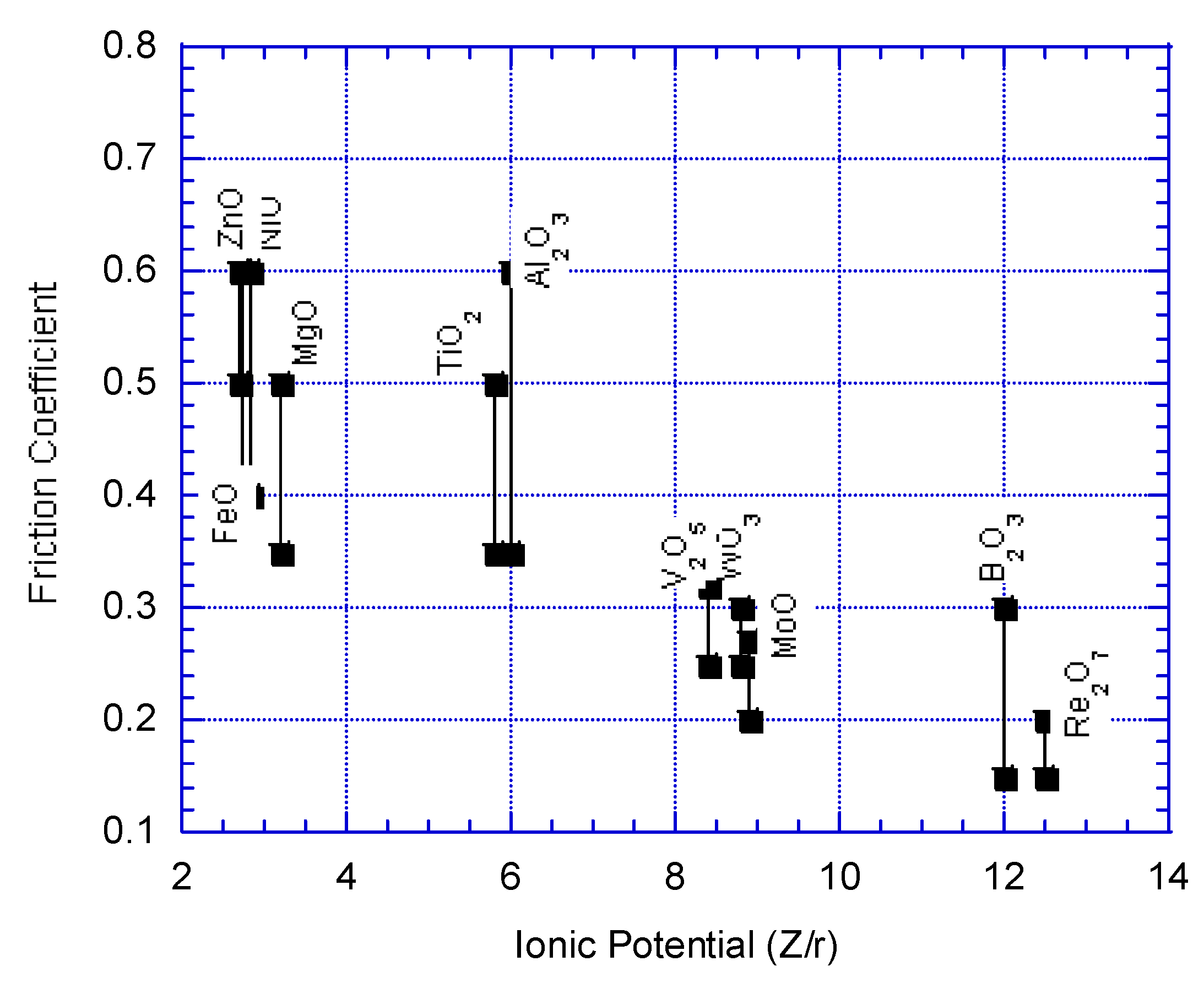
Certain solid oxides (such as Re2O7, B2O3, MoO3, etc.) are capable of affording fairly low friction coefficients (i.e., 0.1-0.3) to sliding contact interfaces at elevated temperatures and hence referred to as lubricious oxides in the tribology literature. A recently proposed crystal chemical model [1] was able to establish a close correlation between the reported friction coefficients of such oxides and their ionic potentials, φ (see Figure 1). It is important to remind that friction is primarily a system’s property hence may vary a great deal with changes in test condition, environment, and temperature. However, it has been used as a measure of lubricity for all kinds of materials and coatings in previous years. Overall, the extent of physical, chemical, and mechanical events that occur at sliding contact interfaces is rather complex but plays the most prominent role in the frictional behavior or lubricity of all sliding surfaces including those that contain solid oxides. It is well-known that these events are largely controlled by the general principles of reaction kinetics and thermodynamics [2,3,4,5].
Figure 1.
Relationship between friction coefficients and ionic potentials of certain oxides [1]. Spread shows upper and lower friction values reported by different authors in the literature for each oxide over a range of temperatures.
Figure 1.
Relationship between friction coefficients and ionic potentials of certain oxides [1]. Spread shows upper and lower friction values reported by different authors in the literature for each oxide over a range of temperatures.
Until recently, many equilibrium thermodynamic concepts and principles have been suggested to account for the tribochemical phenomena that take place at sliding contact interfaces under dry and boundary lubricated sliding conditions. Among them, approaches based on Lewis acids and bases and Pearson’s hard and soft acids and bases (HSAB) became quite popular in the recent tribochemistry literature. Obviously, tribochemical reactions (just like their thermochemical counterparts) occur through some electron exchange, transfer, and sharing mechanisms. Because of the large involvements of electrons in the tribochemical reactions or interactions, tribochemists often resort to the principles of Lewis acid-base concepts or other relevant principles for the interpretation of thermo- and/or mechano-chemical interactions between tribosurfaces and lubricant species that are acting, respectively, as electron donors and acceptors and thus assume varied degrees of chemical hardness or softness. Such uses of Lewis acid and base concepts are plenty and some of the most relevant ones to this study are chronologically enumerated in Table 1.

| Mori et al. (1987) - Describes adsorption activity of organics on fresh steel surfaces by hard and soft acid and base concepts and the hard-soft acid-base (HSAB) principle [2]. |
| Lee (1989-1991) – Applies the HSAB principle to solid adhesion and surface tribointeractions [6,7,8]. |
| Kajdas (1995) - Models tribochemical reactions based on low-energy electron emission from tribosurfaces and formulates a generalized Negative Ion Radical-HSAB action mechanism [4]. |
| Fischer et al. (1995) - Characterizes solid tribosurfaces with Lewis acid and base theory and frontier molecular orbital theory [9]. |
| Mansuy (1995) - Investigates effect of Lewis acid-base interactions between ZDTP and n-dodecylamine on the composition of ZDTP tribochemical films [10]. |
| Martin et al (1995-2000) - Illustrates interactions in binary additive system, formation of ZDTP tribochemical films, synergism in MoDTC/ZDTP and MoDTC/calcium borates, and transfer of tribochemical films by Lewis acid and base concept and the HSAB principle, chemical hardness, and maximum hardness principle [3,11]. |
| Jiang et al. (1996-1997) - Develops antiwear model of ZDTP based on its local charges calculated by ab initio quantum chemistry [12,13]. |
| Bhatia et al. (1999) - Elucidates tribochemical reactions of PFPE on magnetic head/disk interface by catalysis of Lewis acids [14]. |
| Li (2000) - Attempts bond valence matching principle and Saville’s rule for understanding formation thermodynamics of inorganic and organic species yielded from ZDTP on rubbing steel surfaces [15]. |
| Li et al (2001) - Employs electronegativity, electron affinity, and ionization potential of functional antiwear additive elements (S, P) from ZDTP to account for their preferential residence on rubbing coating surfaces of varied mechanical and chemical nature [16]. |
Initially, to understand the nature of tribochemical interactions between the sliding surfaces and the reactive decomposition products of additives, some researchers cited in Table 1 have used the HSAB and maximum hardness principles [2,3,6,10]. Of the concepts which have found broader implications in tribochemistry are those related to the Lewis acid and base hardness (or softness) derived from the quantum chemical theories. These parameters include chemical hardness [2,3] and the ionic potential [1]. The chemical hardness is more comprehensive in that it has already changed from an early qualitative entity to a quantitative reality owing to the introduction of Density Functional Theory (DFT). With the availability and increased uses of this theory, several new concepts (such as electronic chemical potential, or absolute electronegativity, and Fukui functions) were defined to quantitatively depict the global or local reactivity of chemical systems including the ones that involve dry and/or lubricated sliding. Comparatively, the ionic potential, which is based more specifically on the crystal chemistry of solids, found very recent uses in accounting for the lubrication by solid oxides [1].
In the present paper, the lubrication behavior of solid oxides is further considered in light of two other quantum chemistry-based parameters: electronegativity and chemical hardness. Specifically, we explored the usefulness of these parameters in explaining the nature of lubricity in solid oxides and in justifying their equivalent or superior significance to that of ionic potential that has already been used in Ref. 1. The two quantifiable quantum chemistry parameters are of considerable potential use in chemical mapping of tribosurfaces and additive molecules as demonstrated by many of the authors listed in Table 1. They may also be very useful in gaining more fundamental chemical insights into the governing tribological or tribochemical mechanisms of lubricious oxides. At first, we feel that it will be very useful to explain (very briefly) some of the most relevant concepts of electronegativity and chemical hardness of solid oxides, and then rationalize their usefulness in predicting the extent of adhesive interactions, shear rheology, and, hence the lubricity of these oxides.
Electronegativity and Chemical Hardness
To illustrate the meaning and importance of electronegativity and chemical hardness, we begin with a chemical system that is essentially a collection of nuclei and electrons. Hence, it could be an atom, a molecule, an ion, or a cluster of several molecules that are in a state of chemical interaction. The physical and chemical behaviors of such systems can be described by DFT which is a form of quantum mechanics or quantum chemistry that uses the one-electron density function instead of the more usual wave functions [16,17]. In the DFT, two important parameters that are of particular importance to the chemists are electronic chemical potential (μ) or absolute electronegativity (χ) and absolute or chemical hardness (η) [18,19]. Chemical potential measures the escaping tendency of an electron cloud, while chemical hardness determines the resistance of the species to lose electrons. Both μ and η are global properties at the ground state in the sense that they characterize the species as a whole, i.e., they are molecular but not orbital properties. The exact definitions of these two quantities are:
and
where E is the electronic energy of a chemical system; N is the number of electrons; and v(r) is the potential due to the nuclei, plus any external potential. For atomic species, the chemical potential is the negative of Mulliken electronegativity (χ), which can alternatively be called absolute electronegativity, that is, the resistance of the chemical potential to a change in the number of electrons.
The method of finite difference yields an operational, and approximate, definition of μ and η:
where IP is the ionization potential, and EA is the electron affinity of the system. Within the validity of Koopmans’ theorem, the frontier orbital energies are given by
where HOMO is the highest occupied molecular orbital, and LUMO the lowest unoccupied molecular orbital. On an orbital basis, we can write chemical potential and chemical hardness as
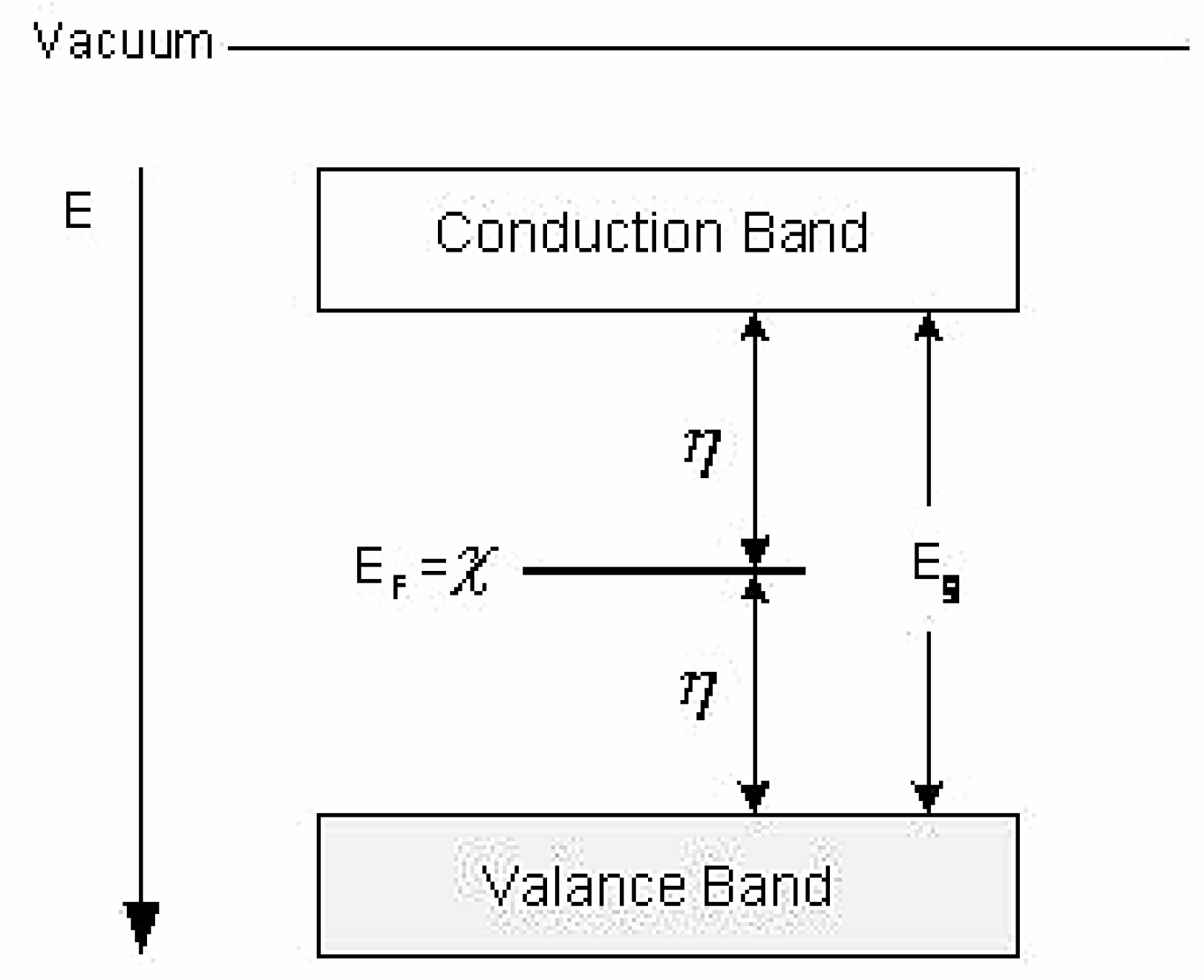
Figure 2 depicts a schematic representation of all these parameters in an orbital energy diagram. It offers a graphic way of defining what is meant by electronegativity and chemical hardness which will be used in assessing the lubricity of solid oxides. Obviously, hard molecules have a large HOMO-LUMO gap, and soft molecules have a small HOMO-LUMO gap. Figure 3 is a simplified account of the electronic band structures of solid oxides based on the fundamental DFT-derived concepts. These two figures show the inherent coherence of the chemical hardness, HOMO-LUMO gap between bonding and anti-bonding molecular orbitals, as called by chemists, and the band-gap between the conduction and valence energy bands of solids (Eg), as dubbed by physicists.
Figure 2.
Relationship between quantum chemistry descriptors and orbital energy diagram.
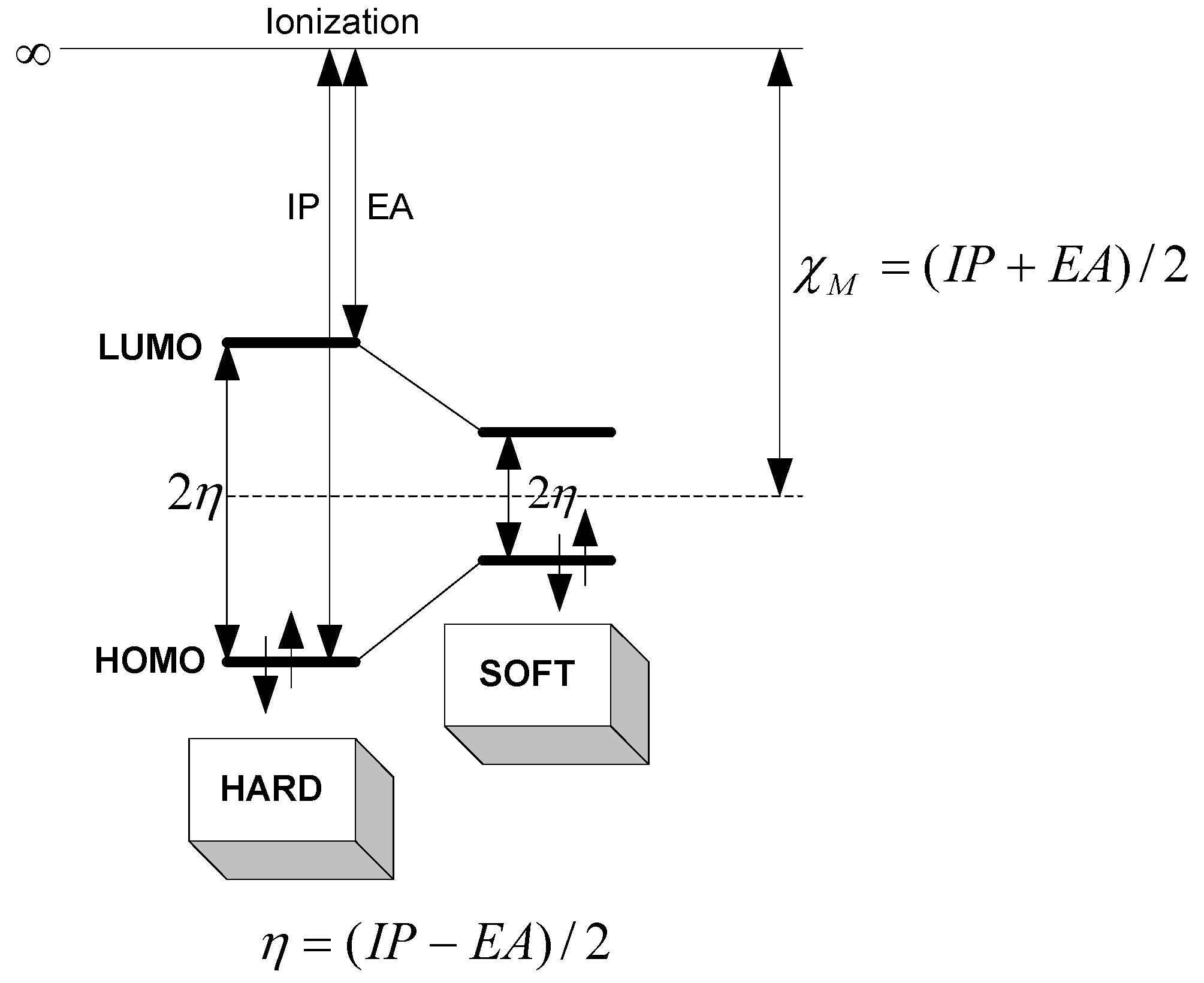
Figure 3.
Schematic electronic structure of solid oxides.
In equilibrium, absolute electronegativity within a chemical system is equal everywhere, while chemical hardness is a function of position. According to Sanderson’s electronegativity equalization principle, when two systems, A and B, are brought together, electrons will flow from lower χ to higher χ until the chemical potential reaches equilibrium. As a first approximation, the fractional number of electrons transferred, , is given by
or
Thus, the electron transfer is driven by , but resisted by the sum of . Since molecular interactions involve other interactions besides electron transfer, is not the total change of electrons but is still useful in determining the initial orbital interaction between two chemical systems, and in serving as an approximation for the bond strength [17]. For the hard-hard interactions, can be very large; thus, becomes too small, and the interaction will be dominated by the electrostatic interaction, instead of electron (charge) transfer. For the soft-soft interaction, can be rather small and will be larger. Such interactions may have strong implications in the electron exchange, transfer, and sharing mechanisms at sliding contact interfaces as they determine the extent of adhesion and hence frictional interactions.
Rationale
In the literature, there have not been comprehensive discussions of the acid-base interactions in solid oxides in relation to their lubricity and/or frictional behaviors. In a series of studies, Lee has used the hard-soft acid-base (HSAB) concepts and principles in order to better understand the mechanisms of adhesion or adhesive interactions between certain metal-polymer systems that are brought into static or sliding contacts [20,21]. In view of the electronic band structures of the types of polymers and solids that he considered in his studies, he was able to provide reasonable explanation for the adhesive interactions between these materials [22,23]. Similar concepts may be used to understand the lubrication behavior of solid oxides. There have been a few attempts to employ the HSAB concepts and principles in describing the friction or lubrication behavior of oxide or oxidized surfaces [2,4,22,23].
Mori has explored the effects of tribological conditions and surface chemistry on boundary lubrication behaviors of sliding surfaces that are covered by metal oxides under mild sliding conditions and of metallic or nascent surfaces when sliding occurs under severe conditions [2]. Judging from Lewis’s theory of acids and bases and Pearson’s HSAB concept [24], the former are harder Lewis acids, and the latter softer Lewis acids. Such a concept somewhat contrasts with Kajdas’s treatment of tribochemical interactions that occur on the interfaces between rubbing surfaces and functional tribo-additives [4]. Considering the tribophysical effects of exoelectron emission, Kajdas formulated an approach involving a negative-ion-radical HSAB action mechanism and claimed that typical soft acid-soft base interactions relate mostly to the adsorption processes, while the hard acid-hard base interactions relate to tribochemical processes [4]. When naturally oxidized surfaces of solid metals are brought into contact with additives in oils, the fact that the exposure sequence of such metal surfaces follows from oxide to nascent (atomic) to tribo-excitation states means that for Mori’s process and Kajdas’s approach there is a common denominator relating to the Pearson’s concept. So, both descriptions of the individual tribosystems are reasonable from the viewpoint of molecular orbitals.
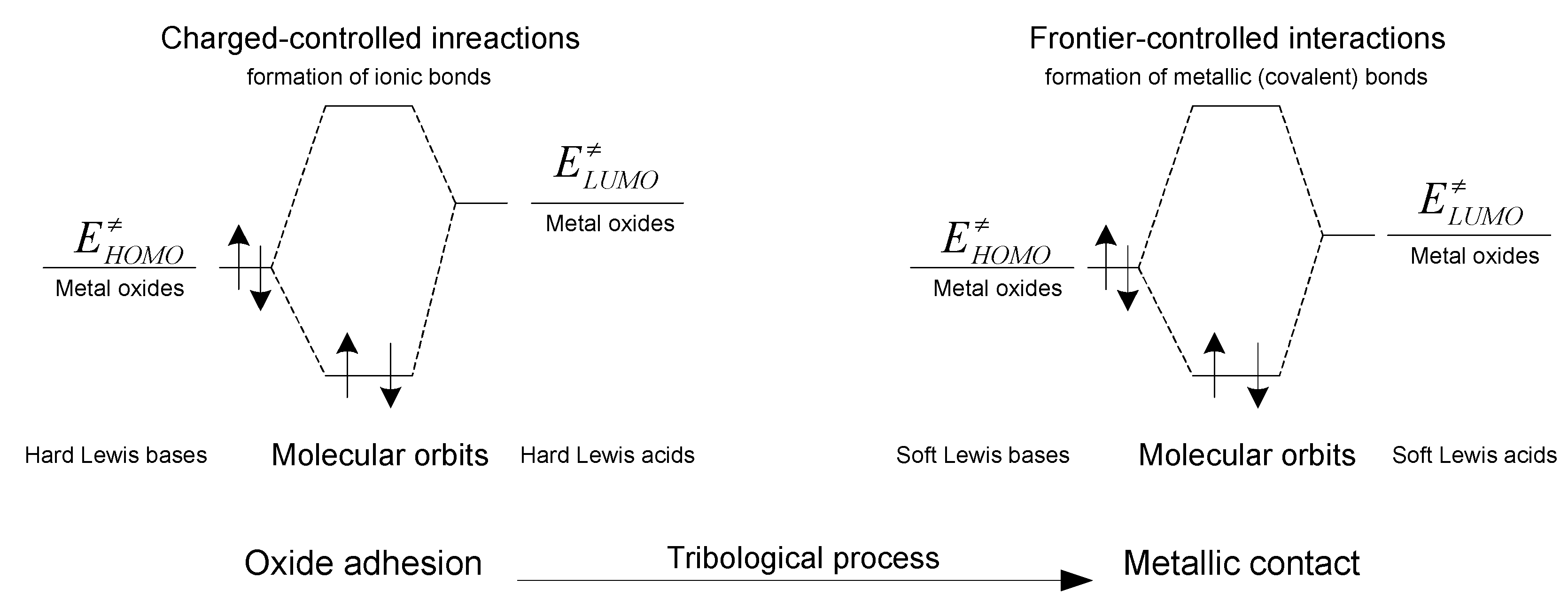
According to Klopman’s polyelectronic perturbation theory about electron transfer between donors and acceptors, two major terms are involved in the acid-base interaction: the Coulombic and the frontier orbital [22]. The former suggests hard-hard interactions in which is lower and is higher, and thus is charge controlled; and the latter implies soft-soft interactions where is higher and is lower, and is hence frontier-controlled.
As the present study is directed toward the understanding of the frictional interactions between solid oxides in terms of Lewis acid-base chemistry, Mori’s treatment of rubbing surfaces as Lewis acids of varied hardnesses (i.e., oxidized vs nascent) is of greater appropriateness [2]. Figure 4 presents a schematic accounting of the quantum chemistry involved in the frictional interactions between solid oxides and metals. Such oxides occur naturally on the surfaces of most metals and during most tribological tests, the initial stage of frictional interactions is largely dominated by these oxides. However, as they are removed during repeated sliding passes, the metal-to-metal interactions become more pronounced and determine both the nature and the extent of frictional interactions.
Figure 4.
A molecular orbital theory account of tribological mechanisms of ionic solid oxides.
Relation of Electronegativity and Chemical Hardness to Lubricity
The sliding surfaces of metals and nonoxide ceramics may oxidize when sliding occurs in an oxidizing environment. Sometimes, thin oxide films that form on these surfaces may play a significant role in the friction and wear behavior of these surfaces [23]. In terms of the electronic charge transfer mechanisms defined in Equation (6) or (7), the extent of the tribological events occurring at such surfaces might be further exacerbated by the extent of oxidation or chemical changes on these surfaces. In fact, as demonstrated in Table 2, changes in the stoichiometry of solid oxides, e.g., the coordination number, bring about variations of their electronegativities and chemical hardnesses. This may suggest a chemical reason for the varied tribological performances of these oxides. As a rule, both electronegativity and chemical hardness of the oxides decrease as their coordination number increases with the more obvious descending of chemical hardness. This observation signifies that oxides with higher coordination numbers are more reactive in adhesive interactions, and therefore may exhibit friction and wear at higher scales of severity. With this information in mind, rubbing surfaces can be proactively designed to gain anticipated frictional performances.
| Oxides | φ / Z/r | χ / eV | η / eV |
| ReO3 | 11.7 | 9.895(6a) | 0.356(6) |
| Re2O7 | 12.5 | 10.311(4), 10.181(6) | -0.101(4), -0.358(6) |
| B2O3 | 12 | 8.801(3), 8.724(4), 8.598(6) | 13.857(3), 6.432(4), 3.936(6) |
| V2O5 | 8.4 | 9.592(4), 9.496(5), 9.422(6) | 2.230(4), 1.807(5), 1.603(6) |
| MoO3 | 8.9 | 9.674(4), 9.585(5) 9.493(6), 9.344(7) | 2.337(4), 2.158(5) 2.044(6), 2.009(7) |
| WO3 | 8.8 | 9.764(4), 9.678(5), 9.588(6) | 1.868(4), 1.663(5), 1.558(6) |
| TiO2 | 5.8 | 9.138(4), 9.058 (5), 8.973 (6), 8.849(8) | 2.285(4), 1.943(5), 1.691(6), 1.465(8) |
| Al2O3 | 6 | 8.116(6) | 4.031(6) |
| SnO2 | 5.6 | 8.885(4), 8.820(5), 8.753(6), 8.695(7), 8.637(8) | 2.292(4), 2.125(5), 2.000(6), 1.919(7), 1.859(8) |
| ZrO2 | 5 | 8.618(4), 8.548(5), 8.487(6) | 2.930(4), 2.788(5), 2.695(6) |
| MgO | 3.2 | 6.702(4), 6.632(5), 6.585(6), 6.449(8) | 4.100(4), 3.773(5), 3.590(6), 3.180(8) |
| NiO | 2.8 | 7.476(4), 7.421(5), 7.739(6) | 2.549(4), 2.240(5), 2.044(6) |
| CoO | 2.7 | 7.598(4), 7.536(5), 7.485(6) | 2.099(4), 1.779(5), 1.558(6) |
| ZnO | 2.7 | 7.650(4), 7.596(5), 7.556(6), 7.446(8) | 1.867(4), 1.593(5), 1.418(6), 1.044(8) |
| FeO | 2.7 | 7.650(4), 7.556(6), 7.460(8) | 1.661(4), 1.249(6), 0.942(8) |
| PbO | 4.8 | 6.933(4), 6.774(6), 6.744(7), 6.697(8) | 1.893(4), 1.603(6), 1.560(7), 1.502(8) |
| CuO | 4.0 | 7.977(4), 7.925(5), 7.874(6) | 1.249(4), 0.955(5), 0.710(6) |
| SiO2 | 3.0 | 8.974(4/6) | 4.384(4/6) |
| Cs2O | 0.6 | 4.571(6), 4.535(8), 4.514(9), 4.499(10), 4.478(11), 4.463(12) | 1.539(6), 1.464(8), 1.424(9), 1.395(10), 1.358(11), 1.331(12) |
aNumber in parentheses designates coordination numbers of solid oxides.
The charge number (Z), ionic radius (r) and their ratio: the ionic potential (φ), are commonly used to relate, individually or together, with other atomic or molecular properties, e.g., electronegativity, chemical hardness or softness of Lewis acids and bases [25,26]. As these parameters all take into account the competition between forces of electrostatic type and those of covalent type, they are connected to the chemical hardness as defined by Pearson [18,24] and Pearson and Parr [17]. On the one hand, these quantum chemistry parameters can characterize semi-quantitatively those physical or chemical events that occur on sliding surfaces; while on the other hand, all of them are related to the electronic structures of chemical systems, which are now better understood due to the introduction of conceptual DFT parameters and related electronic structural principles.
Single Oxides
Oxides are chemical systems. The ionic potential listed in Table 2 for oxides represents a valid quantum chemistry parameter that controls several physical and chemical phenomena. In general, the higher the ionic potential, the greater the extent of screening of a cation in an oxide by surrounding anions; hence, they will have much reduced chemical interactions with other cations in the system [1]. Conversely, oxides with lower ionic potentials are very strong and hard to shear, because their cations constantly interact with each other and form strong covalent or ionic bonds that make them very strong and hard to shear. The shear strengths and hence the friction coefficients of sliding interfaces that contain these oxides will be high as demonstrated in Figure 1.
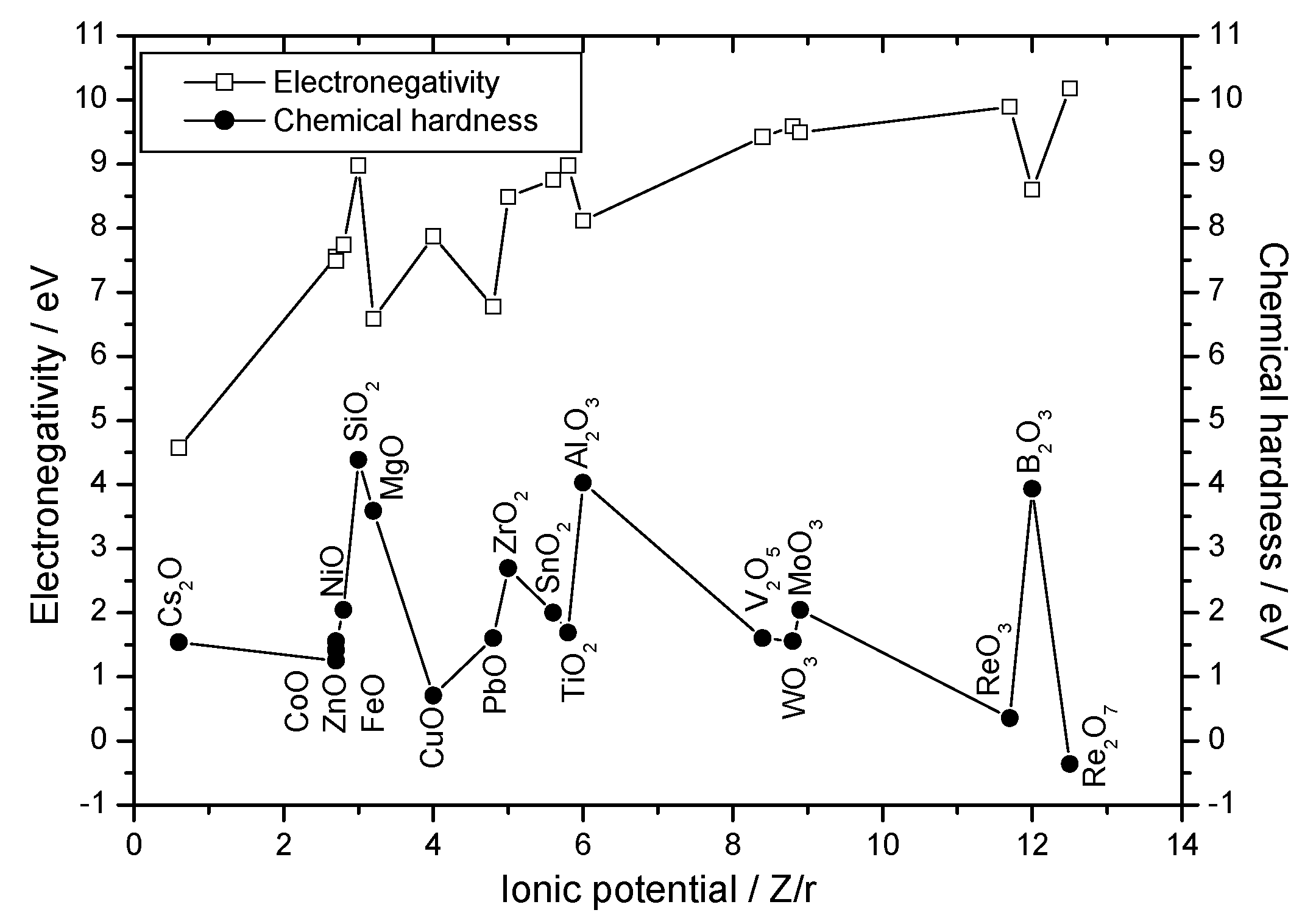
The electronegativity, which is the negative of the electronic chemical potential, is an important quantum chemistry descriptor for reactivities displayed by any chemical systems. Figure 5 shows the existence of a reasonable correlation between electronegativity and ionic potentials of the oxides considered, but a little or no obvious correlation exists between their chemical hardnesses and ionic potentials. However, there appears to be an approximate derivative relationship between electronegativity and chemical hardness and this finding is in mathematical agreement with the deductions from DFT, as indicated by Equations (1) and (2).
Figure 5.
Relationship among electronegativity, chemical hardness, and ionic potential of certain solid oxides with coordination number of 6. (Data of ionic potentials of solid oxides are from Ref. [1].)
Figure 5.
Relationship among electronegativity, chemical hardness, and ionic potential of certain solid oxides with coordination number of 6. (Data of ionic potentials of solid oxides are from Ref. [1].)
Electronegativity vs friction coefficient
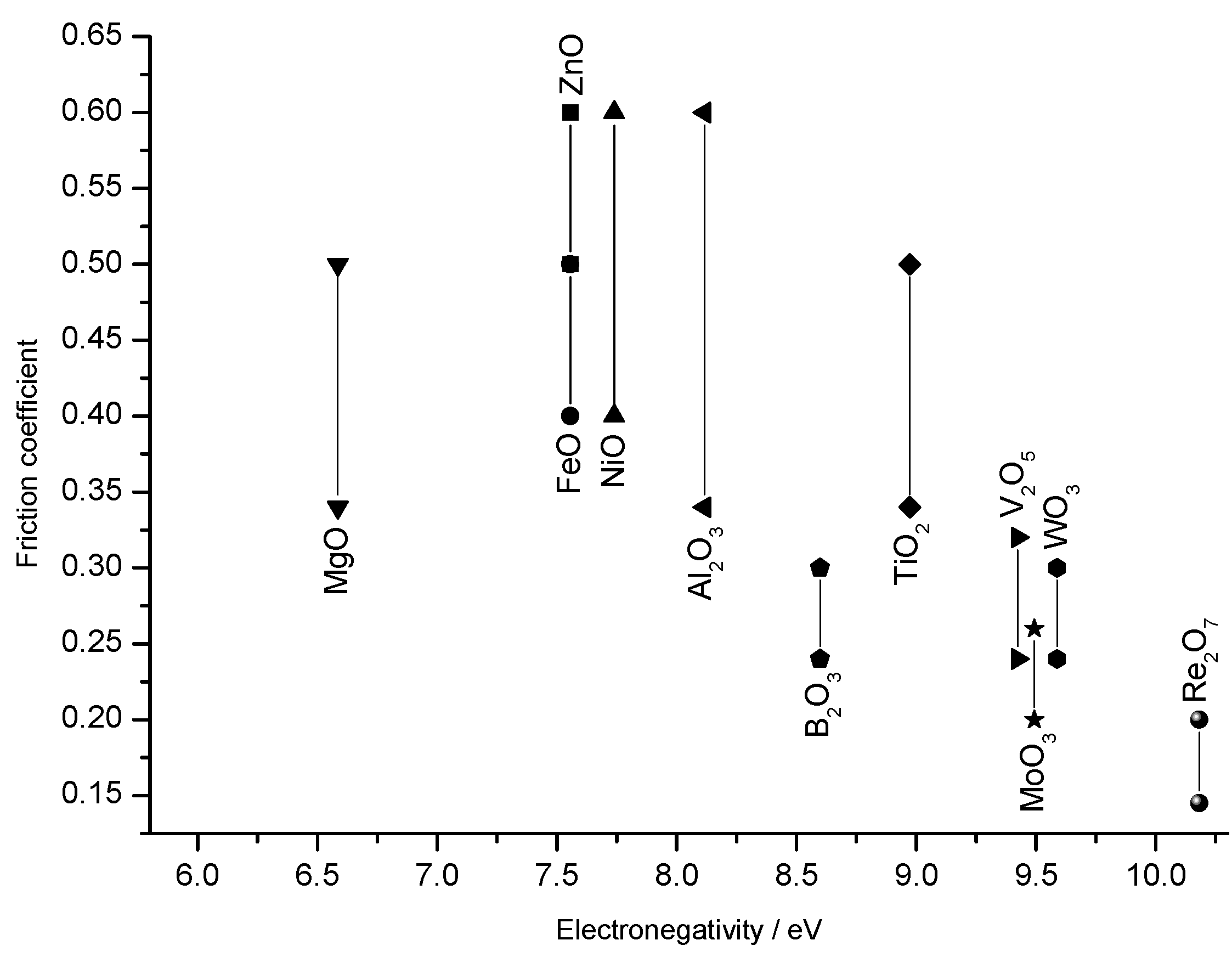
As the electronegativity and chemical hardness denote the tendency of chemical reactions or interactions in a chemical system, they should also be capable of providing a better understanding or deeper insight into the tribochemical processes occurring at sliding interfaces. In view of the relevancy of the ionic potentials of oxides to their electronegativities, it is reasonable to expect that the same should be true regarding the relationship between the friction coefficients of solid oxides and their electronegativities. Such a supposition is affirmed by the data presented in Figure 6. As a rule, for the tribosystem of solid oxides with identical coordination numbers (in this study, the coordination number of six is arbitrarily chosen for comparison), the higher the electronegativity, the lower the friction coefficient. The relationship is understandable as oxides of higher electronegativity hold their bonding electrons more tightly and have lower tendency to bind chemically with their neighboring oxides. This condition naturally leads to lower shearing in the sliding of solid oxides and thus decreased friction coefficients.
Chemical hardness vs friction coefficient
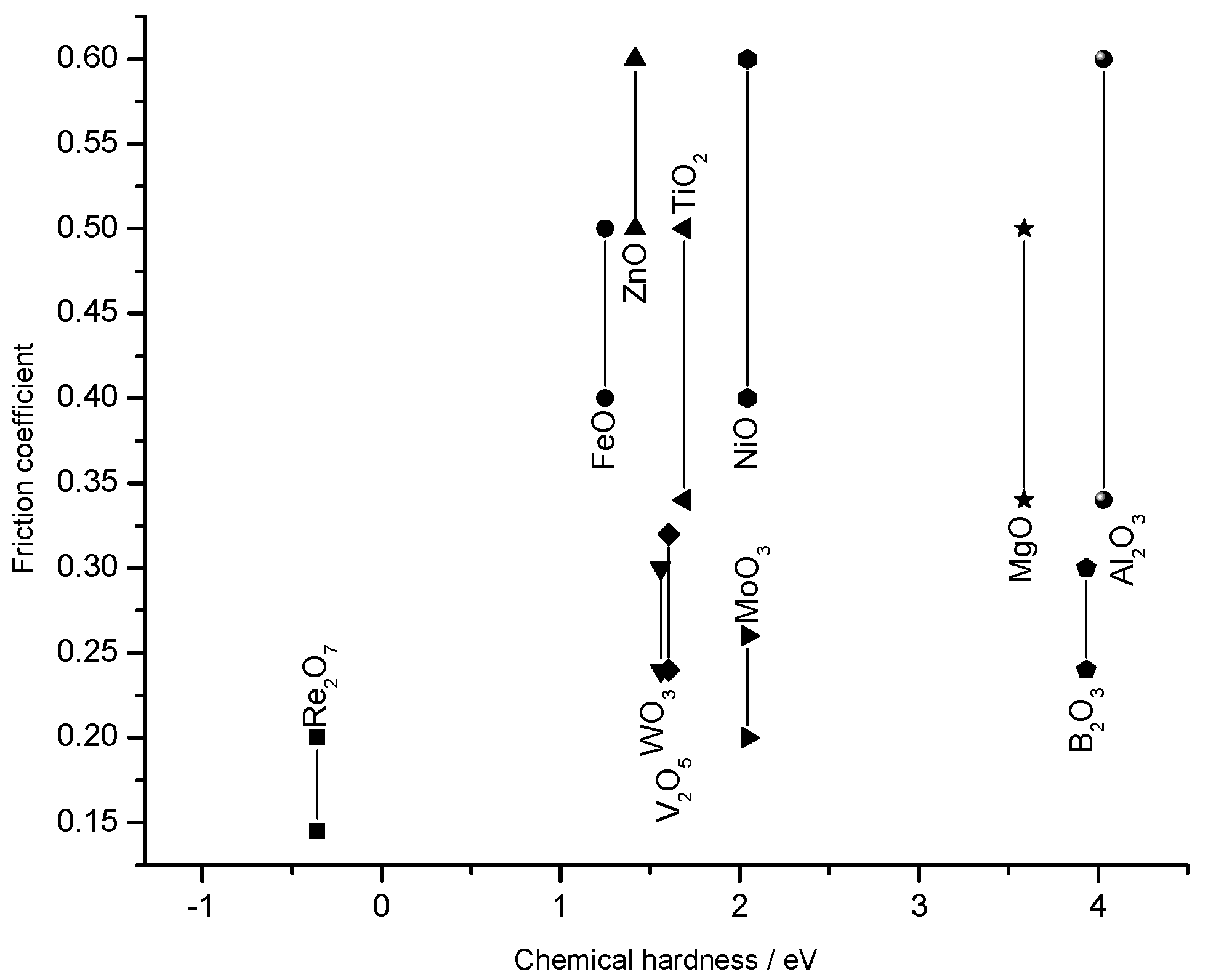
As discussed earlier, just like electronegativity, chemical hardness is also a valid quantum chemistry parameter and has been used in the past to elucidate the nature of tribochemical interactions in lubricated sliding contacts [2]. However, in this study, the relationship between friction coefficients of the solid oxides and their chemical hardnesses is not very obvious (see Figure 7). For oxides of higher electronegativities (such as WO3, V2O5, MoO3, and B2O3 with lower friction coefficients), there is no discernable change of their friction coefficients as the chemical hardness values increase. For oxides of lower electronegativities (such as FeO, ZnO, TiO2, NiO, MgO and Al2O3), tantamount to higher chemical potentials, large scatters in friction coefficients are found, however they do not show discernable trend with respect to their chemical hardnesses. Interestingly, of the solid oxides considered, Re2O7 has both the lowest chemical hardness (below zero) and the lowest friction coefficient. Hence, both electronegativity and chemical hardness exert some influences on the frictional behaviors of solid oxides in such special ways, but perhaps chemical hardness is not a dominating factor with respect to the lubricity of solid oxides while electronegativity appears to be closely related.
Figure 6.
Relationship between friction coefficients and electronegativity of certain solid oxides with coordination number of 6. (Data of friction coefficient of solid oxides are from Ref. [1].)
Figure 6.
Relationship between friction coefficients and electronegativity of certain solid oxides with coordination number of 6. (Data of friction coefficient of solid oxides are from Ref. [1].)

Figure 7.
Relationship between friction coefficients and chemical hardness of certain solid oxides with coordination number of 6. (Data of friction coefficient of solid oxides are from Ref. [1]).
Figure 7.
Relationship between friction coefficients and chemical hardness of certain solid oxides with coordination number of 6. (Data of friction coefficient of solid oxides are from Ref. [1]).
Double Oxides
As opposed to electronegativity and chemical hardness, the fractional number of transferred electrons (), as defined in Equations (6) and (7), may be of greater utility for the study of lubrication behavior of sliding interfaces that contain more than one type of oxide. Because of the dependence of electronegativity and chemical hardness on the coordination number of solid oxides, the sliding interfaces with different oxide pairs with different coordination numbers may demonstrate varied frictional behaviors. This is attributable to the fact that the nature of adhesive interactions at such interfaces will be very different when their chemical compositions are different. Table 3 presents the calculated fractional numbers of transferred electrons for different oxide pairs in sliding contact in accordance with Equation 6.
As is expressed as the ratio of difference in electronegativity and sum of chemical hardness of contacting oxides, it is advisable to first examine the relationships among Δχ, Ση, and Δϕ for the studied oxides, as well as their relevance to friction coefficients. After that, any possible relationship between the lubricity and of contacting oxide pairs can be established.
Figure 8 shows that the difference in electronegativity is more closely related than the sum of chemical hardness to the difference in ionic potential of solid oxides (note that the numbers along data points in this Figure are referenced to the numbers in the first column in Table 3). It is thus reasonable that friction coefficients of oxide pairs are more relevant to the difference in electronegativity than to the sum of chemical hardness (compare Figure 9 and Figure 10). As a rule, the larger the difference in electronegativity, the lower the friction coefficients of the oxide pairs. On the other hand, there is no discernible relevancy of the friction coefficients of oxide pairs in sliding contact to the sum of their chemical hardnesses. These results reaffirm that the frictional performance of solid oxides has stronger relevancy to electronegativity than to chemical hardness.
Table 3.
Calculated values of fractional numbers of transferred electrons for contacting oxide pairsa.
| No. | Oxide pairs | Δϕ | Δχ | Δη | ΔN |
| 1 | NiO-FeO | 0.15 | 0.183 | 3.293 | 0.0278 |
| 2 | Al2O3-TiO2 | 0.2 | 0.857 | 5.722 | 0.0749 |
| 3 | NiO-TiO2 | 2.9 | 1.234 | 3.375 | 0.183 |
| 4 | Al2O3-NiO | 3.1 | 0.377 | 6.075 | 0.0310 |
| 5 | Al2O3-FeO | 3.3 | 0.560 | 5.280 | 0.0530 |
| 6 | PbO-MoO3 | 4.1 | 2.719 | 3.647 | 0.373 |
| 7 | NiO-Ta2O5 | 4.2 | 1.387 | 4.265 | 0.163 |
| 8 | NiO-MoO3 | 5.1 | 1.754 | 4.088 | 0.215 |
| 9 | NiO-WO3 | 5.9 | 1.849 | 3.602 | 0.257 |
| 10 | CoO-MoO3 | 6.1 | 2.008 | 3.602 | 0.279 |
| 11 | ZnO-MoO3 | 6.2 | 1.937 | 3.462 | 0.280 |
| 12 | CuO-MoO3 | 6.5 | 1.619 | 2.754 | 0.294 |
| 13 | PbO-V2O5 | 6.8 | 2.648 | 3.206 | 0.413 |
| 14 | CoO-WO3 | 6.9 | 2.103 | 3.116 | 0.337 |
| 15 | SiO2-PbO | 7.8 | 2.200 | 5.987 | 0.184 |
| 16 | Cs2O-MoO3 | 8.3 | 4.922 | 3.583 | 0.687 |
| 17 | CuO-Re2O7 | 8.5 | 2.307 | 0.352 | 3.277 |
| 18 | NiO-B2O3 | 9.1 | 0.859 | 5.980 | 0.0718 |
| 19 | PbO-B2O3 | 10.4 | 1.824 | 5.539 | 0.165 |
aDifferences in DFT-based parameters of oxide pairs are calculated at the same coordination number, 6.
Figure 8.
Relationship among the difference in electronegativity, sum of chemical hardness, and difference in ionic potential of certain solid oxides with coordination number of 6. (Open squares denote difference in electronegativity; numbers next to data points correspond to the numbers used in Table 3 for each oxide pair).
Figure 8.
Relationship among the difference in electronegativity, sum of chemical hardness, and difference in ionic potential of certain solid oxides with coordination number of 6. (Open squares denote difference in electronegativity; numbers next to data points correspond to the numbers used in Table 3 for each oxide pair).
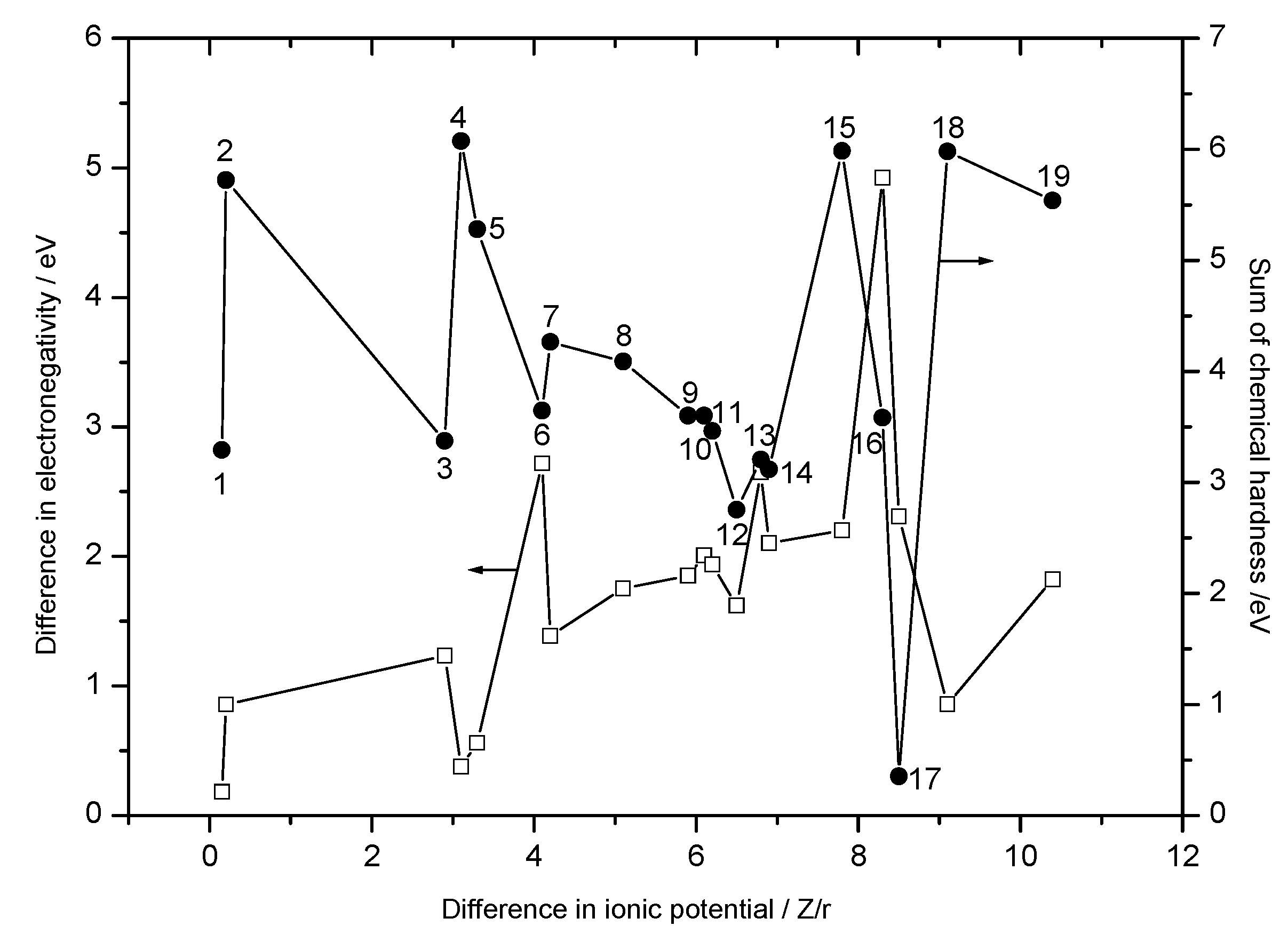
Figure 9.
Relationship between friction coefficients and differences in electronegativity of certain solid oxide pairs with coordination number of 6.(Numbers next to data points correspond to the numbers used in Table 3 for each oxide pair; data of friction coefficient of solid oxides are from Ref. [1].)
Figure 9.
Relationship between friction coefficients and differences in electronegativity of certain solid oxide pairs with coordination number of 6.(Numbers next to data points correspond to the numbers used in Table 3 for each oxide pair; data of friction coefficient of solid oxides are from Ref. [1].)
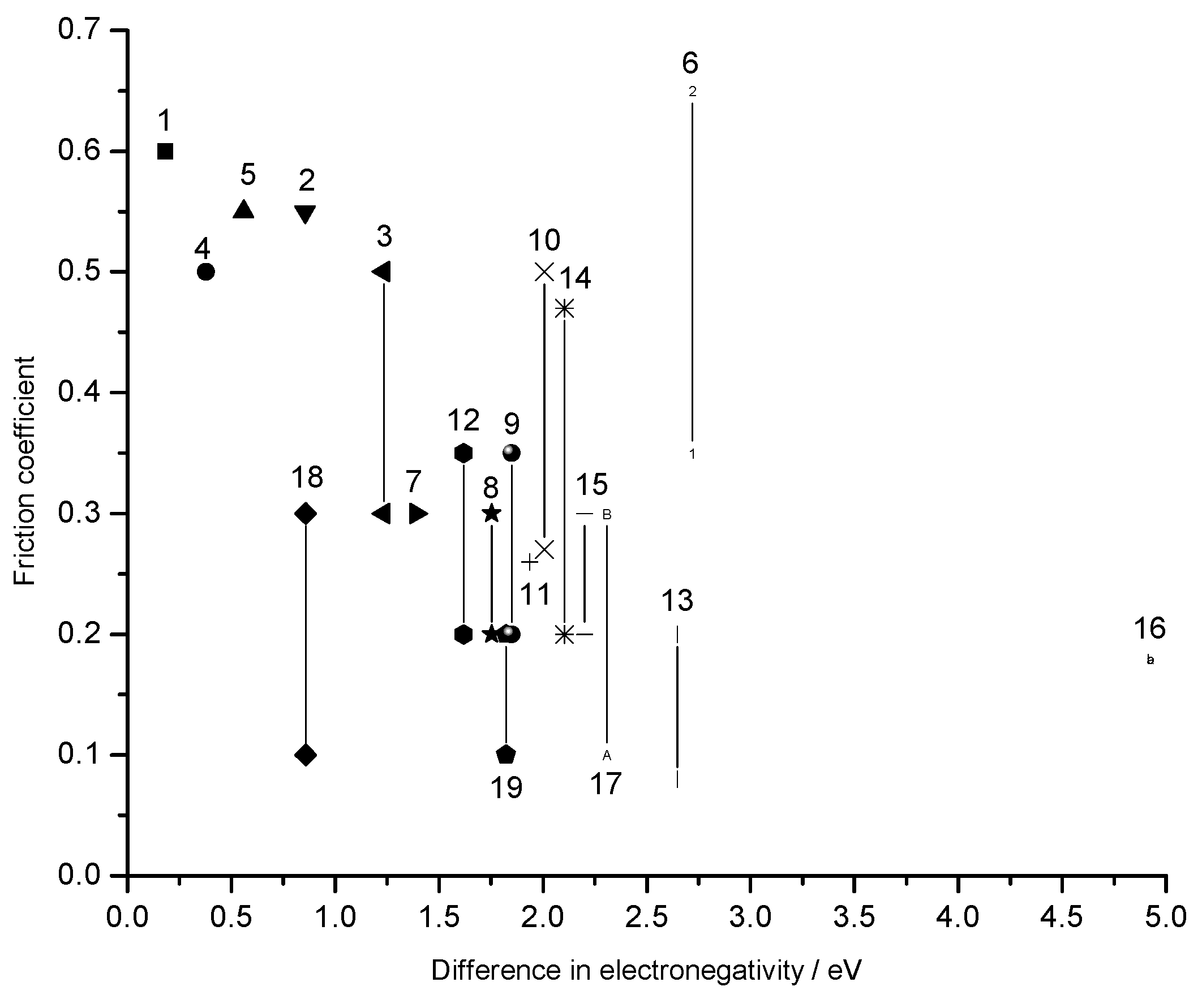
Figure 10.
Relationship between friction coefficients and sum of chemical hardness of certain solid oxide pairs with coordination number of 6. (Numbers next to data points correspond to the numbers used in Table 3 for each oxide pair; data of friction coefficient of solid oxides are from Ref.[1]).
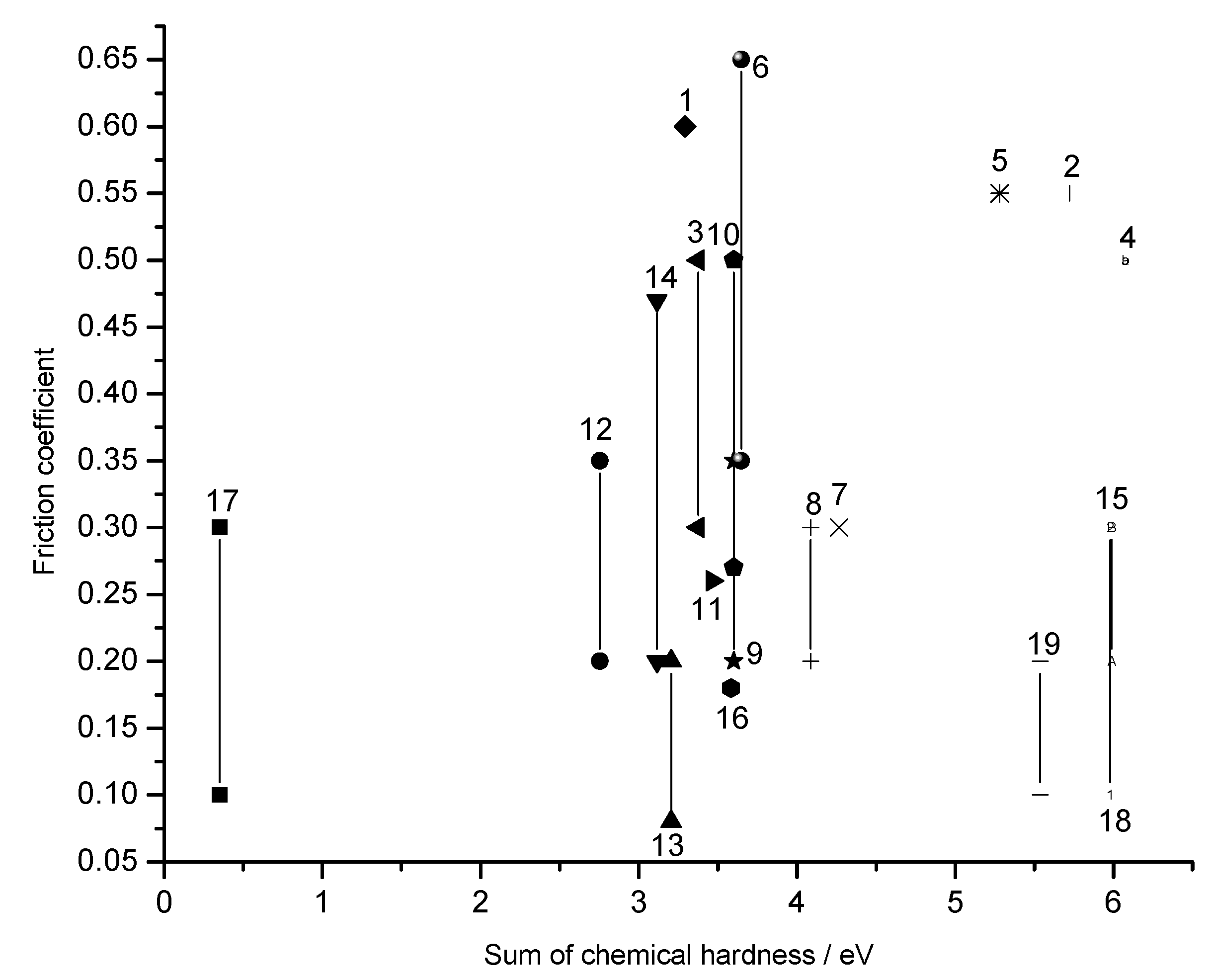
An increase of has two implications: one is that the degree of chemical interaction between solid oxides becomes stronger and thus they are more likely to form a low-melting-point, thus easily shearable compound; the other implication is that the interaction mode between solid oxides begins to shift from more electrostatic (oxide adhesion) to more covalent (metallic contact), as suggested in Figure 4. This means that less ionic and more covalent oxides are less cohesive and more shearable. Therefore, oxide pairs with a larger difference in electronegativity and a smaller sum of chemical hardness will be more sharable and thus more lubricious than those oxide pairs with a smaller difference in their electronegativity.
The results of this study may have some practical implications for the design or formulation of self-lubricating, smart tribological systems. One potential implication might be in the fields of metal-cutting and forming operations where high temperatures always exist and cause severe adhesive and oxidative wear of cutting or forming tool surfaces. The lubrication of such tools is becoming more and more difficult mainly because the cutting speeds are continuously increasing to achieve higher degrees of productivity or lower cost, as well as external lubricants or metalworking fluids are under increasing scrutiny or their contents are subject to increasingly stiffer environmental regulations. What will be very desirable is that a tool that needs little or no external lubrication. Most cutting and forming tools used by industry today are coated with a hard nitride or carbide film and they function well when used in externally lubricated cutting or forming operation. When used under dry or marginally lubricated cutting operations, they fail rather quickly. By incorporating certain alloying elements that can readily lead to the formation of lubricious oxides on cutting or forming surfaces of such tools, one can potentially improve the performance of these tools. Similar lubrication approaches may also be used in the formulation of novel thermal or plasma spray coatings that are already used in various engine components as well as rolls and dies used in high-temperature forging and metal forming operations.
In recent years, attempts have already been made to incorporate lubricious oxides and/or oxide forming elements into coating systems in order to achieve low friction and wear. In one of these, researchers have incorporated tungsten and vanadium oxides into the coating systems and achieved reasonably low friction and wear coefficients at elevated temperatures [27]. While in another study, vanadium is purposely added into TiAlN coatings with the hope that it will result in V2O5 as a lubricious oxide and thus enable dry machining. Dry sliding tests showed that the friction coefficient of such a composite coating dropped from 0.6-0.8 to about 0.18 at 700oC. It was concluded that the addition of vanadium to hard coatings holds promise for achieving greater lubricity during dry machining mainly because of the formation of V2O5 and other easily shearable lower-oxides of vanadium [28].
Gulbinski et al. [29] studied the dry sliding behavior of pure MoO3, V2O5 as well as phases originating from Ag2O-MoO3, Cu-V2O5 and Ag-V2O5. All of the phases produced were able to lower friction, but the best results were observed on silver molybdate (Ag2MoO4) and silver-vanadium oxides forming surfaces. In a series of pin-on-disk studies, these authors were able to decrease friction coefficients to 0.2 at elevated temperatures. In another study, Strong and Zabinski have achieved remarkably low friction coefficients for sliding ceramic surfaces that contained Cs2MoOS3 at elevated temperatures [30]. Specifically, they reported friction coefficients of as low as 0.03 for Cs2O containing Si3N4 surfaces at 600oC. In a related study, Rosado et al. have explored the solid lubrication behavior of several cesium-based compounds on Si3N4 ceramics. Among others, the best overall performance was achieved with a cesium silicate reaction film formed in-situ during sliding tests at 650oC [31]. In light of the quantum chemical concepts laid out by the authors of this paper, the difference in ionic potentials of cesium oxide and silicon dioxide is about 8.9 (which is a value that is consistent with the ranking of double oxides (in terms of their lubricity) in Table 3), while the difference in electronegativity for the same oxides is 4.4 (which is a value that also fits quite nicely into Figure 9 with respect to its reported lubricity).
Conclusions
The focal point of this paper has been the introduction of the DFT-based concepts to lubrication performance of solid oxides. Tribologically, two basic DFT-based quantum chemistry parameters are considered: absolute electronegativity, or chemical potential, and absolute or chemical hardness. From these parameters, a fundamental parameter, , the fractional number of electrons transferred between the contacting solid oxides can be estimated. Conclusions from an analysis of the relationship between the friction coefficients of some oxides and these parameters are:
Electronegativity, like ionic potential, is a valid quantum chemistry parameter for predicting the frictional behaviors of solid oxides in sliding contact. Generally, the higher the electronegativity of the solid oxides, the lower their friction coefficients. Thus, electronegativity provides means other than the ionic potential to estimate the sliding frictional performances of solid oxides. Comparatively, chemical hardness of solid oxides is less related to their friction coefficients.
The fractional number of transferred electrons between contacting solid oxides calculated from their electronegativity and chemical hardness is of limited use in elucidating the friction behaviors of solid oxide pairs at high temperatures. However, it appears that the higher the fractional numbers of transferred electrons, the smaller the friction coefficients. This effect is attributed to the transition in the contacting nature of oxide pairs from ionicity to covalence.
Relations of friction coefficient, electronegativity, chemical hardness, fractional number of transferred electrons, and coordination number of solid oxides can give clues in classifying and selecting solid oxides with desired frictional performances. This makes it feasible to chemically design tribosurfaces of solid oxides and formulate new alloy components or composite oxide structures that can provide low friction at high temperatures.
Electronegativity along with ionic potential are two key quantum chemistry parameters that can be used to predict the frictional behaviors of solid oxides. These two parameters can be of use, in a quantitative or semi-quantitative way, in characterizing tribosystem elements and frictional events that may occur at sliding contact interfaces.
Acknowledgment
This work was supported by the China Postdoctoral Science Fund (No.1999[10]) and by National Natural Science Foundation of China (No. 50075044). Additional support was provided by the Office of Transportation Technology, US Department of Energy, under Contract W-31-109-Eng-38.
References and Notes
- Erdemir, A. Trib. Lett. 2000, 8, 97–102.
- Mori, S. Tribochemical activity of nascent metal surfaces. In Proc. Int. Trib. Conf., Yokohama, Japan; Satellite Forum on Tribochemistry. 1995; pp. 37–42. [Google Scholar]
- Martin, J.M. Trib. Lett. 1999, 6, 1–8.
- Kajdas, C. A novel approach to tribochemical reactions: Generalized NIRAM-HSAB action mechanism. In Proc. Int. Trib. Conf., Yokohama, Japan; Satellite Forum on Tribochemistry. 1995; pp. 31–35. [Google Scholar]
- Singer, I.L.; Mogne, T.L.; Donnet, C.; Martin, J.M. J. Vac. Sci. Technol. A 1996, 14, 38–45. [CrossRef]
- Lee, L.H. Molecular dynamics and energetics of metal-polymer friction and wear. I: Application of the hard-soft acid-base (HSAB) principle to solid adhesion and surface tribointeractions. In Proc. 5th International Congress on Tribology; (eds. K. Holmberg and I. Nieminen), Finnish Society for Tribology, Espoo, Finland. 1989; Vol. 3, pp. 308–313. [Google Scholar]
- Lee, L.H. Hard-soft acid-base (HSAB) principle for solid adhesion and surface interactions. In Fundamentals of Adhesion; (ed. L. H. Lee), Plenum Press, New York, Chapter 12; 1990; pp. 349–362. [Google Scholar]
- Lee, L.H. Relevance of the density-functional theory to acid-base interactions and adhesion in solids. In Acid-Base Interactions; (Eds. K.L. Mittal and H.R. Anderson, Jr.); VSP: Netherlands, 1991; pp. 25–46. [Google Scholar]
- Fischer, T.E.; Mullins, W.M. J. Phys. Chem. 1992, 96, 5690–5701. [CrossRef]
- Mansuy, H. Study of interactions between anti-wear additives and surfactants: Influence on the limited films formation. NTIS No. DE96753703/HDM. 1995. [Google Scholar]
- Martin, J. M.; Grossiord, C.; Mogne, T.L.; Bec, S.; Tonck, A. Tribol. Int. 2001, 34, 523–530.
- Jiang, S.Y.; Dasgupta, S.; Blanco, M.; Frazier, R.; Yamaguchi, E. S.; Tang, Y. C.; Goddard, W. A. J. Phys. Chem. 1996, 100, 15760–15769. [CrossRef]
- Jiang, S.Y.; Frazier, R.; Yamaguchi, E. S.; Blanco, M.; Dasgupta, S.; Zhou, Y.H.; Cagin, T.; Tang, Y.C.; Goddard, W. A. J. Phys. Chem. B 1997, 101, 7702–7709. [CrossRef]
- Bhatia, C.S.; Fong, W.; Chen, C.Y.; Wei, J.J.; Bogy, D.B.; Andres, S.; Stammler, T.; Stohr, J. IEEE Trans. on Magnetics 1999, 35, 910–915. [CrossRef]
- Li, S.H. Study on tribochemodesign based on tribochemical case analyses. In Postdoctoral Report, Tsinghua University, December 2000.
- Li, S.H.; Zhang, R.J.; Jin; Wang, Y.C.; Tung, S.C. Tribology Transactions, 2003; 46, 200–205.
- Parr, R.G.; Pearson, R.G. J. Amer. Chem. Soc. 1983, 105, 7512–7516. [CrossRef]
- Pearson, R.G. Proc. Natl. Acad. Sci. 1986, 83, 8440–8441. [CrossRef]
- Lee, L.H. Relevance of the density-functional theory to acid-base interactions and adhesion in solids. In Acid-Base Interactions; (Eds. K.L. Mittal and H.R. Anderson, Jr.); VSP: Netherlands, 1991; pp. 25–46. [Google Scholar]
- Lee, L.H. Molecular dynamics and energetics of metal-polymer friction and wear. I: Application of the hard-soft acid-base (HSAB) principle to solid adhesion and surface tribointeractions. In Proc. 5th International Congress on Tribology; (eds. K. Holmberg and I. Nieminen), Finnish Society for Tribology, Espoo, Finland. 1989; 3, pp. 308–313. [Google Scholar]
- Lee, L.H. Hard-soft acid-base (HSAB) principle for solid adhesion and surface interactions. In Fundamentals of Adhesion; (ed. L. H. Lee); Plenum Press: New York, Chapter 12; 1990; pp. 349–362. [Google Scholar]
- Klopman, G. J. Amer. Chem. Soc. 1968, 90, 223–234. [CrossRef]
- Quinn, T. F. J. Tribol. Int., 1983, 16, 257–271.
- Pearson, R.G. J. Chem. Edu. 1999, 76, 267–275. [CrossRef]
- Shannon, R.D. Acta Crystallogr. A 1976, 32, 751–767. (Also see: Shannon, R.D. Electronic properties of cations and corresponding oxides. See: http://www.icmcb.u-bordeaux.fr/pub/elecprop/ions.htm.)
- Guo, Q.Z.; Chen, A.Q. Principles of Organic Acids and Bases. Xiamen University Press: Xiamen, 1991; 120–130. [Google Scholar]
- Lugscheider, E.; Knotek, O.; Barwulf, S.; Bobzin, K. Surf. Coat. Technol. 2001, 142-144, 137–142. [CrossRef]
- Mayrhofer, P.H.; Hovsepian, P.E.; Mitterer, C.; Munz, W.D. Surf. Coat. Technol. 2004, 177, 341–347. [CrossRef]
- Gulbinski, W.; Suszko, T.; Sienicki, W.; Warcholinski, B. Wear, 2003; 254, 129–135.
- Strong, K.L.; Zabinski, J.S. Thin Solid Films, 2002; 406, 174–184.
- Rosado, L.; Forster, N.H.; Trivedi, H.K.; King, J.P. Tribol. Trans. 2000, 43, 489–497.
© 2005 by MDPI (http://www.mdpi.org).
Share and Cite
MDPI and ACS Style
Erdemir, A.; Li, S.; Jin, Y. Relation of Certain Quantum Chemical Parameters to Lubrication Behavior of Solid Oxides. Int. J. Mol. Sci. 2005, 6, 203-218. https://doi.org/10.3390/i6060203
AMA Style
Erdemir A, Li S, Jin Y. Relation of Certain Quantum Chemical Parameters to Lubrication Behavior of Solid Oxides. International Journal of Molecular Sciences. 2005; 6(6):203-218. https://doi.org/10.3390/i6060203
Chicago/Turabian StyleErdemir, Ali, Shenghua Li, and Yuansheng Jin. 2005. "Relation of Certain Quantum Chemical Parameters to Lubrication Behavior of Solid Oxides" International Journal of Molecular Sciences 6, no. 6: 203-218. https://doi.org/10.3390/i6060203