
<?xml version="1.0" encoding="UTF-8"?>
<!DOCTYPE article PUBLIC "-//NLM//DTD Journal Publishing DTD v2.3 20070202//EN" "journalpublishing.dtd">
<article xmlns:mml="http://www.w3.org/1998/Math/MathML" xmlns:xlink="http://www.w3.org/1999/xlink" xml:lang="en" article-type="research-article">
<front>
<journal-meta>
<journal-id journal-id-type="publisher-id">ijms</journal-id>
<journal-title>International Journal of Molecular Sciences</journal-title>
<abbrev-journal-title>Int. J. Mol. Sci.</abbrev-journal-title>
<issn pub-type="epub">1422-0067</issn>
<publisher>
<publisher-name>Molecular Diversity Preservation International (MDPI)</publisher-name></publisher></journal-meta>
<article-meta>
<article-id pub-id-type="doi">10.3390/ijms14023671</article-id>
<article-id pub-id-type="publisher-id">ijms-14-03671</article-id>
<article-categories>
<subj-group>
<subject>Article</subject></subj-group></article-categories>
<title-group>
<article-title>Synthesis and Characterization of the Inclusion Complex of β-cyclodextrin and Azomethine</article-title></title-group>
<contrib-group>
<contrib contrib-type="author">
<name><surname>Sambasevam</surname><given-names>Kavirajaa Pandian</given-names></name></contrib>
<contrib contrib-type="author">
<name><surname>Mohamad</surname><given-names>Sharifah</given-names></name><xref ref-type="corresp" rid="c1-ijms-14-03671">*</xref></contrib>
<contrib contrib-type="author">
<name><surname>Sarih</surname><given-names>Norazilawati Muhamad</given-names></name></contrib>
<contrib contrib-type="author">
<name><surname>Ismail</surname><given-names>Nor Atiqah</given-names></name></contrib>
<aff id="af1-ijms-14-03671">Department of Chemistry, Faculty of Science, University of Malaya, Kuala Lumpur 50603, Malaysia; E-Mails: <email>kavirajaa@live.com</email> (K.P.S.); <email>nmsarih@um.edu.my</email> (N.M.S.); <email>atiqahtariqa@yahoo.com</email> (N.A.I.)</aff></contrib-group>
<author-notes>
<corresp id="c1-ijms-14-03671">
<label>*</label>Author to whom correspondence should be addressed; E-Mail: <email>sharifahm@um.edu.my</email>; Tel.: +603-79676751; Fax: +603-79674193.</corresp></author-notes>
<pub-date pub-type="collection">
<year>2013</year></pub-date>
<pub-date pub-type="epub">
<day>07</day>
<month>02</month>
<year>2013</year></pub-date>
<volume>14</volume>
<issue>2</issue>
<fpage>3671</fpage>
<lpage>3682</lpage>
<history>
<date date-type="received">
<day>08</day>
<month>12</month>
<year>2012</year></date>
<date date-type="rev-recd">
<day>14</day>
<month>01</month>
<year>2013</year></date>
<date date-type="accepted">
<day>25</day>
<month>01</month>
<year>2013</year></date></history>
<permissions>
<copyright-statement>© 2013 by the authors; licensee Molecular Diversity Preservation International, Basel, Switzerland.</copyright-statement>
<copyright-year>2013</copyright-year>
<license license-type="open-access" xlink:href="http://creativecommons.org/licenses/by/3.0">
<p>This article is an open-access article distributed under the terms and conditions of the Creative Commons Attribution license (http://creativecommons.org/licenses/by/3.0/).</p></license></permissions>
<abstract>
<p>A β-cyclodextrin (β-Cyd) inclusion complex containing azomethine as a guest was prepared by kneading method with aliquot addition of ethanol. The product was characterized by Fourier Transform Infrared (FTIR) spectrometer, <sup>1</sup>H Nuclear Magnetic Resonance (<sup>1</sup>H NMR) and Thermogravimetric Analyzer (TGA), which proves the formation of the inclusion complex where the benzyl part of azomethine has been encapsulated by the hydrophobic cavity of β-Cyd. The interaction of β-Cyd and azomethine was also analyzed by means of spectrometry by UV-Vis spectrophotometer to determine the formation constant. The formation constant was calculated by using a modified Benesi-Hildebrand equation at 25 °C. The apparent formation constant obtained was 1.29 × 10<sup>4</sup> L/mol. Besides that, the stoichiometry ratio was also determined to be 1:1 for the inclusion complex of β-Cyd with azomethine.</p></abstract>
<kwd-group>
<kwd>β-cyclodextrin</kwd>
<kwd>azomethine</kwd>
<kwd>Schiff bases</kwd>
<kwd>inclusion complex</kwd></kwd-group></article-meta></front>
<body>
<sec sec-type="intro">
<title>1. Introduction</title>
<p>The studies on supramolecular chemistry give a broad idea of intermolecular interactions where covalent bonds are not likely to form between the interacting species. Thus, most of this interaction has been performed by host-guest interaction. Among the host molecules, cyclodextrin seems to be the most promising to form inclusion complexes, especially with various guest molecules with suitable polarity and dimensions [<xref ref-type="bibr" rid="b1-ijms-14-03671">1</xref>,<xref ref-type="bibr" rid="b2-ijms-14-03671">2</xref>].</p>
<p>Cyclodextrin molecules are cyclic oligosaccharides made up of six to twelve α-<sc>d</sc>-glucopyranose monomers, which are connected at 1 and 4 carbon atoms. Cyclodextrins with six to eight α-<sc>d</sc>-glucopyranose units are denoted as α-, β- and γ-Cyclodextrins respectively. Among these various types of cyclodextrins, α-cyclodextrin is not suitable for many drugs and γ-cyclodextrin is expensive. β-cyclodextrin is widely used because it is readily available, and its cavity size is suitable for a wide range of guest molecules. In general, the special characteristic of cyclodextrins is the ability to form an inclusion complex with various organic molecules through host-guest interaction with the interior cavity that provides hydrophobic environment to trap an apolar pollutant [<xref ref-type="bibr" rid="b3-ijms-14-03671">3</xref>]. The inclusion complex of these host–guest systems occurs through various interactions, such as hydrogen bonding, van der Waals interaction, hydrophobic interactions and also electrostatic attraction [<xref ref-type="bibr" rid="b2-ijms-14-03671">2</xref>], where the described types of bonding would alter the photochemical and photophysical properties of the guest molecules. Thus, the physical, chemical and biochemical properties of guest molecules will be modified and the application criteria of those guest molecules also can be improved [<xref ref-type="bibr" rid="b4-ijms-14-03671">4</xref>].</p>
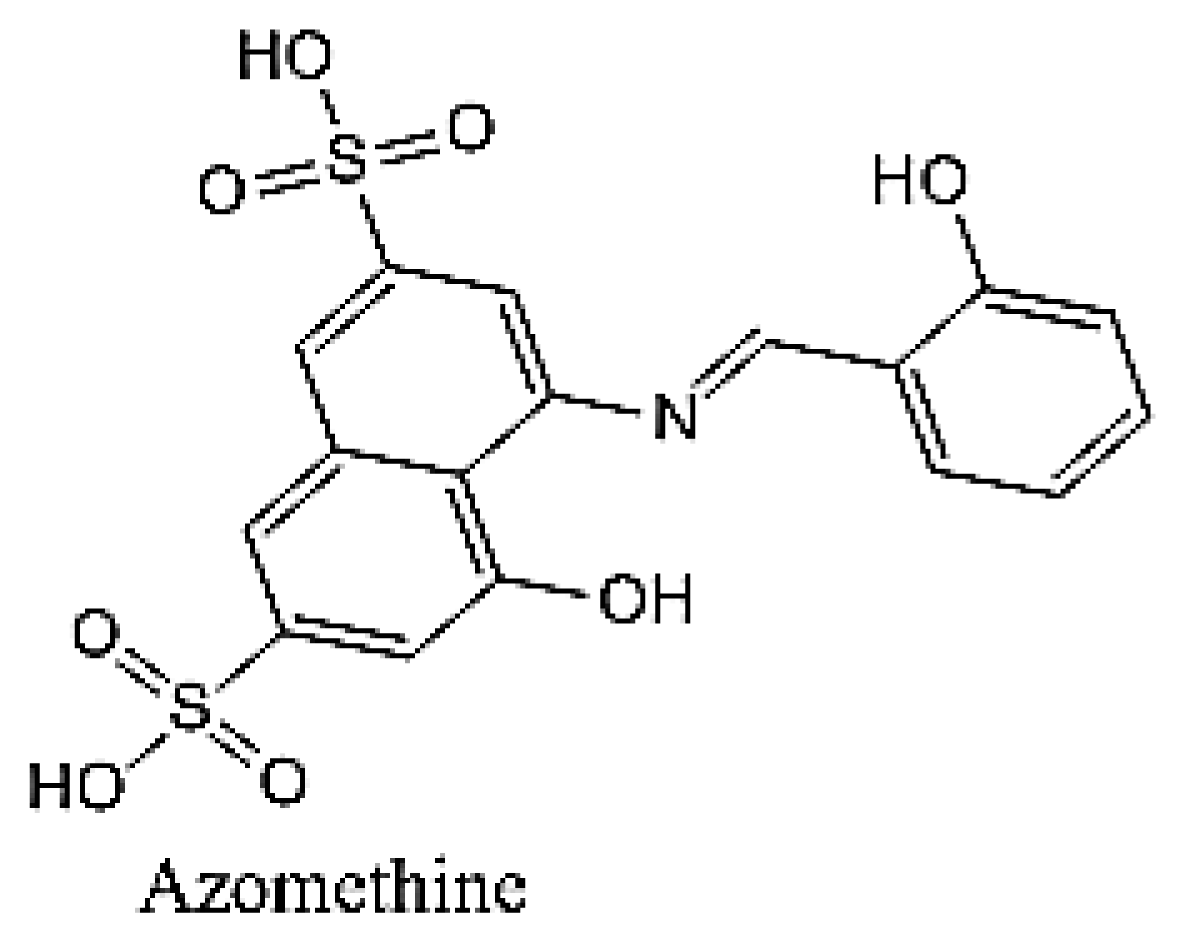
<p>So far, various kinds of guest molecules such as drugs, steroids, ionic liquids and dyes were used as host-guest interaction to change the properties of the guest molecules into the desired form. Schiff bases are compound with a functional group that contains a carbon nitrogen double bond with the nitrogen atom connected to an aryl or alkyl group. Azomethine is one examples of a Schiff based compound (<xref ref-type="fig" rid="f1-ijms-14-03671">Figure 1</xref>) [<xref ref-type="bibr" rid="b5-ijms-14-03671">5</xref>]. According to the previous research [<xref ref-type="bibr" rid="b6-ijms-14-03671">6</xref>], azomethine has shown some applications in therapeutic applications to exert anti-tumor activity. In addition, Smith and Chen [<xref ref-type="bibr" rid="b7-ijms-14-03671">7</xref>] have demonstrated that azo compounds can be used as chromophores and metalochromic agents. Azomethine (Schiff based) compounds are widely used due to the good mechanical strength [<xref ref-type="bibr" rid="b8-ijms-14-03671">8</xref>], attractive thermal stability [<xref ref-type="bibr" rid="b9-ijms-14-03671">9</xref>], nonlinear optical materials, optical interconnect, oscillator, amplifier, frequency converter [<xref ref-type="bibr" rid="b10-ijms-14-03671">10</xref>] and liquid crystal thermosets (LCTs) [<xref ref-type="bibr" rid="b11-ijms-14-03671">11</xref>]. However, poor solubility of these azomethines in organic solvents limits their applications in various fields. Nepal <italic>et al.</italic>[<xref ref-type="bibr" rid="b12-ijms-14-03671">12</xref>] have introduced β-cyclodextrin to the poly (azomethines) to improve the solubility and processability of Schiff bases for various types of applications.</p>
<p>In this study, we have synthesized a novel inclusion complex of β-cyclodextrin and azomethine, which was not reported elsewhere. We believe this work would be the initial step to investigate the interaction feasibility of β-cyclodextrin and azomethine. Thus, we have chosen simple, highly sensitive and selective methods for the characterization of inclusion complexes such as Fourier transform-infrared (FTIR) spectrometry, proton nuclear magnetic resonance (<sup>1</sup>H NMR) spectrometry, thermogravimetric analysis (TGA), and ultraviolet-visible (UV-Vis) spectrometry [<xref ref-type="bibr" rid="b13-ijms-14-03671">13</xref>].</p></sec>
<sec sec-type="results|discussion">
<title>2. Results and Discussion</title>
<sec>
<title>2.1. Characterizations</title>
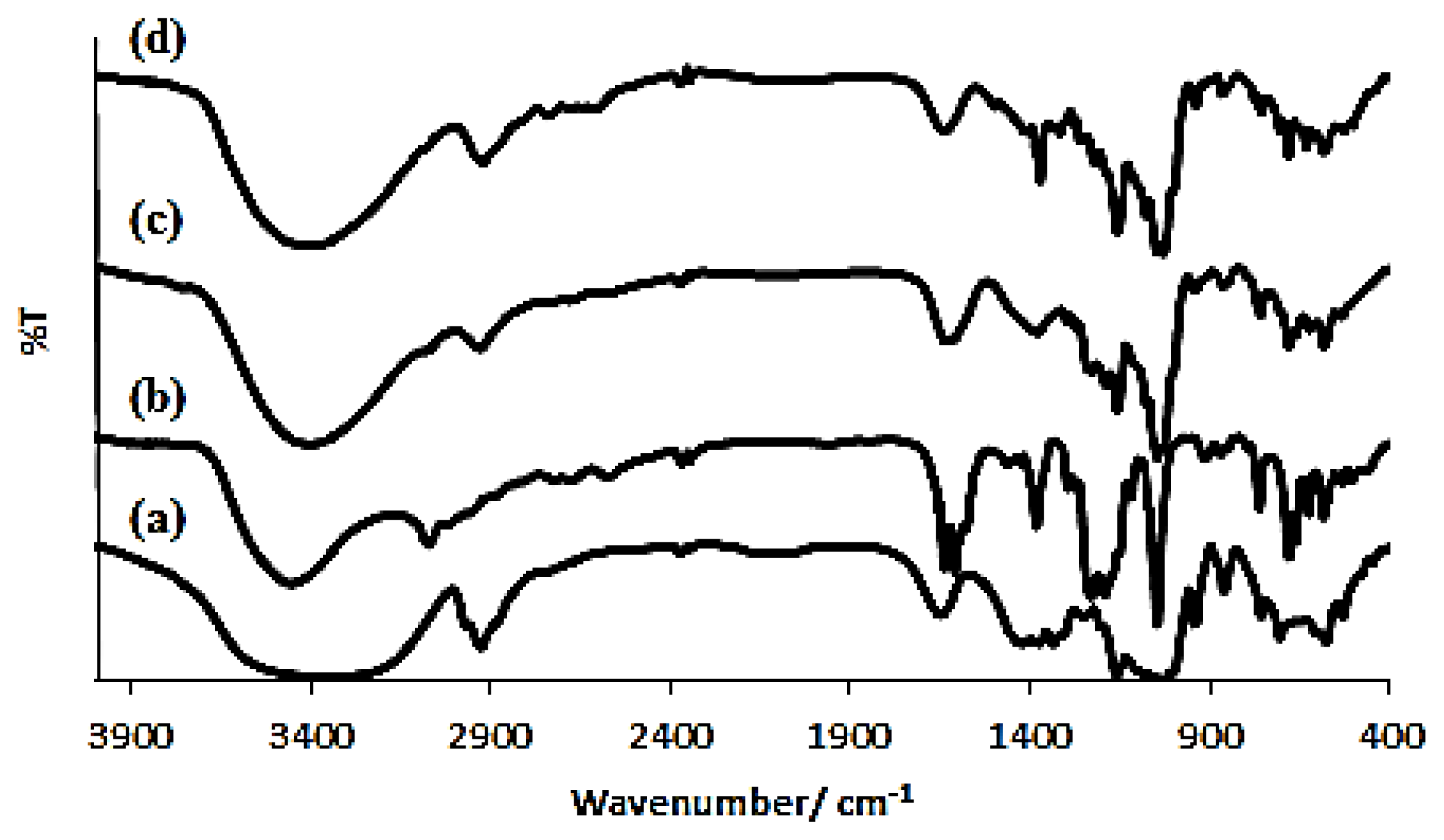
<p>FTIR is a very useful tool to prove the existence of both guest and host molecules in their inclusion complexes [<xref ref-type="bibr" rid="b14-ijms-14-03671">14</xref>]. <xref ref-type="fig" rid="f2-ijms-14-03671">Figure 2</xref> shows the FTIR spectra for the (a) β-cyclodextrin, (b) azomethine and (c) physical mixture of azomethine and β-Cyd and (d) inclusion complex of azomethine-β-cyclodextrin. The spectrum for the inclusion complex looks almost similar to the pure β-cyclodextrin. It indicates the formation of the inclusion complex, similar to a phenomenon observed by Li <italic>et al.</italic>[<xref ref-type="bibr" rid="b15-ijms-14-03671">15</xref>]. Besides that, a broad hydroxyl band of pure β-cyclodextrin at 3370.72 cm<sup>−1</sup> was found to be narrowed in the FTIR spectrum of the inclusion complex which is a good indication of the formation of the inclusion complex; this is a common phenomenon observed by many researchers in synthesizing the inclusion complex between β-cyclodextrin (host) and a guest molecules [<xref ref-type="bibr" rid="b15-ijms-14-03671">15</xref>–<xref ref-type="bibr" rid="b18-ijms-14-03671">18</xref>].</p>
<p>The frequencies for β-Cyd observed at 3370.72 cm<sup>−1</sup>, 2928.53 cm<sup>−1</sup>, 1157.84 cm<sup>−1</sup>, and 1029.24 cm<sup>−1</sup> which corresponds to the symmetric and antisymmetric stretching of ν[OH], ν[CH<sub>2</sub>], ν[C–C] and bending vibration of ν[O–H] respectively. Meanwhile the frequencies for azomethine were recorded at 3449.28 cm<sup>−1</sup>, 1608.52 cm<sup>−1</sup> and 681.39 cm<sup>−1</sup> for the respective functional groups such as ν[OH], ν[C=C] and vibrational stretching of ν[=C–H]. <xref ref-type="table" rid="t1-ijms-14-03671">Tables 1</xref> and <xref ref-type="table" rid="t2-ijms-14-03671">2</xref> have shown the difference in frequencies between β-Cyd and the inclusion complex; and between azomethine and inclusion complex respectively.</p>
<p>Both tables show some increase and decrease in intensity changes, Δδ. The increment is due to the insertion of the benzene part ring into the electron rich cavity of β-cyclodextrin and will increase the density of electron cloud, which will lead to the increase in frequency [<xref ref-type="bibr" rid="b19-ijms-14-03671">19</xref>]. The decrease in the frequency between the inclusion complex and its constituent molecule is due to the changes in the microenvironment which lead to the formation of hydrogen bonding and the presence of van der Waals forces during their interaction to form the inclusion complex [<xref ref-type="bibr" rid="b20-ijms-14-03671">20</xref>]. On the other hand, the FTIR spectrum of physical mixtures imitated the characteristic peaks of β-Cyd and azomethine, which can be regarded as a simple superimposition of those host and guest molecules. Thus, the FTIR spectra significantly proves the formation of the azomethine-β-Cyd inclusion complex.</p>
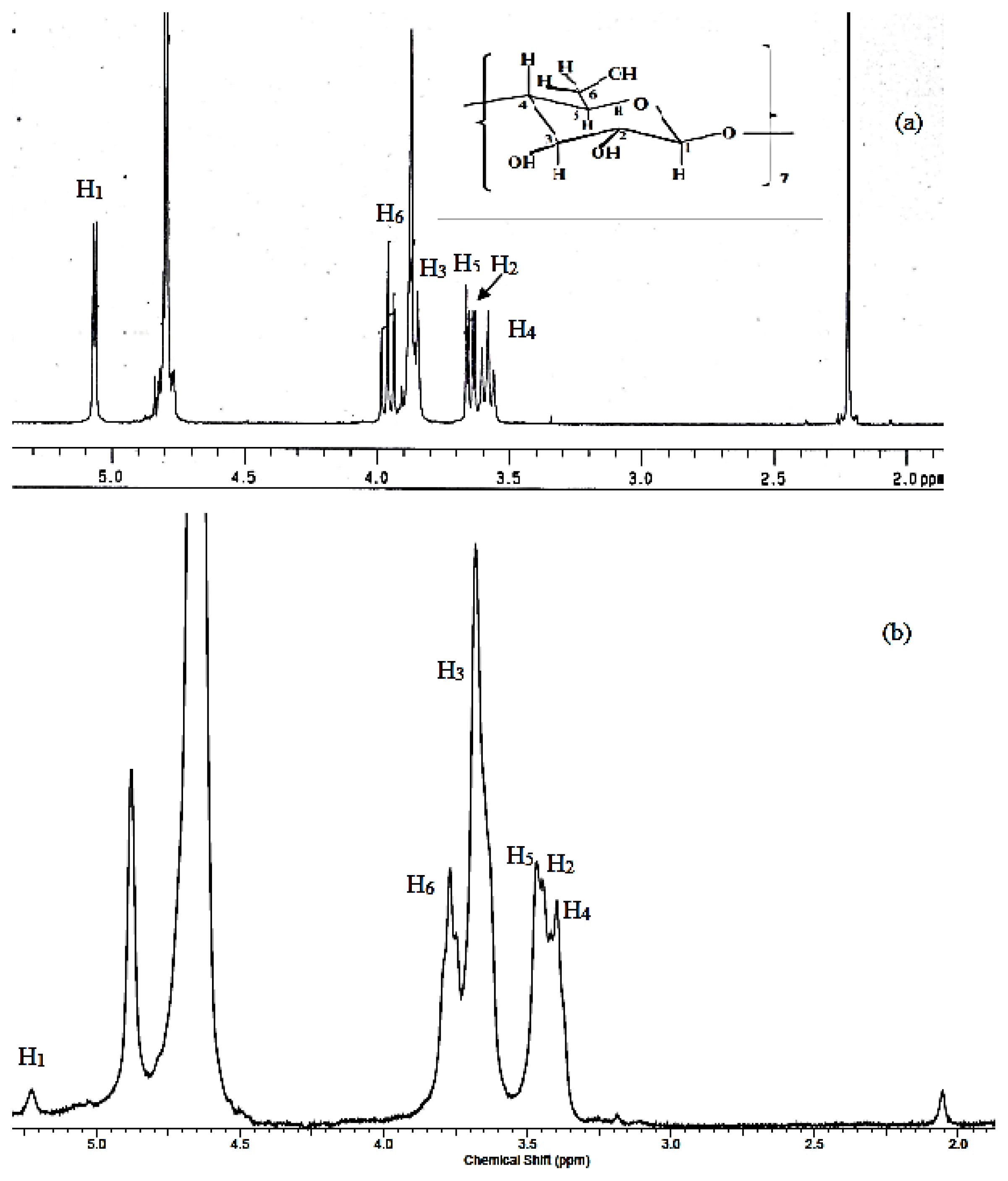
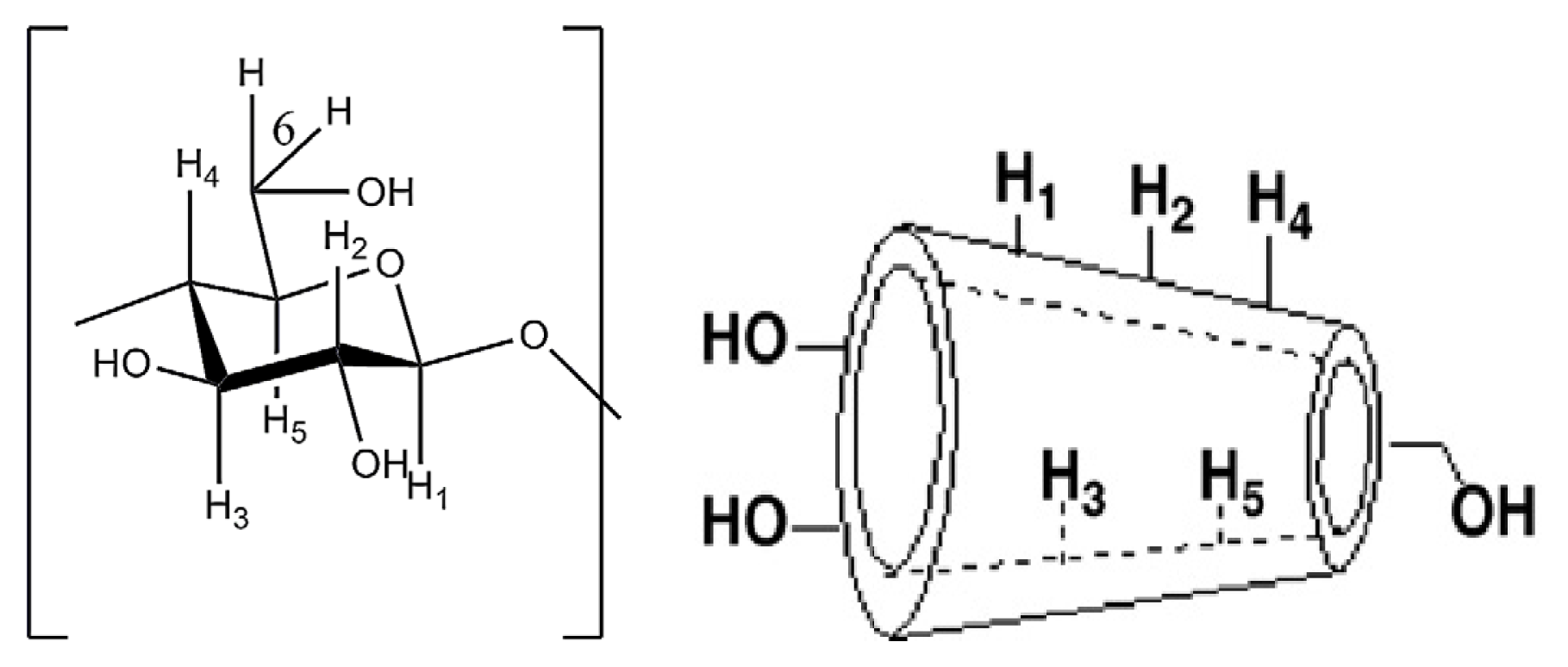
<p>Insertion of a guest molecule into the hydrophobic cavity of the β-cyclodextrin will result in the chemical shift of guest and host molecules in the NMR spectra. In general, large chemical shifts will be observed at H3 and H5, which are located in the inner cavity of cyclodextrin due to the inclusion phenomena [<xref ref-type="bibr" rid="b21-ijms-14-03671">21</xref>]. The chemical shift change (Δδ) is defined as the difference in chemical shift change, positive sign means a downfield shift and negative sign means an upfield shift [<xref ref-type="bibr" rid="b22-ijms-14-03671">22</xref>]. <xref ref-type="table" rid="t3-ijms-14-03671">Table 3</xref> exhibits the peak assignments for β-Cyd and the inclusion complex of azomethine-β-Cyd.</p>
<p><xref ref-type="fig" rid="f3-ijms-14-03671">Figure 3</xref> shows, the <sup>1</sup>H NMR spectra of β-Cyd and inclusion complex protons. In this study only β-Cyd and inclusion complex protons could be discussed because too many peaks were overlapped in 7.0–8.2 ppm region of azomethine indicating the aromatic ring [<xref ref-type="bibr" rid="b3-ijms-14-03671">3</xref>]. <xref ref-type="table" rid="t3-ijms-14-03671">Table 3</xref> shows some chemical shifts observed for H1, H2, H3, H4, H5 and H6. However, the chemical shifts for protons such as H3 and H5 (located inside the cavity of β-Cyd) are slightly higher compare to other protons, which are located at the exterior side of the cavity. Therefore, this shift provides the indication for the formation of the inclusion complex between β-Cyd and azomethine [<xref ref-type="bibr" rid="b23-ijms-14-03671">23</xref>–<xref ref-type="bibr" rid="b28-ijms-14-03671">28</xref>].</p>
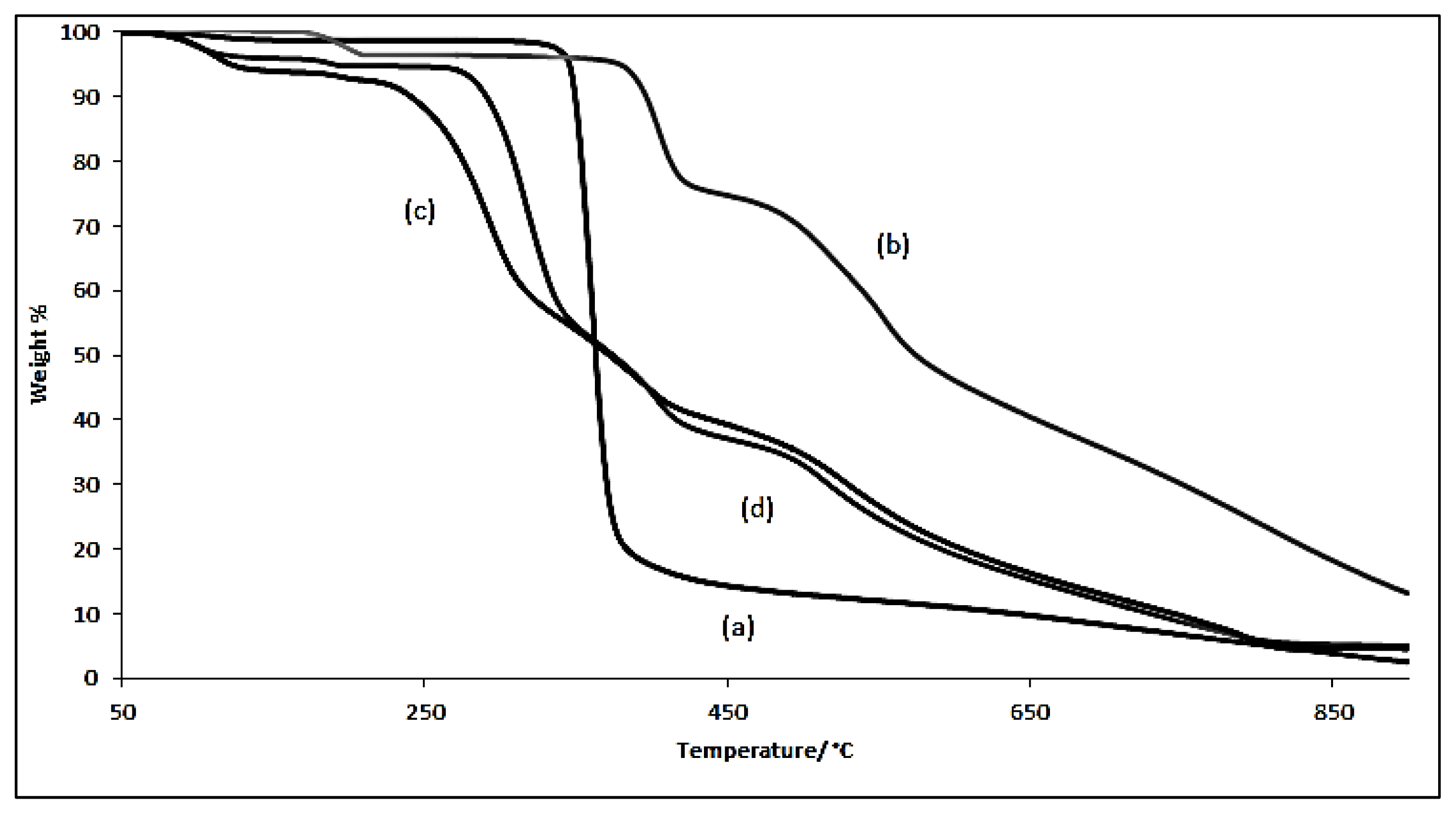
<p>Thermogravimetric analysis (TGA) will be done on samples to identify the changes in weight percent with respect to temperature change. TGA was performed on pure β-Cyd, azomethine and their inclusion complex. TGA results plotted in <xref ref-type="fig" rid="f4-ijms-14-03671">Figure 4</xref> in the temperature range of 50 °C to 850 °C. β-Cyd exhibits two separate weight losses due to loss of water molecules at 99.3 °C which was located in the cavity of β-Cyd and followed by the decomposition of macrocycles at 343 °C [<xref ref-type="bibr" rid="b29-ijms-14-03671">29</xref>]. Meanwhile azomethine exhibited weight losses at 170 °C and 380 °C which were due to the degradation of benzyl part and–CH=N– respectively. Then the inclusion complex underwent weight losses in three stages and lost 95% of its original weight at 809 °C. The first stage is due to the dehydration of water molecules and the second stage is due to the decomposition of β-Cyd and the third stage probably due to the decomposition of azomethine. In comparison, to confirm the formation of the inclusion complex, thermal analysis has been done on physical mixture of β-Cyd and azomethine. The first weight loss for the inclusion complex starts at 71 °C whereas it starts at 95 °C for the physical mixture which is almost similar to the water loss of β-Cyd. It means the formation of inclusion complex has changed the thermal degradation properties of β-Cyd and azomethine. In addition, the second decomposition for β-Cyd was around 343 °C but for the inclusion complex it has been decreased to 225 °C. This phenomenon suggests that formation of inclusion complex decrease the thermal stability of β-Cyd [<xref ref-type="bibr" rid="b24-ijms-14-03671">24</xref>].</p></sec>
<sec>
<title>2.2. Spectroscopic Studies</title>
<sec>
<title>2.2.1. Effect of pH</title>
<p>The effect of pH has been studied to determine the optimum pH for inclusion formation between β-Cyd and azomethine. pH 7 was chosen to be the optimum pH for this inclusion complex due to the highest absorbance at 236 nm. This is a common phenomena as observed by Cesla <italic>et al.</italic> where derivative of sulphonated azo dyes like azomethine can form highly stable inclusion complex with β-Cyd at neutral pH [<xref ref-type="bibr" rid="b30-ijms-14-03671">30</xref>].</p></sec>
<sec>
<title>2.2.2. Absorption Spectra</title>
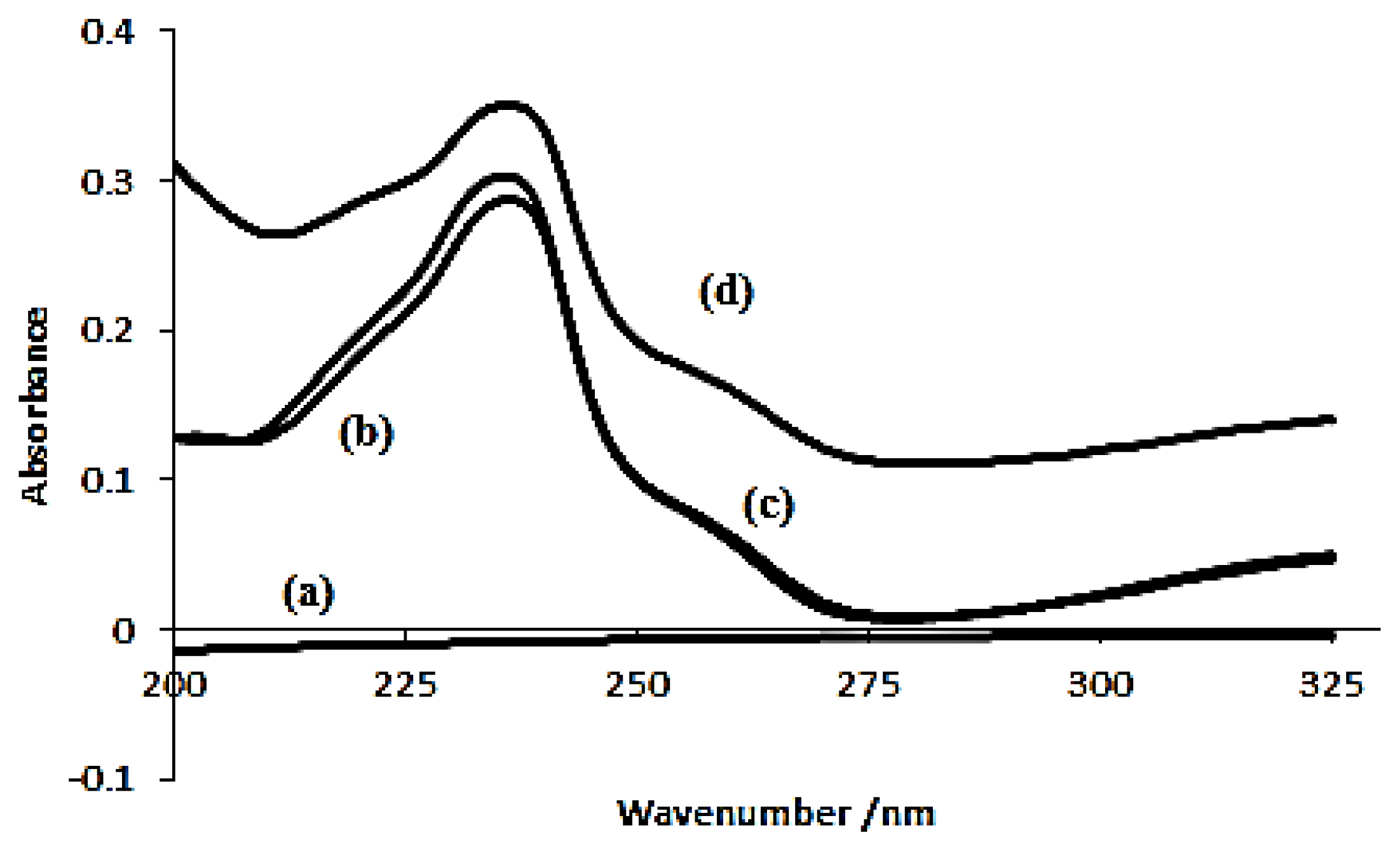
<p>Absorption spectra used to confirm the formation of inclusion complex. In this study, absorption spectra of β-Cyd, azomethine, physical mixture and inclusion complex were taken into consideration [<xref ref-type="bibr" rid="b31-ijms-14-03671">31</xref>]. In <xref ref-type="fig" rid="f5-ijms-14-03671">Figure 5</xref>, it was recorded that β-Cyd has almost no absorption throughout the wavelength; hence, its absorbance can be neglected [<xref ref-type="bibr" rid="b31-ijms-14-03671">31</xref>]. Absorption spectra for azomethine and the physical mixture were similar at most of the points along the wavelength recorded, which shows the absorbance arises from azomethine alone. Whereas, inclusion complex had an increased intensity at all points of wavelength due to the formation inclusion phenomena between β-Cyd and azomethine. The same phenomena has been observed by Wang <italic>et al.</italic>[<xref ref-type="bibr" rid="b32-ijms-14-03671">32</xref>] in their interaction studies of β-Cyd and orange G.</p></sec>
<sec>
<title>2.2.3. Stoichiometry and Apparent Formation Constant for Azomethine-β-Cyd Inclusion Complex</title>
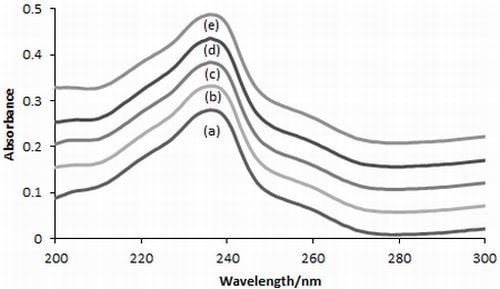
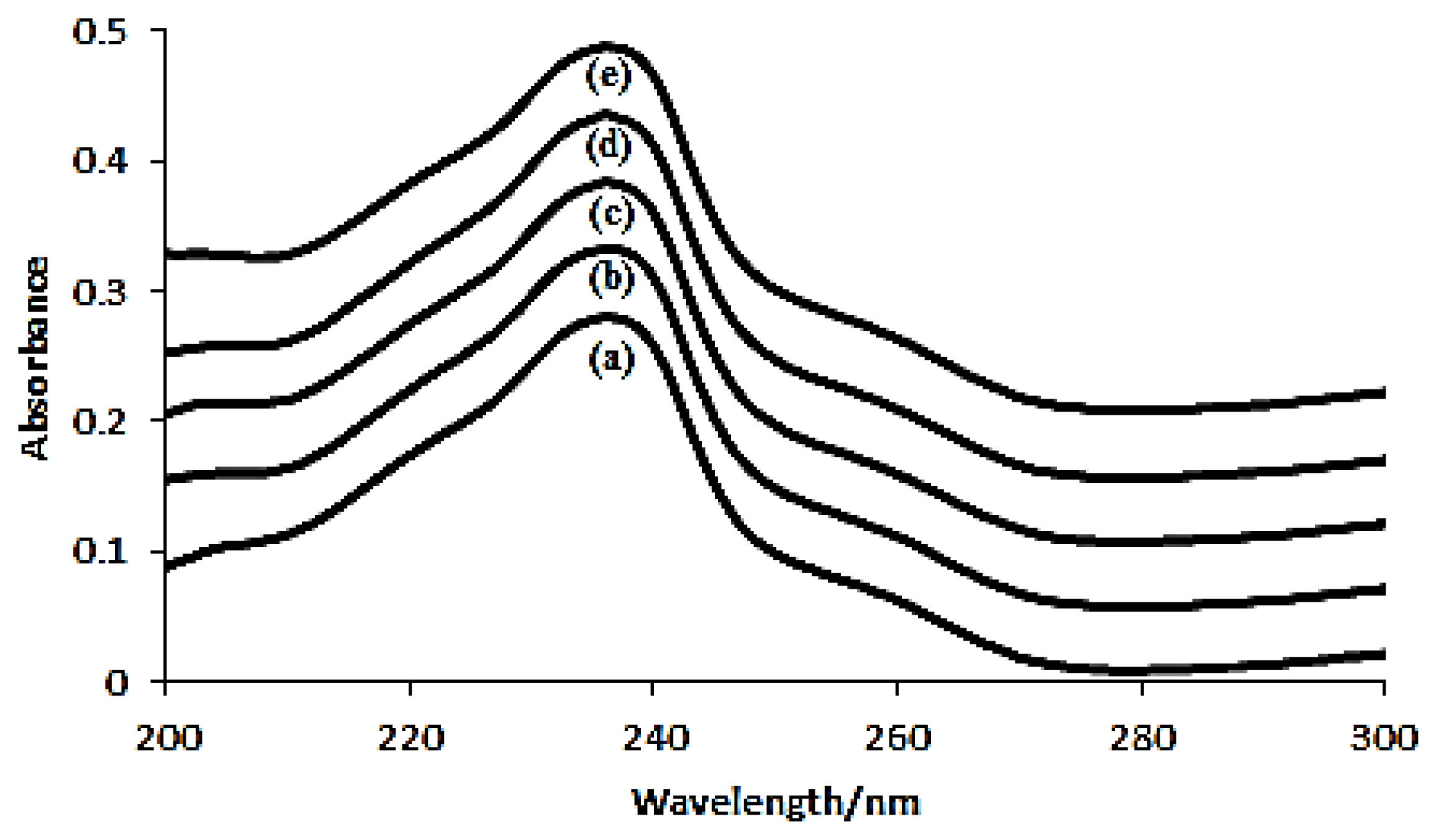
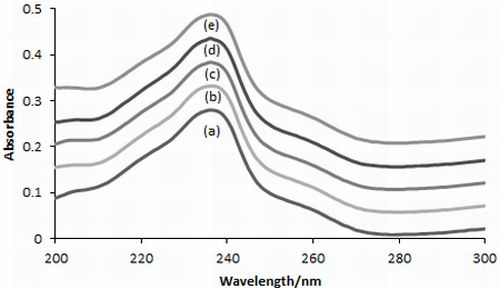
<p>To determine the apparent formation constant for the inclusion complex of azomethine and β-Cyd, the concentration of azomethine was held constant at 9 × 10<sup>−3</sup> M. Meanwhile concentrations of β-Cyd has been manipulated as 0 M, 3 × 10<sup>−5</sup> M, 4 × 10<sup>−5</sup> M, 5 × 10<sup>−5</sup> M and 6 × 10<sup>−5</sup> M. The absorbance of solutions were measured at 236 nm against a reagent blank which were prepared with identical reagent concentration but without azomethine. The absorption spectra of inclusion complex at different concentrations range of β-Cyd is shown in <xref ref-type="fig" rid="f6-ijms-14-03671">Figure 6</xref>.</p>
<p>It is observed that, the absorbance value increased with increasing β-Cyd concentration while the concentration of azomethine remains the same. It indicates the solubility of guest molecule (azomethine) increases upon forming the inclusion complex [<xref ref-type="bibr" rid="b33-ijms-14-03671">33</xref>]. Since the benzyl part of azomethine more likely to enter the hydrophobic cavity of β-Cyd, stoichiometric ratio of inclusion complex should be therotically 1:1. This theory can be proved if a linear relationship obtained from the reciprocal plot of 1/<italic>A vs.</italic> 1/[β-Cyd] based on the Hildebrand-Benesi <xref rid="FD1" ref-type="disp-formula">Equation 1</xref> [<xref ref-type="bibr" rid="b34-ijms-14-03671">34</xref>].</p>
<disp-formula id="FD1">
<label>(1)</label>
<mml:math id="mm1" display="block">
<mml:semantics id="sm1">
<mml:mrow>
<mml:mfrac>
<mml:mn>1</mml:mn>
<mml:mi>A</mml:mi></mml:mfrac>
<mml:mo>=</mml:mo>
<mml:mfrac>
<mml:mn>1</mml:mn>
<mml:mrow>
<mml:mi>ɛ</mml:mi>
<mml:msub>
<mml:mrow>
<mml:mrow>
<mml:mo stretchy="false">[</mml:mo>
<mml:mi>G</mml:mi>
<mml:mo stretchy="false">]</mml:mo></mml:mrow></mml:mrow>
<mml:mn>0</mml:mn></mml:msub>
<mml:mi>K</mml:mi>
<mml:mo stretchy="false">[</mml:mo>
<mml:mi>C</mml:mi>
<mml:mi>D</mml:mi>
<mml:mo stretchy="false">]</mml:mo></mml:mrow></mml:mfrac>
<mml:mo>+</mml:mo>
<mml:mfrac>
<mml:mn>1</mml:mn>
<mml:mrow>
<mml:mi>ɛ</mml:mi>
<mml:msub>
<mml:mrow>
<mml:mrow>
<mml:mo stretchy="false">[</mml:mo>
<mml:mi>G</mml:mi>
<mml:mo stretchy="false">]</mml:mo></mml:mrow></mml:mrow>
<mml:mn>0</mml:mn></mml:msub></mml:mrow></mml:mfrac></mml:mrow></mml:semantics></mml:math></disp-formula>
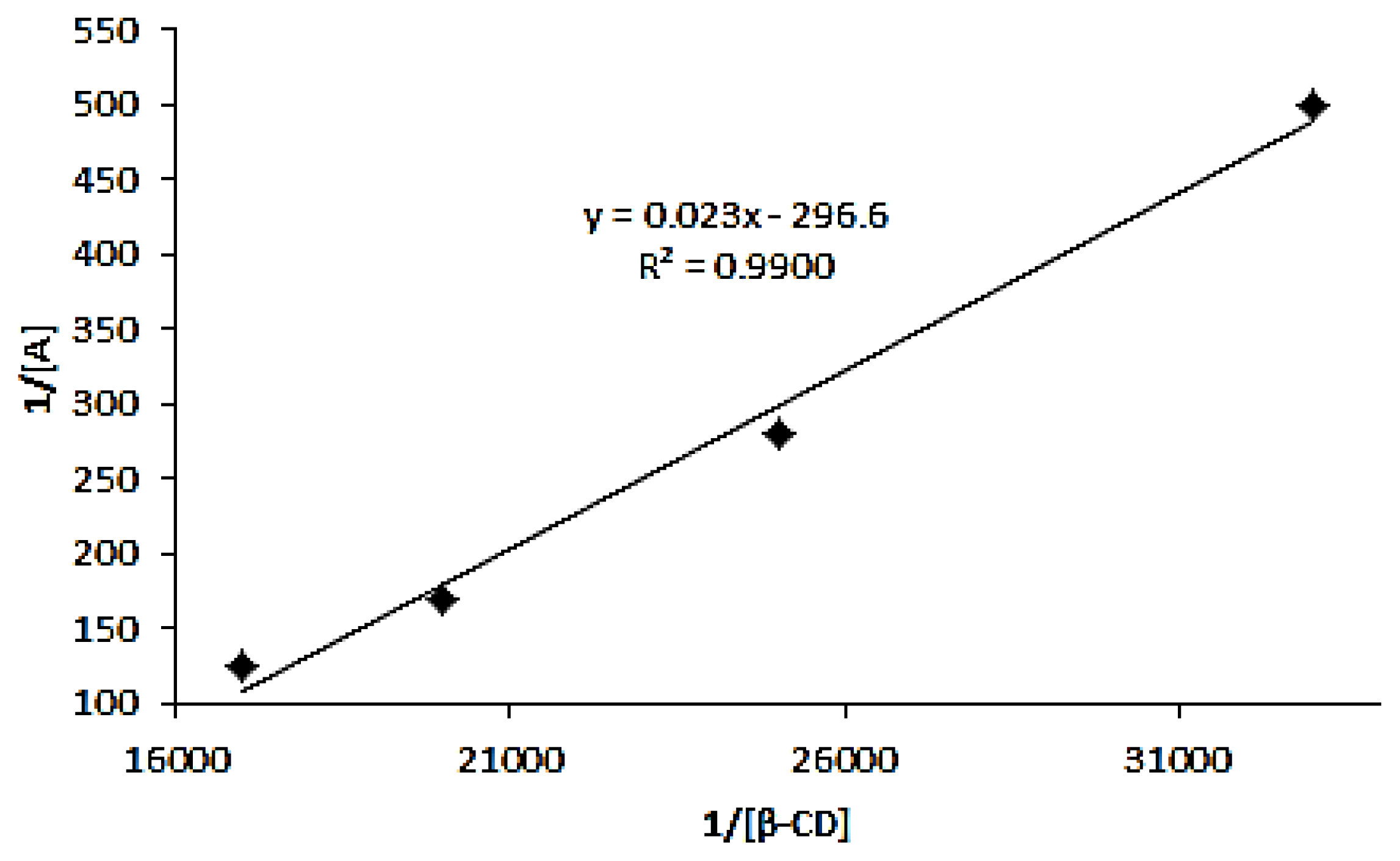
<p>where <italic>A</italic> is the absorbance for the azomethine solution at each β-Cyd concentration while [<italic>G</italic>]<sub>0</sub>, <italic>K</italic>, [<italic>CD</italic>], ɛ are the initial concentration of azomethine, apparent formation constant, the concentration of β-cyclodextrin and the molar absorptivity, respectively. <xref ref-type="fig" rid="f7-ijms-14-03671">Figure 7</xref> shows reciprocal plots that determine the stoichiometry ratio of the inclusion formation. A very good linear relationship was obtained for 1/<italic>A vs.</italic> 1/[β-Cyd] with <italic>R</italic><sup>2</sup> = 0.9900. This reciprocal plot clearly indicates the stoichiometry ratio for the inclusion formation between azomethine and β-Cyd is 1:1. The same phenomenon has been observed by Wang <italic>et al.</italic>[<xref ref-type="bibr" rid="b32-ijms-14-03671">32</xref>] by using a derivative of sulphonated azo compound like orange <italic>G</italic> to form inclusion complex with β-Cyd.</p>
<p>The apparent formation constant was determined based on the reciprocal plot from <xref ref-type="fig" rid="f7-ijms-14-03671">Figure 7</xref>. With correlation coefficient, <italic>R</italic><sup>2</sup> = 0.9900 and the apparent formation constant was 1.29 × 10<sup>4</sup> L/mol.</p></sec></sec></sec>
<sec>
<title>3. Experimental Section</title>
<sec>
<title>3.1. Reagents and Solutions</title>
<p>Azomethine (Sigma Aldrich, 95%) and β-cyclodextrin (Acros Organics, 99%) were used as received without further purification. Other chemicals such as DMSO, buffer solutions with pH 2, pH 7 and pH 12 were purchased from R &amp; M Chemicals and distilled water was used throughout the research.</p></sec>
<sec>
<title>3.2. Synthesis of the Inclusion Complex of β-Cyd and Azomethine</title>
<p>The inclusion complex of β-Cyd and azomethine was synthesized by using kneading method. Both compounds were mixed in 1:1 mol ratio and grinded thoroughly in a mortar for 30 min and ethanol has been added throughout the grinding process. The precipitate formed was left in oven for drying at temperature of 50 °C for 5 days. Then the precipitate was taken out from the mortar and placed in a vial and kept in a desiccator.</p>
<p>The physical mixture of β-Cyd and azomethine was prepared according to Wang <italic>et al.</italic>[<xref ref-type="bibr" rid="b35-ijms-14-03671">35</xref>], where, β-Cyd and azomethine were separately mixed in a mortar. Both compounds were weighted out at a molar ratio of 1:1 and were mixed together until a homogeneous mixture was formed.</p></sec>
<sec>
<title>3.3. Characterizations</title>
<p>Characterization measurements were done with <sup>1</sup>H NMR, FTIR and TGA. D<sub>2</sub>O was used as solvent for <sup>1</sup>H NMR (Lambda JEOL 400 Mhz, JEOL (Malaysia), Petaling Jaya, Malaysia) sample preparation. FTIR samples were prepared as KBr pellets, and its spectra determined by Perkin Elmer RX1 FT-IR spectrometer. The thermal analysis was studied by TGA (TA Instruments Q 500, Research Instruments Sdn Bhd, Petaling Jaya, Malaysia).</p></sec>
<sec>
<title>3.4. Spectroscopic Studies</title>
<p>A UV–Visible spectrophotometer (Shimadzu, Kuala Lumpur, Malaysia) with 1 cm quartz cells was used for all the following spectroscopic studies. Absorption spectra were determined between 190 nm and 400 nm.</p>
<sec>
<title>3.4.1. Effect of pH</title>
<p>Effect of pH for inclusion complex formed was determined by using three different pH buffers. Buffer solutions with pH 2, pH 7 and pH 12 have been used to determine the optimum pH. Subsequently the optimum pH has been used for the absorption spectra and the formation constant.</p></sec>
<sec>
<title>3.4.2. Absorption Spectra</title>
<p>Absorption spectra were recorded for β-Cyd, azomethine, the inclusion complex and physical mixture.</p></sec>
<sec>
<title>3.4.3. Formation Constant</title>
<p>The concentrations of β-Cyd were varied in the range of 0–0.0006 M while the concentration of azomethine was held constant at 9 × 10<sup>−3</sup> M. The data obtained were used to illustrate reciprocal plot for azomethine-β-cyclodextrin inclusion complex with 1/A <italic>vs.</italic> 1/[β-Cyd].</p></sec></sec></sec>
<sec sec-type="conclusions">
<title>4. Conclusions</title>
<p>A novel azomethine-β-Cydinclusion complex was successfully synthesized, and characterized using FTIR, <sup>1</sup>H NMR and TGA. Azomethine-β-Cydinclusion complex has performed 1:1 host-guest interaction at pH 7 with an apparent formation constant of 1.29 × 10<sup>4</sup> L/mol which was calculated by Hildebrand-Benesi equation.</p></sec></body>
<back>
<ack>
<title>Acknowledgments</title>
<p>The authors would like to thank University of Malaya for the University of Malaya Research Grant (RG169/12SUS and RG176-11AFR) High Impact Research–Ministry of Higher Education (HIR MoHE (faculty) F0004-21001) and MoHEscholarship for the financial supports.</p></ack>
<fn-group><fn id="fn1-ijms-14-03671">
<p><bold>Conflict of Interest</bold></p>
<p>The authors declare no conflict of interest.</p></fn></fn-group>
<ref-list>
<title>References</title>
<ref id="b1-ijms-14-03671"><label>1</label><citation citation-type="journal"><person-group person-group-type="author"><name><surname>Connors</surname><given-names>K.A.</given-names></name></person-group><article-title>The stability of cyclodextrin complexes in solution</article-title><source>Chem. Rev</source><year>1997</year><volume>97</volume><fpage>1325</fpage><lpage>1358</lpage><pub-id pub-id-type="doi">10.1021/cr960371r</pub-id><pub-id pub-id-type="pmid">11851454</pub-id></citation></ref>
<ref id="b2-ijms-14-03671"><label>2</label><citation citation-type="journal"><person-group person-group-type="author"><name><surname>Szejtli</surname><given-names>J.</given-names></name></person-group><article-title>Introduction and general overview of cyclodextrin chemistry</article-title><source>Chem. Rev</source><year>1998</year><volume>98</volume><fpage>1743</fpage><lpage>1753</lpage><pub-id pub-id-type="doi">10.1021/cr970022c</pub-id><pub-id pub-id-type="pmid">11848947</pub-id></citation></ref>
<ref id="b3-ijms-14-03671"><label>3</label><citation citation-type="journal"><person-group person-group-type="author"><name><surname>Lee</surname><given-names>C.-W.</given-names></name><name><surname>Kim</surname><given-names>S.-J.</given-names></name><name><surname>Youn</surname><given-names>Y-.S.</given-names></name><name><surname>Widjojokusumo</surname><given-names>E.</given-names></name><name><surname>Lee</surname><given-names>Y-H.</given-names></name><name><surname>Kim</surname><given-names>J.</given-names></name><name><surname>Lee</surname><given-names>Y-.W.</given-names></name><name><surname>Tjandrawinata</surname><given-names>R.R.</given-names></name></person-group><article-title>Preparation of bitter taste masked cetirizine dihydrochloride/β-cyclodextrin inclusion complex by supercritical antisolvent (SAS) process</article-title><source>J. Supercrit. Fluids</source><year>2010</year><volume>55</volume><fpage>348</fpage><lpage>357</lpage><pub-id pub-id-type="doi">10.1016/j.supflu.2010.05.028</pub-id></citation></ref>
<ref id="b4-ijms-14-03671"><label>4</label><citation citation-type="journal"><person-group person-group-type="author"><name><surname>Zhu</surname><given-names>X.</given-names></name><name><surname>Sun</surname><given-names>J.</given-names></name><name><surname>Wu</surname><given-names>J.</given-names></name></person-group><article-title>Study on the inclusion interactions of β-cyclodextrin and its derivative with dyes by spectrofluorimetry and its analytical application</article-title><source>Talanta</source><year>2007</year><volume>72</volume><fpage>237</fpage><lpage>242</lpage><pub-id pub-id-type="doi">10.1016/j.talanta.2006.10.016</pub-id><pub-id pub-id-type="pmid">19071608</pub-id></citation></ref>
<ref id="b5-ijms-14-03671"><label>5</label><citation citation-type="book"><person-group person-group-type="author"><name><surname>Nic</surname><given-names>M.</given-names></name><name><surname>Jirat</surname><given-names>J.</given-names></name><name><surname>Kosata</surname><given-names>B</given-names></name></person-group><source>IUPAC, Compendium of Chemical Terminology</source><publisher-name>Blackwell Scientific Publications</publisher-name><publisher-loc>Oxford, UK</publisher-loc><year>1997</year><pub-id pub-id-type="doi">10.1351/goldbook.A00564</pub-id></citation></ref>
<ref id="b6-ijms-14-03671"><label>6</label><citation citation-type="journal"><person-group person-group-type="author"><name><surname>Namkung</surname><given-names>M.J.</given-names></name><name><surname>Fletcher</surname><given-names>T.L.</given-names></name></person-group><article-title>Derivatives of 2-hydroxy-p-phenetidine. I. Azomethines</article-title><source>J. Med. Chem</source><year>1970</year><volume>13</volume><fpage>329</fpage><pub-id pub-id-type="pmid">5418523</pub-id></citation></ref>
<ref id="b7-ijms-14-03671"><label>7</label><citation citation-type="journal"><person-group person-group-type="author"><name><surname>Smith</surname><given-names>H.E.</given-names></name><name><surname>Chen</surname><given-names>F.-M.</given-names></name></person-group><article-title>Optically Active Amines 27. CNDO/S calculations on the azomethine and conjugated azomethine chromophores</article-title><source>J. Org. Chem.</source><year>1979</year><volume>44</volume><fpage>2775</fpage><lpage>2779</lpage><pub-id pub-id-type="doi">10.1021/jo01329a037</pub-id></citation></ref>
<ref id="b8-ijms-14-03671"><label>8</label><citation citation-type="journal"><person-group person-group-type="author"><name><surname>Morgan</surname><given-names>P.W.</given-names></name><name><surname>Kwolek</surname><given-names>S.L.</given-names></name><name><surname>Terry</surname><given-names>C.</given-names></name></person-group><article-title>Aromatic azomethine polymers and fibers</article-title><source>Macromolecules</source><year>1987</year><volume>20</volume><fpage>729</fpage><lpage>739</lpage><pub-id pub-id-type="doi">10.1021/ma00170a006</pub-id></citation></ref>
<ref id="b9-ijms-14-03671"><label>9</label><citation citation-type="journal"><person-group person-group-type="author"><name><surname>Catanescu</surname><given-names>O.</given-names></name><name><surname>Grigoras</surname><given-names>M.</given-names></name><name><surname>Colotin</surname><given-names>G.</given-names></name><name><surname>Dobreanu</surname><given-names>A.</given-names></name><name><surname>Hurduc</surname><given-names>N.</given-names></name><name><surname>Simionescu</surname><given-names>C.I.</given-names></name></person-group><article-title>Synthesis and characterization of some aliphatic-aromatic poly (Schiff base)s</article-title><source>Eur. Polym. J</source><year>2001</year><volume>37</volume><fpage>2213</fpage><lpage>2216</lpage><pub-id pub-id-type="doi">10.1016/S0014-3057(01)00119-7</pub-id></citation></ref>
<ref id="b10-ijms-14-03671"><label>10</label><citation citation-type="journal"><person-group person-group-type="author"><name><surname>Dutta</surname><given-names>P.K.</given-names></name><name><surname>Jain</surname><given-names>P.</given-names></name><name><surname>Sen</surname><given-names>P.</given-names></name><name><surname>Trivedi</surname><given-names>R.</given-names></name><name><surname>Sen</surname><given-names>P.K.</given-names></name><name><surname>Dutta</surname><given-names>J.</given-names></name></person-group><article-title>Synthesis and characterization of novel polyazomethine ether for NLO application</article-title><source>Eur. Polym. J</source><year>2003</year><volume>39</volume><fpage>1007</fpage><lpage>1011</lpage><pub-id pub-id-type="doi">10.1016/S0014-3057(02)00328-2</pub-id></citation></ref>
<ref id="b11-ijms-14-03671"><label>11</label><citation citation-type="journal"><person-group person-group-type="author"><name><surname>Ribera</surname><given-names>D.A.</given-names></name><name><surname>Manteco’n</surname><given-names>A.</given-names></name><name><surname>Serra</surname><given-names>A.</given-names></name></person-group><article-title>Synthesis and crosslinking of a series of dimeric liquid-crystalline diglycidylester compounds containing imine groups</article-title><source>J. Polym. Sci. A</source><year>2002</year><volume>40</volume><fpage>4344</fpage><lpage>4356</lpage><pub-id pub-id-type="doi">10.1002/pola.10510</pub-id></citation></ref>
<ref id="b12-ijms-14-03671"><label>12</label><citation citation-type="journal"><person-group person-group-type="author"><name><surname>Nepal</surname><given-names>D.</given-names></name><name><surname>Samal</surname><given-names>S.</given-names></name><name><surname>Geckeler</surname><given-names>K.E.</given-names></name></person-group><article-title>The first fullerene-terminated soluble poly(azomethine) rotaxene</article-title><source>Macromolecules</source><year>2003</year><volume>36</volume><fpage>3800</fpage><lpage>3802</lpage><pub-id pub-id-type="doi">10.1021/ma0258410</pub-id></citation></ref>
<ref id="b13-ijms-14-03671"><label>13</label><citation citation-type="journal"><person-group person-group-type="author"><name><surname>Tang</surname><given-names>B.</given-names></name><name><surname>Liu</surname><given-names>W.-L.</given-names></name><name><surname>Wang</surname><given-names>Y.</given-names></name><name><surname>Chen</surname><given-names>Z.-Z.</given-names></name></person-group><article-title>Studies on the supramolecular interaction between napropamide and β-cyclodextrin by spectrofluorimetry and its analytical application</article-title><source>Anal. Chim. Acta</source><year>2004</year><volume>509</volume><fpage>145</fpage><lpage>150</lpage><pub-id pub-id-type="doi">10.1016/j.aca.2003.12.037</pub-id></citation></ref>
<ref id="b14-ijms-14-03671"><label>14</label><citation citation-type="journal"><person-group person-group-type="author"><name><surname>Jiao</surname><given-names>H.</given-names></name><name><surname>Goh</surname><given-names>S.H.</given-names></name><name><surname>Valiyaveettil</surname><given-names>S.</given-names></name></person-group><article-title>Inclusion complexes of poly(neopentyl glycol sebacate) with cyclodextrins</article-title><source>Macromolecules</source><year>2011</year><volume>34</volume><fpage>8138</fpage><lpage>8142</lpage></citation></ref>
<ref id="b15-ijms-14-03671"><label>15</label><citation citation-type="journal"><person-group person-group-type="author"><name><surname>Li</surname><given-names>N.</given-names></name><name><surname>Liu</surname><given-names>J.</given-names></name><name><surname>Zhao</surname><given-names>X.</given-names></name><name><surname>Gao</surname><given-names>Y.</given-names></name><name><surname>Zhang</surname><given-names>L.</given-names></name><name><surname>Zhang</surname><given-names>J.</given-names></name><name><surname>Yu</surname><given-names>L.</given-names></name></person-group><article-title>Complex formation of ionic liquid surfactant and β-cyclodextrin</article-title><source>Colloids Surf. A</source><year>2007</year><volume>292</volume><fpage>196</fpage><lpage>201</lpage><pub-id pub-id-type="doi">10.1016/j.colsurfa.2006.06.023</pub-id></citation></ref>
<ref id="b16-ijms-14-03671"><label>16</label><citation citation-type="journal"><person-group person-group-type="author"><name><surname>Li</surname><given-names>W.</given-names></name><name><surname>Lu</surname><given-names>B.</given-names></name><name><surname>Sheng</surname><given-names>A.</given-names></name><name><surname>Yang</surname><given-names>F.</given-names></name><name><surname>Wang</surname><given-names>Z.</given-names></name></person-group><article-title>Spectroscopic and theoretical study on inclusion complexation of beta-cyclodextrin with permethrin</article-title><source>J. Mol. Struct</source><year>2010</year><volume>981</volume><fpage>194</fpage><lpage>203</lpage><pub-id pub-id-type="doi">10.1016/j.molstruc.2010.08.008</pub-id></citation></ref>
<ref id="b17-ijms-14-03671"><label>17</label><citation citation-type="journal"><person-group person-group-type="author"><name><surname>Li</surname><given-names>J.</given-names></name><name><surname>Ni</surname><given-names>X.</given-names></name><name><surname>Zhou</surname><given-names>Z.</given-names></name><name><surname>Leong</surname><given-names>K.W.</given-names></name></person-group><article-title>Preparation and characterization of polypseudorotaxanes based on block-selected inclusion complexation between poly(propylene oxide)-poly(ethylene oxide)-poly(propyleneoxide) triblock copolymers and α-cyclodextrin</article-title><source>J. Am. Chem. Soc</source><year>2003</year><volume>125</volume><fpage>1788</fpage><lpage>1795</lpage><pub-id pub-id-type="doi">10.1021/ja026623p</pub-id><pub-id pub-id-type="pmid">12580604</pub-id></citation></ref>
<ref id="b18-ijms-14-03671"><label>18</label><citation citation-type="journal"><person-group person-group-type="author"><name><surname>Rusa</surname><given-names>C.C.</given-names></name><name><surname>Luca</surname><given-names>C.</given-names></name><name><surname>Tonelli</surname><given-names>A.E.</given-names></name></person-group><article-title>Polymer-cyclodextrin inclusion compounds: Toward new aspects of their inclusion mechanism</article-title><source>Macromolecules</source><year>2001</year><volume>34</volume><fpage>1318</fpage><lpage>1322</lpage><pub-id pub-id-type="doi">10.1021/ma001868c</pub-id></citation></ref>
<ref id="b19-ijms-14-03671"><label>19</label><citation citation-type="journal"><person-group person-group-type="author"><name><surname>Tang</surname><given-names>B.</given-names></name><name><surname>Chen</surname><given-names>Z.-Z.</given-names></name><name><surname>Zhang</surname><given-names>N.</given-names></name><name><surname>Zhang</surname><given-names>J.</given-names></name><name><surname>Wang</surname><given-names>Y.</given-names></name></person-group><article-title>Synthesis and characterization of a novel cross-linking complex of β-cyclodextrin-o-vanilin furfaralhydrazone and highly selective spectrofluorimetric determination of trace gallium</article-title><source>Talanta</source><year>2006</year><volume>68</volume><fpage>575</fpage><lpage>580</lpage><pub-id pub-id-type="doi">10.1016/j.talanta.2005.04.070</pub-id><pub-id pub-id-type="pmid">18970359</pub-id></citation></ref>
<ref id="b20-ijms-14-03671"><label>20</label><citation citation-type="journal"><person-group person-group-type="author"><name><surname>Hamidi</surname><given-names>H.</given-names></name><name><surname>Abderrahim</surname><given-names>R.</given-names></name><name><surname>Meganem</surname><given-names>F.</given-names></name></person-group><article-title>Spectroscopic studies of inclusion complex of β-cyclodextrin and benzidine diammonium dipicrate</article-title><source>Spectrochim. Acta A</source><year>2010</year><volume>75</volume><fpage>32</fpage><lpage>36</lpage><pub-id pub-id-type="doi">10.1016/j.saa.2009.09.018</pub-id></citation></ref>
<ref id="b21-ijms-14-03671"><label>21</label><citation citation-type="journal"><person-group person-group-type="author"><name><surname>Djedaini</surname><given-names>F.</given-names></name><name><surname>Lin</surname><given-names>S.Z.</given-names></name><name><surname>Perly</surname><given-names>B.</given-names></name><name><surname>Wouessidjewe</surname><given-names>D.</given-names></name></person-group><article-title>High-field nuclear magnetic resonance techniques for the investigation of a β-cyclodextrin:indomethacin inclusion complex</article-title><source>J. Pharm. Sci</source><year>1990</year><volume>79</volume><fpage>643</fpage><lpage>646</lpage><pub-id pub-id-type="doi">10.1002/jps.2600790721</pub-id><pub-id pub-id-type="pmid">2398475</pub-id></citation></ref>
<ref id="b22-ijms-14-03671"><label>22</label><citation citation-type="journal"><person-group person-group-type="author"><name><surname>Fernandes</surname><given-names>C.M.</given-names></name><name><surname>Carvalho</surname><given-names>R.A.</given-names></name><name><surname>Pereira da Costa</surname><given-names>S.</given-names></name><name><surname>Veiga</surname><given-names>F.J.B.</given-names></name></person-group><article-title>Multimodal molecular encapsulation of nicardipine hydrochloride by β-cyclodextrin, hydroxypropyl-β-cyclodextrin and triacetyl-β-cyclodextrin in solution. Structural studies by <sup>1</sup>H NMR and ROESY experiments</article-title><source>Eur. J. Pharm. Sci</source><year>2003</year><volume>18</volume><fpage>285</fpage><lpage>296</lpage><pub-id pub-id-type="doi">10.1016/S0928-0987(03)00025-3</pub-id><pub-id pub-id-type="pmid">12694880</pub-id></citation></ref>
<ref id="b23-ijms-14-03671"><label>23</label><citation citation-type="journal"><person-group person-group-type="author"><name><surname>Youming</surname><given-names>Z.</given-names></name><name><surname>Xinrong</surname><given-names>D.</given-names></name><name><surname>Liangcheng</surname><given-names>W.</given-names></name><name><surname>Taibao</surname><given-names>W.</given-names></name></person-group><article-title>Synthesis and characterization of inclusion complexes of aliphatic-aromatic poly(Schiff base)s with β-cyclodextrin (highlight)</article-title><source>J. Incl. Phenom. Macrocycl. Chem</source><year>2008</year><volume>60</volume><fpage>313</fpage><lpage>319</lpage><pub-id pub-id-type="doi">10.1007/s10847-007-9379-z</pub-id></citation></ref>
<ref id="b24-ijms-14-03671"><label>24</label><citation citation-type="journal"><person-group person-group-type="author"><name><surname>Chen</surname><given-names>M.</given-names></name><name><surname>Diao</surname><given-names>G.</given-names></name><name><surname>Zhang</surname><given-names>E.</given-names></name></person-group><article-title>Study of inclusion complex of β-cyclodextrin and nitrobenzene</article-title><source>Chemosphere</source><year>2006</year><volume>63</volume><fpage>522</fpage><lpage>529</lpage><pub-id pub-id-type="doi">10.1016/j.chemosphere.2005.08.033</pub-id><pub-id pub-id-type="pmid">16324733</pub-id></citation></ref>
<ref id="b25-ijms-14-03671"><label>25</label><citation citation-type="journal"><person-group person-group-type="author"><name><surname>Harata</surname><given-names>K.</given-names></name></person-group><article-title>The structure of the cyclodextrin complex. IV. The crystal structure of α-cyclodextrin-sodium 1-propanesulfonate nonahydrate</article-title><source>Bull. Chem. Soc. Jpn</source><year>1977</year><volume>50</volume><fpage>1259</fpage><lpage>1266</lpage><pub-id pub-id-type="doi">10.1246/bcsj.50.1259</pub-id></citation></ref>
<ref id="b26-ijms-14-03671"><label>26</label><citation citation-type="journal"><person-group person-group-type="author"><name><surname>Saenger</surname><given-names>W.</given-names></name></person-group><article-title>Crystal packing patterns of cyclodextrin inclusion complexes</article-title><source>J. Incl. Phenom. Macrocycl. Chem</source><year>1984</year><volume>2</volume><fpage>445</fpage><lpage>454</lpage><pub-id pub-id-type="doi">10.1007/BF00662211</pub-id></citation></ref>
<ref id="b27-ijms-14-03671"><label>27</label><citation citation-type="journal"><person-group person-group-type="author"><name><surname>Wang</surname><given-names>J.</given-names></name><name><surname>Cao</surname><given-names>Y.</given-names></name><name><surname>Sun</surname><given-names>B.</given-names></name><name><surname>Wang</surname><given-names>C.</given-names></name></person-group><article-title>Physicochemical and release characterization of garlic oil-β-cyclodextrin inclusion complexes</article-title><source>Food Chem</source><year>2011</year><volume>127</volume><fpage>1680</fpage><lpage>1685</lpage><pub-id pub-id-type="doi">10.1016/j.foodchem.2011.02.036</pub-id></citation></ref>
<ref id="b28-ijms-14-03671"><label>28</label><citation citation-type="journal"><person-group person-group-type="author"><name><surname>Fernandes</surname><given-names>J.A.</given-names></name><name><surname>Lima</surname><given-names>S.</given-names></name><name><surname>Braga</surname><given-names>S.S.</given-names></name><name><surname>Claro</surname><given-names>P.R.</given-names></name><name><surname>Borges</surname><given-names>J.E.R.</given-names></name><name><surname>Teixeira</surname><given-names>C.</given-names></name><name><surname>Pilinger</surname><given-names>M.</given-names></name><name><surname>Dias</surname><given-names>J.C.C.T.</given-names></name><name><surname>Goncalves</surname><given-names>I.S.</given-names></name></person-group><article-title>Inclusion Complex formation of diferrocenyldimethylsilane with β-cyclodextrin</article-title><source>J. Organomet Chem</source><year>2005</year><volume>690</volume><fpage>4801</fpage><lpage>4808</lpage><pub-id pub-id-type="doi">10.1016/j.jorganchem.2005.07.073</pub-id></citation></ref>
<ref id="b29-ijms-14-03671"><label>29</label><citation citation-type="journal"><person-group person-group-type="author"><name><surname>Salustio</surname><given-names>P.J.</given-names></name><name><surname>Feio</surname><given-names>G.</given-names></name><name><surname>Figueirinhas</surname><given-names>J.L.</given-names></name><name><surname>Pinto</surname><given-names>J.F.</given-names></name><name><surname>Marques</surname><given-names>H.M.C.</given-names></name></person-group><article-title>The influence of the preparation methods on the inclusion of model drugs in a β-cyclodextrin cavity</article-title><source>Eur. J. Pharm. Biopharm</source><year>2009</year><volume>71</volume><fpage>377</fpage><lpage>386</lpage><pub-id pub-id-type="doi">10.1016/j.ejpb.2008.09.027</pub-id><pub-id pub-id-type="pmid">18977436</pub-id></citation></ref>
<ref id="b30-ijms-14-03671"><label>30</label><citation citation-type="journal"><person-group person-group-type="author"><name><surname>Cesla</surname><given-names>P.</given-names></name><name><surname>Fischer</surname><given-names>J.</given-names></name><name><surname>Tesarova</surname><given-names>E.</given-names></name><name><surname>Jandera</surname><given-names>P.</given-names></name><name><surname>Stanek</surname><given-names>V.</given-names></name></person-group><article-title>Effects of capillary coating and β-cyclodextrin additive to the background electrolyte on separation of sulphonated azodyes by capillary zone electrophoresis</article-title><source>J. Chromatogr. A</source><year>2007</year><volume>1149</volume><fpage>358</fpage><lpage>367</lpage><pub-id pub-id-type="doi">10.1016/j.chroma.2007.02.113</pub-id><pub-id pub-id-type="pmid">17416382</pub-id></citation></ref>
<ref id="b31-ijms-14-03671"><label>31</label><citation citation-type="journal"><person-group person-group-type="author"><name><surname>Li</surname><given-names>N.</given-names></name><name><surname>Zang</surname><given-names>Y.-H.</given-names></name><name><surname>Wu</surname><given-names>Y.-N.</given-names></name><name><surname>Xiong</surname><given-names>X.-L.</given-names></name><name><surname>Zhang</surname><given-names>Y.-H.</given-names></name></person-group><article-title>Inclusion complex of trimethoprim with β-cyclodextrin</article-title><source>J. Pharmaceut. Biomed</source><year>2005</year><volume>39</volume><fpage>824</fpage><lpage>829</lpage><pub-id pub-id-type="doi">10.1016/j.jpba.2005.05.011</pub-id></citation></ref>
<ref id="b32-ijms-14-03671"><label>32</label><citation citation-type="journal"><person-group person-group-type="author"><name><surname>Wang</surname><given-names>H.Y.</given-names></name><name><surname>Han</surname><given-names>J.</given-names></name><name><surname>Feng</surname><given-names>X.G.</given-names></name></person-group><article-title>Spectroscopic study of orange G-β-cyclodextrin complex and its analytical application</article-title><source>Spectrochim. Acta A</source><year>2007</year><volume>66</volume><fpage>578</fpage><lpage>585</lpage><pub-id pub-id-type="doi">10.1016/j.saa.2006.03.035</pub-id></citation></ref>
<ref id="b33-ijms-14-03671"><label>33</label><citation citation-type="journal"><person-group person-group-type="author"><name><surname>Jiang</surname><given-names>H.</given-names></name><name><surname>Li</surname><given-names>D.</given-names></name><name><surname>Shanshan</surname><given-names>Y.</given-names></name></person-group><article-title>Synthesis and characterization of β-cyclodextrin inclusion complex containing di(8-hydroxyquinoline)magnesium</article-title><source>Spectrochim. Acta A</source><year>2008</year><volume>70</volume><fpage>878</fpage><lpage>883</lpage><pub-id pub-id-type="doi">10.1016/j.saa.2007.10.004</pub-id></citation></ref>
<ref id="b34-ijms-14-03671"><label>34</label><citation citation-type="book"><person-group person-group-type="author"><name><surname>Davies</surname><given-names>J.E.D.</given-names></name><name><surname>Ripmeester</surname><given-names>J.A.</given-names></name></person-group><source>Physical Methods in Supramolecular Chemistry</source><person-group person-group-type="editor"><name><surname>Atwood</surname><given-names>J.L.</given-names></name><name><surname>Lehn</surname><given-names>J.-M.</given-names></name></person-group><publisher-name>Pergamon Press</publisher-name><publisher-loc>Oxford, UK</publisher-loc><year>1996</year><fpage>426</fpage></citation></ref>
<ref id="b35-ijms-14-03671"><label>35</label><citation citation-type="journal"><person-group person-group-type="author"><name><surname>Wang</surname><given-names>J.</given-names></name><name><surname>Cao</surname><given-names>Y.</given-names></name><name><surname>Sun</surname><given-names>B.</given-names></name><name><surname>Wang</surname><given-names>C.</given-names></name></person-group><article-title>Characterisation of inclusion complex of <italic>trans</italic>-ferulic acid and hydroxypropyl-β-cyclodextrin</article-title><source>Food Chem</source><year>2011</year><volume>124</volume><fpage>1069</fpage><lpage>1075</lpage><pub-id pub-id-type="doi">10.1016/j.foodchem.2010.07.080</pub-id></citation></ref></ref-list>
<sec sec-type="display-objects">
<title>Figures and Tables</title>
<fig id="f1-ijms-14-03671" position="float">
<label>Figure 1</label>
<caption>
<p>Chemical structure azomethine.</p></caption>
<graphic xlink:href="ijms-14-03671f1.gif"/></fig>
<fig id="f2-ijms-14-03671" position="float">
<label>Figure 2</label>
<caption>
<p>The Fourier transform-infrared (FTIR) spectra of (<bold>a</bold>) β-cyclodextrin; (<bold>b</bold>) azomethine; and (<bold>c</bold>) physical mixture of azomethine and β-Cyd; (<bold>d</bold>) inclusion complex of azomethine-β-Cyd.</p></caption>
<graphic xlink:href="ijms-14-03671f2.gif"/></fig>
<fig id="f3-ijms-14-03671" position="float">
<label>Figure 3</label>
<caption>
<p><sup>1</sup>H NMR spectra of (<bold>a</bold>) β-Cyd and (<bold>b</bold>) inclusion complex.</p></caption>
<graphic xlink:href="ijms-14-03671f3.gif"/></fig>
<fig id="f4-ijms-14-03671" position="float">
<label>Figure 4</label>
<caption>
<p>TGA for (<bold>a</bold>) β-cyclodextrin; (<bold>b</bold>) azomethine; (<bold>c</bold>) inclusion complex; (<bold>d</bold>) physical mixture.</p></caption>
<graphic xlink:href="ijms-14-03671f4.gif"/></fig>
<fig id="f5-ijms-14-03671" position="float">
<label>Figure 5</label>
<caption>
<p>Absorption spectra of (<bold>a</bold>) β-Cyd; (<bold>b</bold>) azomethine; (<bold>c</bold>) physical mixture and (<bold>d</bold>) inclusion complex.</p></caption>
<graphic xlink:href="ijms-14-03671f5.gif"/></fig>
<fig id="f6-ijms-14-03671" position="float">
<label>Figure 6</label>
<caption>
<p>Absorption spectra of azomethine with various concentration of β-Cyd. (<bold>a</bold>) 0 M, (<bold>b</bold>) 3 × 10<sup>−5</sup> M, (<bold>c</bold>) 4 × 10<sup>−5</sup> M, (<bold>d</bold>) 5 × 10<sup>−5</sup>M, (<bold>e</bold>) 6 × 10<sup>−5</sup> M.</p></caption>
<graphic xlink:href="ijms-14-03671f6.gif"/></fig>
<fig id="f7-ijms-14-03671" position="float">
<label>Figure 7</label>
<caption>
<p>Reciprocal plot for 1/A against 1/[β-Cyd] of azomethine-β-Cyd inclusion complex.</p></caption>
<graphic xlink:href="ijms-14-03671f7.gif"/></fig>
<table-wrap id="t1-ijms-14-03671" position="float">
<label>Table 1</label>
<caption>
<p>Comparison between the intensity of β-Cyd and the inclusion complex.</p></caption>
<table frame="hsides" rules="groups">
<thead>
<tr>
<th align="center" valign="middle" rowspan="3">Functional Group</th>
<th colspan="2" align="center" valign="middle">Wavenumber (cm<sup>−1</sup>)</th>
<th align="center" valign="middle" rowspan="3">Changes Δδ</th></tr>
<tr>
<th colspan="2" align="left" valign="middle">
<hr/></th></tr>
<tr>
<th align="center" valign="middle">β-Cyd</th>
<th align="center" valign="middle">Inclusion complex</th></tr></thead>
<tbody>
<tr>
<td align="center" valign="middle">ν[OH] symmetric and antisymmetric</td>
<td align="center" valign="middle">3370.72</td>
<td align="center" valign="middle">3379.88</td>
<td align="center" valign="middle">+9.16</td></tr>
<tr>
<td align="center" valign="middle">ν[CH<sub>2</sub>]</td>
<td align="center" valign="middle">2928.53</td>
<td align="center" valign="middle">2923.12</td>
<td align="center" valign="middle">−5.53</td></tr>
<tr>
<td align="center" valign="middle">ν[C–C]</td>
<td align="center" valign="middle">1157.84</td>
<td align="center" valign="middle">1157.66</td>
<td align="center" valign="middle">−0.18</td></tr>
<tr>
<td align="center" valign="middle">ν[O–H] bending vibration</td>
<td align="center" valign="middle">1029.24</td>
<td align="center" valign="middle">1079.36</td>
<td align="center" valign="middle">+50.12</td></tr></tbody></table></table-wrap>
<table-wrap id="t2-ijms-14-03671" position="float">
<label>Table 2</label>
<caption>
<p>Comparison between the intensity of azomethine and the inclusion complex.</p></caption>
<table frame="hsides" rules="groups">
<thead>
<tr>
<th align="center" valign="middle" rowspan="3">Functional Group</th>
<th colspan="2" align="center" valign="middle">Wavenumber (cm<sup>−1</sup>)</th>
<th align="center" valign="middle" rowspan="3">Changes Δδ</th></tr>
<tr>
<th colspan="2" align="left" valign="middle">
<hr/></th></tr>
<tr>
<th align="center" valign="middle">Azomethine</th>
<th align="center" valign="middle">Inclusion complex</th></tr></thead>
<tbody>
<tr>
<td align="center" valign="middle">ν[OH]</td>
<td align="center" valign="middle">3449.28</td>
<td align="center" valign="middle">3379.88</td>
<td align="center" valign="middle">−69.4</td></tr>
<tr>
<td align="center" valign="middle">ν[C=N] stretching vibration</td>
<td align="center" valign="middle">1608.52</td>
<td align="center" valign="middle">1639.04</td>
<td align="center" valign="middle">+30.52</td></tr>
<tr>
<td align="center" valign="middle">ν[=C–H]</td>
<td align="center" valign="middle">681.39</td>
<td align="center" valign="middle">760.28</td>
<td align="center" valign="middle">+78.89</td></tr></tbody></table></table-wrap>
<table-wrap id="t3-ijms-14-03671" position="float">
<label>Table 3</label>
<caption>
<p>Chemical shifts (ppm) for the protons of β-cyclodextrin and inclusion complex.</p></caption>
<table frame="hsides" rules="groups">
<thead>
<tr>
<th colspan="7" align="center" valign="middle">
<graphic xlink:href="ijms-14-03671f8.gif"/></th></tr>
<tr>
<th colspan="7" align="left" valign="middle">
<hr/></th></tr>
<tr>
<th align="center" valign="middle"/>
<th align="center" valign="middle">H1</th>
<th align="center" valign="middle">H2</th>
<th align="center" valign="middle">H3</th>
<th align="center" valign="middle">H4</th>
<th align="center" valign="middle">H5</th>
<th align="center" valign="middle">H6</th></tr></thead>
<tbody>
<tr>
<td align="center" valign="top">β-Cyd 5.0642</td>
<td align="center" valign="top">3.6309</td>
<td align="center" valign="top">3.9616</td>
<td align="center" valign="top">3.5833</td>
<td align="center" valign="top">3.6650</td>
<td align="center" valign="top">3.9616</td>
<td align="center" valign="top"/></tr>
<tr>
<td align="center" valign="top">Inclusion complex</td>
<td align="center" valign="top">5.0300</td>
<td align="center" valign="top">3.4400</td>
<td align="center" valign="top">3.6800</td>
<td align="center" valign="top">3.4000</td>
<td align="center" valign="top">3.3900</td>
<td align="center" valign="top">3.7700</td></tr>
<tr>
<td align="center" valign="top">Δδ</td>
<td align="center" valign="top">0.0342</td>
<td align="center" valign="top">0.1909</td>
<td align="center" valign="top"><bold>0.2816</bold></td>
<td align="center" valign="top">0.1833</td>
<td align="center" valign="top"><bold>0.2750</bold></td>
<td align="center" valign="top">0.1916</td></tr></tbody></table></table-wrap></sec></back></article>