<?xml version="1.0" encoding="UTF-8"?>
<!DOCTYPE article PUBLIC "-//NLM//DTD Journal Publishing DTD v2.3 20070202//EN" "journalpublishing.dtd">
<article xmlns:mml="http://www.w3.org/1998/Math/MathML" xmlns:xlink="http://www.w3.org/1999/xlink" xml:lang="en" article-type="research-article">
<front>
<journal-meta>
<journal-id journal-id-type="publisher-id">ijms</journal-id>
<journal-title>International Journal of Molecular Sciences</journal-title>
<abbrev-journal-title>Int. J. Mol. Sci.</abbrev-journal-title>
<issn pub-type="epub">1422-0067</issn>
<publisher>
<publisher-name>Molecular Diversity Preservation International (MDPI)</publisher-name></publisher></journal-meta>
<article-meta>
<article-id pub-id-type="doi">10.3390/ijms14010818</article-id>
<article-id pub-id-type="publisher-id">ijms-14-00818</article-id>
<article-categories>
<subj-group>
<subject>Articles</subject></subj-group></article-categories>
<title-group>
<article-title>Ameliorating Effects of Exogenously Applied Proline on Seed Composition, Seed Oil Quality and Oil Antioxidant Activity of Maize (<italic>Zea mays</italic> L.) under Drought Stress</article-title></title-group>
<contrib-group>
<contrib contrib-type="author">
<name><surname>Ali</surname><given-names>Qasim</given-names></name><xref ref-type="aff" rid="af1-ijms-14-00818">1</xref></contrib>
<contrib contrib-type="author">
<name><surname>Anwar</surname><given-names>Farooq</given-names></name><xref ref-type="aff" rid="af2-ijms-14-00818">2</xref><xref ref-type="corresp" rid="c1-ijms-14-00818">*</xref></contrib>
<contrib contrib-type="author">
<name><surname>Ashraf</surname><given-names>Muhammad</given-names></name><xref ref-type="aff" rid="af3-ijms-14-00818">3</xref></contrib>
<contrib contrib-type="author">
<name><surname>Saari</surname><given-names>Nazamid</given-names></name><xref ref-type="aff" rid="af4-ijms-14-00818">4</xref><xref ref-type="corresp" rid="c1-ijms-14-00818">*</xref></contrib>
<contrib contrib-type="author">
<name><surname>Perveen</surname><given-names>Rashida</given-names></name><xref ref-type="aff" rid="af5-ijms-14-00818">5</xref></contrib></contrib-group>
<aff id="af1-ijms-14-00818">
<label>1</label>Department of Botany, Government College University, Faisalabad-38040, Pakistan</aff>
<aff id="af2-ijms-14-00818">
<label>2</label>Department of Chemistry, University of Sargodha, Sargodha-40100, Pakistan</aff>
<aff id="af3-ijms-14-00818">
<label>3</label>Department of Botany, University of Agriculture, Faisalabad-38040, Pakistan</aff>
<aff id="af4-ijms-14-00818">
<label>4</label>Faculty of Food Science and Technology, Universiti Putra Malaysia, UPM-43400 Serdang, Selangor, Malaysia</aff>
<aff id="af5-ijms-14-00818">
<label>5</label>Department of Physics, University of Agriculture, Faisalabad-38040, Pakistan</aff>
<author-notes>
<corresp id="c1-ijms-14-00818">
<label>*</label>Authors to whom correspondence should be addressed; E-Mails: <email>fqanwar@yahoo.com</email> (F.A.); <email>nazamid@putra.upm.edu.my</email> (N.S.); Tel.: +92-48-9230546 (F.A.); +60-3-89468385(N.S.); Fax: +92-48-3222121 (F.A.); +60-3-8942552(N.S.).</corresp></author-notes>
<pub-date pub-type="collection">
<year>2013</year></pub-date>
<pub-date pub-type="epub">
<day>04</day>
<month>01</month>
<year>2013</year></pub-date>
<volume>14</volume>
<issue>1</issue>
<fpage>818</fpage>
<lpage>835</lpage>
<history>
<date date-type="received">
<day>20</day>
<month>09</month>
<year>2012</year></date>
<date date-type="rev-recd">
<day>10</day>
<month>11</month>
<year>2012</year></date>
<date date-type="accepted">
<day>19</day>
<month>12</month>
<year>2012</year></date></history>
<permissions>
<copyright-statement>© 2013 by the authors; licensee Molecular Diversity Preservation International, Basel, Switzerland.</copyright-statement>
<copyright-year>2013</copyright-year>
<license license-type="open-access" xlink:href="http://creativecommons.org/licenses/by/3.0">
<p>This article is an open-access article distributed under the terms and conditions of the Creative Commons Attribution license (http://creativecommons.org/licenses/by/3.0/).</p></license></permissions>
<abstract>
<p>This study was carried out to appraise whether or not the exogenous application of a potential osmoprotectant, proline, could ameliorate the adverse effects of drought stress on maize seed and seed oil composition, as well as oil antioxidant activity. Water stress reduced the kernel sugar, oil, protein and moisture contents and most of the seed macro- and micro-elements analyzed in both maize cultivars but it increased the contents of seed fiber and ash. Water stress increased the oil oleic acid content with a subsequent decrease in the amount of linoleic acid, resulting in an increased oil oleic/linoleic ratio for both maize cultivars. However, no variation was observed in oil stearic and palmitic acids content due to water stress. A considerable drought induced an increase in seed oil α-, γ-, δ- and total tocopherols and flavonoids were observed in both maize cultivars. However, oil phenolic and carotenoid content as well as 1,1-diphenyl-2-picryl-hydrazyl (DPPH) free radical scavenging activity decreased. Foliar-applied proline significantly increased the content of seed sugar, oil, protein, moisture, fiber and ash in both maize cultivars under well irrigated and water deficit conditions. Furthermore, exogenous application of proline increased the oil oleic and linoleic acid contents. The concentrations of antioxidant compounds namely phenolics, carotenoids, flavonoids and tocopherols estimated in the seed oil increased due to foliar-applied proline under water deficit conditions that was positively correlated with the enhanced oil DPPH free radical scavenging activity. Moreover, the increase in the contents of these antioxidant compounds and oil antioxidant activity due to the foliar application of proline was noted to be more pronounced under water deficit conditions.</p></abstract>
<kwd-group>
<kwd>seed composition</kwd>
<kwd>oil attributes</kwd>
<kwd>fatty acids</kwd>
<kwd>antioxidant activity</kwd>
<kwd>lipophilic minor components</kwd></kwd-group></article-meta></front>
<body>
<sec sec-type="intro">
<title>1. Introduction</title>
<p>It is now well known that different environmental factors not only influence the growth and productivity but also significantly affect the nutrients profile of oil-seed crops [ <xref ref-type="bibr" rid="b1-ijms-14-00818">1</xref>]. Of the different unfavorable environmental conditions, a shortage of water is considered to be one of the most important factors that can alter the yield and quality of seeds as well as the physicochemical attributes of the related oils in the oil-seed crops [ <xref ref-type="bibr" rid="b2-ijms-14-00818">2</xref>, <xref ref-type="bibr" rid="b3-ijms-14-00818">3</xref>].</p>
<p>A large proportion of world food demand is fulfilled by cereal crops [ <xref ref-type="bibr" rid="b4-ijms-14-00818">4</xref>]. Cereal grains are predominantly composed of carbohydrates, mostly in the form of starch, along with considerable amounts of protein and lipids, vitamins, and minerals [ <xref ref-type="bibr" rid="b5-ijms-14-00818">5</xref>, <xref ref-type="bibr" rid="b6-ijms-14-00818">6</xref>]. Among different cultivated economically important cereal crops, maize (<italic>Zea mays</italic> L.) not only has sufficient amount of carotenoids, tocopherols and oil, but also has significant contents of starch and protein compared with other major food crops such as rice and wheat. Although maize is principally cultivated for carbohydrate production, in the past several years, it has gained great significance as a source of vegetable oil for the food industry.</p>
<p>Among the common edible oils, maize oil is considered the best due to its large amount of unsaturated fatty acids (oleic and linoleic acids), which are in the range from 65% to 85% depending upon the type of cultivar and the environmental conditions to which a cultivar is exposed [ <xref ref-type="bibr" rid="b6-ijms-14-00818">6</xref>, <xref ref-type="bibr" rid="b7-ijms-14-00818">7</xref>]. The oil is also a rich source of secondary metabolic antioxidant compounds, such as phenolics, flavonoids, carotenoids and tocopherols [ <xref ref-type="bibr" rid="b3-ijms-14-00818">3</xref>, <xref ref-type="bibr" rid="b6-ijms-14-00818">6</xref>]. These compounds have a significant role in oil oxidative stability. Although these compounds are considered as non-nutritive, their antioxidative and bioactive properties have made them indispensable for human health [ <xref ref-type="bibr" rid="b7-ijms-14-00818">7</xref>]. They possess multiple biological effects such as anti-artherogenic, anti-inflammatory, antiallergenic, antimicrobial, antithrombotic and cardioprotective [ <xref ref-type="bibr" rid="b8-ijms-14-00818">8</xref>].</p>
<p>Various organic compatible solutes that effectively take part in plant stress tolerance include proline (PRO), glycine betaine (GB), trehalose (Tre) and several others [ <xref ref-type="bibr" rid="b6-ijms-14-00818">6</xref>, <xref ref-type="bibr" rid="b9-ijms-14-00818">9</xref>–<xref ref-type="bibr" rid="b11-ijms-14-00818">11</xref>]. Of these organic osmolytes, proline (an imino acid) is also found widely in plants and accumulates in large quantities in response to environmental stresses such as drought, salinity, extreme of temperature, <italic>etc</italic>. [ <xref ref-type="bibr" rid="b12-ijms-14-00818">12</xref>–<xref ref-type="bibr" rid="b15-ijms-14-00818">15</xref>]. It actively takes part in plant osmotic adjustment under stressful environmental conditions [ <xref ref-type="bibr" rid="b16-ijms-14-00818">16</xref>]. In addition to its role as an osmolyte for osmotic adjustment, it actively takes part to stabilize sub-cellular structures, biological membranes, proteins, and scavenge free radicals. It also plays a vital role in buffering cellular redox potential under stressful environmental conditions. Normally, proline accumulation in plants, is in response to drought or salinity stress occurs in the cytosol where it contributes substantially to the cytoplasmic osmotic adjustment [ <xref ref-type="bibr" rid="b15-ijms-14-00818">15</xref>–<xref ref-type="bibr" rid="b17-ijms-14-00818">17</xref>].</p>
<p>There are many reports that depict that exogenous application of proline as foliar spray can play an important role in enhancing plant tolerance against abiotic stresses. This ameliorationg effect of exogenously applied proline can be in the form of either osmoprotection [ <xref ref-type="bibr" rid="b18-ijms-14-00818">18</xref>, <xref ref-type="bibr" rid="b19-ijms-14-00818">19</xref>] or cryoprotection or protection against reactive oxygen species [ <xref ref-type="bibr" rid="b20-ijms-14-00818">20</xref>, <xref ref-type="bibr" rid="b21-ijms-14-00818">21</xref>]. For example, in various plant species growing under stress conditions, exogenously supplied proline provided osmoprotection and facilitated plant growth [<xref ref-type="bibr" rid="b9-ijms-14-00818">9</xref>, <xref ref-type="bibr" rid="b19-ijms-14-00818">19</xref>, <xref ref-type="bibr" rid="b22-ijms-14-00818">22</xref>, <xref ref-type="bibr" rid="b23-ijms-14-00818">23</xref>]. Proline can also protect cellular and subcellular membranes from oxidative stress by enhancing the activities of various antioxidant enzymes including superoxide dismutase (SOD), peroxidase (POD) and catalase (CAT) [ <xref ref-type="bibr" rid="b24-ijms-14-00818">24</xref>, <xref ref-type="bibr" rid="b25-ijms-14-00818">25</xref>]. Such protective effects of exogenously applied proline were indicated to be due to plasma membrane stabilization [ <xref ref-type="bibr" rid="b26-ijms-14-00818">26</xref>,<xref ref-type="bibr" rid="b27-ijms-14-00818">27</xref>]. Although exogenous application of proline as foliar spray has been employed to enhance stress tolerance in a number of crops [ <xref ref-type="bibr" rid="b19-ijms-14-00818">19</xref>, <xref ref-type="bibr" rid="b23-ijms-14-00818">23</xref>], very little information is available in the literature on the effects of foliar application of this osmolyte in altering the seed composition, levels of different fatty acids, tocopherols, carotenoids, phenolics and flavonoids particularly in the seed oil of maize. In view of this, it was hypothesized that exogenous application of proline as foliar spray improves the seed composition in terms of quantity as well as quality of seed oil in maize grown under water deficit conditions. Thus, the premier objective of conducting the present study was to assess up to what extent exogenous application of proline could alter seed composition, oil yield, and fatty acids, tocopherols, antioxidants and physico-chemical attributes of the seed oil derived from maize plants grown under water deficit conditions.</p></sec>
<sec sec-type="results|discussion">
<title>2. Results and Discussion</title>
<p>Grain yield and its quality are governed by a number of factors particularly the duration and rate of grain filling [ <xref ref-type="bibr" rid="b28-ijms-14-00818">28</xref>] and availability of assimilates, that are negatively influenced under water deficit conditions [ <xref ref-type="bibr" rid="b1-ijms-14-00818">1</xref>–<xref ref-type="bibr" rid="b3-ijms-14-00818">3</xref>, <xref ref-type="bibr" rid="b6-ijms-14-00818">6</xref>, <xref ref-type="bibr" rid="b29-ijms-14-00818">29</xref>]. The maize seed proximate analysis in the present study depicted that imposition of drought stress reduced the seed sugar, oil, protein and moisture content and increased the fiber and ash contents of the two maize cultivars. However, seed starch contents remained un-affected due to water stress. Exogenous application of proline as foliar spray significantly increased the seed oil, protein, moisture, fiber and ash contents in both the cultivars under water stress and non-stress conditions showing the ameliorating effects of exogenously applied proline on seed proximate composition (<xref ref-type="table" rid="t1-ijms-14-00818">Table 1</xref>). Furthermore, this enhancement in the seed proximate parameters due to foliar application of proline was more pronounced under water deficit conditions as compared with non-stress conditions. This ameliorating effect of exogenously applied proline on altering these seed chemical parameters might have been due to its role to maintain turgor in plants both under non-stress and water deficit conditions, thereby maintaining high photosynthetic efficiency [ <xref ref-type="bibr" rid="b30-ijms-14-00818">30</xref>] and as a result more allocation of assimilates to developing seeds [ <xref ref-type="bibr" rid="b31-ijms-14-00818">31</xref>].</p>
<p>Analysis of the quality-oriented physico-chemical attributes showed that the oil saponification value decreased, while oil un-saponifiable matter increased due to water stress in both maize cultivars, but oil iodine value remained unchanged. Foliar-applied proline significantly increased the oil saponification and iodine values in both cultivars, but the oil un-saponifiable matter decreased due to exogenously applied proline both under non-stress and water stress conditions. Of the other seed oil quality-oriented parameters, peroxide and <italic>p</italic>-anisidine values, oil density and seed oil free fatty acids increased in both maize cultivars due to desiccation stress. Exogenous application of proline as foliar spray slightly increased the oil <italic>p</italic>-anisidine value of both maize cultivars under normal and water deficit conditions, but, oil peroxide value and free fatty acids decreased slightly due to foliar application of proline in both maize cultivars both under water stress and non-stress conditions. Similarly, maize kernel oil dienes and trienes, a measure of the extent of oil oxidation, were also affected due to water limited conditions. A significant decrease in oil dienes with a subsequent increase in trienes was observed due to water stress. Foliar-applied proline significantly decreased the seed oil dienes and trienes of both maize cultivars both under stress and non-stress conditions (<xref ref-type="table" rid="t2-ijms-14-00818">Table 2</xref>). Such improvement in seed oil quality in terms of oil physico-chemical attributes due to foliar-applied proline both under non-stress and water deficit conditions can be related to an earlier study on maize seed oil [ <xref ref-type="bibr" rid="b6-ijms-14-00818">6</xref>] in which it was reported that exogenous application of a potential organic osmolyte glycinebetaine showed ameliorating effects on these seed oil physico-chemical attributes under water deficit and non-stressed conditions.</p>
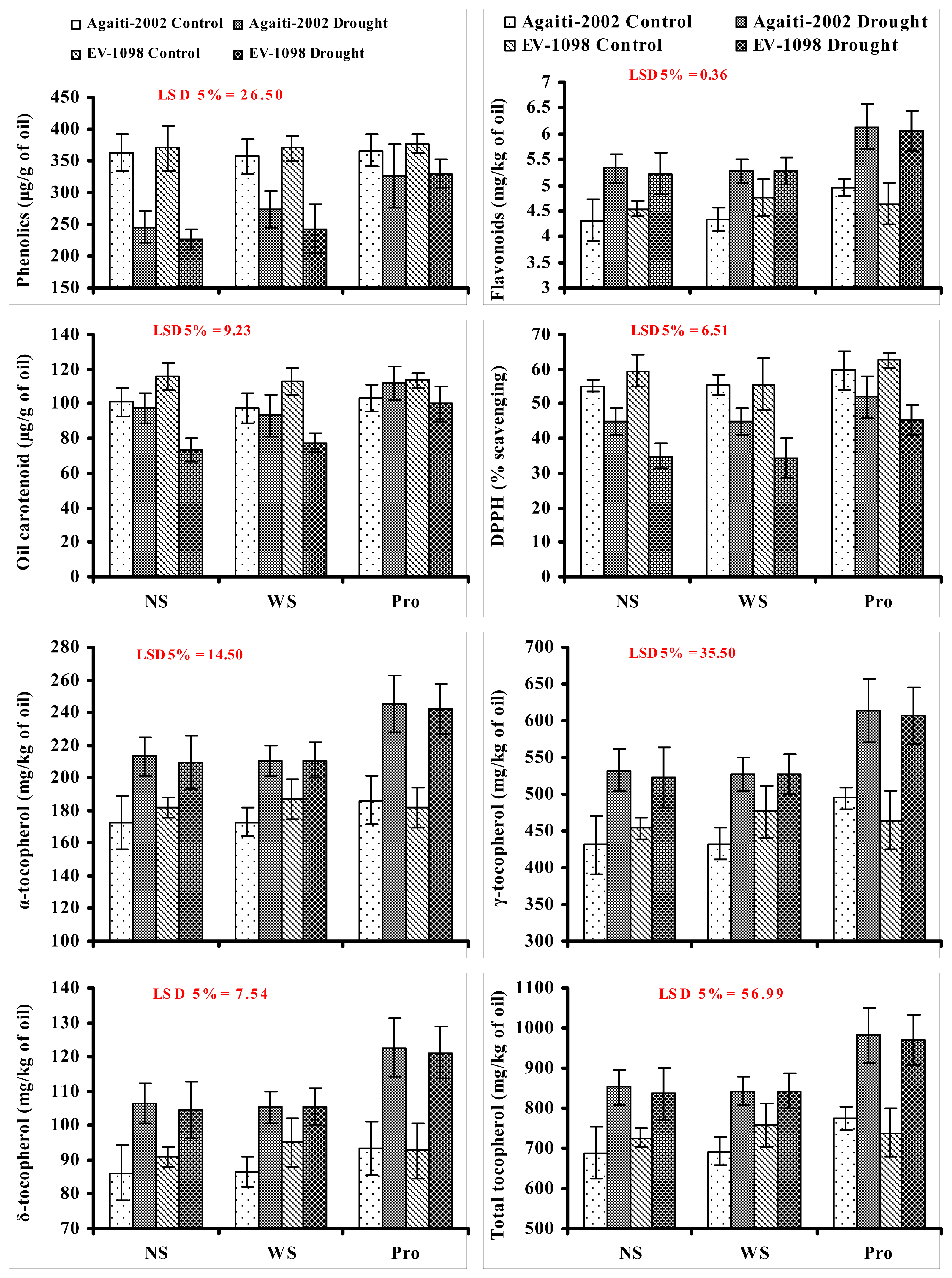
<p>It is generally known that different abiotic stresses including desiccation stress cause the production of highly reactive oxygen species (ROS) such as O<sub>2</sub><sup>−</sup>, H<sub>2</sub>O<sub>2</sub> and OH in different plant organelles such as mitochondria, peroxisomes, and chloroplasts [ <xref ref-type="bibr" rid="b32-ijms-14-00818">32</xref>–<xref ref-type="bibr" rid="b34-ijms-14-00818">34</xref>]. In defense, to counteract the excess production of ROS, plants synthesize various hydrophilic (ascorbic acid, and salicylic acid) and lipophilic (tocopherols) secondary metabolic compounds that play a significant role in scavenging these ROS in various plant parts. As in most crop species, the desiccation is the final phase of seed development [ <xref ref-type="bibr" rid="b35-ijms-14-00818">35</xref>], so, seeds contain low amount of water as well as low levels of few water-soluble antioxidants and antioxidant enzymes [ <xref ref-type="bibr" rid="b36-ijms-14-00818">36</xref>]. So, at this desiccated seed filling stage they are not properly safeguarded from oxidative stress. Thus, during this seed filling stage, the amount of lipophilic antioxidant compounds especially tocopherols are more important in scavenging the ROS thereby maintaining seed oil quality. Tocopherols exist in four distinct forms such as α-, β-, γ- and δ-tocopherols. These compounds differ in the number and position of methyl substitutions in the chromanol ring. They are well recognized due to their antioxidative property in vegetable oils. Their presence in vegetative oils increases the stability of lipids against autoxidation [ <xref ref-type="bibr" rid="b37-ijms-14-00818">37</xref>]. In the present study, water stress significantly increased α-, γ-, δ- and total tocopherol contents in the kernel oil of both maize cultivars. Of the different tocopherols analyzed, γ-tocopherol occurred abundantly in the seed oil of both maize cultivars under non-stress (430.83 to 454.81 mg kg<sup>−1</sup>) and water stress conditions (522.50 to 532.87 mg kg<sup>−1</sup>). Foliar application of proline further increased the oil content in either of the maize cultivars under both the stress (increased from 209 to 245.4, 5.22.5 to 613.5, 104.5 to 122.7 and 836–981.6 mg kg<sup>−1</sup>) and non-stress conditions (increased from 172.33 to 186.20, 430.83 to 494.67, 86.17 to 93.43 and 689.33 to 774.30 mg kg<sup>−1</sup>, respectively for α-, γ-, δ- and total tocopherol) (<xref ref-type="fig" rid="f1-ijms-14-00818">Figure 1</xref>). Furthermore, an increase in tocopherols due to foliar-applied proline was noted to be more distinct under water deficit conditions as compared with non-stress conditions. These findings are similar to those of Britz and Kremer [ <xref ref-type="bibr" rid="b38-ijms-14-00818">38</xref>] in which they reported that drought stress caused a significant increase in seed α-tocopherols in soybean. Similarly, drought stress caused increase in tocopherols has also been reported in an <italic>Arabidopsis</italic> mutant (<italic>npq1</italic>) [ <xref ref-type="bibr" rid="b39-ijms-14-00818">39</xref>], <italic>Rosmarinus officinalis</italic>[ <xref ref-type="bibr" rid="b40-ijms-14-00818">40</xref>], sunflower [ <xref ref-type="bibr" rid="b2-ijms-14-00818">2</xref>], and maize seed oils [ <xref ref-type="bibr" rid="b3-ijms-14-00818">3</xref>, <xref ref-type="bibr" rid="b6-ijms-14-00818">6</xref>]. As described earlier [ <xref ref-type="bibr" rid="b41-ijms-14-00818">41</xref>], tocopherols are lipophilic antioxidants and they protect the polyunsaturated fatty acids from peroxidation [ <xref ref-type="bibr" rid="b42-ijms-14-00818">42</xref>] so the quantification of these components is worthwhile. In the present study, a positive association has been found between un-saturated fatty acids such as oleic and linoleinic acids, and each of α, γ, δ and total tocopherol contents. These findings are analogous to those of Kriese <italic>et al</italic>. [ <xref ref-type="bibr" rid="b43-ijms-14-00818">43</xref>] and Ali <italic>et al</italic>. [ <xref ref-type="bibr" rid="b3-ijms-14-00818">3</xref>], who found a positive correlation between some fatty acids, and γ-tocopherols and total tocopherols. Furthermore, in a recent study Ali and Ashraf [ <xref ref-type="bibr" rid="b44-ijms-14-00818">44</xref>] reported that exogenously applied osmolytes such as glycinebetaine could improve the contents of oil tocopherols under water deficit conditions.</p>
<p>Flavonoids are the plants secondary metabolic compounds, which act effectively as scavengers of oxidizing molecules including singlet oxygen and free radicals. They also play an important physiological role in plant stress tolerance [ <xref ref-type="bibr" rid="b19-ijms-14-00818">19</xref>, <xref ref-type="bibr" rid="b45-ijms-14-00818">45</xref>]. In the present study, seed oil flavonoids of both maize cultivars increased due to imposition of water stress (4.30 to 5.32 mg kg<sup>−1</sup>). Exogenous application of proline as a foliar spray further increased the contents of oil flavonoids of both cultivars under stress regimes, but more proline-induced increase was observed in both cultivars under water deficit conditions (increased from 4.30 to 4.94 and 5.22 to 6.33 under non-stress and water deficit conditions, respectively) (<xref ref-type="fig" rid="f1-ijms-14-00818">Figure 1</xref>). Such changes in these oil attributes can be correlated with an earlier study in which it was observed that total flavonoid contents increased throughout the seed development in two Korean soybean cultivars during desiccation [ <xref ref-type="bibr" rid="b46-ijms-14-00818">46</xref>]. Similarly, the drought-induced increase in flavonoid contents in maize kernel oil as observed in the present study may have been due to their enhanced synthesis during seed development and seed maturity [ <xref ref-type="bibr" rid="b47-ijms-14-00818">47</xref>]. The increase in flavonoids in kernel oil of drought stressed plants due to exogenous application of proline, might have been due to delay in maturity of plants that might have delayed the seed maturity [ <xref ref-type="bibr" rid="b48-ijms-14-00818">48</xref>] thereby leading to more accumulation of flavonoids in the seeds [ <xref ref-type="bibr" rid="b49-ijms-14-00818">49</xref>].</p>
<p>Phenolic compounds have been reported to be present in all vegetable oils, which are very important for the oxidative stability of the polyunsaturated fatty acids of these oils [ <xref ref-type="bibr" rid="b50-ijms-14-00818">50</xref>]. Furthermore, it has been reported in an earlier study that seed oil total phenolic contents are indicative of the seed oil total antioxidative activity [ <xref ref-type="bibr" rid="b46-ijms-14-00818">46</xref>] due to the presence of the phenolic hydrogens (as hydrogen-donating radical scavengers), which predict their antioxidant activity [ <xref ref-type="bibr" rid="b51-ijms-14-00818">51</xref>]. Cereal grains have been reported to have the highest level of phenolics and antioxidant activity [ <xref ref-type="bibr" rid="b52-ijms-14-00818">52</xref>]. In some earlier studies on olive oil [ <xref ref-type="bibr" rid="b53-ijms-14-00818">53</xref>], rape-seed oil [ <xref ref-type="bibr" rid="b54-ijms-14-00818">54</xref>] and maize kernel oil [ <xref ref-type="bibr" rid="b3-ijms-14-00818">3</xref>, <xref ref-type="bibr" rid="b6-ijms-14-00818">6</xref>], it was observed that water deficit significantly decreased the concentration of oil phenolic compounds. All these reports support the results of the present study wherein drought-induced decrease in phenolic contents (from 363.33 to 245 mg kg<sup>−1</sup>) was observed (<xref ref-type="fig" rid="f1-ijms-14-00818">Figure 1</xref>). The proline-induced increase in oil phenolic contents (increased from 226.67 to 330 μg g<sup>−1</sup> under water deficit conditions) in the present study can be supported by the findings of previous studies [ <xref ref-type="bibr" rid="b44-ijms-14-00818">44</xref>, <xref ref-type="bibr" rid="b55-ijms-14-00818">55</xref>], which revealed that foliar-applied compatible solutes could enhance the levels of phenolic compounds in strawberry and maize, respectively, under water deficit conditions.</p>
<p>In the present study, seed oil carotenoid contents of both maize cultivars decreased (from 116 to 73.33 μg g<sup>−1</sup>) significantly due to the imposition of water stress. This reduction in oil carotenoid contents can be related to an earlier study on different pea cultivars, where in drought stress significantly reduced the seed total carotenoid contents of different pea cultivars, but this decrease in carotenoid contents was not uniform in pea cultivars [ <xref ref-type="bibr" rid="b56-ijms-14-00818">56</xref>]. Exogenous application of proline significantly enhanced the accumulation of carotenoids (increased 73.33 to 111.7 μg g<sup>−1</sup>) in the seed oil of both maize cultivars under water deficit conditions (<xref ref-type="fig" rid="f1-ijms-14-00818">Figure 1</xref>) which could have been due to the reason that lipid biosynthesis in seeds during ripening is stimulated by the exogenous application of organic osmolytes [ <xref ref-type="bibr" rid="b44-ijms-14-00818">44</xref>].</p>
<p>The 1,1-diphenyl-2-picryl-hydrazyl (DPPH) radical scavenging activity, a measure of oil total antioxidant activity, decreased (55% to 32%) significantly in both maize cultivars due to drought stress. Exogenous application of proline increased (from 55% to 62% and 35% to 52%) the seed oil antioxidant activity in both maize cultivars under stress and non-stress conditions, respectively (<xref ref-type="fig" rid="f1-ijms-14-00818">Figure 1</xref>). In the present study, seed oil antioxidant activity in both cultivars was positively related to oil phenolics, carotenoids, flavonoids, tocopherols and oil oleic acid contents only when proline was applied as foliar spray under both stress and non-stress conditions. The strong positive correlation between total phenolics, carotenoids and antioxidant activity as observed in the present study had already been observed in cereals [ <xref ref-type="bibr" rid="b52-ijms-14-00818">52</xref>] and soybean [ <xref ref-type="bibr" rid="b46-ijms-14-00818">46</xref>], which suggests that this increase in oil antioxidant activity is contributed by the presence of high amount of phenolic compounds. Similar positive correlation in seed oil antioxidant activity and different lipophilic antioxidant compounds under water deficit condition and due to exogenous application of organic osmolytes had already been reported in some earlier studies in maize [ <xref ref-type="bibr" rid="b3-ijms-14-00818">3</xref>, <xref ref-type="bibr" rid="b6-ijms-14-00818">6</xref>].</p>
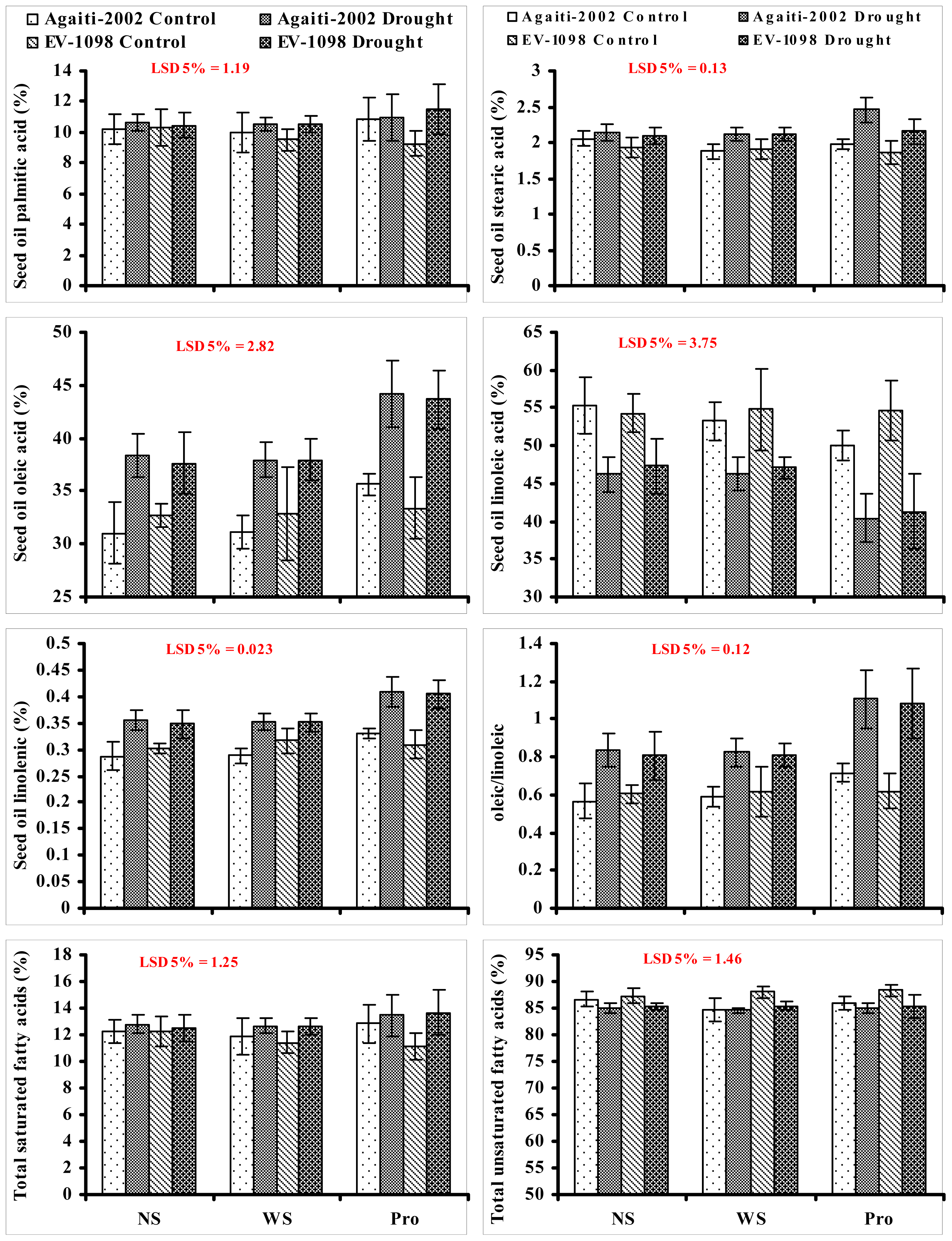
<p>Due to increased industrial use of corn, the fatty acid composition of its oil is considered very vital in determination of oil nutritional quality and possible uses of oil in industrial applications. However, adverse environmental conditions such as drought have significant effects on seed oil fatty acid composition [ <xref ref-type="bibr" rid="b2-ijms-14-00818">2</xref>, <xref ref-type="bibr" rid="b3-ijms-14-00818">3</xref>, <xref ref-type="bibr" rid="b57-ijms-14-00818">57</xref>]. Similarly, in the present study, maize kernel oil oleic acid, linolenic acid and oleic/linoleic ratio increased, while linoleic acid decreased in both maize cultivars due to drought stress. Foliar-applied proline further increased the contents of oleic, linolenic and oleic/linoleic and decreased the linoleic acid contents. However, no significant effect of water stress or foliar-applied proline was observed on oil total saturated and unsaturated fatty acids (<xref ref-type="fig" rid="f2-ijms-14-00818">Figure 2</xref>). Furthermore, the increase in oil oleic acid, linolenic acid and oleic/linoleic ratio due to foliar-applied proline was more distinct in drought stressed plants. The changes in oleic/linoleic acid ratio due to exogenous application of proline under both water deficit (increased from 0.80 to 1.10) and non-stressed (increased from 0.56 to 0.71) conditions as observed in the present study shows a direct or indirect effect of proline on the enzymes involved in the biosynthesis of oleic and linoleinic acids. These results indicate that it is likely that proline had a protective effect rather than a direct involvement in fatty oil biosynthesis and storage, which occurs in liposomes or oleosomes in seeds during seed filling stage [ <xref ref-type="bibr" rid="b35-ijms-14-00818">35</xref>].</p></sec>
<sec>
<title>3. Experimental Section</title>
<p>The present study was conducted to assess the changes in composition of maize seed and seed oil derived from field grown plants sprayed with proline, one of the potential organic osmolytes. For the experimentation two maize cultivars with differential tolerance to drought Agaiti-2002 (drought tolerant) and EV-1098 (relatively drought sensitive) were used. These two cultivars are being widely used in Pakistan for maize breeding programs aiming at improving qualitative and quantitative traits of the crops. The seeds of these two maize cultivars were supplied by the Maize and Millet Research Institute, Yousaf wala (Sahiwal), Pakistan. The experiment was conducted at the research area of the New Botanical Garden, of the Department of Botany, University of Agriculture, Faisalabad, Pakistan (latitude 30°30 N, longitude 73°10 E and altitude 213 m).</p>
<p>The climatic conditions at the experimental site during the experimentation calculated as means were as follow: photosynthetically available radiation (<italic>PAR</italic>) measured at noon varied from 794 to 1154 μmol m<sup>−2</sup> s<sup>−1</sup>, and day/night RH 33.1/75.1%, and day and night temperatures 38.3 ± 4.0 °C and 22.8 ± 3.6 °C, respectively.</p>
<p>The soil of the experimental site was sandy clay (average 65% clay content, 22% sand and 13% silt). The soil texture was determined by using the hygrometer method following Dewis and Freitas [ <xref ref-type="bibr" rid="b58-ijms-14-00818">58</xref>]. The saturation percentage of soil was 31, organic matter 0.78% and NH<sub>4</sub>-N 3.00, NO<sub>3</sub>-N 6.5, available potassium 187, phosphorous 5.6, and calcium 109 (all values of nutrients in mg kg<sup>−1</sup> of dry soil). The soil electrical conductivity (EC<sub>e</sub>) was 2.1 dS m<sup>−1</sup> and pH 8.1. Electrical conductance (ECe), pH and inorganic nutrients of the soil saturation extract were appraised following Jackson [ <xref ref-type="bibr" rid="b59-ijms-14-00818">59</xref>].</p>
<p>The whole experiment was arranged in a randomized complete block design (RCBD). On the basis of water stress treatments the main plot was divided into two sub-plots. In one sub-plot, normal irrigation was applied and in the second sub-plot, drought stress was started during the early growth stage of crop growth. Each experimental unit was replicated four times. For the preparation of soil for seed sowing, the first irrigation to both subplots was applied 15 days before sowing. When the soil was at field capacity condition, the plots were well prepared for sowing the seeds. The rate of the seed sown was 10 kg ha<sup>−1</sup> of each maize cultivar that was hand-drilled by maintaining inter-row distance of 75 cm. Plants were thinned 15 days after germination to maintain plant-to-plant space 30 cm.</p>
<p>The first irrigation to all plots was applied 8 days after seedling emergence and thereafter, drought stress treatment was initiated by controlling irrigation schedule. After the 1st irrigation, the watering to non-stressed plants was applied regularly at 15-day-interval except the plants meant for experiencing drought stress; however, the irrigations meant for water stressed plants were applied at 21-day intervals.</p>
<p>Two levels of proline (Sigma Aldrich, Germany) (0 and 30 mM) were used for the experimentation, which were prepared in the surfactant tween-20 (0.1% solution) and applied foliarly only once at the vegetative stage, when the plants were at five-leaf stage. An aliquot of 500 ml of 30 mM proline solution was applied foliarly to plants in each replicate using manually operated agricultural spray equipment with an eight-liter tank capacity. The equipment tank was fitted with a brass spray lance with fine spray brass nozzle and a pump barrel made of seamless brass tube. The foliar application of proline was carried out in the evening just before sunset. Before harvest, ears were removed. The ears were dried for 3 to 4 days in air during daytime. After proper drying, kernels were separated from ears and used for further analysis. All reagents used were of analytical and HPLC grades and purchased from Sigma-Aldrich (Germany).</p>
<sec>
<title>3.1. Characterization of Maize kernels and Kernel Oil</title>
<sec sec-type="methods">
<title>Proximate Analysis</title>
<p>Maize kernels were evaluated for different proximate analyses including crude protein, moisture, ash, crude fat, starch and crude fiber by using appropriate protocols as depicted in AACC [ <xref ref-type="bibr" rid="b60-ijms-14-00818">60</xref>], <italic>i.e</italic>., Method No. 44-15A, Method No. 08-01, Method No. 46-30, Method No. 30-25, Method 32-10, respectively.</p></sec></sec>
<sec>
<title>3.2. Oil Extraction</title>
<p>For the extraction of oil, the seeds were properly dried. Then the seeds (200 g) of each treatment were crushed into 80 mesh of particle size. This accurately weighed crushed seed material was then packed in paper thimbles and placed them in a Soxhlet collector fitted with 500 mL volumetric flask. The extraction was carried out using <italic>n</italic>-hexane as a solvent for 8 h.</p></sec>
<sec>
<title>3.3. Chemical Parameters of Oil</title>
<p>Determinations of kernel oil different physico-chemical attributes including iodine value, saponification value, unsaponifiable matter, peroxide value, density and contents of free fatty acids (FFA) of the extracted oil were performed following the established AOCS methods (Cd 1-25, Cd 3-25, Ca 61-40, Cd 8-53, Cc 10a-25 and F9a-44, respectively [ <xref ref-type="bibr" rid="b61-ijms-14-00818">61</xref>].</p>
<p>Oil specific extinctions, dienes and trienes [ɛ<sup>1%</sup> 1 cm (λ)] at 232 and 270 nm, as a measure of oil oxidation measure were appraised following the IUPAC method II. D. 23 [ <xref ref-type="bibr" rid="b62-ijms-14-00818">62</xref>]. Oil samples (0.1 mL) were diluted with iso-octane until the absorbance was in the range 0–0.8. The absorbance of the samples was read at 232 and 270 nm on a spectrophotometer (U-2001, Hitachi Instruments Inc., Tokyo, Japan). The amount of <italic>p</italic>-anisidine was determined following an IUPAC method II. D. 26 [ <xref ref-type="bibr" rid="b62-ijms-14-00818">62</xref>]. Coloured complexes of the oil samples were developed by reading the oil samples <italic>p</italic>-anisidine for 10 min and absorbance read at 350 nm using a spectrophotometer (U-2001, Hitachi Instruments Inc., Tokyo, Japan).</p></sec>
<sec>
<title>3.4. Fatty Acid Composition of Seed Oil</title>
<p>Fatty acid methyl esters (FAMEs) were prepared following the IUPAC standard method (2.301) [ <xref ref-type="bibr" rid="b62-ijms-14-00818">62</xref>] and quantified using a gas chromatograph (Perkin Elmer, model Clarus 500) fitted with a Rt-2340 NB (RESTEK, Corp.) methyl-lignocerate-coated (film thickness 0.20 μm) polar capillary column (60 m × 0.25 mm) and an FID detector. Analytical grade nitrogen gas with a flow rate of 5 mL/min was used as mobile phase. Other conditions maintained were: oven initial temperature, 80 °C; ramp rate, 3 °C/min; final temperature, 210 °C; detector temperature 220 °C; and injector temperature, 210 °C. The quantification of FAMEs was based on their absolute retention times after comparing with appropriate standards purchased from Sigma-Aldrich (Buchs, Switzerland).</p></sec>
<sec>
<title>3.5. Tocopherol Content</title>
<p>The tocopherol content in the kernel oil was determined following Lee <italic>et al</italic>. [ <xref ref-type="bibr" rid="b63-ijms-14-00818">63</xref>] and analyzed by HPLC (Sykam GmbH, Kleinostheim, Germany). The HPLC system was equipped with S-1122 dual piston solvent delivery system, and S-3210 UV/VIS diode array detector. Twenty μL of the extract were injected into the Hypersil ODS reverse phase (C18) column (5 μm particle size, 250 mm × 4.6 ID Themohypersil GmbH, (Darmstadt, Germany) fitted with a C<sub>18</sub> guard column and methanol: acetonitrile: methylene chloride (50:44:6, <italic>v</italic>/<italic>v</italic>) mobile phase at 1 mL/min flow rate. The peak areas were recorded and calculated by a computer with SRI peak simple chromatography data acquisition and integration software (SRI instrument, Torrance, CA, USA) at 295 nm. The quantification of tocopherols was done by comparing the samples with pure standards purchased from Sigma-Aldrich (Buchs, Switzerland).</p></sec>
<sec>
<title>3.6. Total Phenolic Contents</title>
<p>The amount of total phenolics was assessed using the Folin-Ciocalteu reagent method as described by Chaovanalikit and Wrolstad [ <xref ref-type="bibr" rid="b64-ijms-14-00818">64</xref>]. Briefly, 10 g oil was mixed with 60 mL <italic>n</italic>-hexane and extracted with 60% methanol (60:40 watre:methanol <italic>v</italic>/<italic>v</italic>). The solvent was evaporated to dryness (40 °C) using a rotary evaporator (Heidolph, model, Laborota 4001, Schwabach, Germany) to obtain the crude extract. Then the crude extract (50 mg) was mixed with 0.5 mL of Folin-Ciocalteu reagent and 7.5 mL deionized water. The mixture was kept at room temperature for 10 min, and then 1.5 mL of 20% sodium carbonate (<italic>w</italic>/<italic>v</italic>) added. The mixture was heated in a water bath at 40 °C for 20 min, cooled in an ice bath and absorbance measured at 755 nm using a spectrophotometer (U-2001, Hitachi Instruments Inc. Tokyo, Japan). Amounts of TP were calculated using a gallic acid calibration curve within the range of 10–100 mg/L. The results were expressed as gallic acid equivalents (GAE) g/100 g of dry matter.</p></sec>
<sec>
<title>3.7. Total Flavonoids</title>
<p>Total flavonoids were appraised following the procedure of Dewanto <italic>et al</italic>. [ <xref ref-type="bibr" rid="b65-ijms-14-00818">65</xref>]. Two milliliter of aqueous extract of dry matter were placed in a 10 cm<sup>3</sup> volumetric flask, then added 5 mL of distilled water followed by 0.6 mL of 5% sodium nitrite solution. After 5 min, 0.6 mL of AlCl<sub>3</sub> solution (10%) was added. After another 5 min, 2 mL of 1M NaOH were added and the volume made up to 10 mL with distilled H<sub>2</sub>O. The solution was mixed thoroughly and absorbance noted at 510 nm. TF concentrations were expressed as catechin equivalents g/100 g of dry matter.</p></sec>
<sec>
<title>3.8. Total Carotenoid Content</title>
<p>Total carotenoids were estimated following the method of Gao <italic>et al</italic>. [ <xref ref-type="bibr" rid="b66-ijms-14-00818">66</xref>]. Oil solutions in hexane (1 g/100 mL) were read at 460 nm on a spectrophotometer (U-2001, Hitachi Instruments Inc. Tokyo, Japan). Quantification of amounts was based on the carotene standards and amount of carotenoids was expressed in μg g<sup>−1</sup> of oil.</p></sec>
<sec>
<title>3.9. DPPH Radical Scavenging Activity</title>
<p>The free DPPH radical scavenging activity of the oil extracts was estimated following the method as described by Sultana <italic>et al</italic>. [ <xref ref-type="bibr" rid="b67-ijms-14-00818">67</xref>] and Iqbal and Bhanger [ <xref ref-type="bibr" rid="b68-ijms-14-00818">68</xref>] with some modifications. Five ml of a freshly prepared solution of 1,1′-diphenyl-2-picrylhydrazyl (DPPH) at concentration 0.025 g/L were added to 1.0 mL of the extract of dry material in methanol. The mixture was incubated at room temperature in the dark for 30 min. Then the decrease in absorbance was measured against a blank at 515 nm (the change in color from deep-violet to light-yellow). Following formula was used to calculate the radical scavenging activity:</p>
<disp-formula id="FD1">
<label>(1)</label>
<mml:math id="mm1" display="block">
<mml:semantics id="sm1">
<mml:mrow>
<mml:mtext>DPPH radical scavenging </mml:mtext>
<mml:mo stretchy="false">(</mml:mo>
<mml:mo>%</mml:mo>
<mml:mo stretchy="false">)</mml:mo>
<mml:mo>=</mml:mo>
<mml:mo stretchy="false">[</mml:mo>
<mml:mo stretchy="false">(</mml:mo>
<mml:mtext>AB</mml:mtext>
<mml:mo>-</mml:mo>
<mml:mtext>AA</mml:mtext>
<mml:mo stretchy="false">)</mml:mo>
<mml:mo>/</mml:mo>
<mml:mtext>AB</mml:mtext>
<mml:mo stretchy="false">]</mml:mo>
<mml:mo>×</mml:mo>
<mml:mn>100</mml:mn></mml:mrow></mml:semantics></mml:math></disp-formula>
<p>Where AB is absorbance of blank sample (t = 0 min); AA is absorbance of tested extract solution after 15 min of incubation.</p></sec>
<sec sec-type="methods">
<title>3.10. Statistical Analysis</title>
<p>Data for each attribute was subjected to CoStat Computer Program (version 6.303, PMB 320, Monterey, CA, USA) for calculating ANOVA. Mean values were compared with LSD, worked out following Steel and Torrie [ <xref ref-type="bibr" rid="b69-ijms-14-00818">69</xref>].</p></sec></sec>
<sec sec-type="conclusions">
<title>4. Conclusions</title>
<p>From the results of the present analyses, it could be concluded that imposition of drought stress significantly affected the chemical composition of maize kernels and kernel oil, but exogenous application of proline ameliorated the adverse effects of drought on seed chemical composition. These effects of exogenously applied proline on improving seed and seed oil composition were not only exhibited under water deficit conditions but also under non-stressed conditions. Amongst the different studied maize kernel oil characteristics, oil yield, fatty acid composition, oxidative stability and oil phenolics were found to be more vulnerable to drought and positively affected by the foliar application of proline. The exogenous application of proline can thus be effectively used to improve seed and seed oil nutritional quality of maize crop grown not only under water deficit conditions but also under well watered conditions. However, a comparatively more increasing effect was observed in these antioxidative compounds due to the foliar application of proline; under water deficit conditions such as those compared with non-stress conditions, the ameliorating effect of foliar-applied proline was indicated on seed nutritional quality under water deficit conditions.</p></sec></body>
<back>
<ack>
<title>Acknowledgments</title>
<p>The author gratefully acknowledges the funding from the Pakistan Academy of Sciences (PAS) (Grant No. ACS/HEC/2006/PAS/2989) and King Saud University, Riyadh SA, through research grant No. KSU-VPP 101. The results presented in this paper are a part of Ph.D. studies of Qasim Ali.</p></ack>
<fn-group><fn id="fn1-ijms-14-00818">
<p><bold>Conflict of Interest</bold></p>
<p>The authors declare no conflict of interest.</p></fn></fn-group>
<ref-list>
<title>References</title>
<ref id="b1-ijms-14-00818"><label>1</label><citation citation-type="journal"><person-group person-group-type="author"><name><surname>Anwar</surname><given-names>F.</given-names></name><name><surname>Zafar</surname><given-names>S.N.</given-names></name><name><surname>Rashid</surname><given-names>U.</given-names></name></person-group><article-title>Characterization of <italic>Moringa oleifera</italic> seed oil from drought and irrigated regions of Punjab, Pakistan</article-title><source>Grasas Y Aceites</source><year>2006</year><volume>57</volume><fpage>160</fpage><lpage>168</lpage></citation></ref>
<ref id="b2-ijms-14-00818"><label>2</label><citation citation-type="journal"><person-group person-group-type="author"><name><surname>Ali</surname><given-names>Q.</given-names></name><name><surname>Ashraf</surname><given-names>M.</given-names></name><name><surname>Anwar</surname><given-names>F.</given-names></name></person-group><article-title>Physicochemical attributes of seed oil from drought stressed sunflower (<italic>Helianthus annuus</italic> L.) plants</article-title><source>Grasas Y Aceites</source><year>2009</year><volume>60</volume><fpage>475</fpage><lpage>481</lpage></citation></ref>
<ref id="b3-ijms-14-00818"><label>3</label><citation citation-type="journal"><person-group person-group-type="author"><name><surname>Ali</surname><given-names>Q.</given-names></name><name><surname>Ashraf</surname><given-names>M.</given-names></name><name><surname>Anwar</surname><given-names>F.</given-names></name></person-group><article-title>Seed composition and seed oil antioxidant activity of maize under water stress</article-title><source>J. Am. Oil Chem. Soc</source><year>2010</year><volume>87</volume><fpage>1179</fpage><lpage>1187</lpage><pub-id pub-id-type="doi">10.1007/s11746-010-1599-5</pub-id></citation></ref>
<ref id="b4-ijms-14-00818"><label>4</label><citation citation-type="book"><person-group person-group-type="author"><name><surname>Lásztity</surname><given-names>R.</given-names></name></person-group><source>Cereal Chemistry</source><publisher-name>Akadémiai Kiadó</publisher-name><publisher-loc>Budapest, Hungary</publisher-loc><year>1999</year><fpage>11</fpage><lpage>51</lpage></citation></ref>
<ref id="b5-ijms-14-00818"><label>5</label><citation citation-type="journal"><person-group person-group-type="author"><name><surname>Baye</surname><given-names>T.M.</given-names></name><name><surname>Pearson</surname><given-names>T.C.</given-names></name><name><surname>Settles</surname><given-names>A.M.</given-names></name></person-group><article-title>Development of a calibration to predict maize seed composition using single kernel near infrared spectroscopy</article-title><source>J. Cereal Sci</source><year>2006</year><volume>43</volume><fpage>236</fpage><lpage>243</lpage><pub-id pub-id-type="doi">10.1016/j.jcs.2005.11.003</pub-id></citation></ref>
<ref id="b6-ijms-14-00818"><label>6</label><citation citation-type="journal"><person-group person-group-type="author"><name><surname>Ali</surname><given-names>Q.</given-names></name><name><surname>Ashraf</surname><given-names>M.</given-names></name></person-group><article-title>Exogenously applied glycinebetaine enhances seed and seed oil quality of maize (<italic>Zea mays</italic> L.) under water deficit conditions</article-title><source>Environ. Exp. Bot</source><year>2011</year><volume>71</volume><fpage>249</fpage><lpage>259</lpage><pub-id pub-id-type="doi">10.1016/j.envexpbot.2010.12.009</pub-id></citation></ref>
<ref id="b7-ijms-14-00818"><label>7</label><citation citation-type="journal"><person-group person-group-type="author"><name><surname>Schussler</surname><given-names>R.</given-names></name><name><surname>Westgate</surname><given-names>M.E.</given-names></name></person-group><article-title>Maize kernel set at low water potential sensitivity to reduced assimilates during early kernel growth</article-title><source>Crop Sci</source><year>1991</year><volume>31</volume><fpage>1189</fpage><lpage>1195</lpage><pub-id pub-id-type="doi">10.2135/cropsci1991.0011183X003100050023x</pub-id></citation></ref>
<ref id="b8-ijms-14-00818"><label>8</label><citation citation-type="journal"><person-group person-group-type="author"><name><surname>Balasundram</surname><given-names>N.</given-names></name><name><surname>Sundram</surname><given-names>K.</given-names></name><name><surname>Samman</surname><given-names>S.</given-names></name></person-group><article-title>Phenolic compounds in plants and agri-industrial by-products: antioxidant activity, occurrence, and potential uses</article-title><source>Food Chem</source><year>2006</year><volume>99</volume><fpage>191</fpage><lpage>203</lpage><pub-id pub-id-type="doi">10.1016/j.foodchem.2005.07.042</pub-id></citation></ref>
<ref id="b9-ijms-14-00818"><label>9</label><citation citation-type="book"><person-group person-group-type="author"><name><surname>Yancey</surname><given-names>P.H.</given-names></name></person-group><article-title>Compatible and Counteracting Solutes</article-title><source>Cellular and Molecular Physiology of Cell Volume Regulation</source><person-group person-group-type="editor"><name><surname>Strange</surname><given-names>K.</given-names></name></person-group><publisher-name>CRC Press</publisher-name><publisher-loc>Boca Raton, FL, USA</publisher-loc><year>1994</year><fpage>81</fpage><lpage>109</lpage></citation></ref>
<ref id="b10-ijms-14-00818"><label>10</label><citation citation-type="journal"><person-group person-group-type="author"><name><surname>Ashraf</surname><given-names>M.</given-names></name><name><surname>Foolad</surname><given-names>M.R.</given-names></name></person-group><article-title>Roles of glycinebetaine and proline in improving plant abiotic stress tolerance</article-title><source>Environ. Exp. Bot</source><year>2007</year><volume>59</volume><fpage>206</fpage><lpage>216</lpage><pub-id pub-id-type="doi">10.1016/j.envexpbot.2005.12.006</pub-id></citation></ref>
<ref id="b11-ijms-14-00818"><label>11</label><citation citation-type="journal"><person-group person-group-type="author"><name><surname>Nawaz</surname><given-names>K.</given-names></name><name><surname>Ashraf</surname><given-names>M.</given-names></name></person-group><article-title>Exogenous application of glycinebetaine modulates activities of antioxidants in maize plants subjected to salt stress</article-title><source>J. Agron. Crop Sci</source><year>2010</year><volume>196</volume><fpage>28</fpage><lpage>37</lpage><pub-id pub-id-type="doi">10.1111/j.1439-037X.2009.00385.x</pub-id></citation></ref>
<ref id="b12-ijms-14-00818"><label>12</label><citation citation-type="journal"><person-group person-group-type="author"><name><surname>Ashraf</surname><given-names>M.Y.</given-names></name><name><surname>Azmi</surname><given-names>A.R.</given-names></name><name><surname>Khan</surname><given-names>A.H.</given-names></name><name><surname>Ala</surname><given-names>S.A.</given-names></name></person-group><article-title>Effect of water stress on total phenol, peroxidase activity and chlorophyll contents in wheat (<italic>Triticum aestivum</italic> L.)</article-title><source>Acta Physiol. Plant</source><year>1994</year><volume>16</volume><fpage>185</fpage><lpage>191</lpage></citation></ref>
<ref id="b13-ijms-14-00818"><label>13</label><citation citation-type="journal"><person-group person-group-type="author"><name><surname>Öztürk</surname><given-names>L.</given-names></name><name><surname>Demir</surname><given-names>Y.</given-names></name></person-group><article-title><italic>In vivo</italic> and <italic>in vitro</italic> protective role of proline</article-title><source>Plant Growth Regul</source><year>2002</year><volume>38</volume><fpage>259</fpage><lpage>264</lpage><pub-id pub-id-type="doi">10.1023/A:1021579713832</pub-id></citation></ref>
<ref id="b14-ijms-14-00818"><label>14</label><citation citation-type="journal"><person-group person-group-type="author"><name><surname>Kavi-Kishor</surname><given-names>P.B.</given-names></name><name><surname>Sangam</surname><given-names>S.</given-names></name><name><surname>Amrutha</surname><given-names>R.N.</given-names></name><name><surname>Sri</surname><given-names>L.P.</given-names></name><name><surname>Naidu</surname><given-names>K.R.</given-names></name><name><surname>Rao</surname><given-names>K.R.S.S.</given-names></name><name><surname>Rao</surname><given-names>S.</given-names></name><name><surname>Reddy</surname><given-names>K.J.</given-names></name><name><surname>Theriappan</surname><given-names>P.</given-names></name><name><surname>Sreeniv</surname><given-names>N.</given-names></name></person-group><article-title>Regulation of proline biosynthesis, degradation, uptake and transport in higher plants: Its implications in plant growth and abiotic stress tolerance</article-title><source>Curr. Sci</source><year>2005</year><volume>88</volume><fpage>424</fpage><lpage>438</lpage></citation></ref>
<ref id="b15-ijms-14-00818"><label>15</label><citation citation-type="journal"><person-group person-group-type="author"><name><surname>Mattioli</surname><given-names>R.</given-names></name></person-group><article-title>The proline biosynthetic genes P5CS1 and P5CS2 play overlapping roles in <italic>Arabidopsis</italic> flower transition but not in embryo development</article-title><source>Physiol. Plant</source><year>2009</year><volume>137</volume><fpage>72</fpage><lpage>85</lpage><pub-id pub-id-type="doi">10.1111/j.1399-3054.2009.01261.x</pub-id><pub-id pub-id-type="pmid">19627555</pub-id></citation></ref>
<ref id="b16-ijms-14-00818"><label>16</label><citation citation-type="journal"><person-group person-group-type="author"><name><surname>Mohammadkhani</surname><given-names>N.</given-names></name><name><surname>Heidari</surname><given-names>R.</given-names></name></person-group><article-title>Effects of drought stress on soluble proteins in two maize varieties</article-title><source>Turk. J. Biol</source><year>2008</year><volume>32</volume><fpage>23</fpage><lpage>30</lpage></citation></ref>
<ref id="b17-ijms-14-00818"><label>17</label><citation citation-type="journal"><person-group person-group-type="author"><name><surname>Ketchum</surname><given-names>R.E.B.</given-names></name><name><surname>Warren</surname><given-names>R.C.</given-names></name><name><surname>Klima</surname><given-names>L.J.</given-names></name><name><surname>Lopez-Gutierrez</surname><given-names>F.</given-names></name><name><surname>Nabors</surname><given-names>M.W.</given-names></name></person-group><article-title>The mechanism and regulation of proline accumulation in suspension cultures of the halophytic grass <italic>Distichlis spicata</italic> L</article-title><source>J. Plant Physiol</source><year>1991</year><volume>137</volume><fpage>368</fpage><lpage>374</lpage><pub-id pub-id-type="doi">10.1016/S0176-1617(11)80147-1</pub-id></citation></ref>
<ref id="b18-ijms-14-00818"><label>18</label><citation citation-type="journal"><person-group person-group-type="author"><name><surname>Flowers</surname><given-names>T.J.</given-names></name></person-group><article-title>Improving crop salt tolerance</article-title><source>J. Exp. Bot</source><year>2004</year><volume>55</volume><fpage>1</fpage><lpage>13</lpage><pub-id pub-id-type="pmid">14645387</pub-id></citation></ref>
<ref id="b19-ijms-14-00818"><label>19</label><citation citation-type="journal"><person-group person-group-type="author"><name><surname>Ali</surname><given-names>Q.</given-names></name><name><surname>Ashraf</surname><given-names>M.</given-names></name><name><surname>Athar</surname><given-names>H.R.</given-names></name></person-group><article-title>Exogenously applied proline at different growth stages enhances growth of two maize cultivars grown under water deficit conditions</article-title><source>Pak. J. Bot</source><year>2007</year><volume>39</volume><fpage>1133</fpage><lpage>1144</lpage></citation></ref>
<ref id="b20-ijms-14-00818"><label>20</label><citation citation-type="journal"><person-group person-group-type="author"><name><surname>Kaul</surname><given-names>S.</given-names></name><name><surname>Sharma</surname><given-names>S.S.</given-names></name><name><surname>Mehta</surname><given-names>I.K.</given-names></name></person-group><article-title>Free radical scavenging potential of l-proline: evidence from <italic>in vitro</italic> assays</article-title><source>Amino Acids</source><year>2008</year><volume>34</volume><fpage>315</fpage><lpage>320</lpage><pub-id pub-id-type="doi">10.1007/s00726-006-0407-x</pub-id><pub-id pub-id-type="pmid">17086481</pub-id></citation></ref>
<ref id="b21-ijms-14-00818"><label>21</label><citation citation-type="journal"><person-group person-group-type="author"><name><surname>Banu</surname><given-names>N.A.</given-names></name><name><surname>Hoque</surname><given-names>A.</given-names></name><name><surname>Watanab-e-Sugimoto</surname><given-names>M.</given-names></name><name><surname>Matsuoka</surname><given-names>K.</given-names></name><name><surname>Nakamura</surname><given-names>Y.</given-names></name><name><surname>Shimoishi</surname><given-names>Y.</given-names></name><name><surname>Murata</surname><given-names>Y.</given-names></name></person-group><article-title>Proline and glycinebetaine induce antioxidant defense gene expression and suppress cell death in cultured tobacco cells under salt stress</article-title><source>J. Plant Physiol</source><year>2009</year><volume>166</volume><fpage>146</fpage><lpage>156</lpage><pub-id pub-id-type="doi">10.1016/j.jplph.2008.03.002</pub-id><pub-id pub-id-type="pmid">18471929</pub-id></citation></ref>
<ref id="b22-ijms-14-00818"><label>22</label><citation citation-type="journal"><person-group person-group-type="author"><name><surname>Csonka</surname><given-names>L.N.</given-names></name><name><surname>Hanson</surname><given-names>A.D.</given-names></name></person-group><article-title>Prokaryotic osmoregulation: Genetics and physiology</article-title><source>Annu. Rev. Microbiol</source><year>1991</year><volume>45</volume><fpage>569</fpage><lpage>606</lpage><pub-id pub-id-type="doi">10.1146/annurev.mi.45.100191.003033</pub-id><pub-id pub-id-type="pmid">1741624</pub-id></citation></ref>
<ref id="b23-ijms-14-00818"><label>23</label><citation citation-type="journal"><person-group person-group-type="author"><name><surname>Athar</surname><given-names>H.R.</given-names></name><name><surname>Ashraf</surname><given-names>M.</given-names></name><name><surname>Wahid</surname><given-names>A.</given-names></name><name><surname>Jamil</surname><given-names>A.</given-names></name></person-group><article-title>Inducing salt tolerance in canola (<italic>Brassica napus</italic> L.) by exogenous application of glycinebetaine and proline: response at the initial growth stages</article-title><source>Pak. J. Bot</source><year>2009</year><volume>41</volume><fpage>1311</fpage><lpage>1319</lpage></citation></ref>
<ref id="b24-ijms-14-00818"><label>24</label><citation citation-type="journal"><person-group person-group-type="author"><name><surname>Islam</surname><given-names>M.M.</given-names></name></person-group><article-title>Exogenous proline and glycinebetaine increase antioxidant enzyme activities and confer tolerance to cadmium stress in cultured tobacco cells</article-title><source>J. Plant Physiol</source><year>2009</year><volume>166</volume><fpage>1587</fpage><lpage>1597</lpage><pub-id pub-id-type="doi">10.1016/j.jplph.2009.04.002</pub-id><pub-id pub-id-type="pmid">19423184</pub-id></citation></ref>
<ref id="b25-ijms-14-00818"><label>25</label><citation citation-type="journal"><person-group person-group-type="author"><name><surname>Yildiz-Aktas</surname><given-names>L.</given-names></name><name><surname>Dagnon</surname><given-names>S.</given-names></name><name><surname>Gurel</surname><given-names>A.</given-names></name><name><surname>Gesheva</surname><given-names>E.</given-names></name><name><surname>Edreva</surname><given-names>A.</given-names></name></person-group><article-title>Drought tolerance in cotton: involvement of nonenzymatic ROS-scavenging compounds</article-title><source>J. Agron. Crop Sci</source><year>2009</year><volume>195</volume><fpage>247</fpage><lpage>253</lpage><pub-id pub-id-type="doi">10.1111/j.1439-037X.2009.00366.x</pub-id></citation></ref>
<ref id="b26-ijms-14-00818"><label>26</label><citation citation-type="journal"><person-group person-group-type="author"><name><surname>Mansour</surname><given-names>M.M.F.</given-names></name></person-group><article-title>Protection of plasma membrane of onion epidermal cells by glycinebetaine and proline against NaCl stress</article-title><source>Plant Physiol. Biochem</source><year>1998</year><volume>36</volume><fpage>767</fpage><lpage>772</lpage><pub-id pub-id-type="doi">10.1016/S0981-9428(98)80028-4</pub-id></citation></ref>
<ref id="b27-ijms-14-00818"><label>27</label><citation citation-type="journal"><person-group person-group-type="author"><name><surname>Takagi</surname><given-names>H.</given-names></name></person-group><article-title>Proline as a stress protectant in yeast: Physiological functions, metabolic regulations, and biotechnological applications</article-title><source>Appl. Microbiol. Biotechnol</source><year>2008</year><volume>81</volume><fpage>211</fpage><lpage>223</lpage><pub-id pub-id-type="doi">10.1007/s00253-008-1698-5</pub-id><pub-id pub-id-type="pmid">18802692</pub-id></citation></ref>
<ref id="b28-ijms-14-00818"><label>28</label><citation citation-type="journal"><person-group person-group-type="author"><name><surname>Brdar</surname><given-names>M.D.</given-names></name><name><surname>Kraljevíc-Balalíc</surname><given-names>M.M.</given-names></name><name><surname>Kobiljski</surname><given-names>B.D.</given-names></name></person-group><article-title>The parameters of grain filling and yield components in common wheat (<italic>Triticum aestivum</italic> L.) and durum wheat (<italic>Triticum turgidum</italic> L. <italic>var</italic>. durum)</article-title><source>Cent. Eur. J. Biol</source><year>2008</year><volume>3</volume><fpage>75</fpage><lpage>82</lpage><pub-id pub-id-type="doi">10.2478/s11535-007-0050-x</pub-id></citation></ref>
<ref id="b29-ijms-14-00818"><label>29</label><citation citation-type="journal"><person-group person-group-type="author"><name><surname>Carvalho</surname><given-names>I.S.</given-names></name><name><surname>Ricardo</surname><given-names>C.P.</given-names></name><name><surname>Chaves</surname><given-names>M.</given-names></name></person-group><article-title>Quality and distribution of assimilates within the whole plant of lupins (<italic>L. albus</italic> and <italic>L. mutabilis</italic>) influenced by water stress</article-title><source>J. Agron. Crop Sci</source><year>2004</year><volume>190</volume><fpage>205</fpage><lpage>210</lpage><pub-id pub-id-type="doi">10.1111/j.1439-037X.2004.00094.x</pub-id></citation></ref>
<ref id="b30-ijms-14-00818"><label>30</label><citation citation-type="journal"><person-group person-group-type="author"><name><surname>Ali</surname><given-names>R.M.</given-names></name><name><surname>Abbas</surname><given-names>H.M.</given-names></name><name><surname>Kamal</surname><given-names>R.K.</given-names></name></person-group><article-title>The effects of treatment with polyamines on dry matter, oil and flavonoid contents in salinity stressed chamomile and sweet marjoram</article-title><source>Plant Soil Environ</source><year>2007</year><volume>53</volume><fpage>529</fpage><lpage>543</lpage></citation></ref>
<ref id="b31-ijms-14-00818"><label>31</label><citation citation-type="journal"><person-group person-group-type="author"><name><surname>Mäkelä</surname><given-names>P.</given-names></name><name><surname>Munns</surname><given-names>R.</given-names></name><name><surname>Colmer</surname><given-names>T.D.</given-names></name><name><surname>Condon</surname><given-names>A.G.</given-names></name><name><surname>Peltonen-Sainio</surname><given-names>P.</given-names></name></person-group><article-title>Effects of foliar applications of glycinebetaine on stomatal conductance, abscisic acid and solute concentrations in leaves of salt- or drought-stressed tomato</article-title><source>Aust. J. Plant Physiol</source><year>1998</year><volume>25</volume><fpage>655</fpage><lpage>663</lpage><pub-id pub-id-type="doi">10.1071/PP98024</pub-id></citation></ref>
<ref id="b32-ijms-14-00818"><label>32</label><citation citation-type="journal"><person-group person-group-type="author"><name><surname>Mittler</surname><given-names>R.</given-names></name></person-group><article-title>Oxidative stress, antioxidants and stress tolerance</article-title><source>Trends Plant Sci</source><year>2002</year><volume>7</volume><fpage>405</fpage><lpage>410</lpage><pub-id pub-id-type="doi">10.1016/S1360-1385(02)02312-9</pub-id><pub-id pub-id-type="pmid">12234732</pub-id></citation></ref>
<ref id="b33-ijms-14-00818"><label>33</label><citation citation-type="book"><person-group person-group-type="author"><name><surname>Smirnoff</surname><given-names>N.</given-names></name></person-group><article-title>Ascorbate, Tcopherol and Carotenoids: Metabolism, Pathway Engineering and Function</article-title><source>Antioxidants and Reactive Oxygen Species</source><person-group person-group-type="editor"><name><surname>Smirnoff</surname><given-names>N.</given-names></name></person-group><publisher-name>Blackwell publishing Ltd</publisher-name><publisher-loc>Oxford, UK</publisher-loc><year>2005</year><fpage>53</fpage><lpage>86</lpage></citation></ref>
<ref id="b34-ijms-14-00818"><label>34</label><citation citation-type="journal"><person-group person-group-type="author"><name><surname>Ashraf</surname><given-names>M.</given-names></name></person-group><article-title>Biotechnological approach of improving plant salt tolerance using antioxidants as markers</article-title><source>Biotechnol. Adv</source><year>2009</year><volume>27</volume><fpage>84</fpage><lpage>93</lpage><pub-id pub-id-type="pmid">18950697</pub-id></citation></ref>
<ref id="b35-ijms-14-00818"><label>35</label><citation citation-type="book"><person-group person-group-type="author"><name><surname>Taize</surname><given-names>L.</given-names></name><name><surname>Zeiger</surname><given-names>E.</given-names></name></person-group><source>Plant Physiologym</source><edition>4th ed</edition><publisher-name>Sinauer Associates, Inc</publisher-name><publisher-loc>Sunderland, MA, USA</publisher-loc><year>2006</year></citation></ref>
<ref id="b36-ijms-14-00818"><label>36</label><citation citation-type="journal"><person-group person-group-type="author"><name><surname>Bailly</surname><given-names>C.</given-names></name><name><surname>Audigier</surname><given-names>C.</given-names></name><name><surname>Ladonne</surname><given-names>F.</given-names></name><name><surname>Wagner</surname><given-names>M.H.</given-names></name><name><surname>Coste</surname><given-names>F.</given-names></name><name><surname>Corbineau</surname><given-names>F.</given-names></name><name><surname>Côme</surname><given-names>D.</given-names></name></person-group><article-title>Changes in oligosachride content and antioxidant enzyme activities in developing been seeds as related to acquisition of drying tolerance and seed quality</article-title><source>J. Exp. Bot</source><year>2001</year><volume>52</volume><fpage>701</fpage><lpage>708</lpage><pub-id pub-id-type="pmid">11413206</pub-id></citation></ref>
<ref id="b37-ijms-14-00818"><label>37</label><citation citation-type="journal"><person-group person-group-type="author"><name><surname>Goffman</surname><given-names>F.D.</given-names></name><name><surname>Böhme</surname><given-names>T.</given-names></name></person-group><article-title>Relationship between fatty acid profile and vitamin E content in maize hybrids (<italic>Zea mays</italic> L.)</article-title><source>J. Agric. Food Chem</source><year>2001</year><volume>49</volume><fpage>4990</fpage><lpage>4994</lpage><pub-id pub-id-type="doi">10.1021/jf010156y</pub-id><pub-id pub-id-type="pmid">11600056</pub-id></citation></ref>
<ref id="b38-ijms-14-00818"><label>38</label><citation citation-type="journal"><person-group person-group-type="author"><name><surname>Britz</surname><given-names>S.J.</given-names></name><name><surname>Kremer</surname><given-names>D.F.</given-names></name></person-group><article-title>Warm temperature and drought during seed maturation increase free α-tocopherol in the seeds of soybean</article-title><source>J. Agric. Food Chem.</source><year>2002</year><volume>50</volume><fpage>6058</fpage><lpage>6063</lpage><pub-id pub-id-type="doi">10.1021/jf0200016</pub-id><pub-id pub-id-type="pmid">12358480</pub-id></citation></ref>
<ref id="b39-ijms-14-00818"><label>39</label><citation citation-type="journal"><person-group person-group-type="author"><name><surname>Havaux</surname><given-names>M.</given-names></name><name><surname>Bonfils</surname><given-names>J.P.</given-names></name><name><surname>Lütz</surname><given-names>C.</given-names></name><name><surname>Niyogi</surname><given-names>K.K.</given-names></name></person-group><article-title>Photodamage of the photosynthetic apparatus and its dependence on the leaf developmental stage in the <italic>npq1 Arabidopsis</italic> mutant deficient in the xanthophyll cycle enzyme violaxanthin de-epoxidase</article-title><source>Plant Physiol</source><year>2000</year><volume>124</volume><fpage>273</fpage><lpage>284</lpage><pub-id pub-id-type="doi">10.1104/pp.124.1.273</pub-id><pub-id pub-id-type="pmid">10982442</pub-id></citation></ref>
<ref id="b40-ijms-14-00818"><label>40</label><citation citation-type="journal"><person-group person-group-type="author"><name><surname>Munné-Bosch</surname><given-names>S.</given-names></name><name><surname>Alegre</surname><given-names>L.</given-names></name></person-group><article-title>Changes in carotenoids, tocopherols and diterpenes during drought and recovery, and the biological significance of chlorophyll loss in <italic>Rosmarinus officinalis</italic> plants</article-title><source>Planta</source><year>2000</year><volume>210</volume><fpage>925</fpage><lpage>931</lpage><pub-id pub-id-type="doi">10.1007/s004250050699</pub-id><pub-id pub-id-type="pmid">10872224</pub-id></citation></ref>
<ref id="b41-ijms-14-00818"><label>41</label><citation citation-type="journal"><person-group person-group-type="author"><name><surname>Collakova</surname><given-names>E.</given-names></name><name><surname>DellaPenna</surname><given-names>D.</given-names></name></person-group><article-title>The role of homogentisate phytyltransferase and other tocopherol pathway enzymes in the regulation of tocopherol synthesis during abiotic stress</article-title><source>Plant Physiol</source><year>2003</year><volume>133</volume><fpage>930</fpage><lpage>940</lpage><pub-id pub-id-type="doi">10.1104/pp.103.026138</pub-id><pub-id pub-id-type="pmid">14512521</pub-id></citation></ref>
<ref id="b42-ijms-14-00818"><label>42</label><citation citation-type="journal"><person-group person-group-type="author"><name><surname>Kamal-Eldin</surname><given-names>A.</given-names></name><name><surname>Appelqvist</surname><given-names>L.A.</given-names></name></person-group><article-title>The chemistry and antioxidants properties of tocopherols and tocotrienols</article-title><source>Lipids</source><year>1996</year><volume>31</volume><fpage>671</fpage><lpage>701</lpage><pub-id pub-id-type="doi">10.1007/BF02522884</pub-id><pub-id pub-id-type="pmid">8827691</pub-id></citation></ref>
<ref id="b43-ijms-14-00818"><label>43</label><citation citation-type="journal"><person-group person-group-type="author"><name><surname>Kriese</surname><given-names>U.</given-names></name><name><surname>Schumann</surname><given-names>E.</given-names></name><name><surname>Weber</surname><given-names>W.E.</given-names></name><name><surname>Beyer</surname><given-names>M.</given-names></name><name><surname>Bruhl</surname><given-names>D.</given-names></name><name><surname>Matthäus</surname><given-names>B.</given-names></name></person-group><article-title>Oil content, tocopherol composition and fatty acid patterns of the seeds of 51 <italic>Cannabis sativa</italic> L. genotypes</article-title><source>Euphytica</source><year>2004</year><volume>137</volume><fpage>339</fpage><lpage>351</lpage><pub-id pub-id-type="doi">10.1023/B:EUPH.0000040473.23941.76</pub-id></citation></ref>
<ref id="b44-ijms-14-00818"><label>44</label><citation citation-type="journal"><person-group person-group-type="author"><name><surname>Ali</surname><given-names>Q.</given-names></name><name><surname>Ashraf</surname><given-names>M.</given-names></name></person-group><article-title>Induction of drought tolerance in maize (<italic>Zea mays</italic> L.) due to exogenous application of trehalose: growth, photosynthesis, water relations, and oxidative defense mechanism</article-title><source>J. Agron. Crop Sci</source><year>2011</year><volume>197</volume><fpage>258</fpage><lpage>271</lpage><pub-id pub-id-type="doi">10.1111/j.1439-037X.2010.00463.x</pub-id></citation></ref>
<ref id="b45-ijms-14-00818"><label>45</label><citation citation-type="journal"><person-group person-group-type="author"><name><surname>Ali</surname><given-names>R.M.</given-names></name><name><surname>Abbas</surname><given-names>H.M.</given-names></name></person-group><article-title>Response of salt stressed barley seedlings to phenylurea</article-title><source>Plant Soil Environ</source><year>2003</year><volume>4</volume><fpage>158</fpage><lpage>162</lpage></citation></ref>
<ref id="b46-ijms-14-00818"><label>46</label><citation citation-type="journal"><person-group person-group-type="author"><name><surname>Kumar</surname><given-names>V.</given-names></name><name><surname>Rani</surname><given-names>A.</given-names></name><name><surname>Dixit</surname><given-names>A.K.</given-names></name><name><surname>Bhatnagar</surname><given-names>D.</given-names></name><name><surname>Chauhan</surname><given-names>G.S.</given-names></name></person-group><article-title>Relative changes in tocopherols, isoflavones, total phenolic content, and antioxidative activity in soybean seeds at different reproductive stages</article-title><source>J. Agric. Food Chem</source><year>2009</year><volume>57</volume><fpage>2705</fpage><lpage>2710</lpage><pub-id pub-id-type="doi">10.1021/jf803122a</pub-id><pub-id pub-id-type="pmid">19256542</pub-id></citation></ref>
<ref id="b47-ijms-14-00818"><label>47</label><citation citation-type="journal"><person-group person-group-type="author"><name><surname>Kleindt</surname><given-names>C.K.</given-names></name><name><surname>Stracke</surname><given-names>R.</given-names></name><name><surname>Mehrtens</surname><given-names>F.</given-names></name><name><surname>Weisshaar</surname><given-names>B.</given-names></name></person-group><article-title>Expression analysis of flavonoid biosynthesis genes during <italic>Arabidopsis thaliana</italic> silique and seed development with a primary focus on the proanthocyanidin biosynthetic pathway</article-title><source>BMC Res</source><year>2010</year><volume>3</volume><fpage>1</fpage><lpage>12</lpage><pub-id pub-id-type="doi">10.1186/1756-0500-3-1</pub-id></citation></ref>
<ref id="b48-ijms-14-00818"><label>48</label><citation citation-type="journal"><person-group person-group-type="author"><name><surname>Lansac</surname><given-names>A.R.</given-names></name><name><surname>Sullivan</surname><given-names>C.Y.</given-names></name><name><surname>Johnson</surname><given-names>B.E.</given-names></name></person-group><article-title>Accumulation of free proline in sorghum (<italic>Sorghum bicolor</italic>) pollen</article-title><source>Can. J. Bot</source><year>1996</year><volume>74</volume><fpage>40</fpage><lpage>45</lpage><pub-id pub-id-type="doi">10.1139/b96-006</pub-id></citation></ref>
<ref id="b49-ijms-14-00818"><label>49</label><citation citation-type="journal"><person-group person-group-type="author"><name><surname>Francisco</surname><given-names>A.</given-names></name><name><surname>Tomtis-Barberhn</surname></name><name><surname>Manuela</surname><given-names>M.</given-names></name><name><surname>Garcia-Grau</surname></name><name><surname>Tomtis-Lorente</surname><given-names>F.</given-names></name></person-group><article-title>Flavonoid concentration changes in maturing broad bean pods</article-title><source>J. Agric. Food Chem.</source><year>1991</year><volume>39</volume><fpage>255</fpage><lpage>258</lpage><pub-id pub-id-type="doi">10.1021/jf00002a006</pub-id></citation></ref>
<ref id="b50-ijms-14-00818"><label>50</label><citation citation-type="journal"><person-group person-group-type="author"><name><surname>Siger</surname><given-names>A.</given-names></name><name><surname>Nogala-kalucka</surname><given-names>M.</given-names></name><name><surname>Lampart-szczapa</surname><given-names>E.</given-names></name></person-group><article-title>The content and antioxidant activity of phenolic compounds in cold-pressed plant oils</article-title><source>J. Food Lipids</source><year>2008</year><volume>15</volume><fpage>137</fpage><lpage>149</lpage><pub-id pub-id-type="doi">10.1111/j.1745-4522.2007.00107.x</pub-id></citation></ref>
<ref id="b51-ijms-14-00818"><label>51</label><citation citation-type="journal"><person-group person-group-type="author"><name><surname>Rice-Evans</surname><given-names>C.A.</given-names></name><name><surname>Miller</surname><given-names>N.J.</given-names></name><name><surname>Paganga</surname><given-names>G.</given-names></name></person-group><article-title>Structure-antioxidant activity relationships of flavonoids and phenolic acids</article-title><source>Free Radic. Biol. Med</source><year>1996</year><volume>20</volume><fpage>933</fpage><lpage>956</lpage><pub-id pub-id-type="doi">10.1016/0891-5849(95)02227-9</pub-id><pub-id pub-id-type="pmid">8743980</pub-id></citation></ref>
<ref id="b52-ijms-14-00818"><label>52</label><citation citation-type="journal"><person-group person-group-type="author"><name><surname>Dykes</surname><given-names>L.</given-names></name><name><surname>Rooney</surname><given-names>L.W.</given-names></name></person-group><article-title>Phenolic compounds in cereal grains and their health benefits</article-title><source>Cereal Foods World</source><year>2007</year><volume>52</volume><fpage>105</fpage><lpage>111</lpage></citation></ref>
<ref id="b53-ijms-14-00818"><label>53</label><citation citation-type="journal"><person-group person-group-type="author"><name><surname>Greven</surname><given-names>M.</given-names></name><name><surname>Neal</surname><given-names>S.</given-names></name><name><surname>Green</surname><given-names>S.</given-names></name><name><surname>Dichio</surname><given-names>B.</given-names></name><name><surname>Clothier</surname><given-names>B.</given-names></name></person-group><article-title>The effects of drought on the water use, fruit development and oil yield from young olive trees</article-title><source>Agric. Water Manag</source><year>2009</year><volume>96</volume><fpage>1525</fpage><lpage>1531</lpage><pub-id pub-id-type="doi">10.1016/j.agwat.2009.06.002</pub-id></citation></ref>
<ref id="b54-ijms-14-00818"><label>54</label><citation citation-type="journal"><person-group person-group-type="author"><name><surname>Bouchereau</surname><given-names>A.</given-names></name><name><surname>Clossais-Besnard</surname><given-names>N.</given-names></name><name><surname>Bensaoud</surname><given-names>A.</given-names></name><name><surname>Leport</surname><given-names>L.</given-names></name><name><surname>Renard</surname><given-names>M.</given-names></name></person-group><article-title>Water stress effects on rapeseed quality</article-title><source>Eur. J. Agron</source><year>1996</year><volume>5</volume><fpage>19</fpage><lpage>30</lpage><pub-id pub-id-type="doi">10.1016/S1161-0301(96)02005-9</pub-id></citation></ref>
<ref id="b55-ijms-14-00818"><label>55</label><citation citation-type="journal"><person-group person-group-type="author"><name><surname>Karjalainen</surname><given-names>R.</given-names></name><name><surname>Lehtinen</surname><given-names>A.</given-names></name><name><surname>Hietaniemi</surname><given-names>V.</given-names></name><name><surname>Pihlava</surname><given-names>J.M.</given-names></name><name><surname>Jokinen</surname><given-names>K.</given-names></name><name><surname>Keinänen</surname><given-names>M.</given-names></name><name><surname>Julkunen-Tiito</surname><given-names>R.</given-names></name></person-group><article-title>Benzothiadiazole and glycine betaine treatments enhance phenolic compound production in strawberry</article-title><source>Acta Hortic</source><year>2002</year><volume>567</volume><fpage>353</fpage><lpage>356</lpage></citation></ref>
<ref id="b56-ijms-14-00818"><label>56</label><citation citation-type="journal"><person-group person-group-type="author"><name><surname>Nemeskéri</surname><given-names>E.</given-names></name></person-group><article-title>Breeding strategy for improvement of colour quality and carotenoid levels in dry pea seeds</article-title><source>Commun. Biometry Crop Sci</source><year>2006</year><volume>1</volume><fpage>49</fpage><lpage>55</lpage></citation></ref>
<ref id="b57-ijms-14-00818"><label>57</label><citation citation-type="journal"><person-group person-group-type="author"><name><surname>Flagella</surname><given-names>Z.</given-names></name><name><surname>Rotunno</surname><given-names>T.</given-names></name><name><surname>Tarantino</surname><given-names>E.</given-names></name><name><surname>Caterina</surname><given-names>R.</given-names></name><name><surname>Caro</surname><given-names>A.</given-names></name></person-group><article-title>Changes in seed yield and oil fatty acid composition of high oleic sunflower (<italic>Helianthus annuus</italic> L.) hybrids in relation to the sowing date and the water regime</article-title><source>Eur. J. Agron</source><year>2002</year><volume>17</volume><fpage>221</fpage><lpage>230</lpage><pub-id pub-id-type="doi">10.1016/S1161-0301(02)00012-6</pub-id></citation></ref>
<ref id="b58-ijms-14-00818"><label>58</label><citation citation-type="book"><person-group person-group-type="author"><name><surname>Dewis</surname><given-names>J.</given-names></name><name><surname>Freitas</surname><given-names>F.</given-names></name></person-group><source>Physical and Chemical Methods of Soil and Water Analysis</source><series>FAO Soil Bulletin No. 10</series><publisher-name>Food and Agriculture Organization of the United Nations, (FAO)</publisher-name><publisher-loc>Rome, Italy</publisher-loc><year>1970</year><fpage>39</fpage><lpage>51</lpage></citation></ref>
<ref id="b59-ijms-14-00818"><label>59</label><citation citation-type="book"><person-group person-group-type="author"><name><surname>Jackson</surname><given-names>M.L.</given-names></name></person-group><source>Soil Chemical Analysis</source><publisher-name>Prentice-Hall, Inc</publisher-name><publisher-loc>Englewood Cliffs, NJ, USA</publisher-loc><year>1962</year></citation></ref>
<ref id="b60-ijms-14-00818"><label>60</label><citation citation-type="book"><source>Approved Methods of the American Association of Cereal Chemists</source><edition>10th ed</edition><publisher-name>AACC</publisher-name><publisher-loc>St. Paul, MN, USA</publisher-loc><year>2000</year></citation></ref>
<ref id="b61-ijms-14-00818"><label>61</label><citation citation-type="book"><collab>American Oil Chemist’s Society (AOCS)</collab><source>Official and Recommended Practices of the American Oil Chemists’ Society</source><edition>5th ed</edition><publisher-name>AOCS Press</publisher-name><publisher-loc>Champaign, IL, USA</publisher-loc><year>1997</year></citation></ref>
<ref id="b62-ijms-14-00818"><label>62</label><citation citation-type="book"><collab>International Union of Pure and Applied Chemistry (IUPAC)</collab><source>Standard Methods for the Analysis of Oils, Fats and Derivatives</source><edition>7th ed</edition><person-group person-group-type="editor"><name><surname>Paquot</surname><given-names>C.</given-names></name><name><surname>Hautfenne</surname><given-names>A.</given-names></name></person-group><publisher-name>Blackwell</publisher-name><publisher-loc>London, UK</publisher-loc><year>1987</year></citation></ref>
<ref id="b63-ijms-14-00818"><label>63</label><citation citation-type="journal"><person-group person-group-type="author"><name><surname>Lee</surname><given-names>B.I.</given-names></name><name><surname>New</surname><given-names>A.L.</given-names></name><name><surname>Ong</surname><given-names>C.N.</given-names></name></person-group><article-title>Simultaneous determination of tocotrienols, tocopherols, retinols and major carotenoids in human plasma</article-title><source>Clin. Chem</source><year>2003</year><volume>49</volume><fpage>2056</fpage><lpage>2066</lpage><pub-id pub-id-type="doi">10.1373/clinchem.2003.022681</pub-id><pub-id pub-id-type="pmid">14633878</pub-id></citation></ref>
<ref id="b64-ijms-14-00818"><label>64</label><citation citation-type="journal"><person-group person-group-type="author"><name><surname>Chaovanalikit</surname><given-names>A.</given-names></name><name><surname>Wrolstad</surname><given-names>R.E.</given-names></name></person-group><article-title>Total anthocyanins and total phenolics of fresh and processed cherries and their antioxidant properties</article-title><source>Food Chem. Toxicol</source><year>2004</year><volume>69</volume><fpage>67</fpage><lpage>72</lpage></citation></ref>
<ref id="b65-ijms-14-00818"><label>65</label><citation citation-type="journal"><person-group person-group-type="author"><name><surname>Dewanto</surname><given-names>V.</given-names></name><name><surname>Wu</surname><given-names>X.</given-names></name><name><surname>Adom</surname><given-names>K.K.</given-names></name><name><surname>Liu</surname><given-names>R.H.</given-names></name></person-group><article-title>Thermal processing enhances the nutritional value of tomatoes by increasing total antioxidant activity</article-title><source>J. Agric. Food Chem</source><year>2002</year><volume>50</volume><fpage>3010</fpage><lpage>3014</lpage><pub-id pub-id-type="doi">10.1021/jf0115589</pub-id><pub-id pub-id-type="pmid">11982434</pub-id></citation></ref>
<ref id="b66-ijms-14-00818"><label>66</label><citation citation-type="journal"><person-group person-group-type="author"><name><surname>Gao</surname><given-names>X.</given-names></name><name><surname>Ohlander</surname><given-names>M.</given-names></name><name><surname>Jeppsson</surname><given-names>N.</given-names></name><name><surname>Björk</surname><given-names>L.</given-names></name><name><surname>Trajkovski</surname><given-names>V.</given-names></name></person-group><article-title>Changes in antioxidant effects and their relationship to phytonutrients in fruits of sea buckthorn (<italic>Hippophaë rhamnoides</italic> L.) during maturation</article-title><source>J. Agric. Food Chem</source><year>2000</year><volume>48</volume><fpage>1485</fpage><lpage>1490</lpage><pub-id pub-id-type="doi">10.1021/jf991072g</pub-id><pub-id pub-id-type="pmid">10820047</pub-id></citation></ref>
<ref id="b67-ijms-14-00818"><label>67</label><citation citation-type="journal"><person-group person-group-type="author"><name><surname>Sultana</surname><given-names>B.</given-names></name><name><surname>Anwar</surname><given-names>F.</given-names></name><name><surname>Przybylski</surname><given-names>R.</given-names></name></person-group><article-title>Antioxidant potential of corn cob extracts for stabilization of corn oil subjected to microwave heating</article-title><source>Food Chem.</source><year>2007</year><volume>104</volume><fpage>997</fpage><lpage>1005</lpage><pub-id pub-id-type="doi">10.1016/j.foodchem.2006.12.061</pub-id></citation></ref>
<ref id="b68-ijms-14-00818"><label>68</label><citation citation-type="journal"><person-group person-group-type="author"><name><surname>Iqbal</surname><given-names>S.</given-names></name><name><surname>Bhanger</surname><given-names>M.I.</given-names></name></person-group><article-title>Stabilization of sunflower oil by garlic extract during accelerated storage</article-title><source>Food Chem</source><year>2007</year><volume>100</volume><fpage>246</fpage><lpage>254</lpage><pub-id pub-id-type="doi">10.1016/j.foodchem.2005.09.049</pub-id></citation></ref>
<ref id="b69-ijms-14-00818"><label>69</label><citation citation-type="book"><person-group person-group-type="author"><name><surname>Steel</surname><given-names>R.G.D.</given-names></name><name><surname>Torrie</surname><given-names>J.H.</given-names></name></person-group><source>Principles and Procedures of Statistics</source><publisher-name>McGraw Hill Book Co., Inc</publisher-name><publisher-loc>New York, NY, USA</publisher-loc><year>1986</year></citation></ref></ref-list>
<sec sec-type="display-objects">
<title>Figures and Tables</title>
<fig id="f1-ijms-14-00818" position="float">
<label>Figure 1</label>
<caption>
<p>Phenolic, flavonoid, carotenoid, and tocopherol contents and 1,1-diphenyl-2- picryl-hydrazyl (DPPH) scavenging activity of seed oil of two maize (<italic>Zea mays</italic> L.) cultivars influenced by exogenous application of proline as foliar spray at vegetative growth stage under drought stress and non-stress conditions (<italic>n</italic> = 4 ± SE). NS: No spray; WS: Water spray; Pro: 30 m<italic>M</italic> proline.</p></caption>
<graphic xlink:href="ijms-14-00818f1.gif"/></fig>
<fig id="f2-ijms-14-00818" position="float">
<label>Figure 2</label>
<caption>
<p>Fatty acid composition of seed oil of two maize (<italic>Zea mays</italic> L.) cultivars influenced by exogenous application of proline as foliar spray at vegetative growth stages under drought stress and non-stress conditions (<italic>n</italic> = 4 ± SE). NS = No spray; WS=Water spray; Pro=30 m<italic>M</italic>proline.</p></caption>
<graphic xlink:href="ijms-14-00818f2.gif"/></fig>
<table-wrap id="t1-ijms-14-00818" position="float">
<label>Table 1</label>
<caption>
<p>Seed proximate composition of two maize (<italic>Zea mays</italic> L.) cultivars as influenced by foliar-applied proline under water stress and non-stress conditions.</p></caption>
<table frame="hsides" rules="groups">
<thead>
<tr>
<th align="left" valign="top">Cultivar</th>
<th align="left" valign="top">Drought treatment</th>
<th align="left" valign="top">Treatments</th>
<th align="left" valign="top">Seed oil content</th>
<th align="left" valign="top">Protein content</th>
<th align="left" valign="top">Starch content</th>
<th align="left" valign="top">Sugar content</th>
<th align="left" valign="top">Ash content</th>
<th align="left" valign="top">Fiber content</th>
<th align="left" valign="top">Moisture content</th></tr></thead>
<tbody>
<tr>
<td align="left" valign="top"/>
<td colspan="7" align="center" valign="top">% of dry weight</td></tr>
<tr>
<td colspan="10" align="left" valign="top">
<hr/></td></tr>
<tr>
<td align="left" valign="middle" rowspan="7">EV-1098</td>
<td align="left" valign="middle" rowspan="3">Control</td>
<td align="left" valign="middle">NS</td>
<td align="left" valign="middle">3.87 ± 0.13 <sup>b</sup></td>
<td align="left" valign="middle">7.92 ± 0.49 <sup>a,b</sup></td>
<td align="left" valign="middle">56.67 ± 8.30 <sup>c</sup></td>
<td align="left" valign="middle">1.60 ± 0.16 <sup>c</sup></td>
<td align="left" valign="middle">1.87 ± 0.24 <sup>c</sup></td>
<td align="left" valign="middle">9.08 ± 0.30 <sup>e</sup></td>
<td align="left" valign="middle">9.07 ± 0.67 <sup>b</sup></td></tr>
<tr>
<td align="left" valign="middle">WS</td>
<td align="left" valign="middle">3.87 ± 0.18 <sup>b</sup></td>
<td align="left" valign="middle">7.87 ± 0.35 <sup>a,b,c</sup></td>
<td align="left" valign="middle">56.67 ± 5.88 <sup>c</sup></td>
<td align="left" valign="middle">1.80 ± 0.02 <sup>b</sup></td>
<td align="left" valign="middle">1.85 ± 0.12 <sup>c</sup></td>
<td align="left" valign="middle">9.52 ± 0.71 <sup>d,e</sup></td>
<td align="left" valign="middle">8.95 ± 1.02 <sup>b</sup></td></tr>
<tr>
<td align="left" valign="middle">Pro</td>
<td align="left" valign="middle">4.12 ± 0.15 <sup>a</sup></td>
<td align="left" valign="middle">8.01 ± 0.73 <sup>a</sup></td>
<td align="left" valign="middle">61.33 ± 7.88 <sup>a,b,c</sup></td>
<td align="left" valign="middle">2.21 ± 0.16 <sup>a</sup></td>
<td align="left" valign="middle">1.97 ± 0.22 <sup>c</sup></td>
<td align="left" valign="middle">10.10 ± 0.80 <sup>b,c</sup></td>
<td align="left" valign="middle">10.18 ± 0.49 <sup>a</sup></td></tr>
<tr>
<td colspan="9" align="left" valign="middle">
<hr/></td></tr>
<tr>
<td align="left" valign="middle" rowspan="3">Drought</td>
<td align="left" valign="middle">NS</td>
<td align="left" valign="middle">2.95 ± 0.15 <sup>d</sup></td>
<td align="left" valign="middle">6.26 ± 0.67 <sup>e</sup></td>
<td align="left" valign="middle">60.33 ± 2.43 <sup>b,c</sup></td>
<td align="left" valign="middle">1.13 ± 0.02 <sup>d</sup></td>
<td align="left" valign="middle">2.23 ± 0.18 <sup>b</sup></td>
<td align="left" valign="middle">10.45 ± 0.82 <sup>b,c</sup></td>
<td align="left" valign="middle">5.71 ± 0.18 <sup>d</sup></td></tr>
<tr>
<td align="left" valign="middle">WS</td>
<td align="left" valign="middle">2.87 ± 0.13 <sup>d</sup></td>
<td align="left" valign="middle">6.85 ± 0.75 <sup>d,e</sup></td>
<td align="left" valign="middle">59.67 ± 4.44 <sup>b,c</sup></td>
<td align="left" valign="middle">1.14 ± 0.01 <sup>d</sup></td>
<td align="left" valign="middle">2.29 ± 0.31 <sup>b</sup></td>
<td align="left" valign="middle">10.55 ± 0.53 <sup>b,c</sup></td>
<td align="left" valign="middle">5.70 ± 0.68 <sup>d</sup></td></tr>
<tr>
<td align="left" valign="middle">Pro</td>
<td align="left" valign="middle">3.63 ± 0.15 <sup>c</sup></td>
<td align="left" valign="middle">7.23 ± 0.68 <sup>b,c,d</sup></td>
<td align="left" valign="middle">65.67 ± 6.30 <sup>a,b</sup></td>
<td align="left" valign="middle">1.18 ± 0.02 <sup>d</sup></td>
<td align="left" valign="middle">2.55 ± 0.24 <sup>a</sup></td>
<td align="left" valign="middle">12.12 ± 0.77 <sup>a</sup></td>
<td align="left" valign="middle">7.18 ± 0.43 <sup>c</sup></td></tr>
<tr>
<td colspan="10" align="left" valign="middle">
<hr/></td></tr>
<tr>
<td align="left" valign="middle" rowspan="7">Agaiti- 2002</td>
<td align="left" valign="middle" rowspan="3">Control</td>
<td align="left" valign="middle">NS</td>
<td align="left" valign="middle">3.72 ± 0.15 <sup>b,c</sup></td>
<td align="left" valign="middle">7.59 ± 0.62 <sup>a,b,c</sup></td>
<td align="left" valign="middle">60.33 ± 6.12 <sup>b,c</sup></td>
<td align="left" valign="middle">1.63 ± 0.08 <sup>c</sup></td>
<td align="left" valign="middle">1.77 ± 0.16 <sup>c</sup></td>
<td align="left" valign="middle">8.62 ± 0.81 <sup>f</sup></td>
<td align="left" valign="middle">8.57 ± 0.29 <sup>b</sup></td></tr>
<tr>
<td align="left" valign="middle">WS</td>
<td align="left" valign="middle">3.65 ± 0.13 <sup>c</sup></td>
<td align="left" valign="middle">7.51 ± 0.90 <sup>a,b,c</sup></td>
<td align="left" valign="middle">61.33 ± 9.58 <sup>a,b</sup></td>
<td align="left" valign="middle">1.80 ± 0.02 <sup>b</sup></td>
<td align="left" valign="middle">1.80 ± 0.10 <sup>c</sup></td>
<td align="left" valign="middle">8.65 ± 0.45 <sup>f</sup></td>
<td align="left" valign="middle">9.10 ± 0.92 <sup>b</sup></td></tr>
<tr>
<td align="left" valign="middle">Pro</td>
<td align="left" valign="middle">4.16 ± 0.14 <sup>a</sup></td>
<td align="left" valign="middle">8.01 ± 0.66 <sup>a</sup></td>
<td align="left" valign="middle">68.00 ± 7.22 <sup>a</sup></td>
<td align="left" valign="middle">2.18 ± 0.16 <sup>a</sup></td>
<td align="left" valign="middle">1.95 ± 0.15 <sup>c</sup></td>
<td align="left" valign="middle">9.89 ± 0.30 <sup>c,d</sup></td>
<td align="left" valign="middle">10.24 ± 0.51 <sup>a</sup></td></tr>
<tr>
<td colspan="9" align="left" valign="middle">
<hr/></td></tr>
<tr>
<td align="left" valign="middle" rowspan="3">Drought</td>
<td align="left" valign="middle">NS</td>
<td align="left" valign="middle">2.36 ± 0.08 <sup>e</sup></td>
<td align="left" valign="middle">6.59 ± 0.48 <sup>d,e</sup></td>
<td align="left" valign="middle">63.67 ± 3.41 <sup>a,b</sup></td>
<td align="left" valign="middle">1.14 ± 0.01 <sup>d</sup></td>
<td align="left" valign="middle">2.27 ± 0.23 <sup>b</sup></td>
<td align="left" valign="middle">10.65 ± 0.57 <sup>b</sup></td>
<td align="left" valign="middle">5.35 ± 0.31 <sup>d</sup></td></tr>
<tr>
<td align="left" valign="middle">WS</td>
<td align="left" valign="middle">2.42 ± 0.09 <sup>e</sup></td>
<td align="left" valign="middle">6.76 ± 0.81 <sup>d,e</sup></td>
<td align="left" valign="middle">61.67 ± 9.59 <sup>a,b</sup></td>
<td align="left" valign="middle">1.14 ± 0.01 <sup>d</sup></td>
<td align="left" valign="middle">2.23 ± 0.18 <sup>b</sup></td>
<td align="left" valign="middle">10.54 ± 0.46 <sup>b,c</sup></td>
<td align="left" valign="middle">5.46 ± 0.13 <sup>d</sup></td></tr>
<tr>
<td align="left" valign="middle">Pro</td>
<td align="left" valign="middle">2.82 ± 0.12 <sup>d</sup></td>
<td align="left" valign="middle">7.18 ± 0.54 <sup>c,d</sup></td>
<td align="left" valign="middle">68.33 ± 3.81 <sup>a</sup></td>
<td align="left" valign="middle">1.16 ± 0.01 <sup>d</sup></td>
<td align="left" valign="middle">2.45 ± 0.28 <sup>a,b</sup></td>
<td align="left" valign="middle">12.27 ± 0.86 <sup>a</sup></td>
<td align="left" valign="middle">6.95 ± 0.31 <sup>c</sup></td></tr>
<tr>
<td colspan="10" align="left" valign="middle">
<hr/></td></tr>
<tr>
<td align="left" valign="middle">LSD at 5%</td>
<td align="center" valign="middle"/>
<td align="center" valign="middle">0.15</td>
<td align="center" valign="middle">0.73</td>
<td align="center" valign="middle">7.40</td>
<td align="center" valign="middle">0.10</td>
<td align="center" valign="middle">0.23</td>
<td align="center" valign="middle">0.72</td>
<td align="center" valign="middle">0.63</td></tr></tbody></table>
<table-wrap-foot><fn id="tfn1-ijms-14-00818">
<p>Data are presented as means ± standard error. Means within the same column sharing the same superscript letters do not differ significantly at the 5% level. NS: No spray; WS: Water spray; Pro: 30 m<italic>M</italic> proline.</p></fn></table-wrap-foot></table-wrap>
<table-wrap id="t2-ijms-14-00818" position="float">
<label>Table 2</label>
<caption>
<p>Seed oil physico-chemical attributes of two maize (<italic>Zea mays</italic> L.) cultivars as influenced by foliar-applied proline under water stress and non-stress conditions.</p></caption>
<table frame="hsides" rules="groups">
<thead>
<tr>
<th align="left" valign="top">Cultivar</th>
<th align="left" valign="top">Drought treatment</th>
<th align="left" valign="top">Treatments</th>
<th align="left" valign="top">Saponification value (mg of KOH g<sup>−1</sup> of oil)</th>
<th align="left" valign="top">Un-saponifiable matter (%)</th>
<th align="left" valign="top">Iodine value (g of I 100g<sup>−1</sup> of oil)</th>
<th align="left" valign="top">FFA (mg of KOH/g of oil)</th>
<th align="left" valign="top">Peroxide value (meq kg<sup>−1</sup>)</th>
<th align="left" valign="top"><italic>p</italic>-anisidine value</th>
<th align="left" valign="top">Dienes [ɛ<sub>1 cm</sub>(λ<sub>232 nm</sub>)]</th>
<th align="left" valign="top">Trienes [ɛ<sub>1 cm</sub>(λ<sub>268 nm</sub>)]</th></tr></thead>
<tbody>
<tr>
<td align="left" valign="middle" rowspan="7">EV-1098</td>
<td align="left" valign="middle" rowspan="3">Control</td>
<td align="left" valign="middle">NS</td>
<td align="left" valign="middle">196.12 ± 10.78 <sup>a</sup></td>
<td align="left" valign="middle">2.11 ± 0.23 <sup>d,e</sup></td>
<td align="left" valign="middle">115.16 ± 5.53 <sup>a,b</sup></td>
<td align="left" valign="middle">1.41 ± 0.08 <sup>c</sup></td>
<td align="left" valign="middle">6.30 ± 0.56 <sup>f</sup></td>
<td align="left" valign="middle">1.87 ± 0.057 <sup>f</sup></td>
<td align="left" valign="middle">1.83 ± 0.005 <sup>b</sup></td>
<td align="left" valign="middle">1.54 ± 0.009 <sup>e</sup></td></tr>
<tr>
<td align="left" valign="middle">WS</td>
<td align="left" valign="middle">193.93 ± 07.42 <sup>a,c</sup></td>
<td align="left" valign="middle">2.25 ± 0.09 <sup>b,c,d</sup></td>
<td align="left" valign="middle">114.37 ± 4.96 <sup>b</sup></td>
<td align="left" valign="middle">1.42 ± 0.08 <sup>c</sup></td>
<td align="left" valign="middle">6.41 ± 0.47 <sup>d</sup></td>
<td align="left" valign="middle">1.89 ± 0.066 <sup>f</sup></td>
<td align="left" valign="middle">1.79 ± 0.005 <sup>d</sup></td>
<td align="left" valign="middle">1.64 ± 0.005 <sup>d</sup></td></tr>
<tr>
<td align="left" valign="middle">Pro</td>
<td align="left" valign="middle">201.67 ± 10.31 <sup>a</sup></td>
<td align="left" valign="middle">1.97 ± 0.04 <sup>e</sup></td>
<td align="left" valign="middle">121.56 ± 8.05 <sup>a</sup></td>
<td align="left" valign="middle">1.29 ± 0.05 <sup>d</sup></td>
<td align="left" valign="middle">5.58 ± 0.47 <sup>h</sup></td>
<td align="left" valign="middle">2.12 ± 0.106 <sup>d,e</sup></td>
<td align="left" valign="middle">1.63 ± 0.006 <sup>h</sup></td>
<td align="left" valign="middle">1.63 ± 0.007 <sup>d</sup></td></tr>
<tr>
<td colspan="10" align="left" valign="middle">
<hr/></td></tr>
<tr>
<td align="left" valign="middle" rowspan="3">Drought</td>
<td align="left" valign="middle">NS</td>
<td align="left" valign="middle">178.55 ± 09.14 <sup>b</sup></td>
<td align="left" valign="middle">2.35 ± 0.19 <sup>a,b</sup></td>
<td align="left" valign="middle">115.34 ± 3.90 <sup>a,b</sup></td>
<td align="left" valign="middle">1.70 ± 0.11 <sup>a,b</sup></td>
<td align="left" valign="middle">7.60 ± 0.37 <sup>a</sup></td>
<td align="left" valign="middle">2.14 ± 0.072 <sup>c,d,e</sup></td>
<td align="left" valign="middle">1.71 ± 0.008 <sup>e</sup></td>
<td align="left" valign="middle">1.81 ± 0.006 <sup>b</sup></td></tr>
<tr>
<td align="left" valign="middle">WS</td>
<td align="left" valign="middle">179.74 ± 10.28 <sup>b</sup></td>
<td align="left" valign="middle">2.28 ± 0.16 <sup>b,c</sup></td>
<td align="left" valign="middle">112.95 ± 7.37 <sup>c</sup></td>
<td align="left" valign="middle">1.76 ± 0.08 <sup>a</sup></td>
<td align="left" valign="middle">7.56 ± 0.44 <sup>a</sup></td>
<td align="left" valign="middle">2.14 ± 0.057 <sup>c,d</sup></td>
<td align="left" valign="middle">1.69 ± 0.007 <sup>f</sup></td>
<td align="left" valign="middle">1.68 ± 0.006 <sup>c</sup></td></tr>
<tr>
<td align="left" valign="middle">Pro</td>
<td align="left" valign="middle">188.08 ± 12.93 <sup>b,c</sup></td>
<td align="left" valign="middle">2.14 ± 0.09 <sup>c</sup></td>
<td align="left" valign="middle">121.86 ± 7.19 <sup>a</sup></td>
<td align="left" valign="middle">1.48 ± 0.10 <sup>c</sup></td>
<td align="left" valign="middle">6.34 ± 0.42 <sup>e,f</sup></td>
<td align="left" valign="middle">2.24 ± 0.097 <sup>b,c</sup></td>
<td align="left" valign="middle">1.60 ± 0.008 <sup>i</sup></td>
<td align="left" valign="middle">1.55 ± 0.008 <sup>e</sup></td></tr>
<tr>
<td colspan="11" align="left" valign="middle">
<hr/></td></tr>
<tr>
<td align="left" valign="middle" rowspan="7">Agaiti- 2002</td>
<td align="left" valign="middle" rowspan="3">Control</td>
<td align="left" valign="middle">NS</td>
<td align="left" valign="middle">191.07 ± 11.27 <sup>a</sup></td>
<td align="left" valign="middle">2.11 ± 0.18 <sup>d,e</sup></td>
<td align="left" valign="middle">113.49 ± 3.40 <sup>c</sup></td>
<td align="left" valign="middle">1.35 ± 0.07 <sup>d</sup></td>
<td align="left" valign="middle">6.15 ± 0.37 <sup>g</sup></td>
<td align="left" valign="middle">2.09 ± 0.091 <sup>d,e</sup></td>
<td align="left" valign="middle">1.88 ± 0.011 <sup>a</sup></td>
<td align="left" valign="middle">1.68 ± 0.005 <sup>c</sup></td></tr>
<tr>
<td align="left" valign="middle">WS</td>
<td align="left" valign="middle">189.26 ± 11.50 <sup>b,c</sup></td>
<td align="left" valign="middle">2.16 ± 0.15 <sup>c</sup></td>
<td align="left" valign="middle">113.75 ± 4.28 <sup>c</sup></td>
<td align="left" valign="middle">1.40 ± 0.06 <sup>c</sup></td>
<td align="left" valign="middle">6.37 ± 0.43 <sup>d,e</sup></td>
<td align="left" valign="middle">2.04 ± 0.189 <sup>e</sup></td>
<td align="left" valign="middle">1.81 ± 0.009 <sup>c</sup></td>
<td align="left" valign="middle">1.64 ± 0.005 <sup>d</sup></td></tr>
<tr>
<td align="left" valign="middle">Pro</td>
<td align="left" valign="middle">198.67 ± 07.27 <sup>a</sup></td>
<td align="left" valign="middle">1.95 ± 0.11 <sup>e</sup></td>
<td align="left" valign="middle">115.68 ± 5.28 <sup>a,b</sup></td>
<td align="left" valign="middle">1.28 ± 0.04 <sup>d</sup></td>
<td align="left" valign="middle">5.50 ± 0.56 <sup>i</sup></td>
<td align="left" valign="middle">2.10 ± 0.068 <sup>d,e</sup></td>
<td align="left" valign="middle">1.66 ± 0.011 <sup>g</sup></td>
<td align="left" valign="middle">1.55 ± 0.004 <sup>e</sup></td></tr>
<tr>
<td colspan="10" align="left" valign="middle">
<hr/></td></tr>
<tr>
<td align="left" valign="middle" rowspan="3">Drought</td>
<td align="left" valign="middle">NS</td>
<td align="left" valign="middle">175.38 ± 11.03 <sup>b</sup></td>
<td align="left" valign="middle">2.47 ± 0.14 <sup>a</sup></td>
<td align="left" valign="middle">116.60 ± 5.41 <sup>a,b</sup></td>
<td align="left" valign="middle">1.64 ± 0.08 <sup>b</sup></td>
<td align="left" valign="middle">6.59 ± 0.39 <sup>c</sup></td>
<td align="left" valign="middle">2.33 ± 0.091 <sup>a,b</sup></td>
<td align="left" valign="middle">1.71 ± 0.009 <sup>e</sup></td>
<td align="left" valign="middle">1.87 ± 0.006 <sup>a</sup></td></tr>
<tr>
<td align="left" valign="middle">WS</td>
<td align="left" valign="middle">179.86 ± 03.80 <sup>b</sup></td>
<td align="left" valign="middle">2.30 ± 0.11 <sup>b</sup></td>
<td align="left" valign="middle">113.83 ± 6.29 <sup>c</sup></td>
<td align="left" valign="middle">1.64 ± 0.08 <sup>b</sup></td>
<td align="left" valign="middle">6.79 ± 0.29 <sup>b</sup></td>
<td align="left" valign="middle">2.32 ± 0.040 <sup>a,b</sup></td>
<td align="left" valign="middle">1.64 ± 0.009 <sup>h</sup></td>
<td align="left" valign="middle">1.82 ± 0.010 <sup>b</sup></td></tr>
<tr>
<td align="left" valign="middle">Pro</td>
<td align="left" valign="middle">186.14 ± 10.24 <sup>b,c</sup></td>
<td align="left" valign="middle">2.15 ± 0.15 <sup>c</sup></td>
<td align="left" valign="middle">116.64 ± 7.55 <sup>a</sup></td>
<td align="left" valign="middle">1.46 ± 0.08 <sup>c</sup></td>
<td align="left" valign="middle">6.33 ± 0.57 <sup>e,f</sup></td>
<td align="left" valign="middle">2.42 ± 0.070 <sup>a</sup></td>
<td align="left" valign="middle">1.55 ± 0.008 <sup>j</sup></td>
<td align="left" valign="middle">1.55 ± 0.005 <sup>e</sup></td></tr>
<tr>
<td colspan="11" align="left" valign="middle">
<hr/></td></tr>
<tr>
<td align="left" valign="top">LSD at 5%</td>
<td align="center" valign="top"/>
<td align="center" valign="top">11.07</td>
<td align="center" valign="top">0.16</td>
<td align="center" valign="top">6.62</td>
<td align="center" valign="top">0.09</td>
<td align="center" valign="top">0.05</td>
<td align="center" valign="top">0.01</td>
<td align="center" valign="top">0.10</td>
<td align="center" valign="top">0.01</td></tr></tbody></table>
<table-wrap-foot><fn id="tfn2-ijms-14-00818">
<p>Data are presented as means ± standard error. Means within the same column sharing the same superscript letters do not differ significantly at the 5% level. NS: No spray; WS: Water spray; Pro: 30 mM proline; FFA= Free fatty acids.</p></fn></table-wrap-foot></table-wrap></sec></back></article>