
<?xml version="1.0" encoding="UTF-8"?>
<!DOCTYPE article PUBLIC "-//NLM//DTD Journal Publishing DTD v2.3 20070202//EN" "journalpublishing.dtd">
<article xmlns:xlink="http://www.w3.org/1999/xlink" xml:lang="en" article-type="research-article">
<front>
<journal-meta>
<journal-id journal-id-type="publisher-id">ijms</journal-id>
<journal-title>International Journal of Molecular Sciences</journal-title>
<abbrev-journal-title>Int. J. Mol. Sci.</abbrev-journal-title>
<issn pub-type="epub">1422-0067</issn>
<publisher>
<publisher-name>Molecular Diversity Preservation International (MDPI)</publisher-name></publisher></journal-meta>
<article-meta>
<article-id pub-id-type="doi">10.3390/ijms14011964</article-id>
<article-id pub-id-type="publisher-id">ijms-14-01964</article-id>
<article-categories>
<subj-group>
<subject>Articles</subject></subj-group></article-categories>
<title-group>
<article-title>Vitamin D and Death by Sunshine</article-title></title-group>
<contrib-group>
<contrib contrib-type="author">
<name><surname>Dixon</surname><given-names>Katie M.</given-names></name><xref ref-type="aff" rid="af1-ijms-14-01964">1</xref><xref ref-type="aff" rid="af2-ijms-14-01964">2</xref><xref ref-type="corresp" rid="c1-ijms-14-01964">*</xref></contrib>
<contrib contrib-type="author">
<name><surname>Tongkao-On</surname><given-names>Wannit</given-names></name><xref ref-type="aff" rid="af1-ijms-14-01964">1</xref></contrib>
<contrib contrib-type="author">
<name><surname>Sequeira</surname><given-names>Vanessa B.</given-names></name><xref ref-type="aff" rid="af1-ijms-14-01964">1</xref></contrib>
<contrib contrib-type="author">
<name><surname>Carter</surname><given-names>Sally E.</given-names></name><xref ref-type="aff" rid="af1-ijms-14-01964">1</xref></contrib>
<contrib contrib-type="author">
<name><surname>Song</surname><given-names>Eric J.</given-names></name><xref ref-type="aff" rid="af1-ijms-14-01964">1</xref></contrib>
<contrib contrib-type="author">
<name><surname>Rybchyn</surname><given-names>Mark S.</given-names></name><xref ref-type="aff" rid="af1-ijms-14-01964">1</xref></contrib>
<contrib contrib-type="author">
<name><surname>Gordon-Thomson</surname><given-names>Clare</given-names></name><xref ref-type="aff" rid="af1-ijms-14-01964">1</xref></contrib>
<contrib contrib-type="author">
<name><surname>Mason</surname><given-names>Rebecca S.</given-names></name><xref ref-type="aff" rid="af1-ijms-14-01964">1</xref></contrib></contrib-group>
<aff id="af1-ijms-14-01964">
<label>1</label>Discipline of Physiology, Bosch Institute, School of Medical Sciences, University of Sydney, Sydney, NSW 2006, Australia; E-Mails: <email>wton9162@uni.sydney.edu.au</email> (W.T.-O.); <email>vanessa@physiol.usyd.edu.au</email> (V.B.S.); <email>scar1097@uni.sydney.edu.au</email> (S.E.C.); <email>eson8487@uni.sydney.edu.au</email> (E.J.S.); <email>mrybchyn@mail.usyd.edu.au</email> (M.S.R.); <email>claregt@physiol.usyd.edu.au</email> (C.G.-T.); <email>rebecca.mason@sydney.edu.au</email> (R.S.M.)</aff>
<aff id="af2-ijms-14-01964">
<label>2</label>Discipline of Anatomy and Histology, Bosch Institute, School of Medical Sciences, University of Sydney, Sydney, NSW 2006, Australia</aff>
<author-notes>
<corresp id="c1-ijms-14-01964">
<label>*</label>Author to whom correspondence should be addressed; E-Mail: <email>katie.dixon@sydney.edu.au</email>; Tel.: +61-2-9351-4633 (ext. 14633); Fax: +61-2-9351-2510.</corresp></author-notes>
<pub-date pub-type="collection">
<year>2013</year></pub-date>
<pub-date pub-type="epub">
<day>18</day>
<month>01</month>
<year>2013</year></pub-date>
<volume>14</volume>
<issue>1</issue>
<fpage>1964</fpage>
<lpage>1977</lpage>
<history>
<date date-type="received">
<day>06</day>
<month>12</month>
<year>2012</year></date>
<date date-type="rev-recd">
<day>04</day>
<month>01</month>
<year>2013</year></date>
<date date-type="accepted">
<day>10</day>
<month>01</month>
<year>2013</year></date></history>
<permissions>
<copyright-statement>© 2013 by the authors; licensee Molecular Diversity Preservation International, Basel, Switzerland.</copyright-statement>
<copyright-year>2013</copyright-year>
<license license-type="open-access" xlink:href="http://creativecommons.org/licenses/by/3.0">
<p>This article is an open-access article distributed under the terms and conditions of the Creative Commons Attribution license (http://creativecommons.org/licenses/by/3.0/).</p></license></permissions>
<abstract>
<p>Exposure to sunlight is the major cause of skin cancer. Ultraviolet radiation (UV) from the sun causes damage to DNA by direct absorption and can cause skin cell death. UV also causes production of reactive oxygen species that may interact with DNA to indirectly cause oxidative DNA damage. UV increases accumulation of p53 in skin cells, which upregulates repair genes but promotes death of irreparably damaged cells. A benefit of sunlight is vitamin D, which is formed following exposure of 7-dehydrocholesterol in skin cells to UV. The relatively inert vitamin D is metabolized to various biologically active compounds, including 1,25-dihydroxyvitamin D3. Therapeutic use of vitamin D compounds has proven beneficial in several cancer types, but more recently these compounds have been shown to prevent UV-induced cell death and DNA damage in human skin cells. Here, we discuss the effects of vitamin D compounds in skin cells that have been exposed to UV. Specifically, we examine the various signaling pathways involved in the vitamin D-induced protection of skin cells from UV.</p></abstract>
<kwd-group>
<kwd>vitamin D</kwd>
<kwd>1,25-dihydroxyvitamin D3</kwd>
<kwd>ultraviolet radiation</kwd>
<kwd>sunburn cells</kwd>
<kwd>cyclobutane pyrimidine dimers</kwd>
<kwd>p53</kwd>
<kwd>nitric oxide</kwd>
<kwd>MAPK</kwd>
<kwd>AKT</kwd></kwd-group></article-meta></front>
<body>
<sec sec-type="intro">
<title>1. Introduction</title>
<p>Ultraviolet radiation (UV) from the sun is well known to cause skin cell damage that ultimately leads to melanoma and non-melanoma skin cancer. Both the UVB (290–320 nm) and UVA (320–400 nm) wavelengths have been shown to contribute to the various molecular events that precede skin carcinogenesis [<xref ref-type="bibr" rid="b1-ijms-14-01964">1</xref>,<xref ref-type="bibr" rid="b2-ijms-14-01964">2</xref>]. The UVB component of UV is required for the production of vitamin D in skin cells. Exposure of 7-dehydrocholesterol in skin cells to UVB leads to production of pre-vitamin D3, which is then thermally isomerised to vitamin D3 [<xref ref-type="bibr" rid="b3-ijms-14-01964">3</xref>]. This is then converted to the biologically active metabolite, 1,25-dihydroxyvitamin D3 (calcitriol; 1,25D) via two sequential hydroxylation steps, predominantly in the liver (forming 25-hydroxyvitamin D) and kidneys (forming 1,25D). There is now clear evidence that other cell types including skin cells are capable of producing 25-hydroxyvitamin D and 1,25D [<xref ref-type="bibr" rid="b4-ijms-14-01964">4</xref>,<xref ref-type="bibr" rid="b5-ijms-14-01964">5</xref>]. Continued exposure of pre-vitamin D and vitamin D to UV radiation produces additional photoproducts, including lumisterol [<xref ref-type="bibr" rid="b3-ijms-14-01964">3</xref>].</p>
<p>The potentially harmful effects of UV radiation on skin cells include DNA damage and the production of reactive oxygen species (ROS) that interact with DNA and other molecules causing oxidative damage [<xref ref-type="bibr" rid="b6-ijms-14-01964">6</xref>]. Nitric oxide (NO) levels are also increased by UV upregulation of nitric oxide synthases [<xref ref-type="bibr" rid="b7-ijms-14-01964">7</xref>–<xref ref-type="bibr" rid="b9-ijms-14-01964">9</xref>] and by UVA-photodecomposition of pre-existing NO stores [<xref ref-type="bibr" rid="b10-ijms-14-01964">10</xref>–<xref ref-type="bibr" rid="b12-ijms-14-01964">12</xref>]. NO loses its beneficial effects at high levels and acts as a free radical or combines with ROS to produce more toxic NO derivatives, such as peroxynitrite, which induce oxidative and nitrosative damage to DNA, nitrosylation of tyrosine residues in proteins, and initiate lipid peroxidation [<xref ref-type="bibr" rid="b13-ijms-14-01964">13</xref>–<xref ref-type="bibr" rid="b15-ijms-14-01964">15</xref>]. Peroxynitrite also activates poly(ADP-ribose) polymerase that converts NAD<sup>+</sup> to nicotinamide and ADP-ribose. This reduces NAD<sup>+</sup> and ATP formation resulting in energy depletion that leads to cell death [<xref ref-type="bibr" rid="b13-ijms-14-01964">13</xref>,<xref ref-type="bibr" rid="b16-ijms-14-01964">16</xref>].</p>
<p>An immediate deleterious effect of UV radiation is the production of various forms of DNA damage in skin cells. DNA damage and signal transduction pathways that are activated in response to stress related protein kinases activate a DNA damage response that leads to cell cycle arrest. This permits removal of DNA lesions by DNA repair enzymes before transcription and replication, or removal of irreparably damaged cells by apoptosis [<xref ref-type="bibr" rid="b1-ijms-14-01964">1</xref>,<xref ref-type="bibr" rid="b17-ijms-14-01964">17</xref>]. However, excess levels of NO cause inactivation of DNA repair enzymes by nitrosylation [<xref ref-type="bibr" rid="b18-ijms-14-01964">18</xref>] and inhibit the excision and ligation steps of nucleotide excision repair [<xref ref-type="bibr" rid="b19-ijms-14-01964">19</xref>]. NO overproduction can also alter the membrane potential of mitochondria, which facilitates the release of pro-apoptotic proteins such as apoptosis initiating factor [<xref ref-type="bibr" rid="b20-ijms-14-01964">20</xref>]. Irreparable DNA damage and imbalances in antioxidant enzyme systems and scavengers are factors responsible for the induction of pro-apoptotic signaling pathways that lead to cell death.</p></sec>
<sec>
<title>2. Vitamin D and Cell Death</title>
<p>Vitamin D and analogs have been reported to induce apoptosis in several cancers, including but not limited to, prostate, breast, and colon cancers [<xref ref-type="bibr" rid="b21-ijms-14-01964">21</xref>–<xref ref-type="bibr" rid="b23-ijms-14-01964">23</xref>]. More recently, vitamin D compounds have been implicated in protection from skin cell death following UV exposure. The active vitamin D hormone 1,25-dihydroxyvitamin D<sub>3</sub> (1,25D) was shown to reduce UV-induced cell death in cultured human skin cells [<xref ref-type="bibr" rid="b24-ijms-14-01964">24</xref>–<xref ref-type="bibr" rid="b31-ijms-14-01964">31</xref>]. The concentrations of 1,25D and doses of UV used in these studies vary considerably as noted in <xref ref-type="table" rid="t1-ijms-14-01964">Table 1</xref>, although the spectra of the UV sources has not always been provided, making comparisons difficult. Studies by our group have demonstrated protection against UV-induced cell death with concentrations of 1,25D as low as 0.01 nM–10 nM in skin fibroblasts [<xref ref-type="bibr" rid="b28-ijms-14-01964">28</xref>] and 1 nM–100 nM in keratinocytes [<xref ref-type="bibr" rid="b29-ijms-14-01964">29</xref>] using 200 mJ/cm<sup>2</sup> UVB and 1170 mJ/cm<sup>2</sup> UVA. Others have achieved protection against UV-induced keratinocyte death using concentrations of 1,25D within this range [<xref ref-type="bibr" rid="b31-ijms-14-01964">31</xref>] and at the upper end of this range [<xref ref-type="bibr" rid="b30-ijms-14-01964">30</xref>], while another group has reported the need for much higher concentrations of 1,25D to inhibit UV-induced apoptosis, up to 1 μM [<xref ref-type="bibr" rid="b26-ijms-14-01964">26</xref>]. Interestingly, the same group did not observe any cytotoxicity with this high dose of 1,25D, while other groups have reported cytotoxicity with doses of 1 μM [<xref ref-type="bibr" rid="b31-ijms-14-01964">31</xref>,<xref ref-type="bibr" rid="b32-ijms-14-01964">32</xref>]. A similar protective effect has been observed using vitamin D analogs; UV-induced skin cell death was inhibited by calcipotriol [<xref ref-type="bibr" rid="b33-ijms-14-01964">33</xref>], 1α,25(OH)<sub>2</sub>lumisterol<sub>3</sub> (JN) and 1α,25(OH)<sub>2</sub>-7-dehydrocholesterol (JM) [<xref ref-type="bibr" rid="b28-ijms-14-01964">28</xref>] and 1α-hydroxymethyl-16-ene-24,24-difluoro-25-hydroxy-26,27-bis-homovitamin D<sub>3</sub> (QW) [<xref ref-type="bibr" rid="b34-ijms-14-01964">34</xref>].</p>
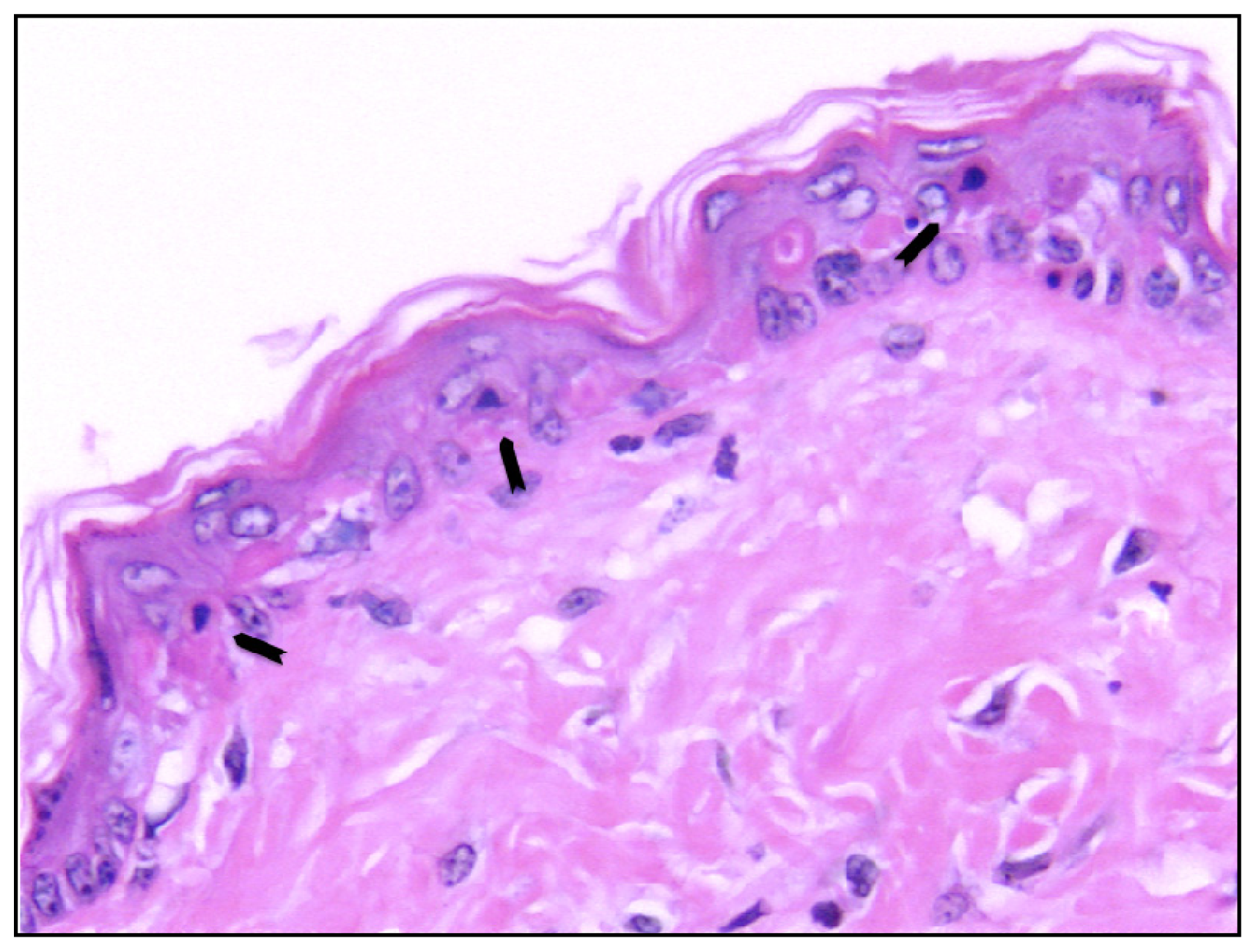
<p>Studies in mice and human subjects have also demonstrated a protective role for vitamin D compounds in preventing skin cell death. Apoptotic keratinocytes are known as “sunburn cells”, recognizable by their haemotoxylin-stained pyknotic nuclei and eosinophilic cytoplasm [<xref ref-type="bibr" rid="b35-ijms-14-01964">35</xref>] (<xref ref-type="fig" rid="f1-ijms-14-01964">Figure 1</xref>), and are likely eliminated from skin before replication [<xref ref-type="bibr" rid="b36-ijms-14-01964">36</xref>]. Sunburn cells were reduced in UV-irradiated mouse skin by 1,25D treatment, both systemically [<xref ref-type="bibr" rid="b37-ijms-14-01964">37</xref>] and by topical application [<xref ref-type="bibr" rid="b29-ijms-14-01964">29</xref>,<xref ref-type="bibr" rid="b38-ijms-14-01964">38</xref>,<xref ref-type="bibr" rid="b39-ijms-14-01964">39</xref>], and in UV-irradiated skin of human subjects after topical application of 1,25D [<xref ref-type="bibr" rid="b40-ijms-14-01964">40</xref>].</p></sec>
<sec>
<title>3. UV-Induced Skin Cell Death: Mechanisms of Photoprotection by Vitamin D Compounds</title>
<p>One or more physiological responses observed in UV irradiated skin after vitamin D treatment may well contribute to the improved cell survival due to vitamin D. These responses include a reduction in UV-induced DNA damage [<xref ref-type="bibr" rid="b29-ijms-14-01964">29</xref>,<xref ref-type="bibr" rid="b41-ijms-14-01964">41</xref>,<xref ref-type="bibr" rid="b42-ijms-14-01964">42</xref>], a reduction in nitric oxide metabolites, nitrite, 3-nitrotyrosine and 8-nitroguanosine [<xref ref-type="bibr" rid="b29-ijms-14-01964">29</xref>,<xref ref-type="bibr" rid="b39-ijms-14-01964">39</xref>,<xref ref-type="bibr" rid="b43-ijms-14-01964">43</xref>,<xref ref-type="bibr" rid="b44-ijms-14-01964">44</xref>], the upregulation of p53 [<xref ref-type="bibr" rid="b39-ijms-14-01964">39</xref>,<xref ref-type="bibr" rid="b45-ijms-14-01964">45</xref>] and the upregulation of inherent antioxidant systems, such as metallothionein [<xref ref-type="bibr" rid="b31-ijms-14-01964">31</xref>,<xref ref-type="bibr" rid="b37-ijms-14-01964">37</xref>]. These responses are discussed in more detail below.</p>
<sec>
<title>3.1. Vitamin D Reduces UV-Induced DNA Damage</title>
<p>One of the major reasons for skin cell death following UV exposure is that the cells have acquired irreparable DNA damage. The most abundant forms of DNA damage found in UV irradiated human skin are thymine dimers, a subset of cyclobutane pyrimidine dimers (CPDs) formed by UV absorption [<xref ref-type="bibr" rid="b46-ijms-14-01964">46</xref>–<xref ref-type="bibr" rid="b48-ijms-14-01964">48</xref>], and 8-hydroxy-2′deoxyguanosine (8-oxodG) produced indirectly by reactive free radicals generated by UV [<xref ref-type="bibr" rid="b6-ijms-14-01964">6</xref>,<xref ref-type="bibr" rid="b13-ijms-14-01964">13</xref>,<xref ref-type="bibr" rid="b49-ijms-14-01964">49</xref>,<xref ref-type="bibr" rid="b50-ijms-14-01964">50</xref>]. Although a reduction in skin cell apoptosis after UV might allow more DNA-damaged cells to survive, the data show that both types of DNA photolesions are reduced in irradiated skin cells treated with 1,25D. This was demonstrated by immunohistochemistry using monoclonal antisera specific for thymine dimers and 8-oxo-dG. Image analysis showed reduced nuclear staining for thymine dimers in UV-irradiated skin cells treated with 1,25D in culture [<xref ref-type="bibr" rid="b28-ijms-14-01964">28</xref>,<xref ref-type="bibr" rid="b38-ijms-14-01964">38</xref>,<xref ref-type="bibr" rid="b51-ijms-14-01964">51</xref>,<xref ref-type="bibr" rid="b52-ijms-14-01964">52</xref>], in mouse skin [<xref ref-type="bibr" rid="b29-ijms-14-01964">29</xref>,<xref ref-type="bibr" rid="b39-ijms-14-01964">39</xref>,<xref ref-type="bibr" rid="b52-ijms-14-01964">52</xref>], <italic>ex vivo</italic> human skin [<xref ref-type="bibr" rid="b43-ijms-14-01964">43</xref>] and human skin <italic>in vivo</italic>[<xref ref-type="bibr" rid="b40-ijms-14-01964">40</xref>]. Reduced thymine dimers in UV-exposed keratinocytes in the presence of 1,25D was also reported using an entirely different method, the Comet assay, which uses a specific enzyme to cut DNA at the site of the relevant lesion [<xref ref-type="bibr" rid="b44-ijms-14-01964">44</xref>,<xref ref-type="bibr" rid="b53-ijms-14-01964">53</xref>]. Reduced nuclear staining for UV-induced 8-oxo-dG by 1,25D was observed in mouse skin [<xref ref-type="bibr" rid="b44-ijms-14-01964">44</xref>] and <italic>ex vivo</italic> human skin [<xref ref-type="bibr" rid="b43-ijms-14-01964">43</xref>]. A reduction in 8-oxo-dG in UV irradiated keratinocytes by 1,25D has also been shown by Comet assay [<xref ref-type="bibr" rid="b44-ijms-14-01964">44</xref>]. UV-induced strand breaks identified by a specific repair enzyme for 8-oxo-dG (human 8-oxoguanine DNA glycosylase) were reduced by 1,25D in irradiated keratinocytes in culture [<xref ref-type="bibr" rid="b44-ijms-14-01964">44</xref>]. The reduction in thymine dimers and 8-oxo-dG occurred within 30 min after irradiation in culture [<xref ref-type="bibr" rid="b29-ijms-14-01964">29</xref>,<xref ref-type="bibr" rid="b44-ijms-14-01964">44</xref>], and also in human <italic>ex vivo</italic> skin when tested at three and six hours, post UV [<xref ref-type="bibr" rid="b43-ijms-14-01964">43</xref>]. The reduction in UV-induced DNA damage would not only enhance cell survival, but is also likely to reduce some of the other deleterious effects of UV in human skin.</p>
<p>There is some information on mediators of this protective response. Vitamin D receptor knock-out mice show increased susceptibility to photocarcinogenesis [<xref ref-type="bibr" rid="b54-ijms-14-01964">54</xref>]. At least in human skin fibroblasts, the 1,25D-induced reduction in UV-induced thymine dimers required the presence of a vitamin D receptor and of a stress protein ERp57 [<xref ref-type="bibr" rid="b45-ijms-14-01964">45</xref>]. Interestingly, although a vitamin D receptor was required, mutations in either the DNA-binding domain or the classical ligand-binding domain, which produced the syndrome of vitamin D-resistant rickets in the donors, did not abrogate the protection from UV-induced thymine dimers in the presence of 1,25D [<xref ref-type="bibr" rid="b45-ijms-14-01964">45</xref>]. This suggests that 1,25D may be acting via a non-classical, non-genomic pathway in exerting its photoprotective effects on DNA damage. This hypothesis is further supported by studies with analogs, including 1,25dihydroxylumisterol, which mimic, at least to some extent, the protective effect of 1,25D and by data which shows that the reduction in thymine dimers by 1,25D is lost in the presence of a chloride channel blocker 4,40-diisothiocyanatostilbene-2,20-disulfonic acid (DIDS) [<xref ref-type="bibr" rid="b53-ijms-14-01964">53</xref>], shown to block non-classical effects of 1,25D in other cell types [<xref ref-type="bibr" rid="b55-ijms-14-01964">55</xref>].</p></sec>
<sec>
<title>3.2. Effects of Vitamin D on p53</title>
<p>UV exposure leads to accumulation of p53 protein within the nucleus of skin cells. A well-known tumor suppressor, p53 is known as the “guardian of the genome” in that it may disrupt the cell cycle, allowing time for repair of DNA damage before replication [<xref ref-type="bibr" rid="b56-ijms-14-01964">56</xref>]. Alternatively, following its phosphorylation at Ser46, p53 may stimulate apoptosis of cells with irreparably damaged DNA before replication.</p>
<p>Studies by our group have shown further increases in p53 at three and six hours after UV in keratinocytes and melanocytes treated with 1,25D (1 or 10 nM) [<xref ref-type="bibr" rid="b29-ijms-14-01964">29</xref>,<xref ref-type="bibr" rid="b52-ijms-14-01964">52</xref>] or vitamin D analogs [<xref ref-type="bibr" rid="b34-ijms-14-01964">34</xref>,<xref ref-type="bibr" rid="b39-ijms-14-01964">39</xref>]. Conversely, studies by another group have shown that at much higher concentrations, 1,25D (1 μM) suppresses p53 in UV-irradiated human keratinocytes measured at two, four and eight hours after UV [<xref ref-type="bibr" rid="b51-ijms-14-01964">51</xref>]. The UVB doses used in these studies were also different. De Haes <italic>et al.</italic> postulated in the latter study that the reduction in p53 accumulation by 1,25D is in accordance with its ability to reduce DNA damage in the form of CPDs [<xref ref-type="bibr" rid="b51-ijms-14-01964">51</xref>]. A more recent study by Yamaguchi and colleagues [<xref ref-type="bibr" rid="b57-ijms-14-01964">57</xref>] demonstrated an increase in p53 paralleled by a reduction in CPDs in human subjects who had been exposed to repeated doses of UV. While this group attributed the protective response to an increase in pigmentation, the production of 1,25D and other D compounds in skin with repeated UV exposure may also contribute.</p>
<p>Nucleotide excision repair (NER) is the main mechanism for repair of UV-induced DNA damage. Interestingly, in keratinocytes, 1,25D increased the levels of two of the key enzymes involved in NER; XPC (xeroderma pigmentosum complementation group C) and DDB2 (damage-specific DNA binding protein 2 also known as XPE) [<xref ref-type="bibr" rid="b58-ijms-14-01964">58</xref>]. Moreover, increased p53 also increases the levels of these enzymes [<xref ref-type="bibr" rid="b59-ijms-14-01964">59</xref>] and, as stated above, 1,25D causes a further increase in expression of p53 after UV [<xref ref-type="bibr" rid="b29-ijms-14-01964">29</xref>,<xref ref-type="bibr" rid="b39-ijms-14-01964">39</xref>]. Whilst the 1,25D-mediated increase in p53 would presumably facilitate DNA repair, the proposed association between higher p53 and greater DNA repair has been challenged by studies that reported a dissociation between increases in p53 and levels of post-UV DNA damage in keratinocytes [<xref ref-type="bibr" rid="b53-ijms-14-01964">53</xref>]. Furthermore, studies in dermal fibroblasts have shown that the increase in p53 by 1,25D can occur in the absence of the VDR, although in the total absence of VDR, no photoprotection by 1,25D is seen in these cells [<xref ref-type="bibr" rid="b45-ijms-14-01964">45</xref>].</p></sec>
<sec>
<title>3.3. Vitamin D Compounds Reduce Nitric Oxide Derivatives</title>
<p>As noted earlier, UV increases NO in skin [<xref ref-type="bibr" rid="b7-ijms-14-01964">7</xref>–<xref ref-type="bibr" rid="b9-ijms-14-01964">9</xref>,<xref ref-type="bibr" rid="b11-ijms-14-01964">11</xref>,<xref ref-type="bibr" rid="b12-ijms-14-01964">12</xref>,<xref ref-type="bibr" rid="b60-ijms-14-01964">60</xref>] leading to: oxidative and nitrative modifications to DNA and other molecules [<xref ref-type="bibr" rid="b15-ijms-14-01964">15</xref>], inhibition of DNA repair [<xref ref-type="bibr" rid="b18-ijms-14-01964">18</xref>,<xref ref-type="bibr" rid="b19-ijms-14-01964">19</xref>], energy depletion and cell death [<xref ref-type="bibr" rid="b13-ijms-14-01964">13</xref>,<xref ref-type="bibr" rid="b16-ijms-14-01964">16</xref>], and membrane alterations; changes that permit the release of pro-apoptotic proteins from mitochondria and the induction of apoptosis.</p>
<p>There is evidence to suggest that 1,25D diminishes the incidence of oxidative and nitrosative DNA damage by reducing the production of NO and other toxic RNS, which may well improve DNA repair mechanisms and improve cell survival. Two relatively stable end products of the nitric oxide pathway, nitrite and 3-nitrotyrosine, used as measures for NO production, were significantly reduced in UV-irradiated skin cells in the presence of 1,25D when measured by the Griess assay (for nitrite) or a whole cell ELISA using a nitrotyrosine antibody [<xref ref-type="bibr" rid="b29-ijms-14-01964">29</xref>,<xref ref-type="bibr" rid="b39-ijms-14-01964">39</xref>]. Another nitric oxide product examined was 8-nitroguanosine (8-NG), which is a marker for inflammation and carcinogenesis [<xref ref-type="bibr" rid="b61-ijms-14-01964">61</xref>]. UV-irradiated human <italic>ex vivo</italic> skin showed markedly increased level of 8-NG, and this was significantly reduced when treated with 1,25D in human <italic>ex vivo</italic> skin as early as 30 minutes post irradiation [<xref ref-type="bibr" rid="b43-ijms-14-01964">43</xref>]. Similarly, nitric oxide synthase (NOS) inhibitors, such as aminoguanidine and L-<italic>N</italic>-monomethylarginine, reduced nitrite and thymine dimer production in irradiated cells to an extent comparable with that resulting from 1,25D treatment [<xref ref-type="bibr" rid="b28-ijms-14-01964">28</xref>,<xref ref-type="bibr" rid="b29-ijms-14-01964">29</xref>]. The selective inhibitor (1400W) of inducible NOS reduced CPDs and 8-oxo-dG in irradiated keratinocytes in culture [<xref ref-type="bibr" rid="b44-ijms-14-01964">44</xref>].</p></sec>
<sec>
<title>3.4. Vitamin D and Antioxidant Systems</title>
<p>Activation of photoreceptors in skin by UV absorption generates free radicals by electron transfer or hydrogen abstraction processes in other molecules, or by energy transfer to molecular oxygen increasing the rate of ROS production [<xref ref-type="bibr" rid="b6-ijms-14-01964">6</xref>]. During normal cellular metabolism low levels of ROS are regulated by intrinsic antioxidant enzyme systems and scavengers that maintain the redox balance in cells. For example, superoxide anions are converted by superoxide dismutase to hydrogen peroxide, which is converted to water and oxygen by catalase. Insufficient enzyme activity increases the levels of superoxide and hydrogen peroxide that form highly toxic peroxynitrite and hydroxyl ions respectively. Free radical scavengers, glutathione, metallothionein, thioredoxin, vitamin C and E, and carotenoids are also present in skin, but may be inactivated by UV-induced ROS and RNS. Glutathione peroxidase, superoxide dismutase and catalase expression are downregulated for several days following UV exposure, which would permit an exponential increase in ROS and reactive nitrogen species (RNS) [<xref ref-type="bibr" rid="b62-ijms-14-01964">62</xref>]. Inflammatory cells induced by UV also migrate into irradiated skin and may contribute to increased levels of ROS [<xref ref-type="bibr" rid="b13-ijms-14-01964">13</xref>]. An imbalance between ROS and antioxidant systems by UV will perturb cellular defence against DNA damage, oxidative and nitrative modifications to proteins, lipid peroxidation of membranes, leading to cell death.</p>
<p>Treatment with 1,25D inhibited the activation of stress-activated protein kinases, c-Jun <italic>N</italic>-terminal kinase (JNK), which lead to apoptosis in UV irradiated keratinocytes [<xref ref-type="bibr" rid="b26-ijms-14-01964">26</xref>], and inhibited apoptosis induced by oxidative stress, TNFα and hydrogen peroxide cytotoxicity [<xref ref-type="bibr" rid="b25-ijms-14-01964">25</xref>,<xref ref-type="bibr" rid="b63-ijms-14-01964">63</xref>,<xref ref-type="bibr" rid="b64-ijms-14-01964">64</xref>], possibly by increasing inherent antioxidant systems. Metallothionein, a cysteine-rich protein responsible for metal detoxification and an oxygen radical scavenger, when upregulated by cadmium in irradiated mouse skin, reduced UV-induced apoptotic sunburn cells, cell death and photo-damage [<xref ref-type="bibr" rid="b65-ijms-14-01964">65</xref>], and was also shown to reduce superoxide and hydroxyl radicals [<xref ref-type="bibr" rid="b66-ijms-14-01964">66</xref>]. UV-induced immune suppression was increased in metallothionein knockout transgenic mice, providing further evidence of its photoprotective effect [<xref ref-type="bibr" rid="b67-ijms-14-01964">67</xref>,<xref ref-type="bibr" rid="b68-ijms-14-01964">68</xref>]. Treatment with 1,25(OH)<sub>2</sub>D<sub>3</sub> upregulated the transcription of metallothionein [<xref ref-type="bibr" rid="b69-ijms-14-01964">69</xref>] along with a reduction in UV-induced sunburn cells in skin [<xref ref-type="bibr" rid="b31-ijms-14-01964">31</xref>,<xref ref-type="bibr" rid="b37-ijms-14-01964">37</xref>].</p></sec>
<sec>
<title>3.5. Vitamin D and MAPK Signaling</title>
<p>The mitogen activated protein kinase (MAPK) cascade is a large group of conserved protein serine/threonine kinases which consist of three distinct tiers of protein kinases; a mitogen-activated extracellular signal-regulated kinase kinase kinase (MEKK), which activates a mitogen-activated extracellular signal-regulated kinase kinase (MEK) that subsequently activates a MAPK. MAPKs include the well characterised c-jun-<italic>N</italic>-terminal kinase (JNK), extracellular signal-regulated kinase (ERK), and p38 MAPK. These kinases are widely located in keratinocytes and are targeted by various extracellular stimuli, including UVR [<xref ref-type="bibr" rid="b70-ijms-14-01964">70</xref>]. Activation of MAPKs requires dual phosphorylation of specific residues within the activation loop, however skin cells must be exposed to UVR for a sufficient time, dose, and particular wavelengths for this to occur [<xref ref-type="bibr" rid="b71-ijms-14-01964">71</xref>]. Upon activation, these members are able to phosphorylate each other in a series of well-defined cascades [<xref ref-type="bibr" rid="b70-ijms-14-01964">70</xref>].</p>
<p>UVR-activated JNK and p38 MAPK translocate to the nucleus of the cell to initiate transcription of target genes resulting in the modulation of cellular functions [<xref ref-type="bibr" rid="b26-ijms-14-01964">26</xref>,<xref ref-type="bibr" rid="b70-ijms-14-01964">70</xref>]. JNK and p38 MAPK have been described in a number of studies as being involved in the induction of apoptosis [<xref ref-type="bibr" rid="b71-ijms-14-01964">71</xref>]. However, treatment of keratinocytes with high concentrations of 1,25D (1 μM) [<xref ref-type="bibr" rid="b26-ijms-14-01964">26</xref>] or at more physiological concentrations (1 nM) [<xref ref-type="bibr" rid="b72-ijms-14-01964">72</xref>] leads to inhibition of UVR-induced JNK phosphorylation by 30%–50%. Since JNK promotes programmed cell death, this effect may contribute to the anti-apoptotic role of 1,25D in keratinocytes following UVR. Conversely, 1,25D has no effect on p38 MAPK activation following UVR exposure [<xref ref-type="bibr" rid="b26-ijms-14-01964">26</xref>].</p>
<p>Treatment of keratinocytes with the JNK signaling inhibitor, SP600125, showed a significant decrease in UVR-induced cell loss, which was similar to the level of protection after 1,25D treatment [<xref ref-type="bibr" rid="b72-ijms-14-01964">72</xref>]. When used in isolation, SP600125 inhibits phosphorylation of downstream targets of JNK but does not affect the phosphorylation of JNK itself [<xref ref-type="bibr" rid="b73-ijms-14-01964">73</xref>].</p></sec>
<sec>
<title>3.6. Vitamin D and Akt Signaling</title>
<p>Similar to the raf/MEK/ERK (MEK/ERK) pathway, the phosphatidylinositol 3-kinase (PI3K)/Akt pathway is also constitutively active at a low level in epidermal keratinocytes and both ERK and Akt are upregulated by UVR [<xref ref-type="bibr" rid="b74-ijms-14-01964">74</xref>,<xref ref-type="bibr" rid="b75-ijms-14-01964">75</xref>]. Both these cascades play a key role in regulation of epidermal cell proliferation and cellular survival in response to extracellular stimuli [<xref ref-type="bibr" rid="b76-ijms-14-01964">76</xref>]. Interestingly, it was reported that phosphorylation of ERK and Akt are augmented from basal levels in the presence of 1,25D which leads to modification of the expression and activity of various apoptosis-regulating molecules, which was suggested to decrease the susceptibility of keratinocytes to apoptosis [<xref ref-type="bibr" rid="b77-ijms-14-01964">77</xref>]. Treatment of cells with pharmacological inhibitors of ERK and PI3K partly reverses protection against UVR-induced apoptosis by 1,25D, thus suggesting that the MEK/ERK and PI3K/Akt cascades may contribute to 1,25D-mediated cellular survival in UV-exposed human keratinocytes [<xref ref-type="bibr" rid="b77-ijms-14-01964">77</xref>]. However, it should be noted that in the report by De Haes <italic>et al.</italic>, high concentrations of 1,25D (10 nM–1 μM) were required for this effect to be observed. Our group has reported a significant reduction in UV-induced thymine dimers in keratinocytes treated with 0.022 μM ERK peptide inhibitor or 0.2 nM Wortmannin, similar to that of 1,25D (1 nM) [<xref ref-type="bibr" rid="b78-ijms-14-01964">78</xref>]. In at least some systems, Akt phosphorylation can result in increased beta-catenin phosphorylation and translocation to the nucleus [<xref ref-type="bibr" rid="b79-ijms-14-01964">79</xref>]. There are several reported interactions between the vitamin D pathway and beta-catenin in skin [<xref ref-type="bibr" rid="b80-ijms-14-01964">80</xref>]. In this context it is interesting to note that, in preliminary experiments, an inhibitor of β-catenin, IWR-1-endo, which enhances proteasomal degradation of β-catenin, on its own, also reduced thymine dimers after UV (unpublished observations). These results suggest that these pathways may contribute to UV-induced thymine dimers and presumably also UV-induced apoptosis, but further studies are required to test this. Protection against thymine dimers also remained when cells were treated with the combination of 1,25D and the ERK peptide inhibitor, Wortmannin [<xref ref-type="bibr" rid="b78-ijms-14-01964">78</xref>] or IWR-1-endo (unpublished observations).</p></sec></sec>
<sec sec-type="conclusions">
<title>4. Conclusions</title>
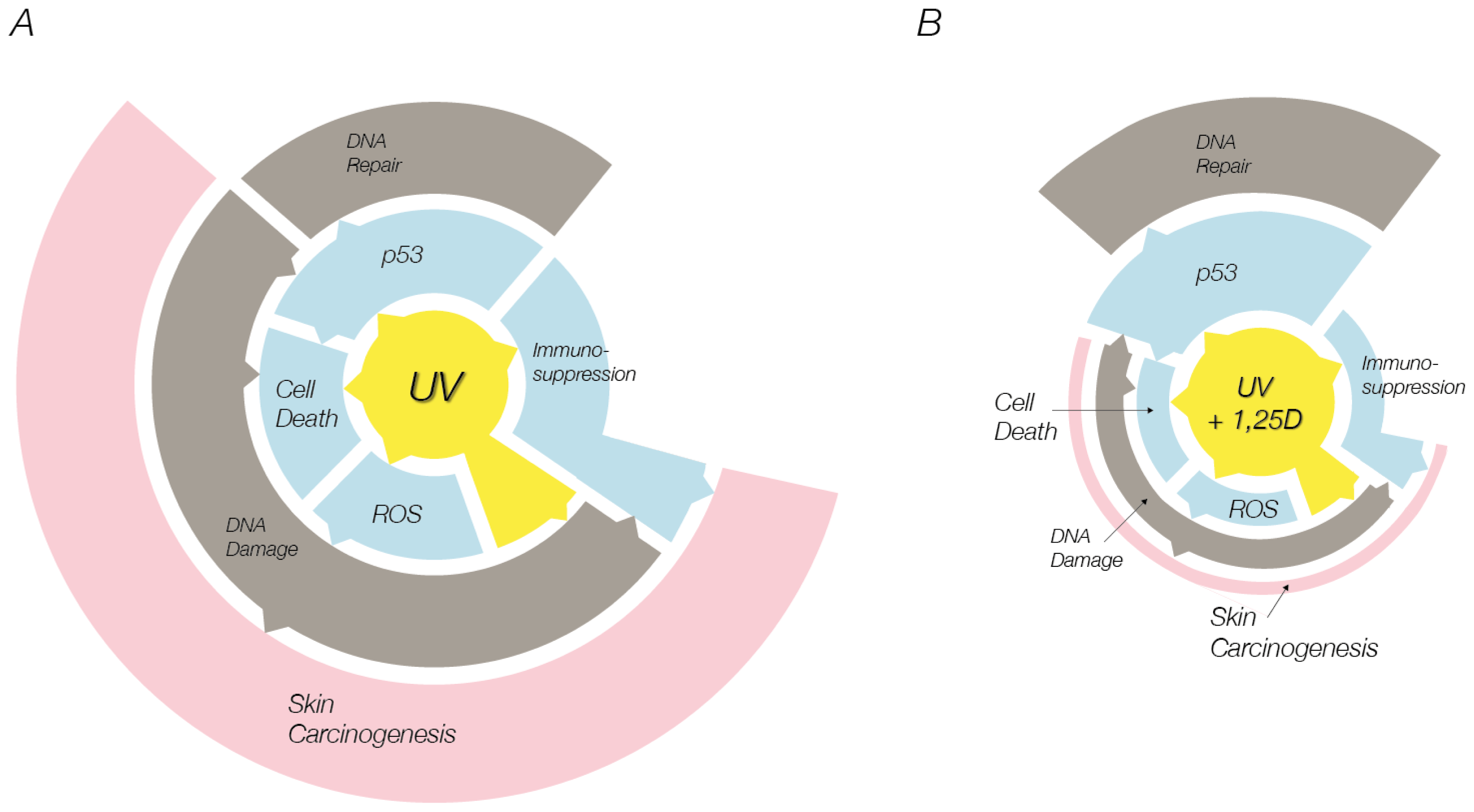
<p>Taken together, the studies reviewed here indicate that the inhibition of UV-induced cell death by vitamin D compounds is indeed a protective effect. This is evidenced by the further increase in p53, which facilitates DNA repair, as demonstrated by a reduction in CPDs in UV-irradiated skin cells treated with vitamin D compounds. Moreover, the indirect DNA damage and the reduction in DNA repair that is normally caused by nitric oxide products would be avoided by the ability of vitamin D compounds to reduce nitric oxide products. Vitamin D compounds are known to inhibit UV-induced immunosuppression [<xref ref-type="bibr" rid="b38-ijms-14-01964">38</xref>,<xref ref-type="bibr" rid="b39-ijms-14-01964">39</xref>,<xref ref-type="bibr" rid="b52-ijms-14-01964">52</xref>], and a reduction in DNA damage would presumably result in inhibition of UV-induced immunosuppression [<xref ref-type="bibr" rid="b81-ijms-14-01964">81</xref>]. <xref ref-type="fig" rid="f2-ijms-14-01964">Figure 2</xref> shows a schematic of the proposed mechanism for protection against skin carcinogenesis by vitamin D compounds.</p>
<p>It could be argued that a reduction in UV-induced skin cell apoptosis in the presence of vitamin D metabolites might allow more damaged cells to survive and thus increase photocarcinogenesis. In practice however, it seems likely that the reduction in UV-induced apoptosis by vitamin D compounds is mainly a result of the reductions in UV-induced DNA damage observed in the presence of vitamin D compounds. This, together with reduced UV-immunosuppression, almost certainly underlies the observed reduction in skin carcinogenesis when vitamin D metabolites are used topically after UV irradiation [<xref ref-type="bibr" rid="b39-ijms-14-01964">39</xref>]. Therefore, there is a potential role for vitamin D compounds as preventative agents for skin cancer.</p></sec></body>
<back>
<ack>
<title>Acknowledgments</title>
<p>The authors acknowledge the financial support of the National Health and Medical Research Council and the Cancer Institute New South Wales, as well as the assistance of A.J. Camp (University of Sydney) with graphic design.</p></ack>
<fn-group><fn id="fn1-ijms-14-01964">
<p><bold>Conflict of Interest</bold></p>
<p>The authors declare no conflict of interest.</p></fn></fn-group>
<ref-list>
<title>References</title>
<ref id="b1-ijms-14-01964"><label>1</label><citation citation-type="journal"><person-group person-group-type="author"><name><surname>Matsumura</surname><given-names>Y.</given-names></name><name><surname>Ananthaswamy</surname><given-names>H.N.</given-names></name></person-group><article-title>Toxic effects of ultraviolet radiation on the skin</article-title><source>Toxicol. Appl. Pharmacol</source><year>2004</year><volume>195</volume><fpage>298</fpage><lpage>308</lpage><pub-id pub-id-type="doi">10.1016/j.taap.2003.08.019</pub-id><pub-id pub-id-type="pmid">15020192</pub-id></citation></ref>
<ref id="b2-ijms-14-01964"><label>2</label><citation citation-type="journal"><person-group person-group-type="author"><name><surname>Dixon</surname><given-names>K.M.</given-names></name><name><surname>Sequeira</surname><given-names>V.B.</given-names></name><name><surname>Camp</surname><given-names>A.J.</given-names></name><name><surname>Mason</surname><given-names>R.S.</given-names></name></person-group><article-title>Vitamin D-fence</article-title><source>Photochem. Photobiol. Sci</source><year>2010</year><volume>9</volume><fpage>564</fpage><lpage>570</lpage><pub-id pub-id-type="doi">10.1039/b9pp00184k</pub-id><pub-id pub-id-type="pmid">20354652</pub-id></citation></ref>
<ref id="b3-ijms-14-01964"><label>3</label><citation citation-type="journal"><person-group person-group-type="author"><name><surname>Holick</surname><given-names>M.F.</given-names></name></person-group><article-title>The cutaneous photosynthesis of previtamin D3: A unique photoendocrine system</article-title><source>J. Invest. Dermatol</source><year>1981</year><volume>77</volume><fpage>51</fpage><lpage>58</lpage><pub-id pub-id-type="doi">10.1111/1523-1747.ep12479237</pub-id><pub-id pub-id-type="pmid">6265564</pub-id></citation></ref>
<ref id="b4-ijms-14-01964"><label>4</label><citation citation-type="journal"><person-group person-group-type="author"><name><surname>Bikle</surname><given-names>D.D.</given-names></name><name><surname>Nemanic</surname><given-names>M.K.</given-names></name><name><surname>Whitney</surname><given-names>J.O.</given-names></name><name><surname>Elias</surname><given-names>P.W.</given-names></name></person-group><article-title>Neonatal human foreskin keratinocytes produce 1,25-dihydroxyvitamin D3</article-title><source>Biochemistry</source><year>1986</year><volume>25</volume><fpage>1545</fpage><lpage>1548</lpage><pub-id pub-id-type="doi">10.1021/bi00355a013</pub-id><pub-id pub-id-type="pmid">2423114</pub-id></citation></ref>
<ref id="b5-ijms-14-01964"><label>5</label><citation citation-type="journal"><person-group person-group-type="author"><name><surname>Lehmann</surname><given-names>B.</given-names></name><name><surname>Rudolph</surname><given-names>T.</given-names></name><name><surname>Pietzsch</surname><given-names>J.</given-names></name><name><surname>Meurer</surname><given-names>M.</given-names></name></person-group><article-title>Conversion of vitamin D3 to 1alpha,25-dihydroxyvitamin D3 in human skin equivalents</article-title><source>Exp. Dermatol</source><year>2000</year><volume>9</volume><fpage>97</fpage><lpage>103</lpage><pub-id pub-id-type="doi">10.1034/j.1600-0625.2000.009002097.x</pub-id><pub-id pub-id-type="pmid">10772383</pub-id></citation></ref>
<ref id="b6-ijms-14-01964"><label>6</label><citation citation-type="journal"><person-group person-group-type="author"><name><surname>Pattison</surname><given-names>D.I.</given-names></name><name><surname>Davies</surname><given-names>M.J.</given-names></name></person-group><article-title>Actions of ultraviolet light on cellular structures</article-title><source>Cancer</source><year>2006</year><fpage>131</fpage><lpage>157</lpage></citation></ref>
<ref id="b7-ijms-14-01964"><label>7</label><citation citation-type="journal"><person-group person-group-type="author"><name><surname>Deliconstantinos</surname><given-names>G.</given-names></name><name><surname>Villiotou</surname><given-names>V.</given-names></name><name><surname>Stravrides</surname><given-names>J.C.</given-names></name></person-group><article-title>Release by ultraviolet b (U.V.B) radiation of nitric oxide (no) from human keratinocytes: A potential role for nitric oxide in erythema production</article-title><source>Br. J. Pharmacol</source><year>1995</year><volume>114</volume><fpage>1257</fpage><lpage>1265</lpage><pub-id pub-id-type="doi">10.1111/j.1476-5381.1995.tb13341.x</pub-id><pub-id pub-id-type="pmid">7620717</pub-id></citation></ref>
<ref id="b8-ijms-14-01964"><label>8</label><citation citation-type="journal"><person-group person-group-type="author"><name><surname>Bruch-Gerharz</surname><given-names>D.</given-names></name><name><surname>Ruzicka</surname><given-names>T.</given-names></name><name><surname>Kolb-Bachofen</surname><given-names>V.</given-names></name></person-group><article-title>Nitric oxide in human skin: Current status and future prospects</article-title><source>J. Invest. Dermatol</source><year>1998</year><volume>110</volume><fpage>1</fpage><lpage>7</lpage><pub-id pub-id-type="doi">10.1046/j.1523-1747.1998.00084.x</pub-id><pub-id pub-id-type="pmid">9424078</pub-id></citation></ref>
<ref id="b9-ijms-14-01964"><label>9</label><citation citation-type="journal"><person-group person-group-type="author"><name><surname>Cals-Grierson</surname><given-names>M.M.</given-names></name><name><surname>Ormerod</surname><given-names>A.D.</given-names></name></person-group><article-title>Nitric oxide function in the skin</article-title><source>Nitric Oxide</source><year>2004</year><volume>10</volume><fpage>179</fpage><lpage>193</lpage><pub-id pub-id-type="doi">10.1016/j.niox.2004.04.005</pub-id><pub-id pub-id-type="pmid">15275864</pub-id></citation></ref>
<ref id="b10-ijms-14-01964"><label>10</label><citation citation-type="journal"><person-group person-group-type="author"><name><surname>Paunel</surname><given-names>A.N.</given-names></name><name><surname>Dejam</surname><given-names>A.</given-names></name><name><surname>Thelen</surname><given-names>S.</given-names></name><name><surname>Kirsch</surname><given-names>M.</given-names></name><name><surname>Horstjann</surname><given-names>M.</given-names></name><name><surname>Gharini</surname><given-names>P.</given-names></name><name><surname>Murtz</surname><given-names>M.</given-names></name><name><surname>Kelm</surname><given-names>M.</given-names></name><name><surname>de Groot</surname><given-names>H.</given-names></name><name><surname>Kolb-Bachofen</surname><given-names>V.</given-names></name><etal/></person-group><article-title>Enzyme-independent nitric oxide formation during UVA challenge of human skin: Characterization, molecular sources, and mechanisms</article-title><source>Free Radic. Biol. Med</source><year>2005</year><volume>38</volume><fpage>606</fpage><lpage>615</lpage><pub-id pub-id-type="doi">10.1016/j.freeradbiomed.2004.11.018</pub-id><pub-id pub-id-type="pmid">15683717</pub-id></citation></ref>
<ref id="b11-ijms-14-01964"><label>11</label><citation citation-type="journal"><person-group person-group-type="author"><name><surname>Mowbray</surname><given-names>M.</given-names></name><name><surname>McLintock</surname><given-names>S.</given-names></name><name><surname>Weerakoon</surname><given-names>R.</given-names></name><name><surname>Lomatschinsky</surname><given-names>N.</given-names></name><name><surname>Jones</surname><given-names>S.</given-names></name><name><surname>Rossi</surname><given-names>A.G.</given-names></name><name><surname>Weller</surname><given-names>R.B.</given-names></name></person-group><article-title>Enzyme-independent no stores in human skin: Quantification and influence of UV radiation</article-title><source>J. Invest. Dermatol</source><year>2009</year><volume>129</volume><fpage>834</fpage><lpage>842</lpage><pub-id pub-id-type="doi">10.1038/jid.2008.296</pub-id><pub-id pub-id-type="pmid">18818674</pub-id></citation></ref>
<ref id="b12-ijms-14-01964"><label>12</label><citation citation-type="journal"><person-group person-group-type="author"><name><surname>Hess</surname><given-names>D.T.</given-names></name><name><surname>Matsumoto</surname><given-names>A.</given-names></name><name><surname>Nudelman</surname><given-names>R.</given-names></name><name><surname>Stamler</surname><given-names>J.S.</given-names></name></person-group><article-title><italic>S</italic>-nitrosylation: Spectrum and specificity</article-title><source>Nat. Cell Biol</source><year>2001</year><volume>3</volume><fpage>E46</fpage><lpage>E49</lpage><pub-id pub-id-type="doi">10.1038/35055152</pub-id><pub-id pub-id-type="pmid">11175760</pub-id></citation></ref>
<ref id="b13-ijms-14-01964"><label>13</label><citation citation-type="journal"><person-group person-group-type="author"><name><surname>Halliday</surname><given-names>G.M.</given-names></name></person-group><article-title>Inflammation, gene mutation and photoimmunosuppression in response to UVR-induced oxidative damage contributes to photocarcinogenesis</article-title><source>Mutat. Res</source><year>2005</year><volume>571</volume><fpage>107</fpage><lpage>120</lpage><pub-id pub-id-type="doi">10.1016/j.mrfmmm.2004.09.013</pub-id><pub-id pub-id-type="pmid">15748642</pub-id></citation></ref>
<ref id="b14-ijms-14-01964"><label>14</label><citation citation-type="journal"><person-group person-group-type="author"><name><surname>Ohshima</surname><given-names>H.</given-names></name><name><surname>Sawa</surname><given-names>T.</given-names></name><name><surname>Akaike</surname><given-names>T.</given-names></name></person-group><article-title>8-nitroguanine, a product of nitrative DNA damage caused by reactive nitrogen species: Formation, occurrence, and implications in inflammation and carcinogenesis</article-title><source>Antioxid. Redox Signal</source><year>2006</year><volume>8</volume><fpage>1033</fpage><lpage>1045</lpage><pub-id pub-id-type="doi">10.1089/ars.2006.8.1033</pub-id><pub-id pub-id-type="pmid">16771693</pub-id></citation></ref>
<ref id="b15-ijms-14-01964"><label>15</label><citation citation-type="journal"><person-group person-group-type="author"><name><surname>Pacher</surname><given-names>P.</given-names></name><name><surname>Beckman</surname><given-names>J.S.</given-names></name><name><surname>Liaudet</surname><given-names>L.</given-names></name></person-group><article-title>Nitric oxide and peroxynitrite in health and disease</article-title><source>Physiol. Rev</source><year>2007</year><volume>87</volume><fpage>315</fpage><lpage>424</lpage><pub-id pub-id-type="doi">10.1152/physrev.00029.2006</pub-id><pub-id pub-id-type="pmid">17237348</pub-id></citation></ref>
<ref id="b16-ijms-14-01964"><label>16</label><citation citation-type="journal"><person-group person-group-type="author"><name><surname>Virág</surname><given-names>L.</given-names></name><name><surname>Szabó</surname><given-names>C.</given-names></name></person-group><article-title>The therapeutic potential of poly(adp-ribose) polymerase inhibitors</article-title><source>Physiol. Rev</source><year>2002</year><volume>54</volume><fpage>375</fpage><lpage>429</lpage></citation></ref>
<ref id="b17-ijms-14-01964"><label>17</label><citation citation-type="journal"><person-group person-group-type="author"><name><surname>Ouhtit</surname><given-names>A.</given-names></name><name><surname>Muller</surname><given-names>H.K.</given-names></name><name><surname>Gorny</surname><given-names>A.</given-names></name><name><surname>Ananthaswamy</surname><given-names>H.N.</given-names></name></person-group><article-title>UVB-induced experimental carcinogenesis: Dysregulation of apoptosis and p53 signalling pathway</article-title><source>Redox Report</source><year>2000</year><volume>5</volume><fpage>128</fpage><lpage>129</lpage><pub-id pub-id-type="doi">10.1179/135100000101535447</pub-id><pub-id pub-id-type="pmid">10939292</pub-id></citation></ref>
<ref id="b18-ijms-14-01964"><label>18</label><citation citation-type="journal"><person-group person-group-type="author"><name><surname>Jaiswal</surname><given-names>M.</given-names></name><name><surname>LaRusso</surname><given-names>N.F.</given-names></name><name><surname>Burgart</surname><given-names>L.J.</given-names></name><name><surname>Gores</surname><given-names>G.J.</given-names></name></person-group><article-title>Inflammatory cytokines induce DNA damage and inhibit DNA repair in cholangiocarcinoma cells by a nitric oxide-dependent mechanism</article-title><source>Cancer Res</source><year>2000</year><volume>60</volume><fpage>184</fpage><lpage>190</lpage><pub-id pub-id-type="pmid">10646872</pub-id></citation></ref>
<ref id="b19-ijms-14-01964"><label>19</label><citation citation-type="journal"><person-group person-group-type="author"><name><surname>Bau</surname><given-names>D.T.</given-names></name><name><surname>Gurr</surname><given-names>J.R.</given-names></name><name><surname>Jan</surname><given-names>K.Y.</given-names></name></person-group><article-title>Nitric oxide is involved in arsenite inhibition of pyrimidine dimer excision</article-title><source>Carcinogenesis</source><year>2001</year><volume>22</volume><fpage>709</fpage><lpage>716</lpage><pub-id pub-id-type="doi">10.1093/carcin/22.5.709</pub-id><pub-id pub-id-type="pmid">11323388</pub-id></citation></ref>
<ref id="b20-ijms-14-01964"><label>20</label><citation citation-type="journal"><person-group person-group-type="author"><name><surname>Saelens</surname><given-names>X.</given-names></name><name><surname>Festjens</surname><given-names>N.</given-names></name><name><surname>Walle</surname><given-names>L.V.</given-names></name><name><surname>van Gurp</surname><given-names>M.</given-names></name><name><surname>van Loo</surname><given-names>G.</given-names></name><name><surname>Vandenabeele</surname><given-names>P.</given-names></name></person-group><article-title>Toxic proteins released from mitochondria in cell death</article-title><source>Oncogene</source><year>2004</year><volume>23</volume><fpage>2861</fpage><lpage>2874</lpage><pub-id pub-id-type="doi">10.1038/sj.onc.1207523</pub-id><pub-id pub-id-type="pmid">15077149</pub-id></citation></ref>
<ref id="b21-ijms-14-01964"><label>21</label><citation citation-type="journal"><person-group person-group-type="author"><name><surname>Simboli-Campbell</surname><given-names>M.</given-names></name><name><surname>Narvaez</surname><given-names>C.J.</given-names></name><name><surname>Tenniswood</surname><given-names>M.</given-names></name><name><surname>Welsh</surname><given-names>J.</given-names></name></person-group><article-title>1,25-dihydroxyvitamin D3 induces morphological and biochemical markers of apoptosis in mcf-7 breast cancer cells</article-title><source>J. Steroid. Biochem. Mol. Biol</source><year>1996</year><volume>58</volume><fpage>367</fpage><lpage>376</lpage><pub-id pub-id-type="doi">10.1016/0960-0760(96)00055-6</pub-id><pub-id pub-id-type="pmid">8903420</pub-id></citation></ref>
<ref id="b22-ijms-14-01964"><label>22</label><citation citation-type="journal"><person-group person-group-type="author"><name><surname>Guzey</surname><given-names>M.</given-names></name><name><surname>Kitada</surname><given-names>S.</given-names></name><name><surname>Reed</surname><given-names>J.C.</given-names></name></person-group><article-title>Apoptosis induction by 1α,25-dihydroxyvitamin D3 in prostate cancer</article-title><source>Mol. Cancer Ther</source><year>2002</year><volume>1</volume><fpage>667</fpage><lpage>677</lpage><pub-id pub-id-type="pmid">12479363</pub-id></citation></ref>
<ref id="b23-ijms-14-01964"><label>23</label><citation citation-type="journal"><person-group person-group-type="author"><name><surname>Vandewalle</surname><given-names>B.</given-names></name><name><surname>Wattez</surname><given-names>N.</given-names></name><name><surname>Lefebvre</surname><given-names>J.</given-names></name></person-group><article-title>Effects of vitamin D3 derivatives on growth, differentiation and apoptosis in tumoral colonic ht 29 cells: Possible implication of intracellular calcium</article-title><source>Cancer Lett</source><year>1995</year><volume>97</volume><fpage>99</fpage><lpage>106</lpage><pub-id pub-id-type="doi">10.1016/0304-3835(95)03958-Y</pub-id><pub-id pub-id-type="pmid">7585485</pub-id></citation></ref>
<ref id="b24-ijms-14-01964"><label>24</label><citation citation-type="book"><person-group person-group-type="author"><name><surname>Mason</surname><given-names>R.S.</given-names></name><name><surname>Holliday</surname><given-names>C.J.</given-names></name></person-group><article-title>1,25dihydroxyVitamin D Contributes to Photoprotection in Skin Cells</article-title><source>Vitamin D Endocrine System: Structural, Biological, Genetic and Clinical Aspects</source><person-group person-group-type="editor"><name><surname>Norman</surname><given-names>A.</given-names></name><name><surname>Bouillon</surname><given-names>R.</given-names></name><name><surname>Thomasset</surname><given-names>M.</given-names></name></person-group><publisher-name>University of California</publisher-name><publisher-loc>Riverside, CA, USA</publisher-loc><year>2000</year><fpage>605</fpage><lpage>608</lpage></citation></ref>
<ref id="b25-ijms-14-01964"><label>25</label><citation citation-type="book"><person-group person-group-type="author"><name><surname>Mason</surname><given-names>R.S.</given-names></name><name><surname>Holliday</surname><given-names>C.J.</given-names></name><name><surname>Gupta</surname><given-names>R.</given-names></name></person-group><article-title>1,25 Dihydroxyvitamin D and Photoprotection in Skin Cells</article-title><source>Modern Trends in Skin Pharmacology</source><edition>1st ed</edition><person-group person-group-type="editor"><name><surname>Tsambos</surname><given-names>D.</given-names></name><name><surname>Merk</surname><given-names>H.</given-names></name></person-group><publisher-name>Parissianos Medical Publications S.A. Athens</publisher-name><publisher-loc>Athens, Greece</publisher-loc><year>2002</year><fpage>59</fpage><lpage>66</lpage></citation></ref>
<ref id="b26-ijms-14-01964"><label>26</label><citation citation-type="journal"><person-group person-group-type="author"><name><surname>De Haes</surname><given-names>P.</given-names></name><name><surname>Garmyn</surname><given-names>M.</given-names></name><name><surname>Degreef</surname><given-names>H.</given-names></name><name><surname>Vantieghem</surname><given-names>K.</given-names></name><name><surname>Bouillon</surname><given-names>R.</given-names></name><name><surname>Segaert</surname><given-names>S.</given-names></name></person-group><article-title>1,25-dihydroxyvitamin D3 inhibits ultraviolet B-induced apoptosis, jun kinase activation, and interleukin-6 production in primary human keratinocytes</article-title><source>J. Cell Biochem</source><year>2003</year><volume>89</volume><fpage>663</fpage><lpage>673</lpage><pub-id pub-id-type="doi">10.1002/jcb.10540</pub-id><pub-id pub-id-type="pmid">12858333</pub-id></citation></ref>
<ref id="b27-ijms-14-01964"><label>27</label><citation citation-type="journal"><person-group person-group-type="author"><name><surname>De Haes</surname><given-names>P.</given-names></name><name><surname>Garmyn</surname><given-names>M.</given-names></name><name><surname>Verstuyf</surname><given-names>A.</given-names></name><name><surname>de Clercq</surname><given-names>P.</given-names></name><name><surname>Vandewalle</surname><given-names>M.</given-names></name><name><surname>Vantieghem</surname><given-names>K.</given-names></name><name><surname>Degreef</surname><given-names>H.</given-names></name><name><surname>Bouillon</surname><given-names>R.</given-names></name><name><surname>Segaert</surname><given-names>S.</given-names></name></person-group><article-title>Two 14-epi analogues of 1,25-dihydroxyvitamin D3 protect human keratinocytes against the effects of UVB</article-title><source>Arch. Dermatol. Res</source><year>2004</year><volume>295</volume><fpage>527</fpage><lpage>534</lpage><pub-id pub-id-type="doi">10.1007/s00403-004-0451-x</pub-id><pub-id pub-id-type="pmid">15042383</pub-id></citation></ref>
<ref id="b28-ijms-14-01964"><label>28</label><citation citation-type="journal"><person-group person-group-type="author"><name><surname>Wong</surname><given-names>G.</given-names></name><name><surname>Gupta</surname><given-names>R.</given-names></name><name><surname>Dixon</surname><given-names>K.M.</given-names></name><name><surname>Deo</surname><given-names>S.S.</given-names></name><name><surname>Choong</surname><given-names>S.M.</given-names></name><name><surname>Halliday</surname><given-names>G.M.</given-names></name><name><surname>Bishop</surname><given-names>J.E.</given-names></name><name><surname>Ishizuka</surname><given-names>S.</given-names></name><name><surname>Norman</surname><given-names>A.W.</given-names></name><name><surname>Posner</surname><given-names>G.H.</given-names></name><etal/></person-group><article-title>1,25-dihydroxyvitamin D and three low-calcemic analogs decrease UV-induced DNA damage via the rapid response pathway</article-title><source>J. Steroid. Biochem. Mol. Biol.</source><year>2004</year><volume>89–90</volume><fpage>567</fpage><lpage>570</lpage><pub-id pub-id-type="pmid">15225840</pub-id></citation></ref>
<ref id="b29-ijms-14-01964"><label>29</label><citation citation-type="journal"><person-group person-group-type="author"><name><surname>Gupta</surname><given-names>R.</given-names></name><name><surname>Dixon</surname><given-names>K.M.</given-names></name><name><surname>Deo</surname><given-names>S.S.</given-names></name><name><surname>Holliday</surname><given-names>C.J.</given-names></name><name><surname>Slater</surname><given-names>M.</given-names></name><name><surname>Halliday</surname><given-names>G.M.</given-names></name><name><surname>Reeve</surname><given-names>V.E.</given-names></name><name><surname>Mason</surname><given-names>R.S.</given-names></name></person-group><article-title>Photoprotection by 1,25 dihydroxyvitamin D3 is associated with an increase in p53 and a decrease in nitric oxide products</article-title><source>J. Invest. Dermatol</source><year>2007</year><volume>127</volume><fpage>707</fpage><lpage>715</lpage><pub-id pub-id-type="doi">10.1038/sj.jid.5700597</pub-id><pub-id pub-id-type="pmid">17170736</pub-id></citation></ref>
<ref id="b30-ijms-14-01964"><label>30</label><citation citation-type="journal"><person-group person-group-type="author"><name><surname>Manggau</surname><given-names>M.</given-names></name><name><surname>Kim</surname><given-names>D.S.</given-names></name><name><surname>Ruwisch</surname><given-names>L.</given-names></name><name><surname>Vogler</surname><given-names>R.</given-names></name><name><surname>Korting</surname><given-names>H.C.</given-names></name><name><surname>Schafer-Korting</surname><given-names>M.</given-names></name><name><surname>Kleuser</surname><given-names>B.</given-names></name></person-group><article-title>1α,25-dihydroxyvitamin D-3 protects human keratinocytes from apoptosis by the formation of sphingosine-1-phosphate</article-title><source>J. Invest. Dermatol</source><year>2001</year><volume>117</volume><fpage>1241</fpage><lpage>1249</lpage><pub-id pub-id-type="doi">10.1046/j.0022-202x.2001.01496.x</pub-id><pub-id pub-id-type="pmid">11710939</pub-id></citation></ref>
<ref id="b31-ijms-14-01964"><label>31</label><citation citation-type="journal"><person-group person-group-type="author"><name><surname>Lee</surname><given-names>J.</given-names></name><name><surname>Youn</surname><given-names>J.I.</given-names></name></person-group><article-title>The photoprotective effect of 1,25-dihydroxyvitamin D3 on ultraviolet light B-induced damage in keratinocyte and its mechanism of action</article-title><source>J. Dermatol. Sci</source><year>1998</year><volume>18</volume><fpage>11</fpage><lpage>18</lpage><pub-id pub-id-type="doi">10.1016/S0923-1811(98)00015-2</pub-id><pub-id pub-id-type="pmid">9747657</pub-id></citation></ref>
<ref id="b32-ijms-14-01964"><label>32</label><citation citation-type="journal"><person-group person-group-type="author"><name><surname>Benassi</surname><given-names>L.</given-names></name><name><surname>Ottani</surname><given-names>D.</given-names></name><name><surname>Fantini</surname><given-names>F.</given-names></name><name><surname>Marconi</surname><given-names>A.</given-names></name><name><surname>Chiodino</surname><given-names>C.</given-names></name><name><surname>Giannetti</surname><given-names>A.</given-names></name><name><surname>Pincelli</surname><given-names>C.</given-names></name></person-group><article-title>1,25-dihydroxyvitamin D3, transforming growth factor beta1, calcium, and ultraviolet B radiation induce apoptosis in cultured human keratinocytes</article-title><source>J. Invest. Dermatol</source><year>1997</year><volume>109</volume><fpage>276</fpage><lpage>282</lpage><pub-id pub-id-type="doi">10.1111/1523-1747.ep12335756</pub-id><pub-id pub-id-type="pmid">9284090</pub-id></citation></ref>
<ref id="b33-ijms-14-01964"><label>33</label><citation citation-type="journal"><person-group person-group-type="author"><name><surname>Youn</surname><given-names>J.I.</given-names></name><name><surname>Park</surname><given-names>B.S.</given-names></name><name><surname>Chung</surname><given-names>J.H.</given-names></name><name><surname>Lee</surname><given-names>J.H.</given-names></name></person-group><article-title>Photoprotective effect of calcipotriol upon skin photoreaction to UVA and UVB</article-title><source>Photodermatol. Photoimmunol. Photomed</source><year>1997</year><volume>13</volume><fpage>109</fpage><lpage>114</lpage><pub-id pub-id-type="doi">10.1111/j.1600-0781.1997.tb00126.x</pub-id><pub-id pub-id-type="pmid">9372528</pub-id></citation></ref>
<ref id="b34-ijms-14-01964"><label>34</label><citation citation-type="journal"><person-group person-group-type="author"><name><surname>Dixon</surname><given-names>K.M.</given-names></name><name><surname>Sequeira</surname><given-names>V.B.</given-names></name><name><surname>Deo</surname><given-names>S.S.</given-names></name><name><surname>Mohan</surname><given-names>R.</given-names></name><name><surname>Posner</surname><given-names>G.H.</given-names></name><name><surname>Mason</surname><given-names>R.S.</given-names></name></person-group><article-title>Differential photoprotective effects of 1,25-dihydroxyvitamin D3 and a low calcaemic deltanoid</article-title><source>Photochem. Photobiol. Sci</source><year>2012</year><volume>11</volume><fpage>1825</fpage><lpage>1830</lpage><pub-id pub-id-type="doi">10.1039/c2pp25208b</pub-id><pub-id pub-id-type="pmid">22907250</pub-id></citation></ref>
<ref id="b35-ijms-14-01964"><label>35</label><citation citation-type="journal"><person-group person-group-type="author"><name><surname>Sheehan</surname><given-names>J.M.</given-names></name><name><surname>Young</surname><given-names>J.R.</given-names></name></person-group><article-title>The sunburn cell revisited: An update on mechanistic aspects</article-title><source>Photochem. Photobiol. Sci</source><year>2002</year><volume>1</volume><fpage>365</fpage><lpage>377</lpage><pub-id pub-id-type="doi">10.1039/b108291d</pub-id><pub-id pub-id-type="pmid">12856704</pub-id></citation></ref>
<ref id="b36-ijms-14-01964"><label>36</label><citation citation-type="journal"><person-group person-group-type="author"><name><surname>Claerhout</surname><given-names>S.</given-names></name><name><surname>van Laethem</surname><given-names>A.</given-names></name><name><surname>Agostinis</surname><given-names>P.</given-names></name><name><surname>Garmyn</surname><given-names>M.</given-names></name></person-group><article-title>Pathways involved in sunburn cell formation: Deregulation in skin cancer</article-title><source>Photochem. Photobiol. Sci</source><year>2006</year><volume>5</volume><fpage>199</fpage><lpage>207</lpage><pub-id pub-id-type="doi">10.1039/b504970a</pub-id><pub-id pub-id-type="pmid">16465306</pub-id></citation></ref>
<ref id="b37-ijms-14-01964"><label>37</label><citation citation-type="journal"><person-group person-group-type="author"><name><surname>Hanada</surname><given-names>K.</given-names></name><name><surname>Sawamura</surname><given-names>D.</given-names></name><name><surname>Nakano</surname><given-names>H.</given-names></name><name><surname>Hashimoto</surname><given-names>I.</given-names></name></person-group><article-title>Possible role of 1,25-dihydroxyvitamin D3-induced metallothionein in photoprotection against UVB injury in mouse skin and cultured rat keratinocytes</article-title><source>J. Dermatol. Sci</source><year>1995</year><volume>9</volume><fpage>203</fpage><lpage>208</lpage><pub-id pub-id-type="doi">10.1016/0923-1811(94)00378-R</pub-id><pub-id pub-id-type="pmid">8664218</pub-id></citation></ref>
<ref id="b38-ijms-14-01964"><label>38</label><citation citation-type="journal"><person-group person-group-type="author"><name><surname>Dixon</surname><given-names>K.M.</given-names></name><name><surname>Deo</surname><given-names>S.S.</given-names></name><name><surname>Norman</surname><given-names>A.W.</given-names></name><name><surname>Bishop</surname><given-names>J.E.</given-names></name><name><surname>Halliday</surname><given-names>G.M.</given-names></name><name><surname>Reeve</surname><given-names>V.E.</given-names></name><name><surname>Mason</surname><given-names>R.S.</given-names></name></person-group><article-title><italic>In vivo</italic> relevance for photoprotection by the vitamin D rapid response pathway</article-title><source>J. Steroid. Biochem. Mol. Biol</source><year>2007</year><volume>103</volume><fpage>451</fpage><lpage>456</lpage><pub-id pub-id-type="doi">10.1016/j.jsbmb.2006.11.016</pub-id><pub-id pub-id-type="pmid">17223553</pub-id></citation></ref>
<ref id="b39-ijms-14-01964"><label>39</label><citation citation-type="journal"><person-group person-group-type="author"><name><surname>Dixon</surname><given-names>K.M.</given-names></name><name><surname>Norman</surname><given-names>A.W.</given-names></name><name><surname>Sequeira</surname><given-names>V.B.</given-names></name><name><surname>Mohan</surname><given-names>R.</given-names></name><name><surname>Rybchyn</surname><given-names>M.S.</given-names></name><name><surname>Reeve</surname><given-names>V.E.</given-names></name><name><surname>Halliday</surname><given-names>G.M.</given-names></name><name><surname>Mason</surname><given-names>R.S.</given-names></name></person-group><article-title>1α,25(OH)<sub>2</sub>-vitamin D and a nongenomic vitamin D analogue inhibit ultraviolet radiation-induced skin carcinogenesis</article-title><source>Cancer Prev. Res</source><year>2011</year><volume>4</volume><fpage>1485</fpage><lpage>1494</lpage><pub-id pub-id-type="doi">10.1158/1940-6207.CAPR-11-0165</pub-id></citation></ref>
<ref id="b40-ijms-14-01964"><label>40</label><citation citation-type="journal"><person-group person-group-type="author"><name><surname>Damian</surname><given-names>D.L.</given-names></name><name><surname>Kim</surname><given-names>Y.J.</given-names></name><name><surname>Dixon</surname><given-names>K.M.</given-names></name><name><surname>Halliday</surname><given-names>G.M.</given-names></name><name><surname>Javeri</surname><given-names>A.</given-names></name><name><surname>Mason</surname><given-names>R.S.</given-names></name></person-group><article-title>Topical calcitriol protects from UV-induced genetic damage but suppresses cutaneous immunity in humans</article-title><source>Exp. Dermatol</source><year>2010</year><volume>19</volume><fpage>E23</fpage><lpage>E30</lpage><pub-id pub-id-type="pmid">19758324</pub-id></citation></ref>
<ref id="b41-ijms-14-01964"><label>41</label><citation citation-type="journal"><person-group person-group-type="author"><name><surname>Mason</surname><given-names>R.S.</given-names></name><name><surname>Sequeira</surname><given-names>V.B.</given-names></name><name><surname>Dixon</surname><given-names>K.M.</given-names></name><name><surname>Gordon-Thomson</surname><given-names>C.</given-names></name><name><surname>Pobre</surname><given-names>K.</given-names></name><name><surname>Dilley</surname><given-names>A.</given-names></name><name><surname>Mizwicki</surname><given-names>M.T.</given-names></name><name><surname>Norman</surname><given-names>A.W.</given-names></name><name><surname>Feldman</surname><given-names>D.</given-names></name><name><surname>Halliday</surname><given-names>G.M.</given-names></name><etal/></person-group><article-title>Photoprotection by 1α,25-dihydroxyvitamin D and analogs: Further studies on mechanisms and implications for UV-damage</article-title><source>J. Steroid. Biochem. Mol. Biol</source><year>2010</year><volume>121</volume><fpage>164</fpage><lpage>168</lpage><pub-id pub-id-type="doi">10.1016/j.jsbmb.2010.03.082</pub-id><pub-id pub-id-type="pmid">20399269</pub-id></citation></ref>
<ref id="b42-ijms-14-01964"><label>42</label><citation citation-type="journal"><person-group person-group-type="author"><name><surname>Mason</surname><given-names>R.S.</given-names></name><name><surname>Sequeira</surname><given-names>V.B.</given-names></name><name><surname>Gordon-Thomson</surname><given-names>C.</given-names></name></person-group><article-title>Vitamin D: The light side of sunshine</article-title><source>Eur. J. Clin. Nut</source><year>2011</year><volume>65</volume><fpage>986</fpage><lpage>993</lpage><pub-id pub-id-type="doi">10.1038/ejcn.2011.105</pub-id></citation></ref>
<ref id="b43-ijms-14-01964"><label>43</label><citation citation-type="journal"><person-group person-group-type="author"><name><surname>Song</surname><given-names>E.J.</given-names></name><name><surname>Gordon-Thomson</surname><given-names>C.</given-names></name><name><surname>Coleb</surname><given-names>L.</given-names></name><name><surname>Sternc</surname><given-names>H.</given-names></name><name><surname>Halliday</surname><given-names>G.M.</given-names></name><name><surname>Damian</surname><given-names>D.L.</given-names></name><name><surname>Reeve</surname><given-names>V.E.</given-names></name><name><surname>Mason</surname><given-names>R.S.</given-names></name></person-group><article-title>1α,25-dihydroxyvitamin D3 reduces several types of UV-induced DNA damage and contributes to photoprotection</article-title><source>J. Steroid. Biochem. Mol. Biol.</source><year>2012</year><comment>submitted for publication</comment></citation></ref>
<ref id="b44-ijms-14-01964"><label>44</label><citation citation-type="journal"><person-group person-group-type="author"><name><surname>Gordon-Thomson</surname><given-names>C.</given-names></name><name><surname>Gupta</surname><given-names>R.</given-names></name><name><surname>Tongkao-on</surname><given-names>W.</given-names></name><name><surname>Ryan</surname><given-names>A.</given-names></name><name><surname>Halliday</surname><given-names>G.M.</given-names></name><name><surname>Mason</surname><given-names>R.S.</given-names></name></person-group><article-title>1α,25 dihydroxyvitamin D3 enhances cellular defences against UV-induced oxidative and other forms of DNA damage in skin</article-title><source>Photochem. Photobiol. Sci.</source><year>2012</year><pub-id pub-id-type="doi">10.1039/c2pp25202c</pub-id></citation></ref>
<ref id="b45-ijms-14-01964"><label>45</label><citation citation-type="journal"><person-group person-group-type="author"><name><surname>Sequeira</surname><given-names>V.B.</given-names></name><name><surname>Rybchyn</surname><given-names>M.S.</given-names></name><name><surname>Tongkao-On</surname><given-names>W.</given-names></name><name><surname>Gordon-Thomson</surname><given-names>C.</given-names></name><name><surname>Malloy</surname><given-names>P.J.</given-names></name><name><surname>Nemere</surname><given-names>I.</given-names></name><name><surname>Norman</surname><given-names>A.W.</given-names></name><name><surname>Reeve</surname><given-names>V.E.</given-names></name><name><surname>Halliday</surname><given-names>G.M.</given-names></name><name><surname>Feldman</surname><given-names>D.</given-names></name><etal/></person-group><article-title>The role of the vitamin D receptor and ERp57 in photoprotection by 1α,25-dihydroxyvitamin D-3</article-title><source>Mol. Endocrinol</source><year>2012</year><volume>26</volume><fpage>574</fpage><lpage>582</lpage><pub-id pub-id-type="doi">10.1210/me.2011-1161</pub-id><pub-id pub-id-type="pmid">22322599</pub-id></citation></ref>
<ref id="b46-ijms-14-01964"><label>46</label><citation citation-type="journal"><person-group person-group-type="author"><name><surname>Douki</surname><given-names>T.</given-names></name><name><surname>Court</surname><given-names>M.</given-names></name><name><surname>Sauvaigo</surname><given-names>S.</given-names></name><name><surname>Odin</surname><given-names>F.</given-names></name><name><surname>Cadet</surname><given-names>J.</given-names></name></person-group><article-title>Formation of the main UV-induced thymine dimeric lesions within isolated and cellular DNA as measured by high performance liquid chromatography-tandem mass spectrometry</article-title><source>J. Biol. Chem</source><year>2000</year><volume>275</volume><fpage>11678</fpage><lpage>11685</lpage><pub-id pub-id-type="doi">10.1074/jbc.275.16.11678</pub-id><pub-id pub-id-type="pmid">10766787</pub-id></citation></ref>
<ref id="b47-ijms-14-01964"><label>47</label><citation citation-type="journal"><person-group person-group-type="author"><name><surname>Cooke</surname><given-names>M.S.</given-names></name><name><surname>Podmore</surname><given-names>I.D.</given-names></name><name><surname>Mistry</surname><given-names>N.</given-names></name><name><surname>Evans</surname><given-names>M.D.</given-names></name><name><surname>Herbert</surname><given-names>K.E.</given-names></name><name><surname>Griffiths</surname><given-names>H.R.</given-names></name><name><surname>Lunec</surname><given-names>J.</given-names></name></person-group><article-title>Immunochemical detection of UV-induced DNA damage and repair</article-title><source>J. Immunol. Methods</source><year>2003</year><volume>280</volume><fpage>125</fpage><lpage>133</lpage><pub-id pub-id-type="doi">10.1016/S0022-1759(03)00269-2</pub-id><pub-id pub-id-type="pmid">12972193</pub-id></citation></ref>
<ref id="b48-ijms-14-01964"><label>48</label><citation citation-type="journal"><person-group person-group-type="author"><name><surname>Mouret</surname><given-names>S.</given-names></name><name><surname>Baudouin</surname><given-names>C.</given-names></name><name><surname>Charveron</surname><given-names>M.</given-names></name><name><surname>Favier</surname><given-names>A.</given-names></name><name><surname>Cadet</surname><given-names>J.</given-names></name><name><surname>Douki</surname><given-names>T.</given-names></name></person-group><article-title>Cyclobutane pyrimidine dimers are predominant DNA lesions in whole human skin exposed to UVA radiation</article-title><source>Proc. Natl. Acad. Sci. USA</source><year>2006</year><volume>103</volume><fpage>13765</fpage><lpage>13770</lpage><pub-id pub-id-type="doi">10.1073/pnas.0604213103</pub-id><pub-id pub-id-type="pmid">16954188</pub-id></citation></ref>
<ref id="b49-ijms-14-01964"><label>49</label><citation citation-type="journal"><person-group person-group-type="author"><name><surname>Kvam</surname><given-names>E.</given-names></name><name><surname>Tyrrell</surname><given-names>R.M.</given-names></name></person-group><article-title>Induction of oxidative DNA base damage in human skin cells by UV and near visible radiation</article-title><source>Carcinogenesis</source><year>1997</year><volume>18</volume><fpage>2379</fpage><lpage>2384</lpage><pub-id pub-id-type="doi">10.1093/carcin/18.12.2379</pub-id><pub-id pub-id-type="pmid">9450485</pub-id></citation></ref>
<ref id="b50-ijms-14-01964"><label>50</label><citation citation-type="journal"><person-group person-group-type="author"><name><surname>Agar</surname><given-names>N.S.</given-names></name><name><surname>Halliday</surname><given-names>G.M.</given-names></name><name><surname>Barnetson</surname><given-names>R.S.</given-names></name><name><surname>Ananthaswamy</surname><given-names>H.N.</given-names></name><name><surname>Wheeler</surname><given-names>M.</given-names></name><name><surname>Jones</surname><given-names>A.M.</given-names></name></person-group><article-title>The basal layer in human squamous tumors harbors more UVA than UVB fingerprint mutations: A role for UVA in human skin carcinogenesis</article-title><source>Proc. Natl. Acad. Sci. USA</source><year>2004</year><volume>101</volume><fpage>4954</fpage><lpage>4959</lpage><pub-id pub-id-type="doi">10.1073/pnas.0401141101</pub-id><pub-id pub-id-type="pmid">15041750</pub-id></citation></ref>
<ref id="b51-ijms-14-01964"><label>51</label><citation citation-type="journal"><person-group person-group-type="author"><name><surname>De Haes</surname><given-names>P.</given-names></name><name><surname>Garmyn</surname><given-names>M.</given-names></name><name><surname>Verstuyf</surname><given-names>A.</given-names></name><name><surname>De Clercq</surname><given-names>P.</given-names></name><name><surname>Vandewalle</surname><given-names>M.</given-names></name><name><surname>Degreef</surname><given-names>H.</given-names></name><name><surname>Vantieghem</surname><given-names>K.</given-names></name><name><surname>Bouillon</surname><given-names>R.</given-names></name><name><surname>Segaert</surname><given-names>S.</given-names></name></person-group><article-title>1,25-dihydroxyvitamin D3 and analogues protect primary human keratinocytes against UVB-induced DNA damage</article-title><source>J. Photochem. Photobiol. B</source><year>2005</year><volume>78</volume><fpage>141</fpage><lpage>148</lpage><pub-id pub-id-type="doi">10.1016/j.jphotobiol.2004.09.010</pub-id><pub-id pub-id-type="pmid">15664501</pub-id></citation></ref>
<ref id="b52-ijms-14-01964"><label>52</label><citation citation-type="journal"><person-group person-group-type="author"><name><surname>Dixon</surname><given-names>K.M.</given-names></name><name><surname>Deo</surname><given-names>S.S.</given-names></name><name><surname>Wong</surname><given-names>G.</given-names></name><name><surname>Slater</surname><given-names>M.</given-names></name><name><surname>Norman</surname><given-names>A.W.</given-names></name><name><surname>Bishop</surname><given-names>J.E.</given-names></name><name><surname>Posner</surname><given-names>G.H.</given-names></name><name><surname>Ishizuka</surname><given-names>S.</given-names></name><name><surname>Halliday</surname><given-names>G.M.</given-names></name><name><surname>Reeve</surname><given-names>V.E.</given-names></name><etal/></person-group><article-title>Skin cancer prevention: A possible role of 1,25dihydroxyvitamin D3 and its analogs</article-title><source>J. Steroid. Biochem. Mol. Biol</source><year>2005</year><volume>97</volume><fpage>137</fpage><lpage>143</lpage><pub-id pub-id-type="doi">10.1016/j.jsbmb.2005.06.006</pub-id><pub-id pub-id-type="pmid">16039116</pub-id></citation></ref>
<ref id="b53-ijms-14-01964"><label>53</label><citation citation-type="journal"><person-group person-group-type="author"><name><surname>Sequeira</surname><given-names>V.B.</given-names></name><name><surname>Rybchyn</surname><given-names>M.S.</given-names></name><name><surname>Gordon-Thomson</surname><given-names>C.</given-names></name><name><surname>Tongkao-On</surname><given-names>W.</given-names></name><name><surname>Mizwicki</surname><given-names>M.T.</given-names></name><name><surname>Norman</surname><given-names>A.W.</given-names></name><name><surname>Reeve</surname><given-names>V.E.</given-names></name><name><surname>Halliday</surname><given-names>G.M.</given-names></name><name><surname>Mason</surname><given-names>R.S.</given-names></name></person-group><article-title>Opening of chloride channels by 1α,25-dihydroxyvitamin D(3) contributes to photoprotection against UVR-induced thymine dimers in keratinocytes</article-title><source>J. Invest. Dermatol.</source><year>2012</year><pub-id pub-id-type="doi">10.1038/jid.2012.343</pub-id></citation></ref>
<ref id="b54-ijms-14-01964"><label>54</label><citation citation-type="journal"><person-group person-group-type="author"><name><surname>Ellison</surname><given-names>T.I.</given-names></name><name><surname>Smith</surname><given-names>M.K.</given-names></name><name><surname>Gilliam</surname><given-names>A.C.</given-names></name><name><surname>MacDonald</surname><given-names>P.N.</given-names></name></person-group><article-title>Inactivation of the vitamin D receptor enhances susceptibility of murine skin to UV-induced tumorigenesis</article-title><source>J. Invest. Dermatol</source><year>2008</year><volume>128</volume><fpage>2508</fpage><lpage>2517</lpage><pub-id pub-id-type="doi">10.1038/jid.2008.131</pub-id><pub-id pub-id-type="pmid">18509362</pub-id></citation></ref>
<ref id="b55-ijms-14-01964"><label>55</label><citation citation-type="journal"><person-group person-group-type="author"><name><surname>Zanello</surname><given-names>L.P.</given-names></name><name><surname>Norman</surname><given-names>A.</given-names></name></person-group><article-title>1α,25(OH)<sub>2</sub> vitamin D3 actions on ion channels in osteoblasts</article-title><source>Steroids</source><year>2006</year><volume>71</volume><fpage>291</fpage><lpage>297</lpage><pub-id pub-id-type="doi">10.1016/j.steroids.2005.09.012</pub-id><pub-id pub-id-type="pmid">16457860</pub-id></citation></ref>
<ref id="b56-ijms-14-01964"><label>56</label><citation citation-type="journal"><person-group person-group-type="author"><name><surname>Hall</surname><given-names>P.A.</given-names></name><name><surname>McKee</surname><given-names>P.H.</given-names></name><name><surname>Menage</surname><given-names>H.D.</given-names></name><name><surname>Dover</surname><given-names>R.</given-names></name><name><surname>Lane</surname><given-names>D.P.</given-names></name></person-group><article-title>High levels of p53 protein in UV-irradiated normal human skin</article-title><source>Oncogene</source><year>1993</year><volume>8</volume><fpage>203</fpage><lpage>207</lpage><pub-id pub-id-type="pmid">8093810</pub-id></citation></ref>
<ref id="b57-ijms-14-01964"><label>57</label><citation citation-type="journal"><person-group person-group-type="author"><name><surname>Yamaguchi</surname><given-names>Y.</given-names></name><name><surname>Coelho</surname><given-names>S.G.</given-names></name><name><surname>Zmudzka</surname><given-names>B.Z.</given-names></name><name><surname>Takahashi</surname><given-names>K.</given-names></name><name><surname>Beer</surname><given-names>J.Z.</given-names></name><name><surname>Hearing</surname><given-names>V.J.</given-names></name><name><surname>Miller</surname><given-names>S.A.</given-names></name></person-group><article-title>Cyclobutane pyrimidine dimer formation and p53 production in human skin after repeated UV irradiation</article-title><source>Exp. Dermatol</source><year>2008</year><volume>17</volume><fpage>916</fpage><lpage>924</lpage><pub-id pub-id-type="doi">10.1111/j.1600-0625.2008.00722.x</pub-id><pub-id pub-id-type="pmid">18363705</pub-id></citation></ref>
<ref id="b58-ijms-14-01964"><label>58</label><citation citation-type="journal"><person-group person-group-type="author"><name><surname>Moll</surname><given-names>P.R.</given-names></name><name><surname>Sander</surname><given-names>V.</given-names></name><name><surname>Frischauf</surname><given-names>A.M.</given-names></name><name><surname>Richter</surname><given-names>K.</given-names></name></person-group><article-title>Expression profiling of vitamin D treated primary human keratinocytes</article-title><source>J. Cell Biochem</source><year>2007</year><volume>100</volume><fpage>574</fpage><lpage>592</lpage><pub-id pub-id-type="doi">10.1002/jcb.21061</pub-id><pub-id pub-id-type="pmid">16960875</pub-id></citation></ref>
<ref id="b59-ijms-14-01964"><label>59</label><citation citation-type="journal"><person-group person-group-type="author"><name><surname>Fitch</surname><given-names>M.E.</given-names></name><name><surname>Cross</surname><given-names>I.V.</given-names></name><name><surname>Ford</surname><given-names>J.M.</given-names></name></person-group><article-title>P53 responsive nucleotide excision repair gene products p48 and xpc, but not p53, localize to sites of UV-irradiation-induced DNA damage, <italic>in vivo</italic></article-title><source>Carcinogenesis</source><year>2003</year><volume>24</volume><fpage>843</fpage><lpage>850</lpage><pub-id pub-id-type="doi">10.1093/carcin/bgg031</pub-id><pub-id pub-id-type="pmid">12771027</pub-id></citation></ref>
<ref id="b60-ijms-14-01964"><label>60</label><citation citation-type="journal"><person-group person-group-type="author"><name><surname>Paunel-Gorgulu</surname><given-names>A.</given-names></name><name><surname>Dejam</surname><given-names>A.</given-names></name><name><surname>Thelen</surname><given-names>S.</given-names></name><name><surname>Kirsch</surname><given-names>M.</given-names></name><name><surname>Horstjann</surname><given-names>M.</given-names></name><name><surname>Gharini</surname><given-names>P.</given-names></name><name><surname>Murtz</surname><given-names>M.</given-names></name><name><surname>Kelm</surname><given-names>M.</given-names></name><name><surname>de Groot</surname><given-names>H.</given-names></name><name><surname>Kolb-Bachofen</surname><given-names>V.</given-names></name><etal/></person-group><article-title>UVA induces immediate and enzyme-independent nitric oxide formation in healthy human skin leading to no-specific signalling</article-title><source>Eur. J. Cell Biol</source><year>2005</year><volume>84</volume><fpage>37</fpage><lpage>38</lpage></citation></ref>
<ref id="b61-ijms-14-01964"><label>61</label><citation citation-type="book"><person-group person-group-type="author"><name><surname>Hiraku</surname><given-names>Y.</given-names></name><name><surname>Kawanishi</surname><given-names>S.</given-names></name></person-group><article-title>Immunohistochemical Analysis of 8-Nitroguanine, a Nitrative DNA Lesion, in Relation to Inflammation-Associated Carcinogenesis</article-title><source>Inflammation and Cancer</source><person-group person-group-type="editor"><name><surname>Kozlov</surname><given-names>S.</given-names></name></person-group><publisher-name>Humana Press</publisher-name><publisher-loc>New York, NY, USA</publisher-loc><year>2009</year><volume>512</volume><fpage>3</fpage><lpage>14</lpage></citation></ref>
<ref id="b62-ijms-14-01964"><label>62</label><citation citation-type="journal"><person-group person-group-type="author"><name><surname>Leccia</surname><given-names>M.T.</given-names></name><name><surname>Yaar</surname><given-names>M.</given-names></name><name><surname>Allen</surname><given-names>N.</given-names></name><name><surname>Gleason</surname><given-names>M.</given-names></name><name><surname>Gilchrest</surname><given-names>B.A.</given-names></name></person-group><article-title>Solar simulated irradiation modulates gene expression and activity of antioxidant enzymes in cultured human dermal fibroblasts</article-title><source>Exp. Dermatol</source><year>2001</year><volume>10</volume><fpage>272</fpage><lpage>279</lpage><pub-id pub-id-type="doi">10.1034/j.1600-0625.2001.100407.x</pub-id><pub-id pub-id-type="pmid">11493316</pub-id></citation></ref>
<ref id="b63-ijms-14-01964"><label>63</label><citation citation-type="journal"><person-group person-group-type="author"><name><surname>Ravid</surname><given-names>A.</given-names></name><name><surname>Rubinstein</surname><given-names>E.</given-names></name><name><surname>Gamady</surname><given-names>A.</given-names></name><name><surname>Rotem</surname><given-names>C.</given-names></name><name><surname>Liberman</surname><given-names>U.A.</given-names></name><name><surname>Koren</surname><given-names>R.</given-names></name></person-group><article-title>Vitamin D inhibits the activation of stress-activated protein kinases by physiological and environmental stresses in keratinocytes</article-title><source>J. Endocrinol</source><year>2002</year><volume>173</volume><fpage>525</fpage><lpage>532</lpage><pub-id pub-id-type="doi">10.1677/joe.0.1730525</pub-id><pub-id pub-id-type="pmid">12065242</pub-id></citation></ref>
<ref id="b64-ijms-14-01964"><label>64</label><citation citation-type="journal"><person-group person-group-type="author"><name><surname>Diker-Cohen</surname><given-names>T.</given-names></name><name><surname>Koren</surname><given-names>R.</given-names></name><name><surname>Liberman</surname><given-names>U.A.</given-names></name><name><surname>Ravid</surname><given-names>A.</given-names></name></person-group><article-title>Vitamin D protects keratinocytes from apoptosis induced by osmotic shock, oxidative stress, and tumor necrosis factor</article-title><source>Ann. N. Y. Acad. Sci</source><year>2003</year><volume>1010</volume><fpage>350</fpage><lpage>353</lpage><pub-id pub-id-type="doi">10.1196/annals.1299.064</pub-id><pub-id pub-id-type="pmid">15033750</pub-id></citation></ref>
<ref id="b65-ijms-14-01964"><label>65</label><citation citation-type="journal"><person-group person-group-type="author"><name><surname>Hanada</surname><given-names>K.</given-names></name><name><surname>Gange</surname><given-names>R.W.</given-names></name><name><surname>Siebert</surname><given-names>E.</given-names></name><name><surname>Hasan</surname><given-names>T.</given-names></name></person-group><article-title>Protective effects of cadmium chloride against UVB injury in mouse skin and in cultured human cells: A possible role of cadmium-induced metallothionein</article-title><source>Photodermatol. Photoimmunol. Photomed</source><year>1991</year><volume>8</volume><fpage>111</fpage><lpage>115</lpage><pub-id pub-id-type="pmid">1804290</pub-id></citation></ref>
<ref id="b66-ijms-14-01964"><label>66</label><citation citation-type="journal"><person-group person-group-type="author"><name><surname>Hanada</surname><given-names>K.</given-names></name><name><surname>Baba</surname><given-names>T.</given-names></name><name><surname>Hashimoto</surname><given-names>I.</given-names></name><name><surname>Fukui</surname><given-names>R.</given-names></name><name><surname>Watanabe</surname><given-names>S.</given-names></name></person-group><article-title>Possible role of cutaneous metallothionein in protection against photo-oxidative stress-epidermal localization and scavenging activity for superoxide and hydroxyl radicals</article-title><source>Photodermatol. Photoimmunol. Photomed</source><year>1992</year><volume>9</volume><fpage>209</fpage><lpage>213</lpage><pub-id pub-id-type="pmid">1342190</pub-id></citation></ref>
<ref id="b67-ijms-14-01964"><label>67</label><citation citation-type="journal"><person-group person-group-type="author"><name><surname>Reeve</surname><given-names>V.E.</given-names></name><name><surname>Nishimura</surname><given-names>N.</given-names></name><name><surname>Bosnic</surname><given-names>M.</given-names></name><name><surname>Michalska</surname><given-names>A.E.</given-names></name><name><surname>Choo</surname><given-names>K.H.A.</given-names></name></person-group><article-title>Lack of metallothionein-i and -ii exacerbates the immunosuppressive effect of ultraviolet B radiation and cis-urocanic acid in mice</article-title><source>Immunology</source><year>2000</year><volume>100</volume><fpage>399</fpage><lpage>404</lpage><pub-id pub-id-type="doi">10.1046/j.1365-2567.2000.00026.x</pub-id><pub-id pub-id-type="pmid">10929064</pub-id></citation></ref>
<ref id="b68-ijms-14-01964"><label>68</label><citation citation-type="journal"><person-group person-group-type="author"><name><surname>Widyarini</surname><given-names>S.</given-names></name><name><surname>Allanson</surname><given-names>M.</given-names></name><name><surname>Gallagher</surname><given-names>N.L.</given-names></name><name><surname>Pedley</surname><given-names>J.</given-names></name><name><surname>Boyle</surname><given-names>G.M.</given-names></name><name><surname>Parsons</surname><given-names>P.G.</given-names></name><name><surname>Whiteman</surname><given-names>D.C.</given-names></name><name><surname>Walker</surname><given-names>C.</given-names></name><name><surname>Reeve</surname><given-names>V.E.</given-names></name></person-group><article-title>Isoflavonoid photoprotection in mouse and human skin is dependent on metallothionein</article-title><source>J. Invest. Dermatol</source><year>2006</year><volume>126</volume><fpage>198</fpage><lpage>204</lpage><pub-id pub-id-type="doi">10.1038/sj.jid.5700013</pub-id><pub-id pub-id-type="pmid">16417237</pub-id></citation></ref>
<ref id="b69-ijms-14-01964"><label>69</label><citation citation-type="journal"><person-group person-group-type="author"><name><surname>Karasawa</surname><given-names>M.</given-names></name><name><surname>Hosoi</surname><given-names>J.</given-names></name><name><surname>Hashiba</surname><given-names>H.</given-names></name><name><surname>Nose</surname><given-names>K.</given-names></name><name><surname>Tohyama</surname><given-names>C.</given-names></name><name><surname>Abe</surname><given-names>E.</given-names></name><name><surname>Suda</surname><given-names>T.</given-names></name><name><surname>Kuroki</surname><given-names>T.</given-names></name></person-group><article-title>Regulation of metallothionein gene expression by 1α,25-dihydroxyvitamin D3 in cultured cells and in mice</article-title><source>Proc. Natl. Acad. Sci. USA</source><year>1987</year><volume>84</volume><fpage>8810</fpage><lpage>8813</lpage><pub-id pub-id-type="doi">10.1073/pnas.84.24.8810</pub-id><pub-id pub-id-type="pmid">3480513</pub-id></citation></ref>
<ref id="b70-ijms-14-01964"><label>70</label><citation citation-type="journal"><person-group person-group-type="author"><name><surname>Assefa</surname><given-names>Z.</given-names></name><name><surname>van Laethem</surname><given-names>A.</given-names></name><name><surname>Garmyn</surname><given-names>M.</given-names></name><name><surname>Agostinis</surname><given-names>P.</given-names></name></person-group><article-title>Ultraviolet radiation-induced apoptosis in keratinocytes: On the role of cytosolic factors</article-title><source>Biochim. Biophys. Acta</source><year>2005</year><volume>1755</volume><fpage>90</fpage><lpage>106</lpage><pub-id pub-id-type="pmid">15964692</pub-id></citation></ref>
<ref id="b71-ijms-14-01964"><label>71</label><citation citation-type="journal"><person-group person-group-type="author"><name><surname>Bode</surname><given-names>A.M.</given-names></name><name><surname>Dong</surname><given-names>Z.</given-names></name></person-group><article-title>Mitogen-activated protein kinase activation in UV-induced signal transduction</article-title><source>Sci. STKE</source><year>2003</year><volume>2003</volume><fpage>RE2</fpage><pub-id pub-id-type="pmid">12554854</pub-id></citation></ref>
<ref id="b72-ijms-14-01964"><label>72</label><citation citation-type="thesis"><person-group person-group-type="author"><name><surname>Gardner</surname><given-names>J.</given-names></name></person-group><article-title>Mechanisms of photoprotection by 1a,25-dihydroxyvitamin D3 in keratinocytes</article-title><source>Honours Thesis</source><publisher-name>University of Sydney</publisher-name><publisher-loc>Sydney, NSW, Australia</publisher-loc><year>2005</year></citation></ref>
<ref id="b73-ijms-14-01964"><label>73</label><citation citation-type="journal"><person-group person-group-type="author"><name><surname>Bennett</surname><given-names>B.L.</given-names></name><name><surname>Sasaki</surname><given-names>D.T.</given-names></name><name><surname>Murray</surname><given-names>B.W.</given-names></name><name><surname>O’Leary</surname><given-names>E.C.</given-names></name><name><surname>Sakata</surname><given-names>S.T.</given-names></name><name><surname>Xu</surname><given-names>W.</given-names></name><name><surname>Leisten</surname><given-names>J.C.</given-names></name><name><surname>Motiwala</surname><given-names>A.</given-names></name><name><surname>Pierce</surname><given-names>S.</given-names></name><name><surname>Satoh</surname><given-names>Y.</given-names></name><etal/></person-group><article-title>Sp600125, an anthrapyrazolone inhibitor of jun <italic>N</italic>-terminal kinase</article-title><source>Proc. Natl. Acad. Sci. USA</source><year>2001</year><volume>98</volume><fpage>13681</fpage><lpage>13686</lpage><pub-id pub-id-type="doi">10.1073/pnas.251194298</pub-id><pub-id pub-id-type="pmid">11717429</pub-id></citation></ref>
<ref id="b74-ijms-14-01964"><label>74</label><citation citation-type="journal"><person-group person-group-type="author"><name><surname>Peus</surname><given-names>D.</given-names></name><name><surname>Vasa</surname><given-names>R.A.</given-names></name><name><surname>Beyerle</surname><given-names>A.</given-names></name><name><surname>Meves</surname><given-names>A.</given-names></name><name><surname>Krautmacher</surname><given-names>C.</given-names></name><name><surname>Pittelkow</surname><given-names>M.R.</given-names></name></person-group><article-title>UVB activates erk1/2 and p38 signaling pathways via reactive oxygen species in cultured keratinocytes</article-title><source>J. Invest. Dermatol</source><year>1999</year><volume>112</volume><fpage>751</fpage><lpage>756</lpage><pub-id pub-id-type="doi">10.1046/j.1523-1747.1999.00584.x</pub-id><pub-id pub-id-type="pmid">10233767</pub-id></citation></ref>
<ref id="b75-ijms-14-01964"><label>75</label><citation citation-type="journal"><person-group person-group-type="author"><name><surname>Wang</surname><given-names>H.Q.</given-names></name><name><surname>Quan</surname><given-names>T.</given-names></name><name><surname>He</surname><given-names>T.</given-names></name><name><surname>Franke</surname><given-names>T.F.</given-names></name><name><surname>Voorhees</surname><given-names>J.J.</given-names></name><name><surname>Fisher</surname><given-names>G.J.</given-names></name></person-group><article-title>Epidermal growth factor receptor-dependent, NF-κB-independent activation of the phosphatidylinositol 3-kinase/akt pathway inhibits ultraviolet irradiation-induced caspases-3, -8, and -9 in human keratinocytes</article-title><source>J. Biol. Chem</source><year>2003</year><volume>278</volume><fpage>45737</fpage><lpage>45745</lpage><pub-id pub-id-type="doi">10.1074/jbc.M300574200</pub-id><pub-id pub-id-type="pmid">12952968</pub-id></citation></ref>
<ref id="b76-ijms-14-01964"><label>76</label><citation citation-type="journal"><person-group person-group-type="author"><name><surname>Diker-Cohen</surname><given-names>T.</given-names></name><name><surname>Koren</surname><given-names>R.</given-names></name><name><surname>Ravid</surname><given-names>A.</given-names></name></person-group><article-title>Programmed cell death of stressed keratinocytes and its inhibition by vitamin D: The role of death and survival signaling pathways</article-title><source>Apoptosis</source><year>2006</year><volume>11</volume><fpage>519</fpage><lpage>534</lpage><pub-id pub-id-type="doi">10.1007/s10495-006-5115-1</pub-id><pub-id pub-id-type="pmid">16532377</pub-id></citation></ref>
<ref id="b77-ijms-14-01964"><label>77</label><citation citation-type="journal"><person-group person-group-type="author"><name><surname>De Haes</surname><given-names>P.</given-names></name><name><surname>Garmyn</surname><given-names>M.</given-names></name><name><surname>Carmeliet</surname><given-names>G.</given-names></name><name><surname>Degreef</surname><given-names>H.</given-names></name><name><surname>Vantieghem</surname><given-names>K.</given-names></name><name><surname>Bouillon</surname><given-names>R.</given-names></name><name><surname>Segaert</surname><given-names>S.</given-names></name></person-group><article-title>Molecular pathways involved in the anti-apoptotic effect of 1,25-dihydroxyvitamin D3 in primary human keratinocytes</article-title><source>J. Cell Biochem</source><year>2004</year><volume>93</volume><fpage>951</fpage><lpage>967</lpage><pub-id pub-id-type="doi">10.1002/jcb.20227</pub-id><pub-id pub-id-type="pmid">15389877</pub-id></citation></ref>
<ref id="b78-ijms-14-01964"><label>78</label><citation citation-type="thesis"><person-group person-group-type="author"><name><surname>Sequeira</surname><given-names>V.B.</given-names></name></person-group><article-title>Studies on the mechanisms of vitamin D compounds</article-title><source>Ph.D. Thesis</source><publisher-name>University of Sydney</publisher-name><publisher-loc>Sydney, NSW, Australia</publisher-loc><year>2011</year></citation></ref>
<ref id="b79-ijms-14-01964"><label>79</label><citation citation-type="journal"><person-group person-group-type="author"><name><surname>Rybchyn</surname><given-names>M.S.</given-names></name><name><surname>Slater</surname><given-names>M.</given-names></name><name><surname>Conigrave</surname><given-names>A.D.</given-names></name><name><surname>Mason</surname><given-names>R.S.</given-names></name></person-group><article-title>An akt-dependent increase in canonical wnt signaling and a decrease in sclerostin protein levels are involved in strontium ranelate-induced osteogenic effects in human osteoblasts</article-title><source>J. Biol. Chem</source><year>2011</year><volume>286</volume><fpage>23771</fpage><lpage>23779</lpage><pub-id pub-id-type="doi">10.1074/jbc.M111.251116</pub-id><pub-id pub-id-type="pmid">21566129</pub-id></citation></ref>
<ref id="b80-ijms-14-01964"><label>80</label><citation citation-type="journal"><person-group person-group-type="author"><name><surname>Bikle</surname><given-names>D.D.</given-names></name></person-group><article-title>Vitamin D metabolism and function in the skin</article-title><source>Mol. Cell Endocrinol</source><year>2011</year><volume>347</volume><fpage>80</fpage><lpage>89</lpage><pub-id pub-id-type="doi">10.1016/j.mce.2011.05.017</pub-id><pub-id pub-id-type="pmid">21664236</pub-id></citation></ref>
<ref id="b81-ijms-14-01964"><label>81</label><citation citation-type="journal"><person-group person-group-type="author"><name><surname>Kripke</surname><given-names>M.L.</given-names></name><name><surname>Cox</surname><given-names>P.A.</given-names></name><name><surname>Alas</surname><given-names>L.G.</given-names></name><name><surname>Yarosh</surname><given-names>D.B.</given-names></name></person-group><article-title>Pyrimidine dimers in DNA initiate systemic immunosuppression in UV-irradiated mice</article-title><source>Proc. Natl. Acad. Sci. USA</source><year>1992</year><volume>89</volume><fpage>7516</fpage><lpage>7520</lpage><pub-id pub-id-type="doi">10.1073/pnas.89.16.7516</pub-id><pub-id pub-id-type="pmid">1502162</pub-id></citation></ref></ref-list>
<sec sec-type="display-objects">
<title>Figures and Table</title>
<fig id="f1-ijms-14-01964" position="float">
<label>Figure 1</label>
<caption>
<p>Typical histology of Skh:hr1 mouse skin showing “sunburn cells” or apoptotic keratinocytes, as indicated by black arrows. Sunburn cells are recognised by their pyknotic nucleus and eosinophilic cytoplasm.</p></caption>
<graphic xlink:href="ijms-14-01964f1.gif"/></fig>
<fig id="f2-ijms-14-01964" position="float">
<label>Figure 2</label>
<caption>
<p>(<bold>A</bold>) Mechanisms of skin carcinogenesis due to ultraviolet (UV) radiation. UV causes cell death through p53-dependent and -independent mechanisms. p53 may facilitate DNA repair or can induce apoptosis of irreparably damaged cells. UV also causes DNA damage directly via absorption and indirectly via formation of reactive oxygen species. UV and DNA damage can lead to immunosuppression. Together, DNA damage and immunosuppression can initiate skin carcinogenesis; (<bold>B</bold>) Proposed mechanism for protection against skin carcinogenesis by 1,25D. The sizes of segments indicate reductions and increases caused by 1,25D. Vitamin D compounds can inhibit UV-induced cell death, DNA damage, immunosuppression and skin carcinogenesis. This may involve the ability of vitamin D compounds to further increase p53 after UV, thereby facilitating DNA repair.</p></caption>
<graphic xlink:href="ijms-14-01964f2.gif"/></fig>
<table-wrap id="t1-ijms-14-01964" position="float">
<label>Table 1</label>
<caption>
<p>Analysis of various studies of protection against UV-induced cell death by 1,25D, taking into account the UV output, dose of 1,25D and skin cell type.</p></caption>
<table frame="hsides" rules="groups">
<thead>
<tr>
<th align="center" valign="middle">References</th>
<th align="center" valign="middle">UVB (mJ/cm<sup>2</sup>)</th>
<th align="center" valign="middle">UVA (mJ/cm<sup>2</sup>)</th>
<th align="center" valign="middle">1,25D Dose (nm)</th>
<th align="center" valign="middle">Cell type</th></tr></thead>
<tbody>
<tr>
<td align="center" valign="top">Gupta <italic>et al</italic>. 2007 <italic>J. Invest. Derm</italic>. ([<xref ref-type="bibr" rid="b29-ijms-14-01964">29</xref>])</td>
<td align="center" valign="top">200</td>
<td align="center" valign="top">1173</td>
<td align="center" valign="top">1–100</td>
<td align="center" valign="top">Keratinocytes</td></tr>
<tr>
<td align="center" valign="top">Wong <italic>et al</italic>. 2004 <italic>J. Ster. Biochem. Mol. Biol</italic>. ([<xref ref-type="bibr" rid="b28-ijms-14-01964">28</xref>])</td>
<td align="center" valign="top">200</td>
<td align="center" valign="top">1173</td>
<td align="center" valign="top">0.01–10</td>
<td align="center" valign="top">Fibroblasts</td></tr>
<tr>
<td align="center" valign="top">Lee &amp; Youn 1998 <italic>J. Derm. Sci</italic>. ([<xref ref-type="bibr" rid="b31-ijms-14-01964">31</xref>])</td>
<td align="center" valign="top">50</td>
<td align="center" valign="top">-</td>
<td align="center" valign="top">1.2 &amp; 12</td>
<td align="center" valign="top">Keratinocytes</td></tr>
<tr>
<td align="center" valign="top">Manggau <italic>et al</italic>. 2001 <italic>J. Invest. Derm</italic>. ([<xref ref-type="bibr" rid="b30-ijms-14-01964">30</xref>])</td>
<td align="center" valign="top">11.76</td>
<td align="center" valign="top">-</td>
<td align="center" valign="top">100</td>
<td align="center" valign="top">Keratinocytes</td></tr>
<tr>
<td align="center" valign="top">De Haes <italic>et al</italic>. 2003 <italic>J. Cell. Biochem</italic>. ([<xref ref-type="bibr" rid="b26-ijms-14-01964">26</xref>])</td>
<td align="center" valign="top">32</td>
<td align="center" valign="top">-</td>
<td align="center" valign="top">100–1000</td>
<td align="center" valign="top">Keratinocytes</td></tr></tbody></table></table-wrap></sec></back></article>