
<?xml version="1.0" encoding="UTF-8"?>
<!DOCTYPE article PUBLIC "-//NLM//DTD Journal Publishing DTD v2.3 20070202//EN" "journalpublishing.dtd">
<article xmlns:xlink="http://www.w3.org/1999/xlink" xml:lang="en" article-type="research-article">
<front>
<journal-meta>
<journal-id journal-id-type="publisher-id">ijms</journal-id>
<journal-title>International Journal of Molecular Sciences</journal-title>
<abbrev-journal-title>Int. J. Mol. Sci.</abbrev-journal-title>
<issn pub-type="epub">1422-0067</issn>
<publisher>
<publisher-name>Molecular Diversity Preservation International (MDPI)</publisher-name></publisher></journal-meta>
<article-meta>
<article-id pub-id-type="doi">10.3390/ijms130912036</article-id>
<article-id pub-id-type="publisher-id">ijms-13-12036</article-id>
<article-categories>
<subj-group>
<subject>Article</subject></subj-group></article-categories>
<title-group>
<article-title>A Computational Study of Calcium(II) and Copper(II) Ion Binding to the Hyaluronate Molecule</article-title></title-group>
<contrib-group>
<contrib contrib-type="author">
<name><surname>Pirc</surname><given-names>Elizabeta Tratar</given-names></name><xref ref-type="aff" rid="af1-ijms-13-12036">1</xref><xref ref-type="aff" rid="af2-ijms-13-12036">2</xref><xref ref-type="corresp" rid="c1-ijms-13-12036">*</xref></contrib>
<contrib contrib-type="author">
<name><surname>Zidar</surname><given-names>Jernej</given-names></name><xref ref-type="aff" rid="af1-ijms-13-12036">1</xref><xref ref-type="aff" rid="af3-ijms-13-12036">3</xref><xref ref-type="aff" rid="af4-ijms-13-12036">4</xref><xref ref-type="corresp" rid="c1-ijms-13-12036">*</xref></contrib>
<contrib contrib-type="author">
<name><surname>Bukovec</surname><given-names>Peter</given-names></name><xref ref-type="aff" rid="af1-ijms-13-12036">1</xref><xref ref-type="aff" rid="af2-ijms-13-12036">2</xref></contrib></contrib-group>
<aff id="af1-ijms-13-12036">
<label>1</label>EN-FIST Centre of Excellence, Dunajska 156, Ljubljana SI-1000, Slovenia; E-Mail: <email>peter.bukovec@fkkt.uni-lj.si</email></aff>
<aff id="af2-ijms-13-12036">
<label>2</label>Faculty of Chemistry and Chemical Technology, Aškerčeva 5, Ljubljana SI-1000, Slovenia</aff>
<aff id="af3-ijms-13-12036">
<label>3</label>Institute of High Performance Computing, Agency for Science, Technology and Research, 1 Fusionopolis Way, #16-16 Connexis North, SG-138632, Singapore</aff>
<aff id="af4-ijms-13-12036">
<label>4</label>National Institute of Chemistry, Hajdrihova 19, Ljubljana SI-1000, Slovenia</aff>
<author-notes>
<corresp id="c1-ijms-13-12036">
<label>*</label>Authors to whom correspondence should be addressed; E-Mails: <email>elizabeta.tratar-pirc@fkkt.uni-lj.si</email> (E.T.P.); <email>zidarj@ihpc.a-star.edu.sg</email> (J.Z.); Tel.: +386-1-2419-186 (E.T.P.); Fax: +386-1-2419-220 (E.T.P.).</corresp></author-notes>
<pub-date pub-type="collection">
<year>2012</year></pub-date>
<pub-date pub-type="epub">
<day>20</day>
<month>09</month>
<year>2012</year></pub-date>
<volume>13</volume>
<issue>9</issue>
<fpage>12036</fpage>
<lpage>12045</lpage>
<history>
<date date-type="received">
<day>08</day>
<month>06</month>
<year>2012</year></date>
<date date-type="rev-recd">
<day>28</day>
<month>08</month>
<year>2012</year></date>
<date date-type="accepted">
<day>06</day>
<month>09</month>
<year>2012</year></date></history>
<permissions>
<copyright-statement>© 2012 by the authors; licensee Molecular Diversity Preservation International, Basel, Switzerland.</copyright-statement>
<copyright-year>2012</copyright-year>
<license license-type="open-access" xlink:href="http://creativecommons.org/licenses/by/3.0">
<p>This article is an open-access article distributed under the terms and conditions of the Creative Commons Attribution license (http://creativecommons.org/licenses/by/3.0/).</p></license></permissions>
<abstract>
<p>The hyaluronate molecule is a negatively charged polysaccharide that performs a plethora of physiological functions in many cell tissues depending on its conformation. In the present paper, molecular modeling at three levels of theory and two basis sets was used to gain a deeper insight in the complex molecular structure of calcium(II) and copper(II) hyaluronate. Simulation results were compared with the experimental data (EXAFS or X-ray). It was found that B3LYP does not properly reproduce the experimental data while the HF and M06 methods do. Simulation data confirm that the <italic>N</italic>-acetyl group of the <italic>N</italic>-acetylglucosamine residue does not participate in the coordination bonding to the calcium(II) or copper(II) ion, as evident from the experimental data.</p></abstract>
<kwd-group>
<kwd>copper(II) ion</kwd>
<kwd>calcium(II) ion</kwd>
<kwd>hyaluronic acid</kwd>
<kwd>QM/MM</kwd>
<kwd>simulation</kwd>
<kwd>biopolymer</kwd></kwd-group></article-meta></front>
<body>
<sec sec-type="intro">
<title>1. Introduction</title>
<p>Hyaluronic acid (HA) is a high molecular weight polysaccharide present in the extracellular matrix of most vertebrate tissues [<xref ref-type="bibr" rid="b1-ijms-13-12036">1</xref>]. Its functions vary from maintaining the constant volume of the interstitial fluid, to organizing the extracellular matrix and various immunosuppressive functions [<xref ref-type="bibr" rid="b2-ijms-13-12036">2</xref>]. The presence of HA on plasma membranes and the variation of its concentration in the pericellular spaces is associated with cell aggregation during morphogenesis and formation of metastasis during malignant transformation and invasion of tumors [<xref ref-type="bibr" rid="b2-ijms-13-12036">2</xref>–<xref ref-type="bibr" rid="b5-ijms-13-12036">5</xref>].</p>
<p>HA is a polymer composed of linear repeats of the disaccharide unit containing <sc>d</sc>-glucuronic acid (GCU) and <italic>N</italic>-acetyl-<sc>d</sc>-glucosamine (NAG). A typical hyaluronate molecule can consist of as many as 10.000 disaccharide units. The overall negative charge of a HA molecule under physiological conditions is caused by the repeating disaccharide units containing anionic carboxylic sites [<xref ref-type="bibr" rid="b3-ijms-13-12036">3</xref>]. The interaction of those sites with metal cations is an important factor contributing to the overall supermolecular structure of HA [<xref ref-type="bibr" rid="b6-ijms-13-12036">6</xref>]. Other factors include: the type of counter ion, pH, temperature and the extent of hydration; with the type of counter ion being the most important [<xref ref-type="bibr" rid="b7-ijms-13-12036">7</xref>,<xref ref-type="bibr" rid="b8-ijms-13-12036">8</xref>]. Structural and literature data for transition metal complexes with HA remain scarce and limited to coordination complexes in water solution with Ca<sup>2+</sup>, Ag<sup>1+</sup>, Cd<sup>2+</sup>, Pb<sup>2+</sup>, Fe<sup>3+</sup> [<xref ref-type="bibr" rid="b7-ijms-13-12036">7</xref>,<xref ref-type="bibr" rid="b9-ijms-13-12036">9</xref>–<xref ref-type="bibr" rid="b11-ijms-13-12036">11</xref>].</p>
<p>In the past, X-ray fiber diffraction was successfully used to solve the solid state structure of HA containing various cations from the 1st and 2nd group of the periodic table, where the formation of 2- or 4-fold helices was reported [<xref ref-type="bibr" rid="b12-ijms-13-12036">12</xref>–<xref ref-type="bibr" rid="b15-ijms-13-12036">15</xref>]. The conformation of the polyanion is stabilized by hydrogen bonds across the glycosidic linkages between the HA monomers. Adjacent antiparallel chains are held together through –COO<sup>−</sup>–Ca<sup>2+</sup>–<sup>−</sup>OOC– bridges and six hydrogen bonded water molecules [<xref ref-type="bibr" rid="b14-ijms-13-12036">14</xref>]. It has been suggested, that the secondary structure of the polymer will be similar to calcium(II) hyaluronate also in cases of other divalent cations [<xref ref-type="bibr" rid="b15-ijms-13-12036">15</xref>].</p>
<p>Amorphous bivalent metal hyaluronates containing either copper(II), or nickel(II), or manganese(II) or cobalt(II) ions were prepared at pH 5.5 by precipitation from water solutions with cold ethanol. The local structure around the metal(II) ion was determined by EXAFS and XANES method [<xref ref-type="bibr" rid="b16-ijms-13-12036">16</xref>,<xref ref-type="bibr" rid="b17-ijms-13-12036">17</xref>]. The coordination polyhedron around the copper(II) ion was shown to be a distorted octahedron. Four oxygen atoms at an average distance of 1.95 Å were found to occupy the planar equatorial sites. At the axial sites oxygen atoms are present at 2.46 Å. Though oxygen atoms are preferred at the axial positions, nitrogen atoms from the <italic>N</italic>-acetyglucosamine residue cannot be excluded as well [<xref ref-type="bibr" rid="b16-ijms-13-12036">16</xref>].</p>
<p>Using quantum chemical methods the basic disaccharide unit of HA was studied. Semiempirical MO methods and <italic>ab initio</italic> calculations have shown good agreement between the optimized geometries and available crystallographic data [<xref ref-type="bibr" rid="b6-ijms-13-12036">6</xref>,<xref ref-type="bibr" rid="b18-ijms-13-12036">18</xref>].</p>
<p>As reported in [<xref ref-type="bibr" rid="b16-ijms-13-12036">16</xref>,<xref ref-type="bibr" rid="b17-ijms-13-12036">17</xref>], synthesized calcium and copper(II) hyaluronates used in the study are amorphous materials making the analysis difficult as X-ray diffraction patterns cannot be used to explain the experimental EXAFS data. One possible way is to use a combined quantum mechanical (QM)/molecular mechanics approach (MM) [<xref ref-type="bibr" rid="b19-ijms-13-12036">19</xref>]. This approach was successfully used in computational enzymology, it was also employed in studies of metal ion binding to a protein and HA as well [<xref ref-type="bibr" rid="b20-ijms-13-12036">20</xref>–<xref ref-type="bibr" rid="b22-ijms-13-12036">22</xref>]. Transition metal binding was also studied using DFT methods [<xref ref-type="bibr" rid="b23-ijms-13-12036">23</xref>–<xref ref-type="bibr" rid="b27-ijms-13-12036">27</xref>]. In all the cases mentioned, atomistic simulations proved to be an invaluable tool for elucidation of experimental structural data.</p>
<p>Larger systems can be studied using a combined quantum mechanical (QM)/molecular mechanics description (MM) [<xref ref-type="bibr" rid="b19-ijms-13-12036">19</xref>]. While this approach was successfully used in computational enzymology, it was also employed in studies of metal ion binding to a protein and HA as well [<xref ref-type="bibr" rid="b28-ijms-13-12036">28</xref>–<xref ref-type="bibr" rid="b33-ijms-13-12036">33</xref>]. In the latter case, QM/MM proved to be an invaluable tool for elucidation of experimental structural data.</p>
<p>In this article we performed QM/MM calculation of complexation of hyaluronate molecule with either calcium(II) or copper(II) ions. We considered Hartree-Fock, B3LYP and M06 methods in conjunction with flexible basis sets, while the part of the system described on the molecular mechanics level was described by the CHARMM force field [<xref ref-type="bibr" rid="b23-ijms-13-12036">23</xref>–<xref ref-type="bibr" rid="b28-ijms-13-12036">28</xref>]. Obtained geometric parameters were compared with experimental values from X-ray diffraction for calcium(II) hyaluronate and EXAFS for copper(II) hyaluronate. We demonstrated that the M06 functional proposed by Zhao and Truhlar and co-workers adequately describes the geometric properties of both calcium(II) and copper(II) hyaluronate system [<xref ref-type="bibr" rid="b30-ijms-13-12036">30</xref>].</p></sec>
<sec sec-type="results|discussion">
<title>2. Results and Discussion</title>
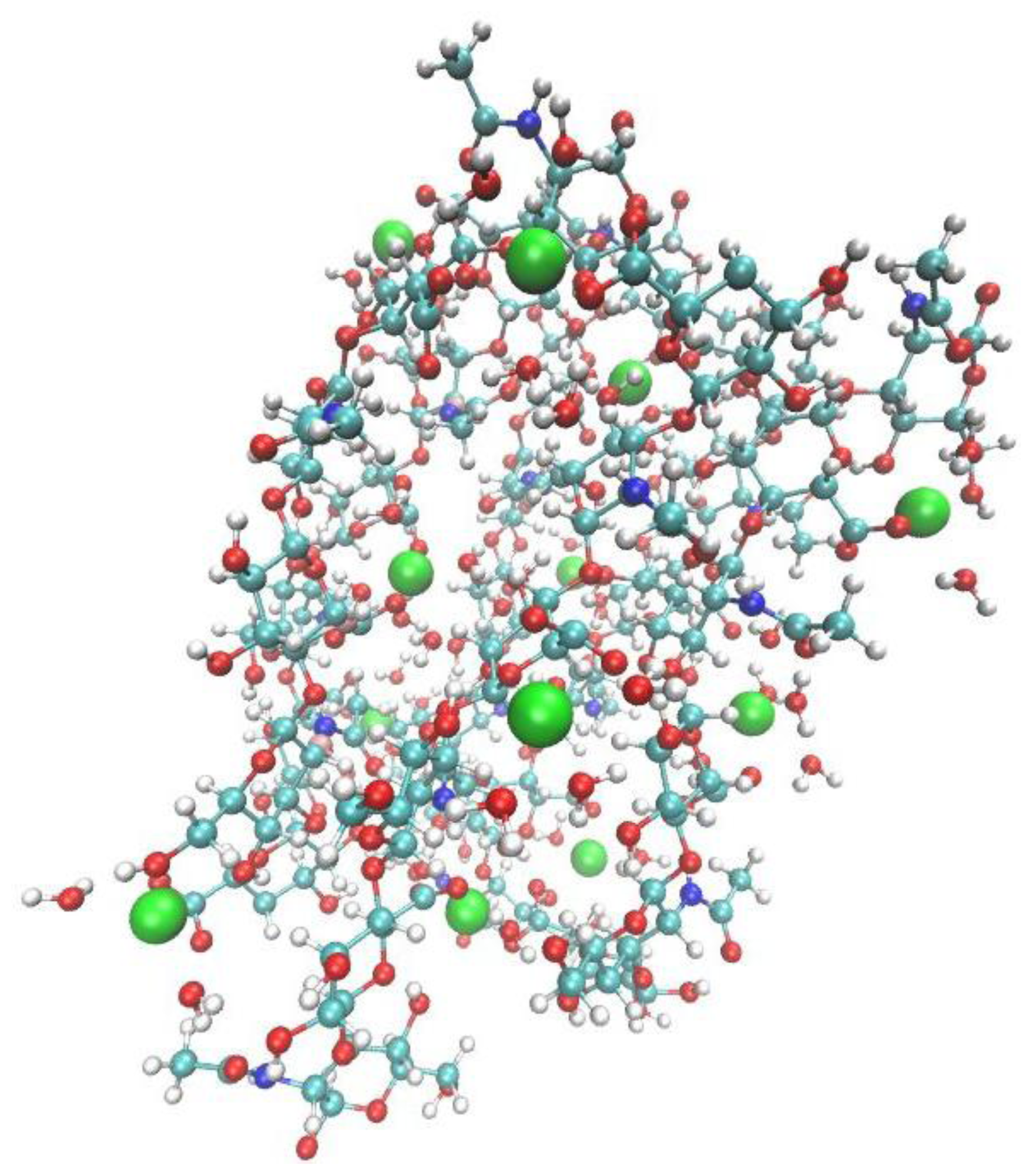
<p>The starting system was constructed from PDB data taking into account the fact the biologically active form is a hexamer [<xref ref-type="bibr" rid="b14-ijms-13-12036">14</xref>,<xref ref-type="bibr" rid="b15-ijms-13-12036">15</xref>]. The initial structure of calcium(II) hyaluronate prepared from PDB data is displayed in <xref ref-type="fig" rid="f1-ijms-13-12036">Figure 1</xref>, details are available elsewhere [<xref ref-type="bibr" rid="b22-ijms-13-12036">22</xref>].</p>
<p>The final distances between the central calcium(II) ion in the QM region and the ligands after the minimization are collected in <xref ref-type="table" rid="t1-ijms-13-12036">Table 1</xref>. Our data show the best agreement with experimental X-ray data is obtained if the system is minimized using the M06 method and the basis set 6-31G(d,p), while using HF or B3LYP does not. Since the calcium ion is a rather large cation (radius 0.99 Å) the coordination numbers are between 6 and 8. In calcium hyaluronate it accommodates eight ligands, in this case the carboxylate groups of two glucuronic acid residues and six neighboring water molecules.</p>
<p>In the next step the calculated distances between the ligand and central atom from <xref ref-type="table" rid="t1-ijms-13-12036">Table 1</xref> were processed in order to obtain the data presented in <xref ref-type="table" rid="t2-ijms-13-12036">Table 2</xref> (see section Methods for details). The processed data for calculation for calcium hyaluronate indicate the standard deviation is the lowest if the simulation is performed with M06 and the basis set 6-31G(d,p). Since the M06 method was parameterized with transition metals and non-metals, this indicates M06 adequately describes the coordination behavior of calcium(II) ion in the hyaluronate complex.</p>
<p>By replacing the calcium(II) ion with copper(II) we obtain a new system. Though the two ions (calcium(II) and copper(II)) have the same charge, their behavior is different.</p>
<p><xref ref-type="table" rid="t3-ijms-13-12036">Table 3</xref> summarizes the distances between the central ion and the ligands in the first coordination shell after the QM/MM minimizations using HF, B3LYP or M06 and the 6-31G* or 6-31G(d,p) basis set. EXAFS experimental data showed that the copper(II) ion is coordinated by four equatorial oxygen atoms at an average distance of 1.95 Å. For the two axial sites at an average distance of 2.46 Å, oxygen atoms were preferentially indicated, although the participation of nitrogen atom from the <italic>N</italic>-acetylglucosamine residue could not be excluded as well. The coordination polyhedron of the copper(II) ion is therefore a disordered octahedron, due to the Jahn-Teller effect [<xref ref-type="bibr" rid="b16-ijms-13-12036">16</xref>]. This so-called tetragonal distortion is the consequence of the <italic>d</italic><sup>9</sup> configuration since the <italic>t</italic><sub>2g</sub> level is not symmetrically filled with electrons (three electrons in two orbitals).</p>
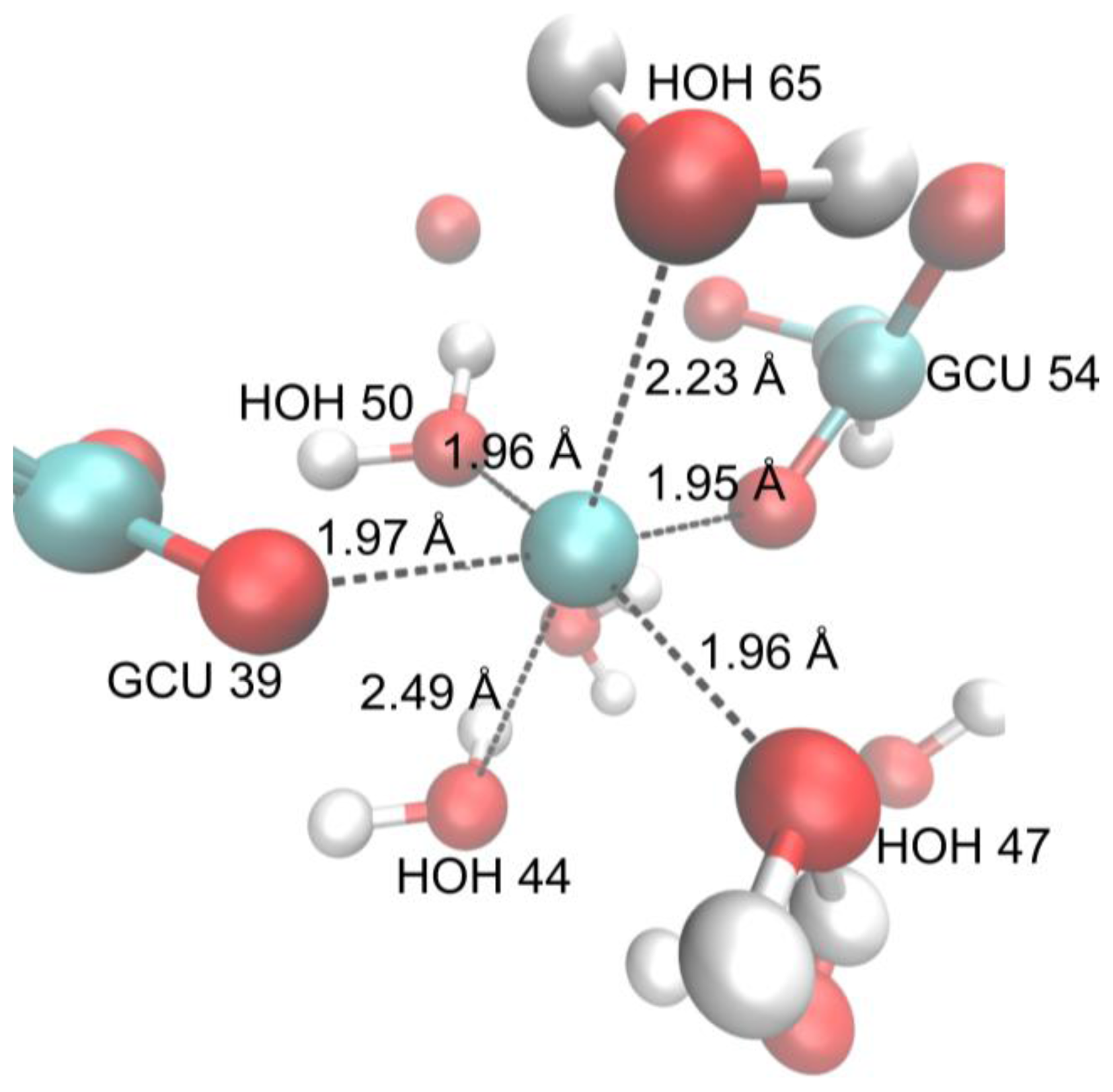
<p>The final structure of copper(II) hyaluronate after the QM/MM minimization using M06 and the basis set 6-31G* confirms the EXAFS data (see <xref ref-type="fig" rid="f2-ijms-13-12036">Figure 2</xref>). Four oxygen atoms are present in the equatorial plane at approximately 1.96 Å. Two oxygen atoms come from two water molecules, whereas two oxygen atoms come from the carboxylate groups of the nearby GCU residues. The axial oxygen atoms come from two water molecules. Our results indicate the nitrogen atom from the <italic>N</italic>-acetylglucosamine residue does not participate in the coordination bonding as it is located outside the first coordination sphere.</p>
<p>The radius of the copper(II) ion is smaller (<italic>i.e.</italic>, 0.73 Å) than the radius of the calcium(II) ion (0.99 Å) therefore a different binding behaviour was expected. The electronic configuration of the copper(II) ion is <italic>d</italic><italic><sup>9</sup></italic>, with three electrons occupying the orbitals <italic>d</italic><sub>x2–y2</sub> and <italic>d</italic><sub>z2</sub>. Since the <italic>t</italic><sub>2g</sub> level is asymmetrically occupied (three electrons in two orbitals), <italic>e</italic><sub>g</sub> and <italic>t</italic><sub>2g</sub> orbitals are no longer degenerated, resulting in unequal distances between the central atom and the ligands at the axial and equatorial positions. The results in <xref ref-type="table" rid="t3-ijms-13-12036">Table 3</xref> show the aforementioned differences. HF and M06 are in good agreement with experimental data obtained by EXAFS regardless of the basis set used. During the B3LYP simulations we observed two water molecules were pulled outside of the first coordination shell.</p>
<p>The data in <xref ref-type="table" rid="t3-ijms-13-12036">Table 3</xref> were then processed in the same manner as the data in <xref ref-type="table" rid="t1-ijms-13-12036">Table 1</xref>. The calculated standard deviations presented in <xref ref-type="table" rid="t4-ijms-13-12036">Table 4</xref> indicate once more that the best agreement with experimental data is obtained with the M06 method regardless of the basis set used; the second best agreement is obtained when using HF.</p>
<p>For more than a decade B3LYP was the functional of choice for studies of many organic systems as evident by the many references in literature [<xref ref-type="bibr" rid="b23-ijms-13-12036">23</xref>–<xref ref-type="bibr" rid="b27-ijms-13-12036">27</xref>]. The case of calcium(II) and copper(II) ion binding to hyaluronic acid is one, where the results (<italic>i.e.</italic>, computed distances between the central atom and the ligands) given by the B3LYP functional greatly differ from the experimental values obtained by either EXAFS (for copper(II) hyaluronate) or X-ray (calcium hyaluronate). One reason may lay in the difficulty in describing the nonbonding interactions between the central atom and the ligands that M06 seem to adequately account for.</p>
<p>Our minimizations of calcium hyaluronate began from the experimental structure. After the minimization using either Hartree Fock or M06 but not B3LYP, we were able to replicate the experimental values. This indicates that both the starting model and the methods employed adequately describe the nonbonding interactions between the central atom and the ligands for both the cases evaluated in this study. As in almost all the systems of biological interest, electrostatics is the main component of the nonbonding energy. In the complexes we studied the ionic nature of the binding metals makes it even more important. Dispersion component of the interaction energy is far less relevant for our systems. Again, quantum chemical calculations include all the components of the interaction energy and the applied M06 functional properly accounts for the dispersion component.</p>
<p>One possible explanation for this is the fact that we were trying to mimic the environment within the solid state calcium and copper(II) hyaluronates for which we had experimental data. Within the solid state the conformational space is severely limited which in turn means that regardless of the starting point (<italic>i.e.</italic>, either starting with calcium or copper(II) ion) the system will end up in the global minimum. Also, since the conformational space within the crystal seems to be relatively small the problem of several local minima and there with associated need for thermal averaging is to a large extent circumvented.</p></sec>
<sec sec-type="methods">
<title>3. Methods</title>
<p>The initial calcium(II) hyaluronate model was constructed as described previously [<xref ref-type="bibr" rid="b22-ijms-13-12036">22</xref>] with the main difference being the size of the QM region as advances in computer hardware allowed us to define a larger QM region, which substantially improves the reliability of results.</p>
<p>The QM region consisted of: a calcium(II) ion, two carboxylate groups from two GCU residues (labelled GCU 39 and GCU 54, respectively), two <italic>N</italic>-acetyl groups from two NAG residues (labelled NAG 38 and NAG 53, respectively) and six water molecules (labelled HOH 44, HOH 47, HOH 50, HOH 59, HOH 62, HOH 65). To delimit the QM region from the MM region dummy link atoms were used on residues NAG 38, GCU 39, NAG 53 and GCU 54.</p>
<p>The QM region was simulated with GAMESS-US using either Hartee-Fock or B3LYP or M06 and using either the basis set 6-31G* and 6-31G(d,p) [<xref ref-type="bibr" rid="b29-ijms-13-12036">29</xref>]. The rest of the system was simulated by molecular mechanics with the CHARMM force field, a constant dielectricity of 1.0 and a cut-off distance of 12.0 Å. All simulations were carried out at 300 K. The minimizations were run for 1000 steps. The trajectories were analyzed and the results were compared to available X-ray data for calcium(II) hyaluranate and EXAFS data for copper(II) hyaluronate [<xref ref-type="bibr" rid="b15-ijms-13-12036">15</xref>,<xref ref-type="bibr" rid="b16-ijms-13-12036">16</xref>].</p>
<p>Previous experimental data show the overall conformation of the hyaluronic acid does not depend much on the bound ionic species, thus calcium(II) ions can be replaced with copper(II) ions. Calculations were subsequently reran and the results were compared with experimental X-ray data for calcium(II) hyaluronate and EXAFS for copper(II) hyaluronate [<xref ref-type="bibr" rid="b15-ijms-13-12036">15</xref>,<xref ref-type="bibr" rid="b16-ijms-13-12036">16</xref>].</p>
<p>The computed distances at the end of the minimization were the used to calculate the quotients between the computed distances for a given central atom-ligand pair with the experimental distance from the same pair, afterwards the standard deviation was computed for each combination of method and basis set. The values are collected in <xref ref-type="table" rid="t2-ijms-13-12036">Table 2</xref> for calcium hyaluronate and <xref ref-type="table" rid="t4-ijms-13-12036">Table 4</xref> for copper(II) hyaluronate.</p>
<p>For the QM/MM simulations the molecular modeling package CHARMM with the GAMESS-US was used, version c35a2q, and ran on the CROW computer clusters at National Institute of Chemistry in Ljubljana [<xref ref-type="bibr" rid="b32-ijms-13-12036">32</xref>–<xref ref-type="bibr" rid="b35-ijms-13-12036">35</xref>]. Molecular graphics were produced using VMD [<xref ref-type="bibr" rid="b36-ijms-13-12036">36</xref>].</p></sec>
<sec sec-type="conclusions">
<title>4. Conclusions</title>
<p>A series of QM/MM minimizations of calcium(II) hyaluronate and copper(II) hyaluronate revealed differences in the distribution of ligands around the central ion in the first coordination shell. Simulations were performed using Hartree-Fock, B3LYP, M06 and two different basis sets. The simulated distances between the ligands and the central ion at M06 level are in good agreement with experimental data for both, calcium(II) and copper(II) hyaluronate, respectively.</p>
<p>There are two main characteristics of Ca(II) and Cu(II) ions to be considered when comparing the environment of both cations with the same ligand. The first characteristic is the size of the cation, and the second one is its electronic configuration. They both influence the coordination behavior in a specific way. For cations such as Ca(II) with symmetrical charge distribution (empty d orbitals) there is no preferential stereochemical direction to be favored by the cation. The size of Ca(II) ion plays the main role in defining its coordination number, at least in simple complexes. It is well known that coordination numbers 6 and 8 are favored for Ca(II). In case of calcium hyaluronate the coordination number is 8, which was determined using X-ray diffraction and confirmed by molecular modeling.</p>
<p>On the other hand, Cu(II) ion is much smaller, and on that basis the preferred coordination numbers are 4 and 6. The <italic>d</italic><sup>9</sup> configuration makes Cu(II) subject to Jahn-Teller distortion if placed in an environment of cubic symmetry, and this has a profound effect on all its stereochemistry. When the coordination number is six, the octahedron is severely distorted with an elongation along one fourfold axis as a typical distortion. Our findings for copper(II) hyaluronate confirm such behavior.</p>
<p>Large multidentate ligands like hyaluronic acid do not obey the simple size-ratio rule. The steric flexibility of the ligand to approach its donor atoms against the central cation may be the prevalent factor in complex formation. It was observed that the local conformation of the hyaluronate chains depends more on the charge and size of the cation and less on its type [<xref ref-type="bibr" rid="b12-ijms-13-12036">12</xref>]. Also both experimental and our simulation data indicate the nitrogen atom from the <italic>N</italic>-acetylglucosamine residue does not participate in the coordination bonding to either calcium(II) or copper(II) ions. Within the solid state both our system mimic the conformational space is severely limited which in turn means that regardless of the starting point (<italic>i.e.</italic>, either starting with calcium or copper(II) ion) the system will always end up in the global minimum after the minimization. Our preliminary simulations of other transition metal hyaluronate complexes further confirm this finding.</p></sec></body>
<back>
<ack>
<title>Acknowledgments</title>
<p>Financial support from the Slovenian Research Agency through grants P1-0012 and P1-0134 is gratefully acknowledged.</p></ack>
<ref-list>
<title>References</title>
<ref id="b1-ijms-13-12036"><label>1</label><citation citation-type="book"><person-group person-group-type="author"><name><surname>Laurent</surname><given-names>T.C.</given-names></name></person-group><article-title>Glycosaminoglycans and Proteoglycans</article-title><source>The Chemistry and Molecular Biology of the Intercellular Matrix</source><person-group person-group-type="editor"><name><surname>Balazs</surname><given-names>E.A.</given-names></name></person-group><publisher-name>Academic Press</publisher-name><publisher-loc>New York, NY, USA</publisher-loc><year>1970</year><volume>2</volume><fpage>703</fpage><lpage>733</lpage></citation></ref>
<ref id="b2-ijms-13-12036"><label>2</label><citation citation-type="book"><person-group person-group-type="author"><name><surname>Alberts</surname><given-names>B.</given-names></name><name><surname>Johnson</surname><given-names>A.</given-names></name><name><surname>Lewis</surname><given-names>J.</given-names></name><name><surname>Raff</surname><given-names>M.</given-names></name><name><surname>Roberts</surname><given-names>K.</given-names></name><name><surname>Walter</surname><given-names>P</given-names></name></person-group><source>Molecular Biology of the Cell</source><edition>4th ed</edition><publisher-name>Garland Science</publisher-name><publisher-loc>New York, NY, USA</publisher-loc><year>2002</year><fpage>1463</fpage><lpage>1473</lpage></citation></ref>
<ref id="b3-ijms-13-12036"><label>3</label><citation citation-type="journal"><person-group person-group-type="author"><name><surname>Laurent</surname><given-names>T.C.</given-names></name><name><surname>Fraser</surname><given-names>J.R.E.</given-names></name></person-group><article-title>Hyaluronan</article-title><source>FASEB J</source><year>1992</year><volume>6</volume><fpage>2397</fpage><lpage>2404</lpage><pub-id pub-id-type="pmid">1563592</pub-id></citation></ref>
<ref id="b4-ijms-13-12036"><label>4</label><citation citation-type="journal"><person-group person-group-type="author"><name><surname>Goa</surname><given-names>K.L.</given-names></name><name><surname>Benfield</surname><given-names>P.</given-names></name></person-group><article-title>Hyaluronic-Acid-A review of its pharmacology and use as a surgical aid in ophthalmology, and its therapeutic potential in joint disease and wound-healing</article-title><source>Drugs</source><year>1994</year><volume>47</volume><fpage>536</fpage><lpage>566</lpage><pub-id pub-id-type="doi">10.2165/00003495-199447030-00009</pub-id><pub-id pub-id-type="pmid">7514978</pub-id></citation></ref>
<ref id="b5-ijms-13-12036"><label>5</label><citation citation-type="journal"><person-group person-group-type="author"><name><surname>Zimmerman</surname><given-names>E.</given-names></name><name><surname>Geiger</surname><given-names>B.</given-names></name><name><surname>Addadi</surname><given-names>L.</given-names></name></person-group><article-title>Initial stages of cell-matrix adhesion can be mediated and modulated by cell-surface hyaluronan</article-title><source>Biophys. J</source><year>2002</year><volume>82</volume><fpage>1848</fpage><lpage>1857</lpage><pub-id pub-id-type="doi">10.1016/S0006-3495(02)75535-5</pub-id><pub-id pub-id-type="pmid">11916844</pub-id></citation></ref>
<ref id="b6-ijms-13-12036"><label>6</label><citation citation-type="journal"><person-group person-group-type="author"><name><surname>Moulabbi</surname><given-names>M.</given-names></name><name><surname>Broch</surname><given-names>H.</given-names></name><name><surname>Robert</surname><given-names>L.</given-names></name><name><surname>Vasilescu</surname><given-names>D.</given-names></name></person-group><article-title>Quantum molecular modeling of hyaluronan</article-title><source>Theochem. J. Mol. Struct</source><year>1997</year><volume>395</volume><fpage>477</fpage><lpage>508</lpage><pub-id pub-id-type="doi">10.1016/S0166-1280(97)00021-3</pub-id></citation></ref>
<ref id="b7-ijms-13-12036"><label>7</label><citation citation-type="journal"><person-group person-group-type="author"><name><surname>Sipos</surname><given-names>P.</given-names></name><name><surname>Veber</surname><given-names>M.</given-names></name><name><surname>Burger</surname><given-names>K.</given-names></name><name><surname>Illes</surname><given-names>J.</given-names></name><name><surname>Machula</surname><given-names>G.</given-names></name></person-group><article-title>Hyaluronate-Metal ion interactions: Correlations between viscosimetric, potentiometric, polarographic and electrophoretic data</article-title><source>Acta Chim. Hungarica Models Chem</source><year>1992</year><volume>129</volume><fpage>671</fpage><lpage>683</lpage></citation></ref>
<ref id="b8-ijms-13-12036"><label>8</label><citation citation-type="journal"><person-group person-group-type="author"><name><surname>Morris</surname><given-names>E.R.</given-names></name><name><surname>Rees</surname><given-names>D.A.</given-names></name><name><surname>Welsh</surname><given-names>E.J.</given-names></name></person-group><article-title>Conformation and dynamic interactions in hyaluronate solutions</article-title><source>J. Mol. Biol</source><year>1980</year><volume>138</volume><fpage>383</fpage><lpage>400</lpage><pub-id pub-id-type="doi">10.1016/0022-2836(80)90294-6</pub-id><pub-id pub-id-type="pmid">7411615</pub-id></citation></ref>
<ref id="b9-ijms-13-12036"><label>9</label><citation citation-type="journal"><person-group person-group-type="author"><name><surname>Figueroa</surname><given-names>N.</given-names></name><name><surname>Nagy</surname><given-names>B.</given-names></name><name><surname>Chakrabarti</surname><given-names>B.</given-names></name></person-group><article-title>Cu<sup>2+</sup>-hyaluronic acid complex-spectrophotometric detection</article-title><source>Biochem. Biophys. Res. Commun</source><year>1977</year><volume>74</volume><fpage>460</fpage><lpage>465</lpage><pub-id pub-id-type="doi">10.1016/0006-291X(77)90326-6</pub-id><pub-id pub-id-type="pmid">836302</pub-id></citation></ref>
<ref id="b10-ijms-13-12036"><label>10</label><citation citation-type="journal"><person-group person-group-type="author"><name><surname>Sterk</surname><given-names>H.</given-names></name><name><surname>Braun</surname><given-names>M.</given-names></name><name><surname>Schmut</surname><given-names>O.</given-names></name><name><surname>Feichtinger</surname><given-names>H.</given-names></name></person-group><article-title>Investigation of the hyaluronic acid-copper complex by N.M.R. spectroscopy</article-title><source>Carbohydr. Res</source><year>1985</year><volume>145</volume><fpage>1</fpage><lpage>11</lpage><pub-id pub-id-type="doi">10.1016/S0008-6215(00)90407-5</pub-id><pub-id pub-id-type="pmid">4092213</pub-id></citation></ref>
<ref id="b11-ijms-13-12036"><label>11</label><citation citation-type="journal"><person-group person-group-type="author"><name><surname>Lapcik</surname><given-names>L.</given-names></name><name><surname>Dammer</surname><given-names>C.</given-names></name><name><surname>Valko</surname><given-names>M.</given-names></name></person-group><article-title>Hyaluronic acid-copper(ii) complexes-spectroscopic characterization</article-title><source>Colloid Polym. Sci</source><year>1992</year><volume>201</volume><fpage>1049</fpage><lpage>1052</lpage></citation></ref>
<ref id="b12-ijms-13-12036"><label>12</label><citation citation-type="journal"><person-group person-group-type="author"><name><surname>Sheehan</surname><given-names>J.K.</given-names></name><name><surname>Atkins</surname><given-names>E.D.</given-names></name></person-group><article-title>X-Ray Fiber Diffraction study of conformational-changes in hyaluronate induced in the presence of sodium, potassium and calcium cations</article-title><source>Int. J. Biol. Macromol</source><year>1983</year><volume>5</volume><fpage>215</fpage><lpage>221</lpage><pub-id pub-id-type="doi">10.1016/0141-8130(83)90005-3</pub-id></citation></ref>
<ref id="b13-ijms-13-12036"><label>13</label><citation citation-type="journal"><person-group person-group-type="author"><name><surname>Atkins</surname><given-names>E.D.</given-names></name><name><surname>Sheehan</surname><given-names>J.K.</given-names></name><name><surname>Phelps</surname><given-names>C.F.</given-names></name></person-group><article-title>Conformation of mucopolysaccharides-hyaluronates</article-title><source>Biochem. J</source><year>1972</year><volume>128</volume><fpage>1255</fpage><lpage>1263</lpage><pub-id pub-id-type="pmid">4643702</pub-id></citation></ref>
<ref id="b14-ijms-13-12036"><label>14</label><citation citation-type="journal"><person-group person-group-type="author"><name><surname>Mitra</surname><given-names>A.K</given-names></name><name><surname>Raghunathan</surname><given-names>S.</given-names></name><name><surname>Sheehan</surname><given-names>J.K.</given-names></name><name><surname>Arnott</surname><given-names>S.</given-names></name></person-group><article-title>Hyaluronic-acid-molecular-conformations and interactions in the orthorhombic and tetragonal forms containing sinuous chains</article-title><source>J. Mol. Biol.</source><year>1983</year><volume>169</volume><fpage>829</fpage><lpage>859</lpage><pub-id pub-id-type="doi">10.1016/S0022-2836(83)80139-9</pub-id><pub-id pub-id-type="pmid">6631954</pub-id></citation></ref>
<ref id="b15-ijms-13-12036"><label>15</label><citation citation-type="journal"><person-group person-group-type="author"><name><surname>Winter</surname><given-names>W.T.</given-names></name><name><surname>Arnott</surname><given-names>S.</given-names></name></person-group><article-title>Hyaluronic acid: The role of divalent cations in conformation and packing</article-title><source>J. Mol. Biol</source><year>1977</year><volume>117</volume><fpage>761</fpage><lpage>784</lpage><pub-id pub-id-type="doi">10.1016/0022-2836(77)90068-7</pub-id><pub-id pub-id-type="pmid">609101</pub-id></citation></ref>
<ref id="b16-ijms-13-12036"><label>16</label><citation citation-type="journal"><person-group person-group-type="author"><name><surname>Tratar Pirc</surname><given-names>E.</given-names></name><name><surname>Arcon</surname><given-names>I.</given-names></name><name><surname>Bukovec</surname><given-names>P.</given-names></name><name><surname>Kodre</surname><given-names>A.</given-names></name></person-group><article-title>Preparation and characterisation of copper(II) hyaluronate</article-title><source>Carbohydr. Res</source><year>2000</year><volume>324</volume><fpage>275</fpage><lpage>282</lpage><pub-id pub-id-type="doi">10.1016/S0008-6215(99)00260-8</pub-id><pub-id pub-id-type="pmid">10744336</pub-id></citation></ref>
<ref id="b17-ijms-13-12036"><label>17</label><citation citation-type="journal"><person-group person-group-type="author"><name><surname>Tratar Pirc</surname><given-names>E.</given-names></name><name><surname>Arcon</surname><given-names>I.</given-names></name><name><surname>Kodre</surname><given-names>A.</given-names></name><name><surname>Bukovec</surname><given-names>P.</given-names></name></person-group><article-title>Metal-ion environment in solid Mn(II), Co(II) and Ni(II) hyaluronates</article-title><source>Carbohydr. Res</source><year>2004</year><volume>339</volume><fpage>2549</fpage><lpage>2554</lpage><pub-id pub-id-type="doi">10.1016/j.carres.2004.07.025</pub-id><pub-id pub-id-type="pmid">15476716</pub-id></citation></ref>
<ref id="b18-ijms-13-12036"><label>18</label><citation citation-type="journal"><person-group person-group-type="author"><name><surname>Eklund</surname><given-names>R.</given-names></name><name><surname>Widmalm</surname><given-names>G.</given-names></name></person-group><article-title>Molecular dynamics simulations of an oligosaccharide using a force field modified for carbohydrates</article-title><source>Carbohydr. Res</source><year>2003</year><volume>338</volume><fpage>393</fpage><lpage>398</lpage><pub-id pub-id-type="doi">10.1016/S0008-6215(02)00503-7</pub-id><pub-id pub-id-type="pmid">12559740</pub-id></citation></ref>
<ref id="b19-ijms-13-12036"><label>19</label><citation citation-type="journal"><person-group person-group-type="author"><name><surname>Warshel</surname><given-names>A.</given-names></name><name><surname>Levitt</surname><given-names>M.</given-names></name></person-group><article-title>Theoretical studies of enzymic reactions: Dielectric, electrostatic and steric stabilization of the carbonium ion in the reaction of lysozyme</article-title><source>J. Mol. Biol</source><year>1976</year><volume>103</volume><fpage>227</fpage><lpage>249</lpage><pub-id pub-id-type="doi">10.1016/0022-2836(76)90311-9</pub-id><pub-id pub-id-type="pmid">985660</pub-id></citation></ref>
<ref id="b20-ijms-13-12036"><label>20</label><citation citation-type="journal"><person-group person-group-type="author"><name><surname>Masgrau</surname><given-names>L.</given-names></name><name><surname>Roujeinikova</surname><given-names>A.</given-names></name><name><surname>Johannissen</surname><given-names>L.O.</given-names></name><name><surname>Hothi</surname><given-names>P.</given-names></name><name><surname>Basran</surname><given-names>J.</given-names></name><name><surname>Ranaghan</surname><given-names>K.E.</given-names></name><name><surname>Mulholland</surname><given-names>A.J.</given-names></name><name><surname>Sutcliffe</surname><given-names>M.J.</given-names></name><name><surname>Scrutton</surname><given-names>N.S.</given-names></name><name><surname>Leys</surname><given-names>D.</given-names></name></person-group><article-title>Atomic description of an enzyme reaction dominated by proton tunneling</article-title><source>Science</source><year>2006</year><volume>312</volume><fpage>237</fpage><lpage>241</lpage><pub-id pub-id-type="doi">10.1126/science.1126002</pub-id><pub-id pub-id-type="pmid">16614214</pub-id></citation></ref>
<ref id="b21-ijms-13-12036"><label>21</label><citation citation-type="journal"><person-group person-group-type="author"><name><surname>Zidar</surname><given-names>J.</given-names></name><name><surname>Tratar</surname><given-names>P.E.</given-names></name><name><surname>Hodoscek</surname><given-names>M.</given-names></name><name><surname>Bukovec</surname><given-names>P.</given-names></name></person-group><article-title>Copper(II) ion binding to cellular prion protein</article-title><source>J. Chem. Inf. Model</source><year>2008</year><volume>48</volume><fpage>283</fpage><lpage>287</lpage><pub-id pub-id-type="doi">10.1021/ci700226c</pub-id><pub-id pub-id-type="pmid">18247504</pub-id></citation></ref>
<ref id="b22-ijms-13-12036"><label>22</label><citation citation-type="journal"><person-group person-group-type="author"><name><surname>Tratar</surname><given-names>P.E.</given-names></name><name><surname>Zidar</surname><given-names>J.</given-names></name><name><surname>Bukovec</surname><given-names>P.</given-names></name><name><surname>Hodoscek</surname><given-names>M.</given-names></name></person-group><article-title>Molecular modeling of cobalt(II) hyaluronate</article-title><source>Carbohydr. Res</source><year>2005</year><volume>340</volume><fpage>2064</fpage><lpage>2069</lpage><pub-id pub-id-type="doi">10.1016/j.carres.2005.06.018</pub-id><pub-id pub-id-type="pmid">16023623</pub-id></citation></ref>
<ref id="b23-ijms-13-12036"><label>23</label><citation citation-type="journal"><person-group person-group-type="author"><name><surname>Hofstetter</surname><given-names>T.E.</given-names></name><name><surname>Howder</surname><given-names>C.</given-names></name><name><surname>Berden</surname><given-names>G.</given-names></name><name><surname>Oomens</surname><given-names>J.</given-names></name><name><surname>Armentrout</surname><given-names>P.B.</given-names></name></person-group><article-title>Structural elucidation of biological and toxicological complexes: Investigation of monomeric and dimeric complexes of histidine with multiply charged transition metal (Zn and Cd) cations using IR action spectroscopy</article-title><source>J. Phys. Chem. B</source><year>2011</year><volume>115</volume><fpage>12648</fpage><lpage>12661</lpage><pub-id pub-id-type="doi">10.1021/jp207294b</pub-id><pub-id pub-id-type="pmid">21932771</pub-id></citation></ref>
<ref id="b24-ijms-13-12036"><label>24</label><citation citation-type="journal"><person-group person-group-type="author"><name><surname>Remko</surname><given-names>M.</given-names></name><name><surname>Fitz</surname><given-names>D.</given-names></name><name><surname>Broer</surname><given-names>R.</given-names></name><name><surname>Rode</surname><given-names>B.M.</given-names></name></person-group><article-title>Effect of metal Ions (Ni<sup>2+</sup>, Cu<sup>2+</sup> and Zn<sup>2+</sup>) and water coordination on the structure of l-phenylalanine, l-tyrosine, l-tryptophan and their zwitterionic forms</article-title><source>J. Mol. Model</source><year>2011</year><volume>17</volume><fpage>3117</fpage><lpage>3128</lpage><pub-id pub-id-type="doi">10.1007/s00894-011-1000-0</pub-id><pub-id pub-id-type="pmid">21360187</pub-id></citation></ref>
<ref id="b25-ijms-13-12036"><label>25</label><citation citation-type="journal"><person-group person-group-type="author"><name><surname>Khodabandeh</surname><given-names>M.H.</given-names></name><name><surname>Hamid</surname><given-names>R</given-names></name><name><surname>Zare</surname><given-names>K.</given-names></name><name><surname>Zahedi</surname><given-names>M.</given-names></name></person-group><article-title>A theoretical elucidation of coordination properties of histidine and lysine to Mn<sup>2+</sup></article-title><source>Int. J. Mass Spectrom.</source><year>2012</year><volume>313</volume><fpage>47</fpage><lpage>57</lpage><pub-id pub-id-type="doi">10.1016/j.ijms.2011.12.019</pub-id></citation></ref>
<ref id="b26-ijms-13-12036"><label>26</label><citation citation-type="journal"><person-group person-group-type="author"><name><surname>Siegbahn</surname><given-names>P.E.</given-names></name></person-group><article-title>The performance of hybrid DFT for mechanisms involving transition metal complexes in enzymes</article-title><source>J. Biol. Inorg. Chem</source><year>2006</year><volume>11</volume><fpage>695</fpage><lpage>701</lpage><pub-id pub-id-type="doi">10.1007/s00775-006-0137-2</pub-id><pub-id pub-id-type="pmid">16830147</pub-id></citation></ref>
<ref id="b27-ijms-13-12036"><label>27</label><citation citation-type="journal"><person-group person-group-type="author"><name><surname>Minenkov</surname><given-names>Y.</given-names></name><name><surname>Singstad</surname><given-names>Å.</given-names></name><name><surname>Occhipinti</surname><given-names>G.</given-names></name><name><surname>Jensen</surname><given-names>V.R.</given-names></name></person-group><article-title>The accuracy of DFT-optimized geometries of functional transition metal compounds: A validation study of catalysts for olefin metathesis and other reactions in the homogeneous phase</article-title><source>Dalton Trans.</source><year>2012</year><volume>41</volume><fpage>5526</fpage><lpage>5541</lpage><pub-id pub-id-type="doi">10.1039/c2dt12232d</pub-id><pub-id pub-id-type="pmid">22430848</pub-id></citation></ref>
<ref id="b28-ijms-13-12036"><label>28</label><citation citation-type="journal"><person-group person-group-type="author"><name><surname>Becke</surname><given-names>A.D.</given-names></name></person-group><article-title>Density-functional exchange-energy approximation with correct asymptotic-behavior</article-title><source>Phys. Rev. A</source><year>1988</year><volume>38</volume><fpage>3098</fpage><lpage>3100</lpage><pub-id pub-id-type="doi">10.1103/PhysRevA.38.3098</pub-id><pub-id pub-id-type="pmid">9900728</pub-id></citation></ref>
<ref id="b29-ijms-13-12036"><label>29</label><citation citation-type="journal"><person-group person-group-type="author"><name><surname>Lee</surname><given-names>C.T.</given-names></name><name><surname>Yang</surname><given-names>W.T.</given-names></name><name><surname>Parr</surname><given-names>G.</given-names></name></person-group><article-title>Development of the colle-salvetti correlation-energy formula into a functional of the electron-density</article-title><source>Phys. Rev. B</source><year>1988</year><volume>37</volume><fpage>785</fpage><lpage>789</lpage><pub-id pub-id-type="doi">10.1103/PhysRevB.37.785</pub-id></citation></ref>
<ref id="b30-ijms-13-12036"><label>30</label><citation citation-type="journal"><person-group person-group-type="author"><name><surname>Zhao</surname><given-names>Y.</given-names></name><name><surname>Truhlar</surname><given-names>D.</given-names></name></person-group><article-title>The M06 suite of density functionals for main group thermochemistry, thermochemical kinetics, noncovalent interactions, excited states, and transition elements: Two new functionals and systematic testing of four M06-class functionals and 12 other functional</article-title><source>Theor. Chem. Acc</source><year>2008</year><volume>120</volume><fpage>215</fpage><lpage>241</lpage><pub-id pub-id-type="doi">10.1007/s00214-007-0310-x</pub-id></citation></ref>
<ref id="b31-ijms-13-12036"><label>31</label><citation citation-type="journal"><person-group person-group-type="author"><name><surname>MacKerell</surname><given-names>A.D.</given-names></name><name><surname>Bashford</surname><given-names>D.</given-names></name><name><surname>Dunbrack</surname><given-names>R.L.</given-names></name><name><surname>Evanseck</surname><given-names>J.D.</given-names></name><name><surname>Field</surname><given-names>M.J.</given-names></name><name><surname>Fischer</surname><given-names>S.</given-names></name><name><surname>Gao</surname><given-names>J.</given-names></name><name><surname>Guo</surname><given-names>H.</given-names></name><name><surname>Ha</surname><given-names>S.</given-names></name><name><surname>Joseph-McCarthy</surname><given-names>D.</given-names></name><etal/></person-group><article-title>All-atom empirical potential for molecular modeling and dynamics studies of proteins</article-title><source>J. Phys. Chem. B</source><year>1998</year><volume>102</volume><fpage>3586</fpage><lpage>3616</lpage><pub-id pub-id-type="doi">10.1021/jp973084f</pub-id></citation></ref>
<ref id="b32-ijms-13-12036"><label>32</label><citation citation-type="journal"><person-group person-group-type="author"><name><surname>Brooks</surname><given-names>B.R.</given-names></name><name><surname>Bruccoleri</surname><given-names>R.E.</given-names></name><name><surname>Olafson</surname><given-names>B.D.</given-names></name><name><surname>States</surname><given-names>D.J.</given-names></name><name><surname>Swaminathan</surname><given-names>S.</given-names></name><name><surname>Karplus</surname><given-names>M.</given-names></name></person-group><article-title>CHARMM: A program for macromolecular energy, minimization, and dynamics calculations</article-title><source>J. Comput. Chem</source><year>1983</year><volume>4</volume><fpage>187</fpage><lpage>217</lpage><pub-id pub-id-type="doi">10.1002/jcc.540040211</pub-id></citation></ref>
<ref id="b33-ijms-13-12036"><label>33</label><citation citation-type="journal"><person-group person-group-type="author"><name><surname>Brooks</surname><given-names>B.R.</given-names></name><name><surname>Brooks</surname><given-names>C.L.</given-names><suffix>III</suffix></name><name><surname>Mackerell</surname><given-names>A.D.</given-names><suffix>Jr.</suffix></name><name><surname>Nilsson</surname><given-names>L.</given-names></name><name><surname>Petrella</surname><given-names>R.J.</given-names></name><name><surname>Roux</surname><given-names>B.</given-names></name><name><surname>Won</surname><given-names>Y.</given-names></name><name><surname>Archontis</surname><given-names>G.</given-names></name><name><surname>Bartels</surname><given-names>C.</given-names></name><name><surname>Boresch</surname><given-names>S.</given-names></name><etal/></person-group><article-title>CHARMM: The biomolecular simulation program</article-title><source>J. Comput. Chem</source><year>2009</year><volume>30</volume><fpage>1545</fpage><lpage>1614</lpage><pub-id pub-id-type="doi">10.1002/jcc.21287</pub-id><pub-id pub-id-type="pmid">19444816</pub-id></citation></ref>
<ref id="b34-ijms-13-12036"><label>34</label><citation citation-type="journal"><person-group person-group-type="author"><name><surname>Schmidt</surname><given-names>M.W.</given-names></name><name><surname>Baldridge</surname><given-names>K.K.</given-names></name><name><surname>Boatz</surname><given-names>J.A.</given-names></name><name><surname>Elbert</surname><given-names>S.T.</given-names></name><name><surname>Gordon</surname><given-names>M.S.</given-names></name><name><surname>Jensen</surname><given-names>J.H.</given-names></name><name><surname>Koseki</surname><given-names>S.</given-names></name><name><surname>Matsunaga</surname><given-names>N.</given-names></name><name><surname>Nguyen</surname><given-names>K.A.</given-names></name><name><surname>Su</surname><given-names>S.J.</given-names></name><etal/></person-group><article-title>General atomic and molecular electronic-structure system</article-title><source>J. Comput. Chem</source><year>1993</year><volume>14</volume><fpage>1347</fpage><lpage>1363</lpage><pub-id pub-id-type="doi">10.1002/jcc.540141112</pub-id></citation></ref>
<ref id="b35-ijms-13-12036"><label>35</label><citation citation-type="journal"><person-group person-group-type="author"><name><surname>Borštnik</surname><given-names>U.</given-names></name><name><surname>Hodošcek</surname><given-names>M.</given-names></name><name><surname>Janežic</surname><given-names>D.</given-names></name></person-group><article-title>Improving the performance of molecular dynamics simulations on parallel clusters</article-title><source>J. Chem. Inf. Model</source><year>2004</year><volume>44</volume><fpage>359</fpage><lpage>364</lpage><pub-id pub-id-type="doi">10.1021/ci034261e</pub-id></citation></ref>
<ref id="b36-ijms-13-12036"><label>36</label><citation citation-type="journal"><person-group person-group-type="author"><name><surname>Humphrey</surname><given-names>W.</given-names></name><name><surname>Dalke</surname><given-names>A.</given-names></name><name><surname>Schulten</surname><given-names>K.</given-names></name></person-group><article-title>VMD: Visual molecular dynamics</article-title><source>J. Mol. Graphics</source><year>1996</year><volume>14</volume><fpage>33</fpage><lpage>38</lpage><pub-id pub-id-type="doi">10.1016/0263-7855(96)00018-5</pub-id></citation></ref></ref-list>
<sec sec-type="display-objects">
<title>Figures and Tables</title>
<fig id="f1-ijms-13-12036" position="float">
<label>Figure 1</label>
<caption>
<p>Model hyaluronate unit. Calcium(II) ions are depicted as Van der Waals spheres. Key to atom colours: white-hydrogen, red-oxygen, cyan-carbon, blue-nitrogen, green-calcium(II) ion.</p></caption>
<graphic xlink:href="ijms-13-12036f1.gif"/></fig>
<fig id="f2-ijms-13-12036" position="float">
<label>Figure 2</label>
<caption>
<p>Copper(II) hyaluronate complex after minimization on M06 level with basis set 6-31G* with distances to copper(II) ion indicated.</p></caption>
<graphic xlink:href="ijms-13-12036f2.gif"/></fig>
<table-wrap id="t1-ijms-13-12036" position="float">
<label>Table 1</label>
<caption>
<p>Distances between the calcium(II) ion and the ligands after the minimization using HF, B3LYP, M06 and two basis sets (6-31G* and 6-31G(d,p), respectively). In the second column experimental X-ray data are reported [<xref ref-type="bibr" rid="b14-ijms-13-12036">14</xref>].</p></caption>
<table frame="hsides" rules="groups">
<thead>
<tr>
<th align="center" valign="middle" rowspan="3">Ligand</th>
<th align="center" valign="middle" rowspan="3">EXP [Å]</th>
<th colspan="2" align="center" valign="middle">HF [Å]</th>
<th colspan="2" align="center" valign="middle">B3LYP [Å]</th>
<th colspan="2" align="center" valign="middle">M06 [Å]</th></tr>
<tr>
<th colspan="2" align="left" valign="middle">
<hr/></th>
<th colspan="2" align="left" valign="middle">
<hr/></th>
<th colspan="2" align="left" valign="middle">
<hr/></th></tr>
<tr>
<th align="center" valign="middle">6-31G *</th>
<th align="center" valign="middle">6-31G(d,p)</th>
<th align="center" valign="middle">6-31G *</th>
<th align="center" valign="middle">6-31G(d,p)</th>
<th align="center" valign="middle">6-31G*</th>
<th align="center" valign="middle">6-31G(d,p)</th></tr></thead>
<tbody>
<tr>
<td align="center" valign="top">GCU 39 O6A</td>
<td align="center" valign="top">2.510</td>
<td align="center" valign="top">2.408</td>
<td align="center" valign="top">2.416</td>
<td align="center" valign="top">2.408</td>
<td align="center" valign="top">2.469</td>
<td align="center" valign="top">2.554</td>
<td align="center" valign="top">2.384</td></tr>
<tr>
<td align="center" valign="top">HOH 44 O</td>
<td align="center" valign="top">2.474</td>
<td align="center" valign="top">2.495</td>
<td align="center" valign="top">2.522</td>
<td align="center" valign="top">2.468</td>
<td align="center" valign="top">2.479</td>
<td align="center" valign="top">2.587</td>
<td align="center" valign="top">2.498</td></tr>
<tr>
<td align="center" valign="top">HOH 47 O</td>
<td align="center" valign="top">2.556</td>
<td align="center" valign="top">2.456</td>
<td align="center" valign="top">2.505</td>
<td align="center" valign="top">2.421</td>
<td align="center" valign="top">2.482</td>
<td align="center" valign="top">2.598</td>
<td align="center" valign="top">2.558</td></tr>
<tr>
<td align="center" valign="top">HOH 50 O</td>
<td align="center" valign="top">2.569</td>
<td align="center" valign="top">2.418</td>
<td align="center" valign="top">2.415</td>
<td align="center" valign="top">2.401</td>
<td align="center" valign="top">2.376</td>
<td align="center" valign="top">2.278</td>
<td align="center" valign="top">2.395</td></tr>
<tr>
<td align="center" valign="top">GCU 54 O6A</td>
<td align="center" valign="top">2.511</td>
<td align="center" valign="top">2.412</td>
<td align="center" valign="top">2.434</td>
<td align="center" valign="top">2.407</td>
<td align="center" valign="top">2.470</td>
<td align="center" valign="top">2.578</td>
<td align="center" valign="top">2.418</td></tr>
<tr>
<td align="center" valign="top">HOH 59 O</td>
<td align="center" valign="top">2.475</td>
<td align="center" valign="top">2.518</td>
<td align="center" valign="top">2.553</td>
<td align="center" valign="top">2.440</td>
<td align="center" valign="top">2.532</td>
<td align="center" valign="top">2.604</td>
<td align="center" valign="top">2.507</td></tr>
<tr>
<td align="center" valign="top">HOH 62 O</td>
<td align="center" valign="top">2.555</td>
<td align="center" valign="top">2.494</td>
<td align="center" valign="top">2.525</td>
<td align="center" valign="top">2.463</td>
<td align="center" valign="top">2.509</td>
<td align="center" valign="top">2.250</td>
<td align="center" valign="top">2.581</td></tr>
<tr>
<td align="center" valign="top">HOH 65 O</td>
<td align="center" valign="top">2.570</td>
<td align="center" valign="top">3.444</td>
<td align="center" valign="top">3.632</td>
<td align="center" valign="top">3.327</td>
<td align="center" valign="top">3.639</td>
<td align="center" valign="top">2.599</td>
<td align="center" valign="top">2.637</td></tr></tbody></table></table-wrap>
<table-wrap id="t2-ijms-13-12036" position="float">
<label>Table 2</label>
<caption>
<p>Standard deviation of the quotient of the ligand-central atom distance for calcium(II) hyaluronate calculated using the experimental (2nd column) and simulation data.</p></caption>
<table frame="hsides" rules="groups">
<thead>
<tr>
<th align="center" valign="middle"/>
<th align="center" valign="middle" rowspan="3">EXP</th>
<th colspan="2" align="center" valign="middle">HF</th>
<th colspan="2" align="center" valign="middle">B3LYP</th>
<th colspan="2" align="center" valign="middle">M06</th></tr>
<tr>
<th align="center" valign="middle"/>
<th colspan="2" align="left" valign="middle">
<hr/></th>
<th colspan="2" align="left" valign="middle">
<hr/></th>
<th colspan="2" align="left" valign="middle">
<hr/></th></tr>
<tr>
<th align="center" valign="middle">Deviation</th>
<th align="center" valign="middle">6-31G*</th>
<th align="center" valign="middle">6-31G(d,p)</th>
<th align="center" valign="middle">6-31G*</th>
<th align="center" valign="middle">6-31G(d,p)</th>
<th align="center" valign="middle">6-31G*</th>
<th align="center" valign="middle">6-31G(d,p)</th></tr></thead>
<tbody>
<tr>
<td align="left" valign="top"/>
<td align="center" valign="top">1.000</td>
<td align="center" valign="top">0.132</td>
<td align="center" valign="top">0.154</td>
<td align="center" valign="top">0.112</td>
<td align="center" valign="top">0.156</td>
<td align="center" valign="top">0.068</td>
<td align="center" valign="top">0.035</td></tr></tbody></table></table-wrap>
<table-wrap id="t3-ijms-13-12036" position="float">
<label>Table 3</label>
<caption>
<p>Distances between the copper(II) ion and the ligands after the minimization using HF, B3LYP, M06 and two basis sets (6-31G* and 6-31G(d,p), respectively). In the second column experimental EXAFS data are reported [<xref ref-type="bibr" rid="b16-ijms-13-12036">16</xref>].</p></caption>
<table frame="hsides" rules="groups">
<thead>
<tr>
<th align="center" valign="middle" rowspan="2">Ligand</th>
<th align="center" valign="middle" rowspan="2">EXP [Å]</th>
<th colspan="2" align="center" valign="middle">HF [Å]</th>
<th colspan="2" align="center" valign="middle">B3LYP [Å]</th>
<th colspan="2" align="center" valign="middle">M06 [Å]</th></tr>
<tr>
<th align="center" valign="middle">6-31G *</th>
<th align="center" valign="middle">6-31G(d,p)</th>
<th align="center" valign="middle">6-31G *</th>
<th align="center" valign="middle">6-31G(d,p)</th>
<th align="center" valign="middle">6-31G *</th>
<th align="center" valign="middle">6-31G(d,p)</th></tr></thead>
<tbody>
<tr>
<td align="center" valign="top">GCU 39 O6A</td>
<td align="center" valign="top">1.952</td>
<td align="center" valign="top">1.976</td>
<td align="center" valign="top">1.983</td>
<td align="center" valign="top">1.917</td>
<td align="center" valign="top">1.969</td>
<td align="center" valign="top">1.966</td>
<td align="center" valign="top">1.989</td></tr>
<tr>
<td align="center" valign="top">HOH 44 O</td>
<td align="center" valign="top">2.465</td>
<td align="center" valign="top">2.341</td>
<td align="center" valign="top">2.371</td>
<td align="center" valign="top">3.458</td>
<td align="center" valign="top">2.901</td>
<td align="center" valign="top">2.487</td>
<td align="center" valign="top">2.385</td></tr>
<tr>
<td align="center" valign="top">HOH 47 O</td>
<td align="center" valign="top">1.952</td>
<td align="center" valign="top">2.070</td>
<td align="center" valign="top">2.072</td>
<td align="center" valign="top">1.967</td>
<td align="center" valign="top">1.990</td>
<td align="center" valign="top">1.960</td>
<td align="center" valign="top">2.002</td></tr>
<tr>
<td align="center" valign="top">HOH 50 O</td>
<td align="center" valign="top">1.952</td>
<td align="center" valign="top">2.070</td>
<td align="center" valign="top">2.069</td>
<td align="center" valign="top">2.032</td>
<td align="center" valign="top">1.998</td>
<td align="center" valign="top">1.960</td>
<td align="center" valign="top">1.997</td></tr>
<tr>
<td align="center" valign="top">GCU 54 O6A</td>
<td align="center" valign="top">1.952</td>
<td align="center" valign="top">1.992</td>
<td align="center" valign="top">2.002</td>
<td align="center" valign="top">1.946</td>
<td align="center" valign="top">2.003</td>
<td align="center" valign="top">1.954</td>
<td align="center" valign="top">1.982</td></tr>
<tr>
<td align="center" valign="top">HOH 59 O</td>
<td align="center" valign="top">3.767</td>
<td align="center" valign="top">3.829</td>
<td align="center" valign="top">3.892</td>
<td align="center" valign="top">3.904</td>
<td align="center" valign="top">3.705</td>
<td align="center" valign="top">3.576</td>
<td align="center" valign="top">3.696</td></tr>
<tr>
<td align="center" valign="top">HOH 62 O</td>
<td align="center" valign="top">3.507</td>
<td align="center" valign="top">3.639</td>
<td align="center" valign="top">3.609</td>
<td align="center" valign="top">3.281</td>
<td align="center" valign="top">3.526</td>
<td align="center" valign="top">3.503</td>
<td align="center" valign="top">3.487</td></tr>
<tr>
<td align="center" valign="top">HOH 65 O</td>
<td align="center" valign="top">2.465</td>
<td align="center" valign="top">2.278</td>
<td align="center" valign="top">2.319</td>
<td align="center" valign="top">2.184</td>
<td align="center" valign="top">2.309</td>
<td align="center" valign="top">2.235</td>
<td align="center" valign="top">2.291</td></tr></tbody></table></table-wrap>
<table-wrap id="t4-ijms-13-12036" position="float">
<label>Table 4</label>
<caption>
<p>Standard deviation of the quotient of the ligand-central atom distance for copper(II) hyaluronate calculated using the experimental (2nd column) and simulation data.</p></caption>
<table frame="hsides" rules="groups">
<thead>
<tr>
<th align="center" valign="middle"/>
<th align="center" valign="middle" rowspan="3">EXP</th>
<th colspan="2" align="center" valign="middle">HF</th>
<th colspan="2" align="center" valign="middle">B3LYP</th>
<th colspan="2" align="center" valign="middle">M06</th></tr>
<tr>
<th align="center" valign="middle"/>
<th colspan="2" align="left" valign="middle">
<hr/></th>
<th colspan="2" align="left" valign="middle">
<hr/></th>
<th colspan="2" align="left" valign="middle">
<hr/></th></tr>
<tr>
<th align="center" valign="middle">Deviation</th>
<th align="center" valign="middle">6-31G *</th>
<th align="center" valign="middle">6-31G(d,p)</th>
<th align="center" valign="middle">6-31G *</th>
<th align="center" valign="middle">6-31G(d,p)</th>
<th align="center" valign="middle">6-31G *</th>
<th align="center" valign="middle">6-31G(d,p)</th></tr></thead>
<tbody>
<tr>
<td align="center" valign="top"/>
<td align="center" valign="top">1.000</td>
<td align="center" valign="top">0.049</td>
<td align="center" valign="top">0.043</td>
<td align="center" valign="top">0.157</td>
<td align="center" valign="top">0.069</td>
<td align="center" valign="top">0.037</td>
<td align="center" valign="top">0.034</td></tr></tbody></table></table-wrap></sec></back></article>