
<?xml version="1.0" encoding="UTF-8"?>
<!DOCTYPE article PUBLIC "-//NLM//DTD Journal Publishing DTD v2.3 20070202//EN" "journalpublishing.dtd">
<article xmlns:mml="http://www.w3.org/1998/Math/MathML" xmlns:xlink="http://www.w3.org/1999/xlink" xml:lang="en" article-type="research-article">
<front>
<journal-meta>
<journal-id journal-id-type="publisher-id">ijms</journal-id>
<journal-title>International Journal of Molecular Sciences</journal-title>
<abbrev-journal-title>Int. J. Mol. Sci.</abbrev-journal-title>
<issn pub-type="epub">1422-0067</issn>
<publisher>
<publisher-name>Molecular Diversity Preservation International (MDPI)</publisher-name></publisher></journal-meta>
<article-meta>
<article-id pub-id-type="doi">10.3390/ijms13078609</article-id>
<article-id pub-id-type="publisher-id">ijms-13-08609</article-id>
<article-categories>
<subj-group>
<subject>Article</subject></subj-group></article-categories>
<title-group>
<article-title>Infrared Study of Er<sup>3+</sup>/Yb<sup>3+</sup> Co-Doped GeO<sub>2</sub>-PbO-Bi<sub>2</sub>O<sub>3</sub> Glass</article-title></title-group>
<contrib-group>
<contrib contrib-type="author">
<name><surname>Bahari</surname><given-names>Hamid-Reza</given-names></name><xref ref-type="aff" rid="af1-ijms-13-08609">1</xref><xref ref-type="corresp" rid="c1-ijms-13-08609">*</xref></contrib>
<contrib contrib-type="author">
<name><surname>Sidek</surname><given-names>Hj. A. A.</given-names></name><xref ref-type="aff" rid="af1-ijms-13-08609">1</xref><xref ref-type="corresp" rid="c1-ijms-13-08609">*</xref></contrib>
<contrib contrib-type="author">
<name><surname>Adikan</surname><given-names>Faisal Rafiq M.</given-names></name><xref ref-type="aff" rid="af2-ijms-13-08609">2</xref></contrib>
<contrib contrib-type="author">
<name><surname>Yunus</surname><given-names>Wan M. M.</given-names></name><xref ref-type="aff" rid="af1-ijms-13-08609">1</xref></contrib>
<contrib contrib-type="author">
<name><surname>Halimah</surname><given-names>Mohamed K.</given-names></name><xref ref-type="aff" rid="af1-ijms-13-08609">1</xref></contrib></contrib-group>
<aff id="af1-ijms-13-08609">
<label>1</label>Department of Physics, Faculty of Science, Universiti Putra Malaysia, Serdang, Selangor, UPM 43400, Malaysia; E-Mails: <email>mahmood@science.upm.edu.my</email> (W.M.M.Y.); <email>halimah@science.upm.edu.my</email> (M.K.H.)</aff>
<aff id="af2-ijms-13-08609">
<label>2</label>Department of Electrical Engineering, Faculty of Engineering, University of Malaya, Kuala Lumpur, 50603, Malaysia; E-Mail: <email>rafiq@um.edu.my</email></aff>
<author-notes>
<corresp id="c1-ijms-13-08609">
<label>*</label>Authors to whom correspondence should be addressed; E-Mails: <email>hr.bahari.59@gmail.com</email> (H.-R.B.); <email>sidek@science.upm.edu.my</email> (H.A.A.S.); Tel.: +60-13308-7610 (H.-R.B.); +60-38946-6601 (H.A.A.S.); Fax: +60-38943-2508 (H.A.A.S.).</corresp></author-notes>
<pub-date pub-type="collection">
<year>2012</year></pub-date>
<pub-date pub-type="epub">
<day>10</day>
<month>07</month>
<year>2012</year></pub-date>
<volume>13</volume>
<issue>7</issue>
<fpage>8609</fpage>
<lpage>8614</lpage>
<history>
<date date-type="received">
<day>21</day>
<month>05</month>
<year>2012</year></date>
<date date-type="rev-recd">
<day>20</day>
<month>06</month>
<year>2012</year></date>
<date date-type="accepted">
<day>25</day>
<month>06</month>
<year>2012</year></date></history>
<permissions>
<copyright-statement>© 2012 by the authors; licensee Molecular Diversity Preservation International, Basel, Switzerland.</copyright-statement>
<copyright-year>2012</copyright-year>
<license license-type="open-access" xlink:href="http://creativecommons.org/licenses/by/3.0">
<p>This article is an open-access article distributed under the terms and conditions of the Creative Commons Attribution license (http://creativecommons.org/licenses/by/3.0/).</p></license></permissions>
<abstract>
<p>Heavy metal oxide glasses, containing bismuth and/or lead in their glass structure are new alternatives for rare eart (RE) doped hosts. Hence, the study of the structure of these vitreous systems is of great interest for science and technology. In this research work, GeO<sub>2</sub>-PbO-Bi<sub>2</sub>O<sub>3</sub> glass host doped with Er<sup>3+</sup>/Yb<sup>3+</sup> ions was synthesized by a conventional melt quenching method. The Fourier transform infrared (FTIR) results showed that PbO and Bi<sub>2</sub>O<sub>3</sub> participate with PbO<sub>4</sub> tetragonal pyramids and strongly distort BiO<sub>6</sub> octahedral units in the glass network, which subsequently act as modifiers in glass structure. These results also confirmed the existence of both four and six coordination of germanium oxide in glass matrix.</p></abstract>
<kwd-group>
<kwd>germanate glass</kwd>
<kwd>Bi<sub>2</sub>O<sub>3</sub></kwd>
<kwd>PbO</kwd>
<kwd>FTIR spectroscopy</kwd></kwd-group></article-meta></front>
<body>
<sec sec-type="intro">
<title>1. Introduction</title>
<p>The optical fibers using heavy metal oxide glasses have good environmental stability and medium optical loss in comparison with fluorides, which makes them suitable for photonic applications in short distances [<xref ref-type="bibr" rid="b1-ijms-13-08609">1</xref>]. Low cut-off optical phonon energy, which has appeared in lead-germanate glasses, decreases the nonradiative relaxation rate of erbium excited states leading to excellent upconversion efficiency [<xref ref-type="bibr" rid="b2-ijms-13-08609">2</xref>]. In addition, bismuth-germanate glasses are increasingly used for applications in non-linear optics, optical switching and second harmonic generation (SHG) [<xref ref-type="bibr" rid="b3-ijms-13-08609">3</xref>] especially because of their high linear and nonlinear refractive index [<xref ref-type="bibr" rid="b4-ijms-13-08609">4</xref>], high thermal expansion, low transition temperature, and excellent infrared transmission [<xref ref-type="bibr" rid="b2-ijms-13-08609">2</xref>].</p>
<p>To design a glass for specific applications, a basic understanding of host material is necessary and, therefore, analysis of their structure is useful. Recent infrared (IR) and Raman studies on manganese doped (100 − <italic>x</italic>)GeO<sub>2</sub>-<italic>x</italic>Bi<sub>2</sub>O<sub>3</sub> system showed that Bi<sup>3+</sup> ions incorporate in glass structure with deformed BiO<sub>6</sub> octahedral units [<xref ref-type="bibr" rid="b5-ijms-13-08609">5</xref>]. The distorted BiO<sub>6</sub> octahedral groups participate in glass network by formation of non-bridging oxygens to modify the glass network. According to recent extended X-ray absorption fine structure (EXAFS) and vibrational study on <italic>x</italic>PbO-(1 − <italic>x</italic>)GeO<sub>2</sub> system [<xref ref-type="bibr" rid="b6-ijms-13-08609">6</xref>], at low lead content, lead ions act as modifiers in the germanate network, however, in PbO compositions higher than 40%, lead ions increasingly play a network former role in glass structure. Infrared spectroscopies are powerful techniques from which to infer structural information about glass material and hence many research groups are motivated to study different vitreous networks by IR spectroscopies [<xref ref-type="bibr" rid="b7-ijms-13-08609">7</xref>,<xref ref-type="bibr" rid="b8-ijms-13-08609">8</xref>]. In the present work, GeO<sub>2</sub>-PbO and GeO<sub>2</sub>-Bi<sub>2</sub>O<sub>3</sub> binary and GeO<sub>2</sub>-PbO-Bi<sub>2</sub>O<sub>3</sub> ternary systems as heavy metal oxide glass hosts with Er<sup>3+</sup>/Yb<sup>3+</sup> dopants were studied. Fourier transform infrared (FTIR) spectroscopy was used to probe into the structure of the prepared glass samples.</p></sec>
<sec sec-type="results|discussion">
<title>2. Results and Discussion</title>
<sec>
<title>FTIR</title>
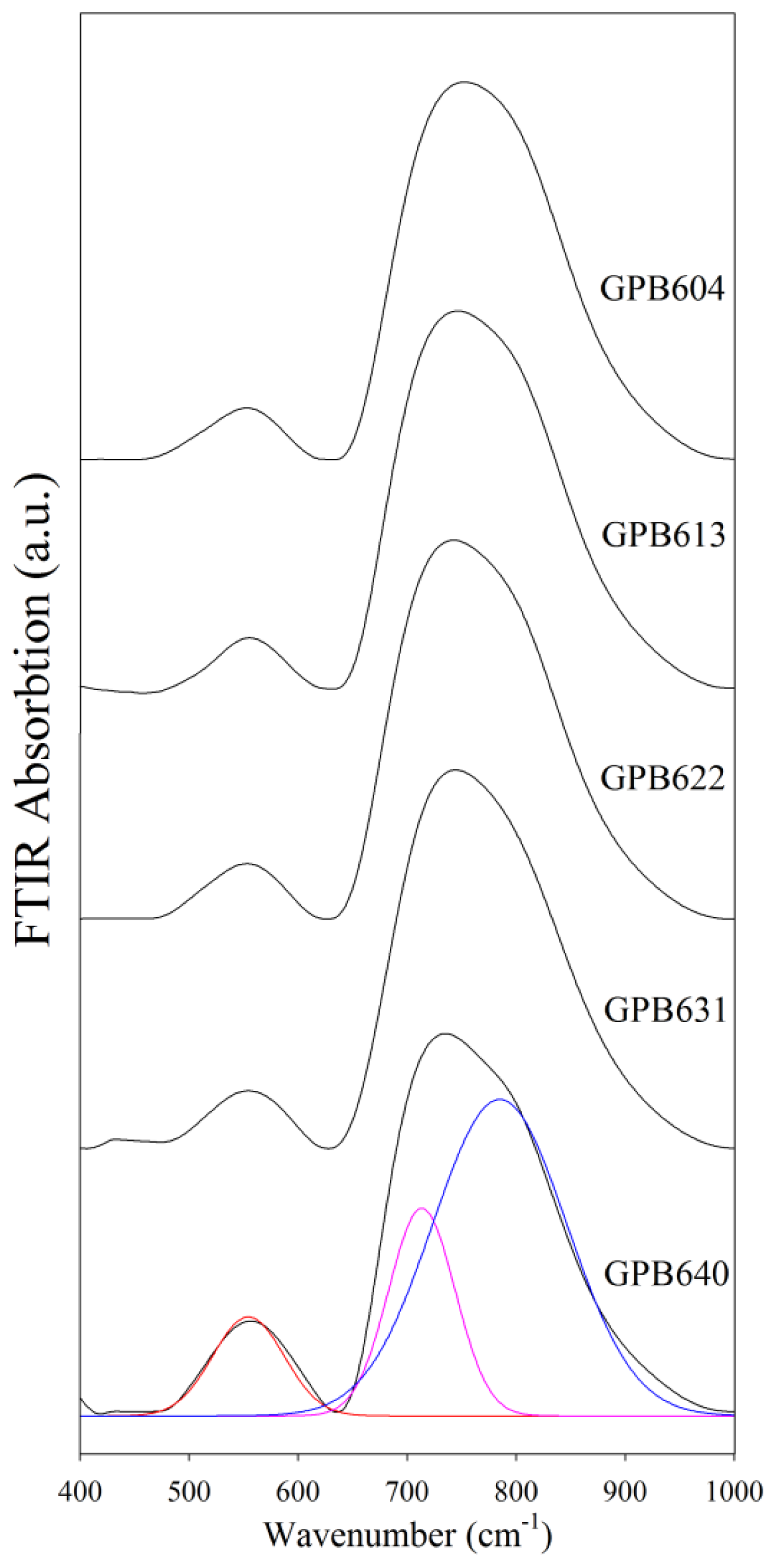
<p><xref ref-type="fig" rid="f1-ijms-13-08609">Figure 1</xref> shows FTIR absorption spectra of GeO<sub>2</sub>-PbO-Bi<sub>2</sub>O<sub>3</sub> glass where two envelops at around 500–600 and 700–800 cm<sup>−1</sup> wavenumbers are present. <xref ref-type="table" rid="t1-ijms-13-08609">Table 1</xref> provides the wavenumbers of the deconvoluted bands. Absorption at 550 cm<sup>−1</sup> indicates bending and symmetric stretching vibration of the Ge–O–Ge of GeO<sub>4</sub> tetrahedral unit [<xref ref-type="bibr" rid="b9-ijms-13-08609">9</xref>], Bi–O<sup>(−)</sup> vibration bond of BiO<sub>6</sub> unit [<xref ref-type="bibr" rid="b10-ijms-13-08609">10</xref>] and antisymmetric bending vibration of Pb-O-Pb bond [<xref ref-type="bibr" rid="b11-ijms-13-08609">11</xref>]. The band at 700–800 cm<sup>−1</sup> wavenumbers was deconvoluted to peaks at 715 cm<sup>−1</sup> and 785 cm<sup>−1</sup>. The first peak is related to stretching vibration mode of the Ge–O–Ge bond in GeO<sub>6</sub> octahedral units of rutile germanium oxide [<xref ref-type="bibr" rid="b12-ijms-13-08609">12</xref>]; the second is related to antisymmetric stretching vibration mode of the Ge–O–Ge bond in GeO<sub>4</sub> tetrahedral units [<xref ref-type="bibr" rid="b9-ijms-13-08609">9</xref>].</p>
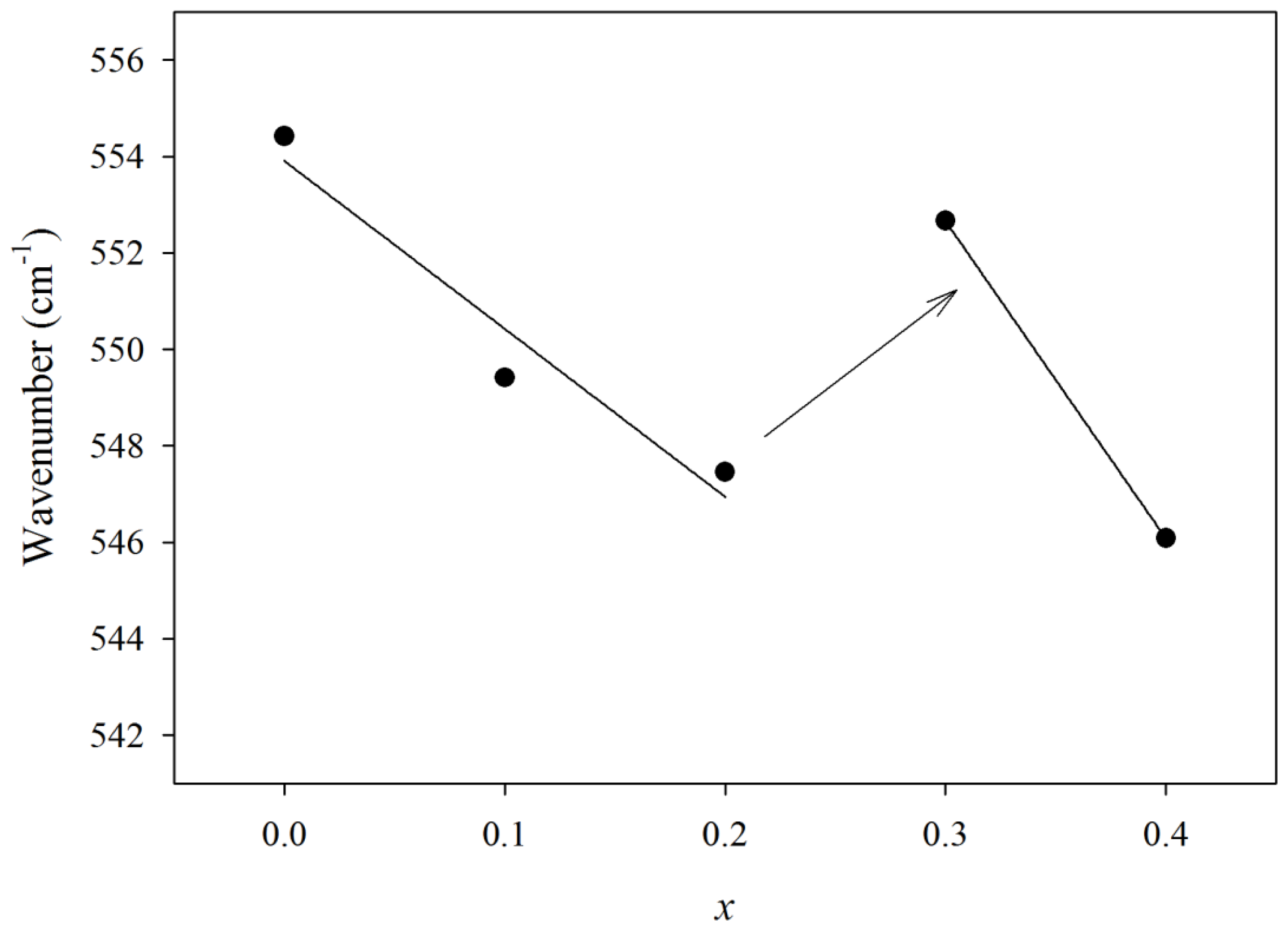
<p>FTIR absorption at 830 cm<sup>−1</sup> is characteristic of the pyramidal BiO<sub>3</sub> group [<xref ref-type="bibr" rid="b13-ijms-13-08609">13</xref>]. Absence of this peak indicates that only BiO<sub>6</sub> units participate in the glass structure. The peak at 470 cm<sup>−1</sup> is related to symmetric bending vibration of Pb–O in PbO<sub>4</sub> tetragonal pyramid (PbO covalent bond) and Bi–O bond bending of strongly distorted BiO<sub>6</sub> octahedral units formed when both Pb and Bi act as network former in a glass matrix. Absence of this peak clearly indicates that the modification role of both lead and bismuth is predominant. Pb<sup>2+</sup> ions in the germanate-lead oxide system act as a modifier in low PbO content with an increase of non-bridging oxygen, yet, participate in the glass network in high composition as PbO chains [<xref ref-type="bibr" rid="b6-ijms-13-08609">6</xref>]. Based on <xref ref-type="fig" rid="f2-ijms-13-08609">Figure 2</xref>, the wavenumber at 550 cm<sup>−1</sup> decreases gradually with increasing <italic>x</italic>. This is attributed to replacement of lead with bismuth ions where Bi<sup>3+</sup> is surrounded by more oxygen than lead. <xref ref-type="fig" rid="f2-ijms-13-08609">Figure 2</xref> shows two linear decreases of wavenumber in both Pb-rich and Bi-rich regions, but a deviation from the linear interpolation is observed when <italic>x</italic> changes from 0.2 to 0.3. This can be related to the appearance of Bi<sup>2+</sup> and/or Bi<sup>1+</sup> which have less oxygen in their surroundings in comparison with Bi<sup>3+</sup> ions. Bi<sup>3+</sup> is shared with three oxygens but Bi<sup>2+</sup> and/or Bi<sup>1+</sup> ions are surrounded with less oxygens. So Bi–O bonding should be stronger for Bi<sup>2+</sup> or Bi<sup>+</sup> ions in contrast to weaker bonding for the Bi<sup>3+</sup> ion and appears in the deviation shown in <xref ref-type="fig" rid="f2-ijms-13-08609">Figure 2</xref> to greater wavenumbers for GPB631 and GPB640.</p>
<p>The 700–800 cm<sup>−1</sup> band was deconvoluted into two peaks at 715 and 785 cm<sup>−1</sup> which are related to GeO<sub>6</sub> and GeO<sub>4</sub> units, respectively, and show the existence of both four and six coordination. Coordination number (<italic>CN</italic>), proposed by the Dachille and Roy study [<xref ref-type="bibr" rid="b14-ijms-13-08609">14</xref>], relates the coordination number of cation “<italic>T</italic>” to the wavelength of the strongest infrared peak of the <italic>T</italic>–<italic>X</italic> stretching bond in TX<sub>2</sub> compounds like SiO<sub>2</sub>, GeO<sub>2</sub> and BeF<sub>2</sub>:</p>
<disp-formula id="FD1">
<label>(1)</label>
<mml:math id="mm1" display="block">
<mml:semantics id="sm1">
<mml:mrow>
<mml:mi>K</mml:mi>
<mml:mo>=</mml:mo>
<mml:mfrac>
<mml:mrow>
<mml:mi>C</mml:mi>
<mml:mi>N</mml:mi>
<mml:mo>·</mml:mo>
<mml:mi>μ</mml:mi>
<mml:msup>
<mml:mrow>
<mml:mrow>
<mml:mo stretchy="false">(</mml:mo>
<mml:msub>
<mml:mrow>
<mml:mi>A</mml:mi></mml:mrow>
<mml:mi>T</mml:mi></mml:msub>
<mml:mo>+</mml:mo>
<mml:msub>
<mml:mrow>
<mml:mi>A</mml:mi></mml:mrow>
<mml:mi>X</mml:mi></mml:msub>
<mml:mo stretchy="false">)</mml:mo></mml:mrow></mml:mrow>
<mml:mrow>
<mml:mn>1</mml:mn>
<mml:mo>/</mml:mo>
<mml:mn>3</mml:mn></mml:mrow></mml:msup></mml:mrow>
<mml:mrow>
<mml:msub>
<mml:mrow>
<mml:mi>Z</mml:mi></mml:mrow>
<mml:mi>T</mml:mi></mml:msub>
<mml:msub>
<mml:mrow>
<mml:mi>Z</mml:mi></mml:mrow>
<mml:mi>X</mml:mi></mml:msub>
<mml:msup>
<mml:mrow>
<mml:mi>λ</mml:mi></mml:mrow>
<mml:mn>2</mml:mn></mml:msup></mml:mrow></mml:mfrac></mml:mrow></mml:semantics></mml:math></disp-formula>
<p>where <italic>A</italic><italic><sub>T</sub></italic> and <italic>A</italic><italic><sub>X</sub></italic> are the atomic number of atoms <italic>T</italic> and <italic>X</italic>, respectively; <italic>Z</italic><italic><sub>T</sub></italic> and <italic>Z</italic><italic><sub>X</sub></italic> are valance of atoms <italic>T</italic> and <italic>X</italic>, respectively; <italic>μ</italic> is reduced mass and <italic>K</italic> is a constant. With <italic>μ</italic> in atomic mass units and <italic>λ</italic> in μm, Dachille and Roy [<xref ref-type="bibr" rid="b14-ijms-13-08609">14</xref>] proposed the average value of <italic>K</italic> = 0.168. In this study, crystalline GeO<sub>2</sub> precursor was used to determine the <italic>K</italic> value, supposing that all germanium atoms are 4-fold coordinated. The FTIR peak in 853 cm<sup>−1</sup>, substituted in the Dachille and Roy relation, yielded <italic>K</italic> = 0.163 which is in accordance with previous results [<xref ref-type="bibr" rid="b10-ijms-13-08609">10</xref>,<xref ref-type="bibr" rid="b11-ijms-13-08609">11</xref>].</p>
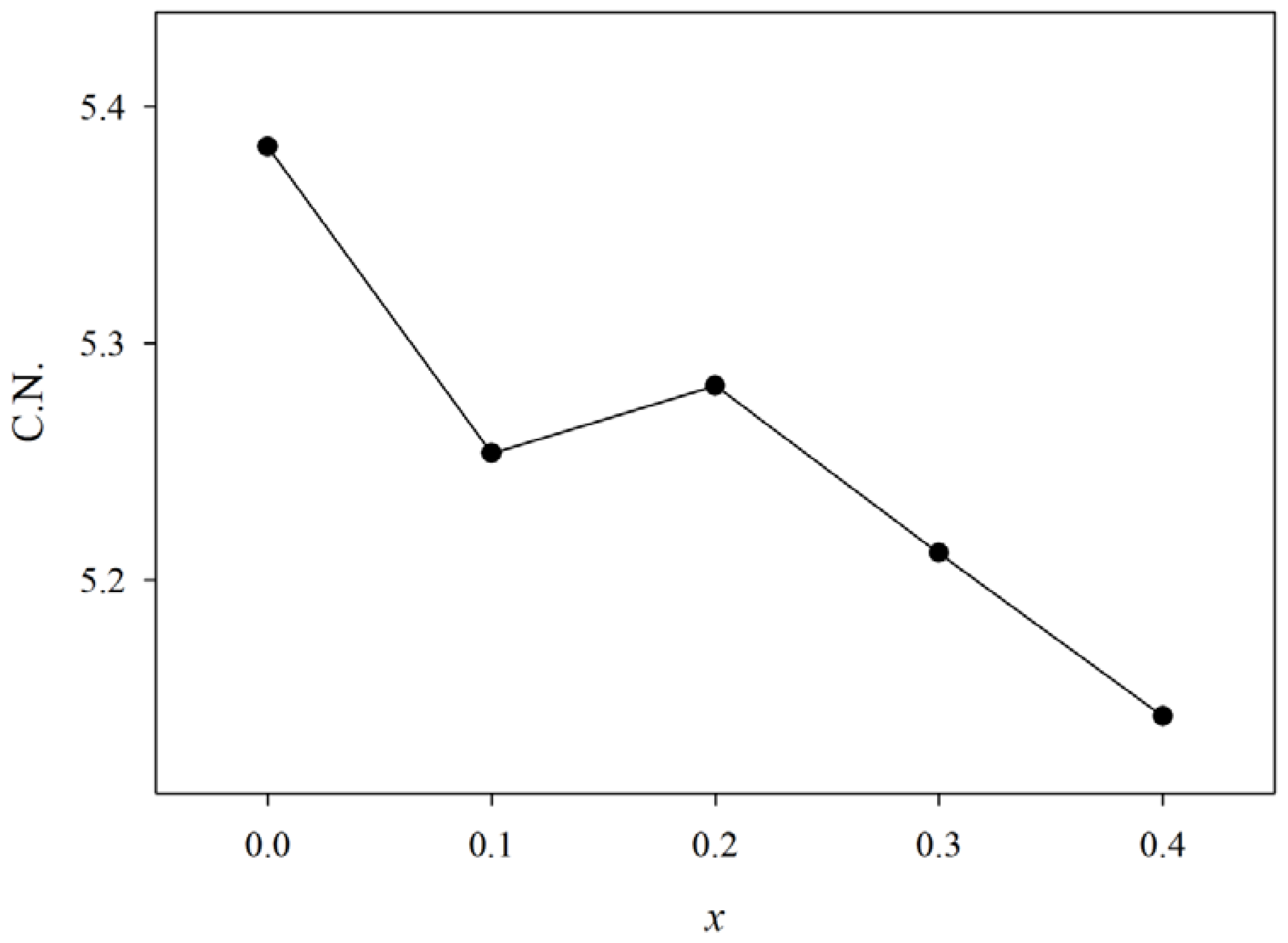
<p><xref ref-type="fig" rid="f3-ijms-13-08609">Figure 3</xref> shows the average coordination number of Ge atoms in 6-fold coordination that was evaluated with <xref rid="FD1" ref-type="disp-formula">Equation 1</xref>. The average coordination number decreases from 5.38 to 5.14 by increasing bismuth content, with a step-up between GPB631 and GPB622 showing the existence of <italic>CN</italic> values of both six and four, and a gradual change in germanium coordination from six to four with the sudden coordination change in the intermediate region.</p></sec></sec>
<sec>
<title>3. Experimental Section</title>
<p>A series of GeO<sub>2</sub>-PbO-Bi<sub>2</sub>O<sub>3</sub> glass samples were prepared by conventional melt-quenching method. High purity (more than 99%) GeO<sub>2</sub>, PbO, Bi<sub>2</sub>O<sub>3</sub>, Er<sub>2</sub>O<sub>3</sub> and Yb<sub>2</sub>O<sub>3</sub> precursors were used to synthesize [GeO<sub>2</sub>]<sub>60</sub>-[ PbO]<sub>(40 −</sub> <italic><sub>x</sub></italic><sub>)</sub>-[½Bi<sub>2</sub>O<sub>3</sub>]<italic><sub>x</sub></italic> with <italic>x</italic> = 0, 10, 20, 30, and 40 mol% and 0.5 and 1.5 wt% of Er<sub>2</sub>O<sub>3</sub> and Yb<sub>2</sub>O<sub>3,</sub> respectively. After mixing and grinding the precursors with the above concentrations and drying the mixture at about 300 °C, the mixture was heated at 1100 °C for 1 h. Then, the melt was quenched into a preheated cylindrical metal mold to obtain a transparent glass sample, and annealed at 420 °C. The samples were cut and polished for measurements.</p>
<p>FTIR spectroscopy was used to study the vibrational properties and structure of glass. The results were extracted from the Perkin-Elmer Spectrum-100 spectrometer, with a UATR accessory. Spectra were taken from 400 cm<sup>−1</sup> to 1000 cm<sup>−1</sup> and deconvoluted into Gaussian component bands.</p></sec>
<sec sec-type="conclusions">
<title>4. Conclusions</title>
<p>The structure of glass host was studied by peak-deconvolution of FTIR spectra, which showed the existence of ionic Pb–O bonds in PbO<sub>4</sub> tetragonal pyramids and Bi–O<sup>(−)</sup> bonds in distorted BiO<sub>6</sub> octahedral groups implying that Bi and Pb behave as modifier in glass. Deconvoluted spectra showed the existence of both four and six germanium coordination (GeO<sub>4</sub> and GeO<sub>6</sub> units) in all of the samples with variation of coordination number from 5.38 to 5.14 by increasing of bismuth content.</p></sec></body>
<back>
<ref-list>
<title>References</title>
<ref id="b1-ijms-13-08609"><label>1</label><citation citation-type="journal"><person-group person-group-type="author"><name><surname>Lezal</surname><given-names>D</given-names></name></person-group><article-title>Chalcogenide glasses-survey and progress</article-title><source>J. Optoelectron. Adv. Mater.</source><year>2003</year><volume>5</volume><fpage>23</fpage><lpage>34</lpage></citation></ref>
<ref id="b2-ijms-13-08609"><label>2</label><citation citation-type="journal"><person-group person-group-type="author"><name><surname>Li</surname><given-names>X.</given-names></name><name><surname>Nie</surname><given-names>Q.</given-names></name><name><surname>Dai</surname><given-names>S.</given-names></name><name><surname>Xu</surname><given-names>T.</given-names></name><name><surname>Lu</surname><given-names>L.</given-names></name><name><surname>Zhang</surname><given-names>X.</given-names></name></person-group><article-title>Energy transfer and frequency upconversion in Ho<sup>3+</sup>/Yb<sup>3+</sup> co-doped bismuth-germanate glasses</article-title><source>J. Alloy Compd</source><year>2008</year><volume>454</volume><fpage>510</fpage><lpage>514</lpage><pub-id pub-id-type="doi">10.1016/j.jallcom.2007.02.143</pub-id></citation></ref>
<ref id="b3-ijms-13-08609"><label>3</label><citation citation-type="journal"><person-group person-group-type="author"><name><surname>Kassab</surname><given-names>L.</given-names></name><name><surname>Hora</surname><given-names>W.</given-names></name><name><surname>Lozano</surname><given-names>W.</given-names></name><name><surname>Oliveira</surname><given-names>M.</given-names></name><name><surname>Maciel</surname><given-names>G.</given-names></name></person-group><article-title>Optical properties of Er<sup>3+</sup> doped GeO<sub>2</sub>–PbO glass: Effect of doping with Bi<sub>2</sub>O<sub>3</sub></article-title><source>Opt. Commun</source><year>2007</year><volume>269</volume><fpage>356</fpage><lpage>361</lpage><pub-id pub-id-type="doi">10.1016/j.optcom.2006.08.014</pub-id></citation></ref>
<ref id="b4-ijms-13-08609"><label>4</label><citation citation-type="journal"><person-group person-group-type="author"><name><surname>Cacho</surname><given-names>V.</given-names></name><name><surname>Kassab</surname><given-names>L.</given-names></name><name><surname>Oliveira</surname><given-names>S.</given-names></name><name><surname>Mansano</surname><given-names>R.</given-names></name><name><surname>Verdonck</surname><given-names>P.</given-names></name></person-group><article-title>Blue cooperative luminescence properties in Yb<sup>3+</sup> doped GeO<sub>2</sub> PbO Bi<sub>2</sub>O<sub>3</sub> vitreous system for the production of thin films</article-title><source>Thin Solid Films</source><year>2006</year><volume>515</volume><fpage>764</fpage><lpage>767</lpage><pub-id pub-id-type="doi">10.1016/j.tsf.2005.12.176</pub-id></citation></ref>
<ref id="b5-ijms-13-08609"><label>5</label><citation citation-type="journal"><person-group person-group-type="author"><name><surname>Baia</surname><given-names>L.</given-names></name><name><surname>Iliescu</surname><given-names>T.</given-names></name><name><surname>Simon</surname><given-names>S.</given-names></name><name><surname>Kiefer</surname><given-names>W.</given-names></name></person-group><article-title>Raman and IR spectroscopic studies of manganese doped GeO<sub>2</sub>-Bi<sub>2</sub>O<sub>3</sub> glass</article-title><source>J. Mol. Struct</source><year>2001</year><volume>599</volume><fpage>9</fpage><lpage>13</lpage><pub-id pub-id-type="doi">10.1016/S0022-2860(01)00855-9</pub-id></citation></ref>
<ref id="b6-ijms-13-08609"><label>6</label><citation citation-type="journal"><person-group person-group-type="author"><name><surname>Ribeiro</surname><given-names>J.L.</given-names></name><name><surname>Dexpert-Ghy</surname><given-names>J.</given-names></name><name><surname>Piriou</surname><given-names>B.</given-names></name><name><surname>Mastelaro</surname><given-names>R.</given-names></name></person-group><article-title>Structural studies in lead germanate glasses: EXAFS and vibrational spectroscopy</article-title><source>J. Non-Cryst. Solids</source><year>1993</year><volume>159</volume><fpage>213</fpage><lpage>221</lpage><pub-id pub-id-type="doi">10.1016/0022-3093(93)90225-M</pub-id></citation></ref>
<ref id="b7-ijms-13-08609"><label>7</label><citation citation-type="journal"><person-group person-group-type="author"><name><surname>Vasantharani</surname><given-names>P.</given-names></name><name><surname>Shailajha</surname><given-names>S.</given-names></name></person-group><article-title>Acoustic properties of borate glasses doped with Ag<sub>2</sub>O</article-title><source>Glob. J. Mol. Sci</source><year>2009</year><volume>4</volume><fpage>29</fpage><lpage>33</lpage></citation></ref>
<ref id="b8-ijms-13-08609"><label>8</label><citation citation-type="journal"><person-group person-group-type="author"><name><surname>Hwa</surname><given-names>L.G.</given-names></name><name><surname>Chao</surname><given-names>W.C.</given-names></name><name><surname>Szu</surname><given-names>S.P.</given-names></name></person-group><article-title>Temperature dependence of elastic moduli of lanthanum gallogermanate glasses</article-title><source>J. Mater. Sci</source><year>2002</year><volume>37</volume><fpage>3423</fpage><lpage>3427</lpage><pub-id pub-id-type="doi">10.1023/A:1016550720293</pub-id></citation></ref>
<ref id="b9-ijms-13-08609"><label>9</label><citation citation-type="journal"><person-group person-group-type="author"><name><surname>Kim</surname><given-names>Y.</given-names></name><name><surname>Saienga</surname><given-names>J.</given-names></name><name><surname>Martin</surname><given-names>S.W.</given-names></name></person-group><article-title>Glass formation in and structural investigation of Li<sub>2</sub>S + GeS<sub>2</sub> + GeO<sub>2</sub> composition using Raman and IR spectroscopy</article-title><source>J. Non-Cryst. Solids</source><year>2005</year><volume>351</volume><fpage>3716</fpage><lpage>3724</lpage><pub-id pub-id-type="doi">10.1016/j.jnoncrysol.2005.09.028</pub-id></citation></ref>
<ref id="b10-ijms-13-08609"><label>10</label><citation citation-type="journal"><person-group person-group-type="author"><name><surname>Saddeek</surname><given-names>Y.B.</given-names></name><name><surname>Abousehly</surname><given-names>A.M.</given-names></name><name><surname>Hussien</surname><given-names>S.I.</given-names></name></person-group><article-title>Synthesis and several features of the Na<sub>2</sub>O-B<sub>2</sub>O<sub>3</sub>-Bi<sub>2</sub>O<sub>3</sub>-MoO<sub>3</sub> glasses</article-title><source>J. Phys. D Appl. Phys</source><year>2007</year><volume>40</volume><fpage>4674</fpage><lpage>4681</lpage><pub-id pub-id-type="doi">10.1088/0022-3727/40/15/048</pub-id></citation></ref>
<ref id="b11-ijms-13-08609"><label>11</label><citation citation-type="journal"><person-group person-group-type="author"><name><surname>Rath</surname><given-names>S.</given-names></name><name><surname>Kabiraj</surname><given-names>D.</given-names></name><name><surname>Avasthi</surname><given-names>D.K.</given-names></name><name><surname>Tripathi</surname><given-names>A.</given-names></name><name><surname>Jain</surname><given-names>K.P.</given-names></name><name><surname>Kumar</surname><given-names>M.</given-names></name><name><surname>Mavi</surname><given-names>H.S.</given-names></name><name><surname>Shukla</surname><given-names>A.K.</given-names></name></person-group><article-title>Evidence of nanostructure formation in Ge oxide by crystallization induced by swift heavy ion irradiation</article-title><source>Nucl. Instrum. Meth. Phys. Res. B</source><year>2007</year><volume>263</volume><fpage>419</fpage><lpage>423</lpage><pub-id pub-id-type="doi">10.1016/j.nimb.2007.07.018</pub-id></citation></ref>
<ref id="b12-ijms-13-08609"><label>12</label><citation citation-type="journal"><person-group person-group-type="author"><name><surname>Pascuta</surname><given-names>P.</given-names></name><name><surname>Culea</surname><given-names>E.</given-names></name></person-group><article-title>FTIR spectroscopic study of some bismuth germanate glasses containing gadolinium ions</article-title><source>Mater. Lett</source><year>2008</year><volume>62</volume><fpage>4127</fpage><lpage>4129</lpage><pub-id pub-id-type="doi">10.1016/j.matlet.2008.06.015</pub-id></citation></ref>
<ref id="b13-ijms-13-08609"><label>13</label><citation citation-type="journal"><person-group person-group-type="author"><name><surname>Baia</surname><given-names>L.</given-names></name><name><surname>Stefan</surname><given-names>R.</given-names></name><name><surname>Popp</surname><given-names>J.</given-names></name><name><surname>Simon</surname><given-names>S.</given-names></name><name><surname>Kiefer</surname><given-names>W.</given-names></name></person-group><article-title>Vibrational investigations of highly iron doped B<sub>2</sub>O<sub>3</sub>–Bi<sub>2</sub>O<sub>3</sub> glass systems</article-title><source>J. Non-Cryst. Solids</source><year>2003</year><volume>324</volume><fpage>109</fpage><lpage>117</lpage><pub-id pub-id-type="doi">10.1016/S0022-3093(03)00227-8</pub-id></citation></ref>
<ref id="b14-ijms-13-08609"><label>14</label><citation citation-type="journal"><person-group person-group-type="author"><name><surname>Dachille</surname><given-names>F.</given-names></name><name><surname>Roy</surname><given-names>R.</given-names></name></person-group><article-title>The use of infra-red absorption and molar refractivities to check coordination</article-title><source>Z. Kristallogr</source><year>1959</year><volume>111</volume><fpage>462</fpage><lpage>470</lpage><pub-id pub-id-type="doi">10.1524/zkri.1959.111.1-6.462</pub-id></citation></ref></ref-list>
<sec sec-type="display-objects">
<title>Figures and Table</title>
<fig id="f1-ijms-13-08609" position="float">
<label>Figure 1</label>
<caption>
<p>Fourier transform infrared (FTIR) spectrum of (GeO<sub>2</sub>)<sub>0.6</sub>(PbO)<sub>0.4 −</sub> <italic><sub>x</sub></italic>(1/2Bi<sub>2</sub>O<sub>3</sub>)<italic><sub>x</sub></italic> glass of different compositions.</p></caption>
<graphic xlink:href="ijms-13-08609f1.gif"/></fig>
<fig id="f2-ijms-13-08609" position="float">
<label>Figure 2</label>
<caption>
<p>Dependence of FTIR wavenumber, located at about 550 cm<sup>−1</sup>, to bismuth composition of (GeO<sub>2</sub>)<sub>0.6</sub>(PbO)<sub>0.4 −</sub> <italic><sub>x</sub></italic>(1/2Bi<sub>2</sub>O3)<italic><sub>x</sub></italic> glass. Bi-rich samples deviate to higher values.</p></caption>
<graphic xlink:href="ijms-13-08609f2.gif"/></fig>
<fig id="f3-ijms-13-08609" position="float">
<label>Figure 3</label>
<caption>
<p>Dependence of coordination number of germanium to bismuth composition of (GeO<sub>2</sub>)<sub>0.6</sub>(PbO)<sub>0.4 −</sub> <italic><sub>x</sub></italic>(1/2Bi<sub>2</sub>O<sub>3</sub>)<italic><sub>x</sub></italic> glass.</p></caption>
<graphic xlink:href="ijms-13-08609f3.gif"/></fig>
<table-wrap id="t1-ijms-13-08609" position="float">
<label>Table 1</label>
<caption>
<p>Deconvoluted wavenumbers and coordination number (CN) extracted from the Fourier transform infrared (FTIR) spectrum of (GeO<sub>2</sub>)<sub>0.6</sub>(PbO)<sub>0.4 −</sub> <italic><sub>x</sub></italic>(1/2Bi<sub>2</sub>O<sub>3</sub>)<italic><sub>x</sub></italic> glass.</p></caption>
<table frame="hsides" rules="groups">
<thead>
<tr>
<th align="center" valign="top" rowspan="3"><italic>x</italic></th>
<th colspan="3" align="center" valign="top">Composition (mol%)</th>
<th colspan="2" align="center" valign="top">Composition (wt%)</th>
<th align="center" valign="top" rowspan="3">Sample Code</th>
<th align="center" valign="top" rowspan="3">f<sub>1</sub> (cm<sup>−1</sup>)</th>
<th align="center" valign="top" rowspan="3">f<sub>2</sub> (cm<sup>−1</sup>)</th>
<th align="center" valign="top" rowspan="3">f<sub>3</sub> (cm<sup>−1</sup>)</th>
<th align="center" valign="top" rowspan="3">Coordination number</th></tr>
<tr>
<th colspan="3" align="left" valign="top">
<hr/></th>
<th colspan="2" align="left" valign="top">
<hr/></th></tr>
<tr>
<th align="center" valign="top">GeO<sub>2</sub></th>
<th align="center" valign="top">PbO</th>
<th align="center" valign="top">Bi<sub>2</sub>O<sub>3</sub></th>
<th align="center" valign="top">Er<sub>2</sub>O<sub>3</sub></th>
<th align="center" valign="top">Yb<sub>2</sub>O<sub>3</sub></th></tr></thead>
<tbody>
<tr>
<td align="center" valign="top">0</td>
<td align="center" valign="top">60</td>
<td align="center" valign="top">40</td>
<td align="center" valign="top">0</td>
<td align="center" valign="top">0.5</td>
<td align="center" valign="top">1.5</td>
<td align="center" valign="top">GPB640</td>
<td align="center" valign="top">554</td>
<td align="center" valign="top">714</td>
<td align="center" valign="top">785</td>
<td align="center" valign="top">5.38</td></tr>
<tr>
<td align="center" valign="top">0.1</td>
<td align="center" valign="top">60</td>
<td align="center" valign="top">30</td>
<td align="center" valign="top">10</td>
<td align="center" valign="top">0.5</td>
<td align="center" valign="top">1.5</td>
<td align="center" valign="top">GPB631</td>
<td align="center" valign="top">549</td>
<td align="center" valign="top">720</td>
<td align="center" valign="top">791</td>
<td align="center" valign="top">5.25</td></tr>
<tr>
<td align="center" valign="top">0.2</td>
<td align="center" valign="top">60</td>
<td align="center" valign="top">20</td>
<td align="center" valign="top">0.5</td>
<td align="center" valign="top">1.5</td>
<td align="center" valign="top">GPB622</td>
<td align="center" valign="top">547</td>
<td align="center" valign="top">714</td>
<td align="center" valign="top">785</td>
<td align="center" valign="top">5.28</td></tr>
<tr>
<td align="center" valign="top">0.3</td>
<td align="center" valign="top">60</td>
<td align="center" valign="top">10</td>
<td align="center" valign="top">30</td>
<td align="center" valign="top">0.5</td>
<td align="center" valign="top">1.5</td>
<td align="center" valign="top">GPB613</td>
<td align="center" valign="top">553</td>
<td align="center" valign="top">717</td>
<td align="center" valign="top">788</td>
<td align="center" valign="top">5.21</td></tr>
<tr>
<td align="center" valign="top">0.4</td>
<td align="center" valign="top">60</td>
<td align="center" valign="top">0</td>
<td align="center" valign="top">40</td>
<td align="center" valign="top">0.5</td>
<td align="center" valign="top">1.5</td>
<td align="center" valign="top">GPB604</td>
<td align="center" valign="top">546</td>
<td align="center" valign="top">719</td>
<td align="center" valign="top">790</td>
<td align="center" valign="top">5.14</td></tr></tbody></table></table-wrap></sec></back></article>