
<?xml version="1.0" encoding="UTF-8"?>
<!DOCTYPE article PUBLIC "-//NLM//DTD Journal Publishing DTD v2.3 20070202//EN" "journalpublishing.dtd">
<article xmlns:xlink="http://www.w3.org/1999/xlink" xml:lang="en" article-type="other">
<front>
<journal-meta>
<journal-id journal-id-type="publisher-id">ijms</journal-id>
<journal-title>International Journal of Molecular Sciences</journal-title>
<abbrev-journal-title>Int. J. Mol. Sci.</abbrev-journal-title>
<issn pub-type="epub">1422-0067</issn>
<publisher>
<publisher-name>Molecular Diversity Preservation International (MDPI)</publisher-name></publisher></journal-meta>
<article-meta>
<article-id pub-id-type="doi">10.3390/ijms13066873</article-id>
<article-id pub-id-type="publisher-id">ijms-13-06873</article-id>
<article-categories>
<subj-group>
<subject>Opinion</subject></subj-group></article-categories>
<title-group>
<article-title>Inflammation Amplification by Versican: The First Mediator</article-title></title-group>
<contrib-group>
<contrib contrib-type="author">
<name><surname>Zhang</surname><given-names>Zhenwei</given-names></name><xref ref-type="aff" rid="af1-ijms-13-06873">1</xref><xref ref-type="author-notes" rid="fn1-ijms-13-06873">†</xref></contrib>
<contrib contrib-type="author">
<name><surname>Miao</surname><given-names>Lei</given-names></name><xref ref-type="aff" rid="af2-ijms-13-06873">2</xref><xref ref-type="author-notes" rid="fn1-ijms-13-06873">†</xref></contrib>
<contrib contrib-type="author">
<name><surname>Wang</surname><given-names>Lianghua</given-names></name><xref ref-type="aff" rid="af1-ijms-13-06873">1</xref><xref ref-type="corresp" rid="c1-ijms-13-06873">*</xref></contrib></contrib-group>
<aff id="af1-ijms-13-06873">
<label>1</label>Department of Biochemistry and Molecular Biology, Second Military Medical University, Shanghai 200433, China; E-Mail: <email>zhengwei-523@hotmail.com</email></aff>
<aff id="af2-ijms-13-06873">
<label>2</label>Department of Pharmacology, Zhejiang Chinese Medical University, Hangzhou 310053, China; E-Mail: <email>miaoleimolly@126.com</email></aff>
<author-notes>
<corresp id="c1-ijms-13-06873">
<label>*</label>Author to whom correspondence should be addressed; E-Mail: <email>wsh928@hotmail.com</email>; Tel.: +86-21-81870970 (ext. 8011); Fax: +86-21-65334333.</corresp><fn id="fn1-ijms-13-06873">
<label>†</label>
<p>These authors contributed equally to this work.</p></fn></author-notes>
<pub-date pub-type="collection">
<year>2012</year></pub-date>
<pub-date pub-type="epub">
<day>06</day>
<month>06</month>
<year>2012</year></pub-date>
<volume>13</volume>
<issue>6</issue>
<fpage>6873</fpage>
<lpage>6882</lpage>
<history>
<date date-type="received">
<day>20</day>
<month>04</month>
<year>2012</year></date>
<date date-type="rev-recd">
<day>03</day>
<month>05</month>
<year>2012</year></date>
<date date-type="accepted">
<day>29</day>
<month>05</month>
<year>2012</year></date></history>
<permissions>
<copyright-statement>© 2012 by the authors; licensee Molecular Diversity Preservation International, Basel, Switzerland.</copyright-statement>
<copyright-year>2012</copyright-year>
<license license-type="open-access" xlink:href="http://creativecommons.org/licenses/by/3.0">
<p>This article is an open-access article distributed under the terms and conditions of the Creative Commons Attribution license (http://creativecommons.org/licenses/by/3.0/).</p></license></permissions>
<abstract>
<p>The effects of inflammation may not always benefit the individual. Its amplifying nature represents a highly regulated biological program, and the inflammatory microenvironment is its essential component. Growing evidence suggests that the ECM (extracellular matrix) is important for the early steps of inflammation. Versican, a ubiquitous component of the ECM, contributes to the formation of the inflammatory response and is highly regulated by cytokines. Certain cytokines exert their initial effects on versican to alter the homeostasis of the inflammatory milieu, and inappropriate production of versican may promote the next inflammatory response. Therefore, versican could be the first step in the amplification of the inflammatory response, and ongoing research of this molecule may help to explain the pathogenesis of inflammation.</p></abstract>
<kwd-group>
<kwd>versican</kwd>
<kwd>cytokines</kwd>
<kwd>extracellular matrix homeostasis</kwd>
<kwd>inflammation amplification</kwd></kwd-group></article-meta></front>
<body>
<sec sec-type="intro">
<title>1. Introduction</title>
<p>Although inflammation helps to fight infection, it often results in an exacerbation of a diseased state in the individual [<xref ref-type="bibr" rid="b1-ijms-13-06873">1</xref>]. The concept of inflammation as a feature of cancer is now generally accepted [<xref ref-type="bibr" rid="b2-ijms-13-06873">2</xref>,<xref ref-type="bibr" rid="b3-ijms-13-06873">3</xref>]. It has been suggested that “smoldering” inflammation comprises a diverse range of processes that affect every aspect of pathology and even normal physiology. In tumorigenesis, inflammation acts at all stages, and, in chronic, progressive disorders, uncontrolled inflammation drives the chronic progression of neurodegenerative diseases [<xref ref-type="bibr" rid="b4-ijms-13-06873">4</xref>,<xref ref-type="bibr" rid="b5-ijms-13-06873">5</xref>]. Moreover, the inflammatory response, which has an amplifying nature, represents a highly regulated biological program, and the inflammatory microenvironment is its essential component [<xref ref-type="bibr" rid="b4-ijms-13-06873">4</xref>–<xref ref-type="bibr" rid="b6-ijms-13-06873">6</xref>].</p>
<p>The extracellular matrix (ECM), which is mainly composed of proteoglycans, glycoproteins and collagens that surround and support the cells within tissues, is a complex structural entity with many physiological and pathological roles. The ECM maintains tissue integrity and homeostasis and provides a reservoir of cytokines and growth factors. However, a number of reports have suggested that the ECM is much more than a scaffold or a buffering environment for ions and neurotransmitters. Instead, it has been proposed that the three-dimensional ultrastructure and its individual components exert a profound effect on cells and modulate the basic functions that are important for the early steps in inflammation, such as the immune cell migration into inflamed tissues and immune cell differentiation [<xref ref-type="bibr" rid="b7-ijms-13-06873">7</xref>]. Aberrant ECM contains proteoglycans and glycoproteins in higher proportions than in the normal surrounding tissue [<xref ref-type="bibr" rid="b8-ijms-13-06873">8</xref>] and may create a more favorable, suitable and hospitable extracellular environment for inflammation; such a situation influences immune cell activation and survival and contributes to immune responses [<xref ref-type="bibr" rid="b7-ijms-13-06873">7</xref>]. Furthermore, numerous extracellular signaling proteins, such as chemokines, cytokines and growth factors, are associated with and exhibit activity in the inflamed ECM, suggesting a possible link between the ECM and inflammation. However, as the relevant data are limited and fragmentary, it is unclear whether the remodeled ECM of inflamed tissues affects the propagation of the inflammatory response [<xref ref-type="bibr" rid="b7-ijms-13-06873">7</xref>]. Accordingly, it is not surprising that the study of the remodeling of the ECM that contributes to inflammation has become a novel research topic.</p></sec>
<sec>
<title>2. Versican and Its Structure</title>
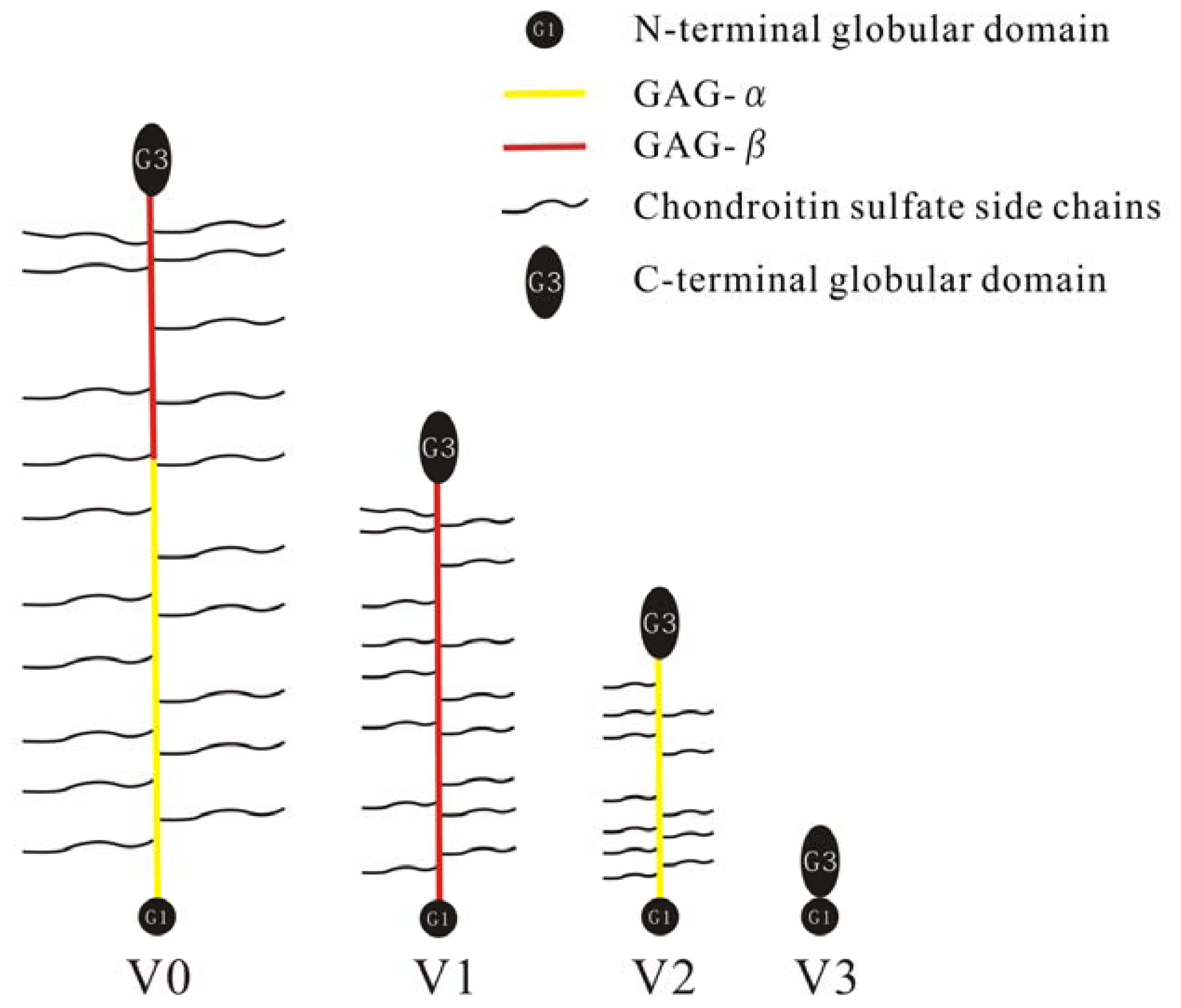
<p>Versican, a ubiquitous component of the ECM, is highly expressed by proliferating cells and mesenchyme during tissue remodeling and embryonic morphogenesis [<xref ref-type="bibr" rid="b9-ijms-13-06873">9</xref>–<xref ref-type="bibr" rid="b11-ijms-13-06873">11</xref>]. Structurally, versican consists of an <italic>N</italic>-terminal globular domain (G1), a <italic>C</italic>-terminal globular domain (G3), and chondroitin sulfate (CS) chain-binding regions (GAG-α, GAG-β) between the G1 and G3 domains [<xref ref-type="bibr" rid="b12-ijms-13-06873">12</xref>]. Alternative splicing generates at least four isoforms of versican, known as V0, V1, V2, and V3 [<xref ref-type="bibr" rid="b13-ijms-13-06873">13</xref>] (<xref ref-type="fig" rid="f1-ijms-13-06873">Figure 1</xref>). V0 contains both GAG-α and GAG-β; V1 and V2 possess only GAG-β and GAG-α, respectively; and V3 solely has the globular domains. Versican isoforms V0/V1 are mainly expressed in the late stage of embryonic development [<xref ref-type="bibr" rid="b14-ijms-13-06873">14</xref>], whereas versican V2 is one of the main constituents of the mature CNS ECM [<xref ref-type="bibr" rid="b15-ijms-13-06873">15</xref>].</p>
<p>The G1 region of versican is composed of an immunoglobulin fold followed by a contiguous pair of link modules that bind hyaluronan; the G3 region contains two epidermal growth factor (EGF)-like repeats, a carbohydrate recognition domain (a lectin-like repeat), and a complement regulatory protein-like motif [<xref ref-type="bibr" rid="b16-ijms-13-06873">16</xref>]. Therefore, versican has diverse binding partners through its different molecular motifs. For example, versican binds to hyaluronan through its G1 domain, to CD44 and L and P selectins through its CS chains, and to epidermal growth factor receptor (EGFR), tenascin-R, fibulin-1 and -2 through its <italic>C</italic>-terminal domain (G3) [<xref ref-type="bibr" rid="b12-ijms-13-06873">12</xref>]. In addition, versican binds to P selectin glycoprotein ligand-1 and has a role in mediating leukocyte aggregation [<xref ref-type="bibr" rid="b17-ijms-13-06873">17</xref>]; it also binds to adhesion molecules on the surface of inflammatory leukocytes. In particular, because versican binds to both hyaluronan and CD44, it is possible that the three may form complexes together and stabilize the CD44-dependent interactions of inflammatory cells.</p></sec>
<sec>
<title>3. Cytokines Exert Their Effects on Versican</title>
<p>Given that several cytokines are critical for both inflammation and tumor growth, they control the hubs of protumorigenic signaling and may be targeted to curtail both tumor-associated inflammation and tumor growth [<xref ref-type="bibr" rid="b4-ijms-13-06873">4</xref>]. In most cases, cytokines or growth factors act in an autocrine or a paracrine manner to control the immune and inflammatory milieu [<xref ref-type="bibr" rid="b18-ijms-13-06873">18</xref>]; these molecules exert their functions in the inflammatory microenvironment and function as important mediators of harmful inflammation, either to favor antitumor immunity or enhance tumor progression [<xref ref-type="bibr" rid="b19-ijms-13-06873">19</xref>]. For instance, the perpetuation of chronic inflammation, which is largely achieved through positive feedback loops, may depend mostly on the cytokines of the consecutive autocrine or paracrine system and the prolonged recruitment of inflammatory cells into the inflammatory milieu. Certain cytokines, such as IL-1β, TNF-α, and interferon-γ, have received much attention with regard to the neuroinflammatory processes in neurodegeneration [<xref ref-type="bibr" rid="b20-ijms-13-06873">20</xref>].</p>
<p>As demonstrated by its unique structural features, versican creates a highly interactive molecular environment and binds to a variety of ECM components, cytokines and growth factors to influence the fundamental events involved in the inflammatory response. It has been shown that the synthesis of versican is highly regulated by specific cytokines (<xref ref-type="table" rid="t1-ijms-13-06873">Table 1</xref>). Indeed, numerous studies have reported that specific cytokines or growth factors, such as transforming growth factor β1, β2 and β3 (TGF-β1, -β2 and -β3), basic fibroblast growth factor (bFGF), platelet-derived growth factor BB (PDGF-BB), and Interleukin-1β (IL-1β), regulate the synthesis of versican [<xref ref-type="bibr" rid="b21-ijms-13-06873">21</xref>–<xref ref-type="bibr" rid="b25-ijms-13-06873">25</xref>]: IL-1β down-regulates the expression of versican by arterial smooth muscle cells, TGF-β1 up-regulates versican in prostatic fibroblasts, facilitating invasion of cancer cells [<xref ref-type="bibr" rid="b21-ijms-13-06873">21</xref>,<xref ref-type="bibr" rid="b24-ijms-13-06873">24</xref>], and TGF-β3 regulates the versican variant expression in conjunction with the disrupted ECM in leiomyogenesis [<xref ref-type="bibr" rid="b23-ijms-13-06873">23</xref>]. Furthermore, two pro-inflammatory cytokines, TNF-α and IFN-γ, enhanced the transcription of versican V2 in neural precursor cells in a dose-dependent manner [<xref ref-type="bibr" rid="b26-ijms-13-06873">26</xref>], while IFN-γ reduces versican expression in bleomycin-exposed lung fibroblasts [<xref ref-type="bibr" rid="b27-ijms-13-06873">27</xref>]. In addition, it was demonstrated in our recent research that IL-11 could regulate the expression of versican and its variants in gastric cell lines, and versican, together with IL-11, participate in the regulation of gastric cell migration [<xref ref-type="bibr" rid="b28-ijms-13-06873">28</xref>]. Findings in our experiments previously hinted at the answer: some neglected cytokines may join in the versican and even other extracellular matrix proteoglycan regulation. Thus, the extensive, and still growing, body of evidence discussed above indicates that versican and specific cytokines are probably involved together in the steps of inflammation.</p></sec>
<sec>
<title>4. Versican and Inflammation</title>
<p>In the last decade, research has elucidated a significant involvement of versican in tumors and neurodegenerative diseases; these observations, coupled with those demonstrating that versican regulates many of the events that contribute to the poor prognosis of cancer and neurodegeneration, highlight the critical importance of versican in the pathogenesis of disease [<xref ref-type="bibr" rid="b29-ijms-13-06873">29</xref>–<xref ref-type="bibr" rid="b35-ijms-13-06873">35</xref>]. It has been suggested that abnormal expression of versican is related to cell proliferation, differentiation, adhesion, and even the homeostasis and integrity of the ECM [<xref ref-type="bibr" rid="b36-ijms-13-06873">36</xref>].</p>
<p>There is also evidence showing that versican mediates cell-ECM interaction and that the stable expression of versican enhances cell attachment and the expression of β1 integrin and fibronectin [<xref ref-type="bibr" rid="b37-ijms-13-06873">37</xref>]. In addition, an <italic>in vivo</italic> study reveals that versican could stimulate mesenchymal to epithelial transition (MET) of metastatic tumor cells by attenuating phospho-Smad 2 levels, which result in elevated cell proliferation and accelerated metastases [<xref ref-type="bibr" rid="b38-ijms-13-06873">38</xref>]. And an <italic>in vitro</italic> study shows that both versican and hyaluronan support macrophage adhesion [<xref ref-type="bibr" rid="b39-ijms-13-06873">39</xref>]. Stimulation of mononuclear cells with granulocyte/macrophage colony-stimulating factor (GM-CSF) in isolated human peripheral blood mononuclear cells increases the expression of versican as well as cytokine induction, and the upregulation of versican during myocardial infarction has a role in the inflammatory reaction, which mediates the subsequent differentiation of monocytes in the infarcted heart [<xref ref-type="bibr" rid="b40-ijms-13-06873">40</xref>]. In UVB-treated Ogg1 knockout mouse (lacking the repair enzyme 8-oxoguanine glycosylase), high versican expression is accompanied by inflammatory response, particularly neutrophil infiltration [<xref ref-type="bibr" rid="b41-ijms-13-06873">41</xref>]. It is proved that polyinosine-polycytidylic acid stimulates versican accumulation in the ECM, and the accumulation could promote monocyte adhesion [<xref ref-type="bibr" rid="b42-ijms-13-06873">42</xref>]. An adenine to thymine transversion at the highly conserved splice acceptor site in intron 7 of the versican gene which produces aberrantly spliced versican transcripts in a French Wagner family is associated with vascular and inflammatory ocular features [<xref ref-type="bibr" rid="b43-ijms-13-06873">43</xref>]. Notably, versican has been suggested to interact with a small number of metastatic cells and activate macrophages through toll-like receptor 2 (TLR2) and its co-receptors, TLR6 and CD14, leading to the production of the metastasis promoting cytokine, TNF-α, in addition to macrophage activation [<xref ref-type="bibr" rid="b44-ijms-13-06873">44</xref>]. Ligation of TLR2 by versican appears to be directly involved in the activation of multiple types of cells in tumor stroma and the induction of inflammatory cytokine secretion [<xref ref-type="bibr" rid="b45-ijms-13-06873">45</xref>]. Such interactions may sustain the inflammatory response, and could thus place versican at the top of the list of molecules to target in attempts to control inflammation [<xref ref-type="bibr" rid="b36-ijms-13-06873">36</xref>]. By localizing TGF-β in the ECM and regulating its signaling, versican could facilitate chondrogenesis and joint morphogenesis [<xref ref-type="bibr" rid="b10-ijms-13-06873">10</xref>] (<xref ref-type="table" rid="t2-ijms-13-06873">Table 2</xref>). Taken together, these results led the authors to envision that the ECM component contributes to the formation of an inflammatory response.</p></sec>
<sec>
<title>5. Versican Could Be the First Step in the Amplification of the Inflammatory Response</title>
<p>It is pointed out that versican and other extracellular-matrix proteoglycans collectively serve as a repository, containing essential cytokines that stimulate ECM remodeling via the autocrine and paracrine mechanisms [<xref ref-type="bibr" rid="b46-ijms-13-06873">46</xref>,<xref ref-type="bibr" rid="b47-ijms-13-06873">47</xref>]. Through altering the levels of versican and/or hyaluronan, cytokines stimulate the formation of versican-hyaluronan aggregates and contribute to the remodeling of the ECM [<xref ref-type="bibr" rid="b48-ijms-13-06873">48</xref>,<xref ref-type="bibr" rid="b49-ijms-13-06873">49</xref>]. So, to elicit an effective immune response, some cytokines that serve as mediators or amplifiers of the program of inflammation may exert their initial effects on the extracellular matrix to change the homeostasis of the inflammatory milieu by regulating particular ECM components, such as versican. This altered homeostasis creates a favorable environment for the cytokines and growth factors and also promotes the recruitment of new inflammatory cells, such as macrophages and neutrophils. Some interesting studies have also demonstrated that versican is a TLR2 agonist and metastasis-enhancing factor and that it can interact with inflammatory chemokines and partially regulate their activity [<xref ref-type="bibr" rid="b44-ijms-13-06873">44</xref>,<xref ref-type="bibr" rid="b50-ijms-13-06873">50</xref>,<xref ref-type="bibr" rid="b51-ijms-13-06873">51</xref>]. Additionally, a highly inflammatory microenvironment could induce high versican expression, with high numbers of infiltrated neutrophils. Conversely, neutrophil infiltration induces versican overexpression [<xref ref-type="bibr" rid="b41-ijms-13-06873">41</xref>]. Ultimately, the ‘cytokine storm’ arrives, causing uncontrolled, prolonged inflammation. A vicious circle between the aberrantly expressed versican and the uncontrolled inflammatory cytokines inevitably occurs and further contributes to the ongoing pathology.</p>
<p>Within this context, versican appears to play a more significant role than merely contributing to the impaired homeostasis in the initially hostile microenvironment; it also mediates the dialog between inflammation and the cytokines. Hence, we propose that versican could be the first step in the amplification of inflammation.</p></sec>
<sec>
<title>6. Concluding Remarks</title>
<p>Although the amplifying nature of inflammation has yet to be fully elucidated, interpreting the basis for ECM and its components in the inflammatory processes is important in this endeavor. Given their important roles, versican and certain cytokines may become promising targets for the development of therapeutic agents that halt the cycle of the inflammatory response and, thereby, retard the progression of inflammation. Taken together, this research adds a new dimension to our understanding of the process of inflammation by demonstrating that versican is required in its amplification. Thus, regardless of the origin of the inflammatory process, therapeutic intervention aimed at the prevention or downregulation of versican could be of great use in ameliorating the amplifying nature of the progression of inflammation and even halt the inflammatory response. Therefore, future directions will be to develop molecular genetic models that reflect the diversity of inflammation and prevent or interrupt the vicious circle between dilapidated interstitial matrix and orderless cytokines so as to retard the progression of inflammation, for from such work innovative therapeutic strategies may follow.</p></sec></body>
<back>
<fn-group><fn id="fn2-ijms-13-06873">
<p><bold>Conflict of Interest</bold></p>
<p>The authors declare no conflict of interest.</p></fn></fn-group>
<ref-list>
<title>References</title>
<ref id="b1-ijms-13-06873"><label>1</label><citation citation-type="journal"><person-group person-group-type="author"><name><surname>Couzin-Frankel</surname><given-names>J.</given-names></name></person-group><article-title>Inflammation bares a dark side</article-title><source>Science</source><year>2010</year><volume>330</volume> <pub-id pub-id-type="doi">10.1126/science</pub-id><fpage>330</fpage><volume>6011</volume><fpage>1621</fpage></citation></ref>
<ref id="b2-ijms-13-06873"><label>2</label><citation citation-type="journal"><person-group person-group-type="author"><name><surname>Hanahan</surname><given-names>D.</given-names></name><name><surname>Weinberg</surname><given-names>R.A.</given-names></name></person-group><article-title>Hallmarks of cancer: The next generation</article-title><source>Cell</source><year>2011</year><volume>144</volume><fpage>646</fpage><lpage>674</lpage><pub-id pub-id-type="doi">10.1016/j.cell.2011.02.013</pub-id><pub-id pub-id-type="pmid">21376230</pub-id></citation></ref>
<ref id="b3-ijms-13-06873"><label>3</label><citation citation-type="journal"><person-group person-group-type="author"><name><surname>Mantovani</surname><given-names>A.</given-names></name></person-group><article-title>Inflaming metastasis</article-title><source>Nature</source><year>2009</year><volume>457</volume><fpage>36</fpage><lpage>37</lpage><pub-id pub-id-type="pmid">19122629</pub-id></citation></ref>
<ref id="b4-ijms-13-06873"><label>4</label><citation citation-type="journal"><person-group person-group-type="author"><name><surname>Grivennikov</surname><given-names>S.I.</given-names></name><name><surname>Greten</surname><given-names>F.R.</given-names></name><name><surname>Karin</surname><given-names>M.</given-names></name></person-group><article-title>Immunity, inflammation, and cancer</article-title><source>Cell</source><year>2010</year><volume>140</volume><fpage>883</fpage><lpage>899</lpage><pub-id pub-id-type="doi">10.1016/j.cell.2010.01.025</pub-id><pub-id pub-id-type="pmid">20303878</pub-id></citation></ref>
<ref id="b5-ijms-13-06873"><label>5</label><citation citation-type="journal"><person-group person-group-type="author"><name><surname>Gao</surname><given-names>H.M.</given-names></name><name><surname>Hong</surname><given-names>J.S.</given-names></name></person-group><article-title>Why neurodegenerative diseases are progressive: Uncontrolled inflammation drives disease progression</article-title><source>Trends. Immunol</source><year>2008</year><volume>29</volume><fpage>357</fpage><lpage>365</lpage><pub-id pub-id-type="doi">10.1016/j.it.2008.05.002</pub-id><pub-id pub-id-type="pmid">18599350</pub-id></citation></ref>
<ref id="b6-ijms-13-06873"><label>6</label><citation citation-type="journal"><person-group person-group-type="author"><name><surname>Glass</surname><given-names>C.K.</given-names></name><name><surname>Saijo</surname><given-names>K.</given-names></name><name><surname>Winner</surname><given-names>B.</given-names></name><name><surname>Marchetto</surname><given-names>M.C.</given-names></name><name><surname>Gage</surname><given-names>F.H.</given-names></name></person-group><article-title>Mechanisms underlying inflammation in neurodegeneration</article-title><source>Cell</source><year>2010</year><volume>140</volume><fpage>918</fpage><lpage>934</lpage><pub-id pub-id-type="doi">10.1016/j.cell.2010.02.016</pub-id><pub-id pub-id-type="pmid">20303880</pub-id></citation></ref>
<ref id="b7-ijms-13-06873"><label>7</label><citation citation-type="journal"><person-group person-group-type="author"><name><surname>Sorokin</surname><given-names>L.</given-names></name></person-group><article-title>The impact of the extracellular matrix on inflammation</article-title><source>Nature</source><year>2010</year><volume>10</volume><fpage>712</fpage><lpage>723</lpage></citation></ref>
<ref id="b8-ijms-13-06873"><label>8</label><citation citation-type="journal"><person-group person-group-type="author"><name><surname>Tímár</surname><given-names>J.</given-names></name><name><surname>Lapis</surname><given-names>K.</given-names></name><name><surname>Dudás</surname><given-names>J.</given-names></name><name><surname>Sebestyén</surname><given-names>A.</given-names></name><name><surname>Kopper</surname><given-names>L.</given-names></name><name><surname>Kovalszky</surname><given-names>I.</given-names></name></person-group><article-title>Proteoglycans and tumor progression: Janus-faced molecules with contradictory functions in cancer</article-title><source>Semin. Cancer Biol</source><year>2002</year><volume>12</volume><fpage>173</fpage><lpage>186</lpage><pub-id pub-id-type="doi">10.1016/S1044-579X(02)00021-4</pub-id><pub-id pub-id-type="pmid">12083848</pub-id></citation></ref>
<ref id="b9-ijms-13-06873"><label>9</label><citation citation-type="journal"><person-group person-group-type="author"><name><surname>Kinsella</surname><given-names>M.G.</given-names></name><name><surname>Bressler</surname><given-names>S.L.</given-names></name><name><surname>Wight</surname><given-names>T.N.</given-names></name></person-group><article-title>The regulated synthesis of versican, decorin and biglycan: Extracellular matrix proteoglycans that influence cellular phenotype</article-title><source>Crit. Rev. Eukaryot. Gene Expr</source><year>2004</year><volume>14</volume><fpage>203</fpage><lpage>234</lpage><pub-id pub-id-type="doi">10.1615/CritRevEukaryotGeneExpr.v14.i3.40</pub-id><pub-id pub-id-type="pmid">15248816</pub-id></citation></ref>
<ref id="b10-ijms-13-06873"><label>10</label><citation citation-type="journal"><person-group person-group-type="author"><name><surname>Choocheep</surname><given-names>K.</given-names></name><name><surname>Hatano</surname><given-names>S.</given-names></name><name><surname>Takagi</surname><given-names>H.</given-names></name><name><surname>Watanabe</surname><given-names>H.</given-names></name><name><surname>Kimata</surname><given-names>K.</given-names></name><name><surname>Kongtawelert</surname><given-names>P.</given-names></name><name><surname>Watanabe</surname><given-names>H.</given-names></name></person-group><article-title>Versican facilitates chondrocyte differentiation and regulates joint morphogenesis</article-title><source>J. Biol. Chem</source><year>2010</year><volume>285</volume><fpage>21114</fpage><lpage>21125</lpage><pub-id pub-id-type="doi">10.1074/jbc.M109.096479</pub-id><pub-id pub-id-type="pmid">20404343</pub-id></citation></ref>
<ref id="b11-ijms-13-06873"><label>11</label><citation citation-type="journal"><person-group person-group-type="author"><name><surname>McCulloch</surname><given-names>D.R.</given-names></name><name><surname>Nelson</surname><given-names>C.M.</given-names></name><name><surname>Dixon</surname><given-names>L.J.</given-names></name><name><surname>Silver</surname><given-names>D.L.</given-names></name><name><surname>Wylie</surname><given-names>J.D.</given-names></name><name><surname>Lindner</surname><given-names>V.</given-names></name><name><surname>Sasaki</surname><given-names>T.</given-names></name><name><surname>Cooley</surname><given-names>M.A.</given-names></name><name><surname>Argraves</surname><given-names>W.S.</given-names></name><name><surname>Apte</surname><given-names>S.S.</given-names></name></person-group><article-title>ADAMTS metalloproteases generate active versican fragments that regulate interdigital web regression</article-title><source>Dev. Cell</source><year>2009</year><volume>17</volume><fpage>687</fpage><lpage>698</lpage><pub-id pub-id-type="doi">10.1016/j.devcel.2009.09.008</pub-id><pub-id pub-id-type="pmid">19922873</pub-id></citation></ref>
<ref id="b12-ijms-13-06873"><label>12</label><citation citation-type="journal"><person-group person-group-type="author"><name><surname>Wu</surname><given-names>Y.J.</given-names></name><name><surname>La Pierre</surname><given-names>D.P.</given-names></name><name><surname>Wu</surname><given-names>J.</given-names></name><name><surname>Yee</surname><given-names>A.J.</given-names></name><name><surname>Yang</surname><given-names>B.B.</given-names></name></person-group><article-title>The interaction of versican with its binding partners</article-title><source>Cell Res</source><year>2005</year><volume>15</volume><fpage>483</fpage><lpage>494</lpage><pub-id pub-id-type="doi">10.1038/sj.cr.7290318</pub-id><pub-id pub-id-type="pmid">16045811</pub-id></citation></ref>
<ref id="b13-ijms-13-06873"><label>13</label><citation citation-type="journal"><person-group person-group-type="author"><name><surname>Zako</surname><given-names>M.</given-names></name><name><surname>Shinomura</surname><given-names>T.</given-names></name><name><surname>Ujita</surname><given-names>M.</given-names></name><name><surname>Ito</surname><given-names>K.</given-names></name><name><surname>Kimata</surname><given-names>K.</given-names></name></person-group><article-title>Expression of PG-M (V3), an alternatively spliced form of PG-M without a chondroitin sulfate attachment in region in mouse and human tissues</article-title><source>J. Biol. Chem</source><year>1995</year><volume>270</volume><fpage>3914</fpage><lpage>3918</lpage><pub-id pub-id-type="doi">10.1074/jbc.270.8.3914</pub-id><pub-id pub-id-type="pmid">7876137</pub-id></citation></ref>
<ref id="b14-ijms-13-06873"><label>14</label><citation citation-type="journal"><person-group person-group-type="author"><name><surname>Landolt</surname><given-names>R.M.</given-names></name><name><surname>Vaughan</surname><given-names>L.</given-names></name><name><surname>Winterhalter</surname><given-names>K.H.</given-names></name><name><surname>Zimmermann</surname><given-names>D.R.</given-names></name></person-group><article-title>Versican is selectively expressed in embryonic tissues that act as barriers to neural crest cell migration and axon outgrowth</article-title><source>Development</source><year>1995</year><volume>121</volume><fpage>2303</fpage><lpage>2312</lpage><pub-id pub-id-type="pmid">7671797</pub-id></citation></ref>
<ref id="b15-ijms-13-06873"><label>15</label><citation citation-type="journal"><person-group person-group-type="author"><name><surname>Schmalfeldt</surname><given-names>M.</given-names></name><name><surname>Dours-Zimmermann</surname><given-names>M.T.</given-names></name><name><surname>Winterhalter</surname><given-names>K.H.</given-names></name><name><surname>Zimmermann</surname><given-names>D.R.</given-names></name></person-group><article-title>Versican V2 is a major extracellular matrix component of the mature bovine brain</article-title><source>J. Biol. Chem</source><year>1998</year><volume>273</volume><fpage>15758</fpage><lpage>15764</lpage><pub-id pub-id-type="doi">10.1074/jbc.273.25.15758</pub-id><pub-id pub-id-type="pmid">9624174</pub-id></citation></ref>
<ref id="b16-ijms-13-06873"><label>16</label><citation citation-type="journal"><person-group person-group-type="author"><name><surname>Ricciardelli</surname><given-names>C.</given-names></name><name><surname>Sakko</surname><given-names>A.J.</given-names></name><name><surname>Ween</surname><given-names>M.P.</given-names></name><name><surname>Russell</surname><given-names>D.L.</given-names></name><name><surname>Horsfall</surname><given-names>D.J.</given-names></name></person-group><article-title>The biological role and regulation of versican levels in cancer</article-title><source>Cancer Metastasis Rev</source><year>2009</year><volume>28</volume><fpage>233</fpage><lpage>245</lpage><pub-id pub-id-type="doi">10.1007/s10555-009-9182-y</pub-id><pub-id pub-id-type="pmid">19160015</pub-id></citation></ref>
<ref id="b17-ijms-13-06873"><label>17</label><citation citation-type="journal"><person-group person-group-type="author"><name><surname>Zheng</surname><given-names>P.S.</given-names></name><name><surname>Vais</surname><given-names>D.</given-names></name><name><surname>Lapierre</surname><given-names>D.</given-names></name><name><surname>Liang</surname><given-names>Y.Y.</given-names></name><name><surname>Lee</surname><given-names>V.</given-names></name><name><surname>Yang</surname><given-names>B.L.</given-names></name><name><surname>Yang</surname><given-names>B.B.</given-names></name></person-group><article-title>PG-M/versican binds to P-selectin glycoprotein ligand-1 and mediates leukocyte aggregation</article-title><source>J. Cell Sci</source><year>2004</year><volume>117</volume><fpage>5887</fpage><lpage>5895</lpage><pub-id pub-id-type="doi">10.1242/jcs.01516</pub-id><pub-id pub-id-type="pmid">15522894</pub-id></citation></ref>
<ref id="b18-ijms-13-06873"><label>18</label><citation citation-type="journal"><person-group person-group-type="author"><name><surname>Dinarello</surname><given-names>C.A.</given-names></name></person-group><article-title>Anti-inflammatory agents: Present and future</article-title><source>Cell</source><year>2010</year><volume>140</volume><fpage>935</fpage><lpage>950</lpage><pub-id pub-id-type="doi">10.1016/j.cell.2010.02.043</pub-id><pub-id pub-id-type="pmid">20303881</pub-id></citation></ref>
<ref id="b19-ijms-13-06873"><label>19</label><citation citation-type="journal"><person-group person-group-type="author"><name><surname>Lin</surname><given-names>W.W.</given-names></name><name><surname>Karin</surname><given-names>M.</given-names></name></person-group><article-title>A cytokine-mediated link between innate immunity, inflammation, and cancer</article-title><source>J. Clin. Invest</source><year>2007</year><volume>117</volume><fpage>1175</fpage><lpage>1183</lpage><pub-id pub-id-type="doi">10.1172/JCI31537</pub-id><pub-id pub-id-type="pmid">17476347</pub-id></citation></ref>
<ref id="b20-ijms-13-06873"><label>20</label><citation citation-type="journal"><person-group person-group-type="author"><name><surname>Hirsch</surname><given-names>E.C.</given-names></name><name><surname>Hunot</surname><given-names>S.</given-names></name></person-group><article-title>Neuroinflammation in Parkinson’s disease: A target for neuroprotection?</article-title><source>Lancet Neurol</source><year>2009</year><volume>8</volume><fpage>382</fpage><lpage>397</lpage><pub-id pub-id-type="doi">10.1016/S1474-4422(09)70062-6</pub-id><pub-id pub-id-type="pmid">19296921</pub-id></citation></ref>
<ref id="b21-ijms-13-06873"><label>21</label><citation citation-type="journal"><person-group person-group-type="author"><name><surname>Sakko</surname><given-names>A.J.</given-names></name><name><surname>Ricciardelli</surname><given-names>C.</given-names></name><name><surname>Mayne</surname><given-names>K.</given-names></name><name><surname>Suwiwat</surname><given-names>S.</given-names></name><name><surname>LeBaron</surname><given-names>R.G.</given-names></name><name><surname>Marshall</surname><given-names>V.R.</given-names></name><name><surname>Tilley</surname><given-names>W.D.</given-names></name><name><surname>Horsfall</surname><given-names>D.J.</given-names></name></person-group><article-title>Modulation of prostate cancer cell attachment to matrix by versican</article-title><source>Cancer Res</source><year>2003</year><volume>63</volume><fpage>4786</fpage><lpage>4791</lpage><pub-id pub-id-type="pmid">12941795</pub-id></citation></ref>
<ref id="b22-ijms-13-06873"><label>22</label><citation citation-type="journal"><person-group person-group-type="author"><name><surname>Berdiaki</surname><given-names>A.</given-names></name><name><surname>Zafiropoulos</surname><given-names>A.</given-names></name><name><surname>Fthenou</surname><given-names>E.</given-names></name><name><surname>Katonis</surname><given-names>P.</given-names></name><name><surname>Tsatsakis</surname><given-names>A.</given-names></name><name><surname>Karamanos</surname><given-names>N.K.</given-names></name><name><surname>Tzanakakis</surname><given-names>G.N.</given-names></name></person-group><article-title>Regulation of hyaluronan and versican deposition by growth factors in fibrosarcoma cell lines</article-title><source>Biochim. Biophys. Acta</source><year>2008</year><volume>1780</volume><fpage>194</fpage><lpage>202</lpage><pub-id pub-id-type="doi">10.1016/j.bbagen.2007.10.005</pub-id><pub-id pub-id-type="pmid">17980161</pub-id></citation></ref>
<ref id="b23-ijms-13-06873"><label>23</label><citation citation-type="journal"><person-group person-group-type="author"><name><surname>Norian</surname><given-names>J.M.</given-names></name><name><surname>Malik</surname><given-names>M.</given-names></name><name><surname>Parker</surname><given-names>C.Y.</given-names></name><name><surname>Joseph</surname><given-names>D.</given-names></name><name><surname>Leppert</surname><given-names>P.C.</given-names></name><name><surname>Segars</surname><given-names>J.H.</given-names></name><name><surname>Catherino</surname><given-names>W.H.</given-names></name></person-group><article-title>Transforming growth factor beta3 regulates the versican variants in the extracellular matrix-rich uterine leiomyomas</article-title><source>Reprod. Sci</source><year>2009</year><volume>16</volume><fpage>1153</fpage><lpage>1164</lpage><pub-id pub-id-type="doi">10.1177/1933719109343310</pub-id><pub-id pub-id-type="pmid">19700613</pub-id></citation></ref>
<ref id="b24-ijms-13-06873"><label>24</label><citation citation-type="journal"><person-group person-group-type="author"><name><surname>Lemire</surname><given-names>J.M.</given-names></name><name><surname>Chan</surname><given-names>C.K.</given-names></name><name><surname>Bressler</surname><given-names>S.</given-names></name><name><surname>Miller</surname><given-names>J.</given-names></name><name><surname>LeBaron</surname><given-names>R.G.</given-names></name><name><surname>Wight</surname><given-names>T.N.</given-names></name></person-group><article-title>Interleukin-1beta selectively decreases the synthesis of versican by arterial smooth muscle cells</article-title><source>J. Cell Biochem</source><year>2007</year><volume>101</volume><fpage>753</fpage><lpage>766</lpage><pub-id pub-id-type="doi">10.1002/jcb.21235</pub-id><pub-id pub-id-type="pmid">17226775</pub-id></citation></ref>
<ref id="b25-ijms-13-06873"><label>25</label><citation citation-type="journal"><person-group person-group-type="author"><name><surname>Schönherr</surname><given-names>E.</given-names></name><name><surname>Kinsella</surname><given-names>M.G.</given-names></name><name><surname>Wight</surname><given-names>T.N.</given-names></name></person-group><article-title>Genistein selectively inhibits platelet-derived growth factor-stimulated versican biosynthesis in monkey arterial smooth muscle cells</article-title><source>Arch. Biochem. Biophys</source><year>1997</year><volume>339</volume><fpage>353</fpage><lpage>361</lpage><pub-id pub-id-type="doi">10.1006/abbi.1996.9854</pub-id><pub-id pub-id-type="pmid">9056268</pub-id></citation></ref>
<ref id="b26-ijms-13-06873"><label>26</label><citation citation-type="journal"><person-group person-group-type="author"><name><surname>Gu</surname><given-names>W.L.</given-names></name><name><surname>Fu</surname><given-names>S.L.</given-names></name><name><surname>Wang</surname><given-names>Y.X.</given-names></name><name><surname>Li</surname><given-names>Y.</given-names></name><name><surname>Wang</surname><given-names>X.F.</given-names></name><name><surname>Xu</surname><given-names>X.M.</given-names></name><name><surname>Lu</surname><given-names>P.H.</given-names></name></person-group><article-title>Expression and regulation of versican in neural precursor cells and their lineages</article-title><source>Acta. Pharmacol. Sin</source><year>2007</year><volume>28</volume><fpage>1519</fpage><lpage>1530</lpage><pub-id pub-id-type="doi">10.1111/j.1745-7254.2007.00659.x</pub-id><pub-id pub-id-type="pmid">17883936</pub-id></citation></ref>
<ref id="b27-ijms-13-06873"><label>27</label><citation citation-type="journal"><person-group person-group-type="author"><name><surname>Venkatesan</surname><given-names>N.</given-names></name><name><surname>Roughley</surname><given-names>P.J.</given-names></name><name><surname>Ludwig</surname><given-names>M.S.</given-names></name></person-group><article-title>Proteoglycan expression in bleomycin lung fibroblasts: Role of transforming growth factor-beta (1) and interferon-gamma</article-title><source>Am. J. Physiol. Lung Cell Mol. Physiol</source><year>2002</year><volume>283</volume><fpage>L806</fpage><lpage>L814</lpage><pub-id pub-id-type="pmid">12225958</pub-id></citation></ref>
<ref id="b28-ijms-13-06873"><label>28</label><citation citation-type="journal"><person-group person-group-type="author"><name><surname>Zhang</surname><given-names>Z.W.</given-names></name><name><surname>Zhang</surname><given-names>J.P.</given-names></name><name><surname>Miao</surname><given-names>L.</given-names></name><name><surname>Liu</surname><given-names>K.</given-names></name><name><surname>Yang</surname><given-names>S.S.</given-names></name><name><surname>Pan</surname><given-names>C.Y.</given-names></name><name><surname>Jiao</surname><given-names>B.H.</given-names></name></person-group><article-title>Interleukin-11 promotes the progress of gastric carcinoma via abnormally expressed versican</article-title><source>Int. J. Biol. Sci</source><year>2012</year><volume>8</volume><fpage>383</fpage><lpage>393</lpage><pub-id pub-id-type="doi">10.7150/ijbs.3579</pub-id><pub-id pub-id-type="pmid">22393310</pub-id></citation></ref>
<ref id="b29-ijms-13-06873"><label>29</label><citation citation-type="journal"><person-group person-group-type="author"><name><surname>Voutilainen</surname><given-names>K.</given-names></name><name><surname>Anttila</surname><given-names>M.</given-names></name><name><surname>Sillanpää</surname><given-names>S.</given-names></name><name><surname>Tammi</surname><given-names>R.</given-names></name><name><surname>Tammi</surname><given-names>M.</given-names></name><name><surname>Saarikoski</surname><given-names>S.</given-names></name><name><surname>Kosma</surname><given-names>V.M.</given-names></name></person-group><article-title>Versican in epithelial ovarian cancer: Relation to hyaluronan, clinicopathologic factors and prognosis</article-title><source>Int. J. Cancer</source><year>2003</year><volume>107</volume><fpage>359</fpage><lpage>364</lpage><pub-id pub-id-type="doi">10.1002/ijc.11423</pub-id><pub-id pub-id-type="pmid">14506734</pub-id></citation></ref>
<ref id="b30-ijms-13-06873"><label>30</label><citation citation-type="journal"><person-group person-group-type="author"><name><surname>Takahashi</surname><given-names>Y.</given-names></name><name><surname>Kuwabara</surname><given-names>H.</given-names></name><name><surname>Yoneda</surname><given-names>M.</given-names></name><name><surname>Isogai</surname><given-names>Z.</given-names></name><name><surname>Tanigawa</surname><given-names>N.</given-names></name><name><surname>Shibayama</surname><given-names>Y.</given-names></name></person-group><article-title>Versican G1 and G3 domains are upregulated and latent transforming growth factor-β binding protein-4 is downregulated in breast cancer stroma</article-title><source>Breast Cancer</source><year>2012</year><volume>19</volume><fpage>46</fpage><lpage>53</lpage><pub-id pub-id-type="doi">10.1007/s12282-011-0264-7</pub-id><pub-id pub-id-type="pmid">21505857</pub-id></citation></ref>
<ref id="b31-ijms-13-06873"><label>31</label><citation citation-type="journal"><person-group person-group-type="author"><name><surname>Pirinen</surname><given-names>R.</given-names></name><name><surname>Leinonen</surname><given-names>T.</given-names></name><name><surname>Böhm</surname><given-names>J.</given-names></name><name><surname>Johansson</surname><given-names>R.</given-names></name><name><surname>Ropponen</surname><given-names>K.</given-names></name><name><surname>Kumpulainen</surname><given-names>E.</given-names></name><name><surname>Kosma</surname><given-names>V.M.</given-names></name></person-group><article-title>Versican in nonsmall cell lung cancer: Relation to hyaluronan, clinicopathologic factors, and prognosis</article-title><source>Hum. Pathol</source><year>2005</year><volume>36</volume><fpage>44</fpage><lpage>50</lpage><pub-id pub-id-type="doi">10.1016/j.humpath.2004.10.010</pub-id><pub-id pub-id-type="pmid">15712181</pub-id></citation></ref>
<ref id="b32-ijms-13-06873"><label>32</label><citation citation-type="journal"><person-group person-group-type="author"><name><surname>Kodama</surname><given-names>J.</given-names></name><name><surname>Hasengaowa Kusumoto</surname><given-names>T.</given-names></name><name><surname>Seki</surname><given-names>N.</given-names></name><name><surname>Matsuo</surname><given-names>T.</given-names></name><name><surname>Ojima</surname><given-names>Y.</given-names></name><name><surname>Nakamura</surname><given-names>K.</given-names></name><name><surname>Hongo</surname><given-names>A.</given-names></name><name><surname>Hiramatsu</surname><given-names>Y.</given-names></name></person-group><article-title>Prognostic significance of stromal versican expression in human endometrial cancer</article-title><source>Ann. Oncol.</source><year>2007</year><volume>18</volume><fpage>269</fpage><lpage>274</lpage><pub-id pub-id-type="pmid">17065588</pub-id></citation></ref>
<ref id="b33-ijms-13-06873"><label>33</label><citation citation-type="journal"><person-group person-group-type="author"><name><surname>Wu</surname><given-names>Y.</given-names></name><name><surname>Sheng</surname><given-names>W.</given-names></name><name><surname>Chen</surname><given-names>L.</given-names></name><name><surname>Chen</surname><given-names>L.</given-names></name><name><surname>Dong</surname><given-names>H.</given-names></name><name><surname>Lee</surname><given-names>V.</given-names></name><name><surname>Lu</surname><given-names>F.</given-names></name><name><surname>Wong</surname><given-names>C.S.</given-names></name><name><surname>Lu</surname><given-names>W.Y.</given-names></name><name><surname>Yang</surname><given-names>B.B.</given-names></name></person-group><article-title>Versican V1 isoform induces neuronal differentiation and promotes neurite outgrowth</article-title><source>Mol. Biol. Cell</source><year>2004</year><volume>15</volume><fpage>2093</fpage><lpage>2104</lpage><pub-id pub-id-type="doi">10.1091/mbc.E03-09-0667</pub-id><pub-id pub-id-type="pmid">14978219</pub-id></citation></ref>
<ref id="b34-ijms-13-06873"><label>34</label><citation citation-type="journal"><person-group person-group-type="author"><name><surname>Sheng</surname><given-names>W.</given-names></name><name><surname>Wang</surname><given-names>G.</given-names></name><name><surname>Wang</surname><given-names>Y.</given-names></name><name><surname>Liang</surname><given-names>J.</given-names></name><name><surname>Wen</surname><given-names>J.</given-names></name><name><surname>Zheng</surname><given-names>P.S.</given-names></name><name><surname>Wu</surname><given-names>Y.</given-names></name><name><surname>Lee</surname><given-names>V.</given-names></name><name><surname>Slingerland</surname><given-names>J.</given-names></name><name><surname>Dumont</surname><given-names>D.</given-names></name><name><surname>Yang</surname><given-names>B.B.</given-names></name></person-group><article-title>The roles of versican V1 and V2 isoforms in cell proliferation and apoptosis</article-title><source>Mol. Biol. Cell</source><year>2005</year><volume>16</volume><fpage>1330</fpage><lpage>1340</lpage><pub-id pub-id-type="doi">10.1091/mbc.E04-04-0295</pub-id><pub-id pub-id-type="pmid">15635104</pub-id></citation></ref>
<ref id="b35-ijms-13-06873"><label>35</label><citation citation-type="journal"><person-group person-group-type="author"><name><surname>Zhang</surname><given-names>Z.W.</given-names></name><name><surname>Zhang</surname><given-names>J.P.</given-names></name><name><surname>Zhou</surname><given-names>T.T.</given-names></name><name><surname>Feng</surname><given-names>W.H.</given-names></name><name><surname>Jiao</surname><given-names>B.H.</given-names></name></person-group><article-title>Does the expression of versican isoforms contribute to the pathogenesis of neurodegenerative diseases?</article-title><source>Arch. Med. Res</source><year>2011</year><volume>42</volume><fpage>258</fpage><lpage>260</lpage><pub-id pub-id-type="doi">10.1016/j.arcmed.2011.04.010</pub-id><pub-id pub-id-type="pmid">21722824</pub-id></citation></ref>
<ref id="b36-ijms-13-06873"><label>36</label><citation citation-type="journal"><person-group person-group-type="author"><name><surname>Wight</surname><given-names>T.N.</given-names></name></person-group><article-title>Versican: A versatile extracellular matrix proteoglycan in cell biology</article-title><source>Curr. Opin. Cell Biol</source><year>2002</year><volume>14</volume><fpage>617</fpage><lpage>623</lpage><pub-id pub-id-type="doi">10.1016/S0955-0674(02)00375-7</pub-id><pub-id pub-id-type="pmid">12231358</pub-id></citation></ref>
<ref id="b37-ijms-13-06873"><label>37</label><citation citation-type="journal"><person-group person-group-type="author"><name><surname>Wu</surname><given-names>Y.J.</given-names></name><name><surname>Wu</surname><given-names>J.</given-names></name><name><surname>Lee</surname><given-names>D.Y.</given-names></name><name><surname>Yee</surname><given-names>A.</given-names></name><name><surname>Cao</surname><given-names>L.</given-names></name><name><surname>Zhang</surname><given-names>Y.</given-names></name><name><surname>Kiani</surname><given-names>C.</given-names></name><name><surname>Yang</surname><given-names>B.B.</given-names></name></person-group><article-title>Versican protects cells from oxidative stress-induced apoptosis</article-title><source>Matrix Biol</source><year>2005</year><volume>24</volume><fpage>3</fpage><lpage>13</lpage><pub-id pub-id-type="doi">10.1016/j.matbio.2004.11.007</pub-id><pub-id pub-id-type="pmid">15748997</pub-id></citation></ref>
<ref id="b38-ijms-13-06873"><label>38</label><citation citation-type="journal"><person-group person-group-type="author"><name><surname>Gao</surname><given-names>D.</given-names></name><name><surname>Joshi</surname><given-names>N.</given-names></name><name><surname>Choi</surname><given-names>H.</given-names></name><name><surname>Ryu</surname><given-names>S.</given-names></name><name><surname>Hahn</surname><given-names>M.</given-names></name><name><surname>Catena</surname><given-names>R.</given-names></name><name><surname>Sadik</surname><given-names>H.</given-names></name><name><surname>Argani</surname><given-names>P.</given-names></name><name><surname>Wagner</surname><given-names>P.L.</given-names></name><name><surname>Vahdat</surname><given-names>L.T.</given-names></name><etal/></person-group><article-title>Myeloid progenitor cells in the premetastatic lung promote metastases by inducing mesenchymal to epithelial transition</article-title><source>Cancer Res</source><year>2012</year><volume>72</volume><fpage>1384</fpage><lpage>1394</lpage><pub-id pub-id-type="doi">10.1158/0008-5472.CAN-11-2905</pub-id><pub-id pub-id-type="pmid">22282653</pub-id></citation></ref>
<ref id="b39-ijms-13-06873"><label>39</label><citation citation-type="journal"><person-group person-group-type="author"><name><surname>De la Motte</surname><given-names>C.A.</given-names></name><name><surname>Hascall</surname><given-names>V.C.</given-names></name><name><surname>Drazba</surname><given-names>J.</given-names></name><name><surname>Bandyopadhyay</surname><given-names>S.K.</given-names></name><name><surname>Strong</surname><given-names>S.A.</given-names></name></person-group><article-title>Mononuclear leukocytes bind to specific hyaluronan structures on colon mucosal smooth muscle cells treated with polyinosinic acid:polycytidylic acid: Inter-alpha-trypsin inhibitor is crucial to structure and function</article-title><source>Am. J. Pathol</source><year>2003</year><volume>163</volume><fpage>121</fpage><lpage>133</lpage><pub-id pub-id-type="doi">10.1016/S0002-9440(10)63636-X</pub-id><pub-id pub-id-type="pmid">12819017</pub-id></citation></ref>
<ref id="b40-ijms-13-06873"><label>40</label><citation citation-type="journal"><person-group person-group-type="author"><name><surname>Toeda</surname><given-names>K.</given-names></name><name><surname>Nakamura</surname><given-names>K.</given-names></name><name><surname>Hirohata</surname><given-names>S.</given-names></name><name><surname>Hatipoglu</surname><given-names>O.F.</given-names></name><name><surname>Demircan</surname><given-names>K.</given-names></name><name><surname>Yamawaki</surname><given-names>H.</given-names></name><name><surname>Ogawa</surname><given-names>H.</given-names></name><name><surname>Kusachi</surname><given-names>S.</given-names></name><name><surname>Shiratori</surname><given-names>Y.</given-names></name><name><surname>Ninomiya</surname><given-names>Y.</given-names></name></person-group><article-title>Versican is induced in infiltrating monocytes in myocardial infarction</article-title><source>Mol. Cell Biochem</source><year>2005</year><volume>280</volume><fpage>47</fpage><lpage>56</lpage><pub-id pub-id-type="doi">10.1007/s11010-005-8051-4</pub-id><pub-id pub-id-type="pmid">16311904</pub-id></citation></ref>
<ref id="b41-ijms-13-06873"><label>41</label><citation citation-type="journal"><person-group person-group-type="author"><name><surname>Kunisada</surname><given-names>M.</given-names></name><name><surname>Yogianti</surname><given-names>F.</given-names></name><name><surname>Sakumi</surname><given-names>K.</given-names></name><name><surname>Ono</surname><given-names>R.</given-names></name><name><surname>Nakabeppu</surname><given-names>Y.</given-names></name><name><surname>Nishigori</surname><given-names>C.</given-names></name></person-group><article-title>Increased expression of versican in the inflammatory response to UVB- and reactive oxygen species-induced skin tumorigenesis</article-title><source>Am. J. Pathol</source><year>2011</year><volume>179</volume><fpage>3056</fpage><lpage>3065</lpage><pub-id pub-id-type="doi">10.1016/j.ajpath.2011.08.042</pub-id><pub-id pub-id-type="pmid">22001346</pub-id></citation></ref>
<ref id="b42-ijms-13-06873"><label>42</label><citation citation-type="journal"><person-group person-group-type="author"><name><surname>Potter-Perigo</surname><given-names>S.</given-names></name><name><surname>Johnson</surname><given-names>P.Y.</given-names></name><name><surname>Evanko</surname><given-names>S.P.</given-names></name><name><surname>Chan</surname><given-names>C.K.</given-names></name><name><surname>Braun</surname><given-names>K.R.</given-names></name><name><surname>Wilkinson</surname><given-names>T.S.</given-names></name><name><surname>Altman</surname><given-names>L.C.</given-names></name><name><surname>Wight</surname><given-names>T.N.</given-names></name></person-group><article-title>Polyinosine-polycytidylic acid stimulates versican accumulation in the extracellular matrix promoting monocyte adhesion</article-title><source>Am. J. Respir. Cell Mol. Biol</source><year>2010</year><volume>43</volume><fpage>109</fpage><lpage>120</lpage><pub-id pub-id-type="doi">10.1165/rcmb.2009-0081OC</pub-id><pub-id pub-id-type="pmid">19717812</pub-id></citation></ref>
<ref id="b43-ijms-13-06873"><label>43</label><citation citation-type="journal"><person-group person-group-type="author"><name><surname>Brézin</surname><given-names>A.P.</given-names></name><name><surname>Nedelec</surname><given-names>B.</given-names></name><name><surname>Barjol</surname><given-names>A.</given-names></name><name><surname>Rothschild</surname><given-names>P.R.</given-names></name><name><surname>Delpech</surname><given-names>M.</given-names></name><name><surname>Valleix</surname><given-names>S.</given-names></name></person-group><article-title>A new VCAN/versican splice acceptor site mutation in a French Wagner family associated with vascular and inflammatory ocular features</article-title><source>Mol. Vis</source><year>2011</year><volume>17</volume><fpage>1669</fpage><lpage>1678</lpage><pub-id pub-id-type="pmid">21738396</pub-id></citation></ref>
<ref id="b44-ijms-13-06873"><label>44</label><citation citation-type="journal"><person-group person-group-type="author"><name><surname>Kim</surname><given-names>S.</given-names></name><name><surname>Takahashi</surname><given-names>H.</given-names></name><name><surname>Lin</surname><given-names>W.W.</given-names></name><name><surname>Descargues</surname><given-names>P.</given-names></name><name><surname>Grivennikov</surname><given-names>S.</given-names></name><name><surname>Kim</surname><given-names>Y.</given-names></name><name><surname>Luo</surname><given-names>J.L.</given-names></name><name><surname>Karin</surname><given-names>M.</given-names></name></person-group><article-title>Carcinoma-produced factors activate myeloid cells through TLR2 to stimulate metastasis</article-title><source>Nature</source><year>2009</year><volume>457</volume><fpage>102</fpage><lpage>106</lpage><pub-id pub-id-type="doi">10.1038/nature07623</pub-id><pub-id pub-id-type="pmid">19122641</pub-id></citation></ref>
<ref id="b45-ijms-13-06873"><label>45</label><citation citation-type="journal"><person-group person-group-type="author"><name><surname>Wang</surname><given-names>W.</given-names></name><name><surname>Xu</surname><given-names>G.L.</given-names></name><name><surname>Jia</surname><given-names>W.D.</given-names></name><name><surname>Ma</surname><given-names>J.L.</given-names></name><name><surname>Li</surname><given-names>J.S.</given-names></name><name><surname>Ge</surname><given-names>Y.S.</given-names></name><name><surname>Ren</surname><given-names>W.H.</given-names></name><name><surname>Yu</surname><given-names>J.H.</given-names></name><name><surname>Liu</surname><given-names>W.B.</given-names></name></person-group><article-title>Ligation of TLR2 by versican: A link between inflammation and metastasis</article-title><source>Arch. Med. Res</source><year>2009</year><volume>40</volume><fpage>321</fpage><lpage>323</lpage><pub-id pub-id-type="doi">10.1016/j.arcmed.2009.04.005</pub-id><pub-id pub-id-type="pmid">19608024</pub-id></citation></ref>
<ref id="b46-ijms-13-06873"><label>46</label><citation citation-type="journal"><person-group person-group-type="author"><name><surname>Sozen</surname><given-names>I.</given-names></name><name><surname>Arici</surname><given-names>A.</given-names></name></person-group><article-title>Interactions of cytokines, growth factors, and the extracellular matrix in the cellular biology of uterine leiomyomata</article-title><source>Fertil. Steril</source><year>2002</year><volume>78</volume><fpage>1</fpage><lpage>12</lpage><pub-id pub-id-type="doi">10.1016/S0015-0282(02)03154-0</pub-id><pub-id pub-id-type="pmid">12095482</pub-id></citation></ref>
<ref id="b47-ijms-13-06873"><label>47</label><citation citation-type="journal"><person-group person-group-type="author"><name><surname>Nikitovic</surname><given-names>D.</given-names></name><name><surname>Zafiropoulos</surname><given-names>A.</given-names></name><name><surname>Katonis</surname><given-names>P.</given-names></name><name><surname>Tsatsakis</surname><given-names>A.</given-names></name><name><surname>Theocharis</surname><given-names>A.D.</given-names></name><name><surname>Karamanos</surname><given-names>N.K.</given-names></name><name><surname>Tzanakakis</surname><given-names>G.N.</given-names></name></person-group><article-title>Transforming growth factor-beta as a key molecule triggering the expression of versican isoforms v0 and v1, hyaluronan synthase-2 and synthesis of hyaluronan in malignant osteosarcoma cells</article-title><source>IUBMB Life</source><year>2006</year><volume>58</volume><fpage>47</fpage><lpage>53</lpage><pub-id pub-id-type="doi">10.1080/15216540500531713</pub-id><pub-id pub-id-type="pmid">16540432</pub-id></citation></ref>
<ref id="b48-ijms-13-06873"><label>48</label><citation citation-type="journal"><person-group person-group-type="author"><name><surname>Evanko</surname><given-names>S.P.</given-names></name><name><surname>Johnson</surname><given-names>P.Y.</given-names></name><name><surname>Braun</surname><given-names>K.R.</given-names></name><name><surname>Underhill</surname><given-names>C.B.</given-names></name><name><surname>Dudhia</surname><given-names>J.</given-names></name><name><surname>Wight</surname><given-names>T.N.</given-names></name></person-group><article-title>Platelet-derived growth factor stimulates the formation of versican-hyaluronan aggregates and pericellular matrix expansion in arterial smooth muscle cells</article-title><source>Arch. Biochem. Biophys</source><year>2001</year><volume>394</volume><fpage>29</fpage><lpage>38</lpage><pub-id pub-id-type="doi">10.1006/abbi.2001.2507</pub-id><pub-id pub-id-type="pmid">11566024</pub-id></citation></ref>
<ref id="b49-ijms-13-06873"><label>49</label><citation citation-type="journal"><person-group person-group-type="author"><name><surname>Wight</surname><given-names>T.N.</given-names></name><name><surname>Merrilees</surname><given-names>M.J.</given-names></name></person-group><article-title>Proteoglycans in atherosclerosis and restenosis: Key roles for versican</article-title><source>Circ. Res</source><year>2004</year><volume>94</volume><fpage>1158</fpage><lpage>1167</lpage><pub-id pub-id-type="doi">10.1161/01.RES.0000126921.29919.51</pub-id><pub-id pub-id-type="pmid">15142969</pub-id></citation></ref>
<ref id="b50-ijms-13-06873"><label>50</label><citation citation-type="journal"><person-group person-group-type="author"><name><surname>Kawashima</surname><given-names>H.</given-names></name><name><surname>Atarashi</surname><given-names>K.</given-names></name><name><surname>Hirose</surname><given-names>M.</given-names></name><name><surname>Hirose</surname><given-names>J.</given-names></name><name><surname>Yamada</surname><given-names>S.</given-names></name><name><surname>Sugahara</surname><given-names>K.</given-names></name><name><surname>Miyasaka</surname><given-names>M.</given-names></name></person-group><article-title>Oversulfated chondroitin/dermatan sulfates containing GlcAbeta1/IdoAalpha1-3GalNAc(4,6-<italic>O</italic>disulfate) interact with L- and P-selectin and chemokines</article-title><source>J. Biol. Chem</source><year>2002</year><volume>277</volume><fpage>12921</fpage><lpage>12930</lpage><pub-id pub-id-type="doi">10.1074/jbc.M200396200</pub-id><pub-id pub-id-type="pmid">11821431</pub-id></citation></ref>
<ref id="b51-ijms-13-06873"><label>51</label><citation citation-type="journal"><person-group person-group-type="author"><name><surname>Hirose</surname><given-names>J.</given-names></name><name><surname>Kawashima</surname><given-names>H.</given-names></name><name><surname>Yoshie</surname><given-names>O.</given-names></name><name><surname>Tashiro</surname><given-names>K.</given-names></name><name><surname>Miyasaka</surname><given-names>M.</given-names></name></person-group><article-title>Versican interacts with chemokines and modulates cellular responses</article-title><source>J. Biol. Chem</source><year>2001</year><volume>276</volume><fpage>5228</fpage><lpage>5234</lpage><pub-id pub-id-type="doi">10.1074/jbc.M007542200</pub-id><pub-id pub-id-type="pmid">11083865</pub-id></citation></ref></ref-list>
<sec sec-type="display-objects">
<title>Figure and Tables</title>
<fig id="f1-ijms-13-06873" position="float">
<label>Figure 1</label>
<caption>
<p>Schematic diagram of versican isoforms.</p></caption>
<graphic xlink:href="ijms-13-06873f1.gif"/></fig>
<table-wrap id="t1-ijms-13-06873" position="float">
<label>Table 1</label>
<caption>
<p>Summary of cytokine effects on versican.</p></caption>
<table frame="hsides" rules="groups">
<thead>
<tr>
<th align="left" valign="bottom">Cytokine</th>
<th align="center" valign="bottom">Effects</th>
<th align="center" valign="bottom">References</th></tr></thead>
<tbody>
<tr>
<td align="left" valign="middle">TGF-β1</td>
<td align="left" valign="top">TGF-β1 up-regulates versican mRNA levels and core protein synthesis in prostatic fibroblasts, facilitating invasion of cancer cells.</td>
<td align="center" valign="middle">[<xref ref-type="bibr" rid="b21-ijms-13-06873">21</xref>,<xref ref-type="bibr" rid="b27-ijms-13-06873">27</xref>]</td></tr>
<tr>
<td align="left" valign="middle">TGF-β2</td>
<td align="left" valign="top">TGF-β2 triggers a significant increase of versican V0 and V1 mRNAs and proteins in some fibrosarcoma cells and osteosarcoma cells.</td>
<td align="center" valign="middle">[<xref ref-type="bibr" rid="b22-ijms-13-06873">22</xref>,<xref ref-type="bibr" rid="b28-ijms-13-06873">28</xref>]</td></tr>
<tr>
<td align="left" valign="middle">TGF-β3</td>
<td align="left" valign="top">TGF-β3 up-regulates the versican variant expression in conjunction with the disrupted ECM in leiomyogenesis.</td>
<td align="center" valign="middle">[<xref ref-type="bibr" rid="b23-ijms-13-06873">23</xref>]</td></tr>
<tr>
<td align="left" valign="middle">bFGF</td>
<td align="left" valign="top">Compared to TGF-β2, bFGF elucidates minor stimulatory effects on versican and its isoforms expression in osteosarcoma cells.</td>
<td align="center" valign="middle">[<xref ref-type="bibr" rid="b22-ijms-13-06873">22</xref>]</td></tr>
<tr>
<td align="left" valign="middle">PDGF-BB</td>
<td align="left" valign="top">PDGF-BB stimulates versican core protein expression in monkey arterial smooth muscle cells.</td>
<td align="center" valign="middle">[<xref ref-type="bibr" rid="b25-ijms-13-06873">25</xref>]</td></tr>
<tr>
<td align="left" valign="middle">IL-1β</td>
<td align="left" valign="top">IL-1β selectively down-regulates versican synthesis by arterial smooth muscle cells, while positively regulating the synthesis of other protroglycans.</td>
<td align="center" valign="middle">[<xref ref-type="bibr" rid="b24-ijms-13-06873">24</xref>]</td></tr>
<tr>
<td align="left" valign="middle">IL-11</td>
<td align="left" valign="top">IL-11 could up-regulate the expression of versican and its variants in gastric cell lines.</td>
<td align="center" valign="middle">[<xref ref-type="bibr" rid="b28-ijms-13-06873">28</xref>]</td></tr>
<tr>
<td align="left" valign="middle">TNF-α</td>
<td align="left" valign="top">TNF-α enhances the transcription of versican V2 in neural precursor cells in a dose-dependent manner.</td>
<td align="center" valign="middle">[<xref ref-type="bibr" rid="b26-ijms-13-06873">26</xref>]</td></tr>
<tr>
<td align="left" valign="middle">IFN-γ</td>
<td align="left" valign="top">IFN-γ reduces versican expression in bleomycin-exposed lung fibroblasts, While exerting the same effects on versican V2 as TNF-α in neural precursor cells.</td>
<td align="center" valign="middle">[<xref ref-type="bibr" rid="b26-ijms-13-06873">26</xref>,<xref ref-type="bibr" rid="b27-ijms-13-06873">27</xref>]</td></tr></tbody></table></table-wrap>
<table-wrap id="t2-ijms-13-06873" position="float">
<label>Table 2</label>
<caption>
<p>Role of versican in inflammation-associated facts.</p></caption>
<table frame="hsides" rules="groups">
<thead>
<tr>
<th align="left" valign="bottom">Fact</th>
<th align="left" valign="bottom">Effects</th>
<th align="center" valign="bottom">References</th></tr></thead>
<tbody>
<tr>
<td align="left" valign="middle" rowspan="2">Aberrant homeostasis</td>
<td align="left" valign="middle">The abnormal expression of versican is related to the homeostasis and integrity of the ECM.</td>
<td align="center" valign="middle">[<xref ref-type="bibr" rid="b36-ijms-13-06873">36</xref>]</td></tr>
<tr>
<td align="left" valign="middle">Versican could stimulate mesenchymal to epithelial transition.</td>
<td align="center" valign="middle">[<xref ref-type="bibr" rid="b38-ijms-13-06873">38</xref>]</td></tr>
<tr>
<td colspan="3" align="left" valign="middle">
<hr/></td></tr>
<tr>
<td align="left" valign="middle" rowspan="4">Inflammatory cell recruited and activated</td>
<td align="left" valign="middle">Versican supports and activates macrophage adhesion.</td>
<td align="center" valign="middle">[<xref ref-type="bibr" rid="b39-ijms-13-06873">39</xref>,<xref ref-type="bibr" rid="b44-ijms-13-06873">44</xref>]</td></tr>
<tr>
<td align="left" valign="middle">High versican expression is accompanied by neutrophil infiltration.</td>
<td align="center" valign="middle">[<xref ref-type="bibr" rid="b41-ijms-13-06873">41</xref>]</td></tr>
<tr>
<td align="left" valign="middle">The accumulation of versican in the ECM could promote monocyte adhesion.</td>
<td align="center" valign="middle">[<xref ref-type="bibr" rid="b42-ijms-13-06873">42</xref>]</td></tr>
<tr>
<td align="left" valign="middle">The upregulation of versican mediates the differentiation of monocytes in the infarcted heart.</td>
<td align="center" valign="middle">[<xref ref-type="bibr" rid="b40-ijms-13-06873">40</xref>]</td></tr>
<tr>
<td colspan="3" align="left" valign="middle">
<hr/></td></tr>
<tr>
<td align="left" valign="top">TLR signal activated</td>
<td align="left" valign="middle">Versican activates TLR2 and its co-receptors, TLR6 and CD14.</td>
<td align="center" valign="middle">[<xref ref-type="bibr" rid="b44-ijms-13-06873">44</xref>]</td></tr>
<tr>
<td colspan="3" align="left" valign="middle">
<hr/></td></tr>
<tr>
<td align="left" valign="middle" rowspan="2">Cytokines localized and induced</td>
<td align="left" valign="middle">Versican could localize TGF-β in the ECM and regulating its signaling, facilitating chondrogenesis and joint morphogenesis.</td>
<td align="center" valign="middle">[<xref ref-type="bibr" rid="b10-ijms-13-06873">10</xref>]</td></tr>
<tr>
<td align="left" valign="middle">Versican induces the production of TNF-α.</td>
<td align="center" valign="middle">[<xref ref-type="bibr" rid="b44-ijms-13-06873">44</xref>]</td></tr></tbody></table></table-wrap></sec></back></article>