
<?xml version="1.0" encoding="UTF-8"?>
<!DOCTYPE article PUBLIC "-//NLM//DTD Journal Publishing DTD v2.3 20070202//EN" "journalpublishing.dtd">
<article xmlns:xlink="http://www.w3.org/1999/xlink" xml:lang="en" article-type="research-article">
<front>
<journal-meta>
<journal-id journal-id-type="publisher-id">ijms</journal-id>
<journal-title>International Journal of Molecular Sciences</journal-title>
<abbrev-journal-title>Int. J. Mol. Sci.</abbrev-journal-title>
<issn pub-type="epub">1422-0067</issn>
<publisher>
<publisher-name>Molecular Diversity Preservation International (MDPI)</publisher-name></publisher></journal-meta>
<article-meta>
<article-id pub-id-type="doi">10.3390/ijms131115360</article-id>
<article-id pub-id-type="publisher-id">ijms-13-15360</article-id>
<article-categories>
<subj-group>
<subject>Article</subject></subj-group></article-categories>
<title-group>
<article-title>Eclipsed Acetaldehyde as a Precursor for Producing Vinyl Alcohol</article-title></title-group>
<contrib-group>
<contrib contrib-type="author">
<name><surname>Osman</surname><given-names>Osman I.</given-names></name><xref ref-type="corresp" rid="c1-ijms-13-15360">*</xref></contrib>
<contrib contrib-type="author">
<name><surname>Alyoubi</surname><given-names>Abdulrahman O.</given-names></name></contrib>
<contrib contrib-type="author">
<name><surname>Elroby</surname><given-names>Shabaan A. K.</given-names></name></contrib>
<contrib contrib-type="author">
<name><surname>Hilal</surname><given-names>Rifaat H.</given-names></name></contrib>
<contrib contrib-type="author">
<name><surname>Aziz</surname><given-names>Saadullah G.</given-names></name></contrib>
<aff id="af1-ijms-13-15360">Chemistry Department, Faculty of Science, King Abdulaziz University, P.O. Box 80203, Jeddah 21589, Saudi Arabia; E-Mails: <email>aalyoubi@kau.edu.sa</email> (A.O.A.); <email>Skamel@kau.edu.sa</email> (S.A.K.E.); <email>rhilal@kau.edu.sa</email> (R.H.H.); <email>saziz@kau.edu.sa</email> (S.G.A.)</aff></contrib-group>
<author-notes>
<corresp id="c1-ijms-13-15360">
<label>*</label>Author to whom correspondence should be addressed; E-Mail: <email>oabdelkarim@kau.edu.sa</email>; Tel.: +966-2-6952000 (ext. 69315); Fax: +966-2-6952709.</corresp></author-notes>
<pub-date pub-type="collection">
<year>2012</year></pub-date>
<pub-date pub-type="epub">
<day>20</day>
<month>11</month>
<year>2012</year></pub-date>
<volume>13</volume>
<issue>11</issue>
<fpage>15360</fpage>
<lpage>15372</lpage>
<history>
<date date-type="received">
<day>24</day>
<month>09</month>
<year>2012</year></date>
<date date-type="rev-recd">
<day>29</day>
<month>10</month>
<year>2012</year></date>
<date date-type="accepted">
<day>29</day>
<month>10</month>
<year>2012</year></date></history>
<permissions>
<copyright-statement>© 2012 by the authors; licensee Molecular Diversity Preservation International, Basel, Switzerland.</copyright-statement>
<copyright-year>2012</copyright-year>
<license license-type="open-access" xlink:href="http://creativecommons.org/licenses/by/3.0">
<p>This article is an open-access article distributed under the terms and conditions of the Creative Commons Attribution license (http://creativecommons.org/licenses/by/3.0/).</p></license></permissions>
<abstract>
<p>The MP2 and DFT/B3LYP methods at 6-311++G(d,p) and aug-cc-pdz basis sets have been used to probe the origin of relative stability preference for eclipsed acetaldehyde over its bisected counterpart. A relative energy stability range of 1.02 to 1.20 kcal/mol, in favor of the eclipsed conformer, was found and discussed. An NBO study at these chemistry levels complemented these findings and assigned the eclipsed acetaldehyde preference mainly to the vicinal antiperiplanar hyperconjugative interactions. The tautomeric interconversion between the more stable eclipsed acetaldehyde and vinyl alcohol has been achieved through a four-membered ring transition state (TS). The obtained barrier heights and relative stabilities of eclipsed acetaldehyde and the two conformers of vinyl alchol at these model chemistries have been estimated and discussed.</p></abstract>
<kwd-group>
<kwd>acetaldehyde</kwd>
<kwd>eclipsed</kwd>
<kwd>bisected</kwd>
<kwd>vinyl alcohol</kwd>
<kwd>tautomerization</kwd>
<kwd>hyperconjugation</kwd>
<kwd>MP2</kwd>
<kwd>B3LYP</kwd>
<kwd>NBO</kwd></kwd-group></article-meta></front>
<body>
<sec sec-type="intro">
<title>1. Introduction</title>
<p>Acetaldehyde (CH<sub>3</sub>CHO) was first synthesized by Scheele in 1774 [<xref ref-type="bibr" rid="b1-ijms-13-15360">1</xref>]. The importance of acetaldehyde lies in its usage as an intermediate in many organic reactions [<xref ref-type="bibr" rid="b2-ijms-13-15360">2</xref>]. To understand the mechanisms of how acetaldehyde works as an intermediate in these organic reactions; the relative stability of its different conformers resulting from the internal rotation of the C–O bond should be investigated. The internal rotation of C–O bond in acetaldehyde produces two stable conformers; namely the eclipsed and bisected forms. Kilb <italic>et al.</italic>[<xref ref-type="bibr" rid="b3-ijms-13-15360">3</xref>] reported an experimental internal rotation barrier of 1.162 kcal/mol in favor of eclipsed conformer over that of a bisected one. Souter and Wood [<xref ref-type="bibr" rid="b4-ijms-13-15360">4</xref>] using far-infrared data determined a new value of 1.128 kcal/mol. A SPASIBA force filed calculations [<xref ref-type="bibr" rid="b5-ijms-13-15360">5</xref>] yielded a rotation barrier of 1.22 kcal/mol. Using MP2/6-311G(d,p), Munoz-Caro <italic>et al.</italic>[<xref ref-type="bibr" rid="b6-ijms-13-15360">6</xref>] calculated a torsional energy of 1.164 kcal/mol. There seems to be poor agreement between the observed and calculated values. We are attempting in this paper, mainly to investigate the origin of the preference of the eclipsed form, and hopefully settle the slight conflict between experiment and theory. The thermolysis of acetaldehyde at temperatures from 480 °C to 525 °C broke the weakest C–C σ bond that needed an activation energy of 47.6 kcal/mol [<xref ref-type="bibr" rid="b7-ijms-13-15360">7</xref>] that produced C<sub>2</sub>H<sub>6</sub> as a terminating step. The NMR studies of the photolysis of acetaldehyde confirmed the presence of vinyl alcohol [<xref ref-type="bibr" rid="b8-ijms-13-15360">8</xref>]. Vasiliou <italic>et al.</italic>[<xref ref-type="bibr" rid="b9-ijms-13-15360">9</xref>,<xref ref-type="bibr" rid="b10-ijms-13-15360">10</xref>] investigated the production of vinyl alcohol by the pyrolytic abstraction of the aldehyde hydrogen followed by migration of one the methyl hydrogens to the other carbon atom.</p>
<p>Holmes and Lossing [<xref ref-type="bibr" rid="b11-ijms-13-15360">11</xref>] estimated the relative energy of acetaldehyde to vinyl alcohol of 41 ± 8 kJ/mol in favor of the former. Smith <italic>et al.</italic>[<xref ref-type="bibr" rid="b12-ijms-13-15360">12</xref>] computed an activation energy of 67.38 kcal/mol for the lower energy route of converting symmetrical acetaldehyde to vinyl alcohol. Their suggestion is in conflict with other routes deduced from experiment [<xref ref-type="bibr" rid="b13-ijms-13-15360">13</xref>,<xref ref-type="bibr" rid="b14-ijms-13-15360">14</xref>]. Andres <italic>et al.</italic>[<xref ref-type="bibr" rid="b15-ijms-13-15360">15</xref>] using MP2/6-311G ** level of theory, estimated an activation energy of 72.45 kcal/mol for the conversion of symmetrical acetaldehyde into vinyl alcohol; and a relative energy of 11.97 kcal/mol in favor of the former. In the second part of paper, we endeavor to reexamine the mechanism of the tautomerization reaction of the more stable eclipsed acetaldehyde and vinyl alcohol, mainly through Natural Bond Orbital (NBO) calculations.</p></sec>
<sec sec-type="results|discussion">
<title>2. Results and Discussion</title>
<sec>
<title>2.1. Relative Stability of Eclipsed and Bisected Acetaldehydes</title>
<sec>
<title>2.1.1. Relative Energy</title>
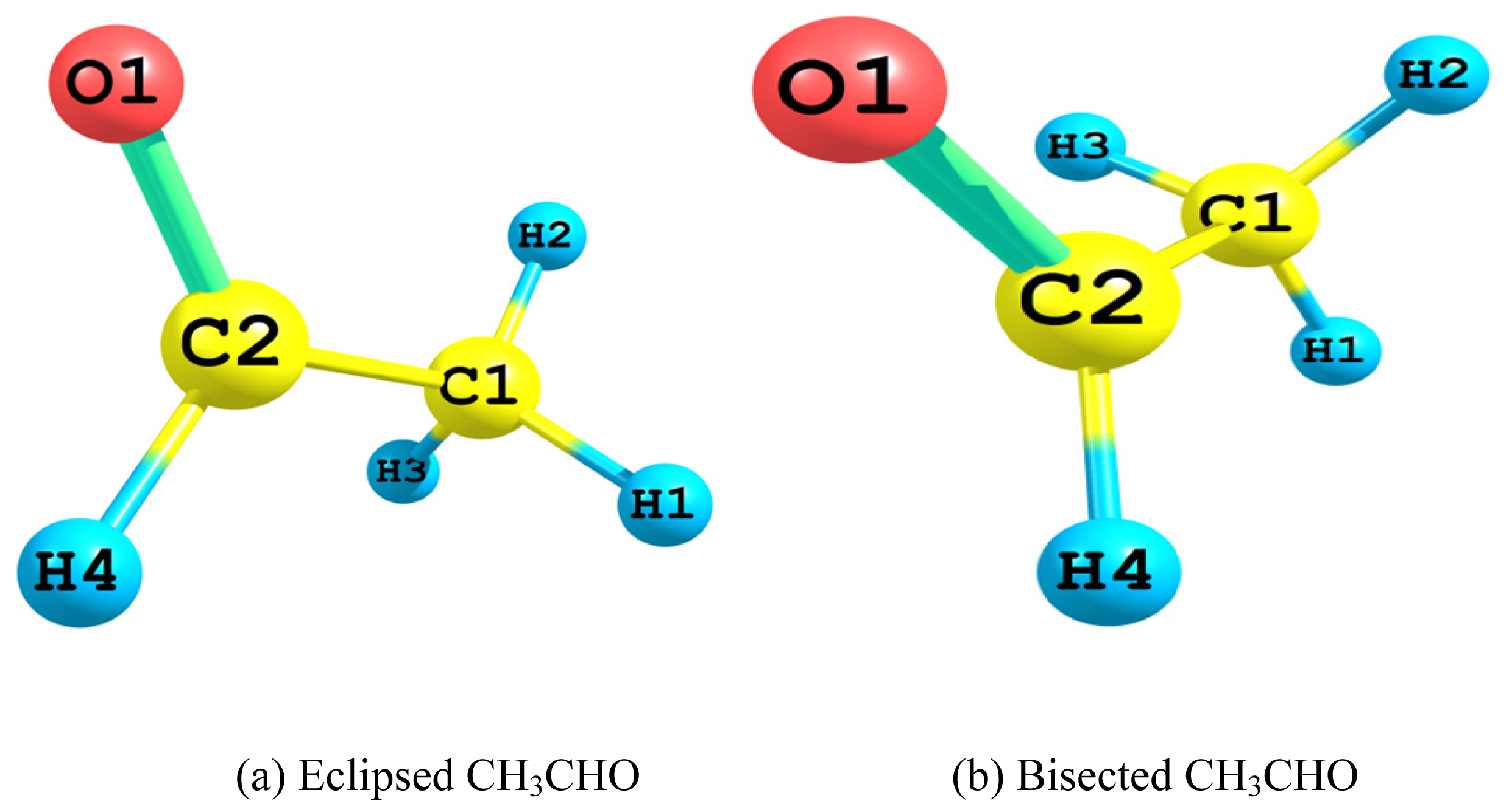
<p>The atom type and labeling of the eclipsed (<xref ref-type="fig" rid="f1-ijms-13-15360">Figure 1a</xref>) and bisected (<xref ref-type="fig" rid="f1-ijms-13-15360">Figure 1b</xref>) conformers of acetaldehyde are depicted. In <xref ref-type="table" rid="t1-ijms-13-15360">Table 1</xref> are shown the two conformers total full electronic energies (<italic>E</italic><sub>Full</sub>), total Lewis electronic energies (<italic>E</italic><sub>L</sub>) and dipole moments, which were computed by using MP2 and B3LYP methods at 6-311++G(d,p) and aug-cc-pvdz basis sets. <italic>E</italic><sub>L</sub> is the total electronic energy resulting from the localized “natural Lewis structure” wave functions in which the orbitals are doubly occupied <italic>i.e.</italic>, it is the energy obtained by deleting all non-Lewis orbitals from the basis sets. It is useful in studying hyperconjugative interactions that are used in the quantitative study of relative stabilities and their origins. <italic>E</italic><sub>Full</sub> is the total electronic energy resulting from the original delocalized wave functions. The energy differences (Δ<italic>E</italic><sub>T</sub>) between their full electronic energies (1.02–1.21 kcal/mol) using these model chemistries are in fair agreement with that of 1.162 kcal/mol obtained by experiment [<xref ref-type="bibr" rid="b3-ijms-13-15360">3</xref>] in favor of the eclipsed conformer. It is apparent that these energy differences are both chemistry model and basis set dependent. In comparison to the observed [<xref ref-type="bibr" rid="b3-ijms-13-15360">3</xref>] value; the aug-cc-pvdz basis set estimated energy differences that deviated by 2.40% and 4.13%; whereas the 6-311++G(d,p) basis set gave larger deviations of <italic>ca.</italic> 12.22% and 6.20%; at the MP2 and B3LYP theoretical methods, respectively. This non-satisfactory agreement between the experimental value [<xref ref-type="bibr" rid="b3-ijms-13-15360">3</xref>] of 1.162 kcal/mol and our calculated values sheds some doubts about the former as it is also in conflict with other experimental values [<xref ref-type="bibr" rid="b4-ijms-13-15360">4</xref>–<xref ref-type="bibr" rid="b6-ijms-13-15360">6</xref>].</p></sec>
<sec>
<title>2.1.2. Hyperconjugative Interactions</title>
<p>The Natural Bond Bond (NBO) analysis of the calculated Lewis energies for the two conformers using 6-311++G(d,p) and aug-cc-pvdz basis sets at B3LYP method gave energy differences of 4.59 and 5.15 kcal/mol, respectively, in favor of the bisected conformer; and delocalization energies of 5.68 and 6.35 kcal/mol, respectively, in favor of the eclipsed one. Thus, these basis sets gave total energy gains (Δ<italic>E</italic><sub>T</sub>) of 1.09 and 1.20 kcal/mol, respectively, with a preference for the eclipsed conformer. The relative stabilization energies, therefore, deviated by 6.20% [6-311++G(d,p)] and 3.27% [aug-cc-pvdz] from the observed value [<xref ref-type="bibr" rid="b3-ijms-13-15360">3</xref>] of 1.162 kcal/mol. The NBO energy analysis gave the same results as those obtained by the analysis of <italic>E</italic><sub>Full</sub>. It was thus not helpful in resolving the conflict; but our main objective, in using NBO analysis, was to answer the fundamental question: what is the origin of the competiveness of the eclipsed conformer?</p>
<p>The Lewis structure preference for the bisected conformer can safely be explained in terms of the relatively minimal steric hindrance. To analyze the delocalization energy preference for the eclipsed counterpart; Natural Bond Order (NBO) theory [<xref ref-type="bibr" rid="b17-ijms-13-15360">17</xref>,<xref ref-type="bibr" rid="b18-ijms-13-15360">18</xref>] has proved to be extremely helpful in determining the quantities and origins of the relative stabilities of conformers [<xref ref-type="bibr" rid="b19-ijms-13-15360">19</xref>]. The delocalization energy lowering caused by hyperconjugative energies can safely be treated by the second-order perturbation energy (<italic>E</italic><sub>(2)</sub>) given in the NBO theory as: (<italic>E</italic><sub>(2)</sub> = Δ<italic>E</italic><italic><sub>ij</sub></italic> = <italic>q</italic><italic><sub>i</sub></italic> (<italic>F</italic><italic><sub>ij</sub></italic>)<sup>2</sup>/Δɛ) where <italic>q</italic><sub>i</sub> is the donor orbital occupancy, <italic>F</italic><sub>ij</sub> is the off-diagonal Kohn-Sham matrix elements between the occupied <italic>i</italic> (<italic>n</italic> or σ) and empty <italic>j</italic> (σ*) orbitals and Δɛ is the difference between the energy of the donor orbital (<italic>i</italic>) and the acceptor orbital (<italic>j</italic>).</p>
<p>In <xref ref-type="table" rid="t2-ijms-13-15360">Table 2</xref> are listed the most important second-order perturbation energy estimates of the hyperconjugative interactions of the eclipsed and bisected conformers of acetaldehyde using B3LYP/aug-cc-pvdz level. The two lone pairs (LP) on the oxygen atom interact with the C–C bond (n<sub>O1</sub>→σ*<sub>CC</sub> and n<sub>O2</sub>→σ*<sub>CC</sub>) and C2-H4 bond (n<sub>O1</sub>→σ*<sub>C2–H4</sub> and n<sub>O2</sub>→σ*<sub>C2–H4</sub>). These interactions gave total delocalization energies of 45.09 and 44.36 kcal/mol for the eclipsed and bisected conformers, respectively. Thus the LP Effect [<xref ref-type="bibr" rid="b20-ijms-13-15360">20</xref>] favored the eclipsed form by 0.73 kcal/mol. The total energies of the vicinal CH–CO* and CH–CH* interactions are 20.26 and 17.56 kcal/mol for the eclipsed and bisected conformers, respectively. They favored the eclipsed form by 2.7 kcal/mol. The eclipsed conformer has two strong antiperiplanar (σ<sub>C1–H2</sub>→σ*<sub>C2–H4</sub> and σ<sub>C2–H4</sub>→σ*<sub>C1–H2</sub>) interactions of 3.03 and 2.53 kcal/mol, which are absent in the bisected counterpart; but replaced by the antiperiplanar (σ<sub>C1–H1</sub>→σ*<sub>CO</sub>) interaction of 4.51 kcal/mol. The eclipsed form has two dual strong semi antiperiplanar (σ<sub>C1–H1</sub>→σ*<sub>CO</sub> and σ<sub>C1–H3</sub>→σ*<sub>CO</sub>) interactions of a total of 7.35 kcal/mol each; whereas the bisected counterpart has four matching relatively weaker semi antiperiplanar (σ<sub>C1–H2</sub>→σ*<sub>CO</sub>, σ<sub>C1–H3</sub>→σ*<sub>CO</sub>, σ<sub>C1–H2</sub>→σ*<sub>C2–H4</sub>, σ<sub>C1–H3</sub>→σ*<sub>C2–H4</sub>) interactions of 4.68, 4.69, 1.34 and 1.34 kcal/mol. Thus due to these interactions the bisected conformer lies 2.7 kcal/mol above the eclipsed one. This outcome can be explained in terms of the C1–H2 and C2–H4 anti arrangement. This kind of geometrical environment allows greater overlap between the interacting orbitals [<xref ref-type="bibr" rid="b20-ijms-13-15360">20</xref>]. In contrast, the bisected form C1–H2 and C2–O1 bonds have less favorable overlap between their interacting orbitals. Globally, the eclipsed conformer is stabilized by <italic>ca.</italic> 3.44 kcal/mol. About 78.7% of this energy gain stems from the vicinal periplanar interactions.</p></sec></sec>
<sec>
<title>2.2. Tautomerization Reaction of Eclipsed Acetaldehyde and Vinyl Alcohol</title>
<sec>
<title>2.2.1. Geometry</title>
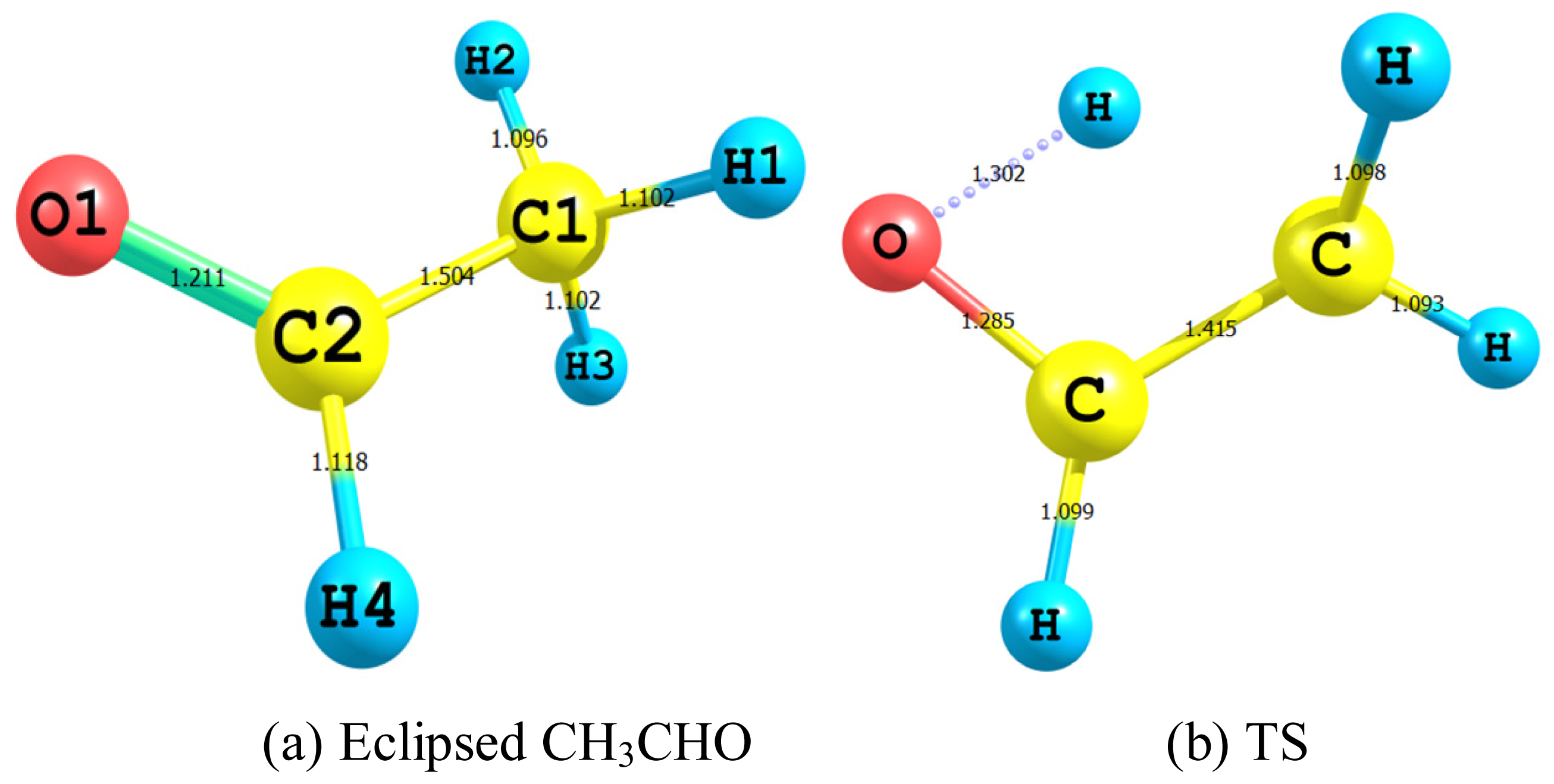
<p>The shapes of eclipsed acetaldehyde (<xref ref-type="fig" rid="f2-ijms-13-15360">Figure 2a</xref>) and its transition state (TS) (<xref ref-type="fig" rid="f2-ijms-13-15360">Figure 2b</xref>); together with the optimized bond lengths (Å), which were calculated by using B3LYP/aug-cc-pvdz level of theory, are shown. <xref ref-type="table" rid="t3-ijms-13-15360">Table 3</xref> depicts the optimized geometries of eclipsed acetaldehyde, TS and syn and anti vinyl alcohol which were estimated by applying the same model chemistry. Apart from H1C1H3 and H4C2O angles which deviate by 1.27° and 2.47° respectively, our calculated bond lengths and angles of acetaldehyde are in satisfactory agreement with the experimental values [<xref ref-type="bibr" rid="b3-ijms-13-15360">3</xref>,<xref ref-type="bibr" rid="b21-ijms-13-15360">21</xref>]. For syn and anti vinyl alcohol, the average deviation between the observed [<xref ref-type="bibr" rid="b22-ijms-13-15360">22</xref>,<xref ref-type="bibr" rid="b23-ijms-13-15360">23</xref>] and computed parameters is 0.007 Å for the bond lengths and 0.56° for the bond angles.</p>
<p>The main geometrical features of the TS that manifested the interconversion between eclipsed acetaldehyde and vinyl alcohol are: (i) the elongation of the C1–H2 from 1.096 Å in acetaldehyde to become 1.507 Å in the TS and to disappear completely in vinyl alcohol (ii) the shortening of C–C bond of 1.504 Å in acetaldehyde to become 1.415 Å in the TS and to finally settling at 1.337 Å in vinyl alcohol as a C=C bond (iii) the elongation of acetaldehyde C=O bond of 1.212 Å by about 0.073 Å in the TS and to attain a typical length of a C–O bond length of 1.366 Å in vinyl alcohol (iv) the emergence of a weakly bonded (H–O) bond of 1.302 Å in the TS that eventually reached a normal HO bond length of 0.967 Å in vinyl alcohol (v) the typical sp<sup>3</sup> HCH angles of <italic>ca</italic>. 109.6° in acetaldehyde opened up by about 4.2° in the TS and flattened up more by <italic>ca</italic>. 4.1° in vinyl alcohol (vi) the three-dimensional dihedral angles of acetaldehyde have worked out their path nicely toward a flat vinyl alcohol through the TS.</p></sec>
<sec>
<title>2.2.2. Activation Energies and Relative Stabilities</title>
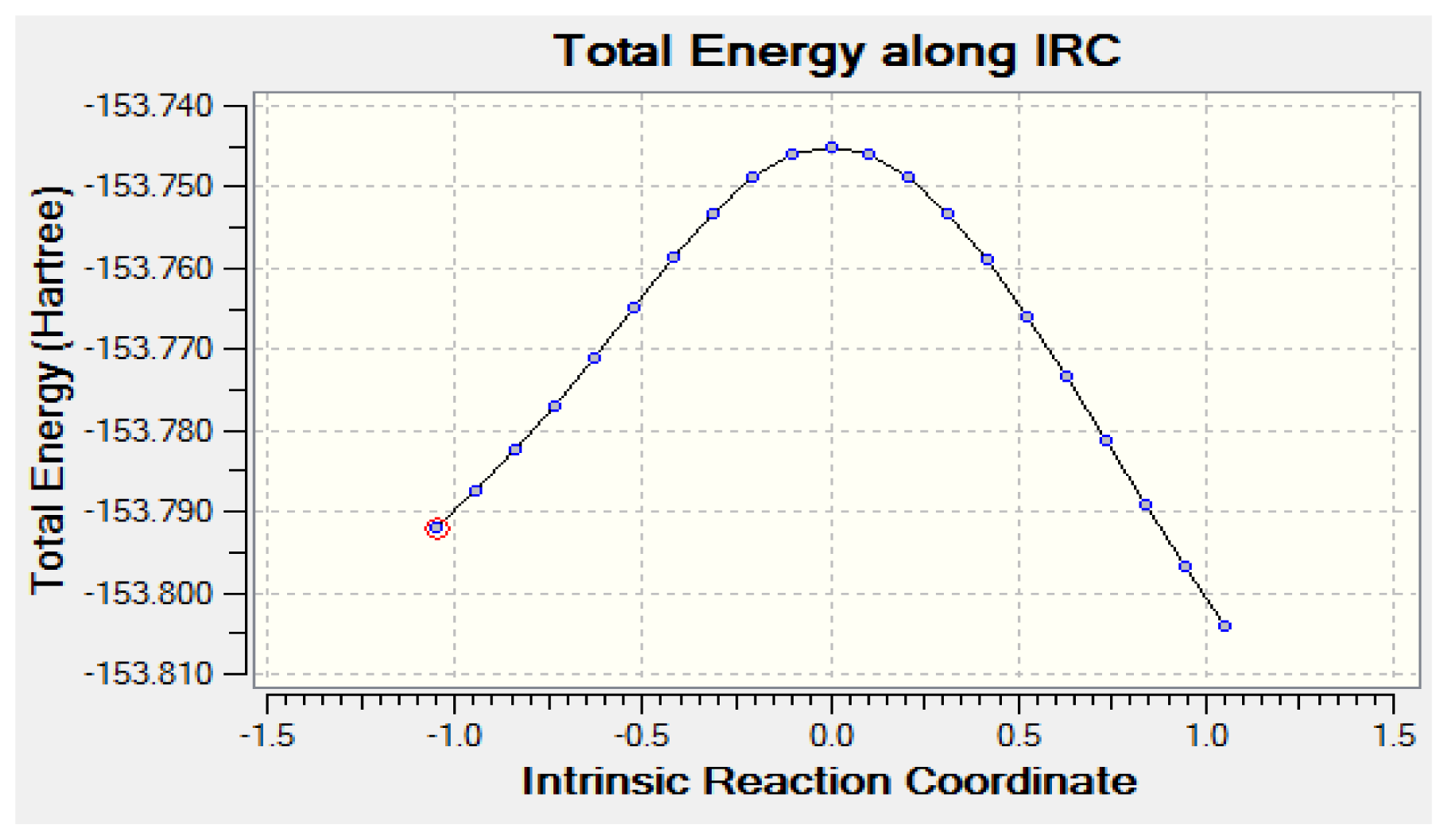
<p><xref ref-type="table" rid="t4-ijms-13-15360">Table 4</xref> lists the zero-point corrected total electronic energies and activation energies of eclipsed acetaldehyde, the Transition State (TS) and syn and anti vinyl alcohol which were computed by using MP2 and B3LYP methods at 6-311++G(d,p) and aug-cc-pvdz basis sets. <xref ref-type="fig" rid="f3-ijms-13-15360">Figure 3</xref> depicts the Intrinsic Reaction Coordinate (IRC) plot that connects eclipsed acetaldehyde to vinyl alcohol through the TS by using B3LYP/aug-cc-pvdz model chemistry. The analysis of the TS imaginary frequency showed variations in the C1–H2 bond length that were in line with the anticipated interconversion between the eclipsed acetaldehyde and vinyl alcohol which were connected by a saddle point.</p>
<p>The analysis of the results depicted in <xref ref-type="table" rid="t4-ijms-13-15360">Table 4</xref> shows that the activation energies and relative stabilities of eclipsed acetaldehyde and vinyl alcohol (Δ<italic>E</italic><sub>1</sub>), in one hand, and between the two isomers of vinyl alcohol (Δ<italic>E</italic><sub>2</sub>), on the other hand; are dependent on the levels of calculations. However, they are not far from each other and the trends are quite consistent. The B3LYP method predicted lower barrier heights (66.35 and 64.61 kcal/mol) compared to those estimated by MP2 model chemistry (67.47and 65.70 kcal/mol) using 6-311++G(d,p) and aug-cc-pvdz basis sets respectively. On the one hand, our calculated activation energy of 67.47 kcal/mol using the MP2/6-311++G(d,p) level deviated by <italic>ca.</italic> 5 kcal/mol compared to that predicted by Andres <italic>et al.</italic>[<xref ref-type="bibr" rid="b15-ijms-13-15360">15</xref>] at the same level of calculation, but with uncorrected zero-point energies. However, it deviated by 0.006 kcal/mol when compared to that computed by Smith <italic>et al.</italic>[<xref ref-type="bibr" rid="b12-ijms-13-15360">12</xref>] using G1 level of theory. On the other hand, our calculated relative stability of eclipsed acetaldehyde/vinyl alcohol of 12.85 kcal/mol exceeded that estimated by Andreas <italic>et al.</italic>[<xref ref-type="bibr" rid="b15-ijms-13-15360">15</xref>] by 0.88 kcal/mol and by 1.6 kcal/mol when compared to that computed by Smith <italic>et al.</italic>[<xref ref-type="bibr" rid="b12-ijms-13-15360">12</xref>].</p>
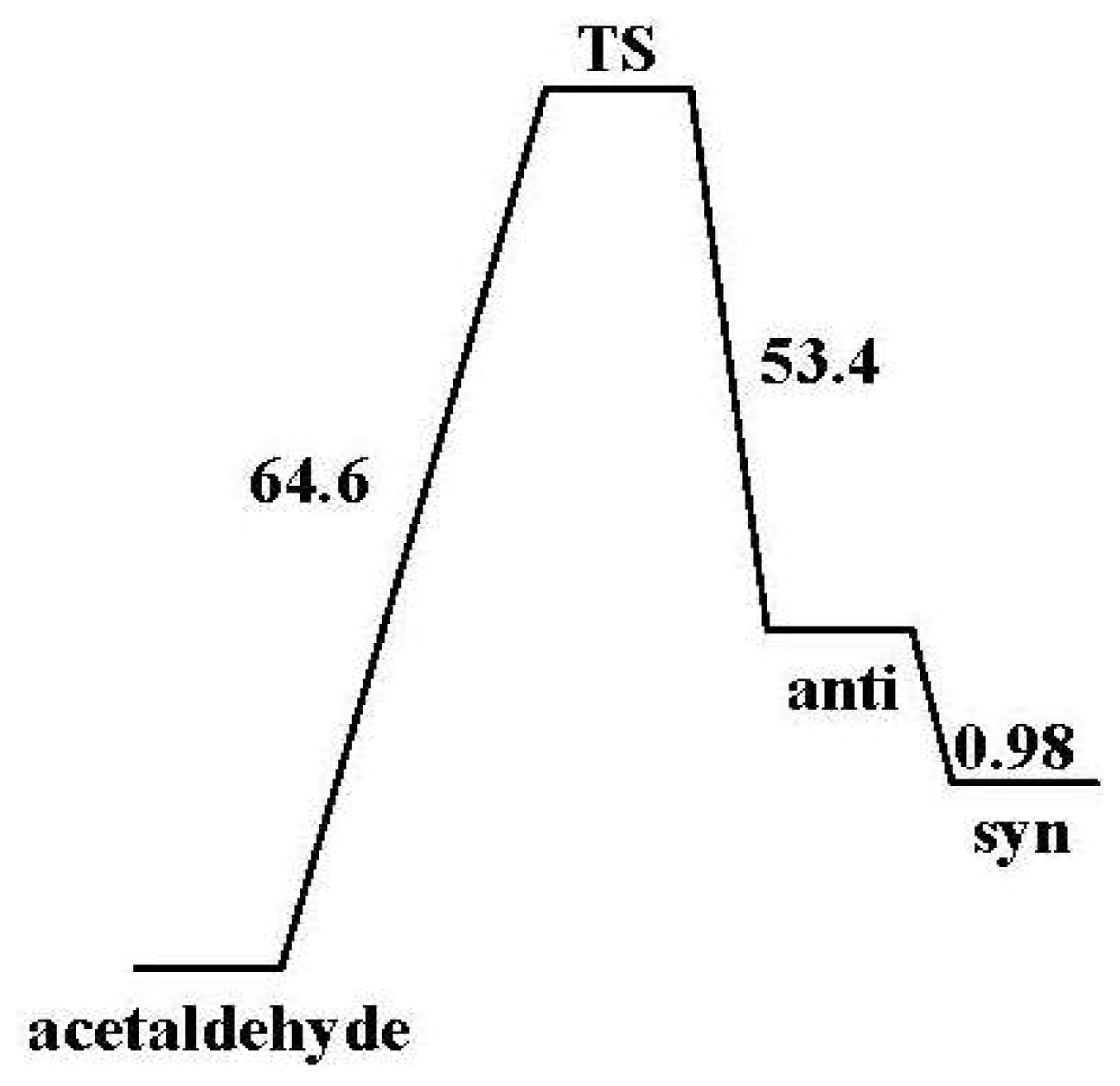
<p>As shown in <xref ref-type="table" rid="t4-ijms-13-15360">Table 4</xref> and <xref ref-type="fig" rid="f4-ijms-13-15360">Figure 4</xref> vinyl alcohol conformers lie 10.71 to 12.85 kcal/mol above the eclipsed acetaldehyde. These values are in line with the experimental [<xref ref-type="bibr" rid="b11-ijms-13-15360">11</xref>] value of 9.80 ± 1.90 kcal/mol; and agree satisfactorily with those estimated by theory [<xref ref-type="bibr" rid="b12-ijms-13-15360">12</xref>,<xref ref-type="bibr" rid="b15-ijms-13-15360">15</xref>]. All our calculated syn/anti relative stabilities (0.98–1.16 kcal/mol) favored the syn form. They were in excellent agreement with the observed [<xref ref-type="bibr" rid="b23-ijms-13-15360">23</xref>] range of 1.08 ± 0.14 kcal/mol. Thus, our best calculated activation energy (<xref ref-type="fig" rid="f4-ijms-13-15360">Figure 4</xref>) of 64.6 kcal/mol for the forward reaction and 54.38 kcal/mol for the reverse reaction is obtained by utilizing B3LYP/aug-cc-pvdz level of chemistry.</p></sec>
<sec sec-type="methods">
<title>2.2.3. Natural Bond Orbital (NBO) Analysis</title>
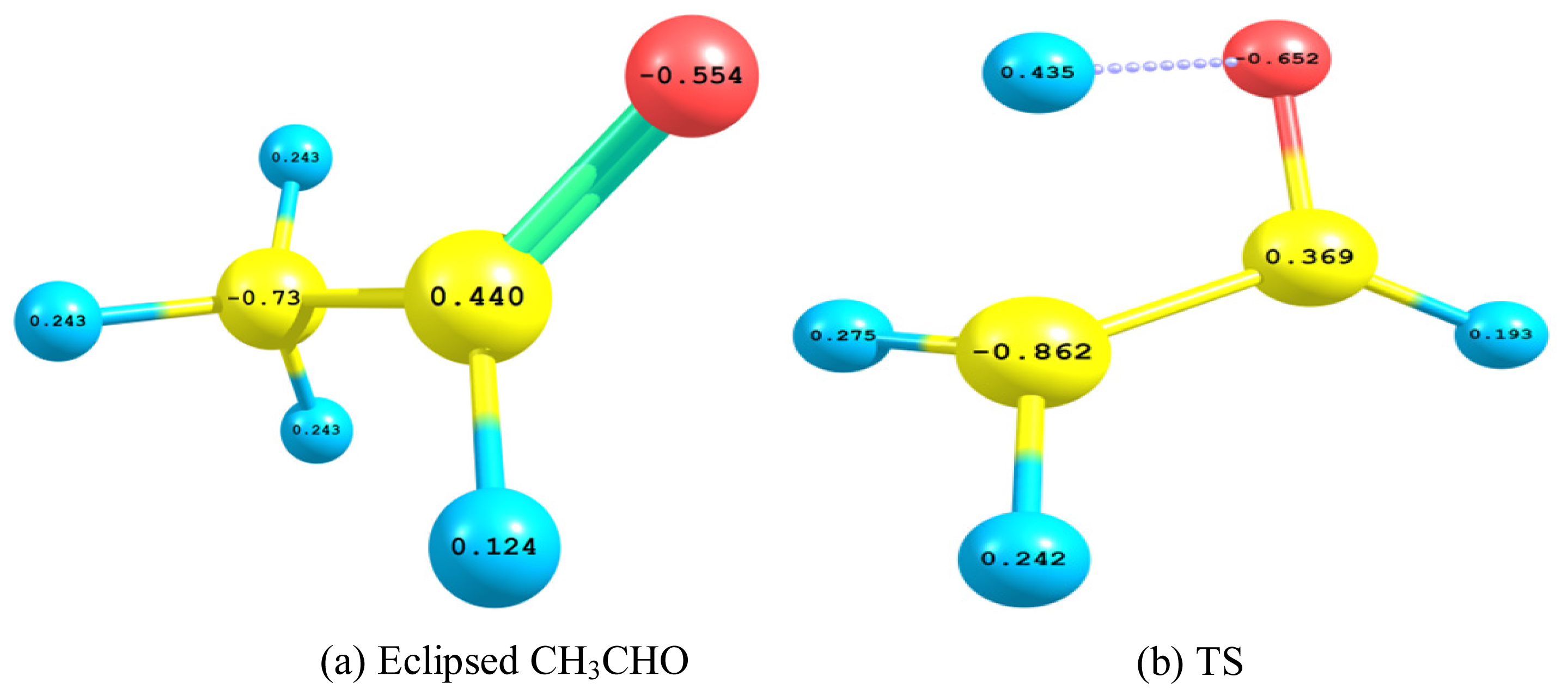
<p>The natural atomic charges of eclipsed acetaldehyde (<xref ref-type="fig" rid="f5-ijms-13-15360">Figure 5a</xref>) and its TS (<xref ref-type="fig" rid="f5-ijms-13-15360">Figure 5b</xref>), which were calculated by using B3LYP/aug-cc-pvdz model chemistry, are depicted. For the eclipsed acetaldehyde, each of the three methyl hydrogen atoms acquires a positive charge of +0.243e. In contrast, the aldehyde hydrogen atom has a less positive charge of +0.193e. The methyl carbon is negatively charged (−0.73e) while the aldehyde carbon is positively charged (+0.44e) and the oxygen atom is negatively charged (−0.554e). In the TS the methyl hydrogen atom, in syn arrangement with the oxygen atom, developed more positive charge (+0.435e) and consequently partially bonded to the methyl carbon and oxygen atoms; which both gained extra negative charges of −0.862e and −0.652e respectively. This electron delocalization can be explained in terms of forming a four-membered ring TS, as a step forward for producing vinyl alcohol. This intuition is confirmed by earlier theoretical studies [<xref ref-type="bibr" rid="b11-ijms-13-15360">11</xref>,<xref ref-type="bibr" rid="b12-ijms-13-15360">12</xref>].</p>
<p><xref ref-type="table" rid="t5-ijms-13-15360">Table 5</xref> lists the second order perturbation energies for eclipsed acetaldehyde and its TS which were calculated by using B3LYP/aug-cc-pvdz chemistry model. In eclipsed acetaldehyde there are very strong hyperconjugative interactions between the oxygen atom (LP) and the C–C bond (18.90 kcal/mol) and C2–H4 bond (23.59 kcal/mol). In comparison, there are also moderate hyperconjugation between the methyl C–H bonds and the C=O bond (σ<sub>C1–H1</sub>→σ*<sub>CO</sub> and σ<sub>C1–H3</sub>→σ*<sub>CO</sub>) of 5.33 kcal/mol each; and between C1–H2 and C2–H4 bonds (σ<sub>C1–H2</sub>→σ*<sub>C2–H4</sub> and σ<sub>C2–H4</sub>→σ*<sub>C1–H2</sub> of 3.03 and 2.53 kcal/mol respectively). For the TS; the oxygen atom LP interaction with the C–C (3.56 kcal/mol) and C2–H4 (10.53 kcal/mol) were subdued, while the C1–H2 and C2–H4 interaction was enlarged (30.26 kcal/mol). This strong hyperconjugation led to the weakness of the C1–H2 bond in comparison to other bonds; as suggested by Guo and Goodman [<xref ref-type="bibr" rid="b25-ijms-13-15360">25</xref>] when they investigated barrier forces in acetaldehyde. Thus this huge change in hyperconjugation has eased the migration of H2 from C1 to the oxygen atom. This conjecture is further supported by an emerging extremely strong delocalization interaction between the oxygen atom LP and C1–H2 bond (n<sub>O2</sub>→σ*<sub>C1–H2</sub>) of 96.08 kcal/mol. This latter interaction was nonexistent in the precursor; and thus supported the formation of a partial bonding between the oxygen and hydrogen atoms as a step forward for the formation of vinyl alcohol.</p></sec></sec></sec>
<sec sec-type="methods">
<title>3. Computational Methods</title>
<p>All the computational methods have been performed using the Gaussian-09 suite [<xref ref-type="bibr" rid="b26-ijms-13-15360">26</xref>]. The electronic energies at the optimized geometries of the eclipsed and bisected conformers of acetaldehyde and syn and anti vinyl alcohol, were obtained by using the perturbation method to second order (MP2) and the hybrid density functional theory (DFT) at the B3LYP method. Two basis sets, 6-311++G(d,p) and aug-cc-pvdz have been utilized.</p>
<p>The optimized geometries and electronic energies of the Transition State (TS) was requested with the QST2 keyword in the route section of the Gaussian program at MP2 and B3LYP methods and using 6-311++G(d,p) and aug-cc-pvdz basis-sets. A saddle point of first-order (one imaginary frequency) was located for the TS. Frequency calculations were then performed for the TS; as a prerequisite for running Intrinsic Reaction Coordinates (IRC) calculations. The normal modes of the imaginary frequencies and the IRCs were analyzed to reveal displacements in the bond lengths and angles involving the atoms of interest. GaussView Version 3.0 [<xref ref-type="bibr" rid="b27-ijms-13-15360">27</xref>] program suite was used to visualize these displacements.</p>
<p>In order to obtain a complete description of the hyperconjugative interactions and Lewis-type orbital energies of the two conformers of acetaldehyde and the TS, the version 3.1 of the Natural Bond orbital (NBO) package [<xref ref-type="bibr" rid="b28-ijms-13-15360">28</xref>] was used. DFT calculations have been carried out by the B3LYP method using the 6-311++G(d,p) and aug-cc-pvdz basis sets.</p></sec>
<sec>
<title>4. Conclusion</title>
<list list-type="roman-lower">
<list-item>
<p>The MP2 and DFT/B3LYP methods with the 6-311++G(d,p) and aug-cc-pvdz basis sets have been used to probe (mainly through NBO calculations): (a) the origin of relative stability preference for the eclipsed acetaldehyde over its bisected counterpart and (b) the elucidation of the 1,3-proton shift mechanism of the tautomerization reaction of eclipsed acetaldehyde and vinyl alcohol.</p></list-item>
<list-item>
<p>The elected model chemistries addressed the problems investigated in a consistent and complementary manner. It is apparent that the relative stability of eclipsed/bisected acetaldehyde conformers is both basis set and method dependent. In comparison to the aug-cc-pvdz basis set, the 6-311++G(d,p) gave lower comparable values (1.02 and 1.09 kcal/mol) at both MP2 and B3LYP methods. Thus, we anticipate that a modern technology experimental reexamination of eclipsed/bisected acetaldehyde would lead to a difference in stability in the order of 1.06 ± 0.04 kcal/mol. As such it will be in line with our lower limits of 1.02 and 1.09 kcal/mol.</p></list-item>
<list-item>
<p>The chemistry models have overestimated the dipole moments of the acetaldehyde conformers (eclipsed form always has a higher value) in comparison to the experimental [<xref ref-type="bibr" rid="b16-ijms-13-15360">16</xref>] value of 2.750 ± 0.006 Debye. The MP2/aug-cc-pvdz level proved to be superior over other tested chemistry levels in reproducing the dipole moments of eclipsed and bisected acetaldehyde of 5.5% and 1.7% higher, respectively, compared to the experimental value [<xref ref-type="bibr" rid="b16-ijms-13-15360">16</xref>].</p></list-item>
<list-item>
<p>The Lewis 2-electron localized structure favored the bisected conformer of acetaldehyde over that of the eclipsed one. Apparently this originated from the minimal steric hindrance. However, the overall preference for the eclipsed conformer arose mainly from the hyperconjugative interactions. In particular, the vicinal antiperiplanar (σ<sub>C1–H2</sub>→σ*<sub>C2–H4</sub> and σ<sub>C2–H4</sub>→σ*<sub>C1–H2</sub>) interactions played the major role in the competiveness of the eclipsed conformer.</p></list-item>
<list-item>
<p>The DFT/B3LYP method produced lower barrier heights than those estimated by MP2 model. In contrast, the aug-cc-pvdz basis set achieved the lowest activation energies of 64.61 kcal/mol.</p></list-item>
<list-item>
<p>The TS showed geometrical features that described the emergence of a four-membered ring species. This is achieved through an intramolecular migration of H2 accompanied by hybridization changes on heavy atoms. The NBO analysis of both eclipsed acetaldehyde and TS is in line with this intuition. The support for this prediction is based on the strong hyperconjugative interactions between the orbitals of the C1–H2 and C2–H4 bonds. This led to the weakness of the C1–H2 bond and a consequent intramolecular 1,3-proton shift between donor and acceptor sites.</p></list-item></list></sec></body>
<back>
<ack>
<title>Acknowledgments</title>
<p>This Project was funded by the Deanship of Scientific Research (DSR) King Abdulaziz University, Jeddah, under grant No. D7-130-/1432. The authors, therefore, acknowledge with thanks DSR support for Scientific Research.</p></ack>
<fn-group><fn id="fn1-ijms-13-15360">
<p><bold>Conflict of Interest</bold></p>
<p>The authors declare no conflict of interest.</p></fn></fn-group>
<ref-list>
<title>References</title>
<ref id="b1-ijms-13-15360"><label>1</label><citation citation-type="book"><person-group person-group-type="author"><name><surname>Hagemeyer</surname><given-names>H.J.</given-names></name></person-group><source>Encyclopedia of Chemical Technology</source><publisher-name>John Wiley &amp; Sons</publisher-name><publisher-loc>New York, NY, USA</publisher-loc><fpage>2001</fpage></citation></ref>
<ref id="b2-ijms-13-15360"><label>2</label><citation citation-type="book"><person-group person-group-type="author"><name><surname>Sowin</surname><given-names>T.J.</given-names></name><name><surname>Melcher</surname><given-names>L.M.</given-names></name></person-group><source>Encyclopedia of Reagents for Organic Synthesis</source><edition>2nd Ed</edition><person-group person-group-type="editor"><name><surname>Paquette</surname><given-names>L.</given-names></name></person-group><publisher-name>John Wiley &amp; Sons</publisher-name><publisher-loc>New York, NY, USA</publisher-loc><year>2004</year><volume>14</volume></citation></ref>
<ref id="b3-ijms-13-15360"><label>3</label><citation citation-type="journal"><person-group person-group-type="author"><name><surname>Kilb</surname><given-names>R.W.</given-names></name><name><surname>Lin</surname><given-names>C.C.</given-names></name><name><surname>Wilson</surname><given-names>E.B.</given-names></name></person-group><article-title>Calculation of energy levels for internal torsion and over-all rotation. II. CH<sub>3</sub>CHO type molecules; acetaldehyde spectra</article-title><source>J. Chem. Phys</source><year>1957</year><volume>26</volume><fpage>1695</fpage><lpage>1703</lpage><pub-id pub-id-type="doi">10.1063/1.1743607</pub-id></citation></ref>
<ref id="b4-ijms-13-15360"><label>4</label><citation citation-type="journal"><person-group person-group-type="author"><name><surname>Souter</surname><given-names>C.E.</given-names></name><name><surname>Wood</surname><given-names>J.L.</given-names></name></person-group><article-title>Combined infrared and microwave determination of torsional parameters</article-title><source>J. Chem. Phys</source><year>1970</year><volume>52</volume><fpage>674</fpage><lpage>682</lpage><pub-id pub-id-type="doi">10.1063/1.1673039</pub-id></citation></ref>
<ref id="b5-ijms-13-15360"><label>5</label><citation citation-type="journal"><person-group person-group-type="author"><name><surname>Zanoun</surname><given-names>A.</given-names></name><name><surname>Durier</surname><given-names>V.</given-names></name><name><surname>Belaidi</surname><given-names>A.</given-names></name><name><surname>Vergoten</surname><given-names>G.</given-names></name></person-group><article-title>The SPASIBA force field of aldehydes. Part I: Structure and vibrational wavenumbers of methanal, ethanal and propanal</article-title><source>J. Mol. Struct</source><year>1999</year><volume>476</volume><fpage>261</fpage><lpage>270</lpage><pub-id pub-id-type="doi">10.1016/S0022-2860(98)00551-1</pub-id></citation></ref>
<ref id="b6-ijms-13-15360"><label>6</label><citation citation-type="journal"><person-group person-group-type="author"><name><surname>Munoz-Caro</surname><given-names>C.</given-names></name><name><surname>Nino</surname><given-names>A.</given-names></name><name><surname>Moule</surname><given-names>D.C.</given-names></name></person-group><article-title>Definition of a periodic methyl torsional coordinate in the S<sub>0</sub> state of acetaldehyde</article-title><source>J. Mol. Struct</source><year>1995</year><volume>350</volume><fpage>83</fpage><lpage>89</lpage><pub-id pub-id-type="doi">10.1016/0022-2860(94)08457-S</pub-id></citation></ref>
<ref id="b7-ijms-13-15360"><label>7</label><citation citation-type="journal"><person-group person-group-type="author"><name><surname>Eusuf</surname><given-names>M.</given-names></name><name><surname>Laidler</surname><given-names>K.J.</given-names></name></person-group><article-title>Kinetics and mechanisms of the thermal decomposition of acetaldehyde: I. The uninhibited reaction</article-title><source>Can. J. Chem</source><year>1964</year><volume>42</volume><fpage>1851</fpage><lpage>1860</lpage><pub-id pub-id-type="doi">10.1139/v64-276</pub-id></citation></ref>
<ref id="b8-ijms-13-15360"><label>8</label><citation citation-type="journal"><person-group person-group-type="author"><name><surname>Blank</surname><given-names>B.</given-names></name><name><surname>Fischer</surname><given-names>H.</given-names></name></person-group><article-title>Chemically Induced Dynamic Nuclear Polarization XI. Intermediary vinyl alcohol during photochemical reactions of acetaldehyde and of acetoin</article-title><source>Helv. Chim. Acta</source><year>1973</year><volume>56</volume><fpage>506</fpage><lpage>510</lpage><pub-id pub-id-type="doi">10.1002/hlca.19730560147</pub-id></citation></ref>
<ref id="b9-ijms-13-15360"><label>9</label><citation citation-type="confproc"><person-group person-group-type="author"><name><surname>Vasiliou</surname><given-names>A.</given-names></name><name><surname>Piech</surname><given-names>K.</given-names></name><name><surname>Ellison</surname><given-names>G.B.</given-names></name><name><surname>Nimlos</surname><given-names>M.R.</given-names></name><name><surname>Daily</surname><given-names>J.W.</given-names></name><name><surname>Stanton</surname><given-names>J.F.</given-names></name></person-group><article-title>Thermal Decomposition of Acetaldehyde Studied by Matrix IR and Pims Spectroscopy</article-title><conf-name>Proceedings of International Symposim on Molecular Spectroscopy, 65th Meeting, Ohio State University</conf-name><conf-loc>Columbus, OH, USA</conf-loc><conf-date>21–25 June 2010</conf-date></citation></ref>
<ref id="b10-ijms-13-15360"><label>10</label><citation citation-type="confproc"><person-group person-group-type="author"><name><surname>Vasiliou</surname><given-names>A.</given-names></name><name><surname>Piech</surname><given-names>K.</given-names></name><name><surname>Ellison</surname><given-names>G.B.</given-names></name><name><surname>Nimlos</surname><given-names>M.R.</given-names></name><name><surname>Daily</surname><given-names>J.W.</given-names></name><name><surname>Stanton</surname><given-names>J.F.</given-names></name></person-group><article-title>The Products of the Thermal Decomposition of CH<sub>3</sub>CHO</article-title><conf-name>Proceedings of International Symposim on Molecular Spectroscopy, 66th Meeting, Ohio State University</conf-name><conf-loc>Columbus, OH, USA</conf-loc><conf-date>20–24 June 2011</conf-date></citation></ref>
<ref id="b11-ijms-13-15360"><label>11</label><citation citation-type="journal"><person-group person-group-type="author"><name><surname>Holmes</surname><given-names>J.H.</given-names></name><name><surname>Lossing</surname><given-names>F.P.</given-names></name></person-group><article-title>Heats of formation of ionic and neutral enols of acetaldehyde and acetone</article-title><source>J. Am. Chem. Soc</source><year>1982</year><volume>104</volume><fpage>2648</fpage><lpage>2649</lpage><pub-id pub-id-type="doi">10.1021/ja00373a058</pub-id></citation></ref>
<ref id="b12-ijms-13-15360"><label>12</label><citation citation-type="journal"><person-group person-group-type="author"><name><surname>Smith</surname><given-names>B.J.</given-names></name><name><surname>Bouma</surname><given-names>W.J.</given-names></name><name><surname>Radom</surname><given-names>L.</given-names></name></person-group><article-title>Unimolecular rearrangements connecting hydroxyethylidene (CH3–C–OH), acetaldehyde (CH3–CH:O), and vinyl alcohol (CH2:CH–OH)</article-title><source>J. Am. Chem. Soc</source><year>1991</year><volume>113</volume><fpage>6452</fpage><lpage>6458</lpage><pub-id pub-id-type="doi">10.1021/ja00017a015</pub-id></citation></ref>
<ref id="b13-ijms-13-15360"><label>13</label><citation citation-type="journal"><person-group person-group-type="author"><name><surname>Rosenfeld</surname><given-names>R.N.</given-names></name><name><surname>Weiner</surname><given-names>B.R.</given-names></name></person-group><article-title>Photofragmentation of acrylic acid and methacrylic acid in the gas phase</article-title><source>J. Am. Chem. Soc</source><year>1983</year><volume>105</volume><fpage>6233</fpage><lpage>6236</lpage><pub-id pub-id-type="doi">10.1021/ja00358a007</pub-id></citation></ref>
<ref id="b14-ijms-13-15360"><label>14</label><citation citation-type="journal"><person-group person-group-type="author"><name><surname>Wesdemiotis</surname><given-names>C.</given-names></name><name><surname>McLafferty</surname><given-names>F.W.</given-names></name></person-group><article-title>Hydroxyethylidene (CH3–C–OH), but not ethenol, tautomerizes to ethanol</article-title><source>J. Am. Chem. Soc.</source><year>1987</year><volume>109</volume><fpage>4760</fpage><lpage>4761</lpage><pub-id pub-id-type="doi">10.1021/ja00249a071</pub-id></citation></ref>
<ref id="b15-ijms-13-15360"><label>15</label><citation citation-type="journal"><person-group person-group-type="author"><name><surname>Andres</surname><given-names>J.</given-names></name><name><surname>Domingo</surname><given-names>L.R.</given-names></name><name><surname>Picher</surname><given-names>M.T.</given-names></name><name><surname>Safont</surname><given-names>V.S.</given-names></name></person-group><article-title>Comparative theoretical study of transition structures, barrier heights, and reaction energies for the intramolecular tautomerization in acetaldehyde/vinyl alcohol and acetaldimine/vinylamine systems</article-title><source>Int. J. Quant. Chem.</source><year>1998</year><volume>66</volume><fpage>9</fpage><lpage>24</lpage><pub-id pub-id-type="doi">10.1002/(SICI)1097-461X(1998)66:1&lt;9::AID-QUA2&gt;3.0.CO;2-Z</pub-id></citation></ref>
<ref id="b16-ijms-13-15360"><label>16</label><citation citation-type="journal"><person-group person-group-type="author"><name><surname>Turner</surname><given-names>P.H.</given-names></name><name><surname>Cox</surname><given-names>A.P.</given-names></name></person-group><article-title>Microwave spectrum, structure, dipole moment and centrifugal distortion of nitrosomethane. Dipole moment of acetaldehyde</article-title><source>J. Chem. Soc. Faraday Trans. 2</source><year>1978</year><volume>74</volume><fpage>533</fpage><lpage>559</lpage><pub-id pub-id-type="doi">10.1039/f29787400533</pub-id></citation></ref>
<ref id="b17-ijms-13-15360"><label>17</label><citation citation-type="journal"><person-group person-group-type="author"><name><surname>Reed</surname><given-names>A.E.</given-names></name><name><surname>Curtiss</surname><given-names>L.A.</given-names></name><name><surname>Weinhold</surname><given-names>F.</given-names></name></person-group><article-title>Intermolecular interactions from a natural bond orbital, donor-acceptor viewpoint</article-title><source>Chem. Rev</source><year>1988</year><volume>88</volume><fpage>899</fpage><lpage>926</lpage><pub-id pub-id-type="doi">10.1021/cr00088a005</pub-id></citation></ref>
<ref id="b18-ijms-13-15360"><label>18</label><citation citation-type="journal"><person-group person-group-type="author"><name><surname>Reed</surname><given-names>A.E.</given-names></name><name><surname>Weinhold</surname><given-names>F.</given-names></name></person-group><article-title>Natural bond orbital analysis of near-Hartree-Fock water dimer</article-title><source>J. Phys. Chem</source><year>1983</year><volume>78</volume><fpage>4066</fpage><lpage>4073</lpage><pub-id pub-id-type="doi">10.1063/1.445134</pub-id></citation></ref>
<ref id="b19-ijms-13-15360"><label>19</label><citation citation-type="journal"><person-group person-group-type="author"><name><surname>Wang</surname><given-names>K.</given-names></name><name><surname>Zhang</surname><given-names>H.</given-names></name><name><surname>Liu</surname><given-names>Y.</given-names></name></person-group><article-title><italic>Ab initio</italic> study of hyperconjugative effect on electronic wavefunctions of 2-chloroethanol</article-title><source>Chin. J. Chem. Phys</source><year>2011</year><volume>24</volume><fpage>434</fpage><lpage>438</lpage><pub-id pub-id-type="doi">10.1088/1674-0068/24/04/434-438</pub-id></citation></ref>
<ref id="b20-ijms-13-15360"><label>20</label><citation citation-type="journal"><person-group person-group-type="author"><name><surname>Yamamoto</surname><given-names>T.</given-names></name><name><surname>Kaneno</surname><given-names>D.</given-names></name><name><surname>Tomoda</surname><given-names>S.</given-names></name></person-group><article-title>The origin of cis effect in 1,2-dihaloethenes: The quantitative comparison of electron delocalizations and steric exchange repulsions</article-title><source>Bull. Chem. Soc. Jpn</source><year>2008</year><volume>81</volume><fpage>1415</fpage><lpage>1422</lpage><pub-id pub-id-type="doi">10.1246/bcsj.81.1415</pub-id></citation></ref>
<ref id="b21-ijms-13-15360"><label>21</label><citation citation-type="journal"><person-group person-group-type="author"><name><surname>Kato</surname><given-names>C.</given-names></name><name><surname>Konaka</surname><given-names>S.</given-names></name><name><surname>Iijima</surname><given-names>T.</given-names></name><name><surname>Kimura</surname><given-names>M.</given-names></name></person-group><article-title>Electron diffraction studies of formaldehyde, acetaldehyde and acetone</article-title><source>Bull. Chem. Soc. Jpn</source><year>1969</year><volume>42</volume><fpage>2148</fpage><lpage>2150</lpage><pub-id pub-id-type="doi">10.1246/bcsj.42.2148</pub-id></citation></ref>
<ref id="b22-ijms-13-15360"><label>22</label><citation citation-type="journal"><person-group person-group-type="author"><name><surname>Rodler</surname><given-names>M.</given-names></name><name><surname>Bauder</surname><given-names>A.</given-names></name></person-group><article-title>Structure of syn-vinyl alcohol determined by microwave spectroscopy</article-title><source>J. Am. Chem. Soc.</source><year>1984</year><volume>106</volume><fpage>4025</fpage><lpage>4028</lpage><pub-id pub-id-type="doi">10.1021/ja00326a024</pub-id></citation></ref>
<ref id="b23-ijms-13-15360"><label>23</label><citation citation-type="journal"><person-group person-group-type="author"><name><surname>Rodler</surname><given-names>M.</given-names></name></person-group><article-title>Microwave spectrum, dipole moment, and structure of anti-vinyl alcohol</article-title><source>J. Mol. Spectrosc</source><year>1985</year><volume>114</volume><fpage>23</fpage><lpage>30</lpage><pub-id pub-id-type="doi">10.1016/0022-2852(85)90332-7</pub-id></citation></ref>
<ref id="b24-ijms-13-15360"><label>24</label><citation citation-type="web"><source>Precomputed vibrational scaling factors</source><comment>Available online: <ext-link xlink:href="http://cccbdb.nist.gov/vibscalejust.asp" ext-link-type="uri">http://cccbdb.nist.gov/vibscalejust.asp</ext-link></comment><access-date>accessed on 21 September 2012</access-date></citation></ref>
<ref id="b25-ijms-13-15360"><label>25</label><citation citation-type="journal"><person-group person-group-type="author"><name><surname>Guo</surname><given-names>D.</given-names></name><name><surname>Goodman</surname><given-names>L.</given-names></name></person-group><article-title>Nature of barrier forces in acetaldehyde</article-title><source>J. Phys. Chem</source><year>1996</year><volume>100</volume><fpage>12540</fpage><lpage>12545</lpage><pub-id pub-id-type="doi">10.1021/jp960182c</pub-id></citation></ref>
<ref id="b26-ijms-13-15360"><label>26</label><citation citation-type="book"><person-group person-group-type="author"><name><surname>Frisch</surname><given-names>G.W.</given-names></name><name><surname>Trucks</surname><given-names>H.B.</given-names></name><name><surname>Schlegel</surname><given-names>G.E.</given-names></name><name><surname>Scuseria</surname><given-names>M.A.</given-names></name><name><surname>Robb</surname><given-names>J.R.</given-names></name><name><surname>Cheeseman</surname><given-names>G.</given-names></name><name><surname>Scalmani</surname><given-names>V.</given-names></name><name><surname>Barone</surname><given-names>B.</given-names></name><name><surname>Mennucci</surname><given-names>G.A.</given-names></name><name><surname>Petersson</surname><given-names>H.</given-names></name><etal/></person-group><source>Gaussian 09, Revision A.02</source><publisher-name>Gaussian, Inc</publisher-name><publisher-loc>Wallingford, CT, USA</publisher-loc><year>2009</year></citation></ref>
<ref id="b27-ijms-13-15360"><label>27</label><citation citation-type="book"><person-group person-group-type="author"><name><surname>Frisch</surname><given-names>A.</given-names></name><name><surname>Dennington</surname><given-names>R.D.</given-names></name><name><surname>Keith</surname><given-names>T.A.</given-names></name></person-group><source>GaussView Version 3.0</source><publisher-name>Gaussian Inc</publisher-name><publisher-loc>Pittsburgh, PA, USA</publisher-loc><fpage>2003</fpage></citation></ref>
<ref id="b28-ijms-13-15360"><label>28</label><citation citation-type="book"><person-group person-group-type="author"><name><surname>Glendenning</surname><given-names>E.D.</given-names></name><name><surname>Reed</surname><given-names>A.E.</given-names></name><name><surname>Carpenter</surname><given-names>J.E.</given-names></name><name><surname>Weihold</surname><given-names>F.</given-names></name></person-group><source>NBO Version 3.1</source><publisher-name>Gaussian Inc</publisher-name><publisher-loc>Pittsburgh, PA, USA</publisher-loc><fpage>1998</fpage></citation></ref></ref-list>
<sec sec-type="display-objects">
<title>Figures and Tables</title>
<fig id="f1-ijms-13-15360" position="float">
<label>Figure 1</label>
<caption>
<p>The atom type and labeling of Eclipsed and Bisected Acetaldehyde. (a) Eclipsed CH<sub>3</sub>CHO (b) Bisected CH<sub>3</sub>CHO</p></caption>
<graphic xlink:href="ijms-13-15360f1.gif"/></fig>
<fig id="f2-ijms-13-15360" position="float">
<label>Figure 2</label>
<caption>
<p>The atom type and labeling and the optimized bond lengths (Å) of eclipsed acetaldehyde and its TS calculated by using B3LYP/aug-cc-pvdz level of theory.</p></caption>
<graphic xlink:href="ijms-13-15360f2.gif"/></fig>
<fig id="f3-ijms-13-15360" position="float">
<label>Figure 3</label>
<caption>
<p>The potential energy profile of the thermal dissociation acetaldehyde along the IRC pathway calculated using B3LYP/aug-cc-pvdz level of theory.</p></caption>
<graphic xlink:href="ijms-13-15360f3.gif"/></fig>
<fig id="f4-ijms-13-15360" position="float">
<label>Figure 4</label>
<caption>
<p>Activation Energies (kcal/mol) for the thermal tautomerization reaction of eclipsed acetaldehyde to produce syn and anti vinyl alcohol which were calculated using B3LYP/aug-cc-pvdz.</p></caption>
<graphic xlink:href="ijms-13-15360f4.gif"/></fig>
<fig id="f5-ijms-13-15360" position="float">
<label>Figure 5</label>
<caption>
<p>Natural atomic charges of eclipsed acetaldehyde and its TS which were calculated by using B3LYP/aug-cc-pvdz level of theory. (a) Eclipsed CH<sub>3</sub>CHO (b) TS</p></caption>
<graphic xlink:href="ijms-13-15360f5.gif"/></fig>
<table-wrap id="t1-ijms-13-15360" position="float">
<label>Table 1</label>
<caption>
<p>The calculated electronic energies (a.u.), relative energies (kcal/mol) and dipole moment (D) of Eclipsed and Bisected Acetaldehyde obtained by using B3LYP and MP2 methods at 6-311++G(d,p) and aug-cc-pvdz basis sets.</p></caption>
<table frame="hsides" rules="groups">
<thead>
<tr>
<th align="center" valign="bottom"/>
<th align="center" valign="bottom">MP2/6-311++G(d,p)</th>
<th align="center" valign="bottom">MP2/aug-cc-pvdz</th>
<th align="center" valign="bottom">B3LYP/6-311++G(d,p)</th>
<th align="center" valign="bottom">B3LYP/aug-cc-pvdz</th></tr></thead>
<tbody>
<tr>
<td align="center" valign="top"><italic>E</italic><sub>Full</sub> Eclipsed</td>
<td align="center" valign="top">−153.44965823</td>
<td align="center" valign="top">−153.41831870</td>
<td align="center" valign="top">−153.88225230</td>
<td align="center" valign="top">−153.85321084</td></tr>
<tr>
<td align="center" valign="top"><italic>E</italic><sub>Full</sub> Bisected</td>
<td align="center" valign="top">−153.44803394</td>
<td align="center" valign="top">−153.41641243</td>
<td align="center" valign="top">−153.88051576</td>
<td align="center" valign="top">−153.85128459</td></tr>
<tr>
<td align="center" valign="top">Δ<italic>E</italic><sub>T</sub>/kcal/mol</td>
<td align="center" valign="top">1.02</td>
<td align="center" valign="top">1.19</td>
<td align="center" valign="top">1.09</td>
<td align="center" valign="top">1.21</td></tr>
<tr>
<td align="center" valign="top"><italic>E</italic><sub>L</sub> Eclipsed</td>
<td align="center" valign="top">-</td>
<td align="center" valign="top">−153.606588212</td>
<td align="center" valign="top">−153.587544947</td></tr>
<tr>
<td align="center" valign="top"><italic>E</italic><sub>L</sub> Bisected</td>
<td align="center" valign="top">-</td>
<td align="center" valign="top">−153.613900827</td>
<td align="center" valign="top">−153.595745153</td></tr>
<tr>
<td colspan="3" align="center" valign="top">Δ<italic>E</italic><sub>L</sub>/kcal/mol</td>
<td align="center" valign="top">4.59</td>
<td align="center" valign="top">5.15</td></tr>
<tr>
<td colspan="3" align="center" valign="top">Delocalization Energy/kcal/mol</td>
<td align="center" valign="top">5.68</td>
<td align="center" valign="top">6.35</td></tr>
<tr>
<td colspan="3" align="center" valign="top">Energy Gain = Δ<italic>E</italic><sub>T</sub>/kcal/mol</td>
<td align="center" valign="top">1.09</td>
<td align="center" valign="top">1.20</td></tr>
<tr>
<td align="center" valign="top">Exptl. <xref ref-type="table-fn" rid="tfn1-ijms-13-15360">a</xref> Δ<italic>E</italic><sub>T</sub></td>
<td align="center" valign="top"/>
<td colspan="2" align="center" valign="top">1.162 kcal/mol</td>
<td align="center" valign="top"/></tr>
<tr>
<td align="center" valign="top">μ/D Eclipsed</td>
<td align="center" valign="top">2.943</td>
<td align="center" valign="top">2.907</td>
<td align="center" valign="top">3.376</td>
<td align="center" valign="top">3.360</td></tr>
<tr>
<td align="center" valign="top">μ/D Bisected</td>
<td align="center" valign="top">2.835</td>
<td align="center" valign="top">2.802</td>
<td align="center" valign="top">3.293</td>
<td align="center" valign="top">3.282</td></tr>
<tr>
<td align="center" valign="top">Exptl. <xref ref-type="table-fn" rid="tfn2-ijms-13-15360">b</xref> μ/D</td>
<td align="center" valign="top"/>
<td colspan="2" align="center" valign="top">2.750 ± 0.006 D</td>
<td align="center" valign="top"/></tr></tbody></table>
<table-wrap-foot><fn id="tfn1-ijms-13-15360">
<label>a</label>
<p>Experimental energy difference between eclipsed and bisected conformers of acetaldehyde taken from Reference [<xref ref-type="bibr" rid="b3-ijms-13-15360">3</xref>];</p></fn><fn id="tfn2-ijms-13-15360">
<label>b</label>
<p>Experimental dipole moment of acetaldehyde taken from Reference [<xref ref-type="bibr" rid="b16-ijms-13-15360">16</xref>].</p></fn></table-wrap-foot></table-wrap>
<table-wrap id="t2-ijms-13-15360" position="float">
<label>Table 2</label>
<caption>
<p>Second-order Perturbation Energy ((<italic>E</italic><sub>(2)</sub>)/kcal/mol) estimates of the hyperconjugative energies of the Eclipsed and Bisected Conformers of Acetaldehyde calculated by using density functional theory (DFT)/B3LYP method at aug-cc-pvdz basis set.</p></caption>
<table frame="hsides" rules="groups">
<thead>
<tr>
<th align="center" valign="bottom">Interaction</th>
<th align="center" valign="bottom">Eclipsed</th>
<th align="center" valign="bottom">Sum</th>
<th align="center" valign="bottom">Interaction</th>
<th align="center" valign="bottom">Bisected</th>
<th align="center" valign="bottom">Sum</th></tr></thead>
<tbody>
<tr>
<td align="center" valign="top">σ<sub>C1–H1</sub>→σ<sup>*</sup><sub>CO</sub></td>
<td align="center" valign="top">5.33</td>
<td align="center" valign="middle" rowspan="6">20.26</td>
<td align="center" valign="top">σ<sub>C1–H1</sub>→σ<sup>*</sup><sub>CO</sub></td>
<td align="center" valign="top">4.51</td>
<td align="center" valign="middle" rowspan="6">17.56</td></tr>
<tr>
<td align="center" valign="top">σ<sub>C1–H1</sub>→π<sup>*</sup><sub>CO</sub></td>
<td align="center" valign="top">2.02</td>
<td align="center" valign="top">σ<sub>C1–H2</sub>→σ<sup>*</sup><sub>C2–H4</sub></td>
<td align="center" valign="top">1.34</td></tr>
<tr>
<td align="center" valign="top">σ<sub>C1–H3</sub>→σ<sup>*</sup><sub>CO</sub></td>
<td align="center" valign="top">5.33</td>
<td align="center" valign="top">σ<sub>C1–H2</sub>→σ<sup>*</sup><sub>CO</sub></td>
<td align="center" valign="top">4.68</td></tr>
<tr>
<td align="center" valign="top">σ<sub>C1–H3</sub>→π<sup>*</sup><sub>CO</sub></td>
<td align="center" valign="top">2.02</td>
<td align="center" valign="top">σ<sub>C1–H3</sub>→σ<sup>*</sup><sub>C2–H4</sub></td>
<td align="center" valign="top">1.34</td></tr>
<tr>
<td align="center" valign="top">σ<sub>C1–H2</sub>→σ<sup>*</sup><sub>C2–H4</sub></td>
<td align="center" valign="top">3.03</td>
<td align="center" valign="top">σ<sub>C1–H3</sub>→σ<sup>*</sup><sub>CO</sub></td>
<td align="center" valign="top">4.69</td></tr>
<tr>
<td align="center" valign="top">σ<sub>C2–H4</sub>→σ<sup>*</sup><sub>C1–H2</sub></td>
<td align="center" valign="top">2.53</td>
<td align="center" valign="top">-</td>
<td align="center" valign="top">-</td></tr>
<tr>
<td colspan="6" align="left" valign="top">
<hr/></td></tr>
<tr>
<td align="center" valign="top">n<sub>O1</sub>→σ<sup>*</sup><sub>CC</sub></td>
<td align="center" valign="top">1.53</td>
<td align="center" valign="middle" rowspan="4">45.09</td>
<td align="center" valign="top">n<sub>O1</sub>→σ<sup>*</sup><sub>CC</sub></td>
<td align="center" valign="top">1.38</td>
<td align="center" valign="middle" rowspan="4">44.36</td></tr>
<tr>
<td align="center" valign="top">n<sub>O1</sub>→σ<sup>*</sup><sub>C2–H4</sub></td>
<td align="center" valign="top">1.07</td>
<td align="center" valign="top">n<sub>O1</sub>→σ<sup>*</sup><sub>C2–H4</sub></td>
<td align="center" valign="top">1.06</td></tr>
<tr>
<td align="center" valign="top">n<sub>O2</sub>→σ<sup>*</sup><sub>CC</sub></td>
<td align="center" valign="top">18.90</td>
<td align="center" valign="top">n<sub>O2</sub>→σ<sup>*</sup><sub>CC</sub></td>
<td align="center" valign="top">19.13</td></tr>
<tr>
<td align="center" valign="top">n<sub>O2</sub>→σ<sup>*</sup><sub>C2–H4</sub></td>
<td align="center" valign="top">23.59</td>
<td align="center" valign="top">n<sub>O2</sub>→σ<sup>*</sup><sub>C2–H4</sub></td>
<td align="center" valign="top">22.79</td></tr>
<tr>
<td colspan="6" align="left" valign="top">
<hr/></td></tr>
<tr>
<td align="center" valign="top">Sum</td>
<td align="center" valign="top">65.35</td>
<td align="center" valign="top">Sum</td>
<td align="center" valign="top">61.92</td>
<td align="center" valign="top">61.92</td></tr></tbody></table></table-wrap>
<table-wrap id="t3-ijms-13-15360" position="float">
<label>Table 3</label>
<caption>
<p>Optimized geometry <xref ref-type="table-fn" rid="tfn3-ijms-13-15360">a</xref>, bond lengths in Å and angles in degrees, of acetaldehyde, Transition State (TS) and syn and anti vinyl alcohol which were obtained by using B3LYP/aug-cc-pvdz level of theory.</p></caption>
<table frame="hsides" rules="groups">
<thead>
<tr>
<th align="center" valign="bottom">Definition</th>
<th align="center" valign="bottom">CH<sub>3</sub>CHO</th>
<th align="center" valign="bottom">TS</th>
<th align="center" valign="bottom">Syn CH<sub>2</sub>CHOH</th>
<th align="center" valign="bottom">Anti CH<sub>2</sub>CHOH</th></tr></thead>
<tbody>
<tr>
<td align="center" valign="top">C1–H1</td>
<td align="center" valign="top">1.102 (1.086) <xref ref-type="table-fn" rid="tfn4-ijms-13-15360">b</xref></td>
<td align="center" valign="top">1.093</td>
<td align="center" valign="top">1.088 (1.070) <xref ref-type="table-fn" rid="tfn5-ijms-13-15360">c</xref></td>
<td align="center" valign="top">1.087 (1.073) <xref ref-type="table-fn" rid="tfn6-ijms-13-15360">d</xref></td></tr>
<tr>
<td align="center" valign="top">C1–H3</td>
<td align="center" valign="top">1.103 (1.086)</td>
<td align="center" valign="top">1.098</td>
<td align="center" valign="top">1.092(1.079)</td>
<td align="center" valign="top">1.089 (1.078)</td></tr>
<tr>
<td align="center" valign="top">C1–H2</td>
<td align="center" valign="top">1.096 (1.079)</td>
<td align="center" valign="top">1.507</td>
<td align="center" valign="top">-</td>
<td align="center" valign="top">-</td></tr>
<tr>
<td align="center" valign="top">C–C</td>
<td align="center" valign="top">1.504 (1.501)</td>
<td align="center" valign="top">1.415</td>
<td align="center" valign="top">1.337 (1.326)</td>
<td align="center" valign="top">1.335 (1.315)</td></tr>
<tr>
<td align="center" valign="top">C2–H4</td>
<td align="center" valign="top">1.118 (1.114)</td>
<td align="center" valign="top">1.099</td>
<td align="center" valign="top">1.090 (1.086)</td>
<td align="center" valign="top">1.093 (1.075)</td></tr>
<tr>
<td align="center" valign="top">C–O</td>
<td align="center" valign="top">1.212 (1.216)</td>
<td align="center" valign="top">1.285</td>
<td align="center" valign="top">1.366 (1.372)</td>
<td align="center" valign="top">1.372 (1.352)</td></tr>
<tr>
<td align="center" valign="top">OH</td>
<td align="center" valign="top">-</td>
<td align="center" valign="top">1.302</td>
<td align="center" valign="top">0.967 (0.969)</td>
<td align="center" valign="top">0.963 (0.941)</td></tr>
<tr>
<td align="center" valign="top">H1C1H3</td>
<td align="center" valign="top">109.57 (108.3)</td>
<td align="center" valign="top">113.78</td>
<td align="center" valign="top">117.89 (118.8)</td>
<td align="center" valign="top">118.85 (119.9)</td></tr>
<tr>
<td align="center" valign="top">H1C1C2</td>
<td align="center" valign="top">109.32 (109.2)</td>
<td align="center" valign="top">122.22</td>
<td align="center" valign="top">119.74 (119.5)</td>
<td align="center" valign="top">119.55 (119.9)</td></tr>
<tr>
<td align="center" valign="top">CCO</td>
<td align="center" valign="top">124.71 (123.9)</td>
<td align="center" valign="top">110.51</td>
<td align="center" valign="top">126.94 (126.2)</td>
<td align="center" valign="top">122.15 (122.7)</td></tr>
<tr>
<td align="center" valign="top">H4C2O</td>
<td align="center" valign="top">119.97 (117.5)</td>
<td align="center" valign="top">119.12</td>
<td align="center" valign="top">110.47 (110.7)</td>
<td align="center" valign="top">115.73 (115.7)</td></tr>
<tr>
<td align="center" valign="top">H1CCO</td>
<td align="center" valign="top">−121.85</td>
<td align="center" valign="top">−152.96</td>
<td align="center" valign="top">180.00</td>
<td align="center" valign="top">180.00</td></tr>
<tr>
<td align="center" valign="top">H3CCO</td>
<td align="center" valign="top">121.85</td>
<td align="center" valign="top">66.50</td>
<td align="center" valign="top">0.00</td>
<td align="center" valign="top">0.00</td></tr>
<tr>
<td align="center" valign="top">H2CCH4</td>
<td align="center" valign="top">−179.99</td>
<td align="center" valign="top">168.17</td>
<td align="center" valign="top">180.00</td>
<td align="center" valign="top">180.00</td></tr>
<tr>
<td align="center" valign="top">H2CCO</td>
<td align="center" valign="top">0.002</td>
<td align="center" valign="top">−9.09</td>
<td align="center" valign="top">180.00</td>
<td align="center" valign="top">180.00</td></tr></tbody></table>
<table-wrap-foot><fn id="tfn3-ijms-13-15360">
<label>a</label>
<p>The optimized geometry obtained by this work. The values between brackets are the experimental geometries of:</p></fn><fn id="tfn4-ijms-13-15360">
<label>b</label>
<p>acetaldehyde taken from References [<xref ref-type="bibr" rid="b3-ijms-13-15360">3</xref>,<xref ref-type="bibr" rid="b21-ijms-13-15360">21</xref>];</p></fn><fn id="tfn5-ijms-13-15360">
<label>c</label>
<p>syn vinyl alcohol taken from Reference [<xref ref-type="bibr" rid="b22-ijms-13-15360">22</xref>] and</p></fn><fn id="tfn6-ijms-13-15360">
<label>d</label>
<p>anti vinyl alcohol obtained from Reference [<xref ref-type="bibr" rid="b23-ijms-13-15360">23</xref>].</p></fn></table-wrap-foot></table-wrap>
<table-wrap id="t4-ijms-13-15360" position="float">
<label>Table 4</label>
<caption>
<p>Zero-Point Corrected <xref ref-type="table-fn" rid="tfn7-ijms-13-15360">a</xref> Electronic Energies in a.u. and activation energies, relative stabilities (Δ<italic>E</italic><sub>1</sub> and Δ<italic>E</italic><sub>2</sub>) <xref ref-type="table-fn" rid="tfn8-ijms-13-15360">b</xref> in kcal/mol of eclipsed acetaldehyde, Transition state (TS) and syn and anti vinyl alcohol, using B3LYP and MP2 methods at 6-311++G(d,p) and aug-cc-pvdz basis sets.</p></caption>
<table frame="hsides" rules="groups">
<thead>
<tr>
<th align="center" valign="bottom">System</th>
<th align="center" valign="bottom">CH<sub>3</sub>CHO</th>
<th align="center" valign="bottom">TS</th>
<th align="center" valign="bottom">Δ<italic>E</italic><sub>1</sub></th>
<th align="center" valign="bottom">SYNCH<sub>2</sub>CHOH</th>
<th align="center" valign="bottom">Δ<italic>E</italic><sub>2</sub></th>
<th align="center" valign="bottom">ANTICH<sub>2</sub>CHOH</th></tr></thead>
<tbody>
<tr>
<td align="center" valign="middle">B3LYP/6-311++G(d,p)</td>
<td align="center" valign="middle">−153.82889034</td>
<td align="center" valign="middle">−153.72316138</td>
<td align="center" valign="middle"/>
<td align="center" valign="middle">−153.81118301</td>
<td align="center" valign="middle"/>
<td align="center" valign="middle">−153.80933272</td></tr>
<tr>
<td align="center" valign="middle">Activation energy</td>
<td align="center" valign="middle">66.35</td>
<td align="center" valign="middle">-</td>
<td align="center" valign="middle">11.70</td>
<td align="center" valign="middle">55.23</td>
<td align="center" valign="middle">1.16</td>
<td align="center" valign="middle">54.07</td></tr>
<tr>
<td align="center" valign="middle">B3LYP/aug-cc-pvdz</td>
<td align="center" valign="middle">−153.7998880</td>
<td align="center" valign="middle">−153.69692622</td>
<td align="center" valign="middle"/>
<td align="center" valign="middle">−153.78350726</td>
<td align="center" valign="middle"/>
<td align="center" valign="middle">−153.78194342</td></tr>
<tr>
<td align="center" valign="middle">Activation energy</td>
<td align="center" valign="middle">64.61</td>
<td align="center" valign="middle">-</td>
<td align="center" valign="middle">10.71</td>
<td align="center" valign="middle">54.33</td>
<td align="center" valign="middle">0.98</td>
<td align="center" valign="middle">53.35</td></tr>
<tr>
<td align="center" valign="middle">MP2/6-311++G(d,p)</td>
<td align="center" valign="middle">−153.39641833</td>
<td align="center" valign="middle">−153.28889802</td>
<td align="center" valign="middle"/>
<td align="center" valign="middle">−153.37687106</td>
<td align="center" valign="middle"/>
<td align="center" valign="middle">−153.37501719</td></tr>
<tr>
<td align="center" valign="middle">Activation energy</td>
<td align="center" valign="middle">67.47</td>
<td align="center" valign="middle">-</td>
<td align="center" valign="middle">12.85</td>
<td align="center" valign="middle">55.20</td>
<td align="center" valign="middle">1.16</td>
<td align="center" valign="middle">54.04</td></tr>
<tr>
<td align="center" valign="middle">MP2/aug-cc-pvdz</td>
<td align="center" valign="middle">−153.36503858</td>
<td align="center" valign="middle">−153.26034014</td>
<td align="center" valign="middle"/>
<td align="center" valign="middle">−153.34649926</td>
<td align="center" valign="middle"/>
<td align="center" valign="middle">−153.34470879</td></tr>
<tr>
<td align="center" valign="middle">Activation energy</td>
<td align="center" valign="middle">65.70</td>
<td align="center" valign="middle">-</td>
<td align="center" valign="middle">12.20</td>
<td align="center" valign="middle">54.07</td>
<td align="center" valign="middle">1.13</td>
<td align="center" valign="middle">52.94</td></tr></tbody></table>
<table-wrap-foot><fn id="tfn7-ijms-13-15360">
<label>a</label>
<p>Scaling factors taken from Reference [<xref ref-type="bibr" rid="b24-ijms-13-15360">24</xref>];</p></fn><fn id="tfn8-ijms-13-15360">
<label>b</label>
<p>Δ<italic>E</italic><sub>1</sub> is the relative stability of acetaldehyde to vinyl alcohol and Δ<italic>E</italic><sub>2</sub> is the relative stability of syn and anti vinyl alcohols.</p></fn></table-wrap-foot></table-wrap>
<table-wrap id="t5-ijms-13-15360" position="float">
<label>Table 5</label>
<caption>
<p>Second-order Perturbation Energy ((<italic>E</italic><sub>(2)</sub>)/kcal/mol) estimates of the hyperconjugative energies of the Eclipsed Acetaldehyde and its TS which were calculated by using DFT/B3LYP method at aug-cc-pvdz basis set.</p></caption>
<table frame="hsides" rules="groups">
<thead>
<tr>
<th align="center" valign="bottom">Interaction/Compound</th>
<th align="center" valign="bottom">σ<sub>C1H1</sub> →σ<sup>*</sup><sub>CO</sub></th>
<th align="center" valign="bottom">σ<sub>C1H3</sub> →σ<sup>*</sup><sub>CO</sub></th>
<th align="center" valign="bottom">σ<sub>C1H2</sub> →σ<sup>*</sup><sub>C2H4</sub></th>
<th align="center" valign="bottom">σ<sub>C2H4</sub> →σ<sup>*</sup><sub>C1H2</sub></th>
<th align="center" valign="bottom">n<sub>O2</sub> →σ<sup>*</sup><sub>CC</sub></th>
<th align="center" valign="bottom">n<sub>O2</sub> →σ<sup>*</sup><sub>C2H4</sub></th>
<th align="center" valign="bottom">n<sub>O2</sub> →σ<sup>*</sup><sub>C1H2</sub></th></tr></thead>
<tbody>
<tr>
<td align="center" valign="top">CH<sub>3</sub>CHO</td>
<td align="center" valign="top">5.33</td>
<td align="center" valign="top">3.03</td>
<td align="center" valign="top">2.53</td>
<td align="center" valign="top">18.90</td>
<td align="center" valign="top">23.59</td>
<td align="center" valign="top">-</td></tr>
<tr>
<td align="center" valign="top">TS</td>
<td align="center" valign="top">9.50</td>
<td align="center" valign="top">2.37</td>
<td align="center" valign="top">30.26</td>
<td align="center" valign="top">2.53</td>
<td align="center" valign="top">3.56</td>
<td align="center" valign="top">10.53</td>
<td align="center" valign="top">96.08</td></tr></tbody></table></table-wrap></sec></back></article>