
<?xml version="1.0" encoding="UTF-8"?>
<!DOCTYPE article PUBLIC "-//NLM//DTD Journal Publishing DTD v2.3 20070202//EN" "journalpublishing.dtd">
<article xmlns:mml="http://www.w3.org/1998/Math/MathML" xmlns:xlink="http://www.w3.org/1999/xlink" xml:lang="en" article-type="research-article">
<front>
<journal-meta>
<journal-id journal-id-type="publisher-id">ijms</journal-id>
<journal-title>International Journal of Molecular Sciences</journal-title>
<abbrev-journal-title>Int. J. Mol. Sci.</abbrev-journal-title>
<issn pub-type="epub">1422-0067</issn>
<publisher>
<publisher-name>Molecular Diversity Preservation International (MDPI)</publisher-name></publisher></journal-meta>
<article-meta>
<article-id pub-id-type="doi">10.3390/ijms12117806</article-id>
<article-id pub-id-type="publisher-id">ijms-12-07806</article-id>
<article-categories>
<subj-group>
<subject>Article</subject></subj-group></article-categories>
<title-group>
<article-title>Correlation of the Rates of Solvolysis of <italic>i</italic>-Butyl Fluoroformate and a Consideration of Leaving-Group Effects</article-title></title-group>
<contrib-group>
<contrib contrib-type="author">
<name><surname>Lee</surname><given-names>Yelin</given-names></name><xref ref-type="aff" rid="af1-ijms-12-07806">1</xref></contrib>
<contrib contrib-type="author">
<name><surname>Park</surname><given-names>Kyoung-Ho</given-names></name><xref ref-type="aff" rid="af1-ijms-12-07806">1</xref></contrib>
<contrib contrib-type="author">
<name><surname>Seong</surname><given-names>Mi Hye</given-names></name><xref ref-type="aff" rid="af1-ijms-12-07806">1</xref></contrib>
<contrib contrib-type="author">
<name><surname>Kyong</surname><given-names>Jin Burm</given-names></name><xref ref-type="aff" rid="af1-ijms-12-07806">1</xref><xref ref-type="corresp" rid="c1-ijms-12-07806">*</xref></contrib>
<contrib contrib-type="author">
<name><surname>Kevill</surname><given-names>Dennis N.</given-names></name><xref ref-type="aff" rid="af2-ijms-12-07806">2</xref></contrib></contrib-group>
<aff id="af1-ijms-12-07806">
<label>1</label>Department of Chemistry and Applied Chemistry, Hanyang University, Ansan-si, Gyeonggi-do 426-791, Korea; E-Mails: <email>redstar486@hanyang.ac.kr</email> (Y.L.); <email>piroho@hanyang.ac.kr</email> (K.-H.P.); <email>tpdlqk85@hanmail.net</email> (M.H.S.)</aff>
<aff id="af2-ijms-12-07806">
<label>2</label>Department of Chemistry and Biochemistry, Northern Illinois University, DeKalb, IL 60115-2862, USA; E-Mail: <email>dkevill@niu.edu</email></aff>
<author-notes>
<corresp id="c1-ijms-12-07806">
<label>*</label>Author to whom correspondence should be addressed; E-Mail:<email>jbkyong@hanyang.ac.kr</email>; Tel.:+82-31-400-5492; Fax: +82-31-400-5457.</corresp></author-notes>
<pub-date pub-type="collection">
<year>2011</year></pub-date>
<pub-date pub-type="epub">
<day>10</day>
<month>11</month>
<year>2011</year></pub-date>
<volume>12</volume>
<issue>11</issue>
<fpage>7806</fpage>
<lpage>7817</lpage>
<history>
<date date-type="received">
<day>09</day>
<month>9</month>
<year>2011</year></date>
<date date-type="rev-recd">
<day>21</day>
<month>10</month>
<year>2011</year></date>
<date date-type="accepted">
<day>31</day>
<month>10</month>
<year>2011</year></date></history>
<permissions>
<copyright-statement>© 2011 by the authors; licensee MDPI, Basel, Switzerland.</copyright-statement>
<copyright-year>2011</copyright-year>
<license license-type="open-access" xlink:href="http://creativecommons.org/licenses/by/3.0">
<p>This article is an open-access article distributed under the terms and conditions of the Creative Commons Attribution license (http://creativecommons.org/licenses/by/3.0/).</p></license></permissions>
<abstract>
<p>The specific rates of solvolysis of isobutyl fluoroformate (<bold>1</bold>) have been measured at 40.0 °C in 22 pure and binary solvents. These results correlated well with the extended Grunwald-Winstein (G-W) equation, which incorporated the <italic>N</italic><sub>T</sub> solvent nucleophilicity scale and the <italic>Y</italic><sub>Cl</sub> solvent ionizing power scale. The sensitivities (<italic>l</italic> and <italic>m</italic>-values) to changes in solvent nucleophilicity and solvent ionizing power, and the <italic>k</italic><italic><sub>F</sub></italic><italic>/k</italic><italic><sub>Cl</sub></italic> values are very similar to those observed previously for solvolyses of <italic>n</italic>-octyl fluoroformate, consistent with the additional step of an addition-elimination pathway being rate-determining. The solvent deuterium isotope effect value (<italic>k</italic><italic><sub>MeOH</sub></italic><italic>/k</italic><italic><sub>MeOD</sub></italic>) for methanolysis of <bold>1</bold> was determined, and for solvolyses in ethanol, methanol, 80% ethanol, and 70% TFE, the values of the enthalpy and the entropy of activation for the solvolysis of <bold>1</bold> were also determined. The results are compared with those reported earlier for isobutyl chloroformate (<bold>2</bold>) and other alkyl haloformate esters and mechanistic conclusions are drawn.</p></abstract>
<kwd-group>
<kwd><italic>i</italic>-butyl fluoroformate</kwd>
<kwd>Grunwald-Winstein equation</kwd>
<kwd>leaving group effect</kwd>
<kwd>addition-elimination</kwd>
<kwd>solvolysis</kwd></kwd-group></article-meta></front>
<body>
<sec sec-type="intro">
<title>1. Introduction</title>
<p>Linear free energy relationship (LFER) analysis with the extended Grunwald-Winstein (G-W) equation (<xref rid="FD1" ref-type="disp-formula">Equation 1</xref>) has long been employed as a diagnostic tool for the study of solvent effects on solvolytic reactions [<xref ref-type="bibr" rid="b1-ijms-12-07806">1</xref>,<xref ref-type="bibr" rid="b2-ijms-12-07806">2</xref>].</p>
<disp-formula id="FD1">
<label>(1)</label>
<mml:math id="mm1" display="block">
<mml:semantics id="sm1">
<mml:mrow>
<mml:mtext>log</mml:mtext>
<mml:mi> </mml:mi>
<mml:mo stretchy="false">(</mml:mo>
<mml:mi>k</mml:mi>
<mml:mo>/</mml:mo>
<mml:msub>
<mml:mrow>
<mml:mi>k</mml:mi></mml:mrow>
<mml:mtext>o</mml:mtext></mml:msub>
<mml:mo stretchy="false">)</mml:mo>
<mml:mo>=</mml:mo>
<mml:msub>
<mml:mrow>
<mml:mi>l</mml:mi>
<mml:mi>N</mml:mi></mml:mrow>
<mml:mtext>T</mml:mtext></mml:msub>
<mml:mo>+</mml:mo>
<mml:msub>
<mml:mrow>
<mml:mi>m</mml:mi>
<mml:mi>Y</mml:mi></mml:mrow>
<mml:mrow>
<mml:mtext>Cl</mml:mtext></mml:mrow></mml:msub>
<mml:mo>+</mml:mo>
<mml:mi>c</mml:mi></mml:mrow></mml:semantics></mml:math></disp-formula>
<p>In <xref rid="FD1" ref-type="disp-formula">Equation 1</xref>,<italic>k</italic> and <italic>k</italic><italic><sub>o</sub></italic> are the specific rates of solvolysis of a substrate in a given solvent and in 80% ethanol, respectively; <italic>l</italic> is the sensitivity towards changes in <italic>N</italic><sub>T</sub>, a scale of solvent nucleophilicity based on the specific rates of solvolysis of <italic>S</italic>-methyl-dibenzothiophenium ion [<xref ref-type="bibr" rid="b3-ijms-12-07806">3</xref>,<xref ref-type="bibr" rid="b4-ijms-12-07806">4</xref>]; <italic>m</italic> is the sensitivity towards changes in <italic>Y</italic><sub>Cl</sub> [<xref ref-type="bibr" rid="b5-ijms-12-07806">5</xref>–<xref ref-type="bibr" rid="b8-ijms-12-07806">8</xref>], a scale of solvent ionizing power based on the specific rates of solvolysis of 1-adamantyl chloride, and <italic>c</italic> is the intercept.</p>
<disp-formula id="FD2">
<label>(2)</label>
<mml:math id="mm2" display="block">
<mml:semantics id="sm2">
<mml:mtable>
<mml:mtr>
<mml:mtd>
<mml:mtext>ROCOX</mml:mtext>
<mml:mo>+</mml:mo>
<mml:mn>2</mml:mn>
<mml:mtext>SOH</mml:mtext>
<mml:mo>→</mml:mo>
<mml:mtext>ROCOOS</mml:mtext>
<mml:mo>+</mml:mo>
<mml:msup>
<mml:mrow>
<mml:msub>
<mml:mrow>
<mml:mtext>SOH</mml:mtext></mml:mrow>
<mml:mn>2</mml:mn></mml:msub></mml:mrow>
<mml:mo>+</mml:mo></mml:msup>
<mml:mo>+</mml:mo>
<mml:msup>
<mml:mrow>
<mml:mtext>X</mml:mtext></mml:mrow>
<mml:mo>-</mml:mo></mml:msup></mml:mtd></mml:mtr>
<mml:mtr>
<mml:mtd>
<mml:mtext>ROCOOH</mml:mtext>
<mml:mo>→</mml:mo>
<mml:mtext>ROH</mml:mtext>
<mml:mo>+</mml:mo>
<mml:msub>
<mml:mrow>
<mml:mtext>CO</mml:mtext></mml:mrow>
<mml:mn>2</mml:mn></mml:msub>
<mml:mi> </mml:mi>
<mml:mo stretchy="false">(</mml:mo>
<mml:mtext>when S</mml:mtext>
<mml:mo>=</mml:mo>
<mml:mtext>H</mml:mtext>
<mml:mo stretchy="false">)</mml:mo></mml:mtd></mml:mtr></mml:mtable></mml:semantics></mml:math></disp-formula>
<disp-formula id="FD3">
<label>(3) (4)</label>
<graphic xlink:href="ijms-12-07806e1.gif"/></disp-formula>
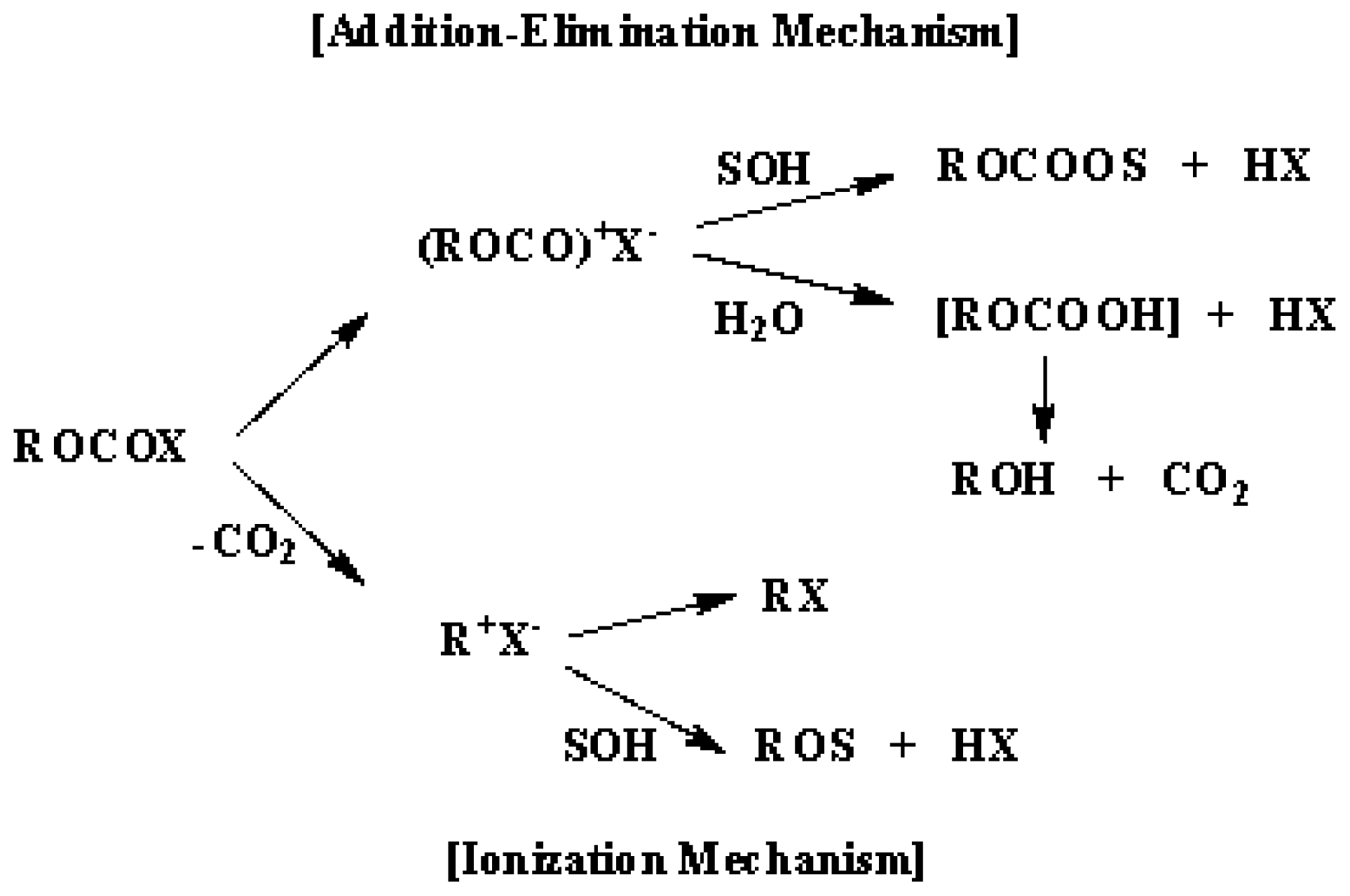
<p>We have previously studied solvolysis reactions of alkyl and aryl haloformate esters concerning the application of the G-W equation [<xref ref-type="bibr" rid="b1-ijms-12-07806">1</xref>,<xref ref-type="bibr" rid="b9-ijms-12-07806">9</xref>]. In hydroxylic solvents, chloroformates with primary alkyl groups solvolyze with rate-determining attack at the carbonyl carbon (<xref rid="FD2" ref-type="disp-formula">Equation 2</xref>). Only in solvents of very low nucleophilicity and very high ionizing power is an ionization mechanism observed (<xref rid="FD3" ref-type="disp-formula">Equation 3</xref>) [<xref ref-type="bibr" rid="b10-ijms-12-07806">10</xref>–<xref ref-type="bibr" rid="b13-ijms-12-07806">13</xref>]. Secondary alkyl chloroformates follow the ionization pathway (<xref rid="FD3" ref-type="disp-formula">Equation 4</xref>) in all the mixed solvents except for the more nucleophilic and less ionizing solvents (<italic>i.e.</italic>, in ethanol and methanol and their mixtures with 10% water) [<xref ref-type="bibr" rid="b14-ijms-12-07806">14</xref>]. For tertiary 1-adamantyl chloroformate (1-AdOCOCl) [<xref ref-type="bibr" rid="b15-ijms-12-07806">15</xref>], the ionization pathway (<xref rid="FD3" ref-type="disp-formula">Equation 4</xref>) was dominant in all the mixed solvents and only in 100% ethanol was a trace of the mixed carbonate detected.</p>
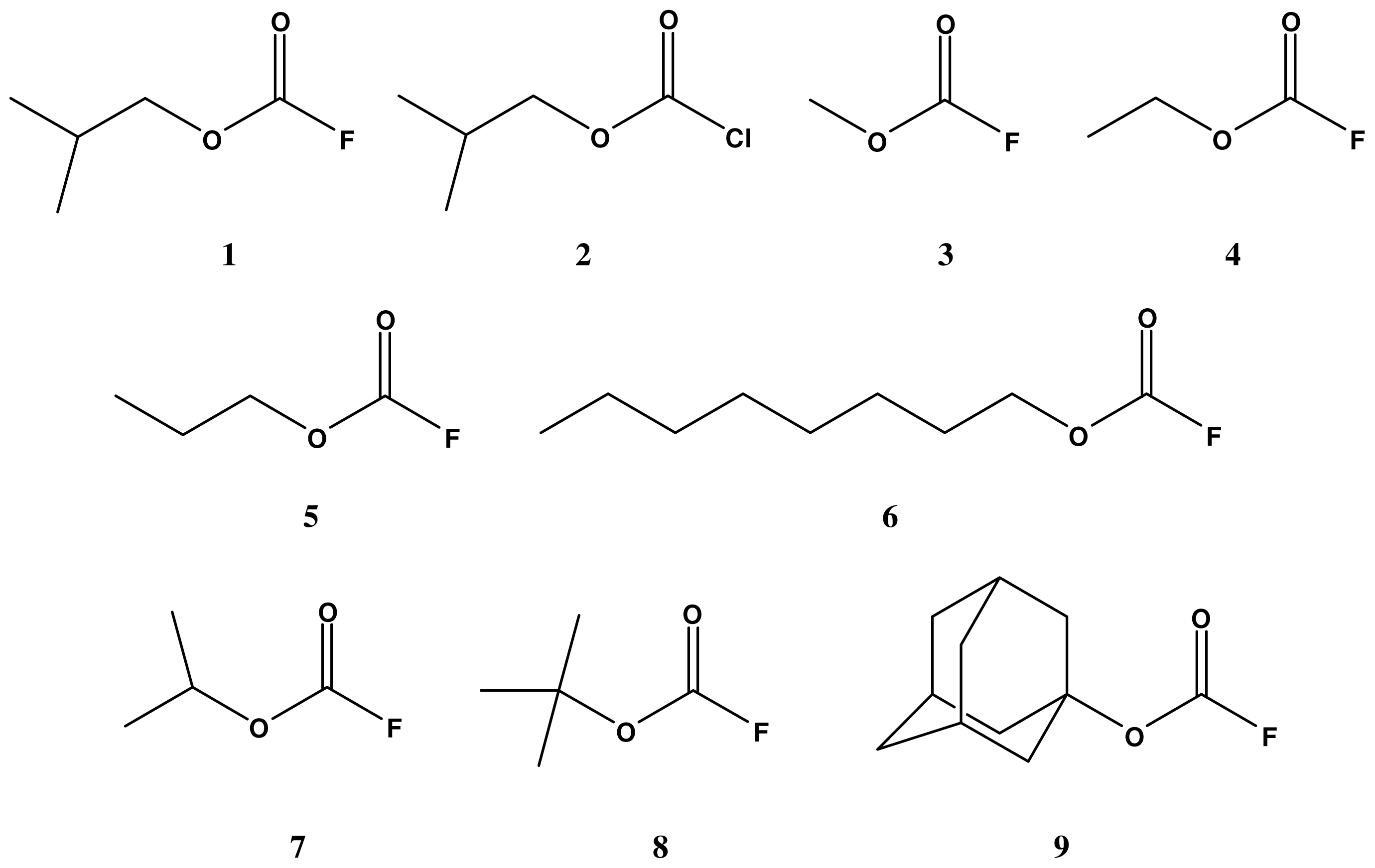
<p>We have also reported that the solvolyses of primary and secondary alkyl fluoroformates (e.g., methyl (<bold>3</bold>) [<xref ref-type="bibr" rid="b16-ijms-12-07806">16</xref>], ethyl (<bold>4</bold>) [<xref ref-type="bibr" rid="b17-ijms-12-07806">17</xref>], <italic>n</italic>-propyl (<bold>5</bold>) [<xref ref-type="bibr" rid="b18-ijms-12-07806">18</xref>], <italic>n</italic>-octyl (<bold>6</bold>) [<xref ref-type="bibr" rid="b19-ijms-12-07806">19</xref>], and isopropyl (<bold>7</bold>) [<xref ref-type="bibr" rid="b20-ijms-12-07806">20</xref>], <xref ref-type="fig" rid="f1-ijms-12-07806">Figure 1</xref>) in a wide range of hydroxylic solvents follow an addition-elimination pathway. Solvolyses of <italic>t</italic>-butyl fluoroformate (<bold>8,</bold> <xref ref-type="fig" rid="f1-ijms-12-07806">Figure 1</xref>) [<xref ref-type="bibr" rid="b21-ijms-12-07806">21</xref>] were found to proceed entirely by an ionization pathway (<xref rid="FD3" ref-type="disp-formula">Equation 4</xref>), which included the loss of carbon dioxide to give the relatively stable <italic>t</italic>-butyl cation. Solvolyses of tertiary 1-adamantyl fluoroformate (<bold>9,</bold> <xref ref-type="fig" rid="f1-ijms-12-07806">Figure 1</xref>) [<xref ref-type="bibr" rid="b22-ijms-12-07806">22</xref>] led to two types of mechanisms, <italic>i.e.</italic>, a bimolecular pathway (<xref rid="FD2" ref-type="disp-formula">Equation 2</xref>) and an ionization pathway (<xref rid="FD3" ref-type="disp-formula">Equation 4</xref>). Accordingly, in order to extend the kinetic study on the solvolysis of alkyl haloformates to <bold>1</bold>, we have investigated the solvolysis reactions of <bold>1</bold> in a variety of pure and binary aqueous organic solvents using the extended G-W equation (<xref rid="FD1" ref-type="disp-formula">Equation 1</xref>). We also report solvolysis studies at three different temperatures in four organic solvents to determine the values of enthalpy (<italic>ΔH</italic><sup>≠</sup>) and entropy (<italic>ΔS</italic><sup>≠</sup>) of activation and the solvent deuterium isotope effect for methanolysis (<italic>k</italic><italic><sub>MeOH</sub></italic><italic>/k</italic><italic><sub>MeOD</sub></italic>). These analyses were combined with a consideration of leaving group effects, by comparison with the values for isobutyl chloroformate (<bold>2</bold>) solvolyses [<xref ref-type="bibr" rid="b13-ijms-12-07806">13</xref>], to arrive at a reasonable mechanism.</p></sec>
<sec sec-type="results|discussion">
<title>2. Results and Discussion</title>
<p>The specific rates of solvolysis of <bold>1</bold> at 40.0 °C are reported in <xref ref-type="table" rid="t1-ijms-12-07806">Table 1</xref>. The solvents consisted of ethanol, methanol, binary mixtures of water with ethanol, methanol, 2,2,2-trifluoroethanol (TFE), acetone (Me<sub>2</sub>CO), 1,1,1,3,3,3-hexafluoro-2-propanol (HFIP) and four binary mixtures of TFE and ethanol. The associated <italic>N</italic><sub>T</sub> and <italic>Y</italic><sub>Cl</sub> values are also reported in <xref ref-type="table" rid="t1-ijms-12-07806">Table 1</xref>, together with the solvent deuterium isotope effect values for <bold>1</bold> and <bold>2</bold> in methanol-d (footnote to <xref ref-type="table" rid="t1-ijms-12-07806">Table 1</xref>). The solvents studied include the important 2,2,2-trifluoroethanol (TFE)–water binary mixtures. These are important to minimize a multicollinearity which when powerful can invalidate the coefficients obtained by multiple regression analysis using extended forms of the Grunwald-Winstein equation. [<xref ref-type="bibr" rid="b23-ijms-12-07806">23</xref>,<xref ref-type="bibr" rid="b24-ijms-12-07806">24</xref>]. Specific rates of solvolysis of <bold>1</bold> were determined at four different temperatures in methanol, ethanol, 80% ethanol, and 70% TFE, and these values, together with calculated enthalpies and entropies of activation, are reported in <xref ref-type="table" rid="t2-ijms-12-07806">Table 2</xref>. The obtained <italic>l</italic>, <italic>m</italic>, and <italic>c</italic> values, together with the corresponding literature values for solvolyses of other fluoroformate esters are summarized in <xref ref-type="table" rid="t3-ijms-12-07806">Table 3</xref>.</p>
<p>As shown in <xref ref-type="table" rid="t1-ijms-12-07806">Table 1</xref>, the specific rates for solvolysis of <bold>1</bold> increase with increasing water content in all the mixed solvents, indicating that the specific rate is accelerated by solvents with higher ionizing power (<italic>Y</italic><sub>Cl</sub>). In contrast, solvolysis of <bold>1</bold> proceeds more rapidly with increasing ethanol content in the four TFE-ethanol solvents. These phenomena are similar to those previously reported for solvolysis of primary and secondary alkyl fluoroformates in various solvents [<xref ref-type="bibr" rid="b16-ijms-12-07806">16</xref>–<xref ref-type="bibr" rid="b20-ijms-12-07806">20</xref>], which have been suggested to proceed through an addition-elimination mechanism with the addition step being rate determining. As is the nature of the nucleophilic acyl substitution reactions, the rate of addition to the carbonyl carbon is slower as the steric demands of the alkyl group (<italic>i.e.</italic>, branching at the α-carbon) increase, and the rate of the reaction was enhanced as the electron withdrawing ability of the alkoxy group increases the positive charge on the carbonyl carbon (electronic effects) [<xref ref-type="bibr" rid="b25-ijms-12-07806">25</xref>]. In <xref ref-type="table" rid="t4-ijms-12-07806">Table 4</xref>, the order of the specific rate for solvolyses of <bold>1</bold> in relation to those previously studied for primary, secondary and tertiary alkyl fluoroformates is shown to be <italic>k</italic><sub>Me</sub> &gt; <italic>k</italic><sub>Et</sub> ≈ <italic>k</italic><sub>n-Pr</sub> ≈ <italic>k</italic><sub>i-Bu</sub> ≈ <italic>k</italic><sub>n-Oct</sub> &gt; <italic>k</italic><sub>i-Pr</sub> &gt;<italic>k</italic><sub>t-Bu</sub> &gt; <italic>k</italic><sub>1-Ad</sub> in 100% MeOH, 100% EtOH, and 80% EtOH but not in 70% TFE [<xref ref-type="bibr" rid="b16-ijms-12-07806">16</xref>–<xref ref-type="bibr" rid="b22-ijms-12-07806">22</xref>].</p>
<p>The difference in reactivity of <bold>8</bold> and <bold>9</bold> has previously been discussed by other workers [<xref ref-type="bibr" rid="b5-ijms-12-07806">5</xref>,<xref ref-type="bibr" rid="b8-ijms-12-07806">8</xref>]. The rate ratios for <bold>1</bold>, <bold>4</bold>, <bold>5</bold>, and <bold>6</bold> in 100% MeOH, 100% EtOH, and 80% EtOH (<xref ref-type="table" rid="t4-ijms-12-07806">Table 4</xref>) being close to unity (<italic>k</italic><sub>ROCOF</sub>/<italic>k</italic><sub>EtOCOF</sub> = 0.91~1.15) suggests that electronic and/or steric influences due to the presence of a branching β-alkyl group in the alkyl fluoroformates can be neglected. On the other hand, the specific rate of solvolysis of <bold>8</bold> in 70% TFE was somewhat faster than the rates of <bold>1</bold>, <bold>4</bold>, <bold>5</bold>, <bold>6</bold> and <bold>7</bold>. The higher rate ratio (<italic>k</italic><sub>t-BuOCOF</sub>/<italic>k</italic><sub>EtOCOF</sub> = 5.6) in 70% TFE relative to 100% MeOH, 100% EtOH, and 80% EtOH probably results from solvolysis of <bold>8</bold> (via the relatively stable t-butyl cation) being more favored by the electrophilic influence of the relatively acidic TFE than the other alkyl fluoroformates, which are believed to proceed by a bimolecular pathway, <italic>i.e.</italic>, for tertiary alkyl haloformates that undergo solvolysis by an ionization process, an increase in the polarity of the solvent and/or its ion-solvation ability resulted in a significant increase in reaction rate. The specific rate of solvolysis of <bold>8</bold>, which has been reported to proceed through an ionization pathway, was found to be 4.0 × 10<sup>2</sup> times faster in 70% TFE (<italic>Y</italic><sub>Cl</sub> = 2.96) than in 100% EtOH (<italic>Y</italic><sub>Cl</sub> = −2.52). This phenomenon occurs because, in the ionization pathway, charge is developed and concentrated in the transition state compared with the starting material (<xref rid="FD3" ref-type="disp-formula">Equation 4</xref>).</p>
<p>Consideration of leaving group effects in nucleophilic substitution reactions has long been recognized as a useful tool in studying reaction mechanisms [<xref ref-type="bibr" rid="b26-ijms-12-07806">26</xref>]. For the ionization pathway, a value of <italic>k</italic><sub>F</sub>/<italic>k</italic><sub>Cl</sub> = 1.3 × 10<sup>−4</sup> was observed for acetyl halide solvolyses [<xref ref-type="bibr" rid="b27-ijms-12-07806">27</xref>], and a low value of <italic>k</italic><sub>F</sub>/<italic>k</italic><sub>Cl</sub> = 1.20 × 10<sup>−5</sup> − 3.17 × 10<sup>−5</sup> was observed for 1-adamantyl haloformate solvolyses [<xref ref-type="bibr" rid="b15-ijms-12-07806">15</xref>,<xref ref-type="bibr" rid="b22-ijms-12-07806">22</xref>]. Since the carbon-fluoride bond (C-F) is much stronger than the carbon-chloride bond (C-Cl), if the carbonhalogen bond is broken in the rate-determining step (ionization pathway), the <italic>k</italic><sub>F</sub>/<italic>k</italic><sub>Cl</sub> ratio would be expected to exhibit a significant leaving group effect, <italic>k</italic><sub>F</sub> ≪ <italic>k</italic><sub>Cl</sub>. In contrast, if the addition step is ratedetermining (<italic>i.e.</italic>, bimolecular pathway), values of close to unity, reflecting a large electron deficiency at the carbonyl carbon of the fluoroformate, would be frequently observed, and the bimolecular pathway through a tetrahedral intermediate formed by the rate-determining addition of solvent to the carbonyl carbon would be characterized by <italic>k</italic><sub>F</sub> ≥ <italic>k</italic><sub>Cl</sub>. A previous report concerning the solvolyses of <bold>4</bold>, <bold>5</bold>, <bold>6</bold> and <bold>7</bold> [<xref ref-type="bibr" rid="b17-ijms-12-07806">17</xref>–<xref ref-type="bibr" rid="b20-ijms-12-07806">20</xref>], which were believed to solvolyze by an addition-elimination mechanism, found a <italic>k</italic><sub>F</sub>/<italic>k</italic><sub>Cl</sub> ratio to be somewhat below unity in ethanol and methanol and slightly greater than unity for solvolyses in mixtures of water with ethanol, methanol, acetone, or TFE (<xref ref-type="table" rid="t5-ijms-12-07806">Table 5</xref>). For other haloformate esters, <italic>k</italic><sub>F</sub>/<italic>k</italic><sub>Cl</sub> ratios of 1.09 to 7.16 for solvolyses in 70% aqueous acetone at 30.1 °C have been reported [<xref ref-type="bibr" rid="b28-ijms-12-07806">28</xref>]. As mentioned above, for binary solvents, the specific rates for solvolysis of the fluoroformate are somewhat faster, despite the stronger carbon-fluorine bond. As shown in <xref ref-type="table" rid="t5-ijms-12-07806">Table 5</xref>, the <italic>k</italic><sub>F</sub>/<italic>k</italic><sub>Cl</sub> ratios were similar for all the substrates, which have been reported to proceed through a bimolecular pathway. They are smaller for the 1-adamantyl substrates, which presumably proceed through a solvolysis-decomposition reaction (ionization pathway) in ethanol, methanol, and 80% ethanol.</p>
<p>The solvent deuterium isotope effect value for methanolysis of <bold>1</bold> is of a magnitude usually taken to indicate that nucleophilic attack by a methanol molecule is assisted by general-base catalysis by a second methanol molecule (<xref ref-type="table" rid="t4-ijms-12-07806">Table 4</xref>) [<xref ref-type="bibr" rid="b29-ijms-12-07806">29</xref>–<xref ref-type="bibr" rid="b31-ijms-12-07806">31</xref>]. The value (<italic>k</italic><sub>MeOH</sub>/<italic>k</italic><sub>MeOD</sub> = 3.40 at 40.0 °C) for <bold>1</bold> is slightly larger than for methanolysis of <bold>2</bold> (<italic>k</italic><sub>MeOH</sub>/<italic>k</italic><sub>MeOD</sub> = 2.00 at 40.0 °C), which further supports the proposal that bond formation is more advanced in the transition state for addition to fluoroformate than for chloroformate. The solvent deuterium isotope effect has previously been studied for several solvolyses of haloformate esters (<xref ref-type="table" rid="t4-ijms-12-07806">Table 4</xref>). In methanol, the <italic>k</italic><sub>MeOH</sub>/<italic>k</italic><sub>MeOD</sub> ratio was in the range of 2.00 to 3.98 for solvolyses of alkyl and aryl haloformates which have been reported to proceed through a bimolecular mechanism [<xref ref-type="bibr" rid="b10-ijms-12-07806">10</xref>–<xref ref-type="bibr" rid="b13-ijms-12-07806">13</xref>,<xref ref-type="bibr" rid="b16-ijms-12-07806">16</xref>–<xref ref-type="bibr" rid="b20-ijms-12-07806">20</xref>,<xref ref-type="bibr" rid="b32-ijms-12-07806">32</xref>,<xref ref-type="bibr" rid="b33-ijms-12-07806">33</xref>]. The <italic>k</italic><sub>ROH</sub>/<italic>k</italic><sub>ROD</sub> values for <italic>i</italic>-propyl chloroformate and <bold>8</bold> in the range of an ionization mechanism, were somewhat smaller at 1.25 in pure water [<xref ref-type="bibr" rid="b34-ijms-12-07806">34</xref>] and 1.26 [<xref ref-type="bibr" rid="b21-ijms-12-07806">21</xref>] in methanol, respectively.</p>
<p>For solvolyses in ethanol, methanol, 80% ethanol, and 70% TFE, the values of the enthalpy and the entropy of activation for the solvolysis of <bold>1</bold> (<xref ref-type="table" rid="t2-ijms-12-07806">Table 2</xref>) are 9.5~11.1 kcal·mol<sup>−1</sup> and −45.3~−39.9 cal·mol<sup>−1</sup>·K<sup>−1</sup>, respectively. The large negative entropies of activation observed for <bold>1</bold> in the four solvents are consistent with the bimolecular nature of the rate-determining step. The mechanism for the solvolysis of <bold>1</bold> is similar to that reported for the solvolyses of <bold>3</bold>, <bold>4</bold>, <bold>5</bold>, <bold>6</bold> and <bold>7</bold> in several solvents, which have been suggested to proceed through a bimolecular pathway [<xref ref-type="bibr" rid="b16-ijms-12-07806">16</xref>–<xref ref-type="bibr" rid="b20-ijms-12-07806">20</xref>].</p>
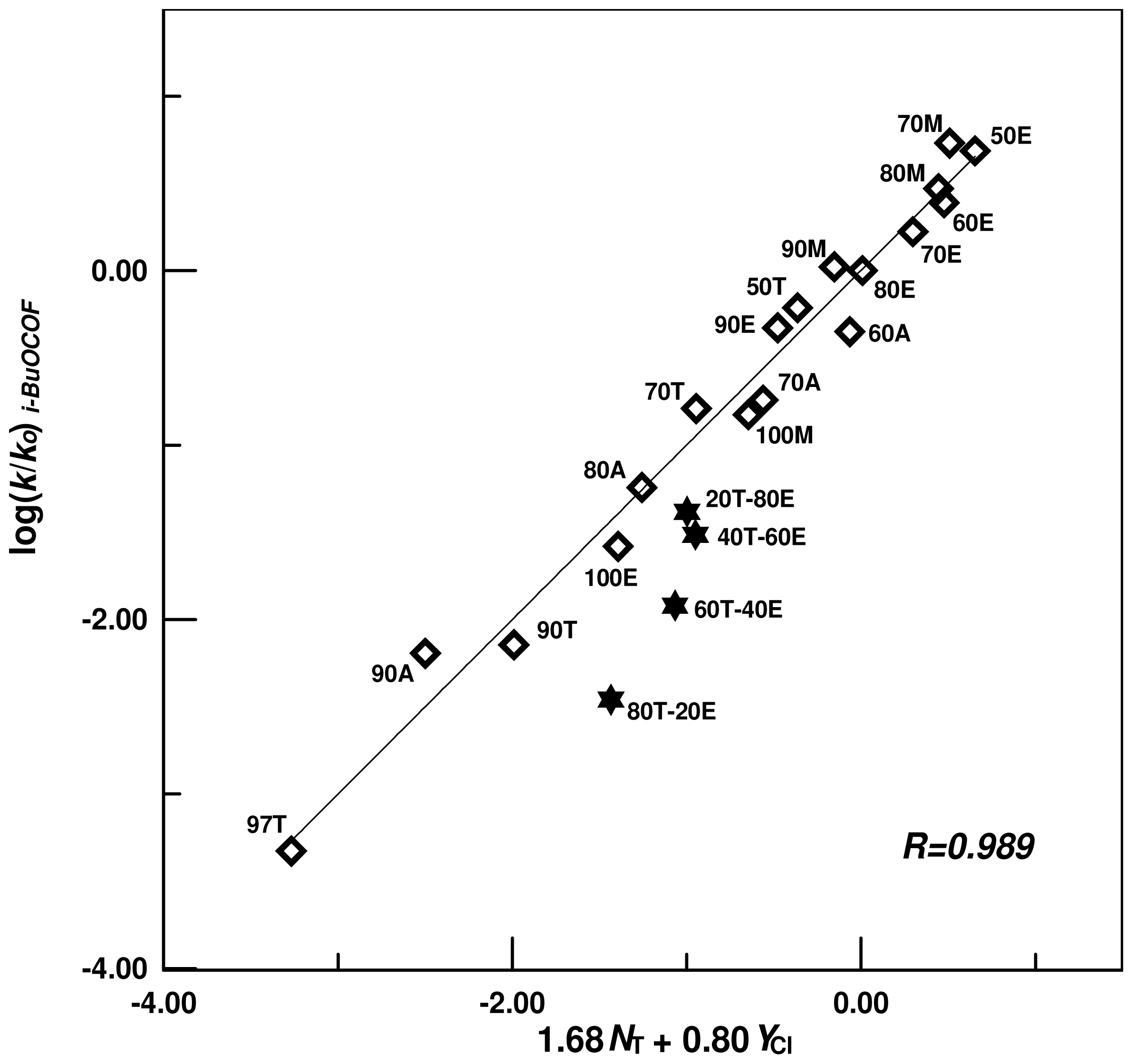
<p>The extended G-W <xref rid="FD1" ref-type="disp-formula">Equation 1</xref> gives information which is very helpful in assessing the mechanism of solvolysis reactions. Therefore a correlation analysis of the specific rates for the solvolysis of <bold>1</bold> was carried out using the extended G-W <xref rid="FD1" ref-type="disp-formula">equation 1</xref> and the <italic>l</italic> and <italic>m</italic> values were compared with those previously obtained from the solvolyses of other alkyl haloformates (<xref ref-type="table" rid="t3-ijms-12-07806">Table 3</xref>) [<xref ref-type="bibr" rid="b13-ijms-12-07806">13</xref>,<xref ref-type="bibr" rid="b16-ijms-12-07806">16</xref>–<xref ref-type="bibr" rid="b22-ijms-12-07806">22</xref>]. As shown in <xref ref-type="fig" rid="f2-ijms-12-07806">Figure 2</xref>, inspection of the plot corresponding to this correlation showed that the four data points for solvolyses in TFE-ethanol mixtures show moderate to appreciable deviation from the linear plot. This was previously discussed in detail using the extended G-W <xref rid="FD1" ref-type="disp-formula">Equation 1</xref> to the specific rates of solvolysis of alkyl and acyl haloformate esters in binary TFE-ethanol solvents [<xref ref-type="bibr" rid="b14-ijms-12-07806">14</xref>,<xref ref-type="bibr" rid="b22-ijms-12-07806">22</xref>,<xref ref-type="bibr" rid="b35-ijms-12-07806">35</xref>,<xref ref-type="bibr" rid="b36-ijms-12-07806">36</xref>] and will not be considered again in this report. Correlations were carried out both with and without the TFE-ethanol data, and analysis of the data obtained applying the extended G-W <xref rid="FD1" ref-type="disp-formula">equation 1</xref> to the specific rates of solvolysis of <bold>1</bold> in all the solvents led to an acceptable linear correlation with values of 1.78 ± 0.13 for <italic>l,</italic> 0.85 ± 0.10 for <italic>m</italic>, −0.07 ± 0.10 for <italic>c</italic>, and 0.956 for the correlation coefficient. Recalculation with omission of these TFE-ethanol mixture data led to a very good linear correlation with values of 1.68 ± 0.07 for <italic>l</italic>, 0.80 ± 0.04 for <italic>m</italic>, 0.01 ± 0.05 for <italic>c</italic>, and 0.989 for the correlation coefficient.</p>
<p>The relative magnitudes of <italic>l</italic> and <italic>m</italic> (<italic>l</italic>/<italic>m</italic> ratio) have often been suggested to be useful mechanistic criteria. As shown in <xref ref-type="table" rid="t3-ijms-12-07806">Table 3</xref>, the <italic>l</italic>/<italic>m</italic> ratio clearly is divided into two classes with values of 1.8~2.8 for those entries postulated to be associated with the addition-elimination (A-E, <xref rid="FD2" ref-type="disp-formula">Equation 2</xref>) mechanism and values of 0.54~0.84 for those believed to be associated with the ionization (I, <xref rid="FD3" ref-type="disp-formula">Equations 3</xref> and <xref rid="FD3" ref-type="disp-formula">4</xref>) mechanism. <xref ref-type="table" rid="t3-ijms-12-07806">Table 3</xref> shows that the <italic>l</italic> and <italic>m</italic> values of <bold>1</bold> are similar to those previously reported for other primary and secondary alkyl fluoroformates, e.g., a plot of log (<italic>k</italic>/<italic>k</italic><sub>o</sub>) for <bold>1</bold> against log (<italic>k</italic>/<italic>k</italic><sub>o</sub>) for <bold>6</bold> shows a good linear correlation [<italic>i.e.</italic>, log (<italic>k</italic>/<italic>k</italic><sub>o</sub>)<sub>i-butyl</sub> = 0.98 log (<italic>k</italic>/<italic>k</italic><sub>o</sub>)<sub>n-octyl</sub> + 0.09, R = 0.990] in pure and mixed solvents. A good linear relationship for the solvolyses of <bold>1</bold> and <bold>6</bold> provides strong evidence for a similarity model. The higher <italic>m</italic>-value for the solvolyses of <bold>1</bold>, relative to <bold>2</bold>, may reflect the kinetically favorable influence of increased solvation of the developing negative charge on the carbonyl oxygen in the presence of the more electronegative fluorine attached at the carbonyl carbon [<xref ref-type="bibr" rid="b16-ijms-12-07806">16</xref>–<xref ref-type="bibr" rid="b20-ijms-12-07806">20</xref>,<xref ref-type="bibr" rid="b37-ijms-12-07806">37</xref>,<xref ref-type="bibr" rid="b38-ijms-12-07806">38</xref>]. As shown in <xref ref-type="table" rid="t3-ijms-12-07806">Table 3</xref>, the solvolyses of primary and secondary alkyl fluoroformates [methyl (<bold>3</bold>), ethyl (<bold>4</bold>), <italic>n</italic>-propyl (<bold>5</bold>), <italic>n</italic>-octyl (<bold>6</bold>), <italic>i</italic>-butyl (<bold>1</bold>) and <italic>i</italic>-propyl (<bold>7</bold>)] in all the solvents studied were found to proceed through only an addition-elimination mechanism with the addition step being rate-determining (<xref rid="FD2" ref-type="disp-formula">Equation 2</xref>), despite the increasing chain length in primary alkyl fluoroformates (<bold>1</bold>, <bold>3</bold>, <bold>4</bold>, <bold>5</bold> and <bold>6</bold>) and the influence of a branched-chain alkyl group as in <bold>7</bold>.</p></sec>
<sec>
<title>3. Experimental Section</title>
<p>Isobutyl chloroformate (<bold>2</bold>, Aldrich, 21.06 g, 0.154 mol) was syringed into a three-neck flask containing dried KF (11.5 g, 0.198 mol) and 18-crown-6 (1.44 g, 0.0054 mol) and fitted with a teflon stirring bar, a condenser topped by an N<sub>2</sub> gas inlet, a septum cap, and a ground glass stopper, as described previously [<xref ref-type="bibr" rid="b20-ijms-12-07806">20</xref>,<xref ref-type="bibr" rid="b39-ijms-12-07806">39</xref>]. The mixture was stirred efficiently at room temperature until IR analysis of an aliquot indicated that no chloroformate remained (C=O stretch at 1779 cm<sup>−1</sup>; fluoroformate C=O stretch at 1830 cm<sup>−1</sup>). After a few more hours (total reaction time 45 h), isobutyl fluoroformate (<bold>1</bold>) was isolated directly from the reaction apparatus by simple distillation: yield 17 g (92%); b.p. 90–92 °C at atmospheric pressure (b.p. 92–93 °C at atmospheric pressure [<xref ref-type="bibr" rid="b40-ijms-12-07806">40</xref>]).</p>
<p>Solvents used in solvolysis experiments were purified as previously described [<xref ref-type="bibr" rid="b13-ijms-12-07806">13</xref>]. All runs were performed using a substrate concentration of 5.81 × 10<sup>−3</sup> mol dm<sup>−3</sup>, and 5 mL portions were removed for titration, except for runs in TFE-H2O and TFE-EtOH mixtures in which 2 mL portions were used for titrations. Due to the faster rates for the solvolysis of 1 in 50% EtOH and 70% MeOH than in other solvents, these kinetic measurements were made conductometrically using a Metrohm 712 (Swiss), with an immersion measuring cell (Pt 100). Runs were carried out in duplicate with for each run at least 95 readings for conductivity measurements and eight to ten readings for titration measurements, with infinity readings after ten half-lives. All the integrated specific rate values obtained from each run for a given solvolysis were used to calculate an overall average value and the associated standard deviation. The l and m values were calculated using multiple regression analysis.</p></sec>
<sec sec-type="conclusions">
<title>4. Conclusions</title>
<p>The solvolyses of <bold>1</bold> give a satisfactory extended Grunwald-Winstein correlation over a wide range of <italic>N</italic><sub>T</sub> and <italic>Y</italic><sub>Cl</sub> values. The sensitivities to changes in <italic>N</italic><sub>T</sub> and <italic>Y</italic><sub>Cl</sub> (<italic>l</italic> = 1.68 and <italic>m</italic> = 0.80) are similar to those for several alkyl fluoroformates, which are shown to solvolyze by an addition-elimination pathway with the addition step being rate determining. The <italic>k</italic><sub>F</sub>/<italic>k</italic><sub>Cl</sub> values obtained in a comparison with the corresponding solvolysis of <bold>2</bold> are similar to those for the solvolyses of <bold>3</bold>, <bold>4</bold>, <bold>5</bold>, <bold>6</bold>, and <bold>7</bold>, consistent with a bimolecular addition-elimination mechanism, proceeding through a tetrahedral intermediate. The solvent deuterium isotope effect value (<italic>k</italic><sub>MeOH</sub>/<italic>k</italic><sub>MeOD</sub> = 3.40) for methanolysis of <bold>1</bold> is of a magnitude usually taken to indicate that nucleophilic attack by a methanol molecule is assisted by general-base catalysis by a second methanol molecule. The large negative entropies of activation (−45.3~−39.9 cal·mol<sup>−1</sup>·K<sup>−1</sup>) observed for the solvolyses of <bold>1</bold> in four solvents are consistent with the bimolecular nature of the ratedetermining step. In the present study, unlike the solvolyses of <bold>2</bold>, where two reaction channels were observed (<italic>i.e.</italic>, the addition-elimination pathway, <xref rid="FD2" ref-type="disp-formula">Equation 2</xref> and the ionization pathway, <xref rid="FD3" ref-type="disp-formula">Equation 4</xref>), the solvolyses of <bold>1</bold> proceed through only an addition-elimination pathway (<xref rid="FD2" ref-type="disp-formula">Equation 2</xref>) with the addition step being rate-determining.</p></sec></body>
<back>
<ref-list>
<title>References</title>
<ref id="b1-ijms-12-07806"><label>1</label><citation citation-type="journal"><person-group person-group-type="author"><name><surname>Grunwald</surname><given-names>E.</given-names></name><name><surname>Winstein</surname><given-names>S.</given-names></name></person-group><article-title>The correlation of solvolysis rates</article-title><source>J. Am. Chem. Soc</source><year>1948</year><volume>70</volume><fpage>846</fpage><lpage>854</lpage><pub-id pub-id-type="doi">10.1021/ja01182a117</pub-id></citation></ref>
<ref id="b2-ijms-12-07806"><label>2</label><citation citation-type="journal"><person-group person-group-type="author"><name><surname>Grunwald</surname><given-names>E.</given-names></name><name><surname>Winstein</surname><given-names>S.</given-names></name><name><surname>Jones</surname><given-names>H.W.</given-names></name></person-group><article-title>The correlation of solvolyses rates and the classification of solvolysis reactions into mechanistic categories</article-title><source>J. Am. Chem. Soc</source><year>1951</year><volume>73</volume><fpage>2700</fpage><lpage>2707</lpage><pub-id pub-id-type="doi">10.1021/ja01150a078</pub-id></citation></ref>
<ref id="b3-ijms-12-07806"><label>3</label><citation citation-type="journal"><person-group person-group-type="author"><name><surname>Kevill</surname><given-names>D.N.</given-names></name><name><surname>Anderson</surname><given-names>S.W.</given-names></name></person-group><article-title>An improved scale of solvent nucleophlicitiy based on the solvolysis of the <italic>S</italic>-methyldibenzothiophenium ion</article-title><source>J. Org. Chem</source><year>1991</year><volume>56</volume><fpage>1845</fpage><lpage>1850</lpage><pub-id pub-id-type="doi">10.1021/jo00005a034</pub-id></citation></ref>
<ref id="b4-ijms-12-07806"><label>4</label><citation citation-type="book"><person-group person-group-type="author"><name><surname>Kevill</surname><given-names>D.N.</given-names></name></person-group><article-title>Development and Uses of Scales of Solvent Nucleophlicity</article-title><source>In Advances in Quantitative Structure-Property Relationship</source><person-group person-group-type="editor"><name><surname>Charton</surname><given-names>M.</given-names></name></person-group><publisher-name>JAI Press</publisher-name><publisher-loc>Greenwich, CT, USA</publisher-loc><year>1996</year><volume>1</volume><fpage>81</fpage><lpage>115</lpage></citation></ref>
<ref id="b5-ijms-12-07806"><label>5</label><citation citation-type="journal"><person-group person-group-type="author"><name><surname>Bentley</surname><given-names>T.W.</given-names></name><name><surname>Carter</surname><given-names>G.E.</given-names></name></person-group><article-title>The S<sub>N</sub>2-S<sub>N</sub>1 Spectrum. 4. The S<sub>N</sub>2 (intermediate) mechanism for solvolyses of tert-butyl chloride: A revised Y scale of solvent ionizing power based on solvolyses of 1-adamantyl chloride</article-title><source>J. Am. Chem. Soc</source><year>1982</year><volume>104</volume><fpage>5741</fpage><lpage>5747</lpage><pub-id pub-id-type="doi">10.1021/ja00385a031</pub-id></citation></ref>
<ref id="b6-ijms-12-07806"><label>6</label><citation citation-type="journal"><person-group person-group-type="author"><name><surname>Bentley</surname><given-names>T.W.</given-names></name><name><surname>Llewellyn</surname><given-names>G.</given-names></name></person-group><article-title><italic>Y</italic><italic><sub>X</sub></italic> scales of solvent ionizing power</article-title><source>Prog. Phys. Org. Chem</source><year>1990</year><volume>17</volume><fpage>121</fpage><lpage>158</lpage></citation></ref>
<ref id="b7-ijms-12-07806"><label>7</label><citation citation-type="journal"><person-group person-group-type="author"><name><surname>Kevill</surname><given-names>D.N.</given-names></name><name><surname>D’Souza</surname><given-names>M.J.</given-names></name></person-group><article-title>Additional <italic>Y</italic><sub>Cl</sub> values and the correlation of the specific rates of solvolysis of tert-butyl chloride in terms of <italic>N</italic><sub>T</sub> and <italic>Y</italic><sub>Cl</sub> scales</article-title><source>J. Chem. Res. Synop</source><year>1993</year><fpage>174</fpage><lpage>175</lpage></citation></ref>
<ref id="b8-ijms-12-07806"><label>8</label><citation citation-type="journal"><person-group person-group-type="author"><name><surname>Von Schleyer</surname><given-names>P.R.</given-names></name><name><surname>Nicholas</surname><given-names>R.D.</given-names></name></person-group><article-title>The reactivity of bridgehead compounds of adamantane</article-title><source>J. Am. Chem. Soc</source><year>1961</year><volume>83</volume><fpage>2700</fpage><lpage>2707</lpage><pub-id pub-id-type="doi">10.1021/ja01473a024</pub-id></citation></ref>
<ref id="b9-ijms-12-07806"><label>9</label><citation citation-type="journal"><person-group person-group-type="author"><name><surname>Fainberg</surname><given-names>A.H.</given-names></name><name><surname>Winstein</surname><given-names>S.J.</given-names></name></person-group><article-title>Correlation of solvolysis rates. III. <italic>t</italic>-Butyl chloride in a wide range of solvent mixtures</article-title><source>J. Am. Chem. Soc</source><year>1956</year><volume>78</volume><fpage>2770</fpage><lpage>2777</lpage><pub-id pub-id-type="doi">10.1021/ja01593a033</pub-id></citation></ref>
<ref id="b10-ijms-12-07806"><label>10</label><citation citation-type="journal"><person-group person-group-type="author"><name><surname>Kevill</surname><given-names>D.N.</given-names></name><name><surname>Kim</surname><given-names>J.C.</given-names></name><name><surname>Kyong</surname><given-names>J.B.</given-names></name></person-group><article-title>Correlation of the rates of solvolysis of methyl chloroformate with solvent properties</article-title><source>J. Chem. Res. Synop</source><year>1999</year><fpage>150</fpage><lpage>151</lpage></citation></ref>
<ref id="b11-ijms-12-07806"><label>11</label><citation citation-type="journal"><person-group person-group-type="author"><name><surname>Kevill</surname><given-names>D.N.</given-names></name><name><surname>D’Souza</surname><given-names>M.J.</given-names></name></person-group><article-title>Concerning the two reaction channels for the solvolyses of ethyl chloroformate and ethyl chlorothioformate</article-title><source>J. Org. Chem</source><year>1998</year><volume>63</volume><fpage>2120</fpage><lpage>2124</lpage><pub-id pub-id-type="doi">10.1021/jo9714270</pub-id></citation></ref>
<ref id="b12-ijms-12-07806"><label>12</label><citation citation-type="journal"><person-group person-group-type="author"><name><surname>Kyong</surname><given-names>J.B.</given-names></name><name><surname>Won</surname><given-names>H.</given-names></name><name><surname>Kevill</surname><given-names>D.N.</given-names></name></person-group><article-title>Application of the the extended grunwald-winstein equation to solvolyses of <italic>n</italic>-propyl chloroformate</article-title><source>Int. J. Mol. Sci</source><year>2005</year><volume>6</volume><fpage>87</fpage><lpage>96</lpage><pub-id pub-id-type="doi">10.3390/i6010087</pub-id></citation></ref>
<ref id="b13-ijms-12-07806"><label>13</label><citation citation-type="journal"><person-group person-group-type="author"><name><surname>D’Souza</surname><given-names>M.J.</given-names></name><name><surname>McAneny</surname><given-names>M.J.</given-names></name><name><surname>Kevill</surname><given-names>D.N.</given-names></name><name><surname>Kyong</surname><given-names>J.B.</given-names></name><name><surname>Choi</surname><given-names>S.H.</given-names></name></person-group><article-title>Kinetic evaluation of the solvolysis of isobutyl chloro- and chlorothioformate esters</article-title><source>Beilstein J. Org. Chem</source><year>2011</year><volume>7</volume><fpage>543</fpage><lpage>552</lpage><pub-id pub-id-type="doi">10.3762/bjoc.7.62</pub-id><pub-id pub-id-type="pmid">21647255</pub-id></citation></ref>
<ref id="b14-ijms-12-07806"><label>14</label><citation citation-type="journal"><person-group person-group-type="author"><name><surname>Kyong</surname><given-names>J.B.</given-names></name><name><surname>Kim</surname><given-names>Y.G.</given-names></name><name><surname>Kim</surname><given-names>D.K.</given-names></name><name><surname>Kevill</surname><given-names>D.N.</given-names></name></person-group><article-title>Dual pathways in the solvolyses of isopropyl chloroformate</article-title><source>Bull. Korean Chem. Soc</source><year>2000</year><volume>21</volume><fpage>662</fpage><lpage>664</lpage></citation></ref>
<ref id="b15-ijms-12-07806"><label>15</label><citation citation-type="journal"><person-group person-group-type="author"><name><surname>Kevill</surname><given-names>D.N.</given-names></name><name><surname>Kyong</surname><given-names>J.B.</given-names></name><name><surname>Weitl</surname><given-names>F.L.</given-names></name></person-group><article-title>Solvolysis-decomposition of 1-adamantyl chloroformate: Evidence for ion pair return in 1-adamantyl chloride solvolysis</article-title><source>J. Org. Chem</source><year>1990</year><volume>55</volume><fpage>4304</fpage><lpage>4311</lpage><pub-id pub-id-type="doi">10.1021/jo00301a019</pub-id></citation></ref>
<ref id="b16-ijms-12-07806"><label>16</label><citation citation-type="journal"><person-group person-group-type="author"><name><surname>Seong</surname><given-names>M.H.</given-names></name><name><surname>Choi</surname><given-names>S.H.</given-names></name><name><surname>Lee</surname><given-names>Y.W.</given-names></name><name><surname>Kyong</surname><given-names>J.B.</given-names></name><name><surname>Kim</surname><given-names>D.K.</given-names></name><name><surname>Kevill</surname><given-names>D.N.</given-names></name></person-group><article-title>Correlation of the rates of solvolysis of methyl fluoroformate using the extended grunwald-winstein equation</article-title><source>Bull. Korean Chem. Soc</source><year>2009</year><volume>30</volume><fpage>2408</fpage><lpage>2412</lpage><pub-id pub-id-type="doi">10.5012/bkcs.2009.30.10.2408</pub-id></citation></ref>
<ref id="b17-ijms-12-07806"><label>17</label><citation citation-type="journal"><person-group person-group-type="author"><name><surname>Seong</surname><given-names>M.H.</given-names></name><name><surname>Kyong</surname><given-names>J.B.</given-names></name><name><surname>Lee</surname><given-names>Y.H.</given-names></name><name><surname>Kevill</surname><given-names>D.N.</given-names></name></person-group><article-title>Correlation of the specific rates of solvolysis of ethyl fluoroformate using the extended grunwald-winstein equation</article-title><source>Int. J. Mol. Sci</source><year>2009</year><volume>10</volume><fpage>929</fpage><lpage>941</lpage><pub-id pub-id-type="doi">10.3390/ijms10030929</pub-id><pub-id pub-id-type="pmid">19399229</pub-id></citation></ref>
<ref id="b18-ijms-12-07806"><label>18</label><citation citation-type="journal"><person-group person-group-type="author"><name><surname>Seong</surname><given-names>M.H.</given-names></name><name><surname>Kyong</surname><given-names>J.B.</given-names></name><name><surname>Kim</surname><given-names>D.K.</given-names></name><name><surname>Kevill</surname><given-names>D.N.</given-names></name></person-group><article-title>Application of the the extended grunwald-winstein equation to solvolyses of <italic>n</italic>-propyl fluoroformate and a consideration of leaving group effects</article-title><source>Bull. Korean Chem. Soc.</source><year>2008</year><volume>29</volume><fpage>1747</fpage><lpage>1751</lpage><pub-id pub-id-type="doi">10.5012/bkcs.2008.29.9.1747</pub-id></citation></ref>
<ref id="b19-ijms-12-07806"><label>19</label><citation citation-type="journal"><person-group person-group-type="author"><name><surname>Kevill</surname><given-names>D.N.</given-names></name><name><surname>D’Souza</surname><given-names>M.J.</given-names></name></person-group><article-title>Correlation of the rates of solvolysis of <italic>n</italic>-octyl fluoroformate and a comparison with <italic>n</italic>-octyl chloroformate solvolysis</article-title><source>J. Chem. Soc. Perkin Trans</source><year>2002</year><volume>2</volume><fpage>240</fpage><lpage>243</lpage></citation></ref>
<ref id="b20-ijms-12-07806"><label>20</label><citation citation-type="journal"><person-group person-group-type="author"><name><surname>Lee</surname><given-names>S.H.</given-names></name><name><surname>Rhu</surname><given-names>C.J.</given-names></name><name><surname>Kyong</surname><given-names>J.B.</given-names></name><name><surname>Kim</surname><given-names>D.K.</given-names></name><name><surname>Kevill</surname><given-names>D.N.</given-names></name></person-group><article-title>Correlation of the rates of solvolysis of isopropyl fluoroformate using the extended grunwald-winstein equation</article-title><source>Bull. Korean Chem. Soc</source><year>2007</year><volume>28</volume><fpage>657</fpage><lpage>661</lpage><pub-id pub-id-type="doi">10.5012/bkcs.2007.28.4.657</pub-id></citation></ref>
<ref id="b21-ijms-12-07806"><label>21</label><citation citation-type="journal"><person-group person-group-type="author"><name><surname>Lee</surname><given-names>Y.W.</given-names></name><name><surname>Seong</surname><given-names>M.H.</given-names></name><name><surname>Kyong</surname><given-names>J.B.</given-names></name><name><surname>Kevill</surname><given-names>D.N.</given-names></name></person-group><article-title>Correlation of the specific rates of solvolysis of <italic>t</italic>-butyl fluoroformate using the extended grunwald-winstein equation</article-title><source>Bull. Korean Chem. Soc</source><year>2010</year><volume>31</volume><fpage>3366</fpage><lpage>3370</lpage><pub-id pub-id-type="doi">10.5012/bkcs.2010.31.11.3366</pub-id></citation></ref>
<ref id="b22-ijms-12-07806"><label>22</label><citation citation-type="journal"><person-group person-group-type="author"><name><surname>Kevill</surname><given-names>D.N.</given-names></name><name><surname>Kyong</surname><given-names>J.B.</given-names></name></person-group><article-title>Multiple pathways in the solvolysis of 1-adamantyl fluoroformate</article-title><source>J. Org. Chem</source><year>1992</year><volume>57</volume><fpage>258</fpage><lpage>265</lpage><pub-id pub-id-type="doi">10.1021/jo00027a046</pub-id></citation></ref>
<ref id="b23-ijms-12-07806"><label>23</label><citation citation-type="journal"><person-group person-group-type="author"><name><surname>Kevill</surname><given-names>D.N.</given-names></name><name><surname>Lin</surname><given-names>G.M.L.</given-names></name></person-group><article-title>Solvent nucleophilicity. A scale based on triethyloxonium ion solvolysis</article-title><source>J. Am. Chem. Soc</source><year>1979</year><volume>101</volume><fpage>3916</fpage><lpage>3919</lpage><pub-id pub-id-type="doi">10.1021/ja00508a032</pub-id></citation></ref>
<ref id="b24-ijms-12-07806"><label>24</label><citation citation-type="journal"><person-group person-group-type="author"><name><surname>Kevill</surname><given-names>D.N.</given-names></name><name><surname>D’Souza</surname><given-names>M.J.</given-names></name></person-group><article-title>Use of the simple and extended grunwald-winstein equations in the correlation of the rates of solvolysis of highly hindered tertiary alkyl derivatives</article-title><source>Curr. Org. Chem</source><year>2010</year><volume>14</volume><fpage>1037</fpage><lpage>1049</lpage><pub-id pub-id-type="doi">10.2174/138527210791130505</pub-id><pub-id pub-id-type="pmid">21243118</pub-id></citation></ref>
<ref id="b25-ijms-12-07806"><label>25</label><citation citation-type="book"><person-group person-group-type="author"><name><surname>Sykes</surname><given-names>P</given-names></name></person-group><source>A Guidebook to Mechanism in Organic Chemistry</source><edition>6th ed</edition><publisher-name>John Wiley &amp; Sons</publisher-name><publisher-loc>New York, NY, USA</publisher-loc><year>1986</year></citation></ref>
<ref id="b26-ijms-12-07806"><label>26</label><citation citation-type="book"><person-group person-group-type="author"><name><surname>Kevill</surname><given-names>D.N.</given-names></name></person-group><source>The Chemistry of the Functional Groups: The Chemistry of Acyl Halides</source><person-group person-group-type="editor"><name><surname>Patai</surname><given-names>S.</given-names></name></person-group><publisher-name>John Wiley &amp; Sons</publisher-name><publisher-loc>New York, NY, USA</publisher-loc><year>1972</year></citation></ref>
<ref id="b27-ijms-12-07806"><label>27</label><citation citation-type="journal"><person-group person-group-type="author"><name><surname>Swain</surname><given-names>C.G.</given-names></name><name><surname>Scott</surname><given-names>C.B.</given-names></name></person-group><article-title>Rates of solvolysis of some alkyl fluorides and chlorides</article-title><source>J. Am. Chem. Soc</source><year>1953</year><volume>75</volume><fpage>246</fpage><lpage>248</lpage><pub-id pub-id-type="doi">10.1021/ja01097a520</pub-id></citation></ref>
<ref id="b28-ijms-12-07806"><label>28</label><citation citation-type="journal"><person-group person-group-type="author"><name><surname>Queen</surname><given-names>A.</given-names></name><name><surname>Nour</surname><given-names>T.A.</given-names></name></person-group><article-title>Kinetics and mechanism of the acetate catalyzed hydrolysis of 4-methoxyphenyl chloroformate and 4-methoxyphenyl fluoroformate in aqueous dioxane</article-title><source>J. Chem. Soc. Perkin Trans</source><year>1976</year><volume>2</volume><fpage>935</fpage><lpage>939</lpage></citation></ref>
<ref id="b29-ijms-12-07806"><label>29</label><citation citation-type="journal"><person-group person-group-type="author"><name><surname>Koo</surname><given-names>I.S.</given-names></name><name><surname>Yang</surname><given-names>K.</given-names></name><name><surname>Kang</surname><given-names>D.H.</given-names></name><name><surname>Park</surname><given-names>H.J.</given-names></name><name><surname>Kang</surname><given-names>K.</given-names></name><name><surname>Lee</surname><given-names>I.</given-names></name></person-group><article-title>Transition-state variation in the solvolyses of phenyl chlorothionoformate in alcohol-water mixtures</article-title><source>Bull. Korean Chem. Soc</source><year>1999</year><volume>20</volume><fpage>577</fpage><lpage>580</lpage></citation></ref>
<ref id="b30-ijms-12-07806"><label>30</label><citation citation-type="journal"><person-group person-group-type="author"><name><surname>Ryu</surname><given-names>Z.H.</given-names></name><name><surname>Shin</surname><given-names>S.H.</given-names></name><name><surname>Lee</surname><given-names>J.P.</given-names></name><name><surname>Lim</surname><given-names>G.T.</given-names></name><name><surname>Bentley</surname><given-names>T.W.</given-names></name></person-group><article-title>Kinetics solvent isotope effects and correlations of rates of solvolyses for α-methylthio and other substitued acetyl chlorides</article-title><source>J. Chem. Soc. Perkin Trans</source><year>2002</year><volume>2</volume><fpage>1283</fpage><lpage>1287</lpage></citation></ref>
<ref id="b31-ijms-12-07806"><label>31</label><citation citation-type="journal"><person-group person-group-type="author"><name><surname>Oh</surname><given-names>Y.H.</given-names></name><name><surname>Jang</surname><given-names>G.G.</given-names></name><name><surname>Lim</surname><given-names>G.T.</given-names></name><name><surname>Ryu</surname><given-names>Z.H.</given-names></name></person-group><article-title>Marked difference in solvation effects and mechanism between solvolyses of substituted acetyl chloride with alkyl groups and with aromatic rings in aqueous fluorinated alcohol and in 2,2,2-trifluoroethanol-ethanol solvent systems</article-title><source>Bull. Korean Chem. Soc</source><year>2002</year><volume>23</volume><fpage>1083</fpage><lpage>1096</lpage></citation></ref>
<ref id="b32-ijms-12-07806"><label>32</label><citation citation-type="journal"><person-group person-group-type="author"><name><surname>Kyong</surname><given-names>J.B.</given-names></name><name><surname>Park</surname><given-names>B.C.</given-names></name><name><surname>Kim</surname><given-names>C.B.</given-names></name><name><surname>Kevill</surname><given-names>D.N.</given-names></name></person-group><article-title>Rate and product studies with benzyl and <italic>p</italic>-nitrobenzyl chloroformates under sovolytic conditions</article-title><source>J. Org. Chem</source><year>2000</year><volume>65</volume><fpage>8051</fpage><lpage>8058</lpage><pub-id pub-id-type="doi">10.1021/jo005630y</pub-id><pub-id pub-id-type="pmid">11073616</pub-id></citation></ref>
<ref id="b33-ijms-12-07806"><label>33</label><citation citation-type="journal"><person-group person-group-type="author"><name><surname>Kyong</surname><given-names>J.B.</given-names></name><name><surname>Ryu</surname><given-names>S.H.</given-names></name><name><surname>Kevill</surname><given-names>D.N.</given-names></name></person-group><article-title>Rate and product studies of the solvolyses of benzyl fluoroformate</article-title><source>Int. J. Mol. Sci</source><year>2006</year><volume>7</volume><fpage>186</fpage><lpage>196</lpage><pub-id pub-id-type="doi">10.3390/i7070186</pub-id></citation></ref>
<ref id="b34-ijms-12-07806"><label>34</label><citation citation-type="journal"><person-group person-group-type="author"><name><surname>Queen</surname><given-names>A.</given-names></name></person-group><article-title>Kinetics of the hydrolysis of acyl chlorides in pure water</article-title><source>Can. J. Chem</source><year>1967</year><volume>45</volume><fpage>1619</fpage><lpage>1629</lpage><pub-id pub-id-type="doi">10.1139/v67-264</pub-id></citation></ref>
<ref id="b35-ijms-12-07806"><label>35</label><citation citation-type="journal"><person-group person-group-type="author"><name><surname>Park</surname><given-names>K.H.</given-names></name><name><surname>Kyong</surname><given-names>J.B.</given-names></name><name><surname>Kevill</surname><given-names>D.N.</given-names></name></person-group><article-title>Nucleophilic substution reactions of <italic>p</italic>-nitrobenzyl chloroformate</article-title><source>Bull. Korean Chem. Soc</source><year>2000</year><volume>21</volume><fpage>1267</fpage><lpage>1270</lpage></citation></ref>
<ref id="b36-ijms-12-07806"><label>36</label><citation citation-type="journal"><person-group person-group-type="author"><name><surname>Kevill</surname><given-names>D.N.</given-names></name><name><surname>Miller</surname><given-names>B.</given-names></name></person-group><article-title>Application of the NT solvent nucleophilicity scale to attack at phosphorus: Solvolyses of <italic>N</italic>,<italic>N</italic>,<italic>N</italic>’,<italic>N</italic>’-tetramethyldiamidophosphorochloridate</article-title><source>J. Org. Chem</source><year>2002</year><volume>67</volume><fpage>7399</fpage><lpage>7406</lpage><pub-id pub-id-type="doi">10.1021/jo020467n</pub-id><pub-id pub-id-type="pmid">12375970</pub-id></citation></ref>
<ref id="b37-ijms-12-07806"><label>37</label><citation citation-type="journal"><person-group person-group-type="author"><name><surname>Kevill</surname><given-names>D.N.</given-names></name><name><surname>D’Souza</surname><given-names>M.J.</given-names></name></person-group><article-title>Correlation of the rates of solvolysis of benzoyl fluoride and a consideration of leaving-group effects</article-title><source>J. Org. Chem</source><year>2004</year><volume>69</volume><fpage>7044</fpage><lpage>7050</lpage><pub-id pub-id-type="doi">10.1021/jo0492259</pub-id><pub-id pub-id-type="pmid">15471451</pub-id></citation></ref>
<ref id="b38-ijms-12-07806"><label>38</label><citation citation-type="journal"><person-group person-group-type="author"><name><surname>Kyong</surname><given-names>J.B.</given-names></name><name><surname>Rhu</surname><given-names>C.J.</given-names></name><name><surname>Kim</surname><given-names>Y.G.</given-names></name><name><surname>Kevill</surname><given-names>D.N.</given-names></name></person-group><article-title>Rate and product studies with 2-adamantyl fluoroformate under solvolytic conditions</article-title><source>J. Phys. Org. Chem</source><year>2007</year><volume>20</volume><fpage>525</fpage><lpage>531</lpage><pub-id pub-id-type="doi">10.1002/poc.1194</pub-id></citation></ref>
<ref id="b39-ijms-12-07806"><label>39</label><citation citation-type="journal"><person-group person-group-type="author"><name><surname>Anh</surname><given-names>D.V.</given-names></name><name><surname>Olofson</surname><given-names>R.A.</given-names></name><name><surname>Wolf</surname><given-names>P.R.</given-names></name><name><surname>Piteau</surname><given-names>M.D.</given-names></name><name><surname>Senet</surname><given-names>J.P.G.</given-names></name></person-group><article-title>A simple conversion of 1-chloroethyl carbonates to fluoroformates: Value in the preparation of tertiary alkyl fluoroformates</article-title><source>J. Org. Chem</source><year>1990</year><volume>55</volume><fpage>1847</fpage><lpage>1851</lpage><pub-id pub-id-type="doi">10.1021/jo00293a032</pub-id></citation></ref>
<ref id="b40-ijms-12-07806"><label>40</label><citation citation-type="journal"><person-group person-group-type="author"><name><surname>Cuomo</surname><given-names>J.</given-names></name><name><surname>Olofson</surname><given-names>R.A.</given-names></name></person-group><article-title>Efficient and convenient synthesis of fluoroformates and carbamoyl fluorides</article-title><source>J. Org. Chem</source><year>1979</year><volume>44</volume><fpage>1016</fpage><lpage>1017</lpage><pub-id pub-id-type="doi">10.1021/jo01320a034</pub-id></citation></ref></ref-list>
<sec sec-type="display-objects">
<title>Figures and Tables</title>
<fig id="f1-ijms-12-07806" position="float">
<label>Figure 1</label>
<caption>
<p>Molecular structures of isobutyl fluoroformate (<bold>1</bold>), isobutyl chloroformate (<bold>2</bold>), methyl fluoroformate (<bold>3</bold>), ethyl fluoroformate (<bold>4</bold>), <italic>n</italic>-propyl fluoroformate (<bold>5</bold>), <italic>n</italic>-octyl fluoroformate (<bold>6</bold>), isopropyl fluoroformate (<bold>7</bold>), tertiary butyl fluoroformate (<bold>8</bold>), and tertiary 1-adamantyl fluoroformate (<bold>9</bold>).</p></caption>
<graphic xlink:href="ijms-12-07806f1.gif"/></fig>
<fig id="f2-ijms-12-07806" position="float">
<label>Figure 2</label>
<caption>
<p>Plot of log (<italic>k/k</italic><italic><sub>o</sub></italic>) for solvolyses of isobutyl fluoroformate (<bold>1</bold>) at 40.0 °C against (1.68<italic>N</italic><sub>T</sub> + 0.80<italic>Y</italic><sub>Cl</sub>). The log (<italic>k/k</italic><italic><sub>o</sub></italic>) values for the four TFE-EtOH mixtures are not included in the correlation; they are added to show their moderate deviation from the correlation line.</p></caption>
<graphic xlink:href="ijms-12-07806f2.gif"/></fig>
<table-wrap id="t1-ijms-12-07806" position="float">
<label>Table 1</label>
<caption>
<p>Specific rates of solvolysis of isobutyl fluoroformate (<bold>1</bold>) <italic><sub>a</sub></italic> in pure and binary solvents at 40.0 °C and the <italic>N</italic><sub>T</sub> and <italic>Y</italic><sub>Cl</sub> values for the solvents.</p></caption>
<table frame="hsides" rules="groups">
<thead>
<tr>
<th align="center" valign="bottom">Solvent <xref ref-type="table-fn" rid="tfn2-ijms-12-07806">b</xref></th>
<th align="center" valign="bottom">10<sup>4</sup> <italic>k</italic> (s<sup>−1</sup>) <xref ref-type="table-fn" rid="tfn3-ijms-12-07806">c</xref></th>
<th align="center" valign="bottom"><italic>N</italic><sub>T</sub><xref ref-type="table-fn" rid="tfn4-ijms-12-07806">d</xref></th>
<th align="center" valign="bottom"><italic>Y</italic><sub>Cl</sub><xref ref-type="table-fn" rid="tfn4-ijms-12-07806">d</xref></th></tr></thead>
<tbody>
<tr>
<td align="center" valign="top">100% MeOH <xref ref-type="table-fn" rid="tfn5-ijms-12-07806">e</xref></td>
<td align="center" valign="top">2.15 ± 0.02 <xref ref-type="table-fn" rid="tfn7-ijms-12-07806">g</xref></td>
<td align="center" valign="top">0.17</td>
<td align="center" valign="top">−1.17</td></tr>
<tr>
<td align="center" valign="top">90% MeOH</td>
<td align="center" valign="top">15.1 ± 0.2</td>
<td align="center" valign="top">−0.01</td>
<td align="center" valign="top">−0.18</td></tr>
<tr>
<td align="center" valign="top">80% MeOH</td>
<td align="center" valign="top">42.5 ± 0.2</td>
<td align="center" valign="top">−0.06</td>
<td align="center" valign="top">0.67</td></tr>
<tr>
<td align="center" valign="top">70% MeOH</td>
<td align="center" valign="top">77.6 ± 0.2</td>
<td align="center" valign="top">−0.40</td>
<td align="center" valign="top">1.46</td></tr>
<tr>
<td align="center" valign="top">100% EtOH</td>
<td align="center" valign="top">0.378 ± 0.002</td>
<td align="center" valign="top">0.37</td>
<td align="center" valign="top">−2.52</td></tr>
<tr>
<td align="center" valign="top">90% EtOH</td>
<td align="center" valign="top">6.77 ± 0.04</td>
<td align="center" valign="top">0.16</td>
<td align="center" valign="top">−0.94</td></tr>
<tr>
<td align="center" valign="top">80% EtOH</td>
<td align="center" valign="top">14.4 ± 0.1</td>
<td align="center" valign="top">0.00</td>
<td align="center" valign="top">0.00</td></tr>
<tr>
<td align="center" valign="top">70% EtOH</td>
<td align="center" valign="top">24.1 ± 0.1</td>
<td align="center" valign="top">−0.20</td>
<td align="center" valign="top">0.78</td></tr>
<tr>
<td align="center" valign="top">60% EtOH</td>
<td align="center" valign="top">35.3 ± 0.2</td>
<td align="center" valign="top">−0.38</td>
<td align="center" valign="top">1.38</td></tr>
<tr>
<td align="center" valign="top">50% EtOH</td>
<td align="center" valign="top">70.0 ± 0.2</td>
<td align="center" valign="top">−0.58</td>
<td align="center" valign="top">2.02</td></tr>
<tr>
<td align="center" valign="top">90% Acetone</td>
<td align="center" valign="top">0.0923 ± 0.0002</td>
<td align="center" valign="top">−0.35</td>
<td align="center" valign="top">−2.39</td></tr>
<tr>
<td align="center" valign="top">80% Acetone</td>
<td align="center" valign="top">0.823 ± 0.001</td>
<td align="center" valign="top">−0.37</td>
<td align="center" valign="top">−0.80</td></tr>
<tr>
<td align="center" valign="top">70% Acetone</td>
<td align="center" valign="top">2.60 ± 0.01</td>
<td align="center" valign="top">−0.42</td>
<td align="center" valign="top">0.17</td></tr>
<tr>
<td align="center" valign="top">60% Acetone</td>
<td align="center" valign="top">6.44 ± 0.03</td>
<td align="center" valign="top">−0.52</td>
<td align="center" valign="top">1.00</td></tr>
<tr>
<td align="center" valign="top">97% TFE</td>
<td align="center" valign="top">0.00678 ± 0.00005</td>
<td align="center" valign="top">−3.30</td>
<td align="center" valign="top">2.83</td></tr>
<tr>
<td align="center" valign="top">90% TFE</td>
<td align="center" valign="top">0.103 ± 0.003</td>
<td align="center" valign="top">−2.55</td>
<td align="center" valign="top">2.85</td></tr>
<tr>
<td align="center" valign="top">70% TFE</td>
<td align="center" valign="top">2.33 ± 0.04</td>
<td align="center" valign="top">−1.98</td>
<td align="center" valign="top">2.96</td></tr>
<tr>
<td align="center" valign="top">50% TFE</td>
<td align="center" valign="top">8.81 ± 0.04</td>
<td align="center" valign="top">−1.73</td>
<td align="center" valign="top">3.16</td></tr>
<tr>
<td align="center" valign="top">80T-20E <xref ref-type="table-fn" rid="tfn6-ijms-12-07806">f</xref></td>
<td align="center" valign="top">0.0500 ± 0.0005</td>
<td align="center" valign="top">−1.76</td>
<td align="center" valign="top">1.89</td></tr>
<tr>
<td align="center" valign="top">60T-40E <xref ref-type="table-fn" rid="tfn6-ijms-12-07806">f</xref></td>
<td align="center" valign="top">0.173 ± 0.002</td>
<td align="center" valign="top">−0.94</td>
<td align="center" valign="top">0.63</td></tr>
<tr>
<td align="center" valign="top">40T-60E <xref ref-type="table-fn" rid="tfn6-ijms-12-07806">f</xref></td>
<td align="center" valign="top">0.440 ± 0.002</td>
<td align="center" valign="top">−0.34</td>
<td align="center" valign="top">−0.48</td></tr>
<tr>
<td align="center" valign="top">20T-80E <xref ref-type="table-fn" rid="tfn6-ijms-12-07806">f</xref></td>
<td align="center" valign="top">0.598 ± 0.004</td>
<td align="center" valign="top">0.08</td>
<td align="center" valign="top">−1.42</td></tr></tbody></table>
<table-wrap-foot><fn id="tfn1-ijms-12-07806">
<label>a</label>
<p>Substrate concentration is 5.81 × 10<sup>−3</sup> mol dm<sup>−3</sup>;</p></fn><fn id="tfn2-ijms-12-07806">
<label>b</label>
<p>Volume/volume basis at 25.0 °C, except for TFE–H<sub>2</sub>O mixtures, which are on a weight/weight basis;</p></fn><fn id="tfn3-ijms-12-07806">
<label>c</label>
<p>The average of all integrated specific rates from duplicate runs, with associated standard deviation;</p></fn><fn id="tfn4-ijms-12-07806">
<label>d</label>
<p>From references [<xref ref-type="bibr" rid="b4-ijms-12-07806">4</xref>] and [<xref ref-type="bibr" rid="b6-ijms-12-07806">6</xref>];</p></fn><fn id="tfn5-ijms-12-07806">
<label>e</label>
<p>Specific rates of solvolysis of isobutyl chloroformate (<bold>2</bold>) in 100% MeOH and 100% MeOD at 40.0 °C are (3.27 ± 0.05)<sub>MeOH</sub> × 10<sup>−4</sup> s<sup>−1</sup> and (1.64 ± 0.02)<sub>MeOD</sub> × 10<sup>−4</sup> s<sup>−1</sup>, respectively, and the <italic>k</italic><sub>MeOH</sub>/<italic>k</italic><sub>MeOD</sub> value of solvolysis of isobutyl chloroformate is 2.00 ± 0.02;</p></fn><fn id="tfn6-ijms-12-07806">
<label>f</label>
<p>T-E are 2,2,2-trifluoroethanol-ethanol mixtures;</p></fn><fn id="tfn7-ijms-12-07806">
<label>g</label>
<p>Value in MeOD of 0.632 ± 0.003, and a solvent deuterium isotope effect (<italic>k</italic><sub>MeOH</sub>/<italic>k</italic><sub>MeOD</sub>) of 3.40 ± 0.02.</p></fn></table-wrap-foot></table-wrap>
<table-wrap id="t2-ijms-12-07806" position="float">
<label>Table 2</label>
<caption>
<p>Specific rates for solvolysis of isobutyl fluoroformate (<bold>1)</bold> at various temperatures and enthalpies (<italic>ΔH</italic><sup>‡</sup>, kcal·mol<sup>−1</sup>) and entropies (<italic>ΔS</italic><sup>‡</sup>, cal·mol<sup>−1</sup>·K<sup>−1</sup><bold>)</bold> of activation.</p></caption>
<table frame="hsides" rules="groups">
<thead>
<tr>
<th align="center" valign="bottom">Solvent <xref ref-type="table-fn" rid="tfn8-ijms-12-07806">a</xref></th>
<th align="center" valign="bottom">T, °C</th>
<th align="center" valign="bottom">10<sup>4</sup> <italic>k</italic> (s<sup>−1</sup>) <xref ref-type="table-fn" rid="tfn8-ijms-12-07806">b</xref></th>
<th align="center" valign="bottom"><italic>ΔH</italic><sup>‡</sup><italic><sub>313</sub></italic><xref ref-type="table-fn" rid="tfn9-ijms-12-07806">c</xref></th>
<th align="center" valign="bottom"><italic>ΔS</italic><sup>‡</sup><italic><sub>313</sub></italic><xref ref-type="table-fn" rid="tfn9-ijms-12-07806">c</xref></th></tr></thead>
<tbody>
<tr>
<td align="center" valign="top">100% MeOH</td>
<td align="center" valign="top">40.0</td>
<td align="center" valign="top">2.15 ± 0.02 <xref ref-type="table-fn" rid="tfn10-ijms-12-07806">d</xref></td>
<td align="center" valign="top">9.5 ± 0.2</td>
<td align="center" valign="top">−45.2 ± 0.7</td></tr>
<tr>
<td align="center" valign="top"/>
<td align="center" valign="top">45.0</td>
<td align="center" valign="top">2.80 ± 0.04</td>
<td align="center" valign="top"/>
<td align="center" valign="top"/></tr>
<tr>
<td align="center" valign="top"/>
<td align="center" valign="top">50.0</td>
<td align="center" valign="top">3.51 ± 0.02</td>
<td align="center" valign="top"/>
<td align="center" valign="top"/></tr>
<tr>
<td align="center" valign="top"/>
<td align="center" valign="top">55.0</td>
<td align="center" valign="top">4.55 ± 0.02</td>
<td align="center" valign="top"/>
<td align="center" valign="top"/></tr>
<tr>
<td align="center" valign="top">100% EtOH</td>
<td align="center" valign="top">40.0</td>
<td align="center" valign="top">0.378 ± 0.002 <xref ref-type="table-fn" rid="tfn10-ijms-12-07806">d</xref></td>
<td align="center" valign="top">10.5 ± 0.2</td>
<td align="center" valign="top">−45.3 ± 0.8</td></tr>
<tr>
<td align="center" valign="top"/>
<td align="center" valign="top">45.0</td>
<td align="center" valign="top">0.508 ± 0.002</td>
<td align="center" valign="top"/>
<td align="center" valign="top"/></tr>
<tr>
<td align="center" valign="top"/>
<td align="center" valign="top">50.0</td>
<td align="center" valign="top">0.671 ± 0.002</td>
<td align="center" valign="top"/>
<td align="center" valign="top"/></tr>
<tr>
<td align="center" valign="top"/>
<td align="center" valign="top">55.0</td>
<td align="center" valign="top">0.854 ± 0.003</td>
<td align="center" valign="top"/>
<td align="center" valign="top"/></tr>
<tr>
<td align="center" valign="top">80% EtOH</td>
<td align="center" valign="top">40.0</td>
<td align="center" valign="top">14.4 ± 0.1 <xref ref-type="table-fn" rid="tfn10-ijms-12-07806">d</xref></td>
<td align="center" valign="top">9.8 ± 0.5</td>
<td align="center" valign="top">−40.3 ± 1.5</td></tr>
<tr>
<td align="center" valign="top"/>
<td align="center" valign="top">45.0</td>
<td align="center" valign="top">19.5 ± 0.2</td>
<td align="center" valign="top"/>
<td align="center" valign="top"/></tr>
<tr>
<td align="center" valign="top"/>
<td align="center" valign="top">50.0</td>
<td align="center" valign="top">25.0 ± 0.2</td>
<td align="center" valign="top"/>
<td align="center" valign="top"/></tr>
<tr>
<td align="center" valign="top"/>
<td align="center" valign="top">55.0</td>
<td align="center" valign="top">31.0 ± 0.3</td>
<td align="center" valign="top"/>
<td align="center" valign="top"/></tr>
<tr>
<td align="center" valign="top">70% TFE</td>
<td align="center" valign="top">40.0</td>
<td align="center" valign="top">2.33 ± 0.04 <xref ref-type="table-fn" rid="tfn10-ijms-12-07806">d</xref></td>
<td align="center" valign="top">11.1 ± 0.4</td>
<td align="center" valign="top">−39.9 ± 1.4</td></tr>
<tr>
<td align="center" valign="top"/>
<td align="center" valign="top">45.0</td>
<td align="center" valign="top">3.08 ± 0.01</td>
<td align="center" valign="top"/>
<td align="center" valign="top"/></tr>
<tr>
<td align="center" valign="top"/>
<td align="center" valign="top">50.0</td>
<td align="center" valign="top">4.03 ± 0.04</td>
<td align="center" valign="top"/>
<td align="center" valign="top"/></tr>
<tr>
<td align="center" valign="top"/>
<td align="center" valign="top">55.0</td>
<td align="center" valign="top">5.54 ± 0.02</td>
<td align="center" valign="top"/>
<td align="center" valign="top"/></tr></tbody></table>
<table-wrap-foot><fn id="tfn8-ijms-12-07806">
<label>a,b</label>
<p>See footnotes in <xref ref-type="table" rid="t1-ijms-12-07806">Table 1</xref>;</p></fn><fn id="tfn9-ijms-12-07806">
<label>c</label>
<p>With associated standard error;</p></fn><fn id="tfn10-ijms-12-07806">
<label>d</label>
<p>From <xref ref-type="table" rid="t1-ijms-12-07806">Table 1</xref>.</p></fn></table-wrap-foot></table-wrap>
<table-wrap id="t3-ijms-12-07806" position="float">
<label>Table 3</label>
<caption>
<p>Correlations of the specific rates of solvolysis of isobutyl fluoroformate (<bold>1</bold>) and a comparison with the corresponding values for the solvolyses of isobutyl chloroformate and other fluoroformates using the Grunwald-Winstein equation.</p></caption>
<table frame="hsides" rules="groups">
<thead>
<tr>
<th align="center" valign="bottom">Substrate</th>
<th align="center" valign="bottom">Mech.<xref ref-type="table-fn" rid="tfn11-ijms-12-07806">a</xref></th>
<th align="center" valign="bottom">n <xref ref-type="table-fn" rid="tfn12-ijms-12-07806">b</xref></th>
<th align="center" valign="bottom"><italic>l</italic> <xref ref-type="table-fn" rid="tfn13-ijms-12-07806">c</xref></th>
<th align="center" valign="bottom"><italic>m</italic> <xref ref-type="table-fn" rid="tfn13-ijms-12-07806">c</xref></th>
<th align="center" valign="bottom"><italic>c</italic> <xref ref-type="table-fn" rid="tfn13-ijms-12-07806">c</xref></th>
<th align="center" valign="bottom"><italic>R</italic> <xref ref-type="table-fn" rid="tfn14-ijms-12-07806">d</xref></th>
<th align="center" valign="bottom"><italic>l/m</italic></th></tr></thead>
<tbody>
<tr>
<td align="center" valign="top"><bold>1</bold></td>
<td align="center" valign="top">A-E</td>
<td align="center" valign="top">22 <xref ref-type="table-fn" rid="tfn15-ijms-12-07806">e</xref></td>
<td align="center" valign="top">1.78 ± 0.13</td>
<td align="center" valign="top">0.85 ± 0.10</td>
<td align="center" valign="top">−0.07 ± 0.10</td>
<td align="center" valign="top">0.956</td>
<td align="center" valign="top">2.09</td></tr>
<tr>
<td align="center" valign="top"/>
<td align="center" valign="top">A-E</td>
<td align="center" valign="top">18 <xref ref-type="table-fn" rid="tfn15-ijms-12-07806">e</xref>,<xref ref-type="table-fn" rid="tfn16-ijms-12-07806">f</xref></td>
<td align="center" valign="top">1.68 ± 0.07</td>
<td align="center" valign="top">0.80 ± 0.04</td>
<td align="center" valign="top">0.01 ± 0.05</td>
<td align="center" valign="top">0.989</td>
<td align="center" valign="top">2.10</td></tr>
<tr>
<td align="center" valign="top"><bold>2</bold></td>
<td align="center" valign="top">A-E</td>
<td align="center" valign="top">18 <xref ref-type="table-fn" rid="tfn17-ijms-12-07806">g</xref></td>
<td align="center" valign="top">1.82 ± 0.15</td>
<td align="center" valign="top">0.53 ± 0.05</td>
<td align="center" valign="top">0.18 ± 0.07</td>
<td align="center" valign="top">0.957</td>
<td align="center" valign="top">3.43</td></tr>
<tr>
<td align="center" valign="top"><bold>3</bold></td>
<td align="center" valign="top">A-E</td>
<td align="center" valign="top">14 <xref ref-type="table-fn" rid="tfn18-ijms-12-07806">h</xref></td>
<td align="center" valign="top">1.33 ± 0.09</td>
<td align="center" valign="top">0.73 ± 0.06</td>
<td align="center" valign="top">−0.08 ± 0.08</td>
<td align="center" valign="top">0.972</td>
<td align="center" valign="top">1.82</td></tr>
<tr>
<td align="center" valign="top"><bold>4</bold></td>
<td align="center" valign="top">A-E</td>
<td align="center" valign="top">17 <xref ref-type="table-fn" rid="tfn19-ijms-12-07806">i</xref></td>
<td align="center" valign="top">1.34 ± 0.14</td>
<td align="center" valign="top">0.77 ± 0.07</td>
<td align="center" valign="top">−0.06 ± 0.10</td>
<td align="center" valign="top">0.942</td>
<td align="center" valign="top">1.74</td></tr>
<tr>
<td align="center" valign="top"><bold>5</bold></td>
<td align="center" valign="top">A-E</td>
<td align="center" valign="top">16 <xref ref-type="table-fn" rid="tfn20-ijms-12-07806">j</xref></td>
<td align="center" valign="top">1.72 ± 0.12</td>
<td align="center" valign="top">0.91 ± 0.08</td>
<td align="center" valign="top">0.05 ± 0.08</td>
<td align="center" valign="top">0.970</td>
<td align="center" valign="top">1.89</td></tr>
<tr>
<td align="center" valign="top"><bold>6</bold></td>
<td align="center" valign="top">A-E</td>
<td align="center" valign="top">19 <xref ref-type="table-fn" rid="tfn21-ijms-12-07806">k</xref></td>
<td align="center" valign="top">1.67 ± 0.07</td>
<td align="center" valign="top">0.76 ± 0.03</td>
<td align="center" valign="top">−0.08 ± 0.18</td>
<td align="center" valign="top">0.988</td>
<td align="center" valign="top">2.20</td></tr>
<tr>
<td align="center" valign="top"><bold>7</bold></td>
<td align="center" valign="top">A-E</td>
<td align="center" valign="top">20 <xref ref-type="table-fn" rid="tfn22-ijms-12-07806">l</xref></td>
<td align="center" valign="top">1.59 ± 0.16</td>
<td align="center" valign="top">0.80 ± 0.06</td>
<td align="center" valign="top">0.06 ± 0.08</td>
<td align="center" valign="top">0.957</td>
<td align="center" valign="top">1.99</td></tr>
<tr>
<td align="center" valign="top">8</td>
<td align="center" valign="top">I</td>
<td align="center" valign="top">17 <xref ref-type="table-fn" rid="tfn23-ijms-12-07806">m</xref></td>
<td align="center" valign="top">0.41 ± 0.05</td>
<td align="center" valign="top">0.65 ± 0.03</td>
<td align="center" valign="top">0.02 ± 0.04</td>
<td align="center" valign="top">0.989</td>
<td align="center" valign="top">0.63</td></tr>
<tr>
<td align="center" valign="top"><bold>9</bold></td>
<td align="center" valign="top">A-E</td>
<td align="center" valign="top">10 <xref ref-type="table-fn" rid="tfn24-ijms-12-07806">n</xref></td>
<td align="center" valign="top">2.78 ± 0.21</td>
<td align="center" valign="top">1.01 ± 0.06</td>
<td align="center" valign="top">0.09 ± 0.16</td>
<td align="center" valign="top">0.987</td>
<td align="center" valign="top">2.78</td></tr>
<tr>
<td align="center" valign="top"/>
<td align="center" valign="top">I</td>
<td align="center" valign="top">16 <xref ref-type="table-fn" rid="tfn24-ijms-12-07806">n</xref></td>
<td align="center" valign="top">~0</td>
<td align="center" valign="top">0.70 ± 0.01</td>
<td align="center" valign="top">−0.02 ± 0.05</td>
<td align="center" valign="top">0.999</td>
<td align="center" valign="top">~0</td></tr></tbody></table>
<table-wrap-foot><fn id="tfn11-ijms-12-07806">
<label>a</label>
<p>Addition-elimination (A-E) and ionization (I);</p></fn><fn id="tfn12-ijms-12-07806">
<label>b</label>
<p>Number of solvent systems included in the correlation;</p></fn><fn id="tfn13-ijms-12-07806">
<label>c</label>
<p>Using <xref rid="FD1" ref-type="disp-formula">equation 1</xref>, with standard errors for <italic>l</italic> and <italic>m</italic> values and with standard errors of the estimate accompanying the <italic>c</italic> values;</p></fn><fn id="tfn14-ijms-12-07806">
<label>d</label>
<p>Correlation coefficient;</p></fn><fn id="tfn15-ijms-12-07806">
<label>e</label>
<p>This study;</p></fn><fn id="tfn16-ijms-12-07806">
<label>f</label>
<p>Omitting the TFE-ethanol solvents;</p></fn><fn id="tfn17-ijms-12-07806">
<label>g</label>
<p>The solvent systems with omission of the four TFE-H<sub>2</sub>O solvents, reference [<xref ref-type="bibr" rid="b13-ijms-12-07806">13</xref>];</p></fn><fn id="tfn18-ijms-12-07806">
<label>h</label>
<p>Reference [<xref ref-type="bibr" rid="b16-ijms-12-07806">16</xref>];</p></fn><fn id="tfn19-ijms-12-07806">
<label>i</label>
<p>Reference [<xref ref-type="bibr" rid="b17-ijms-12-07806">17</xref>];</p></fn><fn id="tfn20-ijms-12-07806">
<label>j</label>
<p>Reference [<xref ref-type="bibr" rid="b18-ijms-12-07806">18</xref>];</p></fn><fn id="tfn21-ijms-12-07806">
<label>k</label>
<p>Reference [<xref ref-type="bibr" rid="b19-ijms-12-07806">19</xref>];</p></fn><fn id="tfn22-ijms-12-07806">
<label>l</label>
<p>Reference [<xref ref-type="bibr" rid="b20-ijms-12-07806">20</xref>];</p></fn><fn id="tfn23-ijms-12-07806">
<label>m</label>
<p>Reference [<xref ref-type="bibr" rid="b21-ijms-12-07806">21</xref>];</p></fn><fn id="tfn24-ijms-12-07806">
<label>n</label>
<p>The 26 solvent systems divided into 16 aqueous fluoroalcohol solvents and the remainder (reference [<xref ref-type="bibr" rid="b22-ijms-12-07806">22</xref>]).</p></fn></table-wrap-foot></table-wrap>
<table-wrap id="t4-ijms-12-07806" position="float">
<label>Table 4</label>
<caption>
<p>A comparison of the specific rates (10<sup>4</sup> <italic>k</italic> (s<sup>−1</sup>)) <sup>a,b</sup> of solvolysis of several alkyl fluoroformates (ROCOF) in pure and binary solvents at 25.0 °C, and the solvent isotope effect values (<italic>k</italic><sub>MeOH</sub>/<italic>k</italic><sub>MeOD</sub>).</p></caption>
<table frame="hsides" rules="groups">
<thead>
<tr>
<th align="center" valign="bottom">Solvent <xref ref-type="table-fn" rid="tfn27-ijms-12-07806">c</xref></th>
<th align="center" valign="bottom">methyl <xref ref-type="table-fn" rid="tfn29-ijms-12-07806">e</xref></th>
<th align="center" valign="bottom">ethyl <xref ref-type="table-fn" rid="tfn30-ijms-12-07806">f</xref></th>
<th align="center" valign="bottom"><italic>n</italic>-propyl <xref ref-type="table-fn" rid="tfn31-ijms-12-07806">g</xref></th>
<th align="center" valign="bottom"><italic>i</italic>-butyl <xref ref-type="table-fn" rid="tfn32-ijms-12-07806">h</xref></th>
<th align="center" valign="bottom"><italic>n</italic>-octyl <xref ref-type="table-fn" rid="tfn33-ijms-12-07806">i</xref></th>
<th align="center" valign="bottom"><italic>i</italic>-propyl <xref ref-type="table-fn" rid="tfn34-ijms-12-07806">j</xref></th>
<th align="center" valign="bottom"><italic>t</italic>-butyl <xref ref-type="table-fn" rid="tfn35-ijms-12-07806">k</xref></th>
<th align="center" valign="bottom">1-adamantyl <xref ref-type="table-fn" rid="tfn36-ijms-12-07806">l</xref></th></tr></thead>
<tbody>
<tr>
<td align="center" valign="middle">100% MeOH</td>
<td align="center" valign="middle">2.47 (5.81)</td>
<td align="center" valign="middle">0.836 (2.32)</td>
<td align="center" valign="middle">- (2.19)</td>
<td align="center" valign="middle">0.952 (2.15)</td>
<td align="center" valign="middle">0.853</td>
<td align="center" valign="middle">0.217</td>
<td align="center" valign="middle">7.43 × 10<sup>−2</sup></td>
<td align="center" valign="middle">2.51 × 10<sup>−2</sup></td></tr>
<tr>
<td align="center" valign="middle">100% EtOH</td>
<td align="center" valign="middle">0.424 (1.09)</td>
<td align="center" valign="middle">0.135 (0.394)</td>
<td align="center" valign="middle">- (0.437)</td>
<td align="center" valign="middle">0.155 (0.378)</td>
<td align="center" valign="middle">0.153</td>
<td align="center" valign="middle">3.93 × 10<sup>−2</sup></td>
<td align="center" valign="middle">1.31 × 10<sup>−2</sup></td>
<td align="center" valign="middle">2.29 × 10<sup>−3</sup></td></tr>
<tr>
<td align="center" valign="middle">80% EtOH</td>
<td align="center" valign="middle">19.1 (43.6)</td>
<td align="center" valign="middle">6.52 (14.3)</td>
<td align="center" valign="middle">- (14.0)</td>
<td align="center" valign="middle">6.31 (14.4)</td>
<td align="center" valign="middle">5.96 <xref ref-type="table-fn" rid="tfn37-ijms-12-07806">m</xref></td>
<td align="center" valign="middle">1.71</td>
<td align="center" valign="middle">0.616</td>
<td align="center" valign="middle">0.150</td></tr>
<tr>
<td align="center" valign="middle">70% TFE <xref ref-type="table-fn" rid="tfn28-ijms-12-07806">d</xref></td>
<td align="center" valign="middle">4.75 (10.8)</td>
<td align="center" valign="middle">1.23 (3.61)</td>
<td align="center" valign="middle">- (2.20)</td>
<td align="center" valign="middle">0.895 (2.33)</td>
<td align="center" valign="middle">0.430 <xref ref-type="table-fn" rid="tfn37-ijms-12-07806">m</xref></td>
<td align="center" valign="middle">0.240</td>
<td align="center" valign="middle">6.84</td>
<td align="center" valign="middle">-</td></tr>
<tr>
<td align="center" valign="middle"><italic>k</italic><italic><sub>MeOH</sub></italic><italic>/k</italic><italic><sub>MeOD</sub></italic></td>
<td align="center" valign="middle">3.98 <xref ref-type="table-fn" rid="tfn29-ijms-12-07806">e</xref></td>
<td align="center" valign="middle">3.10 <xref ref-type="table-fn" rid="tfn30-ijms-12-07806">f</xref></td>
<td align="center" valign="middle">3.32 <xref ref-type="table-fn" rid="tfn31-ijms-12-07806">g</xref></td>
<td align="center" valign="middle">3.40 <xref ref-type="table-fn" rid="tfn32-ijms-12-07806">h</xref></td>
<td align="center" valign="middle">-</td>
<td align="center" valign="middle">2.53 <xref ref-type="table-fn" rid="tfn34-ijms-12-07806">j</xref></td>
<td align="center" valign="middle">1.26 <xref ref-type="table-fn" rid="tfn35-ijms-12-07806">k</xref></td>
<td align="center" valign="middle">-</td></tr></tbody></table>
<table-wrap-foot><fn id="tfn25-ijms-12-07806">
<label>a</label>
<p>Values obtained using Arrhenius plots with the specific rates reported at different temperatures;</p></fn><fn id="tfn26-ijms-12-07806">
<label>b</label>
<p>Values in parentheses represent the specific rates obtained at 40.0 °C;</p></fn><fn id="tfn27-ijms-12-07806">
<label>c</label>
<p>Unless otherwise indicated, on a volume/volume basis, at 25.0 °C, with the other component water;</p></fn><fn id="tfn28-ijms-12-07806">
<label>d</label>
<p>Solvent prepared on weight/weight basis;</p></fn><fn id="tfn29-ijms-12-07806">
<label>e</label>
<p>From reference [<xref ref-type="bibr" rid="b16-ijms-12-07806">16</xref>];</p></fn><fn id="tfn30-ijms-12-07806">
<label>f</label>
<p>From reference [<xref ref-type="bibr" rid="b17-ijms-12-07806">17</xref>];</p></fn><fn id="tfn31-ijms-12-07806">
<label>g</label>
<p>From reference [<xref ref-type="bibr" rid="b18-ijms-12-07806">18</xref>];</p></fn><fn id="tfn32-ijms-12-07806">
<label>h</label>
<p>This study;</p></fn><fn id="tfn33-ijms-12-07806">
<label>i</label>
<p>From reference [<xref ref-type="bibr" rid="b19-ijms-12-07806">19</xref>];</p></fn><fn id="tfn34-ijms-12-07806">
<label>j</label>
<p>From reference [<xref ref-type="bibr" rid="b20-ijms-12-07806">20</xref>];</p></fn><fn id="tfn35-ijms-12-07806">
<label>k</label>
<p>From reference [<xref ref-type="bibr" rid="b21-ijms-12-07806">21</xref>];</p></fn><fn id="tfn36-ijms-12-07806">
<label>l</label>
<p>1-adamantyl fluoroformate, from reference [<xref ref-type="bibr" rid="b22-ijms-12-07806">22</xref>];</p></fn><fn id="tfn37-ijms-12-07806">
<label>m</label>
<p>Values at 24.2 °C.</p></fn></table-wrap-foot></table-wrap>
<table-wrap id="t5-ijms-12-07806" position="float">
<label>Table 5</label>
<caption>
<p>The specific rate ratios (<italic>k</italic><italic><sub>F</sub></italic><italic>/k</italic><italic><sub>Cl</sub></italic>) of solvolyses of alkyl haloformates in pure and binary solvents at various temperatures.</p></caption>
<table frame="hsides" rules="groups">
<thead>
<tr>
<th align="center" valign="bottom">Solvent <xref ref-type="table-fn" rid="tfn38-ijms-12-07806">a</xref></th>
<th align="center" valign="bottom">methyl <xref ref-type="table-fn" rid="tfn40-ijms-12-07806">c</xref></th>
<th align="center" valign="bottom">ethyl <xref ref-type="table-fn" rid="tfn41-ijms-12-07806">d</xref></th>
<th align="center" valign="bottom"><italic>n</italic>-propyl <xref ref-type="table-fn" rid="tfn42-ijms-12-07806">e</xref></th>
<th align="center" valign="bottom"><italic>i</italic>-butyl <xref ref-type="table-fn" rid="tfn43-ijms-12-07806">f</xref></th>
<th align="center" valign="bottom"><italic>n</italic>-octyl <xref ref-type="table-fn" rid="tfn44-ijms-12-07806">g</xref></th>
<th align="center" valign="bottom"><italic>i</italic>-propyl <xref ref-type="table-fn" rid="tfn45-ijms-12-07806">h</xref></th>
<th align="center" valign="bottom">1-adamantyl <xref ref-type="table-fn" rid="tfn46-ijms-12-07806">i</xref></th></tr></thead>
<tbody>
<tr>
<td align="center" valign="top">100% EtOH</td>
<td align="center" valign="top">0.83</td>
<td align="center" valign="top">0.57</td>
<td align="center" valign="top">0.45</td>
<td align="center" valign="top">0.62</td>
<td align="center" valign="top">0.18</td>
<td align="center" valign="top">1.20 × 10<sup>−5</sup></td></tr>
<tr>
<td align="center" valign="top">80% EtOH</td>
<td align="center" valign="top">8.28</td>
<td align="center" valign="top">8.74</td>
<td align="center" valign="top">5.62</td>
<td align="center" valign="top">5.43</td>
<td align="center" valign="top">8.09</td>
<td align="center" valign="top">2.11</td>
<td align="center" valign="top">3.17 × 10<sup>−5</sup></td></tr>
<tr>
<td align="center" valign="top">60% EtOH</td>
<td align="center" valign="top">-</td>
<td align="center" valign="top">14.0</td>
<td align="center" valign="top">-</td>
<td align="center" valign="top">8.43</td>
<td align="center" valign="top">15.1</td>
<td align="center" valign="top">1.79</td>
<td align="center" valign="top">-</td></tr>
<tr>
<td align="center" valign="top">100% MeOH</td>
<td align="center" valign="top">1.12</td>
<td align="center" valign="top">0.93</td>
<td align="center" valign="top">0.75</td>
<td align="center" valign="top">0.66</td>
<td align="center" valign="top">0.95</td>
<td align="center" valign="top">0.39</td>
<td align="center" valign="top">1.56 × 10<sup>−5</sup></td></tr>
<tr>
<td align="center" valign="top">90% MeOH</td>
<td align="center" valign="top">5.11</td>
<td align="center" valign="top">4.82</td>
<td align="center" valign="top">-</td>
<td align="center" valign="top">2.42</td>
<td align="center" valign="top">-</td>
<td align="center" valign="top">1.76</td>
<td align="center" valign="top">-</td></tr>
<tr>
<td align="center" valign="top">80% Me<sub>2</sub>CO</td>
<td align="center" valign="top">3.71</td>
<td align="center" valign="top">3.90</td>
<td align="center" valign="top">4.24 <xref ref-type="table-fn" rid="tfn47-ijms-12-07806">j</xref></td>
<td align="center" valign="top">2.60</td>
<td align="center" valign="top">2.86</td>
<td align="center" valign="top">0.53</td>
<td align="center" valign="top">-</td></tr>
<tr>
<td align="center" valign="top">70% TFE <xref ref-type="table-fn" rid="tfn39-ijms-12-07806">b</xref></td>
<td align="center" valign="top">27.2</td>
<td align="center" valign="top">19.3</td>
<td align="center" valign="top">7.72</td>
<td align="center" valign="top">8.86</td>
<td align="center" valign="top">10.2 <xref ref-type="table-fn" rid="tfn48-ijms-12-07806">k</xref></td>
<td align="center" valign="top">0.067</td>
<td align="center" valign="top">-</td></tr></tbody></table>
<table-wrap-foot><fn id="tfn38-ijms-12-07806">
<label>a</label>
<p>Unless otherwise indicated, on a volume/volume basis, at 25.0 °C, with the other component water;</p></fn><fn id="tfn39-ijms-12-07806">
<label>b</label>
<p>Solvents prepared on weight/weight basis;</p></fn><fn id="tfn40-ijms-12-07806">
<label>c</label>
<p>At 40.0 °C in reference [<xref ref-type="bibr" rid="b16-ijms-12-07806">16</xref>];</p></fn><fn id="tfn41-ijms-12-07806">
<label>d</label>
<p>At 24.2 °C in reference [<xref ref-type="bibr" rid="b17-ijms-12-07806">17</xref>];</p></fn><fn id="tfn42-ijms-12-07806">
<label>e</label>
<p>At 40.0 °C in reference [<xref ref-type="bibr" rid="b18-ijms-12-07806">18</xref>];</p></fn><fn id="tfn43-ijms-12-07806">
<label>f</label>
<p>At 40.0 °C in this study;</p></fn><fn id="tfn44-ijms-12-07806">
<label>g</label>
<p>At 24.2 °C in reference [<xref ref-type="bibr" rid="b19-ijms-12-07806">19</xref>];</p></fn><fn id="tfn45-ijms-12-07806">
<label>h</label>
<p>At 40.0 °C in reference [<xref ref-type="bibr" rid="b20-ijms-12-07806">20</xref>];</p></fn><fn id="tfn46-ijms-12-07806">
<label>i</label>
<p>At 50.0 °C in reference [<xref ref-type="bibr" rid="b22-ijms-12-07806">22</xref>];</p></fn><fn id="tfn47-ijms-12-07806">
<label>j</label>
<p>For 70% Me<sub>2</sub>CO;</p></fn><fn id="tfn48-ijms-12-07806">
<label>k</label>
<p>For 80% TFE.</p></fn></table-wrap-foot></table-wrap></sec></back></article>