
<?xml version="1.0" encoding="UTF-8"?>
<!DOCTYPE article PUBLIC "-//NLM//DTD Journal Publishing DTD v2.3 20070202//EN" "journalpublishing.dtd">
<article xmlns:xlink="http://www.w3.org/1999/xlink" xml:lang="en" article-type="review-article">
<front>
<journal-meta>
<journal-id journal-id-type="publisher-id">ijms</journal-id>
<journal-title>International Journal of Molecular Sciences</journal-title>
<abbrev-journal-title>Int. J. Mol. Sci.</abbrev-journal-title>
<issn pub-type="epub">1422-0067</issn>
<publisher>
<publisher-name>Molecular Diversity Preservation International (MDPI)</publisher-name></publisher></journal-meta>
<article-meta>
<article-id pub-id-type="doi">10.3390/ijms12010506</article-id>
<article-id pub-id-type="publisher-id">ijms-12-00506</article-id>
<article-categories>
<subj-group>
<subject>Review</subject></subj-group></article-categories>
<title-group>
<article-title>The Biochemical and Cellular Basis for Nutraceutical Strategies to Attenuate Neurodegeneration in Parkinson’s Disease</article-title></title-group>
<contrib-group>
<contrib contrib-type="author">
<name><surname>Mazzio</surname><given-names>Elizabeth A.</given-names></name></contrib>
<contrib contrib-type="author">
<name><surname>Close</surname><given-names>Fran</given-names></name></contrib>
<contrib contrib-type="author">
<name><surname>Soliman</surname><given-names>Karam F.A.</given-names></name><xref ref-type="corresp" rid="c1-ijms-12-00506">*</xref></contrib>
<aff id="af1-ijms-12-00506">Florida A&amp;M University, College of Pharmacy and Pharmaceutical Sciences, Tallahassee, FL 32307, USA; E-Mails: <email>elizabethmazzio@yahoo.com</email> (E.A.M.); <email>fran.close@famu.edu</email> (F.C.)</aff></contrib-group>
<author-notes>
<corresp id="c1-ijms-12-00506">*Author to whom correspondence should be addressed; E-Mail: <email>karam.soliman@famu.edu</email>; Tel.: +1-850-599-3306; Fax: +1-850-599-3667.</corresp></author-notes>
<pub-date pub-type="collection">
<year>2011</year></pub-date>
<pub-date pub-type="epub">
<day>17</day>
<month>1</month>
<year>2011</year></pub-date>
<volume>12</volume>
<issue>1</issue>
<fpage>506</fpage>
<lpage>569</lpage>
<history>
<date date-type="received">
<day>18</day>
<month>11</month>
<year>2010</year></date>
<date date-type="rev-recd">
<day>5</day>
<month>1</month>
<year>2011</year></date>
<date date-type="accepted">
<day>14</day>
<month>1</month>
<year>2011</year></date></history>
<permissions>
<copyright-statement>© 2011 by the authors; licensee Molecular Diversity Preservation International, Basel, Switzerland.</copyright-statement>
<copyright-year>2011</copyright-year>
<license license-type="open-access" xlink:href="http://creativecommons.org/licenses/by/3.0">
<p>This article is an open-access article distributed under the terms and conditions of the Creative Commons Attribution license (http://creativecommons.org/licenses/by/3.0/).</p></license></permissions>
<abstract>
<p>Future therapeutic intervention that could effectively decelerate the rate of degeneration within the substantia nigra pars compacta (SNc) could add years of mobility and reduce morbidity associated with Parkinson’s disease (PD). Neurodegenerative decline associated with PD is distinguished by extensive damage to SNc dopaminergic (DAergic) neurons and decay of the striatal tract. While genetic mutations or environmental toxins can precipitate pathology, progressive degenerative succession involves a gradual decline in DA neurotransmission/synaptic uptake, impaired oxidative glucose consumption, a rise in striatal lactate and chronic inflammation. Nutraceuticals play a fundamental role in energy metabolism and signaling transduction pathways that control neurotransmission and inflammation. However, the use of nutritional supplements to slow the progression of PD has met with considerable challenge and has thus far proven unsuccessful. This review re-examines precipitating factors and insults involved in PD and how nutraceuticals can affect each of these biological targets. Discussed are disease dynamics (Sections 1 and 2) and natural substances, vitamins and minerals that could impact disease processes (Section 3). Topics include nutritional influences on α-synuclein aggregation, ubiquitin proteasome function, mTOR signaling/lysosomal-autophagy, energy failure, faulty catecholamine trafficking, DA oxidation, synthesis of toxic DA-quinones, <italic>o</italic>-semiquinones, benzothiazolines, hyperhomocyseinemia, methylation, inflammation and irreversible oxidation of neuromelanin. In summary, it is clear that future research will be required to consider the multi-faceted nature of this disease and re-examine how and why the use of nutritional multi-vitamin-mineral and plant-based combinations could be used to slow the progression of PD, if possible.</p></abstract>
<kwd-group>
<kwd>Parkinson’s disease</kwd>
<kwd>neuroprotective</kwd>
<kwd>neuromelanin</kwd>
<kwd>nutrition</kwd>
<kwd>vitamins</kwd></kwd-group></article-meta></front>
<body>
<sec sec-type="intro">
<title>1. Introduction</title>
<sec>
<title>1.1. Pathology</title>
<p>The pathology of Parkinson’s disease (PD) involves chronic degeneration of dopaminergic (DAergic) neurons in the substantia nigra pars compacta (SNc). Subsequent decay of the nigrostriatal tract manifests itself clinically by symptomatic rigidity, bradykinesia, postural instability and resting tremor. Prominent pathological manifestations associated with degeneration of SNc DAergic neurons include observations describing mitochondrial abnormalities [<xref ref-type="bibr" rid="b1-ijms-12-00506">1</xref>–<xref ref-type="bibr" rid="b4-ijms-12-00506">4</xref>], excessive cytosolic dopamine (DA) oxidation, α-synuclein aggregates, autophagolysosome dysfunction, defects in the ubiquitin-proteasome system (UPS), oxidative stress, nitrosative stress, iron released from bound storage and a gradual loss of neuromelanin (NM) [<xref ref-type="bibr" rid="b5-ijms-12-00506">5</xref>–<xref ref-type="bibr" rid="b7-ijms-12-00506">7</xref>]. These pathological insults are self reinforcing and can advance in cyclical fashion, often intensified by decaying levels of glutathione (GSH), which render greater oxidative damage (via O<sub>2</sub>, H<sub>2</sub>O<sub>2</sub>, OH) [<xref ref-type="bibr" rid="b8-ijms-12-00506">8</xref>,<xref ref-type="bibr" rid="b9-ijms-12-00506">9</xref>] or lipid/protein nitration (via ONOO<sup>−</sup>) and accumulation of 3-nitrotyrosine, protein carbonyls, 8-hydroxyguanosine, malondialdehyde and hydroxynonenol in degenerating neurons [<xref ref-type="bibr" rid="b10-ijms-12-00506">10</xref>–<xref ref-type="bibr" rid="b12-ijms-12-00506">12</xref>]. Neurological degeneration can also be aggravated by chronic central nervous system (CNS) inflammation which can involve recruitment of activated microglial cells, release of cytotoxic molecules, free radicals and glutamate, which can provoke neuritic beading, excitotoxic, apoptotic and necrotic degeneration [<xref ref-type="bibr" rid="b13-ijms-12-00506">13</xref>]. While gradual loss of DAergic SNc pigmented cells occur as a natural process of aging—early diagnosis of PD is associated with a 30%/60% reduction of DAergic neurons/striatal DA which is attributable to degeneration of striatal axon terminals [<xref ref-type="bibr" rid="b14-ijms-12-00506">14</xref>]. Though the etiology circumscribing the selective loss of SNc DAergic neurons in PD is not fully understood, we do know that reportedly ~5–10% of PD patients display mutations in genes such as DJ-1, PTEN-induced kinase 1 (PINK-I), leucine-rich repeat kinase 2 (LRRK2) G2019S, park-1/Synuclein (SNCA), ubiquitin-carboxy-terminal-hydrolase L1, parkin (Del3-5, T240R, Q311X) [<xref ref-type="bibr" rid="b15-ijms-12-00506">15</xref>–<xref ref-type="bibr" rid="b18-ijms-12-00506">18</xref>], ATP13A2 (Park 9), β-glucocerebrosidase and mitochondrial proteins such as park 13 Omi/Htra2, Complex I [<xref ref-type="bibr" rid="b19-ijms-12-00506">19</xref>–<xref ref-type="bibr" rid="b22-ijms-12-00506">22</xref>]. The larger majority of PD cases result from a fusion of natural aging and/or environmental exposures to pesticides, a history of depression, viral/bacterial infections, metals, antipsychotic/antidepressant drugs, rural/farm living or lack of habitual cigarette smoking/tobacco use or consumption of caffeine [<xref ref-type="bibr" rid="b23-ijms-12-00506">23</xref>–<xref ref-type="bibr" rid="b27-ijms-12-00506">27</xref>]. All of these studies provide partial insight as to the precipitating factors involved with PD onset and progression. Moreover, the greatest commonality appears to be either genetic mutations or environmental triggers that lead to direct/indirect accumulation of malfunctional mitochondria, which precede selective DAergic SNc degeneration.</p>
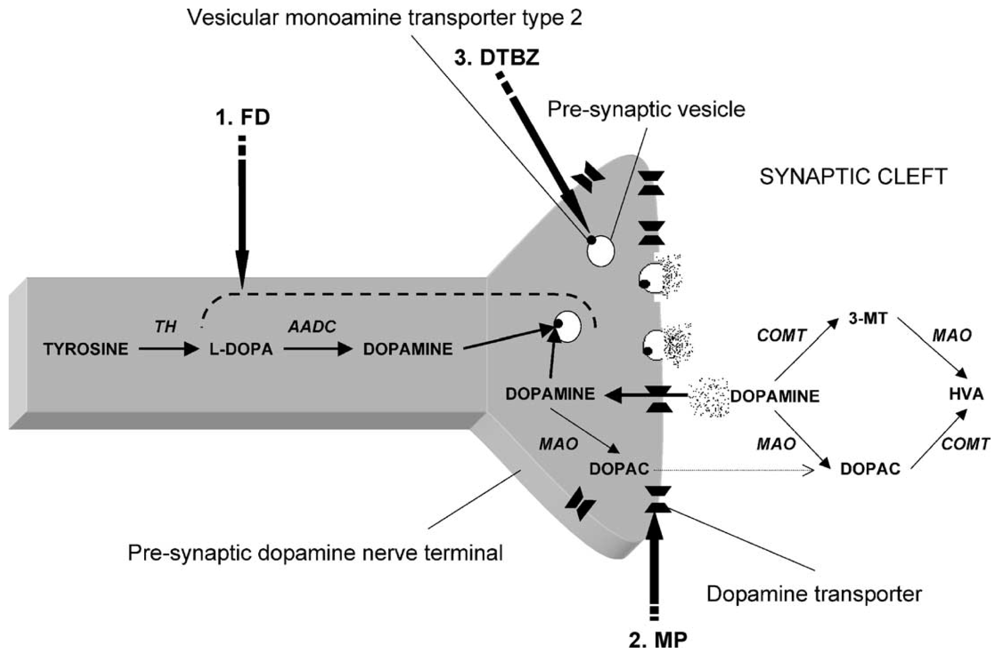
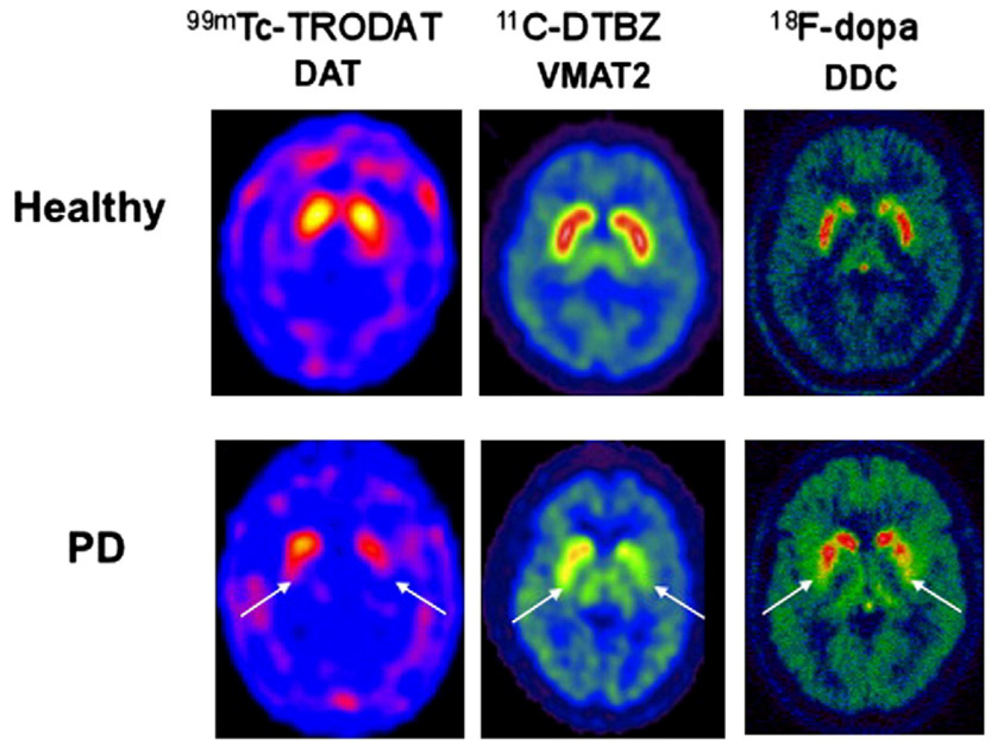
<p>The extent of DAergic SNc losses in human PD can be imaged using positron emission tomography (PET) or single photon emission computerized tomography (SPECT). Radioactive tracers in PD patients have been used to substantiate (<bold>1</bold>) <italic>compromised integrity of pre-synpatic nigrostriatal projections</italic>, <italic>i.e.</italic>, <sup>[18F]</sup>LDOPA (which monitors DA uptake, metabolism, DOPA decarbarboxylase (DDC), DA storage within intact nerve terminals); (<bold>2</bold>) <italic>faulty DA transporters</italic> (DAT) <italic>i.e.</italic>, CFT, C-RTI-32, FP-CIT ligands, <sup>[11C]</sup>methylphenidate (MP)/99mTc-TRODAT-1 or (<bold>3</bold>) <italic>abnormal type-2-vesicular monoamine transporter (VMAT2) function</italic> using tracers such as <sup>[11C]</sup>-dihydrotetrabenazine (DTBZ) which measures cytoplastic DA uptake into synaptic vesicles [<xref ref-type="bibr" rid="b28-ijms-12-00506">28</xref>–<xref ref-type="bibr" rid="b30-ijms-12-00506">30</xref>]. Chronic SNc DAergic degeneration parallels a reduction of <sup>[18]</sup>F-DOPA uptake and DAT binding which are foundational events to faulty circuitry in the basal ganglia that ultimately triggers locomotive disability [<xref ref-type="bibr" rid="b31-ijms-12-00506">31</xref>].</p></sec>
<sec>
<title>1.2. Treatment</title>
<p>In order to counteract the loss of SNc DAergic neurons, medical treatments are aimed at modulating neurotransmitter (NT) function. Prescription medicines allow for fluid voluntary movement, reduction of tremors and a sustained quality of life. Routine adjunct therapies often combine levodopa/dopa-decarboxylase inhibitors Sinemet<sup>®</sup> and Madopar<sup>®</sup> with DA receptor agonists, catechol-<italic>o</italic>-methyltransferase inhibitors, monoamine oxidase (MAO) inhibitors, anti-cholinergics and surgical treatments [<xref ref-type="bibr" rid="b32-ijms-12-00506">32</xref>]. While prescription drugs ameliorate the symptoms, they do not necessarily address the central etiology of degeneration and therefore a number of alternative approaches have been considered to slow the progression of this disease.</p></sec>
<sec>
<title>1.3. Previous Studies on Therapeutic Agents to Slow Progression of PD</title>
<p>Innovative strategies to slow the progression have met with partial success in experimental models, and to a less significant extent in clinical trials. Most neuroprotective strategies seem to fall under the general classes of anti-inflammatory, anti-apoptotic, anti-oxidants, enzyme inhibitors, growth factors, alternative medicine or receptor antagonists/agonists. Experimental trials elucidating efficacy of neuroprotective agents are rapidly expanding, and have thus far included superoxide dismutase (SOD)/catalase/peroxidase mimetics [<xref ref-type="bibr" rid="b33-ijms-12-00506">33</xref>], anti-apoptotic MAO inhibitors, rasagiline [<xref ref-type="bibr" rid="b34-ijms-12-00506">34</xref>–<xref ref-type="bibr" rid="b38-ijms-12-00506">38</xref>], (−)-epigallocatechin-3-gallate, iron chelator/antioxidant/anti-inflammatory combinations [<xref ref-type="bibr" rid="b39-ijms-12-00506">39</xref>–<xref ref-type="bibr" rid="b41-ijms-12-00506">41</xref>], celastrol, nitric oxide synthase (NOS) inhibitors [<xref ref-type="bibr" rid="b42-ijms-12-00506">42</xref>,<xref ref-type="bibr" rid="b43-ijms-12-00506">43</xref>], COX, c-jun <italic>N</italic>-terminal kinase (JNK) inhibitors [<xref ref-type="bibr" rid="b44-ijms-12-00506">44</xref>–<xref ref-type="bibr" rid="b47-ijms-12-00506">47</xref>], alpha-tocopherol, coenzyme Q<sub>10</sub>, lipoic acid [<xref ref-type="bibr" rid="b48-ijms-12-00506">48</xref>–<xref ref-type="bibr" rid="b52-ijms-12-00506">52</xref>], creatine [<xref ref-type="bibr" rid="b53-ijms-12-00506">53</xref>,<xref ref-type="bibr" rid="b54-ijms-12-00506">54</xref>] melatonin, catalpol from root of <italic>Rehmannia glutinosa Libosch</italic> [<xref ref-type="bibr" rid="b55-ijms-12-00506">55</xref>,<xref ref-type="bibr" rid="b56-ijms-12-00506">56</xref>], <italic>N</italic>-acetyl-<sc>l</sc>-cysteine (NAC), thiol antioxidants [<xref ref-type="bibr" rid="b57-ijms-12-00506">57</xref>], nerve growth factors [<xref ref-type="bibr" rid="b58-ijms-12-00506">58</xref>,<xref ref-type="bibr" rid="b59-ijms-12-00506">59</xref>], dehydroepiandrosterone [<xref ref-type="bibr" rid="b60-ijms-12-00506">60</xref>], estrogen receptor agonists [<xref ref-type="bibr" rid="b61-ijms-12-00506">61</xref>], adenosine A2 receptor antagonists [<xref ref-type="bibr" rid="b62-ijms-12-00506">62</xref>–<xref ref-type="bibr" rid="b68-ijms-12-00506">68</xref>], S-allylcysteine [<xref ref-type="bibr" rid="b66-ijms-12-00506">66</xref>], mGlu2/3 metabotropic [<xref ref-type="bibr" rid="b67-ijms-12-00506">67</xref>], acupuncture [<xref ref-type="bibr" rid="b68-ijms-12-00506">68</xref>] traditional Chinese medicine Zhen-Wu-Tang [<xref ref-type="bibr" rid="b69-ijms-12-00506">69</xref>] angiotensin-converting enzyme inhibitors [<xref ref-type="bibr" rid="b70-ijms-12-00506">70</xref>], nicotine, ginseng, ginkgo biloba, caffeine and cannabis [<xref ref-type="bibr" rid="b71-ijms-12-00506">71</xref>].</p>
<p>Despite the success using a vast range of therapeutic agents in preliminary experiments, there is a general failure of clinical trials to substantiate therapeutic effects that slow disease progression, in particular for antioxidants. This may be attributable to limitations in the current animal or <italic>in vitro</italic> models that make extrapolation of information for human PD difficult. Further, the pathology is very complex and may not be effectively antagonized with just single therapy antioxidant, ergogenic, anti-inflammatory regimens.</p>
<p>The use of nutritional supplements to slow the progression of PD has also not been fully substantiated by evidenced-based studies. The aim of this review is to re-visit the pathology of PD, and in light of pathological processes further discuss the rationale behind potential use of vitamin/mineral nutraceutical neuroprotective agents. In this review, the details of pathology are presented in Sections 1 and 2, and further discussed relevant to nutrient interactions in Section 3. Discussion includes the role of vitamins and minerals in the established United States recommended daily allowances, as well as macronutrients and plant based constituents that modulate processes with specific relevance to PD. The review is a combination of past literature and proposed theory based on known molecules that affect known biological targets which range from mitochondrial malfunction, inflammation, DA oxidation and defective UPS/lysosomal autophagy processes. Moreover, some of the compounds proposed in this review have not yet been evaluated.</p></sec></sec>
<sec>
<title>2. Review</title>
<sec>
<title>2.1. Energy Failure—Loss of OXPHOS, Rise in Anaerobic Glycolysis &amp; Lactate, ATP Depletion</title>
<p>We first review the most prominent issue underlying the loss of DAergic neurons, which is a fundamental failure in glucose metabolism due to aberration of mitochondrial respiration. It is important to note that mitochondrial malfunction could initially occur due to toxic effects of α-synuclein, endogenous neurotoxins or exogenous environmental factors. However, experimental models often employ use of mitochondrial toxins such as 1-methyl-4-phenylpyridinium (MPP<sup>+</sup>), rotenone or endogenous isoquinolines to selectively target neuropathological damage similar to, <italic>but not identical to</italic> PD degenerative effects mainly in the SNc and the locus coeruelus (LC) [<xref ref-type="bibr" rid="b72-ijms-12-00506">72</xref>–<xref ref-type="bibr" rid="b74-ijms-12-00506">74</xref>].</p>
<p>Loss of mitochondrial function leads to immediate failure of DA neurotransmission and acceleration of glycolysis to overcome the loss of oxidative phosphorylation (OXPHOS) through substrate level phosphorylation (SLP) [<xref ref-type="bibr" rid="b75-ijms-12-00506">75</xref>–<xref ref-type="bibr" rid="b77-ijms-12-00506">77</xref>]. The impact of mitochondrial toxins on these energy processes is almost always observed. <italic>In vivo</italic>, administration of 1-methyl-4-phenyl-1,2,3,6- tetrahydropyridine (MPTP) generates an immediate rise in glucose utilization (detected with <sup>[2–14C]</sup>deoxyglucose), a drop in ATP, a rise in lactate production, reduction in striatal DAT/DA and loss of tyrosine hydroxylase immunoreactivity, effects which are exacerbated by α-synuclein [<xref ref-type="bibr" rid="b78-ijms-12-00506">78</xref>–<xref ref-type="bibr" rid="b83-ijms-12-00506">83</xref>]. The drop in ATP suggests that energy deficiency is clearly involved with the process of initiating degenerative decline [<xref ref-type="bibr" rid="b84-ijms-12-00506">84</xref>]. Moreover, there is ample information to substantiate that a drop in energy corresponds to a rise in glycolysis to drive SLP, an indicator of metabolic stress. The use of proton magnetic resonance spectroscopy (1H-MRS) has been used to confirm sharp spikes in striatal lactate, which occur within 2 h of MPTP injection in C57BL/6 mice [<xref ref-type="bibr" rid="b85-ijms-12-00506">85</xref>]. In primates, a long term study utilizing infusion of MPTP over 14 ± 5 months resulted in loss of DA pre-synaptic re-uptake, parallel to a 23-fold increase in striatal lactate production, which was sustained for up to 10 months post final administration of MPTP [<xref ref-type="bibr" rid="b86-ijms-12-00506">86</xref>]. While the CNS is most often studied with respect to biochemical effects induced by systemic injection of MPTP, damage in peripheral tissue such as skeletal muscle also involves heightened anaerobic glycolytic function, elevation of lactic acid dehydrogenase and concomitant decrease of mitochondrial Complex IV, with no changes in mitochondrial Complex I [<xref ref-type="bibr" rid="b87-ijms-12-00506">87</xref>]. These shifts toward anaerobic metabolism occur in tissues with capability to uptake MPP<sup>+</sup> where similar patterns observed include loss of ATP, loss of OXPHOS, a rise in glycolysis, heightened production in lactate and neurotoxic effects which can be blocked by providing abundant glucose to growth media in order to sustain ATP production through glycolysis [<xref ref-type="bibr" rid="b77-ijms-12-00506">77</xref>,<xref ref-type="bibr" rid="b88-ijms-12-00506">88</xref>–<xref ref-type="bibr" rid="b93-ijms-12-00506">93</xref>]. The reliance of damaged neurons on greater anaerobic glycolytic function is not exclusive to PD, as head trauma, seizure or ischemia can equally provoke a rise in brain/CSF lactate and loss of ATP parallel to neurological damages [<xref ref-type="bibr" rid="b94-ijms-12-00506">94</xref>–<xref ref-type="bibr" rid="b98-ijms-12-00506">98</xref>]. In Section 3, we discuss nutrients involved with propelling anaerobic function.</p>
<p>In the human brain, <italic>in vivo</italic> functional imaging strategies to assess glucose metabolism in the brain include PET with a <sup>[18F]</sup>2-fluoro-2-deoxy-<sc>d</sc>-glucose (<sup>[18F]</sup>FDG) tracer. This tracer is used to quantify elevated rates of glycolysis/glucose transport relative to surrounding tissue. Some limitations for this method involve the non-specific manner by which <sup>[18F]</sup>FDG accumulates in the brain. <sup>[18F]</sup>FDG enters through the glycolytic cycle prior to conversion of pyruvate, therefore its measurement does not differentiate between aerobic (OXPHOS) and anaerobic (SLP) metabolism. Further, uptake is not selective to cell type and therefore false positives (or heightened metabolic activities) are likely to occur in particular for diseases involving active inflammatory tissue, where metabolic rate of glucose is extremely high [<xref ref-type="bibr" rid="b99-ijms-12-00506">99</xref>]. This technique however, has been used in sliced striatal tissue to corroborate that regional exposure to MPP<sup>+</sup> can evokes a sharp rise in cerebral glucose metabolic rate (CMRglc) [<xref ref-type="bibr" rid="b93-ijms-12-00506">93</xref>]. FDG PET studies could also be beneficial in terms of evaluating patterns in non-diseased, non-inflammatory models. FDG PET imaging techniques clearly show that the process of aging in monkeys, corresponds to loss in both regional cerebral blood flow/<sup>[15O]</sup> H<sub>2</sub>O and rCMRglc in many areas of the brain including the cerebellum, hippocampus, striatum, occipital cortex, temporal cortex, and frontal cortex [<xref ref-type="bibr" rid="b100-ijms-12-00506">100</xref>]. Age associated hypometabolism in the human brain is also believed to precipitate increased risk for many age associated CNS neurodegenerative diseases [<xref ref-type="bibr" rid="b101-ijms-12-00506">101</xref>]. Future research is now considering preventative implementation with nutrients that could assist in minimizing metabolic losses [<xref ref-type="bibr" rid="b101-ijms-12-00506">101</xref>].</p>
<p>In brief, the loss of ATP in the SNc is <italic>detrimental</italic> because this single event can initiate a range of downstream collapse on energy requiring systems that can then lead to (1) catecholamine oxidation and formation of DA neurotoxins/free radicals (2) excitotoxic and programmed cell death (3) mitochondrial transition pore opening, matrix swelling, release of mitochondrial proteins into the cytosol, apoptosis [<xref ref-type="bibr" rid="b102-ijms-12-00506">102</xref>–<xref ref-type="bibr" rid="b107-ijms-12-00506">107</xref>] and microtubular/cell structure collapse [<xref ref-type="bibr" rid="b108-ijms-12-00506">108</xref>].</p></sec>
<sec>
<title>2.2. Loss of DA Regulation and Trafficking—VMAT2</title>
<p>One of the first events brought about by reduction of ATP is a loss of energy requiring systems that drive <italic>DA trafficking</italic>. Section 3, also refers to a large number of nutraceuticals that can block these processes. Failure of DA trafficking, not only occurs due to decline in ATP, but can also result from genetic mutations in SNCA (A53T and A30P) [<xref ref-type="bibr" rid="b109-ijms-12-00506">109</xref>], mitochondrial insufficiency or oxidative damage by ROS, all which trigger excessive DA release from SNc nerve terminals [<xref ref-type="bibr" rid="b110-ijms-12-00506">110</xref>,<xref ref-type="bibr" rid="b111-ijms-12-00506">111</xref>]. With regards to energy, a lack of ATP diminishes the capability of intracellular ATPase pumps to sequester DA into synaptic vesicles (where DA is stable due to slightly acidic pH), which is a pivotal factor in initiating a cascade of neurotoxic events [<xref ref-type="bibr" rid="b112-ijms-12-00506">112</xref>,<xref ref-type="bibr" rid="b113-ijms-12-00506">113</xref>]. Failure of vesicle monoamine transporter 2 (VMAT2) results in immediate leaked DA into the cytosolic compartment (easily subject to oxidative breakdown at neutral pH) where it readily oxidizes to form <italic>neurotoxic DA-quinones,</italic> o<italic>-semiquinones, dopaminergic poisons and related free radicals</italic> [<xref ref-type="bibr" rid="b114-ijms-12-00506">114</xref>–<xref ref-type="bibr" rid="b116-ijms-12-00506">116</xref>] which can then contribute to eventual decay of the striatal tract [<xref ref-type="bibr" rid="b117-ijms-12-00506">117</xref>].</p>
<p>Further, functional loss of VMAT2 can occur due to age-associated losses in VMAT2 <italic>m</italic>RNA expression, which create vulnerability to extensive neurological damage in the presence of mitochondrial toxins such as MPTP <italic>in vivo</italic> or MPP<sup>+</sup> <italic>in vitro</italic> [<xref ref-type="bibr" rid="b118-ijms-12-00506">118</xref>–<xref ref-type="bibr" rid="b123-ijms-12-00506">123</xref>]. MPP<sup>+</sup> can cause further insult due to its ability to bind directly to VMAT2, gain entrance into synaptic vesicles and initiate extrusion of DA back into the cytoplasmic compartment [<xref ref-type="bibr" rid="b124-ijms-12-00506">124</xref>,<xref ref-type="bibr" rid="b125-ijms-12-00506">125</xref>].</p></sec>
<sec>
<title>2.3. Dopamine Oxidation</title>
<p>Inadequate function or expression of VMAT2 <italic>m</italic>RNA has also been reported in association with PD [<xref ref-type="bibr" rid="b126-ijms-12-00506">126</xref>], which could precipitate three main routes by which the oxidation of DA can <italic>become pathological</italic>. These include (1) the enzymatic oxidation of DA via tyrosinase, phospholipase A<sub>2</sub> (PLA<sub>2</sub>)/prostaglandin H synthase (COX), lipoxygenase and xanthine oxidase to form DA-quinone en route to neuromelanin synthesis (2) non-enzymatic autoxidation of DA by the presence of oxygen, H<sub>2</sub>O<sub>2</sub>, or metals and (3) the enzymatic oxidation of DA by MAO which can lead to H<sub>2</sub>O<sub>2</sub> production and synthesis of DA-aldehydes. The heavy oxidation of DA (be it non-enzymatic or enzymatic) seems to initiate neurodegenerative pathogenesis, a depletion of glutathione, oxidation of available ascorbate and subsequent oxidative stress in the SNc area [<xref ref-type="bibr" rid="b127-ijms-12-00506">127</xref>]. In Section 3, we provide information on nutraceuticals that may be able to antagonize each of the major routes of DA oxidation.</p>
<sec>
<title>2.3.1. Enzymatic Oxidation of DA, the Neuromelanin Pathway &amp; DA-Quinones</title>
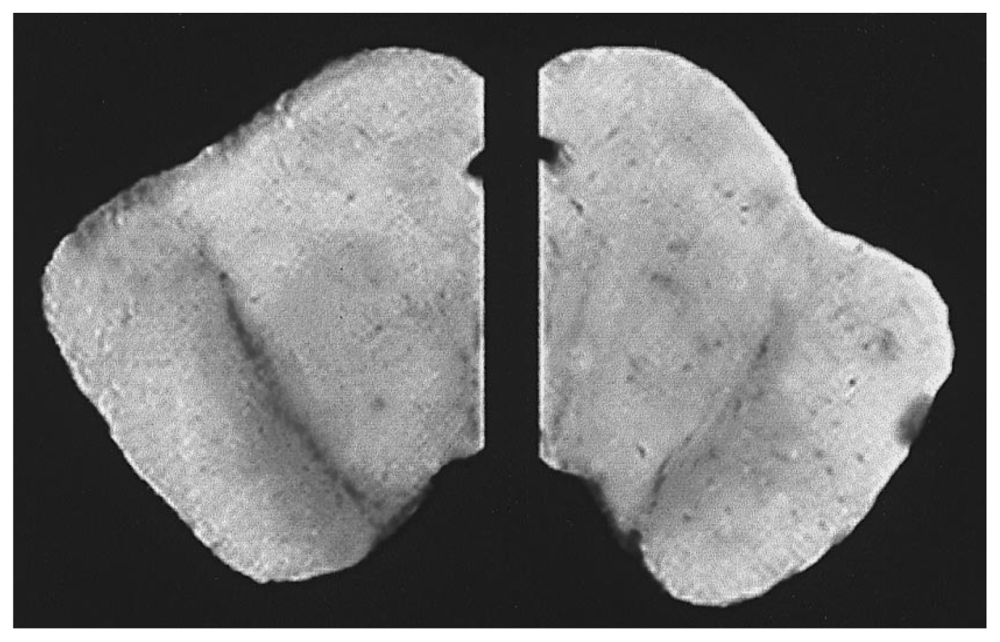
<p>Understanding the role of target enzymes and how they exacerbate DA oxidation could be beneficial in directing future investigation or design of nutraceutical combinations. First, the enzymatic oxidation of DA occurs through heightened activity of tyrosinase, COX, lipoxygenase and xanthine oxidase which converts DA to DA-quinone en route to neuromelanin (NM) [<xref ref-type="bibr" rid="b128-ijms-12-00506">128</xref>]. The neuromelanin pathway if intensified can produce deleterious DA-quinone neurotoxic metabolites such as o-semiquinones or benzothiazolines, which are potent inhibitors of mitochondrial pyruvate dehydrogenase (<italic>i.e</italic>., complex I/Krebs cycle) and initiators of α-synuclein fibrillization [<xref ref-type="bibr" rid="b129-ijms-12-00506">129</xref>–<xref ref-type="bibr" rid="b132-ijms-12-00506">132</xref>]. Oxidized DA can further react with thiols producing DA-cysteine adducts such as 5-S-cysteinyldopamine which mediate metal catalyzed oxidation of proteins, which lead to protein misfolding and aggregation [<xref ref-type="bibr" rid="b131-ijms-12-00506">131</xref>]. While gradual accumulation of NM in SNc tissue occurs as a natural process of aging [<xref ref-type="bibr" rid="b133-ijms-12-00506">133</xref>], an intense heightened dark melanized pigment (<italic>hyperpigmentation</italic>) appears in the SNc preceding not only neuronal degeneration but also α-synuclein aggregation, inflammation, oxidative stress, apoptosis, Lewy body formation, depletion of GSH, functional loss of DAT and the loss of tyrosine hydroxylase positive neurons [<xref ref-type="bibr" rid="b10-ijms-12-00506">10</xref>,<xref ref-type="bibr" rid="b128-ijms-12-00506">128</xref>,<xref ref-type="bibr" rid="b134-ijms-12-00506">134</xref>,<xref ref-type="bibr" rid="b135-ijms-12-00506">135</xref>]. With PD, a biphasic but final loss of NM occurs gradually due to massive oxidation, cell death and release of NM from dying cells [<xref ref-type="bibr" rid="b136-ijms-12-00506">136</xref>]. The loss of melanized nigral DAergic neurons is evident in PD brains (Right) when compared to healthy controls (Left) as shown in <xref ref-type="fig" rid="f3-ijms-12-00506">Figure 3</xref> and is a major part of the pathology [<xref ref-type="bibr" rid="b137-ijms-12-00506">137</xref>]. Ultimately, the loss of NM renders failure of its natural protective function, which is to sequester iron, free radicals and toxic quinones [<xref ref-type="bibr" rid="b138-ijms-12-00506">138</xref>].</p>
<p>The generation of DA oxidative toxins <italic>also</italic> includes <italic>enzymatic conversion of dopaminochrome to 5,6,-dihydroxyindole</italic> by DT diaphorase, the free radical initiated <italic>conversion of</italic> o<italic>-hydroquinones (protective) to</italic> o<italic>-semiquinones (toxic)</italic> [<xref ref-type="bibr" rid="b132-ijms-12-00506">132</xref>] and <italic>transglutaminases</italic> which incorporate sulfur amino acids into DA-cysteine conjugate toxic precursors to neuromelanin [<xref ref-type="bibr" rid="b139-ijms-12-00506">139</xref>]. And, recent studies suggest that transglutaminase inhibitors could be useful to prevent cross-linking reactions that lead to neurodegenerative aggregated proteins [<xref ref-type="bibr" rid="b140-ijms-12-00506">140</xref>]. Animal models deficient in enzymes capable of catalytically oxidizing DA to DA-quinone (<italic>i.e.</italic>, absent of PLA<sub>2</sub> COX2), show a resistance to DAergic neurotoxicity after administration of MPTP. This is also corroborated where knockout models for SOD/GSH Px show extensive damage with MPTP [<xref ref-type="bibr" rid="b140-ijms-12-00506">140</xref>–<xref ref-type="bibr" rid="b144-ijms-12-00506">144</xref>], and protective effects are observed with COX/PLA<sub>2</sub> inhibitors [<xref ref-type="bibr" rid="b145-ijms-12-00506">145</xref>–<xref ref-type="bibr" rid="b148-ijms-12-00506">148</xref>].</p></sec>
<sec>
<title>2.3.2. Non Enzymatic Oxidation of DA, 6-OHDA, Release of Iron &amp; Oxidative Stress</title>
<p>A <italic>second</italic> route for DA oxidation is <italic>non-enzymatically</italic> by reactive oxygen species (ROS) and metals (Fe<sup>2+</sup>, Cu<sup>2+</sup>, and Mn<sup>2+</sup>) [<xref ref-type="bibr" rid="b149-ijms-12-00506">149</xref>,<xref ref-type="bibr" rid="b150-ijms-12-00506">150</xref>]. The autoxidation of DA can render formation of 6-OHDA (a potent neurotoxin) and O<sub>2</sub> <sup>−</sup>. If superoxide reacts with nitric oxide (NO) the formation of ONOO<sup>−</sup> is evident. Peroxynitrite in turn can cyclically re-oxidize DA, deplete available reduced glutathione/ascorbate (vitamin C), incur a substantial loss of endogenous GSH-peroxidase and destroy the natural ability of GSH to act as an antioxidant [<xref ref-type="bibr" rid="b129-ijms-12-00506">129</xref>,<xref ref-type="bibr" rid="b151-ijms-12-00506">151</xref>]. While PD patients display depletion of GSH within the SNc [<xref ref-type="bibr" rid="b152-ijms-12-00506">152</xref>], the reduction of GSH (<italic>i.e</italic>., γ-glutamylcysteine synthetase inhibitor) in experimental models also renders the SNc vulnerable to the toxic effects of MPTP and 6-OHDA [<xref ref-type="bibr" rid="b8-ijms-12-00506">8</xref>]. For this reason, thiol based dietary antioxidants could be considered for clinical trials, as some have reported they prevent MPTP induced toxicity in mice [<xref ref-type="bibr" rid="b57-ijms-12-00506">57</xref>,<xref ref-type="bibr" rid="b153-ijms-12-00506">153</xref>], attenuate pathological effects of 6-OHDA, ONOO<sup>−</sup> and block the formation of DA o-semiquinone neurotoxic radicals [<xref ref-type="bibr" rid="b154-ijms-12-00506">154</xref>].</p>
<p>Once 6-OHDA is formed, its presence can trigger neurodegeneration through reduction of striatal zinc and metallothione (otherwise antioxidant/metal detoxification agents) and initiate selective release of free iron from ferritin, where pro-oxidant effects predominate [<xref ref-type="bibr" rid="b152-ijms-12-00506">152</xref>,<xref ref-type="bibr" rid="b155-ijms-12-00506">155</xref>–<xref ref-type="bibr" rid="b160-ijms-12-00506">160</xref>]. This could be perilous given the already high concentrations of iron dispersed throughout the substantia nigra, globus pallidus, red nucleus and locus cerulus [<xref ref-type="bibr" rid="b161-ijms-12-00506">161</xref>–<xref ref-type="bibr" rid="b163-ijms-12-00506">163</xref>]. Heightened free iron deposits are found in the vicinity of neurodegenerative regions, located in microglia, astrocytes and oligodendrocytes in conjunction with a rise in heme oxygenase (HO-1) (an enzyme which yields free Fe<sup>2+</sup> iron from heme) and disappearance of NM (loss of high affinity binding polymer for Fe<sup>2+</sup>) [<xref ref-type="bibr" rid="b164-ijms-12-00506">164</xref>–<xref ref-type="bibr" rid="b168-ijms-12-00506">168</xref>]. In PD patients, iron deposition near degenerating neurons [<xref ref-type="bibr" rid="b169-ijms-12-00506">169</xref>], could be intensified by hereditary mutations in iron regulatory binding proteins [<xref ref-type="bibr" rid="b170-ijms-12-00506">170</xref>,<xref ref-type="bibr" rid="b171-ijms-12-00506">171</xref>], iron storage/transport proteins such as ferritin (L/H subunits stabilization: storage/ferroxidase mediated uptake and utilization), caeruloplasmin, iron regulatory protein 2, lactoferrin/melanotransferrin receptors or the divalent metal transporter-1 [<xref ref-type="bibr" rid="b172-ijms-12-00506">172</xref>,<xref ref-type="bibr" rid="b173-ijms-12-00506">173</xref>]. Further, the accumulation of iron could be heightened by HO-1 which is significantly expressed in SNc dopaminergic neurons, the nigral neuropil, reactive astrocytes and Lewy bodies [<xref ref-type="bibr" rid="b174-ijms-12-00506">174</xref>].</p>
<p>To summarize, the dynamics of PD pathogenesis is believed to evolve in part from mitochondrial energy failure, and through a series of events—DA oxidation can perpetuate a cyclical generation of DAergic toxins and precipitate high levels of free iron released throughout the basal ganglia. These events initiate a forward cycle of self-perpetuated DA oxidation, loss of NM and Fe<sup>2+</sup> mediated damage which can indirectly fuel this loop by additional damage to the 26S proteasome prompting accelerated α-synuclein protein aggregation [<xref ref-type="bibr" rid="b175-ijms-12-00506">175</xref>] or production of OH radicals which can oxidize lipids/proteins and DNA [<xref ref-type="bibr" rid="b8-ijms-12-00506">8</xref>]. This degenerative cascade could be worsened by genetic mutations in iron transport proteins such as divalent metal transporter 1 (DMT1/natural resistance associated macrophage protein 2/solute carrier family 11, member 2) as noted in the SN of PD patients [<xref ref-type="bibr" rid="b176-ijms-12-00506">176</xref>].</p>
<p>In Section 3, we discuss nutraceuticals that could impact each of these processes, in particular focusing on the important role that iron may play in PD pathology [<xref ref-type="bibr" rid="b177-ijms-12-00506">177</xref>–<xref ref-type="bibr" rid="b179-ijms-12-00506">179</xref>], the removal of which with iron chelators (<italic>i.e</italic>., EGCG, VK-28, clioquincol) is protective in a number of experimental models [<xref ref-type="bibr" rid="b40-ijms-12-00506">40</xref>,<xref ref-type="bibr" rid="b178-ijms-12-00506">178</xref>,<xref ref-type="bibr" rid="b179-ijms-12-00506">179</xref>]. We also discuss the importance of using nutrient based combinations that contain chelators as just one module, since equally destructive forces are contributed by energy compromise, DA oxidation, concentration of free Fe<sup>2+</sup> and the subsequent down stream metal catalyzed aggregation of insoluble proteins [<xref ref-type="bibr" rid="b180-ijms-12-00506">180</xref>].</p></sec>
<sec>
<title>2.3.3. Enzymatic DA Oxidation by MAO-DA Aldehydes &amp; H<sub>2</sub>O<sub>2</sub></title>
<p>The third major route for oxidation of DA is through routine deamination by MAO A or B. MAO activity increases with the natural process of aging and can yield toxic products such as hydrogen peroxide (H<sub>2</sub>O<sub>2</sub>), ammonia, aldehydes, reactive oxygen species [<xref ref-type="bibr" rid="b180-ijms-12-00506">180</xref>–<xref ref-type="bibr" rid="b182-ijms-12-00506">182</xref>], 3,4-dihydroxyphenylacetaldehyde and 3,4-dihydroxyphenylglycolaldehyde. The latter two have been reported to condense with H<sub>2</sub>O<sub>2</sub> to form <italic>neurotoxic OH radicals</italic> [<xref ref-type="bibr" rid="b183-ijms-12-00506">183</xref>,<xref ref-type="bibr" rid="b184-ijms-12-00506">184</xref>]. And, in catecholamine neurons, DA can directly react with H<sub>2</sub>O<sub>2</sub> leading to <italic>formation of 6-OHDA</italic> (neurotoxin) or further condense with acetaldehyde to produce toxic endogenous precursors such as 1,2,3,4-tetrahydroisoquinoline, 1,2,3,4-tetrahydro-β-carboline and R-salsolinol which are then subject to methylation [<xref ref-type="bibr" rid="b185-ijms-12-00506">185</xref>–<xref ref-type="bibr" rid="b190-ijms-12-00506">190</xref>] by either nicotinamide/salsolinol or phenylethanolamine <italic>N</italic>-methyltransferases forming toxic <italic>N</italic>-methylated pyridines with structure similar to MPTP/MPP<sup>+</sup> [<xref ref-type="bibr" rid="b191-ijms-12-00506">191</xref>,<xref ref-type="bibr" rid="b186-ijms-12-00506">186</xref>,<xref ref-type="bibr" rid="b187-ijms-12-00506">187</xref>,<xref ref-type="bibr" rid="b191-ijms-12-00506">191</xref>].</p></sec></sec>
<sec>
<title>2.4. Excitotoxicity</title>
<p>Mitochondrial energy dysfunction not only leads to collapse of DAergic function, but also instability of neurons to maintain voltage at the plasma membrane. Depolarization can cause over-activation of NMDA receptors throughout the brain, where glycine binds to NR1 and glutamate to the NR2 initiating fast inward Ca<sup>2+</sup> currents to the cytoplasm. The general theory of excitotoxicity has remained consistent throughout the years and has been described to involve depolarization of the plasma membrane creating excitability in part due to (1) release of Mg<sup>+</sup> as a voltage dependent <italic>N</italic>-methyl-<sc>d</sc>-aspartate (NMDA) block at presynaptic receptors (2) greater susceptibility to excitatory postsynaptic inward Ca<sup>2+</sup> currents in response to glutamate activation on ionotropic NMDA/AMPA/kainate receptors and (3) a loss of inhibitory GABA metabotropic-inward ion currents upon receptor activation.</p>
<p>Mitochondrial toxins such as rotenone can worsen the heightened amplitude of inward ionic currents, effects known to be are reversible by addition of ATP [<xref ref-type="bibr" rid="b192-ijms-12-00506">192</xref>]. In terms of circuitry, a deficit of magnesium (Mg) or ATP can lead to failed regulatory control of intracellular Ca<sup>2+</sup> systems through changes <italic>not only</italic> at the NMDA receptor but also intracellularly through influences on inositol 1,4,5-trisphosphate and ryanodine receptors [<xref ref-type="bibr" rid="b193-ijms-12-00506">193</xref>,<xref ref-type="bibr" rid="b194-ijms-12-00506">194</xref>]. <italic>In vivo</italic>, studies show that dietary deficiency of Mg lowers NMDA receptor activation threshold and correlates to the overexcitability of glutaminergic neurons [<xref ref-type="bibr" rid="b195-ijms-12-00506">195</xref>]. In Section 3, we discuss the importance of dietary Mg, in this and many other processes involved with PD pathology.</p>
<p>In PD, the over-excitability of the NMDA receptor may contribute to neurodegeneration because Ca<sup>2+</sup> activation of neuronal nNOS can lead to nitrosative stress—a known primary elemental monomer modification leading to toxic mis-folded and aggregated proteins [<xref ref-type="bibr" rid="b196-ijms-12-00506">196</xref>,<xref ref-type="bibr" rid="b197-ijms-12-00506">197</xref>]. In reciprocal fashion, the accumulation of α-synuclein can stimulate nNOS, caspase-3 and initiate poly(ADP-ribose) polymerase (PARP-1) cleavage, all events which contribute toward neurotoxicity [<xref ref-type="bibr" rid="b198-ijms-12-00506">198</xref>]. The toxic effects of α-synuclein on activation of nNOS are corroborated by studies that demonstrate that effects are blocked in the presence of NMDA receptor antagonists such as MK-801 and APV [<xref ref-type="bibr" rid="b199-ijms-12-00506">199</xref>].</p>
<p>In addition, mitochondrial toxicity (<italic>i.e</italic>., MPTP) also leads to accumulation of glutamate in the SNc to an extent parallel to degenerative lesion [<xref ref-type="bibr" rid="b200-ijms-12-00506">200</xref>]. The rise in glutamate stimulates increase influx of Ca<sup>2+</sup> calpain activation in the cytosolic compartment, and these toxic effects are reversed by administration of NMDA antagonists, calpain inhibitors <italic>or</italic> antioxidants [<xref ref-type="bibr" rid="b201-ijms-12-00506">201</xref>–<xref ref-type="bibr" rid="b203-ijms-12-00506">203</xref>]. While the role of the NMDA receptor as it relates to PD is continually debated, it is noteworthy to mention that there is a very delicate balance between preventing over-activation or under-activation of glutaminergic receptors. The function of glutamate in neurotransmission is required for synaptic plasticity. And, as such, some studies also show that NMDA agonists such as D-cycloserine are protective against MPTP induced DAergic degeneration and microglial activation in the brain [<xref ref-type="bibr" rid="b204-ijms-12-00506">204</xref>]. So clearly, this topic is very complex.</p></sec>
<sec>
<title>2.5. Inflammation</title>
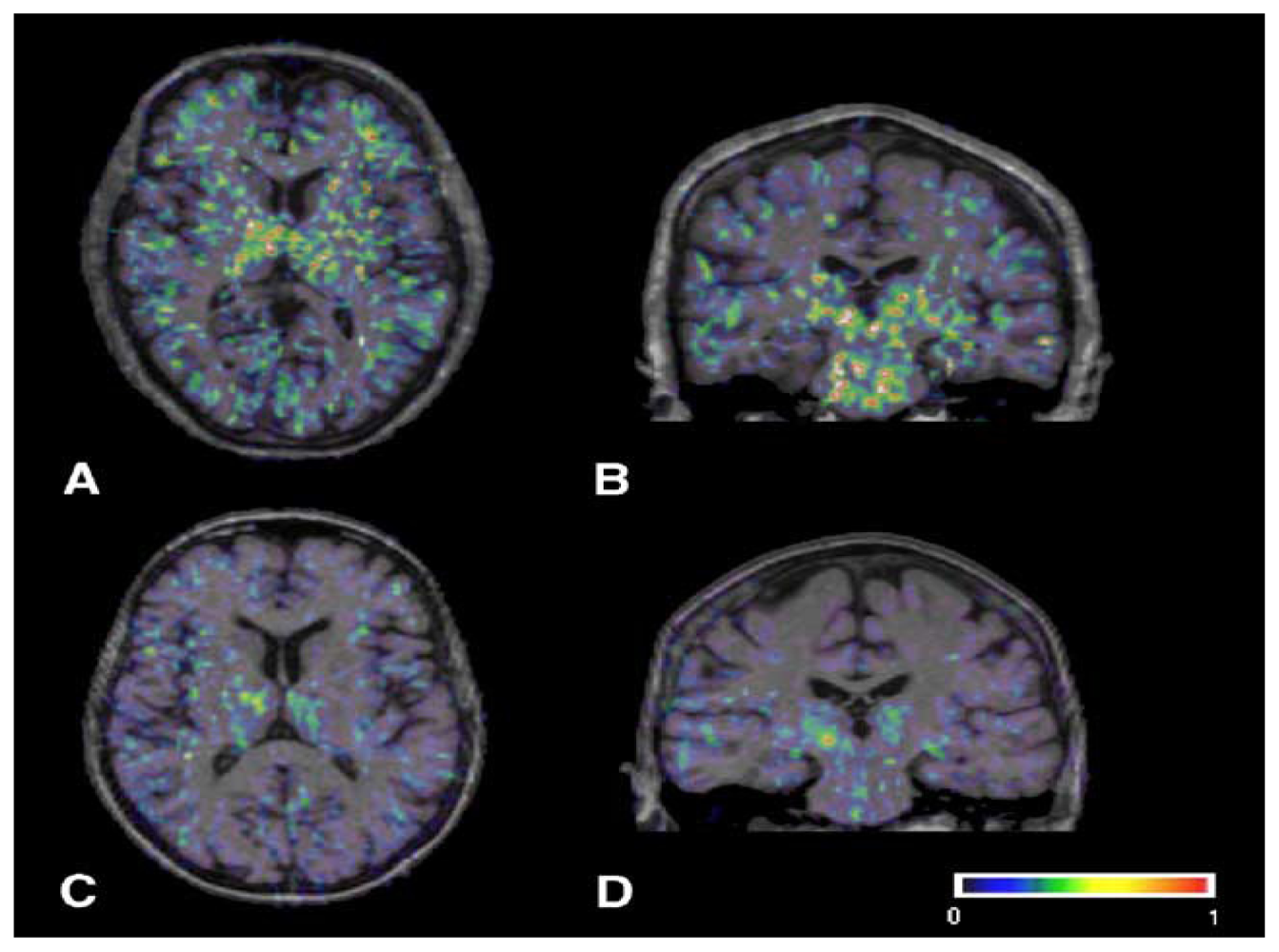
<p>Both dying neurons and aggregated α-synuclein can trigger local gliosis, microglial activation, T cell infiltration and elevated expression/release of immunological participants [<xref ref-type="bibr" rid="b205-ijms-12-00506">205</xref>]. These include major histocompatibility antigens, adhesion molecules, COX-2, IL-1b, IL-2, IL-4, IL-6, TNF-alpha, prostaglandins, glutamate, ROS, iNOS, MPO, NO and O<sub>2</sub> <sup>−</sup> the latter two of which can react forming the neurotoxic molecule ONOO<sup>−</sup> [<xref ref-type="bibr" rid="b205-ijms-12-00506">205</xref>–<xref ref-type="bibr" rid="b215-ijms-12-00506">215</xref>]. Many of the inflammatory indicators are found in post-mortem tissue obtained form PD patients, particularly in regions of the SNc, striatum, LC and spinal fluid [<xref ref-type="bibr" rid="b216-ijms-12-00506">216</xref>]. Major regulators of this response involve tyrosine kinase, phosphatidylinositiol 3-kinase (PI3K)/Akt, and the mitogen activated protein kinase (MAPK) signaling pathways such as c-Jun NH<sub>2</sub>-terminal Kinase (JNK), extracellular signal-regulated kinases (ERK) ½ p38 MAPK [<xref ref-type="bibr" rid="b46-ijms-12-00506">46</xref>,<xref ref-type="bibr" rid="b217-ijms-12-00506">217</xref>–<xref ref-type="bibr" rid="b222-ijms-12-00506">222</xref>]. MAPK’s are evoked by cytokines or inflammatory stimuli, regulated by protein kinase A/cAMP and ultimately direct gene transcription by phosphorylating nuclear factor-kappa B (NF-κB) [<xref ref-type="bibr" rid="b223-ijms-12-00506">223</xref>–<xref ref-type="bibr" rid="b226-ijms-12-00506">226</xref>]. PET imaging using PK11195, [1-(2-chlorophenyl)-<italic>N</italic>-methyl-<italic>N</italic>-(1-methylpropyl)-3-isoquinoline carboxamide] show active microglia occurring around neurodegenerative lesions in idiopathic PD patients <italic>vs.</italic> controls [<xref ref-type="bibr" rid="b227-ijms-12-00506">227</xref>].</p>
<p>The use of anti-inflammatory agents may attenuate DAergic damage and antagonize global effects through targeting a number of signaling routes such as MAPKs, NF-kappaB activation/nuclear translocation or its association with the CREB-binding protein, IkappaB kinase (IKK), activating protein-1 (AP-1) and/or preventing IkappaB degradation or phosphorylation of c-jun <italic>N</italic>-terminal kinase (JNK) [<xref ref-type="bibr" rid="b228-ijms-12-00506">228</xref>–<xref ref-type="bibr" rid="b231-ijms-12-00506">231</xref>]. Substances that can inhibit any one of these mechanistic controls should block pro-inflammatory processes and antagonize the formation of iNOS, COX-2, PGE (2) or HO-1, thereby preventing DAergic loss induced by MPTP [<xref ref-type="bibr" rid="b232-ijms-12-00506">232</xref>–<xref ref-type="bibr" rid="b237-ijms-12-00506">237</xref>]. The co-expression of iNOS and COX-2 could be detrimental because the product formed by NO and O<sub>2</sub> <sup>−</sup> (ONOO<sup>−</sup>) plays a highly relevant role in the pathological processes involved with PD. Removal of one or both of O<sub>2</sub> <sup>−</sup> and NO/ONOO can prevent the deleterious effects of PD model toxins, as reported in transgenic mice deficient in iNOS, nNOS, NADPH oxidase or with overexpression of Mn/SOD conferring resistance to the toxicological effects of MPTP or intrastriatal injection of 6-OHDA [<xref ref-type="bibr" rid="b238-ijms-12-00506">238</xref>–<xref ref-type="bibr" rid="b243-ijms-12-00506">243</xref>]. Likewise, administration of specific nNOS/iNOS inhibitors or SOD mimetics can protect against the neurotoxicity of MPTP [<xref ref-type="bibr" rid="b33-ijms-12-00506">33</xref>,<xref ref-type="bibr" rid="b42-ijms-12-00506">42</xref>,<xref ref-type="bibr" rid="b244-ijms-12-00506">244</xref>–<xref ref-type="bibr" rid="b246-ijms-12-00506">246</xref>]. In the next section, we review nutraceuticals with multi-capabilities on anti-inflammatory signaling processes.</p></sec></sec>
<sec>
<title>3. Nutraceuticals</title>
<sec>
<title>3.1. Energy—Biochemistry and Metabolism</title>
<p>Considering the cascade of degeneration in PD as it involves mutations affecting protein degradation and folding, inadequate energy production in the SNc, DAergic malfunction, degenerative oxidative damage, excitotoxicity and inflammation, the question remains if any nutraceuticals or dietary practices as a lifetime habit can prevent or block one or more of these pathways and as a result slow the progression of PD. The next section provides a review of previous studies and future directives based on mechanisms as discussed above.</p>
<sec>
<title>3.1.1. Pyruvic Acid</title>
<p>To overcome the <italic>loss of ATP</italic>, due to single or multiple hits directed at the mitochondria within neurons of the SNc, the first question to arise is to elucidate if it is possible to enhance anaerobic capability of the human brain, when physiological control over glucose concentrations are highly regulated. In order to optimize anaerobic glycolysis within the brain, dietary compounds must pass through the blood brain barrier (BBB) and likely work to promote key glycolytic regulators of substrate level phosphorylation including phosphoglycerate kinase, pyruvate kinase or lactic acid dehydrogenase (LDH), which would propel production of ATP [<xref ref-type="bibr" rid="b74-ijms-12-00506">74</xref>,<xref ref-type="bibr" rid="b247-ijms-12-00506">247</xref>,<xref ref-type="bibr" rid="b248-ijms-12-00506">248</xref>]. Nutrient offsets associated with these enzymes are clearly altered during CNS neurological injury as evidenced by significant elevation in the ratios of lactate/pyruvate, NAD<sup>+</sup>/NADH and NADP<sup>+</sup>/NADPH [<xref ref-type="bibr" rid="b249-ijms-12-00506">249</xref>]. These nutrient offsets suggest “metabolic stress” and accelerated use of nicotinamide reducing equivalents to drive survival processes to produce ATP through anaerobic shifts, in particular ischemia. The anaerobic process is fueled by the metabolite pyruvate (PY), which is a substrate for the LDH enzyme. Our investigations of the molecule PY, have indicated it to be the most powerful antioxidant of the glycolytic metabolites, also having capability of protect neuroblastoma against MPP<sup>+</sup>/6-OHDA and H<sub>2</sub>O<sub>2</sub> toxicities <italic>in vitro</italic> [<xref ref-type="bibr" rid="b247-ijms-12-00506">247</xref>–<xref ref-type="bibr" rid="b250-ijms-12-00506">250</xref>]. It is possible that oral administration of PY could be capable of entering the brain, serving as a substrate for glycolysis, the Krebs cycle and the GABA shunt [<xref ref-type="bibr" rid="b251-ijms-12-00506">251</xref>] and for this reason its use has been effective in preventing neurological damage associated with ischemic stroke [<xref ref-type="bibr" rid="b252-ijms-12-00506">252</xref>]. Recently, other attributes of PY include an ability to block NMDA excitotoxicity in hippocampal neurons [<xref ref-type="bibr" rid="b253-ijms-12-00506">253</xref>]. Although future research will be required to corroborate this, it would seem logical to combine oral administration of pyruvate, w/Mg (a required cofactor for pyruvate kinase) and niacin (precursor of reducing equivalents) which could help to restore nutrient offsets that occur due to accelerated anaerobic glycolysis in the CNS, when oxygen or mitochondrial function is insufficient.</p></sec>
<sec>
<title>3.1.2. Niacin</title>
<p>Furthermore, a <italic>deficiency of niacin</italic> is known to increase the risk for DAergic neurons to degenerate [<xref ref-type="bibr" rid="b191-ijms-12-00506">191</xref>]. Likewise, the toxicity of MPTP is associated with a depletion of niacin, likely due to high demand for NAD<sup>+</sup> in several biochemical processes including glycolysis and apoptotic over activation of PARP-1 [<xref ref-type="bibr" rid="b254-ijms-12-00506">254</xref>–<xref ref-type="bibr" rid="b256-ijms-12-00506">256</xref>]. The administration of niacin has shown protective against MPTP induced SNc cell loss and striatal DA depletion <italic>in vivo</italic>, effects which are possibly due to preventing drop in ATP by fueling glycolysis and preventing PARP-I NAD<sup>+</sup> depletion [<xref ref-type="bibr" rid="b257-ijms-12-00506">257</xref>–<xref ref-type="bibr" rid="b259-ijms-12-00506">259</xref>]. Further upstream, PARP-1 is under regulatory control of tumor suppressor protein p53, a transcription factor that controls programmed cell death and cell cycle arrest. For this reason, it is not surprising that administration of either <italic>niacin</italic>, <italic>PARP-1/p53 inhibitors</italic> or PARP-1 knockout mice all show a resistance to MPTP mediated DAergic toxicity [<xref ref-type="bibr" rid="b256-ijms-12-00506">256</xref>,<xref ref-type="bibr" rid="b257-ijms-12-00506">257</xref>,<xref ref-type="bibr" rid="b260-ijms-12-00506">260</xref>–<xref ref-type="bibr" rid="b262-ijms-12-00506">262</xref>]. Therefore, the use of niacin as a therapeutic agent could be explored further, given its vast biochemical benefits including additional contribution to the pentose phosphate pathway, which regulates endogenous removal of H<sub>2</sub>O<sub>2</sub> (a major contributing factor to PD pathology) through the GSH-Px system [<xref ref-type="bibr" rid="b191-ijms-12-00506">191</xref>]. And, in our previous work, we have also found NADH to be a powerful antioxidant, alone capable of protecting against peroxide induced toxicity in neuroblastoma [<xref ref-type="bibr" rid="b247-ijms-12-00506">247</xref>].</p>
<p>With regard to niacin, it is important to make note that a bit of controversy surrounds its use particularly as it relates to PD. Concern has been expressed that its administration could lead to synthesis of endogenous <italic>N</italic>-methylated nicotinamide, a compound with structural similarity to MPP<sup>+</sup> [<xref ref-type="bibr" rid="b263-ijms-12-00506">263</xref>]. Nicotinamide <italic>N</italic>-methyltransferase (NNMT) is the enzyme that can readily convert pyridines to toxic substances very similar to the PD toxic metabolite MPP<sup>+</sup> [<xref ref-type="bibr" rid="b191-ijms-12-00506">191</xref>]. While future research will be required to investigate these concerns, it may be possible to combine administration of niacin with natural compounds known to down regulate NNMT such as plant derived isoquinoline alkaloids, <italic>caffeine</italic> ± precursors (<italic>i.e</italic>., <italic>xanthosine</italic>—green tea or cocoa tea), which reportedly compete for methyl groups otherwise donated by s-adenosyl-<sc>l</sc>-methionine to drive NNMT enzyme activity [<xref ref-type="bibr" rid="b264-ijms-12-00506">264</xref>–<xref ref-type="bibr" rid="b266-ijms-12-00506">266</xref>]. The positive effects of caffeine are consistently reported as both administration of caffeine in animal models is therapeutic against MPTP and most importantly human epidemiological studies show that coffee consumption is associated with a decreased risk for developing PD [<xref ref-type="bibr" rid="b267-ijms-12-00506">267</xref>,<xref ref-type="bibr" rid="b268-ijms-12-00506">268</xref>]. As a side note, magnesium may also be a downregulator of NNMT [<xref ref-type="bibr" rid="b269-ijms-12-00506">269</xref>].</p></sec>
<sec>
<title>3.1.3. Magnesium</title>
<p>Dietary magnesium (Mg) has a vast role in integrated human metabolism and is critically involved with production/utilization of ATP in the human brain. A number of studies suggest that a dietary <italic>deficiency of Mg</italic> is associated with greater loss of DAergic neurons [<xref ref-type="bibr" rid="b270-ijms-12-00506">270</xref>]. And. low Mg brain tissue concentrations are evident in human PD patients [<xref ref-type="bibr" rid="b271-ijms-12-00506">271</xref>]. With regards to the review on the pathology of PD above, Mg plays <italic>an indispensable</italic> role in proper DA uptake and vesicular storage and transport [<xref ref-type="bibr" rid="b272-ijms-12-00506">272</xref>]. Heightened levels of Mg can attenuate effects of Ca<sup>2+</sup> overload [<xref ref-type="bibr" rid="b273-ijms-12-00506">273</xref>,<xref ref-type="bibr" rid="b274-ijms-12-00506">274</xref>], augment the function of VMAT2 for sequestration of DA and provide a voltage dependent non-competitive block of the NMDA receptor otherwise responsible for excitability of neurons [<xref ref-type="bibr" rid="b199-ijms-12-00506">199</xref>,<xref ref-type="bibr" rid="b275-ijms-12-00506">275</xref>,<xref ref-type="bibr" rid="b276-ijms-12-00506">276</xref>]. Ample Mg<sup>+</sup> in the diet could be critical for PD patients, because of its diversity in energy related functions, energy storage processes (phosphocreatine), and its ability to thwart Ca<sup>2+</sup> mediated neurotoxicity [<xref ref-type="bibr" rid="b276-ijms-12-00506">276</xref>,<xref ref-type="bibr" rid="b277-ijms-12-00506">277</xref>]. Mg also plays a critical functional role in activation of CuZn-SOD, and could thereby attenuate formation of ONOO<sup>−</sup>, involved with α-synuclein aggregation [<xref ref-type="bibr" rid="b278-ijms-12-00506">278</xref>]. As a note, oral administration of Mg could benefit when co-administered with vitamin B6 and vitamin D. both which assist to maximize its adsorption and utilization.</p></sec>
<sec>
<title>3.1.4. B Vitamins and Regulation of Physiological Homocysteine</title>
<p>Another role for vitamin B<sub>6</sub> pertaining to the pathology of PD is its conjunction with vitamin B<sub>12</sub> and folate which regulate homocysteine by aiding its breakdown to methionine and tetrahydrofolate. These effects may attenuate neurotoxicity associated with <italic>hyperhomocysteinemia—</italic>a condition that is not only associated with PD pathology, but also the toxicity of MPTP in experimental models and as a side-effect of L-DOPA [<xref ref-type="bibr" rid="b279-ijms-12-00506">279</xref>–<xref ref-type="bibr" rid="b281-ijms-12-00506">281</xref>]. High levels of homocysteine could greater the severity of PD because it mediates toxicity by acting on NMDA receptors to precipitate oxidative stress, Ca<sup>2+</sup> overload and apoptosis [<xref ref-type="bibr" rid="b282-ijms-12-00506">282</xref>]. Vitamin B6 could also help to antagonize the hyperhomocysteinemic effects of nicotinamide via enhanced methylation [<xref ref-type="bibr" rid="b279-ijms-12-00506">279</xref>]. Folate is another critical nutrient, where deficiencies in human PD patients have been observed in association with greater levels of plasma homocysteine [<xref ref-type="bibr" rid="b283-ijms-12-00506">283</xref>,<xref ref-type="bibr" rid="b284-ijms-12-00506">284</xref>]. In experimental models, the effects of hyperhomocysteinemia are known to potentiate the neurotoxic effects of MPTP [<xref ref-type="bibr" rid="b285-ijms-12-00506">285</xref>]. For this reason, folate, B<sub>12</sub> and vitamin B<sub>6</sub> could be combined with a nutraceutical such as betaine and/or serine, which reduce homocysteine levels through aiding in its regulatory conversion to methionine or cysteine, respectively [<xref ref-type="bibr" rid="b286-ijms-12-00506">286</xref>,<xref ref-type="bibr" rid="b287-ijms-12-00506">287</xref>]. Garlic is another natural compound which can prevent the build up of homocysteine given its ability to stimulate cystathionine β-synthase and inhibit <italic>N</italic><sup>5</sup>,<italic>N</italic><sup>10</sup>-methylenehydrofolate reductase [<xref ref-type="bibr" rid="b288-ijms-12-00506">288</xref>]. <italic>Further research will be required to explore</italic> the combined use of these particular B-vitamins with some of these nutraceuticals as it relates to homocysteine accumulation and neurotoxicity in human PD.</p></sec>
<sec>
<title>3.1.5. B Complex Vitamins, Riboflavin and Mitochondrial Disorders</title>
<p>There is also rationale to substantiate use of <italic>B-Complex vitamins</italic> for PD patients, due to the critical role these nutrients play in <italic>glucose metabolism and mitochondrial respiration</italic>. Vitamin B<sub>2</sub> derivatives such as flavin adenine dinucleotide (FAD)/flavin mononucleotide (FMN) regulate aerobic mitochondrial metabolism by mediating redox reactions through the electron transport chain [<xref ref-type="bibr" rid="b74-ijms-12-00506">74</xref>,<xref ref-type="bibr" rid="b289-ijms-12-00506">289</xref>]. Interestingly, the use of oral riboflavin supplements in humans can reverse clinical symptoms associated with mitochondrial myopathy/pathologies (involving complex I–II), where reduction of lactate and restored mitochondrial function are associated with clinical improvements [<xref ref-type="bibr" rid="b290-ijms-12-00506">290</xref>–<xref ref-type="bibr" rid="b294-ijms-12-00506">294</xref>]. And, use of coenzyme Q<sub>10</sub> (which plays a role in complex I–II function) for treatment of PD has been of considerable interest, although clinical trials have not yet confirmed therapeutic effects [<xref ref-type="bibr" rid="b295-ijms-12-00506">295</xref>,<xref ref-type="bibr" rid="b258-ijms-12-00506">258</xref>]. The B-Complex vitamins such as thiamin (vitamin B<sub>1</sub>), lipoic acid, biotin, vitamin B<sub>6</sub>, B<sub>12</sub> folate, and pantothenate work together symbiotically to drive pyruvate dehydrogenase complex, gluconeogenesis and blood, glucose, oxygen delivery to the brain. The B-complex vitamins each play a unique role <italic>of equal importance</italic> but <italic>work collectively</italic> to optimize mitochondrial function, in particular when challenged with toxins such as rotenone [<xref ref-type="bibr" rid="b296-ijms-12-00506">296</xref>]. Clinical trials for <italic>multi-vitamin supplements</italic> therefore could be considered.</p></sec>
<sec>
<title>3.1.6. Creatine, Chromium</title>
<p>Nutraceuticals that optimize ATP storage reserves may further strengthen the capacity of energy requiring systems. Known disturbances in choline/creatine have been observed in PD patients [<xref ref-type="bibr" rid="b297-ijms-12-00506">297</xref>], and creatine supplements have been shown to protect against MPP<sup>+</sup>/MPTP, 6-OHDA and glucose deprivation [<xref ref-type="bibr" rid="b53-ijms-12-00506">53</xref>,<xref ref-type="bibr" rid="b54-ijms-12-00506">54</xref>,<xref ref-type="bibr" rid="b298-ijms-12-00506">298</xref>]. However, preliminary studies in our lab have failed to show protective effects by creatine against MPTP induced DA degeneration in the mouse model, a topic under current investigation (unpublished). While creatine could be beneficial in augmenting ATP storage, chromium salts would be equally important in maintaining physiological glucose, glucose tolerance, insulin sensitivity [<xref ref-type="bibr" rid="b299-ijms-12-00506">299</xref>] and glycemic functions [<xref ref-type="bibr" rid="b300-ijms-12-00506">300</xref>]. Adequate chromium in the diet seems fitting given its role in optimizing systemic glucose metabolism, despite a lack of evidence to suggest chromium aberrations in cerebral spinal fluid of PD patients [<xref ref-type="bibr" rid="b301-ijms-12-00506">301</xref>].</p></sec></sec>
<sec>
<title>3.2. Plant Polyphenols—Attenuation of DA Oxidation</title>
<p>The use of vitamins to support energy function could further be combined with plant derived <italic>polyphenolic compounds</italic> (PDPC) that specifically target downstream toxic effects as a direct result to the loss of ATP. These include collapse of DA trafficking, DA oxidation, generation of ROS, fenton reactions, DAergic neurotoxins, loss of NM and CNS glial inflammation. A number of food-based molecules have previously been reported in the literature as being effective in antagonizing specific events within these processes.</p>
<sec>
<title>3.2.1. Tyrosinase Inhibitors</title>
<p>As stated previously, the initial oxidation of DA to DA-quinone, or from DA quinone to its toxic metabolites are believed to contribute toward DAergic degeneration. Although future research will be required to substantiate this, these processes could be blocked by nutraceuticals such as polyphenolic inhibitors of <italic>tyrosinase</italic>, <italic>COX</italic>, <italic>lipoxygenase</italic>, <italic>PLA</italic><italic><sub>2</sub></italic>, <italic>xanthine oxidase</italic> or antioxidants/metal chelators.</p>
<p>The first to review is tyrosinase/polyphenol oxidase (PPO) which is a copper requiring metalloenzyme that catalyzes formation of <italic>o</italic>-quinones. A heightened enzyme activity of tyrosinase could be associated with elevated risk for PD [<xref ref-type="bibr" rid="b302-ijms-12-00506">302</xref>] and skin hyperpigmentation disorders [<xref ref-type="bibr" rid="b303-ijms-12-00506">303</xref>] both which involve heightened oxidation of L-DOPA to form dopachrome [<xref ref-type="bibr" rid="b304-ijms-12-00506">304</xref>,<xref ref-type="bibr" rid="b305-ijms-12-00506">305</xref>]. These same processes are often researched in the field of food chemistry, due to food browning reactions occurring through PPO enzymes in vegetables such as potato or mushroom. Creatively, it has been proposed that such as model could serve practical for the investigation or screening of nutraceuticals against DA oxidation processes as it relates to PD [<xref ref-type="bibr" rid="b306-ijms-12-00506">306</xref>]. Future research could be done to consider analysis of established nutraceuticals known to inhibit tyrosinase, some of which include the following:</p></sec>
<sec>
<title>3.2.2. COX Inhibitors</title>
<p>Natural inhibitors of COX could also block the initial step of enzymatic DA oxidation to DA quinone through PGH<sub>2</sub> synthase. A review of the literature shows a number of promising plant derived polyphenolic compounds (PDPCs) as effective COX inhibitors such as:</p></sec>
<sec>
<title>3.2.3. Lipoxygenase Inhibitors</title>
<p>PDPC’s that may be able to block the initial step of enzymatic DA oxidation to DA-quinone through inhibition of lipoxygenase (5-LOX, 12-LOX) and include the following:</p></sec>
<sec>
<title>3.2.4. Phospholipase A<sub>2</sub> Inhibitors</title>
<p>While PLA<sub>2</sub> inhibitors attenuate DA oxidation reactions, they may serve dual function in PD pathology because they also block formation of arachidonic acid as a substrate for prostaglandins. PLA<sub>2</sub> inhibitors could be combined with administration of omega-3 fatty acids (<italic>i.e.</italic>, canola/fish oil), thereby reducing PGE<sub>2</sub> (a pro-inflammatory prostaglandin specifically associated with PD pathology) [<xref ref-type="bibr" rid="b377-ijms-12-00506">377</xref>]. Co-administration of vitamin E may enhance absorption of omega-3 fatty acids and prevent fatty acid oxidation. Future research could consider analysis of plant-derived compounds that are known to inhibit PLA<sub>2</sub> in experimental models of SNc DAergic damage, some of which are known to include:</p></sec>
<sec>
<title>3.2.5. Xanthine Oxidase Inhibitors</title>
<p>The initial step of enzymatic DA oxidation to DA quinone could be attenuated by xanthine oxidase inhibitors, some of which are known to include the following:</p></sec>
<sec>
<title>3.2.6. Xanthine Oxidase and Superoxide Scavengers</title>
<p>Combined xanthine oxidase/superoxide scavengers may reduce oxidative stress, prevent formation of ONOO and attenuate the degenerative process, some of which are known to include:</p></sec></sec>
<sec>
<title>3.3. Histidine, Quercetin and Zinc</title>
<p>Other polyphenolic compounds that may block the initial step of enzymatic DA oxidation include substances which down regulate DT diaphorase or mono-oxygenases such as EGCG [<xref ref-type="bibr" rid="b432-ijms-12-00506">432</xref>], flavones [<xref ref-type="bibr" rid="b433-ijms-12-00506">433</xref>] baicalin, oroxylin-A glucoronides [<xref ref-type="bibr" rid="b434-ijms-12-00506">434</xref>], quercetin [<xref ref-type="bibr" rid="b435-ijms-12-00506">435</xref>] or histidine [<xref ref-type="bibr" rid="b436-ijms-12-00506">436</xref>]. While we mention the protective properties of EGCG and quercetin on PD related processes throughout this review, noted effects of histidine may also include its ability to augment the uptake and transport of zinc into the brain, where zinc can counteract the pro-oxidant effects of iron [<xref ref-type="bibr" rid="b437-ijms-12-00506">437</xref>], ischemia-reperfusion [<xref ref-type="bibr" rid="b438-ijms-12-00506">438</xref>,<xref ref-type="bibr" rid="b439-ijms-12-00506">439</xref>] or mitochondrial toxins such as MPP<sup>+</sup> [<xref ref-type="bibr" rid="b440-ijms-12-00506">440</xref>]. See Section 3.8.</p></sec>
<sec>
<title>3.4. N Acetyl Cysteine</title>
<p>Thiol based compounds are believed to help slow non-enzymatic autoxidation of DA in the presence of ROS and metals (Fe<sup>2+</sup>, Cu<sup>2+</sup>, and Mn<sup>2+</sup>) [<xref ref-type="bibr" rid="b149-ijms-12-00506">149</xref>,<xref ref-type="bibr" rid="b150-ijms-12-00506">150</xref>]. Autoxidation of DA to 6-OHDA (a potent neurotoxin) and O<sub>2</sub> <sup>−</sup> can be lethal in the presence of NO, forming ONOO<sup>−</sup>. Peroxynitrite can then re-oxidize DA and deplete available reduced glutathione and ascorbate [<xref ref-type="bibr" rid="b129-ijms-12-00506">129</xref>,<xref ref-type="bibr" rid="b151-ijms-12-00506">151</xref>]. Possible dietary counter intervention could include thiol antioxidants such as NAC which in experimental models blocks the autoxidation of DA, prevents MPTP induced toxicity in mice [<xref ref-type="bibr" rid="b57-ijms-12-00506">57</xref>,<xref ref-type="bibr" rid="b153-ijms-12-00506">153</xref>] attenuates pathological effects of 6-OHDA, ONOO<sup>−</sup> and blocks the formation of DA <italic>o</italic>-semiquinone neurotoxic radicals [<xref ref-type="bibr" rid="b154-ijms-12-00506">154</xref>].</p></sec>
<sec>
<title>3.5. Hydrogen Peroxide Scavengers</title>
<p>The third route of DA oxidation is through deamination by MAO A or B which yields H<sub>2</sub>O<sub>2</sub>, ammonia [<xref ref-type="bibr" rid="b180-ijms-12-00506">180</xref>–<xref ref-type="bibr" rid="b182-ijms-12-00506">182</xref>], 3,4-dihydroxyphenylacetaldehyde and 3,4-dihydroxyphenylglycolaldehyde. The latter two condense with H<sub>2</sub>O<sub>2</sub> to form OH radicals [<xref ref-type="bibr" rid="b183-ijms-12-00506">183</xref>,<xref ref-type="bibr" rid="b184-ijms-12-00506">184</xref>] and DA reacts with H<sub>2</sub>O<sub>2</sub> leading to form 6-OHDA or condenses with acetaldehyde to produce toxic precursors subject to methylation [<xref ref-type="bibr" rid="b185-ijms-12-00506">185</xref>–<xref ref-type="bibr" rid="b190-ijms-12-00506">190</xref>]. Due to the importance of MAO activity and the initial condensation reaction between catecholamines and aldehydes that create precursors subject to methylation, future research could investigate therapeutic food based compounds that work as (1) MAO inhibitors (2) compounds that potentiate aldehyde dehydrogenase such as GSH, NAD<sup>+</sup> (3) down regulate nicotinate/phenylethanolamine <italic>N</italic>-methyltransferases such as caffeine or 4) scavenge H<sub>2</sub>O<sub>2</sub>.</p>
<p>Removing hydrogen peroxide generated by MAO or DA autoxidation could be very beneficial in slowing the rate of progression in PD. Hydrogen peroxide, if present in high quantities can oxidize DA to 6-OHDA, which in turn can then react with 6-OHDA to propagate OH radicals, contributing to the formation of α-synuclein-Fe aggregates and insoluble filaments [<xref ref-type="bibr" rid="b35-ijms-12-00506">35</xref>,<xref ref-type="bibr" rid="b441-ijms-12-00506">441</xref>]. The generation of H<sub>2</sub>O<sub>2</sub> in DAergic neurons initiates multiple degenerative processes such as improper degradation of oxidized proteins through the ubiquitin proteasome pathway, formation of dopachrome and toxic DA quinones [<xref ref-type="bibr" rid="b132-ijms-12-00506">132</xref>,<xref ref-type="bibr" rid="b442-ijms-12-00506">442</xref>,<xref ref-type="bibr" rid="b443-ijms-12-00506">443</xref>]. The role for peroxide in PD pathogenesis is evidenced by the fact that its removal via potentiation of catalase/SOD prevents injury in MPTP models of injury. Transgenic mice that over express cytosolic CuZn-SO/GSH-Px or applied administration of SOD/catalase mimetics (which both dismutase O<sub>2</sub> <sup>−</sup>, and convert subsequent H<sub>2</sub>O<sub>2</sub> to water) provide protection against MPTP, paraquat and 6-OHDA <italic>in vivo</italic> models of injury [<xref ref-type="bibr" rid="b33-ijms-12-00506">33</xref>,<xref ref-type="bibr" rid="b243-ijms-12-00506">243</xref>,<xref ref-type="bibr" rid="b444-ijms-12-00506">444</xref>–<xref ref-type="bibr" rid="b446-ijms-12-00506">446</xref>]. In contrast, reduction in GSH-Px/CuZn SOD (<italic>i.e.</italic>, knockout mice) leaves the SNc area vulnerable to oxidative stress and MPTP injury [<xref ref-type="bibr" rid="b143-ijms-12-00506">143</xref>,<xref ref-type="bibr" rid="b447-ijms-12-00506">447</xref>]. For these reasons, beneficial nutritional substances could include those that upregulate endogenous glutathione peroxidase and/or catalase, such as NAC, GSH, selenium, vitamin E, NADPH and curcumin [<xref ref-type="bibr" rid="b448-ijms-12-00506">448</xref>]. Co-administration of niacin (which provides NADPH to drive GSH-Px) along with substances that augment function of GSH-PX could provide synergy in protecting SNc neurons from oxidative stress [<xref ref-type="bibr" rid="b57-ijms-12-00506">57</xref>,<xref ref-type="bibr" rid="b153-ijms-12-00506">153</xref>]. Other useful nutritional substances could include those that aid in SOD such as methionine, manganese, copper, zinc and propolis [<xref ref-type="bibr" rid="b449-ijms-12-00506">449</xref>] and H<sub>2</sub>O<sub>2</sub> scavengers which are known to include the following:</p></sec>
<sec>
<title>3.6. Iron Chelators</title>
<p>6-OHDA generated during DA oxidation, reduces metallothione and causes release of free iron from ferritin [<xref ref-type="bibr" rid="b152-ijms-12-00506">152</xref>,<xref ref-type="bibr" rid="b155-ijms-12-00506">155</xref>,<xref ref-type="bibr" rid="b160-ijms-12-00506">160</xref>]. Natural substances that antagonize 6-OHDA toxicity such as NAC, GSH, cysteine, pyruvic acid, [<xref ref-type="bibr" rid="b455-ijms-12-00506">455</xref>] and zingerone [<xref ref-type="bibr" rid="b456-ijms-12-00506">456</xref>] or are integral constituents of metallothioneine such as serine, lysine and cysteine [<xref ref-type="bibr" rid="b155-ijms-12-00506">155</xref>] could be further researched. The accumulation of free iron is deleterious because it is associated with degenerating SNc neurons, surrounding glial cells and found after administration of MPTP/6-OHDA in animals [<xref ref-type="bibr" rid="b164-ijms-12-00506">164</xref>–<xref ref-type="bibr" rid="b169-ijms-12-00506">169</xref>]. Faulty iron homeostasis in the basal ganglia could lead to a number of oxidative reactions, the acceleration of α-synuclein protein aggregation [<xref ref-type="bibr" rid="b175-ijms-12-00506">175</xref>] and formation of OH radicals which can damage neuronal lipid/protein and DNA [<xref ref-type="bibr" rid="b8-ijms-12-00506">8</xref>]. It is reported that the use of iron chelators protect against MPTP and 6-OHDA models of PD toxicity [<xref ref-type="bibr" rid="b40-ijms-12-00506">40</xref>,<xref ref-type="bibr" rid="b178-ijms-12-00506">178</xref>,<xref ref-type="bibr" rid="b179-ijms-12-00506">179</xref>]. A number of natural substances are capable of reducing/chelating complex iron including the following:</p></sec>
<sec>
<title>3.7. Heme Oxygenase Inhibitors</title>
<p>The accumulation of iron can also occur due to overactivity of the HO-1 enzyme, which can convert heme to free Fe<sup>2+</sup>, and carbon monoxide, this also being significantly expressed in SNc dopaminergic neurons, the nigral neuropil, surrounding reactive astrocytes and Lewy bodies [<xref ref-type="bibr" rid="b174-ijms-12-00506">174</xref>]. Up regulation of HO-1 occurs as a natural response to oxidative stress and correlates to iron deposition in the nigral area with degenerative SNc lesions. For this reason, potentially helpful nutritional substances may include those that can inhibit HO-1 directly such as cysteine, resevatrol, vitamin C, sulfur compounds (<italic>i.e.</italic>, NAC, GSH) [<xref ref-type="bibr" rid="b471-ijms-12-00506">471</xref>], apigenin [<xref ref-type="bibr" rid="b472-ijms-12-00506">472</xref>], quercetin and kaempferol [<xref ref-type="bibr" rid="b473-ijms-12-00506">473</xref>].</p></sec>
<sec>
<title>3.8. Zinc and Selenium</title>
<p>While reactive iron contributes to the degeneration in SNc, the administration of zinc (Zn) and selenium (Se) could strengthen combination nutraceutical strategies [<xref ref-type="bibr" rid="b474-ijms-12-00506">474</xref>–<xref ref-type="bibr" rid="b476-ijms-12-00506">476</xref>]. Dietary intake of Se, Zn are required for the function/expression of endogenous antioxidant enzymes and ample amounts can attenuate iron-induced, MPTP and 6-OHDA induced DAergic degeneration [<xref ref-type="bibr" rid="b150-ijms-12-00506">150</xref>,<xref ref-type="bibr" rid="b475-ijms-12-00506">475</xref>,<xref ref-type="bibr" rid="b477-ijms-12-00506">477</xref>]. Furthermore, chronic inflammation can bring about a Zn deficiency due to the use of Zn-dependent transcription factors that regulate DNA/nucleic acid synthesis in response to cytokine activation in immunocompetant cells (<italic>i.e.</italic>, hypozincemia) [<xref ref-type="bibr" rid="b478-ijms-12-00506">478</xref>,<xref ref-type="bibr" rid="b479-ijms-12-00506">479</xref>]. A Zn deficiency can also evoke a shift in the ratio of Cu/Zn rending less than normal function of the CuZn SOD, turning it from an antioxidant to a pro-oxidant enzyme [<xref ref-type="bibr" rid="b479-ijms-12-00506">479</xref>]. A requirement for zinc in the body could be justified with PD patients, since Zn mediates (a) downregulation of glutamate release, inhibition of NMDA/mGlu-R receptors, protection against NMDA neurotoxicity (b) renders a positive modulation on GABA release (c) stimulates endogenous antioxidant enzymes and nerve growth factors (d) inhibits nNOS, endonucleases, pro-apoptotic cascades (e) augments synaptic plasticity and (f) is known to prevent age related deterioration of learning and memory [<xref ref-type="bibr" rid="b437-ijms-12-00506">437</xref>].</p>
<p>Both zinc and selenium contribute to anti-inflammatory effects through downregulation of MAPK p38, JNK and NF-κB DNA binding/AP-1 c Jun activation, where the therapeutic effects of Se also involve a rise in glutathione peroxidase/reduction of lipid peroxidation, increased glucose uptake, ATP production through glycolysis and an anti-apoptotic effects [<xref ref-type="bibr" rid="b474-ijms-12-00506">474</xref>,<xref ref-type="bibr" rid="b480-ijms-12-00506">480</xref>].</p></sec>
<sec>
<title>3.9. Anti-Inflammatory Nutraceuticals</title>
<p>The CNS inflammatory response is under the ultimate control of kinases such as tyrosine kinase [<xref ref-type="bibr" rid="b217-ijms-12-00506">217</xref>], PI3K/Akt, and mitogen activated protein kinase signaling pathways such as JNK, ERK ½ p38 MAPK [<xref ref-type="bibr" rid="b46-ijms-12-00506">46</xref>,<xref ref-type="bibr" rid="b218-ijms-12-00506">218</xref>–<xref ref-type="bibr" rid="b222-ijms-12-00506">222</xref>]. The topic of inflammatory is far too large for this review and therefore is summarized as follows. Briefly, MAPK’s are evoked by cytokines or inflammatory stimuli, regulated by protein kinase A/cAMP and ultimately control gene transcription by phosphorylating NF-κB which then binds to the promoter region of genes to initiate transcription for a range of pro-inflammatory proteins [<xref ref-type="bibr" rid="b223-ijms-12-00506">223</xref>–<xref ref-type="bibr" rid="b226-ijms-12-00506">226</xref>]. Anti-inflammatory agents can antagonize global effects through targeting a number of these signaling routes such as MAPKs, NF-κB activation/nuclear translocation or its association with the CREB-binding protein, IkappaB kinase (IKK), activating protein-1 (AP-1) and/or preventing IkappaB degradation or phosphorylation of JNK [<xref ref-type="bibr" rid="b228-ijms-12-00506">228</xref>–<xref ref-type="bibr" rid="b231-ijms-12-00506">231</xref>]. In brief summary, natural substances that may provide protection include those that can inactivate phosphorylated MAPK’s such as ERK ½ kinase, p38 MAPK, JNK, inhibit IkappaB kinase, IkappaB degradation, NF-κB, AP-1 activation, antagonize COX-2/PGE2/iNOS and reduce expression of TNF-alpha and other pro-inflammatory proteins in immuno-competent cells some of which are listed as follows:</p>
<p>Additionally, phosphodiesterase (PDE) inhibitors, in particular PDE 1 and IV through altering cAMP can downregulate iNOS [<xref ref-type="bibr" rid="b511-ijms-12-00506">511</xref>] and protect against MPTP toxicity [<xref ref-type="bibr" rid="b512-ijms-12-00506">512</xref>]. Food based compounds known to inhibit PDE include the following:</p></sec>
<sec>
<title>3.10. Toxic Protein Aggregates</title>
<p>In this section we briefly discuss a potential for targeted nutraceutical therapies which would prevent accumulation of α-synuclein, augment the ubiquinone-proteasome system (UPS) or inhibit mammalian target of rapamycin (mTOR) signaling to upregulate autophagy, which may in the long term slow the progression of this disease.</p>
<sec>
<title>3.10.1. Nutraceuticals—Reduction of aggregated α-SYNUCLEIN (PARK1)</title>
<p>In brief, the kinetics of α-synuclein aggregation involves a number of progressive stages some of which could be altered by nutraceuticals. A higher propensity for α-synuclein aggregation can occur due to missense mutations (A30P, A53T, E46K) in human PD [<xref ref-type="bibr" rid="b524-ijms-12-00506">524</xref>]. The general kinetics of aggregation involves three stages: (1) a protein monomer must undergo a modification; (2) modified monomers can then readily interact with each other to form small aggregates and (3) aggregates after reaching a certain size, referred to as a “nucleus”, can undergo irreversible rapid volume expansion called elongation which result in the formation of fibrils, then taking up residence as toxic entities in neurons and Lewy bodies. The initial protein modifications can occur due to phosphorylation of α-Synuclein at Ser 129 (p-Ser 129), nitration at tyrosine residues and <italic>C</italic>-terminal truncation- all of which can lead to nucleation where aggregation becomes probable [<xref ref-type="bibr" rid="b525-ijms-12-00506">525</xref>,<xref ref-type="bibr" rid="b526-ijms-12-00506">526</xref>]. The initial protein modification stage can also occur due to neurotoxic insults including but not limited to DA oxidative products, NO, ROS and high concentration of metals [<xref ref-type="bibr" rid="b527-ijms-12-00506">527</xref>–<xref ref-type="bibr" rid="b529-ijms-12-00506">529</xref>]. In turn, α-synuclein can directly initiate increased membrane ion permeability, vesicle leakage of DA and decreased mitochondrial respiration [<xref ref-type="bibr" rid="b530-ijms-12-00506">530</xref>,<xref ref-type="bibr" rid="b531-ijms-12-00506">531</xref>], which in turn can generate compounds that lead to α-synuclein modification. In essence, α-synuclein can lead to toxicity, and neurotoxicity can lead to α-synuclein aggregation. In this review, we have covered information on nutraceuticals that indirectly attenuate events known to evoke the initial stages of propagative α-synuclein misfolding, such as iNOS, nNOS, DA oxidative products and the enzyme pathways by which DA quinones are produced (Sections 3.1–3.9). In addition, nutraceuticals that inhibit enzymes that otherwise phosphorylate α-synuclein such as polo-like kinases (<italic>i.e.</italic>, thymoquinone–black cumin) [<xref ref-type="bibr" rid="b532-ijms-12-00506">532</xref>], casein kinase II (<italic>i.e.</italic>, ellagic acid) [<xref ref-type="bibr" rid="b533-ijms-12-00506">533</xref>,<xref ref-type="bibr" rid="b534-ijms-12-00506">534</xref>], Gprk2GRK2/5 [<xref ref-type="bibr" rid="b535-ijms-12-00506">535</xref>] or proteases such as calpains, calcium-dependent non-lysosomal cysteine proteases may prevent a tendency for α-synuclein to aggregate or result in truncated toxins of α-synuclein. The use of any nutri-therapy which can prevent likelihood of aggregation, should lessen cell burden of accumulated insoluble proteins which otherwise has affinity for lipids, presynaptic vesicles, membranes and can cause considerable damage to organelles including mitochondria [<xref ref-type="bibr" rid="b536-ijms-12-00506">536</xref>].</p></sec>
<sec>
<title>3.10.2. (Parkin) E3 ubiquitin ligase and Proteosomal Dysfunction</title>
<p>Once α-synuclein aggregates are formed, a second vulnerability for continued accumulation would be improper recognition and ubiquitination of specific target proteins for degradation by the proteasome. This can occur in part due to genetic defects in parkin-E3 ubiquitin ligase or its associate SCF complex (Skp1-Cullin-F-box protein complex) [<xref ref-type="bibr" rid="b537-ijms-12-00506">537</xref>,<xref ref-type="bibr" rid="b538-ijms-12-00506">538</xref>]. While nutritional constituents may not be able to halt faulty processes in ubiquitination, it may be possible to optimize the function of the proteasomal complex with dietary agents.</p>
<p>The proteasomal complex consists of a 20S proteolytic core with two 19S regulatory caps, responsible for recognition, proteolysis, unfolding and transport of proteins into the core lumen for processing. Inhibiting the function of the proteasome with lactacystin, PSI or MG-132 can effectively mimic PD pathology including selective SNc degeneration, α-synuclein positive inclusion like granules and activation of glial cells [<xref ref-type="bibr" rid="b539-ijms-12-00506">539</xref>,<xref ref-type="bibr" rid="b540-ijms-12-00506">540</xref>]. Nutraceutical substances such as iron chelators can protect against the adverse effects of such proteasomal inhibitors with capability to prevent lactacystin-induced DA neurodegeneration <italic>in vivo</italic> [<xref ref-type="bibr" rid="b541-ijms-12-00506">541</xref>]. These protective effects are likely because the proteasome can also be adversely affected or inhibited by DA oxidative metabolites, DA quinones or ROS, effects that are also blocked by antioxidants such as GSH, ascorbic acid, vitamin E, SOD or catalase [<xref ref-type="bibr" rid="b542-ijms-12-00506">542</xref>]. In this aspect nutraceuticals could serve useful to protect against further insult to an already vulnerable proteosomal complex, not only due to mutations in parkin, but also due to lack of endogenous proteasome activator PA28 expression in the SNc, concomitant to reduced function of α-subunit of the 20S proteasome in the SNc of sporadic PD patients [<xref ref-type="bibr" rid="b543-ijms-12-00506">543</xref>,<xref ref-type="bibr" rid="b544-ijms-12-00506">544</xref>].</p></sec>
<sec>
<title>3.10.3. Nutraceuticals, Autophagy and mTOR signaling</title>
<p>A second degradation route for eliminating α-synuclein aggregates and malfunctional mitochondria is through the process of autophagy. The removal of depolarized damaged mitochondria is mediated through a process called mitochondrial fission which is regulated by membrane constriction through dynamin-related protein (Drp1) mitochondrial fission 1 and GTP hydrolysis [<xref ref-type="bibr" rid="b545-ijms-12-00506">545</xref>] in preparation for clearance through autolysosomes. Notable mutations in PINK1 can adversely affect this process, by preventing both Drp1-dependent fragmentation and phosphorylation/relocation of Parkin to mitochondria where it then fails to catalyze mitochondrial ubiquitination, recruitment of ubiquitin-binding autophagic components, HDAC6 and p62, and subsequent mitochondrial clearance [<xref ref-type="bibr" rid="b546-ijms-12-00506">546</xref>]. Together, genetic mutations in both PINK1 and Parkin lead not only to failure of mitochondria, but also a lack of mitochondrial quality control for proper degradation of mitochondria that are no longer functional. While nutritional constituents may not be able to reverse protein defects associated with function of Park and PINK1 mutations, dietary factors can largely influence and activate autophagy-lysosomal function.</p>
<p>Autophagy is described as the means by which cells degrade oxidized and damaged membranes, organelles and mis-folded proteins. This process is initiated by formation of a phagophore which expands and engulfs portions of the cytoplasm then forming a autophagosome [<xref ref-type="bibr" rid="b547-ijms-12-00506">547</xref>]. The initiation stages of autophagosome formation is under control of signaling by class III phosphoinositide 3-kinase and Atg 6 (Beclin-1), which regulates phosphorylation of microtubule-associated protein 1 light chain 3LC3 [<xref ref-type="bibr" rid="b548-ijms-12-00506">548</xref>]. These phosphorylated LC3 marked vesicles are then trafficked along microtubules in a dynein reliant fashion and eventually fuse with lysosomes (autolysosomes), where contents are degraded by acidic lysosomal hydrolases. Lysosomes can also reach out on their own in a process called microautophagy where they directly engulf cytoplasm by invagination or septation. And, once inside the lysosome, cathepsin D becomes the main lysosomal enzyme involved in the degradation of α-synuclein [<xref ref-type="bibr" rid="b549-ijms-12-00506">549</xref>].</p>
<p>The process of UPS and the autophagy-lysosomal systems are under direct control of mammalian target of rapamycin (mTOR) signaling. Stimuli that lead to upregulation of mTOR serve to block autophagy-lysosomal function and its contribution toward accumulated oxidized and damaged organelles/proteins. Signals that upregulate mTOR include those registering as high nutrient energy status signals, such as glucose, insulin, a high ratio of ATP/AMP ratio, leucine, oxidative stress [<xref ref-type="bibr" rid="b550-ijms-12-00506">550</xref>], arginine [<xref ref-type="bibr" rid="b551-ijms-12-00506">551</xref>] and high levels of amino acids [<xref ref-type="bibr" rid="b552-ijms-12-00506">552</xref>]. The rise in mTOR and reduction in the autophagy-lysosome pathway can be chemically induced by 3-methyladenine or chloroquine, effects which lead to accumulation of Ser-129-phosphorylated α-synuclein [<xref ref-type="bibr" rid="b553-ijms-12-00506">553</xref>]. This is opposite to the effects of rapamycin which through inhibition of mTOR activate clearance of aggregate-prone proteins, including α-synuclein as well as faulty mitochondria and prevent the toxic effects of proteosomal inhibitors on DAergic systems [<xref ref-type="bibr" rid="b554-ijms-12-00506">554</xref>]. A number of substances in the diet are known to upregulate autophagy lysosomal function by downregulation of mTOR, some of which include resveratrol, spermidine, curcumin, piperine, caffeine, epigallocatechin gallate, garlic, S-allylcysteine [<xref ref-type="bibr" rid="b555-ijms-12-00506">555</xref>–<xref ref-type="bibr" rid="b557-ijms-12-00506">557</xref>], anthocyanins [<xref ref-type="bibr" rid="b558-ijms-12-00506">558</xref>], selenium [<xref ref-type="bibr" rid="b559-ijms-12-00506">559</xref>], eicosapentaenoic acid and lycopene [<xref ref-type="bibr" rid="b560-ijms-12-00506">560</xref>]. Also, it is likely that nutraceuticals that could selectively inhibit IMPase, IP3, adenylate cyclase [<xref ref-type="bibr" rid="b561-ijms-12-00506">561</xref>] or Akt signaling may downregulate mTOR and induce autophagosomal clearance [<xref ref-type="bibr" rid="b562-ijms-12-00506">562</xref>].</p></sec></sec></sec>
<sec>
<title>4. Conclusion</title>
<p>In conclusion, this review provides information on nutritional biochemistry as it relates to pathological processes inherent to PD. PD pathology involves both regional and systemic nutrient offsets that are largely related to heightened anaerobic glycolysis, homocysteine metabolism, faulty aerobic energy metabolism, metabolic stress, iron deposition and catecholamine mediated oxidative stress. These offsets could be aggravated by blood -tissue nutrient deficiencies as commonly reported in human PD patients or the process of aging itself, both which could exacerbate protein mis-folding/aggregation, disruption of proteasomal processes or losses in DAergic neurotransmission. Future research will be needed to investigate a strategic means to employ combined nutraceuticals that work effectively and collectively to alter metabolism or pathological processes in such a way as to slow the progression of PD in humans. Any therapeutic strategy that can effectively do so, will afford extended quality of life to human PD patients.</p></sec></body>
<back>
<ack>
<title>Acknowledgment</title>
<p>This research was supported by a <italic>grant</italic> from <italic>NIH</italic> NCRR <italic>RCMI</italic> program (G12RR 03020).</p></ack>
<glossary id="GL">
<title>Abbreviations</title>
<def-list>
<def-item>
<term id="G1">6-OHDA</term>
<def>
<p>6 Hydroxydopamine</p></def></def-item>
<def-item>
<term id="G2">AADC</term>
<def>
<p>Aromatic amino acid decarboxylase</p></def></def-item>
<def-item>
<term id="G3">AMPA</term>
<def>
<p>α-amino-3-hydroxyl-5-methyl-4-isoxazole-propionate</p></def></def-item>
<def-item>
<term id="G4">AP-1</term>
<def>
<p>Activator protein 1</p></def></def-item>
<def-item>
<term id="G5">ATP</term>
<def>
<p>Adenosine triphosphate</p></def></def-item>
<def-item>
<term id="G6">BBB</term>
<def>
<p>Blood brain barrier</p></def></def-item>
<def-item>
<term id="G7">CBF</term>
<def>
<p>Cerebral blood flow</p></def></def-item>
<def-item>
<term id="G8">CMRG</term>
<def>
<p>Cerebral metabolic rate of glucose</p></def></def-item>
<def-item>
<term id="G9">CMRG</term>
<def>
<p>Cerebral metabolic rate of glucose</p></def></def-item>
<def-item>
<term id="G10">COMT</term>
<def>
<p>Catechol-<italic>O</italic>-methyltransferase</p></def></def-item>
<def-item>
<term id="G11">COX</term>
<def>
<p>Cyclooxygenase</p></def></def-item>
<def-item>
<term id="G12">CSF</term>
<def>
<p>Cerebral spinal fluid</p></def></def-item>
<def-item>
<term id="G13">DA</term>
<def>
<p>Dopamine</p></def></def-item>
<def-item>
<term id="G14">DAergic</term>
<def>
<p>Dopaminergic</p></def></def-item>
<def-item>
<term id="G15">DAT</term>
<def>
<p>Dopamine transporter</p></def></def-item>
<def-item>
<term id="G16">DOPAC</term>
<def>
<p>3,4-dihydroxyphenylacetic acid</p></def></def-item>
<def-item>
<term id="G17">DTBZ</term>
<def>
<p><sup>[11C]</sup>-dihydrotetrabenazine</p></def></def-item>
<def-item>
<term id="G18">ERK</term>
<def>
<p>Extracellular signal-regulated kinases</p></def></def-item>
<def-item>
<term id="G19">FAD</term>
<def>
<p>Flavin adenine dinucleotide</p></def></def-item>
<def-item>
<term id="G20">FD</term>
<def>
<p><sup>[18F]</sup>-fluoro-l dopa</p></def></def-item>
<def-item>
<term id="G21">FDG</term>
<def>
<p><sup>[18F]</sup>-Fluoro-deoxyglucose</p></def></def-item>
<def-item>
<term id="G22">FMN</term>
<def>
<p>Flavin mononucleotide</p></def></def-item>
<def-item>
<term id="G23">GABA</term>
<def>
<p>Γ-Aminobutyric acid</p></def></def-item>
<def-item>
<term id="G24">GSHPx</term>
<def>
<p>Glutathione peroxidase</p></def></def-item>
<def-item>
<term id="G25">GSH</term>
<def>
<p>Reduced Glutathione</p></def></def-item>
<def-item>
<term id="G26">H<sub>2</sub>O<sub>2</sub></term>
<def>
<p>Hydrogen Peroxide</p></def></def-item>
<def-item>
<term id="G27">HO-1</term>
<def>
<p>Heme oxygenase 1</p></def></def-item>
<def-item>
<term id="G28">HVA</term>
<def>
<p>Homovanillic acid</p></def></def-item>
<def-item>
<term id="G29">IKK</term>
<def>
<p>I kappaB kinase</p></def></def-item>
<def-item>
<term id="G30">IL</term>
<def>
<p>Interleukin</p></def></def-item>
<def-item>
<term id="G31">INOS</term>
<def>
<p>Inducible NOS</p></def></def-item>
<def-item>
<term id="G32">mRNA</term>
<def>
<p>Messenger ribonucleic acid</p></def></def-item>
<def-item>
<term id="G33">mTOR</term>
<def>
<p>Mammalian target of rapamycin</p></def></def-item>
<def-item>
<term id="G34">NA</term>
<def>
<p>Nucleus accumbens,</p></def></def-item>
<def-item>
<term id="G35">NAC</term>
<def>
<p>N acetyl L cysteine</p></def></def-item>
<def-item>
<term id="G36">NAD<sup>+</sup></term>
<def>
<p>Nicotinamide adenine dinucleotide</p></def></def-item>
<def-item>
<term id="G37">NADH</term>
<def>
<p>Nicotinamide adenine dinucleotide reduced</p></def></def-item>
<def-item>
<term id="G38">NADPH</term>
<def>
<p>Nicotinamide adenine dinucleotide phosphate reduced</p></def></def-item>
<def-item>
<term id="G39">NF-κB</term>
<def>
<p>Nuclear factor-kappa B</p></def></def-item>
<def-item>
<term id="G40">NM</term>
<def>
<p>Neuromelanin</p></def></def-item>
<def-item>
<term id="G41">NMDA</term>
<def>
<p><italic>N</italic>-methyl-D-aspartate</p></def></def-item>
<def-item>
<term id="G42">NNMT</term>
<def>
<p>Nicotinamide <italic>N</italic>-methyl transferase</p></def></def-item>
<def-item>
<term id="G43">NOS</term>
<def>
<p>Nitric oxide synthase</p></def></def-item>
<def-item>
<term id="G44">NT</term>
<def>
<p>Neurotransmitter</p></def></def-item>
<def-item>
<term id="G45">O<sub>2</sub><sup>−</sup></term>
<def>
<p>Superoxide</p></def></def-item>
<def-item>
<term id="G46">OXPHOS</term>
<def>
<p>Oxidative Phosphorylation</p></def></def-item>
<def-item>
<term id="G47">PARP-1</term>
<def>
<p>Poly [ADP-ribose] polymerase 1</p></def></def-item>
<def-item>
<term id="G48">PD</term>
<def>
<p>Parkinson’s disease</p></def></def-item>
<def-item>
<term id="G49">PDE</term>
<def>
<p>Phosphodiesterase</p></def></def-item>
<def-item>
<term id="G50">PDPC</term>
<def>
<p>Plant derived polyphenolic compounds</p></def></def-item>
<def-item>
<term id="G51">PET</term>
<def>
<p>Positron emission tomography</p></def></def-item>
<def-item>
<term id="G52">PGE2</term>
<def>
<p>Prostaglandin E2</p></def></def-item>
<def-item>
<term id="G53">PGH2</term>
<def>
<p>Prostaglandin H2 synthase</p></def></def-item>
<def-item>
<term id="G54">PI3K</term>
<def>
<p>Phosphoinositide 3 kinase</p></def></def-item>
<def-item>
<term id="G55">PINK-1</term>
<def>
<p>PTEN-induced putative kinase 1</p></def></def-item>
<def-item>
<term id="G56">PK</term>
<def>
<p>Pyruvate kinase</p></def></def-item>
<def-item>
<term id="G57">PLA<sub>2</sub></term>
<def>
<p>Phospholipase A<sub>2</sub></p></def></def-item>
<def-item>
<term id="G58">PPO</term>
<def>
<p>Polyphenol Oxidase</p></def></def-item>
<def-item>
<term id="G59">PY</term>
<def>
<p>Pyruvate</p></def></def-item>
<def-item>
<term id="G60">ROS</term>
<def>
<p>Reactive Oxygen Species</p></def></def-item>
<def-item>
<term id="G61">Se</term>
<def>
<p>Selenium</p></def></def-item>
<def-item>
<term id="G62">SLP</term>
<def>
<p>Substrate level phosphorylation</p></def></def-item>
<def-item>
<term id="G63">JNK</term>
<def>
<p>c-jun <italic>N</italic>-terminal kinase</p></def></def-item>
<def-item>
<term id="G64">LC</term>
<def>
<p>Locus coeruleus</p></def></def-item>
<def-item>
<term id="G65">LDH</term>
<def>
<p>Lactate Dehydrogenase</p></def></def-item>
<def-item>
<term id="G66">l-DOPA</term>
<def>
<p>l-3,4-dihydroxyphenylalanine</p></def></def-item>
<def-item>
<term id="G67">LOX</term>
<def>
<p>Lipoxygenase</p></def></def-item>
<def-item>
<term id="G68">MAO</term>
<def>
<p>Monoamine oxidase</p></def></def-item>
<def-item>
<term id="G69">MAPK</term>
<def>
<p>Mitogen-activated protein kinase</p></def></def-item>
<def-item>
<term id="G70">MP</term>
<def>
<p><sup>11C</sup>-methylphenidate</p></def></def-item>
<def-item>
<term id="G71">MPP<sup>+</sup></term>
<def>
<p>1-methyl-4-phenylpyridinium</p></def></def-item>
<def-item>
<term id="G72">MPTP</term>
<def>
<p>1-methyl-4-phenyl-1,2,3,6-tetrahydropyridine</p></def></def-item>
<def-item>
<term id="G73">SN</term>
<def>
<p>Substantia nigra</p></def></def-item>
<def-item>
<term id="G74">SNc</term>
<def>
<p>Substantia nigra pars compacta</p></def></def-item>
<def-item>
<term id="G75">SNCA</term>
<def>
<p>α-synuclein</p></def></def-item>
<def-item>
<term id="G76">SOD</term>
<def>
<p>Superoxide dismutase</p></def></def-item>
<def-item>
<term id="G77">SPECT</term>
<def>
<p>Single photon emission computed tomography</p></def></def-item>
<def-item>
<term id="G78">TH</term>
<def>
<p>Tyrosine hydroxylase</p></def></def-item>
<def-item>
<term id="G79">TNF</term>
<def>
<p>Tumor necrosis factor</p></def></def-item>
<def-item>
<term id="G80">UPS</term>
<def>
<p>Ubiquitin-proteasome system</p></def></def-item>
<def-item>
<term id="G81">VMAT2</term>
<def>
<p>Type-2-vesicular monoamine transporter</p></def></def-item>
<def-item>
<term id="G82">Zn</term>
<def>
<p>Zinc</p></def></def-item></def-list></glossary>
<ref-list>
<title>References</title>
<ref id="b1-ijms-12-00506"><label>1</label><citation citation-type="journal"><person-group person-group-type="author"><name><surname>Burch</surname><given-names>D</given-names></name><name><surname>Sheerin</surname><given-names>F</given-names></name></person-group><article-title>Parkinson’s disease</article-title><source>Lancet</source><year>2005</year><volume>365</volume><fpage>622</fpage><lpage>627</lpage><pub-id pub-id-type="pmid">15708109</pub-id></citation></ref>
<ref id="b2-ijms-12-00506"><label>2</label><citation citation-type="journal"><person-group person-group-type="author"><name><surname>Lin</surname><given-names>TK</given-names></name><name><surname>Liou</surname><given-names>CW</given-names></name><name><surname>Chen</surname><given-names>SD</given-names></name><name><surname>Chuang</surname><given-names>YC</given-names></name><name><surname>Tiao</surname><given-names>MM</given-names></name><name><surname>Wang</surname><given-names>PW</given-names></name><name><surname>Chen</surname><given-names>JB</given-names></name><name><surname>Chuang</surname><given-names>JH</given-names></name></person-group><article-title>Mitochondrial dysfunction and biogenesis in the pathogenesis of Parkinson’s disease</article-title><source>Chang Gung Med. J</source><year>2009</year><volume>32</volume><fpage>589</fpage><lpage>599</lpage><pub-id pub-id-type="pmid">20035637</pub-id></citation></ref>
<ref id="b3-ijms-12-00506"><label>3</label><citation citation-type="journal"><person-group person-group-type="author"><name><surname>Dagda</surname><given-names>RK</given-names></name><name><surname>Chu</surname><given-names>CT</given-names></name></person-group><article-title>Mitochondrial quality control: insights on how Parkinson’s disease related genes PINK1, parkin, and Omi/HtrA2 interact to maintain mitochondrial homeostasis</article-title><source>J. Bioenerg. Biomembr</source><year>2009</year><volume>41</volume><fpage>473</fpage><lpage>479</lpage><pub-id pub-id-type="doi">10.1007/s10863-009-9255-1</pub-id><pub-id pub-id-type="pmid">20012177</pub-id></citation></ref>
<ref id="b4-ijms-12-00506"><label>4</label><citation citation-type="journal"><person-group person-group-type="author"><name><surname>Nishioka</surname><given-names>K</given-names></name><name><surname>Vilariño-Güell</surname><given-names>C</given-names></name><name><surname>Cobb</surname><given-names>SA</given-names></name><name><surname>Kachergus</surname><given-names>JM</given-names></name><name><surname>Ross</surname><given-names>OA</given-names></name><name><surname>Hentati</surname><given-names>E</given-names></name><name><surname>Hentati</surname><given-names>F</given-names></name><name><surname>Farrer</surname><given-names>MJ</given-names></name></person-group><article-title>Genetic variation of the mitochondrial complex I subunit NDUFV2 and Parkinson’s disease</article-title><source>Parkinsonism Relat. Disord</source><year>2010</year><volume>10</volume><fpage>686</fpage><lpage>687</lpage></citation></ref>
<ref id="b5-ijms-12-00506"><label>5</label><citation citation-type="journal"><person-group person-group-type="author"><name><surname>Levy</surname><given-names>OA</given-names></name><name><surname>Malagelada</surname><given-names>C</given-names></name><name><surname>Greene</surname><given-names>LA</given-names></name></person-group><article-title>Cell death pathways in Parkinson’s disease: Proximal triggers, distal effectors, and final steps</article-title><source>Apoptosis</source><year>2009</year><volume>14</volume><fpage>478</fpage><lpage>500</lpage><pub-id pub-id-type="doi">10.1007/s10495-008-0309-3</pub-id><pub-id pub-id-type="pmid">19165601</pub-id></citation></ref>
<ref id="b6-ijms-12-00506"><label>6</label><citation citation-type="journal"><person-group person-group-type="author"><name><surname>Nagatsu</surname><given-names>T</given-names></name></person-group><article-title>Parkinson’s disease: changes in apoptosis-related factors suggesting possible gene therapy</article-title><source>J. Neural. Transm</source><year>2002</year><volume>109</volume><fpage>731</fpage><lpage>745</lpage><pub-id pub-id-type="doi">10.1007/s007020200061</pub-id><pub-id pub-id-type="pmid">12111464</pub-id></citation></ref>
<ref id="b7-ijms-12-00506"><label>7</label><citation citation-type="journal"><person-group person-group-type="author"><name><surname>Tofaris</surname><given-names>GK</given-names></name><name><surname>Spillantini</surname><given-names>MG</given-names></name></person-group><article-title>Alpha-synuclein dysfunction in Lewy body diseases</article-title><source>Mov. Disord</source><year>2005</year><volume>20</volume><fpage>S37</fpage><lpage>S44</lpage><pub-id pub-id-type="doi">10.1002/mds.20538</pub-id><pub-id pub-id-type="pmid">16092089</pub-id></citation></ref>
<ref id="b8-ijms-12-00506"><label>8</label><citation citation-type="journal"><person-group person-group-type="author"><name><surname>Bharath</surname><given-names>S</given-names></name><name><surname>Hsu</surname><given-names>M</given-names></name><name><surname>Kaur</surname><given-names>D</given-names></name><name><surname>Rajagopalan</surname><given-names>S</given-names></name><name><surname>Andersen</surname><given-names>JK</given-names></name></person-group><article-title>Glutathione, iron and Parkinson’s disease</article-title><source>Biochem. Pharmacol</source><year>2002</year><volume>64</volume><fpage>1037</fpage><lpage>1048</lpage><pub-id pub-id-type="doi">10.1016/S0006-2952(02)01174-7</pub-id><pub-id pub-id-type="pmid">12213603</pub-id></citation></ref>
<ref id="b9-ijms-12-00506"><label>9</label><citation citation-type="journal"><person-group person-group-type="author"><name><surname>Johnson</surname><given-names>MD</given-names></name><name><surname>Yu</surname><given-names>LR</given-names></name><name><surname>Conrads</surname><given-names>TP</given-names></name><name><surname>Kinoshita</surname><given-names>Y</given-names></name><name><surname>Uo</surname><given-names>T</given-names></name><name><surname>McBee</surname><given-names>JK</given-names></name><name><surname>Veenstra</surname><given-names>TD</given-names></name><name><surname>Morrison</surname><given-names>RS</given-names></name></person-group><article-title>The proteomics of neurodegeneration</article-title><source>Am. J Pharmacogenomics</source><year>2005</year><volume>5</volume><fpage>259</fpage><lpage>270</lpage><pub-id pub-id-type="doi">10.2165/00129785-200505040-00006</pub-id><pub-id pub-id-type="pmid">16078862</pub-id></citation></ref>
<ref id="b10-ijms-12-00506"><label>10</label><citation citation-type="journal"><person-group person-group-type="author"><name><surname>Hald</surname><given-names>A</given-names></name><name><surname>Lotharius</surname><given-names>J</given-names></name></person-group><article-title>Oxidative stress and inflammation in Parkinson’s disease: is there a causal link?</article-title><source>Exp. Neurol</source><year>2005</year><volume>193</volume><fpage>279</fpage><lpage>290</lpage><pub-id pub-id-type="doi">10.1016/j.expneurol.2005.01.013</pub-id><pub-id pub-id-type="pmid">15869932</pub-id></citation></ref>
<ref id="b11-ijms-12-00506"><label>11</label><citation citation-type="journal"><person-group person-group-type="author"><name><surname>Sato</surname><given-names>S</given-names></name><name><surname>Mizuno</surname><given-names>Y</given-names></name><name><surname>Hattori</surname><given-names>N</given-names></name></person-group><article-title>Urinary 8-hydroxydeoxyguanosine levels as a biomarker for progression of Parkinson disease</article-title><source>Neurology</source><year>2005</year><volume>64</volume><fpage>1081</fpage><lpage>1083</lpage><pub-id pub-id-type="doi">10.1212/01.WNL.0000154597.24838.6B</pub-id><pub-id pub-id-type="pmid">15781836</pub-id></citation></ref>
<ref id="b12-ijms-12-00506"><label>12</label><citation citation-type="journal"><person-group person-group-type="author"><name><surname>Pennathur</surname><given-names>S</given-names></name><name><surname>Jackson-Lewis</surname><given-names>V</given-names></name><name><surname>Przedborski</surname><given-names>S</given-names></name><name><surname>Heinecke</surname><given-names>JW</given-names></name></person-group><article-title>Mass spectrometric quantification of 3-nitrotyrosine, ortho-tyrosine, and <italic>o</italic>,<italic>o</italic>′-dityrosine in brain tissue of 1-methyl-4- phenyl-1,2,3,6-tetrahydropyridine-treated mice, a model of oxidative stress in Parkinson’s disease</article-title><source>J. Biol. Chem</source><year>1999</year><volume>274</volume><fpage>34621</fpage><lpage>34628</lpage><pub-id pub-id-type="doi">10.1074/jbc.274.49.34621</pub-id><pub-id pub-id-type="pmid">10574926</pub-id></citation></ref>
<ref id="b13-ijms-12-00506"><label>13</label><citation citation-type="journal"><person-group person-group-type="author"><name><surname>Takeuchi</surname><given-names>H</given-names></name><name><surname>Mizuno</surname><given-names>T</given-names></name><name><surname>Zhang</surname><given-names>G</given-names></name><name><surname>Wang</surname><given-names>J</given-names></name><name><surname>Kawanokuchi</surname><given-names>J</given-names></name><name><surname>Kuno</surname><given-names>R</given-names></name><name><surname>Suzumura</surname><given-names>A</given-names></name></person-group><article-title>Neuritic beading induced by activated microglia is an early feature of neuronal dysfunction toward neuronal death by inhibition of mitochondrial respiration and axonal transport</article-title><source>J. Biol. Chem</source><year>2005</year><volume>280</volume><fpage>10444</fpage><lpage>10454</lpage><pub-id pub-id-type="doi">10.1074/jbc.M413863200</pub-id><pub-id pub-id-type="pmid">15640150</pub-id></citation></ref>
<ref id="b14-ijms-12-00506"><label>14</label><citation citation-type="journal"><person-group person-group-type="author"><name><surname>Cheng</surname><given-names>HC</given-names></name><name><surname>Ulane</surname><given-names>CM</given-names></name><name><surname>Burke</surname><given-names>RE</given-names></name></person-group><article-title>Clinical progression in Parkinson disease and the neurobiology of axons</article-title><source>Ann. Neurol</source><year>2010</year><volume>67</volume><fpage>715</fpage><lpage>725</lpage><pub-id pub-id-type="doi">10.1002/ana.21995</pub-id><pub-id pub-id-type="pmid">20517933</pub-id></citation></ref>
<ref id="b15-ijms-12-00506"><label>15</label><citation citation-type="journal"><person-group person-group-type="author"><name><surname>Fahn</surname><given-names>S</given-names></name><name><surname>Sulzer</surname><given-names>D</given-names></name></person-group><article-title>Neurodegeneration and neuroprotection in Parkinson disease</article-title><source>NeuroRx</source><year>2004</year><volume>1</volume><fpage>139</fpage><lpage>154</lpage><pub-id pub-id-type="doi">10.1602/neurorx.1.1.139</pub-id><pub-id pub-id-type="pmid">15717014</pub-id></citation></ref>
<ref id="b16-ijms-12-00506"><label>16</label><citation citation-type="journal"><person-group person-group-type="author"><name><surname>Bertram</surname><given-names>L</given-names></name><name><surname>Tanzi</surname><given-names>RE</given-names></name></person-group><article-title>The genetic epidemiology of neurodegenerative disease</article-title><source>J. Clin. Invest</source><year>2005</year><volume>115</volume><fpage>1449</fpage><lpage>1457</lpage><pub-id pub-id-type="doi">10.1172/JCI24761</pub-id><pub-id pub-id-type="pmid">15931380</pub-id></citation></ref>
<ref id="b17-ijms-12-00506"><label>17</label><citation citation-type="journal"><person-group person-group-type="author"><name><surname>Hyun</surname><given-names>DH</given-names></name><name><surname>Lee</surname><given-names>M</given-names></name><name><surname>Halliwell</surname><given-names>B</given-names></name><name><surname>Jenner</surname><given-names>P</given-names></name></person-group><article-title>Effect of overexpression of wild-type or mutant parkin on the cellular response induced by toxic insults</article-title><source>J. Neurosci. Res</source><year>2005</year><volume>82</volume><fpage>232</fpage><lpage>244</lpage><pub-id pub-id-type="doi">10.1002/jnr.20638</pub-id><pub-id pub-id-type="pmid">16130151</pub-id></citation></ref>
<ref id="b18-ijms-12-00506"><label>18</label><citation citation-type="journal"><person-group person-group-type="author"><name><surname>Mortiboys</surname><given-names>H</given-names></name><name><surname>Johansen</surname><given-names>KK</given-names></name><name><surname>Aasly</surname><given-names>JO</given-names></name><name><surname>Bandmann</surname><given-names>O</given-names></name></person-group><article-title>Mitochondrial impairment in patients with Parkinson disease with the G2019S mutation in LRRK2</article-title><source>Neurology</source><year>2010</year><volume>75</volume><fpage>2017</fpage><lpage>2020</lpage><pub-id pub-id-type="doi">10.1212/WNL.0b013e3181ff9685</pub-id><pub-id pub-id-type="pmid">21115957</pub-id></citation></ref>
<ref id="b19-ijms-12-00506"><label>19</label><citation citation-type="journal"><person-group person-group-type="author"><name><surname>Henchcliffe</surname><given-names>C</given-names></name><name><surname>Beal</surname><given-names>MF</given-names></name></person-group><article-title>Mitochondrial biology and oxidative stress in Parkinson disease pathogenesis</article-title><source>Nat. Clin. Pract. Neurol</source><year>2008</year><volume>4</volume><fpage>600</fpage><lpage>609</lpage><pub-id pub-id-type="pmid">18978800</pub-id></citation></ref>
<ref id="b20-ijms-12-00506"><label>20</label><citation citation-type="journal"><person-group person-group-type="author"><name><surname>Arvanitakis</surname><given-names>Z</given-names></name><name><surname>Wilson</surname><given-names>RS</given-names></name><name><surname>Schneider</surname><given-names>JA</given-names></name><name><surname>Bienias</surname><given-names>JL</given-names></name><name><surname>Evans</surname><given-names>DA</given-names></name><name><surname>Bennett</surname><given-names>DA</given-names></name></person-group><article-title>Diabetes mellitus and progression of rigidity and gait disturbance in older persons</article-title><source>Neurology</source><year>2004</year><volume>63</volume><fpage>996</fpage><lpage>1001</lpage><pub-id pub-id-type="doi">10.1212/01.WNL.0000138432.16676.4B</pub-id><pub-id pub-id-type="pmid">15452289</pub-id></citation></ref>
<ref id="b21-ijms-12-00506"><label>21</label><citation citation-type="journal"><person-group person-group-type="author"><name><surname>Klein</surname><given-names>RC</given-names></name><name><surname>de Jong</surname><given-names>BM</given-names></name><name><surname>de Vries</surname><given-names>JJ</given-names></name><name><surname>Leenders</surname><given-names>KL</given-names></name></person-group><article-title>Direct comparison between regional cerebral metabolism in progressive supranuclear palsy and Parkinson’s disease</article-title><source>Mov. Disord</source><year>2005</year><volume>20</volume><fpage>1021</fpage><lpage>1030</lpage><pub-id pub-id-type="doi">10.1002/mds.20493</pub-id><pub-id pub-id-type="pmid">15858809</pub-id></citation></ref>
<ref id="b22-ijms-12-00506"><label>22</label><citation citation-type="journal"><person-group person-group-type="author"><name><surname>Lesage</surname><given-names>S</given-names></name><name><surname>Brice</surname><given-names>A</given-names></name></person-group><article-title>Parkinson’s disease: from monogenic forms to genetic susceptibility factors</article-title><source>Hum. Mol. Genet</source><year>2009</year><volume>18</volume><fpage>R48</fpage><lpage>R59</lpage><pub-id pub-id-type="doi">10.1093/hmg/ddp012</pub-id><pub-id pub-id-type="pmid">19297401</pub-id></citation></ref>
<ref id="b23-ijms-12-00506"><label>23</label><citation citation-type="journal"><person-group person-group-type="author"><name><surname>Tanner</surname><given-names>CM</given-names></name><name><surname>Ross</surname><given-names>GW</given-names></name><name><surname>Jewell</surname><given-names>SA</given-names></name><name><surname>Hauser</surname><given-names>RA</given-names></name><name><surname>Jankovic</surname><given-names>J</given-names></name><name><surname>Factor</surname><given-names>SA</given-names></name><name><surname>Bressman</surname><given-names>S</given-names></name><name><surname>Deligtisch</surname><given-names>A</given-names></name><name><surname>Marras</surname><given-names>C</given-names></name><name><surname>Lyons</surname><given-names>KE</given-names></name><name><surname>Bhudhikanok</surname><given-names>GS</given-names></name><name><surname>Roucoux</surname><given-names>DF</given-names></name><name><surname>Meng</surname><given-names>C</given-names></name><name><surname>Abbott</surname><given-names>RD</given-names></name><name><surname>Langston</surname><given-names>JW</given-names></name></person-group><article-title>Occupation and risk of parkinsonism: a multicenter case-control study</article-title><source>Arch. Neurol</source><year>2009</year><volume>66</volume><fpage>1106</fpage><lpage>1113</lpage><pub-id pub-id-type="doi">10.1001/archneurol.2009.195</pub-id><pub-id pub-id-type="pmid">19752299</pub-id></citation></ref>
<ref id="b24-ijms-12-00506"><label>24</label><citation citation-type="journal"><person-group person-group-type="author"><name><surname>Nguyen</surname><given-names>N</given-names></name><name><surname>Pradel</surname><given-names>V</given-names></name><name><surname>Micallef</surname><given-names>J</given-names></name><name><surname>Montastruc</surname><given-names>JL</given-names></name><name><surname>Blin</surname><given-names>O</given-names></name></person-group><article-title>Drug-induced Parkinson syndromes</article-title><source>Therapie</source><year>2004</year><volume>59</volume><fpage>105</fpage><lpage>112</lpage><pub-id pub-id-type="doi">10.2515/therapie:2004021</pub-id><pub-id pub-id-type="pmid">15199676</pub-id></citation></ref>
<ref id="b25-ijms-12-00506"><label>25</label><citation citation-type="journal"><person-group person-group-type="author"><name><surname>Sanyal</surname><given-names>J</given-names></name><name><surname>Chakraborty</surname><given-names>DP</given-names></name><name><surname>Sarkar</surname><given-names>B</given-names></name><name><surname>Banerjee</surname><given-names>TK</given-names></name><name><surname>Mukherjee</surname><given-names>SC</given-names></name><name><surname>Ray</surname><given-names>BC</given-names></name><name><surname>Rao</surname><given-names>VR</given-names></name></person-group><article-title>Environmental and familial risk factors of Parkinsons disease: case-control study</article-title><source>Can. J. Neurol. Sci</source><year>2010</year><volume>37</volume><fpage>637</fpage><lpage>642</lpage><pub-id pub-id-type="pmid">21059511</pub-id></citation></ref>
<ref id="b26-ijms-12-00506"><label>26</label><citation citation-type="journal"><person-group person-group-type="author"><name><surname>Allam</surname><given-names>MF</given-names></name><name><surname>Del Castillo</surname><given-names>AS</given-names></name><name><surname>Navajas</surname><given-names>RF</given-names></name></person-group><article-title>Parkinson’s disease risk factors: genetic, environmental, or both?</article-title><source>Neurol. Res</source><year>2005</year><volume>27</volume><fpage>206</fpage><lpage>208</lpage><pub-id pub-id-type="doi">10.1179/016164105X22057</pub-id><pub-id pub-id-type="pmid">15829184</pub-id></citation></ref>
<ref id="b27-ijms-12-00506"><label>27</label><citation citation-type="journal"><person-group person-group-type="author"><name><surname>Logroscino</surname><given-names>G</given-names></name></person-group><article-title>The role of early life environmental risk factors in Parkinson disease: what is the evidence?</article-title><source>Environ. Health Perspect</source><year>2005</year><volume>113</volume><fpage>1234</fpage><lpage>1238</lpage><pub-id pub-id-type="doi">10.1289/ehp.7573</pub-id><pub-id pub-id-type="pmid">16140634</pub-id></citation></ref>
<ref id="b28-ijms-12-00506"><label>28</label><citation citation-type="journal"><person-group person-group-type="author"><name><surname>Pavese</surname><given-names>N</given-names></name><name><surname>Brooks</surname><given-names>DJ</given-names></name></person-group><article-title>Imaging neurodegeneration in Parkinson’s disease</article-title><source>Biochim. Biophys Acta</source><year>2009</year><volume>1792</volume><fpage>722</fpage><lpage>729</lpage><pub-id pub-id-type="doi">10.1016/j.bbadis.2008.10.003</pub-id><pub-id pub-id-type="pmid">18992326</pub-id></citation></ref>
<ref id="b29-ijms-12-00506"><label>29</label><citation citation-type="journal"><person-group person-group-type="author"><name><surname>Thobois</surname><given-names>S</given-names></name><name><surname>Guillouet</surname><given-names>S</given-names></name><name><surname>Broussolle</surname><given-names>E</given-names></name></person-group><article-title>Contributions of PET and SPECT to the understanding of the pathophysiology of Parkinson’s disease</article-title><source>Neurophysiol. Clin</source><year>2001</year><volume>31</volume><fpage>321</fpage><lpage>340</lpage><pub-id pub-id-type="doi">10.1016/S0987-7053(01)00273-8</pub-id><pub-id pub-id-type="pmid">11817273</pub-id></citation></ref>
<ref id="b30-ijms-12-00506"><label>30</label><citation citation-type="journal"><person-group person-group-type="author"><name><surname>Au</surname><given-names>WL</given-names></name><name><surname>Adams</surname><given-names>JR</given-names></name><name><surname>Troiano</surname><given-names>AR</given-names></name><name><surname>Stoessl</surname><given-names>AJ</given-names></name></person-group><article-title>Parkinson’s disease: <italic>in vivo</italic> assessment of disease progression using positron emission tomography</article-title><source>Brain Res. Mol. Brain Res</source><year>2005</year><volume>134</volume><fpage>24</fpage><lpage>33</lpage><pub-id pub-id-type="doi">10.1016/j.molbrainres.2004.09.028</pub-id><pub-id pub-id-type="pmid">15790527</pub-id></citation></ref>
<ref id="b31-ijms-12-00506"><label>31</label><citation citation-type="journal"><person-group person-group-type="author"><name><surname>Galvan</surname><given-names>A</given-names></name><name><surname>Wichmann</surname><given-names>T</given-names></name></person-group><article-title>Pathophysiology of parkinsonism</article-title><source>Clin. Neurophysiol</source><year>2008</year><volume>119</volume><fpage>1459</fpage><lpage>1474</lpage><pub-id pub-id-type="doi">10.1016/j.clinph.2008.03.017</pub-id><pub-id pub-id-type="pmid">18467168</pub-id></citation></ref>
<ref id="b32-ijms-12-00506"><label>32</label><citation citation-type="journal"><person-group person-group-type="author"><name><surname>Pal</surname><given-names>PK</given-names></name><name><surname>Netravathi</surname><given-names>M</given-names></name></person-group><article-title>Management of neurodegenerative disorders: Parkinson’s disease and Alzheimer’s disease</article-title><source>J. Indian Med. Assoc</source><year>2005</year><volume>103</volume><fpage>168</fpage><lpage>170</lpage><pub-id pub-id-type="pmid">16173294</pub-id></citation></ref>
<ref id="b33-ijms-12-00506"><label>33</label><citation citation-type="journal"><person-group person-group-type="author"><name><surname>Samai</surname><given-names>M</given-names></name><name><surname>Sharpe</surname><given-names>MA</given-names></name><name><surname>Gard</surname><given-names>PR</given-names></name><name><surname>Chatterjee</surname><given-names>PK</given-names></name></person-group><article-title>Comparison of the effects of the superoxide dismutase mimetics EUK-134 and tempol on paraquat-induced nephrotoxicity</article-title><source>Free Radic. Biol. Med</source><year>2007</year><volume>43</volume><fpage>528</fpage><lpage>534</lpage><pub-id pub-id-type="doi">10.1016/j.freeradbiomed.2007.05.014</pub-id><pub-id pub-id-type="pmid">17640563</pub-id></citation></ref>
<ref id="b34-ijms-12-00506"><label>34</label><citation citation-type="journal"><person-group person-group-type="author"><name><surname>Weinreb</surname><given-names>O</given-names></name><name><surname>Amit</surname><given-names>T</given-names></name><name><surname>Bar-Am</surname><given-names>O</given-names></name><name><surname>Youdim</surname><given-names>MB</given-names></name></person-group><article-title>Rasagiline: a novel anti-Parkinsonian monoamine oxidase-B inhibitor with neuroprotective activity</article-title><source>Prog. Neurobiol</source><year>2010</year><volume>92</volume><fpage>330</fpage><lpage>344</lpage><pub-id pub-id-type="doi">10.1016/j.pneurobio.2010.06.008</pub-id><pub-id pub-id-type="pmid">20600573</pub-id></citation></ref>
<ref id="b35-ijms-12-00506"><label>35</label><citation citation-type="journal"><person-group person-group-type="author"><name><surname>Lew</surname><given-names>MF</given-names></name><name><surname>Hauser</surname><given-names>RA</given-names></name><name><surname>Hurtig</surname><given-names>HI</given-names></name><name><surname>Ondo</surname><given-names>WG</given-names></name><name><surname>Wojcieszek</surname><given-names>J</given-names></name><name><surname>Goren</surname><given-names>T</given-names></name><name><surname>Fitzer-Attas</surname><given-names>CJ</given-names></name></person-group><article-title>Long-term efficacy of rasagiline in early Parkinson’s disease</article-title><source>Int. J. Neurosci</source><year>2010</year><volume>120</volume><fpage>404</fpage><lpage>408</lpage><pub-id pub-id-type="doi">10.3109/00207451003778744</pub-id><pub-id pub-id-type="pmid">20504210</pub-id></citation></ref>
<ref id="b36-ijms-12-00506"><label>36</label><citation citation-type="journal"><person-group person-group-type="author"><name><surname>Weinreb</surname><given-names>O</given-names></name><name><surname>Amit</surname><given-names>T</given-names></name><name><surname>Bar-Am</surname><given-names>O</given-names></name><name><surname>Chillag-Talmor</surname><given-names>O</given-names></name><name><surname>Youdim</surname><given-names>MB</given-names></name></person-group><article-title>Novel neuroprotective mechanism of action of rasagiline is associated with its propargyl moiety: interaction of Bcl-2 family members with PKC pathway</article-title><source>Ann. N. Y. Acad. Sci</source><year>2005</year><volume>1053</volume><fpage>348</fpage><lpage>355</lpage><pub-id pub-id-type="doi">10.1196/annals.1344.030</pub-id><pub-id pub-id-type="pmid">16179541</pub-id></citation></ref>
<ref id="b37-ijms-12-00506"><label>37</label><citation citation-type="journal"><person-group person-group-type="author"><name><surname>Zheng</surname><given-names>H</given-names></name><name><surname>Gal</surname><given-names>S</given-names></name><name><surname>Weiner</surname><given-names>LM</given-names></name><name><surname>Bar-Am</surname><given-names>O</given-names></name><name><surname>Warshawsky</surname><given-names>A</given-names></name><name><surname>Fridkin</surname><given-names>M</given-names></name><name><surname>Youdim</surname><given-names>MB</given-names></name></person-group><article-title>Novel multifunctional neuroprotective iron chelator-monoamine oxidase inhibitor drugs for neurodegenerative diseases: <italic>in vitro</italic> studies on antioxidant activity, prevention of lipid peroxide formation and monoamine oxidase inhibition</article-title><source>J. Neurochem</source><year>2005</year><volume>95</volume><fpage>68</fpage><lpage>78</lpage><pub-id pub-id-type="doi">10.1111/j.1471-4159.2005.03340.x</pub-id><pub-id pub-id-type="pmid">16181413</pub-id></citation></ref>
<ref id="b38-ijms-12-00506"><label>38</label><citation citation-type="journal"><person-group person-group-type="author"><name><surname>Youdim</surname><given-names>MB</given-names></name><name><surname>Fridkin</surname><given-names>M</given-names></name><name><surname>Zheng</surname><given-names>H</given-names></name></person-group><article-title>Bifunctional drug derivatives of MAO-B inhibitor rasagiline and iron chelator VK-28 as a more effective approach to treatment of brain ageing and ageing neurodegenerative diseases</article-title><source>Mech. Ageing Dev</source><year>2005</year><volume>126</volume><fpage>317</fpage><lpage>326</lpage><pub-id pub-id-type="doi">10.1016/j.mad.2004.08.023</pub-id><pub-id pub-id-type="pmid">15621213</pub-id></citation></ref>
<ref id="b39-ijms-12-00506"><label>39</label><citation citation-type="journal"><person-group person-group-type="author"><name><surname>Mandel</surname><given-names>SA</given-names></name><name><surname>Avramovich-Tirosh</surname><given-names>Y</given-names></name><name><surname>Reznichenko</surname><given-names>L</given-names></name><name><surname>Zheng</surname><given-names>H</given-names></name><name><surname>Weinreb</surname><given-names>O</given-names></name><name><surname>Amit</surname><given-names>T</given-names></name><name><surname>Youdim</surname><given-names>MB</given-names></name></person-group><article-title>Multifunctional activities of green tea catechins in neuroprotection. Modulation of cell survival genes, iron-dependent oxidative stress and PKC signaling pathway</article-title><source>Neurosignals</source><year>2005</year><volume>14</volume><fpage>46</fpage><lpage>60</lpage><pub-id pub-id-type="doi">10.1159/000085385</pub-id><pub-id pub-id-type="pmid">15956814</pub-id></citation></ref>
<ref id="b40-ijms-12-00506"><label>40</label><citation citation-type="journal"><person-group person-group-type="author"><name><surname>Mandel</surname><given-names>S</given-names></name><name><surname>Maor</surname><given-names>G</given-names></name><name><surname>Youdim</surname><given-names>MB</given-names></name></person-group><article-title>Iron and alpha-synuclein in the substantia nigra of MPTP-treated mice: effect of neuroprotective drugs R-apomorphine and green tea polyphenol (−)-epigallocatechin-3-gallate</article-title><source>J. Mol. Neurosci</source><year>2004</year><volume>24</volume><fpage>401</fpage><lpage>416</lpage><pub-id pub-id-type="doi">10.1385/JMN:24:3:401</pub-id><pub-id pub-id-type="pmid">15655262</pub-id></citation></ref>
<ref id="b41-ijms-12-00506"><label>41</label><citation citation-type="journal"><person-group person-group-type="author"><name><surname>Cleren</surname><given-names>C</given-names></name><name><surname>Calingasan</surname><given-names>NY</given-names></name><name><surname>Chen</surname><given-names>J</given-names></name><name><surname>Beal</surname><given-names>MF</given-names></name></person-group><article-title>Celastrol protects against MPTP- and 3-nitropropionic acid-induced neurotoxicity</article-title><source>J. Neurochem</source><year>2005</year><volume>94</volume><fpage>995</fpage><lpage>1004</lpage><pub-id pub-id-type="doi">10.1111/j.1471-4159.2005.03253.x</pub-id><pub-id pub-id-type="pmid">16092942</pub-id></citation></ref>
<ref id="b42-ijms-12-00506"><label>42</label><citation citation-type="journal"><person-group person-group-type="author"><name><surname>Klivenyi</surname><given-names>P</given-names></name><name><surname>Andreassen</surname><given-names>OA</given-names></name><name><surname>Ferrante</surname><given-names>RJ</given-names></name><name><surname>Lancelot</surname><given-names>E</given-names></name><name><surname>Reif</surname><given-names>D</given-names></name><name><surname>Beal</surname><given-names>MF</given-names></name></person-group><article-title>Inhibition of neuronal nitric oxide synthase protects against MPTP toxicity</article-title><source>Neuroreport</source><year>2000</year><volume>11</volume><fpage>1265</fpage><lpage>1268</lpage><pub-id pub-id-type="doi">10.1097/00001756-200004270-00024</pub-id><pub-id pub-id-type="pmid">10817604</pub-id></citation></ref>
<ref id="b43-ijms-12-00506"><label>43</label><citation citation-type="journal"><person-group person-group-type="author"><name><surname>Watanabe</surname><given-names>H</given-names></name><name><surname>Muramatsu</surname><given-names>Y</given-names></name><name><surname>Kurosaki</surname><given-names>R</given-names></name><name><surname>Michimata</surname><given-names>M</given-names></name><name><surname>Matsubara</surname><given-names>M</given-names></name><name><surname>Imai</surname><given-names>Y</given-names></name><name><surname>Araki</surname><given-names>T</given-names></name></person-group><article-title>Protective effects of neuronal nitric oxide synthase inhibitor in mouse brain against MPTP neurotoxicity: an immunohistological study</article-title><source>Eur. Neuropsychopharmacol</source><year>2004</year><volume>14</volume><fpage>93</fpage><lpage>104</lpage><pub-id pub-id-type="doi">10.1016/S0924-977X(03)00065-8</pub-id><pub-id pub-id-type="pmid">15013024</pub-id></citation></ref>
<ref id="b44-ijms-12-00506"><label>44</label><citation citation-type="journal"><person-group person-group-type="author"><name><surname>Wang</surname><given-names>W</given-names></name><name><surname>Shi</surname><given-names>L</given-names></name><name><surname>Xie</surname><given-names>Y</given-names></name><name><surname>Ma</surname><given-names>C</given-names></name><name><surname>Li</surname><given-names>W</given-names></name><name><surname>Su</surname><given-names>X</given-names></name><name><surname>Huang</surname><given-names>S</given-names></name><name><surname>Chen</surname><given-names>R</given-names></name><name><surname>Zhu</surname><given-names>Z</given-names></name><name><surname>Mao</surname><given-names>Z</given-names></name><name><surname>Han</surname><given-names>Y</given-names></name><name><surname>Li</surname><given-names>M</given-names></name></person-group><article-title>SP600125, a new JNK inhibitor, protects dopaminergic neurons in the MPTP model of Parkinson’s disease</article-title><source>Neurosci. Res</source><year>2004</year><volume>48</volume><fpage>195</fpage><lpage>202</lpage><pub-id pub-id-type="doi">10.1016/j.neures.2003.10.012</pub-id><pub-id pub-id-type="pmid">14741394</pub-id></citation></ref>
<ref id="b45-ijms-12-00506"><label>45</label><citation citation-type="journal"><person-group person-group-type="author"><name><surname>Teismann</surname><given-names>P</given-names></name><name><surname>Tieu</surname><given-names>K</given-names></name><name><surname>Choi</surname><given-names>DK</given-names></name><name><surname>Wu</surname><given-names>DC</given-names></name><name><surname>Naini</surname><given-names>A</given-names></name><name><surname>Hunot</surname><given-names>S</given-names></name><name><surname>Vila</surname><given-names>M</given-names></name><name><surname>Jackson-Lewis</surname><given-names>V</given-names></name><name><surname>Przedborski</surname><given-names>S</given-names></name></person-group><article-title>Cyclooxygenase-2 is instrumental in Parkinson’s disease neurodegeneration</article-title><source>Proc. Natl. Acad. Sci USA</source><year>2003</year><volume>100</volume><fpage>5473</fpage><lpage>5478</lpage><pub-id pub-id-type="doi">10.1073/pnas.0837397100</pub-id><pub-id pub-id-type="pmid">12702778</pub-id></citation></ref>
<ref id="b46-ijms-12-00506"><label>46</label><citation citation-type="journal"><person-group person-group-type="author"><name><surname>Kuan</surname><given-names>CY</given-names></name><name><surname>Burke</surname><given-names>RE</given-names></name></person-group><article-title>Targeting the JNK signaling pathway for stroke and Parkinson’s diseases therapy</article-title><source>Curr. Drug Targets CNS Neurol. Disord</source><year>2005</year><volume>4</volume><fpage>63</fpage><lpage>67</lpage><pub-id pub-id-type="doi">10.2174/1568007053005145</pub-id><pub-id pub-id-type="pmid">15723614</pub-id></citation></ref>
<ref id="b47-ijms-12-00506"><label>47</label><citation citation-type="journal"><person-group person-group-type="author"><name><surname>Silva</surname><given-names>RM</given-names></name><name><surname>Kuan</surname><given-names>CY</given-names></name><name><surname>Rakic</surname><given-names>P</given-names></name><name><surname>Burke</surname><given-names>RE</given-names></name></person-group><article-title>Mixed lineage kinase-c-jun <italic>N</italic>-terminal kinase signaling pathway: a new therapeutic target in Parkinson’s disease</article-title><source>Mov. Disord</source><year>2005</year><volume>20</volume><fpage>653</fpage><lpage>664</lpage><pub-id pub-id-type="doi">10.1002/mds.20390</pub-id><pub-id pub-id-type="pmid">15719422</pub-id></citation></ref>
<ref id="b48-ijms-12-00506"><label>48</label><citation citation-type="journal"><person-group person-group-type="author"><name><surname>Testa</surname><given-names>CM</given-names></name><name><surname>Sherer</surname><given-names>TB</given-names></name><name><surname>Greenamyre</surname><given-names>JT</given-names></name></person-group><article-title>Rotenone induces oxidative stress and dopaminergic neuron damage in organotypic substantia nigra cultures</article-title><source>Brain Res. Mol. Brain Res</source><year>2005</year><volume>134</volume><fpage>109</fpage><lpage>118</lpage><pub-id pub-id-type="doi">10.1016/j.molbrainres.2004.11.007</pub-id><pub-id pub-id-type="pmid">15790535</pub-id></citation></ref>
<ref id="b49-ijms-12-00506"><label>49</label><citation citation-type="journal"><person-group person-group-type="author"><name><surname>Virmani</surname><given-names>A</given-names></name><name><surname>Gaetani</surname><given-names>F</given-names></name><name><surname>Binienda</surname><given-names>Z</given-names></name></person-group><article-title>Effects of metabolic modifiers such as carnitines, coenzyme Q10, and PUFAs against different forms of neurotoxic insults: metabolic inhibitors, MPTP, and methamphetamine</article-title><source>Ann. N. Y. Acad. Sci</source><year>2005</year><volume>1053</volume><fpage>183</fpage><lpage>191</lpage><pub-id pub-id-type="doi">10.1196/annals.1344.016</pub-id><pub-id pub-id-type="pmid">16179522</pub-id></citation></ref>
<ref id="b50-ijms-12-00506"><label>50</label><citation citation-type="journal"><person-group person-group-type="author"><name><surname>Bhat</surname><given-names>V</given-names></name><name><surname>Weiner</surname><given-names>WJ</given-names></name></person-group><article-title>Parkinson’s disease. Diagnosis and the initiation of therapy</article-title><source>Minerva Med</source><year>2005</year><volume>96</volume><fpage>145</fpage><lpage>154</lpage><pub-id pub-id-type="pmid">16175158</pub-id></citation></ref>
<ref id="b51-ijms-12-00506"><label>51</label><citation citation-type="journal"><person-group person-group-type="author"><name><surname>Shults</surname><given-names>CW</given-names></name></person-group><article-title>Therapeutic role of coenzyme Q(10) in Parkinson’s disease</article-title><source>Pharmacol. Ther</source><year>2005</year><volume>107</volume><fpage>120</fpage><lpage>130</lpage><pub-id pub-id-type="doi">10.1016/j.pharmthera.2005.02.002</pub-id><pub-id pub-id-type="pmid">15963354</pub-id></citation></ref>
<ref id="b52-ijms-12-00506"><label>52</label><citation citation-type="journal"><person-group person-group-type="author"><name><surname>Etminan</surname><given-names>M</given-names></name><name><surname>Gill</surname><given-names>SS</given-names></name><name><surname>Samii</surname><given-names>A</given-names></name></person-group><article-title>Intake of vitamin E, vitamin C, and carotenoids and the risk of Parkinson’s disease: a meta-analysis</article-title><source>Lancet Neurol</source><year>2005</year><volume>4</volume><fpage>362</fpage><lpage>365</lpage><pub-id pub-id-type="doi">10.1016/S1474-4422(05)70097-1</pub-id><pub-id pub-id-type="pmid">15907740</pub-id></citation></ref>
<ref id="b53-ijms-12-00506"><label>53</label><citation citation-type="journal"><person-group person-group-type="author"><name><surname>Andres</surname><given-names>RH</given-names></name><name><surname>Huber</surname><given-names>AW</given-names></name><name><surname>Schlattner</surname><given-names>U</given-names></name><name><surname>Pérez-Bouza</surname><given-names>A</given-names></name><name><surname>Krebs</surname><given-names>SH</given-names></name><name><surname>Seiler</surname><given-names>RW</given-names></name><name><surname>Wallimann</surname><given-names>T</given-names></name><name><surname>Widmer</surname><given-names>HR</given-names></name></person-group><article-title>Effects of creatine treatment on the survival of dopaminergic neurons in cultured fetal ventral mesencephalic tissue</article-title><source>Neuroscience</source><year>2005</year><volume>133</volume><fpage>701</fpage><lpage>713</lpage><pub-id pub-id-type="doi">10.1016/j.neuroscience.2005.03.004</pub-id><pub-id pub-id-type="pmid">15890457</pub-id></citation></ref>
<ref id="b54-ijms-12-00506"><label>54</label><citation citation-type="journal"><person-group person-group-type="author"><name><surname>Klivenyi</surname><given-names>P</given-names></name><name><surname>Gardian</surname><given-names>G</given-names></name><name><surname>Calingasan</surname><given-names>NY</given-names></name><name><surname>Yang</surname><given-names>L</given-names></name><name><surname>Beal</surname><given-names>MF</given-names></name></person-group><article-title>Additive neuroprotective effects of creatine and a cyclooxygenase 2 inhibitor against dopamine depletion in the 1-methyl- 4-phenyl-1,2,3,6-tetrahydropyridine (MPTP) mouse model of Parkinson’s disease</article-title><source>J. Mol. Neurosci</source><year>2003</year><volume>21</volume><fpage>191</fpage><lpage>198</lpage><pub-id pub-id-type="doi">10.1385/JMN:21:3:191</pub-id><pub-id pub-id-type="pmid">14645986</pub-id></citation></ref>
<ref id="b55-ijms-12-00506"><label>55</label><citation citation-type="journal"><person-group person-group-type="author"><name><surname>Borah</surname><given-names>A</given-names></name><name><surname>Mohanakumar</surname><given-names>KP</given-names></name></person-group><article-title>Melatonin inhibits 6-hydroxydopamine production in the brain to protect against experimental Parkinsonism in rodents</article-title><source>J. Pineal Res</source><year>2009</year><volume>47</volume><fpage>293</fpage><lpage>300</lpage><pub-id pub-id-type="doi">10.1111/j.1600-079X.2009.00713.x</pub-id><pub-id pub-id-type="pmid">19796048</pub-id></citation></ref>
<ref id="b56-ijms-12-00506"><label>56</label><citation citation-type="journal"><person-group person-group-type="author"><name><surname>Bi</surname><given-names>J</given-names></name><name><surname>Wang</surname><given-names>XB</given-names></name><name><surname>Chen</surname><given-names>L</given-names></name><name><surname>Hao</surname><given-names>S</given-names></name><name><surname>An</surname><given-names>LJ</given-names></name><name><surname>Jiang</surname><given-names>B</given-names></name><name><surname>Guo</surname><given-names>L</given-names></name></person-group><article-title>Catalpol protects mesencephalic neurons against MPTP induced neurotoxicity via attenuation of mitochondrial dysfunction and MAO-B activity</article-title><source>Toxicol In Vitro</source><year>2008</year><volume>22</volume><fpage>1883</fpage><lpage>1889</lpage><pub-id pub-id-type="doi">10.1016/j.tiv.2008.09.007</pub-id><pub-id pub-id-type="pmid">18840519</pub-id></citation></ref>
<ref id="b57-ijms-12-00506"><label>57</label><citation citation-type="journal"><person-group person-group-type="author"><name><surname>Bahat-Stroomza</surname><given-names>M</given-names></name><name><surname>Gilgun-Sherki</surname><given-names>Y</given-names></name><name><surname>Offen</surname><given-names>D</given-names></name><name><surname>Panet</surname><given-names>H</given-names></name><name><surname>Saada</surname><given-names>A</given-names></name><name><surname>Krool-Galron</surname><given-names>N</given-names></name><name><surname>Barzilai</surname><given-names>A</given-names></name><name><surname>Atlas</surname><given-names>D</given-names></name><name><surname>Melamed</surname><given-names>E</given-names></name></person-group><article-title>A novel thiol antioxidant that crosses the blood brain barrier protects dopaminergic neurons in experimental models of Parkinson’s disease</article-title><source>Eur. J. Neurosci</source><year>2005</year><volume>21</volume><fpage>637</fpage><lpage>646</lpage><pub-id pub-id-type="doi">10.1111/j.1460-9568.2005.03889.x</pub-id><pub-id pub-id-type="pmid">15733082</pub-id></citation></ref>
<ref id="b58-ijms-12-00506"><label>58</label><citation citation-type="journal"><person-group person-group-type="author"><name><surname>Levy</surname><given-names>YS</given-names></name><name><surname>Gilgun-Sherki</surname><given-names>Y</given-names></name><name><surname>Melamed</surname><given-names>E</given-names></name><name><surname>Offen</surname><given-names>D</given-names></name></person-group><article-title>Therapeutic potential of neurotrophic factors in neurodegenerative diseases</article-title><source>BioDrugs</source><year>2005</year><volume>19</volume><fpage>97</fpage><lpage>127</lpage><pub-id pub-id-type="doi">10.2165/00063030-200519020-00003</pub-id><pub-id pub-id-type="pmid">15807629</pub-id></citation></ref>
<ref id="b59-ijms-12-00506"><label>59</label><citation citation-type="journal"><person-group person-group-type="author"><name><surname>Slevin</surname><given-names>JT</given-names></name><name><surname>Gerhardt</surname><given-names>GA</given-names></name><name><surname>Smith</surname><given-names>CD</given-names></name><name><surname>Gash</surname><given-names>DM</given-names></name><name><surname>Kryscio</surname><given-names>R</given-names></name><name><surname>Young</surname><given-names>B</given-names></name></person-group><article-title>Improvement of bilateral motor functions in patients with Parkinson disease through the unilateral intraputaminal infusion of glial cell line-derived neurotrophic factor</article-title><source>J. Neurosurg</source><year>2005</year><volume>102</volume><fpage>216</fpage><lpage>222</lpage><pub-id pub-id-type="doi">10.3171/jns.2005.102.2.0216</pub-id><pub-id pub-id-type="pmid">15739547</pub-id></citation></ref>
<ref id="b60-ijms-12-00506"><label>60</label><citation citation-type="journal"><person-group person-group-type="author"><name><surname>D’Astous</surname><given-names>M</given-names></name><name><surname>Morissette</surname><given-names>M</given-names></name><name><surname>Tanguay</surname><given-names>B</given-names></name><name><surname>Callier</surname><given-names>S</given-names></name><name><surname>Di Paolo</surname><given-names>T</given-names></name></person-group><article-title>Dehydroepiandrosterone (DHEA) such as 17beta-estradiol prevents MPTP-induced dopamine depletion in mice</article-title><source>Synapse</source><year>2003</year><volume>47</volume><fpage>10</fpage><lpage>14</lpage><pub-id pub-id-type="doi">10.1002/syn.10145</pub-id><pub-id pub-id-type="pmid">12422368</pub-id></citation></ref>
<ref id="b61-ijms-12-00506"><label>61</label><citation citation-type="journal"><person-group person-group-type="author"><name><surname>D’Astous</surname><given-names>M</given-names></name><name><surname>Morissette</surname><given-names>M</given-names></name><name><surname>Di Paolo</surname><given-names>T</given-names></name></person-group><article-title>Effect of estrogen receptor agonists treatment in MPTP mice: evidence of neuroprotection by an ER alpha agonist</article-title><source>Neuropharmacology</source><year>2004</year><volume>47</volume><fpage>1180</fpage><lpage>1188</lpage><pub-id pub-id-type="doi">10.1016/j.neuropharm.2004.08.020</pub-id><pub-id pub-id-type="pmid">15567427</pub-id></citation></ref>
<ref id="b62-ijms-12-00506"><label>62</label><citation citation-type="journal"><person-group person-group-type="author"><name><surname>Morelli</surname><given-names>M</given-names></name><name><surname>Carta</surname><given-names>AR</given-names></name><name><surname>Kachroo</surname><given-names>A</given-names></name><name><surname>Schwarzschild</surname><given-names>MA</given-names></name></person-group><article-title>Pathophysiological roles for purines: adenosine, caffeine and urate</article-title><source>Prog. Brain Res</source><year>2010</year><volume>183</volume><fpage>183</fpage><lpage>208</lpage><pub-id pub-id-type="pmid">20696321</pub-id></citation></ref>
<ref id="b63-ijms-12-00506"><label>63</label><citation citation-type="journal"><person-group person-group-type="author"><name><surname>Ikeda</surname><given-names>K</given-names></name><name><surname>Kurokawa</surname><given-names>M</given-names></name><name><surname>Aoyama</surname><given-names>S</given-names></name><name><surname>Kuwana</surname><given-names>Y</given-names></name></person-group><article-title>Neuroprotection by adenosine A2A receptor blockade in experimental models of Parkinson’s disease</article-title><source>J. Neurochem</source><year>2002</year><volume>80</volume><fpage>262</fpage><lpage>270</lpage><pub-id pub-id-type="doi">10.1046/j.0022-3042.2001.00694.x</pub-id><pub-id pub-id-type="pmid">11902116</pub-id></citation></ref>
<ref id="b64-ijms-12-00506"><label>64</label><citation citation-type="journal"><person-group person-group-type="author"><name><surname>Xu</surname><given-names>K</given-names></name><name><surname>Bastia</surname><given-names>E</given-names></name><name><surname>Schwarzschild</surname><given-names>M</given-names></name></person-group><article-title>Therapeutic potential of adenosine A2A receptor antagonists in Parkinson’s disease</article-title><source>Pharmacol. Ther</source><year>2005</year><volume>105</volume><fpage>267</fpage><lpage>310</lpage><pub-id pub-id-type="doi">10.1016/j.pharmthera.2004.10.007</pub-id><pub-id pub-id-type="pmid">15737407</pub-id></citation></ref>
<ref id="b65-ijms-12-00506"><label>65</label><citation citation-type="journal"><person-group person-group-type="author"><name><surname>Azam</surname><given-names>F</given-names></name><name><surname>Ibn-Rajab</surname><given-names>IA</given-names></name><name><surname>Alruiad</surname><given-names>AA</given-names></name></person-group><article-title>Adenosine A2A receptor antagonists as novel anti- Parkinsonian agents: a review of structure-activity relationships</article-title><source>Pharmazie</source><year>2009</year><volume>64</volume><fpage>771</fpage><lpage>795</lpage><pub-id pub-id-type="pmid">20095134</pub-id></citation></ref>
<ref id="b66-ijms-12-00506"><label>66</label><citation citation-type="journal"><person-group person-group-type="author"><name><surname>García</surname><given-names>E</given-names></name><name><surname>Villeda-Hernández</surname><given-names>J</given-names></name><name><surname>Pedraza-Chaverrí</surname><given-names>J</given-names></name><name><surname>Maldonado</surname><given-names>PD</given-names></name><name><surname>Santamaría</surname><given-names>A</given-names></name></person-group><article-title>S-allylcysteine reduces the MPTP-induced striatal cell damage via inhibition of pro-inflammatory cytokine tumor necrosis factor-α and inducible nitric oxide synthase expressions in mice</article-title><source>Phytomedicine</source><year>2010</year><volume>18</volume><fpage>65</fpage><lpage>73</lpage><pub-id pub-id-type="doi">10.1016/j.phymed.2010.04.004</pub-id><pub-id pub-id-type="pmid">20576415</pub-id></citation></ref>
<ref id="b67-ijms-12-00506"><label>67</label><citation citation-type="journal"><person-group person-group-type="author"><name><surname>Battaglia</surname><given-names>G</given-names></name><name><surname>Busceti</surname><given-names>CL</given-names></name><name><surname>Pontarelli</surname><given-names>F</given-names></name><name><surname>Biagioni</surname><given-names>F</given-names></name><name><surname>Fornai</surname><given-names>F</given-names></name><name><surname>Paparelli</surname><given-names>A</given-names></name><name><surname>Bruno</surname><given-names>V</given-names></name><name><surname>Ruggieri</surname><given-names>S</given-names></name><name><surname>Nicoletti</surname><given-names>F</given-names></name></person-group><article-title>Protective role of group-II metabotropic glutamate receptors against nigro-striatal degeneration induced by 1-methyl-4-phenyl-1,2,3,6-tetrahydropyridine in mice</article-title><source>Neuropharmacology</source><year>2003</year><volume>45</volume><fpage>155</fpage><lpage>166</lpage><pub-id pub-id-type="doi">10.1016/S0028-3908(03)00146-1</pub-id><pub-id pub-id-type="pmid">12842121</pub-id></citation></ref>
<ref id="b68-ijms-12-00506"><label>68</label><citation citation-type="journal"><person-group person-group-type="author"><name><surname>Kim</surname><given-names>YK</given-names></name><name><surname>Lim</surname><given-names>HH</given-names></name><name><surname>Song</surname><given-names>YK</given-names></name><name><surname>Lee</surname><given-names>HH</given-names></name><name><surname>Lim</surname><given-names>S</given-names></name><name><surname>Han</surname><given-names>SM</given-names></name><name><surname>Kim</surname><given-names>CJ</given-names></name></person-group><article-title>Effect of acupuncture on 6-hydroxydopamine-induced nigrostratal dopaminergic neuronal cell death in rats</article-title><source>Neurosci. Lett</source><year>2005</year><volume>384</volume><fpage>133</fpage><lpage>138</lpage><pub-id pub-id-type="doi">10.1016/j.neulet.2005.04.068</pub-id><pub-id pub-id-type="pmid">15893426</pub-id></citation></ref>
<ref id="b69-ijms-12-00506"><label>69</label><citation citation-type="journal"><person-group person-group-type="author"><name><surname>Li</surname><given-names>XM</given-names></name><name><surname>Ma</surname><given-names>HB</given-names></name><name><surname>Ma</surname><given-names>ZQ</given-names></name><name><surname>Li</surname><given-names>LF</given-names></name><name><surname>Xu</surname><given-names>CL</given-names></name><name><surname>Qu</surname><given-names>R</given-names></name><name><surname>Ma</surname><given-names>SP</given-names></name></person-group><article-title>Ameliorative and neuroprotective effect in MPTP model of Parkinson’s disease by Zhen-Wu-Tang (ZWT), a traditional Chinese medicine</article-title><source>J. Ethnopharmacol</source><year>2010</year><volume>130</volume><fpage>19</fpage><lpage>27</lpage><pub-id pub-id-type="doi">10.1016/j.jep.2010.03.020</pub-id><pub-id pub-id-type="pmid">20347948</pub-id></citation></ref>
<ref id="b70-ijms-12-00506"><label>70</label><citation citation-type="journal"><person-group person-group-type="author"><name><surname>Kurosaki</surname><given-names>R</given-names></name><name><surname>Muramatsu</surname><given-names>Y</given-names></name><name><surname>Kato</surname><given-names>H</given-names></name><name><surname>Watanabe</surname><given-names>Y</given-names></name><name><surname>Imai</surname><given-names>Y</given-names></name><name><surname>Itoyama</surname><given-names>Y</given-names></name><name><surname>Araki</surname><given-names>T</given-names></name></person-group><article-title>Effect of angiotensin-converting enzyme inhibitor perindopril on interneurons in MPTP-treated mice</article-title><source>Eur. Neuropsychopharmacol</source><year>2005</year><volume>15</volume><fpage>57</fpage><lpage>67</lpage><pub-id pub-id-type="doi">10.1016/j.euroneuro.2004.05.007</pub-id><pub-id pub-id-type="pmid">15572274</pub-id></citation></ref>
<ref id="b71-ijms-12-00506"><label>71</label><citation citation-type="journal"><person-group person-group-type="author"><name><surname>Singh</surname><given-names>N</given-names></name><name><surname>Pillay</surname><given-names>V</given-names></name><name><surname>Choonara</surname><given-names>YE</given-names></name></person-group><article-title>Advances in the treatment of Parkinson’s disease</article-title><source>Prog. Neurobiol</source><year>2007</year><volume>81</volume><fpage>29</fpage><lpage>44</lpage><pub-id pub-id-type="doi">10.1016/j.pneurobio.2006.11.009</pub-id><pub-id pub-id-type="pmid">17258379</pub-id></citation></ref>
<ref id="b72-ijms-12-00506"><label>72</label><citation citation-type="journal"><person-group person-group-type="author"><name><surname>Kotake</surname><given-names>Y</given-names></name><name><surname>Ohta</surname><given-names>S</given-names></name></person-group><article-title>MPP<sup>+</sup> analogs acting on mitochondria and inducing neuro-degeneration</article-title><source>Curr. Med. Chem</source><year>2003</year><volume>10</volume><fpage>2507</fpage><lpage>2516</lpage><pub-id pub-id-type="doi">10.2174/0929867033456558</pub-id><pub-id pub-id-type="pmid">14529466</pub-id></citation></ref>
<ref id="b73-ijms-12-00506"><label>73</label><citation citation-type="journal"><person-group person-group-type="author"><name><surname>Nagatsu</surname><given-names>T</given-names></name></person-group><article-title>Isoquinoline neurotoxins in the brain and Parkinson’s disease</article-title><source>Neurosci. Res</source><year>1997</year><volume>29</volume><fpage>99</fpage><lpage>111</lpage><pub-id pub-id-type="doi">10.1016/S0168-0102(97)00083-7</pub-id><pub-id pub-id-type="pmid">9359458</pub-id></citation></ref>
<ref id="b74-ijms-12-00506"><label>74</label><citation citation-type="journal"><person-group person-group-type="author"><name><surname>Mazzio</surname><given-names>EA</given-names></name><name><surname>Soliman</surname><given-names>KF</given-names></name></person-group><article-title>Effects of enhancing mitochondrial oxidative phosphorylation with reducing equivalents and ubiquinone on 1-methyl-4-phenylpyridinium toxicity and complex I-IV damage in neuroblastoma cells</article-title><source>Biochem. Pharmacol</source><year>2004</year><volume>67</volume><fpage>1167</fpage><lpage>1184</lpage><pub-id pub-id-type="doi">10.1016/j.bcp.2003.11.016</pub-id><pub-id pub-id-type="pmid">15006552</pub-id></citation></ref>
<ref id="b75-ijms-12-00506"><label>75</label><citation citation-type="journal"><person-group person-group-type="author"><name><surname>Miller</surname><given-names>GW</given-names></name><name><surname>Gainetdinov</surname><given-names>RR</given-names></name><name><surname>Levey</surname><given-names>AI</given-names></name><name><surname>Caron</surname><given-names>MG</given-names></name></person-group><article-title>Dopamine transporters and neuronal injury</article-title><source>Trends Pharmacol. Sci</source><year>1999</year><volume>20</volume><fpage>424</fpage><lpage>429</lpage><pub-id pub-id-type="doi">10.1016/S0165-6147(99)01379-6</pub-id><pub-id pub-id-type="pmid">10498956</pub-id></citation></ref>
<ref id="b76-ijms-12-00506"><label>76</label><citation citation-type="journal"><person-group person-group-type="author"><name><surname>Del Zompo</surname><given-names>M</given-names></name><name><surname>Piccardi</surname><given-names>MP</given-names></name><name><surname>Ruiu</surname><given-names>S</given-names></name><name><surname>Quartu</surname><given-names>M</given-names></name><name><surname>Gessa</surname><given-names>GL</given-names></name><name><surname>Vaccari</surname><given-names>A</given-names></name></person-group><article-title>Selective MPP<sup>+</sup> uptake into synaptic dopamine vesicles: possible involvement in MPTP neurotoxicity</article-title><source>Br. J. Pharmacol</source><year>1993</year><volume>109</volume><fpage>411</fpage><lpage>414</lpage><pub-id pub-id-type="doi">10.1111/j.1476-5381.1993.tb13584.x</pub-id><pub-id pub-id-type="pmid">8102929</pub-id></citation></ref>
<ref id="b77-ijms-12-00506"><label>77</label><citation citation-type="journal"><person-group person-group-type="author"><name><surname>Mazzio</surname><given-names>E</given-names></name><name><surname>Soliman</surname><given-names>KF</given-names></name></person-group><article-title>d-(+)-glucose rescue against 1-methyl-4-phenylpyridinium toxicity through anaerobic glycolysis in neuroblastoma cells</article-title><source>Brain Res</source><year>2003</year><volume>962</volume><fpage>48</fpage><lpage>60</lpage><pub-id pub-id-type="doi">10.1016/S0006-8993(02)03695-8</pub-id><pub-id pub-id-type="pmid">12543455</pub-id></citation></ref>
<ref id="b78-ijms-12-00506"><label>78</label><citation citation-type="journal"><person-group person-group-type="author"><name><surname>Palacios</surname><given-names>JM</given-names></name><name><surname>Wiederhold</surname><given-names>KH</given-names></name></person-group><article-title>Acute administration of 1-<italic>N</italic>-methyl-4-phenyl-1,2,3,6- tetrahydropyridine (MPTP), a compound producing parkinsonism in humans, stimulates <sup>[2–14C]</sup>deoxyglucose uptake in the regions of the catecholaminergic cell bodies in the rat and guinea pig brains</article-title><source>Brain Res</source><year>1984</year><volume>301</volume><fpage>187</fpage><lpage>191</lpage><pub-id pub-id-type="doi">10.1016/0006-8993(84)90422-0</pub-id><pub-id pub-id-type="pmid">6610458</pub-id></citation></ref>
<ref id="b79-ijms-12-00506"><label>79</label><citation citation-type="journal"><person-group person-group-type="author"><name><surname>Palombo</surname><given-names>E</given-names></name><name><surname>Porrino</surname><given-names>LJ</given-names></name><name><surname>Bankiewicz</surname><given-names>KS</given-names></name><name><surname>Crane</surname><given-names>AM</given-names></name><name><surname>Kopin</surname><given-names>IJ</given-names></name><name><surname>Sokoloff</surname><given-names>L</given-names></name></person-group><article-title>Administration of MPTP acutely increases glucose utilization in the substantia nigra of primates</article-title><source>Brain Res</source><year>1988</year><volume>453</volume><fpage>227</fpage><lpage>234</lpage><pub-id pub-id-type="doi">10.1016/0006-8993(88)90162-X</pub-id><pub-id pub-id-type="pmid">3261197</pub-id></citation></ref>
<ref id="b80-ijms-12-00506"><label>80</label><citation citation-type="journal"><person-group person-group-type="author"><name><surname>Schwartzman</surname><given-names>RJ</given-names></name><name><surname>Alexander</surname><given-names>GM</given-names></name></person-group><article-title>Changes in the local cerebral metabolic rate for glucose in the 1-methyl-4-phenyl-1,2,3,6-tetrahydropyridine (MPTP) primate model of Parkinson’s disease</article-title><source>Brain Res</source><year>1985</year><volume>358</volume><fpage>137</fpage><lpage>143</lpage><pub-id pub-id-type="doi">10.1016/0006-8993(85)90957-6</pub-id><pub-id pub-id-type="pmid">3878182</pub-id></citation></ref>
<ref id="b81-ijms-12-00506"><label>81</label><citation citation-type="journal"><person-group person-group-type="author"><name><surname>Schwartzman</surname><given-names>RJ</given-names></name><name><surname>Alexander</surname><given-names>GM</given-names></name><name><surname>Ferraro</surname><given-names>TN</given-names></name><name><surname>Grothusen</surname><given-names>JR</given-names></name><name><surname>Stahl</surname><given-names>SM</given-names></name></person-group><article-title>Cerebral metabolism of parkinsonian primates 21 days after MPTP</article-title><source>Exp Neurol</source><year>1988</year><volume>102</volume><fpage>307</fpage><lpage>313</lpage><pub-id pub-id-type="doi">10.1016/0014-4886(88)90224-5</pub-id><pub-id pub-id-type="pmid">3264247</pub-id></citation></ref>
<ref id="b82-ijms-12-00506"><label>82</label><citation citation-type="journal"><person-group person-group-type="author"><name><surname>Lagrue</surname><given-names>E</given-names></name><name><surname>Abert</surname><given-names>B</given-names></name><name><surname>Nadal</surname><given-names>L</given-names></name><name><surname>Tabone</surname><given-names>L</given-names></name><name><surname>Bodard</surname><given-names>S</given-names></name><name><surname>Medja</surname><given-names>F</given-names></name><name><surname>Lombes</surname><given-names>A</given-names></name><name><surname>Chalon</surname><given-names>S</given-names></name><name><surname>Castelnau</surname><given-names>P</given-names></name></person-group><article-title>MPTP intoxication in mice: a useful model of Leigh syndrome to study mitochondrial diseases in childhood</article-title><source>Metab. Brain Dis</source><year>2009</year><volume>24</volume><fpage>321</fpage><lpage>335</lpage><pub-id pub-id-type="doi">10.1007/s11011-009-9132-y</pub-id><pub-id pub-id-type="pmid">19319673</pub-id></citation></ref>
<ref id="b83-ijms-12-00506"><label>83</label><citation citation-type="journal"><person-group person-group-type="author"><name><surname>Drolet</surname><given-names>RE</given-names></name><name><surname>Behrouz</surname><given-names>B</given-names></name><name><surname>Lookingland</surname><given-names>KJ</given-names></name><name><surname>Goudreau</surname><given-names>JL</given-names></name></person-group><article-title>Mice lacking alpha-synuclein have an attenuated loss of striatal dopamine following prolonged chronic MPTP administration</article-title><source>Neurotoxicology</source><year>2004</year><volume>25</volume><fpage>761</fpage><lpage>769</lpage><pub-id pub-id-type="doi">10.1016/j.neuro.2004.05.002</pub-id><pub-id pub-id-type="pmid">15288507</pub-id></citation></ref>
<ref id="b84-ijms-12-00506"><label>84</label><citation citation-type="journal"><person-group person-group-type="author"><name><surname>Chan</surname><given-names>P</given-names></name><name><surname>DeLanney</surname><given-names>LE</given-names></name><name><surname>Irwin</surname><given-names>I</given-names></name><name><surname>Langston</surname><given-names>JW</given-names></name><name><surname>Di Monte</surname><given-names>D</given-names></name></person-group><article-title>MPTP-induced ATP loss in mouse brain</article-title><source>Ann. N. Y. Acad. Sci</source><year>1992</year><volume>648</volume><fpage>306</fpage><lpage>308</lpage><pub-id pub-id-type="doi">10.1111/j.1749-6632.1992.tb24564.x</pub-id><pub-id pub-id-type="pmid">1637060</pub-id></citation></ref>
<ref id="b85-ijms-12-00506"><label>85</label><citation citation-type="journal"><person-group person-group-type="author"><name><surname>Koga</surname><given-names>K</given-names></name><name><surname>Mori</surname><given-names>A</given-names></name><name><surname>Ohashi</surname><given-names>S</given-names></name><name><surname>Kurihara</surname><given-names>N</given-names></name><name><surname>Kitagawa</surname><given-names>H</given-names></name><name><surname>Ishikawa</surname><given-names>M</given-names></name><name><surname>Mitsumoto</surname><given-names>Y</given-names></name><name><surname>Nakai</surname><given-names>M</given-names></name></person-group><article-title><sup>1</sup>H MRS identifies lactate rise in the striatum of MPTP-treated C57BL/6 mice</article-title><source>Eur. J. Neurosci</source><year>2006</year><volume>23</volume><fpage>1077</fpage><lpage>1081</lpage><pub-id pub-id-type="doi">10.1111/j.1460-9568.2006.04610.x</pub-id><pub-id pub-id-type="pmid">16519673</pub-id></citation></ref>
<ref id="b86-ijms-12-00506"><label>86</label><citation citation-type="journal"><person-group person-group-type="author"><name><surname>Brownell</surname><given-names>AL</given-names></name><name><surname>Jenkins</surname><given-names>BG</given-names></name><name><surname>Elmaleh</surname><given-names>DR</given-names></name><name><surname>Deacon</surname><given-names>TW</given-names></name><name><surname>Spealman</surname><given-names>RD</given-names></name><name><surname>Isacson</surname><given-names>O</given-names></name></person-group><article-title>Combined PET/MRS brain studies show dynamic and long-term physiological changes in a primate model of Parkinson disease</article-title><source>Nat. Med</source><year>1998</year><volume>4</volume><fpage>1308</fpage><lpage>1312</lpage><pub-id pub-id-type="doi">10.1038/3300</pub-id><pub-id pub-id-type="pmid">9809556</pub-id></citation></ref>
<ref id="b87-ijms-12-00506"><label>87</label><citation citation-type="journal"><person-group person-group-type="author"><name><surname>Pastoris</surname><given-names>O</given-names></name><name><surname>Dossena</surname><given-names>M</given-names></name><name><surname>Foppa</surname><given-names>P</given-names></name><name><surname>Catapano</surname><given-names>M</given-names></name><name><surname>Ferrari</surname><given-names>R</given-names></name><name><surname>Dagani</surname><given-names>F</given-names></name></person-group><article-title>Biochemical evaluations in skeletal muscles of primates with MPTP Parkinson-like syndrome</article-title><source>Pharmacol. Res</source><year>1995</year><volume>31</volume><fpage>361</fpage><lpage>369</lpage><pub-id pub-id-type="pmid">8685074</pub-id></citation></ref>
<ref id="b88-ijms-12-00506"><label>88</label><citation citation-type="journal"><person-group person-group-type="author"><name><surname>Singh</surname><given-names>Y</given-names></name><name><surname>Swanson</surname><given-names>E</given-names></name><name><surname>Sokoloski</surname><given-names>E</given-names></name><name><surname>Kutty</surname><given-names>RK</given-names></name><name><surname>Krishna</surname><given-names>G</given-names></name></person-group><article-title>MPTP and MPTP analogs induced cell death in cultured rat hepatocytes involving the formation of pyridinium metabolites</article-title><source>Toxicol. Appl. Pharmacol</source><year>1988</year><volume>96</volume><fpage>347</fpage><lpage>359</lpage><pub-id pub-id-type="doi">10.1016/0041-008X(88)90093-2</pub-id><pub-id pub-id-type="pmid">3143167</pub-id></citation></ref>
<ref id="b89-ijms-12-00506"><label>89</label><citation citation-type="journal"><person-group person-group-type="author"><name><surname>Singer</surname><given-names>TP</given-names></name><name><surname>Ramsay</surname><given-names>RR</given-names></name><name><surname>McKeown</surname><given-names>K</given-names></name><name><surname>Trevor</surname><given-names>A</given-names></name><name><surname>Castagnoli</surname><given-names>NE</given-names><suffix>Jr</suffix></name></person-group><article-title>Mechanism of the neurotoxicity of 1-methyl-4-phenylpyridinium (MPP<sup>+</sup>) the toxic bioactivation product of 1-methyl-4-phenyl-1,2,3,6-tetrahydropyridine (MPTP)</article-title><source>Toxicology</source><year>1988</year><volume>49</volume><fpage>17</fpage><lpage>23</lpage><pub-id pub-id-type="doi">10.1016/0300-483X(88)90169-2</pub-id><pub-id pub-id-type="pmid">3287690</pub-id></citation></ref>
<ref id="b90-ijms-12-00506"><label>90</label><citation citation-type="journal"><person-group person-group-type="author"><name><surname>Scotcher</surname><given-names>KP</given-names></name><name><surname>Irwin</surname><given-names>I</given-names></name><name><surname>DeLanney</surname><given-names>LE</given-names></name><name><surname>Langston</surname><given-names>JW</given-names></name><name><surname>Di Monte</surname><given-names>D</given-names></name></person-group><article-title>Effects of 1-methyl-4- phenyl-1,2,3,6-tetrahydropyridine and 1-methyl-4-phenylpyridinium ion on ATP levels of mouse brain synaptosomes</article-title><source>J. Neurochem</source><year>1990</year><volume>54</volume><fpage>1295</fpage><lpage>1301</lpage><pub-id pub-id-type="doi">10.1111/j.1471-4159.1990.tb01962.x</pub-id><pub-id pub-id-type="pmid">2313288</pub-id></citation></ref>
<ref id="b91-ijms-12-00506"><label>91</label><citation citation-type="journal"><person-group person-group-type="author"><name><surname>Di Monte</surname><given-names>DA</given-names></name><name><surname>Wu</surname><given-names>EY</given-names></name><name><surname>Delanney</surname><given-names>LE</given-names></name><name><surname>Irwin</surname><given-names>I</given-names></name><name><surname>Langston</surname><given-names>JW</given-names></name></person-group><article-title>Toxicity of 1-methyl-4- phenyl-1,2,3,6-tetrahydropyridine in primary cultures of mouse astrocytes</article-title><source>J. Pharmacol. Exp. Ther</source><year>1992</year><volume>261</volume><fpage>44</fpage><lpage>49</lpage><pub-id pub-id-type="pmid">1560384</pub-id></citation></ref>
<ref id="b92-ijms-12-00506"><label>92</label><citation citation-type="journal"><person-group person-group-type="author"><name><surname>Mazzio</surname><given-names>EA</given-names></name><name><surname>Soliman</surname><given-names>YI</given-names></name><name><surname>Soliman</surname><given-names>KF</given-names></name></person-group><article-title>Variable toxicological response to the loss of OXPHOS through 1-methyl-4-phenylpyridinium-induced mitochondrial damage and anoxia in diverse neural immortal cell lines</article-title><source>Cell Biol. Toxicol</source><year>2010</year><volume>26</volume><fpage>527</fpage><lpage>539</lpage><pub-id pub-id-type="doi">10.1007/s10565-010-9161-7</pub-id><pub-id pub-id-type="pmid">20401737</pub-id></citation></ref>
<ref id="b93-ijms-12-00506"><label>93</label><citation citation-type="journal"><person-group person-group-type="author"><name><surname>Maruoka</surname><given-names>N</given-names></name><name><surname>Murata</surname><given-names>T</given-names></name><name><surname>Omata</surname><given-names>N</given-names></name><name><surname>Takashima</surname><given-names>Y</given-names></name><name><surname>Fujibayashi</surname><given-names>Y</given-names></name><name><surname>Wada</surname><given-names>Y</given-names></name></person-group><article-title>Topological and chronological features of the impairment of glucose metabolism induced by 1-methyl-4-phenylpyridinium ion (MPP<sup>+</sup>) in rat brain slices</article-title><source>J. Neural. Transm</source><year>2007</year><volume>114</volume><fpage>1155</fpage><lpage>1159</lpage><pub-id pub-id-type="doi">10.1007/s00702-007-0720-x</pub-id><pub-id pub-id-type="pmid">17431733</pub-id></citation></ref>
<ref id="b94-ijms-12-00506"><label>94</label><citation citation-type="journal"><person-group person-group-type="author"><name><surname>Clausen</surname><given-names>T</given-names></name><name><surname>Khaldi</surname><given-names>A</given-names></name><name><surname>Zauner</surname><given-names>A</given-names></name><name><surname>Reinert</surname><given-names>M</given-names></name><name><surname>Doppenberg</surname><given-names>E</given-names></name><name><surname>Menzel</surname><given-names>M</given-names></name><name><surname>Soukup</surname><given-names>J</given-names></name><name><surname>Alves</surname><given-names>OL</given-names></name><name><surname>Bullock</surname><given-names>MR</given-names></name></person-group><article-title>Cerebral acid-base homeostasis after severe traumatic brain injury</article-title><source>J. Neurosurg</source><year>2005</year><volume>103</volume><fpage>597</fpage><lpage>607</lpage><pub-id pub-id-type="doi">10.3171/jns.2005.103.4.0597</pub-id><pub-id pub-id-type="pmid">16266040</pub-id></citation></ref>
<ref id="b95-ijms-12-00506"><label>95</label><citation citation-type="journal"><person-group person-group-type="author"><name><surname>Woo</surname><given-names>CW</given-names></name><name><surname>Lee</surname><given-names>BS</given-names></name><name><surname>Kim</surname><given-names>ST</given-names></name><name><surname>Kim</surname><given-names>KS</given-names></name></person-group><article-title>Correlation between lactate and neuronal cell damage in the rat brain after focal ischemia: An <italic>in vivo</italic> 1H magnetic resonance spectroscopic (1H-MRS) study</article-title><source>Acta Radiol</source><year>2010</year><volume>51</volume><fpage>344</fpage><lpage>350</lpage><pub-id pub-id-type="doi">10.3109/02841850903515395</pub-id><pub-id pub-id-type="pmid">20144147</pub-id></citation></ref>
<ref id="b96-ijms-12-00506"><label>96</label><citation citation-type="journal"><person-group person-group-type="author"><name><surname>Chow</surname><given-names>SL</given-names></name><name><surname>Rooney</surname><given-names>ZJ</given-names></name><name><surname>Cleary</surname><given-names>MA</given-names></name><name><surname>Clayton</surname><given-names>PT</given-names></name><name><surname>Leonard</surname><given-names>JV</given-names></name></person-group><article-title>The significance of elevated CSF lactate</article-title><source>Arch. Dis. Child</source><year>2005</year><volume>90</volume><fpage>1188</fpage><lpage>1189</lpage><pub-id pub-id-type="doi">10.1136/adc.2005.075317</pub-id><pub-id pub-id-type="pmid">16243873</pub-id></citation></ref>
<ref id="b97-ijms-12-00506"><label>97</label><citation citation-type="journal"><person-group person-group-type="author"><name><surname>Makoroff</surname><given-names>KL</given-names></name><name><surname>Cecil</surname><given-names>KM</given-names></name><name><surname>Care</surname><given-names>M</given-names></name><name><surname>Ball</surname><given-names>WS</given-names><suffix>Jr</suffix></name></person-group><article-title>Elevated lactate as an early marker of brain injury in inflicted traumatic brain injury</article-title><source>Pediatr. Radiol</source><year>2005</year><volume>35</volume><fpage>668</fpage><lpage>676</lpage><pub-id pub-id-type="doi">10.1007/s00247-005-1441-7</pub-id><pub-id pub-id-type="pmid">15830194</pub-id></citation></ref>
<ref id="b98-ijms-12-00506"><label>98</label><citation citation-type="journal"><person-group person-group-type="author"><name><surname>Cavus</surname><given-names>I</given-names></name><name><surname>Kasoff</surname><given-names>WS</given-names></name><name><surname>Cassaday</surname><given-names>MP</given-names></name><name><surname>Jacob</surname><given-names>R</given-names></name><name><surname>Gueorguieva</surname><given-names>R</given-names></name><name><surname>Sherwin</surname><given-names>RS</given-names></name><name><surname>Krystal</surname><given-names>JH</given-names></name><name><surname>Spencer</surname><given-names>DD</given-names></name><name><surname>Abi-Saab</surname><given-names>WM</given-names></name></person-group><article-title>Extracellular metabolites in the cortex and hippocampus of epileptic patients</article-title><source>Ann. Neurol</source><year>2005</year><volume>57</volume><fpage>226</fpage><lpage>235</lpage><pub-id pub-id-type="doi">10.1002/ana.20380</pub-id><pub-id pub-id-type="pmid">15668975</pub-id></citation></ref>
<ref id="b99-ijms-12-00506"><label>99</label><citation citation-type="journal"><person-group person-group-type="author"><name><surname>Brooks</surname><given-names>DJ</given-names></name></person-group><article-title>Imaging approaches to Parkinson disease</article-title><source>J. Nucl. Med</source><year>2010</year><volume>51</volume><fpage>596</fpage><lpage>609</lpage><pub-id pub-id-type="doi">10.2967/jnumed.108.059998</pub-id><pub-id pub-id-type="pmid">20351351</pub-id></citation></ref>
<ref id="b100-ijms-12-00506"><label>100</label><citation citation-type="journal"><person-group person-group-type="author"><name><surname>Noda</surname><given-names>A</given-names></name><name><surname>Ohba</surname><given-names>H</given-names></name><name><surname>Kakiuchi</surname><given-names>T</given-names></name><name><surname>Futatsubashi</surname><given-names>M</given-names></name><name><surname>Tsukada</surname><given-names>H</given-names></name><name><surname>Nishimura</surname><given-names>S</given-names></name></person-group><article-title>Age-related changes in cerebral blood flow and glucose metabolism in conscious rhesus monkeys</article-title><source>Brain Res</source><year>2002</year><volume>936</volume><fpage>76</fpage><lpage>81</lpage><pub-id pub-id-type="doi">10.1016/S0006-8993(02)02558-1</pub-id><pub-id pub-id-type="pmid">11988232</pub-id></citation></ref>
<ref id="b101-ijms-12-00506"><label>101</label><citation citation-type="journal"><person-group person-group-type="author"><name><surname>Cunnane</surname><given-names>S</given-names></name><name><surname>Nugent</surname><given-names>S</given-names></name><name><surname>Roy</surname><given-names>M</given-names></name><name><surname>Courchesne-Loyer</surname><given-names>A</given-names></name><name><surname>Croteau</surname><given-names>E</given-names></name><name><surname>Tremblay</surname><given-names>S</given-names></name><name><surname>Castellano</surname><given-names>A</given-names></name><name><surname>Pifferi</surname><given-names>F</given-names></name><name><surname>Bocti</surname><given-names>C</given-names></name><name><surname>Paquet</surname><given-names>N</given-names></name><name><surname>Begdouri</surname><given-names>H</given-names></name><name><surname>Bentourkia</surname><given-names>M</given-names></name><name><surname>Turcotte</surname><given-names>E</given-names></name><name><surname>Allard</surname><given-names>M</given-names></name><name><surname>Barberger-Gateau</surname><given-names>P</given-names></name><name><surname>Fulop</surname><given-names>T</given-names></name><name><surname>Rapoport</surname><given-names>SI</given-names></name></person-group><article-title>Brain fuel metabolism, aging, and Alzheimer’s disease</article-title><source>Nutrition</source><year>2011</year><volume>27</volume><fpage>3</fpage><lpage>20</lpage><pub-id pub-id-type="doi">10.1016/j.nut.2010.07.021</pub-id><pub-id pub-id-type="pmid">21035308</pub-id></citation></ref>
<ref id="b102-ijms-12-00506"><label>102</label><citation citation-type="journal"><person-group person-group-type="author"><name><surname>Meredith</surname><given-names>GE</given-names></name><name><surname>Totterdell</surname><given-names>S</given-names></name><name><surname>Beales</surname><given-names>M</given-names></name><name><surname>Meshul</surname><given-names>CK</given-names></name></person-group><article-title>Impaired glutamate homeostasis and programmed cell death in a chronic MPTP mouse model of Parkinson’s disease</article-title><source>Exp. Neurol</source><year>2009</year><volume>219</volume><fpage>334</fpage><lpage>340</lpage><pub-id pub-id-type="doi">10.1016/j.expneurol.2009.06.005</pub-id><pub-id pub-id-type="pmid">19523952</pub-id></citation></ref>
<ref id="b103-ijms-12-00506"><label>103</label><citation citation-type="journal"><person-group person-group-type="author"><name><surname>Halestrap</surname><given-names>AP</given-names></name></person-group><article-title>A pore way to die: the role of mitochondria in reperfusion injury and cardioprotection</article-title><source>Biochem. Soc. Trans</source><year>2010</year><volume>38</volume><fpage>841</fpage><lpage>860</lpage><pub-id pub-id-type="doi">10.1042/BST0380841</pub-id><pub-id pub-id-type="pmid">20658967</pub-id></citation></ref>
<ref id="b104-ijms-12-00506"><label>104</label><citation citation-type="journal"><person-group person-group-type="author"><name><surname>Bisaglia</surname><given-names>M</given-names></name><name><surname>Soriano</surname><given-names>ME</given-names></name><name><surname>Arduini</surname><given-names>I</given-names></name><name><surname>Mammi</surname><given-names>S</given-names></name><name><surname>Bubacco</surname><given-names>L</given-names></name></person-group><article-title>Molecular characterization of dopamine-derived quinones reactivity toward NADH and glutathione: implications for mitochondrial dysfunction in Parkinson disease</article-title><source>Biochim. Biophys Acta</source><year>2010</year><volume>1802</volume><fpage>699</fpage><lpage>706</lpage><pub-id pub-id-type="doi">10.1016/j.bbadis.2010.06.006</pub-id><pub-id pub-id-type="pmid">20600874</pub-id></citation></ref>
<ref id="b105-ijms-12-00506"><label>105</label><citation citation-type="journal"><person-group person-group-type="author"><name><surname>Liou</surname><given-names>AK</given-names></name><name><surname>Zhou</surname><given-names>Z</given-names></name><name><surname>Pei</surname><given-names>W</given-names></name><name><surname>Lim</surname><given-names>TM</given-names></name><name><surname>Yin</surname><given-names>XM</given-names></name><name><surname>Chen</surname><given-names>J</given-names></name></person-group><article-title>BimEL up-regulation potentiates AIF translocation and cell death in response to MPTP</article-title><source>FASEB J</source><year>2005</year><volume>19</volume><fpage>1350</fpage><lpage>1352</lpage><pub-id pub-id-type="pmid">15941767</pub-id></citation></ref>
<ref id="b106-ijms-12-00506"><label>106</label><citation citation-type="journal"><person-group person-group-type="author"><name><surname>Halestrap</surname><given-names>AP</given-names></name></person-group><article-title>Calcium, mitochondria and reperfusion injury: a pore way to die</article-title><source>Biochem. Soc. Trans</source><year>2006</year><volume>34</volume><fpage>232</fpage><lpage>237</lpage><pub-id pub-id-type="doi">10.1042/BST20060232</pub-id><pub-id pub-id-type="pmid">16545083</pub-id></citation></ref>
<ref id="b107-ijms-12-00506"><label>107</label><citation citation-type="journal"><person-group person-group-type="author"><name><surname>Bo</surname><given-names>J</given-names></name><name><surname>Ming</surname><given-names>BY</given-names></name><name><surname>Gang</surname><given-names>LZ</given-names></name><name><surname>Lei</surname><given-names>C</given-names></name><name><surname>Jia</surname><given-names>AL</given-names></name></person-group><article-title>Protection by puerarin against MPP<sup>+</sup>-induced neurotoxicity in PC12 cells mediated by inhibiting mitochondrial dysfunction and caspase-3-like activation</article-title><source>Neurosci. Res</source><year>2005</year><volume>53</volume><fpage>183</fpage><lpage>188</lpage><pub-id pub-id-type="doi">10.1016/j.neures.2005.06.014</pub-id><pub-id pub-id-type="pmid">16112764</pub-id></citation></ref>
<ref id="b108-ijms-12-00506"><label>108</label><citation citation-type="journal"><person-group person-group-type="author"><name><surname>Cappelletti</surname><given-names>G</given-names></name><name><surname>Surrey</surname><given-names>T</given-names></name><name><surname>Maci</surname><given-names>R</given-names></name></person-group><article-title>The Parkinsonism producing neurotoxin MPP<sup>+</sup> affects microtubule dynamics by acting as a destabilising factor</article-title><source>FEBS Lett</source><year>2005</year><volume>579</volume><fpage>4781</fpage><lpage>4786</lpage><pub-id pub-id-type="doi">10.1016/j.febslet.2005.07.058</pub-id><pub-id pub-id-type="pmid">16098973</pub-id></citation></ref>
<ref id="b109-ijms-12-00506"><label>109</label><citation citation-type="journal"><person-group person-group-type="author"><name><surname>Thomas</surname><given-names>B</given-names></name><name><surname>Beal</surname><given-names>MF</given-names></name></person-group><article-title>Parkinson’s disease</article-title><source>Hum. Mol. Genet</source><year>2007</year><volume>16</volume><fpage>R183</fpage><lpage>R194</lpage><pub-id pub-id-type="doi">10.1093/hmg/ddm159</pub-id><pub-id pub-id-type="pmid">17911161</pub-id></citation></ref>
<ref id="b110-ijms-12-00506"><label>110</label><citation citation-type="journal"><person-group person-group-type="author"><name><surname>Rollema</surname><given-names>H</given-names></name><name><surname>de Vries</surname><given-names>JB</given-names></name><name><surname>Damsma</surname><given-names>G</given-names></name><name><surname>Westerink</surname><given-names>BH</given-names></name><name><surname>Kranenborg</surname><given-names>GL</given-names></name><name><surname>Kuhr</surname><given-names>WG</given-names></name><name><surname>Horn</surname><given-names>AS</given-names></name></person-group><article-title>The use of <italic>in vivo</italic> brain dialysis of dopamine, acetylcholine, amino acids and lactic acid in studies on the neurotoxin 1-methyl-4-phenyl-1,2,3,6-tetrahydropyridine (MPTP)</article-title><source>Toxicology</source><year>1988</year><volume>49</volume><fpage>503</fpage><lpage>511</lpage><pub-id pub-id-type="doi">10.1016/0300-483X(88)90036-4</pub-id><pub-id pub-id-type="pmid">3259743</pub-id></citation></ref>
<ref id="b111-ijms-12-00506"><label>111</label><citation citation-type="journal"><person-group person-group-type="author"><name><surname>Ofori</surname><given-names>S</given-names></name><name><surname>Heikkila</surname><given-names>RE</given-names></name><name><surname>Nicklas</surname><given-names>WJ</given-names></name></person-group><article-title>Attenuation by dopamine uptake blockers of the inhibitory effects of 1-methyl-4-phenyl-1,2,3,6-tetrahydropyridine and some of its analogs on NADH-linked metabolism in mouse neostriatal slices</article-title><source>J. Pharmacol. Exp. Ther</source><year>1989</year><volume>251</volume><fpage>258</fpage><lpage>266</lpage><pub-id pub-id-type="pmid">2571719</pub-id></citation></ref>
<ref id="b112-ijms-12-00506"><label>112</label><citation citation-type="journal"><person-group person-group-type="author"><name><surname>Guillot</surname><given-names>TS</given-names></name><name><surname>Miller</surname><given-names>GW</given-names></name></person-group><article-title>Protective actions of the vesicular monoamine transporter 2 (VMAT2) in monoaminergic neurons</article-title><source>Mol. Neurobiol</source><year>2009</year><volume>39</volume><fpage>149</fpage><lpage>170</lpage><pub-id pub-id-type="doi">10.1007/s12035-009-8059-y</pub-id><pub-id pub-id-type="pmid">19259829</pub-id></citation></ref>
<ref id="b113-ijms-12-00506"><label>113</label><citation citation-type="journal"><person-group person-group-type="author"><name><surname>Tanaka</surname><given-names>R</given-names></name><name><surname>Asaga</surname><given-names>H</given-names></name><name><surname>Takeda</surname><given-names>M</given-names></name></person-group><article-title>Nucleoside triphosphate and cation requirement for dopamine uptake by plain synaptic vesicles isolated from rat cerebrums</article-title><source>Brain Res</source><year>1976</year><volume>115</volume><fpage>273</fpage><lpage>283</lpage><pub-id pub-id-type="doi">10.1016/0006-8993(76)90512-6</pub-id><pub-id pub-id-type="pmid">974748</pub-id></citation></ref>
<ref id="b114-ijms-12-00506"><label>114</label><citation citation-type="journal"><person-group person-group-type="author"><name><surname>Hossain</surname><given-names>MM</given-names></name><name><surname>Filipov</surname><given-names>NM</given-names></name></person-group><article-title>Alteration of dopamine uptake into rat striatal vesicles and synaptosomes caused by an <italic>in vitro</italic> exposure to atrazine and some of its metabolites</article-title><source>Toxicology</source><year>2008</year><volume>248</volume><fpage>52</fpage><lpage>58</lpage><pub-id pub-id-type="doi">10.1016/j.tox.2008.03.007</pub-id><pub-id pub-id-type="pmid">18423833</pub-id></citation></ref>
<ref id="b115-ijms-12-00506"><label>115</label><citation citation-type="journal"><person-group person-group-type="author"><name><surname>Choi</surname><given-names>HJ</given-names></name><name><surname>Lee</surname><given-names>SY</given-names></name><name><surname>Cho</surname><given-names>Y</given-names></name><name><surname>Hwang</surname><given-names>O</given-names></name></person-group><article-title>Inhibition of vesicular monoamine transporter enhances vulnerability of dopaminergic cells: relevance to Parkinson’s disease</article-title><source>Neurochem. Int</source><year>2005</year><volume>46</volume><fpage>329</fpage><lpage>335</lpage><pub-id pub-id-type="doi">10.1016/j.neuint.2004.10.009</pub-id><pub-id pub-id-type="pmid">15707697</pub-id></citation></ref>
<ref id="b116-ijms-12-00506"><label>116</label><citation citation-type="journal"><person-group person-group-type="author"><name><surname>Ren</surname><given-names>Y</given-names></name><name><surname>Liu</surname><given-names>W</given-names></name><name><surname>Jiang</surname><given-names>H</given-names></name><name><surname>Jiang</surname><given-names>Q</given-names></name><name><surname>Feng</surname><given-names>J</given-names></name></person-group><article-title>Selective vulnerability of dopaminergic neurons to microtubule depolymerization</article-title><source>J. Biol. Chem</source><year>2005</year><volume>280</volume><fpage>34105</fpage><lpage>34112</lpage><pub-id pub-id-type="doi">10.1074/jbc.M503483200</pub-id><pub-id pub-id-type="pmid">16091364</pub-id></citation></ref>
<ref id="b117-ijms-12-00506"><label>117</label><citation citation-type="journal"><person-group person-group-type="author"><name><surname>Chang</surname><given-names>GD</given-names></name><name><surname>Ramirez</surname><given-names>VD</given-names></name></person-group><article-title>The mechanism of action of MPTP and MPP<sup>+</sup> on endogenous dopamine release from the rat corpus striatum superfused <italic>in vitro</italic></article-title><source>Brain Res</source><year>1986</year><volume>368</volume><fpage>134</fpage><lpage>140</lpage><pub-id pub-id-type="doi">10.1016/0006-8993(86)91050-4</pub-id><pub-id pub-id-type="pmid">3485463</pub-id></citation></ref>
<ref id="b118-ijms-12-00506"><label>118</label><citation citation-type="journal"><person-group person-group-type="author"><name><surname>Kurosaki</surname><given-names>R</given-names></name><name><surname>Muramatsu</surname><given-names>Y</given-names></name><name><surname>Watanabe</surname><given-names>H</given-names></name><name><surname>Michimata</surname><given-names>M</given-names></name><name><surname>Matsubara</surname><given-names>M</given-names></name><name><surname>Imai</surname><given-names>Y</given-names></name><name><surname>Araki</surname><given-names>T</given-names></name></person-group><article-title>Role of dopamine transporter against MPTP (1-methyl-4-phenyl-1,2,3,6-tetrahydropyridine) neurotoxicity in mice</article-title><source>Metab. Brain Dis</source><year>2003</year><volume>18</volume><fpage>139</fpage><lpage>146</lpage><pub-id pub-id-type="doi">10.1023/A:1023863003093</pub-id><pub-id pub-id-type="pmid">12822832</pub-id></citation></ref>
<ref id="b119-ijms-12-00506"><label>119</label><citation citation-type="journal"><person-group person-group-type="author"><name><surname>Jourdain</surname><given-names>S</given-names></name><name><surname>Morissette</surname><given-names>M</given-names></name><name><surname>Morin</surname><given-names>N</given-names></name><name><surname>Di Paolo</surname><given-names>T</given-names></name></person-group><article-title>Oestrogens prevent loss of dopamine transporter (DAT) and vesicular monoamine transporter (VMAT2) in substantia nigra of 1-methyl-4-phenyl-1,2,3,6-tetrahydropyridine mice</article-title><source>J. Neuroendocrinol</source><year>2005</year><volume>17</volume><fpage>509</fpage><lpage>517</lpage><pub-id pub-id-type="doi">10.1111/j.1365-2826.2005.01337.x</pub-id><pub-id pub-id-type="pmid">16011487</pub-id></citation></ref>
<ref id="b120-ijms-12-00506"><label>120</label><citation citation-type="journal"><person-group person-group-type="author"><name><surname>Hogan</surname><given-names>KA</given-names></name><name><surname>Staal</surname><given-names>RG</given-names></name><name><surname>Sonsalla</surname><given-names>PK</given-names></name></person-group><article-title>Analysis of VMAT2 binding after methamphetamine or MPTP treatment: disparity between homogenates and vesicle preparations</article-title><source>J. Neurochem</source><year>2000</year><volume>74</volume><fpage>2217</fpage><lpage>2220</lpage><pub-id pub-id-type="pmid">10800969</pub-id></citation></ref>
<ref id="b121-ijms-12-00506"><label>121</label><citation citation-type="journal"><person-group person-group-type="author"><name><surname>Harrington</surname><given-names>KA</given-names></name><name><surname>Augood</surname><given-names>SJ</given-names></name><name><surname>Kingsbury</surname><given-names>AE</given-names></name><name><surname>Foster</surname><given-names>OJ</given-names></name><name><surname>Emson</surname><given-names>PC</given-names></name></person-group><article-title>Dopamine transporter (Dat) and synaptic vesicle amine transporter (VMAT2) gene expression in the substantia nigra of control and Parkinson’s disease</article-title><source>Brain Res. Mol. Brain Res</source><year>1996</year><volume>36</volume><fpage>157</fpage><lpage>162</lpage><pub-id pub-id-type="doi">10.1016/0169-328X(95)00278-Z</pub-id><pub-id pub-id-type="pmid">9011752</pub-id></citation></ref>
<ref id="b122-ijms-12-00506"><label>122</label><citation citation-type="journal"><person-group person-group-type="author"><name><surname>Frey</surname><given-names>KA</given-names></name><name><surname>Koeppe</surname><given-names>RA</given-names></name><name><surname>Kilbourn</surname><given-names>MR</given-names></name><name><surname>van der Borght</surname><given-names>TM</given-names></name><name><surname>Albin</surname><given-names>RL</given-names></name><name><surname>Gilman</surname><given-names>S</given-names></name><name><surname>Kuhl</surname><given-names>DE</given-names></name></person-group><article-title>Presynaptic monoaminergic vesicles in Parkinson’s disease and normal aging</article-title><source>Ann. Neurol</source><year>1996</year><volume>40</volume><fpage>873</fpage><lpage>884</lpage><pub-id pub-id-type="doi">10.1002/ana.410400609</pub-id><pub-id pub-id-type="pmid">9007092</pub-id></citation></ref>
<ref id="b123-ijms-12-00506"><label>123</label><citation citation-type="journal"><person-group person-group-type="author"><name><surname>Reinhard</surname><given-names>JF</given-names><suffix>Jr</suffix></name><name><surname>Carmichael</surname><given-names>SW</given-names></name><name><surname>Daniels</surname><given-names>AJ</given-names></name></person-group><article-title>Mechanisms of toxicity and cellular resistance to 1-methyl-4-phenyl-1,2,3,6-tetrahydropyridine and 1-methyl-4-phenylpyridinium in adrenomedullary chromaffin cell cultures</article-title><source>J. Neurochem</source><year>1990</year><volume>55</volume><fpage>311</fpage><lpage>320</lpage><pub-id pub-id-type="doi">10.1111/j.1471-4159.1990.tb08853.x</pub-id><pub-id pub-id-type="pmid">1972391</pub-id></citation></ref>
<ref id="b124-ijms-12-00506"><label>124</label><citation citation-type="journal"><person-group person-group-type="author"><name><surname>Wimalasena</surname><given-names>DS</given-names></name><name><surname>Perera</surname><given-names>RP</given-names></name><name><surname>Heyen</surname><given-names>BJ</given-names></name><name><surname>Balasooriya</surname><given-names>IS</given-names></name><name><surname>Wimalasena</surname><given-names>K</given-names></name></person-group><article-title>Vesicular monoamine transporter substrate/inhibitor activity of MPTP/MPP<sup>+</sup> derivatives: A structure-activity study</article-title><source>J. Med. Chem</source><year>2008</year><volume>51</volume><fpage>760</fpage><lpage>768</lpage><pub-id pub-id-type="doi">10.1021/jm070875p</pub-id><pub-id pub-id-type="pmid">18220329</pub-id></citation></ref>
<ref id="b125-ijms-12-00506"><label>125</label><citation citation-type="journal"><person-group person-group-type="author"><name><surname>Przedborski</surname><given-names>S</given-names></name></person-group><article-title>Pathogenesis of nigral cell death in Parkinson’s disease</article-title><source>Parkinsonism Relat. Disord</source><year>2005</year><volume>11</volume><fpage>S3</fpage><lpage>S7</lpage><pub-id pub-id-type="doi">10.1016/j.parkreldis.2004.10.012</pub-id><pub-id pub-id-type="pmid">15885625</pub-id></citation></ref>
<ref id="b126-ijms-12-00506"><label>126</label><citation citation-type="journal"><person-group person-group-type="author"><name><surname>Sala</surname><given-names>G</given-names></name><name><surname>Brighina</surname><given-names>L</given-names></name><name><surname>Saracchi</surname><given-names>E</given-names></name><name><surname>Fermi</surname><given-names>S</given-names></name><name><surname>Riva</surname><given-names>C</given-names></name><name><surname>Carrozza</surname><given-names>V</given-names></name><name><surname>Pirovano</surname><given-names>M</given-names></name><name><surname>Ferrarese</surname><given-names>C</given-names></name></person-group><article-title>Vesicular monoamine transporter 2 mRNA levels are reduced in platelets from patients with Parkinson’s disease</article-title><source>J. Neural. Transm</source><year>2010</year><volume>117</volume><fpage>1093</fpage><lpage>1098</lpage><pub-id pub-id-type="doi">10.1007/s00702-010-0446-z</pub-id><pub-id pub-id-type="pmid">20665056</pub-id></citation></ref>
<ref id="b127-ijms-12-00506"><label>127</label><citation citation-type="journal"><person-group person-group-type="author"><name><surname>Serra</surname><given-names>PA</given-names></name><name><surname>Sciola</surname><given-names>L</given-names></name><name><surname>Delogu</surname><given-names>MR</given-names></name><name><surname>Spano</surname><given-names>A</given-names></name><name><surname>Monaco</surname><given-names>G</given-names></name><name><surname>Miele</surname><given-names>E</given-names></name><name><surname>Rocchitta</surname><given-names>G</given-names></name><name><surname>Miele</surname><given-names>M</given-names></name><name><surname>Migheli</surname><given-names>R</given-names></name><name><surname>Desole</surname><given-names>MS</given-names></name></person-group><article-title>The neurotoxin 1-methyl-4-phenyl-1,2,3,6-tetrahydropyridine induces apoptosis in mouse nigrostriatal glia. Relevance to nigral neuronal death and striatal neurochemical changes</article-title><source>J. Biol. Chem</source><year>2002</year><volume>277</volume><fpage>34451</fpage><lpage>34461</lpage><pub-id pub-id-type="doi">10.1074/jbc.M202099200</pub-id><pub-id pub-id-type="pmid">12084711</pub-id></citation></ref>
<ref id="b128-ijms-12-00506"><label>128</label><citation citation-type="journal"><person-group person-group-type="author"><name><surname>Asanuma</surname><given-names>M</given-names></name><name><surname>Miyazaki</surname><given-names>I</given-names></name><name><surname>Diaz-Corrales</surname><given-names>FJ</given-names></name><name><surname>Ogawa</surname><given-names>N</given-names></name></person-group><article-title>Quinone formation as dopaminergic neuron-specific oxidative stress in the pathogenesis of sporadic Parkinson’s disease and neurotoxin-induced parkinsonism</article-title><source>Acta Med Okayama</source><year>2004</year><volume>58</volume><fpage>221</fpage><lpage>233</lpage><pub-id pub-id-type="pmid">15666991</pub-id></citation></ref>
<ref id="b129-ijms-12-00506"><label>129</label><citation citation-type="journal"><person-group person-group-type="author"><name><surname>Antunes</surname><given-names>F</given-names></name><name><surname>Nunes</surname><given-names>C</given-names></name><name><surname>Laranjinha</surname><given-names>J</given-names></name><name><surname>Cadenas</surname><given-names>E</given-names></name></person-group><article-title>Redox interactions of nitric oxide with dopamine and its derivatives</article-title><source>Toxicology</source><year>2005</year><volume>208</volume><fpage>207</fpage><lpage>212</lpage><pub-id pub-id-type="doi">10.1016/j.tox.2004.11.033</pub-id><pub-id pub-id-type="pmid">15691585</pub-id></citation></ref>
<ref id="b130-ijms-12-00506"><label>130</label><citation citation-type="journal"><person-group person-group-type="author"><name><surname>Li</surname><given-names>HT</given-names></name><name><surname>Lin</surname><given-names>DH</given-names></name><name><surname>Luo</surname><given-names>XY</given-names></name><name><surname>Zhang</surname><given-names>F</given-names></name><name><surname>Ji</surname><given-names>LN</given-names></name><name><surname>Du</surname><given-names>HN</given-names></name><name><surname>Song</surname><given-names>GQ</given-names></name><name><surname>Hu</surname><given-names>J</given-names></name><name><surname>Zhou</surname><given-names>JW</given-names></name><name><surname>Hu</surname><given-names>HY</given-names></name></person-group><article-title>Inhibition of alpha-synuclein fibrillization by dopamine analogs via reaction with the amino groups of alpha-synuclein. Implication for dopaminergic neurodegeneration</article-title><source>FEBS J</source><year>2005</year><volume>272</volume><fpage>3661</fpage><lpage>3672</lpage><pub-id pub-id-type="doi">10.1111/j.1742-4658.2005.04792.x</pub-id><pub-id pub-id-type="pmid">16008565</pub-id></citation></ref>
<ref id="b131-ijms-12-00506"><label>131</label><citation citation-type="journal"><person-group person-group-type="author"><name><surname>Akagawa</surname><given-names>M</given-names></name><name><surname>Ishii</surname><given-names>Y</given-names></name><name><surname>Ishii</surname><given-names>T</given-names></name><name><surname>Shibata</surname><given-names>T</given-names></name><name><surname>Yotsu-Yamashita</surname><given-names>M</given-names></name><name><surname>Suyama</surname><given-names>K</given-names></name><name><surname>Uchida</surname><given-names>K</given-names></name></person-group><article-title>Metal-catalyzed oxidation of protein-bound dopamine</article-title><source>Biochemistry</source><year>2006</year><volume>45</volume><fpage>15120</fpage><lpage>15128</lpage><pub-id pub-id-type="doi">10.1021/bi0614434</pub-id><pub-id pub-id-type="pmid">17154550</pub-id></citation></ref>
<ref id="b132-ijms-12-00506"><label>132</label><citation citation-type="journal"><person-group person-group-type="author"><name><surname>Smythies</surname><given-names>J</given-names></name><name><surname>Galzigna</surname><given-names>L</given-names></name></person-group><article-title>The oxidative metabolism of catecholamines in the brain: a review</article-title><source>Biochim. Biophys Acta</source><year>1998</year><volume>1380</volume><fpage>159</fpage><lpage>162</lpage><pub-id pub-id-type="doi">10.1016/S0304-4165(97)00131-1</pub-id><pub-id pub-id-type="pmid">9565677</pub-id></citation></ref>
<ref id="b133-ijms-12-00506"><label>133</label><citation citation-type="journal"><person-group person-group-type="author"><name><surname>Zecca</surname><given-names>L</given-names></name><name><surname>Fariello</surname><given-names>R</given-names></name><name><surname>Riederer</surname><given-names>P</given-names></name><name><surname>Sulzer</surname><given-names>D</given-names></name><name><surname>Gatti</surname><given-names>A</given-names></name><name><surname>Tampellini</surname><given-names>D</given-names></name></person-group><article-title>The absolute concentration of nigral neuromelanin, assayed by a new sensitive method, increases throughout the life and is dramatically decreased in Parkinson’s disease</article-title><source>FEBS Lett</source><year>2002</year><volume>510</volume><fpage>216</fpage><lpage>220</lpage><pub-id pub-id-type="doi">10.1016/S0014-5793(01)03269-0</pub-id><pub-id pub-id-type="pmid">11801257</pub-id></citation></ref>
<ref id="b134-ijms-12-00506"><label>134</label><citation citation-type="journal"><person-group person-group-type="author"><name><surname>Khan</surname><given-names>FH</given-names></name><name><surname>Sen</surname><given-names>T</given-names></name><name><surname>Maiti</surname><given-names>AK</given-names></name><name><surname>Jana</surname><given-names>S</given-names></name><name><surname>Chatterjee</surname><given-names>U</given-names></name><name><surname>Chakrabarti</surname><given-names>S</given-names></name></person-group><article-title>Inhibition of rat brain mitochondrial electron transport chain activity by dopamine oxidation products during extended <italic>in vitro</italic> incubation: implications for Parkinson’s disease</article-title><source>Biochim. Biophys Acta</source><year>2005</year><volume>1741</volume><fpage>65</fpage><lpage>74</lpage><pub-id pub-id-type="doi">10.1016/j.bbadis.2005.03.013</pub-id><pub-id pub-id-type="pmid">15925494</pub-id></citation></ref>
<ref id="b135-ijms-12-00506"><label>135</label><citation citation-type="journal"><person-group person-group-type="author"><name><surname>Halliday</surname><given-names>GM</given-names></name><name><surname>Ophof</surname><given-names>A</given-names></name><name><surname>Broe</surname><given-names>M</given-names></name><name><surname>Jensen</surname><given-names>PH</given-names></name><name><surname>Kettle</surname><given-names>E</given-names></name><name><surname>Fedorow</surname><given-names>H</given-names></name><name><surname>Cartwright</surname><given-names>MI</given-names></name><name><surname>Griffiths</surname><given-names>FM</given-names></name><name><surname>Shepherd</surname><given-names>CE</given-names></name><name><surname>Double</surname><given-names>KL</given-names></name></person-group><article-title>Alpha-synuclein redistributes to neuromelanin lipid in the substantia nigra early in Parkinson’s disease</article-title><source>Brain</source><year>2005</year><volume>28</volume><fpage>2654</fpage><lpage>2664</lpage></citation></ref>
<ref id="b136-ijms-12-00506"><label>136</label><citation citation-type="journal"><person-group person-group-type="author"><name><surname>García-Molina</surname><given-names>F</given-names></name><name><surname>Fenoll</surname><given-names>LG</given-names></name><name><surname>Morote</surname><given-names>JC</given-names></name><name><surname>García-Ruiz</surname><given-names>PA</given-names></name><name><surname>Rodríguez-López</surname><given-names>JN</given-names></name><name><surname>García-Cánovas</surname><given-names>F</given-names></name><name><surname>Tudela</surname><given-names>J</given-names></name></person-group><article-title>Opposite effects of peroxidase in the initial stages of tyrosinase-catalysed melanin biosynthesis</article-title><source>Int. J. Biochem. Cell Biol</source><year>2005</year><volume>37</volume><fpage>1179</fpage><lpage>1196</lpage><pub-id pub-id-type="doi">10.1016/j.biocel.2004.11.009</pub-id><pub-id pub-id-type="pmid">15778083</pub-id></citation></ref>
<ref id="b137-ijms-12-00506"><label>137</label><citation citation-type="journal"><person-group person-group-type="author"><name><surname>Alexi</surname><given-names>T</given-names></name><name><surname>Borlongan</surname><given-names>CV</given-names></name><name><surname>Faull</surname><given-names>RL</given-names></name><name><surname>Williams</surname><given-names>CE</given-names></name><name><surname>Clark</surname><given-names>RG</given-names></name><name><surname>Gluckman</surname><given-names>PD</given-names></name><name><surname>Hughes</surname><given-names>PE</given-names></name></person-group><article-title>Neuroprotective strategies for basal ganglia degeneration: Parkinson’s and Huntington’s diseases</article-title><source>Prog. Neurobiol</source><year>2000</year><volume>60</volume><fpage>409</fpage><lpage>740</lpage><pub-id pub-id-type="doi">10.1016/S0301-0082(99)00032-5</pub-id><pub-id pub-id-type="pmid">10697073</pub-id></citation></ref>
<ref id="b138-ijms-12-00506"><label>138</label><citation citation-type="journal"><person-group person-group-type="author"><name><surname>Double</surname><given-names>KL</given-names></name><name><surname>Ben-Shachar</surname><given-names>D</given-names></name><name><surname>Youdim</surname><given-names>MB</given-names></name><name><surname>Zecca</surname><given-names>L</given-names></name><name><surname>Riederer</surname><given-names>P</given-names></name><name><surname>Gerlach</surname><given-names>M</given-names></name></person-group><article-title>Influence of neuromelanin on oxidative pathways within the human substantia nigra</article-title><source>Neurotoxicol. Teratol</source><year>2002</year><volume>24</volume><fpage>621</fpage><lpage>628</lpage><pub-id pub-id-type="doi">10.1016/S0892-0362(02)00218-0</pub-id><pub-id pub-id-type="pmid">12200193</pub-id></citation></ref>
<ref id="b139-ijms-12-00506"><label>139</label><citation citation-type="journal"><person-group person-group-type="author"><name><surname>Gentile</surname><given-names>V</given-names></name><name><surname>Cooper</surname><given-names>AJ</given-names></name></person-group><article-title>Transglutaminases—possible drug targets in human diseases</article-title><source>Curr. Drug Targets CNS Neurol. Disord</source><year>2004</year><volume>3</volume><fpage>99</fpage><lpage>104</lpage><pub-id pub-id-type="doi">10.2174/1568007043482552</pub-id><pub-id pub-id-type="pmid">15078184</pub-id></citation></ref>
<ref id="b140-ijms-12-00506"><label>140</label><citation citation-type="journal"><person-group person-group-type="author"><name><surname>Caccamo</surname><given-names>D</given-names></name><name><surname>Currò</surname><given-names>M</given-names></name><name><surname>Condello</surname><given-names>S</given-names></name><name><surname>Ferlazzo</surname><given-names>N</given-names></name><name><surname>Ientile</surname><given-names>R</given-names></name></person-group><article-title>Critical role of transglutaminase and other stress proteins during neurodegenerative processes</article-title><source>Amino Acids</source><year>2010</year><volume>38</volume><fpage>653</fpage><lpage>658</lpage><pub-id pub-id-type="doi">10.1007/s00726-009-0428-3</pub-id><pub-id pub-id-type="pmid">19960212</pub-id></citation></ref>
<ref id="b141-ijms-12-00506"><label>141</label><citation citation-type="journal"><person-group person-group-type="author"><name><surname>Klivenyi</surname><given-names>P</given-names></name><name><surname>Beal</surname><given-names>MF</given-names></name><name><surname>Ferrante</surname><given-names>RJ</given-names></name><name><surname>Andreassen</surname><given-names>OA</given-names></name><name><surname>Wermer</surname><given-names>M</given-names></name><name><surname>Chin</surname><given-names>MR</given-names></name><name><surname>Bonventre</surname><given-names>JV</given-names></name></person-group><article-title>Mice deficient in group IV cytosolic phospholipase A<sub>2</sub> are resistant to MPTP neurotoxicity</article-title><source>J. Neurochem</source><year>1998</year><volume>71</volume><fpage>2634</fpage><lpage>2637</lpage><pub-id pub-id-type="pmid">9832165</pub-id></citation></ref>
<ref id="b142-ijms-12-00506"><label>142</label><citation citation-type="journal"><person-group person-group-type="author"><name><surname>Feng</surname><given-names>ZH</given-names></name><name><surname>Wang</surname><given-names>TG</given-names></name><name><surname>Li</surname><given-names>DD</given-names></name><name><surname>Fung</surname><given-names>P</given-names></name><name><surname>Wilson</surname><given-names>BC</given-names></name><name><surname>Liu</surname><given-names>B</given-names></name><name><surname>Ali</surname><given-names>SF</given-names></name><name><surname>Langenbach</surname><given-names>R</given-names></name><name><surname>Hong</surname><given-names>JS</given-names></name></person-group><article-title>Cyclooxygenase-2-deficient mice are resistant to 1-methyl-4-phenyl1,2,3,6- tetrahydropyridine-induced damage of dopaminergic neurons in the substantia nigra</article-title><source>Neurosci. Lett</source><year>2002</year><volume>329</volume><fpage>354</fpage><lpage>358</lpage><pub-id pub-id-type="doi">10.1016/S0304-3940(02)00704-8</pub-id><pub-id pub-id-type="pmid">12183047</pub-id></citation></ref>
<ref id="b143-ijms-12-00506"><label>143</label><citation citation-type="journal"><person-group person-group-type="author"><name><surname>Zhang</surname><given-names>J</given-names></name><name><surname>Graham</surname><given-names>DG</given-names></name><name><surname>Montine</surname><given-names>TJ</given-names></name><name><surname>Ho</surname><given-names>YS</given-names></name></person-group><article-title>Enhanced <italic>N</italic>-methyl-4-phenyl-1,2,3,6- tetrahydropyridine toxicity in mice deficient in CuZn-superoxide dismutase or glutathione peroxidase</article-title><source>J. Neuropathol. Exp. Neurol</source><year>2000</year><volume>59</volume><fpage>53</fpage><lpage>61</lpage><pub-id pub-id-type="pmid">10744035</pub-id></citation></ref>
<ref id="b144-ijms-12-00506"><label>144</label><citation citation-type="journal"><person-group person-group-type="author"><name><surname>St-Pierre</surname><given-names>J</given-names></name><name><surname>Drori</surname><given-names>S</given-names></name><name><surname>Uldry</surname><given-names>M</given-names></name><name><surname>Silvaggi</surname><given-names>JM</given-names></name><name><surname>Rhee</surname><given-names>J</given-names></name><name><surname>Jäger</surname><given-names>S</given-names></name><name><surname>Handschin</surname><given-names>C</given-names></name><name><surname>Zheng</surname><given-names>K</given-names></name><name><surname>Lin</surname><given-names>J</given-names></name><name><surname>Yang</surname><given-names>W</given-names></name><name><surname>Simon</surname><given-names>DK</given-names></name><name><surname>Bachoo</surname><given-names>R</given-names></name><name><surname>Spiegelman</surname><given-names>BM</given-names></name></person-group><article-title>Suppression of reactive oxygen species and neurodegeneration by the PGC-1 transcriptional coactivators</article-title><source>Cell</source><year>2006</year><volume>127</volume><fpage>397</fpage><lpage>408</lpage><pub-id pub-id-type="doi">10.1016/j.cell.2006.09.024</pub-id><pub-id pub-id-type="pmid">17055439</pub-id></citation></ref>
<ref id="b145-ijms-12-00506"><label>145</label><citation citation-type="journal"><person-group person-group-type="author"><name><surname>Mohanakumar</surname><given-names>KP</given-names></name><name><surname>Muralikrishnan</surname><given-names>D</given-names></name><name><surname>Thomas</surname><given-names>B</given-names></name></person-group><article-title>Neuroprotection by sodium salicylate against 1-methyl-4-phenyl-1,2,3,6-tetrahydropyridine-induced neurotoxicity</article-title><source>Brain Res</source><year>2000</year><volume>864</volume><fpage>281</fpage><lpage>290</lpage><pub-id pub-id-type="doi">10.1016/S0006-8993(00)02189-2</pub-id><pub-id pub-id-type="pmid">10802035</pub-id></citation></ref>
<ref id="b146-ijms-12-00506"><label>146</label><citation citation-type="journal"><person-group person-group-type="author"><name><surname>Gupta</surname><given-names>A</given-names></name><name><surname>Dhir</surname><given-names>A</given-names></name><name><surname>Kumar</surname><given-names>A</given-names></name><name><surname>Kulkarni</surname><given-names>SK</given-names></name></person-group><article-title>Effect of preferential cyclooxygenase-2 (COX-2) inhibitor against 1-methyl-4-phenyl-1,2,3,6-tetrahydropyridine (MPTP)-induced striatal lesions in rats: behavioral, biochemical and histological evidences</article-title><source>Indian J. Exp. Biol</source><year>2010</year><volume>48</volume><fpage>577</fpage><lpage>585</lpage><pub-id pub-id-type="pmid">20882760</pub-id></citation></ref>
<ref id="b147-ijms-12-00506"><label>147</label><citation citation-type="journal"><person-group person-group-type="author"><name><surname>Teismann</surname><given-names>P</given-names></name><name><surname>Ferger</surname><given-names>B</given-names></name></person-group><article-title>Inhibition of the cyclooxygenase isoenzymes COX-1 and COX-2 provide neuroprotection in the MPTP-mouse model of Parkinson’s disease</article-title><source>Synapse</source><year>2001</year><volume>39</volume><fpage>167</fpage><lpage>174</lpage><pub-id pub-id-type="doi">10.1002/1098-2396(200102)39:2&lt;167::AID-SYN8&gt;3.0.CO;2-U</pub-id><pub-id pub-id-type="pmid">11180504</pub-id></citation></ref>
<ref id="b148-ijms-12-00506"><label>148</label><citation citation-type="journal"><person-group person-group-type="author"><name><surname>Tariq</surname><given-names>M</given-names></name><name><surname>Khan</surname><given-names>HA</given-names></name><name><surname>Al Moutaery</surname><given-names>K</given-names></name><name><surname>Al Deeb</surname><given-names>S</given-names></name></person-group><article-title>Protective effect of quinacrine on striatal dopamine levels in 6-OHDA and MPTP models of Parkinsonism in rodents</article-title><source>Brain Res Bullutin</source><year>2001</year><volume>54</volume><fpage>77</fpage><lpage>82</lpage><pub-id pub-id-type="doi">10.1016/S0361-9230(00)00427-5</pub-id></citation></ref>
<ref id="b149-ijms-12-00506"><label>149</label><citation citation-type="journal"><person-group person-group-type="author"><name><surname>Nishino</surname><given-names>Y</given-names></name><name><surname>Ando</surname><given-names>M</given-names></name><name><surname>Makino</surname><given-names>R</given-names></name><name><surname>Ueda</surname><given-names>K</given-names></name><name><surname>Okamoto</surname><given-names>Y</given-names></name><name><surname>Kojima</surname><given-names>N</given-names></name></person-group><article-title>Different mechanisms between copper and iron in catecholamines-mediated oxidative DNA damage and disruption of gene expression <italic>in vitro</italic></article-title><source>Neurotox Res</source><year>2010</year><comment>in press</comment></citation></ref>
<ref id="b150-ijms-12-00506"><label>150</label><citation citation-type="journal"><person-group person-group-type="author"><name><surname>Sayre</surname><given-names>LM</given-names></name><name><surname>Perry</surname><given-names>G</given-names></name><name><surname>Smith</surname><given-names>MA</given-names></name></person-group><article-title>Redox metals and neurodegenerative disease</article-title><source>Curr. Opin. Chem. Biol</source><year>1999</year><volume>3</volume><fpage>220</fpage><lpage>225</lpage><pub-id pub-id-type="doi">10.1016/S1367-5931(99)80035-0</pub-id><pub-id pub-id-type="pmid">10226049</pub-id></citation></ref>
<ref id="b151-ijms-12-00506"><label>151</label><citation citation-type="journal"><person-group person-group-type="author"><name><surname>Blum</surname><given-names>D</given-names></name><name><surname>Torch</surname><given-names>S</given-names></name><name><surname>Lambeng</surname><given-names>N</given-names></name><name><surname>Nissou</surname><given-names>M</given-names></name><name><surname>Benabid</surname><given-names>AL</given-names></name><name><surname>Sadoul</surname><given-names>R</given-names></name><name><surname>Verna</surname><given-names>JM</given-names></name></person-group><article-title>Molecular pathways involved in the neurotoxicity of 6-OHDA., dopamine and MPTP: contribution to the apoptotic theory in Parkinson’s disease</article-title><source>Prog. Neurobiol</source><year>2001</year><volume>65</volume><fpage>135</fpage><lpage>172</lpage><pub-id pub-id-type="doi">10.1016/S0301-0082(01)00003-X</pub-id><pub-id pub-id-type="pmid">11403877</pub-id></citation></ref>
<ref id="b152-ijms-12-00506"><label>152</label><citation citation-type="journal"><person-group person-group-type="author"><name><surname>Ebadi</surname><given-names>M</given-names></name><name><surname>Srinivasan</surname><given-names>SK</given-names></name><name><surname>Baxi</surname><given-names>MD</given-names></name></person-group><article-title>Oxidative stress and antioxidant therapy in Parkinson’s disease</article-title><source>Prog. Neurobiol</source><year>1996</year><volume>48</volume><fpage>1</fpage><lpage>19</lpage><pub-id pub-id-type="doi">10.1016/0301-0082(95)00029-1</pub-id><pub-id pub-id-type="pmid">8830346</pub-id></citation></ref>
<ref id="b153-ijms-12-00506"><label>153</label><citation citation-type="journal"><person-group person-group-type="author"><name><surname>Annepu</surname><given-names>J</given-names></name><name><surname>Ravindranath</surname><given-names>V</given-names></name></person-group><article-title>1-Methyl-4-phenyl-1,2,3,6-tetrahydropyridine-induced complex I inhibition is reversed by disulfide reductant, dithiothreitol in mouse brain</article-title><source>Neurosci. Lett</source><year>2000</year><volume>289</volume><fpage>209</fpage><lpage>212</lpage><pub-id pub-id-type="doi">10.1016/S0304-3940(00)01300-8</pub-id><pub-id pub-id-type="pmid">10961666</pub-id></citation></ref>
<ref id="b154-ijms-12-00506"><label>154</label><citation citation-type="journal"><person-group person-group-type="author"><name><surname>Asanuma</surname><given-names>M</given-names></name><name><surname>Miyazaki</surname><given-names>I</given-names></name><name><surname>Diaz-Corrales</surname><given-names>FJ</given-names></name><name><surname>Ogawa</surname><given-names>N</given-names></name></person-group><article-title>Quinone formation as dopaminergic neuron-specific oxidative stress in the pathogenesis of sporadic Parkinson’s disease and neurotoxin-induced parkinsonism</article-title><source>Acta Med Okayama</source><year>2004</year><volume>58</volume><fpage>221</fpage><lpage>233</lpage><pub-id pub-id-type="pmid">15666991</pub-id></citation></ref>
<ref id="b155-ijms-12-00506"><label>155</label><citation citation-type="journal"><person-group person-group-type="author"><name><surname>Hare</surname><given-names>DJ</given-names></name><name><surname>George</surname><given-names>JL</given-names></name><name><surname>Grimm</surname><given-names>R</given-names></name><name><surname>Wilkins</surname><given-names>S</given-names></name><name><surname>Adlard</surname><given-names>PA</given-names></name><name><surname>Cherny</surname><given-names>RA</given-names></name><name><surname>Bush</surname><given-names>AI</given-names></name><name><surname>Finkelstein</surname><given-names>DI</given-names></name><name><surname>Doble</surname><given-names>P</given-names></name></person-group><article-title>Three-dimensional elemental bio-imaging of Fe, Zn, Cu, Mn and P in a 6-hydroxydopamine lesioned mouse brain</article-title><source>Metallomics</source><year>2010</year><volume>2</volume><fpage>745</fpage><lpage>753</lpage><pub-id pub-id-type="doi">10.1039/c0mt00039f</pub-id><pub-id pub-id-type="pmid">21072366</pub-id></citation></ref>
<ref id="b156-ijms-12-00506"><label>156</label><citation citation-type="journal"><person-group person-group-type="author"><name><surname>Barnham</surname><given-names>KJ</given-names></name><name><surname>Bush</surname><given-names>AI</given-names></name></person-group><article-title>Metals in Alzheimer’s and Parkinson’s diseases</article-title><source>Curr. Opin. Chem. Biol</source><year>2008</year><volume>12</volume><fpage>222</fpage><lpage>228</lpage><pub-id pub-id-type="doi">10.1016/j.cbpa.2008.02.019</pub-id><pub-id pub-id-type="pmid">18342639</pub-id></citation></ref>
<ref id="b157-ijms-12-00506"><label>157</label><citation citation-type="journal"><person-group person-group-type="author"><name><surname>Hirsch</surname><given-names>EC</given-names></name></person-group><article-title>Iron transport in Parkinson’s disease</article-title><source>Parkinsonism Relat. Disord</source><year>2009</year><volume>15</volume><fpage>S209</fpage><lpage>S211</lpage><pub-id pub-id-type="doi">10.1016/S1353-8020(09)70816-8</pub-id><pub-id pub-id-type="pmid">20082992</pub-id></citation></ref>
<ref id="b158-ijms-12-00506"><label>158</label><citation citation-type="journal"><person-group person-group-type="author"><name><surname>Jameson</surname><given-names>GN</given-names></name><name><surname>Jameson</surname><given-names>RF</given-names></name><name><surname>Linert</surname><given-names>W</given-names></name></person-group><article-title>New insights into iron release from ferritin: direct observation of the neurotoxin 6-hydroxydopamine entering ferritin and reaching redox equilibrium with the iron core</article-title><source>Org. Biomol. Chem</source><year>2004</year><volume>2</volume><fpage>2346</fpage><lpage>2351</lpage><pub-id pub-id-type="doi">10.1039/b408044k</pub-id><pub-id pub-id-type="pmid">15305217</pub-id></citation></ref>
<ref id="b159-ijms-12-00506"><label>159</label><citation citation-type="journal"><person-group person-group-type="author"><name><surname>Kobayashi</surname><given-names>H</given-names></name><name><surname>Oikawa</surname><given-names>S</given-names></name><name><surname>Umemura</surname><given-names>S</given-names></name><name><surname>Hirosawa</surname><given-names>I</given-names></name><name><surname>Kawanishi</surname><given-names>S</given-names></name></person-group><article-title>Mechanism of metalmediated DNA damage and apoptosis induced by 6-hydroxydopamine in neuroblastoma SH-SY5Y cells</article-title><source>Free Radic. Res</source><year>2008</year><volume>42</volume><fpage>651</fpage><lpage>660</lpage><pub-id pub-id-type="doi">10.1080/10715760802270334</pub-id><pub-id pub-id-type="pmid">18654880</pub-id></citation></ref>
<ref id="b160-ijms-12-00506"><label>160</label><citation citation-type="journal"><person-group person-group-type="author"><name><surname>Gauthier</surname><given-names>MA</given-names></name><name><surname>Eibl</surname><given-names>JK</given-names></name><name><surname>Crispo</surname><given-names>JA</given-names></name><name><surname>Ross</surname><given-names>GM</given-names></name></person-group><article-title>Covalent arylation of metallothionein by oxidized dopamine products: a possible mechanism for zinc-mediated enhancement of dopaminergic neuron survival</article-title><source>Neurotox. Res</source><year>2008</year><volume>14</volume><fpage>317</fpage><lpage>328</lpage><pub-id pub-id-type="doi">10.1007/BF03033856</pub-id><pub-id pub-id-type="pmid">19073435</pub-id></citation></ref>
<ref id="b161-ijms-12-00506"><label>161</label><citation citation-type="journal"><person-group person-group-type="author"><name><surname>Jiang</surname><given-names>H</given-names></name><name><surname>Song</surname><given-names>N</given-names></name><name><surname>Xu</surname><given-names>H</given-names></name><name><surname>Zhang</surname><given-names>S</given-names></name><name><surname>Wang</surname><given-names>J</given-names></name><name><surname>Xie</surname><given-names>J</given-names></name></person-group><article-title>Up-regulation of divalent metal transporter 1 in 6-hydroxydopamine intoxication is IRE/IRP dependent</article-title><source>Cell Res</source><year>2010</year><volume>20</volume><fpage>345</fpage><lpage>356</lpage><pub-id pub-id-type="doi">10.1038/cr.2010.20</pub-id><pub-id pub-id-type="pmid">20125122</pub-id></citation></ref>
<ref id="b162-ijms-12-00506"><label>162</label><citation citation-type="journal"><person-group person-group-type="author"><name><surname>Nicolaus</surname><given-names>BJ</given-names></name></person-group><article-title>A critical review of the function of neuromelanin and an attempt to provide a unified theory</article-title><source>Med Hypotheses</source><year>2005</year><volume>65</volume><fpage>791</fpage><lpage>796</lpage><pub-id pub-id-type="doi">10.1016/j.mehy.2005.04.011</pub-id><pub-id pub-id-type="pmid">15949901</pub-id></citation></ref>
<ref id="b163-ijms-12-00506"><label>163</label><citation citation-type="journal"><person-group person-group-type="author"><name><surname>Koeppen</surname><given-names>AH</given-names></name></person-group><article-title>The history of iron in the brain</article-title><source>J. Neurol. Sci</source><year>1995</year><volume>134</volume><fpage>1</fpage><lpage>9</lpage><pub-id pub-id-type="doi">10.1016/0022-510X(95)00202-D</pub-id><pub-id pub-id-type="pmid">8847538</pub-id></citation></ref>
<ref id="b164-ijms-12-00506"><label>164</label><citation citation-type="journal"><person-group person-group-type="author"><name><surname>Kaur</surname><given-names>D</given-names></name><name><surname>Andersen</surname><given-names>J</given-names></name></person-group><article-title>Does cellular iron dysregulation play a causative role in Parkinson’s disease?</article-title><source>Ageing Res. Rev</source><year>2004</year><volume>3</volume><fpage>327</fpage><lpage>343</lpage><pub-id pub-id-type="doi">10.1016/j.arr.2004.01.003</pub-id><pub-id pub-id-type="pmid">15231240</pub-id></citation></ref>
<ref id="b165-ijms-12-00506"><label>165</label><citation citation-type="journal"><person-group person-group-type="author"><name><surname>Takanashi</surname><given-names>M</given-names></name><name><surname>Mochizuki</surname><given-names>H</given-names></name><name><surname>Yokomizo</surname><given-names>K</given-names></name><name><surname>Hattori</surname><given-names>N</given-names></name><name><surname>Mori</surname><given-names>H</given-names></name><name><surname>Yamamura</surname><given-names>Y</given-names></name><name><surname>Mizuno</surname><given-names>Y</given-names></name></person-group><article-title>Iron accumulation in the substantia nigra of autosomal recessive juvenile parkinsonism (ARJP)</article-title><source>Parkinsonism Relat. Disord</source><year>2001</year><volume>7</volume><fpage>311</fpage><lpage>314</lpage><pub-id pub-id-type="doi">10.1016/S1353-8020(00)00050-X</pub-id><pub-id pub-id-type="pmid">11344015</pub-id></citation></ref>
<ref id="b166-ijms-12-00506"><label>166</label><citation citation-type="journal"><person-group person-group-type="author"><name><surname>Faucheux</surname><given-names>BA</given-names></name><name><surname>Nillesse</surname><given-names>N</given-names></name><name><surname>Damier</surname><given-names>P</given-names></name><name><surname>Spik</surname><given-names>G</given-names></name><name><surname>Mouatt-Prigent</surname><given-names>A</given-names></name><name><surname>Pierce</surname><given-names>A</given-names></name><name><surname>Leveugle</surname><given-names>B</given-names></name><name><surname>Kubis</surname><given-names>N</given-names></name><name><surname>Hauw</surname><given-names>JJ</given-names></name><name><surname>Agid</surname><given-names>Y</given-names></name><etal/></person-group><article-title>Expression of lactoferrin receptors is increased in the mesencephalon of patients with Parkinson disease</article-title><source>Proc. Natl. Acad. Sci USA</source><year>1995</year><volume>92</volume><fpage>9603</fpage><lpage>9607</lpage><pub-id pub-id-type="doi">10.1073/pnas.92.21.9603</pub-id><pub-id pub-id-type="pmid">7568181</pub-id></citation></ref>
<ref id="b167-ijms-12-00506"><label>167</label><citation citation-type="journal"><person-group person-group-type="author"><name><surname>Jiang</surname><given-names>H</given-names></name><name><surname>Qian</surname><given-names>ZM</given-names></name><name><surname>Xie</surname><given-names>JX</given-names></name></person-group><article-title>Increased DMT1 expression and iron content in MPTP-treated C57BL/6 mice</article-title><source>Sheng Li Xue Bao</source><year>2003</year><volume>55</volume><fpage>571</fpage><lpage>576</lpage><pub-id pub-id-type="pmid">14566406</pub-id></citation></ref>
<ref id="b168-ijms-12-00506"><label>168</label><citation citation-type="journal"><person-group person-group-type="author"><name><surname>Zucca</surname><given-names>FA</given-names></name><name><surname>Giaveri</surname><given-names>G</given-names></name><name><surname>Gallorini</surname><given-names>M</given-names></name><name><surname>Albertini</surname><given-names>A</given-names></name><name><surname>Toscani</surname><given-names>M</given-names></name><name><surname>Pezzoli</surname><given-names>G</given-names></name><name><surname>Lucius</surname><given-names>R</given-names></name><name><surname>Wilms</surname><given-names>H</given-names></name><name><surname>Sulzer</surname><given-names>D</given-names></name><name><surname>Ito</surname><given-names>S</given-names></name><name><surname>Wakamatsu</surname><given-names>K</given-names></name><name><surname>Zecca</surname><given-names>L</given-names></name></person-group><article-title>The neuromelanin of human substantia nigra: physiological and pathogenic aspects</article-title><source>Pigment Cell Res</source><year>2004</year><volume>17</volume><fpage>610</fpage><lpage>617</lpage><pub-id pub-id-type="doi">10.1111/j.1600-0749.2004.00201.x</pub-id><pub-id pub-id-type="pmid">15541018</pub-id></citation></ref>
<ref id="b169-ijms-12-00506"><label>169</label><citation citation-type="journal"><person-group person-group-type="author"><name><surname>Zhang</surname><given-names>J</given-names></name><name><surname>Zhang</surname><given-names>Y</given-names></name><name><surname>Wang</surname><given-names>J</given-names></name><name><surname>Cai</surname><given-names>P</given-names></name><name><surname>Luo</surname><given-names>C</given-names></name><name><surname>Qian</surname><given-names>Z</given-names></name><name><surname>Dai</surname><given-names>Y</given-names></name><name><surname>Feng</surname><given-names>H</given-names></name></person-group><article-title>Characterizing iron deposition in Parkinson’s disease using susceptibility-weighted imaging: an <italic>in vivo</italic> MR study</article-title><source>Brain Res</source><year>2010</year><volume>1330</volume><fpage>124</fpage><lpage>130</lpage><pub-id pub-id-type="doi">10.1016/j.brainres.2010.03.036</pub-id><pub-id pub-id-type="pmid">20303339</pub-id></citation></ref>
<ref id="b170-ijms-12-00506"><label>170</label><citation citation-type="journal"><person-group person-group-type="author"><name><surname>Andersen</surname><given-names>JK</given-names></name></person-group><article-title>Iron dysregulation and Parkinson’s disease</article-title><source>J. Alzheimers Dis</source><year>2004</year><volume>6</volume><fpage>S47</fpage><lpage>S52</lpage><pub-id pub-id-type="pmid">15665414</pub-id></citation></ref>
<ref id="b171-ijms-12-00506"><label>171</label><citation citation-type="journal"><person-group person-group-type="author"><name><surname>Bou-Abdallah</surname><given-names>F</given-names></name><name><surname>McNally</surname><given-names>J</given-names></name><name><surname>Liu</surname><given-names>XX</given-names></name><name><surname>Melman</surname><given-names>A</given-names></name></person-group><article-title>Oxygen catalyzed mobilization of iron from ferritin by iron(iii) chelate ligands</article-title><source>Chem. Commun</source><year>2011</year><volume>47</volume><fpage>731</fpage><lpage>733</lpage><pub-id pub-id-type="doi">10.1039/c0cc03454a</pub-id></citation></ref>
<ref id="b172-ijms-12-00506"><label>172</label><citation citation-type="journal"><person-group person-group-type="author"><name><surname>Qian</surname><given-names>ZM</given-names></name><name><surname>Wang</surname><given-names>Q</given-names></name></person-group><article-title>Expression of iron transport proteins and excessive iron accumulation in the brain in neurodegenerative disorders</article-title><source>Brain Res. Rev</source><year>1998</year><volume>27</volume><fpage>257</fpage><lpage>267</lpage><pub-id pub-id-type="doi">10.1016/S0165-0173(98)00012-5</pub-id><pub-id pub-id-type="pmid">9729418</pub-id></citation></ref>
<ref id="b173-ijms-12-00506"><label>173</label><citation citation-type="journal"><person-group person-group-type="author"><name><surname>Ke</surname><given-names>Y</given-names></name><name><surname>Ming Qian</surname><given-names>Z</given-names></name></person-group><article-title>Iron misregulation in the brain: a primary cause of neurodegenerative disorders</article-title><source>Lancet Neurol</source><year>2003</year><volume>2</volume><fpage>246</fpage><lpage>253</lpage><pub-id pub-id-type="doi">10.1016/S1474-4422(03)00353-3</pub-id><pub-id pub-id-type="pmid">12849213</pub-id></citation></ref>
<ref id="b174-ijms-12-00506"><label>174</label><citation citation-type="journal"><person-group person-group-type="author"><name><surname>Schipper</surname><given-names>HM</given-names></name><name><surname>Liberman</surname><given-names>A</given-names></name><name><surname>Stopa</surname><given-names>EG</given-names></name></person-group><article-title>Neural heme oxygenase-1 expression in idiopathic Parkinson’s disease</article-title><source>Exp. Neurol</source><year>1998</year><volume>150</volume><fpage>60</fpage><lpage>68</lpage><pub-id pub-id-type="doi">10.1006/exnr.1997.6752</pub-id><pub-id pub-id-type="pmid">9514830</pub-id></citation></ref>
<ref id="b175-ijms-12-00506"><label>175</label><citation citation-type="journal"><person-group person-group-type="author"><name><surname>Shamoto-Nagai</surname><given-names>M</given-names></name><name><surname>Maruyama</surname><given-names>W</given-names></name><name><surname>Yi</surname><given-names>H</given-names></name><name><surname>Akao</surname><given-names>Y</given-names></name><name><surname>Tribl</surname><given-names>F</given-names></name><name><surname>Gerlach</surname><given-names>M</given-names></name><name><surname>Osawa</surname><given-names>T</given-names></name><name><surname>Riederer</surname><given-names>P</given-names></name><name><surname>Naoi</surname><given-names>M</given-names></name></person-group><article-title>Neuromelanin induces oxidative stress in mitochondria through release of iron: mechanism behind the inhibition of 26S proteasome</article-title><source>J. Neural. Transm</source><year>2006</year><volume>113</volume><fpage>633</fpage><lpage>644</lpage><pub-id pub-id-type="doi">10.1007/s00702-005-0410-5</pub-id><pub-id pub-id-type="pmid">16362626</pub-id></citation></ref>
<ref id="b176-ijms-12-00506"><label>176</label><citation citation-type="journal"><person-group person-group-type="author"><name><surname>Hirsch</surname><given-names>EC</given-names></name></person-group><article-title>Iron transport in Parkinson’s disease</article-title><source>Parkinsonism Relat. Disord</source><year>2009</year><volume>15</volume><fpage>S209</fpage><lpage>S211</lpage><pub-id pub-id-type="doi">10.1016/S1353-8020(09)70816-8</pub-id><pub-id pub-id-type="pmid">20082992</pub-id></citation></ref>
<ref id="b177-ijms-12-00506"><label>177</label><citation citation-type="journal"><person-group person-group-type="author"><name><surname>Levenson</surname><given-names>CW</given-names></name><name><surname>Cutler</surname><given-names>RG</given-names></name><name><surname>Ladenheim</surname><given-names>B</given-names></name><name><surname>Cadet</surname><given-names>JL</given-names></name><name><surname>Hare</surname><given-names>J</given-names></name><name><surname>Mattson</surname><given-names>MP</given-names></name></person-group><article-title>Role of dietary iron restriction in a mouse model of Parkinson’s disease</article-title><source>Exp. Neurol</source><year>2004</year><volume>190</volume><fpage>506</fpage><lpage>514</lpage><pub-id pub-id-type="doi">10.1016/j.expneurol.2004.08.014</pub-id><pub-id pub-id-type="pmid">15530889</pub-id></citation></ref>
<ref id="b178-ijms-12-00506"><label>178</label><citation citation-type="journal"><person-group person-group-type="author"><name><surname>Gal</surname><given-names>S</given-names></name><name><surname>Fridkin</surname><given-names>M</given-names></name><name><surname>Amit</surname><given-names>T</given-names></name><name><surname>Zheng</surname><given-names>H</given-names></name><name><surname>Youdim</surname><given-names>MB</given-names></name></person-group><article-title>M30, a novel multifunctional neuroprotective drug with potent iron chelating and brain selective monoamine oxidase-ab inhibitory activity for Parkinson’s disease</article-title><source>J. Neural. Transm. Suppl</source><year>2006</year><volume>70</volume><fpage>447</fpage><lpage>456</lpage><pub-id pub-id-type="pmid">17017567</pub-id></citation></ref>
<ref id="b179-ijms-12-00506"><label>179</label><citation citation-type="journal"><person-group person-group-type="author"><name><surname>Kaur</surname><given-names>D</given-names></name><name><surname>Yantiri</surname><given-names>F</given-names></name><name><surname>Rajagopalan</surname><given-names>S</given-names></name><name><surname>Kumar</surname><given-names>J</given-names></name><name><surname>Mo</surname><given-names>JQ</given-names></name><name><surname>Boonplueang</surname><given-names>R</given-names></name><name><surname>Viswanath</surname><given-names>V</given-names></name><name><surname>Jacobs</surname><given-names>R</given-names></name><name><surname>Yang</surname><given-names>L</given-names></name><name><surname>Beal</surname><given-names>MF</given-names></name><name><surname>DiMonte</surname><given-names>D</given-names></name><name><surname>Volitaskis</surname><given-names>I</given-names></name><name><surname>Ellerby</surname><given-names>L</given-names></name><name><surname>Cherny</surname><given-names>RA</given-names></name><name><surname>Bush</surname><given-names>AI</given-names></name><name><surname>Andersen</surname><given-names>JK</given-names></name></person-group><article-title>Genetic or pharmacological iron chelation prevents MPTP-induced neurotoxicity <italic>in vivo</italic>: a novel therapy for Parkinson’s disease</article-title><source>Neuron</source><year>2003</year><volume>37</volume><fpage>899</fpage><lpage>909</lpage><pub-id pub-id-type="doi">10.1016/S0896-6273(03)00126-0</pub-id><pub-id pub-id-type="pmid">12670420</pub-id></citation></ref>
<ref id="b180-ijms-12-00506"><label>180</label><citation citation-type="journal"><person-group person-group-type="author"><name><surname>Zecca</surname><given-names>L</given-names></name><name><surname>Berg</surname><given-names>D</given-names></name><name><surname>Arzberger</surname><given-names>T</given-names></name><name><surname>Ruprecht</surname><given-names>P</given-names></name><name><surname>Rausch</surname><given-names>WD</given-names></name><name><surname>Musicco</surname><given-names>M</given-names></name><name><surname>Tampellini</surname><given-names>D</given-names></name><name><surname>Riederer</surname><given-names>P</given-names></name><name><surname>Gerlach</surname><given-names>M</given-names></name><name><surname>Becker</surname><given-names>G</given-names></name></person-group><article-title><italic>In vivo</italic> detection of iron and neuromelanin by transcranial sonography: a new approach for early detection of substantia nigra damage</article-title><source>Mov. Disord</source><year>2005</year><volume>20</volume><fpage>1278</fpage><lpage>1285</lpage><pub-id pub-id-type="doi">10.1002/mds.20550</pub-id><pub-id pub-id-type="pmid">15986424</pub-id></citation></ref>
<ref id="b181-ijms-12-00506"><label>181</label><citation citation-type="journal"><person-group person-group-type="author"><name><surname>Naoi</surname><given-names>M</given-names></name><name><surname>Maruyama</surname><given-names>W</given-names></name></person-group><article-title>Monoamine oxidase inhibitors as neuroprotective agents in age-dependent neurodegenerative disorders</article-title><source>Curr. Pharm. Des</source><year>2010</year><volume>16</volume><fpage>2799</fpage><lpage>2817</lpage><pub-id pub-id-type="doi">10.2174/138161210793176527</pub-id><pub-id pub-id-type="pmid">20698822</pub-id></citation></ref>
<ref id="b182-ijms-12-00506"><label>182</label><citation citation-type="journal"><person-group person-group-type="author"><name><surname>Bortolato</surname><given-names>M</given-names></name><name><surname>Chen</surname><given-names>K</given-names></name><name><surname>Shih</surname><given-names>JC</given-names></name></person-group><article-title>Monoamine oxidase inactivation: from pathophysiology to therapeutics</article-title><source>Adv. Drug Deliv. Rev</source><year>2008</year><volume>60</volume><fpage>1527</fpage><lpage>1533</lpage><pub-id pub-id-type="doi">10.1016/j.addr.2008.06.002</pub-id><pub-id pub-id-type="pmid">18652859</pub-id></citation></ref>
<ref id="b183-ijms-12-00506"><label>183</label><citation citation-type="journal"><person-group person-group-type="author"><name><surname>Li</surname><given-names>SW</given-names></name><name><surname>Lin</surname><given-names>TS</given-names></name><name><surname>Minteer</surname><given-names>S</given-names></name><name><surname>Burke</surname><given-names>WJ</given-names></name></person-group><article-title>3,4-Dihydroxyphenylacetaldehyde and hydrogen peroxide generate a hydroxyl radical: possible role in Parkinson’s disease pathogenesis</article-title><source>Brain Res. Mol. Brain Res</source><year>2001</year><volume>93</volume><fpage>1</fpage><lpage>7</lpage><pub-id pub-id-type="doi">10.1016/S0169-328X(01)00120-6</pub-id><pub-id pub-id-type="pmid">11532332</pub-id></citation></ref>
<ref id="b184-ijms-12-00506"><label>184</label><citation citation-type="journal"><person-group person-group-type="author"><name><surname>Tabner</surname><given-names>BJ</given-names></name><name><surname>Turnbull</surname><given-names>S</given-names></name><name><surname>El-Agnaf</surname><given-names>OM</given-names></name><name><surname>Allsop</surname><given-names>D</given-names></name></person-group><article-title>Formation of hydrogen peroxide and hydroxyl radicals from A(beta) and alpha-synuclein as a possible mechanism of cell death in Alzheimer’s disease and Parkinson’s disease</article-title><source>Free Radic. Biol. Med</source><year>2002</year><volume>32</volume><fpage>1076</fpage><lpage>1083</lpage><pub-id pub-id-type="doi">10.1016/S0891-5849(02)00801-8</pub-id><pub-id pub-id-type="pmid">12031892</pub-id></citation></ref>
<ref id="b185-ijms-12-00506"><label>185</label><citation citation-type="journal"><person-group person-group-type="author"><name><surname>Matsubara</surname><given-names>K</given-names></name><name><surname>Aoyama</surname><given-names>K</given-names></name><name><surname>Suno</surname><given-names>M</given-names></name><name><surname>Awaya</surname><given-names>T</given-names></name></person-group><article-title><italic>N</italic>-methylation underlying Parkinson’s disease</article-title><source>Neurotoxicol. Teratol</source><year>2002</year><volume>24</volume><fpage>593</fpage><lpage>598</lpage><pub-id pub-id-type="doi">10.1016/S0892-0362(02)00212-X</pub-id><pub-id pub-id-type="pmid">12200190</pub-id></citation></ref>
<ref id="b186-ijms-12-00506"><label>186</label><citation citation-type="journal"><person-group person-group-type="author"><name><surname>Parsons</surname><given-names>RB</given-names></name><name><surname>Smith</surname><given-names>SW</given-names></name><name><surname>Waring</surname><given-names>RH</given-names></name><name><surname>Williams</surname><given-names>AC</given-names></name><name><surname>Ramsden</surname><given-names>DB</given-names></name></person-group><article-title>High expression of nicotinamide <italic>N</italic>-methyltransferase in patients with idiopathic Parkinson’s disease</article-title><source>Neurosci. Lett</source><year>2003</year><volume>342</volume><fpage>13</fpage><lpage>16</lpage><pub-id pub-id-type="doi">10.1016/S0304-3940(03)00218-0</pub-id><pub-id pub-id-type="pmid">12727306</pub-id></citation></ref>
<ref id="b187-ijms-12-00506"><label>187</label><citation citation-type="journal"><person-group person-group-type="author"><name><surname>Naoi</surname><given-names>M</given-names></name><name><surname>Maruyama</surname><given-names>W</given-names></name><name><surname>Nagy</surname><given-names>GM</given-names></name></person-group><article-title>Dopamine-derived salsolinol derivatives as endogenous monoamine oxidase inhibitors: occurrence, metabolism and function in human brains</article-title><source>Neurotoxicology</source><year>2004</year><volume>25</volume><fpage>193</fpage><lpage>204</lpage><pub-id pub-id-type="doi">10.1016/S0161-813X(03)00099-8</pub-id><pub-id pub-id-type="pmid">14697894</pub-id></citation></ref>
<ref id="b188-ijms-12-00506"><label>188</label><citation citation-type="journal"><person-group person-group-type="author"><name><surname>DeCuypere</surname><given-names>M</given-names></name><name><surname>Lu</surname><given-names>Y</given-names></name><name><surname>Miller</surname><given-names>DD</given-names></name><name><surname>LeDoux</surname><given-names>MS</given-names></name></person-group><article-title>Regional distribution of tetrahydroisoquinoline derivatives in rodent, human, and Parkinson’s disease brain</article-title><source>J. Neurochem</source><year>2008</year><volume>107</volume><fpage>1398</fpage><lpage>1413</lpage><pub-id pub-id-type="doi">10.1111/j.1471-4159.2008.05709.x</pub-id><pub-id pub-id-type="pmid">19013830</pub-id></citation></ref>
<ref id="b189-ijms-12-00506"><label>189</label><citation citation-type="journal"><person-group person-group-type="author"><name><surname>Antkiewicz-Michaluk</surname><given-names>L</given-names></name></person-group><article-title>Endogenous risk factors in Parkinson’s disease: dopamine and tetrahydroisoquinolines</article-title><source>Pol. J. Pharmacol</source><year>2002</year><volume>54</volume><fpage>567</fpage><lpage>572</lpage><pub-id pub-id-type="pmid">12866710</pub-id></citation></ref>
<ref id="b190-ijms-12-00506"><label>190</label><citation citation-type="journal"><person-group person-group-type="author"><name><surname>Soto-Otero</surname><given-names>R</given-names></name><name><surname>Méndez-Alvarez</surname><given-names>E</given-names></name><name><surname>Sánchez-Sellero</surname><given-names>I</given-names></name><name><surname>Cruz-Landeira</surname><given-names>A</given-names></name><name><surname>López-Rivadulla Lamas</surname><given-names>M</given-names></name></person-group><article-title>Reduction of rat brain levels of the endogenous dopaminergic proneurotoxins 1,2,3,4- tetrahydroisoquinoline and 1,2,3,4-tetrahydro-beta-carboline by cigarette smoke</article-title><source>Neurosci. Lett</source><year>2001</year><volume>298</volume><fpage>187</fpage><lpage>190</lpage><pub-id pub-id-type="doi">10.1016/S0304-3940(00)01746-8</pub-id><pub-id pub-id-type="pmid">11165438</pub-id></citation></ref>
<ref id="b191-ijms-12-00506"><label>191</label><citation citation-type="journal"><person-group person-group-type="author"><name><surname>Gearhart</surname><given-names>DA</given-names></name><name><surname>Neafsey</surname><given-names>EJ</given-names></name><name><surname>Collins</surname><given-names>MA</given-names></name></person-group><article-title>Phenylethanolamine <italic>N</italic>-methyltransferase has beta-carboline 2N-methyltransferase activity: hypothetical relevance to Parkinson’s disease</article-title><source>Neurochem. Int</source><year>2002</year><volume>40</volume><fpage>611</fpage><lpage>620</lpage><pub-id pub-id-type="doi">10.1016/S0197-0186(01)00115-2</pub-id><pub-id pub-id-type="pmid">11900856</pub-id></citation></ref>
<ref id="b192-ijms-12-00506"><label>192</label><citation citation-type="journal"><person-group person-group-type="author"><name><surname>Wu</surname><given-names>YN</given-names></name><name><surname>Johnson</surname><given-names>SW</given-names></name></person-group><article-title>Rotenone potentiates NMDA currents in substantia nigra dopamine neurons</article-title><source>Neurosci. Lett</source><year>2007</year><volume>421</volume><fpage>96</fpage><lpage>100</lpage><pub-id pub-id-type="doi">10.1016/j.neulet.2007.05.030</pub-id><pub-id pub-id-type="pmid">17560718</pub-id></citation></ref>
<ref id="b193-ijms-12-00506"><label>193</label><citation citation-type="journal"><person-group person-group-type="author"><name><surname>Gao</surname><given-names>WJ</given-names></name><name><surname>Goldman-Rakic</surname><given-names>PS</given-names></name></person-group><article-title>NMDA receptor-mediated epileptiform persistent activity requires calcium release from intracellular stores in prefrontal neurons</article-title><source>Exp. Neurol</source><year>2006</year><volume>197</volume><fpage>495</fpage><lpage>504</lpage><pub-id pub-id-type="doi">10.1016/j.expneurol.2005.05.018</pub-id><pub-id pub-id-type="pmid">16289054</pub-id></citation></ref>
<ref id="b194-ijms-12-00506"><label>194</label><citation citation-type="journal"><person-group person-group-type="author"><name><surname>Nizami</surname><given-names>S</given-names></name><name><surname>Lee</surname><given-names>VW</given-names></name><name><surname>Davies</surname><given-names>J</given-names></name><name><surname>Long</surname><given-names>P</given-names></name><name><surname>Jovanovic</surname><given-names>JN</given-names></name><name><surname>Sihra</surname><given-names>TS</given-names></name></person-group><article-title>Presynaptic roles of intracellular Ca(2+) stores in signalling and exocytosis</article-title><source>Biochem. Soc. Trans</source><year>2010</year><volume>38</volume><fpage>529</fpage><lpage>535</lpage><pub-id pub-id-type="doi">10.1042/BST0380529</pub-id><pub-id pub-id-type="pmid">20298216</pub-id></citation></ref>
<ref id="b195-ijms-12-00506"><label>195</label><citation citation-type="journal"><person-group person-group-type="author"><name><surname>Maurois</surname><given-names>P</given-names></name><name><surname>Pages</surname><given-names>N</given-names></name><name><surname>Bac</surname><given-names>P</given-names></name><name><surname>German-Fattal</surname><given-names>M</given-names></name><name><surname>Agnani</surname><given-names>G</given-names></name><name><surname>Delplanque</surname><given-names>B</given-names></name><name><surname>Durlach</surname><given-names>J</given-names></name></person-group><article-title>Threshold to <italic>N</italic>-methyl-d-aspartate-induced seizures in mice undergoing chronic nutritional magnesium deprivation is lowered in a way partly responsive to acute magnesium and antioxidant administrations</article-title><source>Br. J. Nutr</source><year>2009</year><volume>101</volume><fpage>317</fpage><lpage>321</lpage><pub-id pub-id-type="doi">10.1017/S0007114508006752</pub-id><pub-id pub-id-type="pmid">21129231</pub-id></citation></ref>
<ref id="b196-ijms-12-00506"><label>196</label><citation citation-type="journal"><person-group person-group-type="author"><name><surname>Gu</surname><given-names>Z</given-names></name><name><surname>Nakamura</surname><given-names>T</given-names></name><name><surname>Lipton</surname><given-names>SA</given-names></name></person-group><article-title>Redox reactions induced by nitrosative stress mediate protein misfolding and mitochondrial dysfunction in neurodegenerative diseases</article-title><source>Mol. Neurobiol</source><year>2010</year><volume>41</volume><fpage>55</fpage><lpage>72</lpage><pub-id pub-id-type="doi">10.1007/s12035-010-8113-9</pub-id><pub-id pub-id-type="pmid">20333559</pub-id></citation></ref>
<ref id="b197-ijms-12-00506"><label>197</label><citation citation-type="journal"><person-group person-group-type="author"><name><surname>Martínez</surname><given-names>A</given-names></name><name><surname>Portero-Otin</surname><given-names>M</given-names></name><name><surname>Pamplona</surname><given-names>R</given-names></name><name><surname>Ferrer</surname><given-names>I</given-names></name></person-group><article-title>Protein targets of oxidative damage in human neurodegenerative diseases with abnormal protein aggregates</article-title><source>Brain Pathol</source><year>2010</year><volume>20</volume><fpage>281</fpage><lpage>297</lpage><pub-id pub-id-type="doi">10.1111/j.1750-3639.2009.00326.x</pub-id><pub-id pub-id-type="pmid">19725834</pub-id></citation></ref>
<ref id="b198-ijms-12-00506"><label>198</label><citation citation-type="journal"><person-group person-group-type="author"><name><surname>Adamczyk</surname><given-names>A</given-names></name><name><surname>KaŸmierczak</surname><given-names>A</given-names></name><name><surname>Czapski</surname><given-names>GA</given-names></name><name><surname>Strosznajder</surname><given-names>JB</given-names></name></person-group><article-title>Alpha-synuclein induced cell death in mouse hippocampal (HT22) cells is mediated by nitric oxide-dependent activation of caspase-3</article-title><source>FEBS Lett</source><year>2010</year><volume>584</volume><fpage>3504</fpage><lpage>3508</lpage><pub-id pub-id-type="doi">10.1016/j.febslet.2010.07.019</pub-id><pub-id pub-id-type="pmid">20638384</pub-id></citation></ref>
<ref id="b199-ijms-12-00506"><label>199</label><citation citation-type="journal"><person-group person-group-type="author"><name><surname>Adamczyk</surname><given-names>A</given-names></name><name><surname>Czapski</surname><given-names>GA</given-names></name><name><surname>KaŸmierczak</surname><given-names>A</given-names></name><name><surname>Strosznajder</surname><given-names>JB</given-names></name></person-group><article-title>Effect of <italic>N</italic>-methyl-d-aspartate (NMDA) receptor antagonists on alpha-synuclein-evoked neuronal nitric oxide synthase activation in the rat brain</article-title><source>Pharmacol. Rep</source><year>2009</year><volume>61</volume><fpage>1078</fpage><lpage>1085</lpage><pub-id pub-id-type="pmid">20081243</pub-id></citation></ref>
<ref id="b200-ijms-12-00506"><label>200</label><citation citation-type="journal"><person-group person-group-type="author"><name><surname>Meredith</surname><given-names>GE</given-names></name><name><surname>Totterdell</surname><given-names>S</given-names></name><name><surname>Beales</surname><given-names>M</given-names></name><name><surname>Meshul</surname><given-names>CK</given-names></name></person-group><article-title>Impaired glutamate homeostasis and programmed cell death in a chronic MPTP mouse model of Parkinson’s disease</article-title><source>Exp. Neurol</source><year>2009</year><volume>219</volume><fpage>334</fpage><lpage>340</lpage><pub-id pub-id-type="doi">10.1016/j.expneurol.2009.06.005</pub-id><pub-id pub-id-type="pmid">19523952</pub-id></citation></ref>
<ref id="b201-ijms-12-00506"><label>201</label><citation citation-type="journal"><person-group person-group-type="author"><name><surname>Nimmrich</surname><given-names>V</given-names></name><name><surname>Reymann</surname><given-names>KG</given-names></name><name><surname>Strassburger</surname><given-names>M</given-names></name><name><surname>Schöder</surname><given-names>UH</given-names></name><name><surname>Gross</surname><given-names>G</given-names></name><name><surname>Hahn</surname><given-names>A</given-names></name><name><surname>Schoemaker</surname><given-names>H</given-names></name><name><surname>Wicke</surname><given-names>K</given-names></name><name><surname>Möller</surname><given-names>A</given-names></name></person-group><article-title>Inhibition of calpain prevents NMDA-induced cell death and beta-amyloid-induced synaptic dysfunction in hippocampal slice cultures</article-title><source>Br J Pharmacol</source><year>2010</year><volume>159 </volume><fpage>1523</fpage><lpage>1531</lpage><pub-id pub-id-type="pmid">21410686</pub-id></citation></ref>
<ref id="b202-ijms-12-00506"><label>202</label><citation citation-type="journal"><person-group person-group-type="author"><name><surname>Ma</surname><given-names>T</given-names></name><name><surname>Zhao</surname><given-names>Y</given-names></name><name><surname>Kwak</surname><given-names>YD</given-names></name><name><surname>Yang</surname><given-names>Z</given-names></name><name><surname>Thompson</surname><given-names>R</given-names></name><name><surname>Luo</surname><given-names>Z</given-names></name><name><surname>Xu</surname><given-names>H</given-names></name><name><surname>Liao</surname><given-names>FF</given-names></name></person-group><article-title>Statin’s excitoprotection is mediated by sAPP and the subsequent attenuation of calpain-induced truncation events, likely via rho-ROCK signaling</article-title><source>J. Neurosci</source><year>2009</year><volume>29</volume><fpage>11226</fpage><lpage>11236</lpage><pub-id pub-id-type="doi">10.1523/JNEUROSCI.6150-08.2009</pub-id><pub-id pub-id-type="pmid">19741129</pub-id></citation></ref>
<ref id="b203-ijms-12-00506"><label>203</label><citation citation-type="journal"><person-group person-group-type="author"><name><surname>Pan</surname><given-names>J</given-names></name><name><surname>Xiao</surname><given-names>Q</given-names></name><name><surname>Sheng</surname><given-names>CY</given-names></name><name><surname>Hong</surname><given-names>Z</given-names></name><name><surname>Yang</surname><given-names>HQ</given-names></name><name><surname>Wang</surname><given-names>G</given-names></name><name><surname>Ding</surname><given-names>JQ</given-names></name><name><surname>Chen</surname><given-names>SD</given-names></name></person-group><article-title>Blockade of the translocation and activation of c-Jun <italic>N</italic>-terminal kinase 3 (JNK3) attenuates dopaminergic neuronal damage in mouse model of Parkinson’s disease</article-title><source>Neurochem. Int</source><year>2009</year><volume>54</volume><fpage>418</fpage><lpage>425</lpage><pub-id pub-id-type="doi">10.1016/j.neuint.2009.01.013</pub-id><pub-id pub-id-type="pmid">19428783</pub-id></citation></ref>
<ref id="b204-ijms-12-00506"><label>204</label><citation citation-type="journal"><person-group person-group-type="author"><name><surname>Wang</surname><given-names>AL</given-names></name><name><surname>Liou</surname><given-names>YM</given-names></name><name><surname>Pawlak</surname><given-names>CR</given-names></name><name><surname>Ho</surname><given-names>YJ</given-names></name></person-group><article-title>Involvement of NMDA receptors in both MPTP-induced neuroinflammation and deficits in episodic-like memory in Wistar rats</article-title><source>Behav. Brain Res</source><year>2010</year><volume>208</volume><fpage>38</fpage><lpage>46</lpage><pub-id pub-id-type="doi">10.1016/j.bbr.2009.11.006</pub-id><pub-id pub-id-type="pmid">19900486</pub-id></citation></ref>
<ref id="b205-ijms-12-00506"><label>205</label><citation citation-type="journal"><person-group person-group-type="author"><name><surname>Hald</surname><given-names>A</given-names></name><name><surname>van Beek</surname><given-names>J</given-names></name><name><surname>Lotharius</surname><given-names>J</given-names></name></person-group><article-title>Inflammation in Parkinson’s disease: causative or epiphenomenal?</article-title><source>Subcell. Biochem</source><year>2007</year><volume>42</volume><fpage>249</fpage><lpage>279</lpage><pub-id pub-id-type="pmid">17612055</pub-id></citation></ref>
<ref id="b206-ijms-12-00506"><label>206</label><citation citation-type="journal"><person-group person-group-type="author"><name><surname>Kurkowska-Jastrzebska</surname><given-names>I</given-names></name><name><surname>Wrońska</surname><given-names>A</given-names></name><name><surname>Kohutnicka</surname><given-names>M</given-names></name><name><surname>Członkowski</surname><given-names>A</given-names></name><name><surname>Członkowska</surname><given-names>A</given-names></name></person-group><article-title>MHC class II positive microglia and lymphocytic infiltration are present in the substantia nigra and striatum in mouse model of Parkinson’s disease</article-title><source>Acta Neurobiol. Exp</source><year>1999</year><volume>59</volume><fpage>1</fpage><lpage>8</lpage></citation></ref>
<ref id="b207-ijms-12-00506"><label>207</label><citation citation-type="journal"><person-group person-group-type="author"><name><surname>Ouchi</surname><given-names>Y</given-names></name><name><surname>Yoshikawa</surname><given-names>E</given-names></name><name><surname>Sekine</surname><given-names>Y</given-names></name><name><surname>Futatsubashi</surname><given-names>M</given-names></name><name><surname>Kanno</surname><given-names>T</given-names></name><name><surname>Ogusu</surname><given-names>T</given-names></name><name><surname>Torizuka</surname><given-names>T</given-names></name></person-group><article-title>Microglial activation and dopamine terminal loss in early Parkinson’s disease</article-title><source>Ann. Neurol</source><year>2005</year><volume>57</volume><fpage>168</fpage><lpage>175</lpage><pub-id pub-id-type="doi">10.1002/ana.20338</pub-id><pub-id pub-id-type="pmid">15668962</pub-id></citation></ref>
<ref id="b208-ijms-12-00506"><label>208</label><citation citation-type="journal"><person-group person-group-type="author"><name><surname>Nagatsu</surname><given-names>T</given-names></name><name><surname>Sawada</surname><given-names>M</given-names></name></person-group><article-title>Inflammatory process in Parkinson’s disease: role for cytokines</article-title><source>Curr. Pharm. Des</source><year>2005</year><volume>11</volume><fpage>999</fpage><lpage>1016</lpage><pub-id pub-id-type="doi">10.2174/1381612053381620</pub-id><pub-id pub-id-type="pmid">15777250</pub-id></citation></ref>
<ref id="b209-ijms-12-00506"><label>209</label><citation citation-type="journal"><person-group person-group-type="author"><name><surname>McGeer</surname><given-names>PL</given-names></name><name><surname>McGeer</surname><given-names>EG</given-names></name></person-group><article-title>Inflammation and the degenerative diseases of aging</article-title><source>Ann. N. Y. Acad. Sci</source><year>2004</year><volume>1035</volume><fpage>104</fpage><lpage>116</lpage><pub-id pub-id-type="doi">10.1196/annals.1332.007</pub-id><pub-id pub-id-type="pmid">15681803</pub-id></citation></ref>
<ref id="b210-ijms-12-00506"><label>210</label><citation citation-type="journal"><person-group person-group-type="author"><name><surname>Nagatsu</surname><given-names>T</given-names></name><name><surname>Mogi</surname><given-names>M</given-names></name><name><surname>Ichinose</surname><given-names>H</given-names></name><name><surname>Togari</surname><given-names>A</given-names></name></person-group><article-title>Changes in cytokines and neurotrophins in Parkinson’s disease</article-title><source>J. Neural. Transm. Suppl</source><year>2000</year><volume>60</volume><fpage>277</fpage><lpage>290</lpage><pub-id pub-id-type="pmid">11205147</pub-id></citation></ref>
<ref id="b211-ijms-12-00506"><label>211</label><citation citation-type="journal"><person-group person-group-type="author"><name><surname>Sriram</surname><given-names>K</given-names></name><name><surname>Matheson</surname><given-names>JM</given-names></name><name><surname>Benkovic</surname><given-names>SA</given-names></name><name><surname>Miller</surname><given-names>DB</given-names></name><name><surname>Luster</surname><given-names>MI</given-names></name><name><surname>O’Callaghan</surname><given-names>JP</given-names></name></person-group><article-title>Mice deficient in TNF receptors are protected against dopaminergic neurotoxicity: implications for Parkinson’s disease</article-title><source>FASEB J</source><year>2002</year><volume>16</volume><fpage>1474</fpage><lpage>1476</lpage><pub-id pub-id-type="pmid">12205053</pub-id></citation></ref>
<ref id="b212-ijms-12-00506"><label>212</label><citation citation-type="journal"><person-group person-group-type="author"><name><surname>Onyango</surname><given-names>IG</given-names></name><name><surname>Tuttle</surname><given-names>JB</given-names></name><name><surname>Bennett</surname><given-names>JP</given-names><suffix>Jr</suffix></name></person-group><article-title>Activation of p38 and <italic>N</italic>-acetylcysteine-sensitive c-Jun NH2-terminal kinase signaling cascades is required for induction of apoptosis in Parkinson’s disease cybrids</article-title><source>Mol. Cell Neurosci</source><year>2005</year><volume>28</volume><fpage>452</fpage><lpage>461</lpage><pub-id pub-id-type="doi">10.1016/j.mcn.2004.10.006</pub-id><pub-id pub-id-type="pmid">15737736</pub-id></citation></ref>
<ref id="b213-ijms-12-00506"><label>213</label><citation citation-type="journal"><person-group person-group-type="author"><name><surname>Hirsch</surname><given-names>EC</given-names></name><name><surname>Hunot</surname><given-names>S</given-names></name><name><surname>Hartmann</surname><given-names>A</given-names></name></person-group><article-title>Neuroinflammatory processes in Parkinson’s disease</article-title><source>Parkinsonism Relat. Disord</source><year>2005</year><volume>11</volume><fpage>S9</fpage><lpage>S15</lpage><pub-id pub-id-type="doi">10.1016/j.parkreldis.2004.10.013</pub-id><pub-id pub-id-type="pmid">15885630</pub-id></citation></ref>
<ref id="b214-ijms-12-00506"><label>214</label><citation citation-type="journal"><person-group person-group-type="author"><name><surname>Tansey</surname><given-names>MG</given-names></name><name><surname>Goldberg</surname><given-names>MS</given-names></name></person-group><article-title>Neuroinflammation in Parkinson’s disease: its role in neuronal death and implications for therapeutic intervention</article-title><source>Neurobiol. Dis</source><year>2010</year><volume>37</volume><fpage>510</fpage><lpage>518</lpage><pub-id pub-id-type="doi">10.1016/j.nbd.2009.11.004</pub-id><pub-id pub-id-type="pmid">19913097</pub-id></citation></ref>
<ref id="b215-ijms-12-00506"><label>215</label><citation citation-type="journal"><person-group person-group-type="author"><name><surname>Zhang</surname><given-names>W</given-names></name><name><surname>Wang</surname><given-names>T</given-names></name><name><surname>Pei</surname><given-names>Z</given-names></name><name><surname>Miller</surname><given-names>DS</given-names></name><name><surname>Wu</surname><given-names>X</given-names></name><name><surname>Block</surname><given-names>ML</given-names></name><name><surname>Wilson</surname><given-names>B</given-names></name><name><surname>Zhang</surname><given-names>W</given-names></name><name><surname>Zhou</surname><given-names>Y</given-names></name><name><surname>Hong</surname><given-names>JS</given-names></name><name><surname>Zhang</surname><given-names>J</given-names></name></person-group><article-title>Aggregated alpha-synuclein activates microglia: a process leading to disease progression in Parkinson’s disease</article-title><source>FASEB J</source><year>2005</year><volume>19</volume><fpage>533</fpage><lpage>542</lpage><pub-id pub-id-type="doi">10.1096/fj.04-2751com</pub-id><pub-id pub-id-type="pmid">15791003</pub-id></citation></ref>
<ref id="b216-ijms-12-00506"><label>216</label><citation citation-type="journal"><person-group person-group-type="author"><name><surname>Hirsch</surname><given-names>EC</given-names></name><name><surname>Hunot</surname><given-names>S</given-names></name></person-group><article-title>Neuroinflammation in Parkinson’s disease: a target for neuroprotection?</article-title><source>Lancet Neurol</source><year>2009</year><volume>8</volume><fpage>382</fpage><lpage>397</lpage><pub-id pub-id-type="doi">10.1016/S1474-4422(09)70062-6</pub-id><pub-id pub-id-type="pmid">19296921</pub-id></citation></ref>
<ref id="b217-ijms-12-00506"><label>217</label><citation citation-type="journal"><person-group person-group-type="author"><name><surname>Ji</surname><given-names>H</given-names></name><name><surname>Wang</surname><given-names>H</given-names></name><name><surname>Zhang</surname><given-names>F</given-names></name><name><surname>Li</surname><given-names>X</given-names></name><name><surname>Xiang</surname><given-names>L</given-names></name><name><surname>Aiguo</surname><given-names>S</given-names></name></person-group><article-title>PPARγ agonist pioglitazone inhibits microglia inflammation by blocking p38 mitogen-activated protein kinase signaling pathways</article-title><source>Inflamm. Res</source><year>2010</year><volume>59</volume><fpage>921</fpage><lpage>929</lpage><pub-id pub-id-type="doi">10.1007/s00011-010-0203-7</pub-id><pub-id pub-id-type="pmid">20495845</pub-id></citation></ref>
<ref id="b218-ijms-12-00506"><label>218</label><citation citation-type="journal"><person-group person-group-type="author"><name><surname>Kim</surname><given-names>SH</given-names></name><name><surname>Kim</surname><given-names>J</given-names></name><name><surname>Sharma</surname><given-names>RP</given-names></name></person-group><article-title>Inhibition of p38 and ERK MAP kinases blocks endotoxininduced nitric oxide production and differentially modulates cytokine expression</article-title><source>Pharmacol. Res</source><year>2004</year><volume>49</volume><fpage>433</fpage><lpage>439</lpage><pub-id pub-id-type="doi">10.1016/j.phrs.2003.11.004</pub-id><pub-id pub-id-type="pmid">14998552</pub-id></citation></ref>
<ref id="b219-ijms-12-00506"><label>219</label><citation citation-type="journal"><person-group person-group-type="author"><name><surname>Thomas</surname><given-names>T</given-names></name><name><surname>Timmer</surname><given-names>M</given-names></name><name><surname>Cesnulevicius</surname><given-names>K</given-names></name><name><surname>Hitti</surname><given-names>E</given-names></name><name><surname>Kotlyarov</surname><given-names>A</given-names></name><name><surname>Gaestel</surname><given-names>M</given-names></name></person-group><article-title>MAPKAP kinase 2-deficiency prevents neurons from cell death by reducing neuroinflammation—relevance in a mouse model of Parkinson’s disease</article-title><source>J. Neurochem</source><year>2008</year><volume>105</volume><fpage>2039</fpage><lpage>2052</lpage><pub-id pub-id-type="doi">10.1111/j.1471-4159.2008.05310.x</pub-id><pub-id pub-id-type="pmid">18298661</pub-id></citation></ref>
<ref id="b220-ijms-12-00506"><label>220</label><citation citation-type="journal"><person-group person-group-type="author"><name><surname>Willesen</surname><given-names>MG</given-names></name><name><surname>Gammeltoft</surname><given-names>S</given-names></name><name><surname>Vaudano</surname><given-names>E</given-names></name></person-group><article-title>Activation of the c-Jun <italic>N</italic> terminal kinase pathway in an animal model of Parkinson’s disease</article-title><source>Ann. N. Y. Acad. Sci</source><year>2002</year><volume>973</volume><fpage>237</fpage><lpage>240</lpage><pub-id pub-id-type="doi">10.1111/j.1749-6632.2002.tb04640.x</pub-id><pub-id pub-id-type="pmid">12485868</pub-id></citation></ref>
<ref id="b221-ijms-12-00506"><label>221</label><citation citation-type="journal"><person-group person-group-type="author"><name><surname>Lee</surname><given-names>DY</given-names></name><name><surname>Oh</surname><given-names>YJ</given-names></name><name><surname>Jin</surname><given-names>BK</given-names></name></person-group><article-title>Thrombin-activated microglia contribute to death of dopaminergic neurons in rat mesencephalic cultures: dual roles of mitogen-activated protein kinase signaling pathways</article-title><source>Glia</source><year>2005</year><volume>51</volume><fpage>98</fpage><lpage>110</lpage><pub-id pub-id-type="doi">10.1002/glia.20190</pub-id><pub-id pub-id-type="pmid">15789435</pub-id></citation></ref>
<ref id="b222-ijms-12-00506"><label>222</label><citation citation-type="journal"><person-group person-group-type="author"><name><surname>Kao</surname><given-names>SJ</given-names></name><name><surname>Lei</surname><given-names>HC</given-names></name><name><surname>Kuo</surname><given-names>CT</given-names></name><name><surname>Chang</surname><given-names>MS</given-names></name><name><surname>Chen</surname><given-names>BC</given-names></name><name><surname>Chang</surname><given-names>YC</given-names></name><name><surname>Chiu</surname><given-names>WT</given-names></name><name><surname>Lin</surname><given-names>CH</given-names></name></person-group><article-title>Lipoteichoic acid induces nuclear factor-kappaB activation and nitric oxide synthase expression via phosphatidylinositol 3-kinase, Akt, and p38 MAPK in RAW 264.7 macrophages</article-title><source>Imunology</source><year>2005</year><volume>115</volume><fpage>366</fpage><lpage>374</lpage></citation></ref>
<ref id="b223-ijms-12-00506"><label>223</label><citation citation-type="journal"><person-group person-group-type="author"><name><surname>Chio</surname><given-names>CC</given-names></name><name><surname>Chang</surname><given-names>YH</given-names></name><name><surname>Hsu</surname><given-names>YW</given-names></name><name><surname>Chi</surname><given-names>KH</given-names></name><name><surname>Lin</surname><given-names>WW</given-names></name></person-group><article-title>PKA-dependent activation of PKC.; p38 MAPK and IKK in macrophage: implication in the induction of inducible nitric oxide synthase and interleukin-6 by dibutyryl cAMP</article-title><source>Cell Signal</source><year>2004</year><volume>16</volume><fpage>565</fpage><lpage>575</lpage><pub-id pub-id-type="doi">10.1016/j.cellsig.2003.10.003</pub-id><pub-id pub-id-type="pmid">14751542</pub-id></citation></ref>
<ref id="b224-ijms-12-00506"><label>224</label><citation citation-type="journal"><person-group person-group-type="author"><name><surname>Lee</surname><given-names>JK</given-names></name><name><surname>Choi</surname><given-names>SS</given-names></name><name><surname>Won</surname><given-names>JS</given-names></name><name><surname>Suh</surname><given-names>HW</given-names></name></person-group><article-title>The regulation of inducible nitric oxide synthase gene expression induced by lipopolysaccharide and tumor necrosis factor-alpha in C6 cells: involvement of AP-1 and NFkappaB</article-title><source>Life Sci</source><year>2003</year><volume>73</volume><fpage>595</fpage><lpage>609</lpage><pub-id pub-id-type="doi">10.1016/S0024-3205(03)00317-5</pub-id><pub-id pub-id-type="pmid">12770614</pub-id></citation></ref>
<ref id="b225-ijms-12-00506"><label>225</label><citation citation-type="journal"><person-group person-group-type="author"><name><surname>Wang</surname><given-names>MJ</given-names></name><name><surname>Lin</surname><given-names>WW</given-names></name><name><surname>Chen</surname><given-names>HL</given-names></name><name><surname>Chang</surname><given-names>YH</given-names></name><name><surname>Ou</surname><given-names>HC</given-names></name><name><surname>Kuo</surname><given-names>JS</given-names></name><name><surname>Hong</surname><given-names>JS</given-names></name><name><surname>Jeng</surname><given-names>KC</given-names></name></person-group><article-title>Silymarin protects dopaminergic neurons against lipopolysaccharide-induced neurotoxicity by inhibiting microglia activation</article-title><source>Eur. J. Neurosci</source><year>2002</year><volume>16</volume><fpage>2103</fpage><lpage>2112</lpage><pub-id pub-id-type="doi">10.1046/j.1460-9568.2002.02290.x</pub-id><pub-id pub-id-type="pmid">12473078</pub-id></citation></ref>
<ref id="b226-ijms-12-00506"><label>226</label><citation citation-type="journal"><person-group person-group-type="author"><name><surname>Hua</surname><given-names>LL</given-names></name><name><surname>Zhao</surname><given-names>ML</given-names></name><name><surname>Cosenza</surname><given-names>M</given-names></name><name><surname>Kim</surname><given-names>MO</given-names></name><name><surname>Huang</surname><given-names>H</given-names></name><name><surname>Tanowitz</surname><given-names>HB</given-names></name><name><surname>Brosnan</surname><given-names>CF</given-names></name><name><surname>Lee</surname><given-names>SC</given-names></name></person-group><article-title>Role of mitogen-activated protein kinases in inducible nitric oxide synthase and TNFalpha expression in human fetal astrocytes</article-title><source>J. Neuroimmunol</source><year>2002</year><volume>126</volume><fpage>180</fpage><lpage>189</lpage><pub-id pub-id-type="doi">10.1016/S0165-5728(02)00055-3</pub-id><pub-id pub-id-type="pmid">12020969</pub-id></citation></ref>
<ref id="b227-ijms-12-00506"><label>227</label><citation citation-type="journal"><person-group person-group-type="author"><name><surname>Gerhard</surname><given-names>A</given-names></name><name><surname>Pavese</surname><given-names>N</given-names></name><name><surname>Hotton</surname><given-names>G</given-names></name><name><surname>Turkheimer</surname><given-names>F</given-names></name><name><surname>Es</surname><given-names>M</given-names></name><name><surname>Hammers</surname><given-names>A</given-names></name><name><surname>Eggert</surname><given-names>K</given-names></name><name><surname>Oertel</surname><given-names>W</given-names></name><name><surname>Banati</surname><given-names>RB</given-names></name><name><surname>Brooks</surname><given-names>DJ</given-names></name></person-group><article-title><italic>In vivo</italic> imaging of microglial activation with [11C](R)-PK11195 PET in idiopathic Parkinson’s disease</article-title><source>Neurobiol. Dis</source><year>2006</year><volume>21</volume><fpage>404</fpage><lpage>412</lpage><pub-id pub-id-type="doi">10.1016/j.nbd.2005.08.002</pub-id><pub-id pub-id-type="pmid">16182554</pub-id></citation></ref>
<ref id="b228-ijms-12-00506"><label>228</label><citation citation-type="journal"><person-group person-group-type="author"><name><surname>Ban</surname><given-names>HS</given-names></name><name><surname>Suzuki</surname><given-names>K</given-names></name><name><surname>Lim</surname><given-names>SS</given-names></name><name><surname>Jung</surname><given-names>SH</given-names></name><name><surname>Lee</surname><given-names>S</given-names></name><name><surname>Ji</surname><given-names>J</given-names></name><name><surname>Lee</surname><given-names>HS</given-names></name><name><surname>Lee</surname><given-names>YS</given-names></name><name><surname>Shin</surname><given-names>KH</given-names></name><name><surname>Ohuchi</surname><given-names>K</given-names></name></person-group><article-title>Inhibition of lipopolysaccharide-induced expression of inducible nitric oxide synthase and tumor necrosis factor-alpha by 2′-hydroxychalcone derivatives in RAW 264.7 cells</article-title><source>Biochem. Pharmacol</source><year>2004</year><volume>67</volume><fpage>1549</fpage><lpage>1557</lpage><pub-id pub-id-type="doi">10.1016/j.bcp.2003.12.016</pub-id><pub-id pub-id-type="pmid">15041472</pub-id></citation></ref>
<ref id="b229-ijms-12-00506"><label>229</label><citation citation-type="journal"><person-group person-group-type="author"><name><surname>Wang</surname><given-names>W</given-names></name><name><surname>Ma</surname><given-names>C</given-names></name><name><surname>Mao</surname><given-names>Z</given-names></name><name><surname>Li</surname><given-names>M</given-names></name></person-group><article-title>JNK inhibition as a potential strategy in treating Parkinson’s disease</article-title><source>Drug News Perspect</source><year>2004</year><volume>17</volume><fpage>646</fpage><lpage>654</lpage><pub-id pub-id-type="doi">10.1358/dnp.2004.17.10.873916</pub-id><pub-id pub-id-type="pmid">15696229</pub-id></citation></ref>
<ref id="b230-ijms-12-00506"><label>230</label><citation citation-type="journal"><person-group person-group-type="author"><name><surname>Saporito</surname><given-names>MS</given-names></name><name><surname>Thomas</surname><given-names>BA</given-names></name><name><surname>Scott</surname><given-names>RW</given-names></name></person-group><article-title>MPTP activates c-Jun NH(2)-terminal kinase (JNK) and its upstream regulatory kinase MKK4 in nigrostriatal neurons <italic>in vivo</italic></article-title><source>J. Neurochem</source><year>2000</year><volume>75</volume><fpage>1200</fpage><lpage>1208</lpage><pub-id pub-id-type="pmid">10936203</pub-id></citation></ref>
<ref id="b231-ijms-12-00506"><label>231</label><citation citation-type="journal"><person-group person-group-type="author"><name><surname>Saporito</surname><given-names>MS</given-names></name><name><surname>Brown</surname><given-names>EM</given-names></name><name><surname>Miller</surname><given-names>MS</given-names></name><name><surname>Carswell</surname><given-names>S</given-names></name></person-group><article-title>CEP-1347/KT-7515, an inhibitor of c-jun <italic>N</italic>-terminal kinase activation, attenuates the 1-methyl-4-phenyl tetrahydropyridine-mediated loss of nigrostriatal dopaminergic neurons <italic>in vivo</italic></article-title><source>J. Pharmacol. Exp. Ther</source><year>1999</year><volume>288</volume><fpage>421</fpage><lpage>427</lpage><pub-id pub-id-type="pmid">9918541</pub-id></citation></ref>
<ref id="b232-ijms-12-00506"><label>232</label><citation citation-type="journal"><person-group person-group-type="author"><name><surname>Kurkowska-Jastrzebska</surname><given-names>I</given-names></name><name><surname>Babiuch</surname><given-names>M</given-names></name><name><surname>Joniec</surname><given-names>I</given-names></name><name><surname>Przybyłkowski</surname><given-names>A</given-names></name><name><surname>Członkowski</surname><given-names>A</given-names></name><name><surname>Członkowska</surname><given-names>A</given-names></name></person-group><article-title>Indomethacin protects against neurodegeneration caused by MPTP intoxication in mice</article-title><source>Int. Immunopharmacol</source><year>2002</year><volume>2</volume><fpage>1213</fpage><lpage>1218</lpage><pub-id pub-id-type="doi">10.1016/S1567-5769(02)00078-4</pub-id><pub-id pub-id-type="pmid">12349958</pub-id></citation></ref>
<ref id="b233-ijms-12-00506"><label>233</label><citation citation-type="journal"><person-group person-group-type="author"><name><surname>Fahrig</surname><given-names>T</given-names></name><name><surname>Gerlach</surname><given-names>I</given-names></name><name><surname>Horváth</surname><given-names>E</given-names></name></person-group><article-title>A synthetic derivative of the natural product rocaglaol is a potent inhibitor of cytokine-mediated signaling and shows neuroprotective activity <italic>in vitro</italic> and in animal models of Parkinson’s disease and traumatic brain injury</article-title><source>Mol. Pharmacol</source><year>2005</year><volume>67</volume><fpage>1544</fpage><lpage>1555</lpage><pub-id pub-id-type="doi">10.1124/mol.104.008177</pub-id><pub-id pub-id-type="pmid">15716464</pub-id></citation></ref>
<ref id="b234-ijms-12-00506"><label>234</label><citation citation-type="journal"><person-group person-group-type="author"><name><surname>Wu</surname><given-names>DC</given-names></name><name><surname>Jackson-Lewis</surname><given-names>V</given-names></name><name><surname>Vila</surname><given-names>M</given-names></name><name><surname>Tieu</surname><given-names>K</given-names></name><name><surname>Teismann</surname><given-names>P</given-names></name><name><surname>Vadseth</surname><given-names>C</given-names></name><name><surname>Choi</surname><given-names>DK</given-names></name><name><surname>Ischiropoulos</surname><given-names>H</given-names></name><name><surname>Przedborski</surname><given-names>S</given-names></name></person-group><article-title>Blockade of microglial activation is neuroprotective in the 1-methyl-4-phenyl-1,2,3,6-tetrahydropyridine mouse model of Parkinson disease</article-title><source>J. Neurosci</source><year>2002</year><volume>22</volume><fpage>1763</fpage><lpage>1771</lpage><pub-id pub-id-type="pmid">11880505</pub-id></citation></ref>
<ref id="b235-ijms-12-00506"><label>235</label><citation citation-type="journal"><person-group person-group-type="author"><name><surname>Du</surname><given-names>Y</given-names></name><name><surname>Ma</surname><given-names>Z</given-names></name><name><surname>Lin</surname><given-names>S</given-names></name><name><surname>Dodel</surname><given-names>RC</given-names></name><name><surname>Gao</surname><given-names>F</given-names></name><name><surname>Bales</surname><given-names>KR</given-names></name><name><surname>Triarhou</surname><given-names>LC</given-names></name><name><surname>Chernet</surname><given-names>E</given-names></name><name><surname>Perry</surname><given-names>KW</given-names></name><name><surname>Nelson</surname><given-names>DL</given-names></name><name><surname>Luecke</surname><given-names>S</given-names></name><name><surname>Phebus</surname><given-names>LA</given-names></name><name><surname>Bymaster</surname><given-names>FP</given-names></name><name><surname>Paul</surname><given-names>SM</given-names></name></person-group><article-title>Minocycline prevents nigrostriatal dopaminergic neurodegeneration in the MPTP model of Parkinson’s disease</article-title><source>Proc. Natl. Acad. Sci USA</source><year>2001</year><volume>98</volume><fpage>14669</fpage><lpage>14674</lpage><pub-id pub-id-type="doi">10.1073/pnas.251341998</pub-id><pub-id pub-id-type="pmid">11724929</pub-id></citation></ref>
<ref id="b236-ijms-12-00506"><label>236</label><citation citation-type="journal"><person-group person-group-type="author"><name><surname>Lee</surname><given-names>HG</given-names></name><name><surname>Kim</surname><given-names>H</given-names></name><name><surname>Oh</surname><given-names>WK</given-names></name><name><surname>Yu</surname><given-names>KA</given-names></name><name><surname>Choe</surname><given-names>YK</given-names></name><name><surname>Ahn</surname><given-names>JS</given-names></name><name><surname>Kim</surname><given-names>DS</given-names></name><name><surname>Kim</surname><given-names>SH</given-names></name><name><surname>Dinarello</surname><given-names>CA</given-names></name><name><surname>Kim</surname><given-names>K</given-names></name><name><surname>Yoon</surname><given-names>DY</given-names></name></person-group><article-title>Tetramethoxy hydroxyflavone p7F downregulates inflammatory mediators via the inhibition of nuclear factor kappaB</article-title><source>Ann. N. Y. Acad. Sci</source><year>2004</year><volume>1030</volume><fpage>555</fpage><lpage>568</lpage><pub-id pub-id-type="doi">10.1196/annals.1329.065</pub-id><pub-id pub-id-type="pmid">15659838</pub-id></citation></ref>
<ref id="b237-ijms-12-00506"><label>237</label><citation citation-type="journal"><person-group person-group-type="author"><name><surname>Anwar</surname><given-names>AA</given-names></name><name><surname>Li</surname><given-names>FY</given-names></name><name><surname>Leake</surname><given-names>DS</given-names></name><name><surname>Ishii</surname><given-names>T</given-names></name><name><surname>Mann</surname><given-names>GE</given-names></name><name><surname>Siow</surname><given-names>RC</given-names></name></person-group><article-title>Induction of heme oxygenase 1 by moderately oxidized low-density lipoproteins in human vascular smooth muscle cells: role of mitogen-activated protein kinases and Nrf2</article-title><source>Free Radic. Biol. Med</source><year>2005</year><volume>39</volume><fpage>227</fpage><lpage>236</lpage><pub-id pub-id-type="doi">10.1016/j.freeradbiomed.2005.03.012</pub-id><pub-id pub-id-type="pmid">15964514</pub-id></citation></ref>
<ref id="b238-ijms-12-00506"><label>238</label><citation citation-type="journal"><person-group person-group-type="author"><name><surname>Tieu</surname><given-names>K</given-names></name><name><surname>Ischiropoulos</surname><given-names>H</given-names></name><name><surname>Przedborski</surname><given-names>S</given-names></name></person-group><article-title>Nitric oxide and reactive oxygen species in Parkinson’s disease</article-title><source>IUBMB Life</source><year>2003</year><volume>55</volume><fpage>329</fpage><lpage>335</lpage><pub-id pub-id-type="doi">10.1080/1521654032000114320</pub-id><pub-id pub-id-type="pmid">12938735</pub-id></citation></ref>
<ref id="b239-ijms-12-00506"><label>239</label><citation citation-type="journal"><person-group person-group-type="author"><name><surname>Wu</surname><given-names>DC</given-names></name><name><surname>Teismann</surname><given-names>P</given-names></name><name><surname>Tieu</surname><given-names>K</given-names></name><name><surname>Vila</surname><given-names>M</given-names></name><name><surname>Jackson-Lewis</surname><given-names>V</given-names></name><name><surname>Ischiropoulos</surname><given-names>H</given-names></name><name><surname>Przedborski</surname><given-names>S</given-names></name></person-group><article-title>NADPH oxidase mediates oxidative stress in the 1-methyl-4-phenyl-1,2,3,6-tetrahydropyridine model of Parkinson’s disease</article-title><source>Proc. Natl. Acad. Sci USA</source><year>2003</year><volume>100</volume><fpage>6145</fpage><lpage>6150</lpage><pub-id pub-id-type="doi">10.1073/pnas.0937239100</pub-id><pub-id pub-id-type="pmid">12721370</pub-id></citation></ref>
<ref id="b240-ijms-12-00506"><label>240</label><citation citation-type="journal"><person-group person-group-type="author"><name><surname>Dehmer</surname><given-names>T</given-names></name><name><surname>Lindenau</surname><given-names>J</given-names></name><name><surname>Haid</surname><given-names>S</given-names></name><name><surname>Dichgans</surname><given-names>J</given-names></name><name><surname>Schulz</surname><given-names>JB</given-names></name></person-group><article-title>Deficiency of inducible nitric oxide synthase protects against MPTP toxicity <italic>in vivo</italic></article-title><source>J. Neurochem</source><year>2000</year><volume>74</volume><fpage>2213</fpage><lpage>2216</lpage><pub-id pub-id-type="pmid">10800968</pub-id></citation></ref>
<ref id="b241-ijms-12-00506"><label>241</label><citation citation-type="journal"><person-group person-group-type="author"><name><surname>Klivenyi</surname><given-names>P</given-names></name><name><surname>St Clair</surname><given-names>D</given-names></name><name><surname>Wermer</surname><given-names>M</given-names></name><name><surname>Yen</surname><given-names>HC</given-names></name><name><surname>Oberley</surname><given-names>T</given-names></name><name><surname>Yang</surname><given-names>L</given-names></name><name><surname>Beal</surname><given-names>MF</given-names></name></person-group><article-title>Manganese superoxide dismutase overexpression attenuates MPTP toxicity</article-title><source>Neurobiol. Dis</source><year>1998</year><volume>5</volume><fpage>253</fpage><lpage>258</lpage><pub-id pub-id-type="doi">10.1006/nbdi.1998.0191</pub-id><pub-id pub-id-type="pmid">9848095</pub-id></citation></ref>
<ref id="b242-ijms-12-00506"><label>242</label><citation citation-type="journal"><person-group person-group-type="author"><name><surname>Andreassen</surname><given-names>OA</given-names></name><name><surname>Ferrante</surname><given-names>RJ</given-names></name><name><surname>Dedeoglu</surname><given-names>A</given-names></name><name><surname>Albers</surname><given-names>DW</given-names></name><name><surname>Klivenyi</surname><given-names>P</given-names></name><name><surname>Carlson</surname><given-names>EJ</given-names></name><name><surname>Epstein</surname><given-names>CJ</given-names></name><name><surname>Beal</surname><given-names>MF</given-names></name></person-group><article-title>Mice with a partial deficiency of manganese superoxide dismutase show increased vulnerability to the mitochondrial toxins malonate, 3-nitropropionic acid, and MPTP</article-title><source>Exp. Neurol</source><year>2001</year><volume>167</volume><fpage>189</fpage><lpage>195</lpage><pub-id pub-id-type="doi">10.1006/exnr.2000.7525</pub-id><pub-id pub-id-type="pmid">11161607</pub-id></citation></ref>
<ref id="b243-ijms-12-00506"><label>243</label><citation citation-type="journal"><person-group person-group-type="author"><name><surname>Callio</surname><given-names>J</given-names></name><name><surname>Oury</surname><given-names>TD</given-names></name><name><surname>Chu</surname><given-names>CT</given-names></name></person-group><article-title>Manganese superoxide dismutase protects against 6-hydroxydopamine injury in mouse brains</article-title><source>J. Biol. Chem</source><year>2005</year><volume>280</volume><fpage>18536</fpage><lpage>18542</lpage><pub-id pub-id-type="pmid">15755737</pub-id></citation></ref>
<ref id="b244-ijms-12-00506"><label>244</label><citation citation-type="journal"><person-group person-group-type="author"><name><surname>Levites</surname><given-names>Y</given-names></name><name><surname>Weinreb</surname><given-names>O</given-names></name><name><surname>Maor</surname><given-names>G</given-names></name><name><surname>Youdim</surname><given-names>MB</given-names></name><name><surname>Mandel</surname><given-names>S</given-names></name></person-group><article-title>Green tea polyphenol (−)-epigallocatechin-3-gallate prevents <italic>N</italic>-methyl-4-phenyl-1,2,3,6-tetrahydropyridine-induced dopaminergic neurodegeneration</article-title><source>J. Neurochem</source><year>2001</year><volume>78</volume><fpage>1073</fpage><lpage>1082</lpage><pub-id pub-id-type="doi">10.1046/j.1471-4159.2001.00490.x</pub-id><pub-id pub-id-type="pmid">11553681</pub-id></citation></ref>
<ref id="b245-ijms-12-00506"><label>245</label><citation citation-type="journal"><person-group person-group-type="author"><name><surname>Kurosaki</surname><given-names>R</given-names></name><name><surname>Muramatsu</surname><given-names>Y</given-names></name><name><surname>Michimata</surname><given-names>M</given-names></name><name><surname>Matsubara</surname><given-names>M</given-names></name><name><surname>Kato</surname><given-names>H</given-names></name><name><surname>Imai</surname><given-names>Y</given-names></name><name><surname>Itoyama</surname><given-names>Y</given-names></name><name><surname>Araki</surname><given-names>T</given-names></name></person-group><article-title>Role of nitric oxide synthase against MPTP neurotoxicity in mice</article-title><source>Neurol. Res</source><year>2002</year><volume>24</volume><fpage>655</fpage><lpage>662</lpage><pub-id pub-id-type="doi">10.1179/016164102101200717</pub-id><pub-id pub-id-type="pmid">12392201</pub-id></citation></ref>
<ref id="b246-ijms-12-00506"><label>246</label><citation citation-type="journal"><person-group person-group-type="author"><name><surname>Choi</surname><given-names>JY</given-names></name><name><surname>Park</surname><given-names>CS</given-names></name><name><surname>Kim</surname><given-names>DJ</given-names></name><name><surname>Cho</surname><given-names>MH</given-names></name><name><surname>Jin</surname><given-names>BK</given-names></name><name><surname>Pie</surname><given-names>JE</given-names></name><name><surname>Chung</surname><given-names>WG</given-names></name></person-group><article-title>Prevention of nitric oxide-mediated 1-methyl-4-phenyl-1,2,3,6-tetrahydropyridine-induced Parkinson’s disease in mice by tea phenolic epigallocatechin 3-gallate</article-title><source>Neurotoxicology</source><year>2002</year><volume>23</volume><fpage>367</fpage><lpage>374</lpage><pub-id pub-id-type="doi">10.1016/S0161-813X(02)00079-7</pub-id><pub-id pub-id-type="pmid">12387363</pub-id></citation></ref>
<ref id="b247-ijms-12-00506"><label>247</label><citation citation-type="journal"><person-group person-group-type="author"><name><surname>Mazzio</surname><given-names>EA</given-names></name><name><surname>Soliman</surname><given-names>KF</given-names></name></person-group><article-title>Cytoprotection of pyruvic acid and reduced beta-nicotinamide adenine dinucleotide against hydrogen peroxide toxicity in neuroblastoma cells</article-title><source>Neurochem. Res</source><year>2003</year><volume>28</volume><fpage>733</fpage><lpage>741</lpage><pub-id pub-id-type="doi">10.1023/A:1022813817743</pub-id><pub-id pub-id-type="pmid">12716024</pub-id></citation></ref>
<ref id="b248-ijms-12-00506"><label>248</label><citation citation-type="journal"><person-group person-group-type="author"><name><surname>Mazzio</surname><given-names>EA</given-names></name><name><surname>Reams</surname><given-names>RR</given-names></name><name><surname>Soliman</surname><given-names>KF</given-names></name></person-group><article-title>The role of oxidative stress, impaired glycolysis and mitochondrial respiratory redox failure in the cytotoxic effects of 6-hydroxydopamine <italic>in vitro</italic></article-title><source>Brain Res</source><year>2004</year><volume>1004</volume><fpage>29</fpage><lpage>44</lpage><pub-id pub-id-type="doi">10.1016/j.brainres.2003.12.034</pub-id><pub-id pub-id-type="pmid">15033417</pub-id></citation></ref>
<ref id="b249-ijms-12-00506"><label>249</label><citation citation-type="journal"><person-group person-group-type="author"><name><surname>Auer</surname><given-names>RN</given-names></name></person-group><article-title>Hypoglycemic brain damage</article-title><source>Metab Brain Dis</source><year>2004</year><volume>19</volume><fpage>169</fpage><lpage>175</lpage><pub-id pub-id-type="doi">10.1023/B:MEBR.0000043967.78763.5b</pub-id><pub-id pub-id-type="pmid">15554413</pub-id></citation></ref>
<ref id="b250-ijms-12-00506"><label>250</label><citation citation-type="journal"><person-group person-group-type="author"><name><surname>Mazzio</surname><given-names>E</given-names></name><name><surname>Soliman</surname><given-names>KF</given-names></name></person-group><article-title>Pyruvic acid cytoprotection against 1-methyl-4-phenylpyridinium, 6-hydroxydopamine and hydrogen peroxide toxicities <italic>in vitro</italic></article-title><source>Neurosci. Lett</source><year>2003</year><volume>337</volume><fpage>77</fpage><lpage>80</lpage><pub-id pub-id-type="doi">10.1016/S0304-3940(02)01327-7</pub-id><pub-id pub-id-type="pmid">12527392</pub-id></citation></ref>
<ref id="b251-ijms-12-00506"><label>251</label><citation citation-type="journal"><person-group person-group-type="author"><name><surname>Gonzalez</surname><given-names>SV</given-names></name><name><surname>Nguyen</surname><given-names>NH</given-names></name><name><surname>Rise</surname><given-names>F</given-names></name><name><surname>Hassel</surname><given-names>B</given-names></name></person-group><article-title>Brain metabolism of exogenous pyruvate</article-title><source>J. Neurochem</source><year>2005</year><volume>95</volume><fpage>284</fpage><lpage>293</lpage><pub-id pub-id-type="doi">10.1111/j.1471-4159.2005.03365.x</pub-id><pub-id pub-id-type="pmid">16181432</pub-id></citation></ref>
<ref id="b252-ijms-12-00506"><label>252</label><citation citation-type="journal"><person-group person-group-type="author"><name><surname>Lee</surname><given-names>JY</given-names></name><name><surname>Kim</surname><given-names>YH</given-names></name><name><surname>Koh</surname><given-names>JY</given-names></name></person-group><article-title>Protection by pyruvate against transient forebrain ischemia in rats</article-title><source>J Neurosci</source><year>2001</year><volume>21</volume><fpage>RC171</fpage><pub-id pub-id-type="pmid">11588201</pub-id></citation></ref>
<ref id="b253-ijms-12-00506"><label>253</label><citation citation-type="journal"><person-group person-group-type="author"><name><surname>Izumi</surname><given-names>Y</given-names></name><name><surname>Zorumski</surname><given-names>CF</given-names></name></person-group><article-title>Neuroprotective effects of pyruvate following NMDA-mediated excitotoxic insults in hippocampal slices</article-title><source>Neurosci. Lett</source><year>2010</year><volume>478</volume><fpage>131</fpage><lpage>135</lpage><pub-id pub-id-type="doi">10.1016/j.neulet.2010.04.078</pub-id><pub-id pub-id-type="pmid">20452397</pub-id></citation></ref>
<ref id="b254-ijms-12-00506"><label>254</label><citation citation-type="journal"><person-group person-group-type="author"><name><surname>Cosi</surname><given-names>C</given-names></name><name><surname>Marien</surname><given-names>M</given-names></name></person-group><article-title>Decreases in mouse brain NAD<sup>+</sup> and ATP induced by 1-methyl-4-phenyl- 1,2,3,6-tetrahydropyridine (MPTP): prevention by the poly(ADP-ribose) polymerase inhibitor, benzamide</article-title><source>Brain Res</source><year>1998</year><volume>809</volume><fpage>58</fpage><lpage>67</lpage><pub-id pub-id-type="doi">10.1016/S0006-8993(98)00829-4</pub-id><pub-id pub-id-type="pmid">9795136</pub-id></citation></ref>
<ref id="b255-ijms-12-00506"><label>255</label><citation citation-type="journal"><person-group person-group-type="author"><name><surname>Cosi</surname><given-names>C</given-names></name><name><surname>Marien</surname><given-names>M</given-names></name></person-group><article-title>Implication of poly (ADP-ribose) polymerase (PARP) in neurodegeneration and brain energy metabolism. Decreases in mouse brain NAD<sup>+</sup> and ATP caused by MPTP are prevented by the PARP inhibitor benzamide</article-title><source>Ann. N. Y. Acad. Sci</source><year>1999</year><volume>890</volume><fpage>227</fpage><lpage>239</lpage><pub-id pub-id-type="doi">10.1111/j.1749-6632.1999.tb07998.x</pub-id><pub-id pub-id-type="pmid">10668429</pub-id></citation></ref>
<ref id="b256-ijms-12-00506"><label>256</label><citation citation-type="journal"><person-group person-group-type="author"><name><surname>Iwashita</surname><given-names>A</given-names></name><name><surname>Yamazaki</surname><given-names>S</given-names></name><name><surname>Mihara</surname><given-names>K</given-names></name><name><surname>Hattori</surname><given-names>K</given-names></name><name><surname>Yamamoto</surname><given-names>H</given-names></name><name><surname>Ishida</surname><given-names>J</given-names></name><name><surname>Matsuoka</surname><given-names>N</given-names></name><name><surname>Mutoh</surname><given-names>S</given-names></name></person-group><article-title>Neuroprotective effects of a novel poly(ADP-ribose) polymerase-1 inhibitor, 2-[3-[4-(4-chlorophenyl)-1-piperazinyl] propyl]-4(3<italic>H</italic>)-quinazolinone (FR255595), in an <italic>in vitro</italic> model of cell death and in mouse 1-methyl-4-phenyl-1,2,3,6-tetrahydropyridine model of Parkinson’s disease</article-title><source>J. Pharmacol. Exp. Ther</source><year>2004</year><volume>309</volume><fpage>1067</fpage><lpage>1078</lpage><pub-id pub-id-type="doi">10.1124/jpet.103.064642</pub-id><pub-id pub-id-type="pmid">14985416</pub-id></citation></ref>
<ref id="b257-ijms-12-00506"><label>257</label><citation citation-type="journal"><person-group person-group-type="author"><name><surname>Yokoyama</surname><given-names>H</given-names></name><name><surname>Kuroiwa</surname><given-names>H</given-names></name><name><surname>Tsukada</surname><given-names>T</given-names></name><name><surname>Uchida</surname><given-names>H</given-names></name><name><surname>Kato</surname><given-names>H</given-names></name><name><surname>Araki</surname><given-names>T</given-names></name></person-group><article-title>Poly(ADPribose) polymerase inhibitor can attenuate the neuronal death after 1-methyl-4-phenyl-1,2,3,6- tetrahydropyridine-induced neurotoxicity in mice</article-title><source>J. Neurosci. Res</source><year>2010</year><volume>88</volume><fpage>1522</fpage><lpage>1536</lpage><pub-id pub-id-type="pmid">19998477</pub-id></citation></ref>
<ref id="b258-ijms-12-00506"><label>258</label><citation citation-type="journal"><person-group person-group-type="author"><name><surname>Anderson</surname><given-names>DW</given-names></name><name><surname>Bradbury</surname><given-names>KA</given-names></name><name><surname>Schneider</surname><given-names>JS</given-names></name></person-group><article-title>Broad neuroprotective profile of nicotinamide in different mouse models of MPTP-induced Parkinsonism</article-title><source>Eur. J. Neurosci</source><year>2008</year><volume>28</volume><fpage>610</fpage><lpage>617</lpage><pub-id pub-id-type="doi">10.1111/j.1460-9568.2008.06356.x</pub-id><pub-id pub-id-type="pmid">18702732</pub-id></citation></ref>
<ref id="b259-ijms-12-00506"><label>259</label><citation citation-type="journal"><person-group person-group-type="author"><name><surname>Mukherjee</surname><given-names>SK</given-names></name><name><surname>Klaidman</surname><given-names>LK</given-names></name><name><surname>Yasharel</surname><given-names>R</given-names></name><name><surname>Adams</surname><given-names>JD</given-names><suffix>Jr</suffix></name></person-group><article-title>Increased brain NAD prevents neuronal apoptosis <italic>in vivo</italic></article-title><source>Eur. J. Pharmacol</source><year>1997</year><volume>330</volume><fpage>27</fpage><lpage>34</lpage><pub-id pub-id-type="doi">10.1016/S0014-2999(97)00171-4</pub-id><pub-id pub-id-type="pmid">9228411</pub-id></citation></ref>
<ref id="b260-ijms-12-00506"><label>260</label><citation citation-type="journal"><person-group person-group-type="author"><name><surname>Yokoyama</surname><given-names>H</given-names></name><name><surname>Kuroiwa</surname><given-names>H</given-names></name><name><surname>Tsukada</surname><given-names>T</given-names></name><name><surname>Uchida</surname><given-names>H</given-names></name><name><surname>Kato</surname><given-names>H</given-names></name><name><surname>Araki</surname><given-names>T</given-names></name></person-group><article-title>Poly(ADPribose) polymerase inhibitor can attenuate the neuronal death after 1-methyl-4-phenyl-1,2,3,6- tetrahydropyridine-induced neurotoxicity in mice</article-title><source>J. Neurosci. Res</source><year>2010</year><volume>88</volume><fpage>1522</fpage><lpage>1536</lpage><pub-id pub-id-type="pmid">19998477</pub-id></citation></ref>
<ref id="b261-ijms-12-00506"><label>261</label><citation citation-type="journal"><person-group person-group-type="author"><name><surname>Mandir</surname><given-names>AS</given-names></name><name><surname>Simbulan-Rosenthal</surname><given-names>CM</given-names></name><name><surname>Poitras</surname><given-names>MF</given-names></name><name><surname>Lumpkin</surname><given-names>JR</given-names></name><name><surname>Dawson</surname><given-names>VL</given-names></name><name><surname>Smulson</surname><given-names>ME</given-names></name><name><surname>Dawson</surname><given-names>TM</given-names></name></person-group><article-title>A novel <italic>in vivo</italic> post-translational modification of p53 by PARP-1 in MPTP-induced parkinsonism</article-title><source>J. Neurochem</source><year>2002</year><volume>83</volume><fpage>186</fpage><lpage>192</lpage><pub-id pub-id-type="doi">10.1046/j.1471-4159.2002.01144.x</pub-id><pub-id pub-id-type="pmid">12358742</pub-id></citation></ref>
<ref id="b262-ijms-12-00506"><label>262</label><citation citation-type="journal"><person-group person-group-type="author"><name><surname>Duan</surname><given-names>W</given-names></name><name><surname>Zhu</surname><given-names>X</given-names></name><name><surname>Ladenheim</surname><given-names>B</given-names></name><name><surname>Yu</surname><given-names>QS</given-names></name><name><surname>Guo</surname><given-names>Z</given-names></name><name><surname>Oyler</surname><given-names>J</given-names></name><name><surname>Cutler</surname><given-names>RG</given-names></name><name><surname>Cadet</surname><given-names>JL</given-names></name><name><surname>Greig</surname><given-names>NH</given-names></name><name><surname>Mattson</surname><given-names>MP</given-names></name></person-group><article-title>p53 inhibitors preserve dopamine neurons and motor function in experimental parkinsonism</article-title><source>Ann. Neurol</source><year>2002</year><volume>52</volume><fpage>597</fpage><lpage>606</lpage><pub-id pub-id-type="doi">10.1002/ana.10350</pub-id><pub-id pub-id-type="pmid">12402257</pub-id></citation></ref>
<ref id="b263-ijms-12-00506"><label>263</label><citation citation-type="journal"><person-group person-group-type="author"><name><surname>Fukushima</surname><given-names>T</given-names></name><name><surname>Ohta</surname><given-names>M</given-names></name><name><surname>Tanaka</surname><given-names>K</given-names></name><name><surname>Kaneko</surname><given-names>S-Y</given-names></name><name><surname>Maeda</surname><given-names>T</given-names></name><name><surname>Sasaki</surname><given-names>A</given-names></name></person-group><article-title>Niacin metabolism and Parkinson’s disease</article-title><source>Asia Pac. J. Clin. Nutr</source><year>2004</year><volume>13</volume><fpage>S176</fpage></citation></ref>
<ref id="b264-ijms-12-00506"><label>264</label><citation citation-type="journal"><person-group person-group-type="author"><name><surname>Alston</surname><given-names>TA</given-names></name><name><surname>Abeles</surname><given-names>RH</given-names></name></person-group><article-title>Substrate specificity of nicotinamide methyltransferase isolated from porcine liver</article-title><source>Arch. Biochem. Biophys</source><year>1988</year><volume>260</volume><fpage>601</fpage><lpage>618</lpage><pub-id pub-id-type="doi">10.1016/0003-9861(88)90487-0</pub-id><pub-id pub-id-type="pmid">2963591</pub-id></citation></ref>
<ref id="b265-ijms-12-00506"><label>265</label><citation citation-type="journal"><person-group person-group-type="author"><name><surname>Ashihara</surname><given-names>H</given-names></name><name><surname>Crozier</surname><given-names>A</given-names></name></person-group><article-title>Caffeine: a well known but little mentioned compound in plant science</article-title><source>Trends Plant Sci</source><year>2001</year><volume>6</volume><fpage>407</fpage><lpage>413</lpage><pub-id pub-id-type="doi">10.1016/S1360-1385(01)02055-6</pub-id><pub-id pub-id-type="pmid">11544129</pub-id></citation></ref>
<ref id="b266-ijms-12-00506"><label>266</label><citation citation-type="journal"><person-group person-group-type="author"><name><surname>Koshiishi</surname><given-names>C</given-names></name><name><surname>Kato</surname><given-names>A</given-names></name><name><surname>Yama</surname><given-names>S</given-names></name><name><surname>Crozier</surname><given-names>A</given-names></name><name><surname>Ashihara</surname><given-names>H</given-names></name></person-group><article-title>A new caffeine biosynthetic pathway in tea leaves: utilisation of adenosine released from the S-adenosyl-l-methionine cycle</article-title><source>FEBS Lett</source><year>2001</year><volume>499</volume><fpage>50</fpage><lpage>54</lpage><pub-id pub-id-type="doi">10.1016/S0014-5793(01)02512-1</pub-id><pub-id pub-id-type="pmid">11418110</pub-id></citation></ref>
<ref id="b267-ijms-12-00506"><label>267</label><citation citation-type="journal"><person-group person-group-type="author"><name><surname>Góngora-Alfaro</surname><given-names>JL</given-names></name></person-group><article-title>Caffeine as a preventive drug for Parkinson’s disease: epidemiologic evidence and experimental support</article-title><source>Rev. Neurol</source><year>2010</year><volume>50</volume><fpage>221</fpage><lpage>229</lpage><pub-id pub-id-type="pmid">20198594</pub-id></citation></ref>
<ref id="b268-ijms-12-00506"><label>268</label><citation citation-type="journal"><person-group person-group-type="author"><name><surname>Singh</surname><given-names>K</given-names></name><name><surname>Singh</surname><given-names>S</given-names></name><name><surname>Singhal</surname><given-names>NK</given-names></name><name><surname>Sharma</surname><given-names>A</given-names></name><name><surname>Parmar</surname><given-names>D</given-names></name><name><surname>Singh</surname><given-names>MP</given-names></name></person-group><article-title>Nicotine- and caffeinemediated changes in gene expression patterns of MPTP-lesioned mouse striatum: Implications in neuroprotection mechanism</article-title><source>Chem. Biol. Interact</source><year>2010</year><volume>185</volume><fpage>81</fpage><lpage>93</lpage><pub-id pub-id-type="doi">10.1016/j.cbi.2010.03.015</pub-id><pub-id pub-id-type="pmid">20230807</pub-id></citation></ref>
<ref id="b269-ijms-12-00506"><label>269</label><citation citation-type="journal"><person-group person-group-type="author"><name><surname>Upmeier</surname><given-names>B</given-names></name><name><surname>Gross</surname><given-names>W</given-names></name><name><surname>Köster</surname><given-names>S</given-names></name><name><surname>Barz</surname><given-names>W</given-names></name></person-group><article-title>Purification and properties of S-adenosyl-l-methionine: nicotinic acid-<italic>N</italic>-methyltransferase from cell suspension cultures of <italic>Glycine max</italic> L</article-title><source>Arch. Biochem. Biophys</source><year>1988</year><volume>262</volume><fpage>445</fpage><lpage>454</lpage><pub-id pub-id-type="doi">10.1016/0003-9861(88)90396-7</pub-id><pub-id pub-id-type="pmid">3364975</pub-id></citation></ref>
<ref id="b270-ijms-12-00506"><label>270</label><citation citation-type="journal"><person-group person-group-type="author"><name><surname>Oyanagi</surname><given-names>K</given-names></name></person-group><article-title>The nature of the parkinsonism-dementia complex and amyotrophic lateral sclerosis of Guam and magnesium deficiency</article-title><source>Parkinsonism Relat. Disord</source><year>2005</year><volume>11</volume><fpage>S17</fpage><lpage>S23</lpage><pub-id pub-id-type="doi">10.1016/j.parkreldis.2005.02.010</pub-id><pub-id pub-id-type="pmid">15885623</pub-id></citation></ref>
<ref id="b271-ijms-12-00506"><label>271</label><citation citation-type="journal"><person-group person-group-type="author"><name><surname>Barbiroli</surname><given-names>B</given-names></name><name><surname>Martinelli</surname><given-names>P</given-names></name><name><surname>Patuelli</surname><given-names>A</given-names></name><name><surname>Lodi</surname><given-names>R</given-names></name><name><surname>Iotti</surname><given-names>S</given-names></name><name><surname>Cortelli</surname><given-names>P</given-names></name><name><surname>Montagna</surname><given-names>P</given-names></name></person-group><article-title>Phosphorus magnetic resonance spectroscopy in multiple system atrophy and Parkinson’s disease</article-title><source>Mov. Disord</source><year>1999</year><volume>14</volume><fpage>430</fpage><lpage>435</lpage><pub-id pub-id-type="doi">10.1002/1531-8257(199905)14:3&lt;430::AID-MDS1007&gt;3.0.CO;2-S</pub-id><pub-id pub-id-type="pmid">10348465</pub-id></citation></ref>
<ref id="b272-ijms-12-00506"><label>272</label><citation citation-type="journal"><person-group person-group-type="author"><name><surname>Philippu</surname><given-names>A</given-names></name><name><surname>Matthaei</surname><given-names>H</given-names></name><name><surname>Lentzen</surname><given-names>H</given-names></name></person-group><article-title>Uptake of dopamine into fractions of pig caudate nucleus homogenates</article-title><source>Naunyn Schmiedebergs Arch. Pharmacol</source><year>1975</year><volume>287</volume><fpage>181</fpage><lpage>190</lpage><pub-id pub-id-type="doi">10.1007/BF00510449</pub-id><pub-id pub-id-type="pmid">1143359</pub-id></citation></ref>
<ref id="b273-ijms-12-00506"><label>273</label><citation citation-type="journal"><person-group person-group-type="author"><name><surname>Schümann</surname><given-names>HJ</given-names></name><name><surname>Althoff</surname><given-names>B</given-names></name></person-group><article-title>Effects of calcium and phosphate on catecholamines, ATP and dopamine beta-hydroxylase of chromaffin medullary granules</article-title><source>Naunyn Schmiedebergs Arch. Pharmacol</source><year>1976</year><volume>293</volume><fpage>67</fpage><lpage>74</lpage><pub-id pub-id-type="doi">10.1007/BF00498872</pub-id><pub-id pub-id-type="pmid">948353</pub-id></citation></ref>
<ref id="b274-ijms-12-00506"><label>274</label><citation citation-type="journal"><person-group person-group-type="author"><name><surname>Baker</surname><given-names>PF</given-names></name><name><surname>Knight</surname><given-names>DE</given-names></name></person-group><article-title>Gaining access to the site of exocytosis in bovine adrenal medullary cells</article-title><source>J. Physiol</source><year>1980</year><volume>76</volume><fpage>497</fpage><lpage>504</lpage></citation></ref>
<ref id="b275-ijms-12-00506"><label>275</label><citation citation-type="journal"><person-group person-group-type="author"><name><surname>Yang</surname><given-names>YC</given-names></name><name><surname>Lee</surname><given-names>CH</given-names></name><name><surname>Kuo</surname><given-names>CC</given-names></name></person-group><article-title>Ionic flow enhances low-affinity binding: a revised mechanistic view into Mg<sup>2+</sup> block of NMDA receptors</article-title><source>J. Physiol</source><year>2010</year><volume>588</volume><fpage>633</fpage><lpage>650</lpage><pub-id pub-id-type="doi">10.1113/jphysiol.2009.178913</pub-id><pub-id pub-id-type="pmid">20026615</pub-id></citation></ref>
<ref id="b276-ijms-12-00506"><label>276</label><citation citation-type="journal"><person-group person-group-type="author"><name><surname>Safar</surname><given-names>MM</given-names></name><name><surname>Abdallah</surname><given-names>DM</given-names></name><name><surname>Arafa</surname><given-names>NM</given-names></name><name><surname>Abdel-Aziz</surname><given-names>MT</given-names></name></person-group><article-title>Magnesium supplementation enhances the anticonvulsant potential of valproate in pentylenetetrazol-treated rats</article-title><source>Brain Res</source><year>2010</year><volume>1334</volume><fpage>58</fpage><lpage>64</lpage><pub-id pub-id-type="doi">10.1016/j.brainres.2010.03.076</pub-id><pub-id pub-id-type="pmid">20353763</pub-id></citation></ref>
<ref id="b277-ijms-12-00506"><label>277</label><citation citation-type="journal"><person-group person-group-type="author"><name><surname>Lin</surname><given-names>JY</given-names></name><name><surname>Chung</surname><given-names>SY</given-names></name><name><surname>Lin</surname><given-names>M</given-names></name><name><surname>Cheng</surname><given-names>FC</given-names></name></person-group><article-title>Effects of magnesium sulfate on energy metabolites and glutamate in the cortex during focal cerebral ischemia and reperfusion in the gerbil monitored by a dual-probe microdialysis technique</article-title><source>Life Sci</source><year>2002</year><volume>71</volume><fpage>803</fpage><lpage>811</lpage><pub-id pub-id-type="doi">10.1016/S0024-3205(02)01738-1</pub-id><pub-id pub-id-type="pmid">12074939</pub-id></citation></ref>
<ref id="b278-ijms-12-00506"><label>278</label><citation citation-type="journal"><person-group person-group-type="author"><name><surname>Johnson</surname><given-names>S</given-names></name></person-group><article-title>Micronutrient accumulation and depletion in schizophrenia, epilepsy, autism and Parkinson’s disease?</article-title><source>Med Hypotheses</source><year>2001</year><volume>56</volume><fpage>641</fpage><lpage>645</lpage><pub-id pub-id-type="doi">10.1054/mehy.2000.1302</pub-id><pub-id pub-id-type="pmid">11388783</pub-id></citation></ref>
<ref id="b279-ijms-12-00506"><label>279</label><citation citation-type="journal"><person-group person-group-type="author"><name><surname>Brosnan</surname><given-names>JT</given-names></name><name><surname>Jacobs</surname><given-names>RL</given-names></name><name><surname>Stead</surname><given-names>LM</given-names></name><name><surname>Brosnan</surname><given-names>ME</given-names></name></person-group><article-title>Methylation demand: a key determinant of homocysteine metabolism</article-title><source>Acta Biochim. Pol</source><year>2004</year><volume>51</volume><fpage>405</fpage><lpage>413</lpage><pub-id pub-id-type="pmid">15218538</pub-id></citation></ref>
<ref id="b280-ijms-12-00506"><label>280</label><citation citation-type="journal"><person-group person-group-type="author"><name><surname>Zoccolella</surname><given-names>S</given-names></name><name><surname>Lamberti</surname><given-names>P</given-names></name><name><surname>Armenise</surname><given-names>E</given-names></name><name><surname>de Mari</surname><given-names>M</given-names></name><name><surname>Lamberti</surname><given-names>SV</given-names></name><name><surname>Mastronardi</surname><given-names>R</given-names></name><name><surname>Fraddosio</surname><given-names>A</given-names></name><name><surname>Iliceto</surname><given-names>G</given-names></name><name><surname>Livrea</surname><given-names>P</given-names></name></person-group><article-title>Plasma homocysteine levels in Parkinson’s disease: role of antiparkinsonian medications</article-title><source>Parkinsonism Relat. Disord</source><year>2005</year><volume>11</volume><fpage>131</fpage><lpage>133</lpage><pub-id pub-id-type="pmid">15734674</pub-id></citation></ref>
<ref id="b281-ijms-12-00506"><label>281</label><citation citation-type="journal"><person-group person-group-type="author"><name><surname>Lamberti</surname><given-names>P</given-names></name><name><surname>Zoccolella</surname><given-names>S</given-names></name><name><surname>Armenise</surname><given-names>E</given-names></name><name><surname>Lamberti</surname><given-names>SV</given-names></name><name><surname>Fraddosio</surname><given-names>A</given-names></name><name><surname>de Mari</surname><given-names>M</given-names></name><name><surname>Iliceto</surname><given-names>G</given-names></name><name><surname>Livrea</surname><given-names>P</given-names></name></person-group><article-title>Hyperhomocysteinemia in L-dopa treated Parkinson’s disease patients: effect of cobalamin and folate administration</article-title><source>Eur. J. Neurol</source><year>2005</year><volume>12</volume><fpage>365</fpage><lpage>368</lpage><pub-id pub-id-type="doi">10.1111/j.1468-1331.2004.00973.x</pub-id><pub-id pub-id-type="pmid">15804266</pub-id></citation></ref>
<ref id="b282-ijms-12-00506"><label>282</label><citation citation-type="journal"><person-group person-group-type="author"><name><surname>McCully</surname><given-names>KS</given-names></name></person-group><article-title>Chemical pathology of homocysteine. IV. Excitotoxicity, oxidative stress, endothelial dysfunction, and inflammation</article-title><source>Ann. Clin. Lab. Sci</source><year>2009</year><volume>39</volume><fpage>219</fpage><lpage>232</lpage><pub-id pub-id-type="pmid">19667406</pub-id></citation></ref>
<ref id="b283-ijms-12-00506"><label>283</label><citation citation-type="journal"><person-group person-group-type="author"><name><surname>dos Santos</surname><given-names>EF</given-names></name><name><surname>Busanello</surname><given-names>EN</given-names></name><name><surname>Miglioranza</surname><given-names>A</given-names></name><name><surname>Zanatta</surname><given-names>A</given-names></name><name><surname>Barchak</surname><given-names>AG</given-names></name><name><surname>Vargas</surname><given-names>CR</given-names></name><name><surname>Saute</surname><given-names>J</given-names></name><name><surname>Rosa</surname><given-names>C</given-names></name><name><surname>Carrion</surname><given-names>MJ</given-names></name><name><surname>Camargo</surname><given-names>D</given-names></name><name><surname>Dalbem</surname><given-names>A</given-names></name><name><surname>da Costa</surname><given-names>JC</given-names></name><name><surname>de Sousa Miguel</surname><given-names>SR</given-names></name><name><surname>de Mello Rieder</surname><given-names>CR</given-names></name><name><surname>Wajner</surname><given-names>M</given-names></name></person-group><article-title>Evidence that folic acid deficiency is a major determinant of hyperhomocysteinemia in Parkinson’s disease</article-title><source>Metab. Brain Dis</source><year>2009</year><volume>24</volume><fpage>257</fpage><lpage>269</lpage><pub-id pub-id-type="doi">10.1007/s11011-009-9139-4</pub-id><pub-id pub-id-type="pmid">19294496</pub-id></citation></ref>
<ref id="b284-ijms-12-00506"><label>284</label><citation citation-type="journal"><person-group person-group-type="author"><name><surname>Miller</surname><given-names>JW</given-names></name></person-group><article-title>Homocysteine, folate deficiency, and Parkinson’s disease</article-title><source>Nutr. Rev</source><year>2002</year><volume>60</volume><fpage>410</fpage><lpage>413</lpage><pub-id pub-id-type="doi">10.1301/002966402320964089</pub-id><pub-id pub-id-type="pmid">12521146</pub-id></citation></ref>
<ref id="b285-ijms-12-00506"><label>285</label><citation citation-type="journal"><person-group person-group-type="author"><name><surname>Duan</surname><given-names>W</given-names></name><name><surname>Ladenheim</surname><given-names>B</given-names></name><name><surname>Cutler</surname><given-names>RG</given-names></name><name><surname>Kruman</surname><given-names>II</given-names></name><name><surname>Cadet</surname><given-names>JL</given-names></name><name><surname>Mattson</surname><given-names>MP</given-names></name></person-group><article-title>Dietary folate deficiency and elevated homocysteine levels endanger dopaminergic neurons in models of Parkinson’s disease</article-title><source>J. Neurochem</source><year>2002</year><volume>80</volume><fpage>101</fpage><lpage>110</lpage><pub-id pub-id-type="doi">10.1046/j.0022-3042.2001.00676.x</pub-id><pub-id pub-id-type="pmid">11796748</pub-id></citation></ref>
<ref id="b286-ijms-12-00506"><label>286</label><citation citation-type="journal"><person-group person-group-type="author"><name><surname>Yagisawa</surname><given-names>M</given-names></name><name><surname>Okawa</surname><given-names>N</given-names></name><name><surname>Shigematsu</surname><given-names>N</given-names></name><name><surname>Nakata</surname><given-names>R</given-names></name></person-group><article-title>Effects of intravenous betaine on methionine-loading-induced plasma homocysteine elevation in rats</article-title><source>J. Nutr. Biochem</source><year>2004</year><volume>15</volume><fpage>666</fpage><lpage>671</lpage><pub-id pub-id-type="doi">10.1016/j.jnutbio.2004.05.004</pub-id><pub-id pub-id-type="pmid">15590270</pub-id></citation></ref>
<ref id="b287-ijms-12-00506"><label>287</label><citation citation-type="journal"><person-group person-group-type="author"><name><surname>Kharbanda</surname><given-names>KK</given-names></name><name><surname>Rogers</surname><given-names>DD</given-names><suffix>II</suffix></name><name><surname>Mailliard</surname><given-names>ME</given-names></name><name><surname>Siford</surname><given-names>GL</given-names></name><name><surname>Barak</surname><given-names>AJ</given-names></name><name><surname>Beckenhauer</surname><given-names>HC</given-names></name><name><surname>Sorrell</surname><given-names>MF</given-names></name><name><surname>Tuma</surname><given-names>DJ</given-names></name></person-group><article-title>Role of elevated S-adenosylhomocysteine in rat hepatocyte apoptosis: protection by betaine</article-title><source>Biochem. Pharmacol</source><year>2005</year><volume>70</volume><fpage>1883</fpage><lpage>1890</lpage><pub-id pub-id-type="doi">10.1016/j.bcp.2005.09.021</pub-id><pub-id pub-id-type="pmid">16253211</pub-id></citation></ref>
<ref id="b288-ijms-12-00506"><label>288</label><citation citation-type="journal"><person-group person-group-type="author"><name><surname>Yeh</surname><given-names>Y-Y</given-names></name><name><surname>Lim</surname><given-names>H-S</given-names></name><name><surname>Yeh</surname><given-names>S-M</given-names></name><name><surname>Picciano</surname><given-names>MF</given-names></name></person-group><article-title>Garlic extract attenuates hyperhomocysteinemia caused by folic acid deficiency in the rat</article-title><source>Nutr. Res</source><year>2005</year><volume>25</volume><fpage>93</fpage><lpage>102</lpage><pub-id pub-id-type="doi">10.1016/j.nutres.2004.10.004</pub-id></citation></ref>
<ref id="b289-ijms-12-00506"><label>289</label><citation citation-type="journal"><person-group person-group-type="author"><name><surname>Sled</surname><given-names>VD</given-names></name><name><surname>Rudnitzky</surname><given-names>NI</given-names></name><name><surname>Hatefi</surname><given-names>Y</given-names></name><name><surname>Ohnishi</surname><given-names>T</given-names></name></person-group><article-title>Thermodynamic analysis of flavin in mitochondrial NADH:ubiquinone oxidoreductase (complex I)</article-title><source>Biochemistry</source><year>1994</year><volume>33</volume><fpage>10069</fpage><lpage>10075</lpage><pub-id pub-id-type="doi">10.1021/bi00199a034</pub-id><pub-id pub-id-type="pmid">8060976</pub-id></citation></ref>
<ref id="b290-ijms-12-00506"><label>290</label><citation citation-type="journal"><person-group person-group-type="author"><name><surname>Gerards</surname><given-names>M</given-names></name><name><surname>van den Bosch</surname><given-names>BJ</given-names></name><name><surname>Danhauser</surname><given-names>K</given-names></name><name><surname>Serre</surname><given-names>V</given-names></name><name><surname>van Weeghel</surname><given-names>M</given-names></name><name><surname>Wanders</surname><given-names>RJ</given-names></name><name><surname>Nicolaes</surname><given-names>GA</given-names></name><name><surname>Sluiter</surname><given-names>W</given-names></name><name><surname>Schoonderwoerd</surname><given-names>K</given-names></name><name><surname>Scholte</surname><given-names>HR</given-names></name><name><surname>Prokisch</surname><given-names>H</given-names></name><name><surname>Rötig</surname><given-names>A</given-names></name><name><surname>de Coo</surname><given-names>IF</given-names></name><name><surname>Smeets</surname><given-names>HJ</given-names></name></person-group><article-title>Riboflavin-responsive oxidative phosphorylation complex I deficiency caused by defective ACAD9: new function for an old gene</article-title><source>Brain</source><year>2011</year><volume>134</volume><fpage>210</fpage><lpage>219</lpage><pub-id pub-id-type="doi">10.1093/brain/awq273</pub-id><pub-id pub-id-type="pmid">20929961</pub-id></citation></ref>
<ref id="b291-ijms-12-00506"><label>291</label><citation citation-type="journal"><person-group person-group-type="author"><name><surname>Bar-Meir</surname><given-names>M</given-names></name><name><surname>Elpeleg</surname><given-names>ON</given-names></name><name><surname>Saada</surname><given-names>A</given-names></name></person-group><article-title>Effect of various agents on adenosine triphosphate synthesis in mitochondrial complex I deficiency</article-title><source>J. Pediatr</source><year>2001</year><volume>139</volume><fpage>868</fpage><lpage>870</lpage><pub-id pub-id-type="doi">10.1067/mpd.2001.118885</pub-id><pub-id pub-id-type="pmid">11743516</pub-id></citation></ref>
<ref id="b292-ijms-12-00506"><label>292</label><citation citation-type="journal"><person-group person-group-type="author"><name><surname>Griebel</surname><given-names>V</given-names></name><name><surname>Krägeloh-Mann</surname><given-names>I</given-names></name><name><surname>Ruitenbeek</surname><given-names>W</given-names></name><name><surname>Trijbels</surname><given-names>JM</given-names></name><name><surname>Paulus</surname><given-names>W</given-names></name></person-group><article-title>A mitochondrial myopathy in an infant with lactic acidosis</article-title><source>Dev. Med. Child Neurol</source><year>1990</year><volume>32</volume><fpage>528</fpage><lpage>531</lpage><pub-id pub-id-type="pmid">2365146</pub-id></citation></ref>
<ref id="b293-ijms-12-00506"><label>293</label><citation citation-type="journal"><person-group person-group-type="author"><name><surname>Antozzi</surname><given-names>C</given-names></name><name><surname>Garavaglia</surname><given-names>B</given-names></name><name><surname>Mora</surname><given-names>M</given-names></name><name><surname>Rimoldi</surname><given-names>M</given-names></name><name><surname>Morandi</surname><given-names>L</given-names></name><name><surname>Ursino</surname><given-names>E</given-names></name><name><surname>DiDonato</surname><given-names>S</given-names></name></person-group><article-title>Late-onset riboflavin-responsive myopathy with combined multiple acyl coenzyme A dehydrogenase and respiratory chain deficiency</article-title><source>Neurology</source><year>1994</year><volume>44</volume><fpage>2153</fpage><lpage>2158</lpage><pub-id pub-id-type="doi">10.1212/WNL.44.11.2153</pub-id><pub-id pub-id-type="pmid">7969976</pub-id></citation></ref>
<ref id="b294-ijms-12-00506"><label>294</label><citation citation-type="journal"><person-group person-group-type="author"><name><surname>Ogle</surname><given-names>RF</given-names></name><name><surname>Christodoulou</surname><given-names>J</given-names></name><name><surname>Fagan</surname><given-names>E</given-names></name><name><surname>Blok</surname><given-names>RB</given-names></name><name><surname>Kirby</surname><given-names>DM</given-names></name><name><surname>Seller</surname><given-names>KL</given-names></name><name><surname>Dahl</surname><given-names>HH</given-names></name><name><surname>Thorburn</surname><given-names>DR</given-names></name></person-group><article-title>Mitochondrial myopathy with tRNA(Leu(UUR)) mutation and complex I deficiency responsive to riboflavin</article-title><source>J. Pediatr</source><year>1997</year><volume>130</volume><fpage>138</fpage><lpage>145</lpage><pub-id pub-id-type="doi">10.1016/S0022-3476(97)70323-8</pub-id><pub-id pub-id-type="pmid">9003864</pub-id></citation></ref>
<ref id="b295-ijms-12-00506"><label>295</label><citation citation-type="journal"><person-group person-group-type="author"><name><surname>Kerr</surname><given-names>DS</given-names></name></person-group><article-title>Treatment of mitochondrial electron transport chain disorders: a review of clinical trials over the past decade</article-title><source>Mol. Genet. Metab</source><year>2010</year><volume>99</volume><fpage>246</fpage><lpage>255</lpage><pub-id pub-id-type="doi">10.1016/j.ymgme.2009.11.005</pub-id><pub-id pub-id-type="pmid">20060349</pub-id></citation></ref>
<ref id="b296-ijms-12-00506"><label>296</label><citation citation-type="journal"><person-group person-group-type="author"><name><surname>Jia</surname><given-names>H</given-names></name><name><surname>Liu</surname><given-names>Z</given-names></name><name><surname>Li</surname><given-names>X</given-names></name><name><surname>Feng</surname><given-names>Z</given-names></name><name><surname>Hao</surname><given-names>J</given-names></name><name><surname>Li</surname><given-names>X</given-names></name><name><surname>Shen</surname><given-names>W</given-names></name><name><surname>Zhang</surname><given-names>H</given-names></name><name><surname>Liu</surname><given-names>J</given-names></name></person-group><article-title>Synergistic anti-Parkinsonism activity of high doses of B vitamins in a chronic cellular model</article-title><source>Neurobiol Aging</source><year>2010</year><volume>31</volume><fpage>636</fpage><lpage>646</lpage><pub-id pub-id-type="doi">10.1016/j.neurobiolaging.2008.05.031</pub-id><pub-id pub-id-type="pmid">18639366</pub-id></citation></ref>
<ref id="b297-ijms-12-00506"><label>297</label><citation citation-type="journal"><person-group person-group-type="author"><name><surname>Brownell</surname><given-names>AL</given-names></name><name><surname>Jenkins</surname><given-names>BG</given-names></name><name><surname>Isacson</surname><given-names>O</given-names></name></person-group><article-title>Dopamine imaging markers and predictive mathematical models for progressive degeneration in Parkinson’s disease</article-title><source>Biomed. Pharmacother</source><year>1999</year><volume>53</volume><fpage>131</fpage><lpage>140</lpage><pub-id pub-id-type="doi">10.1016/S0753-3322(99)80078-X</pub-id><pub-id pub-id-type="pmid">10349501</pub-id></citation></ref>
<ref id="b298-ijms-12-00506"><label>298</label><citation citation-type="journal"><person-group person-group-type="author"><name><surname>Matthews</surname><given-names>RT</given-names></name><name><surname>Ferrante</surname><given-names>RJ</given-names></name><name><surname>Klivenyi</surname><given-names>P</given-names></name><name><surname>Yang</surname><given-names>L</given-names></name><name><surname>Klein</surname><given-names>AM</given-names></name><name><surname>Mueller</surname><given-names>G</given-names></name><name><surname>Kaddurah- Daouk</surname><given-names>R</given-names></name><name><surname>Beal</surname><given-names>MF</given-names></name></person-group><article-title>Creatine and cyclocreatine attenuate MPTP neurotoxicity</article-title><source>Exp. Neurol</source><year>1999</year><volume>157</volume><fpage>142</fpage><lpage>149</lpage><pub-id pub-id-type="doi">10.1006/exnr.1999.7049</pub-id><pub-id pub-id-type="pmid">10222117</pub-id></citation></ref>
<ref id="b299-ijms-12-00506"><label>299</label><citation citation-type="journal"><person-group person-group-type="author"><name><surname>McCarty</surname><given-names>MF</given-names></name></person-group><article-title>The therapeutic potential of glucose tolerance factor</article-title><source>Med Hypotheses</source><year>1980</year><volume>6</volume><fpage>1177</fpage><lpage>1189</lpage><pub-id pub-id-type="doi">10.1016/0306-9877(80)90140-1</pub-id><pub-id pub-id-type="pmid">7005627</pub-id></citation></ref>
<ref id="b300-ijms-12-00506"><label>300</label><citation citation-type="journal"><person-group person-group-type="author"><name><surname>McCarty</surname><given-names>MF</given-names></name></person-group><article-title>High-dose biotin, an inducer of glucokinase expression, may synergize with chromium picolinate to enable a definitive nutritional therapy for type II diabetes</article-title><source>Med Hypotheses</source><year>1999</year><volume>52</volume><fpage>401</fpage><lpage>406</lpage><pub-id pub-id-type="doi">10.1054/mehy.1997.0682</pub-id><pub-id pub-id-type="pmid">10416947</pub-id></citation></ref>
<ref id="b301-ijms-12-00506"><label>301</label><citation citation-type="journal"><person-group person-group-type="author"><name><surname>Aguilar</surname><given-names>MV</given-names></name><name><surname>Jiménez-Jiménez</surname><given-names>FJ</given-names></name><name><surname>Molina</surname><given-names>JA</given-names></name><name><surname>Meseguer</surname><given-names>I</given-names></name><name><surname>Mateos-Vega</surname><given-names>CJ</given-names></name><name><surname>González- Muñoz</surname><given-names>MJ</given-names></name><name><surname>de Bustos</surname><given-names>F</given-names></name><name><surname>Gómez-Escalonilla</surname><given-names>C</given-names></name><name><surname>Ort-Pareja</surname><given-names>M</given-names></name><name><surname>Zurdo</surname><given-names>M</given-names></name><name><surname>Martínez-Para</surname><given-names>MC</given-names></name></person-group><article-title>Cerebrospinal fluid selenium and chromium levels in patients with Parkinson’s disease</article-title><source>J. Neural Transm</source><year>1998</year><volume>105</volume><fpage>1245</fpage><lpage>1251</lpage><pub-id pub-id-type="doi">10.1007/s007020050127</pub-id><pub-id pub-id-type="pmid">9928893</pub-id></citation></ref>
<ref id="b302-ijms-12-00506"><label>302</label><citation citation-type="journal"><person-group person-group-type="author"><name><surname>Greggio</surname><given-names>E</given-names></name><name><surname>Bergantino</surname><given-names>E</given-names></name><name><surname>Carter</surname><given-names>D</given-names></name><name><surname>Ahmad</surname><given-names>R</given-names></name><name><surname>Costin</surname><given-names>GE</given-names></name><name><surname>Hearing</surname><given-names>VJ</given-names></name><name><surname>Clarimon</surname><given-names>J</given-names></name><name><surname>Singleton</surname><given-names>A</given-names></name><name><surname>Eerola</surname><given-names>J</given-names></name><name><surname>Hellström</surname><given-names>O</given-names></name><name><surname>Tienari</surname><given-names>PJ</given-names></name><name><surname>Miller</surname><given-names>DW</given-names></name><name><surname>Beilina</surname><given-names>A</given-names></name><name><surname>Bubacco</surname><given-names>L</given-names></name><name><surname>Cookson</surname><given-names>MR</given-names></name></person-group><article-title>Tyrosinase exacerbates dopamine toxicity but is not genetically associated with Parkinson’s disease</article-title><source>J. Neurochem</source><year>2005</year><volume>93</volume><fpage>246</fpage><lpage>256</lpage><pub-id pub-id-type="doi">10.1111/j.1471-4159.2005.03019.x</pub-id><pub-id pub-id-type="pmid">15773923</pub-id></citation></ref>
<ref id="b303-ijms-12-00506"><label>303</label><citation citation-type="journal"><person-group person-group-type="author"><name><surname>Boissy</surname><given-names>RE</given-names></name><name><surname>Visscher</surname><given-names>M</given-names></name><name><surname>DeLong</surname><given-names>MA</given-names></name></person-group><article-title>DeoxyArbutin: a novel reversible tyrosinase inhibitor with effective <italic>in vivo</italic> skin lightening potency</article-title><source>Exp. Dermatol</source><year>2005</year><volume>14</volume><fpage>601</fpage><lpage>608</lpage><pub-id pub-id-type="doi">10.1111/j.0906-6705.2005.00337.x</pub-id><pub-id pub-id-type="pmid">16026582</pub-id></citation></ref>
<ref id="b304-ijms-12-00506"><label>304</label><citation citation-type="journal"><person-group person-group-type="author"><name><surname>Galeazzi</surname><given-names>MA</given-names></name></person-group><article-title>Behavior of polyphenoloxidases in food</article-title><source>Arch. Lat. Nutr</source><year>1984</year><volume>34</volume><fpage>269</fpage><lpage>289</lpage></citation></ref>
<ref id="b305-ijms-12-00506"><label>305</label><citation citation-type="journal"><person-group person-group-type="author"><name><surname>Matheis</surname><given-names>G</given-names></name><name><surname>Belitz</surname><given-names>HD</given-names></name></person-group><article-title>Studies on enzymic browning of potatoes (Solanum tuberosum). III. Kinetics of potato phenoloxidase (EC 1.14.18.1 monophenol, dihydroxyphenylalanine: oxygenoxidoreductase)</article-title><source>Z. Lebensm. Unters. Forsch</source><year>1977</year><volume>163</volume><fpage>191</fpage><lpage>195</lpage><pub-id pub-id-type="doi">10.1007/BF01459856</pub-id><pub-id pub-id-type="pmid">404777</pub-id></citation></ref>
<ref id="b306-ijms-12-00506"><label>306</label><citation citation-type="journal"><person-group person-group-type="author"><name><surname>Henderson</surname><given-names>HM</given-names></name><name><surname>Eskin</surname><given-names>NA</given-names></name><name><surname>Pinsky</surname><given-names>C</given-names></name><name><surname>Bose</surname><given-names>R</given-names></name><name><surname>Ashique</surname><given-names>AM</given-names></name></person-group><article-title>Pyridine and other coal tar constituents as inhibitors of potato polyphenol oxidase: a non-animal model for neurochemical studies</article-title><source>Life Sci</source><year>1992</year><volume>51</volume><fpage>PL207</fpage><lpage>210</lpage><pub-id pub-id-type="doi">10.1016/0024-3205(92)90317-I</pub-id><pub-id pub-id-type="pmid">1435072</pub-id></citation></ref>
<ref id="b307-ijms-12-00506"><label>307</label><citation citation-type="journal"><person-group person-group-type="author"><name><surname>Khatib</surname><given-names>S</given-names></name><name><surname>Nerya</surname><given-names>O</given-names></name><name><surname>Musa</surname><given-names>R</given-names></name><name><surname>Shmuel</surname><given-names>M</given-names></name><name><surname>Tamir</surname><given-names>S</given-names></name><name><surname>Vaya</surname><given-names>J</given-names></name></person-group><article-title>Chalcones as potent tyrosinase inhibitors: the importance of a 2,4-substituted resorcinol moiety</article-title><source>Bioorg. Med. Chem</source><year>2005</year><volume>13</volume><fpage>433</fpage><lpage>441</lpage><pub-id pub-id-type="doi">10.1016/j.bmc.2004.10.010</pub-id><pub-id pub-id-type="pmid">15598564</pub-id></citation></ref>
<ref id="b308-ijms-12-00506"><label>308</label><citation citation-type="journal"><person-group person-group-type="author"><name><surname>Nerya</surname><given-names>O</given-names></name><name><surname>Musa</surname><given-names>R</given-names></name><name><surname>Khatib</surname><given-names>S</given-names></name><name><surname>Tamir</surname><given-names>S</given-names></name><name><surname>Vaya</surname><given-names>J</given-names></name></person-group><article-title>Chalcones as potent tyrosinase inhibitors: the effect of hydroxyl positions and numbers</article-title><source>Phytochemistry</source><year>2004</year><volume>65</volume><fpage>1389</fpage><lpage>1395</lpage><pub-id pub-id-type="doi">10.1016/j.phytochem.2004.04.016</pub-id><pub-id pub-id-type="pmid">15231412</pub-id></citation></ref>
<ref id="b309-ijms-12-00506"><label>309</label><citation citation-type="journal"><person-group person-group-type="author"><name><surname>Lee</surname><given-names>NK</given-names></name><name><surname>Son</surname><given-names>KH</given-names></name><name><surname>Chang</surname><given-names>HW</given-names></name><name><surname>Kang</surname><given-names>SS</given-names></name><name><surname>Park</surname><given-names>H</given-names></name><name><surname>Heo</surname><given-names>MY</given-names></name><name><surname>Kim</surname><given-names>HP</given-names></name></person-group><article-title>Prenylated flavonoids as tyrosinase inhibitors</article-title><source>Arch. Pharm. Res</source><year>2004</year><volume>27</volume><fpage>1132</fpage><lpage>1135</lpage><pub-id pub-id-type="doi">10.1007/BF02975118</pub-id><pub-id pub-id-type="pmid">15595416</pub-id></citation></ref>
<ref id="b310-ijms-12-00506"><label>310</label><citation citation-type="journal"><person-group person-group-type="author"><name><surname>Kim</surname><given-names>SJ</given-names></name><name><surname>Son</surname><given-names>KH</given-names></name><name><surname>Chang</surname><given-names>HW</given-names></name><name><surname>Kang</surname><given-names>SS</given-names></name><name><surname>Kim</surname><given-names>HP</given-names></name></person-group><article-title>Tyrosinase inhibitory prenylated flavonoids from Sophora flavescens</article-title><source>Biol. Pharm Bullutin</source><year>2003</year><volume>26</volume><fpage>1348</fpage><lpage>1350</lpage><pub-id pub-id-type="doi">10.1248/bpb.26.1348</pub-id></citation></ref>
<ref id="b311-ijms-12-00506"><label>311</label><citation citation-type="journal"><person-group person-group-type="author"><name><surname>Son</surname><given-names>JK</given-names></name><name><surname>Park</surname><given-names>JS</given-names></name><name><surname>Kim</surname><given-names>JA</given-names></name><name><surname>Kim</surname><given-names>Y</given-names></name><name><surname>Chung</surname><given-names>SR</given-names></name><name><surname>Lee</surname><given-names>SH</given-names></name></person-group><article-title>Prenylated flavonoids from the roots of Sophora flavescens with tyrosinase inhibitory activity</article-title><source>Planta Med</source><year>2003</year><volume>69</volume><fpage>559</fpage><lpage>561</lpage><pub-id pub-id-type="doi">10.1055/s-2003-40643</pub-id><pub-id pub-id-type="pmid">12865979</pub-id></citation></ref>
<ref id="b312-ijms-12-00506"><label>312</label><citation citation-type="journal"><person-group person-group-type="author"><name><surname>Tan</surname><given-names>C</given-names></name><name><surname>Zhu</surname><given-names>W</given-names></name><name><surname>Lu</surname><given-names>Y</given-names></name></person-group><article-title>Aloin, cinnamic acid and sophorcarpidine are potent inhibitors of tyrosinase</article-title><source>Chin. Med. J. (Engl )</source><year>2002</year><volume>115</volume><fpage>1859</fpage><lpage>1862</lpage></citation></ref>
<ref id="b313-ijms-12-00506"><label>313</label><citation citation-type="journal"><person-group person-group-type="author"><name><surname>Shi</surname><given-names>Y</given-names></name><name><surname>Chen</surname><given-names>Q-X</given-names></name><name><surname>Wang</surname><given-names>Q</given-names></name><name><surname>Song</surname><given-names>KK</given-names></name><name><surname>Qiu</surname><given-names>L</given-names></name></person-group><article-title>Inhibitory effects of cinnamic acid and its derivatives on the diphenolase activity of mushroom (<italic>Agaricus bisporus</italic>) tyrosinase</article-title><source>Food Chem</source><year>2005</year><volume>92</volume><fpage>707</fpage><lpage>712</lpage><pub-id pub-id-type="doi">10.1016/j.foodchem.2004.08.031</pub-id></citation></ref>
<ref id="b314-ijms-12-00506"><label>314</label><citation citation-type="journal"><person-group person-group-type="author"><name><surname>Nerya</surname><given-names>O</given-names></name><name><surname>Vaya</surname><given-names>J</given-names></name><name><surname>Musa</surname><given-names>R</given-names></name><name><surname>Izrael</surname><given-names>S</given-names></name><name><surname>Ben-Arie</surname><given-names>R</given-names></name><name><surname>Tamir</surname><given-names>S</given-names></name></person-group><article-title>Glabrene and isoliquiritigenin as tyrosinase inhibitors from licorice roots</article-title><source>J. Agric. Food Chem</source><year>2003</year><volume>51</volume><fpage>1201</fpage><lpage>1207</lpage><pub-id pub-id-type="doi">10.1021/jf020935u</pub-id><pub-id pub-id-type="pmid">12590456</pub-id></citation></ref>
<ref id="b315-ijms-12-00506"><label>315</label><citation citation-type="journal"><person-group person-group-type="author"><name><surname>Fu</surname><given-names>B</given-names></name><name><surname>Li</surname><given-names>H</given-names></name><name><surname>Wang</surname><given-names>X</given-names></name><name><surname>Lee</surname><given-names>FS</given-names></name><name><surname>Cui</surname><given-names>S</given-names></name></person-group><article-title>Isolation and identification of flavonoids in licorice and a study of their inhibitory effects on tyrosinase</article-title><source>J. Agric. Food Chem</source><year>2005</year><volume>53</volume><fpage>7408</fpage><lpage>7414</lpage><pub-id pub-id-type="doi">10.1021/jf051258h</pub-id><pub-id pub-id-type="pmid">16159166</pub-id></citation></ref>
<ref id="b316-ijms-12-00506"><label>316</label><citation citation-type="journal"><person-group person-group-type="author"><name><surname>Xie</surname><given-names>LP</given-names></name><name><surname>Chen</surname><given-names>QX</given-names></name><name><surname>Huang</surname><given-names>H</given-names></name><name><surname>Wang</surname><given-names>HZ</given-names></name><name><surname>Zhang</surname><given-names>RQ</given-names></name></person-group><article-title>Inhibitory effects of some flavonoids on the activity of mushroom tyrosinase</article-title><source>Biochemistry</source><year>2003</year><volume>68</volume><fpage>487</fpage><lpage>491</lpage><pub-id pub-id-type="pmid">12765534</pub-id></citation></ref>
<ref id="b317-ijms-12-00506"><label>317</label><citation citation-type="journal"><person-group person-group-type="author"><name><surname>Masamoto</surname><given-names>Y</given-names></name><name><surname>Murata</surname><given-names>Y</given-names></name><name><surname>Baba</surname><given-names>K</given-names></name><name><surname>Shimoishi</surname><given-names>Y</given-names></name><name><surname>Tada</surname><given-names>M</given-names></name><name><surname>Takahata</surname><given-names>K</given-names></name></person-group><article-title>Inhibitory effects of esculetin on melanin biosynthesis</article-title><source>Biol. Pharm Bullutin</source><year>2004</year><volume>27</volume><fpage>422</fpage><lpage>425</lpage><pub-id pub-id-type="doi">10.1248/bpb.27.422</pub-id></citation></ref>
<ref id="b318-ijms-12-00506"><label>318</label><citation citation-type="journal"><person-group person-group-type="author"><name><surname>Chen</surname><given-names>QX</given-names></name><name><surname>Ke</surname><given-names>LN</given-names></name><name><surname>Song</surname><given-names>KK</given-names></name><name><surname>Huang</surname><given-names>H</given-names></name><name><surname>Liu</surname><given-names>XD</given-names></name></person-group><article-title>Inhibitory effects of hexylresorcinol and dodecylresorcinol on mushroom (<italic>Agaricus bisporus</italic>) tyrosinase</article-title><source>Protein J</source><year>2004</year><volume>23</volume><fpage>135</fpage><lpage>141</lpage><pub-id pub-id-type="doi">10.1023/B:JOPC.0000020080.21417.ff</pub-id><pub-id pub-id-type="pmid">15106879</pub-id></citation></ref>
<ref id="b319-ijms-12-00506"><label>319</label><citation citation-type="journal"><person-group person-group-type="author"><name><surname>Shin</surname><given-names>NH</given-names></name><name><surname>Ryu</surname><given-names>SY</given-names></name><name><surname>Choi</surname><given-names>EJ</given-names></name><name><surname>Kang</surname><given-names>SH</given-names></name><name><surname>Chang</surname><given-names>IM</given-names></name><name><surname>Min</surname><given-names>KR</given-names></name><name><surname>Kim</surname><given-names>Y</given-names></name></person-group><article-title>Oxyresveratrol as the potent inhibitor on dopa oxidase activity of mushroom tyrosinase</article-title><source>Biochem. Biophys. Res. Commun</source><year>1998</year><volume>243</volume><fpage>801</fpage><lpage>803</lpage><pub-id pub-id-type="doi">10.1006/bbrc.1998.8169</pub-id><pub-id pub-id-type="pmid">9500997</pub-id></citation></ref>
<ref id="b320-ijms-12-00506"><label>320</label><citation citation-type="journal"><person-group person-group-type="author"><name><surname>Ohguchi</surname><given-names>K</given-names></name><name><surname>Tanaka</surname><given-names>T</given-names></name><name><surname>Iliya</surname><given-names>I</given-names></name><name><surname>Ito</surname><given-names>T</given-names></name><name><surname>Iinuma</surname><given-names>M</given-names></name><name><surname>Matsumoto</surname><given-names>K</given-names></name><name><surname>Akao</surname><given-names>Y</given-names></name><name><surname>Nozawa</surname><given-names>Y</given-names></name></person-group><article-title>Gnetol as a potent tyrosinase inhibitor from genus Gnetum</article-title><source>Biosci. Biotechnol. Biochem</source><year>2003</year><volume>67</volume><fpage>663</fpage><lpage>665</lpage><pub-id pub-id-type="doi">10.1271/bbb.67.663</pub-id><pub-id pub-id-type="pmid">12723623</pub-id></citation></ref>
<ref id="b321-ijms-12-00506"><label>321</label><citation citation-type="journal"><person-group person-group-type="author"><name><surname>Kim</surname><given-names>DS</given-names></name><name><surname>Park</surname><given-names>SH</given-names></name><name><surname>Kwon</surname><given-names>SB</given-names></name><name><surname>Li</surname><given-names>K</given-names></name><name><surname>Youn</surname><given-names>SW</given-names></name><name><surname>Park</surname><given-names>KC</given-names></name></person-group><article-title>(−)-Epigallocatechin-3- gallate and hinokitiol reduce melanin synthesis via decreased MITF production</article-title><source>Arch. Pharm. Res</source><year>2004</year><volume>27</volume><fpage>334</fpage><lpage>339</lpage><pub-id pub-id-type="doi">10.1007/BF02980069</pub-id><pub-id pub-id-type="pmid">15089040</pub-id></citation></ref>
<ref id="b322-ijms-12-00506"><label>322</label><citation citation-type="journal"><person-group person-group-type="author"><name><surname>No</surname><given-names>JK</given-names></name><name><surname>Soung</surname><given-names>DY</given-names></name><name><surname>Kim</surname><given-names>YJ</given-names></name><name><surname>Shim</surname><given-names>KH</given-names></name><name><surname>Jun</surname><given-names>YS</given-names></name><name><surname>Rhee</surname><given-names>SH</given-names></name><name><surname>Yokozawa</surname><given-names>T</given-names></name><name><surname>Chung</surname><given-names>HY</given-names></name></person-group><article-title>Inhibition of tyrosinase by green tea components</article-title><source>Life Sci</source><year>1999</year><volume>65</volume><fpage>PL241</fpage><lpage>246</lpage><pub-id pub-id-type="doi">10.1016/S0024-3205(99)00492-0</pub-id><pub-id pub-id-type="pmid">10576599</pub-id></citation></ref>
<ref id="b323-ijms-12-00506"><label>323</label><citation citation-type="journal"><person-group person-group-type="author"><name><surname>Zocca</surname><given-names>F</given-names></name><name><surname>Lomolino</surname><given-names>G</given-names></name><name><surname>Lante</surname><given-names>A</given-names></name></person-group><article-title>Antibrowning potential of Brassicacaea processing water</article-title><source>Bioresour. Technol</source><year>2010</year><volume>101</volume><fpage>3791</fpage><lpage>3795</lpage><pub-id pub-id-type="doi">10.1016/j.biortech.2009.12.126</pub-id><pub-id pub-id-type="pmid">20116236</pub-id></citation></ref>
<ref id="b324-ijms-12-00506"><label>324</label><citation citation-type="journal"><person-group person-group-type="author"><name><surname>Negishi</surname><given-names>O</given-names></name><name><surname>Ozawa</surname><given-names>T</given-names></name></person-group><article-title>Inhibition of enzymatic browning and protection of sulfhydryl enzymes by thiol compounds</article-title><source>Phytochemistry</source><year>2000</year><volume>54</volume><fpage>481</fpage><lpage>487</lpage><pub-id pub-id-type="doi">10.1016/S0031-9422(00)00125-4</pub-id><pub-id pub-id-type="pmid">10939351</pub-id></citation></ref>
<ref id="b325-ijms-12-00506"><label>325</label><citation citation-type="journal"><person-group person-group-type="author"><name><surname>Nagai</surname><given-names>T</given-names></name><name><surname>Suzuki</surname><given-names>N</given-names></name></person-group><article-title>Partial purification of polyphenol oxidase from Chinese cabbage <italic>Brassica rapa</italic> L</article-title><source>J. Agric. Food Chem</source><year>2001</year><volume>49</volume><fpage>3922</fpage><lpage>3926</lpage><pub-id pub-id-type="doi">10.1021/jf000694v</pub-id><pub-id pub-id-type="pmid">11513690</pub-id></citation></ref>
<ref id="b326-ijms-12-00506"><label>326</label><citation citation-type="journal"><person-group person-group-type="author"><name><surname>Yang</surname><given-names>CP</given-names></name><name><surname>Fujita</surname><given-names>S</given-names></name><name><surname>Kohno</surname><given-names>K</given-names></name><name><surname>Kusubayashi</surname><given-names>A</given-names></name><name><surname>Ashrafuzzaman</surname><given-names>M</given-names></name><name><surname>Hayashi</surname><given-names>N</given-names></name></person-group><article-title>Partial purification and characterization of polyphenol oxidase from banana (<italic>Musa sapientum</italic> L.) peel</article-title><source>J. Agric. Food Chem</source><year>2001</year><volume>49</volume><fpage>1446</fpage><lpage>1449</lpage><pub-id pub-id-type="doi">10.1021/jf001051i</pub-id><pub-id pub-id-type="pmid">11312878</pub-id></citation></ref>
<ref id="b327-ijms-12-00506"><label>327</label><citation citation-type="journal"><person-group person-group-type="author"><name><surname>Pérez-Gilabert</surname><given-names>M</given-names></name><name><surname>García-Carmona</surname><given-names>F</given-names></name></person-group><article-title>Dimethyl sulfide, a volatile flavor constituent, is a slow-binding inhibitor of tyrosinase</article-title><source>Biochem. Biophys. Res. Commun</source><year>2001</year><volume>285</volume><fpage>257</fpage><lpage>261</lpage><pub-id pub-id-type="doi">10.1006/bbrc.2001.5189</pub-id><pub-id pub-id-type="pmid">11444834</pub-id></citation></ref>
<ref id="b328-ijms-12-00506"><label>328</label><citation citation-type="journal"><person-group person-group-type="author"><name><surname>Graf</surname><given-names>E</given-names></name><name><surname>Empson</surname><given-names>KL</given-names></name><name><surname>Eaton</surname><given-names>JW</given-names></name></person-group><article-title>Phytic acid. A natural antioxidant</article-title><source>J. Biol. Chem</source><year>1987</year><volume>262</volume><fpage>11647</fpage><lpage>11650</lpage><pub-id pub-id-type="pmid">3040709</pub-id></citation></ref>
<ref id="b329-ijms-12-00506"><label>329</label><citation citation-type="journal"><person-group person-group-type="author"><name><surname>Kubo</surname><given-names>I</given-names></name><name><surname>Kinst-Hori</surname><given-names>I</given-names></name><name><surname>Nihei</surname><given-names>K</given-names></name><name><surname>Soria</surname><given-names>F</given-names></name><name><surname>Takasaki</surname><given-names>M</given-names></name><name><surname>Calderón</surname><given-names>JS</given-names></name><name><surname>Céspedes</surname><given-names>CL</given-names></name></person-group><article-title>Tyrosinase inhibitors from galls of Rhus javanica leaves and their effects on insects</article-title><source>Z. Naturforsch C</source><year>2003</year><volume>58</volume><fpage>719</fpage><lpage>725</lpage><pub-id pub-id-type="pmid">14577638</pub-id></citation></ref>
<ref id="b330-ijms-12-00506"><label>330</label><citation citation-type="journal"><person-group person-group-type="author"><name><surname>Sasaki</surname><given-names>K</given-names></name><name><surname>Yoshizaki</surname><given-names>F</given-names></name></person-group><article-title>Nobiletin as a tyrosinase inhibitor from the peel of Citrus fruit</article-title><source>Biol. Pharm Bullutin</source><year>2002</year><volume>25</volume><fpage>806</fpage><lpage>808</lpage><pub-id pub-id-type="doi">10.1248/bpb.25.806</pub-id></citation></ref>
<ref id="b331-ijms-12-00506"><label>331</label><citation citation-type="journal"><person-group person-group-type="author"><name><surname>Kubo</surname><given-names>I</given-names></name><name><surname>Kinst-Hori</surname><given-names>I</given-names></name></person-group><article-title>Flavonols from saffron flower: tyrosinase inhibitory activity and inhibition mechanism</article-title><source>J. Agric. Food Chem</source><year>1999</year><volume>47</volume><fpage>4121</fpage><lpage>4125</lpage><pub-id pub-id-type="doi">10.1021/jf990201q</pub-id><pub-id pub-id-type="pmid">10552777</pub-id></citation></ref>
<ref id="b332-ijms-12-00506"><label>332</label><citation citation-type="journal"><person-group person-group-type="author"><name><surname>Kubo</surname><given-names>I</given-names></name><name><surname>Kinst-Hori</surname><given-names>I</given-names></name><name><surname>Chaudhuri</surname><given-names>SK</given-names></name><name><surname>Kubo</surname><given-names>Y</given-names></name><name><surname>Sánchez</surname><given-names>Y</given-names></name><name><surname>Ogura</surname><given-names>T</given-names></name></person-group><article-title>Flavonols from Heterotheca inuloides: tyrosinase inhibitory activity and structural criteria</article-title><source>Bioorg. Med. Chem</source><year>2000</year><volume>8</volume><fpage>1749</fpage><lpage>1755</lpage><pub-id pub-id-type="doi">10.1016/S0968-0896(00)00102-4</pub-id><pub-id pub-id-type="pmid">10976523</pub-id></citation></ref>
<ref id="b333-ijms-12-00506"><label>333</label><citation citation-type="journal"><person-group person-group-type="author"><name><surname>Masuda</surname><given-names>T</given-names></name><name><surname>Yamashita</surname><given-names>D</given-names></name><name><surname>Takeda</surname><given-names>Y</given-names></name><name><surname>Yonemori</surname><given-names>S</given-names></name></person-group><article-title>Screening for tyrosinase inhibitors among extracts of seashore plants and identification of potent inhibitors from <italic>Garcinia subelliptica</italic></article-title><source>Biosci. Biotechnol. Biochem</source><year>2005</year><volume>69</volume><fpage>197</fpage><lpage>201</lpage><pub-id pub-id-type="doi">10.1271/bbb.69.197</pub-id><pub-id pub-id-type="pmid">15665485</pub-id></citation></ref>
<ref id="b334-ijms-12-00506"><label>334</label><citation citation-type="journal"><person-group person-group-type="author"><name><surname>Gómez-Cordovés</surname><given-names>C</given-names></name><name><surname>Bartolomé</surname><given-names>B</given-names></name><name><surname>Vieira</surname><given-names>W</given-names></name><name><surname>Virador</surname><given-names>VM</given-names></name></person-group><article-title>Effects of wine phenolics and sorghum tannins on tyrosinase activity and growth of melanoma cells</article-title><source>J. Agric. Food Chem</source><year>2001</year><volume>49</volume><fpage>1620</fpage><lpage>1624</lpage><pub-id pub-id-type="doi">10.1021/jf001116h</pub-id><pub-id pub-id-type="pmid">11312905</pub-id></citation></ref>
<ref id="b335-ijms-12-00506"><label>335</label><citation citation-type="journal"><person-group person-group-type="author"><name><surname>An</surname><given-names>BJ</given-names></name><name><surname>Kwak</surname><given-names>JH</given-names></name><name><surname>Son</surname><given-names>JH</given-names></name><name><surname>Park</surname><given-names>JM</given-names></name><name><surname>Lee</surname><given-names>JY</given-names></name><name><surname>Park</surname><given-names>TS</given-names></name><name><surname>Kim</surname><given-names>SY</given-names></name><name><surname>Kim</surname><given-names>YS</given-names></name><name><surname>Jo</surname><given-names>C</given-names></name><name><surname>Byun</surname><given-names>MW</given-names></name></person-group><article-title>Physiological activity of irradiated green tea polyphenol on the human skin</article-title><source>Am. J. Chin. Med</source><year>2005</year><volume>33</volume><fpage>535</fpage><lpage>546</lpage><pub-id pub-id-type="doi">10.1142/S0192415X05003144</pub-id><pub-id pub-id-type="pmid">16173528</pub-id></citation></ref>
<ref id="b336-ijms-12-00506"><label>336</label><citation citation-type="journal"><person-group person-group-type="author"><name><surname>Shoji</surname><given-names>T</given-names></name><name><surname>Masumoto</surname><given-names>S</given-names></name><name><surname>Moriichi</surname><given-names>N</given-names></name><name><surname>Kobori</surname><given-names>M</given-names></name><name><surname>Kanda</surname><given-names>T</given-names></name><name><surname>Shinmoto</surname><given-names>H</given-names></name><name><surname>Tsushida</surname><given-names>T</given-names></name></person-group><article-title>Procyanidin trimers to pentamers fractionated from apple inhibit melanogenesis in B16 mouse melanoma cells</article-title><source>J. Agric. Food Chem</source><year>2005</year><volume>53</volume><fpage>6105</fpage><lpage>6111</lpage><pub-id pub-id-type="doi">10.1021/jf050418m</pub-id><pub-id pub-id-type="pmid">16029003</pub-id></citation></ref>
<ref id="b337-ijms-12-00506"><label>337</label><citation citation-type="journal"><person-group person-group-type="author"><name><surname>Yamakoshi</surname><given-names>J</given-names></name><name><surname>Otsuka</surname><given-names>F</given-names></name><name><surname>Sano</surname><given-names>A</given-names></name><name><surname>Tokutake</surname><given-names>S</given-names></name><name><surname>Saito</surname><given-names>M</given-names></name><name><surname>Kikuchi</surname><given-names>M</given-names></name><name><surname>Kubota</surname><given-names>Y</given-names></name></person-group><article-title>Lightening effect on ultraviolet-induced pigmentation of guinea pig skin by oral administration of a proanthocyanidin-rich extract from grape seeds</article-title><source>Pigment Cell Res</source><year>2003</year><volume>16</volume><fpage>629</fpage><lpage>638</lpage><pub-id pub-id-type="doi">10.1046/j.1600-0749.2003.00093.x</pub-id><pub-id pub-id-type="pmid">14629720</pub-id></citation></ref>
<ref id="b338-ijms-12-00506"><label>338</label><citation citation-type="journal"><person-group person-group-type="author"><name><surname>Kubo</surname><given-names>I</given-names></name><name><surname>Kinst-Hori</surname><given-names>I</given-names></name><name><surname>Kubo</surname><given-names>Y</given-names></name><name><surname>Yamagiwa</surname><given-names>Y</given-names></name><name><surname>Kamikawa</surname><given-names>T</given-names></name><name><surname>Haraguchi</surname><given-names>H</given-names></name></person-group><article-title>Molecular design of antibrowning agents</article-title><source>J. Agric. Food Chem</source><year>2000</year><volume>48</volume><fpage>1393</fpage><lpage>1399</lpage><pub-id pub-id-type="doi">10.1021/jf990926u</pub-id><pub-id pub-id-type="pmid">10775403</pub-id></citation></ref>
<ref id="b339-ijms-12-00506"><label>339</label><citation citation-type="journal"><person-group person-group-type="author"><name><surname>Roh</surname><given-names>JS</given-names></name><name><surname>Han</surname><given-names>JY</given-names></name><name><surname>Kim</surname><given-names>JH</given-names></name><name><surname>Hwang</surname><given-names>JK</given-names></name></person-group><article-title>Inhibitory effects of active compounds isolated from safflower (<italic>Carthamus tinctorius</italic> L.) seeds for melanogenesis</article-title><source>Biol. Pharm Bullutin</source><year>2004</year><volume>27</volume><fpage>1976</fpage><lpage>1978</lpage><pub-id pub-id-type="doi">10.1248/bpb.27.1976</pub-id></citation></ref>
<ref id="b340-ijms-12-00506"><label>340</label><citation citation-type="journal"><person-group person-group-type="author"><name><surname>Kubo</surname><given-names>I</given-names></name><name><surname>Chen</surname><given-names>QX</given-names></name><name><surname>Nihei</surname><given-names>K</given-names></name><name><surname>Calderón</surname><given-names>JS</given-names></name><name><surname>Céspedes</surname><given-names>CL</given-names></name></person-group><article-title>Tyrosinase inhibition kinetics of anisic acid</article-title><source>Z. Naturforsch C</source><year>2003</year><volume>58</volume><fpage>713</fpage><lpage>718</lpage><pub-id pub-id-type="pmid">14577637</pub-id></citation></ref>
<ref id="b341-ijms-12-00506"><label>341</label><citation citation-type="journal"><person-group person-group-type="author"><name><surname>Kubo</surname><given-names>I</given-names></name><name><surname>Kinst-Hori</surname><given-names>I</given-names></name></person-group><article-title>Tyrosinase inhibitory activity of the olive oil flavor compounds</article-title><source>J. Agric. Food Chem</source><year>1999</year><volume>47</volume><fpage>4574</fpage><lpage>4578</lpage><pub-id pub-id-type="doi">10.1021/jf990165v</pub-id><pub-id pub-id-type="pmid">10552852</pub-id></citation></ref>
<ref id="b342-ijms-12-00506"><label>342</label><citation citation-type="journal"><person-group person-group-type="author"><name><surname>Kim</surname><given-names>HP</given-names></name><name><surname>Son</surname><given-names>KH</given-names></name><name><surname>Chang</surname><given-names>HW</given-names></name><name><surname>Kang</surname><given-names>SS</given-names></name></person-group><article-title>Anti-inflammatory plant flavonoids and cellular action mechanisms</article-title><source>J. Pharmacol. Sci</source><year>2004</year><volume>96</volume><fpage>229</fpage><lpage>245</lpage><pub-id pub-id-type="doi">10.1254/jphs.CRJ04003X</pub-id><pub-id pub-id-type="pmid">15539763</pub-id></citation></ref>
<ref id="b343-ijms-12-00506"><label>343</label><citation citation-type="journal"><person-group person-group-type="author"><name><surname>Francis</surname><given-names>JA</given-names></name><name><surname>Rumbeiha</surname><given-names>W</given-names></name><name><surname>Nair</surname><given-names>MG</given-names></name></person-group><article-title>Constituents in Easter lily flowers with medicinal activity</article-title><source>Life Sci</source><year>2004</year><volume>76</volume><fpage>671</fpage><lpage>683</lpage><pub-id pub-id-type="doi">10.1016/j.lfs.2004.10.001</pub-id><pub-id pub-id-type="pmid">15567192</pub-id></citation></ref>
<ref id="b344-ijms-12-00506"><label>344</label><citation citation-type="journal"><person-group person-group-type="author"><name><surname>Hou</surname><given-names>DX</given-names></name><name><surname>Fujii</surname><given-names>M</given-names></name><name><surname>Terahara</surname><given-names>N</given-names></name><name><surname>Yoshimoto</surname><given-names>M</given-names></name></person-group><article-title>Molecular Mechanisms Behind the Chemopreventive Effects of Anthocyanidins</article-title><source>J. Biomed. Biotechnol</source><year>2004</year><volume>5</volume><fpage>321</fpage><lpage>325</lpage></citation></ref>
<ref id="b345-ijms-12-00506"><label>345</label><citation citation-type="journal"><person-group person-group-type="author"><name><surname>Seeram</surname><given-names>NP</given-names></name><name><surname>Zhang</surname><given-names>Y</given-names></name><name><surname>Nair</surname><given-names>MG</given-names></name></person-group><article-title>Inhibition of proliferation of human cancer cells and cyclooxygenase enzymes by anthocyanidins and catechins</article-title><source>Nutr Cancer</source><year>2003</year><volume>46</volume><fpage>101</fpage><lpage>106</lpage><pub-id pub-id-type="doi">10.1207/S15327914NC4601_13</pub-id><pub-id pub-id-type="pmid">12925310</pub-id></citation></ref>
<ref id="b346-ijms-12-00506"><label>346</label><citation citation-type="journal"><person-group person-group-type="author"><name><surname>Woo</surname><given-names>KJ</given-names></name><name><surname>Jeong</surname><given-names>YJ</given-names></name><name><surname>Inoue</surname><given-names>H</given-names></name><name><surname>Park</surname><given-names>JW</given-names></name><name><surname>Kwon</surname><given-names>TK</given-names></name></person-group><article-title>Chrysin suppresses lipopolysaccharide-induced cyclooxygenase-2 expression through the inhibition of nuclear factor for IL-6 (NF-IL6) DNA-binding activity</article-title><source>FEBS Lett</source><year>2005</year><volume>579</volume><fpage>705</fpage><lpage>711</lpage><pub-id pub-id-type="doi">10.1016/j.febslet.2004.12.048</pub-id><pub-id pub-id-type="pmid">15670832</pub-id></citation></ref>
<ref id="b347-ijms-12-00506"><label>347</label><citation citation-type="journal"><person-group person-group-type="author"><name><surname>Liang</surname><given-names>YC</given-names></name><name><surname>Huang</surname><given-names>YT</given-names></name><name><surname>Tsai</surname><given-names>SH</given-names></name><name><surname>Lin-Shiau</surname><given-names>SY</given-names></name><name><surname>Chen</surname><given-names>CF</given-names></name><name><surname>Lin</surname><given-names>JK</given-names></name></person-group><article-title>Suppression of inducible cyclooxygenase and inducible nitric oxide synthase by apigenin and related flavonoids in mouse macrophages</article-title><source>Carcinogenesis</source><year>1999</year><volume>20</volume><fpage>1945</fpage><lpage>1952</lpage><pub-id pub-id-type="doi">10.1093/carcin/20.10.1945</pub-id><pub-id pub-id-type="pmid">10506109</pub-id></citation></ref>
<ref id="b348-ijms-12-00506"><label>348</label><citation citation-type="journal"><person-group person-group-type="author"><name><surname>Raso</surname><given-names>GM</given-names></name><name><surname>Meli</surname><given-names>R</given-names></name><name><surname>Di Carlo</surname><given-names>G</given-names></name><name><surname>Pacilio</surname><given-names>M</given-names></name><name><surname>Di Carlo</surname><given-names>R</given-names></name></person-group><article-title>Inhibition of inducible nitric oxide synthase and cyclooxygenase-2 expression by flavonoids in macrophage J774A.1</article-title><source>Life Sci</source><year>2001</year><volume>68</volume><fpage>921</fpage><lpage>931</lpage><pub-id pub-id-type="doi">10.1016/S0024-3205(00)00999-1</pub-id><pub-id pub-id-type="pmid">11213362</pub-id></citation></ref>
<ref id="b349-ijms-12-00506"><label>349</label><citation citation-type="journal"><person-group person-group-type="author"><name><surname>Chi</surname><given-names>YS</given-names></name><name><surname>Cheon</surname><given-names>BS</given-names></name><name><surname>Kim</surname><given-names>HP</given-names></name></person-group><article-title>Effect of wogonin, a plant flavone from <italic>Scutellaria radix</italic>, on the suppression of cyclooxygenase-2 and the induction of inducible nitric oxide synthase in lipopolysaccharide-treated RAW 264.7 cells</article-title><source>Biochem. Pharmacol</source><year>2001</year><volume>61</volume><fpage>1195</fpage><lpage>1203</lpage><pub-id pub-id-type="doi">10.1016/S0006-2952(01)00597-4</pub-id><pub-id pub-id-type="pmid">11322923</pub-id></citation></ref>
<ref id="b350-ijms-12-00506"><label>350</label><citation citation-type="journal"><person-group person-group-type="author"><name><surname>O’Leary</surname><given-names>KA</given-names></name><name><surname>de Pascual-Tereasa</surname><given-names>S</given-names></name><name><surname>Needs</surname><given-names>PW</given-names></name><name><surname>Bao</surname><given-names>YP</given-names></name><name><surname>O’Brien</surname><given-names>NM</given-names></name><name><surname>Williamson</surname><given-names>G</given-names></name></person-group><article-title>Effect of flavonoids and vitamin E on cyclooxygenase-2 (COX-2) transcription</article-title><source>Mutat. Res</source><year>2004</year><volume>551</volume><fpage>245</fpage><lpage>254</lpage><pub-id pub-id-type="doi">10.1016/j.mrfmmm.2004.01.015</pub-id><pub-id pub-id-type="pmid">15225597</pub-id></citation></ref>
<ref id="b351-ijms-12-00506"><label>351</label><citation citation-type="journal"><person-group person-group-type="author"><name><surname>Mutoh</surname><given-names>M</given-names></name><name><surname>Takahashi</surname><given-names>M</given-names></name><name><surname>Fukuda</surname><given-names>K</given-names></name><name><surname>Komatsu</surname><given-names>H</given-names></name><name><surname>Enya</surname><given-names>T</given-names></name><name><surname>Matsushima-Hibiya</surname><given-names>Y</given-names></name><name><surname>Mutoh</surname><given-names>H</given-names></name><name><surname>Sugimura</surname><given-names>T</given-names></name><name><surname>Wakabayashi</surname><given-names>K</given-names></name></person-group><article-title>Suppression by flavonoids of cyclooxygenase-2 promoterdependent transcriptional activity in colon cancer cells: structure-activity relationship</article-title><source>Jpn. J. Cancer Res</source><year>2000</year><volume>91</volume><fpage>686</fpage><lpage>691</lpage><pub-id pub-id-type="doi">10.1111/j.1349-7006.2000.tb01000.x</pub-id><pub-id pub-id-type="pmid">10920275</pub-id></citation></ref>
<ref id="b352-ijms-12-00506"><label>352</label><citation citation-type="journal"><person-group person-group-type="author"><name><surname>Huss</surname><given-names>U</given-names></name><name><surname>Ringbom</surname><given-names>T</given-names></name><name><surname>Perera</surname><given-names>P</given-names></name><name><surname>Bohlin</surname><given-names>L</given-names></name><name><surname>Vasänge</surname><given-names>M</given-names></name></person-group><article-title>Screening of ubiquitous plant constituents for COX-2 inhibition with a scintillation proximity based assay</article-title><source>J. Nat. Prod</source><year>2002</year><volume>65</volume><fpage>1517</fpage><lpage>1521</lpage><pub-id pub-id-type="doi">10.1021/np020023m</pub-id><pub-id pub-id-type="pmid">12444669</pub-id></citation></ref>
<ref id="b353-ijms-12-00506"><label>353</label><citation citation-type="journal"><person-group person-group-type="author"><name><surname>Seaver</surname><given-names>B</given-names></name><name><surname>Smith</surname><given-names>JR</given-names></name></person-group><article-title>Inhibition of COX isoforms by nutraceuticals</article-title><source>J. Herb. Pharmacother</source><year>2004</year><volume>4</volume><fpage>11</fpage><lpage>18</lpage><pub-id pub-id-type="doi">10.1080/J157v04n02_02</pub-id><pub-id pub-id-type="pmid">15364641</pub-id></citation></ref>
<ref id="b354-ijms-12-00506"><label>354</label><citation citation-type="journal"><person-group person-group-type="author"><name><surname>Murias</surname><given-names>M</given-names></name><name><surname>Handler</surname><given-names>N</given-names></name><name><surname>Erker</surname><given-names>T</given-names></name><name><surname>Pleban</surname><given-names>K</given-names></name><name><surname>Ecker</surname><given-names>G</given-names></name><name><surname>Saiko</surname><given-names>P</given-names></name><name><surname>Szekeres</surname><given-names>T</given-names></name><name><surname>Jäger</surname><given-names>W</given-names></name></person-group><article-title>Resveratrol analogues as selective cyclooxygenase-2 inhibitors: synthesis and structure-activity relationship</article-title><source>Bioorg. Med. Chem</source><year>2004</year><volume>12</volume><fpage>5571</fpage><lpage>5578</lpage><pub-id pub-id-type="doi">10.1016/j.bmc.2004.08.008</pub-id><pub-id pub-id-type="pmid">15465334</pub-id></citation></ref>
<ref id="b355-ijms-12-00506"><label>355</label><citation citation-type="journal"><person-group person-group-type="author"><name><surname>Chi</surname><given-names>YS</given-names></name><name><surname>Jong</surname><given-names>HG</given-names></name><name><surname>Son</surname><given-names>KH</given-names></name><name><surname>Chang</surname><given-names>HW</given-names></name><name><surname>Kang</surname><given-names>SS</given-names></name><name><surname>Kim</surname><given-names>HP</given-names></name></person-group><article-title>Effects of naturally occurring prenylated flavonoids on enzymes metabolizing arachidonic acid: cyclooxygenases and lipoxygenases</article-title><source>Biochem. Pharmacol</source><year>2001</year><volume>62</volume><fpage>1185</fpage><lpage>1191</lpage><pub-id pub-id-type="doi">10.1016/S0006-2952(01)00773-0</pub-id><pub-id pub-id-type="pmid">11705451</pub-id></citation></ref>
<ref id="b356-ijms-12-00506"><label>356</label><citation citation-type="journal"><person-group person-group-type="author"><name><surname>Selvam</surname><given-names>C</given-names></name><name><surname>Jachak</surname><given-names>SM</given-names></name><name><surname>Bhutani</surname><given-names>KK</given-names></name></person-group><article-title>Cyclooxygenase inhibitory flavonoids from the stem bark of Semecarpus anacardium Linn</article-title><source>Phytother. Res</source><year>2004</year><volume>18</volume><fpage>582</fpage><lpage>584</lpage><pub-id pub-id-type="doi">10.1002/ptr.1492</pub-id><pub-id pub-id-type="pmid">15305321</pub-id></citation></ref>
<ref id="b357-ijms-12-00506"><label>357</label><citation citation-type="journal"><person-group person-group-type="author"><name><surname>Yoo</surname><given-names>SW</given-names></name><name><surname>Kim</surname><given-names>JS</given-names></name><name><surname>Kang</surname><given-names>SS</given-names></name><name><surname>Son</surname><given-names>KH</given-names></name><name><surname>Chang</surname><given-names>HW</given-names></name><name><surname>Kim</surname><given-names>HP</given-names></name><name><surname>Bae</surname><given-names>K</given-names></name><name><surname>Lee</surname><given-names>CO</given-names></name></person-group><article-title>Constituents of the fruits and leaves of Euodia daniellii</article-title><source>Arch. Pharm. Res</source><year>2002</year><volume>25</volume><fpage>824</fpage><lpage>830</lpage><pub-id pub-id-type="doi">10.1007/BF02976999</pub-id><pub-id pub-id-type="pmid">12510833</pub-id></citation></ref>
<ref id="b358-ijms-12-00506"><label>358</label><citation citation-type="journal"><person-group person-group-type="author"><name><surname>Kim</surname><given-names>HP</given-names></name><name><surname>Mani</surname><given-names>I</given-names></name><name><surname>Iversen</surname><given-names>L</given-names></name><name><surname>Ziboh</surname><given-names>VA</given-names></name></person-group><article-title>Effects of naturally-occurring flavonoids and biflavonoids on epidermal cyclooxygenase and lipoxygenase from guinea-pigs. <italic>Prostaglandins Leukot</italic></article-title><source>Essent Fatty Acids</source><year>1998</year><volume>58</volume><fpage>17</fpage><lpage>24</lpage><pub-id pub-id-type="doi">10.1016/S0952-3278(98)90125-9</pub-id></citation></ref>
<ref id="b359-ijms-12-00506"><label>359</label><citation citation-type="journal"><person-group person-group-type="author"><name><surname>Chen</surname><given-names>Y</given-names></name><name><surname>Yang</surname><given-names>L</given-names></name><name><surname>Lee</surname><given-names>TJ</given-names></name></person-group><article-title>Oroxylin A inhibition of lipopolysaccharide-induced iNOS and COX-2 gene expression via suppression of nuclear factor-kappaB activation</article-title><source>Biochem. Pharmacol</source><year>2000</year><volume>59</volume><fpage>1445</fpage><lpage>1457</lpage><pub-id pub-id-type="doi">10.1016/S0006-2952(00)00255-0</pub-id><pub-id pub-id-type="pmid">10751555</pub-id></citation></ref>
<ref id="b360-ijms-12-00506"><label>360</label><citation citation-type="journal"><person-group person-group-type="author"><name><surname>Rossi</surname><given-names>A</given-names></name><name><surname>Ligresti</surname><given-names>A</given-names></name><name><surname>Longo</surname><given-names>R</given-names></name><name><surname>Russo</surname><given-names>A</given-names></name><name><surname>Borrelli</surname><given-names>F</given-names></name><name><surname>Sautebin</surname><given-names>L</given-names></name></person-group><article-title>The inhibitory effect of propolis and caffeic acid phenethyl ester on cyclooxygenase activity in J774 macrophages</article-title><source>Phytomedicine</source><year>2002</year><volume>9</volume><fpage>530</fpage><lpage>535</lpage><pub-id pub-id-type="doi">10.1078/09447110260573164</pub-id><pub-id pub-id-type="pmid">12403162</pub-id></citation></ref>
<ref id="b361-ijms-12-00506"><label>361</label><citation citation-type="journal"><person-group person-group-type="author"><name><surname>You</surname><given-names>KM</given-names></name><name><surname>Jong</surname><given-names>HG</given-names></name><name><surname>Kim</surname><given-names>HP</given-names></name></person-group><article-title>Inhibition of cyclooxygenase/lipoxygenase from human platelets by polyhydroxylated/methoxylated flavonoids isolated from medicinal plants</article-title><source>Arch. Pharm. Res</source><year>1999</year><volume>22</volume><fpage>18</fpage><lpage>24</lpage><pub-id pub-id-type="doi">10.1007/BF02976430</pub-id><pub-id pub-id-type="pmid">10071954</pub-id></citation></ref>
<ref id="b362-ijms-12-00506"><label>362</label><citation citation-type="journal"><person-group person-group-type="author"><name><surname>Prasad</surname><given-names>NS</given-names></name><name><surname>Raghavendra</surname><given-names>R</given-names></name><name><surname>Lokesh</surname><given-names>BR</given-names></name><name><surname>Naidu</surname><given-names>KA</given-names></name></person-group><article-title>Spice phenolics inhibit human PMNL 5-lipoxygenase. <italic>Prostaglandins Leukot</italic></article-title><source>Essent Fatty Acids</source><year>2004</year><volume>70</volume><fpage>521</fpage><lpage>528</lpage><pub-id pub-id-type="doi">10.1016/j.plefa.2003.11.006</pub-id></citation></ref>
<ref id="b363-ijms-12-00506"><label>363</label><citation citation-type="journal"><person-group person-group-type="author"><name><surname>O’Prey</surname><given-names>J</given-names></name><name><surname>Brown</surname><given-names>J</given-names></name><name><surname>Fleming</surname><given-names>J</given-names></name><name><surname>Harrison</surname><given-names>PR</given-names></name></person-group><article-title>Effects of dietary flavonoids on major signal transduction pathways in human epithelial cells</article-title><source>Biochem. Pharmacol</source><year>2003</year><volume>66</volume><fpage>2075</fpage><lpage>2088</lpage><pub-id pub-id-type="doi">10.1016/j.bcp.2003.07.007</pub-id><pub-id pub-id-type="pmid">14609732</pub-id></citation></ref>
<ref id="b364-ijms-12-00506"><label>364</label><citation citation-type="journal"><person-group person-group-type="author"><name><surname>Hsieh</surname><given-names>RJ</given-names></name><name><surname>German</surname><given-names>JB</given-names></name><name><surname>Kinsella</surname><given-names>JE</given-names></name></person-group><article-title>Relative inhibitory potencies of flavonoids on 12-lipoxygenase of fish gill</article-title><source>Lipids</source><year>1988</year><volume>23</volume><fpage>322</fpage><lpage>326</lpage><pub-id pub-id-type="doi">10.1007/BF02537342</pub-id><pub-id pub-id-type="pmid">3398718</pub-id></citation></ref>
<ref id="b365-ijms-12-00506"><label>365</label><citation citation-type="journal"><person-group person-group-type="author"><name><surname>Sekiya</surname><given-names>K</given-names></name><name><surname>Okuda</surname><given-names>H</given-names></name><name><surname>Arichi</surname><given-names>S</given-names></name></person-group><article-title>Selective inhibition of platelet lipoxygenase by esculetin</article-title><source>Biochim. Biophys Acta</source><year>1982</year><volume>713</volume><fpage>68</fpage><lpage>72</lpage><pub-id pub-id-type="doi">10.1016/0005-2760(82)90167-9</pub-id><pub-id pub-id-type="pmid">6814494</pub-id></citation></ref>
<ref id="b366-ijms-12-00506"><label>366</label><citation citation-type="journal"><person-group person-group-type="author"><name><surname>Sadik</surname><given-names>CD</given-names></name><name><surname>Sies</surname><given-names>H</given-names></name><name><surname>Schewe</surname><given-names>T</given-names></name></person-group><article-title>Inhibition of 15-lipoxygenases by flavonoids: structure-activity relations and mode of action</article-title><source>Biochem. Pharmacol</source><year>2003</year><volume>65</volume><fpage>773</fpage><lpage>781</lpage><pub-id pub-id-type="doi">10.1016/S0006-2952(02)01621-0</pub-id><pub-id pub-id-type="pmid">12628491</pub-id></citation></ref>
<ref id="b367-ijms-12-00506"><label>367</label><citation citation-type="journal"><person-group person-group-type="author"><name><surname>Nakadate</surname><given-names>T</given-names></name><name><surname>Yamamoto</surname><given-names>S</given-names></name><name><surname>Aizu</surname><given-names>E</given-names></name><name><surname>Kato</surname><given-names>R</given-names></name></person-group><article-title>Effects of flavonoids and antioxidants on 12-<italic>O</italic>tetradecanoyl- phorbol-13-acetate-caused epidermal ornithine decarboxylase induction and tumor promotion in relation to lipoxygenase inhibition by these compounds</article-title><source>Gann</source><year>1984</year><volume>75</volume><fpage>214</fpage><lpage>222</lpage><pub-id pub-id-type="pmid">6427052</pub-id></citation></ref>
<ref id="b368-ijms-12-00506"><label>368</label><citation citation-type="journal"><person-group person-group-type="author"><name><surname>Fylaktakidou</surname><given-names>KC</given-names></name><name><surname>Hadjipavlou-Litina</surname><given-names>DJ</given-names></name><name><surname>Litinas</surname><given-names>KE</given-names></name><name><surname>Nicolaides</surname><given-names>DN</given-names></name></person-group><article-title>Natural and synthetic coumarin derivatives with anti-inflammatory/antioxidant activities</article-title><source>Curr. Pharm. Des</source><year>2004</year><volume>10</volume><fpage>3813</fpage><lpage>3833</lpage><pub-id pub-id-type="doi">10.2174/1381612043382710</pub-id><pub-id pub-id-type="pmid">15579073</pub-id></citation></ref>
<ref id="b369-ijms-12-00506"><label>369</label><citation citation-type="journal"><person-group person-group-type="author"><name><surname>Malterud</surname><given-names>KE</given-names></name><name><surname>Rydland</surname><given-names>KM</given-names></name></person-group><article-title>Inhibitors of 15-lipoxygenase from orange peel</article-title><source>J. Agric. Food Chem</source><year>2000</year><volume>48</volume><fpage>5576</fpage><lpage>5580</lpage><pub-id pub-id-type="doi">10.1021/jf000613v</pub-id><pub-id pub-id-type="pmid">11087521</pub-id></citation></ref>
<ref id="b370-ijms-12-00506"><label>370</label><citation citation-type="journal"><person-group person-group-type="author"><name><surname>Rui</surname><given-names>YC</given-names></name></person-group><article-title>Advances in pharmacological studies of silymarin</article-title><source>Mem. Inst Oswaldo Cruz</source><year>1991</year><volume>86</volume><fpage>79</fpage><lpage>85</lpage><pub-id pub-id-type="doi">10.1590/S0074-02761991000600020</pub-id><pub-id pub-id-type="pmid">1842018</pub-id></citation></ref>
<ref id="b371-ijms-12-00506"><label>371</label><citation citation-type="journal"><person-group person-group-type="author"><name><surname>Robak</surname><given-names>J</given-names></name><name><surname>Duniec</surname><given-names>Z</given-names></name><name><surname>Rzadkowska-Bodalska</surname><given-names>H</given-names></name><name><surname>Olechnowicz-Stepień</surname><given-names>W</given-names></name><name><surname>Cisowski</surname><given-names>W</given-names></name></person-group><article-title>The effect of some flavonoids on non-enzymatic lipid oxidation and enzymatic oxidation of arachidonic acid</article-title><source>Pol. J. Pharmacol. Pharm</source><year>1986</year><volume>38</volume><fpage>483</fpage><lpage>491</lpage><pub-id pub-id-type="pmid">3106941</pub-id></citation></ref>
<ref id="b372-ijms-12-00506"><label>372</label><citation citation-type="journal"><person-group person-group-type="author"><name><surname>Ferrándiz</surname><given-names>ML</given-names></name><name><surname>Nair</surname><given-names>AG</given-names></name><name><surname>Alcaraz</surname><given-names>MJ</given-names></name></person-group><article-title>Inhibition of sheep platelet arachidonate metabolism by flavonoids from Spanish and Indian medicinal herbs</article-title><source>Pharmazie</source><year>1990</year><volume>45</volume><fpage>206</fpage><lpage>208</lpage><pub-id pub-id-type="pmid">2116628</pub-id></citation></ref>
<ref id="b373-ijms-12-00506"><label>373</label><citation citation-type="journal"><person-group person-group-type="author"><name><surname>Yoshimoto</surname><given-names>T</given-names></name><name><surname>Furukawa</surname><given-names>M</given-names></name><name><surname>Yamamoto</surname><given-names>S</given-names></name><name><surname>Horie</surname><given-names>T</given-names></name><name><surname>Watanabe-Kohno</surname><given-names>S</given-names></name></person-group><article-title>Flavonoids: potent inhibitors of arachidonate 5-lipoxygenase</article-title><source>Biochem. Biophys. Res. Commun</source><year>1983</year><volume>116</volume><fpage>612</fpage><lpage>618</lpage><pub-id pub-id-type="doi">10.1016/0006-291X(83)90568-5</pub-id><pub-id pub-id-type="pmid">6418162</pub-id></citation></ref>
<ref id="b374-ijms-12-00506"><label>374</label><citation citation-type="journal"><person-group person-group-type="author"><name><surname>Schewe</surname><given-names>T</given-names></name><name><surname>Kühn</surname><given-names>H</given-names></name><name><surname>Sies</surname><given-names>H</given-names></name></person-group><article-title>Flavonoids of cocoa inhibit recombinant human 5-lipoxygenase</article-title><source>J. Nutr</source><year>2002</year><volume>132</volume><fpage>1825</fpage><lpage>1829</lpage><pub-id pub-id-type="pmid">12097654</pub-id></citation></ref>
<ref id="b375-ijms-12-00506"><label>375</label><citation citation-type="journal"><person-group person-group-type="author"><name><surname>Oomah</surname><given-names>BD</given-names></name><name><surname>Corbé</surname><given-names>A</given-names></name><name><surname>Balasubramanian</surname><given-names>P</given-names></name></person-group><article-title>Antioxidant and anti-inflammatory activities of bean (<italic>Phaseolus vulgaris</italic> L.) hulls</article-title><source>J. Agric. Food. Chem</source><year>2010</year><volume>58</volume><fpage>8225</fpage><lpage>8230</lpage><pub-id pub-id-type="doi">10.1021/jf1011193</pub-id><pub-id pub-id-type="pmid">20572671</pub-id></citation></ref>
<ref id="b376-ijms-12-00506"><label>376</label><citation citation-type="journal"><person-group person-group-type="author"><name><surname>Abad</surname><given-names>MJ</given-names></name><name><surname>Bermejo</surname><given-names>P</given-names></name><name><surname>Villar</surname><given-names>A</given-names></name></person-group><article-title>The activity of flavonoids extracted from <italic>Tanacetum microphyllum</italic> DC. (<italic>Compositae</italic>) on soybean lipoxygenase and prostaglandin synthetase</article-title><source>Gen. Pharmacol</source><year>1995</year><volume>26</volume><fpage>815</fpage><lpage>819</lpage><pub-id pub-id-type="doi">10.1016/0306-3623(94)00242-F</pub-id><pub-id pub-id-type="pmid">7635257</pub-id></citation></ref>
<ref id="b377-ijms-12-00506"><label>377</label><citation citation-type="journal"><person-group person-group-type="author"><name><surname>Mattammal</surname><given-names>MB</given-names></name><name><surname>Strong</surname><given-names>R</given-names></name><name><surname>Lakshmi</surname><given-names>VM</given-names></name><name><surname>Chung</surname><given-names>HD</given-names></name><name><surname>Stephenson</surname><given-names>AH</given-names></name></person-group><article-title>Prostaglandin H synthetase-mediated metabolism of dopamine: implication for Parkinson’s disease</article-title><source>J. Neurochem</source><year>1995</year><volume>64</volume><fpage>1645</fpage><lpage>1654</lpage><pub-id pub-id-type="pmid">7891092</pub-id></citation></ref>
<ref id="b378-ijms-12-00506"><label>378</label><citation citation-type="journal"><person-group person-group-type="author"><name><surname>Zhou</surname><given-names>LE</given-names></name><name><surname>Wang</surname><given-names>WJ</given-names></name><name><surname>Bai</surname><given-names>JY</given-names></name><name><surname>Cheng</surname><given-names>GF</given-names></name></person-group><article-title>Effects of ginkgolide B on arachidonic acid metabolizing enzymes and level of intracellular calcium in rat polymorphonuclear leukocytes</article-title><source>Yao Xue Xue Bao</source><year>2001</year><volume>36</volume><fpage>92</fpage><lpage>95</lpage><pub-id pub-id-type="pmid">12579871</pub-id></citation></ref>
<ref id="b379-ijms-12-00506"><label>379</label><citation citation-type="journal"><person-group person-group-type="author"><name><surname>Kim</surname><given-names>HR</given-names></name><name><surname>Pham</surname><given-names>HT</given-names></name><name><surname>Ziboh</surname><given-names>VA</given-names></name></person-group><article-title>Flavonoids differentially inhibit guinea pig epidermal cytosolic phospholipase A<sub>2</sub>. <italic>Prostaglandins Leukot</italic></article-title><source>Essent Fatty Acids</source><year>2001</year><volume>65</volume><fpage>281</fpage><lpage>286</lpage><pub-id pub-id-type="doi">10.1054/plef.2001.0326</pub-id></citation></ref>
<ref id="b380-ijms-12-00506"><label>380</label><citation citation-type="journal"><person-group person-group-type="author"><name><surname>Grataroli</surname><given-names>R</given-names></name><name><surname>Léonardi</surname><given-names>J</given-names></name><name><surname>Charbonnier</surname><given-names>M</given-names></name><name><surname>Lafont</surname><given-names>R</given-names></name><name><surname>Lafont</surname><given-names>H</given-names></name><name><surname>Nalbone</surname><given-names>G</given-names></name></person-group><article-title>Effects of dietary corn oil and salmon oil on lipids and prostaglandin E2 in rat gastric mucosa</article-title><source>Lipids</source><year>1988</year><volume>23</volume><fpage>666</fpage><lpage>670</lpage><pub-id pub-id-type="doi">10.1007/BF02535665</pub-id><pub-id pub-id-type="pmid">3419280</pub-id></citation></ref>
<ref id="b381-ijms-12-00506"><label>381</label><citation citation-type="journal"><person-group person-group-type="author"><name><surname>Grataroli</surname><given-names>R</given-names></name><name><surname>Vamecq</surname><given-names>J</given-names></name><name><surname>Poupaert</surname><given-names>JH</given-names></name><name><surname>Léonardi</surname><given-names>J</given-names></name><name><surname>Termine</surname><given-names>E</given-names></name><name><surname>Lafont</surname><given-names>H</given-names></name><name><surname>Nalbone</surname><given-names>G</given-names></name></person-group><article-title>Effects of dietary n−6/n−3 ratios on lipid and prostaglandin E2 metabolism in rat gastric mucosa</article-title><source>J. Lipid Mediat</source><year>1992</year><volume>5</volume><fpage>227</fpage><lpage>236</lpage><pub-id pub-id-type="pmid">1467462</pub-id></citation></ref>
<ref id="b382-ijms-12-00506"><label>382</label><citation citation-type="journal"><person-group person-group-type="author"><name><surname>Han</surname><given-names>CK</given-names></name><name><surname>Son</surname><given-names>MJ</given-names></name><name><surname>Chang</surname><given-names>HW</given-names></name><name><surname>Chi</surname><given-names>YS</given-names></name><name><surname>Park</surname><given-names>H</given-names></name><name><surname>Kim</surname><given-names>HP</given-names></name></person-group><article-title>Inhibition of prostaglandin production by a structurally-optimized flavonoid derivative, 2′,4′,7-trimethoxyflavone and cellular action mechanism</article-title><source>Biol. Pharm Bullutin</source><year>2005</year><volume>28</volume><fpage>1366</fpage><lpage>1370</lpage><pub-id pub-id-type="doi">10.1248/bpb.28.1366</pub-id></citation></ref>
<ref id="b383-ijms-12-00506"><label>383</label><citation citation-type="journal"><person-group person-group-type="author"><name><surname>Tanaka</surname><given-names>S</given-names></name><name><surname>Sato</surname><given-names>T</given-names></name><name><surname>Akimoto</surname><given-names>N</given-names></name><name><surname>Yano</surname><given-names>M</given-names></name><name><surname>Ito</surname><given-names>A</given-names></name></person-group><article-title>Prevention of UVB-induced photoinflammation and photoaging by a polymethoxy flavonoid, nobiletin, in human keratinocytes <italic>in vivo</italic> and <italic>in vitro</italic></article-title><source>Biochem. Pharmacol</source><year>2004</year><volume>68</volume><fpage>433</fpage><lpage>439</lpage><pub-id pub-id-type="doi">10.1016/j.bcp.2004.04.006</pub-id><pub-id pub-id-type="pmid">15242810</pub-id></citation></ref>
<ref id="b384-ijms-12-00506"><label>384</label><citation citation-type="journal"><person-group person-group-type="author"><name><surname>Ticli</surname><given-names>FK</given-names></name><name><surname>Hage</surname><given-names>LI</given-names></name><name><surname>Cambraia</surname><given-names>RS</given-names></name><name><surname>Pereira</surname><given-names>PS</given-names></name><name><surname>Magro</surname><given-names>AJ</given-names></name><name><surname>Fontes</surname><given-names>MR</given-names></name><name><surname>Stábeli</surname><given-names>RG</given-names></name><name><surname>Giglio</surname><given-names>JR</given-names></name><name><surname>França</surname><given-names>SC</given-names></name><name><surname>Soares</surname><given-names>AM</given-names></name><name><surname>Sampaio</surname><given-names>SV</given-names></name></person-group><article-title>Rosmarinic acid, a new snake venom phospholipase A<sub>2</sub> inhibitor from <italic>Cordia verbenacea</italic> (<italic>Boraginaceae</italic>): antiserum action potentiation and molecular interaction</article-title><source>Toxicon</source><year>2005</year><volume>46</volume><fpage>318</fpage><lpage>327</lpage><pub-id pub-id-type="doi">10.1016/j.toxicon.2005.04.023</pub-id><pub-id pub-id-type="pmid">15992846</pub-id></citation></ref>
<ref id="b385-ijms-12-00506"><label>385</label><citation citation-type="journal"><person-group person-group-type="author"><name><surname>Adam</surname><given-names>O</given-names></name></person-group><article-title>Dietary fatty acids and immune reactions in synovial tissue</article-title><source>Eur. J. Med. Res</source><year>2003</year><volume>8</volume><fpage>381</fpage><lpage>387</lpage><pub-id pub-id-type="pmid">12915334</pub-id></citation></ref>
<ref id="b386-ijms-12-00506"><label>386</label><citation citation-type="journal"><person-group person-group-type="author"><name><surname>Shao</surname><given-names>ZH</given-names></name><name><surname>Vanden Hoek</surname><given-names>TL</given-names></name><name><surname>Li</surname><given-names>CQ</given-names></name><name><surname>Schumacker</surname><given-names>PT</given-names></name><name><surname>Becker</surname><given-names>LB</given-names></name><name><surname>Chan</surname><given-names>KC</given-names></name><name><surname>Qin</surname><given-names>Y</given-names></name><name><surname>Yin</surname><given-names>JJ</given-names></name><name><surname>Yuan</surname><given-names>CS</given-names></name></person-group><article-title>Synergistic effect of Scutellaria baicalensis and grape seed proanthocyanidins on scavenging reactive oxygen species <italic>in vitro</italic></article-title><source>Am. J. Chin. Med</source><year>2004</year><volume>32</volume><fpage>89</fpage><lpage>95</lpage><pub-id pub-id-type="doi">10.1142/S0192415X04001722</pub-id><pub-id pub-id-type="pmid">15154288</pub-id></citation></ref>
<ref id="b387-ijms-12-00506"><label>387</label><citation citation-type="journal"><person-group person-group-type="author"><name><surname>Dew</surname><given-names>TP</given-names></name><name><surname>Day</surname><given-names>AJ</given-names></name><name><surname>Morgan</surname><given-names>MR</given-names></name></person-group><article-title>Xanthine oxidase activity <italic>in vitro</italic>: effects of food extracts and components</article-title><source>J. Agric. Food Chem</source><year>2005</year><volume>53</volume><fpage>6510</fpage><lpage>6515</lpage><pub-id pub-id-type="doi">10.1021/jf050716j</pub-id><pub-id pub-id-type="pmid">16076142</pub-id></citation></ref>
<ref id="b388-ijms-12-00506"><label>388</label><citation citation-type="journal"><person-group person-group-type="author"><name><surname>Lin</surname><given-names>JK</given-names></name><name><surname>Chen</surname><given-names>PC</given-names></name><name><surname>Ho</surname><given-names>CT</given-names></name><name><surname>Lin-Shiau</surname><given-names>SY</given-names></name></person-group><article-title>Inhibition of xanthine oxidase and suppression of intracellular reactive oxygen species in HL-60 cells by theaflavin-3,3′-digallate, (−)-epigallocatechin-3-gallate, and propyl gallate</article-title><source>J. Agric. Food Chem</source><year>2000</year><volume>48</volume><fpage>2736</fpage><lpage>2743</lpage><pub-id pub-id-type="doi">10.1021/jf000066d</pub-id><pub-id pub-id-type="pmid">10898615</pub-id></citation></ref>
<ref id="b389-ijms-12-00506"><label>389</label><citation citation-type="journal"><person-group person-group-type="author"><name><surname>Kurisawa</surname><given-names>M</given-names></name><name><surname>Chung</surname><given-names>JE</given-names></name><name><surname>Uyama</surname><given-names>H</given-names></name><name><surname>Kobayashi</surname><given-names>S</given-names></name></person-group><article-title>Oxidative coupling of epigallocatechin gallate amplifies antioxidant activity and inhibits xanthine oxidase activity</article-title><source>Chem. Commun</source><year>2004</year><volume>7</volume><fpage>294</fpage><lpage>295</lpage></citation></ref>
<ref id="b390-ijms-12-00506"><label>390</label><citation citation-type="journal"><person-group person-group-type="author"><name><surname>van Hoorn</surname><given-names>DE</given-names></name><name><surname>Nijveldt</surname><given-names>RJ</given-names></name><name><surname>van Leeuwen</surname><given-names>PA</given-names></name><name><surname>Hofman</surname><given-names>Z</given-names></name><name><surname>M’Rabet</surname><given-names>L</given-names></name><name><surname>de Bont</surname><given-names>DB</given-names></name><name><surname>van Norren</surname><given-names>K</given-names></name></person-group><article-title>Accurate prediction of xanthine oxidase inhibition based on the structure of flavonoids</article-title><source>Eur. J. Pharmacol</source><year>2002</year><volume>451</volume><fpage>111</fpage><lpage>118</lpage><pub-id pub-id-type="doi">10.1016/S0014-2999(02)02192-1</pub-id><pub-id pub-id-type="pmid">12231379</pub-id></citation></ref>
<ref id="b391-ijms-12-00506"><label>391</label><citation citation-type="journal"><person-group person-group-type="author"><name><surname>Selloum</surname><given-names>L</given-names></name><name><surname>Reichl</surname><given-names>S</given-names></name><name><surname>Müller</surname><given-names>M</given-names></name><name><surname>Sebihi</surname><given-names>L</given-names></name><name><surname>Arnhold</surname><given-names>J</given-names></name></person-group><article-title>Effects of flavonols on the generation of superoxide anion radicals by xanthine oxidase and stimulated neutrophils</article-title><source>Arch. Biochem. Biophys</source><year>2001</year><volume>395</volume><fpage>49</fpage><lpage>56</lpage><pub-id pub-id-type="doi">10.1006/abbi.2001.2562</pub-id><pub-id pub-id-type="pmid">11673865</pub-id></citation></ref>
<ref id="b392-ijms-12-00506"><label>392</label><citation citation-type="journal"><person-group person-group-type="author"><name><surname>Nagao</surname><given-names>A</given-names></name><name><surname>Seki</surname><given-names>M</given-names></name><name><surname>Kobayashi</surname><given-names>H</given-names></name></person-group><article-title>Inhibition of xanthine oxidase by flavonoids</article-title><source>Biosci. Biotechnol. Biochem</source><year>1999</year><volume>63</volume><fpage>1787</fpage><lpage>1790</lpage><pub-id pub-id-type="doi">10.1271/bbb.63.1787</pub-id><pub-id pub-id-type="pmid">10671036</pub-id></citation></ref>
<ref id="b393-ijms-12-00506"><label>393</label><citation citation-type="journal"><person-group person-group-type="author"><name><surname>Iio</surname><given-names>M</given-names></name><name><surname>Ono</surname><given-names>Y</given-names></name><name><surname>Kai</surname><given-names>S</given-names></name><name><surname>Fukumoto</surname><given-names>M</given-names></name></person-group><article-title>Effects of flavonoids on xanthine oxidation as well as on cytochrome c reduction by milk xanthine oxidase</article-title><source>J. Nutr. Sci. Vitaminol</source><year>1986</year><volume>32</volume><fpage>635</fpage><lpage>642</lpage><pub-id pub-id-type="doi">10.3177/jnsv.32.635</pub-id><pub-id pub-id-type="pmid">3035152</pub-id></citation></ref>
<ref id="b394-ijms-12-00506"><label>394</label><citation citation-type="journal"><person-group person-group-type="author"><name><surname>Zhu</surname><given-names>JX</given-names></name><name><surname>Wang</surname><given-names>Y</given-names></name><name><surname>Kong</surname><given-names>LD</given-names></name><name><surname>Yang</surname><given-names>C</given-names></name><name><surname>Zhang</surname><given-names>X</given-names></name></person-group><article-title>Effects of Biota orientalis extract and its flavonoid constituents, quercetin and rutin on serum uric acid levels in oxonate-induced mice and xanthine dehydrogenase and xanthine oxidase activities in mouse liver</article-title><source>J. Ethnopharmacol</source><year>2004</year><volume>93</volume><fpage>133</fpage><lpage>140</lpage><pub-id pub-id-type="doi">10.1016/j.jep.2004.03.037</pub-id><pub-id pub-id-type="pmid">15182918</pub-id></citation></ref>
<ref id="b395-ijms-12-00506"><label>395</label><citation citation-type="journal"><person-group person-group-type="author"><name><surname>Moridani</surname><given-names>MY</given-names></name><name><surname>Pourahmad</surname><given-names>J</given-names></name><name><surname>Bui</surname><given-names>H</given-names></name><name><surname>Siraki</surname><given-names>A</given-names></name><name><surname>O’Brien</surname><given-names>PJ</given-names></name></person-group><article-title>Dietary flavonoid iron complexes as cytoprotective superoxide radical scavengers</article-title><source>Free Radic. Biol. Med</source><year>2003</year><volume>34</volume><fpage>243</fpage><lpage>253</lpage><pub-id pub-id-type="doi">10.1016/S0891-5849(02)01241-8</pub-id><pub-id pub-id-type="pmid">12521606</pub-id></citation></ref>
<ref id="b396-ijms-12-00506"><label>396</label><citation citation-type="journal"><person-group person-group-type="author"><name><surname>Foppoli</surname><given-names>C</given-names></name><name><surname>Coccia</surname><given-names>R</given-names></name><name><surname>Cini</surname><given-names>C</given-names></name><name><surname>Rosei</surname><given-names>MA</given-names></name></person-group><article-title>Catecholamines oxidation by xanthine oxidase</article-title><source>Biochim. Biophys Acta</source><year>1997</year><volume>1334</volume><fpage>200</fpage><lpage>206</lpage><pub-id pub-id-type="doi">10.1016/S0304-4165(96)00093-1</pub-id><pub-id pub-id-type="pmid">9101714</pub-id></citation></ref>
<ref id="b397-ijms-12-00506"><label>397</label><citation citation-type="journal"><person-group person-group-type="author"><name><surname>Day</surname><given-names>AJ</given-names></name><name><surname>Bao</surname><given-names>Y</given-names></name><name><surname>Morgan</surname><given-names>MR</given-names></name><name><surname>Williamson</surname><given-names>G</given-names></name></person-group><article-title>Conjugation position of quercetin glucuronides and effect on biological activity</article-title><source>Free Radic. Biol. Med</source><year>2000</year><volume>29</volume><fpage>1234</fpage><lpage>1243</lpage><pub-id pub-id-type="doi">10.1016/S0891-5849(00)00416-0</pub-id><pub-id pub-id-type="pmid">11118813</pub-id></citation></ref>
<ref id="b398-ijms-12-00506"><label>398</label><citation citation-type="journal"><person-group person-group-type="author"><name><surname>Lin</surname><given-names>CM</given-names></name><name><surname>Chen</surname><given-names>CS</given-names></name><name><surname>Chen</surname><given-names>CT</given-names></name><name><surname>Liang</surname><given-names>YC</given-names></name><name><surname>Lin</surname><given-names>JK</given-names></name></person-group><article-title>Molecular modeling of flavonoids that inhibits xanthine oxidase</article-title><source>Biochem. Biophys. Res. Commun</source><year>2002</year><volume>294</volume><fpage>167</fpage><lpage>172</lpage><pub-id pub-id-type="doi">10.1016/S0006-291X(02)00442-4</pub-id><pub-id pub-id-type="pmid">12054758</pub-id></citation></ref>
<ref id="b399-ijms-12-00506"><label>399</label><citation citation-type="journal"><person-group person-group-type="author"><name><surname>Beiler</surname><given-names>JM</given-names></name><name><surname>Martin</surname><given-names>GJ</given-names></name></person-group><article-title>The inhibition of xanthine oxidase by flavonoids and related compounds</article-title><source>J. Biol. Chem</source><year>1951</year><volume>192</volume><fpage>831</fpage><lpage>834</lpage><pub-id pub-id-type="pmid">14907675</pub-id></citation></ref>
<ref id="b400-ijms-12-00506"><label>400</label><citation citation-type="journal"><person-group person-group-type="author"><name><surname>Yoshizumi</surname><given-names>K</given-names></name><name><surname>Nishioka</surname><given-names>N</given-names></name><name><surname>Tsuji</surname><given-names>T</given-names></name></person-group><article-title>Xanthine oxidase inhibitory activity and hypouricemia effect of propolis in rats</article-title><source>Yakugaku Zasshi</source><year>2005</year><volume>125</volume><fpage>315</fpage><lpage>321</lpage><pub-id pub-id-type="doi">10.1248/yakushi.125.315</pub-id><pub-id pub-id-type="pmid">15738631</pub-id></citation></ref>
<ref id="b401-ijms-12-00506"><label>401</label><citation citation-type="journal"><person-group person-group-type="author"><name><surname>Russo</surname><given-names>A</given-names></name><name><surname>Longo</surname><given-names>R</given-names></name><name><surname>Vanella</surname><given-names>A</given-names></name></person-group><article-title>Antioxidant activity of propolis: role of caffeic acid phenethyl ester and galangin</article-title><source>Fitoterapia</source><year>2002</year><volume>73</volume><fpage>S21</fpage><lpage>S29</lpage><pub-id pub-id-type="doi">10.1016/S0367-326X(02)00187-9</pub-id><pub-id pub-id-type="pmid">12495706</pub-id></citation></ref>
<ref id="b402-ijms-12-00506"><label>402</label><citation citation-type="journal"><person-group person-group-type="author"><name><surname>Tapia</surname><given-names>A</given-names></name><name><surname>Rodriguez</surname><given-names>J</given-names></name><name><surname>Theoduloz</surname><given-names>C</given-names></name><name><surname>Lopez</surname><given-names>S</given-names></name><name><surname>Feresin</surname><given-names>GE</given-names></name><name><surname>Schmeda-Hirschmann</surname><given-names>G</given-names></name></person-group><article-title>Free radical scavengers and antioxidants from Baccharis grisebachii</article-title><source>J. Ethnopharmacol</source><year>2004</year><volume>95</volume><fpage>155</fpage><lpage>161</lpage><pub-id pub-id-type="doi">10.1016/j.jep.2004.06.035</pub-id><pub-id pub-id-type="pmid">15507329</pub-id></citation></ref>
<ref id="b403-ijms-12-00506"><label>403</label><citation citation-type="journal"><person-group person-group-type="author"><name><surname>Huang</surname><given-names>Y</given-names></name><name><surname>Tsang</surname><given-names>SY</given-names></name><name><surname>Yao</surname><given-names>X</given-names></name><name><surname>Chen</surname><given-names>ZY</given-names></name></person-group><article-title>Biological properties of baicalein in cardiovascular system</article-title><source>Curr. Drug Targets Cardiovasc. Haematol. Disord</source><year>2005</year><volume>5</volume><fpage>177</fpage><lpage>184</lpage><pub-id pub-id-type="doi">10.2174/1568006043586206</pub-id><pub-id pub-id-type="pmid">15853750</pub-id></citation></ref>
<ref id="b404-ijms-12-00506"><label>404</label><citation citation-type="journal"><person-group person-group-type="author"><name><surname>Shieh</surname><given-names>DE</given-names></name><name><surname>Liu</surname><given-names>LT</given-names></name><name><surname>Lin</surname><given-names>CC</given-names></name></person-group><article-title>Antioxidant and free radical scavenging effects of baicalein, baicalin and wogonin</article-title><source>Anticancer Res</source><year>2000</year><volume>20</volume><fpage>2861</fpage><lpage>2865</lpage><pub-id pub-id-type="pmid">11062694</pub-id></citation></ref>
<ref id="b405-ijms-12-00506"><label>405</label><citation citation-type="journal"><person-group person-group-type="author"><name><surname>Chang</surname><given-names>WS</given-names></name><name><surname>Lee</surname><given-names>YJ</given-names></name><name><surname>Lu</surname><given-names>FJ</given-names></name><name><surname>Chiang</surname><given-names>HC</given-names></name></person-group><article-title>Inhibitory effects of flavonoids on xanthine oxidase</article-title><source>Anticancer Res</source><year>1993</year><volume>13</volume><fpage>2165</fpage><lpage>2170</lpage><pub-id pub-id-type="pmid">8297130</pub-id></citation></ref>
<ref id="b406-ijms-12-00506"><label>406</label><citation citation-type="journal"><person-group person-group-type="author"><name><surname>Varga</surname><given-names>Z</given-names></name><name><surname>Ujhelyi</surname><given-names>L</given-names></name><name><surname>Kiss</surname><given-names>A</given-names></name><name><surname>Balla</surname><given-names>J</given-names></name><name><surname>Czompa</surname><given-names>A</given-names></name><name><surname>Antus</surname><given-names>S</given-names></name></person-group><article-title>Effect of silybin on phorbol myristate actetate-induced protein kinase C translocation NADPH oxidase activity and apoptosis in human neutrophils</article-title><source>Phytomedicine</source><year>2004</year><volume>11</volume><fpage>206</fpage><lpage>212</lpage><pub-id pub-id-type="doi">10.1078/0944-7113-00358</pub-id><pub-id pub-id-type="pmid">15070174</pub-id></citation></ref>
<ref id="b407-ijms-12-00506"><label>407</label><citation citation-type="journal"><person-group person-group-type="author"><name><surname>Sheu</surname><given-names>SY</given-names></name><name><surname>Lai</surname><given-names>CH</given-names></name><name><surname>Chiang</surname><given-names>HC</given-names></name></person-group><article-title>Inhibition of xanthine oxidase by purpurogallin and silymarin group</article-title><source>Anticancer Res</source><year>1998</year><volume>18</volume><fpage>263</fpage><lpage>267</lpage><pub-id pub-id-type="pmid">9568088</pub-id></citation></ref>
<ref id="b408-ijms-12-00506"><label>408</label><citation citation-type="journal"><person-group person-group-type="author"><name><surname>Łuczaj</surname><given-names>W</given-names></name><name><surname>Skrzydlewska</surname><given-names>E</given-names></name></person-group><article-title>Antioxidative properties of black tea</article-title><source>Prev. Med</source><year>2005</year><volume>40</volume><fpage>910</fpage><lpage>918</lpage><pub-id pub-id-type="doi">10.1016/j.ypmed.2004.10.014</pub-id><pub-id pub-id-type="pmid">15850895</pub-id></citation></ref>
<ref id="b409-ijms-12-00506"><label>409</label><citation citation-type="journal"><person-group person-group-type="author"><name><surname>Wang</surname><given-names>Y</given-names></name><name><surname>Zhu</surname><given-names>JX</given-names></name><name><surname>Kong</surname><given-names>LD</given-names></name><name><surname>Yang</surname><given-names>C</given-names></name><name><surname>Cheng</surname><given-names>CH</given-names></name><name><surname>Zhang</surname><given-names>X</given-names></name></person-group><article-title>Administration of procyanidins from grape seeds reduces serum uric acid levels and decreases hepatic xanthine dehydrogenase/oxidase activities in oxonate-treated mice</article-title><source>Basic Clin. Pharmacol. Toxicol</source><year>2004</year><volume>94</volume><fpage>232</fpage><lpage>237</lpage><pub-id pub-id-type="pmid">15125693</pub-id></citation></ref>
<ref id="b410-ijms-12-00506"><label>410</label><citation citation-type="journal"><person-group person-group-type="author"><name><surname>Packer</surname><given-names>L</given-names></name><name><surname>Rimbach</surname><given-names>G</given-names></name><name><surname>Virgili</surname><given-names>F</given-names></name></person-group><article-title>Antioxidant activity and biologic properties of a procyanidin-rich extract from pine (Pinus maritima) bark, pycnogenol</article-title><source>Free Radic. Biol. Med</source><year>1999</year><volume>27</volume><fpage>704</fpage><lpage>724</lpage><pub-id pub-id-type="doi">10.1016/S0891-5849(99)00090-8</pub-id><pub-id pub-id-type="pmid">10490291</pub-id></citation></ref>
<ref id="b411-ijms-12-00506"><label>411</label><citation citation-type="journal"><person-group person-group-type="author"><name><surname>Moini</surname><given-names>H</given-names></name><name><surname>Guo</surname><given-names>Q</given-names></name><name><surname>Packer</surname><given-names>L</given-names></name></person-group><article-title>Enzyme inhibition and protein-binding action of the procyanidinrich french maritime pine bark extract, pycnogenol: effect on xanthine oxidase</article-title><source>J. Agric. Food Chem</source><year>2000</year><volume>48</volume><fpage>5630</fpage><lpage>5639</lpage><pub-id pub-id-type="doi">10.1021/jf000618s</pub-id><pub-id pub-id-type="pmid">11087530</pub-id></citation></ref>
<ref id="b412-ijms-12-00506"><label>412</label><citation citation-type="journal"><person-group person-group-type="author"><name><surname>Moini</surname><given-names>H</given-names></name><name><surname>Guo</surname><given-names>Q</given-names></name><name><surname>Packe</surname><given-names>L</given-names></name></person-group><article-title>Xanthine oxidase and xanthine dehydrogenase inhibition by the procyanidin-rich French maritime pine bark extract, pycnogenol: a protein binding effect</article-title><source>Adv. Exp. Med. Biol</source><year>2002</year><volume>505</volume><fpage>141</fpage><lpage>149</lpage><pub-id pub-id-type="pmid">12083458</pub-id></citation></ref>
<ref id="b413-ijms-12-00506"><label>413</label><citation citation-type="journal"><person-group person-group-type="author"><name><surname>Acquaviva</surname><given-names>R</given-names></name><name><surname>Russo</surname><given-names>A</given-names></name><name><surname>Galvano</surname><given-names>F</given-names></name><name><surname>Galvano</surname><given-names>G</given-names></name><name><surname>Barcellona</surname><given-names>ML</given-names></name><name><surname>Li Volti</surname><given-names>G</given-names></name><name><surname>Vanella</surname><given-names>A</given-names></name></person-group><article-title>Cyanidin and cyanidin 3-<italic>O</italic>-beta-d-glucoside as DNA cleavage protectors and antioxidants</article-title><source>Cell Biol. Toxicol</source><year>2003</year><volume>19</volume><fpage>243</fpage><lpage>252</lpage><pub-id pub-id-type="doi">10.1023/B:CBTO.0000003974.27349.4e</pub-id><pub-id pub-id-type="pmid">14686616</pub-id></citation></ref>
<ref id="b414-ijms-12-00506"><label>414</label><citation citation-type="journal"><person-group person-group-type="author"><name><surname>Cioffi</surname><given-names>G</given-names></name><name><surname>D’Auria</surname><given-names>M</given-names></name><name><surname>Braca</surname><given-names>A</given-names></name><name><surname>Mendez</surname><given-names>J</given-names></name><name><surname>Castillo</surname><given-names>A</given-names></name><name><surname>Morelli</surname><given-names>I</given-names></name><name><surname>de Simone</surname><given-names>F</given-names></name><name><surname>de Tommasi</surname><given-names>N</given-names></name></person-group><article-title>Antioxidant and free-radical scavenging activity of constituents of the leaves of <italic>Tachigalia paniculata</italic></article-title><source>J. Nat. Prod</source><year>2002</year><volume>65</volume><fpage>1526</fpage><lpage>1529</lpage><pub-id pub-id-type="doi">10.1021/np0200764</pub-id><pub-id pub-id-type="pmid">12444671</pub-id></citation></ref>
<ref id="b415-ijms-12-00506"><label>415</label><citation citation-type="journal"><person-group person-group-type="author"><name><surname>Robak</surname><given-names>J</given-names></name><name><surname>Gryglewski</surname><given-names>RJ</given-names></name></person-group><article-title>Flavonoids are scavengers of superoxide anions</article-title><source>Biochem. Pharmacol</source><year>1988</year><volume>37</volume><fpage>837</fpage><lpage>841</lpage><pub-id pub-id-type="doi">10.1016/0006-2952(88)90169-4</pub-id><pub-id pub-id-type="pmid">2830882</pub-id></citation></ref>
<ref id="b416-ijms-12-00506"><label>416</label><citation citation-type="journal"><person-group person-group-type="author"><name><surname>Ignatov</surname><given-names>S</given-names></name><name><surname>Shishniashvili</surname><given-names>D</given-names></name><name><surname>Ge</surname><given-names>B</given-names></name><name><surname>Scheller</surname><given-names>FW</given-names></name><name><surname>Lisdat</surname><given-names>F</given-names></name></person-group><article-title>Amperometric biosensor based on a functionalized gold electrode for the detection of antioxidants</article-title><source>Biosens. Bioelectron</source><year>2002</year><volume>17</volume><fpage>191</fpage><lpage>199</lpage><pub-id pub-id-type="doi">10.1016/S0956-5663(01)00283-4</pub-id><pub-id pub-id-type="pmid">11839472</pub-id></citation></ref>
<ref id="b417-ijms-12-00506"><label>417</label><citation citation-type="journal"><person-group person-group-type="author"><name><surname>Marfak</surname><given-names>A</given-names></name><name><surname>Trouillas</surname><given-names>P</given-names></name><name><surname>Allais</surname><given-names>DP</given-names></name><name><surname>Champavier</surname><given-names>Y</given-names></name><name><surname>Calliste</surname><given-names>CA</given-names></name><name><surname>Duroux</surname><given-names>JL</given-names></name></person-group><article-title>Radiolysis of kaempferol in water/methanol mixtures. Evaluation of antioxidant activity of kaempferol and products formed</article-title><source>J. Agric. Food Chem</source><year>2003</year><volume>51</volume><fpage>1270</fpage><lpage>1277</lpage><pub-id pub-id-type="doi">10.1021/jf020836g</pub-id><pub-id pub-id-type="pmid">12590467</pub-id></citation></ref>
<ref id="b418-ijms-12-00506"><label>418</label><citation citation-type="journal"><person-group person-group-type="author"><name><surname>Lu</surname><given-names>Y</given-names></name><name><surname>Foo</surname><given-names>LY</given-names></name></person-group><article-title>Antioxidant activities of polyphenols from sage (<italic>Salvia officinalis</italic>)</article-title><source>Food Chem</source><year>2001</year><volume>75</volume><fpage>197</fpage><lpage>202</lpage><pub-id pub-id-type="doi">10.1016/S0308-8146(01)00198-4</pub-id></citation></ref>
<ref id="b419-ijms-12-00506"><label>419</label><citation citation-type="journal"><person-group person-group-type="author"><name><surname>Beyer</surname><given-names>G</given-names></name><name><surname>Melzig</surname><given-names>MF</given-names></name></person-group><article-title>Effects of selected flavonoids and caffeic acid derivatives on hypoxanthine-xanthine oxidase-induced toxicity in cultivated human cells</article-title><source>Planta Med</source><year>2003</year><volume>69</volume><fpage>1125</fpage><lpage>1129</lpage><pub-id pub-id-type="doi">10.1055/s-2003-45194</pub-id><pub-id pub-id-type="pmid">14750029</pub-id></citation></ref>
<ref id="b420-ijms-12-00506"><label>420</label><citation citation-type="journal"><person-group person-group-type="author"><name><surname>Park</surname><given-names>YH</given-names></name><name><surname>Han</surname><given-names>DW</given-names></name><name><surname>Suh</surname><given-names>H</given-names></name><name><surname>Ryu</surname><given-names>GH</given-names></name><name><surname>Hyon</surname><given-names>SH</given-names></name><name><surname>Cho</surname><given-names>BK</given-names></name><name><surname>Park</surname><given-names>JC</given-names></name></person-group><article-title>Protective effects of green tea polyphenol against reactive oxygen species-induced oxidative stress in cultured rat calvarial osteoblast</article-title><source>Cell Biol. Toxicol</source><year>2003</year><volume>19</volume><fpage>325</fpage><lpage>337</lpage><pub-id pub-id-type="doi">10.1023/B:CBTO.0000004986.51081.c5</pub-id><pub-id pub-id-type="pmid">14703119</pub-id></citation></ref>
<ref id="b421-ijms-12-00506"><label>421</label><citation citation-type="journal"><person-group person-group-type="author"><name><surname>Rah</surname><given-names>DK</given-names></name><name><surname>Han</surname><given-names>DW</given-names></name><name><surname>Baek</surname><given-names>HS</given-names></name><name><surname>Hyon</surname><given-names>SH</given-names></name><name><surname>Park</surname><given-names>JC</given-names></name></person-group><article-title>Prevention of reactive oxygen species-induced oxidative stress in human microvascular endothelial cells by green tea polyphenol</article-title><source>Toxicol. Lett</source><year>2005</year><volume>155</volume><fpage>269</fpage><lpage>275</lpage><pub-id pub-id-type="doi">10.1016/j.toxlet.2004.10.002</pub-id><pub-id pub-id-type="pmid">15603922</pub-id></citation></ref>
<ref id="b422-ijms-12-00506"><label>422</label><citation citation-type="journal"><person-group person-group-type="author"><name><surname>Liu</surname><given-names>H</given-names></name><name><surname>Yang</surname><given-names>XL</given-names></name><name><surname>Wang</surname><given-names>Y</given-names></name><name><surname>Tang</surname><given-names>XQ</given-names></name><name><surname>Jiang</surname><given-names>DY</given-names></name><name><surname>Xu</surname><given-names>HB</given-names></name></person-group><article-title>Protective effects of scutellarin on superoxide-induced oxidative stress in rat cortical synaptosomes</article-title><source>Acta Pharmacol. Sin</source><year>2003</year><volume>24</volume><fpage>1113</fpage><lpage>1117</lpage><pub-id pub-id-type="pmid">14627495</pub-id></citation></ref>
<ref id="b423-ijms-12-00506"><label>423</label><citation citation-type="journal"><person-group person-group-type="author"><name><surname>Taubert</surname><given-names>D</given-names></name><name><surname>Breitenbach</surname><given-names>T</given-names></name><name><surname>Lazar</surname><given-names>A</given-names></name><name><surname>Censarek</surname><given-names>P</given-names></name><name><surname>Harlfinger</surname><given-names>S</given-names></name><name><surname>Berkels</surname><given-names>R</given-names></name><name><surname>Klaus</surname><given-names>W</given-names></name><name><surname>Roesen</surname><given-names>R</given-names></name></person-group><article-title>Reaction rate constants of superoxide scavenging by plant antioxidants</article-title><source>Free Radic. Biol. Med</source><year>2003</year><volume>35</volume><fpage>1599</fpage><lpage>1607</lpage><pub-id pub-id-type="doi">10.1016/j.freeradbiomed.2003.09.005</pub-id><pub-id pub-id-type="pmid">14680683</pub-id></citation></ref>
<ref id="b424-ijms-12-00506"><label>424</label><citation citation-type="journal"><person-group person-group-type="author"><name><surname>Cheel</surname><given-names>J</given-names></name><name><surname>Theoduloz</surname><given-names>C</given-names></name><name><surname>Rodríguez</surname><given-names>J</given-names></name><name><surname>Schmeda-Hirschmann</surname><given-names>G</given-names></name></person-group><article-title>Free radical scavengers and antioxidants from <italic>Lemongrass</italic> (<italic>Cymbopogon citratus</italic> (DC.) <italic>Stapf</italic>.)</article-title><source>J. Agric Food Chem</source><year>2005</year><volume>53</volume><fpage>2511</fpage><lpage>2517</lpage><pub-id pub-id-type="doi">10.1021/jf0479766</pub-id><pub-id pub-id-type="pmid">15796587</pub-id></citation></ref>
<ref id="b425-ijms-12-00506"><label>425</label><citation citation-type="journal"><person-group person-group-type="author"><name><surname>Moridani</surname><given-names>MY</given-names></name><name><surname>O’Brien</surname><given-names>PJ</given-names></name></person-group><article-title>Iron complexes of deferiprone and dietary plant catechols as cytoprotective superoxide radical scavengers</article-title><source>Biochem. Pharmacol</source><year>2001</year><volume>62</volume><fpage>1579</fpage><lpage>1585</lpage><pub-id pub-id-type="doi">10.1016/S0006-2952(01)00821-8</pub-id><pub-id pub-id-type="pmid">11755110</pub-id></citation></ref>
<ref id="b426-ijms-12-00506"><label>426</label><citation citation-type="journal"><person-group person-group-type="author"><name><surname>Shi</surname><given-names>H</given-names></name><name><surname>Zhao</surname><given-names>B</given-names></name><name><surname>Xin</surname><given-names>W</given-names></name></person-group><article-title>Scavenging effects of baicalin on free radicals and its protection on erythrocyte membrane from free radical injury</article-title><source>Biochem. Mol. Biol. Int</source><year>1995</year><volume>35</volume><fpage>981</fpage><lpage>994</lpage><pub-id pub-id-type="pmid">7549941</pub-id></citation></ref>
<ref id="b427-ijms-12-00506"><label>427</label><citation citation-type="journal"><person-group person-group-type="author"><name><surname>Toyo’oka</surname><given-names>T</given-names></name><name><surname>Kashiwazaki</surname><given-names>T</given-names></name><name><surname>Kato</surname><given-names>M</given-names></name></person-group><article-title>On-line screening methods for antioxidants scavenging superoxide anion radical and hydrogen peroxide by liquid chromatography with indirect chemiluminescence detection</article-title><source>Talanta</source><year>2003</year><volume>60</volume><fpage>467</fpage><lpage>475</lpage><pub-id pub-id-type="doi">10.1016/S0039-9140(03)00076-6</pub-id><pub-id pub-id-type="pmid">18969068</pub-id></citation></ref>
<ref id="b428-ijms-12-00506"><label>428</label><citation citation-type="journal"><person-group person-group-type="author"><name><surname>Stinefelt</surname><given-names>B</given-names></name><name><surname>Leonard</surname><given-names>SS</given-names></name><name><surname>Blemings</surname><given-names>KP</given-names></name><name><surname>Shi</surname><given-names>X</given-names></name><name><surname>Klandorf</surname><given-names>H</given-names></name></person-group><article-title>Free radical scavenging, DNA protection, and inhibition of lipid peroxidation mediated by uric acid</article-title><source>Ann. Clin. Lab. Sci</source><year>2005</year><volume>35</volume><fpage>37</fpage><lpage>45</lpage><pub-id pub-id-type="pmid">15830708</pub-id></citation></ref>
<ref id="b429-ijms-12-00506"><label>429</label><citation citation-type="journal"><person-group person-group-type="author"><name><surname>Mishra</surname><given-names>B</given-names></name><name><surname>Priyadarsini</surname><given-names>KI</given-names></name><name><surname>Kumar</surname><given-names>MS</given-names></name><name><surname>Unnikrishnan</surname><given-names>MK</given-names></name><name><surname>Mohan</surname><given-names>H</given-names></name></person-group><article-title>Effect of <italic>O</italic>-glycosilation on the antioxidant activity and free radical reactions of a plant flavonoid, chrysoeriol</article-title><source>Bioorg. Med. Chem</source><year>2003</year><volume>11</volume><fpage>2677</fpage><lpage>2685</lpage><pub-id pub-id-type="doi">10.1016/S0968-0896(03)00232-3</pub-id><pub-id pub-id-type="pmid">12788341</pub-id></citation></ref>
<ref id="b430-ijms-12-00506"><label>430</label><citation citation-type="journal"><person-group person-group-type="author"><name><surname>Candan</surname><given-names>F</given-names></name></person-group><article-title>Effect of <italic>Rhus coriaria</italic> L. (<italic>Anacardiaceae</italic>) on superoxide radical scavenging and xanthine oxidase activity</article-title><source>J. Enzyme Inhib. Med. Chem</source><year>2003</year><volume>18</volume><fpage>59</fpage><lpage>62</lpage><pub-id pub-id-type="doi">10.1080/1475636031000069273</pub-id><pub-id pub-id-type="pmid">12751822</pub-id></citation></ref>
<ref id="b431-ijms-12-00506"><label>431</label><citation citation-type="journal"><person-group person-group-type="author"><name><surname>Ozgová</surname><given-names>S</given-names></name><name><surname>Hermánek</surname><given-names>J</given-names></name><name><surname>Gut</surname><given-names>I</given-names></name></person-group><article-title>Different antioxidant effects of polyphenols on lipid peroxidation and hydroxyl radicals in the NADPH-, Fe-ascorbate- and Fe-microsomal systems</article-title><source>Biochem. Pharmacol</source><year>2003</year><volume>66</volume><fpage>1127</fpage><lpage>1137</lpage><pub-id pub-id-type="doi">10.1016/S0006-2952(03)00425-8</pub-id><pub-id pub-id-type="pmid">14505792</pub-id></citation></ref>
<ref id="b432-ijms-12-00506"><label>432</label><citation citation-type="journal"><person-group person-group-type="author"><name><surname>Wei</surname><given-names>IH</given-names></name><name><surname>Wu</surname><given-names>YC</given-names></name><name><surname>Wen</surname><given-names>CY</given-names></name><name><surname>Shieh</surname><given-names>JY</given-names></name></person-group><article-title>Green tea polyphenol (−)-epigallocatechin gallate attenuates the neuronal NADPH-d/nNOS expression in the nodose ganglion of acute hypoxic rats</article-title><source>Brain Res</source><year>2004</year><volume>999</volume><fpage>73</fpage><lpage>80</lpage><pub-id pub-id-type="doi">10.1016/j.brainres.2003.11.056</pub-id><pub-id pub-id-type="pmid">14746923</pub-id></citation></ref>
<ref id="b433-ijms-12-00506"><label>433</label><citation citation-type="journal"><person-group person-group-type="author"><name><surname>Chen</surname><given-names>S</given-names></name><name><surname>Deng</surname><given-names>PS</given-names></name><name><surname>Swiderek</surname><given-names>K</given-names></name><name><surname>Li</surname><given-names>M</given-names></name><name><surname>Chan</surname><given-names>SI</given-names></name></person-group><article-title>Interaction of flavones and their bromoacetyl derivatives with NAD(P)H:quinone acceptor oxidoreductase</article-title><source>Mol. Pharmacol</source><year>1995</year><volume>47</volume><fpage>419</fpage><lpage>424</lpage><pub-id pub-id-type="pmid">7870053</pub-id></citation></ref>
<ref id="b434-ijms-12-00506"><label>434</label><citation citation-type="journal"><person-group person-group-type="author"><name><surname>Liu</surname><given-names>XF</given-names></name><name><surname>Liu</surname><given-names>ML</given-names></name><name><surname>Iyanagi</surname><given-names>T</given-names></name><name><surname>Legesse</surname><given-names>K</given-names></name><name><surname>Lee</surname><given-names>TD</given-names></name><name><surname>Chen</surname><given-names>SA</given-names></name></person-group><article-title>Inhibition of rat liver NAD(P)H:quinone acceptor oxidoreductase (DT-diaphorase) by flavonoids isolated from the Chinese herb scutellariae radix (Huang Qin)</article-title><source>Mol. Pharmacol</source><year>1990</year><volume>37</volume><fpage>911</fpage><lpage>915</lpage><pub-id pub-id-type="pmid">1694261</pub-id></citation></ref>
<ref id="b435-ijms-12-00506"><label>435</label><citation citation-type="journal"><person-group person-group-type="author"><name><surname>Tamura</surname><given-names>M</given-names></name><name><surname>Kagawa</surname><given-names>S</given-names></name><name><surname>Tsuruo</surname><given-names>Y</given-names></name><name><surname>Ishimura</surname><given-names>K</given-names></name><name><surname>Morita</surname><given-names>K</given-names></name></person-group><article-title>Effects of flavonoid compounds on the activity of NADPH diaphorase prepared from the mouse brain</article-title><source>Jpn. J. Pharmacol</source><year>1994</year><volume>65</volume><fpage>371</fpage><lpage>373</lpage><pub-id pub-id-type="doi">10.1254/jjp.65.371</pub-id><pub-id pub-id-type="pmid">7990275</pub-id></citation></ref>
<ref id="b436-ijms-12-00506"><label>436</label><citation citation-type="journal"><person-group person-group-type="author"><name><surname>Terland</surname><given-names>O</given-names></name><name><surname>Flatmark</surname><given-names>T</given-names></name><name><surname>Tangerås</surname><given-names>A</given-names></name><name><surname>Grønberg</surname><given-names>M</given-names></name></person-group><article-title>Dopamine oxidation generates an oxidative stress mediated by dopamine semiquinone and unrelated to reactive oxygen species</article-title><source>J. Mol. Cell Cardiol</source><year>1997</year><volume>29</volume><fpage>1731</fpage><lpage>1738</lpage><pub-id pub-id-type="doi">10.1006/jmcc.1997.0412</pub-id><pub-id pub-id-type="pmid">9220358</pub-id></citation></ref>
<ref id="b437-ijms-12-00506"><label>437</label><citation citation-type="journal"><person-group person-group-type="author"><name><surname>Mocchegiani</surname><given-names>E</given-names></name><name><surname>Bertoni-Freddari</surname><given-names>C</given-names></name><name><surname>Marcellini</surname><given-names>F</given-names></name><name><surname>Malavolta</surname><given-names>M</given-names></name></person-group><article-title>Brain, aging and neurodegeneration: role of zinc ion availability</article-title><source>Prog. Neurobiol</source><year>2005</year><volume>75</volume><fpage>367</fpage><lpage>390</lpage><pub-id pub-id-type="doi">10.1016/j.pneurobio.2005.04.005</pub-id><pub-id pub-id-type="pmid">15927345</pub-id></citation></ref>
<ref id="b438-ijms-12-00506"><label>438</label><citation citation-type="journal"><person-group person-group-type="author"><name><surname>Kukreja</surname><given-names>RC</given-names></name><name><surname>Loesser</surname><given-names>KE</given-names></name><name><surname>Kearns</surname><given-names>AA</given-names></name><name><surname>Naseem</surname><given-names>SA</given-names></name><name><surname>Hess</surname><given-names>ML</given-names></name></person-group><article-title>Protective effects of histidine during ischemia-reperfusion in isolated perfused rat hearts</article-title><source>Am. J. Physiol</source><year>1993</year><volume>264</volume><fpage>H1370</fpage><lpage>H1381</lpage><pub-id pub-id-type="pmid">8498550</pub-id></citation></ref>
<ref id="b439-ijms-12-00506"><label>439</label><citation citation-type="journal"><person-group person-group-type="author"><name><surname>Obata</surname><given-names>T</given-names></name><name><surname>Aomine</surname><given-names>M</given-names></name><name><surname>Yamanaka</surname><given-names>Y</given-names></name></person-group><article-title>Protective effect of histidine on iron (II)-induced hydroxyl radical generation in rat hearts</article-title><source>J. Physiol Paris</source><year>1999</year><volume>93</volume><fpage>213</fpage><lpage>218</lpage><pub-id pub-id-type="doi">10.1016/S0928-4257(99)80153-3</pub-id><pub-id pub-id-type="pmid">10399676</pub-id></citation></ref>
<ref id="b440-ijms-12-00506"><label>440</label><citation citation-type="journal"><person-group person-group-type="author"><name><surname>Obata</surname><given-names>T</given-names></name><name><surname>Inada</surname><given-names>T</given-names></name></person-group><article-title>Protective effect of histidine on MPP<sup>+</sup>-induced hydroxyl radical generation in rat striatum</article-title><source>Brain Res</source><year>1999</year><volume>817</volume><fpage>206</fpage><lpage>208</lpage><pub-id pub-id-type="doi">10.1016/S0006-8993(98)01225-6</pub-id><pub-id pub-id-type="pmid">9889367</pub-id></citation></ref>
<ref id="b441-ijms-12-00506"><label>441</label><citation citation-type="journal"><person-group person-group-type="author"><name><surname>Lundvig</surname><given-names>D</given-names></name><name><surname>Lindersson</surname><given-names>E</given-names></name><name><surname>Jensen</surname><given-names>PH</given-names></name></person-group><article-title>Pathogenic effects of alpha-synuclein aggregation</article-title><source>Brain Res. Mol. Brain Res</source><year>2005</year><volume>134</volume><fpage>3</fpage><lpage>17</lpage><pub-id pub-id-type="doi">10.1016/j.molbrainres.2004.09.001</pub-id><pub-id pub-id-type="pmid">15790525</pub-id></citation></ref>
<ref id="b442-ijms-12-00506"><label>442</label><citation citation-type="journal"><person-group person-group-type="author"><name><surname>O’Dowd</surname><given-names>Y</given-names></name><name><surname>Driss</surname><given-names>F</given-names></name><name><surname>Dang</surname><given-names>PM</given-names></name><name><surname>Elbim</surname><given-names>C</given-names></name><name><surname>Gougerot-Pocidalo</surname><given-names>MA</given-names></name><name><surname>Pasquier</surname><given-names>C</given-names></name><name><surname>El-Benna</surname><given-names>J</given-names></name></person-group><article-title>Antioxidant effect of hydroxytyrosol, a polyphenol from olive oil: scavenging of hydrogen peroxide but not superoxide anion produced by human neutrophils</article-title><source>Biochem. Pharmacol</source><year>2004</year><volume>68</volume><fpage>2003</fpage><lpage>2008</lpage><pub-id pub-id-type="doi">10.1016/j.bcp.2004.06.023</pub-id><pub-id pub-id-type="pmid">15476671</pub-id></citation></ref>
<ref id="b443-ijms-12-00506"><label>443</label><citation citation-type="journal"><person-group person-group-type="author"><name><surname>Everse</surname><given-names>J</given-names></name><name><surname>Coates</surname><given-names>PW</given-names></name></person-group><article-title>Role of peroxidases in Parkinson disease: a hypothesis</article-title><source>Free Radic. Biol. Med</source><year>2005</year><volume>38</volume><fpage>1296</fpage><lpage>1310</lpage><pub-id pub-id-type="doi">10.1016/j.freeradbiomed.2005.01.018</pub-id><pub-id pub-id-type="pmid">15855048</pub-id></citation></ref>
<ref id="b444-ijms-12-00506"><label>444</label><citation citation-type="journal"><person-group person-group-type="author"><name><surname>Thiruchelvam</surname><given-names>M</given-names></name><name><surname>Prokopenko</surname><given-names>O</given-names></name><name><surname>Cory-Slechta</surname><given-names>DA</given-names></name><name><surname>Buckley</surname><given-names>B</given-names></name><name><surname>Mirochnitchenko</surname><given-names>O</given-names></name></person-group><article-title>Overexpression of superoxide dismutase or glutathione peroxidase protects against the paraquat + maneb-induced Parkinson disease phenotype</article-title><source>J. Biol. Chem</source><year>2005</year><volume>280</volume><fpage>22530</fpage><lpage>22539</lpage><pub-id pub-id-type="doi">10.1074/jbc.M500417200</pub-id><pub-id pub-id-type="pmid">15824117</pub-id></citation></ref>
<ref id="b445-ijms-12-00506"><label>445</label><citation citation-type="journal"><person-group person-group-type="author"><name><surname>Fornai</surname><given-names>F</given-names></name><name><surname>Carrì</surname><given-names>MT</given-names></name><name><surname>Ferri</surname><given-names>A</given-names></name><name><surname>Paolucci</surname><given-names>E</given-names></name><name><surname>Prisco</surname><given-names>S</given-names></name><name><surname>Bernardi</surname><given-names>G</given-names></name><name><surname>Rotilio</surname><given-names>G</given-names></name><name><surname>Mercuri</surname><given-names>NB</given-names></name></person-group><article-title>Resistance to striatal dopamine depletion induced by 1-methyl-4-phenyl-1,2,3,6-tetrahydropyridine in mice expressing human mutant Cu,Zn superoxide dismutase</article-title><source>Neurosci. Lett</source><year>2002</year><volume>325</volume><fpage>124</fpage><lpage>128</lpage><pub-id pub-id-type="doi">10.1016/S0304-3940(02)00252-5</pub-id><pub-id pub-id-type="pmid">12044637</pub-id></citation></ref>
<ref id="b446-ijms-12-00506"><label>446</label><citation citation-type="journal"><person-group person-group-type="author"><name><surname>Zhao</surname><given-names>Y</given-names></name><name><surname>Gao</surname><given-names>Z</given-names></name><name><surname>Li</surname><given-names>H</given-names></name><name><surname>Xu</surname><given-names>H</given-names></name></person-group><article-title>Hemin/nitrite/H<sub>2</sub>O<sub>2</sub> induces brain homogenate oxidation and nitration: effects of some flavonoids</article-title><source>Biochim. Biophys Acta</source><year>2004</year><volume>1675</volume><fpage>105</fpage><lpage>112</lpage><pub-id pub-id-type="doi">10.1016/j.bbagen.2004.08.011</pub-id><pub-id pub-id-type="pmid">15535973</pub-id></citation></ref>
<ref id="b447-ijms-12-00506"><label>447</label><citation citation-type="journal"><person-group person-group-type="author"><name><surname>Klivenyi</surname><given-names>P</given-names></name><name><surname>Andreassen</surname><given-names>OA</given-names></name><name><surname>Ferrante</surname><given-names>RJ</given-names></name><name><surname>Dedeoglu</surname><given-names>A</given-names></name><name><surname>Mueller</surname><given-names>G</given-names></name><name><surname>Lancelot</surname><given-names>E</given-names></name><name><surname>Bogdanov</surname><given-names>M</given-names></name><name><surname>Andersen</surname><given-names>JK</given-names></name><name><surname>Jiang</surname><given-names>D</given-names></name><name><surname>Beal</surname><given-names>MF</given-names></name></person-group><article-title>Mice deficient in cellular glutathione peroxidase show increased vulnerability to malonate, 3-nitropropionic acid, and 1-methyl-4- phenyl-1,2,5,6-tetrahydropyridine</article-title><source>J. Neurosci</source><year>2000</year><volume>20</volume><fpage>1</fpage><lpage>7</lpage><pub-id pub-id-type="pmid">10627575</pub-id></citation></ref>
<ref id="b448-ijms-12-00506"><label>448</label><citation citation-type="journal"><person-group person-group-type="author"><name><surname>Biswas</surname><given-names>SK</given-names></name><name><surname>McClure</surname><given-names>D</given-names></name><name><surname>Jimenez</surname><given-names>LA</given-names></name><name><surname>Megson</surname><given-names>IL</given-names></name><name><surname>Rahman</surname><given-names>I</given-names></name></person-group><article-title>Curcumin induces glutathione biosynthesis and inhibits NF-kappaB activation and interleukin-8 release in alveolar epithelial cells: mechanism of free radical scavenging activity</article-title><source>Antioxid. Redox Signal</source><year>2005</year><volume>7</volume><fpage>32</fpage><lpage>41</lpage><pub-id pub-id-type="doi">10.1089/ars.2005.7.32</pub-id><pub-id pub-id-type="pmid">15650394</pub-id></citation></ref>
<ref id="b449-ijms-12-00506"><label>449</label><citation citation-type="journal"><person-group person-group-type="author"><name><surname>Ferrari</surname><given-names>CK</given-names></name></person-group><article-title>Functional foods, herbs and nutraceuticals: towards biochemical mechanisms of healthy aging</article-title><source>Biogerontology</source><year>2004</year><volume>5</volume><fpage>275</fpage><lpage>289</lpage><pub-id pub-id-type="doi">10.1007/s10522-004-2566-z</pub-id><pub-id pub-id-type="pmid">15547316</pub-id></citation></ref>
<ref id="b450-ijms-12-00506"><label>450</label><citation citation-type="journal"><person-group person-group-type="author"><name><surname>Mansouri</surname><given-names>A</given-names></name><name><surname>Makris</surname><given-names>DP</given-names></name><name><surname>Kefalas</surname><given-names>P</given-names></name></person-group><article-title>Determination of hydrogen peroxide scavenging activity of cinnamic and benzoic acids employing a highly sensitive peroxyoxalate chemiluminescencebased assay: structure-activity relationships</article-title><source>J. Pharm. Biomed. Anal</source><year>2005</year><volume>39</volume><fpage>22</fpage><lpage>26</lpage><pub-id pub-id-type="doi">10.1016/j.jpba.2005.03.044</pub-id><pub-id pub-id-type="pmid">15953704</pub-id></citation></ref>
<ref id="b451-ijms-12-00506"><label>451</label><citation citation-type="journal"><person-group person-group-type="author"><name><surname>Yilmaz</surname><given-names>Y</given-names></name><name><surname>Toledo</surname><given-names>RT</given-names></name></person-group><article-title>Major flavonoids in grape seeds and skins: antioxidant capacity of catechin, epicatechin, and gallic acid</article-title><source>J. Agric. Food Chem</source><year>2004</year><volume>52</volume><fpage>255</fpage><lpage>260</lpage><pub-id pub-id-type="doi">10.1021/jf030117h</pub-id><pub-id pub-id-type="pmid">14733505</pub-id></citation></ref>
<ref id="b452-ijms-12-00506"><label>452</label><citation citation-type="journal"><person-group person-group-type="author"><name><surname>Sroka</surname><given-names>Z</given-names></name><name><surname>Cisowski</surname><given-names>W</given-names></name></person-group><article-title>Hydrogen peroxide scavenging, antioxidant and anti-radical activity of some phenolic acids</article-title><source>Food Chem. Toxicol</source><year>2003</year><volume>41</volume><fpage>753</fpage><lpage>758</lpage><pub-id pub-id-type="doi">10.1016/S0278-6915(02)00329-0</pub-id><pub-id pub-id-type="pmid">12738180</pub-id></citation></ref>
<ref id="b453-ijms-12-00506"><label>453</label><citation citation-type="journal"><person-group person-group-type="author"><name><surname>Vanzani</surname><given-names>P</given-names></name><name><surname>Rossetto</surname><given-names>M</given-names></name><name><surname>Rigo</surname><given-names>A</given-names></name><name><surname>Vrhovsek</surname><given-names>U</given-names></name><name><surname>Mattivi</surname><given-names>F</given-names></name><name><surname>D’Amato</surname><given-names>E</given-names></name><name><surname>Scarpa</surname><given-names>M</given-names></name></person-group><article-title>Major phytochemicals in apple cultivars: contribution to peroxyl radical trapping efficiency</article-title><source>J. Agric. Food Chem</source><year>2005</year><volume>53</volume><fpage>3377</fpage><lpage>3382</lpage><pub-id pub-id-type="doi">10.1021/jf040482o</pub-id><pub-id pub-id-type="pmid">15853375</pub-id></citation></ref>
<ref id="b454-ijms-12-00506"><label>454</label><citation citation-type="journal"><person-group person-group-type="author"><name><surname>López-Alarcón</surname><given-names>C</given-names></name><name><surname>Lissi</surname><given-names>E</given-names></name></person-group><article-title>Interaction of pyrogallol red with peroxyl radicals. A basis for a simple methodology for the evaluation of antioxidant capabilities</article-title><source>Free Radic. Res</source><year>2005</year><volume>39</volume><fpage>729</fpage><lpage>736</lpage><pub-id pub-id-type="doi">10.1080/10715760500143452</pub-id><pub-id pub-id-type="pmid">16036352</pub-id></citation></ref>
<ref id="b455-ijms-12-00506"><label>455</label><citation citation-type="journal"><person-group person-group-type="author"><name><surname>Mazzio</surname><given-names>EA</given-names></name><name><surname>Reams</surname><given-names>RR</given-names></name><name><surname>Soliman</surname><given-names>KF</given-names></name></person-group><article-title>The role of oxidative stress, impaired glycolysis and mitochondrial respiratory redox failure in the cytotoxic effects of 6-hydroxydopamine <italic>in vitro</italic></article-title><source>Brain Res</source><year>2004</year><volume>1004</volume><fpage>29</fpage><lpage>44</lpage><pub-id pub-id-type="doi">10.1016/j.brainres.2003.12.034</pub-id><pub-id pub-id-type="pmid">15033417</pub-id></citation></ref>
<ref id="b456-ijms-12-00506"><label>456</label><citation citation-type="journal"><person-group person-group-type="author"><name><surname>Kabuto</surname><given-names>H</given-names></name><name><surname>Nishizawa</surname><given-names>M</given-names></name><name><surname>Tada</surname><given-names>M</given-names></name><name><surname>Higashio</surname><given-names>C</given-names></name><name><surname>Shishibori</surname><given-names>T</given-names></name><name><surname>Kohno</surname><given-names>M</given-names></name></person-group><article-title>Zingerone [4-(4-hydroxy-3-methoxyphenyl)-2-butanone] prevents 6-hydroxydopamine-induced dopamine depression in mouse striatum and increases superoxide scavenging activity in serum</article-title><source>Neurochem. Res</source><year>2005</year><volume>30</volume><fpage>325</fpage><lpage>332</lpage><pub-id pub-id-type="doi">10.1007/s11064-005-2606-3</pub-id><pub-id pub-id-type="pmid">16018576</pub-id></citation></ref>
<ref id="b457-ijms-12-00506"><label>457</label><citation citation-type="journal"><person-group person-group-type="author"><name><surname>Caillet</surname><given-names>S</given-names></name><name><surname>Yu</surname><given-names>H</given-names></name><name><surname>Lessard</surname><given-names>S</given-names></name><name><surname>Lamoureux</surname><given-names>G</given-names></name><name><surname>Ajdukovic</surname><given-names>D</given-names></name><name><surname>Lacroix</surname><given-names>M</given-names></name></person-group><article-title>Fenton reaction applied for screening natural antioxidants</article-title><source>Food Chem</source><year>2007</year><volume>100</volume><fpage>542</fpage><lpage>552</lpage><pub-id pub-id-type="doi">10.1016/j.foodchem.2005.10.009</pub-id></citation></ref>
<ref id="b458-ijms-12-00506"><label>458</label><citation citation-type="journal"><person-group person-group-type="author"><name><surname>van Acker</surname><given-names>SA</given-names></name><name><surname>van den Berg</surname><given-names>DJ</given-names></name><name><surname>Tromp</surname><given-names>MN</given-names></name><name><surname>Griffioen</surname><given-names>DH</given-names></name><name><surname>van Bennekom</surname><given-names>WP</given-names></name><name><surname>van der Vijgh</surname><given-names>WJ</given-names></name><name><surname>Bast</surname><given-names>A</given-names></name></person-group><article-title>Structural aspects of antioxidant activity of flavonoids</article-title><source>Free Radic. Biol. Med</source><year>1996</year><volume>20</volume><fpage>331</fpage><lpage>342</lpage><pub-id pub-id-type="doi">10.1016/0891-5849(95)02047-0</pub-id><pub-id pub-id-type="pmid">8720903</pub-id></citation></ref>
<ref id="b459-ijms-12-00506"><label>459</label><citation citation-type="journal"><person-group person-group-type="author"><name><surname>Brown</surname><given-names>JE</given-names></name><name><surname>Khodr</surname><given-names>H</given-names></name><name><surname>Hider</surname><given-names>RC</given-names></name><name><surname>Rice-Evans</surname><given-names>CA</given-names></name></person-group><article-title>Structural dependence of flavonoid interactions with Cu<sup>2+</sup> ions: implications for their antioxidant properties</article-title><source>Biochem. J</source><year>1998</year><volume>330</volume><fpage>1173</fpage><lpage>1178</lpage><pub-id pub-id-type="pmid">9494082</pub-id></citation></ref>
<ref id="b460-ijms-12-00506"><label>460</label><citation citation-type="journal"><person-group person-group-type="author"><name><surname>Arora</surname><given-names>A</given-names></name><name><surname>Nair</surname><given-names>MG</given-names></name><name><surname>Strasburg</surname><given-names>GM</given-names></name></person-group><article-title>Structure-activity relationships for antioxidant activities of a series of flavonoids in a liposomal system</article-title><source>Free Radic. Biol. Med</source><year>1998</year><volume>24</volume><fpage>1355</fpage><lpage>1363</lpage><pub-id pub-id-type="doi">10.1016/S0891-5849(97)00458-9</pub-id><pub-id pub-id-type="pmid">9641252</pub-id></citation></ref>
<ref id="b461-ijms-12-00506"><label>461</label><citation citation-type="journal"><person-group person-group-type="author"><name><surname>Fernandez</surname><given-names>MT</given-names></name><name><surname>Mira</surname><given-names>ML</given-names></name><name><surname>Florêncio</surname><given-names>MH</given-names></name><name><surname>Jennings</surname><given-names>KR</given-names></name></person-group><article-title>Iron and copper chelation by flavonoids: an electrospray mass spectrometry study</article-title><source>J. Inorg. Biochem</source><year>2002</year><volume>92</volume><fpage>105</fpage><lpage>111</lpage><pub-id pub-id-type="doi">10.1016/S0162-0134(02)00511-1</pub-id><pub-id pub-id-type="pmid">12459155</pub-id></citation></ref>
<ref id="b462-ijms-12-00506"><label>462</label><citation citation-type="journal"><person-group person-group-type="author"><name><surname>Cheng</surname><given-names>IF</given-names></name><name><surname>Breen</surname><given-names>K</given-names></name></person-group><article-title>On the ability of four flavonoids, baicilein, luteolin, naringenin, and quercetin, to suppress the Fenton reaction of the iron-ATP complex</article-title><source>Biometals</source><year>2000</year><volume>13</volume><fpage>77</fpage><lpage>83</lpage><pub-id pub-id-type="doi">10.1023/A:1009229429250</pub-id><pub-id pub-id-type="pmid">10831228</pub-id></citation></ref>
<ref id="b463-ijms-12-00506"><label>463</label><citation citation-type="journal"><person-group person-group-type="author"><name><surname>Aherne</surname><given-names>SA</given-names></name><name><surname>O’Brien</surname><given-names>NM</given-names></name></person-group><article-title>Mechanism of protection by the flavonoids, quercetin and rutin, against tert-butylhydroperoxide- and menadione-induced DNA single strand breaks in Caco-2 cells</article-title><source>Free Radic. Biol. Med</source><year>2000</year><volume>29</volume><fpage>507</fpage><lpage>514</lpage><pub-id pub-id-type="doi">10.1016/S0891-5849(00)00360-9</pub-id><pub-id pub-id-type="pmid">11025194</pub-id></citation></ref>
<ref id="b464-ijms-12-00506"><label>464</label><citation citation-type="journal"><person-group person-group-type="author"><name><surname>Mahakunakorn</surname><given-names>P</given-names></name><name><surname>Tohda</surname><given-names>M</given-names></name><name><surname>Murakami</surname><given-names>Y</given-names></name><name><surname>Matsumoto</surname><given-names>K</given-names></name><name><surname>Watanabe</surname><given-names>H</given-names></name></person-group><article-title>Antioxidant and free radical-scavenging activity of Choto-san and its related constituents</article-title><source>Biol. Pharm Bullutin</source><year>2004</year><volume>27</volume><fpage>38</fpage><lpage>46</lpage><pub-id pub-id-type="doi">10.1248/bpb.27.38</pub-id></citation></ref>
<ref id="b465-ijms-12-00506"><label>465</label><citation citation-type="journal"><person-group person-group-type="author"><name><surname>Yoshida</surname><given-names>H</given-names></name><name><surname>Ishikawa</surname><given-names>T</given-names></name><name><surname>Hosoai</surname><given-names>H</given-names></name><name><surname>Suzukawa</surname><given-names>M</given-names></name><name><surname>Ayaori</surname><given-names>M</given-names></name><name><surname>Hisada</surname><given-names>T</given-names></name><name><surname>Sawada</surname><given-names>S</given-names></name><name><surname>Yonemura</surname><given-names>A</given-names></name><name><surname>Higashi</surname><given-names>K</given-names></name><name><surname>Ito</surname><given-names>T</given-names></name><name><surname>Nakajima</surname><given-names>K</given-names></name><name><surname>Yamashita</surname><given-names>T</given-names></name><name><surname>Tomiyasu</surname><given-names>K</given-names></name><name><surname>Nishiwaki</surname><given-names>M</given-names></name><name><surname>Ohsuzu</surname><given-names>F</given-names></name><name><surname>Nakamura</surname><given-names>H</given-names></name></person-group><article-title>Inhibitory effect of tea flavonoids on the ability of cells to oxidize low density lipoprotein</article-title><source>Biochem. Pharmacol</source><year>1999</year><volume>58</volume><fpage>1695</fpage><lpage>1703</lpage><pub-id pub-id-type="doi">10.1016/S0006-2952(99)00256-7</pub-id><pub-id pub-id-type="pmid">10571243</pub-id></citation></ref>
<ref id="b466-ijms-12-00506"><label>466</label><citation citation-type="journal"><person-group person-group-type="author"><name><surname>O’Coinceanainn</surname><given-names>M</given-names></name><name><surname>Bonnely</surname><given-names>S</given-names></name><name><surname>Baderschneider</surname><given-names>B</given-names></name><name><surname>Hynes</surname><given-names>MJ</given-names></name></person-group><article-title>Reaction of iron(III) with theaflavin: complexation and oxidative products</article-title><source>J. Inorg. Biochem</source><year>2004</year><volume>98</volume><fpage>657</fpage><lpage>663</lpage><pub-id pub-id-type="doi">10.1016/j.jinorgbio.2003.12.018</pub-id><pub-id pub-id-type="pmid">15041246</pub-id></citation></ref>
<ref id="b467-ijms-12-00506"><label>467</label><citation citation-type="journal"><person-group person-group-type="author"><name><surname>Fraga</surname><given-names>CG</given-names></name><name><surname>Oteiza</surname><given-names>PI</given-names></name></person-group><article-title>Iron toxicity and antioxidant nutrients</article-title><source>Toxicology</source><year>2002</year><volume>180</volume><fpage>23</fpage><lpage>32</lpage><pub-id pub-id-type="doi">10.1016/S0300-483X(02)00379-7</pub-id><pub-id pub-id-type="pmid">12324197</pub-id></citation></ref>
<ref id="b468-ijms-12-00506"><label>468</label><citation citation-type="journal"><person-group person-group-type="author"><name><surname>Hynes</surname><given-names>MJ</given-names></name><name><surname>Coinceanainn</surname><given-names>MO</given-names></name></person-group><article-title>The kinetics and mechanisms of the reaction of iron(III) with gallic acid, gallic acid methyl ester and catechin</article-title><source>J. Inorg. Biochem</source><year>2001</year><volume>85</volume><fpage>131</fpage><lpage>142</lpage><pub-id pub-id-type="doi">10.1016/S0162-0134(01)00205-7</pub-id><pub-id pub-id-type="pmid">11410233</pub-id></citation></ref>
<ref id="b469-ijms-12-00506"><label>469</label><citation citation-type="journal"><person-group person-group-type="author"><name><surname>Borsari</surname><given-names>M</given-names></name><name><surname>Gabbi</surname><given-names>C</given-names></name><name><surname>Ghelfi</surname><given-names>F</given-names></name><name><surname>Grandi</surname><given-names>R</given-names></name><name><surname>Saladini</surname><given-names>M</given-names></name><name><surname>Severi</surname><given-names>S</given-names></name><name><surname>Borella</surname><given-names>F</given-names></name></person-group><article-title>Silybin, a new iron-chelating agent</article-title><source>J. Inorg. Biochem</source><year>2001</year><volume>85</volume><fpage>123</fpage><lpage>129</lpage><pub-id pub-id-type="doi">10.1016/S0162-0134(01)00198-2</pub-id><pub-id pub-id-type="pmid">11410232</pub-id></citation></ref>
<ref id="b470-ijms-12-00506"><label>470</label><citation citation-type="journal"><person-group person-group-type="author"><name><surname>Kostyuk</surname><given-names>VA</given-names></name><name><surname>Potapovich</surname><given-names>AI</given-names></name></person-group><article-title>Antiradical and chelating effects in flavonoid protection against silica-induced cell injury</article-title><source>Arch. Biochem. Biophys</source><year>1998</year><volume>355</volume><fpage>43</fpage><lpage>48</lpage><pub-id pub-id-type="doi">10.1006/abbi.1998.0708</pub-id><pub-id pub-id-type="pmid">9647665</pub-id></citation></ref>
<ref id="b471-ijms-12-00506"><label>471</label><citation citation-type="journal"><person-group person-group-type="author"><name><surname>Schipper</surname><given-names>HM</given-names></name></person-group><article-title>Heme oxygenase expression in human central nervous system disorders</article-title><source>Free Radic. Biol. Med</source><year>2004</year><volume>37</volume><fpage>1995</fpage><lpage>2011</lpage><pub-id pub-id-type="doi">10.1016/j.freeradbiomed.2004.09.015</pub-id><pub-id pub-id-type="pmid">15544918</pub-id></citation></ref>
<ref id="b472-ijms-12-00506"><label>472</label><citation citation-type="journal"><person-group person-group-type="author"><name><surname>Abate</surname><given-names>A</given-names></name><name><surname>Yang</surname><given-names>G</given-names></name><name><surname>Wong</surname><given-names>RJ</given-names></name><name><surname>Schroder</surname><given-names>H</given-names></name><name><surname>Stevenson</surname><given-names>DK</given-names></name><name><surname>Dennery</surname><given-names>PA</given-names></name></person-group><article-title>Apigenin decreases hemin-mediated heme oxygenase-1 induction</article-title><source>Free Radic. Biol. Med</source><year>2005</year><volume>39</volume><fpage>711</fpage><lpage>718</lpage><pub-id pub-id-type="doi">10.1016/j.freeradbiomed.2005.01.020</pub-id><pub-id pub-id-type="pmid">16109301</pub-id></citation></ref>
<ref id="b473-ijms-12-00506"><label>473</label><citation citation-type="journal"><person-group person-group-type="author"><name><surname>Kantengwa</surname><given-names>S</given-names></name><name><surname>Polla</surname><given-names>BS</given-names></name></person-group><article-title>Flavonoids, but not protein kinase C inhibitors, prevent stress protein synthesis during erythrophagocytosis</article-title><source>Biochem. Biophys. Res. Commun</source><year>1991</year><volume>180</volume><fpage>308</fpage><lpage>314</lpage><pub-id pub-id-type="doi">10.1016/S0006-291X(05)81293-8</pub-id><pub-id pub-id-type="pmid">1656971</pub-id></citation></ref>
<ref id="b474-ijms-12-00506"><label>474</label><citation citation-type="journal"><person-group person-group-type="author"><name><surname>Zatta</surname><given-names>P</given-names></name><name><surname>Lucchini</surname><given-names>R</given-names></name><name><surname>van Rensburg</surname><given-names>SJ</given-names></name><name><surname>Taylor</surname><given-names>A</given-names></name></person-group><article-title>The role of metals in neurodegenerative processes: aluminum, manganese, and zinc</article-title><source>Brain Res Bullutin</source><year>2003</year><volume>62</volume><fpage>15</fpage><lpage>28</lpage><pub-id pub-id-type="doi">10.1016/S0361-9230(03)00182-5</pub-id></citation></ref>
<ref id="b475-ijms-12-00506"><label>475</label><citation citation-type="journal"><person-group person-group-type="author"><name><surname>Schweizer</surname><given-names>U</given-names></name><name><surname>Bräuer</surname><given-names>AU</given-names></name><name><surname>Köhrle</surname><given-names>J</given-names></name><name><surname>Nitsch</surname><given-names>R</given-names></name><name><surname>Savaskan</surname><given-names>NE</given-names></name></person-group><article-title>Selenium and brain function: a poorly recognized liaison</article-title><source>Brain Res. Brain Res. Rev</source><year>2004</year><volume>45</volume><fpage>164</fpage><lpage>178</lpage><pub-id pub-id-type="doi">10.1016/j.brainresrev.2004.03.004</pub-id><pub-id pub-id-type="pmid">15210302</pub-id></citation></ref>
<ref id="b476-ijms-12-00506"><label>476</label><citation citation-type="journal"><person-group person-group-type="author"><name><surname>Johnson</surname><given-names>S</given-names></name></person-group><article-title>Is Parkinson’s disease the heterozygote form of Wilson’s disease: PD = 1/2 WD?</article-title><source>Med Hypotheses</source><year>2001</year><volume>56</volume><fpage>171</fpage><lpage>173</lpage><pub-id pub-id-type="doi">10.1054/mehy.2000.1134</pub-id><pub-id pub-id-type="pmid">11425282</pub-id></citation></ref>
<ref id="b477-ijms-12-00506"><label>477</label><citation citation-type="journal"><person-group person-group-type="author"><name><surname>Sziráki</surname><given-names>I</given-names></name><name><surname>Mohanakumar</surname><given-names>KP</given-names></name><name><surname>Rauhala</surname><given-names>P</given-names></name><name><surname>Kim</surname><given-names>HG</given-names></name><name><surname>Yeh</surname><given-names>KJ</given-names></name><name><surname>Chiueh</surname><given-names>CC</given-names></name></person-group><article-title>Manganese: a transition metal protects nigrostriatal neurons from oxidative stress in the iron-induced animal model of Parkinsonism</article-title><source>Neuroscience</source><year>1998</year><volume>85</volume><fpage>1101</fpage><lpage>1111</lpage><pub-id pub-id-type="doi">10.1016/S0306-4522(97)00660-X</pub-id><pub-id pub-id-type="pmid">9681949</pub-id></citation></ref>
<ref id="b478-ijms-12-00506"><label>478</label><citation citation-type="journal"><person-group person-group-type="author"><name><surname>Cuajungco</surname><given-names>MP</given-names></name><name><surname>Lees</surname><given-names>GJ</given-names></name></person-group><article-title>Zinc metabolism in the brain: relevance to human neurodegenerative disorders</article-title><source>Neurobiol. Dis</source><year>1997</year><volume>4</volume><fpage>137</fpage><lpage>169</lpage><pub-id pub-id-type="doi">10.1006/nbdi.1997.0163</pub-id><pub-id pub-id-type="pmid">9361293</pub-id></citation></ref>
<ref id="b479-ijms-12-00506"><label>479</label><citation citation-type="journal"><person-group person-group-type="author"><name><surname>Bush</surname><given-names>AI</given-names></name></person-group><article-title>Metals and neuroscience</article-title><source>Curr. Opin. Chem. Biol</source><year>2000</year><volume>4</volume><fpage>184</fpage><lpage>191</lpage><pub-id pub-id-type="doi">10.1016/S1367-5931(99)00073-3</pub-id><pub-id pub-id-type="pmid">10742195</pub-id></citation></ref>
<ref id="b480-ijms-12-00506"><label>480</label><citation citation-type="journal"><person-group person-group-type="author"><name><surname>Zago</surname><given-names>MP</given-names></name><name><surname>Mackenzie</surname><given-names>GG</given-names></name><name><surname>Adamo</surname><given-names>AM</given-names></name><name><surname>Keen</surname><given-names>CL</given-names></name><name><surname>Oteiza</surname><given-names>PI</given-names></name></person-group><article-title>Differential modulation of MAP kinases by zinc deficiency in IMR-32 cells: role of H<sub>2</sub>O<sub>2</sub></article-title><source>Antioxid. Redox Signal</source><year>2005</year><volume>7</volume><fpage>1773</fpage><lpage>1782</lpage><pub-id pub-id-type="doi">10.1089/ars.2005.7.1773</pub-id><pub-id pub-id-type="pmid">16356139</pub-id></citation></ref>
<ref id="b481-ijms-12-00506"><label>481</label><citation citation-type="journal"><person-group person-group-type="author"><name><surname>Blonska</surname><given-names>M</given-names></name><name><surname>Bronikowska</surname><given-names>J</given-names></name><name><surname>Pietsz</surname><given-names>G</given-names></name><name><surname>Czuba</surname><given-names>ZP</given-names></name><name><surname>Scheller</surname><given-names>S</given-names></name><name><surname>Krol</surname><given-names>W</given-names></name></person-group><article-title>Effects of ethanol extract of propolis (EEP) and its flavones on inducible gene expression in J774A.1 macrophages</article-title><source>J. Ethnopharmacol</source><year>2004</year><volume>91</volume><fpage>25</fpage><lpage>30</lpage><pub-id pub-id-type="doi">10.1016/j.jep.2003.11.011</pub-id><pub-id pub-id-type="pmid">15036463</pub-id></citation></ref>
<ref id="b482-ijms-12-00506"><label>482</label><citation citation-type="journal"><person-group person-group-type="author"><name><surname>Cho</surname><given-names>H</given-names></name><name><surname>Yun</surname><given-names>CW</given-names></name><name><surname>Park</surname><given-names>WK</given-names></name><name><surname>Kong</surname><given-names>JY</given-names></name><name><surname>Kim</surname><given-names>KS</given-names></name><name><surname>Park</surname><given-names>Y</given-names></name><name><surname>Lee</surname><given-names>S</given-names></name><name><surname>Kim</surname><given-names>BK</given-names></name></person-group><article-title>Modulation of the activity of pro-inflammatory enzymes, COX-2 and iNOS.; by chrysin derivatives</article-title><source>Pharmacol. Res</source><year>2004</year><volume>49</volume><fpage>37</fpage><lpage>43</lpage><pub-id pub-id-type="doi">10.1016/S1043-6618(03)00248-2</pub-id><pub-id pub-id-type="pmid">14597150</pub-id></citation></ref>
<ref id="b483-ijms-12-00506"><label>483</label><citation citation-type="journal"><person-group person-group-type="author"><name><surname>Chen</surname><given-names>JC</given-names></name><name><surname>Ho</surname><given-names>FM</given-names></name><name><surname>Pei-Dawn</surname><given-names>LC</given-names></name><name><surname>Chen</surname><given-names>CP</given-names></name><name><surname>Jeng</surname><given-names>KC</given-names></name><name><surname>Hsu</surname><given-names>HB</given-names></name><name><surname>Lee</surname><given-names>ST</given-names></name><name><surname>Wen</surname><given-names>TW</given-names></name><name><surname>Lin</surname><given-names>WW</given-names></name></person-group><article-title>Inhibition of iNOS gene expression by quercetin is mediated by the inhibition of IkappaB kinase, nuclear factor-kappa B and STAT1, and depends on heme oxygenase-1 induction in mouse BV-2 microglia</article-title><source>Eur. J. Pharmacol</source><year>2005</year><volume>521</volume><fpage>9</fpage><lpage>20</lpage><pub-id pub-id-type="doi">10.1016/j.ejphar.2005.08.005</pub-id><pub-id pub-id-type="pmid">16171798</pub-id></citation></ref>
<ref id="b484-ijms-12-00506"><label>484</label><citation citation-type="journal"><person-group person-group-type="author"><name><surname>Martínez-Flórez</surname><given-names>S</given-names></name><name><surname>Gutiérrez-Fernández</surname><given-names>B</given-names></name><name><surname>Sánchez-Campos</surname><given-names>S</given-names></name><name><surname>González-Gallego</surname><given-names>J</given-names></name><name><surname>Tuñón</surname><given-names>MJ</given-names></name></person-group><article-title>Quercetin attenuates nuclear factor-kappaB activation and nitric oxide production in interleukin-1beta-activated rat hepatocytes</article-title><source>J. Nutr</source><year>2005</year><volume>135</volume><fpage>1359</fpage><lpage>1365</lpage><pub-id pub-id-type="pmid">15930438</pub-id></citation></ref>
<ref id="b485-ijms-12-00506"><label>485</label><citation citation-type="journal"><person-group person-group-type="author"><name><surname>Jung</surname><given-names>WJ</given-names></name><name><surname>Sung</surname><given-names>MK</given-names></name></person-group><article-title>Effects of major dietary antioxidants on inflammatory markers of RAW 264.7 macrophages</article-title><source>Biofactors</source><year>2004</year><volume>21</volume><fpage>113</fpage><lpage>117</lpage><pub-id pub-id-type="doi">10.1002/biof.552210122</pub-id><pub-id pub-id-type="pmid">15630180</pub-id></citation></ref>
<ref id="b486-ijms-12-00506"><label>486</label><citation citation-type="journal"><person-group person-group-type="author"><name><surname>Cho</surname><given-names>SY</given-names></name><name><surname>Park</surname><given-names>SJ</given-names></name><name><surname>Kwon</surname><given-names>MJ</given-names></name><name><surname>Jeong</surname><given-names>TS</given-names></name><name><surname>Bok</surname><given-names>SH</given-names></name><name><surname>Choi</surname><given-names>WY</given-names></name><name><surname>Jeong</surname><given-names>WI</given-names></name><name><surname>Ryu</surname><given-names>SY</given-names></name><name><surname>Do</surname><given-names>SH</given-names></name><name><surname>Lee</surname><given-names>CS</given-names></name><name><surname>Song</surname><given-names>JC</given-names></name><name><surname>Jeong</surname><given-names>KS</given-names></name></person-group><article-title>Quercetin suppresses proinflammatory cytokines production through MAP kinases andNF-kappaB pathway in lipopolysaccharide-stimulated macrophage</article-title><source>Mol. Cell Biochem</source><year>2003</year><volume>243</volume><fpage>153</fpage><lpage>160</lpage><pub-id pub-id-type="doi">10.1023/A:1021624520740</pub-id><pub-id pub-id-type="pmid">12619901</pub-id></citation></ref>
<ref id="b487-ijms-12-00506"><label>487</label><citation citation-type="journal"><person-group person-group-type="author"><name><surname>van Meeteren</surname><given-names>ME</given-names></name><name><surname>Hendriks</surname><given-names>JJ</given-names></name><name><surname>Dijkstra</surname><given-names>CD</given-names></name><name><surname>van Tol</surname><given-names>EA</given-names></name></person-group><article-title>Dietary compounds prevent oxidative damage and nitric oxide production by cells involved in demyelinating disease</article-title><source>Biochem. Pharmacol</source><year>2004</year><volume>67</volume><fpage>967</fpage><lpage>975</lpage><pub-id pub-id-type="doi">10.1016/j.bcp.2003.10.018</pub-id><pub-id pub-id-type="pmid">15104250</pub-id></citation></ref>
<ref id="b488-ijms-12-00506"><label>488</label><citation citation-type="journal"><person-group person-group-type="author"><name><surname>Scuro</surname><given-names>LS</given-names></name><name><surname>Simioni</surname><given-names>PU</given-names></name><name><surname>Grabriel</surname><given-names>DL</given-names></name><name><surname>Saviani</surname><given-names>EE</given-names></name><name><surname>Modolo</surname><given-names>LV</given-names></name><name><surname>Tamashiro</surname><given-names>WM</given-names></name><name><surname>Salgado</surname><given-names>I</given-names></name></person-group><article-title>Suppression of nitric oxide production in mouse macrophages by soybean flavonoids accumulated in response to nitroprusside and fungal elicitation</article-title><source>BMC Biochem</source><year>2004</year><volume>21</volume><fpage>5</fpage></citation></ref>
<ref id="b489-ijms-12-00506"><label>489</label><citation citation-type="journal"><person-group person-group-type="author"><name><surname>Hu</surname><given-names>C</given-names></name><name><surname>Kitts</surname><given-names>DD</given-names></name></person-group><article-title>Luteolin and luteolin-7-<italic>O</italic>-glucoside from dandelion flower suppress iNOS and COX-2 in RAW264.7 cells</article-title><source>Mol. Cell Biochem</source><year>2004</year><volume>265</volume><fpage>107</fpage><lpage>113</lpage><pub-id pub-id-type="doi">10.1023/B:MCBI.0000044364.73144.fe</pub-id><pub-id pub-id-type="pmid">15543940</pub-id></citation></ref>
<ref id="b490-ijms-12-00506"><label>490</label><citation citation-type="journal"><person-group person-group-type="author"><name><surname>Kim</surname><given-names>SJ</given-names></name><name><surname>Park</surname><given-names>H</given-names></name><name><surname>Kim</surname><given-names>HP</given-names></name></person-group><article-title>Inhibition of nitric oxide production from lipopolysaccharidetreated RAW 264.7 cells by synthetic flavones: structure-activity relationship and action mechanism</article-title><source>Arch. Pharm. Res</source><year>2004</year><volume>27</volume><fpage>937</fpage><lpage>943</lpage><pub-id pub-id-type="doi">10.1007/BF02975847</pub-id><pub-id pub-id-type="pmid">15473664</pub-id></citation></ref>
<ref id="b491-ijms-12-00506"><label>491</label><citation citation-type="journal"><person-group person-group-type="author"><name><surname>Matsuda</surname><given-names>H</given-names></name><name><surname>Morikawa</surname><given-names>T</given-names></name><name><surname>Ando</surname><given-names>S</given-names></name><name><surname>Toguchida</surname><given-names>I</given-names></name><name><surname>Yoshikawa</surname><given-names>M</given-names></name></person-group><article-title>Structural requirements of flavonoids for nitric oxide production inhibitory activity and mechanism of action</article-title><source>Bioorg. Med. Chem</source><year>2003</year><volume>11</volume><fpage>1995</fpage><lpage>2000</lpage><pub-id pub-id-type="doi">10.1016/S0968-0896(03)00067-1</pub-id><pub-id pub-id-type="pmid">12670650</pub-id></citation></ref>
<ref id="b492-ijms-12-00506"><label>492</label><citation citation-type="journal"><person-group person-group-type="author"><name><surname>Rojas</surname><given-names>J</given-names></name><name><surname>Payá</surname><given-names>M</given-names></name><name><surname>Devesa</surname><given-names>I</given-names></name><name><surname>Dominguez</surname><given-names>JN</given-names></name><name><surname>Ferrándiz</surname><given-names>ML</given-names></name></person-group><article-title>Therapeutic administration of 3,4,5-trimethoxy-4′-fluorochalcone, a selective inhibitor of iNOS expression, attenuates the development of adjuvant-induced arthritis in rats</article-title><source>Naunyn Schmiedebergs Arch. Pharmacol</source><year>2003</year><volume>368</volume><fpage>225</fpage><lpage>233</lpage><pub-id pub-id-type="doi">10.1007/s00210-003-0780-x</pub-id><pub-id pub-id-type="pmid">12904830</pub-id></citation></ref>
<ref id="b493-ijms-12-00506"><label>493</label><citation citation-type="journal"><person-group person-group-type="author"><name><surname>Ko</surname><given-names>HH</given-names></name><name><surname>Tsao</surname><given-names>LT</given-names></name><name><surname>Yu</surname><given-names>KL</given-names></name><name><surname>Liu</surname><given-names>CT</given-names></name><name><surname>Wang</surname><given-names>JP</given-names></name><name><surname>Lin</surname><given-names>CN</given-names></name></person-group><article-title>Structure-activity relationship studies on chalcone derivatives. The potent inhibition of chemical mediators release</article-title><source>Bioorg. Med. Chem</source><year>2003</year><volume>11</volume><fpage>105</fpage><lpage>111</lpage><pub-id pub-id-type="doi">10.1016/S0968-0896(02)00312-7</pub-id><pub-id pub-id-type="pmid">12467713</pub-id></citation></ref>
<ref id="b494-ijms-12-00506"><label>494</label><citation citation-type="journal"><person-group person-group-type="author"><name><surname>Chiu</surname><given-names>FL</given-names></name><name><surname>Lin</surname><given-names>JK</given-names></name></person-group><article-title>HPLC analysis of naturally occurring methylated catechins, 3″- and 4″-methyl-epigallocatechin gallate, in various fresh tea leaves and commercial teas and their potent inhibitory effects on inducible nitric oxide synthase in macrophages</article-title><source>J. Agric. Food Chem</source><year>2005</year><volume>53</volume><fpage>7035</fpage><lpage>7042</lpage><pub-id pub-id-type="doi">10.1021/jf0507442</pub-id><pub-id pub-id-type="pmid">16131108</pub-id></citation></ref>
<ref id="b495-ijms-12-00506"><label>495</label><citation citation-type="journal"><person-group person-group-type="author"><name><surname>Sutherland</surname><given-names>BA</given-names></name><name><surname>Shaw</surname><given-names>OM</given-names></name><name><surname>Clarkson</surname><given-names>AN</given-names></name><name><surname>Jackson</surname><given-names>DN</given-names></name><name><surname>Sammut</surname><given-names>IA</given-names></name><name><surname>Appleton</surname><given-names>I</given-names></name></person-group><article-title>Neuroprotective effects of (−)-epigallocatechin gallate following hypoxia-ischemia-induced brain damage: novel mechanisms of action</article-title><source>FASEB J</source><year>2005</year><volume>19</volume><fpage>258</fpage><lpage>260</lpage><pub-id pub-id-type="pmid">15569775</pub-id></citation></ref>
<ref id="b496-ijms-12-00506"><label>496</label><citation citation-type="journal"><person-group person-group-type="author"><name><surname>Singh</surname><given-names>R</given-names></name><name><surname>Ahmed</surname><given-names>S</given-names></name><name><surname>Islam</surname><given-names>N</given-names></name><name><surname>Goldberg</surname><given-names>VM</given-names></name><name><surname>Haqqi</surname><given-names>TM</given-names></name></person-group><article-title>Epigallocatechin-3-gallate inhibits interleukin-1beta-induced expression of nitric oxide synthase and production of nitric oxide in human chondrocytes: suppression of nuclear factor kappaB activation by degradation of the inhibitor of nuclear factor kappaB</article-title><source>Arthritis Rheum</source><year>2002</year><volume>46</volume><fpage>2079</fpage><lpage>2086</lpage><pub-id pub-id-type="doi">10.1002/art.10443</pub-id><pub-id pub-id-type="pmid">12209512</pub-id></citation></ref>
<ref id="b497-ijms-12-00506"><label>497</label><citation citation-type="journal"><person-group person-group-type="author"><name><surname>Lee</surname><given-names>SH</given-names></name><name><surname>Seo</surname><given-names>GS</given-names></name><name><surname>Sohn</surname><given-names>DH</given-names></name></person-group><article-title>Inhibition of lipopolysaccharide-induced expression of inducible nitric oxide synthase by butein in RAW 264.7 cells</article-title><source>Biochem. Biophys. Res. Commun</source><year>2004</year><volume>323</volume><fpage>125</fpage><lpage>132</lpage><pub-id pub-id-type="doi">10.1016/j.bbrc.2004.08.063</pub-id><pub-id pub-id-type="pmid">15351711</pub-id></citation></ref>
<ref id="b498-ijms-12-00506"><label>498</label><citation citation-type="journal"><person-group person-group-type="author"><name><surname>Sautebin</surname><given-names>L</given-names></name><name><surname>Rossi</surname><given-names>A</given-names></name><name><surname>Serraino</surname><given-names>I</given-names></name><name><surname>Dugo</surname><given-names>P</given-names></name><name><surname>Di Paola</surname><given-names>R</given-names></name><name><surname>Mondello</surname><given-names>L</given-names></name><name><surname>Genovese</surname><given-names>T</given-names></name><name><surname>Britti</surname><given-names>D</given-names></name><name><surname>Peli</surname><given-names>A</given-names></name><name><surname>Dugo</surname><given-names>G</given-names></name><name><surname>Caputi</surname><given-names>AP</given-names></name><name><surname>Cuzzocrea</surname><given-names>S</given-names></name></person-group><article-title>Effect of anthocyanins contained in a blackberry extract on the circulatory failure and multiple organ dysfunction caused by endotoxin in the rat</article-title><source>Planta Med</source><year>2004</year><volume>70</volume><fpage>745</fpage><lpage>752</lpage><pub-id pub-id-type="doi">10.1055/s-2004-827206</pub-id><pub-id pub-id-type="pmid">15368665</pub-id></citation></ref>
<ref id="b499-ijms-12-00506"><label>499</label><citation citation-type="journal"><person-group person-group-type="author"><name><surname>Liu</surname><given-names>H</given-names></name><name><surname>Yang</surname><given-names>X</given-names></name><name><surname>Tang</surname><given-names>R</given-names></name><name><surname>Liu</surname><given-names>J</given-names></name><name><surname>Xu</surname><given-names>H</given-names></name></person-group><article-title>Effect of scutellarin on nitric oxide production in early stages of neuron damage induced by hydrogen peroxide</article-title><source>Pharmacol. Res</source><year>2005</year><volume>51</volume><fpage>205</fpage><lpage>210</lpage><pub-id pub-id-type="doi">10.1016/j.phrs.2004.09.001</pub-id><pub-id pub-id-type="pmid">15661569</pub-id></citation></ref>
<ref id="b500-ijms-12-00506"><label>500</label><citation citation-type="journal"><person-group person-group-type="author"><name><surname>Lin</surname><given-names>CM</given-names></name><name><surname>Huang</surname><given-names>ST</given-names></name><name><surname>Liang</surname><given-names>YC</given-names></name><name><surname>Lin</surname><given-names>MS</given-names></name><name><surname>Shih</surname><given-names>CM</given-names></name><name><surname>Chang</surname><given-names>YC</given-names></name><name><surname>Chen</surname><given-names>TY</given-names></name><name><surname>Chen</surname><given-names>CT</given-names></name></person-group><article-title>Isovitexin suppresses lipopolysaccharide-mediated inducible nitric oxide synthase through inhibition of NF-kappa B in mouse macrophages</article-title><source>Planta Med</source><year>2005</year><volume>71</volume><fpage>748</fpage><lpage>753</lpage><pub-id pub-id-type="doi">10.1055/s-2005-871287</pub-id><pub-id pub-id-type="pmid">16142640</pub-id></citation></ref>
<ref id="b501-ijms-12-00506"><label>501</label><citation citation-type="journal"><person-group person-group-type="author"><name><surname>Sakata</surname><given-names>K</given-names></name><name><surname>Hirose</surname><given-names>Y</given-names></name><name><surname>Qiao</surname><given-names>Z</given-names></name><name><surname>Tanaka</surname><given-names>T</given-names></name><name><surname>Mori</surname><given-names>H</given-names></name></person-group><article-title>Inhibition of inducible isoforms of cyclooxygenase and nitric oxide synthase by flavonoid hesperidin in mouse macrophage cell line</article-title><source>Cancer Lett</source><year>2003</year><volume>199</volume><fpage>139</fpage><lpage>145</lpage><pub-id pub-id-type="doi">10.1016/S0304-3835(03)00386-0</pub-id><pub-id pub-id-type="pmid">12969786</pub-id></citation></ref>
<ref id="b502-ijms-12-00506"><label>502</label><citation citation-type="journal"><person-group person-group-type="author"><name><surname>Kanno</surname><given-names>S</given-names></name><name><surname>Shouji</surname><given-names>A</given-names></name><name><surname>Tomizawa</surname><given-names>A</given-names></name><name><surname>Hiura</surname><given-names>T</given-names></name><name><surname>Osanai</surname><given-names>Y</given-names></name><name><surname>Ujibe</surname><given-names>M</given-names></name><name><surname>Obara</surname><given-names>Y</given-names></name><name><surname>Nakahata</surname><given-names>N</given-names></name><name><surname>Ishikawa</surname><given-names>M</given-names></name></person-group><article-title>Inhibitory effect of naringin on lipopolysaccharide (LPS)-induced endotoxin shock in mice and nitric oxide production in RAW 264.7 macrophages</article-title><source>Life Sci</source><year>2006</year><volume>78</volume><fpage>673</fpage><lpage>681</lpage><pub-id pub-id-type="doi">10.1016/j.lfs.2005.04.051</pub-id><pub-id pub-id-type="pmid">16137700</pub-id></citation></ref>
<ref id="b503-ijms-12-00506"><label>503</label><citation citation-type="journal"><person-group person-group-type="author"><name><surname>Lin</surname><given-names>HY</given-names></name><name><surname>Shen</surname><given-names>SC</given-names></name><name><surname>Chen</surname><given-names>YC</given-names></name></person-group><article-title>Anti-inflammatory effect of heme oxygenase 1: glycosylation and nitric oxide inhibition in macrophages</article-title><source>J. Cell Physiol</source><year>2005</year><volume>202</volume><fpage>579</fpage><lpage>590</lpage><pub-id pub-id-type="doi">10.1002/jcp.20160</pub-id><pub-id pub-id-type="pmid">15316927</pub-id></citation></ref>
<ref id="b504-ijms-12-00506"><label>504</label><citation citation-type="journal"><person-group person-group-type="author"><name><surname>Chen</surname><given-names>CJ</given-names></name><name><surname>Raung</surname><given-names>SL</given-names></name><name><surname>Liao</surname><given-names>SL</given-names></name><name><surname>Chen</surname><given-names>SY</given-names></name></person-group><article-title>Inhibition of inducible nitric oxide synthase expression by baicalein in endotoxin/cytokine-stimulated microglia</article-title><source>Biochem. Pharmacol</source><year>2004</year><volume>67</volume><fpage>957</fpage><lpage>965</lpage><pub-id pub-id-type="doi">10.1016/j.bcp.2003.10.010</pub-id><pub-id pub-id-type="pmid">15104249</pub-id></citation></ref>
<ref id="b505-ijms-12-00506"><label>505</label><citation citation-type="journal"><person-group person-group-type="author"><name><surname>Lin</surname><given-names>HY</given-names></name><name><surname>Juan</surname><given-names>SH</given-names></name><name><surname>Shen</surname><given-names>SC</given-names></name><name><surname>Hsu</surname><given-names>FL</given-names></name><name><surname>Chen</surname><given-names>YC</given-names></name></person-group><article-title>Inhibition of lipopolysaccharideinduced nitric oxide production by flavonoids in RAW264.7 macrophages involves heme oxygenase-1</article-title><source>Biochem. Pharmacol</source><year>2003</year><volume>66</volume><fpage>1821</fpage><lpage>1832</lpage><pub-id pub-id-type="doi">10.1016/S0006-2952(03)00422-2</pub-id><pub-id pub-id-type="pmid">14563492</pub-id></citation></ref>
<ref id="b506-ijms-12-00506"><label>506</label><citation citation-type="journal"><person-group person-group-type="author"><name><surname>Schümann</surname><given-names>J</given-names></name><name><surname>Prockl</surname><given-names>J</given-names></name><name><surname>Kiemer</surname><given-names>AK</given-names></name><name><surname>Vollmar</surname><given-names>AM</given-names></name><name><surname>Bang</surname><given-names>R</given-names></name><name><surname>Tiegs</surname><given-names>G</given-names></name></person-group><article-title>Silibinin protects mice from T cell-dependent liver injury</article-title><source>J. Hepatol</source><year>2003</year><volume>39</volume><fpage>333</fpage><lpage>340</lpage><pub-id pub-id-type="doi">10.1016/S0168-8278(03)00239-3</pub-id><pub-id pub-id-type="pmid">12927918</pub-id></citation></ref>
<ref id="b507-ijms-12-00506"><label>507</label><citation citation-type="journal"><person-group person-group-type="author"><name><surname>Kang</surname><given-names>JS</given-names></name><name><surname>Jeon</surname><given-names>YJ</given-names></name><name><surname>Kim</surname><given-names>HM</given-names></name><name><surname>Han</surname><given-names>SH</given-names></name><name><surname>Yang</surname><given-names>KH</given-names></name></person-group><article-title>Inhibition of inducible nitric-oxide synthase expression by silymarin in lipopolysaccharide-stimulated macrophages</article-title><source>J. Pharmacol. Exp. Ther</source><year>2002</year><volume>302</volume><fpage>138</fpage><lpage>144</lpage><pub-id pub-id-type="doi">10.1124/jpet.302.1.138</pub-id><pub-id pub-id-type="pmid">12065710</pub-id></citation></ref>
<ref id="b508-ijms-12-00506"><label>508</label><citation citation-type="journal"><person-group person-group-type="author"><name><surname>Banerjee</surname><given-names>T</given-names></name><name><surname>van der Vliet</surname><given-names>A</given-names></name><name><surname>Ziboh</surname><given-names>VA</given-names></name></person-group><article-title>Downregulation of COX-2 and iNOS by amentoflavone and quercetin in A549 human lung adenocarcinoma cell line</article-title><source>Prostaglandins Leukot. Essent Fatty Acids</source><year>2002</year><volume>66</volume><fpage>485</fpage><lpage>492</lpage><pub-id pub-id-type="doi">10.1054/plef.2002.0387</pub-id><pub-id pub-id-type="pmid">12144868</pub-id></citation></ref>
<ref id="b509-ijms-12-00506"><label>509</label><citation citation-type="journal"><person-group person-group-type="author"><name><surname>Takahashi</surname><given-names>T</given-names></name><name><surname>Takasuka</surname><given-names>N</given-names></name><name><surname>Iigo</surname><given-names>M</given-names></name><name><surname>Baba</surname><given-names>M</given-names></name><name><surname>Nishino</surname><given-names>H</given-names></name><name><surname>Tsuda</surname><given-names>H</given-names></name><name><surname>Okuyama</surname><given-names>T</given-names></name></person-group><article-title>Isoliquiritigenin, a flavonoid from licorice, reduces prostaglandin E2 and nitric oxide, causes apoptosis, and suppresses aberrant crypt foci development</article-title><source>Cancer Sci</source><year>2004</year><volume>95</volume><fpage>448</fpage><lpage>453</lpage><pub-id pub-id-type="doi">10.1111/j.1349-7006.2004.tb03230.x</pub-id><pub-id pub-id-type="pmid">15132774</pub-id></citation></ref>
<ref id="b510-ijms-12-00506"><label>510</label><citation citation-type="journal"><person-group person-group-type="author"><name><surname>Lee</surname><given-names>H</given-names></name><name><surname>Kim</surname><given-names>YO</given-names></name><name><surname>Kim</surname><given-names>H</given-names></name><name><surname>Kim</surname><given-names>SY</given-names></name><name><surname>Noh</surname><given-names>HS</given-names></name><name><surname>Kang</surname><given-names>SS</given-names></name><name><surname>Cho</surname><given-names>GJ</given-names></name><name><surname>Choi</surname><given-names>WS</given-names></name><name><surname>Suk</surname><given-names>K</given-names></name></person-group><article-title>lavonoid wogonin from medicinal herb is neuroprotective by inhibiting inflammatory activation of microglia</article-title><source>FASEB J</source><year>2003</year><volume>17</volume><fpage>1943</fpage><lpage>1944</lpage><pub-id pub-id-type="pmid">12897065</pub-id></citation></ref>
<ref id="b511-ijms-12-00506"><label>511</label><citation citation-type="journal"><person-group person-group-type="author"><name><surname>Markovic</surname><given-names>M</given-names></name><name><surname>Miljkovic</surname><given-names>Dj</given-names></name><name><surname>Trajkovic</surname><given-names>V</given-names></name></person-group><article-title>Regulation of inducible nitric oxide synthase by cAMP-elevating phospho-diesterase inhibitors</article-title><source>Curr. Drug Targets Inflamm Allergy</source><year>2003</year><volume>2</volume><fpage>63</fpage><lpage>79</lpage><pub-id pub-id-type="doi">10.2174/1568010033344471</pub-id><pub-id pub-id-type="pmid">14561177</pub-id></citation></ref>
<ref id="b512-ijms-12-00506"><label>512</label><citation citation-type="journal"><person-group person-group-type="author"><name><surname>Hulley</surname><given-names>P</given-names></name><name><surname>Hartikka</surname><given-names>J</given-names></name><name><surname>Abdel’Al</surname><given-names>S</given-names></name><name><surname>Engels</surname><given-names>P</given-names></name><name><surname>Buerki</surname><given-names>HR</given-names></name><name><surname>Wiederhold</surname><given-names>KH</given-names></name><name><surname>Müller</surname><given-names>T</given-names></name><name><surname>Kelly</surname><given-names>P</given-names></name><name><surname>Lowe</surname><given-names>D</given-names></name><name><surname>Lübbert</surname><given-names>H</given-names></name></person-group><article-title>Inhibitors of type IV phosphodiesterases reduce the toxicity of MPTP in substantia nigra neurons <italic>in vivo</italic></article-title><source>Eur. J. Neurosci</source><year>1995</year><volume>7</volume><fpage>2431</fpage><lpage>2440</lpage><pub-id pub-id-type="doi">10.1111/j.1460-9568.1995.tb01041.x</pub-id><pub-id pub-id-type="pmid">8845948</pub-id></citation></ref>
<ref id="b513-ijms-12-00506"><label>513</label><citation citation-type="journal"><person-group person-group-type="author"><name><surname>Yu</surname><given-names>SM</given-names></name><name><surname>Cheng</surname><given-names>ZJ</given-names></name><name><surname>Kuo</surname><given-names>SC</given-names></name></person-group><article-title>Endothelium-dependent relaxation of rat aorta by butein, a novel cyclic AMP-specific phosphodiesterase inhibitor</article-title><source>Eur. J. Pharmacol</source><year>1995</year><volume>280</volume><fpage>69</fpage><lpage>77</lpage><pub-id pub-id-type="doi">10.1016/0014-2999(95)00190-V</pub-id><pub-id pub-id-type="pmid">7498256</pub-id></citation></ref>
<ref id="b514-ijms-12-00506"><label>514</label><citation citation-type="journal"><person-group person-group-type="author"><name><surname>Girotti</surname><given-names>C</given-names></name><name><surname>Ginet</surname><given-names>M</given-names></name><name><surname>Demarne</surname><given-names>FC</given-names></name><name><surname>Lagarde</surname><given-names>M</given-names></name><name><surname>Géloën</surname><given-names>A</given-names></name></person-group><article-title>Lipolytic activity of cirsimarin extracted from Microtea debilis</article-title><source>Planta Med</source><year>2005</year><volume>71</volume><fpage>1170</fpage><lpage>1172</lpage><pub-id pub-id-type="doi">10.1055/s-2005-873146</pub-id><pub-id pub-id-type="pmid">16395657</pub-id></citation></ref>
<ref id="b515-ijms-12-00506"><label>515</label><citation citation-type="journal"><person-group person-group-type="author"><name><surname>Dell’agli</surname><given-names>M</given-names></name><name><surname>Bellosta</surname><given-names>S</given-names></name><name><surname>Rizzi</surname><given-names>L</given-names></name><name><surname>Galli</surname><given-names>GV</given-names></name><name><surname>Canavesi</surname><given-names>M</given-names></name><name><surname>Rota</surname><given-names>F</given-names></name><name><surname>Parente</surname><given-names>R</given-names></name><name><surname>Bosisio</surname><given-names>E</given-names></name><name><surname>Romeo</surname><given-names>S</given-names></name></person-group><article-title>A structure-activity study for the inhibition of metalloproteinase-9 activity and gene expression by analogues of gallocatechin-3-gallate</article-title><source>Cell Mol. Life Sci</source><year>2005</year><volume>62</volume><fpage>2896</fpage><lpage>2903</lpage><pub-id pub-id-type="doi">10.1007/s00018-005-5422-7</pub-id><pub-id pub-id-type="pmid">16314917</pub-id></citation></ref>
<ref id="b516-ijms-12-00506"><label>516</label><citation citation-type="journal"><person-group person-group-type="author"><name><surname>Ko</surname><given-names>WC</given-names></name><name><surname>Shih</surname><given-names>CM</given-names></name><name><surname>Lai</surname><given-names>YH</given-names></name><name><surname>Chen</surname><given-names>JH</given-names></name><name><surname>Huang</surname><given-names>HL</given-names></name></person-group><article-title>Inhibitory effects of flavonoids on phosphodiesterase isozymes from guinea pig and their structure-activity relationships</article-title><source>Biochem. Pharmacol</source><year>2004</year><volume>68</volume><fpage>2087</fpage><lpage>2094</lpage><pub-id pub-id-type="doi">10.1016/j.bcp.2004.06.030</pub-id><pub-id pub-id-type="pmid">15476679</pub-id></citation></ref>
<ref id="b517-ijms-12-00506"><label>517</label><citation citation-type="journal"><person-group person-group-type="author"><name><surname>Paliyath</surname><given-names>G</given-names></name><name><surname>Poovaiah</surname><given-names>BW</given-names></name></person-group><article-title>Identification of naturally occurring calmodulin inhibitors in plants and their effects on calcium- and calmodulin-promoted protein phosphorylation</article-title><source>Plant Cell Physiol</source><year>1985</year><volume>26</volume><fpage>201</fpage><lpage>209</lpage><pub-id pub-id-type="pmid">11540853</pub-id></citation></ref>
<ref id="b518-ijms-12-00506"><label>518</label><citation citation-type="journal"><person-group person-group-type="author"><name><surname>Campos-Toimil</surname><given-names>M</given-names></name><name><surname>Lugnier</surname><given-names>C</given-names></name><name><surname>Droy-Lefaix</surname><given-names>MT</given-names></name><name><surname>Takeda</surname><given-names>K</given-names></name></person-group><article-title>Inhibition of type 4 phosphodiesterase by rolipram and Ginkgo biloba extract (EGb 761) decreases agonist-induced rises in internal calcium in human endothelial cells</article-title><source>Arterioscler. Thromb. Vasc. Biol</source><year>2000</year><volume>20</volume><fpage>E34</fpage><lpage>E40</lpage><pub-id pub-id-type="doi">10.1161/01.ATV.20.9.e34</pub-id><pub-id pub-id-type="pmid">10978267</pub-id></citation></ref>
<ref id="b519-ijms-12-00506"><label>519</label><citation citation-type="journal"><person-group person-group-type="author"><name><surname>Nichols</surname><given-names>MR</given-names></name><name><surname>Morimoto</surname><given-names>BH</given-names></name></person-group><article-title>Differential inhibition of multiple cAMP phosphodiesterase isozymes by isoflavones and tyrphostins</article-title><source>Mol. Pharmacol</source><year>2000</year><volume>57</volume><fpage>738</fpage><lpage>745</lpage><pub-id pub-id-type="pmid">10727520</pub-id></citation></ref>
<ref id="b520-ijms-12-00506"><label>520</label><citation citation-type="journal"><person-group person-group-type="author"><name><surname>Satake</surname><given-names>N</given-names></name><name><surname>Imanishi</surname><given-names>M</given-names></name><name><surname>Shibata</surname><given-names>S</given-names></name></person-group><article-title>Increased nitroglycerin-induced relaxation by genistein in rat aortic rings</article-title><source>Eur. J. Pharmacol</source><year>1999</year><volume>377</volume><fpage>193</fpage><lpage>197</lpage><pub-id pub-id-type="doi">10.1016/S0014-2999(99)00412-4</pub-id><pub-id pub-id-type="pmid">10456430</pub-id></citation></ref>
<ref id="b521-ijms-12-00506"><label>521</label><citation citation-type="journal"><person-group person-group-type="author"><name><surname>Saponara</surname><given-names>R</given-names></name><name><surname>Bosisio</surname><given-names>E</given-names></name></person-group><article-title>Inhibition of cAMP-phosphodiesterase by biflavones of <italic>Ginkgo biloba</italic> in rat adipose tissue</article-title><source>J. Nat. Prod</source><year>1998</year><volume>61</volume><fpage>1386</fpage><lpage>1387</lpage><pub-id pub-id-type="doi">10.1021/np970569m</pub-id><pub-id pub-id-type="pmid">9834158</pub-id></citation></ref>
<ref id="b522-ijms-12-00506"><label>522</label><citation citation-type="journal"><person-group person-group-type="author"><name><surname>Kuppusamy</surname><given-names>UR</given-names></name><name><surname>Das</surname><given-names>NP</given-names></name></person-group><article-title>Effects of flavonoids on cyclic AMP phosphodiesterase and lipid mobilization in rat adipocytes</article-title><source>Biochem. Pharmacol</source><year>1992</year><volume>44</volume><fpage>1307</fpage><lpage>1315</lpage><pub-id pub-id-type="doi">10.1016/0006-2952(92)90531-M</pub-id><pub-id pub-id-type="pmid">1384499</pub-id></citation></ref>
<ref id="b523-ijms-12-00506"><label>523</label><citation citation-type="journal"><person-group person-group-type="author"><name><surname>Orallo</surname><given-names>F</given-names></name><name><surname>Camiña</surname><given-names>M</given-names></name><name><surname>Alvarez</surname><given-names>E</given-names></name><name><surname>Basaran</surname><given-names>H</given-names></name><name><surname>Lugnier</surname><given-names>C</given-names></name></person-group><article-title>Implication of cyclic nucleotide phosphodiesterase inhibition in the vasorelaxant activity of the citrus-fruits flavonoid (+/−)-naringenin</article-title><source>Planta Med</source><year>2005</year><volume>71</volume><fpage>99</fpage><lpage>107</lpage><pub-id pub-id-type="doi">10.1055/s-2005-837774</pub-id><pub-id pub-id-type="pmid">15729616</pub-id></citation></ref>
<ref id="b524-ijms-12-00506"><label>524</label><citation citation-type="journal"><person-group person-group-type="author"><name><surname>Kumar</surname><given-names>S</given-names></name><name><surname>Sarkar</surname><given-names>A</given-names></name><name><surname>Sundar</surname><given-names>D</given-names></name></person-group><article-title>Controlling aggregation propensity in A53T mutant of alphasynuclein causing Parkinson’s disease</article-title><source>Biochem. Biophys. Res. Commun</source><year>2009</year><volume>387</volume><fpage>305</fpage><lpage>309</lpage><pub-id pub-id-type="doi">10.1016/j.bbrc.2009.07.008</pub-id><pub-id pub-id-type="pmid">19580781</pub-id></citation></ref>
<ref id="b525-ijms-12-00506"><label>525</label><citation citation-type="journal"><person-group person-group-type="author"><name><surname>McCormack</surname><given-names>AL</given-names></name><name><surname>Mak</surname><given-names>SK</given-names></name><name><surname>Shenasa</surname><given-names>M</given-names></name><name><surname>Langston</surname><given-names>WJ</given-names></name><name><surname>Forno</surname><given-names>LS</given-names></name><name><surname>Di Monte</surname><given-names>DA</given-names></name></person-group><article-title>Pathologic modifications of alpha-synuclein in 1-methyl-4-phenyl-1,2,3,6-tetrahydropyridine (MPTP)-treated squirrel monkeys</article-title><source>J. Neuropathol. Exp. Neurol</source><year>2008</year><volume>67</volume><fpage>793</fpage><lpage>802</lpage><pub-id pub-id-type="doi">10.1097/NEN.0b013e318180f0bd</pub-id><pub-id pub-id-type="pmid">18648323</pub-id></citation></ref>
<ref id="b526-ijms-12-00506"><label>526</label><citation citation-type="journal"><person-group person-group-type="author"><name><surname>Ulusoy</surname><given-names>A</given-names></name><name><surname>Febbraro</surname><given-names>F</given-names></name><name><surname>Jensen</surname><given-names>PH</given-names></name><name><surname>Kirik</surname><given-names>D</given-names></name><name><surname>Romero-Ramos</surname><given-names>M</given-names></name></person-group><article-title>Co-expression of <italic>C</italic>-terminal truncated alpha-synuclein enhances full-length alpha-synuclein-induced pathology</article-title><source>Eur. J. Neurosci</source><year>2010</year><volume>32</volume><fpage>409</fpage><lpage>422</lpage><pub-id pub-id-type="doi">10.1111/j.1460-9568.2010.07284.x</pub-id><pub-id pub-id-type="pmid">20704592</pub-id></citation></ref>
<ref id="b527-ijms-12-00506"><label>527</label><citation citation-type="journal"><person-group person-group-type="author"><name><surname>Paxinou</surname><given-names>E</given-names></name><name><surname>Chen</surname><given-names>Q</given-names></name><name><surname>Weisse</surname><given-names>M</given-names></name><name><surname>Giasson</surname><given-names>BI</given-names></name><name><surname>Norris</surname><given-names>EH</given-names></name><name><surname>Rueter</surname><given-names>SM</given-names></name><name><surname>Trojanowski</surname><given-names>JQ</given-names></name><name><surname>Lee</surname><given-names>VM</given-names></name><name><surname>Ischiropoulos</surname><given-names>H</given-names></name></person-group><article-title>Induction of alpha-synuclein aggregation by intracellular nitrative insult</article-title><source>J. Neurosci</source><year>2001</year><volume>21</volume><fpage>8053</fpage><lpage>8061</lpage><pub-id pub-id-type="pmid">11588178</pub-id></citation></ref>
<ref id="b528-ijms-12-00506"><label>528</label><citation citation-type="journal"><person-group person-group-type="author"><name><surname>Santner</surname><given-names>A</given-names></name><name><surname>Uversky</surname><given-names>VN</given-names></name></person-group><article-title>Metalloproteomics and metal toxicology of α-synuclein</article-title><source>Metallomics</source><year>2010</year><volume>2</volume><fpage>378</fpage><lpage>392</lpage><pub-id pub-id-type="doi">10.1039/b926659c</pub-id><pub-id pub-id-type="pmid">21072383</pub-id></citation></ref>
<ref id="b529-ijms-12-00506"><label>529</label><citation citation-type="journal"><person-group person-group-type="author"><name><surname>Perez</surname><given-names>RG</given-names></name><name><surname>Hastings</surname><given-names>TG</given-names></name></person-group><article-title>Could a loss of alpha-synuclein function put dopaminergic neurons at risk?</article-title><source>J. Neurochem</source><year>2004</year><volume>89</volume><fpage>1318</fpage><lpage>1324</lpage><pub-id pub-id-type="doi">10.1111/j.1471-4159.2004.02423.x</pub-id><pub-id pub-id-type="pmid">15189334</pub-id></citation></ref>
<ref id="b530-ijms-12-00506"><label>530</label><citation citation-type="journal"><person-group person-group-type="author"><name><surname>Volles</surname><given-names>MJ</given-names></name><name><surname>Lansbury</surname><given-names>PT</given-names><suffix>Jr</suffix></name></person-group><article-title>Vesicle permeabilization by protofibrillar alpha-synuclein is sensitive to Parkinson’s disease-linked mutations and occurs by a pore-like mechanism</article-title><source>Biochemistry</source><year>2002</year><volume>41</volume><fpage>4595</fpage><lpage>4602</lpage><pub-id pub-id-type="doi">10.1021/bi0121353</pub-id><pub-id pub-id-type="pmid">11926821</pub-id></citation></ref>
<ref id="b531-ijms-12-00506"><label>531</label><citation citation-type="journal"><person-group person-group-type="author"><name><surname>Parihar</surname><given-names>MS</given-names></name><name><surname>Parihar</surname><given-names>A</given-names></name><name><surname>Fujita</surname><given-names>M</given-names></name><name><surname>Hashimoto</surname><given-names>M</given-names></name><name><surname>Ghafourifar</surname><given-names>P</given-names></name></person-group><article-title>Alpha-synuclein overexpression and aggregation exacerbates impairment of mitochondrial functions by augmenting oxidative stress in human neuroblastoma cells</article-title><source>Int J. Biochem. Cell Biol</source><year>2009</year><volume>41</volume><fpage>2015</fpage><lpage>2024</lpage><pub-id pub-id-type="doi">10.1016/j.biocel.2009.05.008</pub-id><pub-id pub-id-type="pmid">19460457</pub-id></citation></ref>
<ref id="b532-ijms-12-00506"><label>532</label><citation citation-type="journal"><person-group person-group-type="author"><name><surname>Reindl</surname><given-names>W</given-names></name><name><surname>Yuan</surname><given-names>J</given-names></name><name><surname>Krämer</surname><given-names>A</given-names></name><name><surname>Strebhardt</surname><given-names>K</given-names></name><name><surname>Berg</surname><given-names>T</given-names></name></person-group><article-title>Inhibition of polo-like kinase 1 by blocking polo-box domain-dependent protein-protein interactions</article-title><source>Chem Biol</source><year>2008</year><volume>15</volume><fpage>459</fpage><lpage>466</lpage><pub-id pub-id-type="doi">10.1016/j.chembiol.2008.03.013</pub-id><pub-id pub-id-type="pmid">18482698</pub-id></citation></ref>
<ref id="b533-ijms-12-00506"><label>533</label><citation citation-type="journal"><person-group person-group-type="author"><name><surname>Mbefo</surname><given-names>MK</given-names></name><name><surname>Paleologou</surname><given-names>KE</given-names></name><name><surname>Boucharaba</surname><given-names>A</given-names></name><name><surname>Oueslati</surname><given-names>A</given-names></name><name><surname>Schell</surname><given-names>H</given-names></name><name><surname>Fournier</surname><given-names>M</given-names></name><name><surname>Olschewski</surname><given-names>D</given-names></name><name><surname>Yin</surname><given-names>G</given-names></name><name><surname>Zweckstetter</surname><given-names>M</given-names></name><name><surname>Masliah</surname><given-names>E</given-names></name><name><surname>Kahle</surname><given-names>PJ</given-names></name><name><surname>Hirling</surname><given-names>H</given-names></name><name><surname>Lashuel</surname><given-names>HA</given-names></name></person-group><article-title>Phosphorylation of synucleins by members of the Polo-like kinase family</article-title><source>J. Biol. Chem</source><year>2010</year><volume>285</volume><fpage>2807</fpage><lpage>2822</lpage><pub-id pub-id-type="doi">10.1074/jbc.M109.081950</pub-id><pub-id pub-id-type="pmid">19889641</pub-id></citation></ref>
<ref id="b534-ijms-12-00506"><label>534</label><citation citation-type="journal"><person-group person-group-type="author"><name><surname>Cozza</surname><given-names>G</given-names></name><name><surname>Bonvini</surname><given-names>P</given-names></name><name><surname>Zorzi</surname><given-names>E</given-names></name><name><surname>Poletto</surname><given-names>G</given-names></name><name><surname>Pagano</surname><given-names>MA</given-names></name><name><surname>Sarno</surname><given-names>S</given-names></name><name><surname>Donella-Deana</surname><given-names>A</given-names></name><name><surname>Zagotto</surname><given-names>G</given-names></name><name><surname>Rosolen</surname><given-names>A</given-names></name><name><surname>Pinna</surname><given-names>LA</given-names></name><name><surname>Meggio</surname><given-names>F</given-names></name><name><surname>Moro</surname><given-names>S</given-names></name></person-group><article-title>Identification of ellagic acid as potent inhibitor of protein kinase CK2: a successful example of a virtual screening application</article-title><source>J. Med. Chem</source><year>2006</year><volume>49</volume><fpage>2363</fpage><lpage>2366</lpage><pub-id pub-id-type="doi">10.1021/jm060112m</pub-id><pub-id pub-id-type="pmid">16610779</pub-id></citation></ref>
<ref id="b535-ijms-12-00506"><label>535</label><citation citation-type="journal"><person-group person-group-type="author"><name><surname>Chen</surname><given-names>L</given-names></name><name><surname>Feany</surname><given-names>MB</given-names></name></person-group><article-title>Alpha-synuclein phosphorylation controls neurotoxicity and inclusion formation in a Drosophila model of Parkinson disease</article-title><source>Nat. Neurosci</source><year>2005</year><volume>8</volume><fpage>657</fpage><lpage>663</lpage><pub-id pub-id-type="doi">10.1038/nn1443</pub-id><pub-id pub-id-type="pmid">15834418</pub-id></citation></ref>
<ref id="b536-ijms-12-00506"><label>536</label><citation citation-type="journal"><person-group person-group-type="author"><name><surname>Chinta</surname><given-names>SJ</given-names></name><name><surname>Mallajosyula</surname><given-names>JK</given-names></name><name><surname>Rane</surname><given-names>A</given-names></name><name><surname>Andersen</surname><given-names>JK</given-names></name></person-group><article-title>Mitochondrial alpha-synuclein accumulation impairs complex I function in dopaminergic neurons and results in increased mitophagy <italic>in vivo</italic></article-title><source>Neurosci. Lett</source><year>2010</year><volume>486</volume><fpage>235</fpage><lpage>239</lpage><pub-id pub-id-type="doi">10.1016/j.neulet.2010.09.061</pub-id><pub-id pub-id-type="pmid">20887775</pub-id></citation></ref>
<ref id="b537-ijms-12-00506"><label>537</label><citation citation-type="journal"><person-group person-group-type="author"><name><surname>Mandel</surname><given-names>SA</given-names></name><name><surname>Fishman-Jacob</surname><given-names>T</given-names></name><name><surname>Youdim</surname><given-names>MB</given-names></name></person-group><article-title>Modeling sporadic Parkinson’s disease by silencing the ubiquitin E3 ligase component, SKP1A</article-title><source>Parkinsonism Relat. Disord</source><year>2009</year><volume>15</volume><fpage>S148</fpage><lpage>S151</lpage><pub-id pub-id-type="pmid">20082978</pub-id></citation></ref>
<ref id="b538-ijms-12-00506"><label>538</label><citation citation-type="journal"><person-group person-group-type="author"><name><surname>Yasuda</surname><given-names>T</given-names></name><name><surname>Mochizuki</surname><given-names>H</given-names></name></person-group><article-title>The regulatory role of α-synuclein and parkin in neuronal cell apoptosis; possible implications for the pathogenesis of Parkinson’s disease</article-title><source>Apoptosis</source><year>2010</year><volume>15</volume><fpage>1312</fpage><lpage>1321</lpage><pub-id pub-id-type="doi">10.1007/s10495-010-0486-8</pub-id><pub-id pub-id-type="pmid">20221696</pub-id></citation></ref>
<ref id="b539-ijms-12-00506"><label>539</label><citation citation-type="journal"><person-group person-group-type="author"><name><surname>Xie</surname><given-names>W</given-names></name><name><surname>Li</surname><given-names>X</given-names></name><name><surname>Li</surname><given-names>C</given-names></name><name><surname>Zhu</surname><given-names>W</given-names></name><name><surname>Jankovic</surname><given-names>J</given-names></name><name><surname>Le</surname><given-names>W</given-names></name></person-group><article-title>Proteasome inhibition modeling nigral neuron degeneration in Parkinson’s disease</article-title><source>J. Neurochem</source><year>2010</year><volume>115</volume><fpage>188</fpage><lpage>199</lpage><pub-id pub-id-type="doi">10.1111/j.1471-4159.2010.06914.x</pub-id><pub-id pub-id-type="pmid">20649845</pub-id></citation></ref>
<ref id="b540-ijms-12-00506"><label>540</label><citation citation-type="journal"><person-group person-group-type="author"><name><surname>Hyun</surname><given-names>DH</given-names></name><name><surname>Lee</surname><given-names>M</given-names></name><name><surname>Halliwell</surname><given-names>B</given-names></name><name><surname>Jenner</surname><given-names>P</given-names></name></person-group><article-title>Proteasomal inhibition causes the formation of protein aggregates containing a wide range of proteins, including nitrated proteins</article-title><source>J. Neurochem</source><year>2003</year><volume>86</volume><fpage>363</fpage><lpage>373</lpage><pub-id pub-id-type="pmid">12871577</pub-id></citation></ref>
<ref id="b541-ijms-12-00506"><label>541</label><citation citation-type="journal"><person-group person-group-type="author"><name><surname>Zhu</surname><given-names>W</given-names></name><name><surname>Xie</surname><given-names>W</given-names></name><name><surname>Pan</surname><given-names>T</given-names></name><name><surname>Xu</surname><given-names>P</given-names></name><name><surname>Fridkin</surname><given-names>M</given-names></name><name><surname>Zheng</surname><given-names>H</given-names></name><name><surname>Jankovic</surname><given-names>J</given-names></name><name><surname>Youdim</surname><given-names>MB</given-names></name><name><surname>Le</surname><given-names>W</given-names></name></person-group><article-title>Prevention and restoration of lactacystin-induced nigrostriatal dopamine neuron degeneration by novel brain-permeable iron chelators</article-title><source>FASEB J</source><year>2007</year><volume>21</volume><fpage>3835</fpage><lpage>3844</lpage><pub-id pub-id-type="doi">10.1096/fj.07-8386com</pub-id><pub-id pub-id-type="pmid">17690154</pub-id></citation></ref>
<ref id="b542-ijms-12-00506"><label>542</label><citation citation-type="journal"><person-group person-group-type="author"><name><surname>Zhou</surname><given-names>ZD</given-names></name><name><surname>Lim</surname><given-names>TM</given-names></name></person-group><article-title>Dopamine (DA) induced irreversible proteasome inhibition via DA derived quinones</article-title><source>Free Radic. Res</source><year>2009</year><volume>43</volume><fpage>417</fpage><lpage>430</lpage><pub-id pub-id-type="doi">10.1080/10715760902801533</pub-id><pub-id pub-id-type="pmid">19291591</pub-id></citation></ref>
<ref id="b543-ijms-12-00506"><label>543</label><citation citation-type="journal"><person-group person-group-type="author"><name><surname>McNaught</surname><given-names>KS</given-names></name><name><surname>Jnobaptiste</surname><given-names>R</given-names></name><name><surname>Jackson</surname><given-names>T</given-names></name><name><surname>Jengelley</surname><given-names>TA</given-names></name></person-group><article-title>The pattern of neuronal loss and survival may reflect differential expression of proteasome activators in Parkinson’s disease</article-title><source>Synapse</source><year>2010</year><volume>64</volume><fpage>241</fpage><lpage>250</lpage><pub-id pub-id-type="doi">10.1002/syn.20719</pub-id><pub-id pub-id-type="pmid">19924695</pub-id></citation></ref>
<ref id="b544-ijms-12-00506"><label>544</label><citation citation-type="journal"><person-group person-group-type="author"><name><surname>Olanow</surname><given-names>CW</given-names></name></person-group><article-title>The pathogenesis of cell death in Parkinson’s disease—2007</article-title><source>Mov. Disord</source><year>2007</year><volume>22</volume><fpage>S335</fpage><lpage>S342</lpage><pub-id pub-id-type="doi">10.1002/mds.21675</pub-id><pub-id pub-id-type="pmid">18175394</pub-id></citation></ref>
<ref id="b545-ijms-12-00506"><label>545</label><citation citation-type="journal"><person-group person-group-type="author"><name><surname>Chang</surname><given-names>CR</given-names></name><name><surname>Blackstone</surname><given-names>C</given-names></name></person-group><article-title>Dynamic regulation of mitochondrial fission through modification of the dynamin-related protein Drp1</article-title><source>Ann. N. Y. Acad. Sci</source><year>2010</year><volume>1201</volume><fpage>34</fpage><lpage>39</lpage><pub-id pub-id-type="doi">10.1111/j.1749-6632.2010.05629.x</pub-id><pub-id pub-id-type="pmid">20649536</pub-id></citation></ref>
<ref id="b546-ijms-12-00506"><label>546</label><citation citation-type="journal"><person-group person-group-type="author"><name><surname>Lee</surname><given-names>JY</given-names></name><name><surname>Nagano</surname><given-names>Y</given-names></name><name><surname>Taylor</surname><given-names>JP</given-names></name><name><surname>Lim</surname><given-names>KL</given-names></name><name><surname>Yao</surname><given-names>TP</given-names></name></person-group><article-title>Disease-causing mutations in parkin impair mitochondrial ubiquitination, aggregation, and HDAC6-dependent mitophagy</article-title><source>J. Cell Biol</source><year>2010</year><volume>189</volume><fpage>671</fpage><lpage>679</lpage><pub-id pub-id-type="doi">10.1083/jcb.201001039</pub-id><pub-id pub-id-type="pmid">20457763</pub-id></citation></ref>
<ref id="b547-ijms-12-00506"><label>547</label><citation citation-type="journal"><person-group person-group-type="author"><name><surname>Renna</surname><given-names>M</given-names></name><name><surname>Jimenez-Sanchez</surname><given-names>M</given-names></name><name><surname>Sarkar</surname><given-names>S</given-names></name><name><surname>Rubinsztein</surname><given-names>DC</given-names></name></person-group><article-title>Chemical inducers of autophagy that enhance the clearance of mutant proteins in neurodegenerative diseases</article-title><source>J. Biol. Chem</source><year>2010</year><volume>285</volume><fpage>11061</fpage><lpage>11067</lpage><pub-id pub-id-type="doi">10.1074/jbc.R109.072181</pub-id><pub-id pub-id-type="pmid">20147746</pub-id></citation></ref>
<ref id="b548-ijms-12-00506"><label>548</label><citation citation-type="journal"><person-group person-group-type="author"><name><surname>Cherra</surname><given-names>SJ</given-names><suffix>III</suffix></name><name><surname>Kulich</surname><given-names>SM</given-names></name><name><surname>Uechi</surname><given-names>G</given-names></name><name><surname>Balasubramani</surname><given-names>M</given-names></name><name><surname>Mountzouris</surname><given-names>J</given-names></name><name><surname>Day</surname><given-names>BW</given-names></name><name><surname>Chu</surname><given-names>CT</given-names></name></person-group><article-title>Regulation of the autophagy protein LC3 by phosphorylation</article-title><source>J. Cell Biol</source><year>2010</year><volume>190</volume><fpage>533</fpage><lpage>539</lpage><pub-id pub-id-type="doi">10.1083/jcb.201002108</pub-id><pub-id pub-id-type="pmid">20713600</pub-id></citation></ref>
<ref id="b549-ijms-12-00506"><label>549</label><citation citation-type="journal"><person-group person-group-type="author"><name><surname>Sevlever</surname><given-names>D</given-names></name><name><surname>Jiang</surname><given-names>P</given-names></name><name><surname>Yen</surname><given-names>SH</given-names></name></person-group><article-title>Cathepsin D is the main lysosomal enzyme involved in the degradation of alpha-synuclein and generation of its carboxy-terminally truncated species</article-title><source>Biochemistry</source><year>2008</year><volume>47</volume><fpage>9678</fpage><lpage>9687</lpage><pub-id pub-id-type="doi">10.1021/bi800699v</pub-id><pub-id pub-id-type="pmid">18702517</pub-id></citation></ref>
<ref id="b550-ijms-12-00506"><label>550</label><citation citation-type="journal"><person-group person-group-type="author"><name><surname>Murgas Torrazza</surname><given-names>R</given-names></name><name><surname>Suryawan</surname><given-names>A</given-names></name><name><surname>Gazzaneo</surname><given-names>MC</given-names></name><name><surname>Orellana</surname><given-names>RA</given-names></name><name><surname>Frank</surname><given-names>JW</given-names></name><name><surname>Nguyen</surname><given-names>HV</given-names></name><name><surname>Fiorotto</surname><given-names>ML</given-names></name><name><surname>El-Kadi</surname><given-names>S</given-names></name><name><surname>Davis</surname><given-names>TA</given-names></name></person-group><article-title>Leucine supplementation of a low-protein meal increases skeletal muscle and visceral tissue protein synthesis in neonatal pigs by stimulating mTOR-dependent translation initiation</article-title><source>J. Nutr</source><year>2010</year><volume>140</volume><fpage>2145</fpage><lpage>5212</lpage><pub-id pub-id-type="doi">10.3945/jn.110.128421</pub-id><pub-id pub-id-type="pmid">20962152</pub-id></citation></ref>
<ref id="b551-ijms-12-00506"><label>551</label><citation citation-type="journal"><person-group person-group-type="author"><name><surname>Bauchart-Thevret</surname><given-names>C</given-names></name><name><surname>Cui</surname><given-names>L</given-names></name><name><surname>Wu</surname><given-names>G</given-names></name><name><surname>Burrin</surname><given-names>DG</given-names></name></person-group><article-title>Arginine-induced stimulation of protein synthesis and survival in IPEC-J2 cells is mediated by mTOR but not nitric oxide</article-title><source>Am. J. Physiol. Endocrinol. Metab</source><year>2010</year><volume>299</volume><fpage>E899</fpage><lpage>E909</lpage><pub-id pub-id-type="doi">10.1152/ajpendo.00068.2010</pub-id><pub-id pub-id-type="pmid">20841502</pub-id></citation></ref>
<ref id="b552-ijms-12-00506"><label>552</label><citation citation-type="journal"><person-group person-group-type="author"><name><surname>Kim</surname><given-names>E</given-names></name></person-group><article-title>Mechanisms of amino acid sensing in mTOR signaling pathway</article-title><source>Nutr. Res. Pract</source><year>2009</year><volume>3</volume><fpage>64</fpage><lpage>71</lpage><pub-id pub-id-type="doi">10.4162/nrp.2009.3.1.64</pub-id><pub-id pub-id-type="pmid">20016704</pub-id></citation></ref>
<ref id="b553-ijms-12-00506"><label>553</label><citation citation-type="journal"><person-group person-group-type="author"><name><surname>Machiya</surname><given-names>Y</given-names></name><name><surname>Hara</surname><given-names>S</given-names></name><name><surname>Arawaka</surname><given-names>S</given-names></name><name><surname>Fukushima</surname><given-names>S</given-names></name><name><surname>Sato</surname><given-names>H</given-names></name><name><surname>Sakamoto</surname><given-names>M</given-names></name><name><surname>Koyama</surname><given-names>S</given-names></name><name><surname>Kato</surname><given-names>T</given-names></name></person-group><article-title>Phosphorylated {alpha}-Synuclein at Ser-129 Is Targeted to the Proteasome Pathway in a Ubiquitin-independent Manner</article-title><source>Biol. Chem</source><year>2010</year><volume>285</volume><fpage>40732</fpage><lpage>40744</lpage><pub-id pub-id-type="doi">10.1074/jbc.M110.141952</pub-id></citation></ref>
<ref id="b554-ijms-12-00506"><label>554</label><citation citation-type="journal"><person-group person-group-type="author"><name><surname>Crews</surname><given-names>L</given-names></name><name><surname>Spencer</surname><given-names>B</given-names></name><name><surname>Desplats</surname><given-names>P</given-names></name><name><surname>Patrick</surname><given-names>C</given-names></name><name><surname>Paulino</surname><given-names>A</given-names></name><name><surname>Rockenstein</surname><given-names>E</given-names></name><name><surname>Hansen</surname><given-names>L</given-names></name><name><surname>Adame</surname><given-names>A</given-names></name><name><surname>Galasko</surname><given-names>D</given-names></name><name><surname>Masliah</surname><given-names>E</given-names></name></person-group><article-title>Selective molecular alterations in the autophagy pathway in patients with Lewy body disease and in models of alpha-synucleinopathy</article-title><source>PLoS One</source><year>2010</year><volume>5</volume><fpage>e9313</fpage><pub-id pub-id-type="doi">10.1371/journal.pone.0009313</pub-id><pub-id pub-id-type="pmid">20174468</pub-id></citation></ref>
<ref id="b555-ijms-12-00506"><label>555</label><citation citation-type="journal"><person-group person-group-type="author"><name><surname>Tang</surname><given-names>FY</given-names></name><name><surname>Chiang</surname><given-names>EP</given-names></name><name><surname>Pai</surname><given-names>MH</given-names></name></person-group><article-title>Consumption of S-Allylcysteine Inhibits the Growth of Human Non-Small-Cell Lung Carcinoma in a Mouse Xenograft Model</article-title><source>J Agric Food Chem</source><year>2010</year><comment>in press</comment></citation></ref>
<ref id="b556-ijms-12-00506"><label>556</label><citation citation-type="journal"><person-group person-group-type="author"><name><surname>Petrovski</surname><given-names>G</given-names></name><name><surname>Das</surname><given-names>DK</given-names></name></person-group><article-title>Does autophagy take a front seat in lifespan extension?</article-title><source>J. Cell Mol. Med</source><year>2010</year><volume>14</volume><fpage>2543</fpage><lpage>2551</lpage><pub-id pub-id-type="doi">10.1111/j.1582-4934.2010.01196.x</pub-id><pub-id pub-id-type="pmid">21114762</pub-id></citation></ref>
<ref id="b557-ijms-12-00506"><label>557</label><citation citation-type="journal"><person-group person-group-type="author"><name><surname>Zhou</surname><given-names>H</given-names></name><name><surname>Luo</surname><given-names>Y</given-names></name><name><surname>Huang</surname><given-names>S</given-names></name></person-group><article-title>Updates of mTOR inhibitors</article-title><source>Anticancer Agents Med. Chem</source><year>2010</year><volume>10</volume><fpage>571</fpage><lpage>581</lpage><pub-id pub-id-type="doi">10.2174/187152010793498663</pub-id><pub-id pub-id-type="pmid">20812900</pub-id></citation></ref>
<ref id="b558-ijms-12-00506"><label>558</label><citation citation-type="journal"><person-group person-group-type="author"><name><surname>Lee</surname><given-names>YK</given-names></name><name><surname>Lee</surname><given-names>WS</given-names></name><name><surname>Kim</surname><given-names>GS</given-names></name><name><surname>Park</surname><given-names>OJ</given-names></name></person-group><article-title>Anthocyanins are novel AMPKα1 stimulators that suppress tumor growth by inhibiting mTOR phosphorylation</article-title><source>Oncol. Rep</source><year>2010</year><volume>24</volume><fpage>1471</fpage><lpage>1477</lpage><pub-id pub-id-type="pmid">21042741</pub-id></citation></ref>
<ref id="b559-ijms-12-00506"><label>559</label><citation citation-type="journal"><person-group person-group-type="author"><name><surname>Lee</surname><given-names>YK</given-names></name><name><surname>Park</surname><given-names>SY</given-names></name><name><surname>Kim</surname><given-names>YM</given-names></name><name><surname>Kim</surname><given-names>DC</given-names></name><name><surname>Lee</surname><given-names>WS</given-names></name><name><surname>Surh</surname><given-names>YJ</given-names></name><name><surname>Park</surname><given-names>OJ</given-names></name></person-group><article-title>Suppression of mTOR via Akt-dependent and -independent mechanisms in selenium-treated colon cancer cells: involvement of AMPKalpha1</article-title><source>Carcinogenesis</source><year>2010</year><volume>31</volume><fpage>1092</fpage><lpage>1099</lpage><pub-id pub-id-type="doi">10.1093/carcin/bgq040</pub-id><pub-id pub-id-type="pmid">20164123</pub-id></citation></ref>
<ref id="b560-ijms-12-00506"><label>560</label><citation citation-type="journal"><person-group person-group-type="author"><name><surname>Tang</surname><given-names>FY</given-names></name><name><surname>Cho</surname><given-names>HJ</given-names></name><name><surname>Pai</surname><given-names>MH</given-names></name><name><surname>Chen</surname><given-names>YH</given-names></name></person-group><article-title>Concomitant supplementation of lycopene and eicosapentaenoic acid inhibits the proliferation of human colon cancer cells</article-title><source>J. Nutr. Biochem</source><year>2009</year><volume>20</volume><fpage>426</fpage><lpage>434</lpage><pub-id pub-id-type="doi">10.1016/j.jnutbio.2008.05.001</pub-id><pub-id pub-id-type="pmid">18708285</pub-id></citation></ref>
<ref id="b561-ijms-12-00506"><label>561</label><citation citation-type="journal"><person-group person-group-type="author"><name><surname>Balgi</surname><given-names>AD</given-names></name><name><surname>Fonseca</surname><given-names>BD</given-names></name><name><surname>Donohue</surname><given-names>E</given-names></name><name><surname>Tsang</surname><given-names>TC</given-names></name><name><surname>Lajoie</surname><given-names>P</given-names></name><name><surname>Proud</surname><given-names>CG</given-names></name><name><surname>Nabi</surname><given-names>IR</given-names></name><name><surname>Roberge</surname><given-names>M</given-names></name></person-group><article-title>Screen for chemical modulators of autophagy reveals novel therapeutic inhibitors of mTORC1 signaling</article-title><source>PLoS One</source><year>2009</year><volume>4</volume><fpage>e7124</fpage><pub-id pub-id-type="doi">10.1371/journal.pone.0007124</pub-id><pub-id pub-id-type="pmid">19771169</pub-id></citation></ref>
<ref id="b562-ijms-12-00506"><label>562</label><citation citation-type="journal"><person-group person-group-type="author"><name><surname>Bruno</surname><given-names>P</given-names></name><name><surname>Calastretti</surname><given-names>A</given-names></name><name><surname>Priulla</surname><given-names>M</given-names></name><name><surname>Asnaghi</surname><given-names>L</given-names></name><name><surname>Scarlatti</surname><given-names>F</given-names></name><name><surname>Nicolin</surname><given-names>A</given-names></name><name><surname>Canti</surname><given-names>G</given-names></name></person-group><article-title>Cell survival under nutrient stress is dependent on metabolic conditions regulated by Akt and not by autophagic vacuoles</article-title><source>Cell Signal</source><year>2007</year><volume>19</volume><fpage>2118</fpage><lpage>2126</lpage><pub-id pub-id-type="doi">10.1016/j.cellsig.2007.06.008</pub-id><pub-id pub-id-type="pmid">17643959</pub-id></citation></ref></ref-list>
<sec sec-type="display-objects">
<title>Figures and Tables</title>
<fig id="f1-ijms-12-00506" position="float">
<label>Figure 1</label>
<caption>
<p>PET Imaging Tools Used in PD. Schematic representation of dopamine synthesis and metabolism, including sites of action of pre-synaptic dopaminergic PET ligands. (<bold>1</bold>) FD reflects uptake of l-dopa, the AADC activity, and the storage of dopamine in pre-synaptic vesicles; (<bold>2</bold>) MP binds to the dopamine transporter, which is specific for the gradient-determined re-uptake of dopamine; and (<bold>3</bold>) DTBZ binds to vesicular monoamine transporter type 2, which is responsible for the uptake of monoamines into pre-synaptic vesicles. In the striatum, more than 95% of the monoaminergic nerve terminals are dopaminergic. (AADC: aromatic amino acid decarboxylase; COMT: catechol-<italic>O</italic>-methyltransferase; DOPAC: 3,4-dihydroxyphenylacetic acid; DTBZ: <sup>[11C]</sup>-dihydrotetrabenazine; FD: 6-<sup>[18F]</sup>-fluoro-ldopa; HVA: homovanillic acid; l-DOPA: l-3,4-dihydroxyphenylalanine; MAO: monoamine oxidase; MP: <sup>[11C]</sup>-d-threomethylphenidate; 3-MT: 3- methoxytyramine; TH: tyrosine hydroxylase) [<xref ref-type="bibr" rid="b30-ijms-12-00506">30</xref>].</p></caption><graphic xlink:href="ijms-12-00506f1.gif"/></fig>
<fig id="f2-ijms-12-00506" position="float">
<label>Figure 2</label>
<caption>
<p>Imaging dopamine terminal function in healthy controls and early Parkinson’s disease (Modified from [<xref ref-type="bibr" rid="b28-ijms-12-00506">28</xref>]).</p></caption><graphic xlink:href="ijms-12-00506f2.gif"/></fig>
<fig id="f3-ijms-12-00506" position="float">
<label>Figure 3</label>
<caption>
<p>Melanized dopaminergic neurons of the substantia nigra from post mortem human brain. Brain sections taken through the mid- brain of a normal (left) and a Parkinson’s disease patient (right). The Parkinson’s diseased hemisphere on the right shows a loss of the melanized neurons in the substantia nigra in the ventral midbrain [<xref ref-type="bibr" rid="b137-ijms-12-00506">137</xref>].</p></caption><graphic xlink:href="ijms-12-00506f3.gif"/></fig>
<fig id="f4-ijms-12-00506" position="float">
<label>Figure 4</label>
<caption>
<p>In the PD patient (<bold>A</bold> and <bold>B</bold>), binding is increased in the basal ganglia, pons and frontal regions, while the healthy control person (<bold>C</bold> and <bold>D</bold>) only shows constitutive [11C] (R)-PK11195 binding in the thalamus and pons. The color bar denotes binding potential values from 0 to 1 [<xref ref-type="bibr" rid="b227-ijms-12-00506">227</xref>].</p></caption><graphic xlink:href="ijms-12-00506f4.gif"/></fig>
<table-wrap id="t1-ijms-12-00506" position="float">
<label>Table 1</label>
<caption>
<p>Tyrosinase Inhibitors.</p></caption>
<table frame="box" rules="groups">
<thead>
<tr>
<th align="left" valign="bottom">Tyrosinase Inhibitors</th>
<th align="left" valign="bottom">Reference</th></tr></thead>
<tbody>
<tr>
<td align="left" valign="top">Tetrahydroxychalcones, Butein</td>
<td align="left" valign="top">[<xref ref-type="bibr" rid="b307-ijms-12-00506">307</xref>,<xref ref-type="bibr" rid="b308-ijms-12-00506">308</xref>]</td></tr>
<tr>
<td align="left" valign="top">Prenylated flavonoids, Sanggenon D</td>
<td align="left" valign="top">[<xref ref-type="bibr" rid="b309-ijms-12-00506">309</xref>]</td></tr>
<tr>
<td align="left" valign="top">Sophoraflavanone G, Kuraridin, Kurarinone, Norkurarinol</td>
<td align="left" valign="top">[<xref ref-type="bibr" rid="b310-ijms-12-00506">310</xref>,<xref ref-type="bibr" rid="b311-ijms-12-00506">311</xref>]</td></tr>
<tr>
<td align="left" valign="top">Cinnamic acid, Aloin, Sophorcarpidine</td>
<td align="left" valign="top">[<xref ref-type="bibr" rid="b312-ijms-12-00506">312</xref>,<xref ref-type="bibr" rid="b313-ijms-12-00506">313</xref>]</td></tr>
<tr>
<td align="left" valign="top">Glabrene/Licorice, licuraside, isoliquiritin and licochalcone</td>
<td align="left" valign="top">[<xref ref-type="bibr" rid="b314-ijms-12-00506">314</xref>,<xref ref-type="bibr" rid="b315-ijms-12-00506">315</xref>]</td></tr>
<tr>
<td align="left" valign="top">Quercetin, Galangin, Morin, Fisetin, Luteolin, Apigenin,</td>
<td align="left" valign="top">[<xref ref-type="bibr" rid="b316-ijms-12-00506">316</xref>]</td></tr>
<tr>
<td align="left" valign="top">Esculetin</td>
<td align="left" valign="top">[<xref ref-type="bibr" rid="b317-ijms-12-00506">317</xref>]</td></tr>
<tr>
<td align="left" valign="top">Hexylresorcinol, Dodecylresorcinol</td>
<td align="left" valign="top">[<xref ref-type="bibr" rid="b318-ijms-12-00506">318</xref>]</td></tr>
<tr>
<td align="left" valign="top">Oxyresveratrol</td>
<td align="left" valign="top">[<xref ref-type="bibr" rid="b319-ijms-12-00506">319</xref>]</td></tr>
<tr>
<td align="left" valign="top">Gnetol</td>
<td align="left" valign="top">[<xref ref-type="bibr" rid="b320-ijms-12-00506">320</xref>]</td></tr>
<tr>
<td align="left" valign="top">(−)-Epigallocatechin-3-gallate, Hinokitiol (beta-thujaplicin), Kojic acid</td>
<td align="left" valign="top">[<xref ref-type="bibr" rid="b321-ijms-12-00506">321</xref>,<xref ref-type="bibr" rid="b322-ijms-12-00506">322</xref>]</td></tr>
<tr>
<td align="left" valign="top">Reduced glutathione, cysteine, thiol compounds, ascorbic acid, acetic acid</td>
<td align="left" valign="top">[<xref ref-type="bibr" rid="b323-ijms-12-00506">323</xref>–<xref ref-type="bibr" rid="b326-ijms-12-00506">326</xref>]</td></tr>
<tr>
<td align="left" valign="top">Dimethylsulfide</td>
<td align="left" valign="top">[<xref ref-type="bibr" rid="b327-ijms-12-00506">327</xref>]</td></tr>
<tr>
<td align="left" valign="top">Phytic acid</td>
<td align="left" valign="top">[<xref ref-type="bibr" rid="b328-ijms-12-00506">328</xref>]</td></tr>
<tr>
<td align="left" valign="top">Tannic acid</td>
<td align="left" valign="top">[<xref ref-type="bibr" rid="b329-ijms-12-00506">329</xref>]</td></tr>
<tr>
<td align="left" valign="top">Nobiletin</td>
<td align="left" valign="top">[<xref ref-type="bibr" rid="b330-ijms-12-00506">330</xref>]</td></tr>
<tr>
<td align="left" valign="top">Kaempferol</td>
<td align="left" valign="top">[<xref ref-type="bibr" rid="b331-ijms-12-00506">331</xref>,<xref ref-type="bibr" rid="b332-ijms-12-00506">332</xref>]</td></tr>
<tr>
<td align="left" valign="top">Extract of hibiscus, carex pumila, and garcinia subelliptica</td>
<td align="left" valign="top">[<xref ref-type="bibr" rid="b333-ijms-12-00506">333</xref>]</td></tr>
<tr>
<td align="left" valign="top">Wine phenolics</td>
<td align="left" valign="top">[<xref ref-type="bibr" rid="b334-ijms-12-00506">334</xref>]</td></tr>
<tr>
<td align="left" valign="top">Green tea</td>
<td align="left" valign="top">[<xref ref-type="bibr" rid="b335-ijms-12-00506">335</xref>]</td></tr>
<tr>
<td align="left" valign="top">Procyanidins, Grape seed extract</td>
<td align="left" valign="top">[<xref ref-type="bibr" rid="b336-ijms-12-00506">336</xref>,<xref ref-type="bibr" rid="b337-ijms-12-00506">337</xref>]</td></tr>
<tr>
<td align="left" valign="top">Gallic acid derivatives</td>
<td align="left" valign="top">[<xref ref-type="bibr" rid="b338-ijms-12-00506">338</xref>]</td></tr>
<tr>
<td align="left" valign="top">Safflower</td>
<td align="left" valign="top">[<xref ref-type="bibr" rid="b339-ijms-12-00506">339</xref>]</td></tr>
<tr>
<td align="left" valign="top">Aisic acid</td>
<td align="left" valign="top">[<xref ref-type="bibr" rid="b340-ijms-12-00506">340</xref>]</td></tr>
<tr>
<td align="left" valign="top">Olive oil constituents</td>
<td align="left" valign="top">[<xref ref-type="bibr" rid="b341-ijms-12-00506">341</xref>]</td></tr></tbody></table></table-wrap>
<table-wrap id="t2-ijms-12-00506" position="float">
<label>Table 2</label>
<caption>
<p>Cycloxygenase I/II Inhibitors.</p></caption>
<table frame="box" rules="groups">
<thead>
<tr>
<th align="left" valign="bottom">Cycloxygenase I/II Inhibitors</th>
<th align="left" valign="bottom">Reference</th></tr></thead>
<tbody>
<tr>
<td align="left" valign="top">Quercetin, Kampferol, Chrysin and Galangin</td>
<td align="left" valign="top">[<xref ref-type="bibr" rid="b342-ijms-12-00506">342</xref>,<xref ref-type="bibr" rid="b343-ijms-12-00506">343</xref>]</td></tr>
<tr>
<td align="left" valign="top">Anthocyanins, Delphinidin, Cyanidin, Malvidin</td>
<td align="left" valign="top">[<xref ref-type="bibr" rid="b344-ijms-12-00506">344</xref>,<xref ref-type="bibr" rid="b345-ijms-12-00506">345</xref>]</td></tr>
<tr>
<td align="left" valign="top">Galangin, Morin, Apigenin, Rutin, Catechin, EGCG, Quercetin, Chrysin, Flavones, Luteolin, Tectorigenin, Bilobetin, Nobiletin, Fisetin, Naringenin, Quercetin, Lonchocarpol, Tomentosanol and Wogonin</td>
<td align="left" valign="top">[<xref ref-type="bibr" rid="b346-ijms-12-00506">346</xref>–<xref ref-type="bibr" rid="b349-ijms-12-00506">349</xref>]</td></tr>
<tr>
<td align="left" valign="top">Quercetin, Quercetin 3-glucuronide, Quercetin 3′-sulfate 3′-methylquercetin 3-glucuronide</td>
<td align="left" valign="top">[<xref ref-type="bibr" rid="b350-ijms-12-00506">350</xref>,<xref ref-type="bibr" rid="b351-ijms-12-00506">351</xref>]</td></tr>
<tr>
<td align="left" valign="top">Ursolic acid, Eugenol, Pyrogallol and Cinnamaldehyde</td>
<td align="left" valign="top">[<xref ref-type="bibr" rid="b352-ijms-12-00506">352</xref>]</td></tr>
<tr>
<td align="left" valign="top">Ipriflavone, Resveratrol, MSV-60, Amentoflavone, Ruscus extract</td>
<td align="left" valign="top">[<xref ref-type="bibr" rid="b353-ijms-12-00506">353</xref>,<xref ref-type="bibr" rid="b354-ijms-12-00506">354</xref>]</td></tr>
<tr>
<td align="left" valign="top">Notoginseng Prenylated flavonoids, Morusin, Kuwanon C, Sanggenon, Kazinol, Kuraridin, Kurarinone, Sophoraflavanone G</td>
<td align="left" valign="top">[<xref ref-type="bibr" rid="b355-ijms-12-00506">355</xref>]</td></tr>
<tr>
<td align="left" valign="top">Butein and 7,3′,4′-trihydroxy flavone</td>
<td align="left" valign="top">[<xref ref-type="bibr" rid="b356-ijms-12-00506">356</xref>]</td></tr>
<tr>
<td align="left" valign="top">Coumarins, Bergapten</td>
<td align="left" valign="top">[<xref ref-type="bibr" rid="b357-ijms-12-00506">357</xref>]</td></tr>
<tr>
<td align="left" valign="top">Amentoflavone</td>
<td align="left" valign="top">[<xref ref-type="bibr" rid="b358-ijms-12-00506">358</xref>]</td></tr>
<tr>
<td align="left" valign="top">Oroxylin A</td>
<td align="left" valign="top">[<xref ref-type="bibr" rid="b359-ijms-12-00506">359</xref>]</td></tr>
<tr>
<td align="left" valign="top">Caffeic acid Phenethyl Ester and Propolis</td>
<td align="left" valign="top">[<xref ref-type="bibr" rid="b360-ijms-12-00506">360</xref>]</td></tr></tbody></table></table-wrap>
<table-wrap id="t3-ijms-12-00506" position="float">
<label>Table 3</label>
<caption>
<p>Lipoxygenase Inhibitors.</p></caption>
<table frame="box" rules="groups">
<thead>
<tr>
<th align="left" valign="bottom">Lipoxygenase Inhibitors</th>
<th align="left" valign="bottom">Reference</th></tr></thead>
<tbody>
<tr>
<td align="left" valign="top">Luteolin, Baicalein, Fisetin, Quercetin, Eugenol, Curcumin, Cinnamaldehyde, Piperine, Capsaicin, Allyl sulfide, Oroxylin A, Wogonin</td>
<td align="left" valign="top">[<xref ref-type="bibr" rid="b361-ijms-12-00506">361</xref>–<xref ref-type="bibr" rid="b364-ijms-12-00506">364</xref>]</td></tr>
<tr>
<td align="left" valign="top">Morin, Galangin, Kaempherol, Taxifolin, EGCG, Esculetin, Propyl gallate</td>
<td align="left" valign="top">[<xref ref-type="bibr" rid="b365-ijms-12-00506">365</xref>–<xref ref-type="bibr" rid="b367-ijms-12-00506">367</xref>]</td></tr>
<tr>
<td align="left" valign="top">Coumarin, 7-hydroxy-derivative, Fraxetin, Daphnetin, Coumarin derivatives</td>
<td align="left" valign="top">[<xref ref-type="bibr" rid="b368-ijms-12-00506">368</xref>]</td></tr>
<tr>
<td align="left" valign="top">Amentoflavone</td>
<td align="left" valign="top">[<xref ref-type="bibr" rid="b369-ijms-12-00506">369</xref>]</td></tr>
<tr>
<td align="left" valign="top">Kuraridin, Sophoroflavonone G, Kenusanone A, Psoralidin</td>
<td align="left" valign="top">[<xref ref-type="bibr" rid="b370-ijms-12-00506">370</xref>]</td></tr>
<tr>
<td align="left" valign="top">3,5,6,7,3′,4′-hexamethoxyflavone, Sinensetin, Nobiletin, Tangeretin, Rhamnetin Tetramethylscutellarein, 6,7,8,3′,4′-heptamethoxyflavone, Hesperidin, Ferulic acid</td>
<td align="left" valign="top">[<xref ref-type="bibr" rid="b371-ijms-12-00506">371</xref>]</td></tr>
<tr>
<td align="left" valign="top">Sophoraflavanone G, Quercetin, Kenusanone A</td>
<td align="left" valign="top">[<xref ref-type="bibr" rid="b372-ijms-12-00506">372</xref>]</td></tr>
<tr>
<td align="left" valign="top">Circiliol, Hypolatein, Sideritloflavone</td>
<td align="left" valign="top">[<xref ref-type="bibr" rid="b373-ijms-12-00506">373</xref>]</td></tr>
<tr>
<td align="left" valign="top">Silymarin</td>
<td align="left" valign="top">[<xref ref-type="bibr" rid="b374-ijms-12-00506">374</xref>]</td></tr>
<tr>
<td align="left" valign="top">Bean (<italic>Phaseolus vulgaris</italic> L.) hulls</td>
<td align="left" valign="top">[<xref ref-type="bibr" rid="b375-ijms-12-00506">375</xref>]</td></tr>
<tr>
<td align="left" valign="top">Cirsiliol, Hypolaetin, Hypolaetin-8-<italic>O</italic>-beta-<sc>d</sc>-glucoside, Gossypetin, Gossypin, Hibifolin, Leucocyanidol</td>
<td align="left" valign="top">[<xref ref-type="bibr" rid="b376-ijms-12-00506">376</xref>,<xref ref-type="bibr" rid="b377-ijms-12-00506">377</xref>]</td></tr>
<tr>
<td align="left" valign="top">Oroxylin A, Baicalein, Wogonin</td>
<td align="left" valign="top">[<xref ref-type="bibr" rid="b378-ijms-12-00506">378</xref>]</td></tr>
<tr>
<td align="left" valign="top">Procyanidins</td>
<td align="left" valign="top">[<xref ref-type="bibr" rid="b379-ijms-12-00506">379</xref>]</td></tr>
<tr>
<td align="left" valign="top">Quercetin glycosides</td>
<td align="left" valign="top">[<xref ref-type="bibr" rid="b380-ijms-12-00506">380</xref>]</td></tr>
<tr>
<td align="left" valign="top">Entaureidin and 5,3′-dihydroxy-4′-methoxy-7-carbomethoxyflavonol</td>
<td align="left" valign="top">[<xref ref-type="bibr" rid="b381-ijms-12-00506">381</xref>]</td></tr></tbody></table></table-wrap>
<table-wrap id="t4-ijms-12-00506" position="float">
<label>Table 4</label>
<caption>
<p>Phospholipase A<sub>2</sub> Inhibitors.</p></caption>
<table frame="box" rules="groups">
<thead>
<tr>
<th align="left" valign="bottom">Phospholipase A<sub>2</sub> Inhibitors</th>
<th align="left" valign="bottom">Reference</th></tr></thead>
<tbody>
<tr>
<td align="left" valign="top">Quercetin. Kaempferol, Myrecetin, Kaempferole-3-galactoside, Scutellarein, Ochnaflavone, Amentoflavone, Ginkgetin, Isoginkgetin, Morelloflavone, Bilobetin, Prenylated flavonoids</td>
<td align="left" valign="top">[<xref ref-type="bibr" rid="b342-ijms-12-00506">342</xref>]</td></tr>
<tr>
<td align="left" valign="top">Ginkolide</td>
<td align="left" valign="top">[<xref ref-type="bibr" rid="b378-ijms-12-00506">378</xref>]</td></tr>
<tr>
<td align="left" valign="top">Amentoflavone, Ginkgetin</td>
<td align="left" valign="top">[<xref ref-type="bibr" rid="b379-ijms-12-00506">379</xref>]</td></tr>
<tr>
<td align="left" valign="top">Fish oil, Evening primrose oil</td>
<td align="left" valign="top">[<xref ref-type="bibr" rid="b380-ijms-12-00506">380</xref>,<xref ref-type="bibr" rid="b381-ijms-12-00506">381</xref>]</td></tr>
<tr>
<td align="left" valign="top">2′,4′,7-trimethoxyflavone</td>
<td align="left" valign="top">[<xref ref-type="bibr" rid="b382-ijms-12-00506">382</xref>]</td></tr>
<tr>
<td align="left" valign="top">Nobiletin</td>
<td align="left" valign="top">[<xref ref-type="bibr" rid="b383-ijms-12-00506">383</xref>]</td></tr>
<tr>
<td align="left" valign="top">Rosmarinic acid</td>
<td align="left" valign="top">[<xref ref-type="bibr" rid="b384-ijms-12-00506">384</xref>]</td></tr>
<tr>
<td align="left" valign="top">Omega-3 fatty acids</td>
<td align="left" valign="top">[<xref ref-type="bibr" rid="b385-ijms-12-00506">385</xref>]</td></tr></tbody></table></table-wrap>
<table-wrap id="t5-ijms-12-00506" position="float">
<label>Table 5</label>
<caption>
<p>Xanthine Oxidase Inhibitors.</p></caption>
<table frame="box" rules="groups">
<thead>
<tr>
<th align="left" valign="bottom">Xanthine Oxidase Inhibitors</th>
<th align="left" valign="bottom">Reference</th></tr></thead>
<tbody>
<tr>
<td align="left" valign="top">Skull Cap (Scutellaria baicalensis (SbE)), Grape seed proanthocyanidins</td>
<td align="left" valign="top">[<xref ref-type="bibr" rid="b386-ijms-12-00506">386</xref>]</td></tr>
<tr>
<td align="left" valign="top">Hesperitin, Theaflavin-3,3′-digallate, Cranberry juice</td>
<td align="left" valign="top">[<xref ref-type="bibr" rid="b387-ijms-12-00506">387</xref>–<xref ref-type="bibr" rid="b389-ijms-12-00506">389</xref>]</td></tr>
<tr>
<td align="left" valign="top">Chrysin, Phloretin, Luteolin, Kaempferol, Quercetin, Myrecetin, Galagin, Apigenin, Morin, Isorhamnetin, Fisetin, Rutin</td>
<td align="left" valign="top">[<xref ref-type="bibr" rid="b390-ijms-12-00506">390</xref>–<xref ref-type="bibr" rid="b395-ijms-12-00506">395</xref>]</td></tr>
<tr>
<td align="left" valign="top">EGCG, 4-<italic>t</italic>-butylcatechol, Catechin, Fisetin, Luteolin, Raxifolin</td>
<td align="left" valign="top">[<xref ref-type="bibr" rid="b395-ijms-12-00506">395</xref>,<xref ref-type="bibr" rid="b396-ijms-12-00506">396</xref>]</td></tr>
<tr>
<td align="left" valign="top">Quercetin glycosides</td>
<td align="left" valign="top">[<xref ref-type="bibr" rid="b397-ijms-12-00506">397</xref>]</td></tr>
<tr>
<td align="left" valign="top">Apigenin, Quercetin, Isovitexin</td>
<td align="left" valign="top">[<xref ref-type="bibr" rid="b398-ijms-12-00506">398</xref>]</td></tr>
<tr>
<td align="left" valign="top">Hydroxyl or Methyl Chalcones (<italic>i.e.</italic>, 3,3,4,4-tetrahydroxychalcone), Esculetin, 4-methylumbelliferone</td>
<td align="left" valign="top">[<xref ref-type="bibr" rid="b399-ijms-12-00506">399</xref>]</td></tr>
<tr>
<td align="left" valign="top">Propolis, Caffeic acid phenetyl ester, Chrysin, Galangin</td>
<td align="left" valign="top">[<xref ref-type="bibr" rid="b400-ijms-12-00506">400</xref>,<xref ref-type="bibr" rid="b401-ijms-12-00506">401</xref>]</td></tr>
<tr>
<td align="left" valign="top">5,7,4′-Trihydroxy-6-methoxyflavone <italic>p</italic>-coumaric acid derivatives drupanin, 4-acetyl-3,5-diprenylcinnamic acid, <italic>trans</italic>-ferulic acid <italic>O</italic>-hexan-3-onyl-ether</td>
<td align="left" valign="top">[<xref ref-type="bibr" rid="b402-ijms-12-00506">402</xref>]</td></tr>
<tr>
<td align="left" valign="top">Baicalein, Wogonin, Baicalin</td>
<td align="left" valign="top">[<xref ref-type="bibr" rid="b403-ijms-12-00506">403</xref>–<xref ref-type="bibr" rid="b405-ijms-12-00506">405</xref>]</td></tr>
<tr>
<td align="left" valign="top">Pycnogenol, Silymarin, Silybin, Silybin flavones, Purpurogallin</td>
<td align="left" valign="top">[<xref ref-type="bibr" rid="b406-ijms-12-00506">406</xref>,<xref ref-type="bibr" rid="b407-ijms-12-00506">407</xref>]</td></tr>
<tr>
<td align="left" valign="top">Black Tea</td>
<td align="left" valign="top">[<xref ref-type="bibr" rid="b408-ijms-12-00506">408</xref>]</td></tr>
<tr>
<td align="left" valign="top">Procyanidins, Pygnogenol</td>
<td align="left" valign="top">[<xref ref-type="bibr" rid="b409-ijms-12-00506">409</xref>–<xref ref-type="bibr" rid="b412-ijms-12-00506">412</xref>]</td></tr>
<tr>
<td align="left" valign="top">Anthocyanins, Cyanidin, Cyanidin 3-<italic>O</italic>-beta-<sc>d</sc>-glucoside</td>
<td align="left" valign="top">[<xref ref-type="bibr" rid="b413-ijms-12-00506">413</xref>]</td></tr>
<tr>
<td align="left" valign="top">Myricetin Glycosides</td>
<td align="left" valign="top">[<xref ref-type="bibr" rid="b414-ijms-12-00506">414</xref>]</td></tr></tbody></table></table-wrap>
<table-wrap id="t6-ijms-12-00506" position="float">
<label>Table 6</label>
<caption>
<p>Xanthine Oxidase and Superoxide Scavengers.</p></caption>
<table frame="box" rules="groups">
<thead>
<tr>
<th align="left" valign="bottom">Xanthine Oxidase and Superoxide Scavengers</th>
<th align="left" valign="bottom">Reference</th></tr></thead>
<tbody>
<tr>
<td align="left" valign="top">EGCG, EGC, Pyrogallol, Catechin, Luteolin, Myrecetin, Rutin, Apigenin, Quercetin, Hesperitin, Naringenin, Biochanin, Retinol, Daidzein, Genestein, 4-<italic>t</italic>-butylcatechol, Taxifolin, Fisetin, Kaempferol, 5,7,4′-trihydroxy-6-methoxyflavone</td>
<td align="left" valign="top">[<xref ref-type="bibr" rid="b395-ijms-12-00506">395</xref>,<xref ref-type="bibr" rid="b402-ijms-12-00506">402</xref>,<xref ref-type="bibr" rid="b415-ijms-12-00506">415</xref>–<xref ref-type="bibr" rid="b417-ijms-12-00506">417</xref>]</td></tr>
<tr>
<td align="left" valign="top">Caffeic acid, Rosmarinic acid, Salvianolic acid, Sage</td>
<td align="left" valign="top">[<xref ref-type="bibr" rid="b418-ijms-12-00506">418</xref>]</td></tr>
<tr>
<td align="left" valign="top">Apigenin, Quercetin, Diosmin</td>
<td align="left" valign="top">[<xref ref-type="bibr" rid="b419-ijms-12-00506">419</xref>]</td></tr>
<tr>
<td align="left" valign="top">Green tea polyphenolics, Theaflavin, EGCG</td>
<td align="left" valign="top">[<xref ref-type="bibr" rid="b388-ijms-12-00506">388</xref>,<xref ref-type="bibr" rid="b389-ijms-12-00506">389</xref>,<xref ref-type="bibr" rid="b420-ijms-12-00506">420</xref>,<xref ref-type="bibr" rid="b421-ijms-12-00506">421</xref>]</td></tr>
<tr>
<td align="left" valign="top">Scutellarin</td>
<td align="left" valign="top">[<xref ref-type="bibr" rid="b422-ijms-12-00506">422</xref>]</td></tr>
<tr>
<td align="left" valign="top">Oligomeric proanthocyanidins, EGCG, Delphinidin, Myrecetin, Gallic acid, Caffeic acid, Fisetin, Quercetin, Catechin, Epicatechin</td>
<td align="left" valign="top">[<xref ref-type="bibr" rid="b423-ijms-12-00506">423</xref>]</td></tr>
<tr>
<td align="left" valign="top">Galangin/Caffeic acid phenethyl ester, Propolis, Caffeic, Chlorogenic acid, Gallic acid</td>
<td align="left" valign="top">[<xref ref-type="bibr" rid="b401-ijms-12-00506">401</xref>,<xref ref-type="bibr" rid="b424-ijms-12-00506">424</xref>,<xref ref-type="bibr" rid="b425-ijms-12-00506">425</xref>]</td></tr>
<tr>
<td align="left" valign="top">Baicalein, Baicalin, Morin</td>
<td align="left" valign="top">[<xref ref-type="bibr" rid="b404-ijms-12-00506">404</xref>,<xref ref-type="bibr" rid="b426-ijms-12-00506">426</xref>,<xref ref-type="bibr" rid="b427-ijms-12-00506">427</xref>]</td></tr>
<tr>
<td align="left" valign="top">Uric acid</td>
<td align="left" valign="top">[<xref ref-type="bibr" rid="b428-ijms-12-00506">428</xref>]</td></tr>
<tr>
<td align="left" valign="top">Chrysoeriol ± glycoside</td>
<td align="left" valign="top">[<xref ref-type="bibr" rid="b429-ijms-12-00506">429</xref>]</td></tr>
<tr>
<td align="left" valign="top">Anacardiaceae spice</td>
<td align="left" valign="top">[<xref ref-type="bibr" rid="b430-ijms-12-00506">430</xref>]</td></tr>
<tr>
<td align="left" valign="top">Myrecetin, Fisetin, Quercetin</td>
<td align="left" valign="top">[<xref ref-type="bibr" rid="b431-ijms-12-00506">431</xref>]</td></tr></tbody></table></table-wrap>
<table-wrap id="t7-ijms-12-00506" position="float">
<label>Table 7</label>
<caption>
<p>Peroxide Scavengers.</p></caption>
<table frame="box" rules="groups">
<thead>
<tr>
<th align="left" valign="bottom">Peroxide Scavengers</th>
<th align="left" valign="bottom">Reference</th></tr></thead>
<tbody>
<tr>
<td align="left" valign="top">Acacetin, Dihydrorobinetin, Fisetin, Isorhamnetin, Robinetin, Myricitrin, Hyperoside</td>
<td align="left" valign="top">[<xref ref-type="bibr" rid="b450-ijms-12-00506">450</xref>]</td></tr>
<tr>
<td align="left" valign="top">Resveratrol, Catechin, Gallocatechin</td>
<td align="left" valign="top">[<xref ref-type="bibr" rid="b451-ijms-12-00506">451</xref>,<xref ref-type="bibr" rid="b452-ijms-12-00506">452</xref>]</td></tr>
<tr>
<td align="left" valign="top">Pygnogenol, Pyrogallol, Gallic acid, Anthocyanidins</td>
<td align="left" valign="top">[<xref ref-type="bibr" rid="b452-ijms-12-00506">452</xref>,<xref ref-type="bibr" rid="b453-ijms-12-00506">453</xref>]</td></tr>
<tr>
<td align="left" valign="top">Gallic acid, Trolox, Kaempferol</td>
<td align="left" valign="top">[<xref ref-type="bibr" rid="b454-ijms-12-00506">454</xref>]</td></tr>
<tr>
<td align="left" valign="top">Vanillic/Caffeic acids</td>
<td align="left" valign="top">[<xref ref-type="bibr" rid="b450-ijms-12-00506">450</xref>]</td></tr>
<tr>
<td align="left" valign="top">Baicalein</td>
<td align="left" valign="top">[<xref ref-type="bibr" rid="b448-ijms-12-00506">448</xref>]</td></tr>
<tr>
<td align="left" valign="top">Hydroxytyrosol</td>
<td align="left" valign="top">[<xref ref-type="bibr" rid="b442-ijms-12-00506">442</xref>]</td></tr></tbody></table></table-wrap>
<table-wrap id="t8-ijms-12-00506" position="float">
<label>Table 8</label>
<caption>
<p>Iron Reducing/Chelating Compounds.</p></caption>
<table frame="box" rules="groups">
<thead>
<tr>
<th align="left" valign="bottom">Iron Reducing/Chelating Compounds</th>
<th align="left" valign="bottom">Reference</th></tr></thead>
<tbody>
<tr>
<td align="left" valign="top">Rutin, Morin, Rosemary, Sage, Oregano</td>
<td align="left" valign="top">[<xref ref-type="bibr" rid="b457-ijms-12-00506">457</xref>]</td></tr>
<tr>
<td align="left" valign="top">Phytic acid, Brown rice bran, Tannic acid</td>
<td align="left" valign="top">[<xref ref-type="bibr" rid="b449-ijms-12-00506">449</xref>]</td></tr>
<tr>
<td align="left" valign="top">Apigenin, Diosmin, Phloretin, Fisetin, Taxifolin, Naringenin</td>
<td align="left" valign="top">[<xref ref-type="bibr" rid="b458-ijms-12-00506">458</xref>]</td></tr>
<tr>
<td align="left" valign="top">Quercetin, Rutin, Myrecetin, Luteolin, Epicatechin Caffeic acid, Catechin, Kaempferol, Naringenin, Baicilein</td>
<td align="left" valign="top">[<xref ref-type="bibr" rid="b459-ijms-12-00506">459</xref>–<xref ref-type="bibr" rid="b464-ijms-12-00506">464</xref>]</td></tr>
<tr>
<td align="left" valign="top">Theaflavin, Theaflavin Digallate</td>
<td align="left" valign="top">[<xref ref-type="bibr" rid="b455-ijms-12-00506">455</xref>,<xref ref-type="bibr" rid="b465-ijms-12-00506">465</xref>,<xref ref-type="bibr" rid="b466-ijms-12-00506">466</xref>]</td></tr>
<tr>
<td align="left" valign="top">Vitamin E, Zinc</td>
<td align="left" valign="top">[<xref ref-type="bibr" rid="b467-ijms-12-00506">467</xref>]</td></tr>
<tr>
<td align="left" valign="top">Gallic Acid</td>
<td align="left" valign="top">[<xref ref-type="bibr" rid="b468-ijms-12-00506">468</xref>]</td></tr>
<tr>
<td align="left" valign="top">Silymarin, Silybin</td>
<td align="left" valign="top">[<xref ref-type="bibr" rid="b469-ijms-12-00506">469</xref>]</td></tr>
<tr>
<td align="left" valign="top">Rutin</td>
<td align="left" valign="top">[<xref ref-type="bibr" rid="b470-ijms-12-00506">470</xref>]</td></tr></tbody></table></table-wrap>
<table-wrap id="t9-ijms-12-00506" position="float">
<label>Table 9</label>
<caption>
<p>MAPK/NF-κB/iNOS/COX-2 (−).</p></caption>
<table frame="box" rules="groups">
<thead>
<tr>
<th align="left" valign="bottom">MAPK/NF-κB/iNOS/COX-2 (−)</th>
<th align="left" valign="bottom">Reference</th></tr></thead>
<tbody>
<tr>
<td align="left" valign="top">Selenium, Zinc</td>
<td align="left" valign="top">[<xref ref-type="bibr" rid="b429-ijms-12-00506">429</xref>,<xref ref-type="bibr" rid="b435-ijms-12-00506">435</xref>]</td></tr>
<tr>
<td align="left" valign="top">Chrysin, Quercetin, Galangin, Propolis or its derivatives</td>
<td align="left" valign="top">[<xref ref-type="bibr" rid="b481-ijms-12-00506">481</xref>–<xref ref-type="bibr" rid="b486-ijms-12-00506">486</xref>]</td></tr>
<tr>
<td align="left" valign="top">Apigenin</td>
<td align="left" valign="top">[<xref ref-type="bibr" rid="b487-ijms-12-00506">487</xref>,<xref ref-type="bibr" rid="b488-ijms-12-00506">488</xref>]</td></tr>
<tr>
<td align="left" valign="top">Luteolin</td>
<td align="left" valign="top">[<xref ref-type="bibr" rid="b487-ijms-12-00506">487</xref>,<xref ref-type="bibr" rid="b489-ijms-12-00506">489</xref>,<xref ref-type="bibr" rid="b490-ijms-12-00506">490</xref>]</td></tr>
<tr>
<td align="left" valign="top">Diosmetin, 3-hydroxyflavone, Pillion,4′,7′-dihydroxyflavone, Ayanin, Luteolin, Tectochrysin, 3′,4′-dihydroxyflavone, Tamarixetin, Genestein, Kaempferol, Izalpinin, Ombuine, Biochanin, Tectorigenin, Daidzein, 7-hydroxyflavone, Rhamnetin, flavone, EGCG, Mearnsetin, Liquiritigenin, Myrecetin</td>
<td align="left" valign="top">[<xref ref-type="bibr" rid="b491-ijms-12-00506">491</xref>]</td></tr>
<tr>
<td align="left" valign="top">Hydroxychalcones</td>
<td align="left" valign="top">[<xref ref-type="bibr" rid="b228-ijms-12-00506">228</xref>,<xref ref-type="bibr" rid="b492-ijms-12-00506">492</xref>,<xref ref-type="bibr" rid="b493-ijms-12-00506">493</xref>]</td></tr>
<tr>
<td align="left" valign="top">EGCG/Green tea</td>
<td align="left" valign="top">[<xref ref-type="bibr" rid="b494-ijms-12-00506">494</xref>–<xref ref-type="bibr" rid="b496-ijms-12-00506">496</xref>]</td></tr>
<tr>
<td align="left" valign="top">Butein</td>
<td align="left" valign="top">[<xref ref-type="bibr" rid="b497-ijms-12-00506">497</xref>]</td></tr>
<tr>
<td align="left" valign="top">Anthocyanins</td>
<td align="left" valign="top">[<xref ref-type="bibr" rid="b344-ijms-12-00506">344</xref>,<xref ref-type="bibr" rid="b498-ijms-12-00506">498</xref>]</td></tr>
<tr>
<td align="left" valign="top">5,6,3′,5′-tetramethoxy 7,4′-hydroxyflavone, Artemisia Absinthium, Wormwood, Blackwalnut</td>
<td align="left" valign="top">[<xref ref-type="bibr" rid="b235-ijms-12-00506">235</xref>]</td></tr>
<tr>
<td align="left" valign="top">Scutellarin</td>
<td align="left" valign="top">[<xref ref-type="bibr" rid="b499-ijms-12-00506">499</xref>]</td></tr>
<tr>
<td align="left" valign="top">Isovitexin</td>
<td align="left" valign="top">[<xref ref-type="bibr" rid="b500-ijms-12-00506">500</xref>]</td></tr>
<tr>
<td align="left" valign="top">Naringin, Hesperitin and Naringenin</td>
<td align="left" valign="top">[<xref ref-type="bibr" rid="b501-ijms-12-00506">501</xref>–<xref ref-type="bibr" rid="b503-ijms-12-00506">503</xref>]</td></tr>
<tr>
<td align="left" valign="top">Baicalein</td>
<td align="left" valign="top">[<xref ref-type="bibr" rid="b504-ijms-12-00506">504</xref>,<xref ref-type="bibr" rid="b505-ijms-12-00506">505</xref>]</td></tr>
<tr>
<td align="left" valign="top">Silibinin, Silymarin</td>
<td align="left" valign="top">[<xref ref-type="bibr" rid="b225-ijms-12-00506">225</xref>,<xref ref-type="bibr" rid="b506-ijms-12-00506">506</xref>,<xref ref-type="bibr" rid="b507-ijms-12-00506">507</xref>]</td></tr>
<tr>
<td align="left" valign="top">Amentoflavone</td>
<td align="left" valign="top">[<xref ref-type="bibr" rid="b508-ijms-12-00506">508</xref>]</td></tr>
<tr>
<td align="left" valign="top">Licorice</td>
<td align="left" valign="top">[<xref ref-type="bibr" rid="b509-ijms-12-00506">509</xref>]</td></tr>
<tr>
<td align="left" valign="top">Wogonin</td>
<td align="left" valign="top">[<xref ref-type="bibr" rid="b510-ijms-12-00506">510</xref>]</td></tr>
<tr>
<td align="left" valign="top">Curcumin, Luteolin, Wognonin, Kaempferol, Nobiletin, Bilobetin</td>
<td align="left" valign="top">[<xref ref-type="bibr" rid="b342-ijms-12-00506">342</xref>]</td></tr></tbody></table></table-wrap>
<table-wrap id="t10-ijms-12-00506" position="float">
<label>Table 10</label>
<caption>
<p>Phosphodiesterase Inhibitors.</p></caption>
<table frame="box" rules="groups">
<thead>
<tr>
<th align="left" valign="bottom">Phosphodiesterase Inhibitors</th>
<th align="left" valign="bottom">Reference</th></tr></thead>
<tbody>
<tr>
<td align="left" valign="top">Butein</td>
<td align="left" valign="top">[<xref ref-type="bibr" rid="b513-ijms-12-00506">513</xref>]</td></tr>
<tr>
<td align="left" valign="top">Cirsimarin</td>
<td align="left" valign="top">[<xref ref-type="bibr" rid="b514-ijms-12-00506">514</xref>]</td></tr>
<tr>
<td align="left" valign="top">Grape Skins, Anthocyanin, Malvidin</td>
<td align="left" valign="top">[<xref ref-type="bibr" rid="b515-ijms-12-00506">515</xref>]</td></tr>
<tr>
<td align="left" valign="top">Diosmetin, Luteolin, Apigenin, Quercetin, Myrecetin</td>
<td align="left" valign="top">[<xref ref-type="bibr" rid="b516-ijms-12-00506">516</xref>]</td></tr>
<tr>
<td align="left" valign="top">(+)-Catechin, Caffeic acid</td>
<td align="left" valign="top">[<xref ref-type="bibr" rid="b517-ijms-12-00506">517</xref>]</td></tr>
<tr>
<td align="left" valign="top">Gingko Biloba</td>
<td align="left" valign="top">[<xref ref-type="bibr" rid="b518-ijms-12-00506">518</xref>]</td></tr>
<tr>
<td align="left" valign="top">Biochanin A, Tyrphostin, Diadzein</td>
<td align="left" valign="top">[<xref ref-type="bibr" rid="b519-ijms-12-00506">519</xref>]</td></tr>
<tr>
<td align="left" valign="top">Theophylline</td>
<td align="left" valign="top">[<xref ref-type="bibr" rid="b520-ijms-12-00506">520</xref>]</td></tr>
<tr>
<td align="left" valign="top">Amentoflavone, Bilobetin, Sequoiaflavone, Ginkgetin, Isoginkgetin</td>
<td align="left" valign="top">[<xref ref-type="bibr" rid="b521-ijms-12-00506">521</xref>]</td></tr>
<tr>
<td align="left" valign="top">Scutellarein, Phloretin, Naringenin</td>
<td align="left" valign="top">[<xref ref-type="bibr" rid="b522-ijms-12-00506">522</xref>,<xref ref-type="bibr" rid="b523-ijms-12-00506">523</xref>]</td></tr></tbody></table></table-wrap></sec></back></article>