
<?xml version="1.0" encoding="UTF-8"?>
<!DOCTYPE article PUBLIC "-//NLM//DTD Journal Publishing DTD v2.3 20070202//EN" "journalpublishing.dtd">
<article xmlns:xlink="http://www.w3.org/1999/xlink" xml:lang="en" article-type="research-article">
<front>
<journal-meta>
<journal-id journal-id-type="publisher-id">ijms</journal-id>
<journal-title>International Journal of Molecular Sciences</journal-title>
<abbrev-journal-title>Int. J. Mol. Sci.</abbrev-journal-title>
<issn pub-type="epub">1422-0067</issn>
<publisher>
<publisher-name>Molecular Diversity Preservation International (MDPI)</publisher-name></publisher></journal-meta>
<article-meta>
<article-id pub-id-type="doi">10.3390/ijms12010046</article-id>
<article-id pub-id-type="publisher-id">ijms-12-00046</article-id>
<article-categories>
<subj-group>
<subject>Article</subject></subj-group></article-categories>
<title-group>
<article-title>Flexible and Asymmetric Ligand in Constructing Coordinated Complexes: Synthesis, Crystal Structures and Fluorescent Characterization</article-title></title-group>
<contrib-group>
<contrib contrib-type="author">
<name><surname>Chen</surname><given-names>Peng</given-names></name></contrib>
<contrib contrib-type="author">
<name><surname>Lin</surname><given-names>Jianhua</given-names></name><xref ref-type="corresp" rid="c1-ijms-12-00046">*</xref></contrib>
<aff id="af1-ijms-12-00046">Department of Osteology, The First Affiliated Hospital of Fujian Medical University, Fuzhou 350005, China; E-Mail: <email>chenpengxy@yahoo.com.cn</email></aff></contrib-group>
<author-notes>
<corresp id="c1-ijms-12-00046"><sup>*</sup> Author to whom correspondence should be addressed; E-Mail: <email>jianhua0918@126.com</email>; Tel.: +86-591-83357119; Fax: +86-591-83318716.</corresp></author-notes>
<pub-date pub-type="collection">
<year>2011</year></pub-date>
<pub-date pub-type="epub">
<day>27</day>
<month>12</month>
<year>2010</year></pub-date>
<volume>12</volume>
<issue>1</issue>
<fpage>46</fpage>
<lpage>55</lpage>
<history>
<date date-type="received">
<day>31</day>
<month>10</month>
<year>2010</year></date>
<date date-type="rev-recd">
<day>1</day>
<month>12</month>
<year>2010</year></date>
<date date-type="accepted">
<day>13</day>
<month>12</month>
<year>2010</year></date></history>
<permissions>
<copyright-statement>© 2011 by the authors; licensee Molecular Diversity Preservation International, Basel, Switzerland.</copyright-statement>
<copyright-year>2011</copyright-year>
<license license-type="open-access" xlink:href="http://creativecommons.org/licenses/by/3.0">
<p>This article is an open-access article distributed under the terms and conditions of the Creative Commons Attribution license (http://creativecommons.org/licenses/by/3.0/).</p></license></permissions>
<abstract>
<p>Flexible and asymmetric ligand L [L = 1-((pyridin-3-yl)methyl)-1<italic>H</italic>-benzotriazole], is used as a basic backbone to construct complicated metal-organic frameworks. Two new polymers, namely, [Ag<sub>2</sub>(L)<sub>2</sub>(NO<sub>3</sub>)<sub>2</sub>]<italic><sub>n</sub></italic> (<bold>1</bold>) and [Ag(L)(ClO<sub>4</sub>)]<italic><sub>n</sub></italic> (<bold>2</bold>), were synthesized and characterized by X-ray structure analysis and fluorescent spectroscopy. The complex <bold>1</bold> gives an “S” type double helical conformation, whereas complex <bold>2</bold> exhibits a 1D zigzag configuration. Different anions affect the silver coordination geometry and crystal packing topology.</p></abstract>
<kwd-group>
<kwd>flexible and asymmetric ligand</kwd>
<kwd>double helical conformation</kwd>
<kwd>zigzag configuration</kwd></kwd-group></article-meta></front>
<body>
<sec sec-type="intro">
<title>1. Introduction</title>
<p>In the research of supramolecular chemistry, great interest has recently focused on crystal engineering of coordination frameworks due to their intriguing architectures, new topologies, intertwining phenomena and potential applications in microelectronics, nonlinear optics, ion exchange, molecular selection, molecular separation and recognition [<xref ref-type="bibr" rid="b1-ijms-12-00046">1</xref>–<xref ref-type="bibr" rid="b8-ijms-12-00046">8</xref>]. The structural motifs of coordination polymers rest on several factors, such as the central atom, the performance of the ligands, the coordinated and/or non-coordinated counter ions, the solvent systems and the reaction conditions. The choice of appropriate ligands is no doubt the key factor because it has an obvious influence on the topologies of the coordination polymers and behavior of the molecules. Some flexible bidentate ligands, which can adopt various conformations, have be widely used to construct helixes [<xref ref-type="bibr" rid="b9-ijms-12-00046">9</xref>–<xref ref-type="bibr" rid="b12-ijms-12-00046">12</xref>]. So far, a number of metal complexes utilizing flexible bis (triazole), bis (benzotriazole) or dipyridyl ligands have been reported [<xref ref-type="bibr" rid="b13-ijms-12-00046">13</xref>–<xref ref-type="bibr" rid="b16-ijms-12-00046">16</xref>], but the symmetry of these ligands has greatly limited the novelty and variety of the configuration.</p>
<p>Recently, by a radical nucleophilic substitution, we obtained the hybrid heterocyclic ligand L (L = 1-((pyridin-3-yl)methyl)-1<italic>H</italic>-benzotriazole), which is a versatile N-donor in transition metal chemistry (<xref ref-type="fig" rid="f1-ijms-12-00046">Figure 1</xref>). From a structural point of view, it should be pointed out that (a) as a kind of angular ditopic ligand, the two exo-N atoms of its two different rings can μ<sub>2</sub>-bridge to two different metal atoms; (b) though the CH<sub>2</sub> spacer‘s torsion angle can be twisted only within a limited range due to the <italic>sp</italic><sup>3</sup> configuration of C atom, its pyridine and benzotriazole rings bear a variable dihedral angle to meet the requirement of coordination geometries of metal ions as well as minimize steric interactions in the assembly process; (c) due to its unsymmetrical nature, L satisfies the fundamental requirements for the construction of acentric solids and NLO (non-linear optical) materials. Furthermore, we speculate that the non-coordinated counter anion‘s ligands may affect the polymers‘ structure and properties. In this paper, we have studied the interaction of L with silver nitrate and perchlorate. From our attempts, two new polymers, namely [Ag<sub>2</sub>(L)<sub>2</sub>(NO<sub>3</sub>)<sub>2</sub>]<italic><sub>n</sub></italic> (<bold>1</bold>) and [Ag (L)(ClO<sub>4</sub>)]<italic><sub>n</sub></italic> (<bold>2</bold>), were obtained as crystals suitable for single-crystal X-ray analysis.</p></sec>
<sec sec-type="results|discussion">
<title>2. Results and Discussion</title>
<sec>
<title>2.1. Structure Description</title>
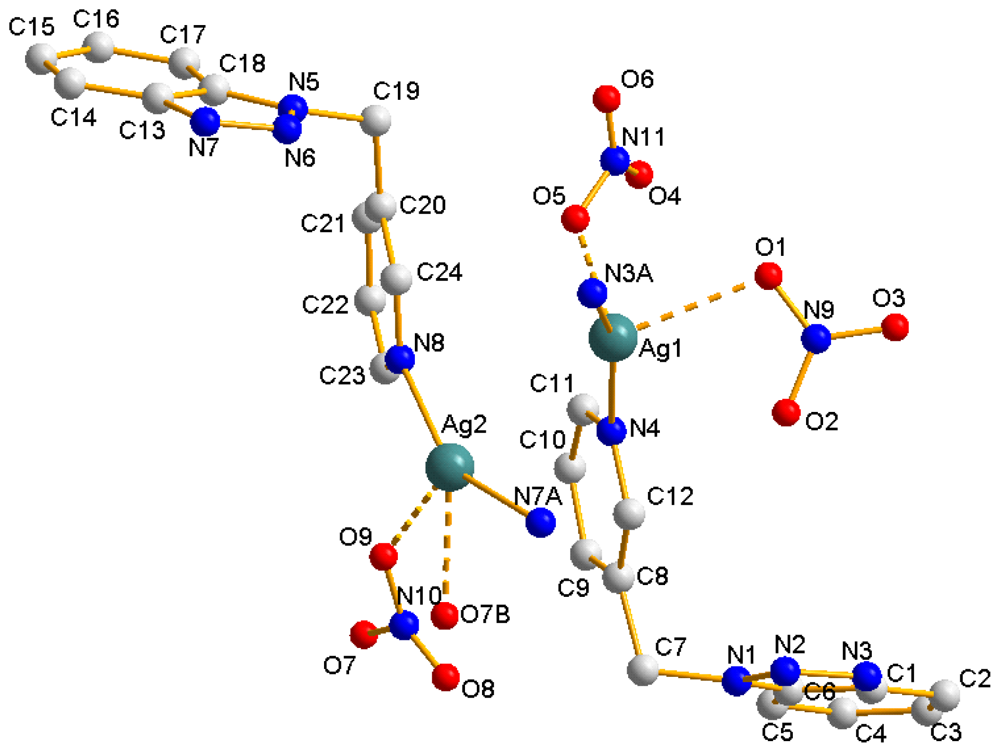
<p>The asymmetry unit of <bold>1</bold> consists of two independent Ag(I) cations, two L ligands, one integrated nitrate and two counteranion nitrate halves, as shown in <xref ref-type="fig" rid="f2-ijms-12-00046">Figure 2</xref>. The environment of every Ag center is the same tetrahedron geometry. Each Ag(1) center is coordinated by two L ligands via the N<italic><sub>py</sub></italic> [Ag(1)-N(4) = 2.238(4) Å] and N<italic><sub>bta</sub></italic> [Ag(1)-N(3A) = 2.217(4) Å] nitrogen donor atoms. For the balance of electric charge, each Ag(1) cation also displays very weak contact to two different nitrates (counteranion half) with O(1) and O(5) [Ag(1)-O(1) = 2.588(6) and Ag(1)-O(5) = 2.404(15) Å, respectively]. Each Ag(2) center adopts almost the same coordination mode as Ag(1), coordinated by two N from two L ligands and two O atoms form two different nitrates (counteranion integrated), with the Ag-N distances ranging from 2.221(4) to 2.241(4) Å, and Ag-O distances ranging from 2.404(15) to 2.588(6) Å.</p>
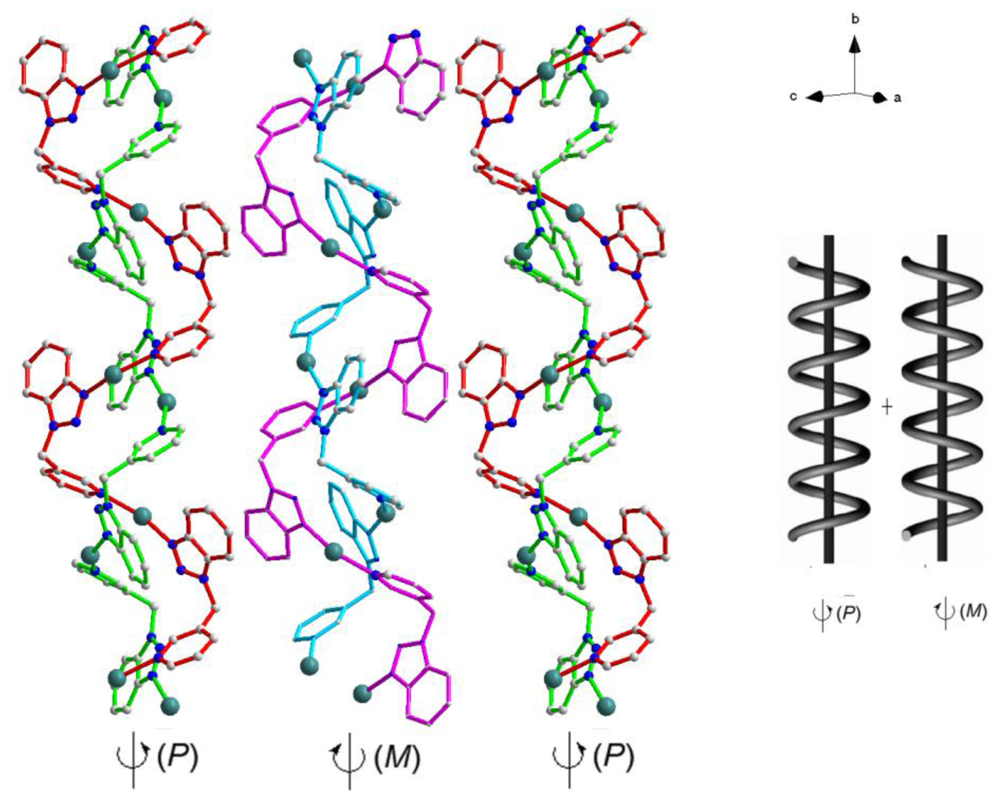
<p>In each L molecule, the <italic>sp</italic><sup>3</sup> configuration of C of -CH<sub>2</sub>- spacer forces the L ligand to be non-linear, with the N(1)-C(7)-C(8) angle 110.2(4)° and the N(5)-C(19)-C(20) angle 111.3(5)°. Each L behaves as an exo-bidentate linker, bridging adjacent Ag(I) cations to give rise to an [-Ag(L)-]<italic><sub>n</sub></italic> infinite 2<sup>1</sup> helix strand, and such that each strand is interwind compactly by another [-Ag(L)-]<italic><sub>n</sub></italic> strand through the aurophilic d<sup>10</sup>-d<sup>10</sup> interactions (Ag···Ag distance 3.2683 Å) to form a double helical species. Unlike the standard tubular double helixes that have been reported [<xref ref-type="bibr" rid="b17-ijms-12-00046">17</xref>–<xref ref-type="bibr" rid="b19-ijms-12-00046">19</xref>], the double helical chain of <bold>1</bold> wriggles with an “S” configuration, as shown in <xref ref-type="fig" rid="f3-ijms-12-00046">Figure 3</xref>. This result can be attributed to the 3- position of the pyridyl ring as the metal coordination site, which limits the stretched-out direction. Each chiral double helical chain links to its adjacent symmetric-related equivalents via the weak attraction of nitrate anion, to generate a quasi 3D supramolecular architecture. In each monocrystal, the balanced packing of left (<italic>P</italic>) and right (<italic>M</italic>) chains counteracts the chirality.</p>
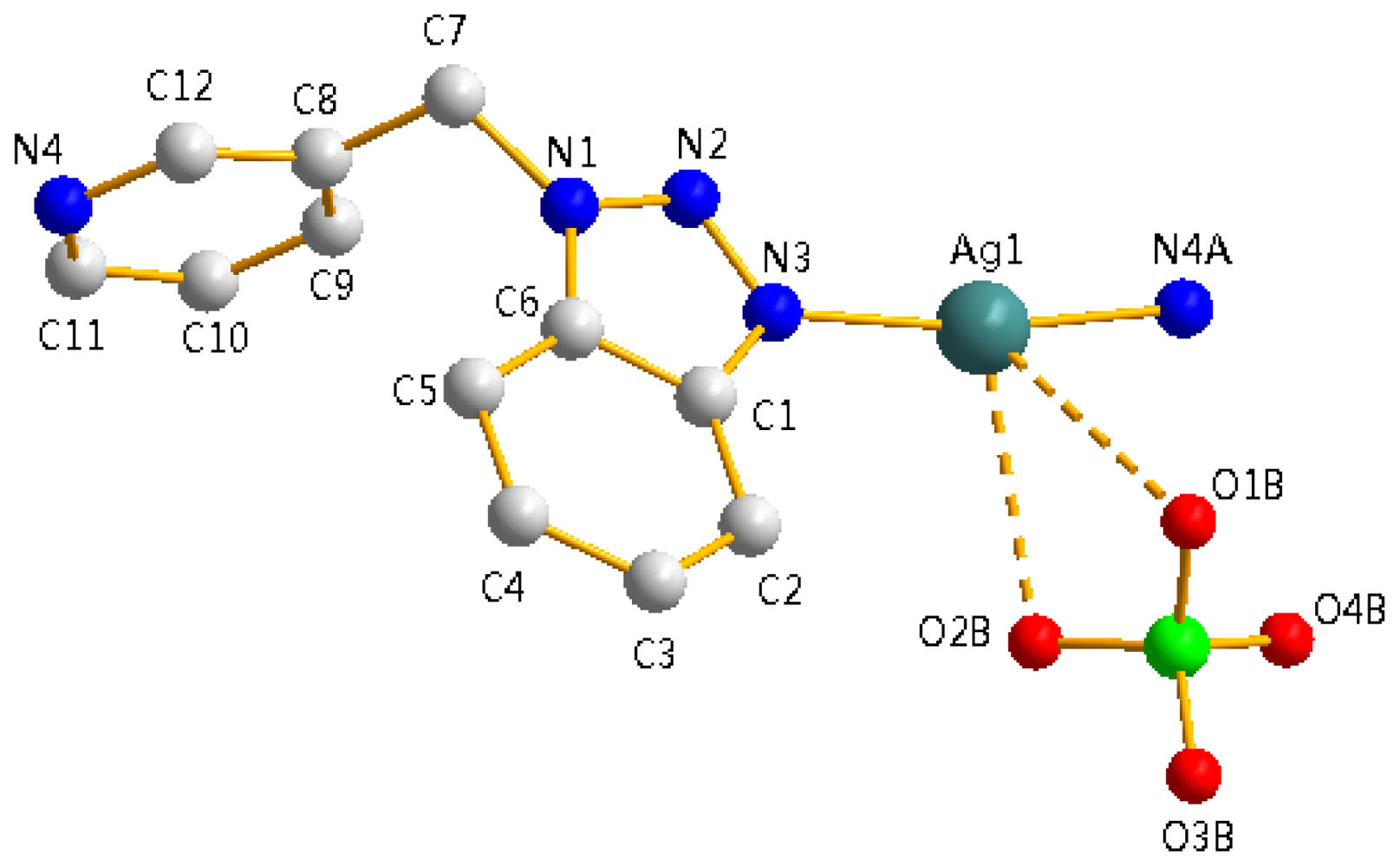
<p>A drawing of the asymmetric unit of <bold>2</bold> is shown in <xref ref-type="fig" rid="f4-ijms-12-00046">Figure 4</xref>, with selected bond distances and angles listed in <xref ref-type="table" rid="t1-ijms-12-00046">Table 1</xref>. The crystal structure reveals that the Ag(I) center is coordinated with two N atoms from two different L, with the Ag-N distances 2.135(3) and 2.113(3) Å, and the N(3)-Ag(1)-N(4) angle 169.97(10)°. The perchlorate group chelates to the Ag(I) center through very weak attraction, with Ag-O distances 2.905(7) and 3.022(6) Å, and the O(2B)-Ag(1)-O(1B) angle 44.99(14)°. For each L ligand in <bold>2</bold>, the N(1)-C(7)-C(8) angle is 111.3(2)° around the -CH<sub>2</sub>- spacer.</p>
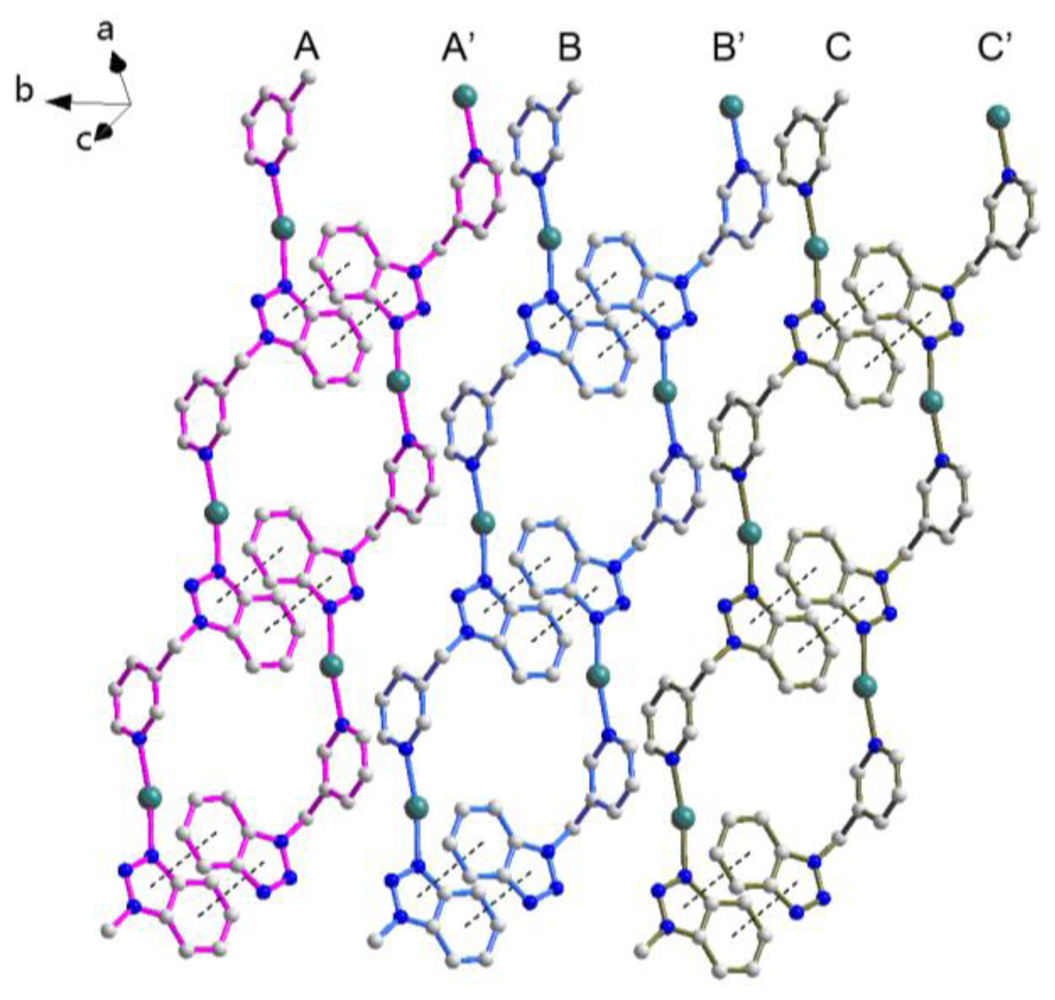
<p>In <bold>2</bold>, each L group also behaves as an exo-bidentate linker, bridging adjacent Ag(I) cations to form an infinite “Z” configuration alone the [100] direction (<xref ref-type="fig" rid="f5-ijms-12-00046">Figure 5</xref>). Furthermore, each zigzag chain links to its adjacent symmetric-related equivalents via the duple π-π interactions with centroid to centroid distances 3.586(1) Å to generate a dimer. Other parameters of the π-π interactions are listed in <xref ref-type="table" rid="t1-ijms-12-00046">Table 1</xref>. It is necessary to point out that these dual π-π interactions were not frequently observed in previously reported architectures [<xref ref-type="bibr" rid="b20-ijms-12-00046">20</xref>,<xref ref-type="bibr" rid="b21-ijms-12-00046">21</xref>].</p></sec>
<sec>
<title>2.2. Fluorescent Properties</title>
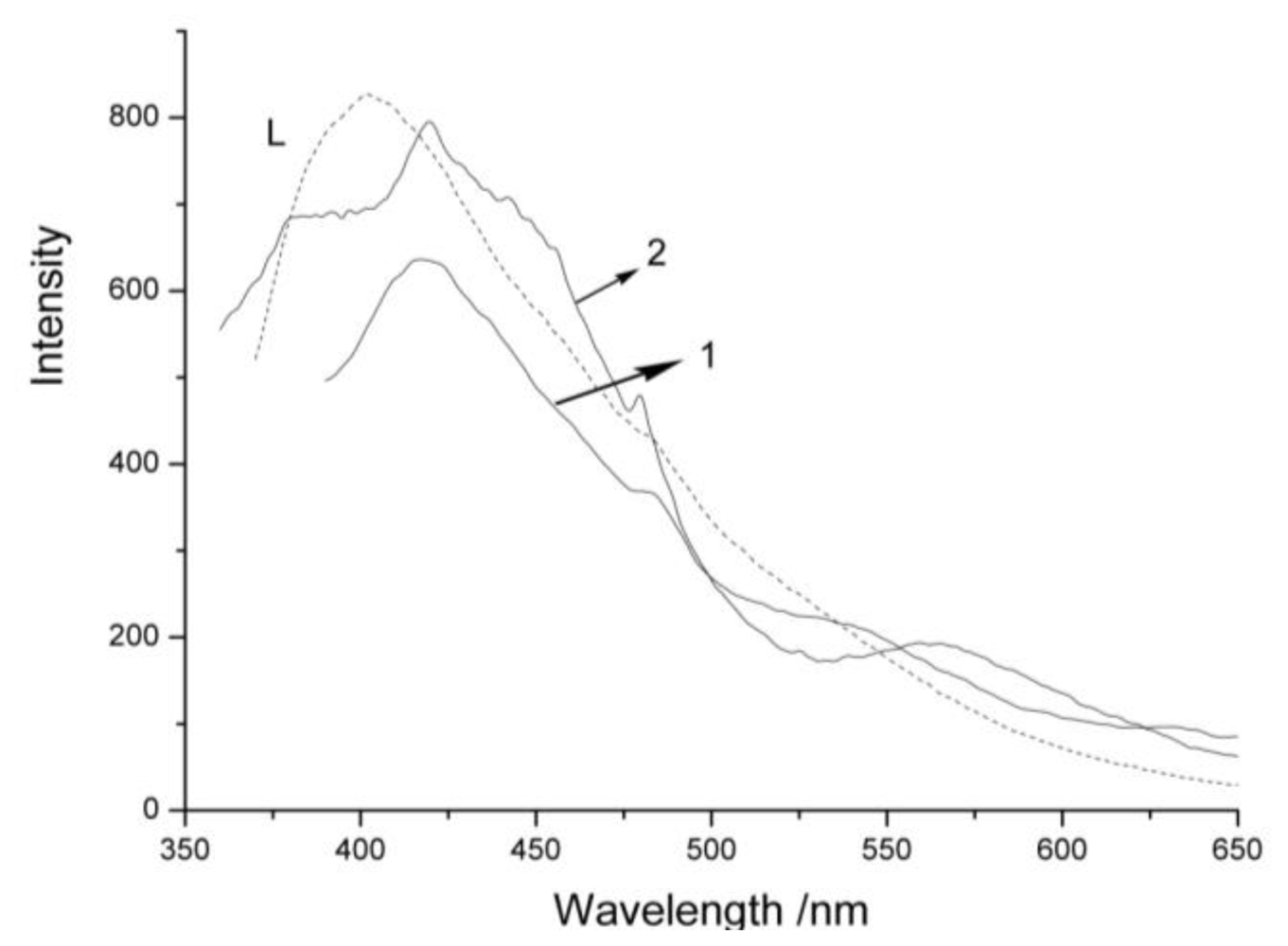
<p>Metal-organic polymer compounds with a d<sup>10</sup> configuration have been found to exhibit photoluminescent properties [<xref ref-type="bibr" rid="b22-ijms-12-00046">22</xref>–<xref ref-type="bibr" rid="b24-ijms-12-00046">24</xref>]. Here, we wanted to examine the photoluminescence of <bold>1</bold> and <bold>2</bold>. The solid-state emission spectra of L and complexes <bold>1</bold> and <bold>2</bold> at room temperature are shown in <xref ref-type="fig" rid="f6-ijms-12-00046">Figure 6</xref>. It can be observed that the intense emissions occurr in the same range for the two complexes (λ<sub>ex</sub> = 350 nm, λ<sub>em</sub> = 417.5 nm for <bold>1</bold>; λ<sub>ex</sub> = 340 nm, λ<sub>em</sub> = 419.5 nm for <bold>2</bold>), which show a very light red-shift to that observed from L (λ<sub>ex</sub> = 340 nm, λ<sub>em</sub> = 402 nm). In d<sup>10</sup>-metal ions with one or two positive charges, the d-orbitals are contracted and therefore the electrons in these orbitals are much less accessible for back bonding to p-acceptor ligands. Moreover, silver cations have weak electro-accepting nature with respect to electrons from L, so these emissions can be assigned to ligand-to-metal charge transfer (LMCT) bands [<xref ref-type="bibr" rid="b25-ijms-12-00046">25</xref>].</p></sec></sec>
<sec>
<title>3. Experimental Section</title>
<sec sec-type="materials|methods">
<title>3.1. Materials and Methods</title>
<p>Benzotriazole was purchased from Acros Ltd. Company and used without further purification, the other reagents were commercially available and used as purchased. The IR spectra as KBr discs were recorded on a Magna 750 FT-IR spectrophotometer. C, H, and N analysis were determined on an Elementary Vario ELIII elemental analyzer. Fluorescent spectra were measured on an Edinburgh Instruments analyzer model FL920.</p></sec>
<sec>
<title>3.2. Synthesis of the Ligand</title>
<p>The desired L was prepared by condensation of 1<italic>H</italic>-benzotriazole with the 3-picolyl chloride in DMF at reflux 4 h in the presence of triethylamine as basic catalyst [<xref ref-type="bibr" rid="b26-ijms-12-00046">26</xref>]. Separation of pure L was performed by chromatography on a silica gel column (eluent ethyl acetate-light petroleum 40:60).</p></sec>
<sec>
<title>3.3. Synthesis of [Ag<sub>2</sub>(L)<sub>2</sub>(NO<sub>3</sub>)<sub>2</sub>]<italic>n</italic> (<bold>1</bold>)</title>
<p>A solution of L (0.021 g, 0.10 mmol) in MeOH (5 mL) was carefully layered on a solution of AgNO<sub>3</sub> (0.017 g, 0.10 mmol) in H<sub>2</sub>O (5 mL). Diffusion between the two phases over a period of two weeks produced colorless block crystals. Yield: 0.012 g (32% based on L); Elementary analysis: calcd. for Ag<sub>2</sub>C<sub>24</sub>H<sub>20</sub>N<sub>10</sub>O<sub>6</sub>(760.24): C, 37.92; H, 2.65; N, 18.42%; found: C, 38.20; H, 2.89; N, 18.43%. IR (KBr, cm<sup>−1</sup>): 3700–3600 (w), 1605 (w), 1482 (w), 1496 (w), 1384 (s), 1227(s), 1194 (m), 1164 (m), 1099 (m), 950 (m), 821(m), 779 (m), 744 (s), 708 (m), 645 (m).</p></sec>
<sec>
<title>3.4. Synthesis of [Ag(L)(ClO<sub>4</sub>)]<italic>n</italic> (<bold>2</bold>)</title>
<p>The procedure of <bold>2</bold> is similar to the synthesis of <bold>1</bold> except that AgClO<sub>4</sub> was used instead of AgNO<sub>3</sub>. Yield: 0.015 g (48% based on L); Elementary analysis: calcd. for AgClC<sub>12</sub>H<sub>10</sub>N<sub>4</sub>O<sub>4</sub> (417.55): C, 34.52; H, 2.41; N, 13.42%; found: C, 34.37; H, 2.59; N, 13.65%. IR (KBr, cm<sup>−1</sup>): 3568(m), 1614(m), 1498 (w), 1459 (w), 1384 (s), 1312 (m), 1224 (m), 1166 (m), 1120 (w), 781 (w), 764 (w), 743 (m), 725(w), 626 (w), 563 (w), 483 (w), 433(w).</p></sec>
<sec>
<title>3.5. X-ray Crystallography</title>
<p>The single crystal X-ray diffraction measurements were carried out on a Siemens Smart CCD area detector. Intensities of reflections were measured using graphite monochromatized Mo-Kα radiation (<italic>λ</italic> = 0.71073 Å) with ω scan mode at 293(2) K in the range of 2.11° &lt; <italic>θ</italic> &lt; 27.48° for <bold>1</bold> and 2.42° &lt; <italic>θ</italic> &lt; 27.48° for <bold>2</bold>. Unit cell dimensions were obtained with least-squares refinements, and semi-empirical absorption corrections were applied using SADABS program [<xref ref-type="bibr" rid="b27-ijms-12-00046">27</xref>]. The structure was solved by direct method [<xref ref-type="bibr" rid="b28-ijms-12-00046">28</xref>] and non-hydrogen atoms were obtained in successive difference Fourier syntheses. The final refinements were performed by full-matrix least-squares methods on F<sup>2</sup> by SHELXL-97 program package [<xref ref-type="bibr" rid="b29-ijms-12-00046">29</xref>]. For both <bold>1</bold> and <bold>2</bold>, hydrogen atoms were generated geometrically and treated as riding. The crystallographic data for <bold>1</bold>–<bold>2</bold> are summarized in <xref ref-type="table" rid="t2-ijms-12-00046">Table 2</xref>, and the selected bond distances and angles are listed in <xref ref-type="table" rid="t3-ijms-12-00046">Table 3</xref>.</p></sec></sec>
<sec>
<title>4. Conclusion</title>
<p>For L, the advantages of flexibility and exo-bidentate are fully demonstrated by the structural data. Two Ag(I) coordination polymers both possess 1d catenulate structure. It is even more surprising that different anions would lead to the complete diversity of the ultimate coordinated compounds‘ geometrical structures. However, to our disappointment, we failed to achieve some acentric solids or NLO materials as predicted. Some deeper reconstruction at the -CH<sub>2</sub>- spacer of the ligand is now being processed for achieving the chirality, and more tests with other metal cations (such as Pt<sup>2+</sup> and Pd<sup>2+</sup>), counter anionic donors (such as <italic>p</italic>-toluenesulfonate and hexafluoro-phosphate), solvent systems and reaction conditions are in progress. It can be expected that many other novel asymmetry metal-organic materials will be realized.</p></sec>
<sec sec-type="supplementary-material">
<title>Supplementary Material</title>
<p>Crystallographic data for the structures reported in this paper have been deposited with the Cambridge Crystallographic Data Centre as supplementary publication No. CCDC 794748 for 1 and No. CCDC 794749 for 2. Copies of the data can be obtained free of charge on application to CCDC, 12 Union Road, Cambridge CB2 1EZ, UK (Fax: +44-1223-336-033; E-Mail: <email>deposit@ccdc.cam.ac.uk</email>).</p></sec></body>
<back>
<ack>
<title>Acknowledgements</title>
<p>The authors would like to thank Fujian Provincial Health Department Foundation under Grant No. 2006-2-2 for financial support.</p></ack>
<ref-list>
<title>References</title>
<ref id="b1-ijms-12-00046"><label>1</label><citation citation-type="journal"><person-group person-group-type="author"><name><surname>Carlucci</surname><given-names>L</given-names></name><name><surname>Ciani</surname><given-names>G</given-names></name></person-group><article-title>Polymeric Layers Catenated by Ribbons of Rings in a Three-dimensional Self-assembled Architecture: A Nanoporous Network with Spongelike Behavior</article-title><source>Angew. Chem. Int. Ed</source><year>2000</year><volume>39</volume><fpage>1506</fpage><lpage>1510</lpage><pub-id pub-id-type="doi">10.1002/(SICI)1521-3773(20000417)39:8&lt;1506::AID-ANIE1506&gt;3.0.CO;2-U</pub-id></citation></ref>
<ref id="b2-ijms-12-00046"><label>2</label><citation citation-type="journal"><person-group person-group-type="author"><name><surname>Evans</surname><given-names>OR</given-names></name><name><surname>Xiong</surname><given-names>RG</given-names></name></person-group><article-title>Crystal Engineering of Acentric Diamondoid Metal-Organic Coordination Networks</article-title><source>Angew. Chem. Int. Ed</source><year>1999</year><volume>38</volume><fpage>536</fpage><lpage>538</lpage><pub-id pub-id-type="doi">10.1002/(SICI)1521-3773(19990215)38:4&lt;536::AID-ANIE536&gt;3.0.CO;2-3</pub-id></citation></ref>
<ref id="b3-ijms-12-00046"><label>3</label><citation citation-type="journal"><person-group person-group-type="author"><name><surname>Li</surname><given-names>H</given-names></name><name><surname>Eddaoudi</surname><given-names>M</given-names></name></person-group><article-title>Design and Synthesis of an Exceptionally Stable and Highly Porous Metal-Organic Framework</article-title><source>Nature</source><year>1999</year><volume>402</volume><fpage>276</fpage><lpage>279</lpage><pub-id pub-id-type="doi">10.1038/46248</pub-id></citation></ref>
<ref id="b4-ijms-12-00046"><label>4</label><citation citation-type="journal"><person-group person-group-type="author"><name><surname>Munakata</surname><given-names>M</given-names></name><name><surname>Wu</surname><given-names>LP</given-names></name></person-group><article-title>Two Types of New Polymeric Copper(I) Complexes of Pyrazinecarboxamide Having Channel and Helical Structures</article-title><source>Inorg. Chem</source><year>1997</year><volume>36</volume><fpage>5416</fpage><lpage>5418</lpage><pub-id pub-id-type="doi">10.1021/ic970427f</pub-id></citation></ref>
<ref id="b5-ijms-12-00046"><label>5</label><citation citation-type="journal"><person-group person-group-type="author"><name><surname>Kepert</surname><given-names>CJ</given-names></name><name><surname>Rosseinsky</surname><given-names>MJ</given-names></name></person-group><article-title>A Porous Chiral Framework of Coordinated 1,3,5-benzenetricarboxylate: Quadruple Interpenetration of the (10,3)—a Network</article-title><source>Chem. Commun</source><year>1998</year><volume>1</volume><fpage>31</fpage><lpage>32</lpage></citation></ref>
<ref id="b6-ijms-12-00046"><label>6</label><citation citation-type="journal"><person-group person-group-type="author"><name><surname>Ranford</surname><given-names>JD</given-names></name><name><surname>Vittal</surname><given-names>JJD</given-names></name></person-group><article-title>Thermal Conversion of a Helical Coil into a Three-dimensional Chiral Framework</article-title><source>Angew. Chem. Int. Ed</source><year>1999</year><volume>38</volume><fpage>3498</fpage><lpage>3501</lpage><pub-id pub-id-type="doi">10.1002/(SICI)1521-3773(19991203)38:23&lt;3498::AID-ANIE3498&gt;3.0.CO;2-F</pub-id></citation></ref>
<ref id="b7-ijms-12-00046"><label>7</label><citation citation-type="journal"><person-group person-group-type="author"><name><surname>Sharma</surname><given-names>CVK</given-names></name><name><surname>Rogers</surname><given-names>RD</given-names></name></person-group><article-title>‘Molecular Chinese blinds‘: Self-organization of Tetranitrato Lanthanide Lomplexes into Open, Chiral Hydrogen Bonded Networks</article-title><source>Chem. Commun</source><year>1999</year><volume>1</volume><fpage>83</fpage><lpage>84</lpage></citation></ref>
<ref id="b8-ijms-12-00046"><label>8</label><citation citation-type="journal"><person-group person-group-type="author"><name><surname>Lopez</surname><given-names>S</given-names></name><name><surname>Kahraman</surname><given-names>M</given-names></name></person-group><article-title>Novel Two-Fold Interpenetrating Diamondoid Coordination Polymers: [Cu(3,3-bipyridine)<sub>2</sub><italic>X</italic>, (<italic>X</italic> = BF<sub>4</sub> <sup>−</sup>, PF<sub>6</sub> <sup>−</sup>)</article-title><source>Inorg. Chem</source><year>1997</year><volume>36</volume><fpage>6138</fpage><lpage>6140</lpage><pub-id pub-id-type="doi">10.1021/ic970703q</pub-id><pub-id pub-id-type="pmid">11670251</pub-id></citation></ref>
<ref id="b9-ijms-12-00046"><label>9</label><citation citation-type="journal"><person-group person-group-type="author"><name><surname>Moulton</surname><given-names>B</given-names></name><name><surname>Zaworotko</surname><given-names>MJ</given-names></name></person-group><article-title>From Molecules to Crystal Engineering: Supramolecular Isomerism and Polymorphism in Network Solids</article-title><source>Chem. Rev</source><year>2001</year><volume>101</volume><fpage>1629</fpage><lpage>1658</lpage><pub-id pub-id-type="doi">10.1021/cr9900432</pub-id><pub-id pub-id-type="pmid">11709994</pub-id></citation></ref>
<ref id="b10-ijms-12-00046"><label>10</label><citation citation-type="journal"><person-group person-group-type="author"><name><surname>Carlucci</surname><given-names>L</given-names></name><name><surname>Ciani</surname><given-names>G</given-names></name></person-group><article-title>A New Type of Entanglement Involving One-dimensional Ribbons of Rings Catenated to a Three-dimensional Network in the Nanoporous Structure of [Co(bix)<sub>2</sub>(H<sub>2</sub>O)<sub>2</sub>] (SO<sub>4</sub>)·7H<sub>2</sub>O</article-title><source>Chem. Commun</source><year>2004</year><volume>4</volume><fpage>380</fpage><lpage>381</lpage></citation></ref>
<ref id="b11-ijms-12-00046"><label>11</label><citation citation-type="journal"><person-group person-group-type="author"><name><surname>Chen</surname><given-names>XD</given-names></name><name><surname>Du</surname><given-names>M</given-names></name></person-group><article-title>Controlled Generation of Heterochiral or Homochiral Coordination Polymer: Helical Conformational Polymorphs and Argentophilicity-induced Spontaneous Resolution</article-title><source>Chem Commun</source><year>2005</year><fpage>4417</fpage><lpage>4419</lpage></citation></ref>
<ref id="b12-ijms-12-00046"><label>12</label><citation citation-type="journal"><person-group person-group-type="author"><name><surname>Zhang</surname><given-names>S</given-names></name><name><surname>Cao</surname><given-names>YN</given-names></name></person-group><article-title>Hydrothermal Synthesis of Two Copper Helical Coordination Polymers with Acentric Three-dimensional Framework Constructing from Mixed Pyridine Carboxylates</article-title><source>J. Solid State Chem</source><year>2008</year><volume>181</volume><fpage>399</fpage><lpage>405</lpage><pub-id pub-id-type="doi">10.1016/j.jssc.2007.12.006</pub-id></citation></ref>
<ref id="b13-ijms-12-00046"><label>13</label><citation citation-type="journal"><person-group person-group-type="author"><name><surname>Haasnoot</surname><given-names>JG</given-names></name></person-group><article-title>For a Review of the Coordination Chemistry of 1,2,4-triazolato Complexes</article-title><source>Coord. Chem. Rev</source><year>2000</year><volume>131</volume><fpage>200</fpage><lpage>202</lpage></citation></ref>
<ref id="b14-ijms-12-00046"><label>14</label><citation citation-type="journal"><person-group person-group-type="author"><name><surname>Cingolani</surname><given-names>A</given-names></name><name><surname>Effendy</surname><given-names>E</given-names></name><name><surname>Hanna</surname><given-names>JV</given-names></name><name><surname>Pellei</surname><given-names>M</given-names></name><name><surname>Pettinari</surname><given-names>C</given-names></name><name><surname>Santini</surname><given-names>C</given-names></name><name><surname>Skelton</surname><given-names>BW</given-names></name><name><surname>White</surname><given-names>AH</given-names></name></person-group><article-title>Crystal Structures and Vibrational and Solution and Solid-State (CPMAS) NMR Spectroscopic Studies in Triphenyl Phosphine, Arsine, and Stibine Silver(I) Bromate Systems, (R3E)<italic><sub>x</sub></italic>AgBrO<sub>3</sub> (E = P, As, Sb; <italic>x</italic> = 1–4)</article-title><source>Inorg. Chem</source><year>2003</year><volume>42</volume><fpage>4938</fpage><lpage>4948</lpage><pub-id pub-id-type="doi">10.1021/ic034243e</pub-id><pub-id pub-id-type="pmid">12895118</pub-id></citation></ref>
<ref id="b15-ijms-12-00046"><label>15</label><citation citation-type="journal"><person-group person-group-type="author"><name><surname>Tang</surname><given-names>LF</given-names></name><name><surname>Wang</surname><given-names>ZW</given-names></name></person-group><article-title>Novel Five- and Six-coordinate Diorganotin(IV) Complexes with bis(triazol-1-yl)alkanes: Linkage Coordination Polymers</article-title><source>Polyhedron</source><year>2000</year><volume>19</volume><fpage>1949</fpage><lpage>1954</lpage><pub-id pub-id-type="doi">10.1016/S0277-5387(00)00457-5</pub-id></citation></ref>
<ref id="b16-ijms-12-00046"><label>16</label><citation citation-type="journal"><person-group person-group-type="author"><name><surname>Li</surname><given-names>BL</given-names></name><name><surname>Zhu</surname><given-names>X</given-names></name></person-group><article-title>Syntheses and Structures of Five Cadmium(II) Coordination Polymers from 1,2-bis(1,2,4-triazol-1-yl)ethane</article-title><source>Polyhedron</source><year>2004</year><volume>23</volume><fpage>3133</fpage><lpage>3141</lpage><pub-id pub-id-type="doi">10.1016/j.poly.2004.09.025</pub-id></citation></ref>
<ref id="b17-ijms-12-00046"><label>17</label><citation citation-type="journal"><person-group person-group-type="author"><name><surname>Huang</surname><given-names>MH</given-names></name><name><surname>Liu</surname><given-names>P</given-names></name></person-group><article-title>Synthesis Structure and Luminescence of a Double Helical Coordination Polymer with a Semirigid Ligand: L = <italic>N</italic>-(4-pyridylmethyl)benzimidazole</article-title><source>Inorg. Chem. Commun</source><year>2006</year><volume>9</volume><fpage>952</fpage><lpage>954</lpage><pub-id pub-id-type="doi">10.1016/j.inoche.2006.06.010</pub-id></citation></ref>
<ref id="b18-ijms-12-00046"><label>18</label><citation citation-type="journal"><person-group person-group-type="author"><name><surname>Yuan</surname><given-names>G</given-names></name><name><surname>Shao</surname><given-names>KZ</given-names></name></person-group><article-title>A Novel Pentanuclear Zn(II) Coordination Polymer with Double Helices: Synthesis, Structure and Luminescent Property</article-title><source>Inorg. Chem. Commun</source><year>2008</year><volume>11</volume><fpage>1246</fpage><lpage>1249</lpage><pub-id pub-id-type="doi">10.1016/j.inoche.2008.07.018</pub-id></citation></ref>
<ref id="b19-ijms-12-00046"><label>19</label><citation citation-type="journal"><person-group person-group-type="author"><name><surname>Liu</surname><given-names>CS</given-names></name><name><surname>Sun</surname><given-names>GH</given-names></name></person-group><article-title>A Double-Helical Silver(I) Coordination Polymer Based on 1-(4-pyridylmethyl)-1<italic>H</italic>-benzotriazole: Synthesis, Crystal Structure and Luminescent Property</article-title><source>Open Crystallogr. J</source><year>2008</year><volume>1</volume><fpage>24</fpage><lpage>30</lpage><pub-id pub-id-type="doi">10.2174/1874846500801010024</pub-id></citation></ref>
<ref id="b20-ijms-12-00046"><label>20</label><citation citation-type="journal"><person-group person-group-type="author"><name><surname>Liu</surname><given-names>Z</given-names></name><name><surname>Chen</surname><given-names>Y</given-names></name></person-group><article-title>Cadmium(II) and Cobalt(II) Complexes Generated from Benzimidazole-5- carboxylate: Self-assembly by Hydrogen Bonding and π-π Interactions</article-title><source>J. Solid State Chem</source><year>2005</year><volume>178</volume><fpage>2306</fpage><lpage>2312</lpage><pub-id pub-id-type="doi">10.1016/j.jssc.2005.04.037</pub-id></citation></ref>
<ref id="b21-ijms-12-00046"><label>21</label><citation citation-type="journal"><person-group person-group-type="author"><name><surname>Wang</surname><given-names>J</given-names></name><name><surname>Huang</surname><given-names>MH</given-names></name></person-group><article-title>Synthesis and Characterization of Two Infinite Coordination Networks from Flexible Unsymmetric Ligands</article-title><source>J. Mol. Struct</source><year>2008</year><volume>875</volume><fpage>22</fpage><lpage>26</lpage><pub-id pub-id-type="doi">10.1016/j.molstruc.2007.04.008</pub-id></citation></ref>
<ref id="b22-ijms-12-00046"><label>22</label><citation citation-type="journal"><person-group person-group-type="author"><name><surname>Hou</surname><given-names>L</given-names></name><name><surname>Li</surname><given-names>D</given-names></name></person-group><article-title>A Novel Photoluminescent Ag-terpyridyl Complex: One-dimensional Linear Metal String with Double-helical Structure</article-title><source>Inorg. Chem. Commun</source><year>2005</year><volume>8</volume><fpage>128</fpage><lpage>130</lpage><pub-id pub-id-type="doi">10.1016/j.inoche.2004.11.019</pub-id></citation></ref>
<ref id="b23-ijms-12-00046"><label>23</label><citation citation-type="journal"><person-group person-group-type="author"><name><surname>Lefebvre</surname><given-names>J</given-names></name><name><surname>Batchelor</surname><given-names>RJ</given-names></name><name><surname>Leznoff</surname><given-names>DB</given-names></name></person-group><article-title>Cu[Au(CN)<sub>2</sub>]<sub>2</sub>(DMSO)<sub>2</sub>: Golden Polymorphs That Exhibit Vapochromic Behavior</article-title><source>J. Am. Chem. Soc</source><year>2004</year><volume>126</volume><fpage>16117</fpage><lpage>16125</lpage><pub-id pub-id-type="doi">10.1021/ja049069n</pub-id><pub-id pub-id-type="pmid">15584747</pub-id></citation></ref>
<ref id="b24-ijms-12-00046"><label>24</label><citation citation-type="journal"><person-group person-group-type="author"><name><surname>Chen</surname><given-names>W</given-names></name><name><surname>Wang</surname><given-names>JY</given-names></name></person-group><article-title>Photoluminescent Metal-Organic Polymer Constructed from Trimetallic Clusters and Mixed Carboxylates</article-title><source>Inorg. Chem</source><year>2003</year><volume>42</volume><fpage>944</fpage><lpage>946</lpage><pub-id pub-id-type="doi">10.1021/ic025871j</pub-id><pub-id pub-id-type="pmid">12588123</pub-id></citation></ref>
<ref id="b25-ijms-12-00046"><label>25</label><citation citation-type="journal"><person-group person-group-type="author"><name><surname>Luo</surname><given-names>JH</given-names></name><name><surname>Hong</surname><given-names>MC</given-names></name></person-group><article-title>Synthesis, Crystal Structure and Fluorescence of Two Novel Mixed-ligand Cadmium Coordination Polymers with Different Structural Motifs</article-title><source>Eur. J. Inorg. Chem</source><year>2003</year><volume>14</volume><fpage>2705</fpage><lpage>2710</lpage></citation></ref>
<ref id="b26-ijms-12-00046"><label>26</label><citation citation-type="journal"><person-group person-group-type="author"><name><surname>Danan</surname><given-names>A</given-names></name><name><surname>Charon</surname><given-names>DS</given-names></name></person-group><article-title>Synthesis and Antiparasitic Activities of Amidinic Azolated Derivatives</article-title><source>Farmaco</source><year>1997</year><volume>52</volume><fpage>227</fpage><lpage>229</lpage><pub-id pub-id-type="pmid">9241827</pub-id></citation></ref>
<ref id="b27-ijms-12-00046"><label>27</label><citation citation-type="book"><person-group person-group-type="author"><name><surname>Sheldrick</surname><given-names>GM</given-names></name></person-group><source>SADABS, Program for Empirical Absorption Correction of Area Detector Data</source><publisher-name>University of Göttingen</publisher-name><publisher-loc>Göttingen, Germany</publisher-loc><year>1996</year></citation></ref>
<ref id="b28-ijms-12-00046"><label>28</label><citation citation-type="book"><person-group person-group-type="author"><name><surname>Sheldrick</surname><given-names>GM</given-names></name></person-group><source>SHELXS 97, Program for Crystal Structure Solution</source><publisher-name>University of Göttingen</publisher-name><publisher-loc>Göttingen, Germany</publisher-loc><year>1997</year></citation></ref>
<ref id="b29-ijms-12-00046"><label>29</label><citation citation-type="book"><person-group person-group-type="author"><name><surname>Sheldrick</surname><given-names>GM</given-names></name></person-group><source>SHELXS 97, Program for Crystal Structure Refinement</source><publisher-name>University of Göttingen</publisher-name><publisher-loc>Göttingen, Germany</publisher-loc><year>1997</year></citation></ref></ref-list>
<sec sec-type="display-objects">
<title>Figures and Tables</title>
<fig id="f1-ijms-12-00046" position="float">
<label>Figure 1</label>
<caption>
<p>Synthesis and structure of L (1-((pyridin-3-yl)methyl)-1<italic>H</italic>-benzotriazole).</p></caption><graphic xlink:href="ijms-12-00046f1.gif"/></fig>
<fig id="f2-ijms-12-00046" position="float">
<label>Figure 2</label>
<caption>
<p>Drawing of two Ag(I) cations‘ coordination environment of the asymmetry unit in <bold>1</bold> [symmetry code. A: −x + 1/2, y + 1/2, −z + 1/2; B: −x + 1, −y + 1, −z].</p></caption><graphic xlink:href="ijms-12-00046f2.gif"/></fig>
<fig id="f3-ijms-12-00046" position="float">
<label>Figure 3</label>
<caption>
<p>View of the “S” type double helical chains of <bold>1</bold>. The balanced packing of left (<italic>P</italic>) and right (<italic>M</italic>) chirality affords this packing and internal racemate.</p></caption><graphic xlink:href="ijms-12-00046f3.gif"/></fig>
<fig id="f4-ijms-12-00046" position="float">
<label>Figure 4</label>
<caption>
<p>A drawing of an asymmetric unit of <bold>2</bold>. Symmetry codes: (<bold>A</bold>) x + 1, y, z−1; (<bold>B</bold>) x, y, z−1.</p></caption><graphic xlink:href="ijms-12-00046f4.gif"/></fig>
<fig id="f5-ijms-12-00046" position="float">
<label>Figure 5</label>
<caption>
<p>The infinite “Z” configuration of <bold>2</bold> and the dual π-π interactions between the dimers. Symmetry code: A: x + 1, y + 2, z + 2; A‘: −x + 3, −y + 3, −z + 1; B: x + 1, y + 1, z + 2; B‘: −x + 3, −y + 2, −z + 1; C: x, y, z + 3; C‘: −x + 2, −y + 1, −z + 2.</p></caption><graphic xlink:href="ijms-12-00046f5.gif"/></fig>
<fig id="f6-ijms-12-00046" position="float">
<label>Figure 6</label>
<caption>
<p>Fluorescent spectra of L (dashed line) and complex <bold>1</bold> and <bold>2</bold> in the solid state at room temperature.</p></caption><graphic xlink:href="ijms-12-00046f6.gif"/></fig>
<table-wrap id="t1-ijms-12-00046" position="float">
<label>Table 1</label>
<caption>
<p>Parameters of the π-π interactions in <bold>2</bold>.</p></caption>
<table frame="hsides" rules="groups">
<thead>
<tr><th align="center" valign="bottom"/>
<th align="center" valign="bottom">D<sub>cc</sub> (Å)</th>
<th align="center" valign="bottom">D<sub>pp</sub> (Å)</th>
<th align="center" valign="bottom">Dihedral angel (°)</th></tr></thead>
<tbody>
<tr>
<td align="center" valign="top">Benzene to Triazole</td>
<td align="center" valign="top">3.586(1)</td>
<td align="center" valign="top">3.309(2)</td>
<td align="center" valign="top">1.38(19)</td></tr>
<tr>
<td align="center" valign="top">Triazole to Benzene</td>
<td align="center" valign="top">3.586(1)</td>
<td align="center" valign="top">3.275(1)</td>
<td align="center" valign="top">1.38(19)</td></tr>
<tr>
<td colspan="4" align="left" valign="top"><hr/></td></tr>
<tr>
<td colspan="4" align="center" valign="top"><bold>The Value of Ring Shifts (Å)</bold></td></tr>
<tr>
<td colspan="4" align="left" valign="top"><hr/></td></tr>
<tr>
<td align="center" valign="top">Benzene</td>
<td align="center" valign="top">2.400</td>
<td align="center" valign="top">triazole</td>
<td align="center" valign="top">2.694</td></tr></tbody></table></table-wrap>
<table-wrap id="t2-ijms-12-00046" position="float">
<label>Table 2</label>
<caption>
<p>Crystallographic data for complexes <bold>1</bold> and <bold>2</bold>.</p></caption>
<table frame="hsides" rules="groups">
<thead>
<tr>
<th align="left" valign="bottom">Compound</th>
<th align="center" valign="bottom">1</th>
<th align="center" valign="bottom">2</th></tr></thead>
<tbody>
<tr>
<td align="left" valign="top">Formula</td>
<td align="left" valign="top">C<sub>12</sub>H<sub>10</sub>N<sub>5</sub>O<sub>3</sub>Ag</td>
<td align="left" valign="top">C<sub>12</sub>H<sub>10</sub>N<sub>4</sub>O<sub>4</sub>AgCl</td></tr>
<tr>
<td align="left" valign="top">Formula Weight</td>
<td align="left" valign="top">380.12</td>
<td align="left" valign="top">417.55</td></tr>
<tr>
<td align="left" valign="top">Crystal size (mm)</td>
<td align="left" valign="top">0.50 × 0.20 × 0.10</td>
<td align="left" valign="top">0.20 × 0.15 × 0.10</td></tr>
<tr>
<td align="left" valign="top">Crystal system</td>
<td align="left" valign="top">Monoclinic</td>
<td align="left" valign="top">Triclinic</td></tr>
<tr>
<td align="left" valign="top">Space group</td>
<td align="left" valign="top">P2<sub>1</sub>/<italic>n</italic></td>
<td align="left" valign="top">P-1</td></tr>
<tr>
<td align="left" valign="top"><italic>a</italic> (Å)</td>
<td align="left" valign="top">12.0272(9)</td>
<td align="left" valign="top">9.1393(3)</td></tr>
<tr>
<td align="left" valign="top"><italic>b</italic> (Å)</td>
<td align="left" valign="top">14.0702(9)</td>
<td align="left" valign="top">9.4459(6)</td></tr>
<tr>
<td align="left" valign="top"><italic>c</italic> (Å)</td>
<td align="left" valign="top">15.8258(11)</td>
<td align="left" valign="top">10.0234(14)</td></tr>
<tr>
<td align="left" valign="top"><italic>α</italic> (º)</td>
<td align="left" valign="top">90</td>
<td align="left" valign="top">63.21(3)</td></tr>
<tr>
<td align="left" valign="top"><italic>β</italic> (º)</td>
<td align="left" valign="top">91.148(5)</td>
<td align="left" valign="top">65.45(3)</td></tr>
<tr>
<td align="left" valign="top"><italic>γ</italic> (º)</td>
<td align="left" valign="top">90</td>
<td align="left" valign="top">74.16(3)</td></tr>
<tr>
<td align="left" valign="top"><italic>V</italic> (Å<sup>3</sup>)</td>
<td align="left" valign="top">2677.6(3)</td>
<td align="left" valign="top">698.64(25)</td></tr>
<tr>
<td align="left" valign="top"><italic>Z</italic></td>
<td align="left" valign="top">4</td>
<td align="left" valign="top">2</td></tr>
<tr>
<td align="left" valign="top"><italic>D</italic><italic><sub>c</sub></italic> (Mg·m<sup>−3</sup>)</td>
<td align="left" valign="top">1.886</td>
<td align="left" valign="top">1.985</td></tr>
<tr>
<td align="left" valign="top">μ (mm<sup>−1</sup>)</td>
<td align="left" valign="top">1.524</td>
<td align="left" valign="top">1.658</td></tr>
<tr>
<td align="left" valign="top"><italic>F</italic> (000)</td>
<td align="left" valign="top">1504</td>
<td align="left" valign="top">412</td></tr>
<tr>
<td align="left" valign="top"><italic>T</italic> (K)</td>
<td align="left" valign="top">293(2)</td>
<td align="left" valign="top">293(2)</td></tr>
<tr>
<td align="left" valign="top">Reflns. Collected</td>
<td align="left" valign="top">6095</td>
<td align="left" valign="top">3163</td></tr>
<tr>
<td align="left" valign="top">Reflns. Unique</td>
<td align="left" valign="top">5012</td>
<td align="left" valign="top">2415</td></tr>
<tr>
<td align="left" valign="top">Parameters</td>
<td align="left" valign="top">409</td>
<td align="left" valign="top">199</td></tr>
<tr>
<td align="left" valign="top">Goodness-of-fit on <italic>F</italic><sup>2</sup></td>
<td align="left" valign="top">1.002</td>
<td align="left" valign="top">1.000</td></tr>
<tr>
<td align="left" valign="top"><italic>R</italic><sub>1</sub>, <sub>w</sub><italic>R</italic><sub>2</sub> [<italic>I</italic> &gt; 2σ (<italic>I</italic>)]<xref ref-type="table-fn" rid="tfn1-ijms-12-00046">a</xref></td>
<td align="left" valign="top">0.0532, 0.1188</td>
<td align="left" valign="top">0.0358, 0.0819</td></tr>
<tr>
<td align="left" valign="top"><italic>R</italic><sub>1</sub>, <sub>w</sub><italic>R</italic><sub>2</sub> (all data)<xref ref-type="table-fn" rid="tfn2-ijms-12-00046">b</xref></td>
<td align="left" valign="top">0.0667, 0.1255</td>
<td align="left" valign="top">0.0524, 0.0908</td></tr>
<tr>
<td align="left" valign="top">Max, Min Δρ (e·A<sup>−3</sup>)</td>
<td align="left" valign="top">0.691, −0.714</td>
<td align="left" valign="top">0.572, −0.527</td></tr></tbody></table>
<table-wrap-foot><fn id="tfn1-ijms-12-00046">
<label>a</label>
<p>R = ∑||F<sub>0</sub>| − |F<sub>c</sub>||)/∑|F<sub>0</sub>|;</p></fn><fn id="tfn2-ijms-12-00046">
<label>b</label>
<p><sub>w</sub>R = [∑w (F<sub>0</sub><sup>2</sup> − F<sub>c</sub><sup>2</sup>)<sup>2</sup>/∑w (F<sub>0</sub><sup>2</sup>)<sup>2</sup>]<sup>1/2</sup>.</p></fn></table-wrap-foot></table-wrap>
<table-wrap id="t3-ijms-12-00046" position="float">
<label>Table 3</label>
<caption>
<p>Selected bond lengths (Å) and angles (°) for complexes <bold>1</bold> and <bold>2</bold>.</p></caption>
<table frame="hsides" rules="groups">
<tbody>
<tr>
<td colspan="4" align="center" valign="top"><bold>1</bold></td></tr>
<tr>
<td align="center" valign="top">Ag(1)-N(3A)</td>
<td align="center" valign="top">2.217(4)</td>
<td align="center" valign="top">Ag(2)-N(8)</td>
<td align="center" valign="top">2.241(4)</td></tr>
<tr>
<td align="center" valign="top">Ag(1)-N(4)</td>
<td align="center" valign="top">2.238(4)</td>
<td align="center" valign="top">Ag(2)-N(7A)</td>
<td align="center" valign="top">2.221(4)</td></tr>
<tr>
<td align="center" valign="top">Ag(1)-O(1)</td>
<td align="center" valign="top">2.588(6)</td>
<td align="center" valign="top">Ag(2)-O(7B)</td>
<td align="center" valign="top">2.532(18)</td></tr>
<tr>
<td align="center" valign="top">Ag(1)-O(5)</td>
<td align="center" valign="top">2.404(15)</td>
<td align="center" valign="top">Ag(2)-O(9)</td>
<td align="center" valign="top">2.471(16)</td></tr>
<tr>
<td align="center" valign="top">N(3A)-Ag(1)-N(4)</td>
<td align="center" valign="top">156.26(18)</td>
<td align="center" valign="top">N(7A)-Ag(2)-N(8)</td>
<td align="center" valign="top">152.66(17)</td></tr>
<tr>
<td align="center" valign="top">N(1)-C(7)-C(8)</td>
<td align="center" valign="top">110.2(4)</td>
<td align="center" valign="top">N(5)-C(19)-C(20)</td>
<td align="center" valign="top">111.3(5)</td></tr>
<tr>
<td colspan="4" align="left" valign="top">Symmetry codes: (A) −x + 1/2, y + 1/2, −z + 1/2; (B) −x + 1, −y + 1, −z.</td></tr>
<tr>
<td colspan="4" align="left" valign="top"><hr/></td></tr>
<tr>
<td colspan="4" align="center" valign="top"><bold>2</bold></td></tr>
<tr>
<td align="center" valign="top">Ag(1)-N(3)</td>
<td align="center" valign="top">2.113(3)</td>
<td align="center" valign="top">Ag(1)-N(4A)</td>
<td align="center" valign="top">2.135(3)</td></tr>
<tr>
<td align="center" valign="top">Ag(1)-O(1B)</td>
<td align="center" valign="top">3.022(6)</td>
<td align="center" valign="top">Ag(1)-O(2B)</td>
<td align="center" valign="top">2.905(6)</td></tr>
<tr>
<td align="center" valign="top">N(3)-Ag(1)-N(4A)</td>
<td align="center" valign="top">169.97(10)</td>
<td align="center" valign="top">N(1)-C(7)-C(8)</td>
<td align="center" valign="top">111.3(2)</td></tr>
<tr>
<td colspan="4" align="left" valign="top">Symmetry codes: (A) x + 1, y, z−1; (B) x, y, z−1.</td></tr></tbody></table></table-wrap></sec></back></article>