
<?xml version="1.0" encoding="UTF-8"?>
<!DOCTYPE article PUBLIC "-//NLM//DTD Journal Publishing DTD v2.3 20070202//EN" "journalpublishing.dtd">
<article xmlns:xlink="http://www.w3.org/1999/xlink" xml:lang="en" article-type="review-article">
<front>
<journal-meta>
<journal-id journal-id-type="publisher-id">ijms</journal-id>
<journal-title>International Journal of Molecular Sciences</journal-title>
<abbrev-journal-title>Int. J. Mol. Sci.</abbrev-journal-title>
<issn pub-type="epub">1422-0067</issn>
<publisher>
<publisher-name>Molecular Diversity Preservation International (MDPI)</publisher-name></publisher></journal-meta>
<article-meta>
<article-id pub-id-type="doi">10.3390/ijms11062499</article-id>
<article-id pub-id-type="publisher-id">ijms-11-02499</article-id>
<article-categories>
<subj-group>
<subject>Review</subject></subj-group></article-categories>
<title-group>
<article-title>Cholesterol-Lowering Effects of Probiotics and Prebiotics: A Review of <italic>in Vivo</italic> and <italic>in Vitro</italic> Findings</article-title></title-group>
<contrib-group>
<contrib contrib-type="author">
<name><surname>Ooi</surname><given-names>Lay-Gaik</given-names></name></contrib>
<contrib contrib-type="author">
<name><surname>Liong</surname><given-names>Min-Tze</given-names></name><xref ref-type="corresp" rid="c1-ijms-11-02499">*</xref></contrib>
<aff id="af1-ijms-11-02499">School of Industrial Technology, Universiti Sains Malaysia, 11800 Penang, Malaysia; E-Mail: <email>ooilaygaik@yahoo.com</email></aff></contrib-group>
<author-notes>
<corresp id="c1-ijms-11-02499">
<label>*</label>Author to whom correspondence should be addressed; E-Mail: <email>mintze.liong@usm.my</email>; Tel.: +604-653-2114; Fax: +604-657-3678.</corresp></author-notes>
<pub-date pub-type="collection">
<year>2010</year></pub-date>
<pub-date pub-type="epub">
<day>17</day>
<month>6</month>
<year>2010</year></pub-date>
<volume>11</volume>
<issue>6</issue>
<fpage>2499</fpage>
<lpage>2522</lpage>
<history>
<date date-type="received">
<day>17</day>
<month>5</month>
<year>2010</year></date>
<date date-type="rev-recd">
<day>26</day>
<month>5</month>
<year>2010</year></date>
<date date-type="accepted">
<day>16</day>
<month>6</month>
<year>2010</year></date></history>
<permissions>
<copyright-statement>© 2010 by the authors; licensee Molecular Diversity Preservation International, Basel, Switzerland.</copyright-statement>
<copyright-year>2010</copyright-year>
<license license-type="open-access" xlink:href="http://creativecommons.org/licenses/by/3.0">
<p>This article is an open-access article distributed under the terms and conditions of the Creative Commons Attribution license (http://creativecommons.org/licenses/by/3.0/).</p></license></permissions>
<abstract>
<p>Probiotics are live microorganisms that promote health benefits upon consumption, while prebiotics are nondigestible food ingredients that selectively stimulate the growth of beneficial microorganisms in the gastrointestinal tract. Probiotics and/or prebiotics could be used as alternative supplements to exert health benefits, including cholesterol-lowering effects on humans. Past <italic>in vivo</italic> studies showed that the administration of probiotics and/or prebiotics are effective in improving lipid profiles, including the reduction of serum/plasma total cholesterol, LDL-cholesterol and triglycerides or increment of HDL-cholesterol. However, other past studies have also shown that probiotics and prebiotics had insignificant effects on lipid profiles, disputing the hypocholesterolemic claim. Additionally, little information is available on the effective dosage of probiotics and prebiotics needed to exert hypocholesterolemic effects. Probiotics and prebiotics have been suggested to reduce cholesterol via various mechanisms. However, more clinical evidence is needed to strengthen these proposals. Safety issues regarding probiotics and/or prebiotics have also been raised despite their long history of safe use. Although probiotic-mediated infections are rare, several cases of systemic infections caused by probiotics have been reported and the issue of antibiotic resistance has sparked much debate. Prebiotics, classified as food ingredients, are generally considered safe, but overconsumption could cause intestinal discomfort. Conscientious prescription of probiotics and/or prebiotics is crucial, especially when administering to specific high risk groups such as infants, the elderly and the immuno-compromised.</p></abstract>
<kwd-group>
<kwd>probiotics</kwd>
<kwd>prebiotics</kwd>
<kwd>hypocholesterolemic</kwd>
<kwd>mechanisms</kwd>
<kwd>safety</kwd></kwd-group></article-meta></front>
<body>
<sec sec-type="intro">
<label>1.</label>
<title>Introduction</title>
<p>The WHO has predicted that by 2030, cardiovascular diseases will remain the leading causes of death, affecting approximately 23.6 million people around the World [<xref ref-type="bibr" rid="b1-ijms-11-02499">1</xref>]. It was reported that hypercholesterolemia contributed to 45% of heart attacks in Western Europe and 35% of heart attacks in Central and Eastern Europe from 1999 to 2003 [<xref ref-type="bibr" rid="b2-ijms-11-02499">2</xref>]. The risk of heart attack is three times higher in those with hypercholesterolemia, compared to those who have normal blood lipid profiles. The WHO delineated that unhealthy diets such as those high in fat, salt and free sugar, and low in complex carbohydrates, fruits and vegetables, lead to increased risk of cardiovascular diseases [<xref ref-type="bibr" rid="b3-ijms-11-02499">3</xref>].</p>
<p>People affected with hypercholesterolemia may avert the use of cholesterol-lowering drugs by practising dietary control or supplementation of probiotics and/or prebiotics. Probiotics are defined as ‘<italic>living microbial supplements that beneficially affect the host animals by improving its intestinal microbial balances</italic>’ [<xref ref-type="bibr" rid="b4-ijms-11-02499">4</xref>]. Prebiotics are ‘<italic>indigestible fermented food substrates that selectively stimulate the growth, composition and activity of microflora in gastrointestinal tract and thus improve hosts’ health and well-being</italic>’ [<xref ref-type="bibr" rid="b5-ijms-11-02499">5</xref>]. When probiotics and prebiotics are used in combination, they are known as ‘synbiotics’. The use of probiotics and prebiotics has only acquired scientific recognition in recent years although their applications as functional foods have been well-established throughout generations. In the interest of their promising effects on health and well being, probiotics and prebiotics have become increasingly recognized as supplements for human consumption.</p>
<p>In addition to improving gut health, probiotics have also been documented to exert other health-promoting effects such as strengthening of the immune system [<xref ref-type="bibr" rid="b6-ijms-11-02499">6</xref>], antihypertensive effects [<xref ref-type="bibr" rid="b7-ijms-11-02499">7</xref>], prevention of cancer [<xref ref-type="bibr" rid="b8-ijms-11-02499">8</xref>], antioxidative effects [<xref ref-type="bibr" rid="b9-ijms-11-02499">9</xref>], reduction of dermatitis symptoms [<xref ref-type="bibr" rid="b10-ijms-11-02499">10</xref>], facilitation of mineral absorption [<xref ref-type="bibr" rid="b11-ijms-11-02499">11</xref>], amelioration of arthritis [<xref ref-type="bibr" rid="b12-ijms-11-02499">12</xref>], reduction of allergic symptoms [<xref ref-type="bibr" rid="b13-ijms-11-02499">13</xref>] and improvement of vulvovaginal candidiasis in women [<xref ref-type="bibr" rid="b14-ijms-11-02499">14</xref>]. Probiotics have also been studied for their cholesterol-lowering effects [<xref ref-type="bibr" rid="b15-ijms-11-02499">15</xref>].</p>
<p>Fructooligosaccharides, inulin, oligofructose, lactulose, and galactooligosaccharides have been identified as prebiotics due to characteristics such as resistance to gastric acidity, hydrolysis by mammalian enzymes and are fermented by gastrointestinal microflora to further selectively stimulate the growth and/or activity of beneficial intestinal bacteria. New compounds with gut resistant properties and selective fermentability by intestinal microorganisms are continuingly being identified and developed as prebiotics [<xref ref-type="bibr" rid="b16-ijms-11-02499">16</xref>]. These include oligosaccharides (isomaltooligosaccharides, lactosucrose, xylooligosaccharides and glucooligosaccharides), sugar alcohols and polysaccharides (starch, resistant starch and modified starch) [<xref ref-type="bibr" rid="b17-ijms-11-02499">17</xref>]. Generally, prebiotics offer promising health benefits such as improving gastrointestinal microflora by selectively promoting the growth of probiotics and/or inhibition of pathogenic microorganisms [<xref ref-type="bibr" rid="b18-ijms-11-02499">18</xref>], stimulation of the immune system [<xref ref-type="bibr" rid="b19-ijms-11-02499">19</xref>], cancer prevention [<xref ref-type="bibr" rid="b20-ijms-11-02499">20</xref>], stimulation of mineral absorption and bone stability [<xref ref-type="bibr" rid="b21-ijms-11-02499">21</xref>] and treatment of irritable bowel-associated diarrhoeas [<xref ref-type="bibr" rid="b22-ijms-11-02499">22</xref>]. Prebiotics are utilized by the intestinal microbial population to produce short-chain fatty acids which may lead to the reduced incidence of gastrointestinal disease [<xref ref-type="bibr" rid="b23-ijms-11-02499">23</xref>], cancers [<xref ref-type="bibr" rid="b24-ijms-11-02499">24</xref>] and cardiovascular diseases [<xref ref-type="bibr" rid="b25-ijms-11-02499">25</xref>]; and improvement of lipid profiles [<xref ref-type="bibr" rid="b26-ijms-11-02499">26</xref>].</p>
<p>Studies examining the efficacy of probiotics in reducing cholesterol often do not sufficiently address the mechanisms by which probiotics modulate hypocholesterolemic effects and the optimum dose, frequency, and duration of treatment for different probiotic strains. Several mechanisms have been hypothesized, which include enzymatic deconjugation of bile acids by bile-salt hydrolase of probiotics [<xref ref-type="bibr" rid="b27-ijms-11-02499">27</xref>], assimilation of cholesterol by probiotics [<xref ref-type="bibr" rid="b28-ijms-11-02499">28</xref>], co-precipitation of cholesterol with deconjugated bile [<xref ref-type="bibr" rid="b29-ijms-11-02499">29</xref>], cholesterol binding to cell walls of probiotics [<xref ref-type="bibr" rid="b30-ijms-11-02499">30</xref>], incorporation of cholesterol into the cellular membranes of probiotics during growth [<xref ref-type="bibr" rid="b31-ijms-11-02499">31</xref>], conversion of cholesterol into coprostanol [<xref ref-type="bibr" rid="b32-ijms-11-02499">32</xref>] and production of short-chain fatty acids upon fermentation by probiotics in the presence of prebiotics [<xref ref-type="bibr" rid="b33-ijms-11-02499">33</xref>].</p>
<p>Probiotics are generally known to be nonpathogenic but they could be infectious, especially in debilitated and immuno-compromised populations [<xref ref-type="bibr" rid="b34-ijms-11-02499">34</xref>]. Some species of <italic>Lactobacillus</italic>, <italic>Bifidobacterium</italic>, <italic>Leuconostoc</italic>, <italic>Enterococcus</italic> and <italic>Pediococcus</italic> have been isolated from infection sites [<xref ref-type="bibr" rid="b35-ijms-11-02499">35</xref>]. Strains of probiotics have also been found to exhibit antibiotic resistance and have raised concerns about horizontal resistant gene transfer to the host and the pool of gastrointestinal pathogenic microflora [<xref ref-type="bibr" rid="b36-ijms-11-02499">36</xref>]. Considering this, the safety verification of probiotics used industrially and commercially is of utmost importance.</p></sec>
<sec>
<label>2.</label>
<title>Hypocholesterolemic Potential: <italic>In Vivo</italic> Evidence and Controversies</title>
<p>The use of animals and humans models to evaluate the effects of probiotics and prebiotics on serum cholesterol levels has been emphasized over the years. Human studies have shown promising evidence that well-established probiotics and/or prebiotics possess hypocholesterolemic effects, while new strains of probiotics or new type of prebiotics have been evaluated in animal models for their potential hypocholesterolemic effects. Many studies have used rats [<xref ref-type="bibr" rid="b37-ijms-11-02499">37</xref>,<xref ref-type="bibr" rid="b38-ijms-11-02499">38</xref>], mice [<xref ref-type="bibr" rid="b39-ijms-11-02499">39</xref>], hamsters [<xref ref-type="bibr" rid="b40-ijms-11-02499">40</xref>], guinea pigs [<xref ref-type="bibr" rid="b41-ijms-11-02499">41</xref>] and pigs [<xref ref-type="bibr" rid="b42-ijms-11-02499">42</xref>] as models due to their similarities with humans in terms of cholesterol and bile acid metabolism, plasma lipoprotein distribution, and regulation of hepatic cholesterol enzymes [<xref ref-type="bibr" rid="b43-ijms-11-02499">43</xref>]. These animals also share an almost similar digestive anatomy and physiology, nutrient requirements, bioavailability and absorption, and metabolic processes with humans, making them useful experimental models for research applications [<xref ref-type="bibr" rid="b42-ijms-11-02499">42</xref>]. Hence, the positive hypocholesterolemic effects shown in animal studies suggest a similar potential in humans. Human trial results that paralleled those obtained from animal studies have further attested to the transferability and reliability of results obtained in selected animal models.</p>
<p>In a study evaluating the effect of <italic>L. plantarum</italic> PH04 (isolated from infant feces) on cholesterol, Nguyen <italic>et al.</italic> [<xref ref-type="bibr" rid="b44-ijms-11-02499">44</xref>] administered <italic>L. plantarum</italic> (4 × 10<sup>8</sup> CFU/mL dose per mouse in daily) to twelve male hypercholesterolemic mice for 14 days. The authors found a significant (<italic>P</italic> &lt; 0.05) reduction of total serum cholesterol (reduced by 7%) and triglycerides (reduced by 10%) compared to the control. In another study, Abd El-Gawad <italic>et al.</italic> [<xref ref-type="bibr" rid="b45-ijms-11-02499">45</xref>] conducted a randomized, placebo-controlled and parallel designed study to assess the efficiency of buffalo milk-yogurts (fortified with <italic>Bifidobacterium longum</italic> Bb-46) in exerting a cholesterol-lowering effect. In the study, the authors fed forty-eight male albino hypercholesterolemic rats (average weight 80–100 g) with 50 g of yogurt [contained 0.07% (w/v) <italic>Bifidobacterium longum</italic> Bb-46] daily for 35 days. The administration of <italic>B. longum</italic> Bb-46-fermented buffalo milk-yogurt significantly reduced concentration of total cholesterol by 50.3%, LDL-cholesterol by 56.3% and triglycerides by 51.2% compared to the control (<italic>P</italic> &lt; 0.05). In another study, Fukushima <italic>et al.</italic> [<xref ref-type="bibr" rid="b46-ijms-11-02499">46</xref>] found that hypercholesterolemic male Fischer 344/Jcl rats (8 week old) fed with 30 g/kg of <italic>L. acidophilus</italic>-fermented rice bran significantly showed an improved lipid profile compared to the control (without <italic>L. acidophilus</italic>). In this 4-week study, the authors reported a significant (<italic>P</italic> &lt; 0.05) reduction in serum total cholesterol and liver cholesterol of 21.3% and 22.9%, respectively compared to the control. The hypocholesterolemic potential of probiotics has also been evaluated using human subjects. Anderson <italic>et al.</italic> [<xref ref-type="bibr" rid="b47-ijms-11-02499">47</xref>] explored the effect of fermented milk containing <italic>L. acidophilus</italic> L1 on serum cholesterol in hypercholesterolemic humans. This randomized, double-blind, placebo-controlled and crossover 10-week study was designed for forty-eight volunteers whose serum cholesterol values ranged from 5.40 mmol/L to 8.32 mmol/L. Daily consumption of 200 g of yogurt containing <italic>L. acidophilus</italic> L1 after each dinner contributed to a significant (<italic>P</italic> &lt; 0.05) reduction in serum cholesterol concentration (−2.4%) compared to the placebo group. In another study, Xiao <italic>et al.</italic> [<xref ref-type="bibr" rid="b48-ijms-11-02499">48</xref>] evaluated the effects of a low-fat yogurt containing 10<sup>8</sup> CFU/g of <italic>B. longum</italic> BL1 on lipid profiles of thirty-two subjects (baseline serum total cholesterol 220–280 mg/dL, body weight 55.4–81.8 kg, aged 28–60 years old). Results from this randomized, single-blind, placebo-controlled and parallel study showed a significant (<italic>P</italic> &lt; 0.05) decline in serum total cholesterol, LDL-cholesterol and triglycerides after 4-weeks. The authors also observed a 14.5% increase in HDL-cholesterol when comparing to the control (yoghurt without <italic>B. longum</italic> BL1; <italic>P</italic> &lt; 0.05).</p>
<p>While the hypocholesterolemic effect of probiotics has been well-documented, prebiotics have also gained increasing attention in cholesterol studies, due to their role in promoting the growth of probiotics. Causey <italic>et al.</italic> [<xref ref-type="bibr" rid="b49-ijms-11-02499">49</xref>] conducted a randomized, double-blind and crossover study using hypercholesterolemic subjects to assess the effects of inulin from chicory root on blood cholesterol level. This study involved twelve men that were randomly assigned to two groups, namely the control group (consumed one pint of vanilla ice-cream without inulin) and the inulin group (consumed one pint of vanilla ice-cream containing 20 g of inulin). The 3-week study found that daily intake of 20 g of inulin significantly (<italic>P</italic> &lt; 0.05) reduced serum triglycerides. Similarly, another double-blind, randomized and placebo-controlled crossover study involving eight healthy volunteers with a daily consumption of 10 g of inulin for three weeks has also reached the same conclusion [<xref ref-type="bibr" rid="b50-ijms-11-02499">50</xref>]. Plasma triacylglycerol concentrations was significantly (<italic>P</italic> &lt; 0.05) lower compared to the placebo [<xref ref-type="bibr" rid="b50-ijms-11-02499">50</xref>]. In another study, Brighenti <italic>et al.</italic> [<xref ref-type="bibr" rid="b51-ijms-11-02499">51</xref>] used a randomized, double-blind, placebo-controlled and parallel design trial involving twelve healthy male volunteers to study the effect of prebiotic on lipid profiles. In this 12-week trial, the authors found that the daily consumption of 50 g of a rice-based ready-to-eat cereal containing 18% inulin significantly (<italic>P</italic> &lt; 0.05) reduced plasma total cholesterol and triacylglycerols by 7.9% (±5.4) and 21.2% (±7.8), respectively compared to the control. Similarly, Mortensen <italic>et al.</italic> [<xref ref-type="bibr" rid="b52-ijms-11-02499">52</xref>] found that forty male mice fed with a purified diet with 10% of long-chained fructan for 16 weeks showed that the fructan significantly reduced blood cholesterol by 29.7% (<italic>P</italic> &lt; 0.001), LDL-cholesterol concentration by 25.9% (<italic>P</italic> &lt; 0.01), IDL-cholesterol level by 39.4% (<italic>P</italic> &lt; 0.001) and VLDL-cholesterol concentration by 37.3% (<italic>P</italic> &lt; 0.05) compared to the control group.</p>
<p>Other indigestible and fermentable compounds such as germinated barley, oligodextrans, gluconic acid, lactose, glutamine, hemicellulose-rich substrates, resistant starch and its derivatives, lactoferrin-derived peptide, and <italic>N</italic>-acetylchitooligosaccharides [<xref ref-type="bibr" rid="b53-ijms-11-02499">53</xref>] have also been identified to exert prebiotic potentials with hypocholesterolemic effects. In a study evaluating the cholesterol-lowering effect of resistant starch, Fernandez <italic>et al.</italic> [<xref ref-type="bibr" rid="b43-ijms-11-02499">43</xref>] administered 10 g/100 g of resistant starch (obtained from the Meer Corporation) to male Hartley guinea pigs (body weight of 300–400 g) for four weeks. This randomized, placebo-controlled and parallel designed study used sixteen male guinea pigs and the results showed that the resistant starch significantly reduced (<italic>P</italic> &lt; 0.01) plasma cholesterol by 27.4% and LDL-cholesterol concentration by 28.0% compared to the control group. In another randomized, placebo-controlled and parallel designed study, Wang <italic>et al.</italic> [<xref ref-type="bibr" rid="b54-ijms-11-02499">54</xref>] found that ten male hypercholesterolemic Wistar rats (7-week-old; mean body weight of 210 ± 20 g) fed with a starch from Chinese yam (<italic>Dioscorea opposita</italic> cv. Anguo) for eight weeks showed a significantly lower plasma total cholesterol, LDL-cholesterol and triglyceride (<italic>P</italic> &lt; 0.05) than the control (32.8%, 27.5% and 46.2% lower, respectively). Favier <italic>et al.</italic> [<xref ref-type="bibr" rid="b55-ijms-11-02499">55</xref>] evaluated the hypocholesterolemic effects of β- cyclodextrin in a randomized, placebo-controlled and parallel design trial involving ten male Wistar rats (mean body weight of 150 g). In this 21-day trial, the authors found that daily consumption of 25 g/kg of β-cyclodextrin significantly (<italic>P</italic> &lt; 0.05) reduced plasma cholesterol and triacylglycerols by 25.9% and 35.0%, respectively, compared to the control group.</p>
<p>Studies have presented evidence of independent hypocholesterolemic effects of probiotics and prebiotics, leading to subsequent evaluations on synbiotics. The administration of a synbiotic product (containing <italic>L. acidophilus</italic> ATCC 4962, fructooligosaccharides, mannitol and inulin) to twenty-four hypercholesterolemic male pigs yielded promising hypocholesterolemic effects [<xref ref-type="bibr" rid="b56-ijms-11-02499">56</xref>]. The authors reported a significant reduction of plasma total cholesterol (<italic>P</italic> &lt; 0.001), triacylglycerol (<italic>P</italic> &lt; 0.001) and LDL-cholesterol (<italic>P</italic> &lt; 0.045) in pigs consuming the synbiotic diet for eight weeks compared to the control. Kieβling <italic>et al.</italic> [<xref ref-type="bibr" rid="b57-ijms-11-02499">57</xref>] evaluated the hypocholesterolemic effect of a synbiotic yoghurt (containing <italic>L. acidophilus</italic> 145, <italic>B. longum</italic> 913 and oligofructose) in a randomized, placebo-controlled and crossover study involving twenty-nine women. The authors found that the daily consumption of 300 g synbiotic yoghurt over 21 weeks significantly increased (<italic>P</italic> &lt; 0.002) serum HDL-cholesterol by 0.3 mmol/L, leading to an improved ratio of LDL/HDL. In another study, Schaafsma <italic>et al.</italic> [<xref ref-type="bibr" rid="b58-ijms-11-02499">58</xref>] conducted a randomized, placebo-controlled, double blind and crossover designed study involving thirty volunteers (aged 33–64 years old; body weight 66.5–98.0 kg) with mean total cholesterol of 5.23 ± 1.03 mmol/L and LDL-cholesterol of 3.42 ± 0.94 mmol/L. In this study, the authors observed that daily consumption of 375 mL synbiotic milk [containing of 10<sup>7</sup>–10<sup>8</sup> CFU/g of <italic>Lactobacillus acidophilus</italic> and 2.5% (g/100 g) of fructooligosaccharides] resulted in a significant decline in total cholesterol (<italic>P</italic> &lt; 0.001), LDL-cholesterol (<italic>P</italic> &lt; 0.005) and LDL/HDL ratio (<italic>P</italic> &lt; 0.05) of 4.4%, 5.4% and 5.3% respectively.</p>
<p>Although many studies have demonstrated convincing cholesterol-lowering effects of probiotics in both animals and humans, controversial results have surfaced. A study by Hatakka <italic>et al.</italic> [<xref ref-type="bibr" rid="b59-ijms-11-02499">59</xref>] refuted the purported hypocholesterolemic effect of probiotics, and reported that the administration of <italic>L. rhamnosus</italic> LC705 (10<sup>10</sup> CFU/g per capsule; two capsules daily) did not influence blood lipid profiles in thirty-eight men with mean cholesterol levels of 6.2 mmol/L after a 4-week treatment period. In another study involving forty-six volunteers (aged 30–75 years old), Simons <italic>et al.</italic> [<xref ref-type="bibr" rid="b60-ijms-11-02499">60</xref>] found that the consumption of <italic>Lactobacillus fermentum,</italic> (2 × 10<sup>9</sup> CFU per capsule; four capsules daily) did not contribute to any lipid profile changes after 10 weeks. Lewis and Burmeister [<xref ref-type="bibr" rid="b61-ijms-11-02499">61</xref>] conducted a randomized, placebo-controlled double blind and crossover designed study to determine the effect of <italic>Lactobacillus acidophilus</italic> on human lipid profiles. In the study, eighty volunteers (aged 20–65 years old; baseline total cholesterol of &gt; 5.0 mmol/L; mean Body Mass Index of 27.8 kg/m<sup>2</sup>) consumed two capsules containing freeze-dried <italic>L. acidophilus</italic> (3 × 10<sup>10</sup> CFU/2 capsules) three times daily for six weeks, and crossed over for another six weeks after a 6-week washout period. The authors found that <italic>L. acidophilus</italic> capsules did not significantly change plasma total cholesterol, LDL-cholesterol, HDL-cholesterol and triglycerides of the subjects. Similar controversies were also raised from studies evaluating the hypocholesterolemic properties of prebiotics and also when probiotics and prebiotics were used together (synbiotic) (<xref ref-type="table" rid="t1-ijms-11-02499">Table 1</xref>).</p>
<p>Such controversial findings may be attributed to various factors. Although <italic>in vivo</italic> trials utilize real life models with true representations of the actual pathological systems, these trials are also easily affected by external factors such as different strains of probiotics, varying types of prebiotics, administration dosage, analytical accuracy of lipid analyses, clinical characteristic of subjects, duration of treatment period, inadequate sample sizes, and lack of suitable controls or placebo groups [<xref ref-type="bibr" rid="b65-ijms-11-02499">65</xref>,<xref ref-type="bibr" rid="b66-ijms-11-02499">66</xref>]. Although some of these studies failed to yield significant results, the reported hypocholesterolemic potential of probiotics and prebiotics supplementation warrants further research.</p></sec>
<sec>
<label>3.</label>
<title>Dosage-Response Effects</title>
<p>Although the hypocholesterolemic potential of probiotics and prebiotics has been widely studied, an accurate dosage of administration has yet to be established. There is a lack of dosage-response studies to determine the ‘minimal effective dosage’ of probiotics and/or prebiotics needed to reduce blood cholesterol levels. The concentration of probiotics in food products varies tremendously and there are currently no regulated standards for probiotic products to produce a cholesterol-lowering effect [<xref ref-type="bibr" rid="b67-ijms-11-02499">67</xref>]. A review of past studies has revealed that the effective administration dosages of probiotics vary greatly and is dependent on the strains used and the clinical characteristics of subjects, such as lipid profiles. Although probiotics have been delivered in the range of 10<sup>7</sup> to 10<sup>11</sup> CFU/day in humans [<xref ref-type="bibr" rid="b68-ijms-11-02499">68</xref>] and 10<sup>7</sup> to 10<sup>9</sup> CFU/day in animals [<xref ref-type="bibr" rid="b69-ijms-11-02499">69</xref>,<xref ref-type="bibr" rid="b70-ijms-11-02499">70</xref>], some probiotics have been shown to be efficacious at lower levels, while some require a substantially higher amount to exert a hypocholesterolemic effect.</p>
<p>The administration of <italic>L. plantarum</italic> 299 v at a dosage of 5.0 × 10<sup>7</sup> CFU/mL daily has been found sufficient to reduce LDL-cholesterol by 12% compared to the control [<xref ref-type="bibr" rid="b68-ijms-11-02499">68</xref>]. In contrast, the consumption of probiotic capsules containing <italic>Lactobacillus acidophilus</italic> DDS-1 and <italic>Bifidobacterium longum</italic> (3 × 10<sup>9</sup> CFU/capsule daily) did not produce significant changes in lipid profiles [<xref ref-type="bibr" rid="b71-ijms-11-02499">71</xref>]. This suggests that higher dosage may not necessarily translate to better effects on cholesterol, as compared to lower dosage. Different strains need varying dosage to exhibit hypocholesterolemic effects (<xref ref-type="table" rid="t2-ijms-11-02499">Table 2</xref>). Clinically effective dosage of probiotics should only be established based on studies of the specific strains conducted in humans.</p>
<p>Similar to probiotics, there is also no recommended daily dosage of prebiotics that specifically exert a hypocholesterolemic effect [<xref ref-type="bibr" rid="b74-ijms-11-02499">74</xref>]. Past studies have demonstrated the efficiency of various prebiotics and the combination of prebiotics and oligosaccharides in different dosages. While one study demonstrated the efficacy of lactulose and L-rhamnose in reducing fasting triglycerides, at dosages of 15 g/day and 25 g/day respectively [<xref ref-type="bibr" rid="b75-ijms-11-02499">75</xref>], another study showed that arabinogalactan administered in dosages up to 30 g/day produced insignificant effect on lipid profiles [<xref ref-type="bibr" rid="b76-ijms-11-02499">76</xref>]. It appears that the hypocholesterolemic effect is specific to the different types of prebiotics (<xref ref-type="table" rid="t3-ijms-11-02499">Table 3</xref>). These inconsistent findings call for more in-depth studies to ascertain the proper dosage of prebiotics specifically targeting a hypocholesterolemic effect.</p>
<p>Several studies have also been conducted to determine and justify the use of various formulations of synbiotics for cholesterol-lowering effect. Researchers have optimized cholesterol removal by synbiotics in laboratory media. Using response surface methodology (RSM), Liong and Shah [<xref ref-type="bibr" rid="b83-ijms-11-02499">83</xref>] demonstrated that <italic>L. casei</italic> ASCC 292 reduced the highest amounts of cholesterol <italic>in vitro</italic> in the presence of fructooligosaccharides (FOS) and maltodextrin. The greatest reduction of cholesterol was observed from the combination of 1.71% (w/v) <italic>L. casei</italic> ASCC 292, 4.95% (w/v) FOS and 6.64% (w/v) maltodextrin. This optimized formulation was further explored in rats [<xref ref-type="bibr" rid="b29-ijms-11-02499">29</xref>]. In a 6-week study using twenty-four hypercholesterolemic male Wistar rats, daily oral-administration of the synbiotic product demonstrated promising hypocholesterolemic effects [<xref ref-type="bibr" rid="b29-ijms-11-02499">29</xref>]. Rats fed with the synbiotic product (<italic>L. casei</italic> at 10<sup>9</sup> CFU/g) showed a significantly (<italic>P</italic> &lt; 0.05) lower total cholesterol and triglyceride (16.7% and 27.1% lower, respectively) compared to the control. However, when rats were fed with the diet comprising of <italic>L. casei</italic> and individual FOS or maltodextrin, insignificant difference in lipid profiles was observed. These findings illustrated the different stimulative effects of different prebiotics on probiotics, leading to different hypocholesterolemic outcomes. In another study, Zhang <italic>et al.</italic> [<xref ref-type="bibr" rid="b84-ijms-11-02499">84</xref>] optimized the production of a synbiotic for <italic>in vitro</italic> cholesterol removal. The authors also utilized RSM and involved <italic>L. plantarum</italic> LS12 as the probiotic, and galactooligosaccharides (GOS) and mannitol as the prebiotics. The authors observed that <italic>L. plantarum</italic> LS12 in the presence of GOS and mannitol could reduce 75.9% more cholesterol compared to the control (glucose-supplemented medium).</p>
<p>Thus, more studies are needed, not only to determine the effective dosage of synbiotic to exhibit hypocholesterolemic effects, but also to evaluate the effects of symbiosis between probiotics and prebiotics on cholesterol-lowering/removing properties. It is subjective to state a general dosage that could be applied to all probiotic/prebiotic products to exhibit a hypocholesterolemic effect. The prescribed dosage should also be justified by well-designed <italic>in vivo</italic> studies specifically investigating on cholesterol profiles.</p></sec>
<sec>
<label>4.</label>
<title>Mechanisms of Cholesterol-Lowering Effects</title>
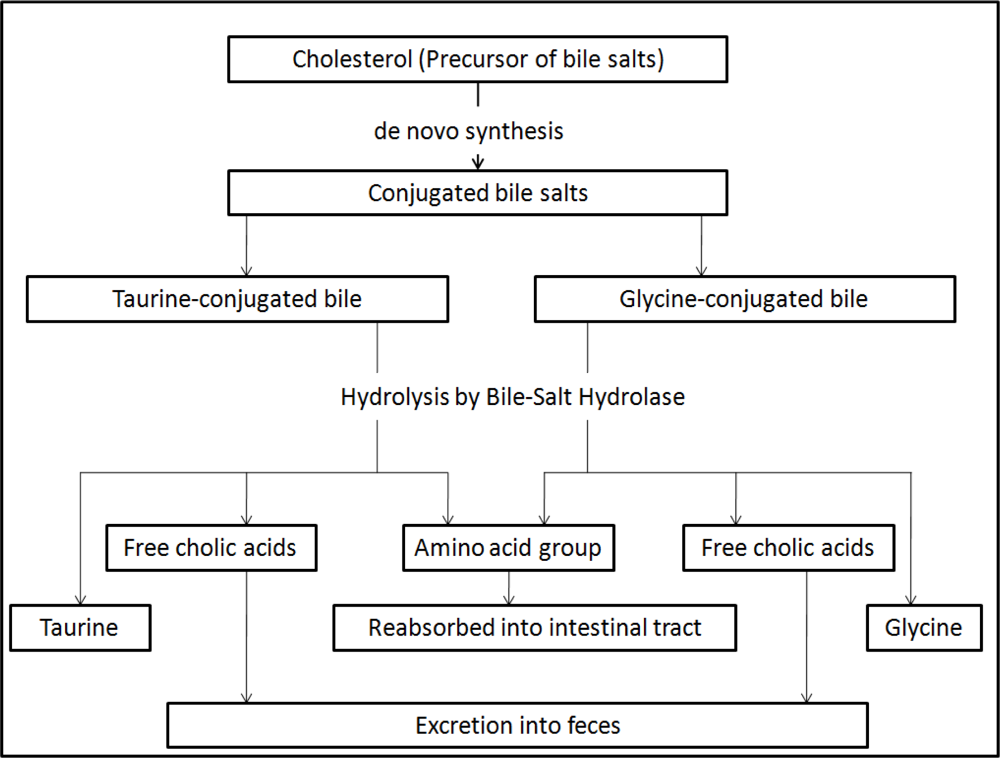
<p>Past <italic>in vitro</italic> studies have evaluated a number of mechanisms proposed for the cholesterol-lowering effects of probiotics and prebiotics. One of the purported mechanisms includes enzymatic deconjugation of bile acids by bile-salt hydrolase of probiotics. Bile, a water-soluble end product of cholesterol in the liver, is stored and concentrated in the gallbladder, and released into the duodenum upon ingestion of food [<xref ref-type="bibr" rid="b85-ijms-11-02499">85</xref>]. It consists of cholesterol, phospholipids, conjugated bile acids, bile pigments and electrolytes. Once deconjugated, bile acids are less soluble and absorbed by the intestines, leading to their elimination in the feces. Cholesterol is used to synthesize new bile acids in a homeostatic response, resulting in lowering of serum cholesterol [<xref ref-type="bibr" rid="b85-ijms-11-02499">85</xref>] (<xref ref-type="fig" rid="f1-ijms-11-02499">Figure 1</xref>). In an <italic>in vitro</italic> study, Jones <italic>et al.</italic> [<xref ref-type="bibr" rid="b86-ijms-11-02499">86</xref>] evaluated the role of bile salt hydrolase in cholesterol-lowering using <italic>Lactobacillus plantarum</italic> 80 (pCBH1). Bile salt hydrolase (BSH) is the enzyme responsible for bile salt deconjugation in the enterohepatic circulation. It has been detected in probiotics indigenous to the gastrointestinal tract. The authors found that BSH activity was able to hydrolyze conjugated glycodeoxycholic acid and taurodeoxycholic acid, leading to the deconjugation of glyco- and tauro-bile acids.</p>
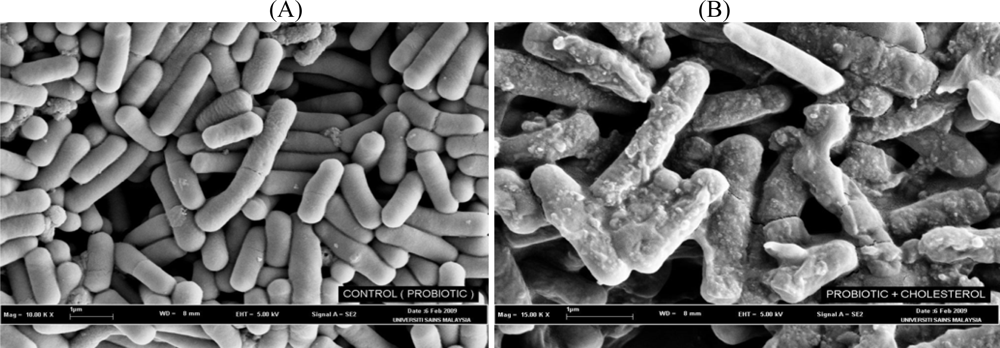
<p>The hypocholesterolemic effect of the probiotics has also been attributed to their ability to bind cholesterol in the small intestines (<xref ref-type="fig" rid="f2-ijms-11-02499">Figure 2</xref>). Usman and Hosono [<xref ref-type="bibr" rid="b87-ijms-11-02499">87</xref>] previously reported that strains of <italic>Lactobacillus gasseri</italic> could remove cholesterol from laboratory media via binding onto cellular surfaces. The ability of cholesterol-binding appeared to be growth and strain specific. Kimoto <italic>et al.</italic> [<xref ref-type="bibr" rid="b88-ijms-11-02499">88</xref>] later strengthened such a hypothesis by evaluating the removal of cholesterol by probiotics cells during different growth conditions. Live and growing cells were compared to those that were non-growing (live but suspended in phosphate buffer) and dead (heat-killed). The authors found that although growing cells removed more cholesterol than dead cells, the heat-killed cells could still remove cholesterol from media, indicating that some cholesterol was bound to the cellular surface.</p>
<p>Cholesterol was also removed by probiotics by incorporation into the cellular membranes during growth. Kimoto <italic>et al.</italic> [<xref ref-type="bibr" rid="b88-ijms-11-02499">88</xref>] has examined the removal of cholesterol by several strains of lactococci from media. The authors observed a difference in the fatty acid distribution pattern for cells grown in the presence and absence of cholesterol. Lipids of probiotics are predominantly found in the membrane, suggesting that cholesterol incorporated into the cellular membrane had altered the fatty acid composition of the cells. The incorporation of cholesterol into the cellular membrane increased the concentration of saturated and unsaturated fatty acids, leading to increased membrane strength and subsequently higher cellular resistance toward lysis [<xref ref-type="bibr" rid="b31-ijms-11-02499">31</xref>]. Lye <italic>et al.</italic> [<xref ref-type="bibr" rid="b31-ijms-11-02499">31</xref>] also further evaluated this mechanism by determining the possible locations of the incorporated cholesterol within the membrane phospholipid bilayer of probiotic cells. The authors incorporated fluorescence probes into the membrane bilayer of probiotic cells that were grown in the absence and presence of cholesterol. Enrichment of cholesterol was found in the regions of the phospholipid tails, upper phospholipids, and polar heads of the cellular membrane phospholipid bilayer in cells that were grown in the presence of cholesterol compared to the control cells, indicating incorporation of cholesterol in those regions.</p>
<p>Cholesterol can also be converted in the intestines to coprostanol, which is directly excreted in feces. This decreases the amount of cholesterol being absorbed, leading to a reduced concentration in the physiological cholesterol pool. Possible conversion of cholesterol into coprostanol by bacteria has been evaluated by Chiang <italic>et al.</italic> [<xref ref-type="bibr" rid="b89-ijms-11-02499">89</xref>]. In their study, the authors found that cholesterol dehydrogenase/isomerase produced by bacteria such as <italic>Sterolibacterium denitrificans</italic> was responsible for catalyzing the transformation of cholesterol to cholest-4-en-3-one, an intermediate cofactor in the conversion of cholesterol to coprostanol. This served as a fundamental for further evaluations using strains of probiotic bacteria. In a recent <italic>in vitro</italic> study, Lye <italic>et al.</italic> [<xref ref-type="bibr" rid="b32-ijms-11-02499">32</xref>] evaluated the conversion of cholesterol to coprostanol by strains of lactobacilli such as <italic>Lactobacillus acidophilus, L. bulgaricus</italic> and <italic>L. casei</italic> ATCC 393 via fluorometric assays. The authors detected both intracellular and extracellular cholesterol reductase in all strains of probiotics examined, indicating possible intracellular and extracellular conversion of cholesterol to coprostanol. The concentration of cholesterol in the medium also decreased upon fermentation by probiotics accompanied by increased concentrations of coprostanol. This mechanism warrants further evaluations as cholesterol reductase is also directly administered to humans to convert cholesterol to coprostanol in the small intestines for a bloodstream cholesterol-lowering effect.</p>
<p>Most of the hypotheses raised to date are based on <italic>in vitro</italic> experiments, and few attempts have been made to evaluate the possible hypocholesterolemic mechanisms based on <italic>in vivo</italic> trials. Most of the <italic>in vivo</italic> trials conducted thus far have focused heavily on verifying the hypocholesterolemic effects of probiotics, rather than the mechanisms involved. Liong <italic>et al.</italic> [<xref ref-type="bibr" rid="b56-ijms-11-02499">56</xref>] had evaluated the hypocholesterolemic effect of a synbiotic and the possible mechanisms involved by using 24 crossbred (Large White × Landrace) hypercholesterolemic pigs. In their parallel 8-week study, the authors found that the administration of a synbiotic containing <italic>L. acidophilus</italic> ATCC 4962, fructooligosaccharides, inulin and mannitol decreased plasma total cholesterol, LDL-cholesterol and triacylglycerols compared to the control. These lipoproteins were subsequently subfractionated and characterized. Pigs supplemented with the synbiotic had a lower concentration of cholesteryl esters in the LDL particles, accompanied by a higher concentration of triacylglycerol. Triacylglycerol-enriched LDL particles are more susceptible to hydrolysis and removal from blood, while loss of cholesteryl esters forms smaller and denser LDL particles leading to a higher removal from blood compared to larger LDL particles. The authors also found that the administration of the synbiotic led to higher concentration of cholesteryl esters in the HDL particles. HDL is termed as the beneficial cholesterol attributed to its role of transporting cholesterol to the liver for further hydrolysis. Cholesterol is transported as cholesteryl esters in the core of HDL. Thus, the authors suggested that the synbiotic induced a hypocholesterolemic effect via altering the pathways of cholesteryl esters and lipoprotein transporters.</p>
<p>Prebiotics such as inulin and fructooligosaccharides are soluble, indigestible, viscous and fermentable compounds that contribute to hypocholesterolemia via two mechanisms: decreasing cholesterol absorption accompanied by enhanced cholesterol excretion via feces, and the production of short-chain fatty acids (SCFAs) upon selective fermentation by intestinal bacterial microflora [<xref ref-type="bibr" rid="b90-ijms-11-02499">90</xref>]. Using Sprague-Dawley hypercholesterolemic-induced rats (n = 32), Kim and Shin [<xref ref-type="bibr" rid="b91-ijms-11-02499">91</xref>] found that the administration of inulin for 4-weeks decreased serum LDL-cholesterol with increased serum HDL-cholesterol levels (<italic>P</italic> &lt; 0.05) compared to the control. Rats fed with inulin also showed higher excretions of fecal lipid and cholesterol compared to the control (<italic>P</italic> &lt; 0.05), mainly attributed to reduced cholesterol absorption. Similar to indigestible fibers, soluble indigestible prebiotics have been postulated to increase the viscosity of the digestive tract and increase the thickness of the unstirred layer in the small intestine, and thus inhibiting the uptake of cholesterol [<xref ref-type="bibr" rid="b92-ijms-11-02499">92</xref>]. This may have led to a higher cholesterol catabolism in the liver that contributed to a hypocholesterolemic effect.</p>
<p>Prebiotics are fermented in the colon by large bowel bacteria, yielding short-chain fatty acids (SCFAs) such as butyrate, acetate and propionate. Fermentation of prebiotics involves a variety of metabolic processes in the anaerobic microbial breakdown of organic compounds, yielding energy for microbial growth and the production of SCFAs [<xref ref-type="bibr" rid="b79-ijms-11-02499">79</xref>]. Rossi <italic>et al.</italic> [<xref ref-type="bibr" rid="b93-ijms-11-02499">93</xref>] found that butyrate was the major fermentation product from inulin, whereas acetate was produced from fructooligosaccharides. The hypocholesterolemic effect of prebiotics has been mainly attributed to SCFAs. Butyrate is known to inhibit liver cholesterol synthesis and provide a source of energy for human colon epithelial cells, meanwhile propionate may inhibit the synthesis of fatty acids in the liver, thereby lowering the rates of triacylglycerol secretion [<xref ref-type="bibr" rid="b77-ijms-11-02499">77</xref>]. Propionate is also involved in the control of hepatic cholesterol synthesis and it reduces the rate of cholesterol synthesis which could lead to the lowering of plasma cholesterol levels [<xref ref-type="bibr" rid="b77-ijms-11-02499">77</xref>].</p>
<p>In conclusion, the mechanisms proposed for mediating hypocholesterolemic effect by probiotics and/or prebiotics are numerous. Although those hypotheses were proved via <italic>in vitro</italic> studies, the mechanisms are not firmly established and demonstrated in <italic>in vivo</italic> studies. Therefore, more <italic>in vivo</italic> studies are needed to explore the underlying mechanism of cholesterol-lowering effects by probiotics and/or prebiotics in order to have a better understanding of the mechanisms and better formulations for human consumption.</p></sec>
<sec>
<label>5.</label>
<title>Safety of Probiotics and Prebiotics</title>
<p>The current use of probiotics does not require approval from the FDA. Although most members of lactobacilli and bifidobacteria are safe for consumption, some species such as <italic>L. rhamnosus</italic>, <italic>L. casei</italic>, <italic>L. paracasei</italic>, <italic>L. leichmannii</italic>, <italic>L. confuses</italic> and <italic>L. plantarum</italic> have been isolated from infectious sites. Lactobacilli are generally known as the normal microflora in the gastrointestinal tract; however, cases such as septicaemia, bacteremia [<xref ref-type="bibr" rid="b94-ijms-11-02499">94</xref>–<xref ref-type="bibr" rid="b96-ijms-11-02499">96</xref>] and endocarditis [<xref ref-type="bibr" rid="b97-ijms-11-02499">97</xref>] have been recorded, inflicting infants, elderly and the immune-compromised [<xref ref-type="bibr" rid="b98-ijms-11-02499">98</xref>]. These cases are uncommon and many studies have proven that probiotics were not the contributory mediator and these cases were usually prompted by individual underlying diseases. Some adverse effects might be induced by probiotics, some of which have been documented in the literature, including systemic infections (<xref ref-type="table" rid="t4-ijms-11-02499">Table 4</xref>), deleterious metabolic activities, possible genetic interactions between probiotics and intestinal microbes and occurrence of antibiotic resistance in probiotics. These cases of adverse effects were often accompanied by other disease, occurrence of gastrointestinal inflammation and lesions, or by an impaired immune system.</p>
<p>The deleterious metabolic activities of probiotics such as mucin degradation and translocation contribute to possible adverse effects upon the consumption. Following the ingestion of probiotics in the gastrointestinal tract, the load of microorganisms passing through the small bowel is increased, which could cause gastrointestinal disturbances including intestinal inflammation. It has been hypothesized that the accumulation of probiotics along the gastrointestinal tract might lead to the risk of intestinal mucus degradation. However, current findings do not support such a suggestion. Ruseler-van Embden <italic>et al.</italic> [<xref ref-type="bibr" rid="b99-ijms-11-02499">99</xref>] determined the mucus glycoprotein degradation ability of <italic>Lactobacillus casei</italic> strain GG, <italic>Lactobacillus acidophilus</italic>, <italic>Bifidobacterium bifidum</italic> and a mesophylic lactic culture (isolated from a commercial fermented product) in germ-free rats. The authors reported that the probiotics strains tested did not degrade intestinal mucus glycoproteins and no damage was observed on the intestinal mucus layer. Recently, Abe <italic>et al.</italic> [<xref ref-type="bibr" rid="b100-ijms-11-02499">100</xref>] evaluated <italic>Bifidobacterium longum</italic> BB536, <italic>Bifidobacterium breve</italic> M-16V and <italic>Bifidobacterium infantis</italic> M-63 on mucin degradation activity <italic>in vitro</italic>. No mucin degradation activity was observed and the authors further explored the translocation ability of <italic>Bifidobacterium longum</italic> BB536 in ten 4-weeks-old mice. No translocation was detected and no damage was observed on epithelial cells or to the mucosal layer in the ileum, cecum and colon.</p>
<p>The production of bile salt hydrolase (BSH) by probiotic strains could increase the accumulation of deconjugated bile which could be subsequently transformed into detrimental secondary bile acids by intestinal microflora. It has been suggested that the accumulation of potentially cytotoxic secondary bile acids in the enterohepatic circulation could increase the risk of gastrointestinal diseases such as cholestasis and colorectal cancer [<xref ref-type="bibr" rid="b101-ijms-11-02499">101</xref>]. Little information is available on such a possibility and to our knowledge, there has been no study that specifically evaluates the detrimental effects of BSH from probiotics on humans. More studies are needed to ascertain that the deleterious effects of BSH from probiotics do not outweigh its benefits.</p>
<p>Adverse immunological effects have been postulated to occur as a result of administration routes, which included oral or parental administration. When probiotics are administered parentally, their cell walls containing peptidoglycan polysaccharides has been postulated to cause adverse effects such as fever, arthritis, cardioangitis, hepatobiliary lesions or autoimmune diseases [<xref ref-type="bibr" rid="b102-ijms-11-02499">102</xref>]. Although it has been noted that these effects are mediated by different cytokines, the detailed mechanisms involved have not been substantially understood. Such a claim remains a hypothesis as there is no direct evidence supported by <italic>in vivo</italic> trials, and warrants further investigation.</p>
<p>The adverse effect in terms of genetic interactions between ingested probiotics and the native intestinal microbes has also been a topic of interest. The phenomenon whereby genetic materials represented by plasmids are transferred between microorganisms in our body [<xref ref-type="bibr" rid="b103-ijms-11-02499">103</xref>] raises the question of whether genetic exchange may occur between probiotics and the microorganisms in the gastrointestinal tract. Transduction, conjugation and transformation have been identified as the three basic forms of microbial genetic exchange within gut microbial communities [<xref ref-type="bibr" rid="b104-ijms-11-02499">104</xref>–<xref ref-type="bibr" rid="b106-ijms-11-02499">106</xref>]. It has been suggested that the transformation of intestinal microflora by DNA may be enhanced upon ingestion of bacteria, leading to genetic rearrangements in the pool of gastrointestinal microflora. The gastrointestinal tract is populated by a complex microflora colony. It could act as a pool for the transmission of antibiotic-resistance genes among beneficial bacteria and harmful pathogens. This transmission can consequently lead to the evolution of antibiotic-resistant probiotics [<xref ref-type="bibr" rid="b107-ijms-11-02499">107</xref>] and potential emergence of resistant pathogens.</p>
<p>D’Aimmo <italic>et al.</italic> [<xref ref-type="bibr" rid="b108-ijms-11-02499">108</xref>] isolated 34 strains of <italic>Lactobacillus</italic> and <italic>Bifidobacterium</italic> and 21 strains of starter culture bacteria (such as <italic>Streptococcus thermophilus</italic>) from dairy products. The authors found that all strains tested were resistant to the antibiotics such as aztreonam, cycloserin, kanamycin, nalidixic acid, polymyxin B and spectinomycin. In another <italic>in vitro</italic> study, Hummel <italic>et al.</italic> [<xref ref-type="bibr" rid="b109-ijms-11-02499">109</xref>] evaluated antibiotic resistant genes in 45 strains of probiotics from the genera of <italic>Lactobacillus</italic>, <italic>Streptococcus</italic>, <italic>Lactococcus</italic>, <italic>Pediococcus</italic> and <italic>Leuconostoc</italic> by using polymerase chain reaction (PCR). The authors found that 77.8 % of the probiotic strains examined were resistant to gentamicin, streptomycin and ciprofloxacin. A previous case study also reported such an occurrence in infants. A 6-week-old infant was hospitalized for a scheduled repair of a double-outlet right ventricle and pulmonic stenosis, and had received a broad-spectrum of antibiotics including vancomycin and ceftriaxone. A probiotic supplement containing <italic>Lactobacillus rhamnosus</italic> GG was also introduced through the gastrostomy tube (10 × 10<sup>9</sup> cells/capsule; one capsule daily). The infant later developed onset fever and marked leukocytosis, and thus blood samples were drawn for culture examination. The blood culture isolates were positive for <italic>Lactobacillus</italic> species, which were resistant to vancomycin, meropenem, ceftriaxone and cefuroxime [<xref ref-type="bibr" rid="b35-ijms-11-02499">35</xref>].</p>
<p>Prebiotics such as inulin and oligofructose are present in our daily diet intake. Daily intake of inulin and oligofructose has been estimated at up to 10 g in the population of the United States [<xref ref-type="bibr" rid="b110-ijms-11-02499">110</xref>]. The safety of inulin and oligofuctose for food application was evaluated by many legal authorities worldwide, and <italic>in vivo</italic> experimental evidence has not demonstrated any toxic effects [<xref ref-type="bibr" rid="b74-ijms-11-02499">74</xref>]. However, prebiotics at very high doses might increase incidences of bloating, flatulence and high osmotic pressure which lead to gastrointestinal discomfort [<xref ref-type="bibr" rid="b111-ijms-11-02499">111</xref>]. The effects might vary widely between individuals and depend on the type of food in which the prebiotics are incorporated.</p>
<p>Prebiotics such as fructooligosaccharides (FOS) stimulate the growth of intestinal microflora and increasing organic acid concentrations within the lower part of gastrointestinal tract [<xref ref-type="bibr" rid="b79-ijms-11-02499">79</xref>,<xref ref-type="bibr" rid="b93-ijms-11-02499">93</xref>] which further contribute to health benefits such as cholesterol-lowering effect and enhancing the resistance to intestinal pathogens. However, some studies found that a high dose of FOS exhibited adverse effects in animal models. In a randomized, placebo-controlled and parallel designed study, Bruggencate <italic>et al</italic>. [<xref ref-type="bibr" rid="b112-ijms-11-02499">112</xref>] administered 60 g/kg of FOS into ten specific pathogen–free 8-week-old male Wistar rats (with a mean body weight of 226 g) for 14 days. The rats were also infected with salmonella. FOS increased translocation of salmonella to extraintestinal sites, mucin excretion and cytotoxicity of fecal water in the FOS group compared to the control. FOS was found to impair the intestinal barrier in rats, as indicated by higher intestinal permeability. The authors further extrapolated their findings using humans as a model. In the double-blind, placebo-controlled, crossover designed study with a washout period of two weeks, Bruggencate <italic>et al.</italic> [<xref ref-type="bibr" rid="b113-ijms-11-02499">113</xref>] studied the adverse effects of FOS in thirty-four men (aged 18–55 years old). In this study, the subjects consumed either lemonade with 20 g of FOS (purity 93%, Raftilose P95, Orafti) or 6 g of sucrose (placebo) daily. The authors discovered that the consumption of FOS increased flatulence, intestinal bloating and fecal mucin excretion, indicating the occurrence of mucosal irritation. However, the authors found that FOS did not affect the cytotoxicity of fecal water and intestinal permeability, and the overall effects were more moderate than those in rats. It appears that high dosage of FOS can cause minor disturbances in the gastrointestinal tract, but such cases are far from being a risk to life [<xref ref-type="bibr" rid="b22-ijms-11-02499">22</xref>].</p>
<p>On the whole, probiotics and prebiotics are safe for consumption due to their low ability of triggering adverse effects [<xref ref-type="bibr" rid="b5-ijms-11-02499">5</xref>,<xref ref-type="bibr" rid="b67-ijms-11-02499">67</xref>]. At this point, there is no standard analysis or assay suggested for safety assessment on probiotics and prebiotics [<xref ref-type="bibr" rid="b67-ijms-11-02499">67</xref>]. However, each probiotic and prebiotic should be evaluated for safety, so that these strains can be isolated for specific purposes at specific dosages to prevent potential adverse reactions.</p></sec>
<sec sec-type="conclusions">
<label>6.</label>
<title>Conclusions</title>
<p>Probiotic and/or prebiotics have been widely assessed for their effects on lipid profiles such as total cholesterol, LDL-cholesterol, HDL-cholesterol and triglycerides. However, not all trials have yielded conclusive results. Certain strains of probiotic and types of prebiotic have demonstrated cholesterol-lowering property while others did not. In order to justify the varying cholesterol-lowering effect exhibited by various strains of probiotics or types of prebiotics, researchers have endeavored to reveal the mechanisms of probiotics and/or prebiotics on hypocholesterolemic effect through <italic>in vitro</italic> and <italic>in vivo</italic> studies. Many of the proposed mechanisms and experimental evidence specifically targeting cholesterol-lowering effects remain controversial. Thus, more properly-designed <italic>in vivo</italic> trials may disclose additional understanding and knowledge to eliminate the controversies, to better understand the underlying mechanisms and for better safety assessment prior to consumption.</p></sec></body>
<back>
<ack>
<p>The authors wish to express their appreciation to the eScienceFund Grant (305/PTEKIND/613218) provided by the Malaysian Ministry of Science, Technology and Innovation, the USM RU grant (1001/PTEKIND/811089 and 1001/PTEKIND/833003) and the USM Fellowship provided by Universiti Sains Malaysia for their financial support. The authors would also like to thank Fung Wai Yee for her help in editing this manuscript.</p></ack>
<ref-list>
<title>References and Notes</title>
<ref id="b1-ijms-11-02499"><label>1.</label><citation citation-type="web"><collab>WHO</collab><article-title>Cardiovascular Disease</article-title>Fact sheet N°317, Geneva, Switzerland, September, 2009. Available at: <ext-link xlink:href="http://www.who.int/mediacentre/factsheets/fs317/en/print.html" ext-link-type="uri">http://www.who.int/mediacentre/factsheets/fs317/en/print.html</ext-link> (accessed on 19 May 2010).</citation></ref>
<ref id="b2-ijms-11-02499"><label>2.</label><citation citation-type="journal"><person-group person-group-type="author"><name><surname>Yusuf</surname><given-names>S</given-names></name><name><surname>Hawken</surname><given-names>S</given-names></name><name><surname>Ounpuu</surname><given-names>S</given-names></name><name><surname>Dans</surname><given-names>T</given-names></name><name><surname>Avezum</surname><given-names>A</given-names></name><name><surname>Lanas</surname><given-names>F</given-names></name><name><surname>McQueen</surname><given-names>M</given-names></name><name><surname>Budaj</surname><given-names>A</given-names></name><name><surname>Pais</surname><given-names>P</given-names></name><name><surname>Varigo</surname><given-names>J</given-names></name><name><surname>Lisheng</surname><given-names>A</given-names></name></person-group><article-title>Effect of Potentially Modifiable Risk Factors Associated with Myocardial Infarction in 52 Countries (The INTERHEART Study): Case-Control Study</article-title><source>Lancet</source><year>2004</year><volume>364</volume><fpage>937</fpage><lpage>952</lpage><pub-id pub-id-type="doi">10.1016/S0140-6736(04)17018-9</pub-id><pub-id pub-id-type="pmid">15364185</pub-id></citation></ref>
<ref id="b3-ijms-11-02499"><label>3.</label><citation citation-type="other"><collab>WHO</collab><article-title>Diet, Nutrition and Prevention of Chronic Diseases</article-title>Report of a Joint WHO/FAO Expert Consultation, Geneva, Switzerland, <year>2003</year></citation></ref>
<ref id="b4-ijms-11-02499"><label>4.</label><citation citation-type="book"><person-group person-group-type="author"><collab>FAO, WHO</collab></person-group><source>Health and Nutritional Properties of Probiotics in Food including Powder Milk with Live Lactic Acid Bacteria</source>Report of a Joint FAO/WHO Expert Consultation on Evaluation of Health and Nutritional Properties of Probiotics in Food Including Powder Milk with Live Lactic Acid Bacteria, Cordoba, Argentina, <day>1–4</day><month>October</month><year>2001</year></citation></ref>
<ref id="b5-ijms-11-02499"><label>5.</label><citation citation-type="journal"><person-group person-group-type="author"><name><surname>Roberfroid</surname><given-names>M</given-names></name></person-group><article-title>Prebiotics: The Concept Revisited</article-title><source>J. Nutr</source><year>2007</year><volume>137</volume><fpage>830</fpage><lpage>837</lpage></citation></ref>
<ref id="b6-ijms-11-02499"><label>6.</label><citation citation-type="journal"><person-group person-group-type="author"><name><surname>Galdeano</surname><given-names>CM</given-names></name><name><surname>de LeBlanc</surname><given-names>A</given-names></name><name><surname>de</surname><given-names>M</given-names></name><name><surname>Vinderola</surname><given-names>G</given-names></name><name><surname>Bonet</surname><given-names>MEB</given-names></name><name><surname>Perdigón</surname><given-names>G</given-names></name></person-group><article-title>Proposed Model: Mechanisms of Immunomodulation Induced by Probiotic Bacteria</article-title><source>Clin. Vaccine Immunol</source><year>2007</year><volume>14</volume><fpage>485</fpage><lpage>492</lpage><pub-id pub-id-type="doi">10.1128/CVI.00406-06</pub-id><pub-id pub-id-type="pmid">17360855</pub-id></citation></ref>
<ref id="b7-ijms-11-02499"><label>7.</label><citation citation-type="journal"><person-group person-group-type="author"><name><surname>Yeo</surname><given-names>SK</given-names></name><name><surname>Liong</surname><given-names>MT</given-names></name></person-group><article-title>Angiotensin I-Converting Enzyme Inhibitory Activity and Bioconversion of Isoflavones by Probiotics in Soymilk Supplemented with Prebiotics</article-title><source>Int. J. Food Sci. Nutr</source><year>2010</year><volume>61</volume><fpage>161</fpage><lpage>181</lpage><pub-id pub-id-type="doi">10.3109/09637480903348122</pub-id><pub-id pub-id-type="pmid">20085504</pub-id></citation></ref>
<ref id="b8-ijms-11-02499"><label>8.</label><citation citation-type="journal"><person-group person-group-type="author"><name><surname>Hirayama</surname><given-names>K</given-names></name><name><surname>Rafter</surname><given-names>J</given-names></name></person-group><article-title>The Role Of Probiotic Bacteria in Cancer Prevention</article-title><source>Microbes. Infect</source><year>2000</year><volume>2</volume><fpage>681</fpage><lpage>686</lpage><pub-id pub-id-type="doi">10.1016/S1286-4579(00)00357-9</pub-id><pub-id pub-id-type="pmid">10884619</pub-id></citation></ref>
<ref id="b9-ijms-11-02499"><label>9.</label><citation citation-type="journal"><person-group person-group-type="author"><name><surname>Songisepp</surname><given-names>E</given-names></name><name><surname>Kulisaar</surname><given-names>T</given-names></name><name><surname>Hütt</surname><given-names>P</given-names></name><name><surname>Elias</surname><given-names>P</given-names></name><name><surname>Brilene</surname><given-names>T</given-names></name><name><surname>Zilmer</surname><given-names>M</given-names></name><name><surname>Mikelsaar</surname><given-names>M</given-names></name></person-group><article-title>A New Probiotic Cheese with Antioxidative and Antimicrobial</article-title><source>J. Dairy Sci</source><year>2004</year><volume>87</volume><fpage>2017</fpage><lpage>2023</lpage><pub-id pub-id-type="doi">10.3168/jds.S0022-0302(04)70019-3</pub-id><pub-id pub-id-type="pmid">15328213</pub-id></citation></ref>
<ref id="b10-ijms-11-02499"><label>10.</label><citation citation-type="journal"><person-group person-group-type="author"><name><surname>Weston</surname><given-names>S</given-names></name><name><surname>Halbert</surname><given-names>A</given-names></name><name><surname>Richmond</surname><given-names>P</given-names></name><name><surname>Prescott</surname><given-names>SL</given-names></name></person-group><article-title>Effects of Probiotics on Topic Dermatitis: A Randomised Controlled Trial</article-title><source>Arch. Dis. Child</source><year>2005</year><volume>90</volume><fpage>892</fpage><lpage>897</lpage><pub-id pub-id-type="doi">10.1136/adc.2004.060673</pub-id><pub-id pub-id-type="pmid">15863468</pub-id></citation></ref>
<ref id="b11-ijms-11-02499"><label>11.</label><citation citation-type="journal"><person-group person-group-type="author"><name><surname>Scholz-Ahrens</surname><given-names>KE</given-names></name><name><surname>Ade</surname><given-names>P</given-names></name><name><surname>Marten</surname><given-names>B</given-names></name><name><surname>Weber</surname><given-names>P</given-names></name><name><surname>Timm</surname><given-names>W</given-names></name><name><surname>Asil</surname><given-names>Y</given-names></name><name><surname>Glüer</surname><given-names>C-C</given-names></name><name><surname>Schrezenmeir</surname><given-names>J</given-names></name></person-group><article-title>Prebiotics, Probiotics and Synbiotics Affect Mineral Absorption, Bone Mineral Content and Bone Structure</article-title><source>J. Nutr</source><year>2007</year><volume>137</volume><fpage>838</fpage><lpage>846</lpage></citation></ref>
<ref id="b12-ijms-11-02499"><label>12.</label><citation citation-type="journal"><person-group person-group-type="author"><name><surname>Baharav</surname><given-names>E</given-names></name><name><surname>Mor</surname><given-names>F</given-names></name><name><surname>Halpern</surname><given-names>M</given-names></name><name><surname>Weinberger</surname><given-names>A</given-names></name></person-group><article-title><italic>Lactobacillus</italic> GG Bacteria Ameliorate Arthritis in Lewis Rats</article-title><source>J. Nutr</source><year>2004</year><volume>134</volume><fpage>1964</fpage><lpage>1969</lpage><pub-id pub-id-type="pmid">15284384</pub-id></citation></ref>
<ref id="b13-ijms-11-02499"><label>13.</label><citation citation-type="journal"><person-group person-group-type="author"><name><surname>Ouwehand</surname><given-names>AC</given-names></name></person-group><article-title>Antiallergic Effects of Probiotics</article-title><source>J. Nutr</source><year>2007</year><volume>137</volume><fpage>794</fpage><lpage>797</lpage></citation></ref>
<ref id="b14-ijms-11-02499"><label>14.</label><citation citation-type="journal"><person-group person-group-type="author"><name><surname>Falagas</surname><given-names>ME</given-names></name><name><surname>Betsi</surname><given-names>GI</given-names></name><name><surname>Athanasiou</surname><given-names>S</given-names></name></person-group><article-title>Probiotics for Prevention of Recurrent Vulvovaginal Candidiasis: A Review</article-title><source>J. Antimicrob. Chemother</source><year>2006</year><volume>58</volume><fpage>266</fpage><lpage>272</lpage><pub-id pub-id-type="doi">10.1093/jac/dkl246</pub-id><pub-id pub-id-type="pmid">16790461</pub-id></citation></ref>
<ref id="b15-ijms-11-02499"><label>15.</label><citation citation-type="journal"><person-group person-group-type="author"><name><surname>Pereira</surname><given-names>DIA</given-names></name><name><surname>Gibson</surname><given-names>GR</given-names></name></person-group><article-title>Effects of Consumption of Probiotics and Prebiotics on Serum Lipid Levels in Human</article-title><source>Crit. Rev. Biochem. Mol. Biol</source><year>2002</year><volume>37</volume><fpage>259</fpage><lpage>281</lpage><pub-id pub-id-type="doi">10.1080/10409230290771519</pub-id><pub-id pub-id-type="pmid">12236466</pub-id></citation></ref>
<ref id="b16-ijms-11-02499"><label>16.</label><citation citation-type="journal"><person-group person-group-type="author"><name><surname>Gibson</surname><given-names>GR</given-names></name><name><surname>Fuller</surname><given-names>R</given-names></name></person-group><article-title>Aspects of <italic>in Vitro</italic> and <italic>in Vivo</italic> Research Approaches Directed Toward Identifying Probiotics and Prebiotics for Human Use</article-title><source>J. Nutr</source><year>2000</year><volume>130</volume><fpage>391S</fpage><lpage>395S</lpage><pub-id pub-id-type="pmid">10721913</pub-id></citation></ref>
<ref id="b17-ijms-11-02499"><label>17.</label><citation citation-type="journal"><person-group person-group-type="author"><name><surname>Cummings</surname><given-names>JH</given-names></name><name><surname>Macfarlane</surname><given-names>GT</given-names></name><name><surname>Englyst</surname><given-names>HN</given-names></name></person-group><article-title>Prebiotic Digestion and Fermentation</article-title><source>Am. J. Clin. Nutr</source><year>2001</year><volume>73</volume><fpage>415</fpage><lpage>420</lpage></citation></ref>
<ref id="b18-ijms-11-02499"><label>18.</label><citation citation-type="journal"><person-group person-group-type="author"><name><surname>Bielecka</surname><given-names>M</given-names></name><name><surname>Biedrzycka</surname><given-names>E</given-names></name><name><surname>Majkowska</surname><given-names>A</given-names></name></person-group><article-title>Selection of Probiotics and Prebiotics for Synbiotic and Confirmation of Their <italic>in Vivo</italic> Effectiveness</article-title><source>Food Res. Int</source><year>2002</year><volume>35</volume><fpage>139</fpage><lpage>144</lpage><pub-id pub-id-type="doi">10.1016/S0963-9969(01)00175-2</pub-id></citation></ref>
<ref id="b19-ijms-11-02499"><label>19.</label><citation citation-type="journal"><person-group person-group-type="author"><name><surname>Schley</surname><given-names>PD</given-names></name><name><surname>Field</surname><given-names>CJ</given-names></name></person-group><article-title>The Immune-Enhancing Effects of Dietary Fiber and Prebiotics</article-title><source>Br. J. Nutr</source><year>2002</year><volume>87</volume><fpage>221</fpage><lpage>230</lpage><pub-id pub-id-type="doi">10.1079/BJNBJN/2002541</pub-id></citation></ref>
<ref id="b20-ijms-11-02499"><label>20.</label><citation citation-type="journal"><person-group person-group-type="author"><name><surname>Klinder</surname><given-names>A</given-names></name><name><surname>Forster</surname><given-names>A</given-names></name><name><surname>Caderni</surname><given-names>G</given-names></name><name><surname>Femia</surname><given-names>AP</given-names></name><name><surname>Pool-Zobel</surname><given-names>BL</given-names></name></person-group><article-title>Fecal Water Genotoxicity is Predictive of Tumor-Preventive Activities by Inulin-Like Oligofructoses, Probiotics (<italic>Lactobacillus rhamnosus</italic> and <italic>Bifidobacterium lactis</italic>) and Their Synbiotic Combination</article-title><source>Nutr. Cancer</source><year>2004</year><volume>49</volume><fpage>144</fpage><lpage>155</lpage><pub-id pub-id-type="doi">10.1207/s15327914nc4902_5</pub-id><pub-id pub-id-type="pmid">15489207</pub-id></citation></ref>
<ref id="b21-ijms-11-02499"><label>21.</label><citation citation-type="journal"><person-group person-group-type="author"><name><surname>Scholz-Ahrens</surname><given-names>KE</given-names></name><name><surname>Acil</surname><given-names>Y</given-names></name><name><surname>Schrezenmeir</surname><given-names>J</given-names></name></person-group><article-title>Effect of Oligofructose or Dietary Calcium on Repeated Calcium and Phosphorus Balances, Bone Mineralization and Trabecular Structure in Ovariectomized Rats</article-title><source>Br. J. Nutr</source><year>2002</year><volume>88</volume><fpage>365</fpage><lpage>377</lpage><pub-id pub-id-type="doi">10.1079/BJN2002661</pub-id><pub-id pub-id-type="pmid">12323086</pub-id></citation></ref>
<ref id="b22-ijms-11-02499"><label>22.</label><citation citation-type="journal"><person-group person-group-type="author"><name><surname>Cummings</surname><given-names>JH</given-names></name><name><surname>Macfarlane</surname><given-names>G</given-names></name></person-group><article-title>Gastrointestinal Effects of Prebiotics</article-title><source>Br. J. Nutr</source><year>2002</year><volume>87</volume><fpage>145</fpage><lpage>151</lpage><pub-id pub-id-type="doi">10.1079/BJNBJN/2002530</pub-id></citation></ref>
<ref id="b23-ijms-11-02499"><label>23.</label><citation citation-type="journal"><person-group person-group-type="author"><name><surname>Topping</surname><given-names>DL</given-names></name><name><surname>Clifton</surname><given-names>PM</given-names></name></person-group><article-title>Short-Chain Fatty Acids and Human Colonic Function: Roles of Resistant Starch and Nonstarch Polysaccharides</article-title><source>Physiol. Rev</source><year>2001</year><volume>81</volume><fpage>1031</fpage><lpage>1064</lpage><pub-id pub-id-type="pmid">11427691</pub-id></citation></ref>
<ref id="b24-ijms-11-02499"><label>24.</label><citation citation-type="journal"><person-group person-group-type="author"><name><surname>Hinnebusch</surname><given-names>BF</given-names></name><name><surname>Meng</surname><given-names>S-F</given-names></name><name><surname>Wu</surname><given-names>JT</given-names></name><name><surname>Archer</surname><given-names>SY</given-names></name><name><surname>Hodin</surname><given-names>RA</given-names></name></person-group><article-title>The Effects of Short-Chain Fatty Acids on Human Colon Cancer Cell Phenotype Are Associated with Histone Hyperacetylation</article-title><source>J. Nutr</source><year>2002</year><volume>132</volume><fpage>1012</fpage><lpage>1017</lpage><pub-id pub-id-type="pmid">11983830</pub-id></citation></ref>
<ref id="b25-ijms-11-02499"><label>25.</label><citation citation-type="journal"><person-group person-group-type="author"><name><surname>Dewailly</surname><given-names>É</given-names></name><name><surname>Blanchet</surname><given-names>C</given-names></name><name><surname>Gingras</surname><given-names>S</given-names></name><name><surname>Lemieux</surname><given-names>S</given-names></name><name><surname>Sauvé</surname><given-names>L</given-names></name><name><surname>Bergeron</surname><given-names>J</given-names></name><name><surname>Holub</surname><given-names>BJ</given-names></name></person-group><article-title>Relations Between N-3 Fatty Acid Status and Cardiovascular Disease Risk Factors Among Quebecers</article-title><source>Am. J. Clin. Nutr</source><year>2001</year><volume>74</volume><fpage>603</fpage><lpage>611</lpage><pub-id pub-id-type="pmid">11684528</pub-id></citation></ref>
<ref id="b26-ijms-11-02499"><label>26.</label><citation citation-type="journal"><person-group person-group-type="author"><name><surname>Wolever</surname><given-names>TMS</given-names></name><name><surname>Schrade</surname><given-names>KB</given-names></name><name><surname>Vogt</surname><given-names>JA</given-names></name><name><surname>Tsihlias</surname><given-names>EB</given-names></name><name><surname>McBurney</surname><given-names>MI</given-names></name></person-group><article-title>Do Colonic Short-Chain Fatty Acids Contribute to the Long-Term Adaptation of Blood Lipids in Subjects with Type 2 Diabetes Consuming a High-Fiber Diet?</article-title><source>Am. J. Clin. Nutr</source><year>2002</year><volume>75</volume><fpage>1023</fpage><lpage>1030</lpage><pub-id pub-id-type="pmid">12036809</pub-id></citation></ref>
<ref id="b27-ijms-11-02499"><label>27.</label><citation citation-type="journal"><person-group person-group-type="author"><name><surname>Lambert</surname><given-names>JM</given-names></name><name><surname>Bongers</surname><given-names>RS</given-names></name><name><surname>de Vos</surname><given-names>WM</given-names></name><name><surname>Kleerebezem</surname><given-names>M</given-names></name></person-group><article-title>Functional Analysis of Four Bile Salt Hydrolase and Penicillin Acylase Family Members in <italic>Lactobacillus plantarum</italic> WCFS1</article-title><source>Appl. Environ. Microbiol</source><year>2008</year><volume>74</volume><fpage>4719</fpage><lpage>4726</lpage><pub-id pub-id-type="doi">10.1128/AEM.00137-08</pub-id><pub-id pub-id-type="pmid">18539794</pub-id></citation></ref>
<ref id="b28-ijms-11-02499"><label>28.</label><citation citation-type="journal"><person-group person-group-type="author"><name><surname>Pereira</surname><given-names>DIA</given-names></name><name><surname>Gibson</surname><given-names>GR</given-names></name></person-group><article-title>Cholesterol Assimilation by Lactic Acid Bacteria and Bifidobacteria Isolated from the Human Gut</article-title><source>Appl. Environ. Microbiol</source><year>2002</year><volume>68</volume><fpage>4689</fpage><lpage>4693</lpage><pub-id pub-id-type="doi">10.1128/AEM.68.9.4689-4693.2002</pub-id><pub-id pub-id-type="pmid">12200334</pub-id></citation></ref>
<ref id="b29-ijms-11-02499"><label>29.</label><citation citation-type="journal"><person-group person-group-type="author"><name><surname>Liong</surname><given-names>MT</given-names></name><name><surname>Shah</surname><given-names>NP</given-names></name></person-group><article-title>Effects of A <italic>Lactobacillus casei</italic> Synbiotic on Serum Lipoprotein, Intestinal Microflora, and Organic Acids in Rats</article-title><source>J. Dairy Sci</source><year>2006</year><volume>89</volume><fpage>1390</fpage><lpage>1399</lpage><pub-id pub-id-type="doi">10.3168/jds.S0022-0302(06)72207-X</pub-id><pub-id pub-id-type="pmid">16606710</pub-id></citation></ref>
<ref id="b30-ijms-11-02499"><label>30.</label><citation citation-type="journal"><person-group person-group-type="author"><name><surname>Liong</surname><given-names>MT</given-names></name><name><surname>Shah</surname><given-names>NP</given-names></name></person-group><article-title>Acid and Bile Tolerance and Cholesterol Removal Ability of Lactobacilli Strains</article-title><source>J. Dairy Sci</source><year>2005</year><volume>88</volume><fpage>55</fpage><lpage>66</lpage><pub-id pub-id-type="doi">10.3168/jds.S0022-0302(05)72662-X</pub-id><pub-id pub-id-type="pmid">15591367</pub-id></citation></ref>
<ref id="b31-ijms-11-02499"><label>31.</label><citation citation-type="journal"><person-group person-group-type="author"><name><surname>Lye</surname><given-names>HS</given-names></name><name><surname>Rusul</surname><given-names>G</given-names></name><name><surname>Liong</surname><given-names>MT</given-names></name></person-group><article-title>Mechanisms of Cholesterol Removal by Lactoballi Under Conditions That Mimic the Human Gastrointestinal Tract</article-title><source>Int. Dairy J</source><year>2010</year><volume>20</volume><fpage>169</fpage><lpage>175</lpage><pub-id pub-id-type="doi">10.1016/j.idairyj.2009.10.003</pub-id></citation></ref>
<ref id="b32-ijms-11-02499"><label>32.</label><citation citation-type="journal"><person-group person-group-type="author"><name><surname>Lye</surname><given-names>HS</given-names></name><name><surname>Rusul</surname><given-names>G</given-names></name><name><surname>Liong</surname><given-names>MT</given-names></name></person-group><article-title>Removal of Cholesterol by Lactobacilli via Incorporation of and Conversion to Coprostanol</article-title><source>J. Dairy Sci</source><year>2010</year><volume>93</volume><fpage>1383</fpage><lpage>1392</lpage><pub-id pub-id-type="doi">10.3168/jds.2009-2574</pub-id><pub-id pub-id-type="pmid">20338415</pub-id></citation></ref>
<ref id="b33-ijms-11-02499"><label>33.</label><citation citation-type="journal"><person-group person-group-type="author"><name><surname>De Preter</surname><given-names>V</given-names></name><name><surname>Vanhoutte</surname><given-names>T</given-names></name><name><surname>Huys</surname><given-names>G</given-names></name><name><surname>Swings</surname><given-names>J</given-names></name><name><surname>De Vuyst</surname><given-names>L</given-names></name><name><surname>Rutgeerts</surname><given-names>P</given-names></name><name><surname>Verbeke</surname><given-names>K</given-names></name></person-group><article-title>Effects of <italic>Lactobacillus casei</italic> Shirota, <italic>Bifidobacterium breve</italic>, and Oligofructose-Enriched Inulin on Colonic Nitrogen-Protein Metabolism in Healthy Humans</article-title><source>Am. J. Physiol. Gastrointest. Liver Physiol</source><year>2007</year><volume>292</volume><fpage>358</fpage><lpage>368</lpage></citation></ref>
<ref id="b34-ijms-11-02499"><label>34.</label><citation citation-type="journal"><person-group person-group-type="author"><name><surname>Peret-Filho</surname><given-names>LA</given-names></name><name><surname>Penna</surname><given-names>FJ</given-names></name><name><surname>Bambirra</surname><given-names>EA</given-names></name><name><surname>Nicoli</surname><given-names>JR</given-names></name></person-group><article-title>Dose Effect of Oral <italic>Saccharomyces boulardii</italic> Treatments on Morbidity and Mortality in Immunosuppressed Mice</article-title><source>J. Med. Microbiol</source><year>1998</year><volume>47</volume><fpage>111</fpage><lpage>116</lpage><pub-id pub-id-type="doi">10.1099/00222615-47-2-111</pub-id><pub-id pub-id-type="pmid">9879952</pub-id></citation></ref>
<ref id="b35-ijms-11-02499"><label>35.</label><citation citation-type="journal"><person-group person-group-type="author"><name><surname>Land</surname><given-names>MH</given-names></name><name><surname>Rouster-Stevens</surname><given-names>K</given-names></name><name><surname>Woods</surname><given-names>CR</given-names></name><name><surname>Cannon</surname><given-names>ML</given-names></name><name><surname>Cnota</surname><given-names>J</given-names></name><name><surname>Shetty</surname><given-names>AK</given-names></name></person-group><article-title><italic>Lactobacillus</italic> Sepsis Associated with Probiotic Therapy</article-title><source>Pediatrics</source><year>2005</year><volume>115</volume><fpage>178</fpage><lpage>181</lpage><pub-id pub-id-type="pmid">15629999</pub-id></citation></ref>
<ref id="b36-ijms-11-02499"><label>36.</label><citation citation-type="journal"><person-group person-group-type="author"><name><surname>Huys</surname><given-names>G</given-names></name><name><surname>D’Haene</surname><given-names>K</given-names></name><name><surname>Swings</surname><given-names>J</given-names></name></person-group><article-title>Genetic Basis of Tetracycline and Minocycline Resistance in Potentially Probiotic <italic>Lactobacillus plantarum</italic> Strain CCUG 43738</article-title><source>Antimicrob. Agents Chemother</source><year>2006</year><volume>50</volume><fpage>1550</fpage><lpage>1551</lpage><pub-id pub-id-type="doi">10.1128/AAC.50.4.1550-1551.2006</pub-id><pub-id pub-id-type="pmid">16569881</pub-id></citation></ref>
<ref id="b37-ijms-11-02499"><label>37.</label><citation citation-type="journal"><person-group person-group-type="author"><name><surname>Shinnick</surname><given-names>FL</given-names></name><name><surname>Longacre</surname><given-names>MJ</given-names></name><name><surname>Ink</surname><given-names>SL</given-names></name><name><surname>Maelett</surname><given-names>JA</given-names></name></person-group><article-title>Oat Fiber: Composition <italic>Versus</italic> Physiological Function in Rats</article-title><source>J. Nutr</source><year>1988</year><volume>118</volume><fpage>144</fpage><lpage>151</lpage><pub-id pub-id-type="pmid">2828580</pub-id></citation></ref>
<ref id="b38-ijms-11-02499"><label>38.</label><citation citation-type="journal"><person-group person-group-type="author"><name><surname>Gallaher</surname><given-names>CM</given-names></name><name><surname>Munion</surname><given-names>J</given-names></name><name><surname>Hesslink</surname><given-names>R</given-names></name><name><surname>Wise</surname><given-names>J</given-names></name><name><surname>Gallaher</surname><given-names>DD</given-names></name></person-group><article-title>Cholesterol Reduction by Glucomannan and Chitosan is Mediated by Changes in Cholesterol Absorption and Bile Acid and Fat Excretion Iin Rats</article-title><source>J. Nutr</source><year>2000</year><volume>130</volume><fpage>2753</fpage><lpage>2759</lpage><pub-id pub-id-type="pmid">11053517</pub-id></citation></ref>
<ref id="b39-ijms-11-02499"><label>39.</label><citation citation-type="journal"><person-group person-group-type="author"><name><surname>Lichtman</surname><given-names>AH</given-names></name><name><surname>Clinton</surname><given-names>SK</given-names></name><name><surname>Iiyama</surname><given-names>K</given-names></name><name><surname>Connelly</surname><given-names>PW</given-names></name><name><surname>Libby</surname><given-names>P</given-names></name><name><surname>Cybulsky</surname><given-names>MI</given-names></name></person-group><article-title>Hyperlipidemia and Atherosclerotic Lesion Development in LDL Receptor–Deficient Mice Fed Defined Semipurified Diets with and without Cholate</article-title><source>Arterioscler. Thromb. Vasc. Biol</source><year>1999</year><volume>19</volume><fpage>1938</fpage><lpage>1944</lpage><pub-id pub-id-type="doi">10.1161/01.ATV.19.8.1938</pub-id><pub-id pub-id-type="pmid">10446074</pub-id></citation></ref>
<ref id="b40-ijms-11-02499"><label>40.</label><citation citation-type="journal"><person-group person-group-type="author"><name><surname>Lin</surname><given-names>Y-G</given-names></name><name><surname>Meijer</surname><given-names>GW</given-names></name><name><surname>Vermeer</surname><given-names>MA</given-names></name><name><surname>Trautwein</surname><given-names>EA</given-names></name></person-group><article-title>Soy Protein Enhances the Cholesterol-Lowering Effect of Plant Sterol Esters in Cholesterol-Fed Hamsters</article-title><source>J. Nutr</source><year>2004</year><volume>134</volume><fpage>143</fpage><lpage>148</lpage><pub-id pub-id-type="pmid">14704307</pub-id></citation></ref>
<ref id="b41-ijms-11-02499"><label>41.</label><citation citation-type="journal"><person-group person-group-type="author"><name><surname>Madsen</surname><given-names>CS</given-names></name><name><surname>Janovitz</surname><given-names>E</given-names></name><name><surname>Zhang</surname><given-names>R</given-names></name><name><surname>Nguyen-Tran</surname><given-names>V</given-names></name><name><surname>Ryan</surname><given-names>CS</given-names></name><name><surname>Yin</surname><given-names>X-H</given-names></name><name><surname>Monshizadegan</surname><given-names>H</given-names></name><name><surname>Chang</surname><given-names>M</given-names></name><name><surname>D’Arienzo</surname><given-names>C</given-names></name><name><surname>Scheer</surname><given-names>S</given-names></name><name><surname>Setters</surname><given-names>R</given-names></name><name><surname>Search</surname><given-names>D</given-names></name><name><surname>Chen</surname><given-names>X</given-names></name><name><surname>Zhuang</surname><given-names>S-B</given-names></name><name><surname>Kunselman</surname><given-names>L</given-names></name><name><surname>Peters</surname><given-names>A</given-names></name><name><surname>Harrity</surname><given-names>T</given-names></name><name><surname>Apedo</surname><given-names>A</given-names></name><name><surname>Huang</surname><given-names>C</given-names></name><name><surname>Cuff</surname><given-names>CA</given-names></name><name><surname>Kowala</surname><given-names>MC</given-names></name><name><surname>Blanar</surname><given-names>MA</given-names></name><name><surname>Sun</surname><given-names>C-Q</given-names></name><name><surname>Robl</surname><given-names>JA</given-names></name><name><surname>Stein</surname><given-names>PD</given-names></name></person-group><article-title>The Guinea Pig as a Preclinical Model for Demonstrating the Efficacy and Safety of Statins</article-title><source>J. Pharmacol. Exp. Ther</source><year>2007</year><volume>324</volume><fpage>576</fpage><lpage>586</lpage><pub-id pub-id-type="doi">10.1124/jpet.107.131615</pub-id><pub-id pub-id-type="pmid">17986646</pub-id></citation></ref>
<ref id="b42-ijms-11-02499"><label>42.</label><citation citation-type="journal"><person-group person-group-type="author"><name><surname>Patterson</surname><given-names>JK</given-names></name><name><surname>Lei</surname><given-names>XG</given-names></name><name><surname>Miller</surname><given-names>DD</given-names></name></person-group><article-title>The Pig as an Experimental Model for Elucidating the Mechanisms Governing Dietary Influence on Mineral Absorption</article-title><source>Exp. Biol. Med</source><year>2008</year><volume>233</volume><fpage>651</fpage><lpage>664</lpage><pub-id pub-id-type="doi">10.3181/0709-MR-262</pub-id></citation></ref>
<ref id="b43-ijms-11-02499"><label>43.</label><citation citation-type="journal"><person-group person-group-type="author"><name><surname>Fernandez</surname><given-names>ML</given-names></name><name><surname>Roy</surname><given-names>S</given-names></name><name><surname>Vergara-Jimenez</surname><given-names>M</given-names></name></person-group><article-title>Resistant Starch and Cholestyramine Have Distinct Effects on Hepatic Cholesterol Metabolism in Guinea Pigs Fed a Hypercholesterolemic Diet</article-title><source>Nutr. Res</source><year>2000</year><volume>20</volume><fpage>837</fpage><lpage>849</lpage><pub-id pub-id-type="doi">10.1016/S0271-5317(00)00170-6</pub-id></citation></ref>
<ref id="b44-ijms-11-02499"><label>44.</label><citation citation-type="journal"><person-group person-group-type="author"><name><surname>Nguyen</surname><given-names>TDT</given-names></name><name><surname>Kang</surname><given-names>JH</given-names></name><name><surname>Lee</surname><given-names>MS</given-names></name></person-group><article-title>Characterization of <italic>Lactobacillus plantarum</italic> PH04, a Potential Probiotic Bacterium with Cholesterol-Lowering Effects</article-title><source>Int. J. Food Microbiol</source><year>2007</year><volume>113</volume><fpage>358</fpage><lpage>361</lpage><pub-id pub-id-type="doi">10.1016/j.ijfoodmicro.2006.08.015</pub-id><pub-id pub-id-type="pmid">17140690</pub-id></citation></ref>
<ref id="b45-ijms-11-02499"><label>45.</label><citation citation-type="journal"><person-group person-group-type="author"><name><surname>Abd El-Gawad</surname><given-names>IA</given-names></name><name><surname>El-Sayed</surname><given-names>EM</given-names></name><name><surname>Hafez</surname><given-names>SA</given-names></name><name><surname>El-Zeini</surname><given-names>HM</given-names></name><name><surname>Saleh</surname><given-names>FA</given-names></name></person-group><article-title>The Hypocholesterolaemic Effect of Milk Yoghurt and Soy-Yoghurt Containing Bifidobacteria in Rats Fed on a Cholesterol-Enriched Diet</article-title><source>Int. Dairy J</source><year>2005</year><volume>15</volume><fpage>37</fpage><lpage>44</lpage><pub-id pub-id-type="doi">10.1016/j.idairyj.2004.06.001</pub-id></citation></ref>
<ref id="b46-ijms-11-02499"><label>46.</label><citation citation-type="journal"><person-group person-group-type="author"><name><surname>Fukushima</surname><given-names>M</given-names></name><name><surname>Yamada</surname><given-names>A</given-names></name><name><surname>Endo</surname><given-names>T</given-names></name><name><surname>Nakano</surname><given-names>M</given-names></name></person-group><article-title>Effects of A Mixture of Organisms, <italic>Lactobacillus acidophilus</italic> or <italic>Streptococcus faecalis</italic> on D6-Desaturase Activity in The Livers of Rats Fed A Fat- and Cholesterol-Enriched Diet</article-title><source>Nutrrients</source><year>1999</year><volume>15</volume><fpage>373</fpage><lpage>378</lpage></citation></ref>
<ref id="b47-ijms-11-02499"><label>47.</label><citation citation-type="journal"><person-group person-group-type="author"><name><surname>Anderson</surname><given-names>JW</given-names></name><name><surname>Gilliland</surname><given-names>SE</given-names></name></person-group><article-title>Effect of Fermented Milk (Yogurt) Containing <italic>Lactobacillus acidophilus</italic> L1 on Serum Cholesterol in Hypercholesterolemic Humans</article-title><source>J. Am. Coll. Nutr</source><year>1999</year><volume>18</volume><fpage>43</fpage><lpage>50</lpage><pub-id pub-id-type="pmid">10067658</pub-id></citation></ref>
<ref id="b48-ijms-11-02499"><label>48.</label><citation citation-type="journal"><person-group person-group-type="author"><name><surname>Xiao</surname><given-names>JZ</given-names></name><name><surname>Kondo</surname><given-names>S</given-names></name><name><surname>Takahashi</surname><given-names>N</given-names></name><name><surname>Miyaji</surname><given-names>K</given-names></name><name><surname>Oshida</surname><given-names>K</given-names></name><name><surname>Hiramatsu</surname><given-names>A</given-names></name><name><surname>Iwatsuki</surname><given-names>K</given-names></name><name><surname>Kokubo</surname><given-names>S</given-names></name><name><surname>Hosono</surname><given-names>A</given-names></name></person-group><article-title>Effects of Milk Products Fermented by <italic>Bifidobacterium longum</italic> on Blood Lipids in Rats and Healthy Adult Male Volunteers</article-title><source>J. Dairy Sci</source><year>2003</year><volume>86</volume><fpage>2452</fpage><lpage>2461</lpage><pub-id pub-id-type="doi">10.3168/jds.S0022-0302(03)73839-9</pub-id><pub-id pub-id-type="pmid">12906063</pub-id></citation></ref>
<ref id="b49-ijms-11-02499"><label>49.</label><citation citation-type="journal"><person-group person-group-type="author"><name><surname>Causey</surname><given-names>JL</given-names></name><name><surname>Feirtag</surname><given-names>JM</given-names></name><name><surname>Gallaher</surname><given-names>DD</given-names></name><name><surname>Tungland</surname><given-names>BC</given-names></name><name><surname>Slavin</surname><given-names>JL</given-names></name></person-group><article-title>Effects of Dietary Inulin on Serum Lipids, Blood Glucose and the Gastrointestinal Environment in Hypercholesterolemic Men</article-title><source>Nutr. Res</source><year>2000</year><volume>20</volume><fpage>191</fpage><lpage>201</lpage><pub-id pub-id-type="doi">10.1016/S0271-5317(99)00152-9</pub-id></citation></ref>
<ref id="b50-ijms-11-02499"><label>50.</label><citation citation-type="journal"><person-group person-group-type="author"><name><surname>Letexier</surname><given-names>D</given-names></name><name><surname>Diraison</surname><given-names>F</given-names></name><name><surname>Beylot</surname><given-names>M</given-names></name></person-group><article-title>Addition of Inulin to a Moderately High-Carbohydrate Diet Reduces Hepatic Lipogenesis and Plasma Triacylglycerol Concentrations in Humans</article-title><source>Am. J. Clin. Nutr</source><year>2003</year><volume>77</volume><fpage>559</fpage><lpage>564</lpage><pub-id pub-id-type="pmid">12600843</pub-id></citation></ref>
<ref id="b51-ijms-11-02499"><label>51.</label><citation citation-type="journal"><person-group person-group-type="author"><name><surname>Brighenti</surname><given-names>F</given-names></name><name><surname>Casiraghi</surname><given-names>MC</given-names></name><name><surname>Canzi</surname><given-names>E</given-names></name><name><surname>Ferrari</surname><given-names>A</given-names></name></person-group><article-title>Effect of Consumption of a Ready-to-Eat Breakfast Cereal Containing Inulin on the Intestinal Milieu and Blood Lipids in Healthy Male Volunteers</article-title><source>Eur. J. Clin. Nutr</source><year>1999</year><volume>53</volume><fpage>726</fpage><lpage>733</lpage><pub-id pub-id-type="doi">10.1038/sj.ejcn.1600841</pub-id><pub-id pub-id-type="pmid">10509770</pub-id></citation></ref>
<ref id="b52-ijms-11-02499"><label>52.</label><citation citation-type="journal"><person-group person-group-type="author"><name><surname>Mortensen</surname><given-names>A</given-names></name><name><surname>Poulsen</surname><given-names>M</given-names></name><name><surname>Frandsen</surname><given-names>H</given-names></name></person-group><article-title>Effect of Long-Chained Fructan Raftilose ® HP on Blood Lipids and Spontaneous Atherosclerosis in Low Density Receptor Knockout Mice</article-title><source>Nutr. Res</source><year>2002</year><volume>22</volume><fpage>473</fpage><lpage>480</lpage><pub-id pub-id-type="doi">10.1016/S0271-5317(02)00358-5</pub-id></citation></ref>
<ref id="b53-ijms-11-02499"><label>53.</label><citation citation-type="journal"><person-group person-group-type="author"><name><surname>Gibson</surname><given-names>GR</given-names></name><name><surname>Probert</surname><given-names>HM</given-names></name><name><surname>Van Loo</surname><given-names>JAE</given-names></name><name><surname>Roberfroid</surname><given-names>MB</given-names></name></person-group><article-title>Dietary Modulation of the Human Colonic Microbiota: Updating the Concept of Prebiotics</article-title><source>Nutr. Res. Rev</source><year>2004</year><volume>17</volume><fpage>257</fpage><lpage>259</lpage></citation></ref>
<ref id="b54-ijms-11-02499"><label>54.</label><citation citation-type="journal"><person-group person-group-type="author"><name><surname>Wang</surname><given-names>SJ</given-names></name><name><surname>Yu</surname><given-names>JL</given-names></name><name><surname>Liu</surname><given-names>HY</given-names></name><name><surname>Chen</surname><given-names>WP</given-names></name></person-group><article-title>Characterisation and Preliminary Lipid-Lowering Evaluation of Starch from Chinese Yam</article-title><source>Food Chem</source><year>2008</year><volume>108</volume><fpage>176</fpage><lpage>181</lpage><pub-id pub-id-type="doi">10.1016/j.foodchem.2007.10.059</pub-id></citation></ref>
<ref id="b55-ijms-11-02499"><label>55.</label><citation citation-type="journal"><person-group person-group-type="author"><name><surname>Favier</surname><given-names>M-L</given-names></name><name><surname>Moundras</surname><given-names>C</given-names></name><name><surname>Demigné</surname><given-names>C</given-names></name><name><surname>Rémésy</surname><given-names>C</given-names></name></person-group><article-title>Fermentable Carbohydrates Exert a More Potent Cholesterol-Lowering Effect than Cholestyramine</article-title><source>Biochim. Biophys. Acta</source><year>1995</year><volume>1258</volume><fpage>115</fpage><lpage>121</lpage><pub-id pub-id-type="doi">10.1016/0005-2760(95)00107-N</pub-id><pub-id pub-id-type="pmid">7548174</pub-id></citation></ref>
<ref id="b56-ijms-11-02499"><label>56.</label><citation citation-type="journal"><person-group person-group-type="author"><name><surname>Liong</surname><given-names>MT</given-names></name><name><surname>Dunshea</surname><given-names>FR</given-names></name><name><surname>Shah</surname><given-names>NP</given-names></name></person-group><article-title>Effects of A Synbiotic Containing <italic>Lactobacillus acidophilus</italic> ATCC 4962 on Plasma Lipid Profiles and Morphology of Erythrocytes in Hypercholesterolemic Pigs on High- and Low-Fat Diets</article-title><source>Br. J. Nutr</source><year>2007</year><volume>98</volume><fpage>736</fpage><lpage>744</lpage><pub-id pub-id-type="pmid">17490507</pub-id></citation></ref>
<ref id="b57-ijms-11-02499"><label>57.</label><citation citation-type="journal"><person-group person-group-type="author"><name><surname>Kießling</surname><given-names>G</given-names></name><name><surname>Schneider</surname><given-names>J</given-names></name><name><surname>Jahreis</surname><given-names>G</given-names></name></person-group><article-title>Long-Term Consumption of Fermented Dairy Products over 6 Months Increases HDL Cholesterol</article-title><source>Eur. J. Clin. Nutr</source><year>2002</year><volume>56</volume><fpage>843</fpage><lpage>849</lpage><pub-id pub-id-type="doi">10.1038/sj.ejcn.1601399</pub-id><pub-id pub-id-type="pmid">12209372</pub-id></citation></ref>
<ref id="b58-ijms-11-02499"><label>58.</label><citation citation-type="journal"><person-group person-group-type="author"><name><surname>Schaafsma</surname><given-names>G</given-names></name><name><surname>Meuling</surname><given-names>WJA</given-names></name><name><surname>van Dokkum</surname><given-names>W</given-names></name><name><surname>Bouley</surname><given-names>C</given-names></name></person-group><article-title>Effects of A Milk Product, Fermented by <italic>Lactobacillus acidophilus</italic> and with Fructo-Oligosaccharides Added, on Blood Lipids in Male Volunteers</article-title><source>Eur. J. Clin. Nutr</source><year>1998</year><volume>52</volume><fpage>436</fpage><lpage>440</lpage><pub-id pub-id-type="doi">10.1038/sj.ejcn.1600583</pub-id><pub-id pub-id-type="pmid">9683397</pub-id></citation></ref>
<ref id="b59-ijms-11-02499"><label>59.</label><citation citation-type="journal"><person-group person-group-type="author"><name><surname>Hatakka</surname><given-names>K</given-names></name><name><surname>Mutanen</surname><given-names>M</given-names></name><name><surname>Holma</surname><given-names>R</given-names></name><name><surname>Saxelin</surname><given-names>M</given-names></name><name><surname>Korpela</surname><given-names>R</given-names></name></person-group><article-title><italic>Lactobacillus rhamnosus</italic> LC705 together with <italic>Propionibacterium freudenreichii</italic> ssp <italic>shermanii</italic> JS Administered in Capsules Is Ineffective in Lowering Serum Lipids</article-title><source>J. Am. Coll. Nutr</source><year>2008</year><volume>27</volume><fpage>441</fpage><lpage>447</lpage><pub-id pub-id-type="pmid">18978162</pub-id></citation></ref>
<ref id="b60-ijms-11-02499"><label>60.</label><citation citation-type="journal"><person-group person-group-type="author"><name><surname>Simons</surname><given-names>LA</given-names></name><name><surname>Amansec</surname><given-names>SG</given-names></name><name><surname>Conway</surname><given-names>P</given-names></name></person-group><article-title>Effect of <italic>Lactobacillus fermentum</italic> on Serum Lipids in Subjects with Elevated Serum Cholesterol</article-title><source>Nutr. Metabolism Cardiovas. Dis</source><year>2006</year><volume>16</volume><fpage>531</fpage><lpage>535</lpage><pub-id pub-id-type="doi">10.1016/j.numecd.2005.10.009</pub-id></citation></ref>
<ref id="b61-ijms-11-02499"><label>61.</label><citation citation-type="journal"><person-group person-group-type="author"><name><surname>Lewis</surname><given-names>SJ</given-names></name><name><surname>Burmeister</surname><given-names>S</given-names></name></person-group><article-title>A Double-Blind Placebo-Controlled Study of the Effects of <italic>Lactobacillus acidophilus</italic> on Plasma Lipids</article-title><source>Eur. J. Clin. Nutr</source><year>2005</year><volume>59</volume><fpage>776</fpage><lpage>780</lpage><pub-id pub-id-type="doi">10.1038/sj.ejcn.1602139</pub-id><pub-id pub-id-type="pmid">15841092</pub-id></citation></ref>
<ref id="b62-ijms-11-02499"><label>62.</label><citation citation-type="journal"><person-group person-group-type="author"><name><surname>Tarpila</surname><given-names>S</given-names></name><name><surname>Aro</surname><given-names>A</given-names></name><name><surname>Salminen</surname><given-names>I</given-names></name><name><surname>Tarpila</surname><given-names>A</given-names></name><name><surname>Kleemola</surname><given-names>P</given-names></name><name><surname>Akkila</surname><given-names>J</given-names></name><name><surname>Adlercreutz</surname><given-names>H</given-names></name></person-group><article-title>The Effect of Flaxseed Supplementation in Processed Foods on Serum Fatty Acids and Enterolactone</article-title><source>Eur. J. Clin. Nutr</source><year>2002</year><volume>56</volume><fpage>157</fpage><lpage>165</lpage><pub-id pub-id-type="doi">10.1038/sj.ejcn.1601298</pub-id><pub-id pub-id-type="pmid">11857049</pub-id></citation></ref>
<ref id="b63-ijms-11-02499"><label>63.</label><citation citation-type="journal"><person-group person-group-type="author"><name><surname>Luo</surname><given-names>J</given-names></name><name><surname>Van Yperselle</surname><given-names>M</given-names></name><name><surname>Rizkalla</surname><given-names>SW</given-names></name><name><surname>Rossi</surname><given-names>F</given-names></name><name><surname>Bornet</surname><given-names>FRJ</given-names></name><name><surname>Slama</surname><given-names>G</given-names></name></person-group><article-title>Chronic Consumption of Short-Chain Fructooligosaccharides Does Not Affect Basal Hepatic Glucose Production or Insulin Resistance in Type 2 Diabetics</article-title><source>J. Nutr</source><year>2000</year><volume>130</volume><fpage>1572</fpage><lpage>1577</lpage><pub-id pub-id-type="pmid">10827212</pub-id></citation></ref>
<ref id="b64-ijms-11-02499"><label>64.</label><citation citation-type="journal"><person-group person-group-type="author"><name><surname>Davidson</surname><given-names>MH</given-names></name><name><surname>Maki</surname><given-names>KC</given-names></name><name><surname>Synecki</surname><given-names>C</given-names></name><name><surname>Toni</surname><given-names>SA</given-names></name><name><surname>Drennan</surname><given-names>KB</given-names></name></person-group><article-title>Effects of Dietary Inulin on Serum Lipids in Men and Women with Hypercholesterolemia</article-title><source>Nutr. Res</source><year>1998</year><volume>18</volume><fpage>503</fpage><lpage>517</lpage><pub-id pub-id-type="doi">10.1016/S0271-5317(98)00038-4</pub-id></citation></ref>
<ref id="b65-ijms-11-02499"><label>65.</label><citation citation-type="journal"><person-group person-group-type="author"><name><surname>Greany</surname><given-names>KA</given-names></name><name><surname>Bonorden</surname><given-names>MJL</given-names></name><name><surname>Halmiton-Reeves</surname><given-names>JM</given-names></name><name><surname>McMullen</surname><given-names>MH</given-names></name><name><surname>Wangen</surname><given-names>KE</given-names></name><name><surname>Phipps</surname><given-names>WR</given-names></name><name><surname>Feirtag</surname><given-names>J</given-names></name><name><surname>Thomas</surname><given-names>W</given-names></name><name><surname>Kurzer</surname><given-names>MS</given-names></name></person-group><article-title>Probiotic Capsules Do Not Lower Plasma Lipid in Young Women and Men</article-title><source>Eur. J. Clin. Nutr</source><year>2008</year><volume>62</volume><fpage>232</fpage><lpage>237</lpage><pub-id pub-id-type="doi">10.1038/sj.ejcn.1602719</pub-id><pub-id pub-id-type="pmid">17356554</pub-id></citation></ref>
<ref id="b66-ijms-11-02499"><label>66.</label><citation citation-type="journal"><person-group person-group-type="author"><name><surname>Liong</surname><given-names>MT</given-names></name></person-group><article-title>Probiotics: A Critical Review of Their Potential Role as Antihypertensive, Immune Modulators, Hypocholesterolemics and Perimenopausal Treatments</article-title><source>Nutr. Rev</source><year>2007</year><volume>65</volume><fpage>1</fpage><lpage>13</lpage><pub-id pub-id-type="doi">10.1111/j.1753-4887.2007.tb00263.x</pub-id><pub-id pub-id-type="pmid">17310855</pub-id></citation></ref>
<ref id="b67-ijms-11-02499"><label>67.</label><citation citation-type="other"><collab>Food and Agriculture Organization of the United Nations and World Health Organization</collab><source>Probiotics in Food: Health and Nutritional Properties and Guidelines for Evaluation</source>Report of a Joint FAO/WHO Expert Consultation on Evaluation of Health and Nutritional Properties of Probiotics in Food including Powder Milk with Live Lactic Acid Bacteria, Cordoba, Argentina, 1–4 October 2001 [and] Report of a Joint FAO/WHO Working Group on Drafting Guidelines for the Evaluation of Probiotics in Food, London, Ontario, Canada, 30 April-1 May 2002.</citation></ref>
<ref id="b68-ijms-11-02499"><label>68.</label><citation citation-type="journal"><person-group person-group-type="author"><name><surname>Naruszewicz</surname><given-names>M</given-names></name><name><surname>Johansson</surname><given-names>M-L</given-names></name><name><surname>Zapolska-Downar</surname><given-names>D</given-names></name><name><surname>Bukowska</surname><given-names>H</given-names></name></person-group><article-title>Effect of <italic>Lactobacillus plantarum</italic> 299v on Cardiovascular Disease Risk Factors in Smokers</article-title><source>Am. J. Clin. Nutr</source><year>2002</year><volume>76</volume><fpage>1249</fpage><lpage>1255</lpage><pub-id pub-id-type="pmid">12450890</pub-id></citation></ref>
<ref id="b69-ijms-11-02499"><label>69.</label><citation citation-type="journal"><person-group person-group-type="author"><name><surname>Lubbadeh</surname><given-names>W</given-names></name><name><surname>Haddadin</surname><given-names>MSY</given-names></name><name><surname>Al-Tamimi</surname><given-names>MA</given-names></name><name><surname>Robinson</surname><given-names>RK</given-names></name></person-group><article-title>Effect on the Cholesterol Content of Fresh Lamb of supplementing the Feed of Awassi Ewes and Lambs with <italic>Lactobacillus acidophilus</italic></article-title><source>Meat Sci</source><year>1999</year><volume>52</volume><fpage>381</fpage><lpage>385</lpage><pub-id pub-id-type="doi">10.1016/S0309-1740(99)00017-0</pub-id><pub-id pub-id-type="pmid">22062700</pub-id></citation></ref>
<ref id="b70-ijms-11-02499"><label>70.</label><citation citation-type="journal"><person-group person-group-type="author"><name><surname>Ha</surname><given-names>CG</given-names></name><name><surname>Cho</surname><given-names>JK</given-names></name><name><surname>Lee</surname><given-names>CH</given-names></name><name><surname>Chai</surname><given-names>YG</given-names></name><name><surname>Ha</surname><given-names>YA</given-names></name><name><surname>Shin</surname><given-names>SH</given-names></name></person-group><article-title>Cholesterol Lowering Effect of <italic>Lactobacillus plantarum</italic> Isolated from Human Feces</article-title><source>J. Mol. Microbiol. Biotechnol</source><year>2006</year><volume>16</volume><fpage>1201</fpage><lpage>1209</lpage></citation></ref>
<ref id="b71-ijms-11-02499"><label>71.</label><citation citation-type="journal"><person-group person-group-type="author"><name><surname>Greany</surname><given-names>KA</given-names></name><name><surname>Nettleton</surname><given-names>JA</given-names></name><name><surname>Wangen</surname><given-names>KE</given-names></name><name><surname>Thomas</surname><given-names>W</given-names></name><name><surname>Kurzer</surname><given-names>MS</given-names></name></person-group><article-title>Probiotic Consumption Does Not Enhance the Cholesterol-Lowering Effect of Soy in Postmenopausal Women</article-title><source>J. Nutr</source><year>2004</year><volume>134</volume><fpage>3277</fpage><lpage>3283</lpage><pub-id pub-id-type="pmid">15570025</pub-id></citation></ref>
<ref id="b72-ijms-11-02499"><label>72.</label><citation citation-type="journal"><person-group person-group-type="author"><name><surname>Jeun</surname><given-names>J</given-names></name><name><surname>Kim</surname><given-names>S-Y</given-names></name><name><surname>Cho</surname><given-names>S-Y</given-names></name><name><surname>Jun</surname><given-names>H-J</given-names></name><name><surname>Park</surname><given-names>H-J</given-names></name><name><surname>Seo</surname><given-names>J-G</given-names></name><name><surname>Chung</surname><given-names>M-J</given-names></name><name><surname>Lee</surname><given-names>S-J</given-names></name></person-group><article-title>Hypocholesterolemic Effects of <italic>Lactobacillus plantarum</italic> KCTC3928 by Increased Bile Acid Excretion in C57BL/6 Mice</article-title><source>Nutrition</source><year>2010</year><volume>26</volume><fpage>321</fpage><lpage>330</lpage><pub-id pub-id-type="doi">10.1016/j.nut.2009.04.011</pub-id><pub-id pub-id-type="pmid">19695834</pub-id></citation></ref>
<ref id="b73-ijms-11-02499"><label>73.</label><citation citation-type="journal"><person-group person-group-type="author"><name><surname>Bertolami</surname><given-names>MC</given-names></name><name><surname>Faludi</surname><given-names>AA</given-names></name><name><surname>Batlouni</surname><given-names>M</given-names></name></person-group><article-title>Evaluation of the Effects of a New Fermented Milk Product (Gaio) on Primary Hypercholesterolemia</article-title><source>Eur. J. Clin. Nutr</source><year>1999</year><volume>53</volume><fpage>97</fpage><lpage>101</lpage><pub-id pub-id-type="doi">10.1038/sj.ejcn.1600683</pub-id><pub-id pub-id-type="pmid">10099941</pub-id></citation></ref>
<ref id="b74-ijms-11-02499"><label>74.</label><citation citation-type="book"><source>FAO Technical Meeting on Prebiotics: Food Quality and Standards Service (AGNS)</source><publisher-name>Food and Agriculture Organization of the United Nations (FAO)</publisher-name><publisher-loc>Rome, Italy</publisher-loc><day>15–16</day><month>September</month><year>2007</year></citation></ref>
<ref id="b75-ijms-11-02499"><label>75.</label><citation citation-type="journal"><person-group person-group-type="author"><name><surname>Vogt</surname><given-names>JA</given-names></name><name><surname>Ishii-Schrade</surname><given-names>KB</given-names></name><name><surname>Pencharz</surname><given-names>PB</given-names></name><name><surname>Jones</surname><given-names>PJH</given-names></name><name><surname>Wolever</surname><given-names>TMS</given-names></name></person-group><article-title>L-Rhamnose and Lactulose Decrease Serum Triacylglycerols and Their Rates of Synthesis, But Do Not Affect Serum Cholesterol Concentrations in Men</article-title><source>J. Nutr</source><year>2006</year><volume>136</volume><fpage>2160</fpage><lpage>2166</lpage><pub-id pub-id-type="pmid">16857835</pub-id></citation></ref>
<ref id="b76-ijms-11-02499"><label>76.</label><citation citation-type="journal"><person-group person-group-type="author"><name><surname>Robinson</surname><given-names>RR</given-names></name><name><surname>Feirtag</surname><given-names>J</given-names></name><name><surname>Slavin</surname><given-names>JL</given-names></name></person-group><article-title>Effects of Dietary Arabinogalactan on Gastrointestinal and Blood Parameters in Healthy Human Subjects</article-title><source>J. Am. Coll. Nutr</source><year>2001</year><volume>20</volume><fpage>279</fpage><lpage>285</lpage><pub-id pub-id-type="pmid">11506055</pub-id></citation></ref>
<ref id="b77-ijms-11-02499"><label>77.</label><citation citation-type="journal"><person-group person-group-type="author"><name><surname>Trautwein</surname><given-names>EA</given-names></name><name><surname>Rieckhoff</surname><given-names>D</given-names></name><name><surname>Erbersdobler</surname><given-names>HF</given-names></name></person-group><article-title>Dietary Inulin Lowers Plasma Cholesterol and Triacylglycerol and Alters Biliary Bile Acid Profile in Hamsters</article-title><source>J. Nutr</source><year>1998</year><volume>128</volume><fpage>1937</fpage><lpage>1943</lpage><pub-id pub-id-type="pmid">9808646</pub-id></citation></ref>
<ref id="b78-ijms-11-02499"><label>78.</label><citation citation-type="journal"><person-group person-group-type="author"><name><surname>Li</surname><given-names>XJ</given-names></name><name><surname>Piao</surname><given-names>XS</given-names></name><name><surname>Kim</surname><given-names>SW</given-names></name><name><surname>Liu</surname><given-names>P</given-names></name><name><surname>Wang</surname><given-names>L</given-names></name><name><surname>Shen</surname><given-names>YB</given-names></name><name><surname>Jung</surname><given-names>SC</given-names></name><name><surname>Lee</surname><given-names>HS</given-names></name></person-group><article-title>Effects of Chito-Oligosaccharide Supplementation on Performance, Nutrient Digestibility, and Serum Composition in Broiler Chickens</article-title><source>Poultry Sci</source><year>2007</year><volume>86</volume><fpage>1107</fpage><lpage>1114</lpage></citation></ref>
<ref id="b79-ijms-11-02499"><label>79.</label><citation citation-type="journal"><person-group person-group-type="author"><name><surname>Hsu</surname><given-names>CK</given-names></name><name><surname>Liao</surname><given-names>JW</given-names></name><name><surname>Chung</surname><given-names>YC</given-names></name><name><surname>Hsieh</surname><given-names>CP</given-names></name><name><surname>Chan</surname><given-names>YC</given-names></name></person-group><article-title>Xylooligosaccharides and Fructooligosaccharides Affect the Intestinal Microbiota and Precancerous Colonic Lesion Development in Rats</article-title><source>J. Nutr</source><year>2004</year><volume>134</volume><fpage>1523</fpage><lpage>1528</lpage><pub-id pub-id-type="pmid">15173423</pub-id></citation></ref>
<ref id="b80-ijms-11-02499"><label>80.</label><citation citation-type="journal"><person-group person-group-type="author"><name><surname>Chen</surname><given-names>H</given-names></name><name><surname>Liu</surname><given-names>L-J</given-names></name><name><surname>Zhu</surname><given-names>J-J</given-names></name><name><surname>Xu</surname><given-names>B</given-names></name><name><surname>Li</surname><given-names>R</given-names></name></person-group><article-title>Effect of Soybean Oligosaccharides on Blood Lipid, Glucose Levels and Antioxidant Enzymes Activity in High Fat Rats</article-title><source>Food Chem</source><year>2010</year><volume>119</volume><fpage>1633</fpage><lpage>1636</lpage><pub-id pub-id-type="doi">10.1016/j.foodchem.2009.09.056</pub-id></citation></ref>
<ref id="b81-ijms-11-02499"><label>81.</label><citation citation-type="journal"><person-group person-group-type="author"><name><surname>Alles</surname><given-names>MS</given-names></name><name><surname>de Roos</surname><given-names>NM</given-names></name><name><surname>Bakx</surname><given-names>JC</given-names></name><name><surname>van de Lisdonk</surname><given-names>E</given-names></name><name><surname>Zock</surname><given-names>PL</given-names></name><name><surname>Hautvast</surname><given-names>JGAJ</given-names></name></person-group><article-title>Consumption of Fructooligosaccharides Does Not Favorably Affect Blood Glucose and Serum Lipid Concentrations in Patients with Type 2 Diabetes</article-title><source>Am. J. Clin. Nutr</source><year>1999</year><volume>69</volume><fpage>64</fpage><lpage>69</lpage><pub-id pub-id-type="pmid">9925124</pub-id></citation></ref>
<ref id="b82-ijms-11-02499"><label>82.</label><citation citation-type="journal"><person-group person-group-type="author"><name><surname>Vulevic</surname><given-names>J</given-names></name><name><surname>Drakoularakou</surname><given-names>A</given-names></name><name><surname>Yaqoob</surname><given-names>P</given-names></name><name><surname>Tzortzis</surname><given-names>G</given-names></name><name><surname>Gibson</surname><given-names>GR</given-names></name></person-group><article-title>Modulation of the Fecal Microflora Profile and Immune Function by a Novel Trans-Galactooligosaccharide Mixture (B-GOS) in Healthy Elderly Volunteers</article-title><source>Am. J. Clin. Nutr</source><year>2008</year><volume>88</volume><fpage>1438</fpage><lpage>1446</lpage><pub-id pub-id-type="pmid">18996881</pub-id></citation></ref>
<ref id="b83-ijms-11-02499"><label>83.</label><citation citation-type="journal"><person-group person-group-type="author"><name><surname>Liong</surname><given-names>MT</given-names></name><name><surname>Shah</surname><given-names>NP</given-names></name></person-group><article-title>Optimization of Cholesterol Removal by Probiotics in the Presence of Prebiotics by Using a Response Surface Method</article-title><source>Appl. Environ. Microbiol</source><year>2005</year><volume>71</volume><fpage>1745</fpage><lpage>1753</lpage><pub-id pub-id-type="doi">10.1128/AEM.71.4.1745-1753.2005</pub-id><pub-id pub-id-type="pmid">15811997</pub-id></citation></ref>
<ref id="b84-ijms-11-02499"><label>84.</label><citation citation-type="journal"><person-group person-group-type="author"><name><surname>Zhang</surname><given-names>F</given-names></name><name><surname>Hang</surname><given-names>X</given-names></name><name><surname>Fan</surname><given-names>X</given-names></name><name><surname>Li</surname><given-names>G</given-names></name><name><surname>Yang</surname><given-names>H</given-names></name></person-group><article-title>Selection and Optimization Procedure of Synbiotic for Cholesterol Removal</article-title><source>Anaerobe</source><year>2007</year><volume>13</volume><fpage>185</fpage><lpage>192</lpage><pub-id pub-id-type="doi">10.1016/j.anaerobe.2007.06.001</pub-id><pub-id pub-id-type="pmid">17681806</pub-id></citation></ref>
<ref id="b85-ijms-11-02499"><label>85.</label><citation citation-type="journal"><person-group person-group-type="author"><name><surname>Begley</surname><given-names>M</given-names></name><name><surname>Hill</surname><given-names>C</given-names></name><name><surname>Gahan</surname><given-names>CGM</given-names></name></person-group><article-title>Bile Salt Hydrolase Activity in Probiotics</article-title><source>Appl. Environ. Microbiol</source><year>2006</year><volume>72</volume><fpage>1729</fpage><lpage>1738</lpage><pub-id pub-id-type="doi">10.1128/AEM.72.3.1729-1738.2006</pub-id><pub-id pub-id-type="pmid">16517616</pub-id></citation></ref>
<ref id="b86-ijms-11-02499"><label>86.</label><citation citation-type="journal"><person-group person-group-type="author"><name><surname>Jones</surname><given-names>ML</given-names></name><name><surname>Chen</surname><given-names>H</given-names></name><name><surname>Ouyang</surname><given-names>W</given-names></name><name><surname>Metz</surname><given-names>T</given-names></name><name><surname>Prakash</surname><given-names>S</given-names></name></person-group><article-title>Microencapsulated Genetically Engineered <italic>Lactobacillus plantarum</italic> 80 (pCBH1) for Bile Acid Deconjugation and Its Implication in Lowering Cholesterol</article-title><source>J. Biomed. Biotechnol</source><year>2004</year><volume>1</volume><fpage>61</fpage><lpage>69</lpage></citation></ref>
<ref id="b87-ijms-11-02499"><label>87.</label><citation citation-type="journal"><person-group person-group-type="author"><name><surname>Usman</surname><given-names>HA</given-names></name></person-group><article-title>Bile Tolerance, Taurocholate Deconjugation, and Binding of Cholesterol by <italic>Lactobacillus gasseri</italic> Strains</article-title><source>J. Dairy Sci</source><year>1999</year><volume>82</volume><fpage>243</fpage><lpage>248</lpage><pub-id pub-id-type="doi">10.3168/jds.S0022-0302(99)75229-X</pub-id><pub-id pub-id-type="pmid">10068945</pub-id></citation></ref>
<ref id="b88-ijms-11-02499"><label>88.</label><citation citation-type="journal"><person-group person-group-type="author"><name><surname>Kimoto</surname><given-names>H</given-names></name><name><surname>Ohmomo</surname><given-names>S</given-names></name><name><surname>Okamoto</surname><given-names>T</given-names></name></person-group><article-title>Cholesterol Removal from Media by Lactococci</article-title><source>J. Dairy Sci</source><year>2002</year><volume>85</volume><fpage>3182</fpage><lpage>3188</lpage><pub-id pub-id-type="doi">10.3168/jds.S0022-0302(02)74406-8</pub-id><pub-id pub-id-type="pmid">12512591</pub-id></citation></ref>
<ref id="b89-ijms-11-02499"><label>89.</label><citation citation-type="journal"><person-group person-group-type="author"><name><surname>Chiang</surname><given-names>YR</given-names></name><name><surname>Ismail</surname><given-names>W</given-names></name><name><surname>Heintz</surname><given-names>D</given-names></name><name><surname>Schaeffer</surname><given-names>C</given-names></name><name><surname>van Dorsselaer</surname><given-names>A</given-names></name><name><surname>Fuchs</surname><given-names>G</given-names></name></person-group><article-title>Study of Anoxic and Oxic Cholesterol Metabolism by <italic>Sterolibacterium denitrificans</italic></article-title><source>J. Bacteriol</source><year>2008</year><volume>190</volume><fpage>905</fpage><lpage>914</lpage><pub-id pub-id-type="doi">10.1128/JB.01525-07</pub-id><pub-id pub-id-type="pmid">18039763</pub-id></citation></ref>
<ref id="b90-ijms-11-02499"><label>90.</label><citation citation-type="journal"><person-group person-group-type="author"><name><surname>Arjmandi</surname><given-names>BH</given-names></name><name><surname>Craig</surname><given-names>J</given-names></name><name><surname>Nathani</surname><given-names>S</given-names></name><name><surname>Reeves</surname><given-names>RD</given-names></name></person-group><article-title>Soluble Dietary Fiber and Cholesterol Influence <italic>in Vivo</italic> Hepatic and Intestinal Cholesterol Biosynthesis in Rats</article-title><source>J. Nutr</source><year>1992</year><volume>122</volume><fpage>1559</fpage><lpage>1565</lpage><pub-id pub-id-type="pmid">1320116</pub-id></citation></ref>
<ref id="b91-ijms-11-02499"><label>91.</label><citation citation-type="journal"><person-group person-group-type="author"><name><surname>Kim</surname><given-names>M-H</given-names></name><name><surname>Shin</surname><given-names>HK</given-names></name></person-group><article-title>The Water-Soluble Extract Of Chicory Influences Serum and Liver Lipid Concentrations, Cecal Short-Chain Fatty Acid Concentrations and Fecal Lipid Excretion in Rats</article-title><source>J. Nutr</source><year>1998</year><volume>128</volume><fpage>1731</fpage><lpage>1736</lpage><pub-id pub-id-type="pmid">9772143</pub-id></citation></ref>
<ref id="b92-ijms-11-02499"><label>92.</label><citation citation-type="journal"><person-group person-group-type="author"><name><surname>Dikeman</surname><given-names>CL</given-names></name><name><surname>Murphy</surname><given-names>MR</given-names></name><name><surname>Fahey</surname><given-names>GC</given-names></name></person-group><article-title>Dietary Fibers Affect Viscosity of Solutions and Simulated Human Gastric and Small Intestinal Digesta</article-title><source>J. Nutr</source><year>2006</year><volume>136</volume><fpage>913</fpage><lpage>919</lpage><pub-id pub-id-type="pmid">16549450</pub-id></citation></ref>
<ref id="b93-ijms-11-02499"><label>93.</label><citation citation-type="journal"><person-group person-group-type="author"><name><surname>Rossi</surname><given-names>M</given-names></name><name><surname>Corradini</surname><given-names>C</given-names></name><name><surname>Amaretti</surname><given-names>A</given-names></name><name><surname>Nicolini</surname><given-names>M</given-names></name><name><surname>Pompei</surname><given-names>A</given-names></name><name><surname>Zanoni</surname><given-names>S</given-names></name><name><surname>Matteuzzi</surname><given-names>D</given-names></name></person-group><article-title>Fermentation of Fructooligosaccharides and Inulin By Bifidobacteria: A Comparative Study of Pure and Fecal Cultures</article-title><source>Appl. Environ. Microbiol</source><year>2005</year><volume>71</volume><fpage>6150</fpage><lpage>6158</lpage><pub-id pub-id-type="doi">10.1128/AEM.71.10.6150-6158.2005</pub-id><pub-id pub-id-type="pmid">16204533</pub-id></citation></ref>
<ref id="b94-ijms-11-02499"><label>94.</label><citation citation-type="journal"><person-group person-group-type="author"><name><surname>Olano</surname><given-names>A</given-names></name><name><surname>Chua</surname><given-names>J</given-names></name><name><surname>Schroeder</surname><given-names>S</given-names></name><name><surname>Minari</surname><given-names>A</given-names></name><name><surname>Salvia</surname><given-names>ML</given-names></name><name><surname>Hall</surname><given-names>G</given-names></name></person-group><article-title><italic>Weissella confusa</italic> (Basonym: <italic>Lactobacillus confusus</italic>) Bacteremia: A Case Report</article-title><source>J. Clin. Microbiol</source><year>2001</year><volume>39</volume><fpage>1604</fpage><lpage>1607</lpage><pub-id pub-id-type="doi">10.1128/JCM.39.4.1604-1607.2001</pub-id><pub-id pub-id-type="pmid">11283096</pub-id></citation></ref>
<ref id="b95-ijms-11-02499"><label>95.</label><citation citation-type="journal"><person-group person-group-type="author"><name><surname>d’Escrivan</surname><given-names>T</given-names></name><name><surname>Meybeck</surname><given-names>A</given-names></name><name><surname>Legout</surname><given-names>L</given-names></name><name><surname>Georges</surname><given-names>H</given-names></name><name><surname>Senneville</surname><given-names>E</given-names></name></person-group><article-title>Severe Sepsis Due to <italic>Lactobacillus helvetica</italic> Bacteremia</article-title><source>Med. Maladies Infect</source><year>2003</year><volume>33</volume><fpage>356</fpage><lpage>357</lpage><pub-id pub-id-type="doi">10.1016/S0399-077X(03)00058-1</pub-id></citation></ref>
<ref id="b96-ijms-11-02499"><label>96.</label><citation citation-type="journal"><person-group person-group-type="author"><name><surname>Chazan</surname><given-names>B</given-names></name><name><surname>Raz</surname><given-names>R</given-names></name><name><surname>Shental</surname><given-names>Y</given-names></name><name><surname>Sprecher</surname><given-names>H</given-names></name><name><surname>Colodner</surname><given-names>R</given-names></name></person-group><article-title>Bacteremia and Pyelonephritis Caused by <italic>Lactobacillus jensenii</italic> in a Patient with Urolithiasis</article-title><source>Isr. Med. Assoc. J</source><year>2008</year><volume>10</volume><fpage>164</fpage><lpage>165</lpage><pub-id pub-id-type="pmid">18432039</pub-id></citation></ref>
<ref id="b97-ijms-11-02499"><label>97.</label><citation citation-type="journal"><person-group person-group-type="author"><name><surname>Zé-Zé</surname><given-names>L</given-names></name><name><surname>Tenreiro</surname><given-names>R</given-names></name><name><surname>Duarte</surname><given-names>A</given-names></name><name><surname>Salgado</surname><given-names>MJ</given-names></name><name><surname>Melo-Cristino</surname><given-names>J</given-names></name><name><surname>Lito</surname><given-names>L</given-names></name><name><surname>Carmo</surname><given-names>MM</given-names></name><name><surname>Felisberto</surname><given-names>S</given-names></name><name><surname>Carmo</surname><given-names>G</given-names></name></person-group><article-title>Case of Aortic Endocarditis Caused by <italic>Lactobacillus casei</italic></article-title><source>J. Med. Microbiol</source><year>2004</year><volume>53</volume><fpage>451</fpage><lpage>453</lpage><pub-id pub-id-type="doi">10.1099/jmm.0.05328-0</pub-id><pub-id pub-id-type="pmid">15096557</pub-id></citation></ref>
<ref id="b98-ijms-11-02499"><label>98.</label><citation citation-type="journal"><person-group person-group-type="author"><name><surname>Rautio</surname><given-names>M</given-names></name><name><surname>Jousimies-Somer</surname><given-names>H</given-names></name><name><surname>Kauma</surname><given-names>H</given-names></name><name><surname>Pietarinen</surname><given-names>I</given-names></name><name><surname>Saxelin</surname><given-names>M</given-names></name><name><surname>Tynkkynen</surname><given-names>S</given-names></name><name><surname>Koskela</surname><given-names>M</given-names></name></person-group><article-title>Liver Abscess Due to a <italic>Lactobacillus rhamnosus</italic> Indistinguishable from <italic>L. rhamnosus</italic> Strain GG</article-title><source>Clin. Infect. Dis</source><year>1999</year><volume>28</volume><fpage>1159</fpage><lpage>1160</lpage><pub-id pub-id-type="doi">10.1086/514766</pub-id><pub-id pub-id-type="pmid">10452653</pub-id></citation></ref>
<ref id="b99-ijms-11-02499"><label>99.</label><citation citation-type="journal"><person-group person-group-type="author"><name><surname>Ruseler-van Ebmden</surname><given-names>JHG</given-names></name><name><surname>van Lieshout</surname><given-names>L</given-names></name><name><surname>Gosselink</surname><given-names>M</given-names></name><name><surname>Marteau</surname><given-names>P</given-names></name></person-group><article-title>Inability of <italic>Lactobacillus casei</italic> Strain GG, <italic>Lactobacillus acidophilus</italic>, and <italic>Bifidobacterium bifidum</italic> to Degrade Intestinal Mucosa Glycoproteins; Clearing the Way for Mucosa-Protective Therapy</article-title><source>Scand. J. Gastroenterol</source><year>1995</year><volume>30</volume><fpage>675</fpage><lpage>680</lpage><pub-id pub-id-type="doi">10.3109/00365529509096312</pub-id><pub-id pub-id-type="pmid">7481531</pub-id></citation></ref>
<ref id="b100-ijms-11-02499"><label>100.</label><citation citation-type="journal"><person-group person-group-type="author"><name><surname>Abe</surname><given-names>F</given-names></name><name><surname>Muto</surname><given-names>M</given-names></name><name><surname>Yaeshima</surname><given-names>T</given-names></name><name><surname>Iwatsuki</surname><given-names>K</given-names></name><name><surname>Aihara</surname><given-names>H</given-names></name><name><surname>Ohashi</surname><given-names>Y</given-names></name><name><surname>Fujisawa</surname><given-names>T</given-names></name></person-group><article-title>Safety Evaluation of Probiotic Bifidobacteria by Analysis of Mucin Degradation Activity and Translocation Ability</article-title><source>Anaerobe</source><year>2010</year><volume>16</volume><fpage>131</fpage><lpage>136</lpage><pub-id pub-id-type="doi">10.1016/j.anaerobe.2009.07.006</pub-id><pub-id pub-id-type="pmid">19638311</pub-id></citation></ref>
<ref id="b101-ijms-11-02499"><label>101.</label><citation citation-type="journal"><person-group person-group-type="author"><name><surname>Tan</surname><given-names>KP</given-names></name><name><surname>Yang</surname><given-names>M</given-names></name><name><surname>Ito</surname><given-names>S</given-names></name></person-group><article-title>Activation of Nuclear Factor (Erythroid-2 Like) Factor 2 by Toxic Bile Acids Provokes Adaptive Defense Responses to Enhance Cell Survival at the Emergence of Oxidative Stress</article-title><source>Mol. Pharmacol</source><year>2007</year><volume>72</volume><fpage>1380</fpage><lpage>1390</lpage><pub-id pub-id-type="doi">10.1124/mol.107.039370</pub-id><pub-id pub-id-type="pmid">17724089</pub-id></citation></ref>
<ref id="b102-ijms-11-02499"><label>102.</label><citation citation-type="journal"><person-group person-group-type="author"><name><surname>Miettinen</surname><given-names>M</given-names></name><name><surname>Vuopio-Varkila</surname><given-names>J</given-names></name><name><surname>Varkila</surname><given-names>K</given-names></name></person-group><article-title>Production of Human Necrosis Factor Alpha, Interleukin 6, and Interleukin 10 Is Induced by Lactic Acid Bacteria</article-title><source>Infect. Immun</source><year>1996</year><volume>64</volume><fpage>5403</fpage><lpage>5405</lpage><pub-id pub-id-type="pmid">8945595</pub-id></citation></ref>
<ref id="b103-ijms-11-02499"><label>103.</label><citation citation-type="journal"><person-group person-group-type="author"><name><surname>Shimizu</surname><given-names>N</given-names></name><name><surname>Kamezaki</surname><given-names>F</given-names></name><name><surname>Shigematsu</surname><given-names>S</given-names></name></person-group><article-title>Tracking of Microinjected DNA in Live Cells Reveals the Intracellular Behavior and Elimination of Extrachromosomal Genetic Material</article-title><source>Nucleic Acids Res</source><year>2005</year><volume>33</volume><fpage>6296</fpage><lpage>6307</lpage><pub-id pub-id-type="doi">10.1093/nar/gki946</pub-id><pub-id pub-id-type="pmid">16269822</pub-id></citation></ref>
<ref id="b104-ijms-11-02499"><label>104.</label><citation citation-type="journal"><person-group person-group-type="author"><name><surname>Deichelbohrer</surname><given-names>I</given-names></name><name><surname>Alonso</surname><given-names>JC</given-names></name><name><surname>Lüder</surname><given-names>G</given-names></name><name><surname>Trautner</surname><given-names>TA</given-names></name></person-group><article-title>Plasmid Transduction by <italic>Bacillus subtilis</italic> Bacteriophage SPP1: Effects of DNA Homology between Plasmid and Bacteriophage</article-title><source>J. Bacteriol</source><year>1985</year><volume>162</volume><fpage>1238</fpage><lpage>1243</lpage><pub-id pub-id-type="pmid">3922945</pub-id></citation></ref>
<ref id="b105-ijms-11-02499"><label>105.</label><citation citation-type="journal"><person-group person-group-type="author"><name><surname>Merryweather</surname><given-names>A</given-names></name><name><surname>Barth</surname><given-names>PT</given-names></name><name><surname>Wilkins</surname><given-names>BM</given-names></name></person-group><article-title>Role and Specificity of Plasmid RP4-Encoded DNA Primase in Bacterial Conjugation</article-title><source>J. Bacteriol</source><year>1986</year><volume>167</volume><fpage>12</fpage><lpage>17</lpage><pub-id pub-id-type="pmid">3522540</pub-id></citation></ref>
<ref id="b106-ijms-11-02499"><label>106.</label><citation citation-type="journal"><person-group person-group-type="author"><name><surname>Prágai</surname><given-names>Z</given-names></name><name><surname>Holczinger</surname><given-names>A</given-names></name><name><surname>Sík</surname><given-names>T</given-names></name></person-group><article-title>Transformation of <italic>Bacillus licheniformis</italic> Protoplasts by Plasmid DNA</article-title><source>Microbiology</source><year>1994</year><volume>140</volume><fpage>305</fpage><lpage>310</lpage><pub-id pub-id-type="doi">10.1099/13500872-140-2-305</pub-id></citation></ref>
<ref id="b107-ijms-11-02499"><label>107.</label><citation citation-type="book"><person-group person-group-type="author"><name><surname>Liong</surname><given-names>MT</given-names></name><name><surname>Yeo</surname><given-names>SK</given-names></name><name><surname>Kuan</surname><given-names>CY</given-names></name><name><surname>Fung</surname><given-names>WY</given-names></name><name><surname>Ewe</surname><given-names>JA</given-names></name></person-group><article-title>Antibiotic Resistance and Probiotics: Roles, Mechanisms and Evidence</article-title><source>Antibiotic Resistance: Causes and Risk Factors</source><person-group person-group-type="editor"><name><surname>Bonilla</surname><given-names>AR</given-names></name><name><surname>Muniz</surname><given-names>KP</given-names></name></person-group><publisher-name>Nova Science Publishers, Inc.:</publisher-name><publisher-loc>New York, NY, USA</publisher-loc><year>2009</year><fpage>5</fpage><lpage>38</lpage></citation></ref>
<ref id="b108-ijms-11-02499"><label>108.</label><citation citation-type="journal"><person-group person-group-type="author"><name><surname>D’Aimmo</surname><given-names>MR</given-names></name><name><surname>Modesto</surname><given-names>M</given-names></name><name><surname>Biavati</surname><given-names>B</given-names></name></person-group><article-title>Antibiotic Resistance of Lactic Acid Bacteria and <italic>Bifidobacterium</italic> spp. Isolated from Dairy and Pharmaceutical Products</article-title><source>Int. J. Food Microbiol</source><year>2007</year><volume>115</volume><fpage>35</fpage><lpage>42</lpage><pub-id pub-id-type="doi">10.1016/j.ijfoodmicro.2006.10.003</pub-id><pub-id pub-id-type="pmid">17198739</pub-id></citation></ref>
<ref id="b109-ijms-11-02499"><label>109.</label><citation citation-type="journal"><person-group person-group-type="author"><name><surname>Hummel</surname><given-names>AS</given-names></name><name><surname>Hertel</surname><given-names>C</given-names></name><name><surname>Holzapfel</surname><given-names>WH</given-names></name><name><surname>Franz</surname><given-names>CMAP</given-names></name></person-group><article-title>Antibiotic Resistances of Starter and Probiotic Strains of Lactic Acid Bacteria</article-title><source>Appl. Environ. Microbiol</source><year>2007</year><volume>73</volume><fpage>730</fpage><lpage>739</lpage><pub-id pub-id-type="doi">10.1128/AEM.02105-06</pub-id><pub-id pub-id-type="pmid">17122388</pub-id></citation></ref>
<ref id="b110-ijms-11-02499"><label>110.</label><citation citation-type="journal"><person-group person-group-type="author"><name><surname>Coussement</surname><given-names>PAA</given-names></name></person-group><article-title>Inulin and Oligofructose: Safe Intakes and Legal Status</article-title><source>J. Nutr</source><year>1999</year><volume>129</volume><fpage>1412</fpage><lpage>1417</lpage></citation></ref>
<ref id="b111-ijms-11-02499"><label>111.</label><citation citation-type="journal"><person-group person-group-type="author"><name><surname>Williams</surname><given-names>CM</given-names></name></person-group><article-title>Effects of Inulin on Lipid Parameters in Humans</article-title><source>J. Nutr</source><year>1999</year><volume>129</volume><fpage>1471</fpage><lpage>1473</lpage></citation></ref>
<ref id="b112-ijms-11-02499"><label>112.</label><citation citation-type="journal"><person-group person-group-type="author"><name><surname>Bruggencate</surname><given-names>SJMT</given-names></name><name><surname>Bovee-Oudenhoven</surname><given-names>IMJ</given-names></name><name><surname>Lettink-Wissink</surname><given-names>MLG</given-names></name><name><surname>van der Meer</surname><given-names>R</given-names></name></person-group><article-title>Dietary Fructooligosaccharides Increase Intestinal Permeability in Rats</article-title><source>J. Nutr</source><year>2005</year><volume>135</volume><fpage>837</fpage><lpage>842</lpage><pub-id pub-id-type="pmid">15795444</pub-id></citation></ref>
<ref id="b113-ijms-11-02499"><label>113.</label><citation citation-type="journal"><person-group person-group-type="author"><name><surname>Bruggencate</surname><given-names>SJMT</given-names></name><name><surname>Bovee-Oudenhoven</surname><given-names>IMJ</given-names></name><name><surname>Lettink-Wissink</surname><given-names>MLG</given-names></name><name><surname>Katan</surname><given-names>MB</given-names></name><name><surname>van der Meer</surname><given-names>R</given-names></name></person-group><article-title>Dietary Fructooligosaccharides Affect Intestinal Barrier Function in Healthy Men</article-title><source>J. Nutr</source><year>2006</year><volume>136</volume><fpage>70</fpage><lpage>74</lpage><pub-id pub-id-type="pmid">16365061</pub-id></citation></ref></ref-list>
<sec sec-type="display-objects">
<title>Figures and Tables</title>
<fig id="f1-ijms-11-02499" position="float">
<label>Figure 1</label>
<caption>
<p>Cholesterol as the precursor for the synthesis of new bile acids and the hypocholesterolemic role of bile salt hydrolase.</p></caption><graphic xlink:href="ijms-11-02499f1.gif"/></fig>
<fig id="f2-ijms-11-02499" position="float">
<label>Figure 2</label>
<caption>
<p>Scanning electron micrograph of <italic>Lactobacillus bulgaricus</italic> cultivated in (A) media without cholesterol and (B) broth supplemented with cholesterol (100 mM).</p></caption><graphic xlink:href="ijms-11-02499f2.gif"/></fig>
<table-wrap id="t1-ijms-11-02499" position="float">
<label>Table 1</label>
<caption>
<p>Controversial hypocholesterolemic effects of prebiotic and synbiotic.</p></caption>
<table frame="hsides" rules="groups">
<thead>
<tr content-type="background-color:#D9D9D9">
<th align="left" valign="middle"><bold>Compound(s)</bold></th>
<th align="center" valign="middle"><bold>Experimental design</bold></th>
<th align="center" valign="middle"><bold>Subjects</bold></th>
<th align="center" valign="middle"><bold>Dose; duration of the study</bold></th>
<th align="center" valign="middle"><bold>Effects</bold></th>
<th align="center" valign="middle"><bold>Ref.</bold></th></tr></thead>
<tbody>
<tr content-type="background-color:#F3F3F3">
<td align="left" valign="top"><bold>Inulin</bold></td>
<td align="left" valign="top">Randomized, placebo-controlled, double-blind &amp; crossover.</td>
<td align="left" valign="top">8 volunteers.</td>
<td align="left" valign="top">3–4 g/100 of inulin &amp; wheat fiber daily for 12 weeks.</td>
<td align="left" valign="top">No significant improvement in lipid profiles.</td>
<td align="left" valign="top">[<xref ref-type="bibr" rid="b62-ijms-11-02499">62</xref>]</td></tr>
<tr content-type="background-color:#D9D9D9">
<td align="left" valign="top"><bold>Fructooligo-saccharides (FOS)</bold></td>
<td align="left" valign="top">Randomized, placebo-controlled, double-blind &amp; crossover.</td>
<td align="left" valign="top">10 diabetic patients (6 men and 4 women); with plasma TC of 4.85–5.58 mmol/L.</td>
<td align="left" valign="top">20 g FOS/day for 4 weeks.</td>
<td align="left" valign="top">No significant improvement in lipid profiles.</td>
<td align="left" valign="top">[<xref ref-type="bibr" rid="b63-ijms-11-02499">63</xref>]</td></tr>
<tr content-type="background-color:#F3F3F3">
<td align="left" valign="top"><bold>Inulin</bold></td>
<td align="left" valign="top">Randomized, placebo-controlled, double-blind &amp; crossover designed study; with 2 six-week treatment periods, separated by a six-week washout period.</td>
<td align="left" valign="top">25 subjects; with baseline LDL-C ranging from 3.36–5.17 mmol/L.</td>
<td align="left" valign="top">45 g chocolate bar (containing of 18 g of inulin) daily during treatment period.</td>
<td align="left" valign="top">No significant improvement in lipid profiles.</td>
<td align="left" valign="top">[<xref ref-type="bibr" rid="b64-ijms-11-02499">64</xref>]</td></tr>
<tr content-type="background-color:#D9D9D9">
<td align="left" valign="top"><bold><italic>L. acidophilus</italic></bold> <bold>&amp;</bold> <bold><italic>B. longum</italic></bold> <bold>&amp; fructooligo-saccharides (FOS)</bold></td>
<td align="left" valign="top">Randomized, single-blind, placebo-controlled &amp; parallel.</td>
<td align="left" valign="top">55 normocholesterolemic volunteers.</td>
<td align="left" valign="top">3 capsules of synbiotics product (consisted of 10<sup>9</sup> CFU/g of <italic>L. acidophilus</italic> &amp; <italic>B. longum</italic>, &amp; 10–15 mg of FOS) once daily for 2 months.</td>
<td align="left" valign="top">No significant improvement in lipid profiles.</td>
<td align="left" valign="top">[<xref ref-type="bibr" rid="b65-ijms-11-02499">65</xref>]</td></tr></tbody></table>
<table-wrap-foot><fn id="tfn1-ijms-11-02499">
<p>TC: Total cholesterol; LDL-C: Low-density lipoprotein cholesterol.</p></fn></table-wrap-foot></table-wrap>
<table-wrap id="t2-ijms-11-02499" position="float">
<label>Table 2</label>
<caption>
<p>Dosage-response effects of different probiotic strains on lipid profiles.</p></caption>
<table frame="hsides" rules="groups">
<thead>
<tr content-type="background-color:#D9D9D9">
<th align="center" valign="middle"><bold>Products/Probiotic strains</bold></th>
<th align="center" valign="middle"><bold>Experimenta l design</bold></th>
<th align="center" valign="middle"><bold>Animals/Subjects</bold></th>
<th align="center" valign="middle"><bold>Dose; duration of the study</bold></th>
<th align="center" valign="middle"><bold>Effects</bold></th>
<th align="center" valign="middle"><bold>Ref.</bold></th></tr></thead>
<tbody>
<tr content-type="background-color:#F3F3F3">
<td colspan="6" align="center" valign="middle"><bold>Animal models</bold><hr/></td></tr>
<tr content-type="background-color:#D9D9D9">
<td align="left" valign="top"><italic>L. plantarum</italic> CK 102(healthy human isolate)</td>
<td align="left" valign="top">Randomized, placebo-controlled, parallel.</td>
<td align="left" valign="top">32 Sprague-Dawley (SD) male rats; 5 weeks old; induced hypercholesterolemic; mean BW of 129 ± 1 g.</td>
<td align="left" valign="top">5.0 × 10<sup>7</sup> CFU/mL daily, 6 weeks.</td>
<td align="left" valign="top">TC: 27.9% decrease (<italic>P</italic> &lt; 0.05) LDL-C: 28.7% decrease (<italic>P</italic> &lt; 0.05) TG: 61.6% decrease (<italic>P</italic> &lt; 0.05)</td>
<td align="left" valign="top">[<xref ref-type="bibr" rid="b70-ijms-11-02499">70</xref>]</td></tr>
<tr content-type="background-color:#D9D9D9">
<td colspan="6" align="left" valign="top"><hr/></td></tr>
<tr content-type="background-color:#F3F3F3">
<td align="left" valign="top"><italic>L. acidophilus</italic> (wild chickens &amp; human isolates)</td>
<td align="left" valign="top">Randomized, placebo-controlled, parallel.</td>
<td align="left" valign="top">30 Awassi weaning lambs; hypercholesterolemic ; mean BW of 55.1 ± 3.4 &amp; 57.9 ± 4.7 kg for the treated &amp; control groups, respectively.</td>
<td align="left" valign="top">1 × 10<sup>9</sup> CFU/capsule, 2 capsules daily, 120 days.</td>
<td align="left" valign="top">TC: 22.6% decrease (<italic>P</italic> &lt; 0.05) [treatment group with mean plasma TC of 72.8 ± 5.7 mg/100 mL; control group with mean plasma TC of 94.0 ± 7.8 mg/100 mL]</td>
<td align="left" valign="top">[<xref ref-type="bibr" rid="b69-ijms-11-02499">69</xref>]</td></tr>
<tr content-type="background-color:#D9D9D9">
<td colspan="5" align="left" valign="top"><hr/></td><td align="left" valign="top"/></tr>
<tr content-type="background-color:#D9D9D9">
<td align="left" valign="top"><italic>L. plantarum</italic> KCTC3928 (Cellbiotech Co. Ltd, Korea)</td>
<td align="left" valign="top">Randomized, placebo-controlled, parallel.</td>
<td align="left" valign="top">21 six-week-old C57BL/6 male mice; induced hypercholesterolemic.</td>
<td align="left" valign="top">1 × 10<sup>9</sup> CFU/mL of <italic>L. plantarum</italic> KCTC3928, 4 weeks.</td>
<td align="left" valign="top">TC: 33% decrease (<italic>P</italic> &lt; 0.05)<break/>LDL-C: 42% decrease (<italic>P</italic> &lt; 0.05) <break/>TG: 32% decrease (<italic>P</italic> &lt; 0.05) <break/>HDL-C: 35% increase (<italic>P</italic> &lt; 0.05)</td>
<td align="left" valign="top">[<xref ref-type="bibr" rid="b72-ijms-11-02499">72</xref>]</td></tr>
<tr content-type="background-color:#D9D9D9">
<td colspan="6" align="left" valign="top"><hr/></td></tr>
<tr content-type="background-color:#F3F3F3">
<td colspan="6" align="center" valign="middle"><bold>Human models</bold><hr/></td></tr>
<tr content-type="background-color:#D9D9D9">
<td align="left" valign="top"><italic>L. plantarum</italic> 299v (ProViva)</td>
<td align="left" valign="top">Randomized, placebo-controlled, double-blind, parallel.</td>
<td align="left" valign="top">36 healthy volunteers with moderately elevated fibrinogen concentrations (&gt;3.0 g/L); 35–45 years old; mean TC of 5.59 ± 0.88 mmol/L for treatment group &amp; 5.51 ± 0.75 mmol/L for control group.</td>
<td align="left" valign="top">400 mL of rose-hip drink containing 5.0 × 10<sup>7</sup> CFU/mL daily, 6 weeks.</td>
<td align="left" valign="top">TC: 2.5% decrease LDL-C: 7.9% decrease</td>
<td align="left" valign="top">[<xref ref-type="bibr" rid="b68-ijms-11-02499">68</xref>]</td></tr>
<tr content-type="background-color:#F3F3F3">
<td align="left" valign="top"><italic>Enterococcus faecium</italic> &amp; 2 strains of <italic>Streptococcus thermophilus</italic> (Causido®; Gaio®)</td>
<td align="left" valign="top">Randomized, placebo controlled, double-blind, crossover.</td>
<td align="left" valign="top">32 patients; 36–65 years old; mean TC of 248.47 ± 26.75 mg/dL, mean LDL-C of 172.22 ± 21.17 mg/dL.</td>
<td align="left" valign="top">200 g of Gaio® containing 10<sup>5</sup>–10<sup>9</sup>/mL of <italic>E. faecium</italic> &amp; 5–20 × 10<sup>8</sup>/mL of <italic>S. thermophilus</italic> daily, 16 weeks.</td>
<td align="left" valign="top">TC: 5.3% decrease (<italic>P</italic> = 0.004)<break/> LDL-C: 6.15% decrease (<italic>P</italic> = 0.012)</td>
<td align="left" valign="top">[<xref ref-type="bibr" rid="b73-ijms-11-02499">73</xref>]</td></tr></tbody></table>
<table-wrap-foot><fn id="tfn2-ijms-11-02499">
<p>TC: Total cholesterol; LDL-C: Low-density lipoprotein cholesterol; HDL-C: High-density lipoprotein cholesterol; TG: triglycerides; BW: body weight.</p></fn></table-wrap-foot></table-wrap>
<table-wrap id="t3-ijms-11-02499" position="float">
<label>Table 3</label>
<caption>
<p>Dosage-response effects of different prebiotics/oligosaccharides on lipid profiles.</p></caption>
<table frame="hsides" rules="groups">
<thead>
<tr content-type="background-color:#D9D9D9">
<th align="center" valign="middle"><bold>Prebiotics/Oligosaccharides</bold></th>
<th align="center" valign="middle"><bold>Experimental design</bold></th>
<th align="center" valign="middle"><bold>Animals/Subjects</bold></th>
<th align="center" valign="middle"><bold>Dose; duration of the study</bold></th>
<th align="center" valign="middle"><bold>Effects</bold></th>
<th align="center" valign="middle"><bold>Ref.</bold></th></tr></thead>
<tbody>
<tr content-type="background-color:#F3F3F3">
<td colspan="6" align="center" valign="middle"><bold>Animal Models</bold><hr/></td></tr>
<tr content-type="background-color:#D9D9D9">
<td align="left" valign="top">Inulin</td>
<td align="left" valign="top">Randomized, placebo-controlled, parallel.</td>
<td align="left" valign="top">10 male golden Syrian hamsters, mean BW of 58 ± 4 g.</td>
<td align="left" valign="top">16% of inulin daily, 5 weeks.</td>
<td align="left" valign="top">TC: 29% decrease (<italic>P</italic> &lt; 0.05)<break/>TG: 63% decrease (<italic>P</italic> &lt; 0.05)</td>
<td align="left" valign="top">[<xref ref-type="bibr" rid="b77-ijms-11-02499">77</xref>]</td></tr>
<tr content-type="background-color:#F3F3F3">
<td align="left" valign="top">Chito-oligosaccharides (COS)</td>
<td align="left" valign="top">Randomized, placebo-controlled, parallel.</td>
<td align="left" valign="top">49 male Arbor Acres broiler chickens; 196 days old.</td>
<td align="left" valign="top">100 mg/kg BW daily, 42 days.</td>
<td align="left" valign="top">TG: 26.9% decrease (<italic>P</italic> &lt; 0.05) <break/>HDL-C: 12.3% increase (<italic>P</italic> &lt; 0.05)</td>
<td align="left" valign="top">[<xref ref-type="bibr" rid="b78-ijms-11-02499">78</xref>]</td></tr>
<tr content-type="background-color:#D9D9D9">
<td align="left" valign="top">Xylo-oligosaccharides (XOS)</td>
<td align="left" valign="top">Randomized, placebo-controlled, parallel.</td>
<td align="left" valign="top">40 male Sprague-Dawley rats; 6 weeks old.</td>
<td align="left" valign="top">60 g XOS/kg diet, 35 days.</td>
<td align="left" valign="top">TG: 33.9% decrease (<italic>P</italic> &lt; 0.05)</td>
<td align="left" valign="top">[<xref ref-type="bibr" rid="b79-ijms-11-02499">79</xref>]</td></tr>
<tr content-type="background-color:#F3F3F3">
<td align="left" valign="top">Soybean oligosaccharides</td>
<td align="left" valign="top">Randomized, placebo-controlled, parallel.</td>
<td align="left" valign="top">50 Wistar rats; aged of 4-week; induced hypercholesterolemic.</td>
<td align="left" valign="top">450 mg/kg BW/day, 45 days.</td>
<td align="left" valign="top">TC: 38.5% decrease (<italic>P</italic> &lt; 0.05) <break/>LDL-C: 43.0% decrease (<italic>P</italic> &lt; 0.05) <break/>TG: 40.8% decrease (<italic>P</italic> &lt; 0.05) <break/>HDL-C: 81.9% increase (<italic>P</italic> &lt; 0.05) (compared to the positive control group)</td>
<td align="left" valign="top">[<xref ref-type="bibr" rid="b80-ijms-11-02499">80</xref>]</td></tr>
<tr content-type="background-color:#D9D9D9">
<td colspan="6" align="left" valign="top"><hr/></td></tr>
<tr content-type="background-color:#D9D9D9">
<td colspan="6" align="center" valign="middle"><bold>Human Models</bold><hr/></td></tr>
<tr content-type="background-color:#F3F3F3">
<td align="left" valign="top">Inulin</td>
<td align="left" valign="top">Randomized, placebo-controlled, double-blind, crossover.</td>
<td align="left" valign="top">8 healthy volunteers; 23–32 years old, BMI of 19–25 kgm<sup>−2</sup>.</td>
<td align="left" valign="top">10 g/day, 3 weeks.</td>
<td align="left" valign="top">TG: 16.3% decrease (<italic>P</italic> &lt; 0.05)</td>
<td align="left" valign="top">[<xref ref-type="bibr" rid="b50-ijms-11-02499">50</xref>]</td></tr>
<tr content-type="background-color:#D9D9D9">
<td align="left" valign="top">Fructo-oligosaccharides (FOS)</td>
<td align="left" valign="top">Randomized, placebo-controlled, single-blind, crossover.</td>
<td align="left" valign="top">20 diabetic &amp; hypercholesterolemic volunteers with fasting serum TC concentrations &gt; 6 mmol/L.</td>
<td align="left" valign="top">15 g/day, two 20 days treatment period, no washout period between treatments.</td>
<td align="left" valign="top">HDL-C: 2.8% increase</td>
<td align="left" valign="top">[<xref ref-type="bibr" rid="b81-ijms-11-02499">81</xref>]</td></tr>
<tr content-type="background-color:#F3F3F3">
<td align="left" valign="top">Galacto-oligosaccharides</td>
<td align="left" valign="top">Randomized, placebo-controlled, double-blind, crossover.</td>
<td align="left" valign="top">44 elderly volunteers (16 men &amp; 28 women); 64–79 years old.</td>
<td align="left" valign="top">5.5 g/d, two 10 weeks treatment period, 4-week washout period.</td>
<td align="left" valign="top">No significant improvement in lipid profiles.</td>
<td align="left" valign="top">[<xref ref-type="bibr" rid="b82-ijms-11-02499">82</xref>]</td></tr></tbody></table>
<table-wrap-foot><fn id="tfn3-ijms-11-02499">
<p>TC: Total cholesterol; LDL-C: Low-density lipoprotein cholesterol; HDL-C: High-density lipoprotein cholesterol; TG: triglycerides; BMI: Body Mass Index; BW: body weight.</p></fn></table-wrap-foot></table-wrap>
<table-wrap id="t4-ijms-11-02499" position="float">
<label>Table 4</label>
<caption>
<p>Isolation of lactobacilli from clinical cases of systemic infections.</p></caption>
<table frame="hsides" rules="groups">
<thead>
<tr content-type="background-color:#D9D9D9">
<th align="center" valign="middle"><bold>Patient’s age (year)/sex</bold></th>
<th align="center" valign="middle"><bold>Diagnosis</bold></th>
<th align="center" valign="middle"><bold>Underlying condition (s)</bold></th>
<th align="center" valign="middle"><bold>Organism (s) isolated</bold></th>
<th align="center" valign="middle"><bold>Therapy; duration of the therapy</bold></th>
<th align="center" valign="middle"><bold>Outcome</bold></th>
<th align="center" valign="middle"><bold>Ref.</bold></th></tr></thead>
<tbody>
<tr content-type="background-color:#F3F3F3">
<td align="center" valign="top"><bold>46/M</bold></td>
<td align="left" valign="top">Bacteremia</td>
<td align="left" valign="top">Short-bowel syndrome, history of <italic>Enterococcus faecalis</italic> aortic valve endocarditis, <italic>Klebsiella</italic> pneumonia bacteremia &amp; candidemia.</td>
<td align="left" valign="top"><italic>L. confuses</italic>; isolated from blood culture.</td>
<td align="left" valign="top">Piperacillin-tazobactam &amp; gentamicin, 4 weeks.</td>
<td align="left" valign="top">Recovered.</td>
<td align="left" valign="top">[<xref ref-type="bibr" rid="b94-ijms-11-02499">94</xref>]</td></tr>
<tr content-type="background-color:#D9D9D9">
<td align="center" valign="top"><bold>21/F</bold></td>
<td align="left" valign="top">Bacteremia</td>
<td align="left" valign="top">Fever, drownsiness &amp; stiff neck.</td>
<td align="left" valign="top"><italic>L. helvetica</italic>; isolated from blood culture.</td>
<td align="left" valign="top">Amoxicillin &amp; gentamicin, 10 days; clindamycin, 15 days.</td>
<td align="left" valign="top">Recovered</td>
<td align="left" valign="top">[<xref ref-type="bibr" rid="b95-ijms-11-02499">95</xref>]</td></tr>
<tr content-type="background-color:#F3F3F3">
<td align="center" valign="top"><bold>59/F</bold></td>
<td align="left" valign="top">Bacteremia</td>
<td align="left" valign="top">Hypertension, diabetes mellitus type 2, history of breast cancer with conservative surgery &amp; kidney stone.</td>
<td align="left" valign="top"><italic>L. jensenii</italic>; isolated from blood &amp; urine culture.</td>
<td align="left" valign="top">Ampicillin, 2 weeks.</td>
<td align="left" valign="top">Recovered</td>
<td align="left" valign="top">[<xref ref-type="bibr" rid="b96-ijms-11-02499">96</xref>]</td></tr>
<tr content-type="background-color:#D9D9D9">
<td align="center" valign="top"><bold>53/M</bold></td>
<td align="left" valign="top">Endocarditis</td>
<td align="left" valign="top">History of rheumatic fever.</td>
<td align="left" valign="top"><italic>L. casei</italic>; isolated from the blood &amp; bone marrow.</td>
<td align="left" valign="top">Valve replacement surgery and was treated with doxycycline.</td>
<td align="left" valign="top">Recovered</td>
<td align="left" valign="top">[<xref ref-type="bibr" rid="b97-ijms-11-02499">97</xref>]</td></tr>
<tr content-type="background-color:#F3F3F3">
<td align="center" valign="top"><bold>74/F</bold></td>
<td align="left" valign="top">Liver abscess</td>
<td align="left" valign="top">Hypertension, non-insulin-dependent diabetes mellitus &amp; pneumonia.</td>
<td align="left" valign="top"><italic>L. rhamnosus</italic>; isolated from blood culture.</td>
<td align="left" valign="top">Ciprofloxacin &amp; clindamycin, 6 weeks.</td>
<td align="left" valign="top">Recovered</td>
<td align="left" valign="top">[<xref ref-type="bibr" rid="b98-ijms-11-02499">98</xref>]</td></tr></tbody></table></table-wrap></sec></back></article>