
<?xml version="1.0" encoding="UTF-8"?>
<!DOCTYPE article PUBLIC "-//NLM//DTD Journal Publishing DTD v2.3 20070202//EN" "journalpublishing.dtd">
<article xmlns:mml="http://www.w3.org/1998/Math/MathML" xmlns:xlink="http://www.w3.org/1999/xlink" xml:lang="en" article-type="review-article">
<front>
<journal-meta>
<journal-id journal-id-type="publisher-id">ijms</journal-id>
<journal-title>International Journal of Molecular Sciences</journal-title>
<abbrev-journal-title>Int. J. Mol. Sci.</abbrev-journal-title>
<issn pub-type="epub">1422-0067</issn>
<publisher>
<publisher-name>Molecular Diversity Preservation International (MDPI)</publisher-name></publisher></journal-meta>
<article-meta>
<article-id pub-id-type="doi">10.3390/ijms11125184</article-id>
<article-id pub-id-type="publisher-id">ijms-11-05184</article-id>
<article-categories>
<subj-group>
<subject>Review</subject></subj-group></article-categories>
<title-group>
<article-title>Liquid-Liquid Phase Transition and Glass Transition in a Monoatomic Model System</article-title></title-group>
<contrib-group>
<contrib contrib-type="author">
<name><surname>Xu</surname><given-names>Limei</given-names></name><xref ref-type="aff" rid="af1-ijms-11-05184">1</xref><xref ref-type="corresp" rid="c1-ijms-11-05184">⋆</xref></contrib>
<contrib contrib-type="author">
<name><surname>Buldyrev</surname><given-names>Sergey V.</given-names></name><xref ref-type="aff" rid="af2-ijms-11-05184">2</xref></contrib>
<contrib contrib-type="author">
<name><surname>Giovambattista</surname><given-names>Nicolas</given-names></name><xref ref-type="aff" rid="af3-ijms-11-05184">3</xref></contrib>
<contrib contrib-type="author">
<name><surname>Stanley</surname><given-names>H. Eugene</given-names></name><xref ref-type="aff" rid="af4-ijms-11-05184">4</xref></contrib></contrib-group>
<aff id="af1-ijms-11-05184">
<label>1</label>WPI Advanced Institute for Materials Research, Tohoku University, 2-1-1 Katahira, Aoba-ku, Sendai 980-8577, Japan</aff>
<aff id="af2-ijms-11-05184">
<label>2</label>Department of Physics, Yeshiva University, 500 West 185th Street, New York, NY 10033, USA; E-Mail: <email>buldyrev@yu.edu</email></aff>
<aff id="af3-ijms-11-05184">
<label>3</label>Department of Physics, Brooklyn College of the City University of New York, Brooklyn, NY 11210, USA; E-Mail: <email>ngiovambattista@brooklyn.cuny.edu</email></aff>
<aff id="af4-ijms-11-05184">
<label>4</label>Center for Polymer Studies and Department of Physics, Boston University, Boston, MA 02215, USA; E-Mail: <email>hes@bu.edu</email></aff>
<author-notes>
<corresp id="c1-ijms-11-05184">
<label>⋆</label>Author to whom correspondence should be addressed; E-Mail: <email>limei.xu@wpi-aimr.tohoku.ac.jp</email>; Tel.: +81 (022) 2175954; Fax: +81 (022) 2175954.</corresp></author-notes>
<pub-date pub-type="collection">
<year>2010</year></pub-date>
<pub-date pub-type="epub">
<day>16</day>
<month>12</month>
<year>2010</year></pub-date>
<volume>11</volume>
<issue>12</issue>
<fpage>5184</fpage>
<lpage>5200</lpage>
<history>
<date date-type="received">
<day>16</day>
<month>11</month>
<year>2010</year></date>
<date date-type="rev-recd">
<day>13</day>
<month>12</month>
<year>2010</year></date>
<date date-type="accepted">
<day>13</day>
<month>12</month>
<year>2010</year></date></history>
<permissions>
<copyright-statement>© 2010 by the authors; licensee MDPI, Basel, Switzerland.</copyright-statement>
<copyright-year>2010</copyright-year>
<license license-type="open-access" xlink:href="http://creativecommons.org/licenses/by/3.0">
<p>This article is an open-access article distributed under the terms and conditions of the Creative Commons Attribution license (http://creativecommons.org/licenses/by/3.0/).</p></license></permissions>
<abstract>
<p>We review our recent study on the polyamorphism of the liquid and glass states in a monatomic system, a two-scale spherical-symmetric Jagla model with both attractive and repulsive interactions. This potential with a parametrization for which crystallization can be avoided and both the glass transition and the liquid-liquid phase transition are clearly separated, displays water-like anomalies as well as polyamorphism in both liquid and glassy states, providing a unique opportunity to study the interplay between the liquid-liquid phase transition and the glass transition. Our study on a simple model may be useful in understanding recent studies of polyamorphism in metallic glasses.</p></abstract>
<kwd-group>
<kwd>glass transition</kwd>
<kwd>polyamorphism</kwd>
<kwd>liquid-liquid phase transition</kwd></kwd-group></article-meta></front>
<body>
<sec sec-type="intro">
<label>1.</label>
<title>Introduction</title>
<p>The phenomenon of polyamorphism of a single-component system has been receiving a considerable attention [<xref ref-type="bibr" rid="b1-ijms-11-05184">1</xref>–<xref ref-type="bibr" rid="b3-ijms-11-05184">3</xref>] since the observation of two or more distinct glasses in water [<xref ref-type="bibr" rid="b4-ijms-11-05184">4</xref>–<xref ref-type="bibr" rid="b12-ijms-11-05184">12</xref>]. A number of new substances of such laboratory transformations have been reported [<xref ref-type="bibr" rid="b13-ijms-11-05184">13</xref>,<xref ref-type="bibr" rid="b14-ijms-11-05184">14</xref>] including elemental [<xref ref-type="bibr" rid="b15-ijms-11-05184">15</xref>–<xref ref-type="bibr" rid="b17-ijms-11-05184">17</xref>], molecular [<xref ref-type="bibr" rid="b18-ijms-11-05184">18</xref>], ionic [<xref ref-type="bibr" rid="b19-ijms-11-05184">19</xref>], and covalent [<xref ref-type="bibr" rid="b20-ijms-11-05184">20</xref>] systems. Recently, a metallic glass case, based on cerium [<xref ref-type="bibr" rid="b19-ijms-11-05184">19</xref>], has been added to the list. Most of the experimental studies on polyamorphism involve transitions from an initial liquid state to either a second metastable liquid or to a glass. Polyamorphism in equilibrium, <italic>i.e.</italic>, a liquid-liquid phase transition (LLPT) [<xref ref-type="bibr" rid="b21-ijms-11-05184">21</xref>], has been studied for bulk phosphorus [<xref ref-type="bibr" rid="b15-ijms-11-05184">15</xref>,<xref ref-type="bibr" rid="b16-ijms-11-05184">16</xref>], and interpreted to underlie experimental observation in bulk water [<xref ref-type="bibr" rid="b7-ijms-11-05184">7</xref>], quasi-two-dimensional confined water, [<xref ref-type="bibr" rid="b22-ijms-11-05184">22</xref>,<xref ref-type="bibr" rid="b23-ijms-11-05184">23</xref>] and quasi-one-dimensional confined water [<xref ref-type="bibr" rid="b24-ijms-11-05184">24</xref>–<xref ref-type="bibr" rid="b28-ijms-11-05184">28</xref>], as well as in the thin layer of water surrounding biomolecules such as lysozyme, DNA, and RNA [<xref ref-type="bibr" rid="b25-ijms-11-05184">25</xref>,<xref ref-type="bibr" rid="b29-ijms-11-05184">29</xref>]. There is evidence from several sources [<xref ref-type="bibr" rid="b30-ijms-11-05184">30</xref>–<xref ref-type="bibr" rid="b36-ijms-11-05184">36</xref>] that the two liquid phases involved in a LLPT have rather different properties. Thus, the existence of a single-component system with two distinct glassforming liquid phases provides a rare opportunity to study the fundamental aspects of glass formation. However, it can be challenging to establish such properties unambiguously because of the propensity of crystallization of the low-entropy liquid. It is therefore of interest to find a model system in which liquid phases can be studied under stable as well as metastable conditions, and glass transition (GT) can be observed independently.</p>
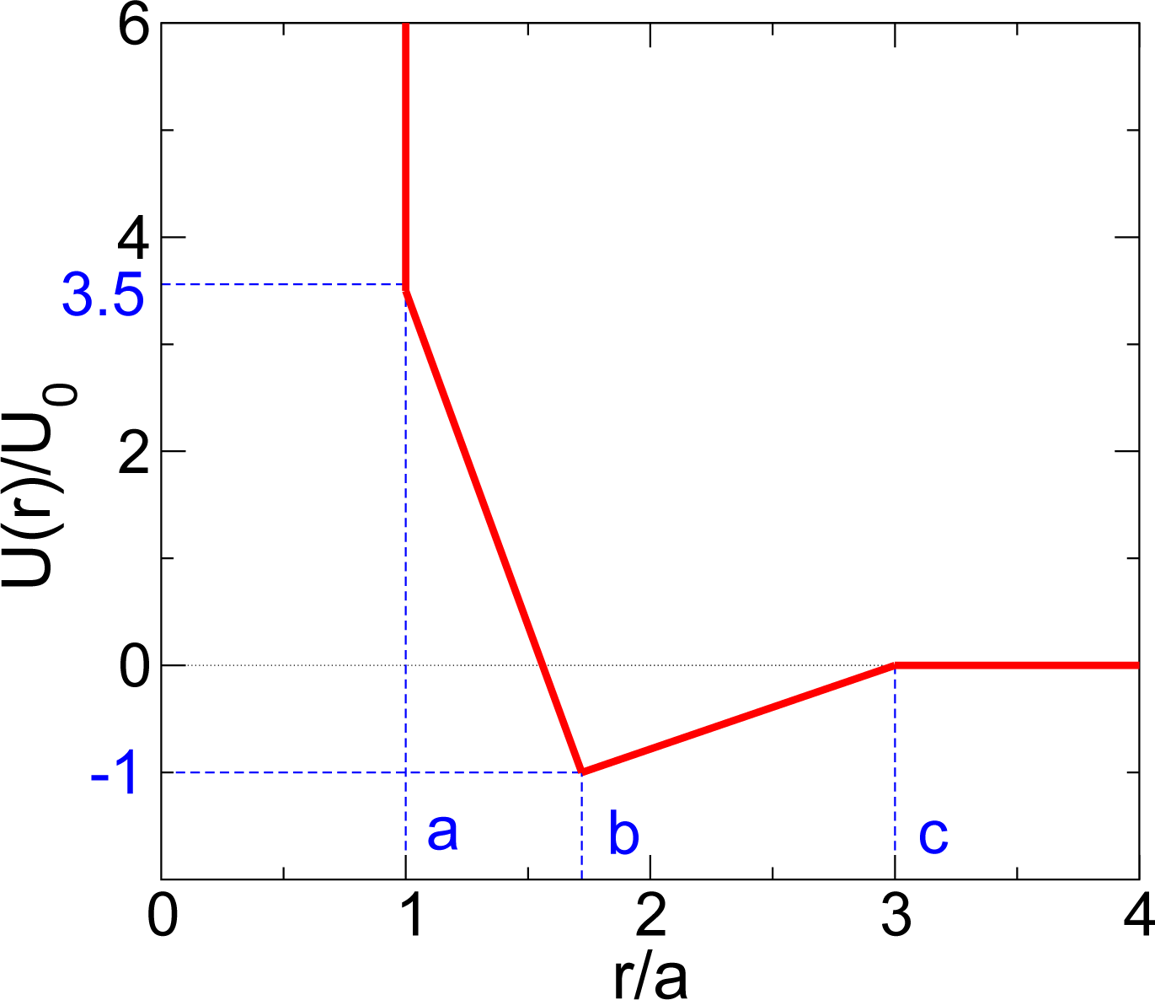
<p>One such a model is the spherically-symmetric two-scale Jagla potential with both replusive and attractive interactions [<xref ref-type="bibr" rid="b30-ijms-11-05184">30</xref>,<xref ref-type="bibr" rid="b37-ijms-11-05184">37</xref>–<xref ref-type="bibr" rid="b42-ijms-11-05184">42</xref>]. In this review, we will show that the two-scale Jagla potential (<xref ref-type="fig" rid="f1-ijms-11-05184">Figure 1</xref>), with a choice of parameters that crystallization can be avoided, exhibits polyamorphism not only in the equilibrium liquid phase at high temperature [<xref ref-type="bibr" rid="b30-ijms-11-05184">30</xref>], but also in the glass states at low temperature [<xref ref-type="bibr" rid="b43-ijms-11-05184">43</xref>]. It has been suggested that such spherically-symmetric potentials provide a generic mechanism for LLPT [<xref ref-type="bibr" rid="b44-ijms-11-05184">44</xref>–<xref ref-type="bibr" rid="b48-ijms-11-05184">48</xref>], and have interested experimentalists to seek examples among the liquid metals [<xref ref-type="bibr" rid="b19-ijms-11-05184">19</xref>]. For example, Stell and coworkers had identified Cesium and Cerium as candidate systems [<xref ref-type="bibr" rid="b49-ijms-11-05184">49</xref>–<xref ref-type="bibr" rid="b52-ijms-11-05184">52</xref>], and indeed irreversible density changes under high pressure in glassy metals containing a large mole fraction of Ce have subsequently been reported [<xref ref-type="bibr" rid="b19-ijms-11-05184">19</xref>]. Thus, the Jagla potential provides an excellent example of a very simply constituted system that is a good glassformer and it is suitable for pursuing the study of glassforming ability, which is obviously a key issue in the science of bulk metallic glasses. This resulted in a unique system that has allowed us to study the relation between the GT and the LLPT, which might be useful for the prediction of the relations between high density and low density metallic liquid phases that might be found in future studies of cerium-rich bulk metallic glassformers.</p>
<p>In this article, we will review our recent studies on a simple Jagla model of monoatomic system [<xref ref-type="bibr" rid="b34-ijms-11-05184">34</xref>,<xref ref-type="bibr" rid="b35-ijms-11-05184">35</xref>,<xref ref-type="bibr" rid="b37-ijms-11-05184">37</xref>–<xref ref-type="bibr" rid="b39-ijms-11-05184">39</xref>,<xref ref-type="bibr" rid="b43-ijms-11-05184">43</xref>] as shown in <xref ref-type="fig" rid="f1-ijms-11-05184">Figure 1</xref>. It shows polyamorphism both in liquid and glasses and can be of interest to general understanding of polyamorphism in liquids (such as water, Yttrium Oxide-Aluminum [<xref ref-type="bibr" rid="b53-ijms-11-05184">53</xref>]), and polyamorphism in metallic glasses (such as Ce-based alloys [<xref ref-type="bibr" rid="b19-ijms-11-05184">19</xref>]).</p></sec>
<sec>
<label>2.</label>
<title>Polyamorphism in the Liquid States</title>
<p>We firstly review the equilibrium properties of the liquid phases of the Jagla model, which is relevant to the study of liquid water. As we know, water is the most important solvent for biological function [<xref ref-type="bibr" rid="b54-ijms-11-05184">54</xref>–<xref ref-type="bibr" rid="b56-ijms-11-05184">56</xref>], yet water possesses many properties that are not well understood. One current hypothesis concerns the possibility that water’s anomalies are related to the existence of a line of a first order LLPT terminating at a liquid-liquid critical point (LLCP) [<xref ref-type="bibr" rid="b4-ijms-11-05184">4</xref>,<xref ref-type="bibr" rid="b7-ijms-11-05184">7</xref>,<xref ref-type="bibr" rid="b21-ijms-11-05184">21</xref>,<xref ref-type="bibr" rid="b44-ijms-11-05184">44</xref>,<xref ref-type="bibr" rid="b57-ijms-11-05184">57</xref>], which is located in the deep supercooled region of the phase diagram below the homogeneous nucleation line, sometimes called the “no-man’s land” because it is difficult to make direct measurements on the <italic>bulk</italic> liquid phase [<xref ref-type="bibr" rid="b7-ijms-11-05184">7</xref>]. For instance, the thermodynamic properties (e.g., specific heat) [<xref ref-type="bibr" rid="b58-ijms-11-05184">58</xref>,<xref ref-type="bibr" rid="b59-ijms-11-05184">59</xref>] of the bulk liquid water seems to diverge to a temperature (<italic>T</italic> ≈ 228 K) within the no man’s land region [<xref ref-type="bibr" rid="b6-ijms-11-05184">6</xref>]. By confining water in hydrophilic nano-geometries, the liquid water can be stabilized down to much lower temperatures, which allows the detection of the thermodynamic property (e.g., specific heat), instead of divergence, exhibiting a maximum [<xref ref-type="bibr" rid="b60-ijms-11-05184">60</xref>]. More recent experiment on nano-confined water by quasi-electric neutron scattering (QENS) and nuclear magnetic resonance (NMR) [<xref ref-type="bibr" rid="b24-ijms-11-05184">24</xref>,<xref ref-type="bibr" rid="b61-ijms-11-05184">61</xref>,<xref ref-type="bibr" rid="b62-ijms-11-05184">62</xref>] showed that water appears to have dynamic crossover, between non-Arrhenius (“fragile”) behavior at high T to Arrhenius (“strong”) behavior at low T [<xref ref-type="bibr" rid="b62-ijms-11-05184">62</xref>–<xref ref-type="bibr" rid="b66-ijms-11-05184">66</xref>]. This indicates that the LLPT may have a strong effect on the dynamic properties of supercooled water, including the glass transition [<xref ref-type="bibr" rid="b67-ijms-11-05184">67</xref>–<xref ref-type="bibr" rid="b71-ijms-11-05184">71</xref>]. We note that, in this review, we only focused on one of four possible scenarios to explain the anomalous properties of water [<xref ref-type="bibr" rid="b72-ijms-11-05184">72</xref>]. In particular, the <italic>singularity-free</italic> scenario [<xref ref-type="bibr" rid="b73-ijms-11-05184">73</xref>–<xref ref-type="bibr" rid="b75-ijms-11-05184">75</xref>] hypothesizes that the low <italic>T</italic> anticorrelation between volume and entropy is sufficient to cause the response functions to increase upon cooling and display maxima at non-zero <italic>T</italic>, without reference to any sigular behavior. In the first part, we focus on the relation between a liquid-liquid phase transition and the thermodynamic and dynamic properties [<xref ref-type="bibr" rid="b25-ijms-11-05184">25</xref>,<xref ref-type="bibr" rid="b30-ijms-11-05184">30</xref>,<xref ref-type="bibr" rid="b62-ijms-11-05184">62</xref>,<xref ref-type="bibr" rid="b65-ijms-11-05184">65</xref>,<xref ref-type="bibr" rid="b76-ijms-11-05184">76</xref>–<xref ref-type="bibr" rid="b78-ijms-11-05184">78</xref>].</p>
<sec>
<label>2.1.</label>
<title>Liquid-Liquid Phase Transition</title>
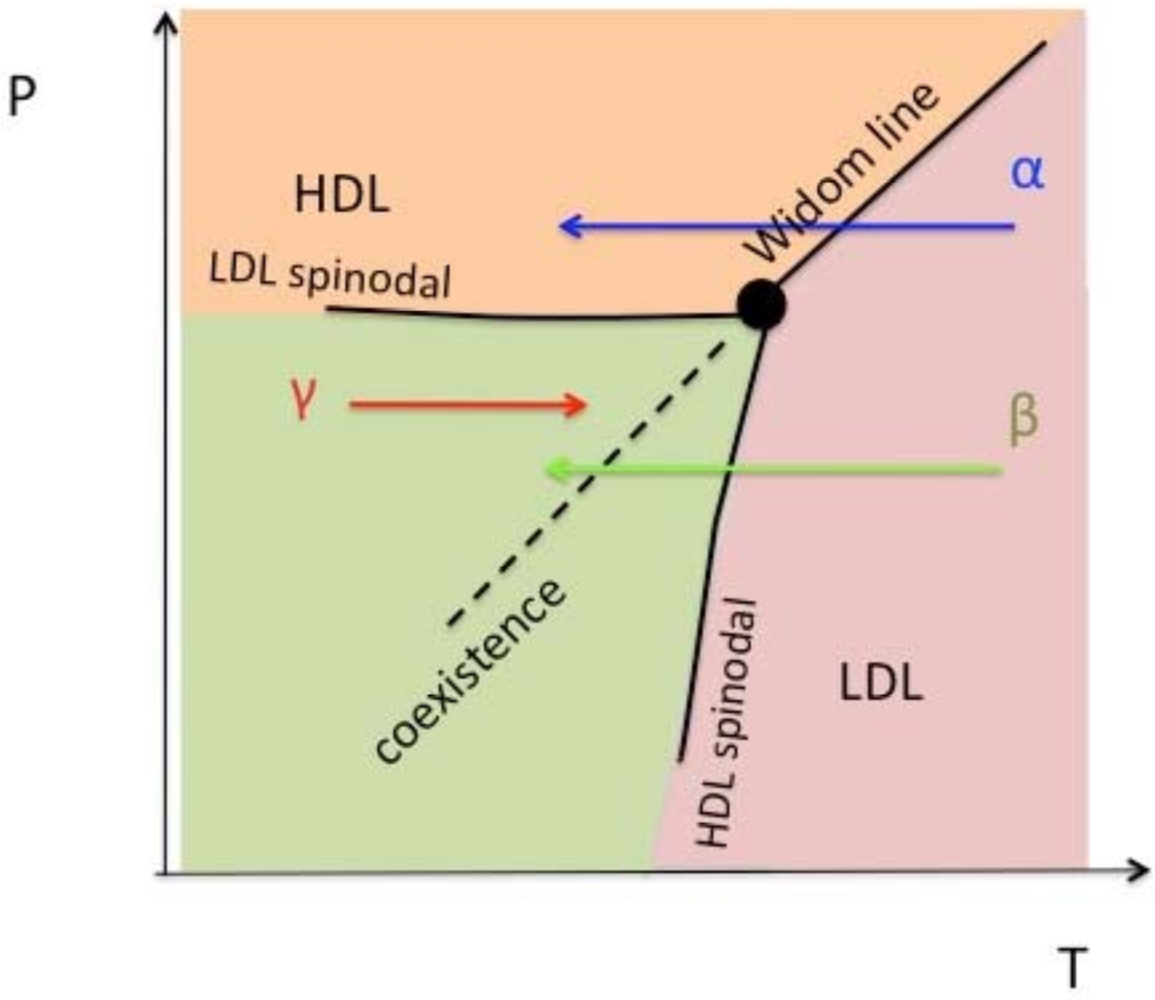
<p>With the proper choice of parameters, as shown in <xref ref-type="fig" rid="f1-ijms-11-05184">Figure 1</xref>, the system shows a LLPT with a critical point located at <italic>T<sub>c</sub></italic> = 0.375, <italic>P<sub>c</sub></italic> = 0.243 and <italic>ρ<sub>c</sub></italic> = 0.37 above the melting line [<xref ref-type="bibr" rid="b30-ijms-11-05184">30</xref>,<xref ref-type="bibr" rid="b34-ijms-11-05184">34</xref>,<xref ref-type="bibr" rid="b35-ijms-11-05184">35</xref>]. The coexistence line, determined by Maxwell rule via integrating of the isotherms in the <italic>P</italic> – <italic>V</italic> phase diagram, shows a positively sloped liquid-liquid coexistence line [<xref ref-type="bibr" rid="b30-ijms-11-05184">30</xref>]. A sketch of the phase diagram is shown in <xref ref-type="fig" rid="f2-ijms-11-05184">Figure 2</xref>. According to the Clapeyron equation,
<disp-formula id="FD1">
<label>(1)</label>
<mml:math display="block">
<mml:mrow>
<mml:mfrac>
<mml:mrow>
<mml:mtext mathvariant="italic">dP</mml:mtext></mml:mrow>
<mml:mrow>
<mml:mtext mathvariant="italic">dT</mml:mtext></mml:mrow></mml:mfrac>
<mml:mo>=</mml:mo>
<mml:mfrac>
<mml:mrow>
<mml:mo>Δ</mml:mo>
<mml:mi>S</mml:mi></mml:mrow>
<mml:mrow>
<mml:mo>Δ</mml:mo>
<mml:mi>V</mml:mi></mml:mrow></mml:mfrac></mml:mrow></mml:math></disp-formula>the entropy in the low temperature phase, high-density liquid (HDL), is lower than the high temperature phase, low-density liquid (LDL), due to a positively sloped coexistence line. Hence, the HDL phase is more ordered than the LDL phase, which is the opposite of the liquid-liquid transition found in simulation for water [<xref ref-type="bibr" rid="b65-ijms-11-05184">65</xref>] and silicon [<xref ref-type="bibr" rid="b31-ijms-11-05184">31</xref>].</p>
<p>The limit of stability of the less-ordered LDL phase is determined by the high pressure LDL spinodal <italic>P</italic><sub>LDL</sub>(<italic>T</italic>), which, for our model, is unlikely to be crossed by cooling the system at constant pressure since <italic>P</italic><sub>LDL</sub>(<italic>T</italic>) ≈ <italic>P<sub>c</sub></italic> for all <italic>T</italic> except in the immediate vicinity of the LLCP. On the other hand, the limit of stability of the more ordered HDL phase is determined by the low pressure HDL spinodal <italic>T</italic><sub>HDL</sub>(<italic>P</italic>), which can be crossed by heating the HDL phase at constant pressure. That is why the dynamic behavior of the more ordered HDL phase can be studied only when <italic>T</italic> &lt; <italic>T</italic><sub>HDL</sub>(<italic>P</italic>) for <italic>P</italic> &lt; <italic>P<sub>c</sub></italic> [<xref ref-type="bibr" rid="b34-ijms-11-05184">34</xref>,<xref ref-type="bibr" rid="b35-ijms-11-05184">35</xref>].</p></sec>
<sec>
<label>2.2.</label>
<title>Liquid-Liquid Transition and the Widom Line</title>
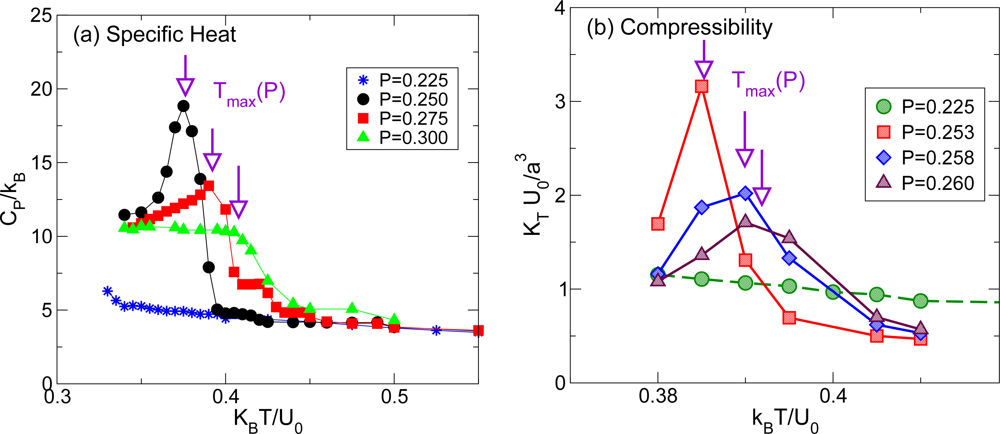
<p>If the system is cooled isobarically along a path above the liquid-liquid critical pressure <italic>P<sub>c</sub></italic> (<xref ref-type="fig" rid="f2-ijms-11-05184">Figure 2</xref>, path <italic>α</italic>), the state functions continuously change from the values characteristic of a high temperature phase (LDL) to those characteristic of a low temperature phase (HDL). The thermodynamic response functions which are the derivatives of the state functions with respect to temperature, e.g., isobaric heat capacity (<xref ref-type="fig" rid="f3-ijms-11-05184">Figure 3(a)</xref>) and isothermal compressibility (<xref ref-type="fig" rid="f3-ijms-11-05184">Figure 3(b)</xref>), have maxima at temperatures denoted by <italic>T</italic><sub>max</sub>(<italic>P</italic>). Remarkably these maxima are still prominent far above the critical pressure, as in the case of the liquid-gas critical phenomenon of water in Refs. [<xref ref-type="bibr" rid="b79-ijms-11-05184">79</xref>–<xref ref-type="bibr" rid="b82-ijms-11-05184">82</xref>], and the values of the response functions at <italic>T</italic><sub>max</sub>(<italic>P</italic>) (e.g., 
<inline-formula>
<mml:math>
<mml:msubsup>
<mml:mi>C</mml:mi>
<mml:mi>P</mml:mi>
<mml:mrow>
<mml:mtext>max</mml:mtext></mml:mrow></mml:msubsup></mml:math></inline-formula> and 
<inline-formula>
<mml:math>
<mml:msubsup>
<mml:mi>K</mml:mi>
<mml:mi>T</mml:mi>
<mml:mrow>
<mml:mtext>max</mml:mtext></mml:mrow></mml:msubsup></mml:math></inline-formula>) diverge as the critical point is approached. The lines of the maxima <italic>T<sub>max</sub></italic>(<italic>P</italic>) for different response functions are different but asymptotically approach one another as the critical point is approached, since all response functions become expressible in terms of the correlation length. This asymptotic line is sometimes called the Widom line, and is often regarded as an extension of the coexistence line into the “one-phase regime”.</p>
<p>If the system is cooled at constant pressure below <italic>P<sub>c</sub></italic> within the two phases region (<xref ref-type="fig" rid="f2-ijms-11-05184">Figure 2</xref>, path <italic>β</italic>), the coexistence line can be difficult to detect in a pure system due to metastability, and changes will occur only when the spinodal is approached where the initial phase is no longer stable. The response functions—<italic>C<sub>P</sub></italic> (<xref ref-type="fig" rid="f3-ijms-11-05184">Figure 3(a)</xref>) and <italic>K<sub>T</sub></italic> (<xref ref-type="fig" rid="f3-ijms-11-05184">Figure 3(b)</xref>)—increase continuously along path <italic>β</italic> (<xref ref-type="fig" rid="f3-ijms-11-05184">Figure 3</xref>) before the system reaches the stability limit near the LDL spinodal [<xref ref-type="bibr" rid="b57-ijms-11-05184">57</xref>].</p></sec>
<sec>
<label>2.3.</label>
<title>Structural Changes and Liquid-Liquid Phase Transition</title>
<p>The structural properties [<xref ref-type="bibr" rid="b34-ijms-11-05184">34</xref>] can be characterized by the translation order parameter and orientation order parameter. The translational order parameter <italic>t</italic> [<xref ref-type="bibr" rid="b88-ijms-11-05184">88</xref> – <xref ref-type="bibr" rid="b83-ijms-11-05184">83</xref>] is defined as 
<inline-formula>
<mml:math>
<mml:mi>t</mml:mi>
<mml:mo>≡</mml:mo>
<mml:mrow>
<mml:msubsup>
<mml:mo>∫</mml:mo>
<mml:mn>0</mml:mn>
<mml:mrow>
<mml:msub>
<mml:mi>r</mml:mi>
<mml:mi>c</mml:mi></mml:msub></mml:mrow></mml:msubsup>
<mml:mrow>
<mml:mrow>
<mml:mo>|</mml:mo>
<mml:mrow>
<mml:mi>g</mml:mi>
<mml:mo stretchy="false">(</mml:mo>
<mml:mi>r</mml:mi>
<mml:mo stretchy="false">)</mml:mo>
<mml:mo>−</mml:mo>
<mml:mn>1</mml:mn></mml:mrow>
<mml:mo>|</mml:mo></mml:mrow>
<mml:mi>d</mml:mi>
<mml:mi>r</mml:mi></mml:mrow></mml:mrow></mml:math></inline-formula>, where <italic>r</italic> is the radial distance, <italic>g</italic>(<italic>r</italic>) is the pair correlation function, and <italic>r<sub>c</sub></italic> = <italic>L</italic>/2 is the cutoff distance, where <italic>L</italic> is dimension of the system. A change in the translational order parameter indicates a change in the structure of the system. For uncorrelated systems, the interaction in the system is short-ranged with <italic>g</italic>(<italic>r</italic>) = 1, leading to <italic>t</italic> = 0; for long-range correlated systems, the modulations in <italic>g</italic>(<italic>r</italic>) persist over large distances, causing <italic>t</italic> to grow.</p>
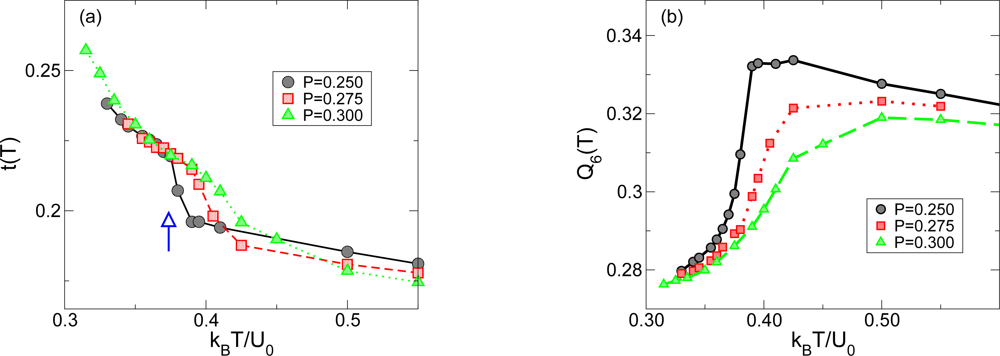
<p>The orientational order parameter characterizes the average local order of the system [<xref ref-type="bibr" rid="b83-ijms-11-05184">83</xref>]. For each particle, there are 12 bonds connecting the centeral particle with each of its 12 nearest neighbours and each bond is characterized by two angles (θ, φ). For the <italic>ith</italic> particle, the orientational order parameter, <italic>Q<sub>l,i</sub></italic>, is defined as
<disp-formula id="FD2">
<label>(2)</label>
<mml:math display="block">
<mml:msub>
<mml:mi>Q</mml:mi>
<mml:mrow>
<mml:mi>ℓ</mml:mi>
<mml:mo>,</mml:mo>
<mml:mi>i</mml:mi></mml:mrow></mml:msub>
<mml:mo>≡</mml:mo>
<mml:msup>
<mml:mrow>
<mml:mo>[</mml:mo>
<mml:mrow>
<mml:mfrac>
<mml:mrow>
<mml:mn>4</mml:mn>
<mml:mi>π</mml:mi></mml:mrow>
<mml:mrow>
<mml:mn>2</mml:mn>
<mml:mi>ℓ</mml:mi>
<mml:mo>+</mml:mo>
<mml:mn>1</mml:mn></mml:mrow></mml:mfrac>
<mml:munderover>
<mml:mo>∑</mml:mo>
<mml:mrow>
<mml:mi>m</mml:mi>
<mml:mo>=</mml:mo>
<mml:mo>−</mml:mo>
<mml:mi>ℓ</mml:mi></mml:mrow>
<mml:mrow>
<mml:mi>m</mml:mi>
<mml:mo>=</mml:mo>
<mml:mi>ℓ</mml:mi></mml:mrow></mml:munderover>
<mml:mrow>
<mml:msup>
<mml:mrow>
<mml:mrow>
<mml:mo>|</mml:mo>
<mml:mrow>
<mml:msub>
<mml:mover accent="true">
<mml:mi>Y</mml:mi>
<mml:mo>¯</mml:mo></mml:mover>
<mml:mrow>
<mml:mi>ℓ</mml:mi>
<mml:mo>,</mml:mo>
<mml:mi>m</mml:mi></mml:mrow></mml:msub></mml:mrow>
<mml:mo>|</mml:mo></mml:mrow></mml:mrow>
<mml:mn>2</mml:mn></mml:msup></mml:mrow></mml:mrow>
<mml:mo>]</mml:mo></mml:mrow>
<mml:mrow>
<mml:mrow>
<mml:mn>1</mml:mn>
<mml:mo>/</mml:mo>
<mml:mn>2</mml:mn></mml:mrow></mml:mrow></mml:msup></mml:math></disp-formula>where <italic>Ȳ<sub>ℓ,m</sub></italic>(<italic>θ, φ</italic>) denotes the average of the spherical harmonic function <italic>Y<sub>ℓ,m</sub></italic>(<italic>θ, φ</italic>) over the 12 bonds associated with particle <italic>i</italic>. The orientational order parameter for the entire system is calculated as <italic>Q<sub>ℓ</sub></italic> =&lt; <italic>Q<sub>ℓ,i</sub></italic> &gt;, where &lt; ... &gt; denotes the average over all particles in the system. For ℓ = 6, <italic>Q<sub>ℓ</sub></italic> has large value for most crystals, such as fcc, hcp, and bcc. In general, the value of <italic>Q</italic><sub>6</sub> increases as the local order of a system increases, e.g, <italic>Q</italic><sub>6</sub>=0.574 for the fcc lattice and <italic>Q</italic><sub>6</sub> = 0.289 for uncorrelated systems.</p>
<p>Similarly to what was observed for the thermodynamic properties, we see a sharp transition, from those resembling the LDL phase to those resembling the HDL phase when the system crosses the Widom line, in the translational <italic>t</italic> (<xref ref-type="fig" rid="f4-ijms-11-05184">Figure 4(a)</xref>) and orientational order parameters <italic>Q</italic><sub>6</sub> (<xref ref-type="fig" rid="f4-ijms-11-05184">Figure 4(b)</xref>). These sharp changes in <italic>t</italic> and <italic>Q</italic><sub>6</sub> becomes more pronounced as the path is closer to the critical pressure.</p></sec>
<sec>
<label>2.4.</label>
<title>Dynamics Crossover and Liquid-Liquid Phase Transition</title>
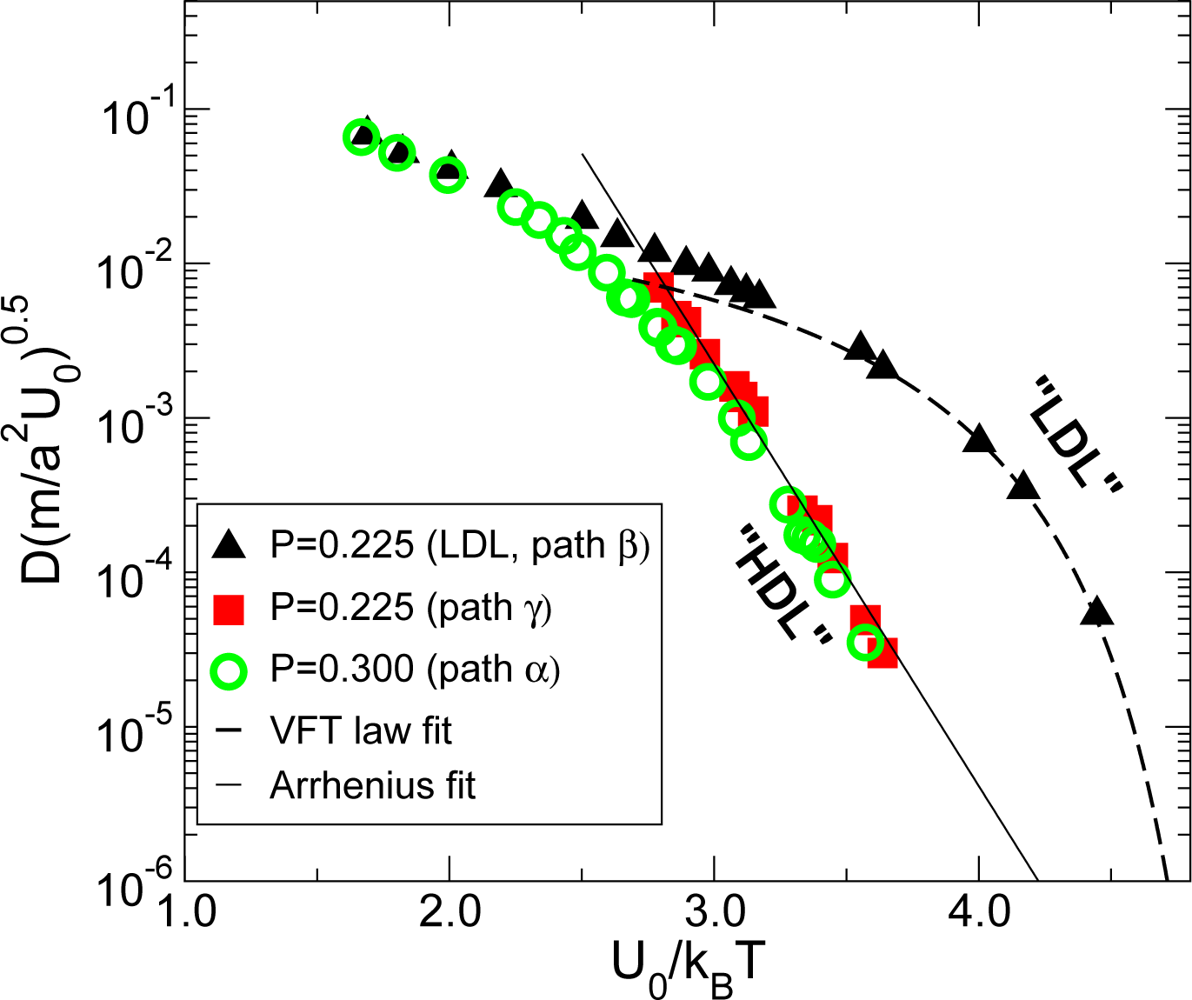
<p>In the region of the P-T phase diagram between the LDL and HDL spinodals, the system can exist in both the LDL and HDL phases, one stable and one metastable. Along path <italic>β</italic> (<xref ref-type="fig" rid="f2-ijms-11-05184">Figure 2</xref>), the LDL phase remains metastable before crossing the LDL spinodal line. The dynamic behavior of the less ordered LDL phase follows the non-Arrhenius Vogel-Fulcher-Tamann (VFT) law (<xref ref-type="fig" rid="f5-ijms-11-05184">Figure 5</xref>, Triangle up), which is the characteristic of fragile glass formers. On the other hand, along paths <italic>γ</italic> which belong to the HDL phase, <italic>D</italic> follows Arrhenius behavior (<xref ref-type="fig" rid="f5-ijms-11-05184">Figure 5</xref>, Square), which is the characteristic of the strong glass formers.</p>
<p>For <italic>P</italic> &gt; <italic>P<sub>c</sub></italic> along path <italic>α</italic>, there is a crossover in the behavior of <italic>D</italic> (<xref ref-type="fig" rid="f5-ijms-11-05184">Figure 5</xref>, Circle). The behavior is similar to what was observed in experimental studies of the strong liquid BeF<sub>2</sub> [<xref ref-type="bibr" rid="b89-ijms-11-05184">89</xref>], confined water [<xref ref-type="bibr" rid="b24-ijms-11-05184">24</xref>] and in simulations of SiO<sub>2</sub> [<xref ref-type="bibr" rid="b31-ijms-11-05184">31</xref>]. In both cases, the Arrhenius slope extrapolates to an intercept at 1/<italic>T</italic> = 0, which is six orders of magnitude above the intercept of the high temperature Arrhenius part of the plot (which is common to all phases). Thus, the behavior of the HDL-like liquid on the low-temperature side of the Widom line can be classified as that of a strong liquid. The behavior on the high-temperature side of the Widom line, in the LDL-like phase, however, is very different, resembling that of the fragile liquid, as is clear from <xref ref-type="fig" rid="f5-ijms-11-05184">Figure 5</xref>. Thus, the present spherically-symmetric Jagla ramp potential exhibits a dynamic crossover from fragile liquid (LDL-like) at high-temperature to strong liquid (HDL-like) at low-temperature, suggesting the analogous fragile-to-strong transition as in water. We note that the strong liquid for Jagla potential is now the HDL phase, while the strong liquid for water is the LDL phase, due to the fact that the coexistence line for Jagla potential is positively sloped.</p>
<p>The Jagla ramp potential has an accessible LLCP and also displays water-type thermodynamic- and dynamic- crossover which occurs as the system crosses the Widom line while cooled along constant pressure paths <italic>P</italic> &gt; <italic>P<sub>c</sub></italic>. These results, similar to simulations of silicon [<xref ref-type="bibr" rid="b31-ijms-11-05184">31</xref>], show that the dynamics is Arrhenius in the more ordered phase (HDL for Jagla ramp model) and fragile for the less ordered phase (LDL for Jagla ramp model). The dynamic crossover for <italic>P</italic> &gt; <italic>P<sub>c</sub></italic> is consistent with (i) the experimental observation in confined geometries (small pores) of a fragility transition [<xref ref-type="bibr" rid="b62-ijms-11-05184">62</xref>], and (ii) experimental observation of a peak in the specific heat upon cooling water at atmospheric pressure in nanopores [<xref ref-type="bibr" rid="b60-ijms-11-05184">60</xref>]. The existence of a single-component, monoatomic, system with two distinct glassforming liquid phases, provides a rare opportunity for study of fundamental aspects of glass formation.</p></sec></sec>
<sec>
<label>3.</label>
<title>Liquid—Glass Transformations</title>
<p>Despite being monatomic, and also spherically symmetric in its interaction potential, the Jagla system proves vitrification during cooling at rates that are very moderate by simulation standards. The observation of a LLPT in the Jagla model [<xref ref-type="bibr" rid="b30-ijms-11-05184">30</xref>,<xref ref-type="bibr" rid="b34-ijms-11-05184">34</xref>,<xref ref-type="bibr" rid="b35-ijms-11-05184">35</xref>,<xref ref-type="bibr" rid="b37-ijms-11-05184">37</xref>–<xref ref-type="bibr" rid="b39-ijms-11-05184">39</xref>] suggests that two different glasses should exist at low temperature. The high density liquid (HDL) is expected to transform into a high density amorphous (HDA) solid upon isobaric cooling at <italic>P</italic> &gt; <italic>P<sub>c</sub></italic> [path <italic>α</italic> in <xref ref-type="fig" rid="f2-ijms-11-05184">Figure 2</xref>]. Similarly, the low density liquid (LDL) should transform into a low density amorphous (LDA) solid upon cooling at <italic>P</italic> &lt; <italic>P<sub>c</sub></italic> [path <italic>β</italic> in <xref ref-type="fig" rid="f2-ijms-11-05184">Figure 2</xref>].</p>
<sec>
<label>3.1.</label>
<title>Low Density Amorphous and High Density Amorphous</title>
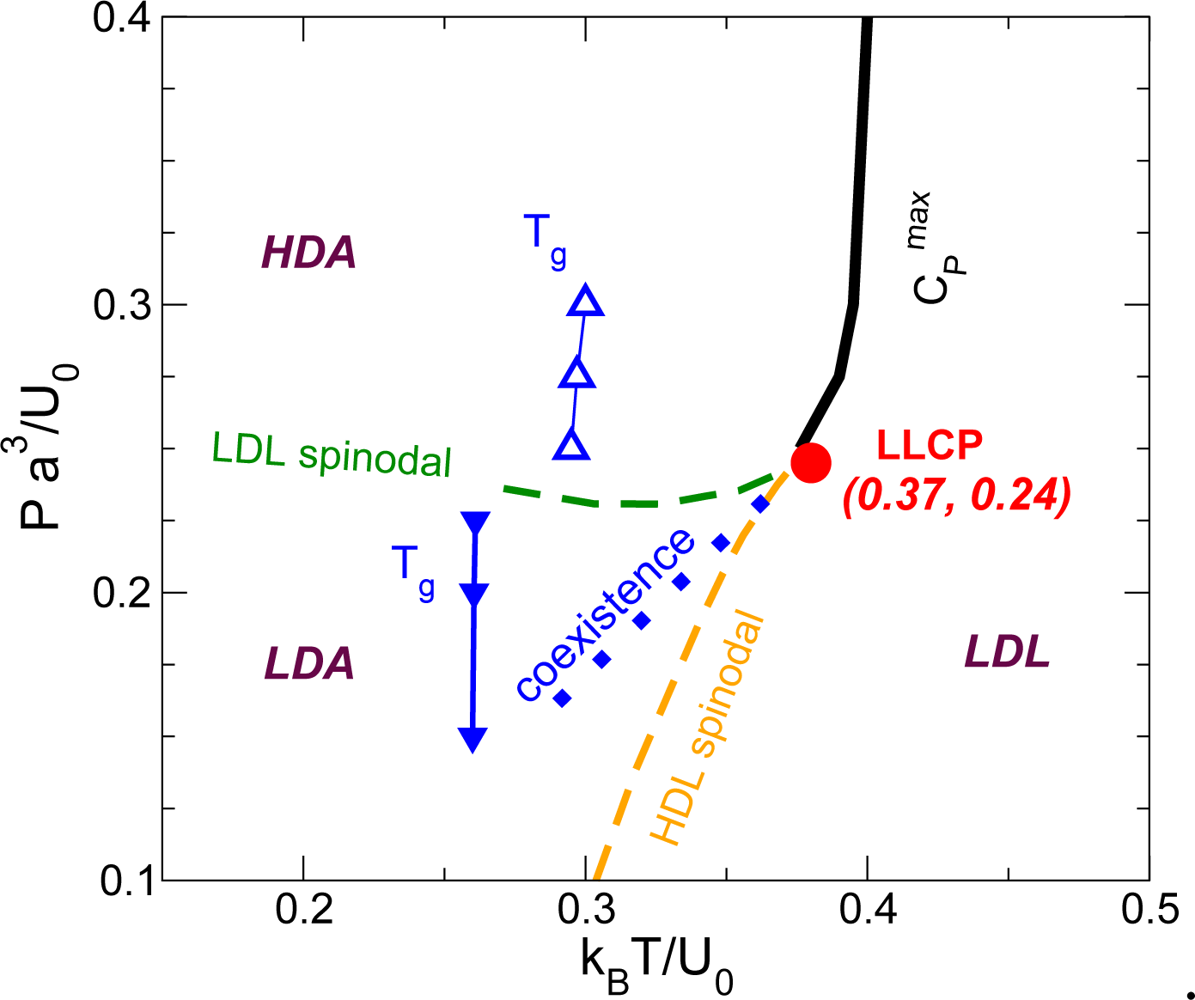
<p>It is well known that the vitrification of monatomic liquid cannot be assumed even in simulations [<xref ref-type="bibr" rid="b17-ijms-11-05184">17</xref>,<xref ref-type="bibr" rid="b91-ijms-11-05184">91</xref>] since crystallization will usually occur during the cooling process. We find that HDA can indeed be formed if the liquid is cooled at a “slow” rate at <italic>P</italic> &gt; <italic>P<sub>c</sub></italic> (path <italic>α</italic>) [<xref ref-type="bibr" rid="b43-ijms-11-05184">43</xref>]. However, cooling the liquid at <italic>P</italic> &lt; <italic>P<sub>c</sub></italic> (path <italic>β</italic>) at the same rate results in crystallization. A faster (“intermediate”) rate [<xref ref-type="bibr" rid="b43-ijms-11-05184">43</xref>] is required in order to obtain LDA. We note that upon cooling along path <italic>β</italic>, the liquid with LDL-like local geometry crosses the LLPT coexistence line (<xref ref-type="fig" rid="f2-ijms-11-05184">Figure 2</xref>). However, the LDL-to-HDL spinodal is never crossed so the system remains in the LDL phase due to metastability. Therefore, further cooling leads to vitrification of solid LDA without HDL formation.</p>
<p>Upon cooling the liquid at <italic>P</italic> &gt; <italic>P<sub>c</sub></italic> (path <italic>α</italic>), although the system is in the one-phase region, a smooth crossover (<italic>not</italic> a transition) occurs from more LDL-like local geometry at temperatures well above the Widom line <italic>T</italic> &gt; <italic>T</italic><sub>W</sub> to more HDL-like local geometry well below the Widom line [<xref ref-type="bibr" rid="b30-ijms-11-05184">30</xref>] (<xref ref-type="fig" rid="f2-ijms-11-05184">Figure 2</xref>). The structural heterogeneity that characterize the Jagla liquid are such that for <italic>T</italic> &gt; <italic>T</italic><sub>W</sub> the system can be thought of as a sea of molecules with locally LDL-like geometry, in which isolated molecules (and small clusters of molecules) with locally HDL-like geometry appear. As <italic>T</italic> decreases, the clusters of molecules with locally HDL-like geometry increase in number and size until there is a crossover at <italic>T</italic><sub>W</sub>. For <italic>T</italic> &gt; <italic>T</italic><sub>W</sub>, the system can be thought of as a sea of molecules with locally HDL-like geometry, in which only isolated molecules (and small clusters of molecules) with locally LDL-like geometry occur. Thus one observes vitrification of the liquid with HDL-like local geometry to HDA.</p>
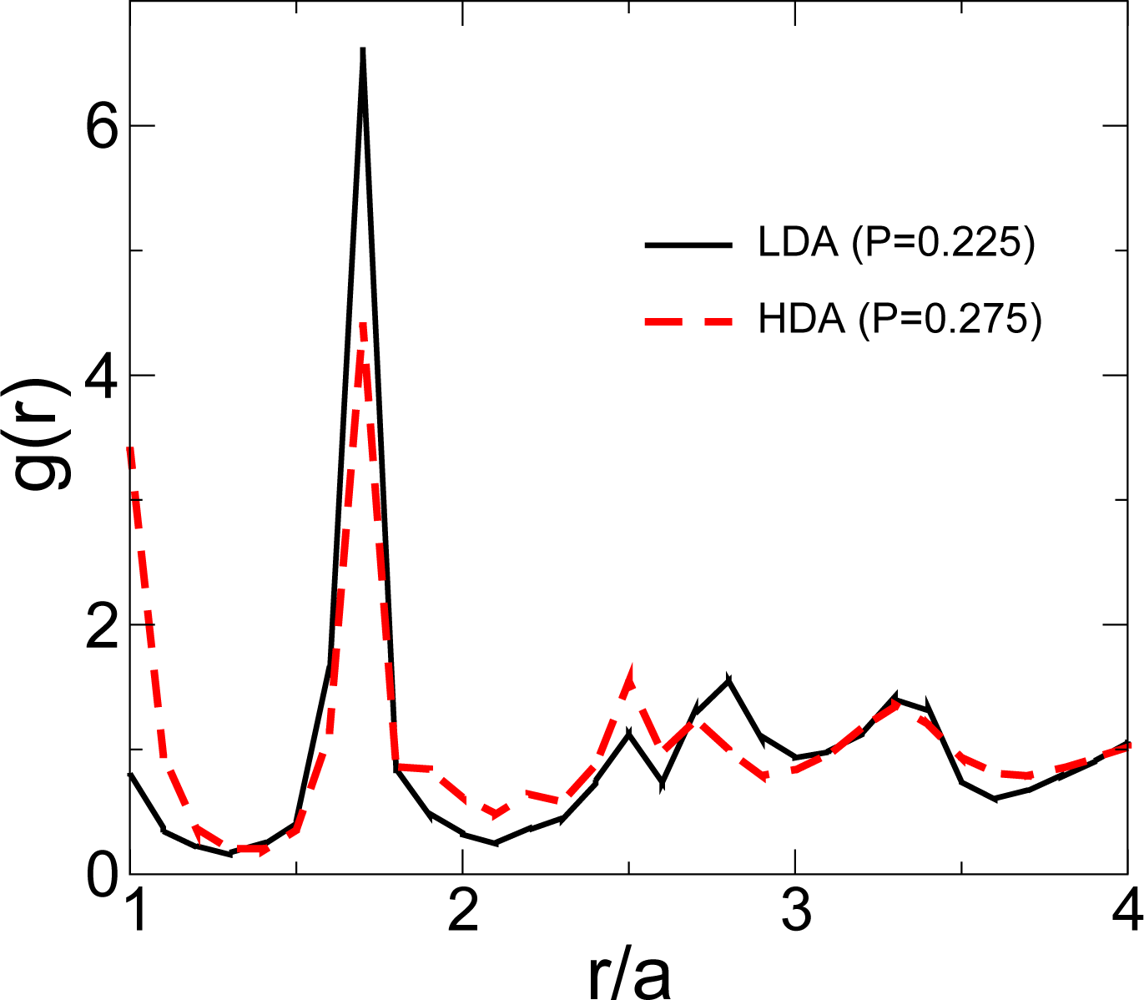
<p><xref ref-type="fig" rid="f6-ijms-11-05184">Figure 6</xref> compares the radial distribution functions (RDF) of LDA and HDA obtained along <italic>P</italic> &lt; <italic>P<sub>c</sub></italic> and <italic>P</italic> &gt; <italic>P<sub>c</sub></italic>, respectively. Both RDFs are clearly different indicating that LDA and HDA are indeed distinct glass phases. For LDA, the majority of the particles are located around the soft-core distance, in the vicinity of the minimum of the pair potential (corresponding to the peak of the RDF at the soft-core distance <italic>r/a</italic> = 1.72 in <xref ref-type="fig" rid="f6-ijms-11-05184">Figure 6</xref>). For HDA, neighbors are observed at both the hard-core distance (<italic>r/a</italic> = 1) and the soft-core distance. The present results suggest that the presence of two scales in a pair interaction potential can be sufficient for a system to be a good glass former.</p></sec>
<sec>
<label>3.2.</label>
<title>Pressure Dependence of the Glass Transition</title>
<p>In this system, the glass transition temperature, <italic>T<sub>g</sub></italic>, determined by differential scanning calorimetry, is weakly <italic>P</italic>-dependent, similar to the observation in metallic glasses. The line of <italic>T<sub>g</sub></italic> is continuous within either the LDL or HDL phases [<xref ref-type="bibr" rid="b43-ijms-11-05184">43</xref>]. However, it shows a discontinuity as the LDL spinodal line is crossed (<xref ref-type="fig" rid="f7-ijms-11-05184">Figure 7</xref>). This interesting result can be used in experiments to test whether a liquid presents polyamorphism. For example, in some substances such as water, crystallization occurs just above <italic>T<sub>g</sub></italic>. In this case, isothermal compression of LDL into HDL cannot be performed at <italic>T</italic> ≈ <italic>T<sub>g</sub></italic> since crystallization can occur. Thus, the presence of polyamorphism cannot be tested close to <italic>T<sub>g</sub></italic> by compression of LDL. In this cases, measuring <italic>T<sub>g</sub></italic> at different pressures and identifying a discontinuity would indicate that polyamorphism in the glass state extends above <italic>T<sub>g</sub></italic> to the liquid phase [<xref ref-type="bibr" rid="b92-ijms-11-05184">92</xref>].</p></sec>
<sec>
<label>3.3.</label>
<title>Density Minimum and Glass Transition</title>
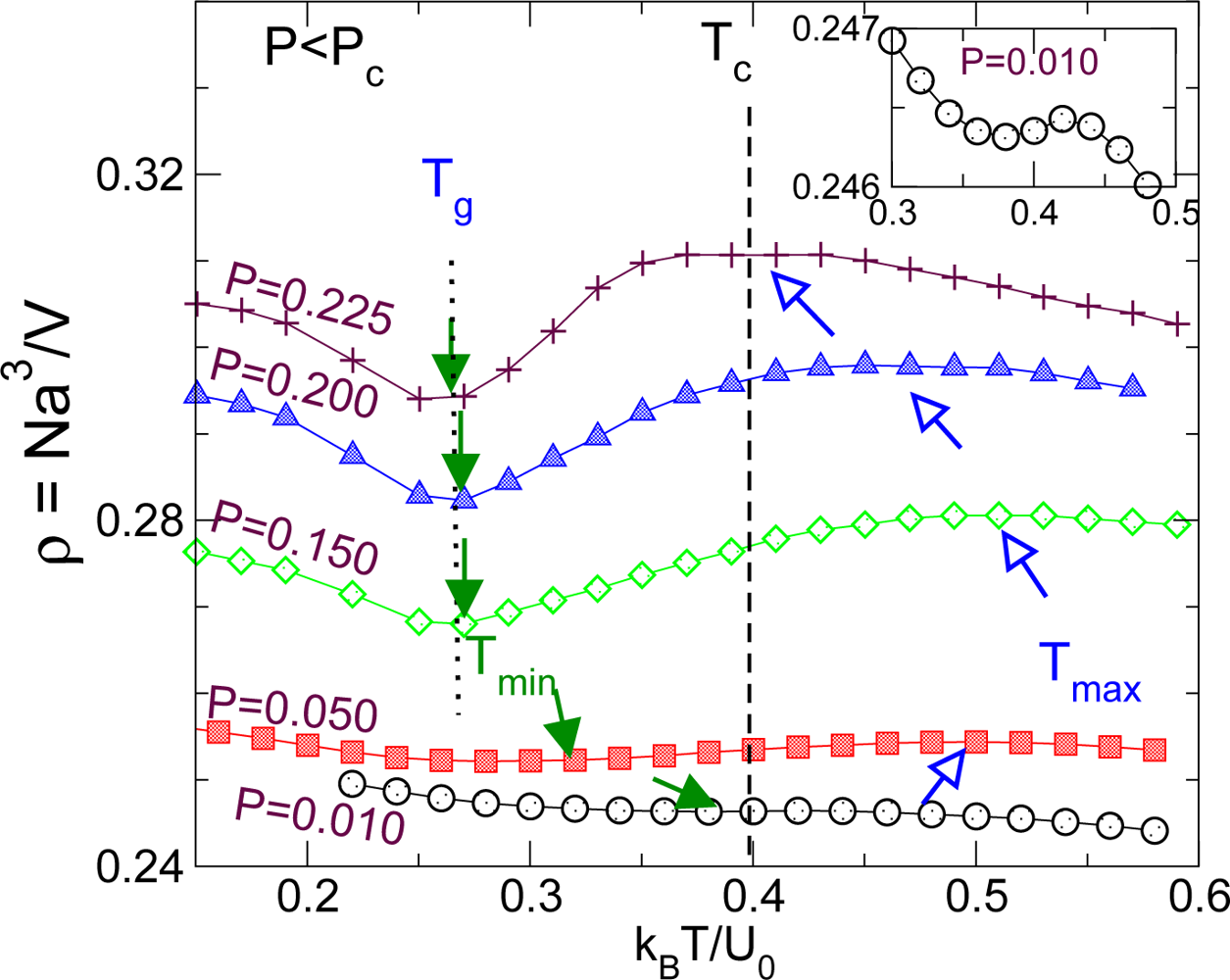
<p>Another important question—especially relevant for liquids with density anomalies such as water, BeF<sub>2</sub>, Si, and SiO<sub>2</sub>—is how the anomalous thermal expansion behavior upon cooling below the temperature of maximum density <italic>T</italic><sub>max</sub> in the supercooled liquid changes to “normal” behavior in the glass state. The display of a temperature of maximum density is a striking feature of the Jagla model, as described earlier [<xref ref-type="bibr" rid="b30-ijms-11-05184">30</xref>,<xref ref-type="bibr" rid="b34-ijms-11-05184">34</xref>,<xref ref-type="bibr" rid="b35-ijms-11-05184">35</xref>]. What is more remarkable is the existence of the even rarer density minimum [<xref ref-type="bibr" rid="b43-ijms-11-05184">43</xref>], which makes studies of the Jagla model useful for the understanding of the general relations between the density anomaly and LLPT. This feature, has been seen not only in experiment of confined water [<xref ref-type="bibr" rid="b26-ijms-11-05184">26</xref>,<xref ref-type="bibr" rid="b27-ijms-11-05184">27</xref>] and in simulation of bulk water [<xref ref-type="bibr" rid="b93-ijms-11-05184">93</xref>,<xref ref-type="bibr" rid="b94-ijms-11-05184">94</xref>] but also in supercooled Te, stable As<sub>2</sub>Te<sub>3</sub> [<xref ref-type="bibr" rid="b95-ijms-11-05184">95</xref>] and some Ge-Te alloys [<xref ref-type="bibr" rid="b96-ijms-11-05184">96</xref>], and at the upper limit of experiments for BeF<sub>2</sub> [<xref ref-type="bibr" rid="b89-ijms-11-05184">89</xref>] and in silica [<xref ref-type="bibr" rid="b97-ijms-11-05184">97</xref>]. In Reference[<xref ref-type="bibr" rid="b43-ijms-11-05184">43</xref>], Xu <italic>et. al.</italic> showed how these features are unique to the low density polymorph and vary in a complex way with pressure. As shown in <xref ref-type="fig" rid="f8-ijms-11-05184">Figure 8</xref>, the density maximum is an equilibrium property, but the density minimum in the equilibrated liquid is only seen at the lowest pressures, in the temperature range between the <italic>T<sub>g</sub></italic> and the <italic>T<sub>max</sub></italic>. At relatively higher pressures below the critical pressure <italic>P<sub>c</sub></italic>, the density minimum is preempted by the GT for the cooling rates applied. For slower cooling rates [<xref ref-type="bibr" rid="b43-ijms-11-05184">43</xref>] the minimum would presumably continue to be seen as an equilibrium phenomenon.</p></sec></sec>
<sec sec-type="conclusions">
<label>4.</label>
<title>Conclusions</title>
<p>In this review, we have discussed the phase transformations in the Jagla model, which was parametrized in order to show polyamorphism at high temperature in the equilibrium liquid phase. The presence of a LLCP results in a sharp increase in thermal (e.g., <italic>C<sub>P</sub></italic>) and structural response functions upon cooling as the Widom line temperature <italic>T</italic><sub>W</sub> is approached. Such a sharp increase in thermal response functions is anomalous (<italic>i.e.</italic>, in normal liquids, <italic>C<sub>P</sub></italic> decreases upon cooling) and is observed in few substances such as water [<xref ref-type="bibr" rid="b98-ijms-11-05184">98</xref>]. It is therefore indeed reasonable to assert that the anomalous behavior of bulk water seen at normal and moderate pressures can be associated with the presence of a nearby LLCP and also helpful to look for comparable behavior in other systems.</p>
<p>Further, the Jagla model proves to have not only one but two very different liquids, which vitrify to different glasses upon cooling with rates common in computer simulations. These glasses are different amorphous forms both from the structural (e.g., their RDFs are distinct) and thermodynamics point of view (e.g., their <italic>T<sub>g</sub></italic> values are different). In particular, we observed that <italic>T<sub>g</sub></italic> is practically constant for each glass but it is larger for HDA than for LDA. <italic>T<sub>g</sub></italic> changes discontinuously (by ≈ 17%) as we go from LDA to HDA across the transition line. The study of the relation between LDA and HDA and the possible transformations between each other are relevant to understand polyamorphism in the glassy state [<xref ref-type="bibr" rid="b1-ijms-11-05184">1</xref>,<xref ref-type="bibr" rid="b2-ijms-11-05184">2</xref>].</p>
<p>Lastly, we note that the Jagla model was originally proposed to model water-like anomalous behaviors [<xref ref-type="bibr" rid="b37-ijms-11-05184">37</xref>–<xref ref-type="bibr" rid="b39-ijms-11-05184">39</xref>,<xref ref-type="bibr" rid="b83-ijms-11-05184">83</xref>]. However, with a different parametrization than that one used here, it might be a good candidate to model cerium. Cerium crystallizes into HCP at low pressure, as the Jagla model does, and Ce-Al alloys show polyamorphism in the glass state [<xref ref-type="bibr" rid="b19-ijms-11-05184">19</xref>]. It will be interesting to see if the Jagla model can be parametrized to yield other properties particular to cerium, such as its isosymmetric crystal-crystal (FCC-FCC) transition [<xref ref-type="bibr" rid="b99-ijms-11-05184">99</xref>]. It is then understandable that the glass formation in cerium-based alloys is only obtained with multiple component doping, or very rapid quenching, as reported in the recent literature [<xref ref-type="bibr" rid="b100-ijms-11-05184">100</xref>].</p></sec></body>
<back>
<ack>
<p>XLM acknowledges the support by the World Premier International Research Center Initiative (WPI Initiative) and Grant-in-Aid for Young Scientists (B), MEXT, Japan. HES thanks NSF grant CHE 0908218 for support. SVB thanks the Office of the Academic Affairs of Yeshiva University for funding the Yeshiva University high-performance computer cluster and acknowledges the partial support of this research through the Bernard W. Gamson Computational Science Center at Yeshiva College.</p></ack>
<ref-list>
<title>References</title>
<ref id="b1-ijms-11-05184"><label>1.</label><citation citation-type="journal"><person-group person-group-type="author"><name><surname>Wilding</surname><given-names>MC</given-names></name><name><surname>Wilson</surname><given-names>M</given-names></name><name><surname>Mcmillan</surname><given-names>PF</given-names></name></person-group><article-title>Structural studies and polymorphism in amorphous solids and liquids at high pressure</article-title><source>Chem. Soc. Rev</source><year>2006</year><volume>35</volume><fpage>964</fpage><lpage>986</lpage><pub-id pub-id-type="doi">10.1039/b517775h</pub-id><pub-id pub-id-type="pmid">17003901</pub-id></citation></ref>
<ref id="b2-ijms-11-05184"><label>2.</label><citation citation-type="journal"><person-group person-group-type="author"><name><surname>McMillan</surname><given-names>PF</given-names></name></person-group><article-title>Polyamorphic transformations in liquids and glasses</article-title><source>J. Mat. Chem</source><year>2004</year><volume>14</volume><fpage>1506</fpage><lpage>1512</lpage><pub-id pub-id-type="doi">10.1039/b401308p</pub-id></citation></ref>
<ref id="b3-ijms-11-05184"><label>3.</label><citation citation-type="journal"><person-group person-group-type="author"><name><surname>Angell</surname><given-names>CA</given-names></name></person-group><article-title>Insights into phases of liquid water from study of its unusual glass-forming properties</article-title><source>Science</source><year>2008</year><volume>319</volume><fpage>582</fpage><lpage>587</lpage><pub-id pub-id-type="doi">10.1126/science.1131939</pub-id><pub-id pub-id-type="pmid">18239117</pub-id></citation></ref>
<ref id="b4-ijms-11-05184"><label>4.</label><citation citation-type="journal"><person-group person-group-type="author"><name><surname>Debenedetti</surname><given-names>PG</given-names></name></person-group><article-title>Supercooled and glassy water</article-title><source>J. Phys. Condens. Mat</source><year>2003</year><volume>15</volume><fpage>R1669</fpage><lpage>R1726</lpage><pub-id pub-id-type="doi">10.1088/0953-8984/15/45/R01</pub-id></citation></ref>
<ref id="b5-ijms-11-05184"><label>5.</label><citation citation-type="journal"><person-group person-group-type="author"><name><surname>Angell</surname><given-names>CA</given-names></name></person-group><article-title>Amorphous water</article-title><source>Ann. Rev. Phys. Chem</source><year>2004</year><volume>55</volume><fpage>559</fpage><lpage>583</lpage><pub-id pub-id-type="doi">10.1146/annurev.physchem.55.091602.094156</pub-id></citation></ref>
<ref id="b6-ijms-11-05184"><label>6.</label><citation citation-type="journal"><person-group person-group-type="author"><name><surname>Debenedetti</surname><given-names>PG</given-names></name><name><surname>Stanley</surname><given-names>HE</given-names></name></person-group><article-title>Supercooled and glassy water</article-title><source>Phys. Today</source><year>2003</year><volume>56</volume><fpage>40</fpage><lpage>46</lpage></citation></ref>
<ref id="b7-ijms-11-05184"><label>7.</label><citation citation-type="journal"><person-group person-group-type="author"><name><surname>Mishima</surname><given-names>O</given-names></name><name><surname>Stanley</surname><given-names>HE</given-names></name></person-group><article-title>The relationship between liquid, supercooled and glassy water</article-title><source>Nature</source><year>1998</year><volume>396</volume><fpage>329</fpage><lpage>335</lpage><pub-id pub-id-type="doi">10.1038/24540</pub-id></citation></ref>
<ref id="b8-ijms-11-05184"><label>8.</label><citation citation-type="journal"><person-group person-group-type="author"><name><surname>Mishima</surname><given-names>O</given-names></name><name><surname>Calvert</surname><given-names>LD</given-names></name><name><surname>Whalley</surname><given-names>E</given-names></name></person-group><article-title>An apparent first-order transition between two amorphous phases of ice induced by pressure</article-title><source>Nature</source><year>1985</year><volume>314</volume><fpage>76</fpage><lpage>78</lpage><pub-id pub-id-type="doi">10.1038/314076a0</pub-id></citation></ref>
<ref id="b9-ijms-11-05184"><label>9.</label><citation citation-type="journal"><person-group person-group-type="author"><name><surname>Mishima</surname><given-names>O</given-names></name><name><surname>Calvert</surname><given-names>LD</given-names></name><name><surname>Whalley</surname><given-names>E</given-names></name></person-group><article-title>Melting ice-I at 77K and 10kbar–A new method of making amorphous solids</article-title><source>Nature</source><year>1984</year><volume>310</volume><fpage>393</fpage><lpage>395</lpage><pub-id pub-id-type="doi">10.1038/310393a0</pub-id></citation></ref>
<ref id="b10-ijms-11-05184"><label>10.</label><citation citation-type="journal"><person-group person-group-type="author"><name><surname>Mishima</surname><given-names>O</given-names></name></person-group><article-title>Relationship between melting and amorphization of ice</article-title><source>Nature</source><year>1996</year><volume>384</volume><fpage>546</fpage><lpage>549</lpage><pub-id pub-id-type="doi">10.1038/384546a0</pub-id></citation></ref>
<ref id="b11-ijms-11-05184"><label>11.</label><citation citation-type="journal"><person-group person-group-type="author"><name><surname>Loerting</surname><given-names>T</given-names></name><name><surname>Salzmann</surname><given-names>C</given-names></name><name><surname>Kohl</surname><given-names>I</given-names></name><name><surname>Mayer</surname><given-names>E</given-names></name><name><surname>Hallbrucker</surname><given-names>A</given-names></name></person-group><article-title>A second distinct structural “state” of high-density amorphous ice at 77 K and 1 bar</article-title><source>Phys. Chem. Chem. Phys</source><year>2001</year><volume>3</volume><fpage>5355</fpage><lpage>5357</lpage><pub-id pub-id-type="doi">10.1039/b108676f</pub-id></citation></ref>
<ref id="b12-ijms-11-05184"><label>12.</label><citation citation-type="journal"><person-group person-group-type="author"><name><surname>Finney</surname><given-names>JL</given-names></name><name><surname>Bowron</surname><given-names>DT</given-names></name><name><surname>Soper</surname><given-names>AK</given-names></name><name><surname>Loerting</surname><given-names>T</given-names></name><name><surname>Mayer</surname><given-names>E</given-names></name><name><surname>Hallbrucker</surname><given-names>A</given-names></name></person-group><article-title>Structure of a new dense amorphous ice</article-title><source>Phys. Rev. Lett</source><year>2002</year><volume>89</volume><fpage>205503</fpage><pub-id pub-id-type="doi">10.1103/PhysRevLett.89.205503</pub-id><pub-id pub-id-type="pmid">12443486</pub-id></citation></ref>
<ref id="b13-ijms-11-05184"><label>13.</label><citation citation-type="book"><source>New Kinds of Phase Transitions: Transformations in Disordered Substances</source><person-group person-group-type="editor"><name><surname>Brazhkin</surname><given-names>V</given-names></name><name><surname>Buldyrev</surname><given-names>SV</given-names></name><name><surname>Ryzhov</surname><given-names>VN</given-names></name><name><surname>Stanley</surname><given-names>HE</given-names></name></person-group><publisher-name>NATO Advanced Research Workshop</publisher-name><publisher-loc>Brussels Belgium</publisher-loc><year>2002</year></citation></ref>
<ref id="b14-ijms-11-05184"><label>14.</label><citation citation-type="journal"><person-group person-group-type="author"><name><surname>Loerting</surname><given-names>T</given-names></name><name><surname>Brazhkin</surname><given-names>VV</given-names></name><name><surname>Morishita</surname><given-names>T</given-names></name></person-group><article-title>Multiple amorphous-amorphous transitions</article-title><source>Adv. Chem. Phys</source><year>2009</year><volume>143</volume><fpage>29</fpage><lpage>82</lpage></citation></ref>
<ref id="b15-ijms-11-05184"><label>15.</label><citation citation-type="journal"><person-group person-group-type="author"><name><surname>Katayama</surname><given-names>Y</given-names></name><name><surname>Mizutani</surname><given-names>T</given-names></name><name><surname>Tsumi</surname><given-names>K</given-names></name><name><surname>Shinomura</surname><given-names>O</given-names></name><name><surname>Yamakata</surname><given-names>M</given-names></name></person-group><article-title>A first-order liquid-liquid phase transition in phosphorus</article-title><source>Nature</source><year>2000</year><volume>403</volume><fpage>170</fpage><lpage>173</lpage><pub-id pub-id-type="doi">10.1038/35003143</pub-id><pub-id pub-id-type="pmid">10646596</pub-id></citation></ref>
<ref id="b16-ijms-11-05184"><label>16.</label><citation citation-type="journal"><person-group person-group-type="author"><name><surname>Monaco</surname><given-names>G</given-names></name><name><surname>Falconi</surname><given-names>S</given-names></name><name><surname>Crichton</surname><given-names>WA</given-names></name><name><surname>Mezouar</surname><given-names>M</given-names></name></person-group><article-title>Nature of the first-order phase transition in fluid phosphorus at high temperature and pressure</article-title><source>Phys. Rev. Lett</source><year>2003</year><volume>90</volume><fpage>255701</fpage><pub-id pub-id-type="doi">10.1103/PhysRevLett.90.255701</pub-id><pub-id pub-id-type="pmid">12857145</pub-id></citation></ref>
<ref id="b17-ijms-11-05184"><label>17.</label><citation citation-type="journal"><person-group person-group-type="author"><name><surname>Bhat</surname><given-names>H</given-names></name><name><surname>Molinero</surname><given-names>V</given-names></name><name><surname>Solomon</surname><given-names>V</given-names></name><name><surname>Soignard</surname><given-names>E</given-names></name><name><surname>Sastry</surname><given-names>S</given-names></name><name><surname>Yarger</surname><given-names>JL</given-names></name><name><surname>Angell</surname><given-names>CA</given-names></name></person-group><article-title>Vitrification of a monatomic metallic liquid</article-title><source>Nature</source><year>2007</year><volume>448</volume><fpage>787</fpage><lpage>790</lpage><pub-id pub-id-type="doi">10.1038/nature06044</pub-id><pub-id pub-id-type="pmid">17700696</pub-id></citation></ref>
<ref id="b18-ijms-11-05184"><label>18.</label><citation citation-type="journal"><person-group person-group-type="author"><name><surname>Kurita</surname><given-names>R</given-names></name><name><surname>Tanaka</surname><given-names>H</given-names></name></person-group><article-title>Critical-like phenomena associated with liquid-liquid transition in a molecular liquid</article-title><source>Science</source><year>2004</year><volume>306</volume><fpage>845</fpage><lpage>848</lpage><pub-id pub-id-type="doi">10.1126/science.1103073</pub-id><pub-id pub-id-type="pmid">15514150</pub-id></citation></ref>
<ref id="b19-ijms-11-05184"><label>19.</label><citation citation-type="journal"><person-group person-group-type="author"><name><surname>Sheng</surname><given-names>HW</given-names></name><name><surname>Liu</surname><given-names>HZ</given-names></name><name><surname>Cheng</surname><given-names>YQ</given-names></name><name><surname>Wen</surname><given-names>J</given-names></name><name><surname>Lee</surname><given-names>PL</given-names></name><name><surname>Luo</surname><given-names>WK</given-names></name><name><surname>Shastri</surname><given-names>SD</given-names></name><name><surname>Ma</surname><given-names>E</given-names></name></person-group><article-title>Polyamorphism in a metallic glass</article-title><source>Nat. Mater</source><year>2007</year><volume>6</volume><fpage>192</fpage><lpage>197</lpage><pub-id pub-id-type="doi">10.1038/nmat1839</pub-id><pub-id pub-id-type="pmid">17310140</pub-id></citation></ref>
<ref id="b20-ijms-11-05184"><label>20.</label><citation citation-type="journal"><person-group person-group-type="author"><name><surname>Sen</surname><given-names>S</given-names></name><name><surname>Gaudio</surname><given-names>S</given-names></name><name><surname>Aitken</surname><given-names>BG</given-names></name><name><surname>Lesher</surname><given-names>CE</given-names></name></person-group><article-title>Observation of a pressure-induced first-order polyamorphic transition in a chalcogenide glass at ambient temperature</article-title><source>Phys. Rev. Lett</source><year>2006</year><volume>97</volume><fpage>025504</fpage><pub-id pub-id-type="doi">10.1103/PhysRevLett.97.025504</pub-id><pub-id pub-id-type="pmid">16907457</pub-id></citation></ref>
<ref id="b21-ijms-11-05184"><label>21.</label><citation citation-type="journal"><person-group person-group-type="author"><name><surname>Poole</surname><given-names>PH</given-names></name><name><surname>Sciortino</surname><given-names>F</given-names></name><name><surname>Essmann</surname><given-names>U</given-names></name><name><surname>Stanley</surname><given-names>HE</given-names></name></person-group><article-title>Phase-behavior of metastable water</article-title><source>Nature</source><year>1992</year><volume>360</volume><fpage>324</fpage><lpage>328</lpage><pub-id pub-id-type="doi">10.1038/360324a0</pub-id></citation></ref>
<ref id="b22-ijms-11-05184"><label>22.</label><citation citation-type="journal"><person-group person-group-type="author"><name><surname>Zanotti</surname><given-names>J-M</given-names></name><name><surname>Bellissent-Funel</surname><given-names>M-C</given-names></name><name><surname>Chen</surname><given-names>S-H</given-names></name></person-group><article-title>Experimental evidence of a liquid-liquid transition in interfacial water</article-title><source>Europhys. Lett</source><year>2005</year><volume>71</volume><fpage>91</fpage><lpage>97</lpage><pub-id pub-id-type="doi">10.1209/epl/i2004-10529-2</pub-id></citation></ref>
<ref id="b23-ijms-11-05184"><label>23.</label><citation citation-type="confproc"><person-group person-group-type="author"><name><surname>Chen</surname><given-names>S-H</given-names></name><name><surname>Mallamace</surname><given-names>F</given-names></name><name><surname>Liu</surname><given-names>L</given-names></name><name><surname>Liu</surname><given-names>DZ</given-names></name><name><surname>Chu</surname><given-names>XQ</given-names></name><name><surname>Zhang</surname><given-names>Y</given-names></name><name><surname>Kim</surname><given-names>C</given-names></name><name><surname>Faraone</surname><given-names>A</given-names></name><name><surname>Mou</surname><given-names>C-Y</given-names></name><name><surname>Fratini</surname><given-names>E</given-names></name><name><surname>Baglioni</surname><given-names>P</given-names></name><name><surname>Kolesnikov</surname><given-names>AI</given-names></name><name><surname>Garcia-Sakai</surname><given-names>V</given-names></name></person-group><article-title>Dynamic crossover phenomenon in confined supercooled water and its relation to the existence of a liquid-liquid critical point in water</article-title><conf-name>Proceedings of 5th International Workshop on Complex Systems</conf-name><conf-loc>Sendai, Japan</conf-loc><conf-date>25–28 September 2007</conf-date></citation></ref>
<ref id="b24-ijms-11-05184"><label>24.</label><citation citation-type="journal"><person-group person-group-type="author"><name><surname>Liu</surname><given-names>L</given-names></name><name><surname>Chen</surname><given-names>S-H</given-names></name><name><surname>Faraone</surname><given-names>A</given-names></name><name><surname>Yen</surname><given-names>CW</given-names></name><name><surname>Mou</surname><given-names>CY</given-names></name></person-group><article-title>Pressure dependence of fragile-to-strong transition and a possible second critical point in supercooled confined water</article-title><source>Phys. Rev. Lett</source><year>2005</year><volume>95</volume><fpage>117802</fpage><pub-id pub-id-type="doi">10.1103/PhysRevLett.95.117802</pub-id><pub-id pub-id-type="pmid">16197049</pub-id></citation></ref>
<ref id="b25-ijms-11-05184"><label>25.</label><citation citation-type="journal"><person-group person-group-type="author"><name><surname>Chen</surname><given-names>S-H</given-names></name><name><surname>Mallamace</surname><given-names>F</given-names></name><name><surname>Mou</surname><given-names>CY</given-names></name><name><surname>Broccio</surname><given-names>M</given-names></name><name><surname>Corsaro</surname><given-names>C</given-names></name><name><surname>Faraone</surname><given-names>A</given-names></name><name><surname>Liu</surname><given-names>L</given-names></name></person-group><article-title>The violation of the Stokes-Einstein relation in supercooled water</article-title><source>Proc. Nat. Acad. Sci. USA</source><year>2006</year><volume>103</volume><fpage>12974</fpage><lpage>12978</lpage><pub-id pub-id-type="doi">10.1073/pnas.0603253103</pub-id><pub-id pub-id-type="pmid">16920792</pub-id></citation></ref>
<ref id="b26-ijms-11-05184"><label>26.</label><citation citation-type="journal"><person-group person-group-type="author"><name><surname>Mallamace</surname><given-names>F</given-names></name><name><surname>Broccio</surname><given-names>M</given-names></name><name><surname>Corsaro</surname><given-names>C</given-names></name><name><surname>Faraone</surname><given-names>A</given-names></name><name><surname>Majolino</surname><given-names>D</given-names></name><name><surname>Venuti</surname><given-names>V</given-names></name><name><surname>Liu</surname><given-names>L</given-names></name><name><surname>Mou</surname><given-names>CY</given-names></name><name><surname>Chen</surname><given-names>S-H</given-names></name></person-group><article-title>Evidence of the existence of the low-density liquid phase in supercooled, confined water</article-title><source>Proc. Natl. Acad. Sci. USA</source><year>2007</year><volume>104</volume><fpage>18387</fpage><lpage>18391</lpage><pub-id pub-id-type="doi">10.1073/pnas.0706504104</pub-id><pub-id pub-id-type="pmid">18000049</pub-id></citation></ref>
<ref id="b27-ijms-11-05184"><label>27.</label><citation citation-type="journal"><person-group person-group-type="author"><name><surname>Liu</surname><given-names>DZ</given-names></name><name><surname>Zhang</surname><given-names>Y</given-names></name><name><surname>Chen</surname><given-names>CC</given-names></name><name><surname>Mou</surname><given-names>CY</given-names></name><name><surname>Poole</surname><given-names>PH</given-names></name><name><surname>Chen</surname><given-names>S-H</given-names></name></person-group><article-title>Observation of the density minimum in deeply supercooled confined water</article-title><source>Proc. Natl. Acad. Sci. USA</source><year>2007</year><volume>104</volume><fpage>9570</fpage><lpage>9574</lpage><pub-id pub-id-type="doi">10.1073/pnas.0701352104</pub-id></citation></ref>
<ref id="b28-ijms-11-05184"><label>28.</label><citation citation-type="journal"><person-group person-group-type="author"><name><surname>Mallamace</surname><given-names>F</given-names></name><name><surname>Corsaro</surname><given-names>C</given-names></name><name><surname>Broccio</surname><given-names>M</given-names></name><name><surname>Branca</surname><given-names>C</given-names></name><name><surname>Gonzalez-Segredo</surname><given-names>N</given-names></name><name><surname>Spooren</surname><given-names>J</given-names></name><name><surname>Chen</surname><given-names>S-H</given-names></name><name><surname>Stanley</surname><given-names>HE</given-names></name></person-group><article-title>NMR evidence of a sharp change in a measure of local order in deeply supercooled confined water</article-title><source>Proc. Natl. Acad. Sci. USA</source><year>2008</year><volume>105</volume><fpage>12725</fpage><lpage>12729</lpage><pub-id pub-id-type="doi">10.1073/pnas.0805032105</pub-id><pub-id pub-id-type="pmid">18753633</pub-id></citation></ref>
<ref id="b29-ijms-11-05184"><label>29.</label><citation citation-type="journal"><person-group person-group-type="author"><name><surname>Chen</surname><given-names>S-H</given-names></name><name><surname>Liu</surname><given-names>L</given-names></name><name><surname>Chu</surname><given-names>X</given-names></name><name><surname>Zhang</surname><given-names>Y</given-names></name><name><surname>Fratini</surname><given-names>E</given-names></name><name><surname>Baglioni</surname><given-names>P</given-names></name><name><surname>Faraone</surname><given-names>A</given-names></name><name><surname>Mamontov</surname><given-names>E</given-names></name></person-group><article-title>Experimental evidence of fragile-to-strong dynamic crossover in DNA hydration water</article-title><source>J. Chem. Phys</source><year>2006</year><volume>125</volume><fpage>171103</fpage><pub-id pub-id-type="doi">10.1063/1.2372491</pub-id><pub-id pub-id-type="pmid">17100421</pub-id></citation></ref>
<ref id="b30-ijms-11-05184"><label>30.</label><citation citation-type="journal"><person-group person-group-type="author"><name><surname>Xu</surname><given-names>L</given-names></name><name><surname>Kumar</surname><given-names>P</given-names></name><name><surname>Buldyrev</surname><given-names>SV</given-names></name><name><surname>Chen</surname><given-names>S-H</given-names></name><name><surname>Poole</surname><given-names>PH</given-names></name><name><surname>Sciortino</surname><given-names>F</given-names></name><name><surname>Stanley</surname><given-names>HE</given-names></name></person-group><article-title>Relation between the Widom line and the dynamic crossover in systems with a liquid-liquid phase transition</article-title><source>Proc. Natl. Acad. Sci. USA</source><year>2006</year><volume>102</volume><fpage>16558</fpage><lpage>16562</lpage></citation></ref>
<ref id="b31-ijms-11-05184"><label>31.</label><citation citation-type="journal"><person-group person-group-type="author"><name><surname>Sastry</surname><given-names>S</given-names></name><name><surname>Angell</surname><given-names>CA</given-names></name></person-group><article-title>Liquid-liquid phase transition in supercooled silicon</article-title><source>Nat. Mater</source><year>2003</year><volume>2</volume><fpage>739</fpage><lpage>743</lpage><pub-id pub-id-type="doi">10.1038/nmat994</pub-id><pub-id pub-id-type="pmid">14556000</pub-id></citation></ref>
<ref id="b32-ijms-11-05184"><label>32.</label><citation citation-type="journal"><person-group person-group-type="author"><name><surname>Morishita</surname><given-names>T</given-names></name></person-group><article-title>Liquid-liquid phase transitions of phosphorus via constant-pressure first-principles molecular dynamics simulations</article-title><source>Phys. Rev. Lett</source><year>2001</year><volume>87</volume><fpage>105701</fpage><pub-id pub-id-type="doi">10.1103/PhysRevLett.87.105701</pub-id><pub-id pub-id-type="pmid">11531487</pub-id></citation></ref>
<ref id="b33-ijms-11-05184"><label>33.</label><citation citation-type="journal"><person-group person-group-type="author"><name><surname>Saika-Voivod</surname><given-names>I</given-names></name><name><surname>Poole</surname><given-names>PH</given-names></name><name><surname>Sciortino</surname><given-names>F</given-names></name></person-group><article-title>Fragile-to-strong transition and polyamorphism in the energy landscape of liquid silica</article-title><source>Nature</source><year>2001</year><volume>412</volume><fpage>514</fpage><lpage>517</lpage><pub-id pub-id-type="doi">10.1038/35087524</pub-id><pub-id pub-id-type="pmid">11484046</pub-id></citation></ref>
<ref id="b34-ijms-11-05184"><label>34.</label><citation citation-type="journal"><person-group person-group-type="author"><name><surname>Xu</surname><given-names>L</given-names></name><name><surname>Buldyrev</surname><given-names>SV</given-names></name><name><surname>Angell</surname><given-names>CA</given-names></name><name><surname>Stanley</surname><given-names>HE</given-names></name></person-group><article-title>Thermodynamics and dynamics of the two-scale spherically symmetric Jagla ramp model of anomalous liquids</article-title><source>Phys. Rev. E</source><year>2006</year><volume>74</volume><fpage>031108</fpage><pub-id pub-id-type="doi">10.1103/PhysRevE.74.031108</pub-id></citation></ref>
<ref id="b35-ijms-11-05184"><label>35.</label><citation citation-type="journal"><person-group person-group-type="author"><name><surname>Xu</surname><given-names>L</given-names></name><name><surname>Buldyrev</surname><given-names>SV</given-names></name><name><surname>Stanley</surname><given-names>HE</given-names></name></person-group><article-title>Relationship between the liquid-liquid phase transition and dynamic behaviour in the Jagla model</article-title><source>J. Phys. Condens. Mat</source><year>2006</year><volume>18</volume><fpage>S2239</fpage><lpage>S2246</lpage><pub-id pub-id-type="doi">10.1088/0953-8984/18/36/S01</pub-id></citation></ref>
<ref id="b36-ijms-11-05184"><label>36.</label><citation citation-type="journal"><person-group person-group-type="author"><name><surname>Xu</surname><given-names>L</given-names></name><name><surname>Mallamace</surname><given-names>F</given-names></name><name><surname>Yan</surname><given-names>ZY</given-names></name><name><surname>Starr</surname><given-names>FW</given-names></name><name><surname>Buldyrev</surname><given-names>SV</given-names></name><name><surname>Stanley</surname><given-names>HE</given-names></name></person-group><article-title>Appearance of a fractional Stokes-Einstein relation in water and a structural interpretation of its onset</article-title><source>Nat. Phys</source><year>2009</year><volume>5</volume><fpage>565</fpage><lpage>569</lpage><pub-id pub-id-type="doi">10.1038/nphys1328</pub-id></citation></ref>
<ref id="b37-ijms-11-05184"><label>37.</label><citation citation-type="journal"><person-group person-group-type="author"><name><surname>Jagla</surname><given-names>EA</given-names></name></person-group><article-title>Core-softened potentials and the anomalous properties of water</article-title><source>J. Chem. Phys</source><year>1999</year><volume>111</volume><fpage>8980</fpage><lpage>8986</lpage><pub-id pub-id-type="doi">10.1063/1.480241</pub-id></citation></ref>
<ref id="b38-ijms-11-05184"><label>38.</label><citation citation-type="journal"><person-group person-group-type="author"><name><surname>Jagla</surname><given-names>EA</given-names></name></person-group><article-title>A model for the fragile-to-strong transition in water</article-title><source>J. Phys. Cond. Matt</source><year>1999</year><volume>11</volume><fpage>10251</fpage><lpage>10258</lpage><pub-id pub-id-type="doi">10.1088/0953-8984/11/50/317</pub-id></citation></ref>
<ref id="b39-ijms-11-05184"><label>39.</label><citation citation-type="journal"><person-group person-group-type="author"><name><surname>Jagla</surname><given-names>EA</given-names></name></person-group><article-title>Liquid-liquid equilibrium for monodisperse spherical particles</article-title><source>Phys. Rev. E</source><year>2001</year><volume>63</volume><fpage>061509</fpage><pub-id pub-id-type="doi">10.1103/PhysRevE.63.061509</pub-id></citation></ref>
<ref id="b40-ijms-11-05184"><label>40.</label><citation citation-type="journal"><person-group person-group-type="author"><name><surname>Gibson</surname><given-names>HM</given-names></name><name><surname>Wilding</surname><given-names>NB</given-names></name></person-group><article-title>Metastable liquid-liquid coexistence and density anomalies in a core-softened fluid</article-title><source>Phys. Rev. E</source><year>2006</year><volume>73</volume><fpage>061507</fpage><pub-id pub-id-type="doi">10.1103/PhysRevE.73.061507</pub-id></citation></ref>
<ref id="b41-ijms-11-05184"><label>41.</label><citation citation-type="journal"><person-group person-group-type="author"><name><surname>Buldyrev</surname><given-names>SV</given-names></name><name><surname>Kumar</surname><given-names>P</given-names></name><name><surname>Debenedetti</surname><given-names>PG</given-names></name><name><surname>Rossky</surname><given-names>PJ</given-names></name><name><surname>Stanley</surname><given-names>HE</given-names></name></person-group><article-title>Water-like solvation thermodynamics in a spherically symmetric solvent model with two characteristic lengths</article-title><source>Proc. Natl. Acad. Sci. USA</source><year>2007</year><volume>104</volume><fpage>20177</fpage><lpage>20182</lpage><pub-id pub-id-type="doi">10.1073/pnas.0708427104</pub-id><pub-id pub-id-type="pmid">18077365</pub-id></citation></ref>
<ref id="b42-ijms-11-05184"><label>42.</label><citation citation-type="journal"><person-group person-group-type="author"><name><surname>Lomba</surname><given-names>E</given-names></name><name><surname>Almarza</surname><given-names>NG</given-names></name><name><surname>Martin</surname><given-names>C</given-names></name><name><surname>McBride</surname><given-names>C</given-names></name></person-group><article-title>Phase behavior of attractive and repulsive ramp fluids: Integral equation and computer simulation studies</article-title><source>J. Chem. Phys</source><year>2007</year><volume>126</volume><fpage>244510</fpage><pub-id pub-id-type="doi">10.1063/1.2748043</pub-id><pub-id pub-id-type="pmid">17614567</pub-id></citation></ref>
<ref id="b43-ijms-11-05184"><label>43.</label><citation citation-type="journal"><person-group person-group-type="author"><name><surname>Xu</surname><given-names>L</given-names></name><name><surname>Buldyrev</surname><given-names>SV</given-names></name><name><surname>Giovambattista</surname><given-names>N</given-names></name><name><surname>Angell</surname><given-names>CA</given-names></name><name><surname>Stanley</surname><given-names>HE</given-names></name></person-group><article-title>A monatomic system with a liquid-liquid critical point and two distinct glassy states</article-title><source>J. Chem. Phys</source><year>2009</year><volume>130</volume><fpage>054505</fpage><pub-id pub-id-type="doi">10.1063/1.3043665</pub-id><pub-id pub-id-type="pmid">19206982</pub-id></citation></ref>
<ref id="b44-ijms-11-05184"><label>44.</label><citation citation-type="journal"><person-group person-group-type="author"><name><surname>Franzese</surname><given-names>G</given-names></name><name><surname>Malescio</surname><given-names>G</given-names></name><name><surname>Skibinsky</surname><given-names>A</given-names></name><name><surname>Buldyrev</surname><given-names>SV</given-names></name><name><surname>Stanley</surname><given-names>HE</given-names></name></person-group><article-title>Generic mechanism for generating a liquid-liquid phase transition</article-title><source>Nature</source><year>2001</year><volume>409</volume><fpage>692</fpage><lpage>695</lpage><pub-id pub-id-type="doi">10.1038/35055514</pub-id><pub-id pub-id-type="pmid">11217853</pub-id></citation></ref>
<ref id="b45-ijms-11-05184"><label>45.</label><citation citation-type="journal"><person-group person-group-type="author"><name><surname>Malescio</surname><given-names>G</given-names></name><name><surname>Franzese</surname><given-names>G</given-names></name><name><surname>Pellicane</surname><given-names>G</given-names></name><name><surname>Skibinsky</surname><given-names>A</given-names></name><name><surname>Buldyrev</surname><given-names>SV</given-names></name><name><surname>Stanley</surname><given-names>HE</given-names></name></person-group><article-title>Liquid-liquid phase transition in one-component fluids</article-title><source>J. Phys. Condens. Mat</source><year>2002</year><volume>14</volume><fpage>2193</fpage><lpage>2200</lpage><pub-id pub-id-type="doi">10.1088/0953-8984/14/9/308</pub-id></citation></ref>
<ref id="b46-ijms-11-05184"><label>46.</label><citation citation-type="journal"><person-group person-group-type="author"><name><surname>Franzese</surname><given-names>G</given-names></name><name><surname>Malescio</surname><given-names>G</given-names></name><name><surname>Skibinsky</surname><given-names>A</given-names></name><name><surname>Buldyrev</surname><given-names>SV</given-names></name><name><surname>Stanley</surname><given-names>HE</given-names></name></person-group><article-title>Metastable liquid-liquid phase transition in a single-component system with only one crystal phase and no density anomaly</article-title><source>Phys. Rev. E</source><year>2002</year><volume>66</volume><fpage>051206</fpage><pub-id pub-id-type="doi">10.1103/PhysRevE.66.051206</pub-id></citation></ref>
<ref id="b47-ijms-11-05184"><label>47.</label><citation citation-type="journal"><person-group person-group-type="author"><name><surname>Skibinsky</surname><given-names>A</given-names></name><name><surname>Buldyrev</surname><given-names>SV</given-names></name><name><surname>Franzese</surname><given-names>G</given-names></name><name><surname>Malescio</surname><given-names>G</given-names></name><name><surname>Stanley</surname><given-names>HE</given-names></name></person-group><article-title>Liquid-liquid phase transitions for soft-core attractive potentials</article-title><source>Phys. Rev. E</source><year>2004</year><volume>69</volume><fpage>061206</fpage><pub-id pub-id-type="doi">10.1103/PhysRevE.69.061206</pub-id></citation></ref>
<ref id="b48-ijms-11-05184"><label>48.</label><citation citation-type="journal"><person-group person-group-type="author"><name><surname>Malescio</surname><given-names>G</given-names></name><name><surname>Franzese</surname><given-names>G</given-names></name><name><surname>Skibinsky</surname><given-names>A</given-names></name><name><surname>Buldyrev</surname><given-names>SV</given-names></name><name><surname>Stanley</surname><given-names>HE</given-names></name></person-group><article-title>Liquid-liquid phase transition for an attractive isotropic potential with wide repulsive range</article-title><source>Phys. Rev. E</source><year>2005</year><volume>71</volume><fpage>061504</fpage><pub-id pub-id-type="doi">10.1103/PhysRevE.71.061504</pub-id></citation></ref>
<ref id="b49-ijms-11-05184"><label>49.</label><citation citation-type="journal"><person-group person-group-type="author"><name><surname>Stell</surname><given-names>G</given-names></name><name><surname>Hemmer</surname><given-names>PC</given-names></name></person-group><article-title>Phase-transitions due to softness of potential core</article-title><source>J. Chem. Phys</source><year>1972</year><volume>56</volume><fpage>4274</fpage><lpage>4286</lpage><pub-id pub-id-type="doi">10.1063/1.1677857</pub-id></citation></ref>
<ref id="b50-ijms-11-05184"><label>50.</label><citation citation-type="journal"><person-group person-group-type="author"><name><surname>Sadr-Lahijany</surname><given-names>MR</given-names></name><name><surname>Scala</surname><given-names>A</given-names></name><name><surname>Buldyrev</surname><given-names>SV</given-names></name><name><surname>Stanley</surname><given-names>HE</given-names></name></person-group><article-title>Liquid-state anomalies and the stell-hemmer core-softened potential</article-title><source>Phys. Rev. Lett</source><year>1998</year><volume>81</volume><fpage>4895</fpage><lpage>4898</lpage><pub-id pub-id-type="doi">10.1103/PhysRevLett.81.4895</pub-id></citation></ref>
<ref id="b51-ijms-11-05184"><label>51.</label><citation citation-type="journal"><person-group person-group-type="author"><name><surname>Scala</surname><given-names>A</given-names></name><name><surname>Sadr-Lahijany</surname><given-names>MR</given-names></name><name><surname>Giovambattista</surname><given-names>N</given-names></name><name><surname>Buldyrev</surname><given-names>SV</given-names></name><name><surname>Stanley</surname><given-names>HE</given-names></name></person-group><article-title>Waterlike anomalies for core-softened models of fluids: Two-dimensional systems</article-title><source>Phys. Rev. E</source><year>2001</year><volume>63</volume><fpage>041202</fpage><pub-id pub-id-type="doi">10.1103/PhysRevE.63.041202</pub-id></citation></ref>
<ref id="b52-ijms-11-05184"><label>52.</label><citation citation-type="journal"><person-group person-group-type="author"><name><surname>Scala</surname><given-names>A</given-names></name><name><surname>Sadr-Lahijany</surname><given-names>MR</given-names></name><name><surname>Giovambattista</surname><given-names>N</given-names></name><name><surname>Buldyrev</surname><given-names>SV</given-names></name><name><surname>Stanley</surname><given-names>HE</given-names></name></person-group><article-title>Applications of the Stell-Hemmer potential to understanding second critical points in real systems</article-title><source>J. Stat. Phys</source><year>2000</year><volume>100</volume><fpage>97</fpage><lpage>106</lpage><pub-id pub-id-type="doi">10.1023/A:1018631426614</pub-id></citation></ref>
<ref id="b53-ijms-11-05184"><label>53.</label><citation citation-type="journal"><person-group person-group-type="author"><name><surname>Greaves</surname><given-names>GN</given-names></name><name><surname>Wilding</surname><given-names>MC</given-names></name><name><surname>Fearn</surname><given-names>S</given-names></name><name><surname>Langstaff</surname><given-names>D</given-names></name><name><surname>Kargl</surname><given-names>F</given-names></name><name><surname>Cox</surname><given-names>S</given-names></name><name><surname>Vu Van</surname><given-names>Q</given-names></name><name><surname>Majrus</surname><given-names>O</given-names></name><name><surname>Benmore</surname><given-names>CJ</given-names></name><name><surname>Weber</surname><given-names>R</given-names></name><name><surname>Martin</surname><given-names>CM</given-names></name><name><surname>Hennet</surname><given-names>L</given-names></name></person-group><article-title>Detection of First-Order Liquid/Liquid Phase Transitions in Yttrium Oxide-Aluminum Oxide Melts</article-title><source>Science</source><year>2008</year><volume>322</volume><fpage>566</fpage><lpage>570</lpage><pub-id pub-id-type="doi">10.1126/science.1160766</pub-id><pub-id pub-id-type="pmid">18948535</pub-id></citation></ref>
<ref id="b54-ijms-11-05184"><label>54.</label><citation citation-type="book"><person-group person-group-type="author"><name><surname>Bellissent-Funel</surname><given-names>M-C</given-names></name></person-group><source>Hydration Processes in Biology: Theoretical and Experimental Approaches</source><publisher-name>ISO Press</publisher-name><publisher-loc>Amsterdam, The Netherlands</publisher-loc><year>1999</year></citation></ref>
<ref id="b55-ijms-11-05184"><label>55.</label><citation citation-type="book"><person-group person-group-type="author"><name><surname>Robinson</surname><given-names>GW</given-names></name><name><surname>Zhu</surname><given-names>S-B</given-names></name><name><surname>Singh</surname><given-names>S</given-names></name><name><surname>Evans</surname><given-names>MW</given-names></name></person-group><source>Water in Biology, Chemistry, and Physics: Experimental Overviews and Computational Methodologies</source><publisher-name>World Scientific</publisher-name><publisher-loc>Singerpore</publisher-loc><year>1996</year></citation></ref>
<ref id="b56-ijms-11-05184"><label>56.</label><citation citation-type="book"><source>Workshop on “Water”: Structure and Dynamics of Water and Aqueous Solutions—Anomalies and their Possible Implications in Biology</source><publisher-name>Institute Laue Langevin</publisher-name><publisher-loc>Grenoble, France</publisher-loc><year>1984</year></citation></ref>
<ref id="b57-ijms-11-05184"><label>57.</label><citation citation-type="book"><person-group person-group-type="author"><name><surname>Debenedetti</surname><given-names>PG</given-names></name></person-group><source>Metastable Liquids: Concepts and Principles</source><publisher-name>Princeton University Press</publisher-name><publisher-loc>Princeton, NJ, USA</publisher-loc><year>1996</year></citation></ref>
<ref id="b58-ijms-11-05184"><label>58.</label><citation citation-type="journal"><person-group person-group-type="author"><name><surname>Angell</surname><given-names>CA</given-names></name><name><surname>Shuppert</surname><given-names>J</given-names></name><name><surname>Tucker</surname><given-names>JC</given-names></name></person-group><article-title>Anomalous properties of supercooled water-heat-capacity, expansivity, and proton magnetic-response chemical-shit from 0 to −38 degrees</article-title><source>J. Phys. Chem</source><year>1973</year><volume>77</volume><fpage>3092</fpage><lpage>3099</lpage><pub-id pub-id-type="doi">10.1021/j100644a014</pub-id></citation></ref>
<ref id="b59-ijms-11-05184"><label>59.</label><citation citation-type="journal"><person-group person-group-type="author"><name><surname>Speedy</surname><given-names>RJ</given-names></name><name><surname>Angell</surname><given-names>CA</given-names></name></person-group><article-title>Isothermal compressibility of supercooled water and evidence for a thermodynamic singularity at −45 degrees</article-title><source>J. Chem. Phys</source><year>1976</year><volume>65</volume><fpage>851</fpage><lpage>858</lpage><pub-id pub-id-type="doi">10.1063/1.433153</pub-id></citation></ref>
<ref id="b60-ijms-11-05184"><label>60.</label><citation citation-type="journal"><person-group person-group-type="author"><name><surname>Maruyama</surname><given-names>S</given-names></name><name><surname>Wakabayashi</surname><given-names>K</given-names></name><name><surname>Oguni</surname><given-names>M</given-names></name></person-group><article-title>Cp Maximum at 233 K for the Water within Silica Nanopores</article-title><source>AIP Conf. Proc</source><year>2004</year><volume>708</volume><fpage>675</fpage><lpage>676</lpage></citation></ref>
<ref id="b61-ijms-11-05184"><label>61.</label><citation citation-type="journal"><person-group person-group-type="author"><name><surname>Bergman</surname><given-names>R</given-names></name><name><surname>Swenson</surname><given-names>J</given-names></name></person-group><article-title>Dynamics of supercooled water in confined geometry</article-title><source>Nature</source><year>2000</year><volume>403</volume><fpage>283</fpage><lpage>286</lpage><pub-id pub-id-type="doi">10.1038/35002027</pub-id><pub-id pub-id-type="pmid">10659841</pub-id></citation></ref>
<ref id="b62-ijms-11-05184"><label>62.</label><citation citation-type="journal"><person-group person-group-type="author"><name><surname>Faraone</surname><given-names>A</given-names></name><name><surname>Liu</surname><given-names>L</given-names></name><name><surname>Mou</surname><given-names>C-Y</given-names></name><name><surname>Yen</surname><given-names>C-W</given-names></name><name><surname>Chen</surname><given-names>S-H</given-names></name></person-group><article-title>Fragile-to-strong liquid transition in deeply supercooled confined water</article-title><source>J. Chem. Phys</source><year>2004</year><volume>121</volume><fpage>10843</fpage><lpage>10846</lpage><pub-id pub-id-type="doi">10.1063/1.1832595</pub-id><pub-id pub-id-type="pmid">15634035</pub-id></citation></ref>
<ref id="b63-ijms-11-05184"><label>63.</label><citation citation-type="journal"><person-group person-group-type="author"><name><surname>Ito</surname><given-names>K</given-names></name><name><surname>Moynihan</surname><given-names>CT</given-names></name><name><surname>Angell</surname><given-names>CA</given-names></name></person-group><article-title>Thermodynamic determination of fragility in liquids and a fragile-to-strong liquid transition in water</article-title><source>Nature</source><year>1999</year><volume>398</volume><fpage>492</fpage><lpage>495</lpage><pub-id pub-id-type="doi">10.1038/19042</pub-id></citation></ref>
<ref id="b64-ijms-11-05184"><label>64.</label><citation citation-type="journal"><person-group person-group-type="author"><name><surname>Starr</surname><given-names>FW</given-names></name><name><surname>Angell</surname><given-names>CA</given-names></name><name><surname>Stanley</surname><given-names>HE</given-names></name></person-group><article-title>Prediction of entropy and dynamic properties of water below the homogeneous nucleation temperature</article-title><source>Physica A</source><year>2003</year><volume>323</volume><fpage>51</fpage><lpage>66</lpage><pub-id pub-id-type="doi">10.1016/S0378-4371(03)00012-8</pub-id></citation></ref>
<ref id="b65-ijms-11-05184"><label>65.</label><citation citation-type="journal"><person-group person-group-type="author"><name><surname>Poole</surname><given-names>PH</given-names></name><name><surname>Sciortino</surname><given-names>F</given-names></name><name><surname>Grande</surname><given-names>T</given-names></name><name><surname>Stanley</surname><given-names>HE</given-names></name><name><surname>Angell</surname><given-names>CA</given-names></name></person-group><article-title>Effect of hydrogen-bonds on the thermodynamic behavior of liquid water</article-title><source>Phys. Rev. Lett</source><year>1994</year><volume>73</volume><fpage>1632</fpage><pub-id pub-id-type="doi">10.1103/PhysRevLett.73.1632</pub-id><pub-id pub-id-type="pmid">10056844</pub-id></citation></ref>
<ref id="b66-ijms-11-05184"><label>66.</label><citation citation-type="journal"><person-group person-group-type="author"><name><surname>Angell</surname><given-names>CA</given-names></name></person-group><article-title>Water- It is a strong liquid</article-title><source>J. Phys. Chem</source><year>1993</year><volume>97</volume><fpage>6339</fpage><lpage>6341</lpage><pub-id pub-id-type="doi">10.1021/j100126a005</pub-id></citation></ref>
<ref id="b67-ijms-11-05184"><label>67.</label><citation citation-type="journal"><person-group person-group-type="author"><name><surname>Smith</surname><given-names>RS</given-names></name><name><surname>Kay</surname><given-names>BD</given-names></name></person-group><article-title>The Existence of Supercooled Liquid Water at 150 K</article-title><source>Nature</source><year>1999</year><volume>398</volume><fpage>788</fpage><lpage>791</lpage><pub-id pub-id-type="doi">10.1038/19725</pub-id></citation></ref>
<ref id="b68-ijms-11-05184"><label>68.</label><citation citation-type="journal"><person-group person-group-type="author"><name><surname>Smith</surname><given-names>RS</given-names></name><name><surname>Dohnalek</surname><given-names>Z</given-names></name><name><surname>Kimmel</surname><given-names>GA</given-names></name><name><surname>Stevenson</surname><given-names>KP</given-names></name><name><surname>Kay</surname><given-names>BD</given-names></name></person-group><article-title>The Self-diffusivity of Amorphous Solid Water Near 150 K</article-title><source>Chem. Phys</source><year>2000</year><volume>258</volume><fpage>291</fpage><lpage>305</lpage><pub-id pub-id-type="doi">10.1016/S0301-0104(00)00130-0</pub-id></citation></ref>
<ref id="b69-ijms-11-05184"><label>69.</label><citation citation-type="journal"><person-group person-group-type="author"><name><surname>Velikov</surname><given-names>V</given-names></name><name><surname>Borick</surname><given-names>S</given-names></name><name><surname>Angell</surname><given-names>CA</given-names></name></person-group><article-title>The glass transition of water, based on hyperquenching experiments</article-title><source>Science</source><year>2001</year><volume>294</volume><fpage>2335</fpage><lpage>2338</lpage><pub-id pub-id-type="doi">10.1126/science.1061757</pub-id><pub-id pub-id-type="pmid">11743196</pub-id></citation></ref>
<ref id="b70-ijms-11-05184"><label>70.</label><citation citation-type="journal"><person-group person-group-type="author"><name><surname>Johari</surname><given-names>GP</given-names></name></person-group><article-title>Calorimetric features of high-enthalpy amorphous solids and glass-softening temperature of water</article-title><source>J. Chem. Phys. B</source><year>2003</year><volume>107</volume><fpage>9063</fpage><lpage>9070</lpage><pub-id pub-id-type="doi">10.1021/jp030009y</pub-id></citation></ref>
<ref id="b71-ijms-11-05184"><label>71.</label><citation citation-type="journal"><person-group person-group-type="author"><name><surname>Mayer</surname><given-names>E</given-names></name></person-group><article-title>Water behaviour—Glass transition in hyperquenched water</article-title><source>Nature</source><year>2005</year><volume>435</volume><fpage>E1</fpage><pub-id pub-id-type="pmid">15917753</pub-id></citation></ref>
<ref id="b72-ijms-11-05184"><label>72.</label><citation citation-type="journal"><person-group person-group-type="author"><name><surname>Stokely</surname><given-names>K</given-names></name><name><surname>Mazza</surname><given-names>MG</given-names></name><name><surname>Stanley</surname><given-names>HE</given-names></name><name><surname>Franzese</surname><given-names>G</given-names></name></person-group><article-title>Effect of Hydrogen Bond Cooperativity on the Behavior of Water</article-title><source>Proc. Natl. Acad. Sci. USA</source><year>2010</year><volume>107</volume><fpage>1301</fpage><lpage>1306</lpage><pub-id pub-id-type="doi">10.1073/pnas.0912756107</pub-id><pub-id pub-id-type="pmid">20080604</pub-id></citation></ref>
<ref id="b73-ijms-11-05184"><label>73.</label><citation citation-type="journal"><person-group person-group-type="author"><name><surname>Sastry</surname><given-names>S</given-names></name><name><surname>Debenedetti</surname><given-names>PG</given-names></name><name><surname>Sciortino</surname><given-names>F</given-names></name><name><surname>Stanley</surname><given-names>HE</given-names></name></person-group><article-title>Singularity-Free Interpretation of the Thermodynamics of Supercooled Water</article-title><source>Phys. Rev. E</source><year>1996</year><volume>53</volume><fpage>6144</fpage><lpage>6154</lpage><pub-id pub-id-type="doi">10.1103/PhysRevE.53.6144</pub-id></citation></ref>
<ref id="b74-ijms-11-05184"><label>74.</label><citation citation-type="journal"><person-group person-group-type="author"><name><surname>Stanley</surname><given-names>HE</given-names></name></person-group><article-title>A Polychromatic Correlated-Site Percolation Problem with Possible Relevance to the Unusual behavior of Supercooled H<sub>2</sub>O and D<sub>2</sub>O</article-title><source>J. Phys. A</source><year>1979</year><volume>12</volume><fpage>L329</fpage><lpage>L337</lpage><pub-id pub-id-type="doi">10.1088/0305-4470/12/12/003</pub-id></citation></ref>
<ref id="b75-ijms-11-05184"><label>75.</label><citation citation-type="journal"><person-group person-group-type="author"><name><surname>Stanley</surname><given-names>HE</given-names></name><name><surname>Teixeira</surname><given-names>J</given-names></name></person-group><article-title>Interpretation of The Unusual Behavior of H<sub>2</sub>O and D<sub>2</sub>O at Low Temperatures: Tests of a Percolation Model</article-title><source>J. Chem. Phys</source><year>1980</year><volume>73</volume><fpage>3404</fpage><lpage>3422</lpage><pub-id pub-id-type="doi">10.1063/1.440538</pub-id></citation></ref>
<ref id="b76-ijms-11-05184"><label>76.</label><citation citation-type="journal"><person-group person-group-type="author"><name><surname>Poole</surname><given-names>PH</given-names></name><name><surname>Sciortino</surname><given-names>F</given-names></name><name><surname>Essmann</surname><given-names>U</given-names></name><name><surname>Stanley</surname><given-names>HE</given-names></name></person-group><article-title>Spinodal of liquid water</article-title><source>Phys. Rev. E</source><year>1993</year><volume>48</volume><fpage>3799</fpage><lpage>3817</lpage><pub-id pub-id-type="doi">10.1103/PhysRevE.48.3799</pub-id></citation></ref>
<ref id="b77-ijms-11-05184"><label>77.</label><citation citation-type="journal"><person-group person-group-type="author"><name><surname>Poole</surname><given-names>PH</given-names></name><name><surname>Essmann</surname><given-names>U</given-names></name><name><surname>Sciortino</surname><given-names>F</given-names></name><name><surname>Stanley</surname><given-names>HE</given-names></name></person-group><article-title>Phase-diagram for amorphous solid water</article-title><source>Phys. Rev. E</source><year>1993</year><volume>48</volume><fpage>4605</fpage><lpage>4610</lpage></citation></ref>
<ref id="b78-ijms-11-05184"><label>78.</label><citation citation-type="journal"><person-group person-group-type="author"><name><surname>Sciortino</surname><given-names>F</given-names></name><name><surname>Poole</surname><given-names>PH</given-names></name><name><surname>Essmann</surname><given-names>U</given-names></name><name><surname>Stanley</surname><given-names>HE</given-names></name></person-group><article-title>Line of compressibility maxima in the phase diagram of supercooled water</article-title><source>Phys. Rev. E</source><year>1997</year><volume>55</volume><fpage>727</fpage><lpage>737</lpage><pub-id pub-id-type="doi">10.1103/PhysRevE.55.727</pub-id></citation></ref>
<ref id="b79-ijms-11-05184"><label>79.</label><citation citation-type="book"><person-group person-group-type="author"><name><surname>Anisimov</surname><given-names>MA</given-names></name><name><surname>Sengers</surname><given-names>JV</given-names></name><name><surname>Levelt Sengers</surname><given-names>JMH</given-names></name></person-group><source>Aqueous System at Elevated Temperatures and Pressures: Physical Chemistry in Water, Stream and Hydrothermal Solutions</source><person-group person-group-type="editor"><name><surname>Palmer</surname><given-names>DA</given-names></name><name><surname>Fernandez-Prini</surname><given-names>R</given-names></name><name><surname>Harvey</surname><given-names>AH</given-names></name></person-group><publisher-name>Elsevier</publisher-name><publisher-loc>Amsterdam, The Netherlands</publisher-loc><year>2004</year></citation></ref>
<ref id="b80-ijms-11-05184"><label>80.</label><citation citation-type="other"><person-group person-group-type="author"><name><surname>Levelt</surname><given-names>JMH</given-names></name></person-group><source>Measurements of the Compressibility of Argon in the Gaseous and Liquid Phase</source><comment>PhD Thesis, University of Amsterdam: Amsterdam, The Netherlands,</comment><year>1958</year></citation></ref>
<ref id="b81-ijms-11-05184"><label>81.</label><citation citation-type="journal"><person-group person-group-type="author"><name><surname>Michels</surname><given-names>A</given-names></name><name><surname>Levelt</surname><given-names>JMH</given-names></name><name><surname>Wolkers</surname><given-names>G</given-names></name></person-group><article-title>Thermodynamic properties of argon at temperatures between 0 °C and −140 °C and at densities up to 640 amagat (pressures up to 1050 atmospheres)</article-title><source>Physica</source><year>1958</year><volume>24</volume><fpage>769</fpage><lpage>794</lpage><pub-id pub-id-type="doi">10.1016/S0031-8914(58)80093-2</pub-id></citation></ref>
<ref id="b82-ijms-11-05184"><label>82.</label><citation citation-type="journal"><person-group person-group-type="author"><name><surname>Michels</surname><given-names>A</given-names></name><name><surname>Levelt</surname><given-names>JMH</given-names></name><name><surname>de Graaff</surname><given-names>W</given-names></name></person-group><article-title>Compressibility isotherms of argon at temperatures between −25 °C and −155 °C, and at densities up to 640 amagat (pressures up to 1050 atmospheres)</article-title><source>Physica</source><year>1958</year><volume>24</volume><fpage>659</fpage><lpage>671</lpage><pub-id pub-id-type="doi">10.1016/S0031-8914(58)80080-4</pub-id></citation></ref>
<ref id="b83-ijms-11-05184"><label>83.</label><citation citation-type="journal"><person-group person-group-type="author"><name><surname>Yan</surname><given-names>ZY</given-names></name><name><surname>Buldyrev</surname><given-names>SV</given-names></name><name><surname>Stanley</surname><given-names>HE</given-names></name></person-group><article-title>Structural order for one-scale and two-scale potentials</article-title><source>Phys. Rev. Lett</source><year>2005</year><volume>95</volume><fpage>130604</fpage><pub-id pub-id-type="doi">10.1103/PhysRevLett.95.130604</pub-id><pub-id pub-id-type="pmid">16197129</pub-id></citation></ref>
<ref id="b84-ijms-11-05184"><label>84.</label><citation citation-type="journal"><person-group person-group-type="author"><name><surname>Yan</surname><given-names>ZY</given-names></name><name><surname>Buldyrev</surname><given-names>SV</given-names></name><name><surname>Giovambattista</surname><given-names>N</given-names></name><name><surname>Debenedetti</surname><given-names>PG</given-names></name><name><surname>Stanley</surname><given-names>HE</given-names></name></person-group><article-title>A family of tunable spherically-symmetric potentials that span the range from hard spheres to waterlike behavior</article-title><source>Phys. Rev. E</source><year>2006</year><volume>73</volume><fpage>051204</fpage><pub-id pub-id-type="doi">10.1103/PhysRevE.73.051204</pub-id></citation></ref>
<ref id="b85-ijms-11-05184"><label>85.</label><citation citation-type="journal"><person-group person-group-type="author"><name><surname>Yan</surname><given-names>ZY</given-names></name><name><surname>Buldyrev</surname><given-names>SV</given-names></name><name><surname>Kumar</surname><given-names>P</given-names></name><name><surname>Giovambattista</surname><given-names>N</given-names></name><name><surname>Debenedetti</surname><given-names>PG</given-names></name><name><surname>Stanley</surname><given-names>HE</given-names></name></person-group><article-title>Structure of the first- and second-neighbor shells of simulated water: Quantitative relation to translational and orientational order</article-title><source>Phys. Rev. E</source><year>2007</year><volume>76</volume><fpage>051201</fpage><pub-id pub-id-type="doi">10.1103/PhysRevE.76.051201</pub-id></citation></ref>
<ref id="b86-ijms-11-05184"><label>86.</label><citation citation-type="journal"><person-group person-group-type="author"><name><surname>Yan</surname><given-names>ZY</given-names></name><name><surname>Buldyrev</surname><given-names>SV</given-names></name><name><surname>Kumar</surname><given-names>P</given-names></name><name><surname>Giovambattista</surname><given-names>N</given-names></name><name><surname>Stanley</surname><given-names>HE</given-names></name></person-group><article-title>Correspondence between phase diagrams of the TIP5P water model and a spherically symmetric repulsive ramp potential with two characteristic length scales</article-title><source>Phys. Rev. E</source><year>2008</year><volume>77</volume><fpage>042201</fpage><pub-id pub-id-type="doi">10.1103/PhysRevE.77.042201</pub-id></citation></ref>
<ref id="b87-ijms-11-05184"><label>87.</label><citation citation-type="journal"><person-group person-group-type="author"><name><surname>Yan</surname><given-names>ZY</given-names></name><name><surname>Buldyrev</surname><given-names>SV</given-names></name><name><surname>Stanley</surname><given-names>HE</given-names></name></person-group><article-title>Relation of water anomalies to the excess entropy</article-title><source>Phys Rev E</source><year>2008</year><volume>78</volume><fpage>051201</fpage><pub-id pub-id-type="doi">10.1103/PhysRevE.78.051201</pub-id></citation></ref>
<ref id="b88-ijms-11-05184"><label>88.</label><citation citation-type="journal"><person-group person-group-type="author"><name><surname>Errington</surname><given-names>JR</given-names></name><name><surname>Debenedetti</surname><given-names>PG</given-names></name></person-group><article-title>Relationship between structural order and the anomalies of liquid water</article-title><source>Nature</source><year>2001</year><volume>409</volume><fpage>318</fpage><lpage>321</lpage><pub-id pub-id-type="doi">10.1038/35053024</pub-id><pub-id pub-id-type="pmid">11201735</pub-id></citation></ref>
<ref id="b89-ijms-11-05184"><label>89.</label><citation citation-type="journal"><person-group person-group-type="author"><name><surname>Hemmati</surname><given-names>M</given-names></name><name><surname>Moynihan</surname><given-names>CT</given-names></name><name><surname>Angell</surname><given-names>CA</given-names></name></person-group><article-title>Interpretation of the molten BeF2 viscosity anomaly in terms of a high temperature density maximum, and other waterlike features</article-title><source>J. Chem. Phys</source><year>2001</year><volume>115</volume><fpage>6663</fpage><lpage>6671</lpage><pub-id pub-id-type="doi">10.1063/1.1396679</pub-id></citation></ref>
<ref id="b90-ijms-11-05184"><label>90.</label><citation citation-type="journal"><person-group person-group-type="author"><name><surname>Corradini</surname><given-names>D</given-names></name><name><surname>Buldyrev</surname><given-names>SV</given-names></name><name><surname>Gallo</surname><given-names>P</given-names></name><name><surname>Stanley</surname><given-names>HE</given-names></name></person-group><article-title>Effect of hydrophobic solutes on the liquid-liquid critical point</article-title><source>Phys. Rev. E</source><year>2010</year><volume>81</volume><fpage>061504</fpage><pub-id pub-id-type="doi">10.1103/PhysRevE.81.061504</pub-id></citation></ref>
<ref id="b91-ijms-11-05184"><label>91.</label><citation citation-type="journal"><person-group person-group-type="author"><name><surname>Molinero</surname><given-names>V</given-names></name><name><surname>Sastry</surname><given-names>S</given-names></name><name><surname>Angell</surname><given-names>CA</given-names></name></person-group><article-title>Tuning of tetrahedrality in a silicon potential yields a series of monatomic (metal-like) glass formers of very high fragility</article-title><source>Phys. Rev. Lett</source><year>2006</year><volume>97</volume><fpage>075701</fpage><pub-id pub-id-type="doi">10.1103/PhysRevLett.97.075701</pub-id><pub-id pub-id-type="pmid">17026248</pub-id></citation></ref>
<ref id="b92-ijms-11-05184"><label>92.</label><citation citation-type="journal"><person-group person-group-type="author"><name><surname>Loerting</surname><given-names>T</given-names></name><name><surname>Giovambattista</surname><given-names>N</given-names></name></person-group><article-title>Amorphous ices: Experiments and numerical simulations</article-title><source>J. Phys. Condens. Matter</source><year>2006</year><volume>18</volume><fpage>R919</fpage><lpage>R977</lpage><pub-id pub-id-type="doi">10.1088/0953-8984/18/50/R01</pub-id></citation></ref>
<ref id="b93-ijms-11-05184"><label>93.</label><citation citation-type="journal"><person-group person-group-type="author"><name><surname>Poole</surname><given-names>PH</given-names></name><name><surname>Saika-Voivod</surname><given-names>I</given-names></name><name><surname>Sciortino</surname><given-names>F</given-names></name></person-group><article-title>Density minimum and liquid-liquid phase transition</article-title><source>J. Phys. Condens. Matter</source><year>2005</year><volume>17</volume><fpage>L431</fpage><lpage>L437</lpage><pub-id pub-id-type="doi">10.1088/0953-8984/17/43/L01</pub-id></citation></ref>
<ref id="b94-ijms-11-05184"><label>94.</label><citation citation-type="journal"><person-group person-group-type="author"><name><surname>Paschek</surname><given-names>D</given-names></name></person-group><article-title>How the Liquid-Liquid Transition Affects Hydrophobic Hydration in Deeply Supercooled Water</article-title><source>Phys. Rev. Lett</source><year>2005</year><volume>94</volume><fpage>217802</fpage><pub-id pub-id-type="doi">10.1103/PhysRevLett.94.217802</pub-id><pub-id pub-id-type="pmid">16090350</pub-id></citation></ref>
<ref id="b95-ijms-11-05184"><label>95.</label><citation citation-type="journal"><person-group person-group-type="author"><name><surname>Tver’yanovich</surname><given-names>LS</given-names></name><name><surname>Ushakov</surname><given-names>VM</given-names></name><name><surname>Tverjanovich</surname><given-names>A</given-names></name></person-group><article-title>Heat of structural transformation at the semiconductor-metal transition in As2Te3 liquid</article-title><source>J. Non-Cryst. Solids</source><year>1996</year><volume>197</volume><fpage>235</fpage><lpage>237</lpage><pub-id pub-id-type="doi">10.1016/0022-3093(96)00198-6</pub-id></citation></ref>
<ref id="b96-ijms-11-05184"><label>96.</label><citation citation-type="journal"><person-group person-group-type="author"><name><surname>Tsuchiya</surname><given-names>Y</given-names></name></person-group><article-title>The molar volume of molten As-Sb, As-Bi and As-Te systems: further evidence for rapid structural changes in liquid As in the supercooled state</article-title><source>J. Non-Cryst. Solids</source><year>1999</year><volume>250</volume><fpage>473</fpage><lpage>477</lpage><pub-id pub-id-type="doi">10.1016/S0022-3093(99)00129-5</pub-id></citation></ref>
<ref id="b97-ijms-11-05184"><label>97.</label><citation citation-type="journal"><person-group person-group-type="author"><name><surname>Sen</surname><given-names>S</given-names></name><name><surname>Andrus</surname><given-names>RL</given-names></name><name><surname>Baker</surname><given-names>DE</given-names></name><name><surname>Murtagh</surname><given-names>MT</given-names></name></person-group><article-title>Observation of an Anomalous Density Minimum in Vitreous Silica</article-title><source>Phys. Rev. Lett</source><year>2004</year><volume>93</volume><fpage>125902</fpage><pub-id pub-id-type="doi">10.1103/PhysRevLett.93.125902</pub-id><pub-id pub-id-type="pmid">15447280</pub-id></citation></ref>
<ref id="b98-ijms-11-05184"><label>98.</label><citation citation-type="journal"><person-group person-group-type="author"><name><surname>Oguni</surname><given-names>M</given-names></name><name><surname>Angell</surname><given-names>CA</given-names></name></person-group><article-title>Anomalous components of supercooled water expansivity, compressibility, and heat-capacity (<italic>C<sub>P</sub></italic> and <italic>C<sub>v</sub></italic>) from binary formamide+water solution studies</article-title><source>J. Chem. Phys</source><year>1983</year><volume>78</volume><fpage>7334</fpage><lpage>7342</lpage><pub-id pub-id-type="doi">10.1063/1.444724</pub-id></citation></ref>
<ref id="b99-ijms-11-05184"><label>99.</label><citation citation-type="journal"><person-group person-group-type="author"><name><surname>Aptekar</surname><given-names>IL</given-names></name><name><surname>Ponyatovskii</surname><given-names>YG</given-names></name></person-group><article-title>Theory of cerium isomorphism .I. Equilibrium <italic>P</italic> – <italic>T</italic> phase diagram</article-title><source>Phys. Met. Metall</source><year>1968</year><volume>25</volume><fpage>10</fpage></citation></ref>
<ref id="b100-ijms-11-05184"><label>100.</label><citation citation-type="journal"><person-group person-group-type="author"><name><surname>Zhang</surname><given-names>B</given-names></name><name><surname>Wang</surname><given-names>RJ</given-names></name><name><surname>Wang</surname><given-names>WH</given-names></name></person-group><article-title>Response of acoustic and elastic properties to pressure and crystallization of Ce-based bulk metallic glass</article-title><source>Phys. Rev. B</source><year>2005</year><volume>72</volume><fpage>104205</fpage><pub-id pub-id-type="doi">10.1103/PhysRevB.72.104205</pub-id></citation></ref></ref-list>
<sec sec-type="display-objects">
<title>Figures</title>
<fig id="f1-ijms-11-05184" position="float">
<label>Figure 1.</label>
<caption>
<p>The spherically-symmetric “two-scale” Jagla ramp potential. The two length scales of the Jagla potential are the hard core diameter <italic>r</italic> = <italic>a</italic> and the soft core diameter <italic>r</italic> = <italic>b</italic>. Here we treat the case with <italic>U<sub>R</sub></italic> = 3.56<italic>U</italic><sub>0</sub>, <italic>b</italic> = 1.72<italic>a</italic>, and a long range cutoff <italic>c</italic> = 3<italic>a</italic>.</p></caption><graphic xlink:href="ijms-11-05184f1.gif"/></fig>
<fig id="f2-ijms-11-05184" position="float">
<label>Figure 2.</label>
<caption>
<p>Sketch of the Jagla potential <italic>P</italic> – <italic>T</italic> phase diagram [<xref ref-type="bibr" rid="b30-ijms-11-05184">30</xref>]. The low-density liquid (LDL) and high density liquid (HDL) phases are separated by a first order transition line (dashed line), terminating at a critical point at <italic>P<sub>c</sub></italic> = 0.243 and <italic>T<sub>c</sub></italic> = 0.373. The Widom line <italic>T</italic><sub>W</sub> indicates the locus of maxima in the correlation length that occurs in supercritical region (<italic>T</italic> &gt; <italic>T<sub>c</sub></italic> and <italic>P</italic> &gt; <italic>P<sub>c</sub></italic>). Studies in this work are along three different kinds of paths: (i) for <italic>P</italic> &gt; <italic>P<sub>c</sub></italic>, path <italic>α</italic> in the one phase region, (ii) for <italic>P</italic> &lt; <italic>P<sub>c</sub></italic>, path <italic>β</italic> in LDL phase, and (iii) for <italic>P</italic> &lt; <italic>P<sub>c</sub></italic>, path <italic>γ</italic> in HDL phase.</p></caption><graphic xlink:href="ijms-11-05184f2.gif"/></fig>
<fig id="f3-ijms-11-05184" position="float">
<label>Figure 3.</label>
<caption>
<p>(Color online) Response functions for the Jagla ramp model as function of temperature for different values of <italic>P</italic> &gt; <italic>P<sub>c</sub></italic> (<xref ref-type="fig" rid="f2-ijms-11-05184">Figure 2</xref>, path <italic>α</italic>) and <italic>P</italic> &lt; <italic>P<sub>c</sub></italic> (<xref ref-type="fig" rid="f2-ijms-11-05184">Figure 2</xref>, path <italic>β</italic>). (a) Constant pressure specific heat <italic>C<sub>P</sub></italic> and (b) isothermal compressibility <italic>K<sub>T</sub></italic>. Both <italic>C<sub>P</sub></italic> and <italic>KT</italic> have maxima, as is known to occur experimentally for the liquid-gas critical point [<xref ref-type="bibr" rid="b79-ijms-11-05184">79</xref>] and for the LLCP [<xref ref-type="bibr" rid="b60-ijms-11-05184">60</xref>]. For large <italic>P</italic> the peaks become less pronounced and shift to higher temperature as the Widom line has positive slope. Adapted from Reference [<xref ref-type="bibr" rid="b34-ijms-11-05184">34</xref>].</p></caption><graphic xlink:href="ijms-11-05184f3.gif"/></fig>
<fig id="f4-ijms-11-05184" position="float">
<label>Figure 4.</label>
<caption>
<p>Structural changes upon crossing the Widom line region. The translational order parameter <italic>t</italic> (a) and the orientational order parameter <italic>Q</italic><sub>6</sub> (b). There is a sharp change in <italic>t</italic> and <italic>Q</italic><sub>6</sub> occurs as the system crosses the Widom line. These sharp changes in <italic>t</italic> and <italic>Q</italic><sub>6</sub> becomes more pronounced as the path is closer to the critical pressure. Adapted from Reference [<xref ref-type="bibr" rid="b34-ijms-11-05184">34</xref>].</p></caption><graphic xlink:href="ijms-11-05184f4.gif"/></fig>
<fig id="f5-ijms-11-05184" position="float">
<label>Figure 5.</label>
<caption>
<p>Dynamic behavior for Jagla ramp potential. The <italic>T</italic>-dependence of the diffusivity <italic>D</italic> along constant pressure paths: (i) <italic>P</italic> &lt; <italic>P<sub>c</sub></italic> for path <italic>β</italic> (LDL) and path <italic>γ</italic> (HDL), and (ii) <italic>P</italic> &gt; <italic>P<sub>c</sub></italic> for path <italic>α</italic>. Along path <italic>β</italic>, the liquid remains in LDL phase due to metastability, and its diffusivity follows a Vogel-Fuchler-Tamann (VFT) fit, indicating a fragile liquid. Along path <italic>γ</italic> in the HDL phase, the liquid is strong, indicated by the temperature independent activation energy. For the path above the critical point, the system shows a crossover upon crossing the Widom line, from LDL-like at high temperature to HDL-like at low temperature side. The dashed line is a Vogel-Fulcher-Tamann fit. Adapted from Reference [<xref ref-type="bibr" rid="b34-ijms-11-05184">34</xref>] with a correction of normalization factor of 600 in the value of <italic>D</italic> by Corradini <italic>et. al</italic> [<xref ref-type="bibr" rid="b90-ijms-11-05184">90</xref>].</p></caption><graphic xlink:href="ijms-11-05184f5.gif"/></fig>
<fig id="f6-ijms-11-05184" position="float">
<label>Figure 6.</label>
<caption>
<p>Illustration of the structural difference of the low density amorphous (LDA) solid and the high density amorphous (HDA) solid by the radial distribution function <italic>g</italic>(<italic>r</italic>). For LDA, there are more particles sitting near the soft-core distance; while for HDA, particles shift from the soft core distance (<italic>r/a</italic> = 1.72) to the hard core distance (<italic>r/a</italic> = 1.0), so the peak at <italic>r/a</italic> = 1.72 decreases while the peak at <italic>r/a</italic> = 1.0 increases. Adapted from Reference [<xref ref-type="bibr" rid="b43-ijms-11-05184">43</xref>].</p></caption><graphic xlink:href="ijms-11-05184f6.gif"/></fig>
<fig id="f7-ijms-11-05184" position="float">
<label>Figure 7.</label>
<caption>
<p>Phase diagram in liquids and glass states. The HDL and LDL have different glass transition temperatures, clearly indicating two types of glasses in system with liquid-liquid phase transition.</p></caption><graphic xlink:href="ijms-11-05184f7.gif"/></fig>
<fig id="f8-ijms-11-05184" position="float">
<label>Figure 8.</label>
<caption>
<p>Demonstration of density minimum is affected by the glass transition along path <italic>β</italic> below <italic>P<sub>c</sub></italic>. For low pressures the temperature of minimum density is located in ergodic region, approaching to the temperature of maximum density (see inset). For relative high pressures below <italic>P<sub>c</sub></italic>, the density minima are preempted by glass transition, indicated by the same location of the density minimum along different <italic>β</italic> paths. Adapted from Reference [<xref ref-type="bibr" rid="b43-ijms-11-05184">43</xref>].</p></caption><graphic xlink:href="ijms-11-05184f8.gif"/></fig></sec></back></article>