
<?xml version="1.0" encoding="UTF-8"?>
<!DOCTYPE article PUBLIC "-//NLM//DTD Journal Publishing DTD v2.3 20070202//EN" "journalpublishing.dtd">
<article xmlns:mml="http://www.w3.org/1998/Math/MathML" xmlns:xlink="http://www.w3.org/1999/xlink" xml:lang="en" article-type="research-article">
<front>
<journal-meta>
<journal-id journal-id-type="publisher-id">ijms</journal-id>
<journal-title>International Journal of Molecular Sciences</journal-title>
<abbrev-journal-title>Int. J. Mol. Sci.</abbrev-journal-title>
<issn pub-type="epub">1422-0067</issn>
<publisher>
<publisher-name>Molecular Diversity Preservation International (MDPI)</publisher-name></publisher></journal-meta>
<article-meta>
<article-id pub-id-type="doi">10.3390/ijms10062809</article-id>
<article-id pub-id-type="publisher-id">ijms-10-02809</article-id>
<article-categories>
<subj-group>
<subject>Article</subject></subj-group></article-categories>
<title-group>
<article-title>Calculation of the Aqueous Thermodynamic Properties of Citric Acid Cycle Intermediates and Precursors and the Estimation of High Temperature and Pressure Equation of State Parameters</article-title></title-group>
<contrib-group>
<contrib contrib-type="author">
<name><surname>Dalla-Betta</surname><given-names>Peter</given-names></name><xref ref-type="aff" rid="af1-ijms-10-02809">1</xref></contrib>
<contrib contrib-type="author">
<name><surname>Schulte</surname><given-names>Mitchell</given-names></name><xref ref-type="aff" rid="af2-ijms-10-02809">2</xref><xref ref-type="corresp" rid="c1-ijms-10-02809">*</xref></contrib></contrib-group>
<aff id="af1-ijms-10-02809">
<label>1</label> School of Earth and Space Exploration, Arizona State University, Box 871404, Tempe, AZ 85287, USA; Current address: RCM Digesters, Inc., P.O. Box 4716, Berkeley, CA 94704, USA; E-Mail:
<email>pete.dalla-betta@earthlink.net</email> (P.D.-B.)</aff>
<aff id="af2-ijms-10-02809">
<label>2</label> Laboratory Exploring Biogeochemistry and Astrobiology Research, Department of Geological Sciences, University of Missouri, 101 Geology Building, Columbia, MO 65211, USA</aff>
<author-notes>
<corresp id="c1-ijms-10-02809">
<label>*</label> Author to whom correspondence should be addressed; E-Mail:
<email>schultemd@missouri.edu</email>; Tel. +1-573-884-5712; Fax: +1-573-882-5458</corresp></author-notes>
<pub-date pub-type="collection">
<month>6</month>
<year>2009</year></pub-date>
<pub-date pub-type="epub">
<day>22</day>
<month>6</month>
<year>2009</year></pub-date>
<volume>10</volume>
<issue>6</issue>
<fpage>2809</fpage>
<lpage>2837</lpage>
<history>
<date date-type="received">
<day>11</day>
<month>4</month>
<year>2009</year></date>
<date date-type="rev-recd">
<day>3</day>
<month>6</month>
<year>2009</year></date>
<date date-type="accepted">
<day>17</day>
<month>6</month>
<year>2009</year></date></history>
<permissions>
<copyright-statement>© 2009 by the authors; licensee Molecular Diversity Preservation International, Basel, Switzerland.</copyright-statement>
<copyright-year>2009</copyright-year>
<license license-type="open-access" xlink:href="http://creativecommons.org/licenses/by/3.0">
<p>This article is an open-access article distributed under the terms and conditions of the Creative Commons Attribution license (http://creativecommons.org/licenses/by/3.0/).</p></license></permissions>
<abstract>
<p>The citric acid cycle (CAC) is the central pathway of energy transfer for many organisms, and understanding the origin of this pathway may provide insight into the origins of metabolism. In order to assess the thermodynamics of this key pathway for microorganisms that inhabit a wide variety of environments, especially those found in high temperature environments, we have calculated the properties and parameters for the revised Helgeson-Kirkham-Flowers equation of state for the major components of the CAC. While a significant amount of data is not available for many of the constituents of this fundamental pathway, methods exist that allow estimation of these missing data.</p></abstract>
<kwd-group>
<kwd>citric acid cycle</kwd>
<kwd>thermodynamics</kwd>
<kwd>metabolism</kwd></kwd-group></article-meta></front>
<body>
<sec sec-type="intro">
<label>1.</label>
<title>Introduction</title>
<p>The citric acid cycle (CAC), also known as the Krebs or tricarboxylic acid cycle, is a fundamental pathway in intermediary metabolism among all the domains of life. Organisms that use the CAC (or especially the reverse or reductive CAC) are represented among the most deeply-rooted autotrophic hyperthermophilic Archaea and Bacteria and the most derived of organotrophic evolutionary lineages [<xref ref-type="bibr" rid="b1-ijms-10-02809">1</xref>–<xref ref-type="bibr" rid="b4-ijms-10-02809">4</xref>]. The key role of iron-sulfur proteins, thioester intermediates, and the reductive use of the CAC in hyperthermophilic autotrophs link the CAC to prebiotic theories of energy metabolism and abiotic carbon fixation at deep-sea hydrothermal vents [<xref ref-type="bibr" rid="b5-ijms-10-02809">5</xref>–<xref ref-type="bibr" rid="b7-ijms-10-02809">7</xref>]. Because of the fundamental metabolic roles and evolutionary importance of the CAC and the reverse CAC, it is of interest to understand the conditions constraining the many reactions of which it may be composed under the considerable range of physical and chemical environments where it functions. Most thermodynamic data available for the substrates used in the CAC are incomplete and have only been determined at the 25 °C and 0.1 MPa standard state. Therefore it is difficult to predict accurate reaction thermodynamics well beyond those conditions, including those likely to have hosted the emergence of life [<xref ref-type="bibr" rid="b7-ijms-10-02809">7</xref>–<xref ref-type="bibr" rid="b10-ijms-10-02809">10</xref>]. For examination of CAC reactions under the relatively extreme high-temperature and high-pressure conditions where life can thrive and may have originated, and to determine the geochemical environments where prebiotic conditions may have been favorable, the high pressure and temperature thermodynamic parameters of the substrates must be determined.</p>
<p>To evaluate the standard Gibbs free energy (
<inline-formula>
<mml:math>
<mml:mo>Δ</mml:mo>
<mml:msubsup>
<mml:mi>G</mml:mi>
<mml:mi>r</mml:mi>
<mml:mn>0</mml:mn></mml:msubsup></mml:math></inline-formula>) of reaction for a given set of products and reactants at temperatures and pressures beyond the 25 °C – 0.1 MPa reference conditions in an aqueous system, the standard Gibbs free energy of formation (
<inline-formula>
<mml:math>
<mml:mo>Δ</mml:mo>
<mml:msubsup>
<mml:mi>G</mml:mi>
<mml:mi>f</mml:mi>
<mml:mn>0</mml:mn></mml:msubsup>
<mml:mi> </mml:mi>
<mml:mi>a</mml:mi>
<mml:mi>q</mml:mi></mml:math></inline-formula>) for each substance at non-standard temperature and pressure must be calculated. Most thermodynamic data available for aqueous organic molecules beyond the 25 °C and 0.1 MPa reference conditions are generally for compounds that are either potential growth substrates or metabolic by-products. Only in a few works are there data available for compounds that are intermediates in the ubiquitous biochemical pathways found in nature. The general lack of empirical data for aqueous organic compounds at elevated temperature and pressure has lead to the development of various equations of state to describe the behavior of various thermodynamic properties at non-standard temperature and pressure [<xref ref-type="bibr" rid="b11-ijms-10-02809">11</xref>,<xref ref-type="bibr" rid="b12-ijms-10-02809">12</xref>]. The revised Helgeson-Kirkham-Flowers equations of state [<xref ref-type="bibr" rid="b11-ijms-10-02809">11</xref>,<xref ref-type="bibr" rid="b13-ijms-10-02809">13</xref>], along with methods for the estimation of high pressure and temperature thermodynamic properties [<xref ref-type="bibr" rid="b14-ijms-10-02809">14</xref>–<xref ref-type="bibr" rid="b20-ijms-10-02809">20</xref>], can be used to predict accurately reaction thermochemical properties for aqueous organic compounds well within the thermal and pressure range of the possible environments where these reactions may be expected to occur in biological processes. In addition to aqueous organic compounds [<xref ref-type="bibr" rid="b13-ijms-10-02809">13</xref>,<xref ref-type="bibr" rid="b18-ijms-10-02809">18</xref>,<xref ref-type="bibr" rid="b21-ijms-10-02809">21</xref>,<xref ref-type="bibr" rid="b22-ijms-10-02809">22</xref>], the revised HKF equations of state have been used to calculate accurately the thermodynamic reaction properties, without the benefit of high pressure and temperature data, for aqueous inorganic [<xref ref-type="bibr" rid="b17-ijms-10-02809">17</xref>] and organic ions [<xref ref-type="bibr" rid="b13-ijms-10-02809">13</xref>,<xref ref-type="bibr" rid="b23-ijms-10-02809">23</xref>], and inorganic electrolytes [<xref ref-type="bibr" rid="b19-ijms-10-02809">19</xref>] at subcritical temperatures and pressures up to 500 MPa. Such versatility makes it one of the more useful tools for evaluating geochemical and biochemical reaction properties in a wide variety of environments, as the revised HKF allows calculation of species and reaction properties among minerals, gases and aqueous species. This provides a framework for understanding many interdependent metabolic and geochemical processes [<xref ref-type="bibr" rid="b24-ijms-10-02809">24</xref>].</p>
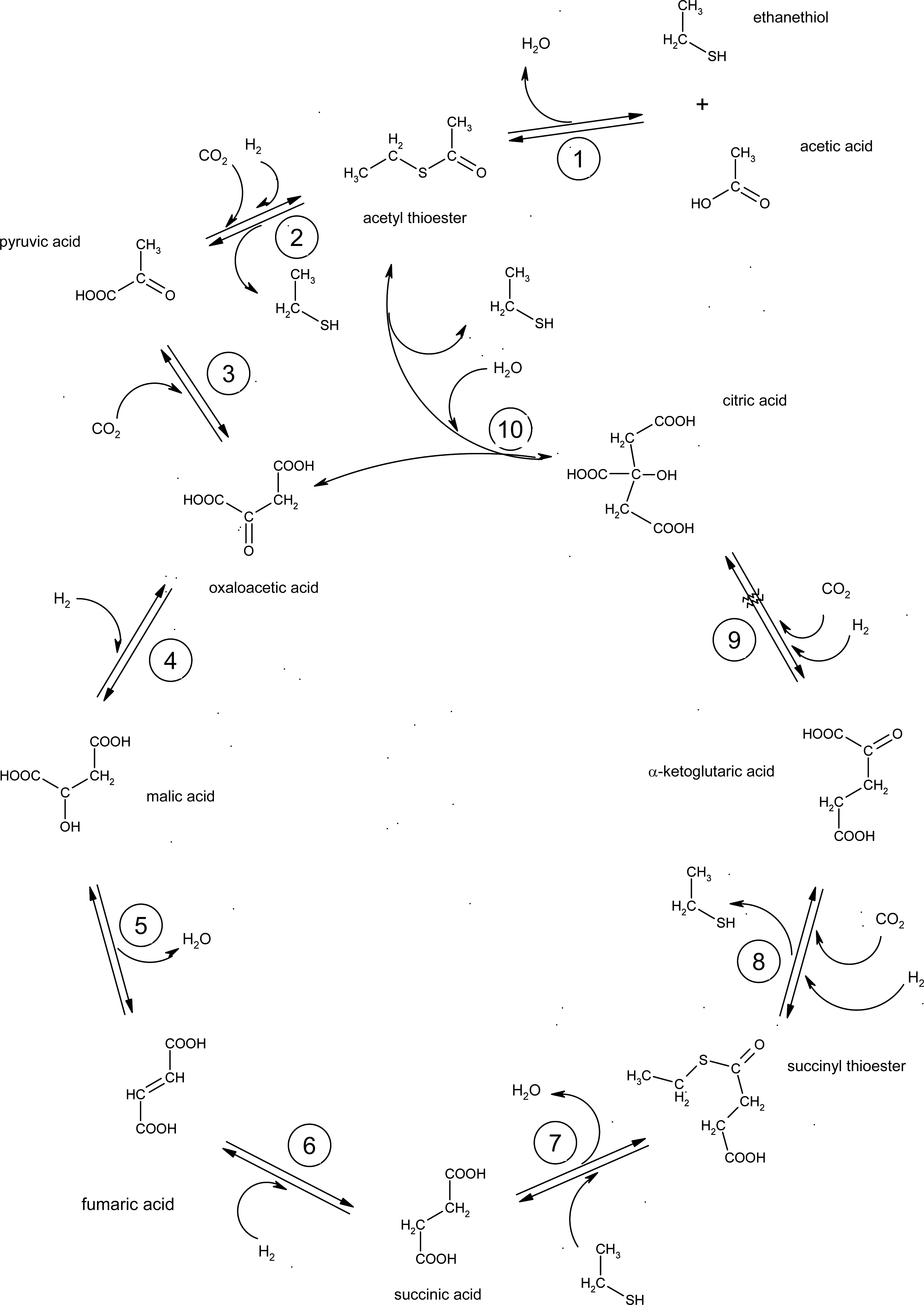
<p>Data for reactions depicted in <xref ref-type="fig" rid="f1-ijms-10-02809">Figure 1</xref> are used as a suggestion for a prebiotic reductive CAC. However, estimation of the thermochemical properties of the thioester intermediates may also function as proxies in lieu of high pressure and temperature reaction data for coenzyme A or other thioester intermediates found in Archaea.</p></sec>
<sec sec-type="methods">
<label>2.</label>
<title>Methods</title>
<p>The revised HKF equation of state uses the standard [<xref ref-type="bibr" rid="b26-ijms-10-02809">26</xref>] 
<inline-formula>
<mml:math>
<mml:mo>Δ</mml:mo>
<mml:msubsup>
<mml:mi>G</mml:mi>
<mml:mi>f</mml:mi>
<mml:mn>0</mml:mn></mml:msubsup>
<mml:mi> </mml:mi>
<mml:mi>a</mml:mi>
<mml:mi>q</mml:mi></mml:math></inline-formula>, aqueous partial molal entropy (<italic>S</italic><sup>0</sup><italic>aq</italic>), partial molal volume (<italic>V</italic><sup>0</sup>), and constant pressure molal heat capacity (
<inline-formula>
<mml:math>
<mml:msubsup>
<mml:mi>C</mml:mi>
<mml:mi>P</mml:mi>
<mml:mn>0</mml:mn></mml:msubsup></mml:math></inline-formula>), along with fitting parameters that integrate the change in the partial molal property, into the 
<inline-formula>
<mml:math>
<mml:mo>Δ</mml:mo>
<mml:msubsup>
<mml:mi>G</mml:mi>
<mml:mi>f</mml:mi>
<mml:mn>0</mml:mn></mml:msubsup>
<mml:mi> </mml:mi>
<mml:mi>a</mml:mi>
<mml:mi>q</mml:mi></mml:math></inline-formula> at the desired temperature and pressure conditions. In regard to the revised- HKF equation of state, the 25 °C – 0.1 MPa properties are referred to as the reference state, i.e. 
<inline-formula>
<mml:math>
<mml:mo>Δ</mml:mo>
<mml:msubsup>
<mml:mi>G</mml:mi>
<mml:mi>f</mml:mi>
<mml:mn>0</mml:mn></mml:msubsup>
<mml:mi> </mml:mi>
<mml:mi>a</mml:mi>
<mml:msub>
<mml:mi>q</mml:mi>
<mml:mrow>
<mml:msub>
<mml:mi>P</mml:mi>
<mml:mi>r</mml:mi></mml:msub>
<mml:mo>,</mml:mo>
<mml:msub>
<mml:mi>T</mml:mi>
<mml:mi>r</mml:mi></mml:msub></mml:mrow></mml:msub></mml:math></inline-formula>, and the calculated partial molal property at P and T, the standard state, i.e. 
<inline-formula>
<mml:math>
<mml:mo>Δ</mml:mo>
<mml:msubsup>
<mml:mi>G</mml:mi>
<mml:mi>f</mml:mi>
<mml:mn>0</mml:mn></mml:msubsup>
<mml:mi> </mml:mi>
<mml:mi>a</mml:mi>
<mml:msub>
<mml:mi>q</mml:mi>
<mml:mrow>
<mml:mi>P</mml:mi>
<mml:mo>,</mml:mo>
<mml:mi>T</mml:mi></mml:mrow></mml:msub></mml:math></inline-formula>. For substances for which incomplete thermodynamic data are available, the use of group contribution, or additivity, algorithms has become the most pragmatic method available in light of the vast number of naturally occurring and synthetic organic compounds. Group additivity relationships have been used to generate 25 °C, 0.1 MPa reference state thermodynamic properties and group values. These estimation methods have been used for pure phase gas, liquid and solid organic compounds [<xref ref-type="bibr" rid="b27-ijms-10-02809">27</xref>–<xref ref-type="bibr" rid="b29-ijms-10-02809">29</xref>] and aqueous neutral and ionic organic compounds. Namely among the aqueous species are <italic>n</italic>-alkanes, <italic>n</italic>-alkenes, <italic>n</italic>-alcohols, <italic>n</italic>–alkanones [<xref ref-type="bibr" rid="b30-ijms-10-02809">30</xref>], aldehydes [<xref ref-type="bibr" rid="b15-ijms-10-02809">15</xref>], amino acids [<xref ref-type="bibr" rid="b18-ijms-10-02809">18</xref>,<xref ref-type="bibr" rid="b22-ijms-10-02809">22</xref>], carboxylic, hydroxy and dicarboxylic acids, and their respective ions [<xref ref-type="bibr" rid="b23-ijms-10-02809">23</xref>], as well as numerous biochemically-relevant organic compounds (e.g.[<xref ref-type="bibr" rid="b31-ijms-10-02809">31</xref>,<xref ref-type="bibr" rid="b32-ijms-10-02809">32</xref>]).</p>
<sec>
<label>2.1.</label>
<title>Strategy used for the estimation of missing reference state values</title>
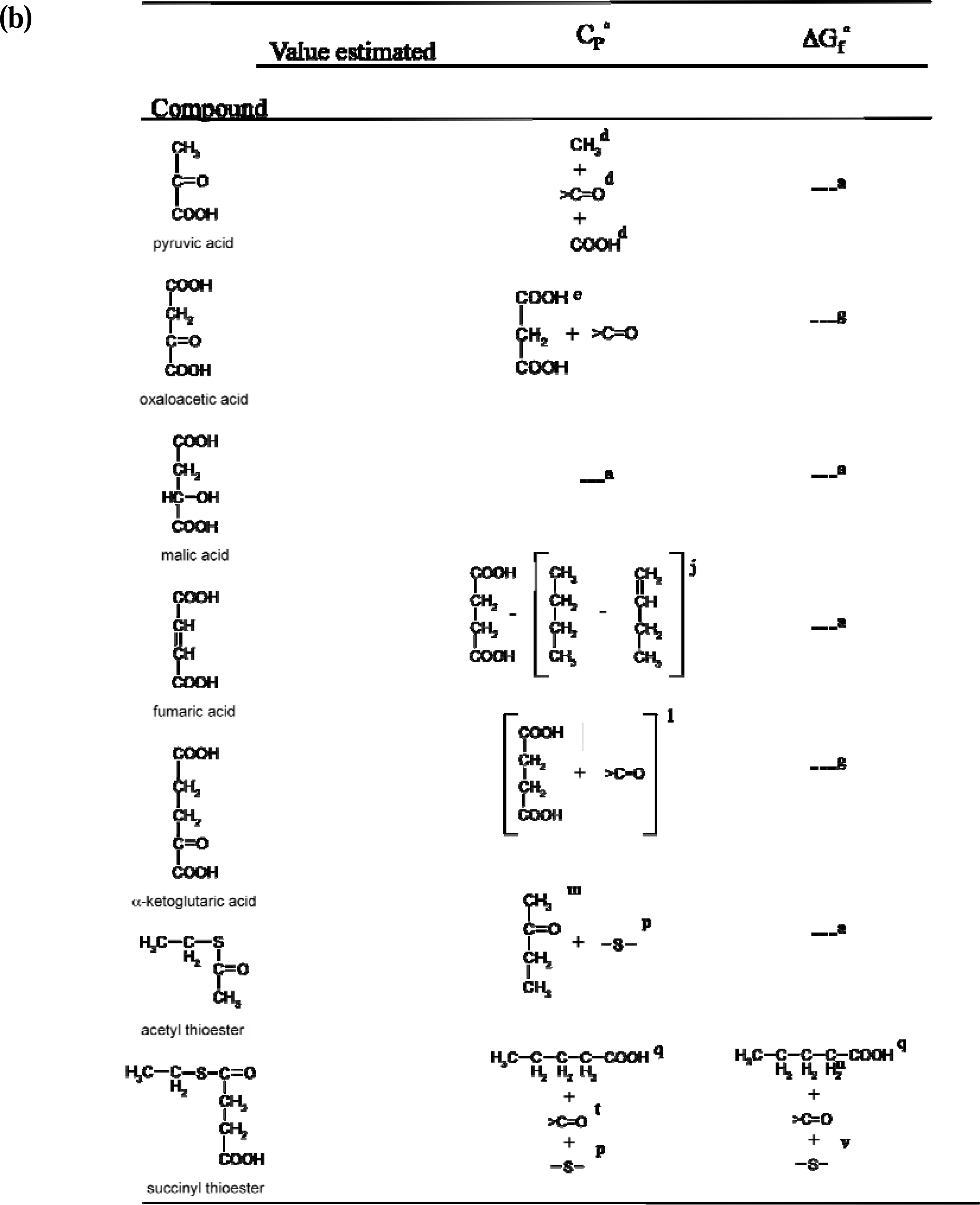
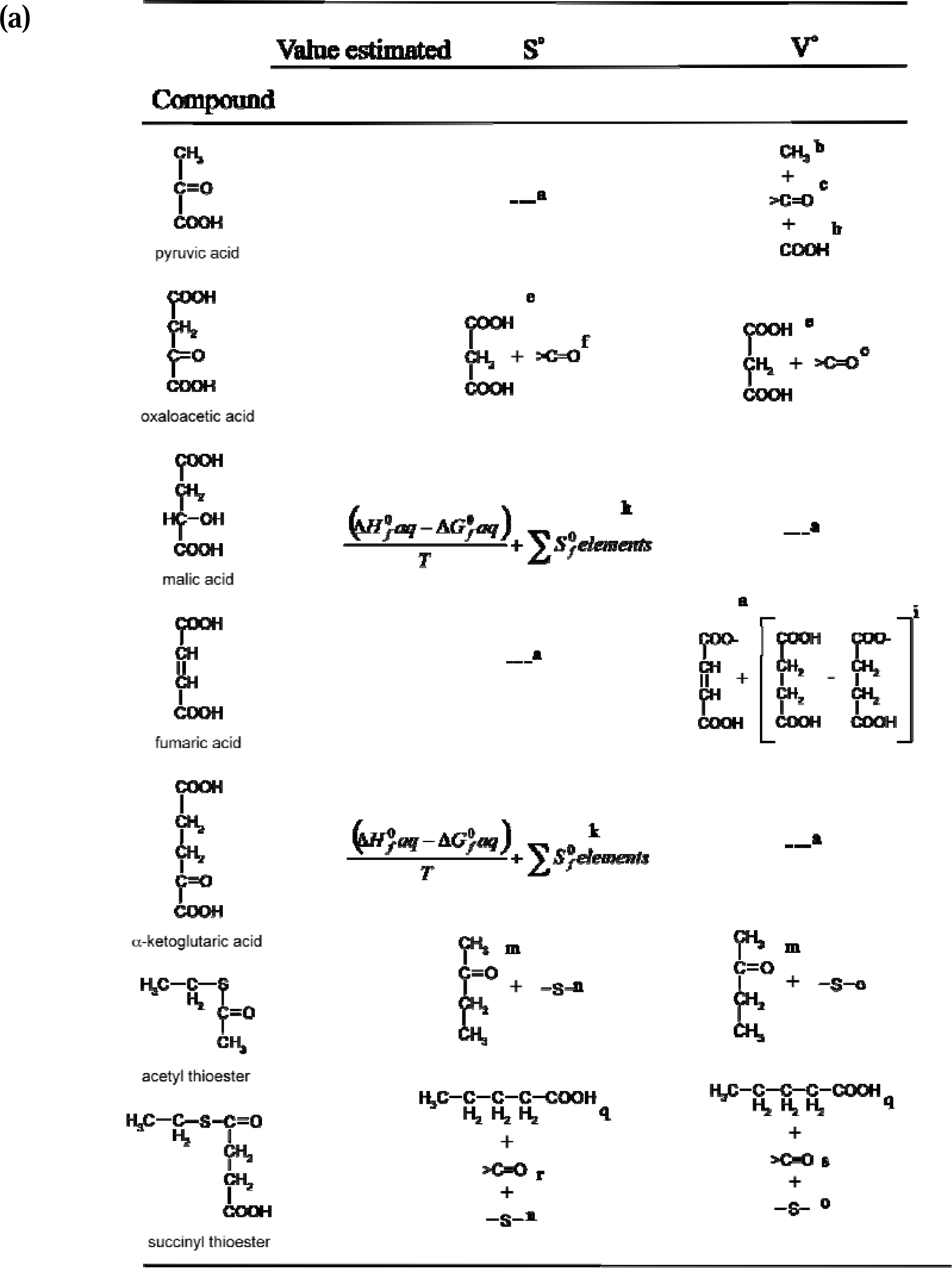
<p>The approach taken to estimate reference state values herein is to utilize methods using state variables and reaction data, where available, to calculate missing values. In absence of state or reaction data, the group contribution method is used, with emphasis on attaining data for the closest structural analogues as a base structure. In doing so, the fewest group values are used to modify the base structure as a means of decreasing the probability of error accumulation. The selection of methods used to estimate reference state data are summarized in <xref ref-type="fig" rid="f2-ijms-10-02809">Figure 2</xref> using the neutral species as examples.</p></sec>
<sec>
<label>2.2.</label>
<title>Calculation of reference state 
<inline-formula>
<mml:math>
<mml:mo>Δ</mml:mo>
<mml:msubsup>
<mml:mi>G</mml:mi>
<mml:mi>f</mml:mi>
<mml:mn>0</mml:mn></mml:msubsup>
<mml:mi> </mml:mi>
<mml:mi>a</mml:mi>
<mml:mi>q</mml:mi></mml:math></inline-formula> and estimation of missing values</title>
<p>The 
<inline-formula>
<mml:math>
<mml:mo>Δ</mml:mo>
<mml:msubsup>
<mml:mi>G</mml:mi>
<mml:mi>f</mml:mi>
<mml:mn>0</mml:mn></mml:msubsup>
<mml:mi> </mml:mi>
<mml:mi>a</mml:mi>
<mml:mi>q</mml:mi></mml:math></inline-formula> values selected for neutral and ionic organic species are shown in <xref ref-type="table" rid="t1-ijms-10-02809">Table 1</xref>. The 
<inline-formula>
<mml:math>
<mml:mo>Δ</mml:mo>
<mml:msubsup>
<mml:mi>G</mml:mi>
<mml:mi>f</mml:mi>
<mml:mn>0</mml:mn></mml:msubsup>
<mml:mi> </mml:mi>
<mml:mi>a</mml:mi>
<mml:mi>q</mml:mi></mml:math></inline-formula> for organic acids and ions for which there were no data available were calculated from the ionization constants (<italic>p</italic>Ka), critically compiled in [<xref ref-type="bibr" rid="b33-ijms-10-02809">33</xref>], and 
<inline-formula>
<mml:math>
<mml:mo>Δ</mml:mo>
<mml:msubsup>
<mml:mi>G</mml:mi>
<mml:mi>f</mml:mi>
<mml:mn>0</mml:mn></mml:msubsup>
<mml:mi> </mml:mi>
<mml:mi>a</mml:mi>
<mml:mi>q</mml:mi></mml:math></inline-formula> of the respective ion or acid for which there were reliable data. The only acid-anion pair for which 
<inline-formula>
<mml:math>
<mml:mo>Δ</mml:mo>
<mml:msubsup>
<mml:mi>G</mml:mi>
<mml:mi>f</mml:mi>
<mml:mn>0</mml:mn></mml:msubsup>
<mml:mi> </mml:mi>
<mml:mi>a</mml:mi>
<mml:mi>q</mml:mi></mml:math></inline-formula> values were unavailable was succinyl thioester. Therefore, estimation of its 
<inline-formula>
<mml:math>
<mml:mo>Δ</mml:mo>
<mml:msubsup>
<mml:mi>G</mml:mi>
<mml:mi>f</mml:mi>
<mml:mn>0</mml:mn></mml:msubsup>
<mml:mi> </mml:mi>
<mml:mi>a</mml:mi>
<mml:mi>q</mml:mi></mml:math></inline-formula> was necessary and attained through the addition of the 
<inline-formula>
<mml:math>
<mml:mo>Δ</mml:mo>
<mml:msubsup>
<mml:mi>G</mml:mi>
<mml:mi>f</mml:mi>
<mml:mn>0</mml:mn></mml:msubsup>
<mml:mi> </mml:mi>
<mml:mi>a</mml:mi>
<mml:mi>q</mml:mi></mml:math></inline-formula> for the (&gt;C=O) and (–S-) groups to pentanoic acid-pentanoate 
<inline-formula>
<mml:math>
<mml:mo>Δ</mml:mo>
<mml:msubsup>
<mml:mi>G</mml:mi>
<mml:mi>f</mml:mi>
<mml:mn>0</mml:mn></mml:msubsup>
<mml:mi> </mml:mi>
<mml:mi>a</mml:mi>
<mml:mi>q</mml:mi></mml:math></inline-formula> for the succinyl thioester acid-anion pair. The 
<inline-formula>
<mml:math>
<mml:mo>Δ</mml:mo>
<mml:msubsup>
<mml:mi>G</mml:mi>
<mml:mi>f</mml:mi>
<mml:mn>0</mml:mn></mml:msubsup>
<mml:mi> </mml:mi>
<mml:mi>a</mml:mi>
<mml:mi>q</mml:mi>
<mml:mi> </mml:mi>
<mml:mo stretchy="false">(</mml:mo>
<mml:mo>&gt;</mml:mo>
<mml:mtext>C</mml:mtext>
<mml:mo>=</mml:mo>
<mml:mtext>O</mml:mtext>
<mml:mo stretchy="false">)</mml:mo></mml:math></inline-formula> group value was calculated from the difference in the y-intercepts for regression equations between <italic>n-</italic>alkanones and (n-1) <italic>n</italic>-alkanes (both taken from reference [<xref ref-type="bibr" rid="b18-ijms-10-02809">18</xref>]). The 
<inline-formula>
<mml:math>
<mml:mo>Δ</mml:mo>
<mml:msubsup>
<mml:mi>G</mml:mi>
<mml:mi>f</mml:mi>
<mml:mn>0</mml:mn></mml:msubsup>
<mml:mi> </mml:mi>
<mml:mi>a</mml:mi>
<mml:mi>q</mml:mi>
<mml:mi> </mml:mi>
<mml:mo stretchy="false">(</mml:mo>
<mml:mo>−</mml:mo>
<mml:mtext>S</mml:mtext>
<mml:mo>-</mml:mo>
<mml:mo stretchy="false">)</mml:mo></mml:math></inline-formula> was calculated similarly, from the difference in y-intercepts from dialkylsulfides [<xref ref-type="bibr" rid="b34-ijms-10-02809">34</xref>] and <italic>n</italic>-alkanes [<xref ref-type="bibr" rid="b18-ijms-10-02809">18</xref>], with the same number of carbon atoms. Data for other components of the citric acid cycle (ethyl thiol and acetic acid; see <xref ref-type="fig" rid="f1-ijms-10-02809">Figure 1</xref>) are available in the literature [<xref ref-type="bibr" rid="b16-ijms-10-02809">16</xref>,<xref ref-type="bibr" rid="b23-ijms-10-02809">23</xref>].</p>
<p>The estimation of high temperature and pressure thermochemical properties for <italic>cis</italic>-aconitate and isocitrate, for the reactions between citrate and α-ketoglutarate, were not calculated due to deficient reference state data. Since citric acid and its ions are the only feasible tricarboxylated base structures available to use for the estimation, this approach was rejected to avoid circularity. Furthermore, the primary goal of estimating the high pressure and temperature parameters for CAC reactions calculated herein is primarily driven to examine these reactions under the near equilibrium conditions that are present in anoxic systems. Extant microbes that use the CAC reductively to fix carbon generally only contain a partial cycle where the pathway is used to supply precursors for biosynthesis via succinyl-Coenzyme A or α-ketoglutarate [<xref ref-type="bibr" rid="b2-ijms-10-02809">2</xref>–<xref ref-type="bibr" rid="b4-ijms-10-02809">4</xref>,<xref ref-type="bibr" rid="b45-ijms-10-02809">45</xref>].</p></sec>
<sec>
<label>2.3.</label>
<title><italic>Calculation of the reference state entropy (S</italic><sup>0</sup> <italic>aq) and estimation of missing values</italic></title>
<p>The <italic>S</italic><sup>0</sup><italic>aq</italic> values selected are shown in <xref ref-type="table" rid="t1-ijms-10-02809">Table 1</xref>. If <italic>S</italic><sup>0</sup><italic>aq</italic> values were not available, third-law entropies were calculated from the aqueous enthalpy and Gibbs free energy values along with the sum of entropies of the elemental constituents using <xref ref-type="disp-formula" rid="FD1">Equation (1)</xref>:
<disp-formula id="FD1">
<label>(1)</label>
<mml:math display="block">
<mml:msup>
<mml:mi>S</mml:mi>
<mml:mn>0</mml:mn></mml:msup>
<mml:mi>a</mml:mi>
<mml:mi>q</mml:mi>
<mml:mo>=</mml:mo>
<mml:mfrac>
<mml:mrow>
<mml:mo>Δ</mml:mo>
<mml:msubsup>
<mml:mi>H</mml:mi>
<mml:mi>f</mml:mi>
<mml:mn>0</mml:mn></mml:msubsup>
<mml:mi>a</mml:mi>
<mml:mi>q</mml:mi>
<mml:mo>−</mml:mo>
<mml:mo>Δ</mml:mo>
<mml:msubsup>
<mml:mi>G</mml:mi>
<mml:mi>f</mml:mi>
<mml:mn>0</mml:mn></mml:msubsup>
<mml:mi>a</mml:mi>
<mml:mi>q</mml:mi></mml:mrow>
<mml:mi>T</mml:mi></mml:mfrac>
<mml:mo>−</mml:mo>
<mml:mo>∑</mml:mo>
<mml:mrow>
<mml:msubsup>
<mml:mi>S</mml:mi>
<mml:mrow>
<mml:mtext mathvariant="italic">elements</mml:mtext></mml:mrow>
<mml:mn>0</mml:mn></mml:msubsup></mml:mrow></mml:math></disp-formula></p>
<p>The <italic>S</italic><sup>0</sup><italic>aq</italic> for some anions in <xref ref-type="table" rid="t1-ijms-10-02809">Table 1</xref> were calculated from the <italic>S</italic><sup>0</sup><italic>aq</italic> of the acid using Δ<italic><sub>ion</sub>S</italic> for the ionization reactions from Miller and Smith-Magowan [<xref ref-type="bibr" rid="b33-ijms-10-02809">33</xref>]:
<disp-formula id="FD2">
<label>(2)</label>
<mml:math display="block">
<mml:msup>
<mml:mi>S</mml:mi>
<mml:mn>0</mml:mn></mml:msup>
<mml:mi>a</mml:mi>
<mml:mi>q</mml:mi>
<mml:mi> </mml:mi>
<mml:mo stretchy="false">(</mml:mo>
<mml:mtext>acid</mml:mtext>
<mml:mo stretchy="false">)</mml:mo>
<mml:mo>=</mml:mo>
<mml:msup>
<mml:mi>S</mml:mi>
<mml:mn>0</mml:mn></mml:msup>
<mml:mi>a</mml:mi>
<mml:mi>q</mml:mi>
<mml:mi> </mml:mi>
<mml:mo stretchy="false">(</mml:mo>
<mml:msup>
<mml:mtext>ion</mml:mtext>
<mml:mrow>
<mml:mo>−</mml:mo>
<mml:mn>1</mml:mn></mml:mrow></mml:msup>
<mml:mo stretchy="false">)</mml:mo>
<mml:mo>+</mml:mo>
<mml:msub>
<mml:mo>Δ</mml:mo>
<mml:mrow>
<mml:mi>i</mml:mi>
<mml:mi>o</mml:mi>
<mml:mi>n</mml:mi></mml:mrow></mml:msub>
<mml:mi>S</mml:mi></mml:math></disp-formula></p>
<p>The aqueous formation entropies for H-α-ketoglutarte<sup>−1</sup> and α-ketoglutarte<sup>−2</sup> were estimated by assuming similar Δ<italic><sub>ion</sub>S</italic> from succinic acid and its mono- and divalent anions (from Shock [<xref ref-type="bibr" rid="b23-ijms-10-02809">23</xref>]). The carbonyl group <italic>S</italic><sup>0</sup><italic>aq</italic> contribution value (54.3 J mol<sup>−1</sup>) used for oxaloacetic acid and its respective anions was calculated from the difference in <italic>S</italic><sup>0</sup><italic>aq</italic> between α-ketoglutaric acid and succinic acid from Shock [<xref ref-type="bibr" rid="b23-ijms-10-02809">23</xref>]:
<disp-formula id="FD3">
<label>(3)</label>
<mml:math display="block">
<mml:msup>
<mml:mi>S</mml:mi>
<mml:mn>0</mml:mn></mml:msup>
<mml:mi>a</mml:mi>
<mml:mi>q</mml:mi>
<mml:mi> </mml:mi>
<mml:mo stretchy="false">(</mml:mo>
<mml:mo>α</mml:mo>
<mml:mo>-</mml:mo>
<mml:mtext>ketoglutaric</mml:mtext>
<mml:mi> </mml:mi>
<mml:mtext>acid</mml:mtext>
<mml:mo stretchy="false">)</mml:mo>
<mml:mo> </mml:mo>
<mml:mo>-</mml:mo>
<mml:mo> </mml:mo>
<mml:msup>
<mml:mi>S</mml:mi>
<mml:mn>0</mml:mn></mml:msup>
<mml:mi>a</mml:mi>
<mml:mi>q</mml:mi>
<mml:mo> </mml:mo>
<mml:mo stretchy="false">(</mml:mo>
<mml:mtext>succinic</mml:mtext>
<mml:mi> </mml:mi>
<mml:mtext>acid</mml:mtext>
<mml:mo stretchy="false">)</mml:mo>
<mml:mo>=</mml:mo>
<mml:msup>
<mml:mi>S</mml:mi>
<mml:mn>0</mml:mn></mml:msup>
<mml:mi>a</mml:mi>
<mml:mi>q</mml:mi>
<mml:mi> </mml:mi>
<mml:mo stretchy="false">(</mml:mo>
<mml:mo>&gt;</mml:mo>
<mml:mtext>C</mml:mtext>
<mml:mo>=</mml:mo>
<mml:mtext>O</mml:mtext>
<mml:mo stretchy="false">)</mml:mo></mml:math></disp-formula></p>
<p>To calculate the <italic>S</italic><sup>0</sup><italic>aq</italic> needed for acetyl thioester the value of <italic>S</italic><sup>0</sup><italic>aq</italic> (-S-) was calculated from the difference in aqueous entropies between ethyl sulfide (see <xref ref-type="app" rid="app1">Appendix A</xref>, <xref ref-type="disp-formula" rid="FD21">Equation 21</xref>), and <italic>n</italic>-butane [<xref ref-type="bibr" rid="b18-ijms-10-02809">18</xref>].</p>
<p>The <italic>S</italic><sup>0</sup><italic>aq</italic> (&gt;C=O) value used for succinyl thioester and its anion was estimated from the difference (68.15 J mol<sup>−1</sup> K<sup>−1</sup>) in y-intercepts between <italic>n</italic>-alkanones and (n-1) <italic>n</italic>-alkanes, both from Shock and Helgeson [<xref ref-type="bibr" rid="b18-ijms-10-02809">18</xref>]. The <italic>S</italic><sup>0</sup><italic>aq</italic> (&gt;C=O) value used here was chosen since the value derived from an <italic>n</italic>-alkanone may be more likely to represent the value of a subterminal carbonyl adjacent to a sulfur atom, as opposed to the α-carbonyl adjacent to a carboxylic acid, as was used above for oxaloacetic acid.</p></sec>
<sec>
<label>2.4.</label>
<title>Calculation of the reference state partial molal volume (V°aq) and estimation of missing values</title>
<p>The chosen partial molal volume values are shown in <xref ref-type="table" rid="t1-ijms-10-02809">Table 1</xref>. The group value <italic>V</italic><sup>0</sup> (&gt;C=O) used for the oxaloacetate series was estimated by the difference in <italic>V</italic><sup>0</sup> between α-ketoglutaric acid [<xref ref-type="bibr" rid="b36-ijms-10-02809">36</xref>] and succinic acid [<xref ref-type="bibr" rid="b35-ijms-10-02809">35</xref>] such that:
<disp-formula id="FD4">
<label>(4)</label>
<mml:math display="block">
<mml:msup>
<mml:mi>V</mml:mi>
<mml:mn>0</mml:mn></mml:msup>
<mml:mo> </mml:mo>
<mml:mo stretchy="false">(</mml:mo>
<mml:mo>α</mml:mo>
<mml:mo>-</mml:mo>
<mml:mtext>ketoglutaric</mml:mtext>
<mml:mi> </mml:mi>
<mml:mtext>acid</mml:mtext>
<mml:mo stretchy="false">)</mml:mo>
<mml:mo> </mml:mo>
<mml:mo>-</mml:mo>
<mml:mo> </mml:mo>
<mml:msup>
<mml:mi>V</mml:mi>
<mml:mn>0</mml:mn></mml:msup>
<mml:mo> </mml:mo>
<mml:mo stretchy="false">(</mml:mo>
<mml:mtext>succinic</mml:mtext>
<mml:mi> </mml:mi>
<mml:mtext>acid</mml:mtext>
<mml:mo stretchy="false">)</mml:mo>
<mml:mo>=</mml:mo>
<mml:msup>
<mml:mi>V</mml:mi>
<mml:mn>0</mml:mn></mml:msup>
<mml:mo> </mml:mo>
<mml:mo stretchy="false">(</mml:mo>
<mml:mo>&gt;</mml:mo>
<mml:mtext>C</mml:mtext>
<mml:mo>=</mml:mo>
<mml:mtext>O</mml:mtext>
<mml:mo stretchy="false">)</mml:mo>
<mml:mo>.</mml:mo></mml:math></disp-formula></p>
<p>This <italic>V</italic><sup>0</sup> (&gt;C=O) was used for pyruvic acid and pyruvate as well since it may rather well represent the volume of an α-carbonyl (<italic>V</italic><sup>0</sup> ~5 cm<sup>3</sup> mol<sup>−1</sup>) adjacent to a carboxylic acid, rather than <italic>n</italic>-alkanone’s carbonyl with a much larger volume of (~14–15 cm<sup>3</sup> mol<sup>−1</sup> [<xref ref-type="bibr" rid="b30-ijms-10-02809">30</xref>,<xref ref-type="bibr" rid="b31-ijms-10-02809">31</xref>]).</p>
<p>The <italic>V</italic><sup>0</sup> for fumarate<sup>−2</sup> was used to estimate the <italic>V</italic><sup>0</sup> of fumaric acid and the H-fumarate<sup>−1</sup> anion by assuming the same Δ<italic><sub>ion</sub>V</italic> relationship for fumaric acid and its ions as for succinic acid from Criss and Wood [<xref ref-type="bibr" rid="b35-ijms-10-02809">35</xref>], and H-succinate<sup>−1</sup> or succinate<sup>−2</sup> anion, from Shock [<xref ref-type="bibr" rid="b23-ijms-10-02809">23</xref>], as demonstrated in <xref ref-type="fig" rid="f2-ijms-10-02809">Figure 2</xref>. The same relationship, using the Δ<italic><sub>ion</sub>V</italic> (13.13 cm<sup>3</sup> mol<sup>−1</sup>) between lactic acid and lactate from Shock [<xref ref-type="bibr" rid="b23-ijms-10-02809">23</xref>] was used to estimate the <italic>V</italic><sup>0</sup> for pyruvate from its acid.</p>
<p>The partial molal volume of the (-S-) group for a thioester was estimated by the addition of the value of <italic>V</italic><sup>0</sup> <sub>(-S-)</sub> from a value published by Lepori and Gianni [<xref ref-type="bibr" rid="b40-ijms-10-02809">40</xref>] to the <italic>V</italic><sup>0</sup> of 2-butanone taken from Shock and Helgeson [<xref ref-type="bibr" rid="b18-ijms-10-02809">18</xref>]. The <italic>V</italic><sup>0</sup> of succinyl thioester and its anion were estimated by the addition of <italic>V</italic><sup>0</sup> <sub>(-S-)</sub> [<xref ref-type="bibr" rid="b40-ijms-10-02809">40</xref>] and <italic>V</italic><sup>0</sup> <sub>(&gt;C=O)</sub> to the <italic>V</italic><sup>0</sup> of pentanoic acid and pentanoate, respectively (both from Shock [<xref ref-type="bibr" rid="b23-ijms-10-02809">23</xref>]). The <italic>V</italic><sup>0</sup> <sub>(&gt;C=O)</sub> value was estimated to be the difference between the <italic>V</italic><sup>0</sup> of <italic>n</italic>-alkanones and (n-1) <italic>n</italic>-alkanes (both taken from Shock and Helgeson [<xref ref-type="bibr" rid="b18-ijms-10-02809">18</xref>]).</p></sec>
<sec>
<label>2.5.</label>
<title>Calculation of the reference state heat capacity (C°<sub>p</sub> aq) and estimation of missing values</title>
<p>The standard molal isobaric heat capacities at the reference temperature and pressure are shown in <xref ref-type="table" rid="t1-ijms-10-02809">Table 1</xref> and estimation procedures in <xref ref-type="fig" rid="f2-ijms-10-02809">Figure 2</xref>. The 
<inline-formula>
<mml:math>
<mml:msubsup>
<mml:mi>C</mml:mi>
<mml:mi>P</mml:mi>
<mml:mn>0</mml:mn></mml:msubsup></mml:math></inline-formula> of pyruvate ion was assumed to have the same difference in 
<inline-formula>
<mml:math>
<mml:msub>
<mml:mo>Δ</mml:mo>
<mml:mrow>
<mml:mi>i</mml:mi>
<mml:mi>o</mml:mi>
<mml:mi>n</mml:mi></mml:mrow></mml:msub>
<mml:msubsup>
<mml:mi>C</mml:mi>
<mml:mi>P</mml:mi>
<mml:mn>0</mml:mn></mml:msubsup></mml:math></inline-formula> from its acid, as did the lactic acid-lactate pair [<xref ref-type="bibr" rid="b23-ijms-10-02809">23</xref>], of 167.4 J mol<sup>−1</sup> K<sup>−1</sup>. The 
<inline-formula>
<mml:math>
<mml:msubsup>
<mml:mi>C</mml:mi>
<mml:mi>P</mml:mi>
<mml:mn>0</mml:mn></mml:msubsup></mml:math></inline-formula> for oxaloacetic acid was estimated by adding the 
<inline-formula>
<mml:math>
<mml:msubsup>
<mml:mi>C</mml:mi>
<mml:mi>P</mml:mi>
<mml:mn>0</mml:mn></mml:msubsup>
<mml:mi> </mml:mi>
<mml:mo stretchy="false">(</mml:mo>
<mml:mo>&gt;</mml:mo>
<mml:mtext>C</mml:mtext>
<mml:mo>=</mml:mo>
<mml:mtext>O</mml:mtext>
<mml:mo stretchy="false">)</mml:mo></mml:math></inline-formula> value (−52.0 J mol<sup>−1</sup> K<sup>−1</sup>) from that reported by Cabani <italic>et al</italic>. [<xref ref-type="bibr" rid="b31-ijms-10-02809">31</xref>] to that of malonic acid [<xref ref-type="bibr" rid="b23-ijms-10-02809">23</xref>]. For the estimation of 
<inline-formula>
<mml:math>
<mml:msubsup>
<mml:mi>C</mml:mi>
<mml:mi>P</mml:mi>
<mml:mn>0</mml:mn></mml:msubsup></mml:math></inline-formula> values for both H-oxaloacetate<sup>−1</sup> and oxaloacetate<sup>−2</sup> ions, it was assumed that the difference from the acid was the same as between succinic acid and it respective anions from Shock [<xref ref-type="bibr" rid="b23-ijms-10-02809">23</xref>]. This assumption was also used to estimate 
<inline-formula>
<mml:math>
<mml:msubsup>
<mml:mi>C</mml:mi>
<mml:mi>P</mml:mi>
<mml:mn>0</mml:mn></mml:msubsup></mml:math></inline-formula> values of the H-mono- and divalent anions of malate, fumarate, and α-ketoglutarate. The 
<inline-formula>
<mml:math>
<mml:msubsup>
<mml:mi>C</mml:mi>
<mml:mi>P</mml:mi>
<mml:mn>0</mml:mn></mml:msubsup></mml:math></inline-formula> of fumaric acid was estimated through subtracting the values for the difference (70.7 J mol<sup>−1</sup> K<sup>−1</sup>) in y-intercepts between <italic>n</italic>-alkanes from <italic>n</italic>-alkenes (both values being from Shock and Helgeson [<xref ref-type="bibr" rid="b18-ijms-10-02809">18</xref>]) from that of succinic acid. For α-ketoglutaric acid, the 
<inline-formula>
<mml:math>
<mml:msubsup>
<mml:mi>C</mml:mi>
<mml:mi>P</mml:mi>
<mml:mn>0</mml:mn></mml:msubsup>
<mml:mi> </mml:mi>
<mml:mo stretchy="false">(</mml:mo>
<mml:mo>&gt;</mml:mo>
<mml:mtext>C</mml:mtext>
<mml:mo>=</mml:mo>
<mml:mtext>O</mml:mtext>
<mml:mo stretchy="false">)</mml:mo></mml:math></inline-formula> value (−52.0 J mol<sup>−1</sup> K<sup>−1</sup>) reported by Cabani <italic>et al</italic>. [<xref ref-type="bibr" rid="b31-ijms-10-02809">31</xref>] was added to that of succninc acid. The 
<inline-formula>
<mml:math>
<mml:msubsup>
<mml:mi>C</mml:mi>
<mml:mi>P</mml:mi>
<mml:mn>0</mml:mn></mml:msubsup></mml:math></inline-formula> for succinyl thioester was estimated from addition of the 
<inline-formula>
<mml:math>
<mml:msubsup>
<mml:mi>C</mml:mi>
<mml:mi>P</mml:mi>
<mml:mn>0</mml:mn></mml:msubsup>
<mml:mi> </mml:mi>
<mml:mo stretchy="false">(</mml:mo>
<mml:mo>&gt;</mml:mo>
<mml:mtext>C</mml:mtext>
<mml:mo>=</mml:mo>
<mml:mtext>O</mml:mtext>
<mml:mo stretchy="false">)</mml:mo></mml:math></inline-formula>, and the 
<inline-formula>
<mml:math>
<mml:msubsup>
<mml:mi>C</mml:mi>
<mml:mi>P</mml:mi>
<mml:mn>0</mml:mn></mml:msubsup>
<mml:mi> </mml:mi>
<mml:mo stretchy="false">(</mml:mo>
<mml:mo>-</mml:mo>
<mml:mtext>S</mml:mtext>
<mml:mo>-</mml:mo>
<mml:mo stretchy="false">)</mml:mo></mml:math></inline-formula> (−81.2 J mol<sup>−1</sup> K<sup>−1</sup>), both calculated in this work, to the 
<inline-formula>
<mml:math>
<mml:msubsup>
<mml:mi>C</mml:mi>
<mml:mi>P</mml:mi>
<mml:mn>0</mml:mn></mml:msubsup></mml:math></inline-formula> of pentanoic acid from Shock [<xref ref-type="bibr" rid="b23-ijms-10-02809">23</xref>]. The 
<inline-formula>
<mml:math>
<mml:msubsup>
<mml:mi>C</mml:mi>
<mml:mi>P</mml:mi>
<mml:mn>0</mml:mn></mml:msubsup>
<mml:mi> </mml:mi>
<mml:mo stretchy="false">(</mml:mo>
<mml:mo>-</mml:mo>
<mml:mtext>S</mml:mtext>
<mml:mo>-</mml:mo>
<mml:mo stretchy="false">)</mml:mo></mml:math></inline-formula> for succinyl thioester was calculated from the difference in y-intercepts of C<sub>2</sub>,C<sub>4</sub>,C<sub>6</sub> n-diaklysulfides [<xref ref-type="bibr" rid="b34-ijms-10-02809">34</xref>] and C<sub>2</sub>,C<sub>4</sub>,C<sub>6</sub> n-alkanes [<xref ref-type="bibr" rid="b23-ijms-10-02809">23</xref>]. The 
<inline-formula>
<mml:math>
<mml:msubsup>
<mml:mi>C</mml:mi>
<mml:mi>P</mml:mi>
<mml:mn>0</mml:mn></mml:msubsup>
<mml:mi> </mml:mi>
<mml:mo stretchy="false">(</mml:mo>
<mml:mo>&gt;</mml:mo>
<mml:mtext>C</mml:mtext>
<mml:mo>=</mml:mo>
<mml:mtext>O</mml:mtext>
<mml:mo stretchy="false">)</mml:mo></mml:math></inline-formula> value (−135.2 J mol<sup>−1</sup> K<sup>−1</sup>) was calculated to be the difference between 2-pentanone and <italic>n</italic>-butane, both from Shock and Helgeson [<xref ref-type="bibr" rid="b18-ijms-10-02809">18</xref>]. This value for 
<inline-formula>
<mml:math>
<mml:msubsup>
<mml:mi>C</mml:mi>
<mml:mi>P</mml:mi>
<mml:mn>0</mml:mn></mml:msubsup>
<mml:mi> </mml:mi>
<mml:mo stretchy="false">(</mml:mo>
<mml:mo>&gt;</mml:mo>
<mml:mtext>C</mml:mtext>
<mml:mo>=</mml:mo>
<mml:mtext>O</mml:mtext>
<mml:mo stretchy="false">)</mml:mo></mml:math></inline-formula> was chosen for succinyl thioester because a carbonyl from an <italic>n</italic>-alkanone may be more likely to represent the 
<inline-formula>
<mml:math>
<mml:msubsup>
<mml:mi>C</mml:mi>
<mml:mi>P</mml:mi>
<mml:mn>0</mml:mn></mml:msubsup>
<mml:mi> </mml:mi>
<mml:mo stretchy="false">(</mml:mo>
<mml:mo>&gt;</mml:mo>
<mml:mtext>C</mml:mtext>
<mml:mo>=</mml:mo>
<mml:mtext>O</mml:mtext>
<mml:mo stretchy="false">)</mml:mo></mml:math></inline-formula> in a thioester, as opposed to that from a α-carbonyl adjacent to a carboxylic acid. The resulting value of 216.1 J mol<sup>−1</sup> K<sup>−1</sup> is in close agreement with the sum of group values provided by Cabani <italic>et al</italic>. [<xref ref-type="bibr" rid="b31-ijms-10-02809">31</xref>], using the (-S-) calculated here, of 216.4 J mol<sup>−1</sup> K<sup>−1</sup>. The 
<inline-formula>
<mml:math>
<mml:msubsup>
<mml:mi>C</mml:mi>
<mml:mi>P</mml:mi>
<mml:mn>0</mml:mn></mml:msubsup></mml:math></inline-formula> of the succinyl thioester anion was assumed to have the same difference from its acid as that between pentanoic acid and pentanoate [<xref ref-type="bibr" rid="b23-ijms-10-02809">23</xref>]. The 
<inline-formula>
<mml:math>
<mml:msubsup>
<mml:mi>C</mml:mi>
<mml:mi>P</mml:mi>
<mml:mn>0</mml:mn></mml:msubsup></mml:math></inline-formula> of acetyl thioester was estimated by adddition 
<inline-formula>
<mml:math>
<mml:msubsup>
<mml:mi>C</mml:mi>
<mml:mi>P</mml:mi>
<mml:mn>0</mml:mn></mml:msubsup>
<mml:mi> </mml:mi>
<mml:mo stretchy="false">(</mml:mo>
<mml:mo>-</mml:mo>
<mml:mtext>S</mml:mtext>
<mml:mo>-</mml:mo>
<mml:mo stretchy="false">)</mml:mo></mml:math></inline-formula>, as described above, to that of 2-butanone from Shock and Helgeson [<xref ref-type="bibr" rid="b18-ijms-10-02809">18</xref>].</p></sec>
<sec sec-type="methods">
<label>2.6.</label>
<title>Extrapolation of reference state data to high pressures and temperatures</title>
<p>Starting with 25°C, 0.1 MPa reference state data, calculating the 
<inline-formula>
<mml:math>
<mml:mo>Δ</mml:mo>
<mml:msubsup>
<mml:mi>G</mml:mi>
<mml:mi>f</mml:mi>
<mml:mn>0</mml:mn></mml:msubsup>
<mml:mi>a</mml:mi>
<mml:msub>
<mml:mi>q</mml:mi>
<mml:mrow>
<mml:mi>P</mml:mi>
<mml:mo>,</mml:mo>
<mml:mi>T</mml:mi></mml:mrow></mml:msub></mml:math></inline-formula> at the elevated P and T involves the integration of <xref ref-type="disp-formula" rid="FD5">Equation (5)</xref> as:
<disp-formula id="FD5">
<label>(5)</label>
<mml:math display="block">
<mml:mo>Δ</mml:mo>
<mml:msubsup>
<mml:mi>G</mml:mi>
<mml:mrow>
<mml:mi>P</mml:mi>
<mml:mo>,</mml:mo>
<mml:mi>T</mml:mi></mml:mrow>
<mml:mn>0</mml:mn></mml:msubsup>
<mml:mo>=</mml:mo>
<mml:mo>Δ</mml:mo>
<mml:msubsup>
<mml:mi>G</mml:mi>
<mml:mrow>
<mml:msub>
<mml:mi>P</mml:mi>
<mml:mi>r</mml:mi></mml:msub>
<mml:mo>,</mml:mo>
<mml:msub>
<mml:mi>T</mml:mi>
<mml:mi>r</mml:mi></mml:msub></mml:mrow>
<mml:mn>0</mml:mn></mml:msubsup>
<mml:mo>−</mml:mo>
<mml:msubsup>
<mml:mi>S</mml:mi>
<mml:mrow>
<mml:msub>
<mml:mi>P</mml:mi>
<mml:mi>r</mml:mi></mml:msub>
<mml:mo>,</mml:mo>
<mml:msub>
<mml:mi>T</mml:mi>
<mml:mi>r</mml:mi></mml:msub></mml:mrow>
<mml:mn>0</mml:mn></mml:msubsup>
<mml:mo stretchy="false">(</mml:mo>
<mml:mi>T</mml:mi>
<mml:mo>−</mml:mo>
<mml:msub>
<mml:mi>T</mml:mi>
<mml:mi>r</mml:mi></mml:msub>
<mml:mo stretchy="false">)</mml:mo>
<mml:mo>+</mml:mo>
<mml:mi> </mml:mi>
<mml:mrow>
<mml:munderover>
<mml:mo>∫</mml:mo>
<mml:mrow>
<mml:msub>
<mml:mi>T</mml:mi>
<mml:mi>r</mml:mi></mml:msub></mml:mrow>
<mml:mi>T</mml:mi></mml:munderover>
<mml:mrow>
<mml:msubsup>
<mml:mi>C</mml:mi>
<mml:mi>P</mml:mi>
<mml:mn>0</mml:mn></mml:msubsup>
<mml:mi>d</mml:mi>
<mml:mi>T</mml:mi>
<mml:mo>−</mml:mo>
<mml:mi>T</mml:mi>
<mml:mrow>
<mml:munderover>
<mml:mo>∫</mml:mo>
<mml:mrow>
<mml:msub>
<mml:mi>T</mml:mi>
<mml:mi>r</mml:mi></mml:msub></mml:mrow>
<mml:mi>T</mml:mi></mml:munderover>
<mml:mrow>
<mml:msubsup>
<mml:mi>C</mml:mi>
<mml:mi>P</mml:mi>
<mml:mn>0</mml:mn></mml:msubsup>
<mml:mi>d</mml:mi></mml:mrow></mml:mrow>
<mml:mi> </mml:mi>
<mml:mtext>ln</mml:mtext>
<mml:mi> </mml:mi>
<mml:mi>T</mml:mi></mml:mrow></mml:mrow>
<mml:mo>+</mml:mo>
<mml:mrow>
<mml:munderover>
<mml:mo>∫</mml:mo>
<mml:mrow>
<mml:msub>
<mml:mi>P</mml:mi>
<mml:mi>r</mml:mi></mml:msub></mml:mrow>
<mml:mi>P</mml:mi></mml:munderover>
<mml:mrow>
<mml:msup>
<mml:mi>V</mml:mi>
<mml:mn>0</mml:mn></mml:msup></mml:mrow></mml:mrow>
<mml:mi> </mml:mi>
<mml:mi>d</mml:mi>
<mml:mi>P</mml:mi></mml:math></disp-formula></p>
<p>The revised-HKF model allows for the incorporation of the changes in the partial molal volume and heat capacity as described in <xref ref-type="app" rid="app2">Appendix B</xref>.</p></sec>
<sec>
<label>2.7.</label>
<title>Estimation of the temperature and pressure effects on the partial molal volume of aqueous organic species: the non-solvation contribution</title>
<p>The partial molal volume of a substance in the revised HKF model is defined by <xref ref-type="disp-formula" rid="FD24">Equation (24)</xref>. At temperatures of ≤ ~150°C, at the water-saturation vapor pressure (P<sub>sat</sub>), the solute-dependent contribution (the non-solvation volume, 
<inline-formula>
<mml:math>
<mml:mo>Δ</mml:mo>
<mml:msubsup>
<mml:mi>V</mml:mi>
<mml:mi>n</mml:mi>
<mml:mn>0</mml:mn></mml:msubsup></mml:math></inline-formula>) to the partial molal volume term dominates the partial molal volume. The 
<inline-formula>
<mml:math>
<mml:mo>Δ</mml:mo>
<mml:msubsup>
<mml:mi>V</mml:mi>
<mml:mi>n</mml:mi>
<mml:mn>0</mml:mn></mml:msubsup></mml:math></inline-formula> term is calculated from <xref ref-type="disp-formula" rid="FD25">Equation (25)</xref> utilizing fitting parameters (<italic>a</italic><sub>1</sub>, <italic>a</italic><sub>2</sub>, <italic>a</italic><sub>3</sub>, and <italic>a</italic><sub>4</sub>) to integrate the 
<inline-formula>
<mml:math>
<mml:mo>Δ</mml:mo>
<mml:msubsup>
<mml:mi>V</mml:mi>
<mml:mi>n</mml:mi>
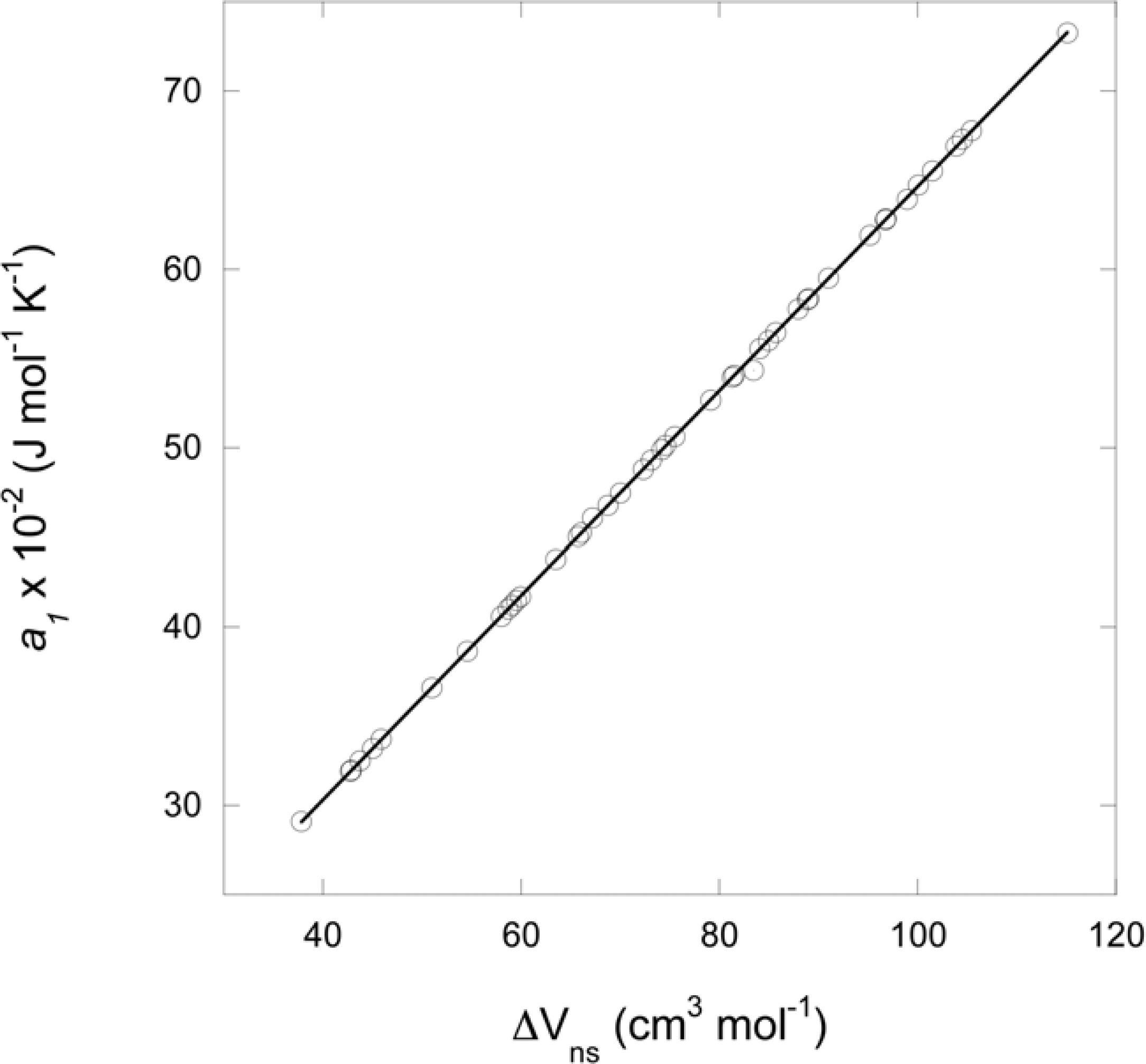
<mml:mn>0</mml:mn></mml:msubsup></mml:math></inline-formula> term into <italic>V</italic><sup>0</sup> at a desired pressure and temperature. The <italic>a</italic><sub>1</sub> and <italic>a<sub>2</sub></italic> parameters have been generated from empirical data gathered at high pressure and temperature conditions for a variety of compounds [<xref ref-type="bibr" rid="b11-ijms-10-02809">11</xref>,<xref ref-type="bibr" rid="b15-ijms-10-02809">15</xref>–<xref ref-type="bibr" rid="b20-ijms-10-02809">20</xref>,<xref ref-type="bibr" rid="b46-ijms-10-02809">46</xref>,<xref ref-type="bibr" rid="b47-ijms-10-02809">47</xref>]. The <italic>a</italic><sub>1</sub> variable is correlated to a high degree with the 
<inline-formula>
<mml:math>
<mml:mo>Δ</mml:mo>
<mml:msubsup>
<mml:mi>V</mml:mi>
<mml:mi>n</mml:mi>
<mml:mn>0</mml:mn></mml:msubsup></mml:math></inline-formula> of a wide range of neutral and charged aqueous organic compounds with a variety of functional groups (<xref ref-type="fig" rid="f3-ijms-10-02809">Figure 3</xref>) and can therefore be used to estimate the values of <italic>a</italic><sub>1</sub> for compounds with structural homology to those with high pressure and temperature data for which there are no volumetric data beyond the reference state.</p>
<p>For the range of compounds regressed in <xref ref-type="fig" rid="f3-ijms-10-02809">Figure 3</xref>, the line is defined by:
<disp-formula id="FD6">
<label>(6)</label>
<mml:math display="block">
<mml:msub>
<mml:mi>a</mml:mi>
<mml:mn>1</mml:mn></mml:msub>
<mml:mo>=</mml:mo>
<mml:mn>0.5711</mml:mn>
<mml:mi> </mml:mi>
<mml:mi> </mml:mi>
<mml:mo>Δ</mml:mo>
<mml:msubsup>
<mml:mi>V</mml:mi>
<mml:mi>n</mml:mi>
<mml:mn>0</mml:mn></mml:msubsup>
<mml:mo>+</mml:mo>
<mml:mn>7.4803</mml:mn></mml:math></disp-formula>where <italic>a</italic><sub>1</sub> is in J mol<sup>−1</sup> K<sup>−1</sup> and 
<inline-formula>
<mml:math>
<mml:mo>Δ</mml:mo>
<mml:msubsup>
<mml:mi>V</mml:mi>
<mml:mi>n</mml:mi>
<mml:mn>0</mml:mn></mml:msubsup></mml:math></inline-formula> in cm<sup>3</sup> mol<sup>−1</sup>. This regression equation was used to generate the <italic>a</italic><sub>1</sub> parameter for all neutral and charged compounds in this work.</p>
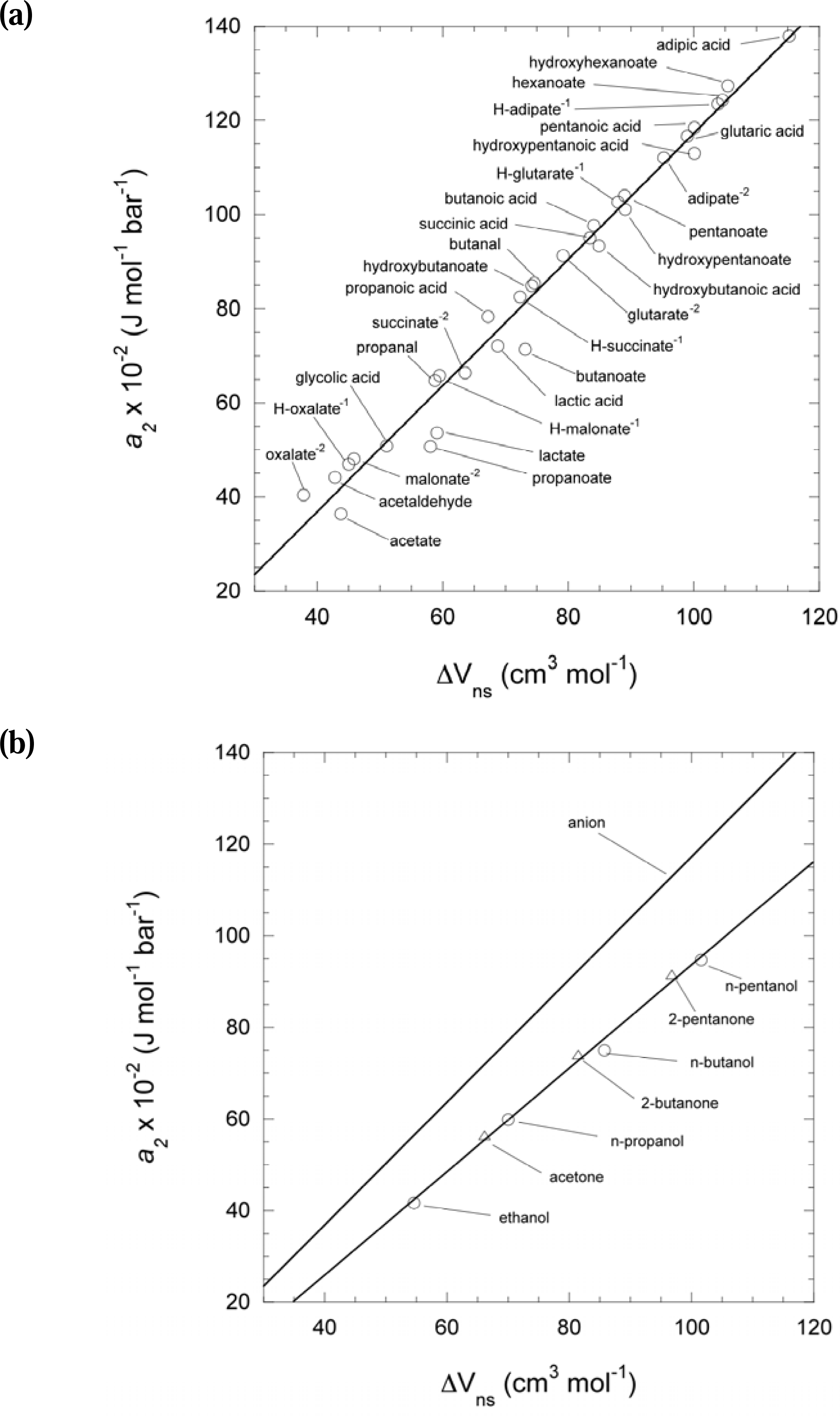
<p>The <italic>a</italic><sub>2</sub> parameter is somewhat more dependent on the functional group characteristics of a particular molecule. In <xref ref-type="fig" rid="f4-ijms-10-02809">Figure 4</xref> the 
<inline-formula>
<mml:math>
<mml:mo>Δ</mml:mo>
<mml:msubsup>
<mml:mi>V</mml:mi>
<mml:mi>n</mml:mi>
<mml:mn>0</mml:mn></mml:msubsup></mml:math></inline-formula> of aldehydes, hydroxy acids, carboxylic acids, and dicarboxylic acids, and their respective anions, are plotted against <italic>a</italic><sub>2</sub>.</p>
<p>The data are fit by the line
<disp-formula id="FD7">
<label>(7)</label>
<mml:math display="block">
<mml:msub>
<mml:mi>a</mml:mi>
<mml:mn>2</mml:mn></mml:msub>
<mml:mo>=</mml:mo>
<mml:mn>1.341</mml:mn>
<mml:mi> </mml:mi>
<mml:mi> </mml:mi>
<mml:mo>Δ</mml:mo>
<mml:msubsup>
<mml:mi>V</mml:mi>
<mml:mi>n</mml:mi>
<mml:mn>0</mml:mn></mml:msubsup>
<mml:mo> </mml:mo>
<mml:mo>-</mml:mo>
<mml:mo> </mml:mo>
<mml:mn>16.764</mml:mn></mml:math></disp-formula>where <italic>a</italic><sub>2</sub> is also in J mol<sup>−1</sup> K<sup>−1</sup>. For <italic>n</italic>-alkanones and <italic>n</italic>-alcohols (<xref ref-type="fig" rid="f4-ijms-10-02809">Figure 4</xref>) the slope is somewhat shallower and the y-intercept lower so these values are fit better by the line
<disp-formula id="FD8">
<label>(8)</label>
<mml:math display="block">
<mml:msub>
<mml:mi>a</mml:mi>
<mml:mn>2</mml:mn></mml:msub>
<mml:mo>=</mml:mo>
<mml:mn>1.129</mml:mn>
<mml:mi> </mml:mi>
<mml:mi> </mml:mi>
<mml:mo>Δ</mml:mo>
<mml:msubsup>
<mml:mi>V</mml:mi>
<mml:mi>n</mml:mi>
<mml:mn>0</mml:mn></mml:msubsup>
<mml:mi> </mml:mi>
<mml:mo>-</mml:mo>
<mml:mi> </mml:mi>
<mml:mn>19.213</mml:mn></mml:math></disp-formula></p>
<p>The <italic>a</italic><sub>2</sub> parameter for all dicarboxylic acids, and dicarboxylate anions, citric acid and its anions, pyruvic acid and pyruvate, and succinyl thioester and its anion were estimated with <xref ref-type="disp-formula" rid="FD7">Equation (7)</xref>. Since the only apparently large departures from the line in <xref ref-type="disp-formula" rid="FD7">Equation (7)</xref> are for shorter- chained carboxylate and hydroxylate anions, a fit for hydroxylates was considered separately to calculate the <italic>a</italic><sub>2</sub> parameter for pyruvate. The y-intercept for hydroxylates (<xref ref-type="disp-formula" rid="FD9">Equation (9)</xref>) is slightly lower with a steeper slope than <xref ref-type="disp-formula" rid="FD8">Equation (8)</xref>:
<disp-formula id="FD9">
<label>(9)</label>
<mml:math display="block">
<mml:msub>
<mml:mi>a</mml:mi>
<mml:mn>2</mml:mn></mml:msub>
<mml:mo>=</mml:mo>
<mml:mn>1.398</mml:mn>
<mml:mi> </mml:mi>
<mml:mi> </mml:mi>
<mml:mo>Δ</mml:mo>
<mml:msubsup>
<mml:mi>V</mml:mi>
<mml:mi>n</mml:mi>
<mml:mn>0</mml:mn></mml:msubsup>
<mml:mi> </mml:mi>
<mml:mo>-</mml:mo>
<mml:mi> </mml:mi>
<mml:mn>14.611</mml:mn></mml:math></disp-formula></p>
<p>However, if the y-intercept value for <italic>n</italic>-alcohols vs. <italic>n</italic>-alkanones can be considered comparable to that of the hydroxy and carbonyl groups in hydroxy- and α keto-acids, respectively, then pyruvate’s y-intercept would shift toward the line in <xref ref-type="disp-formula" rid="FD7">Equation (7)</xref>. Therefore the <italic>a</italic><sub>2</sub> value for pyruvic acid using <xref ref-type="disp-formula" rid="FD7">Equation (7)</xref> was retained. The <italic>a</italic><sub>2</sub> parameter for acetyl thioester was estimated with the line defined by <xref ref-type="disp-formula" rid="FD8">Equation (8)</xref> for <italic>n</italic>-alcohols and <italic>n</italic>-alkanones.</p>
<p>All <italic>a</italic><sub>4</sub> parameters were generated, as suggested by Shock and Helgeson and Shock [<xref ref-type="bibr" rid="b18-ijms-10-02809">18</xref>,<xref ref-type="bibr" rid="b23-ijms-10-02809">23</xref>], using the correlation with the <italic>a</italic><sub>2</sub> fitting parameter. The <italic>a</italic><sub>3</sub> parameter was then calculated by solving the rearranged non-solvation molal volume term (
<inline-formula>
<mml:math>
<mml:mo>Δ</mml:mo>
<mml:msubsup>
<mml:mi>V</mml:mi>
<mml:mi>n</mml:mi>
<mml:mn>0</mml:mn></mml:msubsup></mml:math></inline-formula>) of <xref ref-type="disp-formula" rid="FD25">Equation (25)</xref> at 25 °C and 0.1 MPa.</p></sec>
<sec>
<label>2.8.</label>
<title>Estimation of temperature and pressure effects on the isobaric heat capacity of aqueous organic species: The non-solvation contribution</title>
<p>The non-solvation and solvation heat capacity contributions to the partial molal heat capacity are defined in <xref ref-type="disp-formula" rid="FD27">Equation (27)</xref>. The non-solvation contribution term of <xref ref-type="disp-formula" rid="FD27">Equation (27)</xref> is expanded in <xref ref-type="disp-formula" rid="FD28">Equation (28)</xref> and combines the influence of pressure on the 
<inline-formula>
<mml:math>
<mml:mo>Δ</mml:mo>
<mml:msubsup>
<mml:mi>C</mml:mi>
<mml:mrow>
<mml:mi>P</mml:mi>
<mml:mo>,</mml:mo>
<mml:mi>n</mml:mi></mml:mrow>
<mml:mn>0</mml:mn></mml:msubsup></mml:math></inline-formula> with incorporation of a substance’s <italic>a<sub>3</sub></italic> and <italic>a<sub>4</sub></italic> fitting parameters, from above, and the influence of temperature by the use of two heat capacity fitting parameters, <italic>c<sub>1</sub></italic> and <italic>c<sub>2</sub></italic>. The <italic>c<sub>2</sub></italic> parameter correlates closely with the reference state 
<inline-formula>
<mml:math>
<mml:msubsup>
<mml:mi>C</mml:mi>
<mml:mi>P</mml:mi>
<mml:mn>0</mml:mn></mml:msubsup></mml:math></inline-formula> for compounds with similar functional groups (<xref ref-type="fig" rid="f5-ijms-10-02809">Figure 5</xref>).</p>
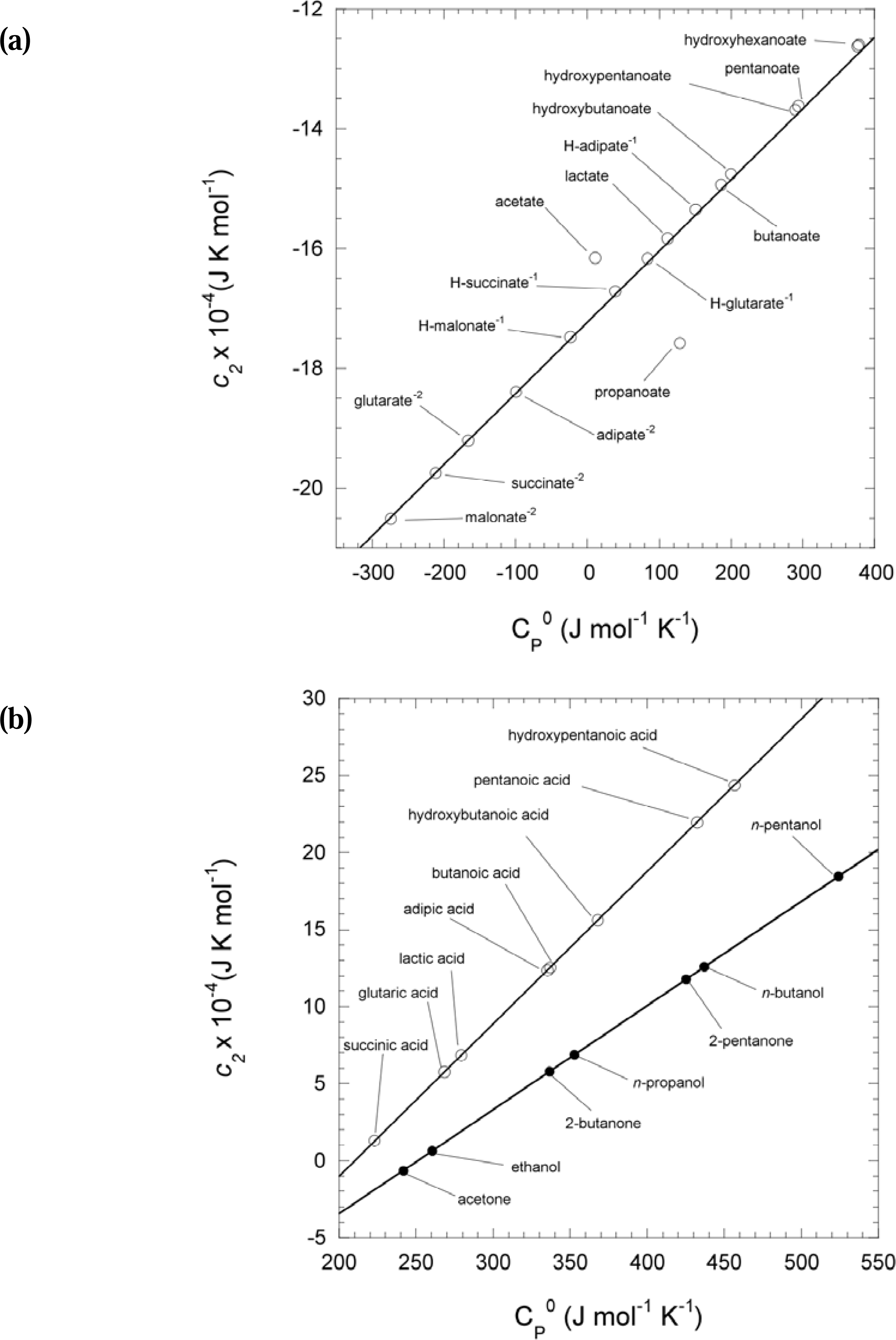
<p>Therefore, from this correlation high temperature and pressure data from structurally similar compounds can be used to predict the <italic>c<sub>2</sub></italic> parameter of molecules for which no high temperature heat capacity data are available. <xref ref-type="fig" rid="f5-ijms-10-02809">Figure 5a</xref> shows the plot of <italic>c</italic><sub>2</sub> vs. 
<inline-formula>
<mml:math>
<mml:msubsup>
<mml:mi>C</mml:mi>
<mml:mi>P</mml:mi>
<mml:mn>0</mml:mn></mml:msubsup></mml:math></inline-formula> values, taken from Shock [<xref ref-type="bibr" rid="b23-ijms-10-02809">23</xref>], for organic acid anions. The regression of these values for the range of compounds shown is described by the line in <xref ref-type="disp-formula" rid="FD10">Equation (10)</xref>:
<disp-formula id="FD10">
<label>(10)</label>
<mml:math display="block">
<mml:msub>
<mml:mi>c</mml:mi>
<mml:mn>2</mml:mn></mml:msub>
<mml:mo>=</mml:mo>
<mml:mn>0.0507</mml:mn>
<mml:mi> </mml:mi>
<mml:msubsup>
<mml:mi>C</mml:mi>
<mml:mi>P</mml:mi>
<mml:mn>0</mml:mn></mml:msubsup>
<mml:mi> </mml:mi>
<mml:mo>-</mml:mo>
<mml:mi> </mml:mi>
<mml:mn>17.188</mml:mn></mml:math></disp-formula>where <italic>c</italic><sub>2</sub> is in J mol<sup>−1</sup>. This regression equation was used to estimate the <italic>c</italic><sub>2</sub> parameters for all the dicarboxylate and carboxylate anions from the reference state 
<inline-formula>
<mml:math>
<mml:msubsup>
<mml:mi>C</mml:mi>
<mml:mi>P</mml:mi>
<mml:mn>0</mml:mn></mml:msubsup></mml:math></inline-formula> used in this study. <xref ref-type="disp-formula" rid="FD11">Equation (11)</xref> describes the upper line in the plot of <italic>c</italic><sub>2</sub> vs. 
<inline-formula>
<mml:math>
<mml:msubsup>
<mml:mi>C</mml:mi>
<mml:mi>P</mml:mi>
<mml:mn>0</mml:mn></mml:msubsup></mml:math></inline-formula> values from organic acids (taken from Shock [<xref ref-type="bibr" rid="b23-ijms-10-02809">23</xref>]) in <xref ref-type="fig" rid="f5-ijms-10-02809">Figure 5b</xref>:
<disp-formula id="FD11">
<label>(11)</label>
<mml:math display="block">
<mml:msub>
<mml:mi>c</mml:mi>
<mml:mn>2</mml:mn></mml:msub>
<mml:mo>=</mml:mo>
<mml:mn>0.4641</mml:mn>
<mml:mi> </mml:mi>
<mml:msubsup>
<mml:mi>C</mml:mi>
<mml:mi>P</mml:mi>
<mml:mn>0</mml:mn></mml:msubsup>
<mml:mi> </mml:mi>
<mml:mo>-</mml:mo>
<mml:mi> </mml:mi>
<mml:mn>25.704</mml:mn></mml:math></disp-formula>which was used to estimate the <italic>c</italic><sub>2</sub> parameter for all organic acids. The lower line in <xref ref-type="fig" rid="f5-ijms-10-02809">Figure 5</xref>(b) is a plot of the <italic>c</italic><sub>2</sub> vs. 
<inline-formula>
<mml:math>
<mml:msubsup>
<mml:mi>C</mml:mi>
<mml:mi>P</mml:mi>
<mml:mn>0</mml:mn></mml:msubsup></mml:math></inline-formula> of short-chained <italic>n</italic>-alcohols and <italic>n</italic>-alkanones [<xref ref-type="bibr" rid="b18-ijms-10-02809">18</xref>] and is described by the line in <xref ref-type="disp-formula" rid="FD12">Equation (12)</xref>, which was used to estimate the <italic>c</italic><sub>2</sub> parameter for acetyl thioester:
<disp-formula id="FD12">
<label>(12)</label>
<mml:math display="block">
<mml:msub>
<mml:mi>c</mml:mi>
<mml:mn>2</mml:mn></mml:msub>
<mml:mo>=</mml:mo>
<mml:mn>0.283</mml:mn>
<mml:mi> </mml:mi>
<mml:msubsup>
<mml:mi>C</mml:mi>
<mml:mi>P</mml:mi>
<mml:mn>0</mml:mn></mml:msubsup>
<mml:mi> </mml:mi>
<mml:mo>-</mml:mo>
<mml:mi> </mml:mi>
<mml:mn>16.970</mml:mn></mml:math></disp-formula></p></sec>
<sec>
<label>2.9.</label>
<title>Estimation of temperature and pressure effects on the partial molal properties of aqueous organic species: The solvation contribution</title>
<p>At temperatures of ≥~150<sup>°</sup>C, at the water-saturation vapor pressure (P<sub>sat</sub>), the solvent-dependent contribution to the partial molal volume (<xref ref-type="disp-formula" rid="FD26">Equation (26)</xref>) and heat capacity (<xref ref-type="disp-formula" rid="FD29">Equation (29)</xref>) terms begin to dominate each partial molal function. The conventional (ω) and effective (ω<sub>e</sub>) Born coefficients, respectively, are used to describe the substance-specific solvation properties of an ionic species or electrolytes, and neutral species (see <xref ref-type="app" rid="app2">Appendix B</xref>).</p></sec>
<sec>
<label>2.10.</label>
<title>Calculation of the conventional Born coefficient (ω) for ionic species</title>
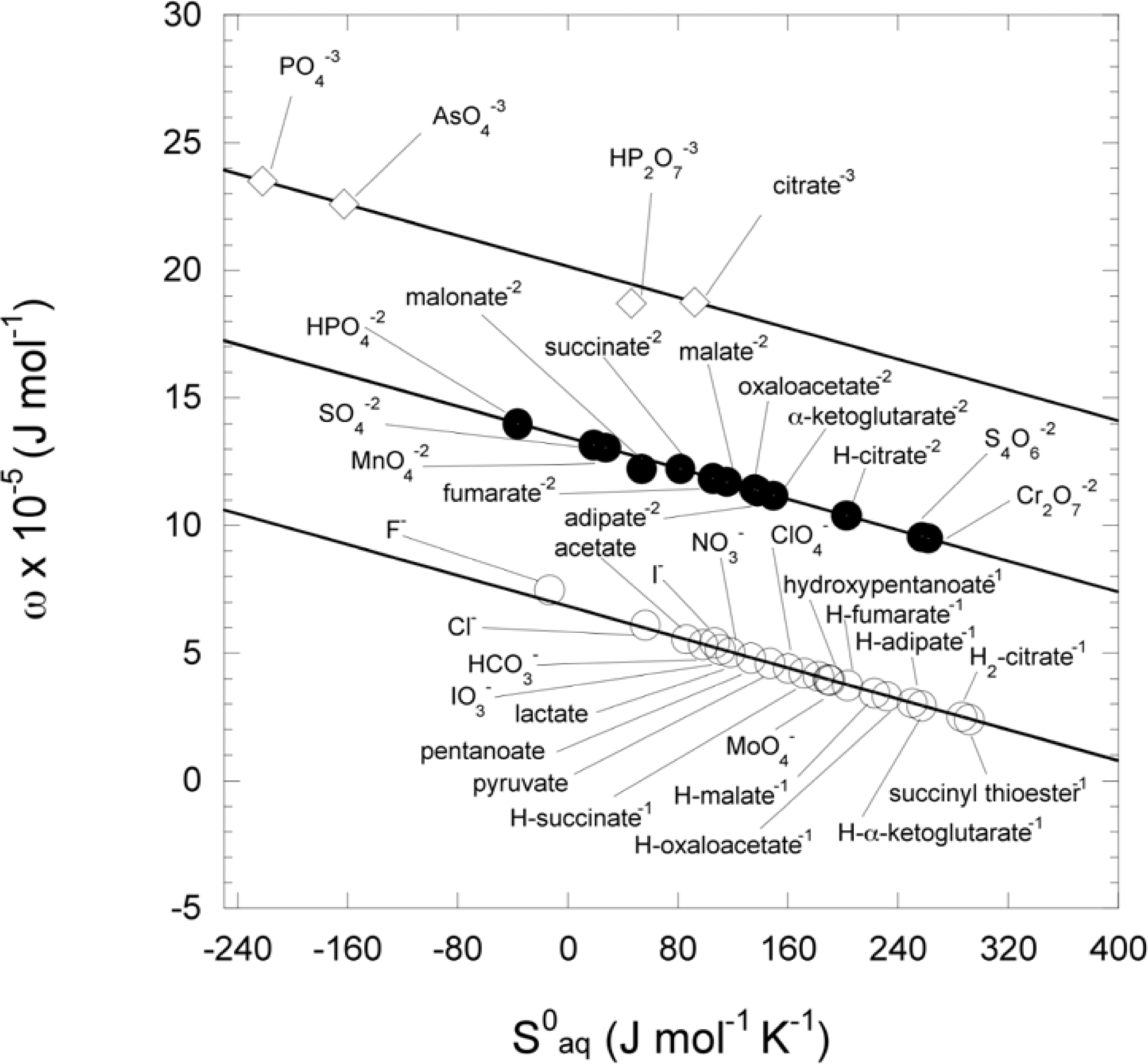
<p>The ω of ionic species has been demonstrated to have a strong correlation with the 
<inline-formula>
<mml:math>
<mml:mo>Δ</mml:mo>
<mml:msubsup>
<mml:mi>S</mml:mi>
<mml:mi>f</mml:mi>
<mml:mn>0</mml:mn></mml:msubsup>
<mml:mi>a</mml:mi>
<mml:mi>q</mml:mi></mml:math></inline-formula> [<xref ref-type="bibr" rid="b17-ijms-10-02809">17</xref>] and can therefore be calculated from this quantity. In <xref ref-type="fig" rid="f6-ijms-10-02809">Figure 6</xref> ω is plotted against the 
<inline-formula>
<mml:math>
<mml:mo>Δ</mml:mo>
<mml:msubsup>
<mml:mi>S</mml:mi>
<mml:mi>f</mml:mi>
<mml:mn>0</mml:mn></mml:msubsup>
<mml:mi>a</mml:mi>
<mml:mi>q</mml:mi></mml:math></inline-formula> for a variety of mono-, di- and trivalent inorganic and organic anions (taken from Shock and Helgeson (1988) [<xref ref-type="bibr" rid="b17-ijms-10-02809">17</xref>]) using relationships in <xref ref-type="disp-formula" rid="FD30">Equations (30–32)</xref> to calculate ω, which was also used to calculate the ω for all anions in this work (data also shown in <xref ref-type="fig" rid="f6-ijms-10-02809">Figure 6</xref>).</p></sec>
<sec>
<label>2.11.</label>
<title>Calculation of the effective Born coefficient (ω<sub>e</sub>) for neutral species</title>
<p>The effective Born coefficient used to describe the solvation contribution of neutral species in the revised-HKF model has been calculated from 
<inline-formula>
<mml:math>
<mml:msubsup>
<mml:mi>S</mml:mi>
<mml:mi>f</mml:mi>
<mml:mn>0</mml:mn></mml:msubsup>
<mml:mi>a</mml:mi>
<mml:mi>q</mml:mi></mml:math></inline-formula> [<xref ref-type="bibr" rid="b13-ijms-10-02809">13</xref>,<xref ref-type="bibr" rid="b22-ijms-10-02809">22</xref>,<xref ref-type="bibr" rid="b23-ijms-10-02809">23</xref>] and the Gibbs free energy of hydration (Δ<italic><sub>hyd</sub>G</italic><sup>0</sup>) (<xref ref-type="app" rid="app3">Appendix C</xref>) in the absence of high temperature 
<inline-formula>
<mml:math>
<mml:msubsup>
<mml:mi>C</mml:mi>
<mml:mi>P</mml:mi>
<mml:mn>0</mml:mn></mml:msubsup></mml:math></inline-formula> and <italic>V</italic><sup>0</sup> data. It has been demonstrated from empirical data that ω<sub>e</sub> generally has a negative value for low- molecular weight neutral organic compounds. The negative value is the result of the inflection of 
<inline-formula>
<mml:math>
<mml:msubsup>
<mml:mi>C</mml:mi>
<mml:mi>P</mml:mi>
<mml:mn>0</mml:mn></mml:msubsup></mml:math></inline-formula> and <italic>V</italic><sup>0</sup> values towards positive-infinity near the critical point of water. As the properties of a set of molecules become increasingly polar, the solute-solvent interaction increases. In the case of some neutral inorganic polyhydroxyl compounds such as aqueous silica, of which the hydrated form is thought to be H<sub>4</sub>SiO<sub>4</sub>, and boric acid (H<sub>3</sub>BO<sub>3</sub>), both demonstrate electrolyte-like behavior and thus positive ω<sub>e</sub> values. The mechanism associated with this phenomenon is thought to arise from water-solute versus water-water competition near the critical point [<xref ref-type="bibr" rid="b48-ijms-10-02809">48</xref>], where solutes that are associated with more solvent molecules than is the solvent itself, and will have 
<inline-formula>
<mml:math>
<mml:msubsup>
<mml:mi>C</mml:mi>
<mml:mi>P</mml:mi>
<mml:mn>0</mml:mn></mml:msubsup></mml:math></inline-formula> and <italic>V</italic><sup>0</sup> values that approach −∞. The volatility of a substance in comparison to water is also thought to have influence over this process as well. This issue is discussed in detail by Amend and Plyasunov [<xref ref-type="bibr" rid="b49-ijms-10-02809">49</xref>], where predictions were made concerning the near-critical point behavior of carbohydrates. It is clear, through their discussion and others, that the relationship between <italic>ω<sub>e</sub></italic> and solvation at higher temperatures is not an obvious one. For instance, the non-electrolyte amino acid proline displays low-temperature solvation behavior that is best described with a negative value for ω<sub>e</sub>. As the temperature increases, however, proline’s solvation is best fit with a positive ω<sub>e</sub>. However, this type of solvation behavior may be particular to the proline zwitterion due to its particularly asymmetrical dipole and spatial arrangement of hydrophobic and hydrophilic moieties [<xref ref-type="bibr" rid="b22-ijms-10-02809">22</xref>]. If the high density of polar functional groups, as in polyhydroxy compounds, is to be viewed as an indicator of near-critical behavior of compounds with hydroxyl functionalities, then for dicarboxylic acids, oxalic acid with an ω<sub>e</sub> that displays neutral behavior may be the closest analogue.</p>
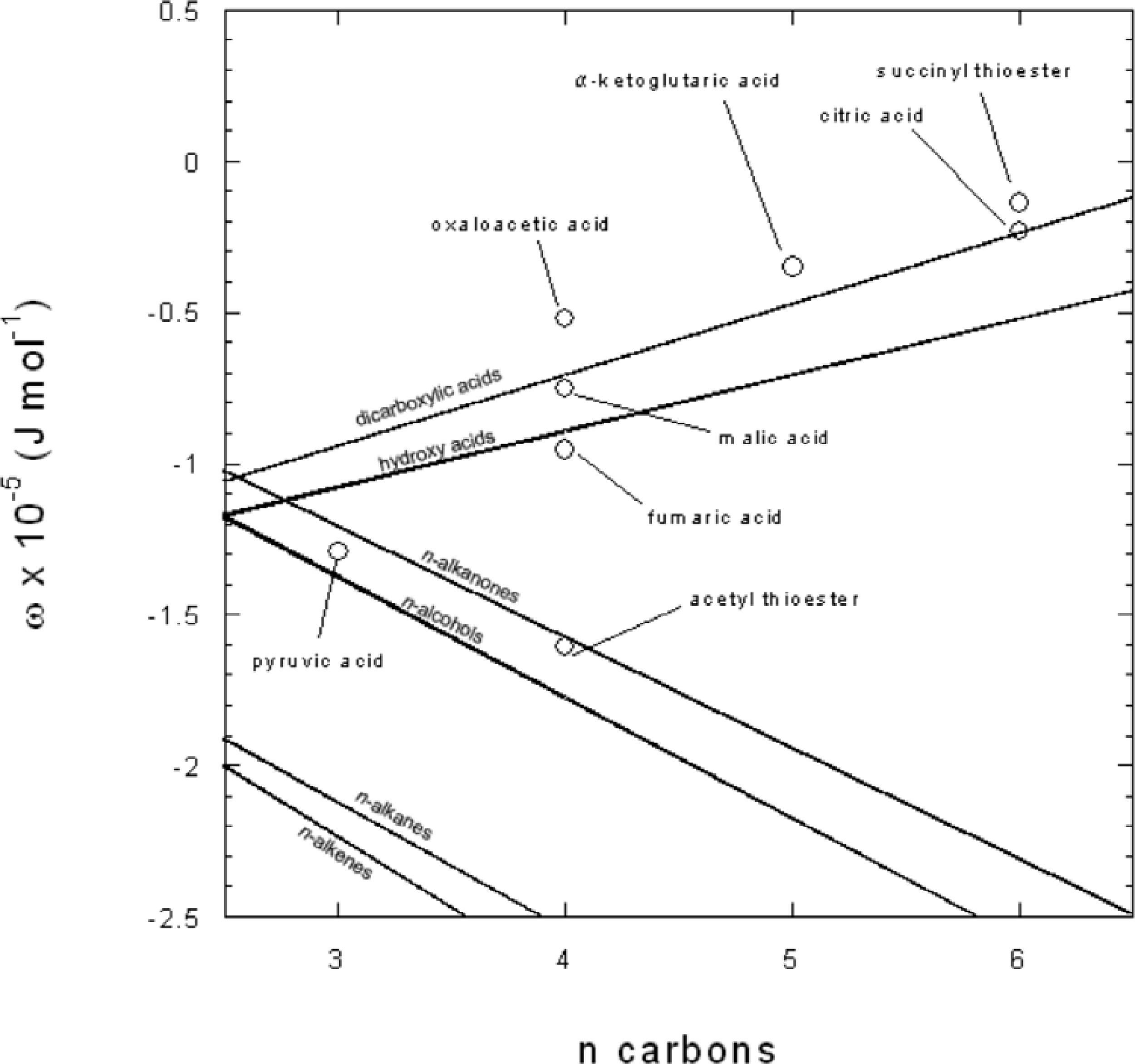
<p>In <xref ref-type="table" rid="t1-ijms-10-02809">Table 1</xref>, different values for <italic>ω<sub>e</sub></italic> are displayed as calculated from the correlations with the Δ<italic><sub>hyd</sub>G</italic><sup>0</sup> (<xref ref-type="disp-formula" rid="FD44">Equation (44)</xref>) and entropy (<xref ref-type="disp-formula" rid="FD45">Equation (45)</xref>), as has been done previously. Also included is a systematic estimation of ω<sub>e</sub> using values provided by Shock and Shock and Helgeson [<xref ref-type="bibr" rid="b18-ijms-10-02809">18</xref>,<xref ref-type="bibr" rid="b23-ijms-10-02809">23</xref>] with results shown in <xref ref-type="fig" rid="f7-ijms-10-02809">Figure 7</xref> in comparison to other series of neutral organic compounds.</p>
<p>The values of these estimations were used for ω<sub>e</sub> in all the neutral compounds in this work. The ω<sub>e</sub> for pyruvic acid was estimated by taking the ω<sub>e</sub> from lactic acid and subtracting the difference between <italic>n</italic>-propanol and acetone:
<disp-formula id="FD13">
<label>(13)</label>
<mml:math display="block">
<mml:msub>
<mml:mo>ω</mml:mo>
<mml:mtext>e</mml:mtext></mml:msub>
<mml:mi> </mml:mi>
<mml:mtext>lactic</mml:mtext>
<mml:mi> </mml:mi>
<mml:mtext>acid</mml:mtext>
<mml:mi> </mml:mi>
<mml:mo>−</mml:mo>
<mml:mi> </mml:mi>
<mml:mo stretchy="false">(</mml:mo>
<mml:msub>
<mml:mo>ω</mml:mo>
<mml:mtext>e</mml:mtext></mml:msub>
<mml:mi> </mml:mi>
<mml:mi>n</mml:mi>
<mml:mo>-</mml:mo>
<mml:mtext>propanol</mml:mtext>
<mml:mi> </mml:mi>
<mml:mo>−</mml:mo>
<mml:mi> </mml:mi>
<mml:msub>
<mml:mo>ω</mml:mo>
<mml:mtext>e</mml:mtext></mml:msub>
<mml:mi> </mml:mi>
<mml:mtext>acetone</mml:mtext>
<mml:mo stretchy="false">)</mml:mo>
<mml:mo>=</mml:mo>
<mml:msub>
<mml:mo>ω</mml:mo>
<mml:mtext>e</mml:mtext></mml:msub>
<mml:mi> </mml:mi>
<mml:mtext>pyruvic</mml:mtext>
<mml:mi> </mml:mi>
<mml:mtext>acid</mml:mtext></mml:math></disp-formula></p>
<p>The ω<sub>e</sub> for oxaloacetic acid was estimated from the value for malonic acid with addition of the carbonyl group value such that:
<disp-formula id="FD14">
<label>(14)</label>
<mml:math display="block">
<mml:msub>
<mml:mo>ω</mml:mo>
<mml:mtext>e</mml:mtext></mml:msub>
<mml:mi> </mml:mi>
<mml:mtext>malonic</mml:mtext>
<mml:mi> </mml:mi>
<mml:mtext>acid</mml:mtext>
<mml:mi> </mml:mi>
<mml:mo>+</mml:mo>
<mml:mi> </mml:mi>
<mml:mo stretchy="false">(</mml:mo>
<mml:msub>
<mml:mo>ω</mml:mo>
<mml:mtext>e</mml:mtext></mml:msub>
<mml:mi> </mml:mi>
<mml:mn>2</mml:mn>
<mml:mo>-</mml:mo>
<mml:mtext>pentanone</mml:mtext>
<mml:mi> </mml:mi>
<mml:mo>−</mml:mo>
<mml:mi> </mml:mi>
<mml:msub>
<mml:mo>ω</mml:mo>
<mml:mtext>e</mml:mtext></mml:msub>
<mml:mi> </mml:mi>
<mml:mi>n</mml:mi>
<mml:mo>-</mml:mo>
<mml:mtext>butane</mml:mtext>
<mml:mo stretchy="false">)</mml:mo>
<mml:mo>=</mml:mo>
<mml:msub>
<mml:mo>ω</mml:mo>
<mml:mtext>e</mml:mtext></mml:msub>
<mml:mi> </mml:mi>
<mml:mtext>oxaloacetic</mml:mtext>
<mml:mi> </mml:mi>
<mml:mtext>acid</mml:mtext></mml:math></disp-formula></p>
<p>Malic acid’s ω<sub>e</sub> value was estimated by from succinic acid from:
<disp-formula id="FD15">
<label>(15)</label>
<mml:math display="block">
<mml:msub>
<mml:mo>ω</mml:mo>
<mml:mtext>e</mml:mtext></mml:msub>
<mml:mi> </mml:mi>
<mml:mtext>succinic</mml:mtext>
<mml:mi> </mml:mi>
<mml:mtext>acid</mml:mtext>
<mml:mi> </mml:mi>
<mml:mo>+</mml:mo>
<mml:mi> </mml:mi>
<mml:mo stretchy="false">(</mml:mo>
<mml:msub>
<mml:mo>ω</mml:mo>
<mml:mtext>e</mml:mtext></mml:msub>
<mml:mi> </mml:mi>
<mml:mtext>hydroxybutanoic</mml:mtext>
<mml:mi> </mml:mi>
<mml:mtext>acid</mml:mtext>
<mml:mi> </mml:mi>
<mml:mo>−</mml:mo>
<mml:mi> </mml:mi>
<mml:msub>
<mml:mo>ω</mml:mo>
<mml:mtext>e</mml:mtext></mml:msub>
<mml:mi> </mml:mi>
<mml:mtext>butanoic</mml:mtext>
<mml:mi> </mml:mi>
<mml:mtext>acid</mml:mtext>
<mml:mo stretchy="false">)</mml:mo>
<mml:mo>=</mml:mo>
<mml:msub>
<mml:mo>ω</mml:mo>
<mml:mtext>e</mml:mtext></mml:msub>
<mml:mi> </mml:mi>
<mml:mtext>malic</mml:mtext>
<mml:mi> </mml:mi>
<mml:mtext>acid</mml:mtext></mml:math></disp-formula>to add the value of the hydroxyl group. For fumaric acid the difference in <italic>n</italic>-alkanes and <italic>n</italic>-alkenes were used to modify succinic acid as:
<disp-formula id="FD16">
<label>(16)</label>
<mml:math display="block">
<mml:msub>
<mml:mo>ω</mml:mo>
<mml:mtext>e</mml:mtext></mml:msub>
<mml:mi> </mml:mi>
<mml:mtext>succinic</mml:mtext>
<mml:mi> </mml:mi>
<mml:mtext>acid</mml:mtext>
<mml:mi> </mml:mi>
<mml:mo>+</mml:mo>
<mml:mi> </mml:mi>
<mml:mo stretchy="false">(</mml:mo>
<mml:msub>
<mml:mo>ω</mml:mo>
<mml:mtext>e</mml:mtext></mml:msub>
<mml:mi> </mml:mi>
<mml:mi>n</mml:mi>
<mml:mo>-</mml:mo>
<mml:mtext>butene</mml:mtext>
<mml:mi> </mml:mi>
<mml:mo>−</mml:mo>
<mml:mi> </mml:mi>
<mml:msub>
<mml:mo>ω</mml:mo>
<mml:mtext>e</mml:mtext></mml:msub>
<mml:mi> </mml:mi>
<mml:mi>n</mml:mi>
<mml:mo>-</mml:mo>
<mml:mtext>butane</mml:mtext>
<mml:mo stretchy="false">)</mml:mo>
<mml:mo>=</mml:mo>
<mml:msub>
<mml:mo>ω</mml:mo>
<mml:mtext>e</mml:mtext></mml:msub>
<mml:mi> </mml:mi>
<mml:mtext>fumaric</mml:mtext>
<mml:mi> </mml:mi>
<mml:mtext>acid</mml:mtext></mml:math></disp-formula></p>
<p>The ω<sub>e</sub> for α-ketoglutaric acid also used succinic acid and carbonyl value for oxaloacetic acid:
<disp-formula id="FD17">
<label>(17)</label>
<mml:math display="block">
<mml:msub>
<mml:mi>ω</mml:mi>
<mml:mi>e</mml:mi></mml:msub>
<mml:mi> </mml:mi>
<mml:mtext>succinic</mml:mtext>
<mml:mi> </mml:mi>
<mml:mtext>acid</mml:mtext>
<mml:mi> </mml:mi>
<mml:mo>+</mml:mo>
<mml:mi> </mml:mi>
<mml:mo stretchy="false">(</mml:mo>
<mml:msub>
<mml:mi>ω</mml:mi>
<mml:mi>e</mml:mi></mml:msub>
<mml:mi> </mml:mi>
<mml:mn>2</mml:mn>
<mml:mo>-</mml:mo>
<mml:mtext>pentanone</mml:mtext>
<mml:mi> </mml:mi>
<mml:mo>−</mml:mo>
<mml:mi> </mml:mi>
<mml:msub>
<mml:mi>ω</mml:mi>
<mml:mi>e</mml:mi></mml:msub>
<mml:mi> </mml:mi>
<mml:mi>n</mml:mi>
<mml:mo>-</mml:mo>
<mml:mtext>butane</mml:mtext>
<mml:mo stretchy="false">)</mml:mo>
<mml:mo>=</mml:mo>
<mml:msub>
<mml:mi>ω</mml:mi>
<mml:mi>e</mml:mi></mml:msub>
<mml:mi> </mml:mi>
<mml:mo>α</mml:mo>
<mml:mo>-</mml:mo>
<mml:mtext>ketoglutaric</mml:mtext>
<mml:mi> </mml:mi>
<mml:mtext>acid</mml:mtext></mml:math></disp-formula></p>
<p>Since there are currently no analogous compounds (tricarboxyl) for citric acid, its ω<sub>e</sub> was estimated to be the same as a C<sub>6</sub> compound using the slope and y-intercept for dicarboxylic acids. The value for succinyl thioester was estimated by:
<disp-formula id="FD18">
<label>(18)</label>
<mml:math display="block">
<mml:msub>
<mml:mo>ω</mml:mo>
<mml:mtext>e</mml:mtext></mml:msub>
<mml:mi> </mml:mi>
<mml:mtext>hexanoic</mml:mtext>
<mml:mi> </mml:mi>
<mml:mtext>acid</mml:mtext>
<mml:mi> </mml:mi>
<mml:mo>+</mml:mo>
<mml:mi> </mml:mi>
<mml:mo stretchy="false">(</mml:mo>
<mml:msub>
<mml:mo>ω</mml:mo>
<mml:mtext>e</mml:mtext></mml:msub>
<mml:mi> </mml:mi>
<mml:mn>2</mml:mn>
<mml:mo>-</mml:mo>
<mml:mtext>pentanone</mml:mtext>
<mml:mi> </mml:mi>
<mml:mo>−</mml:mo>
<mml:mi> </mml:mi>
<mml:msub>
<mml:mo>ω</mml:mo>
<mml:mtext>e</mml:mtext></mml:msub>
<mml:mi> </mml:mi>
<mml:mi>n</mml:mi>
<mml:mo>-</mml:mo>
<mml:mtext>butane</mml:mtext>
<mml:mo stretchy="false">)</mml:mo>
<mml:mi> </mml:mi>
<mml:mo>+</mml:mo>
<mml:mo stretchy="false">(</mml:mo>
<mml:msub>
<mml:mo>ω</mml:mo>
<mml:mtext>e</mml:mtext></mml:msub>
<mml:mi> </mml:mi>
<mml:mtext>diethyl</mml:mtext>
<mml:mi> </mml:mi>
<mml:mtext>sulfide</mml:mtext>
<mml:mi> </mml:mi>
<mml:mo>−</mml:mo>
<mml:msub>
<mml:mo>ω</mml:mo>
<mml:mtext>e</mml:mtext></mml:msub>
<mml:mi> </mml:mi>
<mml:mi>n</mml:mi>
<mml:mo>-</mml:mo>
<mml:mtext>butane</mml:mtext>
<mml:mo stretchy="false">)</mml:mo>
<mml:mo> </mml:mo>
<mml:mo>=</mml:mo>
<mml:mi> </mml:mi>
<mml:msub>
<mml:mo>ω</mml:mo>
<mml:mtext>e</mml:mtext></mml:msub>
<mml:mi> </mml:mi>
<mml:mtext>succinyl</mml:mtext>
<mml:mi> </mml:mi>
<mml:mtext>thioester</mml:mtext></mml:math></disp-formula>using the value from [<xref ref-type="bibr" rid="b22-ijms-10-02809">22</xref>] for diethyl sulfide. The ω<sub>e</sub> estimation for acetyl thioester also used the same value for diethyl sulfide:
<disp-formula id="FD19">
<label>(19)</label>
<mml:math display="block">
<mml:msub>
<mml:mo>ω</mml:mo>
<mml:mtext>e</mml:mtext></mml:msub>
<mml:mi> </mml:mi>
<mml:mtext>diethyl</mml:mtext>
<mml:mi> </mml:mi>
<mml:mtext>sulfide</mml:mtext>
<mml:mi> </mml:mi>
<mml:mo>+</mml:mo>
<mml:mi> </mml:mi>
<mml:mo stretchy="false">(</mml:mo>
<mml:msub>
<mml:mo>ω</mml:mo>
<mml:mtext>e</mml:mtext></mml:msub>
<mml:mi> </mml:mi>
<mml:mn>2</mml:mn>
<mml:mo>-</mml:mo>
<mml:mtext>pentanone</mml:mtext>
<mml:mi> </mml:mi>
<mml:mo>−</mml:mo>
<mml:mi> </mml:mi>
<mml:msub>
<mml:mo>ω</mml:mo>
<mml:mtext>e</mml:mtext></mml:msub>
<mml:mi> </mml:mi>
<mml:mi>n</mml:mi>
<mml:mo>-</mml:mo>
<mml:mtext>butane</mml:mtext>
<mml:mo stretchy="false">)</mml:mo>
<mml:mi> </mml:mi>
<mml:mo>−</mml:mo>
<mml:mo stretchy="false">(</mml:mo>
<mml:msub>
<mml:mo>ω</mml:mo>
<mml:mtext>e</mml:mtext></mml:msub>
<mml:mi> </mml:mi>
<mml:mtext>alkane</mml:mtext>
<mml:mi> </mml:mi>
<mml:mo>−</mml:mo>
<mml:msub>
<mml:mo>ω</mml:mo>
<mml:mtext>e</mml:mtext></mml:msub>
<mml:mi> </mml:mi>
<mml:msub>
<mml:mtext>alkane</mml:mtext>
<mml:mrow>
<mml:mo stretchy="false">(</mml:mo>
<mml:mtext>n</mml:mtext>
<mml:mo>−</mml:mo>
<mml:mn>1</mml:mn>
<mml:mo stretchy="false">)</mml:mo></mml:mrow></mml:msub>
<mml:mo stretchy="false">)</mml:mo>
<mml:mi> </mml:mi>
<mml:mo>=</mml:mo>
<mml:mi> </mml:mi>
<mml:msub>
<mml:mo>ω</mml:mo>
<mml:mtext>e</mml:mtext></mml:msub>
<mml:mi> </mml:mi>
<mml:mtext>acetyl</mml:mtext>
<mml:mi> </mml:mi>
<mml:mtext>thioester</mml:mtext>
<mml:mo>.</mml:mo></mml:math></disp-formula></p>
<p>In consideration of consistency with previous works and the pragmatic aspects of the temperature ranges to be expected to be relevant for these compounds, negative values for ω<sub>e</sub> were chosen. In addition, for practical purposes, since the <italic>p</italic>Ka of the strongest acid among these compounds is 2.49 (pyruvic acid from reference [<xref ref-type="bibr" rid="b33-ijms-10-02809">33</xref>]), at pH above 3–4 the acids of these compounds will not usually be germane in writing reactions.</p></sec></sec>
<sec sec-type="results">
<label>3.</label>
<title>Results</title>
<sec sec-type="methods">
<label>3.1.</label>
<title>Analysis of the possible error associated with methods used in estimating reference and standard state parameters</title>
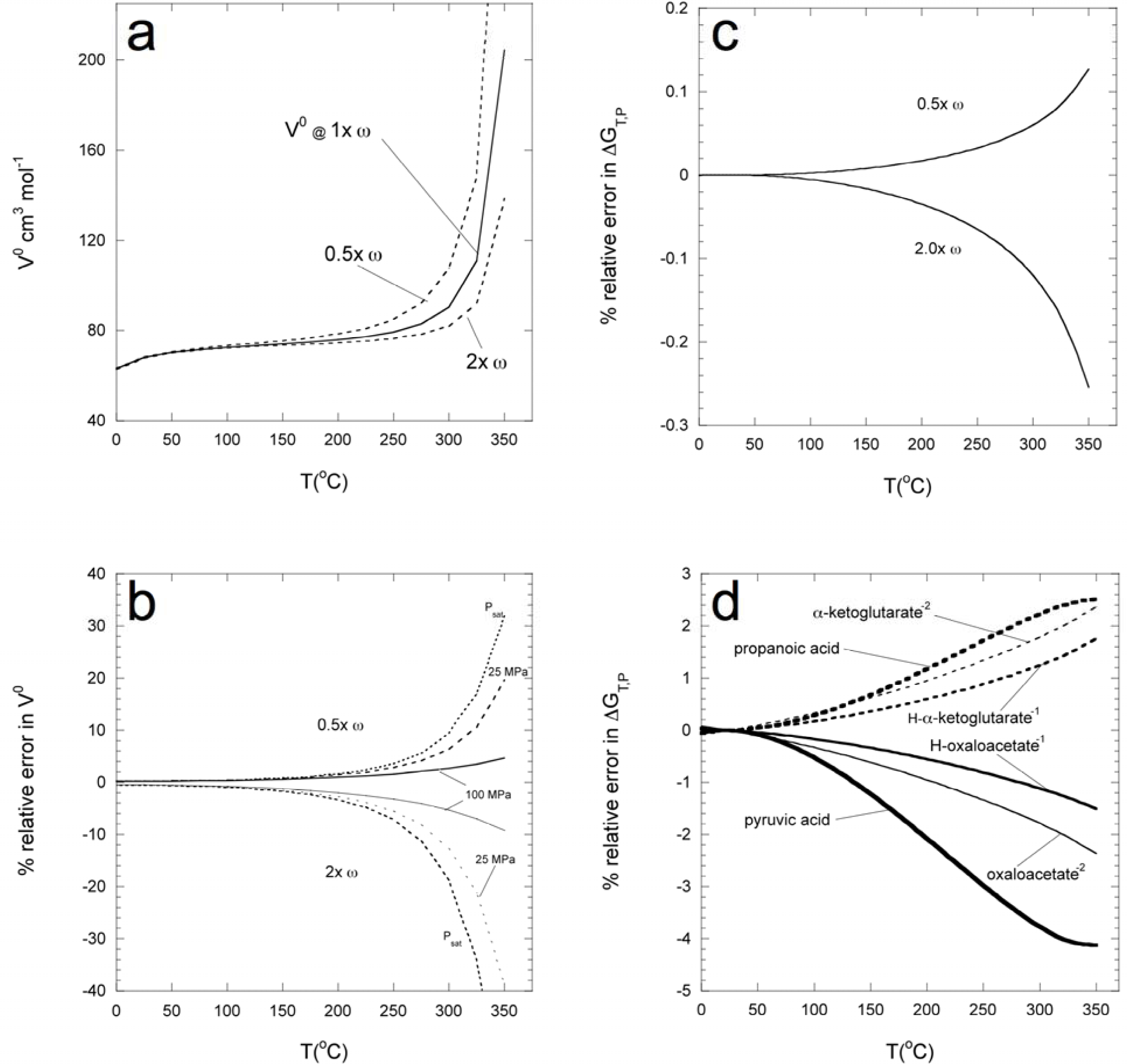
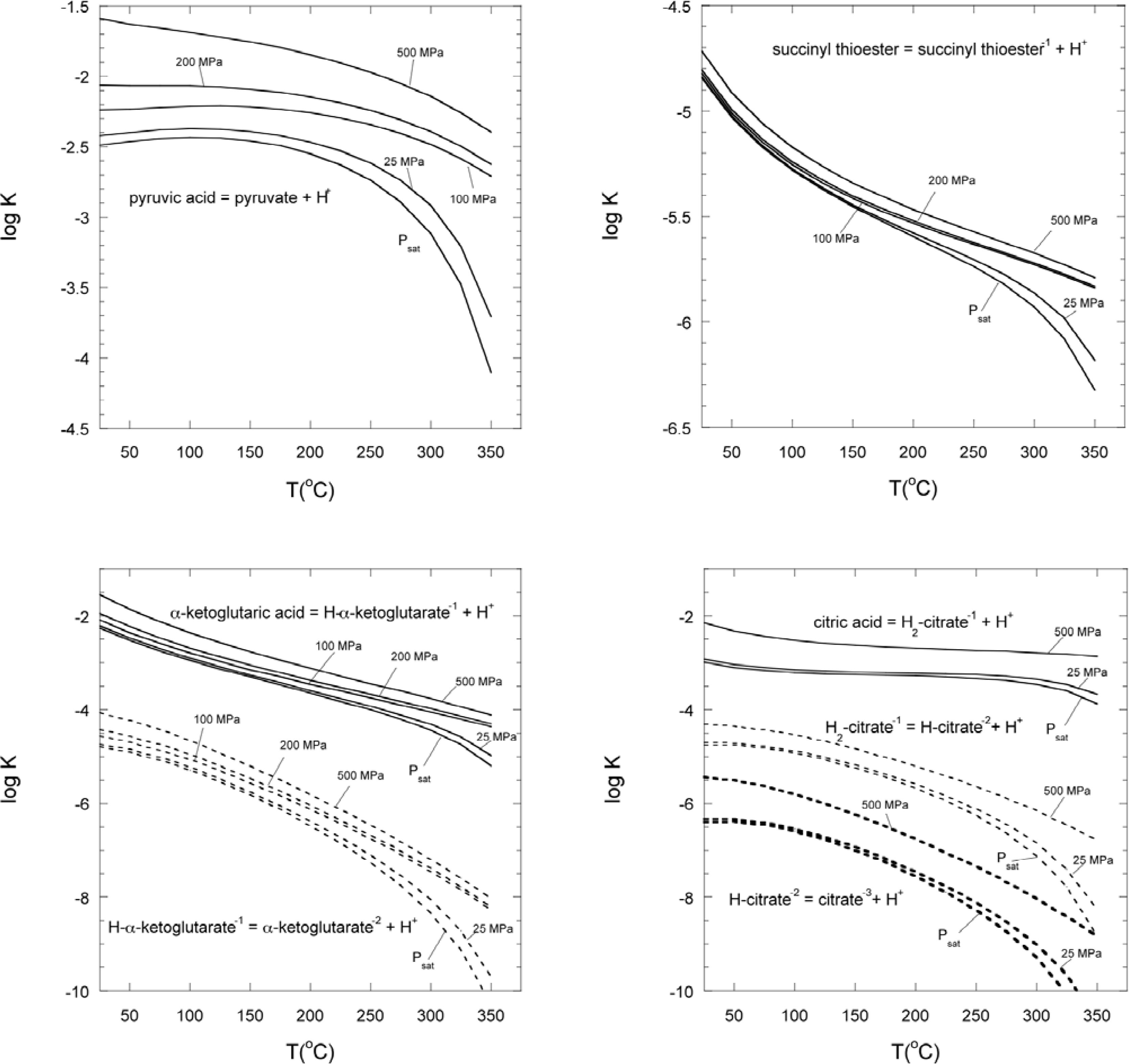
<p>Since the motivation for this work is to estimate the high temperature and pressure thermochemical parameters for compounds for which there was no data, the credibility of the resulting values need be examined. The effects of errors on the reference state data, as well as for values calculated beyond the reference state, can be analyzed by the comparison of expected calculations, using the estimated values, with calculations from values in which a sensible error is incorporated. <xref ref-type="fig" rid="f8-ijms-10-02809">Figure 8a</xref> demonstrates the influence of the over- and underestimation of <italic>ω<sub>e</sub></italic> on the partial molal volume of propanoic acid along P<sub>sat</sub> calculated using <xref ref-type="disp-formula" rid="FD25">Equations (25)</xref> and <xref ref-type="disp-formula" rid="FD26">(26)</xref> with revised HKF parameters from Shock [<xref ref-type="bibr" rid="b23-ijms-10-02809">23</xref>]. Although the reference state 
<inline-formula>
<mml:math>
<mml:mrow>
<mml:msubsup>
<mml:mi>V</mml:mi>
<mml:mrow>
<mml:msub>
<mml:mi>P</mml:mi>
<mml:mi>r</mml:mi></mml:msub>
<mml:msub>
<mml:mi>T</mml:mi>
<mml:mi>r</mml:mi></mml:msub></mml:mrow>
<mml:mn>0</mml:mn></mml:msubsup></mml:mrow></mml:math></inline-formula> is unaffected by ω<sub>e</sub>, the error in the calculated 
<inline-formula>
<mml:math>
<mml:msubsup>
<mml:mi>V</mml:mi>
<mml:mrow>
<mml:mi>P</mml:mi>
<mml:mi>T</mml:mi></mml:mrow>
<mml:mn>0</mml:mn></mml:msubsup></mml:math></inline-formula> increases with temperature as the partial molal volume is influenced increasingly by the solvation term, although at higher pressures the error is diminished (<xref ref-type="fig" rid="f8-ijms-10-02809">Figure 8b</xref>). However, as we are most concerned with providing data for reaction thermodynamics at elevated pressure and temperature, the effects of inaccurate estimation of the 
<inline-formula>
<mml:math>
<mml:mo>Δ</mml:mo>
<mml:msubsup>
<mml:mi>G</mml:mi>
<mml:mrow>
<mml:mi>P</mml:mi>
<mml:mo>,</mml:mo>
<mml:mi>T</mml:mi></mml:mrow>
<mml:mn>0</mml:mn></mml:msubsup></mml:math></inline-formula> are of primary concern. As can be seen in <xref ref-type="fig" rid="f8-ijms-10-02809">Figure 8c</xref>, the revised-HKF method is quite insensitive to even a 2-fold under- or over estimation of ω<sub>e</sub>, with a maximum of ~0.3% relative error at 350°C. The insensitivity to errors from the estimation methods can be further tested by swapping the HKF parameters of one compound for another, while using the original 
<inline-formula>
<mml:math>
<mml:mo>Δ</mml:mo>
<mml:msubsup>
<mml:mi>G</mml:mi>
<mml:mi>f</mml:mi>
<mml:mn>0</mml:mn></mml:msubsup>
<mml:mi>a</mml:mi>
<mml:mi>q</mml:mi></mml:math></inline-formula>. To demonstrate this, for compounds in <xref ref-type="fig" rid="f8-ijms-10-02809">Figure 8d</xref> the original 
<inline-formula>
<mml:math>
<mml:mo>Δ</mml:mo>
<mml:msubsup>
<mml:mi>G</mml:mi>
<mml:mi>f</mml:mi>
<mml:mn>0</mml:mn></mml:msubsup>
<mml:mi>a</mml:mi>
<mml:mi>q</mml:mi></mml:math></inline-formula> values were retained while the remaining values (<italic>S</italic><sup>0</sup><italic>aq</italic>, <italic>a<sub>1</sub></italic>–<italic>a<sub>4</sub></italic>, <italic>c<sub>1</sub></italic>, <italic>c<sub>2</sub></italic>, and Born coefficients) were mutually swapped from another compound: pyruvic acid and propanoic acid, H-oxaloacetate<sup>−1</sup> and H-α-ketoglutarate<sup>−1</sup>, and oxaloacetate<sup>−2</sup> and α-ketoglutarate<sup>−2</sup> (all values are from <xref ref-type="table" rid="t2-ijms-10-02809">Table 2</xref> or Shock [<xref ref-type="bibr" rid="b23-ijms-10-02809">23</xref>] for propanoic acid) and used to solve <xref ref-type="disp-formula" rid="FD39">Equation (39)</xref>. The largest error (~4% relative at 350 °C) is encountered when the equation of state parameters from propanoic acid are replaced with those of pyruvic acid. Considering that there is a relative difference (compared to pyruvic acid) of 15%, 24%, and 12% between the <italic>S</italic><sup>0</sup><italic>aq</italic>, <italic>V</italic><sup>0</sup>, and 
<inline-formula>
<mml:math>
<mml:msubsup>
<mml:mi>C</mml:mi>
<mml:mi>P</mml:mi>
<mml:mn>0</mml:mn></mml:msubsup></mml:math></inline-formula> of propanoic acid, respectively, this level of error is quite tolerable, as group additivity estimations generally give relative errors of ~5% for these classes of organic compounds [<xref ref-type="bibr" rid="b50-ijms-10-02809">50</xref>]. At 150°C the error is approximately half that at 350°C and is likely to fall below the analytical errors encountered when quantifying the concentrations of these substances.</p></sec>
<sec>
<label>3.2.</label>
<title>Estimation of equilibrium constants at high temperatures and pressures</title>
<p>As an example of the usefulness of these data, values of the logarithm of the equilibrium constant (log K) for acid dissociation reactions were calculated at different temperatures from the 
<inline-formula>
<mml:math>
<mml:mo>Δ</mml:mo>
<mml:msubsup>
<mml:mi>G</mml:mi>
<mml:mrow>
<mml:mi>P</mml:mi>
<mml:mo>,</mml:mo>
<mml:mi>T</mml:mi></mml:mrow>
<mml:mn>0</mml:mn></mml:msubsup></mml:math></inline-formula> values at P<sub>sat</sub> using <xref ref-type="disp-formula" rid="FD38">Equations (38)</xref> and <xref ref-type="disp-formula" rid="FD39">(39)</xref> and:
<disp-formula id="FD20">
<label>(20)</label>
<mml:math display="block">
<mml:mtext>log</mml:mtext>
<mml:mi> </mml:mi>
<mml:mi>K</mml:mi>
<mml:mo>=</mml:mo>
<mml:mfrac>
<mml:mrow>
<mml:mo>−</mml:mo>
<mml:mo>Δ</mml:mo>
<mml:msup>
<mml:mi>G</mml:mi>
<mml:mo>∘</mml:mo></mml:msup></mml:mrow>
<mml:mrow>
<mml:mn>2.303</mml:mn>
<mml:mi>R</mml:mi>
<mml:mi>T</mml:mi></mml:mrow></mml:mfrac></mml:math></disp-formula>with the partial molal properties and equation of state parameters in <xref ref-type="table" rid="t1-ijms-10-02809">Table 1</xref> (<xref ref-type="fig" rid="f9-ijms-10-02809">Figure 9</xref>). These values allow us to evaluate the potential for each of these reactions to occur under different geochemical conditions. The plots in <xref ref-type="fig" rid="f8-ijms-10-02809">Figure 8</xref> allow investigation of the pH dependence of the speciation among CAC components. Similarly, the data and parameters, along with the revised HKF equation of state, allow evaluation at wide ranges of temperatures and pressures of reaction energetics among species in the various steps of the CAC (see <xref ref-type="fig" rid="f1-ijms-10-02809">Figure 1</xref>) to determine the thermodynamic viability of these reactions for a variety of conditions. If life did indeed begin under hydrothermal geochemical conditions, these calculations can help identify the conditions necessary for this development.</p></sec></sec>
<sec>
<label>4.</label>
<title>Concluding Remarks</title>
<p>Using the thermodynamic data that have either been measured experimentally or estimated through methods described and provided in this paper for the constituents of the citric acid cycle, we can begin to place the fundamental biological process of energy transfer into a geochemical context. With the data and parameters presented in this paper, we can for the first time calculate thermodynamic reaction properties for the citric acid cycle under hydrothermal conditions, whence life may have emerged. Furthermore, we can use calculations such as the ones described above to evaluate the energy cycles of microorganisms that live at elevated temperatures and pressures and thus gain insight into the conditions necessary for the initiation of these cycles. We are now also able to evaluate quantitatively the steps in the reverse or reductive citric acid cycle, which may have preceded the more modern oxidative citric acid cycle as the primary energy transfer mechanism for life. Such calculations are facilitated through use of the computer program SUPCRT92 [<xref ref-type="bibr" rid="b51-ijms-10-02809">51</xref>].</p>
<p>In addition, we can gain some insight into the conditions (including factors such as pH, temperature, pressure and concentrations of the chemical components) on the early Earth that may have facilitated the initiation of the central metabolic pathways such as the reductive and oxidative citric acid cycles in biological energy systems by evaluating quantitatively the energy gained through various metabolic reactions.</p>
<p>For example, careful examination of <xref ref-type="fig" rid="f9-ijms-10-02809">Figure 9</xref> reveals that the logarithms of the equilibrium constants of many of the deprotonation reactions involving components of the citric acid cycle vary by up to an order of magnitude over the known temperature range for life (currently up to 122°C). Because these reactions are functions of pH, changes in the equilibrium constants over the temperature range will change the range of pH at which they would be thermodynamically favorable. A full evaluation of the geochemical parameters attending any environment would be required to determine the effect each would have on reaction favorability and the viability of the citric acid cycle.</p></sec></body>
<back>
<ack>
<p>We would like to thank Drs. Yuan Gao and Marie-Paulez Bassez for the invitation to submit this article to the Special Issue on the Origin of Life. This manuscript has benefited from many discussions with colleagues over the years on thermodynamic properties of aqueous biomolecules, including Everett Shock, Karyn Rogers, the late Harold Helgeson, Andrey Plyasunov, Laurent Richard, Jan Amend, Doug LaRowe and Jeff Dick. We thank James Holden for discussions of metabolic pathways among life in extreme environments. Financial support has been provided by the School of Earth and Space Exploration at Arizona State University and an NSF RIDGE Postdoctoral Fellowship to PD-B, the Department of Geological Sciences at the University of Missouri, and NASA Astrobiology: Exobiology and Evolutionary Biology Grant NNX07AT84. This is Le BAR contribution #1.</p></ack>
<app-group>
<title>Appendices</title>
<app id="app1">
<title>Appendix A</title>
<p>The <italic>S</italic><sup>0</sup><italic>aq</italic> of ethyl sulfide was calculated from <xref ref-type="disp-formula" rid="FD21">Equation (21)</xref> using values of 
<inline-formula>
<mml:math>
<mml:mo>Δ</mml:mo>
<mml:msubsup>
<mml:mi>S</mml:mi>
<mml:mi>f</mml:mi>
<mml:mn>0</mml:mn></mml:msubsup>
<mml:mi>l</mml:mi></mml:math></inline-formula> [<xref ref-type="bibr" rid="b29-ijms-10-02809">29</xref>], Δ<italic><sub>hyd</sub>H</italic><sup>0</sup>, Δ<italic><sub>hyd</sub>G</italic><sup>0</sup> [<xref ref-type="bibr" rid="b52-ijms-10-02809">52</xref>], and Δ<italic><sub>vap</sub>H</italic><sup>0</sup> [<xref ref-type="bibr" rid="b53-ijms-10-02809">53</xref>], along with:
<disp-formula id="FD21">
<label>(21)</label>
<mml:math display="block">
<mml:mrow>
<mml:msubsup>
<mml:mi>S</mml:mi>
<mml:mrow>
<mml:mi>a</mml:mi>
<mml:mi>q</mml:mi></mml:mrow>
<mml:mn>0</mml:mn></mml:msubsup>
<mml:mo>=</mml:mo>
<mml:mfrac>
<mml:mrow>
<mml:msub>
<mml:mo>Δ</mml:mo>
<mml:mrow>
<mml:mi>h</mml:mi>
<mml:mi>y</mml:mi>
<mml:mi>d</mml:mi></mml:mrow></mml:msub>
<mml:msup>
<mml:mi>H</mml:mi>
<mml:mn>0</mml:mn></mml:msup>
<mml:mo>−</mml:mo>
<mml:msub>
<mml:mo>Δ</mml:mo>
<mml:mrow>
<mml:mi>h</mml:mi>
<mml:mi>y</mml:mi>
<mml:mi>d</mml:mi></mml:mrow></mml:msub>
<mml:msup>
<mml:mi>G</mml:mi>
<mml:mn>0</mml:mn></mml:msup></mml:mrow>
<mml:mi>T</mml:mi></mml:mfrac>
<mml:mo>+</mml:mo>
<mml:mfrac>
<mml:mrow>
<mml:msub>
<mml:mo>Δ</mml:mo>
<mml:mrow>
<mml:mi>v</mml:mi>
<mml:mi>a</mml:mi>
<mml:mi>p</mml:mi></mml:mrow></mml:msub>
<mml:msup>
<mml:mi>H</mml:mi>
<mml:mn>0</mml:mn></mml:msup>
<mml:mo>−</mml:mo>
<mml:msub>
<mml:mo>Δ</mml:mo>
<mml:mrow>
<mml:mi>v</mml:mi>
<mml:mi>a</mml:mi>
<mml:mi>p</mml:mi></mml:mrow></mml:msub>
<mml:msup>
<mml:mi>G</mml:mi>
<mml:mn>0</mml:mn></mml:msup></mml:mrow>
<mml:mi>T</mml:mi></mml:mfrac>
<mml:mo>+</mml:mo>
<mml:msubsup>
<mml:mi>S</mml:mi>
<mml:mrow>
<mml:mi>l</mml:mi>
<mml:mo>,</mml:mo>
<mml:mi>s</mml:mi></mml:mrow>
<mml:mn>0</mml:mn></mml:msubsup></mml:mrow></mml:math></disp-formula>and the 
<inline-formula>
<mml:math>
<mml:mo>Δ</mml:mo>
<mml:msubsup>
<mml:mi>G</mml:mi>
<mml:mi>f</mml:mi>
<mml:mn>0</mml:mn></mml:msubsup>
<mml:mi>g</mml:mi></mml:math></inline-formula> [<xref ref-type="bibr" rid="b52-ijms-10-02809">52</xref>] and 
<inline-formula>
<mml:math>
<mml:mo>Δ</mml:mo>
<mml:msubsup>
<mml:mi>G</mml:mi>
<mml:mi>f</mml:mi>
<mml:mn>0</mml:mn></mml:msubsup>
<mml:mi>l</mml:mi></mml:math></inline-formula> [<xref ref-type="bibr" rid="b28-ijms-10-02809">28</xref>], which were used to calculate Δ<italic><sub>vap</sub>G</italic><sup>0</sup> from the relationship:
<disp-formula id="FD22">
<label>(22)</label>
<mml:math display="block">
<mml:msub>
<mml:mo>Δ</mml:mo>
<mml:mrow>
<mml:mi>v</mml:mi>
<mml:mi>a</mml:mi>
<mml:mi>p</mml:mi></mml:mrow></mml:msub>
<mml:msup>
<mml:mi>G</mml:mi>
<mml:mn>0</mml:mn></mml:msup>
<mml:mo>=</mml:mo>
<mml:mo>Δ</mml:mo>
<mml:msubsup>
<mml:mi>G</mml:mi>
<mml:mi>f</mml:mi>
<mml:mn>0</mml:mn></mml:msubsup>
<mml:mi>g</mml:mi>
<mml:mi> </mml:mi>
<mml:mo>-</mml:mo>
<mml:mi> </mml:mi>
<mml:mo>Δ</mml:mo>
<mml:msubsup>
<mml:mi>G</mml:mi>
<mml:mi>f</mml:mi>
<mml:mn>0</mml:mn></mml:msubsup>
<mml:mi>l</mml:mi>
<mml:mi> </mml:mi>
<mml:mi> </mml:mi>
<mml:mo>.</mml:mo></mml:math></disp-formula></p></app>
<app id="app2">
<title>Appendix B</title>
<p>The revised HKF eos combines substance specific structural or non-solvation (
<inline-formula>
<mml:math>
<mml:mo>Δ</mml:mo>
<mml:mo> </mml:mo>
<mml:msubsup>
<mml:mi>μ</mml:mi>
<mml:mi>n</mml:mi>
<mml:mn>0</mml:mn></mml:msubsup></mml:math></inline-formula>) and solvent dependent or solvation- 
<inline-formula>
<mml:math>
<mml:mo>Δ</mml:mo>
<mml:mo> </mml:mo>
<mml:msubsup>
<mml:mi>μ</mml:mi>
<mml:mi>n</mml:mi>
<mml:mn>0</mml:mn></mml:msubsup></mml:math></inline-formula> partial molal properties to predict the conventional standard molal properties(<italic>μ</italic><sup>0</sup>) of aqueous species:
<disp-formula id="FD23">
<label>(23)</label>
<mml:math display="block">
<mml:msup>
<mml:mi>μ</mml:mi>
<mml:mn>0</mml:mn></mml:msup>
<mml:mo>=</mml:mo>
<mml:mo>Δ</mml:mo>
<mml:msubsup>
<mml:mi>μ</mml:mi>
<mml:mi>n</mml:mi>
<mml:mn>0</mml:mn></mml:msubsup>
<mml:mo>+</mml:mo>
<mml:mo>Δ</mml:mo>
<mml:msubsup>
<mml:mi>μ</mml:mi>
<mml:mi>s</mml:mi>
<mml:mn>0</mml:mn></mml:msubsup></mml:math></disp-formula></p>
<p>The non-solvation contribution to the standard molal term is a summation of the intrinsic property of a substance and its affect the solvent structure in its local vicinity and is the dominant contribution to the partial molal quantity at temperatures of ~≤ 150 °C. The solvent contribution to the standard molal term is a factor of the intrinsic properties of water and the Born transfer properties of solvation [<xref ref-type="bibr" rid="b11-ijms-10-02809">11</xref>]. In effect, for a given structural moiety of a compound the greater the degree or hydrophilicity (i.e. compounds that form hydrogen bonds and/or ions), will reflect in the collapse of the local solvent structure, whereas more hydrophobic moieties will necessitate the formation of cavities within the solvent. The solvation contribution to a standard molal property has the greatest affect when the solvent (H<sub>2</sub>O) is undergoing the greatest degree of change in permitivity, volume, and heat capacity as these functions are influenced by high temperature and pressure. The non-solvation and solvation contribution to the partial molal volume for ions, electrolytes, and neutral aqueous organic species is defined by:
<disp-formula id="FD24">
<label>(24)</label>
<mml:math display="block">
<mml:msup>
<mml:mi>V</mml:mi>
<mml:mn>0</mml:mn></mml:msup>
<mml:mo>=</mml:mo>
<mml:mo>Δ</mml:mo>
<mml:msubsup>
<mml:mi>V</mml:mi>
<mml:mi>n</mml:mi>
<mml:mn>0</mml:mn></mml:msubsup>
<mml:mo>+</mml:mo>
<mml:mo>Δ</mml:mo>
<mml:msubsup>
<mml:mi>V</mml:mi>
<mml:mi>s</mml:mi>
<mml:mn>0</mml:mn></mml:msubsup></mml:math></disp-formula>where the non-solvation term is defined by:
<disp-formula id="FD25">
<label>(25)</label>
<mml:math display="block">
<mml:mo>Δ</mml:mo>
<mml:msubsup>
<mml:mi>V</mml:mi>
<mml:mi>n</mml:mi>
<mml:mn>0</mml:mn></mml:msubsup>
<mml:mo>=</mml:mo>
<mml:msub>
<mml:mi>a</mml:mi>
<mml:mn>1</mml:mn></mml:msub>
<mml:mo>+</mml:mo>
<mml:mfrac>
<mml:mrow>
<mml:msub>
<mml:mi>a</mml:mi>
<mml:mn>2</mml:mn></mml:msub></mml:mrow>
<mml:mrow>
<mml:mo>Ψ</mml:mo>
<mml:mi> </mml:mi>
<mml:mo>+</mml:mo>
<mml:mi> </mml:mi>
<mml:mi>P</mml:mi></mml:mrow></mml:mfrac>
<mml:mo>+</mml:mo>
<mml:mrow>
<mml:mo>(</mml:mo>
<mml:mrow>
<mml:msub>
<mml:mi>a</mml:mi>
<mml:mn>3</mml:mn></mml:msub>
<mml:mo>+</mml:mo>
<mml:mfrac>
<mml:mrow>
<mml:msub>
<mml:mi>a</mml:mi>
<mml:mn>4</mml:mn></mml:msub></mml:mrow>
<mml:mrow>
<mml:mo>Ψ</mml:mo>
<mml:mi> </mml:mi>
<mml:mo>+</mml:mo>
<mml:mi> </mml:mi>
<mml:mi>P</mml:mi></mml:mrow></mml:mfrac></mml:mrow>
<mml:mo>)</mml:mo></mml:mrow>
<mml:mrow>
<mml:mo>(</mml:mo>
<mml:mrow>
<mml:mfrac>
<mml:mn>1</mml:mn>
<mml:mrow>
<mml:mi>T</mml:mi>
<mml:mo>−</mml:mo>
<mml:mo>Θ</mml:mo></mml:mrow></mml:mfrac></mml:mrow>
<mml:mo>)</mml:mo></mml:mrow></mml:math></disp-formula>and the solvation term for ions and electrolytes is:
<disp-formula id="FD26">
<label>(26)</label>
<mml:math display="block">
<mml:mo>Δ</mml:mo>
<mml:msubsup>
<mml:mi>V</mml:mi>
<mml:mi>s</mml:mi>
<mml:mn>0</mml:mn></mml:msubsup>
<mml:mo>=</mml:mo>
<mml:mo>−</mml:mo>
<mml:mi>ω</mml:mi>
<mml:mi>Q</mml:mi>
<mml:mo>+</mml:mo>
<mml:mrow>
<mml:mo>(</mml:mo>
<mml:mrow>
<mml:mfrac>
<mml:mn>1</mml:mn>
<mml:mi>ɛ</mml:mi></mml:mfrac>
<mml:mo>−</mml:mo>
<mml:mn>1</mml:mn></mml:mrow>
<mml:mo>)</mml:mo></mml:mrow>
<mml:msub>
<mml:mrow>
<mml:mo>(</mml:mo>
<mml:mrow>
<mml:mfrac>
<mml:mrow>
<mml:mo>∂</mml:mo>
<mml:mi>ω</mml:mi></mml:mrow>
<mml:mrow>
<mml:mo>∂</mml:mo>
<mml:mi>P</mml:mi></mml:mrow></mml:mfrac></mml:mrow>
<mml:mo>)</mml:mo></mml:mrow>
<mml:mi>T</mml:mi></mml:msub></mml:math></disp-formula></p>
<p>For neutral organic species, the non-solvation term partial derivative function (<italic>∂ω</italic>/<italic>∂P</italic>)<italic><sub>T</sub></italic> is taken to be zero, simplifying the term to −ω<sub>e</sub>Q since the effective Born coefficient is used.</p>
<p>The combination of non-solvation and solvation function for integration of the heat capacity function is:
<disp-formula id="FD27">
<label>(27)</label>
<mml:math display="block">
<mml:msubsup>
<mml:mi>C</mml:mi>
<mml:mi>P</mml:mi>
<mml:mn>0</mml:mn></mml:msubsup>
<mml:mo>=</mml:mo>
<mml:mo>Δ</mml:mo>
<mml:msubsup>
<mml:mi>C</mml:mi>
<mml:mrow>
<mml:mi>P</mml:mi>
<mml:mo>,</mml:mo>
<mml:mi>n</mml:mi></mml:mrow>
<mml:mn>0</mml:mn></mml:msubsup>
<mml:mo>+</mml:mo>
<mml:mo>Δ</mml:mo>
<mml:msubsup>
<mml:mi>C</mml:mi>
<mml:mrow>
<mml:mi>P</mml:mi>
<mml:mo>,</mml:mo>
<mml:mi>s</mml:mi></mml:mrow>
<mml:mn>0</mml:mn></mml:msubsup></mml:math></disp-formula>where the non-solvation contribution is defined by:
<disp-formula id="FD28">
<label>(28)</label>
<mml:math display="block">
<mml:mo>Δ</mml:mo>
<mml:msubsup>
<mml:mi>C</mml:mi>
<mml:mrow>
<mml:mi>P</mml:mi>
<mml:mo>,</mml:mo>
<mml:mi>n</mml:mi></mml:mrow>
<mml:mn>0</mml:mn></mml:msubsup>
<mml:mo>=</mml:mo>
<mml:msub>
<mml:mi>c</mml:mi>
<mml:mn>1</mml:mn></mml:msub>
<mml:mo>+</mml:mo>
<mml:mfrac>
<mml:mrow>
<mml:msub>
<mml:mi>c</mml:mi>
<mml:mn>2</mml:mn></mml:msub></mml:mrow>
<mml:mrow>
<mml:msup>
<mml:mrow>
<mml:mo stretchy="false">(</mml:mo>
<mml:mi>T</mml:mi>
<mml:mo>−</mml:mo>
<mml:mo>Θ</mml:mo>
<mml:mo stretchy="false">)</mml:mo></mml:mrow>
<mml:mn>2</mml:mn></mml:msup></mml:mrow></mml:mfrac>
<mml:mo>−</mml:mo>
<mml:mrow>
<mml:mo>(</mml:mo>
<mml:mrow>
<mml:mfrac>
<mml:mrow>
<mml:mn>2</mml:mn>
<mml:mi>T</mml:mi></mml:mrow>
<mml:mrow>
<mml:msup>
<mml:mrow>
<mml:mo stretchy="false">(</mml:mo>
<mml:mi>T</mml:mi>
<mml:mo>−</mml:mo>
<mml:mo>Θ</mml:mo>
<mml:mo stretchy="false">)</mml:mo></mml:mrow>
<mml:mn>3</mml:mn></mml:msup></mml:mrow></mml:mfrac></mml:mrow>
<mml:mo>)</mml:mo></mml:mrow>
<mml:mrow>
<mml:mo>[</mml:mo>
<mml:mrow>
<mml:msub>
<mml:mi>a</mml:mi>
<mml:mn>3</mml:mn></mml:msub>
<mml:mo stretchy="false">(</mml:mo>
<mml:mi>P</mml:mi>
<mml:mo>−</mml:mo>
<mml:msub>
<mml:mi>P</mml:mi>
<mml:mi>r</mml:mi></mml:msub>
<mml:mo stretchy="false">)</mml:mo>
<mml:mo>+</mml:mo>
<mml:msub>
<mml:mi>a</mml:mi>
<mml:mn>4</mml:mn></mml:msub>
<mml:mi> </mml:mi>
<mml:mtext>ln</mml:mtext>
<mml:mrow>
<mml:mo>(</mml:mo>
<mml:mrow>
<mml:mfrac>
<mml:mrow>
<mml:mo stretchy="false">(</mml:mo>
<mml:mo>Ψ</mml:mo>
<mml:mi> </mml:mi>
<mml:mo>+</mml:mo>
<mml:mi> </mml:mi>
<mml:mi>P</mml:mi>
<mml:mo stretchy="false">)</mml:mo></mml:mrow>
<mml:mrow>
<mml:mo stretchy="false">(</mml:mo>
<mml:mo>Ψ</mml:mo>
<mml:mi> </mml:mi>
<mml:mo>+</mml:mo>
<mml:mi> </mml:mi>
<mml:msub>
<mml:mi>P</mml:mi>
<mml:mi>r</mml:mi></mml:msub>
<mml:mo stretchy="false">)</mml:mo></mml:mrow></mml:mfrac></mml:mrow>
<mml:mo>)</mml:mo></mml:mrow></mml:mrow>
<mml:mo>]</mml:mo></mml:mrow></mml:math></disp-formula>and the solvation term for ions and electrolytes is:
<disp-formula id="FD29">
<label>(29)</label>
<mml:math display="block">
<mml:mo>Δ</mml:mo>
<mml:msubsup>
<mml:mi>C</mml:mi>
<mml:mrow>
<mml:mi>P</mml:mi>
<mml:mo>,</mml:mo>
<mml:mi>s</mml:mi></mml:mrow>
<mml:mn>0</mml:mn></mml:msubsup>
<mml:mo>=</mml:mo>
<mml:mi>ω</mml:mi>
<mml:mi>T</mml:mi>
<mml:mi>X</mml:mi>
<mml:mo>+</mml:mo>
<mml:mn>2</mml:mn>
<mml:mi>T</mml:mi>
<mml:mi>Y</mml:mi>
<mml:msub>
<mml:mrow>
<mml:mo>(</mml:mo>
<mml:mrow>
<mml:mfrac>
<mml:mrow>
<mml:mo>∂</mml:mo>
<mml:mi>ω</mml:mi></mml:mrow>
<mml:mrow>
<mml:mo>∂</mml:mo>
<mml:mi>T</mml:mi></mml:mrow></mml:mfrac></mml:mrow>
<mml:mo>)</mml:mo></mml:mrow>
<mml:mi>P</mml:mi></mml:msub>
<mml:mo>−</mml:mo>
<mml:mi>T</mml:mi>
<mml:mrow>
<mml:mo>(</mml:mo>
<mml:mrow>
<mml:mfrac>
<mml:mn>1</mml:mn>
<mml:mi>ɛ</mml:mi></mml:mfrac>
<mml:mo>−</mml:mo>
<mml:mn>1</mml:mn></mml:mrow>
<mml:mo>)</mml:mo></mml:mrow>
<mml:msub>
<mml:mrow>
<mml:mo>(</mml:mo>
<mml:mrow>
<mml:mfrac>
<mml:mrow>
<mml:msup>
<mml:mo>∂</mml:mo>
<mml:mn>2</mml:mn></mml:msup>
<mml:mi>ω</mml:mi></mml:mrow>
<mml:mrow>
<mml:mo>∂</mml:mo>
<mml:msup>
<mml:mi>T</mml:mi>
<mml:mn>2</mml:mn></mml:msup></mml:mrow></mml:mfrac></mml:mrow>
<mml:mo>)</mml:mo></mml:mrow>
<mml:mi>P</mml:mi></mml:msub></mml:math></disp-formula>and reduces to ω<sub>e</sub>TX for neutral organic species, where (<italic>∂ω</italic>/<italic>∂T</italic>)<italic><sub>P</sub></italic> and (<italic>∂</italic><sup>2</sup><italic>ω/∂P</italic><sup>2</sup>)<italic><sub>P</sub></italic> terms become zero. The <italic>a</italic><sub>1</sub>, <italic>a</italic><sub>2</sub>, <italic>a</italic><sub>3</sub>, <italic>a</italic><sub>4</sub>, <italic>c</italic><sub>1</sub>, and <italic>c</italic><sub>2</sub> coefficients define the substance-specific non-solvation parameters and ω and ω<sub>e</sub> parameters are the conventional and effective Born coefficients for ionic species or electrolytes and neutral species, respectively. The Q, X, and Y coefficients are the solvent, and P-T dependent Born functions from [<xref ref-type="bibr" rid="b11-ijms-10-02809">11</xref>]. Ψ and Θ are the solvent parameters corresponding to 2600 bar and 228 K, respectively. T and P are the temperature and pressure of interest, respectively, and the T<sub>r</sub> and P<sub>r</sub> terms are those of the reference state temperature of 298.15 K and pressure of 0.1 MPa.</p>
<p>The conventional Born coefficient of an ion was calculated by first utilizing the correlation of the standard partial molal entropy with the effective electrostatic radius (r<sub>e</sub>) of the <italic>jth</italic> aqueous species (from [<xref ref-type="bibr" rid="b17-ijms-10-02809">17</xref>]) at 1 bar and 25 °C, such that:
<disp-formula id="FD30">
<label>(30)</label>
<mml:math display="block">
<mml:msub>
<mml:mi>r</mml:mi>
<mml:mrow>
<mml:mi>e</mml:mi>
<mml:mo>,</mml:mo>
<mml:mi>j</mml:mi></mml:mrow></mml:msub>
<mml:mo>=</mml:mo>
<mml:mfrac>
<mml:mrow>
<mml:msubsup>
<mml:mi>Z</mml:mi>
<mml:mi>j</mml:mi>
<mml:mn>2</mml:mn></mml:msubsup>
<mml:mo stretchy="false">(</mml:mo>
<mml:mi>η</mml:mi>
<mml:mi>Y</mml:mi>
<mml:mo>−</mml:mo>
<mml:mn>100</mml:mn>
<mml:mo stretchy="false">)</mml:mo></mml:mrow>
<mml:mrow>
<mml:msubsup>
<mml:mi>S</mml:mi>
<mml:mi>j</mml:mi>
<mml:mn>0</mml:mn></mml:msubsup>
<mml:mi>a</mml:mi>
<mml:mi>q</mml:mi>
<mml:mo>−</mml:mo>
<mml:msub>
<mml:mi>α</mml:mi>
<mml:mi>z</mml:mi></mml:msub></mml:mrow></mml:mfrac></mml:math></disp-formula>where Z<italic><sub>j</sub></italic> is the charge of the j th aqueous species, η is the quantity equal to N<sup>0</sup><italic>e</italic><sup>2</sup> / 2 (N<sup>0</sup> is Avogadro’s number 6.02252 × 10<sup>23</sup> mol <sup>−1</sup>, and e is the absolute electronic charge (<italic>esu</italic>) of 4.80898× 10<sup>−10</sup>). Y is the Born function at 25<sup>0</sup> C and 1 bar [<xref ref-type="bibr" rid="b47-ijms-10-02809">47</xref>] and α<sub>z</sub> is the charge-dependent factor from [<xref ref-type="bibr" rid="b17-ijms-10-02809">17</xref>], equal to 72, 141, and 211 for mono-, di-, and trivalent anions, respectively. The effective electrostatic radius is the related to the conventional Born coefficient of the <italic>j</italic> th ionic species (ω<italic><sub>j</sub></italic>) by:
<disp-formula id="FD31">
<label>(31)</label>
<mml:math display="block">
<mml:msub>
<mml:mi>ω</mml:mi>
<mml:mi>j</mml:mi></mml:msub>
<mml:mi> </mml:mi>
<mml:mo>=</mml:mo>
<mml:mi> </mml:mi>
<mml:msubsup>
<mml:mi>ω</mml:mi>
<mml:mrow>
<mml:mi>j</mml:mi></mml:mrow>
<mml:mrow>
<mml:mi>a</mml:mi>
<mml:mi>b</mml:mi>
<mml:mi>s</mml:mi></mml:mrow></mml:msubsup>
<mml:mi> </mml:mi>
<mml:mi>−</mml:mi>
<mml:mi> </mml:mi>
<mml:msub>
<mml:mi>Z</mml:mi>
<mml:mi>j</mml:mi></mml:msub>
<mml:mi> </mml:mi>
<mml:msubsup>
<mml:mi>ω</mml:mi>
<mml:mrow>
<mml:msup>
<mml:mi>H</mml:mi>
<mml:mn>+</mml:mn></mml:msup></mml:mrow>
<mml:mrow>
<mml:mi>a</mml:mi>
<mml:mi>b</mml:mi>
<mml:mi>s</mml:mi></mml:mrow></mml:msubsup></mml:math></disp-formula>where:
<disp-formula id="FD32">
<label>(32)</label>
<mml:math display="block">
<mml:msubsup>
<mml:mi>ω</mml:mi>
<mml:mi>j</mml:mi>
<mml:mrow>
<mml:mi>a</mml:mi>
<mml:mi>b</mml:mi>
<mml:mi>s</mml:mi></mml:mrow></mml:msubsup>
<mml:mo>=</mml:mo>
<mml:mfrac>
<mml:mrow>
<mml:msup>
<mml:mi>N</mml:mi>
<mml:mn>0</mml:mn></mml:msup>
<mml:msup>
<mml:mi>e</mml:mi>
<mml:mn>2</mml:mn></mml:msup>
<mml:msubsup>
<mml:mi>Z</mml:mi>
<mml:mi>j</mml:mi>
<mml:mn>2</mml:mn></mml:msubsup></mml:mrow>
<mml:mrow>
<mml:mn>2</mml:mn>
<mml:msub>
<mml:mi>r</mml:mi>
<mml:mrow>
<mml:mi>e</mml:mi>
<mml:mo>,</mml:mo>
<mml:mi>j</mml:mi></mml:mrow></mml:msub></mml:mrow></mml:mfrac>
<mml:mo>=</mml:mo>
<mml:mfrac>
<mml:mrow>
<mml:mi>η</mml:mi>
<mml:msubsup>
<mml:mi>Z</mml:mi>
<mml:mi>j</mml:mi>
<mml:mn>2</mml:mn></mml:msubsup></mml:mrow>
<mml:mrow>
<mml:msub>
<mml:mi>r</mml:mi>
<mml:mrow>
<mml:mi>e</mml:mi>
<mml:mo>,</mml:mo>
<mml:mi>j</mml:mi></mml:mrow></mml:msub></mml:mrow></mml:mfrac></mml:math></disp-formula></p>
<p>The factor 
<inline-formula>
<mml:math>
<mml:msubsup>
<mml:mi>ω</mml:mi>
<mml:mrow>
<mml:msup>
<mml:mi>H</mml:mi>
<mml:mo>+</mml:mo></mml:msup></mml:mrow>
<mml:mrow>
<mml:mi>a</mml:mi>
<mml:mi>b</mml:mi>
<mml:mi>s</mml:mi></mml:mrow></mml:msubsup></mml:math></inline-formula> is the absolute Born coefficent for the hydrogen ion equal to 0.5387 × 10<sup>5</sup> cal mol<sup>−1</sup> at 1 bar and 25 °C [<xref ref-type="bibr" rid="b54-ijms-10-02809">54</xref>]. The partial and second derivative functions for the conventional Born coefficient for ionic species at T and P were calculated with <xref ref-type="disp-formula" rid="FD33">Equations (33–35)</xref> from [<xref ref-type="bibr" rid="b47-ijms-10-02809">47</xref>] using <italic>X</italic><sub>1</sub> and <italic>X</italic><sub>2</sub> values using <xref ref-type="disp-formula" rid="FD36">Equations (36)</xref> and <xref ref-type="disp-formula" rid="FD37">(37)</xref> (from [<xref ref-type="bibr" rid="b11-ijms-10-02809">11</xref>]), respectively.
<disp-formula id="FD33">
<label>(33)</label>
<mml:math display="block">
<mml:msub>
<mml:mrow>
<mml:mo>(</mml:mo>
<mml:mrow>
<mml:mfrac>
<mml:mrow>
<mml:mo>∂</mml:mo>
<mml:mi>ω</mml:mi></mml:mrow>
<mml:mrow>
<mml:mo>∂</mml:mo>
<mml:mi>P</mml:mi></mml:mrow></mml:mfrac></mml:mrow>
<mml:mo>)</mml:mo></mml:mrow>
<mml:mi>T</mml:mi></mml:msub>
<mml:mo>=</mml:mo>
<mml:msub>
<mml:mi>X</mml:mi>
<mml:mn>1</mml:mn></mml:msub>
<mml:msub>
<mml:mrow>
<mml:mo>(</mml:mo>
<mml:mrow>
<mml:mfrac>
<mml:mrow>
<mml:mo>∂</mml:mo>
<mml:mi>g</mml:mi></mml:mrow>
<mml:mrow>
<mml:mo>∂</mml:mo>
<mml:mi>P</mml:mi></mml:mrow></mml:mfrac></mml:mrow>
<mml:mo>)</mml:mo></mml:mrow>
<mml:mi>T</mml:mi></mml:msub></mml:math></disp-formula>
<disp-formula id="FD34">
<label>(34)</label>
<mml:math display="block">
<mml:msub>
<mml:mrow>
<mml:mo>(</mml:mo>
<mml:mrow>
<mml:mfrac>
<mml:mrow>
<mml:msup>
<mml:mo>∂</mml:mo>
<mml:mn>2</mml:mn></mml:msup>
<mml:mi>ω</mml:mi></mml:mrow>
<mml:mrow>
<mml:mo>∂</mml:mo>
<mml:msup>
<mml:mi>T</mml:mi>
<mml:mn>2</mml:mn></mml:msup></mml:mrow></mml:mfrac></mml:mrow>
<mml:mo>)</mml:mo></mml:mrow>
<mml:mi>P</mml:mi></mml:msub>
<mml:mo>=</mml:mo>
<mml:msub>
<mml:mi>X</mml:mi>
<mml:mn>2</mml:mn></mml:msub>
<mml:msubsup>
<mml:mrow>
<mml:mo>(</mml:mo>
<mml:mrow>
<mml:mfrac>
<mml:mrow>
<mml:mo>∂</mml:mo>
<mml:mi>g</mml:mi></mml:mrow>
<mml:mrow>
<mml:mo>∂</mml:mo>
<mml:mi>T</mml:mi></mml:mrow></mml:mfrac></mml:mrow>
<mml:mo>)</mml:mo></mml:mrow>
<mml:mi>P</mml:mi>
<mml:mn>2</mml:mn></mml:msubsup>
<mml:mo>+</mml:mo>
<mml:msub>
<mml:mi>X</mml:mi>
<mml:mn>1</mml:mn></mml:msub>
<mml:msub>
<mml:mrow>
<mml:mo>(</mml:mo>
<mml:mrow>
<mml:mfrac>
<mml:mrow>
<mml:msup>
<mml:mo>∂</mml:mo>
<mml:mn>2</mml:mn></mml:msup>
<mml:mi>g</mml:mi></mml:mrow>
<mml:mrow>
<mml:mo>∂</mml:mo>
<mml:msup>
<mml:mi>T</mml:mi>
<mml:mn>2</mml:mn></mml:msup></mml:mrow></mml:mfrac></mml:mrow>
<mml:mo>)</mml:mo></mml:mrow>
<mml:mi>P</mml:mi></mml:msub></mml:math></disp-formula>
<disp-formula id="FD35">
<label>(35)</label>
<mml:math display="block">
<mml:msub>
<mml:mrow>
<mml:mo>(</mml:mo>
<mml:mrow>
<mml:mfrac>
<mml:mrow>
<mml:msup>
<mml:mo>∂</mml:mo>
<mml:mn>2</mml:mn></mml:msup>
<mml:mi>ω</mml:mi></mml:mrow>
<mml:mrow>
<mml:mo>∂</mml:mo>
<mml:msup>
<mml:mi>P</mml:mi>
<mml:mn>2</mml:mn></mml:msup></mml:mrow></mml:mfrac></mml:mrow>
<mml:mo>)</mml:mo></mml:mrow>
<mml:mi>T</mml:mi></mml:msub>
<mml:mo>=</mml:mo>
<mml:msub>
<mml:mi>X</mml:mi>
<mml:mn>2</mml:mn></mml:msub>
<mml:msubsup>
<mml:mrow>
<mml:mo>(</mml:mo>
<mml:mrow>
<mml:mfrac>
<mml:mrow>
<mml:mo>∂</mml:mo>
<mml:mi>g</mml:mi></mml:mrow>
<mml:mrow>
<mml:mo>∂</mml:mo>
<mml:mi>P</mml:mi></mml:mrow></mml:mfrac></mml:mrow>
<mml:mo>)</mml:mo></mml:mrow>
<mml:mi>T</mml:mi>
<mml:mn>2</mml:mn></mml:msubsup>
<mml:mo>+</mml:mo>
<mml:msub>
<mml:mi>X</mml:mi>
<mml:mn>1</mml:mn></mml:msub>
<mml:msub>
<mml:mrow>
<mml:mo>(</mml:mo>
<mml:mrow>
<mml:mfrac>
<mml:mrow>
<mml:msup>
<mml:mo>∂</mml:mo>
<mml:mn>2</mml:mn></mml:msup>
<mml:mi>g</mml:mi></mml:mrow>
<mml:mrow>
<mml:mo>∂</mml:mo>
<mml:msup>
<mml:mi>P</mml:mi>
<mml:mn>2</mml:mn></mml:msup></mml:mrow></mml:mfrac></mml:mrow>
<mml:mo>)</mml:mo></mml:mrow>
<mml:mi>T</mml:mi></mml:msub></mml:math></disp-formula>
<disp-formula id="FD36">
<label>(36)</label>
<mml:math display="block">
<mml:msub>
<mml:mi>X</mml:mi>
<mml:mn>1</mml:mn></mml:msub>
<mml:mo>≡</mml:mo>
<mml:mo>−</mml:mo>
<mml:mi>η</mml:mi>
<mml:munderover>
<mml:mo>∑</mml:mo>
<mml:mrow>
<mml:mi>j</mml:mi>
<mml:mo>=</mml:mo>
<mml:mn>1</mml:mn></mml:mrow>
<mml:mover accent="true">
<mml:mi>j</mml:mi>
<mml:mo>⌢</mml:mo></mml:mover></mml:munderover>
<mml:mrow>
<mml:msub>
<mml:mi>k</mml:mi>
<mml:mi>j</mml:mi></mml:msub>
<mml:mo stretchy="true">[</mml:mo>
<mml:msubsup>
<mml:mi>Z</mml:mi>
<mml:mi>j</mml:mi>
<mml:mn>3</mml:mn></mml:msubsup>
<mml:mo>|</mml:mo>
<mml:msubsup>
<mml:mi>r</mml:mi>
<mml:mrow>
<mml:mi>e</mml:mi>
<mml:mo>,</mml:mo>
<mml:mi>j</mml:mi></mml:mrow>
<mml:mrow>
<mml:mo>−</mml:mo>
<mml:mn>2</mml:mn></mml:mrow></mml:msubsup>
<mml:mo>−</mml:mo>
<mml:msub>
<mml:mi>Z</mml:mi>
<mml:mi>j</mml:mi></mml:msub>
<mml:mi> </mml:mi>
<mml:msup>
<mml:mrow>
<mml:mo stretchy="false">(</mml:mo>
<mml:mn>3.082</mml:mn>
<mml:mi> </mml:mi>
<mml:mo>+</mml:mo>
<mml:mi> </mml:mi>
<mml:mi>g</mml:mi>
<mml:mo stretchy="false">)</mml:mo></mml:mrow>
<mml:mrow>
<mml:mo>−</mml:mo>
<mml:mn>2</mml:mn></mml:mrow></mml:msup>
<mml:mo stretchy="true">]</mml:mo></mml:mrow></mml:math></disp-formula>
<disp-formula id="FD37">
<label>(37)</label>
<mml:math display="block">
<mml:msub>
<mml:mi>X</mml:mi>
<mml:mn>2</mml:mn></mml:msub>
<mml:mo>≡</mml:mo>
<mml:mn>2</mml:mn>
<mml:mi>η</mml:mi>
<mml:munderover>
<mml:mo>∑</mml:mo>
<mml:mrow>
<mml:mi>j</mml:mi>
<mml:mo>=</mml:mo>
<mml:mn>1</mml:mn></mml:mrow>
<mml:mover accent="true">
<mml:mi>j</mml:mi>
<mml:mo>⌢</mml:mo></mml:mover></mml:munderover>
<mml:mrow>
<mml:msub>
<mml:mi>k</mml:mi>
<mml:mi>j</mml:mi></mml:msub>
<mml:mrow>
<mml:mo>[</mml:mo>
<mml:mrow>
<mml:msubsup>
<mml:mi>Z</mml:mi>
<mml:mi>j</mml:mi>
<mml:mn>4</mml:mn></mml:msubsup>
<mml:mo>|</mml:mo>
<mml:msubsup>
<mml:mi>r</mml:mi>
<mml:mrow>
<mml:mi>e</mml:mi>
<mml:mo>,</mml:mo>
<mml:mi>j</mml:mi></mml:mrow>
<mml:mrow>
<mml:mo>−</mml:mo>
<mml:mn>3</mml:mn></mml:mrow></mml:msubsup>
<mml:mo>−</mml:mo>
<mml:msub>
<mml:mi>Z</mml:mi>
<mml:mi>j</mml:mi></mml:msub>
<mml:mi> </mml:mi>
<mml:msup>
<mml:mrow>
<mml:mo stretchy="false">(</mml:mo>
<mml:mn>3.082</mml:mn>
<mml:mi> </mml:mi>
<mml:mo>+</mml:mo>
<mml:mi> </mml:mi>
<mml:mi>g</mml:mi>
<mml:mo stretchy="false">)</mml:mo></mml:mrow>
<mml:mrow>
<mml:mo>−</mml:mo>
<mml:mn>3</mml:mn></mml:mrow></mml:msup></mml:mrow>
<mml:mo>]</mml:mo></mml:mrow></mml:mrow></mml:math></disp-formula></p>
<p>The variable η corresponds to the quantity equal to N<sup>0</sup><italic>e</italic><sup>2</sup> / 2 (N<sup>0</sup> is Avogadro’s number 6.02252 × 10<sup>23</sup> mol <sup>−1</sup>, and e is the absolute electronic charge (<italic>esu</italic>) of 4.80898× 10<sup>−10</sup>), <italic>k</italic> and <italic>Z</italic> are the kth electrolyte and charge of the its <italic>j</italic> th species, respectively (from [<xref ref-type="bibr" rid="b11-ijms-10-02809">11</xref>]). The term g is the solvent dependent function from [<xref ref-type="bibr" rid="b47-ijms-10-02809">47</xref>].
<disp-formula id="FD38">
<label>(38)</label>
<mml:math display="block">
<mml:mo>Δ</mml:mo>
<mml:msup>
<mml:mi>G</mml:mi>
<mml:mn>0</mml:mn></mml:msup>
<mml:mo>≡</mml:mo>
<mml:mo>Δ</mml:mo>
<mml:msubsup>
<mml:mi>G</mml:mi>
<mml:mi>f</mml:mi>
<mml:mn>0</mml:mn></mml:msubsup>
<mml:mo>+</mml:mo>
<mml:mrow>
<mml:mo>(</mml:mo>
<mml:mrow>
<mml:mo>Δ</mml:mo>
<mml:msubsup>
<mml:mi>G</mml:mi>
<mml:mrow>
<mml:mi>P</mml:mi>
<mml:mo>,</mml:mo>
<mml:mi>T</mml:mi></mml:mrow>
<mml:mn>0</mml:mn></mml:msubsup>
<mml:mo>−</mml:mo>
<mml:mo>Δ</mml:mo>
<mml:msubsup>
<mml:mi>G</mml:mi>
<mml:mrow>
<mml:mtext>Pr</mml:mtext>
<mml:mo>,</mml:mo>
<mml:mi>T</mml:mi>
<mml:mi>r</mml:mi></mml:mrow>
<mml:mn>0</mml:mn></mml:msubsup></mml:mrow>
<mml:mo>)</mml:mo></mml:mrow></mml:math></disp-formula>
<disp-formula id="FD39">
<label>(39)</label>
<mml:math display="block">
<mml:mtable columnalign="left">
<mml:mtr>
<mml:mtd>
<mml:mo>Δ</mml:mo>
<mml:msubsup>
<mml:mi>G</mml:mi>
<mml:mrow>
<mml:mi>P</mml:mi>
<mml:mo>,</mml:mo>
<mml:mi>T</mml:mi></mml:mrow>
<mml:mn>0</mml:mn></mml:msubsup>
<mml:mo>−</mml:mo>
<mml:mo>Δ</mml:mo>
<mml:msubsup>
<mml:mi>G</mml:mi>
<mml:mrow>
<mml:mtext>Pr</mml:mtext>
<mml:mo>,</mml:mo>
<mml:mi>T</mml:mi>
<mml:mi>r</mml:mi></mml:mrow>
<mml:mn>0</mml:mn></mml:msubsup>
<mml:mo>=</mml:mo></mml:mtd></mml:mtr>
<mml:mtr>
<mml:mtd>
<mml:mo>−</mml:mo>
<mml:mo>Δ</mml:mo>
<mml:msubsup>
<mml:mi>S</mml:mi>
<mml:mrow>
<mml:mtext>Pr</mml:mtext>
<mml:mo>,</mml:mo>
<mml:mi>T</mml:mi>
<mml:mi>r</mml:mi></mml:mrow>
<mml:mn>0</mml:mn></mml:msubsup>
<mml:mo stretchy="false">(</mml:mo>
<mml:mi>T</mml:mi>
<mml:mo>−</mml:mo>
<mml:msub>
<mml:mi>T</mml:mi>
<mml:mi>r</mml:mi></mml:msub>
<mml:mo stretchy="false">)</mml:mo>
<mml:mo>−</mml:mo>
<mml:msub>
<mml:mi>c</mml:mi>
<mml:mn>1</mml:mn></mml:msub>
<mml:mrow>
<mml:mo>(</mml:mo>
<mml:mrow>
<mml:mi>T</mml:mi>
<mml:mi> </mml:mi>
<mml:mtext>ln</mml:mtext>
<mml:mrow>
<mml:mo>(</mml:mo>
<mml:mrow>
<mml:mfrac>
<mml:mi>T</mml:mi>
<mml:mrow>
<mml:msub>
<mml:mi>T</mml:mi>
<mml:mi>r</mml:mi></mml:msub></mml:mrow></mml:mfrac></mml:mrow>
<mml:mo>)</mml:mo></mml:mrow>
<mml:mo>−</mml:mo>
<mml:mi>T</mml:mi>
<mml:mo>+</mml:mo>
<mml:msub>
<mml:mi>T</mml:mi>
<mml:mi>r</mml:mi></mml:msub></mml:mrow>
<mml:mo>)</mml:mo></mml:mrow>
<mml:mo>+</mml:mo>
<mml:msub>
<mml:mi>a</mml:mi>
<mml:mn>1</mml:mn></mml:msub>
<mml:mo stretchy="false">(</mml:mo>
<mml:mi>P</mml:mi>
<mml:mo>−</mml:mo>
<mml:msub>
<mml:mi>P</mml:mi>
<mml:mi>r</mml:mi></mml:msub>
<mml:mo stretchy="false">)</mml:mo>
<mml:mo>+</mml:mo>
<mml:msub>
<mml:mi>a</mml:mi>
<mml:mn>2</mml:mn></mml:msub>
<mml:mtext>ln</mml:mtext>
<mml:mrow>
<mml:mo>(</mml:mo>
<mml:mrow>
<mml:mfrac>
<mml:mrow>
<mml:mo>Ψ</mml:mo>
<mml:mo>+</mml:mo>
<mml:mi>P</mml:mi></mml:mrow>
<mml:mrow>
<mml:mo>Ψ</mml:mo>
<mml:mo>+</mml:mo>
<mml:msub>
<mml:mi>P</mml:mi>
<mml:mi>r</mml:mi></mml:msub></mml:mrow></mml:mfrac></mml:mrow>
<mml:mo>)</mml:mo></mml:mrow></mml:mtd></mml:mtr>
<mml:mtr>
<mml:mtd>
<mml:mo>−</mml:mo>
<mml:msub>
<mml:mi>c</mml:mi>
<mml:mn>2</mml:mn></mml:msub>
<mml:mrow>
<mml:mo>{</mml:mo>
<mml:mrow>
<mml:mrow>
<mml:mo>[</mml:mo>
<mml:mrow>
<mml:mrow>
<mml:mo>(</mml:mo>
<mml:mrow>
<mml:mfrac>
<mml:mn>1</mml:mn>
<mml:mrow>
<mml:mi>T</mml:mi>
<mml:mo>−</mml:mo>
<mml:mo>Θ</mml:mo></mml:mrow></mml:mfrac></mml:mrow>
<mml:mo>)</mml:mo></mml:mrow>
<mml:mo>−</mml:mo>
<mml:mrow>
<mml:mo>(</mml:mo>
<mml:mrow>
<mml:mfrac>
<mml:mn>1</mml:mn>
<mml:mrow>
<mml:msub>
<mml:mi>T</mml:mi>
<mml:mi>r</mml:mi></mml:msub>
<mml:mo>−</mml:mo>
<mml:mo>Θ</mml:mo></mml:mrow></mml:mfrac></mml:mrow>
<mml:mo>)</mml:mo></mml:mrow></mml:mrow>
<mml:mo>]</mml:mo></mml:mrow>
<mml:mrow>
<mml:mo>(</mml:mo>
<mml:mrow>
<mml:mfrac>
<mml:mrow>
<mml:mo>Θ</mml:mo>
<mml:mo>−</mml:mo>
<mml:mi>T</mml:mi></mml:mrow>
<mml:mo>Θ</mml:mo></mml:mfrac></mml:mrow>
<mml:mo>)</mml:mo></mml:mrow>
<mml:mo>−</mml:mo>
<mml:mfrac>
<mml:mi>T</mml:mi>
<mml:mrow>
<mml:msup>
<mml:mo>Θ</mml:mo>
<mml:mn>2</mml:mn></mml:msup></mml:mrow></mml:mfrac>
<mml:mtext>ln</mml:mtext>
<mml:mrow>
<mml:mo>(</mml:mo>
<mml:mrow>
<mml:mfrac>
<mml:mrow>
<mml:msub>
<mml:mi>T</mml:mi>
<mml:mi>r</mml:mi></mml:msub>
<mml:mo stretchy="false">(</mml:mo>
<mml:mi>T</mml:mi>
<mml:mo>−</mml:mo>
<mml:mo>Θ</mml:mo>
<mml:mo stretchy="false">)</mml:mo></mml:mrow>
<mml:mrow>
<mml:mi>T</mml:mi>
<mml:mo stretchy="false">(</mml:mo>
<mml:msub>
<mml:mi>T</mml:mi>
<mml:mi>r</mml:mi></mml:msub>
<mml:mo>−</mml:mo>
<mml:mo>Θ</mml:mo>
<mml:mo stretchy="false">)</mml:mo></mml:mrow></mml:mfrac></mml:mrow>
<mml:mo>)</mml:mo></mml:mrow></mml:mrow>
<mml:mo>}</mml:mo></mml:mrow></mml:mtd></mml:mtr>
<mml:mtr>
<mml:mtd>
<mml:mo>+</mml:mo>
<mml:mrow>
<mml:mo>(</mml:mo>
<mml:mrow>
<mml:mfrac>
<mml:mn>1</mml:mn>
<mml:mrow>
<mml:mi>T</mml:mi>
<mml:mo>−</mml:mo>
<mml:mo>Θ</mml:mo></mml:mrow></mml:mfrac></mml:mrow>
<mml:mo>)</mml:mo></mml:mrow>
<mml:mrow>
<mml:mo>[</mml:mo>
<mml:mrow>
<mml:msub>
<mml:mi>a</mml:mi>
<mml:mn>3</mml:mn></mml:msub>
<mml:mo stretchy="false">(</mml:mo>
<mml:mi>P</mml:mi>
<mml:mo>−</mml:mo>
<mml:msub>
<mml:mi>P</mml:mi>
<mml:mi>r</mml:mi></mml:msub>
<mml:mo stretchy="false">)</mml:mo>
<mml:mo>+</mml:mo>
<mml:msub>
<mml:mi>a</mml:mi>
<mml:mn>4</mml:mn></mml:msub>
<mml:mi> </mml:mi>
<mml:mtext>ln</mml:mtext>
<mml:mrow>
<mml:mo>(</mml:mo>
<mml:mrow>
<mml:mfrac>
<mml:mrow>
<mml:mo>Ψ</mml:mo>
<mml:mo>+</mml:mo>
<mml:mi>P</mml:mi></mml:mrow>
<mml:mrow>
<mml:mo>Ψ</mml:mo>
<mml:mo>+</mml:mo>
<mml:msub>
<mml:mi>P</mml:mi>
<mml:mi>r</mml:mi></mml:msub></mml:mrow></mml:mfrac></mml:mrow>
<mml:mo>)</mml:mo></mml:mrow></mml:mrow>
<mml:mo>]</mml:mo></mml:mrow></mml:mtd></mml:mtr>
<mml:mtr>
<mml:mtd>
<mml:mo>+</mml:mo>
<mml:mi>ω</mml:mi>
<mml:mrow>
<mml:mo>(</mml:mo>
<mml:mrow>
<mml:mfrac>
<mml:mn>1</mml:mn>
<mml:mrow>
<mml:msub>
<mml:mi>ɛ</mml:mi>
<mml:mrow>
<mml:mi>P</mml:mi>
<mml:mo>,</mml:mo>
<mml:mi>T</mml:mi></mml:mrow></mml:msub></mml:mrow></mml:mfrac>
<mml:mo>−</mml:mo>
<mml:mn>1</mml:mn></mml:mrow>
<mml:mo>)</mml:mo></mml:mrow>
<mml:mo>−</mml:mo>
<mml:mi>ω</mml:mi>
<mml:mrow>
<mml:mo>(</mml:mo>
<mml:mrow>
<mml:mfrac>
<mml:mn>1</mml:mn>
<mml:mrow>
<mml:msub>
<mml:mi>ɛ</mml:mi>
<mml:mrow>
<mml:msub>
<mml:mi>P</mml:mi>
<mml:mi>r</mml:mi></mml:msub>
<mml:mo>,</mml:mo>
<mml:msub>
<mml:mi>T</mml:mi>
<mml:mi>r</mml:mi></mml:msub></mml:mrow></mml:msub></mml:mrow></mml:mfrac>
<mml:mo>−</mml:mo>
<mml:mn>1</mml:mn></mml:mrow>
<mml:mo>)</mml:mo></mml:mrow>
<mml:mo>+</mml:mo>
<mml:mi>ω</mml:mi>
<mml:msub>
<mml:mi>Y</mml:mi>
<mml:mrow>
<mml:msub>
<mml:mi>P</mml:mi>
<mml:mi>r</mml:mi></mml:msub>
<mml:mo>,</mml:mo>
<mml:msub>
<mml:mi>T</mml:mi>
<mml:mi>r</mml:mi></mml:msub></mml:mrow></mml:msub>
<mml:mo stretchy="false">(</mml:mo>
<mml:mi>T</mml:mi>
<mml:mo>−</mml:mo>
<mml:msub>
<mml:mi>T</mml:mi>
<mml:mi>r</mml:mi></mml:msub>
<mml:mo stretchy="false">)</mml:mo></mml:mtd></mml:mtr></mml:mtable></mml:math></disp-formula></p></app>
<app id="app3">
<title>Appendix C</title>
<sec>
<title>Calculation of the effective Born coefficient (w<sub>e</sub>) from Δ<sub>hyd</sub>G<sup>0</sup></title>
<p>The effective Born coefficient (ω<sub>e</sub>) for neutral organics was calculated form the correlation described by [<xref ref-type="bibr" rid="b50-ijms-10-02809">50</xref>] with the Gibbs free energy of hydration (Δ<italic><sub>hyd</sub>G</italic><sup>0</sup>) and the Henry’s constant of a neutral species. Since the Henry’s constant (<italic>K</italic><sub>H</sub>) approximates the equilibrium constant [<xref ref-type="bibr" rid="b50-ijms-10-02809">50</xref>] for a reaction:
<disp-formula id="FD40">
<label>(40)</label>
<mml:math display="block">
<mml:msub>
<mml:mi>A</mml:mi>
<mml:mi>g</mml:mi></mml:msub>
<mml:mo>=</mml:mo>
<mml:msub>
<mml:mi>A</mml:mi>
<mml:mrow>
<mml:mi>a</mml:mi>
<mml:mi>q</mml:mi></mml:mrow></mml:msub></mml:math></disp-formula>the <italic>K</italic><sub>H</sub> is:
<disp-formula id="FD41">
<label>(41)</label>
<mml:math display="block">
<mml:msub>
<mml:mi>K</mml:mi>
<mml:mi>H</mml:mi></mml:msub>
<mml:mo>=</mml:mo>
<mml:mfrac>
<mml:mrow>
<mml:msub>
<mml:mi>C</mml:mi>
<mml:mrow>
<mml:mi>a</mml:mi>
<mml:mi>q</mml:mi></mml:mrow></mml:msub></mml:mrow>
<mml:mrow>
<mml:msub>
<mml:mi>C</mml:mi>
<mml:mi>g</mml:mi></mml:msub></mml:mrow></mml:mfrac></mml:math></disp-formula>where C<sub>aq</sub> is the moles of solute in solution and C<sub>g</sub> is the equilibrium vapor pressure (MPa) of the solute. If both fugacity and molality are considered to be unity for the gas and aqueous species, repectively, then the Δ<italic><sub>hyd</sub>G</italic><sup>0</sup> can be calculated by:
<disp-formula id="FD42">
<label>(42)</label>
<mml:math display="block">
<mml:msub>
<mml:mo>Δ</mml:mo>
<mml:mrow>
<mml:mi>h</mml:mi>
<mml:mi>y</mml:mi>
<mml:mi>d</mml:mi></mml:mrow></mml:msub>
<mml:msup>
<mml:mi>G</mml:mi>
<mml:mn>0</mml:mn></mml:msup>
<mml:mo>=</mml:mo>
<mml:mo>−</mml:mo>
<mml:mi>R</mml:mi>
<mml:mi>T</mml:mi>
<mml:mi> </mml:mi>
<mml:mtext>ln</mml:mtext>
<mml:msub>
<mml:mi>K</mml:mi>
<mml:mi>H</mml:mi></mml:msub></mml:math></disp-formula>Henry’s constant values for pyruvic acid [<xref ref-type="bibr" rid="b55-ijms-10-02809">55</xref>], citric, malic, and α-ketoglutaric acids [<xref ref-type="bibr" rid="b56-ijms-10-02809">56</xref>], and acetyl thioester [<xref ref-type="bibr" rid="b52-ijms-10-02809">52</xref>] were used. The Δ<italic><sub>hyd</sub>G</italic><sup>0</sup> for oxaloacetic and fumaric acids, and succinyl thioester were calculated from the 
<inline-formula>
<mml:math>
<mml:mo>Δ</mml:mo>
<mml:msubsup>
<mml:mi>G</mml:mi>
<mml:mi>f</mml:mi>
<mml:mn>0</mml:mn></mml:msubsup>
<mml:mi>a</mml:mi>
<mml:mi>q</mml:mi></mml:math></inline-formula> from Table 3 and the 
<inline-formula>
<mml:math>
<mml:mo>Δ</mml:mo>
<mml:msubsup>
<mml:mi>G</mml:mi>
<mml:mi>f</mml:mi>
<mml:mn>0</mml:mn></mml:msubsup>
<mml:mi>g</mml:mi></mml:math></inline-formula> calculated from [<xref ref-type="bibr" rid="b28-ijms-10-02809">28</xref>] by:
<disp-formula id="FD43">
<label>(43)</label>
<mml:math display="block">
<mml:msub>
<mml:mo>Δ</mml:mo>
<mml:mrow>
<mml:mi>h</mml:mi>
<mml:mi>y</mml:mi>
<mml:mi>d</mml:mi></mml:mrow></mml:msub>
<mml:msup>
<mml:mi>G</mml:mi>
<mml:mn>0</mml:mn></mml:msup>
<mml:mo>=</mml:mo>
<mml:mi> </mml:mi>
<mml:mo>Δ</mml:mo>
<mml:msubsup>
<mml:mi>G</mml:mi>
<mml:mi>f</mml:mi>
<mml:mn>0</mml:mn></mml:msubsup>
<mml:mi>a</mml:mi>
<mml:mi>q</mml:mi>
<mml:mi> </mml:mi>
<mml:mo>-</mml:mo>
<mml:mi> </mml:mi>
<mml:msubsup>
<mml:mi>G</mml:mi>
<mml:mi>f</mml:mi>
<mml:mn>0</mml:mn></mml:msubsup>
<mml:mi>g</mml:mi></mml:math></disp-formula></p>
<p>Then using the correlation from [<xref ref-type="bibr" rid="b50-ijms-10-02809">50</xref>]:
<disp-formula id="FD44">
<label>(44)</label>
<mml:math display="block">
<mml:msub>
<mml:mi>ω</mml:mi>
<mml:mi>e</mml:mi></mml:msub>
<mml:mo>×</mml:mo>
<mml:mi> </mml:mi>
<mml:msup>
<mml:mn>10</mml:mn>
<mml:mrow>
<mml:mi> </mml:mi>
<mml:mn>5</mml:mn></mml:mrow></mml:msup>
<mml:mo>=</mml:mo>
<mml:mn>2.61</mml:mn>
<mml:mo>+</mml:mo>
<mml:mfrac>
<mml:mrow>
<mml:mn>324</mml:mn>
<mml:mi> </mml:mi>
<mml:mn>.1</mml:mn></mml:mrow>
<mml:mrow>
<mml:mo>Δ</mml:mo>
<mml:msub>
<mml:mi> </mml:mi>
<mml:mrow>
<mml:mi>h</mml:mi>
<mml:mi>y</mml:mi>
<mml:mi>d</mml:mi></mml:mrow></mml:msub>
<mml:msup>
<mml:mi>G</mml:mi>
<mml:mrow>
<mml:mi> </mml:mi>
<mml:mn>0</mml:mn></mml:mrow></mml:msup>
<mml:mo>−</mml:mo>
<mml:mn>90</mml:mn>
<mml:mi> </mml:mi>
<mml:mn>.6</mml:mn></mml:mrow></mml:mfrac></mml:math></disp-formula></p></sec>
<sec>
<title>Calculation of the effective Born coefficient (w<sub>e</sub>) from 
<inline-formula>
<mml:math>
<mml:msubsup>
<mml:mi>S</mml:mi>
<mml:mi>f</mml:mi>
<mml:mn>0</mml:mn></mml:msubsup>
<mml:mi>a</mml:mi>
<mml:mi>q</mml:mi></mml:math></inline-formula></title>
<p>Aqueous entropy values have been used to estimate the effective Born coefficient for different classes of neutral organic compounds [<xref ref-type="bibr" rid="b18-ijms-10-02809">18</xref>,<xref ref-type="bibr" rid="b22-ijms-10-02809">22</xref>,<xref ref-type="bibr" rid="b23-ijms-10-02809">23</xref>]. The correlation used for the neutral compounds in this study were determined by Shock [<xref ref-type="bibr" rid="b23-ijms-10-02809">23</xref>]:
<disp-formula id="FD45">
<label>(45)</label>
<mml:math display="block">
<mml:msub>
<mml:mi>ω</mml:mi>
<mml:mi>e</mml:mi></mml:msub>
<mml:mi> </mml:mi>
<mml:mo>×</mml:mo>
<mml:mi> </mml:mi>
<mml:msup>
<mml:mn>10</mml:mn>
<mml:mn>5</mml:mn></mml:msup>
<mml:mi> </mml:mi>
<mml:mo>=</mml:mo>
<mml:mi> </mml:mi>
<mml:msubsup>
<mml:mi>S</mml:mi>
<mml:mi>f</mml:mi>
<mml:mn>0</mml:mn></mml:msubsup>
<mml:mi> </mml:mi>
<mml:mo>×</mml:mo>
<mml:mi> </mml:mi>
<mml:mn>2770</mml:mn>
<mml:mi> </mml:mi>
<mml:mo>−</mml:mo>
<mml:mo>245900</mml:mo></mml:math></disp-formula>where all values are in J·mol<sup>−1</sup>.</p></sec></app></app-group>
<ref-list>
<title>References and Notes</title>
<ref id="b1-ijms-10-02809"><label>1.</label><citation citation-type="journal"><person-group person-group-type="author"><name><surname>Campbell</surname><given-names>BJ</given-names></name><name><surname>Cary</surname><given-names>SC</given-names></name></person-group><article-title>Abundance of reverse tricarboxylic acid cycle genes in free-living microorganisms at deep-sea hydrothermal vents</article-title><source>Appl. Environ. Microbiol</source><year>2004</year><volume>70</volume><fpage>6282</fpage><lpage>6289</lpage><pub-id pub-id-type="doi">10.1128/AEM.70.10.6282-6289.2004</pub-id><pub-id pub-id-type="pmid">15466576</pub-id></citation></ref>
<ref id="b2-ijms-10-02809"><label>2.</label><citation citation-type="journal"><person-group person-group-type="author"><name><surname>Hu</surname><given-names>Y</given-names></name><name><surname>Holden</surname><given-names>JF</given-names></name></person-group><article-title>Citric acid cycle in the hyperthermophilic Archaeon <italic>Pyrobaculum islandicum</italic> grown autotrophically, heterotrophically, and mixotrophically with acetate</article-title><source>J. Bacteriol</source><year>2006</year><volume>188</volume><fpage>4350</fpage><lpage>4355</lpage><pub-id pub-id-type="doi">10.1128/JB.00138-06</pub-id><pub-id pub-id-type="pmid">16740941</pub-id></citation></ref>
<ref id="b3-ijms-10-02809"><label>3.</label><citation citation-type="journal"><person-group person-group-type="author"><name><surname>Hügler</surname><given-names>M</given-names></name><name><surname>Huber</surname><given-names>H</given-names></name><name><surname>Molyneaux</surname><given-names>SJ</given-names></name><name><surname>Vetriani</surname><given-names>C</given-names></name><name><surname>Sievert</surname><given-names>SM</given-names></name></person-group><article-title>Autotrophic CO<sub>2</sub> fixation via the reductive tricarboxylic acid cycle in different lineages within the phylum <italic>Aquificae</italic>: evidence for two ways of citrate cleavage</article-title><source>Environ. Microbiol</source><year>2007</year><volume>9</volume><fpage>81</fpage><lpage>92</lpage><pub-id pub-id-type="doi">10.1111/j.1462-2920.2006.01118.x</pub-id><pub-id pub-id-type="pmid">17227414</pub-id></citation></ref>
<ref id="b4-ijms-10-02809"><label>4.</label><citation citation-type="journal"><person-group person-group-type="author"><name><surname>Hügler</surname><given-names>M</given-names></name><name><surname>Wirsen</surname><given-names>CO</given-names></name><name><surname>Fuchs</surname><given-names>G</given-names></name><name><surname>Taylor</surname><given-names>CD</given-names></name><name><surname>Sievert</surname><given-names>SM</given-names></name></person-group><article-title>Evidence for autotrophic CO<sub>2</sub> fixation via the reductive tricarboxylic acid cycle by members of the ɛ subdivision of Proteobacteria</article-title><source>J. Bacteriol</source><year>2005</year><volume>187</volume><fpage>3020</fpage><lpage>3027</lpage><pub-id pub-id-type="doi">10.1128/JB.187.9.3020-3027.2005</pub-id><pub-id pub-id-type="pmid">15838028</pub-id></citation></ref>
<ref id="b5-ijms-10-02809"><label>5.</label><citation citation-type="journal"><person-group person-group-type="author"><name><surname>Cody</surname><given-names>GD</given-names></name><name><surname>Boctor</surname><given-names>NZ</given-names></name><name><surname>Filley</surname><given-names>TR</given-names></name><name><surname>Hazen</surname><given-names>RM</given-names></name><name><surname>Scott</surname><given-names>JH</given-names></name><name><surname>Sharma</surname><given-names>A</given-names></name><name><surname>Yoder</surname><given-names>HS</given-names><suffix>Jr</suffix></name></person-group><article-title>Primordial carbonylated iron-sulfur compounds and the synthesis of pyruvate</article-title><source>Science</source><year>2000</year><volume>289</volume><fpage>1337</fpage><lpage>1340</lpage><pub-id pub-id-type="doi">10.1126/science.289.5483.1337</pub-id><pub-id pub-id-type="pmid">10958777</pub-id></citation></ref>
<ref id="b6-ijms-10-02809"><label>6.</label><citation citation-type="book"><person-group person-group-type="author"><name><surname>de Duve</surname><given-names>C</given-names></name></person-group><article-title>Clues from present-day biology: the thioester world</article-title><source>The Molecular Origins of Life: Assembling the Pieces of the Puzzle</source><person-group person-group-type="editor"><name><surname>Brack</surname><given-names>A</given-names></name></person-group><publisher-name>Cambridge University Press</publisher-name><publisher-loc>Cambridge, UK</publisher-loc><year>1998</year><fpage>219</fpage><lpage>236</lpage></citation></ref>
<ref id="b7-ijms-10-02809"><label>7.</label><citation citation-type="journal"><person-group person-group-type="author"><name><surname>Wächtershäuser</surname><given-names>G</given-names></name></person-group><article-title>Evolution of the first metabolic cycles</article-title><source>Proc. Natl. Acad. Sci. USA</source><year>1990</year><volume>87</volume><fpage>200</fpage><lpage>204</lpage><pub-id pub-id-type="doi">10.1073/pnas.87.1.200</pub-id><pub-id pub-id-type="pmid">2296579</pub-id></citation></ref>
<ref id="b8-ijms-10-02809"><label>8.</label><citation citation-type="journal"><person-group person-group-type="author"><name><surname>Amend</surname><given-names>JP</given-names></name><name><surname>Shock</surname><given-names>EL</given-names></name></person-group><article-title>Energetics of amino acid synthesis in hydrothermal ecosystems</article-title><source>Science</source><year>1998</year><volume>281</volume><fpage>1659</fpage><lpage>1662</lpage><pub-id pub-id-type="doi">10.1126/science.281.5383.1659</pub-id><pub-id pub-id-type="pmid">9733509</pub-id></citation></ref>
<ref id="b9-ijms-10-02809"><label>9.</label><citation citation-type="journal"><person-group person-group-type="author"><name><surname>Schulte</surname><given-names>M</given-names></name><name><surname>Shock</surname><given-names>E</given-names></name></person-group><article-title>Thermodynamics of Strecker synthesis in hydrothermal systems</article-title><source>Orig. Life Evol. Biosph</source><year>1995</year><volume>25</volume><fpage>161</fpage><lpage>173</lpage><pub-id pub-id-type="doi">10.1007/BF01581580</pub-id><pub-id pub-id-type="pmid">11536668</pub-id></citation></ref>
<ref id="b10-ijms-10-02809"><label>10.</label><citation citation-type="journal"><person-group person-group-type="author"><name><surname>Shock</surname><given-names>EL</given-names></name><name><surname>McCollom</surname><given-names>T</given-names></name><name><surname>Schulte</surname><given-names>MD</given-names></name></person-group><article-title>Geochemical constraints on chemolithoautotrophic reactions in hydrothermal systems</article-title><source>Orig. Life Evol. Biosph</source><year>1995</year><volume>25</volume><fpage>141</fpage><lpage>159</lpage><pub-id pub-id-type="doi">10.1007/BF01581579</pub-id><pub-id pub-id-type="pmid">11536667</pub-id></citation></ref>
<ref id="b11-ijms-10-02809"><label>11.</label><citation citation-type="journal"><person-group person-group-type="author"><name><surname>Tanger</surname><given-names>JC</given-names></name><name><surname>Helgeson</surname><given-names>HC</given-names></name></person-group><article-title>Calculation of the thermodynamic and transport properties of aqueous species at high pressures and temperatures: revised equations of state for the standard partial molal properties of ions and electrolytes</article-title><source>Am. J. Sci</source><year>1988</year><volume>288</volume><fpage>19</fpage><lpage>98</lpage><pub-id pub-id-type="doi">10.2475/ajs.288.1.19</pub-id></citation></ref>
<ref id="b12-ijms-10-02809"><label>12.</label><citation citation-type="journal"><person-group person-group-type="author"><name><surname>Sedelbauer</surname><given-names>J</given-names></name><name><surname>O’Connell</surname><given-names>JP</given-names></name><name><surname>Wood</surname><given-names>RH</given-names></name></person-group><article-title>A new equation of state for correlation and prediction of standard molal thermodynamic properties of aqueous species at high temperatures and pressures</article-title><source>Chem. Geol</source><year>2000</year><volume>163</volume><fpage>43</fpage><lpage>63</lpage><pub-id pub-id-type="doi">10.1016/S0009-2541(99)00133-3</pub-id></citation></ref>
<ref id="b13-ijms-10-02809"><label>13.</label><citation citation-type="journal"><person-group person-group-type="author"><name><surname>Amend</surname><given-names>JP</given-names></name><name><surname>Helgeson</surname><given-names>HC</given-names></name></person-group><article-title>Group additivity equations of state for calculating the standard molal thermodynamic properties of aqueous organic species at elevated temperatures and pressures</article-title><source>Geochim. Cosmochim. Acta</source><year>1997</year><volume>61</volume><fpage>11</fpage><lpage>46</lpage><pub-id pub-id-type="doi">10.1016/S0016-7037(96)00306-7</pub-id></citation></ref>
<ref id="b14-ijms-10-02809"><label>14.</label><citation citation-type="book"><person-group person-group-type="author"><name><surname>Schulte</surname><given-names>M</given-names></name></person-group><article-title>Synthesis and processing of aqueous organic compounds during water/rock reactions</article-title><publisher-name>Washington University</publisher-name><publisher-loc>St. Louis</publisher-loc><year>1997</year></citation></ref>
<ref id="b15-ijms-10-02809"><label>15.</label><citation citation-type="journal"><person-group person-group-type="author"><name><surname>Schulte</surname><given-names>MD</given-names></name><name><surname>Shock</surname><given-names>EL</given-names></name></person-group><article-title>Aldehydes in hydrothermal solution: standard partial molal thermodynamic properties and relative stabilities at high temperatures and pressures</article-title><source>Geochim. Cosmochim. Acta</source><year>1993</year><volume>57</volume><fpage>3835</fpage><lpage>3846</lpage><pub-id pub-id-type="doi">10.1016/0016-7037(93)90337-V</pub-id><pub-id pub-id-type="pmid">11539453</pub-id></citation></ref>
<ref id="b16-ijms-10-02809"><label>16.</label><citation citation-type="journal"><person-group person-group-type="author"><name><surname>Schulte</surname><given-names>MD</given-names></name><name><surname>Rogers</surname><given-names>KL</given-names></name></person-group><article-title>Thiols in hydrothermal solution: standard partial molal properties and their role in the organic geochemistry of hydrothermal environments</article-title><source>Geochim. Cosmochim. Acta</source><year>2004</year><volume>68</volume><fpage>1087</fpage><lpage>1097</lpage><pub-id pub-id-type="doi">10.1016/j.gca.2003.06.001</pub-id></citation></ref>
<ref id="b17-ijms-10-02809"><label>17.</label><citation citation-type="journal"><person-group person-group-type="author"><name><surname>Shock</surname><given-names>EL</given-names></name><name><surname>Helgeson</surname><given-names>HC</given-names></name></person-group><article-title>Calculation of the thermodynamic and transport properties of aqueous species at high pressures and temperatures: Correlation algorithms for ionic species and equation of state predictions to 5 Kb and 1000°C</article-title><source>Geochim. Cosmochim. Acta</source><year>1988</year><volume>52</volume><fpage>2009</fpage><lpage>2036</lpage><pub-id pub-id-type="doi">10.1016/0016-7037(88)90181-0</pub-id></citation></ref>
<ref id="b18-ijms-10-02809"><label>18.</label><citation citation-type="journal"><person-group person-group-type="author"><name><surname>Shock</surname><given-names>EL</given-names></name><name><surname>Helgeson</surname><given-names>HC</given-names></name></person-group><article-title>Calculation of the thermodynamic and transport properties of aqueous species at high pressures and temperatures: Standard partial molal properties of organic species</article-title><source>Geochim. Cosmochim. Acta</source><year>1990</year><volume>54</volume><fpage>915</fpage><lpage>945</lpage><pub-id pub-id-type="doi">10.1016/0016-7037(90)90429-O</pub-id></citation></ref>
<ref id="b19-ijms-10-02809"><label>19.</label><citation citation-type="journal"><person-group person-group-type="author"><name><surname>Shock</surname><given-names>EL</given-names></name><name><surname>Helgeson</surname><given-names>HC</given-names></name><name><surname>Sverjensky</surname><given-names>DA</given-names></name></person-group><article-title>Calculation of the thermodynamic and transport properties of aqueous species at high pressures and temperatures: Standard partial molal properties of inorganic neutral species</article-title><source>Geochim. Cosmochim. Acta</source><year>1989</year><volume>53</volume><fpage>2157</fpage><lpage>2183</lpage><pub-id pub-id-type="doi">10.1016/0016-7037(89)90341-4</pub-id></citation></ref>
<ref id="b20-ijms-10-02809"><label>20.</label><citation citation-type="journal"><person-group person-group-type="author"><name><surname>Shock</surname><given-names>EL</given-names></name><name><surname>Sassani</surname><given-names>DC</given-names></name><name><surname>Willis</surname><given-names>M</given-names></name><name><surname>Sverjensky</surname><given-names>DA</given-names></name></person-group><article-title>Inorganic species in geologic fluids: Correlations among standard molal thermodynamic properties of aqueous ions and hydroxide complexes</article-title><source>Geochim. Cosmochim. Acta</source><year>1997</year><volume>61</volume><fpage>907</fpage><lpage>950</lpage><pub-id pub-id-type="doi">10.1016/S0016-7037(96)00339-0</pub-id><pub-id pub-id-type="pmid">11541225</pub-id></citation></ref>
<ref id="b21-ijms-10-02809"><label>21.</label><citation citation-type="journal"><person-group person-group-type="author"><name><surname>Amend</surname><given-names>JP</given-names></name><name><surname>Helgeson</surname><given-names>HC</given-names></name></person-group><article-title>Solubilities of the common L-α-amino acids as a function of temperature and solution pH</article-title><source>Pure Appl. Chem</source><year>1997</year><volume>69</volume><fpage>935</fpage><lpage>942</lpage><pub-id pub-id-type="doi">10.1351/pac199769050935</pub-id></citation></ref>
<ref id="b22-ijms-10-02809"><label>22.</label><citation citation-type="journal"><person-group person-group-type="author"><name><surname>Amend</surname><given-names>JP</given-names></name><name><surname>Helgeson</surname><given-names>HC</given-names></name></person-group><article-title>Calculation of the standard molal thermodynamic properties of aqueous biomolecules at elevated temperatures and pressures .1. L-alpha-amino acids</article-title><source>J. Chem. Soc. Faraday T</source><year>1997</year><volume>93</volume><fpage>1927</fpage><lpage>1941</lpage><pub-id pub-id-type="doi">10.1039/a608126f</pub-id></citation></ref>
<ref id="b23-ijms-10-02809"><label>23.</label><citation citation-type="journal"><person-group person-group-type="author"><name><surname>Shock</surname><given-names>EL</given-names></name></person-group><article-title>Organic acids in hydrothermal solutions: standard molal thermodynamic properties of carboxylic acids and estimates of dissociation constants at high temperatures and pressures</article-title><source>Am. J. Sci</source><year>1995</year><volume>295</volume><fpage>496</fpage><lpage>580</lpage><pub-id pub-id-type="doi">10.2475/ajs.295.5.496</pub-id><pub-id pub-id-type="pmid">11540132</pub-id></citation></ref>
<ref id="b24-ijms-10-02809"><label>24.</label><citation citation-type="journal"><person-group person-group-type="author"><name><surname>Amend</surname><given-names>JP</given-names></name><name><surname>Shock</surname><given-names>EL</given-names></name></person-group><article-title>Energetics of overall metabolic reactions of thermophilic and hyperthermophilic Archaea and Bacteria</article-title><source>FEMS Microbiol. Rev</source><year>2001</year><volume>25</volume><fpage>175</fpage><lpage>243</lpage><pub-id pub-id-type="doi">10.1111/j.1574-6976.2001.tb00576.x</pub-id><pub-id pub-id-type="pmid">11250035</pub-id></citation></ref>
<ref id="b25-ijms-10-02809"><label>25.</label><citation citation-type="journal"><person-group person-group-type="author"><name><surname>Russell</surname><given-names>MJ</given-names></name><name><surname>Hall</surname><given-names>AJ</given-names></name></person-group><article-title>The emergence of life from iron monosulphide bubbles at a submarine hydrothermal redox and pH front</article-title><source>J. Geol. Soc. London</source><year>1997</year><volume>154</volume><fpage>377</fpage><lpage>402</lpage><pub-id pub-id-type="doi">10.1144/gsjgs.154.3.0377</pub-id><pub-id pub-id-type="pmid">11541234</pub-id></citation></ref>
<ref id="b26-ijms-10-02809"><label>26.</label><citation citation-type="other">25°C and 0.1 MPa. The standard state used in the present study is one of unit activity of the pure solvent at any pressure and temperature, and the standard state for gases is unit fugacity of the ideal gas at any temperature and 1 bar (0.1 MPa). The standard state convention for aqueous species is one of unit activity in a hypothetical 1 molal solution referenced to infinite dilution at any pressure and temperature.</citation></ref>
<ref id="b27-ijms-10-02809"><label>27.</label><citation citation-type="journal"><person-group person-group-type="author"><name><surname>Benson</surname><given-names>SW</given-names></name><name><surname>Buss</surname><given-names>JH</given-names></name></person-group><article-title>Additivity rules for the estimation of molecular properties. Thermodynamic properties</article-title><source>J. Chem. Phys</source><year>1958</year><volume>29</volume><fpage>546</fpage><lpage>572</lpage><pub-id pub-id-type="doi">10.1063/1.1744539</pub-id></citation></ref>
<ref id="b28-ijms-10-02809"><label>28.</label><citation citation-type="journal"><person-group person-group-type="author"><name><surname>Domalski</surname><given-names>ES</given-names></name><name><surname>Hearing</surname><given-names>ED</given-names></name></person-group><article-title>Estimation of the thermodynamic properties of C-H-N-O-S-Halogen compounds at 298.15 K</article-title><source>J. Phys. Chem. Ref. Data</source><year>1993</year><volume>22</volume><fpage>805</fpage><lpage>1135</lpage><pub-id pub-id-type="doi">10.1063/1.555927</pub-id></citation></ref>
<ref id="b29-ijms-10-02809"><label>29.</label><citation citation-type="journal"><person-group person-group-type="author"><name><surname>Richard</surname><given-names>L</given-names></name></person-group><article-title>Calculation of the standard molal thermodynamic properties as a function of temperature and pressure of some geochemically important organic sulfur compounds</article-title><source>Geochim. Cosmochim. Acta</source><year>2001</year><volume>65</volume><fpage>3827</fpage><lpage>3877</lpage><pub-id pub-id-type="doi">10.1016/S0016-7037(01)00761-X</pub-id></citation></ref>
<ref id="b30-ijms-10-02809"><label>30.</label><citation citation-type="journal"><person-group person-group-type="author"><name><surname>Schulte</surname><given-names>MD</given-names></name><name><surname>Shock</surname><given-names>EL</given-names></name><name><surname>Obsil</surname><given-names>M</given-names></name><name><surname>Majer</surname><given-names>V</given-names></name></person-group><article-title>Volumes of aqueous alcohols, ethers, and ketones to T = 523 K and p = 28 MPa</article-title><source>J. Chem. Thermodyn</source><year>1999</year><volume>31</volume><fpage>1195</fpage><lpage>229</lpage><pub-id pub-id-type="doi">10.1006/jcht.1999.0533</pub-id><pub-id pub-id-type="pmid">11543305</pub-id></citation></ref>
<ref id="b31-ijms-10-02809"><label>31.</label><citation citation-type="journal"><person-group person-group-type="author"><name><surname>Cabani</surname><given-names>S</given-names></name><name><surname>Gianni</surname><given-names>P</given-names></name><name><surname>Mollica</surname><given-names>V</given-names></name><name><surname>Lepori</surname><given-names>L</given-names></name></person-group><article-title>Group contributions to the thermodynamic properties of non-ionic organic solutes in dilute aqueous solutions</article-title><source>J. Solution Chem</source><year>1981</year><volume>10</volume><fpage>563</fpage><lpage>595</lpage><pub-id pub-id-type="doi">10.1007/BF00646936</pub-id></citation></ref>
<ref id="b32-ijms-10-02809"><label>32.</label><citation citation-type="journal"><person-group person-group-type="author"><name><surname>Mavrovouniotis</surname><given-names>ML</given-names></name></person-group><article-title>Group contributions for estimating standard Gibbs energies of formation of biochemical compounds in aqueous solution</article-title><source>Biotechnol. Bioeng</source><year>1990</year><volume>36</volume><fpage>1070</fpage><lpage>1082</lpage><pub-id pub-id-type="doi">10.1002/bit.260361013</pub-id><pub-id pub-id-type="pmid">18595046</pub-id></citation></ref>
<ref id="b33-ijms-10-02809"><label>33.</label><citation citation-type="journal"><person-group person-group-type="author"><name><surname>Miller</surname><given-names>SL</given-names></name><name><surname>Smith-Magowan</surname><given-names>D</given-names></name></person-group><article-title>The thermodynamics of the Krebs cycle and related compounds</article-title><source>J. Phys. Chem. Ref. Data</source><year>1990</year><volume>19</volume><fpage>1049</fpage><lpage>1073</lpage><pub-id pub-id-type="doi">10.1063/1.555878</pub-id></citation></ref>
<ref id="b34-ijms-10-02809"><label>34.</label><citation citation-type="journal"><person-group person-group-type="author"><name><surname>Bastos</surname><given-names>M</given-names></name><name><surname>Kimura</surname><given-names>T</given-names></name><name><surname>Wadsö</surname><given-names>I</given-names></name></person-group><article-title>Some thermodynamic properties of dialkylsulfides and dialkyldisulfides in aqueous solution</article-title><source>J. Chem. Thermodyn</source><year>1991</year><volume>23</volume><fpage>1069</fpage><lpage>1074</lpage><pub-id pub-id-type="doi">10.1016/S0021-9614(05)80112-0</pub-id></citation></ref>
<ref id="b35-ijms-10-02809"><label>35.</label><citation citation-type="journal"><person-group person-group-type="author"><name><surname>Criss</surname><given-names>CM</given-names></name><name><surname>Wood</surname><given-names>RH</given-names></name></person-group><article-title>Apparent molar volumes of aqueous solutions of soome organic solutes at the pressure of 28 MPa and temperatures to 598 K</article-title><source>J. Chem. Thermodyn</source><year>1996</year><volume>28</volume><fpage>723</fpage><lpage>741</lpage><pub-id pub-id-type="doi">10.1006/jcht.1996.0067</pub-id></citation></ref>
<ref id="b36-ijms-10-02809"><label>36.</label><citation citation-type="journal"><person-group person-group-type="author"><name><surname>Wilhoit</surname><given-names>C</given-names></name><name><surname>Lei</surname><given-names>I</given-names></name></person-group><article-title>Thermochemistry of some biologically important compounds</article-title><source>J. Chem. Eng. Data</source><year>1965</year><volume>10</volume><fpage>1066</fpage><lpage>1067</lpage></citation></ref>
<ref id="b37-ijms-10-02809"><label>37.</label><citation citation-type="book"><person-group person-group-type="author"><name><surname>Brown</surname><given-names>HD</given-names></name></person-group><source>Biochemical Microcalorimetry</source><publisher-name>Academic Press</publisher-name><publisher-loc>New York</publisher-loc><year>1969</year></citation></ref>
<ref id="b38-ijms-10-02809"><label>38.</label><citation citation-type="other"><person-group person-group-type="author"><name><surname>James</surname><given-names>AM</given-names></name><name><surname>Lord</surname><given-names>MP</given-names></name></person-group><source>Macmillan's Chemical and Physical Data</source><year>1992</year></citation></ref>
<ref id="b39-ijms-10-02809"><label>39.</label><citation citation-type="book"><person-group person-group-type="author"><name><surname>Cox</surname><given-names>JD</given-names></name><name><surname>Wagman</surname><given-names>DD</given-names></name><name><surname>Medvedev</surname><given-names>VA</given-names></name></person-group><source>CODATA key values for thermodynamics</source><publisher-name>Hemisphere Publishing Corp</publisher-name><publisher-loc>New York</publisher-loc><year>1989</year></citation></ref>
<ref id="b40-ijms-10-02809"><label>40.</label><citation citation-type="journal"><person-group person-group-type="author"><name><surname>Lepori</surname><given-names>L</given-names></name><name><surname>Gianni</surname><given-names>P</given-names></name></person-group><article-title>Partial molar volumes of ionic and nonionic organic solutes in water: A simple additivity scheme based on the intrinsic volume approach</article-title><source>J. Solution Chem</source><year>2000</year><volume>29</volume><fpage>405</fpage><lpage>447</lpage><pub-id pub-id-type="doi">10.1023/A:1005150616038</pub-id></citation></ref>
<ref id="b41-ijms-10-02809"><label>41.</label><citation citation-type="journal"><person-group person-group-type="author"><name><surname>Levien</surname><given-names>BJ</given-names></name></person-group><article-title>A physicochemical study of aqueous citric acid solutions</article-title><source>J. Phys. Chem</source><year>1955</year><volume>59</volume><fpage>640</fpage><lpage>644</lpage><pub-id pub-id-type="doi">10.1021/j150529a016</pub-id></citation></ref>
<ref id="b42-ijms-10-02809"><label>42.</label><citation citation-type="journal"><person-group person-group-type="author"><name><surname>Sijpkes</surname><given-names>AH</given-names></name><name><surname>Van Rossum</surname><given-names>P</given-names></name><name><surname>Raad</surname><given-names>JS</given-names></name><name><surname>Somsen</surname><given-names>G</given-names></name></person-group><article-title>Heat Capacities and Volumes of some polybasic carboxylic acids in water at 298.15K</article-title><source>J. Chem. Thermodyn</source><year>1989</year><volume>21</volume><fpage>1061</fpage><lpage>1067</lpage><pub-id pub-id-type="doi">10.1016/0021-9614(89)90092-X</pub-id></citation></ref>
<ref id="b43-ijms-10-02809"><label>43.</label><citation citation-type="journal"><person-group person-group-type="author"><name><surname>Yokoyama</surname><given-names>H</given-names></name><name><surname>Mochida</surname><given-names>M</given-names></name><name><surname>Koyama</surname><given-names>Y</given-names></name></person-group><article-title>Molar volumes and electrostriction behavior of dicarboxylate, disulfonate, tartrate, and bis(ethylenediamine)-glycinacobalt(III) ions in water</article-title><source>B. Chem. Soc. Jpn</source><year>1988</year><volume>61</volume><fpage>3445</fpage><lpage>3449</lpage><pub-id pub-id-type="doi">10.1246/bcsj.61.3445</pub-id></citation></ref>
<ref id="b44-ijms-10-02809"><label>44.</label><citation citation-type="journal"><person-group person-group-type="author"><name><surname>Apelblat</surname><given-names>A</given-names></name><name><surname>Manzurola</surname><given-names>E</given-names></name></person-group><article-title>Apparent molar volumes of organic acids and salts in water at 298.15 K</article-title><source>Fluid Phase Equilibr</source><year>1990</year><volume>60</volume><fpage>157</fpage><lpage>171</lpage><pub-id pub-id-type="doi">10.1016/0378-3812(90)85049-G</pub-id></citation></ref>
<ref id="b45-ijms-10-02809"><label>45.</label><citation citation-type="journal"><person-group person-group-type="author"><name><surname>Higgins</surname><given-names>IJ</given-names></name><name><surname>Best</surname><given-names>DJ</given-names></name><name><surname>Hammond</surname><given-names>RC</given-names></name><name><surname>Scott</surname><given-names>D</given-names></name></person-group><article-title>Methane-oxidizing microorganisms</article-title><source>Microbiol. Rev</source><year>1981</year><volume>45</volume><fpage>556</fpage><lpage>590</lpage><pub-id pub-id-type="pmid">6799761</pub-id></citation></ref>
<ref id="b46-ijms-10-02809"><label>46.</label><citation citation-type="journal"><person-group person-group-type="author"><name><surname>Schulte</surname><given-names>MD</given-names></name><name><surname>Shock</surname><given-names>EL</given-names></name><name><surname>Wood</surname><given-names>RH</given-names></name></person-group><article-title>The temperature dependence of the standard-state thermodynamic properties of aqueous nonelectrolytes</article-title><source>Geochim. Cosmochim. Acta</source><year>2001</year><volume>65</volume><fpage>3919</fpage><lpage>3930</lpage><pub-id pub-id-type="doi">10.1016/S0016-7037(01)00717-7</pub-id></citation></ref>
<ref id="b47-ijms-10-02809"><label>47.</label><citation citation-type="journal"><person-group person-group-type="author"><name><surname>Shock</surname><given-names>EL</given-names></name><name><surname>Oelkers</surname><given-names>EH</given-names></name><name><surname>Johnson</surname><given-names>JW</given-names></name><name><surname>Sverjensky</surname><given-names>DA</given-names></name><name><surname>Helgeson</surname><given-names>HC</given-names></name></person-group><article-title>Calculation of the thermodynamic properties of aqueous species at high pressures and temperatures: Effective electrostatic radii, dissociation constants and standard partial molal properties to 1000 °C and 5 Kbar</article-title><source>J. Chem. Soc. Faraday T</source><year>1992</year><volume>88</volume><fpage>803</fpage><lpage>826</lpage><pub-id pub-id-type="doi">10.1039/ft9928800803</pub-id></citation></ref>
<ref id="b48-ijms-10-02809"><label>48.</label><citation citation-type="journal"><person-group person-group-type="author"><name><surname>Chialvo</surname><given-names>AA</given-names></name><name><surname>Kusalik</surname><given-names>PG</given-names></name><name><surname>Cummings</surname><given-names>PT</given-names></name><name><surname>Simonson</surname><given-names>JM</given-names></name><name><surname>Mesmer</surname><given-names>RE</given-names></name></person-group><article-title>Molecular approach to high-temperature solvation. Formal, integral equation and experimental results</article-title><source>J. Phys. Condens. Matter</source><year>2000</year><volume>12</volume><fpage>3585</fpage><lpage>3593</lpage><pub-id pub-id-type="doi">10.1088/0953-8984/12/15/307</pub-id></citation></ref>
<ref id="b49-ijms-10-02809"><label>49.</label><citation citation-type="journal"><person-group person-group-type="author"><name><surname>Amend</surname><given-names>JP</given-names></name><name><surname>Plyasunov</surname><given-names>A</given-names></name></person-group><article-title>Carbohydrates in thermophile metabolism: calculation of the standard molal thermodynamic properties of aqueous pentoses and hexoses at elevated temperatures and pressures</article-title><source>Geochim. Cosmochim. Acta</source><year>2001</year><volume>65</volume><fpage>3901</fpage><lpage>3917</lpage><pub-id pub-id-type="doi">10.1016/S0016-7037(01)00707-4</pub-id></citation></ref>
<ref id="b50-ijms-10-02809"><label>50.</label><citation citation-type="journal"><person-group person-group-type="author"><name><surname>Plyasunov</surname><given-names>AV</given-names></name><name><surname>Shock</surname><given-names>EL</given-names></name></person-group><article-title>Correlation strategy for determining the parameters of the revised Helgeson-Kirkham-Flowers model for aqueous nonelectrolytes</article-title><source>Geochim. Cosmochim. Acta</source><year>2001</year><volume>65</volume><fpage>3879</fpage><lpage>3900</lpage><pub-id pub-id-type="doi">10.1016/S0016-7037(01)00678-0</pub-id></citation></ref>
<ref id="b51-ijms-10-02809"><label>51.</label><citation citation-type="journal"><person-group person-group-type="author"><name><surname>Johnson</surname><given-names>JW</given-names></name><name><surname>Oelkers</surname><given-names>EH</given-names></name><name><surname>Helgeson</surname><given-names>HC</given-names></name></person-group><article-title>SUPCRT92: A software package for calculating the standard molal properties of minerals, gases, aqueous species, and reactions from 1 to 5000 bar and 0 to 1000°C</article-title><source>Comput. Geosci</source><year>1992</year><volume>18</volume><fpage>899</fpage><lpage>947</lpage><pub-id pub-id-type="doi">10.1016/0098-3004(92)90029-Q</pub-id></citation></ref>
<ref id="b52-ijms-10-02809"><label>52.</label><citation citation-type="journal"><person-group person-group-type="author"><name><surname>Guthrie</surname><given-names>JP</given-names></name></person-group><article-title>Hydration of thioesters. Evaluation of the free-energy changes for the addition of water to some thioesters, rate-equilibrium correlations over very wide ranges in equilibrium constants, and a new mechansitic criterion</article-title><source>J. Am. Chem. Soc</source><year>1978</year><volume>100</volume><fpage>5892</fpage><lpage>5904</lpage><pub-id pub-id-type="doi">10.1021/ja00486a048</pub-id></citation></ref>
<ref id="b53-ijms-10-02809"><label>53.</label><citation citation-type="journal"><person-group person-group-type="author"><name><surname>Wadsö</surname><given-names>I</given-names></name></person-group><article-title>Heat of vaporization for a number of organic compounds at 25°C</article-title><source>Acta Chem. Scand</source><year>1966</year><volume>23</volume><fpage>544</fpage><lpage>552</lpage></citation></ref>
<ref id="b54-ijms-10-02809"><label>54.</label><citation citation-type="journal"><person-group person-group-type="author"><name><surname>Helgeson</surname><given-names>HC</given-names></name><name><surname>Kirkham</surname><given-names>DH</given-names></name></person-group><article-title>Theoretical prediction of thermodynamic properties of aqueous electrolytes at high pressures and temperatures. III. Equation of state for aqueous species at infinite dilution</article-title><source>Am. J. Sci</source><year>1976</year><volume>276</volume><fpage>97</fpage><lpage>240</lpage><pub-id pub-id-type="doi">10.2475/ajs.276.2.97</pub-id></citation></ref>
<ref id="b55-ijms-10-02809"><label>55.</label><citation citation-type="journal"><person-group person-group-type="author"><name><surname>Kahn</surname><given-names>I</given-names></name><name><surname>Brimblecombe</surname><given-names>P</given-names></name><name><surname>Clegg</surname><given-names>SL</given-names></name></person-group><article-title>Solubilities of pyruvic acid and the lower (C1–C6) carboxylic acids. Experimental determination of equilibrium vapor pressures above pure aqueous and salt solutions</article-title><source>J. Atmos. Chem</source><year>1995</year><volume>22</volume><fpage>285</fpage><lpage>302</lpage><pub-id pub-id-type="doi">10.1007/BF00696639</pub-id></citation></ref>
<ref id="b56-ijms-10-02809"><label>56.</label><citation citation-type="journal"><person-group person-group-type="author"><name><surname>Saxena</surname><given-names>P</given-names></name><name><surname>HiIdelmann</surname><given-names>LM</given-names></name></person-group><article-title>Water-soluble organics in atmospheric particles: A critical review of the literaure and application of thermodynamics to identify candidate compoiunds</article-title><source>J. Atmos. Chem</source><year>1996</year><volume>24</volume><fpage>57</fpage><lpage>109</lpage><pub-id pub-id-type="doi">10.1007/BF00053823</pub-id></citation></ref></ref-list>
<sec sec-type="display-objects">
<title>Figures and Tables</title>
<fig id="f1-ijms-10-02809" position="float">
<label>Figure 1.</label>
<caption>
<p>The reverse citric acid cycle (modified from [<xref ref-type="bibr" rid="b25-ijms-10-02809">25</xref>]).</p></caption>
<graphic xlink:href="ijms-10-02809f1.gif"/></fig>
<fig id="f2-ijms-10-02809" position="float">
<label>Figure 2.</label>
<caption>
<p>Group contribution method used to estimate (a) the standard partial molal entropy (S<sup>°</sup>) and volume (V<sup>°</sup>) and (b) the heat capacity (C<sub>p</sub>°) and free energy (ΔG<sub>f</sub>°) of aqueous organic species considered in this study.</p>
<p><sup>a</sup>-value taken from reference shown in <xref ref-type="table" rid="t1-ijms-10-02809">Table 1</xref>. <sup>b</sup>- group values from [<xref ref-type="bibr" rid="b35-ijms-10-02809">35</xref>]. <sup>c</sup>- the carbonyl group value was estimated from the difference in <italic>V</italic><sup>0</sup> between succinic acid [<xref ref-type="bibr" rid="b23-ijms-10-02809">23</xref>] and α-ketoglutarate [<xref ref-type="bibr" rid="b36-ijms-10-02809">36</xref>]. <sup>d</sup>-estimated using group values from [<xref ref-type="bibr" rid="b31-ijms-10-02809">31</xref>]. <sup>e</sup>-malonic acid from [<xref ref-type="bibr" rid="b23-ijms-10-02809">23</xref>]. <sup>f</sup>-group 
<inline-formula>
<mml:math>
<mml:msubsup>
<mml:mi>S</mml:mi>
<mml:mi>f</mml:mi>
<mml:mn>0</mml:mn></mml:msubsup>
<mml:mi>a</mml:mi>
<mml:mi>q</mml:mi></mml:math></inline-formula> value for &gt;C=O assumed to be the difference in 
<inline-formula>
<mml:math>
<mml:msubsup>
<mml:mi>S</mml:mi>
<mml:mi>f</mml:mi>
<mml:mn>0</mml:mn></mml:msubsup>
<mml:mi>a</mml:mi>
<mml:mi>q</mml:mi></mml:math></inline-formula> between α-ketoglutaric acid [<xref ref-type="bibr" rid="b37-ijms-10-02809">37</xref>] and succinic acid [<xref ref-type="bibr" rid="b23-ijms-10-02809">23</xref>]. <sup>g</sup>-calculated form <italic>p</italic>Ka values from [<xref ref-type="bibr" rid="b33-ijms-10-02809">33</xref>] and 
<inline-formula>
<mml:math>
<mml:mo>Δ</mml:mo>
<mml:msubsup>
<mml:mi>G</mml:mi>
<mml:mi>f</mml:mi>
<mml:mn>0</mml:mn></mml:msubsup>
<mml:mi>a</mml:mi>
<mml:mi>q</mml:mi></mml:math></inline-formula> for ions from <xref ref-type="table" rid="t1-ijms-10-02809">Table 1</xref> (as described in text). <sup>h</sup>-value for 
<inline-formula>
<mml:math>
<mml:mo>Δ</mml:mo>
<mml:msubsup>
<mml:mi>G</mml:mi>
<mml:mi>f</mml:mi>
<mml:mn>0</mml:mn></mml:msubsup>
<mml:mi>a</mml:mi>
<mml:mi>q</mml:mi></mml:math></inline-formula> was taken from [<xref ref-type="bibr" rid="b38-ijms-10-02809">38</xref>], the 
<inline-formula>
<mml:math>
<mml:mo>Δ</mml:mo>
<mml:msubsup>
<mml:mi>H</mml:mi>
<mml:mi>f</mml:mi>
<mml:mn>0</mml:mn></mml:msubsup>
<mml:mi>a</mml:mi>
<mml:mi>q</mml:mi></mml:math></inline-formula> was from [<xref ref-type="bibr" rid="b33-ijms-10-02809">33</xref>], and 
<inline-formula>
<mml:math>
<mml:msubsup>
<mml:mi>S</mml:mi>
<mml:mi>f</mml:mi>
<mml:mn>0</mml:mn></mml:msubsup>
<mml:mtext mathvariant="italic">elements</mml:mtext></mml:math></inline-formula> were the CODATA values from [<xref ref-type="bibr" rid="b39-ijms-10-02809">39</xref>]. <sup>i</sup>-estimated from <italic>V</italic><sup>0</sup> of H-fumarate<sup>−1</sup> (<xref ref-type="fig" rid="f2-ijms-10-02809">Figure 2</xref>) assuming the same difference in <italic>V</italic><sup>0</sup> between the acid and ion as between succinic acid and H-succinate<sup>−1</sup> from [<xref ref-type="bibr" rid="b23-ijms-10-02809">23</xref>]. <sup>j</sup>-estimated by subtracting the difference in y-intercept values for 
<inline-formula>
<mml:math>
<mml:msubsup>
<mml:mi>C</mml:mi>
<mml:mi>P</mml:mi>
<mml:mn>0</mml:mn></mml:msubsup></mml:math></inline-formula> between <italic>n</italic>-alkanes and <italic>n</italic>-alkenes (taken from [<xref ref-type="bibr" rid="b18-ijms-10-02809">18</xref>]) from that of succinic acid (taken from [<xref ref-type="bibr" rid="b23-ijms-10-02809">23</xref>]). <sup>k</sup>- calculated from <italic>p</italic>Ka and 
<inline-formula>
<mml:math>
<mml:mo>Δ</mml:mo>
<mml:msubsup>
<mml:mi>G</mml:mi>
<mml:mi>f</mml:mi>
<mml:mn>0</mml:mn></mml:msubsup>
<mml:mi>a</mml:mi>
<mml:mi>q</mml:mi></mml:math></inline-formula> values from [<xref ref-type="bibr" rid="b33-ijms-10-02809">33</xref>] for ions (as described in text), 
<inline-formula>
<mml:math>
<mml:mo>Δ</mml:mo>
<mml:msubsup>
<mml:mi>H</mml:mi>
<mml:mi>f</mml:mi>
<mml:mn>0</mml:mn></mml:msubsup>
<mml:mi>a</mml:mi>
<mml:mi>q</mml:mi></mml:math></inline-formula> was from [<xref ref-type="bibr" rid="b37-ijms-10-02809">37</xref>)] and 
<inline-formula>
<mml:math>
<mml:msubsup>
<mml:mi>S</mml:mi>
<mml:mi>f</mml:mi>
<mml:mn>0</mml:mn></mml:msubsup>
<mml:mtext mathvariant="italic">elements</mml:mtext></mml:math></inline-formula> were the CODATA values from [<xref ref-type="bibr" rid="b39-ijms-10-02809">39</xref>]. <sup>l</sup>-the 
<inline-formula>
<mml:math>
<mml:msubsup>
<mml:mi>C</mml:mi>
<mml:mi>P</mml:mi>
<mml:mn>0</mml:mn></mml:msubsup></mml:math></inline-formula> for succinic acid was taken from [<xref ref-type="bibr" rid="b23-ijms-10-02809">23</xref>]. The group value for the &gt;C=O was taken from [<xref ref-type="bibr" rid="b31-ijms-10-02809">31</xref>]. <sup>m</sup>-from [<xref ref-type="bibr" rid="b18-ijms-10-02809">18</xref>]. <sup>n</sup>-group value estimated from difference in 
<inline-formula>
<mml:math>
<mml:msubsup>
<mml:mi>S</mml:mi>
<mml:mi>f</mml:mi>
<mml:mn>0</mml:mn></mml:msubsup>
<mml:mi>a</mml:mi>
<mml:mi>q</mml:mi></mml:math></inline-formula> values between ethyl sulfide (as described in Appendix) and <italic>n</italic>-butane (taken from [<xref ref-type="bibr" rid="b18-ijms-10-02809">18</xref>]). <sup>o</sup>- group value from [<xref ref-type="bibr" rid="b40-ijms-10-02809">40</xref>]. <sup>p</sup>- group value estimated from difference in 
<inline-formula>
<mml:math>
<mml:msubsup>
<mml:mi>C</mml:mi>
<mml:mi>P</mml:mi>
<mml:mn>0</mml:mn></mml:msubsup></mml:math></inline-formula> values between ethyl sulfide [<xref ref-type="bibr" rid="b34-ijms-10-02809">34</xref>] and <italic>n</italic>-butane (taken from [<xref ref-type="bibr" rid="b18-ijms-10-02809">18</xref>]. <sup>q</sup>-from [<xref ref-type="bibr" rid="b23-ijms-10-02809">23</xref>]. <sup>r</sup>-group value estimated from difference in y-intercepts of 
<inline-formula>
<mml:math>
<mml:msubsup>
<mml:mi>S</mml:mi>
<mml:mi>f</mml:mi>
<mml:mn>0</mml:mn></mml:msubsup>
<mml:mi>a</mml:mi>
<mml:mi>q</mml:mi></mml:math></inline-formula> between <italic>n</italic>-alkanones and n-1 <italic>n</italic>-alkanes taken from [<xref ref-type="bibr" rid="b18-ijms-10-02809">18</xref>]. <sup>s</sup>- group value from [<xref ref-type="bibr" rid="b30-ijms-10-02809">30</xref>]. <sup>t</sup>- group value estimated from difference in y-intercepts of 
<inline-formula>
<mml:math>
<mml:msubsup>
<mml:mi>C</mml:mi>
<mml:mi>P</mml:mi>
<mml:mn>0</mml:mn></mml:msubsup></mml:math></inline-formula> between <italic>n</italic>-alkanones and n-1 <italic>n</italic>-alkanes taken from [<xref ref-type="bibr" rid="b18-ijms-10-02809">18</xref>]. <sup>u</sup>- group value estimated from difference in y-intercepts of 
<inline-formula>
<mml:math>
<mml:mo>Δ</mml:mo>
<mml:msubsup>
<mml:mi>G</mml:mi>
<mml:mi>f</mml:mi>
<mml:mn>0</mml:mn></mml:msubsup>
<mml:mi>a</mml:mi>
<mml:mi>q</mml:mi></mml:math></inline-formula> between <italic>n</italic>-alkanones and n-1 <italic>n</italic>-alkanes taken from [<xref ref-type="bibr" rid="b18-ijms-10-02809">18</xref>]. <sup>v</sup>- group value estimated from difference in 
<inline-formula>
<mml:math>
<mml:mo>Δ</mml:mo>
<mml:msubsup>
<mml:mi>G</mml:mi>
<mml:mi>f</mml:mi>
<mml:mn>0</mml:mn></mml:msubsup>
<mml:mi>a</mml:mi>
<mml:mi>q</mml:mi></mml:math></inline-formula> values between ethyl sulfide (calculated from 
<inline-formula>
<mml:math>
<mml:mo>Δ</mml:mo>
<mml:msubsup>
<mml:mi>G</mml:mi>
<mml:mi>f</mml:mi>
<mml:mn>0</mml:mn></mml:msubsup>
<mml:mi>g</mml:mi></mml:math></inline-formula> and Δ<italic><sub>hyd</sub>G</italic> from [<xref ref-type="bibr" rid="b34-ijms-10-02809">34</xref>] and <italic>n</italic>-butane (taken from [<xref ref-type="bibr" rid="b18-ijms-10-02809">18</xref>)].</p></caption>
<graphic xlink:href="ijms-10-02809f2a.gif"/>
<graphic xlink:href="ijms-10-02809f2b.gif"/></fig>
<fig id="f3-ijms-10-02809" position="float">
<label>Figure 3.</label>
<caption>
<p>Regression plot of the non-solvation parameter <italic>a<sub>1</sub></italic> against the non-solvation volumes of short-chained aqueous organic species taken from the literature [<xref ref-type="bibr" rid="b15-ijms-10-02809">15</xref>,<xref ref-type="bibr" rid="b18-ijms-10-02809">18</xref>,<xref ref-type="bibr" rid="b23-ijms-10-02809">23</xref>]. The non-solvation volumes were calculated using <xref ref-type="disp-formula" rid="FD25">Equation (25)</xref> with the partial molal volumes and effective Born coefficients of (C<sub>3</sub>-C<sub>5</sub>) carboxylic acids, (C<sub>2</sub>-C<sub>6</sub>) carboxylate anions, (C<sub>3</sub>-C<sub>5</sub>) hydroxy acids, (C<sub>3</sub>-C<sub>6</sub>) hydroxylate anions, (C<sub>2</sub>-C<sub>6</sub>) dicarboxy acids, dicarboxylate<sup>−1</sup>, and dicarboxylate<sup>−2</sup> anions [<xref ref-type="bibr" rid="b23-ijms-10-02809">23</xref>], (C<sub>3</sub>-C<sub>5</sub>) <italic>n</italic>-alkanones, <italic>n</italic>-alkanes, <italic>n</italic>-alkenes, <italic>n</italic>-alcohols [<xref ref-type="bibr" rid="b18-ijms-10-02809">18</xref>] and (C<sub>3</sub>-C<sub>5</sub>) aldehydes [<xref ref-type="bibr" rid="b15-ijms-10-02809">15</xref>].</p></caption>
<graphic xlink:href="ijms-10-02809f3.gif"/></fig>
<fig id="f4-ijms-10-02809" position="float">
<label>Figure 4.</label>
<caption>
<p>Regression plot of the non-solvation parameter <italic>a<sub>2</sub></italic> against the non-solvation volumes of short-chained aqueous organic species taken from the literature [<xref ref-type="bibr" rid="b15-ijms-10-02809">15</xref>,<xref ref-type="bibr" rid="b18-ijms-10-02809">18</xref>,<xref ref-type="bibr" rid="b23-ijms-10-02809">23</xref>]. (a) Regression of non-solvation volumes calculated with <xref ref-type="disp-formula" rid="FD25">Equation (25)</xref> using the partial molal volumes and effective Born coefficients of (C<sub>3</sub>–C<sub>5</sub>) carboxylic acids, (C<sub>2</sub>–C<sub>6</sub>) carboxylate anions, (C<sub>3</sub>–C<sub>5</sub>) hydroxy acids, (C<sub>3</sub>–C<sub>6</sub>) hydroxylate anions, (C<sub>2</sub>–C<sub>6</sub>) dicarboxy acids, −1, and −2 anions [<xref ref-type="bibr" rid="b23-ijms-10-02809">23</xref>], and aldehydes [<xref ref-type="bibr" rid="b15-ijms-10-02809">15</xref>]. (b) Upper line: Regression plot generated from points in upper figure. Lower line: Regression of non-solvation volumes calculated with <xref ref-type="disp-formula" rid="FD25">Equation (25)</xref> using the partial molal volumes and effective Born coefficients of (C<sub>3</sub>–C<sub>5</sub>) <italic>n</italic>-alkanones, and (C<sub>2</sub>–C<sub>5</sub>) <italic>n</italic>-alcohols [<xref ref-type="bibr" rid="b23-ijms-10-02809">23</xref>].</p></caption>
<graphic xlink:href="ijms-10-02809f4.gif"/></fig>
<fig id="f5-ijms-10-02809" position="float">
<label>Figure 5.</label>
<caption>
<p>Regression plots of the non-solvation molal heat capacity variable c<sub>2</sub> against the reference state heat capacity of neutral and ionic organic species from the literature [<xref ref-type="bibr" rid="b18-ijms-10-02809">18</xref>,<xref ref-type="bibr" rid="b23-ijms-10-02809">23</xref>]. (a) Plot of organic acid anions: (C<sub>2</sub>–C<sub>5</sub>) hydroxylates, (C<sub>2</sub>–C<sub>5</sub>) carboxylates and (C<sub>3</sub>–C<sub>6</sub>) H-dicarboxylate<sup>−1</sup> and dicarboxylate<sup>−2</sup> ions (all from reference [<xref ref-type="bibr" rid="b23-ijms-10-02809">23</xref>]) used to generate <xref ref-type="disp-formula" rid="FD10">Equation (10)</xref>. (b) Upper line: Plot of neutral acids: (C<sub>4</sub>–C<sub>5</sub>) carboxylic acids, (C<sub>3</sub>–C<sub>5</sub>) hydroxy acids, and (C<sub>4</sub>–C<sub>6</sub>) dicarboxylic acids from reference [<xref ref-type="bibr" rid="b23-ijms-10-02809">23</xref>] used to generate <xref ref-type="disp-formula" rid="FD11">Equation (11)</xref>. Lower line: Plot of (C<sub>3</sub>–C<sub>5</sub>) <italic>n</italic>-alkanones and (C<sub>2</sub>–C<sub>5</sub>) <italic>n</italic>-alcohols from reference [<xref ref-type="bibr" rid="b18-ijms-10-02809">18</xref>] used to generate <xref ref-type="disp-formula" rid="FD12">Equation (12)</xref>.</p></caption>
<graphic xlink:href="ijms-10-02809f5.gif"/></fig>
<fig id="f6-ijms-10-02809" position="float">
<label>Figure 6.</label>
<caption>
<p>Regression plot of the conventional Born coefficients against the partial molal entropy of various anions. The upper, middle, and lower lines are the correlations for the tri-, di-, and monovalent anions, respectively, from <xref ref-type="disp-formula" rid="FD30">Equations (30–32)</xref> using values of inorganic ions (taken from Shock and Helgeson [<xref ref-type="bibr" rid="b17-ijms-10-02809">17</xref>]), organic anions (taken from Shock [<xref ref-type="bibr" rid="b23-ijms-10-02809">23</xref>]) and compounds calculated in this work.</p></caption>
<graphic xlink:href="ijms-10-02809f6.gif"/></fig>
<fig id="f7-ijms-10-02809" position="float">
<label>Figure 7.</label>
<caption>
<p>Plot of the effective Born coefficient vs. the number of carbon atoms of neutral organic compounds. The lines are regressions generated from values of the selected functional series of compounds noted in <xref ref-type="table" rid="t1-ijms-10-02809">Table 1</xref>. Datum points are the values of <italic>ω<sub>e</sub></italic> for the neutral compounds calculated as described in the text.</p></caption>
<graphic xlink:href="ijms-10-02809f7.gif"/></fig>
<fig id="f8-ijms-10-02809" position="float">
<label>Figure 8.</label>
<caption>
<p>Plot of the error in partial molal properties of neutral and ionic organic compounds expected from the improper estimation of HKF parameters as a function of temperature and pressure. (a) and (b) Partial molal volume of propanoic acid, taken from [<xref ref-type="bibr" rid="b23-ijms-10-02809">23</xref>], calculated using <xref ref-type="disp-formula" rid="FD25">Equations ((25)</xref> + <xref ref-type="disp-formula" rid="FD26">(26))</xref> with the over- and under-estimation of the effective Born coefficient. (a) The solid line is the predicted <italic>V</italic><sup>0</sup> of propanoic acid at Psat using the <italic>ω<sub>e</sub></italic> from [<xref ref-type="bibr" rid="b23-ijms-10-02809">23</xref>]. The upper dashed-line is the <italic>V</italic><sup>0</sup> predicted by underestimating <italic>ω<sub>e</sub></italic> by 0.5-fold. The lower dashed-line is the <italic>V</italic><sup>0</sup> predicted by a 2-fold overestimating of <italic>ω<sub>e</sub></italic>. (b) The percent relative error expected in <italic>V</italic><sup>0</sup> as a function of pressure at 0.5x and 2.0x <italic>ω<sub>e</sub></italic>. (c) The effect of the over- and under-estimation of <italic>ω<sub>e</sub></italic> on relative error in Δ<italic>G<sub>T,P</sub></italic> at Psat (from <xref ref-type="disp-formula" rid="FD38">Equations (38)</xref> and <xref ref-type="disp-formula" rid="FD39">(39)</xref>). (d) Plot demonstrating the relative error in Δ<italic>G<sub>T,P</sub></italic> at Psat expected from gross misestimation of HKF parameters. Using the reference state 
<inline-formula>
<mml:math>
<mml:mo>Δ</mml:mo>
<mml:msubsup>
<mml:mi>G</mml:mi>
<mml:mi>f</mml:mi>
<mml:mn>0</mml:mn></mml:msubsup>
<mml:mi>a</mml:mi>
<mml:mi>q</mml:mi></mml:math></inline-formula> (from <xref ref-type="table" rid="t1-ijms-10-02809">Table 1</xref>) for the labeled acid or ion, the remaining values (
<inline-formula>
<mml:math>
<mml:mo>Δ</mml:mo>
<mml:msubsup>
<mml:mi>S</mml:mi>
<mml:mi>f</mml:mi>
<mml:mn>0</mml:mn></mml:msubsup>
<mml:mi>a</mml:mi>
<mml:mi>q</mml:mi></mml:math></inline-formula>, <italic>a<sub>1</sub></italic>, <italic>a<sub>2</sub></italic>, <italic>a<sub>3</sub></italic>, <italic>a<sub>4</sub></italic>, <italic>c<sub>1</sub></italic>, <italic>c<sub>2</sub></italic>, and <italic>ω<sub>e</sub></italic>) were swapped: propanoic acid (taken from [<xref ref-type="bibr" rid="b23-ijms-10-02809">23</xref>] for pyruvic acid, and the respective α-ketoglutarate anion for H-oxaloacetate<sup>−1</sup> and oxaloacetate<sup>−2</sup> ions (<xref ref-type="table" rid="t1-ijms-10-02809">Table 1</xref>), and vice versa.</p></caption>
<graphic xlink:href="ijms-10-02809f8.gif"/></fig>
<fig id="f9-ijms-10-02809" position="float">
<label>Figure 9.</label>
<caption>
<p>Plot of the logarithms of equilibrium constants for dissociation reactions (as indicated) involving organic species from this work as a function of temperature at P<sub>sat</sub>.</p></caption>
<graphic xlink:href="ijms-10-02809f9.gif"/></fig>
<table-wrap id="t1-ijms-10-02809" position="float">
<label>Table 1.</label>
<caption>
<p>Summary of the aqueous reference state (25 °C, 0.1 MPa) partial molal properties of organic species and parameters for the revised HKF equations of state used to extrapolate to elevated temperatures and pressures.</p></caption>
<table frame="hsides" rules="cols">
<thead>
<tr>
<th valign="bottom" align="left"/>
<th valign="bottom" align="center"><bold>ΔG<sub>f</sub><sup>0</sup> <xref ref-type="table-fn" rid="tfn1-ijms-10-02809">a</xref></bold></th>
<th valign="bottom" align="center"><bold>S<sup>0</sup> <xref ref-type="table-fn" rid="tfn2-ijms-10-02809">b</xref></bold></th>
<th valign="bottom" align="center"><bold>V<sup>0</sup> <xref ref-type="table-fn" rid="tfn3-ijms-10-02809">c</xref></bold></th>
<th valign="bottom" align="center"><bold>C<sub>P</sub><sup>0</sup> <xref ref-type="table-fn" rid="tfn2-ijms-10-02809">b</xref></bold></th>
<th valign="bottom" align="center"><bold>a<sub>1</sub> <xref ref-type="table-fn" rid="tfn4-ijms-10-02809">d</xref>,<xref ref-type="table-fn" rid="tfn31-ijms-10-02809">ee</xref></bold></th>
<th valign="bottom" align="center"><bold>a<sub>2</sub> <xref ref-type="table-fn" rid="tfn4-ijms-10-02809">d</xref></bold></th>
<th valign="bottom" align="center"><bold>a<sub>3</sub> <xref ref-type="table-fn" rid="tfn5-ijms-10-02809">e</xref></bold></th>
<th valign="bottom" align="center"><bold>a<sub>4</sub> <xref ref-type="table-fn" rid="tfn6-ijms-10-02809">f</xref>,<xref ref-type="table-fn" rid="tfn34-ijms-10-02809">hh</xref></bold></th>
<th valign="bottom" align="center"><bold>c<sub>1</sub> <xref ref-type="table-fn" rid="tfn7-ijms-10-02809">g</xref></bold></th>
<th valign="bottom" align="center"><bold>c<sub>2</sub> <xref ref-type="table-fn" rid="tfn6-ijms-10-02809">f</xref></bold></th>
<th valign="bottom" align="center"><bold>ω<xref ref-type="table-fn" rid="tfn2-ijms-10-02809">b</xref></bold></th></tr>
<tr>
<th valign="bottom" align="center" colspan="12">
<hr/></th></tr></thead>
<tbody>
<tr>
<td valign="bottom" align="left">pyruvic acid</td>
<td valign="bottom" align="center">−489.1<xref ref-type="table-fn" rid="tfn10-ijms-10-02809">j</xref></td>
<td valign="bottom" align="center">179.9 <xref ref-type="table-fn" rid="tfn11-ijms-10-02809">k</xref></td>
<td valign="bottom" align="center">54.6 <xref ref-type="table-fn" rid="tfn8-ijms-10-02809">h</xref></td>
<td valign="bottom" align="center">114.6 <xref ref-type="table-fn" rid="tfn8-ijms-10-02809">h</xref></td>
<td valign="bottom" align="center">3.9096</td>
<td valign="bottom" align="center">5745.0 <xref ref-type="table-fn" rid="tfn32-ijms-10-02809">ff</xref></td>
<td valign="bottom" align="center">2.478</td>
<td valign="bottom" align="center">−140079</td>
<td valign="bottom" align="center">24.645</td>
<td valign="bottom" align="center">384086 <xref ref-type="table-fn" rid="tfn36-ijms-10-02809">jj</xref></td>
<td valign="bottom" align="center">−129222 <xref ref-type="table-fn" rid="tfn39-ijms-10-02809">mm</xref></td></tr>
<tr>
<td valign="bottom" align="left">pyruvate<sup>−1</sup></td>
<td valign="bottom" align="center">−474.9 <sup>I</sup></td>
<td valign="bottom" align="center">171.5 <xref ref-type="table-fn" rid="tfn11-ijms-10-02809">k</xref></td>
<td valign="bottom" align="center">41.5 <xref ref-type="table-fn" rid="tfn20-ijms-10-02809">t</xref></td>
<td valign="bottom" align="center">−52.8 <xref ref-type="table-fn" rid="tfn28-ijms-10-02809">bb</xref></td>
<td valign="bottom" align="center">3.2601</td>
<td valign="bottom" align="center">4220.3 <xref ref-type="table-fn" rid="tfn32-ijms-10-02809">ff</xref></td>
<td valign="bottom" align="center">17.617</td>
<td valign="bottom" align="center">−133776</td>
<td valign="bottom" align="center">22.278</td>
<td valign="bottom" align="center">−178281 <xref ref-type="table-fn" rid="tfn35-ijms-10-02809">ii</xref></td>
<td valign="bottom" align="center">42208 <xref ref-type="table-fn" rid="tfn38-ijms-10-02809">ll</xref></td></tr>
<tr>
<td valign="bottom" align="left">oxalaoacetic acid</td>
<td valign="bottom" align="center">−838.3 <xref ref-type="table-fn" rid="tfn10-ijms-10-02809">j</xref></td>
<td valign="bottom" align="center">287.5 <xref ref-type="table-fn" rid="tfn8-ijms-10-02809">h</xref></td>
<td valign="bottom" align="center">72.4 <xref ref-type="table-fn" rid="tfn8-ijms-10-02809">h</xref></td>
<td valign="bottom" align="center">108.7 <xref ref-type="table-fn" rid="tfn8-ijms-10-02809">h</xref></td>
<td valign="bottom" align="center">4.8998</td>
<td valign="bottom" align="center">7178.9 <xref ref-type="table-fn" rid="tfn32-ijms-10-02809">ff</xref></td>
<td valign="bottom" align="center">24.687</td>
<td valign="bottom" align="center">−146006</td>
<td valign="bottom" align="center">27.207</td>
<td valign="bottom" align="center">377592 <xref ref-type="table-fn" rid="tfn36-ijms-10-02809">jj</xref></td>
<td valign="bottom" align="center">−52158 <xref ref-type="table-fn" rid="tfn39-ijms-10-02809">mm</xref></td></tr>
<tr>
<td valign="bottom" align="left">H-oxalaoacetate<sup>−1</sup></td>
<td valign="bottom" align="center">−823.7 <xref ref-type="table-fn" rid="tfn10-ijms-10-02809">j</xref></td>
<td valign="bottom" align="center">233.1 <xref ref-type="table-fn" rid="tfn16-ijms-10-02809">p</xref></td>
<td valign="bottom" align="center">60.3 <xref ref-type="table-fn" rid="tfn21-ijms-10-02809">u</xref></td>
<td valign="bottom" align="center">−77.7 <xref ref-type="table-fn" rid="tfn29-ijms-10-02809">cc</xref></td>
<td valign="bottom" align="center">4.3045</td>
<td valign="bottom" align="center">6672.1 <xref ref-type="table-fn" rid="tfn32-ijms-10-02809">ff</xref></td>
<td valign="bottom" align="center">10.473</td>
<td valign="bottom" align="center">−143911</td>
<td valign="bottom" align="center">−10.600</td>
<td valign="bottom" align="center">−181300 <xref ref-type="table-fn" rid="tfn35-ijms-10-02809">ii</xref></td>
<td valign="bottom" align="center">330604 <xref ref-type="table-fn" rid="tfn38-ijms-10-02809">ll</xref></td></tr>
<tr>
<td valign="bottom" align="left">oxalaoacetate<sup>−2</sup></td>
<td valign="bottom" align="center">−798.7 <sup>I</sup></td>
<td valign="bottom" align="center">107.9 <xref ref-type="table-fn" rid="tfn17-ijms-10-02809">q</xref></td>
<td valign="bottom" align="center">46.7 <xref ref-type="table-fn" rid="tfn22-ijms-10-02809">v</xref></td>
<td valign="bottom" align="center">−328.1 <xref ref-type="table-fn" rid="tfn29-ijms-10-02809">cc</xref></td>
<td valign="bottom" align="center">3.8109</td>
<td valign="bottom" align="center">5513.3 <xref ref-type="table-fn" rid="tfn32-ijms-10-02809">ff</xref></td>
<td valign="bottom" align="center">13.850</td>
<td valign="bottom" align="center">−139121</td>
<td valign="bottom" align="center">−176.230</td>
<td valign="bottom" align="center">−211639 <xref ref-type="table-fn" rid="tfn35-ijms-10-02809">ii</xref></td>
<td valign="bottom" align="center">1139579 <xref ref-type="table-fn" rid="tfn38-ijms-10-02809">ll</xref></td></tr>
<tr>
<td valign="bottom" align="left">malic acid</td>
<td valign="bottom" align="center">−891.6 <xref ref-type="table-fn" rid="tfn11-ijms-10-02809">k</xref></td>
<td valign="bottom" align="center">283.8 <xref ref-type="table-fn" rid="tfn8-ijms-10-02809">h</xref></td>
<td valign="bottom" align="center">82.8 <xref ref-type="table-fn" rid="tfn23-ijms-10-02809">w</xref></td>
<td valign="bottom" align="center">227.7 <xref ref-type="table-fn" rid="tfn23-ijms-10-02809">w</xref></td>
<td valign="bottom" align="center">5.5023</td>
<td valign="bottom" align="center">8481.8 <xref ref-type="table-fn" rid="tfn32-ijms-10-02809">ff</xref></td>
<td valign="bottom" align="center">21.621</td>
<td valign="bottom" align="center">−151393</td>
<td valign="bottom" align="center">117.243</td>
<td valign="bottom" align="center">509492 <xref ref-type="table-fn" rid="tfn36-ijms-10-02809">jj</xref></td>
<td valign="bottom" align="center">−75348 <xref ref-type="table-fn" rid="tfn39-ijms-10-02809">mm</xref></td></tr>
<tr>
<td valign="bottom" align="left">H-malate<sup>−1</sup></td>
<td valign="bottom" align="center">−872.4 <xref ref-type="table-fn" rid="tfn12-ijms-10-02809">l</xref></td>
<td valign="bottom" align="center">227.7 <xref ref-type="table-fn" rid="tfn18-ijms-10-02809">r</xref></td>
<td valign="bottom" align="center">69.4 <xref ref-type="table-fn" rid="tfn24-ijms-10-02809">x</xref></td>
<td valign="bottom" align="center">41.2 <xref ref-type="table-fn" rid="tfn30-ijms-10-02809">dd</xref></td>
<td valign="bottom" align="center">4.8234</td>
<td valign="bottom" align="center">7890.2 <xref ref-type="table-fn" rid="tfn32-ijms-10-02809">ff</xref></td>
<td valign="bottom" align="center">6.924</td>
<td valign="bottom" align="center">−148947</td>
<td valign="bottom" align="center">106.200</td>
<td valign="bottom" align="center">−166880 <xref ref-type="table-fn" rid="tfn35-ijms-10-02809">ii</xref></td>
<td valign="bottom" align="center">344473 <xref ref-type="table-fn" rid="tfn38-ijms-10-02809">ll</xref></td></tr>
<tr>
<td valign="bottom" align="left">malate<sup>−2</sup></td>
<td valign="bottom" align="center">−843.1 <xref ref-type="table-fn" rid="tfn12-ijms-10-02809">l</xref></td>
<td valign="bottom" align="center">126.8 <xref ref-type="table-fn" rid="tfn18-ijms-10-02809">r</xref></td>
<td valign="bottom" align="center">55.7 <xref ref-type="table-fn" rid="tfn24-ijms-10-02809">x</xref></td>
<td valign="bottom" align="center">−209.1 <xref ref-type="table-fn" rid="tfn30-ijms-10-02809">dd</xref></td>
<td valign="bottom" align="center">4.3174</td>
<td valign="bottom" align="center">6702.4 <xref ref-type="table-fn" rid="tfn32-ijms-10-02809">ff</xref></td>
<td valign="bottom" align="center">10.385</td>
<td valign="bottom" align="center">−144037</td>
<td valign="bottom" align="center">−62.817</td>
<td valign="bottom" align="center">−197220 <xref ref-type="table-fn" rid="tfn35-ijms-10-02809">ii</xref></td>
<td valign="bottom" align="center">1170226 <xref ref-type="table-fn" rid="tfn38-ijms-10-02809">ll</xref></td></tr>
<tr>
<td valign="bottom" align="left">fumaric acid</td>
<td valign="bottom" align="center">−645.8 <xref ref-type="table-fn" rid="tfn11-ijms-10-02809">k</xref></td>
<td valign="bottom" align="center">261.1 <xref ref-type="table-fn" rid="tfn11-ijms-10-02809">k</xref></td>
<td valign="bottom" align="center">78.8 <xref ref-type="table-fn" rid="tfn8-ijms-10-02809">h</xref></td>
<td valign="bottom" align="center">154.7 <xref ref-type="table-fn" rid="tfn8-ijms-10-02809">h</xref></td>
<td valign="bottom" align="center">5.2807</td>
<td valign="bottom" align="center">8963.5 <xref ref-type="table-fn" rid="tfn32-ijms-10-02809">ff</xref></td>
<td valign="bottom" align="center">39.867</td>
<td valign="bottom" align="center">−153384</td>
<td valign="bottom" align="center">58.786</td>
<td valign="bottom" align="center">428516 <xref ref-type="table-fn" rid="tfn36-ijms-10-02809">jj</xref></td>
<td valign="bottom" align="center">−95650 <xref ref-type="table-fn" rid="tfn39-ijms-10-02809">mm</xref></td></tr>
<tr>
<td valign="bottom" align="left">H-fumarate<sup>−1</sup></td>
<td valign="bottom" align="center">−628.1 <xref ref-type="table-fn" rid="tfn11-ijms-10-02809">k</xref></td>
<td valign="bottom" align="center">203.3 <xref ref-type="table-fn" rid="tfn11-ijms-10-02809">k</xref></td>
<td valign="bottom" align="center">65.4 <xref ref-type="table-fn" rid="tfn25-ijms-10-02809">y</xref></td>
<td valign="bottom" align="center">−31.8 <xref ref-type="table-fn" rid="tfn30-ijms-10-02809">dd</xref></td>
<td valign="bottom" align="center">4.6074</td>
<td valign="bottom" align="center">7383.1 <xref ref-type="table-fn" rid="tfn32-ijms-10-02809">ff</xref></td>
<td valign="bottom" align="center">8.401</td>
<td valign="bottom" align="center">−146851</td>
<td valign="bottom" align="center">38.350</td>
<td valign="bottom" align="center">−175733 <xref ref-type="table-fn" rid="tfn35-ijms-10-02809">ii</xref></td>
<td valign="bottom" align="center">373932 <xref ref-type="table-fn" rid="tfn38-ijms-10-02809">ll</xref></td></tr>
<tr>
<td valign="bottom" align="left">fumarate<sup>−2</sup></td>
<td valign="bottom" align="center">−601.9 <xref ref-type="table-fn" rid="tfn11-ijms-10-02809">k</xref></td>
<td valign="bottom" align="center">105.4 <xref ref-type="table-fn" rid="tfn11-ijms-10-02809">k</xref></td>
<td valign="bottom" align="center">51.7 <xref ref-type="table-fn" rid="tfn25-ijms-10-02809">y</xref></td>
<td valign="bottom" align="center">−282.1 <xref ref-type="table-fn" rid="tfn30-ijms-10-02809">dd</xref></td>
<td valign="bottom" align="center">4.0998</td>
<td valign="bottom" align="center">6191.7 <xref ref-type="table-fn" rid="tfn32-ijms-10-02809">ff</xref></td>
<td valign="bottom" align="center">11.873</td>
<td valign="bottom" align="center">−141925</td>
<td valign="bottom" align="center">−131.082</td>
<td valign="bottom" align="center">−206072 <xref ref-type="table-fn" rid="tfn35-ijms-10-02809">ii</xref></td>
<td valign="bottom" align="center">1185066 <xref ref-type="table-fn" rid="tfn38-ijms-10-02809">ll</xref></td></tr>
<tr>
<td valign="bottom" align="left">α-ketoglutaric acid</td>
<td valign="bottom" align="center">−842.3 <xref ref-type="table-fn" rid="tfn10-ijms-10-02809">j</xref></td>
<td valign="bottom" align="center">315.1 <xref ref-type="table-fn" rid="tfn8-ijms-10-02809">h</xref></td>
<td valign="bottom" align="center">89.0 <xref ref-type="table-fn" rid="tfn26-ijms-10-02809">z</xref></td>
<td valign="bottom" align="center">173.4 <xref ref-type="table-fn" rid="tfn8-ijms-10-02809">h</xref></td>
<td valign="bottom" align="center">5.8421</td>
<td valign="bottom" align="center">9216.6 <xref ref-type="table-fn" rid="tfn32-ijms-10-02809">ff</xref></td>
<td valign="bottom" align="center">24.128</td>
<td valign="bottom" align="center">−154430</td>
<td valign="bottom" align="center">78.884</td>
<td valign="bottom" align="center">449296 <xref ref-type="table-fn" rid="tfn36-ijms-10-02809">jj</xref></td>
<td valign="bottom" align="center">−35121 <xref ref-type="table-fn" rid="tfn39-ijms-10-02809">mm</xref></td></tr>
<tr>
<td valign="bottom" align="left">H-α-ketoglutarate<sup>−1</sup></td>
<td valign="bottom" align="center">−829.4 <xref ref-type="table-fn" rid="tfn10-ijms-10-02809">j</xref></td>
<td valign="bottom" align="center">243.5 <xref ref-type="table-fn" rid="tfn19-ijms-10-02809">s</xref></td>
<td valign="bottom" align="center">75.6 <xref ref-type="table-fn" rid="tfn24-ijms-10-02809">x</xref></td>
<td valign="bottom" align="center">−13.1 <xref ref-type="table-fn" rid="tfn30-ijms-10-02809">dd</xref></td>
<td valign="bottom" align="center">5.1687</td>
<td valign="bottom" align="center">8700.7 <xref ref-type="table-fn" rid="tfn32-ijms-10-02809">ff</xref></td>
<td valign="bottom" align="center">4.562</td>
<td valign="bottom" align="center">−152298</td>
<td valign="bottom" align="center">51.025</td>
<td valign="bottom" align="center">−173461 <xref ref-type="table-fn" rid="tfn35-ijms-10-02809">ii</xref></td>
<td valign="bottom" align="center">292131 <xref ref-type="table-fn" rid="tfn38-ijms-10-02809">ll</xref></td></tr>
<tr>
<td valign="bottom" align="left">α-ketoglutarate<sup>−2</sup></td>
<td valign="bottom" align="center">−802.0 <sup>I</sup></td>
<td valign="bottom" align="center">136.0 <xref ref-type="table-fn" rid="tfn19-ijms-10-02809">s</xref></td>
<td valign="bottom" align="center">61.9 <xref ref-type="table-fn" rid="tfn24-ijms-10-02809">x</xref></td>
<td valign="bottom" align="center">−263.4 <xref ref-type="table-fn" rid="tfn30-ijms-10-02809">dd</xref></td>
<td valign="bottom" align="center">4.6661</td>
<td valign="bottom" align="center">7520.8 <xref ref-type="table-fn" rid="tfn32-ijms-10-02809">ff</xref></td>
<td valign="bottom" align="center">8.000</td>
<td valign="bottom" align="center">−147420</td>
<td valign="bottom" align="center">−117.057</td>
<td valign="bottom" align="center">−203800 <xref ref-type="table-fn" rid="tfn35-ijms-10-02809">ii</xref></td>
<td valign="bottom" align="center">1117934 <xref ref-type="table-fn" rid="tfn38-ijms-10-02809">ll</xref></td></tr>
<tr>
<td valign="bottom" align="left">citric acid</td>
<td valign="bottom" align="center">−1243.4 <xref ref-type="table-fn" rid="tfn13-ijms-10-02809">m</xref></td>
<td valign="bottom" align="center">329.4 <xref ref-type="table-fn" rid="tfn12-ijms-10-02809">l</xref></td>
<td valign="bottom" align="center">113.6 <xref ref-type="table-fn" rid="tfn23-ijms-10-02809">w</xref></td>
<td valign="bottom" align="center">322.5 <xref ref-type="table-fn" rid="tfn23-ijms-10-02809">w</xref></td>
<td valign="bottom" align="center">7.2438</td>
<td valign="bottom" align="center">12247.7 <xref ref-type="table-fn" rid="tfn32-ijms-10-02809">ff</xref></td>
<td valign="bottom" align="center">39.901</td>
<td valign="bottom" align="center">−166961</td>
<td valign="bottom" align="center">195.456</td>
<td valign="bottom" align="center">614557 <xref ref-type="table-fn" rid="tfn36-ijms-10-02809">jj</xref></td>
<td valign="bottom" align="center">−23333 <xref ref-type="table-fn" rid="tfn39-ijms-10-02809">mm</xref></td></tr>
<tr>
<td valign="bottom" align="left">H<sub>2</sub>-citrate<sup>−1</sup></td>
<td valign="bottom" align="center">−1226.3 <xref ref-type="table-fn" rid="tfn11-ijms-10-02809">k</xref></td>
<td valign="bottom" align="center">286.2 <xref ref-type="table-fn" rid="tfn11-ijms-10-02809">k</xref></td>
<td valign="bottom" align="center">98.1 <xref ref-type="table-fn" rid="tfn27-ijms-10-02809">aa</xref></td>
<td valign="bottom" align="center">187.9 <xref ref-type="table-fn" rid="tfn11-ijms-10-02809">k</xref></td>
<td valign="bottom" align="center">6.4344</td>
<td valign="bottom" align="center">11671.9 <xref ref-type="table-fn" rid="tfn32-ijms-10-02809">ff</xref></td>
<td valign="bottom" align="center">−4.096</td>
<td valign="bottom" align="center">−164580</td>
<td valign="bottom" align="center">241.056</td>
<td valign="bottom" align="center">−149109 <xref ref-type="table-fn" rid="tfn35-ijms-10-02809">ii</xref></td>
<td valign="bottom" align="center">248464 <xref ref-type="table-fn" rid="tfn38-ijms-10-02809">ll</xref></td></tr>
<tr>
<td valign="bottom" align="left">H-citrate<sup>−2</sup></td>
<td valign="bottom" align="center">−1199.2 <xref ref-type="table-fn" rid="tfn11-ijms-10-02809">k</xref></td>
<td valign="bottom" align="center">202.3 <xref ref-type="table-fn" rid="tfn11-ijms-10-02809">k</xref></td>
<td valign="bottom" align="center">88.5 <xref ref-type="table-fn" rid="tfn27-ijms-10-02809">aa</xref></td>
<td valign="bottom" align="center">0.84 <xref ref-type="table-fn" rid="tfn11-ijms-10-02809">k</xref></td>
<td valign="bottom" align="center">6.1522</td>
<td valign="bottom" align="center">11009.3 <xref ref-type="table-fn" rid="tfn32-ijms-10-02809">ff</xref></td>
<td valign="bottom" align="center">−2.165</td>
<td valign="bottom" align="center">−161841</td>
<td valign="bottom" align="center">131.407</td>
<td valign="bottom" align="center">−171775 <xref ref-type="table-fn" rid="tfn35-ijms-10-02809">ii</xref></td>
<td valign="bottom" align="center">1038339 <xref ref-type="table-fn" rid="tfn38-ijms-10-02809">ll</xref></td></tr>
<tr>
<td valign="bottom" align="left">citrate<sup>−3</sup></td>
<td valign="bottom" align="center">−1162.7 <xref ref-type="table-fn" rid="tfn11-ijms-10-02809">k</xref></td>
<td valign="bottom" align="center">92.1 <xref ref-type="table-fn" rid="tfn11-ijms-10-02809">k</xref></td>
<td valign="bottom" align="center">72.0 <xref ref-type="table-fn" rid="tfn27-ijms-10-02809">aa</xref></td>
<td valign="bottom" align="center">−254.8 <xref ref-type="table-fn" rid="tfn11-ijms-10-02809">k</xref></td>
<td valign="bottom" align="center">5.4914</td>
<td valign="bottom" align="center">9458.3 <xref ref-type="table-fn" rid="tfn32-ijms-10-02809">ff</xref></td>
<td valign="bottom" align="center">2.355</td>
<td valign="bottom" align="center">−155429</td>
<td valign="bottom" align="center">−40.909</td>
<td valign="bottom" align="center">−202760 <xref ref-type="table-fn" rid="tfn35-ijms-10-02809">ii</xref></td>
<td valign="bottom" align="center">1874470 <xref ref-type="table-fn" rid="tfn38-ijms-10-02809">ll</xref></td></tr>
<tr>
<td valign="bottom" align="left">succinyl thioester</td>
<td valign="bottom" align="center">−496.6 <xref ref-type="table-fn" rid="tfn14-ijms-10-02809">n</xref></td>
<td valign="bottom" align="center">394.5 <xref ref-type="table-fn" rid="tfn8-ijms-10-02809">h</xref></td>
<td valign="bottom" align="center">140.5 <xref ref-type="table-fn" rid="tfn8-ijms-10-02809">h</xref></td>
<td valign="bottom" align="center">216.1 <xref ref-type="table-fn" rid="tfn8-ijms-10-02809">h</xref></td>
<td valign="bottom" align="center">8.7769</td>
<td valign="bottom" align="center">15562.9 <xref ref-type="table-fn" rid="tfn32-ijms-10-02809">ff</xref></td>
<td valign="bottom" align="center">115.513</td>
<td valign="bottom" align="center">−180666</td>
<td valign="bottom" align="center">113.931</td>
<td valign="bottom" align="center">496645 <xref ref-type="table-fn" rid="tfn36-ijms-10-02809">jj</xref></td>
<td valign="bottom" align="center">−13856 <xref ref-type="table-fn" rid="tfn39-ijms-10-02809">mm</xref></td></tr>
<tr>
<td valign="bottom" align="left">succinyl thioester<sup>−1</sup></td>
<td valign="bottom" align="center">−468.9 <xref ref-type="table-fn" rid="tfn15-ijms-10-02809">o</xref></td>
<td valign="bottom" align="center">292.0 <xref ref-type="table-fn" rid="tfn8-ijms-10-02809">h</xref></td>
<td valign="bottom" align="center">133.7 <xref ref-type="table-fn" rid="tfn8-ijms-10-02809">h</xref></td>
<td valign="bottom" align="center">78.0 <xref ref-type="table-fn" rid="tfn8-ijms-10-02809">h</xref></td>
<td valign="bottom" align="center">8.4641</td>
<td valign="bottom" align="center">16436.3 <xref ref-type="table-fn" rid="tfn32-ijms-10-02809">ff</xref></td>
<td valign="bottom" align="center">−17.979</td>
<td valign="bottom" align="center">−184277</td>
<td valign="bottom" align="center">133.088</td>
<td valign="bottom" align="center">−162424 <xref ref-type="table-fn" rid="tfn35-ijms-10-02809">ii</xref></td>
<td valign="bottom" align="center">187278 <xref ref-type="table-fn" rid="tfn38-ijms-10-02809">ll</xref></td></tr>
<tr>
<td valign="bottom" align="left">acetyl thioester</td>
<td valign="bottom" align="center">−140.1 <xref ref-type="table-fn" rid="tfn14-ijms-10-02809">n</xref></td>
<td valign="bottom" align="center">400.1 <xref ref-type="table-fn" rid="tfn8-ijms-10-02809">h</xref></td>
<td valign="bottom" align="center">107.3 <xref ref-type="table-fn" rid="tfn8-ijms-10-02809">h</xref></td>
<td valign="bottom" align="center">255.5 <xref ref-type="table-fn" rid="tfn8-ijms-10-02809">h</xref></td>
<td valign="bottom" align="center">6.9314</td>
<td valign="bottom" align="center">10305.7 <xref ref-type="table-fn" rid="tfn33-ijms-10-02809">gg</xref></td>
<td valign="bottom" align="center">36.887</td>
<td valign="bottom" align="center">−158933</td>
<td valign="bottom" align="center">171.102</td>
<td valign="bottom" align="center">342400 <xref ref-type="table-fn" rid="tfn37-ijms-10-02809">kk</xref></td>
<td valign="bottom" align="center">−160625 <xref ref-type="table-fn" rid="tfn39-ijms-10-02809">mm</xref></td></tr></tbody></table>
<table-wrap-foot><fn id="tfn1-ijms-10-02809">
<p><sup>a</sup>-kJ mol<sup>−1</sup>.</p></fn><fn id="tfn2-ijms-10-02809">
<p><sup>b</sup>- J mol<sup>−1</sup> K<sup>−1</sup>.</p></fn><fn id="tfn3-ijms-10-02809">
<p><sup>c</sup>-cm<sup>3</sup> mol<sup>−1</sup>.</p></fn><fn id="tfn4-ijms-10-02809">
<p><sup>d</sup>-J mol<sup>−1</sup> bar<sup>−1</sup>.</p></fn><fn id="tfn5-ijms-10-02809">
<p><sup>e</sup>- J mol<sup>−1</sup>.</p></fn><fn id="tfn6-ijms-10-02809">
<p><sup>f</sup>-J K mol<sup>−1</sup>.</p></fn><fn id="tfn7-ijms-10-02809">
<p><sup>g</sup>- J mol<sup>−1</sup> K<sup>−1</sup>.</p></fn><fn id="tfn8-ijms-10-02809">
<p><sup>h</sup>-value as described in <xref ref-type="table" rid="t1-ijms-10-02809">Table 1</xref>.</p></fn><fn id="tfn9-ijms-10-02809">
<p><sup>i</sup>- from [<xref ref-type="bibr" rid="b33-ijms-10-02809">33</xref>].</p></fn><fn id="tfn10-ijms-10-02809">
<p><sup>j</sup>-calculated from <italic>p</italic>Ka values from [<xref ref-type="bibr" rid="b33-ijms-10-02809">33</xref>] and 
<inline-formula>
<mml:math>
<mml:mo>Δ</mml:mo>
<mml:msubsup>
<mml:mi>G</mml:mi>
<mml:mi>f</mml:mi>
<mml:mn>0</mml:mn></mml:msubsup>
<mml:mi>a</mml:mi>
<mml:mi>q</mml:mi></mml:math></inline-formula> of oxaloacetate<sup>−2</sup> from above.</p></fn><fn id="tfn11-ijms-10-02809">
<p><sup>k</sup>-from [<xref ref-type="bibr" rid="b38-ijms-10-02809">38</xref>].</p></fn><fn id="tfn12-ijms-10-02809">
<p><sup>l</sup>-from [<xref ref-type="bibr" rid="b37-ijms-10-02809">37</xref>].</p></fn><fn id="tfn13-ijms-10-02809">
<p><sup>m</sup>-from [<xref ref-type="bibr" rid="b41-ijms-10-02809">41</xref>].</p></fn><fn id="tfn14-ijms-10-02809">
<p><sup>n</sup>-estimated as described in <xref ref-type="fig" rid="f2-ijms-10-02809">Figure 2</xref>.</p></fn><fn id="tfn15-ijms-10-02809">
<p><sup>o</sup>-estimated as was succinyl thioester in <xref ref-type="fig" rid="f2-ijms-10-02809">Figure 2</xref>, except using pentanoate, taken from [<xref ref-type="bibr" rid="b23-ijms-10-02809">23</xref>], as the base structure.</p></fn><fn id="tfn16-ijms-10-02809">
<p><sup>p</sup>- estimated as was oxaloacetic acid in <xref ref-type="fig" rid="f2-ijms-10-02809">Figure 2</xref>, except using H-malonate<sup>−1</sup>, taken from [<xref ref-type="bibr" rid="b23-ijms-10-02809">23</xref>], as the base structure.</p></fn><fn id="tfn17-ijms-10-02809">
<p><sup>q</sup>- estimated as was oxaloacetic acid in <xref ref-type="fig" rid="f2-ijms-10-02809">Figure 2</xref>, except using malonate<sup>−2</sup>, taken from [<xref ref-type="bibr" rid="b23-ijms-10-02809">23</xref>], as the base structure.</p></fn><fn id="tfn18-ijms-10-02809">
<p><sup>r</sup>-calculated from 
<inline-formula>
<mml:math>
<mml:msubsup>
<mml:mi>S</mml:mi>
<mml:mi>f</mml:mi>
<mml:mn>0</mml:mn></mml:msubsup>
<mml:mi>a</mml:mi>
<mml:mi>q</mml:mi></mml:math></inline-formula> of malic acid in above table using the Δ<italic><sub>ion</sub>S</italic> from [<xref ref-type="bibr" rid="b33-ijms-10-02809">33</xref>].</p></fn><fn id="tfn19-ijms-10-02809">
<p><sup>s</sup>-estimated from 
<inline-formula>
<mml:math>
<mml:msubsup>
<mml:mi>S</mml:mi>
<mml:mi>f</mml:mi>
<mml:mn>0</mml:mn></mml:msubsup>
<mml:mi>a</mml:mi>
<mml:mi>q</mml:mi></mml:math></inline-formula> of <italic>a</italic>-ketoglutaric acid from above table assuming the same Δ<italic><sub>ion</sub>S</italic> as between succinic acid and its respective ions in [<xref ref-type="bibr" rid="b23-ijms-10-02809">23</xref>].</p></fn><fn id="tfn20-ijms-10-02809">
<p><sup>t</sup>-estimated from <italic>V</italic><sup>0</sup> of pyruvic acid in above table assuming the same Δ<italic><sub>ion</sub>V</italic> as between lactic acid and lactate, in [<xref ref-type="bibr" rid="b23-ijms-10-02809">23</xref>].</p></fn><fn id="tfn21-ijms-10-02809">
<p><sup>u</sup>-estimated as was oxaloacetic acid in <xref ref-type="fig" rid="f2-ijms-10-02809">Figure 2</xref>, but using H-malonate<sup>−1</sup>, from [<xref ref-type="bibr" rid="b23-ijms-10-02809">23</xref>] as the base structure.</p></fn><fn id="tfn22-ijms-10-02809">
<p><sup>v</sup>- estimated as was oxaloacetic acid in <xref ref-type="fig" rid="f2-ijms-10-02809">Figure 2</xref>, but using malonate<sup>−2</sup>, from [<xref ref-type="bibr" rid="b23-ijms-10-02809">23</xref>] as the base structure.</p></fn><fn id="tfn23-ijms-10-02809">
<p><sup>w</sup>-from [<xref ref-type="bibr" rid="b42-ijms-10-02809">42</xref>].</p></fn><fn id="tfn24-ijms-10-02809">
<p><sup>x</sup>-estimated by assuming the same Δ<italic><sub>ion</sub>V</italic> as between succinic acid, taken from [<xref ref-type="bibr" rid="b35-ijms-10-02809">35</xref>] and its respective ions, taken from [<xref ref-type="bibr" rid="b23-ijms-10-02809">23</xref>].</p></fn><fn id="tfn25-ijms-10-02809">
<p><sup>y</sup>-from [<xref ref-type="bibr" rid="b43-ijms-10-02809">43</xref>].</p></fn><fn id="tfn26-ijms-10-02809">
<p><sup>z</sup>-from [<xref ref-type="bibr" rid="b36-ijms-10-02809">36</xref>].</p></fn><fn id="tfn27-ijms-10-02809">
<p><sup>aa</sup>-from [<xref ref-type="bibr" rid="b44-ijms-10-02809">44</xref>].</p></fn><fn id="tfn28-ijms-10-02809">
<p><sup>bb</sup>-estimated from 
<inline-formula>
<mml:math>
<mml:msubsup>
<mml:mi>C</mml:mi>
<mml:mi>P</mml:mi>
<mml:mn>0</mml:mn></mml:msubsup></mml:math></inline-formula> of pyruvic acid in above table assuming the same 
<inline-formula>
<mml:math>
<mml:msub>
<mml:mo>Δ</mml:mo>
<mml:mrow>
<mml:mi>i</mml:mi>
<mml:mi>o</mml:mi>
<mml:mi>n</mml:mi></mml:mrow></mml:msub>
<mml:msubsup>
<mml:mi>C</mml:mi>
<mml:mi>P</mml:mi>
<mml:mn>0</mml:mn></mml:msubsup></mml:math></inline-formula> as between lactic acid and lactate in [<xref ref-type="bibr" rid="b23-ijms-10-02809">23</xref>].</p></fn><fn id="tfn29-ijms-10-02809">
<p><sup>cc</sup>-estimated as described in <xref ref-type="fig" rid="f2-ijms-10-02809">Figure 2</xref> for oxaloacetic acid but using respective 
<inline-formula>
<mml:math>
<mml:msubsup>
<mml:mi>C</mml:mi>
<mml:mi>P</mml:mi>
<mml:mn>0</mml:mn></mml:msubsup></mml:math></inline-formula> of H-malonate<sup>−1</sup> or malonate<sup>−2</sup>.</p></fn><fn id="tfn30-ijms-10-02809">
<p><sup>dd</sup>-estimated form the acid in the above table assuming the same 
<inline-formula>
<mml:math>
<mml:msub>
<mml:mo>Δ</mml:mo>
<mml:mrow>
<mml:mi>i</mml:mi>
<mml:mi>o</mml:mi>
<mml:mi>n</mml:mi></mml:mrow></mml:msub>
<mml:msubsup>
<mml:mi>C</mml:mi>
<mml:mi>P</mml:mi>
<mml:mn>0</mml:mn></mml:msubsup></mml:math></inline-formula> as between succinic acid and the respective −1 or −2 ion from [<xref ref-type="bibr" rid="b23-ijms-10-02809">23</xref>].</p></fn><fn id="tfn31-ijms-10-02809">
<p><sup>ee</sup> – estimated using <xref ref-type="disp-formula" rid="FD6">Equation (6)</xref></p></fn><fn id="tfn32-ijms-10-02809">
<p><sup>ff</sup>-estimated using <xref ref-type="disp-formula" rid="FD7">Equation (7)</xref>.</p></fn><fn id="tfn33-ijms-10-02809">
<p><sup>gg</sup>- estimated using <xref ref-type="disp-formula" rid="FD8">Equation (8)</xref>.</p></fn><fn id="tfn34-ijms-10-02809">
<p><sup>hh</sup>-calculated from the <italic>a<sub>2</sub></italic> parameter in above table as described by [<xref ref-type="bibr" rid="b23-ijms-10-02809">23</xref>].</p></fn><fn id="tfn35-ijms-10-02809">
<p><sup>ii</sup>- calculated using <xref ref-type="disp-formula" rid="FD10">Equation (10)</xref>.</p></fn><fn id="tfn36-ijms-10-02809">
<p><sup>jj</sup>- calculated using <xref ref-type="disp-formula" rid="FD11">Equation (11)</xref>.</p></fn><fn id="tfn37-ijms-10-02809">
<p><sup>kk</sup>- calculated using <xref ref-type="disp-formula" rid="FD12">Equation (12)</xref>.</p></fn><fn id="tfn38-ijms-10-02809">
<p><sup>ll</sup>-calculated from 
<inline-formula>
<mml:math>
<mml:msubsup>
<mml:mi>S</mml:mi>
<mml:mi>f</mml:mi>
<mml:mn>0</mml:mn></mml:msubsup>
<mml:mi>a</mml:mi>
<mml:mi>q</mml:mi></mml:math></inline-formula> in above table using <xref ref-type="disp-formula" rid="FD30">Equations (30–32)</xref> from [<xref ref-type="bibr" rid="b18-ijms-10-02809">18</xref>].</p></fn><fn id="tfn39-ijms-10-02809">
<p><sup>mm</sup>-estimated as described in text.</p></fn></table-wrap-foot></table-wrap>
<table-wrap id="t2-ijms-10-02809" position="float">
<label>Table 2.</label>
<caption>
<p>The effective Born functions (ω J mol<sup>−1</sup>) used for neutral organic species calculated by different methods.</p></caption>
<table frame="hsides" rules="groups">
<thead>
<tr>
<th valign="bottom" align="left"/>
<th valign="bottom" align="center"><bold>ω<xref ref-type="table-fn" rid="tfn40-ijms-10-02809">a</xref></bold></th>
<th valign="bottom" align="center"><bold>ω<xref ref-type="table-fn" rid="tfn41-ijms-10-02809">b</xref></bold></th>
<th valign="bottom" align="center"><bold>ω<xref ref-type="table-fn" rid="tfn42-ijms-10-02809">c</xref></bold></th></tr></thead>
<tbody>
<tr>
<td valign="bottom" align="left">pyruvic acid</td>
<td valign="bottom" align="center">−1.2922</td>
<td valign="bottom" align="center">−1.2679</td>
<td valign="bottom" align="center">1.2156</td></tr>
<tr>
<td valign="bottom" align="left">oxalaoacetic acid</td>
<td valign="bottom" align="center">−0.5216</td>
<td valign="bottom" align="center">−0.4495</td>
<td valign="bottom" align="center">2.4908</td></tr>
<tr>
<td valign="bottom" align="left">malic acid</td>
<td valign="bottom" align="center">−0.7535</td>
<td valign="bottom" align="center">−0.5100</td>
<td valign="bottom" align="center">2.7785</td></tr>
<tr>
<td valign="bottom" align="left">fumaric acid</td>
<td valign="bottom" align="center">−0.9565</td>
<td valign="bottom" align="center">−0.7306</td>
<td valign="bottom" align="center">−1.7418</td></tr>
<tr>
<td valign="bottom" align="left">a-ketoglutaric acid</td>
<td valign="bottom" align="center">−0.3512</td>
<td valign="bottom" align="center">−0.2814</td>
<td valign="bottom" align="center">1.3690</td></tr>
<tr>
<td valign="bottom" align="left">citric acid</td>
<td valign="bottom" align="center">−0.2333</td>
<td valign="bottom" align="center">−0.2780</td>
<td valign="bottom" align="center">4.0067</td></tr>
<tr>
<td valign="bottom" align="left">succinnyl thioester</td>
<td valign="bottom" align="center">−0.1386</td>
<td valign="bottom" align="center">0.0107</td>
<td valign="bottom" align="center">7.7939</td></tr>
<tr>
<td valign="bottom" align="left">acetyl thioester</td>
<td valign="bottom" align="center">−1.6063</td>
<td valign="bottom" align="center">0.0453</td>
<td valign="bottom" align="center">−3.7706</td></tr></tbody></table>
<table-wrap-foot><fn id="tfn40-ijms-10-02809">
<p><sup>a</sup>-calculated as described in text and <xref ref-type="fig" rid="f6-ijms-10-02809">Figure 6</xref>.</p></fn><fn id="tfn41-ijms-10-02809">
<p><sup>b</sup>-calculated from aqueous entropies from Table 4 using <xref ref-type="disp-formula" rid="FD45">Equation (45)</xref>.</p></fn><fn id="tfn42-ijms-10-02809">
<p><sup>c</sup>-calculated from the hydration Gibbs free energy using <xref ref-type="disp-formula" rid="FD44">Equation (44)</xref>.</p></fn></table-wrap-foot></table-wrap></sec></back></article>