
<?xml version="1.0" encoding="UTF-8"?>
<!DOCTYPE article PUBLIC "-//NLM//DTD Journal Publishing DTD v2.3 20070202//EN" "journalpublishing.dtd">
<article xmlns:xlink="http://www.w3.org/1999/xlink" xml:lang="en" article-type="research-article">
<front>
<journal-meta>
<journal-id journal-id-type="publisher-id">ijms</journal-id>
<journal-title>International Journal of Molecular Sciences</journal-title>
<abbrev-journal-title>Int. J. Mol. Sci.</abbrev-journal-title>
<issn pub-type="epub">1422-0067</issn>
<publisher>
<publisher-name>Molecular Diversity Preservation International (MDPI)</publisher-name></publisher></journal-meta>
<article-meta>
<article-id pub-id-type="doi">10.3390/ijms10062752</article-id>
<article-id pub-id-type="publisher-id">ijms-10-02752</article-id>
<article-categories>
<subj-group>
<subject>Article</subject></subj-group></article-categories>
<title-group>
<article-title>Titration Calorimetry Standards and the Precision of Isothermal Titration Calorimetry Data</article-title></title-group>
<contrib-group>
<contrib contrib-type="author">
<name><surname>Baranauskienė</surname><given-names>Lina</given-names></name></contrib>
<contrib contrib-type="author">
<name><surname>Petrikaitė</surname><given-names>Vilma</given-names></name></contrib>
<contrib contrib-type="author">
<name><surname>Matulienė</surname><given-names>Jurgita</given-names></name></contrib>
<contrib contrib-type="author">
<name><surname>Matulis</surname><given-names>Daumantas</given-names></name><xref ref-type="corresp" rid="c1-ijms-10-02752">*</xref></contrib>
<aff id="af1-ijms-10-02752">Laboratory of Biothermodynamics and Drug Design / Institute of Biotechnology, Graičiūno 8, Vilnius, LT-02241, Lithuania; E-Mails:
<email>linami@ibt.lt</email> (L.B.);
<email>vilma@ibt.lt</email> (V.P.);
<email>matuliene@ibt.lt</email> (J.M.)</aff></contrib-group>
<author-notes>
<corresp id="c1-ijms-10-02752">
<label>*</label>Author to whom correspondence should be addressed; E-Mail:
<email>matulis@ibt.lt</email>; Tel. +370-5-269-1884; Fax: +370-5-260-2116</corresp></author-notes>
<pub-date pub-type="collection">
<month>6</month>
<year>2009</year></pub-date>
<pub-date pub-type="epub">
<day>18</day>
<month>6</month>
<year>2009</year></pub-date>
<volume>10</volume>
<issue>6</issue>
<fpage>2752</fpage>
<lpage>2762</lpage>
<history>
<date date-type="received">
<day>19</day>
<month>5</month>
<year>2009</year></date>
<date date-type="rev-recd">
<day>1</day>
<month>6</month>
<year>2009</year></date>
<date date-type="accepted">
<day>15</day>
<month>6</month>
<year>2009</year></date></history>
<permissions>
<copyright-statement>© 2009 by the authors; licensee Molecular Diversity Preservation International, Basel, Switzerland.</copyright-statement>
<copyright-year>2009</copyright-year>
<license license-type="open-access" xlink:href="http://creativecommons.org/licenses/by/3.0">
<p>This article is an open-access article distributed under the terms and conditions of the Creative Commons Attribution license (<ext-link xlink:href="http://creativecommons.org/licenses/by/3.0/" ext-link-type="uri">http://creativecommons.org/licenses/by/3.0/</ext-link>).</p></license></permissions>
<abstract>
<p>Current Isothermal Titration Calorimetry (ITC) data in the literature have relatively high errors in the measured enthalpies of protein-ligand binding reactions. There is a need for universal validation standards for titration calorimeters. Several inorganic salt co-precipitation and buffer protonation reactions have been suggested as possible enthalpy standards. The performances of several commercial calorimeters, including the VP-ITC, ITC200, and Nano ITC-III, were validated using these suggested standard reactions.</p></abstract>
<kwd-group>
<kwd>titration calorimetry</kwd>
<kwd>enthalpy</kwd>
<kwd>protein-ligand binding</kwd>
<kwd>thermodynamics</kwd>
<kwd>carbonic anhydrase</kwd></kwd-group></article-meta></front>
<body>
<sec sec-type="intro">
<label>1.</label>
<title>Introduction</title>
<p>Isothermal titration calorimetry (ITC) provides the most accurate and direct measurement of the enthalpy of any reaction under isothermal and isobaric conditions. It is also the only method capable of determining the enthalpy, entropy, and the Gibbs free energy of a reaction in a single titration experiment. High-sensitivity isothermal titration calorimeters, commercially available since the early 1990s [<xref ref-type="bibr" rid="b1-ijms-10-02752">1</xref>], yield an abundance of calorimetric data. Isothermal titration calorimetry has been widely used in fields such as drug discovery to measure the thermodynamic parameters of molecular interactions, including target protein interactions with lead compounds [<xref ref-type="bibr" rid="b2-ijms-10-02752">2</xref>–<xref ref-type="bibr" rid="b4-ijms-10-02752">4</xref>], protein-DNA interactions [<xref ref-type="bibr" rid="b5-ijms-10-02752">5</xref>,<xref ref-type="bibr" rid="b6-ijms-10-02752">6</xref>], lipid-DNA interactions [<xref ref-type="bibr" rid="b7-ijms-10-02752">7</xref>], lipid-lipid interactions [<xref ref-type="bibr" rid="b8-ijms-10-02752">8</xref>], and many others that are well reviewed elsewhere [<xref ref-type="bibr" rid="b9-ijms-10-02752">9</xref>–<xref ref-type="bibr" rid="b11-ijms-10-02752">11</xref>].</p>
<p>There have been at least two attempts to compile isothermal titration calorimetry data in the form of databases and to correlate thermodynamic data with the structures of bound complexes. The first repository of ITC data was established by Gilson and coworkers [<xref ref-type="bibr" rid="b12-ijms-10-02752">12</xref>–<xref ref-type="bibr" rid="b14-ijms-10-02752">14</xref>]. The Structure/Calorimetry of Reported Protein Interactions Online database (SCORPIO) of published isothermal titration calorimetry studies and structural information on the interactions between proteins and small-molecule ligands by Ladbury [<xref ref-type="bibr" rid="b15-ijms-10-02752">15</xref>] is another nice database where structure-thermodynamics correlations can be studied.</p>
<p>However, the precision, accuracy, and repeatability of some calorimetric data are questionable. Some reported data may not be as accurate or precise as claimed. To determine the precision of ITC data, one can repeat measurements of the same reaction a large number of times in different laboratories. The limitations and the precision of ITC data were demonstrated by comparing the thermodynamic parameters of the binding of several inhibitors to carbonic anhydrase obtained by a number of laboratories worldwide and comparing the ITC results with other methods such as surface plasmon resonance [<xref ref-type="bibr" rid="b16-ijms-10-02752">16</xref>,<xref ref-type="bibr" rid="b17-ijms-10-02752">17</xref>].</p>
<p>The enthalpy of 4-carboxybenzenesulfonamide (CBS) binding to bovine carbonic anhydrase II was determined by 14 operators of various models of high-sensitivity isothermal titration calorimeters. The resulting value was −10.4±2.5 kcal·mol<sup>–1</sup> (−43.5±10.5 kJ·mol<sup>−1</sup>). The error of the measurement was surprisingly high and significantly higher than those typically reported for ITC measurements. Despite this large uncertainty, we consider this value to be the most precisely determined enthalpy of a protein-ligand interaction and suggest that any ITC operator studying protein-ligand interactions should check their ITC precision by using this reaction as a standard.</p>
<p>As pointed out by Wadso [<xref ref-type="bibr" rid="b18-ijms-10-02752">18</xref>], most ITC users are not particularly concerned about possible systematic errors in their measurements. There have been a number of attempts to determine the scale of the factors that influence accuracy using the statistical error of calorimetric data [<xref ref-type="bibr" rid="b19-ijms-10-02752">19</xref>,<xref ref-type="bibr" rid="b20-ijms-10-02752">20</xref>], the consistency of calorimetric enthalpies with van’t Hoff enthalpies [<xref ref-type="bibr" rid="b21-ijms-10-02752">21</xref>,<xref ref-type="bibr" rid="b22-ijms-10-02752">22</xref>], and calorimeter calibration [<xref ref-type="bibr" rid="b23-ijms-10-02752">23</xref>,<xref ref-type="bibr" rid="b24-ijms-10-02752">24</xref>]. Several associations such as calcium with EDTA, barium with crown ether, ribonuclease A with AMP, and Tris protonation are sometimes used to validate titration calorimeters. However, no reporting of such validation is usually provided.</p>
<p>Here we discuss the need for better and more precisely determined standard reactions to be used for calorimeter validation. Several examples of inaccurate ITC results obtained in our laboratory that appear to be reliable are presented and some possible reasons for the discrepancies are discussed. The accuracy and data precision of several current commercial calorimeters are compared, and the inaccuracies were determined only after careful repetition of the same reactions using several calorimeters.</p></sec>
<sec sec-type="results|discussion">
<label>2.</label>
<title>Results and Discussion</title>
<sec>
<label>2.1.</label>
<title>Enthalpy standards</title>
<p>Isothermal titration calorimeters are calibrated electrically by generating a heat pulse of known power and duration. Such calibration is universal and sufficiently precise. However, the reported data are often inaccurate. Our experience shows that a calorimeter must be validated periodically for precision using the same chemical reaction standards.</p>
<p>The standard reactions can be divided into two groups: reactions involving only chemical reagents and reactions involving ligand binding to proteins. It is important to have a standard reaction of a ligand binding to a protein. However, there are very few reactions where the enthalpy of binding has been determined to high precision and the reagents are readily available from commercial sources. One such reaction is the above-mentioned CBS binding to bovine carbonic anhydrase II. However, despite careful measurements by a number of laboratories worldwide, the uncertainty of the enthalpy is about 25%, and this precision is not sufficient to be used for calorimeter validation.</p>
<p>Another possibility to validate ITC equipment is to use chemical reactions. Several examples are given in <xref ref-type="table" rid="t1-ijms-10-02752">Table 1</xref>. The advantages of using chemical reactions are that reagents are commercially available in highly purified forms and the enthalpy values are determined with significantly greater precision than protein-ligand interactions. The disadvantages are that chemical reactions used for calorimeter calibration are typically carried out at about 100-fold greater concentrations than the protein-ligand binding reactions of interest and the results may be inaccurate if details such as the presence of CO<sub>2</sub> in water are unaccounted for. However, with careful preparation of reactants, the reactions listed in <xref ref-type="table" rid="t1-ijms-10-02752">Table 1</xref> are good candidates that we propose for calorimeter validation.</p>
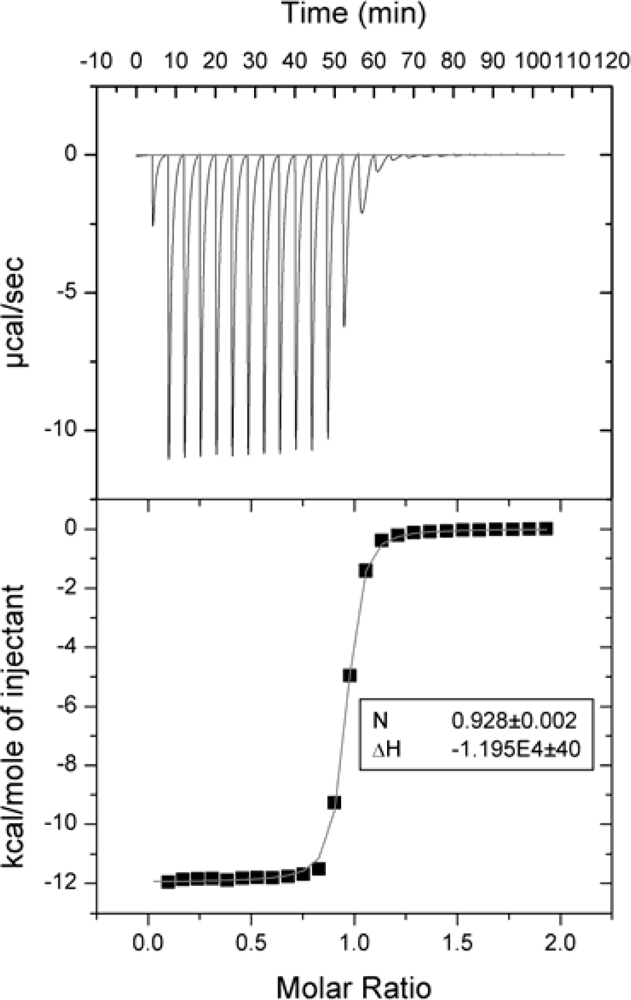
<p><xref ref-type="fig" rid="f1-ijms-10-02752">Figure 1</xref> shows a typical titration of nitric acid with Tris base. The data are nearly perfect, with the stoichiometry and enthalpy within 3% of the literature value. However, even this precision is not sufficient to obtain a reliable heat capacity of binding. Note that this reaction is not suitable for the validation of binding Gibbs free energies determined by ITC. The binding constant is not well determined in this experiment because the factor <italic>c</italic> that must be between 5 and 500 is actually equal to 80,000 (<italic>c</italic> = <italic>nK<sub>b</sub>C</italic>, where <italic>n</italic> – stoichiometry, <italic>K<sub>b</sub></italic> – binding constant, and <italic>C</italic> – concentration of reactant in the cell, <italic>c</italic> = 1×1.6×10<sup>8</sup>×5×10<sup>−4</sup> = 8×10<sup>4</sup>). Therefore, the measured binding constant of 4.7×10<sup>5</sup> M<sup>−1</sup> is much smaller than the literature value of 1.6×10<sup>8</sup> M<sup>−1</sup> (p<italic>K<sub>a</sub></italic> = 8.2 at 25 °C). However, the validations of binding constants and Gibbs free energies are not the subjects of this manuscript and will not be discussed here.</p>
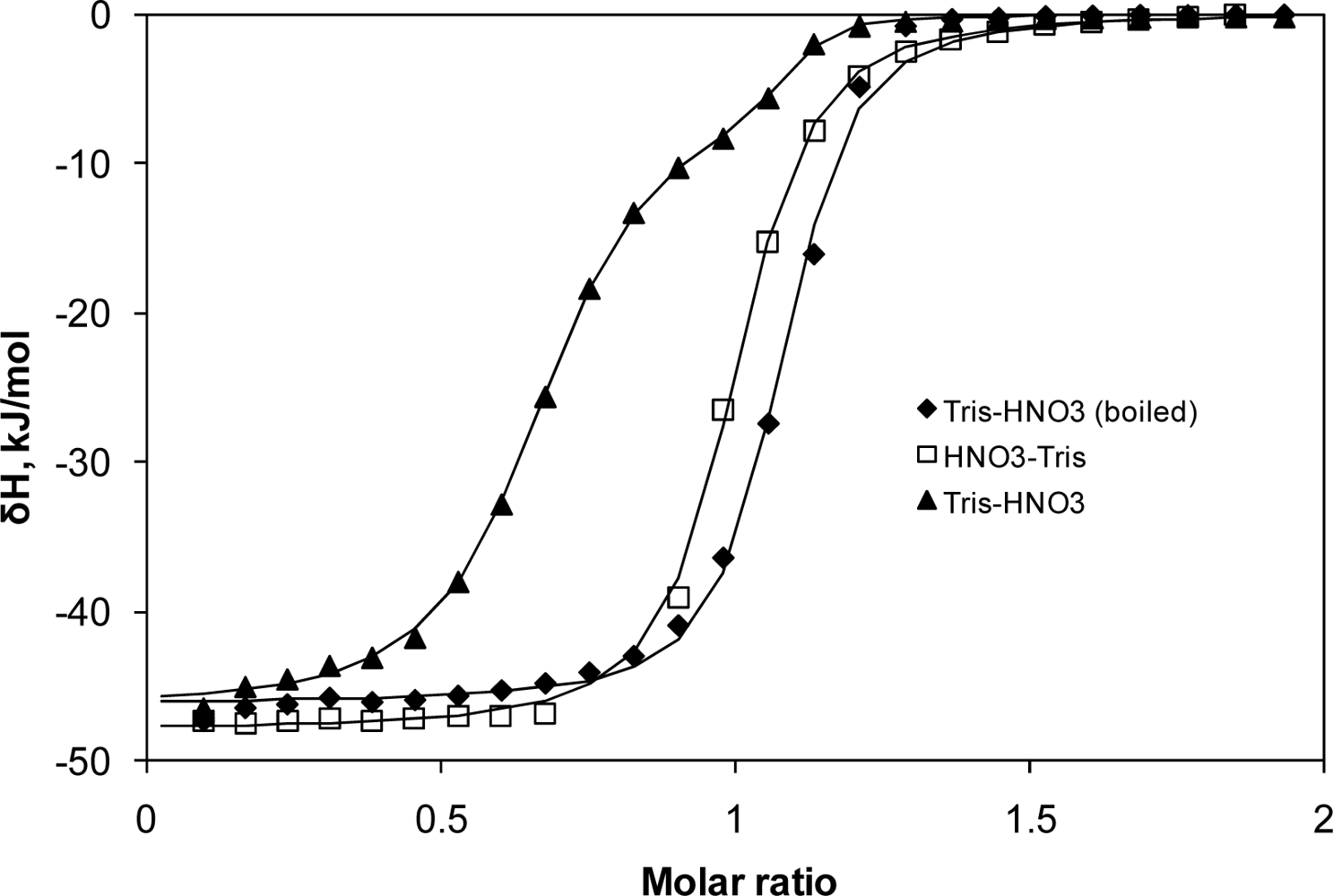
<p>In order to carry out calorimeter calibration and validation with acid-base titrations as shown in <xref ref-type="fig" rid="f1-ijms-10-02752">Figure 1</xref> and <xref ref-type="table" rid="t1-ijms-10-02752">Table 1</xref>, one should carefully degas solutions in order to remove CO<sub>2</sub>. <xref ref-type="fig" rid="f2-ijms-10-02752">Figure 2</xref> shows Tris acid – base ITC data obtained using conventionally purified water and water that had been pre-boiled to remove dissolved CO<sub>2</sub>. Carbon dioxide reacts with Tris base and reduces the amount that can react with acid. This may be a significant source of error. We emphasize that any reaction where CO<sub>2</sub> may interfere is not a good standard. This could be one of the reasons why the interaction of CBS with bovine carbonic anhydrase gives such inconsistent results when measurements from various ITC operators are compared. It is possible that the water sources may have contained different concentrations of CO<sub>2</sub>, resulting in competition for binding to the active site of carbonic anhydrase with CBS. However, if the water to be used for solution preparation is pre-boiled, the Tris acid – base reactions are fully suitable for calibration and validation.</p>
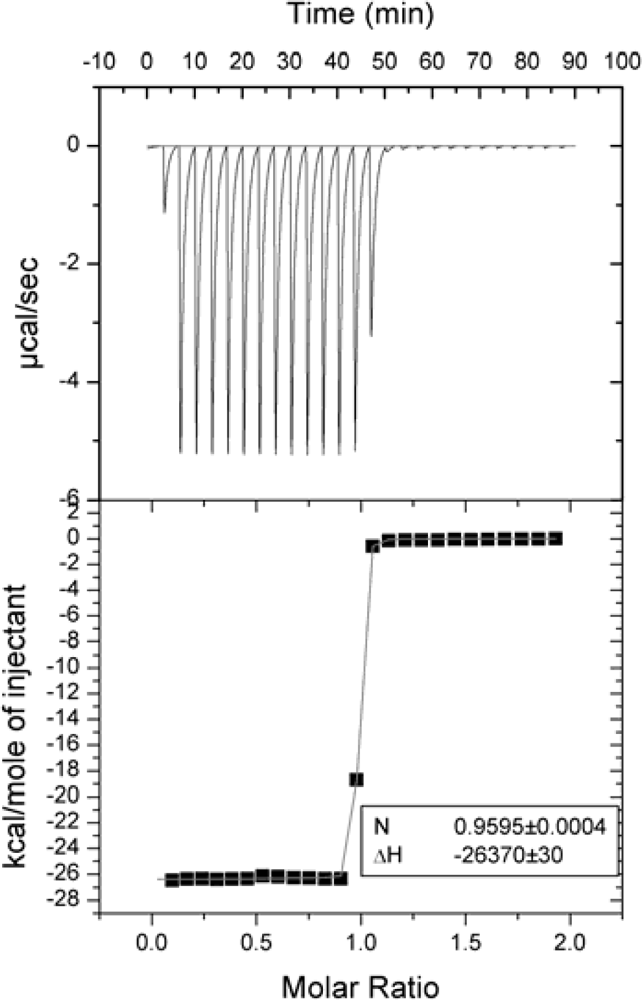
<p><xref ref-type="fig" rid="f3-ijms-10-02752">Figure 3</xref> shows typical ITC data from silver halide formation reactions. This reaction is different from protonation reactions that are sometimes used for calorimeter validation. There is no pH change, and the reaction is not dependent on pH near the neutral range used in protein titrations and for many biological molecules. However, sulfhydryl groups and carbonate may interfere. Silver halide formation reaction involves precipitate and thus demonstrates that precipitate formation does not prevent the accurate determination of thermodynamic parameters of binding using ITC. This reaction is a convenient one to use in addition to the Tris – acid titration. We suggest using the reactions listed in <xref ref-type="table" rid="t1-ijms-10-02752">Table 1</xref> to validate each calorimeter before reporting measured enthalpies of protein-ligand binding reactions.</p></sec>
<sec sec-type="methods">
<label>2.2.</label>
<title>Comparison of data obtained using several microcalorimeters</title>
<p>Having carried out over 3,200 titration experiments on a number of isothermal titration calorimeters, including the Omega ITC (Microcal, Inc.), MCS ITC (Microcal, Inc.), VP-ITC (Microcal, Inc.), Auto-ITC (Microcal, Inc.), Nano ITC-III (Calorimetry Sciences Corporation, Inc.), and ITC200 (Microcal Inc.) instruments, we have noticed some systematic inconsistencies among the various models. Commercially available isothermal titration calorimeters have improved their precision and reliability over the years. However, some models are more reliable than others. Microcal calorimeters are somewhat more reliable than those from Calorimetry Sciences Corp., but they are also more expensive. The most recent Microcal ITC200 model is less accurate than the VP-ITC. However, the ITC200 is designed to consume about 5-fold less material than the VP-ITC.</p>
<p><xref ref-type="table" rid="t2-ijms-10-02752">Table 2</xref> lists our results from three calorimeters using the standard reactions listed in <xref ref-type="table" rid="t1-ijms-10-02752">Table 1</xref>. Standard deviations show the reproducibility of the enthalpy with 95% probability. The values that were most accurate and closest to those reported in the literature were obtained with the VP-ITC, slightly less accurate results were obtained with the ITC200, and the least accurate results were obtained with the Nano ITC-III microcalorimeter.</p>
<p>Interestingly, the Nano ITC-III calorimeter results were very reproducible, but the enthalpy values were systematically underestimated – the reactions should be about 10–20% more exothermic than measured. The silver iodide and silver bromide formation reactions were particularly easy to perform. Silver chloride formation enthalpies and acid-base enthalpies were underestimated both by the Nano ITC-III and the VP-ITC microcalorimeters. Therefore, the most suitable of the studied reactions for calorimeter validation are silver iodide (or bromide) formation and Tris base neutralization with nitric acid.</p></sec>
<sec>
<label>2.3.</label>
<title>Uncertainties of protein-ligand binding enthalpies determined by several microcalorimeters</title>
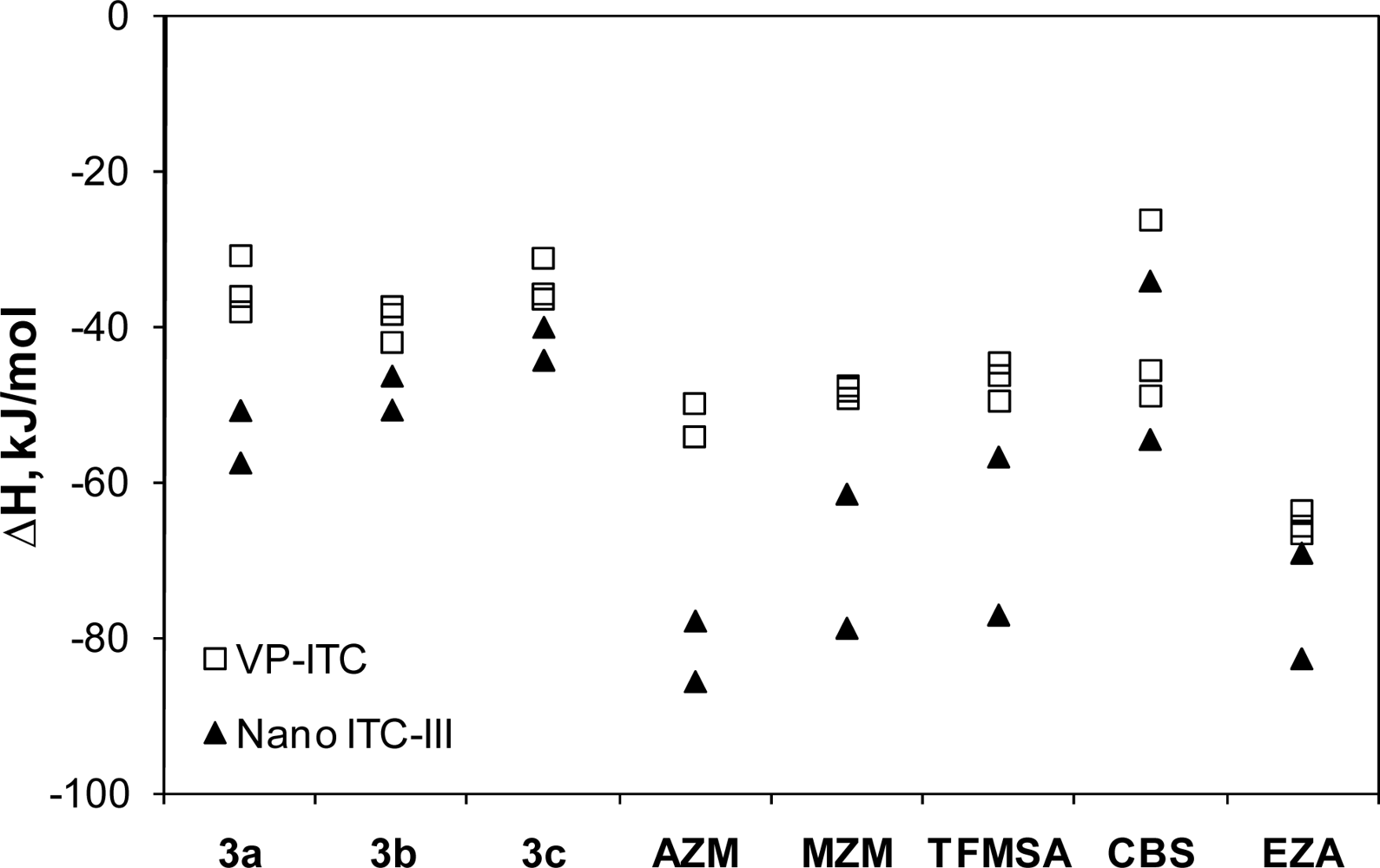
<p>Despite careful validation and repetition of the same experiments on a number of calorimeters, the protein-ligand binding data are sometimes quite scattered and do not repeat well. An example of such a situation where two calorimeters give significantly different enthalpy results is shown in <xref ref-type="fig" rid="f4-ijms-10-02752">Figure 4</xref>. Various sulfonamide compounds that are good ligands of human carbonic anhydrase II were titrated using VP-ITC and Nano ITC-III microcalorimeters. There was either a consistent overestimation of the observed binding enthalpy by the Nano ITC-III microcalorimeter (most likely), or underestimation by the VP-ITC microcalorimeter. The most likely explanation for the overestimation by the Nano ITC-III is the instability of the baseline. The manufacturer is currently offering an upgrade for improved baseline stability. It should also be kept in mind that protein-ligand binding reactions were usually carried out with only 1–10 μM protein in the calorimeter cell. These concentrations are much smaller than the reactions described earlier that were used for calorimeter validation and they are near the sensitivity limit of the calorimeters. The Nano ITC-III microcalorimeter appears to yield more reliable results at higher concentrations such as those used for the reactions listed in <xref ref-type="table" rid="t2-ijms-10-02752">Table 2</xref>. The enthalpies in <xref ref-type="table" rid="t2-ijms-10-02752">Table 2</xref> from the Nano ITC-III calorimeter are underestimated by only about 10% compared to literature values, while the enthalpies for reactions at low protein concentration (<xref ref-type="fig" rid="f4-ijms-10-02752">Figure 4</xref>) are overestimated by a larger factor.</p>
<p>Chemical structures of the ligands numbered 3a-3c have been described previously [<xref ref-type="bibr" rid="b27-ijms-10-02752">27</xref>]. Other ligand name abbreviations are: AZM – acetazolamide, MZM – methazolamide, TFMSA – trifluoromethane sulfonamide, CBS – p-carboxy benzene sulfonamide, EZA – ethoxzolamide. Calorimetric measurements of their binding to carbonic anhydrases I and II were described previously [<xref ref-type="bibr" rid="b28-ijms-10-02752">28</xref>–<xref ref-type="bibr" rid="b30-ijms-10-02752">30</xref>].</p>
<p>Such inconsistencies and the large errors of enthalpy determination make it very difficult to discover correlations between compound structure and thermodynamics. The picture is significantly complicated by the linked protonation reactions, as well. After carrying out the linkage analysis [<xref ref-type="bibr" rid="b28-ijms-10-02752">28</xref>], the intrinsic binding enthalpies are even less reliable, making it difficult to draw the correct conclusions regarding correlations of structure and thermodynamics.</p>
<p>The main goal of any binding measurement is to gain insights into how the thermodynamic parameters correlate with the structure of bound complex. For example, when we study drug lead compound interactions with a protein target, we are primarily interested in learning which chemical functional groups of the lead compound contribute to the thermodynamic parameters. In other words, we are looking for chemical changes to be made to the lead compound to make the binding more thermodynamically favorable and more specific. Unfortunately, these structure-energy correlations are not well understood and the additivity of various functional group contributions is not straightforward.</p>
<p>There are several reasons for this situation. First, we believe that the precision of ITC data is not sufficient due to poor validation as demonstrated above by comparing results obtained by different calorimeters. Second, many protein-ligand interactions have linked protonation reactions that should be accounted for by performing the binding reactions in several buffers of different protonation enthalpies and at several pH values as explained before [<xref ref-type="bibr" rid="b31-ijms-10-02752">31</xref>,<xref ref-type="bibr" rid="b32-ijms-10-02752">32</xref>]. Third, determination of the heat capacity by measuring the binding enthalpies at various temperatures should be performed after the protonation linkage analysis at every temperature. These experiments are tedious and time consuming and therefore are often not completely performed.</p></sec></sec>
<sec>
<label>3.</label>
<title>Experimental Section</title>
<p>Recombinant human carbonic anhydrase was expressed in <italic>E. coli</italic> and purified as previously described [<xref ref-type="bibr" rid="b33-ijms-10-02752">33</xref>]. Carbonic anhydrase ligands were purchased from Sigma-Aldrich Chemical Co., Alfa Aesar, or synthesized as previously described [<xref ref-type="bibr" rid="b27-ijms-10-02752">27</xref>]. Chemicals, including salts and buffers (at least 98% chemical purity) were purchased from Sigma-Aldrich Chemical Co.</p>
<p>Isothermal titration calorimetry experiments were carried out with three microcalorimeters: VP-ITC (Microcal, Inc.), ITC200 (Microcal, Inc.), and Nano ITC III (Calorimetry Sciences Corporation, Inc.). Calorimeters were electrically calibrated according to manufacturer’s instructions. Protein or chemical compound (2–500 μM) was loaded into the calorimeter cell as described in the text. The titration syringe was loaded with another reactant at 10- to 20-fold greater concentration than in the cell. Titrations were usually carried out using 20–30 injections of 10 μL each injected at 3–4 minute intervals. Stirring was 150–400 rpm as suggested by the manufacturer. Titrations were carried out at constant temperature in the 13 – 37 ºC temperature range. Both reactant solutions were prepared in a solution containing the same reagents, such as 50 or 100 mM NaCl, as described in the text.</p></sec>
<sec sec-type="conclusions">
<label>4.</label>
<title>Conclusions</title>
<p>Isothermal titration calorimetry is the most powerful tool to determine the enthalpies of binding of various reactions, including protonation, coprecipitation, and protein-ligand binding. However, there is a need for more careful validation of all calorimeters, more careful experimental planning regarding the buffers, pHs, and temperatures used, and more careful interpretation of calorimetric data before reporting the thermodynamics of binding of the studied reactions. Our recommendation is to select several reactions, such as 1) Tris base with nitric acid, 2) silver nitrate with sodium iodide or bromide, and 3) bovine carbonic anhydrase II with CBS, and to validate calorimeters by carrying out these reactions. Validation should be reported in the experimental section of every ITC manuscript.</p></sec></body>
<back>
<ack>
<p>The project was supported in part by the Lithuanian Science and Studies Foundation (N-06/09), Lithuanian Government, and EEA Grants 2004-LT0019-IP-1EEE.</p></ack>
<ref-list>
<title>References and Notes</title>
<ref id="b1-ijms-10-02752"><label>1.</label><citation citation-type="journal"><person-group person-group-type="author"><name><surname>Wiseman</surname><given-names>T</given-names></name><name><surname>Williston</surname><given-names>S</given-names></name><name><surname>Brandts</surname><given-names>JF</given-names></name><name><surname>Lin</surname><given-names>LN</given-names></name></person-group><article-title>Rapid measurement of binding constants and heats of binding using a new titration calorimeter</article-title><source>Anal. Biochem</source><year>1989</year><volume>179</volume><fpage>131</fpage><lpage>137</lpage><pub-id pub-id-type="doi">10.1016/0003-2697(89)90213-3</pub-id><pub-id pub-id-type="pmid">2757186</pub-id></citation></ref>
<ref id="b2-ijms-10-02752"><label>2.</label><citation citation-type="journal"><person-group person-group-type="author"><name><surname>Lundqvist</surname><given-names>T</given-names></name></person-group><article-title>The devil is still in the details — driving early drug discovery forward with biophysical experimental methods</article-title><source>Curr. Opin. Drug Discov. Devel</source><year>2005</year><volume>8</volume><fpage>513</fpage><lpage>519</lpage><pub-id pub-id-type="pmid">16022188</pub-id></citation></ref>
<ref id="b3-ijms-10-02752"><label>3.</label><citation citation-type="journal"><person-group person-group-type="author"><name><surname>Perozzo</surname><given-names>R</given-names></name><name><surname>Folkers</surname><given-names>G</given-names></name><name><surname>Scapozza</surname><given-names>L</given-names></name></person-group><article-title>Thermodynamics of protein-ligand interactions: History, presence, and future aspects</article-title><source>J. Recept. Signal. Transduct. Res</source><year>2004</year><volume>24</volume><fpage>1</fpage><lpage>52</lpage><pub-id pub-id-type="doi">10.1081/RRS-120037896</pub-id><pub-id pub-id-type="pmid">15344878</pub-id></citation></ref>
<ref id="b4-ijms-10-02752"><label>4.</label><citation citation-type="journal"><person-group person-group-type="author"><name><surname>Ward</surname><given-names>WH</given-names></name><name><surname>Holdgate</surname><given-names>GA</given-names></name></person-group><article-title>Isothermal titration calorimetry in drug discovery</article-title><source>Prog. Med. Chem</source><year>2001</year><volume>38</volume><fpage>309</fpage><lpage>376</lpage><pub-id pub-id-type="pmid">11774798</pub-id></citation></ref>
<ref id="b5-ijms-10-02752"><label>5.</label><citation citation-type="journal"><person-group person-group-type="author"><name><surname>Liu</surname><given-names>CC</given-names></name><name><surname>Richard</surname><given-names>AJ</given-names></name><name><surname>Datta</surname><given-names>K</given-names></name><name><surname>LiCata</surname><given-names>VJ</given-names></name></person-group><article-title>Prevalence of temperature-dependent heat capacity changes in protein-DNA interactions</article-title><source>Biophys. J</source><year>2008</year><volume>94</volume><fpage>3258</fpage><lpage>3265</lpage><pub-id pub-id-type="doi">10.1529/biophysj.107.117697</pub-id><pub-id pub-id-type="pmid">18199676</pub-id></citation></ref>
<ref id="b6-ijms-10-02752"><label>6.</label><citation citation-type="journal"><person-group person-group-type="author"><name><surname>Dragan</surname><given-names>AI</given-names></name><name><surname>Li</surname><given-names>Z</given-names></name><name><surname>Makeyeva</surname><given-names>EN</given-names></name><name><surname>Milgotina</surname><given-names>EI</given-names></name><name><surname>Liu</surname><given-names>Y</given-names></name><name><surname>Crane-Robinson</surname><given-names>C</given-names></name><name><surname>Privalov</surname><given-names>PL</given-names></name></person-group><article-title>Forces driving the binding of homeodomains to DNA</article-title><source>Biochemistry</source><year>2006</year><volume>45</volume><fpage>141</fpage><lpage>151</lpage><pub-id pub-id-type="doi">10.1021/bi051705m</pub-id><pub-id pub-id-type="pmid">16388589</pub-id></citation></ref>
<ref id="b7-ijms-10-02752"><label>7.</label><citation citation-type="journal"><person-group person-group-type="author"><name><surname>Matulis</surname><given-names>D</given-names></name><name><surname>Rouzina</surname><given-names>I</given-names></name><name><surname>Bloomfield</surname><given-names>VA</given-names></name></person-group><article-title>Thermodynamics of cationic lipid binding to DNA and DNA condensation: Roles of electrostatics and hydrophobicity</article-title><source>J. Am. Chem. Soc</source><year>2002</year><volume>124</volume><fpage>7331</fpage><lpage>7342</lpage><pub-id pub-id-type="doi">10.1021/ja0124055</pub-id><pub-id pub-id-type="pmid">12071742</pub-id></citation></ref>
<ref id="b8-ijms-10-02752"><label>8.</label><citation citation-type="journal"><person-group person-group-type="author"><name><surname>Tsamaloukas</surname><given-names>A</given-names></name><name><surname>Szadkowska</surname><given-names>H</given-names></name><name><surname>Heerklotz</surname><given-names>H</given-names></name></person-group><article-title>Thermodynamic comparison of the interactions of cholesterol with unsaturated phospholipid and sphingomyelins</article-title><source>Biophys. J</source><year>2006</year><volume>90</volume><fpage>4479</fpage><lpage>4487</lpage><pub-id pub-id-type="doi">10.1529/biophysj.105.080127</pub-id><pub-id pub-id-type="pmid">16581844</pub-id></citation></ref>
<ref id="b9-ijms-10-02752"><label>9.</label><citation citation-type="journal"><person-group person-group-type="author"><name><surname>Hansen</surname><given-names>LD</given-names></name><name><surname>Russell</surname><given-names>DJ</given-names></name><name><surname>Choma</surname><given-names>CT</given-names></name></person-group><article-title>From biochemistry to physiology: The calorimetry connection</article-title><source>Cell. Biochem. Biophys</source><year>2007</year><volume>49</volume><fpage>125</fpage><lpage>140</lpage><pub-id pub-id-type="doi">10.1007/s12013-007-0049-y</pub-id><pub-id pub-id-type="pmid">17906367</pub-id></citation></ref>
<ref id="b10-ijms-10-02752"><label>10.</label><citation citation-type="journal"><person-group person-group-type="author"><name><surname>Velazquez Campoy</surname><given-names>A</given-names></name><name><surname>Freire</surname><given-names>E</given-names></name></person-group><article-title>ITC in the post-genomic era…? Priceless</article-title><source>Biophys. Chem</source><year>2005</year><volume>115</volume><fpage>115</fpage><lpage>124</lpage><pub-id pub-id-type="doi">10.1016/j.bpc.2004.12.015</pub-id><pub-id pub-id-type="pmid">15752592</pub-id></citation></ref>
<ref id="b11-ijms-10-02752"><label>11.</label><citation citation-type="journal"><person-group person-group-type="author"><name><surname>Ladbury</surname><given-names>JE</given-names></name></person-group><article-title>Application of isothermal titration calorimetry in the biological sciences: Things are heating up!</article-title><source>Biotechniques</source><year>2004</year><volume>37</volume><fpage>885</fpage><lpage>887</lpage><pub-id pub-id-type="pmid">15597533</pub-id></citation></ref>
<ref id="b12-ijms-10-02752"><label>12.</label><citation citation-type="journal"><person-group person-group-type="author"><name><surname>Chen</surname><given-names>X</given-names></name><name><surname>Lin</surname><given-names>Y</given-names></name><name><surname>Liu</surname><given-names>M</given-names></name><name><surname>Gilson</surname><given-names>MK</given-names></name></person-group><article-title>The Binding Database: data management and interface design</article-title><source>Bioinformatics</source><year>2002</year><volume>18</volume><fpage>130</fpage><lpage>139</lpage><pub-id pub-id-type="doi">10.1093/bioinformatics/18.1.130</pub-id><pub-id pub-id-type="pmid">11836221</pub-id></citation></ref>
<ref id="b13-ijms-10-02752"><label>13.</label><citation citation-type="journal"><person-group person-group-type="author"><name><surname>Chen</surname><given-names>X</given-names></name><name><surname>Liu</surname><given-names>M</given-names></name><name><surname>Gilson</surname><given-names>MK</given-names></name></person-group><article-title>BindingDB: A web-accessible molecular recognition database</article-title><source>Comb. Chem. High. Throughput Screen</source><year>2001</year><volume>4</volume><fpage>719</fpage><lpage>725</lpage><pub-id pub-id-type="doi">10.2174/1386207013330670</pub-id><pub-id pub-id-type="pmid">11812264</pub-id></citation></ref>
<ref id="b14-ijms-10-02752"><label>14.</label><citation citation-type="journal"><person-group person-group-type="author"><name><surname>Liu</surname><given-names>T</given-names></name><name><surname>Lin</surname><given-names>Y</given-names></name><name><surname>Wen</surname><given-names>X</given-names></name><name><surname>Jorissen</surname><given-names>RN</given-names></name><name><surname>Gilson</surname><given-names>MK</given-names></name></person-group><article-title>BindingDB: A web-accessible database of experimentally determined protein-ligand binding affinities</article-title><source>Nucleic Acids Res</source><year>2007</year><volume>35</volume><fpage>D198</fpage><lpage>D201</lpage><pub-id pub-id-type="doi">10.1093/nar/gkl999</pub-id><pub-id pub-id-type="pmid">17145705</pub-id></citation></ref>
<ref id="b15-ijms-10-02752"><label>15.</label><citation citation-type="journal"><person-group person-group-type="author"><name><surname>Olsson</surname><given-names>TS</given-names></name><name><surname>Williams</surname><given-names>MA</given-names></name><name><surname>Pitt</surname><given-names>WR</given-names></name><name><surname>Ladbury</surname><given-names>JE</given-names></name></person-group><article-title>The thermodynamics of protein-ligand interaction and solvation: Insights for ligand design</article-title><source>J. Mol. Biol</source><year>2008</year><volume>384</volume><fpage>1002</fpage><lpage>1017</lpage><pub-id pub-id-type="doi">10.1016/j.jmb.2008.09.073</pub-id><pub-id pub-id-type="pmid">18930735</pub-id></citation></ref>
<ref id="b16-ijms-10-02752"><label>16.</label><citation citation-type="journal"><person-group person-group-type="author"><name><surname>Myszka</surname><given-names>DG</given-names></name><name><surname>Abdiche</surname><given-names>YN</given-names></name><name><surname>Arisaka</surname><given-names>F</given-names></name><name><surname>Byron</surname><given-names>O</given-names></name><name><surname>Eisenstein</surname><given-names>E</given-names></name><name><surname>Hensley</surname><given-names>P</given-names></name><name><surname>Thomson</surname><given-names>JA</given-names></name><name><surname>Lombardo</surname><given-names>CR</given-names></name><name><surname>Schwarz</surname><given-names>F</given-names></name><name><surname>Stafford</surname><given-names>W</given-names></name><name><surname>Doyle</surname><given-names>ML</given-names></name></person-group><article-title>The ABRF-MIRG’02 study: Assembly state, thermodynamic, and kinetic analysis of an enzyme/inhibitor interaction</article-title><source>J. Biomol. Technol</source><year>2003</year><volume>14</volume><fpage>247</fpage><lpage>269</lpage></citation></ref>
<ref id="b17-ijms-10-02752"><label>17.</label><citation citation-type="journal"><person-group person-group-type="author"><name><surname>Navratilova</surname><given-names>I</given-names></name><name><surname>Papalia</surname><given-names>GA</given-names></name><name><surname>Rich</surname><given-names>RL</given-names></name><name><surname>Bedinger</surname><given-names>D</given-names></name><name><surname>Brophy</surname><given-names>S</given-names></name><name><surname>Condon</surname><given-names>B</given-names></name><name><surname>Deng</surname><given-names>T</given-names></name><name><surname>Emerick</surname><given-names>AW</given-names></name><name><surname>Guan</surname><given-names>HW</given-names></name><name><surname>Hayden</surname><given-names>T</given-names></name><name><surname>Heutmekers</surname><given-names>T</given-names></name><name><surname>Hoorelbeke</surname><given-names>B</given-names></name><name><surname>McCroskey</surname><given-names>MC</given-names></name><name><surname>Murphy</surname><given-names>MM</given-names></name><name><surname>Nakagawa</surname><given-names>T</given-names></name><name><surname>Parmeggiani</surname><given-names>F</given-names></name><name><surname>Qin</surname><given-names>X</given-names></name><name><surname>Rebe</surname><given-names>S</given-names></name><name><surname>Tomasevic</surname><given-names>N</given-names></name><name><surname>Tsang</surname><given-names>T</given-names></name><name><surname>Waddell</surname><given-names>MB</given-names></name><name><surname>Zhang</surname><given-names>FF</given-names></name><name><surname>Leavitt</surname><given-names>S</given-names></name><name><surname>Myszka</surname><given-names>DG</given-names></name></person-group><article-title>Thermodynamic benchmark study using Biacore technology</article-title><source>Anal. Biochem</source><year>2007</year><volume>364</volume><fpage>67</fpage><lpage>77</lpage><pub-id pub-id-type="doi">10.1016/j.ab.2007.01.031</pub-id><pub-id pub-id-type="pmid">17362870</pub-id></citation></ref>
<ref id="b18-ijms-10-02752"><label>18.</label><citation citation-type="journal"><person-group person-group-type="author"><name><surname>Wadso</surname><given-names>I</given-names></name></person-group><article-title>Needs for standards in isothermal microcalorimetry</article-title><source>Thermochim. Acta</source><year>2000</year><volume>347</volume><fpage>73</fpage><lpage>77</lpage><pub-id pub-id-type="doi">10.1016/S0040-6031(99)00418-9</pub-id></citation></ref>
<ref id="b19-ijms-10-02752"><label>19.</label><citation citation-type="journal"><person-group person-group-type="author"><name><surname>Tellinghuisen</surname><given-names>J</given-names></name></person-group><article-title>Stupid statistics!</article-title><source>Methods Cell Biol</source><year>2008</year><volume>84</volume><fpage>737</fpage><lpage>780</lpage></citation></ref>
<ref id="b20-ijms-10-02752"><label>20.</label><citation citation-type="journal"><person-group person-group-type="author"><name><surname>Tellinghuisen</surname><given-names>J</given-names></name></person-group><article-title>Statistical error in isothermal titration calorimetry</article-title><source>Methods Enzymol</source><year>2004</year><volume>383</volume><fpage>245</fpage><lpage>282</lpage><pub-id pub-id-type="pmid">15063654</pub-id></citation></ref>
<ref id="b21-ijms-10-02752"><label>21.</label><citation citation-type="journal"><person-group person-group-type="author"><name><surname>Mizoue</surname><given-names>LS</given-names></name><name><surname>Tellinghuisen</surname><given-names>J</given-names></name></person-group><article-title>Calorimetric vs. van’t Hoff binding enthalpies from isothermal titration calorimetry: Ba<sup>2+</sup>-crown ether complexation</article-title><source>Biophys. Chem</source><year>2004</year><volume>110</volume><fpage>15</fpage><lpage>24</lpage><pub-id pub-id-type="doi">10.1016/j.bpc.2003.12.011</pub-id><pub-id pub-id-type="pmid">15223140</pub-id></citation></ref>
<ref id="b22-ijms-10-02752"><label>22.</label><citation citation-type="journal"><person-group person-group-type="author"><name><surname>Horn</surname><given-names>JR</given-names></name><name><surname>Russell</surname><given-names>D</given-names></name><name><surname>Lewis</surname><given-names>EA</given-names></name><name><surname>Murphy</surname><given-names>KP</given-names></name></person-group><article-title>Van’t Hoff and calorimetric enthalpies from isothermal titration calorimetry: are there significant discrepancies?</article-title><source>Biochemistry</source><year>2001</year><volume>40</volume><fpage>1774</fpage><lpage>1778</lpage><pub-id pub-id-type="doi">10.1021/bi002408e</pub-id><pub-id pub-id-type="pmid">11327839</pub-id></citation></ref>
<ref id="b23-ijms-10-02752"><label>23.</label><citation citation-type="journal"><person-group person-group-type="author"><name><surname>Mizoue</surname><given-names>LS</given-names></name><name><surname>Tellinghuisen</surname><given-names>J</given-names></name></person-group><article-title>The role of backlash in the “first injection anomaly” in isothermal titration calorimetry</article-title><source>Anal. Biochem</source><year>2004</year><volume>326</volume><fpage>125</fpage><lpage>127</lpage><pub-id pub-id-type="doi">10.1016/j.ab.2003.10.048</pub-id><pub-id pub-id-type="pmid">14769346</pub-id></citation></ref>
<ref id="b24-ijms-10-02752"><label>24.</label><citation citation-type="journal"><person-group person-group-type="author"><name><surname>Tellinghuisen</surname><given-names>J</given-names></name></person-group><article-title>Calibration in isothermal titration calorimetry: heat and cell volume from heat of dilution of NaCl(aq)</article-title><source>Anal. Biochem</source><year>2007</year><volume>360</volume><fpage>47</fpage><lpage>55</lpage><pub-id pub-id-type="doi">10.1016/j.ab.2006.10.015</pub-id><pub-id pub-id-type="pmid">17107650</pub-id></citation></ref>
<ref id="b25-ijms-10-02752"><label>25.</label><citation citation-type="book"><person-group person-group-type="author"><name><surname>Dean</surname><given-names>JA</given-names></name></person-group><source>Lange’s Handbook of Chemistry</source><publisher-name>McGraw-Hill, Inc</publisher-name><publisher-loc>New York, USA</publisher-loc><year>1999</year></citation></ref>
<ref id="b26-ijms-10-02752"><label>26.</label><citation citation-type="book"><person-group person-group-type="author"><name><surname>Christensen</surname><given-names>JJ</given-names></name><name><surname>Hansen</surname><given-names>LD</given-names></name><name><surname>Izatt</surname><given-names>RM</given-names></name></person-group><source>Handbook of Proton Ionizations Heats</source><publisher-name>Wiley-Interscience</publisher-name><publisher-loc>Hoboken, NJ, USA</publisher-loc><year>1976</year></citation></ref>
<ref id="b27-ijms-10-02752"><label>27.</label><citation citation-type="journal"><person-group person-group-type="author"><name><surname>Dudutiene</surname><given-names>V</given-names></name><name><surname>Baranauskiene</surname><given-names>L</given-names></name><name><surname>Matulis</surname><given-names>D</given-names></name></person-group><article-title>Benzimidazo[1,2-c][1,2,3]thiadiazole-7-sulfonamides as inhibitors of carbonic anhydrase</article-title><source>Bioorg. Med. Chem. Lett</source><year>2007</year><volume>17</volume><fpage>3335</fpage><lpage>3338</lpage><pub-id pub-id-type="doi">10.1016/j.bmcl.2007.03.100</pub-id><pub-id pub-id-type="pmid">17442568</pub-id></citation></ref>
<ref id="b28-ijms-10-02752"><label>28.</label><citation citation-type="journal"><person-group person-group-type="author"><name><surname>Krishnamurthy</surname><given-names>VM</given-names></name><name><surname>Kaufman</surname><given-names>GK</given-names></name><name><surname>Urbach</surname><given-names>AR</given-names></name><name><surname>Gitlin</surname><given-names>I</given-names></name><name><surname>Gudiksen</surname><given-names>KL</given-names></name><name><surname>Weibel</surname><given-names>DB</given-names></name><name><surname>Whitesides</surname><given-names>GM</given-names></name></person-group><article-title>Carbonic anhydrase as a model for biophysical and physical-organic studies of proteins and protein-ligand binding</article-title><source>Chem. Rev</source><year>2008</year><volume>108</volume><fpage>946</fpage><lpage>1051</lpage><pub-id pub-id-type="doi">10.1021/cr050262p</pub-id><pub-id pub-id-type="pmid">18335973</pub-id></citation></ref>
<ref id="b29-ijms-10-02752"><label>29.</label><citation citation-type="book"><person-group person-group-type="author"><name><surname>Matulis</surname><given-names>D</given-names></name><name><surname>Todd</surname><given-names>MJ</given-names></name></person-group><article-title>Thermodynamics - Structure Correlations of Sulfonamide Inhibitor Binding to Carbonic Anhydrase</article-title><source>Biocalorimetry 2</source><person-group person-group-type="editor"><name><surname>Ladbury</surname><given-names>JE</given-names></name><name><surname>Doyle</surname><given-names>ML</given-names></name></person-group><publisher-name>Wiley</publisher-name><publisher-loc>New York, USA</publisher-loc><year>2004</year><fpage>107</fpage><lpage>132</lpage></citation></ref>
<ref id="b30-ijms-10-02752"><label>30.</label><citation citation-type="journal"><person-group person-group-type="author"><name><surname>Matulis</surname><given-names>D</given-names></name><name><surname>Kranz</surname><given-names>JK</given-names></name><name><surname>Salemme</surname><given-names>FR</given-names></name><name><surname>Todd</surname><given-names>MJ</given-names></name></person-group><article-title>Thermodynamic stability of carbonic anhydrase: measurements of binding affinity and stoichiometry using ThermoFluor</article-title><source>Biochemistry</source><year>2005</year><volume>44</volume><fpage>5258</fpage><lpage>5266</lpage><pub-id pub-id-type="doi">10.1021/bi048135v</pub-id><pub-id pub-id-type="pmid">15794662</pub-id></citation></ref>
<ref id="b31-ijms-10-02752"><label>31.</label><citation citation-type="journal"><person-group person-group-type="author"><name><surname>Baker</surname><given-names>BM</given-names></name><name><surname>Murphy</surname><given-names>KP</given-names></name></person-group><article-title>Evaluation of linked protonation effects in protein binding reactions using isothermal titration calorimetry</article-title><source>Biophys. J</source><year>1996</year><volume>71</volume><fpage>2049</fpage><lpage>2055</lpage><pub-id pub-id-type="doi">10.1016/S0006-3495(96)79403-1</pub-id><pub-id pub-id-type="pmid">8889179</pub-id></citation></ref>
<ref id="b32-ijms-10-02752"><label>32.</label><citation citation-type="journal"><person-group person-group-type="author"><name><surname>Baker</surname><given-names>BM</given-names></name><name><surname>Murphy</surname><given-names>KP</given-names></name></person-group><article-title>Dissecting the energetics of a protein-protein interaction: The binding of ovomucoid third domain to elastase</article-title><source>J. Mol. Biol</source><year>1997</year><volume>268</volume><fpage>557</fpage><lpage>569</lpage><pub-id pub-id-type="doi">10.1006/jmbi.1997.0977</pub-id><pub-id pub-id-type="pmid">9159490</pub-id></citation></ref>
<ref id="b33-ijms-10-02752"><label>33.</label><citation citation-type="journal"><person-group person-group-type="author"><name><surname>Cimmperman</surname><given-names>P</given-names></name><name><surname>Baranauskiene</surname><given-names>L</given-names></name><name><surname>Jachimoviciute</surname><given-names>S</given-names></name><name><surname>Jachno</surname><given-names>J</given-names></name><name><surname>Torresan</surname><given-names>J</given-names></name><name><surname>Michailoviene</surname><given-names>V</given-names></name><name><surname>Matuliene</surname><given-names>J</given-names></name><name><surname>Sereikaite</surname><given-names>J</given-names></name><name><surname>Bumelis</surname><given-names>V</given-names></name><name><surname>Matulis</surname><given-names>D</given-names></name></person-group><article-title>A quantitative model of thermal stabilization and destabilization of proteins by ligands</article-title><source>Biophys. J</source><year>2008</year><volume>95</volume><fpage>3222</fpage><lpage>3231</lpage><pub-id pub-id-type="doi">10.1529/biophysj.108.134973</pub-id><pub-id pub-id-type="pmid">18599640</pub-id></citation></ref></ref-list>
<sec sec-type="display-objects">
<title>Figures and Tables</title>
<fig id="f1-ijms-10-02752" position="float">
<label>Figure 1.</label>
<caption>
<p>Typical titration of 0.5 mM HNO<sub>3</sub> with 5 mM Tris base using a VP-ITC (Microcal, Inc.) microcalorimeter at 37 °C. Both the cell and syringe solutions contained 100 mM NaCl.</p></caption>
<graphic xlink:href="ijms-10-02752f1.gif"/></fig>
<fig id="f2-ijms-10-02752" position="float">
<label>Figure 2.</label>
<caption>
<p>Tris-base – nitric acid ITC titration data obtained with a Microcal VP-ITC calorimeter at 25 °C. Filled symbols: 0.5 mM Tris base in the cell and 5 mM HNO<sub>3</sub> in the syringe. Open symbols: 0.5 mM HNO<sub>3</sub> in the cell and 5 mM Tris base in the syringe. All solutions contained 100 mM NaCl. When Tris base is in the cell (0.5 mM), the available concentration is reduced by dissolved CO<sub>2</sub>. Therefore, the stoichiometry was reduced to about 0.7. When Tris base is in the syringe (5 mM), the curve is practically unaffected by CO<sub>2</sub>. Using pre-boiled water in the preparation of Tris base solution solves the problem of reduced stoichiometry. Datapoints are the integrals of ITC raw data and the lines are fitted with Origin 5.0 using one- or two-binding site models.</p></caption>
<graphic xlink:href="ijms-10-02752f2.gif"/></fig>
<fig id="f3-ijms-10-02752" position="float">
<label>Figure 3.</label>
<caption>
<p>Titration of 0.1 mM NaI with 1.0 mM AgNO<sub>3</sub> at 25 °C using VP-ITC (Microcal, Inc.) microcalorimeter.</p></caption>
<graphic xlink:href="ijms-10-02752f3.gif"/></fig>
<fig id="f4-ijms-10-02752" position="float">
<label>Figure 4.</label>
<caption>
<p>Comparison of measured ligand binding enthalpies to recombinant human carbonic anhydrase II using VP-ITC and Nano ITC-III microcalorimeters. Titrations were performed at 25 °C in 50 mM sodium phosphate buffer, pH 7.0, containing 50 mM NaCl and 1% DMSO. Note that there is a significant systematic overestimation of the enthalpies measured using the Nano ITC-III calorimeter or underestimation of the enthalpies using the VP-ITC calorimeter. All raw titration curves were good with a binding stoichiometry of 0.9±0.1.</p></caption>
<graphic xlink:href="ijms-10-02752f4.gif"/></fig>
<table-wrap id="t1-ijms-10-02752" position="float">
<label>Table 1.</label>
<caption>
<p>Chemical reactions that could be used as references for ITC equipment.</p></caption>
<table frame="hsides" rules="rows">
<thead>
<tr>
<th valign="middle" align="left"><bold>Cell contents</bold></th>
<th valign="middle" align="center"><bold>Syringe contents</bold></th>
<th valign="middle" align="center"><bold>Temperature, °C, other conditions</bold></th>
<th valign="middle" align="center"><bold>Δ<italic>H</italic> (kJ·mol<sup>−1</sup>) from the literature [<xref ref-type="bibr" rid="b25-ijms-10-02752">25</xref>,<xref ref-type="bibr" rid="b26-ijms-10-02752">26</xref>]</bold></th>
<th valign="middle" align="center"><bold>Δ<italic>Cp</italic> (J·mol<sup>−1</sup>·K<sup>−1</sup>) from the literature [<xref ref-type="bibr" rid="b25-ijms-10-02752">25</xref>,<xref ref-type="bibr" rid="b26-ijms-10-02752">26</xref>]</bold></th></tr></thead>
<tbody>
<tr>
<td valign="bottom" align="center">0.5 mM HNO<sub>3</sub></td>
<td valign="bottom" align="center">5 mM Tris base</td>
<td valign="bottom" align="center">25 °C, 100 mM NaCl</td>
<td valign="bottom" align="center">−47.45</td>
<td valign="bottom" align="center">+73.01</td></tr>
<tr>
<td valign="bottom" align="center">0.5 mM HNO<sub>3</sub></td>
<td valign="bottom" align="center">5 mM NaOH</td>
<td valign="bottom" align="center">25 °C, 100 mM NaCl</td>
<td valign="bottom" align="center">−55.81</td>
<td valign="bottom" align="center">+223.85</td></tr>
<tr>
<td valign="bottom" align="center">0.2 mM NaCl</td>
<td valign="bottom" align="center">2 mM AgNO<sub>3</sub></td>
<td valign="bottom" align="center">25 °C</td>
<td valign="bottom" align="center">−65.72</td>
<td valign="bottom" align="center">+165.39</td></tr>
<tr>
<td valign="bottom" align="center">0.2 mM NaBr</td>
<td valign="bottom" align="center">2 mM AgNO<sub>3</sub></td>
<td valign="bottom" align="center">25 °C</td>
<td valign="bottom" align="center">−84.75</td>
<td valign="bottom" align="center">+172.38</td></tr>
<tr>
<td valign="bottom" align="center">0.2 mM NaI</td>
<td valign="bottom" align="center">2 mM A1gNO<sub>3</sub></td>
<td valign="bottom" align="center">25 °C</td>
<td valign="bottom" align="center">−110.9</td>
<td valign="bottom" align="center">+177.32</td></tr></tbody></table></table-wrap>
<table-wrap id="t2-ijms-10-02752" position="float">
<label>Table 2.</label>
<caption>
<p>Comparison of results obtained with standard reactions listed in <xref ref-type="table" rid="t1-ijms-10-02752">Table 1</xref> using various isothermal titration calorimeters.</p></caption>
<table frame="hsides" rules="rows">
<thead>
<tr>
<th valign="middle" align="center" rowspan="2"><bold>Reaction</bold></th>
<th valign="middle" align="center" rowspan="2"><bold>Literature values (<xref ref-type="table" rid="t1-ijms-10-02752">Table 1</xref>), kJ·mol<sup>−1</sup></bold></th>
<th valign="bottom" align="center" colspan="3"><bold>Δ<italic>H</italic>, kJ·mol<sup>−1</sup>, obtained in our laboratory withthese calorimeters</bold></th></tr>
<tr>
<th valign="bottom" align="center"><bold>VP-ITC</bold></th>
<th valign="bottom" align="center"><bold>ITC200</bold></th>
<th valign="bottom" align="center"><bold>Nano ITC-III</bold></th></tr></thead>
<tbody>
<tr>
<td valign="middle" align="center">Tris-base + HNO<sub>3</sub> → Tris-acidic + …, 25 °C</td>
<td valign="middle" align="center">−47.45</td>
<td valign="middle" align="center">−47.8 ± 1.0</td>
<td valign="middle" align="center">−48.4 ± 2.1</td>
<td valign="middle" align="center">−41.9 ± 0.6</td></tr>
<tr>
<td valign="middle" align="center">Tris-base + HNO<sub>3</sub> → Tris-acidic + …, 13 °C</td>
<td valign="middle" align="center">−48.33</td>
<td valign="middle" align="center">−47.5 ± 0.8</td>
<td valign="middle" align="center">−47.2 ± 3.4</td>
<td valign="middle" align="center">−44.4 ± 0.1</td></tr>
<tr>
<td valign="middle" align="center">Tris-base + HNO<sub>3</sub> → Tris-acidic + …, 37 °C</td>
<td valign="middle" align="center">−46.57</td>
<td valign="middle" align="center">−46.9 ± 0.9</td>
<td valign="middle" align="center">−50.0 ± 2.8</td>
<td valign="middle" align="center">−40.8 ± 0.1</td></tr>
<tr>
<td valign="middle" align="center">NaOH + HNO<sub>3</sub> → H<sub>2</sub>O + …, 25 °C</td>
<td valign="middle" align="center">−55.81</td>
<td valign="middle" align="center">−52.6 ± 1.8</td>
<td valign="middle" align="center">ND</td>
<td valign="middle" align="center">−47.2 ± 2.3</td></tr>
<tr>
<td valign="middle" align="center">AgNO<sub>3</sub> + NaCl → AgCl↓ + …, 25 °C</td>
<td valign="middle" align="center">−65.72</td>
<td valign="middle" align="center">−57.9 ± 2.0</td>
<td valign="middle" align="center">ND</td>
<td valign="middle" align="center">−52.3 ± 2.6</td></tr>
<tr>
<td valign="middle" align="center">AgNO<sub>3</sub> + NaBr → AgBr↓ + …, 25 °C</td>
<td valign="middle" align="center">−84.75</td>
<td valign="middle" align="center">−84.4 ± 3.1</td>
<td valign="middle" align="center">ND</td>
<td valign="middle" align="center">ND</td></tr>
<tr>
<td valign="middle" align="center">AgNO<sub>3</sub> + NaI → AgI↓ + …, 25 °C</td>
<td valign="middle" align="center">−110.9</td>
<td valign="middle" align="center">−110.0 ± 1.7</td>
<td valign="middle" align="center">−103.4 ± 10.8</td>
<td valign="middle" align="center">ND</td></tr></tbody></table>
<table-wrap-foot><fn id="tfn1-ijms-10-02752">
<p>ND – not determined. At least three repeats were carried out and, in most cases, at a number of concentrations to determine the best conditions to most closely match values in <xref ref-type="table" rid="t1-ijms-10-02752">Table 1</xref>.</p></fn></table-wrap-foot></table-wrap></sec></back></article>