
<?xml version="1.0" encoding="UTF-8"?>
<!DOCTYPE article PUBLIC "-//NLM//DTD Journal Publishing DTD v2.3 20070202//EN" "journalpublishing.dtd">
<article xmlns:mml="http://www.w3.org/1998/Math/MathML" xmlns:xlink="http://www.w3.org/1999/xlink" xml:lang="en" article-type="research-article">
<front>
<journal-meta>
<journal-id journal-id-type="publisher-id">ijms</journal-id>
<journal-title>International Journal of Molecular Sciences</journal-title>
<abbrev-journal-title>Int. J. Mol. Sci.</abbrev-journal-title>
<issn pub-type="epub">1422-0067</issn>
<publisher>
<publisher-name>Molecular Diversity Preservation International (MDPI)</publisher-name></publisher></journal-meta>
<article-meta>
<article-id pub-id-type="doi">10.3390/ijms10041808</article-id>
<article-id pub-id-type="publisher-id">ijms-10-01808</article-id>
<article-categories>
<subj-group>
<subject>Article</subject></subj-group></article-categories>
<title-group>
<article-title>Uncovering the Properties of Energy-Weighted Conformation Space Networks with a Hydrophobic-Hydrophilic Model</article-title></title-group>
<contrib-group>
<contrib contrib-type="author">
<name><surname>Lai</surname><given-names>Zaizhi</given-names></name><xref ref-type="aff" rid="af1-ijms-10-01808">1</xref><xref ref-type="fn" rid="fn1-ijms-10-01808">#</xref></contrib>
<contrib contrib-type="author">
<name><surname>Su</surname><given-names>Jiguo</given-names></name><xref ref-type="aff" rid="af1-ijms-10-01808">1</xref><xref ref-type="aff" rid="af2-ijms-10-01808">2</xref><xref ref-type="fn" rid="fn1-ijms-10-01808">#</xref></contrib>
<contrib contrib-type="author">
<name><surname>Chen</surname><given-names>Weizu</given-names></name><xref ref-type="aff" rid="af1-ijms-10-01808">1</xref></contrib>
<contrib contrib-type="author">
<name><surname>Wang</surname><given-names>Cunxin</given-names></name><xref ref-type="aff" rid="af1-ijms-10-01808">1</xref><xref ref-type="corresp" rid="c1-ijms-10-01808">*</xref></contrib></contrib-group>
<aff id="af1-ijms-10-01808">
<label>1</label>College of Life Science and Bioengineering, Beijing University of Technology, Beijing, 100124, P.R. China; E-Mails:
<email>laizaizhi@emails.bjut.edu.cn</email> (Z.L.);
<email>jiguosu@emails.bjut.edu.cn</email> (J.S.);
<email>wzchen@bjut.edu.cn</email> (W.C.)</aff>
<aff id="af2-ijms-10-01808">
<label>2</label>College of Science, Yanshan University, Qinhuangdao, 066004, P.R. China</aff>
<author-notes><fn id="fn1-ijms-10-01808">
<label>#</label>
<p>These authors contributed equally to this work</p></fn>
<corresp id="c1-ijms-10-01808">
<label>*</label> Author to whom correspondence should be addressed; E-Mail:
<email>cxwang@bjut.edu.cn</email>; Tel. +86-10-67392724</corresp></author-notes>
<pub-date pub-type="collection">
<month>4</month>
<year>2009</year></pub-date>
<pub-date pub-type="epub">
<day>21</day>
<month>4</month>
<year>2009</year></pub-date>
<volume>10</volume>
<issue>4</issue>
<fpage>1808</fpage>
<lpage>1823</lpage>
<history>
<date date-type="received">
<day>14</day>
<month>1</month>
<year>2009</year></date>
<date date-type="rev-recd">
<day>30</day>
<month>3</month>
<year>2009</year></date>
<date date-type="accepted">
<day>7</day>
<month>4</month>
<year>2009</year></date></history>
<permissions>
<copyright-statement>© 2009 by the authors; licensee Molecular Diversity Preservation International, Basel, Switzerland.</copyright-statement>
<copyright-year>2009</copyright-year>
<license license-type="open-access" xlink:href="http://creativecommons.org/licenses/by/3.0">
<p>This article is an open-access article distributed under the terms and conditions of the Creative Commons Attribution license (http://creativecommons.org/licenses/by/3.0/).</p></license></permissions>
<abstract>
<p>The conformation spaces generated by short hydrophobic-hydrophilic (HP) lattice chains are mapped to conformation space networks (CSNs). The vertices (nodes) of the network are the conformations and the links are the transitions between them. It has been found that these networks have “small-world” properties without considering the interaction energy of the monomers in the chain, i. e. the hydrophobic or hydrophilic amino acids inside the chain. When the weight based on the interaction energy of the monomers in the chain is added to the CSNs, it is found that the weighted networks show the “scale-free” characteristic. In addition, it reveals that there is a connection between the scale-free property of the weighted CSN and the folding dynamics of the chain by investigating the relationship between the scale-free structure of the weighted CSN and the noted parameter <italic>Z</italic> score. Moreover, the modular (community) structure of weighted CSNs is also studied. These results are helpful to understand the topological properties of the CSN and the underlying free-energy landscapes.</p></abstract>
<kwd-group>
<kwd>Protein Folding</kwd>
<kwd>Conformation Space</kwd>
<kwd>Complex Network</kwd></kwd-group></article-meta></front>
<body>
<sec sec-type="intro">
<label>1.</label>
<title>Introduction</title>
<p>The complex network model [<xref ref-type="bibr" rid="b1-ijms-10-01808">1</xref>–<xref ref-type="bibr" rid="b4-ijms-10-01808">4</xref>] has been largely used to study complex systems, such as atomic clusters [<xref ref-type="bibr" rid="b5-ijms-10-01808">5</xref>], polymers and proteins [<xref ref-type="bibr" rid="b6-ijms-10-01808">6</xref>]. The structure and dynamics of these systems are commonly complex [<xref ref-type="bibr" rid="b7-ijms-10-01808">7</xref>] and they always involve a large number of degrees of freedom. For example, protein folding is a complex process that can be described well by the theory of the free-energy landscape [<xref ref-type="bibr" rid="b8-ijms-10-01808">8</xref>,<xref ref-type="bibr" rid="b9-ijms-10-01808">9</xref>], which has also been successfully applied to the study of a broad range of other systems [<xref ref-type="bibr" rid="b10-ijms-10-01808">10</xref>,<xref ref-type="bibr" rid="b11-ijms-10-01808">11</xref>]. However, due to the complexity of the systems or the processes and the large number of degrees of the freedom involved, a detailed, impartial description of the free-energy landscape underlying the thermodynamics and kinetics cannot easily be extracted. To tackle the problem, new methods based on complex networks have recently been investigated. Doye and Massen have applied a complex network method to research potential energy minima of the small Lennard-Jones clusters [<xref ref-type="bibr" rid="b5-ijms-10-01808">5</xref>,<xref ref-type="bibr" rid="b12-ijms-10-01808">12</xref>]. In another work, the concept of disconnectivity graphs has been applied to analyze the free energy of a peptide [<xref ref-type="bibr" rid="b13-ijms-10-01808">13</xref>,<xref ref-type="bibr" rid="b14-ijms-10-01808">14</xref>]. Besides, the structure of the conformation space (the collection of all possible spatial conformations) based on a lattice model was also studied [<xref ref-type="bibr" rid="b15-ijms-10-01808">15</xref>]. In addition, the free-energy landscape of a three-stranded <italic>β</italic>-sheet (beta3s) and alanine dipeptide have been represented as a conformation space network (CSN) [<xref ref-type="bibr" rid="b6-ijms-10-01808">6</xref>,<xref ref-type="bibr" rid="b16-ijms-10-01808">16</xref>], which is constructed based on the ensemble of microstates (conformations) and their dynamic connectivity. It has been shown [<xref ref-type="bibr" rid="b5-ijms-10-01808">5</xref>,<xref ref-type="bibr" rid="b6-ijms-10-01808">6</xref>,<xref ref-type="bibr" rid="b12-ijms-10-01808">12</xref>,<xref ref-type="bibr" rid="b16-ijms-10-01808">16</xref>] that the CSN of a complex system is an useful tool to study the topology of the conformational space and the dynamical connectivity of the conformations.</p>
<p>In reference [<xref ref-type="bibr" rid="b15-ijms-10-01808">15</xref>], the conformation space of a short two-dimensional (2D) lattice polymer chain was mapped to a network where a link between two nodes indicates the interconversion in a single Monte Carlo move of the chain. Scala <italic>et al</italic>. found that the network was a small-world network [<xref ref-type="bibr" rid="b2-ijms-10-01808">2</xref>] without a scale-free structure [<xref ref-type="bibr" rid="b3-ijms-10-01808">3</xref>]. The study of their work relied on two important simplifications. The first was to use a lattice model, and the second was to neglect the interaction energy of the monomers in the chain [<xref ref-type="bibr" rid="b15-ijms-10-01808">15</xref>]. Neglecting such interaction means that every conformation has the same weight and the topology of the network is determined by the connectivity of the conformation space. In this paper, the weight based on the interaction energy of the monomers in the chain is added to the CSNs and the weighted CSNs are constructed. Through analyzing the weighted networks, it is found that the CSNs show the “scale-free” property, that is, the weight distributions of the CSNs have the property of power-law tail (~ <italic>w</italic><sup>−</sup><italic><sup>γ</sup></italic>), where <italic>w</italic> is the energy weight of the vertex, and <italic>γ</italic> is the scaling exponent. This result indicates that the interaction energy of the monomers in the chain plays an important role in shaping the topology of CSN, thus perhaps providing a possible explanation [<xref ref-type="bibr" rid="b17-ijms-10-01808">17</xref>] for the origin of the scale-free property of the CSN.</p>
<p>Furthermore, the power-law property of the CSNs may have an important relationship with the dynamics of some complex processes such as protein folding. As we know, among the all the possible linear amino-acid sequences, only very few are “protein-like” [<xref ref-type="bibr" rid="b18-ijms-10-01808">18</xref>]. Such sequences must not only be thermodynamically stable, but also have a relatively fast folding time and should be stable against mutations [<xref ref-type="bibr" rid="b19-ijms-10-01808">19</xref>]. Therefore, folding rate is one of the key factors that determine the sequences to fold to the ground state successfully [<xref ref-type="bibr" rid="b20-ijms-10-01808">20</xref>]. Under the pressure of evolution, a protein-like sequence should have a relatively fast folding time [<xref ref-type="bibr" rid="b21-ijms-10-01808">21</xref>]. And the topology of CSN may influent the folding rate. In other words, the sequences with different folding rate may show different properties of the CSN. To probe the connections, we investigated the relationship between the scaling exponent <italic>γ</italic> and the <italic>Z</italic> score [<xref ref-type="bibr" rid="b19-ijms-10-01808">19</xref>,<xref ref-type="bibr" rid="b22-ijms-10-01808">22</xref>–<xref ref-type="bibr" rid="b24-ijms-10-01808">24</xref>], which was often used to measure how much a sequence is “protein-like” [<xref ref-type="bibr" rid="b24-ijms-10-01808">24</xref>]. It is found that they have distinct correlation. Considering that the <italic>Z</italic> score is a good touchstone for the thermodynamic stability and kinetic of the sequences [<xref ref-type="bibr" rid="b19-ijms-10-01808">19</xref>,<xref ref-type="bibr" rid="b24-ijms-10-01808">24</xref>], the result implies that the topology of the weighted CSN is of deep connection with the folding dynamics of the sequences.</p>
<p>Finally, the modular (community) structure [<xref ref-type="bibr" rid="b25-ijms-10-01808">25</xref>] of the weighted CSNs is also investigated. The concept of community means the appearance of the densely connected subsets of vertices, with only scanty connections between subsets in a complex network [<xref ref-type="bibr" rid="b25-ijms-10-01808">25</xref>]. Such structure of complex network has been reported not only in social networks [<xref ref-type="bibr" rid="b25-ijms-10-01808">25</xref>], but also in biochemical networks [<xref ref-type="bibr" rid="b6-ijms-10-01808">6</xref>,<xref ref-type="bibr" rid="b13-ijms-10-01808">13</xref>,<xref ref-type="bibr" rid="b26-ijms-10-01808">26</xref>,<xref ref-type="bibr" rid="b27-ijms-10-01808">27</xref>], food webs [<xref ref-type="bibr" rid="b28-ijms-10-01808">28</xref>], and the internet [<xref ref-type="bibr" rid="b29-ijms-10-01808">29</xref>]. To study this interesting property, several methods have also been developed recently to find the meaningful division of a network [<xref ref-type="bibr" rid="b30-ijms-10-01808">30</xref>,<xref ref-type="bibr" rid="b31-ijms-10-01808">31</xref>,<xref ref-type="bibr" rid="b32-ijms-10-01808">32</xref>]. Simultaneously, it is widely accepted that the modular structure of complex networks plays an important role in their functionalities [<xref ref-type="bibr" rid="b33-ijms-10-01808">33</xref>]. Therefore, the modular analysis of the weighted CSNs will be helpful for us to uncover the main features of the conformation space and the underlying energy landscape at a more coarse-grained level, thus reducing the complexity of the problem [<xref ref-type="bibr" rid="b34-ijms-10-01808">34</xref>]. Especially, it will help us to discriminate between ‘easy folder’ proteins from those having a large number of folding traps.</p></sec>
<sec>
<label>2.</label>
<title>Model and Method</title>
<sec>
<label>2.1.</label>
<title>Construction of the weighted conformation space network</title>
<p>Here the weighted CSN was studied with the 2D hydrophobic-hydrophilic (HP) square lattice model proposed by Dill [<xref ref-type="bibr" rid="b35-ijms-10-01808">35</xref>]. The main point of that model is that the interactions between hydrophobic amino acids are the major driving force in protein folding. There are many advantages to using the HP model. First of all, complete enumeration of the sequence space and the conformation space is possible for sequences of given length. In our work, all sequences have a length of 13. Moreover, the definition of the interaction potential of the conformation is simple. In the present study, the interaction energy <italic>E</italic> of a conformation was defined as the number of topological contacts between adjacent hydrophobic amino acids that were not neighbors in the sequence, denoted by <italic>E<sub>HH</sub></italic> <italic>=</italic> −<italic>1</italic>, <italic>E<sub>PP</sub></italic> <italic>= E<sub>HP</sub></italic> <italic>= 0</italic>. It is common practice in the HP model to simply regard <italic>E</italic> as an “energy”, and neglect the fact that it is more correctly a free energy [<xref ref-type="bibr" rid="b35-ijms-10-01808">35</xref>,<xref ref-type="bibr" rid="b36-ijms-10-01808">36</xref>].</p>
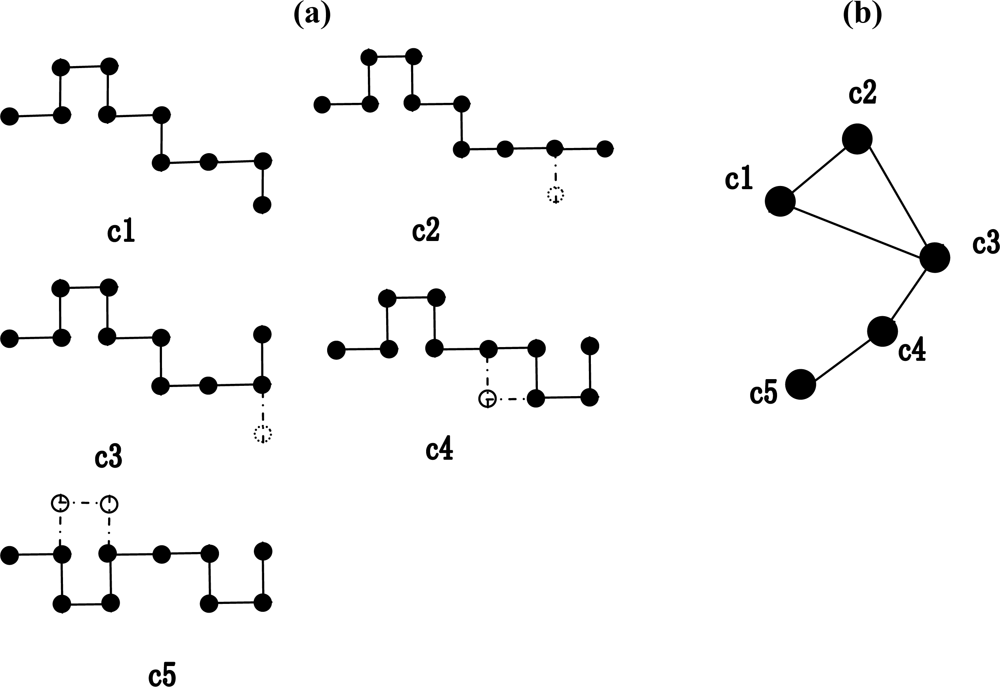
<p>First, the conformation space was mapped onto an unweighted network. All allowed conformations of a chain, which has unique ground-state conformation, were enumerated. Conformation of the chain was evolved by the conventional Monte Carlo elementary moves [<xref ref-type="bibr" rid="b37-ijms-10-01808">37</xref>]: the end rotation, the corner flips and the crankshaft move. As shown in <xref ref-type="fig" rid="f1-ijms-10-01808">Figure 1</xref>(a), the end monomer can be rotated either 90° (conformation <bold>c1</bold> switches to conformation <bold>c2</bold>) or 180° (conformation <bold>c1</bold> switches to conformation <bold>c3</bold>); conformation <bold>c3</bold> can switch to <bold>c4</bold> by single corner flips; and conformation <bold>c4</bold> translates to conformation <bold>c5</bold> by the “crankshaft” move, which can move the two monomers at the same time. All moves must obey the excluded volume criteria: no lattice sites can be doubly occupied. Then, the conformation space can be mapped to an unweighted network. Each conformation of the chain is identified as a vertex of the network. A link is created between two vertices if the two corresponding conformations translate through a single elementary Monte Carlo move. As seen in <xref ref-type="fig" rid="f1-ijms-10-01808">Figure 1</xref>(b), since the conformation <bold>c1</bold> can be switched to the conformation <bold>c2</bold> by a single Monte Carlo move, so there is a link between them. However, the conformation <bold>c2</bold> can not be switched to the conformation <bold>c4</bold> by a single Monte Carlo move, so that there is no link between them.</p>
<p>Second, the energy weight was added to the network. According to the interaction energy of the conformation, the Boltzmann factor of each conformation <italic>exp</italic>[−<italic>E</italic> / <italic>k</italic><sub>B</sub><italic>T</italic>] can be calculated, where <italic>E</italic> and <italic>k</italic><sub>B</sub> are the energy of the conformation and the Boltzmann constant, respectively, and <italic>T</italic> is the absolute temperature. We set <italic>k</italic><sub>B</sub> = 1 and <italic>T</italic> = 1 in this work. The energy weight <italic>W<sub>i</sub></italic> of the vertex <italic>i</italic> in the networks, represents the importance of <italic>i</italic>-th conformation in the conformation space, which can be defined as following: assuming that the vertex <italic>i</italic> connects with vertices <italic>j</italic>, <italic>k</italic>, <italic>h</italic>, the sum of the Boltzmann factors of the vertices <italic>j</italic>, <italic>k</italic>, <italic>h</italic> is treated as the weight of the vertex <italic>i.</italic> Obviously, the numerical value of the weight of the vertex <italic>i</italic> is a real number. Therefore, a vertex with the weight <italic>w</italic> means the numerical value of the vertex’s energy weight falls into the half open interval [<italic>w</italic>-1, <italic>w</italic>).</p>
<p>Finally, we chose HP sequences to construct the weighted CSNs. As to the HP model, the relationship of the conformation–sequence has been studied thoroughly [<xref ref-type="bibr" rid="b38-ijms-10-01808">38</xref>], and the report that the features of protein folding are weakly dependent on the chain length [<xref ref-type="bibr" rid="b39-ijms-10-01808">39</xref>,<xref ref-type="bibr" rid="b40-ijms-10-01808">40</xref>] and the properties of protein folding tested by using 2D lattice model and 3D lattice model are similar [<xref ref-type="bibr" rid="b36-ijms-10-01808">36</xref>,<xref ref-type="bibr" rid="b37-ijms-10-01808">37</xref>] may provide confidence of the validity of using short chain models to study the folding problem. Here we started from a set of 2<sup>13</sup> HP sequences. Through searching the complete conformations of each sequence, a set of 309 sequences with unique lowest-energy state was found from the 2<sup>13</sup> HP sequences. A natural protein sequence has a unique global minimum of free energy which is well separated in energy from other misfolded states. In a lattice HP model, the protein-like folds are associated with sequences that have a minimal number of lowest-energy states [<xref ref-type="bibr" rid="b41-ijms-10-01808">41</xref>,<xref ref-type="bibr" rid="b42-ijms-10-01808">42</xref>]. And the sequences with only one global ground state candidate are good sequences [<xref ref-type="bibr" rid="b43-ijms-10-01808">43</xref>]. The native structures of these sequences have well stability and designability [<xref ref-type="bibr" rid="b19-ijms-10-01808">19</xref>,<xref ref-type="bibr" rid="b43-ijms-10-01808">43</xref>]. We randomly chose three short sequences from these 309 sequences in order to exhibit the scale-free property of the energy-weighted CSNs. The first sequence was (HHPPPHPHPPHPH), and the other two sequences were (HHHHHPHHPPPHP) and (HHHPPPHHPHHHP).</p></sec>
<sec>
<label>2.2.</label>
<title>Folding dynamics and the power-law property of the weighted CSNs</title>
<p>To uncover the relationship between the folding dynamics and the power-law property of the weighted CSN, the set of 309 sequences, as mentioned above, with unique lowest-energy state was applied. Then according to the method of the construction of the complex network above, we constructed 309 weighted complex networks. It is found out that all of these weighted networks show power-law tail properties, thus we can obtain all the scaling exponent <italic>γ</italic> s of the weighted CSNs.</p>
<p>Additionally, a known parameter, Z score (<italic>Z</italic> = Δ/Γ), was introduced in this article. In the <italic>Z</italic> score expression, Δ denotes the average energy difference between the ground state and all the other states and Γ is the standard deviation of the energy spectrum, which can be expressed as follows [<xref ref-type="bibr" rid="b19-ijms-10-01808">19</xref>]:
<disp-formula id="FD1">
<label>(1)</label>
<mml:math display="block">
<mml:mo>Δ</mml:mo>
<mml:mo>=</mml:mo>
<mml:mfrac>
<mml:mn>1</mml:mn>
<mml:mrow>
<mml:msub>
<mml:mi>N</mml:mi>
<mml:mi>C</mml:mi></mml:msub></mml:mrow></mml:mfrac>
<mml:munder>
<mml:mo>∑</mml:mo>
<mml:mrow>
<mml:mi>α</mml:mi>
<mml:mo>&gt;</mml:mo>
<mml:mn>0</mml:mn></mml:mrow></mml:munder>
<mml:mrow>
<mml:mo stretchy="false">(</mml:mo>
<mml:msub>
<mml:mi>E</mml:mi>
<mml:mi>α</mml:mi></mml:msub>
<mml:mo>−</mml:mo>
<mml:msub>
<mml:mi>E</mml:mi>
<mml:mn>0</mml:mn></mml:msub>
<mml:mo stretchy="false">)</mml:mo>
<mml:mo>,</mml:mo></mml:mrow></mml:math></disp-formula>
<disp-formula id="FD2">
<label>(2)</label>
<mml:math display="block">
<mml:msup>
<mml:mo>Γ</mml:mo>
<mml:mn>2</mml:mn></mml:msup>
<mml:mo>=</mml:mo>
<mml:mfrac>
<mml:mn>1</mml:mn>
<mml:mrow>
<mml:msub>
<mml:mi>N</mml:mi>
<mml:mi>C</mml:mi></mml:msub></mml:mrow></mml:mfrac>
<mml:munder>
<mml:mo>∑</mml:mo>
<mml:mrow>
<mml:mi>α</mml:mi>
<mml:mo>&gt;</mml:mo>
<mml:mn>0</mml:mn></mml:mrow></mml:munder>
<mml:mrow>
<mml:msubsup>
<mml:mi>E</mml:mi>
<mml:mi>α</mml:mi>
<mml:mn>2</mml:mn></mml:msubsup>
<mml:mo>−</mml:mo>
<mml:msup>
<mml:mrow>
<mml:mo stretchy="false">(</mml:mo>
<mml:mfrac>
<mml:mn>1</mml:mn>
<mml:mrow>
<mml:msub>
<mml:mi>N</mml:mi>
<mml:mi>C</mml:mi></mml:msub></mml:mrow></mml:mfrac>
<mml:munder>
<mml:mo>∑</mml:mo>
<mml:mrow>
<mml:mo>α</mml:mo>
<mml:mo>&gt;</mml:mo>
<mml:mn>0</mml:mn></mml:mrow></mml:munder>
<mml:mrow>
<mml:msub>
<mml:mi>E</mml:mi>
<mml:mi>α</mml:mi></mml:msub></mml:mrow>
<mml:mo stretchy="false">)</mml:mo></mml:mrow>
<mml:mn>2</mml:mn></mml:msup>
<mml:mo>,</mml:mo></mml:mrow></mml:math></disp-formula>where <italic>E<sub>a</sub></italic> (<italic>α</italic> &gt; 0) represents the energies of the excited conformation, and <italic>E<sub>0</sub></italic> is the lowest state energy, and <italic>N<sub>C</sub></italic> is the number of excited compact conformations. According to the <xref ref-type="disp-formula" rid="FD1">Equations (1)</xref> and <xref ref-type="disp-formula" rid="FD2">(2)</xref>, we can get all values of the Δ/Γ of the conformation spaces generated by the sequences that have unique ground-state. Then the relationship between the exponent scale <italic>γ</italic> and <italic>Z</italic> score can be studied.</p></sec>
<sec>
<label>2.3.</label>
<title>Modularity-detection algorithm</title>
<p>In this article, a multistep greedy algorithm (MSG) in combination with a local refinement procedure named “vertex mover” (VM) [<xref ref-type="bibr" rid="b31-ijms-10-01808">31</xref>,<xref ref-type="bibr" rid="b32-ijms-10-01808">32</xref>] were applied to detect the module structure of the weighted CSNs. The MSG-VM algorithm is an agglomerative hierarchical clustering method and is based on the optimization of the modularity function that is defined as:
<disp-formula id="FD3">
<label>(3)</label>
<mml:math display="block">
<mml:mi>Q</mml:mi>
<mml:mo>=</mml:mo>
<mml:munderover>
<mml:mo>∑</mml:mo>
<mml:mrow>
<mml:mi>i</mml:mi>
<mml:mo>=</mml:mo>
<mml:mn>1</mml:mn></mml:mrow>
<mml:mrow>
<mml:msub>
<mml:mi>N</mml:mi>
<mml:mi>C</mml:mi></mml:msub></mml:mrow></mml:munderover>
<mml:mrow>
<mml:mrow>
<mml:mo>[</mml:mo>
<mml:mrow>
<mml:mfrac>
<mml:mrow>
<mml:mi>I</mml:mi>
<mml:mo stretchy="false">(</mml:mo>
<mml:mi>i</mml:mi>
<mml:mo stretchy="false">)</mml:mo></mml:mrow>
<mml:mi>L</mml:mi></mml:mfrac>
<mml:mo>−</mml:mo>
<mml:msup>
<mml:mrow>
<mml:mo stretchy="false">(</mml:mo>
<mml:mfrac>
<mml:mrow>
<mml:msub>
<mml:mi>d</mml:mi>
<mml:mi>i</mml:mi></mml:msub></mml:mrow>
<mml:mrow>
<mml:mn>2</mml:mn>
<mml:mi>L</mml:mi></mml:mrow></mml:mfrac>
<mml:mo stretchy="false">)</mml:mo></mml:mrow>
<mml:mn>2</mml:mn></mml:msup></mml:mrow>
<mml:mo>]</mml:mo></mml:mrow>
<mml:mo>,</mml:mo></mml:mrow></mml:math></disp-formula>with <italic>I</italic>(<italic>i</italic>) the weights of all edges linking pairs of vertices in community <italic>i</italic>, <italic>d<sub>i</sub></italic> the sum over all degrees of vertices in module <italic>i</italic>, <italic>L</italic> the total weight of all edges, and <italic>N<sub>C</sub></italic> the number of community. At the first step of the algorithm, each vertex in the network is considered as a community. Then the process of the algorithm involves finding the changes in <italic>Q</italic> that would result from the amalgamation of communities, selecting the largest of them. The MSG algorithm is to allow the merging of <italic>l</italic> (<italic>l</italic> &gt; 1) pairs of communities at each iteration step, developing the algorithm that can only merge a pair of communities at each iteration step [<xref ref-type="bibr" rid="b30-ijms-10-01808">30</xref>].</p>
<p>The algorithm works as follows: i. Start with the modularity change matrix Δ<italic>Q</italic>, whose initial value is 
<inline-formula>
<mml:math>
<mml:msub>
<mml:mi>Q</mml:mi>
<mml:mn>0</mml:mn></mml:msub>
<mml:mi> </mml:mi>
<mml:mo>=</mml:mo>
<mml:mi> </mml:mi>
<mml:mo>−</mml:mo>
<mml:munderover>
<mml:mo>∑</mml:mo>
<mml:mrow>
<mml:mi>i</mml:mi>
<mml:mo>=</mml:mo>
<mml:mn>0</mml:mn></mml:mrow>
<mml:mi>N</mml:mi></mml:munderover>
<mml:mrow>
<mml:mfrac>
<mml:mrow>
<mml:msubsup>
<mml:mi>d</mml:mi>
<mml:mi>i</mml:mi>
<mml:mn>2</mml:mn></mml:msubsup></mml:mrow>
<mml:mrow>
<mml:mn>4</mml:mn>
<mml:msup>
<mml:mi>L</mml:mi>
<mml:mn>2</mml:mn></mml:msup></mml:mrow></mml:mfrac></mml:mrow></mml:math></inline-formula> (the means of <italic>d<sub>i</sub></italic> and <italic>L</italic> are the same in the expression (3). N is the number of vertices.); ii. Change the initial values of Δ<italic>Q</italic> according to 
<inline-formula>
<mml:math>
<mml:mo>Δ</mml:mo>
<mml:msub>
<mml:mi>Q</mml:mi>
<mml:mrow>
<mml:mi>i</mml:mi>
<mml:mi>j</mml:mi></mml:mrow></mml:msub>
<mml:mi> </mml:mi>
<mml:mo>=</mml:mo>
<mml:mi> </mml:mi>
<mml:mfrac>
<mml:mi>I</mml:mi>
<mml:mi>L</mml:mi></mml:mfrac>
<mml:mi> </mml:mi>
<mml:mo>−</mml:mo>
<mml:mi> </mml:mi>
<mml:mfrac>
<mml:mrow>
<mml:msub>
<mml:mi>d</mml:mi>
<mml:mi>i</mml:mi></mml:msub>
<mml:msub>
<mml:mi>d</mml:mi>
<mml:mi>j</mml:mi></mml:msub></mml:mrow>
<mml:mrow>
<mml:mn>2</mml:mn>
<mml:msup>
<mml:mi>L</mml:mi>
<mml:mn>2</mml:mn></mml:msup></mml:mrow></mml:mfrac></mml:math></inline-formula> with I the weight of the edges connection the vertices <italic>i</italic> and <italic>j</italic>, <italic>d<sub>x</sub></italic> the degree of vertex <italic>x</italic> = <italic>i</italic>, <italic>j</italic>, and L the total edge weight; iii. Select the elements with among highest <italic>l</italic> values, then join the corresponding communities, and update the matrix Δ<italic>Q<sub>ij</sub></italic>; iv. Repeat the third step until getting the best values of modularity.</p>
<p>In the MSG-VM algorithms, the value of <italic>l</italic> and the weight of each edge of the network should be set. Here, an empirical formula was applied [<xref ref-type="bibr" rid="b32-ijms-10-01808">32</xref>] for the choice of the step width <italic>l</italic>, which can be expressed as follows:
<disp-formula id="FD4">
<label>(4)</label>
<mml:math display="block">
<mml:mi>l</mml:mi>
<mml:mo>=</mml:mo>
<mml:mi>α</mml:mi>
<mml:msqrt>
<mml:mi>L</mml:mi></mml:msqrt>
<mml:mo>,</mml:mo></mml:math></disp-formula>where <italic>L</italic> is the total weight of the edges and <italic>α</italic> = 0.25 [<xref ref-type="bibr" rid="b32-ijms-10-01808">32</xref>]. On the other hand, we defined the weight of the edge in the network as follows: assuming there is an edge <italic>e</italic> between two nodes <italic>n</italic><sub>1</sub> and <italic>n</italic><sub>2</sub>, the product of the Boltzmann factors of the two nodes <italic>n</italic><sub>1</sub> and <italic>n</italic><sub>2</sub> is defined as the weight of edge <italic>e</italic>, which is given by:
<disp-formula id="FD5">
<label>(5)</label>
<mml:math display="block">
<mml:msub>
<mml:mi>W</mml:mi>
<mml:mi>e</mml:mi></mml:msub>
<mml:mo>=</mml:mo>
<mml:mtext>exp</mml:mtext>
<mml:mo stretchy="false">[</mml:mo>
<mml:mo>−</mml:mo>
<mml:mo stretchy="false">(</mml:mo>
<mml:msub>
<mml:mi>E</mml:mi>
<mml:mrow>
<mml:msub>
<mml:mi>n</mml:mi>
<mml:mn>1</mml:mn></mml:msub></mml:mrow></mml:msub>
<mml:mo>+</mml:mo>
<mml:msub>
<mml:mi>E</mml:mi>
<mml:mrow>
<mml:msub>
<mml:mi>n</mml:mi>
<mml:mn>2</mml:mn></mml:msub></mml:mrow></mml:msub>
<mml:mo stretchy="false">)</mml:mo>
<mml:mo>/</mml:mo>
<mml:msub>
<mml:mi>k</mml:mi>
<mml:mi>B</mml:mi></mml:msub>
<mml:mi>T</mml:mi>
<mml:mo stretchy="false">]</mml:mo>
<mml:mo>,</mml:mo></mml:math></disp-formula>where <italic>W<sub>e</sub></italic> is the weight of the edge <italic>e; E</italic><sub><italic>n</italic><sub>1</sub></sub> and <italic>E</italic><sub><italic>n</italic><sub>2</sub></sub> are the energies of the conformations which correspond to nodes n<sub>1</sub> and n<sub>2,</sub> respectively; <italic>k</italic><sub>B</sub> is the Boltzmann constant; <italic>T</italic> is the absolute temperature. We set <italic>k</italic><sub>B</sub> = 1 and <italic>T</italic> = 1 in this work.</p></sec></sec>
<sec sec-type="results|discussion">
<label>3.</label>
<title>Results and Discussion</title>
<sec>
<label>3.1.</label>
<title>The power-law property of the weighted CSN</title>
<p>For a complex network, the widely studied characteristic is the degree. Degree of a vertex is the total number of its connections. This quantity is also called “connectivity”. The degree of a vertex is a local quantity, and the total distribution of vertex degrees often determines some important global characteristics of the network. As to different kinds of networks, the degree distributions follow different forms. The degree distribution of a scale-free network is of a fat-tailed form [<xref ref-type="bibr" rid="b44-ijms-10-01808">44</xref>,<xref ref-type="bibr" rid="b45-ijms-10-01808">45</xref>]. A good approximation of the degree distribution of a random network is a binomial distribution, which can be replaced by Poission distribution for large number of vertices [<xref ref-type="bibr" rid="b4-ijms-10-01808">4</xref>]. In this paper, each vertex in the network was endowed with an energy weight, so the weight is a basic quantity of a vertex, and the weight distribution is an important quality of the weighted network.</p>
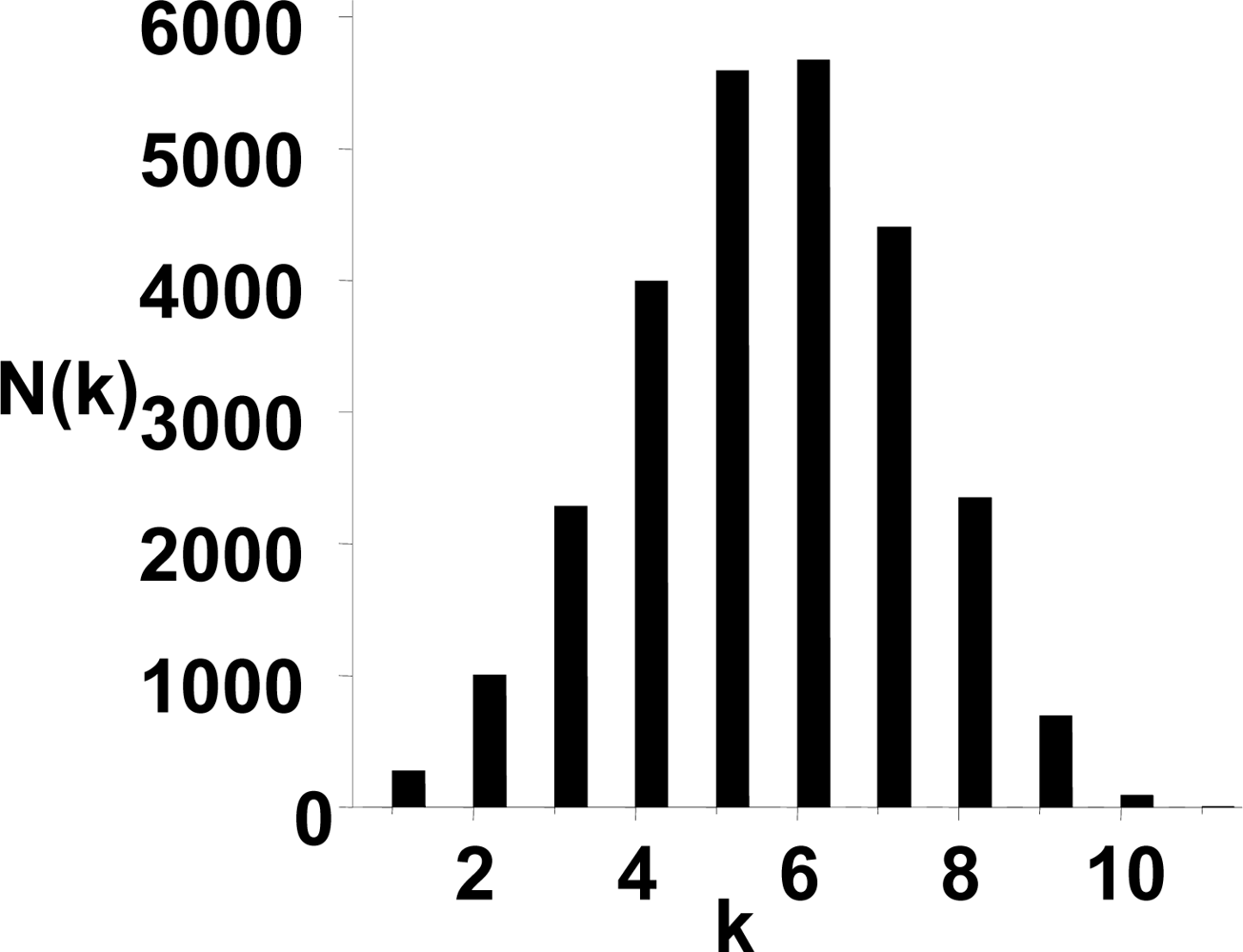
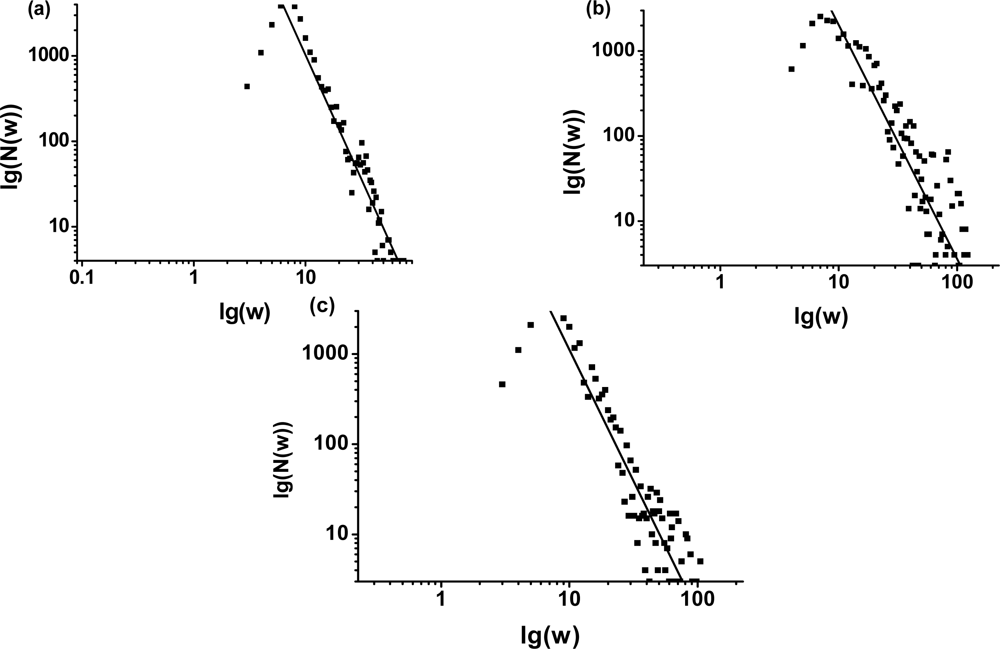
<p><xref ref-type="fig" rid="f2-ijms-10-01808">Figure 2</xref> shows the connectivity distribution of the unweighted CSN. Obviously, the connectivity distribution agrees well with the Poission distribution, thus the topology of the unweighted network is relatively homogeneous, with most of nodes having approximately the same number of the edges. The result is consistent with the previous work [<xref ref-type="bibr" rid="b15-ijms-10-01808">15</xref>]. In <xref ref-type="fig" rid="f3-ijms-10-01808">Figures 3</xref>(a)–(c), it is found that the weight distributions of the CSNs show a well defined fat-tail property. The continuous lines correspond the straight-line fit ~ <italic>w</italic> <sup>−</sup><italic><sup>γ</sup></italic> on the tail of the weight distribution, where <italic>w</italic> is the energy weight of the vertex, and <italic>γ</italic> is the scaling exponent. Furthermore, we also investigated the small-world property of the weighted CSNs.</p>
<p>Using the edge weight defined as (5), we firstly calculated the average shortest distance <italic>l<sub>w</sub></italic> of the weighted CSN and compared it with that of random network <italic>l<sub>random</sub></italic> ~ ln(<italic>n</italic>)/ln(〈<italic>k</italic>〉) [<xref ref-type="bibr" rid="b4-ijms-10-01808">4</xref>], where 〈<italic>k</italic>〉 is average degree of the CSN, and <italic>n</italic> is the number of the nodes in the CSN. Then we randomly chose 10 weighted CSNs from the whole 309 weighted CSNs as the case study. The results shows that the <italic>l<sub>w</sub></italic> of these weighted CSNs are all around 60 (data not shown), which is similar with the previous work [<xref ref-type="bibr" rid="b15-ijms-10-01808">15</xref>]. The results also indicate that the <italic>l<sub>w</sub></italic> of the weighted CSNs is larger than <italic>l<sub>random</sub></italic> and is of the same magnitude of the <italic>l<sub>random</sub></italic>. In our model, we observed <italic>l<sub>random</sub></italic> ≈ 10. Secondly, we estimated the clustering coefficient <italic>C<sub>w</sub></italic> of the weighted CSNs, obtaining that 
<inline-formula>
<mml:math>
<mml:mfrac>
<mml:mrow>
<mml:msub>
<mml:mi>C</mml:mi>
<mml:mi>w</mml:mi></mml:msub></mml:mrow>
<mml:mrow>
<mml:msub>
<mml:mi>C</mml:mi>
<mml:mrow>
<mml:mtext mathvariant="italic">random</mml:mtext></mml:mrow></mml:msub></mml:mrow></mml:mfrac></mml:math></inline-formula>: 10<sup>2</sup>, where <italic>C<sub>random</sub></italic> ≈ 〈<italic>k</italic>〉/<italic>n</italic> is the clustering coefficient of random network. This result indicates that <italic>C<sub>w</sub></italic> is much larger than <italic>C<sub>random</sub></italic>. In summary, the above results suggest that the weighted CSNs have scale-free and small-world properties [<xref ref-type="bibr" rid="b2-ijms-10-01808">2</xref>].</p>
<p>The result indicates that the energy weight is a key factor for the appearance of the power-law property of the CSN. To understand the meaning of the energy weight, we should consider the connectivity of the conformations and more details about the lattice model. It is well known that the lattice model is a simplified model of a polymer. In the lattice model, polymers including proteins can be treated as linear strings of beads, and the details of the structures are not accurately represented. This simplified approximation is based on the following hypothesis: when the real chain conformations are under good solvent conditions or in “theta”[<xref ref-type="bibr" rid="b46-ijms-10-01808">46</xref>] (where conformations are highly expanded), the structural details such as side chain are subsumed under the property of chain stiffness [<xref ref-type="bibr" rid="b47-ijms-10-01808">47</xref>], in other words, some of the degrees of freedom of the structures are “frozen”, but an actual polymer chain is flexible in the three-dimension Euclidean space. For a given stable conformation, due to the influence of the structure details such as the side chain, there are small conformational fluctuations around the stable conformation [<xref ref-type="bibr" rid="b47-ijms-10-01808">47</xref>–<xref ref-type="bibr" rid="b51-ijms-10-01808">51</xref>]. As to the lattice model, it means that for a given lattice conformation, there are many tiny difference conformations fluctuating around this conformation. In other words, there is an ensemble of subconformations belonging to the given lattice conformation. Further, the Boltzmann factor of a conformation incarnates the relative quantity of the subconformations of the ensemble [<xref ref-type="bibr" rid="b16-ijms-10-01808">16</xref>,<xref ref-type="bibr" rid="b52-ijms-10-01808">52</xref>]. On the other hand, the properties of some dynamical processes, such as protein folding, are determined not by the spectrum but also by the connectivity of the conformations [<xref ref-type="bibr" rid="b53-ijms-10-01808">53</xref>]. If the energy barrier between the two conformations is too high, then we can say that the two conformations are not “dynamically connected” [<xref ref-type="bibr" rid="b8-ijms-10-01808">8</xref>]. If a conformation is not dynamically connected to other low energy structures, then it would be kinetically inaccessible in spite of its low energy [<xref ref-type="bibr" rid="b8-ijms-10-01808">8</xref>,<xref ref-type="bibr" rid="b54-ijms-10-01808">54</xref>]. Therefore, assuming that the vertex <italic>i</italic> connects with vertices <italic>j</italic>, <italic>k</italic>, <italic>h</italic>, the weight of vertex <italic>i</italic>, as mentioned above, may reflects the number of all possible potential dynamically connected subconformations connecting to the conformation that corresponds to the vertex <italic>i</italic>. In other words, the weight of a node in the CSN represents the number of possible potential links connecting the node, implying the importance of the node in the CSN.</p>
<p>When the interaction energy of the monomers in the chain is not taken into account, all conformations are of the same free energy, i.e. unit free energy. It means that each conformation has the same weight in the conformation space. Therefore, the topology of the CSN is simply determined by the connectivity of the conformations. In this case, the degree distribution of the network is binomial distribution and significantly deviates from the power-law form, as shown in <xref ref-type="fig" rid="f2-ijms-10-01808">Figure 2</xref>. In terms of the free energy landscape, the free energy surface is flat [<xref ref-type="bibr" rid="b5-ijms-10-01808">5</xref>] and the power-low property disappears.</p>
<p>The power-law distribution indicates that there are a few “hubs” which have large connectivity and a mass of vertices with a relatively small number of links in the network [<xref ref-type="bibr" rid="b3-ijms-10-01808">3</xref>]. In the weighted network of conformation space, the power-law property indicates that a few conformations play the role as “hubs” in the dynamic process of complex systems, such as protein folding. The large weight of a conformation shows that this conformation has relatively more connections and the energies of its connective conformations are low. According to the definition of the energy weight, the large weight of a conformation implies that there are abundant possible routes to access it.</p></sec>
<sec>
<label>3.2.</label>
<title>The scaling exponent γ s versus the ratio Δ/Γ</title>
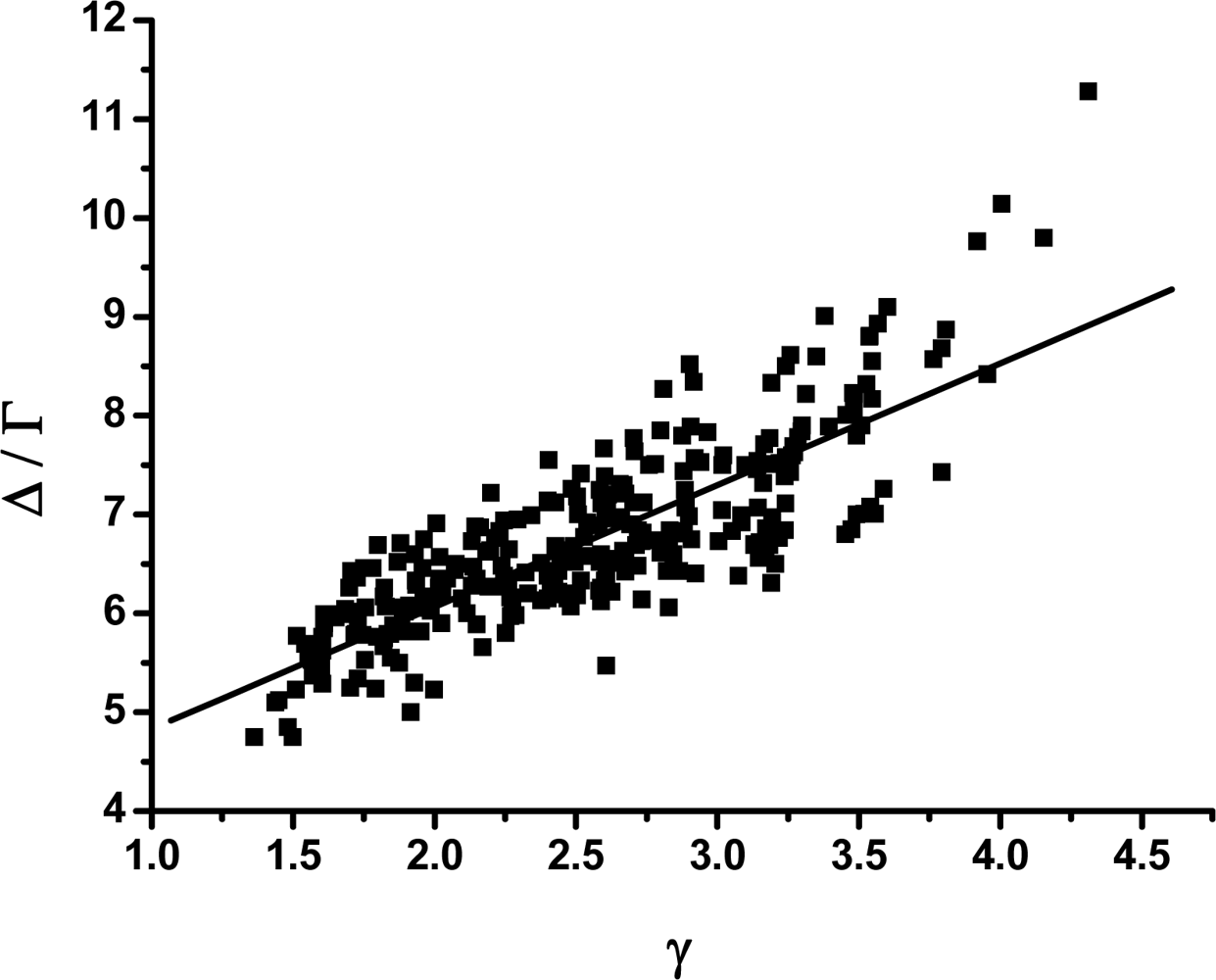
<p><xref ref-type="fig" rid="f4-ijms-10-01808">Figure 4</xref> shows the relation between <italic>γ</italic> and Δ/Γ, in which there is high correlation between <italic>γ</italic> and Δ/Γ. It has been reported that <italic>Z</italic> score correlates significantly with the folding rates [<xref ref-type="bibr" rid="b55-ijms-10-01808">55</xref>,<xref ref-type="bibr" rid="b56-ijms-10-01808">56</xref>] and the sequences with a large ratio Δ/Γ fold fast [<xref ref-type="bibr" rid="b19-ijms-10-01808">19</xref>,<xref ref-type="bibr" rid="b57-ijms-10-01808">57</xref>,<xref ref-type="bibr" rid="b58-ijms-10-01808">58</xref>]. Therefore, the large value of <italic>γ</italic> implies the fast folding.</p>
<p>This result can be understood by the free-energy landscape view. According to the mathematical knowledge of the power-law function [<xref ref-type="bibr" rid="b59-ijms-10-01808">59</xref>], the larger scaling exponent indicates that the value of the function decays to zero more quickly for the relatively large independent variable. For example, for the power-law function <italic>f</italic> (<italic>x</italic>) = <italic>x</italic> <sup>−</sup><italic><sup>β</sup></italic> (<italic>β</italic> &gt; 0), the larger value of <italic>β</italic> indicates that the value of <italic>f</italic> (<italic>x</italic>) inclines to zero more quickly when <italic>x</italic> → +∞. This property can be applied to analyze to the weight distribution of the weighted CSN. As expressed above, the weight distribution of the weighted CSN is a function, which gives the possibility that a randomly selected node has a definite weight. This function is of power-law property and <italic>γ</italic> is its scaling exponent. So, the larger scaling exponent <italic>γ</italic> indicates the less possibility finding the nodes with large weight. In other words, for the larger <italic>γ</italic>, there is relatively less number of nodes which have large weight. On the other hand, according to the physical meaning of the weight of the nodes, the large weight of a node means that this node has dense connections around it. Therefore, a lesser number of nodes with large weight in the network signify there are fewer crowded groups in the network. In terms of free-energy landscape, this scenario implies that the free-energy surface has a small number of deep valleys and high barriers between them [<xref ref-type="bibr" rid="b5-ijms-10-01808">5</xref>,<xref ref-type="bibr" rid="b13-ijms-10-01808">13</xref>]. So, the larger <italic>γ</italic> indicates that the free-energy landscape is smoother [<xref ref-type="bibr" rid="b8-ijms-10-01808">8</xref>].</p>
<p>It has been shown [<xref ref-type="bibr" rid="b19-ijms-10-01808">19</xref>,<xref ref-type="bibr" rid="b24-ijms-10-01808">24</xref>] that the ratio Δ/Γ can be used to measure how much a sequence is “protein-like”, in other words, it is a good criteria for the thermodynamic stability or the stability of against mutation of the sequences. Simultaneously, the similar perspective has been reflected recently in the research of biomolecular binding [<xref ref-type="bibr" rid="b60-ijms-10-01808">60</xref>] and cellular networks [<xref ref-type="bibr" rid="b61-ijms-10-01808">61</xref>,<xref ref-type="bibr" rid="b62-ijms-10-01808">62</xref>] in which the ratio of the energy gap versus roughness of the underlying energy landscape, which in essential is equivalent to the ratio Δ/Γ, has been recognized as an optimization criteria for the specificity of binding in binding energy landscape or the global thermodynamic stability (or robustness) of the network. The relationship between Δ/Γ and <italic>γ</italic> shown in <xref ref-type="fig" rid="f4-ijms-10-01808">Figure (4)</xref> suggests that the scaling exponent of the power-law of the networks should be considered carefully as a valuable topological parameter for the thermodynamic stability (or the robustness) of the CSN, which potentially may be good news for the design of artificial networks.</p>
<p>This result is also helpful for protein design, whose goal is to identify amino acid sequences that can fold well and lead to a given structure [<xref ref-type="bibr" rid="b63-ijms-10-01808">63</xref>,<xref ref-type="bibr" rid="b64-ijms-10-01808">64</xref>]. It has been shown [<xref ref-type="bibr" rid="b65-ijms-10-01808">65</xref>,<xref ref-type="bibr" rid="b66-ijms-10-01808">66</xref>] that for the <italic>Z</italic> score, which was always defined to have negative value in those papers, minimization is equivalent to maximizing the energy gap between mis-folded or unfolded conformations and the native state of the proteins, and such maximization results in stable and fast-folding proteins. Optimization of the <italic>Z</italic> score thus provides a quantitative method for the problem of protein design and has been widely applied [<xref ref-type="bibr" rid="b52-ijms-10-01808">52</xref>,<xref ref-type="bibr" rid="b67-ijms-10-01808">67</xref>,<xref ref-type="bibr" rid="b68-ijms-10-01808">68</xref>]. Therefore, considering the result shown in <xref ref-type="fig" rid="f4-ijms-10-01808">Figure (4)</xref>, the scaling exponent <italic>γ</italic> may provide an alternative optimization criterion for designing protein-like sequences.</p></sec>
<sec>
<label>3.3.</label>
<title>The modularity of the weighted CSNs</title>
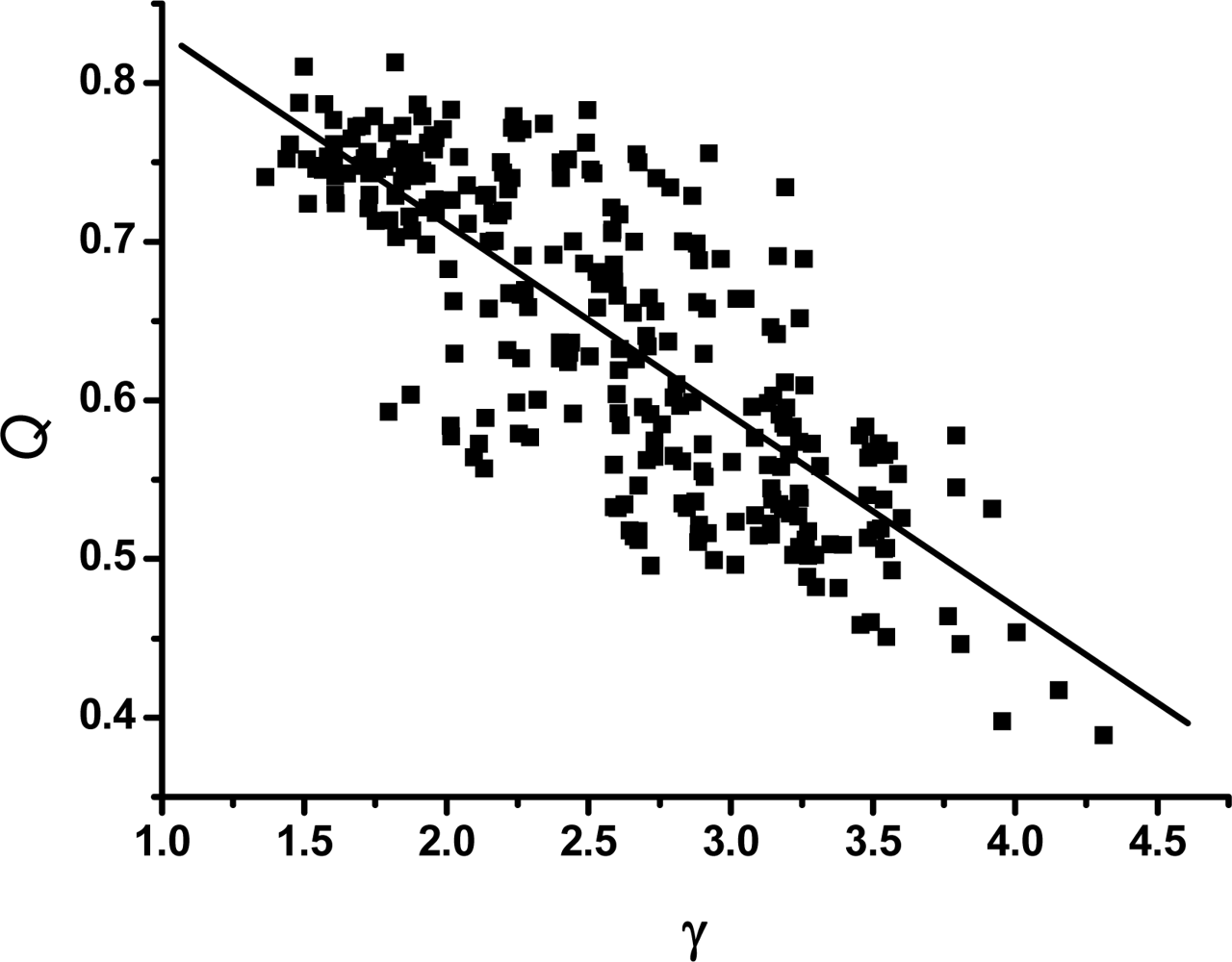
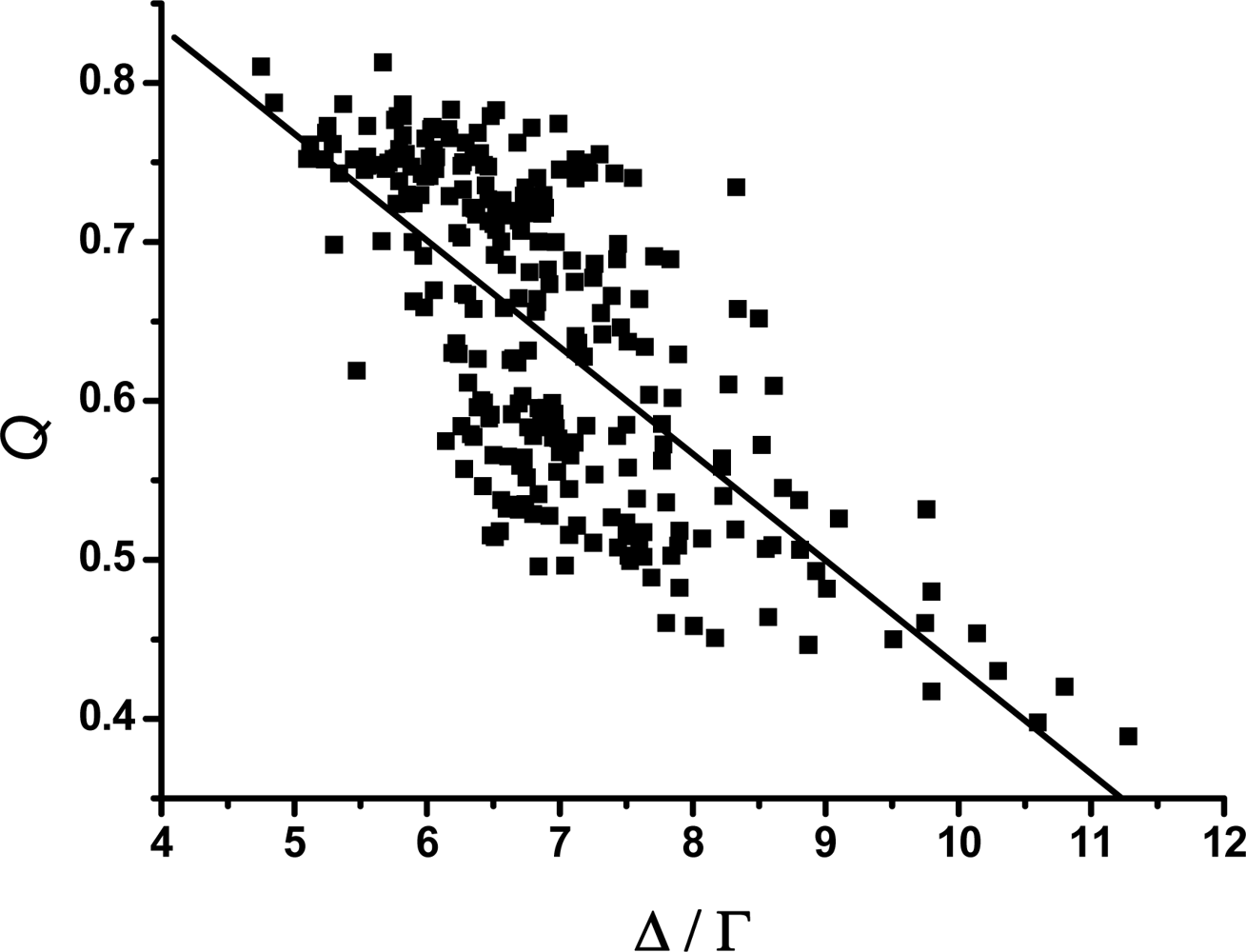
<p><xref ref-type="fig" rid="f5-ijms-10-01808">Figures 5</xref> and <xref ref-type="fig" rid="f6-ijms-10-01808">6</xref> show the relationship between the scaling exponent <italic>γ</italic> s and the modularity <italic>Qs</italic> and the relationship between the ratio Δ/Γ and the modularity <italic>Q</italic>s, respectively. The values of modularity <italic>Q</italic>s are obtained by the MSG-VM algorithm [<xref ref-type="bibr" rid="b31-ijms-10-01808">31</xref>,<xref ref-type="bibr" rid="b32-ijms-10-01808">32</xref>], and the parameters which are needed in the algorithm can be calculated through the <xref ref-type="disp-formula" rid="FD4">Equations (4)</xref> and <xref ref-type="disp-formula" rid="FD5">(5)</xref>. It can be found from both <xref ref-type="fig" rid="f5-ijms-10-01808">Figure 5</xref> and <xref ref-type="fig" rid="f6-ijms-10-01808">Figure 6</xref> that <italic>Q</italic> is more than 0.4 for most weighted CSNs. In addition, as shown in <xref ref-type="fig" rid="f5-ijms-10-01808">Figure 5</xref>, the <italic>γ</italic> s and the <italic>Q</italic>s correlate well with a linear inverse relationship on average. A similar relationship between the ratio Δ/Γ and the modularity <italic>Q</italic>s can be found in <xref ref-type="fig" rid="f6-ijms-10-01808">Figure 6</xref>.</p>
<p>The value of <italic>Q</italic> will be zero for the randomized network [<xref ref-type="bibr" rid="b30-ijms-10-01808">30</xref>]. Nonzero values represent deviations from randomness, and in practice it is found that a value of <italic>Q</italic> above 0.3 is a good criterion for a distinct modularity structure [<xref ref-type="bibr" rid="b30-ijms-10-01808">30</xref>]. Therefore, the result that most values of <italic>Q</italic>s are more than 0.4 implies that the majority of the weighted CSNs have significant community structures. This indicates the overall topology of the CSN is heterogeneous [<xref ref-type="bibr" rid="b69-ijms-10-01808">69</xref>] with subsets of vertices within which vertex-vertex connections are dense, but there are only scant connections between the subsets.</p>
<p>The inverse proportion relationships shown in <xref ref-type="fig" rid="f5-ijms-10-01808">Figures 5</xref> and <xref ref-type="fig" rid="f6-ijms-10-01808">6</xref> may have some interesting implications concerning the modularity mechanism [<xref ref-type="bibr" rid="b70-ijms-10-01808">70</xref>] and the topology of the CSNs. In some biological networks, the modularity structure seems to increase the stability, robustness, and flexibility [<xref ref-type="bibr" rid="b33-ijms-10-01808">33</xref>,<xref ref-type="bibr" rid="b71-ijms-10-01808">71</xref>] of the networks, and recent theory suggests that modularity can be enhanced when the environmental changes over time [<xref ref-type="bibr" rid="b72-ijms-10-01808">72</xref>]. From <xref ref-type="fig" rid="f6-ijms-10-01808">Figure 6</xref>, we can find that the larger value of <italic>Q</italic> on average corresponds to the relative smaller value of Δ/Γ. In other words, the sequences that fold relatively fast appear to avoid forming significant community structures in the conformation space generated by the folding process. When addressed in terms of the free energy landscape, the scenario may be more easily understood. In the view of free energy landscape, the behavior of protein folding can be described by a free energy landscape that looks like a funnel [<xref ref-type="bibr" rid="b8-ijms-10-01808">8</xref>,<xref ref-type="bibr" rid="b9-ijms-10-01808">9</xref>], where there are many different depth minima and various height barriers among them on the coarse surface [<xref ref-type="bibr" rid="b8-ijms-10-01808">8</xref>]. In this language, the surface of the energy landscape can be divided into many basin areas, with the deeper minima having large basins of attraction [<xref ref-type="bibr" rid="b5-ijms-10-01808">5</xref>,<xref ref-type="bibr" rid="b73-ijms-10-01808">73</xref>,<xref ref-type="bibr" rid="b74-ijms-10-01808">74</xref>]. Inside a basin and among the basins between which the height of the barriers is small, there are many dynamical accessible routes among the conformations [<xref ref-type="bibr" rid="b8-ijms-10-01808">8</xref>]. On contrast, if the barriers between the minima are large, there are a small number of pathways among them. This scene reveals the original source of the modularity structure in the weighted CSNs. Moreover, under the evolution pressure, the sequences of protein are selected to have relatively smooth energy landscape on which there are a small quantity of deep minima and high barriers in order to fold quickly [<xref ref-type="bibr" rid="b8-ijms-10-01808">8</xref>,<xref ref-type="bibr" rid="b57-ijms-10-01808">57</xref>], in other words, the sequences which fold relatively rapidly avoid to form conspicuous modularity structures in the weighted CSNs.</p>
<p>To obtain the values of the modularity <italic>Q</italic> in the article, we should calculate the weight of the edges in the network, which describes in some sense how the nodes closely connected. We defined the weight of edges according to expression (5). A possible explanation can help us to understand the meaning of the weight of the edges. As pointed out above, the Boltzmann factor of a lattice conformation depicts the relative quantity of the group of the subconformations around the conformation. When two conformations connect in the CSN, it means there are two potential groups connected to each other and the weight of an edge linking two nodes represents the quantity of the possible accessible routes between the corresponding two groups of the subconformations. The larger value of the product of the Boltzmann factor of the two nodes connected by an edge means the more potential accessible routes between them, thus may carefully consider that these two nodes more closely connected.</p>
<p>Finally, several tasks remain to be done in the future. First of all, one may consider the conformation space generated by a three-dimensional (3D) lattice chain and a more reasonable weighting method. In addition, more details about relationship between the topology of the CSN and protein dynamics could be studied to obtain more profound insights into the protein dynamics and the topology of the CSN. Besides, the farther modular analysis of CSN will help us to comprehend expressly the rugged energy landscape. For example, through modular analysis, one may find out more information about the micro-structure on the surface of the energy landscape, such as “local minima” [<xref ref-type="bibr" rid="b69-ijms-10-01808">69</xref>]. Finally, one may also consider the rate of transition [<xref ref-type="bibr" rid="b75-ijms-10-01808">75</xref>] between the conformations as the weight of edge and the directed network [<xref ref-type="bibr" rid="b1-ijms-10-01808">1</xref>] in the modularity analysis in the future.</p></sec></sec>
<sec sec-type="conclusions">
<label>4.</label>
<title>Conclusions</title>
<p>Complex network theory was applied to analyze the topological properties of the conformation spaces generated by short two-dimensional HP lattice chains and the underlying free-energy landscape. Scaling behavior is observed in the CSN topology when the weight based on interaction energy of monomers inside the sequences is considered. This result uncovers the importance of the monomer interaction in forming the topology of the CSNs, thus may provide an optional comprehension about the origin of the scale-free property of the CSNs. Moreover, the significant correlation between the scaling exponent <italic>γ</italic> s of the weighted CSNs and the <italic>Z</italic> score, which is often used to measure the thermodynamic stability and kinetic of the sequences, indicates that the global topology of the weighted CSNs has profound connection with the folding dynamic behavior. Finally, the modular structures [<xref ref-type="bibr" rid="b22-ijms-10-01808">22</xref>] of the weighted CSNs are also investigated. We find that the sequences that fold relatively faster have a relatively smaller value of the <italic>Q</italic>, which is always applied to quantificationally describe the modular structure of the complex network. A possible physical explain underlying the theory of the energy landscape is also given to discuss this phenomenon.</p></sec></body>
<back>
<ack>
<p>This work was supported in part by National Nature Science Foundation of China (Grant Nos. 20773006 and 30670497) and Specialized Research Fund for the Doctoral Program of Higher Education (No. 200800050003).</p></ack>
<ref-list>
<title>References and Notes</title>
<ref id="b1-ijms-10-01808"><label>1.</label><citation citation-type="journal"><person-group person-group-type="author"><name><surname>Dorogovtsev</surname><given-names>SN</given-names></name><name><surname>Mendes</surname><given-names>JFF</given-names></name></person-group><article-title>Evolution of networks</article-title><source>Adv. Phys</source><year>2002</year><volume>51</volume><fpage>1079</fpage><lpage>1187</lpage><pub-id pub-id-type="doi">10.1080/00018730110112519</pub-id></citation></ref>
<ref id="b2-ijms-10-01808"><label>2.</label><citation citation-type="journal"><person-group person-group-type="author"><name><surname>Watts</surname><given-names>DJ</given-names></name><name><surname>Strogatz</surname><given-names>SH</given-names></name></person-group><article-title>Collective dynamics of ’small-world’ networks</article-title><source>Nature</source><year>1998</year><volume>393</volume><fpage>440</fpage><lpage>442</lpage><pub-id pub-id-type="doi">10.1038/30918</pub-id><pub-id pub-id-type="pmid">9623998</pub-id></citation></ref>
<ref id="b3-ijms-10-01808"><label>3.</label><citation citation-type="journal"><person-group person-group-type="author"><name><surname>Barabasi</surname><given-names>AL</given-names></name><name><surname>Albert</surname><given-names>R</given-names></name></person-group><article-title>Emergence of scaling in random networks</article-title><source>Science</source><year>1999</year><volume>286</volume><fpage>509</fpage><lpage>512</lpage><pub-id pub-id-type="doi">10.1126/science.286.5439.509</pub-id><pub-id pub-id-type="pmid">10521342</pub-id></citation></ref>
<ref id="b4-ijms-10-01808"><label>4.</label><citation citation-type="journal"><person-group person-group-type="author"><name><surname>Albert</surname><given-names>R</given-names></name><name><surname>Barabasi</surname><given-names>AL</given-names></name></person-group><article-title>Statistical mechanics of complex networks</article-title><source>Rev. Mod. Phys</source><year>2002</year><volume>74</volume><fpage>47</fpage><lpage>94</lpage><pub-id pub-id-type="doi">10.1103/RevModPhys.74.47</pub-id></citation></ref>
<ref id="b5-ijms-10-01808"><label>5.</label><citation citation-type="journal"><person-group person-group-type="author"><name><surname>Doye</surname><given-names>JPK</given-names></name></person-group><article-title>The network topology of a potential energy landscape: A static scale-free network</article-title><source>Phys. Rev. Lett</source><year>2002</year><volume>88</volume><fpage>238701</fpage><lpage>238704</lpage><pub-id pub-id-type="doi">10.1103/PhysRevLett.88.238701</pub-id><pub-id pub-id-type="pmid">12059405</pub-id></citation></ref>
<ref id="b6-ijms-10-01808"><label>6.</label><citation citation-type="journal"><person-group person-group-type="author"><name><surname>Rao</surname><given-names>F</given-names></name><name><surname>Caflisch</surname><given-names>A</given-names></name></person-group><article-title>The protein folding network</article-title><source>J Mol Biol</source><year>2004</year><volume>342</volume><fpage>299</fpage><lpage>306</lpage><pub-id pub-id-type="doi">10.1016/j.jmb.2004.06.063</pub-id><pub-id pub-id-type="pmid">15313625</pub-id></citation></ref>
<ref id="b7-ijms-10-01808"><label>7.</label><citation citation-type="journal"><person-group person-group-type="author"><name><surname>Garlaschelli</surname><given-names>D</given-names></name><name><surname>Capocci</surname><given-names>A</given-names></name><name><surname>Caldarelli</surname><given-names>G</given-names></name></person-group><article-title>Self-organized network evolution coupled to extremal dynamics</article-title><source>Nature Phys</source><year>2007</year><volume>3</volume><fpage>813</fpage><lpage>817</lpage><pub-id pub-id-type="doi">10.1038/nphys729</pub-id></citation></ref>
<ref id="b8-ijms-10-01808"><label>8.</label><citation citation-type="journal"><person-group person-group-type="author"><name><surname>Bryngelson</surname><given-names>JD</given-names></name><name><surname>Onuchic</surname><given-names>JN</given-names></name><name><surname>Socci</surname><given-names>ND</given-names></name><name><surname>Wolynes</surname><given-names>PG</given-names></name></person-group><article-title>Funnels, pathways, and the energy landscape of protein folding: A synthesis</article-title><source>Proteins</source><year>1995</year><volume>21</volume><fpage>167</fpage><lpage>195</lpage><pub-id pub-id-type="doi">10.1002/prot.340210302</pub-id><pub-id pub-id-type="pmid">7784423</pub-id></citation></ref>
<ref id="b9-ijms-10-01808"><label>9.</label><citation citation-type="journal"><person-group person-group-type="author"><name><surname>Chahine</surname><given-names>J</given-names></name><name><surname>Nymeyer</surname><given-names>H</given-names></name><name><surname>Leite</surname><given-names>VBP</given-names></name><name><surname>Socci</surname><given-names>ND</given-names></name><name><surname>Onuchic</surname><given-names>JN</given-names></name></person-group><article-title>Specific and nonspecific collapse in protein folding funnels</article-title><source>Phys. Rev. Lett</source><year>2002</year><volume>88</volume><fpage>168101</fpage><pub-id pub-id-type="doi">10.1103/PhysRevLett.88.168101</pub-id><pub-id pub-id-type="pmid">11955268</pub-id></citation></ref>
<ref id="b10-ijms-10-01808"><label>10.</label><citation citation-type="journal"><person-group person-group-type="author"><name><surname>Stillinger</surname><given-names>FH</given-names></name></person-group><article-title>A topographic view of supercooled liquids and glass formation</article-title><source>Science</source><year>1995</year><volume>267</volume><fpage>1935</fpage><lpage>1939</lpage><pub-id pub-id-type="doi">10.1126/science.267.5206.1935</pub-id><pub-id pub-id-type="pmid">17770102</pub-id></citation></ref>
<ref id="b11-ijms-10-01808"><label>11.</label><citation citation-type="journal"><person-group person-group-type="author"><name><surname>Frauenfelder</surname><given-names>H</given-names></name><name><surname>Sligar</surname><given-names>SG</given-names></name><name><surname>Wolynes</surname><given-names>PG</given-names></name></person-group><article-title>The energy landscapes and motions of proteins</article-title><source>Science</source><year>1991</year><volume>254</volume><fpage>1598</fpage><lpage>1603</lpage><pub-id pub-id-type="doi">10.1126/science.1749933</pub-id><pub-id pub-id-type="pmid">1749933</pub-id></citation></ref>
<ref id="b12-ijms-10-01808"><label>12.</label><citation citation-type="journal"><person-group person-group-type="author"><name><surname>Doye</surname><given-names>JPK</given-names></name><name><surname>Massen</surname><given-names>CP</given-names></name></person-group><article-title>Characterizing the network topology of the energy landscapes of atomic clusters</article-title><source>J. Chem. Phys</source><year>2005</year><volume>122</volume><fpage>084105</fpage><pub-id pub-id-type="doi">10.1063/1.1850468</pub-id></citation></ref>
<ref id="b13-ijms-10-01808"><label>13.</label><citation citation-type="journal"><person-group person-group-type="author"><name><surname>Krivov</surname><given-names>SV</given-names></name><name><surname>Karplus</surname><given-names>M</given-names></name></person-group><article-title>Free energy disconnectivity graphs: Application to peptide models</article-title><source>J. Chem. Phys</source><year>2002</year><volume>117</volume><fpage>10894</fpage><pub-id pub-id-type="doi">10.1063/1.1517606</pub-id></citation></ref>
<ref id="b14-ijms-10-01808"><label>14.</label><citation citation-type="journal"><person-group person-group-type="author"><name><surname>Krivov</surname><given-names>SV</given-names></name><name><surname>Karplus</surname><given-names>M</given-names></name></person-group><article-title>Hidden complexity of free energy surfaces for peptide (protein) folding</article-title><source>Proc. Natl. Acad. Sci. USA</source><year>2004</year><volume>101</volume><fpage>14766</fpage><lpage>14770</lpage><pub-id pub-id-type="doi">10.1073/pnas.0406234101</pub-id><pub-id pub-id-type="pmid">15466711</pub-id></citation></ref>
<ref id="b15-ijms-10-01808"><label>15.</label><citation citation-type="journal"><person-group person-group-type="author"><name><surname>Scala</surname><given-names>A</given-names></name><name><surname>Amaral</surname><given-names>LAN</given-names></name><name><surname>Barthélémy</surname><given-names>M</given-names></name></person-group><article-title>Small-world networks and the conformation space of a lattice polymer chain</article-title><source>Europhys. Lett</source><year>2001</year><volume>55</volume><fpage>594</fpage><lpage>600</lpage><pub-id pub-id-type="doi">10.1209/epl/i2001-00457-7</pub-id></citation></ref>
<ref id="b16-ijms-10-01808"><label>16.</label><citation citation-type="journal"><person-group person-group-type="author"><name><surname>Gfeller</surname><given-names>D</given-names></name><name><surname>de Los Rios</surname><given-names>P</given-names></name><name><surname>Caflish</surname><given-names>A</given-names></name><name><surname>Rao</surname><given-names>F</given-names></name></person-group><article-title>complex network analysis of free-energy landscapes</article-title><source>Proc. Natl. Acad. Sci. USA</source><year>2007</year><volume>104</volume><fpage>1817</fpage><lpage>1822</lpage><pub-id pub-id-type="doi">10.1073/pnas.0608099104</pub-id><pub-id pub-id-type="pmid">17267610</pub-id></citation></ref>
<ref id="b17-ijms-10-01808"><label>17.</label><citation citation-type="journal"><person-group person-group-type="author"><name><surname>Gfeller</surname><given-names>D</given-names></name><name><surname>de Lachapelle</surname><given-names>DM</given-names></name><name><surname>de Los Rios</surname><given-names>P</given-names></name><name><surname>Caldarelli</surname><given-names>G</given-names></name><name><surname>Rao</surname><given-names>F</given-names></name></person-group><article-title>Uncovering the topology of configuration space networks</article-title><source>Phys. Rev. E</source><year>2007</year><volume>76</volume><fpage>026113</fpage><pub-id pub-id-type="doi">10.1103/PhysRevE.76.026113</pub-id></citation></ref>
<ref id="b18-ijms-10-01808"><label>18.</label><citation citation-type="journal"><person-group person-group-type="author"><name><surname>Dima</surname><given-names>RI</given-names></name><name><surname>Banavar</surname><given-names>JR</given-names></name><name><surname>Cieplak</surname><given-names>M</given-names></name><name><surname>Maritan</surname><given-names>A</given-names></name></person-group><article-title>Statistical mechanics of protein-like heteropolymers</article-title><source>Proc. Natl. Acad. Sci. USA</source><year>1999</year><volume>96</volume><fpage>4904</fpage><lpage>4907</lpage><pub-id pub-id-type="doi">10.1073/pnas.96.9.4904</pub-id><pub-id pub-id-type="pmid">10220391</pub-id></citation></ref>
<ref id="b19-ijms-10-01808"><label>19.</label><citation citation-type="journal"><person-group person-group-type="author"><name><surname>Melin</surname><given-names>R</given-names></name><name><surname>Li</surname><given-names>H</given-names></name><name><surname>Wingreen</surname><given-names>NS</given-names></name><name><surname>Tang</surname><given-names>C</given-names></name></person-group><article-title>Designability, thermodynamic stability, and dynamics in protein folding: A lattice model study</article-title><source>J Chem Phys</source><year>1999</year><volume>110</volume><fpage>1252</fpage><lpage>1262</lpage><pub-id pub-id-type="doi">10.1063/1.478168</pub-id></citation></ref>
<ref id="b20-ijms-10-01808"><label>20.</label><citation citation-type="journal"><person-group person-group-type="author"><name><surname>Kubelka</surname><given-names>J</given-names></name><name><surname>Hofrichter</surname><given-names>J</given-names></name><name><surname>Eaton</surname><given-names>WA</given-names></name></person-group><article-title>The protein folding ‘speed limit’</article-title><source>Curr. Opin. Struct. Biol</source><year>2004</year><volume>14</volume><fpage>76</fpage><lpage>88</lpage><pub-id pub-id-type="doi">10.1016/j.sbi.2004.01.013</pub-id><pub-id pub-id-type="pmid">15102453</pub-id></citation></ref>
<ref id="b21-ijms-10-01808"><label>21.</label><citation citation-type="journal"><person-group person-group-type="author"><name><surname>Mirny</surname><given-names>LA</given-names></name><name><surname>Abkevich</surname><given-names>VI</given-names></name><name><surname>Shakhnovich</surname><given-names>EI</given-names></name></person-group><article-title>How evolution makes proteins fold quickly</article-title><source>Proc. Natl. Acad. Sci. USA</source><year>1998</year><volume>95</volume><fpage>4976</fpage><lpage>4981</lpage><pub-id pub-id-type="doi">10.1073/pnas.95.9.4976</pub-id><pub-id pub-id-type="pmid">9560213</pub-id></citation></ref>
<ref id="b22-ijms-10-01808"><label>22.</label><citation citation-type="journal"><person-group person-group-type="author"><name><surname>Bowie</surname><given-names>JU</given-names></name><name><surname>Luthy</surname><given-names>R</given-names></name><name><surname>Eisenberg</surname><given-names>D</given-names></name></person-group><article-title>A method to identify protein sequences that fold into a known three dimensional structure</article-title><source>Science</source><year>1991</year><volume>253</volume><fpage>164</fpage><lpage>170</lpage><pub-id pub-id-type="doi">10.1126/science.1853201</pub-id><pub-id pub-id-type="pmid">1853201</pub-id></citation></ref>
<ref id="b23-ijms-10-01808"><label>23.</label><citation citation-type="journal"><person-group person-group-type="author"><name><surname>Seno</surname><given-names>F</given-names></name><name><surname>Vendruscolo</surname><given-names>M</given-names></name><name><surname>Maritan</surname><given-names>A</given-names></name><name><surname>Banavar</surname><given-names>JR</given-names></name></person-group><article-title>An optimal protein design procedure</article-title><source>Phys. Rev. Lett</source><year>1996</year><volume>77</volume><fpage>1901</fpage><lpage>1904</lpage><pub-id pub-id-type="doi">10.1103/PhysRevLett.77.1901</pub-id><pub-id pub-id-type="pmid">10063200</pub-id></citation></ref>
<ref id="b24-ijms-10-01808"><label>24.</label><citation citation-type="journal"><person-group person-group-type="author"><name><surname>Tang</surname><given-names>C</given-names></name></person-group><article-title>Simple models of the protein folding problem</article-title><source>Phys. A</source><year>2000</year><volume>288</volume><fpage>31</fpage><lpage>48</lpage><pub-id pub-id-type="doi">10.1016/S0378-4371(00)00413-1</pub-id></citation></ref>
<ref id="b25-ijms-10-01808"><label>25.</label><citation citation-type="journal"><person-group person-group-type="author"><name><surname>Newman</surname><given-names>MEJ</given-names></name></person-group><article-title>Modularity and community structure in networks</article-title><source>Proc. Natl. Acad. Sci. USA</source><year>2006</year><volume>103</volume><fpage>8577</fpage><lpage>8582</lpage><pub-id pub-id-type="doi">10.1073/pnas.0601602103</pub-id><pub-id pub-id-type="pmid">16723398</pub-id></citation></ref>
<ref id="b26-ijms-10-01808"><label>26.</label><citation citation-type="journal"><person-group person-group-type="author"><name><surname>Ma</surname><given-names>H</given-names></name><name><surname>Zeng</surname><given-names>AP</given-names></name></person-group><article-title>Reconstruction of metabolic networks from genome data and analysis of their global structure for various organisms</article-title><source>Bioinformatics</source><year>2003</year><volume>19</volume><fpage>270</fpage><lpage>277</lpage><pub-id pub-id-type="doi">10.1093/bioinformatics/19.2.270</pub-id><pub-id pub-id-type="pmid">12538249</pub-id></citation></ref>
<ref id="b27-ijms-10-01808"><label>27.</label><citation citation-type="journal"><person-group person-group-type="author"><name><surname>Muff</surname><given-names>S</given-names></name><name><surname>Rao</surname><given-names>F</given-names></name><name><surname>Caflisch</surname><given-names>A</given-names></name></person-group><article-title>Local modularity measure for network clusterizations</article-title><source>Phys. Rev. E</source><year>2005</year><volume>72</volume><fpage>056107</fpage><pub-id pub-id-type="doi">10.1103/PhysRevE.72.056107</pub-id></citation></ref>
<ref id="b28-ijms-10-01808"><label>28.</label><citation citation-type="journal"><person-group person-group-type="author"><name><surname>Williams</surname><given-names>RJ</given-names></name><name><surname>Martinez</surname><given-names>ND</given-names></name></person-group><article-title>Simple rules yield complex food webs</article-title><source>Nature</source><year>2000</year><volume>404</volume><fpage>180</fpage><lpage>183</lpage><pub-id pub-id-type="doi">10.1038/35004572</pub-id><pub-id pub-id-type="pmid">10724169</pub-id></citation></ref>
<ref id="b29-ijms-10-01808"><label>29.</label><citation citation-type="journal"><person-group person-group-type="author"><name><surname>Albert</surname><given-names>R</given-names></name><name><surname>Jeong</surname><given-names>H</given-names></name><name><surname>Barabasi</surname><given-names>AL</given-names></name></person-group><article-title>Diameter of the world wide web</article-title><source>Nature</source><year>1999</year><volume>401</volume><fpage>130</fpage><lpage>131</lpage><pub-id pub-id-type="doi">10.1038/43601</pub-id></citation></ref>
<ref id="b30-ijms-10-01808"><label>30.</label><citation citation-type="journal"><person-group person-group-type="author"><name><surname>Clauset</surname><given-names>A</given-names></name><name><surname>Newman</surname><given-names>MEJ</given-names></name><name><surname>Moore</surname><given-names>C</given-names></name></person-group><article-title>Finding community structure in very large networks</article-title><source>Phys. Rev. E</source><year>2004</year><volume>70</volume><fpage>066111</fpage><pub-id pub-id-type="doi">10.1103/PhysRevE.70.066111</pub-id></citation></ref>
<ref id="b31-ijms-10-01808"><label>31.</label><citation citation-type="journal"><person-group person-group-type="author"><name><surname>Schuetz</surname><given-names>P</given-names></name><name><surname>Caflisch</surname><given-names>A</given-names></name></person-group><article-title>Efficient modularity optimization by multi-step greedy algorithm and vertex mover refinement</article-title><source>Phys. Rev. E</source><year>2008</year><volume>77</volume><fpage>046112</fpage><pub-id pub-id-type="doi">10.1103/PhysRevE.77.046112</pub-id></citation></ref>
<ref id="b32-ijms-10-01808"><label>32.</label><citation citation-type="journal"><person-group person-group-type="author"><name><surname>Schuetz</surname><given-names>P</given-names></name><name><surname>Caflisch</surname><given-names>A</given-names></name></person-group><article-title>Multistep greedy algorithm identifies community structure in real-world and computer-generated networks</article-title><source>Phys. Rev. E</source><year>2008</year><volume>78</volume><fpage>026112</fpage><pub-id pub-id-type="doi">10.1103/PhysRevE.78.026112</pub-id></citation></ref>
<ref id="b33-ijms-10-01808"><label>33.</label><citation citation-type="journal"><person-group person-group-type="author"><name><surname>Holme</surname><given-names>P</given-names></name><name><surname>Huss</surname><given-names>M</given-names></name><name><surname>Jeong</surname><given-names>H</given-names></name></person-group><article-title>Subnetwork hierarchies of biochemical pathways</article-title><source>Bioinformatics</source><year>2003</year><volume>19</volume><fpage>532</fpage><lpage>538</lpage><pub-id pub-id-type="doi">10.1093/bioinformatics/btg033</pub-id><pub-id pub-id-type="pmid">12611809</pub-id></citation></ref>
<ref id="b34-ijms-10-01808"><label>34.</label><citation citation-type="journal"><person-group person-group-type="author"><name><surname>Das</surname><given-names>P</given-names></name><name><surname>Moll</surname><given-names>M</given-names></name><name><surname>Stamati</surname><given-names>H</given-names></name><name><surname>Kavraki</surname><given-names>LE</given-names></name><name><surname>Clementi</surname><given-names>C</given-names></name></person-group><article-title>Low-dimensional, free-energy landscapes of protein-folding reactions by nonlinear dimensionality reduction</article-title><source>Proc. Natl. Acad. Sci. USA</source><year>2006</year><volume>103</volume><fpage>9885</fpage><lpage>9890</lpage><pub-id pub-id-type="doi">10.1073/pnas.0603553103</pub-id><pub-id pub-id-type="pmid">16785435</pub-id></citation></ref>
<ref id="b35-ijms-10-01808"><label>35.</label><citation citation-type="journal"><person-group person-group-type="author"><name><surname>Lau</surname><given-names>KF</given-names></name><name><surname>Dill</surname><given-names>KA</given-names></name></person-group><article-title>A lattice statistical mechanics model of the conformation and sequence spaces of proteins</article-title><source>Macromolecules</source><year>1989</year><volume>22</volume><fpage>3986</fpage><lpage>3997</lpage><pub-id pub-id-type="doi">10.1021/ma00200a030</pub-id></citation></ref>
<ref id="b36-ijms-10-01808"><label>36.</label><citation citation-type="journal"><person-group person-group-type="author"><name><surname>Dill</surname><given-names>KA</given-names></name><name><surname>Bromberg</surname><given-names>S</given-names></name><name><surname>Yue</surname><given-names>K</given-names></name><name><surname>Fiebig</surname><given-names>KM</given-names></name><name><surname>Yee</surname><given-names>DP</given-names></name><name><surname>Thomas</surname><given-names>PD</given-names></name><name><surname>Chan</surname><given-names>HS</given-names></name></person-group><article-title>Principles of protein folding – a perspective from simple exact models</article-title><source>Protein Sci</source><year>1995</year><volume>4</volume><fpage>561</fpage><lpage>602</lpage><pub-id pub-id-type="pmid">7613459</pub-id></citation></ref>
<ref id="b37-ijms-10-01808"><label>37.</label><citation citation-type="journal"><person-group person-group-type="author"><name><surname>Miller</surname><given-names>R</given-names></name><name><surname>Danko</surname><given-names>CA</given-names></name><name><surname>Fasolka</surname><given-names>MJ</given-names></name><name><surname>Balazs</surname><given-names>AC</given-names></name><name><surname>Chan</surname><given-names>HS</given-names></name><name><surname>Dill</surname><given-names>KA</given-names></name></person-group><article-title>Folding kinetics of proteins and copolymers</article-title><source>J. Chem. Phys</source><year>1992</year><volume>96</volume><fpage>768</fpage><lpage>780</lpage><pub-id pub-id-type="doi">10.1063/1.462462</pub-id></citation></ref>
<ref id="b38-ijms-10-01808"><label>38.</label><citation citation-type="journal"><person-group person-group-type="author"><name><surname>Li</surname><given-names>H</given-names></name><name><surname>Helling</surname><given-names>R</given-names></name><name><surname>Tang</surname><given-names>C</given-names></name><name><surname>Wingreen</surname><given-names>N</given-names></name></person-group><article-title>Emergence of preferred structures in a simple model of protein folding</article-title><source>Science</source><year>1996</year><volume>273</volume><fpage>666</fpage><lpage>669</lpage><pub-id pub-id-type="doi">10.1126/science.273.5275.666</pub-id><pub-id pub-id-type="pmid">8662562</pub-id></citation></ref>
<ref id="b39-ijms-10-01808"><label>39.</label><citation citation-type="journal"><person-group person-group-type="author"><name><surname>Gutin</surname><given-names>AM</given-names></name><name><surname>Abkevich</surname><given-names>VI</given-names></name><name><surname>Shakhnovich</surname><given-names>EI</given-names></name></person-group><article-title>Chain length scaling of protein folding time</article-title><source>Phys. Rev. Lett</source><year>1996</year><volume>77</volume><fpage>5433</fpage><pub-id pub-id-type="doi">10.1103/PhysRevLett.77.5433</pub-id><pub-id pub-id-type="pmid">10062802</pub-id></citation></ref>
<ref id="b40-ijms-10-01808"><label>40.</label><citation citation-type="journal"><person-group person-group-type="author"><name><surname>Plaxco</surname><given-names>KW</given-names></name><name><surname>Simons</surname><given-names>KT</given-names></name><name><surname>Baker</surname><given-names>D</given-names></name></person-group><article-title>Contact order, transition placement and the refolding rates of single domain proteins</article-title><source>J. Mol. Biol</source><year>1998</year><volume>277</volume><fpage>985</fpage><lpage>994</lpage><pub-id pub-id-type="doi">10.1006/jmbi.1998.1645</pub-id><pub-id pub-id-type="pmid">9545386</pub-id></citation></ref>
<ref id="b41-ijms-10-01808"><label>41.</label><citation citation-type="journal"><person-group person-group-type="author"><name><surname>Yue</surname><given-names>K</given-names></name><name><surname>Dill</surname><given-names>KA</given-names></name></person-group><article-title>Forces of tertiary structural organization in globular proteins</article-title><source>Proc. Natl. Acad. Sci. USA</source><year>1995</year><volume>92</volume><fpage>146</fpage><lpage>150</lpage><pub-id pub-id-type="doi">10.1073/pnas.92.1.146</pub-id><pub-id pub-id-type="pmid">7816806</pub-id></citation></ref>
<ref id="b42-ijms-10-01808"><label>42.</label><citation citation-type="journal"><person-group person-group-type="author"><name><surname>Li</surname><given-names>H</given-names></name><name><surname>Tang</surname><given-names>C</given-names></name><name><surname>Wingreen</surname><given-names>NS</given-names></name></person-group><article-title>Designability of protein structures: a lattice model study using the Miyazawa-Jernigan matrix</article-title><source>Proteins: Struct. Funct. Genet</source><year>2002</year><volume>49</volume><fpage>403</fpage><lpage>412</lpage><pub-id pub-id-type="doi">10.1002/prot.10239</pub-id></citation></ref>
<ref id="b43-ijms-10-01808"><label>43.</label><citation citation-type="journal"><person-group person-group-type="author"><name><surname>Shahrezaei</surname><given-names>V</given-names></name><name><surname>Hamedani</surname><given-names>N</given-names></name><name><surname>Ejtehadi</surname><given-names>MR</given-names></name></person-group><article-title>Protein ground state candidates in a simple model: An enumeration study</article-title><source>Phys. Rev. E</source><year>1999</year><volume>60</volume><fpage>4629</fpage><lpage>36</lpage><pub-id pub-id-type="doi">10.1103/PhysRevE.60.4629</pub-id></citation></ref>
<ref id="b44-ijms-10-01808"><label>44.</label><citation citation-type="journal"><person-group person-group-type="author"><name><surname>Barrat</surname><given-names>A</given-names></name><name><surname>Barthelemy</surname><given-names>M</given-names></name><name><surname>Pastor-Satorras</surname><given-names>R</given-names></name><name><surname>Vespignani</surname><given-names>A</given-names></name></person-group><article-title>The architecture of complex weighted networks</article-title><source>Proc. Natl. Acad. Sci. USA</source><year>2004</year><volume>101</volume><fpage>3747</fpage><lpage>3752</lpage><pub-id pub-id-type="doi">10.1073/pnas.0400087101</pub-id><pub-id pub-id-type="pmid">15007165</pub-id></citation></ref>
<ref id="b45-ijms-10-01808"><label>45.</label><citation citation-type="journal"><person-group person-group-type="author"><name><surname>Wang</surname><given-names>WX</given-names></name><name><surname>Wang</surname><given-names>BH</given-names></name><name><surname>Hu</surname><given-names>B</given-names></name><name><surname>Yan</surname><given-names>G</given-names></name><name><surname>Ou</surname><given-names>Q</given-names></name></person-group><article-title>General dynamics of topology and traffic on weighted technological networks</article-title><source>Phys. Rev. Lett</source><year>2005</year><volume>94</volume><fpage>188702</fpage><pub-id pub-id-type="doi">10.1103/PhysRevLett.94.188702</pub-id><pub-id pub-id-type="pmid">15904415</pub-id></citation></ref>
<ref id="b46-ijms-10-01808"><label>46.</label><citation citation-type="book"><person-group person-group-type="author"><name><surname>Fu</surname><given-names>RW</given-names></name><name><surname>Li</surname><given-names>G</given-names></name><name><surname>Feng</surname><given-names>KC</given-names></name></person-group><source>Physics of polymer</source><publisher-name>Chemical Industry Press</publisher-name><publisher-loc>Beijing, China</publisher-loc><year>2005</year><fpage>162</fpage><lpage>203</lpage></citation></ref>
<ref id="b47-ijms-10-01808"><label>47.</label><citation citation-type="journal"><person-group person-group-type="author"><name><surname>Bromberg</surname><given-names>S</given-names></name><name><surname>Dill</surname><given-names>KA</given-names></name></person-group><article-title>Side-chain entropy and packing in proteins</article-title><source>Protein Sci</source><year>1994</year><volume>3</volume><fpage>997</fpage><lpage>1007</lpage><pub-id pub-id-type="doi">10.1002/pro.5560030702</pub-id><pub-id pub-id-type="pmid">7920265</pub-id></citation></ref>
<ref id="b48-ijms-10-01808"><label>48.</label><citation citation-type="journal"><person-group person-group-type="author"><name><surname>Kolinski</surname><given-names>A</given-names></name><name><surname>Gront</surname><given-names>D</given-names></name><name><surname>Pokarowski</surname><given-names>P</given-names></name><name><surname>Skolnick</surname><given-names>J</given-names></name></person-group><article-title>A simple lattice model that exhibits a protein-like cooperative all-or-none folding transition</article-title><source>Biopolymers</source><year>2003</year><volume>69</volume><fpage>399</fpage><lpage>405</lpage><pub-id pub-id-type="doi">10.1002/bip.10385</pub-id><pub-id pub-id-type="pmid">12833266</pub-id></citation></ref>
<ref id="b49-ijms-10-01808"><label>49.</label><citation citation-type="journal"><person-group person-group-type="author"><name><surname>Vasquez</surname><given-names>M</given-names></name><name><surname>Nemethy</surname><given-names>G</given-names></name><name><surname>Scheraga</surname><given-names>HA</given-names></name></person-group><article-title>Conformation energy calculations on polypeptides and proteins</article-title><source>Chem. Rev</source><year>1994</year><volume>94</volume><fpage>2183</fpage><lpage>2239</lpage><pub-id pub-id-type="doi">10.1021/cr00032a002</pub-id></citation></ref>
<ref id="b50-ijms-10-01808"><label>50.</label><citation citation-type="journal"><person-group person-group-type="author"><name><surname>Atilgan</surname><given-names>AR</given-names></name><name><surname>Akan</surname><given-names>P</given-names></name><name><surname>Baysal</surname><given-names>C</given-names></name></person-group><article-title>Small-world communication of residues and significance for protein dynamics</article-title><source>Biophys. J</source><year>2004</year><volume>86</volume><fpage>85</fpage><lpage>91</lpage><pub-id pub-id-type="doi">10.1016/S0006-3495(04)74086-2</pub-id><pub-id pub-id-type="pmid">14695252</pub-id></citation></ref>
<ref id="b51-ijms-10-01808"><label>51.</label><citation citation-type="journal"><person-group person-group-type="author"><name><surname>Stillinger</surname><given-names>FH</given-names></name><name><surname>Weber</surname><given-names>TA</given-names></name></person-group><article-title>Packing structures and transitions in liquids and solids</article-title><source>Science</source><year>1984</year><volume>225</volume><fpage>983</fpage><lpage>989</lpage><pub-id pub-id-type="doi">10.1126/science.225.4666.983</pub-id><pub-id pub-id-type="pmid">17783020</pub-id></citation></ref>
<ref id="b52-ijms-10-01808"><label>52.</label><citation citation-type="journal"><person-group person-group-type="author"><name><surname>Tavernelli</surname><given-names>I</given-names></name><name><surname>Cotesta</surname><given-names>S</given-names></name><name><surname>Di lorio</surname><given-names>EE</given-names></name></person-group><article-title>Protein dynamics, thermal stability, and free-energy landscapes: A molecular dynamics investigation</article-title><source>Biophys. J</source><year>2003</year><volume>85</volume><fpage>2641</fpage><lpage>2649</lpage><pub-id pub-id-type="doi">10.1016/S0006-3495(03)74687-6</pub-id><pub-id pub-id-type="pmid">14507727</pub-id></citation></ref>
<ref id="b53-ijms-10-01808"><label>53.</label><citation citation-type="journal"><person-group person-group-type="author"><name><surname>Camacho</surname><given-names>CJ</given-names></name><name><surname>Thirumalai</surname><given-names>D</given-names></name></person-group><article-title>Kinetics and thermodynamics of folding in model proteins</article-title><source>Proc. Natl. Acad. Sci. USA</source><year>1993</year><volume>90</volume><fpage>6369</fpage><lpage>6372</lpage><pub-id pub-id-type="doi">10.1073/pnas.90.13.6369</pub-id><pub-id pub-id-type="pmid">8327519</pub-id></citation></ref>
<ref id="b54-ijms-10-01808"><label>54.</label><citation citation-type="journal"><person-group person-group-type="author"><name><surname>Leopold</surname><given-names>PE</given-names></name><name><surname>Montal</surname><given-names>M</given-names></name><name><surname>Onuchic</surname><given-names>JN</given-names></name></person-group><article-title>Protein folding funnels: a kinetic approach to the sequence-structure relationship</article-title><source>Proc. Natl. Acad. Sci. USA</source><year>1992</year><volume>89</volume><fpage>8721</fpage><lpage>8725</lpage><pub-id pub-id-type="doi">10.1073/pnas.89.18.8721</pub-id><pub-id pub-id-type="pmid">1528885</pub-id></citation></ref>
<ref id="b55-ijms-10-01808"><label>55.</label><citation citation-type="journal"><person-group person-group-type="author"><name><surname>Dinner</surname><given-names>AR</given-names></name><name><surname>Abkevich</surname><given-names>V</given-names></name><name><surname>Shakhnovich</surname><given-names>E</given-names></name><name><surname>Karplus</surname><given-names>M</given-names></name></person-group><article-title>Factors that affect folding ability of proteins</article-title><source>Proteins-Struct. Funct. Genet</source><year>1999</year><volume>35</volume><fpage>34</fpage><lpage>40</lpage><pub-id pub-id-type="doi">10.1002/(SICI)1097-0134(19990401)35:1&lt;34::AID-PROT4&gt;3.0.CO;2-Q</pub-id><pub-id pub-id-type="pmid">10090284</pub-id></citation></ref>
<ref id="b56-ijms-10-01808"><label>56.</label><citation citation-type="journal"><person-group person-group-type="author"><name><surname>Gillespie</surname><given-names>B</given-names></name><name><surname>Plaxco</surname><given-names>KW</given-names></name></person-group><article-title>Using protein folding rates to test protein folding theories</article-title><source>Ann. Rev. Biochem</source><year>2004</year><volume>73</volume><fpage>837</fpage><lpage>859</lpage><pub-id pub-id-type="doi">10.1146/annurev.biochem.73.011303.073904</pub-id><pub-id pub-id-type="pmid">15189160</pub-id></citation></ref>
<ref id="b57-ijms-10-01808"><label>57.</label><citation citation-type="journal"><person-group person-group-type="author"><name><surname>Gutin</surname><given-names>AM</given-names></name><name><surname>Abkevich</surname><given-names>VI</given-names></name><name><surname>Shakhnovich</surname><given-names>EI</given-names></name></person-group><article-title>Evolution-like selection of fast-folding model proteins</article-title><source>Proc. Natl. Acad. Sci. USA</source><year>1995</year><volume>92</volume><fpage>1282</fpage><lpage>1286</lpage><pub-id pub-id-type="doi">10.1073/pnas.92.5.1282</pub-id><pub-id pub-id-type="pmid">7877968</pub-id></citation></ref>
<ref id="b58-ijms-10-01808"><label>58.</label><citation citation-type="journal"><person-group person-group-type="author"><name><surname>Abkevich</surname><given-names>VI</given-names></name><name><surname>Gutin</surname><given-names>AM</given-names></name><name><surname>Shakhnovich</surname><given-names>EI</given-names></name></person-group><article-title>Free-energy landscape for protein-folding kinetics-intermediates, traps, and multiple pathways in theory and lattice model simulations</article-title><source>J. Chem. Phys</source><year>1994</year><volume>101</volume><fpage>6052</fpage><lpage>6062</lpage><pub-id pub-id-type="doi">10.1063/1.467320</pub-id></citation></ref>
<ref id="b59-ijms-10-01808"><label>59.</label><citation citation-type="book"><person-group person-group-type="author"><name><surname>Zhang</surname><given-names>ZS</given-names></name></person-group><source>Mathematical Analysis</source><publisher-name>Peking University Press</publisher-name><publisher-loc>Beijing, China</publisher-loc><year>2005</year><fpage>149</fpage><lpage>186</lpage></citation></ref>
<ref id="b60-ijms-10-01808"><label>60.</label><citation citation-type="journal"><person-group person-group-type="author"><name><surname>Wang</surname><given-names>J</given-names></name><name><surname>Verkhivker</surname><given-names>GM</given-names></name></person-group><article-title>Energy landscape theory, funnels, specificity and optimal criterion of biomolecular binding</article-title><source>Phys. Rev. Lett</source><year>2003</year><volume>90</volume><fpage>188101</fpage><pub-id pub-id-type="doi">10.1103/PhysRevLett.90.188101</pub-id><pub-id pub-id-type="pmid">12786043</pub-id></citation></ref>
<ref id="b61-ijms-10-01808"><label>61.</label><citation citation-type="journal"><person-group person-group-type="author"><name><surname>Wang</surname><given-names>J</given-names></name><name><surname>Huang</surname><given-names>B</given-names></name><name><surname>Xia</surname><given-names>XF</given-names></name><name><surname>Sun</surname><given-names>ZR</given-names></name></person-group><article-title>funneled landscape leads to robustness of cellular networks</article-title><source>Biophys. J</source><year>2006</year><volume>91</volume><fpage>L54</fpage><lpage>L57</lpage><pub-id pub-id-type="doi">10.1529/biophysj.106.086777</pub-id><pub-id pub-id-type="pmid">16815898</pub-id></citation></ref>
<ref id="b62-ijms-10-01808"><label>62.</label><citation citation-type="journal"><person-group person-group-type="author"><name><surname>Wang</surname><given-names>J</given-names></name><name><surname>Huang</surname><given-names>B</given-names></name><name><surname>Xia</surname><given-names>XF</given-names></name><name><surname>Sun</surname><given-names>ZR</given-names></name></person-group><article-title>Funneled landscape leads to robustness of cell networks</article-title><source>PloS Comput. Biol</source><year>2006</year><volume>2</volume><fpage>1385</fpage><lpage>1394</lpage></citation></ref>
<ref id="b63-ijms-10-01808"><label>63.</label><citation citation-type="journal"><person-group person-group-type="author"><name><surname>Dahiyat</surname><given-names>BI</given-names></name><name><surname>Mayo</surname><given-names>SL</given-names></name></person-group><article-title>Protein design automation</article-title><source>Protein Sci</source><year>1996</year><volume>5</volume><fpage>895</fpage><lpage>903</lpage><pub-id pub-id-type="pmid">8732761</pub-id></citation></ref>
<ref id="b64-ijms-10-01808"><label>64.</label><citation citation-type="journal"><person-group person-group-type="author"><name><surname>Vizcarra</surname><given-names>CL</given-names></name><name><surname>Mayo</surname><given-names>SL</given-names></name></person-group><article-title>Electrostatics in computational protein design</article-title><source>Curr. Opin. Chem. Biol</source><year>2005</year><volume>9</volume><fpage>622</fpage><lpage>626</lpage><pub-id pub-id-type="doi">10.1016/j.cbpa.2005.10.014</pub-id><pub-id pub-id-type="pmid">16257567</pub-id></citation></ref>
<ref id="b65-ijms-10-01808"><label>65.</label><citation citation-type="journal"><person-group person-group-type="author"><name><surname>Bryngelson</surname><given-names>JD</given-names></name><name><surname>Wolynes</surname><given-names>PG</given-names></name></person-group><article-title>Spin glasses and the statistical mechanics of protein folding</article-title><source>Proc. Natl. Acad. Sci. USA</source><year>1987</year><volume>84</volume><fpage>7524</fpage><lpage>7528</lpage><pub-id pub-id-type="doi">10.1073/pnas.84.21.7524</pub-id><pub-id pub-id-type="pmid">3478708</pub-id></citation></ref>
<ref id="b66-ijms-10-01808"><label>66.</label><citation citation-type="journal"><person-group person-group-type="author"><name><surname>Abkevich</surname><given-names>VI</given-names></name><name><surname>Gutin</surname><given-names>AM</given-names></name><name><surname>Shakhnovich</surname><given-names>EI</given-names></name></person-group><article-title>Theory of kinetic partitioning in protein folding with possible applications to prions</article-title><source>Proteins-Struct. Funct. Genet</source><year>1998</year><volume>31</volume><fpage>335</fpage><lpage>344</lpage><pub-id pub-id-type="doi">10.1002/(SICI)1097-0134(19980601)31:4&lt;335::AID-PROT1&gt;3.0.CO;2-H</pub-id><pub-id pub-id-type="pmid">9626694</pub-id></citation></ref>
<ref id="b67-ijms-10-01808"><label>67.</label><citation citation-type="journal"><person-group person-group-type="author"><name><surname>Shakhnovich</surname><given-names>EI</given-names></name></person-group><article-title>Protein design: a perspective from simple tractable models</article-title><source>Fold. Design</source><year>1998</year><volume>3</volume><fpage>R45</fpage><lpage>R48</lpage><pub-id pub-id-type="doi">10.1016/S1359-0278(98)00021-2</pub-id></citation></ref>
<ref id="b68-ijms-10-01808"><label>68.</label><citation citation-type="journal"><person-group person-group-type="author"><name><surname>Dokholyan</surname><given-names>NV</given-names></name></person-group><article-title>What is the protein design alphabet?</article-title><source>Proteins-Struct. Funct. Genet</source><year>2004</year><volume>54</volume><fpage>622</fpage><lpage>628</lpage><pub-id pub-id-type="doi">10.1002/prot.10633</pub-id><pub-id pub-id-type="pmid">14997558</pub-id></citation></ref>
<ref id="b69-ijms-10-01808"><label>69.</label><citation citation-type="journal"><person-group person-group-type="author"><name><surname>Bode</surname><given-names>C</given-names></name><name><surname>Kovacs</surname><given-names>IA</given-names></name><name><surname>Szalay</surname><given-names>MS</given-names></name><name><surname>Palotai</surname><given-names>R</given-names></name><name><surname>Korcsmaros</surname><given-names>T</given-names></name><name><surname>Csermely</surname><given-names>P</given-names></name></person-group><article-title>Networks aanlysis of protein dynamics</article-title><source>FEBS Lett</source><year>2007</year><volume>581</volume><fpage>2776</fpage><lpage>82</lpage><pub-id pub-id-type="doi">10.1016/j.febslet.2007.05.021</pub-id><pub-id pub-id-type="pmid">17531981</pub-id></citation></ref>
<ref id="b70-ijms-10-01808"><label>70.</label><citation citation-type="journal"><person-group person-group-type="author"><name><surname>Guimerà</surname><given-names>R</given-names></name><name><surname>Sales-Pardo</surname><given-names>M</given-names></name><name><surname>Amaral</surname><given-names>LAN</given-names></name></person-group><article-title>Modularity from fluctuations in random graphs and complex networks</article-title><source>Phys. Rev. E</source><year>2004</year><volume>70</volume><fpage>025101</fpage><pub-id pub-id-type="doi">10.1103/PhysRevE.70.025101</pub-id></citation></ref>
<ref id="b71-ijms-10-01808"><label>71.</label><citation citation-type="journal"><person-group person-group-type="author"><name><surname>Krause</surname><given-names>AE</given-names></name><name><surname>Frank</surname><given-names>KA</given-names></name><name><surname>Mason</surname><given-names>DM</given-names></name><name><surname>Ulanowicz</surname><given-names>RE</given-names></name><name><surname>Taylor</surname><given-names>WW</given-names></name></person-group><article-title>Compartments revealed in food web structure</article-title><source>Nature</source><year>2003</year><volume>426</volume><fpage>282</fpage><lpage>285</lpage><pub-id pub-id-type="doi">10.1038/nature02115</pub-id><pub-id pub-id-type="pmid">14628050</pub-id></citation></ref>
<ref id="b72-ijms-10-01808"><label>72.</label><citation citation-type="journal"><person-group person-group-type="author"><name><surname>Parter</surname><given-names>M</given-names></name><name><surname>Kashtan</surname><given-names>N</given-names></name><name><surname>Alon</surname><given-names>U</given-names></name></person-group><article-title>Environmental variability and modularity of bacterial metabolic networks</article-title><source>BMC Evol. Biol</source><year>2007</year><volume>7</volume><fpage>169</fpage><lpage>195</lpage><pub-id pub-id-type="doi">10.1186/1471-2148-7-169</pub-id><pub-id pub-id-type="pmid">17888177</pub-id></citation></ref>
<ref id="b73-ijms-10-01808"><label>73.</label><citation citation-type="journal"><person-group person-group-type="author"><name><surname>Doye</surname><given-names>JPK</given-names></name><name><surname>Massen</surname><given-names>CP</given-names></name></person-group><article-title>Characterizing the network topology of the energy landscapes of atomic clusters</article-title><source>Phys. Rev. E</source><year>2005</year><volume>71</volume><fpage>016128</fpage><pub-id pub-id-type="doi">10.1103/PhysRevE.71.016128</pub-id></citation></ref>
<ref id="b74-ijms-10-01808"><label>74.</label><citation citation-type="journal"><person-group person-group-type="author"><name><surname>Massen</surname><given-names>CP</given-names></name><name><surname>Doye</surname><given-names>JPK</given-names></name></person-group><article-title>Exploring the origins of the power-law properties of energy landscapes: an egg-box model</article-title><source>Phys. Rev. E</source><year>2007</year><volume>75</volume><fpage>037101</fpage><pub-id pub-id-type="doi">10.1103/PhysRevE.75.037101</pub-id></citation></ref>
<ref id="b75-ijms-10-01808"><label>75.</label><citation citation-type="journal"><person-group person-group-type="author"><name><surname>Scalley</surname><given-names>ML</given-names></name><name><surname>Baker</surname><given-names>D</given-names></name></person-group><article-title>Protein folding kinetics exhibit an Arrhenius temperature dependence when corrected for the temperature dependence of protein stability</article-title><source>Proc. Natl. Acad. Sci. USA</source><year>1997</year><volume>94</volume><fpage>10636</fpage><lpage>10640</lpage><pub-id pub-id-type="doi">10.1073/pnas.94.20.10636</pub-id><pub-id pub-id-type="pmid">9380687</pub-id></citation></ref></ref-list>
<sec sec-type="display-objects">
<title>Figures</title>
<fig id="f1-ijms-10-01808" position="float">
<label>Figure 1.</label>
<caption>
<p>(a) The example of Monte Carlo move. The five different conformations of a 10 monomers lattice chain are labeled <bold>c1</bold> to <bold>c5</bold>. The dark circles represent the moving monomers. The dashed lines and circles with no shade represent the position of the monomer moved from the previous conformation. (b) The construction of the unweighted network.</p></caption>
<graphic xlink:href="ijms-10-01808f1.gif"/></fig>
<fig id="f2-ijms-10-01808" position="float">
<label>Figure 2.</label>
<caption>
<p>The connectivity distribution of the unweighted conformation space network. In this figure, <bold>k</bold> is the number of the connectivity and <bold>N(k)</bold> is the number of the vertices for the connectivity of <bold>k.</bold></p></caption>
<graphic xlink:href="ijms-10-01808f2.gif"/></fig>
<fig id="f3-ijms-10-01808" position="float">
<label>Figure 3.</label>
<caption>
<p>Topological properties of weighted conformation space networks. Logarithmic coordinate is used. <bold>w</bold> is the energy weight of a vertex, <bold>N(w)</bold> is the number of the vertices whose numerical value of the energy weight fall into the half open interval [<bold>w-1</bold>,<bold>w</bold>). The figures (a), (b) and (c) show the weight distributions of conformation space networks for the 3 sequences: (a) (HHPPPHPHPPHPH); (b) (HHHHHPHHPPPHP); (c) (HHHPPPHHPHHHP). The straight lines correspond to a power-law fit ~ <italic>w</italic> <sup>−</sup><italic><sup>γ</sup></italic> on the tail of the distribution of the weighted CSNs, where <italic>w</italic> is the energy weight of the vertex, and <italic>γ</italic> is the scaling exponent.</p></caption>
<graphic xlink:href="ijms-10-01808f3.gif"/></fig>
<fig id="f4-ijms-10-01808" position="float">
<label>Figure 4.</label>
<caption>
<p>The scaling exponent <italic>γ</italic> s of the weighted CSNs <italic>versus</italic> the ratio Δ/Γ. The continuous line represents the straight-line fitting of the data (with a correlation coefficient of 0.81).</p></caption>
<graphic xlink:href="ijms-10-01808f4.gif"/></fig>
<fig id="f5-ijms-10-01808" position="float">
<label>Figure 5.</label>
<caption>
<p>Relationship between the scaling exponent <italic>γ</italic> s of the weighted CSNs and the modularity <italic>Q</italic>s. The data can be fitted by a straight line, with a correlation coefficient of −0.79.</p></caption>
<graphic xlink:href="ijms-10-01808f5.gif"/></fig>
<fig id="f6-ijms-10-01808" position="float">
<label>Figure 6.</label>
<caption>
<p>Correlation between the modularity <italic>Q</italic>s and the ratio Δ Γ. The straight line is the fitting line of the data. And the correlation coefficient is −0.70.</p></caption>
<graphic xlink:href="ijms-10-01808f6.gif"/></fig></sec></back></article>