
<?xml version="1.0" encoding="UTF-8"?>
<!DOCTYPE article PUBLIC "-//NLM//DTD Journal Publishing DTD v2.3 20070202//EN" "journalpublishing.dtd">
<article xmlns:mml="http://www.w3.org/1998/Math/MathML" xmlns:xlink="http://www.w3.org/1999/xlink" xml:lang="en" article-type="research-article">
<front>
<journal-meta>
<journal-id journal-id-type="publisher-id">ijms</journal-id>
<journal-title>International Journal of Molecular Sciences</journal-title>
<abbrev-journal-title>Int. J. Mol. Sci.</abbrev-journal-title>
<issn pub-type="epub">1422-0067</issn>
<publisher>
<publisher-name>Molecular Diversity Preservation International (MDPI)</publisher-name></publisher></journal-meta>
<article-meta>
<article-id pub-id-type="doi">10.3390/ijms10125381</article-id>
<article-id pub-id-type="publisher-id">ijms-10-05381</article-id>
<article-categories>
<subj-group>
<subject>Article</subject></subj-group></article-categories>
<title-group>
<article-title>A Study of the Crystallization, Melting, and Foaming Behaviors of Polylactic Acid in Compressed CO<sub>2</sub></article-title></title-group>
<contrib-group>
<contrib contrib-type="author">
<name><surname>Zhai</surname><given-names>Wentao</given-names></name></contrib>
<contrib contrib-type="author">
<name><surname>Ko</surname><given-names>Yoorim</given-names></name></contrib>
<contrib contrib-type="author">
<name><surname>Zhu</surname><given-names>Wenli</given-names></name></contrib>
<contrib contrib-type="author">
<name><surname>Wong</surname><given-names>Anson</given-names></name></contrib>
<contrib contrib-type="author">
<name><surname>Park</surname><given-names>Chul B.</given-names></name><xref ref-type="corresp" rid="c1-ijms-10-05381">*</xref></contrib>
<aff id="af1-ijms-10-05381">Microcellular Plastics Manufacturing Laboratory, Department of Mechanical and Industrial Engineering, University of Toronto, Toronto, Ontario, M5S 3G8, Canada; E-Mails: 
<email>zhaiwt@mie.utoronto.ca</email> (W.Z.); 
<email>yoorim.ko@utoronto.ca</email> (Y.K.); 
<email>wlzhu@mie.utoronto.ca</email> (W.Z.); 
<email>awong@mie.utoronto.ca</email> (A.W.)</aff></contrib-group>
<author-notes>
<corresp id="c1-ijms-10-05381">
<label>*</label> Author to whom correspondence should be addressed; E-Mail: 
<email>park@mie.utoronto.ca</email> (C.P.); Tel.: +1-416-978-3053; Fax: +1-416-978-0947.</corresp></author-notes>
<pub-date pub-type="collection">
<month>12</month>
<year>2009</year></pub-date>
<pub-date pub-type="epub">
<day>16</day>
<month>12</month>
<year>2009</year></pub-date>
<volume>10</volume>
<issue>12</issue>
<fpage>5381</fpage>
<lpage>5397</lpage>
<history>
<date date-type="received">
<day>27</day>
<month>10</month>
<year>2009</year></date>
<date date-type="rev-recd">
<day>26</day>
<month>11</month>
<year>2009</year></date>
<date date-type="accepted">
<day>14</day>
<month>12</month>
<year>2009</year></date></history>
<permissions>
<copyright-statement>© 2009 by the authors; licensee Molecular Diversity Preservation International, Basel, Switzerland.</copyright-statement>
<copyright-year>2009</copyright-year>
<license license-type="open-access" xlink:href="http://creativecommons.org/licenses/by/3.0">
<p>This article is an open-access article distributed under the terms and conditions of the Creative Commons Attribution license (http://creativecommons.org/licenses/by/3.0/).</p></license></permissions>
<abstract>
<p>The crystallization and melting behaviors of linear polylactic acid (PLA) treated by compressed CO<sub>2</sub> was investigated. The isothermal crystallization test indicated that while PLA exhibited very low crystallization kinetics under atmospheric pressure, CO<sub>2</sub> exposure significantly increased PLA’s crystallization rate; a high crystallinity of 16.5% was achieved after CO<sub>2</sub> treatment for only 1 min at 100 °C and 6.89 MPa. One melting peak could be found in the DSC curve, and this exhibited a slight dependency on treatment times, temperatures, and pressures. PLA samples tended to foam during the gas release process, and a foaming window as a function of time and temperature was established. Based on the foaming window, crystallinity, and cell morphology, it was found that foaming clearly reduced the needed time for PLA’s crystallization equilibrium.</p></abstract>
<kwd-group>
<kwd>crystallization</kwd>
<kwd>polylactic acid</kwd>
<kwd>compressed CO<sub>2</sub></kwd></kwd-group></article-meta></front>
<body>
<sec sec-type="intro">
<label>1.</label>
<title>Introduction</title>
<p>For polymeric materials, especially for those with regular chain structures, crystallization is a general phenomenon and a very important process because it controls the polymer’s structural formation and thereby strongly influences the final products’ properties [<xref ref-type="bibr" rid="b1-ijms-10-05381">1</xref>]. Polylactic acid (PLA) is one kind of biodegradable polymer being produced from annually renewable resources. There is a growing interest in it for many applications [<xref ref-type="bibr" rid="b2-ijms-10-05381">2</xref>–<xref ref-type="bibr" rid="b6-ijms-10-05381">6</xref>]. Unfortunately, the crystallization of linear PLA occurs too slowly for it to develop significant crystallinity. This is especially so during the nonisothermal conditions encountered in normal extrusion and injection molding processes, where it is hard to achieve high PLA crystallinity in a short time. PLA exhibits a glass transition temperature in the range of 50–60 °C. Below that temperature, PLA is rigid and brittle. Developing high crystallinity in PLA tends to increase the modulus and strength of elasticity as well as the service temperature [<xref ref-type="bibr" rid="b3-ijms-10-05381">3</xref>–<xref ref-type="bibr" rid="b5-ijms-10-05381">5</xref>]. Therefore, the question of how to enhance crystallization behavior and increase crystallinity has been widely discussed in the PLA processing field.</p>
<p>It has been reported that PLA samples with high crystallinity have been obtained by employing such methods as isothermal annealing [<xref ref-type="bibr" rid="b7-ijms-10-05381">7</xref>–<xref ref-type="bibr" rid="b9-ijms-10-05381">9</xref>], polymer blending [<xref ref-type="bibr" rid="b10-ijms-10-05381">10</xref>–<xref ref-type="bibr" rid="b13-ijms-10-05381">13</xref>] or compounding with inorganic particles [<xref ref-type="bibr" rid="b14-ijms-10-05381">14</xref>–<xref ref-type="bibr" rid="b16-ijms-10-05381">16</xref>], and strain-induced crystallization [<xref ref-type="bibr" rid="b17-ijms-10-05381">17</xref>–<xref ref-type="bibr" rid="b19-ijms-10-05381">19</xref>]. In particular, solvent-induced crystallization has produced PLA materials with high crystallization; however, that process uses organic solvents, which are difficult to eliminate from the final product and are not environmentally friendly. Hence, the final product would be inappropriate for use in medical applications. Technology based on supercritical CO<sub>2</sub> is considered to be a solution to problems associated with the use of biomaterials involving polymers.</p>
<p>It is well established that CO<sub>2</sub> is a readily available, inexpensive, and environmentally benign gas. It exhibits tunable liquid-like solubility and gas-like viscosity under supercritical fluid conditions, which can be readily accessed due to its relatively low critical point at <italic>T</italic><sub>c</sub> = 31.1 °C and <italic>P</italic><sub>c</sub> = 7.37 MPa. It has been shown that supercritical CO<sub>2</sub> can swell and plasticize glassy polymers, leading to a depression of their glass-transition temperature (<italic>T</italic><sub>g</sub>) to almost the same degree as is affected by solvents or vapors [<xref ref-type="bibr" rid="b20-ijms-10-05381">20</xref>]. This remarkable depression in <italic>T</italic><sub>g</sub> means increased mobility in polymer chains, and hence allows for a fast relaxation, which subsequently resulting in a fast crystallization of the semicrystalline polymers, such as polyaryl ether ether ketone (PEEK) [<xref ref-type="bibr" rid="b21-ijms-10-05381">21</xref>], PC [<xref ref-type="bibr" rid="b22-ijms-10-05381">22</xref>–<xref ref-type="bibr" rid="b26-ijms-10-05381">26</xref>], and even in the non-thermally crystallizable polymers, such as tert-butyl PEEK, at any temperature between <italic>T</italic><sub>g</sub> and the degradation temperature [<xref ref-type="bibr" rid="b27-ijms-10-05381">27</xref>]. A wealth of papers dealing with CO<sub>2</sub>-induced crystallization in PLA [<xref ref-type="bibr" rid="b18-ijms-10-05381">18</xref>,<xref ref-type="bibr" rid="b28-ijms-10-05381">28</xref>,<xref ref-type="bibr" rid="b29-ijms-10-05381">29</xref>] and PLLA [<xref ref-type="bibr" rid="b30-ijms-10-05381">30</xref>–<xref ref-type="bibr" rid="b33-ijms-10-05381">33</xref>] has been published in the past 10 years. However, very few of these have investigated the crystallization and melting behaviors of PLA at broad treatment temperature and gas pressure scopes.</p>
<p>Strain-induced crystallization is another factor that can enhance crystallinity development in polymers. According to previous report [<xref ref-type="bibr" rid="b17-ijms-10-05381">17</xref>–<xref ref-type="bibr" rid="b19-ijms-10-05381">19</xref>], crystal structure could be developed in amorphous PLA films when uniaxial or biaxial stretching was applied to the polymer. In polymer foaming processes with compressed CO<sub>2</sub>, cell nucleation occurs as a result of gas supersaturation, and then is followed by cell growth. A biaxial extensional flow is always formed in the cell walls during cell growth, which may initiate crystallization [<xref ref-type="bibr" rid="b18-ijms-10-05381">18</xref>]. As a consequence, the foaming process may play a positive role in accelerating PLA crystallization. This phenomenon has been partially confirmed with PLLA by using batch foaming [<xref ref-type="bibr" rid="b30-ijms-10-05381">30</xref>], where the crystallinity of PLLA is significantly increased from 5.2% (after CO<sub>2</sub> saturation at 2 MPa) to 23.4% (after foaming at 100 °C for 30 s). However, it was hard to attribute all crystallinity development to the process of strain-induced crystallization, as exposure to a high temperature during foaming might also affect this behavior in PLLA. In another study, Mihai <italic>et al</italic>. [<xref ref-type="bibr" rid="b18-ijms-10-05381">18</xref>] found that both CO<sub>2</sub> exposure and the stretching process could induce PLA crystallization. However, it was difficult for them to separate the individual effect of CO<sub>2</sub> exposure and the foaming process on the crystallinity of the final PLA samples.</p>
<p>In the present study, a linear PLA exhibiting a low crystallization rate at atmospheric pressure was selected. After being saturated with compressed CO<sub>2</sub> at different pressures and temperatures for various lengths of time, the PLA’s crystallization and melting behavior were investigated to show the possible effects of processing parameters, such as treatment time, temperature, and pressure. The needed time for crystallization equilibrium and equilibrium crystallinity were determined, and the possible effects of temperatures on them were discussed. Also, PLA tended to foam after being saturated under some conditions, so a foaming window was established. Based on this window and the cell morphology of foams, we try to explain the individual effects of CO<sub>2</sub>-induced crystallization and strain-induced crystallization on the final crystallinity of PLA.</p></sec>
<sec sec-type="results|discussion">
<label>2.</label>
<title>Results and Discussion</title>
<sec>
<label>2.1.</label>
<title>Isothermal Crystallization of PLA</title>
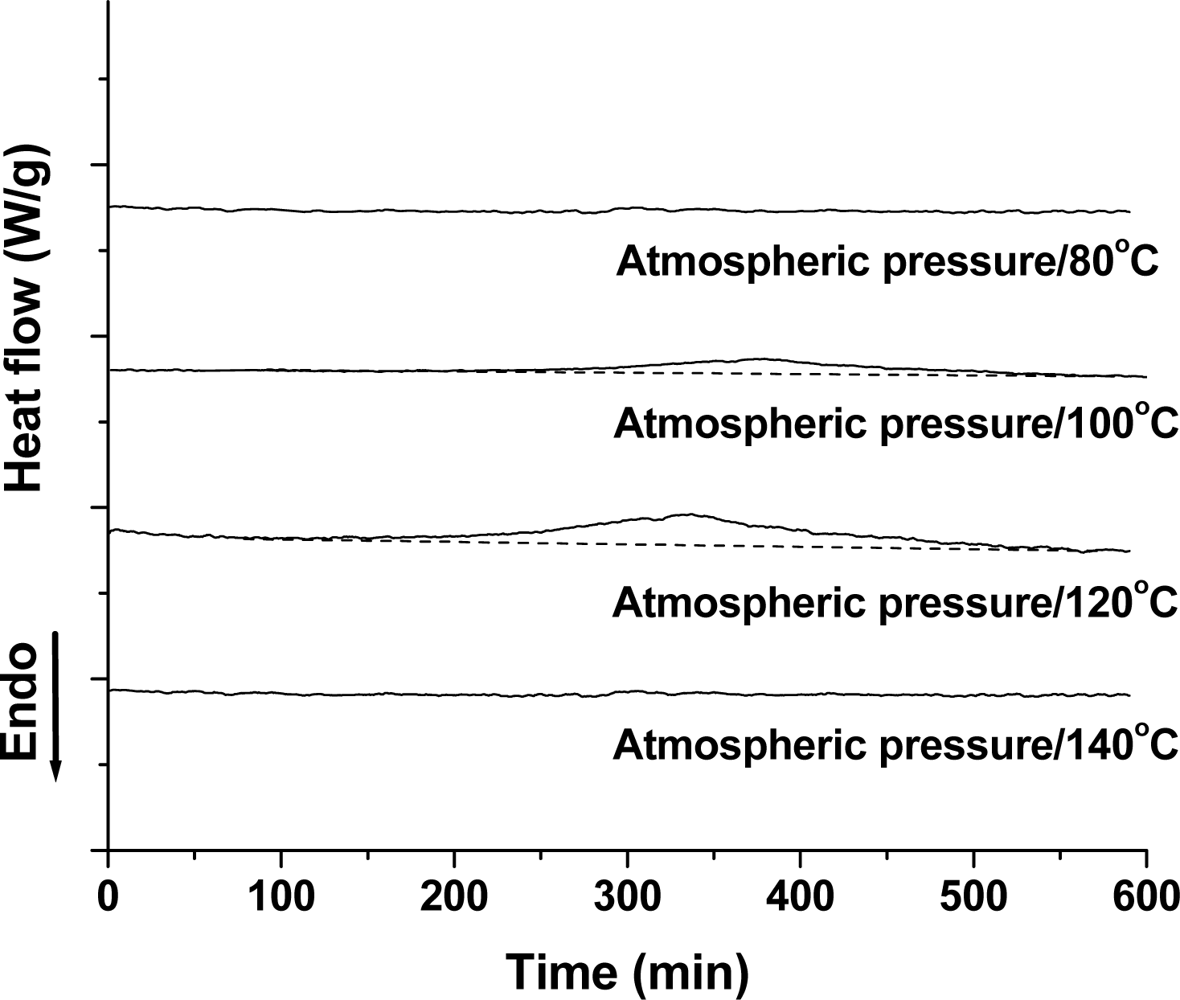
<p>PLA’s isothermal crystallization behavior was investigated using a regular DSC. <xref ref-type="fig" rid="f1-ijms-10-05381">Figure 1</xref> shows the DSC curves of the isothermal crystallization of the PLA samples at different temperatures. At a low temperature of 80 °C, no obvious crystallization peak was found, indicating that the crystallization rate of PLA was very slow, and 10 h was not enough to induce its crystallization. As shown in the following figure (<xref ref-type="fig" rid="f2-ijms-10-05381">Figure 2</xref>), the <italic>T</italic><sub>g</sub> and <italic>T</italic><sub>m</sub> of the PLA is about 58 °C and 148 °C, respectively. Therefore, a temperature of 80 °C was too low to induce PLA crystallization within a short time due to low chain mobility. At 100 °C, however, PLA could crystallize, as observed by the small exothermal peak from 245 to 549 min. With further increasing the temperature to 120 °C, the crystallization rate became faster with crystallization occurring from 155 min, and the Δ<italic>H</italic><sub>c</sub> is bigger. When the temperature is increased to 140 °C, PLA crystallization becomes difficult, because the high chain mobility interferes with the regular arrangement of the polymer chain.</p>
<p>Based on these results, PLA crystallization was difficult. It was found that a longer time and narrower temperatures’ window might be needed to induce PLA crystallization. In addition, compared to 100 and 140 °C, it seems that 120 °C was a proper temperature to induce PLA crystallization under atmospheric pressure.</p></sec>
<sec>
<label>2.2.</label>
<title>Cold-crystallization and Melting Behavior of PLA Treated by CO<sub>2</sub></title>
<p>Amorphous PLA films were treated under compressed CO<sub>2</sub>, and the different processing parameters of temperature, pressure, and time were used during the treatment process. DSC was used to investigate the cold-crystallization and melting behavior of the PLA samples in this study.</p>
<sec>
<label>2.2.1.</label>
<title>Effect of Time</title>
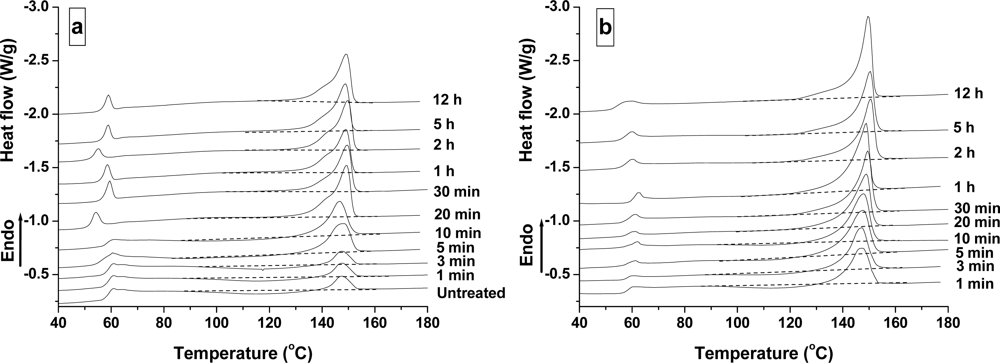
<p><xref ref-type="fig" rid="f2-ijms-10-05381">Figure 2</xref> shows the DSC curves of PLA samples treated at 25 °C and 100 °C at different times. As a reference, the untreated PLA sample is shown in <xref ref-type="fig" rid="f2-ijms-10-05381">Figure 2</xref>(a). It is known that the exothermic and endothermic peaks are attributed to the cold-crystallization and crystal melting of PLA during the DSC heating run, respectively. No crystallization occurred in the untreated sample, because the exothermic peak’s area around 98–136 °C was equivalent to the endothermic peak around 148 °C. After being treated by CO<sub>2</sub> at 6.89 MPa and 25 °C for 1 min, the cold-crystallization area is present and very broad, and the area of exothermic peak is less than that of endothermic peak, indicating the presence of original crystal in CO<sub>2</sub>-treated PLA sample. This result demonstrated that PLA was induced crystallization after being treated by high pressure CO<sub>2</sub> for 1 min. With treatment time increased from 1 to 10 min, the Δ<italic>H</italic><sub>c</sub> tends to decrease, while the Δ<italic>H</italic><sub>m</sub> tends to increase. At 20 min, the cold-crystallization disappears. When the time is more than 40 min, the shape of the melting peak does not change in an obvious manner, even if the treatment time goes up to 12 h. This indicates that the crystallization equilibrium of PLA under 6.89 MPa has been reached. At a high temperature of 100 °C, the CO<sub>2</sub> treatment also significantly reduces the Δ<italic>H</italic><sub>c</sub>, and no cold-crystallization is observed when the treatment time was longer than 20 min. In addition, the Δ<italic>H</italic><sub>m</sub> of PLA samples obtained at 100 °C is larger than at 25 °C, indicating that many more crystalline regions were formed when PLA samples were treated at a high temperature.</p>
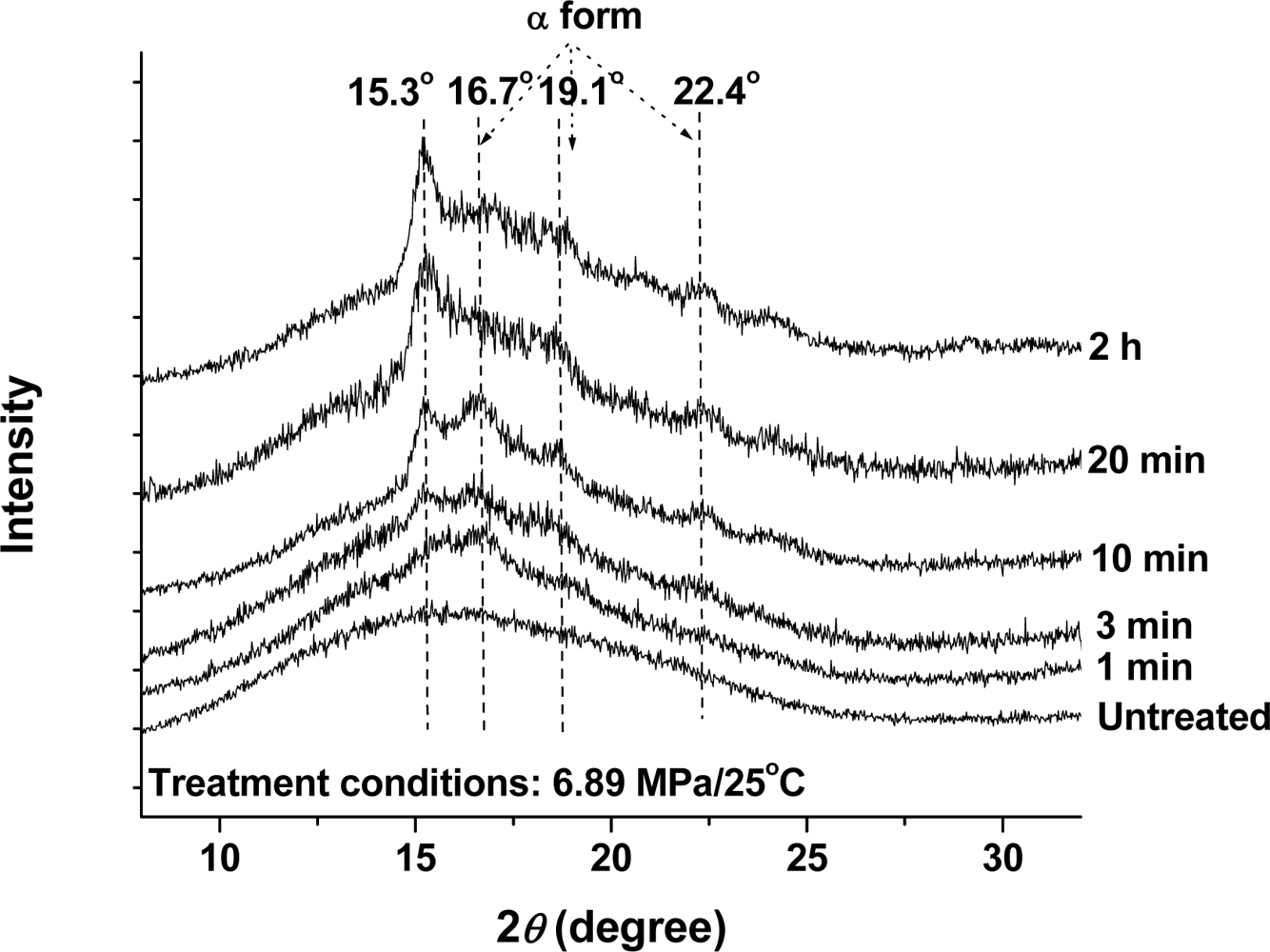
<p>Wide-angle X-ray diffraction (WAXD) measurements were taken to further confirm the crystallization behavior of PLA samples during the CO<sub>2</sub> treatment, because cold-crystallization could be avoided during the WAXD test. <xref ref-type="fig" rid="f3-ijms-10-05381">Figure 3</xref> shows the WAXD results of the PLA samples, where the same samples with the DSC measurements were used. The untreated PLA sample exhibits a broad diffraction peak at 2<italic>θ</italic> = 16.7°, which indicated that the crystallinity in this sample was too low to be detected by the WAXD measurement. This phenomenon was in agreement with the results measured by DSC. After the samples were treated by high-pressure CO<sub>2</sub> at 25 °C for 1 min, a small crystalline peak appeared at 2<italic>θ</italic> = 16.7°, indicating the occurrence of CO<sub>2</sub>-induced crystallization. With increased treatment time, the peak intensity gradually increased. At a treatment time of 10 min, several new diffraction peaks at 2<italic>θ</italic> = 15.3, 19.1, and 22.4° appeared in the WAXD curve. As reported previously, the diffraction peaks at 2<italic>θ</italic> = 16.7, 19.1, and 22.4° belonged to α form [<xref ref-type="bibr" rid="b34-ijms-10-05381">34</xref>]. Therefore, the diffraction peak at 2<italic>θ</italic> = 15.3° suggested the presence of a new crystal structure, suggesting a reorganization in the crystalline structure [<xref ref-type="bibr" rid="b18-ijms-10-05381">18</xref>]. For CO<sub>2</sub> treatment time longer than 20 min, the peak intensity did not change significantly, indicating that the CO<sub>2</sub>-induced crystallization had reached a plateau value. The WAXD result was consistent with the DSC, indicating that PLA was induced crystallization in compressed CO<sub>2</sub> and the equilibrium crystallinity could be achieved as the treatment time had reached 40 min.</p>
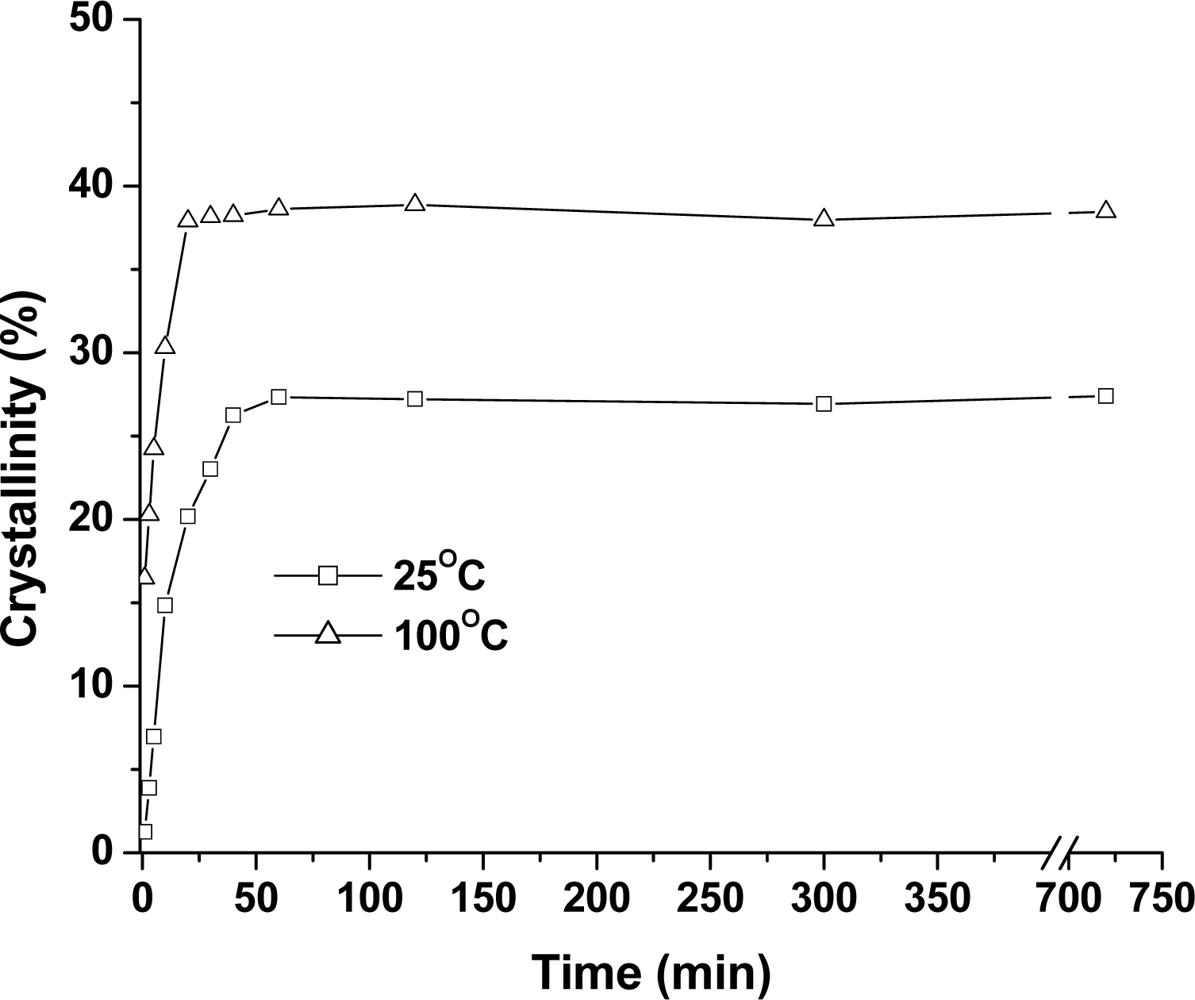
<p><xref ref-type="fig" rid="f4-ijms-10-05381">Figure 4</xref> summarizes the crystallinity results, obtained from DSC thermograms of the PLA samples treated in compressed CO<sub>2</sub>. At 25 °C, a small crystallinity of 1.3% is measured after treatment in compressed CO<sub>2</sub> for only 1 min, and an equilibrium crystallinity of 27.4% is obtained after 40 min. In the meanwhile, a high crystallinity of 16.5% is obtained after 1 min of treatment at 100 °C. When the treatment time is further extended, the crystallinity increases quickly and reaches the maximum value at about 25 min. This demonstrated that the treatment temperature was a critical factor in crystallization behavior of the PLA samples. Also, it is noted that a higher crystallinity of 38.9%, was obtained at a higher temperature compared with 27.4% at a lower temperature.</p>
<p>It is known that supercritical CO<sub>2</sub> can plasticize plastic, and decrease the <italic>T</italic><sub>g</sub> to several tenths of a degree. As a result, polymers can crystallize at a much lower temperature under supercritical CO<sub>2</sub> than under atmospheric pressure. In this study, a temperature of 25 °C, which was much lower than the <italic>T</italic><sub>g</sub> of the original PLA (58 °C), enabled the PLA chain to form regular arrangements. This result demonstrated that CO<sub>2</sub> treatment was effective in inducing PLA’s crystallization. In the past, polymers with poor crystallization ability, like polycarbonate (PC) [<xref ref-type="bibr" rid="b22-ijms-10-05381">22</xref>–<xref ref-type="bibr" rid="b26-ijms-10-05381">26</xref>] and polyaryl ether ether ketone (PEEK) [<xref ref-type="bibr" rid="b27-ijms-10-05381">27</xref>] have been verified to crystallize in supercritical CO<sub>2</sub>. In the case of PC, however, a longer time (<italic>i.e.</italic>, about 2 h or even more), a high pressure, and a high temperature are normally needed to induce crystallization [<xref ref-type="bibr" rid="b25-ijms-10-05381">25</xref>,<xref ref-type="bibr" rid="b26-ijms-10-05381">26</xref>]. This finding suggests that, compared with PC, PLA possesses higher crystallization ability in compressed CO<sub>2</sub>.</p></sec>
<sec>
<label>2.2.2.</label>
<title>Effect of Temperature</title>
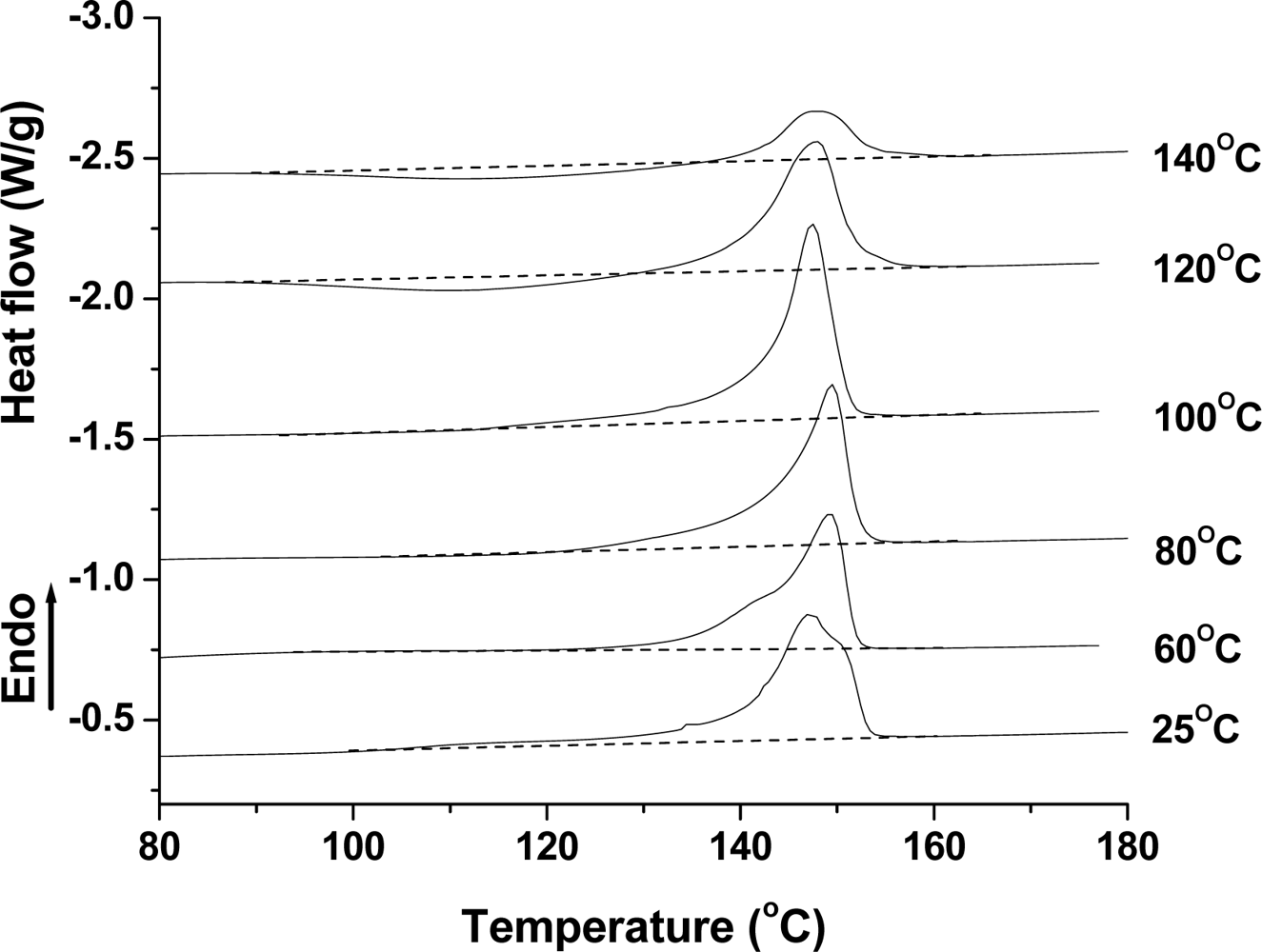
<p><xref ref-type="fig" rid="f5-ijms-10-05381">Figure 5</xref> shows the melting behavior of PLA samples treated at different temperatures for 30 min. At 25 °C, 60 °C, 80 °C, and 100 °C, no obvious cold-crystallizations are observed in the PLA samples. In addition, the endothermic area increases gradually as temperature increases. As the temperature rises to 120 °C and 140 °C, however, a broad cold-crystallization peak is presented in the DSC curves, and the endothermic area decreases correspondingly. It is noted that all PLA samples had one melting peak at 149 °C, and increasing temperatures further did not have an obvious effect on the melting point.</p>
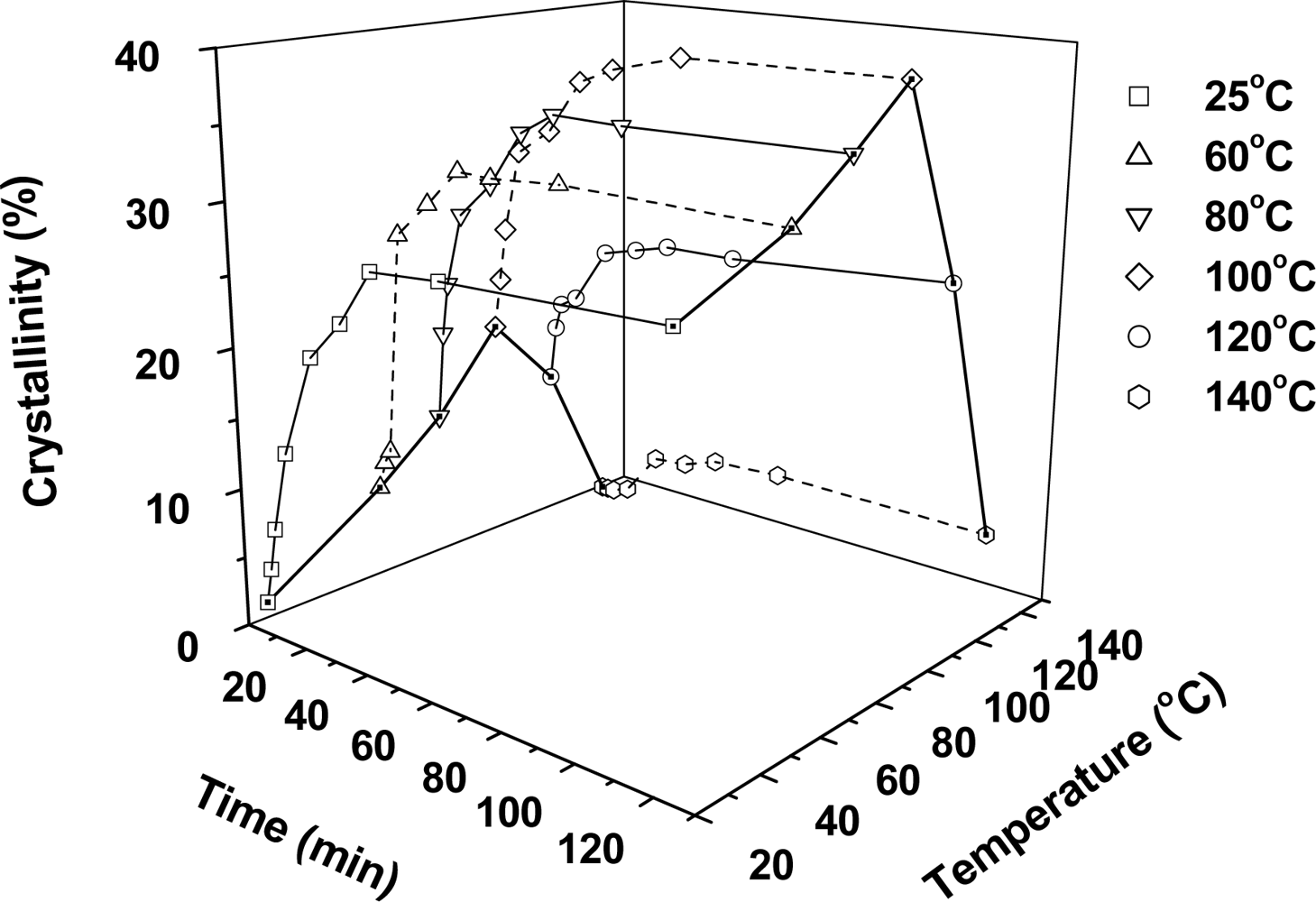
<p>A 3D-map was used to summarize the crystallinity of PLA samples that were treated at 6.89 MPa and at different temperatures for different times, as shown in <xref ref-type="fig" rid="f6-ijms-10-05381">Figure 6</xref>. The data corresponding to 1 min and 120 min at different temperatures were connected respectively with a solid line to show the development of crystallinity with temperature and time. The data corresponding to longer times of 5 h and 12 h were not shown here. It is seen that the crystallinity of PLA increases quickly in the first 10 min, and then tends to level off as the time extends to 25–40 min. Temperature had an obvious effect on crystallization. At low temperatures, the crystallinity of PLA at both short and longer times clearly increased with increased temperature. For equilibrium crystallinity, the percentages and temperatures are 27.4% at 25 °C, 31.4% at 60 °C, 35.9% at 80 °C, and 38.9% at 100 °C. When the temperature exceeds 100 °C, however, the PLA’s crystallinity significantly decreases to 23.4% at 120 °C and 5.0% at 140 °C. Compared with equilibrium crystallinity, PLA crystallinity obtained at short times exhibited a much higher temperature dependency. For example, at 1 min, the crystallinity of PLA samples was 1.3% at 25 °C, 6.8% at 60 °C, 10.7% and 80 °C, 16.5% at 100 °C, 11.0% at 120 °C, and 0.0% at 140 °C. These results further indicate that a presence of maximum temperature for crystallization in PLA sample, which was similar to the crystallization behavior of other polyethers such as PC in supercritical CO<sub>2</sub> [<xref ref-type="bibr" rid="b25-ijms-10-05381">25</xref>,<xref ref-type="bibr" rid="b26-ijms-10-05381">26</xref>].</p>
<p>Temperature is a critical parameter that affects the crystallization behavior of polymers in supercritical CO<sub>2</sub>, because an increased temperature leads to an increase in chain mobility that governs the polymer’s crystallization ability [<xref ref-type="bibr" rid="b22-ijms-10-05381">22</xref>,<xref ref-type="bibr" rid="b26-ijms-10-05381">26</xref>]. Due to the high plasticization effect of CO<sub>2</sub>, PLA could crystallize at a low temperature of 25 °C. With increased temperature, the crystallinity of PLA gradually increased. When the temperature reached the maximum crystallization point of 100 °C, the crystallinity of PLA tended to decrease significantly with temperature, because the chain mobility was too high that prevented the regular arrangement of the polymer chain. As mentioned above, the maximum crystallization temperature of PLA under atmospheric pressure was about 120 °C, and the introduction of high pressure CO<sub>2</sub> shifted it down to 100 °C. The presence of a maximum crystallization temperature in supercritical CO<sub>2</sub> has also been observed in other polyester such as PC [<xref ref-type="bibr" rid="b22-ijms-10-05381">22</xref>,<xref ref-type="bibr" rid="b25-ijms-10-05381">25</xref>]. According to another report, the maximum crystallization temperature of PC was about 140 °C [<xref ref-type="bibr" rid="b22-ijms-10-05381">22</xref>], which was slightly lower than its <italic>T</italic><sub>g</sub>, at 147 °C.</p>
<p>The melting peak of PLA exhibited no obvious change as the temperature was varied in the presence of compressed CO<sub>2</sub>, and the same result has been reported in PLLA by others [<xref ref-type="bibr" rid="b33-ijms-10-05381">33</xref>]. However, this phenomenon was very different in the melting behavior of PC in supercritical CO<sub>2</sub> [<xref ref-type="bibr" rid="b26-ijms-10-05381">26</xref>], where the melting peak usually increased with the temperature. It is known that the increase in melting peak is associated with an increase in lamellar thickness [<xref ref-type="bibr" rid="b35-ijms-10-05381">35</xref>]. Therefore, it is believed that the increased temperature did not facilitate the lamellar thickening process, which might be attributed to the special chain packing and crystallite arrangement within spherulite during PLLA crystallization in compressed CO<sub>2</sub> [<xref ref-type="bibr" rid="b33-ijms-10-05381">33</xref>]. In particular, the presence of a crystal morphological transition had been observed in PLA and PLLA during CO<sub>2</sub> treatment by using WAXD [<xref ref-type="bibr" rid="b18-ijms-10-05381">18</xref>] and light scattering measurements [<xref ref-type="bibr" rid="b33-ijms-10-05381">33</xref>].</p></sec>
<sec>
<label>2.2.3.</label>
<title>Effect of Pressure</title>
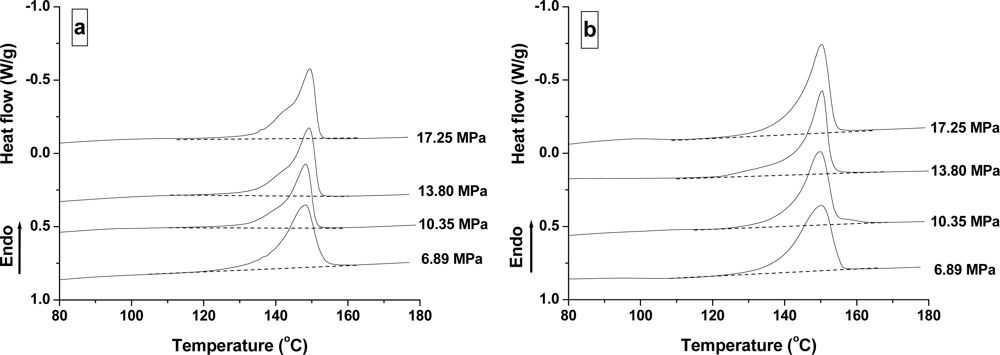
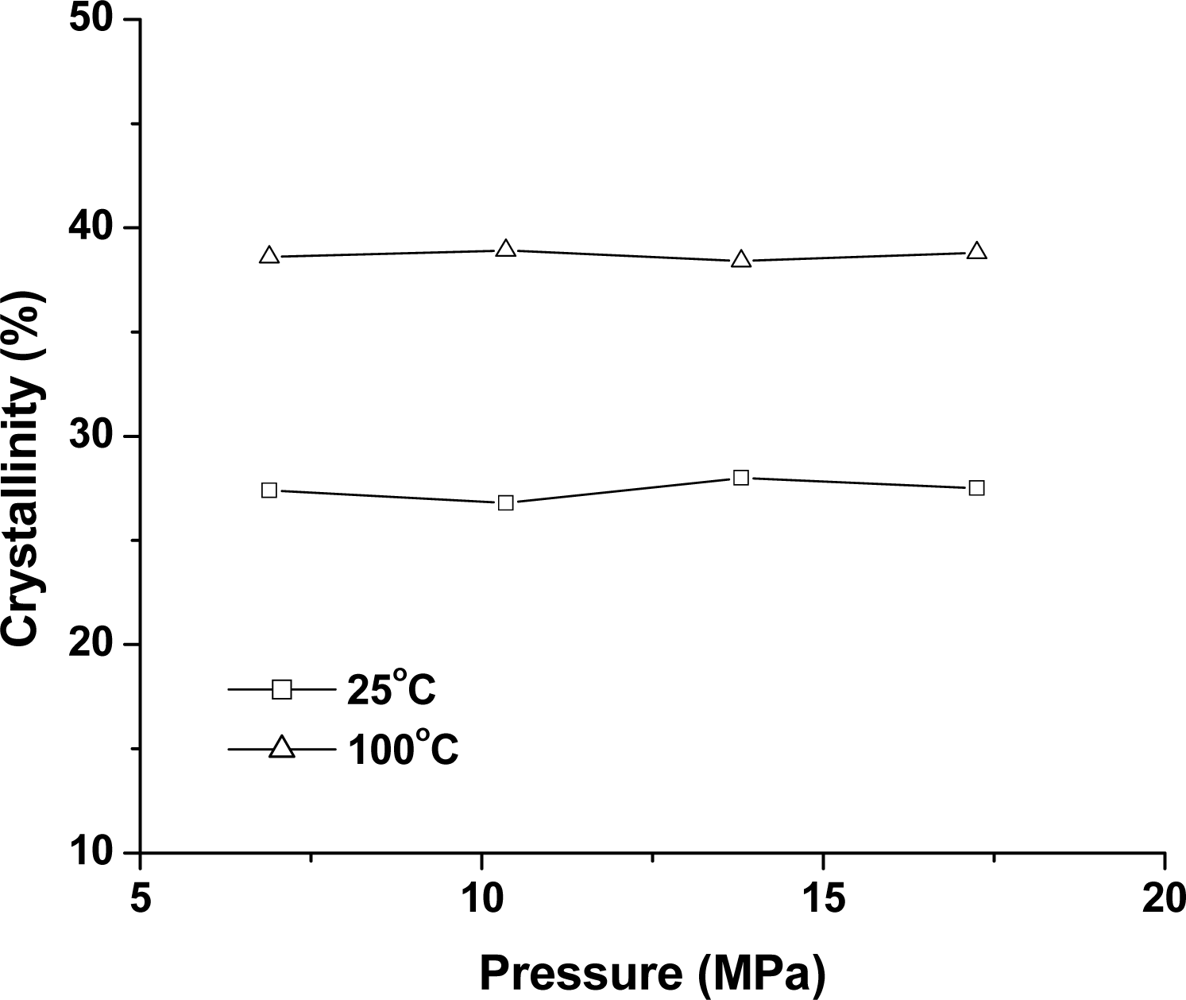
<p><xref ref-type="fig" rid="f7-ijms-10-05381">Figure 7</xref> shows the DSC curves of PLA samples treated at different pressures and at 25 °C and 100 °C for 2 h. All PLA samples do not have a cold-crystallization peak at 6.89–17.25 MPa. Furthermore, with the increased pressure, the melting peak and endothermic area do not show any obvious change. This was further verified by the crystallinity as shown in <xref ref-type="fig" rid="f8-ijms-10-05381">Figure 8</xref>, where the crystallinity of PLA is 27.4% (6.89 MPa), 26.8% (10.35 MPa), 27.0% (13.80 MPa), and 27.5% (17.25 MPa) at 25 °C; and 38.9% (6.89 MPa), 38.3% (10.35 MPa), 38.8% (13.80 MPa), and 39.2% (17.25 MPa) at 100 °C. Therefore, there was almost no CO<sub>2</sub> pressure dependence at the melting point and Δ<italic>H</italic><sub>m</sub>, despite the presence of a transition in CO<sub>2</sub> properties from a subcritical to a supercritical condition.</p>
<p>It is known that an increase in CO<sub>2</sub> pressure tends to increase the mobility of polymer chains and lower <italic>T</italic><sub>g</sub> [<xref ref-type="bibr" rid="b32-ijms-10-05381">32</xref>]. Therefore, transformation of the amorphous phase of polymer to a lower free energy crystalline structure is kinetically favorable [<xref ref-type="bibr" rid="b26-ijms-10-05381">26</xref>]. However, increased CO<sub>2</sub> pressure did not obviously affect the crystallization thermodynamics of PLA. A possible explanation for this may be that the compact crystallite structure restricted the solubility of CO<sub>2</sub> in the crystal region, which then decreased the effect of CO<sub>2</sub> pressure on crystalline thermodynamics [<xref ref-type="bibr" rid="b26-ijms-10-05381">26</xref>]. A similar effect of CO<sub>2</sub> pressure on the melting peak and crystallinity has been observed in PLLA [<xref ref-type="bibr" rid="b30-ijms-10-05381">30</xref>,<xref ref-type="bibr" rid="b33-ijms-10-05381">33</xref>] and PC [<xref ref-type="bibr" rid="b22-ijms-10-05381">22</xref>,<xref ref-type="bibr" rid="b24-ijms-10-05381">24</xref>–<xref ref-type="bibr" rid="b26-ijms-10-05381">26</xref>]. It was found that the melting behavior of PLLA did not change at a CO<sub>2</sub> pressure of 3–5 MPa [<xref ref-type="bibr" rid="b30-ijms-10-05381">30</xref>] and 3–15 MPa [<xref ref-type="bibr" rid="b33-ijms-10-05381">33</xref>]. At a much lower CO<sub>2</sub> pressure of 1 MPa and 2 MPa, however, Wang <italic>et al</italic>. [<xref ref-type="bibr" rid="b30-ijms-10-05381">30</xref>] reported that the crystallinity of PLLA was much lower than that of 3 MPa.</p>
<p>In summary, linear PLA exhibited a low crystallization rate, and 10 h were normally needed to induce PLA crystallization at atmospheric pressure. The CO<sub>2</sub> treatment significantly increased the crystallization rate of PLA; a high crystallization of 16.5% could be obtained even within the short time of 1 min. It is believed that the high plasticization effects of compressed CO<sub>2</sub> accelerated the crystallization rate of PLA.</p></sec></sec>
<sec>
<label>2.3.</label>
<title>The Induced Crystallization of PLA during the Foaming Process</title>
<p>During the gas releasing process, PLA samples could foam under some conditions due to the strong plasticization effects of CO<sub>2</sub>, even though a very thin CO<sub>2</sub> film and a low depressurization rate was applied in these experiments. It is known that a biaxial extensional flow is usually formed in cell walls during cell growth, and this process facilitates strain-induced crystallization. Therefore, the final crystallinity obtained in foamed PLA samples tends to include both the contributions of CO<sub>2</sub>-induced crystallization and strain-induced crystallization. In this study, we tried to show their individual effects on the crystallization process.</p>
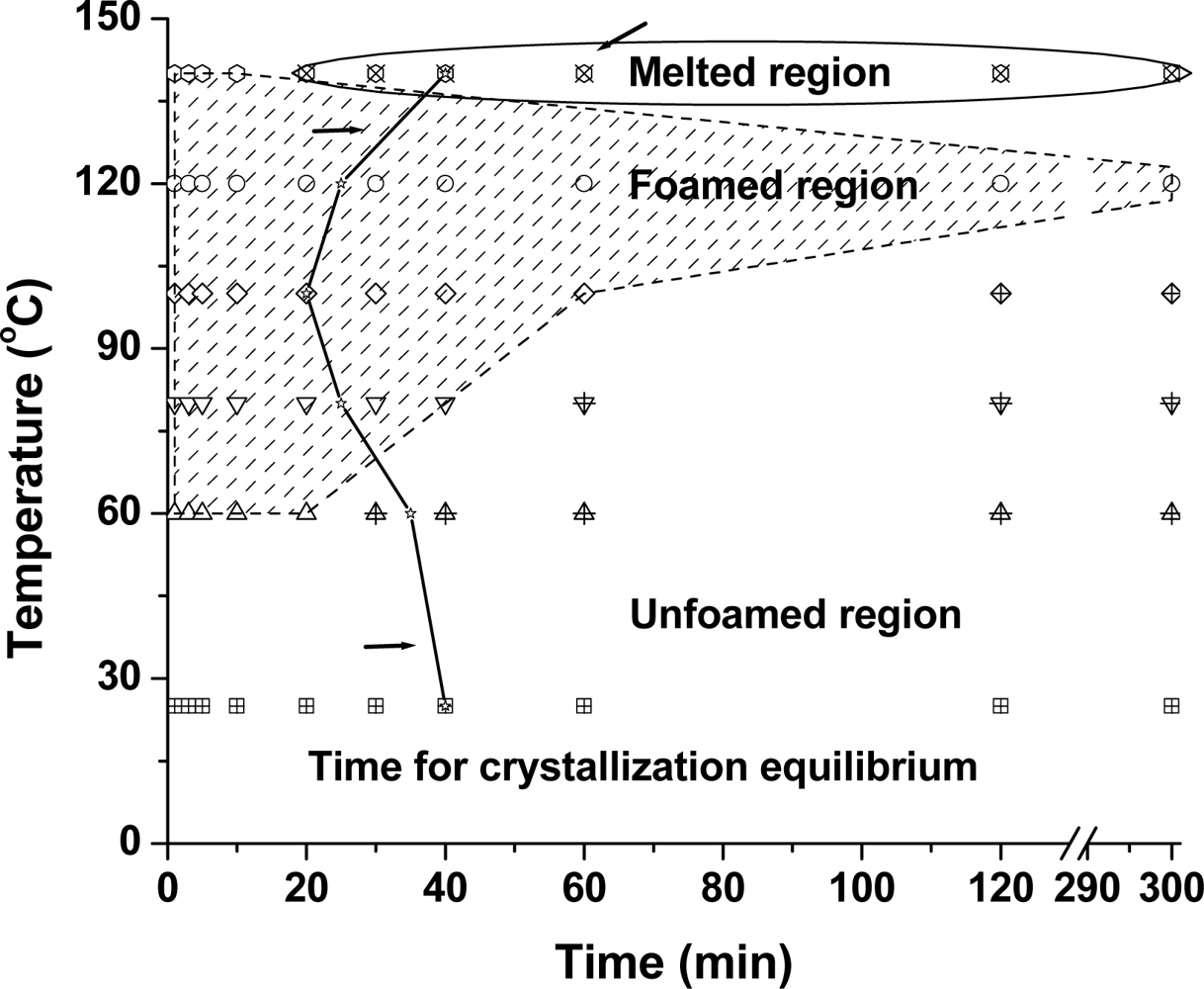
<p><xref ref-type="fig" rid="f9-ijms-10-05381">Figure 9</xref> shows the foaming window of PLA samples as a function of treatment temperature and time. The shadowed region in the figure shows where PLA could foam during the gas release process. Below the shadowed region, the PLA samples could not foam; while above the shadowed region, PLA tended to melt in a high-pressure vessel. It is seen that PLA could not foam at the low temperature of 25 °C. With an increase in temperature to 60 °C, however, foaming began to occur in PLA after being saturation within 20 min, and then could not foam again at the extended time. At a higher temperature, the foaming window of PLA tended to broaden gradually. For example, at 80 °C and 100 °C, foaming occurred after the PLA sample was saturated with compressed CO<sub>2</sub> for 40 min and 1 h, respectively. At 120 °C, PLA could foam even after being saturated for 12 h. With temperature increased to 140 °C, however, PLA foamed only within 10 min, and then tended to melt completely when the time was more than 20 min. Under those conditions, no foams were obtained.</p>
<p>The curved line shown in <xref ref-type="fig" rid="f9-ijms-10-05381">Figure 9</xref> represents the time required for crystallization equilibrium that was estimated by using the effects of time on crystallinity. The crystallization equilibrium time of PLA at 6.89 MPa exhibited an obvious temperature dependency. At 25 °C, 40 min is needed to reach crystallization equilibrium. With increased temperature, the required time linearly decreases to 35 min at 60 °C, 25 min at 80 °C, and 20 min at 100 °C. By further increasing the temperature, however, the required time increases to 25 min at 120 °C and about 40 min at 140 min, respectively.</p>
<p>As mentioned above, both CO<sub>2</sub>-induced crystallization and strain-induced crystallization contributed to crystallinity development in foamed PLA samples. For unfoamed conditions such as at 25 °C, however, it is believed that only CO<sub>2</sub>-induced crystallization contributed to the crystallinity of PLA because of the absence of foaming. Therefore, the data at 25 °C supplied a useful reference to describe the possible effect of polymeric foaming on the final crystallinity of PLA. In unfoamed conditions, a reduction of about 5 min in the time needed for crystallization equilibrium was observed by increasing the temperature of 35 °C (from 25 °C to 60 °C), resulting from the increased polymer chain mobility at high temperature. Once the foaming occurred, however, a reduction of about 15 min was realized by increasing the temperature of 20 °C (from 60 °C to 80 °C). These results demonstrated that the foaming also presented a positive effect in reducing the time requirement for crystallization equilibrium of PLA.</p>
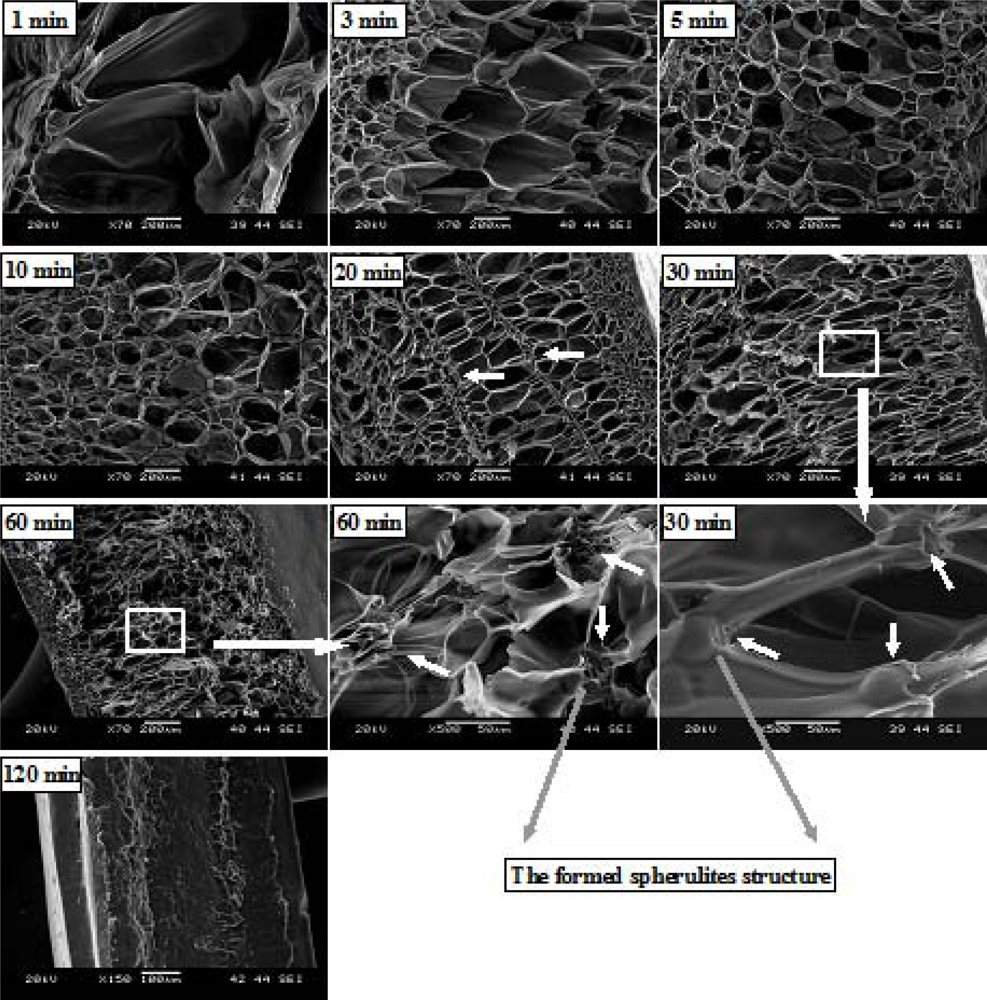
<p><xref ref-type="fig" rid="f10-ijms-10-05381">Figure 10</xref> shows the SEM micrographs of PLA foams obtained after saturated at 6.89 MPa and 100 °C for different times. At the saturation time of 1 min, only a very few big cells are shown in the foam, which might be resulted from an insufficient CO<sub>2</sub> exposure time; thus, CO<sub>2</sub> solubility equilibrium was not reached. By increasing the time to 3 min, the cell size tended to decrease in the foam center, but a large amount of small cells were observed near the foam skin. At extended times of 5 min and 10 min, the cell size distributions become more uniform due to good gas dispersion in the PLA matrix. At 20 min, however, the obvious heterogeneous cell distribution is observed in the foam center, and lots of very small cells are present in those regions (shown in <xref ref-type="fig" rid="f10-ijms-10-05381">Figure 10</xref> in the regions pointed by arrows). Similar cell morphology has been observed in PP [<xref ref-type="bibr" rid="b36-ijms-10-05381">36</xref>] and polyester amide [<xref ref-type="bibr" rid="b37-ijms-10-05381">37</xref>] foams with the foaming temperature that were slightly lower than their melting points, which was attributed to the occurrence of cell nucleation at/around crystal regions, <italic>i.e.</italic>, crystal phase induced heterogeneous cell nucleation. Based on cell morphology obtained after saturation of 10 min, as well as high crystallinity at 20 min, it is suggested that higher crystallinity might have been obtained at 20 min, before foaming. At the extended times of 30 min and 60 min, several spherical particles with a diameter of about 30–40 μm, which seems to be coated by polymer matrix, are observed in the junction of cells. Similar spherical particles have also been observed in the CO<sub>2</sub> induced-crystallization’s polymeric foaming systems like PC [<xref ref-type="bibr" rid="b38-ijms-10-05381">38</xref>], where spherical particles were thought of as spherulite crystal. Because no extra solid particles were added in the PLA foaming process, we believed that the same phenomenon occurred in the PLA foaming system. Furthermore, we believed that these spherulites should be formed during the CO<sub>2</sub> saturation process. We made this claim based on two reasons: the first is that the cell wall stretching process during cell growth tended to make the cell wall and junction area thinner, while the particle size was much thicker than that of cell wall (30–40 <italic>v.s.</italic>, 5 μm); the second is that the stretching process that induced spherulite crystal formation was difficult. We also note that the thickness of foamed samples tended to decrease significantly from 30 to 60 min, and then to 120 min, where no foaming occurred.</p>
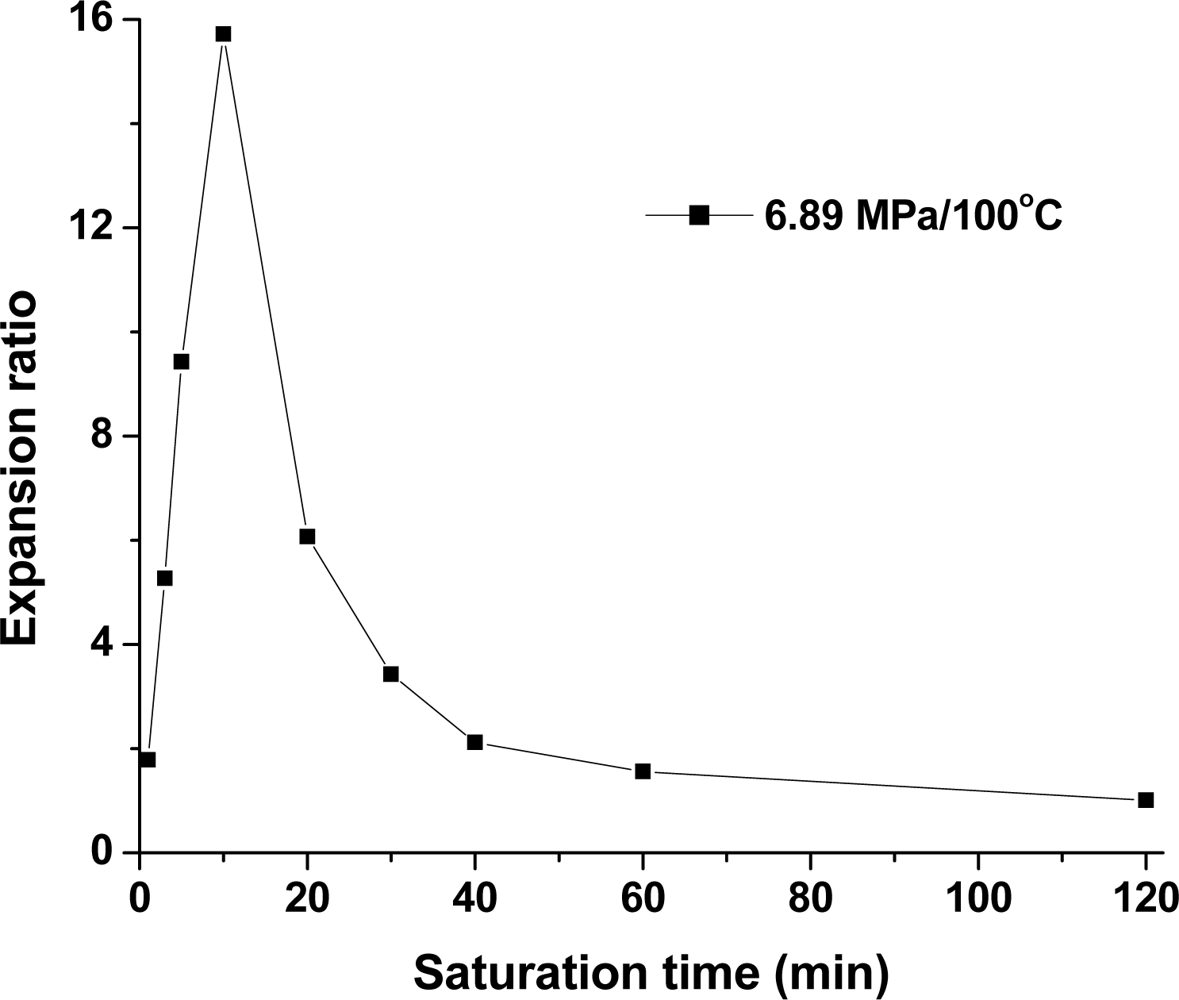
<p>Foaming-induced crystallization seems to be associated with foam expansion, and a high volume expansion ratio tended to induce high crystallinity in the PLA sample. Mihaela <italic>et al</italic>. [<xref ref-type="bibr" rid="b18-ijms-10-05381">18</xref>] investigated the effect of biaxial stretching on the crystallinity of PLA. They found that a high stretch ratio of 9 induced high crystallinity of about 20% in the same PLA as was used in this study, while a low stretch ratio of 1–4 exhibited a small effect on the PLA’s crystallinity. These results suggest that the stretching process during cell growth might exhibit less effect in low expansion ratio foam compared with high expansion ratio foam. <xref ref-type="fig" rid="f11-ijms-10-05381">Figure 11</xref> shows the expansion ratio of PLA foams as a function of treatment time. It is seen that the expansion ratio of PLA foams significantly increases within 10 min; that is, 3.21 at 1 min, 7.27 at 3 min, 11.43 at 5 min, and 15.72 at 10 min, and then quickly decreased to 6.07 at 20 min, 3.43 at 30 min, 2.12 at 40 min, 1.56 at 60 min, and to 1.01 at 120 s., respectively. The obvious foam expansion at 5 min and 10 min might contribute highly to crystallinity. This could be due to a rapid increase in the PLA foam’s crystallinity with the addition of the original crystallites formed during the CO<sub>2</sub> saturation process. At the extended time of 30–60 min, PLA foams exhibited a low expansion ratio, because the high crystallinity that was formed during the CO<sub>2</sub> saturation process, as confirmed by SEM micrographs, increased the stiffness of the polymer matrix and inhibited cell growth. Consequently, foam expansion might only slightly affect PLA’s final crystallinity. This result was consistent with the DSC measurement, where the equilibrium crystallization was reached at about 20 min, and no increase in crystallinity was observed by further extending the time up to 12 h. Therefore, the crystallinity formed by CO<sub>2</sub> exposure determined the foaming behavior of PLA, and thus affected the contribution of strain-induced crystallization to the final crystallinity of PLA foams. To be specific, in the case of high CO<sub>2</sub>-induced crystallization, strain-induced crystallization had a small effect on the final crystallinity of PLA foams; while in low CO<sub>2</sub>-induced crystallization, strain-induced crystallization played an obvious role. Therefore, the PLA sample crystallized very quickly, and the short time required for equilibrium crystallization could be achieved after the sample was treated by the compressed CO<sub>2</sub>.</p></sec></sec>
<sec>
<label>3.</label>
<title>Experimental Section</title>
<sec sec-type="materials">
<label>3.1.</label>
<title>Materials and Samples Preparation</title>
<p>A commercial linear PLA (Ingeo<sup>™</sup>, 2002D) in pellet form was provided by Natureworks LLC, USA. According to the supplier, its <sc>d</sc>-isomer content is 4.3%, melt flow rate is 5–7 g/10 min, and its density is 1.24 g/cm<sup>3</sup>. CO<sub>2</sub> with a purity of 99.5% (Linde gas) was used as the physical blowing agent in all experiments. The PLA pellets were dried in the oven for 4 h at 80 °C before use. Then, polymer specimens with a thickness of about 0.3 mm were prepared by compression molding at 200 °C. The samples were cut into disc-shaped sheets for CO<sub>2</sub> treatment.</p></sec>
<sec>
<label>3.2.</label>
<title>High Pressure CO<sub>2</sub> Treatment</title>
<p>A high-pressure apparatus was used for compressed CO<sub>2</sub> treatment. The 0.3 mm-thick PLA film was placed in a high-pressure vessel preheated to the experimental temperature. The vessel was flushed with low-pressure CO<sub>2</sub> for about 1 min and then pressurized to the desired value. Once the CO<sub>2</sub> pressure reached the desired value, the timing began. At the end of the experiment, the vessel was released at a low depressurization rate, and the sample was removed quickly from the vessel.</p></sec>
<sec sec-type="methods">
<label>3.3.</label>
<title>Analysis</title>
<p>DSC measurements were carried out to determine the <italic>T</italic><sub>g</sub>, cold crystallization temperature (<italic>T</italic><sub>c</sub>) and melting peak (<italic>T</italic><sub>m</sub>) by using a Q2000 (TA Instruments) that was calibrated with indium. All measurements were made at a heating rate of 10 °C/min over a temperature range of 20–200 °C in a dry nitrogen environment. The enthalpy of crystallization on heating Δ<italic>H</italic><sub>c</sub> and melting enthalpy Δ<italic>H</italic><sub>m</sub> were measured. The crystallinity of PLA CO<sub>2</sub>-treated samples was calculated by [(Δ<italic>H</italic><sub>m</sub> Δ<italic>H</italic><sub>c</sub>)/Δ<italic>H</italic><sub>f</sub>] × 100%, where Δ<italic>H</italic><sub>f</sub> is the theoretical heat of fusion of 100% crystalline PLA with a value of 93 J/g [<xref ref-type="bibr" rid="b39-ijms-10-05381">39</xref>]. Isothermal crystallization from the amorphous state was used to measure the crystallization rate of PLA. The samples were first heated to 200 °C at a rate of 10 °C/min to eliminate any thermal history, and then quickly cooled to the present crystallization temperature to initiate isothermal crystallization. In the isothermal crystallization study, the samples were held at the crystallization temperature for 10 h. For CO<sub>2</sub>-treated PLA samples, the first heat scanning curve was used to calculate crystallinity.</p>
<p>WAXD measurements were taken on a Siemens D5000 diffractometer equipped with a Kevex solid-state detector that uses a Cu Kα radiation source with a wavelength of 1.54Å. The measurements were performed at 50 kV and 35 Ma. The data were recorded in reflection mode at a range of 2<italic>θ</italic> = 5–35° using a STEP scan mode. The step size was 0.02 degrees and the counting time was 2.0 s per step.</p>
<p>After being saturated by compressed CO<sub>2</sub>, PLA samples tended to foam under some conditions during the gas release process. Cell morphologies of the foamed samples were observed with a JEOL JMS 6060 scanning electron microscope (SEM). Prior to the SEM observation, the samples were freeze-fractured in liquid nitrogen and sputter-coated with platinum. The volume expansion ratio of the polymer foams can be calculated according to <xref ref-type="disp-formula" rid="FD1">Equation (1)</xref>:
<disp-formula id="FD1">
<label>(1)</label>
<mml:math display="block">
<mml:mo>φ</mml:mo>
<mml:mfrac>
<mml:mo>ρ</mml:mo>
<mml:mrow>
<mml:msub>
<mml:mo>ρ</mml:mo>
<mml:mi>f</mml:mi></mml:msub></mml:mrow></mml:mfrac></mml:math></disp-formula>where <italic>ρ</italic> and <italic>ρ</italic><sub>f</sub> are the mass densities of the samples before and after foaming, respectively, which were measured by the water displacement method in accordance with ASTM D792.</p></sec></sec>
<sec sec-type="conclusions">
<label>4.</label>
<title>Conclusions</title>
<p>Due to the low chain mobility, linear PLA exhibits a very low crystallization rate under atmospheric pressure. This was confirmed by the present study, where about 10 h were needed to isothermally induce PLA crystallization at a suitable temperature of 120 °C. The crystallization and melting behavior of PLA in high pressure or supercritical CO<sub>2</sub> has been investigated by changing the treatment time, temperature, and gas pressure. It was found that a high crystallinity of 16.5–27.4% could be developed after CO<sub>2</sub> treatment at 100 °C for only 1 min at a low temperature of 25 °C. Moreover, the time for crystallization equilibrium significantly shortened to 20–40 min. These results indicated that the high plasticization effect of compressed CO<sub>2</sub> effectively increased the mobility of the polymer chain, and thus accelerated the crystallization rate and broadened the crystallization window of PLA. An optimum crystallization temperature of 100 °C was observed during the PLA crystallization at 6.89 MPa. At a lower temperature, a temperature increase tended to increase the crystallinity of PLA, while at a higher temperature, a reversed trend was observed. DSC curves showed that cold-crystallization tended to decrease and then disappear with increased crystallinity. Only one melting peak could be found in the DSC curve, which was slightly depended on treatment times, temperatures, and pressures. These results indicated that the changed treatment conditions did not affect the perfection of crystals, and thus didn’t affect the lamellar thickening process of crystal domain during the crystallization of PLA. PLA samples tended to foam during the gas release process under some conditions, and a foaming window as a function of temperature and timing was established in this study. Based on the crystallinity, foaming window, and cell morphology, it was found that the occurrence of foaming reduced the time for the crystallization equilibrium of PLA. For the PLA samples with high crystallinity obtained from CO<sub>2</sub> exposure, however, the increased matrix modulus suppressed foam expansion. Consequently, the strain-induced crystallization that resulted from the PLA foaming process only had a slight effect on the final crystallinity of the PLA samples.</p></sec></body>
<back>
<ack>
<p>The authors are grateful to the Consortium of Cellular and Micro-Cellular Plastics (CCMCP) and the Natural Sciences and Engineering Research Council of Canada (NSERC) for their financial support of this project.</p></ack>
<ref-list>
<title>References and Notes</title>
<ref id="b1-ijms-10-05381"><label>1.</label><citation citation-type="book"><person-group person-group-type="author"><name><surname>Mandelkern</surname><given-names>L</given-names></name></person-group><source>Crystallization of Polymers</source><publisher-name>McGraw-Hill</publisher-name><publisher-loc>New York, NY, USA</publisher-loc><year>1964</year></citation></ref>
<ref id="b2-ijms-10-05381"><label>2.</label><citation citation-type="journal"><person-group person-group-type="author"><name><surname>Lunt</surname><given-names>J</given-names></name></person-group><article-title>Large-scale production, properties and commercial applications of polylactic acid polymers</article-title><source>Polym. Degard. Stab</source><year>1998</year><volume>59</volume><fpage>145</fpage><lpage>152</lpage><pub-id pub-id-type="doi">10.1016/S0141-3910(97)00148-1</pub-id></citation></ref>
<ref id="b3-ijms-10-05381"><label>3.</label><citation citation-type="journal"><person-group person-group-type="author"><name><surname>Gupta</surname><given-names>B</given-names></name><name><surname>Revagade</surname><given-names>N</given-names></name><name><surname>Hilborn</surname><given-names>J</given-names></name></person-group><article-title>Poly(lactic acid) fiber: An overview</article-title><source>Prog. Polym. Sci</source><year>2007</year><volume>32</volume><fpage>455</fpage><lpage>482</lpage><pub-id pub-id-type="doi">10.1016/j.progpolymsci.2007.01.005</pub-id></citation></ref>
<ref id="b4-ijms-10-05381"><label>4.</label><citation citation-type="journal"><person-group person-group-type="author"><name><surname>Södegård</surname><given-names>A</given-names></name><name><surname>Stolt</surname><given-names>M</given-names></name></person-group><article-title>Properties of lactic acid based polymers and their correlation with composition</article-title><source>Prog. Polym. Sci</source><year>2002</year><volume>27</volume><fpage>1123</fpage><lpage>1163</lpage><pub-id pub-id-type="doi">10.1016/S0079-6700(02)00012-6</pub-id></citation></ref>
<ref id="b5-ijms-10-05381"><label>5.</label><citation citation-type="journal"><person-group person-group-type="author"><name><surname>Auras</surname><given-names>R</given-names></name><name><surname>Harte</surname><given-names>B</given-names></name><name><surname>Selke</surname><given-names>S</given-names></name></person-group><article-title>An overview of polylactides as packaging materials</article-title><source>Macromol. Biosci</source><year>2004</year><volume>4</volume><fpage>835</fpage><lpage>864</lpage><pub-id pub-id-type="doi">10.1002/mabi.200400043</pub-id><pub-id pub-id-type="pmid">15468294</pub-id></citation></ref>
<ref id="b6-ijms-10-05381"><label>6.</label><citation citation-type="journal"><person-group person-group-type="author"><name><surname>Lim</surname><given-names>LT</given-names></name><name><surname>Auras</surname><given-names>R</given-names></name><name><surname>Rubino</surname><given-names>M</given-names></name></person-group><article-title>Processing technologies for poly(lactic acid)</article-title><source>Prog. Polym. Sci</source><year>2008</year><volume>33</volume><fpage>820</fpage><lpage>852</lpage><pub-id pub-id-type="doi">10.1016/j.progpolymsci.2008.05.004</pub-id></citation></ref>
<ref id="b7-ijms-10-05381"><label>7.</label><citation citation-type="journal"><person-group person-group-type="author"><name><surname>Yasuniwa</surname><given-names>M</given-names></name><name><surname>Tsubakihara</surname><given-names>S</given-names></name><name><surname>Iura</surname><given-names>K</given-names></name><name><surname>Ono</surname><given-names>Y</given-names></name><name><surname>Dan</surname><given-names>Y</given-names></name><name><surname>Takahashi</surname><given-names>K</given-names></name></person-group><article-title>Crystallization behavior of poly(<sc>l</sc>-lactic acid)</article-title><source>Polymer</source><year>2006</year><volume>47</volume><fpage>7554</fpage><lpage>7563</lpage><pub-id pub-id-type="doi">10.1016/j.polymer.2006.08.054</pub-id></citation></ref>
<ref id="b8-ijms-10-05381"><label>8.</label><citation citation-type="journal"><person-group person-group-type="author"><name><surname>Yasuniwa</surname><given-names>M</given-names></name><name><surname>Iura</surname><given-names>K</given-names></name><name><surname>Dan</surname><given-names>Y</given-names></name></person-group><article-title>Melting behavior of poly(<sc>l</sc>-lactic acid): Effects of crystallization temperature and time</article-title><source>Polymer</source><year>2007</year><volume>48</volume><fpage>5398</fpage><lpage>5407</lpage><pub-id pub-id-type="doi">10.1016/j.polymer.2007.07.012</pub-id></citation></ref>
<ref id="b9-ijms-10-05381"><label>9.</label><citation citation-type="journal"><person-group person-group-type="author"><name><surname>Tsuji</surname><given-names>H</given-names></name><name><surname>Takai</surname><given-names>H</given-names></name><name><surname>Saha</surname><given-names>SK</given-names></name></person-group><article-title>Isothermal and non-isothermal crystallization behavior of poly(<sc>l</sc>-lactic acid): Effect of stereocomplex as nucleating agent</article-title><source>Polymer</source><year>2006</year><volume>47</volume><fpage>3826</fpage><lpage>3837</lpage><pub-id pub-id-type="doi">10.1016/j.polymer.2006.03.074</pub-id></citation></ref>
<ref id="b10-ijms-10-05381"><label>10.</label><citation citation-type="journal"><person-group person-group-type="author"><name><surname>Yu</surname><given-names>L</given-names></name><name><surname>Dean</surname><given-names>K</given-names></name><name><surname>Li</surname><given-names>L</given-names></name></person-group><article-title>Polymer blends and composites from renewable resources</article-title><source>Prog. Polym. Sci</source><year>2006</year><volume>31</volume><fpage>576</fpage><lpage>602</lpage><pub-id pub-id-type="doi">10.1016/j.progpolymsci.2006.03.002</pub-id></citation></ref>
<ref id="b11-ijms-10-05381"><label>11.</label><citation citation-type="journal"><person-group person-group-type="author"><name><surname>Pillin</surname><given-names>I</given-names></name><name><surname>Momtrelay</surname><given-names>N</given-names></name><name><surname>Grohens</surname><given-names>Y</given-names></name></person-group><article-title>Thermo-mechanical characterization of plasticized PLA: Is the miscibility the only significant factor</article-title><source>Polymer</source><year>2006</year><volume>47</volume><fpage>4676</fpage><lpage>4682</lpage><pub-id pub-id-type="doi">10.1016/j.polymer.2006.04.013</pub-id></citation></ref>
<ref id="b12-ijms-10-05381"><label>12.</label><citation citation-type="journal"><person-group person-group-type="author"><name><surname>Li</surname><given-names>H</given-names></name><name><surname>Huneault</surname><given-names>MA</given-names></name></person-group><article-title>Crystallization of PLA/thermoplastic starch blends</article-title><source>Int. Polym. Process</source><year>2008</year><volume>5</volume><fpage>412</fpage><lpage>418</lpage></citation></ref>
<ref id="b13-ijms-10-05381"><label>13.</label><citation citation-type="journal"><person-group person-group-type="author"><name><surname>Yeh</surname><given-names>JT</given-names></name><name><surname>Wu</surname><given-names>CJ</given-names></name><name><surname>Tsou</surname><given-names>CH</given-names></name><name><surname>Chai</surname><given-names>WL</given-names></name><name><surname>Chow</surname><given-names>JD</given-names></name><name><surname>Huang</surname><given-names>CY</given-names></name><name><surname>Chen</surname><given-names>KN</given-names></name><name><surname>Wu</surname><given-names>CS</given-names></name></person-group><article-title>Study on the crystallization, miscibility, morphology, properties of poly(lactic acid)/poly(ɛ-caprolactone) blends</article-title><source>Polym. Plast. Tech. Eng</source><year>2009</year><volume>48</volume><fpage>571</fpage><lpage>578</lpage><pub-id pub-id-type="doi">10.1080/03602550902824390</pub-id></citation></ref>
<ref id="b14-ijms-10-05381"><label>14.</label><citation citation-type="journal"><person-group person-group-type="author"><name><surname>Li</surname><given-names>Y</given-names></name><name><surname>Wang</surname><given-names>Y</given-names></name><name><surname>Liu</surname><given-names>Li</given-names></name><name><surname>Han</surname><given-names>L</given-names></name><name><surname>Xiang</surname><given-names>F</given-names></name><name><surname>Zhou</surname><given-names>Z</given-names></name></person-group><article-title>Crystallization improvement of poly(l-lactide) induced by functionalized multiwalled carbon nanotubes</article-title><source>J. Polym. Sci. Part: B Polym. Phys</source><year>2009</year><volume>47</volume><fpage>326</fpage><lpage>339</lpage><pub-id pub-id-type="doi">10.1002/polb.21645</pub-id></citation></ref>
<ref id="b15-ijms-10-05381"><label>15.</label><citation citation-type="journal"><person-group person-group-type="author"><name><surname>Day</surname><given-names>M</given-names></name><name><surname>Nawaby</surname><given-names>AV</given-names></name><name><surname>Liao</surname><given-names>X</given-names></name></person-group><article-title>A DSC study of the crystallization behaviour of polylactic acid and its nanocomposites</article-title><source>J. Therm. Anal. Calorim</source><year>2006</year><volume>86</volume><fpage>623</fpage><lpage>629</lpage><pub-id pub-id-type="doi">10.1007/s10973-006-7717-9</pub-id></citation></ref>
<ref id="b16-ijms-10-05381"><label>16.</label><citation citation-type="journal"><person-group person-group-type="author"><name><surname>Li</surname><given-names>H</given-names></name><name><surname>Huneault</surname><given-names>MA</given-names></name></person-group><article-title>Effect of nucleation and plasticization on the crystallization of poly(lactic acid)</article-title><source>Polymer</source><year>2007</year><volume>48</volume><fpage>6855</fpage><lpage>6866</lpage><pub-id pub-id-type="doi">10.1016/j.polymer.2007.09.020</pub-id></citation></ref>
<ref id="b17-ijms-10-05381"><label>17.</label><citation citation-type="journal"><person-group person-group-type="author"><name><surname>Chapleau</surname><given-names>N</given-names></name><name><surname>Huneault</surname><given-names>MA</given-names></name><name><surname>Li</surname><given-names>H</given-names></name></person-group><article-title>Biaxial orientation of polylactide/thermoplastic starch blends</article-title><source>Int. Polym. Process</source><year>2007</year><volume>22</volume><fpage>402</fpage><lpage>409</lpage></citation></ref>
<ref id="b18-ijms-10-05381"><label>18.</label><citation citation-type="journal"><person-group person-group-type="author"><name><surname>Mihai</surname><given-names>M</given-names></name><name><surname>Huneault</surname><given-names>MA</given-names></name><name><surname>Favis</surname><given-names>BD</given-names></name></person-group><article-title>Crystallinity development in cellular poly(lactic acid) in the presence of supercritical carbon dioxide</article-title><source>J. Appl. Polym. Sci</source><year>2009</year><volume>113</volume><fpage>2920</fpage><lpage>2932</lpage><pub-id pub-id-type="doi">10.1002/app.30338</pub-id></citation></ref>
<ref id="b19-ijms-10-05381"><label>19.</label><citation citation-type="journal"><person-group person-group-type="author"><name><surname>Kokturk</surname><given-names>G</given-names></name><name><surname>Serhatkulu</surname><given-names>TF</given-names></name><name><surname>Cakmak</surname><given-names>M</given-names></name><name><surname>Piskin</surname><given-names>E</given-names></name></person-group><article-title>Evolution of phase behavior and orientation in uniaxially deformed polylactic acid films</article-title><source>Polym. Eng. Sci</source><year>2002</year><volume>42</volume><fpage>1619</fpage><lpage>1628</lpage><pub-id pub-id-type="doi">10.1002/pen.11057</pub-id></citation></ref>
<ref id="b20-ijms-10-05381"><label>20.</label><citation citation-type="journal"><person-group person-group-type="author"><name><surname>Zhang</surname><given-names>Z</given-names></name><name><surname>Handa</surname><given-names>YP</given-names></name></person-group><article-title>CO<sub>2</sub>-assisted melting of semicrystalline polymers</article-title><source>Macromolecules</source><year>1997</year><volume>30</volume><fpage>8505</fpage><lpage>8507</lpage><pub-id pub-id-type="doi">10.1021/ma9712211</pub-id></citation></ref>
<ref id="b21-ijms-10-05381"><label>21.</label><citation citation-type="journal"><person-group person-group-type="author"><name><surname>Handa</surname><given-names>YP</given-names></name><name><surname>Roovers</surname><given-names>J</given-names></name><name><surname>Wang</surname><given-names>F</given-names></name></person-group><article-title>Effect of thermal annealing and supercritical fluids on the crystallization behavior of methyl-substituted poly(aryl ether ether ketone)</article-title><source>Macromolecules</source><year>1994</year><volume>27</volume><fpage>5511</fpage><lpage>5516</lpage><pub-id pub-id-type="doi">10.1021/ma00097a035</pub-id></citation></ref>
<ref id="b22-ijms-10-05381"><label>22.</label><citation citation-type="journal"><person-group person-group-type="author"><name><surname>Gross</surname><given-names>SM</given-names></name><name><surname>Roberts</surname><given-names>GW</given-names></name><name><surname>Kiserow</surname><given-names>DJ</given-names></name><name><surname>Desimone</surname><given-names>JM</given-names></name></person-group><article-title>Crystallization and solid-state polymerization of poly(bisphenol A carbonate) facilitated by supercritical CO<sub>2</sub></article-title><source>Macromolecules</source><year>2000</year><volume>33</volume><fpage>40</fpage><lpage>45</lpage><pub-id pub-id-type="doi">10.1021/ma990901w</pub-id></citation></ref>
<ref id="b23-ijms-10-05381"><label>23.</label><citation citation-type="journal"><person-group person-group-type="author"><name><surname>Becjman</surname><given-names>E</given-names></name><name><surname>Porter</surname><given-names>RS</given-names></name></person-group><article-title>Crystallization of bisphenol A polycarbonate induced by supercritical carbon dioxide</article-title><source>J. Polym. Sci. Part B: Polym. Phys</source><year>1987</year><volume>25</volume><fpage>1511</fpage><lpage>1517</lpage><pub-id pub-id-type="doi">10.1002/polb.1987.090250713</pub-id></citation></ref>
<ref id="b24-ijms-10-05381"><label>24.</label><citation citation-type="journal"><person-group person-group-type="author"><name><surname>Liao</surname><given-names>X</given-names></name><name><surname>Wang</surname><given-names>J</given-names></name><name><surname>Li</surname><given-names>G</given-names></name><name><surname>He</surname><given-names>JS</given-names></name></person-group><article-title>Effect of supercritical carbon dioxide on the crystallization and melting behavior of linear bisphenol A polycarbonate</article-title><source>J. Polym. Sci. Part B: Polym. Phys</source><year>2004</year><volume>42</volume><fpage>280</fpage><lpage>285</lpage><pub-id pub-id-type="doi">10.1002/polb.10597</pub-id></citation></ref>
<ref id="b25-ijms-10-05381"><label>25.</label><citation citation-type="journal"><person-group person-group-type="author"><name><surname>Zhai</surname><given-names>WT</given-names></name><name><surname>Yu</surname><given-names>J</given-names></name><name><surname>Ma</surname><given-names>WM</given-names></name><name><surname>He</surname><given-names>JS</given-names></name></person-group><article-title>Cosolvent effect of water in supercritical carbon dioxide facilitating induced crystallization of polycarbonate</article-title><source>Polym. Eng. Sci</source><year>2007</year><volume>47</volume><fpage>1338</fpage><lpage>1343</lpage><pub-id pub-id-type="doi">10.1002/pen.20816</pub-id></citation></ref>
<ref id="b26-ijms-10-05381"><label>26.</label><citation citation-type="journal"><person-group person-group-type="author"><name><surname>Zhai</surname><given-names>WT</given-names></name><name><surname>Yu</surname><given-names>J</given-names></name><name><surname>Ma</surname><given-names>WM</given-names></name><name><surname>He</surname><given-names>JS</given-names></name></person-group><article-title>Influence of long-chain branching on the crystallization and melting of polycarbonates in supercritical CO<sub>2</sub></article-title><source>Macromolecules</source><year>2007</year><volume>40</volume><fpage>73</fpage><lpage>80</lpage><pub-id pub-id-type="doi">10.1021/ma062181g</pub-id></citation></ref>
<ref id="b27-ijms-10-05381"><label>27.</label><citation citation-type="journal"><person-group person-group-type="author"><name><surname>Handa</surname><given-names>YP</given-names></name><name><surname>Zhang</surname><given-names>ZY</given-names></name><name><surname>Roovers</surname><given-names>J</given-names></name></person-group><article-title>Compressed-gas-induced crystallization in tert-butyl poly(ether ether ketone)</article-title><source>J. Polym. Sci. Part B: Polym.Phys</source><year>2001</year><volume>39</volume><fpage>1505</fpage><lpage>1512</lpage></citation></ref>
<ref id="b28-ijms-10-05381"><label>28.</label><citation citation-type="journal"><person-group person-group-type="author"><name><surname>Yu</surname><given-names>L</given-names></name><name><surname>Liu</surname><given-names>H</given-names></name><name><surname>Dean</surname><given-names>K</given-names></name></person-group><article-title>Thermal behavior of poly(lactic acid) in contact with compressed carbon dioxide</article-title><source>Polym. Int</source><year>2009</year><volume>58</volume><fpage>368</fpage><lpage>372</lpage><pub-id pub-id-type="doi">10.1002/pi.2540</pub-id></citation></ref>
<ref id="b29-ijms-10-05381"><label>29.</label><citation citation-type="journal"><person-group person-group-type="author"><name><surname>Yu</surname><given-names>L</given-names></name><name><surname>Liu</surname><given-names>H</given-names></name><name><surname>Dean</surname><given-names>K</given-names></name><name><surname>Chen</surname><given-names>L</given-names></name></person-group><article-title>Cold crystallization and postmelting crystallization of PLA plasticized by compressed carbon dioxide</article-title><source>J. Polym. Sci. Part B: Polym. Phys</source><year>2008</year><volume>46</volume><fpage>2630</fpage><lpage>2636</lpage><pub-id pub-id-type="doi">10.1002/polb.21599</pub-id></citation></ref>
<ref id="b30-ijms-10-05381"><label>30.</label><citation citation-type="journal"><person-group person-group-type="author"><name><surname>Wang</surname><given-names>X</given-names></name><name><surname>Kumar</surname><given-names>V</given-names></name><name><surname>Li</surname><given-names>W</given-names></name></person-group><article-title>Low density sub-critical CO<sub>2</sub>-blown solid-state PLA foams</article-title><source>Cell. Polym</source><year>2007</year><volume>26</volume><fpage>11</fpage><lpage>35</lpage></citation></ref>
<ref id="b31-ijms-10-05381"><label>31.</label><citation citation-type="journal"><person-group person-group-type="author"><name><surname>López-Periago</surname><given-names>A</given-names></name><name><surname>García-González</surname><given-names>CA</given-names></name><name><surname>Domingo</surname><given-names>C</given-names></name></person-group><article-title>Solvent- and thermal-induced crystallization of poly-<sc>l</sc>-lactic acid in supercritical CO<sub>2</sub> medium</article-title><source>J. Appl. Polym. Sci</source><year>2009</year><volume>111</volume><fpage>291</fpage><lpage>300</lpage><pub-id pub-id-type="doi">10.1002/app.29111</pub-id></citation></ref>
<ref id="b32-ijms-10-05381"><label>32.</label><citation citation-type="journal"><person-group person-group-type="author"><name><surname>Takada</surname><given-names>M</given-names></name><name><surname>Hasegawa</surname><given-names>S</given-names></name><name><surname>Ohahima</surname><given-names>M</given-names></name></person-group><article-title>Crystallization kinetics of poly(<sc>l</sc>-lactide) in contact with pressurized CO<sub>2</sub></article-title><source>Polym. Eng. Sci</source><year>2004</year><volume>44</volume><fpage>186</fpage><lpage>196</lpage><pub-id pub-id-type="doi">10.1002/pen.20017</pub-id></citation></ref>
<ref id="b33-ijms-10-05381"><label>33.</label><citation citation-type="journal"><person-group person-group-type="author"><name><surname>Marubayashi</surname><given-names>H</given-names></name><name><surname>Akaishi</surname><given-names>S</given-names></name><name><surname>Akasaka</surname><given-names>S</given-names></name><name><surname>Asai</surname><given-names>S</given-names></name><name><surname>Sumita</surname><given-names>M</given-names></name></person-group><article-title>Crystalline structure and morphology of poly(<sc>l</sc>-lactide) formed under high-pressure CO<sub>2</sub></article-title><source>Macromolecules</source><year>2008</year><volume>41</volume><fpage>9192</fpage><lpage>9203</lpage><pub-id pub-id-type="doi">10.1021/ma800766h</pub-id></citation></ref>
<ref id="b34-ijms-10-05381"><label>34.</label><citation citation-type="journal"><person-group person-group-type="author"><name><surname>Hoogsteen</surname><given-names>W</given-names></name><name><surname>Postema</surname><given-names>AR</given-names></name><name><surname>Pennings</surname><given-names>AJ</given-names></name><name><surname>Ten Brinke</surname><given-names>G</given-names></name><name><surname>Zugenmaier</surname><given-names>P</given-names></name></person-group><article-title>Crystal structure, conformation, and morphology of solution-spun poly(<sc>l</sc>-lactide) fibers</article-title><source>Macromolecules</source><year>1990</year><volume>23</volume><fpage>634</fpage><lpage>642</lpage><pub-id pub-id-type="doi">10.1021/ma00204a041</pub-id></citation></ref>
<ref id="b35-ijms-10-05381"><label>35.</label><citation citation-type="book"><person-group person-group-type="author"><name><surname>Keith</surname><given-names>HD</given-names></name></person-group><source>Physics and Chemistry of the Organic Solid State</source><person-group person-group-type="editor"><name><surname>Fox</surname><given-names>D</given-names></name><name><surname>Labes</surname><given-names>MM</given-names></name><name><surname>Weissberger</surname><given-names>A</given-names></name></person-group><publisher-name>Interscience Publishers</publisher-name><publisher-loc>New York, NY, USA</publisher-loc><year>1963</year><volume>1</volume></citation></ref>
<ref id="b36-ijms-10-05381"><label>36.</label><citation citation-type="journal"><person-group person-group-type="author"><name><surname>Xu</surname><given-names>Z</given-names></name><name><surname>Jiang</surname><given-names>X</given-names></name><name><surname>Liu</surname><given-names>T</given-names></name><name><surname>Hu</surname><given-names>G</given-names></name><name><surname>Zhao</surname><given-names>L</given-names></name><name><surname>Zhu</surname><given-names>Z</given-names></name><name><surname>Yuan</surname><given-names>W</given-names></name></person-group><article-title>Foaming of polypropylene with supercritical carbon dioxide</article-title><source>J. Super. Fluids</source><year>2007</year><volume>41</volume><fpage>299</fpage><lpage>310</lpage><pub-id pub-id-type="doi">10.1016/j.supflu.2006.09.007</pub-id></citation></ref>
<ref id="b37-ijms-10-05381"><label>37.</label><citation citation-type="journal"><person-group person-group-type="author"><name><surname>Lips</surname><given-names>PAM</given-names></name><name><surname>Velthoen</surname><given-names>IW</given-names></name><name><surname>Dijkstra</surname><given-names>PJ</given-names></name><name><surname>Wessling</surname><given-names>M</given-names></name><name><surname>Feijen</surname><given-names>J</given-names></name></person-group><article-title>Gas foaming of segmented poly(ester amide) films</article-title><source>Polymer</source><year>2005</year><volume>46</volume><fpage>9396</fpage><lpage>9403</lpage><pub-id pub-id-type="doi">10.1016/j.polymer.2005.07.052</pub-id></citation></ref>
<ref id="b38-ijms-10-05381"><label>38.</label><citation citation-type="journal"><person-group person-group-type="author"><name><surname>Mascia</surname><given-names>L</given-names></name><name><surname>Delre</surname><given-names>G</given-names></name><name><surname>Ponti</surname><given-names>PP</given-names></name><name><surname>Bologna</surname><given-names>S</given-names></name><name><surname>Di Giacomo</surname><given-names>G</given-names></name><name><surname>Haworth</surname><given-names>B</given-names></name></person-group><article-title>Crystallization effects on autoclave foaming of polycarbonate using supercritical carbon dioxide</article-title><source>Adv. Polym. Tech</source><year>2006</year><volume>25</volume><fpage>255</fpage><lpage>235</lpage></citation></ref>
<ref id="b39-ijms-10-05381"><label>39.</label><citation citation-type="journal"><person-group person-group-type="author"><name><surname>Fischer</surname><given-names>EW</given-names></name><name><surname>Sterzel</surname><given-names>HJ</given-names></name><name><surname>Wegner</surname><given-names>G</given-names></name></person-group><article-title>Investigation of the structure of solution grown crystals of lactide copolymers by means of chemical reaction</article-title><source>Kolloid-Zu Z-Polymer</source><year>1973</year><volume>251</volume><fpage>980</fpage><lpage>990</lpage><pub-id pub-id-type="doi">10.1007/BF01498927</pub-id></citation></ref></ref-list>
<sec sec-type="display-objects">
<title>Figures</title>
<fig id="f1-ijms-10-05381" position="float">
<label>Figure 1.</label>
<caption>
<p>Isothermal crystallization of PLA at atmospheric pressure and various temperatures.</p></caption><graphic xlink:href="ijms-10-05381f1.gif"/></fig>
<fig id="f2-ijms-10-05381" position="float">
<label>Figure 2.</label>
<caption>
<p>DSC curves of PLA samples treated under the CO<sub>2</sub> pressure of 6.89 MPa at various times at 25 °C (a) and 100 °C (b).</p></caption><graphic xlink:href="ijms-10-05381f2.gif"/></fig>
<fig id="f3-ijms-10-05381" position="float">
<label>Figure 3.</label>
<caption>
<p>WAXD profiles of the untreated sample and the CO<sub>2</sub>-treated PLA samples at 6.89 MPa and 25 °C for 1–120 min.</p></caption><graphic xlink:href="ijms-10-05381f3.gif"/></fig>
<fig id="f4-ijms-10-05381" position="float">
<label>Figure 4.</label>
<caption>
<p>The crystallinity of PLA samples treated at 6.89 MPa and 25 °C and 100 °C.</p></caption><graphic xlink:href="ijms-10-05381f4.gif"/></fig>
<fig id="f5-ijms-10-05381" position="float">
<label>Figure 5.</label>
<caption>
<p>DSC curves of PLA samples treated at 6.89 MPa for 30 min.</p></caption><graphic xlink:href="ijms-10-05381f5.gif"/></fig>
<fig id="f6-ijms-10-05381" position="float">
<label>Figure 6.</label>
<caption>
<p>3D-map showing the crystallinity of PLA samples treated at 6.89 MPa at different temperatures at various times.</p></caption><graphic xlink:href="ijms-10-05381f6.gif"/></fig>
<fig id="f7-ijms-10-05381" position="float">
<label>Figure 7.</label>
<caption>
<p>DSC curves of PLA samples treated under different CO<sub>2</sub> pressures for 2 h at 25 °C (a) and 100 °C (b).</p></caption><graphic xlink:href="ijms-10-05381f7.gif"/></fig>
<fig id="f8-ijms-10-05381" position="float">
<label>Figure 8.</label>
<caption>
<p>The crystallinity of PLA samples treated under different pressures for 2 h.</p></caption><graphic xlink:href="ijms-10-05381f8.gif"/></fig>
<fig id="f9-ijms-10-05381" position="float">
<label>Figure 9.</label>
<caption>
<p>The foaming window of PLA samples with using a batch method, where the treatment pressure was 6.89 MPa. The average time for the crystallization equilibrium of PLA was 30 min.</p></caption><graphic xlink:href="ijms-10-05381f9.gif"/></fig>
<fig id="f10-ijms-10-05381" position="float">
<label>Figure 10.</label>
<caption>
<p>The cell morphology of PLA foams after saturation at 6.89 MPa at different times.</p></caption><graphic xlink:href="ijms-10-05381f10.gif"/></fig>
<fig id="f11-ijms-10-05381" position="float">
<label>Figure 11.</label>
<caption>
<p>The expansion ratio of PLA foams after saturation at 6.89 MPa and 100 °C at different times.</p></caption><graphic xlink:href="ijms-10-05381f11.gif"/></fig></sec></back></article>