
<?xml version="1.0" encoding="UTF-8"?>
<!DOCTYPE article PUBLIC "-//NLM//DTD Journal Publishing DTD v2.3 20070202//EN" "journalpublishing.dtd">
<article xmlns:mml="http://www.w3.org/1998/Math/MathML" xmlns:xlink="http://www.w3.org/1999/xlink" xml:lang="en" article-type="research-article">
  <front>
    <journal-meta>
      <journal-id journal-id-type="publisher-id">molecules</journal-id>
      <journal-title>Molecules</journal-title>
      <abbrev-journal-title abbrev-type="publisher">Molecules</abbrev-journal-title>
      <abbrev-journal-title abbrev-type="pubmed">Molecules</abbrev-journal-title>
      <issn pub-type="epub">1420-3049</issn>
      <publisher>
        <publisher-name>MDPI</publisher-name>
      </publisher>
    </journal-meta>
    <article-meta>
      <article-id pub-id-type="doi">10.3390/molecules17043618</article-id>
      <article-id pub-id-type="publisher-id">molecules-17-03618</article-id>
      <article-categories>
        <subj-group>
          <subject>Article</subject>
        </subj-group>
      </article-categories>
      <title-group>
        <article-title>Response Surface Modeling and Optimization of Accelerated Solvent Extraction of Four Lignans from Fructus Schisandrae</article-title>
      </title-group>
      
      <contrib-group>
        <contrib contrib-type="author">
          <name>
            <surname>Zhao</surname>
            <given-names>Li-Chun</given-names>
          </name>
          <xref rid="af1-molecules-17-03618" ref-type="aff">1</xref>
          <xref rid="af2-molecules-17-03618" ref-type="aff">2</xref>
        </contrib>
        <contrib contrib-type="author">
          <name>
            <surname>He</surname>
            <given-names>Ying</given-names>
          </name>
          <xref rid="af1-molecules-17-03618" ref-type="aff">1</xref>
        </contrib>
        <contrib contrib-type="author">
          <name>
            <surname>Deng</surname>
            <given-names>Xin</given-names>
          </name>
          <xref rid="af1-molecules-17-03618" ref-type="aff">1</xref>
        </contrib>
        <contrib contrib-type="author">
          <name>
            <surname>Yang</surname>
            <given-names>Geng-Liang</given-names>
          </name>
          <xref rid="af2-molecules-17-03618" ref-type="aff">2</xref>
        </contrib>
        <contrib contrib-type="author">
          <name>
            <surname>Li</surname>
            <given-names>Wei</given-names>
          </name>
          <xref rid="af3-molecules-17-03618" ref-type="aff">3</xref>
        </contrib>
        <contrib contrib-type="author">
          <name>
            <surname>Liang</surname>
            <given-names>Jian</given-names>
          </name>
          <xref rid="af1-molecules-17-03618" ref-type="aff">1</xref>
          <xref rid="c1-molecules-17-03618" ref-type="corresp">*</xref>
        </contrib>
        <contrib contrib-type="author">
          <name>
            <surname>Tang</surname>
            <given-names>Qian-Li</given-names>
          </name>
          <xref rid="af4-molecules-17-03618" ref-type="aff">4</xref>
          <xref rid="c1-molecules-17-03618" ref-type="corresp">*</xref>
        </contrib>
      </contrib-group>
      <aff id="af1-molecules-17-03618"><label>1 </label>Affiliated Ruikang Hospital of Guangxi University of Chinese Medicine, Nanning 530011, China</aff>
      <aff id="af2-molecules-17-03618"><label>2 </label>College of Pharmacy, Hebei University, Baoding 071002, China</aff>
      <aff id="af3-molecules-17-03618"><label>3 </label>College of Chinese Medicinal Materials, Jilin Agricultural University, Changchun 130118, China</aff>
      <aff id="af4-molecules-17-03618"><label>4 </label>Department of Scientific Research, Guangxi University of Chinese Medicine, Nanning 530011, China</aff>
      <author-notes>
        <corresp id="c1-molecules-17-03618"><label>*</label> Authors  to whom correspondence should be addressed; Email: <email>ljruikang@126.com</email> (J.L.); <email>htmgx@163.com</email> (Q.-L.T.); Tel.: +86-771-218-8589 (J.L.); Fax: +86-771-233-5098(J.L.).</corresp>
      </author-notes>
      <pub-date pub-type="epub">
        <day>23</day>
        <month>03</month>
        <year>2012</year>
      </pub-date>
      <pub-date pub-type="collection">
        <month>04</month>
        <year>2012</year>
      </pub-date>
      <volume>17</volume>
      <issue>4</issue>
      <fpage>3618</fpage>
      <lpage>3629</lpage>
      <history>
        <date date-type="received">
          <day>06</day>
          <month>02</month>
          <year>2012</year>
        </date>
        <date date-type="rev-recd">
          <day>06</day>
          <month>03</month>
          <year>2012</year>
        </date>
        <date date-type="accepted">
          <day>15</day>
          <month>03</month>
          <year>2012</year>
        </date>
      </history>
      <permissions>
        <copyright-statement>© 2012 by the authors; licensee MDPI, Basel, Switzerland.</copyright-statement>
        <copyright-year>2012</copyright-year>
        <license xmlns:xlink="http://www.w3.org/1999/xlink" license-type="open-access" xlink:href="http://creativecommons.org/licenses/by/3.0/">
          <p>This article is an open-access article distributed under the terms and conditions of the Creative Commons Attribution license (http://creativecommons.org/licenses/by/3.0/).</p>
        </license>
      </permissions>
      <abstract>
        <p>A new method based on accelerated solvent extraction (ASE) combined with response surface methodology (RSM) modeling and optimization has been developed for the extraction of four lignans in Fructus Schisandrae (the fruits of <italic>Schisandra chinensis</italic> Baill). The RSM method, based on a three level and three variable Box-Behnken design (BBD), was employed to obtain the optimal combination of extraction condition. In brief, the lignans schizandrin, schisandrol B, deoxyschizandrin and schisandrin B were optimally extracted with 87% ethanol as extraction solvent, extraction temperature of 160 °C, static extraction time of 10 min, extraction pressure of 1,500 psi, flush volume of 60% and one extraction cycle. The 3D response surface plot and the contour plot derived from the mathematical models were applied to determine the optimal conditions. Under the above conditions, the experimental value of four lignans was 14.72 mg/g, which is in close agreement with the value predicted by the model.</p>
      </abstract>
      <kwd-group>
        <kwd>accelerated solvent extraction</kwd>
        <kwd>response surface methodology</kwd>
        <kwd>lignans</kwd>
        <kwd>Fructus Schisandrae</kwd>
      </kwd-group>
    </article-meta>
  </front>
  <body>
    <sec sec-type="intro">
      <title>1. Introduction</title>
      <p>Generally, the construction of mathematical models for prediction of target compound extraction and separation is an important tool in the field of natural product chemistry [<xref ref-type="bibr" rid="B1-molecules-17-03618">1</xref>]. The models play a vital role in modeling and optimization of extraction processes leading to efficient and economical designs of actual operation [<xref ref-type="bibr" rid="B2-molecules-17-03618">2</xref>,<xref ref-type="bibr" rid="B3-molecules-17-03618">3</xref>]. As all we know, response surface methodology (RSM) is an effective modeling tool to solve linear and non-linear multivariate regression problems [<xref ref-type="bibr" rid="B4-molecules-17-03618">4</xref>,<xref ref-type="bibr" rid="B5-molecules-17-03618">5</xref>,<xref ref-type="bibr" rid="B6-molecules-17-03618">6</xref>]. The RSM technique can simulate and optimize complex processes because it allows more efficient and easier arrangement and interpretation of experiments compared to other traditional method. For the extraction process, it is less laborious and time-consuming than other methods. In terms of these advantages, it is widely employed in optimizing the extraction of natural components including phenolics [<xref ref-type="bibr" rid="B6-molecules-17-03618">6</xref>,<xref ref-type="bibr" rid="B7-molecules-17-03618">7</xref>,<xref ref-type="bibr" rid="B8-molecules-17-03618">8</xref>], chromones [<xref ref-type="bibr" rid="B4-molecules-17-03618">4</xref>], saponins [<xref ref-type="bibr" rid="B3-molecules-17-03618">3</xref>], and polysaccharides [<xref ref-type="bibr" rid="B9-molecules-17-03618">9</xref>].</p>
      <p>Recently, a great advance in extraction of bioactive compounds has been achieved using the accelerated solvent extraction (ASE) method [<xref ref-type="bibr" rid="B10-molecules-17-03618">10</xref>,<xref ref-type="bibr" rid="B11-molecules-17-03618">11</xref>,<xref ref-type="bibr" rid="B12-molecules-17-03618">12</xref>], which represents an exceptionally effective extraction technique compared to alternative methods such as Soxhlet extraction (SE), heat-reflux extraction (HRE) and ultrasound-assisted extraction (UAE). Accelerated solvent extraction (ASE) is a fully automated technique that uses common solvents to rapidly extract solid and semisolid samples. ASE operates at temperature above the normal boiling point of most solvents, using pressure to keep the solvents in liquid form during the extraction process. This extraction technique leads to the possibility of automation, low solvent volume and reduced extraction times [<xref ref-type="bibr" rid="B13-molecules-17-03618">13</xref>,<xref ref-type="bibr" rid="B14-molecules-17-03618">14</xref>]. In addition, the kinetic processes are accelerated for target components to desorb from the matrix at high pressure [<xref ref-type="bibr" rid="B15-molecules-17-03618">15</xref>,<xref ref-type="bibr" rid="B16-molecules-17-03618">16</xref>,<xref ref-type="bibr" rid="B17-molecules-17-03618">17</xref>,<xref ref-type="bibr" rid="B18-molecules-17-03618">18</xref>].</p>
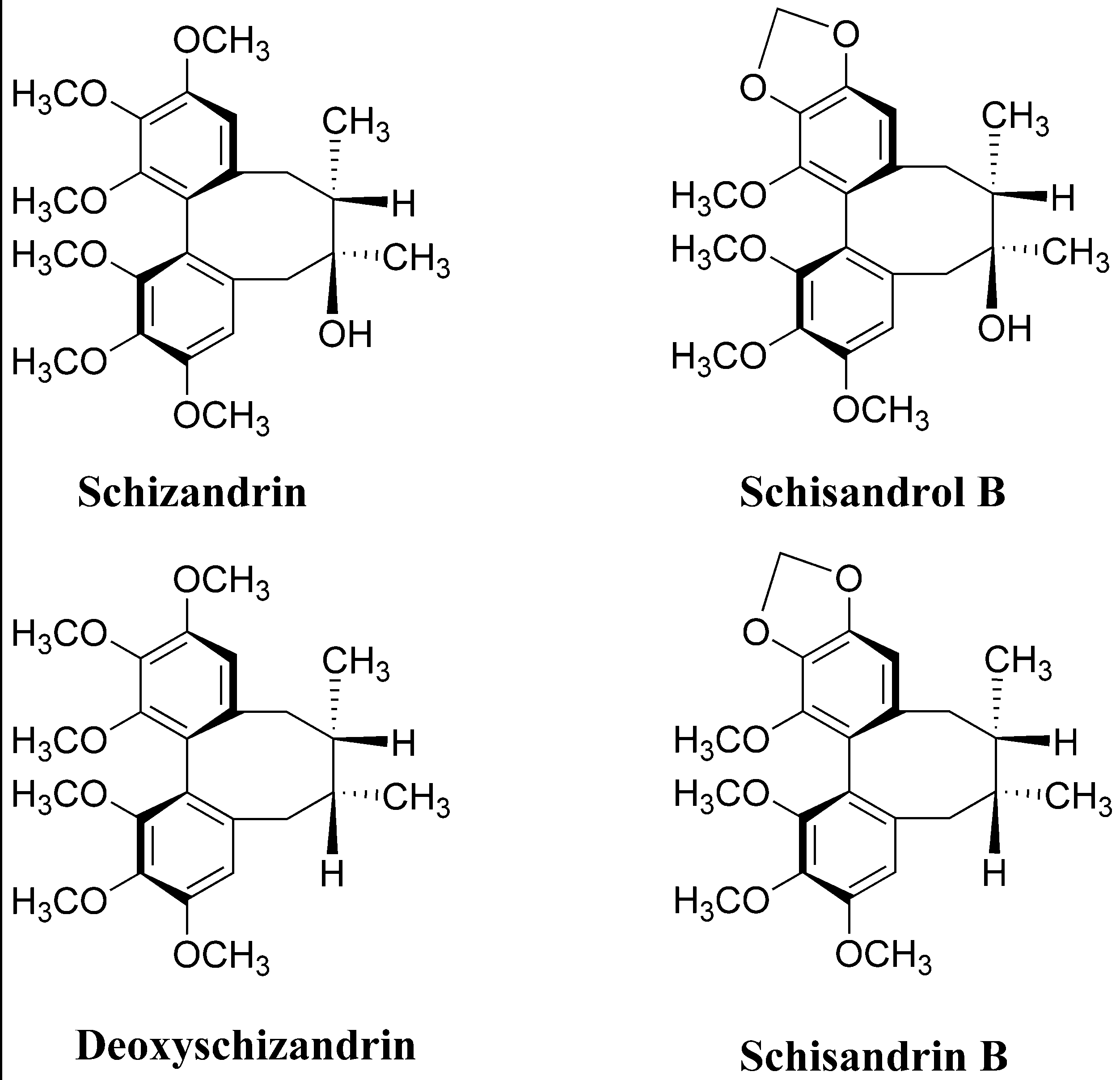
      <p>Many reports dating from the early 19th century have indicated the therapeutic properties of Fructus Schisandrae (the fruits of <italic>Schisandra chinensis</italic> Baill) for liver diseases, including prevention of liver damage, stimulation of liver regeneration and inhibition of hepatocarcinogenesis [<xref ref-type="bibr" rid="B19-molecules-17-03618">19</xref>,<xref ref-type="bibr" rid="B20-molecules-17-03618">20</xref>]. Lignans, the major active principle from <italic>S</italic>. <italic>chinensis</italic>, have shown satisfactory evidence for a clinically significant activity in chronic liver injuries [<xref ref-type="bibr" rid="B21-molecules-17-03618">21</xref>,<xref ref-type="bibr" rid="B22-molecules-17-03618">22</xref>]. The chemical structures of lignans in this plant have been extensively investigated in many published papers, and so far more than 30 lignans have been isolated and identified [<xref ref-type="bibr" rid="B23-molecules-17-03618">23</xref>]. Among them, the major ones were the four lignans schizandrin, schisandrol B, deoxyschizandrin and schisandrin B (<xref ref-type="fig" rid="molecules-17-03618-f001">Figure 1</xref>). Although the ASE method has proved to be effective for the extraction of natural compounds from medicinal plants, no study exist on the simultaneous extraction of four lignans from <italic>S</italic>. <italic>chinensis</italic> using RSM modeling and optimization.</p>
      
      <p>This study aimed to apply response surface methodology (RSM) to model and optimize ASE technique for the extraction of four lignans from Fructus Schisandrae. Several important factors, such as extraction solvent, extraction time and extraction temperature, were systemically analyzed using a Box-Behnken design. To the best of our knowledge, this is the first report on combination of RSM and ASE for extraction of four lignans from Fructus Schisandrae.</p>
    </sec>
    <sec sec-type="results">
      <title>2. Results and Discussion</title>
      <sec>
        <title>2.1. Predicted Model and Statistical Analysis</title>
        <p>Preliminary studies were performed in order to determine the required range of ethanol concentrations (<italic>X</italic><sub>1</sub>, 50–100%), extraction time (<italic>X</italic><sub>2</sub>, 5–12 min) and extraction temperature (<italic>X</italic><sub>3</sub>, 80–180 °C). The whole design consisted of 15 experimental points as listed in <xref ref-type="table" rid="molecules-17-03618-t001">Table 1</xref>, and three replicates (run 13–15) at the center of the design were used for estimating a pure error sum of squares. The experiments were performed in triplicate at all design points in randomized order.</p>
        <fig id="molecules-17-03618-f001" position="anchor">
        <label>Figure 1</label>
        <caption>
          <p>Chemical structures of schizandrin, schisandrol B, deoxyschizandrin and schisandrin B.</p>
        </caption>
        <graphic xmlns:xlink="http://www.w3.org/1999/xlink" xlink:href="molecules-17-03618-g001.tif"/>
      </fig>
        <table-wrap id="molecules-17-03618-t001" position="anchor">
          <object-id pub-id-type="pii">molecules-17-03618-t001_Table 1</object-id>
          <label>Table 1</label>
          <caption>
            <p>Factors and levels for RSM, and Box-Behnken design with the independent variables.</p>
          </caption>
          <table>
            <thead>
              <tr>
                <th rowspan="2" align="center" valign="middle">Run</th>
                <th colspan="3" align="center" valign="middle">Coded and Uncoded Variables Levels</th>
                <th colspan="2" align="center" valign="middle">Yield of Lignans (mg/g)</th>
              </tr>
              <tr style="border-top: solid thin">
                <th align="left" valign="middle"><italic>X</italic><sub>1</sub>/ethanol (%)</th>
                <th align="left" valign="middle"><italic>X</italic><sub>2</sub>/time (min)</th>
                <th align="left" valign="middle"><italic>X</italic><sub>3</sub>/temperature (°C)</th>
                <th align="center" valign="middle">Actual Values</th>
                <th align="center" valign="middle">Predicted Values</th>
              </tr>
            </thead>
            <tbody>
              <tr style="border-top: solid thin">
                <td align="center" valign="middle">1</td>
                <td align="left" valign="middle">−1 (50)</td>
                <td align="left" valign="middle">−1 (5)</td>
                <td align="left" valign="middle">0 (130)</td>
                <td align="left" valign="middle">9.96 ± 0.32</td>
                <td align="center" valign="middle">9.94</td>
              </tr>
              <tr>
                <td align="center" valign="middle">2</td>
                <td align="left" valign="middle">1 (100)</td>
                <td align="left" valign="middle">−1 (5)</td>
                <td align="left" valign="middle">0 (130)</td>
                <td align="left" valign="middle">11.34 ± 0.25</td>
                <td align="center" valign="middle">11.15</td>
              </tr>
              <tr>
                <td align="center" valign="middle">3</td>
                <td align="left" valign="middle">−1 (50)</td>
                <td align="left" valign="middle">1 (12)</td>
                <td align="left" valign="middle">0 (130)</td>
                <td align="left" valign="middle">12.65 ± 0.34</td>
                <td align="center" valign="middle">12.85</td>
              </tr>
              <tr>
                <td align="center" valign="middle">4</td>
                <td align="left" valign="middle">1 (100)</td>
                <td align="left" valign="middle">1 (12)</td>
                <td align="left" valign="middle">0 (130)</td>
                <td align="left" valign="middle">13.99 ± 0.45</td>
                <td align="center" valign="middle">14.01</td>
              </tr>
              <tr>
                <td align="center" valign="middle">5</td>
                <td align="left" valign="middle">−1 (50)</td>
                <td align="left" valign="middle">0 (8.5)</td>
                <td align="left" valign="middle">−1 (80)</td>
                <td align="left" valign="middle">11.80 ± 0.26</td>
                <td align="center" valign="middle">11.69</td>
              </tr>
              <tr>
                <td align="center" valign="middle">6</td>
                <td align="left" valign="middle">1 (100)</td>
                <td align="left" valign="middle">0 (8.5)</td>
                <td align="left" valign="middle">−1 (80)</td>
                <td align="left" valign="middle">12.77 ± 0.23</td>
                <td align="center" valign="middle">12.83</td>
              </tr>
              <tr>
                <td align="center" valign="middle">7</td>
                <td align="left" valign="middle">−1 (50)</td>
                <td align="left" valign="middle">0 (8.5)</td>
                <td align="left" valign="middle">1 (180)</td>
                <td align="left" valign="middle">12.88 ± 0.33</td>
                <td align="center" valign="middle">12.81</td>
              </tr>
              <tr>
                <td align="center" valign="middle">8</td>
                <td align="left" valign="middle">1 (100)</td>
                <td align="left" valign="middle">0 (8.5)</td>
                <td align="left" valign="middle">1 (180)</td>
                <td align="left" valign="middle">13.91 ± 0.29</td>
                <td align="center" valign="middle">14.03</td>
              </tr>
              <tr>
                <td align="center" valign="middle">9</td>
                <td align="left" valign="middle">0 (75)</td>
                <td align="left" valign="middle">−1 (5)</td>
                <td align="left" valign="middle">−1 (80)</td>
                <td align="left" valign="middle">9.90 ± 0.22</td>
                <td align="center" valign="middle">10.03</td>
              </tr>
              <tr>
                <td align="center" valign="middle">10</td>
                <td align="left" valign="middle">0 (75)</td>
                <td align="left" valign="middle">1 (12)</td>
                <td align="left" valign="middle">−1 (80)</td>
                <td align="left" valign="middle">12.99 ± 0.21</td>
                <td align="center" valign="middle">12.91</td>
              </tr>
              <tr>
                <td align="center" valign="middle">11</td>
                <td align="left" valign="middle">0 (75)</td>
                <td align="left" valign="middle">−1 (5)</td>
                <td align="left" valign="middle">1 (180)</td>
                <td align="left" valign="middle">11.10 ± 0.22</td>
                <td align="center" valign="middle">11.19</td>
              </tr>
              <tr>
                <td align="center" valign="middle">12</td>
                <td align="left" valign="middle">0 (75)</td>
                <td align="left" valign="middle">1 (12)</td>
                <td align="left" valign="middle">1 (180)</td>
                <td align="left" valign="middle">14.21 ± 0.31</td>
                <td align="center" valign="middle">14.08</td>
              </tr>
              <tr>
                <td align="center" valign="middle">13</td>
                <td align="left" valign="middle">0 (75)</td>
                <td align="left" valign="middle">0 (8.5)</td>
                <td align="left" valign="middle">0 (130)</td>
                <td align="left" valign="middle">14.12 ± 0.28</td>
                <td align="center" valign="middle">14.00</td>
              </tr>
              <tr>
                <td align="center" valign="middle">14</td>
                <td align="left" valign="middle">0 (75)</td>
                <td align="left" valign="middle">0 (8.5)</td>
                <td align="left" valign="middle">0 (130)</td>
                <td align="left" valign="middle">13.89 ± 0.23</td>
                <td align="center" valign="middle">14.00</td>
              </tr>
              <tr>
                <td align="center" valign="middle">15</td>
                <td align="left" valign="middle">0 (75)</td>
                <td align="left" valign="middle">0 (8.5)</td>
                <td align="left" valign="middle">0 (130)</td>
                <td align="left" valign="middle">13.99 ± 0.27</td>
                <td align="center" valign="middle">14.00</td>
              </tr>
            </tbody>
  </table>
        </table-wrap>
        <p>The design matrix and the corresponding results of RSM experiments to determine the effects of the three independent variables including ethanol concentrations, extraction time and extraction temperature were shown in <xref ref-type="table" rid="molecules-17-03618-t002">Table 2</xref>. Through multiple regression analysis on the experimental data, predicted response <italic>Y</italic> for the yield of lignans could be expressed by the following second-order polynomial equation in term of coded values:</p>
        
        <p><italic>Y </italic>= 14 + 0.59<italic>X</italic><sub>1</sub> + 1.44<italic>X</italic><sub>2</sub> + 0.58<italic>X</italic><sub>3</sub> − 0.011<italic>X</italic><sub>1</sub><italic>X</italic><sub>2</sub> + 0.018<italic>X</italic><sub>1</sub><italic>X</italic><sub>3</sub> + 3.500E − 003<italic>X</italic><sub>2</sub><italic>X</italic><sub>3</sub> − 0.61<italic>X<sup>2</sup><sub>1</sub></italic> − 1.40<italic>X<sup>2</sup><sub>2</sub></italic> − 0.55<italic>X<sup>2</sup><sub>3</sub></italic></p>
        <p>where <italic>Y</italic> is the yield of four lignans (mg/g), and <italic>X</italic><sub>1</sub>, <italic>X</italic><sub>2</sub> and <italic>X</italic><sub>3</sub> are the coded variables for ethanol concentration, extraction time and extraction temperature, respectively. Statistical testing of the model was performed in the form of analysis of variance (ANOVA). Then ANOVA for the fitted quadratic polynomial model of extraction of four lignans were shown in <xref ref-type="table" rid="molecules-17-03618-t002">Table 2</xref>. The quadratic regression model showed the value of determination coefficient (<italic>R<sup>2</sup></italic>) of 0.9939 with no significant lack of fit at <italic>p </italic>&gt; 0.05, which means that the calculated model was able to explain 99.39% of the results. The results indicated that the model used to fit response variable was significant (<italic>p </italic>&lt; 0.0001) and adequate to represent the relationship between the response and the independent variables [<xref ref-type="bibr" rid="B24-molecules-17-03618">24</xref>]. The significance of the model was also judged by <italic>F</italic>-test, which suggested that model had a very high model <italic>F</italic>-value (<italic>F</italic> = 125.80). <italic>R</italic><sup>2</sup><sub>a</sub><sub>dj</sub> (adjusted determination coefficient) is the correlation measure for testing the goodness-of-fit of the regression equation [<xref ref-type="bibr" rid="B25-molecules-17-03618">25</xref>]. The <italic>R</italic><sup>2</sup><sub>adj</sub> value of this model is 0.9860, which indicated only 1.40% of the total variations were not explained by model. Meanwhile, a relatively lower value of coefficient of variation (CV = 1.36) showed a better precision and reliability of the experiments carried out [<xref ref-type="bibr" rid="B4-molecules-17-03618">4</xref>,<xref ref-type="bibr" rid="B26-molecules-17-03618">26</xref>].</p>
        <table-wrap id="molecules-17-03618-t002" position="anchor">
          <object-id pub-id-type="pii">molecules-17-03618-t002_Table 2</object-id>
          <label>Table 2</label>
          <caption>
            <p>Analysis of variance for the fitted quadratic polynomial model of extraction of lignans.</p>
          </caption>
          <table>
            <thead>
              <tr>
                <th align="left" valign="middle">Source</th>
                <th align="left" valign="middle">SS</th>
                <th align="left" valign="middle">DF</th>
                <th align="left" valign="middle">MS</th>
                <th align="left" valign="middle"><italic>F</italic>-value</th>
                <th align="left" valign="middle"><italic>p</italic>-value</th>
                <th align="left" valign="middle"> </th>
              </tr>
            </thead>
            <tbody>
              <tr>
                <td align="left" valign="middle">Model</td>
                <td align="left" valign="middle">34.27</td>
                <td align="left" valign="middle">9</td>
                <td align="left" valign="middle">3.81</td>
                <td align="left" valign="middle">125.80</td>
                <td align="left" valign="middle">&lt;0.0001</td>
                <td align="left" valign="middle">significant</td>
              </tr>
              <tr>
                <td align="left" valign="middle">Residual</td>
                <td align="left" valign="middle">0.21</td>
                <td align="left" valign="middle">7</td>
                <td align="left" valign="middle">0.030</td>
                <td align="left" valign="middle"> </td>
                <td align="left" valign="middle"> </td>
                <td align="left" valign="middle"> </td>
              </tr>
              <tr>
                <td align="left" valign="middle">Lack of fit</td>
                <td align="left" valign="middle">0.16</td>
                <td align="left" valign="middle">3</td>
                <td align="left" valign="middle">0.054</td>
                <td align="left" valign="middle">4.38</td>
                <td align="left" valign="middle">0.0938</td>
                <td align="left" valign="middle">insignificant</td>
              </tr>
              <tr>
                <td align="left" valign="middle">Experimental error</td>
                <td align="left" valign="middle">0.049</td>
                <td align="left" valign="middle">4</td>
                <td align="left" valign="middle">0.012</td>
                <td align="left" valign="middle"> </td>
                <td align="left" valign="middle"> </td>
                <td align="left" valign="middle"> </td>
              </tr>
            </tbody>
          </table>
          <table-wrap-foot><fn><p>Notes: SS, sum of squares; DF, degree of freedom; MS, mean square.</p></fn></table-wrap-foot>
        </table-wrap>
        
        <p>The significance of each coefficient was also determined using <italic>F</italic>-value and <italic>p</italic>-value. The results are given in <xref ref-type="table" rid="molecules-17-03618-t003">Table 3</xref>. It could be seen that the lignans extraction yield was affected significantly by all three extraction parameters (<italic>X</italic><sub>1</sub>, <italic>X</italic><sub>2</sub>, and <italic>X</italic><sub>3</sub>, <italic>p </italic>&lt; 0.001). In addition, it was evident that all the quadratic parameters (<italic>X<sup>2</sup><sub>1</sub></italic>, <italic>X</italic><italic><sup>2</sup><sub>2</sub></italic>, <italic>X<sup>2</sup><sub>3</sub></italic>) were significant at the level of <italic>p </italic>&lt; 0.05 or <italic>p </italic>&lt; 0.0001, whereas the interaction quadratic parameters (<italic>X</italic><sub>1</sub><italic>X</italic><sub>2</sub>,<italic>X</italic><sub>1</sub><italic>X</italic><sub>3</sub> and <italic>X</italic><sub>2</sub><italic>X</italic><sub>3</sub>) were insignificant (<italic>p </italic>&gt; 0.1).</p>
        <table-wrap id="molecules-17-03618-t003" position="anchor">
          <object-id pub-id-type="pii">molecules-17-03618-t003_Table 3</object-id>
          <label>Table 3</label>
          <caption>
            <p>Estimated regression model of relationship between response variables (yield of four lignans) and independent variables (<italic>X</italic><sub>1</sub>, <italic>X</italic><sub>2</sub>, <italic>X</italic><sub>3</sub>).</p>
          </caption>
          <table>
            <thead>
              <tr>
                <th align="left" valign="middle">Variables</th>
                <th align="left" valign="middle">DF</th>
                <th align="left" valign="middle">SS</th>
                <th align="left" valign="middle">MS</th>
                <th align="left" valign="middle"><italic>F</italic>-values</th>
                <th align="left" valign="middle"><italic>p</italic>-value</th>
              </tr>
            </thead>
            <tbody>
              <tr>
                <td align="left" valign="middle">
                  <italic>X</italic>
                  <sub>1</sub>
                </td>
                <td align="left" valign="middle">1</td>
                <td align="left" valign="middle">2.79</td>
                <td align="left" valign="middle">2.79</td>
                <td align="left" valign="middle">92.25</td>
                <td align="left" valign="middle">&lt;0.0001</td>
              </tr>
              <tr>
                <td align="left" valign="middle">
                  <italic>X</italic>
                  <sub>2</sub>
                </td>
                <td align="left" valign="middle">1</td>
                <td align="left" valign="middle">16.65</td>
                <td align="left" valign="middle">16.65</td>
                <td align="left" valign="middle">550.04 </td>
                <td align="left" valign="middle">&lt;0.0001</td>
              </tr>
              <tr>
                <td align="left" valign="middle">
                  <italic>X</italic>
                  <sub>3</sub>
                </td>
                <td align="left" valign="middle">1</td>
                <td align="left" valign="middle">2.70</td>
                <td align="left" valign="middle">2.70 </td>
                <td align="left" valign="middle">89.15</td>
                <td align="left" valign="middle">&lt;0.0001</td>
              </tr>
              <tr>
                <td align="left" valign="middle">
                  <italic>X<sup>2</sup><sub>1</sub></italic>
                </td>
                <td align="left" valign="middle">1</td>
                <td align="left" valign="middle">1.59</td>
                <td align="left" valign="middle">1.59</td>
                <td align="left" valign="middle">52.41</td>
                <td align="left" valign="middle">0.0002</td>
              </tr>
              <tr>
                <td align="left" valign="middle">
                  <italic>X<sup>2</sup><sub>2</sub></italic>
                </td>
                <td align="left" valign="middle">1</td>
                <td align="left" valign="middle">8.28</td>
                <td align="left" valign="middle">8.28 </td>
                <td align="left" valign="middle">273.56</td>
                <td align="left" valign="middle">&lt;0.0001</td>
              </tr>
              <tr>
                <td align="left" valign="middle">
                  <italic>X<sup>2</sup><sub>3</sub></italic>
                </td>
                <td align="left" valign="middle">1</td>
                <td align="left" valign="middle">1.27</td>
                <td align="left" valign="middle">1.27 </td>
                <td align="left" valign="middle">41.97</td>
                <td align="left" valign="middle">0.0003</td>
              </tr>
              <tr>
                <td align="left" valign="middle">
                  <italic>X</italic>
                  <sub>1</sub>
                  <italic>X</italic>
                  <sub>2</sub>
                </td>
                <td align="left" valign="middle">1</td>
                <td align="left" valign="middle">4.41E-004</td>
                <td align="left" valign="middle">4.41E-004</td>
                <td align="left" valign="middle">0.015 </td>
                <td align="left" valign="middle">0.9073 </td>
              </tr>
              <tr>
                <td align="left" valign="middle">
                  <italic>X</italic>
                  <sub>1</sub>
                  <italic>X</italic>
                  <sub>3</sub>
                </td>
                <td align="left" valign="middle">1</td>
                <td align="left" valign="middle">1.23E-003</td>
                <td align="left" valign="middle">1.23E-003</td>
                <td align="left" valign="middle">0.040 </td>
                <td align="left" valign="middle">0.8463</td>
              </tr>
              <tr>
                <td align="left" valign="middle">
                  <italic>X</italic>
                  <sub>2</sub>
                  <italic>X</italic>
                  <sub>3</sub>
                </td>
                <td align="left" valign="middle">1</td>
                <td align="left" valign="middle">4.90E-005</td>
                <td align="left" valign="middle">4.90E-005 </td>
                <td align="left" valign="middle">1.62E-003 </td>
                <td align="left" valign="middle">0.9690 </td>
              </tr>
            </tbody>
          </table>
          <table-wrap-foot><fn><p>Notes: SS, sum of squares; DF, degree of freedom; MS, mean square.</p></fn></table-wrap-foot>
        </table-wrap>
        
      </sec>
      <sec>
        <title>2.2. Optimization of Extraction Parameters of Lignans</title>
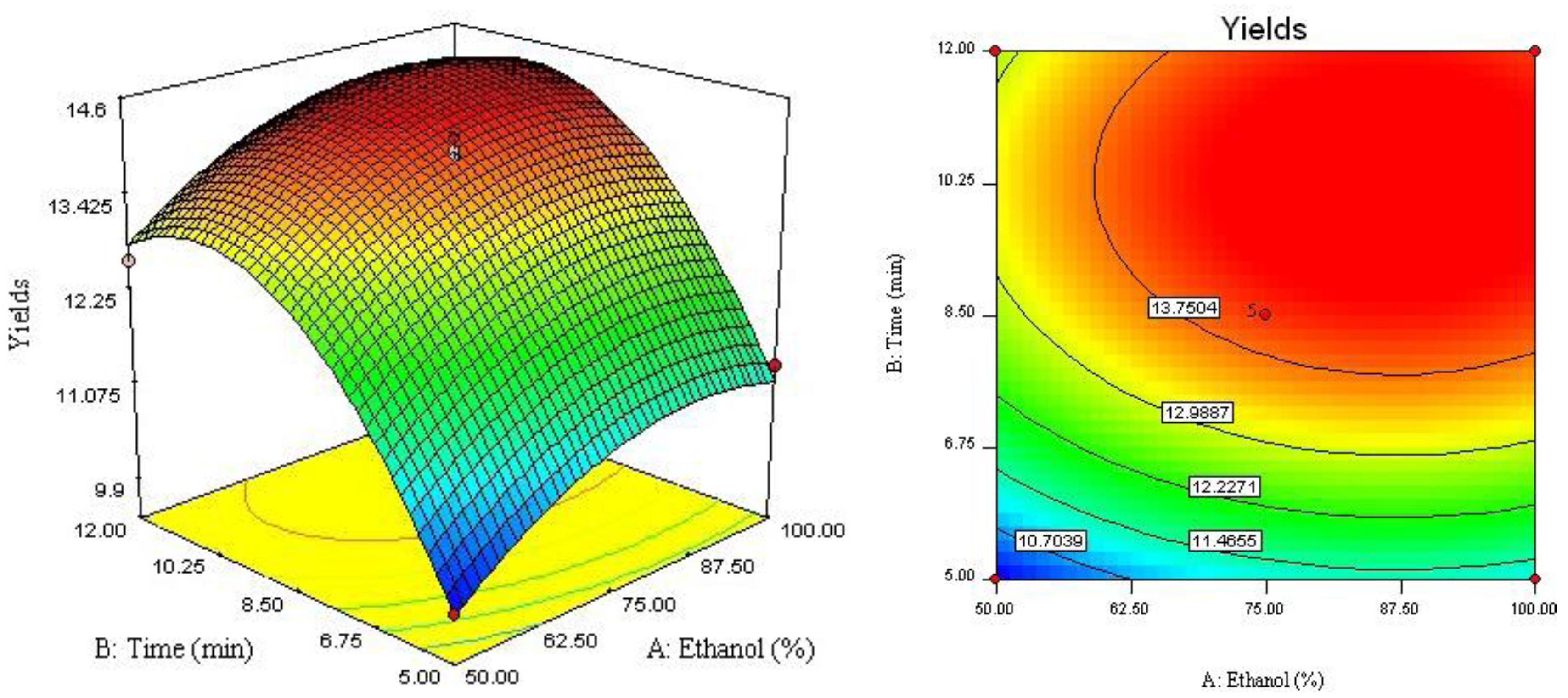
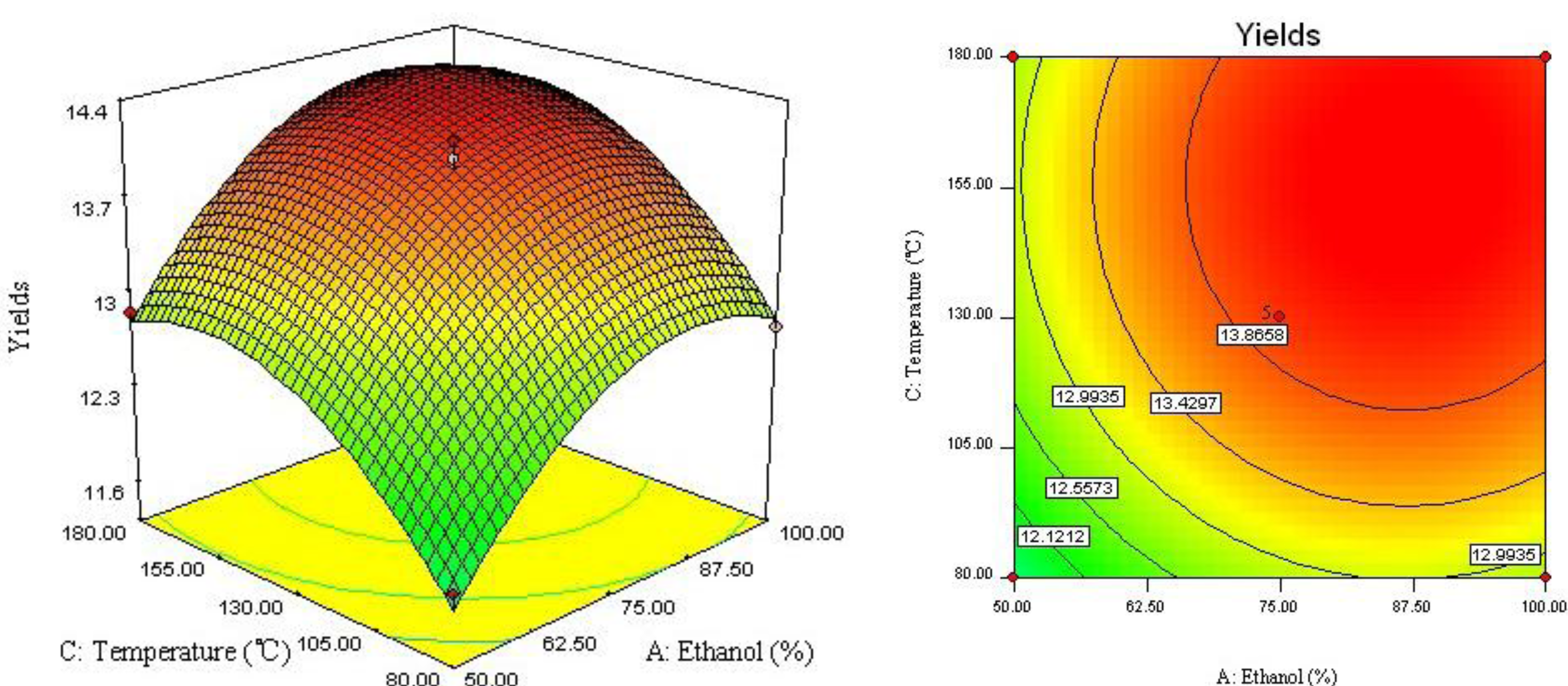
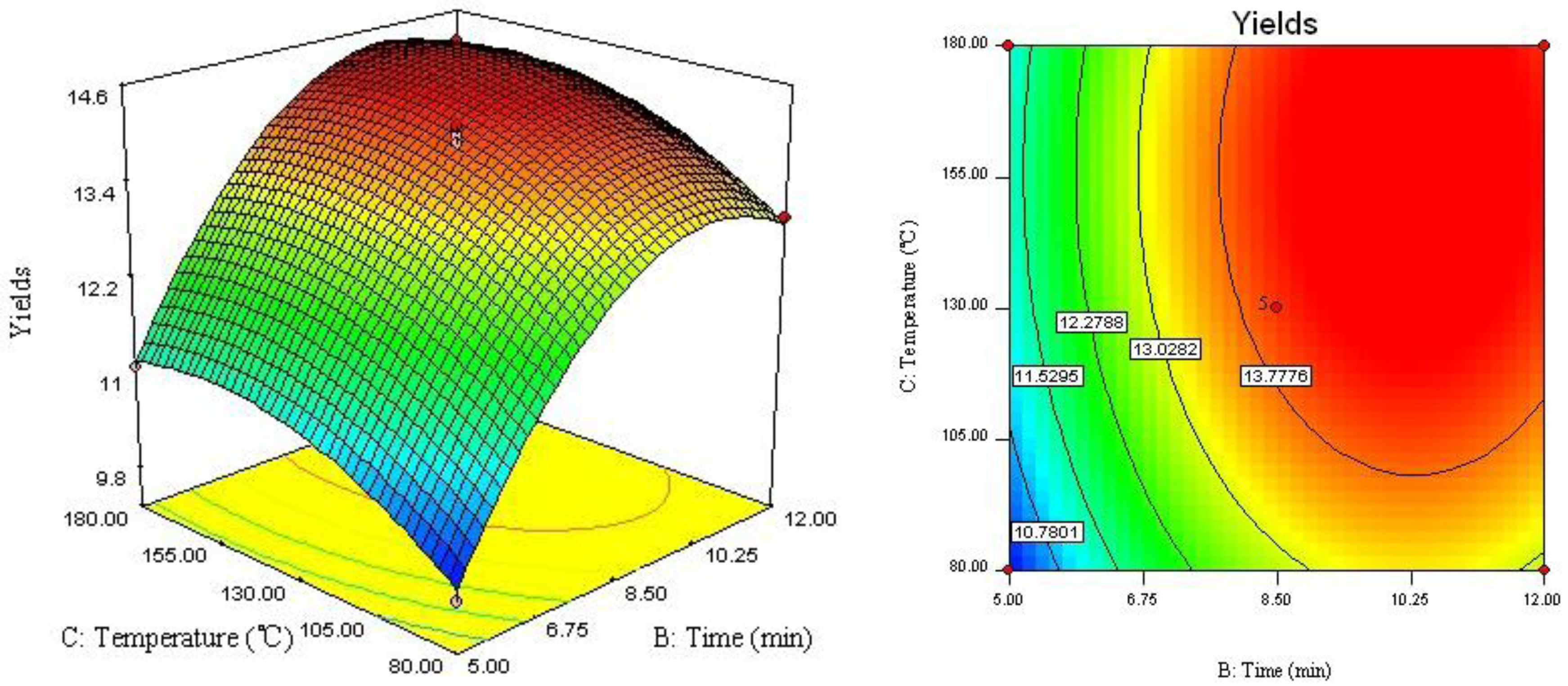
        <p>The relationship between independent and dependent variables was graphically represented by 3D response surface and 2D contour plots generated by the model (<xref ref-type="fig" rid="molecules-17-03618-f002">Figure 2</xref>, <xref ref-type="fig" rid="molecules-17-03618-f003">Figure 3</xref>, <xref ref-type="fig" rid="molecules-17-03618-f004">Figure 4</xref>). Different shapes of the contour plots indicated different interactions between the variables, an elliptical contour plot indicated the interactions between the variables were significant while a circular contour plot means otherwise.</p>
        
        <p><xref ref-type="fig" rid="molecules-17-03618-f002">Figure 2</xref> showed the interaction between ethanol concentration (<italic>X</italic><sub>1</sub>) and extraction time (<italic>X</italic><sub>2</sub>) on the yield of four lignans. Increase of ethanol concentration from 50 to 87% improve the extraction yield. However, when the ethanol concentration over 87%, there was a gradual decline in the response, and extraction time over 10 min did not show any obvious effect on extraction yield. The possible explanation could be that, increasing extraction time may accelerate chemical degradation of bioactive compound in extraction process, which resulted in the lower extraction yield [<xref ref-type="bibr" rid="B11-molecules-17-03618">11</xref>]. <xref ref-type="fig" rid="molecules-17-03618-f003">Figure 3</xref> described the effect of ethanol concentration (<italic>X</italic><sub>1</sub>) and extraction temperature (<italic>X</italic><sub>3</sub>) on the yield of four lignans. It may be also observed that when extraction time (<italic>X</italic><sub>2</sub>) was fixed at 0 level, extraction temperature (<italic>X</italic><sub>3</sub>) displayed a quadratic effect on the response yield. Varying ethanol concentration from 50 to 90% with increase of extraction temperature from 80 to 160 °C, the target compounds’ extraction yield was increasing with increase of ethanol concentration. As shown in <xref ref-type="fig" rid="molecules-17-03618-f004">Figure 4</xref> and <xref ref-type="table" rid="molecules-17-03618-t003">Table 3</xref>, when ethanol concentration (<italic>X</italic><sub>1</sub>) was fixed at 0 level, the interaction of extraction time (<italic>X</italic><sub>2</sub>) and extraction temperature (<italic>X</italic><sub>3</sub>) had also insignificant effect on the extraction yields. It depicted that the highest extraction yield could be achieved when using near 160 °C of extraction temperature and 10 min of extraction time.</p>
        <fig id="molecules-17-03618-f002" position="anchor">
          <label>Figure 2</label>
          <caption>
            <p>Response surface plot and contour plot of ethanol concentration and extraction time.</p>
          </caption>
          <graphic xmlns:xlink="http://www.w3.org/1999/xlink" xlink:href="molecules-17-03618-g002.tif"/>
        </fig>
        <fig id="molecules-17-03618-f003" position="anchor">
          <label>Figure 3</label>
          <caption>
            <p>Response surface plot and contour plot of ethanol concentration and extraction temperature.</p>
          </caption>
          <graphic xmlns:xlink="http://www.w3.org/1999/xlink" xlink:href="molecules-17-03618-g003.tif"/>
        </fig>
        <fig id="molecules-17-03618-f004" position="anchor">
          <label>Figure 4</label>
          <caption>
            <p>Response surface plot and contour plot of extraction temperature and extraction time.</p>
          </caption>
          <graphic xmlns:xlink="http://www.w3.org/1999/xlink" xlink:href="molecules-17-03618-g004.tif"/>
        </fig>
      </sec>
      <sec>
        <title>2.3. Selection of Extraction Cycles and Flush Volume</title>
        <p>The extraction cycles of ASE was determined by performing consecutive accelerated solvent extractions three cycles on the same sample. According to pervious studies and present investigation, single extraction cycle was sufficient to completely extract most of target components [<xref ref-type="bibr" rid="B11-molecules-17-03618">11</xref>,<xref ref-type="bibr" rid="B27-molecules-17-03618">27</xref>]. In order to save time and energy, one cycle extraction was employed in this investigation (data not shown).</p>
        <p>In addition, different flush volume (20, 40, 60, and 80%) was evaluated on whether it affects extraction efficiencies of the target compounds. The results indicated that flush volume was not the main influencing factor (data not shown). Therefore, the flush volume was set at its default values of 60%. Given that extraction pressure was fixed in ASE 300 system (1,500 psi) [<xref ref-type="bibr" rid="B27-molecules-17-03618">27</xref>], we did not evaluate the effect of extraction pressure here.</p>
      </sec>
      <sec>
        <title>2.4. Verification of Predictive Model</title>
        <p>In this study, the aim of optimization was to find the conditions which gave the maximum extraction yield of four lignans in Fructus Schisandrae. The software generated the optimum ethanol concentration, extraction time and extraction temperature was 87.09%, 10.30 min and 156.94 °C, respectively. The software predicted the extraction yield of total lignans was 14.67 mg/g. As shown in <xref ref-type="table" rid="molecules-17-03618-t004">Table 4</xref>, three parallel experiments were carried out under the optimal conditions. Comparing with the value predicted by Design Expert 7.1.6, the results showed that the actual value of 14.72 mg/g was very close to the actual results. In addition, the extraction yield of crude extract was 11.21%, and all target compounds were extracted absolutely via HPLC analysis of sample residues. This indicated that the optimization achieved in the present study was reliable.</p>
        <table-wrap id="molecules-17-03618-t004" position="anchor">
          <object-id pub-id-type="pii">molecules-17-03618-t004_Table 4</object-id>
          <label>Table 4</label>
          <caption>
            <p>Optimum conditions and the predicted and experimental value of response at the optimum conditions.</p>
          </caption>
          <table>
            <thead>
              <tr>
                <th align="left" valign="middle"> </th>
                <th align="center" valign="middle">Ethanol (%)</th>
                <th align="center" valign="middle">Extraction time (min)</th>
                <th align="center" valign="middle">Temperature (°C)</th>
                <th align="center" valign="middle">Yield of Lignans (mg/g)</th>
              </tr>
            </thead>
            <tbody>
              <tr>
                <td align="left" valign="middle">
                  <bold>Optimum conditions (predicted)</bold>
                </td>
                <td align="center" valign="middle">87.09</td>
                <td align="center" valign="middle">10.30</td>
                <td align="center" valign="middle">156.94</td>
                <td align="center" valign="middle">14.67</td>
              </tr>
              <tr>
                <td align="left" valign="middle">
                  <bold>Modified conditions (actual)</bold>
                </td>
                <td align="center" valign="middle">87.00</td>
                <td align="center" valign="middle">10.00</td>
                <td align="center" valign="middle">160.00</td>
                <td align="center" valign="middle">14.72 ± 0.77</td>
              </tr>
            </tbody>
          </table>
        </table-wrap>
      </sec>
      <sec>
        <title>2.5. Comparison with Conventional Extractions</title>
        <p>Prior to the present investigation, heat-reflux extraction was used for sample preparation of lignans in Fructus Schisandrae [<xref ref-type="bibr" rid="B28-molecules-17-03618">28</xref>]. Hence, it is necessary to compare ASE with HRE on extraction yield of total lignans. The results indicated the lignans’ yield of HRE (13.55 mg/g) was slightly lower than that of ASE (14.72 mg/g). Moreover, ASE took only one twelfth of the time it took for HRE (2 h). Therefore, ASE can save lots of time comparing to HRE and provide higher yield of lignans than HRE</p>
      </sec>
    </sec>
    <sec sec-type="methods">
      <title>3. Experimental</title>
      <sec>
        <title>3.1. Plant Material</title>
        <p>Fructus Schisandrae, the wild fruits of <italic>Schisandra chinensis</italic> Baill, were obtained from Changchun Huarui Ginseng Co., Ltd., and identified by Wei Li (College of Chinese Medicinal Materials, Jilin Agricultural University). The cut pieces were ground to obtain a relatively homogenous drug powder (80–100 mm). The powder was dried at 60 °C until constant weight and was well blended before use.</p>
      </sec>
      <sec>
        <title>3.2. Chemicals and Reagents</title>
        <p>Methanol for chromatographic grade was purchased from Fisher Chemicals (Miami, FL, USA). Other chemicals, such as ethanol, <italic>etc</italic>. were all of analytical grade from Beijing Chemical Factory. Water was purified using a Milli-Q water purification system (Milipore, Boston, MA, USA). Standards of schizandrin, schisandrol B, deoxyschizandrin and schisandrin B were obtained from the National Institute for the Control of Pharmaceutical and Biological Products of China (Beijing, China).</p>
      </sec>
      <sec>
        <title>3.3. Accelerated Solvent Extraction</title>
        <p>ASE was performed with a Dionex ASE 300<sup>TM</sup> instrument equipped with a solvent controller (Dionex, Sunnyvale, CA, USA). The system consists of a high pressure pneumatic solvent pump capable of 1,500 psi at elevated flow rate; an extraction solvent pressurized bottle; a carousel for 12 extraction cells of 100 mL; a carousel for 250 mL collection vials; a microprocessor for storing and editing parameters such as temperature, time and pressure; infra-red (IR) sensors to detect the fluid arrival into the collection vial and monitor fluid levels during extract collection. In present investigation, 100 mL of extraction cells was used and filled with 5.0 g of sample powders.</p>
        <p>After the extraction procedure, the filtered solutions were concentrated to dryness in vacuum at 45 °C. The obtained dry extracts were diluted in 25 mL ethanol and the supernatant was filtered through a 0.45 μm nylon membrane and then injected into HPLC for analysis. Three replicate injections were analyzed to determine the extraction yields of lignans with the mean peak area. To evaluate the repeatability of the extraction procedure, a series of three replicated extractions were performed. The results obtained for all target compounds revealed that the R.S.D. was lower than 3.7%.</p>
      </sec>
      <sec>
        <title>3.4. Conventional Extraction</title>
        <p>Heat-reflux extraction (HRE) as one of conventional extractions was performed according to the one published report [<xref ref-type="bibr" rid="B28-molecules-17-03618">28</xref>]. In brief, exhaustive extraction with ethanol was performed on 2.0 g drug powder, placed in an extraction bag filter, and impregnated with ethanol. Extraction was performed for about 2 h with 50 mL methanol.</p>
      </sec>
      <sec>
        <title>3.5. HPLC Analysis of Four Lignans</title>
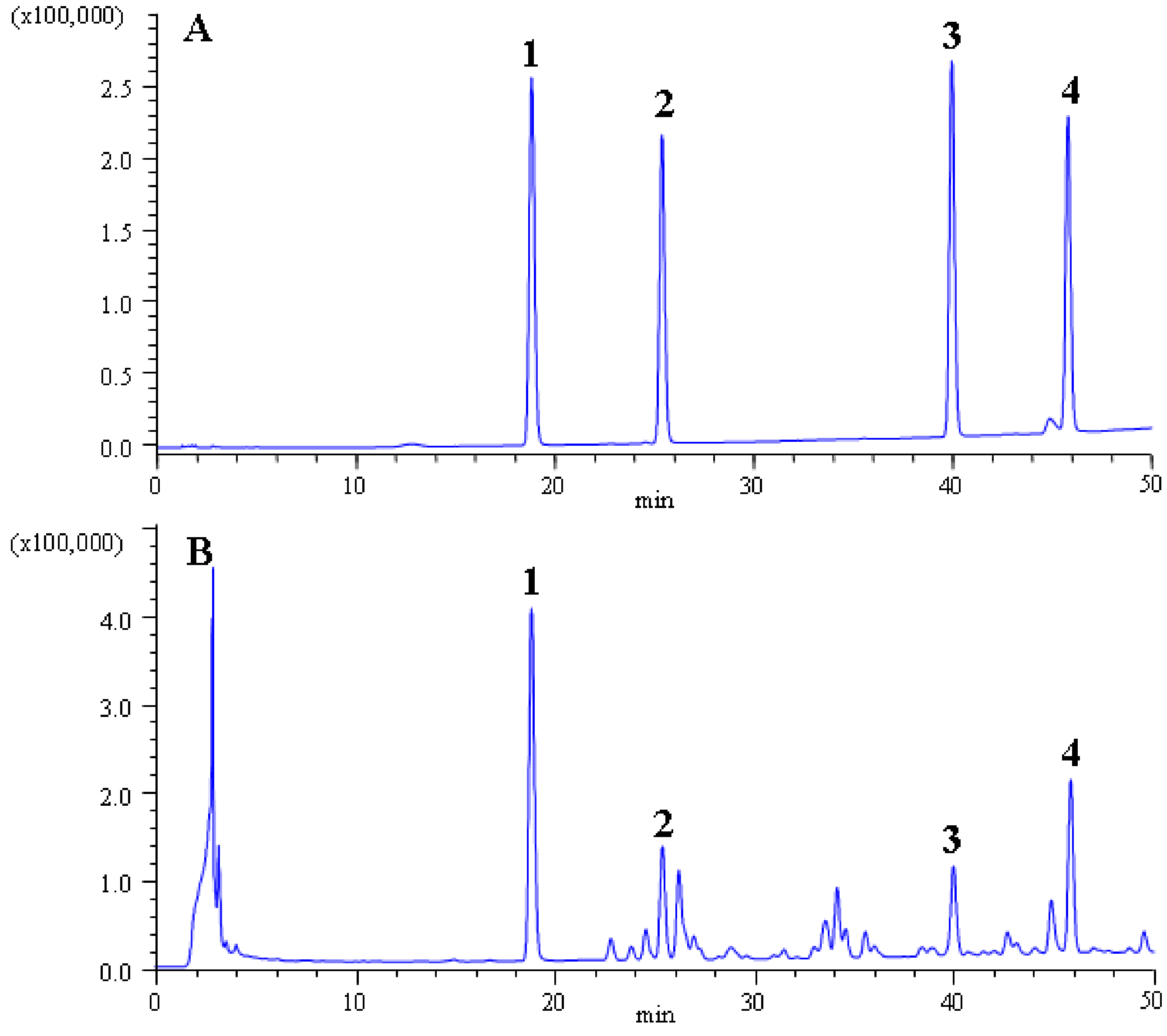
        <p>In the present work, four lignans in Fructus Schisandrae were quantified simultaneously by high performance liquid chromatography coupled with UV detection (HPLC-UV; <xref ref-type="fig" rid="molecules-17-03618-f005">Figure 5</xref>). The HPLC analyses were performed with a HPLC instrument (Agilent 1100, Agilent Technologies, Los Angeles, CA, USA) equipped with a quaternary solvent delivery system, a column oven and UV detector. Separation was achieved on Hypersil ODS2 column (4.6 mm × 250 mm, 5 μm) from Dalian Elite Analytical Instruments Co., Ltd. (Dalian, China). The column temperature was set at 25 °C and detection wavelength was set at 254 nm. The mobile phase was consisted of water (A) and methanol (B) with flow rate of 1.0 mL/min. The gradient elution was programmed as follows: 0–5min, 50% B; 5–45 min, 50–80% B; 45–55 min, 80% B.</p>
        <fig id="molecules-17-03618-f005" position="anchor">
          <label>Figure 5</label>
          <caption>
            <p>HPLC chromatograms of standard solution of four lignans (<bold>A</bold>); extracts of <italic>S. Chinensis</italic> (<bold>B</bold>); schizandrin (1), schisandrol B (2), deoxyschizandrin (3) and schisandrin B (4). </p>
          </caption>
          <graphic xmlns:xlink="http://www.w3.org/1999/xlink" xlink:href="molecules-17-03618-g005.tif"/>
        </fig>
      </sec>
      <sec>
        <title>3.6. Experimental Design and Statistical Analyses</title>
        <p>A single-factor-test was employed to determine the preliminary range of the extraction variables including <italic>X</italic><sub>1</sub> (ethanol concentration), <italic>X</italic><sub>2</sub> (extraction time) and <italic>X</italic><sub>3</sub> (extraction temperature). Then, a three-level-three-factor Box-Behnken factorial design (BBD) (Design Expert software, Trial Version 7.1.6, Stat-Ease Inc., Minneapolis, MN, USA) was applied to determine the best combination of extraction variables for the yields of four lignans in Fructus Schisandrae.</p>
        <p>Experimental data were fitted to a quadratic polynomial model and regression coefficient obtained. The non-linear computer-generated quadratic model used in the response surface was as follows:</p>
        <p><inline-graphic xmlns:xlink="http://www.w3.org/1999/xlink" xlink:href="molecules-17-03618-i001.tif"/></p>
        <p>where <italic>Y</italic> is the estimated response, <italic>β<sub>0</sub></italic>, <italic>β<sub>j</sub></italic>, <italic>β<sub>jj</sub></italic> and <italic>β<sub>ij</sub></italic> are the regression coefficients for intercept, linearity, square and interaction, respectively, while <italic>X<sub>i</sub></italic>, <italic>X<sub>j</sub></italic> are the independent coded variables. Design Expert software was used to estimate the response of each set of experimental design and optimized conditions. The fitness of the polynomial model equation was expressed by the coefficient <italic>R</italic><sup>2</sup>. <italic>F</italic>-test and <italic>p</italic>-value were used to check the significance of the regression coefficient. Data were expressed as the means (SEM) of three replicated determinations.</p>
      </sec>
    </sec>
    <sec sec-type="conclusions">
      <title>4. Conclusions</title>
      <p>In this study, RSM was used to model and optimize ASE method for extraction of four lignans in Fructus Schisandrae. It was effective for estimating the effect of three main independent variables (extraction solvent, time, and temperature) by using the contour and surface plots in RSM. In addition, a second-order polynomial model was employed to optimize lignans extraction from <italic>S. chinensis</italic> by ASE technology. The optimal extraction conditions for the lignans were as follows: 87% ethanol of extraction solvent, 160 °C of extraction temperature, 10 min of extraction time, 1,500 psi of extraction pressure, flush volume of 60% and one extraction cycle. Under the optimum conditions, the experimental extraction yields of four lignans agreed closely with the predicted yield of 14.72 mg/g. In brief, the present study provided a new and efficient method for the extraction of lignans from <italic>S. chinensis</italic>.</p>
      
    </sec>
  </body>
  <back>
    <fn-group><fn><p><italic>Sample Availability</italic>: Samples of the compounds are available from the authors.</p></fn></fn-group>
    <ref-list>
      <title>References and Notes</title>
      <ref id="B1-molecules-17-03618">
        <label>1.</label>
        <citation citation-type="journal">
          <person-group person-group-type="author">
            <name>
              <surname>Khayet</surname>
              <given-names>M.</given-names>
            </name>
            <name>
              <surname>Cojocaru</surname>
              <given-names>C.</given-names>
            </name>
            <name>
              <surname>Essalhi</surname>
              <given-names>M.</given-names>
            </name>
          </person-group>
          <article-title>Artifcial neural network modeling and response surface methodology of desalination by reverse osmosis</article-title>
          <source>J. Memb. Sci.</source>
          <year>2011</year>
          <volume>368</volume>
          <fpage>202</fpage>
          <lpage>214</lpage>
        <pub-id pub-id-type="doi">10.1016/j.memsci.2010.11.030</pub-id></citation>
      </ref>
      <ref id="B2-molecules-17-03618">
        <label>2.</label>
        <citation citation-type="journal">
          <person-group person-group-type="author">
            <name>
              <surname>Liu</surname>
              <given-names>F.F.</given-names>
            </name>
            <name>
              <surname>Ang</surname>
              <given-names>C.Y.</given-names>
            </name>
            <name>
              <surname>Springer</surname>
              <given-names>D.</given-names>
            </name>
          </person-group>
          <article-title>Optimization of extraction conditions for active components in <italic>Hypericum perforatum</italic> using response surface methodology</article-title>
          <source>J. Agric. Food Chem.</source>
          <year>2000</year>
          <volume>48</volume>
          <fpage>3364</fpage>
          <lpage>3371</lpage>
        <pub-id pub-id-type="doi">10.1021/jf991086m</pub-id><pub-id pub-id-type="pmid">10956117</pub-id></citation>
      </ref>
      <ref id="B3-molecules-17-03618">
        <label>3.</label>
        <citation citation-type="journal">
          <person-group person-group-type="author">
            <name>
              <surname>Kwon</surname>
              <given-names>J.H.</given-names>
            </name>
            <name>
              <surname>Belanger</surname>
              <given-names>J.M.</given-names>
            </name>
            <name>
              <surname>Pare</surname>
              <given-names>J.R.</given-names>
            </name>
          </person-group>
          <article-title>Optimization of microwave-assisted extraction (MAP) for ginseng components by response surface methodology</article-title>
          <source>J. Agric. Food Chem.</source>
          <year>2003</year>
          <volume>51</volume>
          <fpage>1807</fpage>
          <lpage>1810</lpage>
        <pub-id pub-id-type="doi">10.1021/jf026068a</pub-id><pub-id pub-id-type="pmid">12643634</pub-id></citation>
      </ref>
      <ref id="B4-molecules-17-03618">
        <label>4.</label>
        <citation citation-type="journal">
          <person-group person-group-type="author">
            <name>
              <surname>Li</surname>
              <given-names>W.</given-names>
            </name>
            <name>
              <surname>Wang</surname>
              <given-names>Z.</given-names>
            </name>
            <name>
              <surname>Sun</surname>
              <given-names>Y.S.</given-names>
            </name>
            <name>
              <surname>Chen</surname>
              <given-names>L.</given-names>
            </name>
            <name>
              <surname>Han</surname>
              <given-names>L.K.</given-names>
            </name>
            <name>
              <surname>Zheng</surname>
              <given-names>Y.N.</given-names>
            </name>
          </person-group>
          <article-title>Application of response surface methodology to optimise ultrasonic-assisted extraction of four chromones in Radix Saposhnikoviae</article-title>
          <source>Phytochem. Anal.</source>
          <year>2011</year>
          <volume>22</volume>
          <fpage>313</fpage>
          <lpage>321</lpage>
        <pub-id pub-id-type="doi">10.1002/pca.1282</pub-id><pub-id pub-id-type="pmid">21438050</pub-id></citation>
      </ref>
      <ref id="B5-molecules-17-03618">
        <label>5.</label>
        <citation citation-type="journal">
          <person-group person-group-type="author">
            <name>
              <surname>Zhao</surname>
              <given-names>L.C.</given-names>
            </name>
            <name>
              <surname>Liang</surname>
              <given-names>J.</given-names>
            </name>
            <name>
              <surname>Li</surname>
              <given-names>W.</given-names>
            </name>
            <name>
              <surname>Cheng</surname>
              <given-names>K.M.</given-names>
            </name>
            <name>
              <surname>Xia</surname>
              <given-names>X.</given-names>
            </name>
            <name>
              <surname>Deng</surname>
              <given-names>X.</given-names>
            </name>
            <name>
              <surname>Yang</surname>
              <given-names>G.L.</given-names>
            </name>
          </person-group>
          <article-title>The use of response surface methodology to optimize the ultrasound-assisted extraction of five anthraquinones from <italic>Rheum palmatum</italic> L</article-title>
          <source>Molecules</source>
          <year>2011</year>
          <volume>16</volume>
          <fpage>5928</fpage>
          <lpage>5937</lpage>
        <pub-id pub-id-type="doi">10.3390/molecules16075928</pub-id><pub-id pub-id-type="pmid">21765390</pub-id></citation>
      </ref>
      <ref id="B6-molecules-17-03618">
        <label>6.</label>
        <citation citation-type="journal">
          <person-group person-group-type="author">
            <name>
              <surname>Yang</surname>
              <given-names>L.</given-names>
            </name>
            <name>
              <surname>Jiang</surname>
              <given-names>J.G.</given-names>
            </name>
            <name>
              <surname>Li</surname>
              <given-names>W.F.</given-names>
            </name>
            <name>
              <surname>Chen</surname>
              <given-names>J.</given-names>
            </name>
            <name>
              <surname>Wang</surname>
              <given-names>D.Y.</given-names>
            </name>
            <name>
              <surname>Zhu</surname>
              <given-names>L.</given-names>
            </name>
          </person-group>
          <article-title>Optimum extraction process of polyphenols from the bark of <italic>Phyllanthus emblica</italic> L. based on the response surface methodology</article-title>
          <source>J. Sep. Sci.</source>
          <year>2009</year>
          <volume>32</volume>
          <fpage>1437</fpage>
          <lpage>1444</lpage>
        <pub-id pub-id-type="doi">10.1002/jssc.200800744</pub-id><pub-id pub-id-type="pmid">19350583</pub-id></citation>
      </ref>
      <ref id="B7-molecules-17-03618">
        <label>7.</label>
        <citation citation-type="journal">
          <person-group person-group-type="author">
            <name>
              <surname>Ballard</surname>
              <given-names>T.S.</given-names>
            </name>
            <name>
              <surname>Mallikarjunan</surname>
              <given-names>P.</given-names>
            </name>
            <name>
              <surname>Zhou</surname>
              <given-names>K.</given-names>
            </name>
            <name>
              <surname>O'Keefe</surname>
              <given-names>S.F.</given-names>
            </name>
          </person-group>
          <article-title>Optimizing the extraction of phenolic antioxidants from peanut skins using response surface methodology</article-title>
          <source>J. Agric. Food Chem.</source>
          <year>2009</year>
          <volume>57</volume>
          <fpage>3064</fpage>
          <lpage>3072</lpage>
        <pub-id pub-id-type="doi">10.1021/jf8030925</pub-id><pub-id pub-id-type="pmid">19284759</pub-id></citation>
      </ref>
      <ref id="B8-molecules-17-03618">
        <label>8.</label>
        <citation citation-type="journal">
          <person-group person-group-type="author">
            <name>
              <surname>Mylonaki</surname>
              <given-names>S.</given-names>
            </name>
            <name>
              <surname>Kiassos</surname>
              <given-names>E.</given-names>
            </name>
            <name>
              <surname>Makris</surname>
              <given-names>D.P.</given-names>
            </name>
            <name>
              <surname>Kefalas</surname>
              <given-names>P.</given-names>
            </name>
          </person-group>
          <article-title>Optimisation of the extraction of olive (<italic>Olea europaea</italic>) leaf phenolics using water/ethanol-based solvent systems and response surface methodology</article-title>
          <source>Anal. Bioanal. Chem.</source>
          <year>2008</year>
          <volume>392</volume>
          <fpage>977</fpage>
          <lpage>985</lpage>
        <pub-id pub-id-type="doi">10.1007/s00216-008-2353-9</pub-id><pub-id pub-id-type="pmid">18762919</pub-id></citation>
      </ref>
      <ref id="B9-molecules-17-03618">
        <label>9.</label>
        <citation citation-type="journal">
          <person-group person-group-type="author">
            <name>
              <surname>Xie</surname>
              <given-names>J.H.</given-names>
            </name>
            <name>
              <surname>Xie</surname>
              <given-names>M.Y.</given-names>
            </name>
            <name>
              <surname>Shen</surname>
              <given-names>M.Y.</given-names>
            </name>
            <name>
              <surname>Nie</surname>
              <given-names>S.P.</given-names>
            </name>
            <name>
              <surname>Li</surname>
              <given-names>C.</given-names>
            </name>
            <name>
              <surname>Wang</surname>
              <given-names>Y.X.</given-names>
            </name>
          </person-group>
          <article-title>Optimisation of microwave-assisted extraction of polysaccharides from <italic>Cyclocarya paliurus</italic> (Batal.) Iljinskaja using response surface methodology</article-title>
          <source>J. Sci. Food Agric.</source>
          <year>2010</year>
          <volume>90</volume>
          <fpage>1353</fpage>
          <lpage>1360</lpage>
          <pub-id pub-id-type="doi">10.1002/jsfa.3935</pub-id>
        </citation>
      </ref>
      <ref id="B10-molecules-17-03618">
        <label>10.</label>
        <citation citation-type="journal">
          <person-group person-group-type="author">
            <name>
              <surname>Hou</surname>
              <given-names>J.G.</given-names>
            </name>
            <name>
              <surname>He</surname>
              <given-names>S.Y.</given-names>
            </name>
            <name>
              <surname>Ling</surname>
              <given-names>M.S.</given-names>
            </name>
            <name>
              <surname>Li</surname>
              <given-names>W.</given-names>
            </name>
            <name>
              <surname>Dong</surname>
              <given-names>R.</given-names>
            </name>
            <name>
              <surname>Pan</surname>
              <given-names>Y.</given-names>
            </name>
            <name>
              <surname>Zheng</surname>
              <given-names>Y.N.</given-names>
            </name>
          </person-group>
          <article-title>A method of extracting ginsenosides from <italic>Panax ginseng</italic> by pulsed electric field</article-title>
          <source>J. Sep. Sci.</source>
          <year>2010</year>
          <volume>33</volume>
          <fpage>2707</fpage>
          <lpage>2713</lpage>
        <pub-id pub-id-type="doi">10.1002/jssc.201000033</pub-id><pub-id pub-id-type="pmid">20715136</pub-id></citation>
      </ref>
      <ref id="B11-molecules-17-03618">
        <label>11.</label>
        <citation citation-type="journal">
          <person-group person-group-type="author">
            <name>
              <surname>Li</surname>
              <given-names>W.</given-names>
            </name>
            <name>
              <surname>Liu</surname>
              <given-names>Z.B.</given-names>
            </name>
            <name>
              <surname>Wang</surname>
              <given-names>Z.</given-names>
            </name>
            <name>
              <surname>Chen</surname>
              <given-names>L.</given-names>
            </name>
            <name>
              <surname>Sun</surname>
              <given-names>Y.S.</given-names>
            </name>
            <name>
              <surname>Hou</surname>
              <given-names>J.G.</given-names>
            </name>
            <name>
              <surname>Zheng</surname>
              <given-names>Y.N.</given-names>
            </name>
          </person-group>
          <article-title>Application of accelerated solvent extraction to the investigation of saikosaponins from the roots of <italic>Bupleurum falcatum</italic></article-title>
          <source>J. Sep. Sci.</source>
          <year>2010</year>
          <volume>33</volume>
          <fpage>1870</fpage>
          <lpage>1876</lpage>
        <pub-id pub-id-type="doi">10.1002/jssc.200900854</pub-id><pub-id pub-id-type="pmid">20491056</pub-id></citation>
      </ref>
      <ref id="B12-molecules-17-03618">
        <label>12.</label>
        <citation citation-type="journal">
          <person-group person-group-type="author">
            <name>
              <surname>Gao</surname>
              <given-names>X.</given-names>
            </name>
            <name>
              <surname>Yang</surname>
              <given-names>X.W.</given-names>
            </name>
            <name>
              <surname>Marriott</surname>
              <given-names>P.J.</given-names>
            </name>
          </person-group>
          <article-title>Simultaneous analysis of seven alkaloids in Coptis-Evodia herb couple and Zuojin Pill by UPLC with accelerated solvent extraction</article-title>
          <source>J. Sep. Sci.</source>
          <year>2010</year>
          <volume>33</volume>
          <fpage>2714</fpage>
          <lpage>2722</lpage>
        <pub-id pub-id-type="doi">10.1002/jssc.201000169</pub-id><pub-id pub-id-type="pmid">20715137</pub-id></citation>
      </ref>
      <ref id="B13-molecules-17-03618">
        <label>13.</label>
        <citation citation-type="journal">
          <person-group person-group-type="author">
            <name>
              <surname>Barri</surname>
              <given-names>T.</given-names>
            </name>
            <name>
              <surname>Bergstrom</surname>
              <given-names>S.</given-names>
            </name>
            <name>
              <surname>Hussen</surname>
              <given-names>A.</given-names>
            </name>
            <name>
              <surname>Norberg</surname>
              <given-names>J.</given-names>
            </name>
            <name>
              <surname>Jonsson</surname>
              <given-names>J.A.</given-names>
            </name>
          </person-group>
          <article-title>Extracting syringe for determination of organochlorine pesticides in leachate water and soil-water slurry: A novel technology for environmental analysis</article-title>
          <source>J. Chromatogr. A</source>
          <year>2006</year>
          <volume>1111</volume>
          <fpage>11</fpage>
          <lpage>20</lpage>
        <pub-id pub-id-type="doi">10.1016/j.chroma.2006.01.097</pub-id><pub-id pub-id-type="pmid">16472821</pub-id></citation>
      </ref>
      <ref id="B14-molecules-17-03618">
        <label>14.</label>
        <citation citation-type="journal">
          <person-group person-group-type="author">
            <name>
              <surname>Zhang</surname>
              <given-names>Y.</given-names>
            </name>
            <name>
              <surname>Liu</surname>
              <given-names>C.</given-names>
            </name>
            <name>
              <surname>Yu</surname>
              <given-names>M.</given-names>
            </name>
            <name>
              <surname>Zhang</surname>
              <given-names>Z.</given-names>
            </name>
            <name>
              <surname>Qi</surname>
              <given-names>Y.</given-names>
            </name>
            <name>
              <surname>Wang</surname>
              <given-names>J.</given-names>
            </name>
            <name>
              <surname>Wu</surname>
              <given-names>G.</given-names>
            </name>
            <name>
              <surname>Li</surname>
              <given-names>S.</given-names>
            </name>
            <name>
              <surname>Yu</surname>
              <given-names>J.</given-names>
            </name>
            <name>
              <surname>Hu</surname>
              <given-names>Y.</given-names>
            </name>
          </person-group>
          <article-title>Application of accelerated solvent extraction coupled with high-performance counter-current chromatography to extraction and online isolation of chemical constituents from <italic>Hypericum perforatum</italic> L.</article-title>
          <source>J. Chromatogr. A</source>
          <year>2011</year>
          <volume>1218</volume>
          <fpage>2827</fpage>
          <lpage>2834</lpage>
        <pub-id pub-id-type="doi">10.1016/j.chroma.2011.03.007</pub-id><pub-id pub-id-type="pmid">21439573</pub-id></citation>
      </ref>
      <ref id="B15-molecules-17-03618">
        <label>15.</label>
        <citation citation-type="journal">
          <person-group person-group-type="author">
            <name>
              <surname>Bergeron</surname>
              <given-names>C.</given-names>
            </name>
            <name>
              <surname>Gafner</surname>
              <given-names>S.</given-names>
            </name>
            <name>
              <surname>Clausen</surname>
              <given-names>E.</given-names>
            </name>
            <name>
              <surname>Carrier</surname>
              <given-names>D.J.</given-names>
            </name>
          </person-group>
          <article-title>Comparison of the chemical composition of extracts from <italic>Scutellaria lateriflora</italic> using accelerated solvent extraction and supercritical fluid extraction <italic>versus</italic> standard hot water or 70% ethanol extraction</article-title>
          <source>J. Agric. Food Chem.</source>
          <year>2005</year>
          <volume>53</volume>
          <fpage>3076</fpage>
          <lpage>3080</lpage>
        <pub-id pub-id-type="doi">10.1021/jf048408t</pub-id><pub-id pub-id-type="pmid">15826062</pub-id></citation>
      </ref>
      <ref id="B16-molecules-17-03618">
        <label>16.</label>
        <citation citation-type="journal">
          <person-group person-group-type="author">
            <name>
              <surname>Ullah</surname>
              <given-names>S.M.</given-names>
            </name>
            <name>
              <surname>Murphy</surname>
              <given-names>B.</given-names>
            </name>
            <name>
              <surname>Dorich</surname>
              <given-names>B.</given-names>
            </name>
            <name>
              <surname>Richter</surname>
              <given-names>B.</given-names>
            </name>
            <name>
              <surname>Srinivasan</surname>
              <given-names>K.</given-names>
            </name>
          </person-group>
          <article-title>Fat extraction from acid- and base-hydrolyzed food samples using accelerated solvent extraction</article-title>
          <source>J. Agric. Food Chem.</source>
          <year>2011</year>
          <volume>59</volume>
          <fpage>2169</fpage>
          <lpage>2174</lpage>
        <pub-id pub-id-type="doi">10.1021/jf104001d</pub-id><pub-id pub-id-type="pmid">21332146</pub-id></citation>
      </ref>
      <ref id="B17-molecules-17-03618">
        <label>17.</label>
        <citation citation-type="journal">
          <person-group person-group-type="author">
            <name>
              <surname>Gentili</surname>
              <given-names>A.</given-names>
            </name>
            <name>
              <surname>Perret</surname>
              <given-names>D.</given-names>
            </name>
            <name>
              <surname>Marchese</surname>
              <given-names>S.</given-names>
            </name>
            <name>
              <surname>Sergi</surname>
              <given-names>M.</given-names>
            </name>
            <name>
              <surname>Olmi</surname>
              <given-names>C.</given-names>
            </name>
            <name>
              <surname>Curini</surname>
              <given-names>R.</given-names>
            </name>
          </person-group>
          <article-title>Accelerated solvent extraction and confirmatory analysis of sulfonamide residues in raw meat and infant foods by liquid chromatography electrospray tandem mass spectrometry</article-title>
          <source>J. Agric. Food Chem.</source>
          <year>2004</year>
          <volume>52</volume>
          <fpage>4614</fpage>
          <lpage>4624</lpage>
        <pub-id pub-id-type="doi">10.1021/jf0495690</pub-id><pub-id pub-id-type="pmid">15264890</pub-id></citation>
      </ref>
      <ref id="B18-molecules-17-03618">
        <label>18.</label>
        <citation citation-type="journal">
          <person-group person-group-type="author">
            <name>
              <surname>Wang</surname>
              <given-names>G.</given-names>
            </name>
            <name>
              <surname>Lee</surname>
              <given-names>A.S.</given-names>
            </name>
            <name>
              <surname>Lewis</surname>
              <given-names>M.</given-names>
            </name>
            <name>
              <surname>Kamath</surname>
              <given-names>B.</given-names>
            </name>
            <name>
              <surname>Archer</surname>
              <given-names>R.K.</given-names>
            </name>
          </person-group>
          <article-title>Accelerated solvent extraction and gas chromatography/mass spectrometry for determination of polycyclic aromatic hydrocarbons in smoked food samples</article-title>
          <source>J. Agric. Food Chem.</source>
          <year>1999</year>
          <volume>47</volume>
          <fpage>1062</fpage>
          <lpage>1066</lpage>
        <pub-id pub-id-type="doi">10.1021/jf980956h</pub-id><pub-id pub-id-type="pmid">10552416</pub-id></citation>
      </ref>
      <ref id="B19-molecules-17-03618">
        <label>19.</label>
        <citation citation-type="journal">
          <person-group person-group-type="author">
            <name>
              <surname>Zhu</surname>
              <given-names>M.</given-names>
            </name>
            <name>
              <surname>Lin</surname>
              <given-names>K.F.</given-names>
            </name>
            <name>
              <surname>Yeung</surname>
              <given-names>R.Y.</given-names>
            </name>
            <name>
              <surname>Li</surname>
              <given-names>R.C.</given-names>
            </name>
          </person-group>
          <article-title>Evaluation of the protective effects of <italic>Schisandra chinensis</italic> on Phase I drug metabolism using a CCl<sub>4</sub> intoxication model</article-title>
          <source>J. Ethnopharmacol.</source>
          <year>1999</year>
          <volume>67</volume>
          <fpage>61</fpage>
          <lpage>68</lpage>
        <pub-id pub-id-type="doi">10.1016/S0378-8741(98)00210-4</pub-id><pub-id pub-id-type="pmid">10616961</pub-id></citation>
      </ref>
      <ref id="B20-molecules-17-03618">
        <label>20.</label>
        <citation citation-type="journal">
          <person-group person-group-type="author">
            <name>
              <surname>Chien</surname>
              <given-names>C.F.</given-names>
            </name>
            <name>
              <surname>Wu</surname>
              <given-names>Y.T.</given-names>
            </name>
            <name>
              <surname>Tsai</surname>
              <given-names>T.H.</given-names>
            </name>
          </person-group>
          <article-title>Biological analysis of herbal medicines used for the treatment of liver diseases</article-title>
          <source>Biomed. Chromatogr.</source>
          <year>2011</year>
          <volume>25</volume>
          <fpage>21</fpage>
          <lpage>38</lpage>
        <pub-id pub-id-type="doi">10.1002/bmc.1568</pub-id><pub-id pub-id-type="pmid">21204110</pub-id></citation>
      </ref>
      <ref id="B21-molecules-17-03618">
        <label>21.</label>
        <citation citation-type="journal">
          <person-group person-group-type="author">
            <name>
              <surname>Song</surname>
              <given-names>J.X.</given-names>
            </name>
            <name>
              <surname>Lin</surname>
              <given-names>X.</given-names>
            </name>
            <name>
              <surname>Wong</surname>
              <given-names>R.N.</given-names>
            </name>
            <name>
              <surname>Sze</surname>
              <given-names>S.C.</given-names>
            </name>
            <name>
              <surname>Tong</surname>
              <given-names>Y.</given-names>
            </name>
            <name>
              <surname>Shaw</surname>
              <given-names>P.C.</given-names>
            </name>
            <name>
              <surname>Zhang</surname>
              <given-names>Y.B.</given-names>
            </name>
          </person-group>
          <article-title>Protective effects of dibenzocyclooctadiene lignans from <italic>Schisandra chinensis</italic> against beta-amyloid and homocysteine neurotoxicity in PC12 cells</article-title>
          <source>Phytother. Res.</source>
          <year>2011</year>
          <volume>25</volume>
          <fpage>435</fpage>
          <lpage>443</lpage>
        <pub-id pub-id-type="pmid">20740476</pub-id></citation>
      </ref>
      <ref id="B22-molecules-17-03618">
        <label>22.</label>
        <citation citation-type="journal">
          <person-group person-group-type="author">
            <name>
              <surname>Guo</surname>
              <given-names>L.Y.</given-names>
            </name>
            <name>
              <surname>Hung</surname>
              <given-names>T.M.</given-names>
            </name>
            <name>
              <surname>Bae</surname>
              <given-names>K.H.</given-names>
            </name>
            <name>
              <surname>Shin</surname>
              <given-names>E.M.</given-names>
            </name>
            <name>
              <surname>Zhou</surname>
              <given-names>H.Y.</given-names>
            </name>
            <name>
              <surname>Hong</surname>
              <given-names>Y.N.</given-names>
            </name>
            <name>
              <surname>Kang</surname>
              <given-names>S.S.</given-names>
            </name>
            <name>
              <surname>Kim</surname>
              <given-names>H.P.</given-names>
            </name>
            <name>
              <surname>Kim</surname>
              <given-names>Y.S.</given-names>
            </name>
          </person-group>
          <article-title>Anti-inflammatory effects of schisandrin isolated from the fruit of <italic>Schisandra chinensis</italic> Baill</article-title>
          <source>Eur. J. Pharmacol.</source>
          <year>2008</year>
          <volume>591</volume>
          <fpage>293</fpage>
          <lpage>299</lpage>
        <pub-id pub-id-type="doi">10.1016/j.ejphar.2008.06.074</pub-id><pub-id pub-id-type="pmid">18625216</pub-id></citation>
      </ref>
      <ref id="B23-molecules-17-03618">
        <label>23.</label>
        <citation citation-type="journal">
          <person-group person-group-type="author">
            <name>
              <surname>Hancke</surname>
              <given-names>J.L.</given-names>
            </name>
            <name>
              <surname>Burgos</surname>
              <given-names>R.A.</given-names>
            </name>
            <name>
              <surname>Ahumada</surname>
              <given-names>F.</given-names>
            </name>
          </person-group>
          <article-title><italic>Schisandra chinensis</italic> (Turcz.) Baill</article-title>
          <source>Fitoterapia</source>
          <year>2011</year>
          <volume>70</volume>
          <fpage>451</fpage>
          <lpage>471</lpage>
        </citation>
      </ref>
      <ref id="B24-molecules-17-03618">
        <label>24.</label>
        <citation citation-type="journal">
          <person-group person-group-type="author">
            <name>
              <surname>Hossain</surname>
              <given-names>M.B.</given-names>
            </name>
            <name>
              <surname>Brunton</surname>
              <given-names>N.P.</given-names>
            </name>
            <name>
              <surname>Patras</surname>
              <given-names>A.</given-names>
            </name>
            <name>
              <surname>Tiwari</surname>
              <given-names>B.</given-names>
            </name>
            <name>
              <surname>O'Donnell</surname>
              <given-names>C.P.</given-names>
            </name>
            <name>
              <surname>Martin-Diana</surname>
              <given-names>A.B.</given-names>
            </name>
            <name>
              <surname>Barry-Ryan</surname>
              <given-names>C.</given-names>
            </name>
          </person-group>
          <article-title>Optimization of ultrasound assisted extraction of antioxidant compounds from marjoram (<italic>Origanum majorana</italic> L.) using response surface methodology</article-title>
          <source>Ultrason. Sonochem.</source>
          <year>2012</year>
          <volume>19</volume>
          <fpage>582</fpage>
          <lpage>590</lpage>
          <pub-id pub-id-type="doi">10.1016/j.ultsonch.2011.11.001</pub-id>
        </citation>
      </ref>
      <ref id="B25-molecules-17-03618">
        <label>25.</label>
        <citation citation-type="journal">
          <person-group person-group-type="author">
            <name>
              <surname>Kim</surname>
              <given-names>H.K.</given-names>
            </name>
            <name>
              <surname>Do</surname>
              <given-names>J.R.</given-names>
            </name>
            <name>
              <surname>Lim</surname>
              <given-names>T.S.</given-names>
            </name>
            <name>
              <surname>Akram</surname>
              <given-names>K.</given-names>
            </name>
            <name>
              <surname>Yoon</surname>
              <given-names>S.R.</given-names>
            </name>
            <name>
              <surname>Kwon</surname>
              <given-names>J.H.</given-names>
            </name>
          </person-group>
          <article-title>Optimisation of microwave-assisted extraction for functional properties of <italic>Vitis coignetiae</italic> extract by response surface methodology</article-title>
          <source>J. Sci. Food Agric.</source>
          <year>2012</year>
          <pub-id pub-id-type="doi">10.1002/jsfa.5546</pub-id>
        </citation>
      </ref>
      <ref id="B26-molecules-17-03618">
        <label>26.</label>
        <citation citation-type="journal">
          <person-group person-group-type="author">
            <name>
              <surname>Rodrigues</surname>
              <given-names>R.C.</given-names>
            </name>
            <name>
              <surname>Kenealy</surname>
              <given-names>W.R.</given-names>
            </name>
            <name>
              <surname>Dietrich</surname>
              <given-names>D.</given-names>
            </name>
            <name>
              <surname>Jeffries</surname>
              <given-names>T.W.</given-names>
            </name>
          </person-group>
          <article-title>Response surface methodology (RSM) to evaluate moisture effects on corn stover in recovering xylose by DEO hydrolysis</article-title>
          <source>Bioresour. Technol.</source>
          <year>2012</year>
          <volume>108</volume>
          <fpage>134</fpage>
          <lpage>139</lpage>
        <pub-id pub-id-type="doi">10.1016/j.biortech.2011.09.026</pub-id><pub-id pub-id-type="pmid">22285898</pub-id></citation>
      </ref>
      <ref id="B27-molecules-17-03618">
        <label>27.</label>
        <citation citation-type="journal">
          <person-group person-group-type="author">
            <name>
              <surname>Li</surname>
              <given-names>W.</given-names>
            </name>
            <name>
              <surname>Wang</surname>
              <given-names>Z.</given-names>
            </name>
            <name>
              <surname>Chen</surname>
              <given-names>L.</given-names>
            </name>
            <name>
              <surname>Zhang</surname>
              <given-names>J.</given-names>
            </name>
            <name>
              <surname>Han</surname>
              <given-names>L.K.</given-names>
            </name>
            <name>
              <surname>Hou</surname>
              <given-names>J.G.</given-names>
            </name>
            <name>
              <surname>Zheng</surname>
              <given-names>Y.N.</given-names>
            </name>
          </person-group>
          <article-title>Pressurized liquid extraction followed by LC-ESI/MS for analysis of four chromones in Radix Saposhnikoviae</article-title>
          <source>J. Sep. Sci.</source>
          <year>2010</year>
          <volume>33</volume>
          <fpage>2881</fpage>
          <lpage>2887</lpage>
        <pub-id pub-id-type="doi">10.1002/jssc.201000336</pub-id><pub-id pub-id-type="pmid">20730837</pub-id></citation>
      </ref>
      <ref id="B28-molecules-17-03618">
        <label>28.</label>
        <citation citation-type="journal">
          <person-group person-group-type="author">
            <name>
              <surname>Yang</surname>
              <given-names>B.</given-names>
            </name>
            <name>
              <surname>Chen</surname>
              <given-names>T.</given-names>
            </name>
            <name>
              <surname>Li</surname>
              <given-names>X.L.</given-names>
            </name>
            <name>
              <surname>Xu</surname>
              <given-names>P.</given-names>
            </name>
            <name>
              <surname>He</surname>
              <given-names>S.P.</given-names>
            </name>
            <name>
              <surname>Yu</surname>
              <given-names>H.S.</given-names>
            </name>
            <name>
              <surname>Jin</surname>
              <given-names>F.X.</given-names>
            </name>
          </person-group>
          <article-title>Determination of lignans in Fructus schisandrae sphenantherae and Fructus schisandrae shinensis by high performance liquid chromatography</article-title>
          <source>J. Dalian Polytechnic Univ.</source>
          <year>2009</year>
          <volume>28</volume>
          <fpage>102</fpage>
          <lpage>106</lpage>
        </citation>
      </ref>
    </ref-list>
  </back>
</article>