
<?xml version="1.0" encoding="UTF-8"?>
<!DOCTYPE article PUBLIC "-//NLM//DTD Journal Publishing DTD v2.3 20070202//EN" "journalpublishing.dtd">
<article xmlns:mml="http://www.w3.org/1998/Math/MathML" xmlns:xlink="http://www.w3.org/1999/xlink" xml:lang="en" article-type="review-article">
  <front>
    <journal-meta>
      <journal-id journal-id-type="publisher-id">molecules</journal-id>
      <journal-title>Molecules</journal-title>
      <abbrev-journal-title abbrev-type="publisher">Molecules</abbrev-journal-title>
      <abbrev-journal-title abbrev-type="pubmed">Molecules</abbrev-journal-title>
      <issn pub-type="epub">1420-3049</issn>
      <publisher>
        <publisher-name>MDPI</publisher-name>
      </publisher>
    </journal-meta>
    <article-meta>
      <article-id pub-id-type="doi">10.3390/molecules171112665</article-id>
      <article-id pub-id-type="publisher-id">molecules-17-12665</article-id>
      <article-categories>
        <subj-group>
          <subject>Review</subject>
        </subj-group>
      </article-categories>
      <title-group>
        <article-title>Chemical Architecture and Applications of Nucleic Acid Derivatives Containing 1,2,3-Triazole Functionalities Synthesized via Click Chemistry</article-title>
      </title-group>
      <contrib-group>
        <contrib contrib-type="author">
          <name>
            <surname>Efthymiou</surname>
            <given-names>Tim</given-names>
          </name>
        </contrib>
        <contrib contrib-type="author">
          <name>
            <surname>Gong</surname>
            <given-names>Wei</given-names>
          </name>
        </contrib>
        <contrib contrib-type="author">
          <name>
            <surname>Desaulniers</surname>
            <given-names>Jean-Paul</given-names>
          </name>
          <xref rid="c1-molecules-17-12665" ref-type="corresp">*</xref>
        </contrib>
      </contrib-group>
      <aff id="af1-molecules-17-12665">Faculty of Science, University of Ontario Institute of Technology, 2000 Simcoe St N, Oshawa, ON L1H 7K4, Canada</aff>
      <author-notes>
        <corresp id="c1-molecules-17-12665"><label>*</label> Author  to whom correspondence should be addressed; Email: <email>jean-paul.desaulniers@uoit.ca</email>; Tel.: +1-905-721-8668 (ext. 3621); Fax: +1-905-721-3304.</corresp>
      </author-notes>
      <pub-date pub-type="epub">
        <day>26</day>
        <month>10</month>
        <year>2012</year>
      </pub-date>
      <pub-date pub-type="collection"><month>11</month>
        <year>2012</year>
      </pub-date>
      <volume>17</volume>
      <issue>11</issue>
      <fpage>12665</fpage>
      <lpage>12703</lpage>
      <history>
        <date date-type="received">
          <day>21</day>
          <month>09</month>
          <year>2012</year>
        </date>
        <date date-type="rev-recd">
          <day>19</day>
          <month>10</month>
          <year>2012</year>
        </date>
        <date date-type="accepted">
          <day>19</day>
          <month>10</month>
          <year>2012</year>
        </date>
      </history>
      <permissions>
        <copyright-statement>© 2012 by the authors; licensee MDPI, Basel, Switzerland.</copyright-statement>
        <copyright-year>2012</copyright-year>
        <license xmlns:xlink="http://www.w3.org/1999/xlink" license-type="open-access" xlink:href="http://creativecommons.org/licenses/by/3.0/">
          <p>This article is an open-access article distributed under the terms and conditions of the Creative Commons Attribution license (http://creativecommons.org/licenses/by/3.0/).</p>
        </license>
      </permissions>
      <abstract>
        <p> There is considerable attention directed at chemically modifying nucleic acids with robust functional groups in order to alter their properties. Since the breakthrough of copper-assisted azide-alkyne cycloadditions (CuAAC), there have been several reports describing the synthesis and properties of novel triazole-modified nucleic acid derivatives for potential downstream DNA- and RNA-based applications. This review will focus on highlighting representative novel nucleic acid molecular structures that have been synthesized via the “click” azide-alkyne cycloaddition. Many of these derivatives show compatibility for various applications that involve enzymatic transformation, nucleic acid hybridization, molecular tagging and purification, and gene silencing. The details of these applications are discussed. In conclusion, the future of nucleic acid analogues functionalized with triazoles is promising.</p>
      </abstract>
      <kwd-group>
        <kwd>click chemistry</kwd>
        <kwd>triazole</kwd>
        <kwd>CuAAC</kwd>
        <kwd>nucleic acids</kwd>
        <kwd>oligonucleotides</kwd>
        <kwd>bioconjugation</kwd>
        <kwd>copper-catalyzed</kwd>
        <kwd>Huisgen dipolar cycloaddition</kwd>
        <kwd>azide</kwd>
        <kwd>alkyne</kwd>
      </kwd-group>
    </article-meta>
  </front>
  <body>
    <sec sec-type="intro">
      <title>1. Introduction</title>
      <p>Since its discovery by Meldal and Sharpless in 2001 [<xref ref-type="bibr" rid="B1-molecules-17-12665">1</xref>], the Cu(I)-catalyzed adaptation of Huisgen’s 1,3-dipolar [3 + 2] azide-alkyne (CuAAC) cycloaddition has not only earned the title of “click” reaction, but has nearly become synonomous with the term due its speed, versatility, simplicity and its broad applications [<xref ref-type="bibr" rid="B2-molecules-17-12665">2</xref>,<xref ref-type="bibr" rid="B3-molecules-17-12665">3</xref>,<xref ref-type="bibr" rid="B4-molecules-17-12665">4</xref>,<xref ref-type="bibr" rid="B5-molecules-17-12665">5</xref>]. This particular click cycloaddition has had a considerable impact on chemical transformations leading to the production of new materials [<xref ref-type="bibr" rid="B6-molecules-17-12665">6</xref>,<xref ref-type="bibr" rid="B7-molecules-17-12665">7</xref>] and libraries of molecules with applications in biological systems [<xref ref-type="bibr" rid="B3-molecules-17-12665">3</xref>]. The CuAAC reaction is an ideal bioorthogonal transformation because it can be performed under various environmental conditions, is high-yielding and expedient, the azide and alkyne moieties are physiologically inert [<xref ref-type="bibr" rid="B8-molecules-17-12665">8</xref>], and the regio- and stereospecificity of the triazole product are tightly controlled [<xref ref-type="bibr" rid="B1-molecules-17-12665">1</xref>].</p>
      <p>In order to form ideal candidates for pharmaceuticals and novel biological research tools, nucleic acids and their oligomers often benefit from chemical modification. For oligonucleotides, chemical modification can be used to mitigate certain problematic features inherent in their native structure such as the polyanionic backbone and their susceptibility to nuclease-mediated cleavage [<xref ref-type="bibr" rid="B9-molecules-17-12665">9</xref>]. In addition, chemical modification can be used to append novel functionalities on the nucleic acid molecule for other downstream biological applications. Such applications include, but are not limited to the field of molecular diagnostics which encompasses the synthesis of DNA microarrays [<xref ref-type="bibr" rid="B10-molecules-17-12665">10</xref>,<xref ref-type="bibr" rid="B11-molecules-17-12665">11</xref>,<xref ref-type="bibr" rid="B12-molecules-17-12665">12</xref>], molecular probes [<xref ref-type="bibr" rid="B13-molecules-17-12665">13</xref>,<xref ref-type="bibr" rid="B14-molecules-17-12665">14</xref>], antisense oligonucleotides (ASOs) [<xref ref-type="bibr" rid="B15-molecules-17-12665">15</xref>,<xref ref-type="bibr" rid="B16-molecules-17-12665">16</xref>], and short-interfering RNAs (siRNAs) [<xref ref-type="bibr" rid="B17-molecules-17-12665">17</xref>,<xref ref-type="bibr" rid="B18-molecules-17-12665">18</xref>,<xref ref-type="bibr" rid="B19-molecules-17-12665">19</xref>]. In addition, nucleic acid derivatives are constantly being designed, synthesized and modified for use as antiviral and anti-tumor therapies, and for the regulation of gene expression. Antiviral nucleoside analogues (ANAs), ASOs and siRNAs have been researched as potential therapeutic agents to overcome viral infections [<xref ref-type="bibr" rid="B20-molecules-17-12665">20</xref>,<xref ref-type="bibr" rid="B21-molecules-17-12665">21</xref>,<xref ref-type="bibr" rid="B22-molecules-17-12665">22</xref>], or the expression of problematic genes in diseased cells [<xref ref-type="bibr" rid="B23-molecules-17-12665">23</xref>]. There are examples of ANAs and ASOs which are commercially available [<xref ref-type="bibr" rid="B24-molecules-17-12665">24</xref>,<xref ref-type="bibr" rid="B25-molecules-17-12665">25</xref>], whereas the pursuit of siRNAs exhibiting properties which present them as viable pharmaceutical candidates is still underway. Some other examples of emerging biologically active nucleic acid derivatives include synthetic ribozymes [<xref ref-type="bibr" rid="B26-molecules-17-12665">26</xref>], unique aptamers [<xref ref-type="bibr" rid="B27-molecules-17-12665">27</xref>,<xref ref-type="bibr" rid="B28-molecules-17-12665">28</xref>], and triplex forming oligonucleotides (TFOs) [<xref ref-type="bibr" rid="B29-molecules-17-12665">29</xref>].</p>
      <p>Due to their structure, there are three main areas within nucleic acids which are commonly altered through chemical modification: the ribose sugar, the nitrogenous base, and the phosphodiester internucleotide linkage. Although there are many examples of chemical transformations being used to modify nucleic acid residues, click chemistry is becoming ubiquitous in its ability to modify these three main areas with relative ease. </p>
      <p>According to the literature, most click-mediated modifications are performed on the nitrogenous bases by introducing novel base analogues [<xref ref-type="bibr" rid="B30-molecules-17-12665">30</xref>,<xref ref-type="bibr" rid="B31-molecules-17-12665">31</xref>,<xref ref-type="bibr" rid="B32-molecules-17-12665">32</xref>,<xref ref-type="bibr" rid="B33-molecules-17-12665">33</xref>], attaching fluorophores or isotopic elements for molecular imaging [<xref ref-type="bibr" rid="B34-molecules-17-12665">34</xref>,<xref ref-type="bibr" rid="B35-molecules-17-12665">35</xref>,<xref ref-type="bibr" rid="B36-molecules-17-12665">36</xref>,<xref ref-type="bibr" rid="B37-molecules-17-12665">37</xref>], forming inter-strand linkages between oligonucleotides [<xref ref-type="bibr" rid="B38-molecules-17-12665">38</xref>,<xref ref-type="bibr" rid="B39-molecules-17-12665">39</xref>,<xref ref-type="bibr" rid="B40-molecules-17-12665">40</xref>], and the bioconjugation of molecules used for the assisted delivery of nucleic acid-based therapies [<xref ref-type="bibr" rid="B41-molecules-17-12665">41</xref>]. There are, however, fewer studies focused on altering the native backbone due to the complexity and multi-step fashion of the proposed synthetic strategies and the reactivity of certain alterations to the automated process of synthesizing designer oligonucleotides [<xref ref-type="bibr" rid="B42-molecules-17-12665">42</xref>]. Click chemistry has given researchers the opportunity to target the backbone using a fairly simple synthetic procedure, with the goal of negating the effects imposed on nucleic acid derivatives which stem from the problematic backbone. Knowing that the polyanionic structure of the native phosphodiester linkage is one of the main problems faced by oligonucleotides trying to emerge on the market as therapeutic agents [<xref ref-type="bibr" rid="B17-molecules-17-12665">17</xref>,<xref ref-type="bibr" rid="B19-molecules-17-12665">19</xref>,<xref ref-type="bibr" rid="B23-molecules-17-12665">23</xref>], click chemistry can introduce a neutrally-charged and physiologically stable heterocycle at this site. That being said, most modifications performed on all three key areas of nucleic acids are done so in order to increase the bioavailability of nucleic acid-based therapies and to reduce their toxicity, all while maintaining their potency.</p>
      <p>In this review we will be documenting the development of click-modified nucleic acid derivatives and their applications in both biological, and non-biological systems. The literature chosen for this review succeeds what was extensively covered by Amblard and colleagues in 2009 [<xref ref-type="bibr" rid="B2-molecules-17-12665">2</xref>] and serves to compliment the review by El-Sagheer and Brown in 2010 [<xref ref-type="bibr" rid="B8-molecules-17-12665">8</xref>] with current and novel triazole-modified ribo- and 2′-deoxyribonucleic acid compounds.</p>
    </sec>
    <sec>
      <title>2. Click Modification of Nucleic Acids</title>
      <sec>
        <title>2.1. Nitrogenous Bases</title>
        <p>Nucleobases are the most frequently modified portions of nucleic acids due to the presence of easily modifiable sites, shorter synthetic routes for their modification, and the functional versatility of the derivatized products [<xref ref-type="bibr" rid="B36-molecules-17-12665">36</xref>,<xref ref-type="bibr" rid="B43-molecules-17-12665">43</xref>]. In the form of nucleotide phosphoramidite building blocks typically used to chemically synthesize DNA and RNA oligonucleotides through an automated process [<xref ref-type="bibr" rid="B44-molecules-17-12665">44</xref>,<xref ref-type="bibr" rid="B45-molecules-17-12665">45</xref>], nucleobase analogues can be site-specifically incorporated throughout the oligomer. Similarly, nucleotide sugar or backbone modifications can be incorporated into synthetic oligonucleotides using this process. However, unlike certain modified sugars or phosphates, all modified nucleobases have the advantage of unrestricted positioning throughout growing polynucleotides [<xref ref-type="bibr" rid="B46-molecules-17-12665">46</xref>]. In addition, modified nucleobases can influence the major or minor grooves within DNA and RNA duplexes [<xref ref-type="bibr" rid="B47-molecules-17-12665">47</xref>,<xref ref-type="bibr" rid="B48-molecules-17-12665">48</xref>] while maintaining direct Watson-Crick interactions [<xref ref-type="bibr" rid="B43-molecules-17-12665">43</xref>,<xref ref-type="bibr" rid="B49-molecules-17-12665">49</xref>]. Certain nucleobase-modified DNA and RNA-based probes have been reported to hybridize to their targets with increased accuracy and mismatch discrimination [<xref ref-type="bibr" rid="B32-molecules-17-12665">32</xref>,<xref ref-type="bibr" rid="B35-molecules-17-12665">35</xref>]. Furthermore, the potency of oligonucleotides designed for gene-silencing applications can be controlled by manipulating their base-pairing thermodynamics [<xref ref-type="bibr" rid="B50-molecules-17-12665">50</xref>]. Since the advent of the CuAAC, modifying the positions typically chosen on the heterocycles of natural nucleobases has been significantly streamlined. The most common accessible sites for chemical alteration on the purine heterocycles include, but are not limited to the 7-aza or deaza and the <italic>N</italic><sup>9</sup>-positions of both adenine and guanine, the 6-<italic>N</italic> exocyclic amine of guanine and the 2-<italic>N</italic> exocyclic amine of adenine. Regarding the pyrimidine heterocycles, positions C5, the 4-<italic>N</italic> exocyclic amine of cytosine and the <italic>N</italic><sup>1</sup>-positions are most notable for chemical modification. Aside from modifying the natural nucleobases themselves, triazoles have been introduced as 1′-furanose sugar-base tethers [<xref ref-type="bibr" rid="B51-molecules-17-12665">51</xref>], or used for the production of synthetic nucleobase analogues as mentioned earlier. In contrast, many nucleobase modifications have been positioned at the C5 position for pyrimidines, and the 7-deaza position for purines to avoid the Watson-Crick base-pairing region and occupy space within the major groove of the DNA/RNA duplex. This strategy provides an avenue through which to click-conjugate large molecules for the purposes of delivery, fluorescent visualization, and for duplex conformational studies [<xref ref-type="bibr" rid="B37-molecules-17-12665">37</xref>,<xref ref-type="bibr" rid="B52-molecules-17-12665">52</xref>,<xref ref-type="bibr" rid="B53-molecules-17-12665">53</xref>]. In addition to these functions, these base analogues also form the basis of potential antiviral and anticancer agents [<xref ref-type="bibr" rid="B54-molecules-17-12665">54</xref>,<xref ref-type="bibr" rid="B55-molecules-17-12665">55</xref>]. Current examples of antiviral nucleic acid-based derivatives which inspire the continued implementation of the CuAAC in developing prospective therapies include the discovery of ribavirin [<xref ref-type="bibr" rid="B25-molecules-17-12665">25</xref>,<xref ref-type="bibr" rid="B56-molecules-17-12665">56</xref>], a successful 1,2,4-triazole-based antiviral nucleoside analogue, and the potent anti-HIV agent known as AZT (3′-azido-3′-deoxythymidine) [<xref ref-type="bibr" rid="B57-molecules-17-12665">57</xref>].</p>
        <sec>
          <title>2.1.1. ASOs and siRNAs</title>
          <p>ASOs are single-stranded DNA (ssDNA) molecules that target and hybridize through Watson-Crick complimentarity to specific messenger RNA (mRNA) transcripts in cells in order to down-regulate the expression of problematic proteins [<xref ref-type="bibr" rid="B58-molecules-17-12665">58</xref>,<xref ref-type="bibr" rid="B59-molecules-17-12665">59</xref>,<xref ref-type="bibr" rid="B60-molecules-17-12665">60</xref>]. Upon binding to the target RNA sequence, the ASO:RNA duplex either recruits RNase H which actively cleaves the RNA transcript, or physically inhibits its proper translation. In order to evaluate the efficacy of ASO-based constructs, there is much focus on increasing the thermostability of DNA:RNA interactions, while increasing the ASO’s resistance to enzymatic degradation [<xref ref-type="bibr" rid="B61-molecules-17-12665">61</xref>]. In an effort to enhance this DNA:RNA duplex thermostability, Nielsen and colleagues chose to incorporate hydrophobic and aromatic moieties at the C5-position of pyrimidines through a triazole tether [<xref ref-type="bibr" rid="B62-molecules-17-12665">62</xref>]. This and other studies have shown that incorporation of hydrophobic groups within the major groove can increase the stability of duplex oligonucleotides through stacking interactions [<xref ref-type="bibr" rid="B41-molecules-17-12665">41</xref>,<xref ref-type="bibr" rid="B63-molecules-17-12665">63</xref>,<xref ref-type="bibr" rid="B64-molecules-17-12665">64</xref>,<xref ref-type="bibr" rid="B65-molecules-17-12665">65</xref>]. Triazoles themselves are well suited for increasing duplex stability because they can stack favorably [<xref ref-type="bibr" rid="B66-molecules-17-12665">66</xref>,<xref ref-type="bibr" rid="B67-molecules-17-12665">67</xref>] and can potentially form H-bonds with the C5-proton [<xref ref-type="bibr" rid="B62-molecules-17-12665">62</xref>].</p>
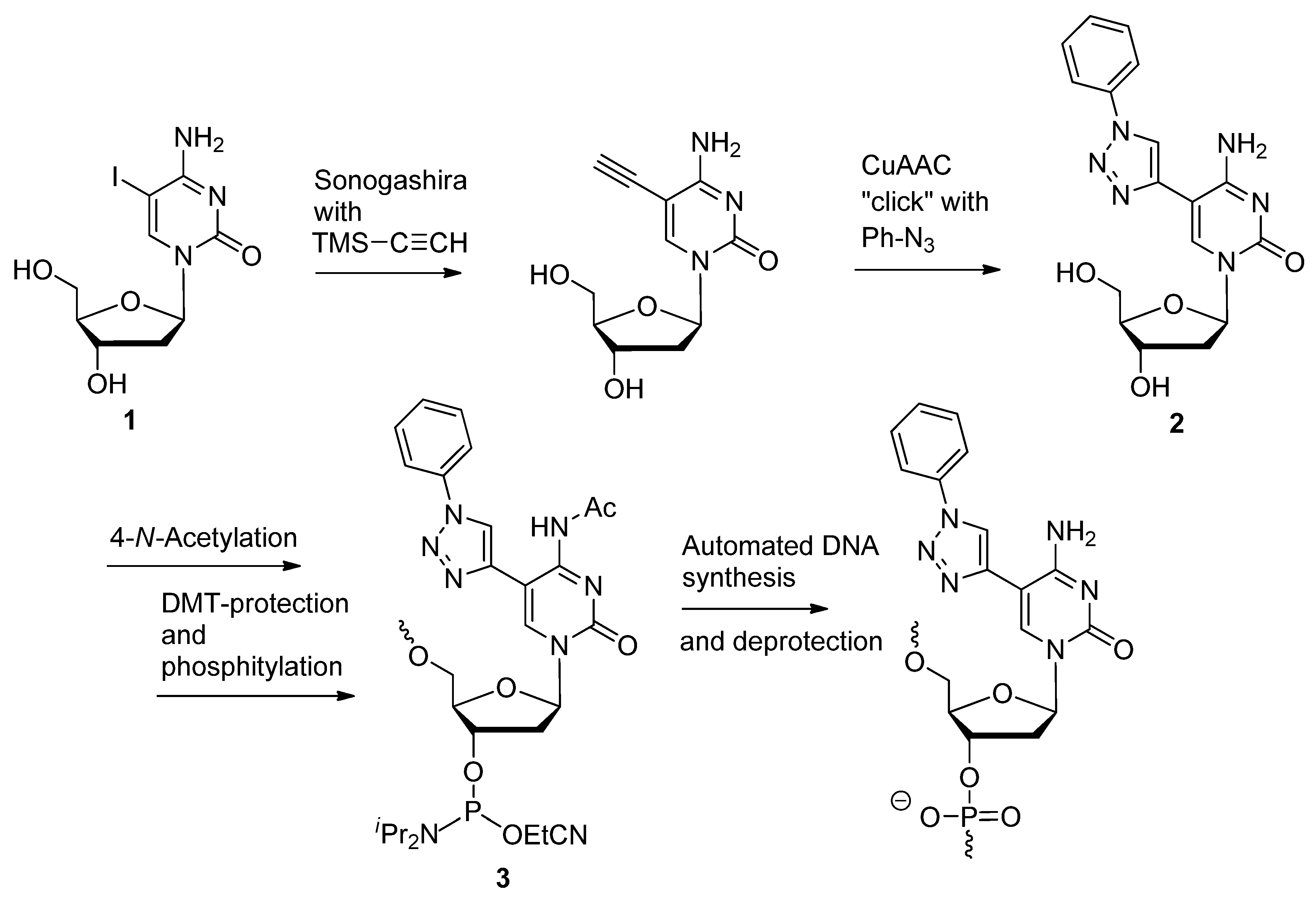
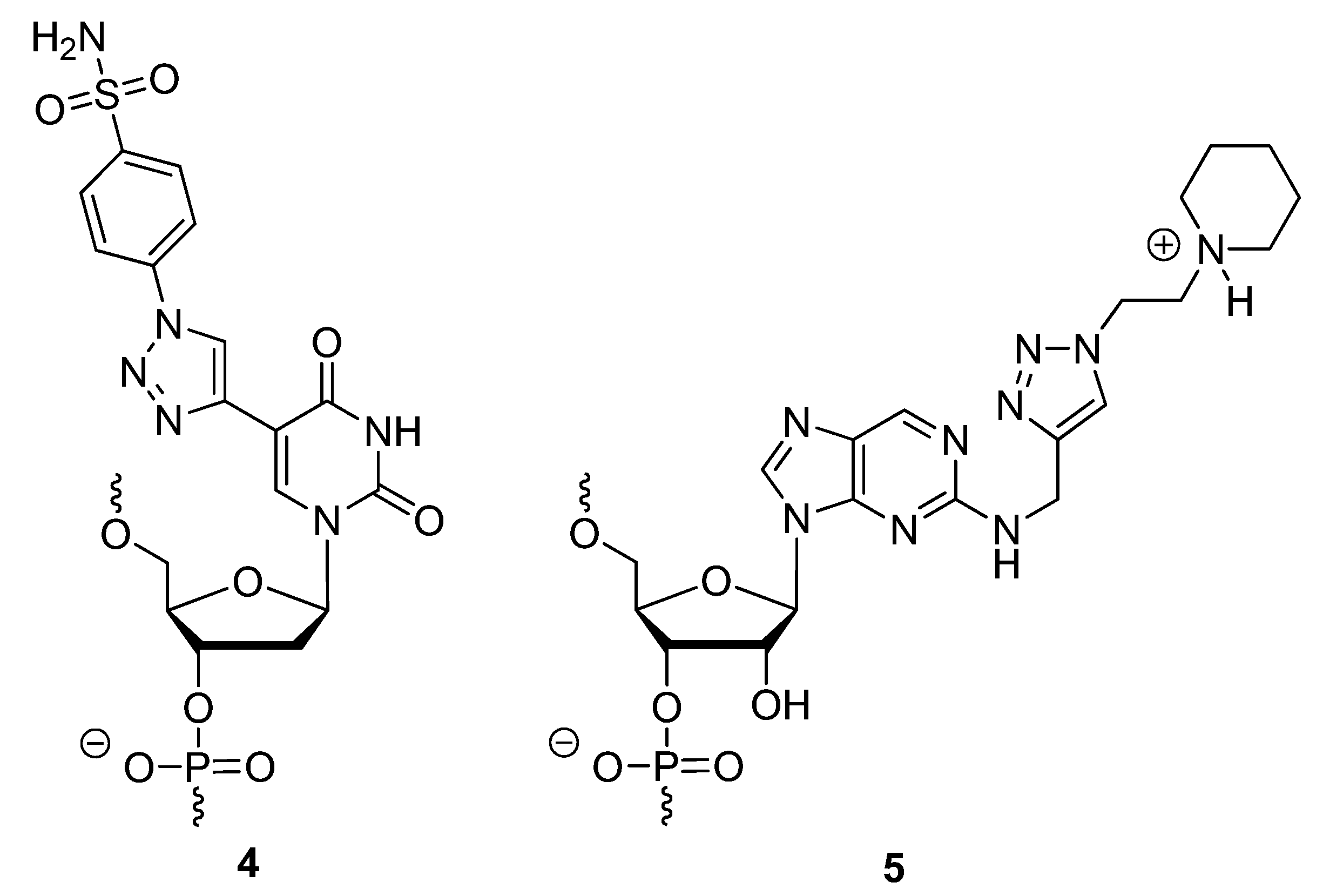
          <p>The C5-iodo cytidine <bold>1</bold> [<xref ref-type="bibr" rid="B68-molecules-17-12665">68</xref>] (<xref ref-type="scheme" rid="molecules-17-12665-scheme1">Scheme 1</xref>) building block underwent a Sonogashira cross-coupling with trimethylsilane (TMS)-acetylene, which was subsequently click-cyclized with phenyl-azide to produce cytidine analogue <bold>2</bold> in 80% yield. After taking the appropriate steps to achieve the corresponding phosphoramidite building block <bold>3</bold>, several DNA sequences were synthesized containing the cytidine analogue, along with others containing the corresponding 5-(phenyltriazole)uridine [<xref ref-type="bibr" rid="B66-molecules-17-12665">66</xref>] nucleoside. After comparing the thermostabilities of the various duplexes containing the 5-(phenyltriazole)pyrimidines, it was discovered that the uridine analogue was more well tolerated when complimented with RNA or with duplex DNA as a triplex-forming oligonucleotide (TFO). In a similar study, DNA molecules containing 5-triazole-benzenesulfonamide-modified pyrimidines such as compound <bold>4</bold> (<xref ref-type="fig" rid="molecules-17-12665-f001">Figure 1</xref>) in the central region were also found to strongly hybridize to RNA [<xref ref-type="bibr" rid="B65-molecules-17-12665">65</xref>]. In both studies, it was observed that duplex stability increased with incremental additions of consecutive C5-triazole-modified pyrimidines in the oligomer as a result of enhanced stacking interactions.</p>
          </sec>
        <sec>
          <title>2.1.2. Oligonucleotide Based Nano-Materials</title>
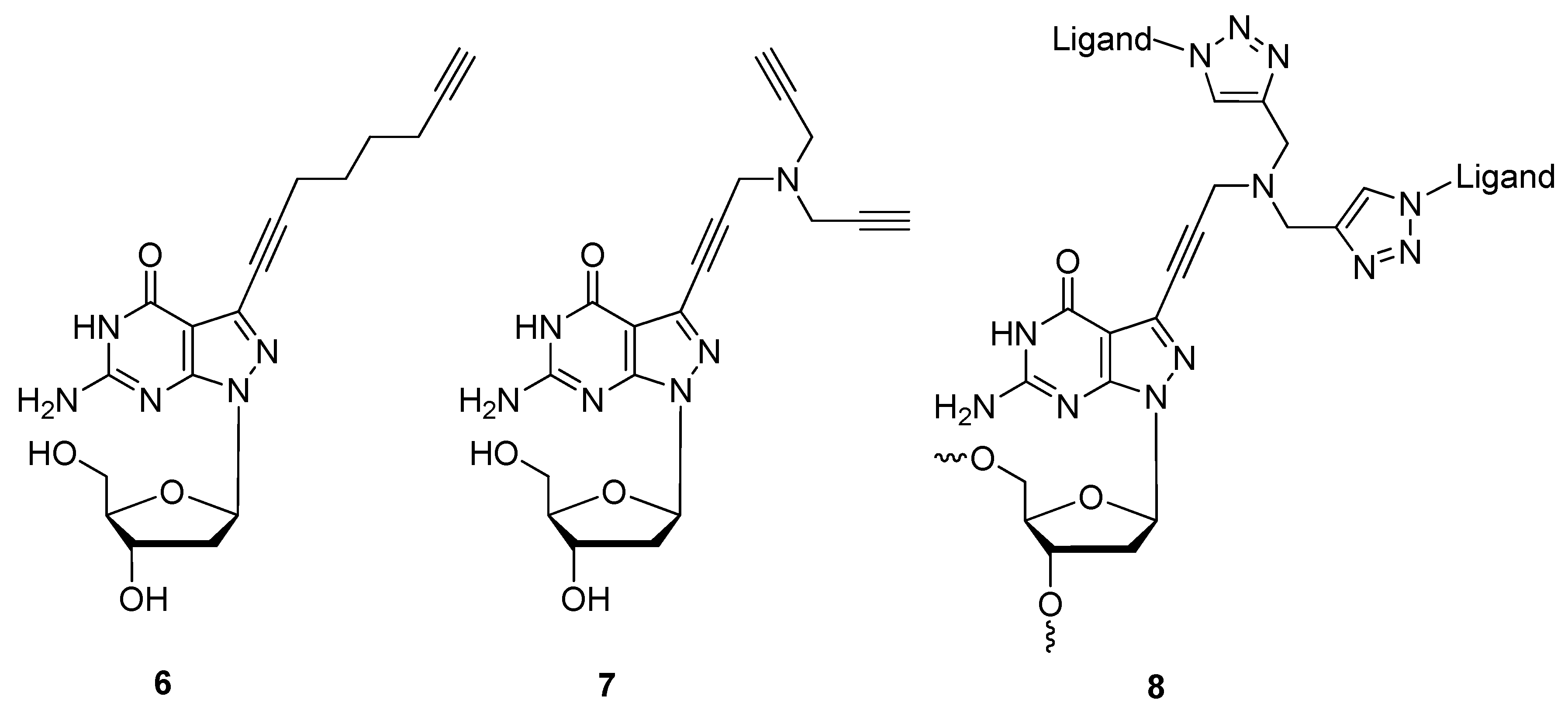
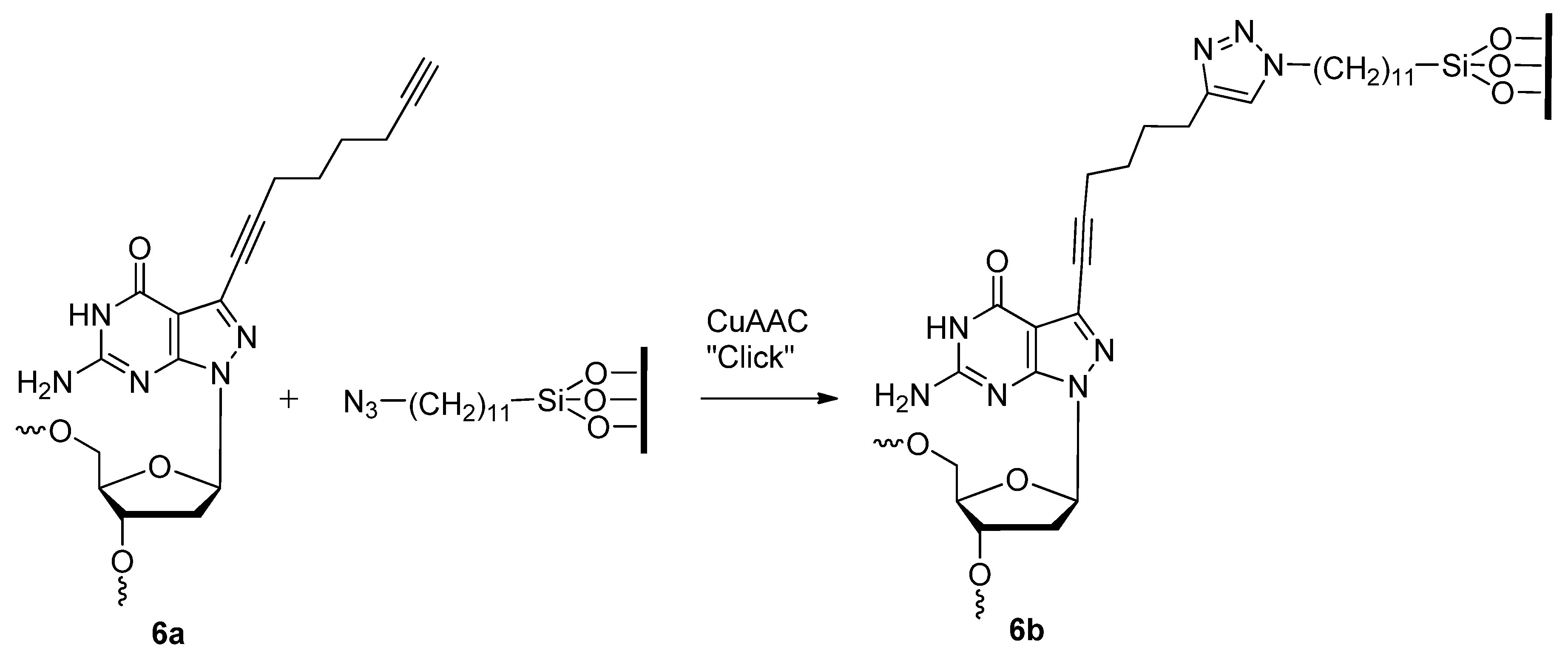
          <p>Finding a facile method of synthesizing new materials is of great interest to material chemists. The CuAAC offers an ideal synthetic strategy towards the development of material libraries used for various downstream applications. Some applications of triazole-based DNA nano-materials that have been explored by members of Seela’s group include click-conjugation for drug delivery [<xref ref-type="bibr" rid="B41-molecules-17-12665">41</xref>] and the development of DNA nanopatterns on a solid support [<xref ref-type="bibr" rid="B73-molecules-17-12665">73</xref>]. Based on the pyrazolo[3,4-<italic>d</italic>]pyrimidine [<xref ref-type="bibr" rid="B74-molecules-17-12665">74</xref>] scaffold instead of a purine, they functionalized the 7-deaza position of the 2′-deoxyguanosine analogue with alkyl linkers of varying length containing terminal mono- or di-acetylenes (compounds <bold>6</bold> or <bold>7</bold>; <xref ref-type="fig" rid="molecules-17-12665-f002">Figure 2</xref>) [<xref ref-type="bibr" rid="B41-molecules-17-12665">41</xref>]. After incorporating the 8-aza-7-deaza-7-(octa-1,7-diynyl)-modified 2′-deoxyguanosine (dG) analogue nucleoside phosphoramidite <bold>6</bold> at the 5′ end or within the central region of synthetic oligonucleotides (<bold>6a</bold>, <xref ref-type="scheme" rid="molecules-17-12665-scheme2">Scheme 2</xref>), the modified oligonucleotides were click-ligated to azide-functionalized silicon wafers <bold>6b</bold> [<xref ref-type="bibr" rid="B73-molecules-17-12665">73</xref>].</p>
          <fig id="molecules-17-12665-scheme1" position="float">
            <object-id pub-id-type="pii">molecules-17-12665-scheme1_Scheme 1</object-id>
            <label>Scheme 1</label>
            <caption>
              <p>Synthesis of C5-triazolo modified pyrimidines with aromatic substituents for increased duplex stability.</p>
            </caption>
            <graphic xmlns:xlink="http://www.w3.org/1999/xlink" xlink:href="molecules-17-12665-g016.tif"/>
          </fig>
          <fig id="molecules-17-12665-f001" position="float">
            <label>Figure 1</label>
            <caption>
              <p>Example compounds used for ASO and siRNA-based applications.</p>
            </caption>
            <graphic xmlns:xlink="http://www.w3.org/1999/xlink" xlink:href="molecules-17-12665-g001.tif"/>
          </fig>
          <p>SiRNAs are double-stranded RNA molecules approximately 21 base pairs (bp) in length, whereby the active RNA strand (guide) utilizes an endogenous pathway to selectively target and cleave mRNA transcripts [<xref ref-type="bibr" rid="B18-molecules-17-12665">18</xref>]. In addition to enhancing their target specificity or decreasing their susceptibility to enzymatic degradation [<xref ref-type="bibr" rid="B9-molecules-17-12665">9</xref>,<xref ref-type="bibr" rid="B69-molecules-17-12665">69</xref>], siRNAs are often chemically modified to reduce their binding to proteins which are not part of the RNA interference (RNAi) pathway [<xref ref-type="bibr" rid="B70-molecules-17-12665">70</xref>]. Proteins containing motifs which bind to double-stranded RNAs in a sequence-dependent manner interact with these duplexes primarily through their minor groove [<xref ref-type="bibr" rid="B71-molecules-17-12665">71</xref>,<xref ref-type="bibr" rid="B72-molecules-17-12665">72</xref>]. Based on this knowledge, a minor-groove modification on the RNA duplex was performed by Beal and colleagues in which a 2-<italic>N</italic>-(methyltriazolyl)ethylpiperidine purine analogue <bold>5</bold> (<xref ref-type="fig" rid="molecules-17-12665-f001">Figure 1</xref>) was substituted into both the non-active passenger and guide strands to influence the protein-binding properties of these RNAs [<xref ref-type="bibr" rid="B47-molecules-17-12665">47</xref>]. Not only did the resultant RNAs modified with this compound retain their gene-silencing activity, but those that were modified in the non-active passenger strand exhibited reduced binding to the adenine deaminase ADAR1 (adenine deaminase that acts on RNA-1).</p>
          <fig id="molecules-17-12665-scheme2" position="float">
            <object-id pub-id-type="pii">molecules-17-12665-scheme2_Scheme 2</object-id>
            <label>Scheme 2</label>
            <caption>
              <p>DNA strands containing 7-deaza-monoacetylenes “clicked” on to surface of azide-functionalized silicon wafers.</p>
            </caption>
            <graphic xmlns:xlink="http://www.w3.org/1999/xlink" xlink:href="molecules-17-12665-g017.tif"/>
          </fig>
        <p>The immobilized oligonucleotides formed self-assembly patterns due to the position of the dG analogue and compounded intra- and intermolecular forces such as phosphodiester-nucleobase interactions, base [<xref ref-type="bibr" rid="B75-molecules-17-12665">75</xref>] and triazole [<xref ref-type="bibr" rid="B66-molecules-17-12665">66</xref>] stacking interactions, and the hydrophobicity of the alkyl linkages. Seela and colleagues continued to functionalize compound <bold>7</bold> (<xref ref-type="fig" rid="molecules-17-12665-f002">Figure 2</xref>) through the double-click cycloaddition of various azides such as benzyl-N<sub>3</sub>, PEG-N<sub>3</sub>, AZT, and a C<sub>11</sub>-N<sub>3</sub> alcohol for the purposes of drug delivery (<bold>8</bold>, <xref ref-type="fig" rid="molecules-17-12665-f002">Figure 2</xref>) [<xref ref-type="bibr" rid="B41-molecules-17-12665">41</xref>].</p>
        <fig id="molecules-17-12665-f002" position="float">
            <label>Figure 2</label>
            <caption>
              <p>Structures of 8-aza-7-deazaguanosine analogues with 7-deaza-mono- or di-acetylenes for further click conjugation.</p>
            </caption>
            <graphic xmlns:xlink="http://www.w3.org/1999/xlink" xlink:href="molecules-17-12665-g002.tif"/>
          </fig>
          </sec>
        <sec>
          <title>2.1.3. Structural Determination</title>
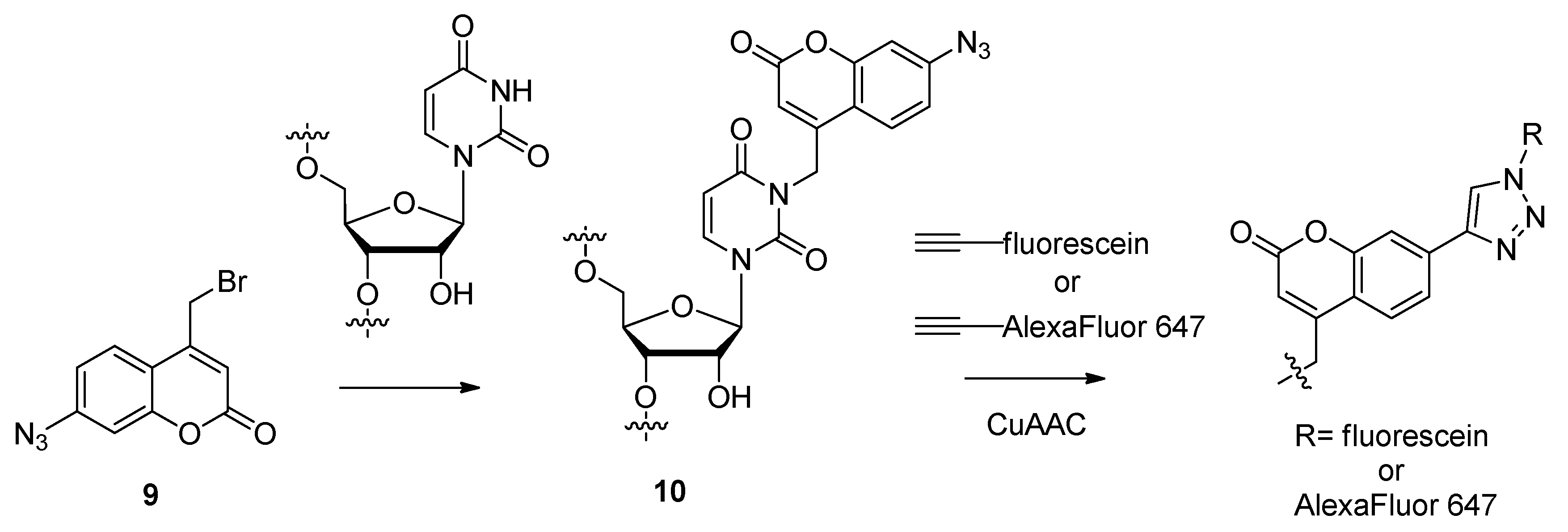
          <p>Many functional groups are being used as potential molecular labels for further elucidating the structures and functions of DNA and RNA-based compounds. Rather than site-specifically incorporating a pre-functionalized nucleoside into synthetic oligonucleotides, Helm and colleagues developed a coumarin chromophore-based post-synthetic RNA alkylating agent <bold>9</bold> they labeled as N3BC (<xref ref-type="scheme" rid="molecules-17-12665-scheme3">Scheme 3</xref>) [<xref ref-type="bibr" rid="B76-molecules-17-12665">76</xref>].</p>
          <fig id="molecules-17-12665-scheme3" position="float">
            <object-id pub-id-type="pii">molecules-17-12665-scheme3_Scheme 3</object-id>
            <label>Scheme 3</label>
            <caption>
              <p>Site-specific <italic>N</italic><sup>3</sup>-alkylations of uridine residues with the coumarin-based compound N3BC.</p>
            </caption>
            <graphic xmlns:xlink="http://www.w3.org/1999/xlink" xlink:href="molecules-17-12665-g018.tif"/>
          </fig>
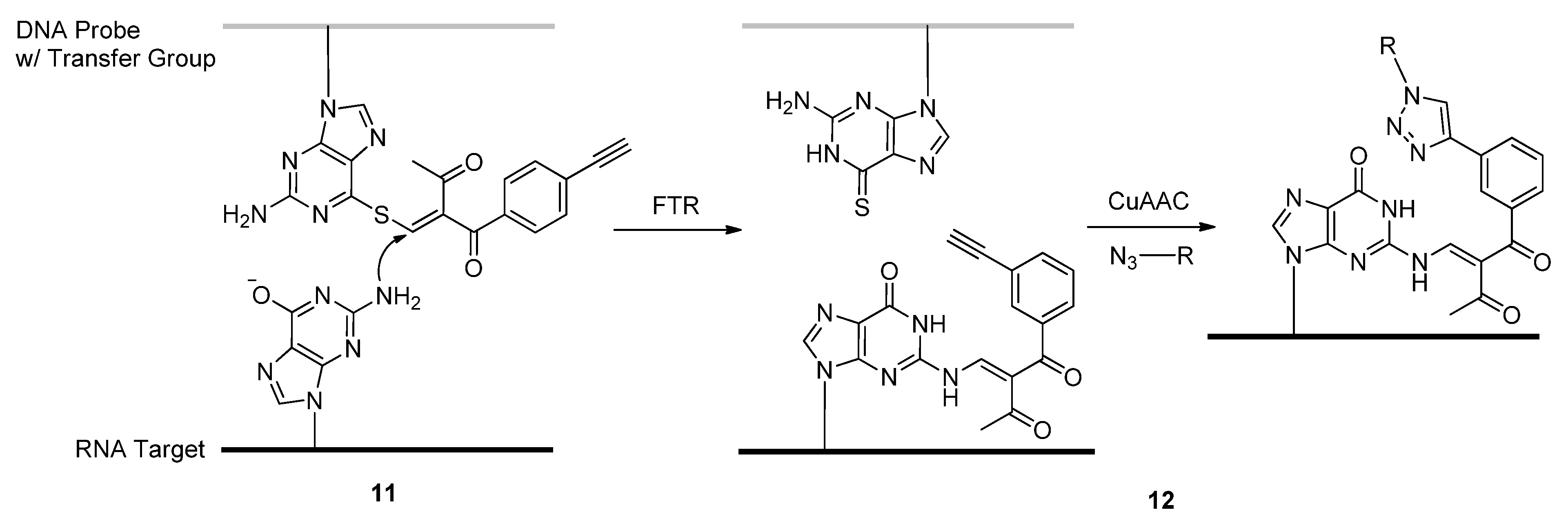
          <p>N3BC, which was synthesized in five steps starting from 3-aminophenol for an overall yield of 44%, was found to be specific for alkylating the <italic>N</italic><sup>3</sup>-position of uridines (<bold>10</bold>, <xref ref-type="scheme" rid="molecules-17-12665-scheme3">Scheme 3</xref>) once exposed to the target RNA sequence and has a coumarin-based excitation wavelength of 320 nm. Alternatively, the N3BC-modified RNAs could undergo conjugation with alkyne-functionalized fluorophores or other ligands due to the free azide moiety. An alternative method of post-synthetically modifying the central region of native RNA molecules was developed by Sasaki and colleagues in which a functionality-transfer reaction (FTR) takes place between the DNA-based probe carrying the desired modification and the complimentary RNA sequence destined for modification (<xref ref-type="scheme" rid="molecules-17-12665-scheme4">Scheme 4</xref>) [<xref ref-type="bibr" rid="B77-molecules-17-12665">77</xref>]. After incorporating C6-thioguanosine into the synthetic DNA probe, the C6-thio is targeted for alkylation with the 2-methyliden-1,3-diketone transfer group. After the probe hybridizes with the complimentary target RNA sequence, the FTR selectively proceeds to modify the C2-amino group of the native guanine base opposite from the functionalized C6-thioguanosine (<bold>11</bold>, <xref ref-type="scheme" rid="molecules-17-12665-scheme4">Scheme 4</xref>). The FTR-modified RNA molecule containing a terminal alkyne from the transfer group could undergo further click-mediated ligation with various azide compounds (<bold>12</bold>, <xref ref-type="scheme" rid="molecules-17-12665-scheme4">Scheme 4</xref>). The initial results from these click ligations showed nearly quantitative yields with all compounds tested [<xref ref-type="bibr" rid="B77-molecules-17-12665">77</xref>].</p>
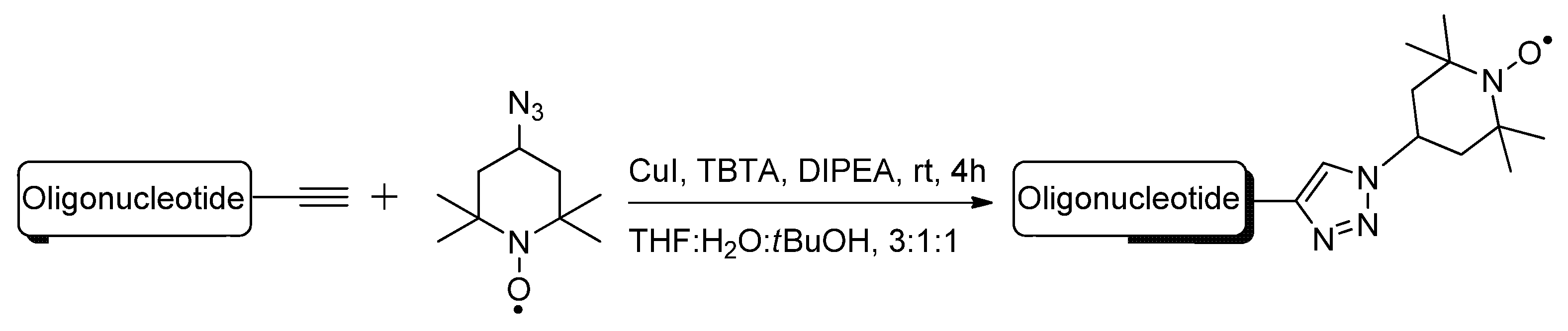
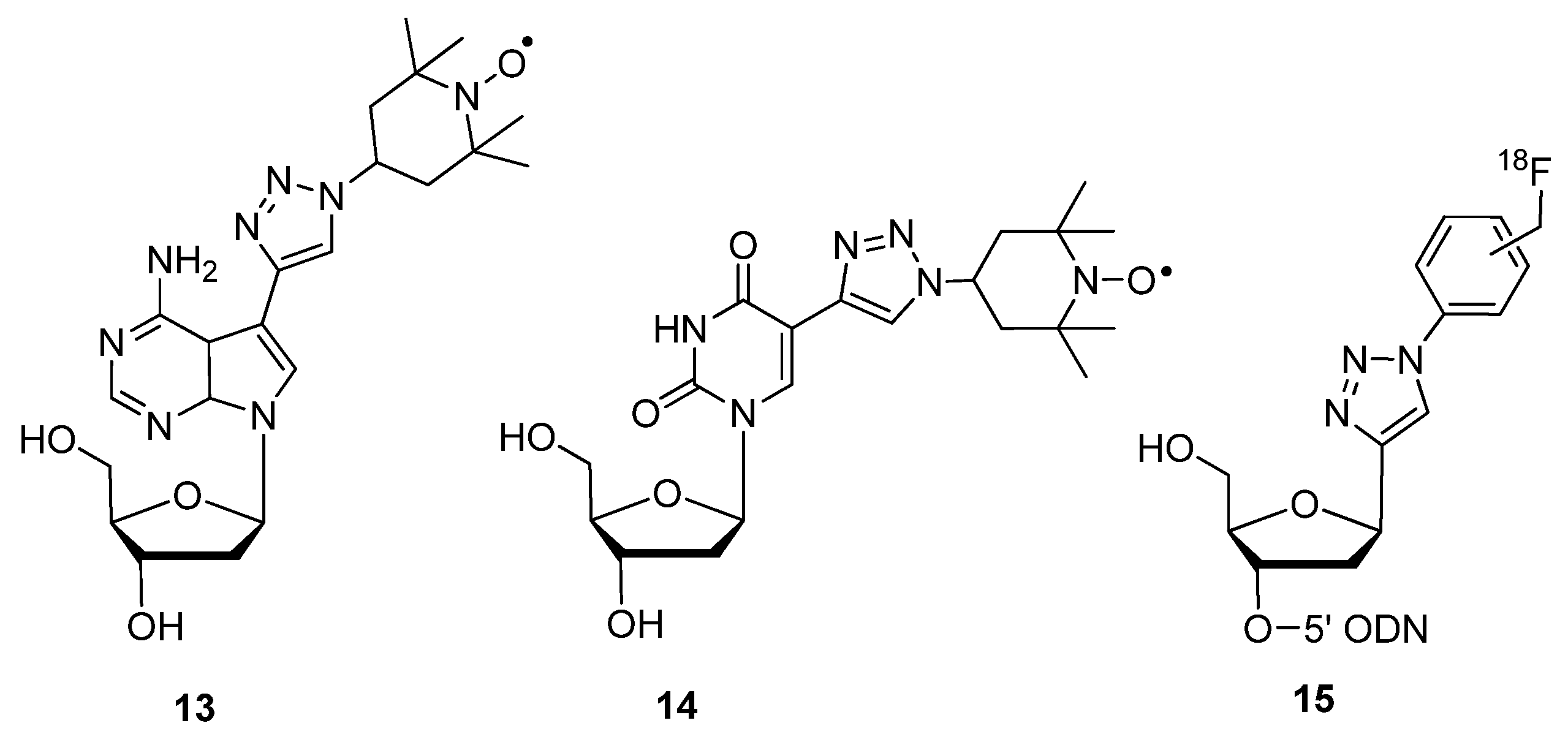
          <p>To examine the folded structures and conformation of DNA or RNA oligomers within biological environments, electron paramagnetic resonance (EPR) [<xref ref-type="bibr" rid="B78-molecules-17-12665">78</xref>] coupled with site-specific spin-labeling of the oligomers has become a useful tool. In preparation for use of this technology, the Seela group used click chemistry to modify DNA and RNA molecules containing alkyne-functionalized purine and pyrimidine analogues <bold>13</bold> and <bold>14</bold> (<xref ref-type="fig" rid="molecules-17-12665-f003">Figure 3</xref>) with the radical azide nitroxide 4-azido-2,2,6,6,-tetramethylpiperidine 1-oxyl (4-azido-TEMPO) [<xref ref-type="bibr" rid="B79-molecules-17-12665">79</xref>] spin-label (<xref ref-type="scheme" rid="molecules-17-12665-scheme5">Scheme 5</xref>) [<xref ref-type="bibr" rid="B52-molecules-17-12665">52</xref>]. This was the first example of click-modifying oligonucleotides at the site of the nucleobase with spin-labels for subsequent EPR analysis.</p>
          <fig id="molecules-17-12665-scheme4" position="float">
            <object-id pub-id-type="pii">molecules-17-12665-scheme4_Scheme 4</object-id>
            <label>Scheme 4</label>
            <caption>
              <p>Template-driven central modifications of target RNA sequences through a functionality-transfer reaction (FTR).</p>
            </caption>
            <graphic xmlns:xlink="http://www.w3.org/1999/xlink" xlink:href="molecules-17-12665-g019.tif"/>
          </fig>
          <fig id="molecules-17-12665-scheme5" position="float">
            <object-id pub-id-type="pii">molecules-17-12665-scheme5_Scheme 5</object-id>
            <label>Scheme 5</label>
            <caption>
              <p>The post-synthetic click-ligation of the 4-azido-TEMPO spin label to alkyne-functionalized oligonucleotides.</p>
            </caption>
            <graphic xmlns:xlink="http://www.w3.org/1999/xlink" xlink:href="molecules-17-12665-g020.tif"/>
          </fig>
          <p>Positron emission tomography (PET) is another molecular imaging technique which can track the distribution and behavior of radiolabeled bioactive molecules <italic>in vivo</italic> [<xref ref-type="bibr" rid="B80-molecules-17-12665">80</xref>]. Most PET scanning procedures involve the use of <sup>18</sup>F-radiolabeling due to its short half-life and covalent stability [<xref ref-type="bibr" rid="B81-molecules-17-12665">81</xref>]. The 1,3-dipolar click cycloaddition has also been employed as a quick and efficient method of attaching nucleobase mimics to the 1′-position of the furanose ring. Utilizing this efficient strategy to modify nucleoside furanose rings, compound <bold>15</bold> (<xref ref-type="fig" rid="molecules-17-12665-f003">Figure 3</xref>) containing the <sup>18</sup>F-radiolabel was synthesized, starting with the 1′-<italic>β</italic>-ethynyl-2′-deoxyribonucleoside building block and its terminal incorporation into synthetic oligonucleotides via phosphoramidite chemistry [<xref ref-type="bibr" rid="B82-molecules-17-12665">82</xref>]. The meta- or para-radiolabeled 1-azido-4-([<sup>18</sup>F]fluoromethyl)benzene prosthetic group was then post-synthetically click-conjugated to the 1′-ethynyl building block within the modified oligonucleotide.</p>
        <fig id="molecules-17-12665-f003" position="float">
            <label>Figure 3</label>
            <caption>
              <p>Structures of purine, pyrimidine or nucleobase mimics containing triazole-tethered spin-labels.</p>
            </caption>
            <graphic xmlns:xlink="http://www.w3.org/1999/xlink" xlink:href="molecules-17-12665-g003.tif"/>
          </fig>
          </sec>
        <sec>
          <title>2.1.4. Fluorescent Labeling</title>
          <p>Attaching fluorescent labels to nucleobases [<xref ref-type="bibr" rid="B35-molecules-17-12665">35</xref>,<xref ref-type="bibr" rid="B37-molecules-17-12665">37</xref>,<xref ref-type="bibr" rid="B53-molecules-17-12665">53</xref>] or making the bases an integral part of the fluorophore [<xref ref-type="bibr" rid="B36-molecules-17-12665">36</xref>,<xref ref-type="bibr" rid="B46-molecules-17-12665">46</xref>,<xref ref-type="bibr" rid="B83-molecules-17-12665">83</xref>] is a highly sought after practice for the labeling of oligonucleotides. Since fluorescent nucleobases in DNA and RNA oligonucleotides hybridize directly to the target oligonucleotide or protein, they can provide visual representations of oligo-target hybridization properties as probing tools [<xref ref-type="bibr" rid="B35-molecules-17-12665">35</xref>] or can gather information to form structure-activity relationships [<xref ref-type="bibr" rid="B76-molecules-17-12665">76</xref>]. The ease of attaching either fluorescent or fluorescence-promoting compounds to nucleobases via the CuAAC has resulted in numerous reports in this field. It is also worth noting that fluorescence can be triggered once a triazole moiety is appended to certain nucleobases, such as adenosine at the C8 position [<xref ref-type="bibr" rid="B84-molecules-17-12665">84</xref>,<xref ref-type="bibr" rid="B85-molecules-17-12665">85</xref>].</p>
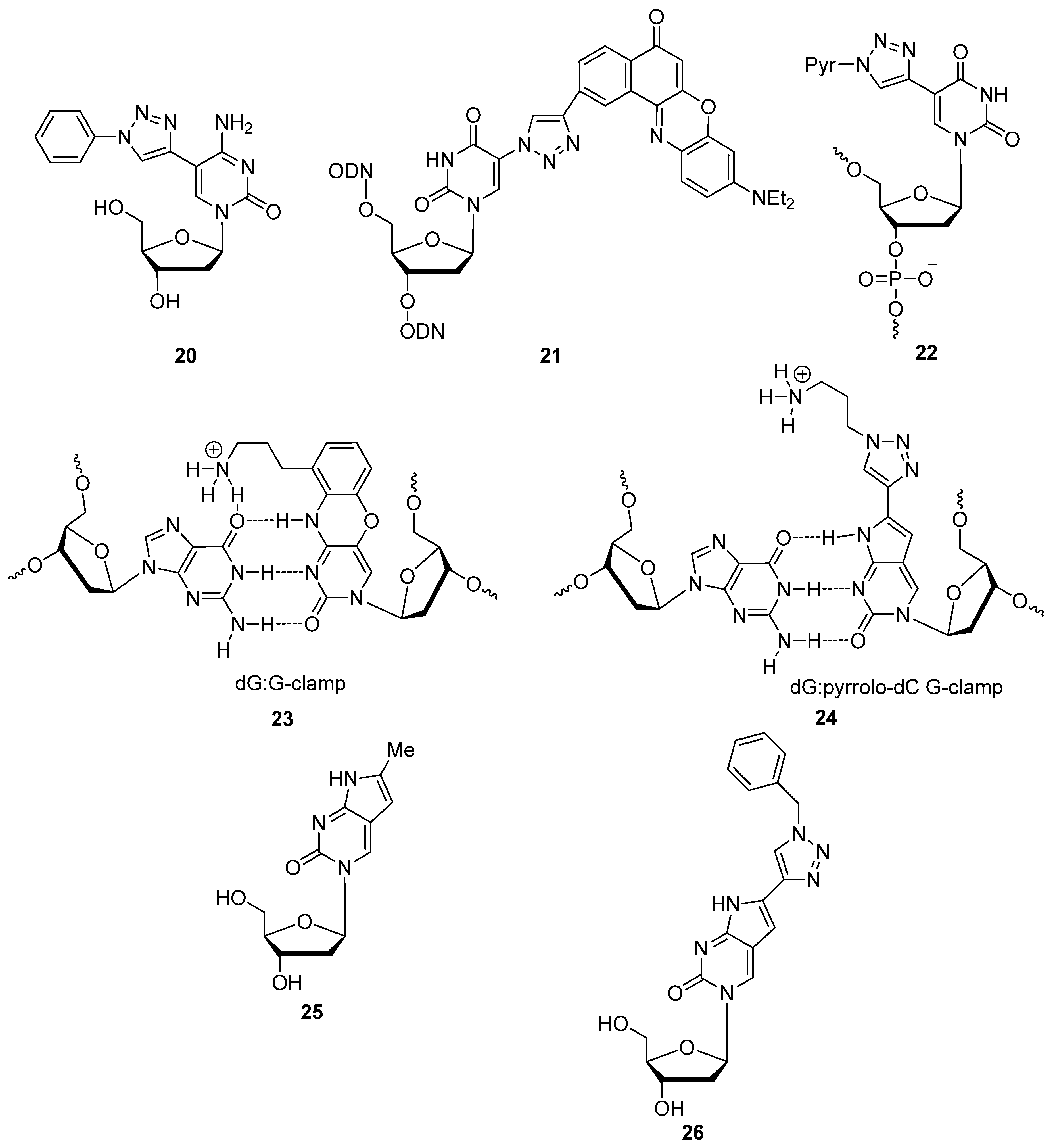
          <p>Although we have already discussed other uses for C5-triazole-modified pyrimidines, the following report describes the synthesis of the fluorescent C5-triazolylcytidine nucleoside analogue <bold>20</bold> (<xref ref-type="fig" rid="molecules-17-12665-f004">Figure 4</xref>). This cytidine analogue was the first example of a C5-ethynylcytidine building block being click-cyclized with an azide residue to form a fluorophore, without the attachment of an actual fluorophore to the molecule [<xref ref-type="bibr" rid="B36-molecules-17-12665">36</xref>]. As previously outlined, a motivation for modifying the C5 position of pyrimidines is that these modifications are well accommodated within the major groove of duplex oligonucleotides, thus leaving the overall natural conformation of the duplex unperturbed. In the same year, a similar study click-conjugated the fluorophore Nile Red at the C5-position of uridine to yield compound <bold>21</bold> (<xref ref-type="fig" rid="molecules-17-12665-f004">Figure 4</xref>) [<xref ref-type="bibr" rid="B53-molecules-17-12665">53</xref>]. The difference with the synthetic scheme presented in the latter study was that the C5-iodopyrimidine was first incorporated into oligonucleotides, followed by a post-synthetic azide displacement at the C5 with NaN<sub>3</sub> and the click-attachment of the alkyne-functionalized dye. Using fluorescence to detect the presence of single-nucleotide polymorphisms (SNPs) in target DNA or RNA sequences, Hrdlicka and colleagues used the CuAAC to attach a pyrene residue at the C5 position of uridine through a triazole moiety [<xref ref-type="bibr" rid="B35-molecules-17-12665">35</xref>]. Compound <bold>22</bold> (<xref ref-type="fig" rid="molecules-17-12665-f004">Figure 4</xref>) showed favorable mismatch discrimination by significantly decreasing its quantum yield in the presence of mismatched sequences.</p>
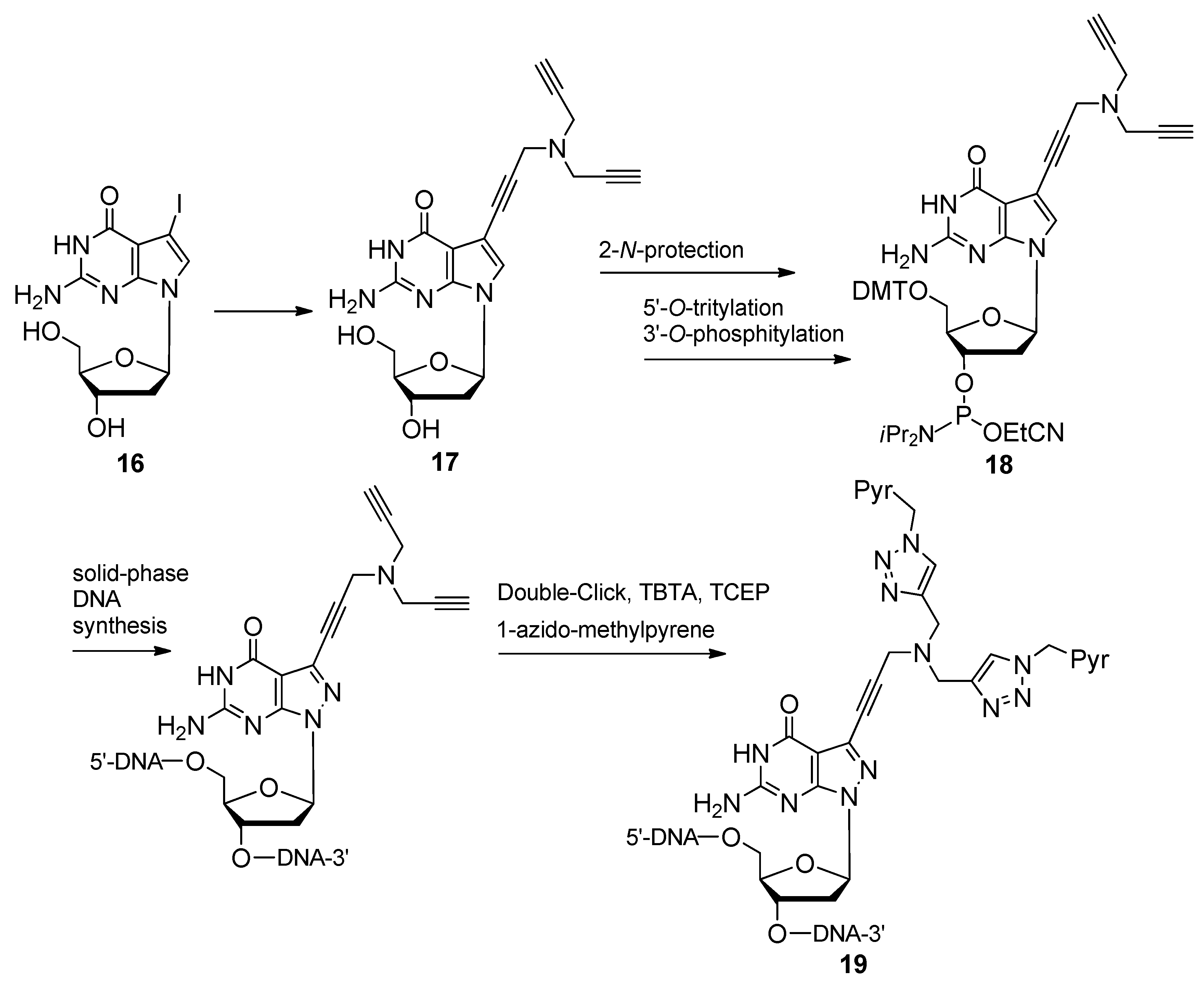
          <p>The expansion of the pyrene′s application as a fluorescent compound is made evident when 1-azidomethyl pyrene is “double-clicked” with the reaction substrate 7-tripropargylamine-7-deaza-2′-deoxyguanosine containing two terminal acetylenes (<xref ref-type="scheme" rid="molecules-17-12665-scheme6">Scheme 6</xref>) [<xref ref-type="bibr" rid="B37-molecules-17-12665">37</xref>]. These labeled guanosine analogues differed slightly from the 8-aza variant of the compound <bold>7</bold> previously mentioned by the Seela group (<xref ref-type="fig" rid="molecules-17-12665-f002">Figure 2</xref>). The starting material 7-iodo-7-deaza-2′-deoxyguanosine <bold>16</bold> [<xref ref-type="bibr" rid="B86-molecules-17-12665">86</xref>] (<xref ref-type="scheme" rid="molecules-17-12665-scheme6">Scheme 6</xref>) underwent the Sonogashira cross-coupling reaction with a ten-fold excess of tripropargylamine, producing the aforementioned di-acetylene <bold>17</bold> on the 7-deaza position. After transforming the di-acetylene into the appropriate phosphoramidite <bold>18</bold>, this compound was used to site-specifically incorporate the bis-pyrene modification at various positions within 12-mers of ss- and dsDNA as a dG substitution. The melting temperatures (<italic>T<sub>m</sub></italic>s) of all di-acetylene-modified oligomers were slightly increased above the reference value (50 °C) ranging from 50–56 °C, indicating that the larger tripropargylamine linkages did not disturb the native duplex structure. After double-clicking the 1-azidomethyl pyrene residues to the di-acetylenes (<bold>19</bold>, <xref ref-type="scheme" rid="molecules-17-12665-scheme6">Scheme 6</xref>) and in addition to the noticeable increase in duplex <italic>T<sub>m</sub></italic>s, excimer fluorescence [<xref ref-type="bibr" rid="B87-molecules-17-12665">87</xref>] was achieved between bis-pyrene-modified purines when placed on opposite strands of the duplex and separated by two base pairs.</p>
          <fig id="molecules-17-12665-scheme6" position="float">
            <object-id pub-id-type="pii">molecules-17-12665-scheme6_Scheme 6</object-id>
            <label>Scheme 6</label>
            <caption>
              <p>Synthesis and oligonucleotide incorporation of double-click conjugated bis-pyrene 2′-deoxyguanosine analogues.</p>
            </caption>
            <graphic xmlns:xlink="http://www.w3.org/1999/xlink" xlink:href="molecules-17-12665-g021.tif"/>
          </fig>
          <p>Seela and colleagues have adopted the CuAAC as the single-most useful tool for performing facile transformations on nucleosides to produce novel building blocks which find use in a variety of applications. Although not related to fluorescent labeling, this report by Seela’s group synthesized the triazole-modified compound <bold>24</bold>, to be a mimic of the G-clamp [<xref ref-type="bibr" rid="B88-molecules-17-12665">88</xref>] (<xref ref-type="fig" rid="molecules-17-12665-f004">Figure 4</xref>). The G-clamp <bold>23</bold> is a nucleoside analogue which is known to provide greater stability to 2′-deoxyribocytidine:guanidine (dC:dG) interactions when substituting dC residues [<xref ref-type="bibr" rid="B89-molecules-17-12665">89</xref>]. Their goal was to fortify the duplex stability within parallel-stranded DNA (psDNA) through this alternative G-clamp mimic, in order to explore the possibilities presented by psDNA as a future biomimetic for biological applications. Adopting the design of this G-clamp mimic <bold>24</bold> which uses the pyrrolo-dC [<xref ref-type="bibr" rid="B83-molecules-17-12665">83</xref>] scaffold <bold>25</bold> and its native fluorescence capabilities, Seela’s group synthesized an alternative triazole-modified pyrrolo-dC derivative <bold>26</bold>, displaying a quantum yield ten times greater than the reference design [<xref ref-type="bibr" rid="B32-molecules-17-12665">32</xref>]. In contrast to the results presented by Hrdlicka and colleagues regarding the uridine analogue <bold>22</bold> with a C5-triazolo-pyrene and its mode of action for detecting mismatches [<xref ref-type="bibr" rid="B35-molecules-17-12665">35</xref>], compound <bold>26</bold> experiences severe quenching of fluorescence when hybridized to matching sequences and an increase in quantum yield as mismatches occur. Since derivative <bold>26</bold> represents a substitution for dC, the compound′s fluorescence is most severely quenched when opposite a dG residue on the target sequence. The quantum yield slowly increases in the following order depending on the opposing residue: dG &lt; dT &lt; dA &lt; dC.</p>
        <fig id="molecules-17-12665-f004" position="float">
            <label>Figure 4</label>
            <caption>
              <p>Triazole-modified nucleic acid-based compounds with fluorescent properties which also serve as precursors for other applications.</p>
            </caption>
            <graphic xmlns:xlink="http://www.w3.org/1999/xlink" xlink:href="molecules-17-12665-g004.tif"/>
          </fig>
          </sec>
        <sec>
          <title>2.1.5. Anticancer and Antiviral Development</title>
          <p>The discovery of antiviral agents such as AZT and Ribavirin have inspired chemists to investigate the use of the CuAAC to develop libraries of potential antiviral and anticancer therapeutics [<xref ref-type="bibr" rid="B90-molecules-17-12665">90</xref>]. With the knowledge that azides and alkynes are selectively reactive with each other, are inert moieties when exposed to biological conditions, and cyclize to produce a stable 1,4-disubstituted isomer of the 1,2,3-triazole, the CuAAC has shown great versatility in producing numerous nucleic acid-based derivatives which target molecules implicated in the propagation of viral disease and cancer [<xref ref-type="bibr" rid="B1-molecules-17-12665">1</xref>,<xref ref-type="bibr" rid="B3-molecules-17-12665">3</xref>,<xref ref-type="bibr" rid="B4-molecules-17-12665">4</xref>,<xref ref-type="bibr" rid="B8-molecules-17-12665">8</xref>].</p>
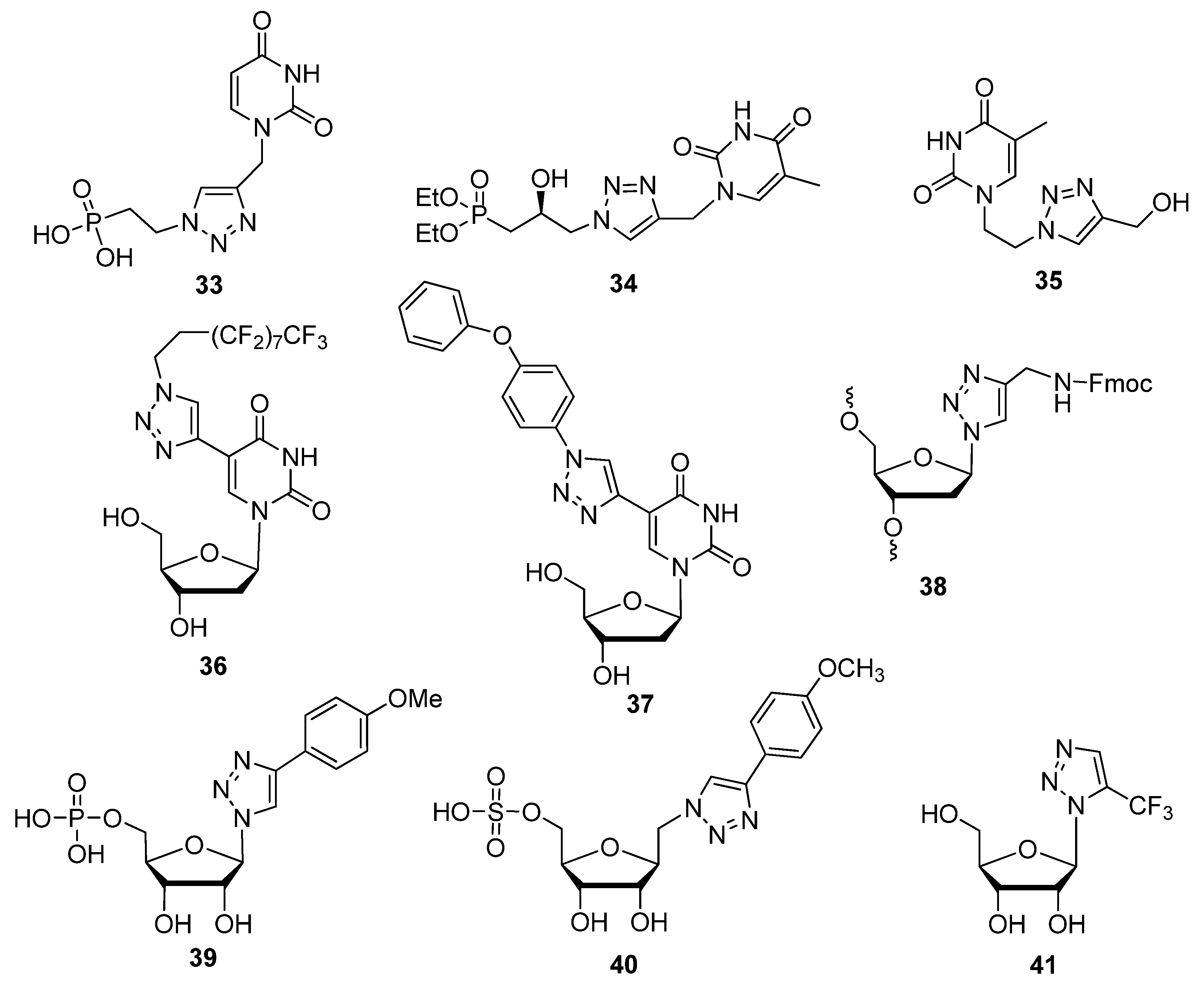
          <p>Mono-nucleoside compounds which have proven themselves to be useful anti-pathogenic agents are acyclic nucleoside phosphonates (ANPs) [<xref ref-type="bibr" rid="B91-molecules-17-12665">91</xref>]. In place of the typical furanose ring found in native nucleotides is an acyclic alkyl chain connecting a phosphonate moiety to the <italic>N</italic><sup>1</sup>-position of pyrimidines or the <italic>N</italic><sup>9</sup>-position of purines. Some examples of click-modified ANPs are compounds <bold>33</bold> [<xref ref-type="bibr" rid="B22-molecules-17-12665">22</xref>] and <bold>34</bold> [<xref ref-type="bibr" rid="B92-molecules-17-12665">92</xref>] (<xref ref-type="fig" rid="molecules-17-12665-f005">Figure 5</xref>) which showed potential against the Hepatitis C Virus (HCV) [<xref ref-type="bibr" rid="B22-molecules-17-12665">22</xref>] or as a future antiviral agent [<xref ref-type="bibr" rid="B92-molecules-17-12665">92</xref>]. An <italic>N</italic><sup>1</sup>-acyclic pyrimidine modification which did not include a phosphonate moiety is compound <bold>35</bold>, designed for its intended use as an antivirulent and showing promising preliminary results as an antioxidant [<xref ref-type="bibr" rid="B93-molecules-17-12665">93</xref>].</p>
          <fig id="molecules-17-12665-f005" position="float">
            <label>Figure 5</label>
            <caption>
              <p>Nucleic acid-based compounds displaying anticancer or antiviral properties.</p>
            </caption>
            <graphic xmlns:xlink="http://www.w3.org/1999/xlink" xlink:href="molecules-17-12665-g005.tif"/>
          </fig>
          <p>Compounds such as 5′-fluorouracil (5′-FU) [<xref ref-type="bibr" rid="B94-molecules-17-12665">94</xref>], floxuridine, gemcitabine and clofarabine are examples of known fluoronucleoside-based anticancer compounds. The effectiveness of these compounds is in some cases the driving force behind the rapid click-mediated production of fluorinated compound libraries with anticancer potential [<xref ref-type="bibr" rid="B54-molecules-17-12665">54</xref>]. Using the same synthetic strategy to modify the C5 position of 2′-deoxypyrimidines [<xref ref-type="bibr" rid="B36-molecules-17-12665">36</xref>,<xref ref-type="bibr" rid="B62-molecules-17-12665">62</xref>], all C5-modified pyrimidine analogues containing a perfluorodecyl-substituted triazole unit such as derivative <bold>36</bold> showed inhibition of cancer cell growth [<xref ref-type="bibr" rid="B54-molecules-17-12665">54</xref>]. Agrofoglio and colleagues also made a contribution after designing a library of C5-substituted click adducts upon discovering that compound <bold>37</bold> not only inhibited a variety of DNA-based viruses, but also displayed anti-tumor activity which was comparable to the reference compound 5′-FU [<xref ref-type="bibr" rid="B55-molecules-17-12665">55</xref>].</p>
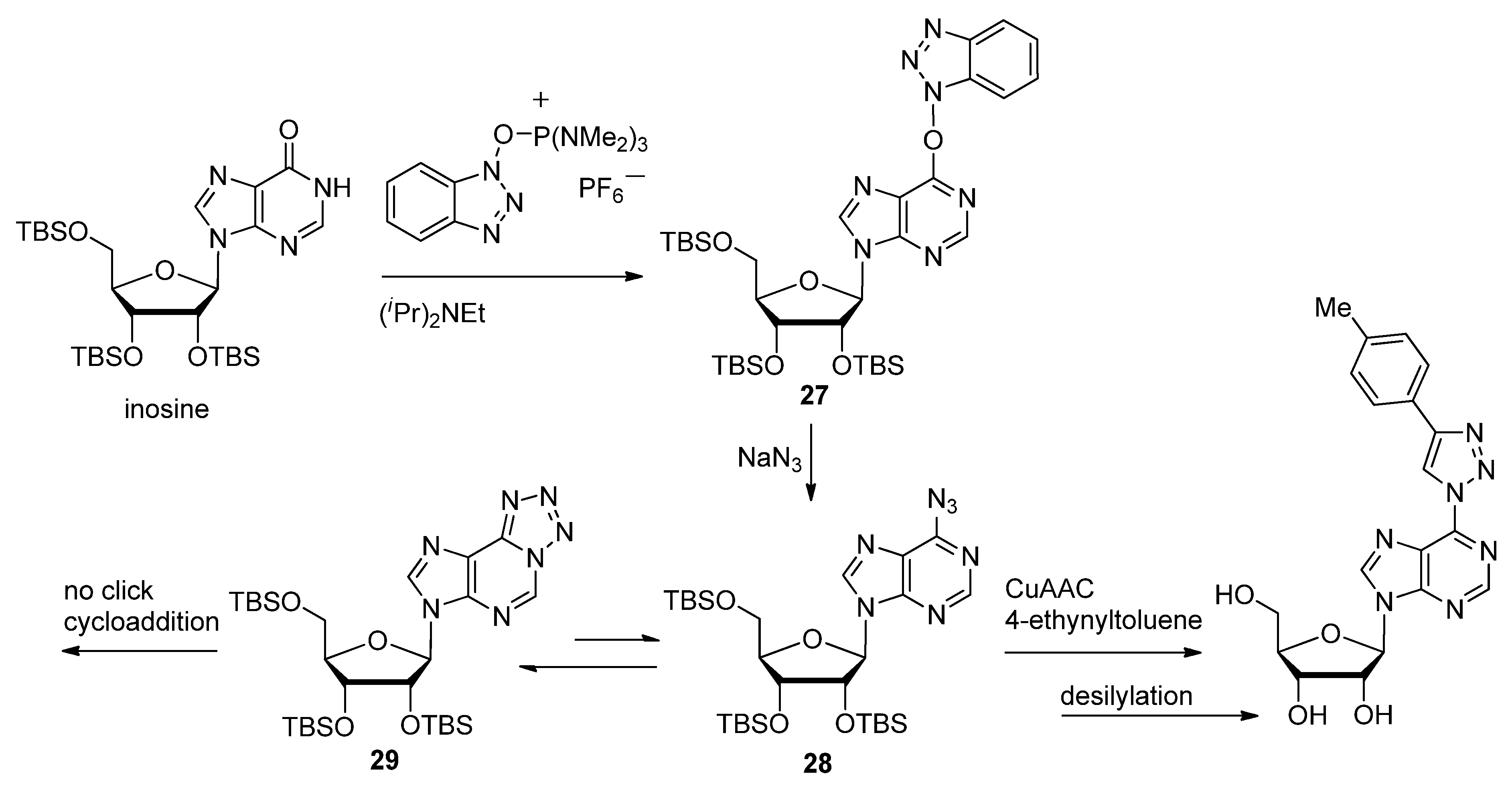
          <p>Lakshman and coworkers modified the <italic>O</italic><sup>6</sup>-position of inosine with an azide group, in order to form a click attachment point for several alkyne-modified functionalities such as 4-ethynyltoluene (<xref ref-type="scheme" rid="molecules-17-12665-scheme7">Scheme 7</xref>) [<xref ref-type="bibr" rid="B95-molecules-17-12665">95</xref>].</p>
          <fig id="molecules-17-12665-scheme7" position="float">
            <object-id pub-id-type="pii">molecules-17-12665-scheme7_Scheme 7</object-id>
            <label>Scheme 7</label>
            <caption>
              <p>Synthetic strategy to isolate the C6-azido purine tautomer for click-cyclization with various alkynes.</p>
            </caption>
            <graphic xmlns:xlink="http://www.w3.org/1999/xlink" xlink:href="molecules-17-12665-g022.tif"/>
          </fig>
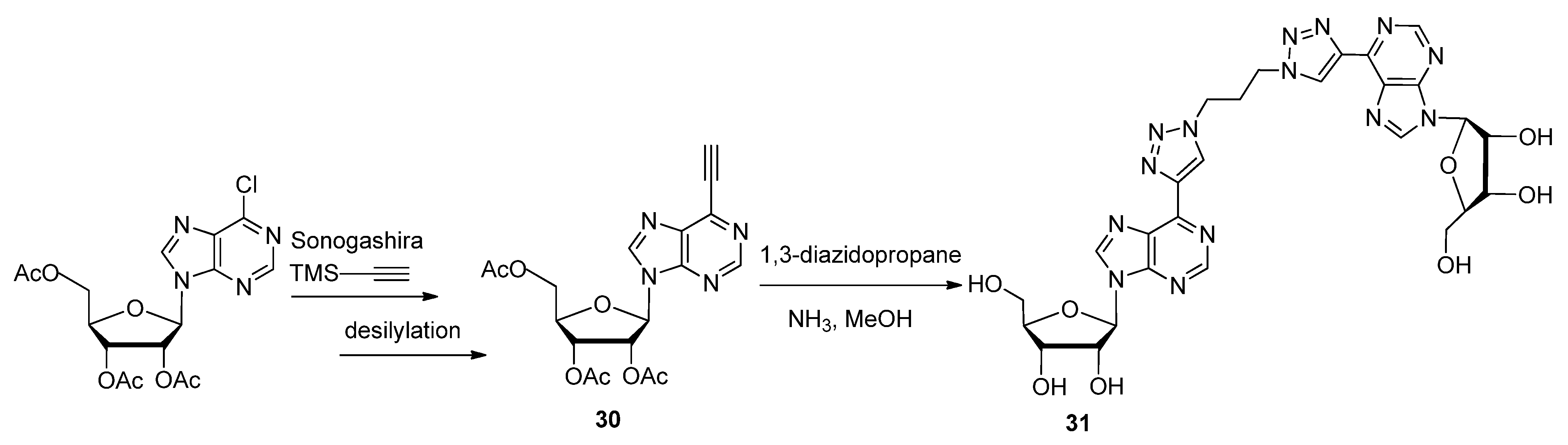
          <p>After the azide displacement reaction with the protected <italic>O</italic><sup>6</sup>-(benzotriazol-1-yl) intermediate <bold>27</bold>, the azide <bold>28</bold> would equilibrate with its <italic>N</italic><sup>1</sup>-tetrazolyl tautomer <bold>29</bold>. Until solvent conditions were optimized to isolate the azido tautomer as the major reactant, the CuAAC conjugation of alkyne-based functionalities was low-yielding or did not occur. Realizing that formation of the tetrazolyl tautomer was a potential hindrance to the CuAAC, Mathew <italic>et al</italic>. decided to use a C6-chloro-protected purine as the substrate for the Sonogashira cross-coupling reaction with TMS-acetylene to introduce a C6-acetylene (<bold>30</bold>, <xref ref-type="scheme" rid="molecules-17-12665-scheme8">Scheme 8</xref>) [<xref ref-type="bibr" rid="B96-molecules-17-12665">96</xref>]. The result of this alternative synthetic strategy coupled with the CuAAC lead to the discovery of several different triazole-modified derivatives such as the homo-purine dimer compound <bold>31</bold>. Both articles focused on the development of agonists or antagonists for adenosine receptors, since they are expressed in almost every cell and therefore present a popular target for potential drugs [<xref ref-type="bibr" rid="B96-molecules-17-12665">96</xref>].</p>
          <fig id="molecules-17-12665-scheme8" position="float">
            <object-id pub-id-type="pii">molecules-17-12665-scheme8_Scheme 8</object-id>
            <label>Scheme 8</label>
            <caption>
              <p>Synthesis of triazole-linked di-nucleosides to be used as anti-adenosine receptor ligands.</p>
            </caption>
            <graphic xmlns:xlink="http://www.w3.org/1999/xlink" xlink:href="molecules-17-12665-g023.tif"/>
          </fig>
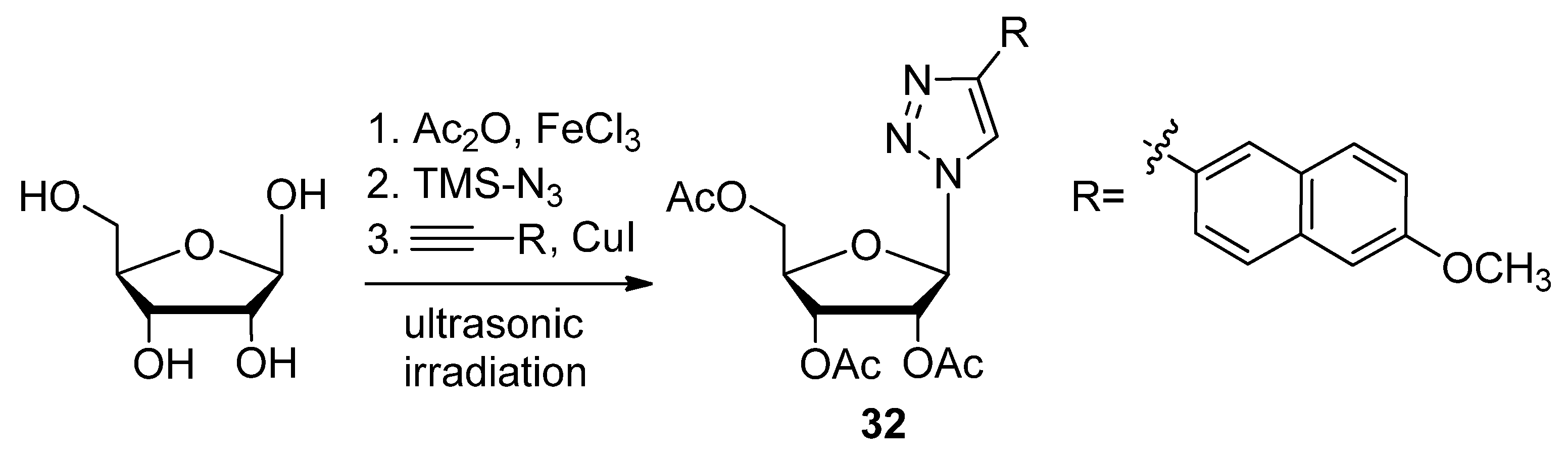
          <p>Referring back to triazole-based substitutions at the 1′-furanose position, there are a few examples of bioactive mimics containing functionalities attached through a five-membered ring systems at this site [<xref ref-type="bibr" rid="B97-molecules-17-12665">97</xref>]. Capitalizing on this trend, the following Fmoc-protected 4-(aminomethyl)-1,2,3-triazolyl nucleoside analogue <bold>38</bold> (<xref ref-type="fig" rid="molecules-17-12665-f005">Figure 5</xref>) was synthesized for its potential use as an antiviral agent [<xref ref-type="bibr" rid="B98-molecules-17-12665">98</xref>]. A more recent example of a 1′-triazole-modified nucleoside analogue which could have antiviral effects is compound <bold>39</bold>, containing a 4-(triazolyl)-<italic>p</italic>-methoxyphenyl substituent which successfully inhibited an <italic>E. coli</italic> nicotinamide adenine dinucleotide malic enzyme (NAD ME) [<xref ref-type="bibr" rid="B99-molecules-17-12665">99</xref>]. An expedient method of implementing the click-modification of a nucleoside mimic at the 1′-furanose position was developed with the assistance of ultrasonic irradiation [<xref ref-type="bibr" rid="B97-molecules-17-12665">97</xref>]. With the help of an Fe(III) catalyst (FeCl<sub>3</sub>), this one-pot synthetic strategy to click-modify a 1′-azidofuranose building block using ultrasonic irradiation reduced reaction times from hours to minutes while increasing the overall yield (<xref ref-type="scheme" rid="molecules-17-12665-scheme9">Scheme 9</xref>). </p>
          <fig id="molecules-17-12665-scheme9" position="float">
            <object-id pub-id-type="pii">molecules-17-12665-scheme9_Scheme 9</object-id>
            <label>Scheme 9</label>
            <caption>
              <p>One-pot synthesis of C1′-triazolo nucleobase mimics with ultrasonic irradiation.</p>
            </caption>
            <graphic xmlns:xlink="http://www.w3.org/1999/xlink" xlink:href="molecules-17-12665-g024.tif"/>
          </fig>
          <p>In addition, the active compound <bold>32</bold> significantly reduced the viability of chronic myelogenous leukemia (CML) K562 cells by 93%, compared with a known CML inhibitor AICAR which lowered cell viability by 35%. Itzstein and colleagues further extended the click-based modification at the 1′-sugar position by adding a methylene bridge at the sugar-triazole junction [<xref ref-type="bibr" rid="B100-molecules-17-12665">100</xref>]. The resultant 1′-homo-<italic>N</italic>-nucleoside derivative <bold>40</bold> (<xref ref-type="fig" rid="molecules-17-12665-f005">Figure 5</xref>) will be tested for its application as an antivirulent. Another group used a unique TBS-directed CuAAC method to force the production of the 1,5-disubstituted regioisomer of the more common 1,4-1,2,3-triazole [<xref ref-type="bibr" rid="B33-molecules-17-12665">33</xref>]. Their inspiration came from examples of fluorinated and highly-bioactive molecules containing 1,5-1,2,3-triazoles [<xref ref-type="bibr" rid="B101-molecules-17-12665">101</xref>]. The antiviral and cytotoxic evaluation of compound <bold>41</bold> with its 5-trifluoromethyl substituted 1,2,3-triazole in the 1′-furanose position is underway.</p>
        </sec>
      </sec>
      <sec>
        <title>2.2. Sugar Modifications</title>
        <p>Modifications at the sugar moiety of nucleosides are commonly employed for the purpose of developing novel anti-viral or cancer therapeutics and for applications which would benefit from appending useful molecules to mono- or oligonucleotides. Applications of nucleoside analogues with modified sugars are generally the same as for analogues with modified bases and backbone structures. However, the sugar moiety is restricted to a small number of modifiable sites. The positions which are modified on the sugar are typically C1′ to C5′ (or C6′ for locked nucleic acids (LNA) [<xref ref-type="bibr" rid="B102-molecules-17-12665">102</xref>]) [<xref ref-type="bibr" rid="B48-molecules-17-12665">48</xref>]. For the purposes of this review, we will be focusing on the sugar positions C2′, C3′ and C5′. Nucleoside analogues where modifications are performed on the C3′ or C5′ positions are either meant to be used as monomer or dimer units, or occupy the terminal ends of DNA or RNA oligonucleotides [<xref ref-type="bibr" rid="B57-molecules-17-12665">57</xref>,<xref ref-type="bibr" rid="B103-molecules-17-12665">103</xref>,<xref ref-type="bibr" rid="B104-molecules-17-12665">104</xref>,<xref ref-type="bibr" rid="B105-molecules-17-12665">105</xref>,<xref ref-type="bibr" rid="B106-molecules-17-12665">106</xref>,<xref ref-type="bibr" rid="B107-molecules-17-12665">107</xref>]. The C2′ position offers the opportunity to place modified nucleoside analogues throughout chemically synthesized oligonucleotides since elongation usually occurs from the C3′ or C5′ positions [<xref ref-type="bibr" rid="B48-molecules-17-12665">48</xref>,<xref ref-type="bibr" rid="B108-molecules-17-12665">108</xref>,<xref ref-type="bibr" rid="B109-molecules-17-12665">109</xref>,<xref ref-type="bibr" rid="B110-molecules-17-12665">110</xref>]. The CuAAC has found utility in attaching molecules to these positions through a triazole tether, especially since AZT is a readily available starting material containing a C3′-azido group [<xref ref-type="bibr" rid="B57-molecules-17-12665">57</xref>]. Using common procedures to functionalize these sugar positions with either azides or alkynes, the CuAAC has become a great tool in churning out libraries of potentially useful nucleic acid-based compounds.</p>
        <sec>
          <title>2.2.1. C3′-Modified Sugars</title>
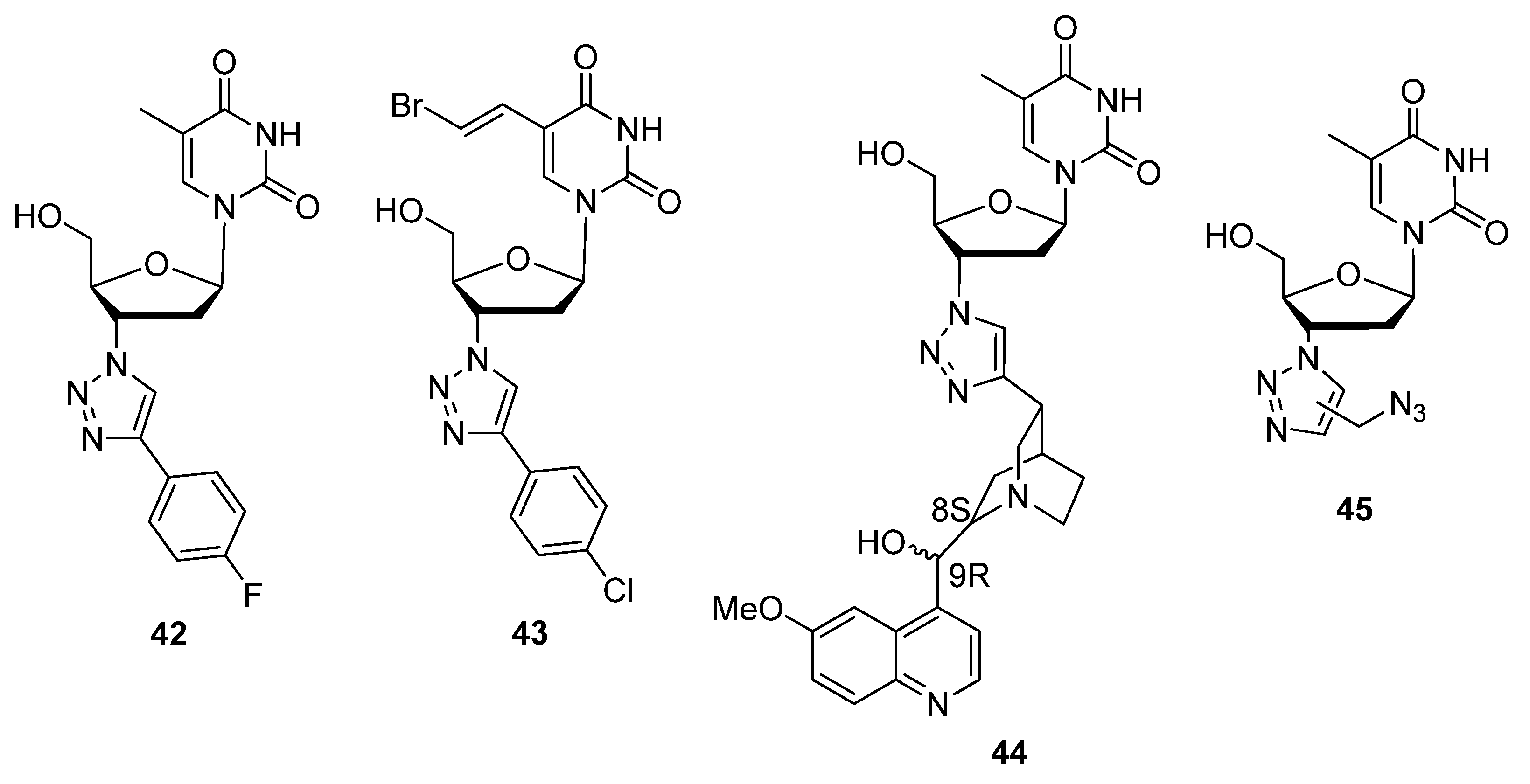
          <p>Many researchers utilize the CuAAC with AZT as the precursor thymine analogue in order to functionalize the C3′ using a variety of alkynes for various applications. For C3′-triazolo-modified compounds synthesized from AZT as the precursor, refer to <xref ref-type="fig" rid="molecules-17-12665-f006">Figure 6</xref>. The goal for the first two structures which were derivatized from AZT was to act as inhibitors of 2′-deoxynucleoside kinases (dNKs) such as thymidine kinases in particular. Thymidine kinase 1 (TK1) was the target of compound <bold>42</bold> (<xref ref-type="fig" rid="molecules-17-12665-f006">Figure 6</xref>), among several compounds synthesized from AZT by Erikkson and colleagues [<xref ref-type="bibr" rid="B57-molecules-17-12665">57</xref>]. TK1 is responsible for the rate-limiting step of initiating DNA replication [<xref ref-type="bibr" rid="B111-molecules-17-12665">111</xref>] and is over-expressed in malignant cell lines [<xref ref-type="bibr" rid="B112-molecules-17-12665">112</xref>], thus making it a suitable target for synthetic ligands. Van Calenbergh and colleagues synthesized nucleoside analogues with an additional C5-(2-bromovinyl) group on the nucleobase [<xref ref-type="bibr" rid="B103-molecules-17-12665">103</xref>]. An example is compound <bold>43</bold> which was selective for thymidine kinase 2 (TK2), a dNK which is responsible for phosphorylating dNTPs for mitochondrial DNA replication [<xref ref-type="bibr" rid="B113-molecules-17-12665">113</xref>]. Their goal was to understand the mechanism through which nucleic acid-based antiviral or anticancer therapies cause mitochondrial DNA toxicity. Compound <bold>44</bold> was synthesized to serve as an anticancer agent and as an optional fluorescent tag at the 3′-ends of oligonucleotides due to the quinine substituent [<xref ref-type="bibr" rid="B105-molecules-17-12665">105</xref>]. With the intention of producing inhibitors for the popular drug target HIV-1 RT, Roy <italic>et al</italic>. modified AZT with both 1,4- and 1,5-disubstituted isomers of the azide-functionalized 1,2,3-triazole <bold>45</bold> based on AZT′s success at inhibiting the same enzyme [<xref ref-type="bibr" rid="B107-molecules-17-12665">107</xref>].</p>
          <fig id="molecules-17-12665-f006" position="float">
            <label>Figure 6</label>
            <caption>
              <p>Various C3′-triazole modified 2′-deoxyfuranoses.</p>
            </caption>
            <graphic xmlns:xlink="http://www.w3.org/1999/xlink" xlink:href="molecules-17-12665-g006.tif"/>
          </fig>
        </sec>
        <sec>
          <title>2.2.2. C5′-Modified Sugars</title>
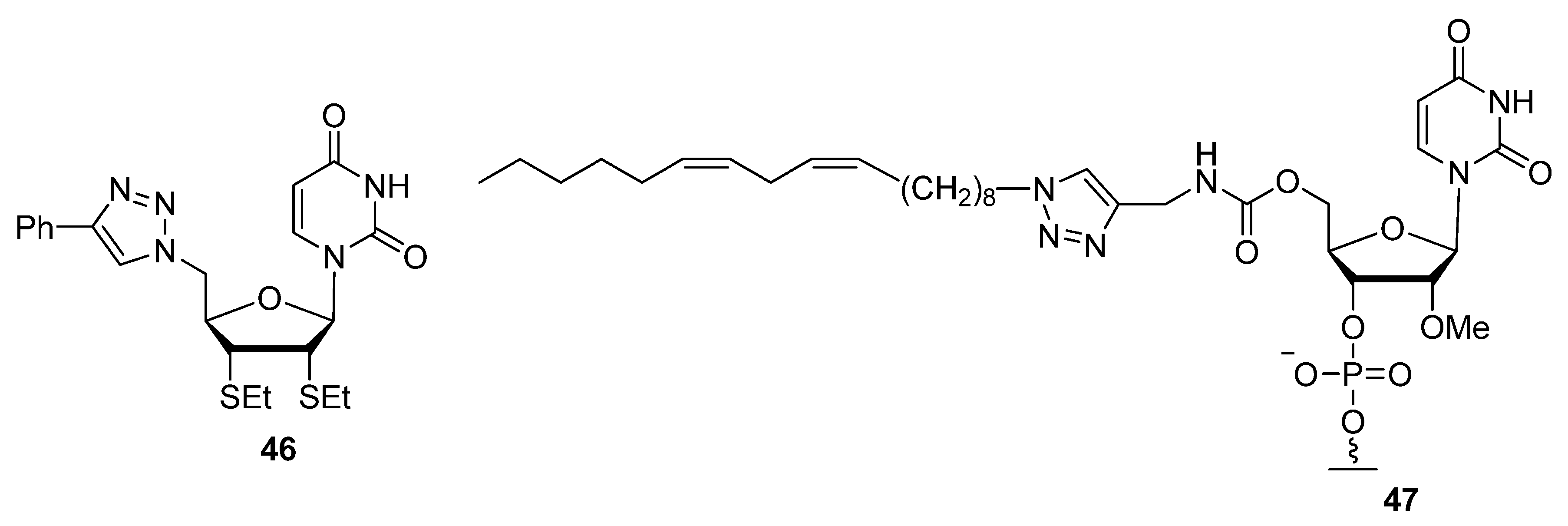
          <p>Ribose sugars with C5′ azide or alkyne groups can be introduced at the 5′-ends of synthetic oligonucleotides and along with many other applications, they can be further click-functionalized with molecules to improve delivery [<xref ref-type="bibr" rid="B106-molecules-17-12665">106</xref>] or to enhance their specificity and potency as cytotoxic agents [<xref ref-type="bibr" rid="B104-molecules-17-12665">104</xref>]. In the pursuit of therapeutic design, Wu and colleagues explored a series of C5′-triazolo modified uridines, thymidines and cytidines to screen for anticancer properties [<xref ref-type="bibr" rid="B104-molecules-17-12665">104</xref>]. Compound <bold>46</bold> (<xref ref-type="fig" rid="molecules-17-12665-f007">Figure 7</xref>) showed substantial cytotoxic profiles against three of the four cancer cells lines tested, surpassing the reference compound 5′-FU with a six-fold increase in potency. With an interest in gene-silencing therapies, Manoharan and colleagues attached long-chain fatty acids to alkyne-functionalized sugars throughout synthetic siRNAs. They discovered that siRNAs containing compound <bold>47</bold> at the 5′ end of the sense strand displayed enhanced activity compared to all other modified constructs, including the wild-type duplex [<xref ref-type="bibr" rid="B106-molecules-17-12665">106</xref>].</p>
          <fig id="molecules-17-12665-f007" position="float">
            <label>Figure 7</label>
            <caption>
              <p>Uridine nucleoside analogues C5′-triazole modified sugars.</p>
            </caption>
            <graphic xmlns:xlink="http://www.w3.org/1999/xlink" xlink:href="molecules-17-12665-g007.tif"/>
          </fig>
        </sec>
        <sec>
          <title>2.2.3. C2′-Modified Sugars</title>
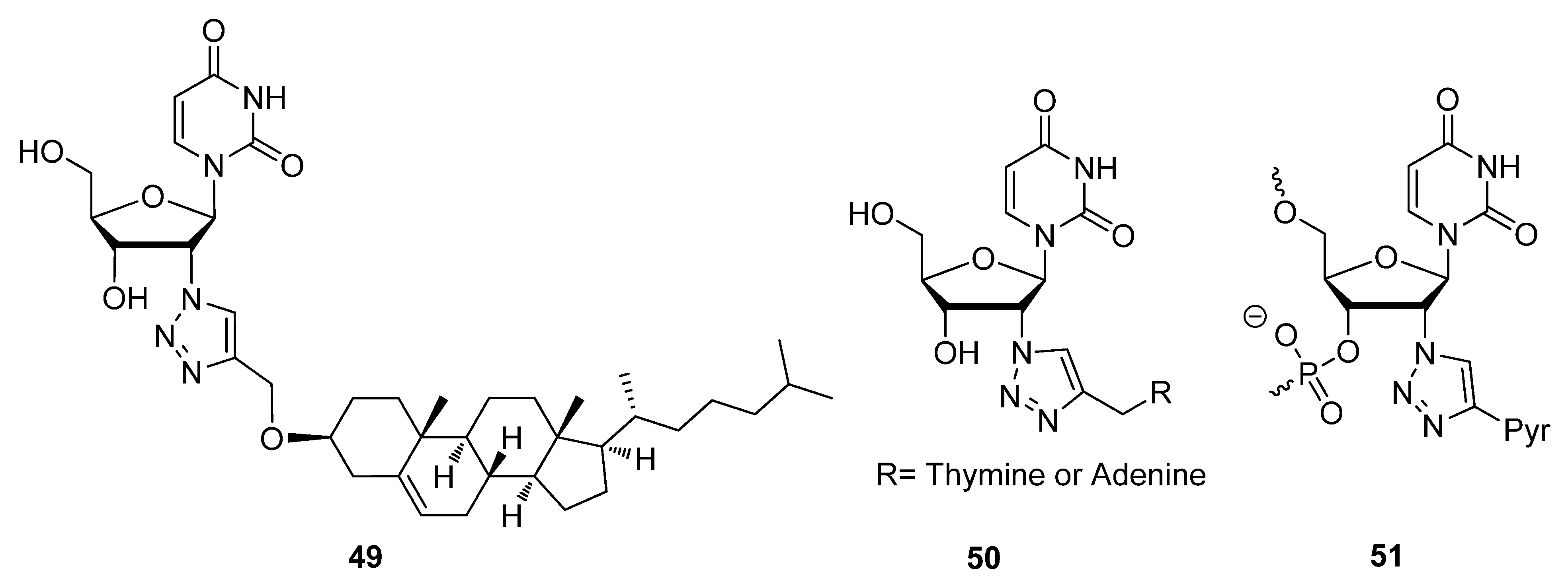
          <p>The last optional position to modify at the furanose sugar moiety in nucleic acid residues while remaining within the scope of this review is the C2′ position. Unlike the C3′ and C5′ positions, nucleic acids containing C2′ sugar modifications can still be incorporated throughout synthetic oligonucleotides since this position does not typically participate in strand elongation. Towards the development of C2′ modified nucleoside monomers, Liebscher and colleagues devised a method of click-appending cholesterol molecules with variable-length aliphatic linkers to the C2′ position of uridine [<xref ref-type="bibr" rid="B109-molecules-17-12665">109</xref>]. Using various solid-state and 2D-NMR spectroscopic techniques, this group verified that compound <bold>49</bold> (<xref ref-type="fig" rid="molecules-17-12665-f008">Figure 8</xref>) containing a cholesterol group tethered to the C2′ sugar position through a triazole moiety could anchor to 1-palmitoyl-2-oleoyl-<italic>sn</italic>-<italic>glycero</italic>-3-phosphocholine (POPC) membranes. Capitalizing on the successful design of double-headed nucleosides for potential therapeutic applications or for DNA and RNA structural studies [<xref ref-type="bibr" rid="B114-molecules-17-12665">114</xref>], another group extended the design by attaching nucleobases to various positions of the sugar moiety, particularly the C2′ position [<xref ref-type="bibr" rid="B48-molecules-17-12665">48</xref>]. Incorporating compounds <bold>50</bold> into duplex DNA or RNA molecules, Nielsen and colleagues studied the effects of these double-headed derivatives on nucleic acid secondary structures.</p>
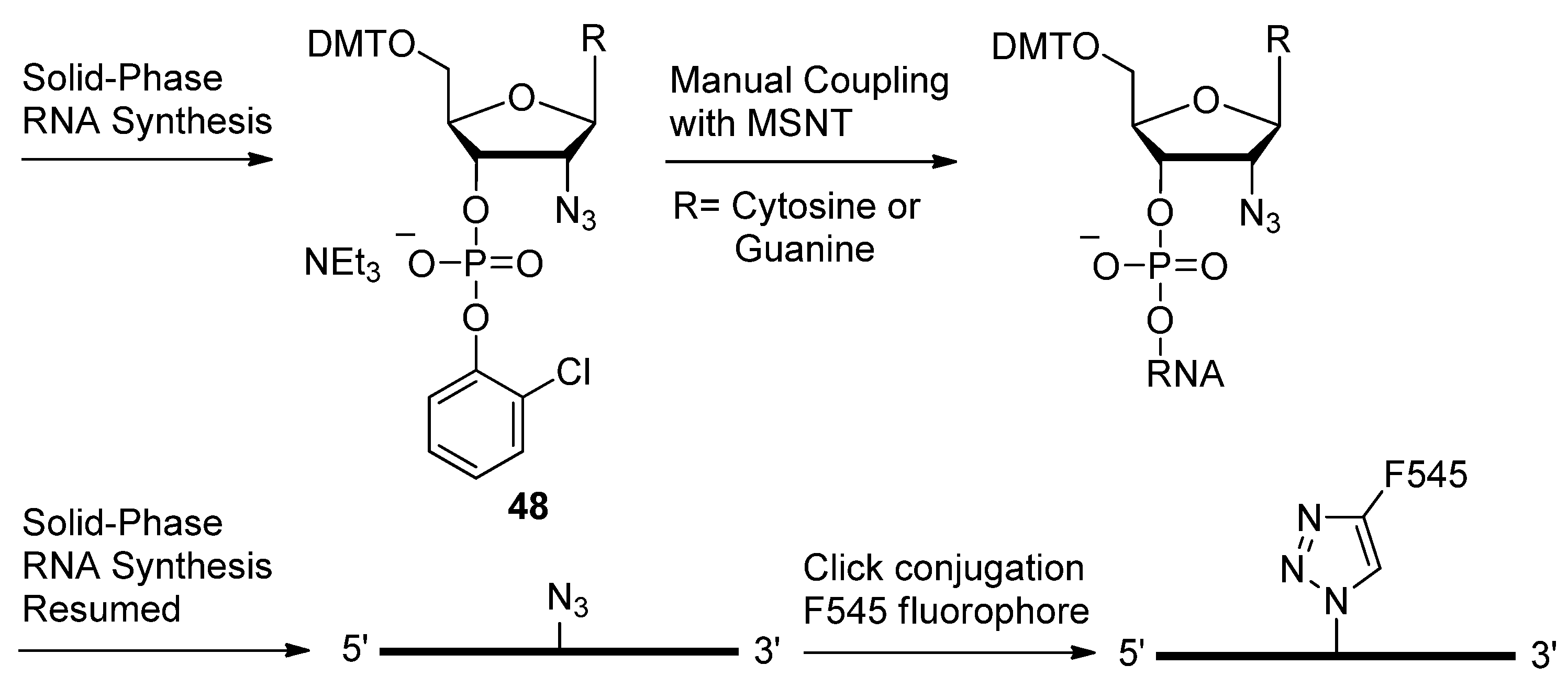
          <p>Based on their previous work with 2′-azido modified 2′-deoxyuridine/adenosine analogues which were compatible with siRNA constructs [<xref ref-type="bibr" rid="B115-molecules-17-12665">115</xref>], Fauster <italic>et al</italic>. extended the work by producing cytidine and guanosine 2′-azido modified analogues [<xref ref-type="bibr" rid="B108-molecules-17-12665">108</xref>]. The synthetic assembly of oligonucleotides using phosphoramidite chemistry has generally proven incompatible with azides. In the presence of P(III), azides have proven to be highly susceptible to the Staudinger reduction [<xref ref-type="bibr" rid="B116-molecules-17-12665">116</xref>]. It is for this reason that most groups who wish to click-derivatize their oligonucleotides, tend to append alkyne groups to their oligomers in preparation for cyclizing with azide-functionalized molecules. Despite these findings, Fauster <italic>et al</italic>. went ahead to prove that azide functional groups at the furanose C2′-position are compatible with the steps of automated oligonucleotide synthesis (<xref ref-type="scheme" rid="molecules-17-12665-scheme10">Scheme 10</xref>) [<xref ref-type="bibr" rid="B108-molecules-17-12665">108</xref>].</p>
          <fig id="molecules-17-12665-scheme10" position="float">
            <object-id pub-id-type="pii">molecules-17-12665-scheme10_Scheme 10</object-id>
            <label>Scheme 10</label>
            <caption>
              <p>RNA synthesis using phosphoramidite chemistry in the presence of free azide moieties and their compatibility with the chemistry.</p>
            </caption>
            <graphic xmlns:xlink="http://www.w3.org/1999/xlink" xlink:href="molecules-17-12665-g025.tif"/>
          </fig>
          <p>Phosphoramidites <bold>48</bold> were site-specifically incorporated into the growing oligonucleotide to place the C2′ azide in the desired position(s), using 1-(mesitylene-2-sulfonyl)-3-nitro-1,2,4-triazole (MSNT) [<xref ref-type="bibr" rid="B117-molecules-17-12665">117</xref>] as an activator. Automated addition of remaining residues continued without affecting the free azide moieties on the oligomer. The resulting azido-siRNAs were then post-synthetically labelled with the fluorophore F545 through the CuAAC. Even though pyrene is commonly used as a fluorescent label due to its innate character as a fluorophore [<xref ref-type="bibr" rid="B118-molecules-17-12665">118</xref>], this next group used this aromatic functionality to produce non-discriminatory DNA and RNA probes [<xref ref-type="bibr" rid="B110-molecules-17-12665">110</xref>]. These universal probes can be useful when the target sequence contains a couple of unknown residues. In the presence of mismatched sequences or abasic sites, compound <bold>51</bold> (<xref ref-type="fig" rid="molecules-17-12665-f008">Figure 8</xref>) was least discriminating as determined by the minimal perturbations in probe:target duplex <italic>T<sub>m</sub></italic>s. The tentative explanation for this behavior is that the pyrene substituent is intercalating into the duplex core and pushing out the opposing nucleobase, thus allowing for universal hybridization devoid of a Watson-Crick interaction.</p>
        <fig id="molecules-17-12665-f008" position="float">
            <label>Figure 8</label>
            <caption>
              <p>Structures of C2′-triazole modified nucleosides.</p>
            </caption>
            <graphic xmlns:xlink="http://www.w3.org/1999/xlink" xlink:href="molecules-17-12665-g008.tif"/>
          </fig>
          </sec>
      </sec>
      <sec>
        <title>2.3. Backbone Modifications</title>
        <p>The goals which stem from modifying all three key areas of nucleic acids are relatively the same, in that all studies pursue the advancement of both structural and functional characteristics of nucleic acid-based derivatives. In order to retain or to enhance properties which are favorable for ASO and siRNA-based constructs, modifications at the site of the backbone are also of great interest. Examples of areas which would benefit from backbone-targeted modifications include the production of longer or multi-branched oligonucleotides and synthetic genes. Currently, there is an upper limit of approximately 100 bases in the length of DNA by using traditional DNA and RNA synthesis techniques such as solid-phase phosphoramidite chemistry [<xref ref-type="bibr" rid="B119-molecules-17-12665">119</xref>]. To overcome this size limitation, a new class of backbone-modified oligonucleotides that utilize the 1,4-disubstituted 1,2,3-triazole as the internucleotide linkage has emerged in the last decade [<xref ref-type="bibr" rid="B26-molecules-17-12665">26</xref>,<xref ref-type="bibr" rid="B120-molecules-17-12665">120</xref>]. Another attractive feature in utilizing triazole-linked oligonucleotides is the enhanced resistance towards endo- and exonuclease-mediated cleavage, which improves construct bioavailability within physiological environments [<xref ref-type="bibr" rid="B2-molecules-17-12665">2</xref>,<xref ref-type="bibr" rid="B8-molecules-17-12665">8</xref>,<xref ref-type="bibr" rid="B19-molecules-17-12665">19</xref>].</p>
        <sec>
          <title>2.3.1. DNA Backbone Modification</title>
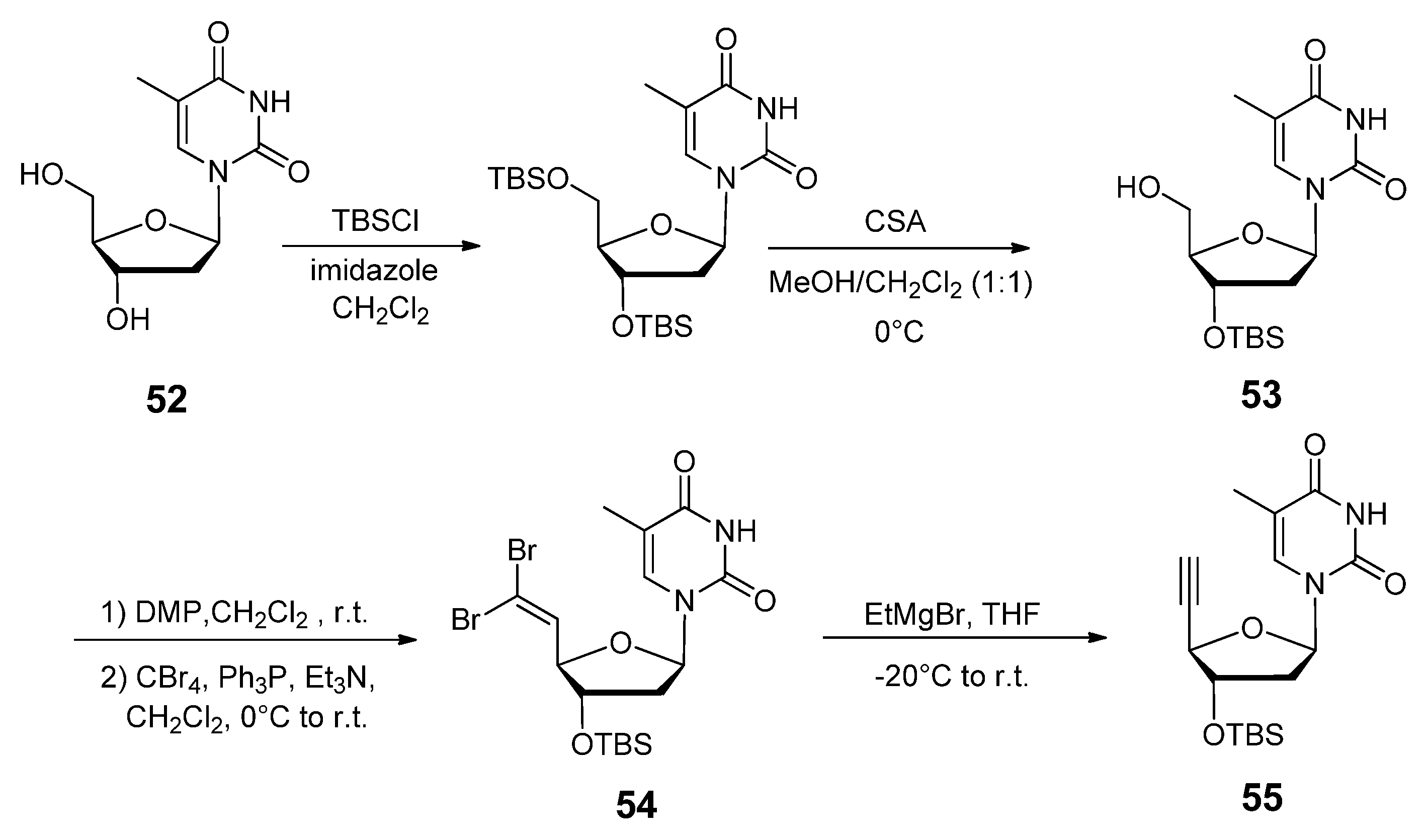
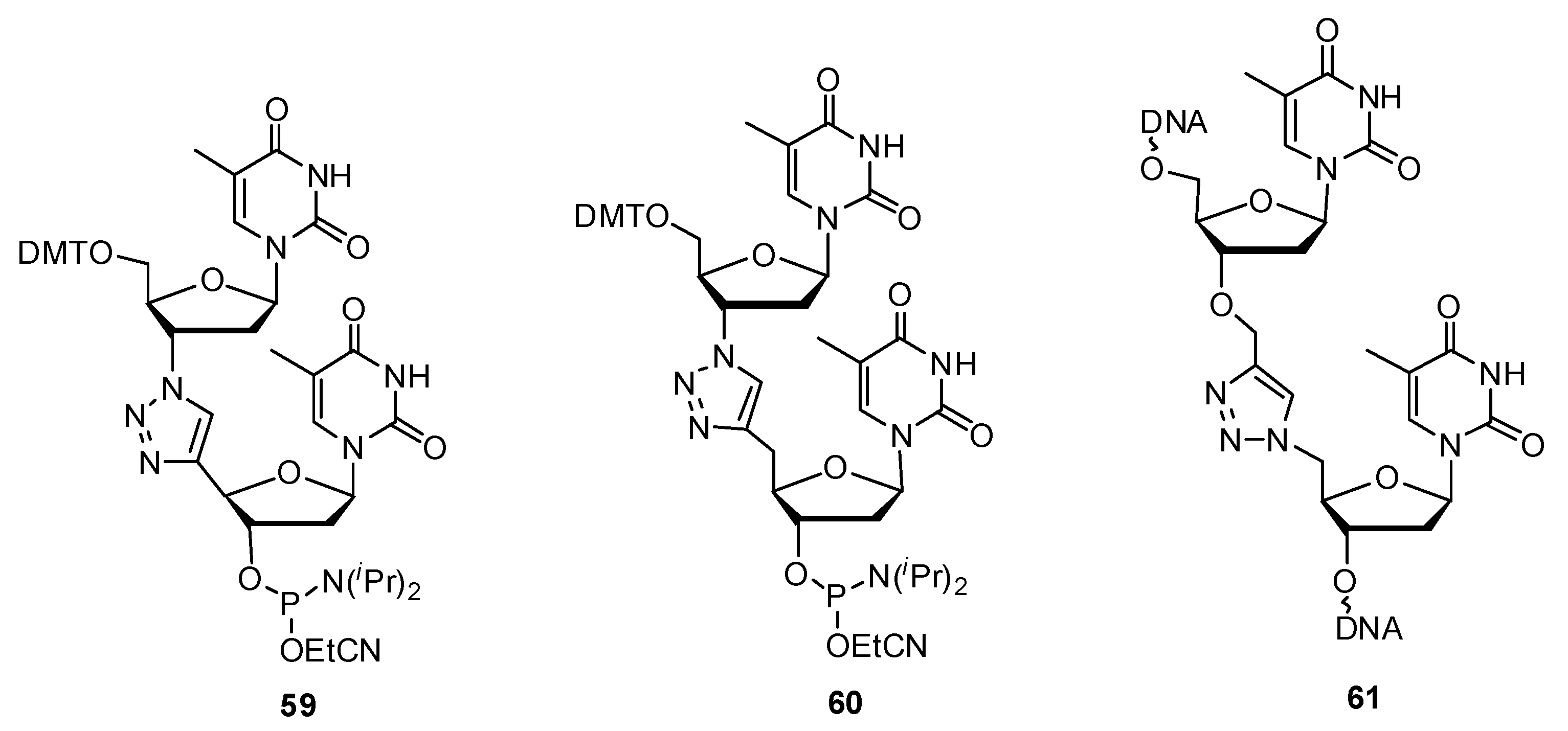
          <p>In one study by Chandrasekhar <italic>et al</italic>., a triazole linked 2′-deoxythymidine nucleoside phosphoramidite <bold>59</bold> (<xref ref-type="fig" rid="molecules-17-12665-f009">Figure 9</xref>) was synthesized for its direct use in solid-phase oligonucleotide synthesis [<xref ref-type="bibr" rid="B121-molecules-17-12665">121</xref>]. This dimer unit can be placed at any requisite site in the chain. They designed a new dinucleoside phosphoramidite with the sugar part of the nucleotide unaltered. The monomer unit <bold>55</bold> (<xref ref-type="scheme" rid="molecules-17-12665-scheme11">Scheme 11</xref>) containing the terminal acetylene moiety which serves as the precursor for the prospective triazole-linked dimer was synthesized from commercially available thymidine <bold>52</bold> in five steps. Succeeding the protection of free alcohols, the group then selectively deprotected the 5′-OH with 10-camphorsulfonic acid [<xref ref-type="bibr" rid="B122-molecules-17-12665">122</xref>], yielding derivative <bold>53</bold>. The free alcohol was then oxidized with Dess-Martin periodinane, subjected to the Corey-Fuchs protocol [<xref ref-type="bibr" rid="B123-molecules-17-12665">123</xref>] and then treated with ethylmagnesium bromide (<bold>54</bold>, <xref ref-type="scheme" rid="molecules-17-12665-scheme11">Scheme 11</xref>). The two key fragments which were the azide unit (AZT) and the terminal acetylene <bold>55</bold> were then clicked together through the CuAAC reaction to yield the target triazole-linked dimer phosphoramidite <bold>59</bold> (<xref ref-type="fig" rid="molecules-17-12665-f009">Figure 9</xref>).</p>
          <fig id="molecules-17-12665-scheme11" position="float">
            <object-id pub-id-type="pii">molecules-17-12665-scheme11_Scheme 11</object-id>
            <label>Scheme 11</label>
            <caption>
              <p>Synthesis of the thymidine 4′-alkynylated monomer.</p>
            </caption>
            <graphic xmlns:xlink="http://www.w3.org/1999/xlink" xlink:href="molecules-17-12665-g026.tif"/>
          </fig>
          <p>Sequentially heterogeneous oligonucleotides bearing a similar triazole-linked dimer <bold>60</bold> (<xref ref-type="fig" rid="molecules-17-12665-f009">Figure 9</xref>) was synthesized by the Florentiev group [<xref ref-type="bibr" rid="B124-molecules-17-12665">124</xref>]. Their triazole-based linker was one atom longer than Chandrasekhar’s modification. Similarly, their synthetic strategy also included the use of Dess-Martin periodinane in order to oxidize the 5′-OH to an aldehyde, after which the dibromoalkene was synthesized as an intermediate to convert the aldehyde into a terminal alkyne. The CuAAC reaction was then carried out between the terminal alkyne and 3′-azido-3′-deoxy-5′-<italic>O</italic>-dimethoxytritylthymidine. After assessing the effects of single and multiple modifications on the thermostability of mixed-base duplexes, an average drop in <italic>T<sub>m</sub></italic> of −4 °C was observed indicating that the incorporation of this triazole linked dimer was slightly destabilizing for its hybridization ability.</p>
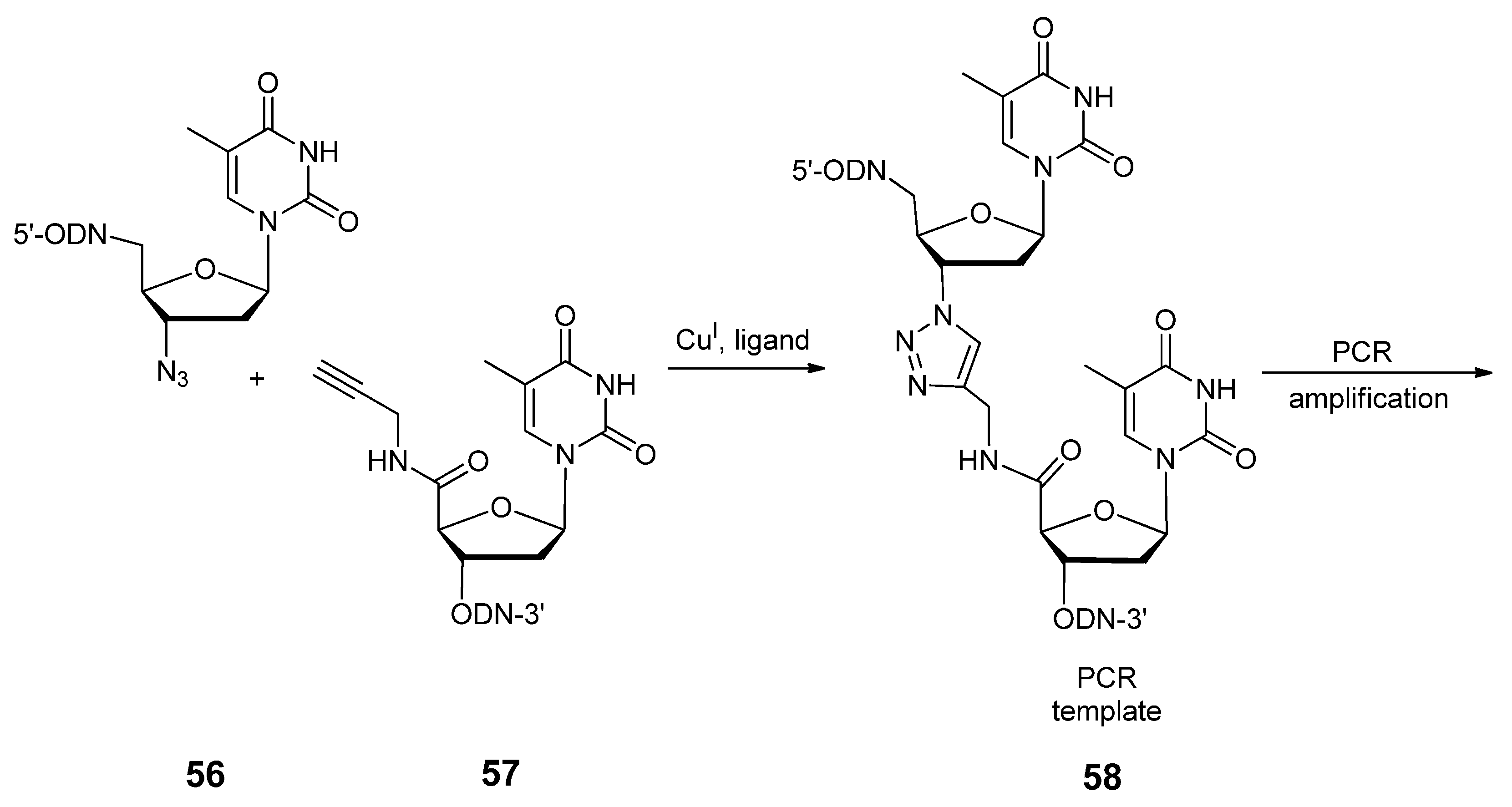
          <p>A click-ligated DNA strand <bold>58</bold> (<xref ref-type="scheme" rid="molecules-17-12665-scheme12">Scheme 12</xref>) made up of 81 residues has been synthesized between oligonucleotides containing 3′-AZT <bold>56</bold> and 5′-propargylamido-2′-deoxythymidine <bold>57</bold> residues [<xref ref-type="bibr" rid="B125-molecules-17-12665">125</xref>]. In order to more efficiently assemble the oligonucleotides with 3′-AZT and avoid the potential incompatibility of the azide group with P(III) chemistry [<xref ref-type="bibr" rid="B116-molecules-17-12665">116</xref>], the required sequences were assembled in the 5′ to 3′ direction using 3′-DMT-5′-phosphoramidites of DNA nucleotides. To produce the azide-functionalized DNA strand, AZT was added as a phosphotriester monomer to the 3′-end of the designer strand after its automated assembly had terminated. The alkyne-modified oligonucleotides to serve as partners for the 3′-AZT strands were assembled through the 5′-ended solid-phase coupling of the 5′-propargylamido thymidine analogue (<bold>57</bold>) phosphoramidite, which was synthesized from the carboxylic acid derivative of thymidine [<xref ref-type="bibr" rid="B126-molecules-17-12665">126</xref>,<xref ref-type="bibr" rid="B127-molecules-17-12665">127</xref>]. The resultant click-ligated DNA strand displayed compatibility with various polymerases as a PCR template and at the time, served as the first example of a novel DNA ligation which could undergo reproducible PCR amplification.</p>
          <fig id="molecules-17-12665-scheme12" position="float">
            <object-id pub-id-type="pii">molecules-17-12665-scheme12_Scheme 12</object-id>
            <label>Scheme 12</label>
            <caption>
              <p>Synthesis and PCR amplification of an unnatural triazole-based DNA backbone.</p>
            </caption>
            <graphic xmlns:xlink="http://www.w3.org/1999/xlink" xlink:href="molecules-17-12665-g027.tif"/>
          </fig>
          <p>Brown and colleagues not only explained the biocompatibility of the triazole linkage within synthetic oligonucleotides [<xref ref-type="bibr" rid="B128-molecules-17-12665">128</xref>], but also examined the structure and base-pair dynamics of a DNA duplex containing a single triazole linkage between two central thymidine residues (<bold>61</bold>, <xref ref-type="fig" rid="molecules-17-12665-f009">Figure 9</xref>) using NMR solution techniques [<xref ref-type="bibr" rid="B129-molecules-17-12665">129</xref>]. The triazole-modified DNA duplex was found to share structural similarity with the reference B-form helical conformation. Although a slight disturbance in the thermodynamic profile of the modified duplex is observed, the triazole linkage <bold>61</bold> promises biocompatibility with polymerases or other such biomolecules.</p>
        <fig id="molecules-17-12665-f009" position="float">
            <label>Figure 9</label>
            <caption>
              <p>DNA oligonucleotides containing triazole-based internucleotide linkages.</p>
            </caption>
            <graphic xmlns:xlink="http://www.w3.org/1999/xlink" xlink:href="molecules-17-12665-g009.tif"/>
          </fig>
          </sec>
        <sec>
          <title>2.3.2. RNA Backbone Modifications</title>
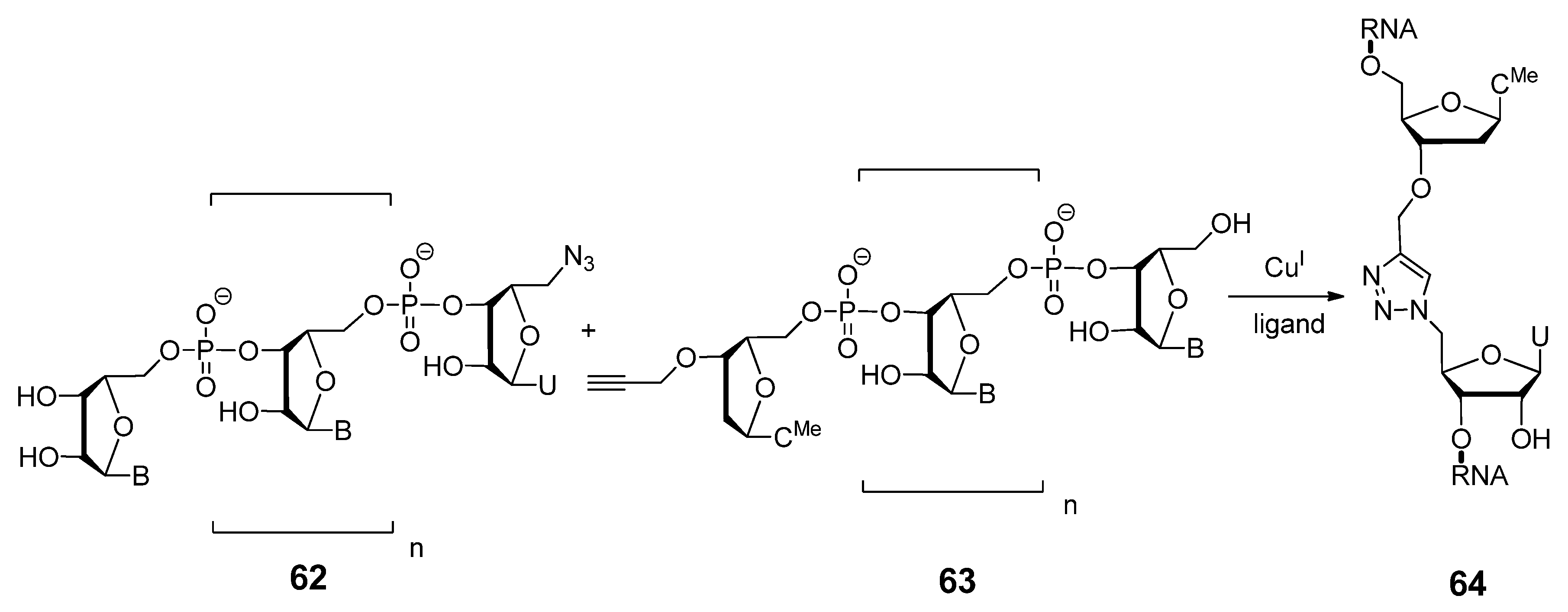
          <p>In addition to triazole-modified backbones in DNA molecules, a number of RNA analogues have been synthesized using click chemistry, in which the native phosphodiester linkages are replaced by triazoles. Examples of such analogues were demonstrated by El-Sagheer and Brown through the click-ligation of smaller azide and alkyne functionalized ribo- and deoxyribonucleotide polymers, into a series of catalytically active RNA and DNA:RNA chimeric hairpin and hammerhead ribozymes of approximately 100 nucleotides in length [<xref ref-type="bibr" rid="B26-molecules-17-12665">26</xref>]. After synthetically assembling and derivatizing individual oligonucleotides with either azide or alkyne functional groups, they are click-cyclized to produce larger molecules. In order to produce these RNA or DNA:RNA hydrids (<bold>64</bold>, <xref ref-type="scheme" rid="molecules-17-12665-scheme13">Scheme 13</xref>), click-ligation occurred between terminal azides or acetylenes placed on either 3′ or 5′ ends of individual DNA or RNA strands, as displayed on the 5′-azido modified uridine and 3′-propargylated-2′-deoxycytidine analogues (<bold>62</bold>, <bold>63</bold>). Both modified hairpin and hammerhead ribozymes were shown to cleave their substrates, thus indicating the potential compatibility of these triazole-based backbone linkages with many biologically important DNA or RNA molecules. </p>
          <fig id="molecules-17-12665-scheme13" position="float">
            <object-id pub-id-type="pii">molecules-17-12665-scheme13_Scheme 13</object-id>
            <label>Scheme 13</label>
            <caption>
              <p>Click-mediated synthesis of the DNA-RNA hydrids.</p>
            </caption>
            <graphic xmlns:xlink="http://www.w3.org/1999/xlink" xlink:href="molecules-17-12665-g028.tif"/>
          </fig>
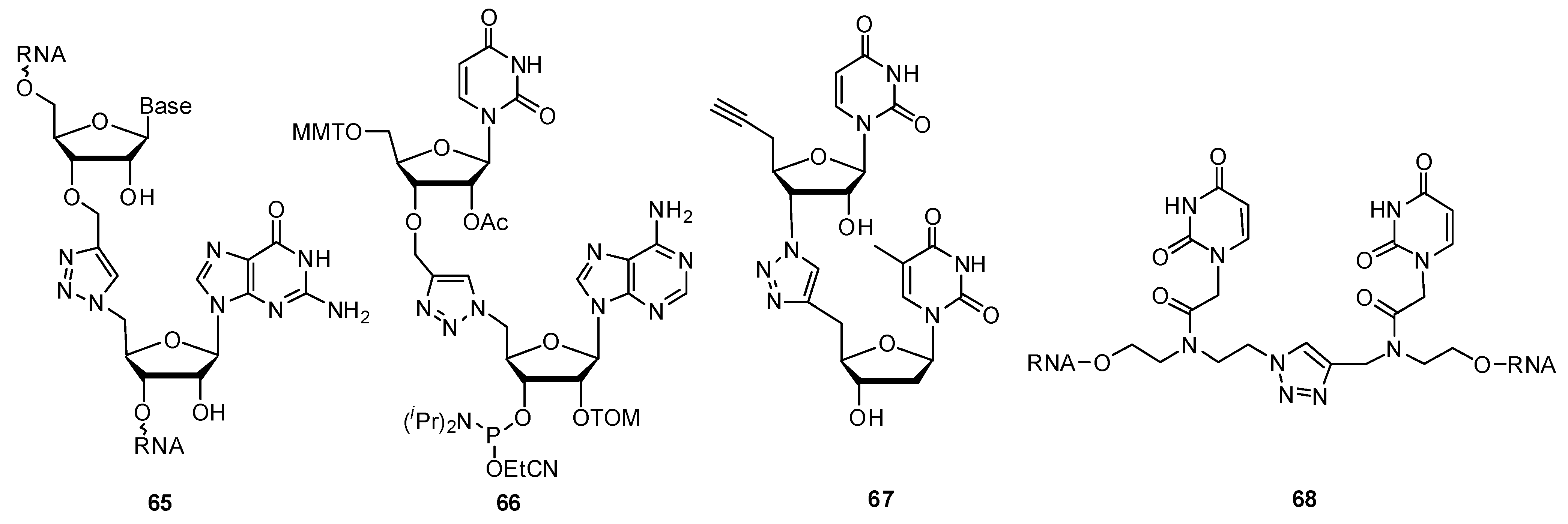
          <p>Paredes and Das extended this work by enzymatically incorporating “clickable” azido groups onto 5′ and 3′ terminal ends of an RNA oligonucleotides via novel azide-labeled nucleotide triphosphates (NTPs) [<xref ref-type="bibr" rid="B120-molecules-17-12665">120</xref>]. Once the clickable groups were installed on individual RNA strands, rapid click radiolabeling could ensue, or template/non-template driven RNA-RNA click ligations were then possible. Linkage <bold>65</bold> (<xref ref-type="fig" rid="molecules-17-12665-f010">Figure 10</xref>) is the result of a successful template-driven RNA-RNA click ligation using fragments of the hepatitis delta virus (HDV) ribozyme. The rate and the extent of target cleavage displayed by the triazole-modified HDV ribozyme was indistinguishable from the transcribed wild-type HDV ribozyme, again indicating a broad applicability of click chemistry in RNA-comprised biological systems. </p>
          <fig id="molecules-17-12665-f010" position="float">
            <label>Figure 10</label>
            <caption>
              <p>Structures of nucleoside analogues linked through a triazole moiety. </p>
            </caption>
            <graphic xmlns:xlink="http://www.w3.org/1999/xlink" xlink:href="molecules-17-12665-g010.tif"/>
          </fig>
          <p>In 2011, Rozners and colleagues synthesized a uracil-adenosine phosphoramidite <bold>66</bold> (<xref ref-type="fig" rid="molecules-17-12665-f010">Figure 10</xref>) containing a triazole backbone unit [<xref ref-type="bibr" rid="B130-molecules-17-12665">130</xref>]. The phosphoramidite approach allows the flexibility to incorporate the desired modification in a site-specific manner throughout the growing oligonucleotide construct. The key consideration in their design was minimizing the synthetic effort and their approach involved the coupling of a 3′-<italic>O</italic>-propargyl uracil monomer with a 5′-azidoadenosine monomer. Reporting a largely destabilizing effect on the RNA double helix (∆<italic>T<sub>m</sub></italic> −7 °C to −14 °C per modification in a 10 bp duplex), this group concluded that the triazole-based linkage was not an ideal replacement for the native phosphodiester linkage. In contrast to these findings and following their success with the solution-phase synthesis of unique triazole linked DNA (<sup>TL</sup>DNA) 8-mer in 2008 [<xref ref-type="bibr" rid="B131-molecules-17-12665">131</xref>], Isobe and colleagues extended their efforts towards the solid-support synthesis of a triazole-linked RNA analogue <bold>67</bold> on a solid support through the CuAAC [<xref ref-type="bibr" rid="B132-molecules-17-12665">132</xref>]. Proton NMR analysis of these monomeric ribonucleoside analogues illustrates a preference for the C3′-endo puckering pattern found in natural ribonucleosides, which suggests a possible use for these triazole-linked nucleoside analogues within RNAi-based applications. With the intention of utilizing novel triazole linkages dispersed throughout duplex siRNAs, our lab reported the synthesis of a nucleoside dimer analogue <bold>68</bold> modified at the backbone with a triazole functionality [<xref ref-type="bibr" rid="B133-molecules-17-12665">133</xref>,<xref ref-type="bibr" rid="B134-molecules-17-12665">134</xref>]. These unnatural triazole-modified siRNAs were capable of silencing the exogenous reporter gene <italic>firefly</italic> luciferase, along with the endogenous gene glyceraldehyde-3-phosphate dehydrogenase (GAPDH) in a dose-dependent manner. Incorporating these novel dimer analogues at the 3′-overhangs of siRNAs imparted an added resistance to nuclease-mediated degradation when compared with unmodified duplexes. Despite the reduced thermostability associated with these modifications, this study highlighted the first reported application of these novel triazole-based internucleotide linkages within functional siRNAs.</p>
        </sec>
        <sec>
          <title>2.3.3. Other Backbone Modifications</title>
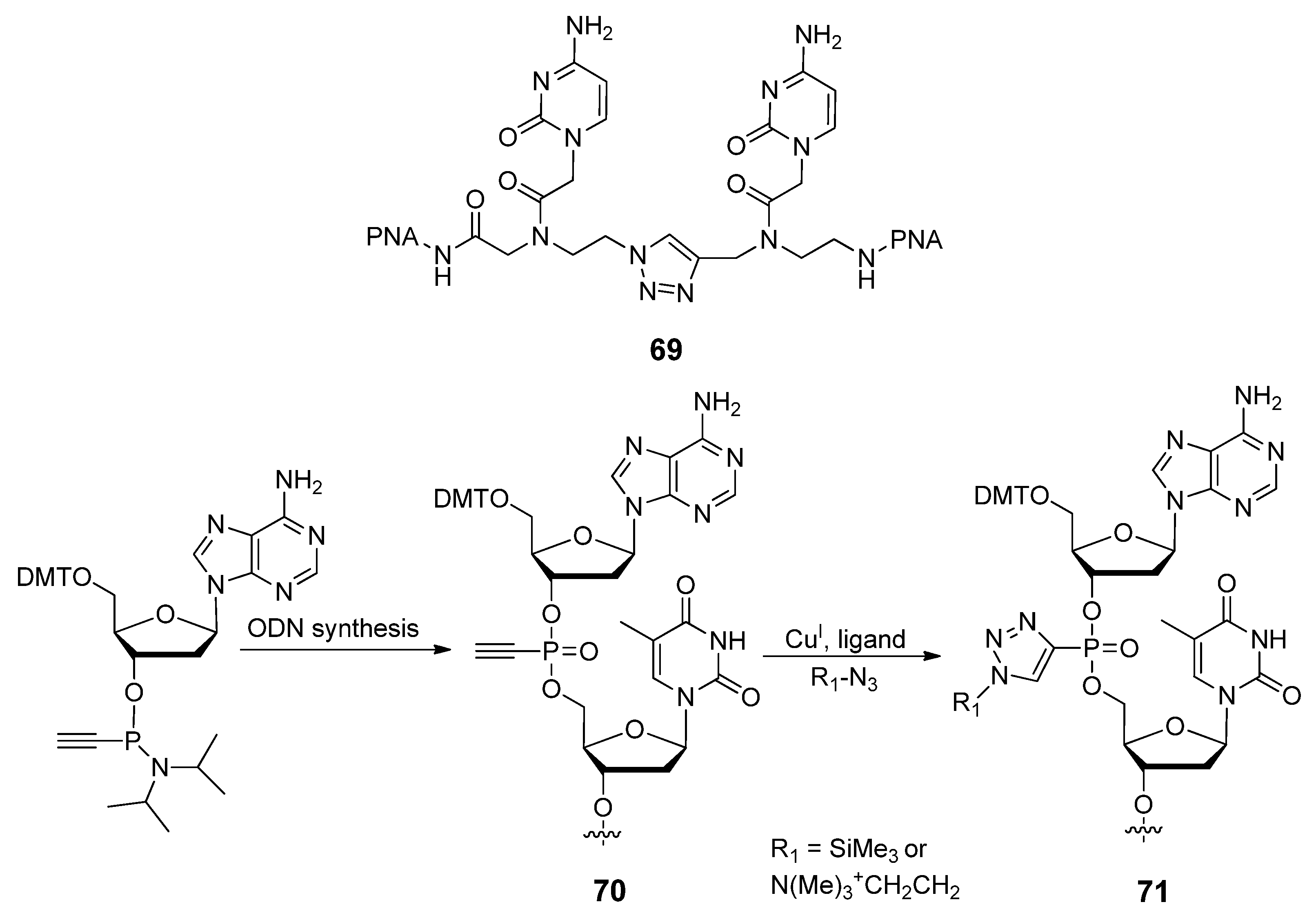
          <p>The Winssinger group reported the substitution of an amide linkage in peptide nucleic acid (PNA), a successful oligonucleoside mimic made of repeating aminoethyl-glycine units [<xref ref-type="bibr" rid="B135-molecules-17-12665">135</xref>], with a triazole linker [<xref ref-type="bibr" rid="B136-molecules-17-12665">136</xref>]. PNA oligomers terminated with an azido monomer were prepared by standard Fmoc-based PNA synthesis [<xref ref-type="bibr" rid="B137-molecules-17-12665">137</xref>], which were then cyclized with various alkyne monomers by means of the CuAAC reaction. The target PNA-based dimer <bold>69</bold> (<xref ref-type="fig" rid="molecules-17-12665-f011">Figure 11</xref>) with the triazole linkage had a negligible impact on the hybridization properties of modified PNA strands and sequence fidelity during PNA synthesis was maintained. These results indicate the suitability of a triazole <italic>in lieu</italic> of the amide linkage within PNA polymers and its capability with the click-templated coupling of PNA fragments.</p>
          <p>Krishna and Caruthers developed the 1,2,3-triazolylphosphonate (TP) internucleotide linkage wherein one of the non-bridging oxygen atoms of the phosphate linkage is replaced by a 1,2,3-triazole moiety, tethered via the C4 of the heterocycle [<xref ref-type="bibr" rid="B42-molecules-17-12665">42</xref>]. This was the first time that click-mediated modification at the phosphorus center had been explored, with the exception of a triazole-functionalization at the 5′-phosphate of a DNA strand [<xref ref-type="bibr" rid="B138-molecules-17-12665">138</xref>]. The proposed 1,2,3-triazolylphosphonate internucleotide (TP) linkages (<bold>71</bold>, <xref ref-type="fig" rid="molecules-17-12665-f011">Figure 11</xref>) are generated through a two-step process. Initially the ethynylphosphonate internucleotide linkage <bold>70</bold> was introduced at designated sites through conventional phosphoramidite chemistry, followed with the post-synthetic CuAAC to introduce the appropriate azide before deprotection and cleavage of the oligonucleotide from the solid support. By coupling these two steps, chimeric oligonucleotides (16−23 mers) which contain up to six TP modifications as well as other functionalities such as LNA nucleotides, 2′-<italic>O</italic>Me ribonucleotides, and phosphorothioates [<xref ref-type="bibr" rid="B139-molecules-17-12665">139</xref>] were synthesized. Nuclease stability assays indicated that these TP-modified ODNs were highly resistant towards exonucleases, whereas melting studies indicated a slight destabilization when a TP-modified ODN was hybridized to its complementary RNA. A fluorescently labeled 16-mer ODN modified with two TP linkages also showed efficient cellular uptake during passive transfection into mammalian cells. This methodology enables the multiple, high-density functionalization of the phosphorus-based backbone of an oligodeoxynucleotide using click chemistry. Various biologically relevant moieties, labeling dyes and diagnostic elements can be introduced at the phosphorus center as opposed to other typically modified areas of DNA nucleosides without compromising the product’s ability to hybridize to its compliment.</p>
        </sec>
      </sec>
      <sec>
        <title>2.4. Bio-conjugation</title>
        <p>Bioconjugation involves conjugating a particular biological scaffold to an existing oligonucleotide that can favorably alter its properties. For example, the poor cell or tissue-specific delivery of synthetic oligonucleotides can be addressed by attaching peptides, lipid derivatives, sugars and other small molecules to natural or modified oligonucleotides [<xref ref-type="bibr" rid="B140-molecules-17-12665">140</xref>]. Fluorescent labeling of oligonucleotides enables us to detect, visualize and study the function of the synthetic oligonucleotides and their interactive behavior within biological systems [<xref ref-type="bibr" rid="B141-molecules-17-12665">141</xref>]. Many dyes are incorporated post-synthetically, in which a small reactive group is introduced to a DNA or RNA oligonucleotide following deprotection [<xref ref-type="bibr" rid="B142-molecules-17-12665">142</xref>]. The CuAAC reaction has been successfully applied in bioconjugation reactions due to its reliability, efficiency, and the stability of alkynes and azides in most physiological and organic conditions.</p>
        <fig id="molecules-17-12665-f011" position="float">
            <label>Figure 11</label>
            <caption>
              <p>Synthesis of 1,2,3-triazolylphosphonate internucleotide (TP) linkages and the triazole-linked dimer within PNA.</p>
            </caption>
            <graphic xmlns:xlink="http://www.w3.org/1999/xlink" xlink:href="molecules-17-12665-g011.tif"/>
          </fig>
          <sec>
          <title>2.4.1. Nucleic Acids Delivery</title>
          <p>In order to enhance the uptake and stability of diagnostic and therapeutic oligonucleotides [<xref ref-type="bibr" rid="B143-molecules-17-12665">143</xref>,<xref ref-type="bibr" rid="B144-molecules-17-12665">144</xref>], Graham and Brown successfully attached a cell-penetrating peptide (Tat peptide) [<xref ref-type="bibr" rid="B145-molecules-17-12665">145</xref>,<xref ref-type="bibr" rid="B146-molecules-17-12665">146</xref>] to oligonucleotides via the CuAAC (<xref ref-type="scheme" rid="molecules-17-12665-scheme14">Scheme 14</xref>) [<xref ref-type="bibr" rid="B147-molecules-17-12665">147</xref>]. After attaching a click functional group to the target oligonucleotide, the Tat peptide was then functionalized with the opposing click-compatible group. To yield a 3′-azido-modified oligonucleotide (<bold>73</bold>), succinimidyl azidovalerate was synthesized and reacted with an amino-modified solid support. Propiolic acid was coupled to the <italic>N</italic>-terminus of the Tat peptide to form an amide bond which gave the necessary alkyne-modified peptide derivative <bold>72</bold>. The two derivatives were then cyclized to form the resultant conjugated system <bold>74</bold>. </p>
          <fig id="molecules-17-12665-scheme14" position="float">
            <object-id pub-id-type="pii">molecules-17-12665-scheme14_Scheme 14</object-id>
            <label>Scheme 14</label>
            <caption>
              <p>Synthesis of oligonucleotide-Tat peptide conjugates.</p>
            </caption>
            <graphic xmlns:xlink="http://www.w3.org/1999/xlink" xlink:href="molecules-17-12665-g029.tif"/>
          </fig>
          <p>Following the theme of forming peptide- and lipid-based bioconjugate systems, the conjugation of oligonucleotides to carbohydrates is also an effective way to improve the delivery and targeting capability of synthetic oligonucleotides. Kiviniemi and colleagues synthesized 4′-modifed alkyne-derivatized nucleosides which have been utilized in glycoconjuations (<bold>75</bold>, <xref ref-type="fig" rid="molecules-17-12665-f012">Figure 12</xref>) [<xref ref-type="bibr" rid="B148-molecules-17-12665">148</xref>]. Azido-derivatized sugar ligands can be efficiently conjugated to the alkynyl groups of these nucleosides via click chemistry. The influence of the 4′-modifications on the melting temperature with DNA and 2′-<italic>O</italic>-methyl RNA targets was studied. The mannose conjugation formed duplexes with complementary 2′-<italic>O</italic>Me RNA, equivalent to the stability of those formed by the corresponding unmodified DNA.</p>
          <fig id="molecules-17-12665-f012" position="float">
            <label>Figure 12</label>
            <caption>
              <p>Various structures of triazole-linked oligonucleotide conjugates. </p>
            </caption>
            <graphic xmlns:xlink="http://www.w3.org/1999/xlink" xlink:href="molecules-17-12665-g012.tif"/>
          </fig>
          <p>Oligonucleotides are capable of self-aggregating into larger structures due to their sequence-dependent complimentarity and their electronic properties. This next group utilized a technique referred to as atom transfer radical polymerization (ATRP) [<xref ref-type="bibr" rid="B149-molecules-17-12665">149</xref>] coupled with click chemistry to create controlled aggregates of DNA co-polymers [<xref ref-type="bibr" rid="B150-molecules-17-12665">150</xref>]. They initiated the radical-induced self-assembly of alkyne-functionalized amphiphilic copolymers, followed by their click-conjugation to the 5′-end of alkynylated ssDNA molecules (<bold>76</bold>, <xref ref-type="fig" rid="molecules-17-12665-f012">Figure 12</xref>). Controlled radical polymerization (CRP) techniques such as ATRP can be attractive and facile alternatives to traditional methods of polymerization. Applying these techniques, Averick <italic>et al</italic>. succeeding in coating the core of a star-shaped copolymer comprised of azido groups on its extensions, with 3′- or 5′-alkynyl DNA strands through click-ligation (<bold>77</bold>) [<xref ref-type="bibr" rid="B151-molecules-17-12665">151</xref>]. They extended the strategy to form click-conjugated DNA-copolymer hybrids which were concomitantly functionalized with other “clickable” residues containing fluorescent properties. Through these techniques, nucleic acid-based polymers of controlled size and arrangement can be rapidly produced and used for a variety of targeted applications.</p>
        </sec>
        <sec>
          <title>2.4.2. Copper-Free Click Ligation</title>
          <p>Despite the promising application of CuAAC reaction in oligonucleotide modification, the use of CuAAC in biological systems has been delayed by the fact that copper ions may damage DNA or RNA, thus yielding strand breaks [<xref ref-type="bibr" rid="B152-molecules-17-12665">152</xref>]. However, there are several emerging studies that employ uncatalyzed versions of the cycloaddition reaction. The studies mentioned hitherto mainly focus on the use of cyclooctynes, which can undergo strain-promoted azide-alkyne cycloadditions (SPAAC) in the absence of a copper catalyst [<xref ref-type="bibr" rid="B153-molecules-17-12665">153</xref>,<xref ref-type="bibr" rid="B154-molecules-17-12665">154</xref>].</p>
          <p>The conjugation of a ribonucleotide 16-mer with the cationic amphiphilic peptide penetratin and an anionic hyaluronan tetrasaccharide by means of Cu-free “click” chemistry was reported by the Filippov group [<xref ref-type="bibr" rid="B153-molecules-17-12665">153</xref>]. The alkyne-functionalized 16-mer was prepared by automated solid-phase synthesis, using a newly developed strained cyclooctyne phosphoramidite <bold>78</bold> (<xref ref-type="fig" rid="molecules-17-12665-f013">Figure 13</xref>) in the final coupling. The cycloaddition reaction between these alkyne-functionalized RNA oligomers <bold>79</bold> and azide-containing biomolecules <bold>80</bold>, was performed to generate the appropriate synthesized RNA conjugates <bold>81</bold>. The SPAAC reaction was also explored by Manoharan and colleagues who similarly used strained cyclooctynes for Cu-free click cycloadditions to synthesize oligonucleotide-ligand conjugates such as derivative <bold>82</bold> [<xref ref-type="bibr" rid="B154-molecules-17-12665">154</xref>]. Both groups demonstrated that an SPAAC reaction could be amenable to forming triazole-linked oligonucleotide-ligand conjugates within biological systems.</p>
          <fig id="molecules-17-12665-f013" position="float">
            <label>Figure 13</label>
            <caption>
              <p>Synthesis and the structure of RNA conjugates via the SPAAC reaction.</p>
            </caption>
            <graphic xmlns:xlink="http://www.w3.org/1999/xlink" xlink:href="molecules-17-12665-g013.tif"/>
          </fig>
        </sec>
        <sec>
          <title>2.4.3. Oligonucleotide Labeling</title>
          <p>The azide-alkyne click cycloaddition has provided a means to functionalize oligonucleotides with fluorescent properties or to add compounds displaying those properties for clinical diagnosis and to analyze drug-target interactions [<xref ref-type="bibr" rid="B155-molecules-17-12665">155</xref>,<xref ref-type="bibr" rid="B156-molecules-17-12665">156</xref>]. Inkster and colleagues described the click-mediated attachment of a [<sup>18</sup>F]FPy5yne prosthetic group [<xref ref-type="bibr" rid="B157-molecules-17-12665">157</xref>] to a 5′-azide-modified ASO [<xref ref-type="bibr" rid="B158-molecules-17-12665">158</xref>]. The <sup>18</sup>F-labeled oligonucleotide <bold>86</bold> (<xref ref-type="fig" rid="molecules-17-12665-f014">Figure 14</xref>) was obtained with a satisfactory radiochemical yield of 24.6 ± 0.5% (decay corrected), which can then be used for <italic>in vivo</italic> PET imaging studies. Another example of post-synthetically attaching a fluorophore to oligonucleotides for PET imaging studies, the Luxen group are the first to directly label duplex siRNAs through the CuAAC (<xref ref-type="scheme" rid="molecules-17-12665-scheme15">Scheme 15</xref>) [<xref ref-type="bibr" rid="B159-molecules-17-12665">159</xref>]. The acetylene-based tether attached to a 3′-end of the duplex <bold>83</bold> served as a scaffold for attaching the azide-functionalized [<sup>18</sup>F]-radiolabelled derivative <bold>84</bold> through click chemistry, producing the conjugate <bold>85</bold>.</p>
          <fig id="molecules-17-12665-f014" position="float">
            <label>Figure 14</label>
            <caption>
              <p>Examples of spin-labels and fluorescent residues linked to oligonucleotides through triazole tethers.</p>
            </caption>
            <graphic xmlns:xlink="http://www.w3.org/1999/xlink" xlink:href="molecules-17-12665-g014.tif"/>
          </fig>
          <fig id="molecules-17-12665-scheme15" position="float">
            <object-id pub-id-type="pii">molecules-17-12665-scheme15_Scheme 15</object-id>
            <label>Scheme 15</label>
            <caption>
              <p>Synthesis of [<sup>18</sup>F]-radiolabeled siRNA by using [<sup>18</sup>F]fluoroazide.</p>
            </caption>
            <graphic xmlns:xlink="http://www.w3.org/1999/xlink" xlink:href="molecules-17-12665-g030.tif"/>
          </fig>
          <p>For Wagenknecht and colleagues, the CuAAC reaction fit the profile of being the most capable of bioorthogonal reactions required to post-synthetically label a target oligonucleotide with the Nile Blue chromophore [<xref ref-type="bibr" rid="B160-molecules-17-12665">160</xref>]. The goal of the group was to study aspects of oligonucleotide structure [<xref ref-type="bibr" rid="B161-molecules-17-12665">161</xref>,<xref ref-type="bibr" rid="B162-molecules-17-12665">162</xref>] and the effects of chromophore stacking [<xref ref-type="bibr" rid="B163-molecules-17-12665">163</xref>] using an acyclic linker scaffold. Incorporating an acyclic 2′-deoxyribonucleoside analogue in the form of a 3-amino-1,2-propanediol linker containing an alkyne tether into synthetic oligonucleotides was the first step towards setting up the click-bioconjugation. The azido-modified Nile Blue chromophore was subsequently click-cyclized with the free acetylenes and tethered through a triazole moiety to the resultant acyclic DNA-mimic scaffold (<bold>87</bold>, <xref ref-type="fig" rid="molecules-17-12665-f014">Figure 14</xref>).</p>
        </sec>
        <sec>
          <title>2.4.4. Other Applications of “Click Conjugation”</title>
          <p>The use of DNA-directed chemistry is becoming increasing popular due its capability of positioning reactants for subsequent reactivity with accuracy and specificity [<xref ref-type="bibr" rid="B164-molecules-17-12665">164</xref>]. Since triplex-forming oligonucleotides (TFOs) have been shown to provide an adequate scaffold for controlling specific chemical transformations [<xref ref-type="bibr" rid="B165-molecules-17-12665">165</xref>], small molecules employed as TFO binders can be used to influence these TFO-mediated chemical transformations. In an attempt to modulate a di-click conjugation towards the formation of a TFO, a dialkyne-DNA construct and two azido-functionalized DNA strands were covalently paired through a triplex DNA binder [<xref ref-type="bibr" rid="B166-molecules-17-12665">166</xref>]. A triplex DNA binder such as naphthylquinoline was utilized by Gothelf and colleagues to successfully form the parallel pyrimidine–purine–pyrimidine triplex <bold>88</bold> (<xref ref-type="fig" rid="molecules-17-12665-f015">Figure 15</xref>). Given the variety of small molecules available as potential DNA binders, the scope of this methodology may be expanded to include other template-directed transformations where conformational control is favorable.</p>
          <fig id="molecules-17-12665-f015" position="float">
            <label>Figure 15</label>
            <caption>
              <p>Representatives of other click-conjugated derivatives.</p>
            </caption>
            <graphic xmlns:xlink="http://www.w3.org/1999/xlink" xlink:href="molecules-17-12665-g015.tif"/>
          </fig>
          <p>El-Sagheer used click chemistry to ligate two complementary DNA strands to produce an end-sealed DNA duplex <bold>89</bold> (<xref ref-type="fig" rid="molecules-17-12665-f015">Figure 15</xref>) with a triazole-based linkage sealing each end of the duplex [<xref ref-type="bibr" rid="B39-molecules-17-12665">39</xref>]. Each single strand had a 5′-terminal alkyne and 3′-azide. The CuAAC reaction was used to link the two strands by covalently joining the 5′-alkyne to the 3′-azide. The resultant constructs were thermally very stable and a fluorescent version remained intact for up to three days in fetal bovine serum. This study illustrates the potential for these triazole end-sealed adducts as decoy protein ligands that can influence gene expression, or find utility in nanotechnology.</p>
          <p>In the interest of expanding the repertoire of triazole-modified nanomaterials, the CuAAC reaction was used to synthesize the first water-soluble container-shaped scaffold (cavitand) bearing four inter-locked triazole-linked guanosines (<bold>90</bold>, <xref ref-type="fig" rid="molecules-17-12665-f015">Figure 15</xref>) [<xref ref-type="bibr" rid="B167-molecules-17-12665">167</xref>]. Sherman and colleagues used a cavitand-shaped template functionalized with four progargyl ether rim groups and four pendant alkyl phosphate monoesters, serving as precursors for the four-fold click-cyclization with 5′-azido-5′-deoxyguanosine. These compounds may potentially be used as assembly scaffolds for the template-driven construction of G-quadruplexes and other nano-scale structures and devices [<xref ref-type="bibr" rid="B168-molecules-17-12665">168</xref>].</p>
          <p>Finally, the Seela group has done extensive work which involves the cross-linking of single-stranded oligonucleotides using click chemistry [<xref ref-type="bibr" rid="B38-molecules-17-12665">38</xref>,<xref ref-type="bibr" rid="B74-molecules-17-12665">74</xref>,<xref ref-type="bibr" rid="B169-molecules-17-12665">169</xref>,<xref ref-type="bibr" rid="B170-molecules-17-12665">170</xref>,<xref ref-type="bibr" rid="B171-molecules-17-12665">171</xref>]. These studies exemplify the use of alkynyl-modified nucleobases and bis-azides which undergo step-wise click-cyclyzation to form triazole-linked DNA-based adducts. Recently, Seela and colleagues investigated the attributes of the DNA cross-linking process through the CuAAC reaction [<xref ref-type="bibr" rid="B38-molecules-17-12665">38</xref>]. They synthesized 7-deaza-alkynylated purine analogues or the corresponding C5-substituted pyrimidine nucleoside analogues, which were specifically incorporated within synthetic duplex oligonucleotides (<bold>91</bold>). Cross-linking was performed using the “bis-click” protocol between an acetylene-modified duplex and the bis-azide linkage <bold>92</bold>, resulting in the chemoselective formation of interstrand cross-linked DNA molecules (<bold>93</bold>, <xref ref-type="scheme" rid="molecules-17-12665-scheme16">Scheme 16</xref>). It was shown that interstrand cross-linked heterodimeric DNA duplexes were stabilized by the resultant cross-linkage.</p>
          <fig id="molecules-17-12665-scheme16" position="float">
            <object-id pub-id-type="pii">molecules-17-12665-scheme16_Scheme 16</object-id>
            <label>Scheme 16</label>
            <caption>
              <p>“Bis-click” cross-linking of duplex DNA.</p>
            </caption>
            <graphic xmlns:xlink="http://www.w3.org/1999/xlink" xlink:href="molecules-17-12665-g031.tif"/>
          </fig>
        </sec>
      </sec>
    </sec>
    <sec sec-type="conclusions">
      <title>3. Conclusions</title>
      <p>It is clearly evident that the field of functionalizing nucleic acids for their application in biological systems or for the development of novel nanomaterials holds a promising future. In the pursuit of finding reactions that can perform simple high-yielding transformations to nucleic acids which deviate from the traditional methods of modification, the Cu(I)-catalyzed version of the Huisgen [3 + 2] cycloaddition satisfies all necessary criteria as an indispensable tool. With the knowledge that azides and alkynes are selectively reactive with each other under a variety of mild or harsh conditions resulting in a stable 1,4-regioisomer of the triazole heterocycle, the CuAAC provides a flexible medium through which nucleic acids can be directly modified. Whether the goal is the creation of novel biopolymers, PCR templates, bioconjugated superstructures, gene-silencing or antiviral agents, the possibilities presented by this modular transformation are endless when considering the number of modifiable sites on natural nucleosides.</p>
    </sec>
    </body>
  <back>
    <ack>
      <title>Acknowledgments</title>
      <p>We acknowledge the University of Ontario Institute of Technology and the National Sciences and Engineering Research Council for their financial support. </p>
    </ack>
  <ref-list>
      <title>References</title>
      <ref id="B1-molecules-17-12665">
        <label>1.</label>
        <citation citation-type="journal">
          <person-group person-group-type="author">
            <name>
              <surname>Kolb</surname>
              <given-names>H.C.</given-names>
            </name>
            <name>
              <surname>Finn</surname>
              <given-names>M.G.</given-names>
            </name>
            <name>
              <surname>Sharpless</surname>
              <given-names>K.B.</given-names>
            </name>
          </person-group>
          <article-title>Click chemistry: Diverse chemical function from a few good reactions</article-title>
          <source>Angew. Chem. Int. Ed. Engl.</source>
          <year>2001</year>
          <volume>40</volume>
          <fpage>2004</fpage>
          <lpage>2021</lpage>
          <pub-id pub-id-type="doi">10.1002/1521-3773(20010601)40:11&lt;2004::AID-ANIE2004&gt;3.0.CO;2-5</pub-id>
        </citation>
      </ref>
      <ref id="B2-molecules-17-12665">
        <label>2.</label>
        <citation citation-type="journal">
          <person-group person-group-type="author">
            <name>
              <surname>Amblard</surname>
              <given-names>F.</given-names>
            </name>
            <name>
              <surname>Cho</surname>
              <given-names>J.H.</given-names>
            </name>
            <name>
              <surname>Schinazi</surname>
              <given-names>R.F.</given-names>
            </name>
          </person-group>
          <article-title>Cu(I)-catalyzed Huisgen azide-alkyne 1,3-dipolar cycloaddition reaction in nucleoside, nucleotide, and oligonucleotide chemistry</article-title>
          <source>Chem. Rev.</source>
          <year>2009</year>
          <volume>109</volume>
          <fpage>4207</fpage>
          <lpage>4220</lpage>
          <pub-id pub-id-type="doi">10.1021/cr9001462</pub-id>
        </citation>
      </ref>
      <ref id="B3-molecules-17-12665">
        <label>3.</label>
        <citation citation-type="journal">
          <person-group person-group-type="author">
            <name>
              <surname>Kolb</surname>
              <given-names>H.C.</given-names>
            </name>
            <name>
              <surname>Sharpless</surname>
              <given-names>K.B.</given-names>
            </name>
          </person-group>
          <article-title>The growing impact of click chemistry on drug discovery</article-title>
          <source>Drug Discov. Today</source>
          <year>2003</year>
          <volume>8</volume>
          <fpage>1128</fpage>
          <lpage>1137</lpage>
          <pub-id pub-id-type="doi">10.1016/S1359-6446(03)02933-7</pub-id>
        </citation>
      </ref>
      <ref id="B4-molecules-17-12665">
        <label>4.</label>
        <citation citation-type="journal">
          <person-group person-group-type="author">
            <name>
              <surname>Meldal</surname>
              <given-names>M.</given-names>
            </name>
            <name>
              <surname>Tornoe</surname>
              <given-names>C.W.</given-names>
            </name>
          </person-group>
          <article-title>Cu-Catalyzed azide-alkyne cycloaddition</article-title>
          <source>Chem. Rev.</source>
          <year>2008</year>
          <volume>108</volume>
          <fpage>2952</fpage>
          <lpage>3015</lpage>
          <pub-id pub-id-type="doi">10.1021/cr0783479</pub-id>
        </citation>
      </ref>
      <ref id="B5-molecules-17-12665">
        <label>5.</label>
        <citation citation-type="journal">
          <person-group person-group-type="author">
            <name>
              <surname>Rostovtsev</surname>
              <given-names>V.V.</given-names>
            </name>
            <name>
              <surname>Green</surname>
              <given-names>L.G.</given-names>
            </name>
            <name>
              <surname>Fokin</surname>
              <given-names>V.V.</given-names>
            </name>
            <name>
              <surname>Sharpless</surname>
              <given-names>K.B.</given-names>
            </name>
          </person-group>
          <article-title>A stepwise huisgen cycloaddition process: copper(I)-catalyzed regioselective “ligation” of azides and terminal alkynes</article-title>
          <source>Angew. Chem. Int. Ed. Engl.</source>
          <year>2002</year>
          <volume>41</volume>
          <fpage>2596</fpage>
          <lpage>2599</lpage>
          <pub-id pub-id-type="doi">10.1002/1521-3773(20020715)41:14&lt;2596::AID-ANIE2596&gt;3.0.CO;2-4</pub-id>
        </citation>
      </ref>
      <ref id="B6-molecules-17-12665">
        <label>6.</label>
        <citation citation-type="journal">
          <person-group person-group-type="author">
            <name>
              <surname>de Miguel</surname>
              <given-names>G.</given-names>
            </name>
            <name>
              <surname>Wielopolski</surname>
              <given-names>M.</given-names>
            </name>
            <name>
              <surname>Schuster</surname>
              <given-names>D.I.</given-names>
            </name>
            <name>
              <surname>Fazio</surname>
              <given-names>M.A.</given-names>
            </name>
            <name>
              <surname>Lee</surname>
              <given-names>O.P.</given-names>
            </name>
            <name>
              <surname>Haley</surname>
              <given-names>C.K.</given-names>
            </name>
            <name>
              <surname>Ortiz</surname>
              <given-names>A.L.</given-names>
            </name>
            <name>
              <surname>Echegoyen</surname>
              <given-names>L.</given-names>
            </name>
            <name>
              <surname>Clark</surname>
              <given-names>T.</given-names>
            </name>
            <name>
              <surname>Guldi</surname>
              <given-names>D.M.</given-names>
            </name>
          </person-group>
          <article-title>Triazole bridges as versatile linkers in electron donor-acceptor conjugates</article-title>
          <source>J. Am. Chem. Soc.</source>
          <year>2011</year>
          <volume>133</volume>
          <fpage>13036</fpage>
          <lpage>13054</lpage>
        <pub-id pub-id-type="doi">10.1021/ja202485s</pub-id><pub-id pub-id-type="pmid">21702513</pub-id></citation>
      </ref>
      <ref id="B7-molecules-17-12665">
        <label>7.</label>
        <citation citation-type="journal">
          <person-group person-group-type="author">
            <name>
              <surname>van Dijk</surname>
              <given-names>M.</given-names>
            </name>
            <name>
              <surname>Nollet</surname>
              <given-names>M.L.</given-names>
            </name>
            <name>
              <surname>Weijers</surname>
              <given-names>P.</given-names>
            </name>
            <name>
              <surname>Dechesne</surname>
              <given-names>A.C.</given-names>
            </name>
            <name>
              <surname>van Nostrum</surname>
              <given-names>C.F.</given-names>
            </name>
            <name>
              <surname>Hennink</surname>
              <given-names>W.E.</given-names>
            </name>
            <name>
              <surname>Rijkers</surname>
              <given-names>D.T.S.</given-names>
            </name>
            <name>
              <surname>Liskamp</surname>
              <given-names>R.M.J.</given-names>
            </name>
          </person-group>
          <article-title>Synthesis and characterization of biodegradable peptide-based polymers prepared by microwave-assisted click chemistry</article-title>
          <source>Biomacromolecules</source>
          <year>2008</year>
          <volume>9</volume>
          <fpage>2834</fpage>
          <lpage>2843</lpage>
          <pub-id pub-id-type="doi">10.1021/bm8005984</pub-id>
        </citation>
      </ref>
      <ref id="B8-molecules-17-12665">
        <label>8.</label>
        <citation citation-type="journal">
          <person-group person-group-type="author">
            <name>
              <surname>El-Sagheer</surname>
              <given-names>A.H.</given-names>
            </name>
            <name>
              <surname>Brown</surname>
              <given-names>T.</given-names>
            </name>
          </person-group>
          <article-title>Click chemistry with DNA</article-title>
          <source>Chem. Soc. Rev.</source>
          <year>2010</year>
          <volume>39</volume>
          <fpage>1388</fpage>
          <lpage>1405</lpage>
          <pub-id pub-id-type="doi">10.1039/b901971p</pub-id>
        </citation>
      </ref>
      <ref id="B9-molecules-17-12665">
        <label>9.</label>
        <citation citation-type="journal">
          <person-group person-group-type="author">
            <name>
              <surname>Cho</surname>
              <given-names>I.S.</given-names>
            </name>
            <name>
              <surname>Kim</surname>
              <given-names>J.</given-names>
            </name>
            <name>
              <surname>Lim</surname>
              <given-names>D.H.</given-names>
            </name>
            <name>
              <surname>Ahn</surname>
              <given-names>H.C.</given-names>
            </name>
            <name>
              <surname>Kim</surname>
              <given-names>H.</given-names>
            </name>
            <name>
              <surname>Lee</surname>
              <given-names>K.B.</given-names>
            </name>
            <name>
              <surname>Lee</surname>
              <given-names>Y.S.</given-names>
            </name>
          </person-group>
          <article-title>Improved serum stability and biophysical properties of siRNAs following chemical modifications</article-title>
          <source>Biotechnol. Lett.</source>
          <year>2008</year>
          <volume>30</volume>
          <fpage>1901</fpage>
          <lpage>1908</lpage>
          <pub-id pub-id-type="doi">10.1007/s10529-008-9776-4</pub-id>
        </citation>
      </ref>
      <ref id="B10-molecules-17-12665">
        <label>10.</label>
        <citation citation-type="journal">
          <person-group person-group-type="author">
            <name>
              <surname>Miller</surname>
              <given-names>M.B.</given-names>
            </name>
            <name>
              <surname>Tang</surname>
              <given-names>Y.W.</given-names>
            </name>
          </person-group>
          <article-title>Basic concepts of microarrays and potential applications in clinical microbiology</article-title>
          <source>Clin. Microbiol. Rev.</source>
          <year>2009</year>
          <volume>22</volume>
          <fpage>611</fpage>
          <lpage>633</lpage>
          <pub-id pub-id-type="doi">10.1128/CMR.00019-09</pub-id>
        </citation>
      </ref>
      <ref id="B11-molecules-17-12665">
        <label>11.</label>
        <citation citation-type="journal">
          <person-group person-group-type="author">
            <name>
              <surname>Seo</surname>
              <given-names>T.S.</given-names>
            </name>
            <name>
              <surname>Bai</surname>
              <given-names>X.P.</given-names>
            </name>
            <name>
              <surname>Ruparel</surname>
              <given-names>H.</given-names>
            </name>
            <name>
              <surname>Li</surname>
              <given-names>Z.M.</given-names>
            </name>
            <name>
              <surname>Turro</surname>
              <given-names>N.J.</given-names>
            </name>
            <name>
              <surname>Ju</surname>
              <given-names>J.Y.</given-names>
            </name>
          </person-group>
          <article-title>Photocleavable fluorescent nucleotides for DNA sequencing on a chip constructed by site-specific coupling chemistry</article-title>
          <source>Proc. Natl. Acad. Sci. USA</source>
          <year>2004</year>
          <volume>101</volume>
          <fpage>5488</fpage>
          <lpage>5493</lpage>
          <pub-id pub-id-type="doi">10.1073/pnas.0401138101</pub-id>
        </citation>
      </ref>
      <ref id="B12-molecules-17-12665">
        <label>12.</label>
        <citation citation-type="journal">
          <person-group person-group-type="author">
            <name>
              <surname>Chevolot</surname>
              <given-names>Y.</given-names>
            </name>
            <name>
              <surname>Bouillon</surname>
              <given-names>C.</given-names>
            </name>
            <name>
              <surname>Vidal</surname>
              <given-names>S.</given-names>
            </name>
            <name>
              <surname>Morvan</surname>
              <given-names>F.</given-names>
            </name>
            <name>
              <surname>Meyer</surname>
              <given-names>A.</given-names>
            </name>
            <name>
              <surname>Cloarec</surname>
              <given-names>J.-P.</given-names>
            </name>
            <name>
              <surname>Jochum</surname>
              <given-names>A.</given-names>
            </name>
            <name>
              <surname>Praly</surname>
              <given-names>J.-P.</given-names>
            </name>
            <name>
              <surname>Vasseur</surname>
              <given-names>J.-J.</given-names>
            </name>
            <name>
              <surname>Souteyrand</surname>
              <given-names>E.</given-names>
            </name>
          </person-group>
          <article-title>DNA-Based carbohydrate biochips: A platform for surface glyco-engineering</article-title>
          <source>Angew. Chem. Int. Ed. Engl.</source>
          <year>2007</year>
          <volume>46</volume>
          <fpage>2398</fpage>
          <lpage>2402</lpage>
        <pub-id pub-id-type="doi">10.1002/anie.200604955</pub-id><pub-id pub-id-type="pmid">17328027</pub-id></citation>
      </ref>
      <ref id="B13-molecules-17-12665">
        <label>13.</label>
        <citation citation-type="journal">
          <person-group person-group-type="author">
            <name>
              <surname>Liu</surname>
              <given-names>X.</given-names>
            </name>
            <name>
              <surname>Farmerie</surname>
              <given-names>W.</given-names>
            </name>
            <name>
              <surname>Schuster</surname>
              <given-names>S.</given-names>
            </name>
            <name>
              <surname>Tan</surname>
              <given-names>W.</given-names>
            </name>
          </person-group>
          <article-title>Molecular beacons for DNA biosensors with micrometer to submicrometer dimensions</article-title>
          <source>Anal. Biochem.</source>
          <year>2000</year>
          <volume>283</volume>
          <fpage>56</fpage>
          <lpage>63</lpage>
        <pub-id pub-id-type="doi">10.1006/abio.2000.4656</pub-id><pub-id pub-id-type="pmid">10929808</pub-id></citation>
      </ref>
      <ref id="B14-molecules-17-12665">
        <label>14.</label>
        <citation citation-type="journal">
          <person-group person-group-type="author">
            <name>
              <surname>Seio</surname>
              <given-names>K.</given-names>
            </name>
            <name>
              <surname>Takaku</surname>
              <given-names>Y.</given-names>
            </name>
            <name>
              <surname>Miyazaki</surname>
              <given-names>K.</given-names>
            </name>
            <name>
              <surname>Kurohagi</surname>
              <given-names>S.</given-names>
            </name>
            <name>
              <surname>Masaki</surname>
              <given-names>Y.</given-names>
            </name>
            <name>
              <surname>Ohkubo</surname>
              <given-names>A.</given-names>
            </name>
            <name>
              <surname>Sekine</surname>
              <given-names>M.</given-names>
            </name>
          </person-group>
          <article-title>Synthesis of terminally modified oligonucleotides and their hybridization dependence on the size of the target RNAs</article-title>
          <source>Org. Biomol. Chem.</source>
          <year>2009</year>
          <volume>7</volume>
          <fpage>2440</fpage>
          <lpage>2451</lpage>
          <pub-id pub-id-type="doi">10.1039/b900301k</pub-id>
        </citation>
      </ref>
      <ref id="B15-molecules-17-12665">
        <label>15.</label>
        <citation citation-type="journal">
          <person-group person-group-type="author">
            <name>
              <surname>Izant</surname>
              <given-names>J.G.</given-names>
            </name>
            <name>
              <surname>Weintraub</surname>
              <given-names>H.</given-names>
            </name>
          </person-group>
          <article-title>Inhibition of thymidine kinase gene expression by anti-sense RNA: A molecular approach to genetic analysis</article-title>
          <source>Cell</source>
          <year>1984</year>
          <volume>36</volume>
          <fpage>1007</fpage>
          <lpage>1016</lpage>
          <pub-id pub-id-type="doi">10.1016/0092-8674(84)90050-3</pub-id>
        </citation>
      </ref>
      <ref id="B16-molecules-17-12665">
        <label>16.</label>
        <citation citation-type="journal">
          <person-group person-group-type="author">
            <name>
              <surname>Uhlmann</surname>
              <given-names>E.</given-names>
            </name>
            <name>
              <surname>Peyman</surname>
              <given-names>A.</given-names>
            </name>
          </person-group>
          <article-title>Antisense oligonucleotides: A new therapeutic principle</article-title>
          <source>Chem. Rev.</source>
          <year>1990</year>
          <volume>90</volume>
          <fpage>543</fpage>
          <lpage>584</lpage>
          <pub-id pub-id-type="doi">10.1021/cr00102a001</pub-id>
        </citation>
      </ref>
      <ref id="B17-molecules-17-12665">
        <label>17.</label>
        <citation citation-type="journal">
          <person-group person-group-type="author">
            <name>
              <surname>Bumcrot</surname>
              <given-names>D.</given-names>
            </name>
            <name>
              <surname>Manoharan</surname>
              <given-names>M.</given-names>
            </name>
            <name>
              <surname>Koteliansky</surname>
              <given-names>V.</given-names>
            </name>
            <name>
              <surname>Sah</surname>
              <given-names>D.W.Y.</given-names>
            </name>
          </person-group>
          <article-title>RNAi therapeutics: A potential new class of pharmaceutical drugs</article-title>
          <source>Nat. Chem. Biol.</source>
          <year>2006</year>
          <volume>2</volume>
          <fpage>711</fpage>
          <lpage>719</lpage>
          <pub-id pub-id-type="doi">10.1038/nchembio839</pub-id>
        </citation>
      </ref>
      <ref id="B18-molecules-17-12665">
        <label>18.</label>
        <citation citation-type="journal">
          <person-group person-group-type="author">
            <name>
              <surname>Fire</surname>
              <given-names>A.</given-names>
            </name>
            <name>
              <surname>Xu</surname>
              <given-names>S.Q.</given-names>
            </name>
            <name>
              <surname>Montgomery</surname>
              <given-names>M.K.</given-names>
            </name>
            <name>
              <surname>Kostas</surname>
              <given-names>S.A.</given-names>
            </name>
            <name>
              <surname>Driver</surname>
              <given-names>S.E.</given-names>
            </name>
            <name>
              <surname>Mello</surname>
              <given-names>C.C.</given-names>
            </name>
          </person-group>
          <article-title>Potent and specific genetic interference by double-stranded RNA in <italic>Caenorhabditis elegans</italic></article-title>
          <source>Nature</source>
          <year>1998</year>
          <volume>391</volume>
          <fpage>806</fpage>
          <lpage>811</lpage>
          <pub-id pub-id-type="doi">10.1038/35888</pub-id>
        </citation>
      </ref>
      <ref id="B19-molecules-17-12665">
        <label>19.</label>
        <citation citation-type="journal">
          <person-group person-group-type="author">
            <name>
              <surname>Watts</surname>
              <given-names>J.K.</given-names>
            </name>
            <name>
              <surname>Deleavey</surname>
              <given-names>G.F.</given-names>
            </name>
            <name>
              <surname>Damha</surname>
              <given-names>M.J.</given-names>
            </name>
          </person-group>
          <article-title>Chemically modified siRNA: Tools and applications</article-title>
          <source>Drug Discov. Today</source>
          <year>2008</year>
          <volume>13</volume>
          <fpage>842</fpage>
          <lpage>855</lpage>
          <pub-id pub-id-type="doi">10.1016/j.drudis.2008.05.007</pub-id>
        </citation>
      </ref>
      <ref id="B20-molecules-17-12665">
        <label>20.</label>
        <citation citation-type="journal">
          <person-group person-group-type="author">
            <name>
              <surname>Kim</surname>
              <given-names>S.I.</given-names>
            </name>
            <name>
              <surname>Shin</surname>
              <given-names>D.</given-names>
            </name>
            <name>
              <surname>Lee</surname>
              <given-names>H.</given-names>
            </name>
            <name>
              <surname>Ahn</surname>
              <given-names>B.Y.</given-names>
            </name>
            <name>
              <surname>Yoon</surname>
              <given-names>Y.</given-names>
            </name>
            <name>
              <surname>Kim</surname>
              <given-names>M.</given-names>
            </name>
          </person-group>
          <article-title>Targeted delivery of siRNA against hepatitis C virus by apolipoprotein A-I-bound cationic liposomes</article-title>
          <source>J. Hepatol.</source>
          <year>2009</year>
          <volume>50</volume>
          <fpage>479</fpage>
          <lpage>488</lpage>
          <pub-id pub-id-type="doi">10.1016/j.jhep.2008.10.029</pub-id>
        </citation>
      </ref>
      <ref id="B21-molecules-17-12665">
        <label>21.</label>
        <citation citation-type="journal">
          <person-group person-group-type="author">
            <name>
              <surname>Khaliq</surname>
              <given-names>S.</given-names>
            </name>
            <name>
              <surname>Khaliq</surname>
              <given-names>S.A.</given-names>
            </name>
            <name>
              <surname>Zahur</surname>
              <given-names>M.</given-names>
            </name>
            <name>
              <surname>Ijaz</surname>
              <given-names>B.</given-names>
            </name>
            <name>
              <surname>Jahan</surname>
              <given-names>S.</given-names>
            </name>
            <name>
              <surname>Ansar</surname>
              <given-names>M.</given-names>
            </name>
            <name>
              <surname>Riazuddin</surname>
              <given-names>S.</given-names>
            </name>
            <name>
              <surname>Hassan</surname>
              <given-names>S.</given-names>
            </name>
          </person-group>
          <article-title>RNAi as a new therapeutic strategy against HCV</article-title>
          <source>Biotechnol. Adv.</source>
          <year>2010</year>
          <volume>28</volume>
          <fpage>27</fpage>
          <lpage>34</lpage>
          <pub-id pub-id-type="doi">10.1016/j.biotechadv.2009.08.004</pub-id>
        </citation>
      </ref>
      <ref id="B22-molecules-17-12665">
        <label>22.</label>
        <citation citation-type="journal">
          <person-group person-group-type="author">
            <name>
              <surname>Elayadi</surname>
              <given-names>H.</given-names>
            </name>
            <name>
              <surname>Smietana</surname>
              <given-names>M.</given-names>
            </name>
            <name>
              <surname>Pannecouque</surname>
              <given-names>C.</given-names>
            </name>
            <name>
              <surname>Leyssen</surname>
              <given-names>P.</given-names>
            </name>
            <name>
              <surname>Neyts</surname>
              <given-names>J.</given-names>
            </name>
            <name>
              <surname>Vasseur</surname>
              <given-names>J.-J.</given-names>
            </name>
            <name>
              <surname>Lazrek</surname>
              <given-names>H.B.</given-names>
            </name>
          </person-group>
          <article-title>Straightforward synthesis of triazoloacyclonucleotide phosphonates as potential HCV inhibitors</article-title>
          <source>Bioorg. Med. Chem. Lett.</source>
          <year>2010</year>
          <volume>20</volume>
          <fpage>7365</fpage>
          <lpage>7368</lpage>
          <pub-id pub-id-type="doi">10.1016/j.bmcl.2010.10.046</pub-id>
        </citation>
      </ref>
      <ref id="B23-molecules-17-12665">
        <label>23.</label>
        <citation citation-type="journal">
          <person-group person-group-type="author">
            <name>
              <surname>Corey</surname>
              <given-names>D.R.</given-names>
            </name>
          </person-group>
          <article-title>Chemical modification: The key to clinical application of RNA interference?</article-title>
          <source>J. Clin. Invest.</source>
          <year>2007</year>
          <volume>117</volume>
          <fpage>3615</fpage>
          <lpage>3622</lpage>
          <pub-id pub-id-type="doi">10.1172/JCI33483</pub-id>
        </citation>
      </ref>
      <ref id="B24-molecules-17-12665">
        <label>24.</label>
        <citation citation-type="journal">
          <person-group person-group-type="author">
            <name>
              <surname>Geary</surname>
              <given-names>R.S.</given-names>
            </name>
            <name>
              <surname>Henry</surname>
              <given-names>S.P.</given-names>
            </name>
            <name>
              <surname>Grillone</surname>
              <given-names>L.R.</given-names>
            </name>
          </person-group>
          <article-title>Fomivirsen—Clinical pharmacology and potential drug interactions</article-title>
          <source>Clin. Pharmacokinet.</source>
          <year>2002</year>
          <volume>41</volume>
          <fpage>255</fpage>
          <lpage>260</lpage>
          <pub-id pub-id-type="doi">10.2165/00003088-200241040-00002</pub-id>
        </citation>
      </ref>
      <ref id="B25-molecules-17-12665">
        <label>25.</label>
        <citation citation-type="journal">
          <person-group person-group-type="author">
            <name>
              <surname>Huffman</surname>
              <given-names>J.H.</given-names>
            </name>
            <name>
              <surname>Sidwell</surname>
              <given-names>R.W.</given-names>
            </name>
            <name>
              <surname>Khare</surname>
              <given-names>G.P.</given-names>
            </name>
            <name>
              <surname>Witkowski</surname>
              <given-names>J.T.</given-names>
            </name>
            <name>
              <surname>Allen</surname>
              <given-names>L.B.</given-names>
            </name>
            <name>
              <surname>Robins</surname>
              <given-names>R.K.</given-names>
            </name>
          </person-group>
          <article-title><italic>In-vitro</italic> effect of 1-<italic>β</italic>-D-ribofuranosyl-1,2,4-triazole-3-carboxamide (Virazole, ICN-1229) on deoxyribonucleic acid and ribonucleic acid viruses</article-title>
          <source>Antimicrob. Agents Ch.</source>
          <year>1973</year>
          <volume>3</volume>
          <fpage>235</fpage>
          <lpage>241</lpage>
          <pub-id pub-id-type="doi">10.1128/AAC.3.2.235</pub-id>
        </citation>
      </ref>
      <ref id="B26-molecules-17-12665">
        <label>26.</label>
        <citation citation-type="journal">
          <person-group person-group-type="author">
            <name>
              <surname>El-Sagheer</surname>
              <given-names>A.H.</given-names>
            </name>
            <name>
              <surname>Brown</surname>
              <given-names>T.</given-names>
            </name>
          </person-group>
          <article-title>New strategy for the synthesis of chemically modified RNA constructs exemplified by hairpin and hammerhead ribozymes</article-title>
          <source>Proc. Natl. Acad. Sci. USA</source>
          <year>2010</year>
          <volume>107</volume>
          <fpage>15329</fpage>
          <lpage>15334</lpage>
          <pub-id pub-id-type="doi">10.1073/pnas.1006447107</pub-id>
        </citation>
      </ref>
      <ref id="B27-molecules-17-12665">
        <label>27.</label>
        <citation citation-type="journal">
          <person-group person-group-type="author">
            <name>
              <surname>Mascini</surname>
              <given-names>M.</given-names>
            </name>
            <name>
              <surname>Palchetti</surname>
              <given-names>I.</given-names>
            </name>
            <name>
              <surname>Tombelli</surname>
              <given-names>S.</given-names>
            </name>
          </person-group>
          <article-title>Nucleic acid and peptide aptamers: Fundamentals and bioanalytical aspects</article-title>
          <source>Angew. Chem. Int. Ed. Engl.</source>
          <year>2012</year>
          <volume>51</volume>
          <fpage>1316</fpage>
          <lpage>1332</lpage>
          <pub-id pub-id-type="doi">10.1002/anie.201006630</pub-id>
        </citation>
      </ref>
      <ref id="B28-molecules-17-12665">
        <label>28.</label>
        <citation citation-type="journal">
          <person-group person-group-type="author">
            <name>
              <surname>Keefe</surname>
              <given-names>A.D.</given-names>
            </name>
            <name>
              <surname>Pai</surname>
              <given-names>S.</given-names>
            </name>
            <name>
              <surname>Ellington</surname>
              <given-names>A.</given-names>
            </name>
          </person-group>
          <article-title>Aptamers as therapeutics</article-title>
          <source>Nat. Rev. Drug Discov.</source>
          <year>2010</year>
          <volume>9</volume>
          <fpage>537</fpage>
          <lpage>550</lpage>
          <pub-id pub-id-type="doi">10.1038/nrd3141</pub-id>
        </citation>
      </ref>
      <ref id="B29-molecules-17-12665">
        <label>29.</label>
        <citation citation-type="journal">
          <person-group person-group-type="author">
            <name>
              <surname>Kaihatsu</surname>
              <given-names>K.</given-names>
            </name>
            <name>
              <surname>Janowski</surname>
              <given-names>B.A.</given-names>
            </name>
            <name>
              <surname>Corey</surname>
              <given-names>D.R.</given-names>
            </name>
          </person-group>
          <article-title>Recognition of chromosomal DNA by PNAs</article-title>
          <source>Chem. Biol.</source>
          <year>2004</year>
          <volume>11</volume>
          <fpage>749</fpage>
          <lpage>758</lpage>
          <pub-id pub-id-type="doi">10.1016/j.chembiol.2003.09.014</pub-id>
        </citation>
      </ref>
      <ref id="B30-molecules-17-12665">
        <label>30.</label>
        <citation citation-type="journal">
          <person-group person-group-type="author">
            <name>
              <surname>Saito</surname>
              <given-names>Y.</given-names>
            </name>
            <name>
              <surname>Escuret</surname>
              <given-names>V.</given-names>
            </name>
            <name>
              <surname>Durantel</surname>
              <given-names>D.</given-names>
            </name>
            <name>
              <surname>Zoulim</surname>
              <given-names>F.</given-names>
            </name>
            <name>
              <surname>Schinazi</surname>
              <given-names>R.F.</given-names>
            </name>
            <name>
              <surname>Agrofoglio</surname>
              <given-names>L.A.</given-names>
            </name>
          </person-group>
          <article-title>Synthesis of 1,2,3-triazolo-carbanucleoside analogues of ribavirin targeting an HCV in replicon</article-title>
          <source>Bioorg. Med. Chem.</source>
          <year>2003</year>
          <volume>11</volume>
          <fpage>3633</fpage>
          <lpage>3639</lpage>
          <pub-id pub-id-type="doi">10.1016/S0968-0896(03)00349-3</pub-id>
        </citation>
      </ref>
      <ref id="B31-molecules-17-12665">
        <label>31.</label>
        <citation citation-type="journal">
          <person-group person-group-type="author">
            <name>
              <surname>El Akri</surname>
              <given-names>K.</given-names>
            </name>
            <name>
              <surname>Bougrin</surname>
              <given-names>K.</given-names>
            </name>
            <name>
              <surname>Balzarini</surname>
              <given-names>J.</given-names>
            </name>
            <name>
              <surname>Faraj</surname>
              <given-names>A.</given-names>
            </name>
            <name>
              <surname>Benhida</surname>
              <given-names>R.</given-names>
            </name>
          </person-group>
          <article-title>Efficient synthesis and <italic>in vitro</italic> cytostatic activity of 4-substituted triazolyl-nucleosides</article-title>
          <source>Bioorg. Med. Chem. Lett.</source>
          <year>2007</year>
          <volume>17</volume>
          <fpage>6656</fpage>
          <lpage>6659</lpage>
          <pub-id pub-id-type="doi">10.1016/j.bmcl.2007.08.077</pub-id>
        </citation>
      </ref>
      <ref id="B32-molecules-17-12665">
        <label>32.</label>
        <citation citation-type="journal">
          <person-group person-group-type="author">
            <name>
              <surname>Ming</surname>
              <given-names>X.</given-names>
            </name>
            <name>
              <surname>Seela</surname>
              <given-names>F.</given-names>
            </name>
          </person-group>
          <article-title>A nucleobase-discriminating pyrrolo-dC click adduct designed for DNA fluorescence mismatch sensing</article-title>
          <source>Chem. Eur. J.</source>
          <year>2012</year>
          <volume>18</volume>
          <fpage>9590</fpage>
          <lpage>9600</lpage>
          <pub-id pub-id-type="doi">10.1002/chem.201103385</pub-id>
        </citation>
      </ref>
      <ref id="B33-molecules-17-12665">
        <label>33.</label>
        <citation citation-type="journal">
          <person-group person-group-type="author">
            <name>
              <surname>Xiong</surname>
              <given-names>Z.</given-names>
            </name>
            <name>
              <surname>Qiu</surname>
              <given-names>X.-L.</given-names>
            </name>
            <name>
              <surname>Huang</surname>
              <given-names>Y.</given-names>
            </name>
            <name>
              <surname>Qing</surname>
              <given-names>F.-L.</given-names>
            </name>
          </person-group>
          <article-title>Regioselective synthesis of 5-trifluoromethyl-1,2,3-triazole nucleoside analogues via TBS-directed 1,3-dipolar cycloaddition reaction</article-title>
          <source>J. Fluorine Chem.</source>
          <year>2011</year>
          <volume>132</volume>
          <fpage>166</fpage>
          <lpage>174</lpage>
          <pub-id pub-id-type="doi">10.1016/j.jfluchem.2010.12.012</pub-id>
        </citation>
      </ref>
      <ref id="B34-molecules-17-12665">
        <label>34.</label>
        <citation citation-type="journal">
          <person-group person-group-type="author">
            <name>
              <surname>Gramlich</surname>
              <given-names>P.M.E.</given-names>
            </name>
            <name>
              <surname>Warncke</surname>
              <given-names>S.</given-names>
            </name>
            <name>
              <surname>Gierlich</surname>
              <given-names>J.</given-names>
            </name>
            <name>
              <surname>Carell</surname>
              <given-names>T.</given-names>
            </name>
          </person-group>
          <article-title>Click-click-click: Single to triple modification of DNA</article-title>
          <source>Angew. Chem. Int. Ed. Engl.</source>
          <year>2008</year>
          <volume>47</volume>
          <fpage>3442</fpage>
          <lpage>3444</lpage>
          <pub-id pub-id-type="doi">10.1002/anie.200705664</pub-id>
        </citation>
      </ref>
      <ref id="B35-molecules-17-12665">
        <label>35.</label>
        <citation citation-type="journal">
          <person-group person-group-type="author">
            <name>
              <surname>Ostergaard</surname>
              <given-names>M.E.</given-names>
            </name>
            <name>
              <surname>Guenther</surname>
              <given-names>D.C.</given-names>
            </name>
            <name>
              <surname>Kumar</surname>
              <given-names>P.</given-names>
            </name>
            <name>
              <surname>Baral</surname>
              <given-names>B.</given-names>
            </name>
            <name>
              <surname>Deobald</surname>
              <given-names>L.</given-names>
            </name>
            <name>
              <surname>Paszczynski</surname>
              <given-names>A.J.</given-names>
            </name>
            <name>
              <surname>Sharma</surname>
              <given-names>P.K.</given-names>
            </name>
            <name>
              <surname>Hrdlicka</surname>
              <given-names>P.J.</given-names>
            </name>
          </person-group>
          <article-title>Pyrene-functionalized triazole-linked 2′-deoxyuridines—probes for discrimination of single nucleotide polymorphisms (SNPs)</article-title>
          <source>Chem. Commun.</source>
          <year>2010</year>
          <volume>46</volume>
          <fpage>4929</fpage>
          <lpage>4931</lpage>
        <pub-id pub-id-type="doi">10.1039/c0cc01133a</pub-id></citation>
      </ref>
      <ref id="B36-molecules-17-12665">
        <label>36.</label>
        <citation citation-type="journal">
          <person-group person-group-type="author">
            <name>
              <surname>Dodd</surname>
              <given-names>D.W.</given-names>
            </name>
            <name>
              <surname>Swanick</surname>
              <given-names>K.N.</given-names>
            </name>
            <name>
              <surname>Price</surname>
              <given-names>J.T.</given-names>
            </name>
            <name>
              <surname>Brazeau</surname>
              <given-names>A.L.</given-names>
            </name>
            <name>
              <surname>Ferguson</surname>
              <given-names>M.J.</given-names>
            </name>
            <name>
              <surname>Jones</surname>
              <given-names>N.D.</given-names>
            </name>
            <name>
              <surname>Hudson</surname>
              <given-names>R.H.E.</given-names>
            </name>
          </person-group>
          <article-title>Blue fluorescent deoxycytidine analogues: Convergent synthesis, solid-state and electronic structure, and solvatochromism</article-title>
          <source>Org. Biomol. Chem.</source>
          <year>2010</year>
          <volume>8</volume>
          <fpage>663</fpage>
          <lpage>666</lpage>
          <pub-id pub-id-type="doi">10.1039/b919921g</pub-id>
        </citation>
      </ref>
      <ref id="B37-molecules-17-12665">
        <label>37.</label>
        <citation citation-type="journal">
          <person-group person-group-type="author">
            <name>
              <surname>Seela</surname>
              <given-names>F.</given-names>
            </name>
            <name>
              <surname>Ingale</surname>
              <given-names>S.A.</given-names>
            </name>
          </person-group>
          <article-title>Double click” reaction on 7-deazaguanine DNA: Synthesis and excimer fluorescence of nucleosides and oligonucleotides with branched side chains decorated with proximal pyrenes</article-title>
          <source>J. Org. Chem.</source>
          <year>2010</year>
          <volume>75</volume>
          <fpage>284</fpage>
          <lpage>295</lpage>
          <pub-id pub-id-type="doi">10.1021/jo902300e</pub-id>
        </citation>
      </ref>
      <ref id="B38-molecules-17-12665">
        <label>38.</label>
        <citation citation-type="journal">
          <person-group person-group-type="author">
            <name>
              <surname>Xiong</surname>
              <given-names>H.</given-names>
            </name>
            <name>
              <surname>Seela</surname>
              <given-names>F.</given-names>
            </name>
          </person-group>
          <article-title>Cross-linked DNA: Site-selective “click” ligation in duplexes with bis-azides and stability changes caused by internal cross-links</article-title>
          <source>Bioconjug. Chem.</source>
          <year>2012</year>
          <volume>23</volume>
          <fpage>1230</fpage>
          <lpage>1243</lpage>
          <pub-id pub-id-type="doi">10.1021/bc300074k</pub-id>
        </citation>
      </ref>
      <ref id="B39-molecules-17-12665">
        <label>39.</label>
        <citation citation-type="journal">
          <person-group person-group-type="author">
            <name>
              <surname>El-Sagheer</surname>
              <given-names>A.H.</given-names>
            </name>
          </person-group>
          <article-title>Very stable end-sealed double stranded DNA by click chemistry</article-title>
          <source>Nucleos. Nucleot. Nucl.</source>
          <year>2009</year>
          <volume>28</volume>
          <fpage>315</fpage>
          <lpage>323</lpage>
          <pub-id pub-id-type="doi">10.1080/15257770902946132</pub-id>
        </citation>
      </ref>
      <ref id="B40-molecules-17-12665">
        <label>40.</label>
        <citation citation-type="journal">
          <person-group person-group-type="author">
            <name>
              <surname>Jacobsen</surname>
              <given-names>M.F.</given-names>
            </name>
            <name>
              <surname>Ravnsbaek</surname>
              <given-names>J.B.</given-names>
            </name>
            <name>
              <surname>Gothelf</surname>
              <given-names>K.V.</given-names>
            </name>
          </person-group>
          <article-title>Small molecule induced control in duplex and triplex DNA-directed chemical reactions</article-title>
          <source>Org. Biomol. Chem.</source>
          <year>2010</year>
          <volume>8</volume>
          <fpage>50</fpage>
          <lpage>52</lpage>
          <pub-id pub-id-type="doi">10.1039/b919387a</pub-id>
        </citation>
      </ref>
      <ref id="B41-molecules-17-12665">
        <label>41.</label>
        <citation citation-type="journal">
          <person-group person-group-type="author">
            <name>
              <surname>Seela</surname>
              <given-names>F.</given-names>
            </name>
            <name>
              <surname>Xiong</surname>
              <given-names>H.</given-names>
            </name>
            <name>
              <surname>Budow</surname>
              <given-names>S.</given-names>
            </name>
          </person-group>
          <article-title>Synthesis and ‘double click’ density functionalization of 8-aza-7-deazaguanine DNA bearing branched side chains with terminal triple bonds</article-title>
          <source>Tetrahedron</source>
          <year>2010</year>
          <volume>66</volume>
          <fpage>3930</fpage>
          <lpage>3943</lpage>
          <pub-id pub-id-type="doi">10.1016/j.tet.2010.03.086</pub-id>
        </citation>
      </ref>
      <ref id="B42-molecules-17-12665">
        <label>42.</label>
        <citation citation-type="journal">
          <person-group person-group-type="author">
            <name>
              <surname>Krishna</surname>
              <given-names>H.</given-names>
            </name>
            <name>
              <surname>Caruthers</surname>
              <given-names>M.H.</given-names>
            </name>
          </person-group>
          <article-title>Alkynyl Phosphonate DNA: A versatile “click” able backbone for DNA-based biological applications</article-title>
          <source>J. Am. Chem. Soc.</source>
          <year>2012</year>
          <volume>134</volume>
          <fpage>11618</fpage>
          <lpage>11631</lpage>
          <pub-id pub-id-type="doi">10.1021/ja3026714</pub-id>
        </citation>
      </ref>
      <ref id="B43-molecules-17-12665">
        <label>43.</label>
        <citation citation-type="journal">
          <person-group person-group-type="author">
            <name>
              <surname>Peacock</surname>
              <given-names>H.</given-names>
            </name>
            <name>
              <surname>Maydanovych</surname>
              <given-names>O.</given-names>
            </name>
            <name>
              <surname>Beal</surname>
              <given-names>P.A.</given-names>
            </name>
          </person-group>
          <article-title><italic>N</italic><sup>2</sup>-Modified 2-aminopurine ribonucleosides as minor-groove-modulating adenosine replacements in duplex RNA</article-title>
          <source>Org. Lett.</source>
          <year>2010</year>
          <volume>12</volume>
          <fpage>1044</fpage>
          <lpage>1047</lpage>
          <pub-id pub-id-type="doi">10.1021/ol100019r</pub-id>
        </citation>
      </ref>
      <ref id="B44-molecules-17-12665">
        <label>44.</label>
        <citation citation-type="journal">
          <person-group person-group-type="author">
            <name>
              <surname>Ohtsuka</surname>
              <given-names>E.</given-names>
            </name>
            <name>
              <surname>Ikehara</surname>
              <given-names>M.</given-names>
            </name>
            <name>
              <surname>Soll</surname>
              <given-names>D.</given-names>
            </name>
          </person-group>
          <article-title>Recent developments in the chemical synthesis of polynucleotides</article-title>
          <source>Nucleic Acids Res.</source>
          <year>1982</year>
          <volume>10</volume>
          <fpage>6553</fpage>
          <lpage>6570</lpage>
          <pub-id pub-id-type="doi">10.1093/nar/10.21.6553</pub-id>
        </citation>
      </ref>
      <ref id="B45-molecules-17-12665">
        <label>45.</label>
        <citation citation-type="journal">
          <person-group person-group-type="author">
            <name>
              <surname>Caruthers</surname>
              <given-names>M.H.</given-names>
            </name>
            <name>
              <surname>Barone</surname>
              <given-names>A.D.</given-names>
            </name>
            <name>
              <surname>Beaucage</surname>
              <given-names>S.L.</given-names>
            </name>
            <name>
              <surname>Dodds</surname>
              <given-names>D.R.</given-names>
            </name>
            <name>
              <surname>Fisher</surname>
              <given-names>E.F.</given-names>
            </name>
            <name>
              <surname>McBride</surname>
              <given-names>L.J.</given-names>
            </name>
            <name>
              <surname>Matteucci</surname>
              <given-names>M.</given-names>
            </name>
            <name>
              <surname>Stabinsky</surname>
              <given-names>Z.</given-names>
            </name>
            <name>
              <surname>Tang</surname>
              <given-names>J.Y.</given-names>
            </name>
          </person-group>
          <article-title>Chemical synthesis of deoxyoligonucleotides by the phosphoramidite method</article-title>
          <source>Method. Enzymol.</source>
          <year>1987</year>
          <volume>154</volume>
          <fpage>287</fpage>
          <lpage>313</lpage>
        </citation>
      </ref>
      <ref id="B46-molecules-17-12665">
        <label>46.</label>
        <citation citation-type="journal">
          <person-group person-group-type="author">
            <name>
              <surname>Wilson</surname>
              <given-names>J.N.</given-names>
            </name>
            <name>
              <surname>Kool</surname>
              <given-names>E.T.</given-names>
            </name>
          </person-group>
          <article-title>Fluorescent DNA base replacements: reporters and sensors for biological systems</article-title>
          <source>Org. Biomol. Chem.</source>
          <year>2006</year>
          <volume>4</volume>
          <fpage>4265</fpage>
          <lpage>4274</lpage>
          <pub-id pub-id-type="doi">10.1039/b612284c</pub-id>
        </citation>
      </ref>
      <ref id="B47-molecules-17-12665">
        <label>47.</label>
        <citation citation-type="journal">
          <person-group person-group-type="author">
            <name>
              <surname>Peacock</surname>
              <given-names>H.</given-names>
            </name>
            <name>
              <surname>Fostvedt</surname>
              <given-names>E.</given-names>
            </name>
            <name>
              <surname>Beal</surname>
              <given-names>P.A.</given-names>
            </name>
          </person-group>
          <article-title>Minor-groove-modulating adenosine replacements control protein binding and RNAi activity in siRNAs</article-title>
          <source>ACS Chem. Biol.</source>
          <year>2010</year>
          <volume>5</volume>
          <fpage>1115</fpage>
          <lpage>1124</lpage>
          <pub-id pub-id-type="doi">10.1021/cb100245u</pub-id>
        </citation>
      </ref>
      <ref id="B48-molecules-17-12665">
        <label>48.</label>
        <citation citation-type="journal">
          <person-group person-group-type="author">
            <name>
              <surname>Jorgensen</surname>
              <given-names>A.S.</given-names>
            </name>
            <name>
              <surname>Shaikh</surname>
              <given-names>K.I.</given-names>
            </name>
            <name>
              <surname>Enderlin</surname>
              <given-names>G.</given-names>
            </name>
            <name>
              <surname>Ivarsen</surname>
              <given-names>E.</given-names>
            </name>
            <name>
              <surname>Kumar</surname>
              <given-names>S.</given-names>
            </name>
            <name>
              <surname>Nielsen</surname>
              <given-names>P.</given-names>
            </name>
          </person-group>
          <article-title>The synthesis of double-headed nucleosides by the CuAAC reaction and their effect in secondary nucleic acid structures</article-title>
          <source>Org. Biomol. Chem.</source>
          <year>2011</year>
          <volume>9</volume>
          <fpage>1381</fpage>
          <lpage>1388</lpage>
          <pub-id pub-id-type="doi">10.1039/c0ob00438c</pub-id>
        </citation>
      </ref>
      <ref id="B49-molecules-17-12665">
        <label>49.</label>
        <citation citation-type="journal">
          <person-group person-group-type="author">
            <name>
              <surname>Okamoto</surname>
              <given-names>A.</given-names>
            </name>
            <name>
              <surname>Saito</surname>
              <given-names>Y.</given-names>
            </name>
            <name>
              <surname>Saito</surname>
              <given-names>I.</given-names>
            </name>
          </person-group>
          <article-title>Design of base-discriminating fluorescent nucleosides</article-title>
          <source>J. Photoch. Photobio. C</source>
          <year>2005</year>
          <volume>6</volume>
          <fpage>108</fpage>
          <lpage>122</lpage>
          <pub-id pub-id-type="doi">10.1016/j.jphotochemrev.2005.07.002</pub-id>
        </citation>
      </ref>
      <ref id="B50-molecules-17-12665">
        <label>50.</label>
        <citation citation-type="journal">
          <person-group person-group-type="author">
            <name>
              <surname>Addepalli</surname>
              <given-names>H.</given-names>
            </name>
            <name>
              <surname>Meena</surname>
            </name>
            <name>
              <surname>Peng</surname>
              <given-names>C.G.</given-names>
            </name>
            <name>
              <surname>Wang</surname>
              <given-names>G.</given-names>
            </name>
            <name>
              <surname>Fan</surname>
              <given-names>Y.</given-names>
            </name>
            <name>
              <surname>Charisse</surname>
              <given-names>K.</given-names>
            </name>
            <name>
              <surname>Jayaprakash</surname>
              <given-names>K.N.</given-names>
            </name>
            <name>
              <surname>Rajeev</surname>
              <given-names>K.G.</given-names>
            </name>
            <name>
              <surname>Pandey</surname>
              <given-names>R.K.</given-names>
            </name>
            <name>
              <surname>Lavine</surname>
              <given-names>G.</given-names>
            </name>
            <name>
              <surname>Zhang</surname>
              <given-names>L.</given-names>
            </name>
            <etal/>
          </person-group>
          <article-title>Modulation of thermal stability can enhance the potency of siRNA</article-title>
          <source>Nucleic Acids Res.</source>
          <year>2010</year>
          <volume>38</volume>
          <fpage>7320</fpage>
          <lpage>7331</lpage>
        <pub-id pub-id-type="doi">10.1093/nar/gkq568</pub-id><pub-id pub-id-type="pmid">20610434</pub-id></citation>
      </ref>
      <ref id="B51-molecules-17-12665">
        <label>51.</label>
        <citation citation-type="journal">
          <person-group person-group-type="author">
            <name>
              <surname>Chittepu</surname>
              <given-names>P.</given-names>
            </name>
            <name>
              <surname>Sirivolu</surname>
              <given-names>V.R.</given-names>
            </name>
            <name>
              <surname>Seela</surname>
              <given-names>F.</given-names>
            </name>
          </person-group>
          <article-title>Nucleosides and oligonucleotides containing 1,2,3-triazole residues with nucleobase tethers: Synthesis via the azide-alkyne ‘click’ reaction</article-title>
          <source>Bioorg. Med. Chem.</source>
          <year>2008</year>
          <volume>16</volume>
          <fpage>8427</fpage>
          <lpage>8439</lpage>
        <pub-id pub-id-type="doi">10.1016/j.bmc.2008.08.026</pub-id><pub-id pub-id-type="pmid">18774721</pub-id></citation>
      </ref>
      <ref id="B52-molecules-17-12665">
        <label>52.</label>
        <citation citation-type="journal">
          <person-group person-group-type="author">
            <name>
              <surname>Ding</surname>
              <given-names>P.</given-names>
            </name>
            <name>
              <surname>Wunnicke</surname>
              <given-names>D.</given-names>
            </name>
            <name>
              <surname>Steinhoff</surname>
              <given-names>H.-J.</given-names>
            </name>
            <name>
              <surname>Seela</surname>
              <given-names>F.</given-names>
            </name>
          </person-group>
          <article-title>Site-directed spin-labeling of DNA by the azide-alkyne ‘click’ reaction: Nanometer distance measurements on 7-deaza-2′-deoxyadenosine and 2′-deoxyuridine nitroxide conjugates spatially separated or linked to a ‘dA-dT’ base pair</article-title>
          <source>Chem. Eur. J.</source>
          <year>2010</year>
          <volume>16</volume>
          <fpage>14385</fpage>
          <lpage>14396</lpage>
          <pub-id pub-id-type="doi">10.1002/chem.201001572</pub-id>
        </citation>
      </ref>
      <ref id="B53-molecules-17-12665">
        <label>53.</label>
        <citation citation-type="journal">
          <person-group person-group-type="author">
            <name>
              <surname>Beyer</surname>
              <given-names>C.</given-names>
            </name>
            <name>
              <surname>Wagenknecht</surname>
              <given-names>H.-A.</given-names>
            </name>
          </person-group>
          <article-title><italic>In situ</italic> azide formation and “click” reaction of nile red with DNA as an alternative postsynthetic route</article-title>
          <source>Chem. Commun.</source>
          <year>2010</year>
          <volume>46</volume>
          <fpage>2230</fpage>
          <lpage>2231</lpage>
          <pub-id pub-id-type="doi">10.1039/b924471a</pub-id>
        </citation>
      </ref>
      <ref id="B54-molecules-17-12665">
        <label>54.</label>
        <citation citation-type="journal">
          <person-group person-group-type="author">
            <name>
              <surname>Park</surname>
              <given-names>S.M.</given-names>
            </name>
            <name>
              <surname>Yang</surname>
              <given-names>H.</given-names>
            </name>
            <name>
              <surname>Park</surname>
              <given-names>S.-K.</given-names>
            </name>
            <name>
              <surname>Kim</surname>
              <given-names>H.M.</given-names>
            </name>
            <name>
              <surname>Kim</surname>
              <given-names>B.H.</given-names>
            </name>
          </person-group>
          <article-title>Design, synthesis, and anticancer activities of novel perfluoroalkyltriazole-appended 2′-deoxyuridines</article-title>
          <source>Bioorg. Med. Chem. Lett.</source>
          <year>2010</year>
          <volume>20</volume>
          <fpage>5831</fpage>
          <lpage>5834</lpage>
        <pub-id pub-id-type="doi">10.1016/j.bmcl.2010.07.126</pub-id><pub-id pub-id-type="pmid">20732810</pub-id></citation>
      </ref>
      <ref id="B55-molecules-17-12665">
        <label>55.</label>
        <citation citation-type="journal">
          <person-group person-group-type="author">
            <name>
              <surname>Montagu</surname>
              <given-names>A.</given-names>
            </name>
            <name>
              <surname>Roy</surname>
              <given-names>V.</given-names>
            </name>
            <name>
              <surname>Balzarini</surname>
              <given-names>J.</given-names>
            </name>
            <name>
              <surname>Snoeck</surname>
              <given-names>R.</given-names>
            </name>
            <name>
              <surname>Andrei</surname>
              <given-names>G.</given-names>
            </name>
            <name>
              <surname>Agrofoglio</surname>
              <given-names>L.A.</given-names>
            </name>
          </person-group>
          <article-title>Synthesis of new C5-(1-substituted-1,2,3-triazol-4 or 5-yl)-2′-deoxyuridines and their antiviral evaluation</article-title>
          <source>Eur. J. Med. Chem.</source>
          <year>2011</year>
          <volume>46</volume>
          <fpage>778</fpage>
          <lpage>786</lpage>
          <pub-id pub-id-type="doi">10.1016/j.ejmech.2010.12.017</pub-id>
        </citation>
      </ref>
      <ref id="B56-molecules-17-12665">
        <label>56.</label>
        <citation citation-type="journal">
          <person-group person-group-type="author">
            <name>
              <surname>Streeter</surname>
              <given-names>D.G.</given-names>
            </name>
            <name>
              <surname>Witkowski</surname>
              <given-names>J.T.</given-names>
            </name>
            <name>
              <surname>Khare</surname>
              <given-names>G.P.</given-names>
            </name>
            <name>
              <surname>Sidwell</surname>
              <given-names>R.W.</given-names>
            </name>
            <name>
              <surname>Bauer</surname>
              <given-names>R.J.</given-names>
            </name>
            <name>
              <surname>Robins</surname>
              <given-names>R.K.</given-names>
            </name>
            <name>
              <surname>Simon</surname>
              <given-names>L.N.</given-names>
            </name>
          </person-group>
          <article-title>Mechanism of action of 1-<italic>β</italic>-D-ribofuranosyl-1,2,4-triazole-3-carboxamide (Virazole), a new broad-spectrum antiviral agent</article-title>
          <source>Proc. Natl. Acad. Sci. USA</source>
          <year>1973</year>
          <volume>70</volume>
          <fpage>1174</fpage>
          <lpage>1178</lpage>
          <pub-id pub-id-type="doi">10.1073/pnas.70.4.1174</pub-id>
        </citation>
      </ref>
      <ref id="B57-molecules-17-12665">
        <label>57.</label>
        <citation citation-type="journal">
          <person-group person-group-type="author">
            <name>
              <surname>Lin</surname>
              <given-names>J.</given-names>
            </name>
            <name>
              <surname>Roy</surname>
              <given-names>V.</given-names>
            </name>
            <name>
              <surname>Wang</surname>
              <given-names>L.</given-names>
            </name>
            <name>
              <surname>You</surname>
              <given-names>L.</given-names>
            </name>
            <name>
              <surname>Agrofoglio</surname>
              <given-names>L.A.</given-names>
            </name>
            <name>
              <surname>Deville-Bonne</surname>
              <given-names>D.</given-names>
            </name>
            <name>
              <surname>McBrayer</surname>
              <given-names>T.R.</given-names>
            </name>
            <name>
              <surname>Coats</surname>
              <given-names>S.J.</given-names>
            </name>
            <name>
              <surname>Schinazi</surname>
              <given-names>R.F.</given-names>
            </name>
            <name>
              <surname>Eriksson</surname>
              <given-names>S.</given-names>
            </name>
          </person-group>
          <article-title>3′-(1,2,3-Triazol-1-yl)-3′-deoxythymidine analogs as substrates for human and <italic>Ureaplasma parvum</italic> thymidine kinase for structure-activity investigations</article-title>
          <source>Bioorg. Med. Chem.</source>
          <year>2010</year>
          <volume>18</volume>
          <fpage>3261</fpage>
          <lpage>3269</lpage>
          <pub-id pub-id-type="doi">10.1016/j.bmc.2010.03.023</pub-id>
        </citation>
      </ref>
      <ref id="B58-molecules-17-12665">
        <label>58.</label>
        <citation citation-type="journal">
          <person-group person-group-type="author">
            <name>
              <surname>Yu</surname>
              <given-names>B.</given-names>
            </name>
            <name>
              <surname>Zhao</surname>
              <given-names>X.</given-names>
            </name>
            <name>
              <surname>Lee</surname>
              <given-names>L.J.</given-names>
            </name>
            <name>
              <surname>Lee</surname>
              <given-names>R.J.</given-names>
            </name>
          </person-group>
          <article-title>Targeted delivery systems for oligonucleotide therapeutics</article-title>
          <source>AAPS J.</source>
          <year>2009</year>
          <volume>11</volume>
          <fpage>195</fpage>
          <lpage>203</lpage>
          <pub-id pub-id-type="doi">10.1208/s12248-009-9096-1</pub-id>
        </citation>
      </ref>
      <ref id="B59-molecules-17-12665">
        <label>59.</label>
        <citation citation-type="book">
          <person-group person-group-type="author">
            <name>
              <surname>Crooke</surname>
              <given-names>S.T.</given-names>
            </name>
          </person-group>
          <source>Basic Principles of Antisense Therapeutics</source>
          <publisher-name>Springer</publisher-name>
          <publisher-loc>Berlin/Heidelberg, Germany</publisher-loc>
          <year>1998</year>
          <fpage>1</fpage>
          <lpage>50</lpage>
        </citation>
      </ref>
      <ref id="B60-molecules-17-12665">
        <label>60.</label>
        <citation citation-type="journal">
          <person-group person-group-type="author">
            <name>
              <surname>Stephenson</surname>
              <given-names>M.L.</given-names>
            </name>
            <name>
              <surname>Zamecnik</surname>
              <given-names>P.C.</given-names>
            </name>
          </person-group>
          <article-title>Inhibition of Rous sarcoma viral RNA translation by a specific oligodeoxyribonucleotide</article-title>
          <source>Proc. Natl. Acad. Sci. USA</source>
          <year>1978</year>
          <volume>75</volume>
          <fpage>285</fpage>
          <lpage>288</lpage>
          <pub-id pub-id-type="doi">10.1073/pnas.75.1.285</pub-id>
        </citation>
      </ref>
      <ref id="B61-molecules-17-12665">
        <label>61.</label>
        <citation citation-type="journal">
          <person-group person-group-type="author">
            <name>
              <surname>Deleavey</surname>
              <given-names>G.F.</given-names>
            </name>
            <name>
              <surname>Damha</surname>
              <given-names>M.J.</given-names>
            </name>
          </person-group>
          <article-title>Designing chemically modified oligonucleotides for targeted gene silencing</article-title>
          <source>Chem. Biol.</source>
          <year>2012</year>
          <volume>19</volume>
          <fpage>937</fpage>
          <lpage>954</lpage>
          <pub-id pub-id-type="doi">10.1016/j.chembiol.2012.07.011</pub-id>
        </citation>
      </ref>
      <ref id="B62-molecules-17-12665">
        <label>62.</label>
        <citation citation-type="journal">
          <person-group person-group-type="author">
            <name>
              <surname>Andersen</surname>
              <given-names>N.K.</given-names>
            </name>
            <name>
              <surname>Dossing</surname>
              <given-names>H.</given-names>
            </name>
            <name>
              <surname>Jensen</surname>
              <given-names>F.</given-names>
            </name>
            <name>
              <surname>Vester</surname>
              <given-names>B.</given-names>
            </name>
            <name>
              <surname>Nielsen</surname>
              <given-names>P.</given-names>
            </name>
          </person-group>
          <article-title>Duplex and triplex formation of mixed pyrimidine oligonucleotides with stacking of phenyl-triazole moieties in the major groove</article-title>
          <source>J. Org. Chem.</source>
          <year>2011</year>
          <volume>76</volume>
          <fpage>6177</fpage>
          <lpage>6187</lpage>
          <pub-id pub-id-type="doi">10.1021/jo200919y</pub-id>
        </citation>
      </ref>
      <ref id="B63-molecules-17-12665">
        <label>63.</label>
        <citation citation-type="journal">
          <person-group person-group-type="author">
            <name>
              <surname>Wagner</surname>
              <given-names>R.W.</given-names>
            </name>
            <name>
              <surname>Matteucci</surname>
              <given-names>M.D.</given-names>
            </name>
            <name>
              <surname>Lewis</surname>
              <given-names>J.G.</given-names>
            </name>
            <name>
              <surname>Gutierrez</surname>
              <given-names>A.J.</given-names>
            </name>
            <name>
              <surname>Moulds</surname>
              <given-names>C.</given-names>
            </name>
            <name>
              <surname>Froehler</surname>
              <given-names>B.C.</given-names>
            </name>
          </person-group>
          <article-title>Antisense gene inhibition by oligonucleotides containing C-5 propyne pyrimidines</article-title>
          <source>Science</source>
          <year>1993</year>
          <volume>260</volume>
          <fpage>1510</fpage>
          <lpage>1513</lpage>
        <pub-id pub-id-type="doi">10.1126/science.7684856</pub-id><pub-id pub-id-type="pmid">7684856</pub-id></citation>
      </ref>
      <ref id="B64-molecules-17-12665">
        <label>64.</label>
        <citation citation-type="journal">
          <person-group person-group-type="author">
            <name>
              <surname>Gutierrez</surname>
              <given-names>A.J.</given-names>
            </name>
            <name>
              <surname>Matteucci</surname>
              <given-names>M.D.</given-names>
            </name>
            <name>
              <surname>Grant</surname>
              <given-names>D.</given-names>
            </name>
            <name>
              <surname>Matsumura</surname>
              <given-names>S.</given-names>
            </name>
            <name>
              <surname>Wagner</surname>
              <given-names>R.W.</given-names>
            </name>
            <name>
              <surname>Froehler</surname>
              <given-names>B.C.</given-names>
            </name>
          </person-group>
          <article-title>Antisense gene inhibition by C-5-substituted deoxyuridine-containing oligodeoxynucleotides</article-title>
          <source>Biochemistry</source>
          <year>1997</year>
          <volume>36</volume>
          <fpage>743</fpage>
          <lpage>748</lpage>
        <pub-id pub-id-type="doi">10.1021/bi9620971</pub-id><pub-id pub-id-type="pmid">9020771</pub-id></citation>
      </ref>
      <ref id="B65-molecules-17-12665">
        <label>65.</label>
        <citation citation-type="journal">
          <person-group person-group-type="author">
            <name>
              <surname>Kumar</surname>
              <given-names>P.</given-names>
            </name>
            <name>
              <surname>Chandak</surname>
              <given-names>N.</given-names>
            </name>
            <name>
              <surname>Nielsen</surname>
              <given-names>P.</given-names>
            </name>
            <name>
              <surname>Sharma</surname>
              <given-names>P.K.</given-names>
            </name>
          </person-group>
          <article-title>Sulfonamide bearing oligonucleotides: Simple synthesis and efficient RNA recognition</article-title>
          <source>Bioorg. Med. Chem.</source>
          <year>2012</year>
          <volume>20</volume>
          <fpage>3843</fpage>
          <lpage>3849</lpage>
          <pub-id pub-id-type="doi">10.1016/j.bmc.2012.04.036</pub-id>
        </citation>
      </ref>
      <ref id="B66-molecules-17-12665">
        <label>66.</label>
        <citation citation-type="journal">
          <person-group person-group-type="author">
            <name>
              <surname>Kocalka</surname>
              <given-names>P.</given-names>
            </name>
            <name>
              <surname>Andersen</surname>
              <given-names>N.K.</given-names>
            </name>
            <name>
              <surname>Jensen</surname>
              <given-names>F.</given-names>
            </name>
            <name>
              <surname>Nielsen</surname>
              <given-names>P.</given-names>
            </name>
          </person-group>
          <article-title>Synthesis of 5-(1,2,3-triazol-4-yl)-2′-deoxyuridines by a click chemistry approach: Stacking of triazoles in the major groove gives increased nucleic acid duplex stability</article-title>
          <source>ChemBioChem</source>
          <year>2007</year>
          <volume>8</volume>
          <fpage>2106</fpage>
          <lpage>2116</lpage>
          <pub-id pub-id-type="doi">10.1002/cbic.200700410</pub-id>
        </citation>
      </ref>
      <ref id="B67-molecules-17-12665">
        <label>67.</label>
        <citation citation-type="journal">
          <person-group person-group-type="author">
            <name>
              <surname>Whiting</surname>
              <given-names>M.</given-names>
            </name>
            <name>
              <surname>Muldoon</surname>
              <given-names>J.</given-names>
            </name>
            <name>
              <surname>Lin</surname>
              <given-names>Y.C.</given-names>
            </name>
            <name>
              <surname>Silverman</surname>
              <given-names>S.M.</given-names>
            </name>
            <name>
              <surname>Lindstrom</surname>
              <given-names>W.</given-names>
            </name>
            <name>
              <surname>Olson</surname>
              <given-names>A.J.</given-names>
            </name>
            <name>
              <surname>Kolb</surname>
              <given-names>H.C.</given-names>
            </name>
            <name>
              <surname>Finn</surname>
              <given-names>M.G.</given-names>
            </name>
            <name>
              <surname>Sharpless</surname>
              <given-names>K.B.</given-names>
            </name>
            <name>
              <surname>Elder</surname>
              <given-names>J.H.</given-names>
            </name>
            <etal/>
          </person-group>
          <article-title>Inhibitors of HIV-1 protease by using in situ click chemistry</article-title>
          <source>Angew. Chem. Int. Ed. Engl.</source>
          <year>2006</year>
          <volume>45</volume>
          <fpage>1435</fpage>
          <lpage>1439</lpage>
        <pub-id pub-id-type="doi">10.1002/anie.200502161</pub-id><pub-id pub-id-type="pmid">16425339</pub-id></citation>
      </ref>
      <ref id="B68-molecules-17-12665">
        <label>68.</label>
        <citation citation-type="journal">
          <person-group person-group-type="author">
            <name>
              <surname>Robins</surname>
              <given-names>M.J.</given-names>
            </name>
            <name>
              <surname>Barr</surname>
              <given-names>P.J.</given-names>
            </name>
          </person-group>
          <article-title>Nucleic acid related compounds. 39. Efficient conversion of 5-iodo to 5-alkynyl and derived 5-substituted uracil bases and nucleosides</article-title>
          <source>J. Org. Chem.</source>
          <year>1983</year>
          <volume>48</volume>
          <fpage>1854</fpage>
          <lpage>1862</lpage>
        <pub-id pub-id-type="doi">10.1021/jo00159a012</pub-id></citation>
      </ref>
      <ref id="B69-molecules-17-12665">
        <label>69.</label>
        <citation citation-type="journal">
          <person-group person-group-type="author">
            <name>
              <surname>Bramsen</surname>
              <given-names>J.B.</given-names>
            </name>
            <name>
              <surname>Laursen</surname>
              <given-names>M.B.</given-names>
            </name>
            <name>
              <surname>Nielsen</surname>
              <given-names>A.F.</given-names>
            </name>
            <name>
              <surname>Hansen</surname>
              <given-names>T.B.</given-names>
            </name>
            <name>
              <surname>Bus</surname>
              <given-names>C.</given-names>
            </name>
            <name>
              <surname>Langkjaer</surname>
              <given-names>N.</given-names>
            </name>
            <name>
              <surname>Babu</surname>
              <given-names>B.R.</given-names>
            </name>
            <name>
              <surname>Hojland</surname>
              <given-names>T.</given-names>
            </name>
            <name>
              <surname>Abramov</surname>
              <given-names>M.</given-names>
            </name>
            <name>
              <surname>Van Aerschot</surname>
              <given-names>A.</given-names>
            </name>
            <etal/>
          </person-group>
          <article-title>A large-scale chemical modification screen identifies design rules to generate siRNAs with high activity, high stability and low toxicity</article-title>
          <source>Nucleic Acids Res.</source>
          <year>2009</year>
          <volume>37</volume>
          <fpage>2867</fpage>
          <lpage>2881</lpage>
        <pub-id pub-id-type="doi">10.1093/nar/gkp106</pub-id><pub-id pub-id-type="pmid">19282453</pub-id></citation>
      </ref>
      <ref id="B70-molecules-17-12665">
        <label>70.</label>
        <citation citation-type="journal">
          <person-group person-group-type="author">
            <name>
              <surname>Robbins</surname>
              <given-names>M.</given-names>
            </name>
            <name>
              <surname>Judge</surname>
              <given-names>A.</given-names>
            </name>
            <name>
              <surname>MacLachlan</surname>
              <given-names>I.</given-names>
            </name>
          </person-group>
          <article-title>siRNA and innate immunity</article-title>
          <source>Oligonucleotides</source>
          <year>2009</year>
          <volume>19</volume>
          <fpage>89</fpage>
          <lpage>101</lpage>
          <pub-id pub-id-type="doi">10.1089/oli.2009.0180</pub-id>
        </citation>
      </ref>
      <ref id="B71-molecules-17-12665">
        <label>71.</label>
        <citation citation-type="journal">
          <person-group person-group-type="author">
            <name>
              <surname>Chang</surname>
              <given-names>K.Y.</given-names>
            </name>
            <name>
              <surname>Ramos</surname>
              <given-names>A.</given-names>
            </name>
          </person-group>
          <article-title>The double-stranded RNA-binding motif, a versatile macromolecular docking platform</article-title>
          <source>FEBS J.</source>
          <year>2005</year>
          <volume>272</volume>
          <fpage>2109</fpage>
          <lpage>2117</lpage>
          <pub-id pub-id-type="doi">10.1111/j.1742-4658.2005.04652.x</pub-id>
        </citation>
      </ref>
      <ref id="B72-molecules-17-12665">
        <label>72.</label>
        <citation citation-type="journal">
          <person-group person-group-type="author">
            <name>
              <surname>Tian</surname>
              <given-names>B.</given-names>
            </name>
            <name>
              <surname>Bevilacqua</surname>
              <given-names>P.C.</given-names>
            </name>
            <name>
              <surname>Diegelman-Parente</surname>
              <given-names>A.</given-names>
            </name>
            <name>
              <surname>Mathews</surname>
              <given-names>M.B.</given-names>
            </name>
          </person-group>
          <article-title>The double-stranded-RNA-binding motif: Interference and much more</article-title>
          <source>Nat. Rev. Mol. Cell Biol.</source>
          <year>2004</year>
          <volume>5</volume>
          <fpage>1013</fpage>
          <lpage>1023</lpage>
          <pub-id pub-id-type="doi">10.1038/nrm1528</pub-id>
        </citation>
      </ref>
      <ref id="B73-molecules-17-12665">
        <label>73.</label>
        <citation citation-type="journal">
          <person-group person-group-type="author">
            <name>
              <surname>Qing</surname>
              <given-names>G.</given-names>
            </name>
            <name>
              <surname>Xiong</surname>
              <given-names>H.</given-names>
            </name>
            <name>
              <surname>Seela</surname>
              <given-names>F.</given-names>
            </name>
            <name>
              <surname>Sun</surname>
              <given-names>T.</given-names>
            </name>
          </person-group>
          <article-title>Spatially controlled DNA nanopatterns by “click” chemistry using oligonucleotides with different anchoring sites</article-title>
          <source>J. Am. Chem. Soc.</source>
          <year>2010</year>
          <volume>132</volume>
          <fpage>15228</fpage>
          <lpage>15232</lpage>
        <pub-id pub-id-type="doi">10.1021/ja105246b</pub-id><pub-id pub-id-type="pmid">20936845</pub-id></citation>
      </ref>
      <ref id="B74-molecules-17-12665">
        <label>74.</label>
        <citation citation-type="journal">
          <person-group person-group-type="author">
            <name>
              <surname>Seela</surname>
              <given-names>F.</given-names>
            </name>
            <name>
              <surname>Xiong</surname>
              <given-names>H.</given-names>
            </name>
            <name>
              <surname>Leonard</surname>
              <given-names>P.</given-names>
            </name>
            <name>
              <surname>Budow</surname>
              <given-names>S.</given-names>
            </name>
          </person-group>
          <article-title>8-Aza-7-deazaguanine nucleosides and oligonucleotides with octadiynyl side chains: Synthesis, functionalization by the azide-alkyne ‘click’ reaction and nucleobase specific fluorescence quenching of coumarin dye conjugates</article-title>
          <source>Org. Biomol. Chem.</source>
          <year>2009</year>
          <volume>7</volume>
          <fpage>1374</fpage>
          <lpage>1387</lpage>
          <pub-id pub-id-type="doi">10.1039/b822041g</pub-id>
        </citation>
      </ref>
      <ref id="B75-molecules-17-12665">
        <label>75.</label>
        <citation citation-type="journal">
          <person-group person-group-type="author">
            <name>
              <surname>Manalo</surname>
              <given-names>M.N.</given-names>
            </name>
            <name>
              <surname>Perez</surname>
              <given-names>L.M.</given-names>
            </name>
            <name>
              <surname>LiWang</surname>
              <given-names>A.</given-names>
            </name>
          </person-group>
          <article-title>Hydrogen-bonding and π-π base-stacking interactions are coupled in DNA, as suggested by calculated and experimental <italic>trans</italic> H-bond deuterium isotope shifts</article-title>
          <source>J. Am. Chem. Soc.</source>
          <year>2007</year>
          <volume>129</volume>
          <fpage>11298</fpage>
          <lpage>11299</lpage>
          <pub-id pub-id-type="doi">10.1021/ja0692940</pub-id>
        </citation>
      </ref>
      <ref id="B76-molecules-17-12665">
        <label>76.</label>
        <citation citation-type="journal">
          <person-group person-group-type="author">
            <name>
              <surname>Kellner</surname>
              <given-names>S.</given-names>
            </name>
            <name>
              <surname>Seidu-Larry</surname>
              <given-names>S.</given-names>
            </name>
            <name>
              <surname>Burhenne</surname>
              <given-names>J.</given-names>
            </name>
            <name>
              <surname>Motorin</surname>
              <given-names>Y.</given-names>
            </name>
            <name>
              <surname>Helm</surname>
              <given-names>M.</given-names>
            </name>
          </person-group>
          <article-title>A multifunctional bioconjugate module for versatile photoaffinity labeling and click chemistry of RNA</article-title>
          <source>Nucleic Acids Res.</source>
          <year>2011</year>
          <volume>39</volume>
          <fpage>7348</fpage>
          <lpage>7360</lpage>
          <pub-id pub-id-type="doi">10.1093/nar/gkr449</pub-id>
        </citation>
      </ref>
      <ref id="B77-molecules-17-12665">
        <label>77.</label>
        <citation citation-type="journal">
          <person-group person-group-type="author">
            <name>
              <surname>Onizuka</surname>
              <given-names>K.</given-names>
            </name>
            <name>
              <surname>Shibata</surname>
              <given-names>A.</given-names>
            </name>
            <name>
              <surname>Taniguchi</surname>
              <given-names>Y.</given-names>
            </name>
            <name>
              <surname>Sasaki</surname>
              <given-names>S.</given-names>
            </name>
          </person-group>
          <article-title>Pin-point chemical modification of RNA with diverse molecules through the functionality transfer reaction and the copper-catalyzed azide-alkyne cycloaddition reaction</article-title>
          <source>Chem. Commun.</source>
          <year>2011</year>
          <volume>47</volume>
          <fpage>5004</fpage>
          <lpage>5006</lpage>
          <pub-id pub-id-type="doi">10.1039/c1cc10582e</pub-id>
        </citation>
      </ref>
      <ref id="B78-molecules-17-12665">
        <label>78.</label>
        <citation citation-type="journal">
          <person-group person-group-type="author">
            <name>
              <surname>Schiemann</surname>
              <given-names>O.</given-names>
            </name>
            <name>
              <surname>Prisner</surname>
              <given-names>T.F.</given-names>
            </name>
          </person-group>
          <article-title>Long-range distance determinations in biomacromolecules by EPR spectroscopy</article-title>
          <source>Q Rev. Biophys.</source>
          <year>2007</year>
          <volume>40</volume>
          <fpage>1</fpage>
          <lpage>53</lpage>
          <pub-id pub-id-type="doi">10.1017/S003358350700460X</pub-id>
        </citation>
      </ref>
      <ref id="B79-molecules-17-12665">
        <label>79.</label>
        <citation citation-type="journal">
          <person-group person-group-type="author">
            <name>
              <surname>Bushmakina</surname>
              <given-names>N.G.</given-names>
            </name>
            <name>
              <surname>Misharin</surname>
              <given-names>A.Y.</given-names>
            </name>
          </person-group>
          <article-title>A simple synthesis of 4-amino-2,2,6,6-tetramethyl-1-piperidinyloxy radical</article-title>
          <source>Synthesis-Stuttgart</source>
          <year>1986</year>
          <volume>11</volume>
          <fpage>966</fpage>
          <pub-id pub-id-type="doi">10.1055/s-1986-31841</pub-id>
        </citation>
      </ref>
      <ref id="B80-molecules-17-12665">
        <label>80.</label>
        <citation citation-type="journal">
          <person-group person-group-type="author">
            <name>
              <surname>Ametamey</surname>
              <given-names>S.M.</given-names>
            </name>
            <name>
              <surname>Honer</surname>
              <given-names>M.</given-names>
            </name>
            <name>
              <surname>Schubiger</surname>
              <given-names>P.A.</given-names>
            </name>
          </person-group>
          <article-title>Molecular imaging with PET</article-title>
          <source>Chem. Rev.</source>
          <year>2008</year>
          <volume>108</volume>
          <fpage>1501</fpage>
          <lpage>1516</lpage>
          <pub-id pub-id-type="doi">10.1021/cr0782426</pub-id>
        </citation>
      </ref>
      <ref id="B81-molecules-17-12665">
        <label>81.</label>
        <citation citation-type="journal">
          <person-group person-group-type="author">
            <name>
              <surname>Miller</surname>
              <given-names>P.W.</given-names>
            </name>
            <name>
              <surname>Long</surname>
              <given-names>N.J.</given-names>
            </name>
            <name>
              <surname>Vilar</surname>
              <given-names>R.</given-names>
            </name>
            <name>
              <surname>Gee</surname>
              <given-names>A.D.</given-names>
            </name>
          </person-group>
          <article-title>Synthesis of <sup>11</sup>C, <sup>18</sup>F, <sup>15</sup>O, and <sup>13</sup>N Radiolabels for Positron Emission Tomograpy</article-title>
          <source>Angew. Chem. Int. Ed. Engl.</source>
          <year>2008</year>
          <volume>47</volume>
          <fpage>8998</fpage>
          <lpage>9033</lpage>
          <pub-id pub-id-type="doi">10.1002/anie.200800222</pub-id>
        </citation>
      </ref>
      <ref id="B82-molecules-17-12665">
        <label>82.</label>
        <citation citation-type="journal">
          <person-group person-group-type="author">
            <name>
              <surname>Kuboyama</surname>
              <given-names>T.</given-names>
            </name>
            <name>
              <surname>Nakahara</surname>
              <given-names>M.</given-names>
            </name>
            <name>
              <surname>Yoshino</surname>
              <given-names>M.</given-names>
            </name>
            <name>
              <surname>Cui</surname>
              <given-names>Y.</given-names>
            </name>
            <name>
              <surname>Sako</surname>
              <given-names>T.</given-names>
            </name>
            <name>
              <surname>Wada</surname>
              <given-names>Y.</given-names>
            </name>
            <name>
              <surname>Imanishi</surname>
              <given-names>T.</given-names>
            </name>
            <name>
              <surname>Obika</surname>
              <given-names>S.</given-names>
            </name>
            <name>
              <surname>Watanabe</surname>
              <given-names>Y.</given-names>
            </name>
            <name>
              <surname>Suzuki</surname>
              <given-names>M.</given-names>
            </name>
            <etal/>
          </person-group>
          <article-title>Stoichiometry-focused <sup>18</sup>F-labeling of alkyne-substituted oligodeoxynucleotides using azido([<sup>18</sup>F]fluoromethyl)benzenes by Cu-catalyzed Huisgen reaction</article-title>
          <source>Bioorg. Med. Chem.</source>
          <year>2011</year>
          <volume>19</volume>
          <fpage>249</fpage>
          <lpage>255</lpage>
        <pub-id pub-id-type="doi">10.1016/j.bmc.2010.11.033</pub-id><pub-id pub-id-type="pmid">21146995</pub-id></citation>
      </ref>
      <ref id="B83-molecules-17-12665">
        <label>83.</label>
        <citation citation-type="journal">
          <person-group person-group-type="author">
            <name>
              <surname>Inoue</surname>
              <given-names>H.</given-names>
            </name>
            <name>
              <surname>Imura</surname>
              <given-names>A.</given-names>
            </name>
            <name>
              <surname>Ohtsuka</surname>
              <given-names>E.</given-names>
            </name>
          </person-group>
          <article-title>Synthesis of dodecadeoxyribonucleotides containing a pyrrolo[2,3-d]pyrimidine nucleoside and their base-pairing ability</article-title>
          <source>Nippon Kagaku Kaishi</source>
          <year>1987</year>
          <fpage>1214</fpage>
          <lpage>1220</lpage>
        </citation>
      </ref>
      <ref id="B84-molecules-17-12665">
        <label>84.</label>
        <citation citation-type="journal">
          <person-group person-group-type="author">
            <name>
              <surname>Dierckx</surname>
              <given-names>A.</given-names>
            </name>
            <name>
              <surname>Diner</surname>
              <given-names>P.</given-names>
            </name>
            <name>
              <surname>El-Sagheer</surname>
              <given-names>A.H.</given-names>
            </name>
            <name>
              <surname>Kumar</surname>
              <given-names>J.D.</given-names>
            </name>
            <name>
              <surname>Brown</surname>
              <given-names>T.</given-names>
            </name>
            <name>
              <surname>Grotli</surname>
              <given-names>M.</given-names>
            </name>
            <name>
              <surname>Wilhelmsson</surname>
              <given-names>L.M.</given-names>
            </name>
          </person-group>
          <article-title>Characterization of photophysical and base-mimicking properties of a novel fluorescent adenine analogue in DNA</article-title>
          <source>Nucleic Acids Res.</source>
          <year>2011</year>
          <volume>39</volume>
          <fpage>4513</fpage>
          <lpage>4524</lpage>
        <pub-id pub-id-type="doi">10.1093/nar/gkr010</pub-id><pub-id pub-id-type="pmid">21278417</pub-id></citation>
      </ref>
      <ref id="B85-molecules-17-12665">
        <label>85.</label>
        <citation citation-type="journal">
          <person-group person-group-type="author">
            <name>
              <surname>Dyrager</surname>
              <given-names>C.</given-names>
            </name>
            <name>
              <surname>Borjesson</surname>
              <given-names>K.</given-names>
            </name>
            <name>
              <surname>Diner</surname>
              <given-names>P.</given-names>
            </name>
            <name>
              <surname>Elf</surname>
              <given-names>A.</given-names>
            </name>
            <name>
              <surname>Albinsson</surname>
              <given-names>B.</given-names>
            </name>
            <name>
              <surname>Wilhelmsson</surname>
              <given-names>L.M.</given-names>
            </name>
            <name>
              <surname>Grotli</surname>
              <given-names>M.</given-names>
            </name>
          </person-group>
          <article-title>Synthesis and photophysical characterisation of fluorescent 8-(1<italic>H</italic>-1,2,3-triazol-4-yl)adenosine derivatives</article-title>
          <source>Eur. J. Org. Chem.</source>
          <year>2009</year>
          <fpage>1515</fpage>
          <lpage>1521</lpage>
        </citation>
      </ref>
      <ref id="B86-molecules-17-12665">
        <label>86.</label>
        <citation citation-type="journal">
          <person-group person-group-type="author">
            <name>
              <surname>Seela</surname>
              <given-names>F.</given-names>
            </name>
            <name>
              <surname>Peng</surname>
              <given-names>X.</given-names>
            </name>
            <name>
              <surname>Budow</surname>
              <given-names>S.</given-names>
            </name>
          </person-group>
          <article-title>Advances in the synthesis of 7-deazapurine-pyrrolo[2,3-d]pyrimidine-2 ′-deoxyribonucleosides including D- and L-enantiomers, fluoro derivatives and 2′,3′-dideoxyribonucleosides</article-title>
          <source>Curr. Org. Chem.</source>
          <year>2007</year>
          <volume>11</volume>
          <fpage>427</fpage>
          <lpage>462</lpage>
          <pub-id pub-id-type="doi">10.2174/138527207780059286</pub-id>
        </citation>
      </ref>
      <ref id="B87-molecules-17-12665">
        <label>87.</label>
        <citation citation-type="journal">
          <person-group person-group-type="author">
            <name>
              <surname>Winnik</surname>
              <given-names>F.M.</given-names>
            </name>
          </person-group>
          <article-title>Photophysics of preassociated pyrenes in aqueous polymer-solutions and in other organized media</article-title>
          <source>Chem. Rev.</source>
          <year>1993</year>
          <volume>93</volume>
          <fpage>587</fpage>
          <lpage>614</lpage>
          <pub-id pub-id-type="doi">10.1021/cr00018a001</pub-id>
        </citation>
      </ref>
      <ref id="B88-molecules-17-12665">
        <label>88.</label>
        <citation citation-type="journal">
          <person-group person-group-type="author">
            <name>
              <surname>Ming</surname>
              <given-names>X.</given-names>
            </name>
            <name>
              <surname>Ding</surname>
              <given-names>P.</given-names>
            </name>
            <name>
              <surname>Leonard</surname>
              <given-names>P.</given-names>
            </name>
            <name>
              <surname>Budow</surname>
              <given-names>S.</given-names>
            </name>
            <name>
              <surname>Seela</surname>
              <given-names>F.</given-names>
            </name>
          </person-group>
          <article-title>Parallel-stranded DNA: Enhancing duplex stability by the ‘G-clamp ’ and a pyrrolo-dC derivative</article-title>
          <source>Org. Biomol. Chem.</source>
          <year>2012</year>
          <volume>10</volume>
          <fpage>1861</fpage>
          <lpage>1869</lpage>
          <pub-id pub-id-type="doi">10.1039/c2ob06606h</pub-id>
        </citation>
      </ref>
      <ref id="B89-molecules-17-12665">
        <label>89.</label>
        <citation citation-type="journal">
          <person-group person-group-type="author">
            <name>
              <surname>Lin</surname>
              <given-names>K.Y.</given-names>
            </name>
            <name>
              <surname>Matteucci</surname>
              <given-names>M.D.</given-names>
            </name>
          </person-group>
          <article-title>A cytosine analogue capable of clamp-like binding to a guanine in helical nucleic acids</article-title>
          <source>J. Am. Chem. Soc.</source>
          <year>1998</year>
          <volume>120</volume>
          <fpage>8531</fpage>
          <lpage>8532</lpage>
          <pub-id pub-id-type="doi">10.1021/ja981286z</pub-id>
        </citation>
      </ref>
      <ref id="B90-molecules-17-12665">
        <label>90.</label>
        <citation citation-type="journal">
          <person-group person-group-type="author">
            <name>
              <surname>Koszytkowska-Stawinska</surname>
              <given-names>M.</given-names>
            </name>
            <name>
              <surname>Mironiuk-Puchalska</surname>
              <given-names>E.</given-names>
            </name>
            <name>
              <surname>Rowicki</surname>
              <given-names>T.</given-names>
            </name>
          </person-group>
          <article-title>Synthesis of 1,2,3-triazolo-nucleosides via the post-triazole N-alkylation</article-title>
          <source>Tetrahedron</source>
          <year>2012</year>
          <volume>68</volume>
          <fpage>214</fpage>
          <lpage>225</lpage>
          <pub-id pub-id-type="doi">10.1016/j.tet.2011.10.067</pub-id>
        </citation>
      </ref>
      <ref id="B91-molecules-17-12665">
        <label>91.</label>
        <citation citation-type="journal">
          <person-group person-group-type="author">
            <name>
              <surname>De Clercq</surname>
              <given-names>E.</given-names>
            </name>
            <name>
              <surname>Holy</surname>
              <given-names>A.</given-names>
            </name>
          </person-group>
          <article-title>Acyclic nucleoside phosphonates: A key class of antiviral drugs</article-title>
          <source>Nat. Rev. Drug Discov.</source>
          <year>2005</year>
          <volume>4</volume>
          <fpage>928</fpage>
          <lpage>940</lpage>
          <pub-id pub-id-type="doi">10.1038/nrd1877</pub-id>
        </citation>
      </ref>
      <ref id="B92-molecules-17-12665">
        <label>92.</label>
        <citation citation-type="journal">
          <person-group person-group-type="author">
            <name>
              <surname>Ganesan</surname>
              <given-names>M.</given-names>
            </name>
            <name>
              <surname>Muraleedharan</surname>
              <given-names>K.M.</given-names>
            </name>
          </person-group>
          <article-title>Synthesis of <italic>β</italic>-hydroxyphosphonate and 1,2-dihydroxy acyclic nucleoside analogs via 1,3-dipolar cycloaddition strategy</article-title>
          <source>Nucleos. Nucleot. Nucl.</source>
          <year>2010</year>
          <volume>29</volume>
          <fpage>91</fpage>
          <lpage>96</lpage>
          <pub-id pub-id-type="doi">10.1080/15257771003597709</pub-id>
        </citation>
      </ref>
      <ref id="B93-molecules-17-12665">
        <label>93.</label>
        <citation citation-type="journal">
          <person-group person-group-type="author">
            <name>
              <surname>Trakossas</surname>
              <given-names>S.</given-names>
            </name>
            <name>
              <surname>Coutouli-Argyropoulou</surname>
              <given-names>E.</given-names>
            </name>
            <name>
              <surname>Hadjipavlou-Litina</surname>
              <given-names>D.J.</given-names>
            </name>
          </person-group>
          <article-title>Synthesis of modified triazole nucleosides possessing one or two base moieties via a click chemistry approach</article-title>
          <source>Tetrahedron Lett.</source>
          <year>2011</year>
          <volume>52</volume>
          <fpage>1673</fpage>
          <lpage>1676</lpage>
          <pub-id pub-id-type="doi">10.1016/j.tetlet.2011.01.145</pub-id>
        </citation>
      </ref>
      <ref id="B94-molecules-17-12665">
        <label>94.</label>
        <citation citation-type="journal">
          <person-group person-group-type="author">
            <name>
              <surname>Duschinsky</surname>
              <given-names>R.</given-names>
            </name>
            <name>
              <surname>Pleven</surname>
              <given-names>E.</given-names>
            </name>
            <name>
              <surname>Heidelberger</surname>
              <given-names>C.</given-names>
            </name>
          </person-group>
          <article-title>The synthesis of 5-fluoropyrimidines</article-title>
          <source>J. Am. Chem. Soc.</source>
          <year>1957</year>
          <volume>79</volume>
          <fpage>4559</fpage>
          <lpage>4560</lpage>
        </citation>
      </ref>
      <ref id="B95-molecules-17-12665">
        <label>95.</label>
        <citation citation-type="journal">
          <person-group person-group-type="author">
            <name>
              <surname>Lakshman</surname>
              <given-names>M.K.</given-names>
            </name>
            <name>
              <surname>Singh</surname>
              <given-names>M.K.</given-names>
            </name>
            <name>
              <surname>Parrish</surname>
              <given-names>D.</given-names>
            </name>
            <name>
              <surname>Balachandran</surname>
              <given-names>R.</given-names>
            </name>
            <name>
              <surname>Day</surname>
              <given-names>B.W.</given-names>
            </name>
          </person-group>
          <article-title>Azide-tetrazole equilibrium of C-6 azidopurine nucleosides and their ligation reactions with alkynes</article-title>
          <source>J. Org. Chem.</source>
          <year>2010</year>
          <volume>75</volume>
          <fpage>2461</fpage>
          <lpage>2473</lpage>
          <pub-id pub-id-type="doi">10.1021/jo902342z</pub-id>
        </citation>
      </ref>
      <ref id="B96-molecules-17-12665">
        <label>96.</label>
        <citation citation-type="journal">
          <person-group person-group-type="author">
            <name>
              <surname>Mathew</surname>
              <given-names>S.C.</given-names>
            </name>
            <name>
              <surname>By</surname>
              <given-names>Y.</given-names>
            </name>
            <name>
              <surname>Berthault</surname>
              <given-names>A.</given-names>
            </name>
            <name>
              <surname>Virolleaud</surname>
              <given-names>M.-A.</given-names>
            </name>
            <name>
              <surname>Carrega</surname>
              <given-names>L.</given-names>
            </name>
            <name>
              <surname>Chouraqui</surname>
              <given-names>G.</given-names>
            </name>
            <name>
              <surname>Commeiras</surname>
              <given-names>L.</given-names>
            </name>
            <name>
              <surname>Condo</surname>
              <given-names>J.</given-names>
            </name>
            <name>
              <surname>Attolini</surname>
              <given-names>M.</given-names>
            </name>
            <name>
              <surname>Gaudel-Siri</surname>
              <given-names>A.</given-names>
            </name>
            <etal/>
          </person-group>
          <article-title>Expeditious synthesis and biological evaluation of new C-6 1,2,3-triazole adenosine derivatives A1 receptor antagonists or agonists</article-title>
          <source>Org. Biomol. Chem.</source>
          <year>2010</year>
          <volume>8</volume>
          <fpage>3874</fpage>
          <lpage>3881</lpage>
          <pub-id pub-id-type="doi">10.1039/c0ob00017e</pub-id>
        </citation>
      </ref>
      <ref id="B97-molecules-17-12665">
        <label>97.</label>
        <citation citation-type="journal">
          <person-group person-group-type="author">
            <name>
              <surname>Driowya</surname>
              <given-names>M.</given-names>
            </name>
            <name>
              <surname>Puissant</surname>
              <given-names>A.</given-names>
            </name>
            <name>
              <surname>Robert</surname>
              <given-names>G.</given-names>
            </name>
            <name>
              <surname>Auberger</surname>
              <given-names>P.</given-names>
            </name>
            <name>
              <surname>Benhida</surname>
              <given-names>R.</given-names>
            </name>
            <name>
              <surname>Bougrin</surname>
              <given-names>K.</given-names>
            </name>
          </person-group>
          <article-title>Ultrasound-assisted one-pot synthesis of anti-CML nucleosides featuring 1,2,3-triazole nucleobase under iron-copper catalysis</article-title>
          <source>Ultrason. Sonochem.</source>
          <year>2012</year>
          <volume>19</volume>
          <fpage>1132</fpage>
          <lpage>1138</lpage>
          <pub-id pub-id-type="doi">10.1016/j.ultsonch.2012.04.007</pub-id>
        </citation>
      </ref>
      <ref id="B98-molecules-17-12665">
        <label>98.</label>
        <citation citation-type="journal">
          <person-group person-group-type="author">
            <name>
              <surname>Kolganova</surname>
              <given-names>N.A.</given-names>
            </name>
            <name>
              <surname>Florentiev</surname>
              <given-names>V.L.</given-names>
            </name>
            <name>
              <surname>Chudinov</surname>
              <given-names>A.V.</given-names>
            </name>
            <name>
              <surname>Zasedatelev</surname>
              <given-names>A.S.</given-names>
            </name>
            <name>
              <surname>Timofeev</surname>
              <given-names>E.N.</given-names>
            </name>
          </person-group>
          <article-title>Simple and stereoselective preparation of an 4-(aminomethyl)-1,2,3-triazolyl nucleoside phosphoramidite</article-title>
          <source>Chem. Biodivers.</source>
          <year>2011</year>
          <volume>8</volume>
          <fpage>568</fpage>
          <lpage>576</lpage>
          <pub-id pub-id-type="doi">10.1002/cbdv.201000047</pub-id>
        </citation>
      </ref>
      <ref id="B99-molecules-17-12665">
        <label>99.</label>
        <citation citation-type="journal">
          <person-group person-group-type="author">
            <name>
              <surname>Hou</surname>
              <given-names>S.</given-names>
            </name>
            <name>
              <surname>Liu</surname>
              <given-names>W.</given-names>
            </name>
            <name>
              <surname>Ji</surname>
              <given-names>D.</given-names>
            </name>
            <name>
              <surname>Zhao</surname>
              <given-names>Z.</given-names>
            </name>
          </person-group>
          <article-title>Efficient synthesis of triazole moiety-containing nucleotide analogs and their inhibitory effects on a malic enzyme</article-title>
          <source>Bioorg. Med. Chem. Lett.</source>
          <year>2011</year>
          <volume>21</volume>
          <fpage>1667</fpage>
          <lpage>1669</lpage>
          <pub-id pub-id-type="doi">10.1016/j.bmcl.2011.01.107</pub-id>
        </citation>
      </ref>
      <ref id="B100-molecules-17-12665">
        <label>100.</label>
        <citation citation-type="journal">
          <person-group person-group-type="author">
            <name>
              <surname>Bhatt</surname>
              <given-names>B.</given-names>
            </name>
            <name>
              <surname>Thomson</surname>
              <given-names>R.J.</given-names>
            </name>
            <name>
              <surname>von Itzstein</surname>
              <given-names>M.</given-names>
            </name>
          </person-group>
          <article-title>An efficient approach to 2,5-anhydro-glucitol-based 1′-homo-<italic>N</italic>-nucleoside mimetics</article-title>
          <source>Tetrahedron Lett.</source>
          <year>2011</year>
          <volume>52</volume>
          <fpage>2741</fpage>
          <lpage>2743</lpage>
          <pub-id pub-id-type="doi">10.1016/j.tetlet.2011.03.090</pub-id>
        </citation>
      </ref>
      <ref id="B101-molecules-17-12665">
        <label>101.</label>
        <citation citation-type="journal">
          <person-group person-group-type="author">
            <name>
              <surname>Alvarez</surname>
              <given-names>R.</given-names>
            </name>
            <name>
              <surname>Velazquez</surname>
              <given-names>S.</given-names>
            </name>
            <name>
              <surname>Sanfelix</surname>
              <given-names>A.</given-names>
            </name>
            <name>
              <surname>Aquaro</surname>
              <given-names>S.</given-names>
            </name>
            <name>
              <surname>Declercq</surname>
              <given-names>E.</given-names>
            </name>
            <name>
              <surname>Perno</surname>
              <given-names>C.F.</given-names>
            </name>
            <name>
              <surname>Karlsson</surname>
              <given-names>A.</given-names>
            </name>
            <name>
              <surname>Balzarini</surname>
              <given-names>J.</given-names>
            </name>
            <name>
              <surname>Camarasa</surname>
              <given-names>M.J.</given-names>
            </name>
          </person-group>
          <article-title>1,2,3-Triazole-[2′,5′-bis-<italic>O</italic>-(tert-butyldimethylsilyl)-beta-D-ribofuranosyl]-3′-spiro-5′′-(4′′-amino-1′′,2′′-oxathiol 2′′,2′′-dioxide) (TSAO) analogs: Synthesis and anti-HIV-1 activity</article-title>
          <source>J. Med. Chem.</source>
          <year>1994</year>
          <volume>37</volume>
          <fpage>4185</fpage>
          <lpage>4194</lpage>
          <pub-id pub-id-type="doi">10.1021/jm00050a015</pub-id>
        </citation>
      </ref>
      <ref id="B102-molecules-17-12665">
        <label>102.</label>
        <citation citation-type="journal">
          <person-group person-group-type="author">
            <name>
              <surname>Singh</surname>
              <given-names>S.K.</given-names>
            </name>
            <name>
              <surname>Nielsen</surname>
              <given-names>P.</given-names>
            </name>
            <name>
              <surname>Koshkin</surname>
              <given-names>A.A.</given-names>
            </name>
            <name>
              <surname>Wengel</surname>
              <given-names>J.</given-names>
            </name>
          </person-group>
          <article-title>LNA (locked nucleic acids): Synthesis and high-affinity nucleic acid recognition</article-title>
          <source>Chem. Commun.</source>
          <year>1998</year>
          <fpage>455</fpage>
          <lpage>456</lpage>
        </citation>
      </ref>
      <ref id="B103-molecules-17-12665">
        <label>103.</label>
        <citation citation-type="journal">
          <person-group person-group-type="author">
            <name>
              <surname>Van Poecke</surname>
              <given-names>S.</given-names>
            </name>
            <name>
              <surname>Negri</surname>
              <given-names>A.</given-names>
            </name>
            <name>
              <surname>Gago</surname>
              <given-names>F.</given-names>
            </name>
            <name>
              <surname>Van Daele</surname>
              <given-names>I.</given-names>
            </name>
            <name>
              <surname>Solaroli</surname>
              <given-names>N.</given-names>
            </name>
            <name>
              <surname>Karlsson</surname>
              <given-names>A.</given-names>
            </name>
            <name>
              <surname>Balzarini</surname>
              <given-names>J.</given-names>
            </name>
            <name>
              <surname>Van Calenbergh</surname>
              <given-names>S.</given-names>
            </name>
          </person-group>
          <article-title>3′-[4-Aryl-(1,2,3-triazol-1-yl)]-3′-deoxythymidine Analogues as Potent and Selective Inhibitors of Human Mitochondrial Thymidine Kinase</article-title>
          <source>J. Med. Chem.</source>
          <year>2010</year>
          <volume>53</volume>
          <fpage>2902</fpage>
          <lpage>2912</lpage>
          <pub-id pub-id-type="doi">10.1021/jm901532h</pub-id>
        </citation>
      </ref>
      <ref id="B104-molecules-17-12665">
        <label>104.</label>
        <citation citation-type="journal">
          <person-group person-group-type="author">
            <name>
              <surname>Yu</surname>
              <given-names>J.-L.</given-names>
            </name>
            <name>
              <surname>Wu</surname>
              <given-names>Q.-P.</given-names>
            </name>
            <name>
              <surname>Zhang</surname>
              <given-names>Q.-S.</given-names>
            </name>
            <name>
              <surname>Xi</surname>
              <given-names>X.-D.</given-names>
            </name>
            <name>
              <surname>Liu</surname>
              <given-names>N.-N.</given-names>
            </name>
            <name>
              <surname>Li</surname>
              <given-names>Y.-Z.</given-names>
            </name>
            <name>
              <surname>Liu</surname>
              <given-names>Y.-H.</given-names>
            </name>
            <name>
              <surname>Yin</surname>
              <given-names>H.-Q.</given-names>
            </name>
          </person-group>
          <article-title>Synthesis and antitumor activity of novel 2′,3′-diethanethio-2′,3′,5′-trideoxy-5′-triazolonucleoside analogues</article-title>
          <source>Eur. J. Med. Chem.</source>
          <year>2010</year>
          <volume>45</volume>
          <fpage>3219</fpage>
          <lpage>3222</lpage>
        <pub-id pub-id-type="doi">10.1016/j.ejmech.2010.03.038</pub-id><pub-id pub-id-type="pmid">20409617</pub-id></citation>
      </ref>
      <ref id="B105-molecules-17-12665">
        <label>105.</label>
        <citation citation-type="journal">
          <person-group person-group-type="author">
            <name>
              <surname>Baraniak</surname>
              <given-names>D.</given-names>
            </name>
            <name>
              <surname>Kacprzak</surname>
              <given-names>K.</given-names>
            </name>
            <name>
              <surname>Celewicz</surname>
              <given-names>L.</given-names>
            </name>
          </person-group>
          <article-title>Synthesis of 3′-azido-3′-deoxythymidine (AZT)–<italic>Cinchona</italic> alkaloid conjugates via click chemistry: Toward novel fluorescent markers and cytostatic agents</article-title>
          <source>Bioorg. Med. Chem. Lett.</source>
          <year>2011</year>
          <volume>21</volume>
          <fpage>723</fpage>
          <lpage>726</lpage>
          <pub-id pub-id-type="doi">10.1016/j.bmcl.2010.11.127</pub-id>
        </citation>
      </ref>
      <ref id="B106-molecules-17-12665">
        <label>106.</label>
        <citation citation-type="journal">
          <person-group person-group-type="author">
            <name>
              <surname>Yamada</surname>
              <given-names>T.</given-names>
            </name>
            <name>
              <surname>Peng</surname>
              <given-names>C.G.</given-names>
            </name>
            <name>
              <surname>Matsuda</surname>
              <given-names>S.</given-names>
            </name>
            <name>
              <surname>Addepalli</surname>
              <given-names>H.</given-names>
            </name>
            <name>
              <surname>Jayaprakash</surname>
              <given-names>K.N.</given-names>
            </name>
            <name>
              <surname>Alam</surname>
              <given-names>M.R.</given-names>
            </name>
            <name>
              <surname>Mills</surname>
              <given-names>K.</given-names>
            </name>
            <name>
              <surname>Maier</surname>
              <given-names>M.A.</given-names>
            </name>
            <name>
              <surname>Charisse</surname>
              <given-names>K.</given-names>
            </name>
            <name>
              <surname>Sekine</surname>
              <given-names>M.</given-names>
            </name>
            <etal/>
          </person-group>
          <article-title>Versatile site-specific conjugation of small molecules to siRNA using click chemistry</article-title>
          <source>J. Org. Chem.</source>
          <year>2011</year>
          <volume>76</volume>
          <fpage>1198</fpage>
          <lpage>1211</lpage>
        <pub-id pub-id-type="doi">10.1021/jo101761g</pub-id><pub-id pub-id-type="pmid">21299239</pub-id></citation>
      </ref>
      <ref id="B107-molecules-17-12665">
        <label>107.</label>
        <citation citation-type="journal">
          <person-group person-group-type="author">
            <name>
              <surname>Roy</surname>
              <given-names>V.</given-names>
            </name>
            <name>
              <surname>Obikhod</surname>
              <given-names>A.</given-names>
            </name>
            <name>
              <surname>Zhang</surname>
              <given-names>H.-W.</given-names>
            </name>
            <name>
              <surname>Coats</surname>
              <given-names>S.J.</given-names>
            </name>
            <name>
              <surname>Herman</surname>
              <given-names>B.D.</given-names>
            </name>
            <name>
              <surname>Sluis-Cremer</surname>
              <given-names>N.</given-names>
            </name>
            <name>
              <surname>Agrofoglio</surname>
              <given-names>L.A.</given-names>
            </name>
            <name>
              <surname>Schinazi</surname>
              <given-names>R.F.</given-names>
            </name>
          </person-group>
          <article-title>Synthesis and anti-HIV evaluation of 3′-triazolo nucleosides</article-title>
          <source>Nucleos. Nucleot. Nucl.</source>
          <year>2011</year>
          <volume>30</volume>
          <fpage>264</fpage>
          <lpage>270</lpage>
          <pub-id pub-id-type="doi">10.1080/15257770.2011.580291</pub-id>
        </citation>
      </ref>
      <ref id="B108-molecules-17-12665">
        <label>108.</label>
        <citation citation-type="journal">
          <person-group person-group-type="author">
            <name>
              <surname>Fauster</surname>
              <given-names>K.</given-names>
            </name>
            <name>
              <surname>Hartl</surname>
              <given-names>M.</given-names>
            </name>
            <name>
              <surname>Santner</surname>
              <given-names>T.</given-names>
            </name>
            <name>
              <surname>Aigner</surname>
              <given-names>M.</given-names>
            </name>
            <name>
              <surname>Kreutz</surname>
              <given-names>C.</given-names>
            </name>
            <name>
              <surname>Bister</surname>
              <given-names>K.</given-names>
            </name>
            <name>
              <surname>Ennifar</surname>
              <given-names>E.</given-names>
            </name>
            <name>
              <surname>Micura</surname>
              <given-names>R.</given-names>
            </name>
          </person-group>
          <article-title>2′-Azido RNA, a versatile tool for chemical biology: Synthesis, X-ray structure, siRNA applications, click labeling</article-title>
          <source>ACS Chem. Biol.</source>
          <year>2012</year>
          <volume>7</volume>
          <fpage>581</fpage>
          <lpage>589</lpage>
          <pub-id pub-id-type="doi">10.1021/cb200510k</pub-id>
        </citation>
      </ref>
      <ref id="B109-molecules-17-12665">
        <label>109.</label>
        <citation citation-type="journal">
          <person-group person-group-type="author">
            <name>
              <surname>Kaczmarek</surname>
              <given-names>O.</given-names>
            </name>
            <name>
              <surname>Scheidt</surname>
              <given-names>H.A.</given-names>
            </name>
            <name>
              <surname>Bunge</surname>
              <given-names>A.</given-names>
            </name>
            <name>
              <surname>Foese</surname>
              <given-names>D.</given-names>
            </name>
            <name>
              <surname>Karsten</surname>
              <given-names>S.</given-names>
            </name>
            <name>
              <surname>Arbuzova</surname>
              <given-names>A.</given-names>
            </name>
            <name>
              <surname>Huster</surname>
              <given-names>D.</given-names>
            </name>
            <name>
              <surname>Liebscher</surname>
              <given-names>J.</given-names>
            </name>
          </person-group>
          <article-title>2′-Linking of lipids and other functions to uridine through 1,2,3-triazoles and membrane anchoring of the amphiphilic products</article-title>
          <source>Eur. J. Org. Chem.</source>
          <year>2010</year>
          <fpage>1579</fpage>
          <lpage>1586</lpage>
        </citation>
      </ref>
      <ref id="B110-molecules-17-12665">
        <label>110.</label>
        <citation citation-type="journal">
          <person-group person-group-type="author">
            <name>
              <surname>Sau</surname>
              <given-names>S.P.</given-names>
            </name>
            <name>
              <surname>Hrdlicka</surname>
              <given-names>P.J.</given-names>
            </name>
          </person-group>
          <article-title>C2′-Pyrene-functionalized triazole-linked DNA: Universal DNA/RNA hybridization probes</article-title>
          <source>J. Org. Chem.</source>
          <year>2012</year>
          <volume>77</volume>
          <fpage>5</fpage>
          <lpage>16</lpage>
          <pub-id pub-id-type="doi">10.1021/jo201845z</pub-id>
        </citation>
      </ref>
      <ref id="B111-molecules-17-12665">
        <label>111.</label>
        <citation citation-type="journal">
          <person-group person-group-type="author">
            <name>
              <surname>Johansson</surname>
              <given-names>K.</given-names>
            </name>
            <name>
              <surname>Ramaswamy</surname>
              <given-names>S.</given-names>
            </name>
            <name>
              <surname>Ljungcrantz</surname>
              <given-names>C.</given-names>
            </name>
            <name>
              <surname>Knecht</surname>
              <given-names>W.</given-names>
            </name>
            <name>
              <surname>Piskur</surname>
              <given-names>J.</given-names>
            </name>
            <name>
              <surname>Munch-Petersen</surname>
              <given-names>B.</given-names>
            </name>
            <name>
              <surname>Eriksson</surname>
              <given-names>S.</given-names>
            </name>
            <name>
              <surname>Eklund</surname>
              <given-names>H.</given-names>
            </name>
          </person-group>
          <article-title>Structural basis for substrate specificities of cellular deoxyribonucleoside kinases</article-title>
          <source>Nat. Struct. Biol.</source>
          <year>2001</year>
          <volume>8</volume>
          <fpage>616</fpage>
          <lpage>620</lpage>
          <pub-id pub-id-type="doi">10.1038/89661</pub-id>
        </citation>
      </ref>
      <ref id="B112-molecules-17-12665">
        <label>112.</label>
        <citation citation-type="journal">
          <person-group person-group-type="author">
            <name>
              <surname>Hallek</surname>
              <given-names>M.</given-names>
            </name>
            <name>
              <surname>Wanders</surname>
              <given-names>L.</given-names>
            </name>
            <name>
              <surname>Strohmeyer</surname>
              <given-names>S.</given-names>
            </name>
            <name>
              <surname>Emmerich</surname>
              <given-names>B.</given-names>
            </name>
          </person-group>
          <article-title>Thymidine kinase: A tumor-marker with prognostic value for non-Hodgkin’s lymphoma and a broad range of potential clinical applications</article-title>
          <source>Ann. Hematol.</source>
          <year>1992</year>
          <volume>65</volume>
          <fpage>1</fpage>
          <lpage>5</lpage>
          <pub-id pub-id-type="doi">10.1007/BF01715117</pub-id>
        </citation>
      </ref>
      <ref id="B113-molecules-17-12665">
        <label>113.</label>
        <citation citation-type="journal">
          <person-group person-group-type="author">
            <name>
              <surname>Eriksson</surname>
              <given-names>S.</given-names>
            </name>
            <name>
              <surname>Munch-Petersen</surname>
              <given-names>B.</given-names>
            </name>
            <name>
              <surname>Johansson</surname>
              <given-names>K.</given-names>
            </name>
            <name>
              <surname>Eklund</surname>
              <given-names>H.</given-names>
            </name>
          </person-group>
          <article-title>Structure and function of cellular deoxyribonucleoside kinases</article-title>
          <source>Cell. Mol. Life Sci.</source>
          <year>2002</year>
          <volume>59</volume>
          <fpage>1327</fpage>
          <lpage>1346</lpage>
          <pub-id pub-id-type="doi">10.1007/s00018-002-8511-x</pub-id>
        </citation>
      </ref>
      <ref id="B114-molecules-17-12665">
        <label>114.</label>
        <citation citation-type="journal">
          <person-group person-group-type="author">
            <name>
              <surname>Christensen</surname>
              <given-names>M.S.</given-names>
            </name>
            <name>
              <surname>Madsen</surname>
              <given-names>C.M.</given-names>
            </name>
            <name>
              <surname>Nielsen</surname>
              <given-names>P.</given-names>
            </name>
          </person-group>
          <article-title>Synthesis and modelling of DNA junction and minor groove zipper motifs incorporating the double-headed nucleoside 5′(<italic>S</italic>)-<italic>C</italic>-(thymine-1-ylmethyl)thymidine</article-title>
          <source>Org. Biomol. Chem.</source>
          <year>2007</year>
          <volume>5</volume>
          <fpage>1586</fpage>
          <lpage>1594</lpage>
          <pub-id pub-id-type="doi">10.1039/b700852j</pub-id>
        </citation>
      </ref>
      <ref id="B115-molecules-17-12665">
        <label>115.</label>
        <citation citation-type="journal">
          <person-group person-group-type="author">
            <name>
              <surname>Aigner</surname>
              <given-names>M.</given-names>
            </name>
            <name>
              <surname>Hartl</surname>
              <given-names>M.</given-names>
            </name>
            <name>
              <surname>Fauster</surname>
              <given-names>K.</given-names>
            </name>
            <name>
              <surname>Steger</surname>
              <given-names>J.</given-names>
            </name>
            <name>
              <surname>Bister</surname>
              <given-names>K.</given-names>
            </name>
            <name>
              <surname>Micura</surname>
              <given-names>R.</given-names>
            </name>
          </person-group>
          <article-title>Chemical synthesis of site-specifically 2′-azido-modified RNA and potential applications for bioconjugation and RNA interference</article-title>
          <source>ChemBioChem</source>
          <year>2011</year>
          <volume>12</volume>
          <fpage>47</fpage>
          <lpage>51</lpage>
          <pub-id pub-id-type="doi">10.1002/cbic.201000646</pub-id>
        </citation>
      </ref>
      <ref id="B116-molecules-17-12665">
        <label>116.</label>
        <citation citation-type="journal">
          <person-group person-group-type="author">
            <name>
              <surname>Staudinger</surname>
              <given-names>H.</given-names>
            </name>
            <name>
              <surname>Meyer</surname>
              <given-names>J.</given-names>
            </name>
          </person-group>
          <article-title>On new organic phosphorus bonding III phosphine methylene derivatives and phosphinimine</article-title>
          <source>Helv. Chim. Acta</source>
          <year>1919</year>
          <volume>2</volume>
          <fpage>635</fpage>
          <lpage>646</lpage>
          <pub-id pub-id-type="doi">10.1002/hlca.19190020164</pub-id>
        </citation>
      </ref>
      <ref id="B117-molecules-17-12665">
        <label>117.</label>
        <citation citation-type="journal">
          <person-group person-group-type="author">
            <name>
              <surname>Micura</surname>
              <given-names>R.</given-names>
            </name>
          </person-group>
          <article-title>Cyclic Oligoribonucleotides (RNA) by solid-phase synthesis</article-title>
          <source>Chem. Eur. J.</source>
          <year>1999</year>
          <volume>5</volume>
          <fpage>2077</fpage>
          <lpage>2082</lpage>
          <pub-id pub-id-type="doi">10.1002/(SICI)1521-3765(19990702)5:7&lt;2077::AID-CHEM2077&gt;3.0.CO;2-U</pub-id>
        </citation>
      </ref>
      <ref id="B118-molecules-17-12665">
        <label>118.</label>
        <citation citation-type="journal">
          <person-group person-group-type="author">
            <name>
              <surname>Birks</surname>
              <given-names>J.B.</given-names>
            </name>
          </person-group>
          <article-title>Excimers</article-title>
          <source>Rep. Prog. Phys.</source>
          <year>1975</year>
          <volume>38</volume>
          <fpage>903</fpage>
          <lpage>974</lpage>
          <pub-id pub-id-type="doi">10.1088/0034-4885/38/8/001</pub-id>
        </citation>
      </ref>
      <ref id="B119-molecules-17-12665">
        <label>119.</label>
        <citation citation-type="journal">
          <person-group person-group-type="author">
            <name>
              <surname>Caruthers</surname>
              <given-names>M.H.</given-names>
            </name>
          </person-group>
          <article-title>Chemical synthesis of DNA and DNA analogs</article-title>
          <source>Accounts Chem. Res.</source>
          <year>1991</year>
          <volume>24</volume>
          <fpage>278</fpage>
          <lpage>284</lpage>
          <pub-id pub-id-type="doi">10.1021/ar00009a005</pub-id>
        </citation>
      </ref>
      <ref id="B120-molecules-17-12665">
        <label>120.</label>
        <citation citation-type="journal">
          <person-group person-group-type="author">
            <name>
              <surname>Paredes</surname>
              <given-names>E.</given-names>
            </name>
            <name>
              <surname>Das</surname>
              <given-names>S.R.</given-names>
            </name>
          </person-group>
          <article-title>Click chemistry for rapid labeling and ligation of RNA</article-title>
          <source>ChemBioChem</source>
          <year>2011</year>
          <volume>12</volume>
          <fpage>125</fpage>
          <lpage>131</lpage>
          <pub-id pub-id-type="doi">10.1002/cbic.201000466</pub-id>
        </citation>
      </ref>
      <ref id="B121-molecules-17-12665">
        <label>121.</label>
        <citation citation-type="journal">
          <person-group person-group-type="author">
            <name>
              <surname>Chandrasekhar</surname>
              <given-names>S.</given-names>
            </name>
            <name>
              <surname>Srihari</surname>
              <given-names>P.</given-names>
            </name>
            <name>
              <surname>Nagesh</surname>
              <given-names>C.</given-names>
            </name>
            <name>
              <surname>Kiranmai</surname>
              <given-names>N.</given-names>
            </name>
            <name>
              <surname>Nagesh</surname>
              <given-names>N.</given-names>
            </name>
            <name>
              <surname>Idris</surname>
              <given-names>M.M.</given-names>
            </name>
          </person-group>
          <article-title>Synthesis of readily accessible triazole-linked dimer deoxynucleoside phosphoramidite for solid-phase oligonucleotide synthesis</article-title>
          <source>Synthesis-Stuttgart</source>
          <year>2010</year>
          <fpage>3710</fpage>
          <lpage>3714</lpage>
        </citation>
      </ref>
      <ref id="B122-molecules-17-12665">
        <label>122.</label>
        <citation citation-type="journal">
          <person-group person-group-type="author">
            <name>
              <surname>Chandrasekhar</surname>
              <given-names>S.</given-names>
            </name>
            <name>
              <surname>Rambabu</surname>
              <given-names>C.</given-names>
            </name>
            <name>
              <surname>Reddy</surname>
              <given-names>A.S.</given-names>
            </name>
          </person-group>
          <article-title>Spirastrellolide B: the synthesis of southern (C<sub>9</sub>–C<sub>25</sub>) region</article-title>
          <source>Org. Lett.</source>
          <year>2008</year>
          <volume>10</volume>
          <fpage>4355</fpage>
          <lpage>4357</lpage>
          <pub-id pub-id-type="doi">10.1021/ol801771s</pub-id>
        </citation>
      </ref>
      <ref id="B123-molecules-17-12665">
        <label>123.</label>
        <citation citation-type="journal">
          <person-group person-group-type="author">
            <name>
              <surname>Corey</surname>
              <given-names>E.J.</given-names>
            </name>
            <name>
              <surname>Fuchs</surname>
              <given-names>P.L.</given-names>
            </name>
          </person-group>
          <article-title>Synthetic method for formyl-&gt;ethynyl conversion (RCHO-&gt;RC=CH or RC=CR′)</article-title>
          <source>Tetrahedron Lett.</source>
          <year>1972</year>
          <fpage>3769</fpage>
          <lpage>3772</lpage>
        </citation>
      </ref>
      <ref id="B124-molecules-17-12665">
        <label>124.</label>
        <citation citation-type="journal">
          <person-group person-group-type="author">
            <name>
              <surname>Varizhuk</surname>
              <given-names>A.</given-names>
            </name>
            <name>
              <surname>Chizhov</surname>
              <given-names>A.</given-names>
            </name>
            <name>
              <surname>Smirnov</surname>
              <given-names>I.</given-names>
            </name>
            <name>
              <surname>Kaluzhny</surname>
              <given-names>D.</given-names>
            </name>
            <name>
              <surname>Florentiev</surname>
              <given-names>V.</given-names>
            </name>
          </person-group>
          <article-title>Triazole-Linked Oligonucleotides with Mixed-Base Sequences: Synthesis and Hybridization Properties</article-title>
          <source>Eur. J. Org. Chem.</source>
          <year>2012</year>
          <volume>11</volume>
          <fpage>2173</fpage>
          <lpage>2179</lpage>
        </citation>
      </ref>
      <ref id="B125-molecules-17-12665">
        <label>125.</label>
        <citation citation-type="journal">
          <person-group person-group-type="author">
            <name>
              <surname>El-Sagheer</surname>
              <given-names>A.H.</given-names>
            </name>
            <name>
              <surname>Brown</surname>
              <given-names>T.</given-names>
            </name>
          </person-group>
          <article-title>Synthesis and Polymerase Chain Reaction Amplification of DNA Strands Containing an Unnatural Triazole Linkage</article-title>
          <source>J. Am. Chem. Soc.</source>
          <year>2009</year>
          <volume>131</volume>
          <fpage>3958</fpage>
          <lpage>3964</lpage>
          <pub-id pub-id-type="doi">10.1021/ja8065896</pub-id>
        </citation>
      </ref>
      <ref id="B126-molecules-17-12665">
        <label>126.</label>
        <citation citation-type="journal">
          <person-group person-group-type="author">
            <name>
              <surname>Montevecchi</surname>
              <given-names>P.C.</given-names>
            </name>
            <name>
              <surname>Manetto</surname>
              <given-names>A.</given-names>
            </name>
            <name>
              <surname>Navacchia</surname>
              <given-names>M.L.</given-names>
            </name>
            <name>
              <surname>Chatgilialoglu</surname>
              <given-names>C.</given-names>
            </name>
          </person-group>
          <article-title>Thermal decomposition of the <italic>tert</italic>-butyl perester of thymidine-5′-carboxylic acid. Formation and fate of the pseudo-C4′ radical</article-title>
          <source>Tetrahedron</source>
          <year>2004</year>
          <volume>60</volume>
          <fpage>4303</fpage>
          <lpage>4308</lpage>
        <pub-id pub-id-type="doi">10.1016/j.tet.2004.03.029</pub-id></citation>
      </ref>
      <ref id="B127-molecules-17-12665">
        <label>127.</label>
        <citation citation-type="journal">
          <person-group person-group-type="author">
            <name>
              <surname>Zhang</surname>
              <given-names>J.C.</given-names>
            </name>
            <name>
              <surname>Matteucci</surname>
              <given-names>M.D.</given-names>
            </name>
          </person-group>
          <article-title>Synthesis of a <italic>N</italic>-acylsulfamide linked dinucleoside and its incorporation into an oligonucleotide</article-title>
          <source>Bioorg. Med. Chem. Lett.</source>
          <year>1999</year>
          <volume>9</volume>
          <fpage>2213</fpage>
          <lpage>2216</lpage>
          <pub-id pub-id-type="doi">10.1016/S0960-894X(99)00358-3</pub-id>
        </citation>
      </ref>
      <ref id="B128-molecules-17-12665">
        <label>128.</label>
        <citation citation-type="journal">
          <person-group person-group-type="author">
            <name>
              <surname>El-Sagheer</surname>
              <given-names>A.H.</given-names>
            </name>
            <name>
              <surname>Sanzone</surname>
              <given-names>A.P.</given-names>
            </name>
            <name>
              <surname>Gao</surname>
              <given-names>R.</given-names>
            </name>
            <name>
              <surname>Tavassoli</surname>
              <given-names>A.</given-names>
            </name>
            <name>
              <surname>Brown</surname>
              <given-names>T.</given-names>
            </name>
          </person-group>
          <article-title>Biocompatible artificial DNA linker that is read through by DNA polymerases and is functional in <italic>Escherichia coli</italic></article-title>
          <source>Proc. Natl. Acad. Sci. USA</source>
          <year>2011</year> 
		  <volume>108</volume>
          <fpage>11338</fpage>
          <lpage>11343</lpage>
        <pub-id pub-id-type="doi">10.1073/pnas.1101519108</pub-id><pub-id pub-id-type="pmid">21709264</pub-id></citation>
      </ref>
      <ref id="B129-molecules-17-12665">
        <label>129.</label>
        <citation citation-type="journal">
          <person-group person-group-type="author">
            <name>
              <surname>Dallmann</surname>
              <given-names>A.</given-names>
            </name>
            <name>
              <surname>El-Sagheer</surname>
              <given-names>A.H.</given-names>
            </name>
            <name>
              <surname>Dehmel</surname>
              <given-names>L.</given-names>
            </name>
            <name>
              <surname>Mugge</surname>
              <given-names>C.</given-names>
            </name>
            <name>
              <surname>Griesinger</surname>
              <given-names>C.</given-names>
            </name>
            <name>
              <surname>Ernsting</surname>
              <given-names>N.P.</given-names>
            </name>
            <name>
              <surname>Brown</surname>
              <given-names>T.</given-names>
            </name>
          </person-group>
          <article-title>Structure and Dynamics of Triazole-Linked DNA: Biocompatibility Explained</article-title>
          <source>Chem. Eur. J.</source>
          <year>2011</year>
          <volume>17</volume>
          <fpage>14714</fpage>
          <lpage>14717</lpage>
          <pub-id pub-id-type="doi">10.1002/chem.201102979</pub-id>
        </citation>
      </ref>
      <ref id="B130-molecules-17-12665">
        <label>130.</label>
        <citation citation-type="journal">
          <person-group person-group-type="author">
            <name>
              <surname>Mutisya</surname>
              <given-names>D.</given-names>
            </name>
            <name>
              <surname>Selvam</surname>
              <given-names>C.</given-names>
            </name>
            <name>
              <surname>Kennedy</surname>
              <given-names>S.D.</given-names>
            </name>
            <name>
              <surname>Rozners</surname>
              <given-names>E.</given-names>
            </name>
          </person-group>
          <article-title>Synthesis and properties of triazole-linked RNA</article-title>
          <source>Bioorg. Med. Chem. Lett.</source>
          <year>2011</year>
          <volume>21</volume>
          <fpage>3420</fpage>
          <lpage>3422</lpage>
          <pub-id pub-id-type="doi">10.1016/j.bmcl.2011.03.111</pub-id>
        </citation>
      </ref>
      <ref id="B131-molecules-17-12665">
        <label>131.</label>
        <citation citation-type="journal">
          <person-group person-group-type="author">
            <name>
              <surname>Isobe</surname>
              <given-names>H.</given-names>
            </name>
            <name>
              <surname>Fujino</surname>
              <given-names>T.</given-names>
            </name>
            <name>
              <surname>Yamazaki</surname>
              <given-names>N.</given-names>
            </name>
            <name>
              <surname>Guillot-Nieckowski</surname>
              <given-names>M.</given-names>
            </name>
            <name>
              <surname>Nakamura</surname>
              <given-names>E.</given-names>
            </name>
          </person-group>
          <article-title>Triazole-linked analogue of deoxyribonucleic acid (<sup>TL</sup>DNA): Design, synthesis, and double-strand formation with natural DNA</article-title>
          <source>Org. Lett.</source>
          <year>2008</year>
          <volume>10</volume>
          <fpage>3729</fpage>
          <lpage>3732</lpage>
          <pub-id pub-id-type="doi">10.1021/ol801230k</pub-id>
        </citation>
      </ref>
      <ref id="B132-molecules-17-12665">
        <label>132.</label>
        <citation citation-type="journal">
          <person-group person-group-type="author">
            <name>
              <surname>Fujino</surname>
              <given-names>T.</given-names>
            </name>
            <name>
              <surname>Endo</surname>
              <given-names>K.</given-names>
            </name>
            <name>
              <surname>Yamazaki</surname>
              <given-names>N.</given-names>
            </name>
            <name>
              <surname>Isobe</surname>
              <given-names>H.</given-names>
            </name>
          </person-group>
          <article-title>Synthesis of triazole-linked analogues of RNA (<sup>TL</sup>RNA)</article-title>
          <source>Chem. Lett.</source>
          <year>2012</year>
          <volume>41</volume>
          <fpage>403</fpage>
          <lpage>405</lpage>
          <pub-id pub-id-type="doi">10.1246/cl.2012.403</pub-id>
        </citation>
      </ref>
      <ref id="B133-molecules-17-12665">
        <label>133.</label>
        <citation citation-type="journal">
          <person-group person-group-type="author">
            <name>
              <surname>Efthymiou</surname>
              <given-names>T.C.</given-names>
            </name>
            <name>
              <surname>Desaulniers</surname>
              <given-names>J.-P.</given-names>
            </name>
          </person-group>
          <article-title>Synthesis and properties of oligonucleotides that contain a triazole-linked nucleic acid dimer</article-title>
          <source>J. Heterocycl. Chem.</source>
          <year>2011</year>
          <volume>48</volume>
          <fpage>533</fpage>
          <lpage>539</lpage>
          <pub-id pub-id-type="doi">10.1002/jhet.532</pub-id>
        </citation>
      </ref>
      <ref id="B134-molecules-17-12665">
        <label>134.</label>
        <citation citation-type="journal">
          <person-group person-group-type="author">
            <name>
              <surname>Efthymiou</surname>
              <given-names>T.C.</given-names>
            </name>
            <name>
              <surname>Vanthi</surname>
              <given-names>H.</given-names>
            </name>
            <name>
              <surname>Oentoro</surname>
              <given-names>J.</given-names>
            </name>
            <name>
              <surname>Peel</surname>
              <given-names>B.</given-names>
            </name>
            <name>
              <surname>Desaulniers</surname>
              <given-names>J.-P.</given-names>
            </name>
          </person-group>
          <article-title>Efficient synthesis and cell-based silencing activity of siRNAs that contain triazole backbone linkages</article-title>
          <source>Bioorg. Med. Chem. Lett.</source>
          <year>2012</year>
          <volume>22</volume>
          <fpage>1722</fpage>
          <lpage>1726</lpage>
          <pub-id pub-id-type="doi">10.1016/j.bmcl.2011.12.104</pub-id>
        </citation>
      </ref>
      <ref id="B135-molecules-17-12665">
        <label>135.</label>
        <citation citation-type="journal">
          <person-group person-group-type="author">
            <name>
              <surname>Nielsen</surname>
              <given-names>P.E.</given-names>
            </name>
            <name>
              <surname>Egholm</surname>
              <given-names>M.</given-names>
            </name>
            <name>
              <surname>Berg</surname>
              <given-names>R.H.</given-names>
            </name>
            <name>
              <surname>Buchardt</surname>
              <given-names>O.</given-names>
            </name>
          </person-group>
          <article-title>Sequence-selective recognition of DNA by strand displacement with a thymine-substituted polyamide</article-title>
          <source>Science</source>
          <year>1991</year>
          <volume>254</volume>
          <fpage>1497</fpage>
          <lpage>1500</lpage>
        <pub-id pub-id-type="doi">10.1126/science.1962210</pub-id><pub-id pub-id-type="pmid">1962210</pub-id></citation>
      </ref>
      <ref id="B136-molecules-17-12665">
        <label>136.</label>
        <citation citation-type="journal">
          <person-group person-group-type="author">
            <name>
              <surname>Chouikhi</surname>
              <given-names>D.</given-names>
            </name>
            <name>
              <surname>Barluenga</surname>
              <given-names>S.</given-names>
            </name>
            <name>
              <surname>Winssinger</surname>
              <given-names>N.</given-names>
            </name>
          </person-group>
          <article-title>Clickable peptide nucleic acids (cPNA) with tunable affinity</article-title>
          <source>Chem. Commun.</source>
          <year>2010</year>
          <volume>46</volume>
          <fpage>5476</fpage>
          <lpage>5478</lpage>
          <pub-id pub-id-type="doi">10.1039/c0cc01081b</pub-id>
        </citation>
      </ref>
      <ref id="B137-molecules-17-12665">
        <label>137.</label>
        <citation citation-type="journal">
          <person-group person-group-type="author">
            <name>
              <surname>Thomson</surname>
              <given-names>S.A.</given-names>
            </name>
            <name>
              <surname>Josey</surname>
              <given-names>J.A.</given-names>
            </name>
            <name>
              <surname>Cadilla</surname>
              <given-names>R.</given-names>
            </name>
            <name>
              <surname>Gaul</surname>
              <given-names>M.D.</given-names>
            </name>
            <name>
              <surname>Hassman</surname>
              <given-names>C.F.</given-names>
            </name>
            <name>
              <surname>Luzzio</surname>
              <given-names>M.J.</given-names>
            </name>
            <name>
              <surname>Pipe</surname>
              <given-names>A.J.</given-names>
            </name>
            <name>
              <surname>Reed</surname>
              <given-names>K.L.</given-names>
            </name>
            <name>
              <surname>Ricca</surname>
              <given-names>D.J.</given-names>
            </name>
            <name>
              <surname>Wiethe</surname>
              <given-names>R.W.</given-names>
            </name>
            <etal/>
          </person-group>
          <article-title>Fmoc mediated synthesis of peptide nucleic acids</article-title>
          <source>Tetrahedron</source>
          <year>1995</year>
          <volume>51</volume>
          <fpage>6179</fpage>
          <lpage>6194</lpage>
          <pub-id pub-id-type="doi">10.1016/0040-4020(95)00286-H</pub-id>
        </citation>
      </ref>
      <ref id="B138-molecules-17-12665">
        <label>138.</label>
        <citation citation-type="journal">
          <person-group person-group-type="author">
            <name>
              <surname>Kumar</surname>
              <given-names>R.</given-names>
            </name>
            <name>
              <surname>El-Sagheer</surname>
              <given-names>A.</given-names>
            </name>
            <name>
              <surname>Tumpane</surname>
              <given-names>J.</given-names>
            </name>
            <name>
              <surname>Lincoln</surname>
              <given-names>P.</given-names>
            </name>
            <name>
              <surname>Wilhelmsson</surname>
              <given-names>L.M.</given-names>
            </name>
            <name>
              <surname>Brown</surname>
              <given-names>T.</given-names>
            </name>
          </person-group>
          <article-title>Template-directed oligonucleotide strand ligation, covalent intramolecular DNA circularization and catenation using click chemistry</article-title>
          <source>J. Am. Chem. Soc.</source>
          <year>2007</year>
          <volume>129</volume>
          <fpage>6859</fpage>
          <lpage>6864</lpage>
        <pub-id pub-id-type="doi">10.1021/ja070273v</pub-id><pub-id pub-id-type="pmid">17488075</pub-id></citation>
      </ref>
      <ref id="B139-molecules-17-12665">
        <label>139.</label>
        <citation citation-type="journal">
          <person-group person-group-type="author">
            <name>
              <surname>Eckstein</surname>
              <given-names>F.</given-names>
            </name>
          </person-group>
          <article-title>Nucleoside phosphorothioates</article-title>
          <source>J. Am. Chem. Soc.</source>
          <year>1966</year>
          <volume>88</volume>
          <fpage>4292</fpage>
          <lpage>4294</lpage>
          <pub-id pub-id-type="doi">10.1021/ja00970a054</pub-id>
        </citation>
      </ref>
      <ref id="B140-molecules-17-12665">
        <label>140.</label>
        <citation citation-type="journal">
          <person-group person-group-type="author">
            <name>
              <surname>Singh</surname>
              <given-names>Y.</given-names>
            </name>
            <name>
              <surname>Spinelli</surname>
              <given-names>N.</given-names>
            </name>
            <name>
              <surname>Defrancq</surname>
              <given-names>E.</given-names>
            </name>
          </person-group>
          <article-title>Chemical strategies for oligonucleotide-conjugates synthesis</article-title>
          <source>Curr. Org. Chem.</source>
          <year>2008</year>
          <volume>12</volume>
          <fpage>263</fpage>
          <lpage>290</lpage>
          <pub-id pub-id-type="doi">10.2174/138527208783743732</pub-id>
        </citation>
      </ref>
      <ref id="B141-molecules-17-12665">
        <label>141.</label>
        <citation citation-type="journal">
          <person-group person-group-type="author">
            <name>
              <surname>Sameiro</surname>
              <given-names>M.</given-names>
            </name>
            <name>
              <surname>Goncalves</surname>
              <given-names>T.</given-names>
            </name>
          </person-group>
          <article-title>Fluorescent labeling of biomolecules with organic probes</article-title>
          <source>Chem. Rev.</source>
          <year>2009</year>
          <volume>109</volume>
          <fpage>190</fpage>
          <lpage>212</lpage>
          <pub-id pub-id-type="doi">10.1021/cr0783840</pub-id>
        </citation>
      </ref>
      <ref id="B142-molecules-17-12665">
        <label>142.</label>
        <citation citation-type="journal">
          <person-group person-group-type="author">
            <name>
              <surname>Best</surname>
              <given-names>M.D.</given-names>
            </name>
          </person-group>
          <article-title>Click chemistry and bioorthogonal reactions: Unprecedented selectivity in the labeling of biological molecules</article-title>
          <source>Biochemistry</source>
          <year>2009</year>
          <volume>48</volume>
          <fpage>6571</fpage>
          <lpage>6584</lpage>
          <pub-id pub-id-type="doi">10.1021/bi9007726</pub-id>
        </citation>
      </ref>
      <ref id="B143-molecules-17-12665">
        <label>143.</label>
        <citation citation-type="journal">
          <person-group person-group-type="author">
            <name>
              <surname>Moulton</surname>
              <given-names>H.M.</given-names>
            </name>
            <name>
              <surname>Nelson</surname>
              <given-names>M.H.</given-names>
            </name>
            <name>
              <surname>Hatlevig</surname>
              <given-names>S.A.</given-names>
            </name>
            <name>
              <surname>Reddy</surname>
              <given-names>M.T.</given-names>
            </name>
            <name>
              <surname>Iversen</surname>
              <given-names>P.L.</given-names>
            </name>
          </person-group>
          <article-title>Cellular uptake of antisense morpholino oligomers conjugated to arginine-rich peptides</article-title>
          <source>Bioconjug. Chem.</source>
          <year>2004</year>
          <volume>15</volume>
          <fpage>290</fpage>
          <lpage>299</lpage>
          <pub-id pub-id-type="doi">10.1021/bc034221g</pub-id>
        </citation>
      </ref>
      <ref id="B144-molecules-17-12665">
        <label>144.</label>
        <citation citation-type="journal">
          <person-group person-group-type="author">
            <name>
              <surname>Englisch</surname>
              <given-names>U.</given-names>
            </name>
            <name>
              <surname>Gauss</surname>
              <given-names>D.H.</given-names>
            </name>
          </person-group>
          <article-title>Chemically modified oligonucleotides as probes and inhibitors</article-title>
          <source>Angew. Chem. Int. Ed. Engl.</source>
          <year>1991</year>
          <volume>30</volume>
          <fpage>613</fpage>
          <lpage>629</lpage>
          <pub-id pub-id-type="doi">10.1002/anie.199106133</pub-id>
        </citation>
      </ref>
      <ref id="B145-molecules-17-12665">
        <label>145.</label>
        <citation citation-type="journal">
          <person-group person-group-type="author">
            <name>
              <surname>Nitin</surname>
              <given-names>N.</given-names>
            </name>
            <name>
              <surname>Santangelo</surname>
              <given-names>P.J.</given-names>
            </name>
            <name>
              <surname>Kim</surname>
              <given-names>G.</given-names>
            </name>
            <name>
              <surname>Nie</surname>
              <given-names>S.M.</given-names>
            </name>
            <name>
              <surname>Bao</surname>
              <given-names>G.</given-names>
            </name>
          </person-group>
          <article-title>Peptide-linked molecular beacons for efficient delivery and rapid mRNA detection in living cells</article-title>
          <source>Nucleic Acids Res.</source>
          <year>2004</year>
          <volume>32</volume>
          <fpage>1</fpage>
          <lpage>8</lpage>
        <pub-id pub-id-type="doi">10.1093/nar/gkg933</pub-id><pub-id pub-id-type="pmid">14704337</pub-id></citation>
      </ref>
      <ref id="B146-molecules-17-12665">
        <label>146.</label>
        <citation citation-type="journal">
          <person-group person-group-type="author">
            <name>
              <surname>Eguchi</surname>
              <given-names>A.</given-names>
            </name>
            <name>
              <surname>Akuta</surname>
              <given-names>T.</given-names>
            </name>
            <name>
              <surname>Okuyama</surname>
              <given-names>H.</given-names>
            </name>
            <name>
              <surname>Senda</surname>
              <given-names>T.</given-names>
            </name>
            <name>
              <surname>Yokoi</surname>
              <given-names>H.</given-names>
            </name>
            <name>
              <surname>Inokuchi</surname>
              <given-names>H.</given-names>
            </name>
            <name>
              <surname>Fujita</surname>
              <given-names>S.</given-names>
            </name>
            <name>
              <surname>Hayakawa</surname>
              <given-names>T.</given-names>
            </name>
            <name>
              <surname>Takeda</surname>
              <given-names>K.</given-names>
            </name>
            <name>
              <surname>Hasegawa</surname>
              <given-names>M.</given-names>
            </name>
            <etal/>
          </person-group>
          <article-title>Protein transduction domain of HIV-1 tat protein promotes efficient delivery of DNA into mammalian cells</article-title>
          <source>J. Biol. Chem.</source>
          <year>2001</year>
          <volume>276</volume>
          <fpage>26204</fpage>
          <lpage>26210</lpage>
        <pub-id pub-id-type="doi">10.1074/jbc.M010625200</pub-id><pub-id pub-id-type="pmid">11346640</pub-id></citation>
      </ref>
      <ref id="B147-molecules-17-12665">
        <label>147.</label>
        <citation citation-type="journal">
          <person-group person-group-type="author">
            <name>
              <surname>Brown</surname>
              <given-names>S.D.</given-names>
            </name>
            <name>
              <surname>Graham</surname>
              <given-names>D.</given-names>
            </name>
          </person-group>
          <article-title>Conjugation of an oligonucleotide to Tat, a cell-penetrating peptide, via click chemistry</article-title>
          <source>Tetrahedron Lett.</source>
          <year>2010</year>
          <volume>51</volume>
          <fpage>5032</fpage>
          <lpage>5034</lpage>
          <pub-id pub-id-type="doi">10.1016/j.tetlet.2010.07.101</pub-id>
        </citation>
      </ref>
      <ref id="B148-molecules-17-12665">
        <label>148.</label>
        <citation citation-type="journal">
          <person-group person-group-type="author">
            <name>
              <surname>Kiviniemi</surname>
              <given-names>A.</given-names>
            </name>
            <name>
              <surname>Virta</surname>
              <given-names>P.</given-names>
            </name>
            <name>
              <surname>Lonnberg</surname>
              <given-names>H.</given-names>
            </name>
          </person-group>
          <article-title>Solid-supported synthesis and click conjugation of 4′-<italic>C</italic>-alkyne functionalized oligodeoxyribonucleotides</article-title>
          <source>Bioconjug. Chem.</source>
          <year>2010</year>
          <volume>21</volume>
          <fpage>1890</fpage>
          <lpage>1901</lpage>
          <pub-id pub-id-type="doi">10.1021/bc100268w</pub-id>
        </citation>
      </ref>
      <ref id="B149-molecules-17-12665">
        <label>149.</label>
        <citation citation-type="journal">
          <person-group person-group-type="author">
            <name>
              <surname>Matyjaszewski</surname>
              <given-names>K.</given-names>
            </name>
          </person-group>
          <article-title>Atom transfer radical polymerization: From mechanisms to applications</article-title>
          <source>Isr. J. Chem.</source>
          <year>2012</year>
          <volume>52</volume>
          <fpage>206</fpage>
          <lpage>220</lpage>
          <pub-id pub-id-type="doi">10.1002/ijch.201100101</pub-id>
        </citation>
      </ref>
      <ref id="B150-molecules-17-12665">
        <label>150.</label>
        <citation citation-type="journal">
          <person-group person-group-type="author">
            <name>
              <surname>Pan</surname>
              <given-names>P.J.</given-names>
            </name>
            <name>
              <surname>Fujita</surname>
              <given-names>M.</given-names>
            </name>
            <name>
              <surname>Ooi</surname>
              <given-names>W.Y.</given-names>
            </name>
            <name>
              <surname>Sudesh</surname>
              <given-names>K.</given-names>
            </name>
            <name>
              <surname>Takarada</surname>
              <given-names>T.</given-names>
            </name>
            <name>
              <surname>Goto</surname>
              <given-names>A.</given-names>
            </name>
            <name>
              <surname>Maeda</surname>
              <given-names>M.</given-names>
            </name>
          </person-group>
          <article-title>DNA-functionalized thermoresponsive bioconjugates synthesized via ATRP and click chemistry</article-title>
          <source>Polymer</source>
          <year>2011</year>
          <volume>52</volume>
          <fpage>895</fpage>
          <lpage>900</lpage>
        <pub-id pub-id-type="doi">10.1016/j.polymer.2011.01.016</pub-id></citation>
      </ref>
      <ref id="B151-molecules-17-12665">
        <label>151.</label>
        <citation citation-type="journal">
          <person-group person-group-type="author">
            <name>
              <surname>Averick</surname>
              <given-names>S.</given-names>
            </name>
            <name>
              <surname>Paredes</surname>
              <given-names>E.</given-names>
            </name>
            <name>
              <surname>Li</surname>
              <given-names>W.W.</given-names>
            </name>
            <name>
              <surname>Matyjaszewski</surname>
              <given-names>K.</given-names>
            </name>
            <name>
              <surname>Das</surname>
              <given-names>S.R.</given-names>
            </name>
          </person-group>
          <article-title>Direct DNA conjugation to star polymers for controlled reversible assemblies</article-title>
          <source>Bioconjug. Chem.</source>
          <year>2011</year>
          <volume>22</volume>
          <fpage>2030</fpage>
          <lpage>2037</lpage>
          <pub-id pub-id-type="doi">10.1021/bc200240q</pub-id>
        </citation>
      </ref>
      <ref id="B152-molecules-17-12665">
        <label>152.</label>
        <citation citation-type="journal">
          <person-group person-group-type="author">
            <name>
              <surname>Jewett</surname>
              <given-names>J.C.</given-names>
            </name>
            <name>
              <surname>Bertozzi</surname>
              <given-names>C.R.</given-names>
            </name>
          </person-group>
          <article-title>Cu-free click cycloaddition reactions in chemical biology</article-title>
          <source>Chem. Soc. Rev.</source>
          <year>2010</year>
          <volume>39</volume>
          <fpage>1272</fpage>
          <lpage>1279</lpage>
          <pub-id pub-id-type="doi">10.1039/b901970g</pub-id>
        </citation>
      </ref>
      <ref id="B153-molecules-17-12665">
        <label>153.</label>
        <citation citation-type="journal">
          <person-group person-group-type="author">
            <name>
              <surname>van Delft</surname>
              <given-names>P.</given-names>
            </name>
            <name>
              <surname>Meeuwenoord</surname>
              <given-names>N.J.</given-names>
            </name>
            <name>
              <surname>Hoogendoorn</surname>
              <given-names>S.</given-names>
            </name>
            <name>
              <surname>Dinkelaar</surname>
              <given-names>J.</given-names>
            </name>
            <name>
              <surname>Overkleeft</surname>
              <given-names>H.S.</given-names>
            </name>
            <name>
              <surname>van der Marel</surname>
              <given-names>G.A.</given-names>
            </name>
            <name>
              <surname>Filippov</surname>
              <given-names>D.V.</given-names>
            </name>
          </person-group>
          <article-title>Synthesis of oligoribonucleic acid conjugates using a cyclooctyne phosphoramidite</article-title>
          <source>Org. Lett.</source>
          <year>2010</year>
          <volume>12</volume>
          <fpage>5486</fpage>
          <lpage>5489</lpage>
        <pub-id pub-id-type="doi">10.1021/ol102357u</pub-id><pub-id pub-id-type="pmid">21049910</pub-id></citation>
      </ref>
      <ref id="B154-molecules-17-12665">
        <label>154.</label>
        <citation citation-type="journal">
          <person-group person-group-type="author">
            <name>
              <surname>Jayaprakash</surname>
              <given-names>K.N.</given-names>
            </name>
            <name>
              <surname>Peng</surname>
              <given-names>C.G.</given-names>
            </name>
            <name>
              <surname>Butler</surname>
              <given-names>D.</given-names>
            </name>
            <name>
              <surname>Varghese</surname>
              <given-names>J.P.</given-names>
            </name>
            <name>
              <surname>Maier</surname>
              <given-names>M.A.</given-names>
            </name>
            <name>
              <surname>Rajeev</surname>
              <given-names>K.G.</given-names>
            </name>
            <name>
              <surname>Manoharan</surname>
              <given-names>M.</given-names>
            </name>
          </person-group>
          <article-title>Non-nucleoside building blocks for copper-assisted and copper-free click chemistry for the efficient synthesis of RNA conjugates</article-title>
          <source>Org. Lett.</source>
          <year>2010</year>
          <volume>12</volume>
          <fpage>5410</fpage>
          <lpage>5413</lpage>
        <pub-id pub-id-type="doi">10.1021/ol102205j</pub-id><pub-id pub-id-type="pmid">21049912</pub-id></citation>
      </ref>
      <ref id="B155-molecules-17-12665">
        <label>155.</label>
        <citation citation-type="journal">
          <person-group person-group-type="author">
            <name>
              <surname>Boisgard</surname>
              <given-names>R.</given-names>
            </name>
            <name>
              <surname>Kuhnast</surname>
              <given-names>B.</given-names>
            </name>
            <name>
              <surname>Vonhoff</surname>
              <given-names>S.</given-names>
            </name>
            <name>
              <surname>Younes</surname>
              <given-names>C.</given-names>
            </name>
            <name>
              <surname>Hinnen</surname>
              <given-names>F.</given-names>
            </name>
            <name>
              <surname>Verbavatz</surname>
              <given-names>J.M.</given-names>
            </name>
            <name>
              <surname>Rousseau</surname>
              <given-names>B.</given-names>
            </name>
            <name>
              <surname>Furste</surname>
              <given-names>J.</given-names>
            </name>
            <name>
              <surname>Wlotzka</surname>
              <given-names>B.</given-names>
            </name>
            <name>
              <surname>Dolle</surname>
              <given-names>F.</given-names>
            </name>
            <etal/>
          </person-group>
          <article-title><italic>In vivo</italic> biodistribution and pharmacokinetics of <sup>18</sup>F-labelled Spiegelmers: A new class of oligonucleotidic radiopharmaceuticals</article-title>
          <source>Eur. J. Nucl. Med. Mol. I.</source>
          <year>2005</year>
          <volume>32</volume>
          <fpage>470</fpage>
          <lpage>477</lpage>
          <pub-id pub-id-type="doi">10.1007/s00259-004-1669-8</pub-id>
        </citation>
      </ref>
      <ref id="B156-molecules-17-12665">
        <label>156.</label>
        <citation citation-type="journal">
          <person-group person-group-type="author">
            <name>
              <surname>Viel</surname>
              <given-names>T.</given-names>
            </name>
            <name>
              <surname>Boisgard</surname>
              <given-names>R.</given-names>
            </name>
            <name>
              <surname>Kuhnast</surname>
              <given-names>B.</given-names>
            </name>
            <name>
              <surname>Jego</surname>
              <given-names>B.</given-names>
            </name>
            <name>
              <surname>Siquier-Pernet</surname>
              <given-names>K.</given-names>
            </name>
            <name>
              <surname>Hinnen</surname>
              <given-names>F.</given-names>
            </name>
            <name>
              <surname>Dolle</surname>
              <given-names>F.</given-names>
            </name>
            <name>
              <surname>Tavitian</surname>
              <given-names>B.</given-names>
            </name>
          </person-group>
          <article-title>Molecular imaging study on <italic>in vivo</italic> distribution and pharmacokinetics of modified small interfering RNAs (siRNAs)</article-title>
          <source>Oligonucleotides</source>
          <year>2008</year>
          <volume>18</volume>
          <fpage>201</fpage>
          <lpage>212</lpage>
          <pub-id pub-id-type="doi">10.1089/oli.2008.0133</pub-id>
        </citation>
      </ref>
      <ref id="B157-molecules-17-12665">
        <label>157.</label>
        <citation citation-type="journal">
          <person-group person-group-type="author">
            <name>
              <surname>Inkster</surname>
              <given-names>J.A.H.</given-names>
            </name>
            <name>
              <surname>Guerin</surname>
              <given-names>B.</given-names>
            </name>
            <name>
              <surname>Ruth</surname>
              <given-names>T.J.</given-names>
            </name>
            <name>
              <surname>Adam</surname>
              <given-names>M.J.</given-names>
            </name>
          </person-group>
          <article-title>Radiosynthesis and bioconjugation of [<sup>18</sup>F]FPy5yne, a prosthetic group for the <sup>18</sup>F labeling of bioactive peptides</article-title>
          <source>J. Labelled Compd. Rad.</source>
          <year>2008</year>
          <volume>51</volume>
          <fpage>444</fpage>
          <lpage>452</lpage>
          <pub-id pub-id-type="doi">10.1002/jlcr.1561</pub-id>
        </citation>
      </ref>
      <ref id="B158-molecules-17-12665">
        <label>158.</label>
        <citation citation-type="journal">
          <person-group person-group-type="author">
            <name>
              <surname>Inkster</surname>
              <given-names>J.A.H.</given-names>
            </name>
            <name>
              <surname>Adam</surname>
              <given-names>M.J.</given-names>
            </name>
            <name>
              <surname>Storr</surname>
              <given-names>T.</given-names>
            </name>
            <name>
              <surname>Ruth</surname>
              <given-names>T.J.</given-names>
            </name>
          </person-group>
          <article-title>Labeling of an antisense oligonucleotide with [<sup>18</sup>F]FPy5yne</article-title>
          <source>Nucleos. Nucleot. Nucl.</source>
          <year>2009</year>
          <volume>28</volume>
          <fpage>1131</fpage>
          <lpage>1143</lpage>
          <pub-id pub-id-type="doi">10.1080/15257770903400691</pub-id>
        </citation>
      </ref>
      <ref id="B159-molecules-17-12665">
        <label>159.</label>
        <citation citation-type="journal">
          <person-group person-group-type="author">
            <name>
              <surname>Mercier</surname>
              <given-names>F.</given-names>
            </name>
            <name>
              <surname>Paris</surname>
              <given-names>J.</given-names>
            </name>
            <name>
              <surname>Kaisin</surname>
              <given-names>G.</given-names>
            </name>
            <name>
              <surname>Thonon</surname>
              <given-names>D.</given-names>
            </name>
            <name>
              <surname>Flagothier</surname>
              <given-names>J.</given-names>
            </name>
            <name>
              <surname>Teller</surname>
              <given-names>N.</given-names>
            </name>
            <name>
              <surname>Lemaire</surname>
              <given-names>C.</given-names>
            </name>
            <name>
              <surname>Luxen</surname>
              <given-names>A.</given-names>
            </name>
          </person-group>
          <article-title>General method for labeling siRNA by click chemistry with fluorine-18 for the purpose of PET imaging</article-title>
          <source>Bioconjug. Chem.</source>
          <year>2011</year>
          <volume>22</volume>
          <fpage>108</fpage>
          <lpage>114</lpage>
          <pub-id pub-id-type="doi">10.1021/bc100263y</pub-id>
        </citation>
      </ref>
      <ref id="B160-molecules-17-12665">
        <label>160.</label>
        <citation citation-type="journal">
          <person-group person-group-type="author">
            <name>
              <surname>Lachmann</surname>
              <given-names>D.</given-names>
            </name>
            <name>
              <surname>Berndl</surname>
              <given-names>S.</given-names>
            </name>
            <name>
              <surname>Wolfbeis</surname>
              <given-names>O.S.</given-names>
            </name>
            <name>
              <surname>Wagenknecht</surname>
              <given-names>H.-A.</given-names>
            </name>
          </person-group>
          <article-title>Synthetic incorporation of Nile Blue into DNA using 2′-deoxyriboside substitutes: Representative comparison of (<italic>R</italic>)- and (<italic>S</italic>)-aminopropanediol as an acyclic linker</article-title>
          <source>Beilstein J. Org. Chem.</source>
          <year>2010</year>
          <volume>6</volume>
          <fpage>1</fpage>
          <lpage>7</lpage>
        <pub-id pub-id-type="pmid">20485585</pub-id></citation>
      </ref>
      <ref id="B161-molecules-17-12665">
        <label>161.</label>
        <citation citation-type="journal">
          <person-group person-group-type="author">
            <name>
              <surname>Takarada</surname>
              <given-names>T.</given-names>
            </name>
            <name>
              <surname>Tamaru</surname>
              <given-names>D.</given-names>
            </name>
            <name>
              <surname>Liang</surname>
              <given-names>X.G.</given-names>
            </name>
            <name>
              <surname>Asanuma</surname>
              <given-names>H.</given-names>
            </name>
            <name>
              <surname>Komiyama</surname>
              <given-names>M.</given-names>
            </name>
          </person-group>
          <article-title>L-Threoninol as a chiral linker of azobenzene for the effective photo-regulation of DNA triplex formation</article-title>
          <source>Chem. Lett.</source>
          <year>2001</year>
          <volume>30</volume>
          <fpage>732</fpage>
          <lpage>733</lpage>
        </citation>
      </ref>
      <ref id="B162-molecules-17-12665">
        <label>162.</label>
        <citation citation-type="journal">
          <person-group person-group-type="author">
            <name>
              <surname>Asanuma</surname>
              <given-names>H.</given-names>
            </name>
            <name>
              <surname>Takarada</surname>
              <given-names>T.</given-names>
            </name>
            <name>
              <surname>Yoshida</surname>
              <given-names>T.</given-names>
            </name>
            <name>
              <surname>Tamaru</surname>
              <given-names>D.</given-names>
            </name>
            <name>
              <surname>Liang</surname>
              <given-names>X.G.</given-names>
            </name>
            <name>
              <surname>Komiyama</surname>
              <given-names>M.</given-names>
            </name>
          </person-group>
          <article-title>Enantioselective incorporation of azobenzenes into oligodeoxyribonucleotide for effective photoregulation of duplex formation</article-title>
          <source>Angew. Chem. Int. Ed. Engl.</source>
          <year>2001</year>
          <volume>40</volume>
          <fpage>2671</fpage>
          <lpage>2673</lpage>
          <pub-id pub-id-type="doi">10.1002/1521-3773(20010716)40:14&lt;2671::AID-ANIE2671&gt;3.0.CO;2-Z</pub-id>
        </citation>
      </ref>
      <ref id="B163-molecules-17-12665">
        <label>163.</label>
        <citation citation-type="journal">
          <person-group person-group-type="author">
            <name>
              <surname>Shi</surname>
              <given-names>Y.</given-names>
            </name>
            <name>
              <surname>Machida</surname>
              <given-names>K.</given-names>
            </name>
            <name>
              <surname>Kuzuya</surname>
              <given-names>A.</given-names>
            </name>
            <name>
              <surname>Komiyama</surname>
              <given-names>M.</given-names>
            </name>
          </person-group>
          <article-title>Design of phosphoramidite monomer for optimal incorporation of functional intercalator to main chain of oligonucleotide</article-title>
          <source>Bioconjug. Chem.</source>
          <year>2005</year>
          <volume>16</volume>
          <fpage>306</fpage>
          <lpage>311</lpage>
          <pub-id pub-id-type="doi">10.1021/bc049698m</pub-id>
        </citation>
      </ref>
      <ref id="B164-molecules-17-12665">
        <label>164.</label>
        <citation citation-type="journal">
          <person-group person-group-type="author">
            <name>
              <surname>Li</surname>
              <given-names>X.Y.</given-names>
            </name>
            <name>
              <surname>Liu</surname>
              <given-names>D.R.</given-names>
            </name>
          </person-group>
          <article-title>DNA-templated organic synthesis: Nature ’s strategy for controlling chemical reactivity applied to synthetic molecules</article-title>
          <source>Angew. Chem. Int. Ed. Engl.</source>
          <year>2004</year>
          <volume>43</volume>
          <fpage>4848</fpage>
          <lpage>4870</lpage>
          <pub-id pub-id-type="doi">10.1002/anie.200400656</pub-id>
        </citation>
      </ref>
      <ref id="B165-molecules-17-12665">
        <label>165.</label>
        <citation citation-type="journal">
          <person-group person-group-type="author">
            <name>
              <surname>Chen</surname>
              <given-names>Y.</given-names>
            </name>
            <name>
              <surname>Mao</surname>
              <given-names>C.</given-names>
            </name>
          </person-group>
          <article-title>Reprogramming DNA-directed reactions on the basis of a DNA conformational change</article-title>
          <source>J. Am. Chem. Soc.</source>
          <year>2004</year>
          <volume>126</volume>
          <fpage>13240</fpage>
          <lpage>13241</lpage>
          <pub-id pub-id-type="doi">10.1021/ja045718j</pub-id>
        </citation>
      </ref>
      <ref id="B166-molecules-17-12665">
        <label>166.</label>
        <citation citation-type="journal">
          <person-group person-group-type="author">
            <name>
              <surname>Jacobsen</surname>
              <given-names>M.F.</given-names>
            </name>
            <name>
              <surname>Ravnsbaek</surname>
              <given-names>J.B.</given-names>
            </name>
            <name>
              <surname>Gothelf</surname>
              <given-names>K.V.</given-names>
            </name>
          </person-group>
          <article-title>Small molecule induced control in duplex and triplex DNA-directed chemical reactions</article-title>
          <source>Org. Biomol. Chem.</source>
          <year>2010</year>
          <volume>8</volume>
          <fpage>50</fpage>
          <lpage>52</lpage>
          <pub-id pub-id-type="doi">10.1039/b919387a</pub-id>
        </citation>
      </ref>
      <ref id="B167-molecules-17-12665">
        <label>167.</label>
        <citation citation-type="journal">
          <person-group person-group-type="author">
            <name>
              <surname>Nikan</surname>
              <given-names>M.</given-names>
            </name>
            <name>
              <surname>Bare</surname>
              <given-names>G.A.L.</given-names>
            </name>
            <name>
              <surname>Sherman</surname>
              <given-names>J.C.</given-names>
            </name>
          </person-group>
          <article-title>Synthesis of a water-soluble triazole-linked cavitand-guanosine conjugate</article-title>
          <source>Tetrahedron Lett.</source>
          <year>2011</year>
          <volume>52</volume>
          <fpage>1791</fpage>
          <lpage>1793</lpage>
          <pub-id pub-id-type="doi">10.1016/j.tetlet.2011.02.017</pub-id>
        </citation>
      </ref>
      <ref id="B168-molecules-17-12665">
        <label>168.</label>
        <citation citation-type="journal">
          <person-group person-group-type="author">
            <name>
              <surname>Ou</surname>
              <given-names>T.-M.</given-names>
            </name>
            <name>
              <surname>Lu</surname>
              <given-names>Y.-J.</given-names>
            </name>
            <name>
              <surname>Tan</surname>
              <given-names>J.-H.</given-names>
            </name>
            <name>
              <surname>Huang</surname>
              <given-names>Z.-S.</given-names>
            </name>
            <name>
              <surname>Wong</surname>
              <given-names>K.-Y.</given-names>
            </name>
            <name>
              <surname>Gu</surname>
              <given-names>L.-Q.</given-names>
            </name>
          </person-group>
          <article-title>G-quadruplexes: Targets in anticancer drug design</article-title>
          <source>ChemMedChem</source>
          <year>2008</year>
          <volume>3</volume>
          <fpage>690</fpage>
          <lpage>713</lpage>
          <pub-id pub-id-type="doi">10.1002/cmdc.200700300</pub-id>
        </citation>
      </ref>
      <ref id="B169-molecules-17-12665">
        <label>169.</label>
        <citation citation-type="journal">
          <person-group person-group-type="author">
            <name>
              <surname>Seela</surname>
              <given-names>F.</given-names>
            </name>
            <name>
              <surname>Sirivolu</surname>
              <given-names>V.R.</given-names>
            </name>
          </person-group>
          <article-title>DNA containing side chains with terminal triple bonds: Base-pair stability and functionalization of alkynylated pyrimidines and 7-deazapurines</article-title>
          <source>Chem. Biodivers.</source>
          <year>2006</year>
          <volume>3</volume>
          <fpage>509</fpage>
          <lpage>514</lpage>
          <pub-id pub-id-type="doi">10.1002/cbdv.200690054</pub-id>
        </citation>
      </ref>
      <ref id="B170-molecules-17-12665">
        <label>170.</label>
        <citation citation-type="journal">
          <person-group person-group-type="author">
            <name>
              <surname>Seela</surname>
              <given-names>F.</given-names>
            </name>
            <name>
              <surname>Sirivolu</surname>
              <given-names>V.R.</given-names>
            </name>
          </person-group>
          <article-title>Nucleosides and oligonucleotides with diynyl side chains: Base pairing and functionalization of 2′-deoxyuridine derivatives by the copper(I)-catalyzed alkyne-azide ′click′ cycloaddition</article-title>
          <source>Helv. Chim. Acta</source>
          <year>2007</year>
          <volume>90</volume>
          <fpage>535</fpage>
          <lpage>552</lpage>
          <pub-id pub-id-type="doi">10.1002/hlca.200790055</pub-id>
        </citation>
      </ref>
      <ref id="B171-molecules-17-12665">
        <label>171.</label>
        <citation citation-type="journal">
          <person-group person-group-type="author">
            <name>
              <surname>Seela</surname>
              <given-names>F.</given-names>
            </name>
            <name>
              <surname>Sirivolu</surname>
              <given-names>V.R.</given-names>
            </name>
            <name>
              <surname>Chittepu</surname>
              <given-names>P.</given-names>
            </name>
          </person-group>
          <article-title>Modification of DNA with octadiynyl side chains: Synthesis, base pairing, and formation of fluorescent coumarin dye conjugates of four nucleobases by the alkyne–azide “click” reaction</article-title>
          <source>Bioconjug. Chem.</source>
          <year>2008</year>
          <volume>19</volume>
          <fpage>211</fpage>
          <lpage>224</lpage>
          <pub-id pub-id-type="doi">10.1021/bc700300f</pub-id>
        </citation>
      </ref>
    </ref-list>
  </back>
</article>