
<?xml version="1.0" encoding="UTF-8"?>
<!DOCTYPE article PUBLIC "-//NLM//DTD Journal Publishing DTD v2.3 20070202//EN" "journalpublishing.dtd">
<article xmlns:mml="http://www.w3.org/1998/Math/MathML" xmlns:xlink="http://www.w3.org/1999/xlink" xml:lang="en" article-type="research-article">
  <front>
    <journal-meta>
      <journal-id journal-id-type="publisher-id">molecules</journal-id>
      <journal-title>Molecules</journal-title>
      <abbrev-journal-title abbrev-type="publisher">Molecules</abbrev-journal-title>
      <abbrev-journal-title abbrev-type="pubmed">Molecules</abbrev-journal-title>
      <issn pub-type="epub">1420-3049</issn>
      <publisher>
        <publisher-name>MDPI</publisher-name>
      </publisher>
    </journal-meta>
    <article-meta>
      <article-id pub-id-type="doi">10.3390/molecules171112469</article-id>
      <article-id pub-id-type="publisher-id">molecules-17-12469</article-id>
      <article-categories>
        <subj-group>
          <subject>Article</subject>
        </subj-group>
      </article-categories>
      <title-group>
        <article-title>A Novel Antibacterial Compound from <italic>Siegesbeckia glabrescens</italic></article-title>
      </title-group>
      <contrib-group>
        <contrib contrib-type="author">
          <name>
            <surname>Kim</surname>
            <given-names>Young-Soo</given-names>
          </name>
          <xref rid="af1-molecules-17-12469" ref-type="aff">1</xref>
          <xref rid="fn1-molecules-17-12469" ref-type="fn">†</xref>
        </contrib>
        <contrib contrib-type="author">
          <name>
            <surname>Kim</surname>
            <given-names>Hyungil</given-names>
          </name>
          <xref rid="af1-molecules-17-12469" ref-type="aff">1</xref>
          <xref rid="fn1-molecules-17-12469" ref-type="fn">†</xref>
        </contrib>
        <contrib contrib-type="author">
          <name>
            <surname>Jung</surname>
            <given-names>Eunsun</given-names>
          </name>
          <xref rid="af1-molecules-17-12469" ref-type="aff">1</xref>
        </contrib>
        <contrib contrib-type="author">
          <name>
            <surname>Kim</surname>
            <given-names>Jang-Hyun</given-names>
          </name>
          <xref rid="af2-molecules-17-12469" ref-type="aff">2</xref>
        </contrib>
        <contrib contrib-type="author">
          <name>
            <surname>Hwang</surname>
            <given-names>Wangtaek</given-names>
          </name>
          <xref rid="af1-molecules-17-12469" ref-type="aff">1</xref>
        </contrib>
        <contrib contrib-type="author">
          <name>
            <surname>Kang</surname>
            <given-names>Eun-Ju</given-names>
          </name>
          <xref rid="af1-molecules-17-12469" ref-type="aff">1</xref>
        </contrib>
        <contrib contrib-type="author">
          <name>
            <surname>Lee</surname>
            <given-names>Sanghyun</given-names>
          </name>
          <xref rid="af3-molecules-17-12469" ref-type="aff">3</xref>
        </contrib>
        <contrib contrib-type="author">
          <name>
            <surname>Ha</surname>
            <given-names>Byung-Jo</given-names>
          </name>
          <xref rid="af4-molecules-17-12469" ref-type="aff">4</xref>
        </contrib>
        <contrib contrib-type="author">
          <name>
            <surname>Lee</surname>
            <given-names>Jongsung</given-names>
          </name>
          <xref rid="af4-molecules-17-12469" ref-type="aff">4</xref>
        </contrib>
        <contrib contrib-type="author">
          <name>
            <surname>Park</surname>
            <given-names>Deokhoon</given-names>
          </name>
          <xref rid="af1-molecules-17-12469" ref-type="aff">1</xref>
          <xref rid="c1-molecules-17-12469" ref-type="corresp">*</xref>
        </contrib>
      </contrib-group>
      <aff id="af1-molecules-17-12469"><label>1 </label>Biospectrum Life Science Institute, Eines Platz 11th FL, #442-13 Sangdaewon Dong, Seongnam City, Gyunggi Do 462-120, Korea</aff>
      <aff id="af2-molecules-17-12469"><label>2 </label>Dermiskin, 44-9 Chongho Ri, Jinwi Myeon, Pyeongtaek City, Gyunggi Do 451-862, Korea</aff>
      <aff id="af3-molecules-17-12469"><label>3 </label>Department of Integrative Plant Science, Chung-Ang University, Anseong City, Gyunggi Do 456-756, Korea</aff>
      <aff id="af4-molecules-17-12469"><label>4 </label>Department of Dermatological Health Management, EulJi University, Seongnam City, Gyunggi Do 461-713, Korea</aff>
      <author-notes>
        <fn id="fn1-molecules-17-12469">
          <label>† </label>
          <p>These authors contributed equally to this work.</p>
        </fn>
        <corresp id="c1-molecules-17-12469"><label>*</label> Author  to whom correspondence should be addressed; Email: <email>pdh@biospectrum.com</email>; Tel.: +82-31-750-9400; Fax: +82-31-750-9494.</corresp>
      </author-notes>
      <pub-date pub-type="epub">
        <day>24</day>
        <month>10</month>
        <year>2012</year>
      </pub-date>
      <pub-date pub-type="collection"><month>11</month>
        <year>2012</year>
      </pub-date>
      <volume>17</volume>
      <issue>11</issue>
      <fpage>12469</fpage>
      <lpage>12477</lpage>
      <history>
        <date date-type="received">
          <day>15</day>
          <month>08</month>
          <year>2012</year>
        </date>
        <date date-type="rev-recd">
          <day>18</day>
          <month>10</month>
          <year>2012</year>
        </date>
        <date date-type="accepted">
          <day>19</day>
          <month>10</month>
          <year>2012</year>
        </date>
      </history>
      <permissions>
        <copyright-statement>© 2012 by the authors; licensee MDPI, Basel, Switzerland.</copyright-statement>
        <copyright-year>2012</copyright-year>
        <license xmlns:xlink="http://www.w3.org/1999/xlink" license-type="open-access" xlink:href="http://creativecommons.org/licenses/by/3.0/">
          <p>This article is an open-access article distributed under the terms and conditions of the Creative Commons Attribution license (http://creativecommons.org/licenses/by/3.0/).</p>
        </license>
      </permissions>
      <abstract>
        <p>The crude methanol extract of the dried aerial parts of <italic>Siegesbeckia glabrescens</italic> (Compositae) showed antibacterial activity against the foodborne pathogen <italic>Staphylococcus aureus</italic>. Bioactivity-guided separation led to the isolation of 3-(dodecanoyloxy)-2-(isobutyryloxy)-4-methylpentanoic acid from nature for the first time.The structure was determined by spectroscopic data analysis (UV, MS, and NMR). The minimal inhibitory concentration (MIC) of 3-(dodecanoyloxy)-2-(isobutyryloxy)-4-methylpentanoic acid against <italic>S. aureus</italic> was found to be 3.12 μg/mL. In addition, in a further antimicrobial activity assay against Gram-positive (<italic>B. subtilis</italic>, <italic>E. faecalis</italic>, <italic>P. acnes</italic>, <italic>S. epidermidis</italic>, <italic>S. schleiferi</italic> subsp. <italic>coagulans</italic>, <italic>S. agalactiae</italic> and <italic>S. pyrogens</italic>), and Gram-negative bacteria (<italic>E. coli</italic> and <italic>P. aeruginosa</italic>), and yeast strains (<italic>C. alibicans</italic> and <italic>F. neoformans</italic>), the antimicrobial activity of the compound was found to be specific for Gram-positive bacteria. The MIC values of the compound for Gram-positive bacteria ranged from 3.12 to 25 μg/mL. Furthermore, it was found that the 2-(isobutyryloxy)-4-methylpentanoic acid substituent may operate as a key factor in the antibacterial activity of the compound, together with the laurate group.</p>
      </abstract>
      <kwd-group>
        <kwd>antibacterial activity</kwd>
        <kwd>3-(dodecanoyloxy)-2-(isobutyryloxy)-4-methylpentanoic acid</kwd>
        <kwd>lauric acid</kwd>
        <kwd>
          <italic>Siegesbeckia glabrescens</italic>
        </kwd>
      </kwd-group>
    </article-meta>
  </front>
  <body>
    <sec sec-type="intro">
      <title>1. Introduction</title>
      <p>Antimicrobial resistance among Gram-positive bacteria has become increasingly prevalent and has resulted in serious infections worldwide over the past two decades [<xref ref-type="bibr" rid="B1-molecules-17-12469">1</xref>,<xref ref-type="bibr" rid="B2-molecules-17-12469">2</xref>]. Most nosocomial and community-acquired infections are caused by <italic>Staphylococcus aureus</italic> [<xref ref-type="bibr" rid="B3-molecules-17-12469">3</xref>,<xref ref-type="bibr" rid="B4-molecules-17-12469">4</xref>,<xref ref-type="bibr" rid="B5-molecules-17-12469">5</xref>,<xref ref-type="bibr" rid="B6-molecules-17-12469">6</xref>]. Herbs and spices with antibacterial activity have been widely used both traditionally and commercially to increase the shelf-life and safety of foods [<xref ref-type="bibr" rid="B7-molecules-17-12469">7</xref>]. With the recent increase in consumer mistrust of synthetic additives, there has been a concomitant increase in the search for new natural compounds from plants that can be used to replace existing synthetic antimicrobials [<xref ref-type="bibr" rid="B8-molecules-17-12469">8</xref>].</p>
      <p><italic>Siegesbeckia glabrescens</italic>, well-known as “Hi-Chum” in Korea, is an annual herb that grows in Korea. The aerial portion and roots of <italic>S. glabrescens</italic> have been used as a traditional medicine to treat rheumatic arthritis, asthma, paralysis and allergic disorders. Modern pharmacological experiments showed that the extracts of <italic>S. glabrescens</italic> exhibit antioxidative, antiallergic, antihypertension, antitumor, and anti-inflammatory activities [<xref ref-type="bibr" rid="B9-molecules-17-12469">9</xref>]. However, the antibacterial activity of these extracts has not yet been evaluated. Therefore, we investigated the antibacterial effects of the <italic>S. glabrescens</italic> extract and characterized new bioactive compounds from <italic>S. glabrescens</italic>. Herein, we report the isolation, structural identification and antibacterial activity of a new compound, 3-(dodecanoyloxy)-2-(isobutyryloxy)-4-methylpentanoic acid, from <italic>S. glabrescens</italic>.</p>
    </sec>
    <sec sec-type="results">
      <title>2. Results and Discussion</title>
      <sec>
        <title>2.1. Isolation of Active Compound from S. glabrescens</title>
        <p>The aerial parts of <italic>S. glabrescens</italic> was extracted with 80% MeOH, and fractionated successively with <italic>n</italic>-hexane, CHCl<sub>3</sub>, and EtOAc. The EtOAc extract exhibited high antibacterial activity against <italic>S. aureus</italic> in an agar disk diffusion assay. Separation of the active compound was performed by a series of silica gel and Sephadex LH-20 column chromatography steps, and then the compound was further purified by preparative and semi-preparative reversed-phase HPLC. The purified active compound (15 mg) was thus obtained from <italic>S. glabrescens.</italic></p>
      </sec>
      <sec>
        <title>2.2. Structure Determination of Isolated Compound</title>
        <p>The chemical structure of the active compound was studied on the basis of MS, <sup>1</sup>H-, and <sup>13</sup>C-NMR spectroscopic data, including HMQC, HMBC, and <sup>1</sup>H-<sup>1</sup>H COSY experiments. The <sup>1</sup>H-NMR spectrum of the active compound contained a triplet methyl protons signal at δ<sub>H</sub> 0.89 and proton signals of a linear carbon chain at δ<sub>H</sub> 1.29 (16H, br), δ<sub>H</sub> 1.62 (2H, m) and δ<sub>H</sub> 2.33 (2H, t) in a pattern typical of a laurate unit. Two methyl proton signals and one proton signal appeared at δ<sub>H</sub> 1.19 (6H, dd, <italic>J</italic> = 7.0) and δ<sub>H</sub> 2.63 (1H, m) due to an isobutyryloxy moiety, as well as two methyl proton signals and three proton signals at δ<sub>H</sub> 0.93 (3H, d, <italic>J</italic> = 6.5), δ<sub>H</sub> 1.01 (3H, d, <italic>J</italic> = 6.5), δ<sub>H</sub> 2.16 (1H, m), δ<sub>H</sub> 5.11 (1H, dd, <italic>J</italic> = 7.5, 7.0), and δ<sub>H</sub> 5.20 (1H, d, <italic>J</italic> = 4.5) due to a typical methylpentanoic acid, respectively. The <sup>13</sup>C-NMR spectrum revealed 22 carbons, including three ester carbonyl (δ<sub>C</sub> 169.8, 173.5 and 176.3), two oxygenated methines (δ<sub>C</sub> 72.0 and 76.5), five methyls [δ<sub>C</sub> 13.3, 17.3, 2 (18.0) and 18.4], ten methylenes [δ<sub>C</sub> 22.6, 24.9, 29.0, 29.2, 29.3, 29.4, 2 (29.6), 31.9 and 33.9] and two methines (δ<sub>C</sub> 29.0 and 33.9). These facts were consistent with a molecular formula of C<sub>22</sub>H<sub>40</sub>O<sub>6</sub>, which was supported by HR-EIMS data (<italic>m/z</italic> 400.2820, [M]<sup>+</sup>) and ESIMS (<italic>m/z</italic> 423.8, [M+Na]<sup>+</sup>). The <sup>1</sup>H-<sup>1</sup>H COSY spectrum of active compound showed proton correlations of δ<sub>H</sub> 5.20 (H-2) with δ<sub>H</sub> 5.11 (H-3); δ<sub>H</sub> 5.11 (H-3) with δ<sub>H</sub> 5.20 (H-2) and δ<sub>H</sub> 2.16 (H-4); δ<sub>H</sub> 2.16 (H-4) with δ<sub>H</sub> 5.11 (H-3), δ<sub>H</sub> 0.93 (H-5) and δ<sub>H</sub> 1.01 (H-6); δ<sub>H</sub> 0.93 (H-5) with δ<sub>H</sub> 2.16 (H-4); δ<sub>H</sub> 1.01 (H-6) with δ<sub>H</sub> 2.16 (H-4); δ<sub>H</sub> 2.63 (H-8) with δ<sub>H</sub> 1.19 (H-9 and H-10). The structure of the active compound was further established according to its HMBC spectrum, in which <sup>1</sup>H-<sup>13</sup>C long-range correlation signals were between δ<sub>H</sub> 5.20 (H-2) and δ<sub>C</sub> 169.8 (C-1), δ<sub>C</sub> 76.5 (C-3), δ<sub>C</sub>176.3 (C-7); δ<sub>H</sub> 5.11 (H-3) and δ<sub>C</sub> 173.5 (C-1'), δ<sub>C</sub> 169.8 (C-1), δ<sub>C</sub> 72.0 (C-2), δ<sub>C</sub> 29.0 (C-4), δ<sub>C</sub> 17.3 (C-5), δ<sub>C</sub> 18.4 (C-6); δ<sub>H</sub> 2.16 (H-4) and δ<sub>C</sub> 72.0 (C-2), δ<sub>C</sub> 76.5 (C-3), δ<sub>C</sub> 17.3 (C-5), δ<sub>C</sub> 18.4 (C-6); δ<sub>H</sub> 0.93 (H-5) and δ<sub>C</sub> 76.5 (C-3), δ<sub>C</sub> 29.0 (C-4), δ<sub>C</sub> 18.4 (C-6); δ<sub>H</sub> 1.01 (H-6) and δ<sub>C</sub> 76.5 (C-3), δ<sub>C</sub> 29.0 (C-4), δ<sub>C</sub> 17.3 (C-5); δ<sub>H</sub> 2.63 (H-8) and δ<sub>C</sub> 176.3 (C-7), δ<sub>C</sub> 18.0 (C-9 and C-10) (<xref ref-type="table" rid="molecules-17-12469-t001">Table 1</xref>).</p>
        <table-wrap id="molecules-17-12469-t001" position="float">
          <object-id pub-id-type="pii">molecules-17-12469-t001_Table 1</object-id>
          <label>Table 1</label>
          <caption>
            <p><sup>1</sup>H- and <sup>13</sup>C-NMR spectral data of 3-(dodecanoyloxy)-2-(isobutyryloxy)-4-methylpentanoic acid from <italic>S. glabrescens</italic>.</p>
          </caption>
          <table>
            <thead>
              <tr>
                <th align="center" valign="middle">Position</th>
                <th align="center" valign="middle"><sup>13</sup>C (δ)</th>
                <th align="center" valign="middle">DEPT</th>
                <th align="center" valign="middle"><sup>1</sup>H (δ) <sup>a</sup> (multiplicity, 
                <italic>J</italic>)</th>
                <th align="center" valign="middle"><sup>1</sup>H-<sup>1</sup>H COSY</th>
                <th align="center" valign="middle">HMBC <sup>b</sup> (<sup>1</sup>H→<sup>13</sup>C)</th>
              </tr>
            </thead>
            <tbody>
              <tr style="border-top:solid thin">
                <td align="center" valign="middle">1'</td>
                <td align="center" valign="middle">173.5</td>
                <td align="center" valign="middle">CO</td>
                <td align="center" valign="middle"> </td>
                <td align="center" valign="middle"> </td>
                <td align="center" valign="middle"> </td>
              </tr>
              <tr>
                <td align="center" valign="middle">2'</td>
                <td align="center" valign="middle">33.9</td>
                <td align="center" valign="middle">CH<sub>2</sub></td>
                <td align="center" valign="middle">2.33 (t, 7.0, 7.5)</td>
                <td align="center" valign="middle">H-3'</td>
                <td align="center" valign="middle">C-1', C-3', C-4'</td>
              </tr>
              <tr>
                <td align="center" valign="middle">3'</td>
                <td align="center" valign="middle">24.9</td>
                <td align="center" valign="middle">CH<sub>2</sub></td>
                <td align="center" valign="middle">1.62 (m)</td>
                <td align="center" valign="middle">H-2', H-4'</td>
                <td align="center" valign="middle">C-1', C-2', C-4'</td>
              </tr>
              <tr>
                <td align="center" valign="middle">4'</td>
                <td align="center" valign="middle">29.0</td>
                <td align="center" valign="middle">CH<sub>2</sub></td>
                <td align="center" valign="middle">1.29 (br)</td>
                <td align="center" valign="middle"> </td>
                <td align="center" valign="middle"> </td>
              </tr>
              <tr>
                <td align="center" valign="middle">5'</td>
                <td align="center" valign="middle">29.2</td>
                <td align="center" valign="middle">CH<sub>2</sub></td>
                <td align="center" valign="middle">1.29 (br)</td>
                <td align="center" valign="middle"> </td>
                <td align="center" valign="middle"> </td>
              </tr>
              <tr>
                <td align="center" valign="middle">6'</td>
                <td align="center" valign="middle">29.3</td>
                <td align="center" valign="middle">CH<sub>2</sub></td>
                <td align="center" valign="middle">1.29 (br)</td>
                <td align="center" valign="middle"> </td>
                <td align="center" valign="middle"> </td>
              </tr>
              <tr>
                <td align="center" valign="middle">7'</td>
                <td align="center" valign="middle">29.4</td>
                <td align="center" valign="middle">CH<sub>2</sub></td>
                <td align="center" valign="middle">1.29 (br)</td>
                <td align="center" valign="middle"> </td>
                <td align="center" valign="middle"> </td>
              </tr>
              <tr>
                <td align="center" valign="middle">8', 9'</td>
                <td align="center" valign="middle">29.6</td>
                <td align="center" valign="middle">2(CH<sub>2</sub>)</td>
                <td align="center" valign="middle">1.29 (br)</td>
                <td align="center" valign="middle"> </td>
                <td align="center" valign="middle"> </td>
              </tr>
              <tr>
                <td align="center" valign="middle">10'</td>
                <td align="center" valign="middle">31.9</td>
                <td align="center" valign="middle">CH<sub>2</sub></td>
                <td align="center" valign="middle">1.29 (br)</td>
                <td align="center" valign="middle"> </td>
                <td align="center" valign="middle"> </td>
              </tr>
              <tr>
                <td align="center" valign="middle">11'</td>
                <td align="center" valign="middle">22.6</td>
                <td align="center" valign="middle">CH<sub>2</sub></td>
                <td align="center" valign="middle">1.29 (br)</td>
                <td align="center" valign="middle"> </td>
                <td align="center" valign="middle"> </td>
              </tr>
              <tr>
                <td align="center" valign="middle">12'</td>
                <td align="center" valign="middle">13.3</td>
                <td align="center" valign="middle">CH<sub>3</sub></td>
                <td align="center" valign="middle">0.90 (t, 7.0)</td>
                <td align="center" valign="middle">H-11'</td>
                <td align="center" valign="middle">C-11', C-10'</td>
              </tr>
              <tr>
                <td align="center" valign="middle">1</td>
                <td align="center" valign="middle">169.8</td>
                <td align="center" valign="middle">CO</td>
                <td align="center" valign="middle"> </td>
                <td align="center" valign="middle"> </td>
                <td align="center" valign="middle"> </td>
              </tr>
              <tr>
                <td align="center" valign="middle">2</td>
                <td align="center" valign="middle">72.0</td>
                <td align="center" valign="middle">CH</td>
                <td align="center" valign="middle">5.20 (d, 4.5)</td>
                <td align="center" valign="middle">H-3</td>
                <td align="center" valign="middle">C-1, C-7, C-3</td>
              </tr>
              <tr>
                <td align="center" valign="middle">3</td>
                <td align="center" valign="middle">76.5</td>
                <td align="center" valign="middle">CH</td>
                <td align="center" valign="middle">5.11 (dd, 7.5, 7.0)</td>
                <td align="center" valign="middle">H-2, H-4</td>
                <td align="center" valign="middle">C-1', C-1, C-2, C-4, C-5, C-6</td>
              </tr>
              <tr>
                <td align="center" valign="middle">4</td>
                <td align="center" valign="middle">29.0</td>
                <td align="center" valign="middle">CH</td>
                <td align="center" valign="middle">2.16 (m)</td>
                <td align="center" valign="middle">H-3, H-5, H-6</td>
                <td align="center" valign="middle">C-3, C-2, C-5, C-6</td>
              </tr>
              <tr>
                <td align="center" valign="middle">5</td>
                <td align="center" valign="middle">17.3</td>
                <td align="center" valign="middle">CH<sub>3</sub></td>
                <td align="center" valign="middle">0.93 (d, 6.5)</td>
                <td align="center" valign="middle">H-4</td>
                <td align="center" valign="middle">C-3, C-4, C-6</td>
              </tr>
              <tr>
                <td align="center" valign="middle">6</td>
                <td align="center" valign="middle">18.4</td>
                <td align="center" valign="middle">CH<sub>3</sub></td>
                <td align="center" valign="middle">1.01 (d, 6.5)</td>
                <td align="center" valign="middle">H-4</td>
                <td align="center" valign="middle">C-3, C-4, C-5</td>
              </tr>
              <tr>
                <td align="center" valign="middle">7</td>
                <td align="center" valign="middle">176.3</td>
                <td align="center" valign="middle">CO</td>
                <td align="center" valign="middle"> </td>
                <td align="center" valign="middle"> </td>
                <td align="center" valign="middle"> </td>
              </tr>
              <tr>
                <td align="center" valign="middle">8</td>
                <td align="center" valign="middle">33.9</td>
                <td align="center" valign="middle">CH</td>
                <td align="center" valign="middle">2.63 (m)</td>
                <td align="center" valign="middle">H-9, H-10</td>
                <td align="center" valign="middle">C-7, C-9, C-10</td>
              </tr>
              <tr>
                <td align="center" valign="middle">9, 10</td>
                <td align="center" valign="middle">18.0</td>
                <td align="center" valign="middle">2(CH<sub>3</sub>)</td>
                <td align="center" valign="middle">1.19 (dd, 7.0)</td>
                <td align="center" valign="middle">H-10, H-8</td>
                <td align="center" valign="middle">C-7, C-8</td>
              </tr>
            </tbody>
  </table>
        <table-wrap-foot><fn><p><sup>a</sup>: <sup>1</sup>H directly attached to <sup>13</sup>C determined from HMQC experiment; <sup>b</sup>: <sup>1</sup>H-<sup>13</sup>C long-range correlation (HMBC) corresponding to two- or three-bond connectivities.</p></fn></table-wrap-foot>
        </table-wrap>
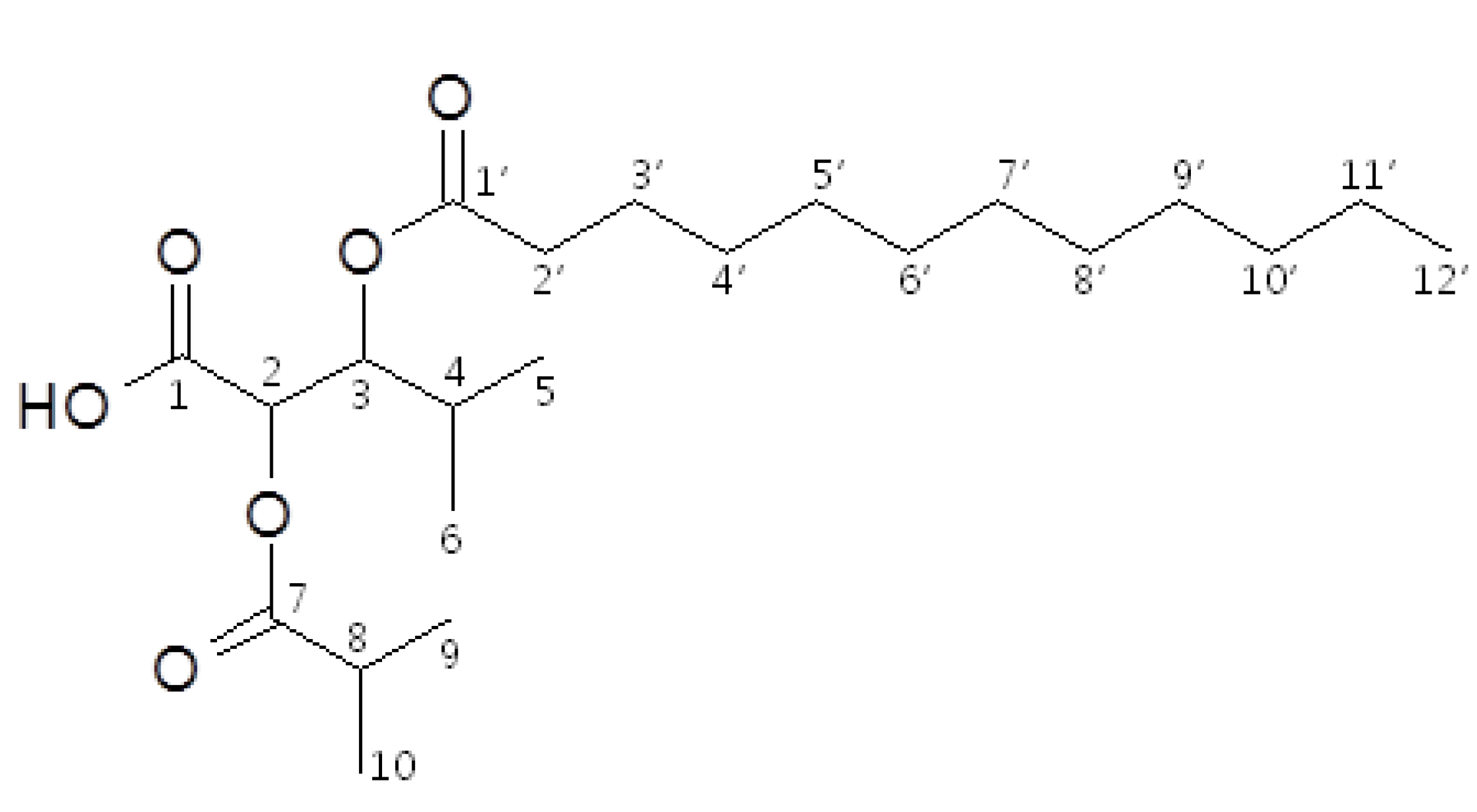
        <p>From all the above information, the structure of the active compound was determined to be 3-(dodecanoyloxy)-2-(isobutyryloxy)-4-methylpentanoic acid (<xref ref-type="fig" rid="molecules-17-12469-f001">Figure 1</xref>), isolated from nature for the first time.</p>
        <fig id="molecules-17-12469-f001" position="float">
          <label>Figure 1</label>
          <caption>
            <p>Structure of 3-(dodecanoyloxy)-2-(isobutyryloxy)-4-methylpentanoic acid from <italic>S. glabrescens</italic>.</p>
          </caption>
          <graphic xmlns:xlink="http://www.w3.org/1999/xlink" xlink:href="molecules-17-12469-g001.tif"/>
        </fig>
      </sec>
      <sec>
        <title>2.3. Antimicrobial Activity of Isolated Compound</title>
        <p>Long-chain fatty acids are known as surface-active anionic detergents [<xref ref-type="bibr" rid="B10-molecules-17-12469">10</xref>]. In general, fatty acid sensitivity is considered to be a characteristic of Gram-positive bacteria, with few Gram-negative species being susceptible [<xref ref-type="bibr" rid="B11-molecules-17-12469">11</xref>]. In addition, lauric acid, which is the most effective among the saturated fatty acids, has been reported to show the antimicrobial activity against six strains of <italic>S. aureus</italic> [<xref ref-type="bibr" rid="B12-molecules-17-12469">12</xref>]. In regards to the chemical structure, 3-(dodecanoyloxy)-2-(isobutyryloxy)-4-methylpentanoic acid has both the structural properties described above, as it contains a saturated long laurate chain. These structural properties suggest that the compound should display antibacterial activity against Gram-positive bacteria.</p>
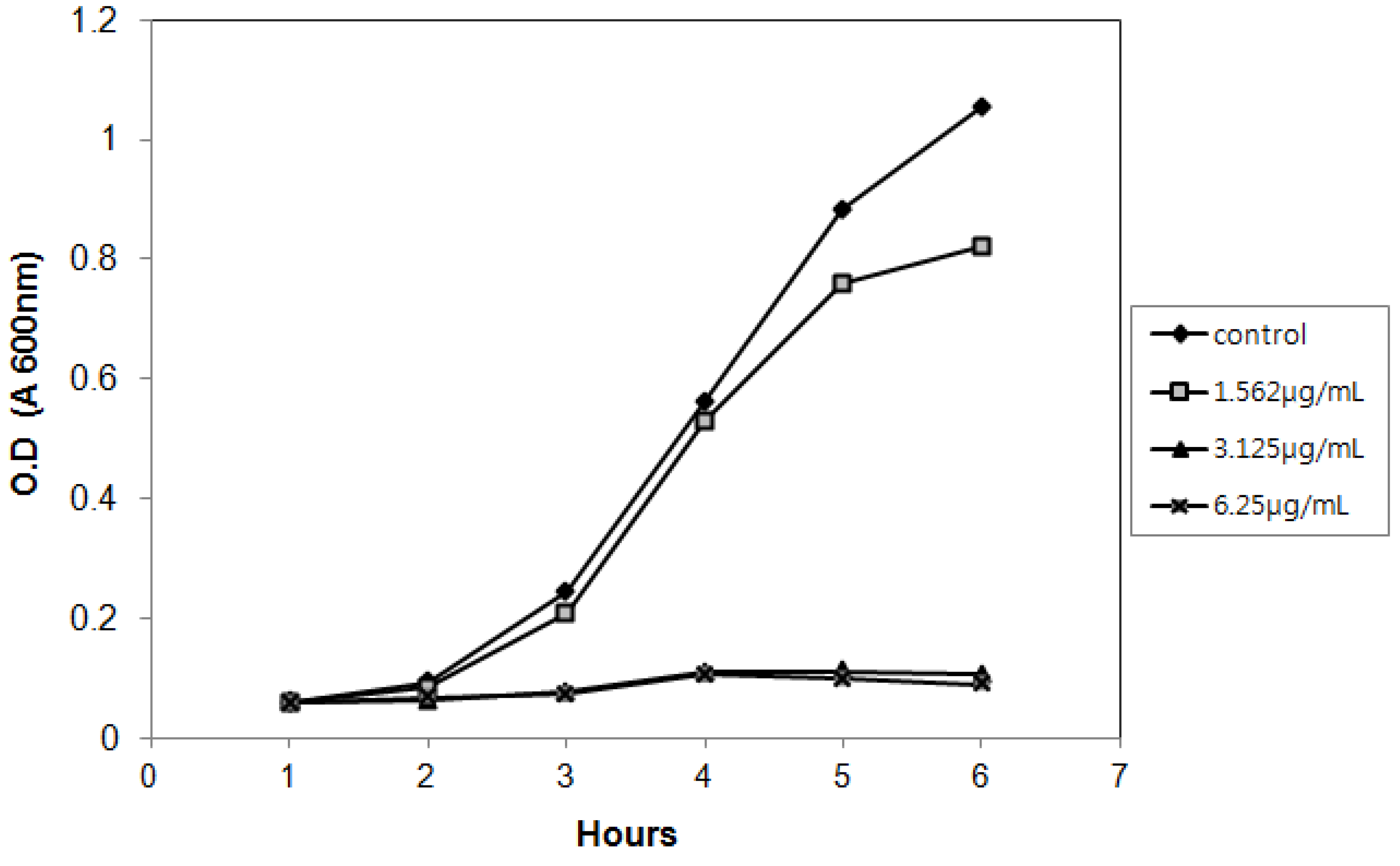
        <p>The disk diffusion method was used to investigate the correlation between structure and antibacterial activity of 3-(dodecanoyloxy)-2-(isobutyryloxy)-4-methylpentanoic acid and lauric acid. As is shown in <xref ref-type="table" rid="molecules-17-12469-t002">Table 2</xref>, while 3-(dodecanoyloxy)-2-(isobutyryloxy)-4-methylpentanoic acid produced an inhibition zone diameter of 11 mm against <italic>S. aureus</italic> at 6.25 μg/mL, no antibacterial activity was observed at the same concentration of lauric acid. An amount of 50 μg/mL of lauric acid showed a similar antibacterial activity as 6.25 μg/mL of 3-(dodecanoyloxy)-2-(isobutyryloxy)-4-methylpentanoic acid (<xref ref-type="table" rid="molecules-17-12469-t002">Table 2</xref>), indicating that the efficacy of 3-(dodecanoyloxy)-2-(isobutyryloxy)-4-methylpentanoic acid against <italic>S. aureus</italic> was approximately 8-fold stronger than that of lauric acid. These results suggest that laurate and 2-(isobutyryloxy)-4-methylpentanoic acid may operate as key factors in the antibacterial activities against <italic>S. aureus</italic> and synergistically enhance the antibacterial activity. We also observed the influence of 3-(dodecanoyloxy)-2-(isobutyryloxy)-4-methylpentanoic acid on the growth of <italic>S. aureus</italic> at 1.562 μg/mL (1/2 MIC), 3.125 μg/mL (MIC), and 6.25 (2 MIC) μg/mL. As shown in <xref ref-type="fig" rid="molecules-17-12469-f002">Figure 2</xref>, 3-(dodecanoyloxy)-2-(isobutyryloxy)-4-methylpentanoic acid inhibited the growth of <italic>S. aureus</italic> at 3.25 μg/mL.</p>
        <table-wrap id="molecules-17-12469-t002" position="float">
          <object-id pub-id-type="pii">molecules-17-12469-t002_Table 2</object-id>
          <label>Table 2</label>
          <caption>
            <p>Antibacterial activity of 3-(dodecanoyloxy)-2-(isobutyryloxy)-4-methylpentanoic acid and lauric acid against <italic>S. aureus</italic> measured using the disk diffusion method.</p>
          </caption>
          <table>
            <thead>
              <tr>
                <th rowspan="2" align="center" valign="middle">Compounds</th>
                <th colspan="4" align="center" valign="middle" style="border-bottom:solid thin">Diameter of clear zone (mm)</th>
              </tr>
              <tr>
                <th align="center" valign="middle">6.25</th>
                <th align="center" valign="middle">12.50</th>
                <th align="center" valign="middle">25.00</th>
                <th align="center" valign="middle">50.00 <sup>a</sup></th>
              </tr>
            </thead>
            <tbody>
              <tr style="border-top:solid thin">
                <td align="center" valign="middle">Lauric acid</td>
                <td align="center" valign="middle">- <sup>b</sup></td>
                <td align="center" valign="middle">-</td>
                <td align="center" valign="middle">-</td>
                <td align="center" valign="middle">11 <sup>c</sup></td>
              </tr>
              <tr>
                <td align="center" valign="middle">3-(Dodecanoyloxy)-2(isobutyryloxy)-4-methylpentanoic acid</td>
                <td align="center" valign="middle">11</td>
                <td align="center" valign="middle">12</td>
                <td align="center" valign="middle">15</td>
                <td align="center" valign="middle">19</td>
              </tr>
              <tr>
                <td align="center" valign="middle">Erythromycin</td>
                <td align="center" valign="middle">40</td>
                <td align="center" valign="middle">40</td>
                <td align="center" valign="middle">42</td>
                <td align="center" valign="middle">46</td>
              </tr>
            </tbody>
  </table>
        <table-wrap-foot><fn><p><sup>a</sup>: Amount of compounds (μg/mL); <sup>b</sup>: No antibacterial activity; <sup>c</sup>: Diameter of clear zone (mm), and diameter of filter disk is 10 mm.</p></fn></table-wrap-foot>
        </table-wrap>
        <fig id="molecules-17-12469-f002" position="float">
          <label>Figure 2</label>
          <caption>
            <p>Growth rate analysis of <italic>S. aureus</italic> under the treatment of 3-(dodecanoyloxy)-2-(isobutyryloxy)-4-methylpentanoic acid.</p>
          </caption>
          <graphic xmlns:xlink="http://www.w3.org/1999/xlink" xlink:href="molecules-17-12469-g002.tif"/>
        </fig>
        <p>Also, we further examined the antibacterial activities of 3-(dodecanoyloxy)-2-(isobutyryloxy)-4-methylpentanoic acid against Gram-positive bacteria (<italic>S. aureus</italic>, <italic>B. subtilis</italic>, <italic>E. faecalis</italic>, <italic>P. acnes</italic>, <italic>S. epidermidis</italic>, <italic>S. schleiferi</italic> subsp <italic>. coagulans</italic>, <italic>S. agalactiae</italic> and <italic>S. pyrogens</italic>), Gram-negative bacteria (<italic>E. coli</italic> and <italic>P. aeruginosa</italic>) and yeast strains (<italic>C. alibicans</italic> and <italic>F. neoformans</italic>) by measuring the MIC, which is the lowest concentration yielding no growth. As shown in <xref ref-type="table" rid="molecules-17-12469-t003">Table 3</xref>, the MIC values of the compound for the Gram-positive bacteria were between 3.12 and 25.00 μg/mL. Specifically, while the compound showed the strongest activity against <italic>S. aureus</italic>, the antibacterial activity against <italic>E. faecalis</italic>, <italic>P. acnes</italic> and <italic>S. epidermidis</italic> was relatively low. In addition, 3-(dodecanoyloxy)-2-(isobutyryloxy)-4-methylpentanoic acid did not show any antibacterial activity against Gram-negative bacteria and yeast (<xref ref-type="table" rid="molecules-17-12469-t003">Table 3</xref>). These results suggest that the antibacterial activity of 3-(dodecanoyloxy)-2-(isobutyryloxy)-4-methylpentanoic acid is specific against Gram-positive bacteria.</p>
        <table-wrap id="molecules-17-12469-t003" position="float">
          <object-id pub-id-type="pii">molecules-17-12469-t003_Table 3</object-id>
          <label>Table 3</label>
          <caption>
            <p>MIC of 3-(dodecanoyloxy)-2-(isobutyryloxy)-4-methylpentanoic acid.</p>
          </caption>
          <table>
            <thead>
              <tr>
                <th align="left" valign="middle"> </th>
                <th align="left" valign="middle">Organism</th>
                <th align="center" valign="middle">MIC (μg/mL)</th>
                <th align="left" valign="middle">Organism</th>
                <th align="center" valign="middle">MIC (μg/mL)</th>
              </tr>
            </thead>
            <tbody>
              <tr style="border-top:solid thin">
                <td rowspan="4" align="left" valign="middle">
                  <bold>Gram-positive bacteria</bold>
                </td>
                <td align="left" valign="middle">
                  <italic>B. subtilis</italic>
                </td>
                <td align="center" valign="middle">6.25</td>
                <td align="left" valign="middle">
                  <italic>S. epidermidis</italic>
                </td>
                <td align="center" valign="middle">25.00</td>
              </tr>
              <tr>
                <td align="left" valign="middle">
                  <italic>E. faecalis</italic>
                </td>
                <td align="center" valign="middle">25.00</td>
                <td align="left" valign="middle">
                  <italic>S. schleiferi</italic> 
                </td>
                <td align="center" valign="middle">12.50</td>
              </tr>
              <tr>
                <td align="left" valign="middle">
                  <italic>P. acnes</italic>
                </td>
                <td align="center" valign="middle">25.00</td>
                <td align="left" valign="middle">
                  <italic>S. agalactiae</italic>
                </td>
                <td align="center" valign="middle">6.25</td>
              </tr>
              <tr>
                <td align="left" valign="middle">
                  <italic>S. aureus</italic>
                </td>
                <td align="center" valign="middle">3.12</td>
                <td align="left" valign="middle">
                  <italic>S. pyrogens</italic>
                </td>
                <td align="center" valign="middle">6.25</td>
              </tr>
              <tr>
                <td align="left" valign="middle">
                  <bold>Gram-negative bacteria</bold>
                </td>
                <td align="left" valign="middle">
                  <italic>E. coli</italic>
                </td>
                <td align="center" valign="middle">- <sup>a</sup></td>
                <td align="left" valign="middle">
                  <italic>P. aeruginosa</italic>
                </td>
                <td align="center" valign="middle">-</td>
              </tr>
              <tr>
                <td align="left" valign="middle">
                  <bold>yeast</bold>
                </td>
                <td align="left" valign="middle">
                  <italic>C. alibicans</italic>
                </td>
                <td align="center" valign="middle">-</td>
                <td align="left" valign="middle">
                  <italic>F. neoformans</italic>
                </td>
                <td align="center" valign="middle">-</td>
              </tr>
            </tbody>
  </table>
        <table-wrap-foot><fn><p><sup>a</sup>: No activity.</p></fn></table-wrap-foot>
        </table-wrap>
      </sec>
    </sec>
    <sec sec-type="methods">
      <title>3. Experimental</title>
      <sec>
        <title>3.1. General</title>
        <p>The HPLC system used was comprised of Waters prep LC 2000 a multi-solvent delivery, and Waters 2487 Dual λ Absorbance detector. UV spectra were obtained on a Dual λ Absorbance detector (Waters 2487) instrument (all Waters, Milford, MA, USA). The HPLC-grade organic solvents and bulk organic solvents were purchased from the Duksan (Ansan, Korea) and J.T. Baker (Phillipsburg, NJ, USA) companies. <sup>1</sup>H- and <sup>13</sup>C-NMR spectra were obtained on a Bruker Avance-500 spectrometer (Bruker Spectrospin, Rheinstetten, Germany; 500 MHz for <sup>1</sup>H- and 125 MHz for <sup>13</sup>C-) using methanol-<italic>d</italic><sub>4</sub> as solvent and tetramethylsilane (TMS) as an internal standard, and the chemical shifts were reported in δ (ppm) units relative to the TMS signal and coupling constants (<italic>J</italic>) in Hz. A complete attribution was performed on the basis of the 2D-experiment (heteronuclear multiple bond correlation, HMBC). Mass spectrometry (ESI) data were measured on Agilent 1100LC/MSD trap. HRMS data were recorded on a JMS-600W spectrometer (JEOL, Tokyo, Japan).</p>
      </sec>
      <sec>
        <title>3.2. Plant Material</title>
        <p>The aerial parts of <italic>S. glabrescens</italic> Makino (Compositae) were purchased from Sam-Hong Pharmaceutical Co., Ltd. in Seoul, Korea.</p>
      </sec>
      <sec>
        <title>3.3. Extraction and Isolation</title>
        <p>The air dried <italic>S. glabrescens</italic> (100 g) were cut into small pieces and extracted three times with 80% MeOH (2 L) at room temperature for 7 days, and filtered. The original 80% MeOH in H<sub>2</sub>O (500 mL × 3, 17.67 g) extract was evaporated to dryness <italic>in vacuo</italic>, and then suspended in 500 mL of water. The water suspension was partitioned three times with CHCl<sub>3</sub> (100 mL). The CHCl<sub>3</sub> (5.93 g) extract was evaporated to dryness <italic>in vacuo</italic>, and was then suspended in 500 mL of 80% MeOH in H<sub>2</sub>O. The 80% MeOH suspension was partitioned three times with <italic>n</italic>-hexane (500 mL). The 80% MeOH (4.46 g) extract was evaporated to dryness <italic>in vacuo</italic>, and was then suspended in 500 mL of water. The water suspension was partitioned three times with EtOAc (500 mL). The EtOAc extract (3.4 g) was evaporated to dryness <italic>in vacuo</italic>. Since high antibacterial activity was observed for the EtOAc extract, this extract was further investigated in detail. The EtOAc extract was chromatographed on a silica gel column (1:100 ratio of sample:silica gel), under medium pressure and eluted using a CHCl<sub>3</sub>-MeOH step gradient system with increasing polarity from 0%, to 2%, 4%, 6%, 8%, 10%, and 100% MeOH to give seven fractions (Fractions 1–7). Fraction 2 (1.38 g) was then subjected to Sephadex LH-20 column chromatography eluted with 80% MeOH in CHCl<sub>3</sub> (5 mL/15 min) to give 80 fractions (Fractions No.1–80 at once). The Sephadex fractions 66–77 (30 mg) was further purified by preparative reversed-phase HPLC using a gradient from 75%–100% ACN in H<sub>2</sub>O (Luna, 250 × 21.20 mm; 5 μm particle size; 15 mL/min; UV detection at 210 nm), to afford 3-(dodecanoyloxy)-2-(isobutyryloxy)-4-methylpentanoic acid (15 mg, R<sub>t</sub> 60.16 min). Oil; UV λ<sub>max</sub> (MeOH) 210 nm; <sup>1</sup>H-NMR and <sup>13</sup>C-NMR (CD<sub>3</sub>OD); see <xref ref-type="table" rid="molecules-17-12469-t001">Table 1</xref>; HR-EIMS (EI<sup>+</sup>) <italic>m/z</italic> 400.2820, [M]<sup>+</sup> (calcd. for C<sub>22</sub>H<sub>40</sub>O<sub>6</sub>, 400.2829); ESIMS (<italic>m/z</italic>): 423.8, [M+Na]<sup>+</sup> (calcd. for C<sub>22</sub>H<sub>40</sub>O<sub>6</sub>Na, 423.3).</p>
      </sec>
      <sec>
        <title>3.4. Antibacterial Activity Assay</title>
        <p>Gram-positive bacteria [<italic>Staphylococcus aureus</italic> (ATCC 6538P), <italic>Bacillus subtilis</italic> (ATCC 15245), <italic>Enterococcus faecalis</italic> (ATCC 11700), <italic>Propionibacterium acnes</italic> (ATCC 6919), <italic>Staphylococcus epidermidis</italic> (ATCC 12228), <italic>Staphylococcus schleiferi</italic> subsp. <italic>coagulans</italic> (ATCC 49545), <italic>Streptococcus agalactiae</italic> (ATCC 14364) and <italic>Streptococcus pyrogens</italic> (ATCC 19615)], Gram-negative bacteria [<italic>Escherichia coli</italic> (ATCC 8739) and <italic>Pseudomonas aeruginosa</italic> (ATCC 27853)] and yeast [<italic>Candida alibicans</italic> (ATCC 10231) and <italic>Filobasidiella neoformans</italic> (ATCC 34144)] were used in these experiments. The antibacterial activity was determined using both the agar diffusion and broth dilution techniques as described previously by Cheesbrough [<xref ref-type="bibr" rid="B13-molecules-17-12469">13</xref>] and Gatsing <italic>et al</italic>. [<xref ref-type="bibr" rid="B14-molecules-17-12469">14</xref>]. Agar diffusion susceptibility testing was performed using the disc method. A disc of blotting paper was impregnated with 50 μL of a 60 mg/mL (for crude extract) or 4 mg/mL (for pure compounds) solution of each sample dissolved in DMSO. Thus, the disc potencies were 1 mg and 200 μg for the crude extract and pure compounds, respectively. Erythromycin (Sigma, St. Louis, MO, USA) was used as the standard drug. After drying, the disc was placed on a plate of sensitivity testing agar inoculated with the test organism. Petri dishes were left at room temperature for approximately 45 min to allow the extract or the compounds to diffuse from the disc into the medium, and were then incubated at 37 °C for 24–48 h. The zones showing no growth were then noted and their diameters were recorded as the zones of inhibition.</p>
        <p>We pre-cultured the bacterial cells for 24 h at 37 °C in 10 mL broth. Approximately 5 × 10<sup>5</sup> cfu/mL bacterial cells of the pre-cultured bacteria were inoculated into 3 mL of broth. The samples were then added into approximately 3 mL of broth containing the bacteria and cultured for 24 h at 37 °C. To determine the activity of the samples, we employed a two-fold serial dilution method. The total volume of the mixture was approximately 3 mL, with the test-compound concentrations in the tube ranging from 200 to 0.78 μg/mL and the concentration of standard compound (erythromycin) ranged from 100 to 0.78 μg/mL. After 24 h of incubation at 37 °C, the MIC value was defined as the lowest concentration that inhibited the visible growth of tested microorganism.</p>
      </sec>
    </sec>
    <sec sec-type="conclusions">
      <title>4. Conclusions</title>
      <p>It was demonstrated that a new compound, 3-(dodecanoyloxy)-2-(isobutyryloxy)-4-methylpentanoic acid isolated from <italic>S. glabrescens</italic> has antibacterial activities specifically against Gram-positive bacteria. We found that the antibacterial effect of 3-(dodecanoyloxy)-2-(isobutyryloxy)-4-methylpentanoic acid was due to both the 2-(isobutyryloxy)-4-methylpentanoic acid group and laurate group. In addition, the antibacterial activity of 3-(dodecanoyloxy)-2-(isobutyryloxy)-4-methylpentanoic acid was more potent than lauric acid itself. To the best of our knowledge, this is the first study demonstrating the antibacterial activity of <italic>S. glabrescens</italic>. In addition, we demonstrated that 3-(dodecanoyloxy)-2-(isobutyryloxy)-4-methylpentanoic acid is an antibacterial compound of <italic>S. glabrescens</italic>. The compound also has a specific antibacterial activity against Gram-positive bacteria and the strongest activity was observed against <italic>S.aureus</italic>, which are major foodborne pathogenic microorganisms.</p>
    </sec>
  </body>
  <back>
    <notes>
      <title>Conflict of Interest</title>
      <p>The authors declare no conflict of interest.</p>
    </notes>
    <ack>
      <title>Acknowledgements</title>
      <p>This study was supported by a grant of the Korea Healthcare Technology R&amp;D Project, Ministry of Health &amp; Welfare, Korea (Grant No.: A103017).</p>
    </ack>
    <ref-list>
      <title>References</title>
      <ref id="B1-molecules-17-12469">
        <label>1.</label>
        <citation citation-type="journal">
          <collab>Centers for Disease Control and Prevention</collab>
          <article-title>Update: Staphylococcus aureus with reduced susceptibility to vancomycin–United States, 1997</article-title>
          <source>Morb. Mortal. Wkly. Rep.</source>
          <year>1997</year>
          <volume>46</volume>
          <fpage>813</fpage>
          <lpage>815</lpage>
        </citation>
      </ref>
      <ref id="B2-molecules-17-12469">
        <label>2.</label>
        <citation citation-type="journal">
          <collab>Centers for Disease Control and Prevention</collab>
          <article-title>Nosocomial enterococci resistant to vancomycin: United States, 1989–1993: National Nosocomial Infection Surveillance</article-title>
          <source>Morb. Mortal. Wkly. Rep.</source>
          <year>1993</year>
          <volume>42</volume>
          <fpage>597</fpage>
          <lpage>599</lpage>
        </citation>
      </ref>
      <ref id="B3-molecules-17-12469">
        <label>3.</label>
        <citation citation-type="journal">
          <person-group person-group-type="author">
            <name>
              <surname>Archer</surname>
              <given-names>G.L.</given-names>
            </name>
          </person-group>
          <article-title><italic>Staphylococcus aureus</italic>: A well-armed pathogen</article-title>
          <source>Clin. Infect. Dis.</source>
          <year>1998</year>
          <volume>26</volume>
          <fpage>1179</fpage>
          <lpage>1181</lpage>
        <pub-id pub-id-type="doi">10.1086/520289</pub-id><pub-id pub-id-type="pmid">9597249</pub-id></citation>
      </ref>
      <ref id="B4-molecules-17-12469">
        <label>4.</label>
        <citation citation-type="journal">
          <person-group person-group-type="author">
            <name>
              <surname>Richard</surname>
              <given-names>M.J.</given-names>
            </name>
            <name>
              <surname>Edwards</surname>
              <given-names>J.R.</given-names>
            </name>
            <name>
              <surname>Culver</surname>
              <given-names>D.H.</given-names>
            </name>
            <name>
              <surname>Gaynes</surname>
              <given-names>R.P.</given-names>
            </name>
          </person-group>
          <article-title>Nosocomial infections in medical intensive care units in the United States. National Nosocomial Infections Surveillance System</article-title>
          <source>Crit. Care Med.</source>
          <year>1999</year>
          <volume>27</volume>
          <fpage>887</fpage>
          <lpage>892</lpage>
          <pub-id pub-id-type="doi">10.1097/00003246-199905000-00020</pub-id>
        </citation>
      </ref>
      <ref id="B5-molecules-17-12469">
        <label>5.</label>
        <citation citation-type="journal">
          <person-group person-group-type="author">
            <name>
              <surname>Nakata</surname>
              <given-names>K.</given-names>
            </name>
            <name>
              <surname>Inoue</surname>
              <given-names>Y.</given-names>
            </name>
            <name>
              <surname>Harada</surname>
              <given-names>J.</given-names>
            </name>
            <name>
              <surname>Maeda</surname>
              <given-names>N.</given-names>
            </name>
            <name>
              <surname>Watanabe</surname>
              <given-names>H.</given-names>
            </name>
            <name>
              <surname>Tano</surname>
              <given-names>Y.</given-names>
            </name>
            <name>
              <surname>Shimomura</surname>
              <given-names>Y.</given-names>
            </name>
            <name>
              <surname>Harino</surname>
              <given-names>S.</given-names>
            </name>
            <name>
              <surname>Sawa</surname>
              <given-names>M.</given-names>
            </name>
          </person-group>
          <article-title>A high incidence of <italic>Staphylococcus aureus</italic> colonization in the externall eyes of patients with atopic dermatitis</article-title>
          <source>Ophthalmology</source>
          <year>2000</year>
          <volume>107</volume>
          <fpage>2167</fpage>
          <lpage>2171</lpage>
          <pub-id pub-id-type="doi">10.1016/S0161-6420(00)00406-1</pub-id>
        </citation>
      </ref>
      <ref id="B6-molecules-17-12469">
        <label>6.</label>
        <citation citation-type="journal">
          <person-group person-group-type="author">
            <name>
              <surname>Shanmuganathan</surname>
              <given-names>V.A.</given-names>
            </name>
            <name>
              <surname>Armstrong</surname>
              <given-names>M.</given-names>
            </name>
            <name>
              <surname>Buller</surname>
              <given-names>A.</given-names>
            </name>
            <name>
              <surname>Tullo</surname>
              <given-names>A.B.</given-names>
            </name>
          </person-group>
          <article-title>External ocular infections due to methicillin-resistant <italic>Staphylococcus aureus</italic> (MRSA)</article-title>
          <source>Eye</source>
          <year>2005</year>
          <volume>19</volume>
          <fpage>284</fpage>
          <lpage>291</lpage>
          <pub-id pub-id-type="doi">10.1038/sj.eye.6701465</pub-id>
        </citation>
      </ref>
      <ref id="B7-molecules-17-12469">
        <label>7.</label>
        <citation citation-type="journal">
          <person-group person-group-type="author">
            <name>
              <surname>Brul</surname>
              <given-names>S.</given-names>
            </name>
            <name>
              <surname>Coote</surname>
              <given-names>P.</given-names>
            </name>
          </person-group>
          <article-title>Preservative agents in foods: Mode of action and microbial resistance mechanisms</article-title>
          <source>Int. J. Food Microbiol.</source>
          <year>1999</year>
          <volume>50</volume>
          <fpage>1</fpage>
          <lpage>17</lpage>
          <pub-id pub-id-type="doi">10.1016/S0168-1605(99)00072-0</pub-id>
        </citation>
      </ref>
      <ref id="B8-molecules-17-12469">
        <label>8.</label>
        <citation citation-type="journal">
          <person-group person-group-type="author">
            <name>
              <surname>Zink</surname>
              <given-names>D.L.</given-names>
            </name>
          </person-group>
          <article-title>The impact of consumer demands and trends on food processing</article-title>
          <source>Emerging Infect. Dis.</source>
          <year>1997</year>
          <volume>3</volume>
          <fpage>467</fpage>
          <lpage>469</lpage>
          <pub-id pub-id-type="doi">10.3201/eid0304.970408</pub-id>
        </citation>
      </ref>
      <ref id="B9-molecules-17-12469">
        <label>9.</label>
        <citation citation-type="book">
          <person-group person-group-type="author">
            <name>
              <surname>Wasserman</surname>
              <given-names>S.I.</given-names>
            </name>
            <name>
              <surname>Marquardt</surname>
              <given-names>D.L.</given-names>
            </name>
          </person-group>
          <source>Anaphlaxis in Allergy: Principles and Practice</source>
          <edition>3rd</edition>
          <publisher-name>CV Mosby</publisher-name>
          <publisher-loc>St. Louis, MO, USA</publisher-loc>
          <year>1988</year>
          <fpage>1365</fpage>
        </citation>
      </ref>
      <ref id="B10-molecules-17-12469">
        <label>10.</label>
        <citation citation-type="journal">
          <person-group person-group-type="author">
            <name>
              <surname>Kodicek</surname>
              <given-names>E.</given-names>
            </name>
          </person-group>
          <article-title>The effect of unsaturated fatty acids on Gram-positive bacteria</article-title>
          <source>Symp. Soc. Exp. Biol.</source>
          <year>1988</year>
          <volume>3</volume>
          <fpage>217</fpage>
          <lpage>232</lpage>
        </citation>
      </ref>
      <ref id="B11-molecules-17-12469">
        <label>11.</label>
        <citation citation-type="journal">
          <person-group person-group-type="author">
            <name>
              <surname>Pollock</surname>
              <given-names>M.R.</given-names>
            </name>
          </person-group>
          <article-title>The effects of long-chain fatty acids on the growth of <italic>Haemophilus pertussis</italic> and other organisms</article-title>
          <source>Symp. Soc. Exp. Biol.</source>
          <year>1949</year>
          <volume>3</volume>
          <fpage>193</fpage>
          <lpage>216</lpage>
        </citation>
      </ref>
      <ref id="B12-molecules-17-12469">
        <label>12.</label>
        <citation citation-type="journal">
          <person-group person-group-type="author">
            <name>
              <surname>Kitahara</surname>
              <given-names>T.</given-names>
            </name>
            <name>
              <surname>Koyama</surname>
              <given-names>N.</given-names>
            </name>
            <name>
              <surname>Matsuda</surname>
              <given-names>J.</given-names>
            </name>
            <name>
              <surname>Aoyama</surname>
              <given-names>Y.</given-names>
            </name>
            <name>
              <surname>Hirakata</surname>
              <given-names>Y.</given-names>
            </name>
            <name>
              <surname>Kamihira</surname>
              <given-names>S.</given-names>
            </name>
            <name>
              <surname>Kohno</surname>
              <given-names>S.</given-names>
            </name>
            <name>
              <surname>Nakashima</surname>
              <given-names>M.</given-names>
            </name>
            <name>
              <surname>Sasaki</surname>
              <given-names>H.</given-names>
            </name>
          </person-group>
          <article-title>Antimicrobial activity of saturated fatty acids and fatty amines against methicillin-resistant <italic>Staphylococcus aureus</italic></article-title>
          <source>Biol. Pharm. Bull.</source>
          <year>2004</year>
          <volume>27</volume>
          <fpage>1321</fpage>
          <lpage>1326</lpage>
          <pub-id pub-id-type="doi">10.1248/bpb.27.1321</pub-id>
        </citation>
      </ref>
      <ref id="B13-molecules-17-12469">
        <label>13.</label>
        <citation citation-type="book">
          <person-group person-group-type="author">
            <name>
              <surname>Cheesbrough</surname>
              <given-names>M.</given-names>
            </name>
          </person-group>
          <source>Medical Laboratory Manual for Tropical Countries: Microbiology</source>
          <publisher-name>Tropical Health Technology</publisher-name>
          <publisher-loc>Oxford, UK</publisher-loc>
          <year>1984</year>
          <fpage>196</fpage>
          <lpage>205</lpage>
        </citation>
      </ref>
      <ref id="B14-molecules-17-12469">
        <label>14.</label>
        <citation citation-type="journal">
          <person-group person-group-type="author">
            <name>
              <surname>Gatsing</surname>
              <given-names>D.</given-names>
            </name>
            <name>
              <surname>Mbah</surname>
              <given-names>J.A.</given-names>
            </name>
            <name>
              <surname>Garba</surname>
              <given-names>I.H.</given-names>
            </name>
            <name>
              <surname>Tane</surname>
              <given-names>P.</given-names>
            </name>
            <name>
              <surname>Djemgou</surname>
              <given-names>P.</given-names>
            </name>
            <name>
              <surname>Nji-Nkah</surname>
              <given-names>B.F.</given-names>
            </name>
          </person-group>
          <article-title>An Antisalmonellal agent from the leaves of <italic>Glossocalyx brevipes</italic> Benth (Monimiaceae)</article-title>
          <source>Pak. J. Biol. Sci.</source>
          <year>2006</year>
          <volume>9</volume>
          <fpage>84</fpage>
          <lpage>87</lpage>
          <pub-id pub-id-type="doi">10.3923/pjbs.2006.84.87</pub-id>
        </citation>
      </ref>
    </ref-list>
      <fn-group><fn><p><italic>Sample Availability</italic>: Samples of the title compound are available from the authors.</p></fn></fn-group>
  </back>
</article>