
<?xml version="1.0" encoding="UTF-8"?>
<!DOCTYPE article PUBLIC "-//NLM//DTD Journal Publishing DTD v2.3 20070202//EN" "journalpublishing.dtd">
<article xmlns:mml="http://www.w3.org/1998/Math/MathML" xmlns:xlink="http://www.w3.org/1999/xlink" xml:lang="en" article-type="research-article">
  <front>
    <journal-meta>
      <journal-id journal-id-type="publisher-id">molecules</journal-id>
      <journal-title>Molecules</journal-title>
      <abbrev-journal-title abbrev-type="publisher">Molecules</abbrev-journal-title>
      <abbrev-journal-title abbrev-type="pubmed">Molecules</abbrev-journal-title>
      <issn pub-type="epub">1420-3049</issn>
      <publisher>
        <publisher-name>MDPI</publisher-name>
      </publisher>
    </journal-meta>
    <article-meta>
      <article-id pub-id-type="doi">10.3390/molecules171012262</article-id>
      <article-id pub-id-type="publisher-id">molecules-17-12262</article-id>
      <article-categories>
        <subj-group>
          <subject>Article</subject>
        </subj-group>
      </article-categories>
      <title-group>
        <article-title>Design, Synthesis and <italic>in Vivo</italic> Anti-inflammatory Activities of 2,4-Diaryl-5-4<italic>H</italic>-imidazolone Derivatives</article-title>
      </title-group>
      <contrib-group>
        <contrib contrib-type="author">
          <name>
            <surname>El-Araby</surname>
            <given-names>Moustafa</given-names>
          </name>
          <xref rid="af1-molecules-17-12262" ref-type="aff">1</xref>
          <xref rid="af2-molecules-17-12262" ref-type="aff">2</xref>
        </contrib>
        <contrib contrib-type="author">
          <name>
            <surname>Omar</surname>
            <given-names>Abdelsattar</given-names>
          </name>
          <xref rid="af2-molecules-17-12262" ref-type="aff">2</xref>
          <xref rid="af3-molecules-17-12262" ref-type="aff">3</xref>
          <xref rid="c1-molecules-17-12262" ref-type="corresp">*</xref>
        </contrib>
        <contrib contrib-type="author">
          <name>
            <surname>Hassanein</surname>
            <given-names>Hassanein H.</given-names>
          </name>
          <xref rid="af4-molecules-17-12262" ref-type="aff">4</xref>
        </contrib>
        <contrib contrib-type="author">
          <name>
            <surname>El-Helby</surname>
            <given-names>Abdel-Ghany H.</given-names>
          </name>
          <xref rid="af3-molecules-17-12262" ref-type="aff">3</xref>
        </contrib>
        <contrib contrib-type="author">
          <name>
            <surname>Abdel-Rahman</surname>
            <given-names>Asharf A.</given-names>
          </name>
          <xref rid="af3-molecules-17-12262" ref-type="aff">3</xref>
        </contrib>
      </contrib-group>
	  <aff id="af1-molecules-17-12262"><label>1 </label>Pharmaceutical Organic Chemistry Department, Faculty of Pharmacy, Helwan University, Cairo 11790, Egypt; Email: <email>alamka@yahoo.com</email></aff>
      <aff id="af2-molecules-17-12262"><label>2 </label>Pharmaceutical Chemistry Department, Faculty of Pharmacy, King AbdulAziz University, Jeddah 21589, Saudi Arabia</aff>
      <aff id="af3-molecules-17-12262"><label>3 </label>Pharmaceutical Chemistry Department, Faculty of Pharmacy, Al-Azhar University, Cairo 11884, Egypt</aff>
      <aff id="af4-molecules-17-12262"><label>4 </label>Pharmaceutical Chemistry Department, Faculty of Pharmacy, Cairo University, Cairo 11787, Egypt</aff>
      
      <author-notes>
        <corresp id="c1-molecules-17-12262"><label>* </label>Author  to whom correspondence should be addressed; Email: <email>asmansour@kau.edu.sa</email>; or <email>abdelsattar_m@hotmail.com</email>; Tel.: +966-567-681-466; Fax: +966-269-516-96.</corresp>
      </author-notes>
      <pub-date pub-type="epub">
        <day>18</day>
        <month>10</month>
        <year>2012</year>
      </pub-date>
      <pub-date pub-type="collection">
        <month>10</month>
		<year>2012</year>
      </pub-date>
      <volume>17</volume>
      <issue>10</issue>
      <fpage>12262</fpage>
      <lpage>12275</lpage>
      <history>
        <date date-type="received">
          <day>22</day>
          <month>08</month>
          <year>2012</year>
        </date>
        <date date-type="rev-recd">
          <day>12</day>
          <month>09</month>
          <year>2012</year>
        </date>
        <date date-type="accepted">
          <day>11</day>
          <month>10</month>
          <year>2012</year>
        </date>
      </history>
      <permissions>
        <copyright-statement>© 2012 by the authors; licensee MDPI, Basel, Switzerland.</copyright-statement>
        <copyright-year>2012</copyright-year>
        <license xmlns:xlink="http://www.w3.org/1999/xlink" license-type="open-access" xlink:href="http://creativecommons.org/licenses/by/3.0/">
          <p>This article is an open-access article distributed under the terms and conditions of the Creative Commons Attribution license (http://creativecommons.org/licenses/by/3.0/).</p>
        </license>
      </permissions>
      <abstract>
        <p>A series of 2,4-diaryl-5(4<italic>H</italic>)-imidazolones were prepared and evaluated for their anti-inflammatory activities. Some selected 2,4-diaryl-5(4<italic>H</italic>)-imidazolones exhibited excellent anti-inflammatory activity in the carrageenan-induced rat paw edema model. Structure Activity Relationships within the series were studied. The substitution at the <italic>N</italic>-sulfonamide moiety by a small hydrophilic acetyl group resulted in compounds with superior <italic>in vivo</italic> anti-inflammatory properties. As expected from their COX-2 selectivity, most of the active compounds lacked gastrointestinal toxicity <italic>in vivo</italic> in rats after a 3-day treatment of 25 mg/kg/day.</p>
      </abstract>
      <kwd-group>
        <kwd>anti-inflammatory</kwd>
        <kwd>COX-2</kwd>
        <kwd>COX-2 inhibitors</kwd>
        <kwd>imidazolone</kwd>
        <kwd>oxazolone</kwd>
        <kwd>docking</kwd>
        <kwd>structure-based design</kwd>
      </kwd-group>
    </article-meta>
  </front>
  <body>
    <sec sec-type="intro">
      <title>1. Introduction</title>
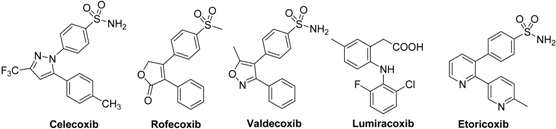
      <p>Cyclooxygenase-2 (COX-2) inhibition was identified two decades ago as the 21st century’s promising control for orthopedic pain and inflammation [<xref ref-type="bibr" rid="B1-molecules-17-12262">1</xref>]. Celecoxib (Celebrex)™ was the first selective COX-2 inhibitor (coxibs) that appeared on the world markets in 1999 as a safer replacement for NSAIDs (non-selective COX-1/COX-2 inhibitors) as it causes less gastrointestinal complications [<xref ref-type="bibr" rid="B2-molecules-17-12262">2</xref>]. After the launch of several successful anti-inflammatory medicines on world markets belonging to the selective COX-2 inhibitors class (<xref ref-type="table" rid="molecules-17-12262-t001">Table 1</xref>), rofecoxib (Vioxx)™ and valdecoxib (Bextra)™ were withdrawn subsequent to evidence of atherothrombotic cardiovascular adverse effects (AEs) [<xref ref-type="bibr" rid="B3-molecules-17-12262">3</xref>]. This dramatic turn raised serious questions about the safety of the COX-2 inhibition concept. Moreover, the U.S. FDA ordered explicit warnings on other marketed coxibs [<xref ref-type="bibr" rid="B4-molecules-17-12262">4</xref>]. Fortunately, further studies revealed that cardiac adverse effects are related to certain drug structures and their metabolic byproducts rather than the COX-2 physiological role [<xref ref-type="bibr" rid="B5-molecules-17-12262">5</xref>]. For instance, rofecoxib was hypothesized to produce highly reactive oxidized metabolites via oxidation of the core unsaturated lactone nucleus into a maleic anhydride peroxide radical species [<xref ref-type="bibr" rid="B6-molecules-17-12262">6</xref>]. Rofecoxib may cause accumulation of oxidized LDL and 20-HETE, two biomarkers involved in atherosclerotic events [<xref ref-type="bibr" rid="B7-molecules-17-12262">7</xref>,<xref ref-type="bibr" rid="B8-molecules-17-12262">8</xref>]. Celecoxib was unable to produce similar metabolic products and hence, less cardiovascular associated risk was observed. Lumiracoxib is another selective COX-2 inhibitor that was also withdrawn due to non-cardiovascular toxicity issues [<xref ref-type="bibr" rid="B9-molecules-17-12262">9</xref>,<xref ref-type="bibr" rid="B10-molecules-17-12262">10</xref>].</p>
      <table-wrap id="molecules-17-12262-t001" position="float">
        <object-id pub-id-type="pii">molecules-17-12262-t001_Table 1</object-id>
        <label>Table 1</label>
        <caption>
          <p>Selective inhibitors of COX-2. The structures of some examples of the first-generation (that is, rofecoxib and celecoxib) and second-generation (etoricoxib, lumiracoxib and valdecoxib).</p>
		  <p><inline-graphic xmlns:xlink="http://www.w3.org/1999/xlink" xlink:href="molecules-17-12262-i001.tif"/></p>
        </caption>
        <table>
          
          
            <tr style="border-top: solid thin">
              <td align="left" valign="top">Approval</td>
              <td align="left" valign="top">1999</td>
              <td align="left" valign="top">1999</td>
              <td align="left" valign="top">2001</td>
              <td align="left" valign="top">2006</td>
              <td align="left" valign="top">2005</td>
            </tr>
            <tr>
              <td align="left" valign="top">Withdrawal</td>
              <td align="left" valign="top">-------</td>
              <td align="left" valign="top">2004</td>
              <td align="left" valign="top">2005</td>
              <td align="left" valign="top">2007</td>
              <td align="left" valign="top">-------</td>
            </tr>
            <tr>
              <td align="left" valign="top">Main AEs</td>
              <td align="left" valign="top">-------</td>
              <td align="left" valign="top">Cardiovascular</td>
              <td align="left" valign="top">Cardiovascular</td>
              <td align="left" valign="top">Hepatotoxicity</td>
              <td align="left" valign="top">-------</td>
            </tr>
            <tr style="border-bottom: solid thin">
              <td align="left" valign="top">Authority</td>
              <td align="left" valign="top">FDA</td>
              <td align="left" valign="top">FDA</td>
              <td align="left" valign="top">FDA</td>
              <td align="left" valign="top">EMA, TGA</td>
              <td align="left" valign="top">UK</td>
            </tr>
          
		 </table>
      </table-wrap>
      <p>These findings led to a revitalization of medicinal chemistry research directed towards development of novel chemical classes of anti-inflammatory agents which are designed to act through inhibition of COX-2 [<xref ref-type="bibr" rid="B11-molecules-17-12262">11</xref>,<xref ref-type="bibr" rid="B12-molecules-17-12262">12</xref>,<xref ref-type="bibr" rid="B13-molecules-17-12262">13</xref>]. Rapid progress in the discovery of novel anti-inflammatory agents may depend on their <italic>in vivo</italic> anti-inflammatory activities compared to ulcerogenic and other side effects [<xref ref-type="bibr" rid="B14-molecules-17-12262">14</xref>]. For design purpose, it is useful to build on well established structural features of selective COX-2 inhibitors to maintain GI safety; and replace the central scaffold to avoid cardiovascular side effects. In this direction, we are presenting here compounds belonging to 1,2-diaryl-4-aylidene-5-4<italic>H</italic>-imidazolone with comparable anti-inflammatory potencies to reference NSAIDs, but with controlled ulcerogenic properties.</p>
    </sec>
    <sec sec-type="results">
      <title>2. Results and Discussion</title>
      <sec>
        <title>2.1. Rationale and Structure-Based Design</title>
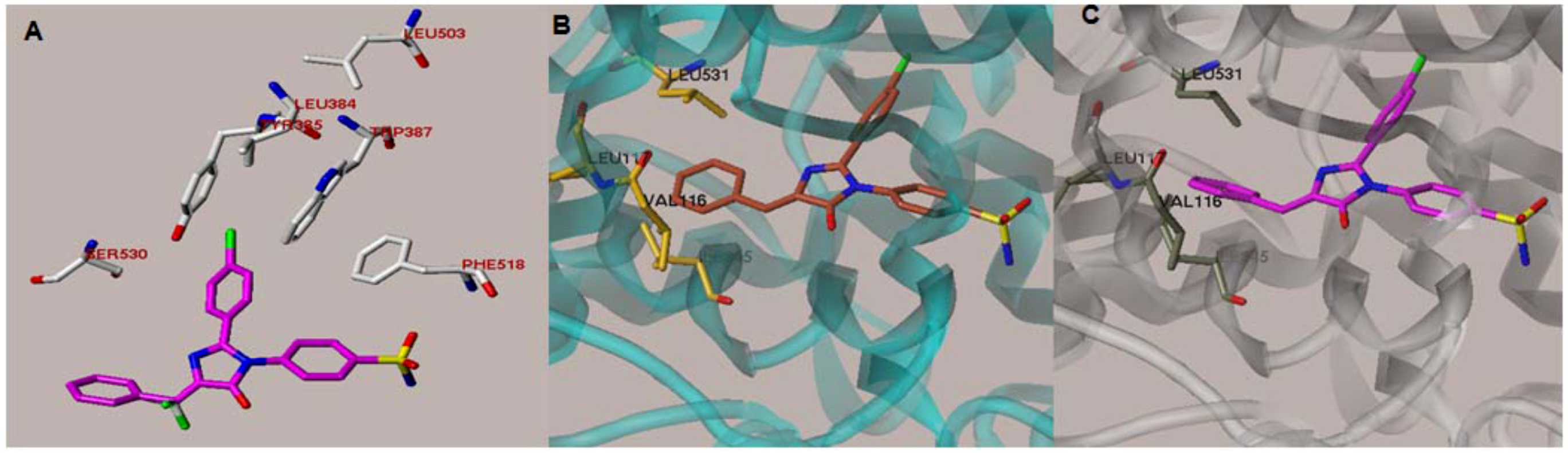
        <p>We envisaged 2,3-diaryl-5(4<italic>H</italic>)-imidazolones as promising molecular targets to develop novel COX-2 anti-inflammatory agents with selective COX-2 inhibition due to their similarity to celecoxib’s pyrazole core (<xref ref-type="fig" rid="molecules-17-12262-f001">Figure 1</xref>). The structure satisfies the basic requirements of selective COX-2 inhibitors as two adjacent aryl groups are attached to a heterocyclic core. One of the aryl groups is confined on the replacement of the methyl group of the lead celecoxib by fluorine, a small lipophilic group frequently employed as a metabolic blocker. A bulky lipophilic arylidene group on the imidazolone scaffold was used in place of celecoxib’s CF<sub>3</sub> group. The side pocket, the major selectivity element towards COX-2 over COX-1, is occupied by the common phenylsulfonamide moeity. Some compounds contained an acetylsulfonamide, a water soluble group, to give a pharmacokinetic advantage. The acetylsulfonamido series was prepared as water soluble sodium salt.</p>
        <fig id="molecules-17-12262-f001" position="float">
          <label>Figure 1</label>
          <caption>
            <p>(<bold>A</bold>) Overlay of imidazolone <bold>3a</bold> and SC-558 inside the active site. Compound <bold>3a</bold> (magenta carbons) is completely eclipsing the structure of <bold>SC-558</bold> (white carbons). The figure also illustrates interaction of the C-2 <italic>p</italic>-fluorophenyl with hydrophobic amino acids. (<bold>B</bold>) Initial docking of compound <bold>3a</bold>,<bold>b</bold> (brown carbons) showing unfavorable approach of the arylidene group with Val-116. (<bold>C</bold>) Optimized docking after torsional changes in the arylidene moiety.</p>
          </caption>
          <graphic xmlns:xlink="http://www.w3.org/1999/xlink" xlink:href="molecules-17-12262-g001.tif"/>
        </fig>
        <p>The validity of our design was investigated using structure-based molecular modeling tools. The study was performed by docking the new imidazolones on the active site of the crystal structure of COX-2. All the molecular modeling works were performed on the SYBYL-X Suite [<xref ref-type="bibr" rid="B15-molecules-17-12262">15</xref>]. Docking experiments were performed on the COX-2 structure coordinates downloaded from the Brookhaven Protein Databank (PDB entry: 6COX) [<xref ref-type="bibr" rid="B16-molecules-17-12262">16</xref>]. This crystal structure complex contains the inhibitor SC-558, a closely related analogue of celecoxib. The ligand was extracted and modified to a representative of our compounds (<bold>3a</bold>, see <xref ref-type="scheme" rid="molecules-17-12262-f003">Scheme 1</xref> below). The geometry of the arylidene was adjusted to <italic>Z</italic> configuration because it was the least energy stereoisomer (<xref ref-type="fig" rid="molecules-17-12262-f001">Figure 1</xref>A).</p>
        
        <p>The docking procedure revealed that fluorophenyl group maintains very good binding distances with the main hydrophobic channel residues Leu-384, Tyr-385, Trp-387, Leu-503, Phe-518 and the backbone of Ser-530.</p>
        <fig id="molecules-17-12262-f003" position="float">
          <object-id pub-id-type="pii">molecules-17-12262-scheme1_Scheme 1</object-id>
          <label>Scheme 1</label>
          <caption>
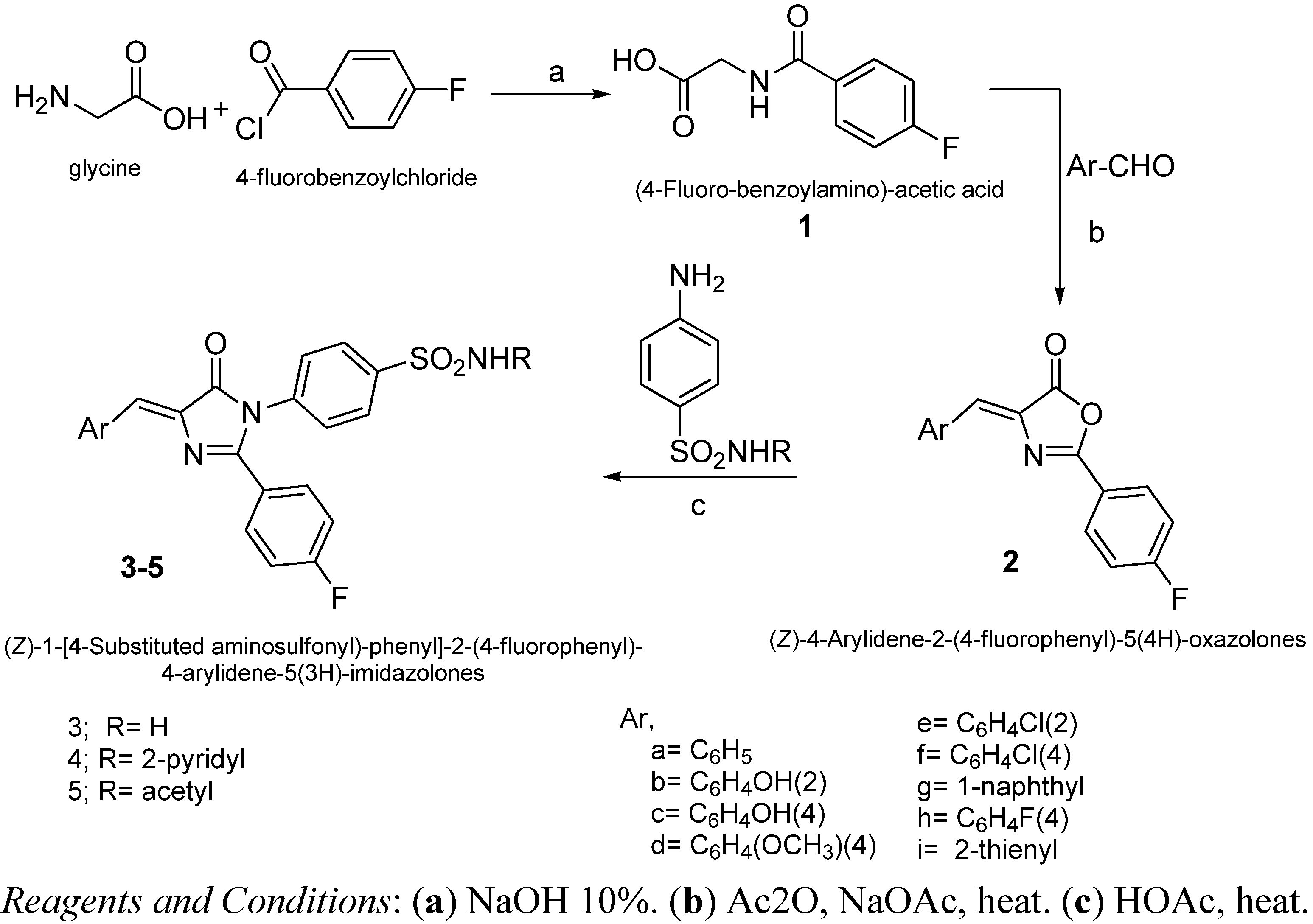
            <p>Synthesis of target compounds <bold>3</bold>–<bold>5</bold>.</p>
          </caption>
          <graphic xmlns:xlink="http://www.w3.org/1999/xlink" xlink:href="molecules-17-12262-g003.tif"/>
        </fig>
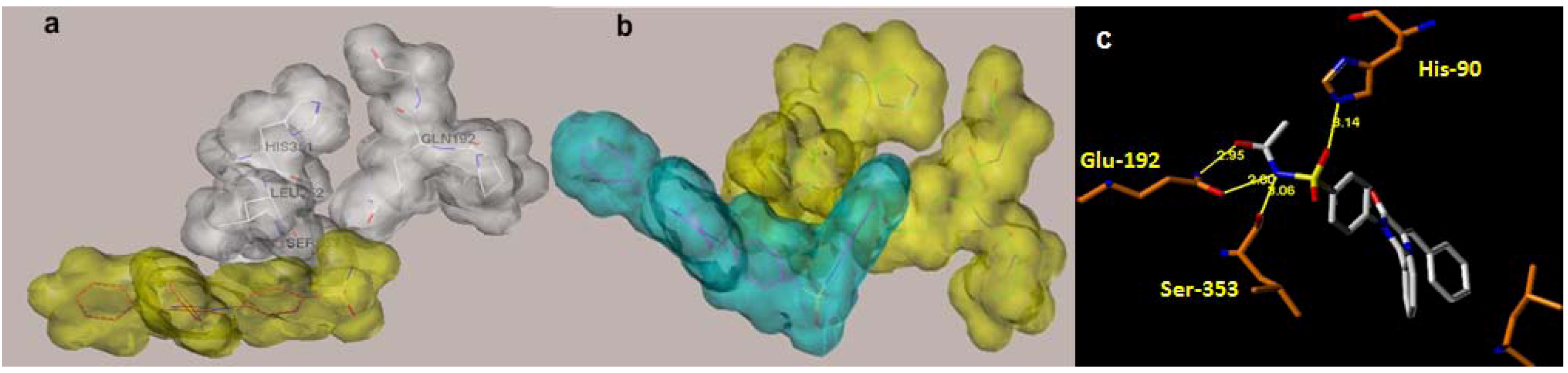
		<p>The pocket around the sulfonamide is apparently hydrophilic as the sulfonamide group is interacting with the imidazole nitrogen of His-90 (one sulfonyl oxygen), the free amide group of glutamine at position 192 (the NH<sub>2</sub> of the sulfonamide) and the NH of backbone nitrogen of Phe-518 (<xref ref-type="fig" rid="molecules-17-12262-f002">Figure 2</xref>a). The docking of <italic>N</italic>-pyridyl substituted sulfonamide showed a tight distance between the pyridyl ring and the backbone C=O of the Leu-352 causing the docking energy to become very high. Energy minimization of the new complex caused a slight shift in the peptide chain at this position with some distortion in bond angle of this carbonyl. Since this adjustment is not very likely in realty, this <italic>N</italic>-pyridyl series was expected to be less potent than the free sulfonamide group one. Volume surface illustration (<xref ref-type="fig" rid="molecules-17-12262-f002">Figure 2</xref>b) revealed that the pyridyl group would be possibly jammed in a narrow space that does not fit well in the active site. On the other hand, <italic>N</italic>-acetyl derivatives have reasonable size; hence, they fitted smoothly without need for computational optimizations. The added carbonyl established a new H-bond with the Gln-192 side chain, therefore, it synergizes the other hydrogen bond network of the sulfonamide NH forming a bifurcated H-bond with C=O of Gln-192 and Ser-353 (<xref ref-type="fig" rid="molecules-17-12262-f002">Figure 2</xref>c).</p>
        
      </sec>
      <sec>
        <title>2.2. Chemistry</title>
        <p>The compounds in the present work are prepared as described in <xref ref-type="scheme" rid="molecules-17-12262-f003">Scheme 1</xref>. The key starting material 4-fluorobenzoylglycine (<bold>1</bold>) has been prepared by the reaction of 4-fluorobenzoyl chloride with glycine in aqueous sodium hydroxide solution. The hippuric acid derivative <bold>1</bold> underwent condensation with a set of aromatic aldehydes to obtain the oxazolone derivatives <bold>2a</bold>–<bold>i</bold> [<xref ref-type="bibr" rid="B17-molecules-17-12262">17</xref>]. The target imidazolones <bold>3</bold>–<bold>5</bold> were prepared by the reaction of the oxazolones <bold>2</bold> with various substituted aromatic amines in boiling acetic acid [<xref ref-type="bibr" rid="B18-molecules-17-12262">18</xref>]. The structures of all the newly synthesized compounds were elucidated with <sup>1</sup>H-NMR, FT-IR and elemental analyses.</p>
        <fig id="molecules-17-12262-f002" position="float">
          <label>Figure 2</label>
          <caption>
            <p>(<bold>a</bold>) The volume surface of the unsubstituted sulfonamide analogue (yellow) and the amino acid residues around. Note the narrow space available between Leu-352 and Gln-192. (<bold>b</bold>) <italic>N</italic>-pyridyl analogue (cyan) docked into the active site (yellow). Note the interference between the surface of the ligand and the protein residue. (<bold>c</bold>) Docking of <italic>N</italic>-acetyl derivative (white carbons) highlights favorable <italic>H</italic>-bond interactions of <italic>N</italic>-acetylsulfonamide group with residues of the active site.</p>
          </caption>
          <graphic xmlns:xlink="http://www.w3.org/1999/xlink" xlink:href="molecules-17-12262-g002.tif"/>
        </fig>
	  </sec>
      <sec>
        <title>2.3. Biological Screening</title>
        <sec>
          <title>2.3.1. Anti-inflammatory Activity</title>
          <p>The <italic>in-vivo</italic> anti-inflammatory activity was studied using carrageenan-induced rat paw edema test [<xref ref-type="bibr" rid="B19-molecules-17-12262">19</xref>]. The anti-inflammatory activity of the tested compounds relative to that of indomethacin was also determined (<xref ref-type="table" rid="molecules-17-12262-t002">Table 2</xref>).</p>
          <table-wrap id="molecules-17-12262-t002" position="float">
            <object-id pub-id-type="pii">molecules-17-12262-t002_Table 2</object-id>
            <label>Table 2</label>
            <caption>
              <p>Effect of imidazolone compounds on carrageenan-induced rat paw edema (mL), % protection and activity relative to indomethacin and meloxicam.</p>
            </caption>
            <table>
              <thead>
                <tr>
                  <th align="center" valign="middle">Tested Compounds</th>
                  <th align="center" valign="middle">Increase in paw edema (mL) ± SEM <sup>a,b</sup></th>
                  <th align="center" valign="middle">% Protection</th>
                  <th align="center" valign="middle">Activity relative to indomethacin</th>
                </tr>
              </thead>
              <tbody>
                <tr>
                  <td align="center" valign="bottom">Control</td>
                  <td align="center" valign="bottom">0.96 ± 0.026</td>
                  <td align="center" valign="middle">0.0</td>
                  <td align="center" valign="middle">0.0</td>
                </tr>
                <tr>
                  <td align="center" valign="bottom">Indomethacin</td>
                  <td align="center" valign="bottom">0.25 ± 0.024</td>
                  <td align="center" valign="middle">74.0</td>
                  <td align="center" valign="middle">100</td>
                </tr>
                <tr>
                  <td align="center" valign="bottom">Meloxicam</td>
                  <td align="center" valign="bottom">0.23 ± 0.019</td>
                  <td align="center" valign="middle">76.0</td>
                  <td align="center" valign="middle">103</td>
                </tr>
                <tr>
                  <td align="center" valign="bottom">
                    <bold>3-a</bold>
                  </td>
                  <td align="center" valign="bottom">0.32 ± 0.028</td>
                  <td align="center" valign="middle">66.7</td>
                  <td align="center" valign="middle">90</td>
                </tr>
                <tr>
                  <td align="center" valign="bottom">
                    <bold>3-c</bold>
                  </td>
                  <td align="center" valign="bottom">0.42 ± 0.032</td>
                  <td align="center" valign="middle">56.3</td>
                  <td align="center" valign="middle">76</td>
                </tr>
                <tr>
                  <td align="center" valign="bottom">
                    <bold>3-d</bold>
                  </td>
                  <td align="center" valign="bottom">0.36 ± 0.016</td>
                  <td align="center" valign="middle">62.5</td>
                  <td align="center" valign="middle">84</td>
                </tr>
                <tr>
                  <td align="center" valign="bottom">
                    <bold>3-g</bold>
                  </td>
                  <td align="center" valign="bottom">0.31 ± 0.027</td>
                  <td align="center" valign="middle">67.7</td>
                  <td align="center" valign="middle">91</td>
                </tr>
                <tr>
                  <td align="center" valign="bottom">
                    <bold>3-h</bold>
                  </td>
                  <td align="center" valign="bottom">0.28 ± 0.022</td>
                  <td align="center" valign="middle">70.8</td>
                  <td align="center" valign="middle">96</td>
                </tr>
                <tr>
                  <td align="center" valign="bottom">
                    <bold>4-a</bold>
                  </td>
                  <td align="center" valign="bottom">0.64 ± 0.026</td>
                  <td align="center" valign="middle">33.3</td>
                  <td align="center" valign="middle">45</td>
                </tr>
                <tr>
                  <td align="center" valign="bottom">
                    <bold>4-c</bold>
                  </td>
                  <td align="center" valign="bottom">0.73 ± 0.022</td>
                  <td align="center" valign="middle">24.0</td>
                  <td align="center" valign="middle">32</td>
                </tr>
                <tr>
                  <td align="center" valign="bottom">
                    <bold>4-d</bold>
                  </td>
                  <td align="center" valign="bottom">0.71 ± 0.028</td>
                  <td align="center" valign="middle">26.0</td>
                  <td align="center" valign="middle">35</td>
                </tr>
                <tr>
                  <td align="center" valign="bottom">
                    <bold>4-g</bold>
                  </td>
                  <td align="center" valign="bottom">0.68 ± 0.032</td>
                  <td align="center" valign="middle">29.2</td>
                  <td align="center" valign="middle">39</td>
                </tr>
                <tr>
                  <td align="center" valign="bottom">
                    <bold>4-h</bold>
                  </td>
                  <td align="center" valign="bottom">0.49 ± 0.024</td>
                  <td align="center" valign="middle">49.0</td>
                  <td align="center" valign="middle">66</td>
                </tr>
                <tr>
                  <td align="center" valign="bottom">
                    <bold>5-a</bold>
                  </td>
                  <td align="center" valign="bottom">0.17 ± 0.016</td>
                  <td align="center" valign="middle">82.3</td>
                  <td align="center" valign="middle">111</td>
                </tr>
                <tr>
                  <td align="center" valign="bottom">
                    <bold>5-c</bold>
                  </td>
                  <td align="center" valign="bottom">0.27 ± 0.023</td>
                  <td align="center" valign="middle">71.9</td>
                  <td align="center" valign="middle">97</td>
                </tr>
                <tr>
                  <td align="center" valign="bottom">
                    <bold>5-d</bold>
                  </td>
                  <td align="center" valign="bottom">0.20 ± 0.024</td>
                  <td align="center" valign="middle">79.2</td>
                  <td align="center" valign="middle">107</td>
                </tr>
                <tr>
                  <td align="center" valign="bottom">
                    <bold>5-g</bold>
                  </td>
                  <td align="center" valign="bottom">0.19 ±0.029</td>
                  <td align="center" valign="middle">80.2</td>
                  <td align="center" valign="middle">108</td>
                </tr>
                <tr>
                  <td align="center" valign="bottom">
                    <bold>5-h</bold>
                  </td>
                  <td align="center" valign="bottom">0.08 ± 0.032</td>
                  <td align="center" valign="middle">91.7</td>
                  <td align="center" valign="middle">124</td>
                </tr>
              </tbody>
			</table>
          
          <table-wrap-foot><fn><p><sup>a</sup> SEM denotes the standard error of the mean. <sup>b</sup> All data are significantly different from control (<italic>p</italic> &lt; 0.001).</p></fn></table-wrap-foot>
          </table-wrap>
		</sec>
        <sec>
          <title>2.3.2. Ulcerogenic Effects</title>
          <p>Selected synthesized compounds were evaluated for their ulcerogenic potential in rats [<xref ref-type="bibr" rid="B20-molecules-17-12262">20</xref>]. Indomethacin was used as reference standard. As shown in <xref ref-type="table" rid="molecules-17-12262-t003">Table 3</xref>, most of tested compounds had much weaker ulcerogenic effect than indomethacin, but slightly higher than that of meloxicam.</p>
          <table-wrap id="molecules-17-12262-t003" position="float">
            <object-id pub-id-type="pii">molecules-17-12262-t003_Table 3</object-id>
            <label>Table 3</label>
            <caption>
              <p>Anti-inflammatory (ED<sub>50</sub>, μM/kg) and ulcerogenic activity of imidazolones and reference drugs.</p>
            </caption>
            <table>
              <thead>
                <tr>
                  <th align="center" valign="middle">Compound</th>
                  <th align="center" valign="middle">ED<sub>50</sub> (μM/kg)</th>
                  <th align="center" valign="middle">% Ulceration</th>
                  <th align="center" valign="middle">Compound</th>
                  <th align="center" valign="middle">ED<sub>50</sub> (μM/kg)</th>
                  <th align="center" valign="middle">% Ulceration</th>
                </tr>
              </thead>
              <tbody>
                <tr>
                  <td align="center" valign="bottom">Indomethacin</td>
                  <td align="center" valign="bottom">9.7</td>
                  <td align="center" valign="bottom">100</td>
                  <td align="center" valign="bottom">
                    <bold>4-d</bold>
                  </td>
                  <td align="center" valign="bottom">29</td>
                  <td align="center" valign="bottom">20</td>
                </tr>
                <tr>
                  <td align="center" valign="bottom">Meloxicam</td>
                  <td align="center" valign="bottom">12</td>
                  <td align="center" valign="bottom">0</td>
                  <td align="center" valign="bottom">
                    <bold>4-g</bold>
                  </td>
                  <td align="center" valign="bottom">28</td>
                  <td align="center" valign="bottom">20</td>
                </tr>
                <tr>
                  <td align="center" valign="bottom">
                    <bold>3-a</bold>
                  </td>
                  <td align="center" valign="bottom">23</td>
                  <td align="center" valign="bottom">10</td>
                  <td align="center" valign="bottom">
                    <bold>4-h</bold>
                  </td>
                  <td align="center" valign="bottom">27</td>
                  <td align="center" valign="bottom">NT</td>
                </tr>
                <tr>
                  <td align="center" valign="bottom">
                    <bold>3-c</bold>
                  </td>
                  <td align="center" valign="bottom">25</td>
                  <td align="center" valign="bottom">NT</td>
                  <td align="center" valign="bottom">
                    <bold>5-a</bold>
                  </td>
                  <td align="center" valign="bottom">17.9</td>
                  <td align="center" valign="bottom">5</td>
                </tr>
                <tr>
                  <td align="center" valign="bottom">
                    <bold>3-d</bold>
                  </td>
                  <td align="center" valign="bottom">24</td>
                  <td align="center" valign="bottom">NT</td>
                  <td align="center" valign="bottom">
                    <bold>5-c</bold>
                  </td>
                  <td align="center" valign="bottom">18</td>
                  <td align="center" valign="bottom">10</td>
                </tr>
                <tr>
                  <td align="center" valign="bottom">
                    <bold>3-g</bold>
                  </td>
                  <td align="center" valign="bottom">22</td>
                  <td align="center" valign="bottom">NT</td>
                  <td align="center" valign="bottom">
                    <bold>5-d</bold>
                  </td>
                  <td align="center" valign="bottom">16.5</td>
                  <td align="center" valign="bottom">5</td>
                </tr>
                <tr>
                  <td align="center" valign="bottom">
                    <bold>3-h</bold>
                  </td>
                  <td align="center" valign="bottom">19.4</td>
                  <td align="center" valign="bottom">10</td>
                  <td align="center" valign="bottom">
                    <bold>5-g</bold>
                  </td>
                  <td align="center" valign="bottom">14.4</td>
                  <td align="center" valign="bottom">NT</td>
                </tr>
                <tr>
                  <td align="center" valign="bottom">
                    <bold>4-a</bold>
                  </td>
                  <td align="center" valign="bottom">28.7</td>
                  <td align="center" valign="bottom">25</td>
                  <td align="center" valign="bottom">
                    <bold>5-h</bold>
                  </td>
                  <td align="center" valign="bottom">12</td>
                  <td align="center" valign="bottom">5</td>
                </tr>
                <tr>
                  <td align="center" valign="bottom">
                    <bold>4-c</bold>
                  </td>
                  <td align="center" valign="bottom">31</td>
                  <td align="center" valign="bottom">NT</td>
                  <td align="center" valign="bottom"> </td>
                  <td align="center" valign="bottom"> </td>
                  <td align="center" valign="bottom"> </td>
                </tr>
              </tbody>
			</table>
          <table-wrap-foot><fn><p>NT = Not Tested.</p></fn></table-wrap-foot>
		  </table-wrap>
          
        </sec>
      </sec>
      <sec>
        <title>2.4. Discussion</title>
        <p>It is well established that scaffold-hopping can lead to new successful leads with better pharmacological profiles than older prototypes [<xref ref-type="bibr" rid="B21-molecules-17-12262">21</xref>]. This approach was applied and lead to identification of compounds with good therapeutic index. The anti-inflammatory activity profile of our present compounds shows that the arylidene moiety replacing the CF<sub>3</sub> of celecoxib had no detrimental effect on the anti-inflammatory activity. It was also proved that the <italic>in silico</italic> design work was beneficial in predicting activities of different compounds and hence, guiding the synthetic plan while reducing laboratory work as it leads to high <italic>in vivo</italic> activities. It also predicted lower activities of the <italic>N</italic>-pyridyl series. The outstanding potencies, low ulcerogenicity and excellent water solubility of <italic>N</italic>-acetylsulfonamide series <bold>5</bold> make it suitable for further development towards introduction of viable drug candidates. For instance, compound <bold>5h</bold> was as potent as the reference meloxicam with minimum ulcerogenic side effects on rats. In addition, this compound can be prepared and tested as a water soluble sodium salt to provide extra advantage in pharmacokinetic properties [<xref ref-type="bibr" rid="B22-molecules-17-12262">22</xref>]. The model also revealed that the arylidene moiety may not cause steric conflicts with the active site although classic COX-2 inhibitors usually contain smaller groups at this position. Again, experimental results confirmed that the anti-inflammatory activity tolerates the presence of this group unless if it contains substitution on the <italic>para</italic> position. However, the anti-inflammatory results did not confirm the modeling projections regarding this relation. </p>
      </sec>
    </sec>
    <sec sec-type="methods">
      <title>3. Experimental</title>
      <sec>
        <title>3.1. General</title>
        <p>All melting points are uncorrected and were determined by the open capillary tube method, using a Griffin melting point apparatus. IR spectra recorded on a Nicolet FT-IR-vector 22 instrument at the Pharmaceutical Analytical Unit, Faculty of Pharmacy, Al-Azhar University, Egypt, using KBr pellets and are expressed in cm<sup>−1</sup>. The <sup>1</sup>H-NMR spectra were recorded on a Varian EM 390 (300 MHz) NMR spectrometer (in DMSO-d<sub>6</sub>) at the Microanalytical Center, Cairo University, Egypt, using TMS as internal reference and chemical shifts is measured in δ ppm. Mass spectra were recorded on a HP Model MS 5988 spectrometer at the Microanalytical Center, Cairo University, Egypt. Elemental analyses were performed using a Perkin Elmer 2400 Series II CHNS/O analyzer at the Pharmaceutical Analytical Unit, Faculty of Pharmacy, Al-Azhar University, Egypt. Progress of the reaction was monitored by TLC using sheets precoated with UV fluorescent silica gel Merck 60F 254.</p>
        <p><italic>Preparation of 4-Fluorobenzoylglycine</italic> (<bold>1</bold>) [<xref ref-type="bibr" rid="B23-molecules-17-12262">23</xref>]. Glycine (0.03 mol, 2.5 g) was dissolved in sodium hydroxide solution (10%, 25 mL). 4-Fluorobenzoyl chloride (0.03 mol) was added portionwise with constant stirring for two hours. Crushed ice was added into the solution, and then it was slowly acidified with hydrochloric acid while stirring. The product was filtered, washed and crystallized from water; the mp 167–169 °C, lit [169–171 °C], yield 89%.</p>
        <p><italic>General Procedure for Preparation of 4-Arylidene-2-(4-fluorophenyl)-5(4H)-oxazolones</italic> (<bold>2</bold>) [<xref ref-type="bibr" rid="B18-molecules-17-12262">18</xref>]. A mixture of 4-fluorobenzoylglycine (<bold>1</bold>, 0.01 mol, 2 g), the appropriate aromatic aldehyde (0.01 mol) and freshly fused sodium acetate (0.5 g) in acetic anhydride (20 mL) was heated at 100 °C for 2 h. The crystalline product obtained was filtered, washed with water then with aqueous ethanol and finally crystallized from ethanol.</p>
		<p><italic>(Z)-4-Benzylidene-2-(4-fluorophenyl)-5(4H)-oxazolone</italic> (<bold>2a</bold>) [<xref ref-type="bibr" rid="B24-molecules-17-12262">24</xref>]. Yield: 72%; mp: 204–206 °C; <sup>1</sup>H-NMR: 8.31–8.28 (m, 2H, CH aromatic) 8.22–8.17 (m, 2H, CH aromatic), 7.45–7.54 (m, 5H, CH aromatic), 7.39 (s, 1H, olefinic proton). IR: aromatic C–H stretch, 3073 cm<sup>−1</sup>; C=O stretch, 1794 cm<sup>−1</sup>; C=N stretch, 1652 cm<sup>−1</sup>; C=C stretch, 1597. MS <italic>m/z</italic> 267 (M<sup>+</sup>, 16.20%). Anal. Calcd for C<sub>16</sub>H<sub>10</sub>FNO<sub>2</sub>: C, 71.91; H, 3.77; N, 5.24. Found: C, 71.96; H, 3.73; N, 5.19.</p>
        <p><italic>(Z)-2-(4-Fluorophenyl)-4-(2-hydroxybenzylidene)-5(4H)-oxazolone</italic> (<bold>2b</bold>). Yield: 66%; mp: 194–195 °C; IR: O–H stretch, 3384 cm<sup>−1</sup>; aromatic C–H stretch, 3079 cm<sup>−1</sup>; C=O stretch, 1792 cm<sup>−1</sup>; C=N stretch, 1674 cm<sup>−1</sup>; C=C stretch, 1607. Anal. Calcd for C<sub>16</sub>H<sub>10</sub>FNO<sub>3</sub>: C, 67.84; H, 3.56; N, 4.94. Found: C, 67.78; H, 3.49; N, 4.98.</p>
        <p><italic>(Z)-2-(4-Fluorophenyl)-4-(4-hydroxybenzylidene)-5(4H)-oxazolone</italic> (<bold>2c</bold>). Yield: 85%; mp: 201–203 °C; <sup>1</sup>H-NMR: 8.34–8.31 (d, 2H, <italic>J</italic> = 9 Hz, CH aromatic), 8.20–8.15 (<italic>m</italic>, 2H, CH aromatic), 7.49–7.43 (m, 2H, CH aromatic) 7.35 (s, 1H, olefinic proton), 7.31–7.27 (t, 2H, CH aromatic), 2.38 (s, 1H, OH proton). Anal. Calcd for C<sub>16</sub>H<sub>10</sub>FNO<sub>3</sub>: C, 67.84; H, 3.56; N, 4.94. Found: C, 67.76; H, 3.51; N, 4.97.</p>
        <p><italic>(Z)-2-(4-Fluorophenyl)-4-(4-methoxybenzylidene)-5(4H)-oxazolone</italic> (<bold>2d</bold>) [<xref ref-type="bibr" rid="B25-molecules-17-12262">25</xref>]. Yield: 78%; mp: 189–191 °C; <sup>1</sup>H-NMR: 8.30–8.18 (t, 2H, CH aromatic), 8.18–8.13 (d, 2H, CH aromatic), 7.49–7.43 (d, 2H, CH aromatic) 7.31 (s, 1H, olefinic proton), 7.11–7.08 (t, 2H, CH aromatic), 3.85 (s, 3H, CH<sub>3</sub> proton). IR: aromatic C–H stretch, 3070 cm<sup>−1</sup>; C=O stretch, 1784 cm<sup>−1</sup>; C=N stretch, 1651 cm<sup>−1</sup>; C=C stretch, 1602. Anal. Calcd for C<sub>17</sub>H<sub>12</sub>FNO<sub>3</sub>: C, 68.68; H, 4.07; N, 4.71. Found: C, 68.71; H, 4.11; N, 4.67.</p>
        <p><italic>(Z)-4-(2-Chlorobenzylidene)-2-(4-fluorophenyl)-5(4H)-oxazolone</italic> (<bold>2e</bold>). Yield: 74%; mp: 220–223 °C; Anal. Calcd for C<sub>16</sub>H<sub>9</sub>ClFNO<sub>2</sub>: C, 63.70; H, 3.01; N, 4.64. Found: C, 63.65; H, 2.97; N, 4.58.</p>
		<p><italic>(Z)-4-(4-Chlorobenzylidene)-2-(4-fluorophenyl)-5(4H)-oxazolone</italic> (<bold>2f</bold>). Yield: 89%; mp: 228–230 °C; <sup>1</sup>H-NMR: 8.25–8.12 (m, 4H, CH aromatic), 7.54–7.27 (m, 4H, CH aromatic), 7.25 (s, 1H, olefinic proton). IR: aromatic C–H stretch, 3057 cm<sup>−1</sup>; C=O stretch, 1792 cm<sup>−1</sup>; C=N stretch, 1656 cm<sup>−1</sup>; C=C stretch, 1592. Anal. Calcd for C<sub>16</sub>H<sub>9</sub>ClFNO<sub>2</sub>: C, 63.70; H, 3.01; N, 4.64. Found: C, 63.67; H, 2.95; N, 4.71.</p>
        <p><italic>(Z)-2-(4-Fluorophenyl)-4-(1-naphthylidene)-5(4H)-oxazolone</italic> (<bold>2g</bold>). Yield: 56%; mp: 217–219 °C; IR: aromatic C–H stretch, 3056 cm<sup>−1</sup>; C=O stretch, 1793 cm<sup>−1</sup>; C=N stretch, 1644 cm<sup>−1</sup>; C=C stretch, 1599. MS <italic>m/z</italic> 313 (M<sup>+</sup>, 6.3%). Anal. Calcd for C<sub>20</sub>H<sub>12</sub>FNO<sub>2</sub>: C, 75.70; H, 3.81; N, 4.41. Found: C, 75.63; H, 3.87; N, 4.56.</p>
        <p><italic>(Z)-4-(4-Fluorobenzylidene)-2-(4-fluorophenyl)-5(4H)-oxazolone</italic> (<bold>2h</bold>) [<xref ref-type="bibr" rid="B23-molecules-17-12262">23</xref>]. Yield: 69%; mp: 214–216 °C; IR: aromatic C–H stretch, 3081 cm<sup>−1</sup>; C=O stretch, 1794 cm<sup>−1</sup>; C=N stretch, 1655 cm<sup>−1</sup>; C=C stretch, 1600. Anal. Calcd for C<sub>16</sub>H<sub>9</sub>F<sub>2</sub>NO<sub>2</sub>: C, 67.37; H, 3.18; N, 4.91. Found: C, 67.42; H, 3.25; N, 4.82.</p>
        <p><italic>(Z)-2-(4-Fluorophenyl)-4-(2-thienylmethylene)-5(4H)-oxazolone</italic> (<bold>2i</bold>) [<xref ref-type="bibr" rid="B26-molecules-17-12262">26</xref>]. Yield: 78%; mp: 214–216 °C; IR: aromatic C–H stretch, 3081 cm<sup>−1</sup>; C=O stretch, 1794 cm<sup>−1</sup>; C=N stretch, 1655 cm<sup>−1</sup>; C=C stretch, 1600. Anal. Calcd for C<sub>14</sub>H<sub>8</sub>FNO<sub>2</sub>S: C, 61.53; H, 2.95; N, 5.13. Found: C, 61.56; H, 2.90; N, 5.17.</p>
      </sec>
      <sec>
        <title>3.2. General Procedure for Preparation 3-[4-Substituted aminosulfonyl)-phenyl]-2-(4-fluorophenyl)-5-arylidene-5(4H)-imidazolones <bold>3</bold>–<bold>5</bold></title>
        <p>A mixture of the appropriate 4-arylidene-2-(4-fluorophenyl)-5(4<italic>H</italic>)-oxazolone <bold>2</bold> (0.01 mol) and 4-substituted aminobenzenesulfonamide (0.01 mol, 2.14 g) in glacial acetic acid (5 mL) containing freshly fused sodium acetate (0.3 g) was heated on boiling water bath with constant stirring for the appropriate time. The separated product was filtered, washed with aqueous ethanol and crystallized from ethanol.</p>
        <p><italic>(Z)-1-[4-(Aminosulfonyl)-phenyl]-2-(4-fluorophenyl)-4-benzylidene-5(4H)-imidazolone</italic> (<bold>3a</bold>). Prepared from <bold>2a</bold>. Yield: 62%; mp: 238–240 °C; IR: broad N–H stretch, 3450–3050 cm<sup>−1</sup>; overlap C=O stretch, amide band, 1603 cm<sup>−1</sup>; N–H bend, 1514 cm<sup>−1</sup>; asymmetric S(=O)<sub>2</sub> stretch 1319 cm<sup>−1</sup>, symmetric S(=O)<sub>2</sub> stretch 1161 cm<sup>−1</sup>. Anal. Calcd for C<sub>22</sub>H1<sub>6</sub>FN<sub>3</sub>O<sub>3</sub>S: C, 62.70; H, 3.83; N, 9.97. Found: C, 62.67; H, 3.79; N, 9.94.</p>
        <p><italic>(Z)-1-[4-(Aminosulfonyl)-phenyl]-2-(4-fluorophenyl)-4-(2-hydroxybenzylidene)-5(4H)-imidazolone</italic> (<bold>3b</bold>). Prepared from <bold>2b</bold>. Yield: 54%; mp: 267–269 °C; Anal. Calcd for C<sub>22</sub>H<sub>16</sub>FN<sub>3</sub>O<sub>4</sub>S: C, 60.40; H, 3.69; N, 9.61. Found: C, 60.37; H, 3.65; N, 9.63.</p>
        <p><italic>(Z)-1-[4-(Aminosulfonyl)-phenyl]-2-(4-fluorophenyl)-4-(4-hydroxybenzylidene)-5(4H)-imidazolone</italic> (<bold>3c</bold>). Prepared from <bold>2c</bold>. Yield: 64%; mp: 279–281 °C; <sup>1</sup>H-NMR: 10.33 (s, 1H, OH), 10.03 (broad NH<sub>2</sub> proton), 8.13–8.08 (m, 2H, CH aromatic), 7.98–7.86 (d, 2H, <italic>J</italic> = 9 Hz, CH aromatic), 7.78–7.75 (d, 2H, <italic>J</italic> = 9 Hz, CH aromatic), 7.51–7.48(d, 2H, <italic>J</italic> = 9 Hz, CH aromatic), 7.40–7.34 (m, 2H, CH aromatic), 7.15 (s, 1H, olefinic CH), 6.79–6.76 (d, 2H, <italic>J</italic> = 9 Hz, CH aromatic). Anal. Calcd for C<sub>22</sub>H<sub>16</sub>FN<sub>3</sub>O<sub>4</sub>S: C, 60.40; H, 3.69; N, 9.61. Found: C, 60.36; H, 3.72; N, 9.65.</p>
        <p><italic>(Z)-1-[4-(Aminosulfonyl)-phenyl]-2-(4-fluorophenyl)-4-(4-methoxybenzylidene)-5(4H)-imidazolone</italic> (<bold>3d</bold>). Prepared from <bold>2d</bold>. Yield: 76%; mp: 290–292 °C; IR: N–H stretch, 3260 cm<sup>−1</sup>; aromatic C–H stretch, 3105 cm<sup>−1</sup>; overlap C=O stretch, amide band, 1600 cm<sup>−1</sup>; N–H bend, 1514 cm<sup>−1</sup>; asymmetric S(=O)<sub>2</sub> stretch 1330 cm<sup>−1</sup>, symmetric S(=O)<sub>2</sub> stretch 1163 cm<sup>−1</sup>. <sup>1</sup>H-NMR: 10.32 (broad NH<sub>2</sub> proton), 8.14–8.09 (m, 2H, CH aromatic), 7.89–7.86 (d, 2H, <italic>J</italic> = 9 Hz, CH aromatic), 7.77–7.75 (d, 2H, <italic>J</italic> = 6 Hz, CH aromatic), 7.63–7.60 (d, 2H, <italic>J</italic> = 9 Hz, CH aromatic), 7.39–7.33 (m, 2H, CH aromatic), 7.17 (s, 1H, olefinic CH), 6.98–6.95 (d, 2H, <italic>J</italic> = 9 Hz, CH aromatic), 3.77 (s, 3H) OCH<sub>3</sub>. Anal. Calcd for C<sub>23</sub>H<sub>18</sub>FN<sub>3</sub>O<sub>4</sub>S: C, 61.19; H, 4.02; N, 9.31. Found: C, 61.15; H, 3.97; N, 9.28.</p>
        <p><italic>(Z)-1-[4-(Aminosulfonyl)-phenyl]-4-(2-chlorobenzylidene)-2-(4-fluorophenyl)-5(4H)imidazolone</italic> (<bold>3e</bold>). Prepared from <bold>2e</bold>. Yield: 79%; mp: 240–242 °C; Anal. Calcd for C<sub>22</sub>H<sub>15</sub>ClFN<sub>3</sub>O<sub>3</sub>: C, 57.96; H, 3.32; N, 9.22. Found: C, 57.91; H, 3.30; N, 9.26.</p>
        <p><italic>(Z)-1-[4-(Aminosulfonyl)-phenyl]-4-(4-chlorobenzylidene)-2-(4-fluorophenyl)-5(4H)-imidazolone</italic> (<bold>3f</bold>). Prepared from <bold>2f</bold>. Yield: 77%; mp: 239–241 °C; IR: broad N–H stretch, 3385–3117 cm<sup>−1</sup>; overlap C=O stretch, amide band, 1606 cm<sup>−1</sup>; N–H bend, 1482 cm<sup>−1</sup>; asymmetric S(=O)<sub>2</sub> stretch 1324 cm<sup>−1</sup>, symmetric S(=O)<sub>2</sub> stretch 1151 cm<sup>−1</sup>. Anal. Calcd for C<sub>22</sub>H<sub>15</sub>ClFN<sub>3</sub>O<sub>3</sub>: C, 57.96; H, 3.32; N, 9.22. Found: C, 57.99; H, 3.28; N, 9.19.</p>
        <p><italic>(Z)-1-[4-(Aminosulfonyl)-phenyl]-2-(4-fluorophenyl)-4-(naphthalen-1-ylmethylene)-5(4H)-imidazolone</italic> (<bold>3g</bold>). Prepared from <bold>2g</bold>. Yield: 67%; mp: 218–220 °C; Anal. Calcd for C<sub>26</sub>H<sub>18</sub>FN<sub>3</sub>O<sub>3</sub>S: C, 66.23; H, 3.85; N, 8.91. Found: C, 66.17; H, 3.92; N, 8.82.</p>
        <p><italic>(Z)-1-[4-(Aminosulfonyl)-phenyl]-4-(4-fluorobenzylidene)-2-(4-fluorophenyl)-5(4H)-imidazolone</italic> (<bold>3h</bold>). Prepared from <bold>2h</bold>. Yield: 72%; mp: 270–272 °C; Anal. Calcd for C<sub>22</sub>H<sub>15</sub>F<sub>2</sub>N<sub>3</sub>O<sub>3</sub>S: C, 60.13; H, 3.44; N, 9.56. Found: C, 60.16; H, 3.47; N, 9.60.</p>
        <p><italic>(Z)-1-[4-(Aminosulfonyl)-phenyl]-2-(4-fluorophenyl)-4-(thien-2-ylmethylene)-5(4H)-imidazolone</italic> (<bold>3i</bold>). Prepared from <bold>2i</bold>. Yield: 72%; mp: 245–247 °C; Anal. Calcd for C<sub>20</sub>H<sub>14</sub>FN<sub>3</sub>O<sub>3</sub>S<sub>2</sub>: C, 56.19; H, 3.30; N, 9.83. Found: C, 56.21; H, 3.26; N, 9.87.</p>
        <p><italic>(Z)-4-Benzylidene-2-(4-fluorophenyl)-1-[4-(2-pyridylaminosulfonyl)-phenyl]-5(4H)-imidazolone</italic> (<bold>4a</bold>). Prepared from <bold>2a</bold>. Yield: 73%; mp: 255–257 °C; Anal. Calcd for C<sub>27</sub>H<sub>19</sub>FN<sub>4</sub>O<sub>3</sub>S: C, 65.05; H, 3.84; N, 11.24. Found: C, 65.11; H, 3.87; N, 11.19.</p>
        <p><italic>(Z)-2-(4-Fluorophenyl)-4-(2-hydroxybenzylidene)-1-[4-(2-pyridylaminosulfonyl)phenyl]-5(4H)-imidazolone</italic> (<bold>4b</bold>). Prepared from <bold>2b</bold>. Yield: 43%; mp: 273–275 °C; Anal. Calcd for C<sub>27</sub>H<sub>19</sub>FN<sub>4</sub>O<sub>4</sub>S: C, 63.03; H, 3.72; N, 10.89. Found: C, 63.07; H, 3.69; N, 10.87.</p>
        <p><italic>(Z)-2-(4-Fluorophenyl)-4-(4-hydroxybenzylidene)-1-[4-(2-pyridylaminosulfonyl)phenyl]-</italic><italic>5(4H)-imidazolone</italic> (<bold>4c</bold>). Prepared from <bold>2c</bold>. Yield: 72%; mp: 294–296 °C; IR: broad N–H stretch, 3410–3085 cm<sup>−1</sup>; overlap C=O stretch, amide band, 1604 cm<sup>−1</sup>; N–H bend, 1515 cm<sup>−1</sup>; asymmetric S(=O)<sub>2</sub> stretch 1385 cm<sup>−1</sup>, symmetric S(=O)<sub>2</sub> stretch 1147 cm<sup>−1</sup>. <sup>1</sup>H-NMR: 10.47 (s, 1H, OH), 10.01 (s, 1H, NH), 8.11–8.00 (m, 2H, CH aromatic), 7.85–7.78 (m, 4H, CH aromatic), 7.69–7.63 (m, 2H, CH aromatic), 7.50–7.47 (m, 2H, CH aromatic), 7.38–7.32 (m, 2H, CH aromatic), 7.18–7.08 (m, 3H, 2CH aromatic, 1CH olefinic), 6.85–6.75 (m, 2H, CH aromatic). Anal. Calcd for C<sub>27</sub>H<sub>19</sub>FN<sub>4</sub>O<sub>4</sub>S: C, 63.03; H, 3.72; N, 10.89. Found: C, 63.08; H, 3.75; N, 10.92.</p>
        <p><italic>(Z)-2-(4-Fluorophenyl)-4-(4-methoxybenzylidene)-1-[4-(2-pyridylaminosulfonyl)phenyl]-</italic><italic>5(4H)-imidazolone</italic> (<bold>4d</bold>). Prepared from <bold>2d</bold>. Yield: 72%; mp: 293–295 °C; IR: N–H stretch, 3290 cm<sup>−1</sup>; aromatic C–H stretch, 3060 cm<sup>−1</sup>; overlap C=O stretch, amide band, 1604 cm<sup>−1</sup>; N–H bend, 1510 cm<sup>−1</sup>; asymmetric S(=O)<sub>2</sub> stretch 1383 cm<sup>−1</sup>, symmetric S(=O)<sub>2</sub> stretch 1153 cm<sup>−1</sup>. <sup>1</sup>H-NMR: 10.38 (s, 1H, NH), 8.11–8.07 (m, 2H, CH aromatic), 7.83–7.82 (d, 2H, <italic>J</italic> = 3 Hz, CH aromatic), 7.67–7.57 (m, 4H, CH aromatic), 7.39–7.33 (m, 2H, CH aromatic), 7.14–7.09 (m, 5H, 4CH aromatic, 1CH olefinic), 6.97–6.94 (d, 2H, <italic>J</italic> = 9 Hz, CH aromatic), 3.76 (s, 3H) OCH<sub>3</sub>. MS <italic>m/z</italic> 528 (M<sup>+</sup>, 50.10%). Anal. Calcd for C<sub>28</sub>H<sub>21</sub>FN<sub>4</sub>O<sub>4</sub>S: C, 63.63; H, 4.00; N, 10.60. Found: C, 63.57; H, 4.03; N, 10.67.</p>
        <p><italic>(Z)-4-(2-Chlorobenzylidene)-2-(4-fluorophenyl)-1-[4-(2-pyridylaminosulfonyl)phenyl]-5(4H)-imidazolone</italic> (<bold>4e</bold>). Prepared from <bold>2e</bold>. Yield: 84%; mp: 244–246 °C; Anal. Calcd for C<sub>27</sub>H<sub>18</sub>ClFN<sub>4</sub>O<sub>3</sub>S: C, 60.85; H, 3.40; N, 10.51. Found: C, 60.87; H, 3.37; N, 10.46.</p>
        <p><italic>(Z)-4-(4-Chlorobenzylidene)-2-(4-fluorophenyl)-1-[4-(2-pyridylaminosulfonyl)phenyl]-5(4H)-imidazolone</italic> (<bold>4f</bold>). Prepared from <bold>2f</bold>. Yield: 89%; mp: 245–247 °C; <sup>1</sup>H-NMR: 10.17 (s, 1H, NH), 8.09–8.01 (m, 2H, CH aromatic), 7.84 (m, 2H, CH aromatic), 7.64–7.61 (m, 4H, CH aromatic), 7.48–7.45 (d, 2H, <italic>J</italic> = 9 Hz, CH aromatic), 7.38–7.33 (m, 2H, CH aromatic), 7.14–7.09 (m, 3H, 2CH aromatic, 1CH olefinic), 6.87 (m, 2H, CH aromatic). MS <italic>m/z</italic> 531 (M<sup>+</sup>, 13.50%). Anal. Calcd for C<sub>27</sub>H<sub>18</sub>ClFN<sub>4</sub>O<sub>3</sub>S: C, 60.85; H, 3.40; N, 10.51. Found: C, 60.87; H, 3.43; N, 10.47.</p>
        <p><italic>(Z)-2-(4-Fluorophenyl)-4-(naphthalen-1-ylmethylene)-1-[4-(2-pyridylaminosulfonyl)phenyl]</italic><italic>-5(4H)-imidazolone</italic> (<bold>4g</bold>). Prepared from <bold>2g</bold>. Yield: 76%; mp: 236–238 °C; IR: N–H stretch, 3303 cm<sup>−1</sup>; aromatic C–H stretch, 3061 cm<sup>−1</sup>; overlap C=O stretch, amide band, 1648 cm<sup>−1</sup>; N–H bend, 1496 cm<sup>−1</sup>; asymmetric S(=O)<sub>2</sub> stretch 1338 cm<sup>−1</sup>. MS <italic>m/z</italic> 548 (M<sup>+</sup>, 21.10%). Anal. Calcd for C<sub>31</sub>H<sub>21</sub>FN<sub>4</sub>O<sub>3</sub>S: C, 67.87; H, 3.86; N, 10.21. Found: C, 67.82; H, 3.91; N, 10.15.</p>
        <p><italic>(Z)-4-(4-Fluorobenzylidene)-2-(4-fluorophenyl)-1-[4-(2-pyridylaminosulfonyl)phenyl]-</italic><italic>5(4H)-imidazolone</italic> (<bold>4h</bold>). Prepared from <bold>2h</bold>. Yield: 81%; mp: 250–252 °C; Anal. Calcd for C<sub>27</sub>H<sub>18</sub>F<sub>2</sub>N<sub>4</sub>O<sub>3</sub>S: C, 62.78; H, 3.51; N, 10.85. Found: C, 62.81; H, 3.54; N, 10.82.</p>
        <p><italic>(Z)-2-(4-Fluorophenyl)-1-[4-(2-pyridylaminosulfonyl)phenyl]-4-(thien-2-ylmethylene)-5(4H)-imidazolone</italic> (<bold>4i</bold>). Prepared from <bold>2i</bold>. Yield: 76%; mp: 251–252 °C; Anal. Calcd for C<sub>25</sub>H<sub>17</sub>FN<sub>4</sub>O<sub>3</sub>S<sub>2</sub>: C, 59.51; H, 3.40; N, 11.10. Found: C, 59.54; H, 3.36; N, 11.14.</p>
        <p><italic>(Z)-1-[4-(Acetylaminosulfonyl)phenyl]-4-benzylidene-2-(4-fluorophenyl)-5(4H)-imidazolone</italic> (<bold>5a</bold>). Prepared from <bold>2a</bold>. Yield: 43%; mp: 231–233 °C; <sup>1</sup>H-NMR: 10.53 (s, 1H, NH), 8.10–8.08 (m, 2H, CH aromatic), 7.92–7.85 (m, 2H, CH aromatic), 7.69–7.63 (m, 2H, CH aromatic), 7.38–7.33 (m, 5H, CH aromatic), 7.31–7.30 (d, 2H, <italic>J</italic> = 3 Hz, CH aromatic), 7.19 (s, 1H, CH olefinic), 2.5 (s, 3H) CH<sub>3</sub>. Anal. Calcd for C<sub>24</sub>H<sub>18</sub>FN<sub>3</sub>O<sub>4</sub>S: C, 62.19; H, 3.91; N, 9.07. Found: C, 62.22; H, 3.87; N, 9.11.</p>
        <p><italic>(Z)-1-[4-(Acetylaminosulfonyl)-phenyl]-2-(4-fluorophenyl)-4-(2-hydroxybenzylidene)-5(4H)-imidazolone</italic> (<bold>5b</bold>). Prepared from <bold>2b</bold>. Yield: 38%; mp: 255–257 °C; Anal. Calcd for C<sub>24</sub>H<sub>18</sub>FN<sub>3</sub>O<sub>5</sub>S: C, 60.12; H, 3.78; N, 8.76. Found: C, 60.07; H, 3.81; N, 8.80.</p>
        <p><italic>(Z)-1-[4-(Acetylaminosulfonyl)-phenyl]-2-(4-fluorophenyl)-4-(4-hydroxybenzylidene)-5(4H)-imidazolone</italic> (<bold>5c</bold>). Prepared from <bold>2c</bold>. Yield: 48%; mp: 279–281 °C; Anal. Calcd for C<sub>24</sub>H<sub>18</sub>FN<sub>3</sub>O<sub>5</sub>S: C, 60.12; H, 3.78; N, 8.76. Found: C, 60.15; H, 3.82; N, 8.81.</p>
        <p><italic>(Z)-1-[4-(Acetylaminosulfonyl)-phenyl]-2-(4-fluorophenyl)-4-(4-methoxybenzylidene)-5(4H)-imidazolone</italic> (<bold>5d</bold>). Prepared from <bold>2d</bold>. Yield: 53%; mp: 285–287 °C; IR: N–H stretch, 3240 cm<sup>−1</sup>; aromatic C–H stretch, 3110 cm<sup>−1</sup>; overlap C=O stretch, amide band, 1650 cm<sup>−1</sup>; N–H bend, 1500 cm<sup>−1</sup>; asymmetric S(=O)<sub>2</sub> stretch 1340 cm<sup>−1</sup>, symmetric S(=O)<sub>2</sub> stretch 1162 cm<sup>−1</sup>. Anal. Calcd for C<sub>25</sub>H<sub>20</sub>FN<sub>3</sub>O<sub>5</sub>S: C, 60.84; H, 4.08; N, 8.51. Found: C, 60.87; H, 4.11; N, 8.56.</p>
        <p><italic>(Z)-1-[4-(Acetylaminosulfonyl)-phenyl]-4</italic><italic>-(2-chlorobenzylidene)-2-(4-fluorophenyl)-5(4H)-imidazolone</italic> (<bold>5e</bold>). Prepared from <bold>2e</bold>. Yield: 48%; mp: 241–243 °C; Anal. Calcd for C<sub>24</sub>H<sub>17</sub>ClFN<sub>3</sub>O<sub>4</sub>S: C, 57.89; H, 3.44; N, 8.44. Found: C, 57.86; H, 3.39; N, 8.47.</p>
        <p><italic>(Z)-1-[4-(Acetylaminosulfonyl)-phenyl]-4-(4-chlorobenzylidene)-2-(4-fluorophenyl)-5(4H)-imidazolone</italic> (<bold>5f</bold>). Prepared from <bold>2f</bold>. Yield: 64%; mp: 237–239 °C; Anal. Calcd for C<sub>24</sub>H<sub>17</sub>ClFN<sub>3</sub>O<sub>4</sub>S: C, 57.89; H, 3.44; N, 8.44. Found: C, 57.88; H, 3.47; N, 8.42.</p>
        <p><italic>(Z)-1-[4-(Acetylaminosulfonyl)-phenyl]-2</italic><italic>-(4-fluorophenyl)-4-(naphthalen-1-ylmethylene)-5(4H)-imidazolone</italic> (<bold>5g</bold>). Prepared from <bold>2g</bold>. Yield: 51%; mp: 231–233 °C; Anal. Calcd for C<sub>28</sub>H<sub>20</sub>FN<sub>3</sub>O<sub>4</sub>S: C, 65.49; H, 3.93; N, 8.18. Found: C, 65.53; H, 3.95; N, 8.25.</p>
        <p><italic>(Z)-1-[4-(Acetylaminosulfonyl)-phenyl]-4-(2-fluorobenzylidene)-2-(4-fluorophenyl)-5(4H)-imidazolone</italic> (<bold>5h</bold>). Prepared from <bold>2h</bold>. Yield: 54%; mp: 250–253 °C; Anal. Calcd for C<sub>24</sub>H<sub>17</sub>F<sub>2</sub>N<sub>3</sub>O<sub>4</sub>S: C, 59.87; H, 3.56; N, 8.73. Found: C, 59.92; H, 3.61; N, 8.77.</p>
        <p><italic>(Z)-1-[4-(Acetylaminosulfonyl)-phenyl]-2-(4-fluorophenyl)-4-(thien-2-ylmethylene)-5(4H)-imidazolone</italic> (<bold>5i</bold>). Prepared from <bold>2i</bold> and recrystallized from ethanol. Yield: 43%; mp: 237–239 °C; Anal. Calcd for C<sub>22</sub>H<sub>16</sub>FN<sub>3</sub>O<sub>4</sub>S<sub>2</sub>: C, 56.28; H, 3.43; N, 8.95. Found: C, 56.31; H, 3.40; N, 8.97.</p>
      </sec>
      <sec>
        <title>3.3. Anti-inflammatory Test</title>
        <p>Male albino rats weighing 150–180 g (National Research Institute, Cairo) were used throughout the work. They were kept in the animal house under standard conditions of light and temperature with free access to food and water. The animals were randomly divided into groups of six rats each. The paw edema was induced by sub-plantar injection of 50 µL of 1% carrageenan solution in saline (0.9%). Indomethacin, meloxicam and the test compounds were dissolved in DMSO and injected subcutaneously in different dose levels of 1, 5 and 10 mg/kg body weight respectively, 1 h prior to carrageenan injection. DMSO was injected to the control group. The volume of paw edema (in mL) was determined by means of a water plethysmometer immediately after injection of carrageenan and 4 h later. ED<sub>50</sub> was calculated for the test compounds and reference drugs through dose response curves by measuring the inhibition of edema volume 4 h after the carrageenan injection. The percentage protection against inflammation was calculated as follows: Vc − Vd/Vc × 100, where Vc is the increase in paw volume in the absence of the test compound (control) and Vd is the increase of paw volume after injection of the test compound. Data were expressed as means ± SEM. Significant differences between the control and the treated groups were obtained using Student’s t-test and <italic>p</italic>-values. The differences in results were considered significant when <italic>p</italic> &lt; 0.001.</p>
      </sec>
      <sec>
        <title>3.4. Ulcerogenicity Test</title>
        <p>Male albino rats (120–150 g) were fasted for 12 h prior to the administration of the compounds. The animals were divided into groups, each of six animals. The control group received 0.2 mL DMSO orally, reference groups received 5 mg/kg indomethacin and test groups received 10 mg/kg tested compounds orally for three successive days. Animals were sacrificed by diethyl ether 6 h after the last dose and the stomach was removed. An opening at the greater curvature was made and the stomach was cleaned by washing with cold saline and inspected with a 3× magnifying lens for any evidence of hyperemia, hemorrhage, definite hemorrhagic erosion, or ulcer. An arbitrary scale was used to calculate the ulcer index which indicates the severity of the stomach lesions (<xref ref-type="table" rid="molecules-17-12262-t003">Table 3</xref>). The % ulceration for each group was calculated as follows:</p>
        <disp-formula>% Ulceration = Number of animals bearing ulcer in a group/Total number of animals in the same group × 100.</disp-formula>
      </sec>
    </sec>
    <sec sec-type="conclusions">
      <title>4. Conclusions</title>
      <p>The arylidene-5-4<italic>H</italic>-imidazolone framework was proved to be a promising molecular target to develop anti-inflammatory agents. COX-2 inhibition, though not tested, is the likely mechanism of action as predicted by molecular docking experiments. Water soluble derivatives of the present scaffold were effective <italic>in vivo</italic> compared to reference marketed drugs, providing an extra molecular druggability feature. The present imidazolone anti-inflammatory compounds showed weak ulcerogenic side effects which are comparable, but not superior, to the positive reference. Further biochemical and pharmacological studies are undergoing to optimize their pharmacological profile and to explore the exact mechanism of action.</p>
    </sec>
    
  </body>
  <back>
    <ack>
      <title>Acknowledgments</title>
      <p>The authors thank Ahmed Mansour, Pharmacology Department, Faculty of Pharmacy, Al-Azhar University for assisting with the ulcerogenicity part of this work.</p>
	</ack>
	<fn-group><fn><p><italic>Sample Availability</italic>: Contact the authors.</p></fn></fn-group>
    <ref-list>
      <title>References</title>
      <ref id="B1-molecules-17-12262">
        <label>1.</label>
        <citation citation-type="journal">
          <person-group person-group-type="author">
            <name>
              <surname>Bazan</surname>
              <given-names>N.G.</given-names>
            </name>
            <name>
              <surname>Flower</surname>
              <given-names>R.J.</given-names>
            </name>
          </person-group>
          <article-title>Medicine: Lipid signals in pain control</article-title>
          <source>Nature</source>
          <year>2002</year>
          <volume>420</volume>
          <fpage>135</fpage>
          <lpage>138</lpage>
          <pub-id pub-id-type="doi">10.1038/420135a</pub-id>
        </citation>
      </ref>
      <ref id="B2-molecules-17-12262">
        <label>2.</label>
        <citation citation-type="journal">
          <person-group person-group-type="author">
            <name>
              <surname>Silverstein</surname>
              <given-names>F.E.</given-names>
            </name>
            <name>
              <surname>Faich</surname>
              <given-names>G.</given-names>
            </name>
            <name>
              <surname>Goldstein</surname>
              <given-names>J.L.</given-names>
            </name>
            <name>
              <surname>Simon</surname>
              <given-names>L.S.</given-names>
            </name>
            <name>
              <surname>Pincus</surname>
              <given-names>T.</given-names>
            </name>
            <name>
              <surname>Whelton</surname>
              <given-names>A.</given-names>
            </name>
            <name>
              <surname>Makuch</surname>
              <given-names>R.</given-names>
            </name>
            <name>
              <surname>Eisen</surname>
              <given-names>G.</given-names>
            </name>
            <name>
              <surname>Agrawal</surname>
              <given-names>N.M.</given-names>
            </name>
            <name>
              <surname>Stenson</surname>
              <given-names>W.F.</given-names>
            </name>
            <etal/>
          </person-group>
          <article-title>Gastrointestinal toxicity with celecoxib <italic>vs</italic>. nonsteroidal anti-inflammatory drugs for osteoarthritis and rheumatoid arthritis: The CLASS study: A randomized controlled trial. Celecoxib Long-term Arthritis Safety Study</article-title>
          <source>JAMA</source>
          <year>2000</year>
          <volume>284</volume>
          <fpage>1247</fpage>
          <lpage>1255</lpage>
        <pub-id pub-id-type="doi">10.1001/jama.284.10.1247</pub-id><pub-id pub-id-type="pmid">10979111</pub-id></citation>
      </ref>
      <ref id="B3-molecules-17-12262">
        <label>3.</label>
        <citation citation-type="journal">
          <person-group person-group-type="author">
            <name>
              <surname>Zhang</surname>
              <given-names>J.</given-names>
            </name>
            <name>
              <surname>Ding</surname>
              <given-names>E.L.</given-names>
            </name>
            <name>
              <surname>Song</surname>
              <given-names>Y.</given-names>
            </name>
          </person-group>
          <article-title>Adverse effects of cyclooxygenase 2 inhibitors on renal and arrhythmia events: Meta-analysis of randomized trials</article-title>
          <source>JAMA</source>
          <year>2006</year>
          <volume>296</volume>
          <fpage>1619</fpage>
          <lpage>1632</lpage>
        <pub-id pub-id-type="doi">10.1001/jama.296.13.jrv60015</pub-id><pub-id pub-id-type="pmid">16968832</pub-id></citation>
      </ref>
      <ref id="B4-molecules-17-12262">
        <label>4.</label>
        <citation citation-type="journal">
          <person-group person-group-type="author">
            <name>
              <surname>Lenzer</surname>
              <given-names>J.</given-names>
            </name>
          </person-group>
          <article-title>FDA advisers warn: COX 2 inhibitors increase risk of heart attack and stroke</article-title>
          <source>BMJ</source>
          <year>2005</year>
          <volume>330</volume>
          <fpage>440</fpage>
          <pub-id pub-id-type="doi">10.1136/bmj.330.7489.440</pub-id>
        </citation>
      </ref>
      <ref id="B5-molecules-17-12262">
        <label>5.</label>
        <citation citation-type="journal">
          <person-group person-group-type="author">
            <name>
              <surname>Mason</surname>
              <given-names>R.P.</given-names>
            </name>
            <name>
              <surname>Walter</surname>
              <given-names>M.F.</given-names>
            </name>
            <name>
              <surname>Day</surname>
              <given-names>C.A.</given-names>
            </name>
            <name>
              <surname>Jacob</surname>
              <given-names>R.F.</given-names>
            </name>
          </person-group>
          <article-title>A biological rationale for the cardiotoxic effects of rofecoxib: Comparative analysis with other COX-2 selective agents and NSAids</article-title>
          <source>Subcell. Biochem.</source>
          <year>2007</year>
          <volume>42</volume>
          <fpage>175</fpage>
          <lpage>190</lpage>
          <pub-id pub-id-type="doi">10.1007/1-4020-5688-5_8</pub-id>
        </citation>
      </ref>
      <ref id="B6-molecules-17-12262">
        <label>6.</label>
        <citation citation-type="journal">
          <person-group person-group-type="author">
            <name>
              <surname>Corey</surname>
              <given-names>E.J.</given-names>
            </name>
            <name>
              <surname>Reddy</surname>
              <given-names>L.R.</given-names>
            </name>
          </person-group>
          <article-title>Facile air oxidation of the conjugate base of rofecoxib</article-title>
          <source>Tetrahedron Lett.</source>
          <year>2005</year>
          <volume>46</volume>
          <fpage>927</fpage>
          <lpage>929</lpage>
        <pub-id pub-id-type="doi">10.1016/j.tetlet.2004.12.055</pub-id></citation>
      </ref>
      <ref id="B7-molecules-17-12262">
        <label>7.</label>
        <citation citation-type="journal">
          <person-group person-group-type="author">
            <name>
              <surname>Walter</surname>
              <given-names>M.F.</given-names>
            </name>
            <name>
              <surname>Jacob</surname>
              <given-names>R.F.</given-names>
            </name>
            <name>
              <surname>Day</surname>
              <given-names>C.A.</given-names>
            </name>
            <name>
              <surname>Dahlborg</surname>
              <given-names>R.</given-names>
            </name>
            <name>
              <surname>Weng</surname>
              <given-names>Y.</given-names>
            </name>
            <name>
              <surname>Mason</surname>
              <given-names>R.P.</given-names>
            </name>
          </person-group>
          <article-title>Sulfone COX-2 inhibitors increase susceptibility of human LDL and plasma to oxidative modification: Comparison to sulfonamide COX-2 inhibitors and NSAIDs</article-title>
          <source>Atherosclerosis</source>
          <year>2004</year>
          <volume>177</volume>
          <fpage>235</fpage>
          <lpage>243</lpage>
        <pub-id pub-id-type="doi">10.1016/j.atherosclerosis.2004.10.001</pub-id><pub-id pub-id-type="pmid">15530895</pub-id></citation>
      </ref>
      <ref id="B8-molecules-17-12262">
        <label>8.</label>
        <citation citation-type="journal">
          <person-group person-group-type="author">
            <name>
              <surname>Liu</surname>
              <given-names>J.Y.</given-names>
            </name>
            <name>
              <surname>Li</surname>
              <given-names>N.</given-names>
            </name>
            <name>
              <surname>Yang</surname>
              <given-names>J.</given-names>
            </name>
            <name>
              <surname>Qiu</surname>
              <given-names>H.</given-names>
            </name>
            <name>
              <surname>Ai</surname>
              <given-names>D.</given-names>
            </name>
            <name>
              <surname>Chiamvimonvat</surname>
              <given-names>N.</given-names>
            </name>
            <name>
              <surname>Zhu</surname>
              <given-names>Y.</given-names>
            </name>
            <name>
              <surname>Hammock</surname>
              <given-names>B.D.</given-names>
            </name>
          </person-group>
          <article-title>Metabolic profiling of murine plasma reveals an unexpected biomarker in rofecoxib-mediated cardiovascular events</article-title>
          <source>Proc. Natl. Acad. Sci. USA</source>
          <year>2010</year>
          <volume>107</volume>
          <fpage>17017</fpage>
          <lpage>17022</lpage>
        <pub-id pub-id-type="doi">10.1073/pnas.1011278107</pub-id><pub-id pub-id-type="pmid">20837537</pub-id></citation>
      </ref>
      <ref id="B9-molecules-17-12262">
        <label>9.</label>
        <citation citation-type="journal">
          <person-group person-group-type="author">
            <name>
              <surname>Burton</surname>
              <given-names>B.</given-names>
            </name>
          </person-group>
          <article-title>Australian drugs regulator cancels registration of COX 2 inhibitor</article-title>
          <source>BMJ</source>
          <year>2007</year>
          <volume>335</volume>
          <fpage>363</fpage>
          <pub-id pub-id-type="doi">10.1136/bmj.39311.635822.DB</pub-id>
        </citation>
      </ref>
      <ref id="B10-molecules-17-12262">
        <label>10.</label>
        <citation citation-type="journal">
          <person-group person-group-type="author">
            <name>
              <surname>Singer</surname>
              <given-names>J.B.</given-names>
            </name>
            <name>
              <surname>Lewitzky</surname>
              <given-names>S.</given-names>
            </name>
            <name>
              <surname>Leroy</surname>
              <given-names>E.</given-names>
            </name>
            <name>
              <surname>Yang</surname>
              <given-names>F.</given-names>
            </name>
            <name>
              <surname>Zhao</surname>
              <given-names>X.</given-names>
            </name>
            <name>
              <surname>Klickstein</surname>
              <given-names>L.</given-names>
            </name>
            <name>
              <surname>Wright</surname>
              <given-names>T.M.</given-names>
            </name>
            <name>
              <surname>Meyer</surname>
              <given-names>J.</given-names>
            </name>
            <name>
              <surname>Paulding</surname>
              <given-names>C.A.</given-names>
            </name>
          </person-group>
          <article-title>A genome-wide study identifies HLA alleles associated with lumiracoxib-related liver injury</article-title>
          <source>Nat. Genet.</source>
          <year>2010</year>
          <volume>42</volume>
          <fpage>711</fpage>
          <lpage>714</lpage>
        <pub-id pub-id-type="doi">10.1038/ng.632</pub-id><pub-id pub-id-type="pmid">20639878</pub-id></citation>
      </ref>
      <ref id="B11-molecules-17-12262">
        <label>11.</label>
        <citation citation-type="journal">
          <person-group person-group-type="author">
            <name>
              <surname>Hayashi</surname>
              <given-names>S.</given-names>
            </name>
            <name>
              <surname>Ueno</surname>
              <given-names>N.</given-names>
            </name>
            <name>
              <surname>Murase</surname>
              <given-names>A.</given-names>
            </name>
            <name>
              <surname>Nakagawa</surname>
              <given-names>Y.</given-names>
            </name>
            <name>
              <surname>Takada</surname>
              <given-names>J.</given-names>
            </name>
          </person-group>
          <article-title>Novel acid-type cyclooxygenase-2 inhibitors: Design, synthesis, and structure-activity relationship for anti-inflammatory drug</article-title>
          <source>Eur. J. Med. Chem.</source>
          <year>2012</year>
          <volume>50</volume>
          <fpage>179</fpage>
          <lpage>195</lpage>
          <pub-id pub-id-type="doi">10.1016/j.ejmech.2012.01.053</pub-id>
        </citation>
      </ref>
      <ref id="B12-molecules-17-12262">
        <label>12.</label>
        <citation citation-type="journal">
          <person-group person-group-type="author">
            <name>
              <surname>Biava</surname>
              <given-names>M.</given-names>
            </name>
            <name>
              <surname>Porretta</surname>
              <given-names>G.C.</given-names>
            </name>
            <name>
              <surname>Poce</surname>
              <given-names>G.</given-names>
            </name>
            <name>
              <surname>Battilocchio</surname>
              <given-names>C.</given-names>
            </name>
            <name>
              <surname>Manetti</surname>
              <given-names>F.</given-names>
            </name>
            <name>
              <surname>Botta</surname>
              <given-names>M.</given-names>
            </name>
            <name>
              <surname>Sautebin</surname>
              <given-names>L.</given-names>
            </name>
            <name>
              <surname>Rossi</surname>
              <given-names>A.</given-names>
            </name>
            <name>
              <surname>Pergola</surname>
              <given-names>C.</given-names>
            </name>
            <name>
              <surname>Ghelardini</surname>
              <given-names>C.</given-names>
            </name>
            <etal/>
          </person-group>
          <article-title>Novel ester and acid derivatives of the 1,5-diarylpyrrole scaffold as anti-inflammatory and analgesic agents</article-title>
          <source>J. Med. Chem.</source>
          <year>2010</year>
          <volume>53</volume>
          <fpage>723</fpage>
          <lpage>733</lpage>
        <pub-id pub-id-type="doi">10.1021/jm901269y</pub-id><pub-id pub-id-type="pmid">19957931</pub-id></citation>
      </ref>
      <ref id="B13-molecules-17-12262">
        <label>13.</label>
        <citation citation-type="journal">
          <person-group person-group-type="author">
            <name>
              <surname>Wallace</surname>
              <given-names>J.L.</given-names>
            </name>
            <name>
              <surname>Ferraz</surname>
              <given-names>J.G.</given-names>
            </name>
          </person-group>
          <article-title>New pharmacologic therapies in gastrointestinal disease</article-title>
          <source>Gastroenterol. Clin. North Am.</source>
          <year>2010</year>
          <volume>39</volume>
          <fpage>709</fpage>
          <lpage>720</lpage>
          <pub-id pub-id-type="doi">10.1016/j.gtc.2010.08.020</pub-id>
        </citation>
      </ref>
      <ref id="B14-molecules-17-12262">
        <label>14.</label>
        <citation citation-type="journal">
          <person-group person-group-type="author">
            <name>
              <surname>Yamakawa</surname>
              <given-names>N.</given-names>
            </name>
            <name>
              <surname>Suemasu</surname>
              <given-names>S.</given-names>
            </name>
            <name>
              <surname>Okamoto</surname>
              <given-names>Y.</given-names>
            </name>
            <name>
              <surname>Tanaka</surname>
              <given-names>K.I.</given-names>
            </name>
            <name>
              <surname>Ishihara</surname>
              <given-names>T.</given-names>
            </name>
            <name>
              <surname>Asano</surname>
              <given-names>T.</given-names>
            </name>
            <name>
              <surname>Miyata</surname>
              <given-names>K.</given-names>
            </name>
            <name>
              <surname>Otsuka</surname>
              <given-names>M.</given-names>
            </name>
            <name>
              <surname>Mizushima</surname>
              <given-names>T.</given-names>
            </name>
          </person-group>
          <article-title>Synthesis and Biological Evaluation of Derivatives of 2-{2-Fluoro-4-[(2-oxocyclopentyl)methyl]phenyl}propanoic Acid: Nonsteroidal Anti-Inflammatory Drugs with Low Gastric Ulcerogenic Activity</article-title>
          <source>J. Med. Chem.</source>
          <year>2012</year>
          <volume>55</volume>
          <fpage>5143</fpage>
          <lpage>5150</lpage>
        <pub-id pub-id-type="doi">10.1021/jm300049g</pub-id><pub-id pub-id-type="pmid">22404396</pub-id></citation>
      </ref>
      <ref id="B15-molecules-17-12262">
        <label>15.</label>
        <citation citation-type="other">
          <article-title>SYBYL-X Suite</article-title>
          <publisher-name>Tripos Associates Inc.</publisher-name>
          <publisher-loc>St. Louis, MO, USA</publisher-loc>
          <year>2010</year>
          <comment>Version SYBYL-X 1.1</comment>
        </citation>
      </ref>
      <ref id="B16-molecules-17-12262">
        <label>16.</label>
        <citation citation-type="journal">
          <person-group person-group-type="author">
            <name>
              <surname>Kurumbail</surname>
              <given-names>R.G.</given-names>
            </name>
            <name>
              <surname>Stevens</surname>
              <given-names>A.M.</given-names>
            </name>
            <name>
              <surname>Gierse</surname>
              <given-names>J.K.</given-names>
            </name>
            <name>
              <surname>McDonald</surname>
              <given-names>J.J.</given-names>
            </name>
            <name>
              <surname>Stegeman</surname>
              <given-names>R.A.</given-names>
            </name>
            <name>
              <surname>Pak</surname>
              <given-names>J.Y.</given-names>
            </name>
            <name>
              <surname>Gildehaus</surname>
              <given-names>D.</given-names>
            </name>
            <name>
              <surname>Miyashiro</surname>
              <given-names>J.M.</given-names>
            </name>
            <name>
              <surname>Penning</surname>
              <given-names>T.D.</given-names>
            </name>
            <name>
              <surname>Seibert</surname>
              <given-names>K.</given-names>
            </name>
            <etal/>
          </person-group>
          <article-title>Structural basis for selective inhibition of cyclooxygenase-2 by anti-inflammatory agents</article-title>
          <source>Nature</source>
          <year>1996</year>
          <volume>384</volume>
          <fpage>644</fpage>
          <lpage>648</lpage>
        <pub-id pub-id-type="doi">10.1038/384644a0</pub-id><pub-id pub-id-type="pmid">8967954</pub-id></citation>
      </ref>
      <ref id="B17-molecules-17-12262">
        <label>17.</label>
        <citation citation-type="journal">
          <person-group person-group-type="author">
            <name>
              <surname>Crawford</surname>
              <given-names>M.</given-names>
            </name>
            <name>
              <surname>Little</surname>
              <given-names>W.T.</given-names>
            </name>
          </person-group>
          <article-title>The Erlenmeyer Reaction with aliphatic aldehydes, 2-phenyloxazol-5-one being used instead of hippuric acid</article-title>
          <source>J. Chem. Soc.</source>
          <year>1959</year>
          <fpage>729</fpage>
          <lpage>731</lpage>
          <pub-id pub-id-type="doi">10.1039/jr9590000729</pub-id>
        </citation>
      </ref>
      <ref id="B18-molecules-17-12262">
        <label>18.</label>
        <citation citation-type="journal">
          <person-group person-group-type="author">
            <name>
              <surname>Joshi</surname>
              <given-names>H.</given-names>
            </name>
            <name>
              <surname>Upadhyay</surname>
              <given-names>P.</given-names>
            </name>
            <name>
              <surname>Karia</surname>
              <given-names>D.</given-names>
            </name>
            <name>
              <surname>Baxi</surname>
              <given-names>A.J.</given-names>
            </name>
          </person-group>
          <article-title>Synthesis of some novel imidazolinones as potent anticonvulsant agents</article-title>
          <source>Eur. J. Med. Chem.</source>
          <year>2003</year>
          <volume>38</volume>
          <fpage>837</fpage>
          <lpage>840</lpage>
          <pub-id pub-id-type="doi">10.1016/S0223-5234(03)00117-X</pub-id>
        </citation>
      </ref>
      <ref id="B19-molecules-17-12262">
        <label>19.</label>
        <citation citation-type="journal">
          <person-group person-group-type="author">
            <name>
              <surname>Winter</surname>
              <given-names>C.A.</given-names>
            </name>
            <name>
              <surname>Risley</surname>
              <given-names>E.A.</given-names>
            </name>
            <name>
              <surname>Nuss</surname>
              <given-names>G.W.</given-names>
            </name>
          </person-group>
          <article-title>Carrageenin-induced edema in hind paw of the rat as an assay for antiiflammatory drugs</article-title>
          <source>Proc. Soc. Exp. Biol. Med.</source>
          <year>1962</year>
          <volume>111</volume>
          <fpage>544</fpage>
          <lpage>547</lpage>
        <pub-id pub-id-type="pmid">14001233</pub-id></citation>
      </ref>
      <ref id="B20-molecules-17-12262">
        <label>20.</label>
        <citation citation-type="journal">
          <person-group person-group-type="author">
            <name>
              <surname>Meshali</surname>
              <given-names>M.</given-names>
            </name>
            <name>
              <surname>El-Sabbagh</surname>
              <given-names>H.</given-names>
            </name>
            <name>
              <surname>Foda</surname>
              <given-names>A.</given-names>
            </name>
          </person-group>
          <article-title>Effect of encapsulation of flufenamic acid with acrylic resins on its bioavailability and gastric ulcerogenic activity in rats</article-title>
          <source>Acta Pharm.</source>
          <year>1983</year>
          <volume>29</volume>
          <fpage>217</fpage>
          <lpage>219</lpage>
        </citation>
      </ref>
      <ref id="B21-molecules-17-12262">
        <label>21.</label>
        <citation citation-type="journal">
          <person-group person-group-type="author">
            <name>
              <surname>Mauser</surname>
              <given-names>H.</given-names>
            </name>
            <name>
              <surname>Guba</surname>
              <given-names>W.</given-names>
            </name>
          </person-group>
          <article-title>Recent developments in <italic>de novo</italic> design and scaffold hopping</article-title>
          <source>Curr. Opin. Drug Discov. Dev.</source>
          <year>2008</year>
          <volume>11</volume>
          <fpage>365</fpage>
          <lpage>374</lpage>
        </citation>
      </ref>
      <ref id="B22-molecules-17-12262">
        <label>22.</label>
        <citation citation-type="journal">
          <person-group person-group-type="author">
            <name>
              <surname>Cheer</surname>
              <given-names>S.M.</given-names>
            </name>
            <name>
              <surname>Goa</surname>
              <given-names>K.L.</given-names>
            </name>
          </person-group>
          <article-title>Parecoxib (parecoxib sodium)</article-title>
          <source>Drugs</source>
          <year>2001</year>
          <volume>61</volume>
          <fpage>1133</fpage>
          <lpage>1141</lpage>
          <pub-id pub-id-type="doi">10.2165/00003495-200161080-00010</pub-id>
        </citation>
      </ref>
      <ref id="B23-molecules-17-12262">
        <label>23.</label>
        <citation citation-type="journal">
          <person-group person-group-type="author">
            <name>
              <surname>Khalifa</surname>
              <given-names>M.</given-names>
            </name>
            <name>
              <surname>Abdelbaky</surname>
              <given-names>N.A.</given-names>
            </name>
          </person-group>
          <article-title>Synthesis of new imidazolyl acetic acid derivatives with anti-inflammatory and analgesic activities</article-title>
          <source>Arch. Pharm. Res.</source>
          <year>2008</year>
          <volume>31</volume>
          <fpage>419</fpage>
          <lpage>423</lpage>
          <pub-id pub-id-type="doi">10.1007/s12272-001-1173-x</pub-id>
        </citation>
      </ref>
      <ref id="B24-molecules-17-12262">
        <label>24.</label>
        <citation citation-type="journal">
          <person-group person-group-type="author">
            <name>
              <surname>Wang</surname>
              <given-names>P.</given-names>
            </name>
            <name>
              <surname>Naduthambi</surname>
              <given-names>D.</given-names>
            </name>
            <name>
              <surname>Mosley</surname>
              <given-names>R.T.</given-names>
            </name>
            <name>
              <surname>Niu</surname>
              <given-names>C.</given-names>
            </name>
            <name>
              <surname>Furman</surname>
              <given-names>P.A.</given-names>
            </name>
            <name>
              <surname>Otto</surname>
              <given-names>M.J.</given-names>
            </name>
            <name>
              <surname>Sofia</surname>
              <given-names>M.J.</given-names>
            </name>
          </person-group>
          <article-title>Phenylpropenamide derivatives: Anti-hepatitis B virus activity of the Z isomer, SAR and the search for novel analogs</article-title>
          <source>Bioorg. Med. Chem. Lett.</source>
          <year>2011</year>
          <volume>21</volume>
          <fpage>4642</fpage>
          <lpage>4647</lpage>
        <pub-id pub-id-type="doi">10.1016/j.bmcl.2011.05.077</pub-id><pub-id pub-id-type="pmid">21704526</pub-id></citation>
      </ref>
      <ref id="B25-molecules-17-12262">
        <label>25.</label>
        <citation citation-type="journal">
          <person-group person-group-type="author">
            <name>
              <surname>Chavez</surname>
              <given-names>F.</given-names>
            </name>
            <name>
              <surname>Kennedy</surname>
              <given-names>N.</given-names>
            </name>
            <name>
              <surname>Rawalpally</surname>
              <given-names>T.</given-names>
            </name>
            <name>
              <surname>Williamson</surname>
              <given-names>R.T.</given-names>
            </name>
            <name>
              <surname>Cleary</surname>
              <given-names>T.</given-names>
            </name>
          </person-group>
          <article-title>Substituents Effect on the Erlenmeyer-Plochl Reaction: Understanding an Observed Process Reaction Time</article-title>
          <source>Org. Process Res. Dev.</source>
          <year>2010</year>
          <volume>14</volume>
          <fpage>579</fpage>
          <lpage>584</lpage>
          <pub-id pub-id-type="doi">10.1021/op100032s</pub-id>
        </citation>
      </ref>
      <ref id="B26-molecules-17-12262">
        <label>26.</label>
        <citation citation-type="journal">
          <person-group person-group-type="author">
            <name>
              <surname>Isobe</surname>
              <given-names>T.</given-names>
            </name>
            <name>
              <surname>Ishikawa</surname>
              <given-names>T.</given-names>
            </name>
          </person-group>
          <article-title>2-Chloro-1,3-dimethylimidazolinium Chloride. 2. Its Application to the Construction of Heterocycles through Dehydration Reactions</article-title>
          <source>J. Org. Chem.</source>
          <year>1999</year>
          <volume>64</volume>
          <fpage>6989</fpage>
          <lpage>6992</lpage>
          <pub-id pub-id-type="doi">10.1021/jo9909756</pub-id>
        </citation>
      </ref>
    </ref-list>
  </back>
</article>